
Submitted:
07 April 2026
Posted:
10 April 2026
You are already at the latest version
Abstract
Among the various insects used in animal foodstuff, Hermetia illucens is regarded as an effective converter of organic wastes including food waste, crop straw, vinasse, rice and wheat bran, human and animal feces. Based on the tremendous potential of converting organic waste into renewable resources, such as food and feed ingredients, extensive research on H. illucens has recently been conducted. The salinity of the foodstuff is a crucial factor to consider for the larval growth and nutrient accumulation of H. illucens, as they live and feed in it. To realize the efficient reuse of food wastes, the effects of salinity (1%, 2%, 3%, 4%, and 5%) in food wastes on the fecundity of H. illucens were researched by way of TWO-SEX life table computer software in laboratory, and the prepupa nutrients (ash, protein, fat, and mineral composition) was also determined with the method of Soxhlet extractor, muffle furnace, and Gas chromatography mass spectrometry (GC-MS). The results showed that the intrinsic rate of increase (r) of H. illucens in control (0.1199 d-1) was greatest and significantly more than those of 3% (0.1110 d-1), 4% (0.1076 d-1) and 5% (0.0989 d-1) treatments by way of affecting the nutritional intake of H. illucens larva. The ash proportion of H. illucens prepupa in the control group was least and significantly less than those in 3%, 4%, and 5% treatments. In addition, the content of crude fat in control was greatest and significantly greater than those in 2%, 3%, 4%, and 5% treatments. The content of crude protein in control was also significantly more than those in all other treatments. Furthermore, the content of some fat acids and amino acids was also significantly affected by the foodstuff salinity. Because of the better reproductive performance and more nutrient component, the feedstuff with lower salinity was more suitable to feed H. illucens larvae, which result was conducive to producing H. illucens prepupa used as animal feeds and biodiesel material in large-scale use.
Keywords:
black soldier fly
; life table
; food waste
; salinity
; fay acid
1. Introduction
With the rapid increase in the world’s population and the changes in the global environment, the existing food production system is no longer able to meet the current needs [1]. To meet human demand for proteins, more efficient production methods are needed to expand the sources of proteins [2]. Insects have become a sustainable source of protein due to their fast growth rate, low cost, and high protein content [3,4,5]. Some insects can grow and develop in organic waste, and some insects can convert agricultural organic waste into high-quality protein, which can be used to establish a green ecological cycle of agriculture [6,7]. Due to the higher content of crude protein in larva and pupa, black soldier fly (Hermetia illucens), houseflies (Musca domestica), yellow mealworm (Tenebrio molitor), and periplaneta americana (Periplaneta americana) have been used in the circular economy [3,8,9].
The black soldier fly, H. illucens, originated in the Americas and is now widely distributed in various regions of the world, including Asia, Europe, Africa, and Oceania [10]. The growth speed of H. illucens larvae feeding on organic waste is the fastest at 27 °C i.e., around 20 days. After H. illucens larvae mature, they migrate out from organic waste and seek dry and dark places to pupate [11]. The feeding characteristics of H. illucens larvae transforming various organic waste, including food waste, vinasse, crop straw, rice and wheat bran, edible mushroom sticks, human feces, livestock and poultry manure, into fat and protein quickly make them particularly suitable for the transformation and treatment of agricultural organic waste and environmental protection [12,13]. Additionally, with the crude protein content is nearly 50% dry weight, H. illucens larvae are more suitable for producing formulating animal feeds used to rear chickens, pigs, fish, and shrimp [14,15].
Due to that the H. illucens larvae live and feed on organic waste, the development rate and physiology may be influenced by ambient factors such as temperature, water content, and salt content level [6]. Previous studies mainly focused on measuring the conversion efficiency of H. illucens on agricultural organic wastes, while the reproductive potential of H. illucens was also measured when they ate different feeds in some recent studies [16,17]. According to the report of Wang et al., when reared on food waste, the fecundity and prepupa nutrient of H. illucens were significantly higher than those fed on pig, chicken, and cow dung, which indicated that food types is an important factor for H. illucens [8]. Cho et al. reported that larval growth of H. illucens was inhibited not by plastics but by substrate salinity, and the mean weight of H. illucens larvae in 3% salinity treatment was significantly less than that in no salt treatments [18]. The result of Kwon and Kim showed that the moisture content does not affect food waste conversion efficiency by the black soldier fly and the decomposition efficiency of food waste remains effective even at salt contents as high as 3% [19]. In the research of Kim et al., the survival rate, larval length and mean weight of H. illucens feeding on food waste (salinity 0.9%) was significantly shorter and less than that feeding on food waste (salinity 0.8%)+bean sprout and food waste+wheat bran (salinity 0.65%) [20]. The survival rate of H. illucens larval in food waste treatment (salinity 0.9%)was less than those in food waste+bean sprouts and food waste+wheat bran treatments [20]. Recent studies showed that the yield and nutrient content of H. illucens larvae are also influenced by microconstituents insecticides in the foodstuff. The extremely low concentrations of cypermethrin (0.4 mg·kg-1) and pirimiphos-methyl (4.8 mg·kg-1) in corn and rice stalks led to negative effect on the conversion rates and yield of H. illucens larvae [21]. Therefore, the growth and development of H. illucens larva was affected by foodstuff salinity.
Therefore, to evaluate the influence of salt (NaCl) in artificial food waste (containing the same weight of cabbage, celery, cucumber, gourd, loofah, winter melon, balsam pear, pumpkin, okra, chicken, pork, beef, and rice) on the population parameters (intrinsic rate of increase, finite rate of increase, net reproductive rate, mean generation time) of H. illucens, the two-sex life table method was used in five foodstuffs salinity treatments (1%, 2%, 3%, 4%, and 5%). In addition, the effect of foodstuffs salinity on the contents of rude fat and protein and other nutritional composition was also investigated. The results of the current study could be beneficial for efficiently degrading agricultural organic waste using H. illucens larvae, as well as for the large-scale production of insect protein and fat.
2. Method and Materials
2.1. Insect Rearing
The initial population of H. illucens was collected from a village, Pingshan (E119°43′9.408″, N30°15′44.446″) in 2017 and then were reared with food wastes (waste was mixed into the water till 70% moisture) in the greenhouse (L:D=14:10, 28 °C and 70±5% RH) at College of Advanced Agricultural Science, Zhejiang A&F University (Hangzhou, Zhejiang, China). The food waste was supplied by student restaurants daily, which usually included fish, pork, beef, rice, wheat, various vegetables, and so on. After homogenizing with mixer, the food waste was used as foodstuff to rear H. illucens larvae.
With the methods of Wang et al., H. illucens larvae were fed in plastic boxes with a 30o tilt angle (100 × 80×10 cm3) until pupation [8]. According to the living habits of H. illucens, the prepupa were collected and put into a box filled with sawdust when crawling out along the walls of the tilted plastic box. Furthermore, the box and H. illucens pupa were put into a nylon net cage (20 mesh, 2 × 2 ×2 m2). The lab photoperiod is 14(L):10(D) h and the halogen lamp (1000 w, Philips, Jiangsu, China) was used for supplementary light. The corrugated paper was put into the nylon net cage to collect H. illucens eggs daily. In addition, H. illucens eggs were put in the multi-purpose biochemical incubator to keep the constant humidity (70±5%) and enhance the hatching rate.
2.2. Life Table and Consumption Rate Analysis
According to the methods of Wang et al., 100 H. illucens adults (50 females and 50 males, 1:1 ratio) were reared in nylon mesh cage cages (20 mesh, 2 × 2 ×2 m3) for randomized selection of fifty 24 h-old H. illucens eggs [8]. Then, these selected eggs were flatted on the nylon net (20 mesh, 5 × 5 cm2), which was covered with the wet filter paper (6 × 6 cm2) to maintain the humidity. When the tested eggs were hatched, each larva was reared in the plastic Petri dish and supplied 10 g of foodstuff. Each survival larva was removed into a new Petri dish with the same weight of foodstuff daily. The artificial feed materials were milled and dried at 50 °C for 24 h, and then added water to achieve 70% (weight/weight) moisture content. Based on our investigation of salt content in 15 food waste samples from Zhejiang and other researches of Cho et al. [18] and Kim et al. [20], the salt (NaCl) was also added to foodstuff at gradient concentrations of was 1%, 2%, 3%, 4%, and 5% corresponding to distinct experimental treatment levels. The residual foodstuff in each plastic Petri dish was dried at 50 °C for 24 hours, and the reducing dry weight daily was defined as age-stage specific consumption rate (cxj). Hermetia illucens pupae were put in the sawdust until emergence. Based on our pre-experiment and the demand of the mating behavior [8], each H. illucens female adult was paired with two males to enhance the percent of mating rate, then three adults were closed in a nylon net cage (1 m × 1 m × 2 m). If male adults in each experiment were not enough, extra males from the non-experimental population were used. A Canna indica (L.) plant (1.5 meter high) was cultivated in the cage, and the humidifiers are used to create water mist to maintain constant humidity (70±5%) (Midea KB20, Midea Co., Ltd., Jiangsu, China) [8]. Until both female and male adults were dead, the survival rates of H. illucens were recorded daily. Due to that female adult would mate twice, a new male was released into the cage once the old male died. According to the report of Wang et al. [8], the chicken dung was put into a 200 ml plastic cup to attract H. illucens female adults to laid eggs on the folded corrugated paper, and the number of eggs each day was recorded. All experiments were conducted under laboratory conditions with 28±0.5 °C, 70±5% RH, and 14:10 (L:D) h.
The fundamental data of H. illucens individuals, including development duration, emergence rate, female and male longevity, and fecundity, was analyzed with TWOSEX-MSChart [23], based on the biology theory of age-stage, two-sex life table [24,25]. The reduced dry weight of foodstuff fed on by H. illucens larvae, also defined as the consumption rate, was obtained by H. illucens larvae to gain nutrition, and the basic data of daily consumption rate was analyzed by CONSUME-MSChart [26]. The parameter definitions in the biology theory of the two-sex life table and formulas used in the computer program are presented in Table 1.
2.3. Nutrition Composition of H. illucens Prepupa
The salinity of foodstuff was 1%, 2%, 3%, 4%, and 5%, respectively, and there was no salt in the control group. About five hundred first instar H. illucens larvae were put into plastic boxes (10×10×8 cm3) and reared with 10 kg foodstuffs (70% moisture) until the prepupa stage. The content of ash, crude fat, and crude protein was determined by lyophilized prepupa matter (LPM). Each treatment was done in five replicates, and each replicates contained ten prepupae.
2.4. Statistical Analysis
The mean and standard errors (SE) of population parameters, including egg, larva, prepupa, pupa duration, adult longevity, and fecundity were estimated with the method of paired bootstrap (100 000) (P<0.05) [27]. All raw data was based on five independent biological replicates, and the mean ± SE of ash, crude fat, crude protein, fatty acids, amino acids, and mineral components in pupa was calculated by SPSS22.0 (SPSS Inc., Chicago, IL, USA). The significant difference among several treatments was estimated by way of one-way ANOVA (LSD, P<0.05).
3. Results
3.1. Age-Stage, Two-Sex Life Table
Due to that some individuals in the tested insect population were in the next stage, while those with slower growth and development were still in the original stage at the same time, there was some overlap among the life stages of H. illucens. The figure also showed the survival rate of the treated population at age x and stage j (Figure 1).
The mean developmental duration, adult longevity, reproduction period, and the mean number of progeny per H. illucens female are shown in Table 2. The development duration of H. illucens male larvae in 4%, and 5% salinity treatments were significantly shorter than that in 1% salinity treatments (paired bootstrap, P<0.05), and the development rate of female larvae in 2% salinity treatment was significantly faster than those in other treatments (paired bootstrap, P<0.05). In addition, the prepupa and pupa duration of female and male were significantly affected by food salinity (paired bootstrap, P<0.05).
3.2. Fecundity
The reproduction period of H. illucens female adults in 1% salinity treatment (7.1 d) was significantly shorter than those in 2%, 3%, and 4% treatments (paired bootstrap, P<0.05) (Table 2). H. illucens females in control produced significantly more eggs than that in 1%, 4%, and 5% salinity treatments (paired bootstrap, P<0.05).
The curve of age-specific survival rate (lx) indicated that H. illucens survival in five salinity treatments and control were decreased as age increased (Figure 2). In the control group, 1%, 2%, 3%, 4%, and 5% salinity treatments, the age- stage specific fecundity (fx5) were 184.4, 141.6, 142.2, 138.2, 126.0, and 188.7 eggs, respectively, and the age-specific fecundity (mx) peaks were 75.3, 70.2, 53.6, 66.5, 53.5, and 61.7 eggs, respectively. Further, the age-specific net fecundity (lxmx) curve peaks reached 59.8, 53.3, 39.6, 38.7, 32.9, and 30.8 eggs, respectively.
The intrinsic rate of increase (rm) of H. illucens in control was significantly greater than that in 3%, 4%, and 5% salinity treatments (paired bootstrap, P<0.05). The net reproduction rate (R0) of H. illucens in the control group was significantly higher than that in 2%, 3%, 4%, and 5% salinity treatments (paired bootstrap, P<0.05). Both finite rate of increase (λ) and mean generation time (T) were significantly affected by food salinity (paired bootstrap, P<0.05) (Table 3).
3.3. Life Expectancy (exj) and Reproductive Values (vxj)
The age-stage exj of a newborn egg in 1%, 2%, 3%, 4%, and 5% treatments and control was 51.4, 51.4, 46.7, 49.3, 46.7, and 51.3 d, respectively (Figure 3). The max reproductive value (vxj) of H. illucens in control (954.9 eggs) was more than those in 1% (727.7 eggs), 2% (728.8 eggs), 3% (731.6 eggs), 4% (719.9 eggs), and 5% (781.0 eggs) treatments (Figure 4).
3.4. Consumption Rate
H. illucens at egg, prepupal, pupal, and adult stages could not feed on food waste (Figure 5). The peak age-specific consumption rate (kx) of H. illucens were 2.2, 2.0, 1.9, 1.8, 2.1, and 2.0 mg in 1%, 2%, 3%, 4%, 5% treatments and control, respectively. The maximum age-specific net consumption rate (qx) of H. illucens were 2.2, 2.0, 1.6, 1.6, 1.7, and 1.9 mg in 1%, 2%, 3%, 4%, 5% treatments and control, respectively. The net consumption rates (C0) of H. illucens in control were less than that in 1% treatment and significantly more than those in 2%, 3%, 4%, and 5% treatments (Figure 5 and Table 4).
3.5. Amino Acid, Fatty Acid, and Mineral Compositions
The content of ash, crude fat, and protein are shown in Table 5. Ash contents of H. illucens lyophilized prepupa matter (LPM) in control was significantly less than those in 3%, 4%, and 5% treatments (F5, 24=21.459, P<0.05). There was no significant difference between the control, 1% and 2% treatments (Table 5). Crude fat in control and five treatments decreased significantly with order of control, 1%, 2%, 3%, 4%, and 5% treatments (F5, 24=26.755, P<0.05). The crude proteins in control was significantly more than those in 1%, 2%, 3%, 4%, and 5% treatments (F5, 24=21.009, P<0.05).
There was no significant difference in the content of decanoic acid (C10:0), stearic acid (C18:0), and linoleic acid (C18:2n6c) among the control and five treatments (Table 6). The content of lauric acid (C12:0) and palmitoleic acid (C16:1) in control were significantly more than those in 3%, 4%, and 5% treatments (F5, 24=2.596, P<0.05; F5, 24=5.018, P<0.05). The myristic acid (C14:0) content in control was significantly more than those in 2%, 3%, 4%, and 5% treatments (F5, 24=14.362, P<0.05). Both of palmitic acid (C16:0) and oleic acid (C18:1n9c) in control were significantly more than those in 1%, 2%, 3%, 4%, and 5% treatments (F5, 24=25.195, P<0.05; F5, 24=16.145, P<0.05).
No significant difference existed in the contents of non-essential amino acids glutamic acid, glycine, arginine, and cystine and essential amino acid valine, phenylalanine, methionine, and tryptophan among all treatments (Table 7). For non-essential amino acids, the content of aspartate, proline, alanine, histidine, and serine were affected by food salinity (F5, 24=5.278, P<0.05; F5, 24=2.470, P<0.05; F5, 24=5.532, P<0.05; F5, 24=4.698, P<0.05; F5, 24=2.978, P<0.05). In addition, the essential amino acids leucine, isoleucine, lysine and threonine contents were also significantly influenced by food salinity (F5, 24=3.581, P<0.05; F5, 24=5.683, P<0.05; F5, 24=5.532, P<0.05; F5, 24=4.766, P<0.05).
The mineral composition of H. illucens LPM is shown in Table 8. There was no significant difference in mineral Mg, Na, and Cu compositions of H. illucens prepupae among the control and five treatments. The contents of Ca, S, K, Mn and P were significantly affected by food salinity (F5, 24=6.019, P<0.05; F5, 24=7.687, P<0.05; F5, 24=6.257, P<0.05; F5, 24=3.451, P<0.05; F5, 24=2.828, P<0.05).
4. Discussion
In this study, we found that several tested parameters were influenced by salt concentration levels, with negative effects on the developmental duration, reproductive potential, net consumption rate, crude fat and protein, fatty acids, amino acids, and mineral composition of H. illucens, and positive effect on the ash content.
According to previous reports, the developmental rate and duration of H. illucens were negatively affected by many factors, including food, suboptimal environmental temperatures, and geographical population [8,28]. In a recent study, sex-specific developmental responses to manure types were observed, with males delayed in cow dung and females accelerated in other substrates [8]. The development duration of H. illucens larva feeding on food waste (12 d) was longer those feeding on waste+bean sprouts (9 d) and food waste+wheat bran (7 d) treatments [20]. We also found that the larva development duration of H. illucens males and females was significantly affected by substrates salinity. In addition, when feeding on artificial diet (milk powder, yeast, and sugar), the development time was 23.03 d [29]. Furthermore, the developing rate of H. illucens was affected by temperature, the larval stage of H. illucens was 22.5-24.1 d at 27 °C [30]. In a previous study, the larval period varied from two weeks to four months in the adverse environment [31].
Similarly, the reproductive capacity of H. illucens was also influenced by foodstuff. In this study, the biological indicator intrinsic rate of increase (rm) in control was significantly more than those in 3%, 4%, and 5% treatments, respectively. These results suggested that the population dynamics were influenced by the foodstuff salinity. Recently, Wang et al. reported that the rm of H. illucens in food waste, chicken manure, pig manure, and cow dung treatments were 0.1249 d-1, 0.1167 d-1, 0.1154 d-1, and 0.1049 d-1, respectively [8]. Samayoa and Hwang showed that rm of H. illucens feeding on mixed organic waste including kitchen scraps, okara, and pineapple peel was 0.0498 d-1 [32]. Furthermore, Samayoa et al. reported that when feeding on an artificial blended diet based on milk powder, yeast, and sugar, the rm of H. illucens was 0.0756 d-1 [29]. These studies suggested that the fecundity of H. illucens was influenced by the intake nutrients.
Additionally, we found that the net reproductive rate (R0) of H. illucens in control was significantly higher than those in 2%, 3%, 4%, and 5% salinity treatments, respectively. These findings suggested that salinity in foodstuffs affects the reproductive potential. Wang et al. showed that the R0 of H. illucens feeding on food waste and pig manure was significantly higher than that in cow dung treatment, and the value of R0 was 445.4, 399.3, and 320.6 eggs, respectively [8]. The R0 value in the current study is consistent with Wang et al. [8]. In addition, the R0 of H. illucens feeding on artificial mixed food including wheat bran and chicken feed was only 68.2 eggs [29], and when feeding on mixed organic waste including kitchen scraps, okara, and pineapple peel, the the R0 was 118.3 eggs [32]. The differences in the fecundity among these studies suggested that the intake of nutrient affected the reproductive potential of black soldier flies.
According to Makkar et al., the essential components of insects include ash, crude protein, and fat, and the main nutritional substances are protein and fat [33]. In this study, we found that the ash content in 3%, 4% and 5% treatments was significantly less than that in control. Spranghers et al. indicated that the ash of H. illucens feeding on digestate, chicken feed, vegetable waste, and restaurant waste were 197, 100, 96, and 27 g·kg-1 LPM, respectively [34]. Wang et al. showed that the ash of dry H. illucens prepupae power in food waste, chicken manure, and cow dung were 30.8, 37.6, and 49.5 g·kg-1 LPM, respectively [8]. These studies demonstrated that the ash content is influenced by the type of food consumed.
In addition, we found that the content of crude fat in control were significantly more than those in 2%, 3%, 4%, and 5% treatments. Wang et al. found that the content of crude fat in H. illucens prepupae feeding on kitchen waste and poultry cultivation wastes was 35.7-37.2% and less than that in the current study [8]. In some previous reports, the percentage of fat were 35%, 15-25%, and 33.7% in cattle manure [35], poultry manure [36], swine manure [37] treatments, respectively. Those studies indicated that the content of fat in H. illucens was affected by the ingested nutrients. The crude protein content of H. illucens prepupa in control (446.3 g·kg-1) was significantly more than those in 1% (430.6 g·kg-1), 2% (423.3 g·kg-1), 3% (415.4 g·kg-1), 4% (410.8 g·kg-1) and 5% (409.8 g·kg-1) treatments, respectively. These results are consistent with Spranghers et al. [34] and Wang et al. [8], who reported the content of crude protein was 412.0-431.0 g·kg-1 LPM, and 412.5-436.9 g·kg-1 LPM.
Furthermore, we also found that the types of fatty acid in the current study were consistent with previous reports [8,34,38,39]. These studies suggested that the type of substrate negatively affected the fatty acid content but did not alter the fatty acid profile of the prepupae. Except for decanoic acid, stearic acid, and linoleic acid, the fatty acids content of H. illucens prepupae in control were significantly more than those in 3%, 4%, and 5% treatments, respectively. Furthermore, except for lauric acid, when feeding on kitchen waste, the content of fatty acid was significantly more than those in cow dung treatment [8]. Spranghers et al. and Wang et al. found that the percentage of lauric acid (C12:0) in prepupa was higher than other fatty acids [8,34]. In addition, a large amount of branched-chain fatty acids (C16:1, C18:1n9c, and C18:2n6c) were found in the control and all of salinity treatments. Furthermore, the content of fatty acids were consistent with previous studies of Spranghers et al. and Wang et al. [8,34].
Additionally, in the current study we found most of the nonessential and essential amino acids which are consistent with that reported by Newton et al. [35,40], St-Hilaire et al. [41], Sealey et al. [38], and Spranghers et al. [34]. Previous studies reported that five amino acids including threonine, lysine, valine, methionine, and isoleucine, were commonly used in the production of livestock and poultry feed [34,35,38,40,41]. The content of these five amino acids in H. illucens prepupae seems to be sufficient for the needs of raising pigs and poultry [42,43]. Similar results are also found by Spranghers et al. and Wang et al. [8,34]. In contrast, Makkar et al. found that there is a lack of cysteine, methionine, and threonine in the pupa [33]. The differences in the types and contents of amino acids may be caused by food salinity, food types, or geographic populations. For tryptophan, limited information is available because of the complicated method of determination [44]. The content range of tryptophan was 2.0-5.9 g·kg-1 LPM when H. illucens prepupae fed with various foodstuffs [35,40]. In the recent two studies, the content of tryptophan was 5.4-6.7 g·kg-1 LPM [34] and 7.1-7.8 g·kg-1 LPM [8], which was similar to that in this study. The high differences in the content of tryptophan might be caused by various reasons such as experimental population, measurement techniques, or food intake. In the recent research of Wang et al. [8], only the content of serine was significantly affected by foodstuff. However, we found that non-essential amino acids such as aspartate, alanine, proline, perine, histidine, and essential amino acids including leucine, lysine, threonine, and isoleucine were significantly affected by foodstuff salinity. The content of amino acids was higher than those reported by Makkar et al. and Spranghers et al. [33,34]. In summary, the amino acid content in the prepupae of H. illucens may be influenced by various factors, such as feed type, salt content, nutrient intake, and geographic population.
The content of mineral in H. illucens prepupae were influenced by various factors, especially by foodstuff. In this study, we found that the content of Ca changed with a smaller range of 20.52-27.10 g·kg-1 LPM, which was less than that in the report of Makkar et al. [33]. The range of Ca content in H. illucens prepupae feeding food waste, pig manure, chicken manure, and cow dung was 19.48-34.71 g·kg-1 LPM [8]. However, Spranghers et al. (2017) reported that there was a greater range of Ca among all treatments, and the range value was 1.23-66.2 g·kg-1 LPM [34]. For three principal metallic elements such as K, Mg, and P, that play an important role in animal feed, the weight proportion was significantly higher than that of other minerals. This may be the primary reason the ash content in the 3%, 4%, and 5% treatments was significantly greater than that in the control group. According to the feeding suggestions for livestock (pigs) and poultry (layer hens) [42,43], excessive ash content in feed formulations was detrimental to the growth of livestock and poultry, which suggested that the H. illucens prepupae produced from feed with higher salinity level may have certain drawbacks when used as animal feed. In industrial production, the crude fat should be separated before using H. illucen pupae to produce feed, which might further increase the proportion of minerals and ash. However, the excessive content of Ca in foodstuffs may increase the gastric juice pH value of livestock and poultry, further increasing the risk of bacterial infection [45]. Therefore, the H. illucen prepupae with low ash content produced from the feed with lower salinity may be the more suitable feed for processing.
In particular, a decade of scientific research has already highlighted the huge potential of using insects to improve sustainability of poultry supply chain. So far, the industry can rely on two different ways: 1) larvae can be processed into meals and fats to be used as protein and energy sources, respectively, in poultry diets; or 2) larvae can be used as live by exploiting their potential as environmental enrichment [46]. Research has already been conducted on the use of H. illucen meal [47,48,49,50], H. illucen dried larvae and H. illucen fat with positive results in terms of animal health and performance, as well as eggs quality [51,52,53]. Live H. illucen larva supplementation on laying hens represents a valuable environmental enrichment [54,55,56]: birds are historically foragers of live insects, being part of their traditional diet and allowing them to express a natural behavior [57,58,59]. The animals performance in relations to live insect’s supplementation, as well as the economically feasibility of introducing live H. illucen larva into the entire production cycle of laying hens, should be evaluated in future.
The composition of gut microbiota develops with host from birth and regulates its health, mainly influenced by dietary factors [60]. The composition of the gut microbiota in mice was significantly changed by high salt diet, especially the inhibition of lactic acid bacteria, and the similar inhibition from high salt diet was also found in human [61]. The immune system of Drosophila melanogaster larvae without symbiotic bacteria could be quickly activated by salt stress, and the pathogen infection was effectively resisted by higher immune activity, which protected D. melanogaster larvae and extended their lifespan [62]. The number of gut microbial communities in D. melanogaster larvae was increased by high salt feed, and the salt stress response could be exacerbated by gut symbiotic bacteria, both of which would inhibit the innate immune system activity and increase the gut microbiota. The survival rate of D. melanogaster larvae was ultimately reduced by intestinal barrier dysfunction [63]. In this study, the innate immune activity of H. illucens larvae with gut microbiota might be inhibited by high salt feed, leading to the dysbiosis of the gut microbiota and the loss of intestinal barrier function, ultimately decreasing the survival rate of H. illucens larvae. In addition, the high-salt diet could damaged and aged the skeletal muscle cells in D. melanogaster larvae, and lead to certain negative effects on the larvae heart [64]. Furthermore, the levels of neurotransmitter and its secretion or transport was significantly inhibited by higher salt diet [65]. Due to that both D. melanogaster and H. illucens belonged to the Diptera, the negative effects of high-salt feed on D. melanogaster larvae might occurred for H. illucens larvae, which might decrease the survival rate of H. illucens larvae when feeding on the high-salt feed.
In conclusion, the reproductive potential of H. illucen was significantly affected by foodstuff salinity. There was no significant difference in fecundity among the control, 1%, and 2% treatments, which suggested that decreasing the salinity in the foodstuff might be implemented in industrial production. In addition, as the salinity increased, the ash content significantly enhanced while the crude protein decreased. At the same time, both amino acids and mineral contents suggested that dry H. illucens prepupae feeding on low-salinity foodstuffs might be more suitable for use as a feed additive. Therefore, the foodstuff salinity should be controlled in the breeding process of H. illucens prepupae used as livestock and poultry feed. In addition, H. illucens prepupae has great potential in the production of biodiesel due to the higher level of crude fat, and more research should be done in the future.
Acknowledgments
The Zhejiang Provincial Natural Science Foundation (ZCLJHSZ26C1701), Scientific Research Startup Fund of Xingzhi College, Zhejiang Normal University (ZC302925001), Livelihood Science and Technology Innovation Research Project in Jiaxing City (2023AZ31006, 2024AZ30007 and 2025CGZ009) supported this work.
Conflicts of Interest
All of authors declare that they have no conflicts of interest associated with this article.
References
- Vandermeer, J.; Aga, A.; Allgeier, J.; Badgley, C.; Baucom, R.; Blesh, J.; et al. Feeding prometheus: an interdisciplinary approach for solving the global food crisis. Front Sustain Food Syst 2018, 2, 39. [Google Scholar] [CrossRef]
- El-Chichakli, B.; von Braun, J.; Lang, C.; Barben, D.; Philp, J. Policy: five cornerstones of a global bioeconomy. Nature 2016, 535, 221–223. [Google Scholar] [CrossRef]
- van Huis, A. Insects as food and feed, a new emerging agricultural sector: a review. J Insects Food Feed 2020, 6, 27–44. [Google Scholar] [CrossRef]
- Meyer-Rochow, V.B.; Pinent, M.; Costa Neto, E.M.; Grabowski, N.T.; Fratini, F.; Mancini, S. Editorial: insects as food and feed. Front Vet Sci 2022, 9, 873765. [Google Scholar] [CrossRef]
- van Huis, A. Edible insects: challenges and prospects. Entomol Res 2022, 52, 161–177. [Google Scholar] [CrossRef]
- Gasco, L.; Biancarosa, I.; Liland, N.S. From waste to feed: a review of recent knowledge on insects as producers of protein and fat for animal feeds. Curr Opin Green Sust 2020, 23, 67–79. [Google Scholar] [CrossRef]
- Jensen, H.; Elleby, C.; Domínguez, I.P.; Chatzopoulos, T.; Charlebois, P. Insect-based protein feed: from fork to farm. J Insects Feed 2021, 7, 1219–1233. [Google Scholar] [CrossRef]
- Wang, S.Y.; Wu, L.L.; Liu, J.H.; Li, B.L.; Zhang, D.Y. Reproductive potential and nutritional composition of Hermetia illucens (Diptera: Stratiomyidae) prepupa reared on different organic wastes. J Econ Entomol 2019, 113, 527–537. [Google Scholar] [CrossRef]
- Wang, S.Y.; Price, J.H.; Zhang, D.Y. Hydrocarbons catalyzed by TmCYP4G122 and TmCYP4G123 in Tenebrio molitor modulate the olfactory response of parasitoid Scleroderma guani. Insect Mol Biol 2019, 28, 637–648. [Google Scholar] [CrossRef]
- Gligorescu, A.; Toft, S.; Hauggaard-Nielsen, H.; Axelsen, J.A.; Nielsen, S.A. Development, growth and metabolic rate of Hermetia illucens larvae. J Appl Entomol 2019, 143, 875–881. [Google Scholar] [CrossRef]
- Tomberlin, J.K.; Adler, P.H.; Myers, H.M. Development of the black soldier fly (Diptera: Stratiomyidae) in relation to temperature. Environ Entomol 2009, 38, 930–934. [Google Scholar] [CrossRef] [PubMed]
- Lalander, C.H.; Fidjeland, J.; Diener, S.; Eriksson, S.; Vinnerås, B. High waste-to-biomass conversion and efficient Salmonella spp. reduction using black soldier fly for waste recycling. Agron Sustain Dev 2015, 35, 261–271. [Google Scholar] [CrossRef]
- Nguyen, T.T.X.; Tomberlin, J.K.; Van Laerhoven, S. Influence of resources on Hermetia illucens (Diptera: Stratiomyidae) larval development. J Med Entomol 2013, 50, 898–906. [Google Scholar] [CrossRef]
- Magalhães, R.; Sánchez-López, A.; Silva Leal, R.; Martínez-Llorens, S.; Oliva-Teles, A.; Peres, H. Black soldier fly (Hermetia illucens) prepupae meal as a fish meal replacement in diets for European seabass (Dicentrarchus labrax). Aquaculture 2017, 476, 79–85. [Google Scholar] [CrossRef]
- Cummins, V.C.; Rawles, S.D.; Thompson, K.R.; Velasquez, A.; Kobayashi, Y.; Hager, J.; et al. Evaluation of black soldier fly (Hermetia illucens) larvae meal as partial or total replacement of marine fish meal in practical diets for Pacific white shrimp (Litopenaeus vannamei). Aquaculture 2017, 473, 337–344. [Google Scholar] [CrossRef]
- Oliveira, F.R.; Doelle, K.; Smith, R.P. External morphology of Hermetia illucens Stratiomyidae: Diptera (L.1758) based on electron microscopy. Annu Res Rev Biol 2016, 9, 1–10. [Google Scholar] [CrossRef]
- Pujol-Luz, J.R.; De Godoi, F.S.P.; Barros-Cordeiro, K.B. Description of the puparium of Hermetia pulchra (Diptera: Stratiomyidae) from Brazil. Zootaxa 2016, 4250, 357–364. [Google Scholar] [CrossRef]
- Cho, S.; Kim, C.H.; Kim, M.J.; Chung, H. Effects of microplastics and salinity on food waste processing by black soldier fly (Hermetia illucens) larvae[J]. J Eco Environ 2020, 44: 7. [Google Scholar] [CrossRef]
- Kwon, J.H.; Kim, J.Y. Treatment efficiency of food waste by the black soldier fly (Hermetia illucens) depending on salinity and moisture contents[J]. J Korea Soc Waste Manag 2016, 33, 590–597. [Google Scholar] [CrossRef]
- Kim, C.H.; Ko, K.; Lee, J.; Chung, H. Screening of effective media for black soldier fly larvae used in food waste treatment[J]. J Korean Soc Environ Engin 2020, 42, 463–471. [Google Scholar] [CrossRef]
- Meijer, N.; Zoet, L.; de Rijk, T.; Zomer, P.; Rijkers, D.; van der Fels-Klerx, H.J.; et al. Effects of pyrethroid and organophosphate insecticides on reared black soldier fly larvae (Hermetia illucens). Insect Sci 2023, 68, 1–18. [Google Scholar] [CrossRef] [PubMed]
- Parry, N.J.; Weldon, C.W. Nutritional content and bioconversion efficiency of Hermetia illucens (Diptera: Stratiomyidae): harvest as larvae or prepupae? Austral Entomol 2021, 60, 707–712. [Google Scholar] [CrossRef]
- Chi, H. TWOSEX-MSChart: computer program for age stage, two-sex life table analysis. 2024. Available online: http://140.120.197.173/ecology/.
- Chi, H.; Liu, H. Two new methods for the study of insect population ecology. Bull Inst Zool Acad Sin 1985, 24, 225–240. [Google Scholar]
- Chi, H. Life-table analysis incorporating both sexes and variable development rates among individuals. Environ Entomol 1988, 17, 26–34. [Google Scholar] [CrossRef]
- Chi, H. CONSUME-MSChart: computer program for consumption rate analysis based on the age stage, two-sex life table. 2024. Available online: http://140.120.197.173/ecology/.
- Efron, B.; Tibshirani, R.J. An introduction to the bootstrap; Chapman and Hall: New York, NY, 1993. [Google Scholar]
- Zhou, F.; Tomberlin, J.K.; Zheng, L.Y.; Yu, Z.N.; Zhang, J.B. Developmental and waste reduction plasticity of three black soldier fly strains (Diptera: Stratiomyidae) raised on different livestock manures. J Med Entomol 2013, 50, 1224–1230. [Google Scholar] [CrossRef] [PubMed]
- Samayoa, A.C.; Chen, W.T.; Hwang, S.Y. Survival and development of Hermetia illucens (Diptera: Stratiomyidae): a biodegradation agent of organic waste. J Econ Entomol 2016, 109, 2580–2585. [Google Scholar] [CrossRef] [PubMed]
- Tomberlin, J.K.; Sheppard, D.C.; Joyce, J.A. Selected life-history traits of black soldier flies (Diptera: Stratiomyidae) reared on three artificial diets. Ann Entomol Soc Am 2002, 95, 379–386. [Google Scholar] [CrossRef]
- Furman, D.; Young, R.; Catts, P. Hermetia illucens (Linnaeus) as a factor in the natural control of Musca domestica Linnaeus. J Econ Entomol 1959, 52, 917–921. [Google Scholar] [CrossRef]
- Samayoa, A.C.; Hwang, S.Y. Degradation capacity and diapause effects on oviposition of Hermetia illucens (Diptera: Stratiomyidae). J Econ Entomol 218(111), 1682–1690. [CrossRef]
- Makkar, H.P.S.; Tran, G.; Heuzé, V.; Ankers, P. State-of-the-art on use of insects as animal feed. Anim Feed Sci Technol 2014, 197, 1–33. [Google Scholar] [CrossRef]
- Spranghers, T.; Ottoboni, M.; Klootwijk, C.; Ovyn, A.; Deboosere, S.; De Meulenaer, B.; et al. Nutritional composition of black soldier fly (Hermetia illucens) prepupae reared on different organic waste substrates. J Sci Food Agric 2017, 97, 2594–2600. [Google Scholar] [CrossRef]
- Newton, G.L.; Booram, C.V.; Barker, R.W.; Hale, O.M. Dried Hermetia illucens larvae meal as a supplement for swine. J Anim Sci 1977, 44, 395–400. [Google Scholar] [CrossRef]
- Arango Gutierrez, G.P.; Vergara Ruiz, R.A.; Mejia Velez, H. Compositional, microbiological and protein digestibility analysis of larval meal of Hermetia illucens (Diptera: Stratiomyidae) at AngelopolisAntioquia, Colombia. Rev Facult Nacl Agron Med 2004, 57, 2491–2499. [Google Scholar]
- Yang, S.Y.; Li, W.J.; Liu, C.X.; Hu, W.F. Effects of fermented swine manure on the conversion ratio of Hermetia illucens and nutritional components detection of Hermetia illucens larva and sand worm. J Anhui Agri Sci 2016, 44, 69–70. [Google Scholar]
- Sealey, W.M.; Gaylord, T.G.; Barrows, F.T.; Tomberlin, J.K.; McGuire, M.A.; Ross, C.; et al. Sensory analysis of rainbow trout, Oncorhynchus mykiss, fed enriched black soldier fly prepupae, Hermetia illucens. J World Aquac Soc 2011, 42, 34–45. [Google Scholar] [CrossRef]
- Finke, M.D. Complete nutrient content of four species of feeder insects. Zoo Biol 2013, 32, 27–36. [Google Scholar] [CrossRef]
- Newton, L.; Sheppard, C.; Watson, D.W.; Burtle, G.; Dove, R. Using the black soldier fly, Hermetia illucens, as a value-added tool for the management of swine manure; Rep. for Mike Williams, Dir. Anim. Poult. Waste Manag. Cent., North Carolina State Univ.: Raleigh, NC, 2005. [Google Scholar]
- St-Hilaire, S.; Sheppard, C.; Tomberlin, J.K.; Irving, S.; Newton, L.; McGuire, M.A.; et al. Fly prepupae as a foodstuff for rainbow trout, Oncorhynchus mykiss. J World Aquac Soc 2007, 38, 59–67. [Google Scholar] [CrossRef]
- Centraal Veevoeder Bureau (CVB). Tabellenboek Veevoeding, voedernormen landbouwhuisdieren en voederwaarde veevoeders; Productschap Diervoeder: The Hague, 2012. [Google Scholar]
- National Research Council (NRC). Nutrient requirements of swine, 11th rev. ed.; National Academy Press: Washington, DC, 2012. [Google Scholar]
- European Commission (EC). Commission Regulation, No. 152/2009 of 27 January 2009 laying down the methods of sampling and analysis for the official control of feed establishes the sampling method and the methods of analysis of feed for control purposes. Off J Eur Union L 2009, 54, 177. [Google Scholar]
- Lawlor, P.G.; Lynch, P.B.; Caffrey, P.J.; O’Reilly, J.J.; O’Connell, M.K. Measurements of the acid-binding capacity of ingredients used in pig diets. Ir Vet J 2005, 58, 447–452. [Google Scholar] [CrossRef]
- Schiavone, A.; Castillo, A. Incorporating whole insect larvae into poultry diets: state of the art and future perspectives. Ital J Anim Sci 2024, 23, 1–14. [Google Scholar] [CrossRef]
- Secci, G.; Bovera, F.; Nizza, S.; Baronti, N.; Gasco, L.; Conte, G.; et al. Quality of eggs from lohmann brown classic laying hens fed black soldier fly meal as substitute for soya bean. Animal 2018, 12, 2191–2197. [Google Scholar] [CrossRef]
- Dabbou, S.; Gai, F.; Biasato, I.; Capucchio, M.T.; Biasibetti, E.; Dezzutto, D.; et al. Black soldier fly defatted meal as a dietary protein source for broiler chickens: effects on growth performance, blood traits, gut morphology and histological features. J Anim Sci Biotechnol 2018, 9, 49. [Google Scholar] [CrossRef]
- Schiavone, A.; Dabbou, S.; Petracci, M.; Zampiga, M.; Sirri, F.; Biasato, I.; et al. Black soldier fly defatted meal as a dietary protein source for broiler chickens: effects on carcass traits, breast meat quality and safety. Animal 2019, 13, 2397–2405. [Google Scholar] [CrossRef]
- Sumbule, E.K.; Ambula, M.K.; Osuga, I.M.; Changeh, J.G.; Mwangi, D.M.; Subramanian, S.; et al. Cost-effectiveness of black soldier fly larvae meal as substitute of fishmeal in diets for layer chicks and growers. Sustainability 2021, 13, 6074. [Google Scholar] [CrossRef]
- Ruhnke, I.; Normant, C.; Campbell, D.L.M.; Iqbal, Z.; Lee, C.; Hinch, G.N.; et al. Impact of on-range choice feeding with black soldier fly larvae (Hermetia illucens) on flock performance, egg quality, and range use of free-range laying hens. Anim Nutr 2018, 4, 452–460. [Google Scholar] [CrossRef]
- Bejaei, M.; Cheng, K.M. The effect of including full-fat dried black soldier fly larvae in laying hen diet on egg quality and sensory characteristics. Insects Food Feed 2020, 6, 305–314. [Google Scholar] [CrossRef]
- Patterson, P.H.; Acar, N.; Ferguson, A.D.; Trimble, L.D.; Sciubba, H.B.; Koutsos, E.A. The impact of dietary Black soldier fly larvae oil and meal on laying hen performance and egg quality. Poult Sci 2021, 100, 101272. [Google Scholar] [CrossRef] [PubMed]
- Star, L.; Arsiwalla, T.; Molist, F.; Leushuis, R.; Dalim, M.; Paul, A. Gradual provision of live black soldier fly (Hermetia illucens) larvae to older laying hens: effect on production performance, egg quality, feather condition and behavior. Animals 2020, 10, 216. [Google Scholar] [CrossRef]
- Tahamtani, F.M.; Ivarsson, E.; Wiklicky, V.; Lalander, C.; Wall, H.; Rodenburg, T.B.; et al. Feeding live Black Soldier Fly larvae (Hermetia illucens) to laying hens: effects on feed consumption, hen health, hen behavior, and egg quality. Poult Sci 2021, 100, 101400. [Google Scholar] [CrossRef]
- Lokaewmanee, K.; Suttibak, S.; Sukthanapirat, R.; Sriyoha, R.; Chanasakhatana, N.; Baotong, S.; et al. Laying hen performance, feed economy, egg quality and yolk fatty acid profiles from laying hens fed live black soldier fly larvae. Czech J Anim Sci 2023, 68, 169–177. [Google Scholar] [CrossRef]
- Despins, J.L.; Axtell, R.C. Feeding behavior and growth of broiler chicks fed larvae of the darkling beetle, Alphitobius diaperinus. Poult Sci 1995, 74, 331–336. [Google Scholar] [CrossRef] [PubMed]
- Widowski, T.M.; Duncan, I.J.H. Working for a dustbath: are hens increasing pleasure rather than reducing suffering? Appl Anim Behav Sci 2000, 68, 39–53. [Google Scholar] [CrossRef] [PubMed]
- Bellezza Oddon, S.; Biasato, I.; Imarisio, A.; Pipan, M.; Dekleva, D.; Colombino, E.; et al. Black soldier fly and yellow mealworm live larvae for broiler chickens: effects on bird performance and health status. J Anim Physiol Anim Nutr 2021, 105, 10–18. [Google Scholar] [CrossRef] [PubMed]
- Pereira, M.T.; Malik, M.; Nostro, J.A.; Mahler, G.J.; Musselman, L.P. Effect of dietary additives on intestinal permeability in both Drosophila and a human cell co-culture. Dis Model Mech 2018, 11(12), dmm034520. [Google Scholar] [CrossRef]
- Wilck, N.; Matus, M.G.; Kearney, S.M.; Olesen, S.W.; Forslund, K.; Bartolomaeus, H.; et al. Salt-responsive gut commensal modulates TH17 axis and disease. Nature 2017, 551(7682), 585–589. [Google Scholar] [CrossRef]
- Zhao, L.; Hua, L.; Bai, P.; Liu, J.; Zhang, Y.; Guo, M.; et al. Intestinal microbiota aggravates the salt stress response in Drosophila melanogaster. Microbiol. China 2020, 47(6), 1867–1875. [Google Scholar]
- Stergiopoulos, K.; Cabrero, P.; Davies, S.A.; Dow, J.A.T. Salty dog, an SLC5 symporter, modulates Drosophila response to salt stress. Physiol Genomics 2009, 37(1), 1–11. [Google Scholar] [CrossRef]
- Du, X.Y. Effects of high-salt diet on brain physiological metabolism and function in Drosophila; Fuzhou Univ in China, 2022. [Google Scholar]
- Wang, S.J. Effects of regular exercise and high-salt diet on exercise capacity, heart function and longevity of aged Drosophila melanogaster based on the differential expression of muscle Tor gene; Ludong Univ in China, 2024. [Google Scholar]
Figure 1.
The age-stage-specific survival rates (sxj) of Hermetia illucens in control (A), 1% (B), 2% (C), 3% (D), 4% (E), and 5% (F).
Figure 1.
The age-stage-specific survival rates (sxj) of Hermetia illucens in control (A), 1% (B), 2% (C), 3% (D), 4% (E), and 5% (F).
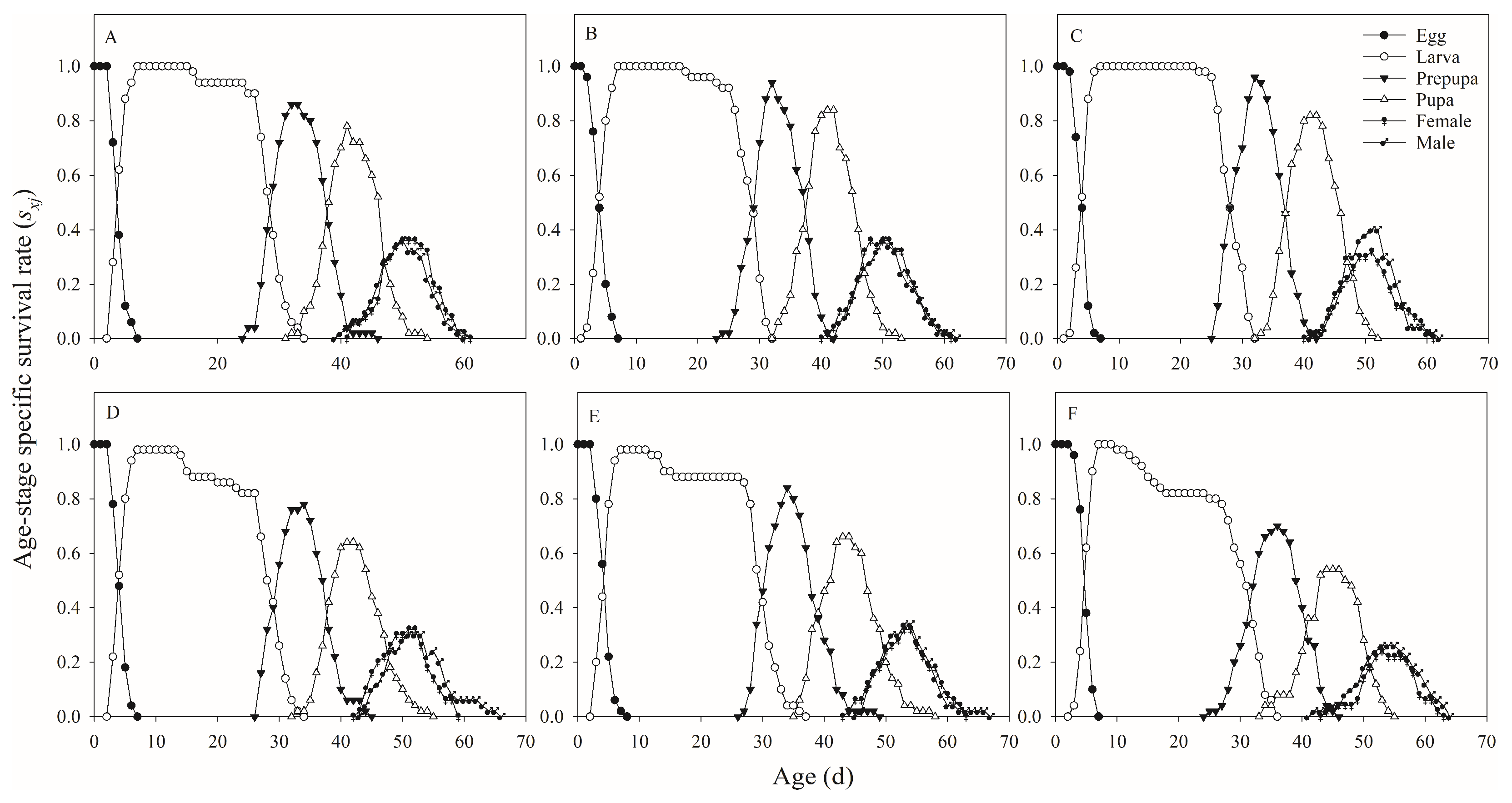
Figure 2.
Age-specific survival rates (lx), age-stage-specific fecundities (fx5), age-specific fecundities (mx), age-specific net fecundities (lxmx) and cumulative reproductive rate (Rx) of Hermetia illucens in control (A), 1% (B), 2% (C), 3% (D), 4% (E), and 5% (F).
Figure 2.
Age-specific survival rates (lx), age-stage-specific fecundities (fx5), age-specific fecundities (mx), age-specific net fecundities (lxmx) and cumulative reproductive rate (Rx) of Hermetia illucens in control (A), 1% (B), 2% (C), 3% (D), 4% (E), and 5% (F).
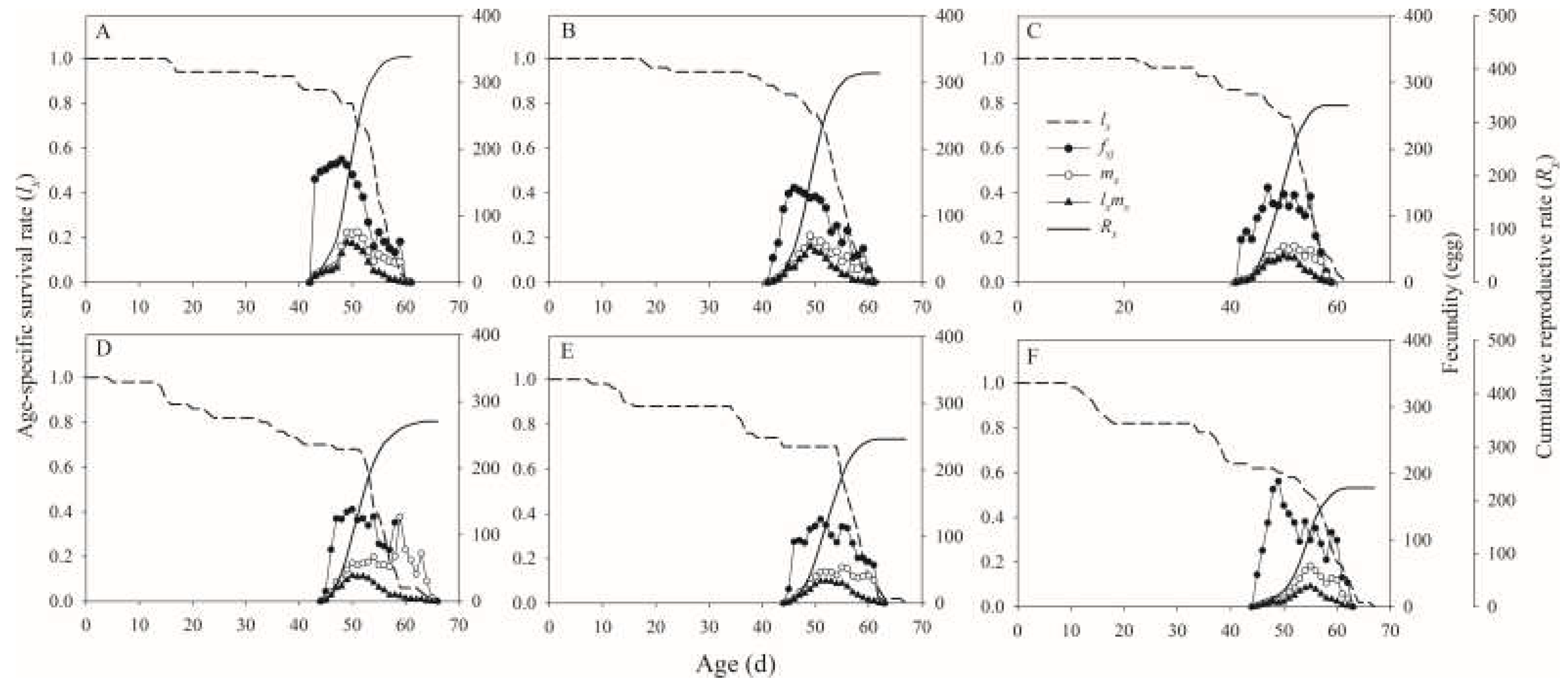
Figure 3.
Age-stage life expectancies (exj) of Hermetia illucens in control (A), 1% (B), 2% (C), 3% (D), 4% (E), and 5% (F).
Figure 3.
Age-stage life expectancies (exj) of Hermetia illucens in control (A), 1% (B), 2% (C), 3% (D), 4% (E), and 5% (F).
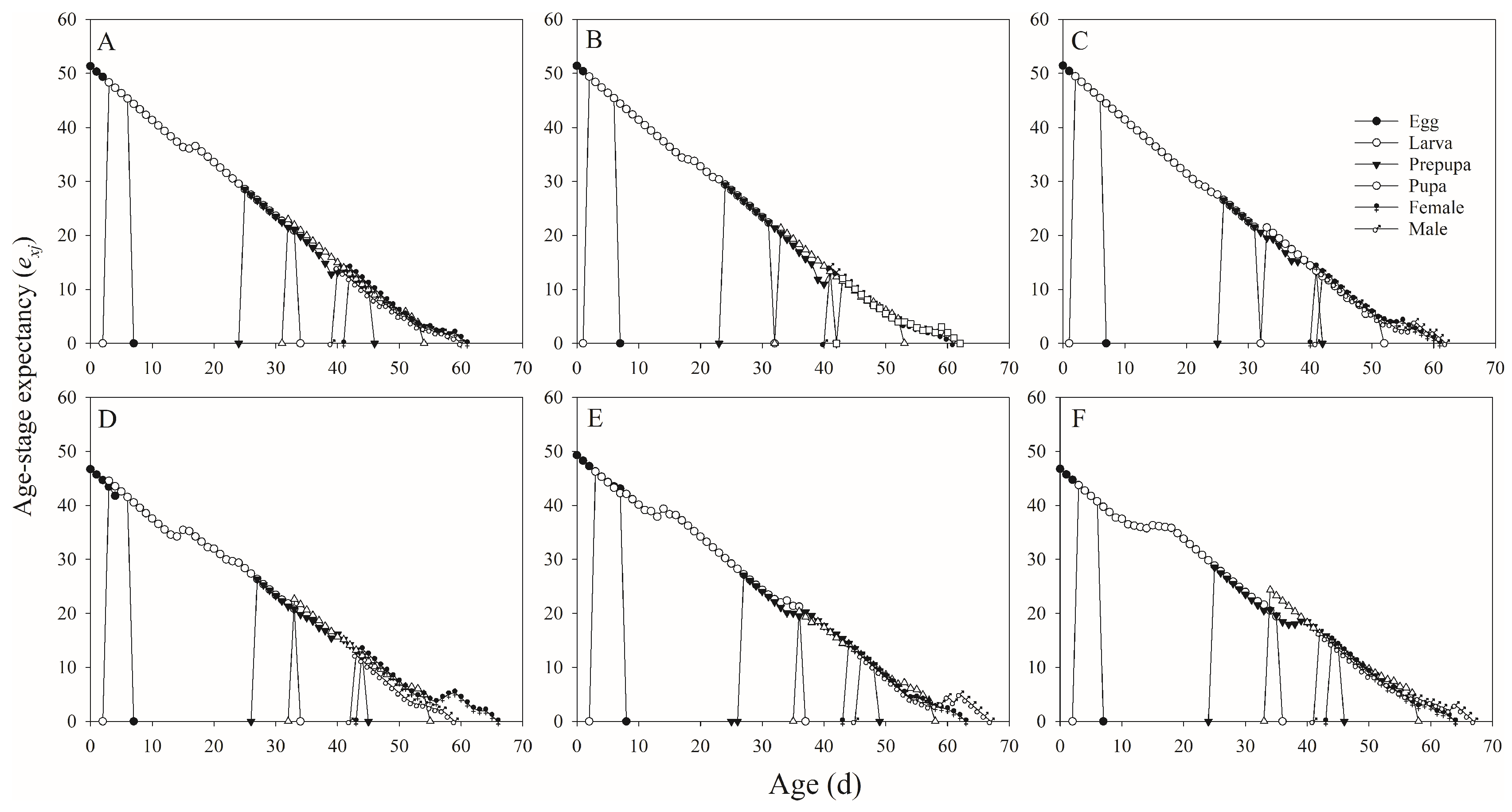
Figure 4.
Age-stage reproductive values (vxj) of Hermetia illucens in control (A), 1% (B), 2% (C), 3% (D), 4% (E), and 5% (F).
Figure 4.
Age-stage reproductive values (vxj) of Hermetia illucens in control (A), 1% (B), 2% (C), 3% (D), 4% (E), and 5% (F).
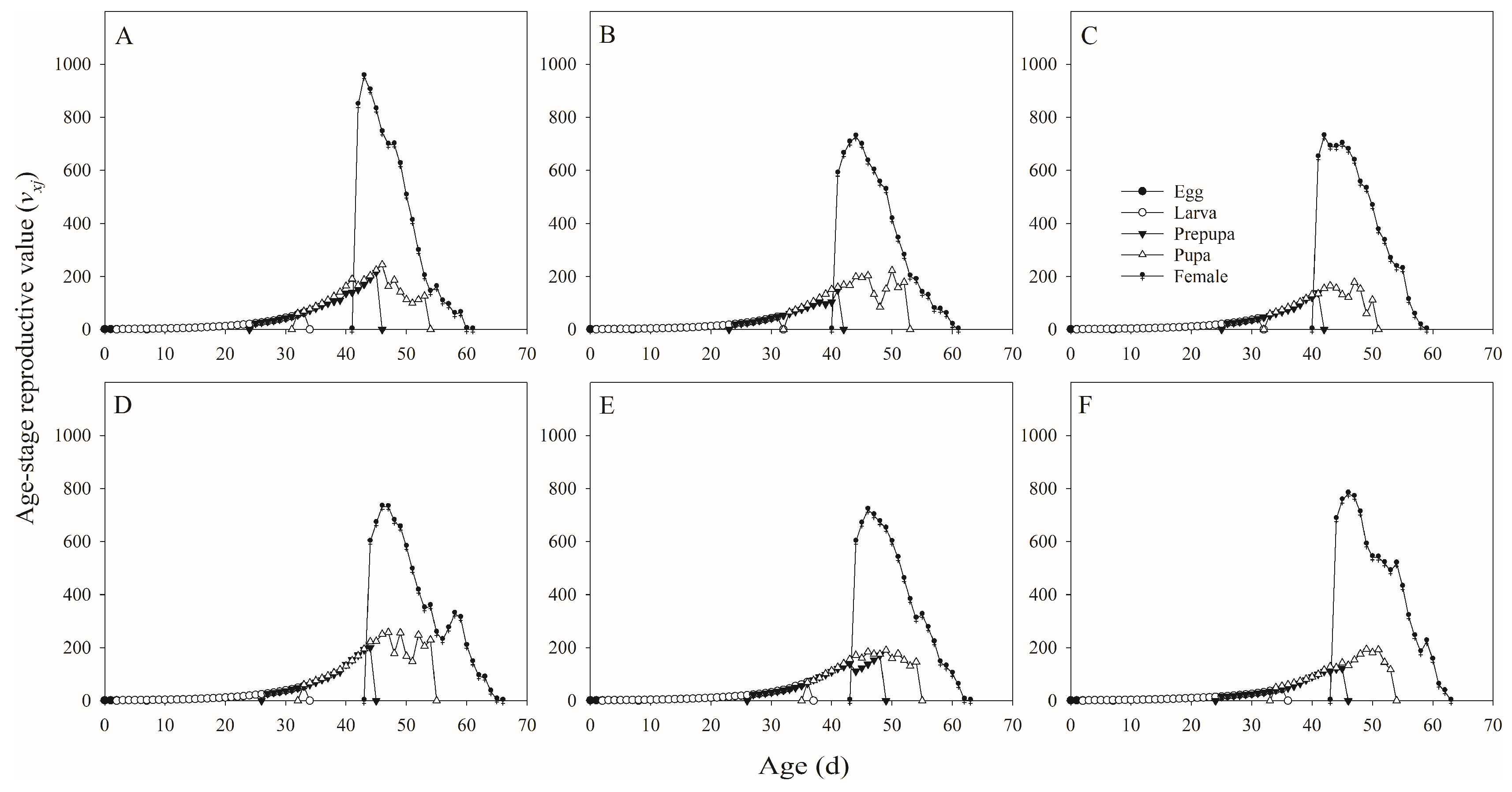
Figure 5.
Age-specific consumption rates (kx), age-specific net consumption rates (qx) and cumulative consumption rates (Cx) of Hermetia illucens in control (A), 1% (B), 2% (C), 3% (D), 4% (E), and 5% (F).
Figure 5.
Age-specific consumption rates (kx), age-specific net consumption rates (qx) and cumulative consumption rates (Cx) of Hermetia illucens in control (A), 1% (B), 2% (C), 3% (D), 4% (E), and 5% (F).
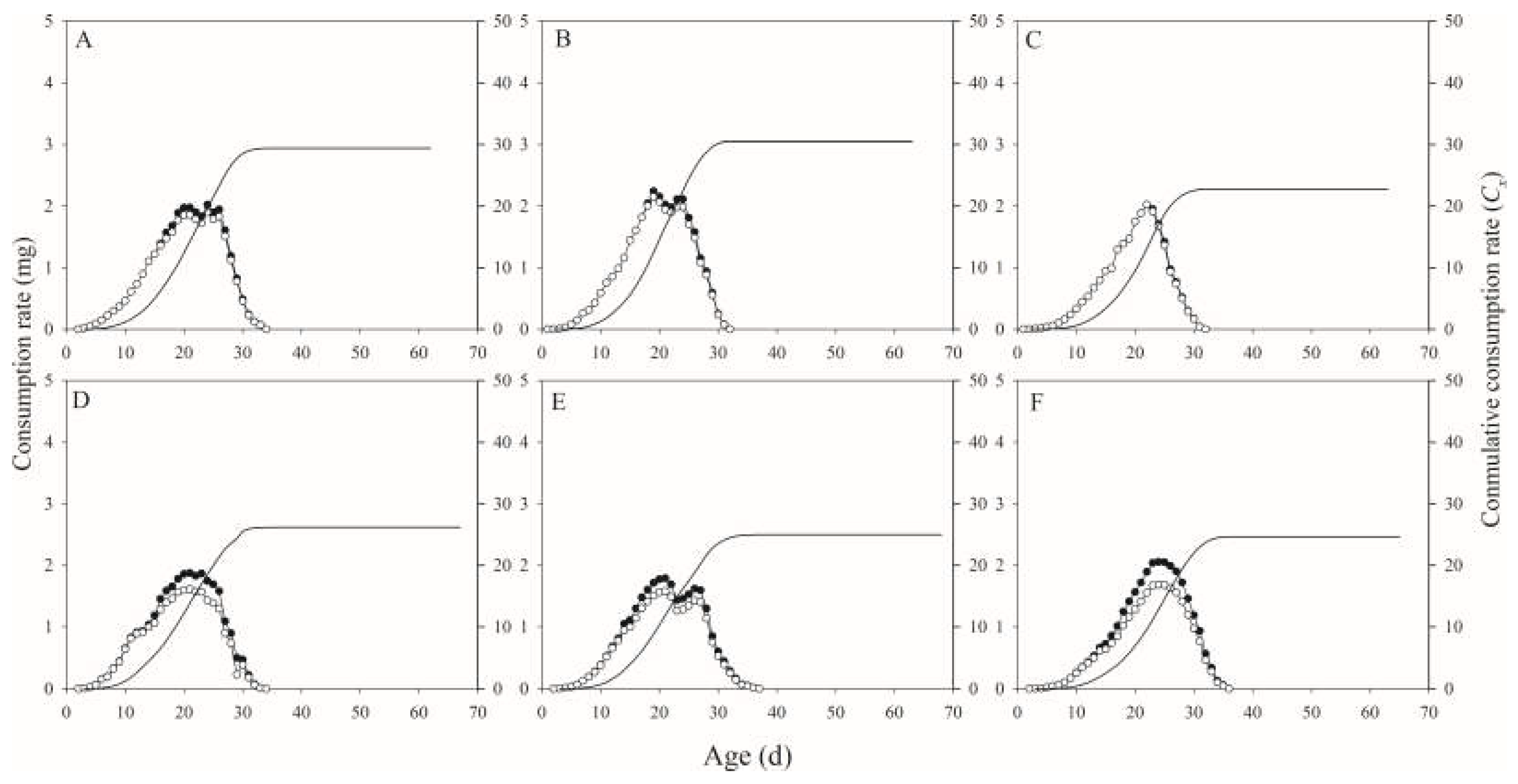

Table 1.
Definition and formulas used to calculate the effect of salinity on the population parameters and consumption rate of Hermetia illucens.
Table 1.
Definition and formulas used to calculate the effect of salinity on the population parameters and consumption rate of Hermetia illucens.
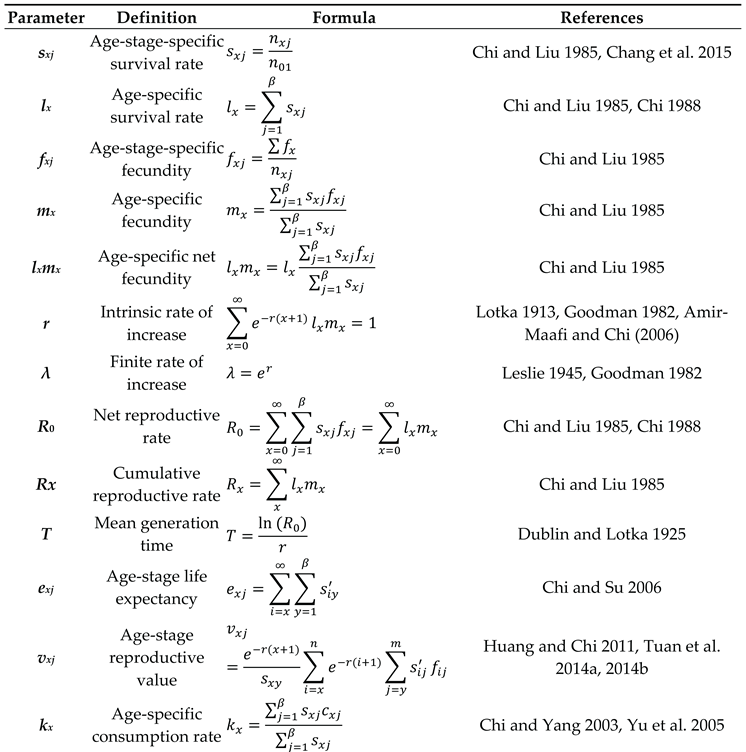
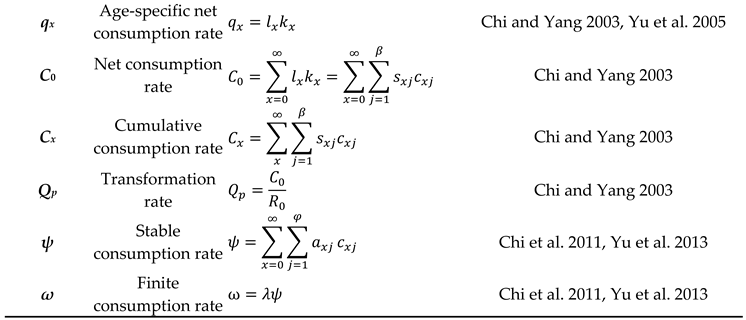
Note: axj is the proportion of individuals belonging to age x and stage j in a stable age-stage distribution.
Table 2.
Effect of foodstuff salinity on the development and fecundity of Hermetia illucens.
| Stage | CK | 1% | 2% | 3% | 4% | 5% | |||||||
|---|---|---|---|---|---|---|---|---|---|---|---|---|---|
| n | Mean ± SE | n | Mean ± SE | n | Mean ± SE | n | Mean ± SE | n | Mean ± SE | n | Mean ± SE | ||
| Male | Egg (d) | 21 | 4.2 ± 0.2 a | 19 | 4.3 ± 0.3 a | 22 | 4.2 ± 0.2 a | 17 | 4.4 ± 0.3 a | 18 | 5.2 ± 0.3 b | 17 | 5.5 ± 0.2 b |
| Larva (d) | 21 | 25.0 ± 0.3 ab | 19 | 24.6 ± 0.4 a | 22 | 25.0 ± 0.4 ab | 17 | 24.8 ± 0.4 ab | 18 | 25.8 ± 0.5 bc | 17 | 26.6 ± 0.6 c | |
| Prepupa (d) | 21 | 8.9 ± 0.3 ab | 19 | 8.5 ± 0.3 a | 22 | 9.0 ± 0.2 b | 17 | 8.9 ± 0.3 ab | 18 | 9.3 ± 0.3 b | 17 | 9.4 ± 0.4 b | |
| Pupa (d) | 21 | 8.1 ± 0.3 a | 19 | 9.0 ± 0.3 bc | 22 | 9.1 ± 0.3 bc | 17 | 8.4 ± 0.4 ab | 18 | 9.3 ± 0.3 c | 17 | 9.0 ± 0.3 bc | |
| Adult (d) | 21 | 8.2 ± 0.4 a | 19 | 8.8 ± 0.4 a | 22 | 8.2 ± 0.3 a | 17 | 8.8 ± 0.3 a | 18 | 8.7 ± 0.3 a | 17 | 8.7 ± 0.3 a | |
| longevity (d) | 21 | 54.4 ± 0.7 a | 19 | 55.2 ± 0.7 a | 22 | 55.1 ± 0.6 a | 17 | 57.5 ± 0.9 b | 18 | 58.3 ± 0.7 b | 17 | 59.1 ± 1.0 b | |
| Female | Egg (d) | 20 | 4.4 ± 0.3 a | 21 | 4.5 ± 0.3 a | 17 | 4.0 ± 0.2 a | 17 | 4.4 ± 0.2 a | 17 | 4.8 ± 0.2 a | 17 | 5.6 ± 0.3 b |
| Larva (d) | 20 | 24.8 ± 0.5 b | 21 | 24.5 ± 0.4 b | 17 | 23.7 ± 0.3 a | 17 | 25.8 ± 0.4c | 17 | 26.3 ± 0.3 c | 17 | 25.9 ± 0.7 c | |
| Prepupa (d) | 20 | 8.9 ± 0.3 ab | 21 | 8.4 ± 0.3 a | 17 | 9.1 ± 0.4 ab | 17 | 8.9 ± 0.3 ab | 17 | 8.9 ± 0.4 ab | 17 | 9.2 ± 0.3 b | |
| Pupa (d) | 20 | 8.9 ± 0.3 ab | 21 | 8.8 ± 0.3 ab | 17 | 9.4 ± 0.3 bc | 17 | 8.4 ± 0.4 a | 17 | 9.4 ± 0.3 bc | 17 | 9.5 ± 0.4 c | |
| Adult (d) | 20 | 9.3 ± 0.4 a | 21 | 9.1 ± 0.3 a | 17 | 9.2 ± 0.3 a | 17 | 8.8 ± 0.3 a | 17 | 9.3 ± 0.3 a | 17 | 9.1 ± 0.4 a | |
| longevity (d) | 20 | 56.1 ± 0.5 b | 21 | 55.3 ± 0.7 a | 17 | 55.4 ± 0.8 ab | 17 | 57.5 ± 0.9 bc | 17 | 58.4 ± 0.7 c | 17 | 59.2 ± 0.9 c | |
| Reproduction period (d) | 20 | 7.4 ± 0.2 ab | 21 | 7.1 ± 0.2 a | 17 | 7.7 ± 0.3 bc | 17 | 8.0 ± 0.3 c | 17 | 7.7 ± 0.3 bc | 17 | 7.4 ± 0.4 ab | |
| Progeny (egg/female) | 20 | 1056.9 ± 24.5 a | 21 | 935.2 ± 33.3 bc | 17 | 977.2 ± 26.1 ab | 17 | 993.6 ± 46.1 ab | 17 | 905.2 ± 33.3 cd | 17 | 858.9 ± 26.0 d | |
Different letters in the same row mean significant difference (paired bootstrap test, P<0.05).
Table 3.
Effect of foodstuff salinity on the population parameters of Hermetia illucens.
| Parameters | CK | 1% | 2% | 3% | 4% | 5% |
|---|---|---|---|---|---|---|
| Intrinsic rate of increase, rm (d-1) | 0.1199 ± 0.0040 a | 0.1190 ± 0.0038 ab | 0.1152 ± 0.0043 abc | 0.1110 ± 0.0043 bc | 0.1076 ± 0.0043 bcd | 0.0989 ± 0.0050 d |
| Finite rate of increase, λ (d-1) | 1.1274 ± 0.0045 a | 1.1264 ± 0.0043 ab | 1.1221 ± 0.0040 abc | 1.1174± 0.0047 bc | 1.1136 ± 0.0048 cd | 1.1040± 0.0056 d |
| Net reproductive rate, R0 (egg) | 422.8 ± 43.9 a | 392.8 ± 36.8 ab | 332.2 ± 36.1 bc | 337.6 ± 28.3 bc | 307.8 ± 21.6 cd | 223.3 ± 20.1 d |
| Mean generation time, T (d) | 50.4 ± 0.6 c | 50.2 ± 0.6 c | 50.4 ± 0.7 c | 52.4 ± 0.7 b | 53.2 ± 0.7 ab | 54.7 ± 1.0 a |
Different letters in the same row mean significant difference (paired bootstrap test, P<0.05).
Table 4.
Effect of foodstuff salinity on the net consumption rate, transformation rate, stable consumption rate, and finite consumption rate of Hermetia illucens.
Table 4.
Effect of foodstuff salinity on the net consumption rate, transformation rate, stable consumption rate, and finite consumption rate of Hermetia illucens.
| Population parameter | CK | 1% | 2% | 3% | 4% | 5% |
|---|---|---|---|---|---|---|
| Net consumption rate (C0) (mg) | 29.4 ± 1.1 a | 30.49 ± 1.0 a | 22.73 ± 1.3 c | 26.2 ± 1.6 b | 25.0 ± 1.4 b | 24.6 ± 1.7 b |
| Transformation rate (Qp) (mg per egg) | 0.0803 ± 0.0147 ab | 0.0754 ± 0.0145 ab | 0.0611 ± 0.0125 a | 0.0775 ± 0.0173 ab | 0.0812 ± 0.0176 ab | 0.1186 ± 0.0348 b |
| Stable consumption rate (ψ) (mg) | 0.3765 ± 0.0188 bc | 0.4176 ± 0.0188 a | 0.2965 ± 0.0153 e | 0.3979 ± 0.0167 ab | 0.3451 ± 0.0178 cd | 0.3102 ± 0.0168 de |
| Finite consumption rate (ω) (mg/d) | 0.4245 ± 0.0216 bc | 0.4704 ± 0.0209 a | 0.3327 ± 0.0172 d | 0.4446 ± 0.0192 ab | 0.3843 ± 0.0205 c | 0.3425 ± 0.0187 d |
Different letters in the same row mean significant difference (paired bootstrap test, P<0.05).
Table 5.
Effect of foodstuff salinity on the nutrients of dried Hermetia illucens prepupa (g·kg-1 LPM).
Table 5.
Effect of foodstuff salinity on the nutrients of dried Hermetia illucens prepupa (g·kg-1 LPM).
| Nutritional components | CK | 1% | 2% | 3% | 4% | 5% |
|---|---|---|---|---|---|---|
| Ash content | 32.0 ± 0.9 a | 32.5 ± 0.7 a | 36.6 ± 0.8 ab | 41.0 ± 1.4 bc | 42.6 ± 1.4 c | 43.0 ± 1.1 c |
| Crude fat | 387.5 ± 3.08 a | 377.3 ± 4.7 ab | 364.6 ± 2.6 bc | 352.5 ± 3.7 cd | 346.6 ± 3.7 d | 336.3 ± 4.3 d |
| Crude protein | 446.3 ± 3.3 a | 430.6 ± 2.6 b | 423.3 ± 3.2 bc | 415.4 ± 2.6 cd | 410.8 ± 2.8 cd | 409.8 ± 3.6 d |
Mean ± SE was calculated from five biological replicates. Different lowercase letters in same row showed the significant difference (LSD, P<0.05). LPM: lyophilized prepupa matter.
Table 6.
Effect of foodstuff salinity on the fatty acids composition of dried Hermetia illucens prepupa (g·kg-1 LPM).
Table 6.
Effect of foodstuff salinity on the fatty acids composition of dried Hermetia illucens prepupa (g·kg-1 LPM).
| Type of fatty acid | CK | 1% | 2% | 3% | 4% | 5% |
|---|---|---|---|---|---|---|
| Decanoic acid (C10:0) | 23.7 ± 0.9 a | 23.0 ± 0.9 a | 22.5 ± 0.8 a | 22.4 ± 1.4 a | 21.1 ± 0.8 a | 20.8 ± 1.1 a |
| Lauric acid (C12:0) | 552.8 ± 6.2 a | 544.8 ± 8.6 ab | 538.2 ± 4.1 ab | 533.8 ± 8.2 b | 532.0 ± 3.5 b | 525.9 ± 2.2 b |
| Myristic acid (C14:0) | 93.8 ± 0.9 a | 87.9 ± 1.8 ab | 82.9 ±1.8 bc | 81.0 ± 2.5 cd | 78.1 ± 1.3 cd | 76.0 ± 1.7 d |
| Palmitic acid (C16:0) | 117.6 ± 4.0 a | 105.2 ± 2.5 b | 101.6 ± 1.7 b | 94.1 ± 1.6 c | 92.4 ± 2.1 c | 83.7 ± 0.9 d |
| Palmitoleic acid (C16:1) | 25.7 ± 0.9 a | 25.0 ± 0.8 ab | 22.7 ± 0.7 abc | 21.6 ± 0.8 bc | 21.2 ± 0.9 c | 21.0 ± 1.2 c |
| Stearic acid (C18:0) | 17.7 ± 0.6 a | 16.8 ± 0.5 a | 17.7 ± 0.3 a | 16.3 ± 0.2 a | 16.1 ± 0.5 a | 16.0 ± 0.6 a |
| Oleic acid (C18:1n9c) | 73.9 ± 1.7 a | 68.4 ± 1.2 b | 65.2 ± 0.9 bc | 64.5 ± 1.0 bc | 62.5 ± 0.6 c | 62.1 ± 0.9 c |
| Linoleic acid (C18:2n6c) | 108.9 ± 1.0 a | 103.4 ± 2.3 a | 106.7 ± 2.6 a | 99.8 ± 2.7 a | 99.4 ± 3.5 a | 97.7 ± 2.9 a |
Mean ± SE was calculated from five biological replicates. Different lowercase letters in same row showed the significant difference (LSD, P<0.05). FAME: fatty acid methyl esters.
Table 7.
Effect of foodstuff salinity on the amino acid composition of dried Hermetia illucens prepupa (g·kg-1 LPM).
Table 7.
Effect of foodstuff salinity on the amino acid composition of dried Hermetia illucens prepupa (g·kg-1 LPM).
| Amino acid | CK | 1% | 2% | 3% | 4% | 5% | |
|---|---|---|---|---|---|---|---|
| Non-essential amino acid | Glutamic acid | 41.5 ± 0.5 a | 41.1 ± 0.3 a | 41.1 ± 0.4 a | 41.0 ± 0.2 a | 40.6 ± 0.22 a | 40.44 ± 0.40 a |
| Aspartate | 38.6 ± 0.4 a | 38.4 ± 0.3 ab | 38.0 ± 0.1 abc | 37.3 ± 0.2 bc | 37.4 ± 0.3 c | 37.2 ± 0.3 c | |
| Alanine | 25.4 ± 0.4 a | 24.3 ± 0.6 ab | 23.9 ± 0.3 b | 23.8 ± 0.3 b | 23.8 ± 0.4 b | 23.5 ± 0.2 b | |
| Glycine | 22.6 ± 0.3 a | 22.6 ± 0.4 a | 22.4 ± 0.5 a | 22.0 ± 0.4 a | 21.3 ± 0.4 a | 20.9 ± 0.5 a | |
| Proline | 21.5 ± 0.3 a | 20.8 ± 0.3 ab | 20.7 ± 0.5 ab | 19.9 ± 0.2 b | 20.1 ± 0.4 b | 19.8 ± 0.3 b | |
| Arginine | 21.8 ± 0.5 a | 21.2 ± 0.4 a | 20.8 ± 0.5 a | 20.2 ± 0.5 a | 20.1 ± 0.2 a | 20.2 ± 0.3 a | |
| Serine | 20.0 ± 0.2 a | 19.2 ± 0.4 ab | 18.9 ± 0.3 ab | 18.7 ± 0.3 ab | 18.5 ± 0.5 ab | 18.3 ± 0.4 b | |
| Histidine | 15.4 ± 0.5 a | 14.4 ± 0.3 ab | 14.3 ± 0.2 b | 14.1 ± 0.2 b | 14.1 ± 0.3 b | 13.5 ± 0.2 b | |
| Cystine | 2.5 ± 0.1 a | 2.2 ± 0.1 a | 2.2 ± 0.2 a | 1.9 ± 0.1 a | 2.1 ± 0.2 a | 2.1 ± 0.2 a | |
| Essential amino acid | Leucine | 28.2 ± 0.4 a | 27.4 ± 0.2 ab | 26.8 ± 0.9 ab | 26.8 ± 0.5 ab | 25.9 ± 0.4 ab | 25.3 ± 0.4 b |
| Lysine | 25.2 ± 0.3 a | 24.3 ± 0.3 ab | 23.7 ± 0.8 abc | 23.0 ± 0.5 bc | 22.6 ± 0.6 bc | 21.7 ± 0.5 c | |
| Valine | 18.6 ± 0.4 a | 18.2 ± 0.4 a | 17.9 ± 0.2 a | 17.9 ± 0.2 a | 17.4 ± 0.3 a | 17.4 ± 0.3 a | |
| Threonine | 18.2 ± 0.4 a | 17.9 ± 0.2 ab | 17.7 ± 0.3 abc | 17.2 ± 0.2 abc | 16.8 ± 0.2 bc | 16.6 ± 0.4 c | |
| Isoleucine | 18.5 ± 0.3 a | 17.7 ± 0.2 ab | 17.4 ± 0.2 ab | 17.4 ± 0.3 ab | 16.9 ± 0.3 ab | 16.6 ± 0.3 b | |
| Phenylalanine | 18.2 ± 0.5 a | 18.2 ± 0.3 a | 17.1 ± 0.5 a | 18.2 ± 0.3 a | 17.5 ± 0.4 a | 17.6 ± 0.3 a | |
| Methionine | 8.3 ± 0.2 a | 7.9 ± 0.3 a | 8.0 ± 0.3 a | 7.7 ± 0.3 a | 7.7 ± 0.2 a | 7.9 ± 0.2 a | |
| Tryptophan | 7.6 ± 0.2 a | 7.4 ± 0.2 a | 7.4 ± 0.2 a | 7.6 ± 0.2 a | 7.4 ± 0.2 a | 7.4 ± 0.2 a | |
Mean ± SE was calculated from five biological replicates. Different lowercase letters in same row showed the significant difference (LSD, P<0.05). LPM: lyophilized prepupa matter.
Table 8.
Effect of foodstuff salinity on the mineral composition of dried Hermetia illucens prepupa (g·kg-1 LPM).
Table 8.
Effect of foodstuff salinity on the mineral composition of dried Hermetia illucens prepupa (g·kg-1 LPM).
| Element | CK | 1% | 2% | 3% | 4% | 5% |
|---|---|---|---|---|---|---|
| Ca | 20.52 ± 0.99 a | 23.12 ± 0.63 ab | 24.55 ± 1.75 b | 25.94 ± 0.48 b | 26.26 ± 0.70 b | 27.10 ± 0.88 b |
| K | 6.86 ± 0.16 a | 7.02 ± 0.18 ab | 7.20 ± 0.25 ab | 7.70 ± 0.20 bc | 7.82 ± 0.20 bc | 8.26 ± 0.19 c |
| P | 3.36 ± 0.11 a | 3.76 ± 0.16 ab | 3.82 ± 0.18 ab | 3.88 ± 0.12 ab | 4.04 ± 0.20 b | 4.12 ± 0.07 b |
| Mg | 2.52 ± 0.11 a | 2.56 ± 0.11 a | 2.72 ± 0.10 a | 2.76 ± 0.13 a | 2.92 ± 0.14 a | 3.04 ± 0.19 a |
| Fe | 0.58 ± 0.04 a | 0.69 ± 0.06 ab | 0.69 ± 0.04 ab | 0.78 ± 0.04 ab | 0.74 ± 0.05 b | 0.77 ± 0.02 b |
| Na | 0.55 ± 0.02 a | 0.59 ± 0.04 a | 0.60 ± 0.03 a | 0.55 ± 0.03 a | 0.59 ± 0.02 a | 0.63 ± 0.3 a |
| S | 0.20 ± 0.01 a | 0.22 ± 0.01 ab | 0.28 ± 0.02 b | 0.29 ± 0.02 b | 0.28 ± 0.01 b | 0.28 ± 0.02 b |
| Mn | 0.14 ± 0.01 a | 0.18 ± 0.01 abc | 0.18 ± 0.01 ab | 0.22 ± 0.01 bc | 0.25 ± 0.03 c | 0.24 ± 0.01 bc |
| Zn | 0.12 ± 0.01 a | 0.14 ± 0.01 ab | 0.14 ± 0.01 ab | 0.15 ± 0.01 ab | 0.17 ± 0.01 b | 0.17 ± 0.01 b |
| Cu | 0.01 ± 0.01 a | 0.01 ± 0.01 a | 0.01 ± 0.01 a | 0.01 ± 0.01 a | 0.01 ± 0.01 a | 0.01 ± 0.01 a |
Mean ± SE was calculated from five biological replicates. Different lowercase letters in same row showed the significant difference (LSD, P<0.05). LPM: lyophilized prepupa matter.
Disclaimer/Publisher’s Note: The statements, opinions and data contained in all publications are solely those of the individual author(s) and contributor(s) and not of MDPI and/or the editor(s). MDPI and/or the editor(s) disclaim responsibility for any injury to people or property resulting from any ideas, methods, instructions or products referred to in the content. |
© 2026 by the authors. Licensee MDPI, Basel, Switzerland. This article is an open access article distributed under the terms and conditions of the Creative Commons Attribution (CC BY) license.
Copyright: This open access article is published under a Creative Commons CC BY 4.0 license, which permit the free download, distribution, and reuse, provided that the author and preprint are cited in any reuse.


