

Submitted:
08 April 2026
Posted:
09 April 2026
You are already at the latest version
Abstract
Plant steroid hormones, namely brassinosteroids (BRs), govern growth and resilience to environmental stress, yet little is known about how BR-signaling kinases (BSKs) operate in non-model horticultural species. Here, we carried out a whole-genome interrogation of the BSK family in Brassica rapa subsp. chinensis and examined its potential involvement in high-temperature stress responses. The search yielded 20 BcBSK members, each featuring a conserved kinase domain at the N-terminus and TPR repeats at the C-terminus. Phylogenetic reconstruction assigned them to separate subgroups, while collinearity assessment detected 16 duplicated gene pairs evolving under strong selection constraints. Upstream regulatory sequences harbored numerous cis-motifs linked to hormonal signals and stress perception. Interactome modeling pinpointed BcBSK2, BcBSK5, BcBSK14, and BcBSK18 as hub components. RNA-seq analysis under elevated temperature (38℃) uncovered distinct expression behaviors between cultivars: in the susceptible line “Aijiaohuang”, BcBSK1 and BcBSK2 transcripts increased sharply, whereas the resistant line “SHI” exhibited little fluctuation. Quantitative PCR results aligned with the RNA-seq findings. Exogenous application of 0.5 mg·L⁻¹ BR improved the activities of catalase, peroxidase, and superoxide dismutase, boosted proline levels, lowered malondialdehyde content, and preserved chlorophyll and carotenoid concentrations under heat exposure. Taken together, these data imply that BcBSK family members contribute to BR-facilitated heat adaptation by orchestrating changes at both transcript and metabolite levels, thus laying a groundwork for genetic enhancement of thermotolerance in this vegetable species.
Keywords:
Brassica rapa subsp. chinensis
; BR-signaling kinase genes
; high-temperature stress
; brassinosteroid hormones
; expression dynamics
; stress physiology
1. Introduction
Non-heading Chinese cabbage (NHCC, Brassica rapa subsp. chinensis) is an important leafy vegetable widely cultivated in China. It is characterized by a short growth cycle and high yield; however, it is highly sensitive to temperature fluctuations. Exposure to high temperatures often results in growth inhibition and deterioration of leaf quality, ultimately reducing yield and marketability [1,2]. Therefore, understanding the molecular mechanisms underlying heat stress responses in NHCC is essential for the development of heat-tolerant cultivars.
Phytohormone signaling pathways play central roles in plant adaptation to high temperature and other abiotic stresses. Among these, brassinosteroids (BRs), a class of plant steroidal hormones, are key regulators involved in diverse developmental processes and stress responses [3,4,5]. BR signaling is initiated when the plasma membrane receptor BRI1 perceives BR ligands and subsequently forms a complex with the co-receptor BAK1, triggering phosphorylation events. The signal is then transduced through a cascade of cytoplasmic components, ultimately regulating the activity of BZR/BES transcription factors and controlling downstream gene expression [6,7,8,9]. Within this pathway, BR-signaling kinases (BSKs), as direct substrates of BRI1, function at an early stage of signal transduction, linking membrane receptors to downstream signaling networks and acting as critical regulatory hubs [10,11].
BSK proteins belong to the RLCK-XII subfamily of receptor-like cytoplasmic kinases and typically contain an N-terminal protein kinase catalytic domain and C-terminal tetratricopeptide repeat (TPR) motifs [3,12,13,14]. This modular structure enables BSKs to integrate kinase activity with protein–protein interactions during signal transduction. Evolutionary analyses have shown that the BSK gene family exhibits lineage-specific diversification in plants. Distinct subgroups differ in species composition, with some clades enriched in monocots or dicots, whereas complete BSK homologs are absent in lower plants [3,15].
Functionally, BSK family members display considerable diversity. In Arabidopsis thaliana, twelve BSK proteins participate not only in BR signaling but also in root development, low-nitrogen responses, and immune regulation [16,17,18]. For example, BSK1 directly interacts with the immune receptor FLS2 and is involved in plant immune responses [19,20,21], whereas BSK5 participates in salt stress responses and abscisic acid (ABA) signaling [22,23]. In rice, OsBSK1-2 positively regulate immune resistance [24,25], and OsBSK2 controls grain size independently of BR signaling [26]. These findings highlight the multifunctional roles of BSK proteins in coordinating plant growth, development, and stress adaptation.
Despite these advances, a systematic understanding of BSK functions under specific stress conditions remains limited. In particular, although exogenous BR application has been shown to enhance plant thermotolerance [27,28,29,30], the roles of key components in BR signal transduction during heat stress are still unclear. As early components of the BR signaling pathway, whether BSK family members exhibit functional differentiation in heat stress responses remains to be elucidated. Moreover, most existing studies have focused on model plants, and evidence from vegetable crops such as NHCC is still scarce.
In this study, the BSK gene family in NHCC was identified at the whole-genome level. By integrating transcriptomic and physiological data, the expression patterns of BSK genes under heat stress were analyzed. Furthermore, gene family characterization, expression profiling, and physiological responses were combined to compare functional differences among individual members and to explore their associations with physiological changes induced by exogenous BR treatment. This study provides new insights into the functional divergence of BSK family members and offers a theoretical basis for elucidating the molecular mechanisms of BR-mediated heat stress responses, thereby contributing to the improvement of heat tolerance in NHCC.
2. Materials and Methods
2.1. Identification and Physicochemical Characterization of the BcBSK Gene Family
To identify members of the BcBSK gene family in NHCC, a combined approach integrating sequence homology searches and domain-based screening was applied. First, twelve reported AtBSK protein sequences from Arabidopsis thaliana were used as queries [3], and a local BLASTP search was performed against the NHCC protein database with an E-value threshold of 1e−100 to obtain candidate homologs. Subsequently, hidden Markov models (HMMs) corresponding to PF07714 and PF25575 from the Pfam database were employed to scan the proteome using HMMER to identify additional candidates.
The results from BLASTP and HMMER were integrated, and candidate sequences were subjected to conserved domain validation. Domain annotation was performed using the Conserved Domain Database (CDD) and InterProScan, and only sequences confirmed by both methods to contain complete characteristic domains of the BSK family were retained as final members.
Physicochemical properties, including amino acid length, molecular weight (MW), and theoretical isoelectric point (pI), were predicted using the ExPASy ProtParam tool. Subcellular localization was predicted using DeepLoc 2.1.
2.2. Phylogenetic Analysis of the BcBSK Gene Family
Multiple sequence alignment of BSK proteins was conducted using BioEdit. The aligned sequences were then used to construct a phylogenetic tree using IQ-TREE (v2.4.0) based on the maximum likelihood (ML) method.
The optimal substitution model was selected using ModelFinder according to the Bayesian Information Criterion (BIC), with Q. plant+G4 identified as the best-fit model. Branch support was assessed using the ultrafast bootstrap method with 1000 replicates. The resulting tree was visualized and edited using iTOL (Interactive Tree Of Life).
2.3. Chromosomal Localization, Synteny, and Ka/Ks Analysis
Chromosomal locations of BcBSK genes were determined using TBtools [31]. Intraspecies synteny analysis was performed using the “One Step MCScanX” function in TBtools to identify collinear gene pairs and duplicated regions.
To evaluate selection pressure, nonsynonymous substitution rates (Ka), synonymous substitution rates (Ks), and their ratios (Ka/Ks) were calculated using KaKs_Calculator 3.0 [32]. A Ka/Ks ratio > 1 indicates positive selection, = 1 indicates neutral evolution, and < 1 indicates purifying selection [33].
2.4. Gene Structure and Conserved Domain Analysis
Gene structures and conserved protein features were analyzed based on genome annotation files and corresponding protein sequences of NHCC. Exon–intron structures were visualized using TBtools.
Conserved domains were annotated using InterProScan and the CDD database. Conserved motifs were identified using MEME Suite, with parameters set to a maximum of eight motifs and motif lengths ranging from 6 to 50 amino acids. Phylogenetic relationships, gene structures, motif composition, and domain organization were integrated and visualized using TBtools.
2.5. Cis-Acting Element Analysis
Promoter sequences (2000 bp upstream of the translation start site, ATG) were extracted for each BcBSK gene. Cis-acting regulatory elements were identified using the PlantCARE database. The results were further processed and visualized using TBtools.
2.6. Protein–Protein Interaction Network Analysis
Protein–protein interaction (PPI) networks were constructed using the STRING database (version 11.0). Protein sequences were mapped based on homology using the Chinese cabbage reference genome under default parameters [34]. The interaction data were visualized and analyzed using Cytoscape (version 3.8.0) to evaluate network topology [35].
2.7. Transcriptome Data and Expression Analysis
Expression profiles of BcBSK genes under heat stress were analyzed using RNA-seq data obtained from the NCBI BioProject database (PRJNA1030162). The dataset included samples from the heat-sensitive cultivar “Aijiaohuang” and the heat-tolerant cultivar “SHI” treated at 38 °C for 0, 6, and 24 h.
Gene expression levels were quantified as FPKM (Fragments Per Kilobase of transcript per Million mapped reads). Differentially expressed genes were identified using the thresholds |log₂(fold change)| ≥ 1 and FDR-adjusted p < 0.05. The normalized expression data were visualized as heatmaps using TBtools.
2.8. qRT–PCR Validation
Gene-specific primers were designed using Primer 5.0, and the sequences are listed in Supplementary Table S1. First-strand cDNA was synthesized using the RTase III Primer Flexible All-in-One Mix kit, including genomic DNA removal.
qRT–PCR was performed using a SYBR Green Premix kit in a total reaction volume of 20 μL, containing 1 μL cDNA template, 10 μL Premix, 0.4 μL of each primer (0.2 μM), and 8.2 μL ddH₂O. Each sample included three biological replicates.
The amplification conditions were as follows: 95 °C for 30 s, followed by 40 cycles of 95 °C for 10 s and 60 °C for 30 s. Relative expression levels were calculated using the 2⁻ΔΔCt method.
2.9. Plant Materials, Treatments, and Physiological Measurements
The heat-sensitive cultivar “Aijiaohuang” and the heat-tolerant cultivar “SHI” of NHCC were used in this study. Seeds were provided by the Horticultural Research Institute of the Shanghai Academy of Agricultural Sciences. Heat tolerance identification and transcriptomic data for these materials were derived from previous studies conducted by our research group[36].
Seeds were germinated in a growth chamber under controlled conditions (25/20 °C day/night, 16 h light/8 h dark, light intensity 12,000 lx). At the 4-5 leaf stage, plants were treated by foliar spraying with deionized water (control), 0.10, 0.50, or 1.00 mg·L⁻¹ BR once daily for three consecutive days.
Heat stress was applied on the fourth day (15:00) by transferring plants to 40/30 °C (day/night) conditions with a 12 h photoperiod. Samples were collected at 0, 3, 6, and 9 days after treatment.
Physiological parameters were measured following standard methods [37]. Proline content was determined using the acid ninhydrin method; SOD activity by the nitroblue tetrazolium method; POD activity using the guaiacol method; MDA content using the thiobarbituric acid method; chlorophyll content by ethanol extraction; and CAT activity spectrophotometrically. All measurements were performed on a fresh weight basis with three replicates.
It should be noted that the transcriptomic analysis and physiological experiments were conducted under different heat stress regimes. The RNA-seq data (38 °C, 0-24 h) were used to capture early transcriptional responses, whereas the physiological experiments (40/30 °C, up to 9 d) were designed to evaluate longer-term stress adaptation and the effects of exogenous BR treatment. These complementary approaches enable a comprehensive understanding of both early molecular responses and subsequent physiological changes under heat stress.
2.10. Statistical Analysis
Data were processed using Microsoft Office 2019. Statistical analyses were conducted using SPSS 27, and figures were generated using GraphPad Prism 10.2. Results.
3. Results
3.1. Genome-Wide Identification and Physicochemical Characterization of BcBSK Proteins in NHCC
A total of 20 BcBSK genes were identified in the NHCC genome (Table 1) and were designated BcBSK1 to BcBSK20. The encoded proteins ranged from 465 to 511 amino acids (aa) in length, with molecular weights (MW) of 52.29–57.92 kDa and theoretical isoelectric points (pI) of 5.17–8.74.
The instability index ranged from 34.87 to 50.92, with most proteins exceeding 40. The grand average of hydropathicity (GRAVY) values ranged from − 0.543 to − 0.316. Subcellular localization prediction indicated that all BcBSK proteins were localized to the plasma membrane. The aliphatic index ranged from 67.42 to 82.94, with BcBSK2, BcBSK10, BcBSK12, BcBSK17, BcBSK18, and BcBSK20 showing values above 80.

Table 1.
Characteristics and physicochemical properties of BcBSK gene family members.
| Transcript_ID | Gene ID | Protein length (aa) |
Molecular weight (kDa) |
Theoretical isoelectric point | Instability Index | Aliphatic Index | Grand average of hydropathicity | Subcellular localization |
| BraC01g028750 | BcBSK1 | 465 | 52.287 | 6.25 | 49.54 | 78.32 | -0.389 | Cell membrane |
| BraC10g000250 | BcBSK2 | 486 | 55.019 | 5.97 | 42.01 | 82.94 | -0.325 | Cell membrane |
| BraC09g014070 | BcBSK3 | 485 | 54.199 | 6.05 | 46.21 | 76.12 | -0.429 | Cell membrane |
| BraC10g016170 | BcBSK4 | 491 | 55.008 | 5.71 | 37.45 | 78.9 | -0.35 | Cell membrane |
| BraC08g016140 | BcBSK5 | 505 | 56.470 | 5.58 | 42.02 | 74.63 | -0.471 | Cell membrane |
| BraC09g010080 | BcBSK6 | 466 | 52.702 | 6.51 | 36.65 | 77.68 | -0.405 | Cell membrane |
| BraC10g035500 | BcBSK7 | 491 | 55.838 | 5.46 | 46.72 | 77.52 | -0.401 | Cell membrane |
| BraC09g012510 | BcBSK8 | 488 | 54.734 | 5.96 | 47.37 | 78.83 | -0.411 | Cell membrane |
| BraC03g034580 | BcBSK9 | 506 | 57.918 | 8.74 | 41.99 | 79.25 | -0.325 | Cell membrane |
| BraC01g009520 | BcBSK10 | 496 | 55.837 | 5.35 | 39.34 | 81.59 | -0.370 | Cell membrane |
| BraC04g006170 | BcBSK11 | 490 | 55.099 | 6.26 | 36.49 | 78.08 | -0.392 | Cell membrane |
| BraC05g043990 | BcBSK12 | 491 | 55.546 | 5.48 | 46.43 | 80.26 | -0.354 | Cell membrane |
| BraC03g044980 | BcBSK13 | 465 | 52.416 | 5.17 | 42.61 | 78.67 | -0.334 | Cell membrane |
| BraC01g003110 | BcBSK14 | 511 | 57.058 | 5.66 | 40.16 | 67.42 | -0.543 | Cell membrane |
| BraC01g045810 | BcBSK15 | 490 | 55.514 | 6.23 | 50.92 | 79.08 | -0.335 | Cell membrane |
| BraC07g032910 | BcBSK16 | 481 | 54.548 | 5.86 | 34.87 | 78.88 | -0.435 | Cell membrane |
| BraC06g048940 | BcBSK17 | 489 | 54.908 | 5.62 | 39.56 | 82.23 | -0.400 | Cell membrane |
| BraC09g001240 | BcBSK18 | 484 | 54.652 | 5.58 | 42.43 | 80.02 | -0.411 | Cell membrane |
| BraC03g030580 | BcBSK19 | 491 | 55.186 | 5.77 | 42.40 | 79.06 | -0.418 | Cell membrane |
| BraC02g011510 | BcBSK20 | 489 | 54.672 | 5.52 | 37.61 | 80.25 | -0.316 | Cell membrane |
1 Protein length, Molecular weight (MW), Theoretical isoelectric point (pI), Instability Index, Aliphatic Index, and Grand average of hydropathicity (GRAVY) were calculated using the ExPASy ProtParam tool. Subcellular localization was predicted using DeepLoc 2.1.
3.2. Phylogenetic Analysis of the BcBSK Gene Family
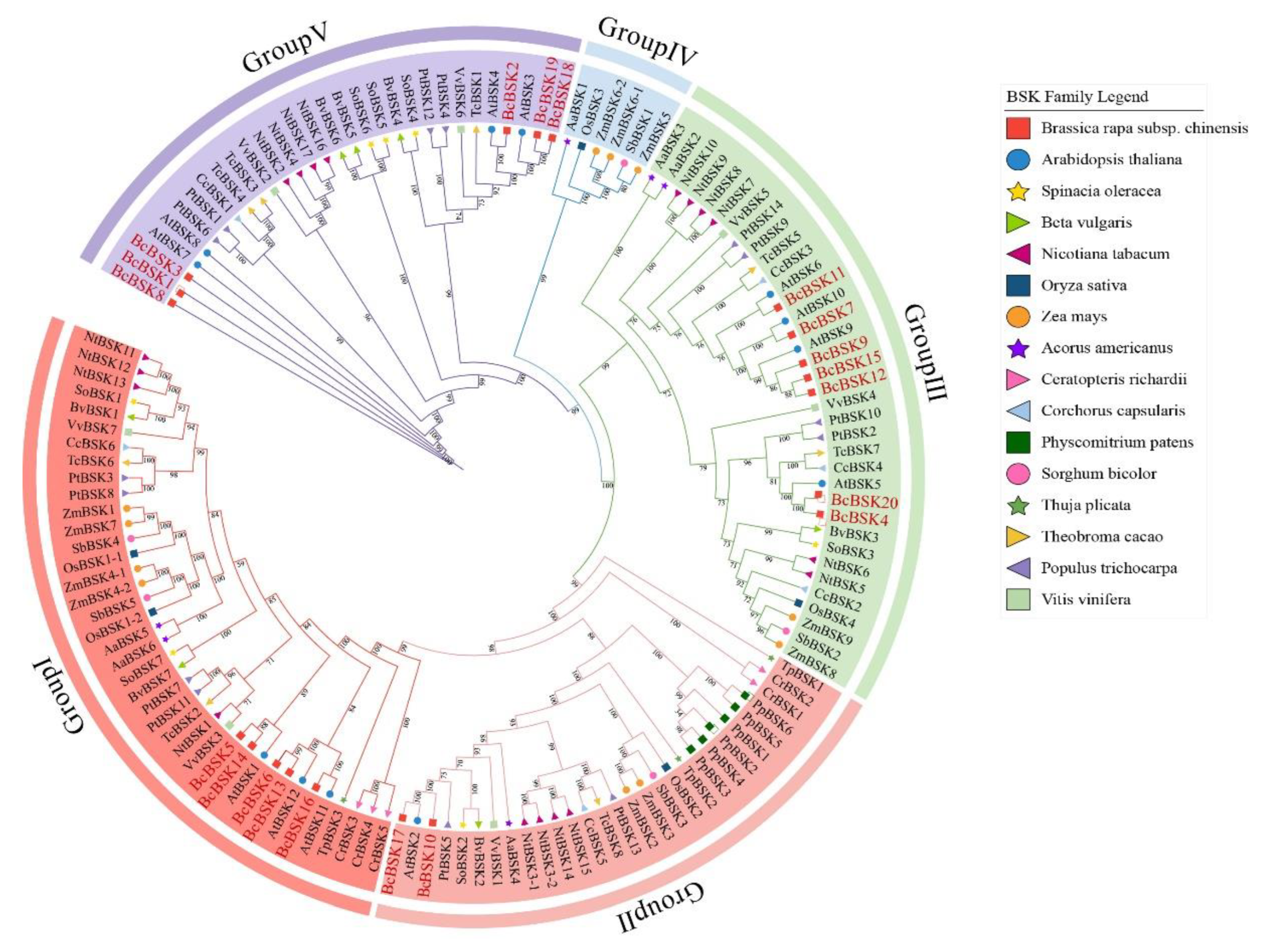
An unrooted phylogenetic tree was constructed based on 20 BSK protein sequences from NHCC and 120 homologous sequences derived from 15 representative species (Figure 1). These species encompassed bryophytes, ferns, gymnosperms, dicotyledons, and monocotyledons.
Phylogenetic analysis grouped the 140 BSK proteins into five subgroups (I–V), with strong support at the major nodes. Distinct differences in species composition were observed among subgroups. Subgroup IV consisted exclusively of monocot species, whereas subgroup V contained only dicot species. In NHCC, the 20 BcBSK proteins were distributed across four subgroups: subgroup I included BcBSK5, BcBSK6, BcBSK13, BcBSK14, and BcBSK16; subgroup II included BcBSK10 and BcBSK17; subgroup III comprised BcBSK4, BcBSK7, BcBSK9, BcBSK11, BcBSK12, BcBSK15, and BcBSK20; and subgroup V contained BcBSK1, BcBSK2, BcBSK3, BcBSK8, BcBSK18, and BcBSK19. Notably, BSK members from the bryophyte Physcomitrium patens were predominantly clustered within subgroup II.
The number of BSK genes varied among species. Except for Thuja plicata, which contained only three members, all other species possessed at least five BSK genes. Specifically, NHCC, Nicotiana tabacum, Populus trichocarpa, and Arabidopsis thaliana contained 20, 18, 14, and 12 members, respectively.
Figure 1.
Phylogenetic analysis of the BSK gene family. An unrooted maximum likelihood (ML) phylogenetic tree was constructed using 20 BSK proteins from NHCC and 120 homologs from 15 representative plant species. The proteins were grouped into five clades (I–V), indicated by branch colors. Species are distinguished by colors and symbols as shown in the legend. BcBSK proteins are highlighted in red. Bootstrap support values are shown at the nodes.
Figure 1.
Phylogenetic analysis of the BSK gene family. An unrooted maximum likelihood (ML) phylogenetic tree was constructed using 20 BSK proteins from NHCC and 120 homologs from 15 representative plant species. The proteins were grouped into five clades (I–V), indicated by branch colors. Species are distinguished by colors and symbols as shown in the legend. BcBSK proteins are highlighted in red. Bootstrap support values are shown at the nodes.
3.3. Chromosomal Localization, Synteny, and Ka/Ks Analysis of the BcBSK Gene Family
The chromosomal distribution and syntenic relationships of BcBSK genes are presented in Figure 2 and Figure 3, respectively. The 20 BcBSK genes were unevenly distributed across 10 chromosomes in NHCC. Chromosomes A09 and A01 each harbored four genes: A09 (BcBSK3, BcBSK6, BcBSK8, and BcBSK18) and A01 (BcBSK1, BcBSK10, BcBSK14, and BcBSK15). Chromosomes A03 and A10 each contained three genes: A03 (BcBSK9, BcBSK13, and BcBSK19) and A10 (BcBSK2, BcBSK4, and BcBSK7). The remaining six genes were distributed across six different chromosomes.
Intraspecies synteny analysis identified 16 collinear gene pairs (Figure 3), forming multiple interchromosomal relationships and a relatively complex interaction pattern. Ka/Ks analysis showed that all collinear gene pairs had Ka/Ks ratios < 1 (Table 2), indicating that they have undergone purifying selection during evolution.
Figure 2.
Chromosomal distribution of the BcBSK gene family. The physical positions of 20 BcBSK genes on NHCC chromosomes are shown. Chromosomes are represented as vertical bars and labeled A01–A10, with genomic coordinates indicated in megabases (Mb). Gene names are displayed at their respective chromosomal locations.
Figure 2.
Chromosomal distribution of the BcBSK gene family. The physical positions of 20 BcBSK genes on NHCC chromosomes are shown. Chromosomes are represented as vertical bars and labeled A01–A10, with genomic coordinates indicated in megabases (Mb). Gene names are displayed at their respective chromosomal locations.
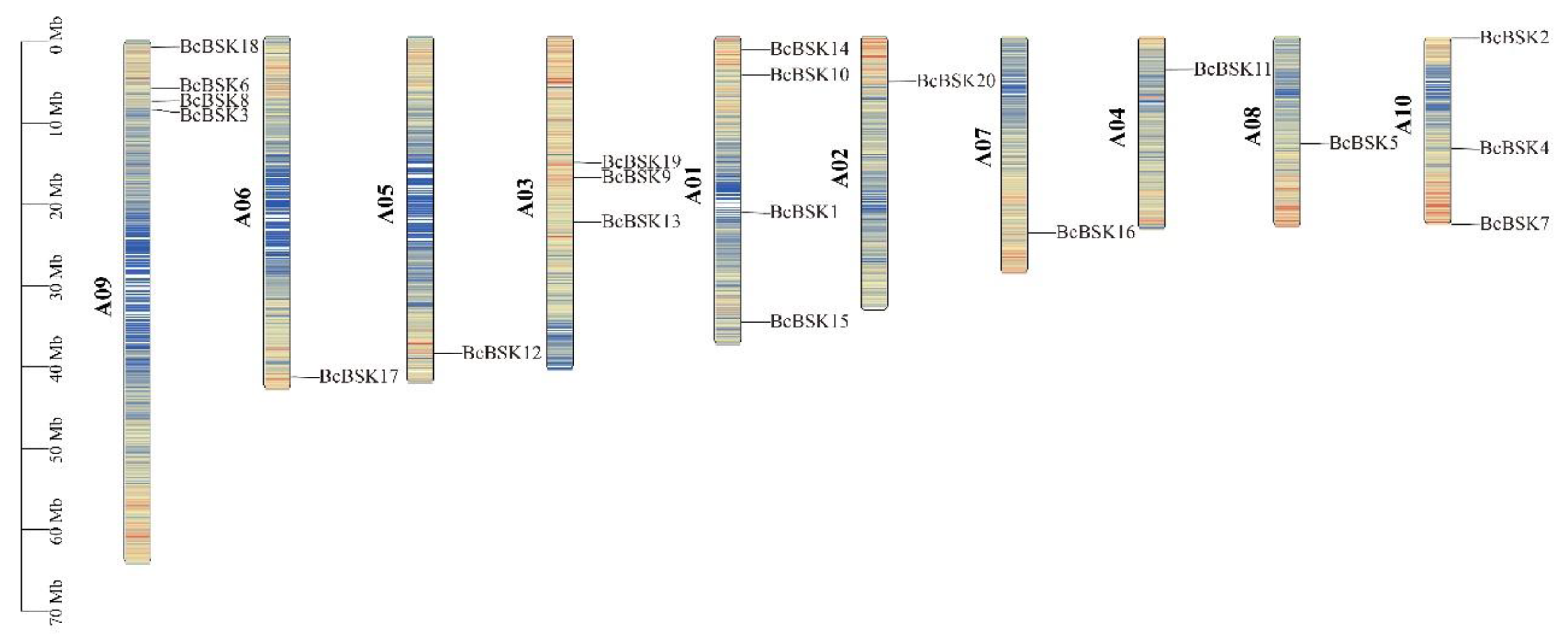
Figure 3.
Intraspecies synteny analysis of the BcBSK gene family. From the outer to inner layers, the circles represent chromosome distribution, gene density, and syntenic relationships, respectively. Red lines indicate collinear gene pairs among BcBSK members, reflecting gene duplication and expansion within the genome.
Figure 3.
Intraspecies synteny analysis of the BcBSK gene family. From the outer to inner layers, the circles represent chromosome distribution, gene density, and syntenic relationships, respectively. Red lines indicate collinear gene pairs among BcBSK members, reflecting gene duplication and expansion within the genome.
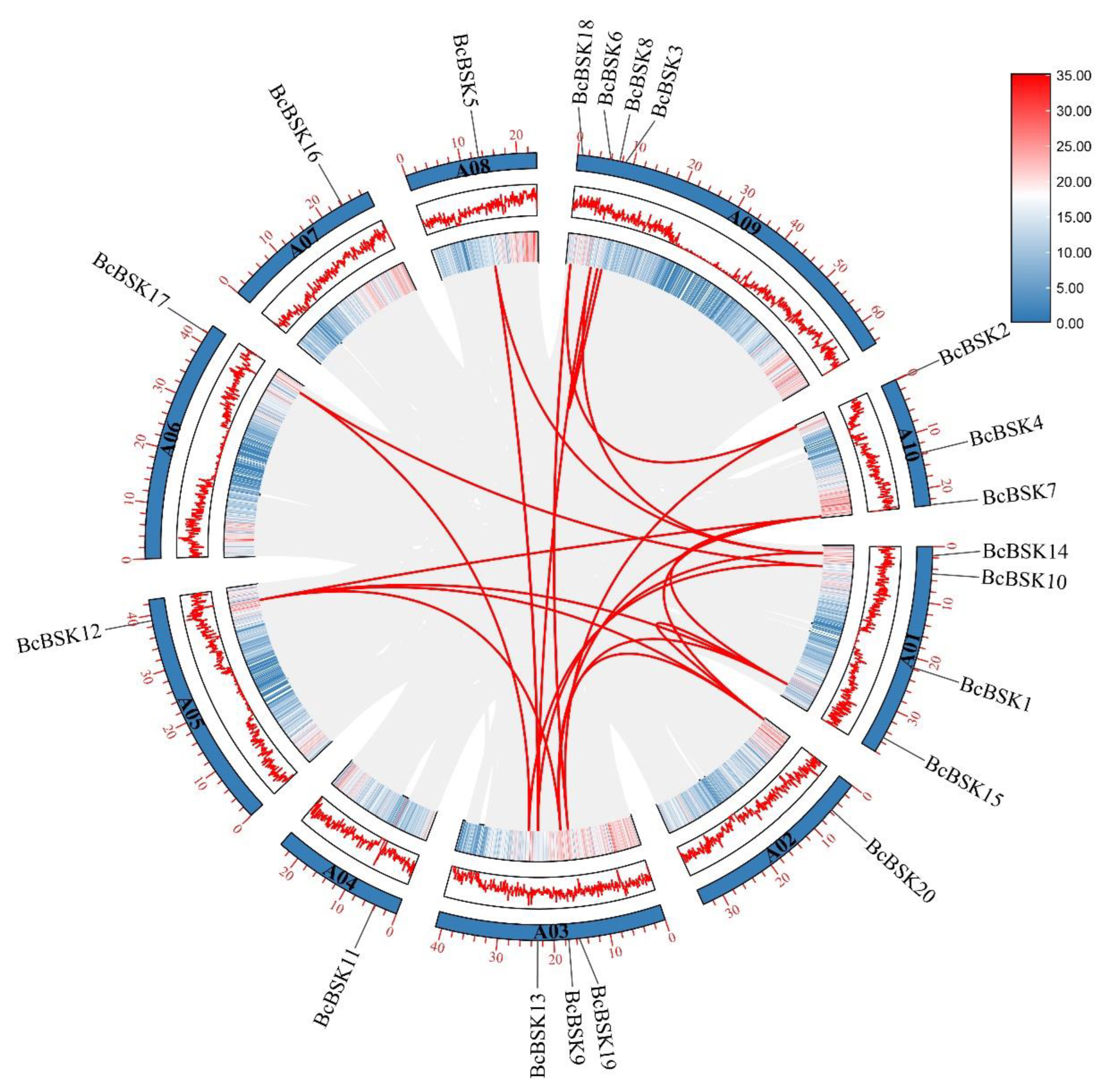
Table 2.
Ka/Ks analysis of collinear gene pairs in the BcBSK gene family.
| gene1 | gene2 | Ka | Ks | Ka/Ks | purifying selection |
| BcBSK15 | BcBSK9 | 0.07089 | 0.274025 | 0.258699 | YES |
| BcBSK14 | BcBSK13 | 0.244432 | 0.332851 | 0.734357 | YES |
| BcBSK15 | BcBSK12 | 0.073853 | 0.325205 | 0.227096 | YES |
| BcBSK10 | BcBSK17 | 0.064546 | 0.591024 | 0.109211 | YES |
| BcBSK14 | BcBSK5 | 0.057806 | 0.206685 | 0.279683 | YES |
| BcBSK14 | BcBSK6 | 0.239543 | 0.319251 | 0.750328 | YES |
| BcBSK15 | BcBSK7 | 0.118482 | 0.572055 | 0.207116 | YES |
| BcBSK9 | BcBSK12 | 0.088034 | 0.320583 | 0.274605 | YES |
| BcBSK13 | BcBSK5 | 0.194841 | 0.476209 | 0.40915 | YES |
| BcBSK19 | BcBSK18 | 0.023446 | 0.282712 | 0.082934 | YES |
| BcBSK13 | BcBSK6 | 0.118487 | 0.239274 | 0.495192 | YES |
| BcBSK9 | BcBSK7 | 0.157136 | 0.415494 | 0.378191 | YES |
| BcBSK19 | BcBSK2 | 0.172094 | 0.422767 | 0.407066 | YES |
| BcBSK12 | BcBSK7 | 0.129434 | 0.636526 | 0.203345 | YES |
| BcBSK8 | BcBSK3 | 0.016925 | 0.243114 | 0.069616 | YES |
| BcBSK18 | BcBSK2 | 0.131279 | 0.603695 | 0.217459 | YES |
1 Ka and Ks represent nonsynonymous and synonymous substitution rates, respectively. The Ka/Ks ratio was used to assess selection pressure: Ka/Ks < 1 indicates purifying selection, Ka/Ks = 1 indicates neutral evolution, and Ka/Ks > 1 indicates positive selection. “Purifying selection” denotes gene pairs subjected to purifying selection.
3.4. Gene Structure and Conserved Domain Analysis of the BcBSK Gene Family
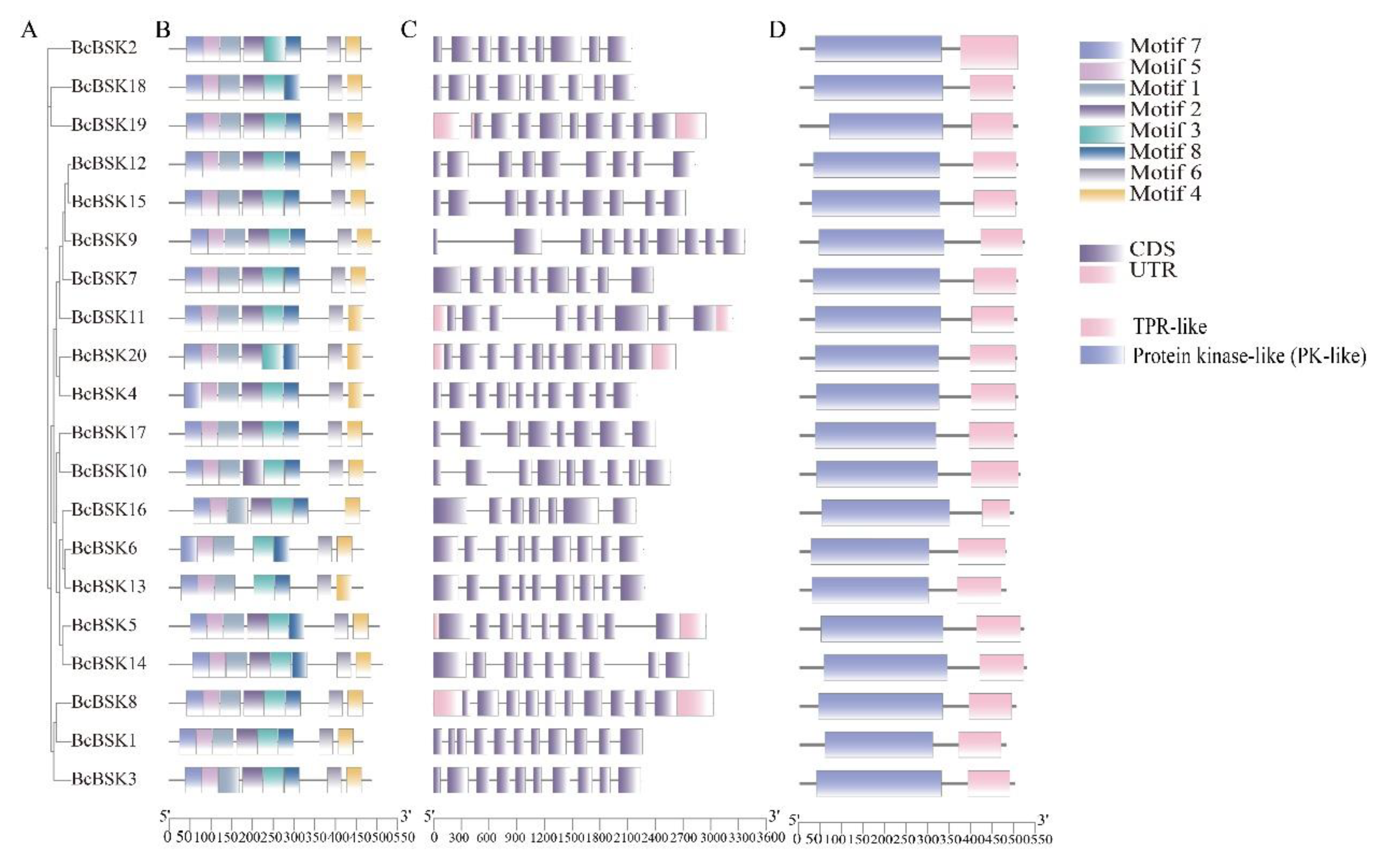
The structural features of the BcBSK gene family were analyzed (Figure 4). Conserved motif analysis (Figure 4B) showed that most proteins contained eight conserved motifs (Motifs 1–8), with a generally consistent distribution pattern. However, some members, including BcBSK6, BcBSK13, and BcBSK16, contained only seven motifs, and BcBSK6 and BcBSK13 exhibited highly similar motif compositions.
Gene structure analysis (Figure 4C) indicated that most BcBSK genes contained nine exons. Specifically, BcBSK3, BcBSK4, BcBSK8, BcBSK9, BcBSK15, and BcBSK20 each contained ten exons, whereas BcBSK1, BcBSK17, and BcBSK16 contained eleven, eight, and seven exons, respectively. Similar exon–intron organization patterns were observed in several gene pairs, such as BcBSK6/BcBSK13, BcBSK4/BcBSK20, BcBSK12/BcBSK15, and BcBSK18/BcBSK19.
Domain analysis (Figure 4D) showed that all BcBSK proteins possessed a conserved kinase domain at the N-terminus and tetratricopeptide repeat (TPR) domains at the C-terminus, indicating a highly conserved domain architecture across the family.
Figure 4.
Conserved motifs, gene structure, and domain organization of the BcBSK gene family. (A) Phylogenetic relationships; (B) conserved motif composition; (C) exon–intron structures; (D) protein domain organization. Different colors represent distinct motifs or domain types.
Figure 4.
Conserved motifs, gene structure, and domain organization of the BcBSK gene family. (A) Phylogenetic relationships; (B) conserved motif composition; (C) exon–intron structures; (D) protein domain organization. Different colors represent distinct motifs or domain types.
3.5. Cis-acting Element Analysis of BcBSK Gene Promoters
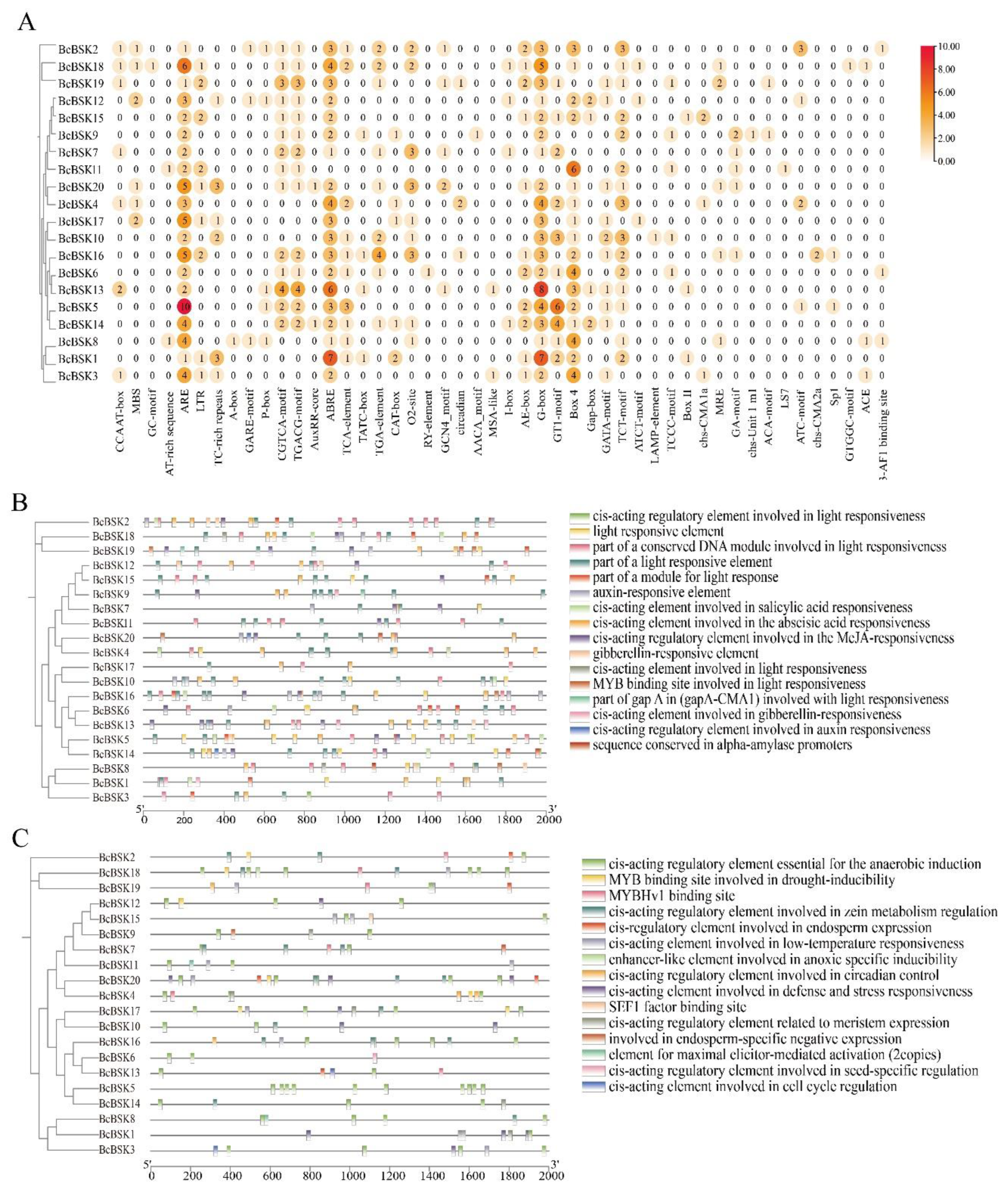
The 2000 bp upstream promoter regions of BcBSK genes were analyzed using the PlantCARE database, and the results are shown in Figure 5. All promoters contained core cis-elements, including the TATA-box and CAAT-box. In addition, multiple cis-acting elements associated with light responsiveness, abiotic stress, hormone responses, and growth and development were identified.
Among these, light-responsive elements were the most abundant, followed by hormone-responsive elements. Notably, ABRE, as well as CGTCA-motif and TGACG-motif, were widely distributed across multiple promoters. Elements related to auxin, salicylic acid, and gibberellin responses were also detected.
Stress-related elements were also prevalent. ARE elements were identified in multiple genes, with BcBSK5 containing the highest number (10). The G-box element was enriched in certain genes, with eight and seven copies identified in BcBSK13 and BcBSK1, respectively. Additionally, elements associated with low-temperature responsiveness (LTR), drought inducibility (MBS), and defense and stress responsiveness (TC-rich repeats) were detected.
Furthermore, several elements related to growth and development were identified, including those involved in meristem regulation, endosperm expression, and cell cycle control.
Figure 5.
Cis-acting element analysis of BcBSK gene promoters. (A) Types and numbers of cis-acting elements; (B–C) distribution of functional elements within promoter regions. Different colors represent different categories of regulatory elements.
Figure 5.
Cis-acting element analysis of BcBSK gene promoters. (A) Types and numbers of cis-acting elements; (B–C) distribution of functional elements within promoter regions. Different colors represent different categories of regulatory elements.
3.6. Protein-Protein Interaction Network Analysis of BcBSK Proteins
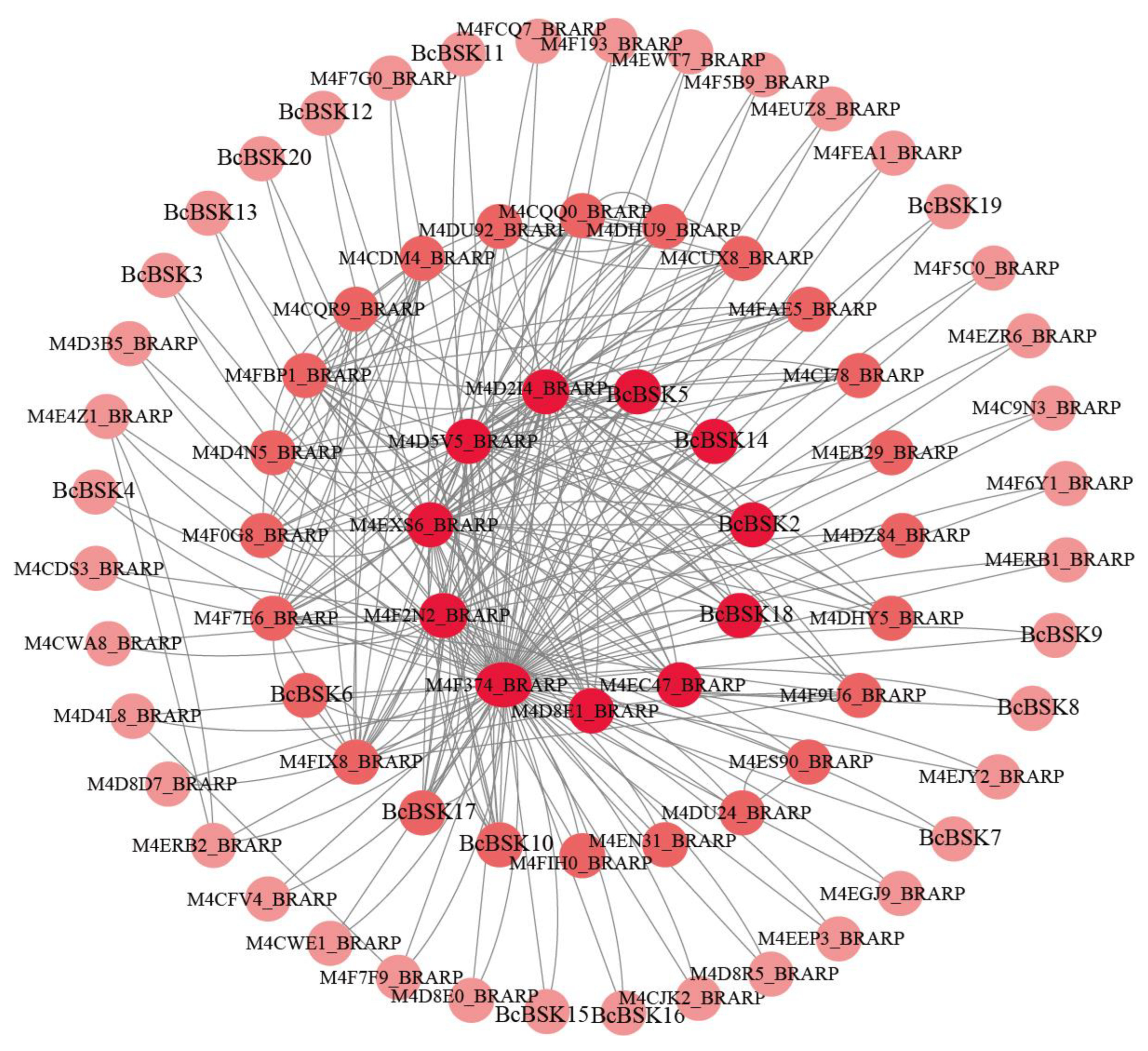
The protein–protein interaction (PPI) network of BcBSK proteins is shown in Figure 6. The 20 members exhibited a radial distribution pattern. BcBSK2, BcBSK5, BcBSK14, and BcBSK18 were located in the central region, with darker node colors, whereas the remaining proteins were distributed across two outer layers. From the periphery to the center, node color intensity increased, corresponding to higher interaction density and connectivity.
Further analysis indicated that BcBSK proteins interacted extensively with multiple members of the BRAP family, forming relatively concentrated interaction clusters within the network.
Figure 6.
Protein–protein interaction network of BcBSK proteins. The network was constructed based on homology-based mapping. Nodes represent proteins, and edges indicate potential interactions. Node color reflects network connectivity, with darker colors indicating higher interaction density.
Figure 6.
Protein–protein interaction network of BcBSK proteins. The network was constructed based on homology-based mapping. Nodes represent proteins, and edges indicate potential interactions. Node color reflects network connectivity, with darker colors indicating higher interaction density.
3.7. Expression Profile Analysis of the BcBSK Gene Family Under Heat Stress
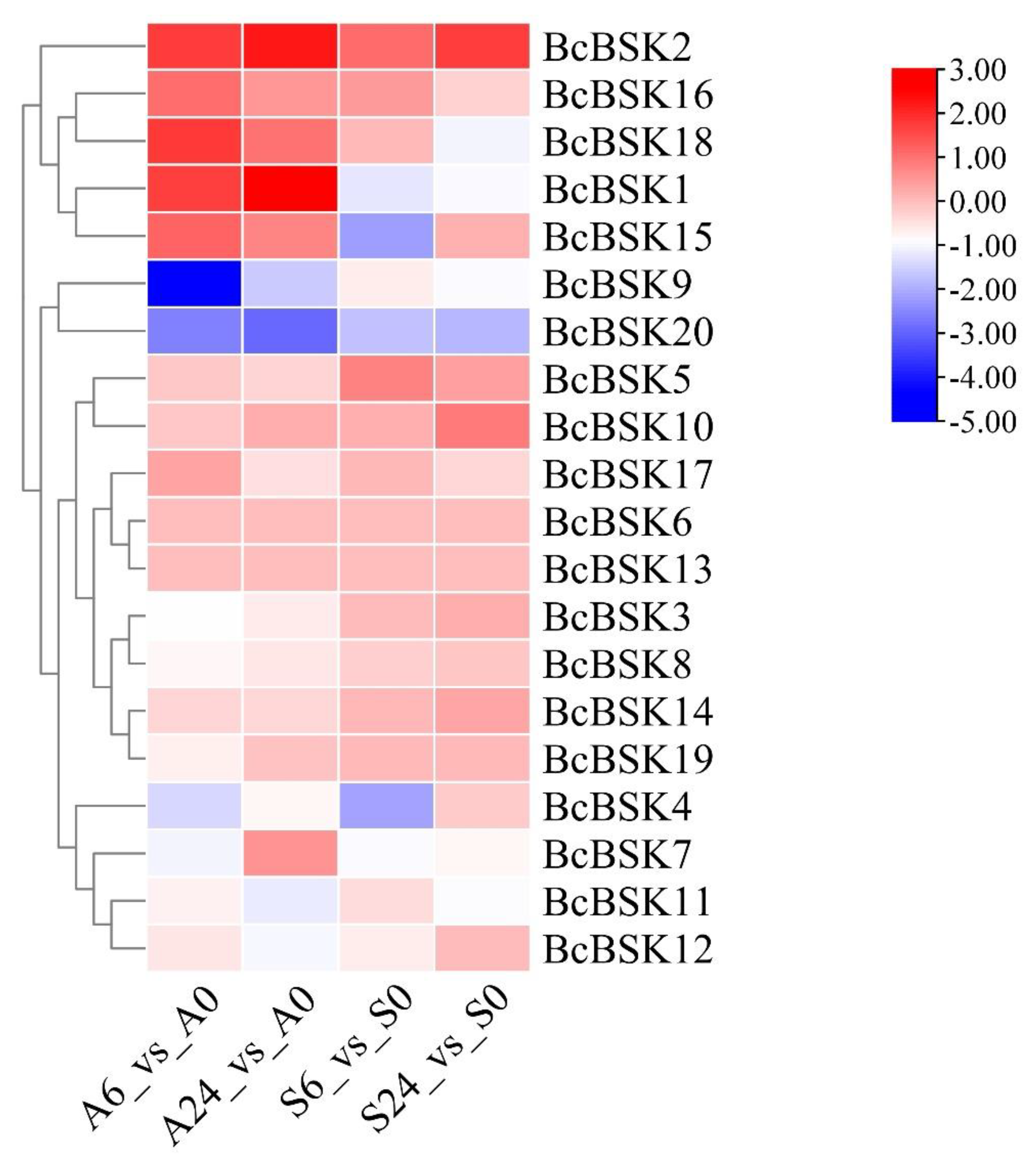
Heatmap analysis showed that BcBSK genes exhibited clear cultivar-specific differences and dynamic temporal expression patterns under heat stress (Figure 7). In the heat-sensitive cultivar “Aijiaohuang”, gene expression displayed greater variability, with pronounced changes over time.
BcBSK1 was consistently upregulated at 6 h (log₂FC = 1.71) and 24 h (log₂FC = 2.56), with higher expression at 24 h. Similarly, BcBSK2 was upregulated at both time points (log₂FC = 1.76 and 2.25). BcBSK18 showed marked upregulation at 6 h (log₂FC = 1.80) and remained upregulated at 24 h despite a slight decrease (log₂FC = 1.01). In contrast, BcBSK9 and BcBSK20 were downregulated at both time points, with log₂FC values of −4.32 and −1.59 for BcBSK9, and −2.57 and −2.91 for BcBSK20 at 6 h and 24 h, respectively.
In the heat-tolerant cultivar “SHI”, most genes exhibited relatively stable expression patterns. BcBSK2 was upregulated at 6 h (log₂FC = 1.12) and 24 h (log₂FC = 1.73), although the magnitude was lower than in “Aijiaohuang”. BcBSK15 was downregulated at 6 h (log₂FC = −2.19) but showed slight upregulation at 24 h (log₂FC = 0.17), indicating a reversal in expression trend. The remaining genes showed no pronounced changes.
Figure 7.
Expression profile of the BcBSK gene family. Colors represent relative expression levels, with red indicating upregulation (log₂FC > 0) and blue indicating downregulation (log₂FC < 0). The dendrogram on the left represents hierarchical clustering of genes.
Figure 7.
Expression profile of the BcBSK gene family. Colors represent relative expression levels, with red indicating upregulation (log₂FC > 0) and blue indicating downregulation (log₂FC < 0). The dendrogram on the left represents hierarchical clustering of genes.
3.8. qRT–PCR Validation of Expression Changes in BcBSK Genes
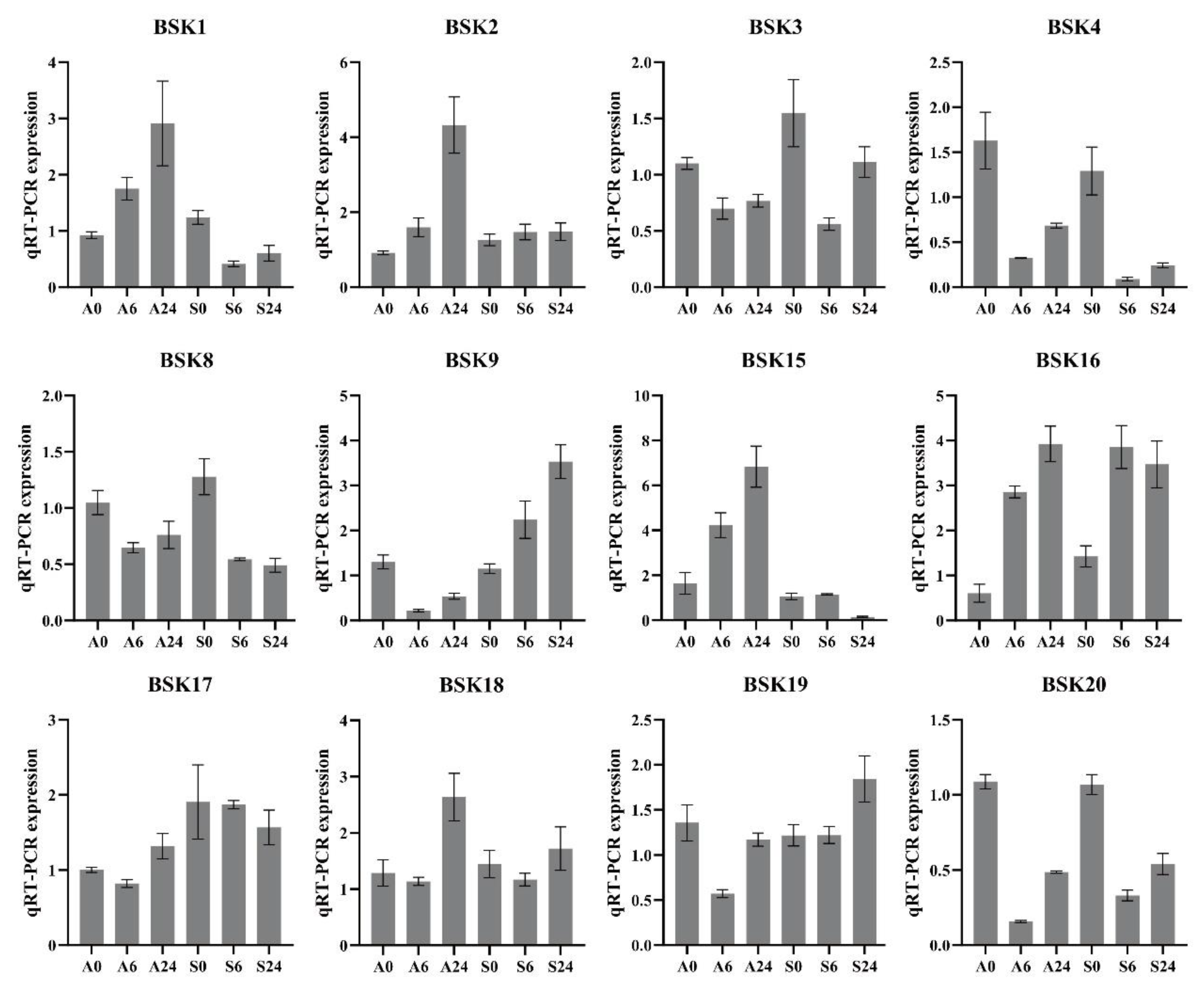
To validate the transcriptomic data, selected BcBSK genes were analyzed by qRT–PCR under heat stress at 0, 6, and 24 h (Figure 8).
In the heat-sensitive cultivar “Aijiaohuang”, the expression trends of the selected genes were consistent with the transcriptomic results. In the heat-tolerant cultivar “SHI”, gene expression showed only minor fluctuations during the 0-24 h period, consistent with the relatively stable expression patterns observed in the transcriptome analysis.
Figure 8.
qRT–PCR validation of BcBSK gene expression under heat stress. Relative expression levels at different time points (0, 6, and 24 h) are presented as bar charts, with error bars indicating the standard error (SE). Expression levels were calculated using the 2⁻ΔΔCt method. A and S denote the heat-sensitive cultivar “Aijiaohuang” and the heat-tolerant cultivar “SHI”, respectively.
Figure 8.
qRT–PCR validation of BcBSK gene expression under heat stress. Relative expression levels at different time points (0, 6, and 24 h) are presented as bar charts, with error bars indicating the standard error (SE). Expression levels were calculated using the 2⁻ΔΔCt method. A and S denote the heat-sensitive cultivar “Aijiaohuang” and the heat-tolerant cultivar “SHI”, respectively.
3.9. Physiological Responses of NHCC Under Heat Stress
The effects of exogenous BR treatment on physiological parameters in leaves of the heat-sensitive cultivar “Aijiaohuang” under heat stress are shown in Figure 9. Antioxidant enzyme activities exhibited clear time-dependent responses to different BR concentrations.
For catalase (CAT), the 0.1 mg·L⁻¹ treatment maintained relatively high activity throughout the 0-9 d period; the 0.5 mg·L⁻¹ treatment showed pronounced increases at 3 d and 6 d; whereas the 1.0 mg·L⁻¹ treatment showed significant differences only at 9 d (P < 0.05). Peroxidase (POD) activity was higher in all BR-treated groups than in the control at 0 d (P < 0.05). The 0.5 mg·L⁻¹ treatment maintained the highest POD activity from 3 to 9 d. Superoxide dismutase (SOD) activity showed a similar trend, with the 0.5 mg·L⁻¹ treatment exhibiting the highest values at all time points and peaking at 6 d.
Regarding membrane lipid peroxidation and osmotic regulation, both the 0.1 mg·L⁻¹ and 0.5 mg·L⁻¹ treatments reduced malondialdehyde (MDA) content at all time points, with the greatest reduction observed at 6 d under the 0.5 mg·L⁻¹ treatment (P < 0.05). In contrast, the 1.0 mg·L⁻¹ treatment showed relatively minor changes. Proline content remained consistently higher under the 0.5 mg·L⁻¹ treatment.
Photosynthetic pigment contents are presented in Table 3. The 0.5 mg·L⁻¹ treatment increased chlorophyll a, chlorophyll b, carotenoid, and total chlorophyll contents at most time points (P < 0.05). The 1.0 mg·L⁻¹ treatment showed increases at 6 d and 9 d, whereas the 0.1 mg·L⁻¹ treatment showed minimal changes. The chlorophyll a/b ratio was lowest under the 0.5 mg·L⁻¹ treatment at 0 d and 3 d, with no significant differences observed at later stages.
Figure 9.
Effects of exogenous BR treatment on physiological parameters in leaves of the heat-sensitive cultivar “Aijiaohuang” under heat stress. (A) CAT activity; (B) MDA content; (C) POD activity; (D) proline content; (E) SOD activity. BR concentrations were 0, 0.1, 0.5, and 1.0 mg·L⁻¹. Different letters indicate significant differences among treatments at the same time point (P < 0.05). Error bars represent the standard error (SE).
Figure 9.
Effects of exogenous BR treatment on physiological parameters in leaves of the heat-sensitive cultivar “Aijiaohuang” under heat stress. (A) CAT activity; (B) MDA content; (C) POD activity; (D) proline content; (E) SOD activity. BR concentrations were 0, 0.1, 0.5, and 1.0 mg·L⁻¹. Different letters indicate significant differences among treatments at the same time point (P < 0.05). Error bars represent the standard error (SE).
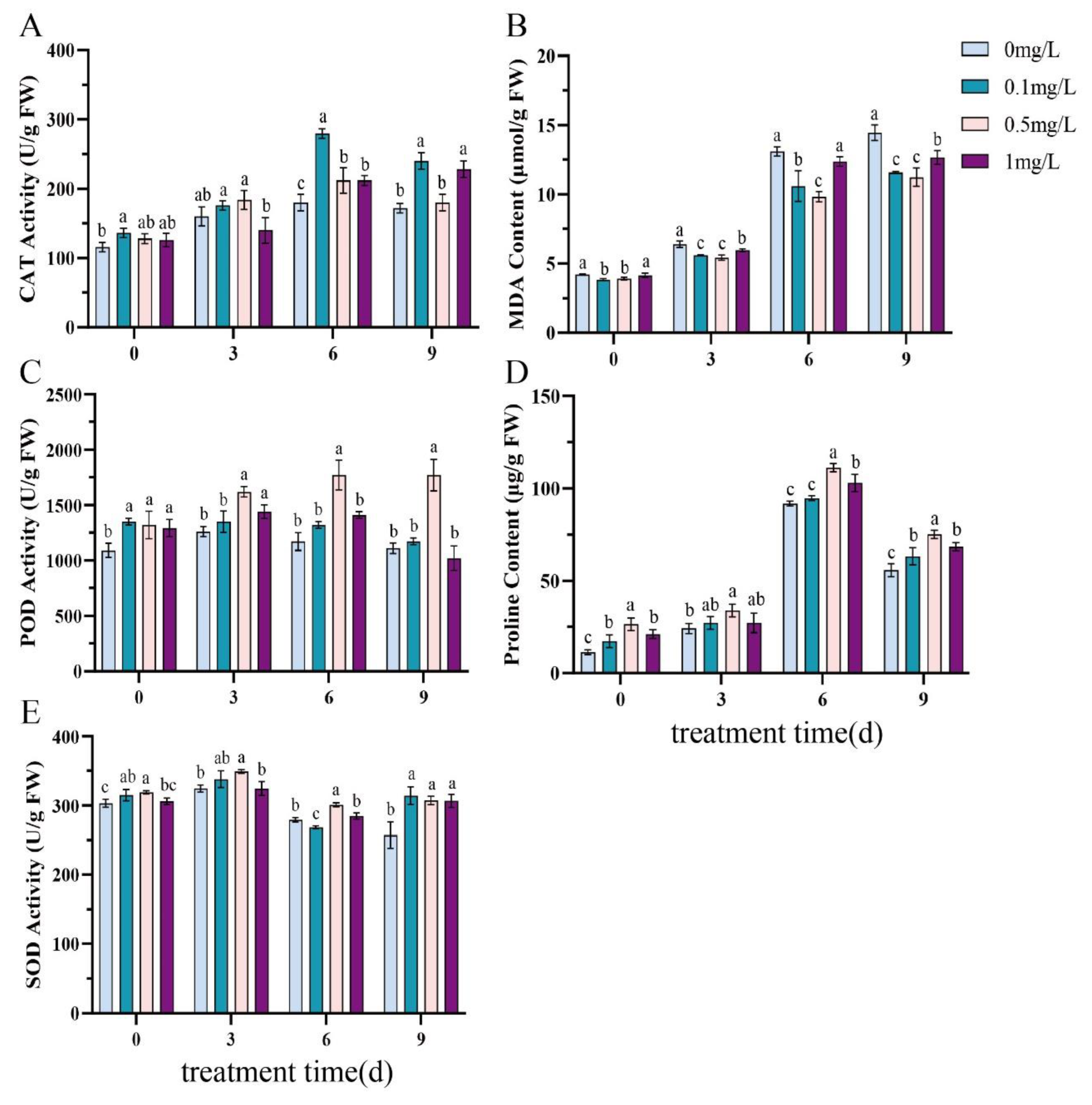
Table 3.
Effects of exogenous BR on photosynthetic pigment contents in leaves of the heat-sensitive cultivar “Aijiaohuang” under heat stress.
Table 3.
Effects of exogenous BR on photosynthetic pigment contents in leaves of the heat-sensitive cultivar “Aijiaohuang” under heat stress.
| Time (d) | BR (mg/L) | Chlorophyll a (mg/g) | Chlorophyll b (mg/g) | Carotenoid (mg/g) | Total Chlorophyll (mg/g) | Chlorophyll a/b |
| 0 | 0.00 | 0.503±0.015c | 0.191±0.004c | 0.012±0.001c | 0.694±0.017c | 2.633±0.083a |
| 0.10 | 0.522±0.017bc | 0.215±0.026bc | 0.015±0.001b | 0.737±0.010c | 2.461±0.352a | |
| 0.50 | 0.560±0.017a | 0.360±0.010a | 0.018±0.000a | 0.920±0.027a | 1.560±0.008b | |
| 1.00 | 0.539±0.001ab | 0.248±0.034b | 0.016±0.000ab | 0.786±0.034b | 2.202±0.308a | |
| 3 | 0.00 | 0.416±0.012c | 0.124±0.005c | 0.010±0.002d | 0.540±0.021d | 3.362±0.116a |
| 0.10 | 0.516±0.008a | 0.198±0.014b | 0.021±0.000c | 0.714±0.013b | 2.621±0.189b | |
| 0.50 | 0.511±0.003a | 0.292±0.016a | 0.083±0.002a | 0.803±0.016a | 1.756±0.095c | |
| 1.00 | 0.478±0.009b | 0.187±0.011b | 0.056±0.008b | 0.664±0.003c | 2.571±0.206b | |
| 6 | 0.00 | 0.458±0.016b | 0.155±0.060c | 0.031±0.005b | 0.613±0.021bc | 2.952±0.073a |
| 0.10 | 0.394±0.045c | 0.196±0.013b | 0.020±0.000c | 0.590±0.036c | 2.027±0.355b | |
| 0.50 | 0.527±0.012a | 0.261±0.022a | 0.078±0.000a | 0.788±0.034a | 2.028±0.123b | |
| 1.00 | 0.479±0.009ab | 0.181±0.017bc | 0.083±0.009a | 0.660±0.011b | 2.667±0.277a | |
| 9 | 0.00 | 0.379±0.012ab | 0.211±0.016b | 0.005±0.001d | 0.591±0.017b | 1.804±0.165a |
| 0.10 | 0.364±0.010b | 0.200±0.012b | 0.011±0.001c | 0.563±0.008c | 1.823±0.148a | |
| 0.50 | 0.393±0.002a | 0.237±0.008a | 0.068±0.003a | 0.631±0.010a | 1.659±0.050a | |
| 1.00 | 0.390±0.007a | 0.237±0.008a | 0.053±0.003b | 0.627±0.002a | 1.647±0.084a |
1 Data are presented as mean ± Standard Error (SE). Different lowercase letters indicate significant differences at P < 0.05 within the same treatment or time point. Chlorophyll a, chlorophyll b, carotenoid, and total chlorophyll represent the contents of chlorophyll a, chlorophyll b, carotenoids, and total chlorophyll, respectively.
4. Discussion
4.1. Evolution, Structure, and Functional Divergence of the BcBSK Gene Family in NHCC
BSK genes, as early components of the BR signaling pathway, play essential regulatory roles in plant growth, development, and stress responses. In the present study, 20 BcBSK genes were identified in NHCC. Phylogenetic analysis indicates that this gene family exhibits lineage-specific diversification during evolution. Specifically, subgroup IV comprises exclusively monocotyledonous species, whereas subgroup V consists entirely of dicotyledonous species; the remaining subgroups include members from both lineages. This distribution pattern is consistent with previous reports [3,15], suggesting that the BSK gene family has undergone evolutionary divergence across plant lineages. The presence of lineage-specific subgroups implies independent gene retention in different evolutionary branches, whereas the mixed composition of other subgroups reflects a relatively high level of conservation among certain members. Whole-genome duplication is widely recognized as a major driver of gene family expansion in plants [38,39,40], and duplicated genes may undergo differential retention and functional divergence, ultimately shaping the observed family structure.
Within this evolutionary framework, the expansion of the BcBSK gene family in NHCC appears to be primarily associated with whole-genome duplication or large-scale segmental duplication events. Synteny analysis reveals complex collinearity relationships among family members, and the consistently low Ka/Ks ratios (<1) indicate that these genes are under strong purifying selection. Subcellular localization prediction shows that all BcBSK proteins are localized to the plasma membrane. This uniform localization not only reflects structural conservation but also supports their functional roles in BR signaling, where membrane association is essential for interactions with receptors such as BRI1 and other signaling components.
From a structural perspective, all BcBSK proteins contain conserved kinase domains and tetratricopeptide repeat (TPR) domains, indicating that their core functional modules remain highly conserved. This structural feature, commonly observed in BSK proteins, highlights its fundamental importance in signal transduction. Protein–protein interaction network analysis further shows that these proteins are mainly associated with cytoplasmic components of the BR signaling pathway, suggesting a high degree of functional convergence. Notably, BcBSK2, BcBSK5, BcBSK14, and BcBSK18 are located at central positions in the interaction network, implying that they may play key regulatory roles.
Based on previously reported functions of different subgroups, the potential roles of BcBSK members can be inferred. Subgroup V shows high sequence similarity to key BR signaling components in Arabidopsis thaliana (e.g., AtBSK3, AtBSK4, AtBSK7, and AtBSK8) and is therefore likely involved primarily in BR signal transduction [3]. In contrast, subgroup I homologs have been implicated in immune responses [24,25,26], drought and salt stress responses [41], and abscisic acid (ABA) signaling [23], suggesting broader roles in stress adaptation. Subgroup III appears more functionally diverse, with homologs associated with heat stress [15], root development [13], seed development [17], and salt stress responses [42], indicating a role in coordinating growth and environmental responses. Subgroup II, by comparison, is more closely associated with fundamental growth regulation; for example, OsBSK2 regulates grain size in rice, suggesting relatively conserved functions within this subgroup [25].
Promoter analysis further reveals regulatory divergence among BcBSK genes. For example, the promoter region of BcBSK5 is enriched in anaerobic-responsive elements, whereas BcBSK13 and BcBSK1 contain a higher abundance of light-responsive elements. Such variation in cis-element composition may contribute to transcriptional diversity, enabling different family members to respond to distinct environmental and endogenous signals, thereby facilitating functional differentiation and coordination within the gene family.
4.2. Alleviating Effects of Exogenous BRs on Heat Stress in NHCC
Under heat stress conditions, exogenous application of BRs partially alleviates physiological damage in the heat-sensitive cultivar “Aijiaohuang”. In the present study, comparison among different concentrations indicates that 0.5 mg·L⁻¹ BR provides a relatively stable protective effect throughout the stress period, particularly during the critical stage from 3 to 6 d.
From a physiological perspective, this protective effect is closely associated with sustained activation of the antioxidant system. The activities of key enzymes, including superoxide dismutase (SOD), peroxidase (POD), and catalase (CAT), remain at relatively high levels following BR treatment, suggesting enhanced reactive oxygen species (ROS) scavenging capacity and reduced oxidative damage [43,44]. Meanwhile, the continuous accumulation of proline and the decrease in malondialdehyde (MDA) content indicate improved osmotic adjustment and reduced membrane lipid peroxidation [45], which contribute to maintaining cellular integrity.
With respect to photosynthetic performance, BR treatment also affects the contents of chlorophyll a, chlorophyll b, and carotenoids. These pigments are generally maintained at higher levels under stress conditions, indicating a protective role in preserving the photosynthetic apparatus [46,47]. These physiological processes are unlikely to operate independently; instead, they appear to act in a coordinated manner to enhance plant adaptation to elevated temperatures. Notably, the regulatory effects of BR exhibit clear concentration dependence. Among the tested treatments, 0.5 mg·L⁻¹ appears to be more effective, possibly because it better matches the endogenous BR signaling range in NHCC, thereby promoting downstream stress-response pathways. However, this interpretation still requires further validation at the molecular level.
4.3. Association Between BcBSK Expression Patterns and Physiological Responses to Exogenous BR
Integrated analysis of gene expression profiles and physiological parameters provides important insights into the role of BR in heat stress responses. In the heat-sensitive cultivar “Aijiaohuang”, genes such as BcBSK1, BcBSK2, and BcBSK18 show rapid upregulation during the early stage of stress (6–24 h), whereas BR-induced physiological changes are mainly observed during the intermediate stage (3–6 d). This temporal pattern suggests that certain BcBSK members are activated at early stages of stress and may contribute to the establishment of subsequent physiological responses, which is consistent with the role of BSKs as early signaling components in the BR pathway [48].
Further comparison among individual members reveals clear divergence in expression patterns within the BcBSK gene family under heat stress. This variation is partially consistent with their positions in the protein interaction network. Previous studies indicate that BSK proteins participate in BR signal transduction through interactions with multiple downstream components and exhibit functional differentiation across physiological processes [49]. Notably, BcBSK2, BcBSK5, BcBSK14, and BcBSK18, which occupy central positions in the interaction network, show pronounced expression changes under stress conditions, suggesting that they may play key roles in signal transduction. In particular, the sustained upregulation of BcBSK2 in the heat-sensitive cultivar is consistent with the trends observed in SOD and POD activities under 0.5 mg·L⁻¹ BR treatment, indicating a possible link to antioxidant regulation.
Comparison between heat-tolerant and heat-sensitive cultivars further reveals a potential association between BcBSK expression patterns and thermotolerance. In the heat-tolerant cultivar “SHI”, most genes exhibit relatively stable expression with limited fluctuations during stress, whereas in the heat-sensitive cultivar, several genes display marked expression changes. This contrast may reflect distinct regulatory strategies in response to stress. Similar patterns have been reported in other plant species, where tolerant genotypes tend to maintain more stable and coordinated transcriptional regulation, whereas sensitive genotypes show greater expression variability under stress conditions [50].
In combination with the effects of exogenous BR, it is observed that in the heat-sensitive cultivar, pronounced gene expression changes are accompanied by partial improvement in physiological parameters following BR treatment. This correspondence suggests that BR signaling contributes to the regulation of stress responses in such genotypes. In addition, the presence of multiple hormone-responsive cis-elements in promoter regions indicates that BcBSK genes may be co-regulated by different signaling pathways at the transcriptional level. Although this provides a basis for potential hormonal crosstalk, the underlying regulatory mechanisms still require further experimental validation.
Overall, the BcBSK gene family exhibits functional divergence, with different members likely acting at distinct stages and through different mechanisms in response to heat stress. Some genes may primarily participate in early signal perception, whereas others may function in downstream signal transduction and integration. It should be noted that these conclusions are largely based on correlations between expression patterns and physiological data; therefore, further studies with higher temporal resolution and functional validation are required to clarify their precise roles.
5. Conclusions
This study presents a comprehensive genome-wide analysis of the BcBSK gene family in NHCC, clarifying its composition and expansion patterns and providing initial insights into its expression profiles under heat stress. Several BcBSK genes show notable responses to BR treatment and heat stress, among which BcBSK2 exhibits particularly pronounced changes.
By integrating transcriptomic and physiological data, a potential association was observed between early gene expression responses and subsequent physiological changes. In particular, exogenous BR treatment is associated with variations in antioxidant-related parameters, suggesting that the BcBSK gene family may be involved in BR-mediated heat stress responses. However, this inference is primarily based on correlation analysis, and the underlying regulatory mechanisms remain to be elucidated.
Overall, the BcBSK gene family in NHCC exhibits expression divergence and is likely involved in thermotolerance-related regulatory processes. Further functional validation of key members will be necessary to clarify their roles within the BR signaling network and to support future efforts in improving heat tolerance in this crop.
Supplementary Materials
The following supporting information can be downloaded at the website of this paper posted on Preprints.org., Table S1: Primer sequences used for qRT-PCR; Table S2: List of BSK protein sequences used for phylogenetic analysis.
Author Contributions
Conceptualization, X.L. ( Xiaofeng Li) and B.Z.; methodology, L.Y. and J.W.; software, P.Y. and X.L. (Xiang Li); validation, L.Y. and J.W.; formal analysis, L.Y.; investigation, L.Y., J.W., P.Y. and X.L. (Xiang Li); resources, X.L. ( Xiaofeng Li) and B.Z.; data curation, L.Y.; writing—original draft preparation, L.Y.; writing—review and editing, X.L. ( Xiaofeng Li) and B.Z.; visualization, L.Y.; supervision, X.L. ( Xiaofeng Li) and B.Z.; project administration, X.L. ( Xiaofeng Li) and B.Z.; funding acquisition, X.L. ( Xiaofeng Li) and B.Z. All authors have read and agreed to the published version of the manuscript.
Funding
This research was funded by the Shanghai Science and Technology Development Foundation (grant number 23N11900200) and the Horizontal Scientific Research Project of Anhui Normal University (grant number 2025127).
Data Availability Statement
The RNA-seq data used in this study are publicly available in the NCBI BioProject database under accession number PRJNA1030162. Other data supporting the findings of this study are available from the corresponding author upon reasonable request.
Acknowledgments
The authors thank the Horticultural Research Institute of the Shanghai Academy of Agricultural Sciences for providing plant materials.
Conflicts of Interest
The authors declare no conflicts of interest.
Abbreviations
The following abbreviations are used in this manuscript:
| NHCC | Non-heading Chinese cabbage (Brassica rapa subsp. chinensis) |
| BR | Brassinosteroid |
| BSK | BR-signaling kinase |
| SOD | Superoxide dismutase |
| POD | Peroxidase |
| CAT | Catalase |
| ROS | Reactive oxygen species |
| MDA | Malondialdehyde |
| PPI | Protein–protein interaction |
| HMMs | Hidden Markov models |
| CDD | Conserved Domain Database |
| ML | Maximum likelihood |
| BIC | Bayesian Information Criterion |
| iTOL | Interactive Tree Of Life |
| PPI | Protein–protein interaction |
| FPKM | Fragments Per Kilobase of transcript per Million mapped reads |
| Ka | nonsynonymous substitution rates |
| Ks | synonymous substitution rates |
| qRT–PCR | Quantitative real-time polymerase chain reaction |
References
- Tian, J.; Chang, K.Z.; Lei, Y.X.; Li, S.H.; Wang, J.W.; Huang, C.X.; Zhong, F.L. Genome-Wide Identification of Proline Transporter Gene Family in Non-Heading Chinese Cabbage and Functional Analysis of BchProT1 under Heat Stress. International Journal of Molecular Sciences 2024, 25. [CrossRef]
- Xin, X.; Li, P.; Zhao, X.; Yu, Y.; Wang, W.; Jin, G.; Wang, J.; Sun, L.; Zhang, D.; Zhang, F.; et al. Temperature-dependent jumonji demethylase modulates flowering time by targeting H3K36me2/3 in Brassica rapa. Nature Communications 2024, 15. [CrossRef]
- Li, Z.Y.; Shen, J.Y.; Liang, J.S. Genome-Wide Identification, Expression Profile, and Alternative Splicing Analysis of the Brassinosteroid-Signaling Kinase (BSK) Family Genes in Arabidopsis. International Journal of Molecular Sciences 2019, 20. [CrossRef]
- Nolan, T.M.; Vukasinovic, N.; Liu, D.R.; Russinova, E.; Yin, Y.H. Brassinosteroids: Multidimensional Regulators of Plant Growth, Development, and Stress Responses. Plant Cell 2020, 32, 295-318. [CrossRef]
- Rao, X.L.; Dixon, R.A. Brassinosteroid Mediated Cell Wall Remodeling in Grasses under Abiotic Stress. Frontiers in Plant Science 2017, 8. [CrossRef]
- Chakraborty, N.; Ganguly, R.; Sarkar, A.; Dasgupta, D.; Sarkar, J.; Acharya, K.; Burachevskaya, M.; Minkina, T.; Keswani, C. Multifunctional Role of Brassinosteroids in Plant Growth, Development, and Defense. Journal of Plant Growth Regulation 2025, 44, 2627-2640. [CrossRef]
- Clouse, S.D. Brassinosteroid Signal Transduction: From Receptor Kinase Activation to Transcriptional Networks Regulating Plant Development. The Plant Cell 2011, 23, 1219-1230. [CrossRef]
- Kim, T.-W.; Guan, S.; Sun, Y.; Deng, Z.; Tang, W.; Shang, J.-X.; Sun, Y.; Burlingame, A.L.; Wang, Z.-Y. Brassinosteroid signal transduction from cell-surface receptor kinases to nuclear transcription factors. Nature Cell Biology 2009, 11, 1254-1260. [CrossRef]
- Li, L.; Mu, T.; Zhang, R.; Zhang, G.; Lyu, J.; Liu, Z.; Luo, S.; Yu, J. The BES1/BZR1 family transcription factor as critical regulator of plant stress resilience. Plant Stress 2025, 15, 100730. [CrossRef]
- Liu, F.; Qu, P.-Y.; Li, J.-P.; Yang, L.-N.; Geng, Y.-J.; Lu, J.-Y.; Zhang, Y.; Li, S. Arabidopsis protein S- acyl transferases positively mediate BR signaling through S- acylation of BSK1. Proceedings of the National Academy of Sciences of the United States of America 2024, 121. [CrossRef]
- Yan, J.; Wang, X.; Liu, J.; Wang, Y.; Yue, J.; Wang, W.; Li, Y.; Sun, Y.; Zhang, B.; Tang, W. BSK family kinases are essential for brassinosteroid signaling and suppression of adventitious rooting by repressing the expression of LBD16. New Phytologist 2026, 250, 283-297. [CrossRef]
- Galindo-Trigo, S.; Khandare, V.; Roosjen, M.; Adams, J.; Wangler, A.-M.; Bayer, M.; Borst, J.W.; Smakowska-Luzan, E.; Butenko, M.A. A multifaceted kinase axis regulates plant organ abscission through conserved signaling mechanisms. Current Biology 2024, 34. [CrossRef]
- Ren, H.; Willige, B.C.; Jaillais, Y.; Geng, S.; Park, M.Y.; Gray, W.M.; Chory, J. BRASSINOSTEROID-SIGNALING KINASE 3, a plasma membrane-associated scaffold protein involved in early brassinosteroid signaling. Plos Genetics 2019, 15. [CrossRef]
- Zhang, B.; Wang, X.; Zhao, Z.; Wang, R.; Huang, X.; Zhu, Y.; Yuan, L.; Wang, Y.; Xu, X.; Burlingame, A.L.; et al. OsBRI1 Activates BR Signaling by Preventing Binding between the TPR and Kinase Domains of OsBSK3 via Phosphorylation. Plant Physiology 2015, 170, 1149-1161. [CrossRef]
- Li, Y.; Zhang, H.; Zhang, Y.; Liu, Y.; Li, Y.; Tian, H.; Guo, S.; Sun, M.; Qin, Z.; Dai, S. Genome-wide identification and expression analysis reveals spinach brassinosteroid-signaling kinase (BSK) gene family functions in temperature stress response. Bmc Genomics 2022, 23. [CrossRef]
- Jia, Z.; Giehl, R.F.H.; Meyer, R.C.; Altmann, T.; von Wiren, N. Natural variation of BSK3 tunes brassinosteroid signaling to regulate root foraging under low nitrogen. Nature Communications 2019, 10. [CrossRef]
- Neu, A.; Eilbert, E.; Asseck, L.Y.; Slane, D.; Henschen, A.; Wang, K.; Buergel, P.; Hildebrandt, M.; Musielak, T.J.; Kolb, M.; et al. Constitutive signaling activity of a receptor-associated protein links fertilization with embryonic patterning in Arabidopsis thaliana. Proceedings of the National Academy of Sciences of the United States of America 2019, 116, 5795-5804. [CrossRef]
- Shiu, S.H.; Karlowski, W.M.; Pan, R.S.; Tzeng, Y.H.; Mayer, K.F.X.; Li, W.H. Comparative analysis of the receptor-like kinase family in Arabidopsis and rice. Plant Cell 2004, 16, 1220-1234. [CrossRef]
- Gao, C.; Zhao, Y.; Wang, W.; Zhang, B.; Huang, X.; Wang, Y.; Tang, D. BRASSINOSTEROID-SIGNALING KINASE 1 modulates OPEN STOMATA 1 phosphorylation and contributes to stomatal closure and plant immunity. Plant Journal 2024, 120, 45-59. [CrossRef]
- Li, Q.; Shao, J.; Luo, M.; Chen, D.; Tang, D.; Shi, H. BRASSINOSTEROID-SIGNALING KINASE1 associates with and is required for cysteine protease RESPONSE TO DEHYDRATION 19-mediated disease resistance in Arabidopsis. Plant Science 2024, 342. [CrossRef]
- Su, B.; Zhang, X.; Li, L.; Abbas, S.; Yu, M.; Cui, Y.; Baluska, F.; Hwang, I.; Shan, X.; Lin, J. Dynamic spatial reorganization of BSK1 complexes in the plasma membrane underpins signal-specific activation for growth and immunity. Molecular Plant 2021, 14, 588-603. [CrossRef]
- Chang, W.; Chen, L.; Xie, X.; Liu, M.; Song, D.; Yu, M.; Li, S.; Wei, L.; Qu, C.; Li, J.; et al. Construction of a FOX-hunting library to systematically identify functional genes and the salt-tolerant line isolation in Brassica napus. Plant Physiology and Biochemistry 2025, 228. [CrossRef]
- Li, Z.-Y.; Xu, Z.-S.; He, G.-Y.; Yang, G.-X.; Chen, M.; Li, L.-C.; Ma, Y.-Z. A mutation in Arabidopsis BSK5 encoding a brassinosteroid-signaling kinase protein affects responses to salinity and abscisic acid. Biochemical and Biophysical Research Communications 2012, 426, 522-527. [CrossRef]
- Wang, J.; Shi, H.; Zhou, L.; Peng, C.; Liu, D.; Zhou, X.; Wu, W.; Yin, J.; Qin, H.; Ma, W.; et al. OsBSK1-2, an Orthologous of AtBSK1, Is Involved in Rice Immunity. Frontiers in Plant Science 2017, 8. [CrossRef]
- Yuan, H.; Xu, Z.; Chen, W.; Deng, C.; Liu, Y.; Yuan, M.; Gao, P.; Shi, H.; Tu, B.; Li, T.; et al. OsBSK2, a putative brassinosteroid-signalling kinase, positively controls grain size in rice. Journal of Experimental Botany 2022, 73, 5529-5542. [CrossRef]
- Li, S.; Xiang, X.; Diao, Z.; Xia, N.; Lu, L.; Zhang, J.; Chen, Z.; Tang, D. The OsBSK1-2-MAPK module regulates blast resistance in rice. Crop Journal 2024, 12, 110-120. [CrossRef]
- Daniel Pantoja-Benavides, A.; Garces-Varon, G.; Restrepo-Diaz, H. Foliar cytokinins or brassinosteroids applications influence the rice plant acclimatization to combined heat stress. Frontiers in Plant Science 2022, 13. [CrossRef]
- Halaji, B.; Haghighi, M.; Kovacs, G.P.; Mirmazloum, I.; Szego, A. The Role of Brassinosteroids and Nano-Encapsulated Brassinosteroids in Capsicum Pepper Growth and Physiological Adaptations to High-Temperature Stress. Horticulturae 2024, 10. [CrossRef]
- Lv, J.; Dong, T.; Zhang, Y.; Ku, Y.; Zheng, T.; Jia, H.; Fang, J. Metabolomic profiling of brassinolide and abscisic acid in response to high-temperature stress. Plant Cell Reports 2022, 41, 935-946. [CrossRef]
- Sadura, I.; Janeczko, A. Brassinosteroids and the Tolerance of Cereals to Low and High Temperature Stress: Photosynthesis and the Physicochemical Properties of Cell Membranes. International Journal of Molecular Sciences 2022, 23. [CrossRef]
- Chen, C.; Chen, H.; Zhang, Y.; Thomas, H.R.; Frank, M.H.; He, Y.; Xia, R. TBtools: An Integrative Toolkit Developed for Interactive Analyses of Big Biological Data. Molecular Plant 2020, 13, 1194-1202. [CrossRef]
- Wan, Z.; Luo, S.; Zhang, Z.; Liu, Z.; Qiao, Y.; Gao, X.; Yu, J.; Zhang, G. Identification and expression profile analysis of the SnRK2 gene family in cucumber. Peerj 2022, 10. [CrossRef]
- Hurst, L.D. The Ka/Ks ratio:: diagnosing the form of sequence evolution. Trends in Genetics 2002, 18, 486-487. [CrossRef]
- Szklarczyk, D.; Kirsch, R.; Koutrouli, M.; Nastou, K.; Mehryary, F.; Hachilif, R.; Gable, A.L.; Fang, T.; Doncheva, N.T.; Pyysalo, S.; et al. The STRING database in 2023: protein-protein association networks and functional enrichment analyses for any sequenced genome of interest. Nucleic Acids Research 2023, 51, D638-D646. [CrossRef]
- Doncheva, N.T.; Jensen, L.J.; Morris, J.H.; Holze, H.; Kirsch, R.; Nastou, K.C.; Cuesta-Astroz, Y.; Rattei, T.; Szklarczyk, D.; Mering, C.v.; et al. Cytoscape stringApp 2.0: Analysis and Visualization of Heterogeneous Biological Networks. Journal of Proteome Research 2023, 22, 637-646. [CrossRef]
- Liu, W.; Dai, Z.; Jia, J.; Li, X.; Zhu, H.; Kan, X.; Zhu, B. Comparative physiological and transcriptomic analyses identify computationally predicted key genes and regulatory pathways in non-heading Chinese cabbage under heat stress. Bmc Plant Biology 2025, 25. [CrossRef]
- Li, H.-s. Principles and Techniques of Plant Physiological and Biochemical Experiments; Higher Education Press: Beijing, 2000.
- Jiao, Y.; Wickett, N.J.; Ayyampalayam, S.; Chanderbali, A.S.; Landherr, L.; Ralph, P.E.; Tomsho, L.P.; Hu, Y.; Liang, H.; Soltis, P.S.; et al. Ancestral polyploidy in seed plants and angiosperms. Nature 2011, 473, 97-U113. [CrossRef]
- Rensing, S.A. Gene duplication as a driver of plant morphogenetic evolution. Current Opinion in Plant Biology 2014, 17, 43-48. [CrossRef]
- Van de Peer, Y.; Mizrachi, E.; Marchal, K. The evolutionary significance of polyploidy. Nature Reviews Genetics 2017, 18, 411-424. [CrossRef]
- Liu, L.; Xiang, Y.; Yan, J.; Di, P.; Li, J.; Sun, X.; Han, G.; Ni, L.; Jiang, M.; Yuan, J.; et al. BRASSINOSTEROID-SIGNALING KINASE 1 phosphorylating CALCIUM/CALMODULIN-DEPENDENT PROTEIN KINASE functions in drought tolerance in maize. New Phytologist 2021, 231, 695-712. [CrossRef]
- Shi, B.; Wang, Y.; Wang, L.; Zhu, S. Genome-Wide Identification of the Brassinosteroid Signal Kinase Gene Family and Its Profiling under Salinity Stress. International Journal of Molecular Sciences 2024, 25. [CrossRef]
- Lee, H.J.; Lee, J.H.; Lee, S.G.; An, S.; Lee, H.S.; Choi, C.K.; Kim, S.K. Foliar application of biostimulants affects physiological responses and improves heat stress tolerance in Kimchi cabbage. Horticulture Environment and Biotechnology 2019, 60, 841-851. [CrossRef]
- Neha; Twinkle; Mohapatra, S.; Sirhindi, G.; Dogra, V. Seed priming with brassinolides improves growth and reinforces antioxidative defenses under normal and heat stress conditions in seedlings of Brassica juncea. Physiologia Plantarum 2022, 174. [CrossRef]
- Chen, Y.; Wang, Y.; Chen, H.; Xiang, J.; Zhang, Y.; Wang, Z.; Zhu, D.; Zhang, Y. Brassinosteroids Mediate Endogenous Phytohormone Metabolism to Alleviate High Temperature Injury at Panicle Initiation Stage in Rice. Rice Science 2023, 30, 70-86. [CrossRef]
- Camejo, D.; Rodríguez, P.; Morales, A.; Dell’Amico, J.M.; Torrecillas, A.; Alarcón, J.J. High temperature effects on photosynthetic activity of two tomato cultivars with different heat susceptibility. Journal of Plant Physiology 2005, 162, 281-289. [CrossRef]
- Ogweno, J.O.; Song, X.S.; Shi, K.; Hu, W.H.; Mao, W.H.; Zhou, Y.H.; Yu, J.Q.; Nogues, S. Brassinosteroids alleviate heat-induced inhibition of photosynthesis by increasing carboxylation efficiency and enhancing antioxidant systems in Lycopersicon esculentum. Journal of Plant Growth Regulation 2008, 27, 49-57. [CrossRef]
- Tang, W.; Kim, T.-W.; Oses-Prieto, J.A.; Sun, Y.; Deng, Z.; Zhu, S.; Wang, R.; Burlingame, A.L.; Wang, Z.-Y. BSKs mediate signal transduction from the receptor kinase BRI1 in Arabidopsis. Science 2008, 321, 557-560. [CrossRef]
- Sreeramulu, S.; Mostizky, Y.; Sunitha, S.; Shani, E.; Nahum, H.; Salomon, D.; Ben Hayun, L.; Gruetter, C.; Rauh, D.; Ori, N.; et al. BSKs are partially redundant positive regulators of brassinosteroid signaling in Arabidopsis. Plant Journal 2013, 74, 905-919. [CrossRef]
- Xia, H.; Ma, X.; Xu, K.; Wang, L.; Liu, H.; Chen, L.; Luo, L. Temporal transcriptomic differences between tolerant and susceptible genotypes contribute to rice drought tolerance. Bmc Genomics 2020, 21. [CrossRef]
Disclaimer/Publisher’s Note: The statements, opinions and data contained in all publications are solely those of the individual author(s) and contributor(s) and not of MDPI and/or the editor(s). MDPI and/or the editor(s) disclaim responsibility for any injury to people or property resulting from any ideas, methods, instructions or products referred to in the content. |
© 2026 by the authors. Licensee MDPI, Basel, Switzerland. This article is an open access article distributed under the terms and conditions of the Creative Commons Attribution (CC BY) license (http://creativecommons.org/licenses/by/4.0/).
Copyright: This open access article is published under a Creative Commons CC BY 4.0 license, which permit the free download, distribution, and reuse, provided that the author and preprint are cited in any reuse.


