

Submitted:
07 April 2026
Posted:
09 April 2026
You are already at the latest version
Abstract
Multiple Sclerosis (MS), a chronic, immune-mediated disease of the central nervous system (CNS) is typified by leukocyte infiltration into CNS, inflammation, demyelination, and neurodegeneration. Risk factors include genetic predispositions involving HLA-DR15 and various single nucleotide polymorphisms affecting T cell function. Early signs such as blurred/double vision, numbness, fatigue, and balance coordination, are later accompanied by cognitive as well as bladder and bowel dysfunction. Genetic models of neuroinflammation have helped development of drugs with significant effects on progression and relapse rate of MS. Nonetheless, MS continues to pose major challenges as the pathological mechanisms remain unclear. Recent studies highlight the crucial role of quality and organization of cytoskeletal proteins in maintaining complex cellular functions such as neuronal excitability and neuroinflammation. Understanding how changes in these proteins impact demyelination is key to drug development for MS. Systems biology, an interdisciplinary field of study posits that complex interactions within biological systems contribute to the inflammatory processes and suggests that Cav-1, an integral membrane protein of caveolae with crucial role in cell signaling may provide a novel target in MS. Herein, we examine potential genetic influences on Cav-1 and its role in inflammation and demyelination in relation to MS. Specifically, its roles in oxidative stress, inflammation, blood brain barrier (BBB) integrity, and autophagy are discussed. Nonetheless, we conclude that translational aspect of Cav-1 and hence its specific therapeutic targeting in MS requires further exploration.
Keywords:
caveolin-1
; caveolae
; inflammation
; autophagy
; oxidative stress
; BBB
; ICAM
; MS
; system biology
; HLA-DR15
; genetic model
1. Introduction
1.1. Systems Biology – Cav-1
Systems biology (SB) is an interdisciplinary approach to study how components of biological system interact at DNA, RNA and protein levels, to produce collective behavior of a system. It measures the organization and dynamics of a system to get insights into the functioning of living organisms [1]. SB can help streamline efforts to understand pathway interactions between inflammation and neurodegenerative diseases by uncovering pathophysiology, early diagnostic biomarkers, and novel therapeutic targets [2]. Genome-wide association studies have transformed the field of multiple sclerosis (MS), leading to the identification of over a hundred risk loci. However, integrating this extensive genetic information into a unified biological framework that clarifies the underlying causes remains a significant challenge. Given the heterogeneity of MS and the inherent complexity of the human genome, several rational strategies can be proposed to better understand the biological functions associated with MS susceptibility and pathophysiology. In this context, SB can utilize computational algorithms to identify potential sub-networks. For example, SB explores the characteristics of the neuronal cytoskeleton to provide insights into how genes and their alterations can lead to MS [3]. Thus, it may prove crucial in developing novel prevention and/or treatment options. Indeed, SB can enhance personalized medicine by customizing MS interventions to individual molecular and genetic profiles [4,5].
Herein, we examine potential role of a specific cytoskeletal protein, namely caveolin-1 (Cav-1), in autophagy, inflammation, and BBB integrity in relation to neurodegenerative diseases in general, and MS in particular. Cav-1 is an integral component of caveolae, small flask-shaped invaginations of the plasma membrane, critical in cell signaling. Moreover, since genetic alteration in Cav-1 have been implication in MS risk [6], it may offer a novel target in this disabling autoimmune disease.
1.2. Multiple Sclerosis
1.3. Etiology
MS is the most recognized autoimmune demyelinating disease of the central nervous system (CNS) typified by chronic neuroinflammation, lymphocyte infiltration, myelin destruction, gliosis, varying degrees of axonal and oligodendrocyte pathology, and progressive neurological dysfunction [7,8,9]. In addition, the infiltration of peripheral autoreactive immune cells into the CNS is accompanied by the activation of innate immune mechanisms [10,11,12]. MS remains the leading cause of non-traumatic disability in young adults between 20 and 30 years of age [13]. Its etiology remains unclear and there is no cure [9]. Currently, the two proposed hypotheses on etiology of MS include: 1. Outside-in model which proposes that an aberrant autoimmune response initiated in the periphery leads to CNS damage, and 2. Inside-out model which posits that a primary neurodegenerative process within the CNS triggers a secondary immune response against myelin debris [14]. It is clear now that both mechanisms contribute to MS initiation and progression albeit differing primarily in their temporal sequence [15].
Once structural and functional brain alterations take place, they eventually lead to cognitive, sensory, and motor impairments [9,16,17]. The clinical presentations can vary widely among patients ranging from severe neurological defects to motor disabilities [18]. There are four types of MS. Namely, clinically isolated syndrome (CIS), relapsing-remitting MS (RRMS), secondary progressive MS (SPMS) and primarily progressive MS (PPMS). CIS is a single episode of neurologic symptoms that lasts 24 hours or longer. MS progression also varies among individuals transitioning from one form of RRMS to SPMS [19]. Unlike SPMS, PPMS progresses slowly yet steadily. Neurodegeneration and inflammation occur in all four types of MS, but in contrast to CIS, RRMS, is characterized by the onset of symptoms that can last longer than 24 h per episode, [20] followed by a period of clinical remission [21,22]. RRMS is the most prevalent form of the disease, affecting 85% of patients [23]. Early symptoms manifest as blurred/double vision, numbness, fatigue, and balance coordination, which progress to include cognitive as well as bladder and bowel dysfunction [24].
1.3.1. Genetic and Other Risk Factors
MS pathogenesis is multifactorial and involves complex interactions between genetic predispositions and environmental triggers [25]. Over the past several decades, genetic research has been crucial in uncovering pieces of the MS puzzle, offering important insights into the still poorly understood causes of this complex disease. Evidence from both family- and twin-based studies shows that genetic factors play a substantial role in MS susceptibility [26]. For instance, concordance rates are significantly higher in monozygotic (identical) twins (25–30%) than in dizygotic (fraternal) twins (3–7%). This disparity underscores the impact of genetics, while the relatively low concordance among identical twins also points to the disease’s incomplete penetrance—meaning that not everyone with genetic risk factors develops MS [27].
Studies of familial aggregation provide additional evidence for a genetic contribution to MS. The prevalence of the disease among individuals with a family history is estimated to be 15–20%, markedly higher than in the general population [28].Among first-degree relatives of affected individuals, the lifetime risk is about 3%—approximately 4% for siblings, 2% for parents, and 2% for children. This is around threefold higher than the age-adjusted risk seen in second- and third-degree relatives (about 1%), and roughly 10 to 30 times greater than the risk in the general population, which is estimated at 0.1–0.3% [26,28].
The strongest and most consistently identified genetic association with MS lies within the human leukocyte antigen (HLA) gene cluster located on chromosome 6p21 [29].This 4-megabase region contains approximately 160 closely linked genes. About half of these genes have important roles in the regulation of the immune system which include the six classical transplantation human leukocyte antigen (HLA) genes—the class I genes HLA-A, HLA-B, and HLA-C, and the class II genes HLA-DPB1, HLA-DQB1, and HLA-DRB1 [30]). HLA genes are highly polymorphic, with over 15,000 alleles identified to date [31].
The HLA genes are part of the major histocompatibility complex (MHC), a highly variable genomic region that has long been linked to MS susceptibility. Within this region, associations were initially observed in the class II region known as HLA-DR2 [32].This region contains two loci, HLA-DR*15 and HLA-DR*16; however, further genetic analyses refined the MS susceptibility signal to the HLA-DRB1*15 locus [33,34]and more specifically to the HLA-DRB1*15:01 allele [29,33], which are important for the differentiation or function of pathogenic T cells and remain the strongest known genetic risk factors for MS [35,66].
Another genomic susceptibility locus identified for MS is purine complex upstream of the caveolin 1 gene (CAV1 gene) [37] that codes for Cav-1 [38]. The CAV1 is over-expressed in experimental animal models of MS [39,40]. Increased expression of this gene has also been reported in Alzheimer’s disease (AD). Loss of this gene, on the other hand, has recently been reported to be associated with neurodegeneration. Further discussion of this dichotomy is included in the “Genetic and experimental modes for MS” section.
There are several other risk factors including environmental and lifestyle risk factors. The most consistent risk factors in MS are childhood obesity, cigarette smoking, and the infection with Epstein-Barr virus (EBV) [41,42,43,44]. On the other hand, high vitamin D levels and sunlight exposure are considered beneficial in MS [45,46].
1.3.2. Diagnosis
MS diagnosis is based on a combination of characteristic clinical, laboratory and radiological features integrated into the McDonald criteria [47,48]. These criteria have evolved over time. Specifically, the advent of magnetic resonance imaging (MRI) has made early diagnosis and hence intervention possible [49,50]. Nonetheless, there are still no specific biological markers for MS. IgG oligoclonal bands (OCBs), distinct bands of immunoglobulin G (IgG) antibodies indicating CNS inflammation, are frequently found in MS patients. Thus, cerebrospinal fluid (CSF) analysis plays a pivotal role, as the presence of OCBs in CSF, but not in serum is crucial for MS diagnosis. When MRI criteria are not met, OCBs can be incorporated into the McDonald criteria as an alternative criterion for dissemination in time (DIT), i.e., evidence that lesion has occurred at different points in time [48,51]. Visual evoked potentials (VEPs), somatosensory evoked potentials (SSEPs), and optical coherence tomography (OCT) are some of the paraclinical tests in MS that are not yet formally included in the diagnostic criteria [52]. Thus, MS remains a diagnosis of exclusion, making comprehensive evaluation essential for ruling out alternative diseases [48,53].
1.3.3. Treatment
Current therapies primarily focus on symptom management rather than on targeting the underlying cause(s). Thus, future treatment of MS should simultaneously focus on early targeting of peripheral immune cell function and on CNS-intrinsic inflammation, along with potential combination therapy, providing neuroprotection and neuro-regeneration [54]. In this regard, oxidative stress mediators, inflammatory signaling pathways and BBB have been widely implicated as molecular targets. However, it is unclear how alterations in molecular substrates influence the development of MS or how they are linked to environmental triggers such as obesity or EBV [2]. A major aim of this review is to elucidate involvement of Cav-1 in dysregulation of these molecular targets particularly their involvement in inflammation and demyelination.
1.3.4. Genetic Models of MS
MS naturally occurs only in humans; however, different animal models have been developed to mimic MS. The current models can be grouped into three categories based on the nature of agents used to induce the condition: autoimmune, viral, and neurotoxic [55]. Experimental autoimmune encephalomyelitis (EAE) is the oldest and most frequently used model system for studying MS in laboratory animals and falls in the first category. Rather than a single model, EAE is a family of models in which CNS inflammation occurs after immunization against CNS-specific antigen [56]. In its classic form, EAE is a CD4+ T cell–mediated autoimmune disease in which immunization with myelin proteins or peptides induces the migration of activated autoreactive T cells across the BBB and into the CNS. Similarly, transfer of autoreactive T cells activated by such antigens can achieve the same result [57]. Indeed, transgenic humanized mice expressing MS-associated HLA (e.g., HLA-DR2) and human myelin-specific T-cell receptors (TCRs) (e.g., MBP84-102-specific) develop EAE and provide a crucial model for studying MS [58]. Interestingly, Cav-1-dependent neuroinflammatory chemokine CXCL10 promotes CD4+ T cell transmigration across brain endothelial cells [59] , suggesting a role for Cav-1 in autoimmune disorders such as MS.
Like MS, the MHC locus displays the biggest contribution to EAE susceptibility and manifestation, confirming the important role of T cells and antigen presentation in disease pathogenesis [60]. In addition, at least 27 non-MHC loci (Eae1-Eae27) have been found to be associated with different traits of the disease, including its incidence, onset, severity, and histopathology [61,62,63]. Interestingly, many of these loci show sex specificity, possibly underscoring gender susceptibility in MS. Moreover, low levels of transducer of ERBB.2-1 (TOB1) transcript in CD4+ T cells are strongly associated with a higher risk of early conversion to clinically defined MS in patients experiencing a first demyelinating event in the CNS [61,64].
The CAV1 gene is over-expressed in experimental animal models of MS [39,40] . The wild-type mice with active encephalomyelitis also show increased expression of Cav-1 in serum and spinal cord tissues in parallel with disease incidence and severity [39,40,65]. On the other hand, Cav-1 knock-out mice show lower encephalitogenic T cells trafficking into the CNS and reduced expressions of adhesion molecules ICAM-1 and VCAM-1 within the lesions [66]. These mice also demonstrate remarkable disease resistance after immunization [67,68]. This suggests that Cav-1 knockdown limited the upregulation of ICAM-1 in endothelial cells, leading to the reduction of the transendothelial migration of pathogenic Th1 and Th17 cells [66]. Involvement of ICAM-1 in neurodegenerative diseases has been recently reviewed [69]. In this regard, it has been suggested that abnormal levels of Cav-1 and ICAM-1 in serum and CSF may serve as markers for active MS, reflecting BBB damage, neuroinflammation, and brain lesions underscored by demyelination [70,71,72,73].
1.4. Molecular- Genetic Substrates of MS
1.4.1. Oxidative Stress - MS
While under physiological conditions reactive oxygen and nitrogen species (ROS/RNS) play pivotal roles in the homeostasis of the cellular environment, in pathological condition, they are involved with the initiation and the perpetuation of the inflammatory and neurodegenerative processes. Additionally, both central and peripheral mechanisms, via enzymes such as NADPH oxidase (NOX), xanthine oxidase (XO), nitric oxide synthase (NOS), myeloperoxidase (MPO), and catalase (CAT) induce oxidative stress [74,75]. On the other hand, enzymes such as superoxide dismutase (SOD), catalase, or glutathione peroxidase (GSH-Px) function as antioxidants [76,77]. Noteworthy, the body’s primary defense against oxidative stress involves Nrf2-Keap1-ARE pathway [78].
Oxidative species are highly reactive and have the capacity to degrade proteins, lipids, and DNA [77,79] thereby compromising cellular function and integrity [80,81]. Moreover, accumulation of ROS in the brain can cause neuronal injury and cell death due to neuroinflammation [82,83]. Oxidative stress also disrupts the integrity of the BBB, resulting in increased permeability and functional impairment. It is noteworthy that both neuroinflammation and BBB dysfunction are key features in the progression of neurological disorders such as MS [77]. This disruption allows inflammatory cells and potentially harmful substances to infiltrate the brain, further contributing to neuronal damage and the progression of neurodegenerative diseases [84]. Neuropathic and inflammatory pain are also associated with elevated levels of ROS [85,86].
Whereas the systemic or intrathecal administration of ROS scavengers and antioxidants inhibit the pain behavior in various animal models of neuropathic pain [87], tobacco consumption increases the risk of developing MS via activation of the above-mentioned mechanisms [88,89]. Nonetheless, oxidative stress and inflammatory processes are believed to be major contributors to the tissue damage observed in MS [90,91]. This contention is further supported by observations in EAE model where elevated levels of ROS produced by macrophages can damage myelin and axons [92]. However, the role of specific genes and their impact on the disease remain to be elucidated. Interestingly, a potential link between the oxidative stress-responsive STAT3 gene and MS has been suggested. This is because activation of this gene transforms macrophages from a detrimental M1 phenotype to a beneficial M2 phenotype [93,94]. Moreover, STAT3 plays a crucial role in myeloid cell activation, T-cell polarization, and cytokine/chemokine production, all of which are involved in MS [95,96].
1.4.2. Endothelial Cell – BBB - MS
Microvessels’ endothelial cells of CNS tightly regulate the movement of ions and molecules as well as immune cell trafficking into the CNS by forming the BBB. BBB is crucial for maintenance of homeostatic environment. Damage to brain endothelial cells leads to an influx of deleterious molecules into the CNS, accelerating leakage across the BBB, where leukocyte entry into the CNS marks an early event in MS. Moreover, endothelial capabilities in antigen presentation and immune cell recruitment directly initiate and amplify neuroimmune responses [97,98]. However, whether BBB dysfunction precedes immune cell infiltration or is the consequence of perivascular leukocyte accumulation remains unknown, but leukocyte migration modifies BBB permeability. In the early stages of MS, around the time of symptom onset, inflammatory BBB damage is accompanied by pathogenic immune cell infiltration into the CNS [99]. In the later stages of MS, dysregulation of neurovascular coupling, is believed to lead to grey matter atrophy [99].
1.4.3. Inflammation - MS
T and B cells are key components of the adaptive immune system. Through their immune properties and their interactions with other immune cells and cytokines, they build a complex network to achieve immune tolerance and maintain homeostasis throughout the body [100]. The immune system must maintain a finely tuned balance between mounting effective defenses against external insults and avoiding harmful responses to self-antigens. This critical equilibrium is achieved through immune tolerance and long-term constraint of potentially harmful responses towards innocuous stimuli [100,101]. For this reason, dysregulation in this tightly regulated system can result in various diseases including autoimmune disorders such as MS. Thus, a breakdown of immune tolerance within the CNS, despite its semi-independence of peripheral immune system, can lead to MS [102,103,104,105].
Notably, myeloid cells are also important contributors to MS pathology. In this regard, it is suggested that pathogenesis of MS starts with the escape of autoreactive T cells from clonal deletion in the thymus followed by their reactivation in lymphoid tissues and their crossing into the CNS, causing gliosis, oligodendrocytes damage, and demyelination [70,106]. The late stages of MS are accompanied by compartmentalized inflammation, contributing to continuous inflammatory and degenerative changes in the CNS, hence driving disease progression [71,72,107,108].The pathogenesis of MS is mainly mediated by CD4+ T cells, which recognize myelin-like peptides in the periphery and then infiltrate the CNS, where they trigger an immune attack toward destruction of myelin [73,74,75,109,110,111].
Among various pathogenic immune cells, antigen specific CD4+ T cells, specifically T-helper 1 (Th1) and T-helper 17 (Th17) cells, have been considered as crucial drivers in EAE provoked neuroinflammation. During the course of the disease, the infiltration of Th1 and Th17 autoreactive effector T cells causes an increase in proinflammatory cytokines such as interferon-γ (IFN-γ) or TNFα [22]. This induces excessive production of ROS and RNS which further promote inflammation and cause oxidative stress [17,112]. The Th17 cell and regulatory T cell (Treg) axis plays a crucial role in the development of MS, which is regarded as an immune imbalance between pro-inflammatory cytokines and the maintenance of immune tolerance [113]. Myelin autoreactive CD4+ T cells from MS patients present higher antigen avidity and show a skewed proinflammatory profile compared to healthy controls [114]. However, efficient trafficking and extravasations of these highly pathogenic immune cells into the CNS are prerequisites for triggering neuroinflammation and MS development[115].
1.4.4. Autophagy - MS
Autophagy, derived from Greek to depict "self-eating" is an essential cell-recycling process that by removing damaged cellular components, provides opportunity for cellular repair or rejuvenation. It occurs within lysosomes and is critical for maintaining the immune function as well as the overall health of the cell [116,117]. In this context it is a major player in induction and management of chronic inflammatory diseases [117,118].
However, in MS, autophagy may play a dual role. On one hand, it enhances remyelination by increasing the activity of oligodendrocytes, and astrocytes, and on the other hand, by activating microglia and T cells, it may induce demyelination. Nonetheless, targeted modulation of autophagy to reduce neuroinflammation and promote repair is being explored for MS intervention [119].
1.5. Cytoskeleton and Cell Membrane Interaction
The cytoskeletal elements within the cell’s cytoplasm are formed from complex and dynamic network of protein filaments that provide internal scaffolds and structural support that not only maintain the cell’s shape but also participate in cellular activities. Cytoskeleton comprises three main types of protein fibers: microfilaments (actin-based, involved in movement), intermediate filaments (mechanical strength), and microtubules (tubulin-based, transport tracks) [120]. Each of the components displays a highly organized structure contributing to multifaceted functions [121]. All three proteins are capable of rapid assembly and disassembly, allowing the cell to quickly adapt its internal architecture [120]. Most of the interactions between the cytoskeleton and the cell membrane appear to involve actin [122].
The outer boundary of every cell, cell membrane, helps transport molecules and ions and allows cell-to-cell communication. This communication with extracellular environment heavily depends on interactions between cell membrane organelles and cytoskeletal elements as well as continuous remodeling of the cell structure [123]. While the cell membrane provides docking sites for cytoskeletal elements and serves as the source of the signaling molecules that control cytoskeletal organization and remolding [124], cytoskeleton, on the other hand, determines the biophysical and biochemical properties of the membrane. Thus, the cell membrane-cytoskeleton interplay underlies—as a central regulator—a multitude of complex processes including signal transduction, motility/migration, membrane traffic, cell-cell, and cell-matrix adhesion [124]. These events in turn impact development and tissue differentiation. Thus, cell membrane–cytoskeleton interactions are central to deciphering how cytoskeletal remodeling, organelle transport and cytoskeletal organization are integrated [125]. When the intricate relationship between the cell membrane and the cytoskeleton is disrupted, significant consequences on cellular health become evident.
1.6. Caveolae and Caveolins
Caveolae (Latin for "little caves") are 60-80 nm wide flask-shaped invaginated pit on the cytoplasmic membrane that can bud to generate endocytic vesicles and uptake pathogens and compartmentalize certain signaling molecules, hence, significantly affecting the efficiency of cell’s signal transduction [126]. It is noteworthy that compared to endothelium of non-neural vessels, CNS endothelial cells have limited vesicular transport (transcytosis) that are up to 14-fold fewer. Thus, numerous macromolecules, including albumin, lipoproteins, insulin, and transferrin, are trans endothelially delivered through caveolae [127].
1.6.1. Cav-1
Caveolin (Cav) is an integral structural protein forming caveolae [128]. There are three subtypes of caveolins- caveolin-1 (Cav-1), caveolin-2 (Cav-2) and caveolin-3 (Cav-3). Cav-1 and Cav-2 are widely expressed in fibroblasts, adipocytes, neuronal cells, and endothelial/epithelial cells whereas Cav-3 is muscle specific. Of these, Cav-1 is essential for caveolae formation. Each caveola consists of 140–150 Cav-1 molecules. The core component of Cav-1 is co-expressed with cavin1 (Cav-1 adaptor protein) to form caveolae [129]. Cav-1 is the most extensively studied and has functions independent of caveolae [129,130,131]. The abnormal expression of Cav-1 and dysfunction of caveolae are closely related to various diseases, including neurological diseases [132]. Thus, our focus will be on Cav-1.
Cav-1 has two isoforms: Cav-1α (24 kDa) and Cav-1β (21 kDa). Both isoforms have a complete C-terminal. However, Cav-1β lacks the N-terminal-specific protein sequences (residues 1–21) [133]. Once synthesized and oligomerized, Cav-1 is inserted into the endoplasmic reticulum (ER) membrane. The hydrophobic domain serves as an ER membrane anchor while the N-terminal domain allows Cav-1 to attach to the exit sites of ER that can then be transported to the Golgi apparatus [134]. In the Golgi apparatus, Cav-1 is assembled into larger and more stable complexes of about 160 caveolin molecules, containing lipids and membrane raft-associated cargos [99]. These are then transported to the plasma membrane as vesicles and inserted as planar caveolar domains to generate the caveolae structures [135].
Cav-1 in caveolae is tethered to cortical actin via direct interaction with the actin-binding protein filamin, stabilizing caveolae on the plasma membrane and simultaneously coupling to the cytoskeleton [136]. Because these proteins can be internalized, Cav-1 is also detectable at many intracellular sites [137,138]. Although their precise role in intracellular sites remains obscure, it is suggested that they play a role in epidermal growth factor receptor (EGFR) signaling, endocytosis, and focal adhesion dynamics [139]. Cav-1 phosphorylation is required for its interaction with other proteins, clustering of specific lipids, and overall function, which also involves morphological changes in caveolae [140,141].
Cav-1 is essential for multiple biological processes including membrane trafficking, cholesterol homeostasis, endocytosis, receptor internalization, cell proliferation, cell death, and cell signaling [142,143]. In fact, Cav-1 facilitates diverse signaling pathways with numerous interacting partners, including the EGFR and endothelial NOS [144]. Moreover, Cav-1 recruits and organizes several signaling proteins, including receptors, kinases, and G proteins, thereby tuning the strength and duration of inflammatory signals [143,145]. Cav-1 is also involved in calcium signaling, autophagy, and apoptosis [146].
1.6.2. Cav-1 – Inflammation – Oxidative Stress – MS
While Cav-1 is a structural component of myelin, its presence in inflammatory settings promotes the trafficking of immune cells that cause demyelination [37]. Thus, Cav-1 is implicated in inflammation initiation, and neurodegeneration [147,148,149]. However, Cav-1, as context-dependent regulator of inflammation, sometimes promotes and other times restrains inflammatory responses depending on the cell type, stimulus, and disease setting. Overall, Cav-1 facilitates inflammatory signaling by organizing receptors in caveolae, modulating innate immune pathways, and coupling these to autophagy, endothelial activation, and cytokine production. For example, in wild-type mice with active EAE, increased expression of Cav-1 in serum and spinal cord astrocyte population is associated with disease incidence and severity in [65,66,150]. On the other hand, lack of endothelial Cav-1 reduces the infiltration of Th1 cells into the CNS, resulting in decreased overall neuroinflammation and severity of EAE [151]. However, how Cav-1 interacts with cytoskeletons and its role in inflammation associated in MS, is yet to be fully elucidated [152,153]. Moreover, it is essential to consider the heterogeneity of Cav-1 regarding its beneficial vs harmful effects [150].
Bruton tyrosine kinase (BTK) is a Tec family tyrosine kinase that is crucial for B cell development, differentiation, and signaling [154]. Thus, pharmacologic inhibition of BTK prevents activation of downstream signaling pathways preventing antigen-driven activation and proliferation as well as B-cell–dependent T-cell activation. In this regard, Cav-1 emerges as a cell-intrinsic regulator that prevents B cell-induced autoimmunity via plasma-membrane organization [155]. Moreover, Cav-1 down-regulates tyrosine phosphorylation of BTK [156]. Although the functional significance of this interaction is not presently understood, the negative regulation of BTK activity by Cav-1 may represent a relevant consequence of the different signaling pathways where BTK is involved. Among the therapies currently being investigated for use in progressive MS are BTK inhibitors such as Fenebrutinib.
As alluded to earlier, the body’s primary defense against oxidative stress involves Nrf2-Keap1-ARE pathway [78]. It is noteworthy that Cav-1 constitutively interacts with Nrf2 in both cytosol and nucleus [157]. Interestingly smoking may increase the risk of MS by decreasing factors related to antioxidant capacity, such as uric acid, as well as upregulating Cav-1 [158,159]. Curiously, loss of Cav-1 also increases ROS production and may contribute to fibrosis [158,160]. Thus, a thorough understanding of Cav-1 interaction with Nrf2-Keap1-ARE pathway may lead to the development of novel treatments for a broad range of human diseases including MS.
1.6.3. Cav-1 – Myelination – MS
In myelinated nerves, Cav-1 is localized in the outer myelin membranes, where it acts as a scaffold for signaling proteins and cholesterol trafficking necessary for maintaining myelin integrity [127,161]. In this context, changes in Cav-1 regulation and protein rearrangements can induce immune response and inflammation [162,163]. Although some studies suggest that Cav-1 is associated with promoting inflammation in certain conditions, it may also act as an inhibitor of eNOS activity [164]. Since excessive eNOS may contribute to vascular leakiness, Cav-1 or cavtratin, derived from CSD, can stabilize the BBB and reduce pathological permeability [165]. Cav-1 is also required for the expansion of the oligodendrocyte membrane, a process essential for wrapping axons during development [166]. Here also, Cav-1 is significantly upregulated during the maturation of both oligodendrocytes and Schwann cells [167].
Recent findings highlight "oligovascular coupling," where endothelial Cav-1 stabilizes the interaction between blood vessels and oligodendrocyte precursor cells (OPCs). Maintaining this coupling is essential for successful oligodendrogenesis and demyelination prevention [168]. However, elevated levels of Cav-1 in neural progenitor cells (NPCs) and OPCs may inhibit their differentiation into mature, myelin-producing oligodendrocytes [169]. This is likely due to suppression of the Wnt/β-catenin pathway, which is critical for oligodendrocyte development [170]. Moreover, excess Cav-1 can suppress β-catenin, thereby stalling the transition from progenitor to mature oligodendrocyte [171]. Thus, maintaining a balanced Cav-1 appears to be critical in myelination and overall cellular function.
1.6.4. Cav-1 – BBB – MS
Interestingly, elevated levels of Cav-1 promote endothelial cell transcytosis and the internalization of tight junction proteins like occludin and claudin-5 which breaks down the protective barrier, allowing massive infiltration of inflammatory cells that can exacerbate MS symptoms [171].
Genetic and environmental factors associated with MS, such as dietary habits, gut microbiome, and vitamin D levels, might contribute directly or indirectly to brain endothelial cell dysfunction. Cav-1 can induce endothelial cell dysfunction through a variety of mechanisms including decreasing protective autophagy in endothelial cells [149]. Moreover, in experimental models of cerebral ischemia, downregulation of Cav-1 results in increased BBB permeability [172]. Curiously, in EAE, suppression of Cav-1by Cav-1 scaffolding domain (CSD)-peptide reduces inflammatory cell infiltration and improves BBB function [150]. Thus, therapeutic approaches targeting Cav-1 may not only prevent BBB damage but also help its repair.
1.6.5. Cav-1 - Autophagy – MS
While several intracellular signaling pathways and multiple autophagy-related proteins (ATG) regulate autophagy, Cav-1, has emerged as an autophagy modulator. Thus, under oxidative stress, Cav-1 binds with activated BECN1 (autophagy protein)/VPS34 (lipid kinase activity of PI3K-III catalytic unit) complex and translocate into mitochondria, where it further induces autophagy [173,174,175]. However, Cav-1 role might be condition-dependent as it is not necessarily a prerequisite for autophagy activation [175]. On the other hand, autophagy itself may modulate (degrade) Cav-1 to induce cell apoptosis and inflammation [176], which complicates a clear conclusion on relationship between Cav-1 and autophagy.
The picture becomes more complex as Cav-1 deficiency has also been associated with autophagy promotion and protective effects against diseases. For example, Cav-1 knockout mice show reduced inflammation and pain [177]. However, there is controversy on this point as well, as other studies have shown that Cav-1 loss is associated with increased IL6 and TNFα production in several inflammatory and autoimmune settings [178]. Moreover, Cav-1 knockout mice exhibited a lowgrade systemic proinflammatory state, with elevated circulating IL1β, IL2, IL6, IL12, and TNFα [179]. Similarly, downregulating Cav-1 expression in murine macrophages increased LPS-induced proinflammatory cytokine TNF-α and IL-6 production and decreased the production of the anti-inflammatory cytokine IL-10. Conversely, overexpression of Cav-1 in mouse macrophage cell line RAW264.7, decreased LPS-induced TNF-α and IL-6 production and augmented IL-10 production [180].
1.7. Cav-1 Gene - MS
Mice deficient in the Cav-1 gene exhibit a variety of conditions, including cardiovascular disease, diabetes, cancer, atherosclerosis, and pulmonary fibrosis [148,149,182,183,184,185]. Although the underlying mechanisms responsible for these diverse phenotypes are not yet fully understood, it has been suggested that the absence of Cav-1 may interfere with metabolic regulation. For instance, Cav-1−/− mice display impaired liver regeneration unless supplemented with glucose, pointing to systemic metabolic deficiencies that require additional intermediates [150,186,187]. Establishing a direct functional link between Cav-1 and metabolic processes could help provide a unifying explanation for these varied disease manifestations [188,189,190].
Altogether, it may be concluded that Cav-1 serves as an active modulator of CNS-directed lymphocyte trafficking and could therefore be a therapeutic target for neuroinflammatory diseases, such as MS. Thus, the future treatment of MS should simultaneously focus on early intervention, potentially using Cav-1 and soluble ICAM-1 as biomarkers, targeting peripheral immune cell function and on CNS-intrinsic inflammation, along with potential combination therapy, providing neuro-regeneration and neuroprotection [52]. This is particularly critical for MS as pathological mechanisms remain unclear and there is no biomarker currently available. Elevated levels of soluble ICAM-1 in the blood are markers of active disease and new brain lesions in MS patients [191]. Secreted Cav-1 levels in serum may serve as a potential early biomarker to index the clinical severity of MS, as serum levels correlate with disease progression in preclinical models [150].
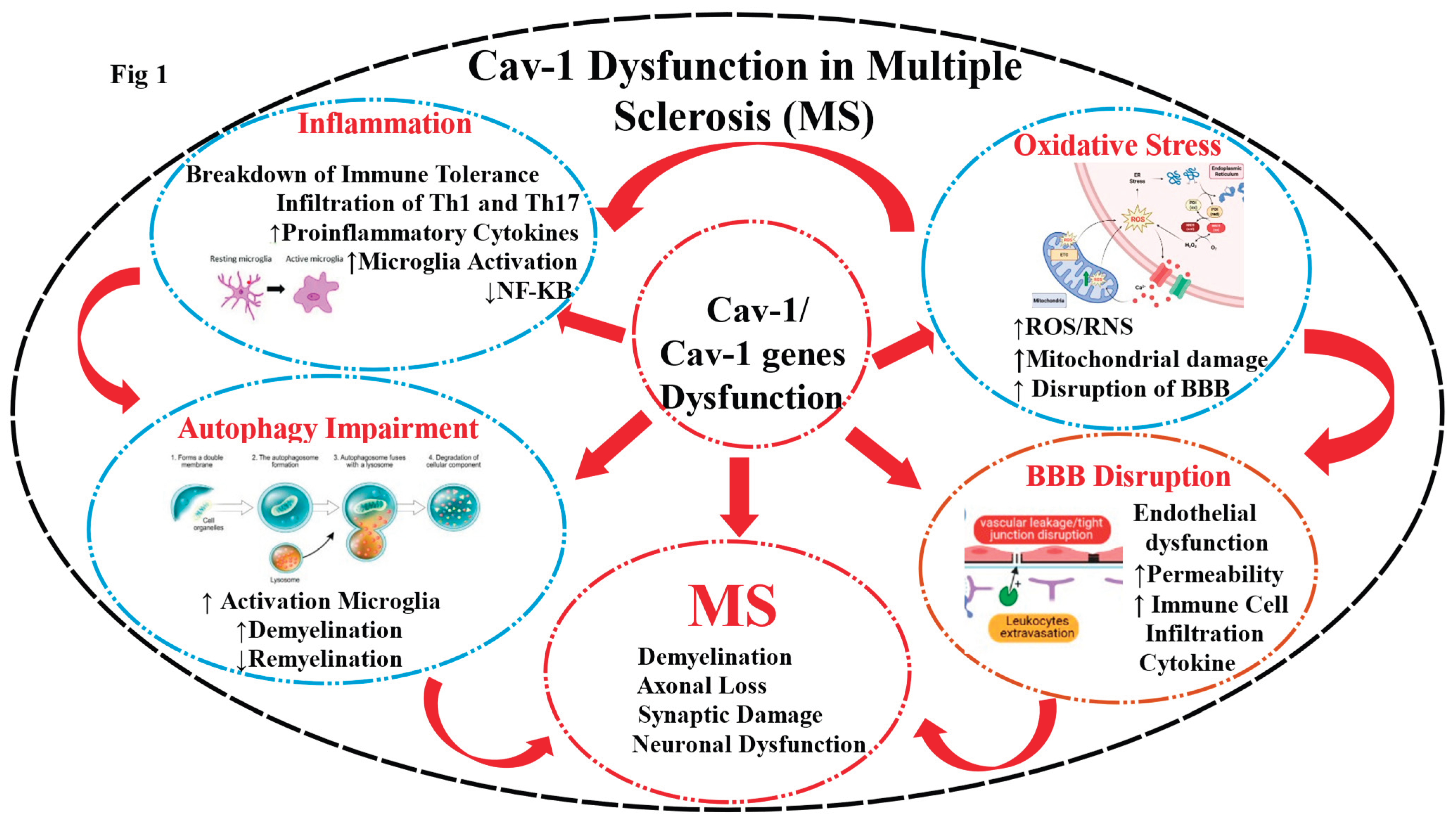
In short, Cav-1 expression underscored by Cav-1 gene, may prove as a reliable biomarker in MS, as its expression correlates with the disease severity and progression. Moreover, its role in regulation of BBB, glial cell dysfunction, and immune cell infiltration into CNS, leading to neuroinflammation, makes it a suitable candidate for therapeutic intervention as well [181,191]. These mechanisms are summarized in Figure 1.
2. Conclusions
MS treatment is primarily focused on reducing inflammation and relapse. While immunomodulatory therapies can result in considerable reductions in inflammation they fail to halt the progression of neurodegeneration. Cav-1 is a central protein that is essential in modulating immune signaling pathways and inflammatory responses during the development of autoimmune diseases. Moreover, a deficiency in Cav-1 gene or its protein expression is linked to increased infiltration of inflammatory cells and enhanced production of inflammatory cytokines. Cav-1 also plays a significant role in the proliferation and migration of immune cells. Nonetheless, translational aspect of Cav-1 and hence its specific therapeutic targeting in MS requires further exploration.
Author Contributions
BG: Conceptualization, Writing – review & editing. YT: Conceptualization, Writing – review & editing, MM: Conceptualization, original outline. HL: Conceptualization, review & editing. RM: Conceptualization, review & editing.
Funding
YT was supported in part by NIH/NIGMS (2 SO6 GM08016-39), BG was supported by a Toffler Foundation grant.
Acknowledgments
YT was supported in part by NIH/NIGMS (2 SO6 GM08016-39), BG was supported by a Toffler Foundation grant.
Conflicts of Interest
The authors declare that the research was conducted in the absence of any commercial or financial relationships that could be construed as a potential conflict of interest.
References
- Banchereau, R.; Cepika, A. M.; Pascual, V. Systems Approaches to Human Autoimmune Diseases. Curr. Opin. Immunol. 2013, 25, 598–605. [CrossRef]
- de Groot, N. S.; Burgas, M. T. Is Membrane Homeostasis the Missing Link between Inflammation and Neurodegenerative Diseases? Cell. Mol. Life Sci. 2015, 72, 4795–4805.
- Tuli, S.; Patel, P.; Shethji, A.; Gau, D. Mitochondria and the Actin Cytoskeleton in Neurodegeneration. Cytoskeleton 2026, in press. [CrossRef]
- Tohda, C.; Yang, X.; Matsui, M.; Inada, Y.; Kadomoto, E.; Nakada, S.; Watari, H.; Shibahara, N. Diosgenin-Rich Yam Extract Enhances Cognitive Function: A Placebo-Controlled, Randomized, Double-Blind, Crossover Study of Healthy Adults. Nutrients 2017, 9, 1160. [CrossRef]
- Savelieff, M. G.; Noureldein, M. H.; Feldman, E. L. Systems Biology to Address Unmet Medical Needs in Neurological Disorders. Methods Mol. Biol. 2022, 2486, 247–276.
- Wu, H.; Deng, R.; Chen, X.; Wong, W. C.; Chen, H.; Gao, L.; et al. Caveolin-1 Is Critical for Lymphocyte Trafficking into the Central Nervous System during Experimental Autoimmune Encephalomyelitis. J. Neurosci. 2016, 36, 5193–5199. [CrossRef]
- Möck, E. E. A.; Honkonen, E.; Airas, L. Synaptic Loss in Multiple Sclerosis: A Systematic Review of Human Postmortem Studies. Front. Neurol. 2021, 12, 782599. [CrossRef]
- Voskuhl, R. R.; MacKenzie-Graham, A. Chronic Experimental Autoimmune Encephalomyelitis Is an Excellent Model to Study Neuroaxonal Degeneration in Multiple Sclerosis. Front. Mol. Neurosci. 2022, 15, 1024058. [CrossRef]
- Jackson, M. S.; Porter, L. G.; Oakes, R. S. Engineering Neuroimmune Regulation: Biomaterial and Nanotechnology Platforms for Neuropathology Diagnosis and Targeted Immunomodulation. Front. Immunol. 2026, 16, 1677612. [CrossRef]
- Gold, R.; Linington, C.; Lassmann, H. Understanding Pathogenesis and Therapy of Multiple Sclerosis via Animal Models: 70 Years of Merits and Culprits in Experimental Autoimmune Encephalomyelitis Research. Brain 2006, 129, 1953–1971. [CrossRef]
- Ontaneda, D.; Hyland, M.; Cohen, J. A. Multiple Sclerosis: New Insights in Pathogenesis and Novel Therapeutics. Annu. Rev. Med. 2012, 63, 389–404. [CrossRef]
- Kurilin, V.; Fisher, M.; Obleukhova, I.; Sennikov, S. Cellular Immunotherapies for Multiple Sclerosis: Mechanistic Insights and Clinical Advances. Int. J. Mol. Sci. 2026, 27, 585. [CrossRef]
- McGinley, M. P.; Goldschmidt, C. H.; Rae-Grant, A. D. Diagnosis and Treatment of Multiple Sclerosis: A Review. JAMA 2021, 325, 765–779.
- Stys, P. K.; Zamponi, G. W.; van Minnen, J.; Geurts, J. J. Will the Real Multiple Sclerosis Please Stand Up? Nat. Rev. Neurosci. 2012, 13, 507–514. [CrossRef]
- Titus, H. E.; Chen, Y.; Podojil, J. R.; Robinson, A. P.; Balabanov, R.; Popko, B.; et al. Preclinical and Clinical Implications of “Inside-Out” vs “Outside-In” Paradigms in Multiple Sclerosis Etiopathogenesis. Front. Cell. Neurosci. 2020, 14, 599717. [CrossRef]
- Akpinar, Z.; Tokgöz, S.; Gökbel, H.; Okudan, N.; Uğuz, F.; Yilmaz, G. The Association of Nocturnal Serum Melatonin Levels with Major Depression in Patients with Acute Multiple Sclerosis. Psychiatry Res. 2008, 161, 253–257. [CrossRef]
- Soto Brambila, P. A.; Ortiz, G. G.; Rivero Moragrega, P.; Briones Torres, A. L.; Gonzalez Ortiz, L. J.; Pacheco Moises, P. F. Relapsing-Remitting Multiple Sclerosis and Its Relationship with the Immune System and Oxidative Stress. Curr. Immunol. Rev. 2018, 14, 15–23. [CrossRef]
- Ghasemi, N.; Razavi, S.; Nikzad, E. Multiple Sclerosis: Pathogenesis, Symptoms, Diagnoses and Cell-Based Therapy. Cell J. 2017, 19, 1–10.
- Elkhodiry, A. A.; El Tayebi, H. M. Scavenging the Hidden Impacts of Noncoding RNAs in Multiple Sclerosis. Noncoding RNA Res. 2021, 6, 187–199. [CrossRef]
- Ford, H. Clinical Presentation and Diagnosis of Multiple Sclerosis. Clin. Med. 2020, 20, 380–383. [CrossRef]
- Adamczyk-Sowa, M.; Pierzchała, K.; Sowa, P.; Mucha, S.; Sadowska-Bartosz, I.; Adamczyk, J.; et al. Melatonin Acts as an Antioxidant and Improves Sleep in MS Patients. Neurochem. Res. 2014, 39, 1585–1593. [CrossRef]
- Muñoz Jurado, A.; Escribano, B. M.; Caballero Villarraso, J.; Galván, A.; Agüera, E.; Santamaría, A.; et al. Melatonin and Multiple Sclerosis: Antioxidant, Anti-Inflammatory and Immunomodulatory Mechanisms of Action. Inflammopharmacology 2022, 30, 1569–1596. [CrossRef]
- Michaličková, D.; Šíma, M.; Slanař, O. New Insights in the Mechanisms of Impaired Redox Signaling and Its Interplay with Inflammation and Immunity in Multiple Sclerosis. Physiol. Res. 2020, 69, 1–19. [CrossRef]
- Arachchige, A. S. P. M.; El Choueiri, J.; Pellicanò, F.; Laurelli, F.; Alves, G. A. M.; Stomeo, N. A Review of Multiple Sclerosis: From Pathophysiology to Latest Therapeutic Advances. AIMS Neurosci. 2025, 12, 514–538. [CrossRef]
- Haki, M.; Al Biati, H. A.; Al Tameemi, Z. S.; Ali, I. S.; Al Hussaniy, H. A. Review of Multiple Sclerosis: Epidemiology, Etiology, Pathophysiology, and Treatment. Medicine 2024, 103, e37297.
- Sawcer, S.; Franklin, R. J. M.; Ban, M. Multiple Sclerosis Genetics. Lancet Neurol. 2014, 13, 700–709. [CrossRef]
- Dyment, D. A.; Sadovnick, A. D.; Ebers, G. C. Genetics of Multiple Sclerosis. Hum. Mol. Genet. 1997, 6, 1693–1698.
- Compston, A.; Coles, A. Multiple Sclerosis. Lancet 2002, 359, 1221–1231.
- Hollenbach, J. A.; Oksenberg, J. R. The Immunogenetics of Multiple Sclerosis: A Comprehensive Review. J. Autoimmun. 2015, 64, 13–25. [CrossRef]
- Horton, R.; Wilming, L.; Rand, V.; Lovering, R. C.; Bruford, E. A.; Khodiyar, V. K.; Lush, M. J.; Povey, S.; Talbot, C. C., Jr.; Wright, M. W.; Wain, H. M.; Trowsdale, J.; Ziegler, A.; Beck, S. Gene Map of the Extended Human MHC. Nat. Rev. Genet. 2004, 5, 889–899. [CrossRef]
- IPD-IMGT/HLA Database. http://hla.alleles.org/nomenclature/index.html (accessed 2026-03-19).
- Haines, J. L.; Pericak-Vance, M. A. Genetics of Multiple Sclerosis. Curr. Dir. Autoimmun. 1999, 1, 273–288.
- Olerup, O.; Hillert, J. HLA Class II-Associated Genetic Susceptibility in Multiple Sclerosis: A Critical Evaluation. Tissue Antigens 1991, 38, 1–15. [CrossRef]
- Barcellos, L. F.; Thomson, G. Genetic Analysis of Multiple Sclerosis in Europeans. J. Neuroimmunol. 2003, 143, 1–6. [CrossRef]
- International Multiple Sclerosis Genetics Consortium; Wellcome Trust Case Control Consortium 2; Sawcer, S.; Hellenthal, G.; Pirinen, M.; Spencer, C. C.; Patsopoulos, N. A.; Moutsianas, L.; et al. Genetic Risk and a Primary Role for Cell-Mediated Immune Mechanisms in Multiple Sclerosis. Nature 2011, 476, 214–219.
- Hafler, D. A.; Compston, A.; et al. Risk Alleles for Multiple Sclerosis Identified by a Genomewide Study. N. Engl. J. Med. 2007, 357, 851–862.
- Zarif Yeganeh, M.; Ghaffarpour, M.; Farhud, D. D.; Karimlou, M.; Ghabaee, M.; Haghighi Nazari, A. Skew in the Human Caveolin-1 Gene Upstream Purine Complex Homozygote Haplotype Compartment in Multiple Sclerosis. J. Neuroimmunol. 2009, 216, 103–107. [CrossRef]
- Kastelijn, E. A.; van Moorsel, C. H.; Kazemier, K. M.; Roothaan, S. M.; Ruven, H. J.; Kwakkel van Erp, J. M.; et al. A Genetic Polymorphism in the CAV1 Gene Associates with the Development of Bronchiolitis Obliterans Syndrome after Lung Transplantation. Fibrogenesis Tissue Repair 2011, 4, 24. [CrossRef]
- Chang, H.; Cheng, C.; Zheng, N.; Zhu, H.; Yang, H.; Zhu, X.; et al. Caveolin-1 Knockout Improves CFA-Induced Inflammatory Pain in Adult Mice through Modulating the cGAS–STING Pathway and Autophagy. PLoS One 2025, 20, e0333646. [CrossRef]
- Hoffman, S.; Maya-Monteiro, C. M.; de Almeida, C. J. G. Editorial: Caveolins in Inflammation, Infections, and Disease. Front. Immunol. 2024, 15, 1387191. [CrossRef]
- Ascherio, A.; Munger, K. L. Environmental Risk Factors for Multiple Sclerosis. Part II: Noninfectious Factors. Ann. Neurol. 2007, 61, 504–513. [CrossRef]
- Muñoz Jurado, A.; Escribano, B. M.; Caballero Villarraso, J.; Galván, A.; Agüera, E.; Santamaría, A.; et al. Melatonin and Multiple Sclerosis: Antioxidant, Anti-Inflammatory and Immunomodulatory Mechanisms of Action. Inflammopharmacology 2022, 30, 1569–1596. [CrossRef]
- Michaličková, D.; Šíma, M.; Slanař, O. New Insights in the Mechanisms of Impaired Redox Signaling and Its Interplay with Inflammation and Immunity in Multiple Sclerosis. Physiol. Res. 2020, 69, 1–19. [CrossRef]
- Arachchige, A. S. P. M.; El Choueiri, J.; Pellicanò, F.; Laurelli, F.; Alves, G. A. M.; Stomeo, N. A Review of Multiple Sclerosis: From Pathophysiology to Latest Therapeutic Advances. AIMS Neurosci. 2025, 12, 514–538. [CrossRef]
- Haki, M.; Al Biati, H. A.; Al Tameemi, Z. S.; Ali, I. S.; Al Hussaniy, H. A. Review of Multiple Sclerosis: Epidemiology, Etiology, Pathophysiology, and Treatment. Medicine 2024, 103, e37297.
- International Multiple Sclerosis Genetics Consortium; Wellcome Trust Case Control Consortium 2; Sawcer, S.; Hellenthal, G.; Pirinen, M.; Spencer, C. C.; Patsopoulos, N. A.; Moutsianas, L.; et al. Genetic Risk and a Primary Role for Cell-Mediated Immune Mechanisms in Multiple Sclerosis. Nature 2011, 476, 214–219.
- Hafler, D. A.; Compston, A.; et al. Risk Alleles for Multiple Sclerosis Identified by a Genomewide Study. N. Engl. J. Med. 2007, 357, 851–862.
- Zarif Yeganeh, M.; Ghaffarpour, M.; Farhud, D. D.; Karimlou, M.; Ghabaee, M.; Haghighi Nazari, A. Skew in the Human Caveolin-1 Gene Upstream Purine Complex Homozygote Haplotype Compartment in Multiple Sclerosis. J. Neuroimmunol. 2009, 216, 103–107. [CrossRef]
- Kastelijn, E. A.; van Moorsel, C. H.; Kazemier, K. M.; Roothaan, S. M.; Ruven, H. J.; Kwakkel van Erp, J. M.; et al. A Genetic Polymorphism in the CAV1 Gene Associates with the Development of Bronchiolitis Obliterans Syndrome after Lung Transplantation. Fibrogenesis Tissue Repair 2011, 4, 24. [CrossRef]
- Ascherio, A.; Munger, K. L. Environmental Risk Factors for Multiple Sclerosis. Part II: Noninfectious Factors. Ann. Neurol. 2007, 61, 504–513. [CrossRef]
- Ascherio, A.; Munger, K. L. Epstein–Barr Virus Infection and Multiple Sclerosis: A Review. J. Neuroimmune Pharmacol. 2010, 5, 271–277. [CrossRef]
- Munger, K. L.; Bentzen, J.; Laursen, B.; Stenager, E.; Koch-Henriksen, N.; Sørensen, T. I.; et al. Childhood Body Mass Index and Multiple Sclerosis Risk: A Long-Term Cohort Study. Mult. Scler. 2013, 19, 1323–1329. [CrossRef]
- Varra, F. N.; Pagonopoulou, O.; Varras, M.; Varra, V. K.; Theodosis-Nobelos, P. Is Obesity a Modifiable Risk Factor in Multiple Sclerosis? Mechanistic Insights into Neuroinflammation and Oxidative Damage. Pathophysiology 2026, 33, 5. [CrossRef]
- Ascherio, A.; Munger, K. L.; Simon, K. C. Vitamin D and Multiple Sclerosis. Lancet Neurol. 2010, 9, 599–612.
- Didonna, A. Preclinical Models of Multiple Sclerosis: Advantages and Limitations towards Better Therapies. Curr. Med. Chem. 2016, 23, 1442–1459. [CrossRef]
- Vincenzi, F.; Smirne, C.; Tonello, S.; Sainaghi, P. P. The Role of Vitamin D in Autoimmune Diseases. Int. J. Mol. Sci. 2026, 27, 555. [CrossRef]
- Oh, J.; Vidal-Jordana, A.; Montalban, X. Multiple Sclerosis: Clinical Aspects. Curr. Opin. Neurol. 2018, 31, 752–759.
- Thompson, A. J.; et al. Diagnosis of Multiple Sclerosis: 2017 Revisions of the McDonald Criteria. Lancet Neurol. 2018, 17, 162–173. [CrossRef]
- Weissert, R.; Wallström, E.; Storch, M. K.; Stefferl, A.; Lorentzen, J.; Lassmann, H.; et al. MHC Haplotype-Dependent Regulation of MOG-Induced EAE in Rats. J. Clin. Invest. 1998, 102, 1265–1273. [CrossRef]
- Montalban, X.; et al. MRI Criteria for MS in Patients with Clinically Isolated Syndromes. Neurology 2010, 74, 427–434. [CrossRef]
- Butterfield, R. J.; Sudweeks, J. D.; Blankenhorn, E. P.; Korngold, R.; Marini, J. C.; Todd, J. A.; et al. New Genetic Loci That Control Susceptibility and Symptoms of Experimental Allergic Encephalomyelitis in Inbred Mice. J. Immunol. 1998, 161 (4), 1860–1867. [CrossRef]
- Butterfield, R. J.; Blankenhorn, E. P.; Roper, R. J.; Zachary, J. F.; Doerge, R. W.; Sudweeks, J.; et al. Genetic Analysis of Disease Subtypes and Sexual Dimorphisms in Mouse Experimental Allergic Encephalomyelitis (EAE): Relapsing/Remitting and Monophasic Remitting/Nonrelapsing EAE Are Immunogenetically Distinct. J. Immunol. 1999, 162 (5), 3096–3102. [CrossRef]
- Butterfield, R. J.; Blankenhorn, E. P.; Roper, R. J.; Zachary, J. F.; Doerge, R. W.; Teuscher, C. Identification of Genetic Loci Controlling the Characteristics and Severity of Brain and Spinal Cord Lesions in Experimental Allergic Encephalomyelitis. Am. J. Pathol. 2000, 157 (2), 637–645. [CrossRef]
- Corvol, J.-C.; Pelletier, D.; Henry, R. G.; Caillier, S. J.; Wang, J.; Pappas, D.; et al. Abrogation of T Cell Quiescence Characterizes Patients at High Risk for Multiple Sclerosis after the Initial Neurological Event. Proc. Natl. Acad. Sci. U.S.A. 2008, 105 (33), 11839–11844. [CrossRef]
- Lee, H.; Volonte, D.; Galbiati, F.; Iyengar, P.; Lublin, D. M.; Bregman, D. B.; et al. Constitutive and Growth Factor-Regulated Phosphorylation of Caveolin-1 Occurs at the Same Site (Tyr-14) in Vivo. Mol. Endocrinol. 2000, 14, 1750–1775.
- Cheng, J. P. X.; Nichols, B. J. Caveolae: One Function or Many? Trends Cell Biol. 2016, 26 (3), 177–189.
- Chang, H.; Cheng, C.; Zheng, N.; Zhu, H.; Yang, H.; Zhu, X.; et al. Caveolin-1 Knockout Improves CFA-Induced Inflammatory Pain in Adult Mice through Modulating the cGAS–STING Pathway and Autophagy. PLoS One 2025, 20 (10), e0333646. [CrossRef]
- Hoffman, S.; Maya-Monteiro, C. M.; de Almeida, C. J. G. Editorial: Caveolins in Inflammation, Infections, and Disease. Front. Immunol. 2024, 15, 1387191. [CrossRef]
- Codrici, E.; Albulescu, L.; Popescu, I. D.; Mihai, S.; Enciu, A. M.; Albulescu, R.; et al. Caveolin-1-Knockout Mouse as a Model of Inflammatory Diseases. J. Immunol. Res. 2018, 2018, 2498576. [CrossRef]
- Wang, X. M.; Kim, H. P.; Song, R.; Choi, A. M. Caveolin-1 Confers Antiinflammatory Effects in Murine Macrophages via the MKK3/p38 MAPK Pathway. Am. J. Respir. Cell Mol. Biol. 2006, 34 (4), 434–442. [CrossRef]
- Lu, J. Q.; Wang, H. Q.; Fang, M. R.; Ye, X. M.; Song, K. Y. Autophagy–NLRP3 Inflammasome Crosstalk in Microglia: A Therapeutic Target for Multiple Sclerosis. Inflammation 2026, 49 (1), 23. [CrossRef]
- Ge, S.; Pachter, J. S. Caveolin-1 Knockdown by Small Interfering RNA Suppresses Responses to the Chemokine Monocyte Chemoattractant Protein-1 by Human Astrocytes. J. Biol. Chem. 2004, 279, 6688–6695. [CrossRef]
- Engel, D.; Beckers, L.; Wijnands, E.; Seijkens, T.; Lievens, D.; Drechsler, M.; Gerdes, N.; Soehnlein, O.; Daemen, M. J.; Stan, R. V.; Biessen, E. A.; Lutgens, E. Caveolin-1 Deficiency Decreases Atherosclerosis by Hampering Leukocyte Influx into the Arterial Wall and Generating a Regulatory T-Cell Response. FASEB J. 2011, 25, 3838–3848. [CrossRef]
- Polman, C. H.; Reingold, S. C.; Banwell, B.; Clanet, M.; Cohen, J. A.; Filippi, M.; et al. Diagnostic Criteria for Multiple Sclerosis: 2010 Revisions to the McDonald Criteria. Ann. Neurol. 2011, 69 (2), 292–302. [CrossRef]
- Arrambide, G.; et al. The Value of Oligoclonal Bands in the Multiple Sclerosis Diagnostic Criteria. Brain 2018, 141, 1075–1084. [CrossRef]
- Vidal-Jordana, A.; et al. Adding the Optic Nerve in Multiple Sclerosis Diagnostic Criteria: A Longitudinal, Prospective, Multicenter Study. Neurology 2024, 102, e200805.
- Vilaseca, A.; et al. Uncovering Alternative Diagnoses in Patients with Clinical Syndromes Suggestive of Multiple Sclerosis: A Transversal Study from the Prospective Barcelona CIS Cohort. Mult. Scler. J. 2025, 31, 408–417. [CrossRef]
- Haase, S.; Linker, R. A. Inflammation in Multiple Sclerosis. Ther. Adv. Neurol. Disord. 2021, 14, 17562864211007687. [CrossRef]
- Robinson, A. P.; Harp, C. T.; Noronha, A.; Miller, S. D. The Experimental Autoimmune Encephalomyelitis (EAE) Model of MS: Utility for Understanding Disease Pathophysiology and Treatment. Handb. Clin. Neurol. 2014, 122, 173–189.
- Miller, S. D.; Karpus, W. J. Experimental Autoimmune Encephalomyelitis in the Mouse. Curr. Protoc. Immunol. 2007, Chapter 15, 15.1.1–15.1.18.
- Pressley, K. R.; Schwegman, L.; Montes De Oca Arena, M.; Chase Huizar, C.; Zamvil, S. S.; Forsthuber, T. G. HLA Transgenic Mouse Models to Study Autoimmune Central Nervous System Diseases. Autoimmunity 2024, 57 (1), 2387414. [CrossRef]
- Trevino, T. N.; Almousawi, A. A.; Martins Goncalves, R.; Ochoa Raya, A.; Robinson, K. F.; Abad, G. L.; et al. A Brain Endothelial Cell Caveolin-1/CXCL10 Axis Promotes T Cell Transcellular Migration across the Blood–Brain Barrier. ASN Neuro 2025, 17 (1), 2472070. [CrossRef]
- Haider, L.; et al. Oxidative Damage in Multiple Sclerosis Lesions. Brain 2011, 134, 1914–1922. [CrossRef]
- Lassmann, H.; van Horssen, J. Oxidative Stress and Its Impact on Neurons and Glia in Multiple Sclerosis Lesions. Biochim. Biophys. Acta 2016, 1862, 506–510.
- Pegoretti, V.; et al. Inflammation and Oxidative Stress in Multiple Sclerosis: Consequences for Therapy Development. Oxid. Med. Cell. Longev. 2020, 2020, 7191080. [CrossRef]
- Jelinek, M.; Jurajda, M.; Duris, K. Oxidative Stress in the Brain: Basic Concepts and Treatment Strategies in Stroke. Antioxidants 2021, 10, 1886. [CrossRef]
- Baird, L.; Yamamoto, M. The Molecular Mechanisms Regulating the KEAP1–NRF2 Pathway. Mol. Cell. Biol. 2020, 40 (13), e00099-20. [CrossRef]
- Forman, H. J.; Zhang, H. Targeting Oxidative Stress in Disease: Promise and Limitations of Antioxidant Therapy. Nat. Rev. Drug Discov. 2021, 20, 689–709. [CrossRef]
- Schieber, M.; Chandel, N. S. ROS Function in Redox Signaling and Oxidative Stress. Curr. Biol. 2014, 24, R453–R462. [CrossRef]
- Suneetha, A.; Raja Rajeswari, K. Role of Dimethyl Fumarate in Oxidative Stress of Multiple Sclerosis: A Review. J. Chromatogr. B 2016, 1019, 15–20.
- Li, Y.; Wang, Y.; Wang, S.; Zhu, H. Effects of Oxidative Stress Gene Protein Expression and DNA Methylation on Multiple Sclerosis: A Multi-Omics Mendelian Randomized Study. Brain Behav. 2025, 15 (6), e70606. [CrossRef]
- Offen, D.; Gilgun-Sherki, Y.; Barhum, Y.; Benhar, M.; Grinberg, L.; Reich, R.; Melamed, E.; Atlas, D. A Low Molecular Weight Copper Chelator Crosses the Blood–Brain Barrier and Attenuates Experimental Autoimmune Encephalomyelitis. J. Neurochem. 2004, 89 (5), 1241–1251. [CrossRef]
- Wang, G.; Shi, Y.; Jiang, X.; et al. HDAC Inhibition Prevents White Matter Injury by Modulating Microglia/Macrophage Polarization through the GSK3β/PTEN/Akt Axis. Proc. Natl. Acad. Sci. U.S.A. 2015, 112 (9), 2853–2858. [CrossRef]
- Sica, A.; Mantovani, A. Macrophage Plasticity and Polarization: In Vivo Veritas. J. Clin. Invest. 2012, 122 (3), 787–795. [CrossRef]
- Qin, H.; Yeh, W.-I.; De Sarno, P.; et al. STAT3/SOCS3 Axis in Myeloid Cells Regulates Neuroinflammation. Proc. Natl. Acad. Sci. U.S.A. 2012, 109 (13), 5004–5009.
- Zhu, E.; Wang, X.; Zheng, B.; et al. miR-20b Suppresses Th17 Differentiation and the Pathogenesis of Experimental Autoimmune Encephalomyelitis. J. Immunol. 2014, 192 (12), 5599–5609. [CrossRef]
- Amersfoort, J.; Eelen, G.; Carmeliet, P. Immunomodulation by Endothelial Cells—Partnering Up with the Immune System. Nat. Rev. Immunol. 2022, 22, 576–588. [CrossRef]
- Zhao, Y.; Zhu, D. Interaction of Brain Endothelial Cells with T Cells: Implications for Progression and Therapeutic Strategies of Multiple Sclerosis. Front. Neurol. 2026, 17, 1721076. [CrossRef]
- Zarkovic, N. Roles and Functions of ROS and RNS in Cellular Physiology and Pathology. Cells 2020, 9, 767. [CrossRef]
- Radak, Z.; Zhao, Z.; Goto, S.; Koltai, E. Age-Associated Neurodegeneration and Oxidative Damage to Lipids, Proteins, and DNA. Mol. Aspects Med. 2011, 32, 305–315. [CrossRef]
- Teleanu, D.; Niculescu, A.; Lungu, I.; Radu, C.; Vladâcenco, O.; Roza, E.; et al. An Overview of Oxidative Stress, Neuroinflammation, and Neurodegenerative Diseases. Int. J. Mol. Sci. 2022, 23, 5938. [CrossRef]
- Katsi, V.; Marketou, M.; Maragkoudakis, S.; Didagelos, M.; Charalambous, G.; Parthenakis, F.; et al. Blood–Brain Barrier Dysfunction: The Undervalued Frontier of Hypertension. J. Hum. Hypertens. 2020, 34, 682–691. [CrossRef]
- Gao, X.; Kim, H. K.; Mo Chung, J.; Chung, K. Reactive Oxygen Species Are Involved in Enhancement of NMDA Receptor Phosphorylation in Animal Models of Pain. Pain 2007, 131 (3), 262–271. [CrossRef]
- Munoz, F. M.; Gao, R.; Tian, Y.; Henstenburg, B. A.; Barrett, J. E.; Hu, H. Neuronal P2X7 Receptor-Induced Reactive Oxygen Species Production Contributes to Nociceptive Behavior in Mice. Sci. Rep. 2017, 7 (1), 3539. [CrossRef]
- Kallenborn-Gerhardt, W.; Schröder, K.; Geisslinger, G.; Schmidtko, A. NOXious Signaling in Pain Processing. Pharmacol. Ther. 2013, 137, 309–317. [CrossRef]
- Chen, J. L.; Wei, L.; Bereczki, D.; Hans, F. J.; Otsuka, T.; Acuff, V.; et al. Nicotine Raises the Influx of Permeable Solutes across the Rat Blood–Brain Barrier with Little or No Capillary Recruitment. J. Cereb. Blood Flow Metab. 1995, 15 (4), 687–698. [CrossRef]
- Hernán, M. A.; Jick, S. S.; Logroscino, G.; Olek, M. J.; Ascherio, A.; Jick, H. Cigarette Smoking and the Progression of Multiple Sclerosis. Brain 2005, 128 (Pt 6), 1461–1465. [CrossRef]
- Zierfuss, B.; Larochelle, C.; Prat, A. Blood–Brain Barrier Dysfunction in Multiple Sclerosis: Causes, Consequences, and Potential Effects of Therapies. Lancet Neurol. 2024, 23 (1), 95–109. [CrossRef]
- Meng, X.; Layhadi, J. A.; Keane, S. T.; Cartwright, N. J. K.; Durham, S. R.; Shamji, M. H. Immunological Mechanisms of Tolerance: Central, Peripheral, and the Role of T and B Cells. Asia Pac. Allergy 2023, 13 (4), 175–186. [CrossRef]
- Goodnow, C. C.; Sprent, J.; Fazekas de St Groth, B.; Vinuesa, C. G. Cellular and Genetic Mechanisms of Self-Tolerance and Autoimmunity. Nature 2005, 435, 590–597. [CrossRef]
- Galea, I.; Bechmann, I.; Perry, V. H. What Is Immune Privilege (Not)? Trends Immunol. 2007, 28, 12–18.
- Engelhardt, B.; Coisne, C. Fluids and Barriers of the CNS Establish Immune Privilege by Confining Immune Surveillance to a Two-Walled Castle Moat Surrounding the CNS Castle. Fluids Barriers CNS 2011, 8, 4. [CrossRef]
- Louveau, A.; Harris, T. H.; Kipnis, J. Revisiting the Mechanisms of CNS Immune Privilege. Trends Immunol. 2015, 36, 569–577. [CrossRef]
- Forrester, J. V.; McMenamin, P. G.; Dando, S. J. CNS Infection and Immune Privilege. Nat. Rev. Neurosci. 2018, 19, 655–671. [CrossRef]
- Compston, A.; Coles, A. Multiple Sclerosis. Lancet 2008, 372 (9648), 1502–1517.
- Lassmann, H. Pathogenic Mechanisms Associated with Different Clinical Courses of Multiple Sclerosis. Front. Immunol. 2018, 9, 3116. [CrossRef]
- Monaco, S.; Nicholas, R.; Reynolds, R.; et al. Intrathecal Inflammation in Progressive Multiple Sclerosis. Int. J. Mol. Sci. 2020, 21, 8217. [CrossRef]
- Lehmann, P. V.; Forsthuber, T.; Miller, A.; Sercarz, E. E. Spreading of T Cell Autoimmunity to Cryptic Determinants of an Autoantigen. Nature 1992, 358, 155–157. [CrossRef]
- Meng, H.; et al. Double Negative T Cells Remarkably Promote Neuroinflammation after Ischemic Stroke. Proc. Natl. Acad. Sci. U.S.A. 2019, 116, 5558–5563. [CrossRef]
- Tavassolifar, M. J.; Moghadasi, A. N.; Esmaeili, B.; Sadatpour, O.; Vodjgani, M.; Izad, M. Redox Imbalance in CD4+ T Cells of Relapsing–Remitting Multiple Sclerosis Patients. Oxid. Med. Cell. Longev. 2020, 8860813. [CrossRef]
- Conde, C.; Escribano, B. M.; Luque, E.; Feijóo, M.; Caballero Villarraso, J.; Valdelvira, M. E.; et al. Extra Virgin Olive Oil Modifies the Changes Induced in Non-Nervous Organs and Tissues by Experimental Autoimmune Encephalomyelitis Models. Nutrients 2019, 11 (10), 2448. [CrossRef]
- Hu, H.; Li, H.; Li, R.; Liu, P.; Liu, H. Re-Establishing Immune Tolerance in Multiple Sclerosis: Focusing on Novel Mechanisms of Mesenchymal Stem Cell Regulation of Th17/Treg Balance. J. Transl. Med. 2024, 22 (1), 663. [CrossRef]
- Cao, Y.; et al. Functional Inflammatory Profiles Distinguish Myelin-Reactive T Cells from Patients with Multiple Sclerosis. Sci. Transl. Med. 2015, 7, 287ra274. [CrossRef]
- Goverman, J. Autoimmune T Cell Responses in the Central Nervous System. Nat. Rev. Immunol. 2009, 9 (6), 393–407. [CrossRef]
- He, C.; Klionsky, D. J. Regulation Mechanisms and Signaling Pathways of Autophagy. Annu. Rev. Genet. 2009, 43, 67–93. [CrossRef]
- Múnera Rodríguez, A. M.; Leiva Castro, C.; Reina Pérez, I.; Benítez Márquez, J. M.; Palomares, F.; López Enríquez, S. The Role of Autophagy in Inflammatory Diseases: Challenges and Therapeutic Potential. Inflamm. Bowel Dis. 2026, izaf279. [CrossRef]
- Bento, C. F.; Renna, M.; Ghislat, G.; Puri, C.; Ashkenazi, A.; Vicinanza, M.; et al. Mammalian Autophagy: How Does It Work? Annu. Rev. Biochem. 2016, 85, 685–713. [CrossRef]
- Al Kuraishy, H. M.; Jabir, M. S.; Al Gareeb, A. I.; Saad, H. M.; Batiha, G. E.; Klionsky, D. J. The Beneficial Role of Autophagy in Multiple Sclerosis: Yes or No? Autophagy 2024, 20 (2), 259–274. [CrossRef]
- Dogterom, M.; Koenderink, G. H. Actin–Microtubule Crosstalk in Cell Biology. Nat. Rev. Mol. Cell Biol. 2019, 20, 38–54. [CrossRef]
- Fletcher, D. A.; Mullins, R. D. Cell Mechanics and the Cytoskeleton. Nature 2010, 463 (7280), 485–492.
- Chaffey, N.; Alberts, B.; Johnson, A.; Lewis, J.; Raff, M.; Roberts, K.; Walter, P. Molecular Biology of the Cell, 4th ed.; Ann. Bot. 2003, 91 (3), 401.
- Di Giaimo, R.; Penna, E.; Pizzella, A.; Cirillo, R.; Perrone Capano, C.; Crispino, M. Cross Talk at the Cytoskeleton–Plasma Membrane Interface: Impact on Neuronal Morphology and Functions. Int. J. Mol. Sci. 2020, 21 (23), 9133. [CrossRef]
- Kapus, A.; Janmey, P. Plasma Membrane–Cortical Cytoskeleton Interactions: A Cell Biology Approach with Biophysical Considerations. Compr. Physiol. 2013, 3 (3), 1231–1281. [CrossRef]
- Koppers, M.; Özkan, N.; Farías, G. G. Complex Interactions Between Membrane-Bound Organelles, Biomolecular Condensates and the Cytoskeleton. Front. Cell Dev. Biol. 2020, 8, 618733. [CrossRef]
- Parton, R. G.; Del Pozo, M. A.; Vassilopoulos, S.; Nabi, I. R.; Le Lay, S.; Lundmark, R.; et al. Caveolae: The FAQs. Traffic 2020, 21 (1), 181–185. [CrossRef]
- Preston, J. E.; Abbott, N. J.; Begley, D. J. Transcytosis of Macromolecules at the Blood–Brain Barrier. Adv. Pharmacol. 2014, 71, 147–163.
- Sinha, B.; Köster, D.; Ruez, R.; Gonnord, P.; Bastiani, M.; Abankwa, D.; et al. Cells Respond to Mechanical Stress by Rapid Disassembly of Caveolae. Cell 2011, 144 (3), 402–413. [CrossRef]
- Parton, R. G.; del Pozo, M. A. Caveolae as Plasma Membrane Sensors, Protectors and Organizers. Nat. Rev. Mol. Cell Biol. 2013, 14, 98–112.
- Kamposioras, K.; Vassilakopoulou, M.; Anthoney, A.; Bariuoso, J.; Mauri, D.; Mansoor, W. Prognostic Significance and Therapeutic Implications of Caveolin-1 in Gastrointestinal Tract Malignancies. Pharmacol. Ther. 2022, 233, 108028. [CrossRef]
- Enyong, E. N.; Gurley, J. M.; De Ieso, M. L.; Stamer, W. D.; Elliott, M. H. Caveolar and Non-Caveolar Caveolin-1 in Ocular Homeostasis and Disease. Prog. Retin. Eye Res. 2022, 91, 101094. [CrossRef]
- Koh, S.; Lee, W.; Park, S. M.; Kim, S. H. Caveolin-1 Deficiency Impairs Synaptic Transmission in Hippocampal Neurons. Mol. Brain 2021, 14, 53. [CrossRef]
- Scherer, P. E.; Tang, Z.; Chun, M.; Sargiacomo, M.; Lodish, H. F.; Lisanti, M. P. Caveolin Isoforms Differ in Their N-Terminal Protein Sequence and Subcellular Distribution. J. Biol. Chem. 1995, 270 (27), 16395–16401. [CrossRef]
- Monier, S.; Parton, R. G.; Vogel, F.; Behlke, J.; Henske, A.; Kurzchalia, T. V. VIP21-Caveolin, a Membrane Protein Constituent of the Caveolar Coat, Oligomerizes in Vivo and in Vitro. Mol. Biol. Cell 1995, 6 (7), 911–927. [CrossRef]
- Hayer, A.; Stoeber, M.; Bissig, C.; Helenius, A. Biogenesis of Caveolae: Stepwise Assembly of Large Caveolin and Cavin Complexes. Traffic 2010, 11 (3), 361–382. [CrossRef]
- Tang, D.; Zhang, Y.; Mei, J.; Zhao, J.; Miao, C.; Jiu, Y. Interactive Mechanisms Between Caveolin-1 and Actin Filaments or Vimentin Intermediate Filaments Instruct Cell Mechanosensing and Migration. J. Mol. Cell Biol. 2023, 14 (11), mjac066. [CrossRef]
- Fridolfsson, H. N.; Roth, D. M.; Insel, P. A.; Patel, H. H. Regulation of Intracellular Signaling and Function by Caveolin. FASEB J. 2014, 28 (9), 3823–3831. [CrossRef]
- Ariotti, N.; Fernández-Rojo, M. A.; Zhou, Y.; Hill, M. M.; Rodkey, T. L.; Inder, K. L.; et al. Caveolae Regulate the Nanoscale Organization of the Plasma Membrane to Remotely Control Ras Signaling. J. Cell Biol. 2014, 204 (5), 777–792. [CrossRef]
- Lajoie, P.; Goetz, J. G.; Dennis, J. W.; Nabi, I. R. Lattices, Rafts, and Scaffolds: Domain Regulation of Receptor Signaling at the Plasma Membrane. J. Cell Biol. 2009, 185 (3), 381–385. [CrossRef]
- Aoki, T.; Nomura, R.; Fujimoto, T. Tyrosine Phosphorylation of Caveolin-1 in the Endothelium. Exp. Cell Res. 1999, 253, 629–636.
- Parton, R. G. Caveolae: Structure, Function, and Relationship to Disease. Annu. Rev. Cell Dev. Biol. 2018, 34, 111–136. [CrossRef]
- Frank, P. G. Endothelial Caveolae and Caveolin-1 as Key Regulators of Atherosclerosis. Am. J. Pathol. 2010, 177, 544–546. [CrossRef]
- Walser, P. J.; Ariotti, N.; Howes, M.; Ferguson, C.; Webb, R.; Schwudke, D.; et al. Constitutive Formation of Caveolae in a Bacterium. Cell 2012, 150 (4), 752–763. [CrossRef]
- Michell, D. L.; Shihata, W. A.; Andrews, K. L.; Abidin, N. A. Z.; Jefferis, A. M.; Sampson, A. K.; et al. High Intraluminal Pressure Promotes Vascular Inflammation via Caveolin-1. Sci. Rep. 2021, 11, 5894. [CrossRef]
- Tang, W.; Li, Y.; Li, Y.; Wang, Q. Caveolin-1, a Novel Player in Cognitive Decline. Neurosci. Biobehav. Rev. 2021, 129, 95–106.
- Gokani, S.; Bhatt, L. K. Caveolin-1: A Promising Therapeutic Target for Diverse Diseases. Curr. Mol. Pharmacol. 2022, 15 (5), 701–715. [CrossRef]
- Shu, Y.; Jin, S. Caveolin-1 in Endothelial Cells: A Potential Therapeutic Target for Atherosclerosis. Heliyon 2023, 9 (8), e18653. [CrossRef]
- Shin, T.; Kim, H.; Jin, J. K.; Moon, C.; Ahn, M.; Tanuma, N.; Matsumoto, Y. Expression of Caveolin-1, -2, and -3 in the Spinal Cords of Lewis Rats with Experimental Autoimmune Encephalomyelitis. J. Neuroimmunol. 2005, 165, 11–20. [CrossRef]
- Wu, H.; Deng, R.; Chen, X.; Wong, W. C.; Chen, H.; Gao, L.; et al. Caveolin-1 Is Critical for Lymphocyte Trafficking into the Central Nervous System during Experimental Autoimmune Encephalomyelitis. J. Neurosci. 2016, 36 (19), 5193–5199. [CrossRef]
- Lutz, S. E.; Smith, J. R.; Kim, D. H.; Olson, C. V. L.; Ellefsen, K.; Bates, J. M.; et al. Caveolin-1 Is Required for Th1 Cell Infiltration, but Not Tight Junction Remodeling, at the Blood–Brain Barrier in Autoimmune Neuroinflammation. Cell Rep. 2017, 21, 2104–2117.
- Wang, R.; He, W.; Li, Z.; Chang, W.; Xin, Y.; Huang, T. Caveolin-1 Functions as a Key Regulator of 17β-Estradiol-Mediated Autophagy and Apoptosis in BT474 Breast Cancer Cells. Int. J. Mol. Med. 2014, 34, 822–827. [CrossRef]
- Shi, Y.; Tan, S. H.; Ng, S.; Zhou, J.; Yang, N. D.; Koo, G. B.; et al. Critical Role of CAV1/Caveolin-1 in Cell Stress Responses in Human Breast Cancer Cells via Modulation of Lysosomal Function and Autophagy. Autophagy 2015, 11, 769–784.
- McDonald, C.; Xanthopoulos, C.; Kostareli, E. The Role of Bruton's Tyrosine Kinase in the Immune System and Disease. Immunology 2021, 164 (4), 722–736. [CrossRef]
- Minguet, S.; Kläsener, K.; Schaffer, A. M.; Fiala, G. J.; Osteso-Ibánez, T.; Raute, K.; et al. Caveolin-1-Dependent Nanoscale Organization of the BCR Regulates B Cell Tolerance. Nat. Immunol. 2017, 18 (10), 1150–1159. [CrossRef]
- Vargas, L.; Nore, B. F.; Berglöf, A.; Heinonen, J. E.; Mattsson, P. T.; Smith, C. I.; Mohamed, A. J. Functional Interaction of Caveolin-1 with Bruton's Tyrosine Kinase and Bmx. J. Biol. Chem. 2002, 277 (11), 9351–9357. [CrossRef]
- Li, W.; Liu, H.; Zhou, J. S.; Cao, J. F.; Zhou, X. B.; Choi, A. M.; et al. Caveolin-1 Inhibits Expression of Antioxidant Enzymes through Direct Interaction with Nuclear Erythroid 2 p45-Related Factor-2 (Nrf2). J. Biol. Chem. 2012, 287 (25), 20922–20930. [CrossRef]
- Kulshrestha, R.; Singh, H.; Pandey, A.; Soundarya, D.; Jaggi, A. S.; Ravi, K. Differential Expression of Caveolin-1 during Pathogenesis of Combined Pulmonary Fibrosis and Emphysema: Effect of Phosphodiesterase-5 Inhibitor. Biochim. Biophys. Acta, Mol. Basis Dis. 2020, 1866 (8), 165802. [CrossRef]
- Alrouji, M.; et al. Investigating the Effect of Cigarette Smoking on Serum Uric Acid Levels in Multiple Sclerosis Patients: A Cross-Sectional Study. Brain Sci. 2023, 13. [CrossRef]
- Sun, L. N.; Liu, X. C.; Chen, X. J.; Guan, G. J.; Liu, G. Curcumin Attenuates High Glucose-Induced Podocyte Apoptosis by Regulating Functional Connections between Caveolin-1 Phosphorylation and ROS. Acta Pharmacol. Sin. 2016, 37, 645–655. [CrossRef]
- Mikol, D. D.; Scherer, S. S.; Duckett, S. J.; Hong, H. L.; Feldman, E. L. Schwann Cell Caveolin-1 Expression Increases during Myelination and Decreases after Axotomy. Glia 2002, 38 (3), 191–199. [CrossRef]
- van Rheenen, J.; Condeelis, J.; Glogauer, M. A Common Cofilin Activity Cycle in Invasive Tumor Cells and Inflammatory Cells. J. Cell Sci. 2009, 122 (Pt 3), 305–311. [CrossRef]
- Das, S.; Srinivasan, S.; Srivastava, A.; Kumar, S.; Das, G.; Das, S.; et al. Differential Influence of IL-9 and IL-17 on Actin Cytoskeleton Regulates the Migration Potential of Human Keratinocytes. J. Immunol. 2019, 202 (7), 1949–1961. [CrossRef]
- Santizo, R. A.; Xu, H. L.; Galea, E.; Muyskens, S.; Baughman, V. L.; Pelligrino, D. A. Combined Endothelial Nitric Oxide Synthase Upregulation and Caveolin-1 Downregulation Decrease Leukocyte Adhesion in Pial Venules of Ovariectomized Female Rats. Stroke 2002, 33, 613–616. [CrossRef]
- Bonini, M. G.; Dull, R. O.; Minshall, R. D. Caveolin-1 Regulation of Endothelial Nitric Oxide Synthase (eNOS) Function and Oxidative Stress in the Endothelium. In Systems Biology of Free Radicals and Antioxidants; Laher, I., Ed.; Springer: Berlin, Heidelberg, 2014.
- Badaut, J.; Blochet, C.; Obenaus, A.; Hirt, L. Physiological and Pathological Roles of Caveolins in the Central Nervous System. Trends Neurosci. 2024, 47 (8), 651–664. [CrossRef]
- Dalton, C. M.; Schlegel, C.; Hunter, C. J. Caveolin-1: A Review of Intracellular Functions, Tissue-Specific Roles, and Epithelial Tight Junction Regulation. Biology 2023, 12 (11), 1402. [CrossRef]
- Miyamoto, K. Update of the Treatment of Multiple Sclerosis. Nihon Rinsho 2013, 71 (5), 817–821.
- Li, Y.; Luo, J.; Lau, W. M.; Zheng, G.; Fu, S.; Wang, T. T.; et al. Caveolin-1 Plays a Crucial Role in Inhibiting Neuronal Differentiation of Neural Stem/Progenitor Cells via VEGF Signaling-Dependent Pathway. PLoS One 2011, 6 (8), e22901. [CrossRef]
- Galbiati, F.; Volonte, D.; Brown, A. M.; Weinstein, D. E.; Ben-Ze'ev, A.; Pestell, R. G.; Lisanti, M. P. Caveolin-1 Expression Inhibits Wnt/β-Catenin/Lef-1 Signaling by Recruiting β-Catenin to Caveolae Membrane Domains. J. Biol. Chem. 2000, 275 (30), 23368–23377. [CrossRef]
- Stamatovic, S. M.; Keep, R. F.; Wang, M. M.; Jankovic, I.; Andjelkovic, A. V. Caveolae-Mediated Internalization of Occludin and Claudin-5 during CCL2-Induced Tight Junction Remodeling in Brain Endothelial Cells. J. Biol. Chem. 2009, 284 (28), 19053–19066. [CrossRef]
- Gu, Y.; Zheng, G.; Xu, M.; Li, Y.; Chen, X.; Zhu, W.; et al. Caveolin-1 Regulates Nitric Oxide-Mediated Matrix Metalloproteinases Activity and Blood–Brain Barrier Permeability in Focal Cerebral Ischemia and Reperfusion Injury. J. Neurochem. 2012, 120, 147–156. [CrossRef]
- Parat, M. O.; Fox, P. L. Oxidative Stress, Caveolae and Caveolin-1. Subcell. Biochem. 2004, 37, 425–441.
- Chen, Z. H.; Cao, J. F.; Zhou, J. S.; Liu, H.; Che, L. Q.; Mizumura, K.; et al. Interaction of Caveolin-1 with ATG12–ATG5 System Suppresses Autophagy in Lung Epithelial Cells. Am. J. Physiol. Lung Cell. Mol. Physiol. 2014, 306 (11), L1016–L1025. [CrossRef]
- Le Lay, S.; Kurzchalia, T. V. Getting Rid of Caveolins: Phenotypes of Caveolin-Deficient Animals. Biochim. Biophys. Acta 2005. [CrossRef]
- Cohen, A. W.; Hnasko, R.; Schubert, W.; Lisanti, M. P. Role of Caveolae and Caveolins in Health and Disease. Physiol. Rev. 2004, 84, 1341–1379. [CrossRef]
- Nah, J.; Yoo, S. M.; Jung, S.; Jeong, E. I.; Park, M.; Kaang, B. K.; et al. Phosphorylated CAV1 Activates Autophagy through an Interaction with BECN1 under Oxidative Stress. Cell Death Dis. 2017, 8 (5), e2822. [CrossRef]
- Fernandez, M. A.; Albor, C.; Ingelmo-Torres, M.; Nixon, S. J.; Ferguson, C.; Kurzchalia, T.; Tebar, F.; Enrich, C.; Parton, R. G.; Pol, A. Caveolin-1 Is Essential for Liver Regeneration. Science 2006, 313, 1628–1632. [CrossRef]
- Chen, Z.; Nie, S. D.; Qu, M. L.; Zhou, D.; Wu, L. Y.; Shi, X. J.; et al. The Autophagic Degradation of Cav-1 Contributes to PA-Induced Apoptosis and Inflammation of Astrocytes. Cell Death Dis. 2018, 9, 771. [CrossRef]
- Wallace, D. C.; Fan, W.; Procaccio, V. Mitochondrial Energetics and Therapeutics. Annu. Rev. Pathol. 2010, 5, 297–348. [CrossRef]
- Luo, S.; Yang, M.; Zhao, H.; Han, Y.; Jiang, N.; Yang, J.; Chen, W.; Li, C.; Liu, Y.; Zhao, C.; Sun, L. Caveolin-1 Regulates Cellular Metabolism: A Potential Therapeutic Target in Kidney Disease. Front. Pharmacol. 2021, 12, 768100. [CrossRef]
- Xu, H.; Li, Y.; Guo, N.; Wu, S.; Liu, C.; Gui, Z.; Xue, W.; Jiang, X.; Ye, M.; Geng, Q.; Feng, X.; Zhang, C.; Jin, L.; Hu, C. Caveolin-1 Mitigates the Advancement of Metabolic Dysfunction-Associated Steatotic Liver Disease by Reducing Endoplasmic Reticulum Stress and Pyroptosis through the Restoration of Cholesterol Homeostasis. Int. J. Biol. Sci. 2025, 21 (2), 490–506. [CrossRef]
- Kim, H.; Ahn, M.; Lee, J.; Moon, C.; Matsumoto, Y.; Koh, C. S.; Shin, T. Increased Phosphorylation of Caveolin-1 in the Spinal Cord of Lewis Rats with Experimental Autoimmune Encephalomyelitis. Neurosci. Lett. 2006, 402, 76–80. [CrossRef]
Figure 1.
Schematic diagram showing how dysfunction in Caveolin-1 (Cav-1) gene or its protein expression may affect the immune system as well as the blood-brain barrier (BBB) and lead to demyelination and multiple sclerosis (MS).
Figure 1.
Schematic diagram showing how dysfunction in Caveolin-1 (Cav-1) gene or its protein expression may affect the immune system as well as the blood-brain barrier (BBB) and lead to demyelination and multiple sclerosis (MS).
Disclaimer/Publisher’s Note: The statements, opinions and data contained in all publications are solely those of the individual author(s) and contributor(s) and not of MDPI and/or the editor(s). MDPI and/or the editor(s) disclaim responsibility for any injury to people or property resulting from any ideas, methods, instructions or products referred to in the content. |
© 2026 by the authors. Licensee MDPI, Basel, Switzerland. This article is an open access article distributed under the terms and conditions of the Creative Commons Attribution (CC BY) license (http://creativecommons.org/licenses/by/4.0/).
Copyright: This open access article is published under a Creative Commons CC BY 4.0 license, which permit the free download, distribution, and reuse, provided that the author and preprint are cited in any reuse.


