
Preprint
Review

This version is not peer-reviewed.

Anthocyanins as Natural Alternatives to Synthetic Red Colorants: Risks and Food Applications

Submitted:

07 April 2026

Posted:

08 April 2026

You are already at the latest version

Abstract
In recent years, increasing consumer demand for healthier and more natural foods has driven the food industry to replace artificial additives. Among these, colorants play a crucial role, as they influence the sensory perception and acceptance of food products. However, the widespread use of synthetic colorants has raised growing concerns due to their potential association with adverse health effects. In addition, several regula-tory agencies have restricted or banned the use of certain synthetic colorants, requiring their replacement with natural alternatives. In this context, anthocyanins have emerged as a promising substitute for artificial colorants, owing to their similar color properties. Despite their potential, their use as food colorant still faces several challenges, particularly regarding stability, incorporation into food matrices, and regula-tory constraints. Therefore, this review examines the challenges and current trends in natural colorants, highlighting the potential of anthocyanins as substitutes for syn-thetic red colorants in food products.
Keywords: 
;  ;  ;  ;  

1. Introduction

Food choice and consumption are largely determined by sensory attributes, with color among the most relevant. This parameter directly influences the perception of product quality and acceptance. For decades, the food industry has used colorants to enhance product appearance, with artificial colorants such as carmoisine, tartrazine, and erythrosine among the most prevalent [1]. This is due to their high coloring capacity, low cost, versatility, and stability [2].
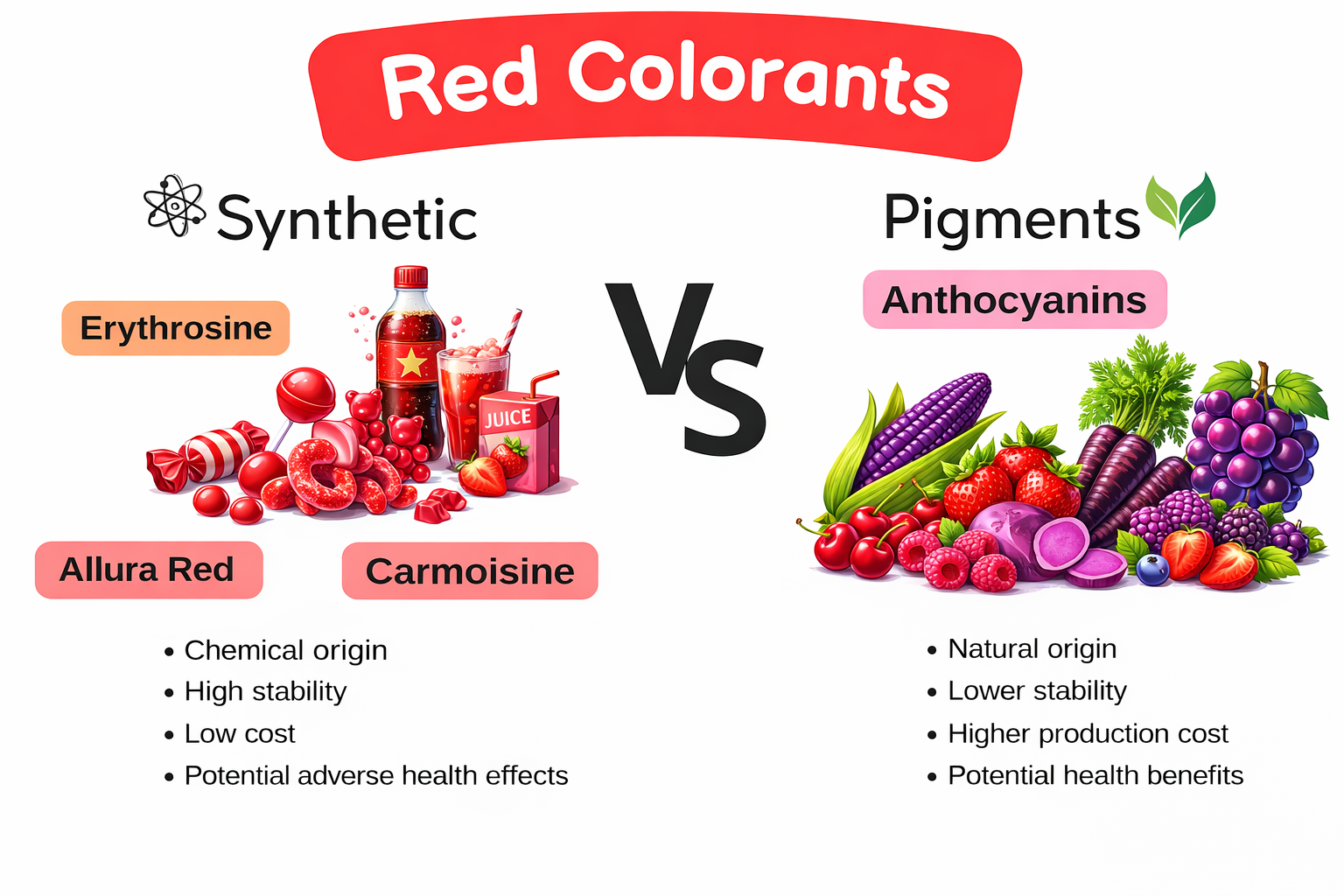
Among synthetic colorants, those that provide red hues are among the most widely used, being extensively used in confectionery, beverages, pastries, bakery products, fried snacks, and other processed foods. Notable examples in this group include Red No. 40 (Allura Red), carmoisine, and Red No. 3 (erythrosine) [3,4].
However, several studies have reported potential adverse effects associated with their consumption, including possible cancer risks and increased hyperactivity-related behaviors in children [5,6]. In response to these concerns, there has been growing interest in identifying safer alternatives, driving research into and the application of natural pigments as substitutes for synthetic colorants. These pigments can be obtained from various sources, including microorganisms, insects, plants, and vegetables [7].
In particular, plant-derived pigments have gained attention not only for their wide range of hues but also for their potential health benefits [8].
Plant pigments contain chromophores in their structure, which are responsible for their coloration by absorbing and reflecting light at specific wavelengths, thereby generating color perception in the human eye. Some of the main natural pigments include carotenoids, responsible for orange hues; chlorophylls, which provide green colors; curcumin with yellow tones; betalains, which can produce red colors; and anthocyanins, capable of providing a wide range of colors depending on their chemical structure and the pH of the medium [9].
Anthocyanins are natural pigments that can be obtained from a wide variety of flowers, fruits, and vegetables, such as red cabbage [10], purple carrot [11], jaboticaba berries [12], grape [13], and purple sweet potato [14], among others. In particular, they have attracted special interest due to their stability in acidic media, where flavylium cation species predominate, which are responsible for intense red hues [15].
This makes them a promising option for use in the food industry as a natural, healthy alternative to synthetic red colorants. Therefore, this review explores the challenges and trends of natural colorants, emphasizing the potential of anthocyanins as substitutes for synthetic red colorants in foods.

2. Regulation of Food Colorings

To authorize the use of natural pigments in foods, their safety must be ensured. This is determined by various criteria that depend on the food additive regulations established in each country [16]. However, there are international organizations that serve as references for food authorities worldwide. One of the main ones is the Codex Alimentarius. Another key body is JECFA (Joint FAO/WHO Expert Committee on Food Additives), which evaluates the safety of additives through scientific studies. In addition, organizations such as the FDA (U.S. Food and Drug Administration) and EFSA (European Food Safety Authority) have an indirect global impact, as their regulations often influence the legislation of other countries. One of the fundamental aspects of food additive regulation is the Acceptable Daily Intake (ADI), which defines the maximum amount of an additive a person can consume daily without posing a health risk. This assessment is key to establishing usage limits in food and ensuring consumer safety.
Food colorants certified by the FDA are designated with the term FD&C, indicating that they can be used in foods, drugs, and cosmetics, whereas food colorants regulated by EFSA are identified with an “E” number at the beginning. Approval by the FDA or EFSA does not imply that these colorants can be used worldwide, as this depends on each country’s regulations; however, they serve as important references for food authorities in many countries.
According to the European Union, natural colorants are classified under Group II: food colors authorized under quantum satis, meaning that no maximum limit is established, provided they are used at the minimum level necessary to achieve the desired effect. This category includes several plant-derived colorants such as chlorophylls (E 140), carotenes (E 160), betanin (E 162), and anthocyanins (E 163). Their use is permitted in specific foods in accordance with Regulation (EC) No. 1333/2008 on food additives.
In turn, the FDA has approved the use of natural plant-based colorants. These include butterfly pea flower extract, which is rich in anthocyanins. Additionally, colorants derived from grapes are included, such as grape extract and enocyanin, obtained from red grape skins, both of which are used as natural sources for application in certain foods.
Anthocyanins, in particular, possess desirable characteristics as food colorants, including low toxicity, intense color, and beneficial biological properties. As colorants, they are classified as a group of commercially viable color ingredients and are regulated as color additives in both the United States and the European Union (EU) [17]. In the EU, anthocyanins are grouped under the food additive code E163, which allows their use as colorants in a wide range of foods, including beverages, desserts, ice creams, and dairy products [18]. In Mexico, under the General Health Law, these pigments are classified as food additives, as there is no specific category for colorants in this regulation.
Several studies have shown that the risk of anthocyanin toxicity in foods is minimal due to their low bioavailability. For example, an acceptable daily intake (ADI) of 2.5 mg/kg body weight per day has been established for anthocyanins derived from grape skin extracts [19]. However, a general ADI has not been established for all anthocyanins due to their wide structural diversity, which complicates their regulation as natural colorants.
Regarding synthetic colorants, EFSA classifies them under Group III, referred to as “food colors with a combined maximum limit,” which are subject to a specific maximum level established based on their acceptable daily intake (ADI). Within this group are Allura Red AC (E129) and erythrosine (E127) [20,21]. In contrast, the FDA designates these colorants as FD&C Red 40 (Allura Red AC) and FD&C Red No. 3 (erythrosine), both approved for use in foods. However, stricter regulatory measures have recently been implemented regarding the use of synthetic red colorants. Such is the case of FD&C Red No. 2, which had been used in various foods and pharmaceuticals and whose authorization was revoked by the FDA, establishing a deadline for the food industry to eliminate this additive from its formulations by 2027. This decision was influenced by studies showing that FD&C Red No. 3 caused cancer in male rats exposed to high levels of this colorant. Although there is no conclusive evidence that it causes cancer in humans [22], this information has raised concerns, leading to a growing need for further scientific research on the potential health effects associated with the long-term consumption of synthetic colorants.

3. Synthetic Red Dyes

Synthetic colorants are additives primarily produced through chemical synthesis from petroleum-derived compounds and, therefore, are not naturally found in foods. These compounds are widely used not only in the food industry but also in the cosmetic, pharmaceutical, and textile sectors. However, their application is regulated due to potential risks to human health and the environment [23].
Some artificial colorants may contain heavy metals and carcinogenic compounds, posing health risks to individuals who consume them frequently [24]. In recent years, the use of synthetic colorants has increased considerably, largely due to their widespread use in processed foods worldwide. It has been reported that their consumption has increased approximately fivefold since 1995 [25].
Approximately 65% of the synthetic colorants used by the food industry are azo dyes, low-molecular-weight synthetic organic compounds with high solubility. These are added to various products due to their high chemical versatility and ability to produce intense, stable colors [26]. The characteristic coloration of these compounds is mainly attributed to the presence of an azo functional group (−N=N−) [27]. However, several studies have reported potential adverse effects associated with some azo dyes (Table 1), as they can be metabolized by the intestinal microbiota into potentially toxic aromatic amines [28]. Furthermore, due to their widespread use across the food, pharmaceutical, cosmetic, and textile industries, these compounds represent a significant source of environmental pollution [29].
Among azo dyes used to confer reddish hues, Red No. 40, also known as Allura Red AC, is a widely used color additive globally and is approved for use in foods and beverages, dietary supplements, pharmaceutical products, and other consumer goods [30]. Together with tartrazine (Yellow No. 5; E102) and sunset yellow (Yellow No. 6; E110), it accounts for nearly 90% of the synthetic colorants used in foods [25]. In 2016, the Joint FAO/WHO Expert Committee on Food Additives (JECFA) established an acceptable daily intake (ADI) of 0–7 mg/kg body weight, concluding that dietary exposure did not pose a health risk at the evaluated levels of consumption [31]. However, recent studies have reported that this colorant may represent a potential health risk. Zhan et al. [32] investigated the effects of Red No. 40 consumption on DNA damage, the microbiome, and colon inflammation, concluding that its intake induces DNA damage, leading to alterations in the intestinal microbiota and subsequently to inflammation in the distal colon, suggesting that chronic exposure may increase the risk of colorectal cancer. Similarly, Chen et al. [33] reported, in vivo studies, that Allura Red can induce intestinal inflammation by activating CD4 T cells and modulating the pro-inflammatory immune response. Furthermore, Noorafshan et al. [34] demonstrated that this synthetic dye may induce neurotoxicity. In their in vivo study, structural and behavioral changes in the medial prefrontal cortex were evaluated following exposure to high doses (70 mg/kg/day). Their findings suggested that even at the acceptable daily dose, Allura Red may impair learning and memory and reduce the number of glial cells.
Carmoisine (E122), also known as azorubine, is another synthetic azo dye that provides color shades ranging from red to brown and is used in various food products. However, the FDA does not permit its use, whereas the EFSA allows its use under specific limits (ADI: 4 mg/kg body weight/day), as is the case in other Latin American countries. However, its consumption has raised concerns due to potential health effects. It has been reported that carmoisine may induce genotoxic effects at high concentrations [35]. In animal models, oral administration of carmoisine for 120 days in mice produced dose-dependent toxic effects, including reduced body weight, hematological alterations, and increased liver enzyme levels, suggesting hepatotoxicity and nephrotoxicity, with the liver identified as a primary target organ [36].
On the other hand, erythrosine (Red No. 3) is a synthetic red xanthene dye. It is synthesized from fluorescein and is widely used in food products, despite contradictory reports regarding its safety [37]. This additive has an acceptable daily intake (ADI) of 0.1 mg/kg body weight [38]. Due to its extensive use in the food and pharmaceutical industries, erythrosine can be detected in industrial wastewater, making it a potential contaminant with ecological and human health implications [39]. Furthermore, recent studies have reported that this dye may induce neurotoxic effects, even at doses equal to or lower than the ADI, as evidenced by alterations in brain enzymatic activity, increased oxidative stress, DNA damage, and histopathological changes in animal models [40]. Similarly, Iheanyichukwu et al. [41] orally administered a combination of erythrosine and tartrazine (50:50) for 23 days at doses of 2.5–20 mg/kg in an animal model, resulting in alterations in renal function characterized by increased serum urea and creatinine levels, suggesting a potential nephrotoxic effect associated with high consumption of these dyes.
In general, the excessive use of synthetic colorants in food processing may impact not only human health but also the environment. Therefore, the food industry is increasingly seeking to replace synthetic colorants with safer natural alternatives. Although these pigments often exhibit lower stability and color intensity, their natural origin and less reactive chemical structure reduce the risk of toxicity and genotoxicity. Among them, anthocyanins provide red hues comparable to those of synthetic dyes such as Allura Red, carmoisine, and erythrosine, making them a promising alternative for their replacement.

4. Anthocyanins as an Alternative to Synthetic Red Color

Anthocyanins are plant secondary metabolites that belong to the flavonoid family. Their basic chemical structure is represented by the flavylium ion, also known as 2-phenylbenzopyrylium, which consists of two aromatic groups, a benzopyrylium (A) and a phenolic ring (B), linked by a three-carbon chain that forms a C6–C3–C6 skeleton [42]. Cyanidin, pelargonidin, delphinidin, peonidin, petunidin, and malvidin are derived from this basic structure (Figure 1). These six anthocyanidins are the most common in nature and are distributed in fruits, flowers, and vegetables [43].
The differences among these pigments lie in their chemical structures, which are determined by the number and position of hydroxyl (-OH) and methoxy (-OCH3) groups on the B ring [44]. These structural modifications give rise to a wide diversity of anthocyanins, with more than 600 compounds identified, whose color depends on the type and concentration of the pigment [45], as well as on the pH of the medium, resulting in a range of colors from reddish to purple and blue hues [46,47].
In recent years, anthocyanins have attracted interest due to their potential as natural colorants, their safety and non-toxicity, and their health benefits, as various biological activities have been attributed to them, including antioxidant, anti-inflammatory, anticancer, and antihypertensive activities, among others [48,49].

5. Factors Influencing Color

5.1. Chemical Structure

The chemical structure of anthocyanins can be modified through processes such as hydroxyl group position, degree of methylation, glycosylation, and acylation, (Table 2), which can influence both their color and their physicochemical and functional properties [50].

5.1.1. Hydroxylation and Methylation

The presence of hydroxyl and methoxy groups on the B ring influences the color stability and hue of anthocyanidins [51]. Hydroxylation leads to blue hues but also increases susceptibility to oxidation, thereby reducing stability. In contrast, the presence of methoxy groups leads to red hues and decreases the propensity for oxidation, contributing to greater molecular stability [52,53]. Therefore, malvidin, peonidin, and petunidin exhibit higher stability [54].

5.1.2. Glycosylation

Glycosylation involves the partial or complete replacement of a hydroxyl group in the anthocyanin structure by a sugar moiety. This modification can occur at different positions within the molecule, as various hydroxyl groups interact with different sugars, thereby altering the physicochemical properties of anthocyanins [55]. These sugars are attached via glycosidic bonds, with glucose, galactose, xylose, rutinose, and rhamnose among the most frequently reported [56]. Furthermore, the position of glycosylation plays a key role in color expression: increased glycosylation on the A-ring is associated with deeper blue hues, whereas substitution on the C-ring tends to promote red and purple tones [57].

5.1.3. Acylation

Another way to modify anthocyanins, which can influence both their stability and color intensity, is acylation [58]. This process consists of the esterification of an organic acid with the glucoside of the anthocyanin molecule. It can be classified as aromatic or aliphatic, depending on the nature of the acid involved, that is, whether it contains an aromatic group or an aliphatic acid group [59]. Some foods that contain acylated anthocyanins include purple sweet potato, strawberry, grape, purple corn, red radish, black carrot, blackberry, and others. Likewise, this type of compound is common in various flowers [60,61].
Unlike glycosylation, acylation is not universal among anthocyanins; however, it has been shown to improve pigment stability, providing greater resistance to environmental factors such as pH, temperature, and light [57]. This increase in stability is attributed to the acyl group’s ability to generate steric hindrance and reduce the attack by hydrophilic molecules, thereby protecting the flavylium cation [62]. Overall, acylation enhances both the stability and color intensity of anthocyanins.

5.2. pH and Temperature

Various factors contribute to anthocyanin degradation, the exposure to light and elevated temperatures accelerates their breakdown. Whereas acidic conditions and low temperatures enhance their stability [42]. Anthocyanin color and stability are strongly pH dependent. Under highly acidic conditions (pH 1–3), anthocyanins predominantly exist as the flavylium cation, their most stable form, which exhibits red hues and high water solubility. As the pH increases to around 4, they transition to a neutral quinonoidal base, which is less stable. At pH 5–6, the colorless carbinol pseudobase becomes more prominent. Further increases in alkaline conditions (pH > 8) promote the formation of chalcones, colorless compounds associated with the irreversible degradation of anthocyanins [52,63].
Thermal processing, one of the most widely used preservation methods in the food industry, can also significantly affect anthocyanin stability. High temperatures promote rapid pigment loss, as anthocyanins are thermosensitive compounds that begin to degrade at temperatures above 50 °C [64]. Heat-induced degradation primarily occurs through deglycosylation, leading to the opening of the pyrylium ring and the formation of chalcone structures. Subsequently, further structural breakdown occurs, including ring cleavage and the formation of coumarin glycoside derivatives due to the loss of the B-ring [65].

5.3. Other Factors

Anthocyanins are highly sensitive compounds, and their color can be affected by the presence of other molecules. In addition to the previously mentioned factors, oxygen, enzymes, and microorganisms can rapidly degrade these pigments [66], while interactions with proteins and phenolic acids can also influence their color [67].

6. Extraction of Anthocyanins

To achieve higher production of natural colorants, it is essential to select an appropriate extraction method that enhances pigment recovery [68]. The extraction of anthocyanins from plant matrices has been widely studied using traditional methods such as maceration, Soxhlet extraction, decoction, percolation, and filtration [69], which are known for their simplicity and low cost. In contrast, non-conventional extraction technologies (Table 3), such as supercritical fluid extraction, pulsed electric fields, and microwave- and ultrasound-assisted techniques, have been developed to reduce extraction time and solvent usage [70]. Additionally, these methods typically operate at lower temperatures, reduce the consumption of organic solvents, and improve the yield of natural pigments. These advantages position them as promising alternatives, particularly if the pigments are intended for use in the food industry [71].

7. Role of Encapsulation and Copigmentation in the Stabilization of Anthocyanin Color

Various methods have been developed to improve the stability of anthocyanins against environmental factors to which they are particularly susceptible. These methods include encapsulation (microencapsulation, nanoencapsulation, and liposomal systems) and copigmentation. The main objective of these approaches is to increase anthocyanin stability, thereby promoting their application in the development, production, and storage of anthocyanin-enriched products. Encapsulation is a widely used technology for protecting bioactive compounds by forming a complex in which the compound of interest is retained within the wall material [83]. This process improves anthocyanin stability against environmental factors such as light, oxygen, pH, and temperature, and can also enhance their bioavailability and bioaccessibility [84].
Anthocyanin microcapsules have been used as food colorants that can modify the structure and color characteristics of food matrices [83]. Therefore, the interaction between anthocyanins and the wall material plays an important role in the properties of the resulting powder, as the type and concentration of the encapsulating agent can influence its stability and color. These variations are associated with chemical interactions such as hydrogen bonding. Among the most commonly used wall materials are polysaccharides such as maltodextrin, starch, and xanthan gum, as well as certain proteins.
Several studies have demonstrated how the type and proportion of encapsulating material can modify physicochemical and color characteristics. For example, Machado et al. [85] reported that red carrot extracts microencapsulated with gum arabic and maltodextrin enhanced the appearance of red hues. Deng et al. [86] evaluated the stability of anthocyanins from purple corn encapsulated with different combinations of wall materials (maltodextrin, gum arabic, and whey protein), observing that increasing the concentration of wall material resulted in lighter-colored microcapsules, which could be attributed to the white color of the wall materials used. Similar results have been previously reported for microencapsulated purple sweet potato extract, in which an increase in lightness during storage was associated with maltodextrin as the wall material. However, microencapsulation was effective in preventing rapid anthocyanin degradation and maintaining stable color parameters for up to 60 days of storage [14].
Another strategy that improves anthocyanin stability and color intensity is copigmentation. This phenomenon involves the formation of complexes between anthocyanins and copigments, which stabilize the flavylium cation and, consequently, increase color intensity. Some copigments include phenolic acids, flavonoids, organic acids, polysaccharides, and metal ions, among others [87]. Anthocyanin–copigment interactions have been classified as intermolecular copigmentation, intramolecular copigmentation, self-association, and metal complexation [88]. These interactions occur mainly through hydrogen bonding, hydrophobic interactions, and electrostatic forces [89]. As a result, bathochromic or hyperchromic shifts may occur, along with an increase in color intensity [90]. It is worth noting that color stability depends on various factors, among which the structure of both anthocyanins and copigments influences the different types of copigmentation [91].
Azman et al. [92] added different phenolic acids as copigments (rosmarinic, ferulic, chlorogenic, and caffeic acids), reporting hyperchromic and bathochromic effects that increased color intensity and shifted the maximum wavelength toward more purple–blue hues. Additionally, rosmarinic acid showed the greatest copigmentation effect. Similar results were reported by Erşan et al. [93], who found that flavonoids present in rooibos intensified the color of strawberry anthocyanins, producing more intense red-purple hues with greater thermal stability. On the other hand, Geng et al. [94] showed that compounds such as ferulic acid, gallic acid, and epigallocatechin gallate increase the intensity and saturation of anthocyanin red color during storage, thereby enhancing chromatic stability.
Recently, studies have explored the combined use of copigmentation and encapsulation to overcome the limitations of copigmentation, as both techniques act synergistically to increase anthocyanin stability and color intensity. Vázquez-González et al. [95] evaluated the incorporation of ferulic acid as a copigment in blueberry skin extracts encapsulated with maltodextrin, observing greater pigment stability and enhanced color during storage. Meanwhile, Salati et al. [96] studied the copigmentation of sour cherry anthocyanins with tannic acid, followed by encapsulation with maltodextrin and gum arabic, and reported good anthocyanin stability and color preservation over 28 days of storage.

8. Application of Anthocyanins in Food

Anthocyanins, as potential natural colorants, have been widely applied in various foods, including beverages, frozen products, confectionery, dairy products, and even meat products, due to their color similarity to artificial colorants. They have been mainly used in beverages, juices, and ice pops because of their low pH (2–3), which helps stabilize anthocyanins and allows them to exhibit reddish hues. Rodríguez-Mena et al. [46] added purple sweet potato extract to ice pops, where color tones very similar to those of Red No. 40 were observed, along with adequate retention of color and anthocyanin content during 30 days of frozen storage. Trein et al. [97] incorporated grape pomace extract into candies, observing an increase in the color parameter a* as the extract concentration increased, which was attributed to the characteristic red color of anthocyanins, as well as good sensory acceptance. Stoica et al. [98] incorporated black carrot pomace (BCP) into yogurt formulations, resulting in a more nutritious product with higher phytochemical content and improved antioxidant activity. Meanwhile, Shamshad et al. [99] added microencapsulated anthocyanins to ice cream, thereby improving the stability of anthocyanins derived from black carrot and enhancing the product’s sensory properties. Cao et al. [100] investigated the addition of five flavonols to mulberry juice as copigment factors, finding that juice color was maintained for a longer period and that anthocyanin stability was improved during storage.

9. Conclusions and Future Perspectives

There is growing interest in replacing artificial colorants with natural alternatives, driven by increased consumer awareness of potential adverse effects associated with high consumption of synthetic colorants. In response to this demand, regulatory agencies have begun reviewing and modifying their regulations. However, this process presents challenges due to the large number of dyes available on the market, requiring scientific evidence and time to support their continued use.
On the other hand, this transition also poses challenges for the food industry, which has relied on synthetic colorants for decades due to their low cost and stability during processing and storage. Therefore, replacing synthetic pigments with natural pigments such as anthocyanins remains a challenge, as despite their wide availability across various plant matrices and advances in strategies to enhance their stability, limitations persist in scaling up extraction processes at the industrial level. Additionally, the standardization of new technologies is required to enable their incorporation into already established food products. Despite these challenges, research in this field has shown progress and continues to generate new strategies to improve the feasibility of anthocyanins as natural colorants. Their use as substitutes for red artificial colorants represents one of the most promising areas, given their hue similarities to synthetic red colorants and their potential to meet current consumer demand for healthier options.

Author Contributions

Conceptualization, Writing-original draft, S.V.M.; Conceptualization, Data analysis, Writing-review and editing L.A.O.M.; Methodology, Writing—review & editing, S.M.G.H.; Supervision, Writing—review & editing, O.M.R.Q.; Supervision, Writing—review & editing, J.M.C.; Formal analysis, writing—review & editing, J.A.G.I. Visualization, writing—review & editing, M.E. The authors have read and agreed to the published version of the manuscript.

Funding

This research received no external funding.

Institutional Review Board Statement

Not applicable.

Data Availability Statement

No new data were created or analyzed in this study.

Acknowledgments

Sandra Vega-Maturino thanks the Secretariat of Science, Humanities, Technology and Innovation (SECIHTI) for the scholarship (No. 812963) granted to pursue doctoral studies in Biochemical Engineering at the Tecnológico Nacional de México/Instituto Tecnológico de Durango.

Conflicts of Interest

The authors declare no conflicts of interest.

Abbreviations

The following abbreviations are used in this manuscript:
ADI Acceptable Daily Intake
EFSA European Food Safety Authority
FDA Food and Drug Administration
JECFA Joint Food and Agriculture Organization of the United Nations / World Health Organization Expert Committee on Food Additives
NADES Natural Deep Eutectic Solvents
DES Deep Eutectic Solvent
Cya-3-glu Cyanidin-3-glucoside

References

  1. Dey, S.; Nagababu, B.H. Applications of food color and bio-preservatives in the food and its effect on human health. Food Chem. Adv. 2022, 1, 100019. [Google Scholar] [CrossRef]
  2. Sigurdson, G.T.; Tang, P.; Giusti, M.M. Natural Colorants: Food Colorants from Natural Sources. Annu. Rev. Food Sci. Technol. 2017, 8, 261–280. [Google Scholar] [CrossRef] [PubMed]
  3. Coutinho, M.E.B.; Gomes, B.R.D.S.; Santos, J.M. Development of a Fast, Low-Cost, and Green Method to Quantify Allura Red AC Dye in Candies through Digital Images Using a Smartphone. ACS Omega 2025, acsomega.5c06279. [Google Scholar] [CrossRef]
  4. Kwon, Y.H.; Banskota, S.; Wang, H.; Rossi, L.; Grondin, J.A.; Syed, S.A.; Yousefi, Y.; Schertzer, J.D.; Morrison, K.M.; Wade, M.G.; Holloway, A.C.; Surette, M.G.; Steinberg, G.R.; Khan, W.I. Chronic Exposure to Synthetic Food Colorant Allura Red AC Promotes Susceptibility to Experimental Colitis via Intestinal Serotonin in Mice. Nat Commun. 2022, 13, 7617. [Google Scholar] [CrossRef]
  5. Miller, M.D.; Steinmaus, C.; Golub, M.S.; Castorina, R.; Thilakartne, R.; Bradman, A.; Marty, M.A. Potential Impacts of Synthetic Food Dyes on Activity and Attention in Children: A Review of the Human and Animal Evidence. Environ Health 2022, 21, 45. [Google Scholar] [CrossRef]
  6. Amchova, P.; Siska, F.; Ruda-Kucerova, J. Food Safety and Health Concerns of Synthetic Food Colors: An Update. Toxics 2024, 12, 466. [Google Scholar] [CrossRef]
  7. Yadav, S.; Tiwari, K.S.; Gupta, C.; Tiwari, M.K.; Khan, A.; Sonkar, S.P. A Brief Review on Natural Dyes, Pigments: Recent Advances and Future Perspectives. Results in Chem. 2023, 5, 100733. [Google Scholar] [CrossRef]
  8. Weiss, V.; Okun, Z.; Shpigelman, A. Utilization of Hydrocolloids for the Stabilization of Pigments from Natural Sources. Curr. Opin. Colloid Interface Sci. 2023, 68, 101756. [Google Scholar] [CrossRef]
  9. Rodríguez-Mena, A.; Ochoa-Martínez, L.A.; González-Herrera, S.M.; Rutiaga-Quiñones, O.M.; González-Laredo, R.F.; Olmedilla-Alonso, B. Natural Pigments of Plant Origin: Classification, Extraction and Application in Foods. Food Chem. 2023, 398, 133908. [Google Scholar] [CrossRef] [PubMed]
  10. Ghareaghajlou, N.; Hallaj-Nezhadi, S.; Ghasempour, Z. Red Cabbage Anthocyanins: Stability, Extraction, Biological Activities and Applications in Food Systems. Food Chem. 2021, 365, 130482. [Google Scholar] [CrossRef]
  11. Perez, M.B.; Da Peña Hamparsomian, M.J.; Gonzalez, R.E.; Denoya, G.I.; Dominguez, D.L.E.; Barboza, K.; Iorizzo, M.; Simon, P.W.; Vaudagna, S.R.; Cavagnaro, P.F. Physicochemical Properties, Degradation Kinetics, and Antioxidant Capacity of Aqueous Anthocyanin-Based Extracts from Purple Carrots Compared to Synthetic and Natural Food Colorants. Food Chem. 2022, 387, 132893. [Google Scholar] [CrossRef] [PubMed]
  12. Chua, L.S.; Thong, H.Y.; Soo, J. Effect of pH on the Extraction and Stability of Anthocyanins from Jaboticaba Berries. Food Chem. Adv. 2024, 5, 100835. [Google Scholar] [CrossRef]
  13. Liazid, A.; Barbero, G.; Azaroual, L.; Palma, M.; Barroso, C. Stability of Anthocyanins from Red Grape Skins under Pressurized Liquid Extraction and Ultrasound-Assisted Extraction Conditions. Molecules 2014, 19, 21034–21043. [Google Scholar] [CrossRef] [PubMed]
  14. Vega-Maturino, S.; Ochoa-Martínez, L.A.; González-Herrera, S.M.; Rutiaga-Quiñones, O.M.; Rodríguez-Mena, A. Ultrasound Extraction and Microencapsulation for Increasing Stability of Anthocyanins Extracted from Purple Sweet Potato. Plant Foods Hum. Nutr. 2025, 80, 134. [Google Scholar] [CrossRef]
  15. Khoo, H.E.; Azlan, A.; Tang, S.T.; Lim, S.M. Anthocyanidins and Anthocyanins: Colored Pigments as Food, Pharmaceutical Ingredients, and the Potential Health Benefits. Food Nutr. Res. 2017, 61, 1361779. [Google Scholar] [CrossRef]
  16. Pôrto, L.B.G.; Bragotto, A.P.A. Food Colors’ Dietary Exposure in the Brazilian Population Using the 2008–2009 and 2017–2018 POF Food Consumption Databases. Foods 2024, 13, 4006. [Google Scholar] [CrossRef]
  17. Iorizzo, M.; Curaba, J.; Pottorff, M.; Ferruzzi, M.G.; Simon, P.; Cavagnaro, P.F. Carrot Anthocyanins Genetics and Genomics: Status and Perspectives to Improve Its Application for the Food Colorant Industry. Genes 2020, 11, 906. [Google Scholar] [CrossRef]
  18. Luzardo-Ocampo, I.; Ramírez-Jiménez, A.K.; Yañez, J.; Mojica, L.; Luna-Vital, D.A. Technological Applications of Natural Colorants in Food Systems: A Review. Foods 2021, 10, 634. [Google Scholar] [CrossRef]
  19. Wallace, T.C.; Giusti, M.M. Anthocyanins. Adv. Nutr. 2015, 6, 620–622. [Google Scholar] [CrossRef]
  20. EFSA Panel on Food Additives and Nutrient Sources added to Food (ANS). Scientific Opinion on the re-evaluation of Allura Red AC (E 129) as a food additive. EFSA J. 2009, 7, 1327. [CrossRef]
  21. EFSA Panel on Food Additives and Nutrient Sources added to Food (ANS). Scientific Opinion on the re-evaluation of Erythrosine (E 127) as a food additive. EFSA J. 2011, 9, 1854. [CrossRef]
  22. U.S. Food and Drug Administration (FDA). FD&C Red No. 3. Available online: https://www.fda.gov/industry/color-additives/fdc-red-no-3 (accessed on 30 February 2026).
  23. Hussain, S.; Sharma, M.; Jarg, T.; Aav, R.; Bhat, R. Natural Pigments (Anthocyanins and Chlorophyll) and Antioxidants Profiling of European Red and Green Gooseberry (Ribes Uva-Crispa, L.) Extracted Using Green Techniques (UAE-Citric Acid-Mediated Extraction). Curr. Res. Food Sci. 2023, 7, 100629. [Google Scholar] [CrossRef]
  24. Alegbe, E.O.; Uthman, T.O. A Review of History, Properties, Classification, Applications and Challenges of Natural and Synthetic Dyes. Heliyon 2024, 10, e33646. [Google Scholar] [CrossRef]
  25. Hofseth, L.J.; Hebert, J.R.; Chanda, A.; Chen, H.; Love, B.L.; Pena, M.M.; Murphy, E.A.; Sajish, M.; Sheth, A.; Buckhaults, P.J.; Berger, F.G. Early-Onset Colorectal Cancer: Initial Clues and Current Views. Nat. Rev. Gastroenterol. Hepatol. 2020, 17, 352–364. [Google Scholar] [CrossRef]
  26. Barciela, P.; Perez-Vazquez, A.; Prieto, M.A. Azo Dyes in the Food Industry: Features, Classification, Toxicity, Alternatives, and Regulation. Food Chem. Toxicol. 2023, 178, 113935. [Google Scholar] [CrossRef]
  27. Khan, I.S.; Ali, Md. N.; Hamid, R.; Ganie, S.A. Genotoxic Effect of Two Commonly Used Food Dyes Metanil Yellow and Carmoisine Using Allium Cepa, L. as Indicator. Toxicol. Rep. 2020, 7, 370–375. [Google Scholar] [CrossRef]
  28. Toraman, E. Biochemical and Molecular Evaluation of Oxidative Stress and Mitochondrial Damage in Fruit Fly Exposed to Carmoisine. Mol. Biol. Rep. 2024, 51, 685. [Google Scholar] [CrossRef]
  29. Hashemi, S.H.; Kaykhaii, M. Azo dyes: Sources, occurrence, toxicity, sampling, analysis, and their removal methods. In Emerging Freshwater Pollutants; Elsevier: Amsterdam, The Netherlands, 2022; pp. 267–287. [Google Scholar]
  30. Bastaki, M.; Farrell, T.; Bhusari, S.; Pant, K.; Kulkarni, R. Lack of Genotoxicity in Vivo for Food Color Additive Allura Red AC. Food Chem. Toxicol. 2017, 105, 308–314. [Google Scholar] [CrossRef]
  31. World Health Organization (WHO); Food and Agriculture Organization of the United Nations (FAO). Safety evaluation of certain food additives. WHO Food Additives Series. 2020. Available online: https://iris.who.int/server/api/core/bitstreams/003fcc41-98d9-407b-ad67-8d1067ec8da3/content (accessed on 22 February 2026).
  32. Zhang, Q.; Chumanevich, A.A.; Nguyen, I.; Chumanevich, A.A.; Sartawi, N.; Hogan, J.; Khazan, M.; Harris, Q.; Massey, B.; Chatzistamou, I.; Buckhaults, P.J.; Banister, C.E.; Wirth, M.; Hebert, J.R.; Murphy, E.A.; Hofseth, L.J. The Synthetic Food Dye, Red 40, Causes DNA Damage, Causes Colonic Inflammation, and Impacts the Microbiome in Mice. Toxicol. Rep. 2023, 11, 221–232. [Google Scholar] [CrossRef]
  33. Chen, L.; He, Z.; Reis, B.S.; Gelles, J.D.; Chipuk, J.E.; Ting, A.T.; Spicer, J.A.; Trapani, J.A.; Furtado, G.C.; Lira, S.A. IFN-Γ+ Cytotoxic CD4+ T Lymphocytes Are Involved in the Pathogenesis of Colitis Induced by IL-23 and the Food Colorant Red 40. Cell. Mol. Immunol. 2022, 19, 777–790. [Google Scholar] [CrossRef]
  34. Noorafshan, A.; Hashemi, M.; Karbalay-Doust, S.; Karimi, F. High Dose Allura Red, Rather than the ADI Dose, Induces Structural and Behavioral Changes in the Medial Prefrontal Cortex of Rats and Taurine Can Protect It. Acta Histochemica 2018, 120, 586–594. [Google Scholar] [CrossRef]
  35. Kara, S.G.; Yuzbasioglu, D.; Avuloglu-Yilmaz, E.; Unal, F. Do the Azo Food Colorings Carmoisine and Ponceau 4R Have a Genotoxic Potential? Toxicol. Res. 2025, 14, tfaf033. [Google Scholar] [CrossRef]
  36. Reza, Md. S. A.; Hasan, Md. M.; Kamruzzaman, Md.; Hossain, Md. I.; Zubair, Md. A.; Bari, L.; Abedin, Md. Z.; Reza, Md. A.; Khalid-Bin-Ferdaus, K., Md; Haque, K. Md. F.; Islam, K.; Ahmed, M.U.; Hossain, Md. K. Study of a Common Azo Food Dye in Mice Model: Toxicity Reports and Its Relation to Carcinogenicity. Food Sci. Nutr. 2019, 7, 667–677. [Google Scholar] [CrossRef]
  37. Singh, M.; Chadha, P. Assessment of Synthetic Food Dye Erythrosine Induced Cytotoxicity, Genotoxicity, Biochemical and Molecular Alterations in Allium Cepa Root Meristematic Cells: Insights from in Silico Study. Toxicol. Res. 2024, 13, tfae126. [Google Scholar] [CrossRef]
  38. Silva, M.M.; Reboredo, F.H.; Lidon, F.C. Food Colour Additives: A Synoptical Overview on Their Chemical Properties, Applications in Food Products, and Health Side Effects. Foods 2022, 11, 379. [Google Scholar] [CrossRef]
  39. Salvi, N.A. Decolorization of Erythrosine B by Rhizopus Arrhizus Biomass. Appl. Water Sci. 2018, 8, 205. [Google Scholar] [CrossRef]
  40. Singh, M.; Chadha, P. Erythrosine-Induced Neurotoxicity: Evaluating Enzymatic Dysfunction, Oxidative Damage, DNA Damage, and Histopathological Alterations in Wistar Rats. J. Appl. Toxicol. 2025, 45, 576–586. [Google Scholar] [CrossRef]
  41. Iheanyichukwu, W.; Adegoke, A.O.; Adebayo, O.G.; Emmanuel, U.M.; Egelege, A.P.; Gona, J.T.; Orluwene, F.M. Combine colorants of tartrazine and erythrosine induce kidney injury: Involvement of TNF-α gene, caspase-9 and KIM-1 gene expression and kidney functions indices. Toxicol. Mech. Methods 2021, 31, 67–72. [Google Scholar] [CrossRef]
  42. Qi, Q.; Chu, M.; Yu, X.; Xie, Y.; Li, Y.; Du, Y.; Liu, X.; Zhang, Z.; Shi, J.; Yan, N. Anthocyanins and Proanthocyanidins: Chemical Structures, Food Sources, Bioactivities, and Product Development. Food Rev. Int. 2023, 39, 4581–4609. [Google Scholar] [CrossRef]
  43. Sadowska-Bartosz, I.; Bartosz, G. Antioxidant Activity of Anthocyanins and Anthocyanidins: A Critical Review. Int. J. Mol. Sci. 2024, 25, 12001. [Google Scholar] [CrossRef]
  44. Mannino, G.; Gentile, C.; Ertani, A.; Serio, G.; Bertea, C.M. Anthocyanins: Biosynthesis, Distribution, Ecological Role, and Use of Biostimulants to Increase Their Content in Plant Foods—A. Review. Agriculture 2021, 11, 212. [Google Scholar] [CrossRef]
  45. Zhao, K.; Zhang, Q.; Wang, Y.; Wei, Q.; Wang, Y. Advances in the biosynthesis and regulatory mechanisms of anthocyanins in horticultural plants: A comprehensive review. Trop. Plants 2025, 4, 0002. [Google Scholar] [CrossRef]
  46. Rodríguez-Mena, A.; Ochoa-Martínez, L.A.; González-Herrera, S.M.; Rutiaga-Quiñones, O.M.; González-Laredo, R.F.; Olmedilla-Alonso, B.; Vega-Maturino, S. Coloring potential of anthocyanins from purple sweet potato paste: Ultrasound-assisted extraction, enzymatic activity, color and its application in ice pops. Food Chem. Adv. 2023, 3, 100358. [Google Scholar] [CrossRef]
  47. Ndwandwe, B.K.; Malinga, S.P.; Kayitesi, E.; Dlamini, B.C. Recent developments in the application of natural pigments as pH-sensitive food freshness indicators in biopolymer-based smart packaging: Challenges and opportunities. Int. J. Food Sci. Technol. 2024, 59, 2148–2161. [Google Scholar] [CrossRef]
  48. Xin, M.; Xu, A.; Tian, J.; Wang, L.; He, Y.; Jiang, H.; Yang, B.; Li, B.; Sun, Y. Anthocyanins as natural bioactives with anti-hypertensive and atherosclerotic potential: Health benefits and recent advances. Phytomedicine 2024, 132, 155889. [Google Scholar] [CrossRef]
  49. Lakshmikanthan, M.; Muthu, S.; Krishnan, K.; Altemimi, A.B.; Haider, N.N.; Govindan, L.; Selvakumari, J.; Alkanan, Z.T.; Cacciola, F.; Francis, Y.M. A comprehensive review on anthocyanin-rich foods: Insights into extraction, medicinal potential, and sustainable applications. J. Agric. Food Res. 2024, 17, 101245. [Google Scholar] [CrossRef]
  50. Ayvaz, H.; Cabaroglu, T.; Akyildiz, A.; Pala, C.U.; Temizkan, R.; Ağçam, E.; Ayvaz, Z.; Durazzo, A.; Lucarini, M.; Direito, R.; Diaconeasa, Z. Anthocyanins: Metabolic Digestion, Bioavailability, Therapeutic Effects, Current Pharmaceutical/Industrial Use, and Innovation Potential. Antioxidants 2022, 12, 48. [Google Scholar] [CrossRef]
  51. Wang, Y.; McClements, D.J.; Chen, L.; Peng, X.; Xu, Z.; Meng, M.; Ji, H.; Zhi, C.; Ye, L.; Zhao, J.; Jin, Z. Progress on molecular modification and functional applications of anthocyanins. Crit. Rev. Food Sci. Nutr. 2024, 64, 11409–11427. [Google Scholar] [CrossRef]
  52. Enaru, B.; Drețcanu, G.; Pop, T.D.; Stǎnilǎ, A.; Diaconeasa, Z. Anthocyanins: Factors Affecting Their Stability and Degradation. Antioxidants 2021, 10, 1967. [Google Scholar] [CrossRef]
  53. Alappat, B.; Alappat, J. Anthocyanin Pigments: Beyond Aesthetics. Molecules 2020, 25, 5500. [Google Scholar] [CrossRef]
  54. Yang, M.; Zhang, M.; Wang, B.; Zhang, Z.; Zhuang, Y.; Liu, J.; Zhang, Q.; Fei, P. Mechanism-driven stabilization of anthocyanins: Comparative copigmentation and encapsulation for food applications. Food Chem. 2025, 495, 146336. [Google Scholar] [CrossRef] [PubMed]
  55. Guo, Y.; Zhang, H.; Shao, S.; Sun, S.; Yang, D.; Lv, S. Anthocyanin: A review of plant sources, extraction, stability, content determination and modifications. Int. J. Food Sci. Technol. 2022, 57, 7573–7591. [Google Scholar] [CrossRef]
  56. Li, Z.; Ahammed, G.J. Plant stress response and adaptation via anthocyanins: A review. Plant Stress 2023, 10, 100230. [Google Scholar] [CrossRef]
  57. Zhao, C.-L.; Yu, Y.-Q.; Chen, Z.-J.; Wen, G.-S.; Wei, F.-G.; Zheng, Q.; Wang, C.-D.; Xiao, X.-L. Stability-increasing effects of anthocyanin glycosyl acylation. Food Chem. 2017, 214, 119–128. [Google Scholar] [CrossRef]
  58. Yadav, S.; Rahim, M.S.; Devi, A.; Sharma, R.K. Revolutionizing Speciality Teas: Multi-omics prospective to breed anthocyanin-rich tea. Food Res. Int. 2025, 209, 116312. [Google Scholar] [CrossRef]
  59. Leonarski, E.; Cesca, K.; De Oliveira, D.; Zielinski, A.A.F. A review on enzymatic acylation as a promising opportunity to stabilizing anthocyanins. Crit. Rev. Food Sci. Nutr. 2023, 63, 6777–6796. [Google Scholar] [CrossRef]
  60. Vidana Gamage, G.C.; Lim, Y.Y.; Choo, W.S. Sources and relative stabilities of acylated and nonacylated anthocyanins in beverage systems. J. Food Sci. Technol. 2022, 59, 831–845. [Google Scholar] [CrossRef] [PubMed]
  61. Sendri, N.; Bhandari, P. Anthocyanins: A comprehensive review on biosynthesis, structural diversity, and industrial applications. Phytochem. Rev. 2024, 23, 1913–1974. [Google Scholar] [CrossRef]
  62. Srinivasan, L.V.; Rana, S.S. Anthocyanins: A promising source of natural colorants and nutraceuticals. Discover Appl. Sci. 2025, 7, 694. [Google Scholar] [CrossRef]
  63. Tena, N.; Martín, J.; Asuero, A.G. State of the Art of Anthocyanins: Antioxidant Activity, Sources, Bioavailability, and Therapeutic Effect in Human Health. Antioxidants 2020, 9, 451. [Google Scholar] [CrossRef]
  64. Lin, Y.; Li, C.; Shi, L.; Wang, L. Anthocyanins: Modified New Technologies and Challenges. Foods 2023, 12, 1368. [Google Scholar] [CrossRef]
  65. Yücetepe, M.; Özaslan, Z.T.; Karakuş, M.Ş; Akalan, M.; Karaaslan, A.; Karaaslan, M.; Başyiğit, B. Unveiling the multifaceted world of anthocyanins: Biosynthesis pathway, natural sources, extraction methods, copigmentation, encapsulation techniques, and future food applications. Food Res. Int. 2024, 187, 114437. [Google Scholar] [CrossRef]
  66. Xue, H.; Zhao, J.; Wang, Y.; Shi, Z.; Xie, K.; Liao, X.; Tan, J. Factors affecting the stability of anthocyanins and strategies for improving their stability: A review. Food Chem. X 2024, 24, 101883. [Google Scholar] [CrossRef]
  67. Mohammed, H.A.; Khan, R.A. Anthocyanins: Traditional Uses, Structural and Functional Variations, Approaches to Increase Yields and Products’ Quality, Hepatoprotection, Liver Longevity, and Commercial Products. Int. J. Mol. Sci. 2022, 23, 2149. [Google Scholar] [CrossRef] [PubMed]
  68. Ghosh, S.; Sarkar, T.; Das, A.; Chakraborty, R. Natural colorants from plant pigments and their encapsulation: An emerging window for the food industry. LWT 2022, 153, 112527. [Google Scholar] [CrossRef]
  69. Tena, N.; Asuero, A.G. Up-To-Date Analysis of the Extraction Methods for Anthocyanins: Principles of the Techniques, Optimization, Technical Progress, and Industrial Application. Antioxidants 2022, 11, 286. [Google Scholar] [CrossRef]
  70. Torres-Ortiz, D.; García-Alcocer, G.; Berumen-Segura, L.C.; Estévez, M. Green extraction of secondary metabolites from plants: Obstacles, current status, and trends. Sustain. Chem. Environ. 2024, 8, 100157. [Google Scholar] [CrossRef]
  71. Masyita, A.; Hardinasinta, G.; Astuti, A.D.; Firdayani, F.; Mayasari, D.; Hori, A.; Nisha, I.N.A.; Nainu, F.; Kuraishi, T. Natural pigments: Innovative extraction technologies and their potential application in health and food industries. Front. Pharmacol. 2025, 15, 1507108. [Google Scholar] [CrossRef]
  72. Fu, X.; Wang, D.; Belwal, T.; Xie, J.; Xu, Y.; Li, L.; Zou, L.; Zhang, L.; Luo, Z. Natural deep eutectic solvent enhanced pulse-ultrasonication assisted extraction as a multi-stability protective and efficient green strategy to extract anthocyanin from blueberry pomace. LWT 2021, 144, 111220. [Google Scholar] [CrossRef]
  73. Li, J.; Guo, X.; Wang, R.; Geng, Z.; Jia, J.; Pang, S.; Du, Y.; Jia, S.; Cui, J. Ultrasonic assisted extraction of anthocyanins from rose flower petal in DES system and enzymatic acylation. LWT 2023, 180, 114693. [Google Scholar] [CrossRef]
  74. Yiğit, Ü; Turabi Yolaçaner, E.; Hamzalıoğlu, A.; Gökmen, V. Optimization of microwave-assisted extraction of anthocyanins in red cabbage by response surface methodology. J. Food Process. Preserv. 2022, 46, e16120. [Google Scholar] [CrossRef]
  75. Mirzazadeh, N.; Bagheri, H.; Mirzazadeh, M.; Soleimanimehr, S.; Rasi, F.; Akhavan-Mahdavi, S. Comparison of different green extraction methods used for the extraction of anthocyanin from red onion skin. Food Sci. Nutr. 2024, 12, 7347–7357. [Google Scholar] [CrossRef]
  76. Rizkiyah, D.N.; Putra, N.R.; Idham, Z.; Che Yunus, M.A.; Veza, I.; Harny, I.; Syahlani, N.; Abdul Aziz, A.H. Optimization of Red Pigment Anthocyanin Recovery from Hibiscus sabdariffa by Subcritical Water Extraction. Processes 2022, 10, 2635. [Google Scholar] [CrossRef]
  77. Gozel Yavuz, G.T.; Yilmaz, E. Comparative evaluation of ultrasound-assisted and conventional extraction methods for anthocyanin recovery and antioxidant potential from blackcurrant. J. Food Meas. Charact. 2026, 20, 1465–1481. [Google Scholar] [CrossRef]
  78. Dara, A.; Feizy, J.; Naji-Tabasi, S.; Fooladi, E.; Rafe, A. Intensified extraction of anthocyanins from Berberis vulgaris L. by pulsed electric field, vacuum-cold plasma, and enzymatic pretreatments: Modeling and optimization. Chem. Biol. Technol. Agric. 2023, 10, 93. [Google Scholar] [CrossRef]
  79. Pham, T.N.; Le, X.T.; Pham, V.T.; Le, H.T. Effects of process parameters in microwave-assisted extraction on the anthocyanin-enriched extract from Rhodomyrtus tomentosa (Ait.) Hassk and its storage conditions on the kinetic degradation of anthocyanins in the extract. Heliyon 2022, 8, e09518. [Google Scholar] [CrossRef]
  80. Leonarski, E.; Kuasnei, M.; Dos Santos, E.H.; Benvenutti, L.; Moraes, P.A.D.; Cesca, K.; De Oliveira, D.; Zielinski, A.A.F. Ultrasound and microwave-assisted extractions as green and efficient approaches to recover anthocyanin from black rice bran. Biomass Convers. Biorefin. 2025, 15, 7251–7264. [Google Scholar] [CrossRef]
  81. Netravati; Gomez, S.; Pathrose, B.; Joseph, M.; Shynu, M.; Kuruvila, B. Comparison of extraction methods on anthocyanin pigment attributes from mangosteen (Garcinia mangostana L.) fruit rind as potential food colourant. Food Chem. Adv. 2024, 4, 100559. [Google Scholar] [CrossRef]
  82. Nunes Mattos, G.; Pessanha De Araújo Santiago, M.C.; Sampaio Doria Chaves, A.C.; Rosenthal, A.; Valeriano Tonon, R.; Correa Cabral, L.M. Anthocyanin Extraction from Jaboticaba Skin (Myrciaria cauliflora Berg.) Using Conventional and Non-Conventional Methods. Foods 2022, 11, 885. [Google Scholar] [CrossRef] [PubMed]
  83. Feitosa, B.F.; Decker, B.L.A.; De Brito, E.S.; Marques, M.C.; Rodrigues, S.; Mariutti, L.R.B. Anthocyanins stability theory – Evidence summary on the effects of microencapsulation. Food Bioprod. Process. 2025, 153, 77–86. [Google Scholar] [CrossRef]
  84. Al-Khayri, J.M.; Asghar, W.; Akhtar, A.; Ayub, H.; Aslam, I.; Khalid, N.; Al-Mssallem, M.Q.; Alessa, F.M.; Ghazzawy, H.S.; Attimarad, M. Anthocyanin Delivery Systems: A Critical Review of Recent Research Findings. Appl. Sci. 2022, 12, 12347. [Google Scholar] [CrossRef]
  85. Machado, M.H.; Almeida, A.D.R.; Maciel, M.V.D.O.B.; Vitorino, V.B.; Bazzo, G.C.; Da Rosa, C.G.; Sganzerla, W.G.; Mendes, C.; Barreto, P.L.M. Microencapsulation by spray drying of red cabbage anthocyanin-rich extract for the production of a natural food colorant. Biocatal. Agric. Biotechnol. 2022, 39, 102287. [Google Scholar] [CrossRef]
  86. Deng, W.; Li, X.; Ren, G.; Bu, Q.; Ruan, Y.; Feng, Y.; Li, B. Stability of Purple Corn Anthocyanin Encapsulated by Maltodextrin, and Its Combinations with Gum Arabic and Whey Protein Isolate. Foods 2023, 12, 2393. [Google Scholar] [CrossRef] [PubMed]
  87. Gençdağ, E.; Özdemir, E.E.; Demirci, K.; Görgüç, A.; Yılmaz, F.M. Copigmentation and stabilization of anthocyanins using organic molecules and encapsulation techniques. Curr. Plant Biol. 2022, 29, 100238. [Google Scholar] [CrossRef]
  88. Wang, J.; Zhao, Y.; Sun, B.; Yang, Y.; Wang, S.; Feng, Z.; Li, J. The structure of anthocyanins and the copigmentation by common micromolecular copigments: A review. Food Res. Int. 2024, 176, 113837. [Google Scholar] [CrossRef] [PubMed]
  89. Tan, C.; Sun, Y.; Yao, X.; Zhu, Y.; Jafari, S.M.; Sun, B.; Wang, J. Stabilization of anthocyanins by simultaneous encapsulation-copigmentation via protein-polysaccharide polyelectrolyte complexes. Food Chem. 2023, 416, 135732. [Google Scholar] [CrossRef]
  90. Singh, S.; Sendri, N.; Sharma, B.; Kumar, P.; Sharma, A.; Tirpude, N.V.; Purohit, R.; Bhandari, P. Copigmentation effect on red cabbage anthocyanins, investigation of their cellular viability and interaction mechanism. Food Res. Int. 2025, 200, 115427. [Google Scholar] [CrossRef]
  91. Lyu, J.; Li, J.; Jiang, W.; Liu, T.; Xu, Y.; Tang, K. Copigmentation effects of different phenolics on color stability of three basic anthocyanins in wines: Chromaticity, thermodynamics and molecular dynamics simulation. Food Chem. 2025, 476, 143499. [Google Scholar] [CrossRef] [PubMed]
  92. Azman, E.M.; Yusof, N.; Chatzifragkou, A.; Charalampopoulos, D. Stability Enhancement of Anthocyanins from Blackcurrant (Ribes nigrum L.) Pomace through Intermolecular Copigmentation. Molecules 2022, 27, 5489. [Google Scholar] [CrossRef]
  93. Erşan, S.; Müller, M.; Reuter, L.; Carle, R.; Müller-Maatsch, J. Co-pigmentation of strawberry anthocyanins with phenolic compounds from rooibos. Food Chem. Mol. Sci. 2022, 4, 100097. [Google Scholar] [CrossRef]
  94. Geng, Y.; Cui, K.; Ding, N.; Liu, H.; Huo, J.; Sui, X.; Zhang, Y. Polyphenol co-pigments enhanced the antioxidant capacity and color stability of blue honeysuckle juice during storage. Food Chem. X 2024, 24, 101848. [Google Scholar] [CrossRef]
  95. Vázquez-González, M.; Kurozawa, L.E.; Rodríguez-Pulido, F.J.; Escudero-Gilete, M.L.; Gordillo, B. Simultaneous stabilization of blueberry anthocyanin colorant through microencapsulation and ferulic acid copigmentation. Food Res. Int. 2025, 217, 116753. [Google Scholar] [CrossRef]
  96. Salati, S.; Moshfegh, N.; Vaseghi-Baba, F.; Niakousari, M.; Mazloomi, S.M.; Hosseini, S.M.H.; Abbasi, A. Enhanced Stability of Extracted Sour Cherry Anthocyanins Copigmented With Tannic Acid and Encapsulated by Spray Drying. Food Sci. Nutr. 2025, 13, e70365. [Google Scholar] [CrossRef]
  97. Trentin, J.; Mussagy, C.U.; Arantes, M.S.T.; Pedro, A.C.; Mafra, M.R.; Farias, F.O. Antioxidant Ready-to-Use Grape Pomace Extracts Recovered with Natural Eutectic Mixtures for Formulation of Color-Rich Gummies. Foods 2024, 13, 2840. [Google Scholar] [CrossRef] [PubMed]
  98. Stoica, F.; Rațu, R.N.; Motrescu, I.; Cara, I.G.; Filip, M.; Țopa, D.; Jităreanu, G. Application of Pomace Powder of Black Carrot as a Natural Food Ingredient in Yoghurt. Foods 2024, 13, 1130. [Google Scholar] [CrossRef] [PubMed]
  99. Shamshad, A.; Iahtisham-Ul-Haq; Butt, M.S.; Nayik, G.A.; Al Obaid, S.; Ansari, M.J.; Karabagias, I.K.; Sarwar, N.; Ramniwas, S. Effect of storage on physicochemical attributes of ice cream enriched with microencapsulated anthocyanins from black carrot. Food Sci. Nutr. 2023, 11, 3976–3988. [Google Scholar] [CrossRef] [PubMed]
  100. Cao, Y.; Xia, Q.; Aniya; Chen, J.; Jin, Z. Copigmentation effect of flavonols on anthocyanins in black mulberry juice and their interaction mechanism investigation. Food Chem. 2023, 399, 133927. [Google Scholar] [CrossRef]
Figure 1. Basic anthocyanin structure.
Preprints 207097 g001
Table 1. Characteristics of red synthetics colorants used in the food industry.
Dye Code (EFSA/FDA) ADI Food product Adverse effect References
Allura Red E129/ FD&C Red No. 40 7
mg/kg bw/day
Bakery products, flavoured fermented milk products, edible cheese rinds, desserts, ice cream, flavoured drinks, baked crustaceans, seafood, breakfast sausages, appetizers, sauces, seasonings, soups, Neurotoxic, risk of colorectal cancer and alteration of the intestinal microbiota [32,33,34,38]
Erythrosine E127/FD&C Red No. 3 0.1 mg/kg bw/day Drinks, cookies, sweet bakery products, meat products, chewing ice cream, ice pops
Neurotoxic and nephrotoxic [1,40,41]
Carmoisine E122/ prohibited 4
mg/kg bw/day
Swiss rolls, jellies, jams, yogurts, cheesecake mixes, and breadcrumbs Genotoxic, hepatotoxicity and nephrotoxicity [26,35,36]
Table 2. Main structural modifications of anthocyanins and their influence on color.
Modification Typical position Associated group Effect on color
Hydroxylation Ring B Hydroxyl Blue
Methylation Ring B Methoxyl Red
Glycosylation C3, C5 Monosaccharides and disaccharides Red-purple
Acylation About sugars in C3 aliphatic or aromatic asid group Purple-blue
Table 3. Extraction methods of anthocyanins from different sources.
Source Extraction
method
Control
parameters
Extraction
solvent
Extraction
efficiency
References
Blueberry pomace Ultrasound-assisted
extraction
3.2 min
349.15 K
325 W
NAES/Choline chloride-Oxalic acid 24.28 mg cya-3-glu/g [72]
Rose flower petal Ultrasound-assisted
extraction
10 min
50 °C
400 W
DES/Choline chloride-lactic acid
8.26 mg cya-3-glu/g [73]
Red cabbage
Microwave-assisted
extraction
5 min
200 W
Ethanol-water
110.20 mg cya-3-glu/L [74]
Purple sweet
potato
Ultrasound-assisted
extraction
10 min
60% amplitud
McIlvaine buffer solution 1.08 mg cya-3-glu/g [46]
Red onin skin High hydrostatic
pressure-assisted
extraction
17.5 min
300 MPa
Water 248.49 mg cya-3-glu/L [75]
Hibiscus sabdariffa
Subcritical water
extraction
4.89 mL/min
393.54 K
8.75 MPa
Water 0.92 mg cya-3-glu/g [76]
Blackcurrat
Conventional
solvent extraction
24 h
40 °C
Ethanol-water 1.08 mg cya-3-glu/g [77]
Berberis vulgaris L. Pulsed electric field 7000 V/cm
100 pulse number
Acidic ethanol 260.28 mg cya-3-glu/L [78]
Rhodomyrtus
tomentosa
Microwave-assisted
extraction
5 min
200 W
Ethanol-water 136.84 mg cya-3-glu/L [79]
Black rice brand Ultrasound-assisted
extraction
50 °C
380 W
Citric acid-ethanol 2.44 mg cya-3-glu/g [80]
Garcinia mangostana L. Microwave-assisted
extraction
120 s
300 W
Water-Acidified ethanol 17 652.64 mg cya-3-glu/L [81]
Jaboticaba Skin
High hydrostatic
pressure-assisted
extraction
15 min
200 MPa
Ethanol-water 1.86 mg cya-3-glu/g [82]
Disclaimer/Publisher’s Note: The statements, opinions and data contained in all publications are solely those of the individual author(s) and contributor(s) and not of MDPI and/or the editor(s). MDPI and/or the editor(s) disclaim responsibility for any injury to people or property resulting from any ideas, methods, instructions or products referred to in the content.
Copyright: This open access article is published under a Creative Commons CC BY 4.0 license, which permit the free download, distribution, and reuse, provided that the author and preprint are cited in any reuse.
Prerpints.org logo

Preprints.org is a free preprint server supported by MDPI in Basel, Switzerland.

Subscribe

Disclaimer

Terms of Use

Privacy Policy

Privacy Settings

© 2026 MDPI (Basel, Switzerland) unless otherwise stated