
Submitted:
07 April 2026
Posted:
08 April 2026
You are already at the latest version
Abstract
High-temperature superconductivity remains an open problem in condensed matter physics. While conventional and many unconventional approaches attribute superconductivity primarily to pairing mechanisms, experimental observations—including pseudogap behavior, strange-metal transport, and nanoscale inhomogeneity— suggest that pairing alone may be insufficient. We introduce a coordination-based framework in which superconductivity arises from the global organization of internal degrees of freedom associated with local electronic configurations. These degrees of freedom, modeled as effective pseudospin variables, form a system-spanning coordination manifold that stabilizes dissipationless transport, with pairing emerging as a secondary manifestation. We show that internal coordination induces an instability of the incoherent transport state, leading to global phase coherence. At the effective level, this yields a scaling relation for the transition temperature, Tc∼gm2/aψ′, linking superconductivity to the strength of coordination. The framework accounts for the separation between pseudogap onset and superconducting transition, the anomalous transport properties of strange metals, and nanoscale electronic inhomogeneity, and predicts distinct coherence scales and nontrivial vortex-core structure. These results suggest that optimizing coordination of internal degrees of freedom may provide an alternative route to enhancing superconductivity.
Keywords:
superconductivity
; high-Tc superconductors
; strongly correlated systems
; pseudogap
; strange metal
; phase coherence
; internal degrees of freedom
; collective phenomena
; quantum phase transition
1. Introduction
Superconductivity is one of the most striking manifestations of collective quantum behavior in condensed matter systems. It is characterized by dissipationless electrical transport, the Meissner effect, and macroscopic phase coherence. Since its microscopic explanation by Bardeen, Cooper, and Schrieffer (BCS) [1], superconductivity has been widely understood as arising from the formation and condensation of Cooper pairs—bound electron states behaving as composite bosons [2,3].
Within the BCS framework, pairing plays a dual role: it generates an energy gap and provides the degrees of freedom that condense into a coherent phase. In conventional superconductors, this picture is quantitatively successful, with phonon-mediated attraction leading to pair formation and superconductivity emerging from long-range phase coherence. Even in many unconventional systems, this logical structure is largely retained, with pairing treated as the primary driver and superconductivity assumed to follow once phase coherence is established [13].
However, experimental observations in strongly correlated materials—most notably cuprates and iron-based superconductors—indicate that this paradigm is incomplete [4]. These systems exhibit several characteristic features, including a pseudogap phase above the superconducting transition temperature [5,6], strange-metal behavior with non-Fermi-liquid transport [7,8], and nanoscale electronic inhomogeneity [9,10]. In addition, spectroscopic signatures suggest that pairing-like correlations may persist above [4].
These observations indicate that pairing-like phenomena can exist without global superconductivity, suggesting that pairing alone may be insufficient to determine the transition. This motivates the question of what additional collective condition is required for macroscopic coherence. Previous work has emphasized the possible separation between pairing and phase coherence, particularly in systems with low superfluid density [11,12].
In this work, we introduce a complementary framework in which superconductivity is governed by the global coordination of internal degrees of freedom associated with local electronic configurations. In strongly correlated systems, electrons may carry internal structure beyond charge and momentum, including spin, orbital, or emergent pseudospin-like variables. We propose that the collective organization of these degrees of freedom determines whether long-range coherence can be established.
Within this framework, the superconducting transition is interpreted as an instability of the incoherent transport state driven by the development of internal coordination. As coordination increases, it enhances the effective phase stiffness of the charge sector. When a critical level is reached, the incoherent state becomes unstable and global phase coherence emerges. At the effective level, this leads to a scaling relation of the form
linking the transition temperature to the strength of coordination and its coupling to charge transport.
This picture naturally accounts for several key features of high- systems. Local or mesoscopic coordination can produce gap-like spectral signatures above , while global coordination—and hence superconductivity—emerges only at lower temperatures. The strange-metal regime can be interpreted as a state in which internal degrees of freedom remain dynamically active but fail to form a stable coordinated manifold [14].
A further consequence is that the familiar phase coherence of superconductivity emerges as a low-energy mode of a more general coordination process. In particular, alignment of internal degrees of freedom, modeled minimally as an manifold, reduces to an effective phase degree of freedom at low energies, consistent with emergent symmetry in strongly correlated systems [15,16].
The framework also leads to experimentally testable implications, including the existence of distinct coherence scales associated with coordination and transport, and nontrivial internal structure of vortex cores arising from local breakdown of coordination.
The present approach is not intended to replace BCS theory, but to extend it to regimes where pairing and coherence are not coincident. In conventional superconductors, pairing and phase coherence occur simultaneously, whereas in strongly correlated systems coordination may precede and enable superconductivity.
The remainder of this paper develops this framework. We first introduce a minimal description separating transport and internal coordination sectors, and then show how effective coherence and charge- pairing emerge from coordinated internal structure. A minimal lattice model is subsequently formulated to capture the coordination-driven instability, followed by discussion of implications for high- phenomenology and materials design.
Figure 1 schematically summarizes the coordination-based phase structure, highlighting the separation between local coordination and global phase coherence.
2. Conceptual Framework
We consider a condensed-matter system in which the electronic degrees of freedom are not fully characterized by charge and momentum alone, but also possess additional internal structure associated with local configurations, orbital states, spin, or other emergent pseudospin-like variables. Such internal degrees of freedom are ubiquitous in strongly correlated systems, where local environments and interactions give rise to multi-component electronic behavior [13,15].
In this work, we refer to the mobile charge-carrying electronic degrees of freedom (e.g., conduction electrons or their effective quasiparticle descriptions) as carriers. These carriers are responsible for electrical transport and couple to internal degrees of freedom present at each lattice site.
Within this setting, it is useful to distinguish two coupled but conceptually distinct sectors:
- Carrier sector (-type): This sector describes the charge-carrying electronic degrees of freedom responsible for transport. It is naturally associated with a phase variable and governs phase coherence and current flow, as in standard descriptions of superconductivity [2].
- Internal coordination sector (effective -type): This sector encodes local internal degrees of freedom, which may arise from spin, orbital degeneracy, or other emergent two-level (pseudospin-like) variables. Such effective structures are widely used in condensed matter physics to describe spin and pseudospin degrees of freedom, including in strongly correlated and gauge-theoretic formulations [13,16]. Here, should be understood as an effective internal symmetry describing local configurational states, not as a fundamental gauge symmetry of particle physics.
The choice of an structure represents the minimal continuous internal manifold capable of capturing two-level (pseudospin-like) degrees of freedom. More general internal manifolds may be considered, but provides the simplest nontrivial setting.
The central hypothesis of this work is that superconductivity is controlled primarily by the organization of the internal sector, rather than by the carrier sector alone.
2.1. Internal Degrees of Freedom and Coordination
We denote the internal degree of freedom at lattice site i by
representing a local internal configuration or pseudospin state. The microscopic origin of is not specified at this level; it may correspond to spin, orbital, or more general emergent variables. What is essential is that these degrees of freedom admit continuous transformations and interact across neighboring sites, as commonly assumed in effective lattice models of correlated systems [14].
We introduce a coordination functional that characterizes the compatibility between neighboring internal states:
where f is minimized when and are aligned in the internal space. A simple and natural choice is
which is analogous to alignment energies in spin and pseudospin models (e.g., Heisenberg-type interactions) [17].
The ground state of this functional corresponds to configurations in which the set becomes mutually compatible across the system.
2.2. Global Coordination Manifold
We define the global coordination manifold as the subset of configurations for which internal degrees of freedom are mutually compatible across extended regions:
In this state, the system selects a common internal frame up to residual symmetry transformations. This corresponds to spontaneous symmetry breaking of the internal manifold, analogous to ordered phases in spin systems and nonlinear sigma models [14].
Fluctuations that disrupt compatibility between sites are energetically suppressed, and the system behaves as a coordinated ensemble rather than a collection of independent local units.
Importantly, global coordination does not require strict uniformity of , but rather that all configurations lie within a connected manifold that preserves mutual compatibility.
2.3. Coupling to the Carrier Sector
The carrier sector is described by local phase variables
which govern charge transport. In conventional descriptions, superconductivity is associated with long-range coherence of the phase [2].
In the present framework, transport depends on both the carrier phase and the internal coordination. Specifically, hopping processes between neighboring sites depend not only on the phase difference , but also on the compatibility of internal states and . This is reminiscent of coupling between charge and internal gauge or spin degrees of freedom in strongly correlated systems [13,15].
This can be captured by an effective coupling of the form
When internal coordination is weak or fluctuating, this coupling is spatially inhomogeneous, leading to incoherent transport and finite resistance. In contrast, when lies within , the internal factor becomes effectively uniform, enhancing phase stiffness in the carrier sector.
2.4. Superconductivity as a Coordinated State
Within this framework, superconductivity arises when the internal sector undergoes a transition into the globally coordinated manifold . Once this coordination is established, the carrier sector inherits an effectively uniform coupling that stabilizes long-range phase coherence.
Thus, superconductivity is not driven solely by phase ordering in the carrier sector, but by the emergence of a coordinated internal structure that enables such coherence.
This leads to the central structural relation:
In this sense, the superconducting state is best understood as a collective compatibility phase of internal degrees of freedom, with dissipationless transport emerging as a consequence of this deeper organization.
3. Emergence of Effective Coherence
A central feature of the present framework is that superconducting phase coherence is not introduced as a primary order parameter, but instead emerges as a low-energy consequence of internal coordination in the sector. This type of symmetry reduction and emergent low-energy mode is well known in systems with spontaneously broken continuous symmetries and nonlinear sigma models [14,15].
3.1. Reduction of Internal Degrees of Freedom
As discussed in the previous section, the internal degrees of freedom tend to align under the coordination functional. When global coordination is achieved, the system selects a common internal frame, which we denote by a reference element .
In this coordinated state, the local variables may be expressed as fluctuations around the common frame:
Because the energy depends only on relative configurations, the global factor g drops out, and the relevant degrees of freedom are contained in the fluctuations . This structure is analogous to standard treatments of ordered phases where global symmetry breaking leaves only relative fluctuations as physical degrees of freedom [18].
Fluctuations that rotate away from the common alignment direction incur a finite energy cost, reflecting the rigidity of the coordinated state. However, a subset of transformations leaves the coordinated structure invariant. These correspond to rotations about a preferred internal axis.
3.2. Emergent Subgroup
The subgroup of that preserves a fixed internal axis is isomorphic to . This implies that, once a global coordination frame is established, the low-energy degrees of freedom reduce from to an effective manifold. Such symmetry reductions are standard in systems with spontaneous symmetry breaking, where the low-energy sector is governed by the coset structure of the original symmetry group [14].
We parametrize these residual fluctuations as
where is a real scalar field defined on lattice sites. Substituting this parametrization into the coordination functional yields
Taking the trace, we obtain
and therefore the effective coordination energy reduces to
3.3. Emergent Phase Coherence
The appearance of the effective phase variable has a direct physical interpretation. It represents the residual freedom of collective internal rotations that remain after global coordination has suppressed all incompatible configurations.
The key point is that this phase is not introduced independently, but is instead a derived degree of freedom arising from the symmetry reduction
Long-range ordering of therefore corresponds to global coherence of the residual internal rotations. Because the carrier sector is coupled to the internal sector, this ordering induces coherence in the transport phase as well. This mechanism parallels the emergence of phase coherence in effective gauge and spin models of strongly correlated systems [13,15].
3.4. Coupling to the Carrier Phase
The carrier sector is described by phase variables . The coupling between internal and carrier sectors takes the schematic form
In the coordinated regime, where
this becomes
When the internal phase develops long-range order, the coupling becomes effectively uniform, enhancing the stiffness of the carrier phase and stabilizing global coherence.
3.5. Superconducting Order as Emergent Phenomenon
We thus arrive at the structural hierarchy:
In this picture, the superconducting order parameter is not fundamental, but arises as a low-energy projection of a deeper internal coordination process.
This framework naturally explains:
- the emergence of pseudogap behavior from local coordination without global phase coherence,
- the delayed onset of superconductivity as ordering of the emergent mode,
- the existence of multiple energy and length scales reflecting hierarchical organization.
3.6. Coordination-Induced Instability of the Incoherent State
The above structure suggests that superconductivity arises from an instability of the incoherent transport state driven by internal coordination.
To formalize this, we introduce two coarse-grained order parameters: an internal coordination amplitude m and a transport coherence amplitude . At the lowest order, the free energy takes the form
Such coupled order-parameter theories are standard in Landau-Ginzburg descriptions of interacting collective modes [21,22].
The coupling term expresses a cooperative feedback: internal coordination enhances phase stiffness, while phase coherence stabilizes internal alignment.
When , the effective quadratic coefficient for the transport sector becomes
The incoherent state becomes unstable when
Estimate of the transition temperature.
A quantitative estimate of the superconducting transition temperature follows by expanding the transport-sector coefficient near its bare instability scale:
The onset of superconductivity is determined by
yielding
In the regime where the bare carrier sector alone does not develop coherence, may be small or negligible, giving the scaling relation
Physical interpretation.
This result provides a quantitative formulation of the central mechanism: internal coordination raises by enhancing the effective phase stiffness of the carrier sector. It also naturally explains the separation of scales in strongly correlated systems, where the onset of coordination () may occur at higher temperatures, while superconductivity emerges only when becomes sufficiently large to satisfy the instability condition.
The coordination-induced instability mechanism leading to superconductivity is summarized schematically in Figure 2.
4. Pairing as a Secondary Phenomenon
Within the present framework, pairing is not taken as the fundamental driver of superconductivity, but rather as a local manifestation of an underlying coordination process in the internal sector. This represents a shift from the conventional hierarchy
to a more general structural relation
This perspective is motivated by extensive experimental and theoretical work indicating that pairing correlations and superconducting coherence can be distinct phenomena, particularly in strongly correlated systems [4,11].
4.1. Pairing as a Collective Projection
As shown in the previous section, global coordination of internal degrees of freedom leads to the emergence of a residual phase mode associated with coherent collective behavior. Once this coordinated state is established, the system admits well-defined low-energy collective excitations, as is typical in systems with broken continuous symmetry [14].
A key observation is that these excitations must be bosonic in order to support macroscopic coherence. Since the underlying degrees of freedom are fermionic electrons, the minimal bosonic objects that can emerge are composite operators formed from pairs of electrons, consistent with general many-body principles [18].
Thus, pairing arises naturally as the lowest-order bosonic projection of a coordinated fermionic system, rather than as a separately imposed mechanism.
4.2. Emergence of a Charge- Field
Let denote the local electronic degrees of freedom at site i, which transform under electromagnetic symmetry as
Given the presence of an internal structure, the simplest invariant bilinear that can be constructed from is
which is the standard singlet pairing channel familiar from conventional superconductivity [3].
This object is antisymmetric in the internal indices and therefore compatible with fermionic statistics. Under a transformation, it transforms as
indicating that it carries charge .
Because is bilinear in fermionic operators, it obeys bosonic commutation relations at low energies and can therefore serve as an order parameter for macroscopic coherence, as in standard BCS theory [2].
4.3. Minimality of the Pairing Channel
The emergence of a charge- field can be understood as a consequence of minimality. A single electron carries charge e but is fermionic and cannot directly form a macroscopically coherent state. Composite objects formed from an odd number of electrons remain fermionic, while even-number composites are bosonic.
Among these, the two-electron composite is the simplest and lowest-energy candidate. Higher-order composites (e.g., four-electron states) are possible in principle but are energetically less favorable and therefore subdominant in typical systems. This hierarchy is consistent with both BCS theory and more general treatments of fermionic condensation [18,27].
Thus, the charge- pairing channel represents the minimal bosonic mode compatible with both charge conservation and fermionic statistics.
4.4. Physical Interpretation
In this framework, pairing does not necessarily correspond to the formation of tightly bound two-electron states. Instead, it reflects the existence of a coherent two-electron channel within a globally coordinated background.
This distinction is particularly important in strongly correlated systems, where pair-like signatures may appear without well-defined bound states, as emphasized in pseudogap and preformed-pair scenarios [5,6]. The pairing amplitude should therefore be interpreted as a collective field encoding the projection of internal coordination onto the charge sector.
4.5. Relation to Conventional Descriptions
In conventional approaches, the superconducting order parameter is introduced as the expectation value of a pair operator,
and pairing is treated as the primary mechanism [1].
In the present framework, the same effective field appears, but its origin is reinterpreted. Rather than arising from a microscopic attractive interaction, the pair field emerges as a natural consequence of internal coordination and symmetry structure.
4.6. Consequences for Superconducting Phenomena
This view of pairing as a secondary phenomenon has several important implications:
- Different experimental probes may detect pairing and coherence at different energy or temperature scales, reflecting the separation between local and global phenomena.
Thus, pairing should be understood as a necessary but not sufficient condition for superconductivity, arising as a local manifestation of a deeper collective organization in the internal degrees of freedom.
5. Pairing as a Secondary Phenomenon
Within the present framework, pairing is not taken as the fundamental driver of superconductivity, but rather as a local manifestation of an underlying coordination process in the internal sector. This represents a shift from the conventional hierarchy
to a more general structural relation
This perspective is motivated by extensive experimental and theoretical work indicating that pairing correlations and superconducting coherence can be distinct phenomena, particularly in strongly correlated systems [4,11].
5.1. Pairing as a Collective Projection
As shown in the previous section, global coordination of internal degrees of freedom leads to the emergence of a residual phase mode associated with coherent collective behavior. Once this coordinated state is established, the system admits well-defined low-energy collective excitations, as is typical in systems with broken continuous symmetry [14].
A key observation is that these excitations must be bosonic in order to support macroscopic coherence. Since the underlying degrees of freedom are fermionic electrons, the minimal bosonic objects that can emerge are composite operators formed from pairs of electrons, consistent with general many-body principles [18].
Thus, pairing arises naturally as the lowest-order bosonic projection of a coordinated fermionic system, rather than as a separately imposed mechanism.
5.2. Emergence of a Charge- Field
Let denote the local electronic degrees of freedom at site i, which transform under electromagnetic symmetry as
Given the presence of an internal structure, the simplest invariant bilinear that can be constructed from is
which is the standard singlet pairing channel familiar from conventional superconductivity [3].
This object is antisymmetric in the internal indices and therefore compatible with fermionic statistics. Under a transformation, it transforms as
indicating that it carries charge .
Because is bilinear in fermionic operators, it obeys bosonic commutation relations at low energies and can therefore serve as an order parameter for macroscopic coherence, as in standard BCS theory [2].
5.3. Minimality of the Pairing Channel
The emergence of a charge- field can be understood as a consequence of minimality. A single electron carries charge e but is fermionic and cannot directly form a macroscopically coherent state. Composite objects formed from an odd number of electrons remain fermionic, while even-number composites are bosonic.
Among these, the two-electron composite is the simplest and lowest-energy candidate. Higher-order composites (e.g., four-electron states) are possible in principle but are energetically less favorable and therefore subdominant in typical systems. This hierarchy is consistent with both BCS theory and more general treatments of fermionic condensation [18,27].
Thus, the charge- pairing channel represents the minimal bosonic mode compatible with both charge conservation and fermionic statistics.
5.4. Physical Interpretation
In this framework, pairing does not necessarily correspond to the formation of tightly bound two-electron states. Instead, it reflects the existence of a coherent two-electron channel within a globally coordinated background.
This distinction is particularly important in strongly correlated systems, where pair-like signatures may appear without well-defined bound states, as emphasized in pseudogap and preformed-pair scenarios [5,6]. The pairing amplitude should therefore be interpreted as a collective field encoding the projection of internal coordination onto the charge sector.
5.5. Relation to Conventional Descriptions
In conventional approaches, the superconducting order parameter is introduced as the expectation value of a pair operator,
and pairing is treated as the primary mechanism [1].
In the present framework, the same effective field appears, but its origin is reinterpreted. Rather than arising from a microscopic attractive interaction, the pair field emerges as a natural consequence of internal coordination and symmetry structure.
5.6. Consequences for Superconducting Phenomena
This view of pairing as a secondary phenomenon has several important implications:
- Different experimental probes may detect pairing and coherence at different energy or temperature scales, reflecting the separation between local and global phenomena.
Thus, pairing should be understood as a necessary but not sufficient condition for superconductivity, arising as a local manifestation of a deeper collective organization in the internal degrees of freedom.
6. Pseudogap and Strange-Metal Phases
One of the central challenges for any theory of high- superconductivity is to account for the rich phase structure observed above the superconducting transition temperature. In particular, the pseudogap and strange-metal regimes exhibit properties that are difficult to reconcile within a purely pairing-based framework [4,13]. In the present approach, these phases arise naturally as intermediate states associated with partial or incomplete internal coordination.
6.1. Pseudogap Regime
Within the coordination-based framework, the pseudogap regime corresponds to a state in which local or mesoscopic internal coordination has already developed, but global coherence across the system has not yet been established.
More precisely, the internal variables begin to organize into locally compatible configurations, forming domains in which the coordination functional is approximately minimized. However, these domains remain disconnected or only weakly coupled, preventing the formation of a system-spanning coordination manifold .
This interpretation is consistent with the widely discussed picture of the pseudogap as a state with strong local correlations but lacking global phase coherence [5,6,11].
This partial coordination has several direct consequences:
- Gap-like spectral features: Local coordination stabilizes two-electron collective channels, leading to the emergence of a finite pairing amplitude at the local level. This produces gap-like features in spectroscopic probes such as angle-resolved photoemission and tunneling measurements, consistent with experimental observations of partial gap formation above [5,6].
- Absence of long-range phase coherence: Because the internal coordination remains fragmented, the emergent phase field introduced in Section 3 does not exhibit long-range order. As a result, macroscopic superconducting coherence does not develop, and the system remains resistive. This separation between pairing and coherence has been emphasized in phase-fluctuation theories [11].
In this picture, the pseudogap temperature marks the onset of local coordination, while the superconducting transition temperature corresponds to the establishment of global coordination and phase coherence. The separation between these two scales is therefore a direct consequence of the multi-stage organization of the internal sector.
6.2. Strange Metal
The strange-metal phase can be understood as a regime in which the system remains dynamically active at the local level but fails to stabilize any form of persistent internal coordination.
In this regime, the internal variables fluctuate strongly, and no locally or globally stable coordination manifold is formed. As a result, the system exhibits the following characteristic features:
- Absence of quasiparticles: Without a stable internal coordination structure, electronic excitations cannot be described in terms of well-defined quasiparticles. This leads to broad spectral features and the breakdown of conventional Fermi-liquid behavior, as widely observed in the strange-metal regime [7,14].
- Anomalous transport: Transport properties are governed by rapidly fluctuating internal configurations, which continually disrupt coherent motion. This produces non-Fermi-liquid transport, including approximately linear temperature dependence of resistivity, a hallmark of strange metals [8].
- Lack of pairing stability: Although transient two-electron correlations may form, the absence of stable coordination prevents the formation of a persistent pairing field. As a result, neither a gap nor coherent superconductivity is observed.
This interpretation aligns with broader theoretical perspectives in which the strange-metal phase represents a quantum-critical or highly fluctuating regime without stable quasiparticles or long-lived order [14].
From this perspective, the strange-metal phase represents a pre-coordination regime, in which the system has not yet developed the structural organization required for either local pairing or global coherence.
6.3. Unified Phase Structure
The coordination-based framework thus provides a unified interpretation of the phase diagram of high- materials:
These phases correspond, respectively, to:
- absence of coordination,
- local or mesoscopic coordination,
- global coordination with long-range coherence.
This hierarchical organization naturally explains the coexistence and separation of different energy scales, as well as the complex crossover behavior observed in experiments [4].
Importantly, this picture emphasizes that superconductivity is not simply the result of strengthening a single interaction, but rather the culmination of a multi-stage coordination process within the internal degrees of freedom of the system.
7. Two Coherence Scales
A central prediction of the present framework is the existence of two distinct coherence scales associated with superconducting systems:
- Transport coherence length , associated with the carrier sector,
- Coordination coherence length , associated with the internal sector.
The separation between different coherence scales has been emphasized in a variety of contexts in strongly correlated systems, particularly in discussions of phase fluctuations, superfluid density, and pseudogap phenomena [4,11,12]. The present framework provides a structural origin for this separation in terms of distinct carrier and internal coordination sectors.
In conventional superconductors, these two scales are typically locked together, reflecting the fact that pairing and coherence arise simultaneously within the BCS paradigm. In contrast, in strongly correlated systems, the two scales may separate significantly, leading to qualitatively different physical behavior.
7.1. Definition of the Two Scales
The transport coherence length characterizes the spatial extent over which the carrier phase remains correlated. It is directly related to the stiffness of the phase and governs the propagation of supercurrents. Operationally, can be associated with quantities such as the superconducting coherence length inferred from vortex structure or the penetration depth, as in conventional superconductivity [2].
The coordination coherence length , on the other hand, measures the spatial range over which internal degrees of freedom remain mutually compatible. It characterizes the size of coordinated domains in the internal sector and is controlled by the strength of the coordination functional introduced in Section 2.
While is associated with phase coherence in the carrier sector, reflects the underlying structural organization that enables such coherence. This distinction is analogous to the separation between pairing amplitude and phase coherence emphasized in phase-fluctuation theories [11].
7.2. Coupling and Decoupling of Scales
The relationship between these two scales depends on the strength of internal coordination.
- Strong coordination regime: When is large and spans the system, the internal sector provides a uniform background that stabilizes phase coherence. In this case, and become effectively locked, reproducing conventional superconducting behavior.
- Intermediate regime: When is finite but does not extend globally, local coordination domains form without long-range connectivity. In this regime, locally, but the absence of global coordination prevents the emergence of long-range phase coherence. This corresponds to the pseudogap phase and is consistent with experimental evidence for local pairing without global coherence [5,6].
Thus, the relative magnitude and spatial distribution of these two scales determine the phase behavior of the system.
7.3. Physical Consequences
The existence of two distinct coherence scales has several important implications:
- Multiple characteristic temperatures: The onset of local coordination (associated with ) can occur at a higher temperature than the establishment of global phase coherence (associated with ). This naturally explains the separation between pseudogap temperature and , as widely observed in cuprate superconductors [4].
- Probe-dependent signatures: Different experimental techniques are sensitive to different coherence scales. Spectroscopic probes may detect local coordination and pairing-like features, while transport measurements require long-range phase coherence. This leads to apparent discrepancies between spectroscopic and transport measurements, a well-known feature of the pseudogap regime [5].
- Nanoscale inhomogeneity: Spatial variation in produces domains of varying coordination strength, leading to inhomogeneous electronic structure. The transport coherence length may then be limited by the connectivity of these domains, consistent with STM observations of spatially varying gap structures [9,10].
7.4. Experimental Signatures
The separation of coherence scales suggests several experimentally testable predictions:
- A temperature regime in which spectroscopic gaps persist while transport remains resistive.
- Distinct length scales extracted from vortex imaging and spectroscopic measurements.
- Sensitivity of superconducting properties to perturbations that affect internal coordination (such as strain or disorder), even when carrier density is unchanged.
- Possible observation of percolative behavior associated with the connectivity of coordinated domains, consistent with percolation-based interpretations of inhomogeneous superconductors [23].
These signatures provide a means to distinguish the present framework from purely pairing-based descriptions.
7.5. Summary
In summary, the introduction of two coherence scales reflects the separation between internal coordination and carrier phase coherence. This separation is negligible in conventional superconductors but becomes essential in strongly correlated systems, where it underlies the complex phase structure and anomalous properties of high- materials.
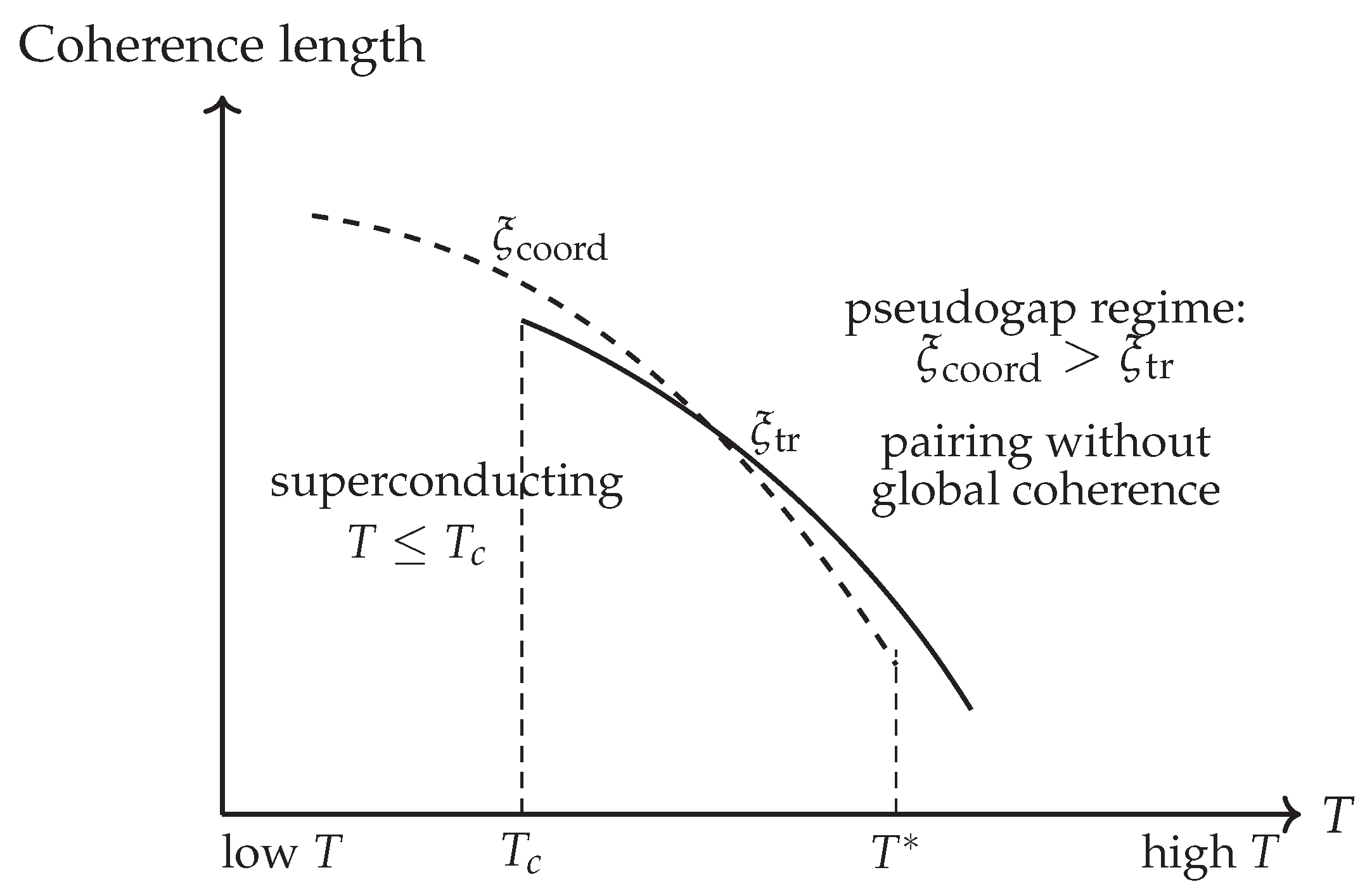
A schematic illustration of this separation is shown in Figure 3, where the coordination coherence scale can remain large above , while the transport coherence scale only diverges at the superconducting transition.
8. Vortex Structure
Magnetic vortices provide one of the most direct probes of superconducting order, as they encode the response of the system to topological phase winding. In conventional descriptions, vortices are understood as singularities in the phase of the superconducting order parameter, around which the phase winds by and the amplitude of the order parameter is suppressed [2,24].
Within the present framework, this description captures only part of the underlying structure. Because superconductivity is taken to arise from global coordination of internal degrees of freedom, vortices must also be understood as defects in this deeper coordination manifold.
8.1. Vortices as Coordination Defects
As shown in Section 3, the superconducting phase emerges as a residual degree of freedom of an underlying coordination field. A vortex, characterized by a winding of the phase, therefore corresponds to a configuration in which the underlying internal variables cannot be made globally compatible.
In this sense, a vortex represents a topological defect in the coordination manifold, rather than merely a phase singularity. This viewpoint is analogous to topological defects in ordered media and nonlinear sigma models, where defects correspond to obstructions in extending a global order parameter across space [25].
The winding of the emergent phase reflects an obstruction to extending a single coordinated internal frame throughout the system.
Consequently, the vortex core is not simply a region where the order parameter vanishes, but a region in which internal coordination breaks down.
8.2. Internal Structure of the Vortex Core
Because the vortex is fundamentally a defect in the internal sector, its core is expected to exhibit structure beyond that predicted by purely phase-based models.
In particular, the following features are anticipated:
- Persistence of local coordination: While global coordination is disrupted at the vortex center, local coordination may remain partially intact. This suggests that pairing-like correlations or gap features may persist within or near the vortex core. Such behavior is consistent with scanning tunneling spectroscopy observations in cuprate superconductors, where gap-like features remain inside vortex cores [9,10].
- Multiple length scales: The spatial extent over which internal coordination is suppressed need not coincide with the scale over which the phase amplitude recovers. This reflects the separation between and introduced in Section 6.
- Nontrivial electronic states: The breakdown of coordination can give rise to localized electronic states that differ qualitatively from conventional vortex-core states, such as the Caroli–de Gennes–Matricon bound states predicted in BCS theory [26]. These may include states associated with partial coordination, frustrated internal configurations, or competing orders.
8.3. Energetics and Stability
From the perspective of the coordination functional, the formation of a vortex introduces a region of increased mismatch in the internal variables . The energy cost of a vortex therefore has contributions from both the carrier sector (associated with phase gradients) and the internal sector (associated with coordination frustration).
This leads to a modified energetic picture:
where corresponds to the standard phase-gradient energy of the superconducting order parameter [2], and reflects the local failure of internal compatibility.
In strongly correlated systems, this additional contribution may be significant and could influence vortex stability, core size, and interactions between vortices. Similar modifications of vortex energetics have been discussed in systems with competing orders and internal degrees of freedom [13].
8.4. Experimental Implications
The coordination-based interpretation of vortices leads to several experimentally testable predictions:
- Core-size anomalies: The apparent size of vortex cores may differ depending on the probe, with coordination-sensitive measurements revealing larger or more complex structures than phase-sensitive ones.
- Enhanced sensitivity to perturbations: Strain, disorder, or magnetic field variations that disrupt internal coordination may significantly alter vortex properties, even if the carrier density remains unchanged.
- Deviation from conventional vortex scaling: The presence of an additional energy contribution from the internal sector may modify standard scaling relations for vortex energy and dynamics.
8.5. Summary
In summary, vortices in the present framework are understood as topological defects in a coordinated internal manifold, rather than purely as phase singularities. This leads to a richer internal structure of vortex cores and provides a direct experimental window into the role of internal coordination in superconductivity.
9. Minimal Model
To make the coordination-based framework more explicit, we introduce a minimal effective lattice model that captures the coupled dynamics of internal coordination and carrier phase coherence. The purpose of this model is not to provide a complete microscopic Hamiltonian for any specific material, but to isolate the minimal set of degrees of freedom and couplings required to realize the mechanism proposed in the preceding sections.
This type of construction is standard in condensed matter physics, where effective lattice models are used to capture emergent collective behavior without requiring full microscopic detail [18,22].
We assign to each lattice site i two variables:
- a carrier-phase variablerepresenting the local phase of the mobile charge-carrying sector;
The corresponding effective free-energy functional is taken to be
This model can be viewed as a coupled lattice system, combining an XY-type phase model with an internal alignment sector, with an explicit interaction between the two.
9.1. Interpretation of the Couplings
The first term,
is the standard XY-type phase-stiffness term for the carrier sector, widely used to describe superconducting phase fluctuations [19]. It favors phase alignment and therefore coherent charge transport.
The second term,
is an internal alignment term analogous to Heisenberg-type interactions in spin systems [17]. It favors mutual compatibility of neighboring internal states and drives the formation of extended coordination domains.
The third term,
is the crucial cooperative coupling between the internal and carrier sectors. Such couplings between multiple order parameters are common in Landau-Ginzburg theories of interacting phases [22].
It expresses the physical assumption that transport coherence is enhanced when neighboring internal degrees of freedom are compatible, and conversely that phase-coherent transport stabilizes internal alignment.
Finally, the local term
represents on-site anisotropy, crystal-field effects, local disorder, or any other perturbation that favors or frustrates specific internal configurations.
The signs of the couplings are chosen so that , , and correspond to cooperative ordering tendencies. In particular, encodes the central mechanism of the present framework: internal coordination increases effective phase stiffness.
9.2. Relation to the Coarse-Grained Theory
The minimal model in Eq. (41) provides a lattice realization of the coarse-grained instability mechanism introduced in Section 3.
To see this, define bond-averaged quantities
which measure, respectively, internal coordination and carrier phase coherence.
Under coarse-graining, the free energy generated by Eq. (41) takes the generic Landau form
consistent with standard coupled-order-parameter theories [21,22].
Thus, the lattice model directly reproduces the coordination-induced instability criterion derived earlier: once internal coordination becomes sufficiently strong, the incoherent transport state becomes unstable and the system develops macroscopic phase coherence.
9.3. Effective Enhancement of Phase Stiffness
The physical content of the model becomes especially transparent if one examines the effective phase coupling on a given bond. For fixed internal configuration, the phase-dependent part of Eq. (41) may be written as
This shows that internal alignment renormalizes the local phase stiffness. Such renormalization of stiffness by additional degrees of freedom is well known in coupled systems and gauge-like formulations of correlated matter [15].
When neighboring internal states are well coordinated, the effective transport coupling is enhanced:
Thus, global internal coordination creates a favorable background for phase coherence.
9.4. Relation to the Transition Temperature
The minimal model also provides a microscopic interpretation of the transition temperature estimate derived earlier. Since the coarse-grained coupling g is inherited from the microscopic inter-sector coupling , and the coordination amplitude m is controlled primarily by and the local potential , the transition temperature may be increased in three conceptually distinct ways:
- by increasing the intrinsic transport stiffness ,
- by increasing the internal coordination tendency ,
- by strengthening the cooperative coupling between the two sectors.
9.5. Regimes of the Model
The minimal model naturally supports three qualitative regimes:
- Weak-coordination regime ( and small): internal states remain disordered, phase stiffness is weak, and the system exhibits incoherent transport.
- Intermediate regime: local or mesoscopic coordination develops, but not yet a system-spanning coordinated state. Pair-like and gap-like signatures may appear without global superconductivity, consistent with pseudogap phenomenology.
- Strong-coordination regime: the internal sector develops long-range compatibility, enhancing the effective phase stiffness sufficiently to drive macroscopic coherence and superconductivity.
These regimes correspond naturally to the strange-metal, pseudogap, and superconducting portions of the phase diagram discussed in Section 5.
9.6. Role as a Platform for Future Work
Although the present paper is conceptual, the minimal model in Eq. (41) provides a concrete starting point for numerical and analytical study. In particular, it can be used to:
- simulate coordination-driven superconducting transitions on finite lattices,
- extract the dependence of on , , and ,
- study the separation of transport and coordination coherence lengths,
- investigate vortex-core structure in the presence of internal coordination.
In this sense, the minimal model serves as the bridge between the conceptual framework developed here and the quantitative program needed to test it.
10. Relation to BCS Theory
The Bardeen–Cooper–Schrieffer (BCS) theory provides the foundational microscopic description of conventional superconductivity, demonstrating that an effective attractive interaction between electrons leads to the formation of Cooper pairs and, subsequently, to a macroscopic coherent state [1]. In this framework, superconductivity arises from the instability of the Fermi surface toward pair formation, with long-range phase coherence emerging as a consequence of Bose condensation of these pairs.
The present framework does not contradict this picture, but rather reinterprets and extends it in the context of strongly correlated systems.
10.1. Complementary Roles of Pairing and Coordination
In conventional superconductors, pairing and coherence occur essentially simultaneously. The formation of Cooper pairs immediately leads to a coherent macroscopic state, and a single order parameter suffices to describe both phenomena [2].
In contrast, high- systems exhibit clear experimental evidence for a separation between pairing-like signatures and global coherence, as discussed in Section 6. This separation has been widely interpreted as evidence for strong phase fluctuations and reduced superfluid stiffness [11].
Within the coordination-based framework, the sequence of physical processes is generalized to
Here, internal coordination establishes a structured background that enables the emergence of stable pairing channels. Global superconductivity then arises when this coordinated state supports long-range phase coherence.
This viewpoint is consistent with scenarios in which pairing amplitude develops at higher temperatures than phase coherence, as observed in underdoped cuprates.
10.2. BCS as a Special Limit
The BCS theory can be understood as a limiting case of the present framework in which internal coordination is either trivial or effectively locked to the carrier sector.
In this limit:
- internal degrees of freedom do not introduce additional independent dynamics,
- pairing and coherence occur at the same scale,
- a single complex order parameter captures the essential physics.
Thus, BCS theory corresponds to a regime in which the separation between coordination and transport coherence scales collapses, and the system can be described entirely within the sector.
10.3. Extension to Strongly Correlated Systems
In strongly correlated materials, internal degrees of freedom—such as spin, orbital, or emergent pseudospin variables—play an essential role. These degrees of freedom can organize independently of charge transport, giving rise to coordination phenomena that precede and constrain pairing.
In this context, pairing is not necessarily driven solely by an effective attractive interaction, but may emerge as a natural consequence of an already coordinated internal structure. This perspective is broadly consistent with approaches that emphasize spin correlations and preformed pairs, such as resonating-valence-bond (RVB) theories [29].
This provides a natural explanation for:
- pairing-like gaps appearing above ,
- the existence of multiple characteristic temperature scales,
- deviations from conventional quasiparticle behavior.
10.4. Interpretation of the Order Parameter
In BCS theory, the superconducting order parameter is identified with the expectation value of a pair operator,
In the present framework, a similar effective field appears, but its interpretation is broadened. The order parameter reflects not only pairing amplitude, but also the projection of a deeper internal coordination structure onto the charge sector.
This interpretation aligns with modern perspectives in which the superconducting order parameter encodes collective organization rather than a purely microscopic pairing amplitude.
10.5. Summary
In summary, the coordination-based framework is compatible with BCS theory in its domain of validity, while extending it to regimes where internal degrees of freedom play a dominant role.
BCS theory describes a situation in which pairing directly generates coherence. The present approach generalizes this picture by allowing for a hierarchical organization in which coordination can precede and enable pairing, particularly in strongly correlated systems.
This relationship preserves the successes of BCS theory while providing a broader conceptual foundation for understanding high- superconductivity.
11. Discussion
The framework developed in this work provides an effective, phenomenological description of superconductivity in systems where internal degrees of freedom play a central role. The central concept introduced—global internal coordination— serves as a unifying organizing principle that connects a wide range of experimental observations, including pseudogap behavior, strange-metal transport, and the separation between pairing signatures and superconducting coherence.
Unlike conventional approaches in which superconductivity is primarily attributed to pairing, the present framework identifies coordination as the fundamental driver, with pairing emerging as a secondary, minimal bosonic manifestation of a coordinated fermionic system. This shift in perspective is supported by the coordination-induced instability mechanism derived earlier, which links superconducting coherence directly to the strength of internal coordination and its coupling to the carrier sector.
11.1. Status as an Effective Framework
The present approach should be understood as an intermediate-level theory that captures emergent organization rather than fundamental microscopic interactions. Its primary goal is to identify the relevant collective degrees of freedom and their structural relationships, rather than to specify the detailed origin of all effective couplings.
This is consistent with standard practice in condensed matter physics, where effective theories often precede microscopic derivations. Landau theory and the BCS framework, for example, successfully describe superconductivity in terms of order parameters and collective behavior without requiring a complete microscopic derivation at the outset [1,21].
In a similar spirit, the coordination-based framework isolates a higher-level organizing principle—global compatibility of internal degrees of freedom—that may arise from different microscopic mechanisms in different materials. The minimal lattice model introduced earlier demonstrates that this principle can be realized within a concrete and tractable theoretical structure.
11.2. Microscopic Origins of Coordination
A central open question concerns the microscopic origin of the internal coordination described in this work. Several physical mechanisms may contribute, including:
- exchange interactions and spin correlations,
- orbital degeneracy and hybridization effects,
- coupling to lattice degrees of freedom,
- emergent collective modes in strongly correlated systems.
These mechanisms are widely recognized as central ingredients in strongly correlated materials and have been extensively discussed in the context of cuprates and related systems [4,13].
From this perspective, the structure employed in this work should be understood as a minimal effective representation of local two-level or pseudospin-like configurations, rather than as a fundamental gauge symmetry. Different microscopic systems may realize more complex internal manifolds, but the essential feature is the existence of continuously deformable internal states capable of collective alignment.
Identifying explicit microscopic Hamiltonians that realize the coordination mechanism remains an important direction for future work.
11.3. Scope and Limitations
The present framework is not intended to replace microscopic theories such as BCS, nor to provide a fully quantitative description of all superconducting materials. Rather, it provides a complementary viewpoint that is particularly relevant in regimes where:
- pairing and phase coherence are experimentally distinct,
- quasiparticle descriptions break down,
- multiple competing orders or internal degrees of freedom are present.
In such systems, a purely pairing-based description may be insufficient, and additional organizational principles—such as internal coordination—may be required.
At the same time, several limitations remain. In particular, the current formulation does not yet provide:
- a fully predictive theory of beyond scaling relations,
- a complete microscopic derivation of the effective couplings ,
- a classification of possible coordination manifolds in different materials.
These limitations are typical of intermediate-scale theories and reflect the complexity of strongly correlated systems, where controlled microscopic derivations remain challenging [29].
11.4. Relation to Other Approaches
The coordination-based perspective shares conceptual features with several existing approaches to strongly correlated systems, including theories of emergent order, competing phases, and collective organization of internal degrees of freedom.
In particular, it is compatible with viewpoints in which electronic systems possess additional internal structure—such as spin, orbital, or pseudospin degrees of freedom—that play a central role in determining low-energy behavior.
It also connects naturally to phase-fluctuation scenarios [11], resonating-valence-bond ideas [29], and more generally to approaches that emphasize the importance of collective organization beyond simple quasiparticle descriptions.
However, the present framework differs in a key respect: it elevates coordination to the primary organizing principle, with pairing treated as a derived consequence. This contrasts with approaches in which pairing is taken as fundamental and other phenomena are interpreted as secondary effects.
This distinction allows the framework to naturally accommodate:
- the existence of pairing-like gaps above ,
- the separation between pseudogap and superconducting regimes,
- the breakdown of quasiparticle descriptions in strange metals,
- the emergence of multiple coherence scales.
Thus, the coordination-based approach provides a unifying perspective in which these phenomena arise as different stages of a single organizational process.
11.5. Outlook
The identification of internal coordination as a central organizing principle opens several avenues for future research.
On the theoretical side, the minimal model introduced earlier provides a concrete starting point for numerical and analytical studies. Simulations of this model could test the coordination-induced instability mechanism, quantify the dependence of on model parameters, and explore the emergence of multiple coherence scales and vortex structures.
On the experimental side, the framework suggests new strategies for probing superconductivity, including measurements sensitive to internal coordination, comparisons of transport and spectroscopic coherence scales, and systematic studies of the effects of strain, interfaces, and disorder.
More broadly, the present work points toward a shift in perspective: superconductivity should be viewed not only as a consequence of interaction strength, but as a problem of collective compatibility and large-scale organization within complex quantum systems.
In this view, macroscopic quantum coherence reflects the successful coordination of internal degrees of freedom across the system, with pairing and phase coherence appearing as observable manifestations of this deeper structural process.
12. Conclusion
In this work, we have developed a coordination-based framework for superconductivity in which the central organizing principle is the global alignment of internal degrees of freedom, rather than the formation of electron pairs alone.
Within this perspective, superconductivity is interpreted as a collective structural transition in which local internal variables become globally compatible, forming an extended coordination manifold that stabilizes dissipationless transport. The familiar phase coherence of the superconducting state is not introduced as a primary order parameter, but instead emerges as a low-energy residual mode of a more fundamental coordination process.
A central result is the identification of a coordination-induced instability mechanism: when internal coordination exceeds a critical strength, the incoherent transport state becomes unstable and the system develops macroscopic phase coherence. At the effective level, this leads to a scaling relation for the transition temperature,
which directly connects superconducting behavior to the strength of internal organization and its coupling to the carrier sector.
Within this framework, pairing is reinterpreted as a secondary phenomenon— a minimal bosonic projection of coordinated fermionic degrees of freedom. This naturally accounts for the appearance of pairing-like gaps above without global coherence, as observed in pseudogap regimes.
More broadly, the coordination-based perspective provides a unified interpretation of several key features of strongly correlated superconductors, including:
- the separation between pseudogap onset and superconducting transition,
- anomalous transport in the strange-metal regime,
- the emergence of multiple coherence scales,
- and the nontrivial internal structure of vortex cores.
The minimal model introduced here demonstrates that this mechanism can be embedded in a concrete theoretical structure, providing a basis for systematic analytical and numerical investigation.
From a materials perspective, the framework suggests a shift in design principles: enhancing superconductivity may be achieved not only by increasing pairing strength, but by promoting global compatibility among internal degrees of freedom. This points toward strategies involving lattice geometry, strain, heterostructuring, disorder control, and nonequilibrium driving to stabilize coordinated states.
While the present formulation remains at an effective level, it establishes a coherent and testable conceptual structure. Future work should focus on deriving the coordination mechanism from explicit microscopic Hamiltonians, exploring the minimal model quantitatively, and testing the predicted separation of coherence scales and vortex-core structure experimentally.
Key Statement
Superconductivity can be understood as a coordination-driven instability in which global compatibility of internal degrees of freedom generates macroscopic phase coherence, with pairing emerging as a secondary manifestation of this deeper organizational process.
Author Contributions
All authors have read and agreed to the published version of the manuscript.
Funding
This research received no external funding.
Data Availability Statement
The original contributions presented in this study are included in the article. Further inquiries can be directed to the corresponding author.
Conflicts of Interest
The author declares no conflicts of interest.
References
- Bardeen, J.; Cooper, L. N.; Schrieffer, J. R. Phys. Rev. 1957, 108, 1175. [CrossRef]
- Tinkham, M. Introduction to Superconductivity, 2nd ed.; McGraw–Hill, 1996. [Google Scholar]
- Schrieffer, J. R. Theory of Superconductivity; Westview Press, 1999. [Google Scholar]
- Keimer, B. Nature 2015, 518, 179. [CrossRef] [PubMed]
- Timusk, T.; Statt, B. Rep. Prog. Phys. 1999, 62, 61. [CrossRef]
- Norman, M. R. Adv. Phys. 2005, 54, 715. [CrossRef]
- Varma, C. M. Phys. Rev. Lett. 1989, 63, 1996. [CrossRef]
- Bruin, J. A. N. Science 2013, 339, 804. [CrossRef] [PubMed]
- Pan, S. H. Nature 2000, 403, 746. [CrossRef]
- Hoffman, J. E. Science 2002, 295, 466. [CrossRef]
- Emery, V. J.; Kivelson, S. A. Nature 1995, 374, 434. [CrossRef]
- Uemura, Y. J. Phys. Rev. Lett. 1989, 62, 2317. [CrossRef] [PubMed]
- Lee, P. A.; Nagaosa, N.; Wen, X.-G. Rev. Mod. Phys. 2006, 78, 17. [CrossRef]
- Sachdev, S. Quantum Phase Transitions; Cambridge Univ. Press, 2011. [Google Scholar]
- Wen, X.-G. Quantum Field Theory of Many-Body Systems; Oxford Univ. Press, 2004. [Google Scholar]
- Wen, X.-G.; Lee, P. A. Phys. Rev. Lett. 1996, 76, 503. [CrossRef] [PubMed]
- Auerbach, A. Interacting Electrons and Quantum Magnetism; Springer, 1994. [Google Scholar]
- Altland, A.; Simons, B. Condensed Matter Field Theory; Cambridge Univ. Press, 2010. [Google Scholar]
- Kosterlitz, J. M.; Thouless, D. J. J. Phys. C 1973, 6, 1181. [CrossRef]
- José, J. V. Phys. Rev. B 1977, 16, 1217. [CrossRef]
- Landau, L. D. Phys. Z. Sowjetunion 1937, 11, 26.
- Chaikin, P. M.; Lubensky, T. C. Principles of Condensed Matter Physics; Cambridge Univ. Press, 1995. [Google Scholar]
- Dagotto, E. Science 2005, 309, 257. [CrossRef]
- de Gennes, P. G. Superconductivity of Metals and Alloys; Westview Press, 1999. [Google Scholar]
- Mermin, N. D. Rev. Mod. Phys. 1979, 51, 591. [CrossRef]
- Caroli, C.; de Gennes, P. G.; Matricon, J. Phys. Lett. 1964, 9, 307. [CrossRef]
- Leggett, A.J.J. Phys. Colloq. 1980, 41, C7.
- Nozières, P.; Schmitt-Rink, S.J. Low Temp. Phys. 1985, 59, 195. [Google Scholar]
- Anderson, P. W. Science 1987, 235, 1196. [CrossRef] [PubMed]
Figure 1.
Schematic phase diagram in the coordination-based framework. The pseudogap regime corresponds to local or mesoscopic internal coordination and pairing-like correlations without global phase coherence. The superconducting phase emerges when coordination becomes sufficiently strong to induce global coherence. The strange-metal regime corresponds to incoherent transport without stable coordination.
Figure 1.
Schematic phase diagram in the coordination-based framework. The pseudogap regime corresponds to local or mesoscopic internal coordination and pairing-like correlations without global phase coherence. The superconducting phase emerges when coordination becomes sufficiently strong to induce global coherence. The strange-metal regime corresponds to incoherent transport without stable coordination.
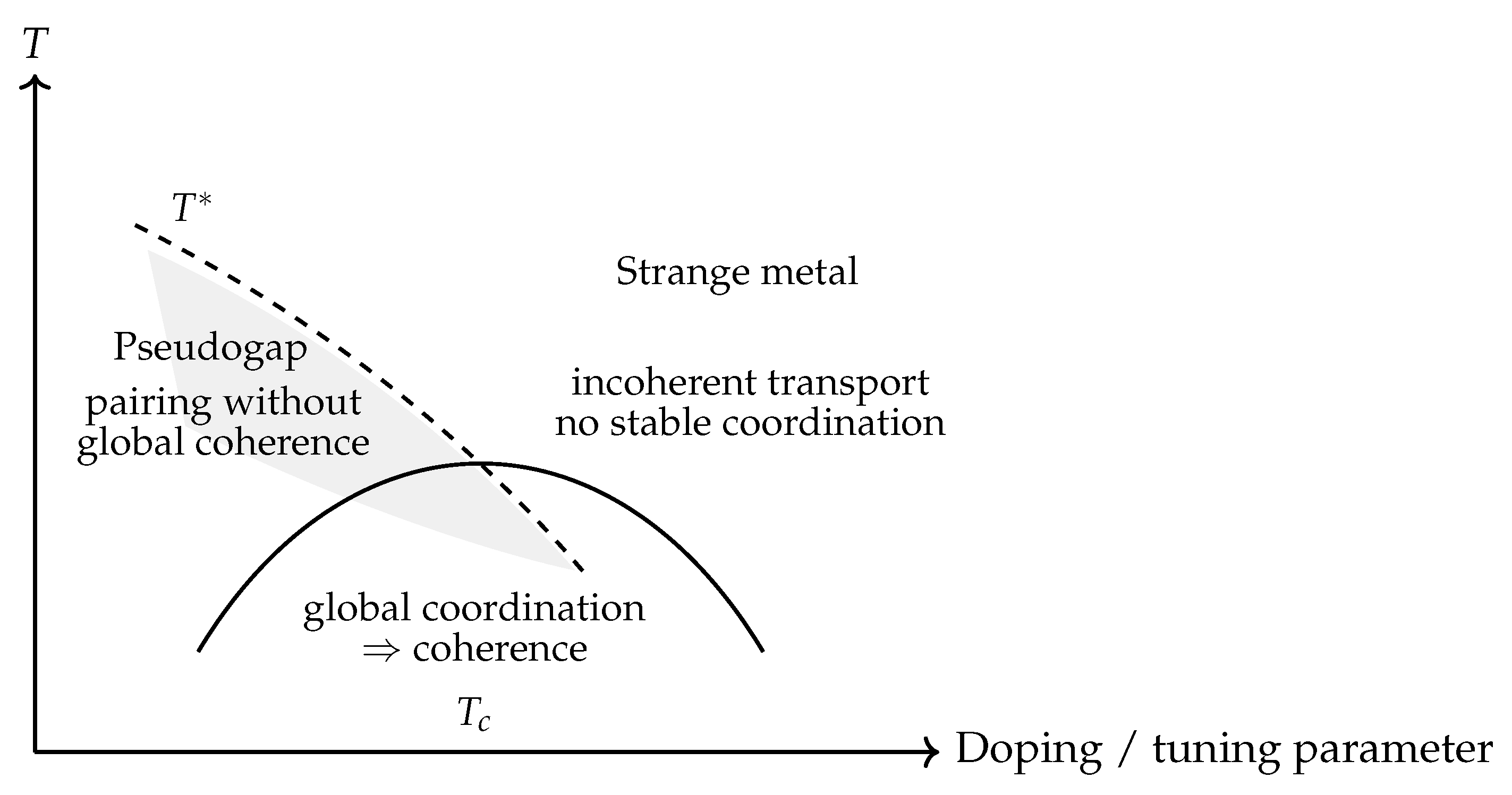
Figure 2.
Coordination-driven mechanism for superconductivity. Internal coordination (m) enhances transport stiffness via coupling , rendering the incoherent state unstable when . This leads to superconductivity () and yields the scaling .
Figure 2.
Coordination-driven mechanism for superconductivity. Internal coordination (m) enhances transport stiffness via coupling , rendering the incoherent state unstable when . This leads to superconductivity () and yields the scaling .
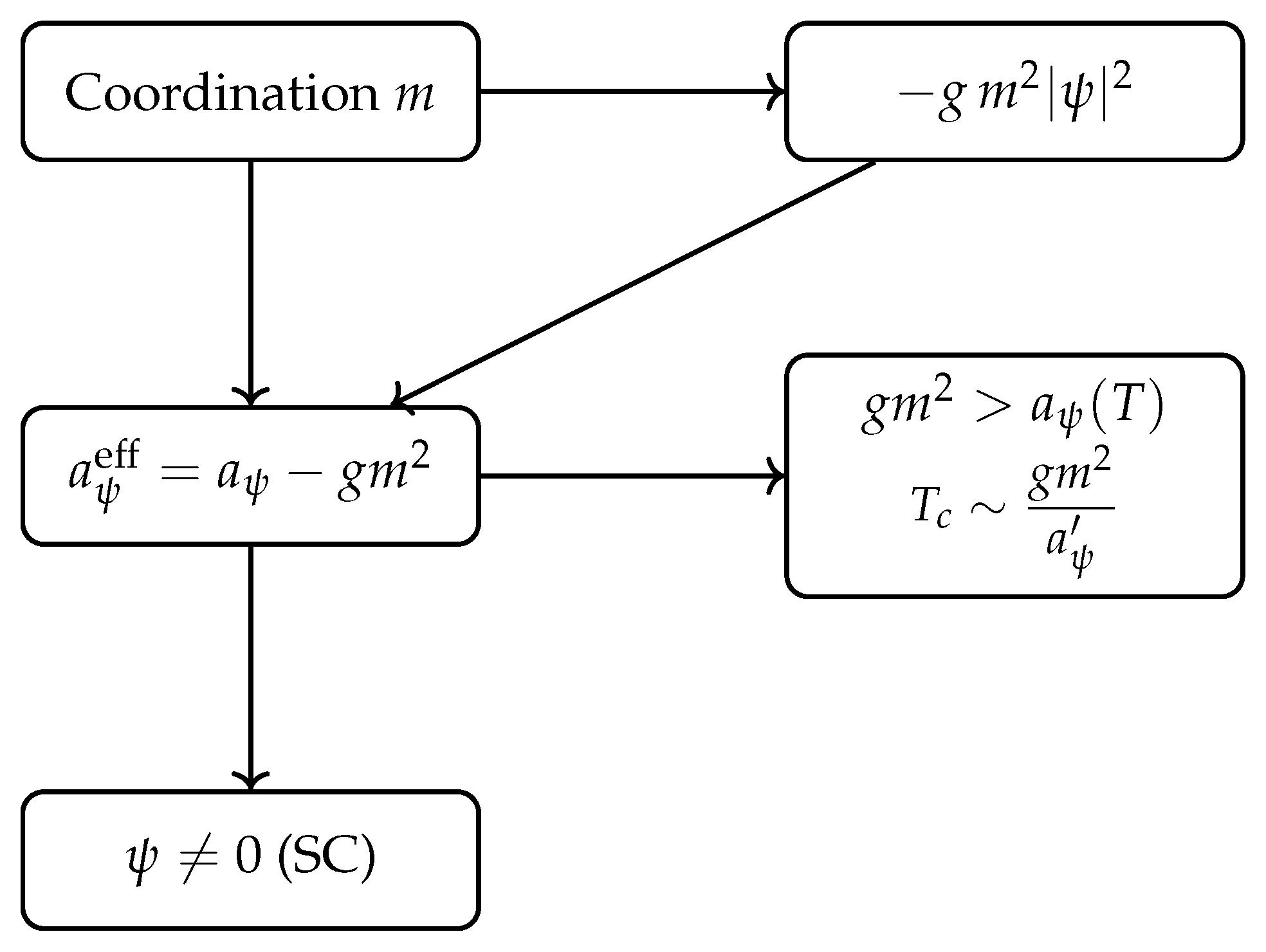
Figure 3.
Schematic separation of coordination and transport coherence scales. In the pseudogap regime, the coordination coherence length remains larger than the transport coherence length , allowing pairing-like correlations without global superconductivity. Global coherence emerges only when becomes sufficiently large near .
Figure 3.
Schematic separation of coordination and transport coherence scales. In the pseudogap regime, the coordination coherence length remains larger than the transport coherence length , allowing pairing-like correlations without global superconductivity. Global coherence emerges only when becomes sufficiently large near .
Disclaimer/Publisher’s Note: The statements, opinions and data contained in all publications are solely those of the individual author(s) and contributor(s) and not of MDPI and/or the editor(s). MDPI and/or the editor(s) disclaim responsibility for any injury to people or property resulting from any ideas, methods, instructions or products referred to in the content. |
© 2026 by the authors. Licensee MDPI, Basel, Switzerland. This article is an open access article distributed under the terms and conditions of the Creative Commons Attribution (CC BY) license (http://creativecommons.org/licenses/by/4.0/).
Copyright: This open access article is published under a Creative Commons CC BY 4.0 license, which permit the free download, distribution, and reuse, provided that the author and preprint are cited in any reuse.


