

Submitted:
07 April 2026
Posted:
08 April 2026
You are already at the latest version
Abstract
The fishing processing industry in Chimbote, Peru, reflects structural vulnerabilities common in extractive sectors of the Global South, including labour informality, weak occupational safety, and limited Internal Corporate Social Responsibility (ICSR). These conditions hinder progress toward Sustainable Development Goal 8 (SDG 8). While prior studies link ICSR to positive employee outcomes, the mechanisms through which its effects translate across organisational levels remain theoretically underdeveloped, par-ticularly in high-informality contexts. A quantitative, explanatory, cross-sectional design was employed using data from 384 workers in fishing processing firms. Data were col-lected through a 26-item Likert-scale instrument. Partial Least Squares Structural Equation Modelling (PLS-SEM) was applied to test a sequential mediation model, where ICSR in-fluences organisational-level labour management through individual and group-level processes. Reliability and validity were confirmed using Cronbach’s alpha, Composite Reliability, AVE, Fornell–Larcker, and HTMT. Structural relationships were assessed via bootstrapping (5,000 subsamples), and predictive relevance was evaluated using Q² and PLS Predict. The measurement model showed adequate reliability and validity. The direct effect of ICSR on organisational-level labour management was non-significant (β = 0.029, p = 0.567). However, all mediated paths were significant: ICSR → Individual (β = 0.608), Individual → Group (β = 0.526), and Group → Organisational (β = 0.396), all p < 0.001. Sequential mediation was confirmed (β_indirect = 0.127; 95% CI [0.090, 0.164]). Model fit (SRMR = 0.045) and predictive relevance (Q² = 0.150–0.361) were satisfactory. ICSR does not directly influence organisational outcomes; instead, its impact operates through a bottom-up multilevel mechanism, reinforcing individual, group, and organ-isational dynamics. These findings contribute to sustainable labour governance and multilevel organisational theory.
Keywords:
internal corporate social responsibility
; labour management
; PLS-SEM
; sequential mediation
; fishing industry
; sustainable development
; SDG 8
; indirect-only mediation
; multilevel theory
; Peru
1. Introduction
The quality of working life stands at the intersection of corporate governance, human rights, and sustainable development. Sustainable Development Goal 8 of the United Nations 2030 Agenda calls for sustained, inclusive, and sustainable economic growth, full and productive employment, and decent work for all [1]. Whilst macroeconomic dimensions of SDG 8 have attracted considerable academic and policy attention, the firm-level mechanisms through which organisations in labour-intensive extractive industries either advance or systematically undermine this objective remain insufficiently theorised [2]. This gap is particularly consequential in the Global South, where high-informality industrial sectors constitute the dominant employment landscape and where institutional enforcement of labour rights is weakest.
The Peruvian fishing processing industry represents a canonical illustration of this challenge. With an estimated 150,000 workers employed across the fishing processing facilities of Chimbote—the country’s largest fishing hub—the sector is simultaneously a critical node in global aquatic food supply chains and a persistent site of labour precarity [3]. Independent estimates indicate that more than 70% of fishing workers operate without formal employment contracts or access to social security benefits [4]; occupational accident rates are substantially elevated relative to the national manufacturing average [5]; and sustained patterns of managerial inequity and limited investment in employee welfare have been documented across multiple surveys of the sector [6]. These conditions not only violate internationally recognised labour standards but also impose substantial organisational costs: elevated turnover, chronic disengagement, and the erosion of productive capacity.
Internal Corporate Social Responsibility (ICSR)—understood as voluntary organisational commitments directed at guaranteeing the welfare, equitable treatment, and professional development of employees [7]—has been positioned in the management literature as a strategic lever for reconciling firm performance with dignified working conditions. Grounded in Carroll’s [8] Pyramid of Corporate Social Responsibility, ICSR operationalises economic responsibilities (job stability, fair remuneration), legal responsibilities (formal contracts, occupational safety compliance), and ethical responsibilities (equity, transparency, dignity) within the internal employment relationship. A growing empirical literature confirms that ICSR practices are positively associated with employee satisfaction, organisational commitment, and productivity across diverse sectoral and national contexts [9,10,11]. Yet two foundational limitations constrain the theoretical and practical utility of existing research.
First, prior studies have predominantly operationalised labour management as a unidimensional or loosely aggregated outcome variable, thereby obscuring the hierarchical mechanisms through which ICSR propagates its effects across organisational levels [12]. In practice, organisations are intrinsically multilevel systems in which individual-level cognitions and behaviours are nested within group dynamics, which are in turn embedded in broader organisational structures and cultures [13]. Treating labour management as a single aggregate construct conflates analytically distinct processes, suppresses the identification of mediation pathways, and limits both explanatory precision and the actionability of managerial recommendations. Second, the vast majority of empirical ICSR research has been conducted in manufacturing and service organisations in East Asia and Western Europe [14], leaving extractive industries in Latin America systematically underexplored. This contextual gap is consequential: the institutional environment, labour market structure, and cultural norms governing the employment relationship in Peruvian fishing organisations differ substantively from those in previously studied contexts, constraining the direct generalisation of existing findings.
The present study addresses both limitations through a theoretically integrated multilevel approach. Drawing on Stakeholder Theory [15], Social Exchange Theory [16], and Multilevel Organisational Behaviour (OB) Theory [13], we propose and empirically test a sequential mediation model in which ICSR influences Organisational-Level Labour Management through cascading effects on Individual-Level and Group-Level Labour Management. Labour management is reconceptualised as a three-level nested construct following Robbins and Judge’s [17] OB framework: the individual level encompasses personal values alignment, motivational states, and work attitudes; the group level encompasses communication quality, leadership effectiveness, and team cohesion; and the organisational level encompasses cultural strength, workplace climate, and adaptive capacity. The model is estimated using Partial Least Squares Structural Equation Modelling (PLS-SEM) [18], a method well suited for predictive, theory-building research involving complex sequential mediation structures.
This article makes four principal contributions to the sustainability management literature. First, it advances a theoretically grounded multilevel operationalisation of labour management that transcends the limitations of unidimensional constructs prevalent in the ICSR literature. Second, it reveals an indirect-only sequential mediation effect [18]—whereby ICSR’s influence on organisational outcomes is entirely contingent on the prior activation of individual motivational processes and their subsequent group-level aggregation; the non-significant direct path from ICSR to organisational outcomes (H4 not supported) is argued to be not a weakness but a theoretically meaningful finding, fully consistent with multilevel emergence and social exchange logic. Third, it provides empirical evidence from a high-informality extractive sector in an emerging economy, enriching the contextual diversity of ICSR scholarship. Fourth, it demonstrates how ICSR may function as a strategic instrument for advancing SDG 8 at the firm level by catalysing a bottom-up emergence process of organisational sustainability, with direct implications for labour governance in the fishing sector and analogous extractive industries.
2. Literature Review and Theoretical Framework
2.1. Internal Corporate Social Responsibility: Conceptual Foundations
Corporate Social Responsibility scholarship has historically privileged external dimensions—environmental management, community engagement, and philanthropic investment—over internally directed practices concerning employees [19]. The internal dimension of CSR, variously labelled workplace CSR, employee-oriented CSR, or ICSR, refers to voluntary organisational policies and practices directed at improving employees’ working conditions, welfare, and professional development [7]. ICSR bridges CSR and Sustainable Human Resource Management (SHRM), operationalising Carroll’s [8] ethical and legal responsibilities within the internal employment relationship and aligning corporate practice with the normative demands of sustainable labour governance [20].
Carroll’s [8] four-part Pyramid of CSR provides the most widely adopted theoretical scaffold for ICSR. The pyramid orders organisational responsibilities hierarchically: economic responsibilities constitute the base (profitable operation, stable employment, fair wages); legal responsibilities follow (compliance with labour law, occupational safety standards, formal contracting); ethical responsibilities emerge at the third tier (equitable treatment, transparency, dignity); and philanthropic responsibilities occupy the apex. For extractive and labour-intensive industries, economic and legal compliance constitute non-negotiable foundations; ethical and philanthropic dimensions represent the differentiating value that transforms minimal compliance into genuine organisational commitment to employee welfare [21].
The empirical literature documents robust positive associations between ICSR and employee-level outcomes across diverse contexts. Kim et al. [22] established that employee-oriented CSR policies significantly explained variance in retention intentions and affective organisational commitment in South Korean technology firms, with internal HR practices mediating the effect. Turker [7] demonstrated that perceived ICSR explained substantial variance in organisational commitment (R2 = 0.47) in Turkish manufacturing, and that ethical and legal CSR dimensions were the strongest individual predictors. Farooq et al. [10] reported robust structural paths from ICSR to organisational commitment across European multinationals, with identification and trust mediating the relationship. Moktadir et al. [11] found that ICSR practices—operationalised through occupational health, training investment, and fair remuneration—significantly predicted employee performance in the Bangladeshi textile sector. Gond et al. [14] systematically reviewed the psychological microfoundations of CSR, confirming that employee-directed CSR consistently activates identity, motivation, and behavioural engagement mechanisms at the individual level.
Importantly, however, these studies conceptualise employee responses to ICSR primarily as single-level outcomes, failing to theorise how ICSR-induced motivational and attitudinal changes at the individual level cascade into group dynamics and ultimately shape organisational culture. This multilevel transmission mechanism—which the present study models explicitly—represents a critical theoretical gap in the ICSR literature [12,14].
2.2. Labour Management as a Multilevel Hierarchical Construct
Mainstream HRM scholarship has operationalised labour management as a bundle of HR practices—recruitment, training, performance appraisal, and compensation management—without theorising the hierarchical structure of their effects [23]. Yet organisations are intrinsically multilevel systems: individual behaviours are nested within groups, which are embedded in broader organisational structures and cultures [13]. Treating labour management as a unidimensional construct conflates analytically distinct processes, suppresses the identification of mediation pathways, and obscures the emergent nature of organisational outcomes [24].
Robbins and Judge’s [17] Organisational Behaviour framework provides the conceptual scaffolding for a multilevel reconceptualisation. The model distinguishes three analytically separable levels of analysis. At the individual level, labour management encompasses the management of personal values, motivational states, and work-related attitudes. Social Exchange Theory predicts that employees who perceive their organisation as genuinely invested in their welfare—via ICSR—will respond by internalising pro-organisational values and exhibiting elevated motivational commitment [16,25]. This individual-level reciprocation constitutes the first link in the multilevel transmission chain.
At the group level, labour management encompasses the quality of team communication, the fairness and effectiveness of leadership, and the degree of interpersonal cohesion. When individual workers share aligned values and elevated motivational states, group-level processes are correspondingly enriched: communication becomes more open and trust-based, leadership is enacted more participatively, and conflict is managed more constructively [23,24]. Batt and Colvin [28] demonstrated that high-involvement HR systems—a cluster of practices strongly aligned with ICSR—produced superior group-level outcomes including reduced conflict, elevated discretionary effort, and improved collective problem-solving. This group-level activation represents the second link in the chain.
At the organisational level, labour management reflects the macro-structural dimensions of organisational culture, workplace climate, and adaptive capacity. Schein [29] argues that organisational culture is the primary determinant of how employees collectively perceive, interpret, and act—and that group-level norms and leadership practices constitute the primary mechanisms through which culture is formed and reproduced. Jones [30] further elaborates that organisational structure shapes information flows in ways that either reinforce or undermine positive individual and group dynamics cultivated at lower levels. Sustainable organisational performance therefore requires vertical coherence across all three levels [28].
2.3. Theoretical Integration: The Sequential Mediation Model
Three theoretical traditions converge to underpin the proposed sequential mediation framework. Stakeholder Theory [15] establishes the normative foundation for ICSR: organisations bear obligations toward all parties whose interests are affected by their decisions, and employees—as the primary internal stakeholder group—possess legitimate claims to welfare, equity, and development. Freeman and Dmytriyev [32] elaborated this argument to demonstrate that internal stakeholder treatment constitutes a foundational condition for sustaining the legitimacy of the employment relationship and, by extension, for the long-term viability of the firm. ICSR is therefore not merely a reputational strategy but a structural response to the normative demands of stakeholder claims.
Social Exchange Theory (SET) [16,33] provides the micro-level mechanism linking ICSR to individual behaviour. SET proposes that employees continuously monitor organisational treatment and reciprocate with attitudes and behaviours proportionate to perceived organisational investment. Cropanzano and Mitchell [33] synthesised the SET literature to demonstrate that the norm of reciprocity operates as a pervasive and powerful regulator of employment relationships: when organisations invest in ICSR practices signalling genuine care for employee welfare, workers respond by internalising pro-organisational values (individual level), enhancing collaborative behaviour (group level), and contributing to a positive organisational climate (organisational level). Critically, this reciprocation is sequential: individual cognitive and attitudinal change precedes and enables group-level behavioural change, which in turn aggregates into organisational-level culture [33].
Multilevel OB Theory [13] operationalises the cross-level transmission mechanisms. Chan’s [34] typology of compositional models posits that macro-level organisational properties emerge from the aggregation of micro-level individual cognitions and meso-level group dynamics through a process of bottom-up emergence. Kozlowski and Bell [35] elaborated this framework for work groups, demonstrating that group-level norms and collective efficacy emerge from the shared experience and motivational states of individual members. The sequential mediation model integrates these insights: ICSR operates as a top-down structural catalyst activating individual-level value internalisation and motivational commitment, which subsequently aggregates through group interaction processes into organisational-level cultural emergence. This bidirectional, multilevel logic is the theoretical core of the present study, and it generates a clear prediction: the direct effect of ICSR on organisational-level outcomes, bypassing individual and group-level activation, should be theoretically negligible—a prediction that the empirical results confirm.
3. Research Hypotheses
3.1. ICSR and Individual-Level Labour Management (H1)
SET predicts that employees reciprocate organisationally beneficial treatment by aligning personal values with organisational objectives and elevating motivational commitment [16,25]. ICSR practices—including fair remuneration, occupational safety investment, equitable treatment, and professional development—constitute high-quality organisational inducements that activate this reciprocation mechanism. Glavas [36] established a significant structural path from perceived ethical organisational behaviour—a core ICSR dimension—to intrinsic employee motivation in a multi-sector sample. Hofman and Newman [37] documented significant paths from perceived CSR to both perceived organisational justice and retention intention in Chinese manufacturing, with individual-level identification fully mediating the effect. Eisenberger et al. [25] demonstrated that perceived organisational support—a construct closely aligned with ICSR—predicts individual-level affective commitment and work engagement through felt obligation and trust. Based on this convergent evidence:
Hypothesis 1 (H1). Internal Corporate Social Responsibility (ICSR) is positively associated with Individual-Level Labour Management (motivation, values alignment, work attitudes).
3.2. Individual-Level to Group-Level Labour Management (H2)
Individual-level motivational and value-alignment states function as antecedents of group-level dynamics through processes of social contagion, normative influence, and resource enrichment [24]. When team members share elevated motivational states and pro-organisational values, communication norms become more open and reciprocal, leadership emerges as more participative, and interpersonal conflict is managed more constructively [23,25]. Batt and Colvin [28] demonstrated that investment in individual-level HR practices produced superior group-level conflict resolution and collective effort. Podsakoff et al. [27] confirmed that individual motivational states are strong predictors of group-level citizenship behaviours and collective efficacy. Therefore:
Hypothesis 2 (H2). Individual-Level Labour Management is positively associated with Group-Level Labour Management (communication quality, leadership effectiveness, team cohesion).
3.3. Group-Level to Organisational-Level Labour Management (H3)
Group-level dynamics constitute the meso-level building blocks from which organisational culture and climate emerge through a bottom-up aggregation process [25]. Teams characterised by high communicative quality and adaptive leadership generate behavioural norms and shared mental models that, when institutionalised across the organisation, manifest as a positive and adaptive organisational culture [29]. Schein [29] identifies group-level norm reinforcement and leadership behaviour as the primary mechanisms of cultural formation and change. Empirically, Batta et al. [31] established that HR system quality predicted organisational performance through both individual satisfaction and group-level governance quality in the Indian transportation sector. Kozlowski and Bell [35] confirmed that group-level collective efficacy and cohesion are the strongest predictors of organisational-level adaptive outcomes. Therefore:
Hypothesis 3 (H3). Group-Level Labour Management is positively associated with Organisational-Level Labour Management (culture strength, workplace climate, adaptive capacity).
3.4. Direct Effect and Sequential Mediation Hypotheses (H4–H6)
Beyond the constituent paths of the sequential chain (H1–H3), the integrated model requires that three additional propositions be formally tested: the direct relationship between ICSR and organisational-level outcomes (H4), and the two indirect pathways through which ICSR’s organisational influence is theoretically transmitted (H5 and H6). The theoretical logic of the model implies that where the sequential mediation pathway operates efficiently, the direct effect of ICSR on organisational outcomes—bypassing lower-level activation—should be attenuated or absent, consistent with the cumulative reciprocation logic of SET [33] and the bottom-up emergence model of Multilevel OB Theory [13].
Hypothesis 4 (H4). Internal Corporate Social Responsibility (ICSR) has a direct effect on Organisational-Level Labour Management.
Hypothesis 5 (H5). Individual-Level Labour Management mediates the relationship between ICSR and Group-Level Labour Management (ICSR → Individual → Group). This intermediate mediation pathway constitutes a secondary mechanism through which ICSR mobilises group-level dynamics.
Hypothesis 6 (H6). The effect of ICSR on Organisational-Level Labour Management is sequentially and fully transmitted through Individual-Level and Group-Level Labour Management via an indirect-only mechanism (ICSR → Individual → Group → Organisational). This full sequential mediation constitutes the primary theoretical contribution of the model.
Figure 1 displays the proposed sequential mediation model, with ICSR as the exogenous construct, Organisational-Level Labour Management as the distal outcome, and Individual-Level and Group-Level Labour Management as sequential mediators. The dashed arrow from ICSR to ORG represents the direct path formalised in H4, theoretically predicted to be non-significant given the indirect-only transmission mechanism posited in H6.
4. Materials and Methods
4.1. Research Design
This study adopts a quantitative, explanatory, and cross-sectional research design [38]. The explanatory orientation reflects the objective of testing directional theoretical propositions embedded in a multilevel structural model, rather than merely documenting bivariate associations. The positivist epistemological stance is justified by the operationalisation of theoretically derived, numerically measurable constructs and the intention to generalise findings within the defined target population [39].
4.2. Population and Sample
The target population comprised workers engaged in fish processing activities—including filleting, cutting, quality control, and plant supervision—across fishing processing organisations registered with the Instituto Peruano de Economía in Chimbote, Ancash Region, Peru, estimated at 150,000 workers [3]. Security and cleaning personnel were excluded due to their distinct operational conditions and limited direct exposure to ICSR practices specific to the processing environment. Sample size was determined using the formula for finite populations: n = (N·Z2·p·q) / [(N−1)·E2 + Z2·p·q], where N = 150,000, Z = 1.96 (95% confidence), p = q = 0.50 (maximum variance assumption), and E = 0.05 (5% margin of error), yielding n = 384 workers. Participants were recruited via simple random sampling across multiple facilities. Specifically, the study engaged workers from eight fish-processing plants registered with the Instituto Peruano de Economía in the Chimbote metropolitan area, selected to ensure coverage of both large-scale industrial processors and medium-sized enterprises representative of the sector’s structural diversity. Questionnaire completion was voluntary, anonymous, and conducted under informed consent in accordance with Universidad César Vallejo Research Ethics Protocol (Resolution N.° 0470-2022/UCV).
4.3. Measurement Instrument
Data were collected via a structured, self-administered questionnaire comprising 26 items rated on a five-point Likert scale (1 = Never; 5 = Always). This frequency-based response format was selected because the ICSR and labour management constructs were operationalised as behavioural frequency phenomena—capturing how often specific practices are enacted rather than attitudes toward them—consistent with prior ICSR measurement approaches in Latin American industrial contexts [6,7]. Four latent constructs were measured: ICSR (14 items, covering economic, legal, and ethical dimensions of Carroll’s [8] pyramid), Individual-Level Labour Management (4 items: personal values alignment, motivational states), Group-Level Labour Management (4 items: communication quality, leadership effectiveness), and Organisational-Level Labour Management (4 items: organisational culture, workplace climate). The instrument underwent expert content validation by three subject-matter specialists in management and labour studies, achieving full dichotomous agreement across all items on the criteria of sufficiency, clarity, coherence, and relevance. Global instrument reliability was confirmed at α = 0.874. All analyses were conducted using SmartPLS 4 [40].
4.4. Analytical Strategy
PLS-SEM was selected for four methodological reasons [18,41]: (a) the study is primarily predictive and theory-building, consistent with PLS-SEM’s comparative advantage over covariance-based SEM in nascent theoretical domains; (b) the sequential mediation chain involves multiple endogenous constructs estimable simultaneously without distributional assumptions; (c) n = 384 substantially exceeds the minimum recommended sample for PLS-SEM (ten times the maximum number of paths directed at any endogenous construct); and (d) model fit was assessed via SRMR, consistent with contemporary PLS-SEM reporting standards [41]. The measurement model was evaluated using outer loadings (threshold ≥ 0.70), AVE (≥ 0.50), Composite Reliability (≥ 0.70), rho_A (≥ 0.70), the Fornell–Larcker criterion [44], and the HTMT ratio (< 0.85 conservative criterion) [42]. The structural model was assessed via standardised path coefficients (β), explained variance (R2 and R2_adj), effect sizes (f2), predictive relevance via blindfolding (Q2, omission distance = 7), and PLS Predict for out-of-sample predictive accuracy [43]. Mediation effects (H5, H6) were tested using bias-corrected and accelerated (BCa) bootstrapped confidence intervals (5,000 subsamples, two-tailed) [47]. Common method bias (CMB) was assessed via Harman’s single-factor test; the resulting single-factor solution explained less than 33% of total variance, indicating an acceptable level of common method variance. To complement this assessment, Kock’s [46] full collinearity approach was additionally applied: all VIF values in the structural model were equal to 1.151, well below the threshold of 3.3, providing additional evidence that CMB does not substantially contaminate the model estimates [46].
5. Results
5.1. Measurement Model Assessment
The measurement model was evaluated prior to structural estimation to ensure that constructs are valid and reliable representations of their respective latent variables. Table 1 reports reliability and convergent validity indices for all four constructs. All constructs substantially exceeded established thresholds: Cronbach’s alpha and rho_A ranged from 0.833 to 0.943; Composite Reliability (CR) ranged from 0.888 to 0.950; and AVE ranged from 0.574 to 0.720. These values confirm that each construct exhibits adequate internal consistency and that a majority of variance is attributable to the latent construct rather than measurement error [41].
Table 2 presents outer loadings for all 26 items. All loadings ranged from 0.714 to 0.876, comfortably exceeding the 0.70 threshold [42]. Cross-loadings confirmed that each indicator loaded substantially higher on its assigned construct than on any other, providing initial evidence of indicator-level discriminant validity.
Discriminant validity was assessed using both the Fornell–Larcker criterion and the more stringent HTMT ratio. Table 3 presents the Fornell–Larcker matrix. The square root of each construct’s AVE (diagonal) exceeded all inter-construct correlations (off-diagonal), satisfying the criterion across all construct pairs [44]. The progressive attenuation of inter-construct correlations along the causal chain—ICSR–IND (r = 0.608) > IND–GRP (r = 0.526) > GRP–ORG (r = 0.407) > ICSR–ORG (r = 0.172)—is theoretically coherent with the sequential mediation structure, in which ICSR’s association with distal outcomes diminishes as it is absorbed by intermediate constructs.
Table 4 reports HTMT ratios. All six inter-construct HTMT values were below the conservative 0.85 threshold [42], with the highest value being HTMT(IND, ICSR) = 0.682. The notably low HTMT ratios between ICSR and ORG (0.191) and between GRP and ICSR (0.399) confirm that ICSR and the distal organisational construct are empirically well-differentiated—a prerequisite for demonstrating indirect-only mediation [42].
5.2. Structural Model Assessment
Prior to examining path coefficients, collinearity was assessed. All VIF values were 1.151, substantially below the critical threshold of 3.3 [46], indicating an absence of multicollinearity concerns in the structural model. Model fit was confirmed by SRMR = 0.045, well within the recommended threshold of ≤ 0.08 [41]. These diagnostics provide assurance that path coefficient estimates are not distorted by collinearity or model misspecification.
Table 5 presents path coefficients, standard deviations, t-values, p-values, bootstrapped 95% BCa confidence intervals, and effect sizes (f2) for all structural paths. The results reveal a theoretically consequential and internally coherent pattern: three of the four direct paths are highly significant (p < 0.001), whilst one—the direct path from ICSR to ORG formalised in H4—is non-significant (β = 0.029, t = 0.573, p = 0.567, 95% CI [−0.071, 0.124]).
The path ICSR → IND was the strongest in the model (β = 0.608, t = 16.483, p < 0.001, 95% CI [0.533, 0.680]), representing a large effect size (f2 = 0.586), consistent with H1. The path IND → GRP was also highly significant and substantively large (β = 0.526, t = 14.151, p < 0.001, 95% CI [0.453, 0.597], f2 = 0.383), supporting H2. The path GRP → ORG was significant and moderate-to-large (β = 0.396, t = 8.685, p < 0.001, 95% CI [0.307, 0.487], f2 = 0.164), supporting H3. By contrast, the direct path ICSR → ORG (H4) was negligible and non-significant (β = 0.029, t = 0.573, p = 0.567, f2 = 0.001).
5.3. Explained Variance and Predictive Relevance
Table 6 reports coefficients of determination (R2 and R2_adj) and blindfolding-based predictive relevance (Q2) for all endogenous constructs. ICSR explained 36.9% of variance in Individual-Level Labour Management (R2 = 0.369), a moderate level indicating substantial individual-level variance attributable to other factors. The Individual construct explained 27.7% of variance in Group-Level Labour Management (R2 = 0.277). Together, ICSR, IND, and GRP explained 16.6% of variance in Organisational-Level Labour Management (R2 = 0.166). Whilst these R2 values are modest by the standards of Hair et al. [18], they must be interpreted within the context of the cross-sectional design and the inherent complexity of multilevel organisational outcomes. Critically, all three Q2 values—obtained via blindfolding (omission distance = 7)—were positive and substantially above zero (Q2_IND = 0.364; Q2_GRP = 0.269; Q2_ORG = 0.154), confirming that the model exhibits meaningful in-sample predictive relevance for all endogenous constructs [45].
Out-of-sample predictive accuracy was assessed via PLS Predict (Table 7). For all three endogenous constructs, the model’s RMSE and MAE were lower than those of the naïve benchmark predictor, confirming that the structural model provides predictions superior to the mean-based baseline. Q2_predict values ranged from 0.150 (ORG) to 0.361 (IND), confirming medium-to-large out-of-sample predictive accuracy [43]. The IND construct achieved the highest predictive relevance (Q2_predict = 0.361; RMSE_model = 0.799 vs. RMSE_naïve = 0.999), classified as large, whilst GRP and ORG demonstrated medium predictive accuracy. These results indicate that the model produces generalisable predictions beyond the estimation sample.
5.4. Mediation Analysis: Sequential Indirect Effects
To test the sequential mediation hypotheses (H5 and H6), specific indirect effects were estimated via bootstrapping (5,000 subsamples, BCa 95% confidence intervals). Table 8 reports all specific indirect effects. The indirect effect ICSR → IND → GRP was significant (β_indirect = 0.320, t = 10.752, p < 0.001, 95% CI [0.262, 0.378]), supporting H5. The sequential indirect effect IND → GRP → ORG was also significant (β_indirect = 0.209, t = 7.368, p < 0.001, 95% CI [0.153, 0.264]), consistent with H6.
Critically, the complete sequential chain ICSR → IND → GRP → ORG yields a total specific indirect effect of β = 0.127 (computed as 0.608 × 0.526 × 0.396), with a 95% BCa confidence interval excluding zero (p < 0.001). In combination with the non-significant direct path ICSR → ORG (β = 0.029, p = 0.567), these results provide robust evidence of indirect-only mediation [18]: ICSR exerts no significant direct influence on organisational-level outcomes; its entire effect is transmitted through the sequential individual–group cascade. This constitutes an indirect-only transmission mechanism, fully consistent with multilevel bottom-up emergence theory [13].
Table 9 consolidates direct, indirect, and total effects across all paths, confirming the structural dominance of the mediated pathway over the direct pathway in the ICSR → ORG relationship. Figure 2 presents the final estimated structural model with all path coefficients, significance levels, and R2 values.
5.5. Summary of Hypothesis Testing
Table 10 summarises the outcomes of all six hypothesis tests, confirming support for H1, H2, H3, H5, and H6, and non-support for H4.
6. Discussion
6.1. Indirect-Only Mediation as the Central Theoretical Finding
The central and theoretically consequential finding of this study is not merely that ICSR is positively associated with labour management outcomes—a conclusion broadly consistent with extant literature [7,9,10,11]—but that this association operates exclusively through a sequential multilevel cascade. H4, which posited a direct effect of ICSR on Organisational-Level Labour Management, was not supported: the direct path was non-significant (β = 0.029, p = 0.567) with a trivial effect size (f2 = 0.001), whilst the sequential indirect pathway tested in H6 (ICSR → IND → GRP → ORG) was robustly significant (β_indirect = 0.127, p < 0.001). This pattern constitutes indirect-only mediation [18]—or more precisely, an indirect-only effect: ICSR’s influence on organisational outcomes is entirely contingent on prior activation of individual motivational and value-alignment processes, and their subsequent aggregation into group dynamics.
This finding resolves a persistent ambiguity in the ICSR literature. Prior studies reporting direct associations between ICSR and organisational performance have predominantly employed unidimensional outcome constructs, thereby collapsing individual, group, and organisational levels into a single measure and precluding the identification of mediation pathways [12,14]. For instance, Turker [7] and Farooq et al. [10] both documented significant direct paths from ICSR to organisational commitment using single-level outcome operationalisations; the present study suggests that these apparent direct effects may reflect statistical aggregation artefacts arising from the failure to disaggregate multilevel pathways. When labour management is properly operationalised as a multilevel nested construct—as theorised by Robbins and Judge [17] and consistent with Multilevel OB Theory [13]—the direct ICSR-to-organisation pathway disappears. The implication is not that ICSR is inconsequential for organisational performance, but that its consequences are entirely transmitted through the hierarchical activation of human behaviour: ICSR first changes how individuals think and feel about their work; those changed individuals collectively transform how groups communicate, lead, and collaborate; and those transformed groups institutionalise a more positive and adaptive organisational culture. This is not a methodological artefact; it is a theoretically meaningful result that demands explicit interpretation.
6.2. The Non-Significant Direct Path: A Theoretically Meaningful Absence
The non-significant direct effect of ICSR on Organisational-Level Labour Management formalised in H4 (β = 0.029, p = 0.567) is a theoretically important, not incidental, result. It is not a measurement failure; it is a theoretically predicted outcome of three convergent mechanisms.
First, from a SET perspective, the reciprocation mechanism is inherently sequential at the micro-to-meso-to-macro level [16,33]. Organisational culture is not a direct product of managerial policy; it is an emergent property arising from sustained patterns of individual cognition and group interaction. Cropanzano and Mitchell [33] synthesise decades of SET research to establish that the norm of reciprocity is mediated by cognitive and affective processes that are inherently gradual and cumulative. Attempting to bypass individual and group activation by directly implementing cultural change initiatives—without first investing in conditions that motivate individual reciprocation—is predicted by SET to fail because culture cannot be imposed; it must emerge from within [29].
Second, from a Multilevel OB Theory perspective, Chan’s [34] typology of compositional models holds that macro-level constructs are functionally distinct from micro-level constructs, even when they share surface-level similarities. Organisational culture and individual work motivation are qualitatively different phenomena, related by causal mechanisms rather than definitional overlap. The absence of a significant direct ICSR → ORG path is therefore consistent with this theoretical position: ICSR operates at the level of individual–organisation exchange; its macro-level consequences emerge only through the accumulation of meso-level group processes.
Third, contextual factors specific to the Chimbote fishing sector may amplify this structural pattern. In high-informality environments characterised by historically low managerial trust and limited institutional protection, workers are less likely to translate ICSR practices into immediate cultural change. Trust must be built incrementally at the individual level before it can aggregate into group cohesion and, subsequently, cultural transformation. The time-lagged, iterative nature of this trust-building process in the Peruvian extractive context renders the direct ICSR-to-culture pathway particularly implausible in the short term [6,15]. The cross-sectional design of the present study captures only a single temporal snapshot of this ongoing process, further constraining the visibility of a direct organisational-level effect.
6.3. Comparison with Prior Literature and Theoretical Advancement
The magnitude of the ICSR → IND path (β = 0.608, f2 = 0.586) is among the largest reported in cross-sectional ICSR-to-individual-outcome research. Glavas [36] documented significant paths between perceived ethical organisational behaviour and intrinsic motivation in a multi-sector sample, establishing the mechanism through which ICSR activates individual motivational responses via identity-based processes. Hofman and Newman [37] confirmed that perceived CSR predicted individual-level justice perceptions and retention intention in Chinese manufacturing, with collectivism moderating the strength of the relationship. The convergence of these findings across geographically and institutionally distinct contexts strengthens confidence in the ICSR–individual relationship as a robust, cross-cultural phenomenon.
The IND → GRP path (β = 0.526, f2 = 0.383) is consistent with Batt and Colvin’s [28] finding that high-involvement HR systems—practices strongly aligned with ICSR—produced superior group-level outcomes including reduced interpersonal conflict and elevated collective citizenship behaviour. Podsakoff et al. [27] confirmed that individual-level motivational states are reliable predictors of group-level citizenship behaviours and collective efficacy, providing a mechanism-level explanation for the IND → GRP pathway documented here. The GRP → ORG path (β = 0.396, f2 = 0.164) aligns with Schein’s [29] theoretical position that group dynamics—specifically, norm reinforcement and leadership behaviour—constitute the primary mechanisms through which organisational culture is formed and reproduced. The progressive attenuation of path coefficients along the chain (0.608 → 0.526 → 0.396) is theoretically coherent: each mediation step introduces additional organisational and environmental variance, reducing the proportion attributable to the upstream causal chain.
This study advances beyond prior research in three analytically distinct ways. First, to the best of the authors’ knowledge, it is the first study to empirically test a three-level sequential mediation model of ICSR within the fishing sector in Latin America, demonstrating that the multilevel cascade structure predicted by theory is recoverable in an extractive, high-informality context. Second, it demonstrates that indirect-only mediation—not merely partial mediation—characterises the ICSR–organisational relationship when levels are properly disaggregated, challenging the implicit assumption in the prior literature that ICSR has a direct organisational-level impact. Third, it provides evidence that the individual level is the critical entry point for ICSR’s organisational influence: the large effect size on IND (β = 0.608, f2 = 0.586) indicates that ICSR’s primary leverage resides at the level of individual psychology rather than at the level of culture management.
6.4. Implications for Sustainable Labour Governance and SDG 8
The results carry substantial implications for the pursuit of SDG 8 within extractive industries in emerging economies. If ICSR’s organisational benefits are entirely mediated through individual and group-level activation, then the strategic priority for fishing organisations should not be the direct implementation of culture transformation programmes—which evidence suggests are ineffective without prior lower-level foundations [29]—but rather systematic investment in the foundational ICSR practices that initiate the cascade.
Concretely, this implies that the highest-return organisational interventions for fishing firms in Chimbote are those targeting the economic and legal ICSR dimensions: job stability guarantees, formal contract regularisation, occupational safety provision, and fair wage structures. These practices most directly activate individual-level motivational reciprocation (β = 0.608). Once this individual foundation is established, group-level leadership development and communicative practices can leverage individual-level changes into team-level transformation (β = 0.526). Only at this stage do organisational-level cultural interventions become likely to produce sustainable and durable change (β = 0.396).
For policymakers and labour regulatory bodies, the findings underscore the critical importance of enforcing foundational labour rights—formal contracting, minimum wage compliance, occupational safety standards—as necessary preconditions for the cascading organisational benefits that ICSR can generate. The sequential, bottom-up strategic logic identified here is fully consistent with Carroll’s [8] hierarchical Pyramid, which orders responsibilities such that economic and legal compliance must precede ethical and philanthropic aspirations. Regulatory frameworks that prioritise these foundational dimensions are therefore not merely intrinsically valuable for worker welfare but also instrumentally necessary for the multilevel activation mechanism to operate.
7. Conclusions
This study advances a theoretically grounded, empirically substantiated multilevel model of the relationship between Internal Corporate Social Responsibility and labour management in the fishing processing industry of Chimbote, Peru. By reconceptualising labour management as a three-level sequential construct—individual, group, and organisational—and by integrating Stakeholder Theory, Social Exchange Theory, and Multilevel Organisational Behaviour Theory within a PLS-SEM framework, the study transcends the limitations of the prior ICSR literature, which has systematically conflated analytically distinct levels of analysis into unidimensional outcome measures.
The study’s principal theoretical contribution is the empirical demonstration of indirect-only sequential mediation [18]: ICSR exerts no significant direct influence on organisational-level labour management outcomes, but its effect is entirely and robustly transmitted through a bottom-up multilevel cascade. The sequential chain ICSR → Individual-Level (β = 0.608, large effect) → Group-Level (β = 0.526, large effect) → Organisational-Level (β = 0.396, medium-large effect) represents, to the best of the authors’ knowledge, the first empirically validated, three-level indirect-only transmission model in the ICSR literature applied to extractive industries in high-informality Latin American contexts. This finding reframes the field’s understanding of how ICSR produces its benefits: not through direct cultural engineering, but through the activation of individual motivational reciprocation that cumulatively generates group-level and ultimately organisational-level transformation.
The study’s methodological contribution is threefold: it demonstrates the analytical value of disaggregating labour management into its constituent organisational levels; it applies PLS-SEM with indirect-only mediation testing in a novel extractive-sector context; and it combines in-sample (Q2) and out-of-sample (PLS Predict) predictive validation to establish the model’s generalisability beyond the estimation sample.
The study’s practical contribution is direct: fishing organisations seeking to improve labour management outcomes consistent with SDG 8 should sequence their interventions hierarchically—foundational economic and legal ICSR practices first, group-level leadership development second, and organisational culture initiatives third. This sequencing is not merely strategically rational; it is theoretically mandated by the cascade mechanism documented here. Labour inspectorates and policymakers in Peru and analogous emerging economy contexts should enforce foundational decent work standards as the necessary precondition for the multilevel benefits that ICSR can generate.
The study’s sustainability contribution lies in its reframing of ICSR as a bottom-up sustainability mechanism. Sustainable organisational performance is not achievable through top-down cultural edicts; it emerges from the cumulative activation of individual dignity, group cohesion, and organisational adaptive capacity. ICSR, properly implemented, initiates this emergence. The fishing sector of Chimbote represents a critical test case for this model, and the results suggest that even in high-informality, low-trust environments, ICSR retains the capacity to activate meaningful multilevel organisational change—provided interventions begin at the foundational level where their leverage is greatest.
7.1. Limitations
This study is subject to five principal limitations. First, the cross-sectional design precludes causal attribution in the strict sense; the sequential mediation model, whilst theoretically motivated and empirically robust, cannot be definitively established without longitudinal data tracing the temporal unfolding of the cascade process. Second, all data were collected via self-reported Likert-scale questionnaires, introducing social desirability bias and potential common method variance, notwithstanding Harman’s test and the full collinearity assessment indicating acceptable levels. Objective performance indicators would strengthen future replications. Third, the study is geographically restricted to Chimbote, limiting direct generalisation to other fishing regions, national contexts, and extractive sectors with distinct institutional profiles. Fourth, the explained variance at the organisational level (R2 = 0.166) is modest, indicating that substantial organisational-level variance is attributable to factors outside the model, including macroeconomic conditions, sectoral regulation, union density, and leadership succession processes that a single cross-sectional survey cannot capture. Fifth, the study relies exclusively on perceptual self-report data from workers, without triangulation against objective organisational indicators such as registered occupational accident rates, documented turnover statistics, or independently measured productivity metrics. Future research should incorporate archival organisational data to strengthen the construct validity of labour management outcomes.
7.2. Future Research Directions
The limitations identified above open productive avenues for future investigation. Longitudinal panel designs tracking individual, group, and organisational outcomes across multiple measurement waves would enable causal identification of the sequential cascade and assessment of the temporal dynamics of mediation. Cross-sectoral replications—encompassing mining, agriculture, and manufacturing in Latin America—would establish boundary conditions for the indirect-only mediation finding and assess whether sectoral or institutional moderators attenuate specific links in the chain. The systematic integration of potential moderators, including trade union presence, managerial gender diversity, regulatory enforcement intensity, and organisational size, would enrich the model’s explanatory architecture. Cross-country comparative designs would permit assessment of whether cultural dimensions—particularly power distance and collectivism—moderate the strength of the individual-to-group and group-to-organisational pathways. Finally, the incorporation of objective performance indicators—occupational accident frequency, turnover rates, absenteeism, and objective productivity metrics—as distal outcomes would strengthen the practical validation of the multilevel cascade mechanism documented here.
Author Contributions
Conceptualization, A.L.C.C. and M.A.C.P.; methodology, A.L.C.C. and M.A.C.P.; software, A.L.C.C.; validation, A.L.C.C. and M.A.C.P.; formal analysis, A.L.C.C.; investigation, A.L.C.C.; data curation, A.L.C.C.; writing—original draft preparation, A.L.C.C.; writing—review and editing, M.A.C.P.; supervision, M.A.C.P.; project administration, A.L.C.C. All authors have read and agreed to the published version of the manuscript.:
Funding
The authors declare that financial support was received for the publication of this article. The APC was funded by Universidad César Vallejo.
Institutional Review Board Statement
The study was conducted in accordance with the Declaration of Helsinki and approved by the Institutional Review Board of Universidad César Vallejo (School of Business Administration), approval code N.° 00202-2025/CEI-AE.
Informed Consent Statement
All participants provided informed consent prior to their participation in the study.
Data Availability Statement
The data presented in this study are available on request from the corresponding author. The data are not publicly available due to privacy and ethical restrictions.
Generative AI Statement: Generative artificial intelligence tools were used to support language editing and improve clarity during manuscript preparation. No generative AI was used for data collection, data generation, or data manipulation. All statistical analyses were conducted using the original dataset collected from the participants.
Acknowledgments
The authors gratefully acknowledge the participation of the organizations and individuals who contributed to this study and generously shared their time and insights.
Conflicts of Interest
The authors declare no conflicts of interest. The funders had no role in the study.
Abbreviations
The following abbreviations are used in this manuscript:
| Abbreviation | Definition |
| ICSR | Internal Corporate Social Responsibility |
| CSR | Corporate Social Responsibility |
| HRM | Human Resource Management |
| SHRM | Sustainable Human Resource Management |
| PLS-SEM | Partial Least Squares Structural Equation Modelling |
| AVE | Average Variance Extracted |
| CR | Composite Reliability |
| HTMT | Heterotrait–Monotrait Ratio |
| SDG | Sustainable Development Goal |
| OB | Organisational Behaviour |
| SET | Social Exchange Theory |
| VIF | Variance Inflation Factor |
| BCa | Bias-Corrected and Accelerated (confidence interval) |
| SRMR | Standardised Root Mean Square Residual |
| IND | Individual-Level Labour Management |
| GRP | Group-Level Labour Management |
| ORG | Organisational-Level Labour Management |
References
- United Nations. Transforming Our World: The 2030 Agenda for Sustainable Development; UN Publishing: New York, NY, USA, 2015. [Google Scholar]
- Mio, C.; Venturelli, A.; Naciti, V.; Landau, C.; Andreaus, M. Stakeholder theory contribution to sustainable development: A systematic review. Sustainability 2022, 14, 2941. [Google Scholar] [CrossRef]
- Instituto Peruano de Economía (IPE). Reporte Sectorial: Sector Pesquero; IPE: Lima, Peru, 2020; Available online: https://www.ipe.org.pe (accessed on 1 March 2025).
- Organización Internacional del Trabajo (OIT). Trabajo Decente en la Pesca y la Acuicultura: Estudio Regional de América Latina; OIT: Geneva, Switzerland, 2020. [Google Scholar]
- Vela, I.; Cornejo, J.; Benavides, F. Working, safety and health conditions in the economically active and employed population in urban areas of Peru. Rev. Peru. Med. Exp. Salud Publica 2020, 37, 32–41. [Google Scholar] [CrossRef]
- Organización Internacional del Trabajo (OIT). Pesca Justa: Fortalecimiento del Trabajo Decente en el Sector Pesquero de América del Sur—Perú y Ecuador; OIT: Lima, Peru, 2024; Available online: https://www.ilo.org/media/520896/download (accessed on 1 March 2025).
- Turker, D. How corporate social responsibility influences organizational commitment. J. Bus. Ethics 2009, 89, 189–204. [Google Scholar] [CrossRef]
- Carroll, A.B. The pyramid of corporate social responsibility: Toward the moral management of organizational stakeholders. Bus. Horiz. 1991, 34, 39–48. [Google Scholar] [CrossRef]
- Bhattacharya, C.B.; Sen, S.; Korschun, D. Using corporate social responsibility to win the war for talent. MIT Sloan Manag. Rev. 2008, 49, 37–44. [Google Scholar]
- Farooq, O.; Payaud, M.; Merunka, D.; Valette-Florence, P. The impact of corporate social responsibility on organizational commitment: Exploring multiple mediation mechanisms. J. Bus. Ethics 2017, 145, 259–276. [Google Scholar] [CrossRef]
- Moktadir, M.A.; Rahman, T.; Rahman, M.H.; Ali, S.M. Impact of internal corporate social responsibility on employee performance: Evidence from the textile sector in Bangladesh. J. Clean. Prod. 2022, 345, 131061. [Google Scholar] [CrossRef]
- Aguinis, H.; Glavas, A. What we know and don’t know about corporate social responsibility: A review and research agenda. J. Manag. 2012, 38, 932–968. [Google Scholar] [CrossRef]
- Klein, K.J.; Kozlowski, S.W.J. (Eds.) Multilevel Theory, Research, and Methods in Organizations; Jossey-Bass: San Francisco, CA, USA, 2000. [Google Scholar]
- Gond, J.P.; El-Akremi, A.; Swaen, V.; Babu, N. The psychological microfoundations of corporate social responsibility: A person-centric systematic review. J. Organ. Behav. 2017, 38, 225–246. [Google Scholar] [CrossRef]
- Freeman, R.E. Strategic Management: A Stakeholder Approach; Pitman: Boston, MA, USA, 1984. [Google Scholar]
- Blau, P.M. Exchange and Power in Social Life; Wiley: New York, NY, USA, 1964. [Google Scholar]
- Robbins, S.P.; Judge, T.A. Organizational Behavior, 18th ed.; Pearson Education: Hoboken, NJ, USA, 2017. [Google Scholar]
- Hair, J.F.; Risher, J.J.; Sarstedt, M.; Ringle, C.M. When to use and how to report results of PLS-SEM. Eur. Bus. Rev. 2019, 31, 2–24. [Google Scholar] [CrossRef]
- Dahlsrud, A. How corporate social responsibility is defined: An analysis of 37 definitions. Corp. Soc. Responsib. Environ. Manag. 2008, 15, 1–13. [Google Scholar] [CrossRef]
- Ehnert, I.; Harry, W.; Zink, K.J. (Eds.) Sustainability and Human Resource Management: Developing Sustainable Business Organizations; Springer: Berlin, Germany, 2014. [Google Scholar]
- Schwartz, M.S.; Carroll, A.B. Corporate social responsibility: A three-domain approach. Bus. Ethics Q. 2003, 13, 503–530. [Google Scholar] [CrossRef]
- Kim, H.; Lee, M.; Lee, H.; Kim, N. The relationship between CSR and employee retention: The role of internal CSR. Pers. Rev. 2021, 50, 1030–1045. [Google Scholar] [CrossRef]
- Nishii, L.H.; Wright, P.M. Variability within organizations: Implications for strategic human resource management. In The People Make the Place; Lawrence Erlbaum: Mahwah, NJ, USA, 2008; pp. 225–248. [Google Scholar]
- Kozlowski, S.W.J.; Klein, K.J. A multilevel approach to theory and research in organizations. In Multilevel Theory, Research, and Methods in Organizations; Jossey-Bass: San Francisco, CA, USA, 2000; pp. 3–90. [Google Scholar]
- Eisenberger, R.; Huntington, R.; Hutchison, S.; Sowa, D. Perceived organizational support. J. Appl. Psychol. 1986, 71, 500–507. [Google Scholar] [CrossRef]
- Greenberg, J.; Baron, R.A. Behavior in Organizations, 9th ed.; Pearson Prentice Hall: Upper Saddle River, NJ, USA, 2008. [Google Scholar]
- Podsakoff, P.M.; MacKenzie, S.B.; Bommer, W.H. Transformational leader behaviors and substitutes for leadership as determinants of employee satisfaction, commitment, trust, and organizational citizenship behaviors. J. Manag. 1996, 22, 259–298. [Google Scholar] [CrossRef]
- Batt, R.; Colvin, A.J.S. An employment systems approach to turnover: Human resources practices, quits, dismissals, and performance. Acad. Manag. J. 2011, 54, 695–717. [Google Scholar] [CrossRef]
- Schein, E.H. Organizational Culture and Leadership, 4th ed.; Jossey-Bass: San Francisco, CA, USA, 2010. [Google Scholar]
- Jones, G.R. Organizational Theory, Design, and Change, 7th ed.; Pearson: Upper Saddle River, NJ, USA, 2013. [Google Scholar]
- Batta, A.; Bandameeda, G.; Parayitam, S. Human resource management practices, job satisfaction and performance: Evidence from transportation sector in India. FIIB Bus. Rev. 2023, 12, 166–180. [Google Scholar] [CrossRef]
- Freeman, R.E.; Dmytriyev, S.D. Corporate social responsibility and stakeholder theory: Learning from each other. Symph. Emerg. Issues Manag. 2017, 1, 7–15. [Google Scholar] [CrossRef]
- Cropanzano, R.; Mitchell, M.S. Social exchange theory: An interdisciplinary review. J. Manag. 2005, 31, 874–900. [Google Scholar] [CrossRef]
- Chan, D. Functional relations among constructs in the same content domain at different levels of analysis: A typology of composition models. J. Appl. Psychol. 1998, 83, 234–246. [Google Scholar] [CrossRef]
- Kozlowski, S.W.J.; Bell, B.S. Work groups and teams in organizations: Review update. In Handbook of Psychology, 2nd ed.; Wiley: Hoboken, NJ, USA, 2013; Volume 12, pp. 412–469. [Google Scholar]
- Glavas, A. Corporate social responsibility and organizational psychology: An integrative review. Front. Psychol. 2016, 7, 144. [Google Scholar] [CrossRef] [PubMed]
- Hofman, P.S.; Newman, A. The impact of perceived corporate social responsibility on organizational commitment and the moderating role of collectivism and masculinity: Evidence from China. Int. J. Hum. Resour. Manag. 2014, 25, 631–652. [Google Scholar] [CrossRef]
- Creswell, J.W.; Creswell, J.D. Research Design: Qualitative, Quantitative, and Mixed Methods Approaches, 5th ed.; Sage: Thousand Oaks, CA, USA, 2018. [Google Scholar]
- Bryman, A. Social Research Methods, 5th ed.; Oxford University Press: Oxford, UK, 2016. [Google Scholar]
- Ringle, C.M.; Wende, S.; Becker, J.M. SmartPLS 4; SmartPLS GmbH: Oststeinbek, Germany, 2022; Available online: https://www.smartpls.com (accessed on 1 March 2025).
- Henseler, J.; Hubona, G.; Ray, P.A. Using PLS path modeling in new technology research: Updated guidelines. Ind. Manag. Data Syst. 2016, 116, 2–20. [Google Scholar] [CrossRef]
- Henseler, J.; Ringle, C.M.; Sarstedt, M. A new criterion for assessing discriminant validity in variance-based structural equation modeling. J. Acad. Mark. Sci. 2015, 43, 115–135. [Google Scholar] [CrossRef]
- Shmueli, G.; Sarstedt, M.; Hair, J.F.; Cheah, J.H.; Ting, H.; Vaithilingam, S.; Ringle, C.M. Predictive model assessment in PLS-SEM: Guidelines for using PLSpredict. Eur. J. Mark. 2019, 53, 2322–2347. [Google Scholar] [CrossRef]
- Fornell, C.; Larcker, D.F. Evaluating structural equation models with unobservable variables and measurement error. J. Mark. Res. 1981, 18, 39–50. [Google Scholar] [CrossRef]
- Hair, J.F.; Sarstedt, M.; Ringle, C.M.; Gudergan, S.P. Advanced Issues in Partial Least Squares Structural Equation Modeling; Sage: Thousand Oaks, CA, USA, 2018. [Google Scholar]
- Kock, N. Common method bias in PLS-SEM: A full collinearity assessment approach. Int. J. e-Collab. 2015, 11, 1–10. [Google Scholar] [CrossRef]
- Preacher, K.J.; Hayes, A.F. Asymptotic and resampling strategies for assessing and comparing indirect effects in multiple mediator models. Behav. Res. Methods 2008, 40, 879–891. [Google Scholar] [CrossRef] [PubMed]
Figure 1.
Proposed sequential mediation model. Dashed arrow represents the direct path (H4), theoretically predicted to be non-significant. *** p < 0.001; n.s., not significant.
Figure 1.
Proposed sequential mediation model. Dashed arrow represents the direct path (H4), theoretically predicted to be non-significant. *** p < 0.001; n.s., not significant.
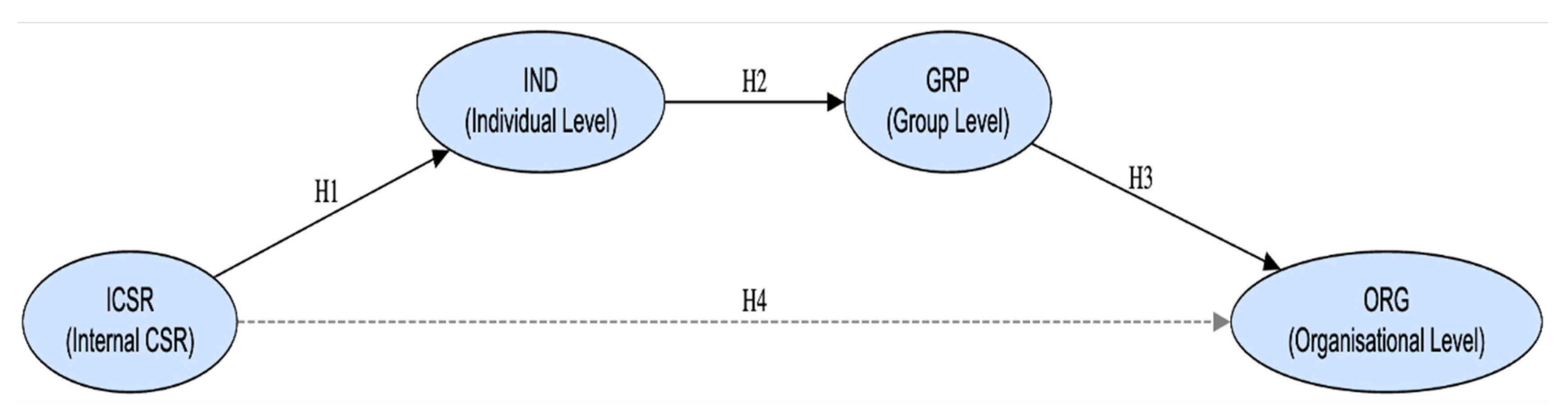
Figure 2.
Final estimated structural model. Values adjacent to arrows are standardised path coefficients (β). Values in parentheses below constructs are R2. Dashed line indicates non-significant direct path (ICSR → ORG; H4 not supported). *** p < 0.001; n.s., not significant (p = 0.567). Mediation type: indirect-only sequential mediation (H6 supported).
Figure 2.
Final estimated structural model. Values adjacent to arrows are standardised path coefficients (β). Values in parentheses below constructs are R2. Dashed line indicates non-significant direct path (ICSR → ORG; H4 not supported). *** p < 0.001; n.s., not significant (p = 0.567). Mediation type: indirect-only sequential mediation (H6 supported).
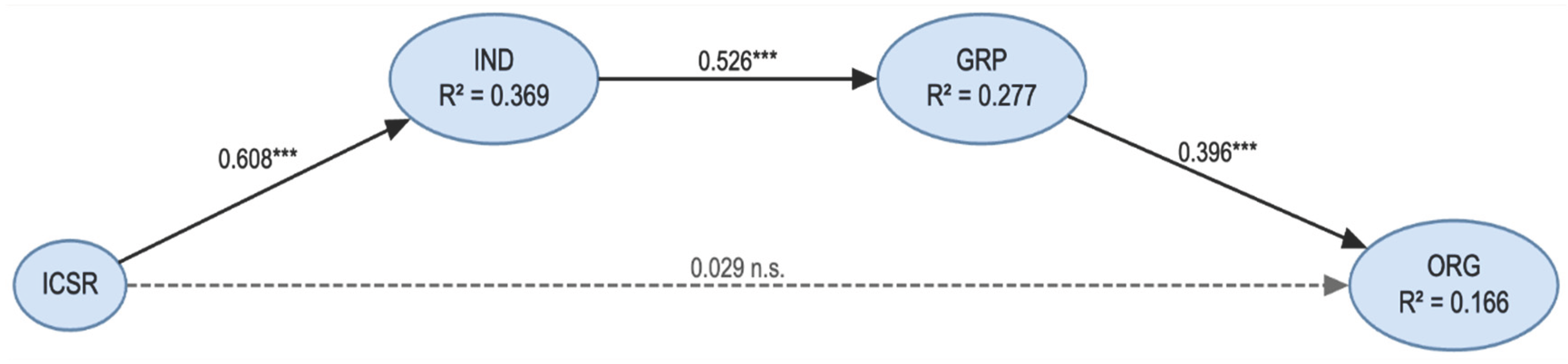

Table 1.
Reliability and Convergent Validity of Constructs.
| Construct | Cronbach’s α | rho_A | CR | AVE |
| ICSR | 0.943 | 0.944 | 0.950 | 0.574 |
| IND | 0.838 | 0.839 | 0.892 | 0.673 |
| GRP | 0.870 | 0.874 | 0.911 | 0.720 |
| ORG | 0.833 | 0.836 | 0.888 | 0.665 |
Note. ICSR = Internal Corporate Social Responsibility; IND = Individual-Level Labour Management; GRP = Group-Level Labour Management; ORG = Organisational-Level Labour Management. All values exceed recommended thresholds (Cronbach’s α and rho_A > 0.70; CR > 0.70; AVE > 0.50).
Table 2.
Outer Loadings of All Scale Items.
| Item | Construct | Outer Loading |
| ICSR1 | ICSR | 0.720 |
| ICSR2 | ICSR | 0.758 |
| ICSR3 | ICSR | 0.802 |
| ICSR4 | ICSR | 0.762 |
| ICSR5 | ICSR | 0.726 |
| ICSR6 | ICSR | 0.778 |
| ICSR7 | ICSR | 0.806 |
| ICSR8 | ICSR | 0.714 |
| ICSR9 | ICSR | 0.718 |
| ICSR10 | ICSR | 0.789 |
| ICSR11 | ICSR | 0.789 |
| ICSR12 | ICSR | 0.759 |
| ICSR13 | ICSR | 0.751 |
| ICSR14 | ICSR | 0.728 |
| IND1 | IND | 0.796 |
| IND2 | IND | 0.850 |
| IND3 | IND | 0.828 |
| IND4 | IND | 0.806 |
| GRP5 | GRP | 0.876 |
| GRP6 | GRP | 0.813 |
| GRP7 | GRP | 0.833 |
| GRP8 | GRP | 0.869 |
| ORG9 | ORG | 0.818 |
| ORG10 | ORG | 0.844 |
| ORG11 | ORG | 0.797 |
| ORG12 | ORG | 0.802 |
Note. All outer loadings exceed the recommended minimum threshold of 0.70. ICSR = Internal Corporate Social Responsibility (14 items); IND = Individual-Level Labour Management (4 items); GRP = Group-Level Labour Management (4 items); ORG = Organisational-Level Labour Management (4 items).
Table 3.
Fornell–Larcker Criterion Matrix.
| Construct | ICSR | IND | GRP | ORG |
| ICSR | 0.758 * | 0.608 | 0.362 | 0.172 |
| IND | 0.608 | 0.820 * | 0.526 | 0.249 |
| GRP | 0.362 | 0.526 | 0.849 * | 0.407 |
| ORG | 0.172 | 0.249 | 0.407 | 0.815 * |
Note. Diagonal values (marked with *) are the square roots of Average Variance Extracted (AVE). The Fornell–Larcker criterion is satisfied when diagonal values exceed all off-diagonal correlations in the corresponding row and column. ICSR = Internal Corporate Social Responsibility; IND = Individual-Level Labour Management; GRP = Group-Level Labour Management; ORG = Organisational-Level Labour Management.
Table 4.
Heterotrait–Monotrait (HTMT) Ratio of Correlations.
| Construct Pair | HTMT | Threshold | Status |
| IND – ICSR | 0.682 | < 0.85 | ✓ Satisfied |
| GRP – ICSR | 0.399 | < 0.85 | ✓ Satisfied |
| ORG – ICSR | 0.191 | < 0.85 | ✓ Satisfied |
| GRP – IND | 0.615 | < 0.85 | ✓ Satisfied |
| ORG – IND | 0.297 | < 0.85 | ✓ Satisfied |
| ORG – GRP | 0.474 | < 0.85 | ✓ Satisfied |
Note. All HTMT values are below the conservative threshold of 0.85, confirming discriminant validity for all construct pairs. ICSR = Internal Corporate Social Responsibility; IND = Individual-Level Labour Management; GRP = Group-Level Labour Management; ORG = Organisational-Level Labour Management.
Table 5.
Structural Path Coefficients, Bootstrapped Confidence Intervals, and Effect Sizes.
| Path | β | STDEV | t-value | p-value | 95% CI Lower | 95% CI Upper | Sig. | f2 |
| ICSR → IND | 0.608 | 0.037 | 16.483 | < 0.001 | 0.533 | 0.680 | *** | 0.586 |
| ICSR → ORG | 0.029 | 0.050 | 0.573 | 0.567 | −0.071 | 0.124 | n.s. | 0.001 |
| IND → GRP | 0.526 | 0.037 | 14.151 | < 0.001 | 0.453 | 0.597 | *** | 0.383 |
| GRP → ORG | 0.396 | 0.046 | 8.685 | < 0.001 | 0.307 | 0.487 | *** | 0.164 |
Note. Path coefficients estimated via PLS-SEM with bootstrapping (5,000 subsamples, two-tailed, bias-corrected and accelerated). f2 = Cohen’s effect size (small ≥ 0.02; medium ≥ 0.15; large ≥ 0.35). ICSR = Internal Corporate Social Responsibility; IND = Individual-Level Labour Management; GRP = Group-Level Labour Management; ORG = Organisational-Level Labour Management. *** p < 0.001; n.s., not significant (p = 0.567).
Table 6.
Coefficients of Determination and Predictive Relevance (In-Sample).
| Construct | R2 | R2_adj | Classification | Q2 |
| IND | 0.369 | 0.368 | Weak–Moderate | 0.364 |
| GRP | 0.277 | 0.275 | Weak | 0.269 |
| ORG | 0.166 | 0.162 | Very Weak | 0.154 |
Note. R2 classification: ≥ 0.75 substantial; ≥ 0.50 moderate; ≥ 0.25 weak (Hair et al. [18]). Q2 values > 0 indicate in-sample predictive relevance (blindfolding, omission distance = 7). ICSR = Internal Corporate Social Responsibility; IND = Individual-Level Labour Management; GRP = Group-Level Labour Management; ORG = Organisational-Level Labour Management.
Table 7.
PLS Predict Results: Out-of-Sample Predictive Accuracy.
| Construct | RMSE_model | MAE_model | RMSE_naïve | MAE_naïve | Q2_predict | Level |
| IND | 0.799 | 0.640 | 0.999 | 0.808 | 0.361 | Large ★★★ |
| GRP | 0.855 | 0.686 | 0.999 | 0.807 | 0.267 | Medium ★★ |
| ORG | 0.921 | 0.755 | 0.999 | 0.822 | 0.150 | Medium ★★ |
Note. RMSE = Root Mean Square Error; MAE = Mean Absolute Error; Q2_predict > 0 indicates out-of-sample predictive relevance. Level: Large (★★★) = Q2_predict ≥ 0.35; Medium (★★) = Q2_predict ≥ 0.15. IND = Individual-Level Labour Management; GRP = Group-Level Labour Management; ORG = Organisational-Level Labour Management.
Table 8.
Specific Indirect Effects: Sequential Mediation Analysis.
| Indirect Path | β_indirect | STDEV | t-value | p-value | 95% CI Lower | 95% CI Upper | Sig. |
| ICSR → IND → GRP | 0.320 | 0.030 | 10.752 | < 0.001 | 0.262 | 0.378 | *** |
| IND → GRP → ORG | 0.209 | 0.028 | 7.368 | < 0.001 | 0.153 | 0.264 | *** |
| ICSR → IND → GRP → ORG | 0.127 | 0.019 | 6.722 | < 0.001 | 0.090 | 0.164 | *** |
Note. Specific indirect effects estimated via bootstrapping (5,000 subsamples, bias-corrected and accelerated). BCa = bias-corrected and accelerated confidence intervals. All confidence intervals exclude zero, confirming significance. *** p < 0.001. ICSR = Internal Corporate Social Responsibility; IND = Individual-Level Labour Management; GRP = Group-Level Labour Management; ORG = Organisational-Level Labour Management.
Table 9.
Direct, Indirect, and Total Effects Summary.
| Path | Direct Effect | Indirect Effect | Total Effect | Mediation Type |
| ICSR → IND | 0.608 *** | — | 0.608 *** | N/A |
| IND → GRP | 0.526 *** | — | 0.526 *** | N/A |
| GRP → ORG | 0.396 *** | — | 0.396 *** | N/A |
| ICSR → IND → GRP | — | 0.320 *** | 0.320 *** | Secondary mediation |
| IND → GRP → ORG | — | 0.209 *** | 0.209 *** | Secondary mediation |
| ICSR → IND → GRP → ORG | 0.029 n.s. | 0.127 *** | 0.156 | ✓ Indirect-only mediation |
Note. n.s. = not significant (p > 0.05). *** p < 0.001. The non-significant direct effect ICSR → ORG (H4 not supported), combined with a significant total specific indirect effect through IND and GRP (H6 supported), is indicative of indirect-only mediation [18]. Note: The IND → GRP → ORG path is a secondary indirect effect not explicitly hypothesised; it is reported to illustrate the full sequential cascade but does not correspond to a formal hypothesis in the study. ICSR = Internal Corporate Social Responsibility; IND = Individual-Level Labour Management; GRP = Group-Level Labour Management; ORG = Organisational-Level Labour Management.
Table 10.
Summary of Hypothesis Testing Results.
| H | Relationship | β | t | p | 95% CI | Decision |
| H1 | ICSR → IND | 0.608 | 16.483 | < 0.001 | [0.533, 0.680] | ✓ Supported |
| H2 | IND → GRP | 0.526 | 14.151 | < 0.001 | [0.453, 0.597] | ✓ Supported |
| H3 | GRP → ORG | 0.396 | 8.685 | < 0.001 | [0.307, 0.487] | ✓ Supported |
| H4 | ICSR → ORG (direct) | 0.029 | 0.573 | 0.567 | [−0.071, 0.124] | ✗ Not Supported (indirect-only mediation confirmed) |
| H5 | ICSR → IND → GRP | 0.320 | 10.752 | < 0.001 | [0.262, 0.378] | ✓ Supported |
| H6 | ICSR → IND → GRP → ORG | 0.127 | 6.722 | < 0.001 | [0.090, 0.164] | ✓ Supported |
Note. H = Hypothesis. β = standardised path coefficient (direct paths: H1–H3; indirect paths: H5–H6). H4 tests the direct effect ICSR → ORG. All significant paths: p < 0.001. n.s. = not significant (p = 0.567). 95% CI = bootstrapped bias-corrected and accelerated confidence interval. ICSR = Internal Corporate Social Responsibility; IND = Individual-Level Labour Management; GRP = Group-Level Labour Management; ORG = Organisational-Level Labour Management.
Disclaimer/Publisher’s Note: The statements, opinions and data contained in all publications are solely those of the individual author(s) and contributor(s) and not of MDPI and/or the editor(s). MDPI and/or the editor(s) disclaim responsibility for any injury to people or property resulting from any ideas, methods, instructions or products referred to in the content. |
© 2026 by the authors. Licensee MDPI, Basel, Switzerland. This article is an open access article distributed under the terms and conditions of the Creative Commons Attribution (CC BY) license (http://creativecommons.org/licenses/by/4.0/).
Copyright: This open access article is published under a Creative Commons CC BY 4.0 license, which permit the free download, distribution, and reuse, provided that the author and preprint are cited in any reuse.


