
Preprint
Article

This version is not peer-reviewed.

Actinidin-Enriched Kiwifruit Concentrate (Kwd+®) Improves Protein Utilization Efficiency and Modulates Body Composition and Muscle Function in a Protein Source-Dependent Manner

Submitted:

07 April 2026

Posted:

08 April 2026

You are already at the latest version

Abstract
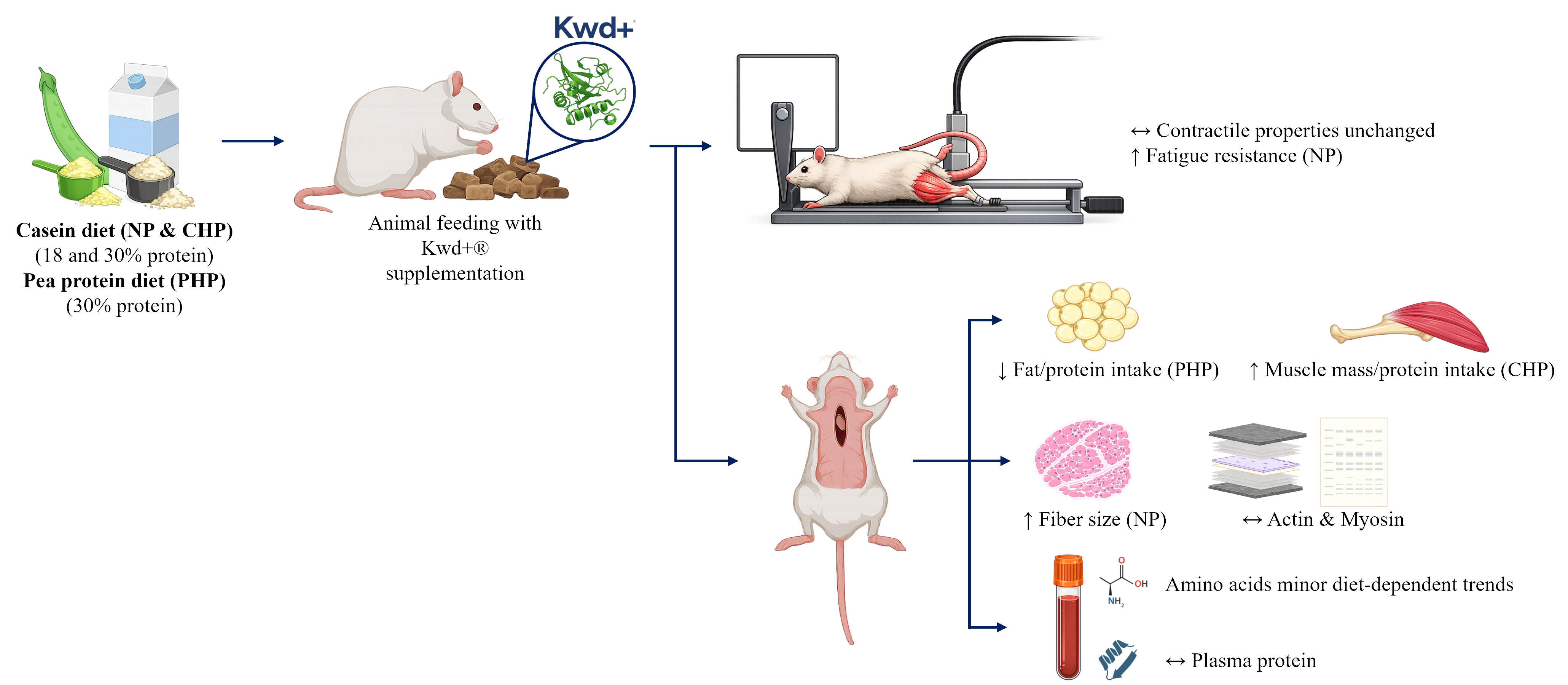
Protein utilization efficiency is a key determinant of metabolic health, body composition, and muscle function, particularly under high-protein dietary conditions and when using plant-based protein sources with lower digestibility. However, the extent to which en-hancing early gastric proteolysis translates into improved whole-body protein utilization remains unclear. The present in vivo study investigated whether supplementation with an actinidin-enriched kiwifruit concentrate (Kwd+®) modulates protein utilization efficiency and physiological outcomes under normoproteic and hyperproteic dietary conditions us-ing casein or pea protein as dietary sources. Rats were fed normoproteic casein (NP), high-protein casein (CHP), or high-protein pea (PHP) diets with or without Kwd+® sup-plementation for 8 weeks. Gastric protein hydrolysis patterns were evaluated by SDS–PAGE, while metabolic outcomes were assessed through body composition, plasma amino acid profiling, skeletal muscle morphology, and contractile function. Kwd+® supplemen-tation enhanced gastric proteolysis in a protein source-dependent manner. Despite the absence of significant changes in circulating amino acid concentrations after multiple comparison correction, Kwd+® improved markers of protein utilization efficiency de-pending on dietary protein source. In animals fed a high-protein pea diet, supplementa-tion significantly reduced fat mass relative to accumulated protein intake, indicating im-proved nutrient partitioning. In contrast, in animals fed a high-protein casein diet, Kwd+® increased muscle mass relative to protein intake, suggesting enhanced anabolic efficiency. Under normoproteic conditions, Kwd+® supplementation was associated with increased muscle fiber cross-sectional area and improved fatigue resistance without alterations in fiber type composition or contractile protein abundance. These findings demonstrate that modulation of early gastric proteolysis through actinidin produces protein source-dependent effects on protein utilization efficiency, nutrient partitioning, and mus-cle function. This work highlights a novel nutritional strategy to improve metabolic out-comes and muscle performance, particularly in the context of high-protein and plant-based diets.
Keywords: 
;  ;  ;  ;  ;  

1. Introduction

Efficient dietary protein digestion is essential for optimal amino acid bioavailability and the stimulation of skeletal muscle protein synthesis (MPS), a process tightly regulated by essential amino acid availability and intracellular signaling pathways [1,2]. Protein digestion is initiated in the stomach, where hydrochloric acid induces protein denaturation and pepsin begins proteolytic cleavage, influencing the subsequent rate of amino acid delivery to the small intestine. The speed of gastric digestion and amino acid absorption significantly modulates postprandial whole-body protein synthesis, breakdown, and net protein balance, as demonstrated by differential kinetic responses to slow and fast proteins [3].
Increased dietary protein intake is frequently recommended in athletic populations aiming to support lean mass accretion and in older adults seeking to attenuate age-related anabolic resistance [4]. However, evidence indicates that increasing protein intake beyond recommended levels does not result in a proportional increase in muscle protein synthesis, suggesting a non-linear relationship between protein dose and anabolic response [5]. Furthermore, protein quality, digestibility, and amino acid composition significantly influence postprandial anabolic potential, as plant-based proteins generally exhibit lower digestibility and essential amino acid availability compared with animal-derived proteins [6]. Importantly, the rate of protein digestion and amino acid absorption modulates the magnitude and timing of postprandial aminoacidemia, thereby influencing systemic amino acid availability [7]. Under aging conditions, skeletal muscle exhibits reduced sensitivity to essential amino acids, a phenomenon termed anabolic resistance, characterized by diminished activation of anabolic signaling pathways and impaired stimulation of MPS [8,9]. This reduced responsiveness may necessitate higher protein intakes to maintain muscle mass and function in older individuals [10].
Collectively, these considerations underscore the importance of optimizing early-phase protein digestion and amino acid delivery kinetics to support efficient muscle protein accretion, particularly under hyperproteic or age-associated conditions in which protein utilization efficiency may become physiologically relevant.
In this context, strategies aimed at enhancing early-phase gastric proteolysis have emerged as a potential approach to improve protein digestion efficiency and amino acid delivery kinetics.
Kiwifruit (Actinidia spp.) is distinguished among fruits by the high abundance of its endogenous cysteine protease, actinidin (EC 3.4.22.14), which accounts for approximately 50-60% of the soluble protein fraction in green kiwifruit (Actinidia deliciosa cv. Hayward) [11,12]. Proteomic and developmental analyses confirm that actinidin represents the dominant proteolytic activity throughout fruit maturation [13]. Structurally, actinidin belongs to the papain-like (C1) family of cysteine proteases and shares conserved catalytic residues characteristic of this group [14,15]. Biochemical characterization reports a molecular mass of approximately 23–27 kDa and activity over a broad pH range, with optimal activity described under mildly acidic conditions compatible with gastric digestion [11,12,16,17,18]. Comparative studies of plant proteases highlight kiwifruit as one of the richest natural sources of food-grade cysteine proteolytic activity [19]. Functionally, actinidin exhibits broad substrate specificity, effectively hydrolysing animal and plant proteins [20], a property that underpins its proposed role in modulating gastric protein digestion. Beyond its enzymatic activity, kiwifruit composition and protease abundance vary across species and cultivars, although A. deliciosa remains the principal dietary source of active actinidin [21].
Within this context, plant-derived proteases have been investigated as potential modulators of dietary protein digestion. Among these, actinidin has received particular attention due to its demonstrated activity under acidic conditions compatible with gastric digestion. In a controlled in vitro gastric model simulating pepsin digestion at pH 1.9, a kiwifruit concentrate containing actinidin significantly enhanced the degradation of several food proteins, including caseins, soy protein isolate, gluten, and beef muscle proteins, as evidenced by accelerated disappearance of intact protein bands and altered peptide patterns on SDS-PAGE [22,23,24]. These findings were later supported by in vivo data in the growing rat model, where dietary inclusion of Hayward kiwifruit significantly increased gastric degradability of multiple protein sources, including soy protein isolate, beef muscle protein, gelatin, and gluten, compared with controls. SDS-PAGE analyses of stomach digesta confirmed greater disappearance of intact proteins and increased fragmentation during the gastric phase, whereas effects at the ileal level were comparatively modest [25]. In a physiologically relevant porcine model dietary actinidin accelerated gastric emptying and increased the gastric breakdown of beef muscle proteins, particularly higher-molecular-weight fractions, supporting a role for actinidin in modulating the rate of gastric digestion and the delivery of digesta to the small intestine [26]. Complementing these findings, mechanistic work in the same research line links the rate at which digested nitrogen enters the small intestine (a function of gastric proteolysis and gastric emptying) with patterns of amino acid disappearance along intestinal segments, reinforcing the concept that actinidin can influence digestion–absorption kinetics rather than merely increasing the overall extent of protein degradation [27].
In humans, a controlled trial in older adults reported that co-ingesting Hayward green kiwifruit with a beef meal produced a more rapid rise in peripheral essential amino acids (including branched-chain amino acids), consistent with a kinetic shift in digestion/absorption; importantly, this is best interpreted as altered temporal dynamics rather than definitive proof of increased cumulative nitrogen absorption [28]. Collectively, these animal and human data support a mechanistic framework in which actinidin enhances early-phase gastric proteolysis and can accelerate downstream amino acid availability profiles, while highlighting the need for further controlled studies linking these kinetic effects to functional physiological outcomes.
However, important gaps remain regarding the physiological and functional relevance of actinidin-mediated proteolysis. Although enhanced gastric protein degradation has been demonstrated in vivo [25], it remains unclear whether enhanced degradation of gastric macropeptides translates into sustained improvements in intestinal amino acid absorption, systemic amino acid availability, and downstream metabolic efficiency under controlled dietary conditions [3,25,26].
The impact of actinidin may be especially context-dependent, as normoproteic and hyperproteic diets impose distinct constraints on gastric processing and amino acid kinetics [2,8]. Under hyperproteic conditions, where increased protein load may impose greater demands on gastric processing and proteolytic efficiency, improved early-phase hydrolysis could enhance temporal protein utilization efficiency and potentially reduce the proportion of undigested protein delivered to the distal intestine [25,26,27,29].
Conversely, under normoproteic intake, the metabolic consequences may differ, particularly when digestive capacity is unlikely to be rate-limiting [30,31]. Moreover, while accelerated amino acid appearance has been documented, the extent to which this kinetic modulation influences muscle-related outcomes, such as protein utilization efficiency, tissue accretion, or functional adaptation, remains insufficiently characterized [28]. Given that skeletal muscle anabolic responses are sensitive not only to amino acid quantity but also to the rate of amino acid delivery, understanding how actinidin affects digestion-absorption-metabolism coupling is essential for establishing its nutritional relevance [3,32,33].
Therefore, the present study aimed to investigate the differential modulation of animal- and plant-based protein digestion by an actinidin-enriched kiwifruit concentrate (Kwd+®) under normoproteic and hyperproteic dietary conditions, and to determine whether enhanced gastric proteolysis translates into measurable effects on amino acid availability, protein efficiency, and muscle-related physiological outcomes.

2. Material and Methods

2.1. Experimental Design

Sixty male Wistar rats (mean body weight: 333.5 ± 7.6 g) were obtained from a certified supplier and housed at the Animal Facility of the Universidad Autónoma de Madrid (Registration number ES-28079-0000097) in compliance with the European Commission Directive 86/609/CEE and the Guide for the Care and Use of Laboratory Animals (NIH Publication No. 85-23, revised 1996). All procedures were approved by the Ethics Committee of the Universidad Autónoma de Madrid and the Comunidad Autónoma de Madrid (PROEX 156.5/24).
Animals were maintained under controlled environmental conditions: temperature 22 ± 1 °C, relative humidity 50–60%, ventilation rate of 15–20 air changes per hour, and a 12-hour light/dark cycle. Animals were housed in pairs in polysulfone cages (type III, SODISPAN; floor area 840 cm², height 15 cm) containing standard wood-shaving bedding (SAFE® 3–4S, Lignocel, J. Rettenmaier & Söhne GmbH + Co. KG, Rosenberg, Germany), with ad libitum access to food and water. Environmental enrichment was provided in the form of cardboard tubes, sizzle pads, and wood blocks. An acclimation period of 7 days was allowed prior to the start of the experimental interventions.
Rats were randomly assigned to one of six experimental groups (n = 10 per group) and subjected to their respective dietary interventions for 8 weeks: (1) normoproteic casein-based diet (18% protein; NP); (2) normoproteic casein diet supplemented with Kwd+® (6.3% w/w of the diet; NP-Kwd+®); (3) high-protein casein diet (30% protein; CHP); (4) high-protein casein diet supplemented with Kwd+® (10.5% w/w of the diet; CHP-Kwd+®); (5) high-protein pea protein diet (30% protein; PHP); and (6) high-protein pea protein diet supplemented with Kwd+® (10.5% w/w of the diet; PHP-Kwd+®). The inclusion level of Kwd+® was adjusted according to the protein content of each diet in order to maintain a consistent enzyme-to-protein ratio across experimental conditions, thereby ensuring comparable proteolytic exposure despite differences in total protein intake. A one-way ANOVA and an independent-samples t test were conducted to assess baseline weight differences among diets and between Kwd+® groups, respectively. No statistically significant differences were found either among diets (F(2, 57) = 1.21, p = .306) or between Kwd+® groups (t(58) = 0.29, p = .776). Diets were formulated and supplied by Inotiv (normoproteic reference: TD.96180; high-protein reference: TD.91361). Kwd+®, an actinidin-enriched kiwifruit concentrate, was provided by Pharmactive Biotech Products, S.L.U.

2.2. Animal Evolution

Body weight and food intake were recorded weekly throughout the 8-week intervention period. Food consumption was measured at the cage level; individual intake was estimated by dividing cage consumption by two. The day before euthanasia, animals were fasted overnight. On the following morning, animals were given access to their respective diet for 30 minutes, after which the remaining chow was removed and weighed to calculate acute food intake.

2.3. In Vivo Skeletal Muscle Contractile Function

Motor unit contractile properties and rate of force development were assessed in vivo in the medial sural triceps, adapting the protocol described by Wasicki et al. [34]. Briefly, animals were deeply anesthetized with isofluorane (induction: 5%; maintenance: 2.5 %) and kept in prone position. The sural triceps was surgically isolated and connected via the Achilles tendon to a force transducer, in turn connected to a mp30 BIOPAC System (Cibertec, Spain). Isometric force was recorded with the muscle at an optimal passive tension of 20 mN. Stimulation electrodes were attached to the muscle, and rectangular pulses were applied (0.1 ms, ≤ 0.5 V) to stabilize muscle function. Then, the supramaximal voltage was first determined by progressively increasing stimulus intensity (0.5 ms square pulses, 1 Hz) until no further increase in contractile response was observed, and this voltage was held constant throughout the experiment. From the twitch recording, maximal force, contraction and half contraction times, maximal and medium (25-75%) contraction slopes, relaxation and half relaxation times, and maximal and medium (25-75%) relaxation slopes were determined. Afterwards, tetanic force was assessed by delivering 200 ms stimulus trains at frequencies increasing from 20 to 100 Hz, in 10 Hz increments, with a 30 s inter-train interval; the maximum force recorded was taken as the optimal tetanic tension. The fatigue protocol consisted of 60 tetanic stimulus trains at 60 Hz, each train lasting 2 s followed by a 3 s rest period. Afterwards, a post-fatigue tetanic stimulus was applied.

2.4. Animal Euthanasia and Sample Collection

After skeletal muscle assays, rats were euthanized by inhalatory anesthesia overdose (isoflurane, 5%) followed by exsanguination. Blood samples were collected in EDTA-covered tubes and centrifuged (2000 g, 10 min, 4 °C) to obtain plasma samples, which were stored at -80 ºC until use. The body cavity was then opened and the stomach and small intestine were removed. Stomach chyme and small intestine contents were extracted and stored separately at - 80 ºC until analysis. In addition, visceral and epidydimal fat pads were dissected and weighed together. Unstimulated sural triceps was also dissected, weighed, and divided in three sections, two of them were frozen at -80ºC, and one was fixed in paraformaldehyde (10%).

2.5. SDS-PAGE Electrophoresis

Gastric and intestinal protein degradation patterns were assessed by SDS–PAGE electrophoresis. Proteins were extracted from thawed gastrointestinal contents by homogenizing approximately 800 mg of sample with 10 mL of extraction buffer (12.5 mM sodium tetraborate, 2% SDS) using an Ultra-Turrax homogenizer. Homogenates were incubated for 1 h at room temperature with gentle agitation and centrifuged at 4700 rpm for 10 min to recover the soluble protein fraction [35].
For electrophoretic analysis, protein extracts were mixed with 5× SDS–PAGE sample loading buffer (NZYtech, Lisbon, Portugal) and adjusted to 1× final concentration, heated at 100 °C for 10 min, and centrifuged at 3500 g for 3 min. Aliquots of 15–30 μL were loaded onto precast gradient SDS–PAGE gels (4–12%, NZYtech) and electrophoresed according to the manufacturer’s instructions. Gels were stained with Coomassie Brilliant Blue R-250 (Sigma) to visualize protein bands. A prestained molecular weight marker (NZYColour Protein Marker II, NZYtech) was loaded in parallel lanes to estimate protein molecular masses.
Gel images were acquired after staining and band intensities were quantified by densitometry using ImageJ software (National Institutes of Health, USA). Band density was expressed in arbitrary density units (ADU) to compare protein degradation patterns among dietary treatments.

2.6. Nuclear Magnetic Resonance (NMR) Spectroscopy

Plasma concentrations of amino acids and proteins were quantified by proton nuclear magnetic resonance (¹H-NMR) spectroscopy using the validated metabolomics platform of Biosfer Teslab Advancing Testing (Barcelona, Spain), following their standard operating procedures. Plasma samples were analyzed using an automated NMR-based metabolomics workflow designed for the quantitative profiling of low molecular weight metabolites in biological fluids. The following amino acids were included in the quantification panel: alanine, glutamine, glutamate, threonine, glycine, histidine, tyrosine, valine, isoleucine, and leucine. A composite variable representing total amino acid concentration was calculated as the arithmetic sum of the ten individual amino acid concentrations.

2.7. Plasmatic Proteins

Circulating protein status (total proteins, albumin and globulins) was measured using a PointCare V3 Automatic Chemistry Analyzer (MNCHIP Technologies Co., Netherlands). Samples were processed following the manufacturer’s instructions using a General Panel+ kit (ref. MN00014, RAL Laboratories, Spain).

2.8. Histology

Sural triceps samples were fixed in 10% formaldehyde and embedded in paraffin. Sections of 5 μm were made using a microtome and then stained with haematoxylin and eosin. A minimum of 15 random fields were photographed for each sample under a 20X objective with a Zeiss Axioskop 2 microscope equipped with the image analysis software package LAS X (Leica, Munich, Germany). The area of each muscle fiber was calculated using the Image J-Fiji program 2.16.

2.9. Western Blot

Western blot analysis was performed as previously described [36]. Briefly, frozen fragments of sural triceps were homogenized in RIPA buffer (Tris-HCl 50 mM (pH 7,4); NaCl 150 mM; NP-40 1%; Sodium deoxicolate 0.5%; SDS 0.1 % and EDTA 1 mM) using a TissueLyser II Beadmill homogenizer (Quiagen). 40 µg protein were loaded in each well, and were separated by electrophoresis for their molecular weight in gradient SDS-polyacrylamide gel (Biorad Laboratories, Spain). Membranes were incubated with either Anti-Alpha Skeletal Muscle Actin antibody [EPR18430] (rabbit polyclonal, 1:2000; Abcam) or Myosin Heavy Chain Antibody (mouse monoclonal; 1:2000; Biotechne-R&D Systems). Appropriate secondary antibodies (1:1000, GE Healthcare Systems) were used. The membranes were developed using a Chemidoc Imaging System, and images were quantified using Image Lab Software (v. 6.1, Biorad, Spain). The same membrane was used to correct protein expressions in each sample, by means of a monoclonal antibody mouse anti GAPDH (1:10000, Applied Biosystems/Ambion, USA)

2.10. Statistical Analysis

All statistical analyses were performed using SPSS v.25 (IBM Corp., Armonk, NY, USA) and R (v4.5.2).
An initial exploratory analysis was conducted for selected outcomes using classical ANOVA and Student's t-test approaches. Physiological and biochemical variables are expressed as mean ± SEM throughout. Body weight gain and weight gain per gram of protein intake were compared between experimental groups across time intervals using unpaired two-way ANOVA, with diet and Kwd+® supplementation as between-subject factors, followed by Bonferroni post-hoc tests. Plasma biochemical variables were compared between experimental groups using one-way ANOVA followed by Bonferroni post-hoc tests.
Analyses of muscle contractile properties were restricted to comparisons between the NP and NP-Kwd+® groups. Twitch contractile parameters were compared between groups using an unpaired Student's t-test. Tetanic force and muscle fatigue responses were analyzed using unpaired two-way ANOVA, with supplementation and fatigue state as factors. The effect of Kwd+® supplementation on the transition between pre- and post-fatigue tetanic force was further examined using a paired two-way ANOVA. The overall contractile response across the force–frequency relationship in tetanic contraction was summarized by calculating the differences of area under the force–frequency curve (dAUC), and differences between NP and NP-Kwd+® groups were assessed using an unpaired Student's t-test. Western blot relative expression values were first analysed using a Saphiro-Wilks test to identify outliers, and afterwards groups were compared using an unpaired Student's t-test.
For the remaining outcomes, a more comprehensive modelling strategy was applied. For each outcome, the effects of diet (NP, CHP, PHP), Kwd+® supplementation (control vs. Kwd+®), and their interaction were initially examined within a mixed-model framework with cage as a random intercept, given that the intervention was assigned at cage level (two animals per cage). When between-cage variance was negligible, the random effect was removed [37]. koModel assumptions were evaluated at both the individual-residual and, where applicable, the random-effect level. When residuals deviated from normality, aligned rank transform (ART) ANOVA was used instead [38]. When heteroscedasticity was detected, candidate residual variance structures (by diet, by Kwd+®, by their additive combination, and by design cell) were fitted and formally compared via likelihood ratio tests under maximum likelihood (ML), with model selection guided by AIC and BIC; the retained structure was re-estimated under restricted maximum likelihood (REML) for final inference.
Planned contrasts, derived from estimated marginal means (EMM), addressed two a priori questions [39,40,41,42]: (a) the simple effect of Kwd+® within each diet and (b) difference-of-differences contrasts comparing the Kwd+® effect in NP with that in CHP and PHP. Omnibus effect sizes were reported as partial eta-squared (η²p) with 95% confidence intervals (CI). Pairwise contrasts were quantified as standardized mean differences (d) with 95% confidence intervals; under heterogeneous variances, the denominator was the group-specific residual SD or the root-mean-square of the SDs of the compared groups. Bonferroni correction was applied per family of contrasts within each outcome: simple effects of Kwd+® within each diet involved a single comparison per family (m = 1) and required no adjustment; difference-of-differences contrasts were adjusted for two comparisons (adjusted α = .025). Statistical significance was set at α = .05 unless otherwise stated.
The outcome-specific details below describe only what departs from the general strategy outlined above.
Body weight gain. Weight gain per cage was recorded across four consecutive intervals (weeks 0–2, 2–4, 4–6, 6–8; 30 cages x 4 intervals). Temporal dependence was modeled with an unstructured (UN) covariance matrix for intervals nested within cages. Fixed effects included diet, Kwd+®, interval, cumulative protein intake standardized within each diet as a covariate, and all two- and three-way interactions. Marginal means were evaluated at three levels of protein intake within each diet (−1 SD, mean, +1 SD); simple effects of Kwd+® were therefore adjusted for three comparisons (adjusted α = .017) and difference-of-differences contrasts for two comparisons within each intake level (adjusted α = .025).
Plasma amino acids. Ten amino acids and a total indicator (sum of the ten) were quantified at the end of the experiment. To control the family-wise error rate across the 11 simultaneous variables, significance was set at α = .0045 (Bonferroni, 0.05/11).
Fat deposition. The outcome was the total fat / accumulated protein ratio.
Unstimulated muscle mass. The outcome was the unstimulated triceps mass / accumulated protein ratio.
Muscle fiber area. The outcome was the cross-sectional fiber area (µm²), with multiple fibers measured per rat (23–66 per animal; 1,102 observations). The initial model included random intercepts for both cage and rat; cage-level variance was negligible, so only the rat-level intercept was retained.

3. Results

3.1. Body Weight Gain and Feed Intake

Body weight gain was similar across all experimental groups throughout the eight-week period (Figure S1A). Despite consuming considerably more total feed and protein (Figure S1B), hyperproteic animals (CHP and PHP) did not accumulate greater body mass than normoproteic controls (NP). Consistently, the ratio of body weight gain to protein intake increased proportionally in all diets (Figure S1C).
Kwd+® supplementation did not significantly modify weight gain in either the NP or CHP diets at any level of protein intake (p > 0.05). In the PHP diet, no significant effect was observed at mean or high protein intake levels; however, a significant simple effect of Kwd+® emerged at low protein intake (-1 SD within diet). PHP animals supplemented with Kwd+® gained significantly more weight than unsupplemented controls (EMM = 34.50, SE = 4.86 vs. EMM = 4.72, SE = 10.00; mean difference = 29.78, 95% CI [7.16, 52.40], SE = 10.99, t(25.33) = 2.71, p = 0.012, Bonferroni-adjusted p = 0.036, d = 1.73, 95% CI [0.42, 3.04]). The difference-in-differences between PHP and NP reached nominal significance (p = 0.046); however, this result was no longer significant after Bonferroni correction (Bonferroni-adjusted p = 0.092).

3.2. Body Composition

Regarding fat deposition, PHP animals supplemented with Kwd+® showed a significantly lower fat mass-to-accumulated-protein ratio than unsupplemented PHP controls, indicating that Kwd+® supplementation attenuated fat deposition relative to protein consumed in the plant-based high-protein group (Table 1, Panel A). The magnitude of this effect was moderate-to-large (d = −0.98). This effect was not observed in NP or CHP animals, and no significant differences-in-differences were detected between diets (Table 1, Panel B).
For skeletal muscle mass, CHP animals supplemented with Kwd+® showed a significantly higher unstimulated triceps mass-to-accumulated-protein ratio compared with unsupplemented CHP controls, indicating greater efficiency of dietary protein incorporation into muscle tissue under casein-based hyperproteic conditions (Table 2, Panel A). This effect was associated with a very large standardized effect size (d = 2.16). No significant effect was observed in NP or PHP groups, and differences-in-differences between diets were not significant (Table 2, Panel B).

3.3. Gastric and Intestinal Protein Digestibility

To explore the mechanisms underlying the observed metabolic outcomes, gastric digestion patterns were analyzed by SDS-PAGE in chyme samples. In NP groups, Kwd+® supplementation increased the degradation of casein subunits (Figure 1). Degradation of α2-casein reached 77 ± 15%, while degradation of the α1+β-casein fraction reached 90 ± 10% in the presence of Kwd+®.Under the CHP, the higher protein load produced a more intense banding pattern, but Kwd+® supplementation further increased casein breakdown before stomach emptying. In this group, α2-casein degradation reached 86 ± 12%, while the α1+β-casein fraction reached 92 ± 6%, indicating enhanced early gastric proteolysis under high protein intake conditions (Table S1).
In PHP groups, high molecular weight pea protein storage proteins, including legumin , vicilin, and convicilin, showed marked resistance to gastric digestion in unsupplemented animals, persisting as intact bands throughout the gastric incubation period. Kwd+® supplementation in PHP animals resulted in the disappearance of these high molecular weight fractions, indicating actinidin-mediated degradation. However, lower molecular weight pea protein fractions persisted even with Kwd+®, confirming an enhanced but incomplete proteolysis (Figure 1, Table S2).
In contrast, analysis of intestinal content revealed uniform banding patterns across all groups regardless of protein type or Kwd+® supplementation, with no residual intact dietary proteins even at high protein loading (Figure S2). This finding indicates that downstream pancreatic proteolysis efficiently completed the digestive process under all dietary conditions and confirms the stomach as the primary site of action of Kwd+®.

3.4. Plasma Amino Acid Profiles

Plasma concentrations of ten amino acids (alanine, glutamine, glutamate, threonine, glycine, histidine, tyrosine, valine, isoleucine, and leucine) and their sum were quantified at the end of the experimental period. After Bonferroni correction for multiple comparisons, no statistically significant effects of Kwd+® were detected for any individual amino acid or for total amino acid levels.
Nevertheless, two amino acids displayed directional trends that may reflect biologically relevant shifts in digestive kinetics and nitrogen metabolism. Alanine showed opposing directional trends across dietary contexts: in the NP group, supplemented animals tended toward lower concentrations, whereas in CHP, supplemented animals tended toward higher concentrations. Although these contrasts did not remain significant after correction, both were associated with large standardized effect sizes (Table 3). For threonine, PHP animals supplemented with Kwd+® tended toward higher circulating concentrations than unsupplemented PHP controls, suggesting a partial improvement in threonine bioavailability from pea protein facilitated by actinidin-enhanced proteolysis. This directional trend was likewise accompanied by a large effect size despite the lack of statistical significance after multiple-testing correction. No significant differences were detected for glutamate, glutamine, glycine, histidine, tyrosine, or BCAAs (i.e., valine, isoleucine, and leucine) after correction for multiple comparisons.

3.5. Plasma Protein Profile

Beyond individual amino acid concentrations and consistent with the functional integration of amino acid availability at the systemic level, we examined circulating protein markers as a global readout of protein anabolic efficiency. Although total proteins, albumin, and globulins remained within physiological ranges across all groups (Figure 2A-C), PHP animals showed significantly reduced levels of all three markers compared with NP and CHP animals. Kwd+® supplementation in PHP reversed this reduction, restoring plasmatic protein concentrations to levels comparable to those of CHP groups. No significant differences in plasma protein levels were detected between NP and NP-Kwd+®, or between CHP and CHP-Kwd+®.

3.6. Skeletal Muscle Fiber Morphology

In the NP diet, Kwd+® supplemented animals exhibited significantly larger muscle fiber cross-sectional areas than unsupplemented controls (M = 7162.95, SD = 2949.15 µm² vs. M = 4584.28, SD = 1674.26 µm²; mean difference = 2694.61, SE = 866.10, t(24) = 3.11, p = 0.005, d = 1.21, 95% CI [0.36, 2.03]) (Figure 3). This difference corresponded to a large effect size. No significant effects of Kwd+® were detected in the CHP (p = .411) or PHP (p = 0.912) diets. The difference-of-differences contrast comparing the Kwd+® effect in NP with that in PHP reached nominal significance (dd = 2598.90, SE = 1219.44, t(24) = 2.13, p = 0.044, d = 1.17, 95% CI [0.03, 2.28]), suggesting a larger Kwd+® effect under the normoproteic diet; however, this result was no longer significant after Bonferroni correction (adjusted p = 0.088). The comparison between NP and CHP was not statistically significant.

3.7. Skeletal Muscle Contractile Properties and Fatigue Resistance

Given the pronounced hypertrophic effect of Kwd+® under normoproteic conditions, contractile properties and fatigue resistance were assessed in vivo in NP and NP-Kwd+® animals. Twitch contraction and relaxation kinetics, maximal twitch force, and the tetanic force-frequency relationship were fully preserved between groups, ruling out any pre-existing functional asymmetry and confirming an unchanged fiber type composition (Table S3; Figure S3).
The fatigue protocol revealed a clear functional divergence: NP-Kwd+® muscles sustained markedly greater relative force throughout the stimulation period compared with unsupplemented NP (Figure 4A), resulting in a significantly greater global contractile performance quantified as the area under the contraction–time curve (Figure 4B), confirming superior fatigue resistance in the supplemented group. In addition, muscles from NP-Kwd+® group exhibited lower post-fatigue maximal tetanic force loss (Figure S3), indicating a better post-fatigue recovery in animals supplemented with Kwd+®. The absence of differences in twitch kinetics indicates that this functional improvement was not driven by a shift in fiber type composition, but rather reflects metabolic and structural adaptations within the existing fiber type profile.

3.8. Myofibrillar Protein Content: Actin and Myosin Heavy Chain Expression

To further characterize the structural basis of the fiber-level adaptations observed in NP-Kwd+® animals, total actin and myosin heavy chain content were quantified by western blot in sural triceps homogenates from NP and NP-Kwd+® groups (Figure 5). No significant differences were detected between groups for either protein. These results indicate that Kwd+® supplementation did not modify the relative abundance of the major contractile proteins in sural triceps muscle.

4. Discussion

Overall, our results indicate that Kwd+® modulates protein utilization in a diet-dependent manner, with distinct physiological responses observed across casein- and pea-based hyperproteic diets. CHP (Casein Hyperproteic Diet) animals consumed considerably more total feed and protein than NP (normoproteic controls), yet this did not translate into greater body mass accumulation. A similar pattern was observed in the pea based hyperproteic diet (PHP). This apparent paradox is well explained by the high thermic effect of protein, which dissipates a substantially larger fraction of ingested energy as heat compared to carbohydrates or fats, and by the upregulation of amino acid oxidation and ureagenesis that occurs at supraphysiological protein intakes, effectively limiting net nitrogen retention [43,44]. Interestingly, within the PHP diet we observed that animals with lower protein intake exhibited greater weight gain when supplemented with Kwd+®, suggesting that enhanced early-phase proteolysis may improve protein utilization efficiency under conditions in which effective amino acid availability becomes relatively limiting [45].
Regarding body composition, the most notable finding was a reduction in fat mass in the PHP group supplemented with Kwd+®, both in absolute terms and when normalized to the total protein intake, suggesting that Kwd+® supplementation may attenuate fat deposition under plant-based high-protein dietary conditions. For skeletal muscle, animals receiving Kwd+® within the CHP diet showed a higher ratio of sural triceps mass relative to accumulated protein intake than CHP controls, indicating greater efficiency of dietary protein incorporation into muscle tissue under casein-based hyperproteic conditions. Importantly, no differences in whole-muscle mass were detected between NP and NP-Kwd+®. This does not preclude a biologically meaningful effect of Kwd+® under normoproteic conditions; rather, it suggests that potential adaptations at this dietary level may occur below the detection threshold of whole-organ mass measurements, and may instead manifest at the level of muscle fiber morphology or other structural parameters discussed below [46,47,48]. This interpretation is strengthened by the magnitude of the observed effects: the reduction in fat/protein ratio in PHP showed a moderate-to-large standardized effect, whereas the increase in unstimulated triceps mass/protein ratio in CHP was associated with a very large effect size. Thus, even in the absence of significant interaction contrasts between diets, the direction and magnitude of the simple effects support the view that Kwd+® preferentially improves protein partitioning toward reduced fat deposition in PHP and toward muscle accretion efficiency in CHP.
To better understand the mechanisms underlying these physiological responses, we examined the gastric digestion patterns of the different dietary proteins. One of the limiting factors of plant-based diets is the lower protein digestibility. Previous studies have demonstrated that actinidin acts as a cysteine endopeptidase with broader substrate specificity than pepsin, hydrolyzing peptide bonds inaccessible to gastric enzymes and thereby exposing new cleavage sites that enhance overall proteolysis in a synergistic manner [20,49]. Consistent with this mechanism, the analysis of gastric chyme revealed clear differences in protein degradation patterns between dietary groups. The analysis of gastric chyme showed increased degradation of casein subunits in NP animals with Kwd+® supplementation, indicating enhanced gastric proteolysis before stomach emptying. In CHP control, the higher protein load produced a stronger band pattern, and CHP with Kwd+® showed a greater breakdown of casein subunits, confirming actinidin's role as a gastric endopeptidase complementing pepsin [49]. In pea protein groups, high molecular weight proteins, such as legumin alpha, vicilin, or convicilin, resisted gastric digestion in PHP animals but disappeared with Kwd+® supplementation; however, lower molecular weight fractions persisted even in PHP with Kwd+®, indicating an enhanced but incomplete degradation by the combined action of pepsin and actinidin. This observation is consistent with previous descriptions of legume storage proteins, which possess compact quaternary structures and may contain antinutritional factors that reduce enzymatic accessibility and gastric digestibility compared with animal proteins [50]. Together, these gel patterns support the interpretation that Kwd+® primarily modulates the kinetics and depth of early gastric hydrolysis rather than the final completeness of digestion, an idea reinforced by the absence of residual intact proteins at the intestinal level.
These digestibility differences offer a mechanistic basis for the differential feed intake patterns across groups that we discussed above: Enhanced proteolysis in CHP with Kwd+® may contribute to faster gastric processing and potentially influence satiety signaling, sustaining voluntary intake, since gastric emptying rate inversely correlates with satiety intensity [51]. Conversely, the persistence of partially intact proteins in PHP chyme may contribute to slower gastric digestion and sustained satiety signaling, a consequence of the structural complexity and antinutritional factors intrinsic to pea protein, thereby limiting protein bioavailability and resist enzymatic degradation [50]. Although Kwd+® partially improved gastric degradation of pea proteins, this effect did not completely eliminate several pea protein fractions, suggesting that the impact of actinidin on gastric emptying kinetics and feeding behavior remained limited under these conditions. Thus, the present data are more compatible with a partial rescue of gastric digestibility in PHP than with a full normalization of pea protein behavior toward that of casein.
On the other hand, analysis of intestinal content revealed uniform banding patterns across all groups regardless of protein type or Kwd+® supplementation, with no residual intact dietary proteins even at high protein loading, indicating that downstream pancreatic proteolysis efficiently completed the digestive process. This finding is consistent with the high proteolytic capacity of pancreatic enzymes such as trypsin, chymotrypsin and carboxypeptidases, which typically hydrolyze most remaining peptide substrates reaching the small intestine [52,53]. Consequently, the stomach appears to represent the primary site at which Kwd+® exerts its proteolytic effect. This is an important point mechanistically, because it suggests that Kwd+® acts upstream of intestinal digestion by altering the form and timing in which protein-derived nitrogen is delivered to the small intestine, rather than by replacing or amplifying pancreatic digestion per se.
In addition, the absence of intact dietary proteins in intestinal content across all groups suggests that intestinal proteolysis and absorption proceeded efficiently under all dietary conditions, supporting the interpretation that potential differences in circulating amino acid profiles primarily reflect variations in upstream gastric-phase digestion rather than limitations in intestinal digestion. Plasma amino acid profiling revealed only limited global differences between dietary groups after correction for multiple comparisons, indicating that Kwd+® supplementation did not substantially alter systemic amino acid availability under most experimental conditions. Nevertheless, some amino acids displayed directional trends that may reflect subtle differences in digestive kinetics and nitrogen metabolism associated with protein source and enzymatic supplementation. Alanine, glutamate, glutamine, and glycine are central to nitrogen transport and detoxification. Alanine is the primary vehicle for nitrogen shuttling from skeletal muscle to the liver via the glucose–alanine cycle [54,55]. In our statistical analysis, alanine concentrations showed only non-significant trends across diets, with a decrease in the NP group receiving Kwd+® and a tendency toward higher values in the CHP group. Although these effects did not remain significant after correction for multiple testing, they may reflect subtle shifts in nitrogen trafficking associated with differences in protein digestion kinetics. Previous works have shown that the rate of amino acid appearance following digestion can influence interorgan nitrogen exchange and alanine cycling between muscle and liver [56,57]. Glutamate and glutamine function as major nitrogen carriers and substrates for hepatic urea synthesis and renal ammonia excretion, with glutamine additionally serving as the principal vehicle for interorgan nitrogen transport [55]. In our dataset, no statistically robust differences were observed for glutamate or glutamine, indicating that systemic nitrogen detoxification capacity remained broadly comparable across dietary groups. Glycine, beyond its nitrogen metabolism role, is the rate-limiting precursor for glutathione synthesis, making its availability critical for antioxidant defense during conditions of elevated nitrogen turnover [58,59]. Circulating glycine levels did not differ significantly between experimental groups, suggesting that antioxidant-related amino acid metabolism remained stable across dietary treatments. Notably, the amino acids showing the clearest directional shifts (alanine in NP and CHP, and threonine in PHP) were associated with medium-to-large effect sizes despite the lack of significance after Bonferroni correction. This pattern is consistent with modest but potentially meaningful kinetic effects that are diluted when assessed at a single terminal time point and under stringent multiplicity control.
Threonine, histidine, and tyrosine are essential or conditionally essential amino acids with key roles in protein synthesis, neurotransmitter production, and immune function. While plant proteins generally provide lower amounts of indispensable amino acids than animal sources, Guillin et al. reported that pea protein extract can approach casein in indispensable amino acid availability under certain conditions [60]. Threonine is required for protein synthesis and collagen formation [61]. and supports gut health, immune function, and hepatic lipid homeostasis [62,63,64]. In this study, animals receiving the PHP supplemented with Kwd+® showed a tendency toward higher circulating threonine concentrations compared with unsupplemented animals, although this effect did not remain significant after correction for multiple testing. Such tendencies are consistent with previous observations indicating that plant proteins often exhibit lower digestibility and amino acid bioavailability than animal proteins due to structural constraints and matrix effects [45,65,66]. Partial improvement in threonine availability in the supplemented PHP group may therefore reflect enhanced early-phase proteolysis facilitated by actinidin. In other words, the plasma amino acid dataset does not provide evidence for a broad systemic aminoacidemic shift, but it does remain compatible with selective, protein-source-dependent changes in early amino acid release and utilization.
Histidine, tyrosine, and branched-chain amino acids (BCAAs) remained broadly comparable across dietary groups, indicating that neither protein source nor Kwd+® supplementation produced major shifts in their systemic pools. Because circulating amino acid concentrations are strongly regulated by tissue uptake, oxidation, and whole-body protein turnover, modifications in digestive processes do not necessarily translate into large differences in plasma levels [56,67]. This consideration is particularly relevant here, because the functional and morphological outcomes suggest that a fraction of the benefit of Kwd+® may have been expressed downstream of plasma appearance, at the level of tissue partitioning and utilization, rather than as a sustained increase in circulating amino acid concentrations.
Consistent with this interpretation, the functional integration of amino acid availability may be better appreciated through circulating protein markers. Despite remaining within physiological ranges across all groups, PHP animals showed reduced total proteins, albumin, and globulins relative to NP and CHP, which was reversed by Kwd+® supplementation. This pattern aligns with the lower anabolic potential often described for plant-based proteins due to reduced digestibility and the presence of antinutritional factors [65], while the recovery observed with Kwd+® supplementation is consistent with the ability of kiwifruit-derived actinidin to enhance plant protein degradation during gastric digestion [68]. Because albumin and globulins integrate systemic protein status over a longer timescale than individual amino acids, their normalization in PHP-Kwd+® may reflect a cumulative improvement in effective nitrogen utilization despite the absence of large terminal differences in the free amino acid pool.
Taken together, the differences in gastric proteolysis, circulating amino acid patterns, and plasma protein markers described above raise an important functional question: whether improvements in protein digestibility translate into measurable skeletal muscle adaptations. Cross-sectional area analysis of sural triceps fibers revealed the largest values in Kwd+® supplemented NP animals, indicating that Kwd+® supplementation promoted muscle fiber hypertrophy specifically under normoproteic dietary conditions. Skeletal muscle growth is primarily regulated by amino acid availability and downstream anabolic signaling pathways such as mTOR rather than by total protein intake [69]. In this context, enhanced early-phase gastric proteolysis may improve the efficiency with which dietary proteins are converted into absorbable peptides and amino acids, thereby supporting muscle remodeling even when total protein intake remains within physiological ranges. Importantly, this was not a marginal effect: the increase in fiber cross-sectional area in NP-Kwd+® was associated with a large effect size, whereas the corresponding difference-of-differences contrast versus PHP reached only nominal significance and did not survive correction. Therefore, the most defensible interpretation is that Kwd+® exerts its clearest morphometric effect under normoproteic conditions, while the evidence for a statistically stronger response in NP than in other diets remains suggestive rather than definitive.
Despite substantially higher protein intake in hyperproteic groups, neither CHP nor PHP animals achieved greater muscle fiber cross-sectional areas than NP-Kwd+®. This observation is consistent with the well-established concept that muscle protein synthesis reaches a saturation threshold beyond which additional amino acid supply does not further stimulate anabolic signalling. Excess amino acids are instead preferentially directed toward oxidation and ureagenesis rather than further protein accumulation [70]. PHP diets similarly failed to increase muscle fiber area despite high protein loads, which aligns with previous reports indicating that plant proteins often stimulate muscle protein synthesis less efficiently than animal proteins due to slower digestion kinetics and reduced leucine availability [65,71,72]. Although Kwd+® partially improved gastric degradation of pea proteins, this effect was insufficient to fully overcome the intrinsic structural constraints associated with plant protein matrices. Together, these data support the view that digestibility enhancement alone may be sufficient to reveal an anabolic advantage when protein supply is physiologically limiting or near-optimal but may be insufficient to overcome either saturation phenomena (CHP) or intrinsic matrix resistance (PHP) when upstream constraints differ.
Collectively, these findings suggest that the anabolic potential of Kwd+® is most clearly expressed when dietary protein intake operates within the physiological range that maximally stimulates muscle protein synthesis rather than under supraphysiological protein loads. This context dependence is one of the main conceptual contributions of the present study.
The pronounced hypertrophic effect of Kwd+® under normoproteic conditions prompted us to examine whether these structural adaptations were accompanied by functional changes in muscle performance. Therefore, contractile properties and fatigue resistance were assessed in the normoproteic groups (NP and NP-Kwd+®). In vivo assessment of the sural triceps contraction revealed fully preserved twitch kinetics, maximal twitch force, and an identical tetanic force-frequency relationship between NP control and NP-Kwd+®, ruling out any pre-existing functional asymmetry and confirming an unchanged fiber type composition, as contractile speed and calcium handling are predominantly determined by the myosin heavy chain isoform profile [73]. This interpretation was further supported by western blot analysis of total actin and myosin heavy chain content in sural triceps homogenates from NP and NP-Kwd+® animals, which revealed no significant differences between groups. The stable contractile protein ratios, in the context of the larger fiber cross-sectional area observed in NP-Kwd+®, suggest a proportional expansion of the myofibrillar apparatus consistent with genuine myofibrillar hypertrophy rather than sarcoplasmic expansion [74]. Although western blot quantification did not reveal greater actin or myosin abundance per unit of homogenate, this is fully compatible with a proportional enlargement of the contractile apparatus at the fiber level; in other words, the data argue against altered protein density or selective isoform enrichment, not against hypertrophy itself. The fatigue protocol, however, revealed that NP-Kwd+® muscles sustained markedly greater relative force throughout the stimulation period, with significantly lower post-fatigue tetanic force loss, confirming superior fatigue resistance. Improved fatigue resistance is consistent with previous observations showing that structural remodeling and enhanced metabolic efficiency can increase the capacity of skeletal muscle to sustain repeated contractions [75]. The absence of differences in twitch kinetics further supports the interpretation that these functional improvements were not driven by shifts in muscle fiber type composition. Moreover, the significant increase in the integrated contraction-time response during the fatigue protocol indicates that the benefit of Kwd+® was not restricted to a terminal endpoint but was expressed across the entire stimulation period, strengthening the interpretation of a true improvement in fatigue resistance. Collectively, these results indicate that Kwd+® supplementation under NP conditions promotes coordinated structural and functional adaptations in skeletal muscle, resulting in a phenotype characterized by increased fiber size and improved resistance to fatigue [69,70,75]. Within the limits of the present design, these adaptations are most parsimoniously explained by improved digestive efficiency and downstream protein utilization rather than by changes in intrinsic contractile phenotype.

5. Conclusions

In summary, supplementation with the actinidin-enriched kiwifruit concentrate Kwd+® enhanced gastric protein hydrolysis and modulated protein utilization in a diet-dependent manner. While circulating amino acid concentrations remained largely unchanged, Kwd+® supplementation improved markers of protein utilization efficiency, including reduced fat deposition in animals fed a high-protein pea diet and increased muscle protein efficiency in animals receiving a high-protein casein diet. Under normoproteic conditions, Kwd+® supplementation was associated with larger skeletal muscle fiber cross-sectional area and improved fatigue resistance without alterations in fiber type composition or contractile protein content. These findings suggest that enhancing early gastric proteolysis through actinidin may improve the efficiency of dietary protein utilization at the tissue level.
The present study demonstrates that Kwd+® supplementation produces protein source- and intake-dependent effects on protein digestibility, metabolic handling, and skeletal muscle physiology, highlighting the importance of digestive kinetics as a modulator of protein utilization efficiency beyond total protein intake. Importantly, these findings indicate that improving early-phase protein digestion does not necessarily translate into increased circulating amino acid concentrations, but rather into a more efficient partitioning of dietary nitrogen toward functional tissue outcomes such as muscle accretion and reduced adiposity. This supports the concept that the temporal dynamics of amino acid delivery, rather than absolute amino acid availability, may represent a key determinant of anabolic efficiency under physiological conditions.
From a nutritional perspective, these results suggest that digestive enhancement strategies may be particularly relevant under conditions in which protein utilization is suboptimal, such as plant-based diets or situations of limited effective protein intake.

Supplementary Materials

The following supporting information can be downloaded at the website of this paper posted on Preprints.org.

Author Contributions

Iván Benito-Vázquez: Conceptualization, Methodology, Investigation, Formal analysis, Data curation, Visualization, Writing – original draft, Project administration. Pablo Méndez-Albiñana: Investigation, Formal analysis. Aaron Fernández-Quintero: Investigation, Formal analysis. María Inés Morán-Valero: Project Management. F. Javier Moreno: Funding acquisition and Supervision. Marina Díez-Municio: Funding acquisition and Supervision. Nuria Fernández: Methodology, Investigation; Luis Monge: Methodology, Investigation; José Antonio Uranga-Ocio: Methodology, Investigation, and Formal analysis. Javier Blanco-Rivero: Conceptualization, Methodology, Investigation, Resources, Supervision, Formal analysis, Data curation, Writing – original draft; Writing – review & editing, Project administration; Funding acquisition. All authors have read and agreed to the published version of the manuscript.

Funding

The authors acknowledge the financial support provided through the Industrial Doctorate IND2022/BIO-23522 awarded to CIAL (CSIC) funded by the Comunidad de Madrid, Pharmactive Biotech Products S.L.U., CiberCV (Grant number: CB16/11/00286) and Ministerio de Ciencia e Innovación (PID2022-138610OB- 100).

Institutional Review Board Statement

All animal procedures were conducted in accordance with the European Directive 2010/63/EU for animal experiments and approved by the corresponding institutional ethics committee (approval number: PROEX 156.5/24).

Data Availability Statement

All data generated or analysed during this study are included in this published article and its supplementary information files. Raw data are available on demand.

Conflicts of Interest

Iván Benito-Vázquez, Pablo Méndez-Albiñana, F. Javier Moreno, Nuria Fernández, Luis Monge, José Antonio Uranga-Ocio, and Javier Blanco-Rivero are affiliated with public research institutions and declare no conflict of interest. Iván Benito-Vázquez, Aaron Fernández-Quintero, María Inés Morán-Valero and Marina Díez-Municio are employed by Pharmactive Biotech Products S.L.U.

References

  1. Phillips, S.M. The Impact of Protein Quality on the Promotion of Resistance Exercise-Induced Changes in Muscle Mass. Nutr. Metab. (Lond). 2016, 13, 1–9.
  2. Wolfe, R.R. Branched-Chain Amino Acids and Muscle Protein Synthesis in Humans: Myth or Reality? J. Int. Soc. Sports Nutr. 2017, 14.
  3. Boirie, Y.; Morio, B.; Caumon, E.; Cano, N.J. Nutrition and Protein Energy Homeostasis in Elderly. Mech. Ageing Dev. 2014, 136–137, 76–84. [CrossRef]
  4. Olaniyan, E.T.; O’Halloran, F.; McCarthy, A.L. Dietary Protein Considerations for Muscle Protein Synthesis and Muscle Mass Preservation in Older Adults. Nutr. Res. Rev. 2021, 34, 147–157.
  5. Pasiakos, S.M.; Cao, J.J.; Margolis, L.M.; Sauter, E.R.; Whigham, L.D.; McClung, J.P.; Rood, J.C.; Carbone, J.W.; Combs, G.F.; Young, A.J. Effects of High-Protein Diets on Fat-Free Mass and Muscle Protein Synthesis Following Weight Loss: A Randomized Controlled Trial. FASEB Journal 2013, 27, 3837–3847. [CrossRef]
  6. Berrazaga, I.; Micard, V.; Gueugneau, M.; Walrand, S. The Role of the Anabolic Properties of Plant-versus Animal-Based Protein Sources in Supporting Muscle Mass Maintenance: A Critical Review. Nutrients 2019, 11.
  7. Weijzen, M.E.G.; Van Gassel, R.J.J.; Kouw, I.W.K.; Trommelen, J.; Gorissen, S.H.M.; Van Kranenburg, J.; Goessens, J.P.B.; Van De Poll, M.C.G.; Verdijk, L.B.; Van Loon, L.J.C. Ingestion of Free Amino Acids Compared with an Equivalent Amount of Intact Protein Results in More Rapid Amino Acid Absorption and Greater Postprandial Plasma Amino Acid Availability Without Affecting Muscle Protein Synthesis Rates in Young Adults in a Double-Blind Randomized Trial. Journal of Nutrition 2022, 152, 59–67. [CrossRef]
  8. Cuthbertson, D.; Smith, K.; Babraj, J.; Leese, G.; Waddell, T.; Atherton, P.; Wackerhage, H.; Taylor, P.M.; Rennie, M.J. Anabolic Signaling Deficits Underlie Amino Acid Resistance of Wasting, Aging Muscle. The FASEB Journal 2005, 19, 1–22. [CrossRef]
  9. Breen, L.; Phillips, S.M. Skeletal Muscle Protein Metabolism in the Elderly: Interventions to Counteract the “anabolic Resistance” of Ageing. Nutr. Metab. (Lond). 2011, 8.
  10. Landi, F.; Calvani, R.; Tosato, M.; Martone, A.M.; Ortolani, E.; Savera, G.; D’Angelo, E.; Sisto, A.; Marzetti, E. Protein Intake and Muscle Health in Old Age: From Biological Plausibility to Clinical Evidence. Nutrients 2016, 8.
  11. Boland, M. Kiwifruit Proteins and Enzymes. Actinidin and Other Significant Proteins. In Advances in Food and Nutrition Research; Academic Press Inc., 2013; Vol. 68, pp. 59–80.
  12. Zhang, B.; Sun, Q.; Liu, H.J.; Li, S.Z.; Jiang, Z.Q. Characterization of Actinidin from Chinese Kiwifruit Cultivars and Its Applications in Meat Tenderization and Production of Angiotensin I-Converting Enzyme (ACE) Inhibitory Peptides. LWT 2017, 78, 1–7. [CrossRef]
  13. Afshar-Mohammadian, M.; Rahimi-Koldeh, J.; Sajedi, R.H. The Comparison of Protease Activity and Total Protein in Three Cultivars of Kiwifruit of Northern Iran during Fruit Development. Acta Physiol. Plant. 2011, 33, 343–348. [CrossRef]
  14. Boland, M.J.; Hardman, M.J. The Actinidin-Catalysed Hydrolysis of N-α-Benzyloxycarbonyl-l-lysine P-Nitrophenyl Ester: PH Dependence and Mechanism. Eur. J. Biochem. 1973, 36, 575–582. [CrossRef]
  15. Isolation of Cysteine Protease Actinidin Gene from Chinese Wild Kiwifruit and Its Expression in Escherichia Coli.
  16. Martin, H.; Simpson, R.M.; Seal, A.; Chen, R.; Hedderley, D. Actinidin Diversity: Discovery of Common and Selective Substrates for Actinidin Isoforms and Actinidia Cultivars. Analytical Methods 2022, 14, 3552–3561. [CrossRef]
  17. Ha, M.; Bekhit, A.E.D.A.; Carne, A.; Hopkins, D.L. Characterisation of Commercial Papain, Bromelain, Actinidin and Zingibain Protease Preparations and Their Activities toward Meat Proteins. Food Chem. 2012, 134, 95–105. [CrossRef]
  18. Dhiman, V.K.; Chauhan, V.; Kanwar, S.S.; Singh, D.; Pandey, H. Purification and Characterization of Actinidin from Actinidia Deliciosa and Its Utilization in Inactivation of α-Amylase. Bull. Natl. Res. Cent. 2021, 45. [CrossRef]
  19. Sun, Q.; Zhang, B.; Yan, Q.J.; Jiang, Z.Q. Comparative Analysis on the Distribution of Protease Activities among Fruits and Vegetable Resources. Food Chem. 2016, 213, 708–713. [CrossRef]
  20. Kaur, L.; Mao, B.; Bailly, J.; Oladeji, O.; Blatchford, P.; McNabb, W.C. Actinidin in Green and SunGold Kiwifruit Improves Digestion of Alternative Proteins—An In Vitro Investigation. Foods 2022, 11. [CrossRef]
  21. Wang, S.; Qiu, Y.; Zhu, F. Kiwifruit (Actinidia Spp.): A Review of Chemical Diversity and Biological Activities. Food Chem. 2021, 350.
  22. Kaur, L.; Rutherfurd, S.M.; Moughan, P.J.; Drummond, L.; Boland, M.J. Actinidin Enhances Gastric Protein Digestion as Assessed Using an in Vitro Gastric Digestion Model. J. Agric. Food Chem. 2010, 58, 5068–5073. [CrossRef]
  23. Jayawardana, I.A.; Boland, M.J.; Loo, T.S.; McNabb, W.C.; Montoya, C.A. Rapid Proteolysis of Gluten-Derived Immunogenic Peptides in Bread by Actinidin in a Combined in Vivo and in Vitro Oro-Gastrointestinal Digestion Model. Food Funct. 2022, 13, 5654–5666. [CrossRef]
  24. Gong, X.; Morton, J.D.; Bhat, Z.F.; Mason, S.L.; Bekhit, A.E.D.A. Comparative Efficacy of Actinidin from Green and Gold Kiwi Fruit Extract on in Vitro Simulated Protein Digestion of Beef Semitendinosus and Its Myofibrillar Protein Fraction. Int. J. Food Sci. Technol. 2020, 55, 742–750. [CrossRef]
  25. Montoya, C.A.; Hindmarsh, J.P.; Gonzalez, L.; Boland, M.J.; Moughan, P.J.; Rutherfurd, S.M. Dietary Actinidin from Kiwifruit (Actinidia Deliciosa Cv. Hayward) Increases Gastric Digestion and the Gastric Emptying Rate of Several Dietary Proteins in Growing Rats. Journal of Nutrition 2014, 144, 440–446. [CrossRef]
  26. Montoya, C.A.; Rutherfurd, S.M.; Olson, T.D.; Purba, A.S.; Drummond, L.N.; Boland, M.J.; Moughan, P.J. Actinidin from Kiwifruit (Actinidia Deliciosa Cv. Hayward) Increases the Digestion and Rate of Gastric Emptying of Meat Proteins in the Growing Pig. British Journal of Nutrition 2014, 111, 957–967. [CrossRef]
  27. Montoya, C.A.; Cabrera, D.L.; Zou, M.; Boland, M.J.; Moughan, P.J. The Rate at Which Digested Protein Enters the Small Intestine Modulates the Rate of Amino Acid Digestibility throughout the Small Intestine of Growing Pigs. Journal of Nutrition 2018, 148, 1743–1750. [CrossRef]
  28. Park, S.; Church, D.D.; Starck, C.; Schutzler, S.E.; Azhar, G.; Kim, I.Y.; Ferrando, A.A.; Moughan, P.J.; Wolfe, R.R. The Impact of Hayward Green Kiwifruit on Dietary Protein Digestion and Protein Metabolism. Eur. J. Nutr. 2021, 60, 1141–1148. [CrossRef]
  29. Rutherfurd, S.M.; Montoya, C.A.; Zou, M.L.; Moughan, P.J.; Drummond, L.N.; Boland, M.J. Effect of Actinidin from Kiwifruit (Actinidia Deliciosa Cv. Hayward) on the Digestion of Food Proteins Determined in the Growing Rat. Food Chem. 2011, 129, 1681–1689. [CrossRef]
  30. Moore, S. Amino Acid Analysis: Aqueous Dimethyl Sulfoxide As Solvent for the Ninhydrin Reaction. J. Biol. Chem. 1968, 10, 6281–6283.
  31. Gorissen, S.H.M.; Witard, O.C. Characterising the Muscle Anabolic Potential of Dairy, Meat and Plant-Based Protein Sources in Older Adults. In Proceedings of the Proceedings of the Nutrition Society; Cambridge University Press, February 1 2018; Vol. 77, pp. 20–31.
  32. Pennings, B.; Boirie, Y.; Senden, J.M.G.; Gijsen, A.P.; Kuipers, H.; Van Loon, L.J.C. Whey Protein Stimulates Postprandial Muscle Protein Accretion More Effectively than Do Casein and Casein Hydrolysate in Older Men. American Journal of Clinical Nutrition 2011, 93, 997–1005. [CrossRef]
  33. West, D.W.D.; Burd, N.A.; Coffey, V.G.; Baker, S.K.; Burke, L.M.; Hawley, J.A.; Moore, D.R.; Stellingwerff, T.; Phillips, S.M. Rapid Aminoacidemia Enhances Myofibrillar Protein Synthesis and Anabolic Intramuscular Signaling Responses after Resistance Exercise. American Journal of Clinical Nutrition 2011, 94, 795–803. [CrossRef]
  34. Wasicki, B.; Krauze, M.; Krutki, P.; Bączyk, M.; Celichowski, J.; Drzymała-Celichowska, H. The Rate of Force Development − in Cat and Rat Medial Gastrocnemius Motor Units – An Interspecies Comparison. J. Biomech. 2026, 194. [CrossRef]
  35. Rutherfurd, S.M.; Montoya, C.A.; Zou, M.L.; Moughan, P.J.; Drummond, L.N.; Boland, M.J. Effect of Actinidin from Kiwifruit (Actinidia Deliciosa Cv. Hayward) on the Digestion of Food Proteins Determined in the Growing Rat. Food Chem. 2011, 129, 1681–1689. [CrossRef]
  36. Méndez-Albiñana, P.; Martínez-González, Á.; Camacho-Rodríguez, L.; Ferreira-Lazarte, Á.; Villamiel, M.; Rodrigues-Díez, R.; Balfagón, G.; García-Redondo, A.B.; Prieto-Nieto, M.I.; Blanco-Rivero, J. Supplementation with the Symbiotic Formulation Prodefen® Increases Neuronal Nitric Oxide Synthase and Decreases Oxidative Stress in Superior Mesenteric Artery from Spontaneously Hypertensive Rats. Antioxidants 2022, 11, 680. [CrossRef]
  37. Demidenko, E.; Sargent, J.; Onega, T. Random Effects Coefficient of Determination for Mixed and Meta-Analysis Models. Commun. Stat. Theory Methods 2012, 41, 953–969. [CrossRef]
  38. Wobbrock, J.O.; Findlater, L.; Gergle, D.; Higgins, J.J. The Aligned Rank Transform for Nonparametric Factorial Analyses Using Only ANOVA Procedures. Conference on Human Factors in Computing Systems - Proceedings 2011, 143–146. [CrossRef]
  39. Keppel, Geoffrey.; Wickens, T.D.. Design and Analysis : A Researcher’s Handbook. 2004, 611.
  40. Schad, D.J.; Vasishth, S.; Hohenstein, S.; Kliegl, R. How to Capitalize on a Priori Contrasts in Linear (Mixed) Models: A Tutorial. J. Mem. Lang. 2020, 110, 104038. [CrossRef]
  41. Granziol, U.; Rabe, M.; Gallucci, M.; Spoto, A.; Vidotto, G. Not Another Post Hoc Paper: A New Look at Contrast Analysis and Planned Comparisons. Adv. Methods Pract. Psychol. Sci. 2025, 8. [CrossRef]
  42. Bedeian, A.G.; Mossholder, K.W. Simple Question, Not so Simple Answer: Interpreting Interaction Terms in Moderated Multiple Regression. J. Manage. 1994, 20, 159–165. [CrossRef]
  43. Westerterp, K.R. Diet Induced Thermogenesis. Nutr. Metab. (Lond). 2004, 1. [CrossRef]
  44. Halton, T.L.; Hu, F.B. The Effects of High Protein Diets on Thermogenesis, Satiety and Weight Loss: A Critical Review. J. Am. Coll. Nutr. 2004, 23, 373–385. [CrossRef]
  45. Gorissen, S.H.M.; Crombag, J.J.R.; Senden, J.M.G.; Waterval, W.A.H.; Bierau, J.; Verdijk, L.B.; van Loon, L.J.C. Protein Content and Amino Acid Composition of Commercially Available Plant-Based Protein Isolates. Amino Acids 2018, 50, 1685–1695. [CrossRef]
  46. Mitchell, C.J.; Churchward-Venne, T.A.; West, D.W.D.; Burd, N.A.; Breen, L.; Baker, S.K.; Phillips, S.M. Resistance Exercise Load Does Not Determine Training-Mediated Hypertrophic Gains in Young Men. J. Appl. Physiol. (1985) 2012, 113, 71–77. [CrossRef]
  47. Phillips, S.M. A Brief Review of Higher Dietary Protein Diets in Weight Loss: A Focus on Athletes. Sports Med. 2014, 44 Suppl 2, 149–153. [CrossRef]
  48. Tipton, K.D.; Wolfe, R.R. Protein and Amino Acids for Athletes. J. Sports Sci. 2004, 22, 65–79. [CrossRef]
  49. Kaur, L.; Boland, M. Influence of Kiwifruit on Protein Digestion. In Advances in Food and Nutrition Research; Academic Press Inc., 2013; Vol. 68, pp. 149–167.
  50. Boye, J.; Wijesinha-Bettoni, R.; Burlingame, B. Protein Quality Evaluation Twenty Years after the Introduction of the Protein Digestibility Corrected Amino Acid Score Method. Br. J. Nutr. 2012, 108 Suppl 2. [CrossRef]
  51. Moran, T.H.; Kinzig, K.P. Gastrointestinal Satiety Signals II. Cholecystokinin. 2004, 286. [CrossRef]
  52. Miner-Williams, W.M.; Stevens, B.R.; Moughan, P.J. Are Intact Peptides Absorbed from the Healthy Gut in the Adult Human? Nutr. Res. Rev. 2014, 27, 308–329. [CrossRef]
  53. Kong, F.; Singh, R.P. Disintegration of Solid Foods in Human Stomach. J. Food Sci. 2008, 73. [CrossRef]
  54. Felig, P. The Glucose-Alanine Cycle. Metabolism 1973, 22, 179–207. [CrossRef]
  55. Holeček, M. Origin and Roles of Alanine and Glutamine in Gluconeogenesis in the Liver, Kidneys, and Small Intestine under Physiological and Pathological Conditions. International Journal of Molecular Sciences 2024, Vol. 25, Page 7037 2024, 25, 7037. [CrossRef]
  56. Boirie, Y.; Dangin, M.; Gachon, P.; Vasson, M.P.; Maubois, J.L.; Beaufrère, B. Slow and Fast Dietary Proteins Differently Modulate Postprandial Protein Accretion. Proc. Natl. Acad. Sci. U. S. A. 1997, 94, 14930–14935. [CrossRef]
  57. Dangin, M.; Guillet, C.; Garcia-Rodenas, C.; Gachon, P.; Bouteloup-Demange, C.; Reiffers-Magnani, K.; Fauquant, J.; Ballèvre, O.; Beaufrère, B. The Rate of Protein Digestion Affects Protein Gain Differently during Aging in Humans. J. Physiol. 2003, 549, 635–644. [CrossRef]
  58. Sekhar, R. V.; Patel, S.G.; Guthikonda, A.P.; Reid, M.; Balasubramanyam, A.; Taffet, G.E.; Jahoor, F. Deficient Synthesis of Glutathione Underlies Oxidative Stress in Aging and Can Be Corrected by Dietary Cysteine and Glycine Supplementation. American Journal of Clinical Nutrition 2011, 94, 847–853. [CrossRef]
  59. Wu, G.; Fang, Y.Z.; Yang, S.; Lupton, J.R.; Turner, N.D. Glutathione Metabolism and Its Implications for Health. Journal of Nutrition 2004, 134, 489–492. [CrossRef]
  60. Guillin, F.M.; Gaudichon, C.; Guérin-Deremaux, L.; Lefranc-Millot, C.; Airinei, G.; Khodorova, N.; Benamouzig, R.; Pomport, P.H.; Martin, J.; Calvez, J. Real Ileal Amino Acid Digestibility of Pea Protein Compared to Casein in Healthy Humans: A Randomized Trial. American Journal of Clinical Nutrition 2022, 115, 353–363. [CrossRef]
  61. Li, P.; Wu, G. Roles of Dietary Glycine, Proline, and Hydroxyproline in Collagen Synthesis and Animal Growth. Amino Acids 2018, 50, 29–38. [CrossRef]
  62. Ross-Inta, C.M.; Zhang, Y.F.; Almendares, A.; Giulivi, C. Threonine-Deficient Diets Induced Changes in Hepatic Bioenergetics. 2009, 296, 1130–1139. [CrossRef]
  63. Wang, W.W.; Qiao, S.Y.; Li, D.F. Amino Acids and Gut Function. Amino Acids 2008 37:1 2008, 37, 105–110. [CrossRef]
  64. Ma, Q.; Zhou, X.; Sun, Y.; Hu, L.; Zhu, J.; Shao, C.; Meng, Q.; Shan, A. Threonine, but Not Lysine and Methionine, Reduces Fat Accumulation by Regulating Lipid Metabolism in Obese Mice. J. Agric. Food Chem. 2020, 68, 4876–4883. [CrossRef]
  65. van Vliet, S.; Burd, N.A.; van Loon, L.J.C. The Skeletal Muscle Anabolic Response to Plant- versus Animal-Based Protein Consumption. J. Nutr. 2015, 145, 1981–1991. [CrossRef]
  66. Gorissen, S.H.M.; Witard, O.C. Characterising the Muscle Anabolic Potential of Dairy, Meat and Plant-Based Protein Sources in Older Adults. Proc. Nutr. Soc. 2018, 77, 20–31. [CrossRef]
  67. Wolfe, R.R. Branched-Chain Amino Acids and Muscle Protein Synthesis in Humans: Myth or Reality? J. Int. Soc. Sports Nutr. 2017, 14.
  68. Kaur, L.; Mao, B.; Bailly, J.; Oladeji, O.; Blatchford, P.; McNabb, W.C. Actinidin in Green and SunGold Kiwifruit Improves Digestion of Alternative Proteins—An In Vitro Investigation. Foods 2022, Vol. 11, Page 2739 2022, 11, 2739. [CrossRef]
  69. Yoon, M.S. The Emerging Role of Branched-Chain Amino Acids in Insulin Resistance and Metabolism. Nutrients 2016, 8. [CrossRef]
  70. Morton, R.W.; Murphy, K.T.; Mckellar, S.R.; Schoenfeld, B.J.; Henselmans, M.; Helms, E.; Aragon, A.A.; Devries, M.C.; Banfield, L.; Krieger, J.W.; et al. A Systematic Review, Meta-Analysis and Meta-Regression of the Effect of Protein Supplementation on Resistance Training-Induced Gains in Muscle Mass and Strength in Healthy Adults. Br. J. Sports Med. 2018, 52, 376–384. [CrossRef]
  71. Medina-Vera, I.; Avila-Nava, A.; León-López, L.; Gutiérrez-Solis, A.L.; Talamantes-Gómez, J.M.; Márquez-Mota, C.C. Plant-Based Proteins: Clinical and Technological Importance. Food Sci. Biotechnol. 2024, 33, 2461. [CrossRef]
  72. Lanng, S.K.; Oxfeldt, M.; Pedersen, S.S.; Johansen, F.T.; Risikesan, J.; Lejel, T.; Bertram, H.C.; Hansen, M. Influence of Protein Source (Cricket, Pea, Whey) on Amino Acid Bioavailability and Activation of the MTORC1 Signaling Pathway after Resistance Exercise in Healthy Young Males. Eur. J. Nutr. 2023, 62, 1295–1308. [CrossRef]
  73. Schiaffino, S.; Reggiani, C. Fiber Types in Mammalian Skeletal Muscles. 2011, 91, 1447–1531. [CrossRef]
  74. Roberts, M.D.; Haun, C.T.; Vann, C.G.; Osburn, S.C.; Young, K.C. Sarcoplasmic Hypertrophy in Skeletal Muscle: A Scientific “Unicorn” or Resistance Training Adaptation? Front. Physiol. 2020, 11, 542447. [CrossRef]
  75. Allen, D.G.; Lamb, G.D.; Westerblad, H. Skeletal Muscle Fatigue: Cellular Mechanisms. 2008, 88, 287–332. [CrossRef]
Figure 1. SDS–PAGE profiles of gastric protein hydrolysis patterns in stomach chyme prior to gastric emptying under the different dietary and Kwd+® supplementation conditions. Casein bands: (1) α2-casein, (2) α1- and β-casein. Kwd+® proteins: (1) actinidin, (2) thaumatin-like protein, (3) KiTH, (4) kirola (Act d11). Pea proteins: (1) lipoxygenase (LOX), (2) convicilin, (3) vicilin, (4) legumin α (11S), (5) vicilin (7S globulin), (6) legumin β (11S), (7) low-molecular-weight fragments (LMW, bands 1–4). NP, normoproteic diet; CHP, high-protein casein diet; PHP, high-protein pea diet. M, protein marker.
Preprints 206979 g001
Figure 2. Plasma protein profile across experimental dietary groups. A) Albumin, B) globulins, and C) total plasma protein concentrations measured at the end of the intervention. Individual points represent single animals, and black symbols indicate group means ± SEM. NP, normoproteic diet; CHP, high-protein casein diet; PHP, high-protein pea diet.
Preprints 206979 g002
Figure 3. Representative hematoxylin–eosin–stained cross-sections of sural triceps muscle and quantification of muscle fiber cross-sectional area from animals fed the different experimental diets. A) Normoproteic casein diet (NP), B) NP supplemented with Kwd+®, C) high-protein casein diet (CHP), D) CHP supplemented with Kwd+®, E) high-protein pea diet (PHP), and F) PHP supplemented with Kwd+® (scale bar: 100 μm). G) Muscle fiber cross-sectional area (μm²). Individual data points represent each animal. Black dots indicate group means, and error bars represent mean ± SEM. Significant differences between groups are indicated by an asterisk (*p < 0.05).
Preprints 206979 g003
Figure 4. Effect of Kwd+® supplementation on muscle fatigue resistance under normoproteic conditions. A) Time course of relative muscle contraction during the fatigue protocol in isolated triceps surae muscles from NP and NP-Kwd+® animals. Values represent mean ± SEM. B) Global contractile performance during the fatigue protocol expressed as the area under the contraction–time curve (AUC). Each point represents an individual muscle, and black symbols indicate mean ± SEM. *p < 0.05 vs. NP.
Preprints 206979 g004
Figure 5. Myosin heavy chain and actin protein expression in triceps surae muscles from NP and NP-Kwd+® animals. A) Quantification of myosin heavy chain and actin protein levels in triceps surae homogenates from NP and NP-Kwd+® groups determined by western blot analysis. Protein abundance was normalized to GAPDH and expressed as relative protein levels. Individual points represent single animals and black symbols indicate mean ± SEM. B) Representative western blot images for myosin heavy chain, actin, and GAPDH from NP and NP+Kwd+® muscles. Blots are representative of 6–9 independent muscle samples per group.
Preprints 206979 g005
Table 1. Effects of Kwd+® Supplementation on the Fat Mass-to-Accumulated Protein Ratio.
Panel A. Simple effects of Kwd+® within each diet
Diet Control Mean (SD) Kwd+® Mean (SD) Mean Difference SE t(df) p
NP 0.10 (0.03) 0.09 (0.03) −0.0144 0.0129 −1.12 (18) 0.280
CHP 0.05 (0.01) 0.06 (0.01) 0.0019 0.0059 0.32 (18) 0.757
PHP 0.06 (0.01) 0.05 (0.01) −0.0108 0.0049 −2.19 (18) 0.042
Panel B. Difference-of-differences contrasts
Contrast dd SE t(df) p d [95% CI]
NP vs. CHP −0.0163 0.0142 −1.15 (25.1) 0.263 −0.72 [−1.97, 0.54]
NP vs. PHP −0.0036 0.0138 −0.26 (23.2) 0.797 −0.16 [−1.40, 1.08]
Note. M (Mean) and SD (Standard Deviation) are sample descriptive statistics. Diff = mean difference (Kwd+® – control). dd = difference in simple Kwd+® effects (NP minus comparison diet); positive values indicate a larger Kwd+® effect in NP. NP, normoproteic diet; CHP, high-protein casein diet; PHP, high-protein pea diet. SE, standard error. CI, confidence interval.
Table 2. Effects of Kwd+® Supplementation on the Unstimulated Triceps Mass-to-Accumulated Protein Ratio.
Panel A. Simple effects of Kwd+® within each diet
Diet Control M (SD) Kwd+® M (SD) Diff SE t(df) p d [95% CI]
NP 0.0121 (0.0018) 0.0131 (0.0017) 0.0010 0.0008 1.20 (24) 0.241 0.57 [−0.38, 1.51]
CHP 0.0070 (0.0006) 0.0084 (0.0008) 0.0014 0.0004 3.50 (24) 0.002 2.16 [0.79, 3.49]
PHP 0.0098 (0.0008) 0.0101 (0.0010) 0.0003 0.0005 0.66 (24) 0.516 0.37 [−0.74, 1.48]
Panel B. Difference-of-differences contrasts
Contrast dd SE t(df) p d [95% CI]
NP vs. CHP −0.0004 0.0009 −0.49 (24) 0.627 −0.35 [−1.72, 1.04]
NP vs. PHP 0.0006 0.0009 0.69 (24) 0.494 0.49 [−0.90, 1.86]
Note. M (Mean) and SD (Standard Deviation) are sample descriptive statistics. Diff = mean difference (Kwd+® – control). dd = difference in simple Kwd+® effects (NP minus comparison diet); positive values indicate a larger Kwd+® effect in NP. NP, normoproteic diet; CHP, high-protein casein diet; PHP, high-protein pea diet. SE, standard error. CI, confidence interval.
Table 3. Simple Effects of Kwd+® Supplementation on Plasma Amino Acid Concentrations (μmol/L).
Amino acid Diet Control M (SD) Kwd+® M (SD) t(df) p pᵃ d [95% CI]
Alanine NP 672.06 (63.65) 626.39 (180.50) 2.03 (51) 0.048 0.528 0.96 [−0.01, 1.93]
CHP 576.70 (73.38) 688.99 (123.63) −2.42 (51) 0.019 0.209 −1.08 [−2.01, −0.16]
Threonine PHP 234.15 (56.96) 306.50 (69.54) −2.53 (50) 0.014 0.154 −1.16 [−2.12, −0.21]
Note. Contrasts reflect the simple effect of Kwd+® within each diet (control – Kwd+®). M (Mean) and SD (Standard deviation) are sample descriptive statistics in the original metric; inferential statistics (t, p, d) derive from aligned rank transform (ART) ANOVA on ranked data. NP, normoproteic diet; CHP, high-protein casein diet; PHP, high-protein pea diet. ᵃBonferroni-adjusted p value (adjusted α = .0045; 0.05/11 amino acid outcomes).
Disclaimer/Publisher’s Note: The statements, opinions and data contained in all publications are solely those of the individual author(s) and contributor(s) and not of MDPI and/or the editor(s). MDPI and/or the editor(s) disclaim responsibility for any injury to people or property resulting from any ideas, methods, instructions or products referred to in the content.
Copyright: This open access article is published under a Creative Commons CC BY 4.0 license, which permit the free download, distribution, and reuse, provided that the author and preprint are cited in any reuse.
Prerpints.org logo

Preprints.org is a free preprint server supported by MDPI in Basel, Switzerland.

Subscribe

Disclaimer

Terms of Use

Privacy Policy

Privacy Settings

© 2026 MDPI (Basel, Switzerland) unless otherwise stated