

Submitted:
06 April 2026
Posted:
08 April 2026
You are already at the latest version
Abstract
In this research we analyzed land cover/use processes and their impact on biodiversity in the Megalopolis of Mexico City. We used land cover/use databases from 1976 and 2018, both validated, improved and adapted for conducting landscape dynamic analysis. We also included records of 159 threatened species of fungi, vascular plants and vertebrates to construct spatially explicit biodiversity richness models based upon niche ecological algorithms. The results showed that human settlement encroachment was the main factor driving land cover/use changes, significantly affecting rural and natural landscapes. The extent and location of the dramatic shrinking of agricultural lands was clearly demonstrated. Afforestation was the second most important land cover/use process occurring mainly on native grasslands and shrublands. Biodiversity richness was depleted substantially, affecting about 35 % of the most important biodiversity hot spots and rendering the remainder more vulnerable due to extensive fragmentation of native ecosystems. The results are discussed in the light of the implications of the value of interdisciplinary methodological approaches, potential water recharge, governance of territorial disputes, loss of cultural heritage and poorly implemented environmental policies. Furthermore, the study highlights the urgent need to generate an innovative model for development which gives equal importance to the conservation of natural and rural landscapes as a fundamental form of subsistence for human settlements. Protecting biocultural heritage is of paramount importance. The region's genetic resources and cultural diversity are unique and have played a fundamental role in providing various benefits from nature to urban and rural inhabitants. These findings can serve as a guide for other similar megacities around the world.
Keywords:
land system analysis
; land cover/use processes
; Mexico City
; landscape dynamics
1. Introduction
Six of the nine global anthropogenic processes of the planetary boundaries framework for a safe operating space for humanity [1] have been exceeded. The report underscores the importance of analyzing the impacts of these processes within a global context. One of these nine global processes is land system change, which plays a critical role in the resilience of the planet [2].
Within this context, human settlement encroachment has been recognized as one of the most significant man-made actions [3], which sees the expansion of cities into surrounding rural and natural landscapes. This is reflected in the number of publications on urban development and urban expansion that have substantially increased since 1992 and 2010 with a focus on the environmental impacts on the urban areas [4].
Land use systems are complex adaptive systems which provide us with insights into the intricate interactions between human and nature. To comprehend land dynamics, an understanding of the processes operating at different scales is crucial [5]. Investigations into land systems, their drivers of change, where they occur and how they evolve over time are important avenues to guide sustainable objectives [6].
According to Genovese et al. [7], understanding underlying drivers and consequences of human settlement encroachment has been identified as core scientific topic; yet this enormous and, trend has been impeded by following traditional disciplinary approaches. Integrated Land Sciences [8], Environmental Governance [9], Sustainability Sciences [10], Environmental Sciences [11], have been proposed as academic pathways to investigate the current complexity of human-nature relationships. These routes have mainly focused on providing cutting-edge methodological, conceptual, and hardware-development issues [12] and [13]. These authors argue that integrated land sciences approaches, considering the extent and geographic distribution of negative impacts have been largely neglected in scientific literature. Turner [8] highlighted the need for this type of empirical analysis and its importance, since geographically delineating land cover processes also allows for the identification of stakeholders and services negatively impacted (eg. local farmers, biodiversity) or benefited (eg. real estate companies) by these changes.
Regardless of the scientific approach, whether disciplinary or interdisciplinary, the conversion of land into human settlements continues to jeopardize the fundamental benefits provided by natural and rural landscapes surrounding cities, with significant direct and indirect impacts. While reducing negative effects is desirable, understanding the processes of change, their impacts, and the actors involved could help move towards more sustainable pathways through land-use agreements [14].
This is especially crucial in megacities where negative impacts on critical ecosystem services in the short term (eg. drinking water) or long term (eg. biodiversity) jeopardize the functioning of the entire urban-rural-natural geoecosystem [15]. One of the impacts is cultural erosion, resulting from a radical change in the interaction with the land or the surrounding environment. This includes the loss of customs, practices, and traditional knowledge, thus disrupting the transmission of identity and traditions to future generations [16]. This is a phenomenon already occurring in megacities in Asia (eg.Tokyo, New Delhi, Mumbai), Europe (eg. Istanbul, London, Paris, Moscow), but also most acutely in Beijing, Bangkok, Lagos, Los Angeles, New York, Sao Paulo and Mexico City [17]. Some of these megacities were centers of cultural and civilizational development, closely linked to and deeply connected with their environment. With changes in land use, we are at risk of the permanent loss of cultural and biological heritage.
Mexico City is considered a Megalopolis in continual expansion and provides a vivid example of the complexity, disruption and vulnerability of its functioning basis [6]. This is the region where we have focused our research to provide an empirical example of the impacts caused by human settlement encroachment processes. The Megalopolis of Mexico City (MMC), considered as the urban area of Mexico City and its extensively interconnected surrounding human settlements, reflects the processes of population growth [18] and urban sprawl [6], as well as various environmental impacts, including poor air quality and water scarcity [19,20]. Considering that Mexico is recognized as a megadiverse country [37], and central Mexico is an important biogeographical zone where ecological and evolutionary processes have occurred harboring a unique melting pot of genetic biodiversity [31,32].
Our objectives In this research were two-fold. Firstly, we conducted an analysis of natural, rural, and urban landscapes to reveal land cover/use change processes in Mexico City Megalopolis in the Las Cruces and Chichinautzin mountain ranges. Secondly, we evaluated the impact on biodiversity by comparing niche ecological models of fungi, vascular plants and vertebrates before and after land cover/use change processes occurred. The major questions addressed in this paper are 1) what is the extent/location of critical land cover/use change processes occurring; 2) How do these processes jeopardize environmental services; 3) Are the land cover/use change processes interconnected? The findings are discussed in the light of impacts on potential water recharge, flagship species, failure of traditional conservation policies and loss of cultural heritage.
2. Methods
2.1. Input Databases
We used two land cover databases from the National Institute of Statistics and Geography (INEGI) of Mexico, namely Series I from 1976 was considered as T1 and Series VI from 2016, was considered as T2, both at a scale of 1:250,000. Subsequently, the layers were updated to adjust the scale to 1:100,000 by interpreting aerial photographs for Series 1 and Sentinel satellite image 2018 to update Series VI, supplemented with field validation points. Urban and peri-urban areas were specifically identified by an object-oriented classification process using the Sentinell satellite image 2018. The map’s scale was 1:100,000 with a minimum cartographic area of ≥25 hectares. Polygons smaller than 25 hectares were aggregated into the nearest larger polygon (see Velázquez et al. [6]). The vector databases considered five cartographic classes of vegetation and land use namely, native forest, native shrubland and grassland, cropland, human settlements and water bodies. Databases were cross-field validated from 2023 to 2025 to ensure mapping classes were delineated and labelled correctly.
2.2. Processes of Land Use/Cover Change at Regional Scale During the Period of 1976–2018
T1 (1976) and T2 (2018) databases were overlaid using ArcGIS Pro software with the same spatial scale and map projection. The intersection of the controlled layers allowed the generation of a transition matrix, statistical data and subsequently, the construction of a cartographic map highlighting the main land use and land cover change processes in the study area.
Analysis of the transitions of groups of aggregates with similar characteristics was conducted, revealing cartographic and statistical representations of land cover/use change processes. In the present study we recognize the following land use/cover change processes (Figure 1.):
1.-Human settlement encroachment: transition from native forest, native grasslands and shrublands and cropland into human settlements.
2.-Rural encroachment: conversion from native forest and native grasslands and shrublands into cropland.
3.- Afforestation: changes from cropland into native grasslands and shrublands and native forest.
4.- Water bodies loss: conversion of water bodies into human settlements and cropland.
5.- Permanence: all original landcover/use classes that remain unchanged during the period of analyses.
2.3. Rates of landcover/use change
Following FAO [21], annual rates of change were computed for each process.
Where:
x = rate of conversion processes
S1 = surface of the cluster x at the date t1
S2 = surface of the cluster x at the date t2
n = difference of years between the two dates
The outcomes were expressed in percentage of loss/gain and annual rate of change in Km2.
2.4. Impacts of Biodiversity Loss by Land Cover/Use Change
A biodiversity database (fungi, plants, and vertebrates) was compiled using records between 2000 to 2024 from the Mexican National Biological Information System [22] and the Global Biodiversity Information Facility [23]. In total 130 species (4 fungi, 44, vascular plants and 82 vertebrates) were used to perform biodiversity richness models. Species included were those listed under a national risk category according to NOM-059-SEMARNAT [24] and occurring in the study region (see S1 for all taxa included).. The database was refined to exclude species with fewer than 20 correctly georeferenced records; these records were validated by the authors. The size of the analysis unit was set at 1 km².
The analysis of the potential spatial distribution of species used as an input the final spatial data base of processes of land cover/use change. This vector dataset was converted into a raster using GIS (ArcViewV3.2) The analysis conducted using the model MaxEnt software, following Phillips [25], as cited in Royle et al. [26]. Ten replicates were run for each species (using cross-validation), and the best-performing replicates were averaged. Model performance was evaluated using the area under curve ROC (Receiver Operating Characteristics, ABC, [27]) from 0 to 1. Only models with ROC values greater than 0.85 were considered in this study.
The potential distribution models for biodiversity richness included 29 climatic variables from the period 1981–2010, downloaded from Chelsea [28]. The models were generated independently and statistically validated using Principal Component Analysis and Pearson Correlation tests. The potential distribution scenarios for species richness at risk were calculated using Zonation 5 software (V2.1; [29]), which provides hierarchical prioritization range 0–1 [30]. As a measure of the probability of biological richness persistence, human settlement cover was assigned a value of ≈0, while land cover was assigned a value of ≈0.5; considering the transformation level of both land uses. We used the Core Area Zonation 2 as the marginal loss rule to balance average coverage and feature coverage [29]. Persistence, gain, and loss zones were calculated through an overlap analysis conducted in the GIS (ArcView V3.2).
3. Results
3.1. Processes of Land Cover/Use Change
Five processes of land cover/use change were depicted and are shown in their size (Table 1) and their geographical distribution (Figure 2.). Results showed that only 56.82% of the original land cover/land use remained unchanged. The continuing processes of change were human settlement encroachment (35.07%), followed by rural encroachment (7.43%), with afforestation and water body loss rather small compared to the magnitude of the former processes.
Human settlement encroachment represents an area of expansion of 1,892 Km2, mainly on the footslopes and in the valleys of Sierra de las Cruces. Rural encroachment registered a conversion of 401 Km2, mostly on footslopes of Sierra de las Cruces and Chichinautzin. Afforestation presents an increment of 30 Km2 (0.57%) in the northern and central part of the study area, while water body loss registered a 6 Km2 (0.11%). It is important to emphasize that the percentage of change refers to the total surface of the whole study region which covers 539,500 hectares (Figure 2.).
3.2. Dynamics and the Main Processes of Land-Use Change
By analyzing causes and distribution of land use change, it was observed that human settlement encroachment mostly occurred over agricultural areas (1,439 Km2), then over native forest (294 Km2) and across 159 Km2 of native grassland and shrubland. Rural encroachment occurred on native grassland and shrubland (180 Km2) and native forest (159 Km2). Rural encroachment also considers changes from native forest (61Km2) to grazing pasture for cattle. Figure 3. shows these trends, revealing a gain or loss of land cover/use change processes.
Afforestation occurred on native grassland and shrubland to native forest (23 Km2) followed by agricultural land into native forest. These conversions could be related to reafforestation programs intensively implemented by the government since 1934. The change of agricultural land into native grassland, might be related to the plantation of native grassland by non-governmental organizations that attempt to recover the subalpine grassland which is home to endemic species of Central Mexico. Water body loss occurs due to urbanized areas (5 Km2) and conversion into farmland (1 Km2).
3.3. Rates of Land Cover/Use Change
Rates of land cover/use change per annum indicates a gain or a loss of area for all cover types. Positive numbers reflect a gain in area for each cover type while negative numbers reflect a loss in area for each land cover. Table 2. shows that native grassland and shrubland (-2.42), agricultural land (-1.51), water bodies (-1.27) and native forest (-0.56) were mapping classes with losses. In contrast, human settlements increase rate reached the higher increase value of 5.40% on an annual basis. This implies that if consistent over time, on average human settlements increased by 1267 hectares per year. The second important finding concerns that human settlement encroachment mostly occurred on cropland so that 1,106 Km2 (53% of its original surface in 1976) of the latter land cover was converted into urban landscapes (Fig. 4).
3.4. Biodiversity Assessment
In total 158 species (11 mushrooms, 30 plants, 15 amphibians, 44 reptiles, 48 birds and 10 mammals) were used to perform biodiversity richness models. This set of species are all listed in the NOM-059-SEMARNAT [24] indicating these are under any of the risk categories according to Mexican biodiversity experts (see S1 for all taxa included).
A total of 158 species was considered which of these, 86 are endemic, 21 Endangered, 64 Threatened and 73 Under Special Protection. Of the 11 species of mushrooms, Psilocybe muliercula and Morchella costata are those with the most restricted distribution ranges. From the 30 listed plants, only one (Mammillaria rhodantha) is a generalist occurring in native vegetation types as well as in agricultural systems. The genus Mammillaria, nonetheless, is the most represented taxa among the plants and many of the species from this genus are restricted and highly threatened. Among the amphibians, Ambystoma is the most represented and threatened genus. Reptiles (44 species) and birds (48 species) are the most abundant, highly threatened and specialized taxa. The genus Crotalus, the most numerous of the former and Buteo, the most numerous of the latter, are highly jeopardized taxa due to anthropogenic activities
As expected, transition vegetation types (ecozones) contained the largest biodiversity hotspots indicated by the dark and light green color in Figure 5. Another remarkable finding relates to the high potential richness of biodiversity observed at the top of the ranges which are remnants of temperate Nearctic ecosystems with a large set of endemic and threatened species as reported by Velázquez et al. [31]. In 42 years of analysis, our land cover/use change processes revealed that 36.7% of the largest biodiversity hotspots have been depleted mostly by human settlement encroachment. This is mostly relevant for the green hot spots which together have lost 47,300 hectares over the study period. Rural landscapes (cropland) have been playing the role as buffers against this massive biodiversity loss. Fragmentation of originally connected largest biodiversity hotspots was clearly portrayed in our species richness model. Sierra de las Cruces in the study region has been the most largely disrupted, diminished and impacted by human settlement encroachment. Mexico and Toluca cities are the urban centers (State capital cities) clearly expanding their borders onto these Sierra de las Cruces. A similar disruption pattern is observed in Sierra Chichinautzin where Cuernavaca and Mexico cities are shrinking the largest concentration of biodiversity richness of the region.
The most impacted taxa involved fungi and amphibian since humid and cold vegetation types (alpine pine forest of Pinus hartwegii-Festuca tolucensis and fir forests Abies religiosa-Cupressus lindleyi) have been largely fragmented and shifted into mixed pine and oak forest vegetation types. The second most impacted group of taxa concerns the grassland specialist type (eg. most species of genus Ambystoma, Sierra Madre Sparrow Xenopiza baileyi, Volcano Rabbit Romerolagus diazi) since most afforestation processes have included native grasslands and scrublands.
Overall, 101 stenotopic species having a narrow range of tolerance for environmental conditions, are the ones most affected by these major land cover/use change processes, while eurytopic species (58 species), having a wide range of tolerance for environmental conditions, have favored expanding their ranges into the fringe of urban areas (eg. painted bountin Passerina ciris). It must be emphasized that the area has been previously highlighted as a biodiversity hotspot of global value [32] and the present paper only uses a small proportion of the biodiversity occurring in the area as a proxy to show the concrete impact on an irreplaceable legacy of the genetic bank it harboured (see S1 file for the species listed).
4. Discussion
4.1. Spatially Explicit Land Cover/Use Processes
The present paper identifies the distribution and type of land cover /use change processes from 1976 to the present in the Mexico City Megalopolis study region. Cartographic, statistical and remote sensing databases were subjected to verification to make them compatible and comparable sensu Velázquez et al. [31]. This process of filtering database quality is often neglected, and outcomes contain errors which limit the accuracy of the conclusions [1]. Through the analysis of change, the main processes of land conversion and current trends were identified. As observed internationally and highlighted by Hatab et al. [3], expansion in human settlement has had an substantial contribution to change in the region. This is even more relevant given that the long-term development of human settlements is closely linked to the interaction between urban and rural areas. However, this study found that rural landscapes have been significantly reduced.
Knowing the precise location (Figure 2) and extent (Table 1 and Table 2) of where processes occurred, allows communication to stakeholders (e.g., local communities, municipal and state authorities, real estate agents, NGO´s); hence, what, where and who may do anything to prevent, revert, or control undesirable land cover/use changes, can be discussed and eventually implemented [2,40]. In this respect, scientific outcomes may gain visibility beyond than their value to the academic community [8]. The general outcome reflects the international trend where rural landscapes are shrinking due to human settlement expansion [33,3]. Also observed in other megacity areas, we demonstrate competing land use between human settlements and food production [34,35]. As mentioned by Chen et al. [36]., urban planners should consider the value of agricultural lands so that a regional long-term development relies on the even balance of natural, rural and urban landscapes [8,7].
4.2. Impact on Biodiversity
This research used biodiversity as proxy to assess disruption, shrinking and fragmentation of the potential richness of globally important biodiversity hotspots in the study region. Biodiversity is one of the many environmental services being jeopardized by the disrupting landscape dynamics we document. Habitat shrinking and fragmentation increase the risks of losing the unique, immense melting pot of genetic biodiversity. The present outcomes highlight the relevance of finding means to take immediate innovative conservation actions. Classical establishment of protected areas has proven to be ineffective since more than half of the 20 decrees are ‘paper parks’ disregarding the role of rural landscapes as livelihoods for the local agrarian communities [38]. It is crucial to alleviate biodiversity loss and poverty injustice of agrarian communities to be able to cope with human settlement expansion and eventually understand the value of the region as the buffer for survival of the whole urban-rural-natural landscape geosystem.
4.3. Outreach of Environmental Impact
There are other consequences of critical ecosystem services that have been negatively impacted by the human settlement encroachment reported here (Table 1 and Table 2). Such is the case with loss of water bodies or the relict vegetation type of subalpine grassland. This seemingly natural drying up, could be due to the interruption of functional processes, climate change and to the natural discharge of the system. This change in land use is regarded as an irreversible conversion process due to the impervious disruption of the biophysical environmental functions such as water infiltration and recharge. Velázquez et al. [6] quantified the potential amount of water recharged in the region as 1229.75 million m3. The present research presents the results regarding changes observed in land use/cover. We estimate a reduction of 48% of the potential recharge equivalent to a reduction of 594 million m3 due to the loss of agricultural areas, as well as native vegetation and water bodies, primarily due to land conversion land expanding urban settlements.
Land cover and use processes also reflect social and cultural consequences. More than 150 agrarian communities (ejidos and indigenous communities) have been granted the legal right to engage in agricultural activities for centuries [39]. These native agrarian communities have also contributed to the domestication of the landscape, as a result of years of intricate relationship in unique agricultural systems such as chinampa, cactus, amaranth, and other production systems [40]. Other traditional agricultural systems, such as oats, beans, and maize, have been threatened by the drastic reduction of arable land, often driven by reforestation policies that prioritize massive tree plantations (https://sedema.cdmx.gob.mx/programas/programa/reto-verde) and the unplanned expansion of human settlements, challenging rural cultural heritage. Livelihoods, as a means of interaction with nature, are disrupted or drastically reduced, and consequently, knowledge of biogeophysical cycles and interest in environmental care and conservation diminish, creating societies disconnected from their natural surroundings and loss of cultural identity [14].
4.4. Governability Side Effects
We observed that the loss of land value as an agricultural or forestry system has rendered local farming communities vulnerable, forcing them to sell their land or relinquish governance. Illegal groups have been reported to control land access, drill oil wells, and engage in illegal logging and poaching [6]. This is not an isolated case, but rather the norm in megacities (e.g., São Paulo, Los Angeles, Bogotá, Rio de Janeiro, Cairo, New Delhi). In short, the conversion of agricultural land fosters illegal governance with incalculable social, cultural, financial, and environmental costs. Re-evaluating the role of farming communities as landowners who manage food, water, and biodiversity is fundamental to understanding the trends observed in large and medium-sized cities. Agricultural land is perceived as heritage that has been developed over years and, therefore, is protected, managed, and possesses a symbolic value of belonging, reinforcing cultural identity [16].
5. Conclusions
This study reveals proximal and underlying processes of land cover/use change between 1976 and 2018. The rates of change reveal the loss of agricultural land necessary for food production, the reduction of potential biodiversity habitat, and discuss the impact of the land use/cover change in the light of the decline in potential water recharge capacity. These impacts are a consequence of land conversion due to the expansion of human settlements while the conversion of natural vegetation areas into human settlements appears to have been less frequent. Ill-planned public environmental policies (e.g., establishment of ineffective protected areas, excessive reforestation and afforestation initiatives) have jeopardized the provision of key environmental benefits, critical for the Megalopolis Mexico City region.
The study addressed the urgent need to generate an innovative development model that gives equal importance to the conservation of nature and culture as fundamental livelihoods. The protection of biological heritage is of paramount importance, as is the promotion of development and conservation of rural landscapes. Taken together, encouraging strategies and policies based on land assessment could guide the expansion of human settlements towards urbanization, while promoting resilience by conserving the biological and cultural heritage of rural areas and their livelihoods, as well as those of urban areas.
Supplementary Materials
The following supporting information can be downloaded at the website of this paper posted on Preprints.org, Supplementary table 1. Species list of selected taxa to conduct niche ecollogical modelling for comppiling an spatially explicit biodiversity assessment.
Author Contributions
Conceptualization, Alejandra Fregoso, Alejandro Velázquez, Valerio Castro-López and Diana Bell; Methodology, Alejandra Fregoso, Alejandro Velázquez, Fernando Gopar-Merino, Clarita Rodriguez, Valerio Castro-López, Aurora Martinez-Ponce and María Raziel Hernandez-Azotea; Software, Fernando Gopar-Merino, Clarita Rodriguez, Valerio Castro-López and Aurora Martinez-Ponce; Validation, Alejandra Fregoso; Formal analysis, Alejandra Fregoso, Fernando Gopar-Merino, Clarita Rodriguez, Aurora Martinez-Ponce and María Raziel Hernandez-Azotea; Investigation, Alejandra Fregoso, Alejandro Velázquez, Clarita Rodriguez, María Raziel Hernandez-Azotea and Diana Bell; Resources, Alejandro Velázquez; Data curation, Alejandro Velázquez, Clarita Rodriguez, Valerio Castro-López and María Raziel Hernandez-Azotea; Writing – original draft, Alejandra Fregoso and Alejandro Velázquez; Writing – review & editing, Alejandra Fregoso, Alejandro Velázquez and Diana Bell; Supervision, Alejandro Velázquez, Fernando Gopar-Merino and Diana Bell; Funding acquisition, Alejandro Velázquez and Diana Bell. All authors have read and agreed to the published version of the manuscript.
Funding
This study was funded by the British Academy through the University of East Anglia project (C&I 2017: UEA-UNAM 52816-1876-12-VI-18) and by the National Autonomous University of Mexico (DGAPA-UNAM IN105721 and DGAPA-UNAM IN229325). The author, A. Fregoso, gratefully acknowledges the financial support of the German Academic Exchange Service (DAAD) through the Research Grants - Promotion in Germany, 2024/25 (57693453), which made her work possible.
Data Availability Statement
The original contributions presented in this study are included in the article/supplementary material. Further inquiries can be directed to the corresponding author(s).
Acknowledgments
Thanks to Prof. Rüdiger Schaldac for his review and improvement of the manuscript. Special thanks are due to the participating farming communities, the Government of Mexico City, and the local institutions (Ministry of the Environment and Commission of Natural Resources and Rural Development).
Conflicts of Interest
The authors declare no conflict of interest.
References
- Rockstrom, J.; Steffen, W.; Noone, K.; Persson, A.; Lambin, E.F.; Lenton, T.M.; Scheffer, M.; Folke, C.; Schellnhuber, H.J.; Nykvist, B.; de Wit, C.A.; Hughes, T.; van der Leeuw, S.; Rodhe, H.; Sorlin, S.; Snyder, P.K.; Costanza, R.; Svedin, U.; Falkenmark, M.; Karlberg, L.; Corell, R.W.; Fabry, V.J.; Hansen, J.; Walker, B.; Liverman, D.; Richardson, K.; Crutzen, P.; Foley, J.A. A safe operating space for humanity: identifying and quantifying planetary boundaries that must not be transgressed could help prevent human activities from causing unacceptable environmental change, argue Johan Rockstrom and colleagues. Nature 2009, 461, 472–476. [Google Scholar] [CrossRef]
- Richardson, K.; Steffen, W.; Lucht, W.; Bendtsen, J.; Cornell, S.E.; Donges, J.F.; Drüke, M.; Fetzer, I.; Bala, G.; Bloh, W.; Feulner, G.; Fiedler, S.; Gerten, D.; Gleeson, T.; Hofmann, M.; Huiskamp, W.; Kummu, M.; Mohan, C.; Nogués-Bravo, D.; Petri, S.; Miina Porkka, M.; Rahmstorf, S.; Schaphoff, S.; Thonicke, K.; Tobian, A.; Virkki, V.; Wang-Erlandsson, L.; Weber, L.; Rockström, J. Earth beyond six of nine planetary boundaries. Sci. adv. 2023, 9, eadh2458. [Google Scholar] [CrossRef] [PubMed]
- Hatab, A.A.; Cavinato, M.E.R.; Lindemer, A.; Lagerkvist, C.J. Urban sprawl, food security and agricultural systems in developing countries: A systematic review of the literature. Cities 2019, 94, 129–142. [Google Scholar] [CrossRef]
- Li, M.; Cao, Y.; Dai, J.; Song, J.; Liang, M.A. Comprehensive Review of Urban Expansion and Its Driving Factors. Land 2025, 14, 1534. [Google Scholar] [CrossRef]
- Dearing, J.A.; Braimoh, A.K.; Reenberg, A.; Turner, B.L.; Van der Leeuw, S. Complex land systems: the need for long time perspectives to assess their future. Ecol. and Soc. 2010, 15. [Google Scholar] [CrossRef]
- Velazquez, A.; Fregoso, A.; Siebe, C.; Gopar-Merino, F.; Morales-Casique, E.; Prado, B.; Marin-Castro, B.E.; Mora, L.; Reygadas, D.; Castro-López, V.; Few, R.; Aviles, C.; Lezama-Campos, L.; Morales, W.; Bell, D. Multiscale landscape analyses: The Megalopolis of Mexico as a case study. Environ. Dev. 2025, 56, 101262. [Google Scholar] [CrossRef]
- Genovese, D.; Candiloro, S.; D’Anna, A.; Dettori, M.; Restivo, V.; Amodio, E.; Casuccio, A. Urban sprawl and health: A review of the scientific literature. Environ. Res. Lett. 2023, 18, 083004. [Google Scholar] [CrossRef]
- Turner, B.L. Toward integrated land-change science: Advances in 1.5 decades of sustained international research on land-use and land-cover change. In Challenges of a Changing Earth: Proceedings of the Global Change Open Science Conference Amsterdam; The Netherlands, Steffen, W., Jäger, J., Carson, D.J., Bradshaw, C., Eds.; Springer-Verlag Berlin Heidelberg, New York, 2002, 10–13 July 2001; pp. 21–26. [Google Scholar]
- Lemos, M.C.; Agrawal, A. Environmental governance. Annu. Rev. Environ. Resour. 2006, 31, 297–325. [Google Scholar] [CrossRef]
- Chan, K.M.; Boyd, D.R.; Gould, R.K.; Jetzkowitz, J.; Liu, J.; Muraca, B.; Naidoo, R.; Olmsted, P.; Satterfield, T; Selomane, O.; Singh, G.G.; Sumaila, R.; Ngo, H.T.; Boedhihartono, A.K.; Agard, J.; de Aguiar, A.P.D.; Armenteras, D.; Balint, L.; Barrington-Leigh, C.; Cheung, W.W.L.; Díaz, S.; Driscoll, J.; Esler, K.; Eyster, H.; Gregr, E.J.; Hashimoto, S.; Hernández-Pedraza; Hickler, G.C.; Kok, T.; Lazarova, M.; Mohamed, T.; Murray-Hudson, A.A.A.; O’Farrell, M.; Palomo, P.; Saysel, I.; Seppelt, A.K.; Josef Settele, R.; Strassburg, J.; Xue, B.; Brondízio, D.E.S. Levers and leverage points for pathways to sustainability. People and Nature 2020, 2, 693–717. [Google Scholar] [CrossRef]
- Sauvé, S.; Bernard, S.; Sloan, P. Environmental sciences, sustainable development and circular economy: Alternative concepts for trans-disciplinary research. Environ. Dev. 2016, 17, 48–56. [Google Scholar] [CrossRef]
- Pontius, R.G.; Castella, J.; de Nijs, T.; Duan, Z.; Fotsing, E.; Goldstein, N.; Kok, K.; Koomen, E.; Lippitt, C.D.; McConnell, W.; Mohd Sood, A.; Pijanowski, B.; Verburg, P.; Veldkamp, A.T. Lessons and Challenges in Land Change Modeling Derived from Synthesis of Cross-Case Comparisons. In Trends in Spatial Analysis and Modelling: Decision-Support and Planning Strategies; Behnisch, M., Meinel, G., Eds.; Springer International Publishing: Cham, 2018; pp. 143–164. [Google Scholar]
- Verburg, P.H.; Alexander, P.; Evans, T.; Magliocca, N.R.; Malek, Z.; Rounsevell, M.D.; Van Vliet, J. Beyond land cover change: towards a new generation of land use models. Curr. Opin. Environ. Sustain. 2019, 38, 77–85. [Google Scholar] [CrossRef]
- Meyfroidt, P.; De Bremond, A.; Ryan, C.M.; Archer, E.; Aspinall, R.; Chhabra, A.; Camarai, G.; Corbera, E.; DeFriesm, R.; Diaz, S.; Dong, J.; Ellis, W.C.; Erb, K.H.; Fisher, J.A.; Garrett, R.D.; Golubiewsk, N.E.; Grau, H.R.; Groveu, J.M.; Haberl, H.; Heinimann, A.; Hostert, P.; Jobbagy, E.G.; Kerra, S.; Kuemmerle, T.; Lambin, E.F.; Lavoreldd, S.; Lelee; Mertzg, S.; Messerli, O.; Metternichti, P.; Munroej, G.; Nagendrakk, D.K.; Nielsen, H.; Ojimal, J. Ø.; Parkern, D.S.; Pascual, D.C.; Porterq, U.; Ramankuttyr, J.R.; Reenbergg, N.; Chowdhurys, A.; Setot, R.R.; Seufertu, K.C.; Shibataw, V.; Thomsonx, H.; Turner, A., II; Urabebb, B.L.; Veldkampcc, J.; Verburgu, T.; Zelekedd, P.H.; zu Ermgassena, G.K.H.J. Ten facts about land systems for sustainability. Proc. Natl. Acad. Sci. 2022, 119, e2109217118. [Google Scholar] [CrossRef]
- Kapoor, A. Changes in ecosystem service values due to urbanization in the national Capital Region of India (2005–2025). Discov. Cities 2026, 3, 16. [Google Scholar] [CrossRef]
- Ramavhunga, N. How urbanisation impacts the transmission of cultural knowledge and practices from one generation to the next within Vhavenda communities. Int. J. Res. Bus. Soc. Sci. 2025, 14, 313–322. [Google Scholar] [CrossRef]
- IPCC. Climate change 2022. Impacts, adaptation and vulnerability; Intergovernmental Panel on Climate Change: Alise Singer, 2022. [Google Scholar]
- Aguilar, A.G.; Flores, M.A.; Lara, L.F. Peri-urbanization and land use fragmentation in Mexico City. Informality, environmental deterioration, and ineffective urban policy. Front. Sustain. Cities 2022, 4, 790474. [Google Scholar] [CrossRef]
- Molina, L.T.; Molina, M.J. Improving air quality in megacities: Mexico City case study. Ann. N. Y. Acad. Sci. 2004, 1023, 142–158. [Google Scholar] [CrossRef] [PubMed]
- Jujnovsky, J.; González-Martínez, T.M.; Cantoral-Uriza, E.A.; Almeida-Leñero, L. Assessment of water supply as an ecosystem service in a rural-urban watershed in southwestern Mexico City. Environ. Manag. 2012, 49, 690–702. [Google Scholar] [CrossRef]
- FAO. Forest Resources Assessment 1990. Survey of tropical forest cover and study of change processes; Food and Agriculture Organization of the United Nation: Number 130; Rome, 1996. [Google Scholar]
- CONABIO. Sistema Nacional de Información sobre Biodiversidad (SNIB). Registros de ejemplares, versión 2024-12. Comisión Nacional para el Conocimiento y Uso de la Biodiversidad. México. 2024. Available online: http://www.snib.mx/ (accessed on 31 March 2026).
- The Global Biodiversity Information Facility. What is GBIF? Available online: https://www.gbif.org (accessed on 31 March 2026).
- Diario Oficial de la Federación. MODIFICACIÓN del Anexo Normativo III, Lista de especies en riesgo de la Norma Oficial Mexicana NOM-059-SEMARNAT-2010, Protección ambiental-Especies nativas de México de flora y fauna silvestres-Categorías de riesgo y especificaciones para su inclusión, exclusión o cambio-Lista de especies en riesgo; Diario Oficial de la Federación, Secretaría de Medio Ambiente y Recursos Naturales: México, 2019. [Google Scholar]
- Phillips, S.J.; Dudík, M. Modeling of species distributions with Maxent: new extensions and a comprehensive evaluation. Ecography 2008, 31, 161–175. [Google Scholar] [CrossRef]
- Royle, J.A.; Chandler, R.B.; Yackulic, C.; Nichols, J.D. Likelihood analysis of species occurrence probability from presence-only data for modelling species distributions. Meth. Ecol. Evol. 2012, 3, 545–554. [Google Scholar] [CrossRef]
- Swets, J.A. Signal detection theory and ROC analysis in psychology and diagnostics: Collected papers; Psychology Press: New York and London, 2014. [Google Scholar]
- Hausfather, Z. CMIP6: the next generation of climate models explained. Carbon Brief: Clear on Climate. Carbon Brief Ltd. 2019. Available online: https://www.carbonbrief. (accessed on 31 March 2026).
- Moilanen, A.; Lehtinen, P.; Kohonen, I.; Jalkanen, J.; Virtanen, E.A.; Kujala, H. Zonation 5 v1.0rc2 (release candidate 2) software upload. Zenodo 2022. [Google Scholar]
- Lehtomäki, J.; Moilanen, A. Methods and workflow for spatial conservation prioritization using Zonation. Environ. Model. Software 2013, 47, 128–137. [Google Scholar] [CrossRef]
- Velázquez, A; Bocco, G.; Romero, F.J.; Vega, A.P. A landscape perspective on biodiversity conservation. The case of Central Mexico. Mt. Res. Dev. 2003, 23, 240–246. [Google Scholar] [CrossRef]
- Velazquez, A.; Romero-Malpica, F. Biodiversidad de la región de montaña del sur de la Cuenca de México; Universidad Autónoma Metropolitana, Secretaria del Medio Ambiente: Mexico, 1998. [Google Scholar]
- Tóth, G. Impact of land-take on the land resource base for crop production in the European Union. Sci. Total Environ. 2012, 435, 202–214. [Google Scholar] [CrossRef]
- Bren d’Amour, C.; Reitsma, F.; Baiocchi, G.; Barthel, S.; Güneralp, B.; Erb, K.H.; Haberlh, H.; Creutziga, F.; Seto, K.C. Future urban land expansion and implications for global croplands. Proc. Natl Acad. Sci. 2017, 114, 8939–8944. [Google Scholar] [CrossRef]
- Van Vliet, J. Direct and indirect loss of natural area from urban expansion. Nat. Sustain. 2019, 2, 755–763. [Google Scholar] [CrossRef]
- Chen, M.; Chen, L.; Cheng, J.; Yu, J. Identifying interlinkages between urbanization and Sustainable Development Goals. Geogr. Sustain. 2022, 3, 339–346. [Google Scholar] [CrossRef]
- Koleff, P.; Urquiza-Haas, T.; Ruiz-GonzáLEZ, S.P.; Hernández-Robles, D.R.; Mastretta-Yanes, A.; Quintero, E.; Sarukhán, J. Biodiversity in Mexico: State of knowledge Global Biodiversity; Pullaiah, T., Ed.; Apple Academic Press: New York, 2018; p. pp. 53. [Google Scholar]
- Brechin, S.R.; Fortwangler, C.L.; Wilshusen, P.R.; West, P.C. Contested Nature: Promoting International Biodiversity with Social Justice in the Twenty-first Century; SUNY Press: Albany, NY, 2003. [Google Scholar]
- Registro Agrario Nacional (RAN). El Atlas de la Propiedad Social de la Tierra en México 2024: guía cartográfica completa sobre ejidos y comunidades en el país. México, 2024. Available online: https://www.gob.mx/ran/articulos/el-atlas-de-la-propiedad-social-de-la-tierra-en-mexico-2024-guia-cartografica-completa-sobre-ejidos-y-comunidades-en-el-pais (accessed on 31 March 2026).
- Göpel, J; Schu¨ngel, J; Stuch, B; Schaldach, R. Assessing the effects of agricultural intensification on natural habitats and biodiversity in Southern Amazonia. In PLoS ONE; Mirko Di, Ed.; 2020; Volume 15, 11. [Google Scholar] [CrossRef]
- Alcántara Onofre, S. Urban Agriculture and Landscape in Mexico City Between History and Innovation. In AgriCultura: Urban Agriculture and the Heritage Potential of Agrarian Landscape; Scazzosi, L., Branduini, P., Eds.; Springer International Publishing: Cham., 2020; pp. 79–96. [Google Scholar]
Figure 1.
Flow diagram of the main processes of land cover/use change. The blocks contain the land cover/use cartographic classes used. The arrows represent the flow of change of each class from T1 to T2. Land cover/use processes are depicted with numbers as: 1.- Human settlement encroachment, 2.- Rural encroachment, 3, Afforestation and 4.-Water loss.
Figure 1.
Flow diagram of the main processes of land cover/use change. The blocks contain the land cover/use cartographic classes used. The arrows represent the flow of change of each class from T1 to T2. Land cover/use processes are depicted with numbers as: 1.- Human settlement encroachment, 2.- Rural encroachment, 3, Afforestation and 4.-Water loss.
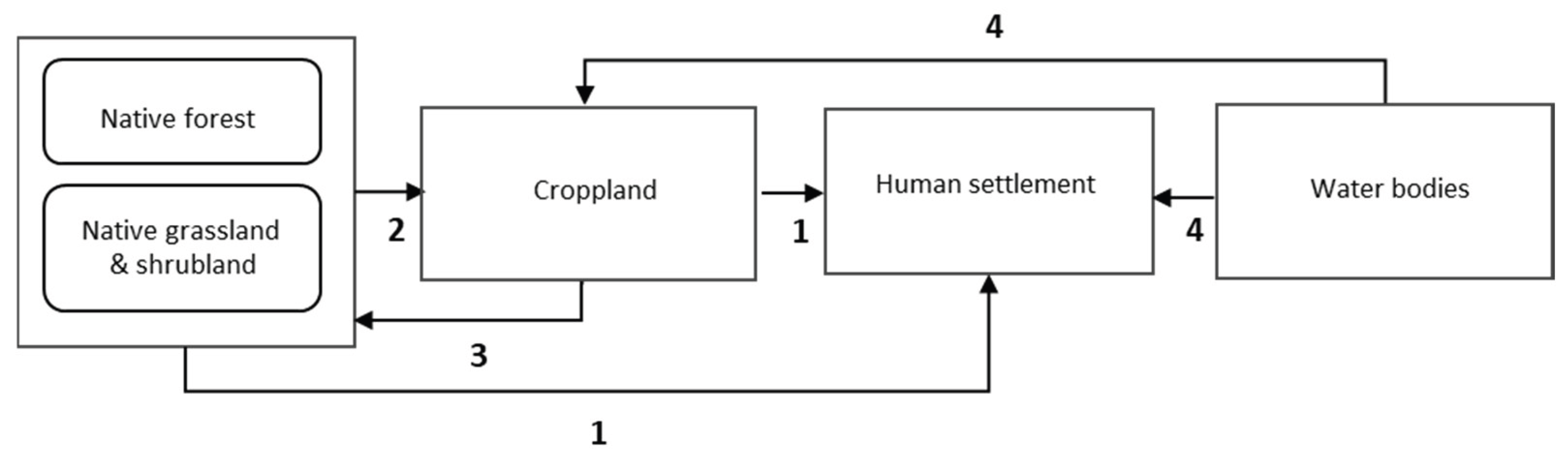
Figure 2.
Land cover/-use change processes. This is a spatially explicit model of the distribution and locations of conversions in land cover/use from 1976 to another type in 2018 (verified in the field from 2020-2025). The permanence of the vegetation cover/use is also represented in white.
Figure 2.
Land cover/-use change processes. This is a spatially explicit model of the distribution and locations of conversions in land cover/use from 1976 to another type in 2018 (verified in the field from 2020-2025). The permanence of the vegetation cover/use is also represented in white.
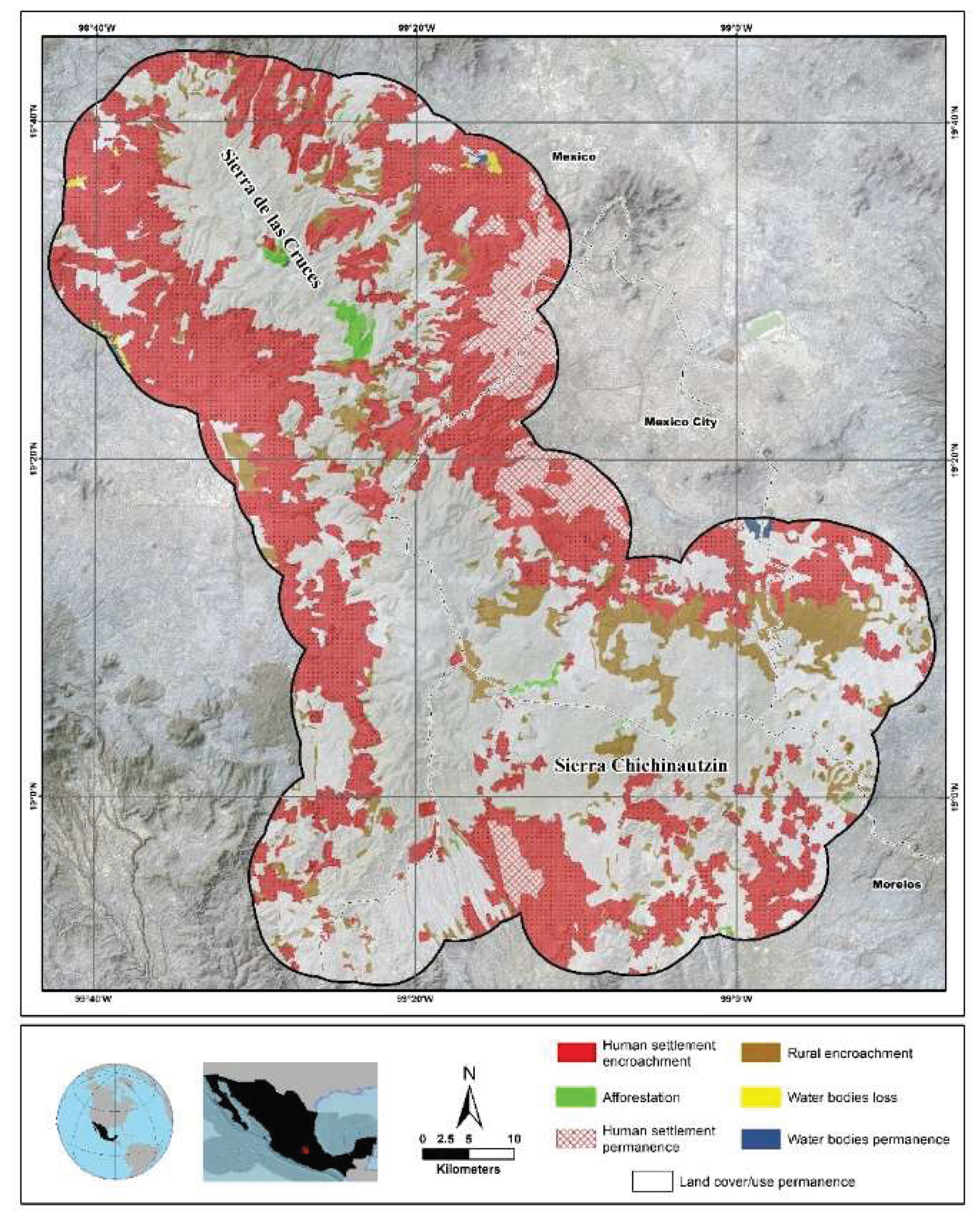
Figure 3.
Dynamics of land-use change processes showing conversion of land cover/use from 1976 to 2018. The values in the source cartographic classes (white squares) correspond to the total surface of area in 1976. The arrows indicate the direction of change. The color stars indicate the process, and the values correspond to the total area converted in Km2. The percentage (%) value is relative to the initial surface of the cartographic class in 1976.
Figure 3.
Dynamics of land-use change processes showing conversion of land cover/use from 1976 to 2018. The values in the source cartographic classes (white squares) correspond to the total surface of area in 1976. The arrows indicate the direction of change. The color stars indicate the process, and the values correspond to the total area converted in Km2. The percentage (%) value is relative to the initial surface of the cartographic class in 1976.
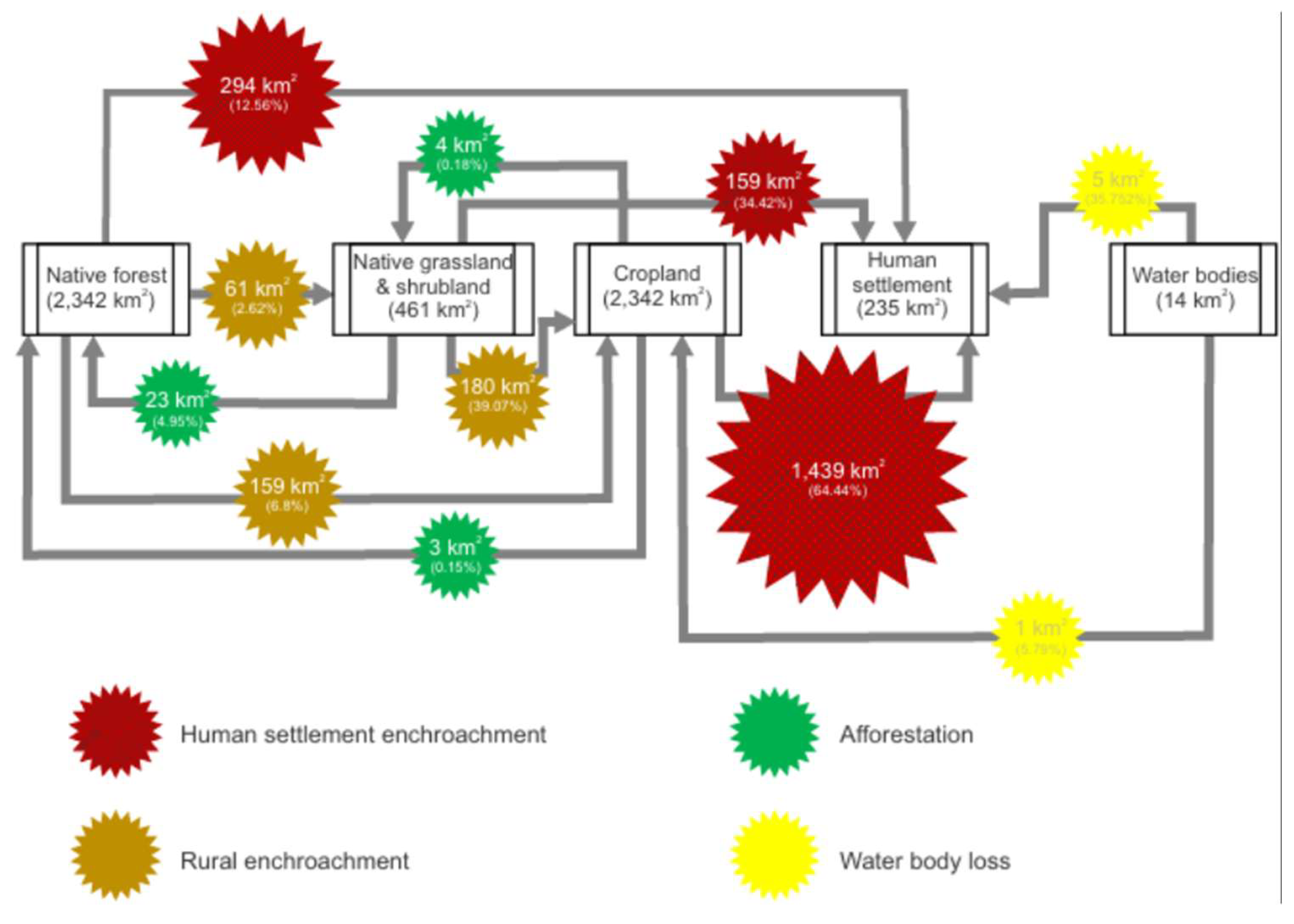
Figure 5.
Disruption, shrinking and fragmentation of the potential richness biodiversity hotspots harbor in the study region. Sierra de las Cruces (left and upper region) has experienced dramatic human settlement encroachment with significant impoverishment of the threatened biodiversity. Sierra Chichinautzin (lower region) remains harboring important biodiversity hotspots although these are being jeopardized by the dominant land cover/use change processes depicted here.
Figure 5.
Disruption, shrinking and fragmentation of the potential richness biodiversity hotspots harbor in the study region. Sierra de las Cruces (left and upper region) has experienced dramatic human settlement encroachment with significant impoverishment of the threatened biodiversity. Sierra Chichinautzin (lower region) remains harboring important biodiversity hotspots although these are being jeopardized by the dominant land cover/use change processes depicted here.
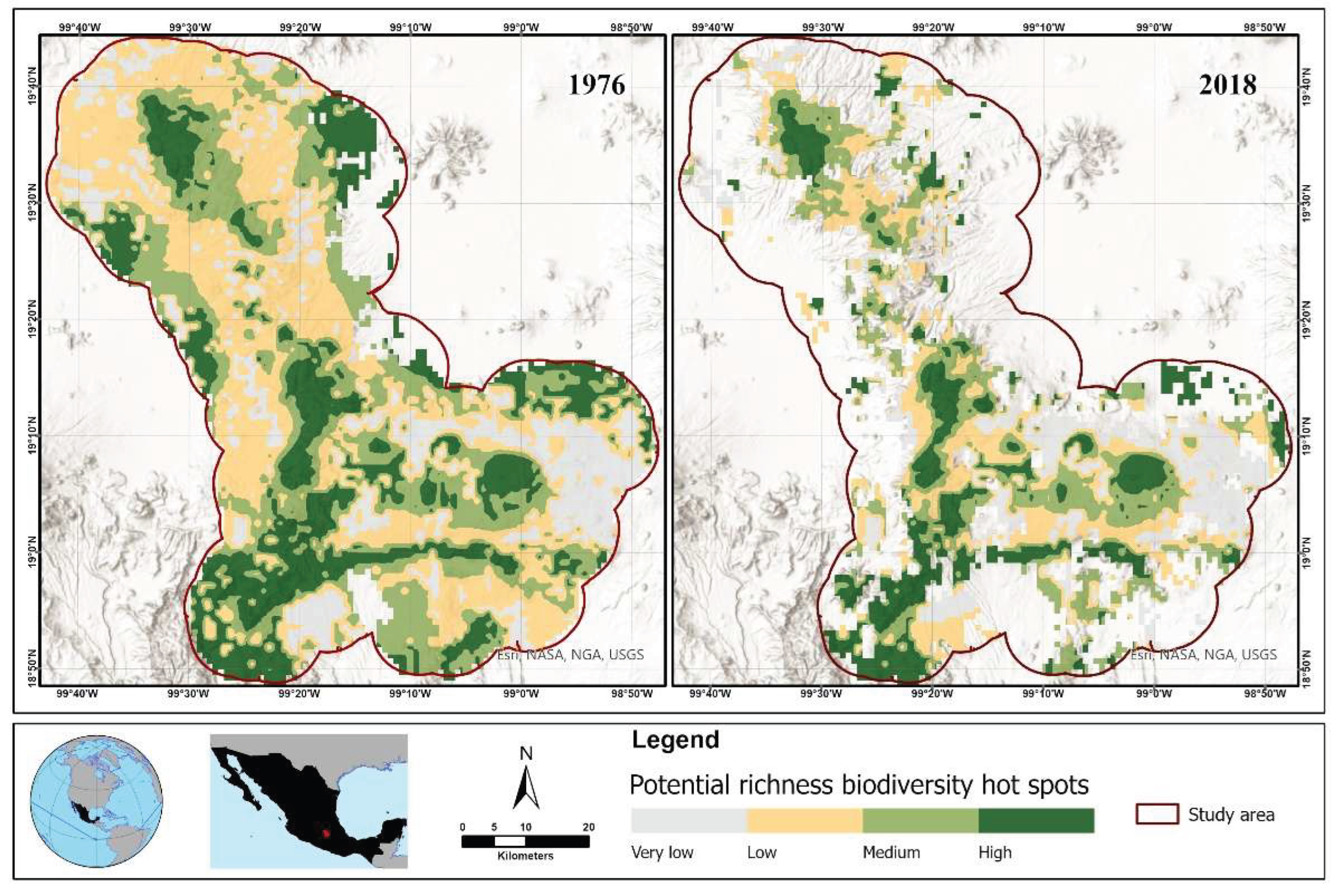

Table 1.
Processes of land-use change between T1 (1976) and T2 (2018).
| Processes of land use change | Area (km2) | Percentage (%) |
|---|---|---|
| Human settlement encroachment | 1,892 | 35.07 |
| Rural encroachment | 401 | 7.43 |
| Afforestation | 30 | 0.57 |
| Water body loss | 6 | 0.11 |
| Permanency | 3,065 | 56.82 |
| Total | 5,395 | 100.00 |
Table 2.
Rates of land cover/use change.
| Cover type | Area Km2 (T1 - 1976) |
Area Km2 (T2 - 2018) |
Rate of change | Gross % of change |
|---|---|---|---|---|
| Native forest | 2,342 | 1,854 | -0.56 | -20.84 |
| Native grassland and shrubland | 461 | 165 | -2.42 | -64.21 |
| Cropland | 2,342 | 1,236 | -1.51 | -47.22 |
| Human settlements | 235 | 2,132 | 5.40 | +807.23 |
| Water bodies | 14 | 8 | -1.27 | -42.86 |
Disclaimer/Publisher’s Note: The statements, opinions and data contained in all publications are solely those of the individual author(s) and contributor(s) and not of MDPI and/or the editor(s). MDPI and/or the editor(s) disclaim responsibility for any injury to people or property resulting from any ideas, methods, instructions or products referred to in the content. |
© 2026 by the authors. Licensee MDPI, Basel, Switzerland. This article is an open access article distributed under the terms and conditions of the Creative Commons Attribution (CC BY) license (http://creativecommons.org/licenses/by/4.0/).
Copyright: This open access article is published under a Creative Commons CC BY 4.0 license, which permit the free download, distribution, and reuse, provided that the author and preprint are cited in any reuse.


