
Submitted:
06 April 2026
Posted:
08 April 2026
You are already at the latest version
Abstract
Thyroid cancer (TC) is the most common endocrine malignancy, with a steadily rising global incidence. Despite most cases having a favorable prognosis, a subset of patients develops aggressive, recurrent, or radioiodine-refractory disease, demonstrating the need for improved molecular biomarkers and targeted therapies. The Forkhead box P (FOXP) transcription factors (FOXP1–FOXP4) have appeared as important regulators of tumor biology, yet their roles in thyroid cancer remain incompletely defined. This review summarizes current bioinformatic, experimental, and clinical evidence regarding FOXP expression patterns, molecular mechanisms, and clinical relevance in TC. FOXP3 and FOXP4 mainly associate with aggressive clinicopathological features, including extrathyroidal invasion, lymph node metastasis, and distant metastases, and may serve as markers of poor prognosis. The most explored FOXP3 contributes to immune evasion and radioiodine resistance by suppressing sodium iodide symporter expression and regulating tumor-associated immune responses. FOXP4 promotes tumor progression by activating key oncogenic signaling pathways and regulating non-coding RNAs. In contrast, evidence indicates that FOXP2 primarily acts as a tumor suppressor in TC by inhibiting cell proliferation and promoting apoptosis, although it may show context-dependent functions. FOXP1, though less well studied, is also suggested to have tumor-suppressive effects in some studies, and demands additional investigation in TC. Collectively, FOXP factors constitute promising diagnostic, prognostic, and treatment targets, although additional confirmation in large clinical studies is required.
Keywords:
thyroid cancer
; FOXP1
; FOXP2
; FOXP3
; FOXP4
1. Introduction
Thyroid cancer (TC) remains the most common endocrine malignancy worldwide, ranking 7 in general population incidence steadily increasing in time, according to the 2022 Global Cancer Statistics published by International Agency for Research on Cancer. High female predominance with approximately three times higher female to male ratio places TC third most common malignancy in female population, and only thirteenth in male. Although mortality rates remain low and stable for decades, worrisome increased incidence among the middle-aged population (between 45 and 64 years) has been spotted [1]. Exposure to radiation, heavy metals, and air pollution have been considered as predisposing factors for the constant growth in incidence, as well as modifiable risk factors such as obesity, lack of exercise, heavy alcohol consumption, smoking and secondhand smoking [2,3,4]. Simultaneous technological development with high-resolution ultrasound and structured guidelines in Thyroid Imaging Reporting and Data System (TI-RADS) of thyroid nodes, as well as personal interest in patients, have led to overdiagnosis of small thyroid cancers (<1 cm) in the recent years [4,5].
The fifth edition of the World Health Organization (WHO) Classification of Endocrine Tumors, released in 2022 gives a revised classification of thyroid neoplasms, intregrating classic histology, immunohistochemical markers and molecular pathways into risk-stratified groups that interfere clinical treatment [6,7]. Follicular cell derived differentiated thyroid carcinomas (DTC) comprise largest group of malignant neoplasms of the thyroid gland with distinct features of papillary thyroid carcinoma (PTC), follicular thyroid carcinoma (FTC) and oncocytic thyroid carcinoma (OTC). WHO Classification gives two distinct high-grade follicular cell-derived carcinomas: poorly differentiated thyroid carcinoma (PDTC) and differentiated high-grade thyroid carcinoma (DHGTC), representing intermediate stage between indolent DTC and aggressive form of undifferentiated TC called anaplastic (ATC). Poorly differentiated tumors are separated due to presence of high mitotic count or tumor necrosis. Frequent parafollicular cell-derived neoplasm is medullary thyroid carcinoma (MTC) [7].
Differentiated thyroid carcinoma is generally considered indolent malignant neoplasm with excellent prognosis in adults. In children and young adults, agressive behavior reflects in local metastases and high recurrence rates. However, mortality remains low even in this population [1,3,7]. PTC is the most common histological type of TC, reflecting in 85-90% of diagnosed cases worldwide. Molecular pathway of PTC is complex and includes MAPK signal pathway inducing point mutations and activating BRAF-V600E mutation present in >60% classic subtype PTC [3,4,7]. Although they have high affinity to lymph nodes, clinical outcome is dependent on size of the tumor, leaving tumors smaller than 1 cm often clinically silent. Follicular thyroid carcinoma is follicular cell-derived invasive neoplasm that lacks nuclear features of PTC, and is present in 10-15% of all TC. Capsular or/and vascular invasion make distinction between benign follicular adenoma with excellent prognosis and FTC. Based on capsular and vascular invasion, FTC has risk-stratified groups, where vascular invasion gives worst prognosis. FTC exhibits enhanced lipid metabolism and PI3K/AKT pathway activation and is usually RAS-mutation induced neoplasm, with NRAS being the most frequent driver mutation [4,7]. Oncocytic TCs are malignant follicular cell-derived tumors comprising ≥75% oncocytes and lacking PTC nuclear features, present in 3-7% TCs. Unique histologic quality is oxyphilic cells, but tumor generally shows similar growth pattern as FTC. These tumors show more local recurrence and distant metastases than classic FTC, and are radioiodine refractory. MAPK signal pathway with RAS mutation and TERT promoter mutations are molecular basis of the tumor [3,7]. Medullary TC (<5%) is neuroendocrine neoplasm with characteristic RET proto-oncogene mutation [4,7]. Anaplastic carcinoma is rare neoplasm (<2%) characterized by explosive and locally aggressive tumor growth as well as refractoriness to standard treatment, which leads to very poor prognosis [7,8]. ATC is generally MAPK pathway driven, but also PI3K/AKT pathway induced, harboring more than one driver mutation.
Most of the TCs present asymptomatically, found incidentally on imaging. Nonetheless, fatigue, emotional distress, anxiety or depression, followed by hoarseness, compression or noticeable lump in the neck can be present in patients with TC [3,4]. Surgery remains the gold standard of care [3,4,8], followed by radioactive iodine (RAI), and rarely chemotherapy and radiotherapy for radioiodine refractory TCs [3,5]. Radioactive iodine is used in ablation of remnant tissue after surgical treatment and for microdisease. Chemotherapy is rarely used in aggressive neoplasm such as ATC [5,8]. However, radioiodine refractory carcinomas and recurrent metastases pose a great challenge for treatment, leading to exploring novel treatment options based on the molecular pathways and innovative treatments. Immunotherapies like PD-1 inhibitors enhance patient’s immune system. Tyrosine kinase inhibitors (TKIs) such as sorafenib, lenvatinib and vandetanib, have been approved for treating aggressive TC. BRAFV600E inhibitors and their combination with MEK inhibitors, can be effective for patients with BRAFV600E mutation in refractory PTC [5,8,9]. Treatments for specific mutations, such as TRK kinase inhibitors (larotrectinib and entrectinib), have proven to be successful in treating cancers with NTRK gene mutations. Pembrolizumab is treatment option for tumors with microsatellite instability high status or mismatch repair deficiencies [5,8,9,10].
Despite generally favorable outcomes, several clinical challenges persist in thyroid cancer, including overdiagnosis of indolent tumors, difficulties in distinguishing aggressive from low-risk disease, and the management of radioiodine-refractory and recurrent cases. In light of these limitations, increasing attention has been directed toward transcriptional regulators, particularly members of the FOXP subfamily, as key modulators of tumor behavior.
1.1. Structure and Function of FOXP Genes
The FOXP subfamily belongs to the larger Forkhead (FOX) gene superfamily and comprises four members: FOXP1 (3p14.1), FOXP2 (7q31), FOXP3 (Xp11.23), and FOXP4 (6p21.1) [11]. FOX genes are highly conserved across eukaryotes, occurring in organisms ranging from yeast to humans, with 43 FOX genes identified in the human genome. Many of these genes, including all members of the FOXP subfamily, play essential roles in development and organogenesis [12].Deregulation of FOX genes have been linked to cancer initiation, invasion, progression, and therapy resistance, as well as to the modulation of other oncogenic pathways that contribute to tumor development [13]. In particular, FOXP proteins are crucial for immune regulation, organ development, and cancer pathogenesis [12,14].
All FOX transcription factors bind DNA through a conserved forkhead, or “winged helix,” domain composed of three α-helices and two wing-like loop structures [15]. In the FOXP subfamily, this DNA-binding domain is positioned at the C-terminal end, in contrast to most other FOX proteins in which it is N-terminal end of protein. In addition, the FOXP1 forkhead domain contains deletions within the wing regions compared with other FOX family members [16]. Unlike other forkhead subfamilies, FOXP proteins possess several conserved domains beyond the DNA-binding region [17,18]. These include a highly conserved C2H2 zinc finger domain, a leucine zipper motif, the winged helix domain (WHD) composed of β-sheets, α-helices, and wing-like loops resembling a helix–turn–helix structure [19], the forkhead DNA-binding domain, and N-terminal domain [20]. Notably, FOXP1 and FOXP2 contain a C-terminal binding site for C-terminal binding protein 1 (CtBP1), which is absent in FOXP3 and FOXP4 [18,21,22,23] (Figure1).
Whereas most FOX proteins function as monomers in solution and when bound to DNA [16], the ability of FOXP proteins to form heterodimers expands the functional repertoire of this subfamily [17,18]. Structural analyses have shown that the FOXP1 forkhead domain consists of five α-helices (H1–H5), three β-strands (S1–S3), and two wing regions (W1 and W2) [24,25]. FOXP2 and FOXP3 exhibit highly similar crystal structures, forming dimers analogous to FOXP1 but with distinct dimerization properties. Although the forkhead domains of all FOXP proteins enable C-terminal winged helix-mediated dimerization, FOXP3 dimers are considered more stable than those formed by FOXP1 or FOXP2 [22]. Mendoza et al. further identified both homo- and heterodimeric complexes, as well as higher-order oligomers comprising FOXP1, FOXP2, and FOXP4, in HEK293 cells and brain tissue[26].
FOXP proteins predominantly act as transcriptional repressors, and with the exception of FOXP3, they also contain polyglutamine tracts near their N-terminus [17,18]. Two independent subdomains contribute to the transcriptional repression activity of FOXP proteins. Subdomain 1 contains a highly conserved leucine zipper motif, similar to that of N-Myc, which mediates both homo- and heterodimerization among FOXP1, FOXP2, and FOXP4. Subdomain 2 includes a binding motif for the corepressor CtBP1 and is present in FOXP1 and FOXP2 but absent in FOXP4. In contrast, FOXP3 represses target gene expression through interactions with RUNX transcription factors [27,28].
FOXP1 is a transcription factor involved in multiple biological processes, including neural development, monocyte differentiation, macrophage function, T and B lymphocyte differentiation and T cells (Tregs) maintenance and differentiation [29,30,31]. It also contributes to the development of the heart, lungs, and central nervous system, with mutations causing FOXP1 syndrome, a neurodevelopmental disorder [29,32,33]. Multiple FOXP1 isoforms exist, with at least three expressed in adult lung and brain tissue and implicated in central nervous system development [17,18,34], while seven FOXP1 isoforms lacking part of the N-terminal (NH3-terminal) region have been identified, and three of these were detected in samples of Diffuse Large B-cell Lymphoma (DLBCL)[35].
The FOXP2 gene is a key regulator of human language and cognitive development [36,37], influencing genes critical for nervous system function, particularly in brain regions involved in language and fine motor coordination[38]. It participates in embryonic development and cell cycle regulation via pathways associated with neurogenesis, such as Wnt and Notch[39,40]. Variations in FOXP2 are linked to speech and language disorders, as well as a range of neuropsychiatric conditions [41,42,43].
FOXP3 is a key immune transcription factor primarily expressed in regulatory T (Treg) cells(CD4⁺/CD25⁺ or CD4⁺/CD25⁻) [44,45], cells that function as immunosuppressive lymphocytes [46], maintaining immune homeostasis and self-tolerance [20]. Treg cells, including natural (nTregs) and induced (iTregs) subsets, rely on FOXP3 for their development and function, making it a specific biomarker for this population[46,47,48]. FOXP3 is also found in other cell types, such as B lymphocytes and thymocytes, and in normal tissues like lung, thymus, prostate, and breast[44,49,50,51]. In humans, five FOXP3 isoforms have been identified: FOXP3FL, FOXP3Δ3, FOXP3Δ3Δ4, FOXP3Δ8, and FOXP3Δ3Δ8[50,51,52].
FOXP4 is a transcription factor essential for development and organogenesis, particularly in regulation of metabolic processes, immune function, and T-cell development[27,53]. It shares significant sequence similarity with FOXP1 and FOXP2 and, together, they form a multidomain transcriptional repressor complex [54]. FOXP4 is essential for maintaining Treg homeostasis and function and contributes to central nervous system development [55,56]. In the brain, it is co-expressed with FOXP1 and FOXP2 in regions such as the cortex, cerebellum, and striatum, where they may form heterodimers to regulate shared downstream target genes [57].
1.2. FOXP Genes and Cancer
FOXP dependent cancer initiation and progression are associated with multiple hallmarks of malignancy, including immune evasion, resistance to growth suppressors, genomic instability and mutational burden, induction of angiogenesis, evasion of apoptosis, sustained proliferative signaling, and inflammation. Although accumulating evidence indicates that FOXP proteins can function either as oncogenes or tumor suppressors depending of cancer type [58,59], the molecular determinants and regulatory mechanisms that dictate whether FOXP proteins exert tumor-suppressive or oncogenic activities have yet to be fully elucidated.
FOXP1 overexpression has been consistently associated with poor prognosis in several B-cell lymphomas, including DLBCL [60,61,62], primary cutaneous large B-cell lymphoma (PCLBCL) [63], follicular lymphoma [35], and gastric mucosa associated lymphoid tissue lymphoma (MALT) [64], supporting its role as an oncogene in these malignancies. In these contexts, elevated FOXP1 expression is frequently correlated with worse clinical outcomes. These effects may arise from multiple molecular pathways, including arrest of the cell cycle at the G1/S transition and decreased phosphorylation of the retinoblastoma protein [65]. Other potential mechanisms involve nuclear interaction of FOXP1 with estrogen receptors α or β [66,67], suppression of MHC class II expression combined with activation of Wnt/β-catenin signaling [68,69], and chromosomal translocations driven by immunoglobulin heavy chain enhancer activity [59,70].In contrast, FOXP1 is considered to have tumor-suppressive activity in certain epithelial malignancies, including lung, breast, prostate and pancreatic cancer. Takayama et al. observed that decreased FOXP1 expression correlates with prostate cancer progression and poorer patient survival by modulating androgen receptor and inhibiting cell proliferation and migration [71]. The FOXP1 gene is located at chromosome 3p14.1, a region commonly described as a tumor suppressor locus; accordingly, loss of FOXP1 expression has been associated with poor prognosis in breast cancer [72]. Moreover, FOXP1 can interact with FOXP3 through nuclear factor of activated T cells (NFAT)–IL-2 promoter DNA complexes [72], indicating that its oncogenic or tumor-suppressive roles may be modulated by transcriptional networks and protein–protein interactions. Truncated FOXP1 isoforms are associated with DLBCL characterized by continuous nuclear factor kappa-light-chain-enhancer of activated B cells (NF-κB) activation, suggesting that these shorter forms disrupt the repressive function of full-length FOXP1 and enhance NF-κB signaling [35].
FOXP2 predominantly functions as a transcriptional repressor and has a context-dependent role in oncogenesis and cancer progression. FOXP2 suppresses the transcriptional activity of target genes through its zinc finger domain and can interact with CtBP1, a transcriptional corepressor that regulates the expression of tumor suppressor genes such as BAX, PTEN, and CDKN2A [73]. Through these interactions, FOXP2 has also been implicated in the repression of E-cadherin expression and the promotion of cellular invasion [58]. In addition, FOXP2 may modulate the expression of genes involved in key oncogenic signaling pathways, including IGF-1 (insulin-like growth factor 1), NF-κB, and Wnt signaling [74,75,76]. FOXP2 is downregulated in certain malignancies, such as breast, liver, and gastric cancers, whereas it is overexpressed in others [58,77,78,79], further supporting its dual functional role. Consistent with a tumor-suppressive function in specific contexts, Cuiffo et al. demonstrated that FOXP2 downregulation enhances tumor initiation in breast cancer, suggesting its role as a putative tumor and metastasis suppressor[80]. Similarly, FOXP2 expression is reduced in hepatocellular carcinoma (HCC) tissues, where decreased expression correlates with poor overall survival and increased tumor invasiveness [81].
FOXP3 is located on chromosome Xp11.23 [44], a region of particular biological significance due to its X-linked inheritance pattern. Consequently, a single genetic “hit” affecting FOXP3 may be sufficient to disrupt its function and contribute to malignant transformation [51,82]. Genetic alterations in FOXP3 include both single nucleotide polymorphisms (SNPs) and microsatellite polymorphisms [50].Among the most frequently studied FOXP3 promoter polymorphisms are rs3761549 (C>T) and rs3761548 (C>A), both of which have been implicated in carcinogenesis [44]. Mutations and dysregulated expression of FOXP3 have been associated with immune dysfunction and tumor development [51].
Functionally, FOXP3 plays a central role in immune regulation and may contribute to tumor immune evasion [83]. Additionally, FOXP3 has been shown to inhibit angiogenesis through regulation of vascular endothelial growth factor (VEGF), as demonstrated in breast cancer MDA-MB-231 cell lines [84]. However, the prognostic significance of FOXP3 expression in cancer is not uniform across tumor types. Elevated FOXP3 expression is associated with poor prognosis in colorectal cancer [47], melanoma [50], and both non-small cell and small cell lung carcinoma [85], while, higher FOXP3 expression correlates with improved prognosis in breast, prostate and gastric cancers [50,51,86,87]. These divergent outcomes likely reflect tumor type–specific functional roles and distinct molecular contexts in which FOXP3 is activated.
FOXP3 regulates transcription through both gene activation and repression [20]. Binding of FOXP3 to promoter and 5′ regulatory regions of CTLA4 (encoding CTLA-4 receptor) and IL2RA (encoding CD25 and IL-2 receptor-α) induces histone acetylation and enhanced expression of CTLA-4 and CD25 in T cells. Conversely, FOXP3 binding to promoters of IL-2, IL-7RA, or IFN-γ is associated with reduced histone acetylation and chromatin remodeling, leading to transcriptional repression of these cytokines [51].In breast cancer, FOXP3 has been characterized as a tumor suppressor [83,88,89,90], in part through transcriptional repression of oncogenes such as HER2/ErbB2[90] and SKP2[91]. Furthermore, FOXP3 interacts with several key transcription factors within the tumor microenvironment, including NF-κB, NFAT [92], and acute myeloid leukemia 1 (AML-1) [93], underscoring its role as a central regulator of immune and tumor-associated signaling networks.
The role of FOXP4 in cancer remains relatively underexplored compared to other FOXP family members. FOXP4 regulates the expression of multiple genes involved in biological processes that contribute to cancer progression [94]. FOXP4 was found to be overexpressed in A549 and H1703 non-small cell lung cancer (NSCLC) cell lines, and its depletion significantly inhibited cellular proliferation and invasion in these models [95], also FOXP4 has been linked to prostate cancer susceptibility in Chinese populations [96]. In addition, the long non-coding RNA FOXP4-AS1 has been identified as a potential poor prognostic biomarker in colorectal cancer and osteosarcoma [97], suggesting that FOXP4 related regulatory networks may influence tumor progression and clinical outcomes. FOXP4 regulates β-catenin expression by enhancing its transcription, thereby promoting the malignant progression of esophageal squamous cell carcinoma (ESCC) while, also playing a significant role in tumor growth in the kidney and larynx[98]. FOXP4 expression was reported to be significantly downregulated in renal cancers [27], implying that FOXP4 may also exert tumor-suppressive functions depending on the tissue context. These findings suggest that FOXP4, similar to other FOXP family members, may exhibit dual and context-dependent roles in tumorigenesis, although further studies are required to clarify its function.
Despite increasing evidence implicating FOXP family members in tumorigenesis, their roles in human carcinomas remain incompletely understood, particularly in the context of thyroid carcinoma. Considering accumulating evidence indicating that FOXP proteins may exert oncogenic or tumor-suppressive effects depending on the biological context, a comprehensive evaluation of their involvement in thyroid cancer is warranted. Therefore, this review aims to summarizes current knowledge on FOXP transcription factors in thyroid cancer, examining their expression patterns, molecular mechanisms, clinical relevance, and therapeutic potential. By integrating bioinformatic, experimental, and clinical evidence, we aim to provide a comprehensive view of FOXP driven cancer processes and highlights opportunities to applying these insights to potential clinical applications.
2. FOXP3 Gene in Thyroid Cancer
Among FOXP family members, FOXP3 is the most studied gene in thyroid cancer. FOXP3, a transcription factor known for its role in regulatory T cells, is increasingly recognized as important player in thyroid cancer, particularly PTC, where it influences tumor progression, immune evasion, treatment resistance, and may serve as a prognostic marker and therapeutic target. The following sections explore these functions and their clinical significance.
2.1. FOXP3 Expression And Its Localization
FOXP3 is expressed in a significant proportion of papillary thyroid carcinoma cases and his elevated expression is associated with thyroid carcinoma [99,100]. High FOXP3 expression is more common in malignant thyroid tumors than in benign conditions like goiter, indicating his role in carcinogenesis [101]. In PTC, elevated FOXP3 levels are linked to aggressive features such as lymph node metastases, extrathyroidal extension and multifocality, suggesting his contribution to a more aggressive tumor phenotype [102].The aggressiveness of tumors depends not only by the level of FOXP3expression but also by its location within the cell. According to Cunha et al. FOXP3 is localized both in cytoplasm and nuclei of cancer cells and in differentiated thyroid carcinoma-infiltrating lymphocytes [103]. In their study FOXP3 nuclear localization was associated with aggressiveness of differentiated thyroid carcinomas, also, lymphocytes with expressed FOXP3 were more luckily to infiltrate tumors smaller than 2 cm, lacking extrathyroidal invasion and accompanied by chronic lymphocytic thyroiditis (LT) [103]. Same authors found higher cytoplasmic FOXP3 immunostaining in malignant lesions than in benign nodules and suggested this localization may result from increased mutation rates [103], consistent with reports that cytoplasmic FOXP3 arises from somatic mutations in the forkhead (FKH)/winged-helix domain [104]. Cunha et al. also reported higher nuclear FOXP3 immunostaining in the younger patients and in the aggressive differentiated thyroid carcinomas with metastasis at diagnosis [103]. Ugolini et al. noticed predominant FOXP3 staining in the cytoplasm of thyroid tumor cells, with both nuclear and cytoplasmic staining in some cases of infiltrating cells[105], while Xin et al. reported that FOXP3 was mainly localized in cytoplasm and nucleus of PTC cells and that his expression was associated with lymph node metastasis and TNM clinical stage [99].
2.2. FOXP3 and Immune Evasion in Thyroid Cancer
FOXP3 plays a key role in regulatory T cell development and function, and in thyroid cancer, particularly PTC, its expression is linked to immune suppression that allows tumor cells to evade immunosurveillance [102]. FOXP3 induces a molecular mimicry and modulates the patterns of expression of various genes in cancer cells, which regulate immune response against thyroid tissue and favors an aggressive phenotype, but specific function of FOXP3 in thyroid cancer cells is still unclear [88,100,106,107,108]. FOXP3positive tumors exhibit a greater propensity for invasion and metastasis, potentially through the induction of immunosuppressive cytokines such as transforming growth factor-β1 (TGF-β1) and interleukin-10 (IL-10) [106]. This may reflect a form of molecular mimicry, whereby tumor cells adopt immunoregulatory features to suppress antitumor immune responses, thereby facilitating immune evasion and promoting tumor progression [106].High levels of FOXP3 inhibit expression of PPARγ (nuclear hormone receptor) and caspase-3 (a key pro-apoptotic molecule) and increase expression of NF-ĸB and cyclin D1, which can lead to higher cell proliferation and migration, as well as hindering of apoptosis in cancer cells [83].
Previous studies reported that FOXP3 expression in cancer cells was correlated with extrathyroidal invasion, infiltration of immune cells and distant metastasis [100,103,105,107]. Differences in FOXP3 expression have also been observed between neoplastic and non-neoplastic tissues. In addition, patients whose tumors and tumor-infiltrating lymphocytes were positive for FOXP3 had shorter disease-free survival and overall survival compared with those who were negative for FOXP3 in both [108]. In thyroid cancer, the presence of Tregs is associated with aggressive disease. Patients with tumor-associated lymphocytes, particularly FOXP3positive cells within tumor involved lymph nodes, demonstrate increased disease progression as well as a higher incidence of invasion and metastasis [109]. Zeng et al. reported an absence of FOXP3⁺ Tregs in benign thyroid tumors, whereas a substantial accumulation of these cells was observed in the peritumoral regions of PTC. In patients with DTC complicated by chronic lymphocytic thyroiditis (CLT), the concurrent presence of CD68⁺, CD4⁺, CD8⁺, CD20⁺, FOXP3⁺ and Th17 lymphocytes within the tumor microenvironment was associated with lower tumor invasiveness, more favorable pathological characteristics, and improved prognosis [110]. However, the same study also demonstrated that among PTC patients with Hashimoto’s thyroiditis (HT), the rate of lymph node metastasis was significantly higher in those with high FOXP3 expression in the tumor microenvironment compared with those exhibiting low FOXP3 expression [110]. This finding suggests that elevated FOXP3 expression may promote lymph node metastasis in PTC/HT patients [110]. Yang et al. reported that patients with HT exhibit reduced FOXP3 expression and impaired Treg function, which may result from abnormal acetylation of FOXP3 [111]. Previous studies have indicated that FOXP3 expression in PTC is not influenced by the coexistence of HT [107,112]. These findings indicate that FOXP3 expression is not directly associated with the presence of HT, rather, the process of malignant transformation is likely responsible for the aberrant FOXP3 expression observed in PTC cells [107,112]. Further, Zeng et al. found that the presence of Th17 cells in the tumor microenvironment of PTC/HT patients was associated with a better prognosis [113]. Accumulating evidence indicates that imbalance between Th17 cells and Tregs is closely involved in the initiation and progression of multiple tumor types [114]. Zeng et al. proposed that external stimulation may rapidly induce Th17 differentiation while suppressing Treg mediated inhibition, resulting in a shift of the Th17/Treg balance toward Th17 dominance [110]. Previous studies have shown that Th17 cells can inhibit lymph node metastasis and are associated with favorable outcomes in PTC with HT, therefore, a Th17biased Th17/Treg balance may represent an important factor contributing to improved prognosis [113]. Within the tumor microenvironment shaped by both thyroid cancer and inflammation, Treg cells appear to promote lymph node metastasis, whereas Th17 cells may counteract the tumor-promoting effects of Tregs. A lower Th17/Treg ratio is associated with increased tumor invasiveness and metastatic potential, while a shift toward Treg dominance is linked to poorer prognosis. Nonetheless, the precise roles of Th17 and Treg cells in PTC lymph node metastasis require further experimental validation. Given that Th17 and Treg cells can interconvert under specific microenvironmental conditions, it remains unclear whether the observed immune alterations in PTC with HT are a cause of tumorigenesis or a consequence of tumor progression, warranting further investigation [110,113].
Previous studies have demonstrated that FOXP3 directly binds to the transcriptional start site of the chemokine receptor CXCR4, suggesting a regulatory role in CXCR4 expression. CXCR4 and its ligand, CXCL12, are widely expressed across human cancers and drive key oncogenic processes, including tumor cell proliferation, invasion, and angiogenesis. Increasing evidence indicates that CXCR4–CXCL12 signaling contributes to the pathogenesis of PTC by promoting tumor growth, progression, and metastasis. Notably, CXCR4 expression has been strongly associated with BRAF (serine/threonine-protein kinase B-Raf) mutation status and the degree of neoplastic infiltration [115]. These observations suggest that oncogenic BRAF activation may potentiate CXCR4-driven signaling pathways, thereby enhancing local tumor aggressiveness. It has therefore been proposed that cooperative interactions between CXCR4 expression and BRAF mutation status contribute to an aggressive PTC phenotype [115]. A plausible mechanism underlying this cooperation is the recruitment and activation of inflammatory cells, including T lymphocytes and Tregs, which may further amplify CXCR4 mediated tumor-promoting signals within the tumor microenvironment.
2.3. Polymorphisms of FOXP3
Different studies reported high nuclear FOXP3 localization in papillary thyroid carcinoma and linked the rs3761548 polymorphism to cancer risk [101,116]. Jiang et al. examined the association of FOXP3 rs3761548 and rs2280883 polymorphisms with susceptibility to DTC. They found that the A allele of rs3761548 was more frequent in DTC patients than controls, while the C allele of rs2280883 was less frequent in patients. Individuals with the rs3761548AC genotype had a higher DTC risk, whereas those with the rs2280883CT genotype had a lower risk. The AA/AC genotypes of rs3761548 polymorphism were significantly more common in female than male DTC patients, whereas the rs2280883 CC/CT frequencies did not differ by sex[117]. In their study Achilla et al. indicated that the A allele and the CA and AA genotypes of rs3761548 genetic variant, showed strong statistically significant difference in their distribution between female PTC patients and controls [116]. This may help account for the higher prevalence of PTC in females than in males and could be related to FOXP3 location on Xp11.23. Additionally, Jiang et al. reported that the rs3761548 AA/AC genotype was more frequent in more advanced tumors (diameter >1 cm), while rs2280883 CC/CT genotype was less common in those cases. Overall, rs3761548 AA/AC appears to be a potential risk genotype for DTC, while rs2280883 CC/CT is a protective genotype, suggesting these SNPs could indicate DTC aggressiveness [117]. Muayad et al. reported that, among patients with thyroid disorders, individuals carrying the heterozygous (AC) genotype of the rs3761548 polymorphism had significantly higher serum FOXP3 levels compared with those carrying the other genotypes [118].
2.4. Epigenetic Regulation of FOXP3 Expression
FOXP3 expression can be regulated by both methylation of DNA and miRNA. Achilla et al. analyzed methylation status of FOXP3 gene in PTC patients. They reported no methylation in male and female controls regardless of rs3761548 genotype, nor in male PTC patients carrying either the A or C allele. In female PTC patients, an unmethylated status was observed only among those with the AA genotype. In contrast, methylation was identified in some females with the CC or CA genotypes, suggesting a possible interaction between FOXP3 methylation status and rs3761548 genotypes in PTC susceptibility [116].The combined analysis of FOXP3 rs3761548 genotypes and methylation status indicated that methylated cytosines were detected only in female patients carrying the rs3761548 C allele [116]. Based on these findings, it was suggested by Achilla et al. that the C allele may be associated with methylation in female patients with CA or CC genotypes. In contrast, in healthy individuals carrying the CA or CC genotypes, both alleles were observed to be unmethylated [116]. The rs3761548 AA genotype has previously been associated with impaired FOXP3 transcription, as the A allele has been shown to disrupt binding of transcription factor [119]. Additionally, the A allele has been reported to be associated with reduced FOXP3 expression and altered Treg function and cytokine secretion [120,121]. Accordingly, Achilla et al. proposed that the reduced FOXP3 expression observed in PTC patients in relation to rs3761548 genotype could be associated either with the presence of the A allele or with methylation of the C allele. Furthermore, given that methylation was detected only in female patients, this observation was suggested to be potentially related to the higher incidence of PTC in females compared with males [116].
Previous studies have shown that FOXP3 expression is upregulated, whereas miR-125b expression is downregulated in thyroid cancer tissues and thyroid cancer cell lines [122]. miR-125b suppresses the migration and invasion of anaplastic thyroid cancer cells by directly targeting PIK3CD. Wang et al. further demonstrated that miR-125b can inhibit FOXP3 expression through direct binding to its 3′-UTR. In addition, they reported that overexpression of miR-125b enhanced the sensitivity of thyroid cancer cells to cisplatin by inducing autophagy via the Atg7 pathway, both in vitro and in vivo [122].
2.5. FOXP3 as a Therapeutic Target and PTC Biomarker
FOXP3 is a promising therapeutic target due to its roles in immune evasion and therapy resistance. Approaches that target FOXP3+ Tregs or modulate its expression in tumor cells could boost anti-tumor immunity and improve treatment outcomes [102,105]. Vaccination against FOXP3 expressing cells has also been shown to enhance tumor immunity, highlighting a potential new approach for cancer immunotherapy [105]. However, FOXP3’s function is complex, while it often correlates with poor prognosis in thyroid cancer, in some cancers its upregulation can have anti-tumor or anti-metastatic effects, emphasizing the need for further research to clarify its role and to develop effective therapeutic strategies. After immunohistochemistry, Neves Junior et al. and Mohamed et al. observed high positivity for FOXP3 in PTC cells, which led them to conclude that FOXP3 could potentially be used as biomarker for PTC diagnosis [103,107,112]. On the other hand, Ugolini et al. observed lover FOXP3 staining in PTC cells [105]. We can conclude that in order to use FOXP3 as a diagnostic marker, more research is needed.
FOXP3, a key transcription factor in Tregs, plays a central role in PTC by promoting tumor progression, immune evasion, and therapy resistance through Treg activation and cytokine modulation (Figure 2). Its high expression and cytoplasmic localization are linked to aggressive features and reduced radioiodine sensitivity, while genetic polymorphisms and epigenetic regulation affect its expression. Given these roles, FOXP3 represents both a potential therapeutic target and a biomarker for PTC, although further research is needed to clarify its complex, context-dependent functions. The reported variability in FOXP3 expression across studies, including findings of both increased and decreased expression, may be influenced by differences in the FOXP3 isoforms expressed among various cell types, subcellular localization of FOXP3, the Treg and tumor cell populations examined, the methods of analyses, sample sizes, and tumor location and stage [99,100,102,107,108,122,123].
3. FOXP4 in Thyroid Cancer
In recent years, FOXP4 has also emerged as a potential regulator of thyroid cancer progression. Accumulated studies have provided results that demonstrate its oncogenic function. FOXP4 facilitates thyroid cancer progression by activating key oncogenic pathways and influencing the tumor microenvironment, resulting in a more aggressive TC phenotype, and its tumor-promoter roles will be discussed in this section.
3.1. FOXP4 Expression Patterns
Despite limited data on FOXP4 expression in various malignant diseases, several studies have shown elevated FOXP4 expression in thyroid cancer, particularly in papillary thyroid carcinoma. Zhu et al. utilized TCGA data for bioinformatic analysis and observed significantly higher FOXP4 mRNA levels in cancerous samples compared to normal thyroid samples [124]. The same authors then confirmed FOXP4 overexpression in TC tissue samples and cell lines through immunohistochemistry and quantitative PCR [124,125]. The agreement between in silico and experimental data suggests elevated FOXP4 expression is a robust molecular feature in thyroid pathogenesis. Additionally, the predominant nuclear localization of FOXP4 in thyroid cancer tissues supports its direct involvement in regulating TC progression [124,125]. However, further research is needed on FOXP4 expression in specific TC subtypes, as the available literature primarily addresses papillary thyroid carcinoma.
3.2. FOXP4 Regulatory Networks
Functional studies on thyroid tumor cell lines have shown that elevated FOXP4 expression promotes tumor cell proliferation, migration, and epithelial–mesenchymal transition, primarily by regulating tumor suppressive pathways [124,125]. Conversely, FOXP4 knockdown induces cell cycle arrest and less aggressive behavior in TC cells [124,125].
At the molecular level, FOXP4 directly participates in major oncogenic signaling pathways, such as the Wnt/β-catenin and AKT/mTOR pathways, or indirectly through interactions with downstream effectors like FBXW7 (F-box and WD repeat domain containing 7) [124,125,126]. FBXW7is an established tumor suppressor that induces degradation of several oncogenes, including c-Myc, cyclin E, and Notch, all of which regulate cell cycle progression and tumor growth [127,128,129]. Additionally, studies in other tumor models show that FOXP4 regulates EMT programs and interacts with TGF-β- and Wnt/β-catenin-related pathways [130,131]. Although direct evidence in thyroid cancer remains limited, these results from various tumor models suggest an important role for FOXP4 in promoting thyroid tumor aggressiveness.
Bioinformatic studies indicate that FOXP4 is associated with immune and inflammation pathways, including chemokine signaling and cytokine–receptor interactions, which may influence the tumor microenvironment and facilitate immune evasion by cancer cells [124]. Network analysis has found that FOXP4 is connected to important genes like NTRK3 (Neurotrophic Receptor Tyrosine Kinase 3), which suggests that receptor tyrosine kinase signaling is involved in cancer development driven by FOXP4 [124].
FOXP4 is also involved in a competing endogenous RNA (ceRNA) network with FOXP4-AS1 long non-coding RNA and miR-4525, allowing for precise post-transcriptional regulation of its expression [124,126,132,133]. Through sequestration of miR-4525, FOXP4-AS1 inhibits microRNA-mediated suppression of FOXP4, resulting in increased FOXP4 protein levels. These observations are consistent with evidence that micro RNAs and long non-coding RNAs play significant roles in thyroid cancer progression and in the regulation of the FOX gene family [134,135,136].
Taken together, these findings show that FOXP4 plays a central role in controlling proliferative, migratory, and microenvironmental signaling networks (Figure 3). This supports its importance in aggressive thyroid cancer and suggests it could be useful for developing of prognostic biomarkers or targeted therapies.
4. FOXP2 in Thyroid Cancer
Compared to FOXP3 and FOXP4, FOXP2 has a more complex and variable expression pattern in thyroid cancer. FOXP2 was first recognized for its role in speech and language development. Recent studies show that FOXP2 is involved in various malignancies. Its role can shift between oncogene and tumor suppressor, depending on tumor type and cellular environment [137,138,139].
4.1. FOXP2 Expression Patterns
In thyroid cancer, FOXP2 expression is often disrupted and varies depending on the tissue-specific context. Most studies report lower FOXP2 expression in cancerous thyroid tissue compared to normal thyroid tissue. This suggests a tumor-suppressor role [140,141]. The decrease in FOXP2 can result from post-transcriptional mechanisms of gene expression regulation, including micro RNA regulation [142]. For example, miR-221-3p can lower FOXP2 levels via the Hedgehog signaling pathway. This leads to increased cell growth and decreased cell death [141]. Transcriptomics and network analysis reveal that FOXP2 is involved in complex gene networks and, these findings expand its roles in tumorigenesis [143,144,145]. Recent single-cell RNA sequencing data show that FOXP2 expression can vary across different parts of the tumor and surrounding tissue, underscoring the importance of its spatial effects [134]. Overall, these data indicate that FOXP2 expression patterns reflect a combination of transcriptional, post-transcriptional, and microenvironmental regulatory mechanisms in TC, highlighting its complex and still unexplored function.
4.2. FOXP2 Regulatory Networks
FOXP2 plays an important role in regulating key cellular processes in thyroid cancer, particularly proliferation and apoptosis. Tumor-suppressive function was demonstrated in functional studies, which revealed that elevated FOXP2 inhibits tumor cell proliferation and induces apoptosis [140]. These effects are mediated via transcriptional regulation of downstream targets and modulation of oncogenic signaling pathways. Similar tumor-suppressive roles of FOXP2 have been reported in other malignancies, reinforcing its role as a regulator of tumor growth dynamics [141].
At the molecular level, FOXP2 exerts its effects by directly regulating specific target genes. Yang et al. observed that RPS6KA6 is transcriptionally activated by FOXP2, and that, when overexpressed, FOXP2 inhibits cell proliferation and promotes apoptosis in thyroid cancer [4]. Restoration experiments further confirmed that the FOXP2–RPS6KA6 axis plays a key role in controlling thyroid cancer cell proliferation and apoptosis [140]. This regulatory axis is closely linked to the PI3K/AKT signaling pathway, a central regulator of cell survival and proliferation that is frequently dysregulated, further suggesting that FOXP2 is a potential prognostic biomarker in thyroid cancer [140].
In addition, FOXP2 modulates the Wnt/β-catenin signaling pathway, influencing proliferation, migration, and apoptosis of thyroid cancer cells [146]. FOXP2 is also involved in Hedgehog signaling, where micro RNA-mediated suppression contributes to tumor cell proliferation and survival [141].
Beyond direct effects on tumor cells, FOXP2 also impacts the tumor microenvironment. Studies have shown that FOXP2 expression correlates with immune cell infiltration patterns in thyroid cancer, alluding to an immunomodulatory function [100]. Single-cell transcriptomic analyses show that FOXP2 can activate PROS1 transcription in cancer-associated fibroblasts. PROS1 then triggers the MERTK/WNT/TGF-β signaling axis. This promotes tumor progression through paracrine tumor-stroma interactions [147]. These findings also support FOXP2's indirect role in promoting thyroid cancer aggressiveness and its multilayer function in TC.
Taken together, FOXP2 functions as a context-dependent regulator in thyroid cancer biology, integrating transcriptional control of cell-cycle regulators, modulation of key signaling pathways, and interacting with the tumor microenvironment (Figure 4). While its predominant role appears tumor-suppressive at the cellular level, its involvement in stromal signaling and treatment resistance highlights multiple contributions to thyroid cancer progression, which need further investigation.
5. FOXP1 in Thyroid Cancer
There is currently limited evidence regarding the role and expression of the FOXP1 gene in thyroid cancer[148]. Agbektas et al. analyzed differences in expressions of FOXP1 gene, in patients with DTC before and after radioactive iodine therapy. They found that FOXP1 gene expression was significantly higher in DTC patients before RAI therapy, while protein levels were lower compared to controls, and expression did not change significantly after therapy. In healthy controls, FOXP1 protein levels were higher than in DTC patients. The discrepancy between FOXP1 mRNA and protein levels suggests that post-transcriptional regulation may influence its biomarker potential. Finally, they concluded that FOXP1 acts as a tumor suppressor by inhibiting proliferation of DTC cells [148].
Abnormal expression of these gene was previously reported in various types of cancer [72,149,150,151,152,153,154,155]. Banham et al. were first to report overexpression of FOXP1 gene in DLBCL, as well as his abnormal expression in various solid tumors [149]. Barrans e tal. reported higher expression of FOXP1 gene in in a subset of DLBCL, and is more common in the non-germinal center activated B-cell typewith expressed BCL2 and absence of t(14;18) [61]. Wen et al. demonstrated that FOXP1 gene expression was increased in acute myeloid leukemia (AML) and was a promising biomarker for predicting responses to immunotherapy in AML patients. They also found that the methylation level in the FOXP1 gene was significantly lower among samples from AML patients compared to healthy controls and that methylation of FOXP1 reduced the level of FOXP1 mRNA, which indicates that DNA methylation regulates FOXP1 gene expression. They also suggested that FOXP1 modulates the tumor immune microenvironment by controlling immune cell infiltration in AML [154].
In various cancer types, such as pancreatic, colon, stomach, head, neck, lung, endometrial, renal, prostate and breast cancers, FOXP1 can function as tumor-suppressor [66,149,153,155,156,157], while, in other cancer types such as HCC, DLBCL and MALT type of marginal zone B-cell lymphoma, he can function as oncogene [70,72,150,154,157]. Shorter isoforms of these proteins function as oncogenes, while wild-type FOXP1 function as tumor-suppressor. Depending on a cancer type, overexpression of FOXP1 is associated with good or bad disease progression [157]. In lymphomas decrease expression of FOXP1 is associated with favorable disease outcome and overall survival, but in solid tumors this decreased expression is an unfavorable prognostic factor. Though, in solid tumors, if FOXP1 is located in the nucleus, his decreased expression is an indicator of good overall survival. Additionally, in patients with solid tumors, decreased FOXP1 expression is also correlated with an unfavorable relapse-free survival [152]. Because Xiao et al. in their metadata analysis included information about FOXP1 expression in breast cancer, endometrial cancer, hepatocellular carcinoma, NSCLC, prostate cancer, colorectal cancer, epithelial ovarian cancer, and neuroblastoma, they considered that their finding may be applicable to all solid tumors [152]. Based on very limited data, we can speculate that changes in expression levels of the FOXP1 gene potentially play an important role in the development and progression of thyroid cancer and that it may function as tumor suppressor in thyroid cancer, but further research is necessary.
6. Clinical Significance and Prognostic Implications
6.1. Associations with Tumor Aggressiveness
FOXP transcription factors, especially FOXP3 and FOXP4, are strongly associated with aggressive clinicopathological features in thyroid cancer. These patterns suggest FOXP expression could be a biomarker for high-risk patients. Such patients may benefit from more intensive treatment or surveillance.
FOXP3 gene expression correlates with several indicators of tumor aggressiveness. Cunha et al. reported an association between FOXP3 gene expression and aggressive differentiated thyroid carcinomas, including larger tumor size, and advanced stage [103]. Multiple studies confirm this, including Mohamed et al., who found FOXP3 in PTC is linked to higher tumor stage, extracapsular extension, and higher radioiodine doses [107]. FOXP4 gene expression also correlates with aggressive features of TC. Zhou et al. showed that high expression is linked to poor prognosis, extrathyroidal invasion, vascular invasion, and distant metastasis in thyroid cancer [124,125]. These consistent findings across cohorts and populations support FOXP3 and FOXP4 as a potential markers for aggressive disease.
Tumor size is a key prognostic factor in thyroid cancer and larger tumors generally have worse outcomes [158,159]. FOXP3 expression is consistently linked with larger tumor size in several studies [103,107]. This could imply that FOXP3 helps drive tumor growth. Alternatively, FOXP3 expression might rise as tumors increase due to hypoxia, metabolic stress, or other microenvironmental changes. Extrathyroidal extension represents tumor invasion beyond the thyroid capsule into surrounding tissues, which is a critical prognostic factor that influences staging and treatment [160]. Both FOXP3 and FOXP4 expression correlate with extrathyroidal extension [103,107,124], indicating that FOXP factors may facilitate tumor invasion by indirectly degrading the extracellular matrix, affecting cell adhesion, and promoting migration.
6.2. Lymph Node and Distant Metastasis
Lymph node metastasis occurs in about 30–80% of papillary thyroid carcinoma patients, and this rate depends on the extent of surgical dissection and pathological examination [161]. Lymph node metastasis in PTC does not greatly lower overall survival. However, it increases the risk of recurrence and may require more aggressive treatment. FOXP expression patterns show clear links with lymph node metastasis. Mohamed et al. found that FOXP3 expression in PTC was significantly associated with lymph node metastasis [107]. This association remained significant in multivariate analysis, adjusting for other clinicopathological variables, suggesting that FOXP3 expression provides independent prognostic information. The mechanisms by which FOXP3 promotes lymph node metastasis likely include enhanced migration and invasion, as well as potential effects on lymphangiogenesis. Zeng et al. specifically studied FOXP3 in Hashimoto's thyroiditis. They reported that FOXP3 promotes lymph node metastasis in PTC patients with HT [162]. This finding is interesting because PTC with HT is generally thought to have a better prognosis. The observation that FOXP3 expression associates with lymph node metastasis, even in this favorable context, suggests FOXP3 is a robust marker of metastatic potential.
Distant metastasis, usually to the lungs and bones, occurs in about 5–10% of differentiated thyroid cancer patients, which significantly worsens the prognosis [163]. Previous studies noted that high FOXP4 expression is connected with distant metastasis in thyroid cancer [124,125]. Similarly, Mohamed et al. found an association between FOXP3 expression and distant TC spreading [107]. These findings suggest that FOXP factors may help drive all steps of the metastatic process, from local invasion to the spread and colonization of distant organs.
6.3. Treatment Resistance
FOXP3 could be a marker for radioiodine resistance, which is major clinical problem linked to poor outcomes. In PTC, FOXP3 expression has been linked to resistance to radioiodine therapy, a standard treatment for the disease. [105,107]. Ma et al. demonstrated that sodium iodide symporter (NIS) transcript levels were markedly reduced in PTC compared with normal thyroid tissue [164]. Immunohistochemical analysis further revealed diminished NIS protein expression in tumor tissues, with residual NIS predominantly localized to the cytoplasm rather than plasma membrane. These findings indicate that both NIS expression and subcellular localization are profoundly altered in malignant thyroid tissue. Notably, FOXP3 expression was correlated with decreased NIS expression, suggesting a potential inhibitory role for FOXP3 in NIS regulation. Ma et al. showed that TGF-βinduces FOXP3 expression and proposed that FOXP3, in turn, promotes TGF-β1 secretion, thereby establishing a positive feedback loop that sustains FOXP3 expression [164]. Collectively, these data support a model in which FOXP3driven TGF-β1 signaling represses NIS expression, contributing to resistance to radioiodine therapy in PTC. On the other hand, BRAF also inhibits NIS expression, and BRAF mutation is one of most prevalent mutations in thyroid cancer [165]. These findings suggest that factors other than TGF-β1 may also mediate repression of NIS, and that BRAF mutation status may substantially contribute to this effect. Moreover, given that FOXP3 functions as a transcription factor, it is plausible that FOXP3 directly regulates NIS expression through binding to its transcriptional regulatory regions. Redifferentiation agents, such as selumetinib (a MEK inhibitor), can restore NIS expression in some patients [166].
FOXP2 has also been implicated in mechanisms of therapeutic resistance. In BRAF V600E-mutant papillary thyroid cancer, silencing FOXP2 has been shown to reverse resistance to the BRAF inhibitor vemurafenib [167]. This observation suggests that FOXP2 contributes to adaptive resistance pathways, potentially by modulating survival signaling networks. The context-dependent role of FOXP2 illustrates the complexity of its function in thyroid cancer. FOXP-positive, radioiodine-resistant patients might also need other options, such as tyrosine kinase inhibitors, immunotherapy, or targeted drugs, and alternative therapeutic approaches need further investigation in this context.
6.4. Prognostic Value and Survival Outcomes
Recent studies have examined links between FOXP expression and survival in thyroid cancer patients. The results vary depending on the specific FOXP family member, patient group, and follow-up period.
FOXP4 is linked with poor prognosis in thyroid cancer. Zhou et al. found that high FOXP4 expression is associated with worse prognosis in thyroid cancer patients [124,125]. Despite limited number of survival studies evidenced association between FOXP4 and aggressive features (such as extrathyroidal invasion, vascular invasion, or distant metastasis) suggests that FOXP4 predicts poorer survival.
The prognostic value of FOXP3 has been studied in several reports, with variable findings. Cunha et al. found that FOXP3 expression is associated with aggressiveness in differentiated thyroid carcinomas. This suggests a worse prognosis, while Mohamed et al. reported that FOXP3 expression correlated with worse prognostic variables, such as CK19 (cytokeratin 19), which showed a stronger correlation with 10-year overall survival [107]. Whether FOXP3 provides independent prognostic information remains to be determined, as its interaction with other markers requires further study.
The context of Hashimoto's thyroiditis also influences prognostic associations. Mohamed et al. found that HT with PTC was associated with better prognostic variables, including smaller tumor size and lower metastasis rates, suggesting a protective role of the autoimmune background [107]. However, Zeng et al. reported that FOXP3 expression promotes lymph node metastasis even in PTC patients with HT [162], suggesting that FOXP3 expression may override the generally favorable prognosis associated with HT.
When considering recurrence, this represents an important outcome in thyroid cancer, as recurrent disease requires additional treatment and is associated with worse long-term outcomes. Li et al. identified specific FOXP3+ Treg cell subsets associated with recurrence in papillary thyroid carcinoma using high-dimensional flow cytometry [168]. This finding suggests that not only FOXP3 expression in tumor cells but also the characteristics of FOXP3+ immune cells in the tumor microenvironment influence recurrence risk.
The potential of FOXP factors as prognostic biomarkers must be validated in large, prospective cohorts with long-term follow-up. Ideally, prognostic models incorporating FOXP expression alongside established clinicopathological variables (age, tumor size, lymphatic and vascular invasion, extrathyroidal extension, lymph node metastasis, distant metastasis) and molecular markers (BRAF mutation, TERT promoter mutation) should be developed and validated. Such integrated models could improve risk stratification and guide personalized treatment decisions.
7. Conclusion and Future Perspectives
In conclusion, FOXP transcription factors form a complex, as well as context-dependent network that strongly affects thyroid cancer. FOXP3 and FOXP4 are mainly linked to aggressive tumor behavior, immune evasion, and therapy resistance. In contrast, FOXP2 and FOXP1 appear to suppress tumor growth. However, evidence for their functions is limited. The tumor-suppressive mechanisms of these factors in thyroid cancer remain incompletely delineated. The dual, tissue-specific roles of FOXP family members point to their importance as biomarkers and treatment targets in thyroid cancer.
To the best of our knowledge, this review represents one of the first attempts to comprehensively synthesize the roles of all FOXP family members in thyroid cancer. Despite accumulating evidence, several research gaps still exist. Future studies should use large, well-characterized patient cohorts to validate FOXP's prognostic and predictive value. Mechanistic investigations must clarify FOXP-driven regulatory networks, including interactions with oncogenic pathways and the tumor microenvironment. FOXP-targeted or FOXP-modulating therapies, such as RNA-based approaches and pathway-specific inhibitors, are promising. Incorporating FOXP expression into multimodal risk stratification may improve individualized treatment. An expanded understanding of FOXP biology may offer new ways to advance the diagnosis, prognosis, and treatment of thyroid cancer. Ultimately, integrating FOXP-centered molecular knowledge of clinical decision-making may constitute a important step toward precision oncology in thyroid cancer.
Conflicts of Interest
The authors declare no conflicts of interest.
Abbreviations
The following abbreviations are used in this manuscript:
| PCLBCL | Primary Cutaneous Large B-cell Lymphoma |
| TI-RADS ceRNA CtBP1 DHGTC DLBCL FBXW7 iTregs nTregs TGF-β1 AML-1 IGF-1 IL-10 NF-κB MALT PDTC Treg AML ATC |
Thyroid Imaging Reporting and Data System Competing Endogenous RNA C-terminal Binding site for C-terminal binding protein 1 Differentiated High-grade Thyroid Carcinoma Diffuse Large B-cell Lymphoma F-box and WD repeat domain containing 7 Induced Regulatory T cells NaturalRegulatory T cells Transforming Growth Factor-β1 Acute Myeloid Leukemia 1 Insulin-like Growth Factor 1 Interleukin-10 Nuclear factor kappa-light-chain-enhancer of activated B cells Gastric Mucosa Associated Lymphoid Tissue Lymphoma Poorly Differentiated Thyroid Carcinoma Regulatory T cells Acute Myeloid Leukemia Anaplastic Thyroid Carcinoma |
| CLT DTC EMT FTC HCC MTC NIS OTC PTC SNPs WHD WHO HT LT TC |
Chronic Lymphocytic Thyroiditis Differentiated Thyroid Carcinomas Epithelial–Mesenchymal Transition Follicular Thyroid Carcinoma Hepatocellular Carcinoma Medullary Thyroid Carcinoma Sodium Iodide Symporter OncocyticThyroid Carcinoma Papillary Thyroid Carcinoma Single Nucleotide Polymorphisms Winged Helix Domain World Health Organization Hashimoto’s Thyroiditis Lymphocytic Thyroiditis Thyroid Cancer |
References
- Filho, A.M.; Laversanne, M.; Ferlay, J.; Colombet, M.; Piñeros, M.; Znaor, A.; Parkin, D.M.; Soerjomataram, I.; Bray, F. The GLOBOCAN 2022 Cancer Estimates: Data Sources, Methods, and a Snapshot of the Cancer Burden Worldwide. Intl Journal of Cancer2025, 156, 1336–1346. [CrossRef]
- Kruger, E.; Toraih, E.A.; Hussein, M.H.; Shehata, S.A.; Waheed, A.; Fawzy, M.S.; Kandil, E. Thyroid Carcinoma: A Review for 25 Years of Environmental Risk Factors Studies. Cancers2022, 14, 6172. [CrossRef]
- Forma, A.; Kłodnicka, K.; Pająk, W.; Flieger, J.; Teresińska, B.; Januszewski, J.; Baj, J. Thyroid Cancer: Epidemiology, Classification, Risk Factors, Diagnostic and Prognostic Markers, and Current Treatment Strategies. Int J Mol Sci2025, 26, 5173. [CrossRef]
- Li, Y.-D.; Ye, Q.-Y.; Chen, Y.-X.; Hu, X.-R. Thyroid Cancer: Pathogenesis, Clinicopathology, Diagnosis, and Management. MedComm (2020)2025, 6, e70449. [CrossRef]
- Durante, C.; Hegedüs, L.; Czarniecka, A.; Paschke, R.; Russ, G.; Schmitt, F.; Soares, P.; Solymosi, T.; Papini, E. 2023 European Thyroid Association Clinical Practice Guidelines for Thyroid Nodule Management. European Thyroid Journal2023, 12, e230067. [CrossRef]
- Baloch, Z.W.; Asa, S.L.; Barletta, J.A.; Ghossein, R.A.; Juhlin, C.C.; Jung, C.K.; LiVolsi, V.A.; Papotti, M.G.; Sobrinho-Simões, M.; Tallini, G.; et al. Overview of the 2022 WHO Classification of Thyroid Neoplasms. EndocrPathol2022, 33, 27–63. [CrossRef]
- Badiu, C. Who Classification of Endocrine and Neuroendocrine Tumours, 5th Edition - Who Classification of Tumours, Volume 10. Acta Endo (Buc)2024, 20, 412–412. [CrossRef]
- Zhang, L.; Feng, Q.; Wang, J.; Tan, Z.; Li, Q.; Ge, M. Molecular Basis and Targeted Therapy in Thyroid Cancer: Progress and Opportunities. Biochimica et Biophysica Acta (BBA) - Reviews on Cancer2023, 1878, 188928. [CrossRef]
- Nabhan, F.; Dedhia, P.H.; Ringel, M.D. Thyroid Cancer, Recent Advances in Diagnosis and Therapy. Intl Journal of Cancer2021, 149, 984–992. [CrossRef]
- Ringel, M.D.; Sosa, J.A.; Baloch, Z.; Bischoff, L.; Bloom, G.; Brent, G.A.; Brock, P.L.; Chou, R.; Flavell, R.R.; Goldner, W.; et al. 2025 American Thyroid Association Management Guidelines for Adult Patients with Differentiated Thyroid Cancer. Thyroid®2025, 35, 841–985. [CrossRef]
- Myatt, S.S.; Lam, E.W.-F. The Emerging Roles of Forkhead Box (Fox) Proteins in Cancer. Nat Rev Cancer2007, 7, 847–859. [CrossRef]
- Carlsson, P.; Mahlapuu, M. Forkhead Transcription Factors: Key Players in Development and Metabolism. Developmental Biology2002, 250, 1–23. [CrossRef]
- Fay, D.S. Cancer Metabolism: Feeding a Worm to Starve a Tumor. Current Biology2013, 23, R557–R559. [CrossRef]
- Katoh, M.; Katoh, M. Human FOX Gene Family (Review). Int J Oncol2004. [CrossRef]
- Kaestner, K.H.; Knöchel, W.; Martínez, D.E. Unified Nomenclature for the Winged Helix/Forkhead Transcription Factors. Genes Dev.2000, 14, 142–146. [CrossRef]
- Li, C.; Tucker, P.W. DNA-Binding Properties and Secondary Structural Model of the Hepatocyte Nuclear Factor 3/Fork Head Domain. Proc. Natl. Acad. Sci. U.S.A.1993, 90, 11583–11587. [CrossRef]
- Shu, W.; Yang, H.; Zhang, L.; Lu, M.M.; Morrisey, E.E. Characterization of a New Subfamily of Winged-Helix/Forkhead (Fox) Genes That Are Expressed in the Lung and Act as Transcriptional Repressors. Journal of Biological Chemistry2001, 276, 27488–27497. [CrossRef]
- Wang, B.; Lin, D.; Li, C.; Tucker, P. Multiple Domains Define the Expression and Regulatory Properties of Foxp1 Forkhead Transcriptional Repressors. Journal of Biological Chemistry2003, 278, 24259–24268. [CrossRef]
- Clark, K.L.; Halay, E.D.; Lait, E.; Burley, S.K. Co-Crystal Structure of the HNF-3/Fork Head DNA-Recognition Motif Resembles Histone HS. 1993, 364(6436), 412-20.
- Chen, Y.; Chen, C.; Zhang, Z.; Liu, C.-C.; Johnson, M.E.; Espinoza, C.A.; Edsall, L.E.; Ren, B.; Zhou, X.J.; Grant, S.F.A.; et al. DNA Binding by FOXP3 Domain-Swapped Dimer Suggests Mechanisms of Long-Range Chromosomal Interactions. Nucleic Acids Research2015, 43, 1268–1282. [CrossRef]
- Li, S.; Weidenfeld, J.; Morrisey, E.E. Transcriptional and DNA Binding Activity of the Foxp1/2/4 Family Is Modulated by Heterotypic and Homotypic Protein Interactions. Molecular and Cellular Biology2004, 24, 809–822. [CrossRef]
- Stroud, J.C.; Wu, Y.; Bates, D.L.; Han, A.; Nowick, K.; Paabo, S.; Tong, H.; Chen, L. Structure of the Forkhead Domain of FOXP2 Bound to DNA. Structure2006, 14, 159–166. [CrossRef]
- Perumal, K.; Dirr, H.W.; Fanucchi, S. A Single Amino Acid in the Hinge Loop Region of the FOXP Forkhead Domain Is Significant for Dimerisation. Protein J2015, 34, 111–121. [CrossRef]
- Chu, Y.; Chang, C.; Shiu, J.; Chang, Y.; Chen, C.; Chuang, W. Solution Structure and Backbone Dynamics of the DNA-binding Domain of FOXP1: Insight into Its Domain Swapping and DNA Binding. Protein Science2011, 20, 908–924. [CrossRef]
- Obsil, T.; Obsilova, V. Structure/Function Relationships Underlying Regulation of FOXO Transcription Factors. Oncogene2008, 27, 2263–2275. [CrossRef]
- Mendoza, E.; Scharff, C. Protein-Protein Interaction Among the FoxP Family Members and Their Regulation of Two Target Genes, VLDLR and CNTNAP2 in the Zebra Finch Song System. Front. Mol. Neurosci.2017, 10, 112. [CrossRef]
- Teufel, A.; Wong, E.A.; Mukhopadhyay, M.; Malik, N.; Westphal, H. FoxP4, a Novel Forkhead Transcription Factor. Biochimica et Biophysica Acta (BBA) - Gene Structure and Expression2003, 1627, 147–152. [CrossRef]
- Lu, M.M.; Li, S.; Yang, H.; Morrisey, E.E. Foxp4: A Novel Member of the Foxp Subfamily of Winged-Helix Genes Co-Expressed with Foxp1 and Foxp2 in Pulmonary and Gut Tissues. Mechanisms of Development2002, 119, S197–S202. [CrossRef]
- Van Keimpema, M.; Grüneberg, L.J.; Mokry, M.; Van Boxtel, R.; Van Zelm, M.C.; Coffer, P.; Pals, S.T.; Spaargaren, M. The Forkhead Transcription Factor FOXP1 Represses Human Plasma Cell Differentiation. Blood2015, 126, 2098–2109. [CrossRef]
- Ren, J.; Han, L.; Tang, J.; Liu, Y.; Deng, X.; Liu, Q.; Hao, P.; Feng, X.; Li, B.; Hu, H.; et al. Foxp1 Is Critical for the Maintenance of Regulatory T-Cell Homeostasis and Suppressive Function. PLoS Biol2019, 17, e3000270. [CrossRef]
- Urreizti, R.; Damanti, S.; Esteve, C.; Franco-Valls, H.; Castilla-Vallmanya, L.; Tonda, R.; Cormand, B.; Vilageliu, L.; Opitz, J.M.; Neri, G.; et al. A De Novo FOXP1 Truncating Mutation in a Patient Originally Diagnosed as C Syndrome. Sci Rep2018, 8, 694. [CrossRef]
- Siper, P.M.; De Rubeis, S.; Trelles, M.D.P.; Durkin, A.; Di Marino, D.; Muratet, F.; Frank, Y.; Lozano, R.; Eichler, E.E.; Kelly, M.; et al. Prospective Investigation of FOXP1 Syndrome. Molecular Autism2017, 8, 57. [CrossRef]
- Meerschaut, I.; Rochefort, D.; Revençu, N.; Pètre, J.; Corsello, C.; Rouleau, G.A.; Hamdan, F.F.; Michaud, J.L.; Morton, J.; Radley, J.; et al. FOXP1 -Related Intellectual Disability Syndrome: A Recognisable Entity. J Med Genet2017, 54, 613–623. [CrossRef]
- Ferland, R.J.; Cherry, T.J.; Preware, P.O.; Morrisey, E.E.; Walsh, C.A. Characterization of Foxp2 and Foxp1 mRNA and Protein in the Developing and Mature Brain. J of Comparative Neurology2003, 460, 266–279. [CrossRef]
- Brown, P.; Marafioti, T.; Kusec, R.; Banham, A.H. The FOXP1 Transcription Factor Is Expressed in the Majority of Follicular Lymphomas but Is Rarely Expressed in Classical and Lymphocyte Predominant Hodgkin’s Lymphoma. J Mol Hist2005, 36, 249–256. [CrossRef]
- MacDermot, K.D.; Bonora, E.; Sykes, N.; Coupe, A.-M.; Lai, C.S.L.; Vernes, S.C.; Vargha-Khadem, F.; McKenzie, F.; Smith, R.L.; Monaco, A.P.; et al. Identification of FOXP2 Truncation as a Novel Cause of Developmental Speech and Language Deficits. The American Journal of Human Genetics2005, 76, 1074–1080. [CrossRef]
- Flores, S.V.; Figueroa-Barra, A.; Labraña-Palma, M.; Roco-Videla, A.; Caviedes-Olmos, M.; Perez-Jiménez, S.; Aguilera Eguía, R. Variability and Positive Selection in FOXP2, a Gene Associated with the Development of Language, Speech, and Cognition. Data and Metadata2024, 3, 439. [CrossRef]
- Lai, C.S.L.; Fisher, S.E.; Hurst, J.A.; Vargha-Khadem, F.; Monaco, A.P. A Forkhead-Domain Gene Is Mutated in a Severe Speech and Language Disorder. Nature2001, 413, 519–523. [CrossRef]
- Tsui, D.; Vessey, J.P.; Tomita, H.; Kaplan, D.R.; Miller, F.D. FoxP2 Regulates Neurogenesis during Embryonic Cortical Development. J. Neurosci.2013, 33, 244–258. [CrossRef]
- Spaeth, J.M.; Hunter, C.S.; Bonatakis, L.; Guo, M.; French, C.A.; Slack, I.; Hara, M.; Fisher, S.E.; Ferrer, J.; Morrisey, E.E.; et al. The FOXP1, FOXP2 and FOXP4 Transcription Factors Are Required for Islet Alpha Cell Proliferation and Function in Mice. Diabetologia2015, 58, 1836–1844. [CrossRef]
- METASTROKE Consortium, International Consortium for Blood Pressure GWAS; SpiroMeta Consortium; CHARGE Consortium Pulmonary Group, CHARGE Consortium Aging and Longevity Group; Hagenaars, S.P.; Harris, S.E.; Davies, G.; Hill, W.D.; Liewald, D.C.M.; Ritchie, S.J.; Marioni, R.E.; et al. Shared Genetic Aetiology between Cognitive Functions and Physical and Mental Health in UK Biobank (N=112 151) and 24 GWAS Consortia. Mol Psychiatry2016, 21, 1624–1632. [CrossRef]
- McCarthy-Jones, S.; Green, M.J.; Scott, R.J.; Tooney, P.A.; Cairns, M.J.; Wu, J.Q.; Oldmeadow, C.; Carr, V. Preliminary Evidence of an Interaction between the FOXP2 Gene and Childhood Emotional Abuse Predicting Likelihood of Auditory Verbal Hallucinations in Schizophrenia. Journal of Psychiatric Research2014, 50, 66–72. [CrossRef]
- Mozzi, A.; Forni, D.; Clerici, M.; Pozzoli, U.; Mascheretti, S.; Guerini, F.R.; Riva, S.; Bresolin, N.; Cagliani, R.; Sironi, M. The Evolutionary History of Genes Involved in Spoken and Written Language: Beyond FOXP2. Sci Rep2016, 6, 22157. [CrossRef]
- Jiang, L.-L.; Ruan, L.-W. Association between FOXP3 Promoter Polymorphisms and Cancer Risk: A Meta-Analysis. Oncology Letters2014, 8, 2795–2799. [CrossRef]
- Magg, T.; Mannert, J.; Ellwart, J.W.; Schmid, I.; Albert, M.H. Subcellular Localization of FOXP 3 in Human Regulatory and Nonregulatory T Cells. Eur J Immunol2012, 42, 1627–1638. [CrossRef]
- Müller, S.; Poehnert, D.; Müller, J.A.; Scheumann, G.W.F.; Koch, M.; Lück, R. Regulatory T Cells in Peripheral Blood, Lymph Node, and Thyroid Tissue in Patients with Medullary Thyroid Carcinoma. World j. surg.2010, 34, 1481–1487. [CrossRef]
- Grimmig, T.; Kim, M.; Germer, C.-T.; Gasser, M.; Maria Waaga-Gasser, A. The Role of FOXP3 in Disease Progression in Colorectal Cancer Patients. OncoImmunology2013, 2, e24521. [CrossRef]
- Waight, J.D.; Takai, S.; Marelli, B.; Qin, G.; Hance, K.W.; Zhang, D.; Tighe, R.; Lan, Y.; Lo, K.-M.; Sabzevari, H.; et al. Cutting Edge: Epigenetic Regulation of Foxp3 Defines a Stable Population of CD4+ Regulatory T Cells in Tumors from Mice and Humans. The Journal of Immunology2015, 194, 878–882. [CrossRef]
- Nik Tavakoli, N.; Hambly, B.D.; Sullivan, D.R.; Bao, S. Forkhead Box Protein 3: Essential Immune Regulatory Role. The International Journal of Biochemistry & Cell Biology2008, 40, 2369–2373. [CrossRef]
- Redpath, M.; Xu, B.; Van Kempen, L.C.; Spatz, A. The Dual Role of the X-linked FoxP3 Gene in Human Cancers. Molecular Oncology2011, 5, 156–163. [CrossRef]
- Martin, F.; Ladoire, S.; Mignot, G.; Apetoh, L.; Ghiringhelli, F. Human FOXP3 and Cancer. Oncogene2010, 29, 4121–4129. [CrossRef]
- Jia, H.; Qi, H.; Gong, Z.; Yang, S.; Ren, J.; Liu, Y.; Li, M.-Y.; Chen, G.G. The Expression of FOXP3 and Its Role in Human Cancers. Biochimica et Biophysica Acta (BBA) - Reviews on Cancer2019, 1871, 170–178. [CrossRef]
- Jackson, B.C.; Carpenter, C.; Nebert, D.W.; Vasiliou, V. Update of Human and Mouse Forkhead Box (FOX) Gene Families. Hum Genomics2010, 4, 345. [CrossRef]
- Santos, M.E.; Athanasiadis, A.; Leitao, A.B.; DuPasquier, L.; Sucena, E. Alternative Splicing and Gene Duplication in the Evolution of the FoxP Gene Subfamily. Molecular Biology and Evolution2011, 28, 237–247. [CrossRef]
- Dong, D.; Sindhava, V.J.; Ganesan, A.; Naradikian, M.S.; Stephen, T.L.; Frisch, A.; Valentine, K.M.; Buza, E.; Wiehagen, K.R.; Cancro, M.P.; et al. Normal Treg Homeostasis and Suppressive Function Require Both FOXP1 and FOXP4.JCI insight. 2025, 10(18), e195981. [CrossRef]
- Tam, W.Y.; Leung, C.K.Y.; Tong, K.K.; Kwan, K.M. Foxp4 Is Essential in Maintenance of Purkinje Cell Dendritic Arborization in the Mouse Cerebellum. Neuroscience2011, 172, 562–571. [CrossRef]
- Co, M.; Anderson, A.G.; Konopka, G. FOXP Transcription Factors in Vertebrate Brain Development, Function, and Disorders. WIREs Developmental Biology2020, 9, e375. [CrossRef]
- Herrero, M.J.; Gitton, Y. The Untold Stories of the Speech Gene, the FOXP2 Cancer Gene. Genes Cancer2018, 9, 11–38. [CrossRef]
- Halacli, S.O.; Dogan, A.L. FOXP1 Regulation via the PI3K/Akt/p70S6K Signaling Pathway in Breast Cancer Cells. Oncology Letters2015, 9, 1482–1488. [CrossRef]
- Wlodarska, I.; Veyt, E.; De Paepe, P.; Vandenberghe, P.; Nooijen, P.; Theate, I.; Michaux, L.; Sagaert, X.; Marynen, P.; Hagemeijer, A.; et al. FOXP1, a Gene Highly Expressed in a Subset of Diffuse Large B-Cell Lymphoma, Is Recurrently Targeted by Genomic Aberrations. Leukemia2005, 19, 1299–1305. [CrossRef]
- Barrans, S.L.; Fenton, J.A.L.; Banham, A.; Owen, R.G.; Jack, A.S. Strong Expression of FOXP1 Identifies a Distinct Subset of Diffuse Large B-Cell Lymphoma (DLBCL) Patients with Poor Outcome. Blood2004, 104, 2933–2935. [CrossRef]
- Sagaert, X.; De Paepe, P.; Libbrecht, L.; Vanhentenrijk, V.; Verhoef, G.; Thomas, J.; Wlodarska, I.; De Wolf-Peeters, C. Forkhead Box Protein P1 Expression in Mucosa-Associated Lymphoid Tissue Lymphomas Predicts Poor Prognosis and Transformation to Diffuse Large B-Cell Lymphoma. JCO2006, 24, 2490–2497. [CrossRef]
- Hoefnagel, J.J.; Mulder, M.M.S.; Dreef, E.; Jansen, P.M.; Pals, S.T.; Meijer, C.J.L.M.; Willemze, R.; Vermeer, M.H. Expression of B-Cell Transcription Factors in Primary Cutaneous B-Cell Lymphoma. Modern Pathology2006, 19, 1270–1276. [CrossRef]
- Han, S.; Wu, X.; Wan, L.; Zeng, Q.; Li, J.; Liu, Z. FOXP1 Expression Predicts Polymorphic Histology and Poor Prognosis in Gastric Mucosa-Associated Lymphoid Tissue Lymphomas. Dig Surg2009, 26, 156–162. [CrossRef]
- Wang, X.; Sun, J.; Cui, M.; Zhao, F.; Ge, C.; Chen, T.; Yao, M.; Li, J. Downregulation of FOXP1 Inhibits Cell Proliferation in Hepatocellular Carcinoma by Inducing G1/S Phase Cell Cycle Arrest. IJMS2016, 17, 1501. [CrossRef]
- Fox, S.B.; Brown, P.; Han, C.; Ashe, S.; Leek, R.D.; Harris, A.L.; Banham, A.H. Expression of the Forkhead Transcription Factor FOXP1 Is Associated with Estrogen Receptor and Improved Survival in Primary Human Breast Carcinomas.Clinical Cancer Research2004, 10, 3521-7, doi.org/10.1158/1078-0432.CCR-03-0461.
- Bates, G.J.; Fox, S.B.; Han, C.; Launchbury, R.; Leek, R.D.; Harris, A.L.; Banham, A.H. Expression of the Forkhead Transcription Factor FOXP1 Is Associated with That of Estrogen Receptorβ in Primary Invasive Breast Carcinomas. Breast Cancer Res Treat2008, 111, 453–459. [CrossRef]
- Brown, P.J.; Wong, K.K.; Felce, S.L.; Lyne, L.; Spearman, H.; Soilleux, E.J.; Pedersen, L.M.; Møller, M.B.; Green, T.M.; Gascoyne, D.M.; et al. FOXP1 Suppresses Immune Response Signatures and MHC Class II Expression in Activated B-Cell-like Diffuse Large B-Cell Lymphomas. Leukemia2016, 30, 605–616. [CrossRef]
- Walker, M.P.; Stopford, C.M.; Cederlund, M.; Fang, F.; Jahn, C.; Rabinowitz, A.D.; Goldfarb, D.; Graham, D.M.; Yan, F.; Deal, A.M.; et al. FOXP1 Potentiates Wnt/b-Catenin Signaling in Diffuse Large B Cell Lymphoma.Science signaling,2015, 8(362), ra12-ra12. [CrossRef]
- Zhang, Y.; Zhang, S.; Wang, X.; Liu, J.; Yang, L.; He, S.; Chen, L.; Huang, J. Prognostic Significance of FOXP1 as an Oncogene in Hepatocellular Carcinoma. J Clin Pathol2012, 65, 528–533. [CrossRef]
- Takayama, K.; Suzuki, T.; Tsutsumi, S.; Fujimura, T.; Takahashi, S.; Homma, Y.; Urano, T.; Aburatani, H.; Inoue, S. Integrative Analysis of FOXP1 Function Reveals a Tumor-Suppressive Effect in Prostate Cancer.Molecular endocrinology2014, 28, 2012-2024, doi.org/10.1210/me.2014-1171.
- Koon, H.B.; Ippolito, G.C.; Banham, A.H.; Tucker, P.W. FOXP1: A Potential Therapeutic Target in Cancer. Expert Opinion on Therapeutic Targets2007, 11, 955–965. [CrossRef]
- Zhang, W.; Duan, N.; Song, T.; Li, Z.; Zhang, C.; Chen, X. The Emerging Roles of Forkhead Box (FOX) Proteins in Osteosarcoma. J. Cancer2017, 8, 1619–1628. [CrossRef]
- Sin, C.; Li, H.; Crawford, D.A. Transcriptional Regulation by FOXP1, FOXP2, and FOXP4 Dimerization. J Mol Neurosci2015, 55, 437–448. [CrossRef]
- Vernes, S.C.; Spiteri, E.; Nicod, J.; Groszer, M.; Taylor, J.M.; Davies, K.E.; Geschwind, D.H.; Fisher, S.E. High-Throughput Analysis of Promoter Occupancy Reveals Direct Neural Targets of FOXP2, a Gene Mutated in Speech and Language Disorders. The American Journal of Human Genetics2007, 81, 1232–1250. [CrossRef]
- DeLaughter, D.M.; Christodoulou, D.C.; Robinson, J.Y.; Seidman, C.E.; Baldwin, H.S.; Seidman, J.G.; Barnett, J.V. Spatial Transcriptional Profile of the Chick and Mouse Endocardial Cushions Identify Novel Regulators of Endocardial EMT in Vitro. Journal of Molecular and Cellular Cardiology2013, 59, 196–204. [CrossRef]
- Song, X.-L.; Tang, Y.; Lei, X.-H.; Zhao, S.-C.; Wu, Z.-Q. miR-618 Inhibits Prostate Cancer Migration and Invasion by Targeting FOXP2. J. Cancer2017, 8, 2501–2510. [CrossRef]
- Wong, K.K.; Gascoyne, D.M.; Soilleux, E.J.; Lyne, L.; Spearman, H.; Roncador, G.; Pedersen, L.M.; Møller, M.B.; Green, T.M.; Banham, A.H. FOXP2-Positive Diffuse Large B-Cell Lymphomas Exhibit a Poor Response to R-CHOP Therapy and Distinct Biological Signatures. Oncotarget2016, 7, 52940–52956. [CrossRef]
- Campbell, A.J.; Lyne, L.; Brown, P.J.; Launchbury, R.J.; Bignone, P.; Chi, J.; Roncador, G.; Lawrie, C.H.; Gatter, K.C.; Kusec, R.; et al. Aberrant Expression of the Neuronal Transcription Factor FOXP2 in Neoplastic Plasma Cells. Br J Haematol2010, 149, 221–230. [CrossRef]
- Cuiffo, B.G.; Karnoub, A.E. Silencing FOXP2 in Breast Cancer Cells Promotes Cancer Stem Cell Traits and Metastasis. Molecular & Cellular Oncology2016, 3, e1019022. [CrossRef]
- Yan, X.; Zhou, H.; Zhang, T.; Xu, P.; Zhang, S.; Huang, W.; Yang, L.; Gu, X.; Ni, R.; Zhang, T. Downregulation of FOXP2 Promoter Human Hepatocellular Carcinoma Cell Invasion. Tumor Biol.2015, 36, 9611–9619. [CrossRef]
- Liu, R.; Li, S.; Yang, W.-H.; Wang, L. IPEX Syndrome, FOXP3 and Cancer. Journal of syndromes2015, 1,7. [CrossRef]
- Szylberg, Ł.; Karbownik, D.; Marszałek, A. The Role of FOXP3 in Human Cancers. Anticancer Res2016, 36, 3789–3794.
- Li, X.; Gao, Y.; Li, J.; Zhang, K.; Han, J.; Li, W.; Hao, Q.; Zhang, W.; Wang, S.; Zeng, C.; et al. FOXP3 Inhibits Angiogenesis by Downregulating VEGF in Breast Cancer. Cell Death Dis2018, 9, 744. [CrossRef]
- He, Y.-Q.; Bo, Q.; Yong, W.; Qiu, Z.-X.; Li, Y.-L.; Li, W.-M. FoxP3 Genetic Variants and Risk of Non-Small Cell Lung Cancer in the Chinese Han Population. Gene2013, 531, 422–425. [CrossRef]
- Ma, G.-F.; Miao, Q.; Liu, Y.-M.; Gao, H.; Lian, J.-J.; Wang, Y.-N.; Zeng, X.-Q.; Luo, T.-C.; Ma, L.-L.; Shen, Z.-B.; et al. High FoxP3 Expression in Tumour Cells Predicts Better Survival in Gastric Cancer and Its Role in Tumour Microenvironment. Br J Cancer2014, 110, 1552–1560. [CrossRef]
- Hao, Q.; Zhang, C.; Gao, Y.; Wang, S.; Li, J.; Li, M.; Xue, X.; Li, W.; Zhang, W.; Zhang, Y. FOXP3 Inhibits NF-κB Activity and Hence COX2 Expression in Gastric Cancer Cells. Cellular Signalling2014, 26, 564–569. [CrossRef]
- Merlo, A.; Casalini, P.; Carcangiu, M.L.; Malventano, C.; Triulzi, T.; Mènard, S.; Tagliabue, E.; Balsari, A. FOXP3 Expression and Overall Survival in Breast Cancer. JCO2009, 27, 1746–1752. [CrossRef]
- Ladoire, S.; Arnould, L.; Mignot, G.; Coudert, B.; Rébé, C.; Chalmin, F.; Vincent, J.; Bruchard, M.; Chauffert, B.; Martin, F.; et al. Presence of Foxp3 Expression in Tumor Cells Predicts Better Survival in HER2-Overexpressing Breast Cancer Patients Treated with Neoadjuvant Chemotherapy. Breast Cancer Res Treat2011, 125, 65–72. [CrossRef]
- Zuo, T.; Wang, L.; Morrison, C.; Chang, X.; Zhang, H.; Li, W.; Liu, Y.; Wang, Y.; Liu, X.; Chan, M.W.Y.; et al. FOXP3 Is an X-Linked Breast Cancer Suppressor Gene and an Important Repressor of the HER-2/ErbB2 Oncogene. Cell2007, 129, 1275–1286. [CrossRef]
- Nakahira, K.; Morita, A.; Kim, N.-S.; Yanagihara, I. Phosphorylation of FOXP3 by LCK Downregulates MMP9 Expression and Represses Cell Invasion. PLoS ONE2013, 8, e77099. [CrossRef]
- Bettelli, E.; Dastrange, M.; Oukka, M. Foxp3 Interacts with Nuclear Factor of Activated T Cells and NF-κB to Repress Cytokine Gene Expression and Effector Functions of T Helper Cells. Proc. Natl. Acad. Sci. U.S.A.2005, 102, 5138–5143. [CrossRef]
- Ono, M.; Yaguchi, H.; Ohkura, N.; Kitabayashi, I.; Nagamura, Y.; Nomura, T.; Miyachi, Y.; Tsukada, T.; Sakaguchi, S. Foxp3 Controls Regulatory T-Cell Function by Interacting with AML1/Runx1. Nature2007, 446, 685–689. [CrossRef]
- Ma, T.; Zhang, J. Upregulation of FOXP4 in Breast Cancer Promotes Migration and Invasion through Facilitating EMT. CMAR2019, Volume 11, 2783–2793. [CrossRef]
- Yang, T.; Li, H.; Thakur, A.; Chen, T.; Xue, J.; Li, D.; Chen, M. FOXP4 Modulates Tumor Growth and Independently Associates with miR-138 in Non-Small Cell Lung Cancer Cells. Tumor Biol.2015, 36, 8185–8191. [CrossRef]
- Liu, M.; Shi, X.; Wang, J.; Xu, Y.; Wei, D.; Zhang, Y.; Yang, K.; Wang, X.; Liang, S.; Chen, X.; et al. Association of FOXP4 Gene with Prostate Cancer and the Cumulative Effects of Rs4714476 and 8q24 in Chinese Men. Clin. Lab.2015, 61. [CrossRef]
- Yang, L.; Ge, D.; Chen, X.; Qiu, J.; Yin, Z.; Zheng, S.; Jiang, C. FOXP4-AS1 Participates in the Development and Progression of Osteosarcoma by Downregulating LATS1 via Binding to LSD1 and EZH2. Biochemical and Biophysical Research Communications2018, 502, 493–500. [CrossRef]
- Niu, Y.; Wang, G.; Li, Y.; Guo, W.; Guo, Y.; Dong, Z. LncRNA FOXP4-AS1 Promotes the Progression of Esophageal Squamous Cell Carcinoma by Interacting With MLL2/H3K4me3 to Upregulate FOXP4. Front. Oncol.2021, 11, 773864. [CrossRef]
- Expression of Foxp3 and TLR4 in Human Papillary Thyroid Carcinoma and Its Clinical Significance. Histology and Histopathology2022, 38, 339–347. [CrossRef]
- Xu, L.; Yang, Z.; Zhao, Q.; Feng, H.; Kuang, J.; Liu, Z.; Chen, L.; Zhan, L.; Yan, J.; Cai, W.; et al. Effect of FOXP2 Transcription Factor on Immune Infiltration of Thyroid Cancer and Its Potential Clinical Value. Front. Immunol.2022, 13, 982812. [CrossRef]
- Szylberg, Ł.; Bodnar, M.; Harasymczuk, J.; Marszalek, A. Expression of FoxP3 Protein Plays a Key Role in Thyroid Tumors in Children. Fetal and Pediatric Pathology2014, 33, 84–91. [CrossRef]
- Gong, Z.; Jia, H.; Xue, L.; Li, D.; Zeng, X.; Wei, M.; Liu, Z.; Tong, M.C.F.; Chen, G.G. The Emerging Role of Transcription Factor FOXP3 in Thyroid Cancer. Rev EndocrMetabDisord2022, 23, 421–429. [CrossRef]
- Cunha, L.L.; Morari, E.C.; Nonogaki, S.; Soares, F.A.; Vassallo, J.; Ward, L.S. Foxp3 Expression Is Associated with Aggressiveness in Differentiated Thyroid Carcinomas. Clinics2012, 67, 483–488. [CrossRef]
- Lopes, J.E.; Torgerson, T.R.; Schubert, L.A.; Anover, S.D.; Ocheltree, E.L.; Ochs, H.D.; Ziegler, S.F. Analysis of FOXP3 Reveals Multiple Domains Required for Its Function as a Transcriptional Repressor. The Journal of Immunology2006, 177, 3133–3142. [CrossRef]
- Ugolini, C.; Elisei, R.; Proietti, A.; Pelliccioni, S.; Lupi, C.; Borrelli, N.; Viola, D.; Leocata, P.; Vitti, P.; Miccoli, P.; et al. FoxP3 Expression in Papillary Thyroid Carcinoma: A Possible Resistance Biomarker to Iodine 131 Treatment. Thyroid2014, 24, 339–346. [CrossRef]
- Hinz, S.; Pagerols-Raluy, L.; Oberg, H.-H.; Ammerpohl, O.; Grüssel, S.; Sipos, B.; Grützmann, R.; Pilarsky, C.; Ungefroren, H.; Saeger, H.-D.; et al. Foxp3 Expression in Pancreatic Carcinoma Cells as a Novel Mechanism of Immune Evasion in Cancer. Cancer Research2007, 67, 8344–8350. [CrossRef]
- Mohamed, S.Y.; Ibrahim, T.R.; Elbasateeny, S.S.; Abdelaziz, L.A.; Farouk, S.; Yassin, M.A.; Embaby, A. Clinicopathological Characterization and Prognostic Implication of FOXP3 and CK19 Expression in Papillary Thyroid Carcinoma and Concomitant Hashimoto’s Thyroiditis. Sci Rep2020, 10, 10651. [CrossRef]
- Farrag, M.S.; Emarah, Z.; Hamdy, O.; Hafez, M.T.; Abdelwahab, K.; Ros, M.H.; Farrag, N.S.; Ibrahiem, A.T. Relevance of CD4+ and CD8+ Tumor-Infiltrating Lymphocytes and Foxp3 as Prognostic Factors in Papillary Thyroid Carcinoma: New Mission for Immunotherapy. Egyptian Journal of Pathology2021, 41, 73–86. [CrossRef]
- French, J.D.; Kotnis, G.R.; Said, S.; Raeburn, C.D.; McIntyre, R.C.; Klopper, J.P.; Haugen, B.R. Programmed Death-1+ T Cells and Regulatory T Cells Are Enriched in Tumor-Involved Lymph Nodes and Associated with Aggressive Features in Papillary Thyroid Cancer. The Journal of Clinical Endocrinology & Metabolism2012, 97, E934–E943. [CrossRef]
- Zeng, R.; Lyu, Y.; Niu, H.; Yang, K.; Yan, X. FoxP3 Promotes Lymph Node Metastasis in Patients with Papillary Thyroid Carcinoma Complicated with Hashimoto’s Thyroiditis. Transl Cancer Res TCR2020, 9, 1337–1350. [CrossRef]
- Yang, X.; Lun, Y.; Jiang, H.; Liu, X.; Duan, Z.; Xin, S.; Zhang, J. SIRT1-Regulated Abnormal Acetylation of FOXP3 Induces Regulatory T-Cell Function Defect in Hashimoto’s Thyroiditis. Thyroid2018, 28, 246–256. [CrossRef]
- Neves Junior, M.P.; Carvalho Filho, E.M.D.; Camandaroba, M.P.G.; Mascarenhas, M.B.; Correia, T.C.; Neves, Y.C.S. FOXP3 Expression in Papillary Thyroid Carcinoma with and without Hashimoto’s Thyroiditis. J. Bras. Patol. Med. Lab.2013, 49, 283–287. [CrossRef]
- Zeng, R.; Lyu, Y.; Zhang, G.; Shou, T.; Wang, K.; Niu, H.; Yan, X. Positive Effect of RORγt on the Prognosis of Thyroid Papillary Carcinoma Patients Combined with Hashimoto’s Thyroiditis.American journal of translational research2018, 10, 3011.
- Chen, Z.; Ding, J.; Pang, N.; Du, R.; Meng, W.; Zhu, Y.; Zhang, Y.; Ma, C.; Ding, Y. The Th17/Treg Balance and the Expression of Related Cytokines in Uygur Cervical Cancer Patients. Diagn Pathol2013, 8, 61. [CrossRef]
- Torregrossa, L.; Giannini, R.; Borrelli, N.; Sensi, E.; Melillo, R.M.; Leocata, P.; Materazzi, G.; Miccoli, P.; Santoro, M.; Basolo, F. CXCR4 Expression Correlates with the Degree of Tumor Infiltration and BRAF Status in Papillary Thyroid Carcinomas. Modern Pathology2012, 25, 46–55. [CrossRef]
- Achilla, C.; Chorti, A.; Papavramidis, T.; Angelis, L.; Chatzikyriakidou, A. Genetic and Epigenetic Association of FOXP3 with Papillary Thyroid Cancer Predisposition. IJMS2024, 25, 7161. [CrossRef]
- Lei Zheng, W.J.; Yang Zhang, L.X. Association between FOXP3, FOXE1 Gene Polymorphisms and Risk of Differentiated Thyroid Cancer in Chinese Han Population. Mol Biol2015, 04. [CrossRef]
- Muayad, B.A.; Jassim, H.A. Role of FOXP3 (Rs3761548) Polymorphism in Modulating FOXP3 Protein Level in Iraqi Patients with Thyroid Disorder. Al-Rafidain J Med Sci2025, 8, 208–214. [CrossRef]
- Oda, J.M.M.; Hirata, B.K.B.; Guembarovski, R.L.; Watanabe, M.A.E. Genetic Polymorphism in FOXP3 Gene: Imbalance in Regulatory T-Cell Role and Development of Human Diseases. J Genet2013, 92, 163–171. [CrossRef]
- Yu, M.; Tan, X.; Huang, Y. Foxp-3 Variants Are Associated with Susceptibility to Graves’ Disease in Chinese Population. Eur J Inflamm2017, 15, 113–119. [CrossRef]
- Tan, G.; Wang, X.; Zheng, G.; Du, J.; Zhou, F.; Liang, Z.; Wei, W.; Yu, H. Meta-Analysis Reveals Significant Association between FOXP3 Polymorphisms and Susceptibility to Graves’ Disease. J Int Med Res2021, 49, 03000605211004199. [CrossRef]
- Wang, S.; Wu, J.; Ren, J.; Vlantis, A.C.; Li, M.; Liu, S.Y.W.; Ng, E.K.W.; Chan, A.B.W.; Luo, D.-C.; Liu, Z.; et al. MicroRNA-125b Interacts with Foxp3 to Induce Autophagy in Thyroid Cancer. Molecular Therapy2018, 26, 2295–2303. [CrossRef]
- Wang, J.; Gong, R.; Zhao, C.; Lei, K.; Sun, X.; Ren, H. Human FOXP3 and Tumour Microenvironment. Immunology2023, 168, 248–255. [CrossRef]
- Zhou, T.; Zhao, D.; Ma, N.; Zhu, X.; Chen, X.; Luo, X.; Chen, S.; Gao, Q. The Essential Role of Forkhead Box P4 (FOXP4) in Thyroid Cancer: A Study Related to The Cancer Genome Atlas and Experimental Data. Endocrine Connections2023, 12, e220390. [CrossRef]
- Zhou, T.; Ma, N.; Zhang, Y.; Chen, X.; Luo, X.; Zhang, M.; Gao, Q.; Zhao, D. Transcription Factor FOXP4 Inversely Governs Tumor Suppressor Genes and Contributes to Thyroid Cancer Progression. Heliyon2024, 10, e23875. [CrossRef]
- Luo, X.; Gao, Q.; Zhou, T.; Tang, R.; Zhao, Y.; Zhang, Q.; Wang, N.; Ye, H.; Chen, X.; Chen, S.; et al. FOXP4-AS1 Inhibits Papillary Thyroid Carcinoma Proliferation and Migration Through the AKT Signaling Pathway. Front. Oncol.2022, 12, 900836. [CrossRef]
- Yeh, C.-H.; Bellon, M.; Nicot, C. FBXW7: A Critical Tumor Suppressor of Human Cancers. Mol Cancer2018, 17, 115. [CrossRef]
- Wang, Z.; Inuzuka, H.; Zhong, J.; Wan, L.; Fukushima, H.; Sarkar, F.H.; Wei, W. Tumor Suppressor Functions of FBW7 in Cancer Development and Progression. FEBS Letters2012, 586, 1409–1418. [CrossRef]
- Rajabi, S.; Alix-Panabières, C.; Alaei, A.S.; Abooshahab, R.; Shakib, H.; Ashrafi, M.R. Looking at Thyroid Cancer from the Tumor-Suppressor Genes Point of View. Cancers2022, 14, 2461. [CrossRef]
- Chen, Y.; Li, X.; Li, Y.; Wu, Y.; Huang, G.; Wang, X.; Guo, S. Downregulation of microRNA-423-5p Suppresses TGF-β1-induced EMT by Targeting FOXP4 in Airway Fibrosis. Mol Med Rep2022, 26, 242. [CrossRef]
- E, C.; Yang, J.; Li, H.; Li, C. LncRNA LOC105372579 Promotes Proliferation and Epithelial-Mesenchymal Transition in Hepatocellular Carcinoma via Activating miR-4316/FOXP4 Signaling. CMAR2019, Volume 11, 2871–2879. [CrossRef]
- Zhang, G.; Wang, Y.; Han, X.; Lu, T.; Fu, L.; Jin, H.; Yang, K.; Cai, H. FOXP4-AS1 May Be a Potential Prognostic Biomarker in Human Cancers: A Meta−Analysis and Bioinformatics Analysis. Front. Oncol.2022, 12, 799265. [CrossRef]
- Yu, L.; Lu, J. Long Non-Coding RNA, FOXP4-AS1, Acts as a Novel Biomarker of Cancers. Oncologie2023, 25, 619–627. [CrossRef]
- Zhang, F.; Yu, X.; Lin, Z.; Wang, X.; Gao, T.; Teng, D.; Teng, W. Using Tumor-Infiltrating Immune Cells and a ceRNA Network Model to Construct a Prognostic Analysis Model of Thyroid Carcinoma. Front. Oncol.2021, 11, 658165. [CrossRef]
- Akhlaghipour, I.; Fanoodi, A.; Zangouei, A.S.; Taghehchian, N.; Khalili-Tanha, G.; Moghbeli, M. MicroRNAs as the Critical Regulators of Forkhead Box Protein Family in Pancreatic, Thyroid, and Liver Cancers. Biochem Genet2023, 61, 1645–1674. [CrossRef]
- Taghehchian, N.; Lotfi, M.; Zangouei, A.S.; Akhlaghipour, I.; Moghbeli, M. MicroRNAs as the Critical Regulators of Forkhead Box Protein Family during Gynecological and Breast Tumor Progression and Metastasis. Eur J Med Res2023, 28, 330. [CrossRef]
- Su, W.; Hu, S.; Zhou, L.; Bi, H.; Li, Z. FOXP2 Inhibits the Aggressiveness of Lung Cancer Cells by Blocking TGFβ Signaling. Oncol Lett2024, 27, 227. [CrossRef]
- Xiaoquan Zhu; Chao Chen; Wei Dong; Yong Xu; Siying Liang; Wenlong Jia; Jian Li; Ying Qu; JianpoZhai; Yaoguang Zhang; et al. FOXP2confers Oncogenic Effects in Prostate Cancer through Activating MET Signalling. 2022. [CrossRef]
- Yan, L.; Sun, H.; Chen, Y.; Yu, X.; Zhang, J.; Li, P. FOXP2 Suppresses the Proliferation, Invasion, and Aerobic Glycolysis of Hepatocellular Carcinoma Cells by Regulating the KDM5A / FBP1 Axis. Environmental Toxicology2024, 39, 341–356. [CrossRef]
- Yang, F.; Xiao, Z.; Zhang, S. FOXP2 Regulates Thyroid Cancer Cell Proliferation and Apoptosis via Transcriptional Activation of RPS6KA6. Exp Ther Med2022, 23, 434. [CrossRef]
- Chang, W.; Chang, Q.; Lu, H.; Li, Y.; Chen, C. MiR-221-3p Facilitates Thyroid Cancer Cell Proliferation and Inhibit Apoptosis by Targeting FOXP2 Through Hedgehog Pathway. Mol Biotechnol2022, 64, 919–927. [CrossRef]
- Fu, L.; Shi, Z.; Luo, G.; Tu, W.; Wang, X.; Fang, Z.; Li, X. Multiple microRNAs Regulate Human FOXP2 Gene Expression by Targeting Sequences in Its 3’ Untranslated Region. Mol Brain2014, 7, 71. [CrossRef]
- Tapia-Carrillo, D.; Zambada-Moreno, O.; Hernández-Lemus, E.; Tovar, H. Two Cohorts, One Network: Consensus Master Regulators Orchestrating Papillary Thyroid Carcinoma. IJMS2025, 26, 11231. [CrossRef]
- Zhang, Y.-L.; Sun, F.-T.; Zhang, Z.; Chen, X.-X.; Liu, A.-X.; Pan, J.-J.; Peng, F.; Zhou, S.; Sun, L.-J. Comprehensive Expression Analysis Suggests Functional Overlapping of Human FOX Transcription Factors in Cancer. Asian Pacific Journal of Cancer Prevention2015, 15, 10475–10481. [CrossRef]
- Kim, J.-H.; Hwang, J.; Jung, J.H.; Lee, H.-J.; Lee, D.Y.; Kim, S.-H. Molecular Networks of FOXP Family: Dual Biologic Functions, Interplay with Other Molecules and Clinical Implications in Cancer Progression. Mol Cancer2019, 18, 180. [CrossRef]
- Zou, H.; Tang, C.; Chen, H. FOXP2 Regulates the Proliferation, Migration, and Apoptosis of Thyroid Carcinoma Cells via Wnt/β-Catenin Signaling Pathway. Trop. J. Pharm Res2022, 20, 1609–1614. [CrossRef]
- Zhang, W.; Zhang, Y.; Liu, Z.; Wang, Z.; Wang, H.; Ji, X.; Su, H.; Yang, F.; Yan, L.; Xu, Y.; et al. PROS1-MERTK Axis Drives Tumor Microenvironment Crosstalk and Progression in Papillary Thyroid Microcarcinoma. Advanced Science2025, 12, e13474. [CrossRef]
- Agbektas, T.; Tas, A.; Sariakcali, B.; Hasbek, Z.; Silig, Y. Potential of the FOX Gene Family and LncRNAs as Biomarkers in Differentiated Thyroid Cancer Treated with I-131. Turkish Journal of Biochemistry2025, 50(6), 813-826. [CrossRef]
- Banham, A.H.; Beasley, N.; Campo, E.; Fernandez, P.L.; Fidler, C.; Gatter, K.; Jones, M.; Mason, D.Y.; Prime, J.E.; Trougouboff, P.; et al. The FOXP1 Winged Helix Transcription Factor Is a Novel Candidate Tumor Suppressor Gene on Chromosome 3p.Cancer research2001, 61(24), 8820-8829.
- Banham, A.H.; Connors, J.M.; Brown, P.J.; Cordell, J.L.; Ott, G.; Sreenivasan, G.; Farinha, P.; Horsman, D.E.; Gascoyne, R.D. Expression of the FOXP1 Transcription Factor Is Strongly Associated with Inferior Survival in Patients with Diffuse Large B-Cell Lymphoma.Clinical Cancer Research2005, 11(3), 1065-1072, doi.org/10.1158/1078-0432.1065.11.3.
- Jiang, W.; Li, L.; Tang, Y.; Zhang, W.; Liu, W.; Li, G. Expression of FOXP1 in Mucosa-Associated Lymphoid Tissue Lymphoma Suggests a Large Tumor Cell Transformation and Predicts a Poorer Prognosis in the Positive Thyroid Patients. Med Oncol2012, 29, 3352–3359. [CrossRef]
- Xiao, J.; He, B.; Zou, Y.; Chen, X.; Lu, X.; Xie, M.; Li, W.; He, S.; You, S.; Chen, Q. Prognostic Value of Decreased FOXP1 Protein Expression in Various Tumors: A Systematic Review and Meta-Analysis. Sci Rep2016, 6, 30437. [CrossRef]
- Sheng, H.; Li, X.; Xu, Y. Knockdown of FOXP1 Promotes the Development of Lung Adenocarcinoma. Cancer Biology & Therapy2019, 20, 537–545. [CrossRef]
- Wen, X.; Xu, Z.; Ni, H.; Liu, S.; Jin, Y.; Zhao, W.; Luo, S.; Fang, Y.; Mao, Z.; Lin, J.; et al. FOXP1 Is Associated with Oncogenesis and Clinical Outcomes in Hematologic Malignancies. Front. Immunol.2025, 16, 1569641. [CrossRef]
- Wang, L.; Luo, P.; Yang, Z.; Zhong, X.; Ji, C. FOXP1 Inhibits Pancreatic Cancer Growth by Transcriptionally Regulating IRF1 Expression. PLoS ONE2023, 18, e0280794. [CrossRef]
- Giatromanolaki, A.; Koukourakis, M.I.; Sivridis, E.; Gatter, K.C.; Harris, A.L.; Banham, A.H. Loss of Expression and Nuclear/Cytoplasmic Localization of the FOXP1 Forkhead Transcription Factor Are Common Events in Early Endometrial Cancer: Relationship with Estrogen Receptors and HIF-1α Expression. Modern Pathology2006, 19, 9–16. [CrossRef]
- Katoh, M.; Igarashi, M.; Fukuda, H.; Nakagama, H.; Katoh, M. Cancer Genetics and Genomics of Human FOX Family Genes. Cancer Letters2013, 328, 198–206. [CrossRef]
- Ginzberg, S.P.; Sharpe, J.; Passman, J.E.; Amjad, W.; Wirtalla, C.J.; SoegaardBallester, J.M.; Finn, C.B.; Mandel, S.J.; Kelz, R.R.; Wachtel, H. Revisiting the Relationship Between Tumor Size and Risk in Well-Differentiated Thyroid Cancer. Thyroid2024, 34, 980–989. [CrossRef]
- Kim, C.A.; Kim, H.I.; Kim, N.H.; Kim, T.Y.; Kim, W.B.; Chung, J.H.; Jeon, M.J.; Kim, T.H.; Kim, S.W.; Kim, W.G. Prognostic Impact of Primary Tumor Size in Papillary Thyroid Carcinoma without Lymph Node Metastasis. Endocrinol Metab2025, 40, 405–413. [CrossRef]
- Bouzehouane, N.; Roy, P.; Decaussin-Petrucci, M.; Bertholon-Grégoire, M.; Bully, C.; Perrin, A.; Lasolle, H.; Lifante, J.-C.; Borson-Chazot, F.; Bournaud, C. Prognostic Impact of Microscopic Extra-Thyroidal Extension (mETE) on Disease Free Survival in Patients with Papillary Thyroid Carcinoma (PTC). Cancers2022, 14, 2591. [CrossRef]
- Liu, P.; Yu, X. Lymphatic Metastasis of Papillary Thyroid Carcinoma: Mechanism and Clinicopathological Physiology. Front. Endocrinol.2026, 16, 1725077. [CrossRef]
- Zeng, R.; Lyu, Y.; Niu, H.; Yang, K.; Yan, X. FoxP3 Promotes Lymph Node Metastasis in Patients with Papillary Thyroid Carcinoma Complicated with Hashimoto’s Thyroiditis. Transl Cancer Res TCR2020, 9, 1337–1350. [CrossRef]
- Wang, S.; Luo, J.; Zhong, Z.; Qi, X.; Liu, T.; Qin, R.; Zhao, Z.; Xi, Y.; Sun, R.; Wu, Y.; et al. Treatment and Prognosis for Patients with Differentiated Thyroid Carcinoma Bone Metastases. Transl Cancer Res TCR2020, 9, 972–982. [CrossRef]
- Ma, S.; Wang, Q.; Ma, X.; Wu, L.; Guo, F.; Ji, H.; Liu, F.; Zhao, Y.; Qin, G. FoxP3 in Papillary Thyroid Carcinoma Induces NIS Repression through Activation of the TGF-Β1/Smad Signaling Pathway. Tumor Biol.2016, 37, 989–998. [CrossRef]
- Riesco-Eizaguirre, G.; Rodríguez, I.; De La Vieja, A.; Costamagna, E.; Carrasco, N.; Nistal, M.; Santisteban, P. The BRAFV600E Oncogene Induces Transforming Growth Factor β Secretion Leading to Sodium Iodide Symporter Repression and Increased Malignancy in Thyroid Cancer. Cancer Research2009, 69, 8317–8325. [CrossRef]
- He, Y.; Tang, Z.; Xu, M.; Huang, T. Dedifferentiation and Redifferentiation of Follicular-Cell-Derived Thyroid Carcinoma: Mechanisms and Therapeutic Implications. Biomedicines2025, 13, 2982. [CrossRef]
- Jiang, S.; Huang, Y.; Li, Y.; Gu, Q.; Jiang, C.; Tao, X.; Sun, J. Silencing FOXP2 Reverses Vemurafenib Resistance in BRAFV600E Mutant Papillary Thyroid Cancer and Melanoma Cells. Endocrine2022, 79, 86–97. [CrossRef]
- Li, S.; Chen, Z.; Liu, M.; Li, L.; Cai, W.; Lian, Z.-X.; Guan, H.; Xu, B. Immunophenotyping with High-Dimensional Flow Cytometry Identifies Treg Cell Subsets Associated with Recurrence in Papillary Thyroid Carcinoma. Endocrine-Related Cancer2024, 31, e230240. [CrossRef]
Figure 1.
Structure and domains of FOXP proteins. The rectangles-protein domains; The numbers-amino acid numbers; WHD (Winged Helix Domain)-β-sheets + α-helices + wing-like loops; CtBP1-C-terminal binding protein 1 domain; Forkhead domain-DNA-binding domain. The figure is not-to-scale drawing.
Figure 1.
Structure and domains of FOXP proteins. The rectangles-protein domains; The numbers-amino acid numbers; WHD (Winged Helix Domain)-β-sheets + α-helices + wing-like loops; CtBP1-C-terminal binding protein 1 domain; Forkhead domain-DNA-binding domain. The figure is not-to-scale drawing.
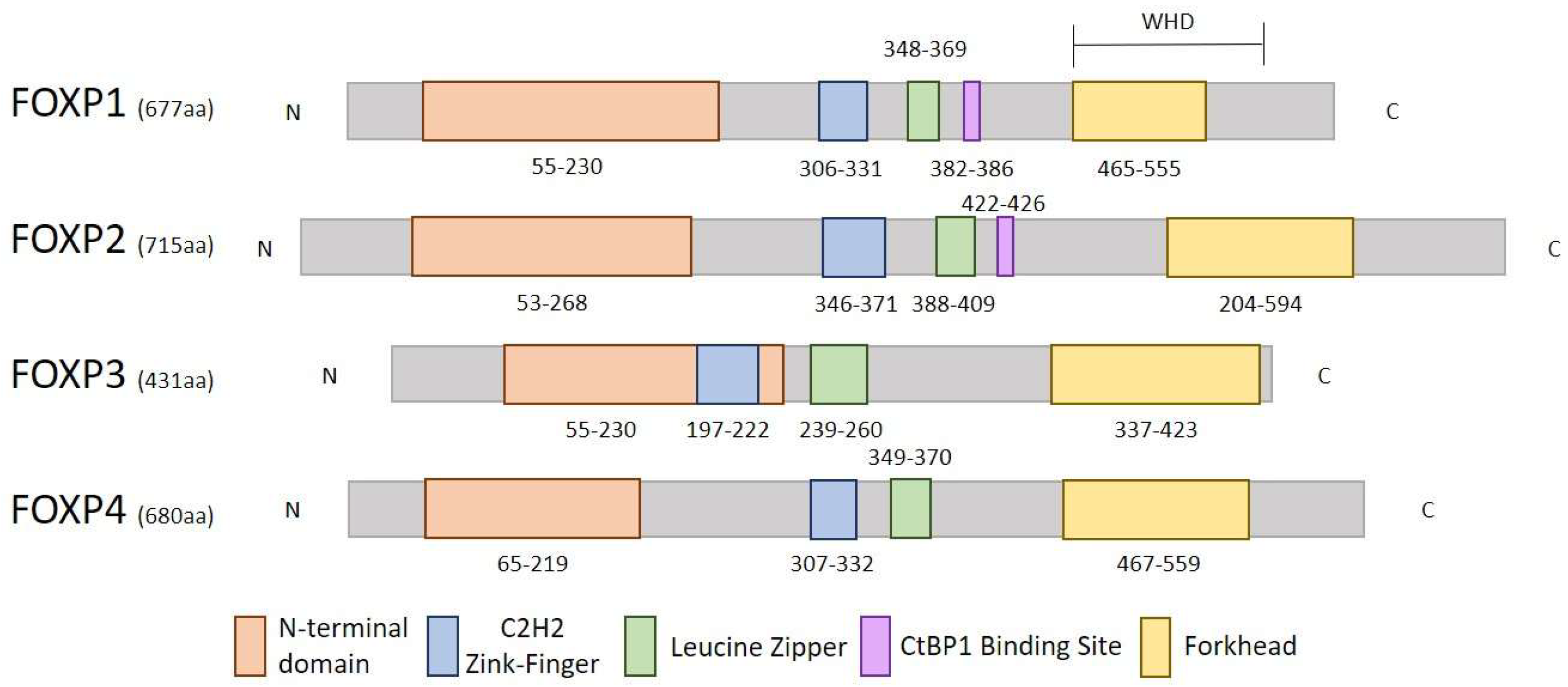
Figure 2.
FOXP3 in thyroid cancer: Oncogenic role of FOXP3 in thyroid cancer progression. FOXP3 primarily acts as an oncogene in thyroid cancer. It upregulates the expression of NF-κB, cyclin D1, and CXCR4, while downregulating PPARγ and caspase-3. In addition, FOXP3 stimulates TGF-β and IL-10 signaling pathways. A higher number of FOXP3 positive lymphocytes in tumor involved lymph nodes, along with increased FOXP3 activity in thyroid cancer, contributes to tumor progression, resistance to radioiodine therapy and reduced overall survival. Tumor progression is characterized by enhanced cell proliferation and migration, suppression of apoptosis and increased invasiveness.
Figure 2.
FOXP3 in thyroid cancer: Oncogenic role of FOXP3 in thyroid cancer progression. FOXP3 primarily acts as an oncogene in thyroid cancer. It upregulates the expression of NF-κB, cyclin D1, and CXCR4, while downregulating PPARγ and caspase-3. In addition, FOXP3 stimulates TGF-β and IL-10 signaling pathways. A higher number of FOXP3 positive lymphocytes in tumor involved lymph nodes, along with increased FOXP3 activity in thyroid cancer, contributes to tumor progression, resistance to radioiodine therapy and reduced overall survival. Tumor progression is characterized by enhanced cell proliferation and migration, suppression of apoptosis and increased invasiveness.
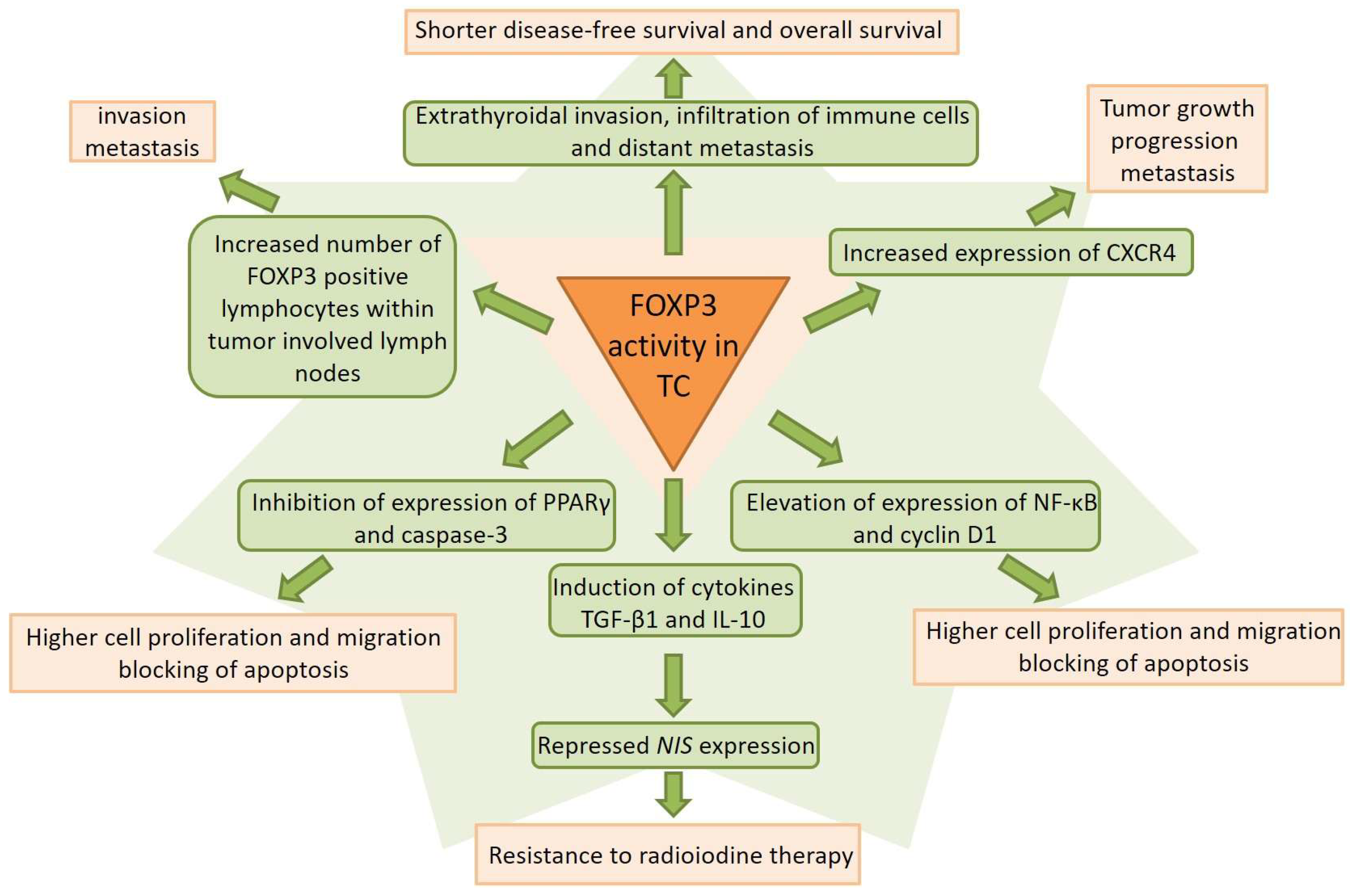
Figure 3.
FOXP4 in thyroid cancer: Oncogenic role of FOXP4 in thyroid cancer progression. FOXP4 functions predominantly as an oncogene in thyroid cancer. Its expression is upregulated through inhibition of miR-4525 by FOXP4-AS1, leading to activation of key oncogenic pathways, including Wnt/β-catenin, Akt–mTOR, and TGF-β signaling, along with inactivation of the tumor suppressor FBXW7. These molecular events collectively promote tumor progression, characterized by increased proliferation, migration, and epithelial–mesenchymal transition (EMT).
Figure 3.
FOXP4 in thyroid cancer: Oncogenic role of FOXP4 in thyroid cancer progression. FOXP4 functions predominantly as an oncogene in thyroid cancer. Its expression is upregulated through inhibition of miR-4525 by FOXP4-AS1, leading to activation of key oncogenic pathways, including Wnt/β-catenin, Akt–mTOR, and TGF-β signaling, along with inactivation of the tumor suppressor FBXW7. These molecular events collectively promote tumor progression, characterized by increased proliferation, migration, and epithelial–mesenchymal transition (EMT).
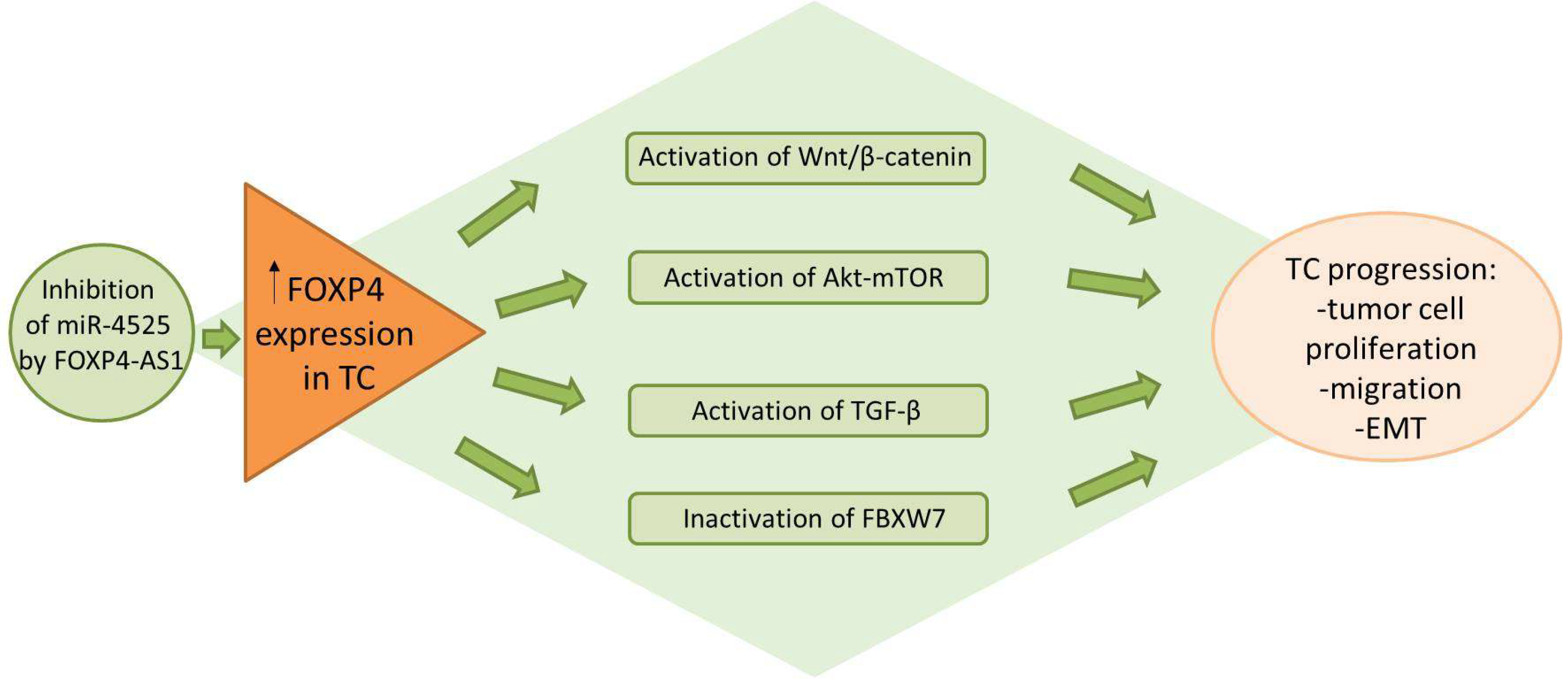
Figure 4.
FOXP2 in thyroid cancer: Dual role of FOXP2 in thyroid cancer: context-dependent oncogenic and tumor-suppressive functions. FOXP2 exhibits a context-dependent role in thyroid cancer, acting as both an oncogene and tumor suppressor. On the oncogenic side, reduced FOXP2 expression mediated by miR-221-3p via the Hedgehog pathway promotes cell proliferation, decreases apoptosis, and enhances tumor invasiveness through activation of PROS1 and MERTK/Wnt/TGF-β signaling. Conversely, FOXP2 exerts tumor-suppressive effects by inhibiting Wnt/β-catenin signaling, leading to decreased expression of β-catenin, c-Myc, and cyclin D1, increased RPS6KA6 expression, reduced cell proliferation, and enhanced apoptosis.
Figure 4.
FOXP2 in thyroid cancer: Dual role of FOXP2 in thyroid cancer: context-dependent oncogenic and tumor-suppressive functions. FOXP2 exhibits a context-dependent role in thyroid cancer, acting as both an oncogene and tumor suppressor. On the oncogenic side, reduced FOXP2 expression mediated by miR-221-3p via the Hedgehog pathway promotes cell proliferation, decreases apoptosis, and enhances tumor invasiveness through activation of PROS1 and MERTK/Wnt/TGF-β signaling. Conversely, FOXP2 exerts tumor-suppressive effects by inhibiting Wnt/β-catenin signaling, leading to decreased expression of β-catenin, c-Myc, and cyclin D1, increased RPS6KA6 expression, reduced cell proliferation, and enhanced apoptosis.
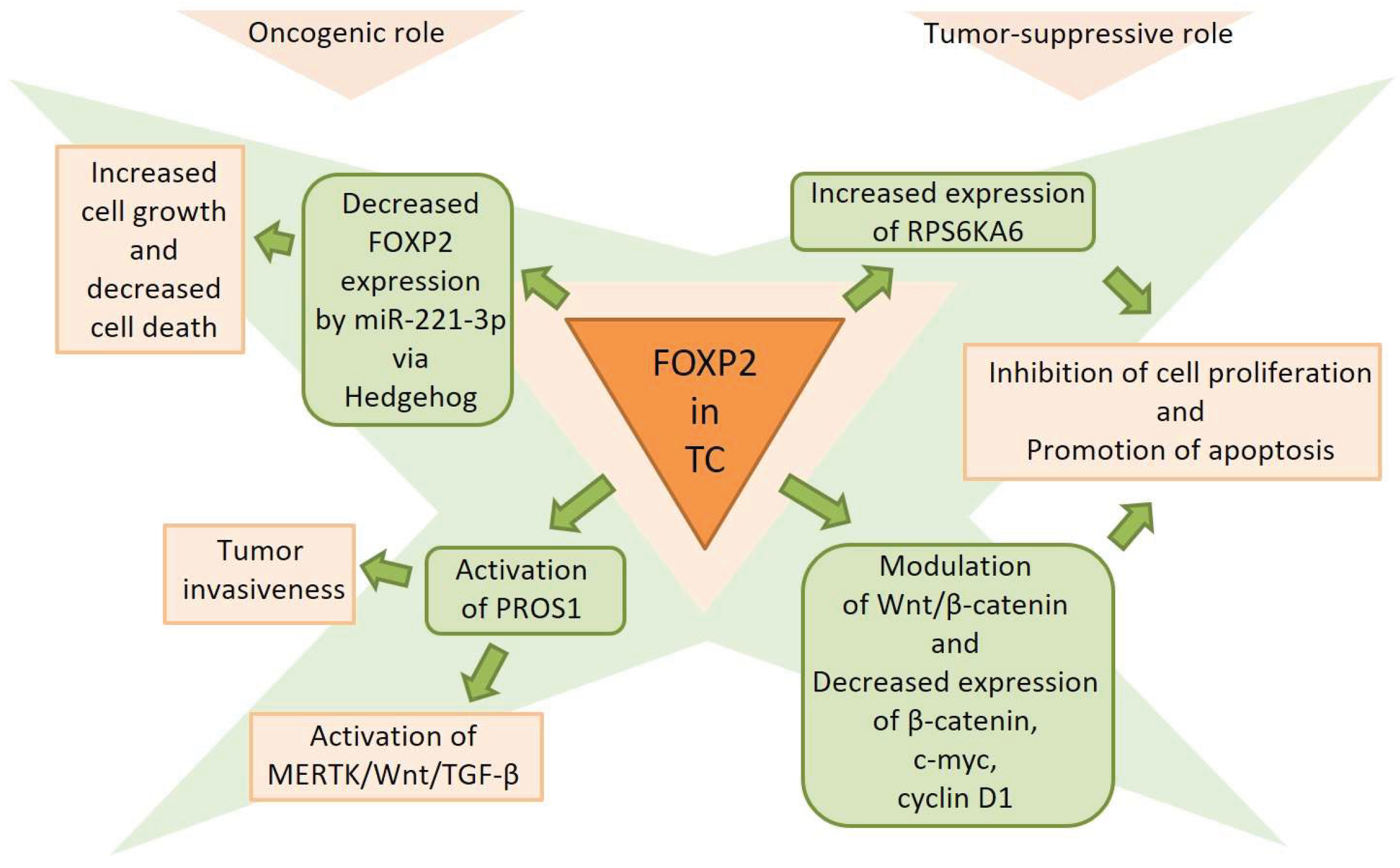
Disclaimer/Publisher’s Note: The statements, opinions and data contained in all publications are solely those of the individual author(s) and contributor(s) and not of MDPI and/or the editor(s). MDPI and/or the editor(s) disclaim responsibility for any injury to people or property resulting from any ideas, methods, instructions or products referred to in the content. |
© 2026 by the authors. Licensee MDPI, Basel, Switzerland. This article is an open access article distributed under the terms and conditions of the Creative Commons Attribution (CC BY) license (http://creativecommons.org/licenses/by/4.0/).
Copyright: This open access article is published under a Creative Commons CC BY 4.0 license, which permit the free download, distribution, and reuse, provided that the author and preprint are cited in any reuse.


