
Submitted:
20 March 2026
Posted:
27 April 2026
You are already at the latest version
Abstract
Mediastinal staging remains a critical step in the management of non-small-cell lung cancer (NSCLC), as it directly impacts treatment planning, surgical decision-making, and overall prognosis. For many years, mediastinoscopy was considered the standard approach; however, in routine practice, less invasive techniques have largely taken its place. Endobronchial Ultrasound (EBUS) and Endoscopic Ultrasound (EUS) have become widely adopted because they allow real-time sampling of lymph nodes with good accuracy and a low complication rate. In clinical seĴings, these techniques are often used together rather than separately, as each provides access to different nodal stations. This combined approach improves diagnostic yield and reduces the number of patients who require surgical staging. At the same time, recent updates in the IASLC TNM classification, including the proposed 9th edition, have introduced more detailed nodal categories, making accurate tissue confirmation even more important in daily practice. In this review, we summarize the current use of combined EBUS and EUS in mediastinal staging, focusing on their practical advantages, limitations, and roles across different clinical scenarios. We also discuss their relevance in the context of molecular testing and evolving treatment strategies. Despite their strengths, there are situations in which negative results should be interpreted with caution and confirmed surgically. Overall, these techniques have reshaped the approach to mediastinal staging and are now central to modern lung cancer care.
Keywords:
non-small-cell lung cancer
; mediastinal staging
; endobronchial ultrasound (EBUS)
; endoscopic ultrasound (EUS)
; EBUS-TBNA
; EUS-FNA
; combined endosonography
; IASLC TNM classification
; lymph node staging
; molecular profiling
Introduction
Mediastinal lymph node staging remains a cornerstone in lung cancer management, influencing treatment selection, surgical candidacy, and prognosis. Traditional surgical staging using mediastinoscopy has historically been considered the gold standard. However, minimally invasive endosonographic techniques have increasingly replaced surgical staging due to their superior diagnostic yield and improved safety profile. Furthermore, combining endobronchial ultrasound-guided transbronchial needle aspiration (EBUS-TBNA) with endoscopic ultrasound-guided fine needle aspiration (EUS-FNA) is better than standard mediastinoscopy because it can biopsy lymph nodes and metastases that mediastinoscopy cannot reach. The European Respiratory Society (ERS) recommends using both EBUS and EUS together, rather than either test alone, for mediastinal staging in lung cancer [1]. The American College of Chest Physicians (ACCP) also recommends EBUS-FNA, EUS-FNA, or both together over surgical staging as the first test for mediastinal staging in non-small-cell lung cancer (NSCLC) [2]. Precise mediastinal staging is essential for the best management of NSCLC.
Simultaneously, continuous refinements of the IASLC TNM staging system have improved anatomic classification and prognostic accuracy. The 8th edition and proposed 9th edition updates introduced more granular tumor size subdivisions, nodal stratification, and expanded metastatic categories, necessitating integration of precise tissue-based staging techniques into clinical workflows.
Indications for Invasive Mediastinal Staging
Current staging recommendations support invasive mediastinal evaluation in patients with:
- Tumors larger than 3 cm
- Centrally located tumors
- PET-positive mediastinal lymph nodes
- Enlarged lymph nodes on CT imaging
- Suspected N1 disease
Patients presenting with small peripheral stage IA tumors and negative imaging findings may be considered for direct surgical resection without the need for invasive mediastinal staging [3].
The ninth edition of the TNM classification for lung cancer introduces an adjustment to the nodal descriptors, specifically subdividing N2 into single-station (N2a) and multi-station (N2b) nodal metastases (see Table 1 and Table 2). Single-station N2 disease is associated with a more favorable prognosis compared to multi-station involvement [4]. This revision has significant implications for clinical practice and underscores the necessity of comprehensive mediastinal staging through a multidisciplinary approach.
Evolution of Mediastinal Staging
Imaging-based staging, computed tomography, and PET-CT provide essential structural and metabolic information but cannot provide a definitive histologic diagnosis. Both modalities demonstrate limited specificity and sensitivity for mediastinal lymph node assessment, particularly in differentiating malignant from inflammatory lymphadenopathy. Consequently, tissue confirmation remains mandatory in many clinical scenarios [3,4,5,6,7,8,9,10,11]. The emergence of Endosonographic Staging, combining Endobronchial and Esophageal ultrasound (EBUS and EUS), has made it the preferred initial minimally invasive staging modality in many centers. These techniques provide real-time ultrasound guidance for nodal sampling and allow access to both mediastinal and selected extrathoracic targets, including adrenal glands, celiac lymph nodes, and the left hepatic lobe. Reported diagnostic performance includes.
Mediastinal Nodal Mapping and Endosonographic Access
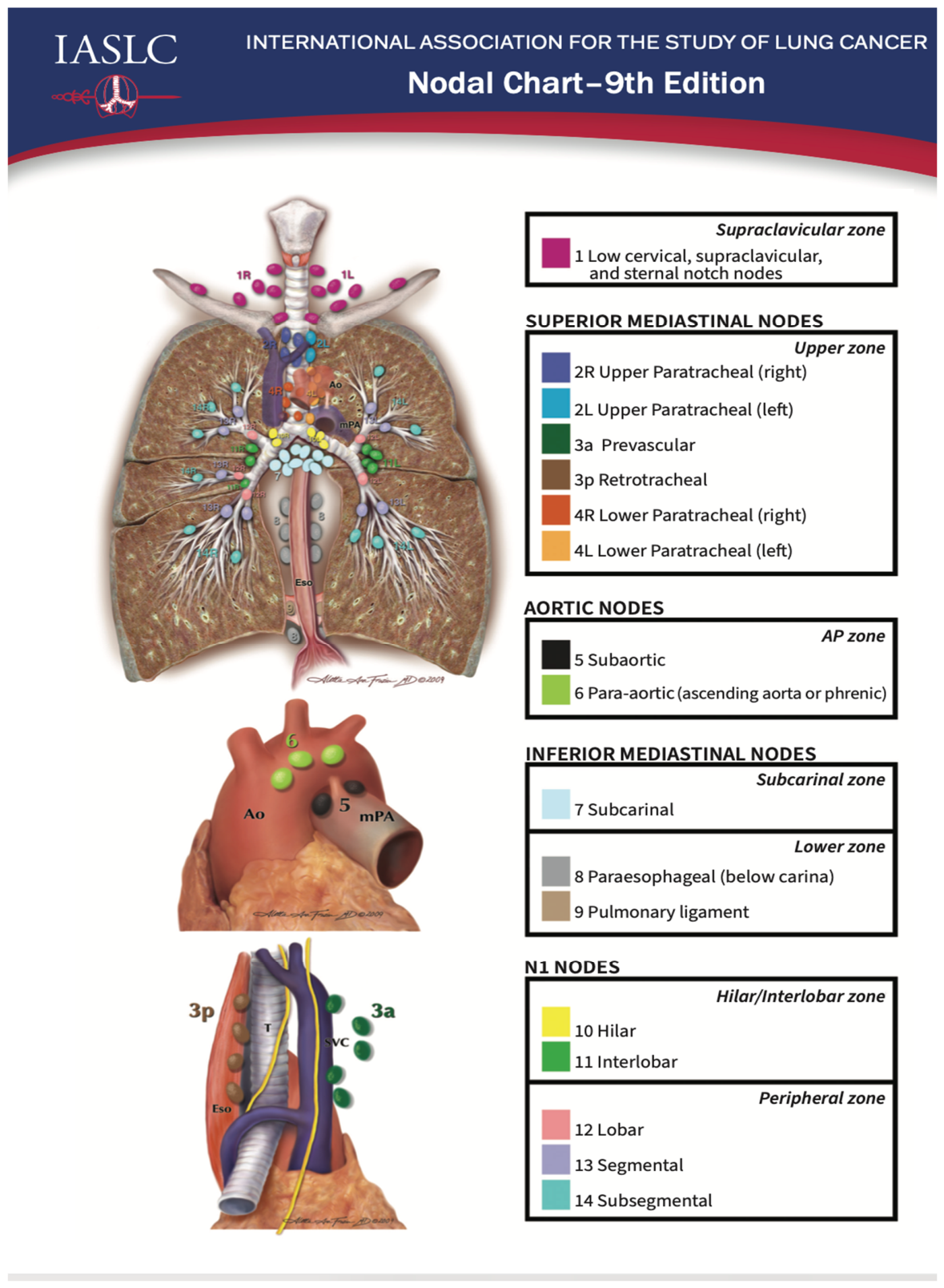
Accurate identification of lymph node stations is essential for standardized and reliable staging. The IASLC nodal map defines mediastinal, hilar, and intrapulmonary lymph node stations and provides a framework for systematic sampling. Evaluating all accessible lymph nodes with both EBUS and EUS can improve diagnostic and staging accuracy. [35].
Stations Accessible by EBUS
The EBUS scope is a flexible echo-bronchoscope that provides a field of view of 50 to 70 degrees and generates images parallel to the shaft. According to ACCP guidelines, EBUS-TBNA is recommended as the preferred initial test for suspected N2 or N3 disease. If results are negative, surgical sampling should be performed for clinically suspicious nodes, and the selection of the initial diagnostic test should depend on the operator’s expertise [2].
EBUS-TBNA allows reliable sampling of upper and lower paratracheal nodes (stations 2R/L and 4R/L), Subcarinal nodes (station 7), Hilar and interlobar nodes (stations 10, 11, and 12).
EUS can also be performed using the EBUS scope (EUS-B FNA) and it improves sensitivity when added to EBUS [20]. EUS can access stations 2L, 4L, #5, #6, #7, 3P, 8R/L, 9R/L, Celiac axis LNS, Right and Left Adrenal Glands. Stations 2R and 2L are also accessible if the nodes are enlarged. Remarkably, Hwangbo and colleagues reported that lymph nodes detected by EUS-B but missed by EBUS were not located in the inferior mediastinum; rather, they were primarily at stations 4L and 5. In this study, EUS was performed using an EBUS bronchoscope (EUS-B approach). In a prospective trial including 150 patients with NSCLC who underwent combined EBUS and EUS-B during the same procedure using a single bronchoscope (instead of a conventional EUS endoscope), the addition of EUS-B increased overall mediastinal staging sensitivity from 82% to 92%.
Importantly, EUS-B provides access to nodal stations that are difficult or inaccessible with EBUS alone, particularly stations 5, 8, and 9, as well as the left adrenal gland, thereby enhancing the completeness and accuracy of mediastinal staging [21].
Stations Accessible by EUS
The linear EUS scope provides a wider field of view than the EBUS scope, offering a 180-degree view. EUS-FNA complements EBUS by enabling access to inferior mediastinal nodes (stations 8 and 9), aortopulmonary window nodes (stations 5 and 6), adrenal glands, celiac axis lymph nodes, and the left hepatic lobe. EUS also facilitates access to smaller station 2L and 4L lymph nodes compared to EBUS. Transesophageal lung biopsy with EUS can be performed during the same procedure and is safe for patients with central tumors near the esophagus [56]. In a study of 138 patients who underwent both EBUS and EUS, EUS was more effective at detecting malignancy at lymph node stations 5, 6, and 7 [57]. For patients with adrenal involvement, a dedicated EUS scope enables evaluation of both mediastinal nodes and adrenal glands in a single procedure. This approach reduces patient discomfort, risk, and costs [58].
EUS has a valuable complementary approach for perimediastinal lung lesions when conventional biopsy methods are infeasible or associated with excessive risk, and it expands the diagnostic capabilities available for individualized lung cancer management. In a retrospective cohort analysis of 55 patients carefully selected with intraparenchymal pulmonary nodules suspicious for malignancy, in whom standard biopsy techniques were either unsuccessful or deemed inappropriate. All procedures were performed using real-time endoscopic ultrasonography with a 22-gauge needle, ensuring precise lesion localization and controlled tissue acquisition. Adequate cytologic or histologic sampling was achieved in 94.5% of cases, with a corresponding diagnostic accuracy and sensitivity of 94.5%, confirming the reliability of this technique, with no procedure-related morbidity, including pneumothorax, pleural effusion, or esophageal complications. [114] Nasir et al. emphasize that EUS-guided lung biopsy is not intended to replace established diagnostic modalities but rather to serve as a complementary tool within a multidisciplinary diagnostic algorithm. Its greatest clinical value lies in high-risk patients, in cases where histologic confirmation is required prior to oncologic therapy.
Advantages of Combined Endosonographic Staging
Combining EBUS and EUS improves mediastinal coverage and diagnostic sensitivity compared with either modality alone. Meta-analytic data demonstrate that sensitivity gains of up to 21% can be achieved when both techniques are employed systematically [1,35]. This comprehensive approach reduces false-negative results and limits the need for confirmatory surgical staging. Comparative studies have demonstrated that combining endobronchial and esophageal ultrasound techniques improves staging performance compared with either modality alone. Reported data indicate an approximate 11% improvement in sensitivity when EBUS-TBNA is integrated with EUS-based sampling for lung cancer staging [34]. In a prospective cohort of 166 patients, outcomes from combined endosonographic staging were compared to mediastinoscopy, with final surgical pathology serving as the reference standard. The combined approach identified advanced nodal or metastatic disease (N2, N3, or M1) in 14% of cases initially classified as negative by mediastinoscopy, thus preventing unnecessary surgical procedures [59]. The diagnostic performance of the combined technique was high, with a sensitivity of 91%, a specificity of 100%, a negative predictive value of 96%, and an overall accuracy of 97%.
Conventional mediastinoscopy mainly accesses paratracheal and subcarinal lymph nodes. However, several important regions—including the paraesophageal, aortopulmonary window, para-aortic, and inferior pulmonary ligament stations—are not routinely reachable with this method [60,61,62,63]. Moreover, the lower part of the subcarinal space may remain inaccessible. Nodal metastases that go unnoticed during mediastinoscopy are most often found in these less accessible areas [64,65].
Complications are uncommon with combined EBUS/EUS mediastinal staging. The overall complication rate is approximately 1–2%, with a reported mortality of 0.04%. Most complications are minor (e.g., transient hypoxia, minor bleeding), while severe adverse events are rare.
In comparison, standard mediastinoscopy carries a higher morbidity, with an overall complication rate of approximately 2–3%. Reported mortality is around 0.08%, most commonly related to major vascular injury or catastrophic bleeding. Therefore, combined endosonographic staging (EBUS/EUS) offers lower morbidity and approximately half the mortality rate compared with mediastinoscopy, while maintaining high diagnostic accuracy.[66,71]
Special Clinical Scenarios
Radiologically Normal Mediastinum
Occult nodal metastases may be present despite normal CT or PET imaging. Combined endosonographic staging improves the detection of subclinical nodal disease and may eliminate the need for surgical staging when results are negative. Herth and colleagues evaluated 100 patients with normal lymph nodes on CT who underwent EBUS for preoperative staging. EBUS identified 19 of 20 occult metastases that were not detected by CT scans [37]. In a separate study by the same group, EBUS-TBNA detected 8 of 9 occult lymph node metastases in 97 patients with PET-negative mediastinum [36]. Shingyoji et al. reported findings from 113 patients who underwent preoperative EBUS staging. Of these, 20 patients (17.6%) had N2 disease, but EBUS-TBNA identified occult disease in only 7 of them [40]. Ong et al. analyzed 220 patients who received preoperative EBUS staging, identifying 49 patients (22%) with occult metastases; EBUS detected 18 (8%) of these 49 cases [38].
Restaging After Neoadjuvant Therapy
Post-treatment fibrosis and necrosis reduce sampling sensitivity [39]. Negative endosonographic findings following induction therapy should be interpreted cautiously and may require surgical confirmation based on the recommendations of European Society of Thoracic Surgeons (ESTS) if clinical management decisions depend on nodal clearance. In a recent study by Cetinkaya et al., 44 patients with 73 lymph nodes were biopsied after neoadjuvant therapy. EBUS-TBNA detected malignant cells in 23 patients (57.5%) and 25 lymph nodes (34.2%). No nodal metastasis was found in 21 patients (42.5%) and 48 lymph nodes (65.8%). All patients with negative EBUS-TBNA results underwent mediastinoscopy (n = 9) or surgery (n = 12). Metastatic involvement was subsequently identified in 5 of 21 patients (23.8%) and 6 of 48 lymph nodes (12.5%). The sensitivity, specificity, positive predictive value, negative predictive value, and overall accuracy of EBUS-TBNA were 82.1%, 100%, 100%, 76.2%, and 88.6%, respectively. Negative EBUS results post-induction should therefore be confirmed with invasive procedures such as mediastinoscopy and/or thoracoscopy [40]. The sensitivity of EUS-FNA for restaging after chemo-radiation is approximately 44% with a false negative rate of 58% [41]. Re-staging should only be performed in cases where it changes surgical management such as in new nodal or contralateral (N3) nodal disease due to progression during induction.
Stereotactic Body Radiation Therapy (SBRT) Planning
EBUS-TBNA plays a critical role in excluding occult N1 disease prior to stereotactic body radiation therapy, leading to stage migration and treatment modification in a substantial proportion of patients. Reported studies showed a stage shift of 16% - 19% in patients considered for SBRT [42,43]
The Role of Endosonography in the Context of Molecular Markers
The amount of tissue sampled is critical, and studies on EBUS have shown promising results [44,45,46,47,48,49,50]. The adequacy of EBUS-TBNA for molecular analysis depends on factors such as sample size, tumor necrosis, nodal micrometastasis, and contamination [51]. Molecular analysis is feasible in most EBUS or EUS samples, with reported success rates between 89% and 98% [52,53,54,55,56,57,58,59]. Obtaining sufficient tissue is essential for PD-L1 testing, which is now standard in the management of NSCLC. Sakakibara and colleagues compared EBUS-TBNA with transbronchial biopsy (TBB) for PD-L1 expression and assessed concordance with surgical specimens. EBUS-TBNA, TBB, surgical specimens, and lymph node metastases generally showed similar PD-L1 positivity rates. EBUS-TBNA was more reliable than TBB in both the number and quality of tumor cells collected [55]. Further studies are needed to confirm the value of endosonography in this context.
Transbronchial cryobiopsy (cryo-EBUS) is emerging as a complementary technique capable of retrieving larger, well-preserved histologic specimens. In a case series done by Genova et al., five consecutive patients with thoracic malignancies or suspected lymphoproliferative disease underwent cryobiopsy for subcarinal node (station 7) and showed better tissue architecture preservation and greater material volume compared to cytology, in 3 out of 5 cases cryo-EBUS provided complete lymphoma histology, larger tissue for molecular profiling in NSCLC and full molecular testing, including PD-L1.
Technical Aspects of the Procedure
All procedures were performed under conscious sedation or general anesthesia following institutional protocol. An initial airway assessment was conducted using white-light bronchoscopy to facilitate mucosal anesthesia and evaluate endobronchial anatomy before ultrasound-guided staging. EBUS was then performed, followed by EUS when additional nodal access was needed [72]. Consistent transducer–wall contact, minimal probe angulation, and continuous suction during needle aspiration helped ensure optimal sonographic image quality. A standardized, step-by-step approach to mediastinal staging was implemented. Sampling began with lymph node stations on the side opposite the primary tumor (N3), followed by ipsilateral mediastinal stations (N2), and then ipsilateral hilar nodes (N1) [73]. The sequence was adjusted in certain cases based on tumor location and procedural findings to reduce the risk of cross-contamination. Mediastinal lymph node stations were defined according to established anatomical landmarks and mapped using both EBUS-guided transbronchial needle aspiration (TBNA) and EUS-guided fine-needle aspiration (FNA) techniques [88].
Highest mediastinal nodes (Station 1) cover the area between the inferior border of the cricoid cartilage and the thoracic inlet, bounded in front by the manubrium and on the sides by the clavicles. Access was obtained bronchoscopically using the midline of the trachea as a reference; the left-sided part was also accessible via the esophagus, but the suggested borders were not visible on EUS.
Upper paratracheal nodes (Station 2) on the right side (2R) were approached along the lateral tracheal wall, guided by the innominate vein above its junction with the superior vena cava. Left-sided nodes (2L) were evaluated relative to the upper margin of the aortic arch, using the trachea as the central landmark.
Prevascular and retrotracheal nodes (Station 3) are subdivided into anterior (3A) and posterior (3P) compartments, extending from the thoracic inlet to the carina. The anterior part, located ventral to the great vessels, was visualized on EBUS but not sampled by EUS due to airway interference. The posterior part, between the trachea and vertebral column, was accessible with both modalities.
Lower paratracheal nodes (Station 4) on the right side (4R) were examined between the lower edge of the innominate vein and the lower border of the azygos vein. Localization was achieved by carefully withdrawing from the right main bronchus while visualizing both the azygos vein and the superior vena cava. Differentiation from station 10R was based on the anatomical relationship to the azygos vein, with N1 nodes located below. Left-sided nodes (4L) were evaluated within the area bounded superiorly by the aortic arch and inferiorly by the left pulmonary artery, adjacent to the ligamentum arteriosum. Visualization was achieved bronchoscopically via the left main bronchus and supplemented by EUS, which identified the descending aorta and its transition to the arch.
Aortopulmonary window (Station 5) nodes in this area were examined lateral to the aortic arch and proximal to the origin of the left pulmonary artery. Boundaries were defined by the inferior surface of the aortic arch above and the upper margin of the left pulmonary artery below.
Figure 1.
IASLC lymph node map (9th edition) illustrating the anatomical distribution of thoracic lymph node stations. The map includes supraclavicular nodes (station 1), superior mediastinal nodes (stations 2R/L, 3a, 3p, 4R/L), aortic nodes (stations 5 and 6), inferior mediastinal nodes (stations 7, 8, and 9), and N1 nodes including hilar and intrapulmonary stations (stations 10–14). This classification provides a standardized framework for the assessment of mediastinal and hilar lymph nodes in lung cancer staging.
Figure 1.
IASLC lymph node map (9th edition) illustrating the anatomical distribution of thoracic lymph node stations. The map includes supraclavicular nodes (station 1), superior mediastinal nodes (stations 2R/L, 3a, 3p, 4R/L), aortic nodes (stations 5 and 6), inferior mediastinal nodes (stations 7, 8, and 9), and N1 nodes including hilar and intrapulmonary stations (stations 10–14). This classification provides a standardized framework for the assessment of mediastinal and hilar lymph nodes in lung cancer staging.
Station 6 lymph nodes are found in front of and to the side of the ascending aorta and aortic arch, below the top edge of the aortic arch, and above its lower edge. These nodes are hard to see with EBUS, but with EUS, we can find them by locating the aortic arch and scanning around it, looking through and above the arch [74]. Newer methods now allow biopsies of lymph nodes in stations 5 and 6, either by crossing the aorta or not, using EUS or EBUS [75,76]. See Figure 2 for reference.
The subcarinal compartment (station 7) is anatomically bounded by the left lower lobe bronchus superiorly on the left and the bronchus intermedius inferiorly on the right. Access is achieved through either bronchial or esophageal routes, with the scope’s direction adjusted according to the chosen approach. In practice, sampling is most commonly performed using the esophageal technique. After inserting the echoendoscope, gradual withdrawal allows visualization of adjacent cardiac and vascular structures, including the left atrium and pulmonary artery. Controlled rotation of the probe aligns the imaging plane with the subcarinal space. Special caution is needed during needle advancement due to its proximity to the pericardium.
Stations 8 and 9 are assessed along the inferior mediastinum in relation to pulmonary venous anatomy and the diaphragm. Station 8 is located in a paraesophageal position between the superior and inferior pulmonary veins, extending upward to the level of the subcarinal bronchi and downward to the diaphragm. Further down, station 9 is situated within the pulmonary ligament, bounded above by the inferior pulmonary vein and below by the diaphragm. Endoscopic orientation depends on sequentially visualizing mediastinal landmarks during controlled withdrawal within the esophagus, with the superior pulmonary vein serving as a key reference point.
Hilar nodal groups are accessed via bronchoscopy. On the right, station 10R is evaluated from the main bronchus just before the upper lobe bronchus, using the azygos vein as the main landmark to define its upper boundary. On the left, station 10L is encountered along the main bronchus beneath the pulmonary artery. Interlobar nodes (station 11) are examined at the level of the secondary carina, which corresponds to the bifurcation of the lobar bronchi on each side.
Evaluation of extrathoracic sites is conducted using the esophageal approach to improve staging completeness. The left adrenal gland is visualized from the gastric position by first identifying the left kidney and spleen; it usually appears as a curved structure located above the kidney. To assess the right adrenal gland, the scope is advanced into the duodenum beyond the pylorus, then the right kidney is located, and the scope is gradually withdrawn to expose the gland superiorly. The celiac axis is evaluated by tracing the abdominal aorta to its first major anterior branch, and the surrounding lymphatic tissue in this area is examined for potential metastatic spread.
A structured sequence has been suggested to help acquire endosonographic skills. For bronchoscopic ultrasound, a common progression includes stations 4L, 7, 10L, 10R, the azygos vein, and 4R. In the esophageal approach, orientation typically begins with the left lobe of the liver and descending aorta, then moves to the left adrenal gland, followed by mediastinal stations such as 7, 4L, and 4R [77].
To puncture a lymph node, advance the needle quickly. Hold the needle with the thumb pointing down to control its movement. Once inside the node, move the needle in and out, ensuring to see the needle moving within the lymph node rather than moving the node itself. Take two samples without suction to minimize blood contamination. Collect a third sample using negative-pressure suction for cell block, histology, and molecular analysis. This is one approach; there is no strong evidence supporting suction, and a slow-pull method may also be used. [77]
Procedure Competency
Effective training in mediastinal endosonography should include learning anatomy, practicing on simulators, and performing supervised procedures. Outcomes are highly operator-dependent, and learning rates vary. Training exclusively on real patients is not ideal, as it can prolong procedures, increase sedation requirements, and raise complication rates [78]. The standard approach is first to learn the six EBUS and EUS landmarks, practice locating them in sequence, and then perform supervised procedures on patients [79,80].
Professional societies, including the American Thoracic Society, the European Respiratory Society, and the American College of Chest Physicians, recommend performing at least 40 procedures to achieve competency and at least 20 cases annually to maintain proficiency [81,82]. Technical skills improve with increased procedural experience, especially after about 140 procedures [83,84,85]. These guidelines highlight differences in staging performance among various practitioner groups. Interventional pulmonologists demonstrate greater accuracy compared to general pulmonologists and trainees. In a study by Miller et al., interventional specialists correctly staged 95.5% of cases, while generalists and fellows achieved rates of 44.4% and 30.0%, respectively (p < 0.001). Additionally, researchers have examined the agreement between perceived competence and actual performance. Interventional pulmonologists showed the highest level of agreement, whereas less experienced groups exhibited lower concordance levels [86].
Regarding the use of ROSE (Rapid Onsite Evaluation), which is a specialized, real-time diagnostic procedure where a cytopathologist or trained professional examines cytologic samples immediately during a needle aspiration biopsy (FNA), it has not been shown to improve diagnostic yield [87,88]. However, if available, ROSE can reduce the number of needle passes and the number of slides prepared during the procedure. ROSE may also help improve technique and reduce the number of procedures [89]. Chen and colleagues completed an extensive review of 27 studies, finding that ROSE is notably better than standard sampling methods. Physicians using ROSE are able to obtain consistently higher-quality tissue, which helps them diagnose conditions more accurately and increases the likelihood of properly detecting cancer. For instance, ROSE raised the proportion of usable samples by 12%, boosted overall diagnostic accuracy by 14%, and upped the sensitivity for identifying cancer by 10%.
ROSE also typically means fewer needle insertions are needed to collect sufficient tissue, making it less unpleasant for patients. Importantly, it doesn’t extend procedure times or raise complication rates—both remain unchanged.
Results from ROSE align remarkably well with final lab diagnoses, showing a 97% concordance. This reliability lets clinicians make immediate decisions with confidence. These benefits are greatest for people with solid lung tumors or suspected lung cancer, though they’re less significant in lymph node evaluations or similar scenarios.
Additionally, ROSE allows for the collection of samples suitable for further tests, such as those needed for personalized lung cancer therapies. Overall, the current research strongly supports ROSE as a valuable option in cases where fast, precise results and high-quality specimens really matter.
A comparative study of cytology slides and cell block preparations demonstrated high diagnostic performance, with similar results observed for both methods. The combination of cytology slides with either core tissue or cell block achieved the highest diagnostic performance, although these approaches required greater resources. The diagnostic yield and accuracy for each preparation method are as follows [90]:
- Cytology slides: 81%, 80%
- Cell-block: 48%, 33%
- Core-tissue: 87%, 99%
- Cytology slides + core-tissue: 80%, 100%
- Cytology slides + cell-block: 86%, 100%
Comparative studies have reported similar specimen adequacy and overall diagnostic yield for 21G and 22G needles in EBUS-TBNA. Some evidence suggests that, when rapid onsite evaluation (ROSE) is available, using a 21G needle may decrease the number of passes needed [91]. Larger-caliber needles have also been linked to improved diagnostic performance in certain situations, including higher detection rates for benign disease (83% vs. 60%) and greater accuracy in histologic subtyping of non-small cell lung cancer (88% vs. 65%) compared to 22G needles [92]. In EUS-guided sampling of solid lesions adjacent to the gastrointestinal tract, current data have not shown a significant difference in diagnostic accuracy between fine-needle aspiration and fine-needle biopsy [93]. Emerging evidence further indicates that 19G EBUS needles may offer technical advantages, including easier maneuverability, an acceptable safety profile, and potentially higher diagnostic yield [94].
Prospective randomized controlled trials have demonstrated no benefit of suction compared to non-suction during needle aspiration, with no observed difference in diagnostic yield or specimen adequacy [95]. Data remain insufficient regarding the impact of suction versus non-suction on the acquisition of molecular markers in NSCLC. For mediastinal staging of potentially operable NSCLC using EBUS-TBNA, optimal results are achieved with three passes per lymph node station, as the diagnostic yield plateaus after three passes [96].
Lymph node characteristics that suggest, but do not definitively indicate, malignancy include round shape, heterogeneous appearance, distinct margins, and the presence of a coagulative necrosis sign [97]. Heterogeneous features are more predictive of malignancy than other characteristics [98]. However, no LN feature can definitively confirm or rule out malignancy. These signs may be particularly useful when multiple LNs are present within the same station, particularly if their size is below the usual cutoff values (e.g., <5 mm) [99]. Color Doppler imaging may also help in choosing the most appropriate target. In particular, vascular patterns such as the bronchial artery inflow sign can help direct needle placement toward nodes that are more suspicious during EBUS-TBNA. Prospective studies suggest that this approach may improve sampling accuracy [100]. reported sensitivity, specificity, positive predictive value, negative predictive value, and diagnostic accuracy of the bronchial artery flow sign using color Doppler as 0.93, 0.64, 0.84, 0.6, and 0.81, respectively. EBUS elastography also helps differentiate benign from malignant lymph nodes. In a prospective study by Sun et al. [101], which included 56 patients with 68 LNs (33 benign and 35 malignant), elastography distinguished benign from malignant LNs with high accuracy. Sensitivity, specificity, positive predictive value, negative predictive value, and accuracy for benign versus malignant LNs were 85.71, 81.82, 83.33, 84.38, and 83.82%, respectively, compared to 91.43, 72.73, 78.05, 88.89, and 82.35%, respectively. Ultrasonographic features of lymph nodes can provide additional clues regarding malignancy. The Canada Lymph Node Score (CLNS) was developed as a simple, weighted, evidence-based score to predict malignancy at the time of EBUS based on real-time ultrasound characteristics.
CLN Score Components (1 point each and a maximum score of 4) (Figure 3)
- Short-axis diameter ≥10 mm
- Well-defined margins
- Absence of central hilar structure
- Presence of central necrosis
Hanna et al. published a prospective multicenter Canadian study including 140 patients with suspected or confirmed lung or esophageal cancer; 300 mediastinal lymph nodes were evaluated with 12 expert raters across 7 centers, and pathology was used as the gold standard. A cut-off score of ≥ 3 was used to calculate sensitivity, specificity, negative predictive value, and positive predictive value, and showed 31.5%, 96.3%, 65.4%, and 86.5%, respectively.
CLNS is a highly specific tool that helps rule in malignancy and identify which lymph nodes may need repeat biopsy or mediastinoscopy when initial sampling is inconclusive. It can also guide clinicians on prioritizing lymph nodes for biopsy. However, due to lower sensitivity, it should not replace pathological diagnosis.[117]
Endosonography in Lymphoma, Sarcoidosis and Infections
The sensitivity of EBUS in diagnosing lymphoma ranges from approximately 57% to 61%. The value of EBUS-TBNA in diagnosing lymphoma remains a subject of debate. While EBUS-TBNA can serve as the initial diagnostic modality for lymphomas, its diagnostic yield is low, especially for suspected new cases, particularly Hodgkin’s lymphoma. Negative results from EBUS-TBNA do not rule out lymphoma. Therefore, further interventions such as mediastinoscopy should be considered for patients with a high suspicion of disease following negative or non-diagnostic endosonography [102,106].
A large retrospective study done by Dayan et al. evaluated the effectiveness of endosonography as a first-line diagnostic test for suspected mediastinal lymphoma. Over a ten-year period, 444 patients with suspicious mediastinal lymphadenopathy underwent EBUS, EUS, or combined procedures. Lymphoma was ultimately diagnosed in 77 patients. About 88% of lymphoma cases were successfully diagnosed using endosonographic biopsy alone, avoiding the need for surgery. When adequate samples were obtained, diagnostic sensitivity reached approximately 92%, with very high specificity and predictive value. Additionally, the technique allowed accurate subtype classification in nearly 90% of cases, including both Hodgkin and non-Hodgkin lymphomas. The highest sensitivity was observed in low-grade non-Hodgkin lymphomas. The combined use of EBUS and EUS provided the best diagnostic yield, likely because it allowed access to more lymph node stations. The study also highlighted the importance of ancillary studies like flow cytometry, immunohistochemistry, and molecular testing in improving diagnostic accuracy. [116]
Another study investigated the role of transbronchial lung cryobiopsy (cryo-TBB) as a diagnostic tool for pulmonary lymphoproliferative disorders. Cryobiopsy is a bronchoscopic technique that freezes lung tissue before extraction, allowing retrieval of larger and better-preserved specimens. Researchers retrospectively reviewed 970 cryobiopsies performed over seven years and identified 13 cases involving lymphoproliferative disorders.
The results demonstrated a high diagnostic success rate. In 12 out of 13 cases, a precise pathological diagnosis was achieved using cryobiopsy combined with immunohistochemistry and molecular testing. Only one case remained inconclusive, and even a subsequent surgical biopsy failed to clarify it. Importantly, cryobiopsy samples were large enough for advanced analyses such as fluorescence in situ hybridization (FISH) and immunophenotyping. Instant freezing did not damage tissue quality or interfere with molecular studies. [115]
Both cryobiopsy and endosonography represent major progress in minimally invasive lymphoma diagnostics. They deliver high diagnostic accuracy, near-zero for major complication rates, and strong capability for molecular and immunophenotypic analysis. When performed in experienced centers, these methods should be considered first-line diagnostic strategies before surgical biopsy.
Endosonography is very effective for diagnosing granulomas in people with sarcoidosis. In these cases, imaging typically shows clusters of lymph nodes symmetrically arranged around large blood vessels. The structure of the lymph nodes is generally maintained, and a hilum is visible. Endosonography is more sensitive and accurate than simple mucosal biopsies, whether or not a blind transbronchial puncture is used. A pooled analysis found that EBUS-TBNA had 84% sensitivity and 100% specificity for diagnosing sarcoidosis [108]. Combined EBUS/EUS endosonography is also more accurate (80%) than conventional bronchoscopic biopsies (53%) in these patients [109].
EBUS-TBNA shows 70% sensitivity, 97.2% specificity, and 89.9% accuracy for diagnosing tuberculosis in hilar and mediastinal lymph nodes, based on cytology or histology of caseating granulomas [110]. It also has a higher diagnostic yield than cTBNA for histoplasmosis [111].
A study of 43 HIV-positive patients with mediastinal lymphadenopathy found that combining bronchoalveolar lavage (BAL) with transbronchial biopsy (TBB) gave a 69.8% diagnostic yield. BAL with EBUS-TBNA had an 86% yield, and TBB with EBUS-TBNA reached 88.4%. Tuberculosis was the most common diagnosis, and EBUS-TBNA was more accurate than BAL [112].
Fine-needle aspiration cytology (FNA) is increasingly used to diagnose infections, especially as more patients are immunocompromised. Endosonographic FNA is often the first test when clinical and imaging findings suggest an infectious lesion that can be reached with these methods. However, great care is needed when aspirating mediastinal cysts, since using transbronchial or transesophageal routes can introduce infection. Duplication and foregut cysts have unique echoendoscopic features, including multilayered walls and anechoic contents. If these cysts are uncomplicated, they can usually be diagnosed without a biopsy or its risks.
Newer Thin Convex EBUS
In a recent ex-vivo human lung study, the newer thin convex probe EBUS (with a 5.9mm tip) demonstrated improved reach and a higher success rate compared to the standard convex probe EBUS. It achieved an average maximum reach of 22.1mm and a further endoscopic visibility range of 10.3mm. This enhanced miniaturized EBUS probe could selectively assess almost all segmental bronchi, with 98% of the right and 91% of the left segments being accessible. This significantly surpasses the accessibility of the conventional convex probe EBUS, which could only reach 48% of the right and 47% of the left segments. This advancement allows for more precise assessment of N1 nodes and potentially identifies intrapulmonary lesions that are normally inaccessible to the conventional convex probe EBUS with no difficulty in needle deployment or sampling. [113]. As N1 staging has become more important in the era of preoperative induction therapy in NSCLC, these thinner scopes are becoming vital to clinical decision making.
Conclusion
Combined endosonographic techniques (EBUS/EUS) have surpassed conventional mediastinoscopy as the most effective initial test for staging non-small cell lung cancer. Compared with mediastinoscopy, EBUS and EUS are associated with reduced procedural morbidity, shorter recovery time, and lower overall healthcare costs.
The combined EBUS-EUS technique offers superior sensitivity and negative predictive value, allowing for the sampling of multiple stations and distant metastases, including structures below the diaphragm. This makes it the future gold standard in staging non-small cell lung cancer when performed by an experienced operator. It is important to note that EBUS and EUS should not be viewed as competitive techniques but rather as complementary approaches.
The choice of the best minimally invasive approach should be based on the available resources and expertise. In patients with suspicious lymph nodes detected on either CT or PET scans, negative endosonography should be surgically confirmed.
Author Contributions
Conceptualization, Omar Alkathiri and Moishe Liberman; methodology, Omar Alkathiri; investigation, Omar Alkathiri; writing—original draft preparation, Omar Alkathiri; writing—review and editing, Omar Alkathiri and Moishe Liberman; supervision, Moishe Liberman. All authors have read and agreed to the published version of the manuscript.
Data Availability Statement
Data sharing is not applicable to this article as no new data were created or analyzed in this study.
References
- Peter Vilmann 1, Paul Frost Clementsen 2, Sara Colella 3, Mette Siemsen 4, Paul De Leyn 5, Jean-Marc Dumonceau 6, Felix J Herth 7, Alberto Larghi 8, Enrique Vazquez-Sequeiros 9, Cesare Hassan 8, Laurence Crombag 10et al. Combined endobronchial and esophageal endosonography for the diagnosis and staging of lung cancer ... Endoscopy 2015; 47: 545–559.
- Gerard A Silvestri 1, Anne V Gonzalez 2, Michael A Jantz 3, Mitchell L Margolis 4, Michael K Gould 5, Lynn T Tanoue 6, Loren J Harris 7, Frank C Detterbeck 8vMethods for staging non-small cell lung cancer: Diagnosis and management of lung cancer, 3rd ed: American College of Chest Physicians evidence-based clinical practice guidelines. Chest 2013;143(5): e211s-50s.
- W De Wever 1, S Ceyssens, L Mortelmans, S Stroobants, G Marchal, J Bogaert, J A Verschakelen Additional value of PET-CT in the staging of lung cancer: comparison with CT alone, PET alone and visual cor- relation of PET and CT. Eur Radiol 2007;17(1):23–32.
- Silvestri GA, Gould MK, Margolis ML. American College of Chest Physicians. Non-invasive staging of nonsmall cell lung cancer: ACCP evidenced based clinical practice guidelines (2nd edition). Chest 2007;132(3):178S–201S.
- Dales RE, Stark RM, Raman S. Computed tomography to stage lung cancer. Approaching a controversy using meta-analysis. Am Rev Respir Dis 1990;141(5.1):1096–101.
- Lardinois D, Weder W, Hany TF. Staging of non- small-cell lung cancer with integrated positron- emission tomography and computed tomography. N Engl J Med 2003;348(25):2500–7.
- Robert James Cerfolio 1, Ayesha S Bryant, Buddhiwardhan Ojha, Mohammad Eloubeidi. Improving the inaccuracies of clinical staging of patients with NSCLC: a prospective trial. Ann Thorac Surg 2005; 80(4):1207–13.
- McLoud TC, Bourgouin PM, Greenberg RW. Bronchogenic carcinoma: analysis of staging in the mediastinum with CT by correlative lymph node mapping and sampling. Radiology 1992;182(2): 319–23.
- K G Tournoy 1, S Maddens, R Gosselin, G Van Maele, J P van Meerbeeck, A Kelles. Integrated FDG-PET/CT does not make invasive staging of the intrathoracic lymph nodes in non- small cell lung cancer redundant: a prospective study. Thorax 2007;62(8):696–701.
- Toloza EM, Harpole L, McCrory DC. Noninvasive staging of non-small cell lung cancer: a review of the current evidence. Chest 2003;123(1):137S–46S.
- Silvestri GA, Hoffman B, Reed CE. Choosing between CT, positron emission tomography, endoscopic ultrasound with fine-needle aspiration, transbronchial needle aspiration, thoracoscopy, mediastinoscopy, and mediastinotomy for staging lung cancer. Chest 2003;123(2):333–5.
- Ping Gu 1, Yi-Zhuo Zhao, Li-Yan Jiang, Wei Zhang, Yu Xin, Bao-Hui Han Endobronchial ultrasound-guided transbronchial needle aspiration for staging of lung cancer: a systematic review and meta-analysis. Eur J Cancer 2009;45(8): 1389-96.
- Kazuhiro Yasufuku 1, Andrew Pierre, Gail Darling, Marc de Perrot, Thomas Waddell, Michael Johnston, Gilda da Cunha Santos, William Geddie, Scott Boerner, Lisa W Le, et al. A prospective controlled trial of endobronchial ultrasound-guided transbronchial needle aspiration compared with me- diastinoscopy for mediastinal lymph node staging of lung cancer. J Thorac Cardiovasc Surg 2011;142(6): 1393–400.
- Kazuhiro Yasufuku 1, Masako Chiyo, Yasuo Sekine, Prashant N Chhajed, Kiyoshi Shibuya, Toshihiko Iizasa, Takehiko Fujisawa. Real-time endobronchial ultrasound-guided transbronchial needle aspiration of mediastinal and hilar lymph no- des. Chest 2004;126(1):122–8.
- M Krasnik 1, P Vilmann, S S Larsen, G K Jacobsen Preliminary experience with a new method of endoscopic trans- bronchial real time ultrasound guided biopsy for diagnosis of mediastinal and hilar lesions. Thorax 2003;58(12):1083–6.
- R C Rintoul 1, K M Skwarski, J T Murchison, W A Wallace, W S Walker, I D Penman Endobronchial and endoscopic ultrasound-guided real-time fine-needle aspiration for mediastinal staging. Eur Respir J 2005;25(3):416–21.
- Kazuhiro Yasufuku 1, Masako Chiyo, Eitetsu Koh, Yasumitsu Moriya, Akira Iyoda, Yasuo Sekine, Kiyoshi Shibuya, Toshihiko Iizasa, Takehiko Fujisawa. Endobronchial ultrasound guided transbronchial needle aspiration for staging of lung cancer. Lung Cancer 2005; 50(3):347–54.
- F J F Herth 1, R Eberhardt, P Vilmann, M Krasnik, A Ernst. Real-time endobronchial ultrasound guided transbronchial needle aspiration for sampling mediastinal lymph nodes. Thorax 2006;61(9):795–8.
- Kazuhiro Yasufuku 1, Takahiro Nakajima, Ken Motoori, Yasuo Sekine, Kiyoshi Shibuya, Kenzo Hiroshima, Takehiko Fujisawa. Compari- son of endobronchial ultrasound, positron emission tomography, and CT for lymph node staging of lung cancer. Chest 2006;130(3):710–8.
- Felix J F Herth 1, Mark Krasnik, Nicolas Kahn, Ralf Eberhardt, Armin Ernst. Combined endoscopic-endobronchial ultrasound-guided fine-needle aspiration of mediastinal lymph nodes through a single bronchoscope in 150 patients with suspected lung cancer. Chest 2010; 138(4):790-4.
- Masahide Oki 1, Hideo Saka 2, Masahiko Ando 3, Rie Tsuboi 2, Masashi Nakahata 2, Saori Oka 2, Yoshihito Kogure 2, Chiyoe Kitagawa 2. Transbronchial versus transesophageal needle aspiration using an ultrasound bronchoscope for the diagnosis of mediastinal lesions: a randomized study. Chest 2014; 147(5): 1259-66.
- Bin Hwangbo 1, Geon-Kook Lee, Hee Seok Lee, Kun-Young Lim, Soo-Hyun Lee, Hyae-Young Kim, Hyun Sung Lee, Moon Soo Kim, Jong Mog Lee, Byung-Ho Nam, Jae Ill Zo. Transbronchial and transesophageal fine-needle aspiration using an ultrasound bronchoscope in mediastinal staging of potentially operable lung cancer. Chest 2010;138(4):795-802.
- Kurt G Tournoy 1, Frederic De Ryck, Lieve R Vanwalleghem, Frank Vermassen, Marleen Praet, Joachim G Aerts, Georges Van Maele, Jan P van Meerbeeck. Endoscopic ultrasound reduces surgical mediastinal staging in lung cancer: a randomized trial. Am J Respir Crit Care Med 2008;177(5): 531-5.
- Larsen SS, Krasnik M, Vilmann P. Endoscopic ultrasound guided biopsy of mediastinal lesions has a major impact on patient management. Thorax 2002;57: 98-103.
- Fritscher-Ravens A, Soehendra N, Schirrow L. Role of transesophageal endosonography-guided fine-needle aspiration in the diagnosis of lung cancer. Chest 2000;117:339-45.
- Wiersema MJ, Vazquez-Sequeiros E, Wiersema LM. Evaluation of mediastinal lymphadenopathy with endoscopic US-guided fine-needle aspiration biopsy. Radiology 2001;219:252-7.
- Wallace MB, Silvestri GA, Sahai AV. Endoscopic ultrasound-guided fine needle aspiration for staging patients with carcinoma of the lung. Ann Thorac Surg 2001;72:1861-7.
- M Giovannini 1, J F Seitz, G Monges, H Perrier, I Rabbia. Fine-needle aspiration cytology guided by endoscopic ultrasonography: Results in 141 patients. Endoscopy 1995;27:171-7.
- Micames CG, McCrory DC, Pavey DA. Endoscopic ultrasound-guided fine-needle aspiration for non-small cell lung cancer staging: A systematic review and metaanalysis. Chest 2007;131:539-48.
- Puli SR, Batapati Krishna Reddy J, Bechtold ML. Endoscopic ultrasound: It’s accuracy in evaluating mediastinal lymphadenopathy? A meta-analysis and systematic review. World J Gastroenterol 2008;14:3028-37.
- Frank C Detterbeck 1, Michael A Jantz, Michael Wallace, Johan Vansteenkiste, Gerard A Silvestri; . American College of Chest Physicians. Invasive mediastinal staging of lung cancer: ACCP evidence-based clinical practice guidelines (2nd edition). Chest 2007; 132(Suppl 3):202S–20S.
- Z T Hammoud 1, R C Anderson, B F Meyers, T J Guthrie, C L Roper, J D Cooper, G A Patterson. The current role of mediastinoscopy in the evaluation of thoracic disease. J Thorac Cardiovasc Surg 1999; 118(5):894–9.
- Anthony Lemaire 1, Ivana Nikolic, Thomas Petersen, Jack C Haney, Eric M Toloza, David H Harpole Jr, Thomas A D’Amico, William R Burfeind. Nine-year single center experience with cervical mediastinoscopy complications and false negative rate. Ann Thorac Surg 2006;82(4):1185–9.
- Sahajal Dhooria 1, Ashutosh N Aggarwal 1, Dheeraj Gupta 1, Digambar Behera 1, Ritesh Agarwal 2. Utility and Safety of Endoscopic Ultrasound With Bronchoscope-Guided Fine-Needle Aspiration in Mediastinal Lymph Node Sampling: Systematic Review and Meta-Analysis. Respir Care. 2015 Jul; 60(7):1040-50.
- Christophe Dooms 1, Kurt G Tournoy 2, Olga Schuurbiers 3, Herbert Decaluwe 4, Frédéric De Ryck 5, Ad Verhagen 6, Roel Beelen 7, Erik van der Heijden 8, Paul De Leyn 4. Endosonography for mediastinal nodal staging of clinical N1 non-small cell lung cancer: a prospective multicenter study. Chest. 2015 Jan; 147(1):209-215.
- Herth FJ, Eberhardt R, Krasnik M, Ernst A. Endobronchial ultrasound-guided transbronchial needle aspiration of lymph nodes in the radiologically and positron emission tomography-normal mediastinum in patients with lung cancer. Chest. 2008 Apr;133(4):887-91.
- Herth FJ, Ernst A, Eberhardt R, Vilmann P, Dienemann H, Krasnik M. Endobronchial ultrasound-guided transbronchial needle aspiration of lymph nodes in the radiologically normal mediastinum. Eur Respir J. 2006 Nov; 28(5):910-4.
- Ong P, Grosu H, Eapen GA, Rodriguez M, Lazarus D, Ost D, Jimenez CA, Morice R, Bandi V, Tamara L, Cornwell L, Green L, Zhu A, Casal RF. Endobronchial ultrasound-guided transbronchial needle aspiration for systematic nodal staging of lung cancer in patients with N0 disease by computed tomography and integrated positron emission tomography-computed tomography. Ann Am Thorac Soc. 2015 Mar; 12(3):415-9.
- Felix J F Herth 1, Jouke T Annema, Ralf Eberhardt, Kazuhiro Yasufuku, Armin Ernst, Mark Krasnik, Robert C Rintoul. Endobronchial ultrasound with transbronchial needle aspiration for restaging the mediastinum in lung cancer. J Clin Oncol 2008; 26(20):3346-50.
- Cetinkaya E, Usluer O, Yılmaz A, Tutar N, Çam E, Özgül MA, Demirci NY. Is endobronchial ultrasound-guided transbronchial needle aspiration an effective diagnostic procedure in restaging of non-small cell lung cancer patients? Endosc Ultrasound. 2017 May-Jun;6(3):162-167.
- Martin B von Bartheld 1, Michel I M Versteegh, Jerry Braun, Luuk N A Willems, Klaus F Rabe, Jouke T Annema. Transesophageal ultrasound-guided fine-needle aspiration for the mediastinal restaging of non-small cell lung cancer. J Thorac Oncol 2011;6:1510-15.
- Devadatta Sarwate 1, Saiyad Sarkar, William S Krimsky, Constantine M Burgan, Kalpesh Patel, Ruth Evans, Daniel P Harley. Optimization of mediastinal staging in potential candidates for stereotactic radiosurgery of the chest. J Thorac Cardiovasc Surg 2012; 144(1):81-6.
- Vial MR, Khan KA, O’Connell O, Peng SA, Gomez DR, Chang JY, Rice DC, Mehran R, Jimenez CJ, Grosu HB, Ost DE, Eapen GA. Vial MR, Khan KA, O’Connell O, Peng SA, Gomez DR, Chang JY, Rice DC, Mehran R, Jimenez CJ, Grosu HB, Ost DE, Eapen GA. Endobronchial Ultrasound-Guided Transbronchial Needle Aspiration in the Nodal Staging of Stereotactic Ablative Body Radiotherapy Patients.Ann Thorac Surg. 2017 May;103(5):1600-1605.
- Folch E, Yamaguchi N, Vanderlaan PA. Adequacy of lymph node transbronchial needle aspirates using convex probe endobronchial ultrasound for multiple tumor genotyping techniques in non-small-cell lung cancer. J Thorac Oncol 2013;8:1438-44.
- Nakajima T, Yasufuku K, Suzuki M. Assessment of epidermal growth factor receptor mutation by endobronchial ultrasound-guided transbronchial needle aspiration. Chest 2007;132:597-602.
- Garcia-Olive I, Monso E, Andreo F. Endobronchial ultrasound-guided transbronchial needle aspiration for identifying EGFR mutations. Eur Respir J 2010;35:391-5.
- Schuurbiers OC, Looijen-Salamon MG, Ligtenberg MJ, van der Heijden HF.A brief retrospective report on the feasibility of epidermal growth factor receptor and KRAS mutation analysis in transesophageal ultrasound- and endobronchial ultrasound-guided fine needle cytological aspirates. J Thorac Oncol 2010;5:1664-7.
- Ronald van Eijk 1, Jappe Licht, Melanie Schrumpf, Mehrdad Talebian Yazdi, Dina Ruano, Giusi I Forte, Petra M Nederlof, Maud Veselic, Klaus F Rabe, Jouke T Annema, Vincent Smit, Hans Morreau, Tom van Wezel. Rapid KRAS, EGFR, BRAF and PIK3CA mutation analysis of fine needle aspirates from non-small-cell lung cancer using allele-specific qPCR. PLoS One 2011;6:e17791.
- George Santis 1, Roger Angell, Guillermina Nickless, Alison Quinn, Amanda Herbert, Paul Cane, James Spicer, Ronan Breen, Emma McLean, Khalid Tobal. Screening for EGFR and KRAS mutations in endobronchial ultrasound derived transbronchial needle aspirates in non-small cell lung cancer using COLD-PCR. PLoS One 2011;6:e25191.
- Takahiro Nakajima 1, Kazuhiro Yasufuku 2, Akira Nakagawara 3, Hideki Kimura 4, Ichiro Yoshino 5. Multigene mutation analysis of metastatic lymph nodes in non-small cell lung cancer diagnosed by endobronchial ultrasound-guided transbronchial needle aspiration. Chest 2011;140:1319-24.
- Julissa Jurado 1, Anjali Saqi 2, Roger Maxfield 3, Alexis Newmark 4, Matt Lavelle 4, Matthew Bacchetta 4, Lyall Gorenstein 4, Frank Dovidio 4, Mark E Ginsburg 4, Joshua Sonett 4, et al. The efficacy of EBUS-guided transbronchial needle aspiration for molecular testing in lung adenocarcinoma. Ann Thorac Surg 2013; 96:1196-202. 10.1016/j.athoracsur.2013.05.066.
- R J José 1, P Shaw, M Taylor, D R Lawrence, P J George, S M Janes, N Navani. Impact of EBUS-TBNA on modalities for tissue acquisition in patients with lung cancer. QJM 2014;107:201-6. 10.1093/qjmed/hct233.
- Abiramy Jeyabalan 1, Nidhi Bhatt 2, Martin J Plummeridge 1, Andrew R L Medford 1. Adequacy of endobronchial ultrasound-guided transbronchial needle aspiration samples processed as histopathological samples for genetic mutation analysis in lung adenocarcinoma. Mol Clin Oncol 2016; 4:119-25.
- Schuurbiers OC, Looijen-Salamon MG, Ligtenberg MJ, van der Heijden HF. A brief retrospective report on the feasibility of epidermal growth factor receptor and KRAS mutation analysis in transesophageal ultrasound- and endobronchial ultrasound-guided fine needle cytological aspirates. J Thorac Oncol. 2010 Oct;5(10):1664-7.
- Sakakibara R, Inamura K, Tambo Y et al. EBUS-TBNA as a promising method for the evaluation of tumor PD-L1 expression in lung cancer. Clinical Lung Cancer (2017). [CrossRef]
- Nasir BS, Edwards M, Tiffault V, Kazakov J, Khereba M, Ferraro P, Liberman M. Transesophageal pulmonary nodule biopsy using endoscopic ultrasonography. J Thorac Cardiovasc Surg. 2014 Sep;148(3):850-5.
- Wallace MB, Pascual JM, Raimondo M,et al. Minimally invasive endoscopic staging of suspected lung cancer. JAMA 2008; 299(5):540-6.
- Crombag LMMJ, Szlubowski A, Stigt JA, Schuurbiers O, Korevaar DA, Bonta PI, Annema JT. EUS-B-FNA vs conventional EUS-FNA for left adrenal gland analysis in lung cancer patients. Lung Cancer. 2017 Jun;108:38-44.
- Liberman M, Sampalis J, Duranceau A, et al. Endosonographic mediastinal lymph node staging of lung cancer. Chest 2014; 146(2):389-97.
- Toloza EM, Harpole L, McCrory DC. Noninvasive staging of non-small cell lung cancer: a review of the current evidence. Chest 2003;123(1):137S–46S.
- Silvestri GA, Hoffman B, Reed CE. Choosing between CT, positron emission tomography, endoscopic ultrasound with fine-needle aspiration, transbronchial needle aspiration, thoracoscopy, mediastinoscopy, and mediastinotomy for staging lung cancer. Chest 2003;123(2):333–5.
- Robert James Cerfolio 1, Ayesha S Bryant, Buddhiwardhan Ojha, Mohammad Eloubeidi. Improving the inaccuracies of clinical staging of patients with NSCLC: a prospective trial. Ann Thorac Surg 2005; 80(4):1207–13.
- McLoud TC, Bourgouin PM, Greenberg RW. Bronchogenic carcinoma: analysis of staging in the mediastinum with CT by correlative lymph node mapping and sampling. Radiology 1992;182(2): 319–23.
- Z T Hammoud 1, R C Anderson, B F Meyers, T J Guthrie, C L Roper, J D Cooper, G A Patterson. The current role of mediastinoscopy in the evaluation of thoracic disease. J Thorac Cardiovasc Surg 1999; 118(5):894–9.
- Anthony Lemaire 1, Ivana Nikolic, Thomas Petersen, Jack C Haney, Eric M Toloza, David H Harpole Jr, Thomas A D’Amico, William R Burfeind. Nine-year single center experience with cervical mediastinoscopy complications and false negative rate. Ann Thorac Surg 2006;82(4):1185–9.
- Von Bartheld MB, van Breda A, Annema JT. Complication rate of endosonography (endobronchial and endoscopic ultrasound): a systematic review. Respiration 2014;87(4):343-51.
- Aerts JG. EUS-FNA of enlarged necrotic lymph nodes may cause infectious mediastinitis. J Thorac Oncol 2008;3: 1191-3.
- Gamrekeli A. Infection of a bronchogenic cyst after ultrasonography-guided fine needle aspiration. Ann Thorac Surg 2013;95: 2154-5.
- Huang CT. A rare constellation of empyema, lung abscess, and mediastinal abscess as a complication of endobronchial ultrasound-guided transbronchial needle aspiration. Eur J Cardiothorac Surg 2011;40:264-5.
- Wildi SM. Diagnosis of benign cysts of the mediastinum: the role and risks of EUS and FNA. Gastrointest Endosc 2003;58:362-8.
- Von Bartheld MB1, Annema JT. Endosonography-related mortality and morbidity for pulmonary indications: a nationwide survey in the Netherlands. Gastrointest Endosc. 2015 Dec; 82(6):1009-15.
- Oliveira RL, Liberman M. Endosonographic Mediastinal Lymph Node Staging in Non-Small Cell Lung Cancer: How I Teach It. Ann Thorac Surg. 2017 Jul; 104(1):18-21.
- Kurt G Tournoy 1, Jouke T Annema, Mark Krasnik, Felix J F Herth, Jan P van Meerbeeck. Endoscopic and endobronchial ultrasonography according to the proposed lymph node map definition in the seventh edition of the tumor, node, and metastasis classification for lung cancer. J Thorac Oncol 2009; 4:1576–1584.
- Bendzsak A, Oliveira R, Goudie E, Thiffault V, Jouquan A, Ferraro P, Liberman M. Evaluation of the Mediastinum: Differentiating Between Stations 4L, 5, and 6 Using EBUS and EUS. Ann Thorac Surg. 2017 Feb;103(2):e219-e221.
- Moishe Liberman 1, André Duranceau, Etienne Grunenwald, Jocelyne Martin, Vicky Thiffault, Mohamed Khereba, Pasquale Ferraro. New technique performed by using EUS access for biopsy of paraaortic (station 6) mediastinal lymph nodes without traversing the aorta (with video).Gastrointest Endosc 2011;73(5):1048-51.
- Kazakov J, Hegde P, Tahiri M, Thiffault V, Ferraro P, Liberman M. Endobronchial and Endoscopic Ultrasound-Guided Transvascular Biopsy of Mediastinal, Hilar, and Lung Lesions. Ann Thorac Surg. 2017 Mar; 103(3):951-955.
- Christian Jenssen 1, Jouke Tabe Annema 1, Paul Clementsen 1, Xin-Wu Cui 1, Mathias Maximilian Borst 1, Christoph Frank Dietrich 1. Ultrasound techniques in the evaluation of the mediastinum, part 2: mediastinal lymph node anatomy and diagnostic reach of ultrasound techniques, clinical work up of neoplastic and inflammatory mediastinal lymphadenopathy using ultrasound techniques and how to learn mediastinal endosonography. J Thorac Dis 2015; 7:E439–E458.
- Stather DR, Maceachern P, Chee A. Trainee impact on advanced diagnostic bronchoscopy: an analysis of 607 consecutive procedures in an interventional pulmonary practice. Respirology. 2013 Jan; 18(1):179-84.
- Lars Konge 1, Paul Frost Clementsen 2, Charlotte Ringsted 3, Valentina Minddal 2, Klaus Richter Larsen 4, Jouke T Annema 5. Simulator training for endobronchial ultrasound: a randomised controlled trial. Eur Respir J 2015; 46:1140–1149.Randomized controlled trial investigating the impact of simulator-based training in EBUS.
- Konge L, Colella S, Vilmann P, Clementsen PF. How to learn and to perform endoscopic ultrasound and endobronchial ultrasound for lung cancer staging: a structured guide and review. Endosc Ultrasound 2015; 4:4–9.
- Medford AR. Learning curve for endobronchial ultrasound-guided transbronchial needle aspiration [letter]. Chest 2012;141:1643.
- Alberto Fernández-Villar 1, Virginia Leiro-Fernández 2, Maribel Botana-Rial 2, Cristina Represas-Represas 2, Manuel Núñez-Delgado 2. The endobronchial ultrasound-guided transbronchial needle biopsy learning curve for mediastinal and hilar lymph node diagnosis. Chest 2012;141:278-9.
- Ernst A, Silvestri GA, Johnstone D. Interventional pulmonary procedures: guidelines from the American College of Chest Physicians. Chest 2003;123:1693-717.
- Bolliger CT, Mathur PN, Beamis JF. ERS/ ATS statement on interventional pulmonology. European Respiratory Society/American Thoracic Society. Eur Respir J 2002;19:356-73.
- Block MI. Endobronchial ultrasound for lung cancer staging: how many stations should be sampled? Ann Thorac Surg 2010;89:1582-7.
- Miller RJ, Mudambi L, Vial MR, Hernandez M, Eapen GA. Miller RJ, Mudambi L, Vial MR, Hernandez M, Eapen GA. Ann Am Thorac Soc. 2017 Apr 11.
- Trisolini R, Cancellieri A, Tinelli C. Rapid onsite evaluation of transbronchial aspirates in the diagnosis of hilar and mediastinal adenopathy: a randomized trial. Chest 2011;139:395-401.
- Oki M, Saka H, Kitagawa C. Rapid onsite cytologic evaluation during endobronchial ultrasound-guided transbronchial needle aspiration for diagnosing lung cancer: a randomized study. Respiration 2013; 85: 486-92.
- Brian T Collins 1, Alexander C Chen, Jeff F Wang, Cory T Bernadt, Souzan Sanati. Improved laboratory resource utilization and patient care with the use of rapid on site evaluation for endobronchial ultrasound fine-needle aspiration biopsy. Cancer Cytopathol 2013;121:544-51.
- Rotolo N, Cattoni M, Crosta G, Nardecchia E, Poli A, Moretti F, Conti V, La Rosa S, Dominioni L, Imperatori A. Comparison of multiple techniques for endobronchial ultrasound-transbronchial needle aspiration specimen preparation in a single institution experience. J Thorac Dis. 2017 May;9(Suppl 5): S381-S385.
- Lonny B Yarmus 1, Jason Akulian 2, Noah Lechtzin 2, Faiza Yasin 2, Biren Kamdar 2, Armin Ernst 3, David E Ost 4, Cynthia Ray 5, Sarah R Greenhill 6, Carlos A Jimenez 4, et al. Comparison of 21-gauge and 22-gauge aspiration needle in endobronchial ultrasound-guided transbronchial needle aspiration: results of the american college of chest physicians quality improvementregistry, education, and evaluation registry.Chest 2013;143(4):1036-43.
- Jeyabalan A, Shelley-Fraser G, Medford AR. Impact of needle gauge on characterization of endobronchial ultrasound-guided transbronchial needle aspiration (EBUS-TBNA) histology samples. Respirology. 2014 Jul;19(5):735-9.
- Nagula S, Pourmand K, Aslanian H, Bucobo JC, Gonda T, Gonzalez S, Goodman A, Gross SA, Ho S, DiMaio CJ, Kim M, Pais S, Poneros J, Robbins D, Schnoll-Sussman F, Sethi A, Buscaglia JM. Comparing EUS-Fine Needle Aspiration and EUS-Fine Needle Biopsy for Solid Lesions: A Multicenter, Randomized Trial. Clin Gastroenterol Hepatol. 2017 Jun 14. pii: S1542-3565(17)30719-X.
- Tyan C, Patel P, Czarnecka K, Gompelmann D, Eberhardt R, Fortin M, MacEachern P, Hergott CA, Dumoulin E, Tremblay A, Kemp SV, Shah PL, Herth FJF, Yasufuku K. Flexible 19-Gauge Endobronchial Ultrasound-Guided Transbronchial Needle Aspiration Needle: First Experience. Respiration. 2017;94(1):52-57.
- Roberto F Casal 1, Gregg A Staerkel 2, David Ost 3, Francisco A Almeida 4, Mateen H Uzbeck 3, George A Eapen 3, Carlos A Jimenez 3, Graciela M Nogueras-Gonzalez 5, Mona Sarkiss 6, Rodolfo C Morice 3. Randomized. Chest 2012;142(3):568-73.
- Lee HS, Lee GK, Lee HS, Kim MS, Lee JM, Kim HY, Nam BH, Zo JI, Hwangbo B. Real-time endobronchial ultrasound-guided transbronchial needle aspiration in mediastinal staging of non-small cell lung cancer: how many aspirations per target lymph node station? Chest 2008 Aug;134(2):368-374.
- Fujiwara T, Yasufuku K, Nakajima T, Chiyo M, Yoshida S, Suzuki M, Shibuya K, Hiroshima K, Nakatani Y, Yoshino I. The utility of sonographic features during endobronchial ultrasound-guided transbronchial needle aspiration for lymph node staging in patients with lung cancer: a standard endobronchial ultrasound image classification system. Chest. 2010 Sep;138(3):641-7.
- Schmid-Bindert G, Jiang H, Kähler G, Saur J, Henzler T, Wang H, Ren S, Zhou C, Pilz LR. Predicting malignancy in mediastinal lymph nodes by endobronchial ultrasound: a new ultrasound scoring system. Respirology. 2012 Nov;17(8):1190-8.
- Casal RF. Endobronchial ultrasound images may predict malignant involvement of mediastinal lymph nodes: is tissue still the issue? Respirology. 2012 Nov;17(8):1155-6.
- Nosotti M, Palleschi A, Tosi D, Mendogni P, Righi I, Carrinola R, Rosso L. Nosotti M, Palleschi A, Tosi D, Mendogni P, Righi I, Carrinola R, Rosso L. J Thorac Dis. 2017 May;9(Suppl 5): S376-S380.
- Sun J, Zheng X, Mao X, Wang L, Xiong H, Herth FJF, Han B. Sun J, Zheng X, Mao X, Wang L, Xiong H, Herth FJF, Han B. Respiration. 2017;93(5):327-338. [CrossRef]
- Erer OF, Erol S, Anar C, Aydogdu Z, Ozkan SA. Diagnostic yield of EBUS-TBNA for lymphoma and review of the literature. Endosc Ultrasound. 2016 Apr 28. [CrossRef]
- Steinfort DP, Conron M, Tsui A. Endobronchial ultrasound-guided transbronchial needle aspiration for the evaluation of suspected lymphoma. J Thorac Oncol 2010;5:804-9.
- Kennedy MP, Jimenez CA, Bruzzi JF. Endobronchial ultrasound-guided transbronchial needle aspiration in the diagnosis of lymphoma. Thorax 2008;63: 360-5.
- Kheir F, Itani A, Assasa O, Alraiyes AH. The utility of endobronchial ultrasound-transbronchial needle aspiration in lymphoma. Endosc Ultrasound. 2016 Jan-Feb; 5(1):43-8.
- Grosu HB, Iliesiu M, Caraway NP, Medeiros LJ, Lei X, Jimenez CA, Morice RC, Casal RF, Ost D, Eapen GA. Endobronchial Ultrasound-Guided Transbronchial Needle Aspiration for the Diagnosis and Subtyping of Lymphoma. Ann Am Thorac Soc. 2015 Sep;12(9):1336-44.
- Talebian Yazdi M, von Bartheld MB, Waaijenborg FG, Nabers J, Venmans BJ, Veselic-Charvat M, Jansen PM, Marijt EW, Annema JT. Endosonography for the diagnosis of malignant lymphoma presenting with mediastinal lymphadenopathy. J Bronchology Interv Pulmonol. 2014 Oct;21(4):298-305.
- Rocco Trisolini 1, Luigi Lazzari Agli, Carmine Tinelli, Annalisa De Silvestri, Valeria Scotti, Marco Patelli. Endobronchial ultrasound-guided transbronchial needle aspiration for diagnosis of sarcoidosis in clinically unselected study populations. Respirology. 2015 Feb; 20(2):226-34.
- von Bartheld MB, Dekkers OM, Szlubowski A, Eberhardt R, Herth FJ, in ‘t Veen JC, de Jong YP, van der Heijden EH, Tournoy KG, Claussen M, van den Blink B, Shah PL, Zoumot Z, Clementsen P, Porsbjerg C, Mauad T, Bernardi FD, van Zwet EW, Rabe KF, Annema JT. Endosonography vs conventional bronchoscopy for the diagnosis of sarcoidosis: the GRANULOMA randomized clinical trial. JAMA. 2013 Jun 19; 309(23):2457-64.
- Wang Y, Zhu H, Yang S, Wang K, Tian PW, Shi JY, Han QB, Luo YX, Luo FM, Li WM. The Diagnostic Value of Endobronchial Ultrasound-guided Needle Aspiration Biopsy for Lung or Mediastinal Lymph Node Cancer and Tuberculosis. Sichuan Da Xue Xue Bao Yi Xue Ban. 2017 May; 48(3):347-351.
- Sodhi A, Supakul R, Williams GW, Tolley EA, Headley AS, Murillo LC1, Kadaria D. Role of Transbronchial Needle Aspiration (Conventional and EBUS Guided) in the Diagnosis of Histoplasmosis in Patients Presenting with Mediastinal Lymphadenopathy. South Med J. 2017 Jan; 110(1):33-36.
- Sánchez-Cabral O1, Martínez-Mendoza D, Fernandez-Bussy S, Aspuru-García E, Rivera-Rosales R, Luna-Rivero C, Martínez-Orozco JA, Reyes-Terán G. Usefulness of Endobronchial Ultrasound in Patients with Human Immunodeficiency Virus Infection and Mediastinal Lymphadenopathy. Respiration. 2017; 93(6):424-429.
- Patel P, Wada H, Hu HP, Hirohashi K, Kato T, Ujiie H, Ahn JY, Lee D, Geddie W, Yasufuku K. Patel P, Wada H, Hu HP, Hirohashi K, Kato T, Ujiie H, Ahn JY, Lee D, Geddie W, Yasufuku K. Ann Thorac Surg. 2017 Apr;103(4):1158-1164.
- Basil S. Nasir, MBBCh, Marcel Edwards, MD, Vicky Tiffault, RN, Jordan Kazakov, MD, Mohammed Khereba, MD, Pasquale Ferraro, MD, and Moishe Liberman, MD, PhD. Transesophageal pulmonary nodule biopsy usingendoscopic ultrasonography september 2014.
- Rita Bianchi 1, Alessandra Dubini 2, Silvia Asioli 2, Claudia Ravaglia 3, Sara Tomassetti 3, Silvia Puglisi 3, Sara Piciucchi 4, Christian Gurioli 3, Carlo Gurioli 3, Roberto Fiocca 1, et al. Transbronchial cryobiopsy: an effective tool in the diagnosis of lymphoproliferative disorders of the lung. ERJ Open Research. 2020.
- Gabriel Dayan 1, Stephan Soder 1, Anny Godin 1, Antonio Maietta 2, Philippe Stephenson 2, Bernard Lemieux 3, Moishe Liberman 4. Endosonography-Guided Biopsy as a First Test in the Diagnosis of Lymphoma. Seminars in Thoracic and Cardiovascular Surgery. 2021.
- Danielle A Hylton 1, Simon Turner 2, Biniam Kidane 3, Jonathan Spicer 4, Feng Xie 1, Forough Farrokhyar 1, Kazuhiro Yasufuku 5, John Agzarian 6, Waël C Hanna 7; . The Canada Lymph Node Score for prediction of malignancy in mediastinal lymph nodes during endobronchial ultrasound. Journal of Thoracic and Cardiovascular Surgery. 2020.
Figure 2.
Access to station 6 lymph nodes using endoscopic ultrasound (EUS). Illustration demonstrating transesophageal ultrasound-guided needle access to para-aortic (station 6) lymph nodes. Adapted from Liberman et al., Gastrointestinal Endoscopy 2011;73(5):1048–1051.
Figure 2.
Access to station 6 lymph nodes using endoscopic ultrasound (EUS). Illustration demonstrating transesophageal ultrasound-guided needle access to para-aortic (station 6) lymph nodes. Adapted from Liberman et al., Gastrointestinal Endoscopy 2011;73(5):1048–1051.
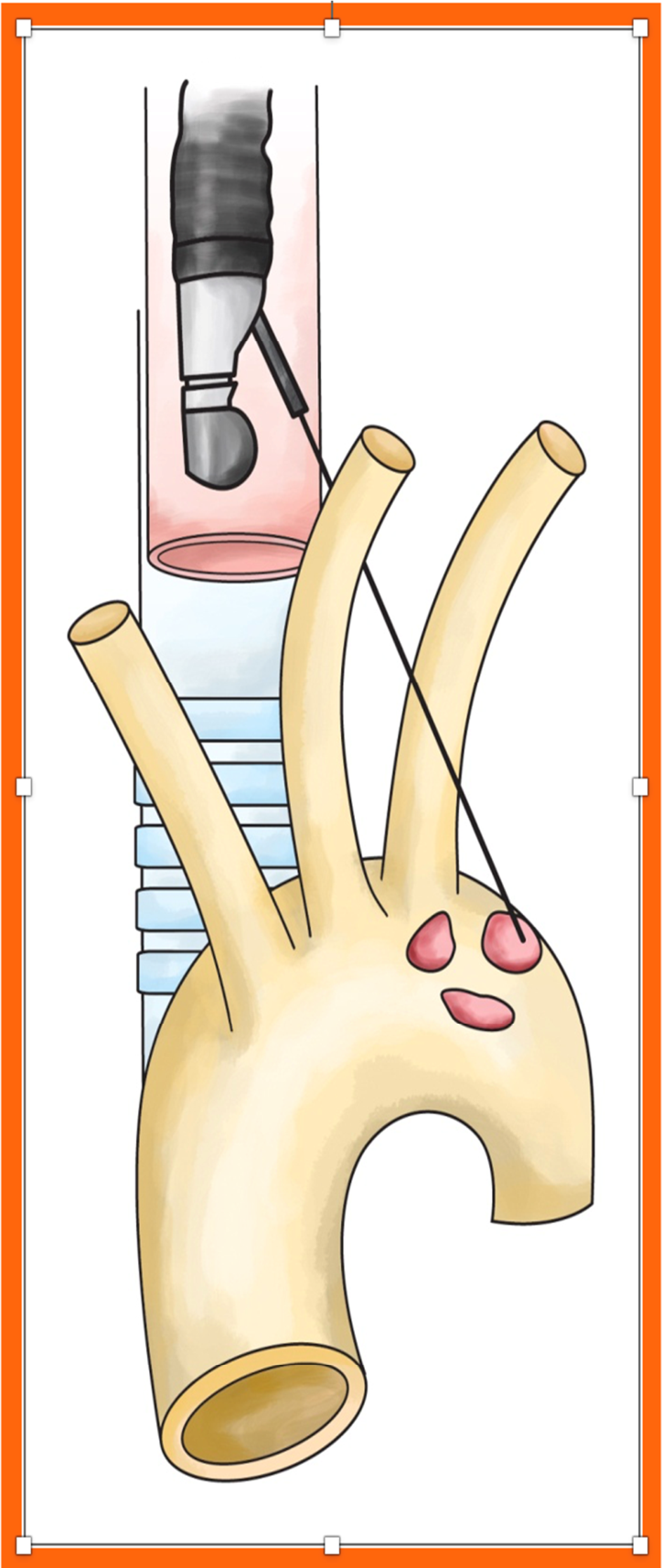
Figure 3.
Canada Lymph Node Score for ultrasonographic assessment of mediastinal lymph nodes. The scoring system is based on four sonographic features: nodal margins (indistinct vs. well-defined), central hilar structure (present vs. absent), central necrosis (absent vs. present), and small axis diameter (<10 mm vs. ≥10 mm). Each malignant feature scores 1 point, with total scores ranging from 0 to 4. A score of 0–1 indicates a low probability of malignancy, whereas a score of 2–4 suggests a high probability of malignancy.
Figure 3.
Canada Lymph Node Score for ultrasonographic assessment of mediastinal lymph nodes. The scoring system is based on four sonographic features: nodal margins (indistinct vs. well-defined), central hilar structure (present vs. absent), central necrosis (absent vs. present), and small axis diameter (<10 mm vs. ≥10 mm). Each malignant feature scores 1 point, with total scores ranging from 0 to 4. A score of 0–1 indicates a low probability of malignancy, whereas a score of 2–4 suggests a high probability of malignancy.
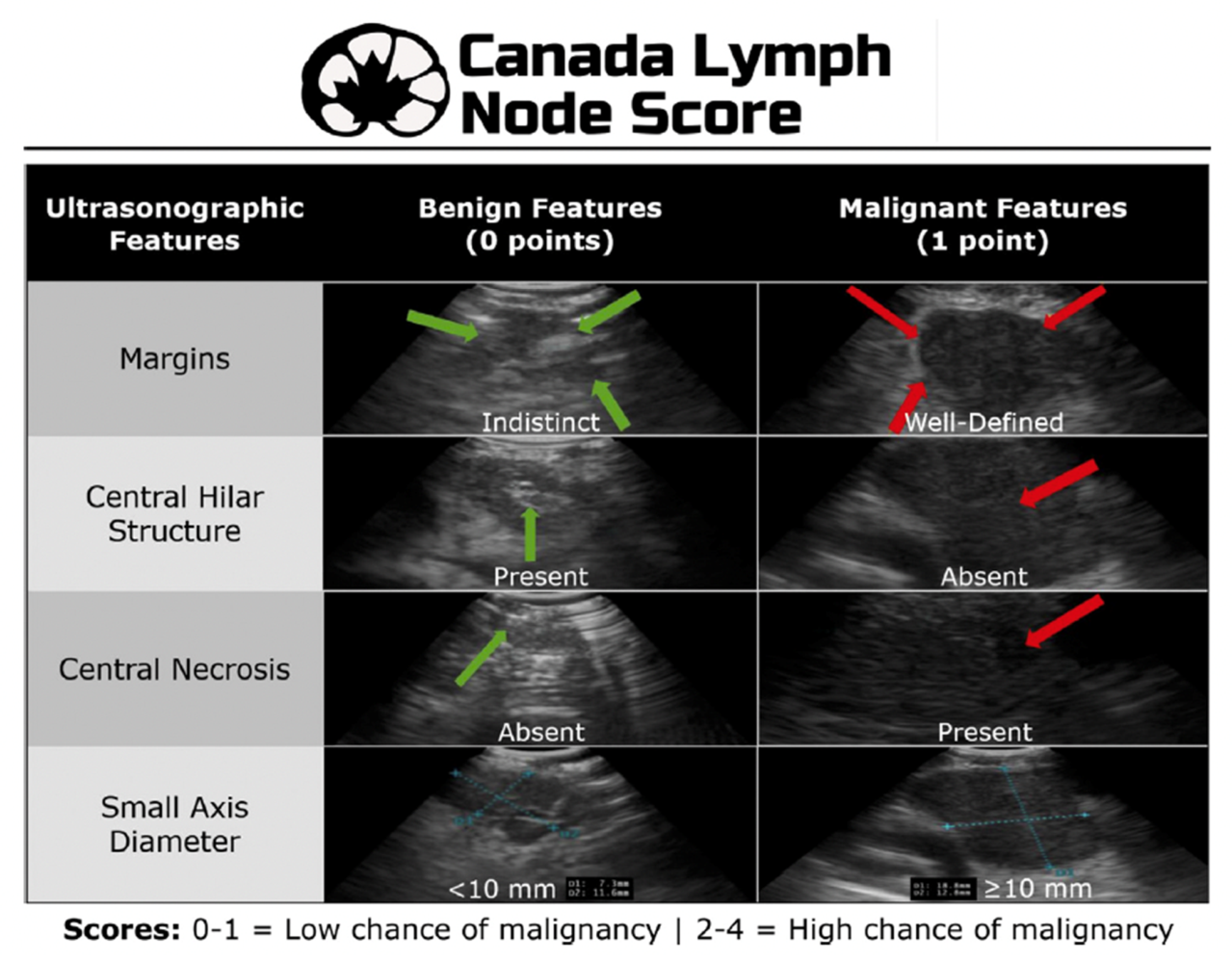

Table 1.
Stage groups of the 9th edition of the IASLC Tumor, Node, Metastasis (TNM) classification for lung cancer.
Table 1.
Stage groups of the 9th edition of the IASLC Tumor, Node, Metastasis (TNM) classification for lung cancer.
| T Category | Descriptor | N0 | N1 | N2a | N2b | N3 |
| T1a | ≤1 cm | IA1 | IIA | IIB | IIIA | IIIB |
| T1b | >1to ≤2 cm | IA2 | IIA | IIB | IIIA | IIIB |
| T1c | >2 to ≤ 3 cm | IA3 | IIA | IIB | IIIA | IIIB |
| T2a | Visceral pleura / central invasion | IB | IIB | IIIA | IIIB | IIIB |
| T2a | >3 to ≤4 cm | IB | IIB | IIIA | IIIB | IIIB |
| T2b | >4 to ≤5 cm | IIA | IIB | IIIA | IIIB | IIIB |
| T3 | >5 to ≤ 7 cm | IIB | IIIA | IIIA | IIIB | IIIC |
| T3 | Invasion | IIB | IIIA | IIIA | IIIB | IIIC |
| T3 | Same lobe separate nodules | IIB | IIIA | IIIA | IIIB | IIIC |
| T4 | >7 cm | IIIA | IIIA | IIIB | IIIB | IIIC |
| T4 | Invasion | IIIA | IIIA | IIIB | IIIB | IIIC |
| T4 | Ipsilateral separate tumor nodules | IIIA | IIIA | IIIB | IIIB | IIIC |
| M1a | Contralateral tumor nodules | IVA | IVA | IVA | IVA | IVA |
| M1a | Pleural/pericardial effusion or nodules | IVA | IVA | IVA | IVA | IVA |
| M1b | Single extrathoracic metastasis | IVA | IVA | IVA | IVA | IVA |
| M1c1 | Multiple metastases in one organ | IVB | IVB | IVB | IVB | IVB |
| M1c2 | Multiple metastases in >1 organ | IVB | IVB | IVB | IVB | IVB |
Table 2.
IASLC TNM definitions (9th edition) for primary tumor (T), regional lymph nodes (N), and distant metastasis (M) in lung cancer.
Table 2.
IASLC TNM definitions (9th edition) for primary tumor (T), regional lymph nodes (N), and distant metastasis (M) in lung cancer.
|
T: Primary Tumor | |
| Category | Definition |
| Tx | Primary tumor cannot be assessed |
| T0 | No evidence of primary tumor |
| Tis | Carcinoma in situ |
| T1 | Tumor surrounded by lung or visceral pleura, or in a lobar or more peripheral bronchus |
| T1mi | Minimally invasive adenocarcinoma |
| T1a | Tumor ≤1 cm in greatest dimension |
| T1b | Tumor >1 cm but ≤2 cm |
| T1c | Tumor >2 cm but ≤3 cm |
| T2 | Tumor with any of the following features |
| T2a | >3 cm but ≤4 cm; or visceral pleura invasion; or involves main bronchus; or associated with atelectasis/obstructive pneumonitis |
| T2b | >4 cm but ≤5 cm |
| T3 | >5 cm but ≤7 cm; or chest wall invasion; or pericardium/phrenic nerve involvement; or same-lobe tumor nodules |
| T4 | >7 cm; or invasion of mediastinum, heart, great vessels, trachea, esophagus, diaphragm; or tumor nodules in a different ipsilateral lobe |
|
N: Regional Lymph Nodes | |
| Category | Definition |
| NX | Regional lymph nodes cannot be assessed |
| N0 | No regional lymph node metastasis |
| N1 | Ipsilateral peribronchial and/or hilar lymph node involvement |
| N2 | Ipsilateral mediastinal and/or subcarinal lymph nodes |
| N2a | Single-station N2 involvement |
| N2b | Multi-station N2 involvement |
| N3 | Contralateral mediastinal or hilar, or supraclavicular lymph nodes |
|
M: Distant Metastasis | |
| Category | Definition |
| M0 | No distant metastasis |
| M1 | Distant metastasis present |
| M1a | Pleural/pericardial disease or contralateral lung nodules |
| M1b | Single extrathoracic metastasis |
| M1c | Multiple extrathoracic metastases |
| M1c1 | Multiple metastases in a single organ |
| M1c2 | Multiple metastases in multiple organs |
Disclaimer/Publisher’s Note: The statements, opinions and data contained in all publications are solely those of the individual author(s) and contributor(s) and not of MDPI and/or the editor(s). MDPI and/or the editor(s) disclaim responsibility for any injury to people or property resulting from any ideas, methods, instructions or products referred to in the content. |
© 2026 by the authors. Licensee MDPI, Basel, Switzerland. This article is an open access article distributed under the terms and conditions of the Creative Commons Attribution (CC BY) license (http://creativecommons.org/licenses/by/4.0/).
Copyright: This open access article is published under a Creative Commons CC BY 4.0 license, which permit the free download, distribution, and reuse, provided that the author and preprint are cited in any reuse.


