

Submitted:
05 April 2026
Posted:
07 April 2026
You are already at the latest version
Abstract
This study investigates the safety measures associated with blending hydrogen (H₂) with methane (CH₄) to reduce carbon emissions in the hard-to-abate industries, trans-portation sectors and domestic uses. The results highlighted significant safety risks due to hydrogen's lower ignition energy (IE) and broader flammability range, especially under high-pressure conditions. Using Aspen HYSYS chemical process simulation and the HSC Chemistry platform, the study quantified carbon emissions and combustion heat release of H₂-CH₄ mixtures at various H₂ contents, temperatures, and pressures. The results suggest that blending H₂ with CH₄ can be beneficial, provided H₂ content does not exceed safe thresholds and stays within a recommended Wobbe Index (WI) range of 45 - 55 MJ/m³. The WI increases with H₂ concentration exceeding 50 mole% due to density effects outweighing HHV reductions. Hydrogen's high buoyancy and diffusivity reduce localized accumulation in open areas but pose risks in confined spaces due to its wide flammability range. H₂-CH₄ blends with ≤ 20 mole% H₂ are safer than higher concentrations or pure H₂. For blends with > 20 mole% H₂, engineered safety features (ESF) like leak detection, alarms, ventilation, and spark-free environ-ments are essential. Managing concentrations to avoid the detonation range (pure H₂: 18 - 59 mole% & pure CH₄: 6.3 - 13.5 mole%) is critical. Adhering to H2 safety codes limiting H₂ to ≤ 20 mole% in pipelines is recommended. Conservatively, < 18 mole% H2 reduces detonation risk, and ≤ 10 mole% provides added safety margins. These find-ings can guide policymakers and industry stakeholders in developing safe, efficient hydrogen-enhanced energy systems, hence supporting carbon reduction goals.
Keywords:
flammability range
; explosibility
; H2 embrittlement
; carbon emission
; H2-CH4 blends
; wobbe index
1. Introduction
Climate change presents a significant global challenge, prompting nations to seek sustainable and renewable energy solutions to reduce their carbon footprint. One promising approach is the integration of H₂ into natural gas (primarily CH4) systems, creating H₂-CH₄ blends that can be used for various applications such as the hard-to-abate industries, transportation including vehicles and aircraft, and domestic heating. While H2 blending has the potential to reduce carbon emissions; it introduces safety and economic considerations that must be carefully managed.
Blending H2 with CH4 affects the flammability properties of the gaseous mixture, influenced by varying H₂ concentrations and operating pressures. Hydrogen’s lower ignition energy (IE = 0.02 mJ) and broader flammability range in air (UFL of 75 mole% H2 and LFL of 4.4 mole% H2) compared to CH4 (IE = 28 mJ) pose increased explosibility risks, especially under high-pressure conditions, necessitating rigorous safety measures. The compatibility of end-use products and material degradation due to H2 embrittlement present significant challenges, which could result in mechanical failures.
Current recommendations suggest a H2 blend of up to 15 mole% in natural gas (which is primarily methane), with safety measures and infrastructure adjustments becoming critical beyond this threshold. The transition to a H2 economy may require government support through carbon taxes and subsidies to ensure a smooth and economically viable shift.
This study uses science-based approaches by leverages Aspen HYSYS and HSC Chemistry software to quantify carbon emissions and assess the combustion heat release of H₂-CH₄ mixtures, highlighting the trade-offs involved in reducing CO₂ emissions while considering energy density requirements. The findings emphasize the need for comprehensive safety protocols, infrastructure upgrades, and the potential economic impact of integrating H2 into natural gas systems.
2. Motivation, Objectives, and Contribution
2.1. Motivation
The urgency to address climate change drives the exploration of H₂ as a solution for significant CO₂ emissions reduction. Integrating H2 into natural gas (primarily methane, CH₄) offers a promising pathway to decarbonize hard-to-abate industries, transportation, and domestic heating. However, this integration introduces safety, technical, and economic challenges due to hydrogen’s unique properties, such as its lower ignition energy (IE) and broader flammability range compared to methane (CH4) gas. Furthermore, the material compatibility concern (caused by H2 embrittlement) necessitates careful management and potential infrastructure upgrades. This study is motivated by the need to provide specific insights and safety measures for policymakers and industry stakeholders to ensure safe, efficient, and economically viable hydrogen-enhanced energy systems.
2.2. Objectives
The overarching objective of this study is three-fold as follows:
a) Employ science-based approaches to quantify key safety measures and highlight potential trade-offs in leveraging H₂-CH₄ blends to reduce carbon emissions across various sectors, such as the hard-to-abate industries (e.g., steel, cement, petrochemical, etc.), transportation (namely, road vehicles and commercial aviation), and domestic heating, all of which traditionally rely on combusting fossil fuels.
b) Provide recommendations to policymakers, safety standards developers, and end-users on best practices for the safe use of H₂-CH₄ blends, ensuring a balance between safety, operational efficiency, and carbon reduction goals.
c) Advance the ultimate goal of transitioning to cleaner fuel mixtures by guiding the development of safe, efficient, and economically viable hydrogen-augmented energy systems.
2.3. Contribution
This study addresses gaps in current knowledge by offering new safety measures and insights into the feasibility of blending H₂ with CH₄ to enhance combustion efficiency in various industrial and domestic applications without compromising user safety. The quantitative insights are generated using the chemical process simulation tool Aspen HYSYS (ver. 15) to predict CO₂ emissions under varying mole percentages of H₂ in the mixture, and the HSC Chemistry platform (ver. 10) to calculate combustion heat release. The findings of this study should assist policymakers and industry stakeholders in developing safe, efficient, and economically viable hydrogen-enhanced energy systems.
2.4. Literature Review
The Web of Science (WoS) advanced search tool was used to identify publications most relevant to our research from 2000 to 2026. The following search query was applied: (((TS = “hydrogen-methane blend”) OR (TS = “hydrogen-natural gas blend”)) OR (TS = “H2-CH4 blend”)). The WoS categories considered included ‘Energy Fuels’, ‘Chemical Engineering’, and ‘Thermodynamics’. This query returned 234 documents from the WoS Core Collection. We then manually screened these documents to ensure alignment with the scope of this research. Note that in the WoS Advanced Search, ‘TS’ is the field tag for Topic. A TS - search retrieves records in which the specified terms appear in the title, abstract, author keywords, or Keywords Plus (WoS-generated keywords). Keywords Plus are algorithmically derived by WoS, primarily from the titles of references cited by the article (and related indexing), to capture concepts that may not appear in the article’s title or author keywords.
Figure 1 shows bibliometric analysis networks using VOSviewer software (version 1.6.20 for Microsoft Windows systems).
Figure 1 shows 144 items and 13 clusters generated using the VOSviewer software tool. The items represent objects of interest, such as publications, authors, or keywords. A bibliometric network (or map) includes only one type of item. Links connect pairs of items and represent relationships between them. Examples include bibliographic coupling links between publications, co-authorship links between authors, and co-occurrence links between terms such as keywords. Together, items and links constitute a network; that is, a network is a set of items along with the links between them. In addition, items may be grouped into clusters. A cluster is a set of items within the network (or map). Examples of items in Figure 1 include “methane,” “combustion,” “emissions,” “blends,” “embrittlement,” “flame,” and “hydrogen–natural gas” (or “HCNG”). Figure 1 also shows 13 color-coded clusters that group related items.
Using the Web of Science (WoS) advanced search, 29 documents were identified as the most relevant publications that aligned with the scope of this study: Haeseldonckx and D’haeseleer (2007) [1] examined safety hazards during the transport and distribution of H2/CH4 blends. They noted that H2 can be mixed with CH4 up to 17 vol% without issues; higher concentrations will require pipeline replacements and new end-use appliances. Agnolucci and McDowall (2013) [2] examined assumptions regarding industrial H2 demands, knowledge gaps, and unresolved issues. They suggested areas for further research to enhance the understanding of H2 safety in different industrial applications. Melaina et al. (2013) [3] summarized proposals to blend H2 into existing CH4 pipelines to boost the output of renewable energy systems like wind farms. They concluded that H2 concentrations of 5%-15% by volume would be appropriate without significantly increasing risks to end-use devices, public safety, or pipeline integrity.
Jentsch et al. (2014) [4] discussed renewable energy generation, electricity storage, and utilization of excess energy using power-to-gas (PtG) technology They explored the prospects of PtG in Germany under an 85% renewable energy scenario to identify the optimal PtG capacity and the best spatial distribution for its deployment. Weiner (2014) [5] summarized efforts of the International Energy Agency’s Hydrogen Implementing Agreement (IEA HIA) on disseminating H2 safety information through case studies, technical reports, and presentations. deVries et al (2017) [6] assessed the safety and functionality of domestic appliances using H2/CH4 blends, finding that fitness-for-purpose limits depend on thermal input changes due to Wobbe Index (WI) variations, while safety is assessed through flashback risks. Their results indicated that the maximum permissible H2 content for cooking burners is determined by flashback risks, and for lean-premixed appliances, by thermal input loss.
Khalil (2017) [7] employed a state-of-the-art visual flowcharting methodology to develop a probabilistic model quantifying occupational fire and explosion risks initiated by gas leaks within enclosed spaces. The model incorporates various parameters such as initiation time, leak type, mechanical ventilation failure, presence of ignition sources, and leak detection probability. Using Monte Carlo sampling (using 10⁶ trials per simulation case), the model simulates fire or explosion injury risks. The author employed a case study approach to illustrate the model’s functionality, revealing that small H2 leaks from compressors, unlike larger leaks, pose intolerable risk frequencies exceeding acceptable levels. He recommended implementation of safety control measures and best practices to mitigate these risks. The model can be used to train first responders and can be applied to various industrial scenarios, such as natural gas pipe leaks, and warehouses with H2-powered forklifts, providing valuable insights for safety codes and standards and root cause investigations (RCA). de Santoli et al. (2017) [8] reviewed the technical adaptations needed to use H2/CH4 blends for common end-user devices such as home gas furnaces and cooking surfaces. They also compared existing Italian and European safety standards and regulations to highlight the need for new legislations on H2-CH4 blends.
Guandalini et al. (2017) [9] investigated the impact on H2/CH4 transport infrastructure design, compliance with composition limits, and quality constraints during both stationary and dynamic operations. They noted that H2 injection impacts the calorific value and Wobbe index (WI) of the bend. Lo Basso et al. (2017) [10] examined the effects of H2-CH4 mixtures on boilers and analyzed the technical implications for certifying the performance of domestic boilers using H2-CH4 blends. Witkowski et al. (2018) [11] analyzed the safety hazards of transporting H2-CH4 mixture in natural gas networks and the potential pipeline failure consequences.
Issac (2019) [12] discussed the UK HyDeploy project that aimed to demonstrate that H2 can be safely blended into CH4 gas distribution system without needing changes to appliances. The project has three phases: establishing evidence for regulatory exemption to inject 20 mol% H2, constructing the necessary infrastructure, and conducting a trial starting in summer 2019. If successful, blending H2 at 20 mol% could decarbonize 29 TWh of heat annually and equate to removing 2.5 million cars’ worth of carbon emissions. Zhao et al. (2019) [13] examined how much H2 can be added to CH4 without impacting residential burner performance by evaluating a representative cooktop burner. They assessed flashback limits, ignition time, flame characteristics, cooking performance, combustion noise, burner temperature, and emissions for various H2 levels. Results show that up to 15% H2 addition by volume does not significantly affect combustion performance, indicating that existing cooking appliances can use H2 without modifications.
Khalil (2019) [14] discussed the P2G process which involves converting surplus electricity from renewable electricity sources into compressed H2 using water electrolyzers. The compressed H2 gas can then be blended with CH4 to produce hythane gas which can be utilized for domestic heating and various industrial applications, including combined heat and power (CHP) systems. The author also discussed the H21 project in the UK and the NaturalHy project led by Loughborough University (UK), Leeds University (UK), Commissariat d’Energie Atomique (France), Shell Hydrogen, Health and Safety Executive (UK), and the National Grid in UK. Zhang et al. (2019) [15] investigated the impact of acoustically absorbing materials on detonation propagation in methane mixtures. They found that longer porous sections can dampen transverse waves and increasing shock wave losses.
Schiro et al. (2020) [16] evaluated the impact of H2 enrichment on widely used premixed boilers, including factors such as pollutant emissions, efficiency, flashback and explosion hazards, control systems, and material selection. They calculated combustion parameters of H2-enriched natural gas to guide the design of new components under maximum H2 blending tolerable by current boilers. Zhou et al. (2022) [17] examined the impact of adding H2 to T-tubes on the explosion characteristics of CH4-H2 mixtures in air using experiments and numerical simulations. Their findings revealed that H2 significantly affects the explosion severity of the mixed gas, particularly when its content exceeds 10% by volume. Chen et al. (2022) [18] employed a mechanical algorithm and failure criteria to investigate the structural integrity of H2-mixed CH4 pipelines under extreme loads. The results demonstrated that the model accurately predicts the burst pressure of H2-CH4 pipelines. Cristello et al. (2023) [19] used simulation models and surveys to investigate the safety concerns of transporting H2 in natural gas distribution pipelines. They employed a transient model to evaluate the compatibility of current leak detection methods with blended hydrogen. Fetisov et al. (2023) [20] analyzed the compression, transportation, and fire hazards of H2-CH4 mixtures by examining a case study using NSYS Fluent software. Findings showed that the risk of spontaneous H2 combustion increases with higher H2 concentrations. A 50-50% H2 blend poses significant risks to compressor station equipment, potentially leading to accidents and fires.
Liu et al. (2024) [21] analyzed concentrations of H2 blended in CH4 and gas velocity at pipe leak points. Factors such as gas pressure, leak orifice size, wind speed, and H2-blending ratio impact the diffusion range. Findings showed that near the leak point, CH4 concentrations exceed the upper explosive limit, while H2 concentrations remain within the explosive limit. The hazardous range of H2-blended gas leakage is slightly larger than that of CH4 alone. Bu et al. (2024) [22] applied numerical simulations to examine leakage and diffusion characteristics of H2-CH4 under different H2 blending ratios. Prediction model for the diffusion hazard range was established based on multivariate regression theory. Findings indicated that the gaseous mixture has a wider diffusion range in soil compared to CH4 alone. Xu et al. (2024) [23] experimentally evaluated the effects of H2-doping ratios on the explosion characteristics of multi-component natural gas/H2 mixtures in 30 L cylindrical tanks. Their study highlighted important insights for ensuring safe transportation of H2-blended natural gas pipelines. Mei et al. (2024) [24] used a computational fluid dynamics (CFD) model to investigate accident scenarios at H2-blended natural gas stations. Results indicated that H2 increases the explosion intensity of gas clouds but also accelerates the diffusion rate of leaking gas into the air. The peak explosion overpressure does not correlate linearly with the H2 blending ratio. The worst-case scenario, with a 20% H2 blend, showed a peak overpressure of 19.29 kPa. Higher wind speeds can reduce the hazard degree by accelerating the dispersion of leaked gas.
Gong et al. (2025) [25] proposed a numerical scheme based on backpropagation neural network combined with a genetic algorithm to analyze the diffusion pattern of H2 leakage from natural gas pipelines. Wang and Tian (2025) [26] employed a 3-D model to simulate multi-hole leakage scenarios in buried pipelines transporting H2-blended natural gas. The analysis examined the effects of the number of leakage holes, hole spacing, and soil porosity on the diffusion hazard. Results showed that gas leakage follows three phases: initial independent diffusion, intersecting accelerated diffusion, and unified-source diffusion. Hydrogen primarily experiences the first two phases, while methane undergoes all three, dominating the ground dangerous range. Yang et al. (2025) [27] investigated the impact of bent pipes on explosion characteristics in H2-mixed natural gas, aiming to enhance storage and transportation safety. They analyzed the effects of pipe spacing configuration in pipes with a large length-to-diameter ratio. They found that the maximum explosion pressure and pressure rise rate increased significantly with the addition of double bends, from 21.7 kPa and 1.8 MPa/s to 65.2 kPa and 3.7 MPa/s, respectively.
Chang et al. (2025) [28] employed a diffusion model for leakage from buried H2-blended natural gas and numerically analyzed 16 leakage scenarios. The findings indicated that as H2 blend ratio increases from 0 to 25%, CH4 diffusion distance increases from 1.46 m to 1.52 m, suggesting that higher H2 concentration promotes CH4 diffusion. They also identified correlations between leakage rate and factors like soil properties, pipeline conditions, and H2 blend ratio. Li et al. (2026) [29] used numerical simulations to analyze the leakage consequences of H2-blended natural gas pipeline using PHAST software. They investigated the impact of H2 blending ratio, leakage hole diameter, and ambient wind speed on jet thermal radiation and explosion overpressure. Results showed that the range of jet fire radiation increases with larger leakage holes and higher wind speeds but decreases with higher H2 blending ratios. Explosion overpressure range increases with larger leakage holes, decreases with higher wind speeds, and initially increases then decreases with higher hydrogen blending ratios.
3. Definitions of Key Parameters and Research Methods
This section may be divided by subheadings. It should provide a concise and precise description of the experimental results, their interpretation, as well as the experimental conclusions that can be drawn.
3.1. Definitions of Key Parameters
Flammability limits - Are the concentrations of fuel in the air within which the fuel can ignite. For mixtures of fuels, these limits depend on the properties of the individual gases in the mixture.
For example, the flammability limits of pure H2 and pure CH4 gases in air are as follows:
a) For H2, the lower flammability limit (LFL) is ≈ 4.0 mole% and the upper flammability limit (UFL) is ≈75.0 mole%.
b) For CH4, the lower flammability limit (LFL) is ≈ 5.0 mole% and the upper flammability limit (UFL) is ≈15.0 mole%.
Clearly, H2 has a winder flammability range compared to CH4. Note that for gases, the mole% is the same is volume%.
For the H2-CH4 mixture, the explosibility range is the difference between the upper flammability limit (UFLmixture) and the lower flammability limit (LFLmixture).
When H2 and CH4 are mixed, the flammability limits of this mixture will be affected by the properties of both gases and the Le Chatelier’s mixing rule can be used to calculate these limits for the mixture using Eqs. 1 and 2:
Where:
- XH2 and XCH4 are the mole fractions of H2 and CH4, respectively.
- LFLH2, UFLH2 & LFLCH4, UFLCH4 are the flammability limits for the pure H2 and CH4 gases.
The flammability limits can also be affected by total pressure. The correction factors for pressure can be included in the calculations as shown by Eqs. 3 and 4.
- Wobbe Index (WI) - The Wobbe Index (WI) is a measure of the energy delivery rate of a fuel gas at constant pressure through a burner. WI is defined as shown by Eq. (7):
- -
- HHV: Higher heating value, which depends on the composition of the gas or gaseous mixture.
- -
- SG: Specific gravity, which is the ratio of the gas density to the density of air.
3.2. Research Methods
The following science-based approaches are employed to achieve the objectives as cited in section 2.3:
- Analyze the following key characteristics of the H2-CH4 mixture:
- -
- Detonation limits and ignition energy (IE) as a function of H2 mole% and under various operating pressures.
- -
- Mixture’s lower and upper flammability limits in air (LFLmixture and UFLmixture in mole%) under various operating pressures.
- -
- Explosibility range (mole%) as a function of H2 mole% in the mixture and under various operating pressure.
- Utilize the Aspen HYSYS chemical process simulation tool [30] to quantify carbon emissions from combusting H₂-CH₄ mixtures with different H₂ mole percentages.
- Employ the HSC Chemistry platform [31] to calculate the combustion heat release (MJ/kg) for pure H₂, pure CH₄, and their stochiometric mixture. Also, quantify the effect of temperature on the mixture’s combustion heat release.
- Identify safe H₂-CH₄ mixtures by calculating the Wobbe Index (WI) as a function of H2 mole% in the H2-CH4 mixture.
4. Results and Discussion
Section 4 is divided in 6 subsections as follows:
Subsection 4.1 – Parameters impacting H2-CH4 mixture.
Subsection 4.2 – Detonation limits and ignition energy of H2-CH4 mixture
Subsection 4.3 – Explosibility ranges of H2-CH4 mixture
Subsection 4.4 – Safety limits of Wobbe Index (WI) of H2-CH4 mixture
Subsection 4.5 – Carbon emission
Subsection 4.6 – Heat of combustion
4.1. Parameters Impacting and of H2-CH4 Mixture
Figure 2 shows the variation of and as a function of mole% H2. For example, in a mixture of xH2 = 50 mole% H2 and xCH4 = 50 mole% CH4 and using Eqs. 2 and 3, the calculated mixture’s flammability limits are: is ≈ 4.44 mole% and is ≈ 25.0 mole%. At 0.0 mole% H2 (i.e., 100 mole% CH4), is 5.0% and is 15 mole%. At 100 mole% H2 (i.e., 0.0 mole% CH4), is 4.0 mole% and is 75 mole%. This trend demonstrates that as the mole percentage of H₂ in the gaseous mixture increases, decreases and increases, resulting in a wider flammability range.
To demonstrate the effect of pressure on the flammability limits, let us apply Eqs. 5 and 6 for H2-CH4 mixture with 10 mole% H2 and at 1 atm and 2 atm, respectively.
- For this mixture at 1 atm pressure, = 4.88 mole% and
- For this mixture at 2 atm, = 2.44 mole% and
In this example, the at 2 atm is lower than at 1 atm, suggesting that higher pressures make the mixture flammable more flammable. Also, the increases as H2 mole% increases (namely, from 16.3 at 1 atm to 32.61 mole% at 2 atm), indicating that the H2-CH4 mixture is flammable over a broader range of concentrations as the total pressure () increases.
As Figure 3 depicts, at 0.0 mole% H2 (i.e., 100 mole% CH4), the lower flammability limit drops from 5.0 mole% to 0.5 mole% as the pressure increases from 1 atm to 10 atm. Also, at 100 mole% H2 (i.e., 0.0 mole% CH4), the lower flammability limit drops from 4.0 mole% to 0.4 mole% as the pressure increases from 1 atm to 10 atm. Figure 3 also shows the decreasing trend in as the p=20 atm and 50 atm, respectively.
As obvious from the trends shown in Figure 4, decreases as pressure increases. This indicates that at higher pressures, a smaller concentration of the mixture is needed to ignite compared to at 1 atm. For example, at 1 atm, LFLmixture with 50 mole% H2 is ≈ 4.44%, while at 80 atm, it drops significantly. This reduction in with increasing pressure poses a greater risk of ignition at lower concentrations in high-pressure environments.
Contrary to the noticed decrease in as the pressure increases, increases. This means that at higher pressures, the range of concentrations over which the mixture can ignite is larger. For instance, at 1 atm, for 50 mole% H2 is ≈ 25 mole%, while at 80 atm, it can approach 100%. A of 100% means, theoretically, that the gas mixture remains flammable at any concentration, including pure H2 or pure CH4 and all concentrations in between. Additionally, higher values at elevated pressures expand the flammability range, thus increasing the potential for explosive conditions.
In summary, as discussed in subsection 4.1, blending H₂ with CH₄ lowers making it flammable at lower concentrations. Additionally, increasing H₂ concentration raises . Increased pressure further broadens the flammability range of this mixture. Therefore, understanding and controlling the mixing ratios of H₂ and CH₄ is crucial for operational safety in industrial applications, particularly at higher pressures such as those in the high-pressure natural gas pipelines. Industrial operators under these conditions must ensure they maintain safe H2 concentration limits to avoid unintended fires and explosions. Furthermore, proper ventilation and use of detection and alarm systems for H₂ and CH₄ concentrations monitoring become more essential at higher pressures or with greater percentages of H₂ in the gaseous mixture.
4.2. Detonation Limits and Ignition Energy of H2-CH4 Mixture
Subsections 4.2.1 and 4.2.2 provide key insights into the impact on the detonation limits and ignition energy of H₂-CH₄ mixtures, respectively, as the H₂ mole percentage in the gaseous mixture increases from 0% to 100%.
4.2.1. Detonation Limits
The detonation limits of H2-CH4 mixture in air are influenced by H2 concentration. Pure CH₄ is less prone to detonation compared to pure H2. In air, the lower and upper detonation limits for pure H₂ are approximately 18 mole% and 59 mole%, respectively, whereas for pure CH₄, these limits are around 6.3 mole% and 13.5mole%, respectively. As illustrated in Figure 5, increasing the H₂ concentration in the gaseous mixture results in a wider detonation range.
The comparison of detonation limits between H2 and CH4, along with the impact of increasing H2 content, provides useful insights into the safety management of H₂-CH₄ mixtures in various industrial and domestic applications. Understanding these safety limits is crucial for developing effective strategies to minimize the risk of detonation and ensure safe handling of hydrogen-enriched fuels.
4.2.2. Ignition Energy (IE)
Hydrogen has a lower IE than methane, making it easier to ignite. The ignition energy of H2 is 0.02 mJ (= 20 μJ) while that of CH4 is 0.28 mJ (Khalil, 2019) [14]. Accordingly, a higher concentration of H2 in its mixture with CH4 will reduce the overall ignition energy of this fuel mixture. As depicted in Figure 6, increasing the H₂ concentration in this gaseous mixture rapidly decreases the mixture IE, making it more prone to ignition. For instance, a gaseous mixture containing 20 mole% H₂ has an IE of ≈ 0.228 mJ, representing an 18.5% reduction compared to pure CH₄, which has an IE of 28 mJ. Additionally, for a mixture with 50 mole% H₂, the IE is ≈ 0.05 mJ, representing an 82.1% reduction compared to pure CH₄. Consequently, H₂-CH₄ mixtures with H₂ concentrations above 20 mole% begin to exhibit significantly wider detonation ranges and lower ignition energies, thus necessitating stricter safety measures.
Flammable gases IE typically decreases with increasing pressure due to the increased density and closer proximity of gas molecules, which makes ignition easier. Hydrogen, which has a very low IE, is already highly sensitive to ignition; hence further increases in pressure can make its safe handling more critical. Pressure similarly impacts IE of H₂-CH₄ mixtures. Figure 7 shows the baseline IE values for different H₂ mole percentages at atmospheric pressure. As the pressure increases (10 atm, 20 atm, 50 atm), the mixture’s IE decreases proportionally. Figure 6 also shows that for any given pressure, a higher H₂ content in the mixture results in lower ignition energy due to hydrogen’s inherently low ignition energy (0.02 mJ).
4.3. Explosibility Ranges
As defined in subsection 3.1, for any given H2 mole% in the H2-CH4 mixture, the flammability range is the difference between and . A larger difference indicates a wider explosibility range.
Figure 8 shows the calculated explosibility ranges for three H2-CH4 mixtures: one with 0.0 mole% H2 (i.e., pure CH4), one with 20 mole% H2, and one with 50 mole% H2, at varying pressures (1, 10, 20, and 50 atm). The higher-pressure values are representative of the typical conditions found in natural gas pipelines.
Summary of observations from Figure 8 - The explosibility range expands with increasing pressure, indicating a considerable risk of explosions over a broader range of fuel-air mixtures at higher pressures (the fuel here is the H2-CH4 mixture). This is because for any given H₂ concentration in the gaseous mixture, as pressure increases, the lower flammability limit (LFL) of the mixture decreases, while the upper flammability limit (UFL) increases. For example, at 1 atm, a mixture with 50 mole% H₂ has an explosibility range of 20.56 mole%, compared to 10.0 mole% (=15 mole% - 5 mole%) for pure CH₄. At higher pressures, these differences become nearly negligible because UFL values reach their maximum cap, and LFL values are compressed so low that they are effectively similar across all H₂ mole fractions.
From an operational safety standpoint, as H₂ mole fractions and pressure increase, H₂-CH₄ mixtures become flammable and more explosible across a broader range of concentrations. This significantly raises the risk of fires and explosions in applications such as Power-to-Gas (P2G), where H₂ is injected into natural gas pipelines. Accordingly, operational safety measures would include:
- Deploying sensors and alarms to rapidly alert pipelines field operators, particularly in high-pressure sections of the natural gas networks.
- Conducting regular maintenance and visual inspection of the pipelines to preempt potential leak points.
- Using pressure relief devices (PRD) to avoid accidental pipelines over-pressurizing.
- Train field personnel in handling and responding to hydrogen-rich environments, focusing on higher explosibility risks.
- Integrating emergency operating procedures (EOPs) for prompt shutdowns and evacuation plans to address potential leaks and explosions.
4.4. Safety Limits of Wobbe Index (WI) of H2-CH4 Mixture
As discussed in subsection 3.1, the WI is a measure of the energy delivery rate of a gaseous fuel at constant pressure through a burner. WI is defined by Eq. (7):
Maintaining the WI within the safe range (45–55 MJ/m³) is a recommended safety measure to: a) Ensure that combustion systems operate efficiently without requiring major modifications, b) The air-to-fuel ratio remains optimal, thus ensuring complete combustion with minimal carbon emissions, c) Safety risks such as flame instability, overheating, or unburned fuel accumulation are minimized, and d) Equipment service life is preserved by avoiding excessive thermal or mechanical stress. Below are the consequences of WI outside the safe range (WI > 55 MJ/m³ or WI < 45 MJ/m³):
- When WI exceeds 55 MJ/m³: A WI above 55 MJ/m³ indicates that the fuel delivers too much energy per unit volume. This can result in: a) Overheating in burners and other components of the combustion system. Overheating can lead to material degradation, warping, or even failure of components, b) Improper air-to-fuel ratios. If the fuel flow rate is too high relative to the air supply (i.e., a fuel rich condition), combustion may be incomplete. This can lead to incomplete combustion products such as carbon monoxide (CO) or unburned hydrocarbons (UHC), and c) Higher flame temperatures caused by excessive energy delivery can lead to the formation of nitrogen oxides (NOx), which are harmful primary air pollutants,
- When WI drops below 45 MJ/m³: A WI below 45 MJ/m³ indicates that the fuel delivers too little energy per unit volume. This can result in: a) Flame instability or extinction as a fuel with a low WI may not provide enough energy to sustain a stable flame, especially in systems designed for higher WI fuels. Flame extinction can lead to unburned fuel accumulation, which is a serious safety hazard, b) Low WI fuels may not generate sufficient heat, leading to inefficient operation of the combustion system. This can negatively impact industrial processes, power generation, or residential heating, c) A low WI can also disrupt the optimal air-to-fuel ratio, causing incomplete combustion. This may result in increased emissions of CO and UHC, d) Low-energy flames may cause soot or carbon deposits to build up on burner surfaces, thus reducing system efficiency and requiring more frequent maintenance, and e) In applications like power generation or industrial heating, a low WI fuel may fail to meet the required energy output, leading to operational disruptions.
Figure 9 shows that as the mole percentage of H₂ in the mixture increases: a) The HHV of the mixture (MJ/m3) decreases because H₂ has a significantly lower HHV (≈ 12.75 MJ/m³) compared to CH₄ (≈ 39.82 MJ/m3) and b) The overall SG of the mixture decreases (because H₂ is much lighter than CH₄) and, hence, also decrease as a result.
As can be seen in Figure 10, the mixture’s WI first decreases and then starts to increase. The reduction in HHV is a dominant factor in the WI initial decrease. Because H2 has a much lower density compared to CH4 (namely, 0.084 kg/m3 vs. 0.668 kg/m3, as H2 mole% increases, the density of the mixture decreases significantly because the mole-fraction-weighted average shifts toward hydrogen’s lower density. A lower density increases , thus partially offsetting the decrease in HHV. The net result is that initially, the decrease in HHV outweighs the decrease in density, resulting in a net decrease in mixture’s WI as H2 mole% increases up to ≈ 50%.
Figure 10 also shows that WI increases after ≈ 50 mole% H2. The rationale here is that after ≈ 50 mole% H2, the density of the H2-CH4 mixture becomes very low because H2 dominates the mixture composition. Accordingly, the reduction in density is now the dominant factor influencing the WI. Note that a lower density significantly increases , which starts to outweigh the reduction in the mixture HHV. Beyond 50 mole% H2, the HHV is already closer to hydrogen’s value (≈ 12.75 MJ/m3), so further increases in H2 content cause only small reductions in HHV. As a result, the decrease in HHV slows down, and the reduction in density becomes the primary driver of the mixture’s WI. The rapid decrease in density, combined with the slowing decrease in HHV, causes the WI to start increasing as H2 mole% exceeds ≈ 50%.
The physical meaning of WI lies in the balance between energy content (HHV) and ease of flow through a burner (influenced by the gas fuel density). In the 0 – 50 mole% H2 range, the energy content of the mixture (i.e., HHV) decreases rapidly because H2 has a much lower HHV than methane (when expressed in MJ/m3). This makes the mixture less energy-dense, reducing the energy delivery rate. The reduction in energy delivery is the dominant factor, leading to a decrease in WI. However, in the range 50 – 100% H2, the mixture becomes increasingly dominated by H2, which has a very low density. As the density decreases, the mixture flows more easily through a burner. The ease of flow (represented by ) becomes the dominant factor, allowing the Wobbe Index to increase despite the lower energy content (i.e., HHV).
From a practical standpoint, the behavior of WI, as Fig. `0 depicts, reflects the changing energy delivery characteristics of the fuel mixture. Combustion systems designed for a specific WI must be carefully tuned if the H2/CH4 composition changes. At higher H2 concentrations, the low density of H2 can result in higher flow rates, which might require adjustments to burner nozzles or air/fuel ratios to maintain stable combustion.
4.5. Carbon Emission
The combustion of H2 gas in air produces water vapor (H2O) and heat without generating CO₂, making it a clean energy source. In contrast, the complete combustion of CH₄ produces one mole of CO₂ per mole of CH₄, along with water vapor. Therefore, as the mole percentage of H₂ in its mixture with CH₄ increases, CO₂ emissions are expected to decrease. The molecular weight of the H2-CH4 mixture decreases as H2 content increases because it has a much lower molecular weight (2.016 g/mol) compared to CH4 (16.04 g/mol). For example, complete combustion of 1 kg of CH₄ produces ≈ 2.74 kg of CO₂. While combustion of 1 kg of a mixture of H2 and CH4 mixture (containing 0.5 mass fraction H2 and 0.5 mass fraction CH4) produces ≈ 1.37 kg CO2. This significant reduction in CO2 mass underscores the environmental benefits of incorporating hydrogen into natural gas fuel systems.
The main insight of the above discussion is that H2 offers the potential for zero CO₂ emissions, making it an ideal candidate for decarbonizing hard-to-abate industries, household heating, and transportation sectors that currently rely on fossil fuel combustion. Blending H₂ with CH₄ can significantly reduce CO₂ emissions while still benefiting from the high energy density of CH₄. The volumetric energy density of pure CH₄ is ≈ 39.8 MJ/m³, compared to ≈12.8 MJ/m³ for pure H₂. Therefore, gradually increasing H₂ content in fuel blends can serve as a transitional strategy toward cleaner energy systems, while leveraging existing natural gas infrastructure. To demonstrate this potential, Aspen HYSYS process simulation software (ver. 15) has been utilized to model the combustion of H₂-CH₄ mixtures in air at atmospheric pressure across various H2 mole % in the mixture. The calculation results are presented in Figure 10 which shows that pure CH4 combustion generates 2.744 kg CO₂/kg of the gaseous mixture. As H2 content increases, CO₂ emissions decrease, ultimately reaching zero for pure H2 combustion. This trend reflects the fundamental difference in combustion of CH₄ which produces one mole of CO₂ per mole of CH4 consumed, while H₂ combustion yields only water vapor as a product.
From Figure 11, in an H₂-CH₄ mixture with 88.9 mole% H₂, the calculated CO₂ emissions using the Aspen HYSYS combustion model are approximately 1.37 kg CO₂/kg of the mixture. Additionally, CO₂ emissions significantly decrease to 0.383 kg CO₂/kg of the mixture when H2 concentration is increased to 98 mole%. Ultimately, when the H₂ content reaches 100 mole%, CO₂ emissions drop to zero. The Aspen HYSYS combustion model results, as illustrated in Figure 11, highlight the critical role of incentivizing H₂ adoption in energy systems to achieve significant reductions in carbon emission.
4.6. Heat of Combustion
HSC Chemistry software (Ver. 10) was employed to calculate the energy release (MJ/kg) from combustion of H2-CH4 mixture as a function of H2 content in the mixture from 0% up to 50 H2 mole% (Figure 12). The results demonstrate that H2 blending with CH4 significantly enhances the combustion heat release (both LHV and HHV). For example, at 25 °C, pure CH4 combustion yields ≈ 55.5 MJ/kg CH₄ (HHV) while the stoichiometric H₂-CH₄ blend produces 66.2 MJ/kg of mixture — representing ≈ 19.3% increase in the mass-based energy density. Pure H2 combustion achieves the highest energy release at 141.8 MJ/kg H₂ (HHV) which is ≈ 2.6 times greater than that of CH4 on a mass basis (55.5 MJ/kg). However, because H2 has a lower energy density per unit volume than CH4 (namely, 12.7 MJ/m³ H2 vs. 39.8 MJ/m³ CH4), a trade-off must be considered when designing fuel mixtures for specific applications, such as aviation or power generation, where energy density is critical design parameter in addition to CO2 emission reduction.
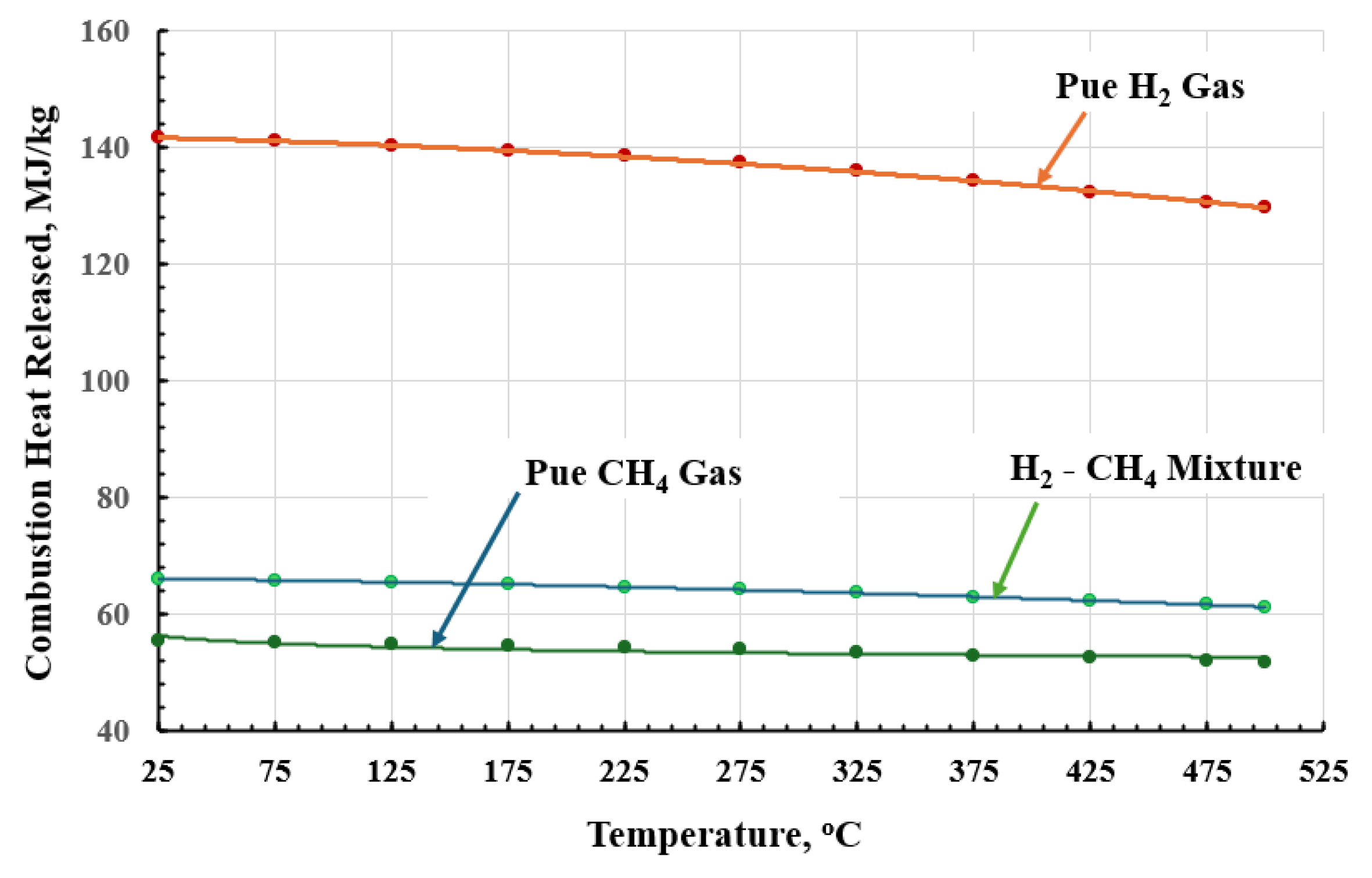
Additionally, HSC Chemistry software (Ver. 10) was used to calculate the energy release (MJ/kg) from the combustion of pure CH₄, pure H₂, and their stoichiometric mixture as a function of temperature, ranging from 25 °C to 500 °C. The results, shown in Figure 13, demonstrate that blending H₂ with CH₄ significantly enhances the combustion heat release compared to combusting CH₄ alone. This increased energy release is advantageous for many industrial applications that could benefit from H₂-CH₄ fuel blends.
5. Conclusions and Recommendations for Future Work
5.1. Conclusions
This study examined the safety measures of blending H₂ with CH₄ to reduce carbon emissions in hard-to-abate industries (such as cement, steel, and petrochemical industries), transportation (including road vehicles and commercial aviation), and household heating. The research highlighted significant safety risks due to hydrogen’s lower ignition energy (IE) and broader flammability and explosibility ranges, especially under high-pressure conditions. Using the Aspen HYSYS chemical process simulation tool and the HSC Chemistry platform, the study quantified carbon emissions and the combustion heat release of H₂-CH₄ mixtures at various H₂ contents, temperatures, and pressures. The results suggest that blending H₂ with CH₄ can be beneficial for the aforementioned applications, provided the H₂ content in the blend does not exceed the indicated safe thresholds and remains within a recommended safe operating range of 45-55 MJ/m³ based on the calculated Wobbe Index (WI). The following are key insights to gained from this study:
- ▪
- Trending WI a function of H2 in gaseous blend: The underlying mechanism involves the competing effects of H₂-CH₄ mixture density and the higher heating value (HHV) on the WI, (where ). As the mixture’s density decreases, the term increases, eventually outweighing the concurrent reduction in the mixture’s HHV (MJ/m³). This crossover occurs because, beyond 50 mole% H₂ (see Subsection 4.4), the mixture’s HHV approaches hydrogen’s characteristic value of 12.75 MJ/m³. Therefore, further increases in H₂ content would result in only marginal decreases in HHV, while the mixture density continues to drop rapidly. This condition (where the rate of HHV reduction decelerates while density reduction accelerates) causes WI to increase as H₂ concentration exceeds approximately 50 mole%.
- ▪
- Hydrogen’s unique properties, such as high buoyancy and diffusivity, can reduce localized accumulation in open environments but pose significant risks in confined spaces due to its low IE and wide flammability range. In this context, H₂-CH₄ blends with ≤ 20 mole% H₂ are considered safer to handle compared to higher H₂ concentrations or pure H₂ and, hence, can serve as transitional fuels.
- ▪
- For mixtures with high H₂ content (>20 mole%), engineered safety features (ESF) such as leak detection and alarm systems, adequate ventilation, and maintaining spark-free environments are essential. In air, the detonation range for pure H₂ is between 18 mole% and 59 mole%, while for pure CH₄, it is between 6.3 mole% and 13.5 mole%. Therefore, increased H₂ concentrations in H₂-CH₄ mixtures pose additional risks that must be managed by avoiding concentrations within these explosibility ranges (see subsection 4.2.1).
- ▪
- Safety recommendations: Adhering to industry safety codes and standards that limit H₂ concentrations to ≤ 20 mole% in natural gas pipelines are recommended to prevent material embrittlement concerns. However, as this study shows, a more conservative approach would be to keep H₂ concentrations < 18 mole% to stay outside the detonation range. Additionally, limiting H₂ concentration to ≤ 10 mole% would provide an added safety margin in environments with potential ignition sources.
- ▪
- As this study shows, there are risks associated with injecting H₂ into natural gas (primarily CH₄ gas) pipelines. These risks include gaseous leaks of flammable mixtures followed by fire and/or explosions if ignition sources are present. Recommended risk mitigation strategies may include: a) Utilizing H₂ sensors for early leak detection, b) Implementing proper ventilation systems in confined spaces, and c) Eliminating ignition sources to enhance safety in H₂-containing mixtures.
Policymakers and industry stakeholders could leverage the aforementioned insights to provide guidance for the safe use of hydrogen-enhanced energy systems, thereby supporting carbon reduction goals.
5.2. Future Work
Future research on H₂-CH₄ blending should focus on exploring the following:
- ▪
- Long-term material compatibility concerns by: a) Investigating the long-term effects of H2 embrittlement on various pipeline materials and b) Assessing material degradation due to prolonged exposure to H₂-CH₄ blends.
- ▪
- Advanced leak detection by: a) Developing advanced H2 leak detection technologies for real-time monitoring and b) Integrating artificial intelligence (AI) and machine learning (ML) methods for prognostic health monitoring (PHM) of H2-CH4 pipelines.
- ▪
- Optimal blending ratios by: a) Exploring optimal H₂ blending ratios for different sectors including the hard-to-abate industries, transportation, and residential / domestic use and b) Assessing the economic and safety trade-offs (i.e., cost-to-benefit analysis) of various blending ratios.
- ▪
- Combustion efficiency improvement by: a) Studying the impact of H₂-CH₄ blends on combustion efficiency in various applications and b) Evaluating modifications needed for existing combustion systems to handle different H₂ concentrations.
- ▪
- Infrastructure upgrades by: a) Evaluating the economic feasibility of upgrading existing natural gas infrastructure for hydrogen compatibility and b) Assessing the potential for retrofitting older pipelines to handle hydrogen blends safely.
- ▪
- Safety standards and regulations by: a) Developing and refining safety standards and regulations for H₂-CH₄ blending in different applications and b) Collaborating with regulatory bodies to establish best practices for the safe use of H2-CH4 blends.
- ▪
- Consumer acceptance of the H2-CH4 blending technology by: a) Conducting studies on consumer acceptance and perception of hydrogen-enriched natural gas and b) Identifying potential barriers to adoption and developing strategies to address consumer concerns.
- ▪
- Techno-economic analysis (TEA) by: a) Assessing potential scalability of this technology and b) Evaluating the economic viability of H2 blending under different market conditions.
- ▪
- Impact on renewable integration by: a) Investigating how H₂-CH₄ blending can support the integration of renewable energy sources into the electric grids and b) Assessing the role of H2 in balancing supply and demand in renewable-heavy energy systems.
Funding
This research received no external funding.
Acknowledgments
The author acknowledges the constructive comments from his colleagues from the Hydrogen Safety Panel at the Pacific Northwest National Laboratory (PNNL), the National Fire Protection Association (NFPA), Hydrogen Safety Task 37 and the Safety and Regulatory Aspects of Large-Scale Hydrogen Energy Applications Task 43 of the Hydrogen Technology Collaboration Program (H2TCP) of the International Energy Agency (IEA) during the preparation of this study.
Conflicts of Interest
The author declare no conflicts of interest.
Abbreviations
The following abbreviations are used in this manuscript:
| CH4 | Methane |
| CO | Carbon monoxide |
| CO2 | Carbon dioxide |
| EOP | Emergency operating procedure |
| ESF | Engineered safety features |
| H2 | Hydrogen |
| HHV | Higher heating value |
| IE | Ignition energy |
| LFL | Lower flammability limit |
| LHV | Lower heating value |
| NOX | Nitrogen Oxides |
| P2G (or PtG) | Power to gas |
| PRD | Pressure relief device |
| SG | Specific gravity |
| UFL | Upper flammability limit |
| UHC | Unburned hydrocarbons |
| WI | Wobbe Index |
References
- Haeseldonckx, D.; D’haeseleer, W. The use of the natural-gas pipeline infrastructure for hydrogen transport in a changing market structure. Int. J Hydrogen Energy 2007, 32, 1381-1386. [Google Scholar] [CrossRef]
- Agnolucci, P.; McDowall, W. Designing future hydrogen infrastructure: Insights from analysis at different spatial scales. Int. J Hydrogen Energy 2013, 38, 5181–5191. [Google Scholar] [CrossRef]
- Melaina, M.W., Antonia, O., and M. Penev, M. (2013). Blending hydrogen in natural gas pipeline networks: A Review of Key Issues. Technical Report, NREL/TP-5600-51995. [CrossRef]
- Jentsch, M.; Trost, T.; Sterner, M. Optimal use of Power-to-Gas energy storage systems in an 85% renewable energy scenario. Energy Procedia 2014, 46, 254–261. [Google Scholar] [CrossRef]
- Weiner, S.C. Advancing the hydrogen safety knowledge base. Int. J Hydrogen Energy 2014, 39(Issue 35), 20357–20361. [Google Scholar] [CrossRef]
- deVries; Mokhov, A.V.; Levinsky, H.B. The impact of natural gas/hydrogen mixtures on the performance of end-use equipment: Interchangeability analysis for domestic appliances. Applied Energy 2017, 208, 1007–1019. [Google Scholar] [CrossRef]
- Khalil, Y.F. A probabilistic visual-flowcharting-based model for consequence assessment of fire and explosion events involving leaks of flammable gases. Journal of Loss Prevention in the Process Industries 2017, 50, 190–204. [Google Scholar] [CrossRef]
- de Santoli, L.; Paiolo, R.; Lo Basso, G. An overview on safety issues related to hydrogen and methane blend applications in domestic and industrial use. Energy Procedia 2017, 126, 297–304. [Google Scholar] [CrossRef]
- Guandalini, G.; Colbertaldo, P.; Campanari, S. Dynamic modeling of natural gas quality within transport pipelines in presence of hydrogen injections. Applied Energy 2017, 185, 1712–1723. [Google Scholar] [CrossRef]
- Lo Basso, G.; Nastasi, B.; Garcia, D.A.; Cumo, F. How to handle the hydrogen enriched natural gas blends in combustion efficiency measurement procedure of conventional and condensing boilers. Energy 2017, 123, 615–636. [Google Scholar] [CrossRef]
- Witkowski, A.; Rusin, A.; Majkut, M.; Stolecka, K. Analysis of compression and transport of the methane/hydrogen mixture in existing natural gas pipelines. Int. J Pressure Vessels and Piping 2018, 166, 24–34. [Google Scholar] [CrossRef]
- Issac, T. HyDeploy: The UK’s First Hydrogen Blending Deployment Project. Clean Energy 2019, 3(2), 114–125. [Google Scholar] [CrossRef]
- Zhao, Y.; McDonell, V.; Samuelsen, S. Influence of hydrogen addition to pipeline natural gas on the combustion performance of a cooktop burner. Int. J Hydrogen Energy 2019, 44(Issue 23), 12239–12253. [Google Scholar] [CrossRef]
- Khalil, Y. F. (2019). Hydrogen safety considerations for the power-to-gas (P2G) conversion process. Invited Presentation at the Hydrogen Production Workshop, November 6 – 8, 2019, Électricité de France (EDF), 78400 Chatou, France. [CrossRef]
- Zhang, B; Liu, H; Yan, BJ. Effect of acoustically absorbing wall tubes on the near-limit detonation propagation behaviors in a methane-oxygen mixture. Fuel 2019, 236, 975–983. [Google Scholar] [CrossRef]
- Schiro, F.; Stoppato, A.; Benato, A. Modelling and analyzing the impact of hydrogen enriched natural gas on domestic gas boilers in a decarbonization perspective. Carbon Resources Conversion 2020, Vol. 3, 122–129. [Google Scholar] [CrossRef]
- Zhou, N.; et al. Effect of hydrogen addition on the explosion characteristics of methane-hydrogen-air mixture in T-shaped bifurcation pipe. Energy Sources, Part-A: Recovery, Utilization, and Environmental Effects 2022, Vol. 44I(Issue 2), 3808–3822. [Google Scholar] [CrossRef]
- Chen, Z.F.; et al. Structural integrity assessment of hydrogen-mixed natural gas pipelines based on a new multi-parameter failure criterion. Ocean Engineering 2022, Vol. 247, 110731. [Google Scholar] [CrossRef]
- Cristello, J.B.; et al. Feasibility analysis of blending hydrogen into natural gas networks. International Journal of Hydrogen Energy 2023, Vol. 48(Issue 46), 17605–17629. [Google Scholar] [CrossRef]
- Fetisov, V.; Davardoost, H.; Mogylevets, V. Technological aspects of methane–hydrogen mixture transportation through operating gas pipelines considering industrial and fire safety. Fire 2023, 6(10), 409. [Google Scholar] [CrossRef]
- Liu, W.; et al. Study on the leakage and diffusion characteristics of buried hydrogen-blended natural gas pipelines. Journal of Pressure Vessel Technology Transactions of the ASME 2024, Vol. 146(Issue, 011001), 1–13. [Google Scholar] [CrossRef]
- Bu, F.; et al. Analysis of leakage and diffusion characteristics and hazard range determination of buried hydrogen-blended natural gas pipeline based on CFD. ACS Omega 2024, Vol. 9(Issue37), 39202–39218. [Google Scholar] [CrossRef]
- Xu, H.J.; et al. The effect of jet disturbance on flame propagation characteristics of multi-component natural gas/hydrogen mixed fuel. International Journal of Hydrogen Energy 2024, Vol. 84, 690–699. [Google Scholar] [CrossRef]
- Mei, Y; Jian Shuai, J.; Li, Y. Analysis of the consequences of hydrogen-blended natural Gas leakage accidents. Combustion Science and Technology 2024, Vol. 196(Issue17), 4768–4791. [Google Scholar] [CrossRef]
- Gong, X.; et al. Research on leakage and diffusion behavior of hydrogen doped natural gas in integrated pipeline corridors based on data drive. Scientific Reports 2025, Vol. 15(Issue 1), 1–22. [Google Scholar] [CrossRef] [PubMed]
- Wang, H.; Tian, X. Numerical simulation of diffusion characteristics and hazards in multi-hole leakage from hydrogen-blended natural gas pipelines. Energies 2025, 18(16), 4309. [Google Scholar] [CrossRef]
- Yang, Y.; et al. Effect of bend spacing configuration on the vented explosion characteristics of premixed methane/hydrogen in pipelines with a large length-to-diameter ratio. Fire 2025, 8(8), 328. [Google Scholar] [CrossRef]
- Chang, W.; et al. Diffusion characterization of hydrogen-blended natural gas leakage for buried pipeline based on simulation. International Journal of Hydrogen Energy 2025, Vol. 99(20), 394–408. [Google Scholar] [CrossRef]
- Li, J.; et al. Study on the scope of impact of consequences of leakage of hydrogen blended with natural gas pipeline. Journal of Loss Prevention in the Process Industries 2026, Vol. 99, 105810. [Google Scholar] [CrossRef]
- Aspen HYSYS | Leading Process Simulation Software for Oil & Gas | AspenTech. https://www.aspentech.com/en.
- HSC Chemistry - Metso. https://www.metso.com/portfolio/hsc-chemistry/.
Figure 1.
Bibliometric analysis networks (Type of analysis and counting method: Co-occurrence of authors keywords and full counting method).
Figure 1.
Bibliometric analysis networks (Type of analysis and counting method: Co-occurrence of authors keywords and full counting method).
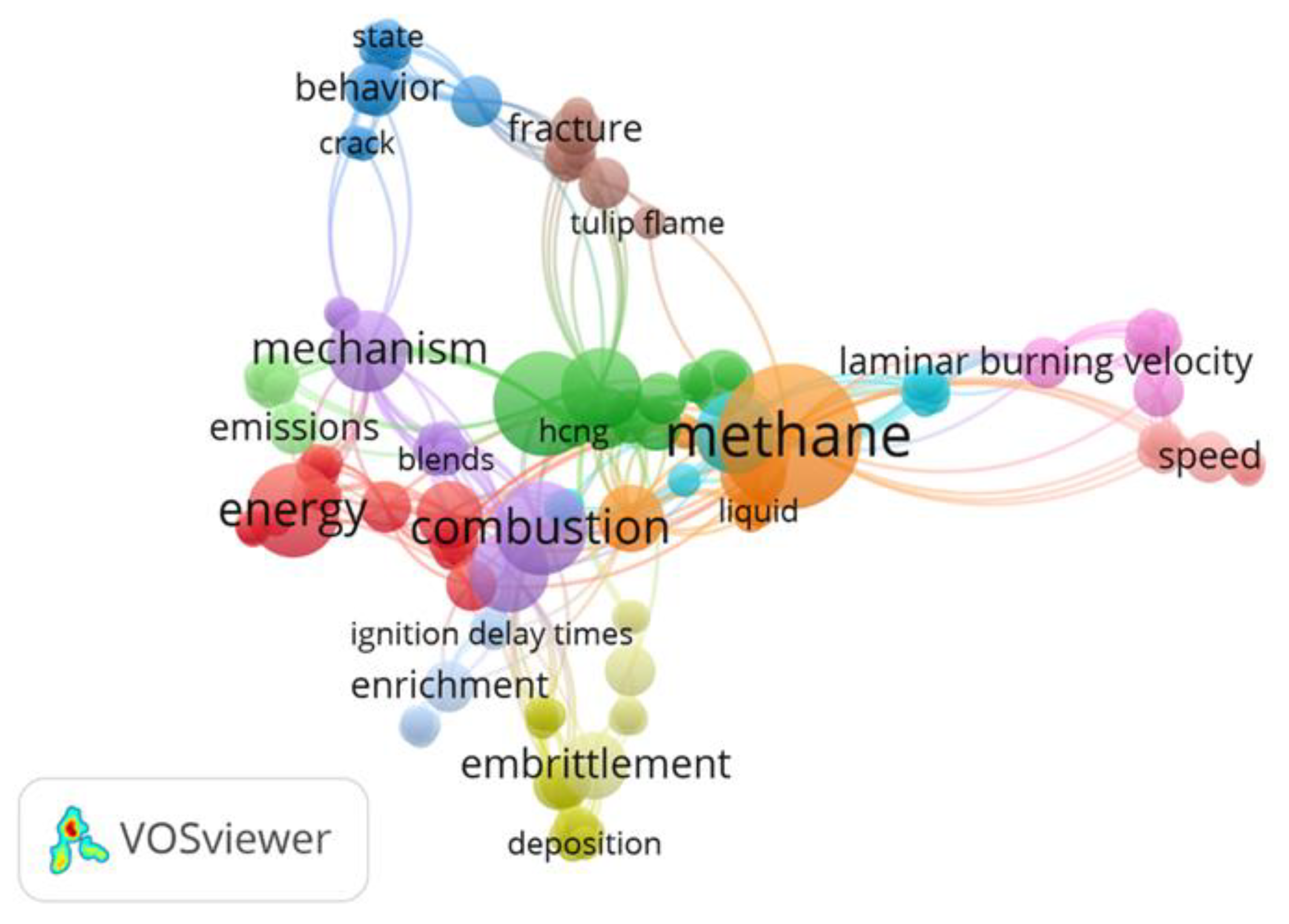
Figure 2.
of H2-CH4 mixture (at 1 atm total pressure) as a function of mole % H2 in mixture.
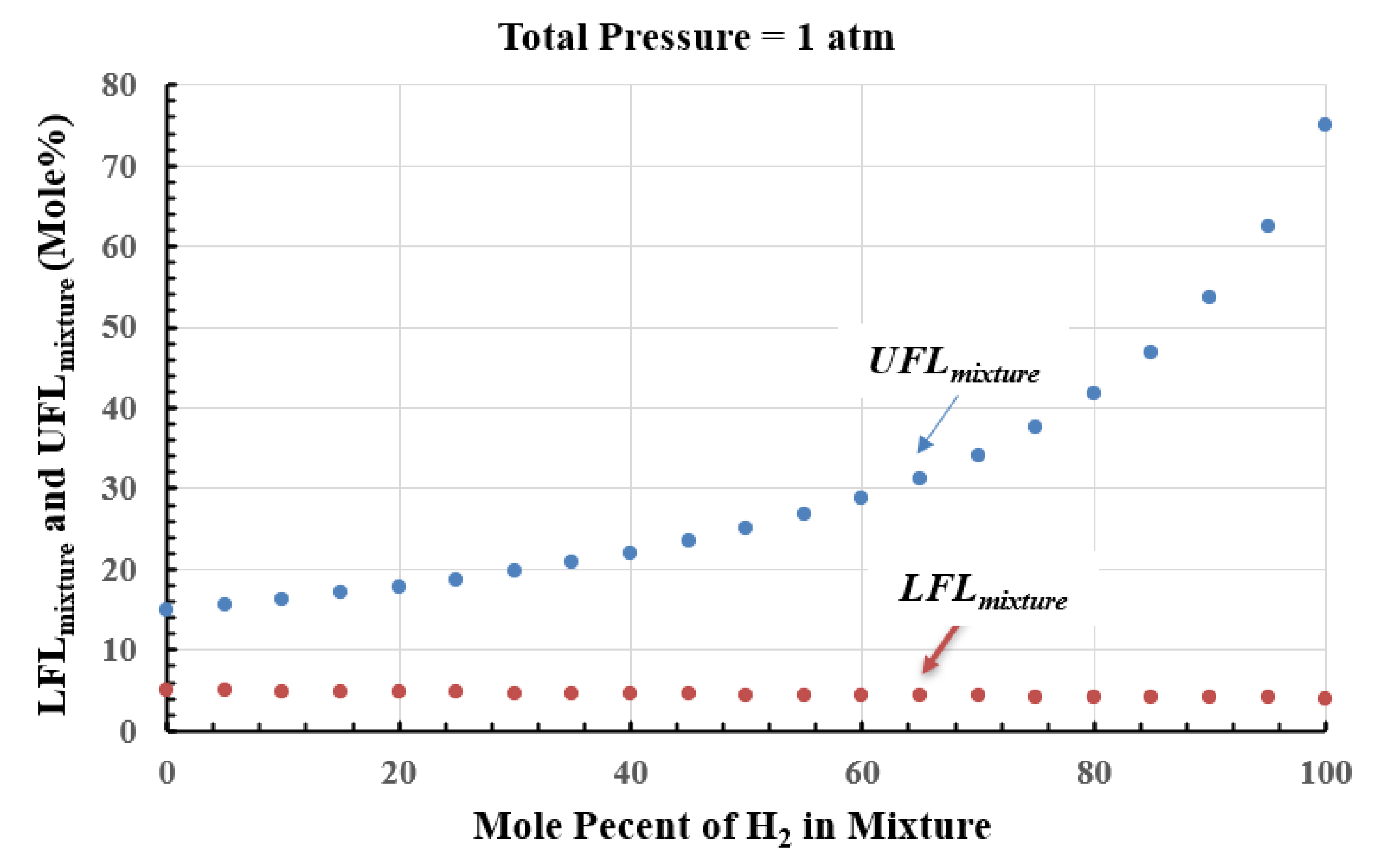
Figure 3.
Effect of the total pressure on as a function of mole% H2 in the mixture.
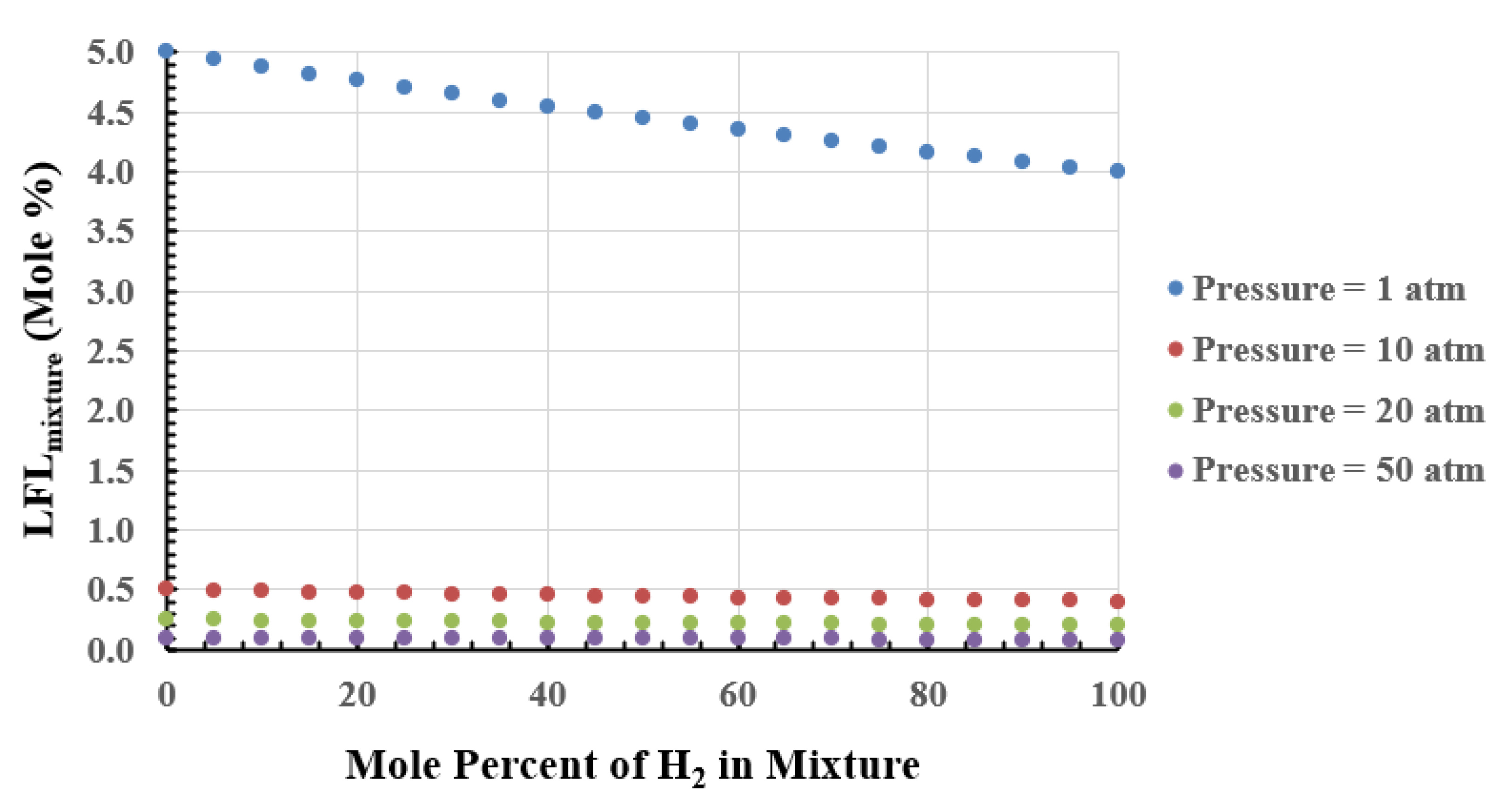
Figure 4.
Effect of pressure on LFL of H2-CH4 mixture as a function of mole% H2.
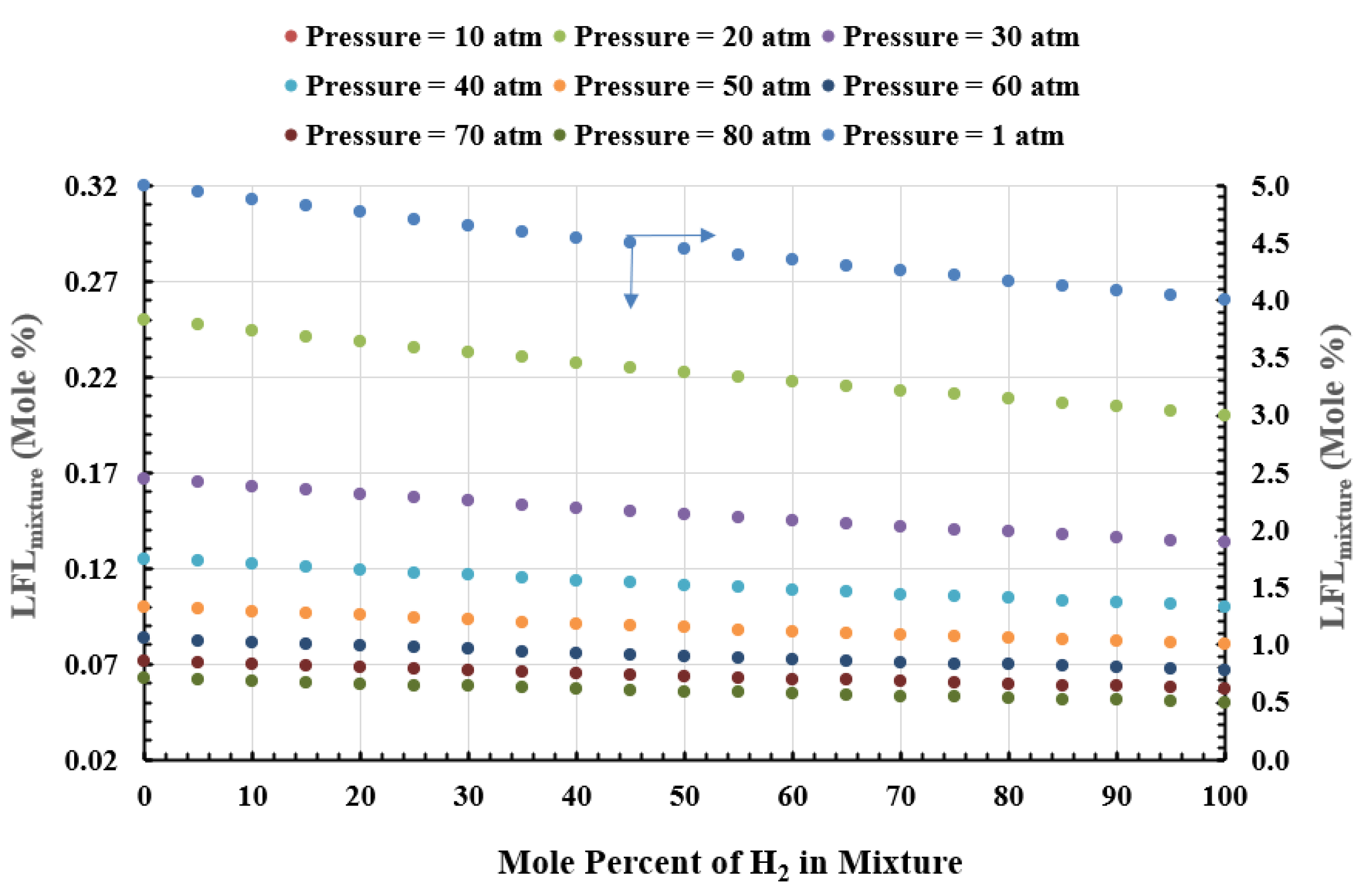
Figure 5.
Detonation limits in air of H2-CH4 mixtures.
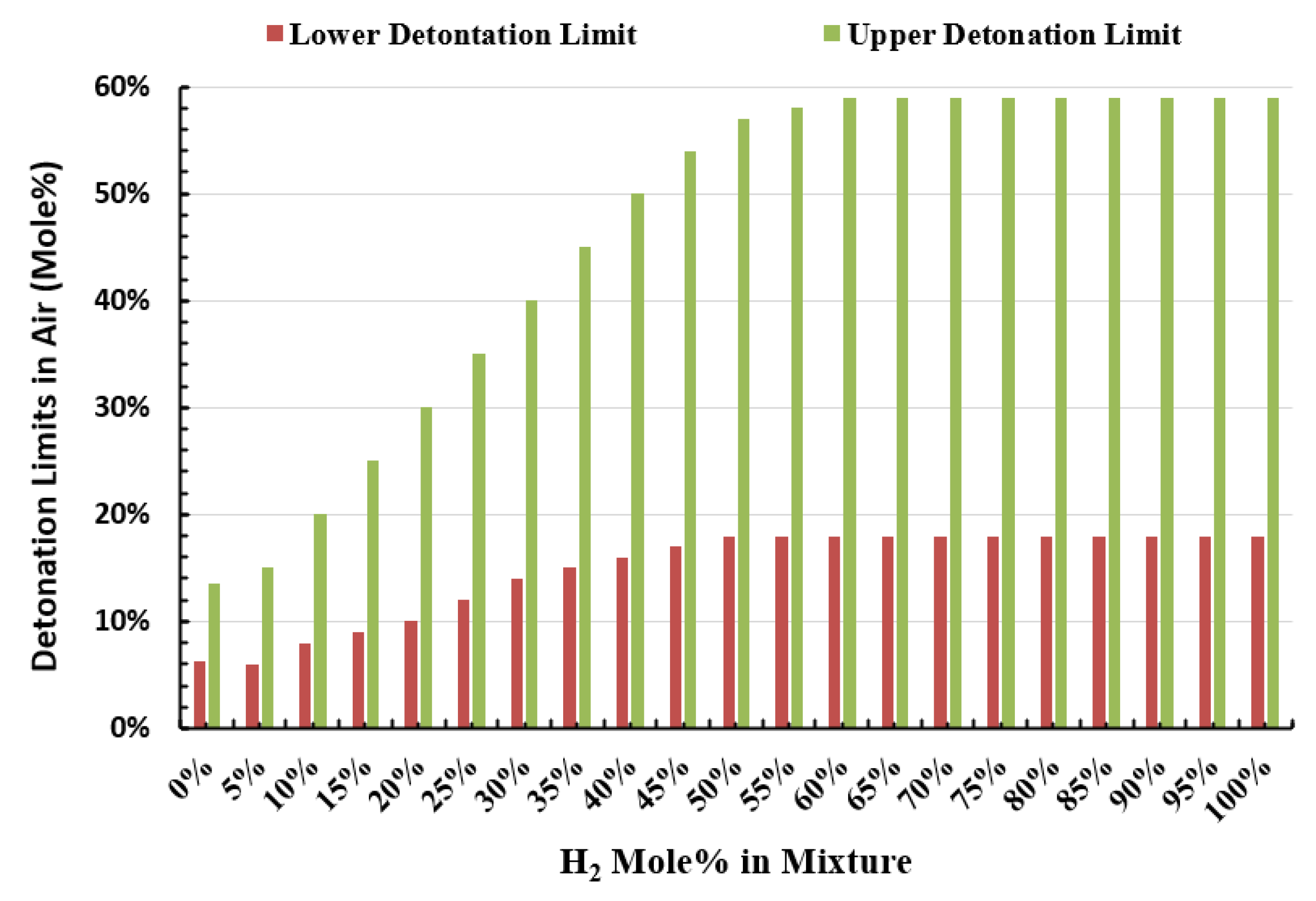
Figure 6.
Ignition energy (IE) of H2-CH4 mixture as a function of H2 mole%.
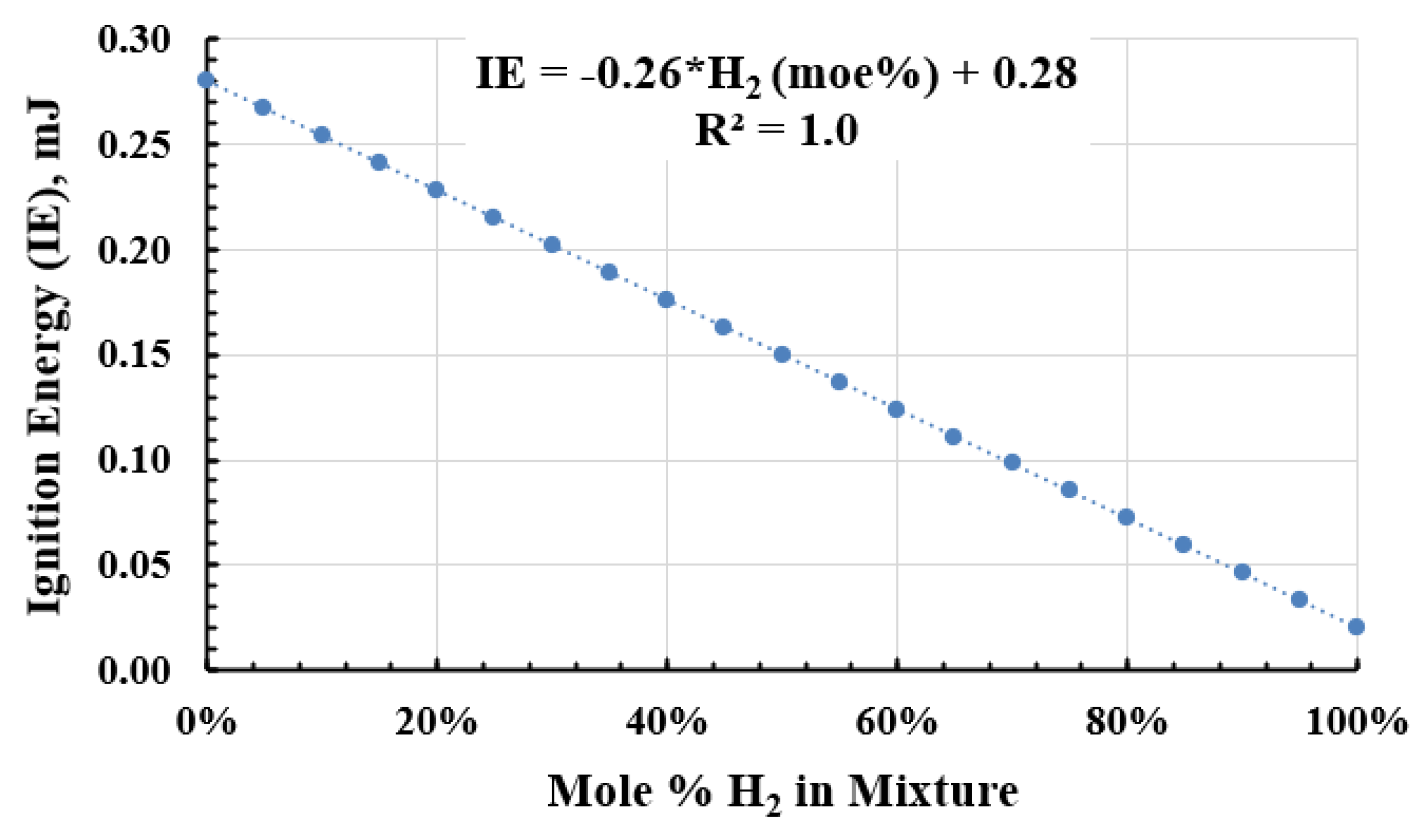
Figure 7.
Pressure-dependence of H2-CH4 mixture ignition energy.
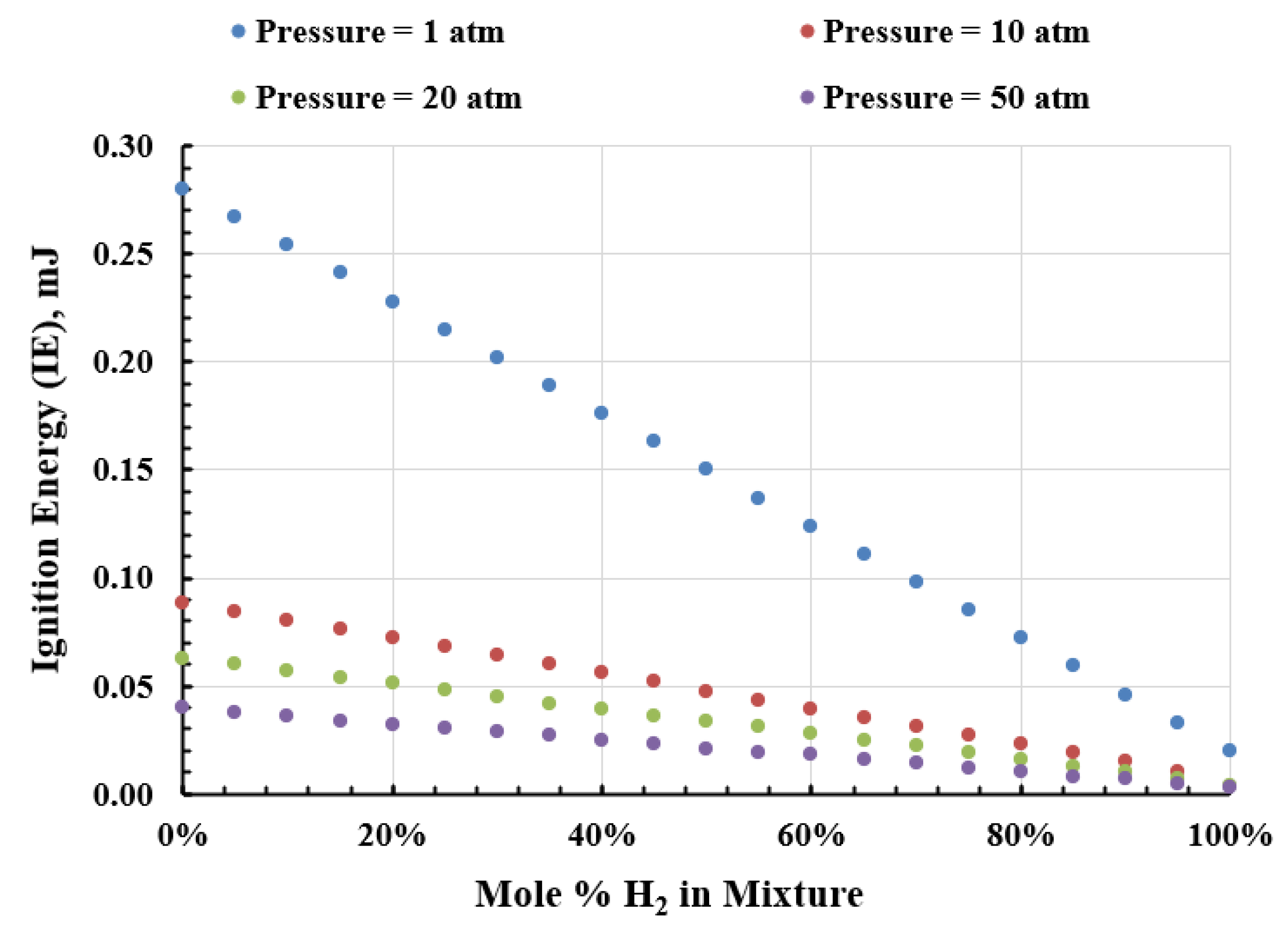
Figure 8.
Explosibility range (in mole % H2) at three pressures (1 atm, 10 atm, 20 atm, and 50 atm).
Figure 8.
Explosibility range (in mole % H2) at three pressures (1 atm, 10 atm, 20 atm, and 50 atm).
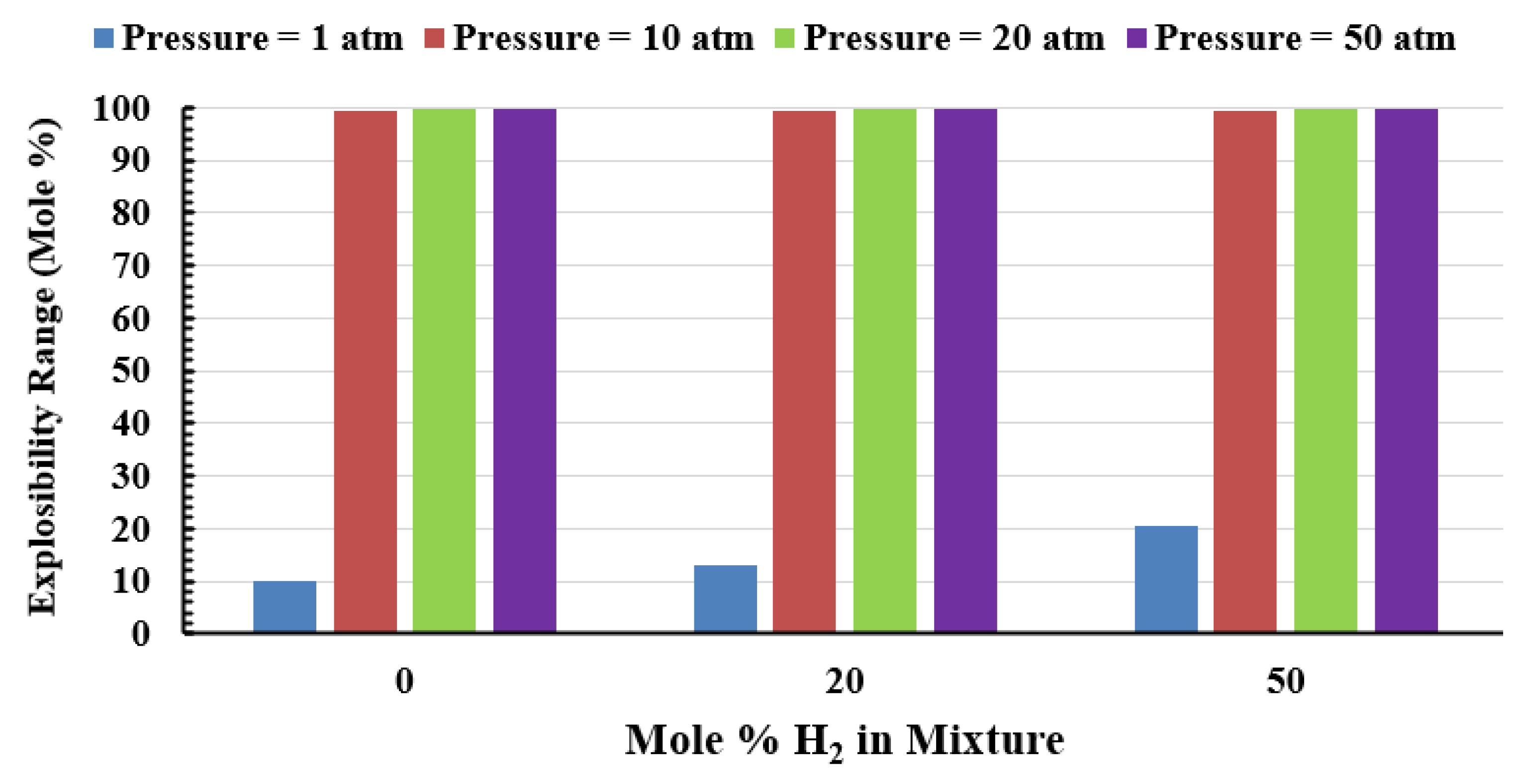
Figure 9.
Trending H2-CH4 mixture’s HHV and specific gravity as a function of H2 mole% in mixture.
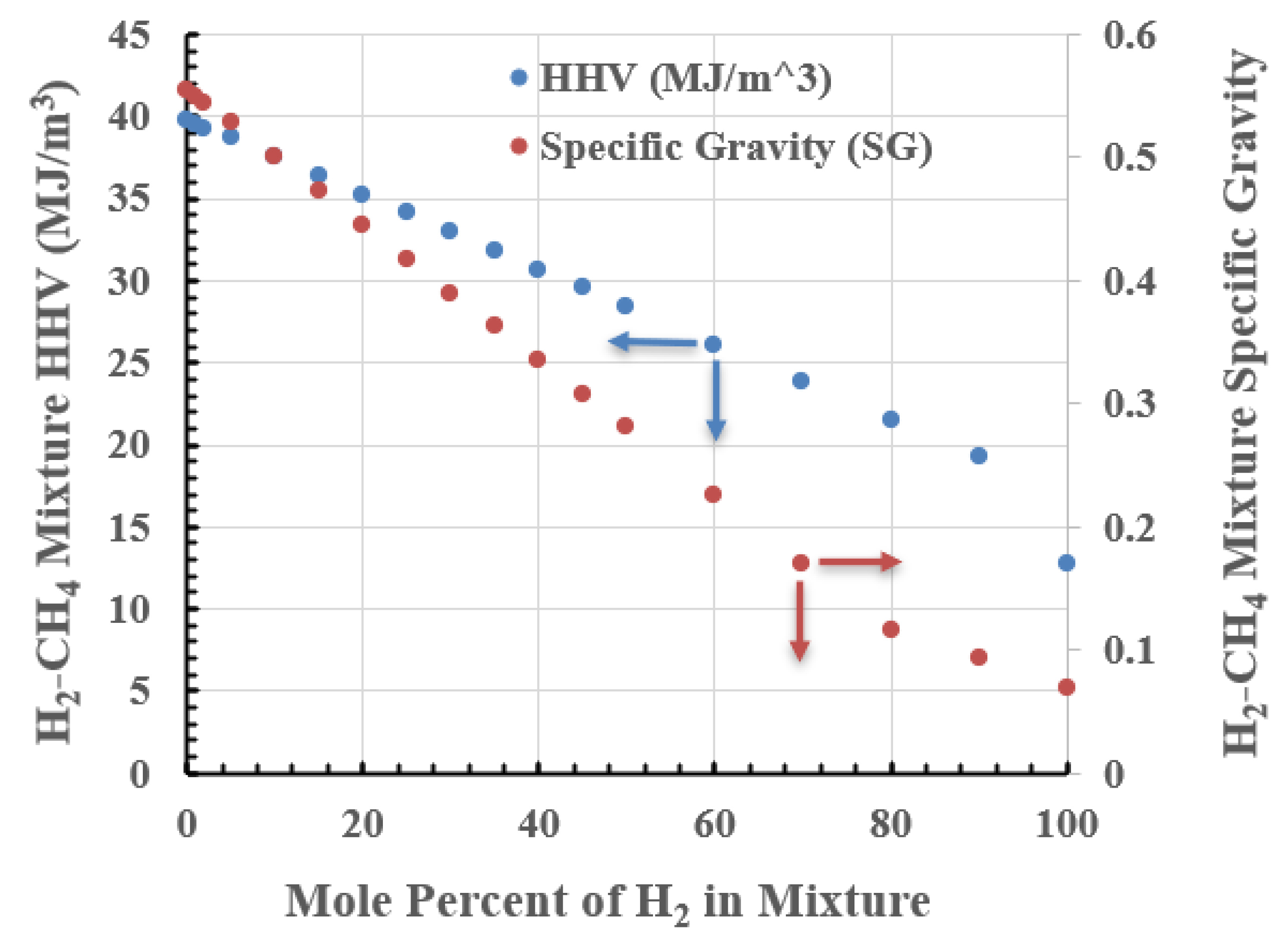
Figure 10.
Trending Wobbe Index of H2-CH4 mixture as a function of H2 mole% in mixture.
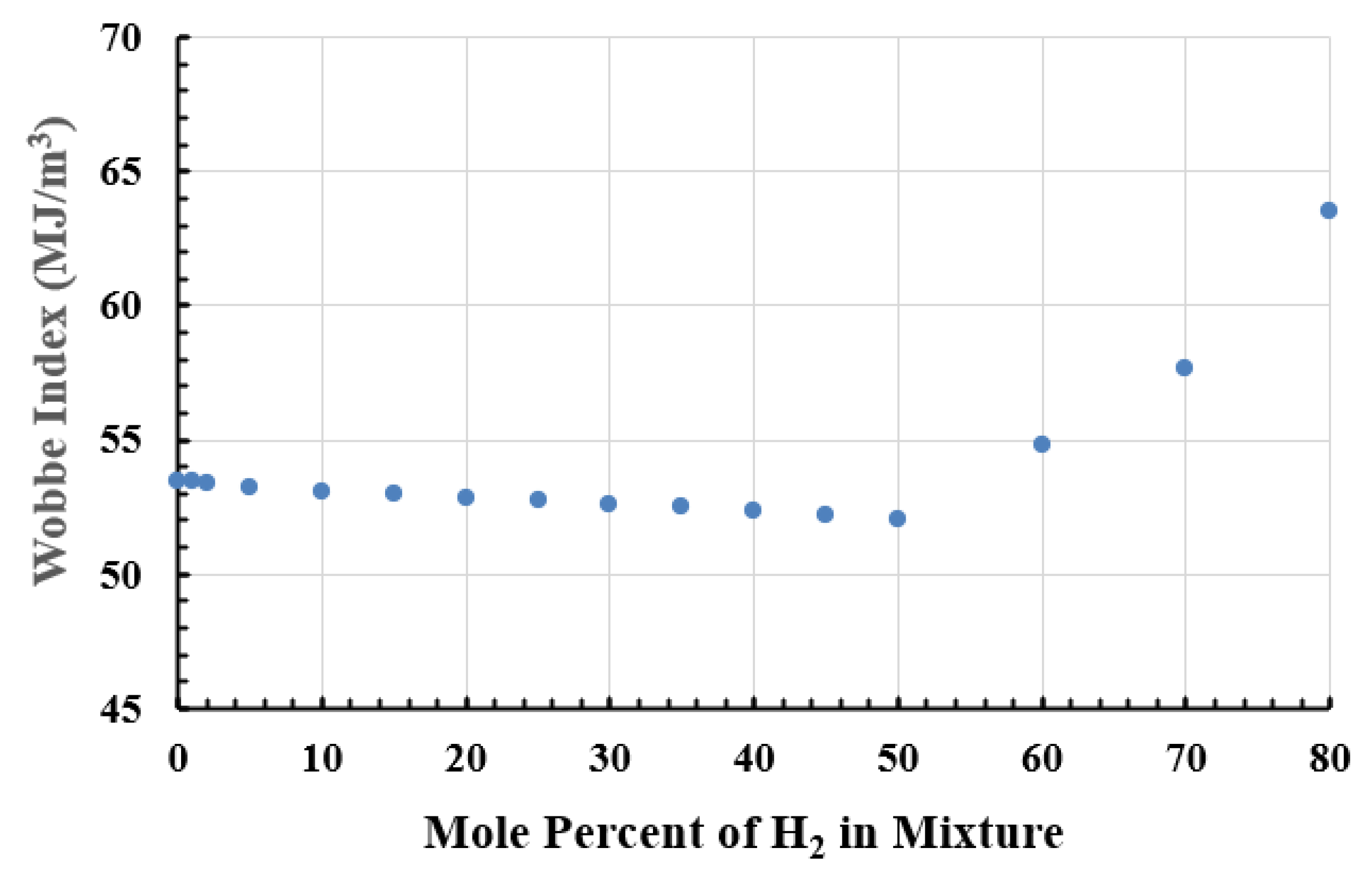
Figure 11.
Aspen HYSYS combustion model results: kg CO2 emission per kg H2-CH4 mixture combustion in air.
Figure 11.
Aspen HYSYS combustion model results: kg CO2 emission per kg H2-CH4 mixture combustion in air.
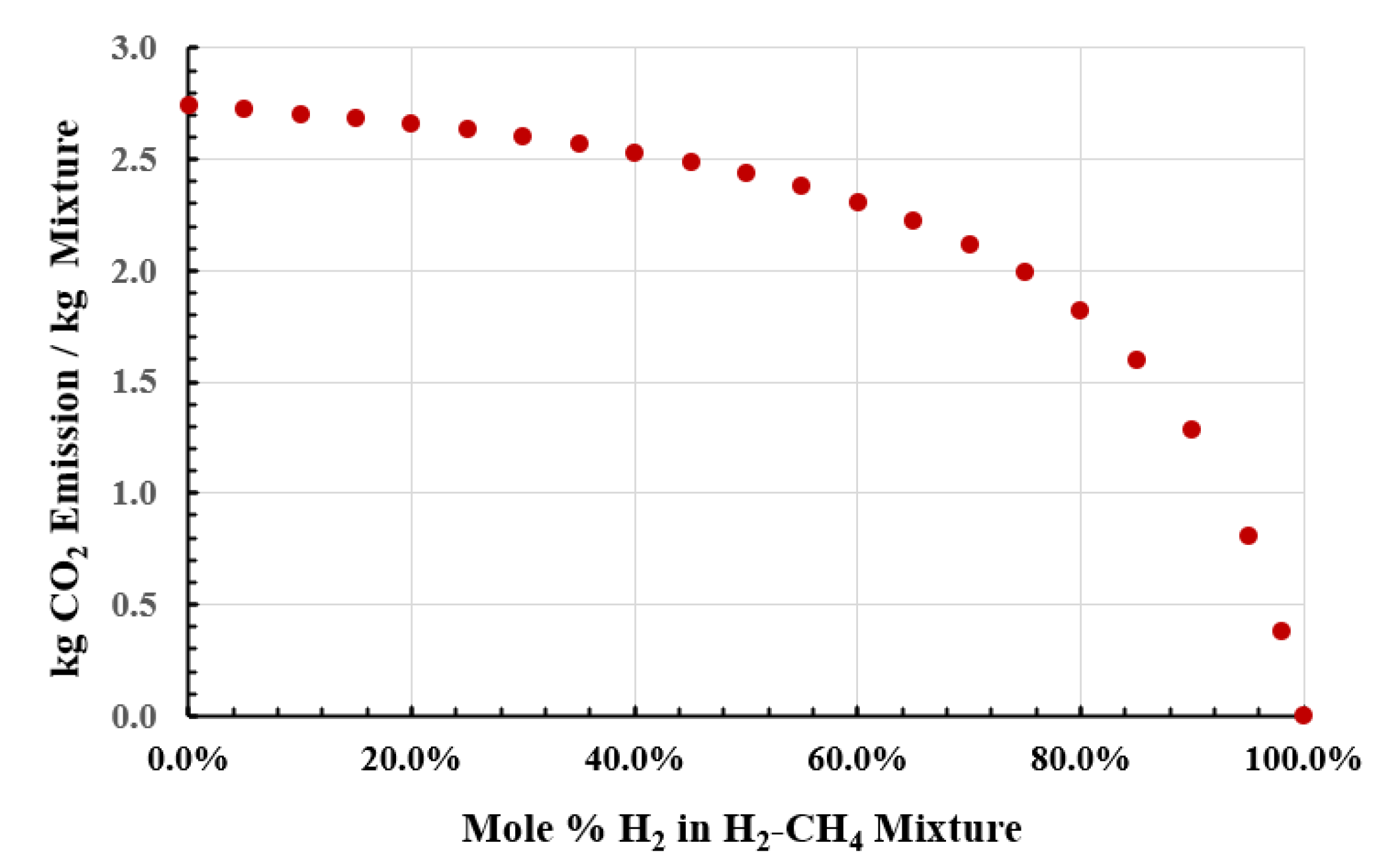
Figure 12.
HSC Chemistry (Rev. 10) calculations of the combustion heat released (LHV and HHV) of the H2-CH4 gaseous mixture.
Figure 12.
HSC Chemistry (Rev. 10) calculations of the combustion heat released (LHV and HHV) of the H2-CH4 gaseous mixture.
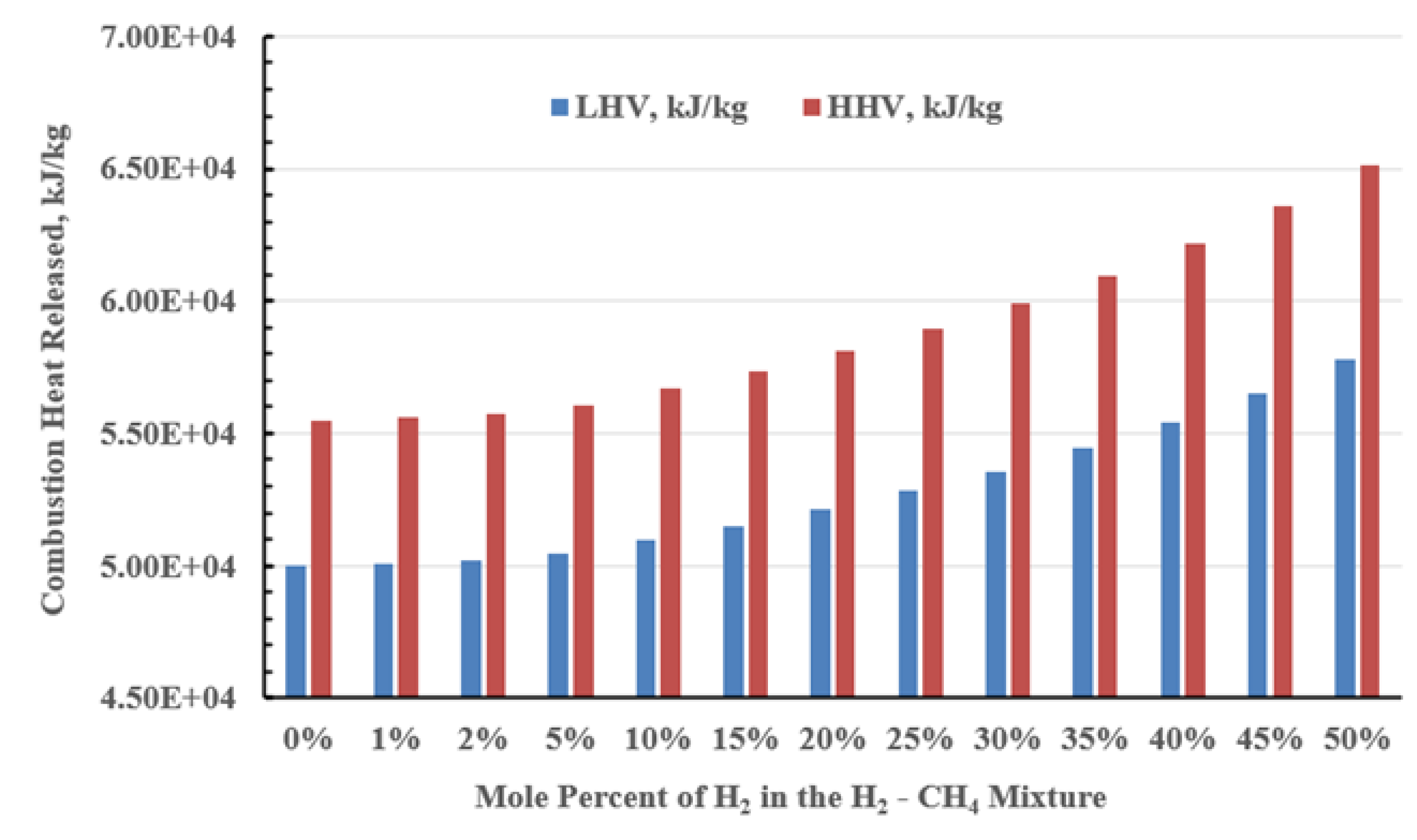
Figure 13.
HSC Chemistry (Ver. 10) calculations of the Combustion energy release (MJ/kg) of pure H2, pure CH4, and H2-CH4 stochiometric mixture as a function of temperature.
Figure 13.
HSC Chemistry (Ver. 10) calculations of the Combustion energy release (MJ/kg) of pure H2, pure CH4, and H2-CH4 stochiometric mixture as a function of temperature.
Disclaimer/Publisher’s Note: The statements, opinions and data contained in all publications are solely those of the individual author(s) and contributor(s) and not of MDPI and/or the editor(s). MDPI and/or the editor(s) disclaim responsibility for any injury to people or property resulting from any ideas, methods, instructions or products referred to in the content. |
© 2026 by the authors. Licensee MDPI, Basel, Switzerland. This article is an open access article distributed under the terms and conditions of the Creative Commons Attribution (CC BY) license (http://creativecommons.org/licenses/by/4.0/).
Copyright: This open access article is published under a Creative Commons CC BY 4.0 license, which permit the free download, distribution, and reuse, provided that the author and preprint are cited in any reuse.


