
Submitted:
07 April 2026
Posted:
08 April 2026
You are already at the latest version
Abstract
In this study a new species of Pedicularis, P. dieshanensis, is described. It is endemic to Die Mountains, China, grows on the alpine meadow at the edge of the fir forest at elevations of 3150-3500 m. This species is characterized by the presence of 3-4 whorled cauline leaves, pinnatifid leave margin, purple corolla, galea with a conical beak, slightly tilted to the left, and hairless filaments. The new species morphologically resembles P. cheilanthifolia and P. anas, but it differs from P. cheilanthifolia by having pinnatifid leave margin, shorter galea, longer beak and hairless filaments, and it differs from P. anas by having pinnatifid leave margin, stable flower color and longer beak. In this paper, a detailed description of the new species includes data on its habitat, ecology, phenology, conservation status, a distribution map, detailed illustration, field photographs, and a comparison with closely related species is provided.
Keywords:
Pedicularis
; die mountains
; Pedicularis cheilanthifolia
; Pedicularis anas
1. Introduction
The genus Pedicularis L. (Orobanchaceae), commonly known as louseworts, is one of the most species-rich genera of parasitic plants, comprising about 677 species distributed primarily across alpine and arctic regions of the Northern Hemisphere [1,2]. China represents a major center of diversity for the genus, hosting approximately 352 recognized species (of which over 60% are endemic), predominantly concentrated in the Hengduan Mountains, the Himalayas, and the Qinghai-Tibet Plateau [3,4,5,6,7]. Globally, taxonomic exploration of Pedicularis remains active, as the field investigation work has continued to deepen, some new species of Pedicularis have been discovered and reported[2,8,9,10,11,12]. Advances in molecular phylogenetics and integrative taxonomy have resolved several cryptic species complexes[7,13,14,15], yet numerous unresolved lineages persist, particularly in poorly surveyed regions of the Sino-Himalayan corridor.
During our botanical expeditions in Die Mountains, China, which is located at the northeastern edge of the Qinghai-Xizang Plateau, we encountered and studied individuals of several populations of Pedicularis with a combination of characters that do not correspond with any of the known species in China. Here, we describe this taxon as a new species, Pedicularis dieshanensis, based on comprehensive morphological comparisons and ecological evidence. We include photographic plates and an illustration of the new species, as well as a distribution map. This discovery not only enriches the diversity of Pedicularis but also highlights the need for further taxonomic exploration in understudied regions.
2. Materials and Methods
This new species was first found on the southern slope of Die Mountains by Wang-xuan Mao, one of the gatherers, in 2015. After that, on the south and north slopes of Die Mountains, we discovered a total of 6 different populations. All the populations grow on the alpine meadow at the edge of the forest. We conducted field surveys of this species during 2015 to 2025, photos of the habitat, whole plant and its various organs were taken, specimens from different populations were collected, and its geographic and ecological data were recorded.
The voucher specimens were kept in the Herbarium of Gansu Agricultural University (GAUF), located in Lanzhou City, Gansu Province, China. In addition, type specimens and other relevant herbarium specimens of Pedicularis available online from AMES, BM, E, L, K, P and PE (acronyms following Thiers[16], continuously updated), JSTOR Global Plants[17], China National Specimen Information Infrastructure NSII[18] and The Chinese Virtual Herbarium[19] were also examined for taxonomic comparison. The IUCN Red List Categories and Criteria [20,21] were used to evaluate the conservation status of the new species.
3. Results
Taxonomic Treatment
Pedicularis dieshanensis X. J. Liu, X. G. Sun & W. Li, sp.nov.
Holotype: CHINA. Gansu Province: Diebu County, Jianni Valley, forest edge, alt. 3336 m, 34°7′15″N, 103°38′40″E, 14 July 2022, X. G. Sun, X. J. Liu & W. X. Mao 20220714001 (holotype: GAUF!). CHINA. Gansu: Diebu, Guma Lake, forest edge, alt. 3264 m, 34°8′38″N, 103°41′23″E,11July 2022, X. G. Sun, X. J. Liu &W. X. Mao 20220711001(Paratype: GAUF! LZU!).
Diagnosis:Pedicularis dieshanensis morphologically resembles Pedicularis cheilanthifolia and Pedicularis anas in having whorled phyllotaxy, short corolla tube and beaked galea. However, it differs from Pedicularis cheilanthifolia by having pinnatifid leave margin, shorter galea, longer beak and hairless filaments, and it differs from Pedicularis anas by having pinnatifid leave margin, stable flower color and longer beak.
Description: Annual herb, 12-30 cm tall. Roots cylindrical, branched. Stem quadrangle, single and erect or multiple and ascending, villous, especially around the node. Basal leaves persistent, petiole 1.5-2.5 cm long, covered with sparse white villous; leaf blade oblong, 1.5-2.2 cm long, 4-7 mm wide, pinnatifid, segments 6-8 pairs. Cauline leaves 3-4 whorled, occasionally opposite near the base, petiole 3-5mm long, densely covered with long white hair; leaf blade slightly smaller than basal leaves, ovate oblong, adaxially hispidulous, abaxially villous along veins. Inflorescence spicate, 2-7 cm long, interrupted basally. Proximal bracts leaflike, middle and upper ovate or rhombic, base broadly cuneate, densely hairy. Calyx membranous, 4-7 mm long, red spotted, 5 lobed, unequal, anterior 2 lobes lanceolate, smaller than posterior lobes, posterior 3 lobes ovate triangular, 2 mm long. Corolla purple red, 12-15 mm long; tube 6-8 mm, decurved through anterior slit of calyx, ascending distally near junction of limb, expanded apically; lower lip 6-8 mm long, 9-12 mm wide, 3 lobes, lateral lobes reniform, middle one broad obovate, lobe margin overlapping; galea falcate, 5-7 mm long, slightly enlarged in the part containing stamens, apex with a conical beak, ca. 2 mm, slightly tilted to the left, apex obtuse; filaments 2 pairs, hairless; style exserted or included. Capsule ca. 15 mm long, triangular-lanceolate, sharp cuspate, with ca. 2/3 exserted from calyx; seeds oval, 1.5-2 mm long. Figure 1 and Figure 2.
Etymology: The species epithet is derived from the type locality, Die Mountains.
Phenology: Flowering is from July to August; fruiting is from late August to September.
Distribution, habitat and ecology: Pedicularis dieshanensis is an annual herb, grows on the alpine meadow at the edge of the forest dominated by Picea asperata and Abies fargesii at elevations of 3150-3500 m. The populations were distributed on both the south and the north slopes of Die Mountains. The individuals grow in open meadow, mainly accompanied by herbs of Poaceae and Cyperaceae, or near the canopy of shrub Dasiphora fruticosa. The distribution of this species is located in the temperate zone, however, the populations grow at high altitude region, so the climate is relatively cold.
Conservation status: Based on our field investigations in the Die Mountains area and its surrounding regions, the individuals of this species are restricted to Die Mountains. Both on the south and north slopes of Die Mountains, we found a total of 6 different populations with over 5000 flowering individuals. Habitats similar to that of this species are widely distributed in the region, so it can be inferred that there are other populations present in this area as well. Moreover, the habitat of this species is far away from human settlements, so it is not exposed to any immediate threats. According to the distribution, population size, ecology and threats, we suggest this species should be considered as Least Concern (LC) according to IUCN criteria [20,21].
4. Discussion
The new species Pedicularis dieshanensis has 3-4 whorled cauline leaves, its galea with a conical beak, bases of petioles of leaves and bracts not connate or cupular, flowers more than 10 mm, according to Tsoong’s system, it should be categorized into series Cheilanthifoliae. After comparing the characteristics between Pedicularis dieshanensis and species in series Cheilanthifoliae as well as close relatives species, we found the new species is morphologically similar to Pedicularis cheilanthifolia Schrenk and Pedicularis anas Maxim. Detailed differences among these three species are listed in Table 1, based on Flora of China[1] and our own measurements in field (Table 1).
Our morphological comparison (Table 1) clearly distinguishes P. dieshanensis from its morphologically closest relatives, P. cheilanthifolia and P. anas. While sharing the overall habit of having whorled phyllotaxy, short corolla tube and beaked galea, the new species exhibits a unique combination of traits. The 3-4 whorled cauline leaves, non-connate petiole bases, and floral length over 10 mm firmly place it within Tsoong’s series Cheilanthifoliae[5,22,23]. However, the detailed morphology reveals a distinct set of characters, the corolla is consistently purple (vs. more variable in the other two), the beak is distinct (ca. 2 mm) and slightly tilted to the left with an obtuse apex, and the filaments are completely glabrous (vs. sparsely pubescent in P. cheilanthifolia). This combination of features, particularly the distinct beak morphology, has not been recorded for any other species in this series, supporting its recognition as a distinct species.
Recent large-scale phylogenetic studies have significantly advanced our understanding of Pedicularis evolution. The phylogeny presented by Yu et al.[7], which includes over 250 species, provides a framework for interpreting the systematic position of newly discovered taxa. In that study, series Cheilanthifoliae was found to be paraphyletic, with its members, including P. cheilanthifolia, nested within the large, primarily opposite-whorled leaved Clade 1[7]. Furthermore, P. anas was also placed within this same clade. Given this phylogenetic context, we hypothesize that P. dieshanensis, with its whorled cauline leaves, likely also belongs to this Clade 1. This clade is characterized by opposite/whorled phyllotaxy, short corolla tubes, and a high proportions of toothless and beakless galea, and most of the species are from China, extending to Himalaya, particularly in southwestern (SW) China. The discovery of a new species with a distinct beak within this clade adds to the known floral diversity of this group.
The distribution area of P. dieshanensis, Die Mountains, is located at the northeastern edge of the Qinghai-Tibet Plateau, this region represents a transitional zone and is less intensively explored compared to the core Hengduan Mountains hotspot. The sympatric occurrence of P. dieshanensis with its morphologically similar species P. cheilanthifolia and P. anas in the Die Mountains is of particular interest. Unlike many previously described new species of Pedicularis that are narrowly endemic and geographically isolated from their relatives[10,11], P. dieshanensis shares its habitat with two close relatives. This sympatric distribution suggests that apart from geographic isolation, other factors, such as ecological differentiation or reproductive isolation, may have played a crucial role in its speciation. The three species can be clearly distinguished by a combination of morphological traits (Table 1), including corolla color, beak morphology, and leaf characteristics. In the highly species-rich genus Pedicularis, particularly in the Himalaya-Hengduan Mountains region, floral traits are known to be under strong selective pressure from pollinators, and divergence in these traits can effectively reduce interspecific pollen transfer among co-flowering species[24,25,26]. The distinct corolla morphology was observed among these three sympatric species, P. dieshanensis with its purple corolla and distinct beak, P. cheilanthifolia and P. anas with more variable corolla coloration, this may represent adaptations to different pollinator guilds or may serve as mechanical isolation mechanisms that prevent hybridization.
The Die Mountains, located at the northeastern edge of the Qinghai-Tibet Plateau, represent a transitional zone where multiple floristic elements converge. The co-occurrence of three closely related species in this region highlights the complexity of species differentiation processes in Pedicularis. While allopatric speciation driven by the “sky island” effect has been well documented in the Hengduan Mountains[27,28], our findings suggest that sympatric or parapatric speciation mechanisms, mediated by ecological divergence or pollinator-mediated reproductive isolation, may also play important roles in driving diversification within this genus. This is consistent with the observation that floral diversity in Pedicularis is often associated with pollinator specialization, even among species occurring in the same locality [29].
Our field assessments indicate a population of over 5000 individuals across 6 populations, with suitable habitat seemingly widespread on the Die Mountains. This suggests a status of Least Concern (LC) according to IUCN criteria. However, as the Die Mountains are subject to increasing human activity and climate change, long-term monitoring of these populations is warranted to ensure their stability.
While we have placed P. dieshanensis in series Cheilanthifoliae based on morphology, its exact phylogenetic relationship within Clade 1[7]remains to be tested. Future studies incorporating molecular data for P. dieshanensis and its close relatives would help resolve its position within the intricate phylogenetic backbone of Pedicularis.
Author Contributions
Conceptualization, X.-G. S. and X.-J.L.; methodology, X.-G. S. and X.-J.L.; formal analysis, X.-J.L. and W.L.; investigation, X.-J.L., W.L. and X.-G. S.; resources, W.L.; data curation, W.L.; writing—original draft preparation, X.-J.L. and W.L.; writing—review and editing, X.-J.L. and X.-G. S.; visualization, W.L.; supervision, X.-J.L.; project administration, X.-J.L.; funding acquisition, X.-J.L. All authors have read and agreed to the published version of the manuscript.
Funding
This research was funded by Construction of the Plant Community Monitoring System in the Gansu Taohe National Nature Reserve.
Data Availability Statement
Data are contained within the article.
Acknowledgments
We would like to express our sincere gratitude to Mr. Wang-Xuan Mao from the Diebu County Forestry Technology Comprehensive Service Station in Gansu Province, China, who first discovered this new species in the field. We also thank the staff of the Gansu Taohe National Nature Reserve for their assistance during the subsequent field surveys.
Conflicts of Interest
The authors declare no conflicts of interest.
References
- Yang, H. B.; Noel, H. H.; Robert, R. M. Scrophulariaceae. In Flora of China 18; Missouri Botanical Garden Press: St. Louis, MO, USA, 1998; pp. 97–209. [Google Scholar]
- Arti, G.; Achuta, N. S. A new hemiparasitic species of Pedicularis (Orobanchaceae) from North Sikkim, India. Nord. J. Bot. 2023, 9, 1–10. [Google Scholar]
- Li, H. L. A revision of the genus Pedicularis in China. part I. Proc. Acad. Natl. Sci. Phila. 1948, 100, 205–378. [Google Scholar]
- Li, H. L. A revision of the genus Pedicularis in China. part II. Proc. Acad. Natl. Sci. Phila. 1949, 101, 1–378. [Google Scholar]
- Tsoong, P. C. A new system for the genus Pedicularis. Zhi Wu Fen Lei Xue Bao 1955, 4, 71–147. [Google Scholar]
- Tsoong, P. C. A new system for the genus Pedicularis. Zhi Wu Fen Lei Xue Bao 1956, 5, 239–278. [Google Scholar]
- Yu, W. B.; Liu, M. L.; Wang, H.; Mill, R. R.; Ree, R. H.; Yang, J. B.; Li, D. Z. Towards a comprehensive phylogeny of the large temperate genus Pedicularis (Orobanchaceae), with an emphasis on species from the Himalaya-Hengduan Mountains. BMC Plant Biol. 2015, 15, 176–189. [Google Scholar] [CrossRef]
- Yu, W. B.; Zhang, S. D.; Wang, H. New taxa of Pedicularis from the Hengduan Mountains, southwestern China. Novon 2008, 18, 125–129. [Google Scholar]
- Yu, W. B.; Huang, P. H.; Li, D. Z.; Wang, H. A new species of Pedicularis (Orobanchaceae) from the Hengduan Mountains, southwest China. Novon 2010, 20, 512–518. [Google Scholar]
- Liu, M. L.; Yu, W. B. Pedicularis wanghongiae (Orobanchaceae), a new species from Yunnan, southwestern China. Phytotaxa 2015, 217(1), 53–62. [Google Scholar] [CrossRef]
- Li, X.; Wang, H.; Li, D. Z.; Yu, W. B. Taxonomic and nomenclatural notes on Pedicularis (Orobanchaceae): I. One new species from northwest Yunnan, China. PhytoKeys 2019, 130, 205–215. [Google Scholar] [CrossRef]
- Chen, L.L.; Yang, J.X.; Jiang, H.; Liao, M.; Cai, X.Z.; Hu, G.W. Pedicularis tamurensis T. Yamaz. (Orobanchaceae), a newly recorded species of Pedicularis from China[J]. Plant Sci. J. 2024, 42(2), 135−139. [Google Scholar]
- Yu, W. B.; Huang, P.H.; Ree, R.H.; Liu, M. L.; Li, D. Z.; Wang, H. DNA barcoding of Pedicularis Linn. (Orobanchaceae): testing four candidate DNA barcoding loci in a large and hemiparasitic genus. J. Syst. Evol. 2011, 49, 425–437. [Google Scholar] [CrossRef]
- Eaton, D.A.R.; Ree, R. H. Inferring phylogeny and introgression using RADseq data: an example from flowering plants (Pedicularis: Orobanchaceae). Syst. Biol. 2013, 62(5), 689–706. [Google Scholar] [CrossRef] [PubMed]
- Yu, W.B.; Huang, P. H.; Li, D.Z.; Wang, H. Incongruence between nuclear and chloroplast DNA phylogenies in Pedicularis section Cyathophora (Orobanchaceae). PLoS One 2013, 8(9), e74828. [Google Scholar] [CrossRef]
- Thiers, B. Index Herbariorum: A global directory of public herbaria and associated staff. New York Botanical Garden’s Virtual Herbarium. Available online: http://sweetgum.nybg.org/science/ih/ (accessed on 12 September 2025).
- JSTOR Global Plants. Available online: http://plants.jstor.org (accessed on 18 September 2025).
- National Specimen Information Infrastructure NSII. Available online: http://www.nsii.org.cn/2017/home-en.php (accessed on 21 July 2025).
- Chinese Virtual Herbarium. Available online: http://www.cvh.ac.cn (accessed on 21 July 2025).
- IUCN. IUCN Red List Categories and Criteria: Version 3.1; IUCN Species Survival Commission: Gland, Switzerland; Cambridge, UK, 2012. [Google Scholar]
- IUCN. IUCN Guidelines for Using the IUCN Red List Categories and Criteria: Version 15.1; Standards and Petitions Subcommittee: Gland, Switzerland; Cambridge, UK, 2022. [Google Scholar]
- Tsoong, P.C. A new system for the genus Pedicularis (continued). Acta Bot Sin. 1961, 9(3–4), 230–274. [Google Scholar]
- Tsoong, P.C. Scrophulariaceae (Pars II). In Flora Reipublicae Popularis Sinacae; Chien, S-S, Chun, W-Y, Eds.; Science Press: Beijing, 1963; pp. 1–378. [Google Scholar]
- Eaton, D. A. R.; Fenster, C. B.; Hereford, J.; Huang, S.Q.; Ree, R. H. Floral diversity and community structure in Pedicularis (Orobanchaceae). Ecology 2012, 93((sp8)), S182–S194. [Google Scholar] [CrossRef]
- Huang, S. Q.; Shi, X.Q. Floral isolation in Pedicularis: how do congeners with shared pollinators minimize reproductive interference? New Phytol. 2013, 199(3), 858–865. [Google Scholar] [CrossRef]
- Armbruster, W. S.; Shi, X. Q.; Huang, S. Q. Do specialized flowers promote reproductive isolation? Realized pollination accuracy of three sympatric Pedicularis species. Ann. Bot. 2014, 113(2), 331–340. [Google Scholar] [CrossRef]
- Liu, J.; Möller, M.; Provan, J.; Gao, L. M.; Poudel, R. C.; Li, D. Z. Geological and ecological factors drive cryptic speciation of yews in a biodiversity hotspot. New Phytol. 2013, 199(4), 1093–1108. [Google Scholar] [CrossRef] [PubMed]
- Xing, Y.; Ree, R. H. Uplift-driven diversification in the Hengduan Mountains, a temperate biodiversity hotspot. PNAS 2017, 114(17), E3444–E3451. [Google Scholar] [CrossRef]
- Ree, R. H. Phylogeny and the evolution of floral diversity in Pedicularis (Orobanchaceae). Int. J. Plant Sci. 2005, 166(4), 595–613. [Google Scholar] [CrossRef]
Figure 1.
Pedicularis dieshanensis: (A) Whole plant. (B) Basal leaf. (C) Cauline leaf. (D-F) Bract. (G-H) Calyx. (I) Flower. (J) Lower lip. (K) Stamen and stigma.
Figure 1.
Pedicularis dieshanensis: (A) Whole plant. (B) Basal leaf. (C) Cauline leaf. (D-F) Bract. (G-H) Calyx. (I) Flower. (J) Lower lip. (K) Stamen and stigma.
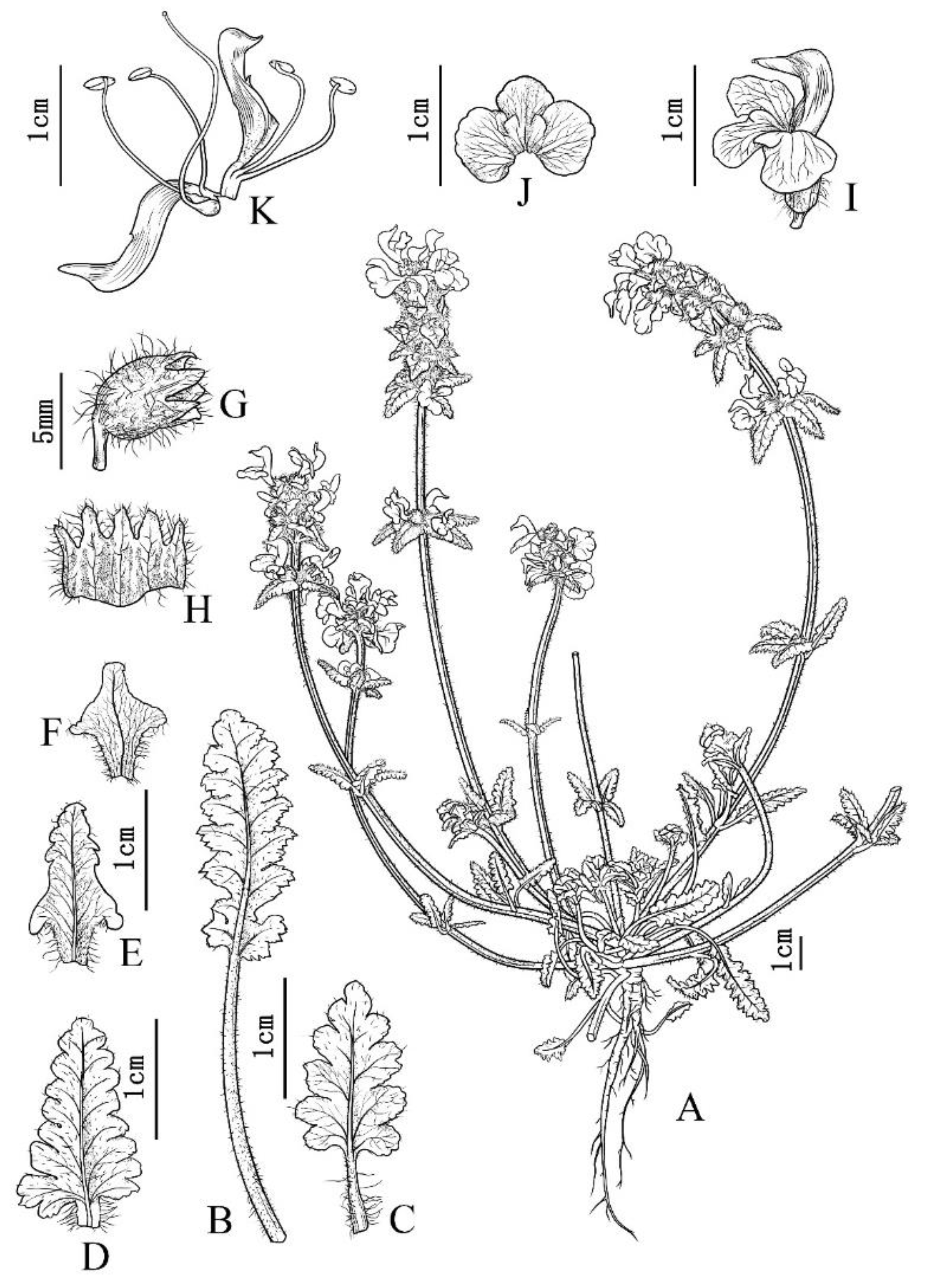
Figure 2.
Pedicularis dieshanensis: (A) Habitat. (B) Whole plant. (C) Cauline leaf. (D) Root. (E) Inflorescence. (F) Flower. (G) Stamen and stigma. (H) Calyx.
Figure 2.
Pedicularis dieshanensis: (A) Habitat. (B) Whole plant. (C) Cauline leaf. (D) Root. (E) Inflorescence. (F) Flower. (G) Stamen and stigma. (H) Calyx.
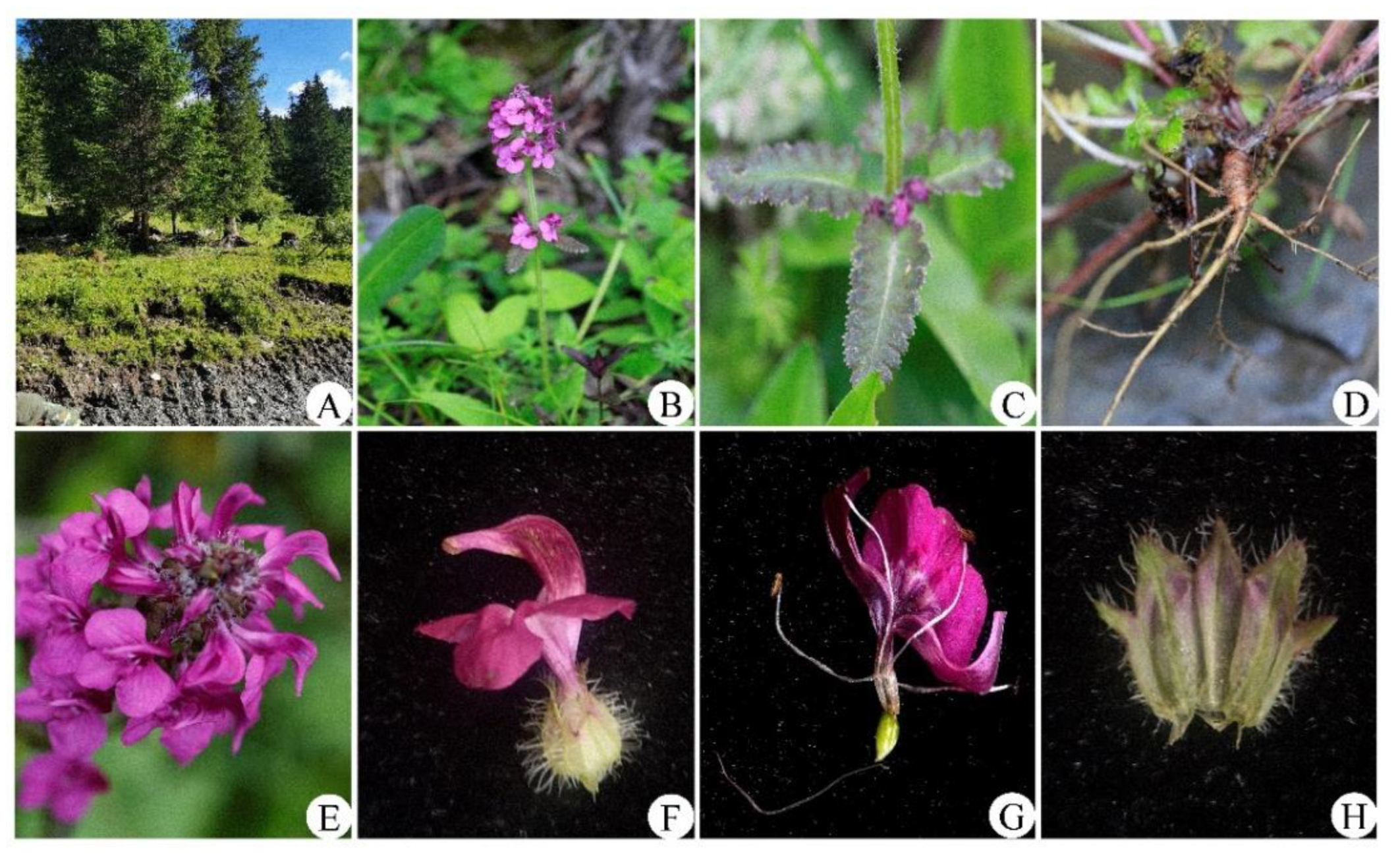

Table 1.
Main diagnostic morphological characters of Pedicularis dieshanensis and related species.
| Character | P. dieshanensis | P. cheilanthifolia | P. anas |
|---|---|---|---|
| Plant height | 12-30 cm | 5-30 cm | 4.5-40 cm |
| Leaf blade | Oblong, 1.5-2.2×0.4-0.7 cm | linear-lanceolate, 0.7-4 × 0.25-0.8 cm | oblong-ovate to linear-lanceolate |
| Leaf margin | pinnatifid, segments 6-8 pairs | pinnatisect, segments 8-12 pairs | pinnatisect, segments 7-11 pairs |
| Calyx | 4-7 mm long | 8-9 mm long | 4-7 mm long |
| Corolla color | purple red | purple-red to white, sometimes yellow | purple, yellow, or purple with pale yellow lower lip and dark purplish red galea |
| Galea | 5-7 mm long | 10mm | ca. 6 mm |
| Beak | ca. 2 mm, slightly tilted to the left, apex obtuse | a short conical beak or beakless | ca. 1 mm, slender |
| Lower lip | 6-8×9-12 mm | 8-10×10-12 mm | ca. 7.5× 10 mm |
| Style | exserted or included | exserted | exserted or included |
| Filaments | hairless | sparsely pubescent basally, glabrous apically | hairless |
| Capsule | ca. 15 mm long, ca. 2/3 exceeding calyx | ca. 16 mm long, ca. 1/2 exceeding calyx | to 1.8 cm, 3/5 exceeding calyx |
Disclaimer/Publisher’s Note: The statements, opinions and data contained in all publications are solely those of the individual author(s) and contributor(s) and not of MDPI and/or the editor(s). MDPI and/or the editor(s) disclaim responsibility for any injury to people or property resulting from any ideas, methods, instructions or products referred to in the content. |
© 2026 by the authors. Licensee MDPI, Basel, Switzerland. This article is an open access article distributed under the terms and conditions of the Creative Commons Attribution (CC BY) license (http://creativecommons.org/licenses/by/4.0/).
Copyright: This open access article is published under a Creative Commons CC BY 4.0 license, which permit the free download, distribution, and reuse, provided that the author and preprint are cited in any reuse.


