

Submitted:
05 April 2026
Posted:
08 April 2026
You are already at the latest version
Abstract
Biological regulation is inherently recursive. Genes give rise to proteins that circle back to shape transcription, stress responses activate programs that later dampen the same response, and chromosomal dosage changes ripple through development until they settle into recognizable disease states. This paper repositions Reflexive Category Theory (RCT) as a biology-centered descriptive framework for that kind of recurrent causality. Rather than presenting RCT as a mathematical structure applied from the outside, we treat it as a disciplined way to represent how molecular systems repeatedly act on the conditions that produced them. The concept is developed through three disease-relevant settings: the p53-MDM2-BRCA1 damage-response network, the MYC-TERT telomerase reactivation axis, and the dosage-rewired hematopoietic landscape of trisomy 21. Across these examples, the central claim is that reflexive modeling is valuable not because it replaces experiment, but because it preserves mechanistic continuity across multi-step, feedback-rich biology. In that sense, RCT is proposed here as a conceptual bridge between molecular evidence and system-level interpretation in oncology and genetic disease.
Keywords:
Reflexive Category Theory
; systems biology
; feedback loops
; oncogenic pathways
; p53–MDM2
; telomerase reactivation
; MYC–TERT axis
; trisomy 21
; hematopoiesis
; disease state stability
; causal recurrence
; precision oncology
Introduction
Disease biology rarely unfolds along a straight line. Tumor suppressor networks do not proceed from mutation to phenotype through one uninterrupted path; instead, they cycle through sensing, adaptation, repair, attenuation, and renewed challenge. Telomerase activation is likewise sustained not by a single event, but by reinforcing transcriptional and epigenetic programs. In developmental disorders such as Down syndrome, the initiating lesion is not one mutated gene but a chromosomal dosage imbalance that reshapes regulatory behavior across cell states and developmental time. What makes these systems difficult is not simply their size, but the fact that their outputs continually feed back on their own inputs.
Systems biology has addressed this complexity with differential-equation models, Boolean formalisms, Bayesian structures, and network maps. Those approaches remain essential, especially when the goal is quantitative dynamics, stochastic behavior, or probabilistic inference. Even so, a persistent challenge remains once several valid biological routes converge on the same phenotype and those routes, in turn, modify the upstream regulators that launched them. At that point, conventional pathway diagrams often become descriptive rather than logically integrated. Relational frameworks are useful precisely because they foreground dependence, equivalence, and recurrence across the whole system rather than isolating one pathway at a time.[1]
For that reason, Reflexive Category Theory is introduced here in explicitly biological terms. In this manuscript, an object corresponds to a defensible biological entity or state, such as a gene locus, transcript isoform, protein complex, chromatin state, cell-fate decision, or tissue context. A morphism represents a biologically meaningful relation: transcription, translation, degradation, stabilization, signaling, splicing, lineage transition, or phenotypic constraint. Reflexivity refers to the return of system output onto the conditions of its own maintenance.[2] In practice, that means modeling situations in which one molecular event does not merely produce a downstream consequence, but helps determine whether the initiating program will persist, shut down, or be re-entered in the next round of biological updating.
The three case studies were selected because each captures a different form of biological recurrence. The p53-MDM2 circuit is the classic stress-responsive negative-feedback module, and single-cell work has shown that its activity unfolds as pulses rather than as a simple on-off switch after DNA damage.[3] BRCA1 broadens the picture by showing that repair competence depends not only on gene presence, but also on transcript architecture, protein integrity, and pathway context [4,5] Telomerase reactivation illustrates a different logic, in which transcriptional activation, promoter rewiring, and non-canonical TERT functions can stabilize an oncogenic high-TERT state.[6,7,8]. Trisomy 21 adds a developmental example in which gene dosage alters hematopoietic trajectories long before overt leukemia appears, creating a permissive systems background for GATA1s-associated disease evolution.[7,9]
The aim of this redrafted concept paper is therefore not to foreground mathematics, but to propose a biology-first interpretive framework. RCT is treated as a formal scaffold for recurrent biological causality. The framework is evaluated according to three questions. First, can it encode experimentally grounded feedback structures without reducing them to vague arrows? Second, can it preserve equivalence between alternate biological routes that should converge on the same functional outcome? Third, can it identify the structural requirements for stable disease states and thereby highlight interventions most likely to destabilize them? The rest of the paper develops these questions across tumor-suppressor control, telomerase reactivation, and trisomy 21 hematopoiesis.
Biology-First Reflexive Systems Framework
Within this reformulation, the purpose of RCT is to preserve biological architecture rather than to replace quantitative modeling. A biological system is represented as a structured set of entities linked by causal transitions whose order matters and whose recurrence may determine phenotype persistence. In ordinary pathway figures, feedback is usually drawn but not formalized. In the present framework, feedback is elevated to a first-class biological relation.
Three principles organize the approach. First, entity fidelity: each object should correspond to a biologically defensible unit, such as TP53, p53 protein, active p53, MDM2, BRCA1 transcript isoforms, TERT promoter state, fetal megakaryocyte progenitors, or a clonal leukemic niche. Second, causal fidelity: each morphism should correspond to a real or testable mechanism, such as promoter occupancy, transcriptional activation, ubiquitination, exon skipping, differentiation bias, or cytokine-mediated reinforcement. Third, reflexive fidelity: when a process returns to alter the conditions of its own recurrence, the loop must be represented explicitly, not merely implied.
Under this scheme, commutativity is interpreted biologically rather than mathematically. If two mechanistically distinct routes yield the same experimentally recognized state, the model should preserve that equivalence. For example, p53-dependent arrest can proceed through multiple downstream effectors, but if the biological endpoint under the resolution studied is the same checkpoint state, then those routes should remain functionally coherent in the model. Likewise, a BRCA1 splice-disrupting variant and a direct loss-of-function route should converge on DNA-repair deficiency when they generate the same phenotypic incapacity.
Fixed points, in turn, become biologically interpretable equilibria or quasi-stable disease states. A healthy surveillance state, a persistent telomerase-high malignant state, a transient GATA1s-driven proliferative phase, or a full leukemic takeover can each be treated as system configurations that are reproduced by the network’s own regulatory structure. The analytical question is not merely whether a molecule is present, but whether the causal architecture can recreate the same system state after one full round of regulatory updating.
Importantly, the present paper treats speculative edges conservatively. Where strong evidence exists, such as p53 induction of MDM2 or MYC activation of TERT, these are encoded as established reflexive relations. Where the biology is plausible but incomplete, such as BRCA1-associated higher-order self-maintenance through transcriptional, splicing, and repair-linked feedback, those edges are designated as candidate relations requiring empirical validation. This distinction is essential if RCT is to remain biologically credible.
Case Study I: Damage Surveillance as a Reflexive Tumor-Suppressor Program
The p53-MDM2 module offers perhaps the clearest biological example of a response system that builds its own restraint into the circuitry. After DNA damage, p53 is stabilized and becomes transcriptionally active, driving programs involved in cell-cycle arrest, DNA repair, apoptosis, and senescence. One of the genes induced in that state is MDM2, whose protein product then targets p53 for degradation. This is not a secondary detail of pathway architecture; it is the mechanism that keeps checkpoint signaling from remaining constitutively high and helps generate the pulse-like behavior observed in single cells under genotoxic stress.[3,10,11]
A biology-led RCT representation therefore begins with molecular strata that experimentalists already recognize: TP53 locus, TP53 transcript, p53 protein, activated p53 state, MDM2 locus, MDM2 transcript, MDM2 protein, and fate-associated states such as arrest, repair, apoptosis, or senescence. Morphisms encode transcription, translation, post-translational activation, target-gene induction, and ubiquitin-mediated elimination. The key reflexive feature is that p53 induces a regulator that returns to constrain p53. The loop is therefore not just a graph cycle; it is a causal closure relevant to system persistence.
This representation becomes especially useful when cell-fate outcomes are considered. p53-dependent arrest can be transmitted through several target programs, including p21-centered checkpoint control and GADD45-associated damage responses. In ordinary diagrams these appear as separate branches; in a reflexive systems framework they can be treated as alternate causal routes that converge on a common checkpoint state, provided the biological resolution of the model does not require them to be distinguished. This preserves mechanistic plurality without allowing interpretive contradiction.
BRCA1 extends the discussion from stress-response attenuation to the question of repair competence. Its role in homologous recombination and genome maintenance depends not only on the presence of the locus, but on correct transcriptional control, appropriate isoform production, and preservation of protein function[4,5]. The earlier draft treated BRCA1 as though a strong direct self-activating loop were already established. The literature supports a narrower and more defensible position: BRCA1 sits within a repair-centered environment in which chromatin state, transcript processing, and protein-level activity influence whether future repair remains possible, but a constitutive autonomous BRCA1 self-loop is less securely demonstrated than the p53-MDM2 circuit. That distinction strengthens the paper because it keeps the framework biologically disciplined.
This distinction matters because splicing provides a biologically concrete test case. The BRCA1 locus generates multiple transcript isoforms, and pathogenic splice alterations can move the system from repair competence to repair deficiency. A mutation-induced exon-skipping route and a direct loss-of-function route should converge on the same DNA-repair-deficient state if both abolish the relevant protein function. In this way, RCT does not create new biology; it enforces consistency in how biologically equivalent consequences are represented.
The resulting biological interpretation is clear. Homeostasis corresponds to a surveillance state in which p53 activation is transiently inducible yet self-limited. Repeated or unresolved damage can move the system toward sustained arrest or apoptosis, whereas TP53 loss, MDM2 amplification, or BRCA1 dysfunction shift the architecture toward genomic instability. The value of the framework lies in making explicit which feedbacks are required to preserve surveillance and which lesions break the return path that normally restores control.
Case Study II: Telomerase Reactivation as a Self-Sustaining Oncogenic State
Telomerase biology provides a contrasting case in which the dominant recurrent logic is reinforcing rather than self-limiting. In most somatic cells, TERT expression is suppressed, telomeres erode with division, and proliferative life span remains bounded. In cancer, that arrangement is broken. TERT reactivation supports telomere maintenance and thereby contributes to the immortalized phenotype that underlies malignant persistence. The key biological issue is therefore not only how TERT is switched on, but how the system prevents itself from switching back off once activation has occurred.[6,7,8]
MYC is among the best established transcriptional drivers of TERT, acting at the promoter together with cofactors such as SP1 and with signal-responsive inputs linked to inflammation and stress[12,13]TERT, however, is not simply a telomere-extending enzyme. A growing body of work indicates that TERT can also participate in broader oncogenic programs, including reinforcement of transcriptional outputs and stabilization of regulators such as MYC in permissive cellular contexts[8,14]The significance of that relationship is biological rather than merely formal: MYC can help establish TERT expression, and TERT can in turn help preserve the regulatory environment in which MYC remains effective.
A biology-first reflexive representation therefore includes TERT locus, promoter state, transcript, protein, telomere status, MYC regulatory modules, SP1, NF-kB-associated inflammatory inputs, senescence state, and proliferative persistence state. Morphisms correspond to promoter activation, transcription, translation, telomere maintenance, protein stabilization, inflammatory reinforcement, and suppression of senescence. The critical reflexive event is not just a loop between two molecules; it is the emergence of a whole-cell state in which proliferative signaling and immortality become mutually sustaining.
This architecture also makes room for several biologically distinct entry routes into the same telomerase-competent state. One route begins with MYC activation. Another begins with promoter-level rewiring, including recurrent TERT promoter hotspot mutations that create ETS-responsive transcriptional input.[7] Still another may arise through persistent inflammatory or stress-associated signaling. If these routes ultimately converge on the same maintained TERT-high phenotype, the model should recognize that shared destination while preserving the mechanistic identity of how the system entered it.
The biological payoff of this representation is the interpretation of persistence. Once a TERT-high state is established, the system may become resistant to single-point disruption if parallel reinforcing edges remain active. This immediately suggests why dual interventions may outperform isolated ones: blocking MYC-axis transcription alone may be insufficient if TERT has already become independently locked on, while telomerase inhibition alone may be bypassed if the surrounding oncogenic circuitry remains able to re-establish a permissive state. RCT does not replace pharmacology here; it provides a structured explanation for why some tumor states recur after apparently successful initial suppression.
The usefulness of the framework becomes even clearer when canonical telomere maintenance is considered alongside non-canonical telomerase biology. Telomere elongation explains why cells can continue dividing, but it does not fully explain why telomerase-positive cancers often display durable survival programs, inflammatory coupling, and stem-like persistence. Those broader features are more consistent with TERT participating in a network state rather than acting only as an enzymatic repair factor for chromosome ends[8]. A biology-centered reflexive model therefore links TERT to the maintenance of malignant organization, not just to telomere length in isolation.
Case Study III: Trisomy 21 as a Developmental Dosage-Rewiring Event
Trisomy 21 is especially instructive because the initiating lesion is neither focal nor transient. An extra copy of chromosome 21 continuously alters dosage-sensitive regulatory programs across development. In fetal hematopoiesis, that altered dosage environment shifts progenitor behavior, expands erythro-megakaryocytic output, and creates a developmental context in which transient abnormal myelopoiesis and later myeloid leukemia of Down syndrome can arise [9,15]. The biological problem is therefore not adequately captured by saying that copy number is increased. The important question is how that increased dosage repeatedly reshapes the trajectories available to the hematopoietic system.
Current evidence supports a stepwise disease model. Trisomy 21 first establishes a developmentally altered hematopoietic field. Within that field, GATA1s-generating lesions promote transient megakaryoblastic expansion, but additional cooperating alterations - often involving signaling regulators or chromatin-associated genes - are generally required for progression to overt leukemia[16,17]Among dosage-sensitive chromosome 21 contributors, ERG and ETS2 recur across experimental and mechanistic studies, and ERG in particular has been shown to be required for the myeloproliferative phenotype in model systems[9,18]
In a biology-first reflexive representation, the primary objects include chromosome 21 dosage states, dosage-sensitive genes and their regulatory outputs, fetal hematopoietic stem and progenitor states, megakaryocytic and erythroid branch states, GATA1s clone states, inflammatory or niche-associated reinforcement states, and full leukemic takeover states. Morphisms encode dosage-enhanced transcriptional output, differentiation skewing, altered progenitor expansion, clonal persistence, and microenvironmental reinforcement. The important insight is that trisomy should not be modeled simply as three isolated gene copies. It should be modeled as a shift in the causal landscape through which future developmental decisions are made.
This allows the framework to distinguish several biologically meaningful equilibria. One corresponds to trisomy-biased but still bounded hematopoiesis. A second corresponds to GATA1s-associated transient abnormal myelopoiesis, in which a clone persists but remains developmentally limited. A third corresponds to leukemic escape once additional lesions remove the constraints that previously bounded the clone. These are not merely time points; they are qualitatively different system states recreated by different combinations of dosage and feedback.
The value of this formulation emerges in counterfactual analysis. If ERG dosage is normalized in an otherwise trisomic background, does the system still re-form the same pre-leukemic state, or does that trajectory collapse? Experimental evidence indicates that ERG dosage is a central determinant of Down syndrome-associated myeloproliferation [18] Within a reflexive interpretation, that finding means the system has lost one of the recurrent supports needed to reproduce the pathological state over successive developmental cycles. By the same logic, introducing GATA1s outside the trisomic context should not recreate the same sustained proliferative program, because the broader dosage-shaped support network is absent.
A further strength of the framework is its ability to incorporate the microenvironmental and inflammatory reinforcement that is increasingly recognized in Down syndrome biology. Altered interferon signaling and immune tone may help convert a cell-intrinsic dosage imbalance into a tissue-level loop that repeatedly favors abnormal clone maintenance [9] This is exactly the kind of multiscale return path that is easy to miss when disease is reduced to a list of mutated genes or overexpressed transcripts.
What RCT Adds Beyond Classical Experimental Readouts
PCR, sequencing, immunoblotting, chromatin assays, telomerase activity assays, and cytogenetics remain indispensable because they tell us what is present in a sample. They establish mutation status, expression magnitude, enzymatic activity, and copy number. No formal systems framework can substitute for that empirical grounding.
What those assays do not supply on their own is an explicit account of how several mechanistic routes can converge, feed back, and repeatedly regenerate phenotype. A TP53 mutation report does not by itself explain whether residual checkpoint signaling will collapse, oscillate, or be partially rescued by parallel repair circuitry. A telomerase assay does not explain whether TERT activity is being sustained by promoter rewiring, inflammatory signaling, MYC reinforcement, or several of these at once. A cytogenetic finding of trisomy 21 does not specify which dosage-sensitive interactions are actually maintaining a leukemogenic developmental state. The contribution of RCT is to organize those relations into a coherent mechanistic grammar.
RCT is useful precisely at this interpretive layer. It integrates experimental facts into a structure that can be interrogated for equivalence, recurrence, and stability. The framework therefore complements, rather than competes with, conventional methods. Experiments determine the edges that are biologically justified; the reflexive framework asks what those edges imply when assembled into a whole.
Discussion
The strongest contribution of a biology-led reflexive framework is conceptual compression without biological flattening. The p53-MDM2 axis, MYC-TERT coupling, and trisomy 21 hematopoiesis look at first like unrelated problems spanning tumor suppression, immortality, and developmental leukemogenesis. Yet each is governed by the same biological principle: pathological or protective states persist only when the system contains a return path that recreates the state after perturbation. Negative feedback can preserve bounded surveillance; positive feedback can preserve malignant persistence; dosage-linked developmental feedback can preserve biased hematopoietic trajectories.
This perspective also sharpens how hypotheses are generated. Instead of asking only which gene is upregulated, one asks which return path is necessary for the phenotype to reproduce itself. In p53 biology, the question becomes whether attenuation and recovery are both encoded adequately, or whether one arm is broken by mutation or amplification. In telomerase biology, the question becomes whether immortality is sustained by a single promoter event or by a distributed reinforcing module. In trisomy 21, the question becomes which dosage-sensitive edges are structurally indispensable to maintain the pre-leukemic state.
A second advantage is modularity. Biological subsystems can be assembled around shared states such as senescence, DNA-repair competence, inflammatory signaling, or stemness. This matters because real disease states are rarely isolated. p53 influences senescence, telomerase opposes it, and trisomy-associated inflammatory signaling may modify both stress responses and clonal persistence. A reflexive framework can, in principle, join these submodels without losing the identity of their local mechanisms.
A third advantage is translational interpretability. Clinicians and experimental biologists increasingly need models that explain why a combination therapy is rational, why some lesions are context-defining while others are accessory, and why the same measured biomarker can imply different vulnerabilities in different network settings.
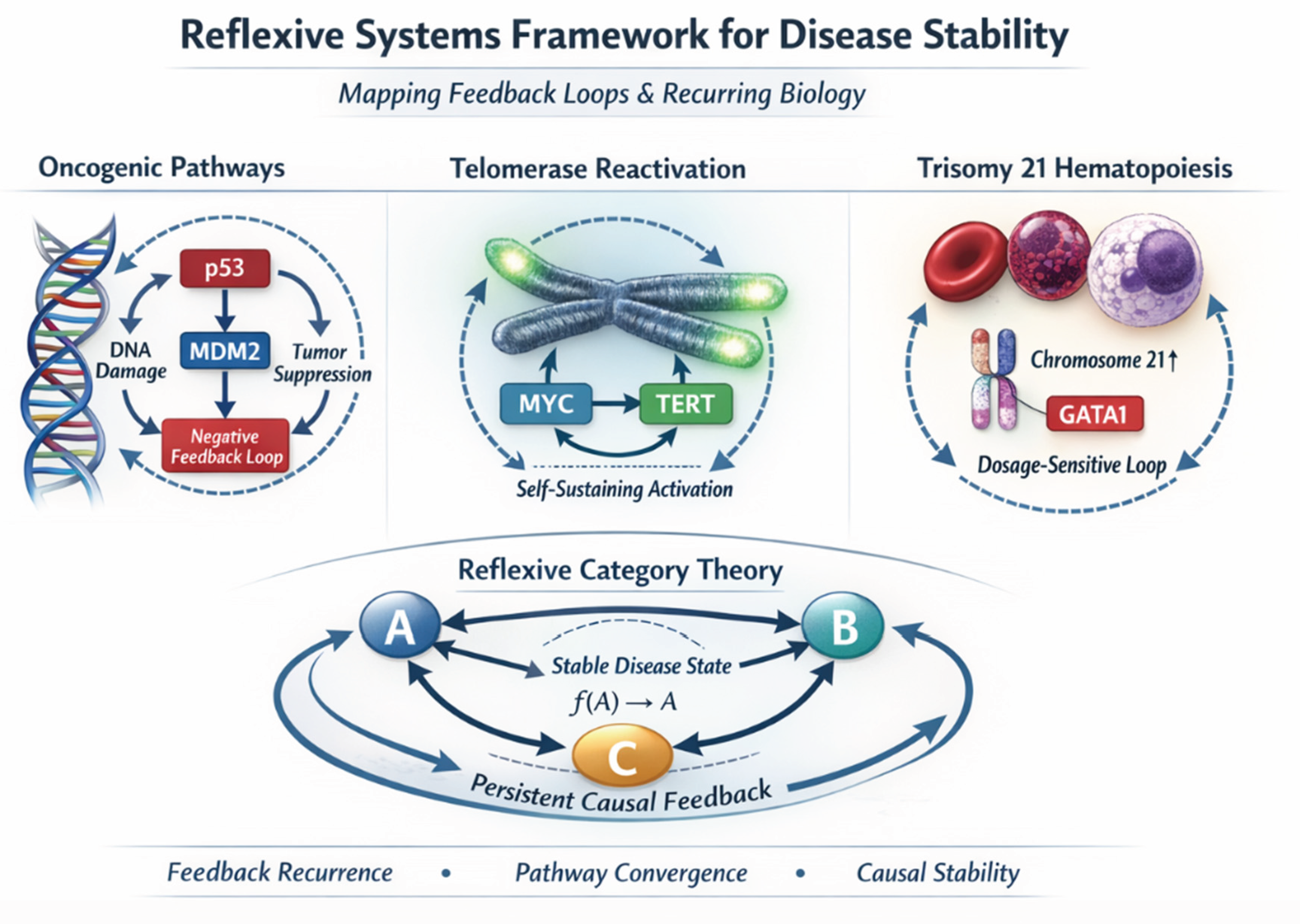
Figure 1 visually summarizes the paper’s central idea that disease states are maintained by recursive biological feedback loops rather than simple linear pathways. It illustrates three biological examples—p53–MDM2 tumor surveillance, MYC–TERT telomerase reactivation, and trisomy 21 dosage-driven hematopoiesis—all converging into a central Reflexive Category Theory systems model, where repeated causal feedback stabilizes either healthy or pathological states. Because RCT is architecture-centered, it can serve as a mechanistic reasoning layer between raw omics data and therapeutic decision logic.[2]
The limitations are equally important. RCT is only as informative as the biology encoded within it. If speculative edges are entered as facts, the model becomes formally elegant but biologically misleading. This is particularly relevant for candidate BRCA1 self-reinforcement, niche-mediated leukemic feedback, and the broader non-canonical actions of TERT, all of which require careful stratification by evidentiary strength. The framework is therefore best viewed as a disciplined biological knowledge model, not as an autonomous truth generator.
Another limitation is accessibility. Category-theoretic terminology can alienate biologists if introduced without mechanistic translation. The present redraft addresses that by defining every formal element in experimental language. Future work should continue in that direction by building libraries of reusable biological motifs: negative-feedback checkpoint modules, feed-forward immortalization modules, dosage-expansion modules, and microenvironmental reinforcement modules.
Finally, validation must be empirical and iterative. Predictions emerging from a reflexive framework should be treated as experimentally testable statements: that ERG dosage removal collapses a trisomy-associated pre-leukemic state; that dual MYC-TERT disruption is structurally more destabilizing than either alone in specific tumor contexts; or that some p53 pathway branches are functionally equivalent at one biological scale but not another. In this sense, the framework is most powerful when paired with perturbation biology.
Conclusion
This paper reframes the original document from mathematics-led exposition to biology-led systems reasoning. The central claim is that Reflexive Category Theory is valuable in biomedicine not because it introduces abstraction for its own sake, but because it formalizes a biological reality that molecular and developmental pathology repeatedly reveal: disease states persist through recurrent causality.
Across tumor-suppressor surveillance, telomerase reactivation, and trisomy 21 hematopoiesis, the framework identifies the loops, alternative routes, and stabilizing structures that determine whether a system returns to homeostasis, enters a self-sustaining malignant state, or remains trapped in a dosage-driven pathological trajectory. This makes RCT particularly suitable for concept-paper work at the interface of molecular biology, oncology, and translational systems medicine.
The most important practical implication is complementarity. Wet-lab and clinical assays determine what exists. A reflexive systems framework determines how those findings cohere into a disease architecture and which perturbations are most likely to destabilize it. If developed carefully, biologically grounded RCT could mature into a useful layer for hypothesis generation, experimental design, and eventually interpretable decision support in precision oncology and genomic medicine.
References
- Huang, S. Back to the biology in systems biology: what can we learn from biomolecular networks? Brief Funct Genomic Proteomic;PubMed 2004, 2(4), 279–97. [Google Scholar] [CrossRef] [PubMed]
- Sreekant Mudholkar, R; Virmani, A; Ranjeet Mudholkar, S. Reflexive Category Theory: A Unified Framework for Self-Reference in Mathematics and Computer Science.
- Lahav, G; Rosenfeld, N; Sigal, A; Geva-Zatorsky, N; Levine, AJ; Elowitz, MB; et al. Dynamics of the p53-Mdm2 feedback loop in individual cells. Nat Genet. 2004, 36(2), 147–50. [Google Scholar] [CrossRef] [PubMed]
- Venkitaraman, AR. Cancer susceptibility and the functions of BRCA1 and BRCA2. Cell;PubMed 2002, 108(2), 171–82. [Google Scholar] [CrossRef] [PubMed]
- Huang, R; Zhou, PK. DNA damage repair: historical perspectives, mechanistic pathways and clinical translation for targeted cancer therapy. Signal Transduction and Targeted Therapy PubMed. 2021, 6(1), 1 254. [Google Scholar] [CrossRef] [PubMed]
- Hanahan, D. Hallmarks of Cancer: New Dimensions. Cancer Discov.;PubMed 2022, 12(1), 31–46. [Google Scholar] [CrossRef] [PubMed]
- Yuan, X; Larsson, C; Xu, D. Mechanisms underlying the activation of TERT transcription and telomerase activity in human cancer: old actors and new players. Oncogene PubMed. 2019, 38(34), 6172–83. [Google Scholar] [CrossRef] [PubMed]
- Dratwa, M; Wysoczańska, B; Łacina, P; Kubik, T; Bogunia-Kubik, K. TERT—Regulation and Roles in Cancer Formation. Front Immunol;PubMed 2020, 11, 589929. [Google Scholar] [CrossRef] [PubMed]
- Laurent, AP; Kotecha, RS; Malinge, S. Gain of chromosome 21 in hematological malignancies: lessons from studying leukemia in children with Down syndrome. Leukemia;PubMed 2020, 34(8), 1984–99. [Google Scholar] [CrossRef] [PubMed]
- Geva-Zatorsky, N; Rosenfeld, N; Itzkovitz, S; Milo, R; Sigal, A; Dekel, E; et al. Oscillations and variability in the p53 system. Mol Syst Biol. 2006, 2. [Google Scholar] [CrossRef] [PubMed]
- Marine, JC; Lozano, G. Mdm2-mediated ubiquitylation: p53 and beyond. Cell Death Differ;PubMed 2010, 17(1), 93–102. [Google Scholar] [CrossRef] [PubMed]
- Khattar, E; Tergaonkar, V. Transcriptional Regulation of Telomerase Reverse Transcriptase (TERT) by MYC. In Front Cell Dev Biol; PubMed, 26 Jan 2017; Volume 5(JAN). [Google Scholar] [CrossRef] [PubMed]
- Kato, S; Sato, T; Fujita, H; Kawatani, M; Yamada, Y. Effects of GLP-1 receptor agonist on changes in the gut bacterium and the underlying mechanisms. Sci Rep.;PubMed 2021, 11(1). [Google Scholar] [CrossRef] [PubMed]
- Liu, M; Zhang, Y; Jian, Y; Gu, L; Zhang, D; Zhou, H; et al. The regulations of telomerase reverse transcriptase (TERT) in cancer. Cell Death Dis. 2024, 15(1). [Google Scholar] [CrossRef] [PubMed]
- Chou, R; Fanciullo, GJ; Fine, PG; Adler, JA; Ballantyne, JC; Davies, P; et al. Clinical Guidelines for the Use of Chronic Opioid Therapy in Chronic Noncancer Pain. Journal of Pain 2009, 10(2). [Google Scholar] [CrossRef] [PubMed]
- de Castro, CPM; Cadefau, M; Cuartero, S. The Mutational Landscape of Myeloid Leukaemia in Down Syndrome. Cancers (Basel) PubMed. 2021, 13(16). [Google Scholar] [CrossRef] [PubMed]
- Gialesaki, S; Bräuer-Hartmann, D; Issa, H; Bhayadia, R; Alejo-Valle, O; Verboon, L; et al. RUNX1 isoform disequilibrium promotes the development of trisomy 21-associated myeloid leukemia. Blood 2023, 141(10), 1105–18. [Google Scholar] [CrossRef] [PubMed]
- Liu, X; Shin, N; Koblish, HK; Yang, G; Wang, Q; Wang, K; et al. Selective inhibition of IDO1 effectively regulates mediators of antitumor immunity. Blood PubMed. 2010, 115(17), 3520–30. [Google Scholar] [CrossRef] [PubMed]
Figure 1.
This figure illustrates how feedback-driven biological loops in cancer and trisomy 21 repeatedly recreate stable disease states through reflexive systems architecture.
Figure 1.
This figure illustrates how feedback-driven biological loops in cancer and trisomy 21 repeatedly recreate stable disease states through reflexive systems architecture.
Disclaimer/Publisher’s Note: The statements, opinions and data contained in all publications are solely those of the individual author(s) and contributor(s) and not of MDPI and/or the editor(s). MDPI and/or the editor(s) disclaim responsibility for any injury to people or property resulting from any ideas, methods, instructions or products referred to in the content. |
© 2026 by the authors. Licensee MDPI, Basel, Switzerland. This article is an open access article distributed under the terms and conditions of the Creative Commons Attribution (CC BY) license.
Copyright: This open access article is published under a Creative Commons CC BY 4.0 license, which permit the free download, distribution, and reuse, provided that the author and preprint are cited in any reuse.


