
Preprint
Communication

This version is not peer-reviewed.

Synthesis of (R)-(+)-3-(1-hydroxyethylidene)-1-(1-phenylethyl)piperidine-2,4-dione, novel Tetramic Acid Analogue

Submitted:

03 April 2026

Posted:

06 April 2026

You are already at the latest version

Abstract
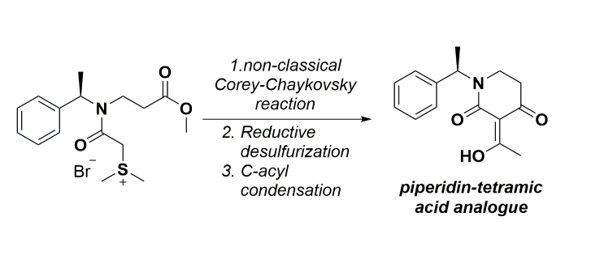
Herein, starting from (R)-(+)-α-methylbenzylamine, we report an efficient synthesis and full characterization of a new (R)-3-(1-hydroxyethylidene)-1-(1-phenylethyl)piperidine-2,4-dione, a new tetramic acid analogue. The key steps involved a non-classical Corey-Chaykovsky intramolecular cy-clization reaction to access the corresponding zwitterion, followed by a sequential desul-furization/reduction and condensation procedure. The key intermediate was obtained in 5 steps, and the desired product 7 with an overall 58% yield.
Keywords: 
;  ;  ;  

1. Introduction

Nitrogen-containing heterocycles are formidable chemical structures most widely found in biological and pharmaceutical products. Specifically, 3-acyltetramic acids are produced by a wide range of organisms [1,2,3,4] and have shown interesting pharmaceutical properties, including antibacterial, [5,6] herbicidal, [7] and antitumoral activity [8] (Figure 1, top). This is due to naturally occurring properties that confer a large lipophilic residue on their pyrrolidine-2,4-dione core; they show an amphiphilic or detergent-like character, enabling them to interact with cellular membranes, and can form stable chelate complexes with metal ions [9]. Although pyrrolidinone 3-acyl tetramic acids have been extensively studied, there are scarcely any reports regarding their saturated 6-membered analogues as precursors of pyridone-based natural products mediated by enzyme-catalyzed TrdC Dieckmann cyclization [10,11,12] (Figure 1, bottom). Therefore, the discovery of a new methodology to access these six heterocyclic member substrates in high yields, at low cost, and with a few synthesis steps, represents a main goal in this field.
As a part of our program research efforts directed toward obtaining novel nitrogen heterocyclic intermediates, and taking into account that our research group previously had investigated the preparation of a nitrogen heterocycle compound via zwitterionic intermediates obtained thought a non-classical Corey-Chaykovsky reaction and demonstrated its utility in accessing an important bioactive substance [13], we now applied this experience in the synthesis of the six-member nitrogen heterocycle tetramic acid analogue.

2. Results and Discussion

To synthesize the key intermediate zwitterionic compound 4, we commence by first condensing (R)-(+)-α-methylbenzylamine in methanol with methyl acrylate, followed by an amidation reaction with bromoacetyl bromide in a biphasic medium, which allowed us to get the corresponding haloamide 2 in 98% yield after two steps. Then, 2 was condensed with dimethyl sulfide to access the corresponding sulfonium salt 3, which was subjected under basic conditions to the non-classical Corey-Chaykovsky 6-exo-trig cyclization reaction to generate the desired zwitterionic heterocycle 4. Then, we ventured into the reduction/desulfurization reaction by implementing the conditions reported by Russell et al.,[14] where the use of zinc dust and acetic acid as solvent generated the core piperidine-2,4-dione 5 in 98% yield (Scheme 1).
With compound 5 in hand, we turned our attention to the obtention of the desired 3-Acyl tetramic acid. It is important to mention the immediate employment of compound 5 for the next reaction to avoid the dimerization process [15]. In this sense, we approach this study considering the previously reported work of Moloney et al., [16] in which the acylation sequence is mediated by N,N´-dicyclohexylcarbodiimide (DCC) and 4-dimethylaminopyridine (DMAP). As we can see in Table 1, the only use of DMAP or the mixture of DMAP (0.5 equiv.) and DCC, delivered the O-acylated derivative 6, while, when DMAP (1.2 equiv.), and DCC (1.1 equiv) were employed, we obtained the desired 3-acyl tetramic acid 7 in 65% yield in accordance with Moloney's report (Scheme 2).
Table 6. vs C-Acyl 7 from piperidin-2,4-dione 5.
Entry DMAP (equiv.) DCC
(equiv)
Acylating agent
(equiv)
Compound 6
Yield (%)
Compound 7
Yield (%)
1 1 --- Acetyl chloride, (1) 80 ---
2 0.1 (1.1) Acetic acid, (1.1) 85 5
3 0.5 (1.1) Acetic acid, (1.1) 75 15
4 1.2 (1.1) Acetic acid, (1.1) --- 65
All experiments were carried out at room temperature.
Structure 7 was fully characterized by NMR spectroscopy. Despite its five-member analogue being described by Moloney as four types of tautomeric enol forms in solution,[16] compound 7 exhibits non-similar behavior, as the 1H-NMR analysis showed, the presence of only two enol forms is due to the stabilizing intramolecular C−H•••O hydrogen bond usually present in lactams containing the chiral auxiliary a-methylbenzylamine as the chemical shift of the benzylic proton is centered around 6 ppm in each tautomer [17] . The equilibrium is shown by a dynamic internal tautomerization between two, the exo-enol vs endo-enol tautomer, where the methyl group of the minor endo-enol is centered around 2.49 ppm while for the major exo-enol tautomer appears around 2.59 ppm (Figure 2). All shifts’ assignations were confirmed by two-dimensional NMR spectroscopy studies. Finally, the major tautomer is favored due to the more electrophilic character of the exo-ketone in accordance with the previously studied report by Gromak [18].

3. Materials and Methods

3.1. General

All reagents and solvents were purchased from commercial sources. 1H NMR and 13C NMR spectra were recorded at 500 MHz and 125 MHz respectively, in CDCl3 using a Bruker Avance III Spectrometer. Chemical shifts are given in ppm and reported to the residual solvent peak (CHCl3 7.26 ppm and 77.16 ppm). Data are reported as follows: chemical shift (d), multiplicity (s = singlet, d = doublet, t = triplet, q = quartet, m = multiplet), coupling constant(s) (J, Hz), and integration. Analytical TLC was performed on silica gel 60F254 plates. Column chromatography was carried out on silica gel 60 (63-200 mm). Mass spectra were recorded on JEOL The JM-Station JMS-700 at a voltage of 70 eV. Optical rotations were measured on Perkin-Elmer 341 polarimeter at room temperature. Infrared spectra were obtained using a Thermo Scientific Nicolet (Waltham, MA, USA).

3.2. Synthesis of Methyl (R)-3-((1-phenylethyl)amino)propanoate (1)

To a solution of (R)-(+)-a-methylbenzylamine (2 g, 16.5 mmol) in methanol (16.5 mL, 1M) was slowly added methyl acrylate (1.80 mL, 19.80mmol), the mixture was stirred at room temperature, until the consumption of total starting material was observed through TLC (24 hours, hexane/ethyl acetate 1:1), the crude reaction was concentrated under reduce pressure, and purified over column chromatography (hexane/ethyl acetate 6:4) to give a colorless oil in quantitative yield.
1H NMR (500 MHz, CDCl3) δ 7.38 – 7.21 (m, 6H), 3.80 (q, J = 6.6 Hz, 1H), 3.69 (s, 3H), 2.78 (m, 1H), 2.71 (m, 1H), 2.50 (m, 2H), 1.37 (d, J = 6.5 Hz, 3H). 13C NMR (126 MHz, CDCl3) δ 173.5, 145.6, 128.6, 127.1, 126.7, 58.3, 51.7, 43.0, 34.8, 24.6. [α]D =+ 41.0 (c = 1.0, CHCl3).

3.3. Synthesis of Methyl (R)-3-(2-bromo-N-(1-phenylethyl)acetamido)propanoate (2)

Methyl (R)-3-((1-phenylethyl)amino)propanoate (16.50 mmol, 3.42 g), was dissolved in 1:1 CH2Cl2/H2O (50/50 mL), and K2CO3 (33.00 mmol) was added. The resulting mixture was cooled to 0°C, and bromoacetyl bromide (1.72 mL, 19.80 mmol) was slowly added (dropwise), then warmed to room temperature, and stirred for 12 hours. The crude reaction was extracted with CH2Cl2 (3 x 30 mL). The organic phases were combined and dried over anhydrous Na2SO4. The solvent was evaporated under reduced pressure and then purified by column chromatography on silica gel (hexane/ethyl acetate 6:4), to obtain the pure desired compound as a colorless oil in 98% yield.
1H NMR (500 MHz, CDCl3) δ 7.43 – 7.28 (m, 5H), 5.18 (q, J = 6.9 Hz, 1H), 3.98 (m, 2H), 3.62 (s, 3H), 3.52 (m, 2H), 2.43 (m, 2H), 1.70 (m, 3H). 13C NMR (126 MHz, CDCl3) δ 172.1, 166.9, 139.4, 129.0, 128.2, 127.0, 77.4, 77.2, 76.9, 56.7, 51.7, 39.3, 32.7, 26.5, 18.1. [α]D = +78.6 (c = 1.0, CH2Cl2).

3.4. Synthesis of (R)-(2-((3-methoxy-3-oxopropyl)(1-phenylethyl)amino)-2-oxoethyl)dimethylsulfonium bromide (3)

To a solution of methyl (R)-3-(2-bromo-N-(1-phenylethyl)acetamido)propanoate (1 g, 3.04 mmol) in methanol (3 mL, 1M), was added dimethyl sulfide (1.8 mL, 24.36 mmol) at room temperature, and the reaction was stirred for 24 hours. The crude was concentrated under vacuum, and the resulting solid was recrystallized (CH2Cl2/ethyl acetate 1:3) to give a white solid in a 93% yield.
1H NMR (500 MHz, CDCl3) δ 7.27–7.40 (m,5H), 5.94 (d, J = 10.8,1H), 5.66 (d, J = 10.8, 1H), 5.19 (q, J = 6.9, 1H), 3.55 (s, 3H,), 3.41 (m, 2H), 3.34 (s, 3H,), 3.30 (s, 3H,), 2.37 (m, 2H), 1.70 (d, J = 6.9, 3H,). 13C NMR (126 MHz, CDCl3) δ 171.2, 163.6, 126.4, 138.7, 55.9, 51.3, 49.2, 32.1, 26.8, 24.7, 17.2. [α]D = +142.0 (c = 2.0, EtOH).

3.5. Synthesis of (R)-5-(dimethylsulfonio)-6-oxo-1-(1-phenylethyl)-1,2,3,6-tetrahydropyridin-4-olate (4)

(R)-(2-((3-methoxy-3-oxopropyl)(1-phenylethyl)amino)-2-oxoethyl)dimethylsulfonium bromide (1.10 g, 2.83 mmol) was dissolved in methanol (2.83mL, 1M), then KOH (0.31 g, 5.67 mmol) was added in one portion at room temperature, and the mixture was stirred for 1 hour. Finally, the crude was filtered over celite and concentrated by reduced pressure; the resulting solid was recrystallized (CH2Cl2/hexane 1:3) to give a white solid in quantitative yield.
1H NMR (500 MHz, CDCl3) δ 7.36 – 7.22 (m, 5H), 5.95 (q, J = 7.1 Hz, 1H), 3.19 (ddd, J = 12.4, 8.0, 6.4 Hz, 1H), 3.00 (s, 3H), 2.90 (m, 1H), 2.32 (m, 2H), 1.51 (d, J = 7.1 Hz, 3H). 13C NMR (126 MHz, CDCl3) δ 188.2, 166.8, 141.7, 128.4, 127.3, 127.1, 74.5, 49.6, 38.3, 37.1, 27.0, 26.7, 16.0. M.P. 139°C - 140°C, [α]D = +70.5 (c = 1.0, MeOH).

3.6. Synthesis of (R)-1-(1-phenylethyl)piperidine-2,4-dione (5)

To a solution of (R)-5-(dimethylsulfonio)-6-oxo-1-(1-phenylethyl)-1,2,3,6-tetrahydropyridin-4-olate (0.1 g, 0.36 mmol) in glacial acetic acid (0.36 mL, 1M) at room temperature was added in one portion zinc dust (0.35 g, 5.340 mmol), the reaction mixture was stirred for 24 hours. Ethyl acetate was added (10 mL), and the crude was filtered over a thin bed of silica gel. The organic phase was washed with brine, dried over Na2SO4, and concentrated under reduced pressure to give a pale-yellow oil in a 98% yield.
1H NMR (500 MHz, CDCl3) δ 7.25 (m, 5H), 5.98 (q, J = 7.2 Hz, 1H), 3.35 (s, 2H), 3.31 (m, 1H), 3.08 (m, 1H), 2.38 (m, 1H), 2.23 (m, 1H), 1.48 (d, J = 7.1 Hz, 3H). 13C NMR (126 MHz, CDCl3) δ 13C NMR (126 MHz, CDCl3) δ 204.0, 166.2, 139.6, 128.8, 127.9, 127.3, 50.5, 49.6, 38.9, 37.6, 15.7. [α]D = +7.1 (c = 1.0, CH2Cl2).

3.7. Synthesis of (R)-6-oxo-1-(1-phenylethyl)-1,2,3,6-tetrahydropyridin-4-yl acetate (6)

To a solution of acetic acid (0.057 mL, 1.0 mmol) in CH2Cl2 were added DCC (0.208 g, 1.0 mmol), (R)-1-(1-phenylethyl)piperidine-2,4-dione (0.2 g, 0.92 mmol), and DMAP (0.010 g, 0.09 mmol). The mixture was stirred for 24 hours at room temperature. The crude reaction mixture was extracted with CH2Cl2. Concentration in vacuo followed by flash chromatography (hexane/ethyl acetate 7:3) over silica gel gives the mixture of products 6, 85% yield as a colorless oil and 7, 5% yield as a pale-yellow oil.
Compound 6: 1H NMR (500 MHz, CDCl3) δ 7.39 – 7.24 (m, 5H), 6.00 (q, J = 7.1 Hz, 1H), 5.85 (s, 1H), 3.32 (ddd, J = 12.4, 9.2, 6.2 Hz, 1H), 3.01 (ddd, J = 12.7, 6.9, 6.1 Hz, 1H), 2.50 – 2.38 (m, 2H), 2.20 (s, 3H), 1.53 (d, J = 7.1 Hz, 3H). 13C NMR (126 MHz, CDCl3) δ 13C NMR (126 MHz, CDCl3) δ 167.8, 164.8, 159.5, 140.6, 128.6, 127.5, 127.3, 111.7, 49.5, 38.9, 27.4, 21.2, 15.7. [α]D =+43.1 (c 0.96, CH2Cl2).
Compound 7: 1H NMR (500 MHz, CDCl3) δ 7.33 – 7.16 (m, 7H), 5.92 (q, J = 7.1 Hz, 1H), 3.18 (tdd, J = 17.4, 8.6, 5.9 Hz, 1H), 2.91 (tt, J = 11.8, 6.0 Hz, 1H), 2.43 – 2.27 (m, 3H), 1.50 (d, J = 7.1 Hz, 3H). 13C NMR (126 MHz, CDCl3) δ 198.2, 195.6, 192.4, 191.5, 171.7, 164.2, 140.7, 139.3, 128.8, 128.6, 128.0, 127.5, 127.3, 127.3, 107.2, 102.7, 50.5, 49.7, 37.8, 37.5, 36.8, 33.8, 26.2, 25.1, 15.8, 15.6. [α]D =+354.6 (c 1.0, CH3OH).

3.8. Synthesis of (R)-(+)-3-(1-hydroxyethylidene)-1-(1-phenylethyl)piperidine-2,4-dione (7)

To a solution of acetic acid (0.028 mL, 0.50mmol) in CH2Cl2 were added DCC (0.104 g, 0.50 mmol), (R)-1-(1-phenylethyl)piperidine-2,4-dione (0.1 g, 0.46 mmol), and DMAP (0.067 g, 0.55 mmol). The mixture was stirred overnight at room temperature. The crude reaction mixture was washed with CH2Cl2. Concentration in vacuo followed by flash chromatography (hexane/ethyl acetate 8:2) over silica gel gives the desired product as a pale-yellow oil in a 65% yield.
1H NMR (500 MHz, CDCl3) δ 7.33 – 7.16 (m, 7H), 5.92 (q, J = 7.1 Hz, 1H), 3.18 (tdd, J = 17.4, 8.6, 5.9 Hz, 1H), 2.91 (tt, J = 11.8, 6.0 Hz, 1H), 2.43 – 2.27 (m, 3H), 1.50 (d, J = 7.1 Hz, 3H). 13C NMR (126 MHz, CDCl3) δ 198.2, 195.6, 192.4, 191.5, 171.7, 164.2, 140.7, 139.3, 128.8, 128.6, 128.0, 127.5, 127.3, 127.3, 107.2, 102.7, 50.5, 49.7, 37.8, 37.5, 36.8, 33.8, 26.2, 25.1, 15.8, 15.6. [α]D =+354.6 (c 1.0, CH3OH), HRMS (FAB): Calcd for C15H18NO3: 260.1287 Found: 260.1282.
In conclusion, we have developed an efficient six-step synthesis of (R)-(+)-3-(1-hydroxyethylidene)-1-(1-phenylethyl)piperidine-2,4-dione starting from (R)-(+)-a-methylbenzylamine with an overall of 58% yield as a new tetramic acid analogue. The methodology highlights the utility of the non-classical Corey-Chaykovsky reaction to access zwitterionic intermediates and their subsequent transformation into new six-membered nitrogen heterocycles, which opens the possibility to access novel biologically important tetramic acid analogues. NMR studies confirmed that this kind of tetramic acid exists as a dynamic mixture of two enol tautomers, with the exo-enol form being predominant.

Supplementary Materials

The following supporting information can be downloaded at: https://www.mdpi.com/article/doi/s1.

Author Contributions

Conceptualization, D.M.A. and J.L.T.; methodology, A.A.A. and F.M.M.; validation, A. P.C., D.M.A. and J.L.T.; formal analysis, A.A.A.; investigation, J.L.T.; resources, J.R.J.P.; data curation, J.R.J.P.; writing—original draft preparation, J.L.T.; writing—review and editing, D.M.A.; visualization, J.L.T. and D.M.A.; funding acquisition, J.L.T. and D.M.A. All authors have read and agreed to the published version of the manuscript.

Funding

The authors thank the Secretariat of Science, Humanities, Technology, and Innovation (SECIHTI) for its financial support for project CBF-2025-I-1805 and project CBF-2025-I-2262.

Data Availability Statement

Data presented in this study are included in the Supplementary Materials.

Acknowledgments

F.M.M. thanks SECIHTI for the Scholarship 2086645. The author thanks FAP and HAR for technical support in the laboratory.

Conflicts of Interest

The authors declare no conflicts of interest

References

  1. Kim, H. W.; Lee, J. W.; Shim, S. H. Biosynthesis, biological activities, and structure–activity relationships of decalin-containing tetramic acid derivatives isolated from fungi. Nat. Prod. Rep. 2024, 41, 1294–1317. [Google Scholar] [CrossRef] [PubMed]
  2. Pang, X.; Chen, W.; Wang, X.; Zhow, X.; Yang, B.; Tian, X.; Wang, J.; Xu, S.; Liu, Y. New Tetramic Acid Derivatives from the Deep-Sea-Derived Fungus Penicillium sp. SCSIO06868 With SARS-CoV-2 Mpro Inhibitory Activity Evaluation. Front. Microbiol. 2021, 12(730807), 1–8. [Google Scholar] [CrossRef] [PubMed]
  3. Jiang, M.; Chen, S.; Li, J.; Liu, L. The Biological and Chemical Diversity of Tetramic Acid Compounds from Marine-Derived Microorganisms. Mar. Drugs 2020, 18, 114–157. [Google Scholar] [CrossRef] [PubMed]
  4. Huang, Z.; Nong, X.; Liang, X.; Qi, S. New tetramic acid derivatives from the deep-sea-derived fungus Cladosporium sp. SCSIO z0025. Tetrahedron 2018, 74, 2620–2626. [Google Scholar] [CrossRef]
  5. Imamura, N.; Adachi, K.; Sano, H. Magnesidin A, a component of marine antibiotic magnesidin, produced by vibrio gazogenes ATCC29988. J. Antibiot. 1994, 47, 257–261. [Google Scholar] [CrossRef] [PubMed]
  6. Gänzle, M. G. Reutericyclin: biological activity, mode of action, and potential applications. Appl. Microbiol. Biotechnol. 2004, 64, 326–332. [Google Scholar] [CrossRef] [PubMed]
  7. Graupner, P. R.; Carr, A.; Clancy, E.; Gilbert, J.; Bailey, K. L.; Derby, J.-A.; Gerwick, C. B. The Macrocidins:  Novel Cyclic Tetramic Acids with Herbicidal Activity Produced by Phoma macrostoma. J. Nat. Prod. 2003, 66, 1558–1561. [Google Scholar] [CrossRef] [PubMed]
  8. Shigeura, H. T.; Gordon, C. N. The biological activity of Tenuazonic acid. Biochemistry 1963, 2, 1132.–1137. [Google Scholar] [CrossRef] [PubMed]
  9. Petermichl, M.; Schobert, R. 3-Acyltetramic Acids: A Decades-Long Approach to a Fascinating Natural Product Family. Synlett 2017, 28, 654–663. [Google Scholar] [CrossRef]
  10. Chun, G.; Qinglian, L.; Xuhua, M.; Xiangjing, Q.; Junying, M.; Jianhua, J. Discovery of a New Family of Dieckmann Cyclases Essential to Tetramic Acid and Pyridone-Based Natural Products Biosynthesis. J. Org. Lett. 2015, 17(3), 628–631. [Google Scholar]
  11. Hemmerling, F.; Hahn, F. Biosynthesis of oxygen and nitrogen-containing heterocycles in polyketides. Beilstein J. Org. Chem. 2016, 12, 1512–1550. [Google Scholar] [CrossRef] [PubMed]
  12. Robertsen, H. L.; Musiol-Kroll, E. M.; Ding, L.; Laiple, K. J.; Hofeditz, T.; Wohlleben, W.; Lee, S. Y.; Grond, S.; Weber, T. Filling the Gaps in the Kirromycin Biosynthesis: Deciphering the Role of Genes Involved in Ethylmalonyl-CoA Supply and Tailoring Reactions. Scientific Reports 2018, 8, 3230–3239. [Google Scholar] [CrossRef] [PubMed]
  13. López-González, R.; Gnecco, D.; Juárez, J. R.; Orea, M. L.; Gómez-Calvario, V.; Bernès, S.; Aparicio, D. M.; Terán, J. L. Synthesis of (+)- and (−)-Geissman-Waiss lactone from chiral sulfonium salts. Tetrahedron Lett. 2020, 61, 151697–151700. [Google Scholar] [CrossRef]
  14. Russell, G. A.; Mikol, G. β-Keto Sulfoxides. II. Transformations Giving Sulfur-Free Products. J. Am. Chem. Soc. 1966, 88(23), 5498–5504. [Google Scholar] [CrossRef]
  15. Romero, N.; Gnecco, D.; Terán, J.; Bernés, S. 4-Hydroxy-1,1-bis[(S)-1-phenylethyl]-5,5,6,6-tetrahydro-3,4-bipyridine -2,2(1H,1H)-dione. Acta Cryst. 2013, E69, 408–412. [Google Scholar]
  16. Moloney, M. G.; Jeong, Y. Synthesis of and Tautomerism in 3-Acyltetramic Acids. J. Org. Chem. 2011, 76, 1342–1354. [Google Scholar] [CrossRef] [PubMed]
  17. Sandoval, L. J.; Fuentes, L.; Quintero, L.; Höpfl, H.; Hernández-P, J. M.; Terán, J. L.; Sartillo-P, F. The Stabilizing Role of the Intramolecular C–H···O Hydrogen Bond in Cyclic Amides Derived From α-Methylbenzylamine. J. Org. Chem. 2015, 80, 4481–4490. [Google Scholar] [CrossRef] [PubMed]
  18. Gromak, V. V.; Avakyan, V. G.; Lakhvich, O. F. Spectroscopic and quantum-mechanical study of enol-enol tautomerism of 3-acetyltetramic acid derivatives. J. Appl. Spectrosc. 2000, 67, 205–215. [Google Scholar] [CrossRef]
Figure 1. - Examples of pyrrolidin- and piperidin-, 3-acyltetramic acids show interesting biological properties.
Preprints 206598 g001
Scheme 1. Synthesis of piperidine-2,4-dione 5 starting from (R)-(+)-α-methylbenzylamine.
Preprints 206598 sch001
Scheme 2. Synthesis of o-acyl or c-acyl compounds.
Preprints 206598 sch002
Figure 2. 1H-NMR spectra of tautomeric enol forms in the solution of compound 7.
Preprints 206598 g002
Disclaimer/Publisher’s Note: The statements, opinions and data contained in all publications are solely those of the individual author(s) and contributor(s) and not of MDPI and/or the editor(s). MDPI and/or the editor(s) disclaim responsibility for any injury to people or property resulting from any ideas, methods, instructions or products referred to in the content.
Copyright: This open access article is published under a Creative Commons CC BY 4.0 license, which permit the free download, distribution, and reuse, provided that the author and preprint are cited in any reuse.
Prerpints.org logo

Preprints.org is a free preprint server supported by MDPI in Basel, Switzerland.

Subscribe

Disclaimer

Terms of Use

Privacy Policy

Privacy Settings

© 2026 MDPI (Basel, Switzerland) unless otherwise stated