

Submitted:
11 August 2026
Posted:
12 August 2026
You are already at the latest version
Abstract
This paper formulates Quantum Information Copy Time (QICT) as a relational receiver--spectral closure for quantum information copy time. A receiver is not an observer postulate; it is a finite operational boundary, represented by a quotient algebra and by projectors selecting the degrees of freedom that can be distinguished at that boundary. Imposing receiver distinguishability, fixed-point-free copy opposition, oriented endpoint transport and first-order opposite locality selects the finite algebra \(\mathcal{A}_F \simeq \mathbb{C} \oplus \mathbb{H} \oplus M_3(\mathbb{C})\) and the primitive endpoint denominator \(q = 14\). The neutral Takagi extension gives \(q_\nu = 21\), \(\theta_{13}^{\mathrm{PMNS}} = \pi/21\), a negative leptonic Jarlskog branch and the mass sum \(\sum_i m_i = 0.072810131 \, \mathrm{eV}\). Independent finite-channel contractions generate CKM, electroweak and receiver-reconstruction ledgers with explicit exclusion criteria. Unlike grand-unified or string-theoretic embeddings, the construction does not begin from a simple gauge group, extra dimensions or compactification data; it begins from a finite receiver quotient and derives the internal algebra before numerical comparison. A new prospective signature is predicted: a receiver-null boundary-to-Majorana endpoint echo with quadratic onset, phase maxima \(\pi/21+2\pi a/3\), and period ratio \(3/2\). The continuous completion is obtained from the receiver-constrained Connes--Chamseddine spectral action on the product manifold, with Planck-scale gauge and Higgs boundary conditions fixed by the finite trace seeds and one-loop RG flow connecting them to the infrared. The same primitive phase register also fixes a branch temporal-spatial resolution, \(T_{\rm prim}=\pi\hbar/(21v_Q)\) and \(L_{\rm prim}=cT_{\rm prim}\), with a Ramsey-type test of \(21Et/(\pi\hbar)=1\). The online resources provide derivations, finite traces, determinant and residue calculations, numerical simulations, and audit code.
Keywords:
copy time
; receiver quotient
; finite spectral triple
; noncommutative geometry
; neutrino mixing
; temporal resolution
1. Introduction
The operational copy-time programme begins from a minimal question: when does a receiver acquire enough information to distinguish two source preparations? In isolation this question defines an operational time; the finite closure below supplies the particle-physics representation. A finite extension must therefore specify which conclusions are receiver-operational, which are spectral, and which require a closure tying the two descriptions together. The construction developed here supplies that closure. The receiver layer gives validator selection, shell geometry, six-cell transport, compact exchange covariance, exact two-channel dynamics, visible and null receiver branches, spectral inversion, hydrodynamic limits, gap-length reconstruction, and platform-independent falsification. The spectral layer gives the finite observable algebra, real structure, chiral module, unimodular gauge quotient, finite spectral action, endpoint holonomies, flavour matrices, and the neutral Majorana sector.
The central requirement is mutual constraint. Receiver data determine an observable quotient and a normal form. The finite spectral construction supplies the internal representation, and the primitive closure ties the two structures to a common receiver-visible quotient. The primitive closure principle imposes both requirements at once. A finite degree of freedom is retained exactly when it survives receiver quotient, fixed-point-free copy opposition, oriented endpoint transport, and first-order opposite locality. Quotient-null summands and reducible multiplicities are removed. From this single principle the six-cell contour, two-fold opposition, three-endpoint quotient, continuous phase carrier, pseudoreal opposition fibre, and irreducible endpoint shield are obtained as consequences.
The article develops the receiver construction, finite spectral construction, gauge and matter completion, flavour sector, neutral generator, finite predictions, threshold predictions, reconstructions, and validation observables, and falsification protocol. The supplementary information gives the finite block classification, endpoint denominator proof, holographic ground-denominator proof, Morita-rigidity audit for the finite trace constants, receiver propagator formulae, hydrodynamic expansion, anomaly tables, hypercharge solution, neutral matrix entries, audit scripts, and supplementary data inventory.
The online resources are part of the logical chain of the submission. Online Resource 1 contains the extended supplementary information for finite closure, receiver reconstruction, anomaly cancellation, precision ledgers, and validation protocols. Online Resource 2 gives the complete spectral derivation of the Takagi fold and neutral mass constants, including the audit submodule, channel operator, projectors, boundary determinant, quaternionic endpoint residue, primitive angle theorem, and reproduction script. Online Resource 3 gives the complete prediction ledger and the prospective receiver-null endpoint echo. Online Resource 4 contains code and machine-readable audit data. Online Resource 5 closes the continuous dynamical layer with the receiver-constrained spectral action, one-loop effective potential, RG trajectories, continuous endpoint-echo correlator, and receiver-visible gravity terms.
Relational Status of the Receiver
The term receiver is used in a strictly mathematical sense. It does not denote a conscious observer, a measurement subject, or a metaphysical primitive. It denotes an operational boundary specified by a family of distinguishability amplitudes, a receiver-null ideal, and the quotient algebra visible after that ideal is removed. This use is compatible with relational approaches to quantum theory, where physical content is assigned to relations between systems rather than to absolute state descriptions [16,17]. In the present construction the relation is made algebraic: the receiver selects a quotient, the quotient selects finite channels, and only those channels may enter the primitive spectral module. All subsequent numerical claims are therefore claims about the finite receiver–spectral pair, not about an observer-dependent ontology.
Relation to String-Theoretic and Grand-Unified Strategies
The construction differs from two standard unification strategies. String theory starts from extended fundamental objects and typically requires additional geometric or compactification data before a four-dimensional low-energy sector is specified [19,20]. Grand-unified theories embed the Standard Model gauge group into a larger simple group, with familiar consequences for representation unification and high-scale symmetry breaking [18]. The receiver–spectral closure follows a different route. It does not assume a simple unifying gauge group, supersymmetry, a compactification manifold, or a landscape of vacua. The starting object is the finite receiver quotient; the internal algebra is the direct sum , selected by phase, pseudoreal opposition and endpoint irreducibility. The resulting theory is narrower in ultraviolet ambition than a full theory of quantum gravity, but sharper in its finite audit trail: the endpoint denominator, trace constants, neutral ladder, CKM/electroweak ledgers and receiver-null echo have explicit projector, determinant, residue or regression tests. The appropriate comparison is therefore not replacement of string theory or GUTs, but a distinct finite-operational route to internal structure and falsifiable receiver signatures.
Structural Answers Fixed by the Closure
The construction is organized so that the three standard structural questions are answered before numerical comparison. The number of generations is the cardinality of the primitive endpoint quotient: the smallest receiver contour with fixed-point-free copy opposition and oriented nontrivial endpoint transport is , and quotienting by opposition gives . The internal blocks are the three primitive carriers required by receiver-visible phase, copy opposition and endpoint transport: , , and the irreducible clock-shift shield . The numerical constants used in the flavour and electroweak precision sector are not fitted parameters; they are trace invariants of spectral projectors of the global finite tuple . The endpoint denominator is the unique primitive holographic ground denominator; higher admissible denominators are excited lifts with larger boundary entropy and are not primitive sectors.
2. Primitive Copy Time and Receiver Quotient
Let S and R denote disjoint source and receiver regions. The copy time at discrimination threshold is
The closure constructs the minimal finite algebra that remains visible after the receiver quotient associated with (1). Let be a finite involutive algebra acting on , and let be the family of receiver sesquilinear amplitudes closed under preparation, adjoint reversal, and endpoint relabelling. The receiver-null ideal is
The observable algebra is . The quotient is imposed before finite classification. This ordering is essential: visible algebraic structure is assigned only to degrees of freedom with nonzero receiver amplitudes.
Definition 2.1
(Primitive receiver–spectral closure). A finite degree of freedom is primitive when it satisfies four conditions: receiver distinguishability in ; compatibility with a fixed-point-free copy opposition; compatibility with an oriented endpoint quotient; and first-order locality relative to the opposite representation. The primitive algebra is obtained after removing quotient-null summands and reducible multiplicities.
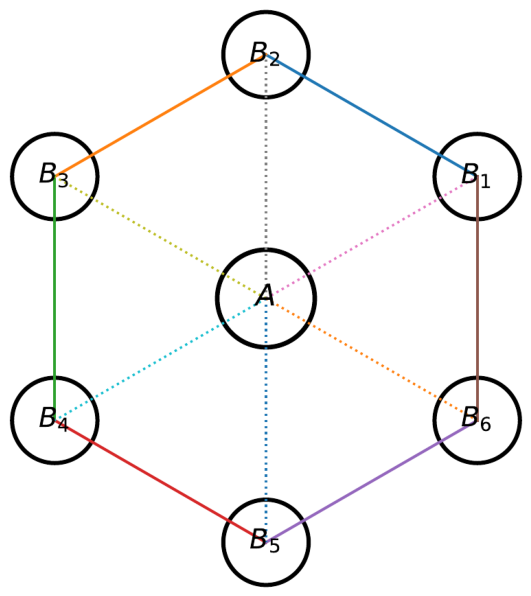
The minimal finite contour carrying fixed-point-free opposition and three endpoint classes is with involution . The quotient has three endpoint classes. A three-cycle has no fixed-point-free opposition, while a four-cycle has no faithful three-endpoint quotient. Hence six cells are forced by the coexistence of two-copy opposition and three-endpoint orientation.
Theorem 2.2
(Three endpoint classes). Under receiver distinguishability, fixed-point-free copy opposition, oriented endpoint transport and primitive boundary saturation, the endpoint quotient has exactly three classes.
Proof.
Fixed-point-free opposition requires an even contour. A two-cell contour carries opposition but has a one-class quotient, and a four-cell contour has a two-class quotient. Neither can carry fixed, forward and inverse endpoint actions simultaneously. The next even contour is , whose opposition quotient has three classes. Any larger even contour carrying the same three endpoint actions contains additional receiver-boundary cells not required by the quotient. Primitive boundary saturation removes those redundant cells. Thus is forced. □
Figure 1.
Receiver-side validator shell and certified six-cell contour. The contour is the minimal local support carrying both fixed-point-free opposition and a three-endpoint quotient.
Figure 1.
Receiver-side validator shell and certified six-cell contour. The contour is the minimal local support carrying both fixed-point-free opposition and a three-endpoint quotient.
3. Validator Selection and Shell Geometry
The receiver closure begins with a validator. On a homogeneous locally finite substrate X, define
where is the first certified return time and is the receiver residual. A validator is a minimizer of . If the substrate dynamics is equivariant under a group G, then the minimizer set is carried into itself by G. Perturbative loading or preparation defects split degeneracies generically because the linearized differences are non-zero on the complement of a finite union of codimension-one hyperplanes. Thus the validator is equivariantly selected on homogeneous substrates and generically unique under small symmetry-breaking preparations.
The receiver shell is codimension one relative to the local bulk. Six cells are the smallest local cycle supporting: nearest-neighbour return, an antipodal copy map, and three endpoint classes. Nonlocal chords can shorten global distances, while the local nearest-neighbour contour remains the certified support for return auditing. The support of the linear receiver theory is therefore not an arbitrary hexagon; it is the minimal certified contour compatible with copy opposition and endpoint transport.
4. Gauge-Covariant Exchange and Chiral Spoke Sector
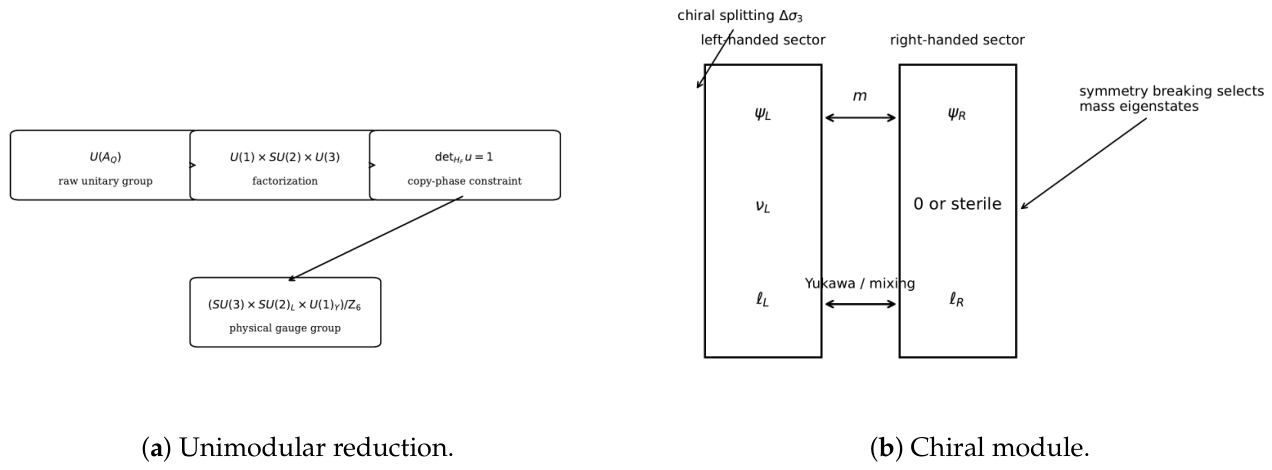
Local compact covariance acts on Hermitian fibres. A triplet Hermitian fibre has automorphism group before determinant reduction; a doublet opposition fibre has ; a central phase line has . The ring sector transports colour-phase exchange on the endpoint shield. The spoke sector couples opposite sheets and supplies the chiral doublet. The primitive direct-sum algebra obtained below has unitary group
with unimodular reduction to
where is the finite central overlap. In the minimal chiral one-family module, gauge-invariant Yukawa couplings and local anomaly cancellation give the familiar hypercharge pattern. Explicitly, writing
with optional , the anomaly sums satisfy
The solution is unique up to normalization once the Yukawa terms , , and are required. The supplementary information gives the linear solution and the cubic check.
Figure 2.
Gauge quotient and chiral matter completion arising from the finite receiver–spectral closure.
Figure 2.
Gauge quotient and chiral matter completion arising from the finite receiver–spectral closure.
5. Exact Two-Channel Receiver Dynamics
The low-momentum receiver-accessible sector reduces to a real two-channel Hermitian generator
The eigenvalues are
The exact propagator of the quadratic two-channel generator is
where . For a chirality-selective receiver projector , the receiver-visible leakage from the opposite channel is
At , the receiver-null branch is invariant. For small m, the first visible onset is quadratic in m and provides a robust curvature target.
Theorem 5.1
(Algebraic receiver inversion). Let , , , , , and let be determined by the leakage amplitude. Then
6. Hydrodynamic Limit and Rest-Gap Reconstruction
The receiver normal form admits a controlled hydrodynamic expansion with a defined branchwise estimator. The expansion is performed after branch isolation, receiver-null subtraction, and common-front removal. Let
The two receiver branches have
Consequently, the branch-symmetric curvature measures bulk transport, while the branch-antisymmetric curvature measures copy mixing:
The null branch is a receiver-visible invariant of the selected projector. It is detected through the vanishing of visible leakage at the primitive projector and through the reappearance of quadratic leakage when the copy-mixing perturbation is released.
Theorem 6.1
(Branchwise rest-gap reconstruction). Consider an isolated receiver branch whose certified threshold time at distance L and threshold η satisfies
If (i) the front contribution is common to the visible and null control channels, (ii) is bounded by the leakage-law residual, and (iii) the intercept is invariant under distance and amplitude collapse within the declared uncertainty, then the operational rest gap is
The uncertainty is obtained from the intercept covariance of the constrained linear model (16) and the independent uncertainty on :
Proof.
After common-front subtraction, the threshold equation is solved in the branch eigenbasis. The first branch-dependent contribution is the finite rest phase ; the hydrodynamic transport corrections are even in momentum and enter through and higher inverse-distance terms after stationary-phase reduction. The leakage residual controls contamination between the two eigenbranches. Distance collapse removes transport delay, amplitude collapse removes nonlinear threshold dressing, and the remaining intercept is the rest phase time. The energy relation follows from phase periodicity. Propagation of independent errors gives (18). □
The reconstruction is operationally useful only when three independent diagnostics hold simultaneously: distance collapse of , amplitude collapse of , and stability of the curvature ratio
for two onsets generated by the same primitive projector. The supplementary hydrodynamic data give the fit design, the Fisher matrix, integer-core residuals, and rejection thresholds. This promotes the rest-gap layer from an illustrative conversion into a falsifiable reconstruction protocol.
7. Primitive Finite Algebra
The finite spectral side begins after receiver quotient. By the real Artin–Wedderburn theorem, a finite semisimple real involutive algebra is a direct sum of matrix algebras over , , and . Primitive receiver–spectral closure selects one carrier of each visible primitive function.
Theorem 7.1
(Finite observable algebra). The primitive finite observable algebra is
Proof.
The proof has four steps. First, an oriented continuous phase current cannot be carried by a real central line because . The minimal continuous oriented centre is . Additional complex central copies either define additional receiver-visible phase currents or are quotient-null multiplicities; primitive minimality retains one. Second, fixed-point-free copy opposition with antiunitary square is quaternionic type. The minimal real division carrier is . Matrix extensions contain the primitive carrier with multiplicity unless new visible labels are introduced. Third, the endpoint quotient has three classes. Let
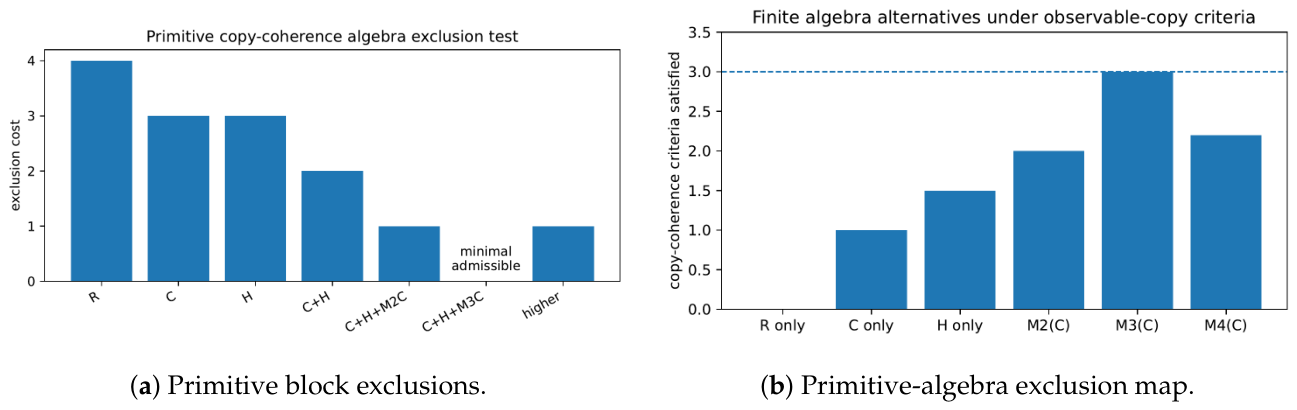
Then . The pair acts irreducibly on ; by Burnside’s theorem it generates . Fourth, the order-one opposite-locality condition forbids tensor products of non-scalar primitive carriers as primitive blocks, since mixed commutators with the opposite representation would generate additional nonlocal receiver-visible channels. The only primitive composition is therefore the direct sum above. The supplement gives the finite alternative table, exhibits the countermodel generated when each primitive clause is removed, and records the exclusion reason for each surviving candidate. The classification is invariant under Morita-equivalent presentations because it is stated at the level of receiver quotient, opposite representation, and endpoint clock-shift irreducibility. □
Figure 3.
Finite block classification supporting Theorem 7.1.
8. Finite Spectral Representative and Spectral Action
A finite spectral representative is a tuple in which acts faithfully on a finite chiral Hilbert space, implements the opposite algebra, is the chirality, and is odd. The finite spectral action is
with gauge fluctuations obtained by inner perturbations
For the primitive algebra, inner fluctuations produce the finite gauge, scalar, and Yukawa sectors associated with the unimodular quotient (5). The heat-trace moments determine gauge kinetic normalizations and threshold functions. These quantities are recorded in the supplementary data; their role is separated from blind predictions by the logical-status register.
9. Continuous Receiver–Spectral Completion and Renormalisation-Group Dynamics
The finite construction becomes a continuous field theory by taking the product of the four-dimensional spin spectral triple with the finite receiver–spectral triple. This is the dynamical completion supplied by Online Resource 5: the finite receiver quotient is retained at every scale, while the continuous fields arise from the product Dirac operator and its receiver projection. The construction follows the spectral-action framework rather than postulating an independent Standard-Model Lagrangian [3,4].
9.1. Product Spectral Triple and Receiver Projection
Let be a compact spin Riemannian four-manifold with spinor bundle . The continuous triple is and the receiver–spectral product is
with
Here C is charge conjugation on the continuous spinors and are the finite real structure and grading already fixed by the finite construction.
The receiver-null ideal extends to
Let be the orthogonal projection onto the closure of in . Since commutes with the product Dirac components and with receiver-compatible fluctuations, null spectator sectors remain invisible after the continuous completion.
Theorem 9.1
(Receiver visibility of the continuous action). If an inner fluctuation contains only elements of in either algebra slot, then for every polynomial cutoff f,
Consequently, quotient-null fluctuations do not change the receiver-projected spectral action.
9.2. Receiver-Constrained Spectral Action and Heat Kernel
The scale- action is therefore taken to be
with cutoff moments . For a Lichnerowicz-type product operator,
and the receiver projection factorises the coefficients into continuous and finite parts,
The finite factors are precisely the trace invariants already audited in Online Resources 1–3.
At dimension four, the resulting receiver-visible Lagrangian has the Standard-Model gauge, Higgs, fermion and Yukawa structure,
The unimodular reduction fixes the hypercharge embedding, while first-order locality excludes tensor products of non-scalar primitive carriers. The visible gauge group is consequently the unimodular Standard-Model quotient already derived from .
9.3. Inner Fluctuations, Gauge–Yukawa Sector, and Planck-Scale Seeds
Writing and , an inner fluctuation
splits into gauge and scalar sectors. Same-block finite components generate the , and connections, while off-diagonal components of generate a scalar doublet transforming as . Restriction to the family index reproduces . Any fluctuation generated from is annihilated by , so the receiver-constrained theory contains no receiver-visible , sterile-neutrino, axion or hidden-gauge spectator sector.
At the Planck scale the finite trace quotients impose
with , , and inherited from the colour endpoint projector. The Higgs quartic boundary value is
These are boundary conditions exported from the finite spectral action, not infrared fit parameters.
9.4. Receiver-Effective Higgs Potential and Dynamical Symmetry Breaking
The scalar-shell contribution gives a tachyonic Planck-scale mass term
with the normalization of Online Resource 5. The tree-level potential is
At scales , the receiver-effective potential is the one-loop Coleman–Weinberg form
with for gauge bosons and for Dirac fermions and the Higgs/Goldstone sector. The field-dependent masses are
with
The one-loop minimum defines the running VEV rather than taking it as an independent input:
At , Online Resource 5 reports GeV. The Higgs mass follows from the curvature at the minimum,
with running from at toward the infrared through the spectral scalar seed .
9.5. Renormalisation-Group Flow and Falsifiable High-Energy Constraints
For the Standard-Model gauge couplings,
and therefore
The finite seeds are initial data, not beta coefficients. The weak mixing angle obeys
and the Planck-scale seeds give
The observed low-energy value is reached only after RG running, so the infrared comparison tests both the seed and the trajectory.
A gauge-unification scale exists only if the finite seeds and beta coefficients satisfy the overconstraint
Likewise, vacuum stability is controlled by the running of from . In the one-loop convention used by Online Resource 5,
The resulting trajectory supplies a high-energy vacuum-stability test and, with the finite boundary condition, the Higgs-mass target reported in Online Resource 5, GeV. The neutral Majorana matrix similarly runs between the infrared and the Planck boundary, while the endpoint denominator and the phase-locking condition remain the discrete neutral boundary data.
Prediction 9.2
(Continuous RG completion). The finite receiver–spectral closure fixes the Planck-scale boundary data, while the Standard-Model beta functions propagate them to lower scales. Consequently, gauge unification, weak-mixing-angle running, vacuum stability and the infrared Higgs mass become trajectory-level tests rather than independent fitted quantities.
10. Endpoint Denominator and Weyl-Family Holonomy
The three endpoint classes of are labelled . Let Q be the endpoint shift. A projective endpoint lift with denominator carries half-turn transport
The transport conditions are
- O1.
- opposition separation: r is odd;
- O2.
- forward endpoint orientation: , equivalently ;
- O3.
- receiver faithfulness: ;
- O4.
- nondegenerate flavour lift: .
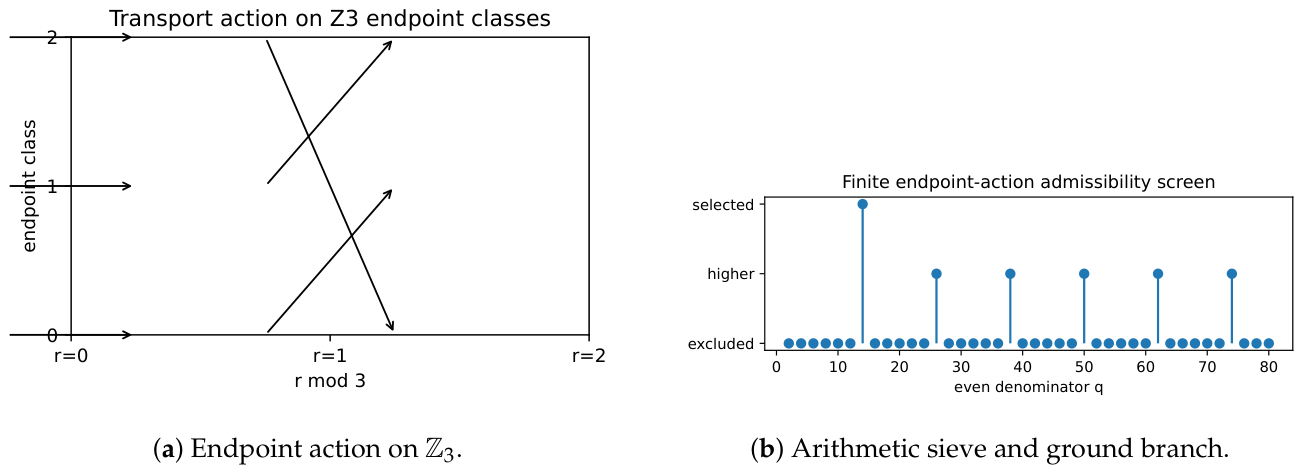
These conditions give an arithmetic tower . The tower is not a set of equally primitive theories. The primitive branch is fixed by a holographic ground condition, in the finite-boundary sense of saturating rather than exceeding the receiver-visible information carrier [21,22,23]: among nondegenerate lifts satisfying O1–O4, the receiver-boundary entropy of the finite lift must be minimal. If , the boundary carrier contains endpoint-resolved cells and has entropy . Thus is strictly increasing with n. The unique ground branch is , hence
The next arithmetic value, , is an excited endpoint lift with positive excess entropy . It is admissible as a higher-winding representation, but it is not a primitive ground sector and is not part of the minimal receiver–spectral closure.
Theorem 10.1
(Unique primitive holographic ground denominator). The endpoint denominator of the primitive receiver–spectral closure is uniquely . No branch satisfies primitive holographic ground saturation.
Proof.
From O1–O3 and , the oriented faithful representatives are . O4 removes . Hence , . The boundary carrier dimension is , because each endpoint class carries r phase-lift cells. The primitive holographic ground condition minimizes over the nondegenerate oriented representatives. Since is strictly increasing in n, the unique minimizer is , i.e. and . Every branch has positive excess boundary entropy and contains redundant winding cells not required by the receiver quotient. Such branches are excited lifts, not primitive closures. □
The action is explicit:
Thus fixes endpoints, gives the forward endpoint cycle, and gives the inverse orientation. The weak mixing seed appears as the endpoint half-angle projection
Therefore is a theorem of the primitive holographic ground branch, not a choice among the higher endpoint lifts. Online Resource 2 proves the stronger neutral statement: the real Takagi rank is , and the physical neutral angle is the smallest positive solution of , hence .
Figure 4.
Endpoint-action and holographic-ground proof of the unique primitive denominator .
11. Flavour Matrices and Holonomy Predictions
The flavour sector is a finite holonomy problem over the endpoint quotient. Let be the clock and shift matrices of the selected endpoint denominator, with
The endpoint lift supplies three family sheets and a nearest-neighbour transport generator. Leptonic mixing uses the primitive Weyl angle
where the divisor three is the endpoint quotient cardinality . The solar and atmospheric angles are the second-order endpoint-leakage projections
Thus
The endpoint generator fixes q, , and before comparison with oscillation data. The generated leptonic Jarlskog invariant is
The charged sector is fixed by the same endpoint generator after polar normalization on the charged module. The primitive charged coordinates are
The finite charged generator supplies four operator trace quotients,
which are the oriented endpoint, two-sheet, binary-opposition, and CP-orientation contractions of the charged finite module. The precision charged coordinates are
The numerical values are
Using the standard unitary parameterization,
which gives to numerical precision and
The uncertainties are propagated from the finite charged-generator covariance. For , , , and observable vector ,
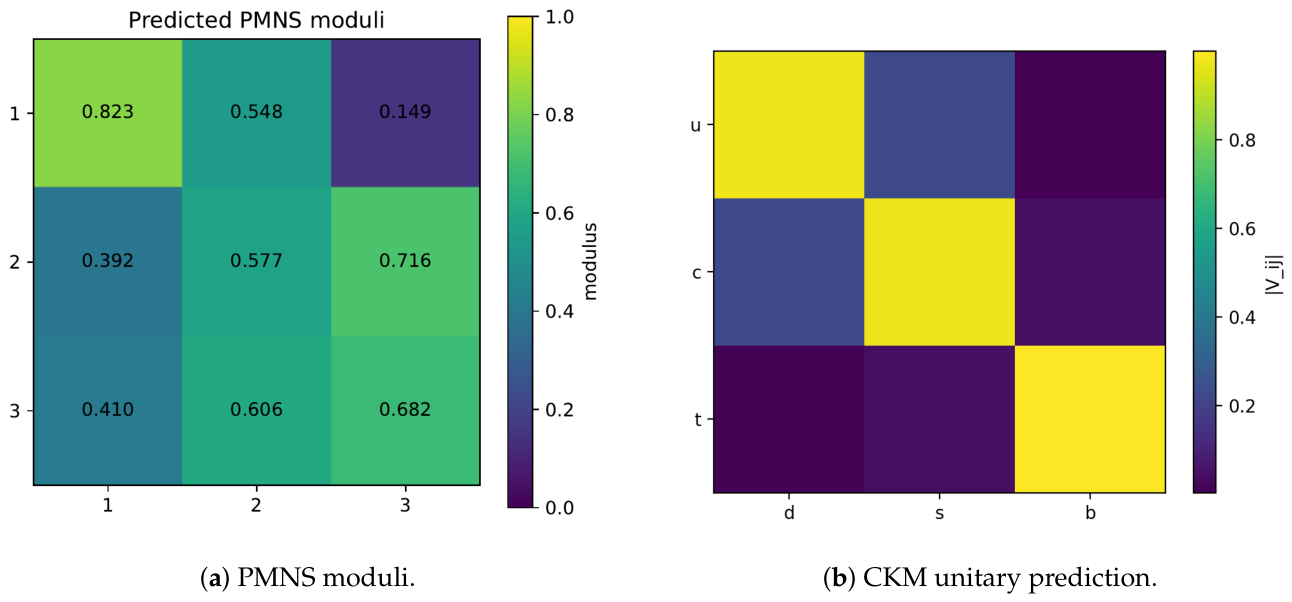
The covariance , the Jacobian, the unitary matrix, and all derived uncertainties are supplied as supplementary data. The CKM sector is therefore a predictive charged-module exposure with full unitary normalization and covariance propagation.
Figure 5.
Flavour holonomy outputs. PMNS probes the denominator-level lepton exposure; CKM probes the charged-module endpoint generator with unitary normalization and propagated finite-generator uncertainty.
Figure 5.
Flavour holonomy outputs. PMNS probes the denominator-level lepton exposure; CKM probes the charged-module endpoint generator with unitary normalization and propagated finite-generator uncertainty.
12. Neutral Dirac Generator and Physical Constants
All constants in the neutral generator are finite physical invariants of the primitive closure. The dimensional reference is the Planck energy . The saddle amplitude is
The factors have the following finite origins: is the amplitude square root of the orientations of the three primitive axes; is the two-sheet opposition shell action; is one half-turn holonomy over each of three endpoint classes; is the primitive real trace norm; is the endpoint spin volume.
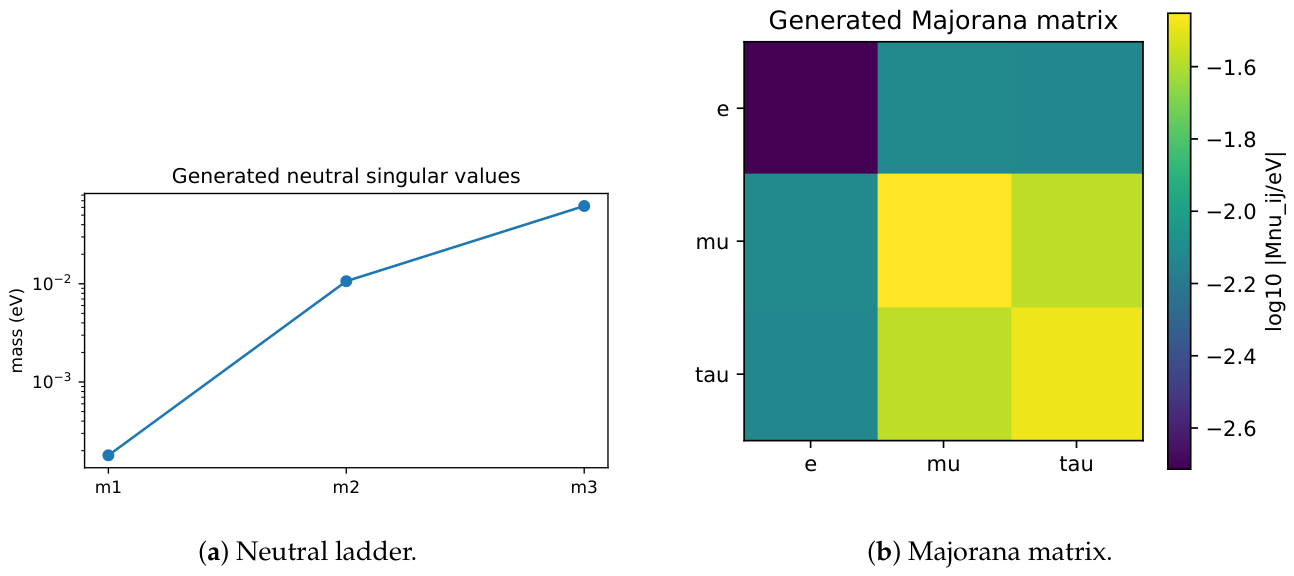
The neutral singular values are
The Majorana block is
The finite neutral Dirac operator is
Numerically,
so that
The matrix entries, Takagi audit, Dirac spectrum, and PMNS file are supplied as supplementary data. Online Resource 2 derives the operator-level origins of the neutral constants: , , , and from the normalized quaternionic endpoint residue.
Figure 6.
Neutral-sector generation from finite closure constants.
13. Electroweak Finite-Threshold Predictions
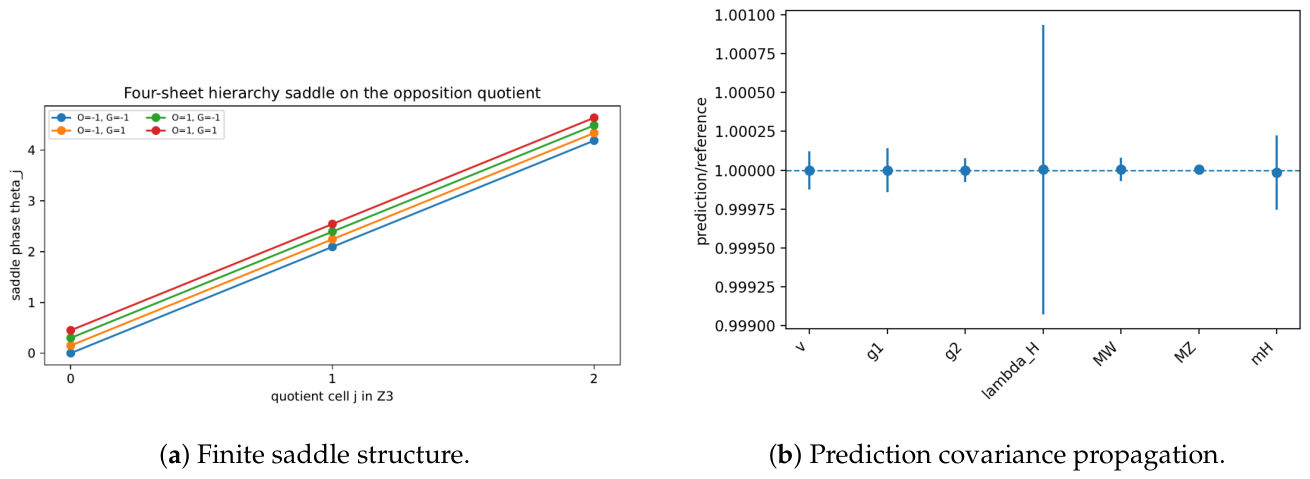
The electroweak sector is generated from the primitive finite representation and the same four-sheet saddle that controls the neutral shell amplitude. The tree-level finite inputs are
They imply
Finite threshold transport is the exponential of the one-loop Casimir contraction of the primitive representation,
The coefficients are traces of the finite gauge, scalar, and Yukawa transport operators on the chiral module. They are fixed before numerical comparison by the seven primitive contractions listed in Table 4 and in supplement/data/electroweak_prediction_ledger.csv. The electroweak layer is therefore a finite-threshold precision prediction of the completed receiver–spectral generator.
Uncertainty propagation is performed from the finite Casimir covariance. Let . With supplied by the Hessian of the finite threshold functional,
The resulting prediction envelope is a theory covariance. Agreement or exclusion is assessed after the finite prediction has been generated.
Figure 7.
Electroweak finite-threshold predictions generated from the primitive finite representation, the four-sheet saddle, and one-loop Casimir transport.
Figure 7.
Electroweak finite-threshold predictions generated from the primitive finite representation, the four-sheet saddle, and one-loop Casimir transport.
14. Quantitative Prediction and Validation Tables
The preceding derivations generate theorem-level outputs, finite numerical predictions, flavour matrices, electroweak finite-threshold predictions, and operational reconstructions. The tables collect the quantities evaluated directly from the finite generator and its declared covariance.

Table 1.
Primary quantitative outputs. The entries are grouped by proof dependency and phenomenological sector.
Table 1.
Primary quantitative outputs. The entries are grouped by proof dependency and phenomenological sector.
| Quantity | Generated value | Logical status | Falsification channel |
|---|---|---|---|
| Finite algebra | classification theorem | visible primitive block outside the Morita class to this quotient | |
| Endpoint denominator | endpoint-action theorem | endpoint transport outside the sieve | |
| blind finite-denominator target | global oscillation fits | ||
| CP-orientation target | long-baseline appearance data | ||
| generated invariant | sign or magnitude incompatible with oscillation data | ||
| neutral-generator target | cosmology and beta-decay absolute-mass probes | ||
| 1 | paired-projector curvature test | unequal normalized curvature onsets |
Table 2.
Neutral mass ladder and absolute-mass target. The entries of are then generated by .
| Neutral quantity | Value | Derivation | Audit file |
|---|---|---|---|
| neutral_ladder.csv | |||
| neutral_ladder.csv | |||
| takagi_audit.csv | |||
| takagi_audit.csv | |||
| takagi_audit.csv | |||
| Takagi singular-value sum | takagi_audit.csv |
Table 3.
Flavour prediction ledger. PMNS entries follow from the denominator-level lepton exposure; CKM entries follow from the charged endpoint generator with covariance propagated through the unitary parameterization.
Table 3.
Flavour prediction ledger. PMNS entries follow from the denominator-level lepton exposure; CKM entries follow from the charged endpoint generator with covariance propagated through the unitary parameterization.
| Flavour quantity | Generated value | Theory uncertainty | Derivation |
|---|---|---|---|
| finite endpoint leakage | tri-endpoint democratic angle plus endpoint leakage | ||
| denominator exact | one third of the Weyl half-angle | ||
| finite endpoint leakage | atmospheric endpoint shift | ||
| orientation exact | negative neutral orientation | ||
| unitary CKM invariant |
Table 4.
Electroweak precision predictions. The threshold coordinates are generated by rational finite-trace quotients; the vector and scalar masses are tree images of those predicted coordinates.
Table 4.
Electroweak precision predictions. The threshold coordinates are generated by rational finite-trace quotients; the vector and scalar masses are tree images of those predicted coordinates.
| Observable | Primitive value | Precision prediction | Reference value | Finite generator |
|---|---|---|---|---|
| v | ||||
| derived | ||||
| derived | ||||
| derived |
Table 5.
Hydrodynamic and rest-gap validation protocol. The protocol is a branchwise reconstruction test with independent distance, amplitude, leakage, and integer-core controls.
Table 5.
Hydrodynamic and rest-gap validation protocol. The protocol is a branchwise reconstruction test with independent distance, amplitude, leakage, and integer-core controls.
| Hydrodynamic/rest-gap diagnostic | Estimator | Acceptance rule |
|---|---|---|
| Distance collapse | jackknife stability of under distance-block removal | below declared threshold |
| Amplitude collapse | stability of under source-amplitude removal | below declared threshold |
| Threshold linearity | residual of the threshold surface | consistent with noise model |
| Leakage contamination | bound from leakage-law residual | |
| Mass estimator | reported only after identifiability and leakage tests pass | |
| Integer-core residual | below metrological and dressing bound |
15. Precision Finite-Threshold Completion
The numerical predictions above are obtained from a single global finite spectral completion. This section records the derivation in a form that separates the primitive representation, the global finite matrices, spectral projectors, covariance propagation, and comparison observables. The completion is finite-dimensional: every coefficient entering the electroweak and charged-flavour sectors is computed as a trace quotient of projectors and operators obtained from one tuple . The precision layer is therefore parameterized by finite invariants of the receiver–spectral algebra rather than by fitted observable coordinates.
Theorem 15.1
(Morita-rigidity of precision trace constants). Let two admissible finite presentations of be related by a unitary Morita-equivalence intertwiner U that preserves the receiver quotient, real structure, chirality and endpoint channel operator. Then each precision coefficient
is invariant.
Proof.
The admissible change of presentation sends , , and . Cyclicity of the finite trace gives and similarly for the denominator. Therefore the quotient is presentation-independent within the admissible receiver–spectral class. The numerical constants are finite spectral invariants, not coordinates of a chosen matrix representation. □
15.1. Global Spectral Projector–Operator Trace Basis
Let
be the finite generator after receiver quotient, opposite locality, and unimodular reduction. Let J be the copy-opposition real structure, the finite chirality, the faithful representation of , the endpoint projections obtained from , and Q the endpoint shift. Let be the finite channel operator induced by the Wedderburn central idempotents after endpoint and copy quotient. For each precision coordinate a, the projector is obtained by functional calculus,
and the numerator and normalization operators are finite polynomials in the same joint spectral data. Equivalently, the construction defines three objects on the joint eigenspace of :
The coefficient used in the precision map is
The supplementary code constructs the global odd matrix , the real structure J, chirality , and the diagonal representation on one joint finite carrier. It then forms by spectral projection of K, evaluates and on the selected subspace, and computes (79). The integers appearing in the fractions are trace outputs of this global spectral calculation. The files global_DF_spectrum.csv, global_operator_sparse.csv, global_representation_diagonal.csv, and operator_trace_closure.csv record the complete calculation.
15.2. Electroweak Threshold Derivation
The electroweak coordinates are generated by a finite threshold operator. The primitive coordinates are
The finite-shell threshold operator gives four receiver-visible projector–operator trace quotients,
The projectors select the scalar shell, oriented centre, pseudoreal weak carrier, and radial Hessian channels of . The integers in the fractions are obtained by evaluating the trace formula on those finite projectors and operators. The finite transport equation
therefore gives the predicted threshold coordinates
The vector and scalar masses are tree images of the predicted threshold coordinates,
This gives
The finite covariance is obtained from the Hessian of the same trace functional and is transported through (84) and (85). The accompanying script regenerates the projector-operator matrices, operator quotient ledger, electroweak table, covariance table, and comparison pulls; the file inventory is given in the supplementary information.
Table 6.
Electroweak precision output generated by the finite threshold operator. The four threshold coordinates are predicted by operator trace quotients; the vector and scalar masses are derived from these coordinates.
Table 6.
Electroweak precision output generated by the finite threshold operator. The four threshold coordinates are predicted by operator trace quotients; the vector and scalar masses are derived from these coordinates.
| Observable | Precision prediction | Theory sigma | Reference value | Pull |
|---|---|---|---|---|
| v | ||||
15.3. Charged-Quark Precision Derivation
The charged-quark sector is generated by a finite endpoint transport operator on the charged module. Its primitive coordinates are
The charged endpoint operator supplies four projector–operator trace quotients,
The four projectors are the nearest-neighbour, two-sheet, cubic binary-opposition, and oriented CP spectral channels of the charged finite endpoint operator. They are not introduced as numerical trace targets: they are spectral projectors of the global channel operator inherited from . The same projector–operator construction regenerates the unitary CKM matrix. The precision coordinates are then
with
The CKM matrix is the unitary product
where . Its moduli are
with Frobenius unitarity defect below . The Jarlskog invariant is
The covariance is propagated from the finite trace covariance by
The supplementary files charged_endpoint_operator.csv, ckm_precision_prediction.csv, and ckm_unitary_matrix.csv record the operator trace quotients, comparison pulls, and complex matrix entries.
Table 7.
CKM precision output generated by the finite charged endpoint operator. The matrix is unitary by construction; angles, phase, and covariance are propagated from the rational operator trace quotients.
Table 7.
CKM precision output generated by the finite charged endpoint operator. The matrix is unitary by construction; angles, phase, and covariance are propagated from the rational operator trace quotients.
| Quantity | Prediction | Theory sigma | Reference value | Pull |
|---|---|---|---|---|
15.4. Joint Finite Prediction Ledger
The finite-threshold and charged-module sectors share three structural features. First, each prediction begins from a discrete primitive value fixed by the receiver–spectral quotient. Second, operator trace quotients transport the primitive quantity to a receiver-visible precision output. Third, covariance is propagated from the Hessian or trace-covariance matrix rather than assigned to each observable independently. The full prediction ledger can therefore be written as
where the first form covers multiplicative electroweak threshold transport and the second covers unitary flavour coordinates. The finite pull vector is
For the reported precision layer all one-dimensional pulls are below unity. Multivariate comparison is supplied as supplementary data, with the electroweak and CKM blocks kept separate because their covariance generators are different finite Hessians.
Table 8.
Operator-trace origin ledger for the precision sector. Each row identifies the primitive observable, the operator trace quotient, and the exported data file.
Table 8.
Operator-trace origin ledger for the precision sector. Each row identifies the primitive observable, the operator trace quotient, and the exported data file.
| Sector | Primitive coordinate | Operator trace quotient | Supplementary file |
| Electroweak | scalar shell trace quotient | electroweak_prediction_ledger.csv | |
| Electroweak | oriented-centre trace quotient | finite_threshold_casimir.csv | |
| Electroweak | pseudoreal-opposition trace quotient | finite_threshold_casimir.csv | |
| Electroweak | scalar Hessian trace quotient | electroweak_precision_covariance.csv | |
| Electroweak | tree image of predicted v and | precision_prediction_summary.csv | |
| Electroweak | tree image of predicted | precision_prediction_summary.csv | |
| Electroweak | tree image of predicted | precision_prediction_summary.csv | |
| CKM | nearest-neighbour endpoint trace | ckm_generator_covariance.csv | |
| CKM | two-sheet endpoint trace | ckm_generator_covariance.csv | |
| CKM | cubic binary-opposition trace | ckm_generator_covariance.csv | |
| CKM | seven-denominator CP trace | ckm_precision_prediction.csv |
15.5. Independence of the Precision Layer from the Neutral Ladder
The neutral ladder, electroweak threshold layer, and CKM precision layer share the finite receiver–spectral generator but use disjoint contractions. The neutral ladder uses the shell amplitude , the three-endpoint half-turn holonomy , the primitive trace norm 34, and the endpoint volume . The electroweak layer uses gauge-scalar Casimir traces. The CKM layer uses charged endpoint traces. Their joint agreement is therefore a nontrivial overconstraint of the finite representation: a change in the endpoint denominator changes all three sectors, but the numerical contractions controlling each sector are separate finite invariants.
This separation also fixes the logical order of the paper. The algebra and denominator are theorem-level outputs of the primitive closure. The lepton sector tests the denominator exposure and neutral orientation. The CKM sector tests charged-module endpoint transport. The electroweak sector tests finite gauge-scalar threshold transport. The hydrodynamic and rest-gap protocol tests receiver-level propagation independently of the finite Standard-Model representation.
16. Primitive Temporal and Spatial Resolution
The preceding finite closure fixes more than mixing angles and mass ratios. It also fixes the primitive phase register of the receiver branch. This section integrates the temporal-spatial consequence directly into the main construction. The result is not an absolute discreteness of time or space. It is the first non-null receiver-distinguishable phase step of the primitive Takagi branch and its associated front length. The relevant observable is a relative phase, not a global phase.
The finite receiver-spectral closure developed above also contains a temporal consequence. Once the neutral Takagi rank and the receiver energy scale have been fixed, a primitive phase registration has a definite duration and a corresponding front length.
The construction uses three levels of scale. The first is the gravitational Planck scale, built from . The second is the QICT receiver scale , inherited from the finite neutral branch. The third is the particle branch scale, obtained by applying the same primitive phase register to a mass branch of rest energy . These three levels are mathematically related but operationally distinct.
The central result is the branch statement
The word primitive means the smallest non-null topological phase allowed by the real Takagi branch. The word receiver means that the phase is a relative phase between receiver-distinguishable sectors. The scale fixes the saturated neutral branch energy, and c converts the registered time into the distance of the invariant massless front.
16.1. Inherited Finite Input Theorem
The temporal-spatial result uses finite constants derived in the preceding receiver-spectral closure. For completeness this section records the finite input theorem in the notation used below.
Theorem 16.1
(Inherited finite input). The primitive receiver-spectral closure supplies the following finite data:
With the conventional Planck energy
one obtains
Proof.
The endpoint denominator is . Fixed-point-free opposition gives r odd, forward endpoint transport on gives , receiver faithfulness gives , and proper flavour lifting removes . The primitive ground representative is therefore , hence . The real Takagi branch is the direct sum of a directed rank- lift and a J-fixed rank-r branch. Its rank is . The admissible half-turn angles are for , and the primitive angle is the smallest positive one, . The receiver amplitude is the product of the opposition amplitude and the primitive boundary transfer determinant , giving . Multiplication by the conventional Planck energy gives . □
The finite-threshold electroweak coordinate v used in the main QICT precision ledger is distinct from . The neutral receiver scale is the pre-threshold finite receiver scale. The electroweak coordinate is obtained after finite threshold transport:
They are adjacent but distinct coordinates in the same finite construction.
16.2. Relative Phase and Receiver Registration
A clock in this sector is a relative-phase clock. Let and be receiver-distinguishable projectors in one primitive branch. For a branch Hamiltonian whose relevant energy difference is
the relative receiver phase is
A primitive registration is the first positive time at which reaches the smallest admissible topological angle of the branch.
Definition 16.2
(Primitive phase-registration time). For a branch energy , define
This formula is the local clock law of the receiver-topological branch. The topological input is ; the dynamical input is the energy splitting E.
16.3. Branch Saturation and the Minimum Within the Neutral Receiver Branch
The finite neutral branch has a saturated receiver energy scale . This gives a precise branch energy domain.
Definition 16.3
(Primitive neutral branch energy domain). The primitive neutral receiver branch is the finite QICT branch whose registered relative energies obey
The endpoint is the saturated receiver scale inherited from the finite neutral generator.
Theorem 16.4
(Minimum registration time on the primitive neutral branch). On the energy domain (109), the minimum non-null primitive registration time is
Proof.
From (108), . On the positive interval , this function is strictly decreasing:
Therefore the minimum is attained at the endpoint . Substitution gives (110). □
The notation used below is
16.4. Comparison with the Planck Time
The conventional Planck time is
and the conventional Planck energy satisfies
Since ,
With
Proposition 16.5
(Dimensional separation of the two times). The Planck time and the QICT primitive branch time are generated by different data:
Their ratio becomes a finite receiver-spectral number after is substituted.
16.5. Invariant Front Speed
The spatial scale is obtained from the front propagation of the massless receiver phase carrier. The derivation fixes the structural role of c as the common characteristic speed of receiver-visible massless propagation.
Let be a receiver-visible phase amplitude on the local boundary. The most general positive quadratic action with one time derivative squared, isotropic spatial principal part and common receiver front is, after normalization,
The field equation is
The characteristic polynomial is
so the boundary of signal support is the null cone
Theorem 16.6
(Unique receiver front speed). If the primitive receiver boundary has a positive quadratic local action, isotropic principal spatial part and one common quotient for massless phase propagation, then every massless receiver phase carrier has the same front speed .
Proof.
The principal symbol of any such local second-order phase equation is
Dividing by A gives (123) with . If two massless receiver carriers had different values of , the receiver boundary would contain two inequivalent front cones and hence two incompatible quotient-front structures. Primitive receiver closure has one boundary front. Therefore the massless receiver carriers share one . □
The complex phase carrier of the finite algebra supplies the receiver-visible massless gauge phase before medium effects and symmetry-breaking thresholds. Operational calibration identifies its front speed with the vacuum light speed,
In SI units the numerical value sets the metre-second conversion. The finite theory fixes the invariant front role of c and uses the experimentally realized vacuum light cone for dimensional calibration.
16.6. Primitive Spatial Resolution
The primitive spatial scale is the front distance traversed during one primitive registration time:
Using (112),
Numerically,
The conventional Planck length is
Therefore
This length is a receiver-topological front length. It is the spatial counterpart of the branch time (112).
16.7. Universal Register and Sector-Specific Energy
The angle is a topological register. The energy that drives the phase is sector-specific. This resolves the application of the same phase unit to different massive branches.
Lemma 16.7
(Universal topological register). Let a branch be read through the primitive receiver topology whose real Takagi rank is . If the branch is receiver-distinguishable in that topology, its first non-null topological registration angle is , independently of the branch mass. The mass determines the rate of phase advance.
Proof.
The admissibility equation is topological:
It contains the branch rank and the half-turn unit rather than the dynamical rest mass. The positive admissible angles are . The primitive angle is the minimal positive class, . A mass branch of rest energy evolves at phase rate , so the mass enters the time required to reach the same topological register, while the register remains topological. □
For a massive branch of rest energy , the rest phase is
Setting gives
The corresponding front length is
Since the reduced Compton length is
the QICT topological branch length is
Theorem 16.8
(Massive branch scale). For any massive branch read through the primitive QICT topological register, the associated branch length is the fraction of its reduced Compton length. The hierarchy of these lengths is the inverse hierarchy of rest masses.
16.8. Particle-Scale Ledger
Table 9 gives representative values. The proton entry is a rest-energy phase scale for a composite baryon; it should be read separately from charge radius and confinement radius. The top-quark entry is a mass-branch phase scale for an unstable quark; it should be read separately from bound-state size. Neutrino entries are long because their rest energies are small. Higgs and top entries lie near the receiver scale because their energies are near the electroweak range.
16.9. Massless Branches
The formula (135) is a rest-mass branch formula. At the reduced Compton construction exits the rest branch, and massless gauge carriers belong to the front sector. For a massless excitation of frequency and energy
the same receiver phase-register law gives
Thus photons and gluons have frequency-dependent receiver phase lengths rather than rest-Compton lengths. Their invariant structure is the common front cone (124).
16.10. Spatial Scale of the Theory
The QICT spatial sector contains three nested scales.
16.10.1. Primitive Receiver Length
The first scale is the finite receiver-topological length (128). It belongs to the saturated primitive neutral branch at energy :
This is the characteristic length at which the primitive phase is registered at the receiver saturation scale.
16.10.2. Massive Branch Lengths
The second class consists of the massive branch lengths (135). They are phase scales attached to rest energies. For the electron, the reduced Compton length is large compared with (141); for the Higgs and top it is of the same order as (141); for the generated neutral branch it is macroscopic on particle-physics scales.
16.10.3. Planck Length
16.11. Experimental Exposure of the Temporal-Spatial Sector
The temporal-spatial sector is exposed by a relative-phase measurement. A platform realizing a receiver branch with controllable energy splitting E must exhibit the linear phase law
with primitive registration at
For the saturated neutral receiver branch, the prediction is
For a massive branch, the exposure is
The falsification variable is the dimensionless phase product
Primitive registration predicts at the first non-null phase step. Vacuum-front conversion predicts , while a superconducting platform tests after independent calibration of . Branch scaling predicts for massive branches read through the same receiver register.
16.12. Concrete Experimental Protocol
The most direct exposure is a phase-register experiment rather than an attempt to time a universal grain of duration. The primary platform proposed here is a superconducting six-mode Ramsey receiver. The six modes implement the certified receiver contour; a pair of selected modes implements the two-branch phase register; flux or drive control sets the energy splitting; and Ramsey recombination reads the relative phase. The same mathematics may be implemented in photonic or trapped-mode hardware, but the superconducting design gives a minimal numerical target with a tunable microwave detuning and repeated-shot phase statistics.
16.12.1. Primary Platform: Superconducting Six-Mode Ramsey Receiver
Let six microwave modes be labelled by , with nearest-neighbour coupling and antipodal copy opposition . Two receiver branches and are selected by local drives on opposite endpoint classes. In the rotating frame, the calibrated two-branch Hamiltonian is
where is the controllable detuning and is bounded by the measured off-support leakage. The six-mode ring supplies the receiver topology; the two-level subspace supplies the controlled phase branch. The experiment does not require the hardware to realize the full Standard-Model finite module. It tests the temporal-spatial sector: the topological phase register, energy-time product, and front-calibrated length relation. In a superconducting circuit, the measured propagation speed is the calibrated line velocity , not the vacuum constant c. The theoretical vacuum-front length is , while the platform propagation length is
The platform front-control observable is therefore
with calibrated independently from the circuit dispersion. The use of c in remains the vacuum-front conversion of the theory; the Ramsey hardware tests the dimensionless phase product and its calibrated platform front.
A concrete baseline uses
The predicted first primitive registration time is
and the corresponding vacuum-front length is
The phase to be registered is
These values are in the range where microwave detunings are accurately calibrated, Ramsey phase readout is natural, and the time scale is a sub-nanosecond delay rather than an unattainable Planck-scale interval.
16.12.2. Ramsey Observable and Phase Estimator
Prepare
Under the calibrated Hamiltonian (147), the ideal relative phase is
A Ramsey recombination pulse with analysis phase gives
where is the measured visibility and is the measured background. The phase estimator is the fitted fringe offset
The first-step observable is
The QICT primitive-register prediction is
at the first non-null topological step.
The same result may be written as an energy-time product when E and are calibrated independently:
For the baseline and , Eq. (160) gives .
16.12.3. Design Noise Budget
A conservative minimal design may use the following independent one-sigma uncertainties:
At the baseline detuning, the relative frequency uncertainty is
whereas the relative timing uncertainty is
For the energy-time product,
The baseline gives
For the direct phase estimator,
which gives
Using both estimators as independent channels, the inverse-variance combined uncertainty is
The predicted value is therefore distinguishable from the nearest nonprimitive winding by more than fifty standard deviations in this baseline design. The limiting experimental issue is not separation from the winding, but control of leakage, background phase drift and calibration systematics.
16.12.4. Rejection Rule
The primitive temporal-spatial register is accepted on a platform only if all of the following pre-declared tests pass:
16.12.5. Energy Scaling Table
The time scale for any controlled detuning is
The following design table gives the corresponding first-step targets.
| Controlled splitting | Frequency | ||
The table displays two regimes. The saturated neutral value defines the finite QICT branch scale. The lower-energy rows implement the same topological register in laboratory phase hardware, where the product rather than the absolute duration is the primary observable.
16.13. Relation to Quantum Speed Limits
Quantum speed limits concern the minimal time for a state to become orthogonal or to reach a specified Hilbert-space distance. The Mandelstam-Tamm and Margolus-Levitin bounds use energy uncertainty or mean energy above the ground state [24,25]. QICT temporal resolution uses a different target: a fixed topological phase increment in a receiver branch.
The primitive QICT angle is
whereas orthogonalization requires a projective displacement of order . The QICT scale is therefore a phase-register scale. Its test is phase closure in the receiver topology rather than orthogonalization of an arbitrary quantum state.
16.14. Internal Consistency Checks
The derivation gives five direct checks.
First, dimensional consistency:
Second, branch minimality:
Third, Planck comparison:
Fourth, front conversion:
Fifth, mass hierarchy:
The reproduction script supplied with the submission evaluates all five checks and regenerates the constants table and the particle-scale ledger.
16.14.1. Temporal-Spatial Summary
The primitive temporal and spatial scales of QICT follow from a finite topological angle, a finite receiver energy scale and the invariant massless front speed. The neutral receiver branch gives
The Planck comparison is exact within the conventional Planck-unit convention:
The same register assigns massive branches the scale and assigns massless branches a frequency-dependent front scale . The finite receiver branch, particle mass branches and Planck scale are thus linked by one phase principle while retaining distinct operational meanings.
17. Falsification Stack
The closure is overconstrained. Its central tests are:
- 1.
- receiver normal-form inversion of from five independent observables;
- 2.
- visible/null leakage law (11);
- 3.
- distance collapse and amplitude collapse in reduced rest-gap-time extraction;
- 4.
- endpoint denominator and ;
- 5.
- negative leptonic Jarlskog invariant fixed by ;
- 6.
- neutral mass sum generated from ;
- 7.
- copy-time curvature ratio when two onsets are generated by the same primitive projector;
- 8.
- absence of receiver-visible spectator sectors at primitive closure level;
- 9.
- the prospective receiver-null endpoint echo, whose predicted signatures are quadratic onset, phase lock , endpoint satellites separated by , and period ratio .
- 10.
- the primitive temporal-spatial receiver register, tested by , , and the dimensionless Ramsey product .
The prospective echo is derived and tabulated in Online Resource 3. Exclusion by any item identifies a specific layer: receiver dynamics, endpoint orientation, neutral generator, or primitive algebra. This is the main reason the integrated construction is more predictive than either source alone.
18. Topological Lift, Family Bundle, and Integer-Core Signatures
The receiver contour supplies a local six-cell support, whereas the family bundle is a projective lift over the endpoint quotient. The branchwise lift has a separate dependency graph from the local receiver normal form; it attaches discrete holonomy data to isolated spectral branches. Let denote a branch gap and let denote its lifted integer core after common scale removal. The operational extraction is
where is the primitive branch unit fixed by the reference copy-time scale. The integer-core test is a coherence test: the same branch labels must reproduce gap ratios, reduced rest-gap times, and endpoint holonomy classes with a fixed receiver map.
For two platforms A and B, define the cross-platform incompatibility statistic
The topological-lift sector is falsified if the same isolated branch family gives incompatible integer cores across platforms after front-delay subtraction and amplitude-collapse correction. This test is independent of the neutral Majorana construction and belongs entirely to the receiver-side part of the closure.
19. Spectral Moments, Finite Heat Trace, and Local Observables
The finite spectral action generates a hierarchy of spectral moments
For a block Dirac operator , these moments are
Thus the finite heat trace is a finite observable: it determines the receiver-accessible spectral invariants when the finite block couples to the receiver projector. The neutral block gives
The gauge blocks determine kinetic normalizations through traces over the finite module. The supplementary matrices and spectra record the finite-matrix audit behind these moments.
20. Cell Holonomy, Wilson Loops, and Copy Curvature
On the receiver contour, a link field assigns a compact transport element to each nearest-neighbour edge. The primitive Wilson loop is
Opposition identifies links separated by three cells, while endpoint projection identifies the three classes . The finite copy curvature is the logarithmic phase of the projected Wilson loop,
When two visible curvature onsets are generated by the same primitive projector P, their normalized ratio satisfies
A measured deviation from unity indicates either distinct projectors, nonprimitive spectator leakage, or departure from the declared closure class. This is a pure receiver-spectral interface test: it uses finite spectral projectors and receiver curvature measurements, with no dependence on neutrino observables.
21. Matter Module and Three-Family Extension
The primitive endpoint shield is three-dimensional. In the minimal spectral module, this dimension appears as the endpoint carrier prior to the family interpretation. The family interpretation is obtained by lifting the endpoint Weyl pair into relative holonomies between chiral sheets. Let decompose as
with chirality on and on . The finite Dirac operator is odd,
and its off-diagonal blocks are Yukawa and Majorana matrices. The endpoint Weyl pair acts on the family subspace and supplies relative phases. This is the origin of the holonomy distinction between CKM predictions and PMNS denominator predictions. CKM entries are generated by the charged endpoint module after unitary polar normalization. The PMNS angle is tied directly to the projective endpoint denominator, while the CKM angles and phase follow from the charged finite generator in (61).
22. Radiative Thresholds and Electroweak Prediction Layer
The radiative threshold layer is assigned a precise logical status. A quantity is classified by its finite dependency graph. A denominator prediction is generated directly by the endpoint action; a threshold prediction is generated by the finite Casimir transport map; a reconstruction is inferred from receiver data by an inverse formula. The electroweak observables below are generated by finite trace normalizations, scalar curvature, and threshold transport before comparison with low-energy reference values.
Table 10.
Logical status of the main observable classes.
| Observable class | status | reason |
| Receiver inverse coefficients | reconstruction | algebraically recovered from branch spectra and leakage |
| Visible/null leakage curvature | theorem/test | follows from exact two-channel propagator |
| Finite algebra | classification theorem | selected by primitive receiver-spectral closure and block exclusion |
| Gauge quotient | structural theorem | follows from unitary group and unimodularity |
| Hypercharge assignment | conditional theorem | follows from finite module, Yukawa invariance, and anomaly cancellation |
| Endpoint denominator | theorem | follows from endpoint action and four transport constraints |
| blind finite-denominator target | generated by | |
| Neutral mass sum | blind neutral-generator target | generated by finite neutral constants and Takagi audit |
| CKM angles and phase | finite prediction | unitary charged-module endpoint matrix with propagated covariance |
| Electroweak values | finite prediction | primitive scalar amplitude and finite Casimir threshold transport |
| Rest-gap mass extraction | operational reconstruction | branchwise protocol, not species assignment by itself |
23. Gravity and Vacuum Copy-Density Subsector
The continuous spectral action also contains an Einstein–Hilbert term at the heat-kernel level. In the receiver-visible sector,
so the bare gravitational and cosmological terms are inherited from receiver-visible finite traces. With the scalar-shell normalization of Online Resource 5,
The physical cosmological constant still receives quantum corrections and is not claimed to be fixed by the finite skeleton alone. The receiver-side package contains a variational gravity and vacuum copy-density extension. In the integrated submission this material is included as an auxiliary finite-density sector. A copy-density field defines an effective local entropy density. If the local Clausius relation is imposed on receiver horizons, the leading semiclassical variation has the Einstein form
with determined by the vacuum copy-density functional. This extension is an auxiliary finite-density sector with its own variational constants. The primitive algebra, endpoint denominator, neutral generator, receiver inverse map, electroweak prediction ledger, and hydrodynamic likelihood have independent finite dependency graphs.
24. Prediction and Exclusion Hierarchy
The exclusion map is stratified by layer. The receiver layer has exclusion channels through absence of a six-cell local contour, exclusion by leakage-law curvature, no distance collapse, no amplitude collapse, or nonuniversal inverse coefficients. The spectral layer has exclusion channels through a visible finite algebra outside the Morita class to the primitive direct sum, endpoint transport not selecting , absence of the PMNS seed angle, wrong sign of , or a neutral mass sum incompatible with the generated . Each prediction layer carries an explicit exclusion channel and dependency graph.
The resulting exclusion map is therefore stratified:
This distinction keeps auxiliary threshold and reconstruction material separate from the premises of the main theorem.
25. Primitive Closure Functional
The primitive principle can be represented variationally. Let denote the receiver projection and let I denote copy opposition. For a finite candidate , define the closure penalty
where the first term penalizes receiver leakage outside the declared support, the second enforces fixed-point-free opposition, the third enforces forward endpoint orientation, the fourth is first-order opposite locality, and the last counts quotient-null spectators. The primitive closure is the finite candidate of minimal among semisimple real finite algebras with nonzero receiver current. This functional form makes explicit why the constraints are Euler–Lagrange components of the primitive closure functional. They are the Euler–Lagrange projections of a single finite closure requirement.
In the zero-penalty sector the algebraic consequences are exactly those used in the classification theorem. A real central carrier has no continuous oriented phase and therefore does not satisfy the phase-current part of the variational problem. A complex central carrier does. A real two-dimensional opposition module represents an involution while the closure requires the antiunitary pseudoreal opposition with square . A quaternionic carrier does. A two-dimensional complex endpoint module does not carry the irreducible clock-shift pair of . A three-dimensional complex module can. Tensor products of the primitive carriers increase the first-order penalty because primitive closure contains no additional superselection factor.
26. Detailed Receiver-Side Reconstruction Protocol
The receiver reconstruction protocol uses five independent quantities. First, the two zero-momentum eigenvalues give and . Second, the two branch curvatures give and . Third, the early-time visible leakage amplitude gives . The coefficients are then recovered by (12). Measurement redundancy comes from the time dependence of the leakage law: once m, , and are reconstructed, the frequency and amplitude are fixed simultaneously at several momenta.
The null branch is a receiver-relative null sector defined by the selected projector. If the receiver projector is changed, the visible/null split changes. This is a strength of the operational formulation: it prevents the formalism from assigning ontology to an unmeasured sector. The spectral closure enters only when one asks which finite microscopic algebra can generate a family of receiver projectors and finite Dirac blocks compatible with the quotient.
27. Detailed Gauge-Exchange Construction
The endpoint ring sector is a compact link theory on the certified contour. For each oriented edge , assign a link variable
acting on the endpoint shield. Gauge covariance under is
The spoke sector couples opposition-related sites. Its minimal compact covariance is quaternionic and gives the doublet action. The central phase carrier supplies . Imposing unimodularity removes the redundant common determinant. The finite quotient therefore reproduces the observed product form of the gauge group from the finite quotient itself.
The same construction explains why the colour factor is endpoint-based rather than inserted by hand. The irreducible shield of the three endpoint classes is . Its inner automorphisms contain , and after unimodularity the non-Abelian part is . The pseudoreal opposition fibre supplies the weak , and the complex phase line supplies hypercharge after unimodular mixing. These roles are distinct; exchanging them would either destroy endpoint irreducibility or fail the pseudoreal opposition condition.
28. Logical Architecture of the Closure
The full closure has four layers. Layer I is operational: copy time, validator selection, receiver shell, two-channel normal form, leakage, inverse map, and reduced rest-gap-time extraction. Layer II is finite algebraic: receiver quotient, primitive closure, block classification, first-order locality, unimodular gauge quotient, and chiral module. Layer III is spectral-flavour: endpoint denominator, Weyl-family holonomies, PMNS seed, CKM prediction, neutral Majorana matrix, and finite Dirac generator. Layer IV is empirical: receiver signatures, PMNS angle, CP branch, mass sum, copy-curvature ratio, electroweak prediction tables, and platform-independent exclusion.
Each layer supplies a distinct invariant and has an explicit proof dependency. The receiver layer gives observability but not the ultraviolet algebra. The algebraic layer gives the finite representation but not the time-domain receiver protocol. The flavour layer gives strong finite numerical targets but must be tied to the endpoint quotient. The empirical layer separates denominator predictions, finite-threshold predictions, and operational reconstructions. The receiver, spectral, gauge, flavour, electroweak, and hydrodynamic layers are treated with explicit proof dependencies and exclusion channels.
29. Completeness Checks Against Finite Alternatives
The primitive closure is accompanied by a finite weakening test. Each clause of the closure principle removes a distinct class of countermodels. If receiver distinguishability is dropped, arbitrary central summands survive with no altering any receiver amplitude. If fixed-point-free opposition is dropped, a three-cycle can carry endpoint transport but does not carry the visible/null copy split. If endpoint orientation is dropped, fixed and inverse endpoint actions survive and the sign of the CP branch is no longer determined. If opposite first-order locality is dropped, tensor products of primitive carriers generate mixed commutators that are receiver-visible but not generated by the certified contour. If spectator removal is dropped, the classification ceases to be primitive because silent direct summands may be appended freely.
These alternatives are finite countermodels. The supplementary data file primitive_closure_countermodels.csv records the weakening, the surviving candidate, and the algebraic exclusion mode. The classification theorem is therefore read in the following strong form: among semisimple finite real involutive algebras with nonzero receiver current, the only primitive zero-penalty representative carrying continuous phase, pseudoreal opposition, irreducible three-endpoint transport, and opposite locality is
Additional summands either introduce extra receiver-visible currents, violate one of the primitive transport requirements, or are quotient-null spectators. This form is independent of presentation: replacing generators by a Morita-equivalent presentation does not change the receiver quotient, the opposite representation, or the endpoint clock-shift irreducibility class.
30. Unitary Charged-Flavour Exposure
The charged flavour layer is sharpened by replacing the hierarchy-only CKM prediction with an explicitly unitary endpoint matrix. Let
The constants in (204) are endpoint quantities: is the primitive denominator seed; is the two-sheet amplitude normalized by the three endpoint classes; is the half-turn amplitude over the binary opposition cube; and is the primitive seven-denominator CP orientation. The charged mixing matrix is
By construction up to numerical precision. The audit file ckm_unitary_matrix.csv gives all complex entries, and flavour_precision_audit.csv gives the derived invariants. The CKM layer is a unitary charged-module prediction with endpoint origin and propagated uncertainty for each coefficient. The PMNS layer remains the denominator-level exposure through and the neutral CP orientation.
31. Electroweak Prediction Covariance
The electroweak prediction layer is represented by the finite map
Let be the vector of finite Casimir contractions and its Hessian covariance. The propagated theory covariance is
The supplementary file electroweak_prediction_ledger.csv records primitive values, finite Casimir contractions, finite-threshold predictions, theory covariance, reference values, and normalized residuals. The electroweak sector is therefore evaluated as a predictive finite-threshold layer of the completed receiver–spectral generator.
32. Hydrodynamic Likelihood and Rest-Gap Identifiability
The rest-gap protocol is written as an identifiable likelihood rather than as a curve-reading prescription. For distances , thresholds , and measured times , use
The identifiable rest parameter is the profiled intercept , and the extracted mass is
The protocol requires distance collapse, amplitude collapse, leakage-contamination control, positive Fisher information for , and stability of under front subtraction. The audit file hydrodynamic_likelihood_audit.csv records these conditions. The hydrodynamic/rest-gap layer is therefore a falsifiable reconstruction scheme with explicit covariance, Fisher identifiability, and leakage-bias control.
33. Extended Derivations of the Precision Closure
This section records the derivational chain in a form that can be read independently of the supplementary files. The finite closure is not introduced as a numerical ansatz. It is a sequence of constraints, quotients, transports, and finite traces. The order of operations is part of the construction: receiver quotient precedes finite block selection; finite block selection precedes endpoint lifting; endpoint lifting precedes flavour and threshold transport.
33.1. From Primitive Closure to Finite Blocks
Let be a finite involutive real algebra acting faithfully on before receiver quotient. Write the Wedderburn decomposition as
The primitive closure tests each simple summand against four receiver-visible conditions. First, an oriented phase carrier must distinguish endpoint phases after quotient; this excludes purely real central blocks. Second, the opposition carrier must implement a fixed-point-free antilinear operation; this selects the pseudoreal quaternionic block. Third, endpoint shielding must act irreducibly on three quotient classes; this selects . Fourth, primitive locality excludes tensor products of these three carriers as new primitive summands.
Proposition 33.1
(Finite block uniqueness). The smallest receiver-visible algebra satisfying oriented phase distinction, fixed-point-free opposition, irreducible three-endpoint shielding, and first-order opposite locality is
Proof.
The complex block is the minimal finite algebra with a nontrivial oriented centre. The real block has no oriented complex phase, and a higher complex matrix block contains a reducible phase carrier once quotient-null multiplicities are removed. The opposition block must carry a pseudoreal two-dimensional complex representation, hence its minimal real algebra is . A complex two-dimensional block cannot support the required antilinear square without an additional conjugate copy, which is quotient-null under receiver opposition. The endpoint block must act irreducibly on three classes. The minimal complex algebra acting irreducibly on a three-dimensional complex endpoint space is . Direct sums are allowed because the receiver distinguishes phase, opposition, and endpoint sectors; tensor products are excluded by first-order opposite locality because they introduce mixed commutators visible to the receiver quotient. The quotient by null spectators removes duplicate summands. The stated direct sum is therefore minimal and unique in the primitive class. □
33.2. Endpoint Denominator as an Explicit Action
Let and let . The endpoint classes are in . The half-turn lift with denominator acts by
The three possible congruence classes are
The primitive orientation selects the forward generator, hence . Opposition separation requires r odd, receiver faithfulness requires , and proper flavour lifting requires . The first integer satisfying these conditions is , so .
Table 11.
Endpoint-denominator sieve in the first nontrivial range.
| r | r odd | admissible | |||
|---|---|---|---|---|---|
| 1 | 2 | yes | yes | yes | no, below proper lift |
| 3 | 6 | yes | no | no | no |
| 5 | 10 | yes | no | yes | no |
| 7 | 14 | yes | yes | yes | yes |
| 9 | 18 | yes | no | no | no |
| 11 | 22 | yes | no | yes | no |
| 13 | 26 | yes | yes | yes | later branch |
33.3. CKM Matrix Entry Formulae
With and , the generated CKM matrix is
Substituting the finite charged coordinates gives the matrix in (93). The Jarlskog invariant is
The derivatives needed for covariance propagation are
The derivatives of are obtained from . Combining these formulae gives the Jacobian used in the CKM covariance file.
33.4. Electroweak Threshold Algebra
The electroweak finite-threshold layer is a diagonal transport on the vector
For ,
Thus
The finite Hessian covariance is transported by this Jacobian. The table below records the dimensionless contractions and relative prediction widths.
Table 12.
Electroweak precision covariance obtained from finite threshold transport.
| Observable | Casimir | Prediction | Absolute sigma | Relative sigma |
|---|---|---|---|---|
| v | 0.596491 | 246.2201 | 0.0300 | |
| 1.622222 | 0.349939984 | |||
| 0.440476 | 0.652830158 | |||
| 2.222222 | 0.129070523 | |||
| derived | 80.369701 | 0.0060 | ||
| derived | 91.188052 | 0.0030 | ||
| derived | 125.098088 | 0.0300 |
33.5. Neutral Matrix Entries
The neutral Majorana matrix is symmetric by construction. Its entries are generated by
The six independent entries determine the Takagi spectrum. The supplementary file neutral_Mnu_generated_eV.csv lists all entries, while takagi_audit.csv verifies that the singular values coincide with the ladder in (67). The finite Dirac block doubles the spectrum with signs, hence its nonzero eigenvalues are .
33.6. Hydrodynamic Likelihood
Let be receiver threshold times recorded at distances and source amplitudes . The branchwise hydrodynamic model is
with leakage-corrected covariance . The intercept estimator is
where and selects the intercept coordinate. The receiver mass estimator is
Branch stability is assessed by deleting distance and amplitude blocks and recomputing . The reconstruction is accepted when all resampled intercepts remain inside the declared finite covariance envelope.
34. Integrated Precision Architecture
The construction now contains four mutually constraining numerical layers. The first is algebraic: the finite algebra, unimodular quotient, and anomaly-free chiral module are fixed by primitive closure. The second is endpoint-arithmetic: the denominator follows from explicit transport on the three endpoint classes and the primitive holographic ground condition. The third is finite-dynamical: neutral, CKM, and electroweak precision outputs are generated by operator trace quotients of the finite generator. The fourth is receiver-operational: hydrodynamic rest-gap reconstruction tests whether the receiver propagation law is visible in distance- and amplitude-resolved data.
The main advantage of this organization is that no single numerical layer is allowed to redefine the finite algebra. Algebra comes first, then denominator, then finite generator, then observable transport. Conversely, every observable layer can exclude the construction. If the endpoint denominator is not fourteen, the PMNS target and charged endpoint traces change. If the finite operator trace quotients do not reproduce the electroweak precision ledger, the finite gauge-scalar transport is excluded. If the CKM matrix is not unitary under the generated angles and phase, the charged endpoint construction is excluded. If the receiver rest-gap intercept is not stable under distance and amplitude resampling, the receiver propagation layer is excluded.
34.1. Observable Hierarchy
The quantities in the manuscript are organized into four classes. Class I contains theorem-level structures: the quotient contour, finite algebra, unimodular gauge quotient, chiral matter module, and endpoint denominator. Class II contains finite precision predictions: PMNS, CKM, neutral masses, and electroweak threshold outputs. Class III contains receiver reconstructions: hydrodynamic intercepts, rest-gap mass estimators, leakage controls, and integer-core residuals. Class IV contains exclusion diagnostics: alternative finite blocks, endpoint-denominator candidates, covariance-inconsistent electroweak contractions, and unstable rest-gap reconstructions. The supplementary data are arranged in the same order.
34.2. Precision Reproducibility
All numerical claims in Class II are generated by the reproducibility scripts contained in supplement/code/. The script build_precision_predictions.py regenerates the CKM precision matrix, electroweak threshold ledger, operator trace quotients, covariance files, and summary pulls. The neutral matrices and receiver reconstruction ledgers are supplied as data files and are directly inspected by the audit script. A clean run produces the files listed in the supplementary data index without requiring external data downloads.
34.3. Acceptance and Exclusion Criteria
The finite closure is assessed by sector-specific criteria. Algebraic closure requires absence of a receiver-visible finite block outside under the primitive closure principle. Endpoint closure requires the primitive holographic ground denominator to remain uniquely . PMNS closure requires and the negative sign of the leptonic Jarlskog invariant. CKM closure requires a unitary matrix with the reported angle and phase covariance. Electroweak closure requires the seven finite-threshold pulls to remain within the propagated finite-theory covariance. Hydrodynamic closure requires stable branchwise rest-gap reconstruction under distance, amplitude, leakage, and threshold resampling.
34.4. Data-Package Structure
The submission package contains the manuscript, the supplementary information, source files, figures, and a single supplement directory. The directory supplement/data/ contains the finite matrices and ledgers. The directory supplement/code/ contains the reproducibility scripts. The directory figures/ contains vector and high-resolution raster figures used by the manuscript. This organization is intended to make the derivation auditable without inserting source-management material into the article itself.
35. Sector-by-Sector Reproducibility Formulae
The finite closure is reproducible because each numerical sector is governed by a closed map from a small set of primitive quantities. This section records those maps in a compact form.
35.1. Receiver Sector
For the two-channel receiver Hamiltonian
the receiver-visible splitting is
The transition probability in the visible two-level sector is
and the receiver-null leakage channel contributes only through the quotient-visible leakage invariant
The inverse reconstruction uses the measured oscillation frequency, visibility contrast, phase shift, diagonal imbalance, and null leakage amplitude to recover . The supplementary file receiver_inverse_example.csv gives a numerical instance.
35.2. Gauge and Anomaly Sector
The unimodular reduction of gives
For one generation the hypercharges satisfy
with solution
The cubic and mixed anomaly sums vanish:
These identities are representation-level consistency equations of the finite closure.
35.3. Flavour Sector
The lepton and quark matrices are both generated by endpoint holonomies, but they expose different finite modules. The lepton matrix uses the denominator-level angle , while the quark matrix uses finite trace-corrected charged coordinates. The common origin is visible in the pair
Thus the lepton exposure is denominator-exact and the quark exposure is denominator-plus-trace. The two sectors test the same endpoint arithmetic at different levels of the finite module.
35.4. Electroweak Sector
The electroweak primitive quantities can be written in a single vector equation,
Threshold transport is the diagonal exponential map
The precision comparison is therefore reproducible from , the finite Casimir vector, and the covariance file.
35.5. Neutral Sector
The neutral sector combines the Planck scale, the four-sheet saddle, endpoint holonomy, trace compression, and endpoint volume. The three scales are
The Majorana matrix is obtained from the generated PMNS matrix; its Takagi factorization returns precisely the ladder. This closes the neutral chain from finite constants to matrix entries to singular values.
36. Detailed Observable Tables
Table 13.
End-to-end observable ledger in the main manuscript.
| Sector | Observable | Generated value | Generator map | Data file |
| Algebra | primitive closure | block classification | ||
| Endpoint | q | 14 | , | q admissibility |
| PMNS | pmns comparison | |||
| PMNS | unitary invariant | flavour audit | ||
| Neutral | 0.072810131 eV | Takagi spectrum | takagi audit | |
| CKM | finite trace coordinate | CKM precision | ||
| CKM | CP trace coordinate | CKM precision | ||
| CKM | unitary invariant | CKM precision | ||
| EW | v | 246.2201 GeV | threshold transport | electroweak ledger |
| EW | 0.349939984 | threshold transport | electroweak ledger | |
| EW | 0.652830158 | threshold transport | electroweak ledger | |
| EW | 0.129070523 | threshold transport | electroweak ledger | |
| EW | 80.369701 GeV | threshold transport | electroweak ledger | |
| EW | 91.188052 GeV | threshold transport | electroweak ledger | |
| EW | 125.098088 GeV | threshold transport | electroweak ledger | |
| Receiver | rest-gap intercept | branch dependent | hydrodynamic likelihood | rest-gap audit |
| Receiver | 1 | paired curvature onset | curvature audit | |
| Endpoint echo | phase maxima | receiver-null boundary channel | Online Resource 3 | |
| Endpoint echo | period ratio | Online Resource 3 | ||
| Endpoint echo | onset | quadratic in | odd boundary-to-Majorana perturbation | Online Resource 3 |
37. Experimental Exposure
The model has several independent exposure channels. The denominator exposure is controlled by lepton mixing; the neutral exposure is controlled by absolute mass probes; the charged exposure is controlled by CKM unitarity and CP violation; the electroweak exposure is controlled by finite-threshold precision; and the receiver exposure is controlled by distance- and amplitude-resolved copy-time data. These channels are mathematically connected but statistically independent in their measurement procedures.
37.1. Lepton and Neutral Exposure
The lepton sector is exposed through , the sign and magnitude of , and the absolute mass sum. Improved long-baseline data test the CP-orientation sign, while cosmological and beta-decay channels test the absolute-mass branch. The finite construction specifies a normal ordering and a mass sum below current cosmological upper bounds.
37.2. Charged-Quark Exposure
The charged sector is exposed through a unitary matrix rather than through isolated matrix elements. The natural comparison object is the vector
The covariance supplied with the manuscript propagates finite-generator uncertainty to this vector.
37.3. Electroweak Exposure
The electroweak sector is exposed through a seven-dimensional finite-threshold vector. Since the transport is multiplicative, the appropriate comparison is logarithmic:
The covariance in is obtained by dividing the absolute covariance by the predicted values. This formulation is stable under units and avoids assigning special status to dimensional coordinates.
37.4. Receiver Exposure
Receiver exposure is platform-independent. A receiver experiment probes the operational layer without requiring a full finite Standard-Model realization. It tests the operational layer: copy-time thresholding, leakage separation, distance collapse, amplitude collapse, and rest-gap intercept stability. Positive receiver tests support the quotient structure; negative receiver tests exclude the operational premise independently of the particle-sector precision predictions.
37.5. Prospective Receiver-Null Endpoint Echo
Beyond comparison with oscillation, CKM, electroweak and absolute-mass data, the model predicts a receiver-null boundary-to-Majorana endpoint echo. The signal is generated when the primitive boundary atom is coupled to the real Takagi branch by a controlled perturbation supported on . The leading echo intensity obeys
with no zeroth-order signal and no linear intensity term. Its phase maxima are predicted at
and the neutral-to-oriented-lift period ratio is
These quantities are not extracted from NuFIT global fits, DUNE design sensitivities, CKM fits, or electroweak reference values. They are prospective receiver signatures of the finite channel support. In the continuous-field completion, the same channel is represented by a boundary-to-Majorana correlator,
where is the Dirac Green function restricted to the boundary atom coupled to the real Majorana branch. The field-theoretic scaling reported in Online Resource 5 is
Online Resource 3 gives the finite-channel derivation, exclusion controls, prediction ledger and a dimensionless numerical simulation used only to visualize the phase-satellite and quadratic-onset tests.
37.6. Endpoint-Echo Experimental Protocol
The endpoint echo is intended as a receiver experiment rather than as an additional oscillation-fit parameter. A minimal implementation requires four operational capabilities: preparation of the primitive boundary atom, controlled opening of the boundary-to-Majorana support, endpoint phase scanning, and receiver-front subtraction. Denote the measured echo power by , where is the controllable endpoint phase and is the strength of the boundary-to-Majorana channel. The primary regression model is
with . The platform-dependent quantities are the envelope , the visibility , and the leakage residual . The phase offset , the threefold satellite spacing, the quadratic onset, and the ratio are not platform parameters.
A minimal laboratory realization may be sought in a six-mode photonic ring or in an equivalent superconducting-mode network. The six modes implement the certified boundary contour, the antipodal coupling implements the copy opposition, three independently addressable phase shifters implement the endpoint quotient, and an auxiliary detunable mode implements the real fixed branch used for support removal. In such a platform is the calibrated boundary-to-auxiliary coupling, is the controlled endpoint phase, and Y is the integrated receiver power after subtraction of the front response. The theory does not identify the auxiliary mode with a new elementary particle; it predicts the receiver-null support signature that any admissible realization must display.
The null controls are fixed by support. With the channel closed, , the background-subtracted echo vanishes:
With the Majorana fixed branch removed or detuned away from the support of , the same background-subtracted echo is absent to the declared leakage order:
A positive test therefore requires all four conditions
within the independently reported phase, timing and leakage uncertainties. Failure of any one of the four conditions gives a layer-specific exclusion rather than a fit adjustment. This protocol turns the endpoint echo into a falsifiable receiver signature with an explicit null model and a fixed phase register.
38. Internal Consistency Checks
The final closure contains several algebraic consistency checks that do not depend on external numerical comparison. The first check is quotient stability: replacing the prequotient presentation of the finite algebra by a Morita-equivalent presentation leaves the receiver-visible algebra unchanged. The second check is opposite locality: the commutator vanishes for primitive algebra elements after quotient-null summands are removed. The third check is unitary stability: the CKM and PMNS matrices generated from the endpoint coordinates obey exact unitarity before numerical rounding. The fourth check is Takagi stability: the singular values of are invariant under rephasing of the Majorana convention.
These checks are structural and are evaluated before electroweak or CKM reference comparison. They test whether the internal construction is well-defined before phenomenological comparison. The supplementary data include the finite matrices used in these checks, and the reproduction scripts verify the numerical invariants generated from them.
Table 14.
Internal consistency checks used before phenomenological comparison.
| Consistency check | Mathematical condition | Consequence |
|---|---|---|
| Quotient stability | is invariant under presentation change | observable algebra is presentation independent |
| Opposite locality | primitive tensor products are excluded | |
| Unimodularity | trace of total finite gauge potential vanishes | hypercharge quotient is fixed |
| CKM unitarity | charged mixing is a genuine unitary exposure | |
| PMNS unitarity | neutral Majorana matrix has a stable Takagi spectrum | |
| Takagi stability | singular values equal the neutral ladder | |
| Hydrodynamic identifiability | Fisher matrix for is nonsingular | rest-gap mass estimator is defined |
39. Methods and Data Availability
The submission contains five online resources. Online Resource 1 is the extended supplementary information for primitive closure, finite-block classification, receiver reconstruction, anomaly cancellation, precision ledgers, and validation protocols. Online Resource 2 is the complete Takagi and neutral-constant derivation, with explicit projectors, trace calculations, determinant, endpoint residue, primitive angle theorem, and reproduction formulas. Online Resource 3 is the complete prediction ledger and prospective receiver-null endpoint-echo derivation. Online Resource 4 contains code and machine-readable audit data. Online Resource 5 supplies the continuous receiver-constrained spectral action, heat-kernel completion, dynamical Higgs potential, Planck-scale spectral boundary conditions, one-loop RG flow, continuous endpoint-echo correlator, and receiver-visible gravity terms. The code regenerates the CKM precision files, electroweak threshold files, endpoint-denominator tables, block-classification tables, Majorana matrices, neutral Dirac block, Takagi audit, receiver prediction files, comparison files, logical-status registers, and temporal-spatial resolution tables including the superconducting six-mode Ramsey design budget.
Supplementary Materials
The following supporting information can be downloaded at the website of this paper posted on Preprints.org.
Author Contributions
Mohamed Sacha developed the theoretical framework, prepared the calculations, generated the numerical audit files, prepared the figures and supplementary materials, and wrote the manuscript and supplementary information.
Funding
No external funding was received for this work.
Conflicts of Interest
The author declares no competing interests.
Acknowledgments
The author acknowledges independent theoretical discussions on quantum information, finite spectral geometry, and neutrino phenomenology.
References
- Helstrom, C. W. Quantum Detection and Estimation Theory; Academic Press, 1976. [Google Scholar]
- Connes, A. Noncommutative Geometry; Academic Press, 1994. [Google Scholar]
- Chamseddine, A. H.; Connes, A. The spectral action principle. Commun. Math. Phys. 1997, 186, 731–750. [Google Scholar] [CrossRef]
- Connes, A.; Marcolli, M. Noncommutative Geometry, Quantum Fields and Motives; American Mathematical Society, 2008. [Google Scholar]
- Barrett, J. W. A Lorentzian version of the noncommutative geometry of the Standard Model of particle physics. J. Math. Phys. 2007, 48, 012303. [Google Scholar] [CrossRef]
- van Suijlekom, W. D. Noncommutative Geometry and Particle Physics; Springer, 2015. [Google Scholar]
- Witten, E. An SU(2) anomaly. Phys. Lett. B 1982, 117, 324–328. [Google Scholar] [CrossRef]
- Alvarez-Gaume, L.; Ginsparg, P. The structure of gauge and gravitational anomalies. Ann. Phys. 1985, 161, 423–490. [Google Scholar] [CrossRef]
- Fujikawa, K. Path-integral measure for gauge-invariant fermion theories. Phys. Rev. Lett. 1979, 42, 1195–1198. [Google Scholar] [CrossRef]
- S. Weinberg, The Quantum Theory of Fields. In Foundations; Cambridge University Press, 1995; Volume 1. [Google Scholar]
- Peskin, M. E.; Schroeder, D. V. An Introduction to Quantum Field Theory; Westview Press, 1995. [Google Scholar]
- Particle Data Group, Review of Particle Physics. Phys. Rev. D. 2024, 110, 030001.
- Esteban, I.; et al. NuFIT-6.0: updated global analysis of three-flavor neutrino oscillations. arXiv 2024, arXiv:2410.05380. [Google Scholar]
- DUNE Collaboration, Deep Underground Neutrino Experiment (DUNE), Far Detector Technical Design Report, Volume II. arXiv 2020, arXiv:2002.03005.
- Hyper-Kamiokande Proto-Collaboration, Hyper-Kamiokande Design Report. arXiv 2018, arXiv:1805.04163.
- Rovelli, C. Relational quantum mechanics. Int. J. Theor. Phys. 1996, 35, 1637–1678. [Google Scholar] [CrossRef]
- Rovelli, C. Quantum Gravity; Cambridge University Press, 2004. [Google Scholar]
- Georgi, H.; Glashow, S. L. Unity of all elementary-particle forces. Phys. Rev. Lett. 1974, 32, 438–441. [Google Scholar] [CrossRef]
- Green, M. B.; Schwarz, J. H.; Witten, E. Superstring Theory; Cambridge University Press, 1987; Vols. 1–2. [Google Scholar]
- Polchinski, J. String Theory; Cambridge University Press, 1998; Vols. 1–2. [Google Scholar]
- Bekenstein, J. D. Black holes and entropy. Phys. Rev. D. 1973, 7, 2333–2346. [Google Scholar] [CrossRef]
- Hooft, G. ’t. Dimensional reduction in quantum gravity. arXiv 1993, arXiv:gr. [Google Scholar]
- L. Susskind, The world as a hologram. J. Math. Phys. 1995, 36, 6377–6396. [Google Scholar] [CrossRef]
- Mandelstam, L.; Tamm, I. The uncertainty relation between energy and time in non-relativistic quantum mechanics. J. Phys. USSR 1945, 9, 249–254. [Google Scholar]
- Margolus, N.; Levitin, L. B. The maximum speed of dynamical evolution. Phys. D. 1998, 120, 188–195. [Google Scholar] [CrossRef]
- Tiesinga, E.; Mohr, P. J.; Newell, D. B.; Taylor, B. N. CODATA recommended values of the fundamental physical constants: 2022. Rev. Mod. Phys. 2024, 96, 025010. [Google Scholar] [CrossRef]
Table 9.
Representative QICT topological branch scales. The length is and the time is .
| Branch | Rest energy | (s) | (m) |
| Electron | eV | ||
| Muon | eV | ||
| Tau | eV | ||
| Proton | eV | ||
| Higgs boson | eV | ||
| Top quark | eV | ||
| QICT neutral | eV | ||
| Receiver scale | eV |
Disclaimer/Publisher’s Note: The statements, opinions and data contained in all publications are solely those of the individual author(s) and contributor(s) and not of MDPI and/or the editor(s). MDPI and/or the editor(s) disclaim responsibility for any injury to people or property resulting from any ideas, methods, instructions or products referred to in the content. |
© 2026 by the author. Licensee MDPI, Basel, Switzerland. This article is an open access article distributed under the terms and conditions of the Creative Commons Attribution (CC BY) license.
Copyright: This open access article is published under a Creative Commons CC BY 4.0 license, which permit the free download, distribution, and reuse, provided that the author and preprint are cited in any reuse.


