
Preprint
Article

This version is not peer-reviewed.

Electrophilic Aromatic Substitution on Benzofuran and Indole: Possible Explanation through Wheland Intermediates, Frontier Orbitals Control, Charges Control

Submitted:

02 April 2026

Posted:

06 April 2026

You are already at the latest version

Abstract
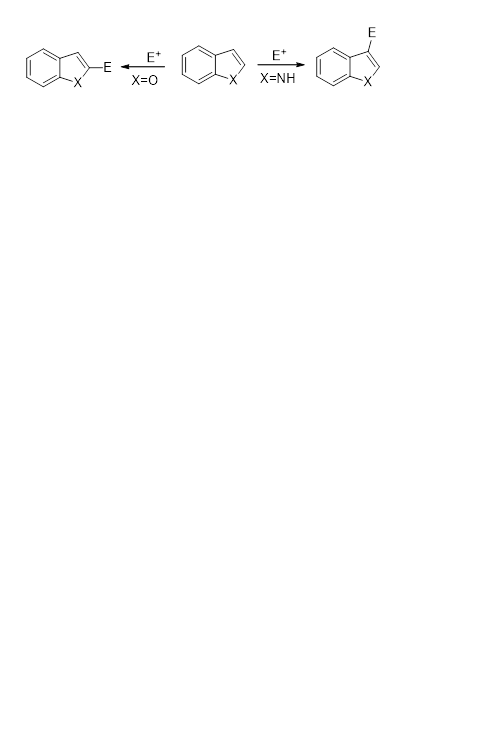
Benzofuran and indole are structurally similar compounds, but they show different reactivity patterns. Benzofuran can undergo electrophilic substitution at either the  or  position depending on the electrophile, whereas indole reacts preferentially at the  position. Density functional theory (DFT) calculations of the Wheland intermediates in the Vilsmeier-Haack formylation and nitration reactions are consistent with the experimental results for formylation, but cannot explain the regioselectivity observed in the nitration of of benzofuran. A frontier orbital approach successfully explains the regiochemistry of Vilsmeier-Haack reaction: electron density favors substitution at the  position in benzofuran and at the  position in indole. In contrast, nitration at the  position in both benzofuran and indole can be explained by assuming charge control as the dominant factor governing the reaction.
Keywords: 
;  ;  ;  ;  ;  ;  ;  

1. Introduction

Electrophilic aromatic substitution (EAS) is a fundamental reaction in organic chemistry and the orienting effects of substituents have been known since the end of the nineteenth century [1,2]. In this way, some substituents (such as -OH) direct the reaction to the ortho and para positions of the aromatic ring, while others (such as -NO2) direct the electrophilic substitution to the meta position. However, the reasons for this behavior were not initially understood and early studies were limited to describing these patterns without attempting to rationalize it. The orienting effects of the substituents in EAS were initially interpreted using the alternating polarity theory [3], until Wheland proposed the formation of arenium ion intermediate [4]. This approach allowed the explanation of the mechanism of EAS (Scheme 1) [5].
Based on the proposed mechanism, substituents that can stabilize the resonant positive charge in the ring also stabilize the intermediate and, consequently, the transition state of the first step in Scheme 1. On the contrary, substituents that do not stabilize the positive charge lead to destabilization of both the intermediate and the corresponding transition state. The observed orienting effects are due to kinetic control. Substituents that stabilize the σ-complex formed upon ortho/para attack are able to lower the activation barrier for these pathways, while in the absence of such kind of stabilization, meta substitution becomes kinetically favored. Several studies have been conducted on this mechanism in order to explain the observed regioselectivity [6,7,8,9,10,11,12,13,14].
A possible involvement of frontier orbitals in the determination of regioselectivity in the EAS has been proposed by Fukui [15,16], while Klopman and Salem proposed a general approach to the reactivity of a compound where both frontier orbitals and charges interactions were considered (eq. 1 is a simplified version of the Klopman–Salem equation) [17,18,19].
E = Q n u c l Q e l e c t r ε R + 2 c n u c l c e l e c t r β 2 E H O M O E L U M O
Recently, we reported the results of DFT calculations (B3LYP/aug-cc-pVDZ level of approximation) on the electrophilic aromatic substitution. Our analysis shows that the frontier orbital control and/or the charge control can be applied to explain the reactivity of activated ortho/para orienting compounds, depending on the nature of the electrophile. On the contrary, both approaches failed in the description of the reactivity of deactivated meta orienting substrates [20]. In the case of benzaldehyde, meta orientation in nitration reaction can be explained by using Hirshfeld charges, while both frontier orbitals and Hirshfeld charges approaches failed to explain the observed orientation in chlorination reaction [21].
Figure 1. Resonance structures of possible intermediates in electrophilic aromatic substitution of benzofuran (X = O) and indole (X = NH).
Preprints 206360 g001
This article explains the observed reactivity of benzofuran and indole. Based on resonance-stabilized intermediates (Fig. 1), no particular orientation is expected to be favored, and the observed reactivity of these two compounds shows a complex behavior.

2. Materials and Methods

Gaussian09 was used to optimize all geometries discussed in this work [22]. All the computations were based on the Density Functional Theory (DFT) by using the B3LYP hybrid xc functional [23], B3PW91 [24], BPV86 [25], CAM-B3LYP [26], HCTH [27], HSEH1PBE [28,29,30,31,32,33,34], LSDA [35], MPW1PW91 [36], PBEPBE [37], TPSSTPSS [38,39], and WB97XD [40]. Geometry optimizations from the Gaussian09 program have been obtained at aug-cc-pVDZ [41] level of approximation. Geometry optimizations were performed with default settings on geometry convergence (gradients and displacements), integration grid and electronic density (SCF) convergence. Redundant coordinates were used for geometry optimization as produced by the Gaussian09 program. Analytical evaluation of the energy second derivative matrix w.r.t. with respect to Cartesian coordinates (Hessian matrix) confirmed the nature of minima on the energy surface points associated with the optimized structures.

3. Results and Discussion

Benzofuran showed an unusual reactivity towards electrophiles. The reaction of benzofuran (1) with dimethylformamide and phosphorus oxychloride gave benzofuran-2-carbaldehyde (2) (Scheme 2a) [42,43]. The same substrate reacted with dinitrogen tetroxide to give 3-nitrobenzofuran (3) as the main product, along with a small amount of of 2-nitrobenzofuran (Scheme 2b) [44].
Indole showed a completely different behavior, reacting only at the β position. Indole (5) reacted with dimethylformamide in the presence of condensing agents similar to phosphorus oxychloride to give indole-3-carbaldehyde (6) (Scheme 3a) [45,46]. In contrast, N-benzylindole (7) reacted with nitric acid in acetic anhydride at -70 °C to produce N-benzyl-3-nitroindole (8) (Scheme 3b) [47].
To rationalize the differing behaviors observed in the formylation and nitration of benzofuran and indole, calculations were performed to evaluate the stability of the possible intermediates. As mentioned above, the greater the stability of an intermediate, the more stable the corresponding transition state, and thus the faster the reaction. For the identification of intermediates in the formylation reaction, the mechanism shown in Scheme 4 was used. [48,49].
DFT calculations were performed at B3LYP/aug-cc-pVDZ level of theory using Gaussian09 and the results are reported in Table 1. The energies of the intermediates agree with the observed behavior in the Vilsmeier-Haack reaction. For benzofuran, attack at the α position is favored, while, for indole, electrophilic substitution is favored at the β position. However, the energies of the intermediates do not explain the observed behavior of nitration on benzofuran. Calculations assuming the formation of the Wheland intermediate from the attack of the nitronium ion agree for a reaction at the α position, while contrasts with the experimental results. Nitration performed with dinitrogen tetroxide can occur through the formation of a radical intermediate (due to the formation of .NO2) [50]; therefore, calculations were also performed on the possible radical intermediate (Table 1). However, in this case as well, calculations favor the formation of the intermediate at the α position and do not agree with the experimental results.
The differences in stability between the intermediates can be explained by the varying distribution of positive charge in these compounds. Fig. 2 collects the Hirshfeld charges on the formylation intermediates of benzofuran and indole. Notably, for benzofuran derivatives, the intermediate deriving from attack at the β position shows a localized charge at C-2, while the intermediate from attack at the α position shows a more delocalized charge. In contrast, for the intermediates derived from indole, the one formed by the attack at the β position shows a significant contribution from the nitrogen atom, while this effect is less pronounced in the other intermediate.
Figure 2. Hirshfeld charges in formylation intermediates
Preprints 206360 g002
Considering the limitations observed in the nitration of benzofuran, where the energies of the intermediates do not explain the observed regioselectivity, the possible influence of frontier orbitals or charge control has been tested. Calculations were performed at the DFT/aug-cc-pVDZ level of theory using different functionals. The results are reported in Table 2 and refer to the α and β positions in benzofuran and indole. The table includes the atomic coefficients and electron density in the HOMO (highest occupied molecular orbital), as well as the Hirshfeld charges at these positions.
These results require careful discussion. In the case of benzofuran, calculations using different functionals yield very similar trends. In all cases, the HOMO exhibits the highest electron density at the α position, in agreement with the experimental results for the Vilsmeier-Haack reaction . We can suppose that the reagent (Me2N=CHCl)+ in which the positive charge il delocalized over both carbon and nitrogen, can be considered a soft electrophile. In contrast, the β position is favored when the charge distribution plays a dominant role in the determining the regiochemistry of electrophilic substitution. This is observed in nitration, where a hard electrophile is used and the reaction predominantly occurs at the β position.
This different behavior is not observed for indole . Both the HOMO electron density and the Hirshfeld charges favor the electrophilic attack at the β position. For all functionals employed, the highest electron density is located on the β carbon atom, promoting reaction at this position. A similar trend is observed when charges are considered: although both the α and β carbons carry a negative charge, all functionals assign the highest negative charge to the β carbon, in agreement with the experimental results.

5. Conclusions

In this article, we examined the electrophilic aromatic substitutions of benzofuran and indole. These compounds are particularly interesting because, despite their similar structures, they show different reactivity: benzofuran can undergo α or β substitution depending on the reaction conditions, whereas indole displays complete β-selectivity. DFT calculations of the Wheland intermediates for the Vilsmeier-Haack and nitration reactions are generally consistent with the observed reactivity. However, the relative stability of the possible intermediates in benzofuran nitration does not full explain the experimental outcome. The frontier molecular orbital approach successfully rationalizes the regioselectivity observed in the formylation reaction. Additionally, the concept of charge control in electrophilic aromatic accounts for the for the β-selectivity observed in the nitration reaction.

Supplementary Materials

The following supporting information can be downloaded at the website of this paper posted on Preprints.org, Z matrix of calculated compounds.

Author Contributions

Conceptualization, M.D. and L.E..; validation, R.R.; investigation, L.E. All authors have read and agreed to the published version of the manuscript.

Funding

This research received no external funding.

Data Availability Statement

Data is available in Supplementary Materials.

Conflicts of Interest

The authors declare no conflicts of interest.

References

  1. Koerner, W. Fatti per servire alla determinazione del luogo chimico nelle sostanze aromatiche. G. Sci. Nat. Ed. Econ. 1869, 5, 212–256. [Google Scholar]
  2. Koerner, W. Studi sull’isomeria delle così dette sostanze aromatiche a sei atomi di carbonio. Gazz. Chim. Ital. 1874, 4, 305–446. [Google Scholar]
  3. Karrer, P. Lehrbuch der Organischen Chemie; Georg Thieme Verlag: Stuttgart, Germany, 1963. [Google Scholar]
  4. Wheland, G. W. A quantum mechanical investigation of the orientation of substitution in aromatic molecules. J. Am. Chem. Soc. 1942, 64, 900–908. [Google Scholar] [CrossRef]
  5. Olah, G. A. Aromatic substitutions. XXVIII. Mechanism of electrophilic aromatic substitutions. Acc. Chem. Res. 1971, 4, 240–248. [Google Scholar] [CrossRef]
  6. Stuyver, T.; Danovich, D.; De Proft, F.; Shaik, S. Electrophilic aromatic substitution reactions: mechanistic landascape, electrostatic and electric-field control of reaction rates, and mechanistic crossovers. J. Am. Chem. Soc. 2019, 141, 9719–9730. [Google Scholar] [CrossRef]
  7. Galabov, B.; Nalbantova, D.; Schleyer, P. v. R.; Schaefer, H. F., III. Electrophilic aromatic substitution: new insights into an old class of reactions. Acc. Chem. Res. 2016, 49, 1191–1199. [Google Scholar] [CrossRef]
  8. Domingo, L. R. Molecular Electron Density Theory: A Modern View of Reactivity in Organic Chemistry. Molecules 2016, 21, 1319. [Google Scholar] [CrossRef] [PubMed]
  9. Freire de Queiroz, J.; Walkimar de M. Carneiro, J.; Sabino, A. A.; Sparrapan, R.; Eberlin, M. N.; Esteves, P. M. Electrophilic Aromatic Nitration: Understanding Its Mechanism and Substituent Effects. J. Org. Chem. 2006, 71, 6192–6203. [Google Scholar] [CrossRef]
  10. Schwabe, T.; Grimme, S. Theoretical Description of Substituent Effects in Electrophilic Aromatic Substitution Reactions. Eur. J. Org. Chem. 2008, 5928–5935. [Google Scholar] [CrossRef]
  11. Fievez, T.; Pinter, B.; Geerlings, P.; Bickelhaupt, F. M.; De Proft, F. Regioselectivity in Electrophilic Aromatic Substitution: Insights from Interaction Energy Decomposition Potentials. Eur. J. Org. Chem. 2011, 2958–2968. [Google Scholar] [CrossRef]
  12. Szatylowicz, H.; Jezuita, A.; Krygowski, T. M. Aromaticity: a story of 150 years of development. Struct. Chem. 2019, 30, 1519–1548. [Google Scholar]
  13. Starmenkovic, N.; Ulrih, N. P.; Cerkovnik, J. An analysis of electrophilic aromatic substitution: a “complex approach”. Phys. Chem. Chem. Phys. 2021, 23, 5051–5068. [Google Scholar] [CrossRef] [PubMed]
  14. Martins, F. A.; Freitas, M. P. Myths and Truths About Electrophilic Aromatic Substitution: The Particular Case of Fluorobenzene. J. Phys. Org. Chem. 2026, 39, e70063. [Google Scholar] [CrossRef]
  15. Fukui, K.; Yonezawa, T.; Shingu, H. A molecular orbital theory of reactivity of aromatic hydrocarbons. J. Chem. Phys. 1952, 20, 722–725. [Google Scholar] [CrossRef]
  16. Elliott, R. J.; Sackwild, V.; Richards, W. G. Quantitative frontier orbital theory: Part I. Electrophilic aromatic substitution. J. Mol. Struct. 1982, 86, 301–314. [Google Scholar] [CrossRef]
  17. Klopman, G. Chemical reactivity and the concept of charge- and frontier-controlled reactions. J. Am. Chem. Soc. 1968, 90, 223–234. [Google Scholar] [CrossRef]
  18. Salem, L. Intermolecular orbital theory of the interaction between conjugated systems. I. General theory. J. Am. Chem. Soc. 1968, 90, 543–552. [Google Scholar] [CrossRef]
  19. Salem, L. Intermolecular orbital theory of the interaction between conjugated systems. II. Thermal and photochemical cycloaddition. J. Am. Chem. Soc. 1968, 90, 553–566. [Google Scholar] [CrossRef]
  20. Emanuele, L.; D’Auria, M. Limitations of frontier orbital and charge approaches in the description of electrophilic aromatic substitution. Organics 2025, 6, 34. [Google Scholar] [CrossRef]
  21. Emanuele, L.; Racioppi, R.; D’Auria, M. Frontier orbitals and charges approaches in electrophilic aromatic substitution: the cases of anisole and benzaldehyde. Organics 2026, 7, 13. [Google Scholar] [CrossRef]
  22. Gaussian 09, Revision A.1, M. J. Frisch, G. W. Trucks, H. B. Schlegel, G. E. Scuseria, M. A. Robb, J. R. Cheeseman, G. Scalmani, V. Barone, B. Mennucci, G. A. Petersson, H. Nakatsuji, M. Caricato, X. Li, H. P. Hratchian, A. F. Izmaylov, J. Bloino, G. Zheng, J. L. Sonnenberg, M. Hada, M. Ehara, K. Toyota, R. Fukuda, J. Hasegawa, M. Ishida, T. Nakajima, Y. Honda, O. Kitao, H. Nakai, T. Vreven, J. A. Montgomery, Jr., J. E. Peralta, F. Ogliaro, M. Bearpark, J. J. Heyd, E. Brothers, K. N. Kudin, V. N. Staroverov, R. Kobayashi, J. Normand, K. Raghavachari, A. Rendell, J. C. Burant, S. S. Iyengar, J. Tomasi, M. Cossi, N. Rega, J. M. Millam, M. Klene, J. E. Knox, J. B. Cross, V. Bakken, C. Adamo, J. Jaramillo, R. Gomperts, R. E. Stratmann, O. Yazyev, A. J. Austin, R. Cammi, C. Pomelli, J. W. Ochterski, R. L. Martin, K. Morokuma, V. G. Zakrzewski, G. A. Voth, P. Salvador, J. J. Dannenberg, S. Dapprich, A. D. Daniels, O. Farkas, J. B. Foresman, J. V. Ortiz, J. Cioslowski, and D. J. Fox, Gaussian, Inc., Wallingford CT, 2009.
  23. Becke, A. D. Density-functional thermochemistry. III. The role of exact exchange. J. Chem. Phys. 1993, 98, 5648–5652. [Google Scholar] [CrossRef]
  24. Perdew, J. P.; Wang, Y. Accurate and simple analytic representation of the electron-gas correlation energy. Phys. Rev. B 1992, 45, 13244–13249. [Google Scholar] [CrossRef] [PubMed]
  25. Perdew, J. P. Density-functional approximation for the correlation energy of the inhomogeneous electron gas. Phys. Rev. B 1986, 33, 8822−8824. [Google Scholar] [CrossRef]
  26. Yanai, T.; Tew, D.; Handy, N. A new hybrid exchange-correlation functional using the Coulomb-attenuating method (CAM-B3LYP). Chem. Phys. Lett 2004, 393, 51–57. [Google Scholar] [CrossRef]
  27. Boese, A. D.; Handy, N. C. New exchange-correlation density functionals: The role of the kinetic-energy density. J. Chem. Phys. 2002, 116, 9559–9569. [Google Scholar] [CrossRef]
  28. Heyd, J.; Scuseria, G. Efficient hybrid density functional calculations in solids: Assessment of the Heyd–Scuseria–Ernzerhof screened Coulomb hybrid functional. J. Chem. Phys. 2004, 121, 1187–1192. [Google Scholar] [CrossRef]
  29. Heyd, J.; Scuseria, G. E. Assessment and validation of a screened Coulomb hybrid density functional. J. Chem. Phys. 2004, 120, 7274–7280. [Google Scholar] [CrossRef]
  30. Heyd, J.; Peralta, J. E.; Scuseria, G. E.; Martin, R. L. Energy band gaps and lattice parameters evaluated with the Heyd-Scuseria-Ernzerhof screened hybrid functional. J. Chem. Phys. 2005, 123, 174101. [Google Scholar] [CrossRef]
  31. Heyd, J.; Scuseria, G. E.; Ernzerhof, M. Erratum: “Hybrid functionals based on a screened Coulomb potential” [J. Chem. Phys. 118, 8207 (2003)]. J. Chem. Phys. 2006, 124, 219906. [Google Scholar] [CrossRef]
  32. Henderson, T. M.; Izmaylov, A. F.; Scalmani, G.; Scuseria, G. E. Can short-range hybrids describe long-range-dependent properties? J. Chem. Phys. 2009, 131, 44108. [Google Scholar] [CrossRef]
  33. Izmaylov, A. F.; Scuseria, G. E.; Frisch, M. J. Efficient evaluation of short-range Hartree-Fock exchange in large molecules and periodic systems. J. Chem. Phys. 2006, 125, 104103. [Google Scholar] [CrossRef]
  34. Krukau, A. V.; Vydrov, O. A.; Izmaylov, A. F.; Scuseria, G. E. Influence of the exchange screening parameter on the performance of screened hybrid functionals. J. Chem. Phys. 2006, 125, 224106. [Google Scholar] [CrossRef]
  35. Vosko, S. H.; Wilk, L.; Nusair, M. Accurate spin-dependent electron liquid correlation energies for local spin density calculations: a critical analysis. Can. J. Phys. 1980, 58, 1200–1211. [Google Scholar] [CrossRef]
  36. Adamo, C.; Barone, V. Exchange functionals with improved long-range behavior and adiabatic connection methods without adjustable parameters: The mPW and mPW1PW models. J. Chem. Phys. 1998, 108, 664–675. [Google Scholar] [CrossRef]
  37. Ernzerhof, M.; Perdew, J. P. Generalized gradient approximation to the angle- and system-averaged exchange hole. J. Chem. Phys. 1998, 109, 3313–3320. [Google Scholar] [CrossRef]
  38. Tao, J. M.; Perdew, J. P.; Staroverov, V. N.; Scuseria, G. E. Climbing the Density Functional Ladder: Nonempirical Meta–Generalized Gradient Approximation Designed for Molecules and Solids. Phys. Rev. Lett. 2003, 91, 146401. [Google Scholar] [CrossRef]
  39. Staroverov, V. N.; Scuseria, G. E.; Tao, J.; Perdew, J. P. Comparative assessment of a new nonempirical density functional: Molecules and hydrogen-bonded complexes. J. Chem. Phys. 2003, 119, 12129. [Google Scholar] [CrossRef]
  40. Chai, J.-D.; Head-Gordon, M. Long-range corrected hybrid density functionals with damped atom–atom dispersion corrections. Phys. Chem. Chem. Phys. 2008, 10, 6615–6620. [Google Scholar] [CrossRef] [PubMed]
  41. Dunning, T. H., Jr. Gaussian basis sets for use in correlated molecular calculations. I. The atoms boron through neon and hydrogen. J. Chem. Phys. 1989, 90, 1007–1023. [Google Scholar] [CrossRef]
  42. Bisagni, M.; Buu-Hoï, N. P.; Royer, R. Oxygen heterocycles. Part III. The reactivity of benzofuran and 2-alkylbenzofurans. J. Chem. Soc. 1955, 3688–3693. [Google Scholar] [CrossRef]
  43. Krutošiková, A.; Kováč, J.; Dandárová, M. Synthesis and reactions of substituted benzofuro[3,2-b]pyrrole derivatives. Coll. Czech. Chem. Commun. 1982, 47, 3288–3296. [Google Scholar] [CrossRef]
  44. Kaluza, F.; Perold, G. Über das 3-nitro-cumaron. Chem. Ber. 1955, 88, 597–601. [Google Scholar] [CrossRef]
  45. Wolff, P. Verfahren zur Darstellung von Verbindungen der Indolreihe. German Patent 1935, 614325.
  46. Van Order, R. B.; Lindwall, H. G. Indole. Chem. Rev. 1942, 30, 69–96. [Google Scholar] [CrossRef]
  47. Pelkey, E. T.; Gribble, G. W. Synthesis and reactions of N-protected 3-nitroindoles. Synthesis 1999, 1117–1122. [Google Scholar] [CrossRef]
  48. Arnold, Z.; Holý, A. Synthetic reactions of dimethylformamide. XIV. Some new findings on adducts of the Vilsmeier-Haack type. Coll. Czech. Chem. Commun. 1962, 27, 2886–2897. [Google Scholar] [CrossRef]
  49. Jugie, G.; Smith, J. A. S.; Martin, G. J. Nuclear magnetic resonance investigations of carbonium ion intermediates. Part III. A chlorine-35 quadrupole resonance study of several (R-chloromethylene)dimethylammonium salts (Vilsmeier–Haack and Viehe reagents). J. Chem. Soc., Perkin Trans. 2 1975, 925–927. [Google Scholar] [CrossRef]
  50. Smith, K.; Almeer, S.; Peters, C. Regioselectivity mononitration of aromatic compounds by zeolite/dinitrogen tetroxide/air in a solvent-free system. Chem. Commun. 2001, 2748–2749. [Google Scholar] [CrossRef]
Scheme 1. The mechanism of electrophilic aromatic substitution.
Preprints 206360 sch001
Scheme 2. (a) Formylation of benzofuran; (b) nitration of benzofuran.
Preprints 206360 sch002
Scheme 3. (a) Formylation of indole; (b) nitration of N-benzylindole.
Preprints 206360 sch003
Scheme 4. Mechanism of Vilsmeier-Haack reaction.
Preprints 206360 sch004
Table 1. Energy of some intermediates in electrophilic aromatic substitutions on benzofuran and indole.
Compound ΔE [kJ mol-1] Compound ΔE [kJ mol-1]
Preprints 206360 i001
35.58
Preprints 206360 i002 0
Preprints 206360 i003 0 Preprints 206360 i004
18.26
Preprints 206360 i005
39.80
Preprints 206360 i006 0
Preprints 206360 i007 39.76 Preprints 206360 i008 0
Table 2. Atomic coefficients in the HOMO, electron density, and Hirshfeld charges in benzofuran. and indole.
Preprints 206360 i009
Compound Functional HOMO Atomic coefficient
(electron density)
Hirshfeld charges
α β α β
Benzofuran B3LYP 0.32
(0.10)
0.28
(0.08)
0.037 -0.072
B3PW91 0.31
(0.10)
0.27
(0.07)
0.037 -0.080
BPV86 0.31
(0.10)
0.29
(0.08)
0.027 -0.075
CAM-B3LYP 0.31
(0.10)
0.27
(0.07)
0.038 -0.075
HCTH 0.30
(0.09)
0.28
(0.08)
0.028 -0.074
HSEH1PBE 0.31
(0.10)
0.28
(0.08)
0.035 -0.077
LSDA 0.32
(0.10)
0.28
(0.08)
0.013 -0.081
MPW1PW91 0.31
(0.10)
0.28
(0.08)
0.036 -0.077
PBEPBE 0.30
(0.09)
0.28
(0.08)
0.023 -0.074
TPSSTPSS 0.30
(0.09)
0.27
(0.07)
0.031 -0.069
WB97XD 0.31
(0.10)
0.27
(0.07)
0.038 -0.077
Indole B3LYP 0.26
(0.07)
0.31
(0.10)
-0.033 -0.090
B3PW91 0.26
(0.07)
0.31
(0.10)
-0.006 -0.093
BPV86 0.25
(0.06)
0.32
(0.10)
-0.012 -0.091
CAM-B3LYP 0.26
(0.07)
0.31
(0.10)
-0.003 -0.093
HCTH 0.24
(0.06)
0.31
(0.10
-0.010 -0.091
HSEH1PBE 0.25
(0.06)
0.31
(0.10)
-0.006 -0.094
LSDA 0.23
(0.05)
0.32
(0.10)
-0.022 -0.098
MPW1PW91 0.26
(0.07)
0.31
(0.10)
-0.006 -0.094
PBEPBE 0.23
(0.05)
0.30
(0.09)
-0.013 -0.092
TPSSTPSS 0.23
(0.05)
0.30
(0.09)
-0.005 -0.087
WB97XD 0.25
(0.06)
0.31
(0.10)
-0.004 -0.094
Disclaimer/Publisher’s Note: The statements, opinions and data contained in all publications are solely those of the individual author(s) and contributor(s) and not of MDPI and/or the editor(s). MDPI and/or the editor(s) disclaim responsibility for any injury to people or property resulting from any ideas, methods, instructions or products referred to in the content.
Copyright: This open access article is published under a Creative Commons CC BY 4.0 license, which permit the free download, distribution, and reuse, provided that the author and preprint are cited in any reuse.
Prerpints.org logo

Preprints.org is a free preprint server supported by MDPI in Basel, Switzerland.

Subscribe

Disclaimer

Terms of Use

Privacy Policy

Privacy Settings

© 2026 MDPI (Basel, Switzerland) unless otherwise stated