

Submitted:
30 March 2026
Posted:
03 April 2026
You are already at the latest version
Abstract
Orthographic depth varies across alphabetic writing systems and plays a central role in spelling acquisition. In immersion education, a second language (L2) is used as a language of instruction for part of the curriculum, such that learners are primarily confronted with its writing system during the initial stages of literacy development. This early exposure may shape the spelling strategies subsequently deployed in the first language (L1), which also corresponds to the dominant language of the surrounding community. This article provides a structured review of key mechanisms involved in spelling acquisition, orthographic depth, and cross-linguistic influence in bilingual and immersion contexts. On this basis, it proposes a conceptual and predictive framework specifying how the orthographic depth of the instructional language modulates spelling strategies and spelling error profiles in L1. Focusing on French-speaking pupils enrolled in immersion programmes with L2s characterised by either predominantly phonemic or opaque orthographies, the framework integrates strategy-based models of orthographic development. The model distinguishes phonological, lexical, and morphographic components of orthographic knowledge and predicts that immersion in phonemic-dominant orthographies favours phonographic dominance and regularisation patterns, whereas immersion in opaque orthographies promotes greater reliance on lexical-orthographic strategies, resulting in distinct and systematic spelling error profiles in French.
Keywords:
orthographic depth
; immersion education
; bilingual spelling
; French orthography
; cross-linguistic influence
1. Introduction
Written language plays a central role in contemporary societies, functioning both as a primary medium of communication and as a gateway to knowledge. Its acquisition is shaped by multiple factors, including the structural properties of the writing system, the learning context, and early literacy experiences (Share, 1995). Orthographic systems differ considerably in the extent to which spelling can be deduced from phonology. This variation, commonly captured by the notion of orthographic depth, refers to the degree to which a written language deviates from simple one-to-one grapheme-phoneme correspondence (Frost et al., 1987; Seymour et al., 2003; Ziegler & Goswami, 2005). Although no natural orthography is fully transparent in this strict sense, writing systems nevertheless differ markedly in the probabilistic reliability of phoneme–grapheme mappings (Marjou, 2021). In orthographies commonly described as transparent, spelling can be derived largely from phonological information, whereas in more opaque orthographies, accurate spelling requires the integration of lexical, contextual, and morphological constraints (Perfetti, 2003; Perfetti & Dunlap, 2008). These structural differences are known to influence both the pace and the nature of literacy acquisition across languages (Seymour et al., 2003; Share, 2008; Verhoeven & Perfetti, 2011).
In bilingual learners, literacy development is further shaped by the interaction of two linguistic systems rather than by independent, language-specific trajectories (Bialystok, 2017; Koda, 2008). Research on bilingual reading and spelling has documented cross-linguistic influence at multiple levels, including phonological processing, sensitivity to orthographic patterns and morphological awareness (Commissaire et al., 2011; Cummins, 2007; Deacon et al., 2009; Geva & Wang, 2001). These findings suggest that written language skills rely on partially shared cognitive and linguistic resources that can be reorganised across languages. Research on emergent biliteracy also indicates that bilingual children may exhibit parallel developmental trajectories between languages from the earliest stages of writing, alongside patterns reflecting the joint activation of both orthographic systems (Soltero-González & Butvilofsky, 2016). Together, this line of work provides the necessary background for examining how a bilingual experience may reshape spelling behaviour.
Immersion education provides a particularly informative context for examining these interactions. In immersion settings, a second language serves as the primary medium of instruction for a substantial portion of the curriculum, resulting in sustained exposure to its written system during the acquisition of reading and writing skills (Genesee, 2006; Tedick et al., 2011). Given that written language is practised in all academic fields, the orthographic properties of the instructional language are likely to shape the spelling strategies developed by learners, with potential consequences extending beyond the instructional language itself (Durgunoğlu, 2002; Koda, 2008). A recent systematic review by Oshchepkova et al. (2023), covering studies published between 1979 and 2022, highlights the combined influence of orthographic structure, instructional language and educational context on bilingual literacy outcomes. While this work provides a comprehensive synthesis of empirical findings on the subject, its aim is not to formalise predictive theoretical models specifying how particular properties of the instructional language —such as orthographic transparency— can reorganise spelling strategies and error profiles in the first language. More generally, most existing approaches to cross-linguistic influence in spelling focus on the transfer of specific forms or rules —e.g. phoneme–grapheme correspondences or orthographic patterns—, rather than on the transfer of spelling strategies shaped by the structural properties of the writing system.
The present article addresses this gap by proposing a conceptual and predictive framework linking the orthographic transparency of the instructional language to spelling strategy selection and to systematic spelling error profiles in the first language. Using French as an illustrative case, the framework articulates explicit predictions regarding the types of spelling errors expected under transparent and opaque immersion contexts. The model is informed by empirical observations drawn from immersion education settings in Belgium, where French-speaking children acquire literacy through English (Burgi & Jeanjean, 2025), Dutch (Bongini, 2025) or German (Herpich, 2025; Molitor, 2025). Crucially, the framework adopts a gradient and probabilistic conception of orthographic transparency. Early attempts to operationalise orthographic depth already proposed that differences between alphabetic writing systems should be conceived as gradient rather than categorical. Using data-oriented learning algorithms, van den Bosch et al. (1994) demonstrated systematic differences in the generalisation difficulty of grapheme–phoneme correspondences across English, French and Dutch, and argued that relative differences between languages are more informative than absolute performance values. More recent computational approaches have extended this logic by providing continuous, probabilistic estimates of orthographic transparency across a wider range of languages. In particular, Marjou (2021), using an artificial neural network trained on phoneme–grapheme and grapheme–phoneme translation tasks, reports markedly low phoneme-to-grapheme predictability for French (≈28%) and English (≈36%), compared to substantially higher, though non-maximal, scores for Dutch (≈73%) and German (≈69%)1.
On this basis, the Belgian immersion context provides a particularly relevant setting to examine how early exposure to instructional languages with contrasting degrees of orthographic predictability—phonemically dominant but morphophonemically constrained systems (Dutch, German) versus highly opaque systems (English)— probabilistically shapes spelling strategies in French literacy acquisition. Within this perspective, immersion is expected not to produce categorical outcomes, but to modulate the likelihood of specific types of spelling errors, as a function of the statistical regularities internalised through the instructional language. The proposed framework thus targets children who begin literacy acquisition in an instructional language other than French, focusing on the early stages of subsequent French spelling development. It does not assume that all learners will systematically display the predicted patterns, nor does it construe such patterns as indicators of disorder. Instead, it offers a principled interpretative framework for atypical spelling errors —i.e. errors not typically observed in monolingual French-speaking learners— that are more likely to occur in immersion contexts and could otherwise be misinterpreted as signs of dyslexia or dysorthographia.
To situate this framework theoretically, the article first reviews core mechanisms of spelling acquisition in alphabetic writing systems, before turning to bilingual spelling development and cross-linguistic influence. It then introduces a strategy-based model of immersion-induced spelling reorganisation and formulates a set of testable predictions regarding French spelling error profiles under transparent versus opaque immersion conditions.
2. Theoretical Background
2.1. Foundations of Spelling Acquisition in Alphabetic Writing Systems
2.1.1. Core Component of Spelling and their Differential Weighting
From a psycholinguistic perspective, orthographic knowledge refers to the information stored in memory that supports accurate word recognition and spelling (Apel, 2011). In the framework proposed by Apel et al. (2019), this knowledge is instantiated in mental graphemic representations (MGR), defined as lexical-level representations of written words that enable rapid and accurate access during reading and spelling. These representations constitute the orthographic lexicon and are progressively built and refined through exposure to print.
In alphabetic writing systems such as French, English, German and Dutch, spelling relies on mastery of the alphabetic principle —i.e. the understanding that written symbols encode the phonological structure of spoken words through systematic, but language-specific, graphemes-phonemes correspondence (Erhi, 1997)—. However, the extent to which correct spelling can be derived from phonology varies across languages (Ziegler & Goswami, 2005). In more transparent orthographies, a large proportion of spelling can be recovered from speech, whereas in more opaque systems, accurate spelling requires increased sensitivity to orthographic, morphological and syntactic constraints that are not directly recoverable from phonological information (Borleffs et al., 2019). From this perspective, spelling competence can be described as comprising three interrelated components: phonological, lexical and grammatical spelling.
Phonological spelling is grounded in the principle of phonography and relies on the ability to encode spoken forms through systematic phoneme–grapheme correspondences. It involves the combinatorial assembly of graphemes from a limited inventory according to language-specific rules. In alphabetic languages, this component depends on knowledge of regular phoneme–grapheme mappings and mainly supports the encoding of unfamiliar words (Fayol, 2009). Lexical spelling refers to word-specific written forms that are stored in memory through exposure to print. It supports the selection of the conventional spelling when phonology alone is not sufficient, such as when several spellings correspond to the same phonological form or when conventional markers —e.g. diacritics, capital letters— are required to meet orthographic norm. Within this component, sensitivity to graphotactic and orthotactic constraints —i.e. probabilistic regularities governing the distribution of letters and letter sequences—facilitates spelling by restricting the range of plausible spellings and reinforcing conventional lexical patterns (Treiman & Kessler, 2025). Lexical spelling is also supported by derivational morphology, as morphological families share orthographic structure across related words and can help stabilise lexical spellings through network-based support (Ruberto et al., 2025). Finally, Grammatical spelling refers to the encoding of morphosyntactic distinctions, independently of phonological recoverability. It concerns cases where the selection of the correct written form depends on the grammatical category, syntactic function or agreement relations between words, rather than on phonology or lexical identity. This includes subject–verb agreement, agreement within the noun phrase, agreement conditioned by the direct object, as well as grammatical homophones whose resolution requires morphosyntactic analysis (Fayol, 2009). Accurate grammatical spelling requires the identification of grammatical categories and syntactic relations, as well as the integration of abstract morphosyntactic features that are often phonologically silent. Its acquisition relies heavily on explicit instruction and metalinguistic awareness (Arseneau & Nadeau, 2018).
In alphabetic writing systems, reading and spelling are closely interrelated, as both rely on shared knowledge of the alphabetic principle and of conventional orthographic forms (Ehri, 1997). Spelling, however, is generally more demanding than reading: proficient readers can recognise far more written words than they can spell accurately. This asymmetry reflects fundamental differences in the cognitive operations involved. Reading primarily relies on recognition processes that tolerate partial or approximate matching between visual input and stored representations, whereas spelling requires the precise retrieval and reconstruction of all graphic features of a word, including elements that are not directly recoverable from phonology (Holmes & Carruthers, 1998; Treiman et al., 2025). As a result, spelling places greater demands on the integration of phonological, lexical and morphographic knowledge.
During early literacy development, children rely heavily on phonological mediation strategies for both reading and writing. Within the self-teaching framework (Share, 2008, 1995), phonological decoding plays a central role in establishing initial links between written and spoken forms, thereby supporting the emergence of orthographic representations from the earliest stages of reading (Nation et al., 2007). As decoding becomes more automated, orthographic learning becomes more efficient (Bosse, 2015; Cunningham, 2006). However, spelling acquisition does not depend on decoding alone. The consolidation of orthographic representations also depends on efficient whole-word letter processing, linked to visual–attentional ressources, which promotes exhaustive and sequential letter processing and strengthens orthographic learning through motor engagement (Bosse et al., 2015). Through repeated reading and writing experiences, children gradually build an increasingly stable and differentiated internal spelling repertoire, supporting both rapid word recognition and accurate spelling.
From a theoretical standpoint, spelling in an alphabetic system would be maximally efficient if grapheme–phoneme and phoneme–grapheme correspondences were perfectly regular and predictable, allowing spelling to rely on phonological segmentation alone. In practice, however, only a small number of languages approach this ideal —e.g. Finnish, Turkish—, while most alphabetic writing systems depart from it to varying degrees (Seymour et al., 2003). These differences are commonly described in terms of orthographic consistency, that is, the degree of regularity in the correspondences between orthographic and phonological codes within a writing system (Fayol et al., 2008). Systems with highly regular correspondences are typically characterised as transparent —e.g. Dutch, German, Italian—, whereas those involving multiple competing spellings for the same sound or multiple pronunciations for the same grapheme are considered opaque —e.g. English, French, Danish— (Caravolas, 2004; Seymour et al., 2003). Importantly, orthographic transparency does not constitute a categorical distinction but rather a continuum along which alphabetic systems can be positioned (Caravolas, 2004; Seymour et al., 2003), as captured by various quantitative indices, such as the proportion of irregular correspondences (Coltheart et al., 2001), phoneme–grapheme asymmetries (Ziegler et al., 2001), or entropy-based measures of correspondence uncertainty (Borgwaldt et al., 2004, 2005). Across approaches, greater orthographic opacity consistently translates into increased computational demands on spelling, which in turn necessitates the coordination of phonological procedures with lexical, orthographic and morphographic knowledge, making spelling a particularly sensitive domain for examining the organisation of writing strategies across languages and learning contexts.
Empirical evidence consistently shows that literacy acquisition is faster and less effortful in transparent orthographies than in opaque ones (e.g. Borleffs et al., 2019; Seymour et al., 2003). A comparative study by Seymour et al. (2003) across European languages illustrates this contrast in word reading: in most languages examined, children achieve basic reading proficiency—measured in terms of accuracy and fluency—by the end of the first year of schooling, whereas French and English constitute notable exceptions. Importantly, this delay is not explained by differences in the age of onset of literacy instruction, but by cross-linguistic variation in syllabic complexity and orthographic depth. These differences are formalised by the Orthographic Depth Hypothesis (Katz & Frost, 1992), which posits that transparent writing systems, characterised by highly regular grapheme–phoneme correspondences, foster early reliance on phonological decoding strategies, whereas more opaque systems require greater engagement of lexical–orthographic processing. Beyond decoding speed, this transparency advantage extends to the development of foundational linguistic skills supporting literacy, including phonological awareness and aspects of morphosyntactic processing (Majorano et al., 2021). From this perspective, orthographic transparency emerges as a key dimension shaping how learners mobilise phonological information during reading and spelling: children acquiring transparent orthographies typically develop phonological awareness earlier than those learning more opaque systems (Mann & Wimmer, 2002), even though phonological awareness remains a necessary but not sufficient condition for literacy acquisition across languages (Barrus et al., 1995). Crucially, the structural properties of writing systems do not merely affect the pace or efficiency of literacy development but systematically shape the relative weighting and interaction of phonological, lexical and morphographic processes involved in spelling. This strategic reorganisation is central to understanding cross-linguistic influence in bilingual and immersion contexts and motivates a predictive framework specifying how different writing systems constrain the organisation of spelling strategies across learning contexts. Within this framework, a key question concerns how repeated exposure to orthographic regularities gives rise to stable mental representations of written forms; a question addressed by the concept of mental orthographic representations, developed in the following section.
2.1.2. Mental Orthographic Representations of Orthographic Patterns
A central mechanism underlying the organisation of spelling strategies across writing systems is the development of internal orthographic representations that support efficient word recognition and production. Classical models of literacy acquisition, such as Ehri’s amalgamation hypothesis (Ehri, 1997) and Share’s self-teaching framework (Share, 2008, 1995), conceptualise the emergence of lexical orthographic representations as a consequence of phonemic awareness and phonological recoding: repeated decoding episodes progressively bind phonological and orthographic information, leading to the establishment of stable word-specific representations in memory.
More recent accounts, however, adopt a less strictly phonology-driven view of orthographic learning. Within the framework proposed by Apel and colleagues, orthographic knowledge is instantiated in mental graphemic representations (MGR), defined as lexical-level representations of written words that support rapid and accurate access during reading and spelling (Apel, 2011; Apel, Thomas-Tate, et al., 2012; Apel et al., 2019). In this perspective, MGR are not conceived as a late by-product of phonological mastery but emerge within an interactive system developing in coordination with phonological, orthographic and morphological knowledge. Sublexical orthographic knowledge—such as phoneme–grapheme correspondences, morpho-orthographic regularities, and orthotactic constraints—does not constitute stored word representations per se, but provides critical informational support for the acquisition, consolidation, and updating of MGR (Apel et al., 2012). Importantly, this interactive view is supported by empirical evidence suggesting that orthographic sensitivity can emerge earlier and more independently than assumed in strictly phonology-centred accounts. Young children show sensitivity to orthographic structure—such as recognising their written name or distinguishing legal from illegal spellings—before mastering phonological decoding (Wright & Ehri, 2007). Experimental studies using orthographic fast-mapping paradigms further demonstrate that preschool children can form initial lexical orthographic representations after minimal exposure to print, and that such learning predicts spelling performance beyond phonemic awareness (Nation et al., 2007; Apel et al., 2006).
Recent work further refines this account. A systematic review by Li and Wang (2023) confirms the central role of phonological recoding in orthographic learning, while also highlighting the moderating influence of word-level properties such as orthographic depth, regularity and frequency. Experimental studies examining the micro-dynamics of learning during independent reading show that lexical orthographic representations can emerge rapidly but vary in precision depending on the reliability of phoneme–grapheme mappings (Tucker et al., 2016). Computational modelling similarly demonstrates how repeated exposure to statistical regularities in print leads to progressively more precise lexical graphemic representations (Chang, 2023; Chang et al., 2020; Monaghan, 2023). The development and consolidation of MGR are closely linked to lexical quality. According to the Lexical Quality Hypothesis (Perfetti, 2017), fluent reading and spelling depend on the precision and integration of orthographic, phonological and semantic information at the word level. Empirical studies consistently show that both general orthographic knowledge and word-specific lexical representations predict reading and spelling performance, notably through their effects on lexical access (Abdalkareem & Ahmed, 2025; Ouellette & Sénéchal, 2008; Treiman et al., 2025; Treiman & Kessler, 2019). Wegener et al. (2018) show that children can generate orthographic skeletons from the phonological form of novel words prior to any visual exposure, and that the quality of these preliminary representations predicts subsequent reading ease. Within a lexical quality framework, such findings can be interpreted as evidence that factors contributing to richer lexical representations —among which semantic richness is classically assumed— support orthographic consolidation and the emergence of more robust and accessible mental graphemic representations (MGR) (Wegener et al., 2018, 2022). In line with this view, several studies have also highlighted the early stability and gradual refinement of MGR in structured literacy contexts, such as adult-led storybook reading tasks, where repeated and sustained exposure to print facilitates orthographic learning (Apel, 2010; Apel, Thomas-Tate, et al., 2012; Brimo, 2013). Evidence from atypical or at-risk populations reinforces this perspective. Children with language impairment, from low-SES backgrounds, or exposed to non-standard dialects tend to form fewer or less stable lexical orthographic representations and show reduced sensitivity to orthotactic regularities (Apel, Wolter, et al., 2012; Wolter & Apel, 2010).
Taken together, this body of evidence supports an interactionist view in which lexical orthographic representations (MGR) emerge from a probabilistic learning system integrating phonological, orthographic and morphological regularities derived from both spoken and written input. Rather than reflecting a linear or stage-like progression, orthographic learning results from the coordinated growth and interaction of multiple sources of linguistic knowledge. This perspective provides a principled foundation for interpreting spelling development, spelling errors and cross-linguistic influence across writing systems, and directly informs the predictive framework proposed in the present study.
2.1.3. Typology of Learners’ Spelling Errors
Spelling errors are a normal feature of early writing development and have been described through classification frameworks targeting different dimensions of the orthographic system. A well-established typology proposed by Catach (Catach, 1980; Catach et al., 1980) distinguishes several major categories of errors in children’s written French. Phonetic or extragraphic errors reflect difficulties in the perception, analysis, or segmentation of the speech stream and include phoneme omissions or substitutions, confusions between phonologically similar sounds, and inappropriate segmentation of spoken language. Phonogrammic errors arise when an inappropriate grapheme is selected among several possible spellings for the same phoneme. In opaque orthographic systems such as French, they reflect partial mastery of phoneme–grapheme correspondences and difficulties in selecting context-appropriate graphemic forms. Morphogrammic errors concern the written encoding of grammatical and derivational morphemes — e.g. gender, number, person, tense—. Their relative frequency tends to increase over development, not because morphosyntactic knowledge is absent at early stages, but because written language progressively involves more complex syntactic structures and morphological distinctions. Homophone errors reflect difficulties in mapping identical phonological forms onto distinct orthographic representations. In French, they stem from the semiographic dimension of the writing system, as correct spelling requires access to lexical representations —e.g. /ʃɑ̃/: champ (field) vs chant (song) — and, in many cases, grammatical information —e.g. /sɔ̃/: son (his) vs sont (are); /a/: a (has) vs à (to) —. Finally, non-functional or ideographic errors concern graphic conventions such as capitalisation, punctuation, apostrophes, or hyphenation in compound words. Although these elements contribute to textual organisation and meaning, errors affecting them do not directly involve phonological or morphological encoding. Overall, this typology highlights the multidimensional nature of spelling and underscores that spelling errors cannot be reduced to phonological inaccuracies alone, but instead reflect the interaction of phonological, orthographic, lexical, and grammatical processes.
More recent spelling analysis grids are grounded in the Triple Word Form Theory (Daffern et al., 2015; Richards et al., 2006), which conceptualises spelling as the coordinated encoding of phonological, orthographic, and morphological dimensions of word knowledge. This framework provides a principled basis for classifying spelling errors according to the primary locus of difficulty. From this perspective, phonological errors reflect difficulties in phonemic analysis or segmentation —e.g. omissions, substitutions, inversions— and are most frequent at the earliest stages of spelling acquisition, when children rely heavily on phonological mediation. Their incidence typically decreases as phonemic awareness and basic phoneme–grapheme correspondences are established (Bahr et al., 2012; McMurray, 2020). Orthographic (graphotactic) errors arise when letter sequences violate the distributional constraints of the writing system despite an accurate phonological representation. They tend to become predominant once basic phonological encoding is in place, as spelling increasingly depends on the consolidation of an orthographic lexicon and sensitivity to letter-sequence regularities (Bahr et al., 2012). Finally, morphological errors involve the encoding of grammatical and derivational information —e.g. inflectional markers, grammatical homophones, word-family morphemes—. As already noted by Catach (1980), their relative frequency tends to increase over development, not because morphological knowledge is initially absent, but because written language progressively requires the management of more complex morphosyntactic relations and less frequent morphological forms (Bahr et al., 2012; Mossing, 2009).
Such a developmental progression supports the view that phonological, orthographic and morphological resources are available from the earliest stages of spelling acquisition but follow partially independent developmental trajectories. The distribution of spelling errors can therefore be interpreted as a window onto the relative organisation and maturation of these representational systems, providing a sensitive indicator of learners’ spelling strategies and underlying linguistic knowledge (Niolaki et al., 2023).
2.2. Bilingual Spelling and Cross-Linguistic Transfer
Access to biliteracy —i.e. the development of reading and spelling skills in two languages— is shaped by multiple linguistic factors, among which the structural properties of the writing systems involved play a central role (Bijeljac-Babic, 2017). When two languages rely on comparable writing systems, learners can mobilise overlapping cognitive operations, such as phonemic analysis or alphabetic decoding, which facilitates cross-linguistic transfer and supports the development of metalinguistic skills (Nocus, 2024). Conversely, greater structural distance between writing systems increases cognitive demands and requires more explicit learning. From this perspective, biliteracy development cannot be understood solely in terms of language exposure or proficiency but must be examined through the ways bilingual learners mobilise, coordinate, and reorganise linguistic resources across writing systems. Spelling acquisition in particular relies on a dynamic interplay between intralinguistic resources—i.e. language-specific phonological, lexical, morphosyntactic, and orthographic knowledge supporting spelling within each language—and interlinguistic resources, which emerge from the relationships learners establish between their two languages (Dressler, 2002). Intralinguistic resources include, for example, the use of oral language competence to plan written productions, encode unfamiliar words, and access stored orthographic representations or language-specific spelling patterns (Bauer et al., 2017). Interlinguistic resources, by contrast, allow children to draw on shared properties across languages and to mobilise knowledge acquired in one system when processing written language in the other. Through such cross-linguistic strategies, bilingual learners support the transfer of partially shared skills across languages, including phonemic awareness, alphabetic knowledge, and aspects of morphological reasoning (Carlisle & Beeman, 2000; Gort, 2006; Soltero-González & Butvilofsky, 2016). This resource-based perspective provides a principled framework for examining cross-linguistic transfer in bilingual spelling, both at the level of surface forms and at the level of underlying spelling strategies.
Research on emergent biliteracy shows that bilingual children often activate both linguistic systems during written production rather than treating them as independent codes. Accordingly, Soltero-González et al. (2012,2016) document a wide range of manifestations of interlinguistic interaction in writing, including code-switching, phonographic and syntactic transfer, intralexical mixing, literal translation, lexical borrowing, and punctuation transfer, illustrating how bilingual writers flexibly mobilise resources across languages. The direction and magnitude of this cross-linguistic mobilisation depend on factors such as typological proximity, orthographic structure, and the amount and nature of exposure to each written code (Durgunoğlu, 2002; Genesee & Jared, 2008; Koda, 2008). When children learn to read and write in two alphabetic systems, some degree of cross-linguistic interaction is therefore inevitable, although its form varies across educational contexts and cannot be reduced to simple interference or facilitation effects.
Although interlinguistic interactionq in writing are well documented, the concept of transfer covers a range of heterogeneous phenomena that are not always clearly distinguished in the literature. One well-studied form is formal —or representational— transfer, whereby orthographic units, patterns, or conventions from one language are carried over into another. This includes the use of non-target phoneme–grapheme correspondences, the intrusion of language-specific letter sequences, or the extension of orthographic conventions such as consonant doubling or capitalisation beyond their licensed domains (Deacon et al., 2009; Koda, 2008).
Beyond surface-level transfer, cross-linguistic influence also operates at the level of processing routines and spelling strategies. Rather than involving the direct importation of specific orthographic forms, it affects the relative mobilisation of phonological, lexical, and morphographic resources during spelling. Depending on their experience with each writing system, bilingual learners may rely more heavily on phonological encoding, lexical–orthographic retrieval, or morphological information (Bialystok, 2017; Geva & Wang, 2001), with systematic consequences for spelling behaviour that are not always directly visible in written products.
At a more abstract level, strategic transfer reflects the generalisation of expectations about how writing systems function. Through sustained engagement with a given orthography, learners develop implicit assumptions about the reliability of phoneme–grapheme correspondences, the role of contextual constraints in grapheme selection, or the need to memorise word-specific spellings. These procedural biases guide spelling decisions across languages, such that transfer operates primarily at the level of strategies shaped by the structural properties of writing systems, rather than through isolated orthographic units (Bahr et al., 2015).
Although these dimensions of transfer are analytically distinct, empirical studies of bilingual writing often conflate them by focusing primarily on formal transfer and surface similarities between languages (Koda, 2008; Oshchepkova et al., 2023). Such approaches offer limited insight into the mechanisms underlying spelling behaviour, particularly in educational contexts involving sustained exposure to a single instructional language. In these contexts, what appears as interlinguistic transfer may instead reflect deeper reorganisations in the relative weighting of phonological, lexical, and morphographic processes in spelling (Niolaki et al., 2023). Crucially, this does not imply that immersion learners are naïve with respect to the written form of their first language. Even when literacy teaching is initiated in another language than French, children are exposed to written French through environmental print, family practices, and early school activities. However, this situation differs fundamentally from sequential or late biliteracy, in which literacy is first acquired in one language and later extended to another. In such cases, prior literacy entails more advanced metalinguistic skills and explicit orthographic knowledge that can be deliberately mobilised when learning a second writing system. In early immersion contexts, by contrast, children encounter two writing systems at the very onset of literacy acquisition, before these analytical resources are fully established. Cross-linguistic influence is therefore expected to operate primarily through the shaping of emerging spelling strategies, driven by early procedural experience with the instructional orthography, rather than through the transfer of explicit orthographic knowledge.
Taken together, these considerations suggest that interlinguistic influence in immersion education primarily reflects strategy-level adaptations shaped by sustained exposure to the instructional orthography. The following section examines how such adaptations give rise to systematic patterns of cross-linguistic influence.
3. Predicted Spelling Error Profiles in Immersion Context: A Conceptual Model
Against this background, immersion education can be characterised as a learning context in which a second language is used systematically as a medium of instruction across academic domains, leading to sustained exposure to its written system during critical phases of literacy development (Genesee, 2006; Genesee & Jared, 2008). In contrast to more traditional forms of second language instruction, which typically involve sequential biliteracy, immersion education entails the early and concurrent engagement of two writing systems. From a psycholinguistic perspective, this configuration makes the instructional language a dominant source of orthographic experience. Because reading and writing are continuously mobilised to support subject learning, the orthographic properties of the instructional language are repeatedly engaged and progressively integrated into learners’ spelling routines. Over time, this sustained engagement is likely to shape how learners approach spelling tasks, not only in the instructional language but also in their first language (Durgunoğlu, 2002; Koda, 2008; Koda & Zehler, 2008). Research on bilingual literacy has documented cross-linguistic effects on phonological processing, sensitivity to orthographic patterns, and morphological use (Commissaire et al., 2011; Cummins, 2007). However, these effects are most often described in terms of observable outcomes, with comparatively little attention paid to the underlying mechanisms. The degree to which long-term exposure to a particular writing system alters the relative importance of phonological, lexical, and morphographic resources in spelling is not fully understood.
Within the proposed predictive framework, cross-linguistic influence is expected to depend on the type of orthographic constraints imposed by the instructional language. In this respect, the distinction between phonemically dominant —i.e. transparent— and opaque orthographies is particularly informative. Phonemically dominant systems, characterised by highly consistent phoneme–grapheme correspondences, support efficient phonographic encoding, whereas opaque systems require greater reliance on lexical–orthographic representations, contextual constraints, and morphographic information. Dutch and German illustrate the former configuration. Although both encode morphophonemic regularities, these constraints primarily serve to maintain stem consistency and do not undermine the reliability of phonographic encoding at the segmental level. As a result, spelling strategies developed in these systems remain predominantly phonographic during early literacy acquisition. When such orthographies function as languages of instruction, they are therefore expected to promote specific strategic orientations toward spelling.
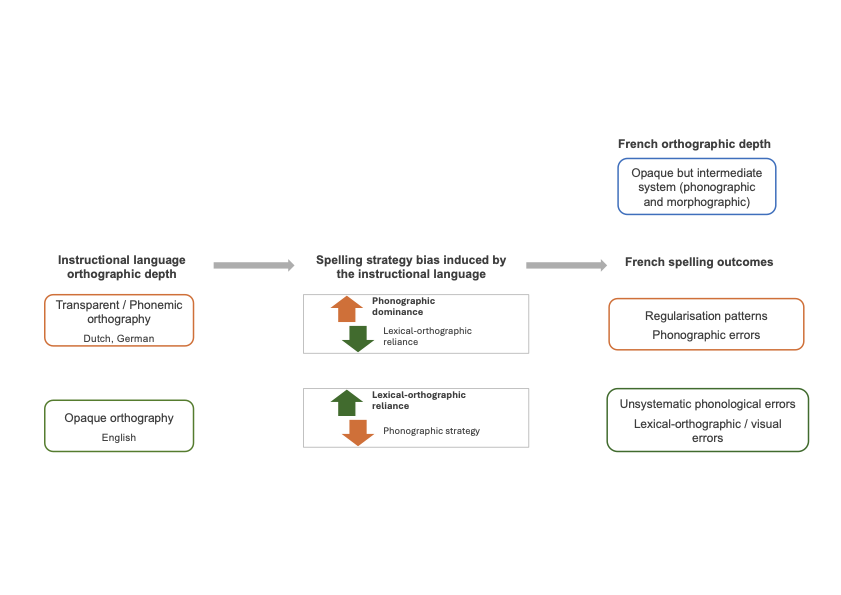
Taken together, these considerations motivate a model that conceptualises cross-linguistic influence in immersion education, not as the transfer of isolated forms or rules, but as the outcome of systematic shifts in spelling strategy organisation induced by sustained exposure to the orthographic properties of the instructional language. The conceptual model presented in Figure 1 predicts that, for French-speaking pupils enrolled in immersion programmes, spelling errors in French reflect systematic consequences of dominant spelling strategies shaped by the orthographic properties of the instructional language (L2). When applied to French, an opaque writing system, these biases give rise to distinct and predictable spelling error profiles.
Building on the conceptual model presented in Figure 1, the following sections formulate a set of theory-driven predictions regarding spelling error profiles in French under immersion education. As discussed in Section 2.2, spelling development in bilingual learners relies on the dynamic coordination of intralinguistic resources within each language and interlinguistic resources emerging from sustained interaction between writing systems. In immersion contexts, prolonged exposure to a single instructional orthography is therefore expected to shape spelling primarily through the transfer of dominant encoding strategies, rather than through the direct transfer of isolated forms.
Accordingly, the proposed framework moves beyond a surface cataloguing of errors to identify systematic zones of vulnerability within the French spelling system. These vulnerabilities arise from the interaction between strategy-level biases induced by immersion in transparent versus opaque instructional orthographies and the structural properties of French. The resulting error profiles are not interpreted as global orthographic deficits, but as predictable consequences of strategy selection during spelling acquisition.
3.1. Predicted Spelling Errors Profiles in French Spelling Under Transparent L2 Immersion
The predictions formulated in Figure 1 are grounded in cross-linguistic differences in the probabilistic reliability of phonographic encoding procedures. Quantitative analyses of orthographic depth consistently show that phoneme–grapheme mappings are substantially more reliable in Dutch and German—despite the presence of morphophonemic constraints—than in French or English (van den Bosch et al., 1994; Marjou, 2021). As a result, phonographic encoding yields correct spellings in most cases in Dutch and German, but in only a minority of cases in French and English, a contrast that favours the early dominance of phonographic strategies in immersion contexts (Durgunoğlu, 2002; Koda, 2008).
In phonemically dominant instructional languages, the high level of reliability supports the early stabilisation and repeated use of phonographic encoding procedures across reading and writing activities. Although Dutch and German encode morphophonemic regularities, these primarily ensure stem consistency and do not substantially undermine segmental phonographic transparency. Consistent with the Orthographic Depth Hypothesis (Katz & Frost, 1992; Seymour et al., 2003) and strategy-based models of spelling development (Ehri, 1997; Share, 1995, 2008), repeated deployment of these efficient procedures leads to their procedural dominance during literacy acquisition. When transferred to French—an orthography in which phonographic encoding is only partially informative—such strategy-level biases are predicted to generate systematic regularisation patterns. Importantly, the resulting spelling errors do not reflect deficient phonological representations or learning failure, but rather the transfer of encoding procedures that are optimal in the instructional language yet only partially compatible with the structural constraints of French spelling.
3.1.1. Phonological / Phonographic Spelling
Because phoneme–grapheme conversion is substantially more reliable in the instructional language than in French, learners are biased towards phonographic encoding procedures which, when transferred to French, are predicted to generate systematic regularisation patterns.
Prediction 1 – Concentration of Errors Spelling Domains Incompatible with Phonographic Encoding
Under transparent L2 immersion, spelling errors in French are predicted to cluster in domains where phoneme-grapheme conversion alone is insufficient to recover the conventional written form. A first source of vunerability concerns vocalic units with low phonographic recoverability, whose orthographic realisation cannot be derived through linear phoneme–grapheme mapping.
French nasal vowels provide a clear illustration of this mismatch. Their spelling poses a challenge for two partly independent reasons. Some of them display genuine polygraphism, in that several competing graphemic sequences can encode the same phonological unit and cannot be selected based on phonology alone —e.g. /ɛ̃/➝ in, ain, ein; /ɑ̃/➝ an, en and, in morphologically constrained contexts, sequences such as -ant and -ent which are phonologically identical but encode distinct morphographic functions, respectively verbal forms in the present participle and adverbs—. Other nasal vowels, although less polygraphic, remain orthographically opaque because their spelling cannot be directly inferred from phonology and instead rely on lexical learning —e.g. /ɔ̃/➝ typically on with om restricted do specific context (before the letters b and p), and frequent morphological endings such as -ont (marking third-person plural in certain verb groups); /œ̃/➝ un with contextually constrained um—.
This difficulty is further reinforced by cross-linguistic differences in the phonological status of nasalisation across the instructional languages considered. In Germanic languages, vowel nasalisation is generally an allophonic phenomenon, restricted to specific phonetic contexts —e.g. before a nasal consonant—, and does not constitute a distinct phonemic vowel category as in French. This pattern has been documented for Dutch and German (Altvater-Mackensen & Fikkert, 2007) and also holds for English (Broeders & Gussenhoven, 2025; Garrott, 2006), even though English is treated separately in the present predictive framework due to its opaque orthography. Therefore, learners with Germanic linguistic backgrounds frequently realise French nasal vowels as an oral vowel followed by a nasal consonant —often n or ŋ—, rather than as a nasal vowel alone. When spelling strategies are dominated by phonographic procedures, learners are therefore predicted to approximate French nasal vowels using locally plausible or frequent graphophonological patterns —e.g. /ɑ̃fɑ̃/: enfant (child) ➝ enfen— despite accurate perception of the target phonological form.
Similar mechanisms are expected for complex vocalic configurations, such as vowel–glide sequences —e.g. /ɡʁənuj/: grenouille (frog) ➝ grenouye—, whose spelling cannot be derived though phonological assembly alone and must instead be learned as part of stabilised orthographic representations during literacy development.
A second source of vulnerability concerns context-dependent grapheme selection. In French, many phonemes have multiple possible graphemic realisations whose selection depends on orthographic context rather than on phonology alone. This is the case for consonants such as g, whose pronunciation varies according to the following vowel —g+i/e ➝/ ʒ/ ; g+u ➝/g/—, or for consonant doubling used to encode phonemic contrasts —e.g. /s/ ➝ s or ss between two vowels—. Learners relying predominantly on phonographic encoding are predicted to mismanage these alternations, producing spellings such as gitare —/ʒitaʁ/— for guitare —guitar /gitaʁ/— or poison —poison /pwɑzɔ̃/— for poisson —/pwɑsɔ̃/ fish —. These errors reflect difficulty in integrating phonological information with graphotactic constraints, a pattern already documented in monolingual development and amplified here by immersion in a highly transparent orthography (Treiman et al., 2025; Treiman & Kessler, 2019).
This prediction is consistent with previous findings showing that, in the absence of stabilised orthographic representations, bilingual learners rely on locally available phonological cues when encoding unfamiliar or orthographically opaque vocalic units (e.g. Bassetti, 2008; Treiman & Kessler, 2014)
Prediction 2 – Over-Application of L2-Dominant Consonantal Encoding Procedures
In immersion contexts with phonemically transparent instructional languages such as Dutch or German, highly reliable and procedurally dominant consonantal encoding (Borleffs et al., 2019; Llaurado & Dockrell, 2020; Protopapas & Vlahou, 2009) are expected to extend beyond the instructional language and shape spelling behaviour in French. This over-application is expected to follow a continuum ranging from the preferential selection of the most transparent and procedurally reliable French graphies among competing option to the transfer of consonantal encoding procedures from the instructional language that have no direct equivalent in the French orthographic system.
When French offers multiple graphemic options for encoding the same phoneme, this bias is illustrated by consonantal choices that maximise phonographic transparency. The phoneme /k/ provides a clear example. In Dutch orthography, normative descriptions specify that native words are written with k, whereas c, q and qu are largely restricted to a limited set of loanwords (Instituut voor de nederlandse taal, 2026). As a result, k constitutes the most frequent and direct way of encoding /k/, a regularity that is explicitly reinforced in early literacy instruction, where learners are taught to select k, in most cases, and to treat alternative graphies as exceptions linked to foreign-origin words. A comparable pattern is found in German. In standard German, the phoneme /k/ is also most frequently encoded by the letter k across word positions (Bredel & Wöllstein, 2023), with other spellings —ck, c, occasionally x— occurring under more restricted positional or lexical conditions. When transferred to French spelling, this L2-shaped procedural bias is predicted to result in the overuse of k —or ck— at the expense of French conventions —e.g. /kart/ ➝karte for carte (card)—, even though c is statistically the most frequent representation of /k/ in French.
This same procedural bias may also extend beyond competition among existing French graphies, leading learners to apply highly automatised L2 graphemic procedures that have non-productive equivalent in French orthographic system. In such cases, learners are predicted to transfer L2-dominant encoding procedures directly, resulting in orthographic intrusions rather than in the selection of an alternative French grapheme (Niolaki et al., 2023). A typical example concerns the encoding of /ʃ/. In French, this phoneme is stably and predominantly encoded by the digraph ch, with no functional competition from alternative graphies. In German, by contrast, /ʃ/ is systematically encoded by the trigraph sch, which constitutes a highly frequent and strongly automatised orthographic procedure. When transferred to French spelling, this procedural unit may be imported as such, yielding forms like marsche for marche (walk). In this case, the error does not reflect competition between French graphies, but the intrusion of an L2-specific encoding routine.
Importantly, these patterns do not reflect transfer from the first-acquired language per se, but rather the influence of the instructional language as the dominant source of orthographic procedural knowledge during literacy development (Deacon et al., 2009, 2013; Koda, 2008). Comparable consonantal regularisation effects have been reported in bilingual spelling involving Germanic languages (Niolaki et al., 2023).
3.1.2. Lexical Spelling
Prediction 3 – Reduced Mobilisation of Lexical-Orthographic Representations in French
Under transparent L2 immersion, the high efficiency of phonographic encoding reduces the need for systematic reliance on stored lexical–orthographic representations during spelling. Consequently, lexical spelling errors in French are predicted to reflect under-activation of lexical knowledge rather than poor lexical acquisition.
These errors are expected to concentrate on lexical items whose correct spelling cannot be reliably inferred from phonology and is only weakly supported by derivational relations. This includes words containing non-recoverable silent letters —e.g. beaucoup(a lot), prix (price), nez (nose)— as well as cases of lexical homophony, where phonology provides no guidance and correct spelling depends on access to word-specific orthographic representations and on the integration of semantic and contextual information. Typical examples include: /vɛʁ/ ➝ verre (glass) – vert (green) – vers (towards); /mɛʁ/ ➝ mer (sea) – mère (mother); /sɑ̃/ ➝ sang (blood) – sans (without) – cent (hundred). Importantly, these cases differ from grammatical homophones, as they do not involve morphosyntactic computation but require lexical discrimination supported by contextual cues.
Transparent L2 immersion is also predicted to affect peripheral lexical graphic markers whose encoding is conventionally specified and does not play a central role in phonological or grammatical computation during early spelling acquisition. This category includes lexical diacritics, but their linguistic status must be distinguished from their developmental accessibility. Accents marking vowel quality, such as the acute or grave accent, primarily signal phonological distinction and do not provide information about morphological structure. By contrast the circumflex accent carried a morpho-lexical motivation: it typically reflects the historical loss of an etymological s and can be supported by derivational relations —e.g. forêt (forest) ➝ forestier (forester); hôpital (hospital) ➝ hospitalier (hospitable)—. However, despite this underlying regularity, the rule governing the circumflex accent is not transparent or productively accessible to young writers during the initial phases of spelling acquisition. Unlike morphologically transparent alternations, such as petit —small, masculine form— and petite —small, feminine form—, the presence of the circumflex accent cannot be reliably predicted from phonological cues or from synchronically accessible morphological information. In addition to these lexical contrasts, French diacritics may also encode grammatical distinctions that are not recoverable from phonology alone—see Prediction 4.
Within this framework, although French diacritical marks have different linguistic functions (phonological, lexical or grammatical), their encoding should not be significantly affected by the dominant spelling strategies favoured by a transparent immersion language. Errors affecting diacritical marks should, therefore, be rare and unstable, reflecting occasional under-mobilisation of lexical or morphosyntactic information rather than a fundamental deficit in spelling acquisition. Indeed, diacritical marks generally have a low functional load in phonographic encoding and are not reliably supported by high-yield phoneme–grapheme procedures, making them unlikely to become integrated into automatised spelling routines shaped by transparent orthographies.
From an interlinguistic perspective, this vulnerability is not restricted to instructional languages that entirely lack diacritics, such as Dutch, is also expected under German immersion. Although German employs diacritics —e.g. umlauts—, these markers serve phonological functions and do not encode comparable grammatical oppositions tied to verbal morphology. Consequently, immersion in German as well as immersion in Dutch provides limited opportunities for learners to develop stable encoding routines for French diacritic conventions that require morphosyntactic arbitration rather than phonological or purely lexical cues.
3.1.3. Grammatical / Morphographic Spelling
Prediction 4 – Increased Vulnerability of Grammatical Markers Lacking Phonological Cues
Finally, transparent L2 immersion is predicted to selectively affect grammatical spelling domains in French that rely on phonologically silent morphographic markers. Because phonographic encoding procedures do not require explicit morphosyntactic computation, grammatical information that is not audible is less likely to be encoded during spelling.
This vulnerability is expected to manifest most clearly in grammatical homophones —e.g. a (has) vs à (to); son (his, her) / sont (are), ces (these)/ses (their)—, where learners relying on phonographic strategies select forms based on phonological identity or default frequency rather than on grammatical analysis. A closely related case concerns first-group verbs, where the distinction between the infinitive —/e/, -er— and the past participle —/e/, -é— is marked orthographically by an accent but remains phonologically neutral —e.g. chanter (to sing) vs chanté (sung)—. In such contexts, correct spelling requires morphosyntactic arbitration that is not supported by phonographic encoding.
Similarly, silent agreement markers for gender, number, and verbal inflection are predicted to be under-encoded —e.g. elle est tombé for elle est tombée (she fell), les chien noir for les chiens noirs (black dogs)—, despite adequate oral competence. Together, errors affecting grammatical homophones, diacritic-marked verb forms, and silent agreement markers illustrate a common underlying mechanism: the under-activation of grammatical computation during spelling, driven by the dominance of phonographic strategies induced by transparent L2 immersion.
To synthesise the theoretical assumptions and predictions developed in the previous sections, Table 1 provides an integrated overview of the dominant spelling strategies induced by transparent L2 immersion and their expected manifestations in French spelling.
3.2. Predicted Spelling Errors Profiles in French Spelling Under Opaque L2 Immersion
In contrast to Dutch and German, English is characterised by low and unstable phoneme–grapheme predictability, which prevents the emergence of a dominant phonographic encoding routine. Under immersion in such an opaque instructional language, phoneme–grapheme correspondences are too inconsistent to serve as a global organising principle for spelling. Accurate spelling therefore relies primarily on the mobilisation of lexical–orthographic knowledge, supported by frequency, analogy, and global visual similarity (Katz & Frost, 1992; Seymour et al., 2003; Share, 1995, 2008; Perfetti, 2017).
Research on bilingual literacy and cross-linguistic influence shows that sustained exposure to opaque orthographies promotes increased reliance on lexical-level processing and orthographic pattern generalisation, rather than on rule-based phoneme–grapheme conversion (Geva & Wang, 2001; Koda, 2008; Deacon et al., 2009). In immersion contexts, where the instructional language structures literacy practices across academic domains, these lexical–orthographic procedures are repeatedly mobilised and are therefore expected to become procedurally dominant. When transferred to French, this dominance is predicted to yield a spelling error profile that is distinct from that observed under transparent L2 immersion in terms of underlying mechanisms, even when some surface error types may overlap. In this case, errors are expected to be driven primarily by lexical selection processes and cross-linguistic competition, rather than by phonographic regularisation. Such errors thus reflect strategy-level biases shaped by experience with opaque instructional orthography, rather than surface-level transfer or deficient phonological representations, and are consistent with recent accounts interpreting spelling errors as indicators of underlying processing strategies (Bahr et al., 2015; Niolaki et al., 2023).
3.2.1. Phonological / Phonographic Spelling
Prediction 1 – Relative Preservation of Basic Phoneme–Grapheme Encoding Accuracy
Under opaque L2 immersion, learners are predicted to show relatively preserved basic phoneme–grapheme encoding accuracy in French. Because English does not support a stable, rule-based phonographic strategy, learners are unlikely to develop a dominant conversion procedure that could be systematically overgeneralised across languages. As a result, the coherent phonographic regularisation patterns observed under transparent L2 immersion —e.g. k for /k/; sch for /ʃ/—, as well as systematic approximations of complex vocalic units —e.g. grenouye for grenouille (frog)—, are expected to be less frequent.
Importantly, this does not imply the absence of phoneme–grapheme conversion processes altogether. French itself exhibits relatively high grapheme–phoneme predictability in reading (≈80%), despite much lower phoneme–grapheme predictability in spelling (≈28%) and is therefore substantially less opaque than English in the reading direction —≈36% in reading and ≈31% in spelling— (Marjou, 2021). Furthermore, in line with the self-teaching hypothesis (Share, 1995, 2008), early and repeated exposure to French print —particularly through reading— may support occasional attempts to apply grapheme–phoneme correspondences when spelling.
Given that exposure to reading typically precedes spelling and places lower cognitive demands on learners, they may attempt to mobilise grapheme–phoneme correspondences derived from French reading experience when spelling, either by applying French-based conversions or, more sporadically, by relying on English-derived conversions. However, because these conversions are not consistently reinforced in spelling and are not supported by a stable phonographic system, they are unlikely to become proceduralised. Such attempts are therefore expected to remain local and variable, without giving rise to coherent regularisation patterns.
This prediction is consistent with models of spelling development showing that, in opaque orthographies, phonological recoding remains available but does not dominate spelling behaviour (Treiman et al., 2003; Share, 2008). The relative preservation of basic phoneme–grapheme accuracy thus reflects not enhanced compatibility with French spelling, but the absence of a dominant phonographic bias transferred from the instructional language.
3.2.2. Lexical Spelling
Prediction 2 – Increased Lexical–Orthographic Intrusions and Cross-Linguistic Competition
Because opaque orthographies require extensive reliance on stored word forms, learners immersed in English are predicted to develop strong lexical–orthographic dominance. Within self-teaching and lexical quality frameworks, spelling acquisition in opaque systems depends heavily on the accumulation of item-specific representations supported by frequency, exposure and analogy (Share, 1995; Perfetti, 2017). As a result, spelling behaviour is guided less by procedural encoding routines than by the retrieval of familiar orthographic patterns.
When transferred to French, this lexical–orthographic bias is expected to generate cross-linguistic competition at the lexical level, particularly for formally similar items that share both meaning and partial orthographic structure across languages. Typical manifestations include the intrusion of English spellings into French written production —e.g. language for langage, example for exemple, letter for lettre—. These errors reflect competition between co-activated lexical representations associated with a shared semantic concept. In bilingual lexical processing, such co-activation is well documented and gives rise to competition effects at the level of form selection (Dijkstra & Van Heuven, 2002). In this context, the English orthographic form is more likely to prevail, as it is typically more frequent and more strongly reinforced in the written input to which learners are exposed at this stage of spelling development. Spelling errors of this type thus reflect difficulties in selecting the appropriate language-specific orthographic label from memory under conditions of lexical competition, rather than inaccurate lexical knowledge per se. More generally, learners immersed in an opaque L2 are predicted to rely on global visual patterns and analogy-based reasoning when spelling in French. This may result in spellings that are orthographically plausible and visually coherent, yet non-conventional within the French system. Importantly, such errors arise from lexical selection processes rather than from the misapplication of phoneme–grapheme correspondences, a pattern well documented in research on bilingual literacy and opaque orthographies (Koda, 2008; Bialystok, 2002).
Prediction 3 – Reduced Sensitivity to French-Specific Graphic Markers
Learners are predicted to show reduced sensitivity to French-specific graphic markers that lack systematic or functionally comparable equivalents in the instructional language, including diacritics and other conventionally specified markers. In opaque orthographies, spelling is primarily guided by item-based lexical retrieval and by the selection of globally plausible orthographic patterns under conditions of high uncertainty (Koda, 2008; Perfetti, 2017). Within this organisation, graphic markers that carry low informational weight within lexical–orthographic retrieval —because they are weakly supported by frequency, analogy, or salient morphosyntactic patterns— receive limited strategic weighting. As a result, the encoding of French-specific graphic markers is expected to remain unstable and peripheral relative to core lexical spelling processes. This vulnerability is predicted to manifest as omissions, substitutions, or inconsistent marking of conventionally specified elements, rather than as systematic mis-encodings. Typical manifestations include the omission or instability of diacritics in lexically specified forms where accentuation is not supported by phonological contrast or transparent morphological cues —e.g. /ɛ̃teʁɛ/: interet for intérêt (interest)—. A particularly illustrative case is provided by événement —/evɛnənɑ̃/, event—, which combines two distinct diacritics —é and è— within the same word. The second accent, which marks vowel openness rather than stress or syllabic prominence, is frequently mis-specified even by monolingual French adult writers and is often assimilated to the first as an acute accent. This pattern highlights the weak procedural support for diacritic encoding in French and its strong dependence on item-specific lexical stabilisation.
Superficially similar error patterns may also be observed under transparent L2 immersion when the instructional language does not encode comparable graphic devices, as in Dutch, which lacks diacritics altogether. However, the underlying mechanisms differ in a principled way. Under opaque L2 immersion, reduced sensitivity to low-salience graphic markers reflects a lexical–orthographic strategy in which conventionally specified details are deprioritised in favour of global word-form coherence. Under transparent L2 immersion, by contrast, comparable omissions arise from the dominance of phonographic encoding procedures that bypass lexical specification altogether. The convergence of surface error patterns across immersion contexts is particularly evident for diacritic contrasts such as those illustrated by événement, where two accentuated vowels encode a phonemic distinction that is only weakly supported by phonological cues. This convergence invites closer examination of the phonetic robustness of the underlying vowel contrast itself. Although /e/ and /ɛ/ constitute distinct phonemic categories in French, their differentiation provides limited strategic support for spelling. Acoustic studies show that the contrast relies primarily on differences in vowel openness, reflected in relatively small shifts in F1 values, while F2 values2 largely overlap (Cecelewski et al., 2024; Delattre, 1965; Storme, 2017). Consequently, the acoustic distance between the two vowels is modest and highly sensitive to contextual factors such as speech rate, prosodic position, and speaker variability. From a spelling perspective, this limited acoustic robustness constrains the usefulness of phonological information for reliably selecting the appropriate diacritic, particularly in the absence of transparent morphological cues. As a result, even proficient writers may treat accentuation on mid vowels as a weakly specified graphic feature rather than as a fully proceduralised encoding rule. In practice, writers may neutralise the contrast, assimilate one accent to another, or produce an underspecified diacritic mark, reflecting uncertainty at the level of orthographic selection rather than at the level of phonological representation.
Importantly, these phonetic considerations do not undermine the dissociation between the distinct strategy-level biases induced phonographic dominance under transparent L2 immersion and lexical-orthographic prioritisation under opaque L2 immersion, but rather help explain why certain graphic contrasts constitute fragile loci for spelling across contexts. They specify the limits of phonological support available for orthographic encoding, without collapsing the distinct strategic mechanisms induced by transparent versus opaque instructional languages. Thus, while surface error patterns may converge across immersion contexts, they arise from distinct strategy-level biases: lexical prioritisation under orthographic opacity versus phonographic dominance under transparency. This dissociation directly supports the present framework’s claim that spelling errors in immersion contexts must be interpreted in terms of underlying processing strategies rather than in terms of error forms alone.
3.2.3. Grammatical / Morphographic Spelling
Prediction 4 – Relative Preservation of Grammatical Spelling with Persistent Vulnerability to Grammatical Homophones
Grammatical spelling in French is predicted to be selectively preserved in domains where correct encoding relies on visually specified morphosyntactic markers rather than on phonological cues. Reduced reliance on phonographic encoding may facilitate greater attention to visually encoded morphosyntactic distinctions, including agreement markers and inflectional endings that are not recoverable from phonology alone. In this respect, lexical–orthographic dominance may indirectly support the processing of certain grammatical spellings.
However, grammatical homophones are predicted to remain a persistent locus of difficulty under opaque L2 immersion, albeit for reasons that differ fundamentally from those observed under transparent L2 immersion. In English, grammatical distinctions are only weakly marked in the written code and rarely require systematic resolution of homophonous forms through morphosyntactic analysis. Consequently, learners have limited opportunities to develop and automate procedures that link written form selection to syntactic context. When transferred to French, this lack of proceduralised morphosyntactic arbitration is predicted to constrain the resolution of grammatical homophones. Rather than engaging explicit grammatical computation, learners are expected to rely primarily on lexical familiarity, surface frequency, or default forms when selecting among homophonous alternatives —e.g. a (has) vs à (to), son (his, her) vs sont (are)—. Once again at the surface level, error patterns may resemble those observed under transparent L2 immersion; at the mechanistic level, however, they reflect distinct sources of vulnerability. Under transparent L2 immersion, grammatical homophone errors arise from the dominance of phonographic strategies that bypass morphosyntactic encoding, whereas under opaque L2 immersion they reflect the absence of automatised morphosyntactic routines capable of constraining lexical selection in context.
To synthesise the theoretical assumptions and predictions developed in the previous sections, Table 2 provides an integrated overview of the dominant spelling strategies induced by opaque L2 immersion and their expected manifestations in French spelling.
4. Discussion
The present framework invites a shift in how spelling outcomes in immersion education are interpreted, moving beyond surface descriptions of cross-linguistic interference toward an analysis of underlying spelling strategy organisation. Rather than conceptualising cross-linguistic influence as the transfer of isolated forms or rules, the predictions developed for transparent and opaque L2 immersion point to two distinct modes of strategic organisation shaped by prolonged experience with the orthographic properties of the instructional language (Koda, 2008; Bahr et al., 2015).
Under transparent L2 immersion, spelling behaviour in French is primarily structured by the dominance and cross-linguistic transfer of phonographic procedures. This strategic orientation gives rise to systematic regularisation patterns and coherent error profiles reflecting the over-application of highly efficient phoneme–grapheme conversion routines, in line with the Orthographic Depth Hypothesis and strategy-based models of spelling development (Katz & Frost, 1992; Seymour et al., 2003; Ehri, 1997; Share, 1995, 2008). Under opaque L2 immersion, by contrast, the absence of a stable phonographic conversion system promotes lexical–orthographic dominance —which is also widely used and even dominant in French, mainly when the first stages of spelling acquisition have been completed—, resulting in qualitatively different mechanisms of cross-linguistic influence characterised by lexical intrusions, analogy-based selection, and visual competition (Koda, 2008; Bialystok, 2002; Perfetti, 2017), rather than by phoneme–grapheme overgeneralisation.
Crucially, comparable surface error patterns may emerge across immersion contexts while reflecting distinct underlying mechanisms. This dissociation underscores the need to interpret spelling errors in immersion settings at the level of spelling strategy organisation rather than in terms of isolated forms or deficit-based accounts (Bahr et al., 2015; Niolaki et al., 2023). From this perspective, cross-linguistic influence on immersion spelling is best understood as a reorganisation of the relative weighting of phonological, lexical, and morphographic resources involved in spelling. This reorganisation is not driven by the direct transfer of representations from one language to another, but by sustained engagement with a particular type of orthographic system that progressively biases how spelling is approached as a problem-solving activity (Durgunoğlu, 2002; Koda, 2008). As modelled in Figure 1, immersion education constitutes a learning environment in which the instructional language functions as the dominant context for reading and writing across academic domains (Genesee, 2006; Genesee & Jared, 2008). Through repeated use, its orthographic properties become embedded in literacy routines and shape dominant spelling strategies that generalise beyond the instructional language itself.
This strategy-based account provides a principled explanation for why similar surface error types may arise across learners while reflecting distinct sources of vulnerability depending on the immersion context. For example, grammatical homophone errors may be observed under both transparent and opaque L2 immersion, yet stem from different mechanisms: phonographic dominance and bypassing of morphosyntactic computation in the former case, and limits of lexical selection in the absence of automatised morphosyntactic arbitration in the latter (Koda, 2008; Bahr et al., 2015). Importantly, the mechanisms posited by the model are not directly observable in written products, but are inferred from systematic patterns of error distribution, consistency, and contextual sensitivity, in line with strategy-based and probabilistic accounts of spelling development (Bahr et al., 2015; Oshchepkova et al., 2023). In this respect, the framework generates falsifiable predictions at the level of systematic error profiles—defined by their distribution, consistency and contextual sensitivity—rather than at the level of isolated error tokens.
An additional source of originality of the present framework lies in its explicit consideration of the nature of French orthographic opacity itself. Although French is commonly classified as an opaque orthography, its opacity is qualitatively distinct from that of English (see Marjou, 2021 for quantitative data on phoneme–grapheme predictability). Whereas English opacity is largely resolved through extensive lexicalisation and analogy-based processing, French spelling relies on a hybrid system combining phonological opacity with relatively stable morphographic and graphotactic regularities (Seymour et al., 2003; Ziegler & Goswami, 2005). In this context, characterising French as an “intermediate” orthography does not refer to a numerical position on a transparency scale, but to the mechanisms through which opacity is managed within the system.
This distinction has important consequences for cross-linguistic influence in immersion contexts. Immersion in English exposes learners to an orthographic system in which opacity is primarily handled through item-based lexical storage and frequency-driven competition, with limited systematic support from morphographic structure (Koda, 2008; Perfetti, 2017). As a result, learners develop strategies that prioritise global lexical selection when phonology is unreliable. When transferred to French, however, these strategies interact with an orthographic system in which opacity is partially constrained by morphosyntactic marking and graphotactic regularities. The present model predicts that this misalignment will generate specific patterns of spelling difficulty reflecting a tension between lexical–orthographic strategies induced by English and the more structured, rule-governed nature of French opacity, as schematically represented in Figure 1.
By explicitly distinguishing between types of orthographic opacity and their resolution strategies, the framework refines the predictions of the Orthographic Depth Hypothesis in bilingual and immersion contexts (Katz & Frost, 1992; Seymour et al., 2003). It shows that the effects of immersion depend not only on whether the instructional language is transparent or opaque, but also on how opacity is organised within that system and on the degree of compatibility between its dominant strategies and those required by the first language. More broadly, the framework supports a view of spelling development as a dynamic and adaptive system in which learners continuously adjust their encoding strategies in response to the statistical and structural properties of the writing systems they encounter. This perspective is consistent with self-teaching models (Share, 1995, 2008) and interactive accounts of orthographic learning (Ehri, 1997; Apel, 2011), while extending them to bilingual and immersion contexts by explicitly modelling how educational environments shape the relative weighting and transferability of spelling strategies across languages.
At the same time, several scope conditions delimit the applicability of the proposed framework and must be made explicit. First, the model applies exclusively to children who begin literacy acquisition in a language other than French within an immersion context. It does not concern learners whose initial spelling acquisition takes place in French and who subsequently learn another written language. The predicted effects arise from the early procedural dominance of the instructional language and from its role in structuring spelling strategies during the initial phases of literacy development. Second, the framework is intended to account primarily for spelling behaviour during the early stages of French spelling acquisition. Its predictions do not extend to more advanced writers, for whom increased lexicalisation, metalinguistic awareness and explicit instruction progressively reduce strategy-driven effects. At later stages of development, cross-linguistic influence is expected to be largely restricted to a limited set of lexical intrusions involving formally similar items across languages —e.g. language vs langage, literature vs littérature—, rather than to systematic strategy-level biases. Third, the model does not predict that all children in immersion contexts will systematically produce the error patterns described. Instead, it provides a principled interpretative framework for understanding atypical or unexpected spelling errors that may emerge in immersion settings. Importantly, spelling errors are not treated as indicators of deficit, but as adaptive responses to mismatches between dominant spelling strategies and the structural properties of the writing system.
Beyond orthographic depth, other factors are also likely to modulate spelling strategy selection and deserve further investigation, including instructional practices, the timing and nature of explicit spelling instruction, and individual differences in metalinguistic awareness. Extending the framework to other language pairs and writing systems would further allow its generality and limits to be assessed. In this respect, the genealogical affiliation of the instructional languages constitutes a relevant background condition. English, Dutch and German belong to the Germanic family, whereas French is a Romance language. Although genealogical proximity is not proposed here as an explanatory factor per se, future research could examine whether the effects attributed to orthographic depth interact with language family by comparing immersion in phonemically dominant Romance orthographies with Germanic ones.
Finally, although the present framework is not designed as a diagnostic tool, it has clear implications for educational and clinical practice. By situating certain atypical spelling patterns within a coherent account of strategy-driven cross-linguistic influence, it may help prevent immersion-related spelling behaviours from being misinterpreted as indicators of dyslexia or dysorthographia, thereby contributing to more accurate assessment and differential diagnostic reasoning.
5. Conclusions
The present article proposes a conceptual framework that reconceptualises cross-linguistic influence in immersion spelling as a strategy-driven phenomenon shaped by the orthographic properties of the instructional language and interacting with the specific structure of the target orthography. By highlighting both the strategic dimension of transfer and the status of French as an opaque but intermediate system, the model offers a theoretically grounded basis for interpreting spelling errors in immersion education and for guiding future empirical and pedagogical work.
Conflicts of Interest
“During the preparation of this manuscript, the author used ChatGPT (version 1.2026.006) and DeepL (version 26.1.23595006) to support English language editing, sentence reformulation, and the refinement of clarity, coherence, and academic style. These tools were used exclusively as aids to drafting and revising text. The authors have reviewed and edited the output and take full responsibility for the content of this publication.”.
Abbreviations
The following abbreviations are used in this manuscript:
| L1 | First Language (French) |
| L2 | Instructional language |
| MOR | Mental Orthographic Representations |
| MGR | Mental Graphemic representations |
| 1 | Grapheme-to-phoneme predictability for French and English is aproximately 76% and 31% and for Dutch and German approximately 56% and 78%. |
| 2 | Acoustic analyses of French mid vowels indicate that the contrast between /e/ and /ɛ/ is primarily realised along the first formant (F1), reflecting differences in vowel openness, while the second formant (F2), associated with front–back tongue position, largely overlaps. For adult speakers of Standard French, mean F1 values are typically reported around 400–450 Hz for /e/ and 500–600 Hz for /ɛ/, F2 values for both vowels generally fall in the 1900–2300 Hz range. |
References
- Abdalkareem, S. K., & Ahmed, A. (2025). Enhancing Primary School Students’ Spelling Proficiency through Orthographic Activities. Gading Journal for the Social Sciences (e-ISSN 2600-7568), 28(1), 123–131. [CrossRef]
- Altvater-Mackensen, N., & Fikkert, P. (2007). On the acquisition of nasals in Dutch and German. Linguistics in the Netherlands, 24, 14–24. [CrossRef]
- Apel, K. (2010). Kindergarten Children’s Initial Spoken and Written Word Learning in a Storybook Context. Scientific Studies of Reading, 14(5), 440–463. [CrossRef]
- Apel, K. (2011). What Is Orthographic Knowledge? Language, Speech & Hearing Services in Schools, 42(4), 592–603. [CrossRef]
- Apel, K., Henbest, V. S., & Masterson, J. (2019). Orthographic knowledge: Clarifications, challenges, and future directions. Reading and Writing, 32(4), 873–889. [CrossRef]
- Apel, K., Thomas-Tate, S., Wilson-Fowler, E. B., & Brimo, D. (2012). Acquisition of initial mental graphemic representations by children at risk for literacy development. Applied Psycholinguistics, 33(2), 365–391. [CrossRef]
- Apel, K., Wolter, J. A., & Masterson, J. J. (2006). Effects of Phonotactic and Orthotactic Probabilities During Fast Mapping on 5-Year-Olds’ Learning to Spell. Developmental Neuropsychology, 29(1), 21–42. [CrossRef]
- Apel, K., Wolter, J., & Masterson, J. (2012). Mental Graphemic Representations. In Encyclopedia of the Sciences of Learning (pp. 2185–2186). Springer US. http://ouci.dntb.gov.ua/en/works/4VempKW7/.
- Arseneau, R., & Nadeau, M. (2018). Expérimentation des dictées métacognitives: Quels effets sur l’apprentissage de l’orthographe grammaticale en contexte francophone minoritaire ? Canadian Journal of Applied Linguistics / Revue canadienne de linguistique appliquée, 21(2), 126–153. [CrossRef]
- Bahr, R. H., Silliman, E. R., Berninger, V. W., & Dow, M. (2012). Linguistic Pattern Analysis of Misspellings of Typically Developing Writers in Grades 1 to 9. Journal of Speech, Language, and Hearing Research : JSLHR, 55(6), 1587–1599. [CrossRef]
- Bahr, R. H., Silliman, E. R., Danzak, R. L., & Wilkinson, L. C. (2015). Bilingual spelling patterns in middle school: It is more than transfer. International Journal of Bilingual Education and Bilingualism, 18(1), 73–91. [CrossRef]
- Barrus, S., Simmons, D., & Kameenui, E. (1995). Synthesis of Research on Phonological Awareness: Principles and Implications for Reading Acquisition. Technical (No. 21; Information Analyses, p. 72). National Center To Improve the Tools of Educators. https://files.eric.ed.gov/fulltext/ED386868.pdf.
- Bassetti, B. (2008). 10. Orthographic Input and Second Language Phonology. In T. Piske & M. Young-Scholten (Eds), Input Matters in SLA (pp. 191–206). Multilingual Matters. [CrossRef]
- Bauer, E. B., Presiado, V., & Colomer, S. (2017). Writing Through Partnership: Fostering Translanguaging in Children Who Are Emergent Bilinguals. Journal of Literacy Research, 49(1), 10–37. [CrossRef]
- Bialystok, E. (2017). The bilingual adaptation: How minds accommodate experience. Psychological Bulletin, 143(3), 233.
- Bijeljac-Babic, R. (2017). L’ Enfant bilingue: De la petite enfance à l’école. Odile Jacob.
- Bongini, M. (2025). Acquisition de l’orthographe grammaticale et lexicale chez des élèves en enseignement francophone et en enseignement par immersion linguistique français-néerlandais: Analyse à partir d’une dictée lacunaire et d’une production écrite [Master Thesis]. University of Liege.
- Borgwaldt, S. R., Hellwig, F. M., & Groot, A. M. B. D. (2005). Onset Entropy Matters – Letter-to-phoneme Mappings in Seven Languages. Reading and Writing, 18(3), 211–229. [CrossRef]
- Borgwaldt, S. R., Hellwig, F. M., & Groot, A. M. B. de. (2004). Word-initial entropy in five languages: Letter to sound, and sound to letter. Written Language & Literacy, 7(2), 165–184. [CrossRef]
- Borleffs, E., Maassen, B. A. M., Lyytinen, H., & Zwarts, F. (2019). Cracking the Code: The Impact of Orthographic Transparency and Morphological-Syllabic Complexity on Reading and Developmental Dyslexia. Frontiers in Psychology, 9, 2534. [CrossRef]
- Bosse, M., Chaves, N., Largy, P., & Valdois, S. (2015). Orthographic learning during reading: The role of whole-word visual processing. Journal of Research in Reading, 38(2), 141–158. [CrossRef]
- Bosse, M.-L. (2015). Learning to Read and Spell: How Children Acquire Word Orthographic Knowledge. Child Development Perspectives, 9(4), 222–226. [CrossRef]
- Bredel, U., & Wöllstein, A. (2023). Amtliches Regelwerk der deutschen Rechtschreibung. Regeln und Wörterverzeichnis. IDS-Verlag.
- Brimo, D. (2013). The “How to” Guide to Spelling Assessment. Perspectives on Language Learning and Education, 20(4), 129–136. [CrossRef]
- Broeders, T., & Gussenhoven, C. (2025). Nasalization. https://opentextbooks.rug.nl/americanenglishphonetics2/chapter/6-7-nasalization/.
- Burgi, R., & Jeanjean, L. (2025). Acquisition de l’orthographe française dans le cadre d’un enseignement en immersion en classes de quatrième primaires franco-anglaise et franco- néerlandaise [Master Thesis, University of Liege]. http://hdl.handle.net/2268.2/22529.
- Caravolas, M. (2004). Spelling Development in Alphabetic Writing Systems: A Cross-Linguistic Perspective. European Psychologist, 9(1), 3–14. [CrossRef]
- Carlisle, J. F., & Beeman, M. M. (2000). The effects of language of instruction on the reading and writing achievement of first-grade Hispanic children. Scientific Studies of Reading, 4(4), 331–353.
- Catach, N. (1980). L’orthographe française. Traité théorique et pratique. Paris, Nathan.
- Catach, N., Gruaz, C., & Duprez, D. (1980). L’Orthographe Française, Traité Théorique et Pratique, Paris, Nathan. Chalard, M, Bonin, P., Meot, A., Boyer, B., et Fayol, M.,(2003). Objective Age-Ofacquisition (AoA) Norms for a Set Of, 230, 209–245.
- Cecelewski, J., Gendrot, C., Adda-Decker, M., & Boula de Mareüil, P. (2024). Diachronic evolution of /e ɛ o ɔ/ in French across 100 years of speech archives. Journal of French Language Studies, 34(3), 483–515. Cambridge Core. [CrossRef]
- Chang, Y.-N. (2023). The influence of oral vocabulary knowledge on individual differences in a computational model of reading. Scientific Reports, 13(1), 1680. [CrossRef]
- Chang, Y.-N., Taylor, J. S. H., Rastle, K., & Monaghan, P. (2020). The relationships between oral language and reading instruction: Evidence from a computational model of reading. Cognitive Psychology, 123, 101336. [CrossRef]
- Coltheart, M., Rastle, K., Perry, C., Langdon, R., & Ziegler, J. (2001). DRC: A dual route cascaded model of visual word recognition and reading aloud. Psychological Review, 108(1), 204–256. [CrossRef]
- Comblain, A. (2004). Le bilinguisme précoce: Implications sur l’acquisition de la langue maternelle orale et écrite.
- Comblain, A. (2023). Bilinguisme et apprentissage précoce des langues. Entre idées reçues et fausses croyances. Presses Universitaires de Liège - PUL, Liège, Belgium. https://orbi.uliege.be/handle/2268/263833.
- Commissaire, E., Duncan, L. G., & Casalis, S. (2011). Cross-language transfer of orthographic processing skills: A study of French children who learn English at school. Journal of Research in Reading, 34(1), 59–76. [CrossRef]
- Cummins, J. (2007). Rethinking monolingual instructional strategies in multilingual classrooms. Canadian Journal of Applied Linguistics, 10(2), 221–240.
- Cunningham, A. E. (2006). Accounting for children’s orthographic learning while reading text: Do children self-teach? Journal of Experimental Child Psychology, 95(1), 56–77. [CrossRef]
- Daffern, T., Mackenzie, N. M., & Hemmings, B. (2015). The development of a spelling assessment tool informed by Triple Word Form Theory. The Australian Journal of Language and Literacy, 38(2), 72–82. [CrossRef]
- Deacon, S. H., Chen, X., Luo, Y., & Ramirez, G. (2013). Beyond language borders: Orthographic processing and word reading in Spanish–English bilinguals. Journal of Research in Reading, 36(1), 58–74. [CrossRef]
- Deacon, S. H., Wade-Woolley, L., & Kirby, J. R. (2009). Flexibility in young second-language learners: Examining the language specificity of orthographic processing. Journal of Research in Reading, 32(2), 215–229. [CrossRef]
- Delattre, P. (with Internet Archive). (1965). Comparing the phonetic features of English, French, German and Spanish. An interim report. Heidelberg, Groos. http://archive.org/details/comparingphoneti0000unse.
- Dijkstra, T., & Van Heuven, W. J. B. (2002). The architecture of the bilingual word recognition system: From identification to decision. Bilingualism: Language and Cognition, 5(3), 175–197. [CrossRef]
- Dressler, C. A. (2002). Inter- and intra-language influences on the English spelling development of fifth-grade, Spanish -speaking English language learners—ProQuest [Harvard University]. https://www.proquest.com/openview/4ecd9e210e448cf4ac1bb03659885dae/1?pq-origsite=gscholar&cbl=18750&diss=y.
- Durgunoğlu, A. Y. (2002). Cross-linguistic transfer in literacy development and implications for language learners. Annals of Dyslexia, 52(1), 189–204. [CrossRef]
- Ehri, L. C. (1997). Learning to read and learning to spell are one and the same, almost. In Learning to spell: Research, theory, and practice across languages (pp. 237–269). Lawrence Erlbaum Associates Publishers.
- Fayol, M. (2009). Chapitre 8. L’orthographe et son apprentissage. In Réussir à apprendre (pp. 127–139). Presses Universitaires de France. [CrossRef]
- Fayol, M., Bonin, P., & Collay, S. (2008). La consistance orthographique en production verbale écrite: Une brève synthèse. L’Année psychologique, 108(3), 517–546.
- Frost, R., Katz, L., & Bentin, S. (1987). Strategies for visual word recognition and orthographical depth: A multilingual comparison. Journal of Experimental Psychology: Human Perception and Performance, 13(1), 104–115. [CrossRef]
- Garrott, C. L. (2006). L1 (English) to L2 (French) Transfer: The Question of Nasalization.
- Genesee, F. (2006). What do we Know About Bilingual Education for Majority-Language Students? In The Handbook of Bilingualism (pp. 547–576). John Wiley & Sons, Ltd. [CrossRef]
- Genesee, F., & Jared, D. (2008). Literacy development in early French immersion programs. Canadian Psychology/Psychologie Canadienne, 49(2), 140–147. [CrossRef]
- Geva, E., & Wang, M. (2001). The development of basic reading skills in children: A cross-language perspective. Annual Review of Applied Linguistics, 21, 182–204. [CrossRef]
- Gort, M. (2006). Strategic codeswitching, interliteracy, and other phenomena of emergent bilingual writing: Lessons from first grade dual language classrooms. Journal of Early Childhood Literacy, 6(3), 323–354. [CrossRef]
- Herpich, C. (2025). Impact d’un enseignement par immersion allemand-français et français-allemand sur l’acquisition des compétences orthographiques. University of Liege.
- Holmes, V. M., & Carruthers, J. (1998). The Relation between Reading and Spelling in Skilled Adult Readers. Journal of Memory and Language, 39(2), 264–289. [CrossRef]
- Instituut voor de nederlandse taal. (2026). Taalportaal. https://taalportaal.org/taalportaal/topic/pid/topic-14247943800162202.
- Katz, L., & Frost, R. (1992). The Reading Process is Different for Different Orthographies: The Orthographic Depth Hypothesis. In Advances in Psychology (Vol. 94, pp. 67–84). North-Holland. [CrossRef]
- Koda, K. (2008). Impacts of prior literacy experience on second language learning to read. In Learning to Read Across Languages. Routledge.
- Koda, K., & Zehler, A. M. (2008). Learning to Read Across Languages: Cross-Linguistic Relationships in First- and Second-Language Literacy Development. Routledge.
- Li, Y., & Wang, M. (2023). A systematic review of orthographic learning via self-teaching. Educational Psychologist, 58(1), 35–56. [CrossRef]
- Llaurado, A., & Dockrell, J. E. (2020). The Impact of Orthography on Text Production in Three Languages: Catalan, English, and Spanish. Frontiers in Psychology, 11, 878. [CrossRef]
- Majorano, M., Bastianello, T., Bodea-Hategan, C., Fantuzzi, P., Fontana, G., Hoste, E., Lombardi, M., Standaert, A., Talas, D., Trifu, R., Vescogni, L., & Persici, V. (2021). Early Literacy Skills and Later Reading and Writing Performance Across Countries: The Effects of Orthographic Consistency and Preschool Curriculum. Child & Youth Care Forum, 50(6), 1063–1085. [CrossRef]
- Mann, V., & Wimmer, H. (2002). Phoneme awareness and pathways into literacy: A comparison of German and American children. Reading and Writing, 15(7), 653–682. [CrossRef]
- Marjou, X. (2021). OTEANN: Estimating the Transparency of Orthographies with an Artificial Neural Network. In E. Vylomova, E. Salesky, S. Mielke, G. Lapesa, R. Kumar, H. Hammarström, I. Vulić, A. Korhonen, R. Reichart, E. M. Ponti, & R. Cotterell (Eds), Proceedings of the Third Workshop on Computational Typology and Multilingual NLP (pp. 1–9). Association for Computational Linguistics. [CrossRef]
- McMurray, S. (2020). Learning to spell for children 5–8 years of age: The importance of an integrated approach to ensure the development of phonic, orthographic and morphemic knowledge at compatible levels. Dyslexia, 26(4), 442–458. [CrossRef]
- Molitor, F. (2025). Étude pilote: Apprentissage de l’orthographe en français dans un cadre d’immersion français-allemand et allemand-français [Master Thesis, Univerity of Liege]. http://hdl.handle.net/2268.2/24793.
- Monaghan, P. (2023). Literacy and early language development: Insights from computational modelling. Journal of Child Language, 50(6), 1394–1410. [CrossRef]
- Mossing, C. (2009). The Morphological Complexity of Spelling, Ages 8 to 15 Years. USF Tampa Graduate Theses and Dissertations. https://digitalcommons.usf.edu/etd/2115.
- Nation, K., Angell, P., & Castles, A. (2007). Orthographic learning via self-teaching in children learning to read English: Effects of exposure, durability, and context. Journal of Experimental Child Psychology, 96(1), 71–84. [CrossRef]
- Niolaki, G. Z., Negoita, A., Vousden, J. I., Terzopoulos, A. R., Taylor, L., & Masterson, J. (2023). What spelling errors can tell us about the development of processes involved in children’s spelling. Frontiers in Psychology, 14, 1178427. [CrossRef]
- Nocus, I. (2024). Bilinguisme et bilittéracie des enfants dans différents contextes multilingues. Contextes et didactiques. Revue semestrielle en sciences de l’éducation, 23. [CrossRef]
- Oshchepkova, E. S., Kartushina, N. A., & Razmakhnina, K. O. (2023). Bilingualism and Development of Literacy in Children: A Systematic Review. Psychology in Russia, 16(1), 3–25. [CrossRef]
- Ouellette, G. P., & Sénéchal, M. (2008). A Window Into Early Literacy: Exploring the Cognitive and Linguistic Underpinnings of Invented Spelling. Scientific Studies of Reading, 12(2), 195–219. [CrossRef]
- Perfetti, C. (2003). The Universal Grammar of Reading. Scientific Studies of Reading, 7(1), 3–24. [CrossRef]
- Perfetti, C. A. (2017). Lexical quality revisited. In E. Segers & P. van den Broek (Eds), Developmental Perspectives in Written Language and Literacy: In honor of Ludo Verhoeven (pp. 51–67). John Benjamins Publishing Company. https://www.degruyterbrill.com/document/doi/10.1075/z.206.04per/html.
- Perfetti, CharlesA., & Dunlap, S. (2008). Learning to read: General principles and writing system variations. In Learning to Read Across Languages. Routledge.
- Protopapas, A., & Vlahou, E. L. (2009). A comparative quantitative analysis of Greek orthographic transparency. Behavior Research Methods, 41(4), 991–1008. [CrossRef]
- Richards, T. L., Aylward, E. H., Field, K. M., Grimme, A. C., Raskind, W., Richards, A. L., Nagy, W., Eckert, M., Leonard, C., Abbott, R. D., & Berninger, V. W. (2006). Converging Evidence for Triple Word Form Theory in Children With Dyslexia. Developmental Neuropsychology, 30(1), 547–589. [CrossRef]
- Ruberto, N., Beaulieu, J., Maynard, C., Baran, G., & Daigle, D. (2025). Quels sont les défis des élèves québécois de deuxième secondaire en orthographe lexicale? Didactique, 6(1), 145–169. [CrossRef]
- Seymour, P. H. K., Aro, M., Erskine, J. M., & Network, collaboration with C. A. A. (2003). Foundation literacy acquisition in European orthographies. British Journal of Psychology, 94(2), 143–174. [CrossRef]
- Share. (2008). Orthographic Learning, Phonological Recoding, and Self-Teaching. In Advances in Child Development and Behavior (Vol. 36, pp. 31–82). JAI. [CrossRef]
- Share, D. L. (1995). Phonological recoding and self-teaching: Sine qua non of reading acquisition. Cognition, 55(2), 151–218. [CrossRef]
- Soltero-González, L., & Butvilofsky, S. (2016). The early Spanish and English writing development of simultaneous bilingual preschoolers. Journal of Early Childhood Literacy, 16(4), 473–497. [CrossRef]
- Soltero-González, L., Escamilla, K., & Hopewell, S. (2012). Changing teachers’ perceptions about the writing abilities of emerging bilingual students: Towards a holistic bilingual perspective on writing assessment. International Journal of Bilingual Education and Bilingualism, 15(1), 71–94. [CrossRef]
- Storme, B. (2017). The loi de position and the acoustics of French mid vowels. Glossa: A Journal of General Linguistics, 2(1). [CrossRef]
- Tedick, D. J., Christian, D., & Fortune, T. W. (2011). Immersion Education: Practices, Policies, Possibilities. Multilingual Matters.
- Treiman, R., Hulslander, J., Willcutt, E. G., Pennington, B. F., & Olson, R. K. (2025). On the relationship between word reading ability and spelling ability. Reading and Writing, 38(6), 1509–1531. [CrossRef]
- Treiman, R., & Kessler, B. (2014). How Children Learn to Write Words. Oxford University Press.
- Treiman, R., & Kessler, B. (2019). Development of context-sensitive pronunciation in reading: The case of ‹c› and ‹g›. Journal of Experimental Child Psychology, 182, 114–125. [CrossRef]
- Treiman, R., & Kessler, B. (2025). Statistical learning in spelling and reading. Trends in Cognitive Sciences, 29(12), 1136–1145. [CrossRef]
- Tucker, R., Castles, A., Laroche, A., & Deacon, S. H. (2016). The nature of orthographic learning in self-teaching: Testing the extent of transfer. Journal of Experimental Child Psychology, 145, 79–94. [CrossRef]
- van den Bosch, A. P. J., Content, A., Daelemans, W. M. P., & de Gelder, B. L. M. F. (1994). Analysing orthographic depth of different languages using data-oriented algorithms. Proceedings of the Second International Conference on Quantitative Linguistics, QUALICO-94, Moscow, September 20-24, 1994, 26–31.
- Verhoeven, L., & Perfetti, C. A. (2011). Morphological processing in reading acquisition: A cross-linguistic perspective. Applied Psycholinguistics, 32(3), 457–466. [CrossRef]
- Wegener, S., Beyersmann, E., Wang, H.-C., & Castles, A. (2022). Oral vocabulary knowledge and learning to read new words: A theoretical review. Australian Journal of Learning Difficulties, 27(2), 253–278. [CrossRef]
- Wegener, S., Wang, H.-C., de Lissa, P., Robidoux, S., Nation, K., & Castles, A. (2018). Children reading spoken words: Interactions between vocabulary and orthographic expectancy. Developmental Science, 21(3), e12577. [CrossRef]
- Wolter, J. A., & Apel, K. (2010). Initial Acquisition of Mental Graphemic Representations in Children with Language Impairment. Journal of Speech, Language, and Hearing Research, 53(1), 179–195. [CrossRef]
- Wright, D.-M., & Ehri, L. C. (2007). Beginners remember orthography when they learn to read words: The case of doubled letters. Applied Psycholinguistics, 28(1), 115–133. [CrossRef]
- Ziegler, J. C., & Goswami, U. (2005). Reading Acquisition, Developmental Dyslexia, and Skilled Reading Across Languages: A Psycholinguistic Grain Size Theory. Psychological Bulletin, 131(1), 3–29. [CrossRef]
- Ziegler, J. C., Perry, C., Jacobs, A. M., & Braun, M. (2001). Identical Words are Read Differently in Different Languages. Psychological Science, 12(5), 379–384. [CrossRef]
Figure 1.
Conceptual model of strategy-driven cross-linguistic influence in immersion spelling.
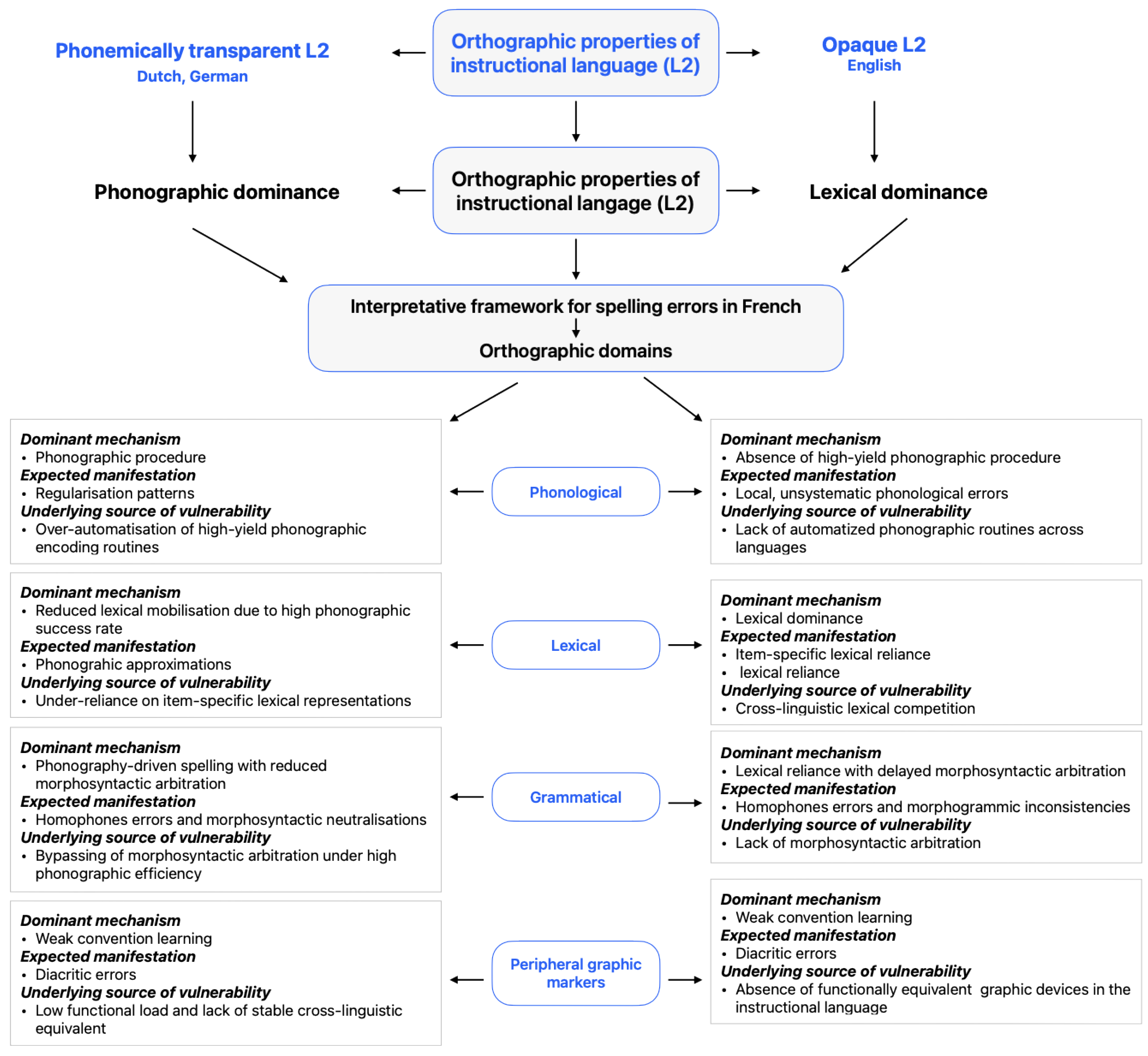

Table 1.
Predictions derived for phonemically dominant L2 immersion.
| Orthographic domain | Dominant mechanism induced by immersion | Expected manifestations in French spelling | Underlying source of vulnerability |
| Phonological | Phonographic procedural dominance | Systematic regularisation patterns; over-selection of highly transparent graphies (e.g. k); simplification of complex vocalic units | Over-automatisation of high-yield encoding routines shaped by the instructional language |
| Lexical | Reduced mobilisation of lexical representations | Phonographic approximations despite the availability of stabilised lexical forms | Under-reliance on item-specific lexical representations |
| Grammatical | Omission of morphosyntactic encoding in favour of phonography | Errors involving grammatical homophone and unmarked agreement | Bypassing of morphosyntactic arbitration mechanisms |
| Peripheral graphic markers | Weak mobilisation of conventional orthographic knowledge | Rare and unstable errors affecting diacritics and other non-phonological graphic markers | Low functional load and lack of stable cross-linguistic equivalents |
Table 2.
Predictions derived for opaque L2 immersion.
| Orthographic domain | Dominant mechanism induced by immersion | Expected manifestations in French spelling | Underlying source of vulnerability |
| Phonological | Absence of a stable phonographic conversion procedure | Globally preserved phoneme-grapheme encoding; rare, local and unsystematic phonological errors | Lack of automatised phonographic routines transferable across languages |
| Lexical | Lexical-orthographic dominance | Cross-linguistic lexical intrusions and competition | Strong activation and competition between orthographically similar lexical representations |
| Grammatical | Lexical reliance without specialised morphosyntactic arbitration | Persistent vulnerability of grammatical homophones; selection guides by frequency rather than morphosyntactic analysis | Reliance on lexical familiarity in the absence of dedicated morphosyntactic resolution strategies |
| Peripheral graphic markers | Weak mobilisation of conventional orthographic knowledge | Reduced sensitivity to French-specific diacritics and other conventional markers; unstable and peripheral errors | Absence of functionally equivalent graphic devices in the instructional language |
Disclaimer/Publisher’s Note: The statements, opinions and data contained in all publications are solely those of the individual author(s) and contributor(s) and not of MDPI and/or the editor(s). MDPI and/or the editor(s) disclaim responsibility for any injury to people or property resulting from any ideas, methods, instructions or products referred to in the content. |
© 2026 by the authors. Licensee MDPI, Basel, Switzerland. This article is an open access article distributed under the terms and conditions of the Creative Commons Attribution (CC BY) license (http://creativecommons.org/licenses/by/4.0/).
Copyright: This open access article is published under a Creative Commons CC BY 4.0 license, which permit the free download, distribution, and reuse, provided that the author and preprint are cited in any reuse.