
Submitted:
02 April 2026
Posted:
07 April 2026
You are already at the latest version
Abstract
Wearable lower-limb exoskeletons can enhance mobility, reduce metabolic cost, and aid rehabilitation. Effective human-exo cooperation requires personalized assistance profiles that match biomechanical principles. Existing methods often rely on fixed curves, involve complex tuning, and lack biomechanical interpretability. To address this, we propose a “Physics-guided perception and physiology-driven optimization” approach. First, a Physics-guided Dynamic Fusion Model (PDFM) is proposed, which integrates Newton–Euler dynamics, LSTM, and NTM to estimate multi-plane hip joint moments without ground reaction forces, employing biomechanical models as complementary fusion factors rather than the embedded hard constraints used in conventional physics-informed neural networks (PINNs). Estimation accuracy reached 92.51% (sagittal), 86.86% (coronal), and 88.15% (transverse), outperforming all single-network baselines across all three anatomical planes. Second, an assistance profile derived from estimated moments is individually optimized using Bayesian optimization based on multi-muscle sEMG. Compared to no-exo walking, the optimized system reduced target muscle loading by 49.31% and metabolic cost by 14.75%; relative to the pre-optimized profile, the reductions were 23.64% and 5.74%, respectively. This work provides a validated framework for personalized hip exoskeleton assistance.
Keywords:
soft exoskeleton
; joint moment estimation
; neural network
; profile optimization
; personalized assistance
1. Introduction
Wearable lower-limb exoskeleton technology demonstrates significant potential in enhancing human locomotor performance, reducing metabolic cost during walking, and promoting neurological rehabilitation [1,2,3]. Among various joint assistance strategies, hip assistance has been proven to be more energy-efficient than others while also improving center-of-mass stability to some extent [4,5]. Realizing this advantage requires efficient and natural human-robot synergy, meaning the exoskeleton must precisely supplement or substitute the function of hip flexor/extensor muscles. Consequently, generating a personalized assistance profile that conforms to the intrinsic biomechanical laws of the human body is crucial. Many recent studies have employed pre-defined assistance profiles as reference templates for exoskeleton force/moment output [6,7]. This approach not only diminishes the biomechanical and physiological interpretability of the exoskeleton’s assistance effect but also complicates personalized adaptation from the initial stage of assistance planning [8]. To address these limitations, assistance strategies referencing the biological hip joint moment have emerged [9,10]. By matching the exoskeleton’s assistance moment to the user’s biological joint moment, these strategies effectively reduce the metabolic cost of walking through a decrease in muscular mechanical work [11].
Accurate acquisition of personalized hip joint moments is a prerequisite for implementing this assistance strategy. The gold standard for calculating hip joint moments is the Newton–Euler (N–E) inverse dynamics algorithm. However, its heavy reliance on ground reaction forces (GRF) severely limits its practicality in wearable applications [12]. In recent years, data-driven estimation methods, particularly those utilizing neural networks to directly learn the moment mapping relationship from electromyography (EMG) signals and kinematic data, have reduced modeling and measurement complexity, offering a promising solution to eliminate the dependency on force plates [13]. While EMG signals provide physiological insights, strict sensor wearing requirements (accurate positioning, resistance to displacement, and clean skin contact) significantly reduce their practicality during prolonged or vigorous activities. Consequently, kinematic data are less restrictive to measure, involve smaller data volumes, offer higher precision, and are simpler to operate. Furthermore, they can be acquired by wearable sensors, such as inertial measurement units (IMUs), integrated into the exoskeleton’s perception module, granting them higher usability in research on real-time joint moment estimation. In terms of model architecture, researchers have proposed hybrid models that leverage the complementary strengths of multiple networks to circumvent the accuracy and generalization constraints inherent to single neural network architectures [14]. Furthermore, researchers have found that different neural network architectures possess unique characteristics making them suitable for different locomotion scenarios (e.g., walking, jumping, ascending/descending slopes) [15,16,17].
To overcome the aforementioned limitations—including the GRF dependency of the gold-standard inverse dynamics algorithm, the poor long-term practicality of EMG-driven approaches, the lack of physical interpretability inherent to data-driven neural network predictions, and the inherent bottlenecks in accuracy and generalizability of single neural network architectures—a Physics-guided Dynamic Fusion Model (PDFM) is first proposed in this paper. This model strategically integrates Newton–Euler dynamics, long short-term memory (LSTM) networks, and neural turing machines (NTMs) to achieve multi-plane hip joint moment estimation without requiring ground reaction force measurements. Unlike conventional physics-informed neural networks (PINNs) that embed physical laws as hard constraints within the network architecture, the proposed method employs biomechanical models as complementary fusion factors to guide the data-driven estimation process.
After obtaining reliable moment estimates, assistance profiles for the exoskeleton can be generated through human-exo system modeling. However, precise adaptation to different users requires further personalized parameter optimization (e.g., assistance phase, amplitude, and duration) [18]. Among recent studies, methods based on metabolic rate optimization are frequently employed [19]. Yet, the extended duration of measurement and optimization in such protocols may induce user discomfort, potentially compromising the optimization outcome. In contrast, surface electromyography (sEMG)-based optimization, characterized by a shorter process and higher user comfort, has demonstrated promising feasibility for tuning joint assistance profiles [20]. Accordingly, we employ a Bayesian optimization framework driven by integrated electromyography (iEMG) across three target muscles (the Rectus Femoris, RF; Vastus Medialis Obliquus, VMO; Vastus Lateralis Obliquus, VLO) to achieve personalized calibration of the assistance amplitude. This approach circumvents the core drawbacks of conventional metabolic cost optimization strategies, namely their protracted experimental workflows and the associated discomfort for end users.
This study presents a moment-based assistance strategy for a soft hip exosuit optimized via multi-muscle iEMG and Bayesian optimization. The primary contributions are as follows: 1) a Physics-guided Dynamic Fusion Framework (PDFM) enabling high-accuracy multi-plane hip moment estimation without ground reaction forces; 2) a biomechanical conversion method transforming estimated sagittal moments into personalized assistance profiles through gait and human-exoskeleton dynamic modeling; 3) an efficient personalization protocol leveraging multi-muscle iEMG and Bayesian optimization for rapid parameter tuning; and 4) comprehensive multi-subject experiments validating assistance efficacy through neuromuscular and metabolic metrics. Results demonstrate that the PDFM achieves 92.51% sagittal-plane estimation accuracy, with the optimized system significantly reducing average iEMG by 23.64% and metabolic cost by 5.74% relative to pre-optimized conditions.
2. Materials and Methods
2.1. The Soft Lower-Limb Exoskeleton Platform
A belt-type hip flexion exoskeleton previously developed [21], transmitting assistive torque via a flexible band to mimic the primary hip flexor (RF) function during walking (Figure 1), was utilized in this study. The system (2.7 kg total) integrates sensing, control, actuation, and flexible transmission modules. A simplified assistance profile with an empirically set 35 N peak force was previously proposed, expressed as:
2.2. Participants and Experimental Protocol
Thirteen healthy participants (8 males, 5 females; 28.08 ± 3.12 years, 1.74 ± 0.09 m, 69.78 ± 8.56 kg) were included. The data acquisition was divided into two parts: biomechanical and sEMG data collection. Detailed subject information is provided in Table A1. Overall experimental setup is illustrated in Figure 2.
The detailed protocol was as follows:
Familiarization: Participants observed a full experiment demonstration, gave informed consent, and completed lower limb maximum voluntary contraction (MVC) test guided by a physical therapist.
Biomechanical data collection: Participants performed 20 overground walking trials at a self-selected speed. Kinematic data (100 Hz, VICON, UK) and ground reaction forces (1000 Hz, AMTI, US) were synchronously recorded using a standard Plug-in Gait marker set.
sEMG Collection During Gradient Assistance: All participants completed six 1-minute gradient-assisted treadmill walking trials at assistance amplitudes of 10, 20, 30, 40, 50, and 60 N (5-min rests between trials), while sEMG was recorded (2000 Hz, Noraxon, US). Additionally, the Stratified Safety Validation group (n=3), selected based on their PDFM-estimated hip flexion moment outputs (spanning low, median, and high biomechanical demands), underwent testing at 70 N and 80 N.
Exoskeleton Assistance Evaluation: Participants completed four conditions: 1) No-exo (NE), 2) Non-assisted (NA), 3) Applied conventional profile (CP), and 4) Applied optimized profile (OP). Each condition included three trials. sEMG was recorded during 1-min walks (5-min rests). Metabolic data were collected for each condition during a protocol of 3-min quiet standing, 6-min walking, and 5-min rest, using a portable system (Cosmed, IT). All sessions were supervised by a physical therapist.
Kinematic data (joint coordinates, angles, angular velocities, angular accelerations, and segmental center-of-mass coordinates/accelerations) were exported from Vicon Nexus (v2.10.2). Reference hip joint moments were obtained using the Plug-in Gait model [22]. Raw EMG signals extracted from the middle portion of each trial (following adaptation to the testing environment) were band-pass filtered (20–500 Hz, Butterworth), then demeaned, rectified, and low-pass filtered (10 Hz, Butterworth) in accordance with Surface EMG for Non-Invasive Assessment of Muscle guidelines. All subsequent data processing, including gait parameter extraction, EMG analysis, Bayesian optimization, and assistance profile generation, was performed using custom-written scripts in MATLAB (R2023a, MathWorks, USA). This study was approved by the Ethics Committee of Hebei University of Technology (No. [HEBUThMEC2022005]) and conducted in accordance with the Declaration of Helsinki.
2.2. PDFM
The Newton–Euler method provides physically generalizable and accurate lower-limb joint moment estimates adaptable to various subjects, yet its rigid reliance on GRF measurements limits wearable use. Neural network predictors avoid GRFs but suffer from subject variability and reduced accuracy. To overcome these constraints, we designed the PDFM (Figure 3) to improve estimation accuracy without requiring GRF data.
Common metrics for evaluating the accuracy of model outputs include the correlation coefficient (reflecting waveform similarity), the Root Mean Square Error (RMSE), and the normalized RMSE (rMSE). To simplify the iterative refinement process of the fusion model and enhance the intuitiveness of the evaluation results, we defined a new metric termed Correlation-Accuracy. Its calculation formula is as follows:
where R denotes the Correlation-Accuracy, c represents the correlation coefficient, and Er signifies the rRMSE. A higher value of R indicates greater accuracy of the model output.
2.3.1. Newton–Euler Inverse Dynamics Model
A simplified seven-link lower limb model (Figure 3) was developed for wearable exoskeleton applications. The model includes the trunk, thighs, shanks, and feet (seven segments with mass centers) and six joints (hips, knees, ankles). Initial segment dimensions were scaled from anthropometric means of six participants and individually adjusted per user. The hip joint moment from the Newton–Euler inverse dynamics is expressed as:
where M is the hip joint moment, M(θ) represents the projection of other joint moments onto the hip, and θ denotes the joint angles. Fm is the joint force matrix, calculated as the product of segment mass and its center of mass acceleration. R is the moment arm, defined as the distance from a segment’s center of mass to its proximal joint. I is the moment of inertia, derived from standard segmental formulas, and α is the angular acceleration. As indicated by the equation, the input parameters required to drive the Newton–Euler inverse dynamics model include: joint coordinates, joint angles, angular velocities, angular accelerations, center of mass coordinates, and their corresponding accelerations. To enhance the neural network model’s capacity to capture biomechanical features, these kinematic parameters were used as input features, totaling 54 dimensions.
2.3.2. Selection of Neural Network Models
An overly complex model architecture can compromise estimation efficiency. Therefore, we adopted a two-factor fusion scheme. To identify the most suitable factors that balance efficiency with accuracy, we first evaluated five distinct neural network architectures for hip joint moment estimation: Backpropagation Neural Network (BPNN), Feedforward Neural Network (FNN), LSTM, NTM, and Recurrent Neural Network (RNN). Leave-one-subject-out (LOSO) cross-validation was employed to validate the estimation accuracy of each neural network approach while ensuring the cross-subject generalizability of the models. In this 13-fold procedure, data from twelve participants were used for model training in each iteration, while the remaining participant served as the independent test set. A repeated-measures ANOVA (see Section 2.5) of the five single neural networks’ R values revealed significant performance differences across planes (p < 0.001; descriptive statistics in Table 2). Based on their superior overall accuracy, the LSTM and NTM were selected as fusion factors. Detailed statistical comparisons are presented in Section 3.1. Detailed neural network model settings are provided in Table A2.
2.3.3. Construction of the PDFM
The PDFM integrates the LSTM, NTM neural network models, and the Newton–Euler dynamic model. Its workflow is illustrated in Figure 3. During the stance phase, the Newton–Euler model produces erroneous results due to the absence of GRF inputs. Consequently, the fusion is restricted to the LSTM and NTM outputs. In contrast, during the swing phase, the high-performing Newton–Euler model is selected as one factor, paired with the relatively more accurate NTM model as the other.
Preliminary analysis of the five neural networks revealed considerable variation in the estimation accuracy of each individual network across different gait phases. The stance phase constitutes a significant portion of the gait cycle and, crucially, operates entirely without the physics-based guidance of the Newton–Euler method during moment estimation, necessitating a more meticulous approach. Therefore, the stance phase was further subdivided into five distinct stages (Initial contact, Loading response, Mid-stance, Terminal stance, and Pre-swing) for individualized moment estimation.
To rationally orchestrate the fusion of the three sub-models, we designed a Fusion Coefficient Calibration Method (FCCM). The FCCM employs an exhaustive grid search strategy to determine the optimal weight pair for the two selected fusion factors. Specifically, for each gait stage, weight coefficients ranging from 0 to 1 (with a step size of 0.01) are independently assigned to each fusion factor. After evaluating all possible combinations, the specific weight pair (wp, kp) yielding the highest R value is selected as the optimal allocation for that gait stage. This process is formulated as:
where τs is the final hip joint moment estimate output by the PDFM for a specific gait stage, p denotes the different gait stages, τp1 and τp2 are the estimates from the two sub-models selected for fusion in stage p, wp and kp is the final optimal weight assigned by FCCM for that stage. This method not only enhances the overall estimation accuracy but also elucidates the performance characteristics of different algorithms across various gait stages. To demonstrate the superior performance of the proposed PDFM, LOSO cross-validation was also conducted for the model.
2.4. Exoskeleton Assistance Profile Planning
The workflow for the assistance profile planning is illustrated in Figure 4.
2.4.1. Assistance Gait Cycle Planning
This study employed a flexible lower-limb exoskeleton providing sagittal-plane assistance only; thus, the assistance profile was planned using PDFM’s sagittal-plane moment estimates. Assistance was targeted at the leg-lifting phase (approx. 31–75% of the gait cycle, encompassing terminal stance through mid-swing) , as shown in Figure 4a. Gait events within this phase were detected using the method from Xiang et al. [23].
2.4.2. Human-Exoskeleton Dynamics Model
The sagittal-plane human-exoskeleton dynamic model is illustrated in Figure 4b. The red line represents the projection of the assistive band, connecting its origin and endpoint in the sagittal plane. The yellow line connects the hip and knee joint centers in the sagittal plane. The blue line is a parallel translation of the yellow line within the sagittal plane. The purpose of this translation is to establish an intuitive geometric relationship for computational purposes. The resulting mapping formula between the hip joint moment and the required exoskeleton assistance force is given by:
where τs is the PDFM-derived hip joint moment (the target assistive moment), F is the corresponding required assistance force from the exoskeleton, LH is the vertical distance in the sagittal plane between the hip joint center and the actuator, LE is the sagittal-plane distance from the band attachment point on the exoskeleton to the corresponding point on the wearer’s body, LC is the distance in the sagittal plane from the translated hip joint point (blue line) to the band’s endpoint, and θ is the hip joint flexion/extension angle. The parameter k takes a value of -1 when (LC sinθ − LE) ≤ 0, and a value of 1 when (LC sinθ − LE) > 0. In this formulation, τs and θ are time-varying inputs. The remaining parameters are anthropometrically determined constants for a given user and setup. Therefore, F can be expressed as a function of time-f(t), and is presented in the form of an assistance force profile.
2.4.3. Exoskeleton Assistance Function
While the theoretical force distribution curve f(t) can be directly adopted as the reference basis for the design of the assistive function, its multiple input parameters and computational complexity would impede the exoskeleton’s response speed. Therefore, a sum-of-sines model was adopted to generate the exoskeleton’s assistance function F(t), expressed as:
where n denotes the order (number of harmonic terms) of the function, and am, bm, cm are the amplitude, frequency, and phase parameters, respectively. These parameters were determined by fitting the model to the target profile f(t) using nonlinear least-squares optimization with a trust-region iterative strategy, minimizing the sum of squared residuals.
Given that the sum-of-sines model involves a boundary constraint related to the assigned order n, assistance functions from the 1st to the 8th order (n=1,2, ... ,8) were constructed. The rRMSE and R2 between each order’s function and f(t) were calculated, as summarized in Table 1.
The results indicate that accuracy did not improve significantly beyond the 5th order. Consequently, a 5th-order function was selected as the final assistance profile. To address inter-subject variability and facilitate subsequent parameter optimization for different users, the assistance function for the i-th participant was normalized into the following form:
where Ai is the assistance amplitude for the exoskeleton applied to the i-th participant, and fimax is the maximum value of the original target profile fi(t).
2.4.4. Optimization of Assistance Parameters
With the assistance waveform defined, this section optimizes its amplitude. Previous studies typically set a fixed amplitude (e.g., 35 N) empirically, requiring per-user field adjustment. To overcome this, we propose a muscle-activity-based customization method. As a prerequisite, a physiologically safe assistance range needs to be established.
Consistent with biological torque control principles [10], the assistance force required for effective load sharing scales with the biological hip flexion moment demand [24]. Accordingly, three participants were selected to constitute the Stratified Safety Validation (SSV) group based on their PDFM-estimated hip flexion moment outputs during unassisted walking, with normalized peak hip flexion moments spanning the lower quartile (< 25th percentile, sub9), median (~50th percentile, sub7), and upper quartile (> 90th percentile, sub4), respectively. After generating their waveform fSSV(t), subSSV underwent comprehensive gradient testing at nine assistance levels (10–80 N, with 80 N being the motor output limit, in 10 N increments). sEMG of RF, VMO, and VLO was recorded, and iEMG was calculated over five assistance cycles (31–75% GC) and normalized as:
where K=10,20, ... ,80, and SSV=4, 7, 9. The results are presented in Figure 5a. Within the 10–40 N range, muscle activity levels decreased steadily, indicating effective load sharing by the exoskeleton. However, when the assistance amplitude exceeded 60 N, the iEMG of the VMO and VLO increased sharply. This is because an excessively high assistive force, mismatched with the natural gait dynamics, induced an overly rapid hip flexion velocity. Consequently, increased knee extension velocity was required to maintain gait stability. Furthermore, the rise in iEMG for the RF within this high-assistance range reflects abnormal compensatory activity. Therefore, the optimal assistance amplitude was set at 60 N for this participant.
To identify the personalized optimal assistance amplitude that minimizes muscle activation, we employed a Gaussian Process (GP)-based Bayesian optimization approach. Given the discrete nature of empirical sampling, six assistance levels (10, 20, 30, 40, 50, and 60 N) were tested for each participant, yielding corresponding mean iEMG values (averaged across RF, VMO, and VLO). These six observations served as training data for a GP surrogate model with a Matérn 5/2 kernel, which was fitted to characterize the probabilistic relationship between assistance amplitude and muscle activation. The GP provides a posterior predictive distribution comprising a mean function μ(A) (predicted iEMG) and standard deviation σ(A) (epistemic uncertainty), enabling interpolation across the continuous search space [10,60] N. The optimal amplitude was determined by minimizing the GP posterior mean within the SSV-validated safety bounds:
For this one-dimensional problem with six uniformly distributed observations, minimizing the GP posterior mean yields the converged Bayesian optimization solution while leveraging the GP’s capacity for uncertainty quantification. From a biomechanical perspective, this optimization aims to identify the assistance amplitude that effectively reduces the load on the RF without inducing compensatory activation in the VMO and VLO, thereby minimizing the overall neuromuscular cost.
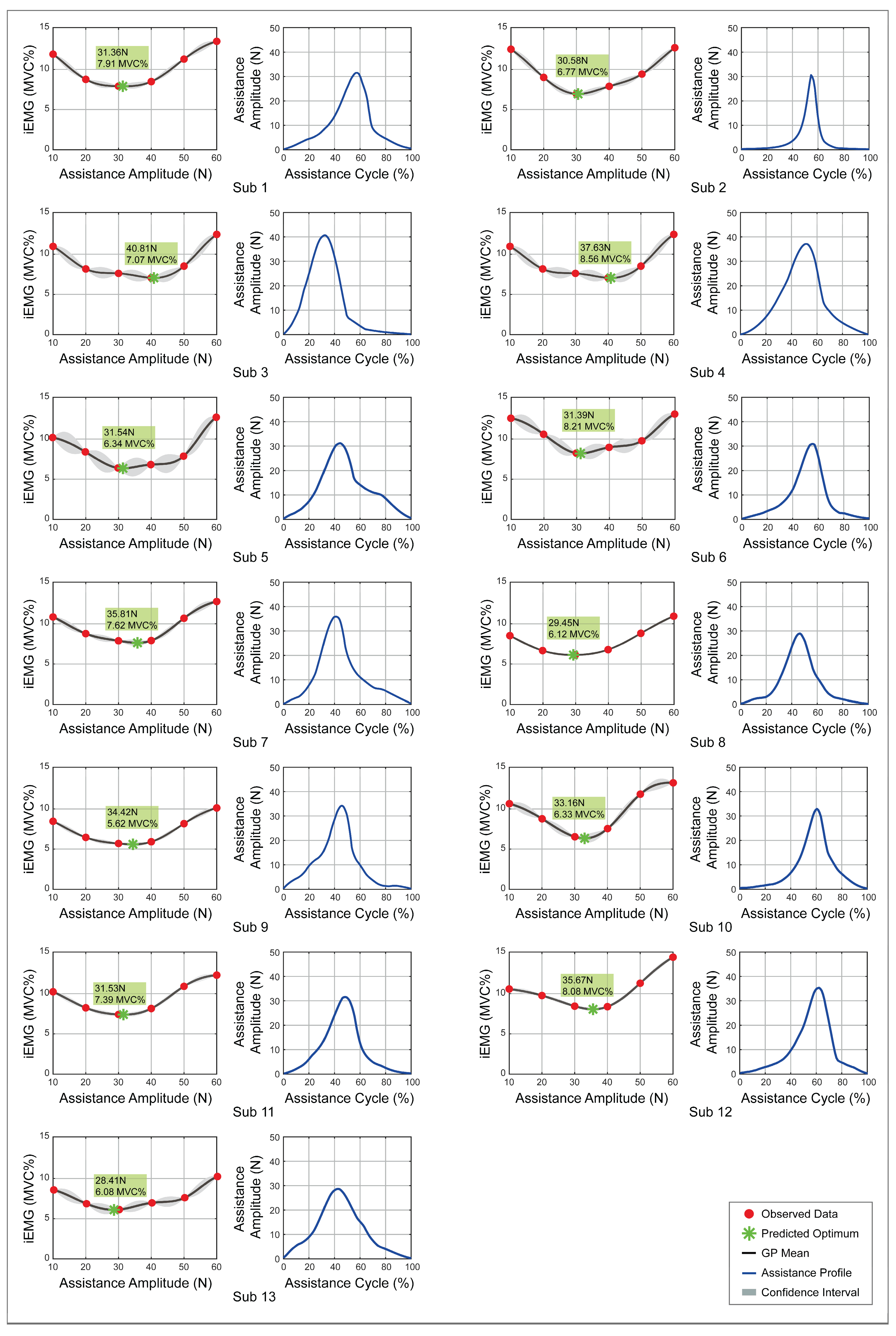
Representative Bayesian optimization curves for the SSV group are presented in Figure 5b, illustrating the GP posterior mean, 95% confidence intervals, and predicted optima across low, moderate, and high biomechanical demand profiles. The distribution of resulting optimal amplitudes for all participants is shown in Figure 5c. Finally, the personalized assistance profiles (time-domain force curves) generated from these optimized amplitudes are illustrated in Figure 6. Complete Bayesian optimization results and generated assistance profiles for all 13 subjects are presented in Figure A1.
2.5. Statistical Analysis
All statistical analyses were performed using IBM SPSS Statistics (Version 26.0, USA), with a two-tailed significance level set at α=0.05 and all data presented as mean ± SD. Prior to hypothesis testing, the Shapiro-Wilk test was used to verify the normality of data distribution, and Mauchly’s test was applied to validate the sphericity assumption, with Greenhouse-Geisser correction employed to adjust degrees of freedom when sphericity was violated. One-way repeated-measures analysis of variance (ANOVA) was conducted to evaluate differences in multi-plane hip joint moment estimation accuracy across 7 models (BPNN, FNN, LSTM, NTM, RNN, N–E, PDFM) and differences in neuromuscular/metabolic outcomes across 4 experimental conditions, with Bonferroni-corrected post-hoc tests used for pairwise comparisons to control Type I error, and partial eta squared (ηₚ²) reported as the effect size to quantify the magnitude of observed effects, with 0.01, 0.06 and 0.14 defined as small, medium and large effects per Cohen’s standard.
3. Result
3.1. Accuracy of Hip Moment Output by PDFM
In LOSO cross-validation (n=13), the PDFM achieved superior hip joint moment estimation accuracy compared to the Newton–Euler model and five single neural network baselines (BPNN, FNN, LSTM, NTM, and RNN), as shown in Figure 7. One-way repeated-measures ANOVA revealed significant differences among the seven models across all accuracy metrics and planes (Table 2).
For Correlation-Accuracy (R), significant main effects were observed in the sagittal (F [2.14, 25.69] = 8.694, p < 0.001, ηₚ² = 0.420), coronal (F [1.38, 16.50] = 65.292, p < 0.001, ηₚ² = 0.845), and transverse planes (F [1.18, 14.18] = 347.427, p < 0.001, ηₚ² = 0.967). Post-hoc Bonferroni-corrected comparisons indicated that PDFM significantly outperformed all single neural networks in the sagittal (92.51 ± 4.1%) and transverse (88.15 ± 6.1%) planes (all p < 0.05). However, in the coronal plane, while PDFM (86.86 ± 5.1%) significantly exceeded BPNN, FNN, LSTM, and RNN (all p < 0.002), it exhibited comparable performance to NTM (85.46 ± 8.1%, p = 0.616) and was significantly outperformed by the Newton–Euler model (88.43 ± 4.2%, p < 0.002).
Analysis of the five single neural networks’ R values revealed significant performance variations in the coronal (F [1.46, 17.51] = 35.243, p < 0.001, ηₚ² = 0.746) and transverse planes (F [1.31, 15.74] = 425.219, p < 0.001, ηₚ² = 0.973), but not in the sagittal plane (F [1.89, 22.73] = 2.074, p = 0.151, ηₚ² = 0.147). Post-hoc comparisons indicated that LSTM and NTM significantly exceeded the other three models in the coronal and transverse planes (all p < 0.001). Specifically, LSTM (88.64 ± 7.7%) achieved the highest accuracy in the sagittal plane, whereas NTM (84.72 ± 8.7%)—though numerically inferior to RNN (89.26 ± 5.6%) in this plane—demonstrated significantly superior performance to RNN in the other two planes (all p < 0.002). These findings informed the selection of LSTM and NTM as the fusion factors in Section 2.3.2.
Regarding RMSE, significant model effects were detected in the sagittal (F [1.00, 12.05] = 82.225, p < 0.001, ηₚ² = 0.873) and coronal planes (F [1.02, 12.26] = 91.682, p < 0.001, ηₚ² = 0.884). PDFM exhibited significantly lower RMSE than all other models in these two planes (sagittal: 0.157 ± 0.041 N·m/kg; coronal: 0.126 ± 0.026 N·m/kg; all p < 0.001). In the transverse plane, PDFM (0.028 ± 0.012 N·m/kg) significantly outperformed BPNN, FNN, LSTM, RNN, and N–E (p < 0.05), but did not significantly differ from NTM (0.032 ± 0.018 N·m/kg, p = 1.000).
For Correlation Coefficients, which evaluate temporal similarity and phase consistency, significant main effects were observed across all three planes (sagittal: F [1.03, 12.38] = 319.959, p < 0.001, ηₚ² = 0.964; coronal: F [1.13, 13.57] = 309.512, p < 0.001, ηₚ² = 0.963; transverse: F [1.04, 12.43] = 160.598, p < 0.001, ηₚ² = 0.930). Post-hoc comparisons indicated that PDFM achieved significantly higher correlation coefficients than all comparative models in the sagittal (0.938 ± 0.028, p < 0.001) and transverse (0.929 ± 0.029, p < 0.001) planes. However, in the coronal plane, while PDFM (0.924 ± 0.024) significantly exceeded the five single neural networks (all p < 0.001), it was significantly outperformed by the Newton–Euler model (0.939 ± 0.022, p < 0.001).
The estimation results for the sagittal plane across all models (88.16 ± 2.63% for R) were superior to those for the coronal (75.47 ± 10.96%) and transverse (75.78 ± 9.01%) planes. This variation aligns with established biomechanical characteristics: sagittal-plane motion exhibits relatively stable and pronounced patterns, whereas coronal and transverse moments exhibit higher inter-subject variability and rely more heavily on whole-body coordination.
Table 3 presents the dynamic weight allocations by the FCCM across gait phases. During the stance phase, NTM was generally assigned higher weights across most phases and planes. However, its weight was lower than that of LSTM in specific instances: the sagittal plane during Loading Response, the coronal plane during Midstance, and both the transverse and coronal planes during Terminal Stance. In contrast, during the swing phase, NTM’s weight exceeded that of the Newton–Euler model only in the transverse plane.
3.2. Bayesian Optimization Outcomes
Although the cohort mean (33.21 ± 3.51 N) approximated the empirical fixed value of 35 N, optimal amplitudes spanned a considerable range (28.41–40.81 N). Notably, 3 of 13 subjects (23.08%) exhibited optimal amplitudes > 40 N or < 30 N, suggesting that a fixed 35 N would result in either insufficient assistance or compensatory over-activation for these individuals.
3.3. Electromyographic and Metabolic Effect of the Assistance
iEMG serves as a surrogate measure of neural drive; reductions under submaximal contractions are associated with decreased efferent electrical signals and motor unit recruitment. Therefore, we employed iEMG to evaluate the efficacy of the optimized assistance profile.
The iEMG of the three target muscles and their mean values were compared across four testing conditions (Figure 8 and Table 4): no-exo (NE), non-assisted (NA), applied conventional profile (CP), and applied optimized profile (OP). ANOVA revealed significant differences in mean iEMG across conditions (F [1.00, 13.00] = 4332.586, p < 0.001, ηₚ² = 0.997). Compared to the NE condition (10.77 ± 1.19%MVC), mean iEMG was significantly reduced by 49.31% in OP (5.46 ± 1.01%MVC) and 33.61% in CP (7.15 ± 1.37%MVC) (p < 0.001), with the RF showing the greatest reduction among the three target muscles (54.34% and 43.07%, respectively). This reduction is consistent with successful unloading of the target muscles by the exosuit assistance. Compared to CP, mean iEMG decreased by 23.64% in OP.
Relative iEMG reductions exhibited different patterns across baselines. Compared with NE, OP showed a significantly larger reduction in RF (54.34%) than in VLO (52.10%) and VMO (44.11%) (all p < 0.03). In contrast, compared with CP, the reduction in RF (19.93%) was significantly smaller than those in VLO (28.19%) and VMO (23.25%) (all p < 0.001). This differential pattern suggests that the optimized assistance achieved more selective unloading of the primary target muscle (RF) while minimizing concurrent activation demands on synergistic knee extensors (VLO and VMO), whereas the conventional profile appeared to distribute mechanical assistance less discriminately across the muscle group.
Both metabolic cost and respiratory exchange ratio (RER) differed significantly across the four conditions (metabolic cost: F [1.05, 12.60] = 200.416, p < 0.001, ηₚ² = 0.944; RER: F [1.08, 12.91] = 10.741, p < 0.001, ηₚ² = 0.472) (Figure 9 and Table 4). Compared to the NE condition (3.66 ± 0.28 W/kg), net metabolic cost significantly decreased in OP (3.12 ± 0.36 W/kg) and CP (3.31 ± 0.44 W/kg) by 14.75% and 9.56%, respectively (all p < 0.001). Furthermore, RER in the OP condition (0.86 ± 0.06) was significantly lower than in NE (0.92 ± 0.05), NA (0.91 ± 0.04), and CP (0.90 ± 0.04) (all p < 0.001), consistent with improved metabolic efficiency. Restricted to CP and OP conditions, ANOVA indicated significantly reduced metabolic cost and RER in the optimized profile (F [1,12] = 82.273, p < 0.001, ηₚ² = 0.873; and F [1,12] = 51.896, p < 0.001, ηₚ² = 0.812), suggesting the effectiveness of the effectiveness of the profile optimization.
4. Discussion
This study developed a high-accuracy hip joint moment estimation model (PDFM) that eliminates the dependency on ground reaction forces, and customized the exoskeleton assistance profile based on its output to enhance assistive efficacy. The results demonstrate that PDFM not only exhibits high biomechanical interpretability but also surpasses traditional biomechanical and single-network computational methods in hip joint moment estimation accuracy. The optimized assistance profile significantly reduced the load on the primary target muscles and overall metabolic cost while improving muscle coordination patterns, thereby achieving assistance effects associated with more natural muscle activation patterns.
The PDFM achieved the highest accuracy in estimating hip joint moments across all three anatomical planes, outperforming all single neural network baselines and thereby validating the effectiveness of its complementary learning fusion strategy. Notably, the accuracy improvements provided by PDFM in the coronal and transverse planes were substantially greater than those in the sagittal plane. This observation aligns with established biomechanical characteristics of gait: during level walking, sagittal-plane motion (primarily related to propulsion) exhibits relatively stable and pronounced patterns that are easier for models to capture. In contrast, moments in the coronal (adduction/abduction) and transverse (internal/external rotation) planes are generally lower in amplitude, exhibit higher inter-subject variability, and rely more heavily on whole-body coordination to maintain dynamic balance [25]. The superior performance of PDFM in the non-sagittal planes can be attributed to its fusion mechanism, which enhances its ability to capture these subtle and complex dynamic patterns. This capability suggests considerable potential for applications in non-sagittal plane motion analysis and complex gait intent recognition.
The optimal dynamic weight allocation by the FCCM algorithm provides insights into the compatibility between different estimation models and biomechanical gait phases. During propulsion phases involving continuous load transfer—specifically Loading Response and Terminal Stance in the sagittal plane—the LSTM model, which excels in processing sequential temporal dependencies, demonstrated stronger adaptability. In contrast, during phases associated with balance control—including Initial Contact, Midstance, and Preswing in the sagittal plane, as well as most phases in the coronal and transverse planes—the NTM model exhibited higher suitability, likely attributable to its superior capacity for memorizing and learning complex biomechanical phase templates. Notably, the Newton–Euler method received higher weights during the Swing phase in the sagittal and coronal planes, reflecting its advantage in physical consistency when ground reaction forces are absent. However, in the transverse plane, NTM remained dominant during Swing phase, which may be attributed to the higher computational complexity inherent in modeling hip rotational dynamics using rigid-body mechanics [26].
The PDFM demonstrates potential for wearable applications, as its input features (joint kinematics) are compatible with IMU-based motion capture systems, though the current implementation utilized laboratory-grade optical tracking. Crucially, the high-accuracy hip joint moment estimates provided by the PDFM serve as the essential biomechanical input for the human–exoskeleton dynamics model, enabling the generation of physiologically consistent assistance profiles. This precise estimation capability establishes the necessary foundation for subject-specific customization, ensuring that the derived assistance parameters align with individual biomechanical demands.
The assistance profile optimized based on PDFM output and iEMG-guided Bayesian optimization exhibited statistically significant improvements across the evaluated neuromuscular and metabolic parameters. At the muscle activity level, OP reduced the overall iEMG of the target muscle group by 49.31% compared to NE, consistent with effective load sharing by the exoskeleton. Changes in muscle activation patterns were observed between conditions. When transitioning from the NE condition to the OP condition, the primary reduction in activation occurred in the RF. In contrast, when shifting from the CP condition to the OP condition, greater reductions were observed in the VLO and VMO relative to the RF. This suggests that the CP condition may have elicited different recruitment strategies among the quadriceps components, whereas the optimized profile was associated with a redistribution of mechanical demand favoring the primary hip flexor (RF). These condition-dependent differences in muscle activation distribution are consistent with the enhanced customization achieved by the optimized assistance profile.
The optimization at the muscular level was ultimately reflected in a reduction of whole-body metabolic cost. During the OP condition, net metabolic cost decreased by 14.75% compared to NE and by 5.74% compared to the CP condition. This metabolic economy surpasses that reported for recent cable-driven (11.35%) and unpowered (7.2%) hip-assistive devices [1,9]. Furthermore, the concurrent decrease in RER (from 0.91 to 0.86) is consistent with a modest increase in the relative contribution of fat oxidation to total energy expenditure [27]. This may reflect a reduction in overall physiological load while maintaining the same walking speed, potentially contributing to decreased perceived exertion.
This study has several limitations. First, although the current sample size (n = 13) meets the fundamental requirements for testing the primary hypotheses, expanding the cohort would enhance statistical power and generalizability of the conclusions, enabling subgroup analyses based on demographic or biomechanical characteristics. Second, all experiments were conducted in a controlled laboratory setting; therefore, the transferability and ecological validity of the findings to complex real-world scenarios require further verification. Third, while PDFM performs well as an offline analysis tool, whether its computational efficiency can support future low-latency real-time control remains to be validated through subsequent engineering implementation and system optimization. Future research will focus on integrating PDFM with wearable sensing systems (e.g., IMUs) and extending its application to broader user populations, such as older adults and individuals with neurological impairments.
5. Conclusions
This study proposes a fusion model (PDFM) for high-accuracy hip joint moment estimation. The model achieved prediction accuracies of 92.51%, 86.86%, and 88.15% in the sagittal, coronal, and transverse planes, respectively, outperforming all single-network baselines while providing biomechanically interpretable weight allocations (Table 3) that elucidate the complementary strengths of physics-based and data-driven approaches. This consistent high-fidelity estimation (R > 86% in all planes), achieved without ground reaction force measurements, establishes a critical foundation for wearable applications. Leveraging the sagittal-plane moment estimates from the PDFM, a customized assistance profile was derived through human-exo dynamic formulation and Bayesian amplitude optimization. In subsequent wearable experiments, this optimized profile reduced target muscle group activity by approximately 49.31%, lowered net metabolic cost by 14.75%, and significantly decreased the RER from 0.92 to 0.86. These results demonstrate that personalized assistance optimization, driven by high-fidelity biomechanical perception (via PDFM), can synergistically achieve significant neuromuscular unloading and metabolic savings. This work provides a validated framework and crucial empirical evidence to inform the development of next-generation intelligent and efficient wearable assistive systems.
Author Contributions
H.T.: Methodology, Software, Investigation, Formal analysis, Validation, Data cu-ration, Writing – original draft, Writing – review & editing; J.W.: Methodology, Writing – review & editing, Project administration, Resources; S.G.: Conceptualization, Meth-odology, Writing – review & editing, Project administration, Funding acquisition; F.C.: Investigation – subject recruitment, experimental setup, experimental execution, raw data management; L.L.: Data curation, Model training; All authors: Read and approved the final manuscript.
Funding
This research was funded by the National Natural Science Foundation of China, grant number 52275018, U23A20344 and 62303155.
Institutional Review Board Statement
The study was conducted in accordance with the Declaration of Helsinki, and approved by the Institutional Review Board Ethics Committee of Hebei University of Technology (No. [HEBUThMEC2022005], 2022.07.01).
Informed Consent Statement
Informed consent was obtained from all subjects involved in the study.
Data Availability Statement
The original data are available following reasonable request.
Acknowledgments
The authors thank Xusheng Liu (Physical Therapist) for providing technical guidance and ensuring participant safety during MVC, sEMG, and metabolic consumption testing.
Conflicts of Interest
The authors declare no conflicts of interest.
Abbreviations
The following abbreviations are used in this manuscript:
| PDFM | Physics-guided Dynamic Fusion Model |
| PINN | Physics-informed Neural Networks |
| N–E | Newton–Euler |
| EMG | Electromyography |
| GRF | Ground Reaction Forces |
| IMUs | Inertial Measurement Units |
| LSTM | Long Short-term Memory |
| RMSE | Root Mean Square Error |
| NTM | Neural Turing Machines |
| sEMG | surface Electromyography |
| iEMG | integrated Electromyography |
| RF | Rectus Femoris |
| VMO | Vastus Medialis Obliquus |
| VLO | Vastus Lateralis Obliquus |
| MVC | Maximum Voluntary Contraction |
| NE | No-exo |
| NA | Non-assisted |
| CP | Conventional Profile |
| OP | Optimized Profile |
| BPNN | Backpropagation Neural Network |
| FNN | Feedforward Neural Network |
| RNN | Recurrent Neural Network |
| LOSO | Leave-one-subject-out |
| FCCM | Fusion Coefficient Calibration Method |
| SSV | Stratified Safety Validation |
| GP | Gaussian Process |
| ANOVA | One-way Repeated-measures Analysis of Variance |
| RER | Respiratory Exchange Ratio |
Appendix A

Table A1.
Demographic and physical characteristics of all participants.
| Participant No. | Sex | Age (years) | Height (m) | Body mass (kg) |
|---|---|---|---|---|
| 1 | M | 25 | 1.78 | 72.6 |
| 2 | M | 26 | 1.72 | 68.3 |
| 3 | M | 25 | 1.83 | 78.6 |
| 4 | M | 27 | 1.86 | 80.4 |
| 5 | M | 25 | 1.85 | 65.1 |
| 6 | M | 31 | 1.75 | 78.2 |
| 7 | M | 26 | 1.69 | 65.5 |
| 8 | M | 28 | 1.83 | 84.4 |
| 9 | F | 32 | 1.68 | 62.1 |
| 10 | F | 34 | 1.67 | 71.4 |
| 11 | F | 27 | 1.72 | 63.4 |
| 12 | F | 31 | 1.57 | 56.5 |
| 13 | F | 28 | 1.69 | 60.6 |
| Mean ± SD | 8M/5F | 28.08 ± 3.12 | 1.74 ± 0.09 | 69.78 ± 8.56 |
All participants were free of musculoskeletal/neurological disorders, could walk independently, and provided written informed consent. Exclusion criteria included recent lower-limb injury, exoskeleton contraindications, and inability to follow instructions.
Table A2.
Hyperparameter settings of the five standalone neural network baseline models.
| Model | Hyperparameters & Training Details |
|---|---|
| BPNN | • Architecture: Input + FC + Output • Hidden layers: 3 FC layers (64-128-64 units) • Activation: ReLU • Optimizer: Adam • Learning rate: 5×10⁻⁵ • Regularization: L2 penalty (λ=1×10⁻⁵) • Batch size: 16 |
| FNN | • Architecture: Input + FNN + Output • Hidden layers: 2 FC layers (128-64 units) • Activation: ReLU • Optimizer: Adam • Learning rate: 5×10⁻⁵ • Regularization: L2 penalty (λ=1×10⁻⁵) • Batch size: 16 |
| LSTM | • Architecture: Input + LSTM + FC (linear) + Output • LSTM hidden units: 128 • FC layer units: 3 units • Optimizer: Adam • Learning rate: 5×10⁻⁵ • Dropout: 0.4 • Batch size: 16 |
| RNN | • Architecture: Input + RNN + FC + Output • Hidden units: 128 • FC layer units: 3 • Optimizer: Adam • Learning rate: 5×10⁻⁵ • Dropout: 0.3 • Batch size: 16 |
| NTM | • Architecture: Input + NTM + FC (linear) + Output • Controller: LSTM (128 hidden units) • Memory matrix: 128 × 40 (content-addressable) • FC layer units: 3 units • Read/Write heads: 1 head • Optimizer: Adam • Learning rate: 5×10⁻⁵ • Batch size: 16 |
All models were evaluated using leave-one-subject-out (LOSO) cross-validation (13-fold). Training was performed with a maximum of 150 epochs and early stopping (patience = 10) based on validation loss. Within each training fold (n = 12 subjects), 20% of subjects (2–3 subjects) were held out as a validation set using subject-wise partitioning to ensure independence between training and validation data, preventing data leakage from the same participant. For the PDFM, the underlying NTM and LSTM sub-models retained their original hyperparameter configurations during fusion.
References
- Kim, E; Lee, S.H.; Kim, D; Yu, J; Lee, H.J.; Kim, Y.H. A wearable hip exoskeleton for anaerobic exercise in healthy adults. Sci Rep 2024, 14, 26424. [Google Scholar] [CrossRef]
- Lee, D; Lee, S.H.; Young, A.J. AI-driven universal lower-limb exoskeleton system for community ambulation. Sci Adv 2024, 10, eadq0288. [Google Scholar] [CrossRef]
- Kim, H.S.; Park, J.H.; Lee, H.S.; Lee, J.Y.; Jung, J.W.; Park, S.B.; Hyun, D.J.; Park, S.; Yoon, J.; Lim, H. Effects of wearable powered exoskeletal training on functional mobility, physiological health and quality of life in non-ambulatory spinal cord injury patients. J Korean Med Sci 2021, 36, e80. [Google Scholar] [CrossRef]
- Chen, W.B.; Wu, S.; Zhou, T.C.; Xiong, C.H. On the biological mechanics and energetics of the hip joint muscle-tendon system assisted by passive hip exoskeleton. Bioinspir Biomim 2019, 14, 016012. [Google Scholar] [CrossRef]
- Hao, M.; Chen, K.; Fu, C.L. Effects of hip torque during step-to-step transition on center-of-mass dynamics during human walking examined with numerical simulation. J Biomech 2019, 90, 33–39. [Google Scholar] [CrossRef]
- Ishmael, M.K.; Gunnell, A.; Pruyn, K.; Creveling, S.; Hunt, G.; Hood, S.; Archangeli, D.; Foreman, K.B.; Lenzi, T. Powered hip exoskeleton reduces residual hip effort without affecting kinematics and balance in individuals with above-knee amputations during walking. IEEE Trans Biomed Eng 2023, 70, 1162–1171. [Google Scholar] [CrossRef]
- Lee, H.J.; Lee, S.; Chang, W.H.; Seo, K.; Shim, Y.; Choi, B.O.; Ryu, G.H.; Kim, Y.H. A wearable hip assist robot can improve gait function and cardiopulmonary metabolic efficiency in elderly adults. IEEE Trans Neural Syst Rehabil Eng 2017, 25, 1549–1557. [Google Scholar] [CrossRef] [PubMed]
- Gordon, D.F.N.; McGreavy, C.; Christou, A.; Vijayakumar, S. Human-in-the-loop optimization of exoskeleton assistance via online simulation of metabolic cost. IEEE Trans Robot 2022, 38, 1410–1429. [Google Scholar] [CrossRef]
- Zhou, T.C.; Xiong, C.H.; Zhang, J.J.; Hu, D.; Chen, W.B.; Huang, X.L. Reducing the metabolic energy of walking and running using an unpowered hip exoskeleton. J Neuroeng Rehabil 2021, 18, 95. [Google Scholar] [CrossRef] [PubMed]
- Young, A.J.; Gannon, H.; Ferris, D.P. A biomechanical comparison of proportional electromyography control to biological torque control using a powered hip exoskeleton. Front Bioeng Biotechnol 2017, 5, 37. [Google Scholar] [CrossRef]
- Farris, D.J.; Robertson, B.D.; Sawicki, G.S. Elastic ankle exoskeletons reduce soleus muscle force but not work in human hopping. J Appl Physiol 2013, 115, 579–585. [Google Scholar] [CrossRef]
- Pandy, M.G.; Berme, N. A numerical method for simulating the dynamics of human walking. J Biomech 1988, 21, 1043–1051. [Google Scholar] [CrossRef] [PubMed]
- Gui, K.; Liu, H.H.; Zhang, D.G. A practical and adaptive method to achieve EMG-based torque estimation for a robotic exoskeleton. IEEE-ASME Trans Mechatron 2019, 24, 483–494. [Google Scholar] [CrossRef]
- Maideen, A.; Mohanarathinam, A. Deep learning-based torque and joint angle estimation from electromyography signals: a hybrid DNN-LSTM approach. KSII Trans Internet Inf Syst 2025, 19, 2529–2547. [Google Scholar]
- Zhang, L.B.; Soselia, D.; Wang, R.L.; Gutierrez-Farewik, E.M. Lower-limb joint torque prediction using LSTM neural networks and transfer learning. IEEE Trans Neural Syst Rehabil Eng 2022, 30, 600–609. [Google Scholar] [CrossRef]
- Zhang, L.B.; Soselia, D.; Wang, R.L.; Gutierrez-Farewik, E.M. Estimation of joint torque by EMG-driven neuromusculoskeletal models and LSTM networks. IEEE Trans Neural Syst Rehabil Eng 2023, 31, 3722–3731. [Google Scholar] [CrossRef] [PubMed]
- Wang, M.S.; Chen, Z.L.; Zhan, H.R.; Zhang, J.Y.; Wu, X.L.; Jiang, D.; Guo, Q. Lower limb joint torque prediction using long short-term memory network and gaussian process regression. Sensors 2023, 23, 9576. [Google Scholar] [CrossRef]
- Kim, J.; Quinlivan, B.T.; Deprey, L.A.; Revi, D.A.; Eckert-Erdheim, A.; Murphy, P.; Orzel, D.; Walsh, C.J. Reducing the energy cost of walking with low assistance levels through optimized hip flexion assistance from a soft exosuit. Sci Rep 2022, 12, 11004. [Google Scholar] [CrossRef]
- Witte, K.A.; Fiers, P.; Sheets, A.L.; Collins, S.H. Improving the energy economy of human running with powered and unpowered ankle exoskeleton assistance. Sci Robot 2020, 5, eaay9108. [Google Scholar] [CrossRef]
- Zhang, B.; Jiang, W.Z.; Tan, X.W.; Su, J.H.; Zhao, Y.W.; Zhao, X.A. Modular soft exoskeleton design and control for assisting movements in multiple lower limb joint configurations. IEEE Trans Autom Sci Eng 2025, 22, 20799–20813. [Google Scholar] [CrossRef]
- Guo, S.; Xiang, Q.; Hashimoto, K.; Jin, S. Assistive force of a belt-type hip assist suit for lifting the swing leg during walking. In Proceedings of the 2020 IEEE International Conference on Robotics and Automation (ICRA), France, 31 May 2020 - 31 August 2020. [Google Scholar]
- Molina-Rueda, F.; Fernández-González, P.; Cuesta-Gómez, A.; Koutsou, A.; Carratalá-Tejada, M.; Miangolarra-Page, J.C. Test-retest reliability of a conventional gait model for registering joint angles during initial contact and toe-off in healthy subjects. Int J Environ Res Public Health 2021, 18, 1343. [Google Scholar] [CrossRef]
- Xiang, Q.; Wang, J.X.; Liu, Y.; Guo, S.J.; Liu, L. Gait recognition and assistance parameter prediction determination based on kinematic information measured by inertial measurement units. Bioengineering-Basel 2024, 11, 275. [Google Scholar] [CrossRef] [PubMed]
- Sun, L.; Lu, W.; Wang, W.; Wang, H.; Xue, M.M.; Zhang, X.Y. A soft hip exoskeleton biomimetic assistance method incorporating dual-pretension and biomechanics-based force modeling. Med Biol Eng Comput 2026, PMID 7704869. [Google Scholar] [CrossRef] [PubMed]
- Winter, D.A. Human balance and posture control during standing and walking. Gait Posture 1995, 3, 193–214. [Google Scholar] [CrossRef]
- Neptune, R.R.; McGowan, C.P. Muscle contributions to whole-body sagittal plane angular momentum during walking. J Biomech 2011, 44, 6–12. [Google Scholar] [CrossRef] [PubMed]
- Romijn, J.A.; Coyle, E.F.; Sidossis, L.S.; Gastaldelli, A.; Horowitz, J.F.; Endert, E.; Wolfe, R.R. Regulation of endogenous fat and carbohydrate metabolism in relation to exercise intensity and duration. Am J Physiol 1993, 265, E380–E391. [Google Scholar] [CrossRef]
Figure 1.
Soft hip flexion assist exoskeleton structure: a) Exoskeleton structure and assistance principle; b) Exoskeleton donning effect.
Figure 1.
Soft hip flexion assist exoskeleton structure: a) Exoskeleton structure and assistance principle; b) Exoskeleton donning effect.
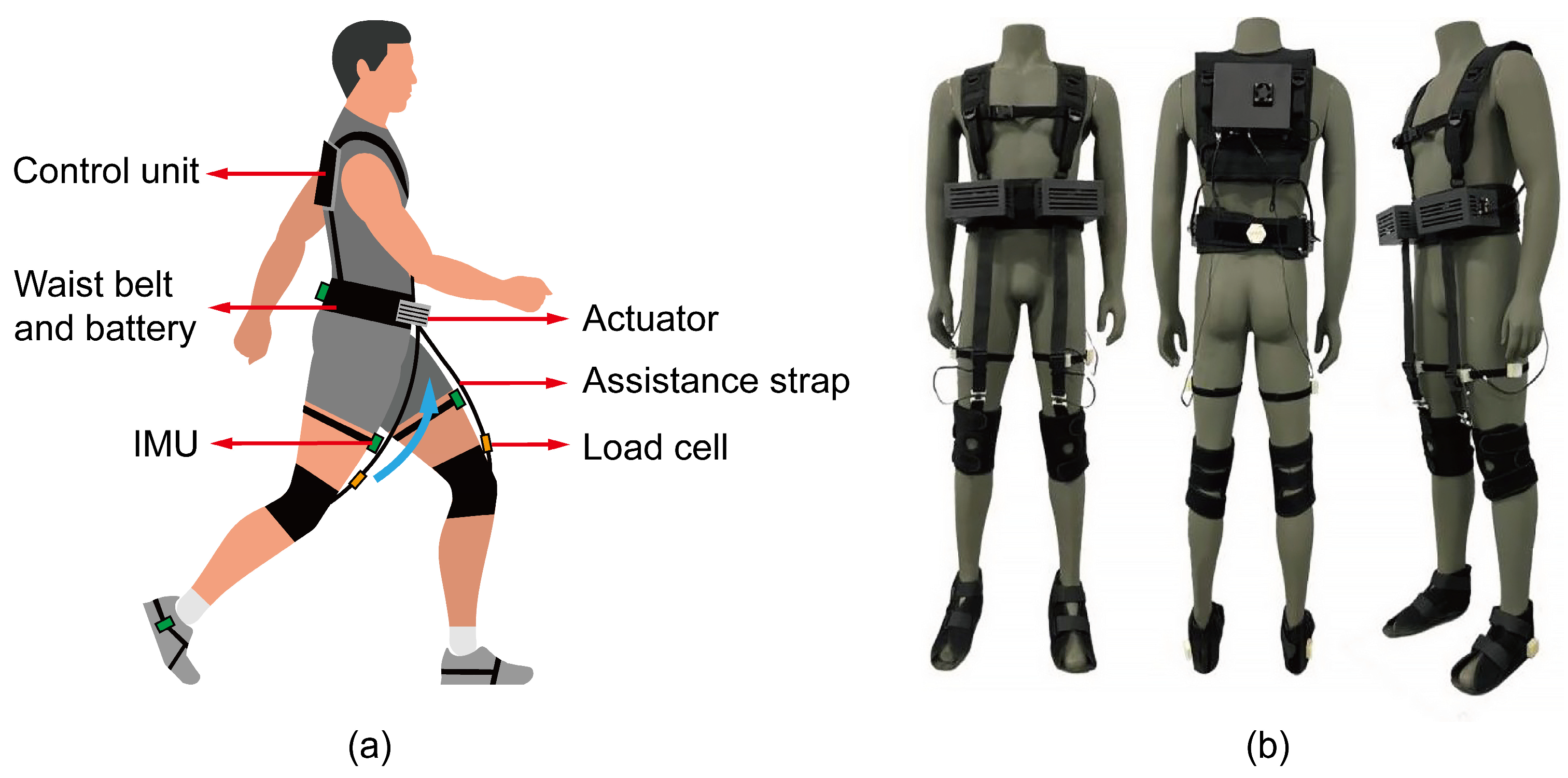
Figure 2.
Experimental setup: a) Biomechanical data collection; b) Surface electromyography data collection; c) Plug-in Gait marker set; d) Metabolic test.
Figure 2.
Experimental setup: a) Biomechanical data collection; b) Surface electromyography data collection; c) Plug-in Gait marker set; d) Metabolic test.
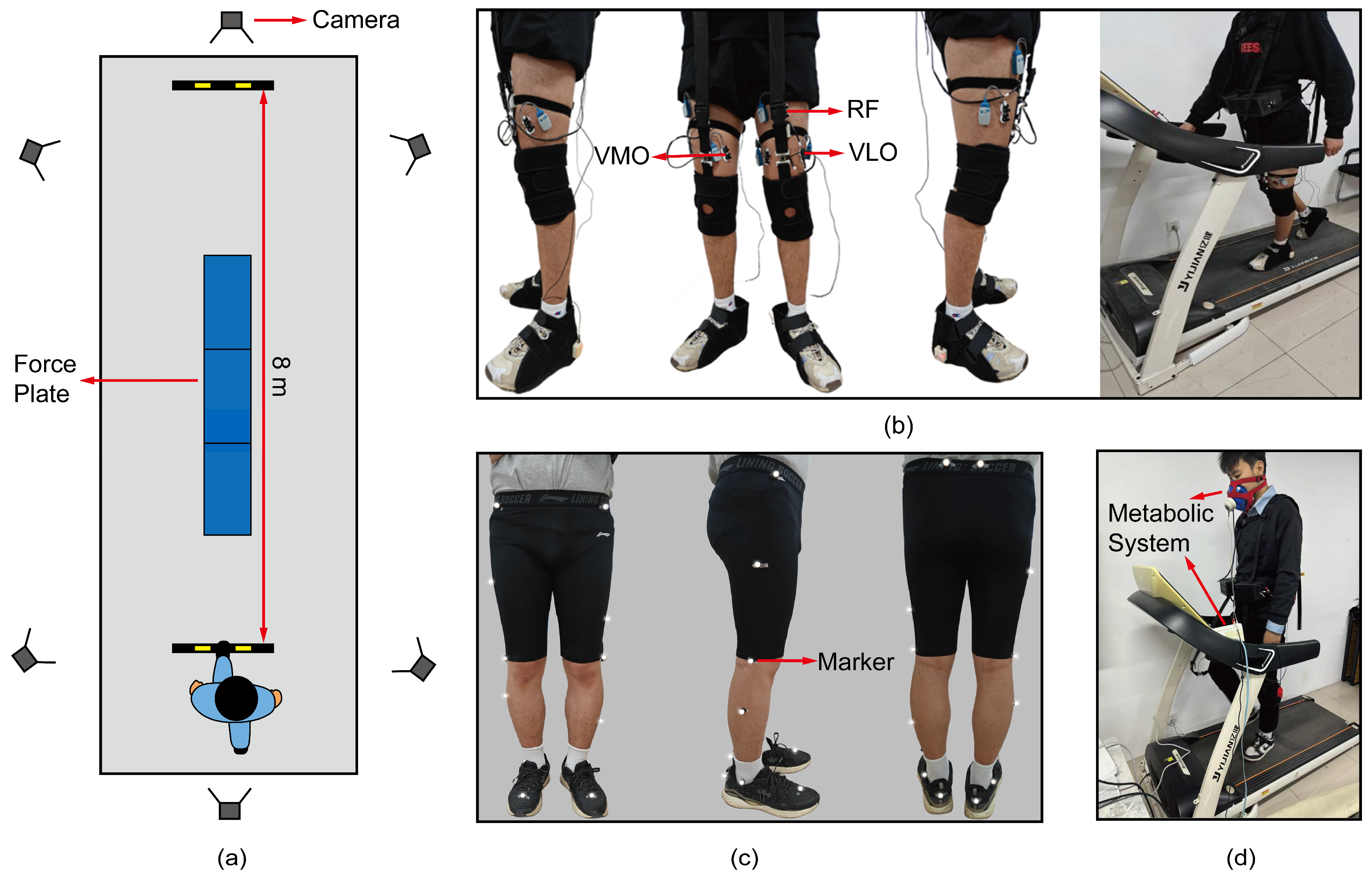
Figure 3.
Framework for PDFM.
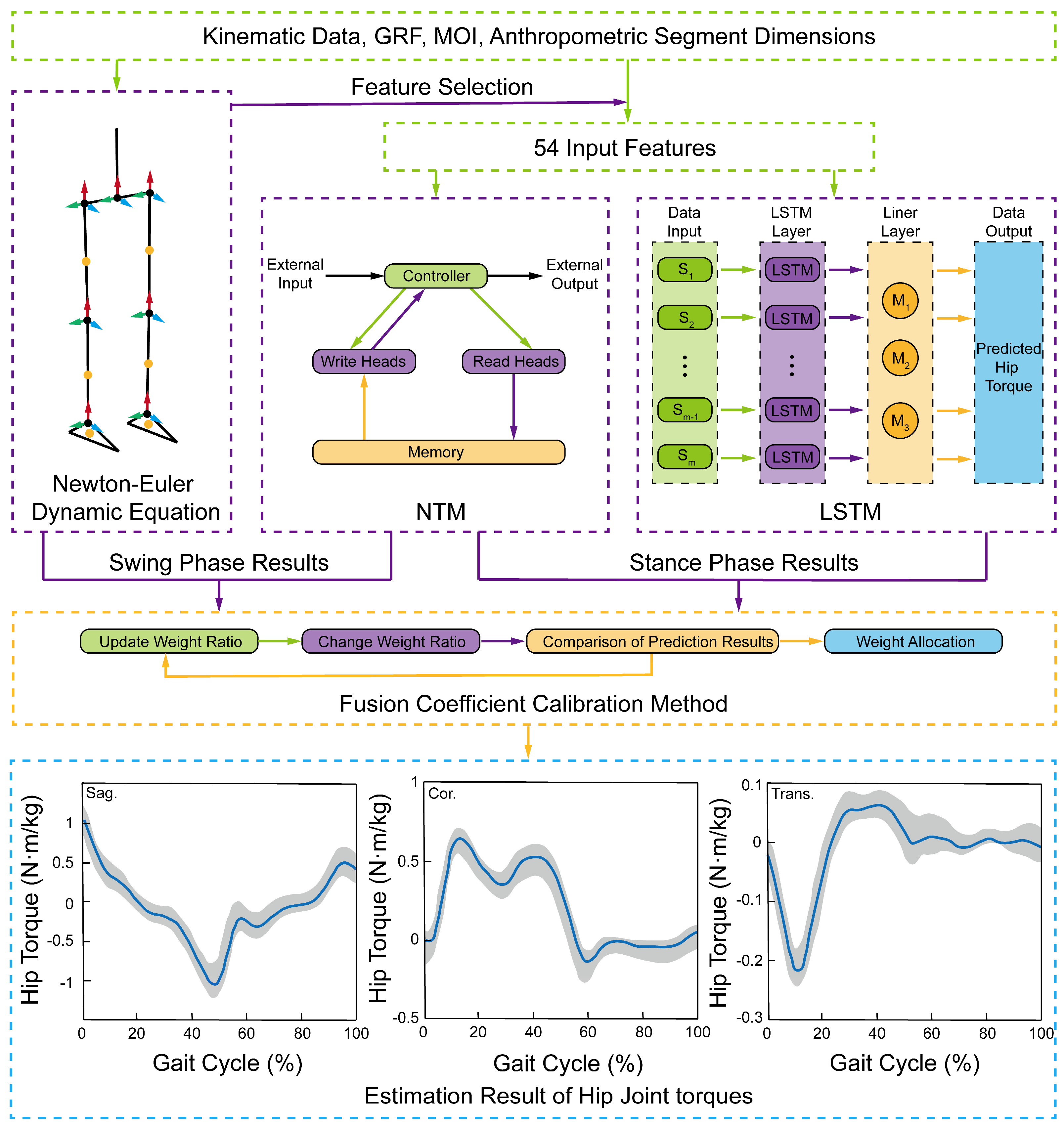
Figure 4.
Framework for assistance profile planning.
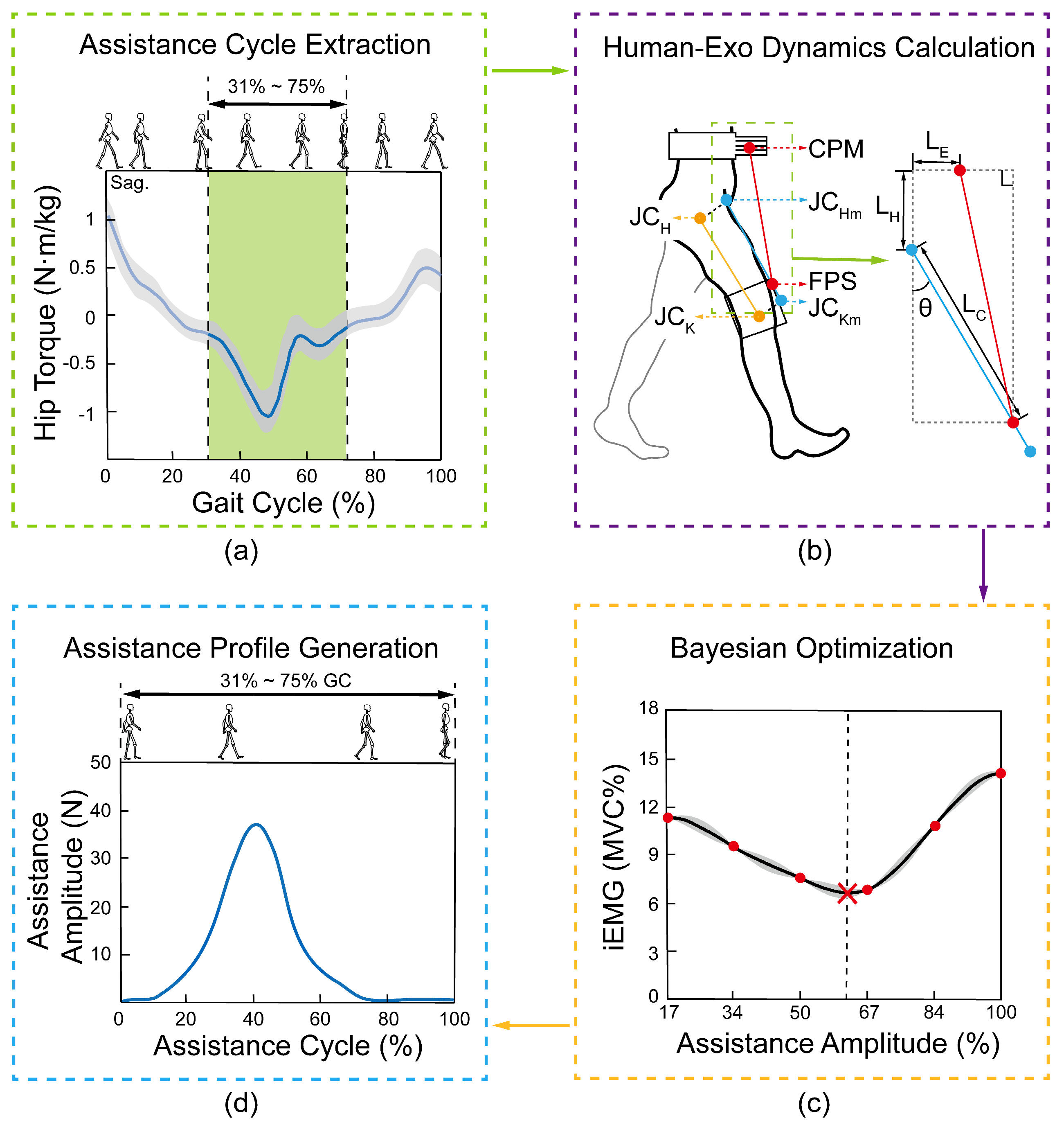
Figure 5.
Bayesian optimization of assistance amplitude. (a) Mean iEMG (%MVC) of the RF, VLO, and VMO muscles across varying assistance amplitudes for Stratified Safety Validation (SSV) group; (b) Gaussian process (GP) regression fitting (solid lines) with observed data points (red circles) and predicted optimal amplitudes (green stars); (c) Distribution of individually optimized assistance amplitudes across all 13 subjects, with the mean (red solid line) and standard deviation (blue dashed lines) indicated.
Figure 5.
Bayesian optimization of assistance amplitude. (a) Mean iEMG (%MVC) of the RF, VLO, and VMO muscles across varying assistance amplitudes for Stratified Safety Validation (SSV) group; (b) Gaussian process (GP) regression fitting (solid lines) with observed data points (red circles) and predicted optimal amplitudes (green stars); (c) Distribution of individually optimized assistance amplitudes across all 13 subjects, with the mean (red solid line) and standard deviation (blue dashed lines) indicated.
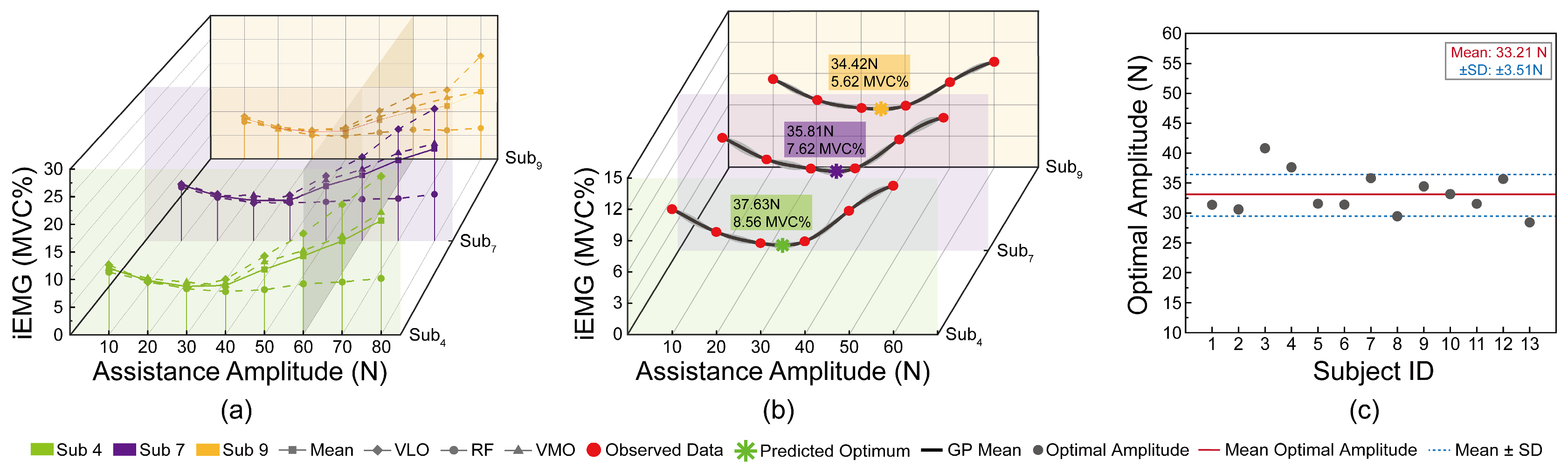
Figure 6.
Individualized hip flexion assistance torque amplitude profiles across a full normalized assistance cycle (0–100%) for SSV group.
Figure 6.
Individualized hip flexion assistance torque amplitude profiles across a full normalized assistance cycle (0–100%) for SSV group.
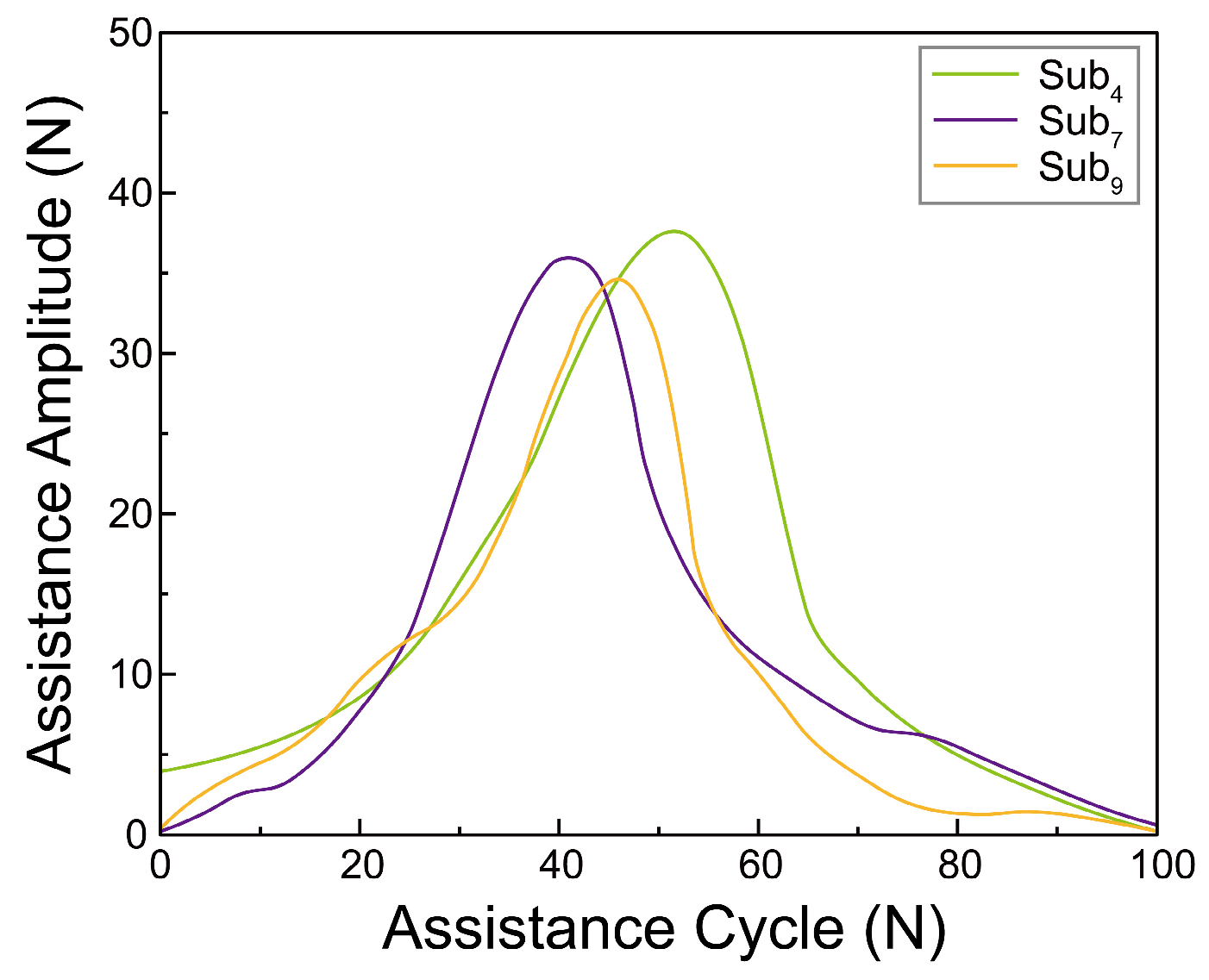
Figure 7.
Comparison of hip joint moment trajectories in (a) sagittal, (b) coronal, and (c) transverse planes. Solid blue line represents PDFM mean across thirteen subjects with shaded area indicating ±1 standard deviation; solid red line represents ground truth (Vicon-based inverse dynamics); dotted lines represent single neural network baselines (NTM, LSTM, RNN, FNN, BPNN) and Newton–Euler model shown as mean trajectories without error bands for clarity. The standard deviations are illustrated by the shaded area.
Figure 7.
Comparison of hip joint moment trajectories in (a) sagittal, (b) coronal, and (c) transverse planes. Solid blue line represents PDFM mean across thirteen subjects with shaded area indicating ±1 standard deviation; solid red line represents ground truth (Vicon-based inverse dynamics); dotted lines represent single neural network baselines (NTM, LSTM, RNN, FNN, BPNN) and Newton–Euler model shown as mean trajectories without error bands for clarity. The standard deviations are illustrated by the shaded area.
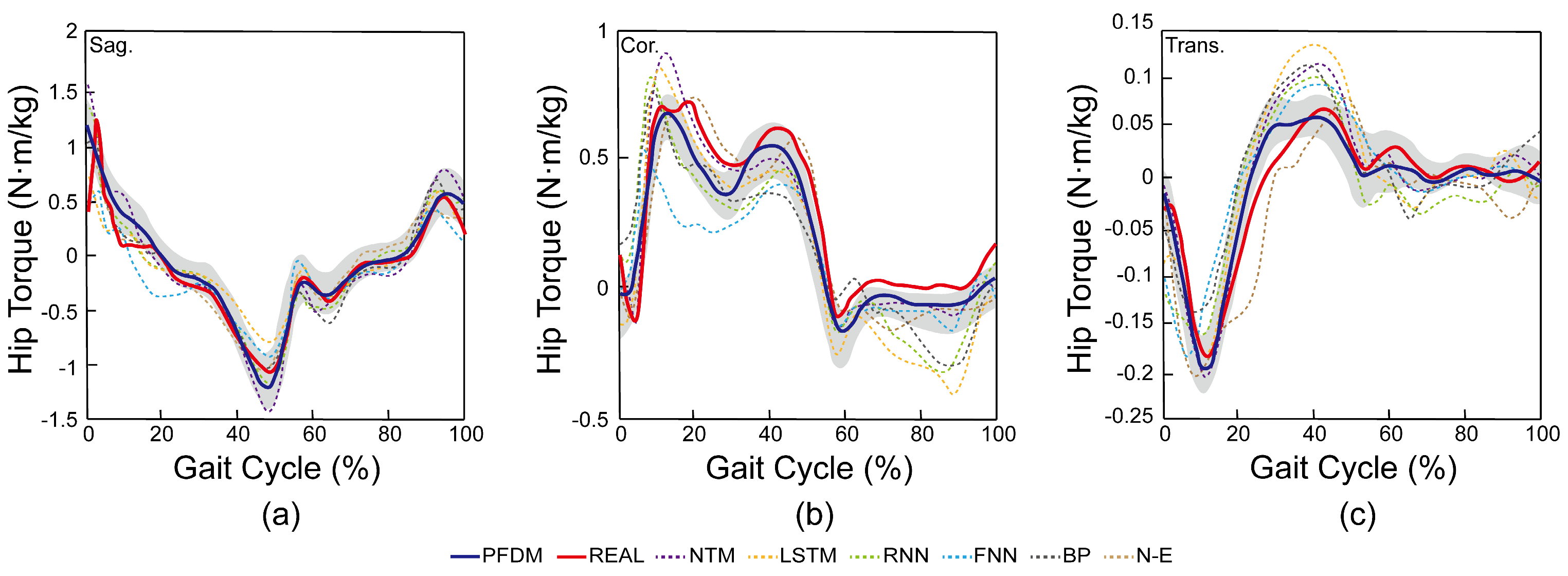
Figure 8.
Muscle activation levels (iEMG, %MVC) of the RF, VMO, and VLO during walking under four experimental conditions: no-exo (NE), non-assisted (NA), conventional assistance profile (CP), and optimized assistance profile (OP). Error bars indicate standard deviations. Percentage values positioned to the left of each bar represent changes relative to the NE condition, whereas values to the right represent changes relative to the CP condition.
Figure 8.
Muscle activation levels (iEMG, %MVC) of the RF, VMO, and VLO during walking under four experimental conditions: no-exo (NE), non-assisted (NA), conventional assistance profile (CP), and optimized assistance profile (OP). Error bars indicate standard deviations. Percentage values positioned to the left of each bar represent changes relative to the NE condition, whereas values to the right represent changes relative to the CP condition.
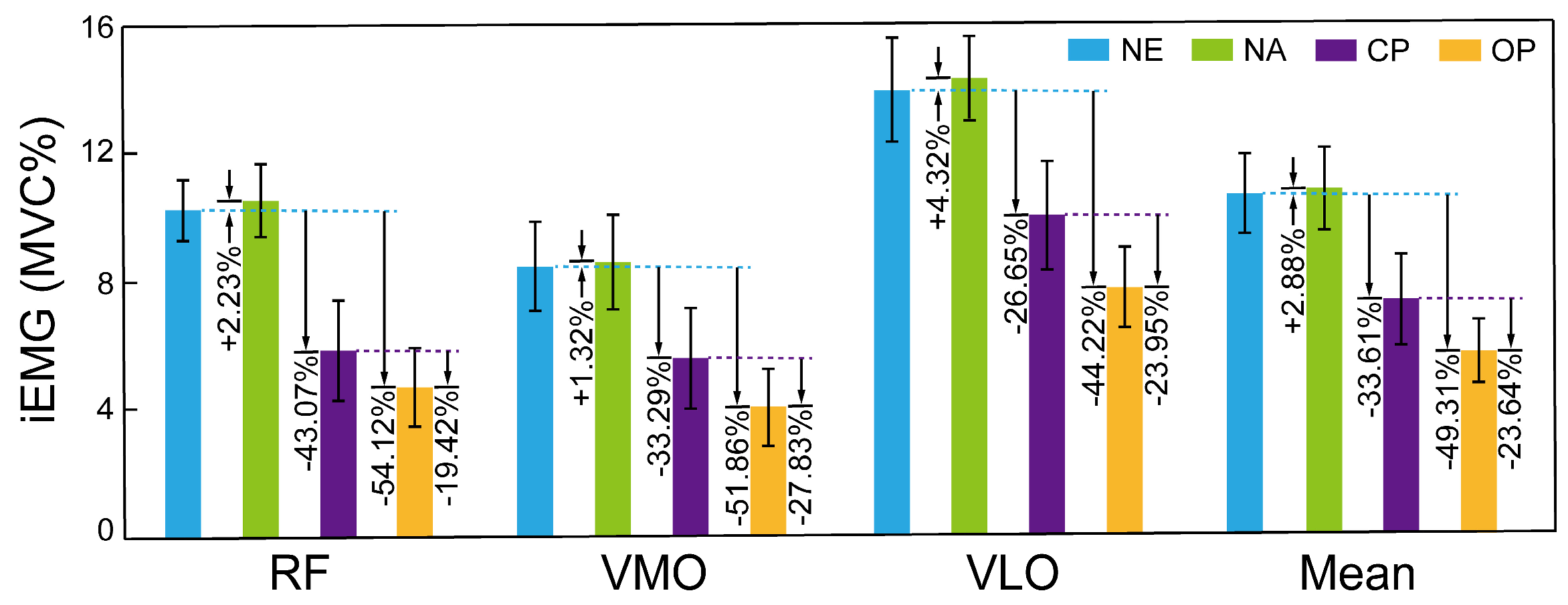
Figure 9.
(a) Net metabolic cost (W/kg) and (b) respiratory exchange ratio (RER) across four experimental conditions: no-exo (NE), non-assisted (NA), conventional assistance profile (CP), and optimized assistance profile (OP). Error bars indicate standard deviations. Percentage values positioned to the left of each bar represent changes relative to the NE condition, whereas values to the right represent changes relative to the CP condition.
Figure 9.
(a) Net metabolic cost (W/kg) and (b) respiratory exchange ratio (RER) across four experimental conditions: no-exo (NE), non-assisted (NA), conventional assistance profile (CP), and optimized assistance profile (OP). Error bars indicate standard deviations. Percentage values positioned to the left of each bar represent changes relative to the NE condition, whereas values to the right represent changes relative to the CP condition.
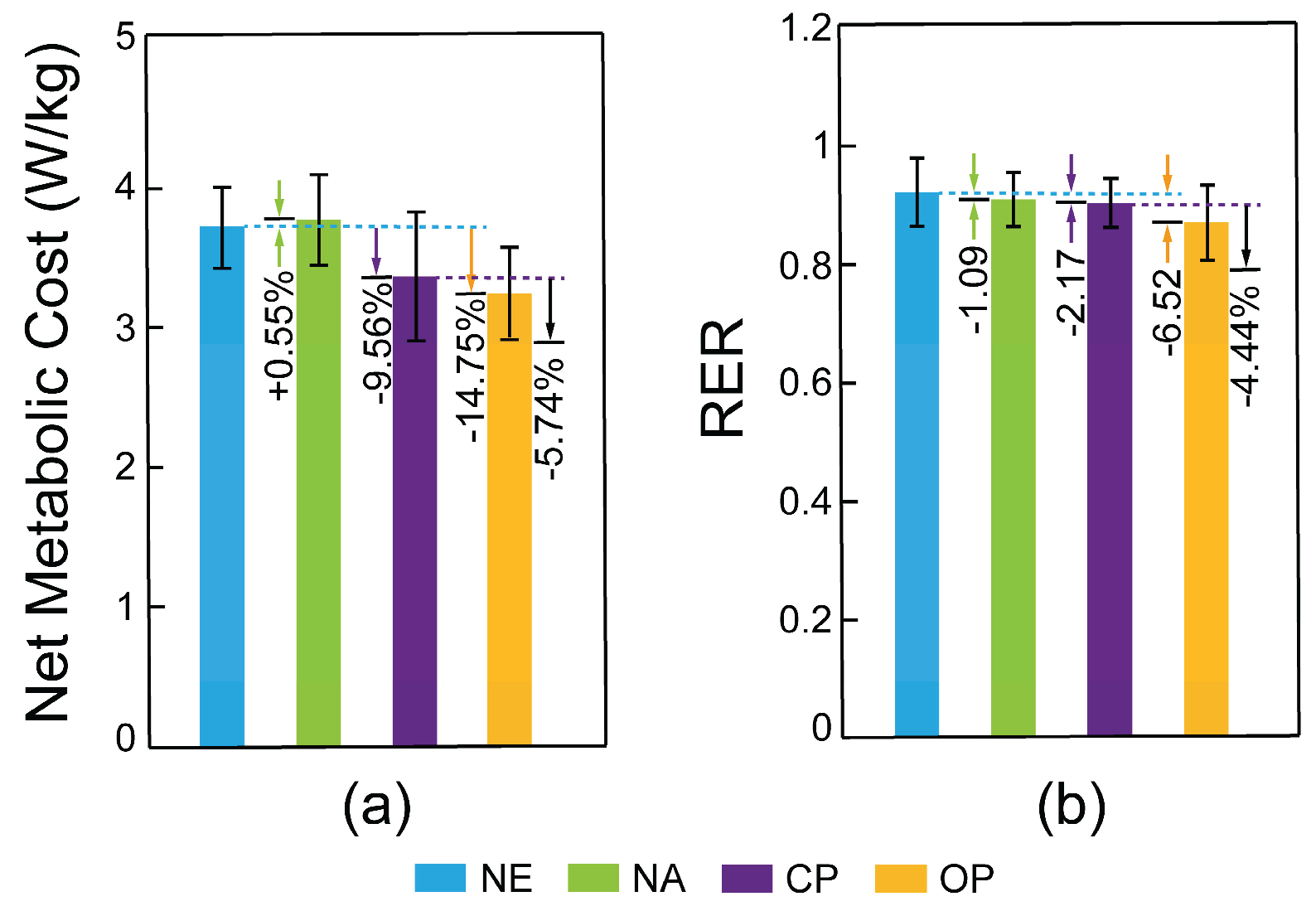
Table 1.
rRMSE and R2 of each order of boost function.
| Assistance Function Order | 1 | 2 | 3 | 4 | 5 | 6 | 7 | 8 |
| rRMSE | 21.8% | 7.49% | 2.58% | 0.53% | 0.19% | 0.18% | 0.18% | 0.17% |
| R2 | 0.554 | 0.949 | 0.994 | 0.999 | 1 | 1 | 1 | 1 |
Table 2.
Performance comparison of moment estimation accuracy (Mean ± SD) across three planes.
| Model | R | RMSE (N·m/kg) | Correlation Coefficient | |||||||
| Sag. | Cor. | Trans. | Sag. | Cor. | Trans. | Sag. | Cor. | Trans. | ||
| BPNN | 88.31% (6.2%) |
65.22% (8.2%) |
67.53% (10.5%) |
0.242 (0.072) |
0.161 (0.037) |
0.045 (0.018) |
0.867 (0.046) |
0.813 (0.033) |
0.817 (0.032) |
|
| FNN | 86.77% (5.4%) |
64.35% (5.6%) |
68.24% (9.7%) |
0.263 (0.081) |
0.189 (0.049) |
0.053 (0.019) |
0.871 (0.032) |
0.801 (0.049) |
0.767 (0.072) |
|
| LSTM | 89.64% (7.7%) |
71.23% (7.5%) |
74.29% (10.2%) |
0.181 (0.052) |
0.175 (0.036) |
0.047 (0.016) |
0.879 (0.036) |
0.895 (0.032) |
0.871 (0.033) |
|
| NTM | 84.72% (8.7%) |
85.46% (8.1%) |
86.44% (7.1%) |
0.242 (0.062) |
0.149 (0.033) |
0.032 (0.018) |
0.889 (0.035) |
0.904 (0.031) |
0.915 (0.038) |
|
| RNN | 89.26% (5.6%) |
66.71% (15.8%) |
66.72% (9.2%) |
0.191 (0.048) |
0.177 (0.048) |
0.041 (0.015) |
0.891 (0.034) |
0.849 (0.048) |
0.787 (0.065) |
|
| N–E | 85.91% (4.6%) |
88.43% (4.2%) |
79.06% (9.7%) |
0.175 (0.043) |
0.118 (0.023) |
0.034 (0.012) |
0.935 (0.031) |
0.939 (0.022) |
0.897 (0.032) |
|
| PDFM | 92.51% (4.1%) |
86.86% (5.1%) |
88.15% (6.1%) |
0.157 (0.041) |
0.126 (0.026) |
0.028 (0.012) |
0.938 (0.028) |
0.924 (0.024) |
0.929 (0.029) |
|
Table 3.
Weight allocation results of FCCM.
| Dimensions | Initial contact | Loading response | Mid stance | TerminalStance | Pre-swing | Swing | ||||||||||
| wLSTM | kNTM | wLSTM | kNTM | wLSTM | kNTM | wLSTM | kNTM | wLSTM | kNTM | wN–E | kNTM | |||||
| Sag. | 0.06 (0.02) |
0.71 (0.05) |
0.88 (0.09) |
0.46 (0.07) |
0.29 (0.11) |
0.93 (0.14) |
0.95 (0.17) |
0.44 (0.11) |
0.41 (0.06) |
0.62 (0.13) |
0.89 (0.09) |
0.25 (0.08) |
||||
| Cor. | 0.22 (0.05) |
0.92 (0.17) |
0.07 (0.02) |
0.74 (0.07) |
0.77 (0.08) |
0.12 (0.06) |
0.85 (0.09) |
0.37 (0.04) |
0.22 (0.05) |
0.91 (0.07) |
0.61 (0.12) |
0.28 (0.03) |
||||
| Trans. | 0.11 (0.04) |
0.69 (0.08) |
0.05 (0.04) |
0.98 (0.16) |
0.09 (0.04) |
0.85 (0.12) |
0.13 (0.05) |
0.56 (0.13) |
0.07 (0.02) |
0.86 (0.06) |
0.62 (0.14) |
0.87 (0.07) |
||||
Table 4.
Muscle activity and metabolic parameters under different conditions.
| Condition | RF (%) | VMO (%) | VLO (%) | Mean (%) | Metabolic Cost (W/kg) |
RER |
|---|---|---|---|---|---|---|
| NE | 10.31 (1.35) |
8.35 (1.42) |
13.66 (1.63) |
10.77 (1.19) |
3.66 (0.28) |
0.92 (0.05) |
| NA | 10.54 (1.13) |
8.46 (1.49) |
14.25 (1.32) |
11.08 (1.26) |
3.68 (0.32) |
0.91 (0.04) |
| CP | 5.87 (1.58) |
5.57 (1.58) |
10.02 (1.71) |
7.15 (1.37) |
3.31 (0.44) |
0.90 (0.04) |
| OP | 4.73 (1.19) |
4.02 (1.22) |
7.62 (1.22) |
5.46 (1.01) |
3.12 (0.36) |
0.86 (0.06) |
Disclaimer/Publisher’s Note: The statements, opinions and data contained in all publications are solely those of the individual author(s) and contributor(s) and not of MDPI and/or the editor(s). MDPI and/or the editor(s) disclaim responsibility for any injury to people or property resulting from any ideas, methods, instructions or products referred to in the content. |
© 2026 by the authors. Licensee MDPI, Basel, Switzerland. This article is an open access article distributed under the terms and conditions of the Creative Commons Attribution (CC BY) license (http://creativecommons.org/licenses/by/4.0/).
Copyright: This open access article is published under a Creative Commons CC BY 4.0 license, which permit the free download, distribution, and reuse, provided that the author and preprint are cited in any reuse.


