

Submitted:
02 April 2026
Posted:
07 April 2026
You are already at the latest version
Abstract
Long-duration human spaceflight exposes very healthy astronauts to complex risks including neuroocular changes, musculoskeletal and cardiovascular deconditioning, radiation injury, immunologic disturbances, and surgical emergencies. An integrated, autonomy-focused medical architecture for missions of 30 days to over 2 years is needed, emphasizing in-situ diagnosis, therapy, and monitoring under severe resource constraints. The clinical framework maps conditions to mission phase and outlines space-adapted diagnostic strategies centered on AI-guided point-of-care ultrasound, wearable biosensors, and microfluidic lab-on-chip assays. Preventative countermeasures are specified including structured exercise, lower-body negative pressure, bone-protective pharmacotherapy, radiation shielding, and AI-assisted psychological support. Evaluating the clinical need for monitoring, diagnosing, and even for some possible invasive therapeutical interventions led to the definition of a compact modular system combining miniaturized surgical robotics, on-demand 3D printing, and AR/AI guidance to even enable minimally invasive procedures by a non-expert crew. The ressources that are required to build such a system for a very limited application and benefitting just very few people are very high. They might provide an ideal base with dual-use potential for low- and middle-income countries however, where similar design drivers—ease of use, automation and autonomous operation, small footprint, and local service, repair and parts fabrication—address the current critical gaps in under-resourced health systems. Of course low cost of manufacturing and operation is likely the most important feature for that application. Co-designed "space–global health" technologies could simultaneously enable safer deep-space exploration, for which development ressources are available, and expand access to high-quality diagnostics and interventions on Earth providing very high impact to the population, which unfortunately does not attract sufficient development funds despite a huge need.
Keywords:
space medicine
; long-duration spaceflight
; AI diagnostics
; point-of-care ultrasound
; 3D printing
; minimally invasive surgery
; global health
; low-resource settings
1. Introduction
Long-duration human spaceflight campaigns to Mars and beyond will require autonomous health systems capable of managing chronic deconditioning, emergent disease, and acute surgical events without continuous terrestrial support [1,2].
Experience from six- to twelve-month International Space Station (ISS) missions has revealed multisystem effects of microgravity and radiation, including bone demineralization, muscle atrophy, neuro-ocular changes, cardiovascular deconditioning, immune dysregulation, and psychological stress [3,4].
Proposed Mars-class missions extending two years or longer intensify these risks and raise the bar for in-situ medical capability [5,6,7]. The ISS is only around four hundred kilometers from the earths surface and communication with the station therefore virtually in real-time. Leaving the earths vicinity travelling into outer space, will cause the duration for a radio signal round-trip message (speed of light), depending on the orbital positions, to be between 6 and 44 minutes. This significant delay necessitates autonomy as real-time control is impossible.
It needs to be noted that the typical astronaut is in outstanding physical and mental state, who has been prepared for the mission in space for a long time. The astronauts personal health mission is to maintain muscle mass, monitor and detect early symptoms as early as possible. While the nutrient intake is quite likely not exciting in a space module, it is prepared to provide everything that the body requires in the amounts needed.
Many low- and middle-income countries (LMICs) face analogous constraints to astronauts (except of ourse that the people there cannot be considered very healthy in all instances): general lack of access to medical service, difficult to reach medical professionals in time, limited numbers of trained clinicians and an even bigger problem for specialist consultations, fragmented data silos, need for continuos monitoring and prevention leading to health education, fragile supply chains, and insufficient imaging and laboratory infrastructure combined with economic constraints [8,9].
2. Health Risks Across Mission Durations
2.1. Short-Duration Missions (30 Days)
The first month of spaceflight is dominated by acute adaptation phenomena. Space adaptation syndrome (SAS) manifests within days, with nausea, disorientation, and vomiting in a majority of astronauts due to vestibular–visual conflict in microgravity [3]. Cephalad fluid shifts cause facial edema, increased central venous pressure, and early cardiovascular deconditioning, with reductions in stroke volume and orthostatic tolerance measurable within 1–2 weeks [12]. Sleep disruption, transient immune changes, and initial losses in muscle strength and bone density begin during this period [13,14].
2.2. Medium-Duration Missions (180 Days)
By six months, musculoskeletal and neuro-ocular changes are prominent. Long-duration ISS data show bone mineral density (BMD) losses of approximately 0.5–1.5% per month at load-bearing sites without countermeasures [15]. Postural muscle cross-sectional area decreases despite exercise, contributing to strength and endurance loss [16]. Spaceflight-associated neuro-ocular syndrome (SANS)—characterized by optic disc edema, globe flattening, and hyperopic shifts—emerges in a subset of astronauts and is thought to be driven by chronic cephalad fluid shifts and altered intracranial pressure dynamics [17,18]. Cumulative radiation doses over six months on the ISS are around 80–160 mSv, significantly above typical terrestrial occupational exposure [19]. Cases of in-flight deep vein thrombosis underscore evolving thrombotic risk [20].
2.3. One-Year Missions
One-year missions amplify chronic neuro-structural and skeletal changes. MRI studies of long-duration astronauts report ventricular expansion and brain position shifts that can persist for months after landing, suggesting incomplete neuro-structural recovery [21,22]. BMD losses become more severe and recovery incomplete; only a subset of astronauts regain preflight BMD at the hip and spine within a year post-flight, even with exercise and pharmacologic interventions [15,23]. Long missions also reveal persistent immune alterations, including latent herpesvirus reactivation, and increased arrhythmia risk [14,24].
2.4. Multi-Year, Mars-Class Missions (2+ Years)
Multi-year missions approach or exceed current lifetime radiation limits, increasing projected cancer and central nervous system risk from chronic galactic cosmic rays and solar particle events [19]. Cataract formation from high-energy particle exposure, potentially irreversible SANS-related visual changes, chronic deconditioning, and mental health risks from isolation and confinement become dominant concerns [25,26]. Structural bone compromise raises the likelihood of fractures, with implications for in-flight orthopaedic surgery capability.
3. Health Risk Matrix: Diagnosis, Therapy, Monitoring
4. Preventive Countermeasures and Predictive Monitoring
Exercise and pharmacologic countermeasures are central to mitigating deconditioning. Combined aerobic and resistive exercise—including optimized protocols such as SPRINT—can maintain cardiorespiratory fitness and muscle mass with reduced time commitments [29,30]. Bisphosphonate therapy combined with high-load resistance exercise reduces BMD loss during long-duration missions [23]. Nutritional strategies, including adequate calcium and vitamin D and antioxidant-rich diets, may further mitigate bone and radiation effects, with animal data supporting specific dietary countermeasures against radiation-induced skeletal damage [31].
Fluid management and neuro-ocular protection rely on countermeasures such as lower-body negative pressure (LBNP), which can partially reverse cephalad fluid shifts and are proposed to address both cardiovascular deconditioning and SANS [4,18]. Postural strategies, intermittent LBNP, and pharmacologic modulation of intracranial pressure are under active investigation [17].
Advanced wearable biosensors enable continuous monitoring of ECG, oxygen saturation, heart rate, respiration, skin temperature, and activity, feeding into predictive algorithms for early detection of physiological deterioration [32,33]. Serial optic nerve sheath diameter and transcranial Doppler indices may predict intracranial pressure elevations before overt symptoms [17,34]. Lab-on-chip platforms can monitor hematologic and inflammatory markers, bone turnover, and viral loads, providing quantitative trend data for risk modeling [35,36,37].
5. AI-Powered Onboard Physician and Surgical Robotics
An AI-assisted crew medical officer must synthesize heterogeneous data streams, produce differential diagnoses with calibrated confidence scores, and guide interventions autonomously during communication delays. Recent demonstrations suggest that large-language-model-based clinical assistants can integrate structured medical knowledge with real-time physiologic and imaging data for deep-space missions [38].
Future exploration missions will face higher medical risk because the crews will be farther from Earth, communication delays will be longer, and immediate return will no longer be practical [39]. In such a setting, the current model used on the ISS is not enough, so crews will need more onboard capability for diagnosis, emergency care, and potentially surger. Robot-assisted surgery could support medical care during deep-space missions, where evacuation to Earth and real-time ground support is impossible. Novel robotic systems need to evolve beyond current operating-room systems into compact, multifunctional platforms with partial autonomy, imaging support, and perioperative capabilities. Microgravity changes human physiology in ways that matter for surgery, including fluid shifts, cardiovascular and musculoskeletal changes, immune dysregulation, and impaired wound healing. Most likely surgical emergencies, even in healthy space crews, would likely be appendicitis, cholecystitis, trauma, and obstruction. Their impact could threaten both, the astronaut survival and the mission success. Laparoscopic and robotic minimally invasive approaches are better suited than open surgery because they help contain blood and body fluids and isolate the surgical field from the spacecraft environment. Real-time telesurgery from Earth for any deep-space missions is not feasible anymore because of the long communication latency. This requires greater crew autonomy, stronger medical training, and intelligent, possibly even autonomous, robotic systems over dependence on ground-controlled surgery.
Table 2 summarizes the multimodal data domains required for high-accuracy diagnosis and monitoring and the technical modality that would obtain the data. All of that needs to then be consolidated and evaluated by the AI system and the crew medical officer.
The AI system combines continuous physiological signals, episodic lab and imaging data, environmental parameters, and natural-language symptom reports using multimodal fusion architectures [28,32]. Edge computing enables offline operation with opportunistic synchronization, an approach shared with resource-limited terrestrial settings.
6. Engineering Architecture: MERIDIAN System
To operationalize this medical model, we propose the MERIDIAN (Medical Engineering Robotic Integrated Diagnostic & Interventional Architecture for Nodes in space andlow income nation settings.)) system architecture, a modular architecture composed of a diagnostic hub, intervention module, fabrication unit, and AI physician core (as shown in Figure 1).
The diagnostic hub houses the AI-guided POCUS including transcranial Doppler, microfluidic lab-on-chip analyzers, ophthalmic tools, wearable biosensors, and a nanopore sequencer [27,35].
The intervention module centers on a miniaturized robotic surgical platform capable of simple laparoscopic procedures with 3D-printed ports and instruments, drug-eluting dressings, and microgravity-adapted fluid control [40,41,42]. The fabrication unit integrates polymer, resin, bioprinting, and metal additive manufacturing plus UV-C sterilization, enabling on-demand production of instruments, implants, and disposable devices [42,43]. The AI core provides decision support, image analysis, AR-based procedural guidance, and optional telesurgery links [38].
7. Dual-Use Potential for Low-Income Nations
Many of the environmental constraints driving MERIDIAN—limited expert staff, space and power constraints, and supply chain fragility—parallel those in low-resource health systems.
AI-enabled POCUS has emerged as a promising solution to expand diagnostic imaging in LMICs by enabling non-expert providers to perform and interpret ultrasound for obstetric, cardiopulmonary, and emergency indications [10,37,44,45,46]. Recent reviews highlight how AI coaching of probe placement and automated measurement can improve diagnostic accuracy and standardization in low-resource settings [46,47].
Concepts for integrated small footprint robotic system have already been discussed and presented in 2017. The ReMeDi project [48] for example proposed a remote medical examination unit as a combination of physical examination and ultrasonographic examination with the integration of a robotic system capable of obtaining palpation data. While the palpation was not succesful at the time there are many new technologies that are able to provide that information for diagnosis and even for the subsequent use of guiding a surgical robot system [49].
3D printing programs in low-resource hospitals have demonstrated the feasibility of local fabrication of medical components with reduced cost and lead time compared with imports [11,43]. Wearable biosensors based on inexpensive flexible substrates can provide non-invasive monitoring of vital signs and biochemical markers at low cost when combined with mobile devices [33,36,50,51].
Just like on planet earth, medical problems are hopefully the exception and do not happen to often. Monitoring and early detection are keys to avoid more seere conditions. But that also means that a unit in space - and installed in remote areas or in LMIC’s - needs to be as autonomous as possible with following additional key design attributes directly applicable to LMIC context:
- 1)
- ease of use and self explanatory,
- 2)
- providing automation and decision support based on monitoring data and a prediction engine,
- 3)
- low manufacturing and operating cost,
- 4)
- small footprint and energy efficiency,
- 5)
- local fabrication and maintenance possibilities,
- 6)
- connectivity-aware medical and operational AI capabilities,
- 7)
- high data security and individual accounts for each user,
- 8)
- health status metrics and progress indicators together with recommendations,
- 9)
- connection to a local sensor element (e.g. a smartphone with camera) with a dashboard,
- 10)
- and the ability to send / retrieve data and connect to emergency services.
8. Conclusion and Next Steps
The synthesis of space medicine, AI-enabled diagnostics, and additive manufacturing suggests that safe, prolonged human spaceflight is technically feasible if health systems are redesigned around autonomy, prevention, and extreme resource efficiency [5]. The same constraints that shape medical systems for deep space—minimal expert presence, limited mass, and unreliable resupply—align closely with those of low-income health systems on Earth. This creates a strong rationale for co-developing dual-use technologies such as AI-guided point-of-care ultrasound, wearable biosensors, microfluidic lab-on-chip diagnostics, and on-demand 3D-printed medical tools to simultaneously advance astronaut safety and global health equity [8,9,10,11,36].
Next steps should focus on integrated prototyping and validation in analogue environments. Priorities include building and testing an AI “medical officer” that fuses wearable, imaging, and lab data in terrestrial extreme environments and space analog missions; iteratively refining AI-guided ultrasound and minimally invasive intervention workflows for non-expert operators; and deploying 3D-printing hubs and AI diagnostics in selected low-resource hospitals to evaluate usability, cost, and impact [10,11,38].
Parallel work is needed on regulatory frameworks, data governance, and ethical guidelines for autonomy and decision support in both spaceflight and low-income settings. A coordinated program linking space agencies, global health organizations, and local health systems can turn this blueprint into a family of robust, scalable, and affordable medical platforms for use from low Earth orbit to the most underserved clinics on Earth [9].
The systems for LMIC are much more needed and could create a huge positive impact when compared to the systems developed for space applications and use. Developments for this purpose are not receiving suffcient funding however, also because there is not a real existing business model in place yet. It could likely be shown that a regular visit -maybe initially with some incentives- to a system for a control and monitoring check-up combined with some recommendations could improve the overall health situation and lead to early detection.
This evidence for the economic value of regular health checkups is difficult in the health systems of the higher income nations with health care provision mainly focused on the diagnosis and therapy of health issues.
9. Engineering / Innovator Development Agenda
A practical development agenda from the manuscript can be framed around four concrete workstreams.
1. AI–POCUS for Non-Expert Operators: Focus on a single handheld probe plus tablet/phone app that auto-guides acquisition and interpretation for a tightly scoped set of use cases (cardiac function, lung pathology, FAST/abdominal free fluid, basic obstetrics, SANS/optic nerve sheath). The core research and development tasks are: building or accessing labeled POCUS datasets that reflect both space-relevant and LMIC-relevant pathologies; training view-quality and anatomy-recognition models that can coach probe motion and automatically compute key measurements; and validating the system with non-expert users in analog environments (Antarctica, undersea habitats, rural hospitals). Aim for a minimal, explainable output (“likely diagnosis” plus confidence and next action) rather than a full radiology report.
2. Microfluidic Lab-on-Chip Stack: Develop a small, modular point-of-care lab that fits in a shoebox and uses exchangeable microfluidic cartridges for hematology, basic chemistry, inflammation, infection, and bone turnover. Engineering priorities are a rugged, low-power base reader; cartridges that can be manufactured or at least assembled locally (3D-printed housings plus simple membranes/reagents); and tight integration with the AI layer so that lab values are interpreted in context of vitals and POCUS rather than in isolation. Early pilots should be in space analog sites and district hospitals to test robustness, operator workload, and cost per test.
3. Minimal Surgical / Procedural Toolkit with Additive Manufacturing: Start with a narrow set of life-saving procedures that are realistically in scope for non-expert, AI-guided operators: ultrasound-guided chest tube, pericardiocentesis, lumbar puncture, abscess drainage, and central venous access; optionally one or two basic laparoscopic operations (appendectomy, cholecystectomy) in simulation. Define the minimal reusable and printed instruments needed for each, and design them for 3D printing in robust, sterilizable polymers or metals. A near-term goal is a “procedural kit” plus AR/AI guidance that can be validated in simulation centers and remote hospitals before considering robotic actuation.
4. Wearable Sensing and Edge AI Baseline Engine: Implement a simple, robust wearable package (e.g., watch + patch/vest) that continuously records a small set of signals (heart rate and variability, respiration, SpO2, activity, skin temperature) and learns individual baselines over the first weeks of a mission or deployment. The main engineering work lies in on-device anomaly detection (tinyML) and clean integration with the AI–POCUS and lab-on-chip platforms so that changes in trends trigger targeted imaging or lab work rather than generic alerts. Design hardware and firmware to work offline for long periods, with optional synchronization when connectivity is available.
10. Addendum - Abbreviations
See below Figure 2 for a list of abbreviations used in the manuscript.
The author declares that the research was conducted in the absence of any commercial or financial relationships that could be construed as a potential conflict of interest.
The work was partly supported by the “Excellence Initiative—Research University” program at AGH University of Krakow.
An institutional Review Board statement is not applicable, as this work did not involve any testing on animals or humans.
References
- Nicogossian, A.E.; Williams, R.S.; Huntoon, C.L.; Doarn, C.R.; Polk, J.D. Space Physiology and Medicine: From Evidence to Practice, 4 ed.; Springer: New York, 2016. [Google Scholar] [CrossRef]
- Williams, D.; et al. Acclimation during space flight: Effects on human physiology. Canadian Medical Association Journal 2009, 180, 1317–1323. [Google Scholar] [CrossRef]
- Buckey, J.C. Space Physiology; Oxford University Press: Oxford, 2006. [Google Scholar]
- Hargens, A.R.; Vico, L. Long-duration bed rest as an analog to microgravity. Journal of Applied Physiology 2016, 120, 891–903. [Google Scholar] [CrossRef]
- Balasubramaniam, S.; et al. Space medicine in the era of long-duration exploration missions. npj Microgravity 2020, 6, 32. [Google Scholar]
- Smith, T.; Peterman, A.; Donoviel, D. Exponential Medicine: Challenges of Human Spaceflight Bringing Innovations for Earth—A Case Study. In Novel Innovation Design for the Future of Health; Friebe, M., Ed.; Springer: Cham, 2022. [Google Scholar] [CrossRef]
- Nguyen, T.H. Space Healthtech: Innovation Base for Longevity. In Novel Innovation Design for the Future of Health; Friebe, M., Ed.; Springer: Cham, 2022. [Google Scholar] [CrossRef]
- Farmer, P.E.; et al. Expansion of cancer care and control in countries of low and middle income: A call to action. The Lancet 2010, 376, 1186–1193. [Google Scholar] [CrossRef] [PubMed]
- Meara, J.G.; et al. Global surgery 2030: Evidence and solutions for achieving health, welfare, and economic development. The Lancet 2015, 386, 569–624. [Google Scholar] [CrossRef] [PubMed]
- Mindel, S.; et al. Artificial intelligence applications for point-of-care ultrasound in low-resource settings: A scoping review. Ultrasound in Medicine & Biology 2024, 50, 601–616. [Google Scholar] [CrossRef]
- Savonen, B.L. 3D Printing in Low Resource Healthcare Settings. Doctoral dissertation, Michigan Technological University, 2020. [Google Scholar]
- Hughson, R.L.; et al. Cardiovascular adaptations to long-duration spaceflight: Lessons from the ISS. Physiological Reviews 2018, 98, 599–626. [Google Scholar] [CrossRef]
- Cohen, H.S.; et al. Vestibular and cognitive effects of spaceflight. Journal of Vestibular Research 2010, 20, 1–9. [Google Scholar] [CrossRef]
- Crucian, B.; et al. Immune system dysregulation during spaceflight: Potential countermeasures for deep-space exploration missions. Frontiers in Immunology 2014, 5, 267. [Google Scholar] [CrossRef]
- Vico, L.; Hargens, A. Skeletal changes during and after long-duration spaceflight. The Lancet Diabetes & Endocrinology 2018, 6, 829–838. [Google Scholar] [CrossRef]
- Fitts, R.H.; et al. Prolonged space flight-induced alterations in the structure and function of human skeletal muscle fibres. The Journal of Physiology 2010, 588, 3567–3592. [Google Scholar] [CrossRef]
- Lee, A.G.; et al. Spaceflight-associated neuro-ocular syndrome (SANS). Eye 2020, 34, 1164–1170. [Google Scholar] [CrossRef]
- Macias, B.R.; et al. Spaceflight-associated neuro-ocular syndrome (SANS) and the potential role of head-down tilt bed rest. npj Microgravity 2020, 6, 7. [Google Scholar] [CrossRef]
- Cucinotta, F.A.; Durante, M. Cancer risk from exposure to galactic cosmic rays: Implications for space exploration by human beings. The Lancet Oncology 2006, 7, 431–435. [Google Scholar] [CrossRef] [PubMed]
- Levy, J.; et al. Deep vein thrombosis in space. The New England Journal of Medicine 2020, 382, 89–90. [Google Scholar] [CrossRef]
- Van Ombergen, A.; et al. Brain tissue-volume changes in cosmonauts. The New England Journal of Medicine 2018, 379, 1678–1680. [Google Scholar] [CrossRef] [PubMed]
- Roberts, D.R.; et al. Effects of spaceflight on astronaut brain structure as indicated on MRI. The New England Journal of Medicine 2019, 380, 1647–1656. [Google Scholar] [CrossRef]
- LeBlanc, A.; et al. Bisphosphonates as a supplement to exercise to protect bone during long-duration spaceflight. Osteoporosis International 2013, 24, 2105–2114. [Google Scholar] [CrossRef]
- Meck, J.V.; et al. Episodes of supraventricular tachycardia in astronauts during spaceflight. The American Journal of Cardiology 2001, 87, 547–550. [Google Scholar] [CrossRef]
- Cucinotta, F.A.; et al. Space radiation and cataracts in astronauts. Radiation Research 2001, 156, 460–466. [Google Scholar] [CrossRef]
- Kanas, N.; Manzey, D. Space Psychology and Psychiatry, 2 ed.; Springer: New York, 2008. [Google Scholar]
- Sargsyan, A.E.; et al. Ultrasound for spaceflight and remote environments. Critical Ultrasound Journal 2005, 7, 1–10. Please verify year, journal volume, and DOI; the supplied metadata appears inconsistent. [CrossRef]
- Cosper, P.F.; et al. Optimizing healthcare in space: The role of ultrasound imaging in long-duration missions. npj Microgravity 2024, 10, 15. [Google Scholar] [CrossRef]
- Smith, S.M.; et al. Benefits for bone from resistance exercise and nutrition in long-duration spaceflight. Journal of Bone and Mineral Research 2012, 27, 1896–1906. [Google Scholar] [CrossRef]
- Loehr, J.A.; et al. Physical training for long-duration spaceflight. Aerospace Medicine and Human Performance 2015, 86, A14–A23. [Google Scholar] [CrossRef]
- Schreurs, A.S.; et al. Dietary countermeasure mitigates simulated spaceflight-induced bone loss and radiation damage. Scientific Reports 2020, 10, 4173. [Google Scholar] [CrossRef]
- Masson, P.; et al. Advanced biosensors for monitoring astronauts’ health during long-duration space missions. Biosensors and Bioelectronics 2018, 111, 18–26. [Google Scholar] [CrossRef] [PubMed]
- Quintero, V.; et al. Wearable biosensors for health monitoring: Advances in materials and integration. Nanoscale Horizons 2025, 10, 456–476. [Google Scholar] [CrossRef]
- Kramer, A.H.; et al. Optic nerve sheath diameter and radiologic measures of raised intracranial pressure. Journal of Neuroimaging 2013, 23, 78–82. [Google Scholar] [CrossRef]
- Li, X.; et al. Microfluidic point-of-care testing for space and remote environments. Lab on a Chip 2019, 19, 3210–3225. [Google Scholar] [CrossRef]
- Friebe, M. Reverse Innovation: Circumvent Digital Health Transformation Issues. In Novel Innovation Design for the Future of Health; Friebe, M., Ed.; Springer: Cham, 2022. [Google Scholar] [CrossRef]
- Friebe, M.; Illanes, A. Advancements in Medical Imaging and Image-Guided Procedures: A Potential—Or Rather Likely—Paradigm Shift in Diagnosis and Therapy: Understand Disruption and Take Advantage of It! Applied Sciences 2023, 13, 9218. [Google Scholar] [CrossRef]
- Crum, W.; et al. AI-driven clinical decision support for deep space missions: Lessons from early NASA deployments. npj Digital Medicine 2025, 8, 10. DOI appears incomplete; please verify. [CrossRef]
- D., P.; et al. Robot-assisted surgery in space: pros and cons. A review from the surgeon’s point of view. NPJ microgravity 2021, 7, 56. [Google Scholar] [CrossRef]
- Satava, R.M.; et al. Surgical robotics and telesurgery in space medicine. Surgical Endoscopy 2001, 15, 1192–1195. [Google Scholar] [CrossRef]
- Loukas, M.; et al. Robot-assisted surgery in space: Pros and cons. npj Microgravity 2022, 8, 18. [Google Scholar] [CrossRef]
- Freeman, R.J.; et al. Design and evaluation of a multifunctional surgical device for space medicine. Acta Astronautica 2020, 171, 103–111. [Google Scholar] [CrossRef]
- Savonen, B.L.; Pearce, J.M. The competitive advantage of using 3D-printing in low-resource healthcare settings. Proceedings of the Proceedings of the Design Society: DESIGN Conference 2020, Vol. 1, 2541–2550. [Google Scholar]
- Bahadur, S.; et al. AI-enabled obstetric point-of-care ultrasound as an emerging tool in low-resource settings: A scoping review. Global Health: Science and Practice 2025, 13, e2025012. [Google Scholar]
- Ryan, K.; et al. AI-assisted ultrasound: Bridging innovation and access in low-resource settings. Global Health Innovation 2024, 2, 145–154. [Google Scholar]
- Moy, L.; et al. Overview of artificial intelligence in point-of-care ultrasound: New horizons for global health. Advances in Interventional Technology 2024, 6, 1–15. [Google Scholar]
- Topol, E.; et al. Overcoming barriers in the use of artificial intelligence in point-of-care ultrasound. npj Digital Medicine 2025, 8, 22. [Google Scholar] [CrossRef]
- Arent, K.; et al. Advancements in Medical Imaging and Image-GuideSelected Topics in Design and Application of a Robot for Remote Medical Examination with the Use of Ultrasonography and Ascultation from the Perspective of the REMEDI Project. Journal of Automation, Mobile Robotics and Intelligent Systems 2017, 11, 82–94. [Google Scholar] [CrossRef]
- Friebe, M. Haptic and Palpation Sensing for Robotic Surgery: Engineering Perspectives on Design and Integration. Sensors 2026, 26, 1126. [Google Scholar] [CrossRef] [PubMed]
- Heikenfeld, J.; et al. Universal flexible wearable biosensors for noninvasive health monitoring. ACS Applied Materials & Interfaces 2024, 16, 12345–12360. [Google Scholar] [CrossRef]
- Barbazzeni, B. Value Propositions for Future Health Developments: Digital, Portable, Connected, Experience-Enhancing, Supportive, Patient-Centric, and Affordable. In Novel Innovation Design for the Future of Health; Friebe, M., Ed.; Springer: Cham, 2022. [Google Scholar] [CrossRef]
Figure 1.
The MERIDIAN (Medical Engineering Robotic Integrated Diagnostic & Interventional Architecture for Nodes in space) concept design that is composed of a diagnostic hub, intervention module, fabrication unit, and AI physician core and could also be an base setup for low income nation medical hubs.
Figure 1.
The MERIDIAN (Medical Engineering Robotic Integrated Diagnostic & Interventional Architecture for Nodes in space) concept design that is composed of a diagnostic hub, intervention module, fabrication unit, and AI physician core and could also be an base setup for low income nation medical hubs.
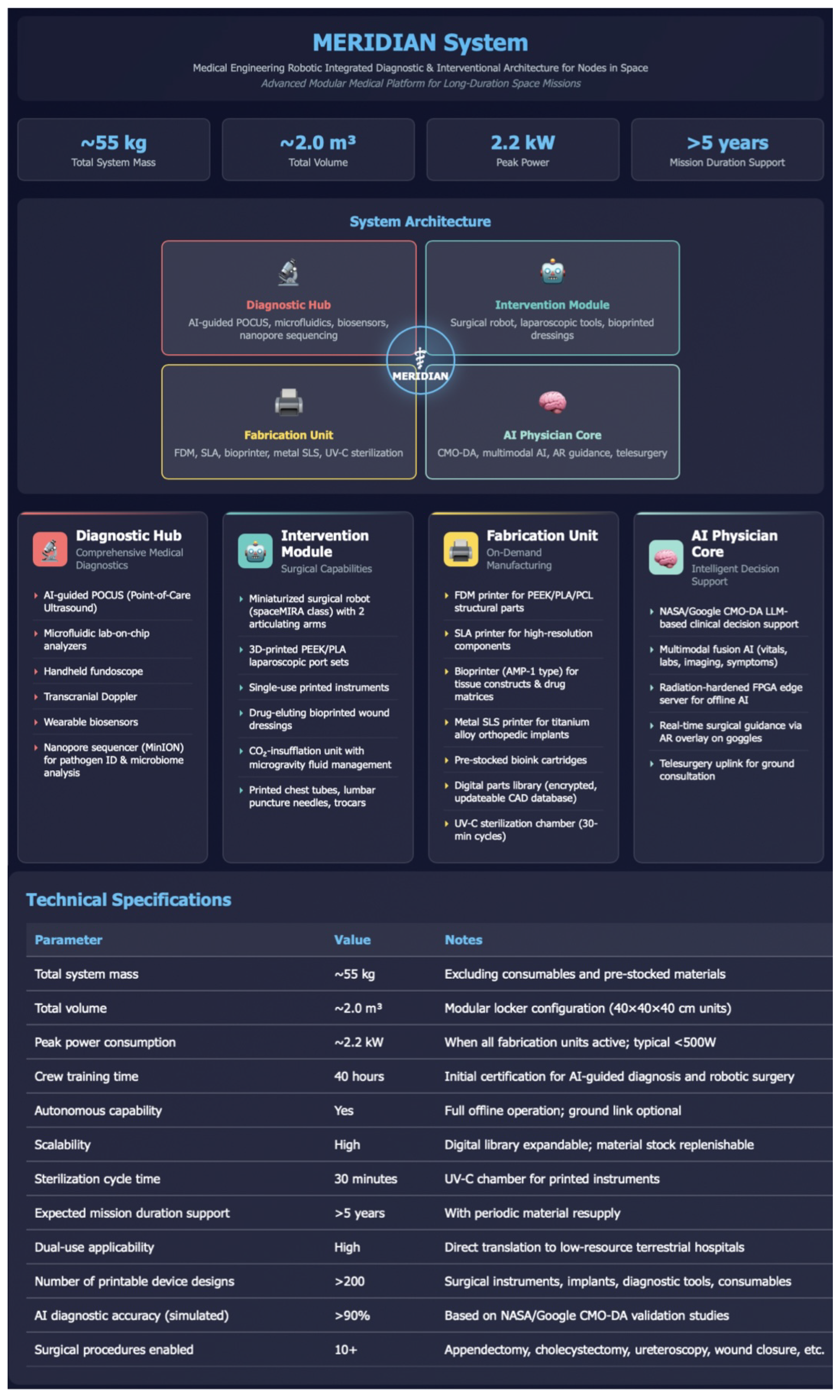
Figure 2.
Abbreviations spelled out.
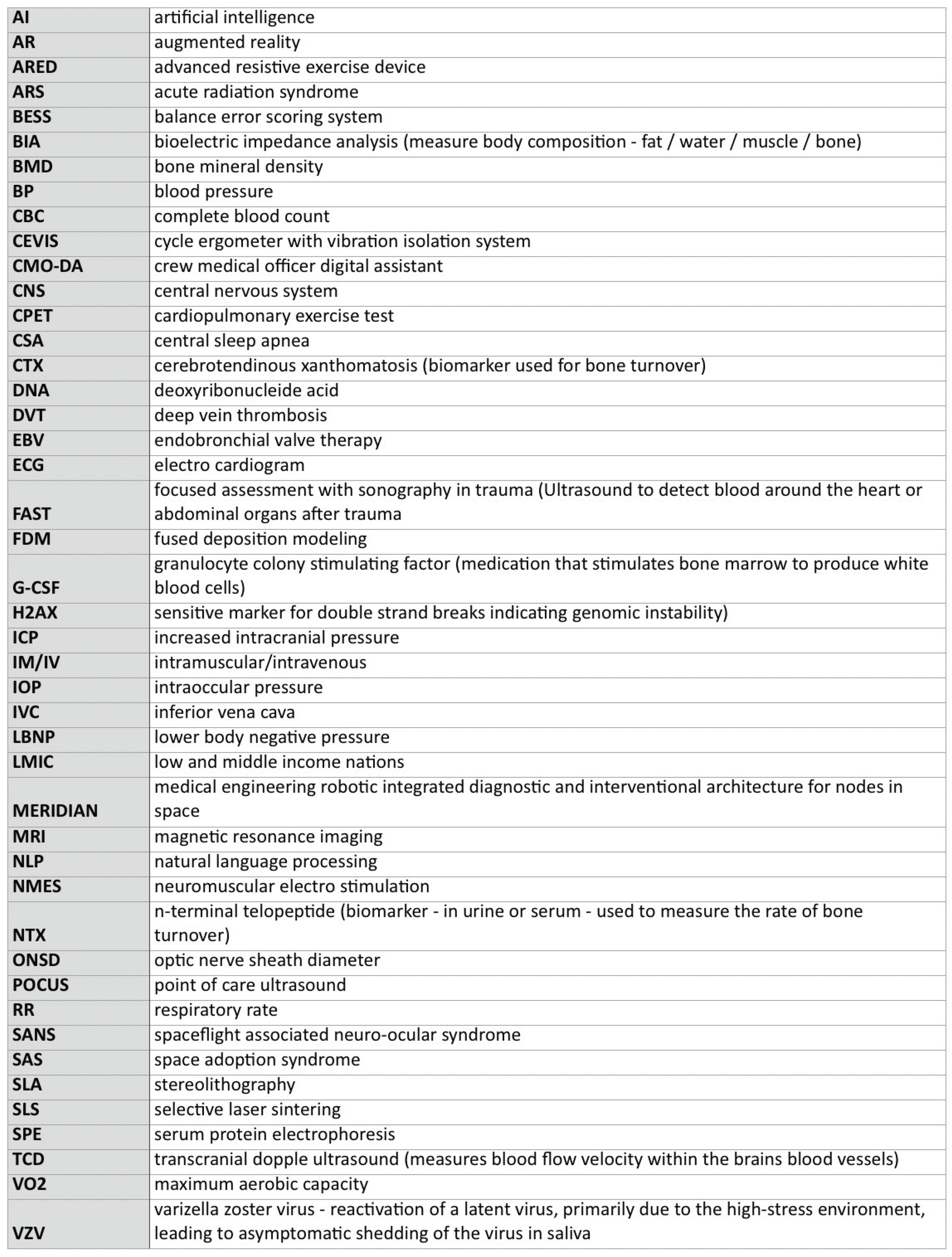

Table 1.
Health risk matrix for long-duration spaceflight.
| Condition | Onset | In-space diagnosis | In-space therapy | Monitoring |
|---|---|---|---|---|
| Space Adaptation Syndrome | Days 1–4 | Clinical: nausea score, nystagmus, vestibular tests | Promethazine, scopolamine, fluid resupply | Symptom diary, vestibular testing |
| Cardiovascular deconditioning | 30+ days | Cardiac POCUS, ECG, BP | LBNP, aerobic exercise, fluid/salt loading | VO2 max (CPET), Holter, weekly POCUS |
| Muscle atrophy | 30+ days | Muscle ultrasound, BIA, grip strength | ARED resistance exercise, protein, NMES | Serial muscle ultrasound, dynamometry |
| Bone loss | 30+ days | Ultrasound densitometry, bone markers | Bisphosphonates, high-load exercise, Ca/Vit D | Bone biomarkers, cortical ultrasound |
| SANS / ICP elevation | 60+ days | Ocular POCUS (ONSD), fundoscopy, vision | LBNP, positioning, acetazolamide | Weekly ONSD, acuity, tonometry |
| DVT / thromboembolism | 60+ days | Venous POCUS | Anticoagulation, compression, ambulation | Serial POCUS, D-dimer |
| Radiation injury / ARS | Ongoing | Dosimetry, CBC | G-CSF, antioxidants, storm shelter | CBC, DNA damage markers |
| Immune / viral reactivation | 30+ days | PCR, CBC differential | Antivirals, immune support | Serial viral load, lymphocytes |
| Brain structural change | 180+ days | ONSD, TCD | Posture, LBNP, ICP-lowering therapy | Monthly TCD, ocular POCUS |
| Psychological deterioration | 90+ days | Psychometrics, behavior monitoring | AI-assisted CBT, sleep hygiene, light therapy | Weekly cognitive and mood tests |
| Renal calculi | 60+ days | Renal POCUS | Hydration, thiazides, citrate | Serial renal ultrasound |
| Orthostatic intolerance | Post-flight | Stand test, HR/BP | Fluid loading, compression, fludrocortisone | Daily standing HR/BP |
| Acute trauma / appendicitis | Any | FAST POCUS, exam | Antibiotics, robotic-assisted surgery | Labs, serial exam |
Table 2.
Multimodal Sensor Data provision for the AI input. What is exactly measured? ... and where does the data come from?
Table 2.
Multimodal Sensor Data provision for the AI input. What is exactly measured? ... and where does the data come from?
| Data domain | Specific inputs | Modality |
|---|---|---|
| Continuous vitals | ECG, SpO2, HR, RR, skin temp, BP | Wearable biosensors |
| Metabolic / lab | CBC, CRP, cortisol, glucose, creatinine, viral PCR, bone markers | Microfluidic POC |
| Imaging | POCUS video (cardiac, lung, abdominal, ocular, vascular) | Handheld ultrasound + AI |
| Ophthalmologic | ONSD, fundus images, IOP | POCUS + fundoscope |
| Neurological | TCD waveform, cognitive scores, pupillometry | TCD + tablet tests |
| Radiation | Cumulative dose, SPE alerts | Personal dosimeter |
| Behavioral | Sleep (actigraphy), mood scores, speech features | Wearables + NLP |
| Genomic | Baseline variants, epigenetic clock | Sequencing |
| Environmental | CO2, humidity, temp, particulates | Cabin sensors |
| Symptom NLP | Self-reported symptoms, questionnaires | Voice/text interface |
Disclaimer/Publisher’s Note: The statements, opinions and data contained in all publications are solely those of the individual author(s) and contributor(s) and not of MDPI and/or the editor(s). MDPI and/or the editor(s) disclaim responsibility for any injury to people or property resulting from any ideas, methods, instructions or products referred to in the content. |
© 2026 by the authors. Licensee MDPI, Basel, Switzerland. This article is an open access article distributed under the terms and conditions of the Creative Commons Attribution (CC BY) license (http://creativecommons.org/licenses/by/4.0/).
Copyright: This open access article is published under a Creative Commons CC BY 4.0 license, which permit the free download, distribution, and reuse, provided that the author and preprint are cited in any reuse.


