

Submitted:
03 April 2026
Posted:
03 April 2026
You are already at the latest version
Abstract
This study examines the impact of regrinding on the interfacial properties of sulfide minerals and the flotation performance of weathered copper-porphyry tailings. The feed material is characterized by a low copper grade (0.17%) and a high proportion of oxidized species (53.84%), which contributes to its inherent chemical stability and poor flotation kinetics. The findings indicate that regrinding serves a dual role: facilitating the liberation of mineral intergrowths and inducing mechanical surface renewal. This renewal is characterized by a significant decrease in the oxidation-reduction potential (ORP) and an intensification of the surface reactivity. Experimental results identify an optimal grinding fineness of 77-81% passing -0.045 mm, yielding a copper recovery of 16.26% in the absence of a sulfidizing agent. The integration of sodium sulfide (400 g/t) with regrinding significantly enhances recovery to 36.37%, driven by the establishment of a reducing environment (ORP ≈ -150 mV) and the chemisorption-mediated activation of mineral surfaces. While ultrafine grinding (90-100% passing -0.045 mm) further increases recovery to 51.47%, it is accompanied by deleterious sliming effects and a subsequent loss of process selectivity. The study confirms that mechanical surface rejuvenation and the optimization of electrochemical conditions are critical for improving the processing efficiency of anthropogenic resources, providing a theoretical framework for establishing rational beneficiation regimes.
Keywords:
regrinding
; copper tailings
; flotation
; sulfidization
; redox potential
; surface oxidation
; ultrafine grinding
; mineral processing
1. Introduction
As high-grade mineral reserves deplete and conventional mining becomes more complex, the industry must pivot toward reclaiming anthropogenic resources. Today, mining operations face a dual challenge: falling ore grades and expanding plant capacities, both of which lead to a massive buildup of tailings. This resource depletion is no longer just a geological concern-it has become a critical technological and environmental bottleneck.
On a global scale, between 8.9 and 14.4 billion tonnes of tailings are generated annually, adding to an estimated 200-280 billion tonnes already in storage [1,2,3]. While these sites pose environmental risks, they also represent a significant opportunity for secondary recovery [4,5,6,7,8]. International experience proves this is viable. For instance, Amerigo Resources in Chile successfully recovers copper and molybdenum from El Teniente tailings, while DRDGOLD in South Africa has scaled up gold recovery from legacy dumps [9,10].
This issue is particularly pressing for Kazakhstan, where over 1,700 technogenic mineral sites (TMFs) hold roughly 55 billion tonnes of material [11,12,13]. To date, only 11% of these resources are reprocessed - far below the 70-80% seen in leading mining nations. To address this, Kazakhstan is currently launching 25 projects aimed at extracting copper, gold, and iron from existing tailings
Sulfide tailings are of particular scientific and practical interest. During long-term storage, sulfide minerals undergo oxidation and passivation, leading to the formation of secondary surface phases that suppress flotation activity. The efficiency of metal recovery from such materials depends on the particle size distribution, the degree of mineral liberation, and, most critically, the surface state. While incomplete liberation limits recovery, over-grinding can also degrade performance by generating excessive slimes.
In modern reprocessing circuits, regrinding serves a dual purpose: it reduces particle size and cleans the mineral surfaces. Optimizing the grinding regime allows for surface renewal-stripping away oxide films to expose fresh sulfide phases, which significantly boosts floatability [14]. Research indicates that the liberation of valuable components improves with increased grinding time regardless of particle size. However, to achieve maximum selectivity and efficiency, it is often more effective to process narrow size fractions separately.
Ultimately, mineral liberation is dictated by the ore’s specific mineralogy and texture [4,5,15,16,17,18]. Consequently, the performance of the flotation circuit is a direct result of the ore texture and the target particle size achieved during the grinding or regrinding stage.
In their study, Bakalarz, Duchnowska, and Luszczkiewicz demonstrated that increasing the grinding time of copper sulfide ores improves the liberation of valuable components across all particle sizes. While deep grinding may slightly diminish the flotation performance of fully liberated fines, it remains essential for achieving maximum selectivity. Their findings suggest that to optimize overall efficiency, it is practical to process narrow size fractions separately, as fine and coarse particles have distinct flotation requirements [2].
One of the primary hurdles in tailings reprocessing is their mineralogical complexity. In copper-bearing tailings, valuable metals are often found in refractory forms, specifically as oxidized copper species coating the particle surfaces. To improve recovery, these oxidized minerals must be activated through sulfidization [19,20,21,22]. Research by T.B.Oserov, Smailov, et al. indicates that hydrophobicity in oxidized minerals can be achieved by adding sodium sulfide. However, this sulfidization process occurs primarily as a surface-level reaction, forming an extremely thin film. Precisely controlling this reaction requires monitoring the oxidation-reduction potential (ORP). Our previous work on oxidized lead-zinc ores has already demonstrated that maintaining a specific ORP level is critical for effective flotation performance.
Regrinding legacy tailings does more than just reduce particle size; it facilitates surface rejuvenation. This process strips away passivating oxide films and exposes fresh sulfide phases, fundamentally altering the physicochemical and flotation properties of the material. Consequently, investigating how regrinding affects the surface state of aged sulfide minerals is a critical task for improving metal recovery rates.
The objective of this study is to evaluate the impact of regrinding on surface renewal and its subsequent effect on reprocessing efficiency. By understanding these mechanisms, we aim to contribute to the development of resource-saving and environmentally conscious technologies, aligning with the broader principles of the circular economy.
2. Materials and Methods
To address the objectives of this study, we developed a sequential methodology consisting of several key stages: designing the experimental circuit, regrinding the legacy tailings in both a rotary axis mill and an ultra-fine mill, and performing flotation tests on the resulting pulp. During flotation, we maintained strict control over reagent dosages, pH levels, ORP, and temperature. This structured approach ensures a smooth transition from theoretical analysis to a reproducible laboratory protocol suitable for future scaling and industrial implementation.
The study focused on legacy flotation tailings from porphyry copper ores, sampled from various tailings storage facilities in the Republic of Kazakhstan. We determined their bulk chemical and phase compositions via conventional silicate analysis, while copper and trace element concentrations were measured using ICP-MS. Mineralogical analysis was conducted on polished sections in reflected light using an OLYMPUS BX 53 microscope, integrated with a SIMAGIS XS-3CU imaging system and SIAMS Mineral C7 software. Furthermore, we mapped the particle size distribution using a FRITSCH Analyzette 22 laser diffraction analyzer and a CYCLOSIZER LF-11. Phase identification was finalized using a Bruker D2 Phaser diffractometer.
The beneficiation process began with the pre-conditioning of the ground pulp, followed by the addition of flotation reagents (collector and frother). Flotation tests were then carried out using a laboratory-scale flotation machine. The primary equipment used in these experiments included:
- − Grinding: An MSHL-7 (40 ML) laboratory ball mill (Mekhanobr-tekhnika).
- − Flotation: A Vektis 3-liter pneumo-mechanical flotation machine.
- − Monitoring: Hanna HI3230B and HI1230B electrodes were used to monitor pH, ORP, and temperature.
The core experimental parameters were set as follows:
- − Grinding kinetics: Intervals of 0, 3, 5, 10, and 15 minutes;
- − Rougher flotation: 5 minutes;
- − Reagent dosages: Sodium sulfide (Na2S) at 400 g/t; potassium butyl xanthate (PBX) at 50 g/t; and Methyl Isobutyl Carbinol (MIBC) as a frother at 20 g/t;
- − Process Monitoring: pH, ORP, and temperature readings were recorded at three critical stages: immediately after grinding, before collector addition, and after collector addition;
- − Water Quality: All tests were conducted using process water of a standardized chemical composition.
Flotation concentrates and tailings were weighed and analyzed for copper content to calculate recovery rates. To ensure reliability, all flotation tests were performed in triplicate, with the results averaged for the final analysis. The separation efficiency was quantified using the Hancock-Luyken formula, providing a standardized measure of the beneficiation performance.
Е=(ε-γ)/(100-α)
A detailed analysis of the flotation test results across varying levels of the -0.045 mm size fraction, along with the developed copper recovery model, is presented in the ‘Results’ section.
3. Results
The results of this study are structured as follows: first, the raw material was characterized using a suite of analytical techniques, including optical microscopy and Inductively Coupled Plasma Optical Emission Spectrometry (ICP-OES). The initial sample was then ground to the target particle size in a laboratory mill. Following the grinding stage, pulp samples were dried and submitted for mineralogical analysis to evaluate the degree of mineral liberation and visualize particle morphology.
Table 1 summarizes the chemical composition of the primary sample.
Copper Speciation Analysis
To evaluate the potential for copper recovery, phase analysis was performed to determine the distribution of copper across different chemical forms (Table 2).
The results of the optical mineralogy study of the legacy tailings are presented below. This examination established the mineral composition of both the ore and gangue fractions, grain morphology and size distribution, and the specific characteristics of mineral associations within the anthropogenic processing products. Chalcopyrite is the most abundant copper sulfide in the sample. Its grains are most commonly observed as intergrowths with gangue minerals or in a liberated state. In certain areas, it occurs in association with pyrite (see Figure 1a, b, c), magnetite (Figure 1a), sphalerite, and bornite. The predominant (average) grain size of chalcopyrite is characterized as ultra-fine (1–10 μm) and fine (10–30 μm), although relatively coarser grains (40–60–120 μm) are occasionally encountered.
Bornite, covellite, and chalcocite are observed only as accessory minerals and are extremely rare. The grain size for these minerals typically ranges from less than 1 μm up to 80 μm.
The particle size distribution (PSD) of the legacy tailings sample, categorized by size fractions, is presented in Table 3.
The initial analysis showed that the -0.045+0 mm fraction dominates the sample with a weight recovery of 51.66%, while the total content of the finished size class (-0.071 mm) reaches 73.42%. Interestingly, the copper distribution across all size fractions is directly proportional to their weight. This correlation points to a fine-grained and relatively uniform mineralization, suggesting that the valuable components are not isolated in specific pockets but are spread throughout the material.
To better understand how these components are distributed within the finest particles, we further classified the -0.071+0 mm fraction, including micro-slimes. This detailed analysis was performed using a Cyclosizer, with the results summarized in Table 4.
The data in Table 4 highlight a significant challenge: the highest copper distribution (39.95%) is concentrated in the finest fraction (-8.4+0 μm). The presence of a substantial amount of these micro-slimes (26.85% of the total mass), coupled with their high metal content, confirms the extremely fine-grained nature of the copper mineralization. From a metallurgical perspective, this often hinders flotation due to the detrimental effect of ‘slime coating,’ where ultra-fine particles interfere with the recovery of valuable minerals.
To address this and find the optimal balance for mineral liberation, a series of laboratory experiments were conducted using different grinding times. The resulting particle size distributions for these ground samples are presented in Table 5.
A series of experimental studies were conducted to determine how the degree of grinding influences copper recovery. To evaluate the effectiveness of surface activation, these experiments were carried out both with the addition of sodium sulfide and in its absence. This comparative approach allows us to isolate the impact of chemical activation from physical liberation. The experimental procedure and flowsheets are illustrated in Figure 2.
The metallurgical performance results, detailing the grades and recovery rates of copper, are summarized in Table 6.
The data in Table 6 clearly indicate that copper recovery is not solely dependent on the fineness of the grind, but is significantly enhanced by the addition of sodium sulfide. For the as-received tailings (without regrinding), the introduction of Na2S increased recovery from 13.74% to 17.54% (a net gain of 3.8%). The impact of regrinding becomes far more pronounced when combined with chemical activation. For instance, at a -0.045 mm content of 77%, copper recovery rose from 16.26% (without Na2S) to 36.37% (with Na2S). Furthermore, ultra-fine grinding (UFG) pushed the recovery even higher, reaching 50.43–51.47%. However, it is important to note the Hancock-Luyken enrichment efficiency, which remained within the 33.52-34.26% range. Once the -0.045 mm fraction exceeds 90%, the growth in efficiency begins to decelerate. This trend suggests that the process is approaching an optimal technical limit, where further energy expenditure for grinding may no longer yield proportional metallurgical benefits.
Based on the trends illustrated in Figure 3, several key observations can be made regarding the experiments conducted without the addition of sodium sulfide:
- -
- maximum Recovery Plateau: The highest copper recovery values (ranging from 16.26% to 15.56%) were achieved at a grinding fineness of 77-81% (-0.045 mm). Enrichment Efficiency: The Hancock-Luyken enrichment efficiency at these fineness levels was recorded as 12.56% (for 77% passing) and 12.70% (for 81% passing).
- -
- Marginal Gains: The negligible difference of only 0.14% between these efficiency rates indicates that further grinding beyond 77% - in the absence of chemical activation- does not lead to any significant metallurgical improvement.
The approximation of the experimental data using a second-order polynomial function yielded high coefficients of determination: R² = 0,8698 and R² = 0,9397. These values confirm a strong nonlinear relationship between the degree of grinding and copper recovery into the concentrate. Furthermore, the high correlation coefficients validate the reliability of the observed dependencies and ensure the statistical significance of the experimental results.
Following the baseline tests, experiments were conducted with the addition of sodium sulfide (Na2S) acting as a sulfidizing agent for the oxidized copper minerals. This step was essential, as the sample contains a high proportion of oxidized species 53.84%, including 17.08% chrysocolla, which is notoriously difficult to recover. As shown in Figure 3, the second-order polynomial approximation demonstrates a high degree of fit with R² = 0,9094, confirming the strong predictability of the recovery trend under sulfidizing conditions.
To better understand the chemical environment during flotation, real-time measurements of pH, Oxidation-Reduction Potential (ORP), and temperature were recorded.
The dynamics of these electrochemical parameters are presented in Table 7.
The measurements conducted indicate that the degree of grinding directly influences the electrochemical characteristics of the mineral pulp. As the -0.045 mm fraction increased from 65% to 100%, a moderate decrease in pH (from 7.77 to 7.49–7.6) was observed, accompanied by more pronounced shifts in the ORP. The introduction of sodium sulfide triggered a sharp decline in ORP, which stabilized at -150 mV regardless of the grinding fineness. This creates a potent reducing environment conducive to the flotation of oxidized copper species. Simultaneously, the pH values rose to approximately 8.6, a change directly attributed to the alkaline nature of sodium sulfide. These electrochemical conditions facilitate effective surface activation, which is essential for the subsequent adsorption of collectors on the mineral surfaces.
The dependence of ORP changes on the grinding fineness is shown in Figure 4.
The results presented in Figure 4 indicate that in the absence of Na2S, the ORP decreases from +44 mV at 65% fineness to -58 mV at 81% fineness. This trend suggests a reduction of the medium as grinding intensifies, which facilitates the removal of slimes and gangue from the copper mineral surfaces. This section may be divided by subheadings. It should provide a concise and precise description of the experimental results, their interpretation, as well as the experimental conclusions that can be drawn.
4. Discussion
A comprehensive investigation of the aged copper ore tailings revealed a complex mineralogical and technological structure, resulting from prolonged storage in the tailings facility. According to the chemical phase analysis (Table 2), more than half of the total copper (53.84%) exists in oxidized forms, including a significant proportion of chrysocolla (17.08%) [16,17,18]. These characteristics, combined with the extremely low initial metal content (0.17%), account for the inefficiency of direct flotation, which yields a recovery of no more than 13.74%.
The primary factor reducing floatability is the passivation of the sulfide surfaces. Microscopic examinations conducted using an OLYMPUS BX 53 system confirmed the presence of ultra-fine chalcopyrite grains (1–30 μm), often found in intimate associations with non-metallic minerals and magnetite (Figure 4). Prolonged storage within the tailings facility has led to the formation of oxide-hydroxide films on the grain surfaces, which inhibit the adsorption of the collector.
To address these surface barriers, we implemented a regrinding strategy designed to trigger a “mechanical renewal” of the mineral surfaces. Our data show that as the grinding fineness increases to 77% (passing -0.045 mm), copper recovery rises to 16.26%, even in the absence of specific reagents. This clearly supports the hypothesis that mechanical action cleans the surfaces and exposes fresh sulfide minerals. The most telling indicator of this process is the electrochemical potential. We observed a significant shift in the ORP, which dropped from an initial +186 mV to -58 mV at 81% (-0.045 mm) without the addition of sodium sulfide (Table 7). This measurable decline in potential provides direct evidence that the mineral surfaces are being liberated and successfully cleaned of passivating layers [7].
The synergistic effect observed when combining regrinding with sulfidization is particularly noteworthy. Introducing Na2S (400 g/t) alongside regrinding to 77% (-0.045 mm) triggered a sharp jump in copper recovery, reaching 36.37%. We attribute this surge to the high surface energy of the newly liberated mineral faces. These “fresh” surfaces exhibit a superior adsorption capacity for HS- ions, which facilitates the formation of a stable, sulfide-like layer [16,17,18]. Furthermore, the stabilization of the ORP at -150 mV (Table 7) upon sulfidizer addition appears to create an ideal thermodynamic window. This specific electrochemical environment is essential for the effective attachment (anchoring) of the xanthate collector to the mineral surface.
Thermodynamic modeling of the system further supports our experimental findings. It confirms that in the initial state, without the addition of reagents, copper exists primarily in the form of passivating oxides, such as CuO and Cu2O. These stable oxide layers effectively block collector access to the mineral core. The corresponding Pourbaix diagram (Potential–pH diagram), illustrated in Figure 5, clearly delineates the stability regions of these phases [20].
With the mechanical renewal of the surface and the supply, the potential of the system shifts to the mV region. In the Purbe diagram, this region corresponds to the thermodynamic stability of chalcosine (Cu2S). This transition provides a clear fundamental explanation for the significant jump in copper recovery—from and to observed under optimal grinding conditions.
However, an efficiency analysis using the Hancock-Luyken method points to a distinct «technological barrier». As the process shifts toward ultra-fine grinding (90-100% passing -0.045 mm), the separation efficiency reaches a plateau (33.5-34.2%), even as recovery climbs to 51.47%. This phenomenon is clarified by CYCLOSIZER size analysis (Table 5), which reveals a high copper concentration (39.95% distribution) within the micro-slimes of the -8.4 μm fraction. Excessive sliming during ultra-fine comminution leads to increased unproductive reagent consumption and diminished selectivity. Consequently, these findings define the rational grinding limit within the range of 77-81% passing -0.045 mm.
The proposed approach aligns with global trends in the processing [1,2,6,9] of low-grade anthropogenic materials (such as projects by Amerigo Resources and DRDGOLD) and positions Kazakhstan’s legacy tailings as a promising resource within the circular economy model [5]. By transforming industrial waste into a viable source of copper, this strategy addresses both economic recovery and environmental sustainability.
5. Conclusions
Based on the investigation into the impact of regrinding on the processing of aged porphyry copper tailings, the following conclusions were drawn:
Specifics of Anthropogenic Raw Materials: The legacy tailings are characterized by a low copper content (0.17%) and a high degree of oxidation, with 53.84% of copper present in oxidized forms (including chrysocolla). This mineralogical composition necessitates surface pretreatment to overcome the inherently low flotation activity of the material.
Role of regrinding in surface renewal: It has been experimentally demonstrated that regrinding serves a dual function: liberating mineral associations and cleaning mineral surfaces of oxide films. The optimal mechanical treatment for rougher flotation was found to be 77-81% passing -0.045 mm, which increases copper recovery to 16.26% without the use of specific sulfidizing reagents.
Synergistic effect of sulfidization: The application of sodium sulfide (Na2S) in combination with regrinding significantly enhances technological performance. At a grinding fineness of 77% (-0.045 mm), copper recovery jumped from 16.26% (without Na2S) to 36.37% (with Na2S). This supports the hypothesis that mechanical surface renewal during grinding creates favorable conditions for the effective adsorption of sulfide ions onto fresh mineral phases.
Electrochemical indicators: ORP monitoring revealed that increasing the grinding fineness shifts the environment toward more reducing conditions (with ORP dropping from +44 to -58 mV without reagents). The addition of Na2S stabilizes the ORP at -150 mV, serving as a reliable indicator for the thermodynamic conditions required for the flotation of activated copper minerals.
Efficiency threshold: Although ultra-fine grinding (100% passing -0.045 mm) can push copper recovery to 51.47%, the Hancock-Luyken efficiency index reaches a plateau at approximately34%. This indicates that further grinding leads to excessive sliming without a proportional gain in selectivity, establishing the economic and technological optimum within the 77-81% passing -0.045 mm range.
As a continuation of this study, future research will investigate ultrasonic treatment as a method for mineral surface activation and evaluate its impact on the selective flotation of anthropogenic raw materials.
This section is not mandatory but can be added to the manuscript if the discussion is unusually long or complex.
Author Contributions
Conceptualization: —T.T. and A.M.; methodology:—G. M.; formal analysis:—L.S., S.Y.; investigation:—A.M., G.M., data curation:—A.M. and L.S.; writing—original draft preparation:—T.T.; writing—review and editing:—T.T.; project administration:—A.M., M.B., and S.K. All authors have read and agreed to the published version of the manuscript.
Funding
This research has been/was/is funded by the Science Committee of the Ministry of Science and Higher Education of the Republic of Kazakhstan (Grant No. AP26198169).
Data Availability Statement
The original contributions presented in the study are included in the article. Further inquiries can be directed at the corresponding authors.
Acknowledgments
During the preparation of this manuscript, the authors used ChatGPT for drafting and linguistic refinement of the Introduction and Discussion sections. The authors have carefully reviewed and edited the generated content and take full responsibility for the final version of the manuscript.
Conflicts of Interest
The authors state that the study was conducted in the absence of any commercial or financial relationships that could be interpreted as a potential conflict of interest.
References
- Kursunoglu, Sait. A Review on the Recovery of Critical Metals from Mine and Mineral Processing Tailings: Recent Advances. Journal of Sustainable Metallurgy 2025, 11, 2023–2050. [Google Scholar] [CrossRef]
- Cotrina-Teatino, Marco Antonio; Marquina-Araujo, Jairo Jhonatan; Avalos-Murga, John Anthony; Carrion-Villacorta, Fabricio Leonardo. Flotation of mine tailings: A bibliometric analysis and systematic literature review. Journal of Environmental Chemical Engineering 2025, Volume 13(Issue 2), 116136. [Google Scholar] [CrossRef]
- Cacciuttolo, Carlos; Atencio, Edison. Past, Present, and Future of Copper Mine Tailings Governance in Chile (1905–2022): A Review in One of the Leading Mining Countries in the World. Int. J. Environ. Res. Public Health 2022, 19, 13060. [Google Scholar] [CrossRef] [PubMed]
- Kinnunen, P.; Karhu, M.; Yli-Rantala, E.; Kivikytö-Reponen, P.; Mäkinen, J. A review of circular economy strategies for mine tailings. Cleaner Engineering and Technology 2022, 8, 100499. [Google Scholar] [CrossRef]
- Dadzie, R.A.; Zanin, M.; Skinner, W.; Addai-Mensah, J.; Asamoah, R.; Abaka-Wood, G.B. Reprocessing of Sulphide Flotation Tailings for Copper Recovery: Characterisation. Minerals 2025, 15, 649. [Google Scholar] [CrossRef]
- Araujo, Francisco S. M.; Llano, Isabella Taborda; Nunes, Everton Barbosa; Santos, Rafael M. Recycling and Reuse of Mine Tailings: A Review of Advancements and Their Implications. Preprints Posted. 12 August 2022. [CrossRef]
- Chen, Xumeng; Peng, Yongjun; Bradshaw, Dee. Effect of regrinding conditions on pyrite flotation in the presence of copper ions. // International Journal of Mineral Processing Volume 2013, Volume 125, Pages 129–136. [Google Scholar] [CrossRef]
- Jia, Xiaoling; Zhan, Yan; Tian, Xiang. Recent Advances in Treatment Technologies and Resource Utilization of Mine Tailings in Hunan Province, China. Processes 2025, 13, 2957. [Google Scholar] [CrossRef]
- Amerigo Resources Ltd. Management’s Discussion and Analysis For the Three and Nine Months Ended September 30, 2025. Available online: https://www.amerigoresources.com.
- Muflih Hidayat. 18 November 2025. Available online: ://www.drdgold.com.
- Duczmal-Czernikiewicz, Agata; Baibatsha, Adilkhan; Bekbotayeva, Alma; Omarova, Gulnara; Baisalova, Akmaral. Ore Minerals and Metal Distribution in Tailings of Sediment-Hosted Stratiform Copper Deposits from Poland and Kazakhstan. Minerals 2021, 11, 752. [Google Scholar] [CrossRef]
- Mambetalieva, A.R.; Makasheva, G.K.; Tusupbekova, T.Sh.; Kaliaskar, S.K.; Sagatbek, S. The effect of ultrafine grinding on the technological parameters of the enrichment of dump tailings. In Vestnik KazUTB; 2024; Volume Р, pp. 466–476. [Google Scholar]
- Baibatsha, A.; Bekbotayeva, A.; Kembayev, M.; et al. Mineralogy and processing of accumulated tailings of Kazakhstan beneficiation factories as technogenic ores. In Proceedings of the 23rd International Multidisciplinary Scientific GeoConference SGEM 2023, 2023; pp. 77–84. [Google Scholar] [CrossRef]
- Bakalarz, Alicja; Duchnowska, Magdalena; Luszczkiewicz, Andrzej. Influence of liberation of sulphide minerals on flotation of sedimentary copper ore. // EDP Sciences 2017, 18. [Google Scholar] [CrossRef]
- Trifunović, V.; Dimitrijević, M.; Pavlović, P.; et al. Flotation Tailings from Cu–Au Mining (Bor, Serbia) as a Source of Critical Elements. Minerals 2024, №14(9), Р. 1–14. [Google Scholar] [CrossRef]
- Zhang, X.; Zhu, Y.; Lu, L.; Li, C. Research on the separation of malachite from quartz with S-carboxymethyl-O,O′-dibutyl dithiophosphate chelating collector and its insights into flotation mechanism. Powder Technology 2020, Р.374–406. [Google Scholar] [CrossRef]
- Choi, J.; Seo, J.; Kim, S.B.; Kim, W. Flotation Behavior of Malachite Using Hydrophobic Talc Nanoparticles as Collectors. Minerals 2020, №10(9), Р.1–9. [Google Scholar] [CrossRef]
- Hu, B.; Lu, X.; Liu, R.; et al. Flotation Performance and Adsorption Mechanism of a Novel Chelating Collector for Azurite. Minerals 2022, №12(4), Р.1–14. [Google Scholar] [CrossRef]
- Mambetaliyeva, A.; Tussupbekova, T.; Sabirova, L.; Makasheva, G.; Rysbekov, K.; Barmenshinova, M. Study of Oxidative–Reductive Potential Changes in the Enrichment of Oxidized Polymetallic Ores. Appl. Sci. 2025, 15, 6091. [Google Scholar] [CrossRef]
- Oserov, T. Mechanochemical synthesis of a sulfidizer for processing copper ores // Dissertation for the degree of Doctor of Philosophy (PhD). Almaty. 2020, p. 142, Available online: official.satbayev.university official.satbayev.university.
- Moimane, T.; Peng, Y. Sulphidisation of oxides and oxidised sulphides and adsorption of thiol collectors on the sulphidised products-a critical review // Advances in Colloid and Interface Science. July 2022, Volume 305, p. 102697, Available online: https://www.sciencedirect.com/science/article/abs/pii/S0001868622000999?via%3Dihub.
- Smaylov, B. Development of a method of enrichability assessment and modeling of flotation schemes for processing of hard-to-enrich lead-zinc ores. Dissertation for the degree of Candidate of Technical Sciences; Moscow, 2018. Available online: xn--80apgmbdfl.xn--p1ai.
Figure 1.
Primary occurrences and mineral associations of chalcopyrite. Abbreviations: Ccp - chalcopyrite, Py - pyrite, Mt - magnetite. Magnification: 500x/1000x. Reflected light, plane-polarized light (PPL).
Figure 1.
Primary occurrences and mineral associations of chalcopyrite. Abbreviations: Ccp - chalcopyrite, Py - pyrite, Mt - magnetite. Magnification: 500x/1000x. Reflected light, plane-polarized light (PPL).
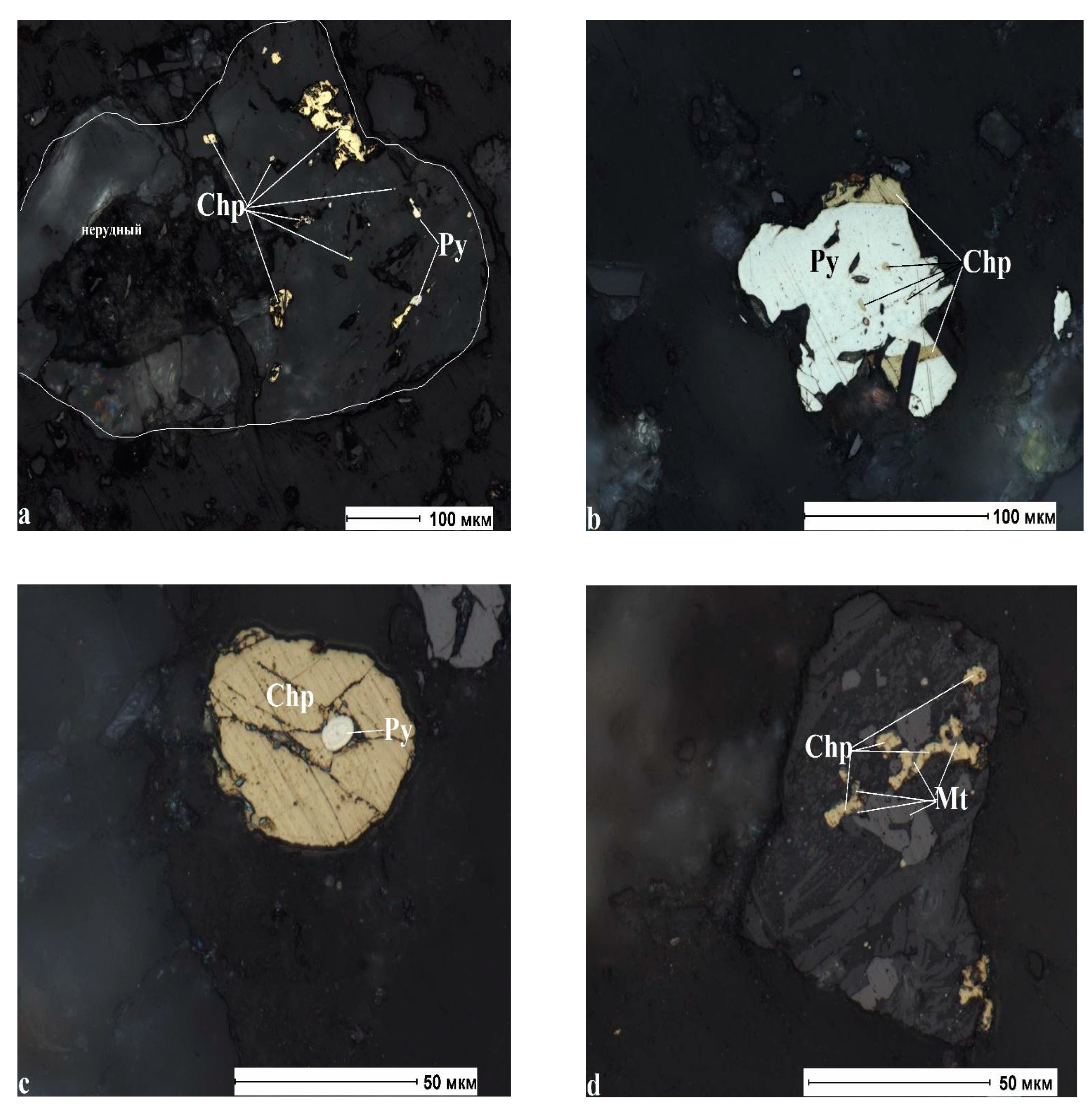
Figure 2.
Experimental flowsheet for the flotation of the initial tailings sample.
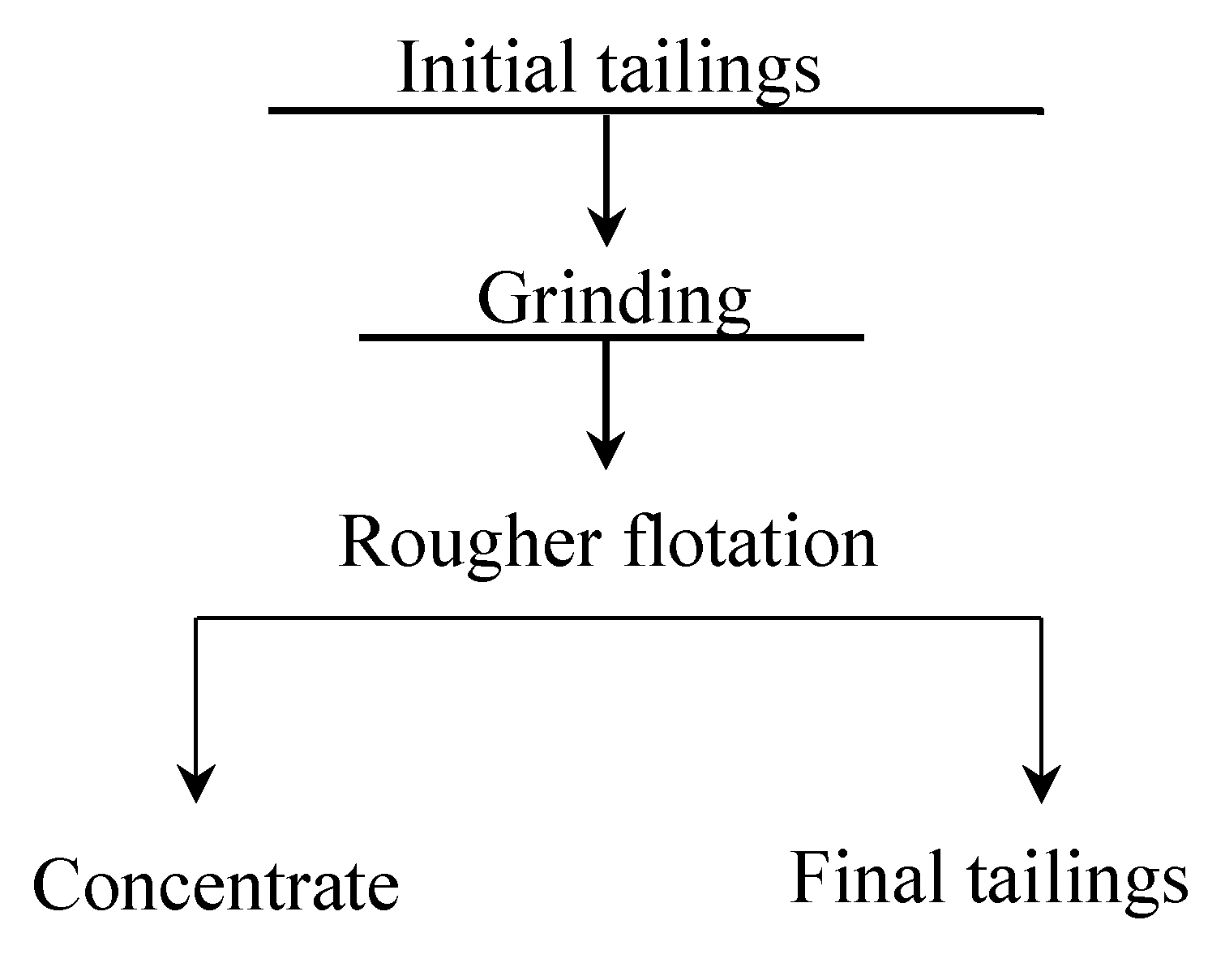
Figure 3.
Copper recovery as a function of the -0.045 mm fraction content.
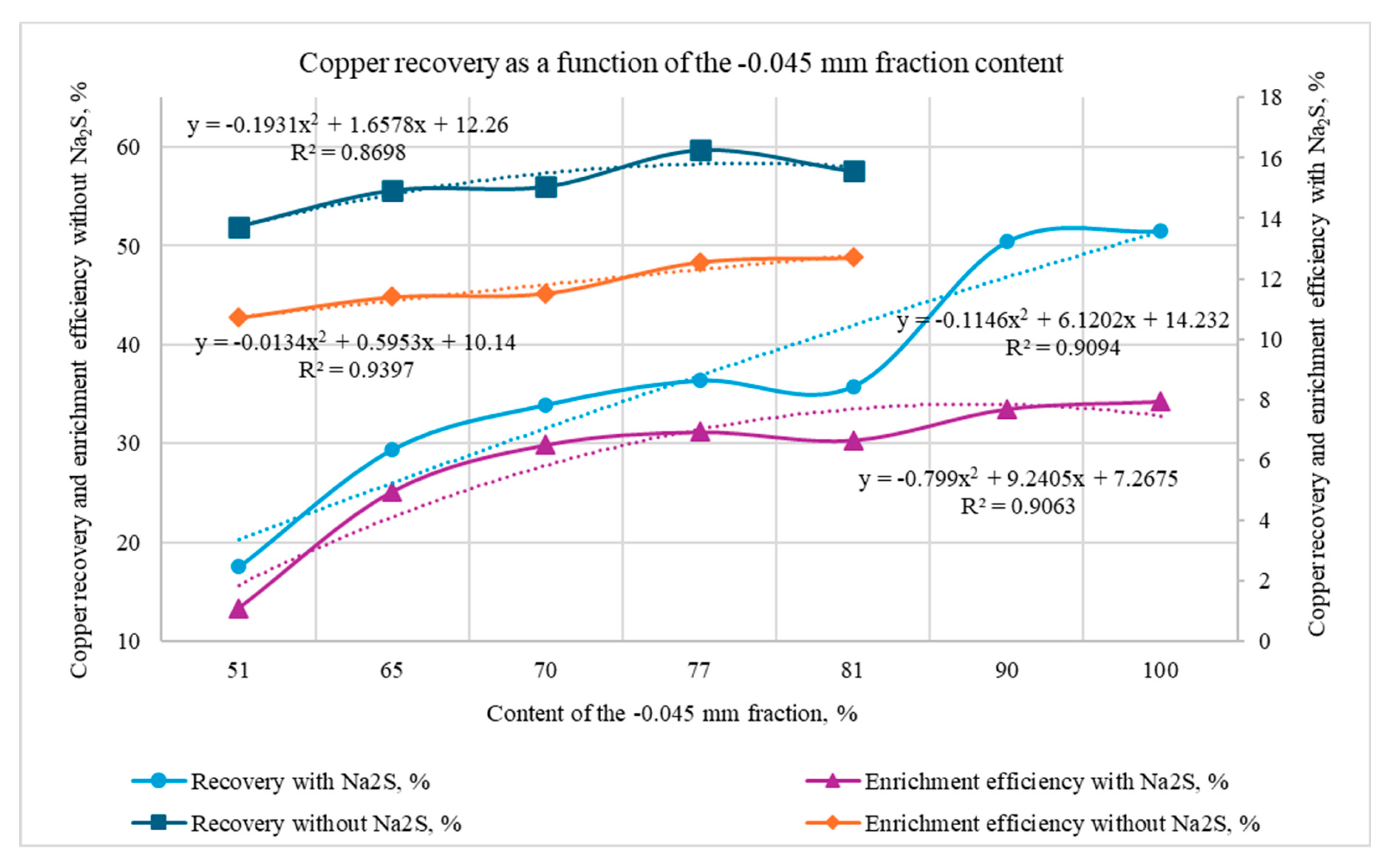
Figure 4.
Effect of grinding fineness on redox potential (ORP) changes.
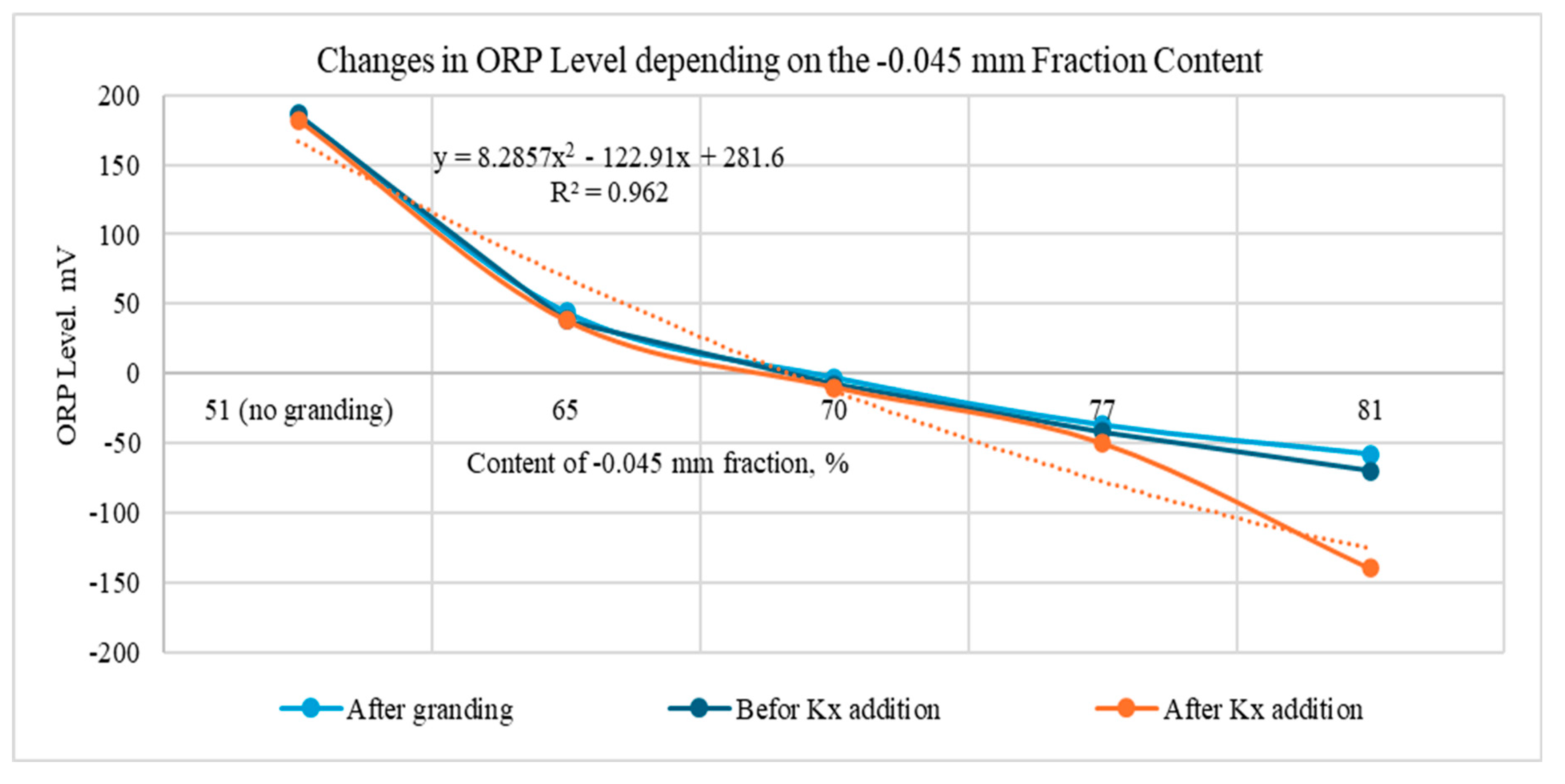
Figure 5.
Eh–pH diagram for the Cu-S-H2O system at 25 °C, calculated using HSC Chemistry software. The experimental data point (pH 8.6; Eh -150 mV) falls within the thermodynamic stability region of secondary copper sulfides (CuS, Cu2S). This alignment confirms the effectiveness of the sulfidization process following the mechanical renewal of the mineral surfaces.
Figure 5.
Eh–pH diagram for the Cu-S-H2O system at 25 °C, calculated using HSC Chemistry software. The experimental data point (pH 8.6; Eh -150 mV) falls within the thermodynamic stability region of secondary copper sulfides (CuS, Cu2S). This alignment confirms the effectiveness of the sulfidization process following the mechanical renewal of the mineral surfaces.
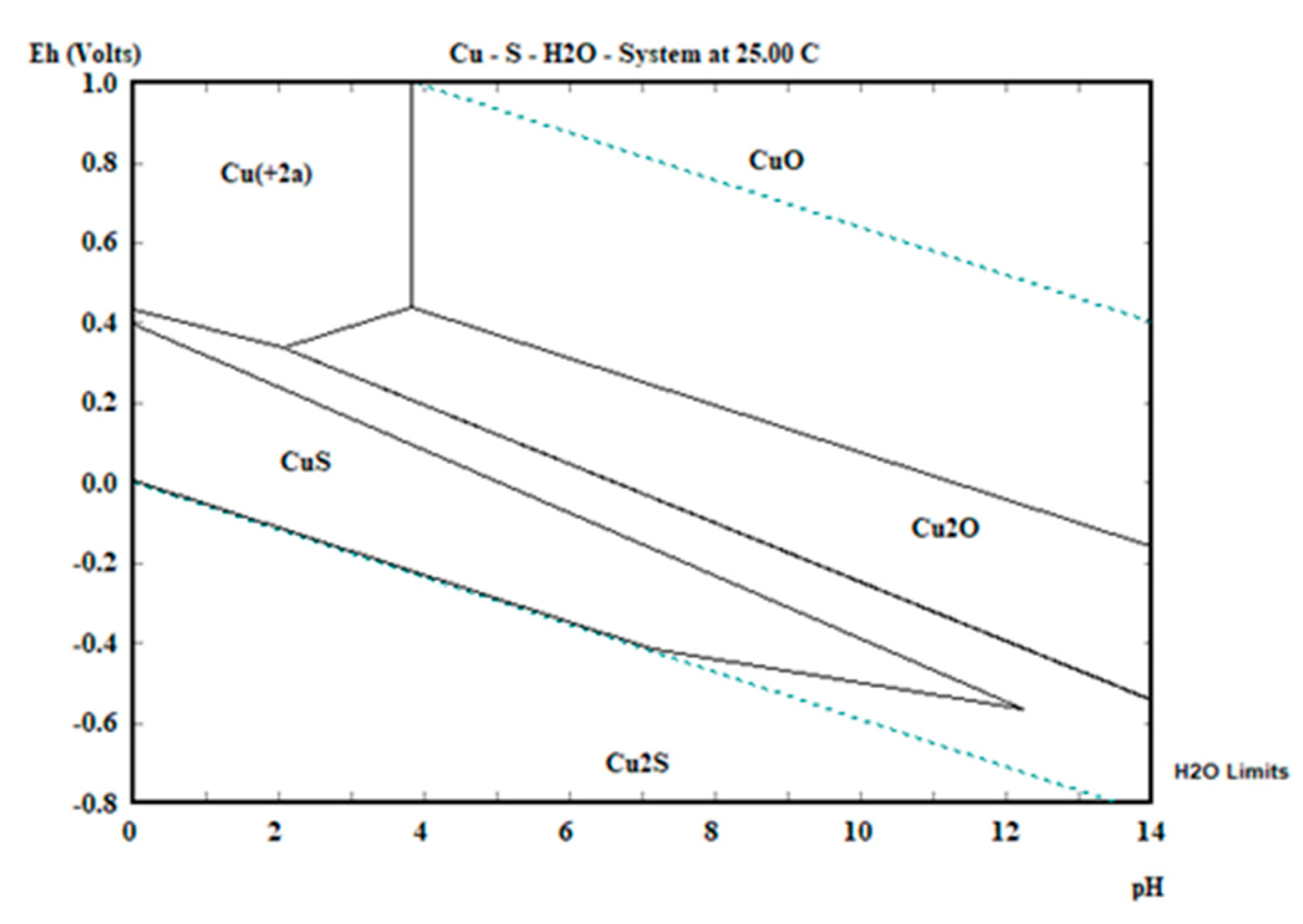

Table 1.
Chemical composition of the feed sample.
| Element | Content (wt. %) |
| Copper (Cu), % | 0.17 |
| Silver (Ag), g/t | 1.19 |
| Gold (Au), g/t | < LOD |
| Zinc (Zn) | 0.28 |
| Lead (Pb), % | 0.09 |
| Iron (Fe), % | 5.37 |
| Total Sulfur (S), % | 1.03 |
| Sulfide Sulfur, % | 1.00 |
| Arsenic (As), % | 0.015 |
| Antimony (Sb), % | 0.003 |
| Cadmium (Cd), % | 0.0001 |
| Molybdenum (Mo), % | 0.005 |
| Tellurium (Te), % | 0.0003 |
| Silicon dioxide, % | 58.06 |
| Aluminum oxide, % | 17.47 |
| Calcium oxide, % | 4.82 |
| Magnesium oxide, % | 1.34 |
| Potassium oxide, % | 2.89 |
| Selenium (Se), % | < LOD |
| Tin (Sn), % | < LOD |
| Bismuth (Bi), % | < LOD |
* < LOD – Below Limit of Detection.
Table 2.
Copper phase composition of the tailings.
| Copper Phase / Mineral Form | Content, % (absolute) |
Distribution, % (relative) |
| Sulfide Minerals, including.: | 0.078 | 46.16 |
| Secondary sulfides | 0.026 | 15.39 |
| Primary sulfides | 0.052 | 30.77 |
| Oxidized Minerals | 0.092 | 53.84 |
| including: Chrysocolla | 0.029 | 17.08 |
| Total Copper | 0.170 | 100.0 |
Table 3.
Particle size distribution of the initial tailings sample.
| Size fraction, mm | Weight, % | Grade, %, g/t* | Distribution, % | ||||
| Cu | Ag* | S | Cu | Ag | S | ||
| -0.5+0.2 | 8.15 | 0.196 | 1.472 | 1.11 | 9.27 | 10.08 | 8.80 |
| -0.2+0.1 | 13.24 | 0.176 | 1.106 | 1.02 | 13.53 | 12.31 | 13.14 |
| -0.1+0.071 | 5.19 | 0.201 | 1.882 | 1.15 | 6.06 | 8.21 | 5.81 |
| -0.071+0.045 | 21.76 | 0.162 | 1.196 | 0.92 | 20.46 | 21.87 | 19.48 |
| -0.045+0 | 51.66 | 0.169 | 1.095 | 1.05 | 50.68 | 47.54 | 52.77 |
| Feed | 100.0 | 0.17 | 1.19 | 1.03 | 100.0 | 100.0 | 100.0 |
Table 4.
Particle size analysis of the -71+0 μm fraction (Cyclosizer data).
| Size fraction (μm) | Weight, % | Cu Grade, % | Distribution, % |
| +71 | 26.08 | 0.147 | 22.55 |
| -71+59.1 | 13.42 | 0.156 | 12.31 |
| -59.1+45.4 | 9.06 | 0.163 | 8.69 |
| -45.4+32.7 | 13.61 | 0.103 | 8.24 |
| -32.7+22.22 | 4.06 | 0.156 | 3.73 |
| -22.22+11.11 | 6.24 | 0.115 | 4.22 |
| -11.11+8.4 | 0.68 | 0.078 | 0.31 |
| -8.4+0 | 26.85 | 0.253 | 39.95 |
| Total (Feed) | 100.0 | 0.17 | 100.0 |
Table 5.
Particle size distribution of the samples at varying grinding intervals.
| Size (mm) | Initial (0 min) | ||||||
| Ball Mill (Rotary Axis) | Ultra-Fine Grinding (UFG) | ||||||
| 0 | 5 | 10 | 15 | 20 | 10 | 20 | |
| 0.08 | 0.00 | 0.00 | 0.00 | 0.00 | 0.00 | 0.00 | 0.00 |
| 8.4 | 26.85 | 32.14 | 38.59 | 44.75 | 47.03 | 43.97 | 65.44 |
| 11.11 | 27.53 | 44.23 | 47.85 | 51.04 | 54.95 | 50.02 | 77.49 |
| 22.22 | 33.77 | 54.81 | 58.72 | 64.99 | 70.21 | 72.70 | 93.23 |
| 32.7 | 37.83 | 58.05 | 63.67 | 71.64 | 79.36 | 85.90 | 98.29 |
| 45.4 | 51.44 | 65.50 | 69.95 | 77.16 | 84.57 | 96.26 | 100.00 |
| 59.1 | 60.50 | 75.05 | 79.34 | 83.82 | 88.71 | 99.52 | 100.00 |
| 71 | 73.92 | 81.26 | 87.06 | 94.06 | 96.30 | 100.00 | 100.00 |
*data represents cumulative percent passing.
Table 6.
Copper flotation performance and metallurgical balance.
| -0.045 mm content (%) | Na2S dosage, g/t | Yield, % | Concentrate grade, % | Recovery, % | Enrichment Efficiency, % |
| 51 (initial) | 0 | 3.05 | 0.911 | 13.74 | 10.71 |
| 65 | 0 | 3.55 | 0.858 | 14.93 | 11.40 |
| 70 | 0 | 3.56 | 0.879 | 15.05 | 11.52 |
| 77 | 0 | 3.73 | 0.868 | 16.26 | 12.56 |
| 81 | 0 | 2.89 | 1.14 | 15.56 | 12.70 |
| 51 (initial) | 400 | 4.18 | 0.823 | 17.54 | 13.38 |
| 65 | 400 | 4.28 | 1.37 | 29.41 | 25.19 |
| 70 | 400 | 4.11 | 1.64 | 33.93 | 29.88 |
| 77 | 400 | 5.27 | 1.41 | 36.37 | 31.17 |
| 81 | 400 | 5.52 | 1.29 | 35.80 | 30.34 |
| 90 | 400 | 16.98 | 0.622 | 50.43 | 33.52 |
| 100 | 400 | 17.28 | 0.634 | 51.47 | 34.26 |
Table 7.
The dynamics of these electrochemical parameters.
| -0.045 mm Content (%) | рН | ORP | temperature, °С | Note | ||||||
| After grinding | Before Xanthate | After Xanthate | After grinding | Before Xanthate | After Xanthate | After grinding | Before Xanthate | After Xanthate | ||
| 56 (initial) | 7,77 | 7,77 | 7,8 | 186 | 186 | 182 | 15,71 | 15,71 | 15,71 | without Na2S |
| 65 | 7,54 | 7,52 | 7,56 | 44 | 38 | 38 | 18,4 | 18,2 | 18,1 | without Na2S |
| 70 | 7,5 | 7,51 | 7,48 | -3 | -8 | -10 | 19,4 | 19,4 | 19,4 | without Na2S |
| 77 | 7,52 | 7,53 | 7,54 | -37 | -42 | -50 | 20,4 | 20,5 | 20,5 | without Na2S |
| 81 | 7,49 | 7,49 | 7,52 | -58 | -70 | -140 | 21 | 21 | 21 | without Na2S |
| 56 (initial) | 7,54 | 7,52 | 8,66 | 186 | 186 | -150 | 18,4 | 18,2 | 18,1 | with Na2S |
| 65 | 7,5 | 7,51 | 8,62 | 44 | 38 | -150 | 19,4 | 19,4 | 19,4 | with Na2S |
| 70 | 7,52 | 7,53 | 8,64 | -3 | -8 | -150 | 20,4 | 20,5 | 20,5 | with Na2S |
| 77 | 7,49 | 7,49 | 8,69 | -37 | -42 | -150 | 21 | 21 | 21 | with Na2S |
| 81 | 7,49 | 7,49 | 8,73 | -58 | -70 | -140 | 21 | 21 | 21 | with Na2S |
| 90 | 7,7 | 7,7 | 8,71 | 146 | 126 | -150 | 21 | 21 | 21 | with Na2S |
| 100 | 7,6 | 7,67 | 8,72 | 129 | 112 | -150 | 22 | 22 | 21 | with Na2S |
Disclaimer/Publisher’s Note: The statements, opinions and data contained in all publications are solely those of the individual author(s) and contributor(s) and not of MDPI and/or the editor(s). MDPI and/or the editor(s) disclaim responsibility for any injury to people or property resulting from any ideas, methods, instructions or products referred to in the content. |
© 2026 by the authors. Licensee MDPI, Basel, Switzerland. This article is an open access article distributed under the terms and conditions of the Creative Commons Attribution (CC BY) license.
Copyright: This open access article is published under a Creative Commons CC BY 4.0 license, which permit the free download, distribution, and reuse, provided that the author and preprint are cited in any reuse.


