

Submitted:
02 April 2026
Posted:
03 April 2026
You are already at the latest version
Abstract
Social media increasingly shapes how younger publics encounter environmental issues, sustainability themes, and knowledge about responsible natural resource use. Despite this influence, many institutions still choose platforms impressionistically, even though differences in platform scale, audience concentration, and communication affordances affect the reach and educational fit of environmental messaging. This paper examines how major social media platforms can be interpreted as strategic communication environments for advancing youth-oriented environmental awareness and literacy. The study employs a comparative secondary-data design and treats platform indicators as planning evidence rather than as proof of platform effectiveness. It synthesizes current global and platform-specific reporting from DataReportal alongside official company and investor records where available. The analysis compares platform-scale indicators, youth-relevant audience structure, and recent trend signals to identify communication opportunity structures for youth outreach. The analysis shows that major platforms differ not only in reported scale but also in metric type, youth concentration, and likely communication function. Visually driven and socially networked platforms appear especially relevant to youth-facing dissemination, while broader-reach or search-oriented platforms remain useful for explanation, search visibility, and sustained follow-through. At the same time, the evidence does not demonstrate that platform scale alone produces environmental literacy or behavioral change. The study concludes that validated platform indicators can support bounded inference about where youth-oriented environmental communication is most plausibly positioned to achieve visibility, repetition, and strategic fit. It provides a source-validated, cross-platform framework for utilizing social media to enhance environmental awareness and literacy among youth, while maintaining clear boundaries on what public platform indicators can demonstrate.
Keywords:
social media
; environmental awareness
; environmental literacy
; sustainability communication
; youth outreach
; platform trends
; secondary data
1. Introduction
Climate mitigation and adaptation depend not only on technological innovation and policy reform but also on sustained gains in public understanding, institutional commitment, and everyday environmental responsibility. Communication matters because it shapes whether people clearly recognize environmental problems, trust the evidence presented to them, and understand how sustainability goals connect to practical action [1,2,3].
Social media platforms now mediate a substantial share of public encounters with environmental information. Platform governance, algorithmic curation, creator cultures, and moderation practices influence which sustainability themes gain visibility, how rapidly they circulate, and which publics encounter them [4,5]. These conditions make platform choices a substantive communication decision rather than a neutral matter of message placement.
At the same time, institutions often overread surface metrics. Views, likes, shares, and follower counts may signal attention, but, by themselves, they do not demonstrate environmental literacy, trust, or a responsible resource-use orientation [6,7,8,9]. A strategy that optimizes only for visibility may therefore misallocate scarce resources when the chosen platform does not match the intended audience, message format, or educational purpose.
The current platform’s scale reinforces the importance of these decisions. DataReportal reports 5.66 billion active social media user identities worldwide at the start of October 2025, equivalent to 68.7% of the global population, while also noting that these figures represent user identities rather than perfectly deduplicated individuals [10]. These numbers indicate that social media now functions as a global communication infrastructure rather than a niche media environment.
The longer arc of platform expansion strengthens that conclusion. Kepios analysis reported by DataReportal indicates that global social media user identities increased from just under 2.27 billion in October 2015 to 5.66 billion in October 2025, meaning that social media use more than doubled over the decade. DataReportal also cautions that long-run comparisons spanning periods before July 2024 may be affected by later source-data revisions, so the trend should be interpreted as contextual evidence of large-scale growth rather than as a precise annual behavioral series [11].
This broader communication shift becomes more consequential when the analysis narrows to youth outreach. Younger users do not distribute their attention evenly across platforms, and institutions that seek to deepen environmental awareness and literacy among youth cannot assume that aggregate platform popularity translates automatically into youth relevance. Pew Research Center reports that among U.S. adults ages 18 to 29, Instagram use reaches eight in ten, while YouTube, TikTok, and Snapchat also remain especially strong among younger adults. Pew’s 2025 teen reporting similarly shows that YouTube remains the most widely used platform among teens, while TikTok, Instagram, and Snapchat also retain majority or near-majority use [12,13]. These age-patterned findings do not validate global monthly active-user totals, but they do support the narrower claim that youth-facing environmental communication is likely to depend heavily on a cluster of visually driven and socially networked platforms.
Misinformation further complicates this landscape. Climate denial, delay narratives, and misleading solution claims can distort public understanding and weaken trust in environmental communication [14,15,16,17]. Because the same platforms that expand reach can also amplify counter-messaging, institutions cannot treat platform selection as separate from credibility design.
Despite a strong literature on digital activism, environmental communication, and online participation, an applied gap remains. Existing scholarships often examine single platforms, specific campaigns, or psychological mechanisms. At the same time, practitioners still lack a current cross-platform synthesis that combines validated platform scale, youth-relevant audience structure, and trend signals in a form directly useful for sustainability communication planning [9,18,19]. Stronger peer-reviewed analysis also requires more than a practical checklist. It requires a clear account of what this type of evidence can and cannot support.
This paper addresses that gap by treating platform indicators as planning evidence rather than as proof of platform effectiveness. More specifically, it develops and applies a comparative framework for interpreting platform-scale indicators as proxies for youth-oriented communication opportunity structures. The paper, therefore, contributes not only an updated cross-platform synthesis but also a methodological clarification: validated platform indicators can support bounded strategic inference about awareness and literacy conditions, even though they cannot establish educational or behavioral outcomes directly.
The study asks three questions.
RQ1. How do major social media platforms differ in scale, audience structure, and strategic relevance for youth-oriented environmental awareness and literacy communication?
RQ2. How do metric type, audience concentration, and trend dynamics shape bounded inferences about platform suitability for disseminating environmental sustainability themes and knowledge to youth?
RQ3. What are the policy and practice implications when institutions rely on validated secondary platform indicators to guide youth-oriented sustainability communication?
Having established the importance of platform choice and the communication gap this paper addresses, the next section reviews the scholarship that informs how platform scale, audience structure, and strategic fit should be interpreted.
2. Literature Review
From Awareness to Verified Action
Environmental communication research consistently distinguishes awareness from action. Communication can deepen public understanding and make environmental issues more salient, yet those gains do not automatically translate into long-term behavioral change [1,2]. This distinction matters for social media research because digital platforms often reward speed, repetition, and visibility. In contrast, environmental literacy and responsible natural resource use usually develop through slower processes of explanation, reflection, and trust-building.
The policy context reinforces this distinction. The Paris Agreement frames implementation as a multilevel process that depends on public legitimacy, institutional capacity, and sustained social commitment rather than on communication exposure alone [3]. Any platform-centered analysis must therefore separate communication opportunity from verified sustainability outcomes.
Platforms as Distinct Communication Environments
Platforms are not interchangeable communication containers. Bennett and Segerberg [4] show that digitally networked action often operates through personalized sharing rather than stable organizational structures, while Boulianne [6], Christensen [7], and Halupka [8] show that digital participation can lower barriers to visibility and expression, yet vary substantially in depth, durability, and civic consequence. In essence, these studies suggest that platform fit matters because different platforms structure attention, interaction, and social signaling in distinct ways.
In all, public health, environmental, and digital communication research point in the same direction. Thackeray et al. [20] and Kite et al. [9] argue that digital platforms can support information access, engagement, and dissemination only when organizations align channel choice with audience characteristics, communication goals, and evaluation strategy. For environmental sustainability work, platform scale is relevant, but strategic fit remains decisive.
Youth-Oriented Environmental Communication
Youth-facing environmental communication deserves special attention because younger publics often encounter climate themes through digital media before they encounter them through formal institutional channels. Research on climate activism shows that youth-led movements use platforms to diffuse frames, coordinate events, and normalize pro-climate identities, but the literature also shows that mobilization depends on network conditions, organizational support, and broader civic context rather than on platform visibility alone [18,21,22].
Environmental education scholarship reaches a similar conclusion from a different angle. Durable sustainability engagement depends on institutional support, curricular integration, and community context, not on exposure alone [23,24,25]. Social media may therefore provide a useful entry point for awareness and literacy, but it should not be treated as a substitute for deeper educational structures.
Misinformation, Credibility, and the Remaining Gap
The literature on misinformation adds another critical layer. Many researchers such as Ecker et al. [15], Lewandowsky and van der Linden [16], Compton et al. [14], and van der Linden et al. [17] show that misinformation can persist even after correction attempts. For environmental communication, scale alone is never enough. Organizations must also anticipate contestation, clarify the credibility of sources, and design communication that resists misleading reframing.
Taken together, the literature explains why platforms matter, why raw attention is insufficient, and why misinformation complicates environmental outreach. What remains less developed is a current, cross-platform framework for interpreting platform indicators as bounded evidence of youth-oriented communication opportunity structures. The next section specifies how the present study addresses that gap.
3. Methodology
3.1. Research Design
This article uses comparative secondary data analysis. The design aligns with the research questions because the paper examines how current platform indicators can support bounded inference about youth-oriented communication of environmental awareness and literacy. The study does not test causal effects and does not directly measure environmental outcomes. Instead, it evaluates the communication conditions under which sustainability themes and knowledge may plausibly reach youth publics.
The study, therefore, treats platform-scale indicators as planning evidence rather than as proof of platform effectiveness. That distinction is central to the article’s contribution. The analysis examines what current public indicators can validly reveal to researchers and institutions about communication opportunity structures, and where those indicators fail to support strong inference.
3.2. Analytical Framework
Operational definition of youth relevance. For this study, the relevance of youth-oriented platforms is operationalized using the 18- to 24-year-old age cohort. This choice is methodological rather than universal. It reflects the most comparable cross-platform audience data available in the selected secondary sources, which report audience composition more consistently for adult age groups than for younger age bands. Accordingly, the analysis uses ages 18 to 24 as a pragmatic proxy for youth-oriented relevance in platform comparison.
Figure 1 presents the article’s analytical framework. The model links platform scale, audience structure, and platform affordances to communication opportunity structures, then positions awareness and literacy outcomes as downstream implications rather than directly observed results.
Figure 1 clarifies the paper’s inferential boundary. Platform indicators do not directly measure awareness or literacy. They support a narrower claim: by combining scale, audience concentration, and affordance-sensitive interpretation, researchers can identify communication opportunity structures that are more or less plausible for youth-oriented sustainability outreach.
3.3. Source Selection and Validation
The analysis draws on publicly accessible platform indicators from DataReportal/Kepios reporting and the platform-specific statistics pages summarized in its essential platform reports [10,26,27,28,29,30]. Those figures are supplemented, where necessary, with official company, investor, or company-published public records: Instagram is anchored to Meta’s public statement that the platform reached 3 billion monthly active users; WhatsApp is anchored to Meta’s statement that the platform serves more than 3 billion users; Telegram is anchored to Telegram’s public press information; and Snapchat is anchored to Snap’s fourth-quarter 2025 investor release [31,32,33,34].
To contextualize the strategic importance of current platform selection, the analysis also includes an annual trend visualization of global social media user identities spanning 2015 through 2025. This addition does not alter the study design. It rather provides contextual evidence of the communication scale by compiling annual figures from DataReportal Global Overview reports. It is interpreted cautiously because DataReportal notes that methodological revisions can affect comparisons over time [35,36,37,38,39,40,41,42,43,44,45].
3.4. Analytic Approach and Methodological Limitations
The analysis proceeds in three steps. First, it examines current platform-scale indicators to establish the size and visibility of major platforms. Second, it considers youth-relevant audience indicators to assess which platforms appear more relevant to younger users. Third, it interprets these indicators in relation to communication strategy, misinformation risk, and policy application.
The approach has important limitations. Public platform indicators are not fully equivalent across platforms; some report monthly active users, some report users, and others report potential advertising reach. Some figures refer only to adults aged 18 and above, and comparable audience-composition snapshots are not always available for the same reporting period as platform-scale figures. Therefore, the analysis supports bounded strategic inference about communication opportunity structures, not causal inference about educational or behavioral outcomes.
4. Results
4.1. Platform Scale and Long-Run Growth
The results address the research questions by examining current platform-scale indicators, youth-relevant audience structure, and long-run communication growth as planning evidence for environmental awareness and literacy outreach.
To add a genuine year-over-year trend perspective, Figure 2 reports annual global social media user totals from 2015 to 2025 together with yearly net additions. Positioning the trend figure in the results section allows it to function as contextual evidence for the empirical comparison that follows rather than as introductory background packaging.
Figure 2 shows uninterrupted growth across the decade, but it also reveals that the pace of annual expansion varied from year to year. Growth accelerated sharply between 2016 and 2021, then moderated as global adoption moved beyond the halfway point of the world population. This pattern strengthens the case for treating social media as a durable communication infrastructure while also underscoring the value of reading platform trends dynamically rather than as static snapshots.
To clarify the current platform scale without obscuring metric differences, Table 1 organizes the validated indicators by metric family rather than treating them as a single, comparable universe.
Table 1 identifies the outer bounds of the present platform opportunity while also making the principal comparability issue impossible to miss. Facebook, Instagram, and WhatsApp occupy the top tier of reported scale, while YouTube and TikTok also retain very large, reported reach. However, the table also shows that these figures do not all describe the same kind of platform scale. Stronger peer-reviewed interpretation, therefore, requires caution: platform size can inform strategic salience, but mixed metrics prevent a strict performance hierarchy.
To make those scale relationships easier to visually inspect, Figure 3 presents a comparative summary of the values in Table 1, acknowledging the caveat about metric non-equivalence.
Figure 3 shows that platform scale remains concentrated among a relatively small number of dominant platforms. The figure also reinforces the point that scale alone cannot answer this paper’s central question. A platform may be globally large yet still vary substantially in youth relevance, communication style, and strategic suitability for environmental awareness and literacy work.
Because aggregate scale alone does not indicate youth relevance, the analysis next turns to audience structure. Table 2 summarizes directly comparable youth-relevant audience indicators from the latest cross-platform advertising-audience snapshot available for the selected platforms.
4.2. Youth-Relevant Audience Structure
Table 2 adds a targeting lens that Table 1 alone cannot provide. Instagram and TikTok pair large reported scale with comparatively higher relative audience shares among 18- to 24-year-olds, while YouTube combines broader reach with a lower relative concentration in this cohort. X shows a relatively younger, more male-skewed profile. These differences suggest a conditional strategic ordering rather than a universal ranking.
To clarify those relative differences visually, Figure 4 displays the age 18-24 audience shares summarized in Table 2.
Figure 4 shows that youth relevance is not evenly distributed across the selected platforms. This figure supports a more targeted interpretation of platform choice: institutions that seek to deepen environmental awareness and literacy among youth may need to prioritize different channels than institutions seeking broad general-public exposure.
4.3. Strategic Interpretation of Platform Differences
To complement the age-share comparison with a composition-based visual, Figure 5 presents Instagram’s current global advertising audience by gender. Instagram provides a useful illustrative case because it combines very large reported scale, comparatively higher relative 18 to 24 audience shares, and a broadly balanced gender profile in the available data.
Figure 5 shows that Instagram’s global audience is broadly balanced by gender rather than overwhelmingly concentrated in one segment. That balance helps explain why Instagram remains strategically attractive for youth-oriented sustainability communication: it combines large scale, comparatively higher relative 18 to 24 audience presence, and relatively even gender reach.
Taken together, the validated secondary indicators support a bounded claim. Visually led and socially networked platforms appear especially important for youth-oriented awareness and literacy dissemination, while broader platforms remain relevant for explanation, search visibility, reinforcement, and cross-audience spillover. The next section interprets those patterns more directly.
5. Discussion
The analysis supports a strategy-first interpretation rather than a claim of platform effectiveness. Validated secondary indicators can help institutions allocate attention, creative effort, and evaluation resources more rationally, but they do not demonstrate that any platform will, on its own, produce environmental literacy gains or responsible resource-use behavior [1,9]. The findings, therefore, support platform selection as an early planning decision for youth-oriented environmental communication rather than as evidence of downstream impact.
The article’s main scholarly contribution lies in clarifying how platform indicators can function as proxies for communication opportunity structures. When interpreted through the framework in Figure 1, current platform-scale indicators help identify where youth-oriented sustainability themes are most likely to find visibility, repetition, and peer circulation. They do not, however, tell us whether messages are understood, trusted, retained, or acted upon. That distinction matters for peer-reviewed research because it separates valid proxy use from overextended causal inference.
Audience structure remains central because environmental sustainability communication rarely addresses a single homogeneous public. Youth outreach often depends on visibility, identity signaling, peer circulation, and low-friction participation, while policy-facing or household behavior campaigns may require broader age distribution, stronger search pathways, or more stable information environments [4,6,7,8]. The findings, therefore, suggest that no single platform dominates all communication objectives. Organizations should align platform choice with the educational and communicative tasks they hope to accomplish.
The analysis also reinforces a practical distinction between reach and fit. A large platform scale may increase the likelihood of encountering environmental content, but scale alone does not establish credibility, relevance, or learning. Communication research has repeatedly shown that outcomes depend heavily on targeting, message design, tailoring, and opportunities for follow-through [9,20]. Applied to environmental sustainability, this means that a large platform can be useful for broad awareness and visibility of the agenda. In contrast, a different platform or linked channel may better support explanation, repeated exposure, and literacy-building.
The methodological value of the study lies partly in its transparency. By separating metric families in Table 1 and isolating comparable youth indicators in Table 2, the analysis makes clear which comparisons are robust and which remain provisional. That structure strengthens interpretive discipline and offers a clearer model for future cross-platform research than a single blended ranking would provide.
A further implication concerns misinformation and trust. Environmental communication often unfolds in information environments where scientific claims are simplified, politicized, or strategically distorted. Large platforms can expand visibility, but they can also amplify misleading counterframes and selective skepticism. Existing research on correction and prebunking suggests that institutions improve resilience when they clearly communicate source transparency, prepare audiences to recognize manipulative tactics, and provide accessible evidence summaries alongside public-facing content [14,15,16,17].
The study offers a bound but useful contribution. It does not infer direct environmental outcomes from indirect evidence, nor does it treat platform scales as synonymous with impact. Instead, it shows how current platform indicators can help researchers and institutions identify promising communication environments to deepen environmental awareness and literacy among youth through a more informed strategy.
6. Policy Implications
The findings suggest three practical implications for institutions that use social media to support environmental sustainability communication among youth. First, institutions should choose platforms according to educational and communication purposes rather than popularity alone. Some platforms appear better suited to broad awareness and discovery, while others appear better suited to explanation, repeated engagement, or community-based reinforcement.
Second, institutions should treat social media as a forum for environmental learning and consciousness-building, not merely as a promotional channel. Messages should clearly explain issues, connect environmental themes to everyday life, and encourage more responsible attitudes toward natural resource use. The strongest platform choices are therefore those that align with the communication purpose, have plausible audience concentration, and offer appropriate affordances.
Third, institutions should evaluate outcomes beyond visibility metrics. Views and shares may indicate attention, but they do not establish environmental literacy or stronger sustainability consciousness. Organizations should therefore connect platform use to downstream indicators, such as click-through rates to educational resources, repeat engagement with content, participation in sustainability activities, or other measures aligned with campaign goals.
7. Conclusions
Social media now operates on a scale that makes platform choice a consequential component of environmental sustainability communication. This paper shows that current, source-validated platform indicators can help institutions interpret where youth-oriented awareness and literacy efforts are most plausibly positioned to gain visibility, repetition, and strategic fit.
The study does not show that any one platform is inherently most effective. Instead, it shows that current secondary indicators can support bounded inference about communication opportunity structures when researchers separate metric families, distinguish scale from fit, and avoid treating platform visibility as equivalent to educational impact.
The contribution is therefore both practical and scholarly. The paper offers a current, cross-platform framework for using public platform indicators to deepen environmental awareness and literacy among youth while maintaining clear limits on what those indicators can prove. In doing so, it shifts platform choice away from intuition and toward a more transparent, evidence-based strategy for environmental communication research and practice.
Funding
This research did not receive any specific grant from funding agencies in the public, commercial, or Non-Profit agencies.
Data Availability Statement
No new dataset was generated for this study. The analysis relies exclusively on publicly available secondary sources cited in the manuscript.
Acknowledgments
During the preparation of this work, the author used Grammarly to improve language, readability, and organization. After using this tool, the authors reviewed and edited the content as needed and takes full responsibility for the content of the published article.
Conflicts of Interest
The author declares no known competing financial interests or personal relationships that could have appeared to influence the work reported in this paper.
References
- Hart, PS; Feldman, L. The impact of climate change-related imagery and text on public opinion and behavior change. Climate Change 2016, 136(3-4), 403–12. [Google Scholar] [CrossRef]
- Nisa, CF; Bélanger, JJ; Schumpe, BM; Faller, DG. Meta-analysis of randomised controlled trials testing the effects of psychological interventions on pro-environmental behavior. J Exp Psychol Gen. 2019, 148(12), 2202–26. [Google Scholar] [CrossRef]
- United Nations Framework Convention on Climate Change. Paris Agreement [Internet]. 2015. Available online: https://unfccc.int/sites/default/files/english_paris_agreement.pdf.
- Bennett, WL; Segerberg, A. The logic of connective action: Digital media and the personalization of contentious politics. Inf Commun Soc. 2012, 15(5), 739–68. [Google Scholar] [CrossRef]
- Gillespie, T. Custodians of the Internet: Platforms, content moderation, and the hidden decisions that shape social media; Yale University Press: New Haven, 2018. [Google Scholar] [CrossRef]
- Boulianne, S. Social media use and participation: A meta-analysis of current research. Soc Sci Comput Rev. 2015, 33(5), 524–38. [Google Scholar] [CrossRef]
- Christensen, HS. Political activities on the Internet: Slacktivism or political participation by other means? First Monday 2011, 16(2). [Google Scholar] [CrossRef]
- Halupka, M. Clicktivism: A systematic heuristic. Policy Internet 2014, 6(2), 115–32. [Google Scholar] [CrossRef]
- Kite, J; Thomas, M; Grunseit, A; Li, V; Bellew, W; Bauman, A. A model of social media effects in public health: A systematic review of the evidence. J Med Internet Res. 2023, 25, e46345. [Google Scholar] [CrossRef]
- DataReportal. Global social media statistics [Internet]. 14 Mar 2026. Available online: https://datareportal.com/social-media-users.
- DataReportal. Digital 2026: 2 in 3 people on Earth now use social media [Internet]. 14 Mar 2026. Available online: https://datareportal.com/reports/digital-2026-two-in-three-people-use-social-media.
- Pew Research Center. Americans’ social media use 2025 [Internet]. 20 Nov 2025. Available online: https://www.pewresearch.org/internet/2025/11/20/americans-social-media-use-2025/.
- Pew Research Center. Teens and social media fact sheet [Internet]. 10 Jul 2025. Available online: https://www.pewresearch.org/internet/fact-sheet/teens-and-social-media-fact-sheet/.
- Compton, J; van der Linden, S; Cook, J; Basol, M. Inoculation theory in the post-truth era: Extant findings and new frontiers for contested science, misinformation, and conspiracy theories. Soc Personal Psychol Compass 2021, 15(6), e12602. [Google Scholar] [CrossRef]
- Ecker, UKH; Lewandowsky, S; Cook, J; Schmid, P; Fazio, LK; Brashier, N; et al. The psychological drivers of misinformation belief and its resistance to correction. Nat Rev Psychol. 2022, 1, 13–29. [Google Scholar] [CrossRef]
- Lewandowsky, S; van der Linden, S. Countering misinformation and fake news through inoculation and prebunking. Eur Rev Soc Psychol. 2021, 32, 348–84. [Google Scholar] [CrossRef]
- van der Linden, S; Leiserowitz, A; Rosenthal, S; Maibach, E. Inoculating the public against misinformation about climate change. Global Chall. 2017, 1(2), 1600008. [Google Scholar] [CrossRef] [PubMed]
- Damoah, B; Keengwe, S; Owusu, S; Yeboah, C; Kekessie, FK. The global climate and environmental protest: Student environmental activism as transformative defiance. Int J Environ Sustain Soc Sci. 2023, 4(4), 1180–98. [Google Scholar] [CrossRef]
- Tapia-Echanove, M; Fernández-Berrocal, P; de la Fuente, A. Climate change cognition, affect, and behavior in youth: A scoping review. WIREs Clim Change 2025, 16(1), e70000. [Google Scholar] [CrossRef]
- Thackeray, R; Neiger, BL; Keller, H. Integrating social media and social marketing: A four-step process. Health Promot Pract. 2012, 13(2), 165–8. [Google Scholar] [CrossRef] [PubMed]
- Buzogány, A. Framing different energy futures? Comparing Fridays for Future and Extinction Rebellion. Energy Res Soc Sci. 2022, 91, 102755. [Google Scholar] [CrossRef]
- de Moor, J; Uba, K; Wahlström, M; Wennerhag, M; De Vydt, M. New kids on the block: Taking stock of the recent cycle of climate activism [Internet]; University of Gothenburg: Gothenburg, 2020; Available online: https://www.gu.se/sites/default/files/2020-07/new_kids_on_the_block_report_final_0.pdf.
- Damoah, B; Adu, EO. Environmental education in South African schools: The role of civil society organizations. Res Soc Sci Technol. 2022, 7(3), 1–17. [Google Scholar] [CrossRef]
- Damoah, B; Omodan, BI. Determinants of effective environmental education policy in South African schools. Int J Educ Res Open 2022, 3, 100206. [Google Scholar] [CrossRef]
- Damoah, B; Khalo, X; Adu, EO. South African integrated environmental education curriculum trajectory. Int J Educ Res. 2024, 125, 102352. [Google Scholar] [CrossRef]
- DataReportal. Facebook users, stats, data, trends, and more [Internet]. 14 Mar 2026. Available online: https://datareportal.com/essential-facebook-stats.
- DataReportal. Instagram users, stats, data, trends, and more [Internet]. 14 Mar 2026. Available online: https://datareportal.com/essential-instagram-stats.
- DataReportal. TikTok users, stats, data, trends, and more [Internet]. 14 Mar 2026. Available online: https://datareportal.com/essential-tiktok-stats.
- DataReportal. YouTube users, stats, data, trends, and more [Internet]. 14 Mar 2026. Available online: https://datareportal.com/essential-youtube-stats.
- DataReportal. X users, stats, data, trends, and more [Internet]. 14 Mar 2026. Available online: https://datareportal.com/essential-x-stats.
- Meta. In India, Instagram debuts a Reels-first experience for its mobile app [Internet]. 28 Sep 2025. Available online: https://about.fb.com/news/2025/09/in-india-instagram-debuts-a-reels-first-experience-for-its-mobile-app/.
- Meta. Introducing message translations on WhatsApp [Internet]. 23 Sep 2025. Available online: https://about.fb.com/news/2025/09/introducing-message-translations-whatsapp/.
- Snap, Inc. Announces fourth quarter and full year 2025 financial results [Internet]. 4 Feb 2026. Available online: https://investor.snap.com/news/news-details/2026/Snap-Inc--Announces-Fourth-Quarter-and-Full-Year-2025-Financial-Results/default.aspx.
- Telegram. Telegram press info [Internet]. 14 Mar 2026. Available online: https://telegram.org/press.
- DataReportal. Digital 2015: Global Digital Overview [Internet]. 21 Jan 2015. Available online: https://datareportal.com/reports/digital-2015-global-digital-overview.
- DataReportal. Digital 2016: Global Digital Overview [Internet]. 27 Jan 2016. Available online: https://datareportal.com/reports/digital-2016-global-digital-overview.
- DataReportal. Digital 2017: Global Digital Overview [Internet]. 25 Jan 2017. Available online: https://datareportal.com/reports/digital-2017-global-digital-overview.
- DataReportal. Digital 2018: Global Digital Overview [Internet]. 30 Jan 2018. Available online: https://datareportal.com/reports/digital-2018-global-digital-overview.
- DataReportal. Digital 2019: Global Digital Overview [Internet]. 31 Jan 2019. Available online: https://datareportal.com/reports/digital-2019-global-digital-overview.
- DataReportal. Digital 2020: Global Digital Overview [Internet]. 30 Jan 2020. Available online: https://datareportal.com/reports/digital-2020-global-digital-overview.
- DataReportal. Digital 2021: Global Overview Report [Internet]. 27 Jan 2021. Available online: https://datareportal.com/reports/digital-2021-global-overview-report.
- DataReportal. Digital 2022: Global Overview Report [Internet]. 26 Jan 2022. Available online: https://datareportal.com/reports/digital-2022-global-overview-report.
- DataReportal. Digital 2023: Global Overview Report [Internet]. 26 Jan 2023. Available online: https://datareportal.com/reports/digital-2023-global-overview-report.
- DataReportal. Digital 2024: Global Overview Report [Internet]. 31 Jan 2024. Available online: https://datareportal.com/reports/digital-2024-global-overview-report.
- DataReportal. Digital 2025: Global Overview Report [Internet]. 5 Feb 2025. Available online: https://datareportal.com/reports/digital-2025-global-overview-report.
Figure 1.
Analytical framework for interpreting platform indicators. Note. The present study evaluates the first four components directly and treats awareness and literacy outcomes as downstream implications rather than as measured endpoints.
Figure 1.
Analytical framework for interpreting platform indicators. Note. The present study evaluates the first four components directly and treats awareness and literacy outcomes as downstream implications rather than as measured endpoints.
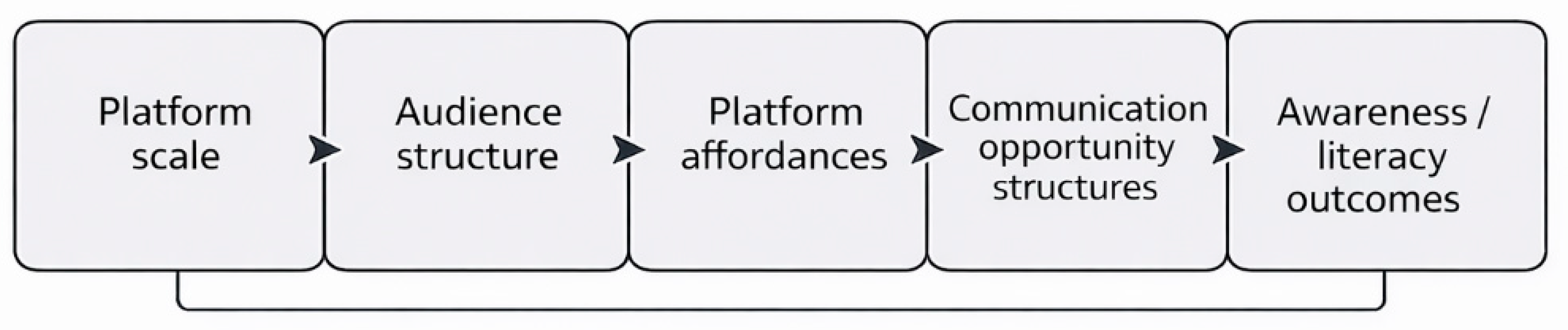
Figure 2.
Annual growth in global social media user identities, 2015–2025. Note. The line plots annual global social media user totals, while the bars plot year-over-year net additions. The series compiles figures reported in DataReportal annual Global Overview reports for 2015 through 2025. Because DataReportal has revised its methodology over time, the figure should be interpreted as a longitudinal indicator rather than a perfectly uniform historical series [35,36,37,38,39,40,41,42,43,44,45].
Figure 2.
Annual growth in global social media user identities, 2015–2025. Note. The line plots annual global social media user totals, while the bars plot year-over-year net additions. The series compiles figures reported in DataReportal annual Global Overview reports for 2015 through 2025. Because DataReportal has revised its methodology over time, the figure should be interpreted as a longitudinal indicator rather than a perfectly uniform historical series [35,36,37,38,39,40,41,42,43,44,45].
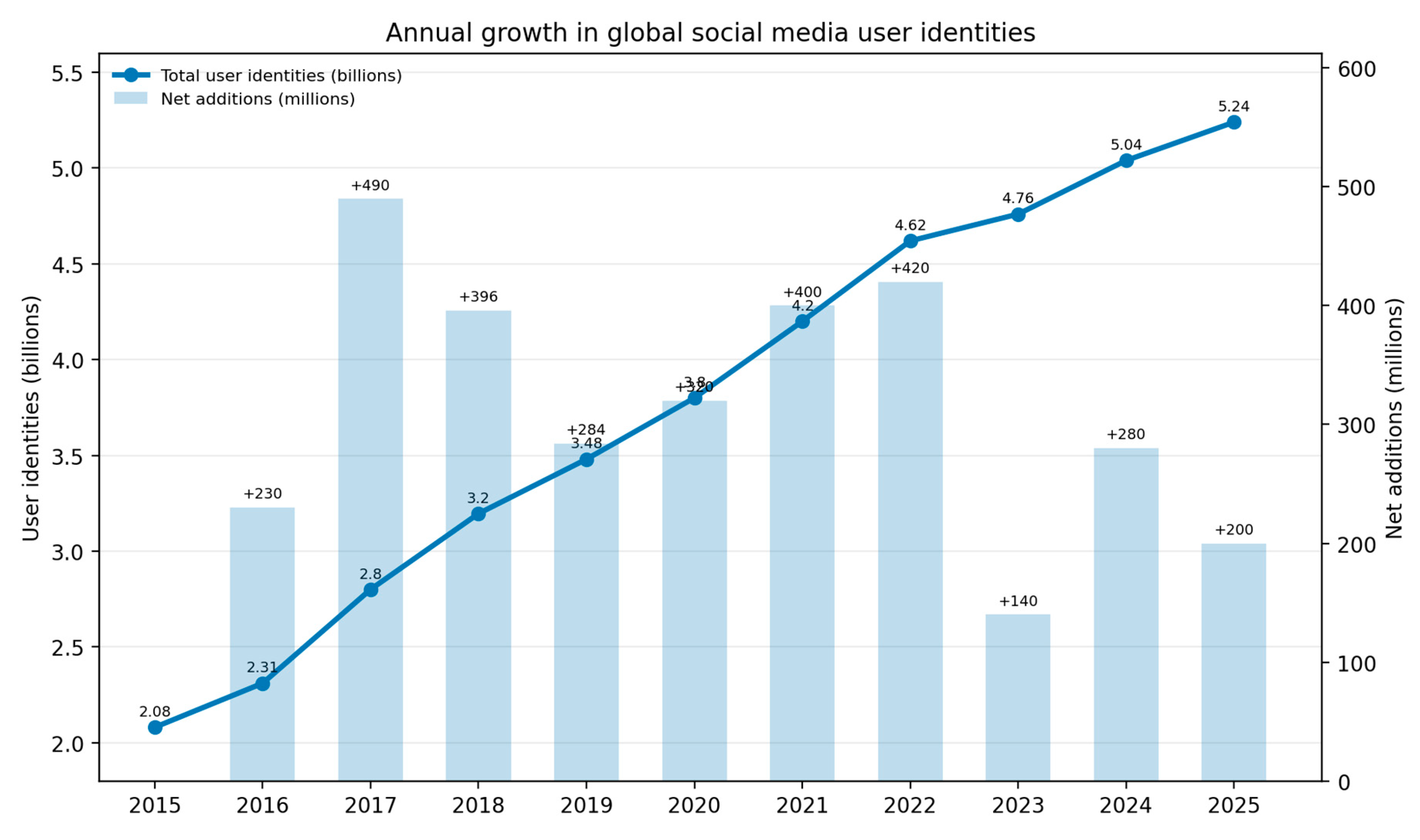
Figure 3.
Visual summary of current platform-scale indicators. Note. Figure 3 visualizes the values reported in Table 1. Because the underlying indicators mix monthly active users, users, and potential advertising reach, the chart remains illustrative rather than inferential.
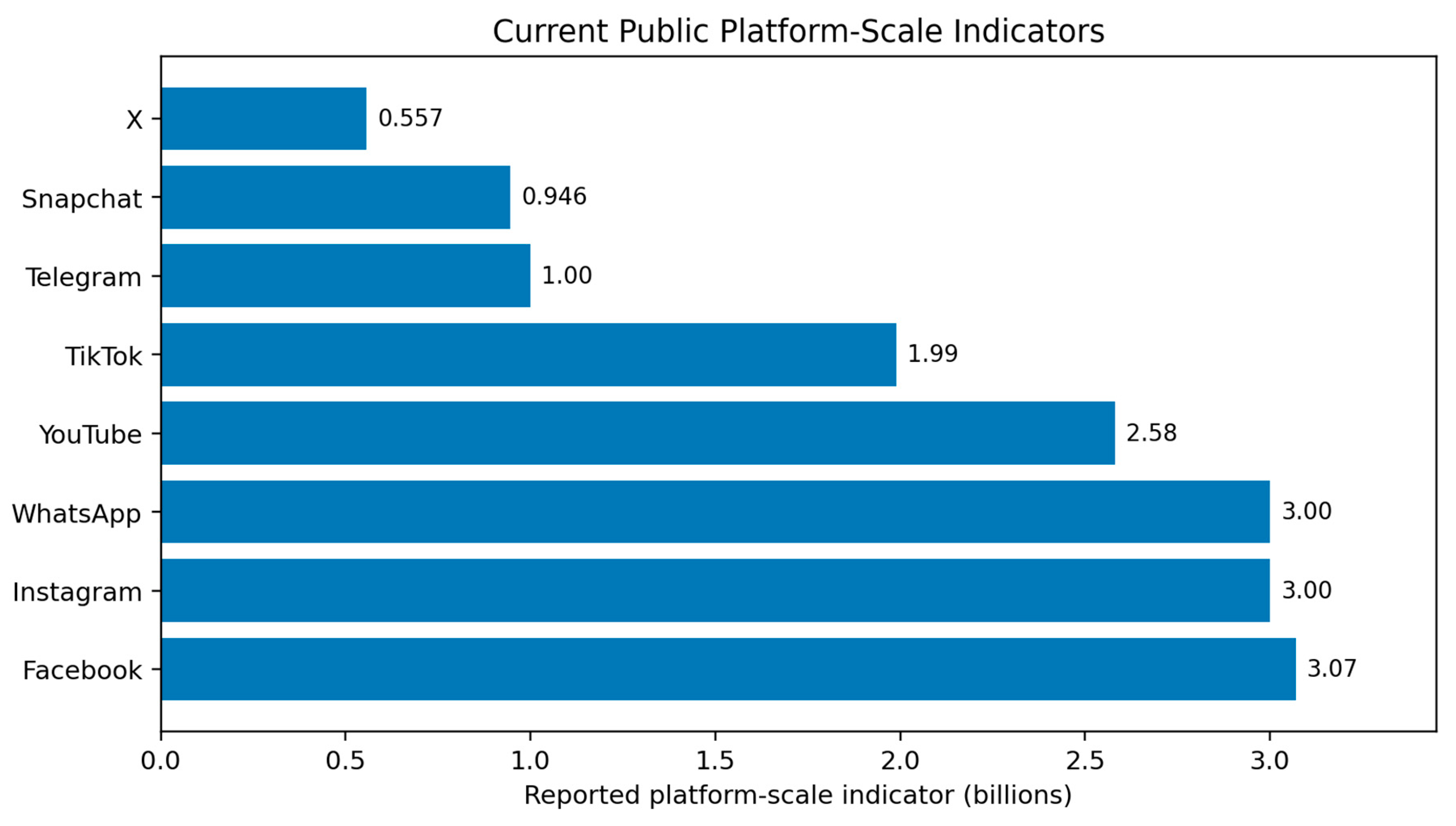
Figure 4.
Age 18 to 24 audience shares for selected platforms. Note. Figure 4 visualizes the platform-specific age 18 to 24 audience shares reported in Table 2 and should be interpreted as a comparative planning aid rather than as evidence of engagement or persuasion.
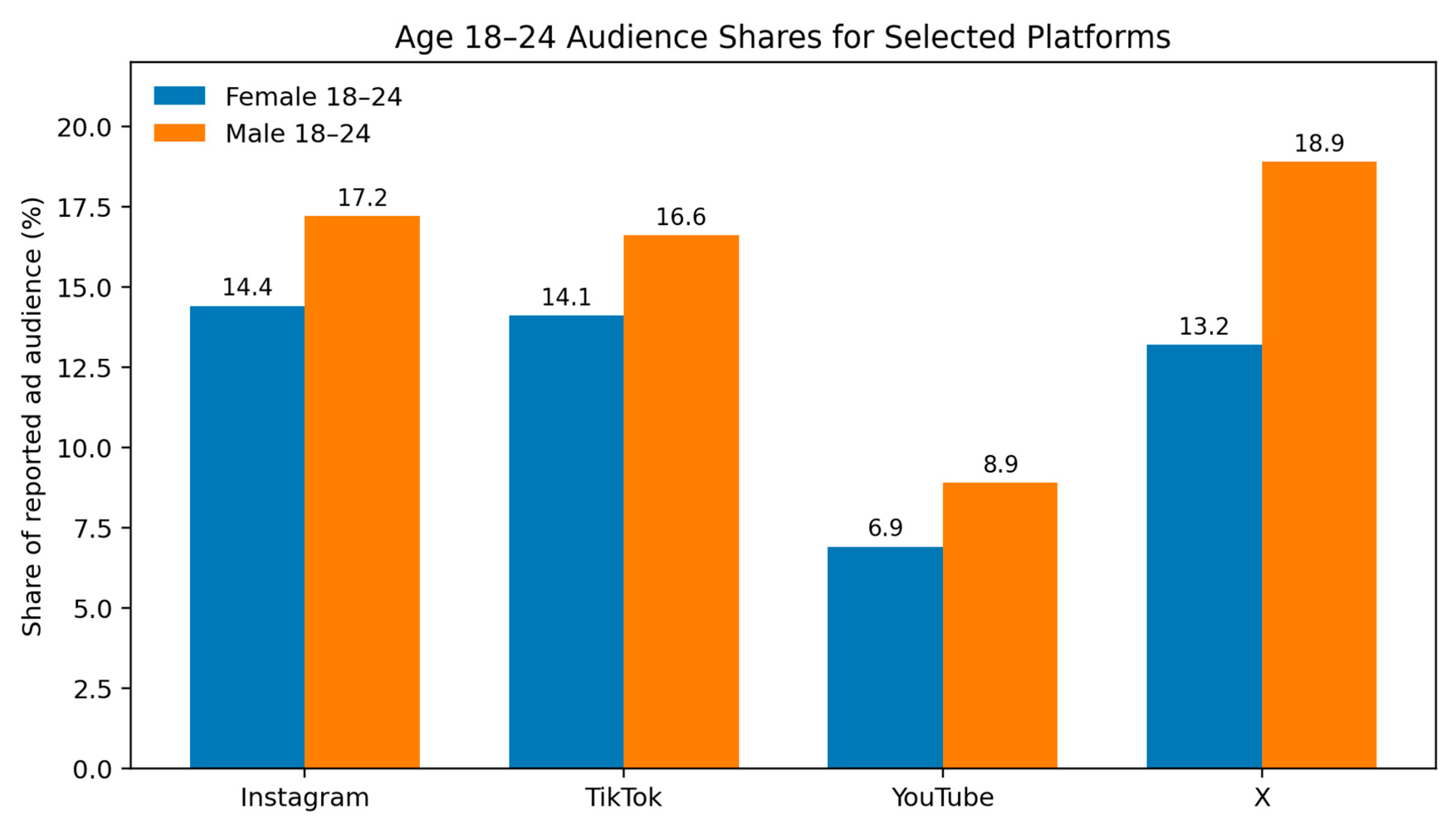
Figure 5.
Instagram global advertising audience by gender. Note. Based on DataReportal’s current Instagram audience profile, which reports a 47.3% female and 52.7% male split in Instagram’s global advertising audience [27].
Figure 5.
Instagram global advertising audience by gender. Note. Based on DataReportal’s current Instagram audience profile, which reports a 47.3% female and 52.7% male split in Instagram’s global advertising audience [27].
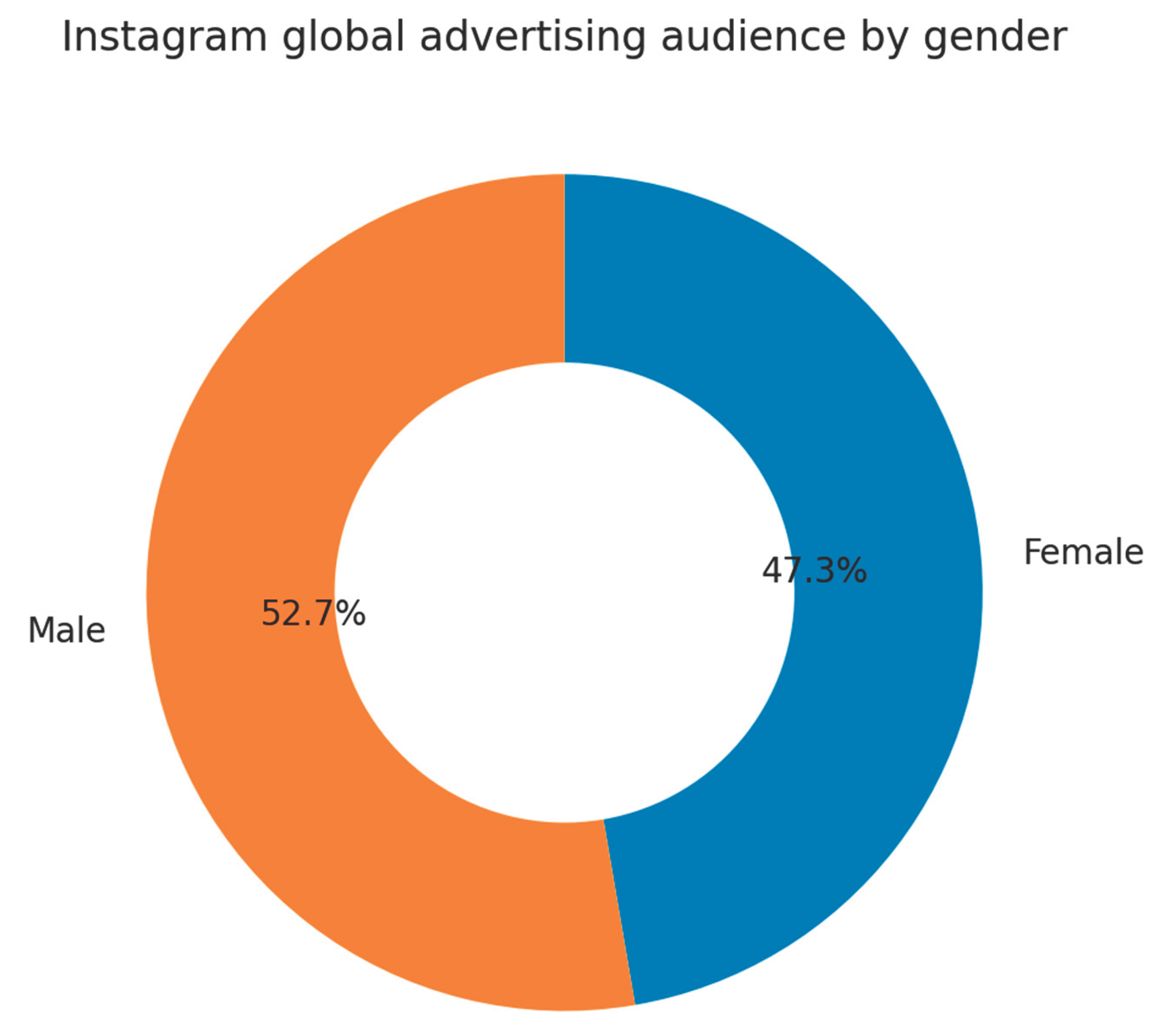

Table 1.
Validated current public platform-scale indicators by metric family.
| Platform | Reported figure | Metric family | Primary source | Interpretive caution |
|---|---|---|---|---|
| 3.07 billion | Monthly active users | DataReportal | MAU/user family only | |
| 3.0 billion | Monthly active users | Meta public record | MAU/user family only | |
| More than 3.0 billion | Users | Meta public record | Reported as users | |
| Telegram | 1.0 billion | Monthly active users | Telegram press record | MAU/user family only |
| Snapchat | 946 million | Monthly active users | Snap investor record | MAU/user family only |
| YouTube | 2.58 billion | Potential ad reach | DataReportal | Not equivalent to MAU |
| TikTok | 1.99 billion | Adults 18+ ad reach | DataReportal | Age-restricted reach |
| X | 557 million | Potential ad reach | DataReportal | Not equivalent to MAU |
Note. Table 1 mmakes metric heterogeneity explicit. The table distinguishes monthly active users, users, and potential advertising reach so that cross-platform interpretation remains bounded. The table is intended to clarify platform opportunity structures, not to establish a definitive performance hierarchy [[10,26–34].
Table 2.
Youth-relevant audience structure across selected platforms.
| Platform | Female 18–24 share | Male 18–24 share | Audience profile | Strategic reading |
|---|---|---|---|---|
| 14.4% | 17.2% | Higher relative 18–24 concentration | Awareness and peer circulation | |
| TikTok | 14.1% | 16.6% | Higher relative 18–24 concentration | Short-form discovery and repetition |
| YouTube | 6.9% | 8.9% | Broader reach, lower relative 18–24 concentration | Explanation, search, follow-through |
| X | 13.2% | 18.9% | Relatively younger, more male-skewed profile | Issue visibility and discourse spillover |
Note. Table 2 mreports comparable audience-composition indicators drawn from DataReportal’s January 2025 platform snapshots for Instagram, TikTok, YouTube, and X [[27–30]. These values reflect the composition of the advertising audience rather than direct behavioral measures.
Disclaimer/Publisher’s Note: The statements, opinions and data contained in all publications are solely those of the individual author(s) and contributor(s) and not of MDPI and/or the editor(s). MDPI and/or the editor(s) disclaim responsibility for any injury to people or property resulting from any ideas, methods, instructions or products referred to in the content. |
© 2026 by the authors. Licensee MDPI, Basel, Switzerland. This article is an open access article distributed under the terms and conditions of the Creative Commons Attribution (CC BY) license (http://creativecommons.org/licenses/by/4.0/).
Copyright: This open access article is published under a Creative Commons CC BY 4.0 license, which permit the free download, distribution, and reuse, provided that the author and preprint are cited in any reuse.


