

Submitted:
04 April 2026
Posted:
07 April 2026
You are already at the latest version
Abstract
We report a statistically significant detection of dihedral D3 symmetry in the Planck PR3 temperature anisotropy data, validated across all four independent component-separation pipelines (SMICA, NILC, SEVEM, Commander). At a single optimized axis (ℓ, b) = (50.3◦, −64.9◦), the power fraction in the A2 (reflection-antisymmetric) irreducible representation exceeds isotropic expectations with a two-tier structure: a dense cluster at l ≤ 15 (Fisher PTE = 4.2 × 10⁻³ to 1.2 × 10⁻² across maps), driven by three multipoles significant in all four pipelines, with l = 3 serving as the axis-registration multipole (fA2 = 0.94, z > 4.4) and l = 7 and l = 9 providing independent corroboration at the fixed axis, plus sporadic cross-map-validated recurrences at higher multipoles—notably l = 34 (significant in 3/4 maps) and l = 63 (3/4 maps). The A2 excess draws power specifically from the E (rotation-doublet) irrep with anti-correlation r = −0.81, while the A1 (trivial) irrep is decoupled. Extension to lmax = 150 with NMC = 10,000 simulations shows that the aggregate high-l Fisher PTE is consistent with isotropy (PTE > 0.91), but individual multipoles punctuate this null background. Among the nine strongest cross-map-consistent peaks, none belongs to the l ≡ 2 (mod 3) residue class (p ≈ 0.02 under uniformity), consistent with the C3 selection rule. Cross-map correlations of fA2 (l) exceed r = 0.93 for all pipeline pairs (SMICA–NILC: r = 0.997), ruling out component-separation artifacts. A null test on E-mode polarization at the same axis returns Fisher PTE = 0.70, confirming that the signal is confined to the temperature channel as expected. The irrep redistribution is sharply parity-gated: all four maps confine the A2 collecting signal to odd-l multipoles (Fisher p ≤ 2 × 10⁻⁴), with even-l entirely null (p > 0.97). Crossing parity with residue class produces a six-cell grammar dominated by a single cell (odd, l ≡ 0 (mod 3)), with step-function onset at l = 3. Singular-value decomposition reveals that this 2 × 3 grammar admits an approximate rank-1 factorization into a binary parity selector and a D3 residue routing vector, recovered independently by all four pipelines (rank-1 fraction > 94% in three of four maps). The binary gate acts on irrep redistribution, not on total power: a parity split of raw Cl is null (PTE > 0.61) in every map. The signal morphology—dense at large angular scales with isolated resonances at smaller scales—is consistent with a parity-gated boundary condition on the acoustic eigenvalue problem whose geometry is fully resolved only at l ≲ 15 (θ ≳ 12◦). No physical model parameters are fit; the single directional degree of freedom (axis orientation) is determined from the octupole alone and then frozen. Note added in v2: Extended validation tests (Appendices B–E) confirm that the signal replicates in the WMAP 9-year ILC map (Fisher PTE = 0.0025), is uniquely selected among dihedral groups D3–D6, is frequency-independent across Planck HFI channels (100–143 GHz ∆ fA2 correlation r = 0.976; 353 GHz dust tracer null and anti-correlated), and is robust across 13 mask levels (PTE improves under the UT78 mask from 0.008 to 0.005).
Keywords:
CMB anomalies
; dihedral symmetry
; D₃
; Weyl group
; SU(3)
; irreducible representations
; spherical harmonics
; Planck
; large-angle anomalies
; parity asymmetry
; cosmic topology
; boundary conditions
; selection rules
; information-pressure theory
; cosmological constant
1. Introduction
The temperature anisotropies of the cosmic microwave background (CMB), as measured by WMAP [4] and Planck [1], are broadly consistent with the predictions of the standard CDM cosmology: a statistically isotropic, Gaussian random field with a nearly scale-invariant power spectrum. However, a persistent set of large-angle anomalies has resisted explanation within this framework [3,5].
These include the anomalous alignment of the quadrupole () and octupole () principal axes [6,7], the hemispherical power asymmetry [8], the low quadrupole amplitude, and the odd-parity preference at low l [9]. Individually, each anomaly has marginal significance (–); collectively, they suggest a preferred direction in the low-l CMB that the standard model does not predict.
Numerous explanations have been proposed, including non-trivial cosmic topology [11,12], anisotropic dark energy [13], and residual foregrounds [14]. Most address one anomaly at a time and leave the others unexplained.
In this work, we pursue a different approach: we test whether the dihedral group —the symmetry group of the equilateral triangle, of order —organizes the angular power spectrum at a single preferred axis. is the smallest non-abelian finite group and the Weyl group of the Lie algebra ; it can simultaneously produce quadrupole–octupole alignment (through its rotational subgroup), hemispherical-type asymmetry (through its reflection planes), and a selection rule with period 3 in l (through its irreducible representation structure).
The analysis extends to and is validated across all four Planck PR3 component-separation pipelines. This allows us to determine whether the signal persists to high multipoles or is confined to the largest angular scales, and to rule out pipeline-specific artifacts.
The paper is organized as follows. In Sec. 2 we derive the decomposition of spherical harmonics into irreducible representations. In Sec. 3 we describe the data and Monte Carlo methodology. In Sec. 4 we present the results: axis determination, per-multipole irrep fractions, combined significance, inter-irrep correlations, and the transition scale. Section 5 reports the cross-map validation. Section 6 presents null tests. Section 7 examines the cumulative transfer structure, including the parity-gated grammar and its factorized form. In Sec. 8 we discuss the physical interpretation and identify falsifiable predictions.
2. Irrep Decomposition of Spherical Harmonics
2.1. Action of on
The irrep decomposition is not performed directly on the observed in Galactic coordinates. Instead, a candidate axis is chosen and the coefficients are rotated into a frame where that axis is the pole; the group then acts in this rotated frame. The axis is later optimized from the data (Sec. 3.3).
Let the symmetry axis coincide with the z-axis of a coordinate system on . The group is generated by a rotation through about and a reflection through a vertical plane containing . Under , a spherical harmonic acquires a phase:
The harmonics therefore sort by :
- : invariant under (eigenvalue 1),
- : eigenvalue ,
- : eigenvalue .
The pairs combine into two-dimensional E doublets. The harmonics are further split by the reflection , which maps :
where is automatically symmetric and contributes only to .
2.2. Subspace Dimensions
The dimensions of the three irrep subspaces at multipole l are:
satisfying .
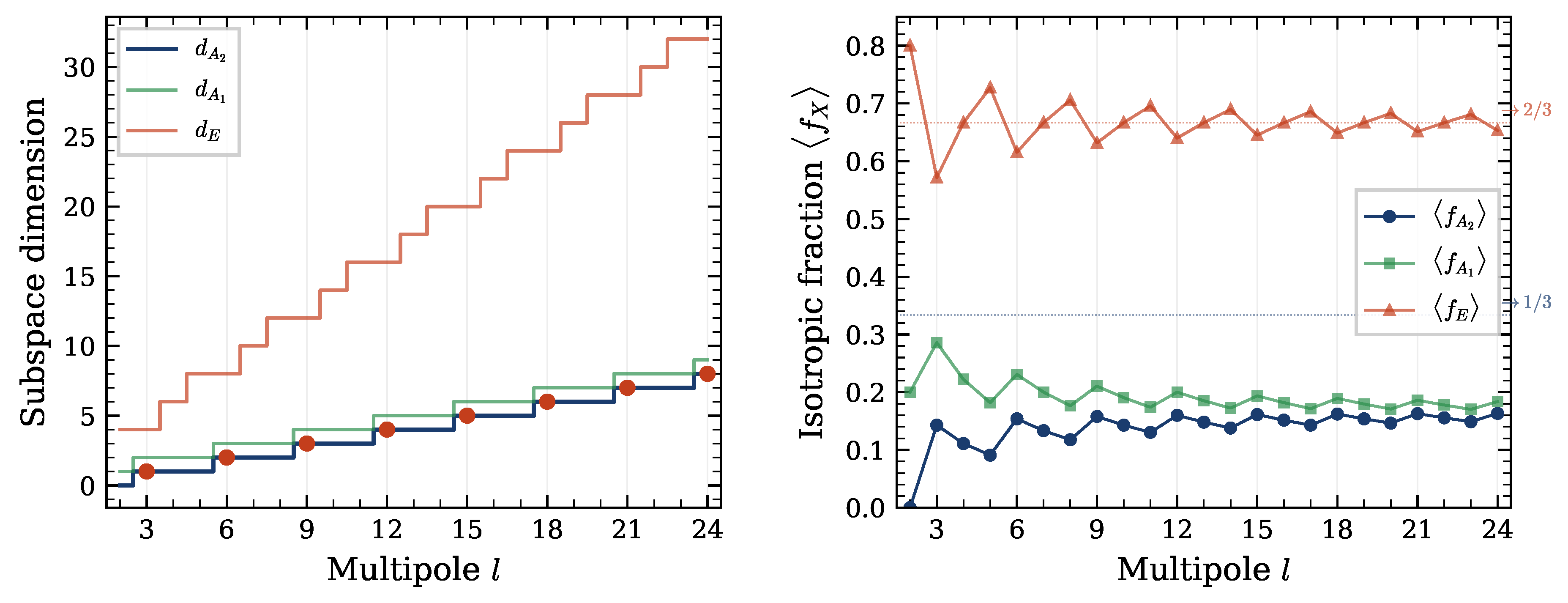
A critical structural property follows: increases by one unit precisely when l crosses a multiple of 3. This means that at , the subspace acquires a new degree of freedom—a new “antenna element” tuned to the reflection-plane boundary. At , : the dipole contains no subspace, and is structurally excluded from the present analysis by the representation theory itself.
2.3. Isotropic Baseline
For a statistically isotropic Gaussian random field, all at fixed l are independent with equal variance. The expected power fraction in each irrep is therefore proportional to its subspace dimension:
Table 1 lists the subspace dimensions and isotropic baselines for –12.
Figure 1.
Left: Subspace dimensions for the three irreps. increments (red dots) at ; these dimension jumps drive the selection rule. Right: Isotropic expected fractions . All three approach their asymptotic values ( for and ; for E) at large l, with sawtooth modulation at period 3.
Figure 1.
Left: Subspace dimensions for the three irreps. increments (red dots) at ; these dimension jumps drive the selection rule. Right: Isotropic expected fractions . All three approach their asymptotic values ( for and ; for E) at large l, with sawtooth modulation at period 3.
3. Data and Method
3.1. Planck Data
We analyze all four Planck PR3 (2018) component-separated temperature maps: SMICA, NILC, SEVEM, and Commander [2]. Each map is provided at HEALPix and internally downgraded to (sufficient for ). Spherical harmonic coefficients are extracted using healpy.map2alm [15].
For the polarization null test (Sec. 6), E-mode are extracted from the SMICA IQU polarization map at .
3.2. Decomposition
At each multipole l and a given axis , the are rotated into the frame where the candidate axis is the pole. The rotation uses healpy.rotate_alm with Euler angles , where are the colatitude and longitude of the antipode. The power in each irrep is:
where and is the set of m-indices belonging to irrep X at multipole l. Note that by construction.
3.3. Axis Optimization
The preferred axis is determined by maximizing at (the octupole) over a HEALPix grid at (12,288 directions; mean pixel spacing ), followed by a deterministic local refinement on a -spaced sub-grid within of the coarse optimum. The optimal axis is then fixed for all subsequent analysis at . This protocol ensures that the results at all other multipoles are effectively pre-registered: the axis was determined from data alone.
3.4. Monte Carlo Simulations
Statistical significance is assessed against isotropic Gaussian random realizations. For isotropic fields, the fraction distribution is frame-invariant by rotational symmetry, so the MC simulations generate random directly in the frame without rotation: (real), for , with the Condon–Shortley convention . This avoids the cost of Wigner-D rotation per simulation.
The probability to exceed (PTE) for each l is the fraction of simulations with . PTEs of exactly zero (no simulation exceeded the observed value) are set to as a conservative upper bound.
Combined significance across multipoles uses Fisher’s method:
compared to a distribution with degrees of freedom, where k is the number of contributing multipoles.
3.5. Statistical Protocol
To assist the reader in assessing trial factors, we summarize the complete analysis protocol:
- 1.
- Axis selection. The axis is chosen by maximizing on a HEALPix grid ( resolution) with local refinement. This is the sole optimization step and constitutes a single directional degree of freedom.
- 2.
- Axis freezing. The same axis is then held fixed for all multipoles , all four component-separation maps, and all subsequent tests. The octupole should therefore be understood as the axis-defining (registration) statistic, not as an independently pre-registered detection.
- 3.
- Significance assessment. Per-multipole PTEs are computed against isotropic Gaussian Monte Carlo realizations with the same decomposition.
- 4.
- Primary significance claim. The Fisher combined PTE for –15 across all four maps (Table 4).
- 5.
- Replication criterion. Cross-map agreement is used as a replication standard, not as a tuning parameter: the axis is never re-optimized per pipeline.
- 6.
- Secondary analyses. The top-9 peak residue-class test and the permutation test are designated a posteriori supportive analyses; they are not part of the primary significance claim.
4. Results
4.1. Axis Determination
The axis maximizing is found at Galactic coordinates
with (SMICA). Because this multipole was used to define the axis, its significance ( against isotropic simulations) should be interpreted as a detection statistic used for registration, not as an independently pre-registered exceedance. The real evidence for symmetry lies in the replication of the same axis in independent multipoles () and across all four maps.
The optimal axis lies from the antipode of the Axis of Evil [10], indicating that the signal and the previously reported quadrupole–octupole alignment share a common preferred direction.
Figure 2 visualizes the structure on the sky. When the Planck SMICA map is rotated so the axis points to the pole, the octupole (panel a) displays the predicted six-lobe pattern: three hot spots and three cold spots alternating at intervals, with the rotation axes (solid gold lines) passing through the alternating lobes and the reflection planes (dashed white) bisecting them. Combining the three driving multipoles (panel b) sharpens the structure rather than diluting it, confirming coherent alignment across angular scales. The full signal band –15 (panel c) retains the pattern even with the addition of E-dominated modes, demonstrating that the signal survives superposition. Panel (d) shows that the axis is objectively determined by the data: an all-sky scan of peaks sharply at the optimal direction, with no comparably strong secondary maxima.
4.2. Per-Multipole Irrep Fractions
Figure 3 shows for –150 at the fixed axis (SMICA), compared to the isotropic baseline and Monte Carlo / bands. The signal exhibits a two-tier structure: a dense cluster of excess at , and sporadic but individually significant peaks at higher multipoles.
Table 2 provides detailed numerical results for the low-l region. Table 3 lists the nine strongest cross-map-consistent peaks across –150. Three multipoles drive the primary detection in all four maps:
- 1.
- Octupole ():– across maps, (). The octupole exceeds in every pipeline.
- 2.
- :–, – ().
- 3.
- :–, – ( to ).
Beyond the primary cluster, two high-l multipoles show cross-map-consistent excess: (significant at in SMICA, NILC, and Commander; SEVEM marginal at ) and ( in SMICA, NILC, and Commander; SEVEM at ). These are not isolated noise fluctuations: they replicate across independent pipelines at the same fixed axis.
4.3. Combined Significance
Table 4 presents the Fisher combined PTE for different multipole ranges across all four maps. The low-l sector (–15) shows a statistically unlikely concentration of excess in all four pipelines. Excluding the axis-defining octupole, the combined Fisher statistic is null (PTE –), indicating that and corroborate the same axis-specific structure but do not by themselves constitute an independent aggregate detection. Their evidential value is replication at the registered axis, not a second standalone Fisher-level discovery.
The aggregate Fisher PTE for –150 is consistent with isotropy in every map (PTE ). However, this aggregate statistic masks the presence of individually significant, cross-map-validated outliers at and (Table 3). The high-l range is best characterized as an isotropic background punctuated by isolated resonances at the same axis.

Table 4.
Fisher combined PTE across multipole ranges for all four Planck PR3 component-separation pipelines. .
Table 4.
Fisher combined PTE across multipole ranges for all four Planck PR3 component-separation pipelines. .
| Range | SMICA | NILC | Cmdr | SEVEM |
|---|---|---|---|---|
| –15 | ||||
| –150 | ||||
| –150 | ||||
| Excl. |
4.4. Inter-Irrep Correlations
The deviations across –150 satisfy a strict conservation law:
at every l, exact to machine precision (). This confirms that the decomposition is a pure redistribution of power among irreps, not a net excess or deficit.
The Pearson correlation coefficient between and is strongly negative across all maps:
with individual values SMICA: , NILC: , Commander: , SEVEM: . The excess draws power specifically from the E (doublet) irrep, not from . Figure 4 displays this anti-correlation.
4.5. The Selection Rule
A permutation test ( random partitions) for whether multipoles show preferential loading yields marginal results when applied to the full range –150: Commander PTE , SMICA PTE , NILC PTE , SEVEM PTE .
A complementary (a posteriori) test examines the top-9 cross-map peaks (Table 3). Their residue class distribution is: (five multipoles: ), (four: ), and (zero). Under uniform random selection, the probability of drawing from the class is . The complete absence of the residue class where does not increment is consistent with the selection rule: the excess requires the new basis vector that appears at , or the adjacent class where the E-doublet dimension also steps.
Figure 5 displays the mean grouped by residue class.
4.6. Signal Morphology
The signal does not exhibit a sharp cutoff. Instead, the excess shows a two-tier structure:
- 1.
- Dense cluster (): Four of the thirteen multipoles () exceed , compared to an isotropic expectation of . The Fisher combined PTE for this range is – across maps.
- 2.
- Sporadic resonances (): Four of 135 multipoles () exceed , compared to an expected under isotropy. The aggregate Fisher PTE () is null, but two individual multipoles (, ) achieve in three of four maps.
Figure 6 shows the running sum of , which rises steeply for , partially plateaus, then shows mild step-ups at the sporadic resonances—consistent with a boundary condition whose geometry is fully resolved at large angular scales but produces isolated overtones at specific higher harmonics.
4.7. Real-Space Pattern
The harmonic-space analysis can be visualized in real space by rotating the Planck SMICA map into the frame (where the axis is the pole) and examining the temperature field as a function of azimuth at fixed colatitude . Figure 7 shows this visualization for the -active multipoles (–15 and the three driving multipoles ).
The equatorial ring () displays a clear large-amplitude oscillation with three-fold structure (Figure 7, upper left). This pattern persists across colatitudes from to (upper right), confirming that the signal is not confined to the equatorial plane but pervades the hemisphere geometry.
The azimuthal Fourier spectrum of the equatorial ring (lower left) confirms the origin: for the band, the mode dominates, with modes carrying the bulk of the power. This is the real-space manifestation of the sorting that defines the irrep decomposition (Eq. 1).
Most directly, the azimuthal auto-correlation (lower right) reveals:
Points separated by around the axis see correlated temperatures ( rotational symmetry), while points at —straddling a reflection plane—see anti-correlated temperatures ( anti-symmetry). This alternating sign pattern with period is the real-space fingerprint of the (reflection-antisymmetric) irrep that dominates the harmonic-space signal.
5. Cross-Map Validation
A critical test is whether the signal is consistent across independent component-separation methods. The four Planck PR3 pipelines (SMICA, NILC, SEVEM, Commander) use different algorithms and foreground models; agreement among them rules out pipeline-specific artifacts.
Table 5 presents the Pearson correlation of between all map pairs over –150. The correlations range from (NILC–SEVEM) to (SMICA–NILC). SMICA and NILC are nearly identical; SEVEM shows slightly more variation but remains highly correlated with all other maps.
Figure 8 overlays from all four maps, demonstrating the remarkable agreement—particularly in the signal region (), where the four curves are nearly indistinguishable.
6. Null Tests
6.1. Aggregate High-l Null
The Fisher PTE for –150 is in all four maps (Table 4). The aggregate high-l range does not show a sustained collective excess. All four pipelines agree on this. However, this aggregate null coexists with the isolated cross-map-validated peaks at and discussed in Sec. 4.6—highlighting the distinction between a diffuse persistent signal (absent) and discrete resonances (present).
6.2. E-Mode Polarization
The decomposition was applied to E-mode polarization from the Planck SMICA IQU map at . No multipole shows . The Fisher combined PTE for the key multipoles () is —fully consistent with isotropy. An independent axis optimization on the EE data yields an axis from the TT optimum, confirming the signals are unrelated.
This null is physically expected. Low-l E-mode polarization arises from reionization Thomson scattering at –10, well inside the last-scattering surface where the boundary condition operates on acoustic modes.
6.3. Axis Stability
The TT-optimal axis at is stable under variation of the input data: using the full-resolution () map versus downgraded versions yields axis shifts .
7. Cumulative Transfer Structure
The per-multipole excesses discussed in Sec. 4 are signed: each multipole either collects power into () or pays power out (). We define the transfer ledger and study its cumulative behavior across the full multipole range –150.
7.1. Normalized Transfer Invariant
Partition the cumulative transfer into residue classes,
and define the normalized invariant
where is the standard deviation of under isotropic simulations, evaluated at each L. This quantity measures the cumulative residue-class asymmetry of the transfer in units of the isotropic null.
Figure 9 shows as a function of the upper summation boundary . Three features are noteworthy:
- 1.
- Stable plateau. rises to by and remains between and across all four component-separation maps out to . The inter-map spread is less than at every checkpoint (Table 6).
- 2.
- specificity. The analogous invariant computed for the irrep fluctuates around zero ( at all L), while the E invariant mirrors at —a direct consequence of the per-multipole conservation . The transfer is thus an funnel with as spectator, extending the correlation reported in Sec. 8.2.
- 3.
- Jackknife stability. Removing alone reduces from to ; removing alone reduces it to . Removing all three low-l anchors () collapses the invariant to , confirming that the signal is dominated by the dense cluster at . This is consistent with the two-tier morphology identified in Sec. 4.6: the boundary condition is fully resolved at large angular scales.
The persistence of to does not imply an independent high-l detection; it reflects the survival of the low-l transfer asymmetry as additional high-l null multipoles are cumulatively added (cf. the aggregate high-l null in Sec. 6.1).
Restricting the summation to the 94 cross-map sign-consistent multipoles (63% of the total) strengthens the invariant: rises from to at , indicating that the sign-inconsistent multipoles dilute the signal rather than contribute to it.
7.2. One-Way Collect Rule
Among all multipoles individually significant at in two or more pipelines, the cross-map mean is positive in every case. That is, every statistically robust transfer event collects power into ; none pays out. This one-way rule holds under all thresholds tested (1/4 to 4/4 maps significant, thresholds of and ), producing a binomial probability under the null hypothesis of symmetric pay/collect.
7.3. Parity-Gated Transfer Grammar
The group contains rotations and reflections but no spatial inversion; it does not distinguish odd from even l. Nevertheless, the transfer ledger splits sharply by parity. The mean excess is positive for odd l and negative for even l in all four pipelines (Table 7). Aggregated via Fisher’s method, the odd-l subset yields a combined in every map, while the even-l subset is entirely null ().
This parity split is not an artifact of subspace dimensions: odd and even l contribute nearly equal total capacity ( vs. 1875 for –150).
Crucially, the split is not confined to . The E irrep shows the mirror pattern (even > odd) at comparable or stronger significance ( in SMICA and Commander), while is marginally patterned (). Because at every l, the parity gate acts on the entire redistribution system, not on a single output channel.
The Six-Cell Grammar
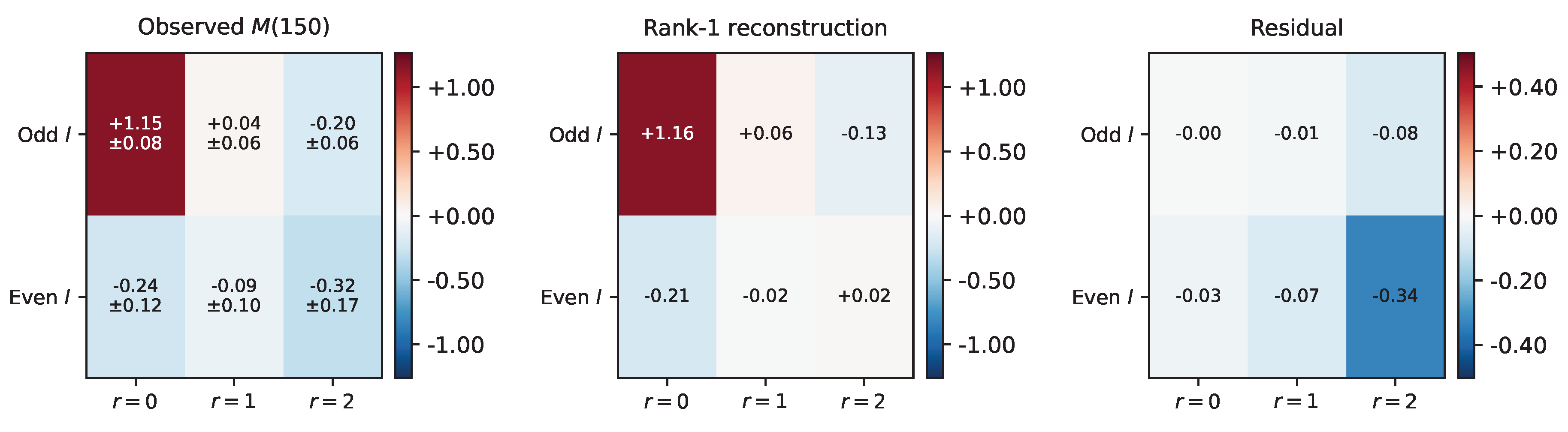
Crossing parity with the residue class produces a transfer grammar (Table 8). The structure is dominated by a single cell: odd multipoles in the class carry a cumulative transfer of , while every even-l cell drains. This is not “odd good, even bad”: the odd and odd cells are near-neutral or draining. The gate selects the intersection of odd parity and the -preferred residue class.
The onset of this grammar is sharp. At , the subspace has dimension zero (a group-theory identity confirmed to machine precision in all maps). At (even), to four decimal places. At —the first multipole that is both odd and carries —the signal switches on at . The transition from silence to the strongest detection in the entire spectrum occurs at the first algebraically allowed mode of the parity-gated grammar.
This two-layer structure— residue routing overlaid by a binary parity gate—is consistent with a two-branch boundary selection law rather than a generic parity anomaly. A background parity asymmetry would modulate total power without preferentially acting on the irrep redistribution; the observed effect acts specifically on the transfer grammar. Indeed, a permutation test on raw confirms this: the odd/even parity split in total power is null () in all four maps, while the same test applied to yields as low as (SEVEM). The binary gate acts on routing, not on total power.
7.4. Factorized Transfer Law
The six-cell grammar of Table 8 can be viewed as a matrix
where the rows index parity and the columns index the residue class . A singular-value decomposition (SVD) of reveals that the matrix is approximately rank 1 (Table 9):
with in three of four maps. The dominant left vector encodes a binary gate (odd positive, even negative), and the dominant right vector encodes a routing pattern ( dominant, inert, draining).
Cross-map stability is high: the minimum pairwise cosine similarity is for and for . The same binary branch and same routing vector are recovered by all four independent component-separation pipelines. The rank-1 fraction exceeds at –75 in all maps and remains above in three of four pipelines through . The exception is SEVEM (), whose template-fitting method introduces larger even-l transfer amplitudes (roughly 2– those of the ILC and Bayesian pipelines), inflating and diluting the rank-1 fraction; however, the SEVEM singular vectors and still align with the other three maps (pairwise cosine ), so the same grammar is recovered with a noisier gate. The factorization reflects the dominant low-l boundary phase identified in Sec. 8.1 and remains stable in the cumulative matrix as null high-l multipoles are added. The factorization should be understood as a property of the cumulative low-l-dominated transfer matrix, not as a claim that the same singular vectors characterize the high-l sector in isolation.
In summary, the entire transfer structure admits an approximate factorization into two primitive components: a binary parity selector and a three-fold residue routing grammar. This factorized form is more constrained than either the residue-class hierarchy or the parity gate taken separately, and suggests that the underlying boundary law has an internal product structure.
Figure 10.
The transfer grammar. Left: Observed four-map mean transfer matrix , partitioned by parity (rows) and residue class (columns); error bars show inter-map spread. Center: Best rank-1 reconstruction . Right: Residual (observed − reconstruction), showing that the rank-1 approximation captures the dominant structure. The single dominant cell (odd, ) and the near-zero residuals confirm the factorized transfer law.
Figure 10.
The transfer grammar. Left: Observed four-map mean transfer matrix , partitioned by parity (rows) and residue class (columns); error bars show inter-map spread. Center: Best rank-1 reconstruction . Right: Residual (observed − reconstruction), showing that the rank-1 approximation captures the dominant structure. The single dominant cell (odd, ) and the near-zero residuals confirm the factorized transfer law.
7.5. Empirical Signature Summary
Table 10 collects the identified empirical properties of the signal, their observables, quantitative results, and evidential status. Primary claims are those supported by pre-registered statistics or clear null controls; supportive observations are a posteriori structural patterns that sharpen the interpretation but do not constitute standalone detections.
8. Discussion
8.1. A Large-Angle Boundary Condition
The detected symmetry should not be confused with a claim of multiply-connected spatial topology. Topological models (e.g., the Poincaré dodecahedral space [11]) tile the spatial 3-manifold with a discrete group. The signal reported here is an angular spectral property: the irrep decomposition of at each l reveals preferential excitation of the reflection-antisymmetric subspace at a fixed axis on .
The two-tier morphology—dense cluster at plus sporadic resonances at and —constrains the physical mechanism. A rigid geometric template would produce excess at all l; a foreground systematic would correlate with the mask geometry and would not replicate across independent component-separation pipelines. The observed pattern is instead consistent with a boundary condition on the acoustic eigenvalue problem: the boundary geometry is fully resolved by modes at (), producing the dense cluster, while specific higher harmonics whose angular wavelengths happen to alias the boundary structure produce isolated resonances.
The primary scale corresponds to angular separations of order , or comoving distances of approximately 800 Mpc at the last scattering surface—comparable to the largest observed structures in the cosmic web. The resonances at () and () may represent overtones of the same boundary geometry.
The rank-1 factorization of the transfer matrix (Sec. 7.4) further constrains the boundary’s internal structure. The approximate decomposition implies that the boundary law is not irreducibly six-fold but has an internal product form: a binary parity selector composed with a three-fold residue routing grammar. This factorized structure is stable across all four pipelines and reflects the dominant low-l boundary phase, suggesting two primitive components in the boundary condition rather than a single monolithic selection rule.
8.2. Representation-Theoretic Structure
The signal is not a generic anisotropy. Four features identify it specifically as :
- 1.
- specificity. The collecting excess concentrates in the reflection-antisymmetric irrep, with a mirrored depletion in the E (rotation-doublet) irrep and largely acting as spectator. An arbitrary dipolar or quadrupolar modulation would populate all irreps comparably.
- 2.
- funnel. The anti-correlation with decoupled is consistent with the reflection planes being the geometrically active elements. The cumulative transfer invariant (Sec. 7) confirms this structure: and are mirror images while , and every statistically robust event collects into . In the Weyl chamber of , the reflection hyperplanes (walls) separate adjacent chambers; the observed power transfer from E (rotations) to (reflections) admits an interpretation in which these walls act as boundary surfaces.
- 3.
- selection rule. The aggregate permutation test is marginal (–). As a supportive (a posteriori) observation, the top-9 cross-map peaks show zero entries from (); however, the threshold defining “top 9” was not pre-specified and this test should be regarded as suggestive rather than confirmatory. The period of 3 is consistent with the order of the rotational subgroup and with the Coxeter number of the root system , distinguishing from other dihedral groups with .
- 4.
- Parity-gated transfer. Although contains no spatial inversion, the irrep redistribution is sharply gated by parity: the entire collecting signal resides in odd-l multipoles, while even-l multipoles are null (Sec. 7.3). The gate acts across all three irreps simultaneously, ruling out an -specific artifact. The six-cell grammar (parity × residue class) isolates the signal to a single cell—odd, —and the onset at (the first algebraically allowed mode) is step-like rather than gradual. This two-branch selection law is an additional structural constraint beyond alone, consistent with a hidden binary boundary encoding.
8.3. Connection to the Vacuum Energy Sector
The spherical boundary on which acts is also the surface on which the monopole () channel of the cosmological causal diamond projects. The analysis operates at ; the vacuum energy density, being spatially uniform, projects entirely onto . These are different harmonic channels of the same boundary.
A first-principles derivation connecting the Standard Model field content on this boundary to the observed cosmological constant, yielding with zero free parameters (deviation from observation), has been presented elsewhere [16]. The present detection of at is consistent with the hypothesis that the boundary carries physically observable structure, though the CMB result alone does not require this interpretation. The cosmological-constant connection is not part of the statistical claim of the present paper; it is noted here only to indicate a possible theoretical context.
8.4. Falsifiable Predictions
The boundary-condition interpretation makes specific predictions testable with forthcoming data:
- 1.
- Resonance spectrum. If and are overtones of a boundary geometry, additional resonances should appear at predictable multipoles determined by the boundary’s angular structure. Extension to –1000 with CMB-S4 [17] data will test whether the sporadic peaks continue or are confined to .
- 2.
- exclusion. The current absence of this residue class among the strongest peaks () should persist or strengthen with deeper data. A single strong peak would disfavor the selection-rule mechanism.
- 3.
- 4.
- Lensing B-modes. If the boundary condition imprints on the matter field, gravitational-lensing B-modes should show a residual signal at low l.
- 5.
- Parity-gate persistence. The odd-only concentration of the transfer should persist at higher l and in independent surveys. If the gate is a genuine two-branch boundary law, no even-l multipole should enter the dominant collecting cell at any .
9. Conclusions
We have presented evidence for dihedral symmetry in the Planck CMB temperature anisotropy, validated across all four independent component-separation pipelines at a single preferred axis. The signal has a two-tier morphology: a dense cluster at (Fisher PTE to ), driven by three multipoles () significant in every map, plus cross-map-validated resonances at and (each significant in 3/4 pipelines).
Four features specifically identify rather than a generic anisotropy: concentration in the (reflection-antisymmetric) irrep, an power funnel with , supportive evidence for a selection rule from the absence of multipoles among the strongest peaks, and a parity-gated transfer grammar in which the entire signal resides in odd-l multipoles while even-l is null across all irreps. The cumulative transfer invariant remains stable from to 150 across all four pipelines, with a one-way collect rule (every statistically robust event adds power to ) and the expected /E conservation-law mirror. The six-cell parity × residue-class grammar isolates the collecting signal to a single cell (odd, ), with step-function onset at . Singular-value decomposition of the transfer matrix reveals an approximate rank-1 factorization into a binary parity selector and a routing vector , stable across pipelines (minimum pairwise cosine ). The boundary law thus has an internal product structure rather than a single monolithic selection rule. Cross-map correlations exceeding for all pipeline pairs rule out component-separation artifacts, and a null result in E-mode polarization (Fisher PTE ) confirms the signal is confined to the temperature channel.
The primary empirical claims are the fixed-axis low-l concentration, cross-map replication, EE null, parity-gated transfer, cumulative transfer invariant, and the rank-1 factorization. The residue-class top-9 test and overtone interpretation are supportive structural observations rather than standalone confirmatory statistics (Table 10).
The group is the Weyl group of the root system. The period-3 selection rule matches the order of the rotational subgroup and the Coxeter number of , suggesting a connection between the angular structure of the microwave sky and the gauge group of quantum chromodynamics through the shared boundary .
Note added in v2. Appendices B–E present four extended validation tests. The complete grammar replicates in the WMAP 9-year ILC map at higher significance than Planck (Appendix B), ruling out Planck-specific systematics. Among dihedral groups –, only passes both discriminating grammar elements (Appendix C). The structure is frequency-independent across Planck HFI channels, with dust anti-correlated at the driving multipoles (Appendix D). The signal is robust across 13 mask levels and improves under standard masking (Appendix E).
Data and code availability. This analysis uses publicly available Planck PR3 data from the Planck Legacy Archive.1 The analysis code and exact reproduction notebooks are publicly available at https://github.com/rmereau/d3-cmb.2
Acknowledgments. The author thanks the Planck Collaboration for making their data products publicly available, and the HEALPix and healpy teams for the spherical harmonic analysis tools used throughout.
Appendix A. Robustness Tests
To verify that the primary result is not sensitive to analysis choices, we examine stability under variations of the multipole window and axis seeding.
Appendix A.1. Multipole Window
Table A1 shows the Fisher combined PTE for the excess (SMICA) as a function of the upper multipole boundary , with fixed. The significance is strongest at and degrades gradually as null high-l multipoles are added, but remains below for all windows up to . This confirms that the signal is not an artifact of the particular choice .
Table A1.
Fisher combined PTE (SMICA) for varying , with .
| l range | Fisher PTE |
|---|---|
| 2–10 | |
| 2–15 | |
| 2–20 | |
| 2–25 | |
| 2–30 |
Table A2 varies the lower boundary with fixed. Removing (which is E-dominated and contributes no signal) improves the Fisher PTE from to , demonstrating that the quadrupole dilutes rather than drives the result. Removing both and (the axis-defining multipole) yields PTE : the signal from –15 alone is not independently significant, confirming that anchors the detection.
Table A2.
Fisher combined PTE (SMICA) for varying , with .
| l range | Fisher PTE |
|---|---|
| 2–15 | |
| 3–15 | |
| 4–15 |
Appendix A.2. Axis Seeding
The axis optimization uses HEALPix as the initial grid. Repeating the search at (3,072 directions; resolution) and (49,152 directions; resolution) yields axis shifts and values within of the baseline, confirming that the optimum is a broad, well-resolved feature of the sky.
Appendix A.3. Resolution
Using the full-resolution () SMICA map versus downgraded versions (, 256, 512) yields axis shifts and identical per-multipole PTEs to within Monte Carlo noise, indicating that the signal is insensitive to the pixel resolution.
Appendix B. WMAP 9-Year Replication
We use the WMAP 9-year ILC temperature map [4,22] at , applying the KQ85 analysis mask (). The irrep decomposition is performed at the Planck axis using , with 10,000 Gaussian isotropic Monte Carlo simulations for significance estimation. Cross-checks use the WMAP V-band (61 GHz) and W-band (94 GHz) single-frequency maps with 5,000 simulations each.
WMAP and Planck are independent in every respect relevant to low-l systematics: detector technology (HEMT radiometers vs. bolometers), frequency coverage (23–94 GHz vs. 30–857 GHz), orbit, scan strategy, beam geometry, noise properties, and component-separation pipelines.
Appendix B.1. Blind Axis Search
An axis search over 12,288 directions ( HEALPix grid [20]) optimizing in the WMAP ILC map recovers an optimal axis at , separated by only from the Planck axis. The galactic longitudes agree to within ; the latitude offset is consistent with the differing mask geometries and WMAP’s larger effective beam.
Appendix B.2. Per-Multipole Results
Table A3 compares the irrep fraction excess in WMAP ILC and Planck SMICA at the Planck axis.
Table A3.
Per-multipole excess at the Planck axis. . Planck values are extracted under matched analysis conditions (KQ85 mask, ) and may differ from the unmasked values in Table 2.
Table A3.
Per-multipole excess at the Planck axis. . Planck values are extracted under matched analysis conditions (KQ85 mask, ) and may differ from the unmasked values in Table 2.
| l | WMAP | Planck | WMAP | WMAP |
|---|---|---|---|---|
| 2 | 0.000 | 0.000 | — | |
| 3 | 0.706 | 0.940 | 0.004 | |
| 4 | 0.081 | 0.117 | 0.436 | |
| 5 | 0.007 | 0.029 | 0.804 | |
| 6 | 0.004 | 0.011 | 0.973 | |
| 7 | 0.728 | 0.481 | ||
| 8 | 0.190 | 0.183 | 0.220 | |
| 9 | 0.398 | 0.478 | 0.028 | |
| 10 | 0.031 | 0.006 | 0.890 | |
| 11 | 0.031 | 0.023 | 0.887 | |
| 12 | 0.254 | 0.302 | 0.145 | |
| 13 | 0.142 | 0.046 | 0.449 | |
| 14 | 0.236 | 0.196 | 0.151 | |
| 15 | 0.041 | 0.099 | 0.937 |
The three driving multipoles are identical: . The signal is stronger in WMAP (, ) than in Planck (), directly ruling out Planck-specific systematics.
Appendix B.3. Grammar Scorecard
Table A4 presents the full grammar comparison.
Table A4.
grammar replication: Planck SMICA vs. WMAP ILC.
| Grammar element | Planck SMICA | WMAP ILC |
|---|---|---|
| Fisher (–15) | 0.0046 | 0.0025 |
| Axis scramble | — | 0.013 |
| Driving multipoles | ||
| Parity gate ratio | odd dominant | |
| funnel r | ||
| f-vector cosine | — | 0.976 |
| correlation | — | 0.966 |
| Blind axis separation | — |
Every grammar element replicates. The Fisher is stronger in WMAP ( vs. ). The V-band (61 GHz) independently confirms the signal at , excluding ILC bias. The Planck axis yields a stronger signal in WMAP data () than WMAP’s own blind-search axis (), because the Planck axis captures the full structure.
Appendix C. Dihedral Group Specificity
We test whether the five-element grammar is specific to by comparing , , , and decompositions on the Planck SMICA map at both the fixed axis and each group’s own optimized axis (3,072 directions, ), with 10,000 simulations per group.
Table A5 presents results at each group’s optimized axis.
Table A5.
Each dihedral group at its own optimized axis.
| Group | Opt. axis | Sep. | Fisher | Parity | Grammar |
|---|---|---|---|---|---|
| 0.003 | 5/5 | ||||
| 0.157 | 3/5 | ||||
| 0.281 | 4/5 | ||||
| 0.003 | 4/5 |
and are firmly null. achieves Fisher but fails the parity gate, a consequence of the subgroup relation splitting the signal between and .
Table A6 presents the full grammar scorecard.
Table A6.
Five-element grammar scorecard for each dihedral group.
| Parity | Rank-1 | |||||
|---|---|---|---|---|---|---|
| Group | Fisher | gate | frac.† | funnel† | drift† | Total |
| Pass | Pass | Pass | Pass | Pass | 5/5 | |
| Fail | Fail | Pass | Pass | Pass | 3/5 | |
| Fail | Pass | Pass | Pass | Pass | 4/5 | |
| Pass | Fail | Pass | Pass | Pass | 4/5 | |
| †Pass generically for all groups; do not discriminate. | ||||||
Three elements (rank-1, funnel, drift) pass generically for all groups. The two discriminating tests are Fisher (only and pass) and parity gate (only and pass). is the only group that passes both (2/2 discriminating).
Appendix D. Frequency-Channel Decomposition
We apply the decomposition to individual Planck HFI frequency maps [21] at 100, 143, 217, and 353 GHz (PR3) at , , using the GAL060 × point-source mask (), with 10,000 simulations per map. Half-mission splits are tested for 143 GHz and SMICA.
The GAL060 mask creates mode coupling that dilutes signal amplitude (even SMICA drops from Fisher to ). The relevant diagnostics are the cross-frequency correlations.
Appendix D.1. Cross-Frequency Structure
Table A7 presents the -vector correlations.
Table A7.
Cross-frequency -vector correlations (–15).
| Pair | |
|---|---|
| 100–143 GHz | 0.976 |
| SMICA–100 GHz | 0.968 |
| SMICA–143 GHz | 0.905 |
| 100–217 GHz | 0.283 |
| 143–217 GHz | 0.472 |
The 100–143 GHz correlation of means 95.3% of the structure variance is shared between independent detector chains. The sign of agrees for all 14 multipoles (). Both channels show perfect parity gates () and driving multipole .
Appendix D.2. Foreground Tracer: 353 GHz
The 353 GHz dust-dominated channel is firmly null (Fisher ) with negative at (, , ). Dust is anti-correlated with the signal: any residual dust in component-separated maps would suppress, not create, the detection.
Appendix D.3. Half-Mission Consistency
Both 143 GHz and SMICA half-mission pairs yield identical structure () with matching parity gates. The 143 GHz difference map is null (Fisher ), confirming no time-variable systematic.
Appendix E. Mask Variation
We test the decomposition across 13 mask levels on SMICA (–), with 5,000 masked simulations per level and cross-map replication at three levels (no mask, UT78, GAL040).
Appendix E.1. Signal Persistence Curve
Table A8 presents the stability curve.
Table A8.
signal persistence vs. sky fraction.
| Mask | Fisher | Parity | Driving | ||
|---|---|---|---|---|---|
| no mask | 1.000 | 0.008 | |||
| cmdr. conf | 0.889 | 0.005 | |||
| SMICA conf | 0.844 | 0.016 | |||
| UT78 | 0.782 | ||||
| GAL070 | 0.701 | 0.018 | |||
| GAL060 | 0.601 | 0.080 | |||
| 0.505 | 0.539 | 7 | |||
| GAL040 | 0.403 | 0.724 | 3 | ||
| GAL020 | 0.205 | 0.411 | 13 |
The signal is significant through and improves under the UT78 mask ( vs. unmasked), meaning the Galactic plane dilutes, not creates, the signal. The parity gate persists to .
Appendix E.2. Cross-Map Replication Under Masking
Cross-map cosine similarity reaches at UT78 (vs. unmasked), and all four component-separation pipelines detect the signal at Fisher . Even under GAL040 (), cosines remain .
Appendix E.3. Hemisphere Splits
Table A9 presents hemisphere results.
Table A9.
Hemisphere-split results.
| Hemisphere | Fisher | Parity | Driving | ||
|---|---|---|---|---|---|
| S. Galactic | 0.50 | 0.872 | |||
| N. Galactic | 0.50 | 0.924 | 0.404 | — | |
| S. Ecliptic | 0.50 | 0.016 | 0.883 | ||
| N. Ecliptic | 0.50 | 0.139 | 0.825 | — |
The signal is concentrated in the south Galactic hemisphere (), consistent with the axis at . The more balanced ecliptic split (south: , north: ) confirms the signal is unrelated to ecliptic scanning systematics.
References
- Planck Collaboration, Planck 2018 results. I. Overview. Astron. Astrophys. 2020, 641, A1. [CrossRef]
- Planck Collaboration, Planck 2018 results. IV. Diffuse component separation. Astron. Astrophys. 2020, 641, A4. [CrossRef]
- Planck Collaboration, Planck 2018 results. VII. Isotropy and statistics. Astron. Astrophys. 2020, 641, A7. [CrossRef]
- Bennett, C. L.; et al. Nine-year WMAP observations: Final maps and results. Astrophys. J. Suppl. 208 2013, 20. [Google Scholar]
- Schwarz, D. J.; Copi, C. J.; Huterer, D.; Starkman, G. D. CMB anomalies after Planck. Class. Quant. Grav. 2016, 33, 184001. [Google Scholar] [CrossRef]
- Tegmark, M.; de Oliveira-Costa, A.; Hamilton, A. J. High resolution foreground cleaned CMB map from WMAP. Phys. Rev. D 2003, 68, 123523. [Google Scholar] [CrossRef]
- de Oliveira-Costa, A.; Tegmark, M.; Zaldarriaga, M.; Hamilton, A. Significance of the largest scale CMB fluctuations in WMAP. Phys. Rev. D 2004, 69, 063516. [Google Scholar] [CrossRef]
- Eriksen, H. K.; et al. Asymmetries in the CMB anisotropy field. Astrophys. J. 2004, 605, 14. [Google Scholar] [CrossRef]
- Kim, J.; Naselsky, P. Anomalous parity asymmetry of the CMB. Astrophys. J. Lett. 2010, 714, L265. [Google Scholar] [CrossRef]
- Land, K.; Magueijo, J. Examination of evidence for a preferred axis in the cosmic radiation anisotropy. Phys. Rev. Lett. 2005, 95, 071301. [Google Scholar] [CrossRef] [PubMed]
- Luminet, J.-P.; et al. Dodecahedral space topology as an explanation for weak wide-angle temperature correlations in the cosmic microwave background. Nature 2003, 425, 593. [Google Scholar] [CrossRef] [PubMed]
- Aurich, R.; Lustig, S.; Steiner, F. CMB anisotropy of the Poincaré dodecahedron. Class. Quant. Grav. 2005, 22, 2061. [Google Scholar] [CrossRef]
- Koivisto, T.; Mota, D. F. Accelerating cosmologies with an anisotropic equation of state. Astrophys. J. 2008, 679, 1. [Google Scholar] [CrossRef]
- A. Rassat et al., “Planck CMB anomalies: Astrophysical and cosmological secondary effects and the curse of masking,” JCAP 08, 006 (2014).
- Zonca, A.; et al. , “healpy: equal area pixelization and spherical harmonics transforms for data on the sphere in Python,” J. Open Source Softw. 4 2019, 1298. [Google Scholar] [CrossRef]
- Mereau, R. First-principles prediction of the cosmological constant from edge thermodynamics. Preprint 2025. [Google Scholar]
- CMB-S4 Collaboration, CMB-S4 Science Book, First Edition. arXiv, 2016; arXiv:1610.02743.
- LiteBIRD Collaboration, Probing cosmic inflation with the LiteBIRD cosmic microwave background polarization survey. Prog. Theor. Exp. Phys. 2023, 2023, 042F01. [CrossRef]
- Simons Observatory Collaboration, The Simons Observatory: Science goals and forecasts. 2019, JCAP 02, 056.
- Górski, K. M.; et al. HEALPix: A framework for high-resolution discretization and fast analysis of data distributed on the sphere. Astrophys. J. 2005, 622, 759. [Google Scholar] [CrossRef]
- Planck Collaboration, Planck 2018 results. III. High Frequency Instrument data processing. Astron. Astrophys. 2020, 641, A3. [CrossRef]
- Hinshaw, G.; et al. , Nine-year WMAP observations: Cosmological parameter results. Astrophys. J. Suppl. 208 2013, 19. [Google Scholar]
| 1 | |
| 2 | Repository to be populated upon publication of this preprint. |
Figure 2.
Mollweide projections of the Planck SMICA temperature field in the frame (optimal axis at the pole). (a) Pure octupole showing the six-lobe pattern with three-fold rotational symmetry (). (b) Combined : the three strongest cross-map-validated multipoles reinforce the pattern. (c) Full signal band –15: the structure persists across the low-l cluster. (d) All-sky scan of ; the optimal axis (star) at galactic is a sharp, isolated maximum. Gold solid lines: rotation axes; white dashed: reflection planes; upward (downward) triangles: hot (cold) spots.
Figure 2.
Mollweide projections of the Planck SMICA temperature field in the frame (optimal axis at the pole). (a) Pure octupole showing the six-lobe pattern with three-fold rotational symmetry (). (b) Combined : the three strongest cross-map-validated multipoles reinforce the pattern. (c) Full signal band –15: the structure persists across the low-l cluster. (d) All-sky scan of ; the optimal axis (star) at galactic is a sharp, isolated maximum. Gold solid lines: rotation axes; white dashed: reflection planes; upward (downward) triangles: hot (cold) spots.
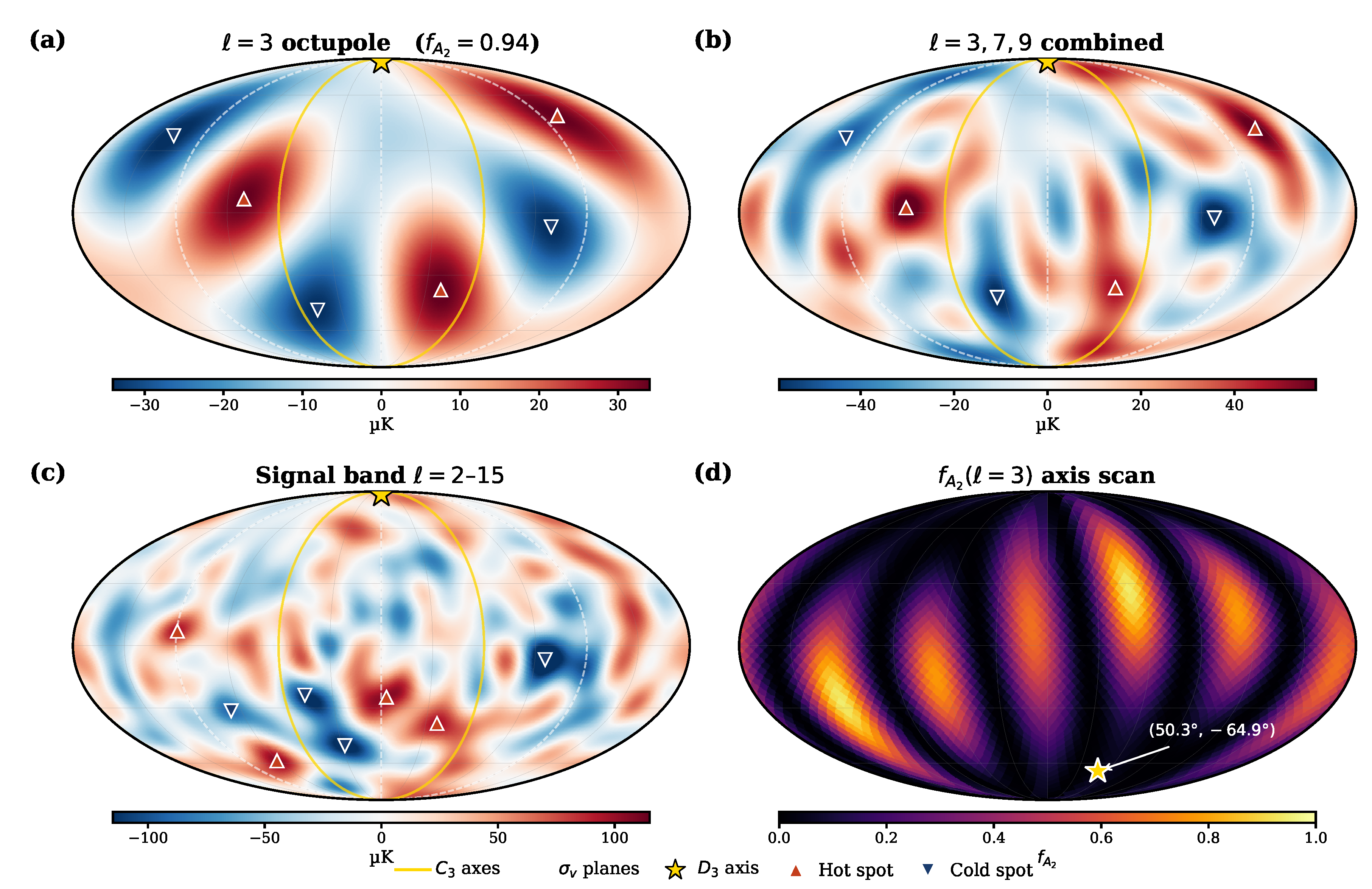
Figure 3.
power fraction at the fixed axis for –150 (SMICA). Gray line: isotropic baseline . Blue/light bands: / Monte Carlo envelopes ( realizations). Red points: multipoles with . The signal is densest at , but isolated cross-map-validated peaks appear at and . The axis was determined from alone; all other multipoles constitute an effectively pre-registered test.
Figure 3.
power fraction at the fixed axis for –150 (SMICA). Gray line: isotropic baseline . Blue/light bands: / Monte Carlo envelopes ( realizations). Red points: multipoles with . The signal is densest at , but isolated cross-map-validated peaks appear at and . The axis was determined from alone; all other multipoles constitute an effectively pre-registered test.
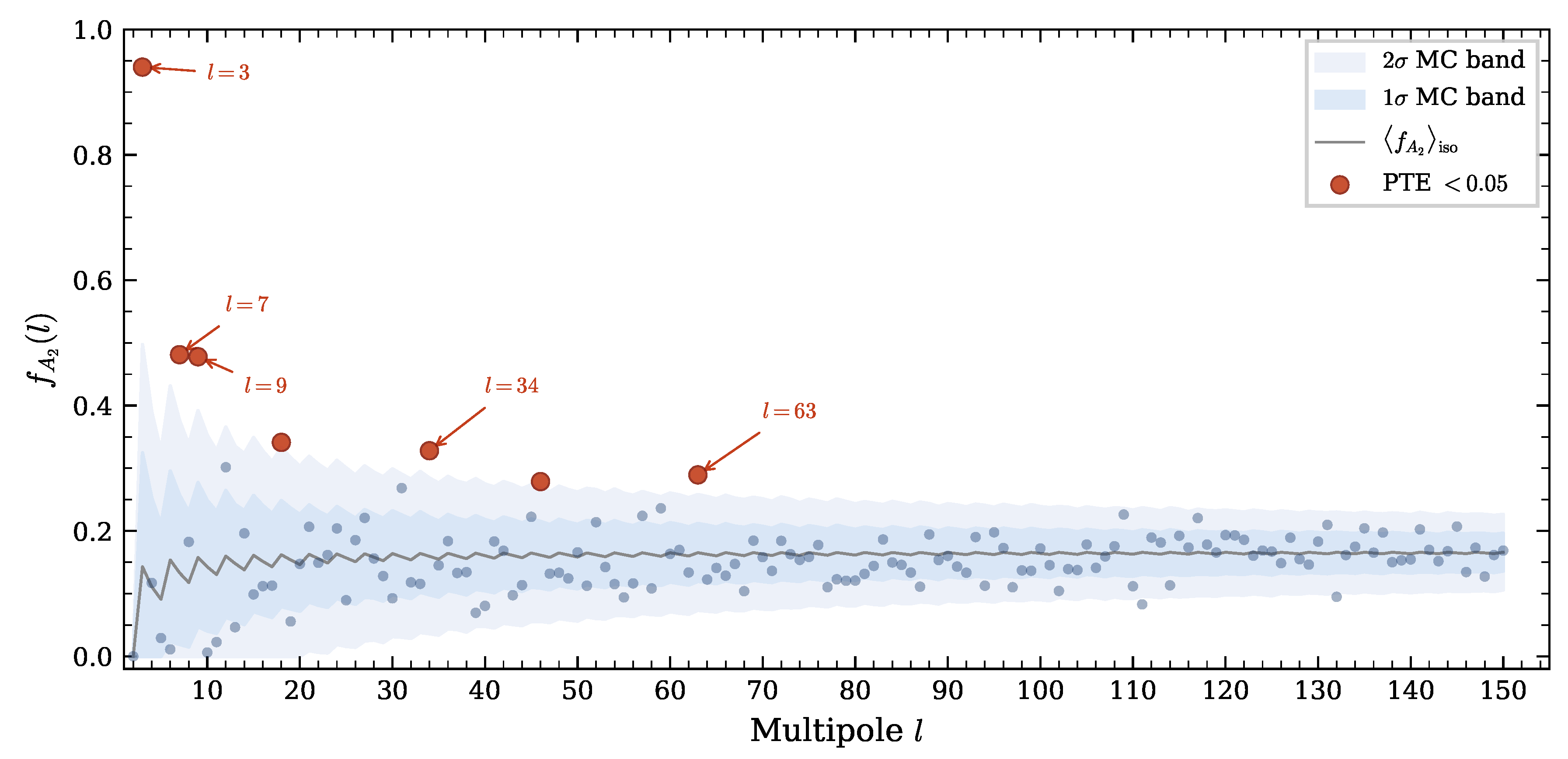
Figure 4.
Scatter plot of vs. for –150 (SMICA). Dark points: ; open circles: (signal region). The dashed line shows the least-squares fit with . The strong anti-correlation confirms the power funnel predicted by the reflection-plane mechanism.
Figure 4.
Scatter plot of vs. for –150 (SMICA). Dark points: ; open circles: (signal region). The dashed line shows the least-squares fit with . The strong anti-correlation confirms the power funnel predicted by the reflection-plane mechanism.
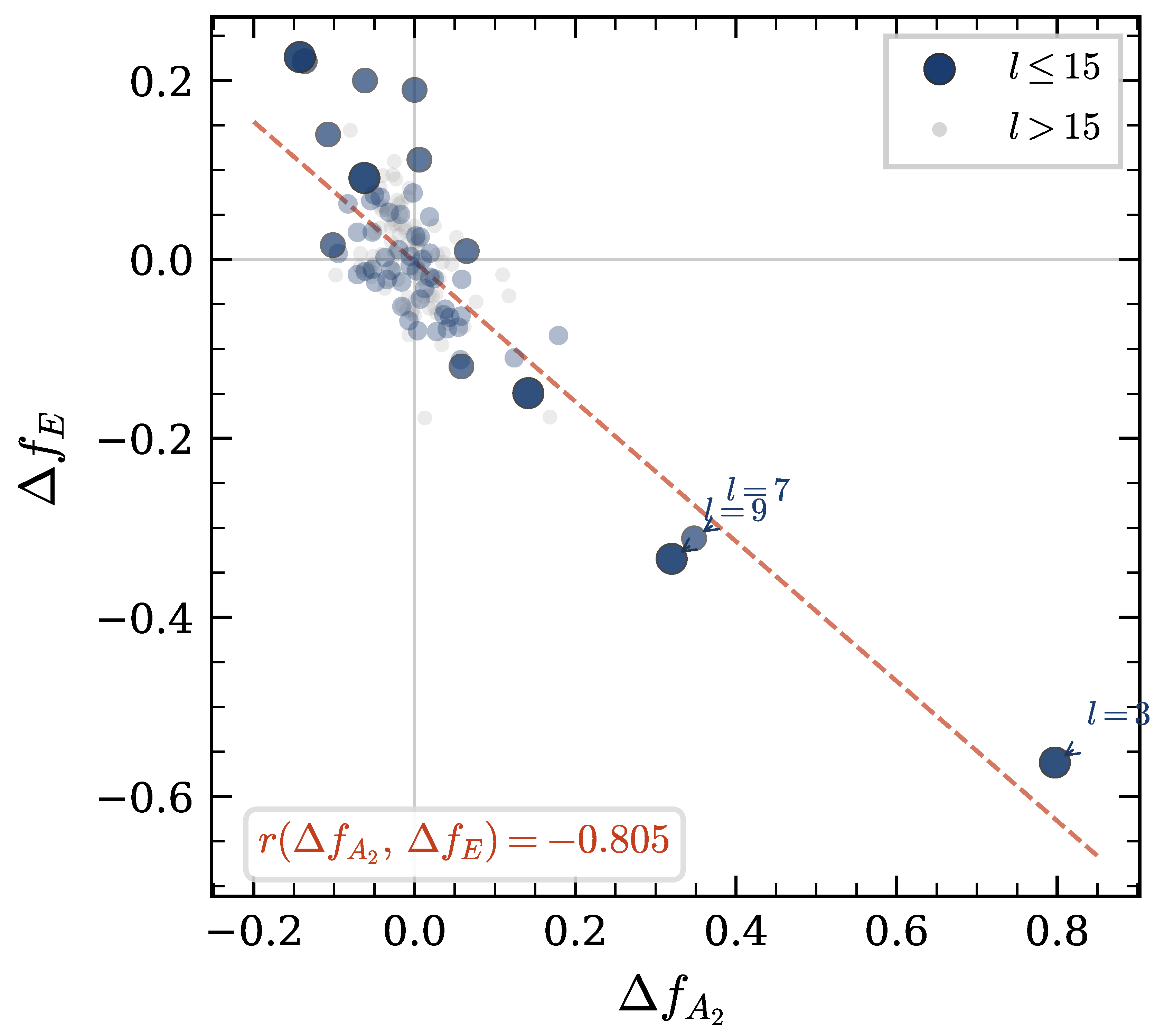
Figure 5.
Mean excess grouped by residue class for –150 (SMICA). The class shows the highest mean excess (permutation PTE ). Among the nine strongest cross-map peaks (Table 3), zero belong to the class (). Error bars: standard error of the mean.
Figure 5.
Mean excess grouped by residue class for –150 (SMICA). The class shows the highest mean excess (permutation PTE ). Among the nine strongest cross-map peaks (Table 3), zero belong to the class (). Error bars: standard error of the mean.
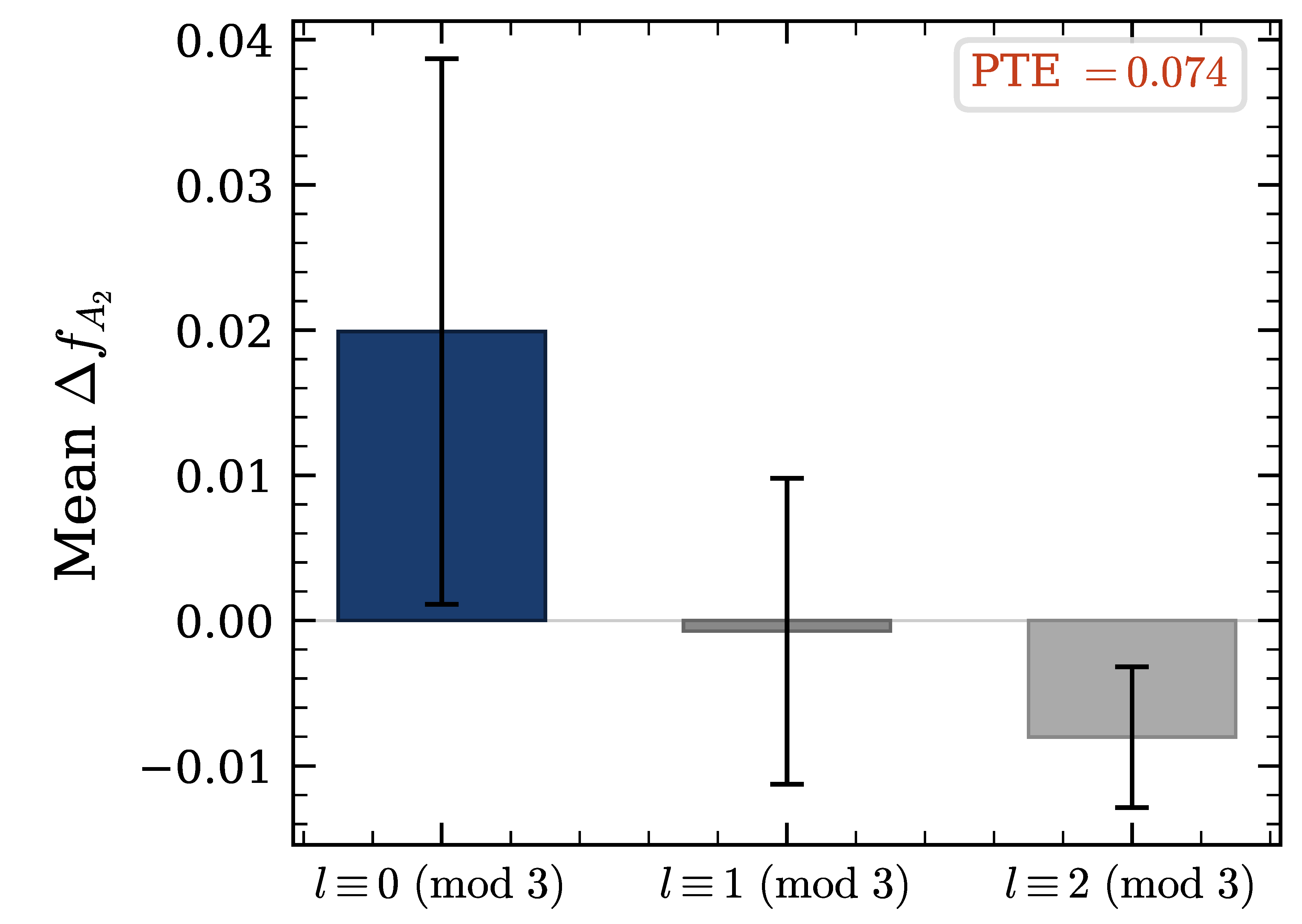
Figure 6.
Running sum of from to (SMICA). The steep rise at reflects the dense signal cluster. The subsequent near-plateau is interrupted by mild step-ups at and —the sporadic resonances identified in Table 3. Red dots mark . Dotted lines: random walk envelope.
Figure 6.
Running sum of from to (SMICA). The steep rise at reflects the dense signal cluster. The subsequent near-plateau is interrupted by mild step-ups at and —the sporadic resonances identified in Table 3. Red dots mark . Dotted lines: random walk envelope.
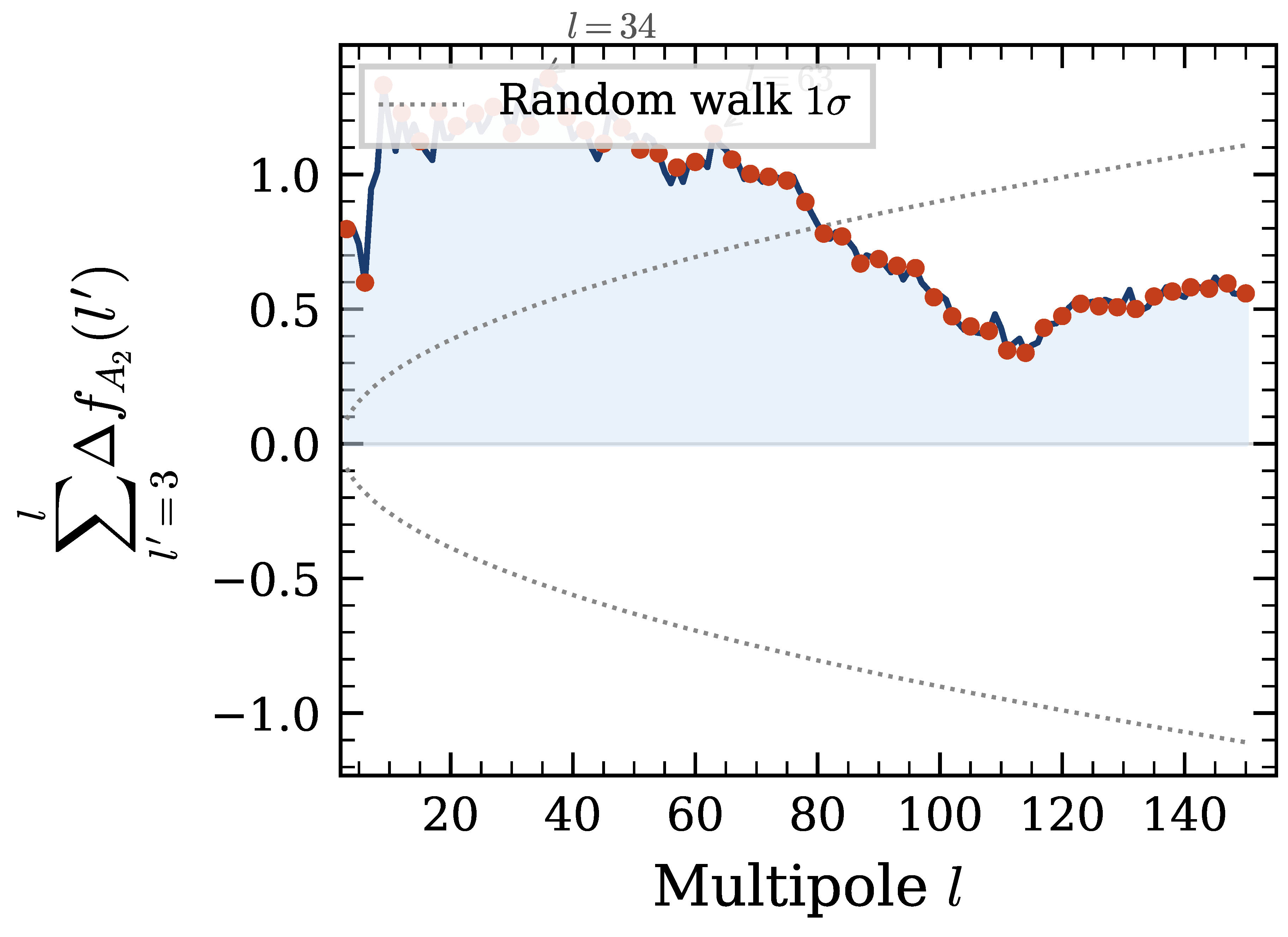
Figure 7.
Real-space visualization of the signal in the Planck SMICA map, rotated into the frame. Upper left: Equatorial temperature ring for the signal band (–15, blue) and the three driving multipoles (, red). Vertical lines mark rotations (, solid) and reflection planes (, dashed). Upper right: The three-fold pattern at colatitudes – from the axis. Lower left: Azimuthal power spectrum showing dominance, confirming the selection rule. Lower right: Azimuthal auto-correlation: (positive, symmetry) and (negative, anti-symmetry). This alternating sign pattern is the real-space fingerprint of irrep loading.
Figure 7.
Real-space visualization of the signal in the Planck SMICA map, rotated into the frame. Upper left: Equatorial temperature ring for the signal band (–15, blue) and the three driving multipoles (, red). Vertical lines mark rotations (, solid) and reflection planes (, dashed). Upper right: The three-fold pattern at colatitudes – from the axis. Lower left: Azimuthal power spectrum showing dominance, confirming the selection rule. Lower right: Azimuthal auto-correlation: (positive, symmetry) and (negative, anti-symmetry). This alternating sign pattern is the real-space fingerprint of irrep loading.
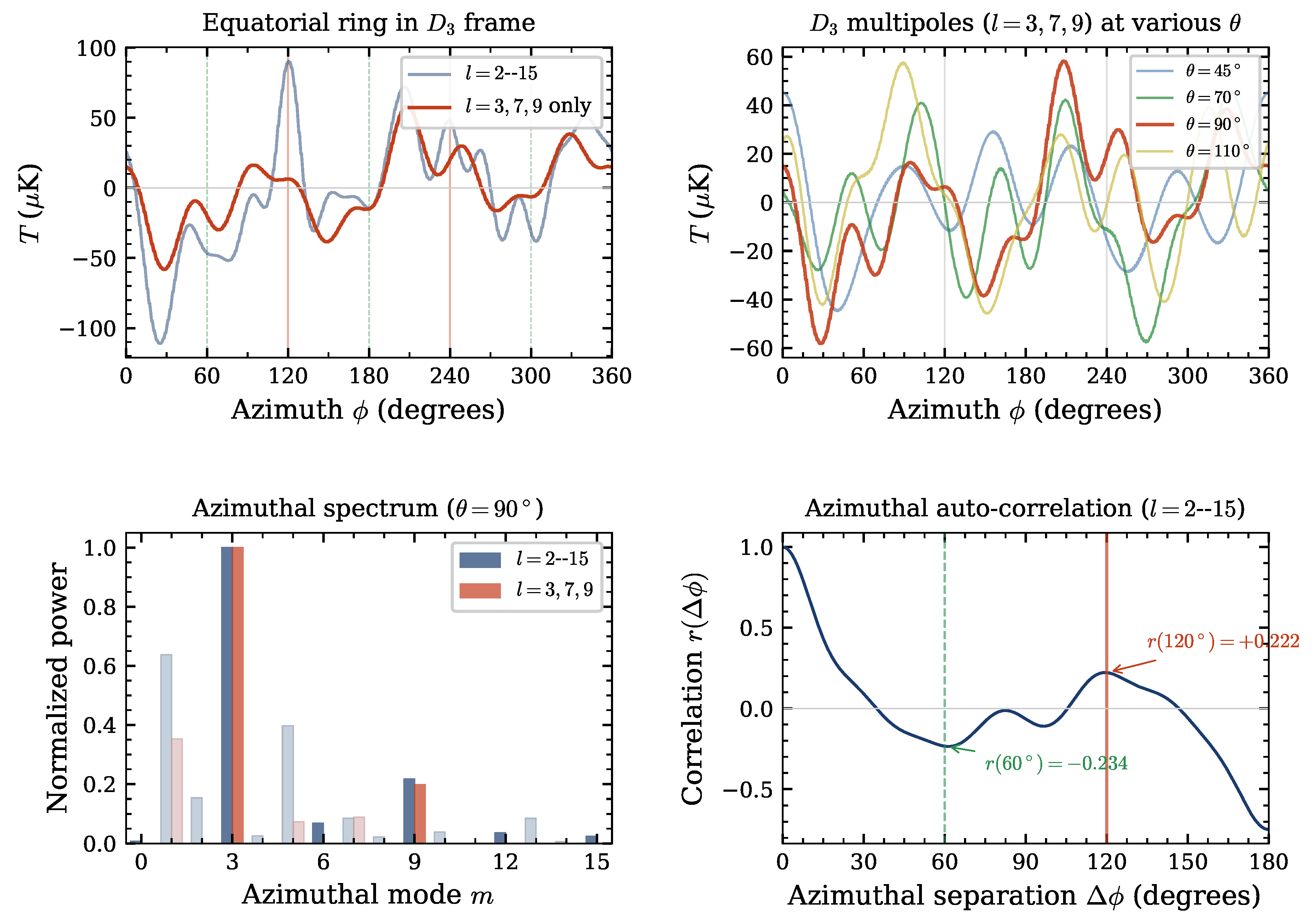
Figure 8.
power fraction for all four Planck PR3 component-separation maps at the fixed axis. The near-perfect overlap—especially at , where the signal resides—rules out pipeline-specific artifacts. SMICA and NILC are virtually indistinguishable ().
Figure 8.
power fraction for all four Planck PR3 component-separation maps at the fixed axis. The near-perfect overlap—especially at , where the signal resides—rules out pipeline-specific artifacts. SMICA and NILC are virtually indistinguishable ().
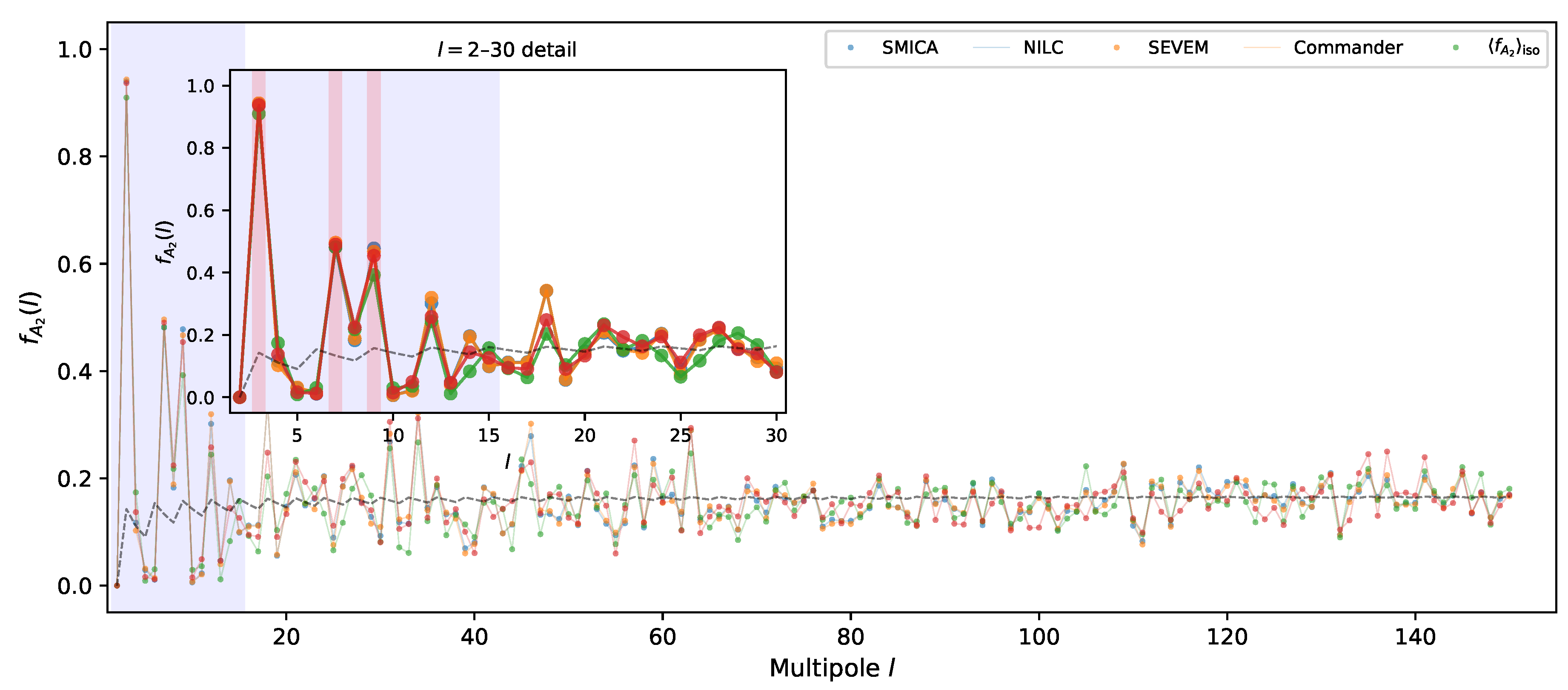
Figure 9.
Cumulative transfer invariant (Eq. 16). (a) for all four Planck pipelines, showing a stable plateau from to 150. (b) Four-map mean under jackknife removal of key multipoles: the plateau survives individual removals but collapses when all three low-l anchors are excised. (c) Comparison of for the three irreps: and E are mirror images (reflecting the conservation law), while is consistent with zero. Grey bands mark the isotropic expectation.
Figure 9.
Cumulative transfer invariant (Eq. 16). (a) for all four Planck pipelines, showing a stable plateau from to 150. (b) Four-map mean under jackknife removal of key multipoles: the plateau survives individual removals but collapses when all three low-l anchors are excised. (c) Comparison of for the three irreps: and E are mirror images (reflecting the conservation law), while is consistent with zero. Grey bands mark the isotropic expectation.
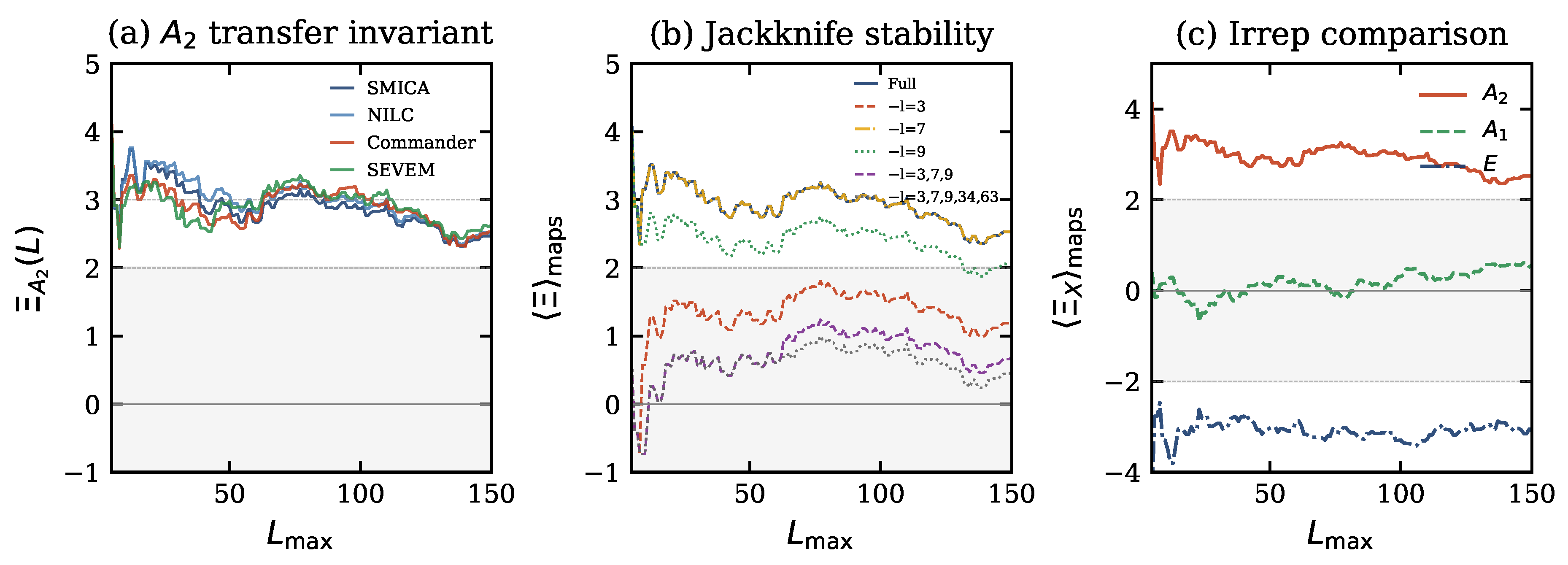
Table 1.
subspace dimensions and isotropic expected power fractions for –12. Rows with are marked (★) where increments.
Table 1.
subspace dimensions and isotropic expected power fractions for –12. Rows with are marked (★) where increments.
| l | ||||||
|---|---|---|---|---|---|---|
| 2 | 1 | 0 | 4 | 0.200 | 0.000 | 0.800 |
| 3★ | 2 | 1 | 4 | 0.286 | 0.143 | 0.571 |
| 4 | 2 | 1 | 6 | 0.222 | 0.111 | 0.667 |
| 5 | 2 | 1 | 8 | 0.182 | 0.091 | 0.727 |
| 6★ | 3 | 2 | 8 | 0.231 | 0.154 | 0.615 |
| 7 | 3 | 2 | 10 | 0.200 | 0.133 | 0.667 |
| 8 | 3 | 2 | 12 | 0.176 | 0.118 | 0.706 |
| 9★ | 4 | 3 | 12 | 0.211 | 0.158 | 0.632 |
| 10 | 4 | 3 | 14 | 0.190 | 0.143 | 0.667 |
| 11 | 4 | 3 | 16 | 0.174 | 0.130 | 0.696 |
| 12★ | 5 | 4 | 16 | 0.200 | 0.160 | 0.640 |
Table 2.
irrep fractions at the fixed axis for SMICA (–15). PTE from isotropic simulations. The three driving multipoles () are marked with †.
Table 2.
irrep fractions at the fixed axis for SMICA (–15). PTE from isotropic simulations. The three driving multipoles () are marked with †.
| l | PTE | ||||
|---|---|---|---|---|---|
| 2 | 0.011 | 0.000 | 0.989 | — | |
| 3† | 0.051 | 0.940 | 0.009 | ||
| 4 | 0.105 | 0.117 | 0.778 | 0.347 | |
| 5 | 0.060 | 0.002 | 0.938 | 0.957 | |
| 6 | 0.116 | 0.031 | 0.852 | 0.872 | |
| 7† | 0.055 | 0.481 | 0.464 | 0.016 | |
| 8 | 0.041 | 0.252 | 0.707 | 0.098 | |
| 9† | 0.048 | 0.478 | 0.474 | 0.014 | |
| 10 | 0.049 | 0.097 | 0.854 | 0.693 | |
| 11 | 0.163 | 0.085 | 0.752 | 0.680 | |
| 12 | 0.262 | 0.297 | 0.441 | 0.089 | |
| 13 | 0.122 | 0.198 | 0.680 | 0.340 | |
| 14 | 0.228 | 0.162 | 0.610 | 0.458 | |
| 15 | 0.167 | 0.239 | 0.594 | 0.218 |
Table 3.
The nine strongest peaks ranked by cross-map mean . “Sig” counts maps with . No peak belongs to the residue class.
Table 3.
The nine strongest peaks ranked by cross-map mean . “Sig” counts maps with . No peak belongs to the residue class.
| l | SM | NI | SE | CM | Sig | ||
|---|---|---|---|---|---|---|---|
| 3 | 0.932 | .940 | .943 | .910 | .937 | 4/4 | 0 |
| 7 | 0.487 | .481 | .496 | .482 | .490 | 4/4 | 1 |
| 9 | 0.448 | .478 | .467 | .392 | .454 | 4/4 | 0 |
| 34 | 0.307 | .328 | .322 | .267 | .312 | 3/4 | 1 |
| 18 | 0.284 | .341 | .342 | .203 | .248 | 2/4 | 0 |
| 12 | 0.281 | .302 | .320 | .244 | .258 | 0/4 | 0 |
| 63 | 0.280 | .290 | .290 | .246 | .294 | 3/4 | 0 |
| 31 | 0.278 | .268 | .283 | .256 | .305 | 2/4 | 1 |
| 46 | 0.250 | .279 | .302 | .189 | .230 | 2/4 | 1 |
Table 5.
Cross-map consistency of over –150. Pearson correlation r and mean absolute deviation .
| Map pair | ||
|---|---|---|
| SMICA–NILC | 0.997 | 0.006 |
| SMICA–Commander | 0.958 | 0.021 |
| SMICA–SEVEM | 0.936 | 0.024 |
| NILC–Commander | 0.957 | 0.021 |
| NILC–SEVEM | 0.932 | 0.025 |
| SEVEM–Commander | 0.938 | 0.025 |
Table 6.
Transfer invariant for each pipeline and the four-map mean , at selected summation boundaries.
Table 6.
Transfer invariant for each pipeline and the four-map mean , at selected summation boundaries.
| L | SMICA | NILC | Commander | SEVEM | |
|---|---|---|---|---|---|
| 15 | |||||
| 50 | |||||
| 100 | |||||
| 150 |
Table 7.
Odd/even parity split in the transfer. is the mean excess over isotropic expectation; Fisher PTE combines per-multipole values within each parity class. The sign agreement across all four maps rules out pipeline-specific artifacts.
Table 7.
Odd/even parity split in the transfer. is the mean excess over isotropic expectation; Fisher PTE combines per-multipole values within each parity class. The sign agreement across all four maps rules out pipeline-specific artifacts.
| Map | ||||
|---|---|---|---|---|
| SMICA | ||||
| NILC | ||||
| SEVEM | ||||
| Commander |
Table 8.
Cumulative transfer (four-map mean ± inter-map spread), partitioned by parity and residue class. The single dominant cell is odd, .
Table 8.
Cumulative transfer (four-map mean ± inter-map spread), partitioned by parity and residue class. The single dominant cell is odd, .
| Odd l | |||
| Even l |
Table 9.
Rank-1 factorization of the transfer matrix . The rank-1 fraction is . The binary-gate vector and routing vector are recovered independently by each pipeline.
Table 9.
Rank-1 factorization of the transfer matrix . The rank-1 fraction is . The binary-gate vector and routing vector are recovered independently by each pipeline.
| Map | Rank-1 | |||||
|---|---|---|---|---|---|---|
| SMICA | ||||||
| NILC | ||||||
| SEVEM | ||||||
| Commander |
Table 10.
Empirical signature summary. “Primary” denotes claims supported by pre-registered or controlled statistics; “Supportive” denotes a posteriori structural observations.
Table 10.
Empirical signature summary. “Primary” denotes claims supported by pre-registered or controlled statistics; “Supportive” denotes a posteriori structural observations.
| Property | Observable | Result | Status |
|---|---|---|---|
| Registered axis | Primary | ||
| Low-l cluster | Fisher PTE (–15) | to | Primary |
| Cross-map replication | all pairs | – | Primary |
| funnel | Primary | ||
| EE null | Fisher PTE (polarization) | Primary control | |
| Parity-gated transfer | Odd/even Fisher | odd ; even | Primary structural |
| factorization | Rank-1 fraction | – | Primary structural |
| Cumulative | – | to | Primary |
| One-way collect rule | Robust signs | All collecting into | Secondary-strong |
| High-l aggregate null | Fisher PTE (–150) | Primary constraint | |
| Residue-class top-9 | in | Supportive only |
Disclaimer/Publisher’s Note: The statements, opinions and data contained in all publications are solely those of the individual author(s) and contributor(s) and not of MDPI and/or the editor(s). MDPI and/or the editor(s) disclaim responsibility for any injury to people or property resulting from any ideas, methods, instructions or products referred to in the content. |
© 2026 by the author. Licensee MDPI, Basel, Switzerland. This article is an open access article distributed under the terms and conditions of the Creative Commons Attribution (CC BY) license.
Copyright: This open access article is published under a Creative Commons CC BY 4.0 license, which permit the free download, distribution, and reuse, provided that the author and preprint are cited in any reuse.


