
Submitted:
02 April 2026
Posted:
03 April 2026
You are already at the latest version
Abstract
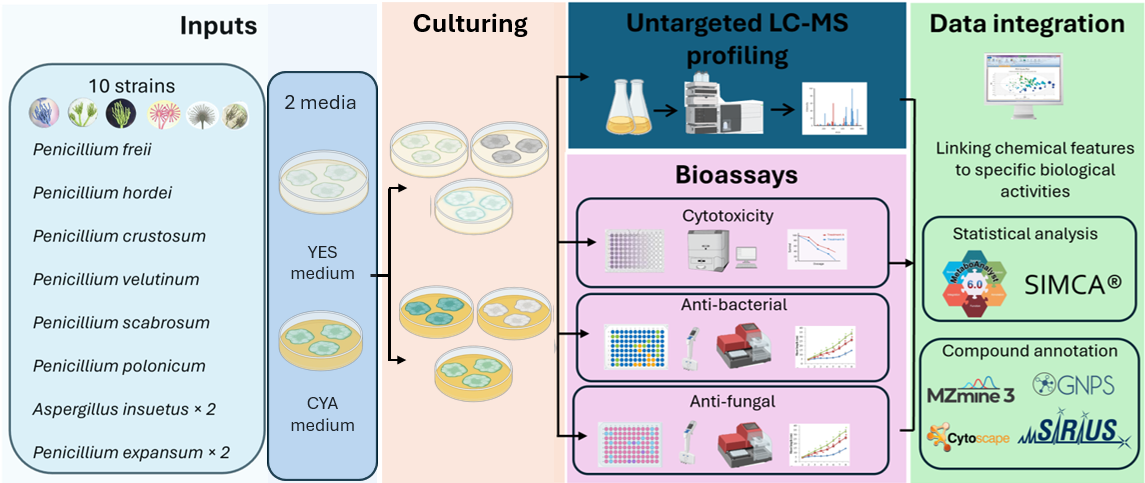
Fungi represent a prolific source of structurally diverse secondary metabolites, yet the extent to which culture conditions reshape the metabolic profile and functional bioactivity remains incompletely understood. In this exploratory study, ten fungal strains cultivated in Yeast Extract Sucrose (YES) and Czapek Yeast Autolysate (CYA) media were analysed using untargeted LC-HRMS metabolomics. This was then combined with multivariate statistical modelling to evaluate medium-dependent metabolic variation and its relation to cytotoxic, antibacterial and antifungal activities. Global metabolic profiling revealed moderate but statistically significant medium-associated metabolite variation, with discriminant metabolites predominantly enriched under CYA conditions. Putative structural annotation suggested patterns consistent with differential regulation of isoprenoid-derived sterols, terpenoids, alkaloid-like metabolites and aromatic polyketides. While antimicrobial activities displayed a heterogeneous, strain-dependent pattern with limited correlation to individual metabolites, cytotoxic activity co-varied with metabolite composition in OPLS regression modelling. Sterols and terpenoid-related features emerged as major contributors to cytotoxicity. Given the absence of biological replication and the limited sample size inherent to this pilot study, all findings should be considered hypothesis-generating and interpreted within an exploratory framework. These results suggest that nutrient composition influences biosynthetic pathway activation while functional outcomes remain strongly dependent on strain-specific metabolic capacity. This work provides a systematic framework and targeted hypothesis for future investigations into condition-dependent fungal chemical diversity in natural product discovery.
Keywords:
fungal secondary metabolism
; untargeted metabolomics
; OPLS regression
; metabolitebioactivity association
; cytotoxic activity
; molecular networking
Copyright: This open access article is published under a Creative Commons CC BY 4.0 license, which permit the free download, distribution, and reuse, provided that the author and preprint are cited in any reuse.


