
Submitted:
02 April 2026
Posted:
02 April 2026
You are already at the latest version
Abstract
Background: Climate projections for western Canada predict reduced water availability and more frequent heatwaves, underscoring the need to improve water-use efficiency and heat tolerance to sustain crop productivity and grain quality.
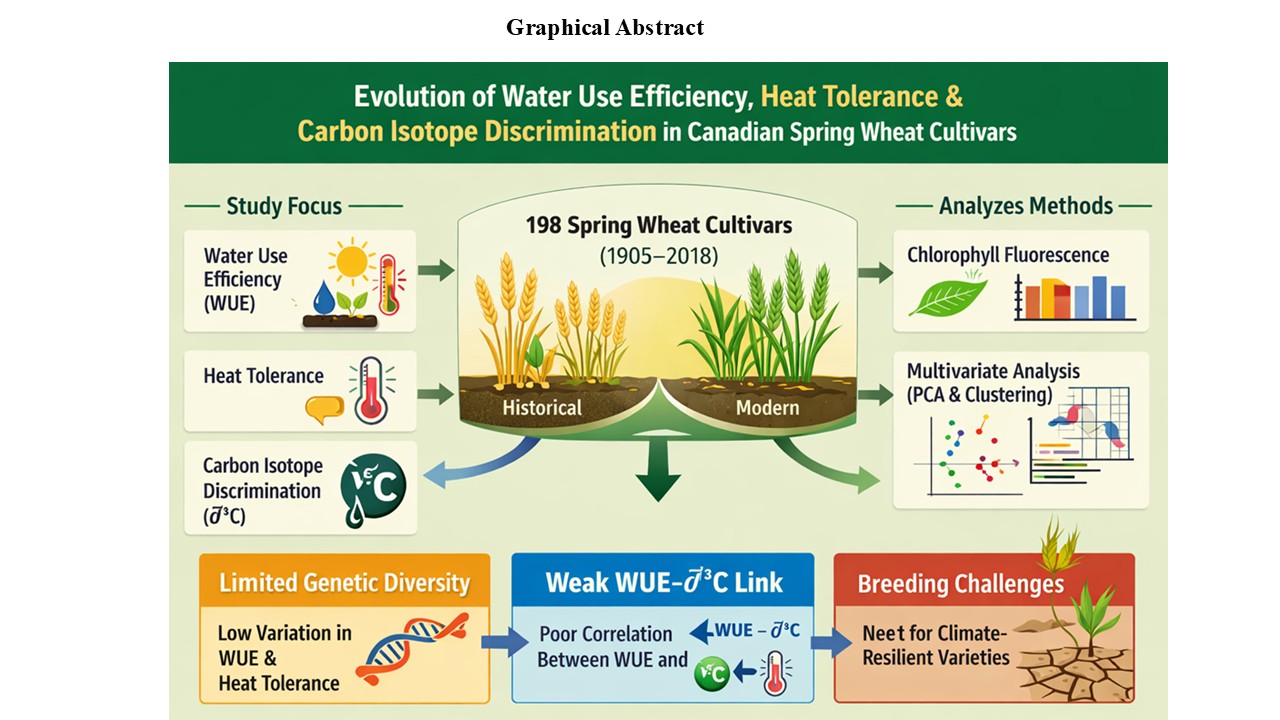
Materials and Methods: A total of 198 historical and modern Canadian spring wheat cultivars were evaluated under water-deficient and high-temperature conditions. Measurements included whole-plant and leaf-level WUE, carbon isotope discrimination (δ¹³C) in flag leaves, and physiological traits such as leaf water potential, photosynthetically active radiation, and chlorophyll fluorescence parameters (F₀, FV/FM, FM, FV, φDo, and ETR) across six growth stages.
Results: WUEWP showed a weak relationship with δ¹³C, indicating strong environmental and genetic in-fluences and limiting its reliability as a proxy across conditions. Spring wheat cultivars exhibited low genetic diversity for WUEWP and heat tolerance, suggesting limited adaptive capacity to increasing stress. Multivariate analyses (PCA and clustering) effectively captured trait variation and differentiated cultivars. Chlorophyll fluorescence traits sensitively reflected reductions in photosynthetic efficiency under drought and heat stress.
Conclusion: Overall, the results indicate meaningful genotypic variation but limited genetic diversity and weak relationships among WUE, δ¹³C, and related traits, highlighting the need for new germplasm and integrated phenotyping to enhance selection efficiency and develop more climate-resilient spring wheat.
Keywords:
genetic diversity
; spring wheat
; stable isotope
; abiotic stress tolerance
Copyright: This open access article is published under a Creative Commons CC BY 4.0 license, which permit the free download, distribution, and reuse, provided that the author and preprint are cited in any reuse.


