

Submitted:
01 April 2026
Posted:
03 April 2026
You are already at the latest version
Abstract
Industrial dye wastewater poses severe environmental and health risks, creating an urgent demand for efficient and sustainable remediation technologies. Herein, hierarchically porous hollow TiO2 nanofibers (HNFTi) were constructed through electrospinning and coupled with blue-, green-, and orange-emissive graphene quantum dots (b-, g-, and o-GQDs) to fabricate visible-light-responsive heterojunction photocatalysts. By tailoring the surface functional groups and heteroatom doping of GQDs, a progressive fluorescence redshift was achieved, which effectively narrowed the bandgap and extended visible-light absorption. Benefiting from the synergistic effects of the hierarchically porous hollow TiO2 architecture and the fluorescence-tuned GQDs, the resulting composites exhibited enhanced light harvesting, accelerated charge separation, and improved interfacial charge transfer. Among them, the 0.5 wt% o-GQDs/HNFTi composite showed the best photocatalytic performance, delivering a methylene blue degradation efficiency of 99.5% within 2 h under visible-light irradiation, markedly higher than that of pristine HNFTi (77.7%). Photoelectrochemical and Kelvin probe force microscopy analyses further confirmed the promoted carrier dynamics and effective interfacial separation of photogenerated electron-hole pairs. This work provides a feasible strategy for integrating structural engineering and fluorescence modulation to develop high-performance TiO2-based photocatalysts for wastewater treatment.
Keywords:
graphene quantum dots
; TiO2 nanofibers
; heterojunction
; fluorescence redshift
; photocatalytic degradation
1. Introduction
Industrial dye wastewater, especially containing methylene blue (MB), poses severe ecological and health risks due to its toxicity and resistance to conventional treatments [1,2,3,4,5,6,7,8,9]. Photocatalysis offers a sustainable route for complete mineralization of such contaminants using solar energy [10,11,12,13]. Titanium dioxide (TiO2) is widely explored as a photocatalyst for its stability, low cost, and non-toxicity, yet its wide bandgap (3.2 eV) restricts absorption to UV light, and rapid electron–hole recombination limits efficiency under visible light [14,15,16,17,18,19,20,21,22].
Structural engineering and heterojunction formation have emerged as effective strategies to overcome these limitations. Hierarchically porous hollow TiO2 nanofibers (HNFTi), fabricated via electrospinning, provide high surface area, interconnected porosity, and hollow channels, enhancing active site availability, light scattering, and charge transport [23,24,25,26,27,28,29,30,31]. Meanwhile, graphene quantum dots (GQDs) act as photosensitizers with tunable fluorescence, strong upconversion emission, and efficient electron-accepting capability [32,33,34,35,36]. Surface functionalization and heteroatom (S, B) doping induce a progressive fluorescence redshift in GQDs, narrowing the bandgap and extending visible-light absorption [37]. When integrated with HNFTi, GQDs facilitate charge separation and boost solar-energy utilization [38].
Herein, blue (b-GQDs), green (g-GQDs), and orange (o-GQDs) quantum dots were hydrothermally synthesized and anchored onto HNFTi to form heterojunction photocatalysts. Comprehensive studies on optical properties, charge-transfer dynamics, and MB degradation reveal that the combination of TiO2 structural modulation and GQDs fluorescence tuning synergistically enhances visible-light-driven photocatalysis, providing a rational design strategy for high-performance, sustainable photocatalysts.
2. Materials and Methods
2.1. Materials
O-phenylenediamine (o-PD), boric acid (BA), and sulfanilic acid (SA) were obtained from Shanghai Sinopharm Chemical Reagent Co., Ltd. Citric acid (CA) was purchased from Adamas. Anatase TiO2 powder was supplied by Sigma-Aldrich. Tetrabutyl titanate (TBT) was purchased from Tianjin Komeo Chemical Reagent Co., Ltd. Glacial acetic acid was obtained from Shanghai Aladdin Biochemical Technology Co., Ltd. N,N-dimethylformamide (DMF) was purchased from Tianjin Zhiyuan Chemical Reagent Co., Ltd. Methylene blue (MB) and polyacrylonitrile (PAN, Mw = 150,000) were purchased from Shanghai Titan Technology Co., Ltd. All reagents were of analytical grade and used as received without further purification.
2.2. Synthesis of Graphene Quantum Dots (b-GQDs, g-GQDs, o-GQDs)
Blue-, green-, and orange-emissive graphene quantum dots (b-GQDs, g-GQDs, and o-GQDs) were synthesized via a hydrothermal method. Typically, o-PD (0.1 g) and CA (0.05 g) were dissolved in 10 mL of deionized water and ultrasonicated for 30 min to form a homogeneous solution. The solution was transferred to a Teflon-lined stainless-steel autoclave and heated at 180 °C for 12 h. After cooling to room temperature, the product was filtered through a 0.22 μm microporous membrane to afford b-GQDs. g-GQDs and o-GQDs were prepared using the same protocol, except that CA was replaced with SA and BA, respectively. The obtained b-GQDs, g-GQDs, and o-GQDs exhibited blue, green, and orange emissions under UV light, with quantum yields of 8.9%, 15.6%, and 20.4%, respectively.
2.3. Synthesis of TiO2 Nanostructures TiO2 Nanowires (NWTi).
TiO2 nanowires were synthesized via a hydrothermal method. In a typical procedure, rutile TiO2 powder (1 g) was dispersed in 50 mL of NaOH solution (10 M) by ultrasonication for 1 h. The suspension was transferred into a Teflon-lined autoclave and heated at 180 °C for 48 h. After cooling, the product was repeatedly washed with deionized water until neutral pH was reached, followed by vacuum filtration. The resulting solid was calcined at 500 °C for 4 h (heating rate: 5 °C/min) to yield TiO2 nanowires (denoted as NWTi).
2.4. Conventional TiO2 Nanofibers (NFTi)
TiO2 nanofibers were prepared via electrospinning. Polyvinylpyrrolidone (2.4 g) and TBT (4 g) were dissolved in ethanol (20 mL) under vigorous stirring to obtain a clear precursor solution. Electrospinning was carried out under the following conditions: distance, 20 cm; voltage, +20 kV/–1.5 kV; and feed rate, 1 cm h−1. After 4 h of spinning, the nanofiber mats were pre-oxidized at 200 °C for 2 h and subsequently calcined at 500 °C for 2 h to afford NFTi.
2.5. Hollow-Structured TiO2 Nanofibers (HNFTi)
HNFTi were prepared following the same electrospinning and calcination process as NFTi, with the formation of hollow porous structures during the thermal treatment.
2.6. Fabrication of GQDs/TiO2 Composites
HNFTi (0.2 g) was dispersed in aqueous solutions containing different loadings of GQDs (0, 0.3, 0.5, 0.8, 1, and 2 wt%, relative to HNFTi). The mixture was magnetically stirred and gently heated at 50 °C to evaporate excess water. The resulting solids were dried at 60 °C to obtain GQDs/TiO2 composites, denoted as b-HNFTi, g-HNFTi, and o-HNFTi, respectively.
2.7. Photocatalytic Activity Tests
The photocatalytic performance was evaluated by the degradation of methylene blue (MB) under visible-light irradiation. In a typical experiment, 20 mg of photocatalyst was dispersed in 50 mL of MB solution (10 mg L−1). Prior to irradiation, the suspension was stirred in the dark for 30 min to achieve adsorption–desorption equilibrium. A 300 W Xe lamp (λ > 420 nm) was used as the light source. At 30 min intervals, 5 mL aliquots were withdrawn, centrifuged, and analyzed using a UV–vis spectrophotometer at 665 nm to determine MB concentration.
2.8. Characterization
The morphology of TiO2 nanostructures was examined by scanning electron microscopy (SEM, Phenom Pure) and transmission electron microscopy (TEM, JEM-2100F). High-resolution TEM (HRTEM) was also conducted. Raman spectra were obtained using a XploRA PLUS confocal Raman spectrometer. X-ray diffraction (XRD) patterns were collected using a D2 PHASER diffractometer. X-ray photoelectron spectroscopy (XPS, K-Alpha) and ultraviolet photoelectron spectroscopy (UPS, Thermo ESCALAB 250Xi) were employed to analyze surface composition and electronic structures. Atomic force microscopy (AFM) images were recorded using an MFP-3D Infinity instrument. UV–vis diffuse reflectance spectra (DRS) were measured on a LAMBDA 750 spectrophotometer. Photocurrent and electrochemical impedance spectroscopy (EIS) measurements were performed on a CHI 600E electrochemical workstation. MB degradation intermediates were identified by LC-MS (Agilent 1290-6530-QTOF). A xenon lamp (CEL-HXF300-T3, 300 W, λ > 420 nm) was used to simulate solar light for photocatalytic experiments.
3. Results
To enhance the limited visible-light activity of pristine TiO2, hollow fibers with high surface area and abundant active sites were fabricated by electrospinning. Three types of graphene quantum dots (b-, g-, and o-GQDs) with tunable fluorescence, synthesized hydrothermally, were then integrated with the fibers to construct heterojunctions. The composites were evaluated for methylene blue degradation under visible light to probe the synergistic effects of TiO2 structural engineering and GQDs surface modulation (Scheme 1).
The surface chemistry of the GQDs was analyzed by FTIR and XPS (Figure 1a–b, Figure S1–S3). All samples (b-, g-, o-GQDs) exhibited C–C, C=C, C–H, and N–H vibrations, indicating hydroxyl and amine functionalization, along with weak –COOH groups [39]. Additional C–S/S=O bands in g-GQDs and B–O/B–N signals in o-GQDs confirmed successful S and B doping [40]. respectively. XPS further revealed that from b- to o-GQDs, electron-donating groups (–OH, –NH2) decreased while –COOH increased (0.99% → 10.91%), consistent with a fluorescence redshift induced by electron-withdrawing surface functionalities [41,42]. XRD patterns showed a broad peak near 26°, corresponding to the (002) plane of graphitic carbon (Figure S4). Raman spectra (Figure 1c) exhibited D and G bands, with IG/ID ratios increasing from 1.03 (b-GQDs) to 1.23 (o-GQDs), indicating enhanced graphitization and structural ordering, which reduces the bandgap and contributes to the redshift [43]. AFM (Figure. 1d–f) revealed thicknesses of 3.65 nm and TEM (Figure 1g–i) showed quasi-spherical particles with diameters of 2.83 nm, while HRTEM confirmed lattice fringes of 0.21–0.24 nm indexed to graphene (100) planes. Slight lattice expansion from b- to o-GQDs is attributed to heteroatom doping and functionalization, perturbing the π-conjugated framework [44]. UV–Vis spectra (Figure 2a–c) displayed characteristic π-π* (C=C) and n-π* (C=O) transitions, with absorption edges redshifting from b- to o-GQDs (236–292 nm → 238–290 nm) [45,46] The optimal excitation/emission pairs were 380/430 nm (b-GQDs), 445/510 nm (g-GQDs), and 485/580 nm (o-GQDs), consistent with observed fluorescence (Figure S5). UPS spectra (Figure 2d) revealed variations in electronic structures. Figure 2e showed fitting curves of maximum excitation wavelength and absorption peak. A clear correlation between lateral size and emission wavelength was observed in Figure 2f [47]. The optical bandgaps estimated from DRS (Figure 2g) decreased from 2.36 eV (b-GQDs) and 2.29 eV (g-GQDs) to 2.20 eV (o-GQDs). The HOMO levels were determined by UPS (Figure 2h), while the corresponding LUMO levels were deduced by subtracting the optical bandgap from the HOMO values (Figure 2i). Structural models (Figure 2h) highlight the increasing π-conjugated domains and evolution of surface functionalities, which stabilize the electronic structure, narrow the bandgap, and enhance visible-light absorption and charge-separation efficiency, with o-GQDs exhibiting the most favorable properties.
SEM images (Figure 3a–d) revealed distinct morphologies: NPTi as aggregated nanoparticles, NWTi as nanowires, NFTi as dispersed fibers, and HNFTi as hollow fibers with rough surfaces and pores confirmed by TEM (Figure 3e–f). The hollow structure of HNFTi arises from phase separation during electrospinning and calcination. BET analysis (Figure 3h) showed type IV isotherms with H2/H3 hysteresis for NFTi/HNFTi, indicating uniform mesopores [48]. HNFTi exhibited the highest surface area (45.74 m2・g−1) and pore volume (0.13 cm2・g−1), providing abundant active sites and enhanced MB adsorption [49]. DRS indicated band gaps of 3.17 (NPTi), 2.93 (NWTi), 2.81 (NFTi), and 2.69 eV (HNFTi), where the narrower bandgap of HNFTi facilitates visible-light absorption and charge separation (Figure 3i). Photocatalytic MB degradation efficiencies increased from NPTi (51.6%) to HNFTi (77.7%).
To validate GQDs/TiO2 heterojunction formation, we characterized the composite samples next. SEM and EDS mapping (Figure 4a–c) confirmed uniform deposition of C, N, S, or B on TiO2 fibers, verifying heterojunction formation. TEM/HRTEM (Figure 4d–i) showed preserved fibrous morphology and well-resolved lattice fringes for both TiO2 and GQDs, indicating that loading does not disrupt crystallinity. XRD patterns (Figure S8a) displayed typical anatase peaks with no shifts, suggesting GQDs reside on the fiber surface rather than the lattice. FTIR (Figure S8b) confirmed C=C stretching from GQDs, while Ti–O–Ti vibrations remained unchanged. Raman spectra (Figure S8c) showed anatase modes along with D/G bands of GQDs, supporting successful heterojunction construction.
Photocatalytic tests (Figure 5a–f) revealed that all fibers modified with varying concentrations of GQDs demonstrated superior performance compared to pure HNFTi (Figure S6), with 0.5 wt% GQD loading optimal: 0.5b-HNFTi (90.1%), 0.5g-HNFTi (94.3%), and 0.5o-HNFTi (99.5%) MB degradation. Excessive GQDs led to aggregation, blocking active sites and promoting carrier recombination. UV–Vis DRS (Figure 5g) confirmed redshifted absorption edges and narrowed bandgaps (HNFTi 2.60 eV → 0.5o-HNFTi 2.46 eV), enhancing visible-light absorption and charge separation [50]. Transient photocurrent (Figure 5h) and EIS (Figure 5i) analyses indicated superior carrier transport for composites, especially 0.5o-HNFTi [51]. KPFM measurements (Figure 5j–k) showed a contact potential difference (CPD) increase under illumination, confirming efficient electron-hole separation at the heterojunction interface [52,53].
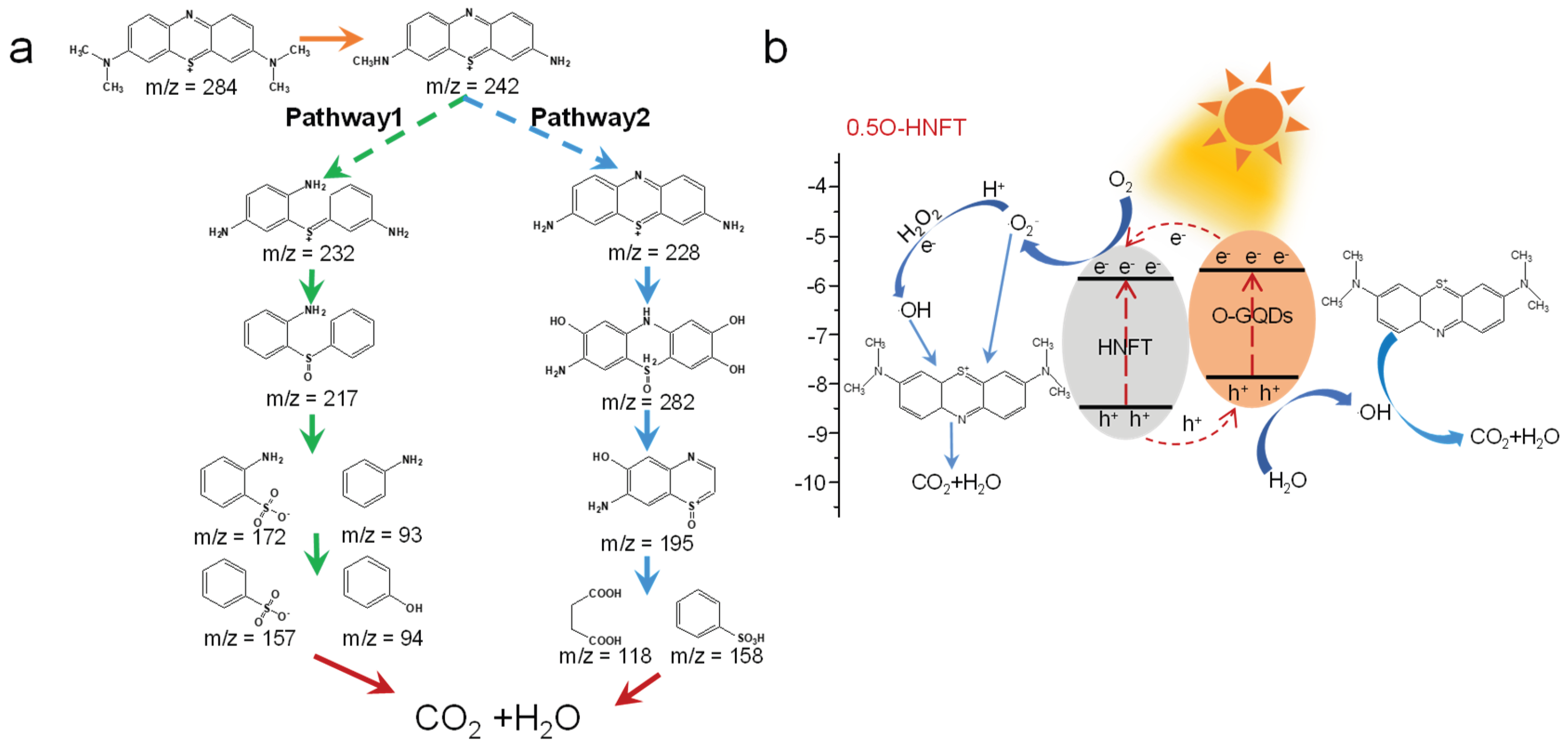
Under visible light, electrons in HNFTi and o-GQDs are excited to their conduction bands, while holes remain in the valence bands. Band alignment drives electron transfer from o-GQDs to HNFTi and hole migration from HNFTi to o-GQDs, suppressing recombination. Photogenerated electrons reduce O2 to ·O2−, which converts to H2O2 and ·OH; holes oxidize H2O or OH− to ·OH. These radicals drive stepwise MB degradation, ultimately producing CO2 and H2O. LC–MS analysis (Figure 6a) suggests two parallel pathways involving demethylation, ring cleavage, sulfur oxidation, and sequential oxidation, consistent with the proposed mechanism (Figure 6b) [54,55].
4. Conclusions
Hierarchically porous hollow TiO2 nanofibers (HNFTi) and three types of GQDs (b-, g-, o-GQDs) were successfully fabricated and combined to form heterojunction photocatalysts. The integration of GQDs enhances visible-light harvesting, narrows the bandgap, and effectively suppresses photogenerated carrier recombination. The progressive fluorescence redshift of GQDs further improves photocatalytic performance. Optimal loading of 0.5 wt% GQDs yielded the highest methylene blue degradation efficiencies: 90.1% (0.5b-HNFTi), 94.3% (0.5g-HNFTi), and 99.5% (0.5o-HNFTi), substantially higher than pristine TiO2 fibers. The GQDs/TiO2 heterojunction effectively extends the light absorption range and promotes electron–hole separation, offering a promising strategy for designing high-performance photocatalysts for sustainable wastewater treatment.
Author Contributions
Weitao Li: Conceptualization, supervision, funding, manuscript review, Zeyun Dong: Methodology, experiment, data curation, Zhengyu Zhang: Validation, experiment assistance, figures, Luoman Zhang: Funding, literature collection, Qizhe Wang: Sample prep, characterization analysis, Shang Li: Supervision, validation, Shuai Li: Data analysis, draft writing, Zeyun Dong: Validation, technical guidance, Lei Wang: Supervision, funding, project admin, manuscript editing, Jialin Liu: Supervision, conceptualization, coordination, manuscript editing
Funding
This work was supported by the National Natural Science Foundation of China (62305400), Central Plains Science and Technology Innovation Young Top Talent Program, the Natural Science Foundation of Henan Province (252300421234), Key Projects of Science and Technology of Henan Province (262102321067, 262102230148), Young Talent Support Program of Henan Association for Science and Technology (2025HYTP055), the Key Scientific Research Projects of Higher Education Institutions in Henan Province (25B540001), Young backbone teachers of Zhongyuan University of Technology (2024XQG04, 2025XQG02), the Discipline Young Master’s Tutor Cultivation project of Zhongyuan University of Technology (SD202432), Natural Science Foundation of Zhongyuan University of Technology (K2026ZD007), Zhengzhou Key Laboratory Project (zzsffe202302), Graduate Scientifc Research Innovation Project of Zhongyuan University of Technology (YKY2025ZK59).
Data Availability Statement
The data can be provided upon request.
Acknowledgments
Thanks to Weitao Li for his guidance and all the members for their efforts.
Conflicts of Interest
The authors declare that they have no known competing financial interests or personal relationships that could have appeared to influence the work reported in this paper.n of competing interest.
References
- Koe, Weng Shin; Lee, Jing Wen; Chong, Woon Chan; Pang, Yean Ling; Sim*, Lan Ching. An overview of photocatalytic degradation: photocatalysts, mechanisms, and development of photocatalytic membrane. Environmental Science and Pollution Research 2020, 27(3), 2522–2565. [Google Scholar] [CrossRef]
- Hui, Khee Chung; Suhaimi, Hazwani; Sambudi*, Nonni Soraya. Electrospun-based TiO2 nanofibers for organic pollutant photodegradation: a comprehensive review. Reviews in Chemical Engineering 2022, 38(6), 641–668. [Google Scholar] [CrossRef]
- Safardoust-Hojaghan, Hossein; Salavati-Niasari*, Masoud. Degradation of methylene blue as a pollutant with N-doped graphene quantum dot/titanium dioxide nanocomposite. Journal of Cleaner Production 2017, 148, 31–36. [Google Scholar] [CrossRef]
- Albayati, Talib M.; Sabri, Anaam A.; Alazawi*, Raghad A. Separation of Methylene Blue as Pollutant of Water by SBA-15 in a Fixed-Bed Column. Arabian Journal for Science and Engineering 2016, 41(7), 2409–2415. [Google Scholar] [CrossRef]
- Feng, FDongqing; Lü, Jinhong; Guo, Sen; Li, Jianfa. Biochar enhanced the degradation of organic pollutants through a Fenton process using trace aqueous iron. Journal of Environmental Chemical Engineering 2021, 9(1), 104677. [Google Scholar] [CrossRef]
- Singh, Pardeep; Borthakur*, Anwesha. A review on biodegradation and photocatalytic degradation of organic pollutants: A bibliometric and comparative analysis. Journal of Cleaner Production 2018, 196, 1669–1680. [Google Scholar] [CrossRef]
- Yang, Yang; Zhang, Chen; Lai, Cui; Zeng, Guangming; Huang, Danlian; Cheng, Min; Wang, Jiajia; Chen, Fei; Zhou, Chengyun; Xiong*, Weiping. BiOX (X = Cl, Br, I) photocatalytic nanomaterials: Applications for fuels and environmental management. Advances in Colloid and Interface Science 2018, 254, 76–93. [Google Scholar] [CrossRef] [PubMed]
- Che, Huinan; Che, Guangbo; Jiang, Enhui; Liu, Chunbo; Dong, Hongjun; Li, Chunmei. A novel Z-Scheme CdS/Bi3O4Cl heterostructure for photocatalytic degradation of antibiotics: Mineralization activity, degradation pathways and mechanism insight. Journal of the Taiwan Institute of Chemical Engineers 2018, 91, 224–234. [Google Scholar] [CrossRef]
- Liang, Caihong; Zhang, Zhonghan; Salim, Teddy; Yen, Zhihao; Goh, Daniel Yongyi; Wong, Lydia Helena; Liu, Zheng; Wang, Liang; Lam, Yeng Ming. A theoretical and experimental study on CO2 reduction selectivity of Mo2CTx MXene catalysts: Influence of surface termination. Nano Research 2026, 19(2), 94907992. [Google Scholar] [CrossRef]
- Trevisan, V.; Olivo, A.; Pinna, F.; Signoretto, M.; Vindigni, F.; Cerrato, G.; Bianchi*, C.L. C-N/TiO2 photocatalysts: Effect of co-doping on the catalytic performance under visible light. Applied Catalysis B: Environmental 2014, 160-161, 152–160. [Google Scholar] [CrossRef]
- Li, Xiyi; Wang, Chao; Tang, Junwang. Methane transformation by photocatalysis. Nature Reviews Materials 2022, 7(8), 617–632. [Google Scholar] [CrossRef]
- Guo, Qing; Zhou, Chuanyao; Ma, Zhibo; Yang, Xueming. Fundamentals of TiO2 Photocatalysis: Concepts, Mechanisms, and Challenges. Advanced Materials 2019, 31(50), 1901997. [Google Scholar] [CrossRef]
- Cheng, Si-Yuan; Cheng, Yi; Li, Chen-Xi; Cai, Yu-Shu; Qian, Jun-Feng; Sun, Zhong-Hua; Zhang, Ji-Ye; Chen, Qun; Wang, Liang; Zhang, Zhi-Hui. Rare-Earth Metal–Organic Framework/CdS Heterostructures for Highly Efficient Photocatalytic Hydrogen Evolution. Advanced Synthesis & Catalysis 2026, 368, 5. [Google Scholar] [CrossRef]
- Qian, Ruifeng; Zong, Huixin; Schneider, Jenny; Zhou, Guanda; Zhao, Ting; Li, Yongli; Yang, Jing; Bahnemann, Detlef W.; Hong, Jia. Pan*, Charge carrier trapping, recombination and transfer during TiO2 photocatalysis: An overview. Catalysis Today 2019, 335, 78–90. [Google Scholar] [CrossRef]
- Rawool, Sushma A.; Yadav, Kishan K.; Polshettiwar*, Vivek. Defective TiO2 for photocatalytic CO2 conversion to fuels and chemicals. Chemical Science 2021, 12(12), 4267–4299. [Google Scholar] [CrossRef]
- Chu, Sheng; Pan, Yuyang; Wang, Ying; Zhang, Huiyan; Xiao, Rui; Zou*, Zhigang. Polyimide-based photocatalysts: rational design for energy and environmental applications. Journal of Materials Chemistry A 2020, 8(29), 14441–14462. [Google Scholar] [CrossRef]
- Yin, Zu-Wei; Betzler, Sophia B.; Sheng, Tian; Zhang, Qiubo; Peng, Xinxing; Shangguan, Junyi; Bustillo, Karen C.; Li, Jun-Tao; Sun, Shi-Gang; Zheng*, Haimei. Visualization of facet-dependent pseudo-photocatalytic behavior of TiO2 nanorods for water splitting using In situ liquid cell TEM. Nano Energy 2019, 62, 507–512. [Google Scholar] [CrossRef]
- Üstün, Burcu; Aydın, Hamide; Naci Koç, Serkan; Kurtan*, Ümran. Amorphous ZnO@S-doped carbon composite nanofiber for use in asymmetric supercapacitors. Diamond and Related Materials 2023, 136, 110048. [Google Scholar] [CrossRef]
- Kang, Meiling; Ruan, Yurong; Lu, Yanzhong; Luo, Lan; Huang, Jinxian; Zhang, Jian-Min; Hong*, Zhensheng. An interlayer defect promoting the doping of the phosphate group into TiO2(B) nanowires with unusual structure properties towards ultra-fast and ultra-stable sodium storage. Journal of Materials Chemistry A 2019, 7(28), 16937–16946. [Google Scholar] [CrossRef]
- Tao, Qin; Wang, Bowei; Yan, Xilong; Chen, Ligong. Hybrids of TiO2 nanobelts modified by graphene: Preparation, characterization, and photocatalytic performance. Applied Surface Science 2019, 490, 546–555. [Google Scholar] [CrossRef]
- Denisov, Nikita; Yoo, JeongEun; Schmuki*, Patrik. Effect of different hole scavengers on the photoelectrochemical properties and photocatalytic hydrogen evolution performance of pristine and Pt-decorated TiO2 nanotubes. Electrochimica Acta 2019, 319, 61–71. [Google Scholar] [CrossRef]
- Sidaraviciute, SRuta; Buivydiene, Dalia; Krugly, Edvinas; Valatka, Eugenijus; Martuzevicius*, Dainius. A composite microfibre-supported short-nanofibre photocatalyst for environmental pollutant decomposition. Journal of Photochemistry and Photobiology A: Chemistry 2019, 368, 7–14. [Google Scholar] [CrossRef]
- Wang, Huan; Liang, Yinghua; Liu, Li; Hu, Jinshan; Cui*, Wenquan. Highly ordered TiO2 nanotube arrays wrapped with g-C3N4 nanoparticles for efficient charge separation and increased photoelectrocatalytic degradation of phenol. Journal of Hazardous Materials 2018, 344, 369–380. [Google Scholar] [CrossRef] [PubMed]
- Nguyen, Minh Hai; Kim, Kyo-Seon. Analysis on growth mechanism of TiO2 nanorod structures on FTO glass in hydrothermal process. Journal of Industrial and Engineering Chemistry 2021, 104, 445–457. [Google Scholar] [CrossRef]
- Wisnet, A.; Bader, K.; Betzler, S. B.; Handloser, M.; Ehrenreich, P.; Pfadler, T.; Weickert, J.; Hartschuh, A.; Schmidt-Mende, L.; Scheu, C.; Dorman*, J. A. Defeating Loss Mechanisms in 1D TiO2-Based Hybrid Solar Cells. Advanced Functional Materials 2015, 25(17), 2601–2608. [Google Scholar] [CrossRef]
- Zhen, Xing; Hou, Lizhen; Gao, Yangyang; Hou, Maofen; Wang, Shiliang. Preparation and optical properties of sulfur-doped silicon oxide microbelts and microrods. Physica E: Low-dimensional Systems and Nanostructures 2022, 142, 115294. [Google Scholar] [CrossRef]
- Zhang, M.-M.; Chen, J.-Y.; Li, H.; Wang, C.-R*. Recent progress in Li-ion batteries with TiO2 nanotube anodes grown by electrochemical anodization. Membranes 2021, 40(2), 249–271. [Google Scholar] [CrossRef]
- Covaliu-Mierlă, Cristina Ileana; Matei, Ecaterina; Stoian, Oana; Covaliu, Leon; Constandache, Alexandra-Corina; Iovu, Horia; Paraschiv*, Gigel. TiO2–Based Nanofibrous Membranes for Environmental Protection. 2022, 12(2), 236. [Google Scholar] [CrossRef]
- Zhang, Jin; Hou, Xuebin; Pang, Zengyuan; Cai, Yibing; Zhou, Huimin; Lv, Pengfei; Wei*, Qufu. Fabrication of hierarchical TiO2 nanofibers by microemulsion electrospinning for photocatalysis applications. Ceramics International 2017, 43(17), 15911–15917. [Google Scholar] [CrossRef]
- Tang, Yunqi; Hao, Rong; Fu, Yu; Jiang, Yong; Zhang, Xiangcheng; Pan, Qingjiang; Jiang*, Baojiang. Carbon quantum dot/mixed crystal TiO2 composites via a hydrogenation process: an efficient photocatalyst for the hydrogen evolution reaction. RSC Advances 2016, 6(99), 96803–96808. [Google Scholar] [CrossRef]
- Liu, Ya-Ning; Zhu, Yu-Jun; Yang, Song; Sun, Zhong-Hua; Cheng, Yi; Zheng, Meng-Qi; Zhao, Yu-Pei; Lian, Cheng; Bu, Yun-Fei; Guskov, Vladimir; He, Ming-Yang; Guo, Hua-Zhang; Wang, Liang; Zhang, Zhi-Hui. Amino-regulated charge separation in MOF/CdS heterostructures for boosted photocatalytic hydrogen evolution. Rare Metals 2025, 44(12), 10215–10226. [Google Scholar] [CrossRef]
- Du, Jimin; Wang, Huiming; Chen, Huijuan; Yang, Menghe; Lu, Xiaoling; Guo, Hui; Zhang, Zhanmin; Shang, Tianwei; Xu, Shujue; Li, Wenqi; Wang, Pianpian; Shakir*, Imran. Synthesis and Enhanced Photocatalytic Activity of Black Porous Zr-doped TiO2 Monoliths. Nano 2016, 11, 06. [Google Scholar] [CrossRef]
- Choi, Yeoseon; Kim, Hyoung-il; Moon, Gun-hee; Jo, Seongwon; Choi, Wonyong. Boosting up the Low Catalytic Activity of Silver for H2 Production on Ag/TiO2 Photocatalyst: Thiocyanate as a Selective Modifier. ACS Catalysis 2016, 6(2), 821–828. [Google Scholar] [CrossRef]
- Rajender, Gone; Kumar, Jitendra; Giri*, P.K. Interfacial charge transfer in oxygen deficient TiO2-graphene quantum dot hybrid and its influence on the enhanced visible light photocatalysis. Applied Catalysis B: Environmental 2018, 224, 960–972. [Google Scholar] [CrossRef]
- Xiong, Yuping; Li, Weitao; Zhang, Luoman; Li, Boyu; Li, Shuangyan; Feng, Qingguo; Liu, Jialin; Wang, Huan; Chen, Dandan; Chen, Yanfei; Wei, Diedie; Guo, Huazhang; Zhang, Jiye; Wang, Liang. Harnessing graphene quantum dots for the selective and sensitive detection of dye contaminants. Diamond and Related Materials 2025, 152, 111914. [Google Scholar] [CrossRef]
- Wang, Kang; Liang, Caihong; Fu, Shuai; Li, Yong; Liu, Wenhui; Guo, Huazhang; Zhang, Jiye; Zhang, Peng; Francisco, Joseph S.; Wang, Liang. Molecularly Tailored Carbon Quantum Dots Enable Enhanced C─C Coupling in CO2 Electroreduction. Advanced Functional Materials n/a, n/a, e30561. [CrossRef]
- Zhang, Lianglin; Luo, Weikang; Chen, Yao; Zheng, Jun; Cao, Lina; Duan, Lihua; Tang, Tao; Wang*, Yang. Green synthesis of boron-doped carbon dots from Chinese herbal residues for Fe3+ sensing, anti-counterfeiting, and photodegradation applications. Journal of Cleaner Production 2023, 422, 138577. [Google Scholar] [CrossRef]
- Li, Weitao; Li, Ming; Liu, Yijian; Pan, Dengyu; Li, Zhen; Wang, Liang; Wu*, Minghong. Three Minute Ultrarapid Microwave-Assisted Synthesis of Bright Fluorescent Graphene Quantum Dots for Live Cell Staining and White LEDs. ACS Applied Nano Materials 2018, 1(4). [Google Scholar] [CrossRef]
- Guo, Huazhang; Liu, Zhikang; Shen, Xiaoyu; Wang, Liang. One-Pot Synthesis of Orange Emissive Carbon Quantum Dots for All-Type High Color Rendering Index White Light-Emitting Diodes. ACS Sustainable Chemistry & Engineering 2022, 10(26), 8289–8296. [Google Scholar] [CrossRef]
- Niu, Qian; Li, Weitao; Yuan, Ruiling; Li, Qianqian; Tang, Haozhe; Yang, Zhenyuan; Yang, Yongqi; Qiao*, Xuezhi. A Dual-Function AgNW@COF SERS Membrane for Organic Pollutant Removal and Simultaneous Concentration Determination. Langmuir 2024, 40(28), 14717–14723. [Google Scholar] [CrossRef]
- Li, Weitao; Zhang, Luoman; Jiang, Ningjia; Chen, Yongqian; Gao, Jie; Zhang, Jihang; Yang, Baoshuo; Liu*, Jialin. Fabrication of Orange Fluorescent Boron-Doped Graphene Quantum Dots for Al3+ Ion Detection. 2022, 27(19), 6771. [Google Scholar] [CrossRef]
- Nair, Raji V.; Chandran, Parvathy R.; Mohamed, A. Peer; Pillai*, Saju. Sulphur-doped graphene quantum dot based fluorescent turn-on aptasensor for selective and ultrasensitive detection of omethoate. Analytica Chimica Acta 2021, 1181, 338893. [Google Scholar] [CrossRef]
- Kadian, Sachin; Manik*, Gaurav. Sulfur doped graphene quantum dots as a potential sensitive fluorescent probe for the detection of quercetin. Food Chemistry 2020, 317, 126457. [Google Scholar] [CrossRef]
- Li, Weitao; Liu, Yang; Pang, Xinglong; Huang, Yuanhao; Dong, Zeyun; Niu, Qian; Xiong, Yuping; Li, Shang; Li, Shuai; Wang, Lei; Guo, Huazhang; Cui, Saisai; Hu, Shenpeng; Li, Yuenan; Cha, Tiantian; Wang*, Liang. Fluorescence Quenching of Graphene Quantum Dots from Orange Peel for Methyl Orange Detection. Nanomaterials 2025, 15(5), 376. [Google Scholar] [CrossRef]
- Nair, Raji V.; Thomas, Reny Thankam; Mohamed, A.P.; Pillai*, Saju. Fluorescent turn-off sensor based on sulphur-doped graphene quantum dots in colloidal and film forms for the ultrasensitive detection of carbamate pesticides. Microchemical Journal 2020, 157, 104971. [Google Scholar] [CrossRef]
- Ibarra-Prieto, Hector Daniel; Garcia-Garcia, Alejandra; Aguilera-Granja, Faustino; Navarro-Ibarra, Diana Carolina; Rivero-Espejel*, Ignacio. One-Pot, Optimized Microwave-Assisted Synthesis of Difunctionalized and B–N Co-Doped Carbon Dots: Structural Characterization. Nanomaterials 2023, 13(20), 2753. [Google Scholar] [CrossRef]
- Li, Weitao; Jiang, Ningjia; Zhang, Luoman; Chen, Yongqian; Gao, Jie; Zhang, Jihang; Yang, Baoshuo; He*, Jianxin. Facile Synthesis of Aminated Graphene Quantum Dots for Promising and Selective Detection of Cobalt and Copper Ions in Aqueous Media. Molecules 2022, 27(22), 7844. [Google Scholar] [CrossRef]
- Hou, Weidong; Li, Yuexia; Wang, Kang; Guo, Huazhang; Zhang, Baohua; Wang, Liang. Boosting photogenerated charge accumulation of oxidated carbon nitride nanotubes for efficient CO2 photoreduction. Science China Chemistry 2025, 68(10), 5293–5301. [Google Scholar] [CrossRef]
- Chen, Yanfei; Wang, Chunyan; Chen, Junyan; Wang, Shuaishuai; Ju, Jingge; Kang*, Weimin. Preparing Biomass Carbon Fiber Derived from Waste Rabbit Hair as a Carrier of TiO2 for Photocatalytic Degradation of Methylene Blue. Polymers 2022, 14(8), 1593. [Google Scholar] [CrossRef] [PubMed]
- He, Jiawei; Zhao, Yuying; Li, Yang; Yuan, Qixin; Wu, Yuhan; Wang, Kui; Sun, Kang; Wu, Jingjie; Jiang, Jianchun; Zhang, Baohua; Wang, Liang; Fan*, Mengmeng. Joule Heating-Driven sp2-C Domains Modulation in Biomass Carbon for High-Performance Bifunctional Oxygen Electrocatalysis. Nano-Micro Letters 2025, 17(1), 221. [Google Scholar] [CrossRef] [PubMed]
- Li, Shuang; Li, Yingai; Chen, Hao; Yang, Youzhi; Lin, Yanhong; Xie*, Tengfeng. N-Doped TiO2 Coupled with Manganese-Substituted Phosphomolybdic Acid Composites As Efficient Photocatalysis-Fenton Catalysts for the Degradation of Rhodamine B. Langmuir 2022, 38(50), 15817–15826. [Google Scholar] [CrossRef]
- An, Guangbin; Wang, Kang; Yang, Min; Zhang, Jiye; Zhong, Haijian; Wang, Liang; Guo*, Huazhang. Rational Design of Metal-Free Nitrogen-Doped Carbon for Controllable Reduction of CO2 to Syngas. Molecules 2025, 30(4), 953. [Google Scholar] [CrossRef]
- Liu, Han; Du, Yuchen; Deng, Yexin; Ye*, Peide D. Semiconducting black phosphorus: synthesis, transport properties and electronic applications. Chemical Society Reviews 2015, 44(9), 2732–2743. [Google Scholar] [CrossRef] [PubMed]
- Wang, Kang; Huang, Kai; Wang, Zeming; An, Guangbin; Zhang, Mingwan; Liu, Wenhui; Fu, Shuai; Guo, Huazhang; Zhang, Baohua; Lian, Cheng; Wu, Jingjie; Wang*, Liang. Functional Group Engineering of Single-Walled Carbon Nanotubes for Anchoring Copper Nanoparticles Toward Selective CO2 Electroreduction to C2 Products. Small 2025, 21(21), 2502733. [Google Scholar] [CrossRef] [PubMed]
- Huang, Mingqiang; Li, Shengman; Zhang, Zhenfeng; Xiong, Xiong; Li, Xuefei; Wu, Yanqing. Multifunctional high-performance van der Waals heterostructures*. Nature Nanotechnology 2017, 12(12), 1148–1154. [Google Scholar] [CrossRef] [PubMed]
Scheme 1.
Schematic diagram of MB degradation by the o-GQDs/TiO2 heterojunction.
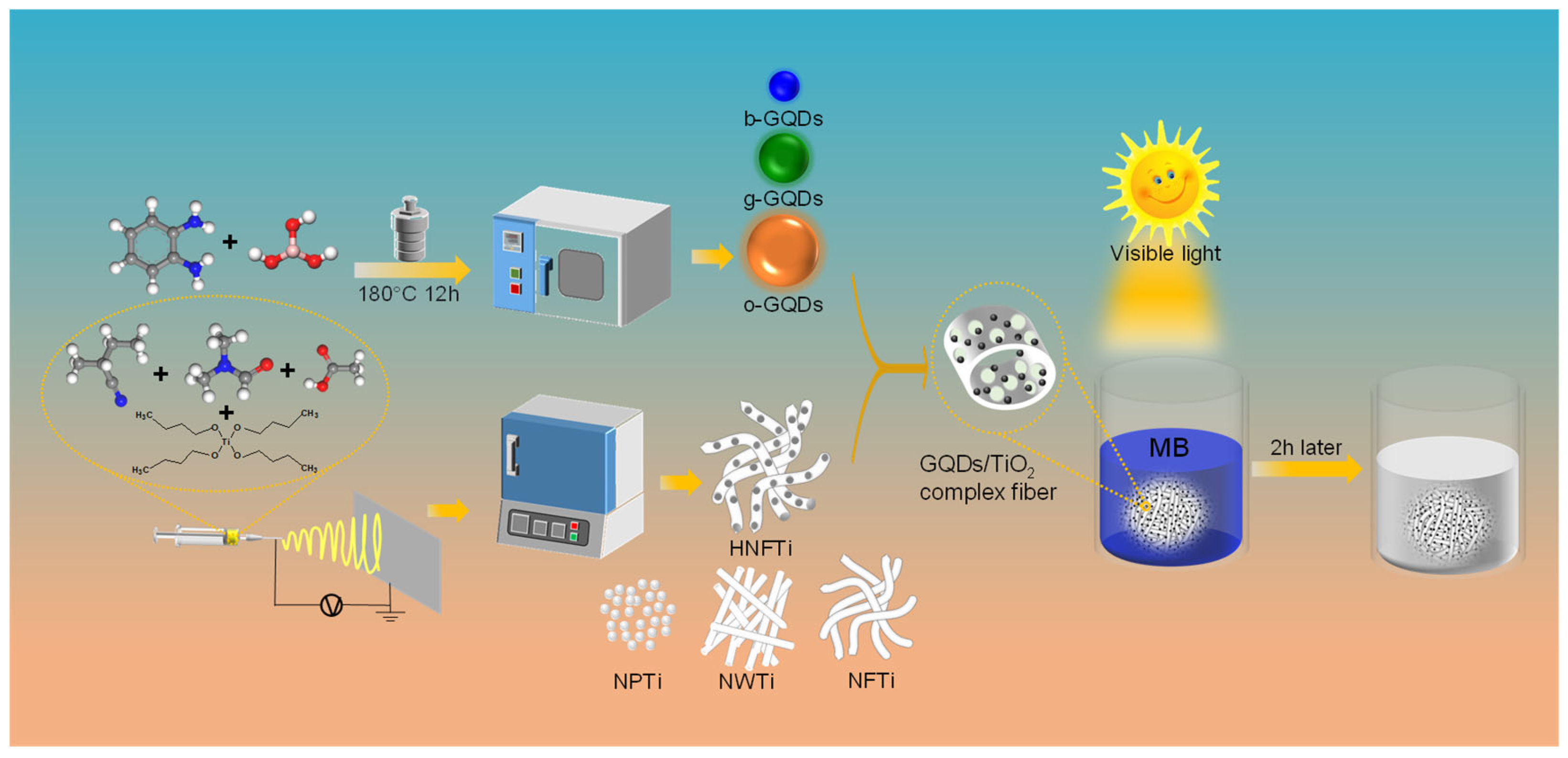
Figure 1.
(a) FTIR spectra, (b) XPS C 1s spectra, and (c) Raman spectra of b-, g-, and o-GQDs. (d–f) AFM images. (g–i) TEM images, with insets showing Fourier transform patterns and HRTEM images, corresponding to b-, g-, and o-GQDs.
Figure 1.
(a) FTIR spectra, (b) XPS C 1s spectra, and (c) Raman spectra of b-, g-, and o-GQDs. (d–f) AFM images. (g–i) TEM images, with insets showing Fourier transform patterns and HRTEM images, corresponding to b-, g-, and o-GQDs.
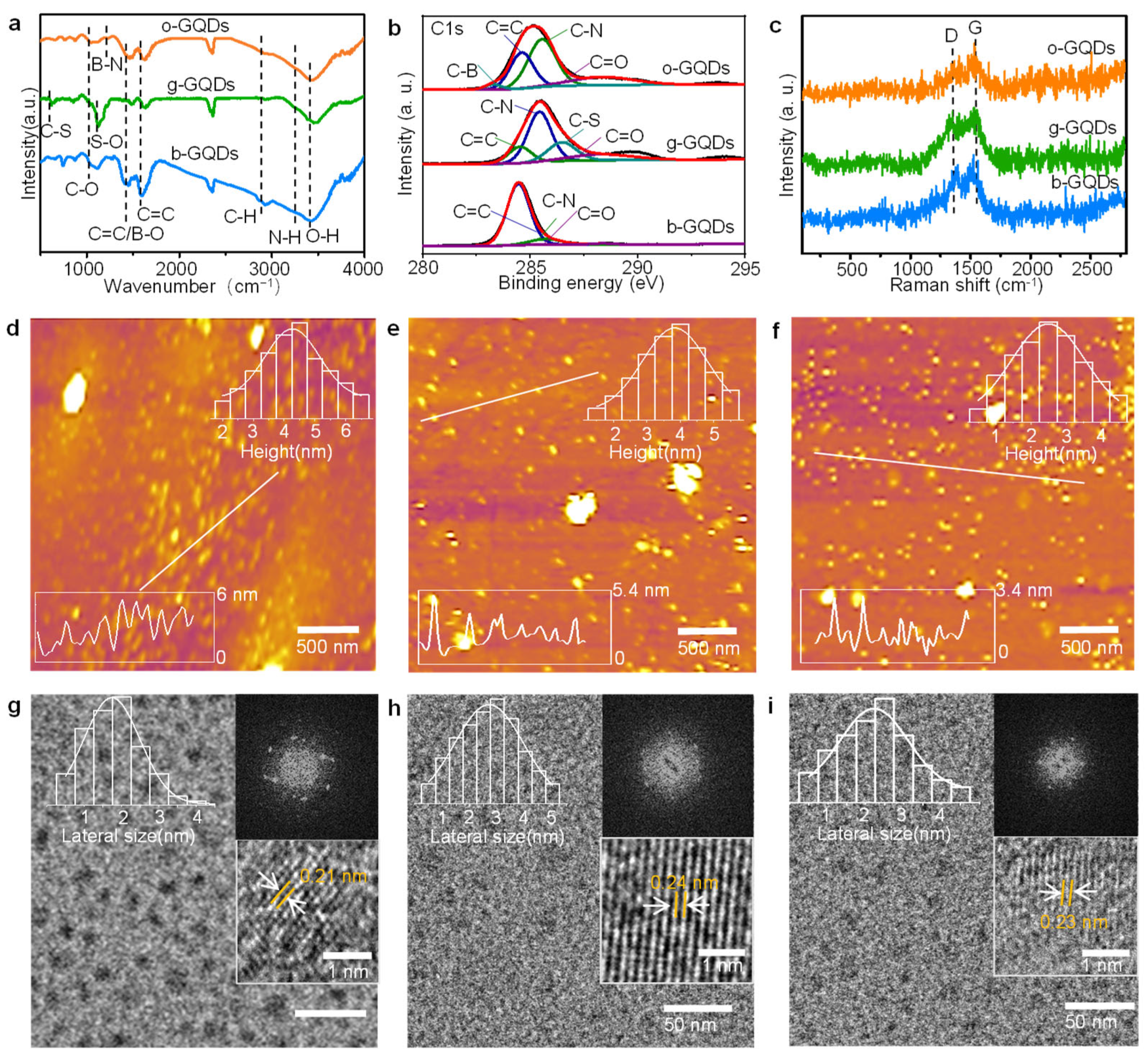
Figure 2.
(a–c) UV–Vis absorption, PL, and PLE spectra of b-, g-, and o-GQDs. (d) UPS spectra of b-, g-, and o-GQDs. (e) Fitting curves of maximum excitation wavelength and absorption peak. (f) Correlation between particle size of GQDs and their optimal emission wavelength (g) Dependence of calculated HOMO and LUMO energy levels on particle size. (h, i) Time-dependent density functional theory calculation results: calculated HOMO-LUMO energy levels orbital distributions.
Figure 2.
(a–c) UV–Vis absorption, PL, and PLE spectra of b-, g-, and o-GQDs. (d) UPS spectra of b-, g-, and o-GQDs. (e) Fitting curves of maximum excitation wavelength and absorption peak. (f) Correlation between particle size of GQDs and their optimal emission wavelength (g) Dependence of calculated HOMO and LUMO energy levels on particle size. (h, i) Time-dependent density functional theory calculation results: calculated HOMO-LUMO energy levels orbital distributions.
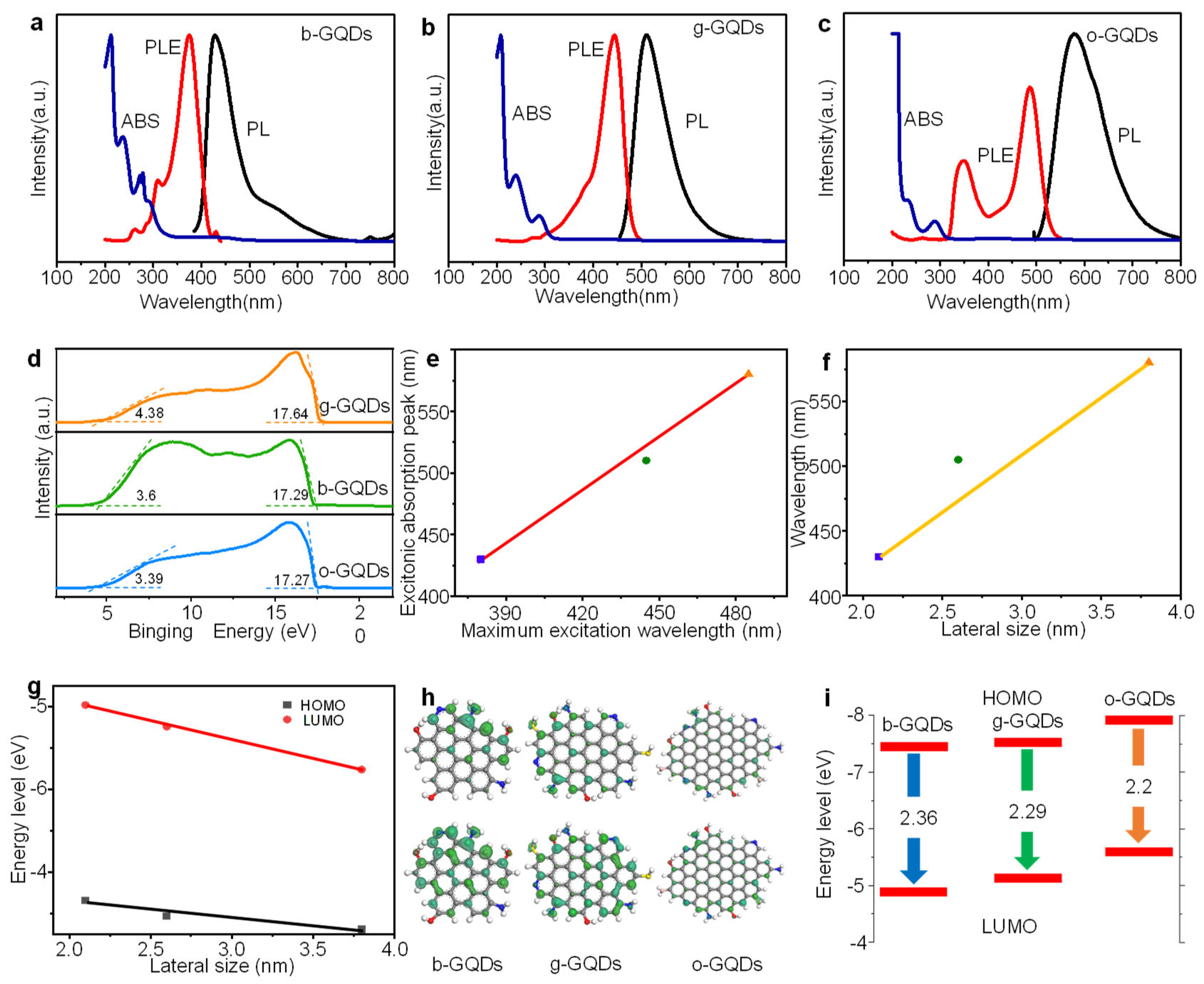
Figure 3.
(a–d) SEM images of NPTi, NWTi, NFTi, and HNFTi. (e, f) TEM images of HNFTi. (g) Pore size distribution curves, (h) BET surface area, and (i) UV–Vis DRS of NPTi, NWTi, NFTi, and HNFTi.
Figure 3.
(a–d) SEM images of NPTi, NWTi, NFTi, and HNFTi. (e, f) TEM images of HNFTi. (g) Pore size distribution curves, (h) BET surface area, and (i) UV–Vis DRS of NPTi, NWTi, NFTi, and HNFTi.
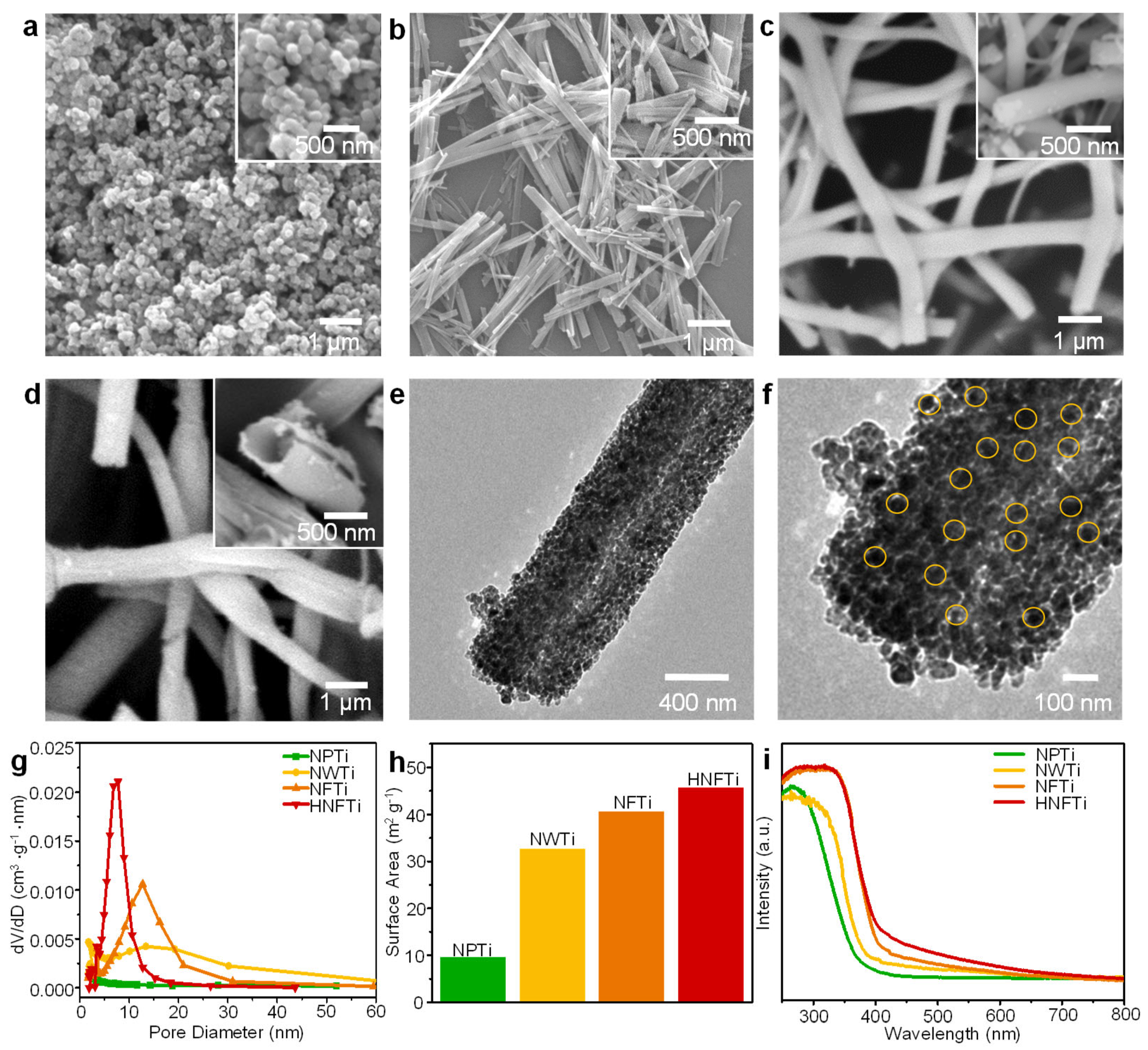
Figure 4.
(a–c) SEM and EDS elemental mapping of 0.5b-HNFTi, 0.5g-HNFTi, and 0.5o-HNFTi. (d–f) TEM images and (g–i) HRTEM images of 0.5b-HNFTi, 0.5g-HNFTi, and 0.5o-HNFTi.
Figure 4.
(a–c) SEM and EDS elemental mapping of 0.5b-HNFTi, 0.5g-HNFTi, and 0.5o-HNFTi. (d–f) TEM images and (g–i) HRTEM images of 0.5b-HNFTi, 0.5g-HNFTi, and 0.5o-HNFTi.
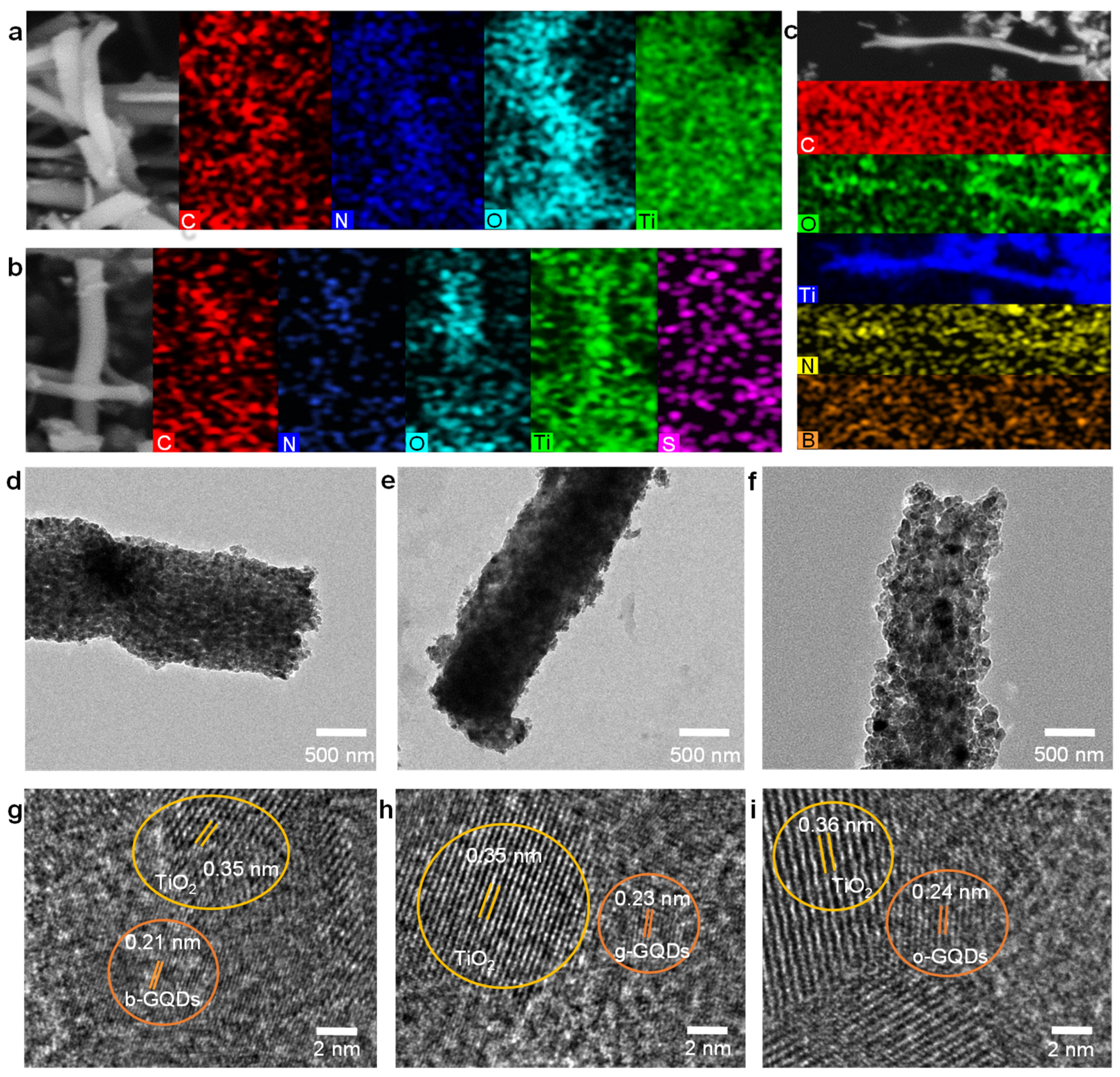
Figure 5.
HNFTi and degradation efficiency of MB by composite photocatalysts with different contents of b-GQDs (a, d), g-GQDs (b, e), and o-GQDs (c, f) under visible light. (g) UV–Vis DRS, (h) photocurrent (I–T) response, and (i) EIS spectra of different photocatalysts. KPFM surface potential mappings of 0.5o-HNFTi in darkness (j), light (k) and 3D image (l).
Figure 5.
HNFTi and degradation efficiency of MB by composite photocatalysts with different contents of b-GQDs (a, d), g-GQDs (b, e), and o-GQDs (c, f) under visible light. (g) UV–Vis DRS, (h) photocurrent (I–T) response, and (i) EIS spectra of different photocatalysts. KPFM surface potential mappings of 0.5o-HNFTi in darkness (j), light (k) and 3D image (l).
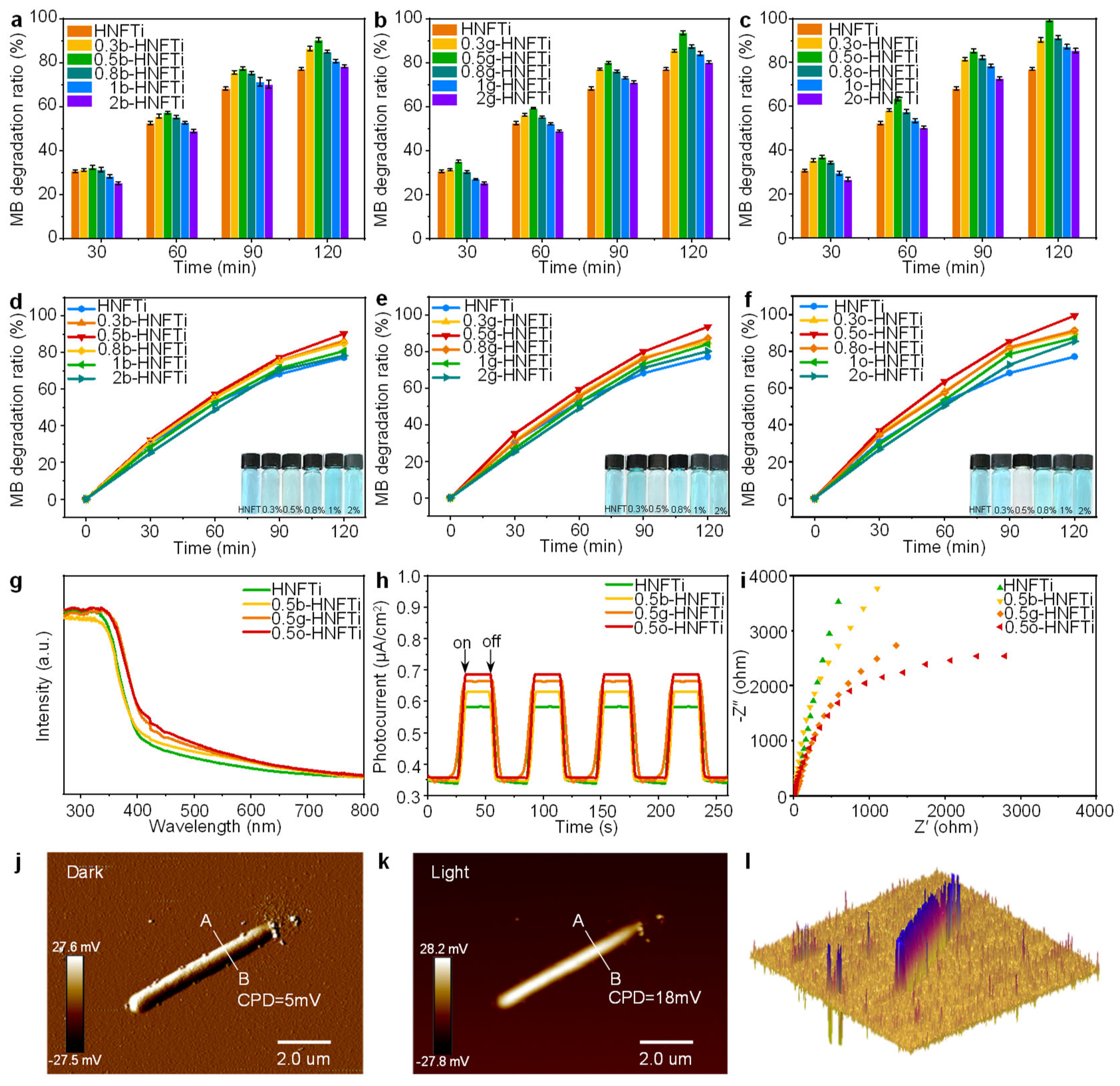
Figure 6.
Cyclic experimental diagram for the catalytic degradation of MB by 0.5o-HNFTi photocatalyst under visible light.
Figure 6.
Cyclic experimental diagram for the catalytic degradation of MB by 0.5o-HNFTi photocatalyst under visible light.
Disclaimer/Publisher’s Note: The statements, opinions and data contained in all publications are solely those of the individual author(s) and contributor(s) and not of MDPI and/or the editor(s). MDPI and/or the editor(s) disclaim responsibility for any injury to people or property resulting from any ideas, methods, instructions or products referred to in the content. |
© 2026 by the authors. Licensee MDPI, Basel, Switzerland. This article is an open access article distributed under the terms and conditions of the Creative Commons Attribution (CC BY) license (http://creativecommons.org/licenses/by/4.0/).
Copyright: This open access article is published under a Creative Commons CC BY 4.0 license, which permit the free download, distribution, and reuse, provided that the author and preprint are cited in any reuse.


