
Submitted:
02 April 2026
Posted:
03 April 2026
You are already at the latest version
Abstract
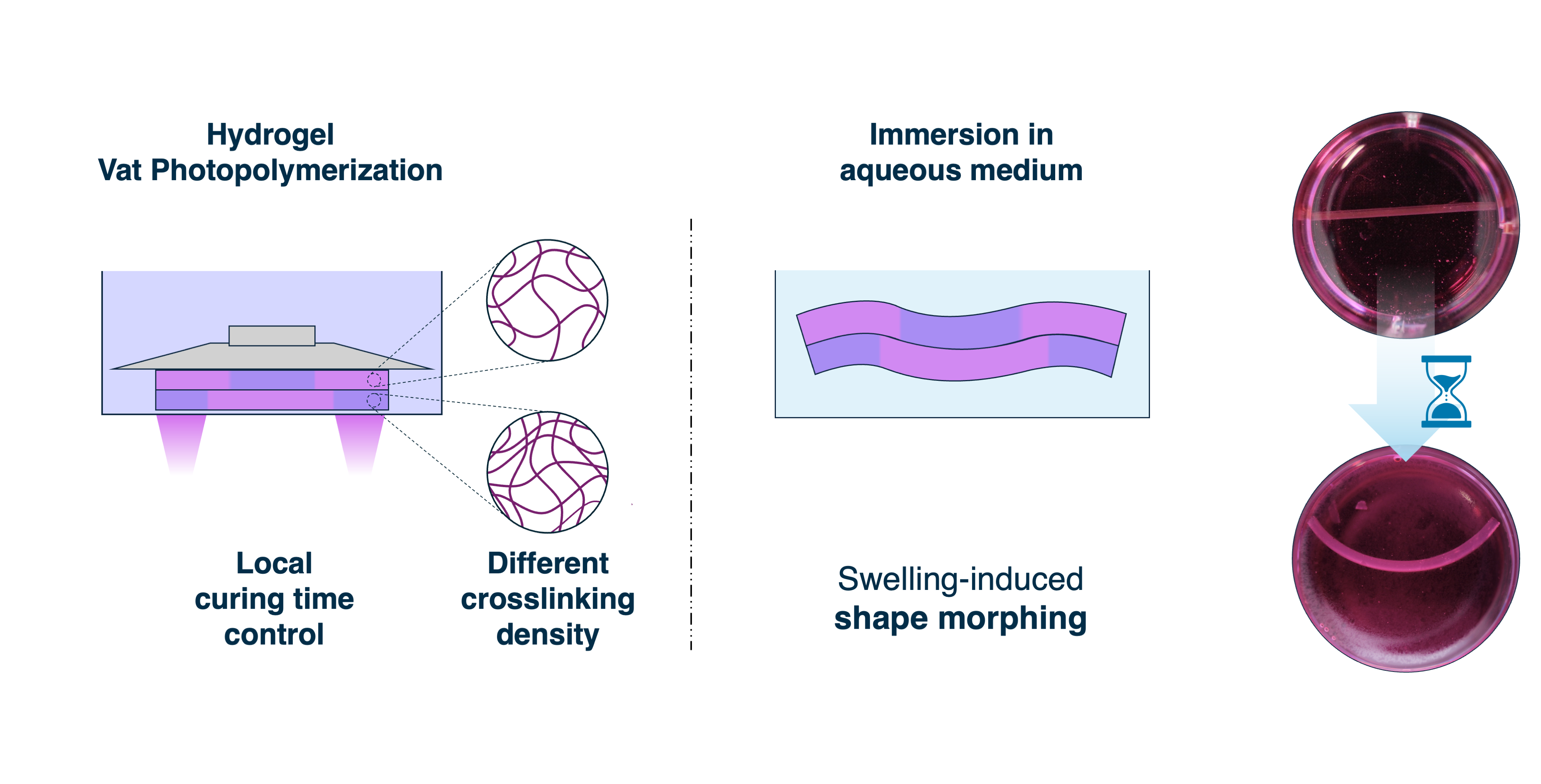
The fabrication of complex architectures remains a central challenge in 3D bioprinting, where low mechanical properties of hydrogels restrict the range of feasible geometries. Four-dimensional (4D) bioprinting can mitigate these limitations by introducing programmed structure shape-morphing in response to external stimuli. However, in most existing approaches, shape-morphing behavior is introduced after hydrogel formation, limiting the complexity of the resulting deformation. Here, a proof-of-concept strategy is presented, in which shape-morphing is directly encoded during fabrication. By modulating light exposure time layer-by-layer in vat photopolymerization, spatial variations in crosslinking density are introduced in situ within GelMA hydrogel constructs. Upon immersion in aqueous media, these variations generate differential swelling, leading to controlled bending of the printed structures. This approach enables the programming of deformation pathways at the printing stage, without requiring additional materials or post-processing steps. The morphing behavior was further supported by finite element simulations, which reproduced the experimentally observed deformation and enabled prediction of the shape change. Overall, this study demonstrates that swelling-driven actuation can be encoded during fabrication. Although demonstrated on simplified geometries, this approach provides a versatile framework for process-driven shape morphing programming and represents a step toward more spatially resolved and potentially volumetric 4D bioprinting strategies.
Keywords:
4D bioprinting
; vat photopolymerization
; shape morphing hydrogel
; swelling
; crosslinking gradient
; finite element method
Copyright: This open access article is published under a Creative Commons CC BY 4.0 license, which permit the free download, distribution, and reuse, provided that the author and preprint are cited in any reuse.


