

Submitted:
01 April 2026
Posted:
02 April 2026
You are already at the latest version
Abstract
Micro- and nanoplastics (MNPs) have now been detected in human blood, placenta, and arterial tissue, yet the oral cavity, which serves as the primary portal of environmental exposure, has received strikingly little mechanistic attention. This narrative review addresses that gap from an environmental microbiology perspective, synthesizing recent literature on periodontal disease, chronic low-grade inflammation, oral biofilms, dental materials, microbial–plastic interactions, and systemic chronic disease risk. Unlike prior reviews, we apply an explicit evidentiary framework that distinguishes what is directly demonstrated from what is biologically plausible but unproven, and we situate the periodontal environment specifically as a particle-retention and inflammatory-amplification niche. The strongest direct oral evidence shows that human dental calculus harbors at least 26 microplastic types, dominated by polyamide (41.4%), polyethylene (32.7%), and polyurethane (7.0%). Polyethylene isolated from calculus induces cytotoxicity, apoptosis, impaired migration, NF-κB activation, and upregulation of IL-1β and IL-6 in human gingival fibroblasts. The oral cavity is also a portal for environmental exposure and a local site of plastic generation: MNPs are released from chewing gum, oral care products, orthodontic appliances, and resin-based dental materials, while oral microorganisms have been documented to degrade methacrylate polymers. Across experimental systems, MNPs activate oxidative stress, inflammasome signaling, macrophage polarization, and barrier dysfunction — pathways that overlap extensively with the pathobiology of periodontitis. Environmental biofilm studies further indicate that plastic substrates can enhance extracellular polymeric substance production, quorum sensing, antibiotic resistance gene transfer, and pathogen persistence, suggesting a plausible but not yet proven oral plastisphere within plaque and calculus. We argue that periodontitis should be reconceptualized as a chronically inflamed particle-processing interface that may increase local MNP retention, cellular reactivity, and systemic inflammatory spillover, with implications for cardiovascular, metabolic, and other chronic disease risk pathways. Current evidence does not yet prove that environmental MNP exposure causes human periodontitis, and that evidentiary boundary is maintained throughout. A priority research agenda is proposed, centered on contamination-controlled subgingival biomonitoring stratified by periodontal status, spatially resolved multi-species biofilm models, polymer source attribution, and longitudinal clinical studies linking oral plastic burden to inflammatory and systemic outcomes.
Keywords:
microplastics
; nanoplastics
; periodontitis
; oral biofilm
; dental calculus
; chronic low-grade inflammation
; plastisphere
; environmental microbiology
; oral-systemic health
1. Introduction
Micro- and nanoplastic (MNP) pollution is now understood not only as a marine or terrestrial contamination problem, but also as a biologically relevant exposure issue at human epithelial interfaces. Most discussions have focused on ingestion, inhalation, intestinal toxicity, pulmonary injury, and translocation into blood or distal organs. The oral cavity has received comparatively little mechanistic attention, even though it is the first compartment to contact food, beverages, airborne particles, oral-care products, and many polymer-containing medical and consumer materials (Di Spirito et al., 2025; Pant et al., 2025; Saha et al., 2025).
Periodontitis is a chronic dysbiotic inflammatory disease of the tooth-supporting tissues. It is driven by a structured oral biofilm and by a maladaptive host response that promotes collagen breakdown, pocket formation, attachment loss, and alveolar bone destruction. Beyond local tissue damage, periodontitis is increasingly framed as a source of chronic low-grade systemic inflammation, with cytokine spillover and plausible contributions to cardiovascular, metabolic, and other chronic conditions (Cecoro et al., 2020; Mazurek-Mochol et al., 2024; Torrungruang et al., 2024). For scientific clarity, the lay phrase “silent inflammation” is best translated here as subclinical or low-grade chronic inflammatory signaling that persists beyond obvious acute symptoms.
The overlap between periodontitis and MNP biology is compelling for four reasons. First, the oral cavity is both an exposure portal and a potential local source of plastic particles because dental and orthodontic materials can degrade, abrade, or leach polymeric by-products (Delaviz et al., 2014; Bourbia et al., 2013; Marashdeh et al., 2018; Warunek et al., 2026). Second, the periodontal environment is rich in biofilm biomass, inflammatory exudate, mineralized plaque, proteases, oxidative stress, and altered epithelial integrity—conditions that could favor particle retention and biological reactivity. Third, MNP toxicology and periodontal pathobiology share overlapping mechanisms, especially reactive oxygen species (ROS), NF-κB signaling, inflammasomes, IL-1β/IL-6 production, macrophage polarization, barrier dysfunction, and impaired tissue repair (Wu et al., 2025; Skaba et al., 2025; Fan et al., 2025). Fourth, environmental microbiology has shown that plastic-associated biofilms can enrich pathogenic taxa, virulence traits, extracellular polymeric substance (EPS) production, and antibiotic resistance gene (ARG) exchange, raising the possibility that plastic particles embedded in oral biofilms could intensify dysbiosis (Huang et al., 2024; Zhou et al., 2024; Zhang et al., 2026; Wang et al., 2026).
This review was therefore designed to rephrase the question from an environmental microbiology perspective: Can periodontitis be understood as a chronically inflamed oral microenvironment in which microplastics and nanoplastics are retained, transformed, or biologically amplified? We analyzed the current PubMed-indexed evidence on oral exposure routes, direct periodontal findings, chronic inflammatory mechanisms, plastisphere biology, polymer biodegradation by oral microbes, and the implications for chronic disease. Throughout, we distinguish what is directly demonstrated from what is mechanistically plausible yet to be studied.
2. Literature Search Strategy and Scope
A structured narrative review approach was used. PubMed was searched through March 7, 2026, using combinations of the following terms: “microplastics,” “nanoplastics,” “micro- and nanoplastics,” “oral cavity,” “mouth,” “saliva,” “dental calculus,” “plaque,” “oral biofilm,” “periodontitis,” “periodontal disease,” “gingival fibroblasts,” “chronic inflammation,” “plastisphere,” “biofilm formation,” “antibiotic resistance gene transfer,” “dental resin,” “dental composite,” “oral bacteria,” and “polymer degradation.” Additional PubMed searches targeted chronic disease contexts (blood, placenta, arteries, gut, lung) when direct periodontal evidence was limited.
Priority was given to PubMed-indexed primary research in humans, mammalian models, oral cell systems, and mechanistic biofilm studies. Recent reviews were included when they were useful for framing evidence quality, definitions, and research gaps. Because direct oral and periodontal MNP studies remain limited, adjacent evidence from environmental microbiology, intestinal toxicology, pulmonary toxicology, and dental materials science was incorporated only when it clarified a biologically plausible pathway that could reasonably extend to the periodontium.
This is not a systematic review or meta-analysis, and no attempt was made to pool effect sizes. The aim was instead to produce an accurate translational synthesis that is aware of evidentiary boundaries. In practical terms, the present literature supports a mechanistic model linking MNPs to periodontal inflammation, but not a definitive causal claim that environmental MNP exposure causes human periodontitis.
3. Periodontitis as a Chronic Low-Grade Inflammatory Interface
The microbial ecology of periodontitis is not simply an increase in total bacterial load; it involves a shift toward a dysbiotic biofilm with altered metabolic activity, virulence expression, and host interactions. Metagenomic and metatranscriptomic work shows that periodontitis is associated not only with compositional differences in plaque communities but also with altered species-specific gene expression across oral sites (Belstrøm et al., 2021). Saliva can reflect changes in subgingival communities and track disease severity and treatment response, reinforcing the view that periodontitis extends beyond a single niche into a broader oral ecological state (Jung et al., 2024). The conceptual basis for this dysbiotic shift is now well established: keystone pathogens such as Porphyromonas gingivalis, despite being low in total abundance, can subvert complement-mediated immune surveillance to remodel the entire community quantitatively and qualitatively, enabling pathobionts to exploit inflammatory tissue breakdown products as nutrients and sustain destruction disproportionate to their biomass (Hajishengallis, 2015). This polymicrobial synergy model—in which inflammation and dysbiosis reinforce each other—is the mechanistic foundation for the particle-retention and inflammatory-amplification model proposed in this review.
Clinically, the periodontal pocket is a chronically inflamed interface where bacterial biomass, host proteases, neutrophil activity, cytokines, bleeding, and tissue breakdown coexist. Reviews of oral-systemic health consistently describe periodontitis as a contributor to a low-grade systemic inflammatory burden, while longitudinal human data support links between periodontal disease and systemic outcomes, such as hypertension, through inflammatory pathways (Cecoro et al., 2020; Torrungruang et al., 2024). The cytokine milieu is dominated by mediators central to MNP toxicology, including IL-1β, IL-6, TNF-α, and inflammasome-associated signals (Mazurek-Mochol et al., 2024; Fan et al., 2025).
This inflammatory background is relevant to particle biology. A healthy mouth is not a sterile tube through which particles simply pass. Rather, it contains pellicle-coated surfaces, saliva proteins, mucus-like macromolecules, dynamic shear forces, structured biofilms, and—during disease—an inflamed and more permeable epithelial barrier. These features can influence adhesion, agglomeration, residence time, and cellular access of exogenous particles. In other words, periodontitis may modify oral dosimetry even if exposure concentration outside the mouth remains unchanged.
For the present review, periodontitis is therefore conceptualized as a chronic inflammatory particle-processing niche. This framing does not imply that plastics are necessary for disease, nor that all periodontal inflammation requires environmental pollutants. Instead, it recognizes that an inflamed periodontal ecosystem may be uniquely capable of retaining, reacting to, and perhaps disseminating MNPs or plastic-derived by-products.
4. The Oral Cavity as an Exposure Portal and Local Source of Micro-/Nanoplastics
Direct oral exposure to plastic particles can arise from everyday consumer products and from dentistry itself. A recent analytical study demonstrated the release of MNPs into the oral cavity from chewing gum, highlighting that common products can contribute directly measurable oral exposure (Pant et al., 2025). A broader review of oral-care products similarly argued that toothpastes, mouthwashes, brushes, and other routine products may serve as underrecognized sources of orally delivered MNPs (Saha et al., 2025).
Dentistry adds a second, conceptually distinct pathway. The oral cavity contains polymeric restorations, adhesives, sealants, prosthetic components, aligners, retainers, and orthodontic appliances, all of which are subject to abrasion, thermal cycling, enzymatic attack, pH fluctuations, and bacterial colonization. Di Spirito et al. (2025) specifically framed dentistry as both an exposure source and a translational setting in which oral and environmental plastic burdens intersect. Warunek et al. (2026) further showed that orthodontic materials can generate microplastics and nanoplastics with measurable immunologic effects on macrophage differentiation and homeostasis.
This dual-source problem is central to the interpretation of oral findings. When plastics are detected in the mouth, they may derive from food packaging, indoor dust, drinking water, airborne deposition, oral-care products, or dental materials themselves. The mouth is therefore not only an exposure gateway but also a microreactor where environmental particles and locally generated polymer debris can mix. From a periodontal perspective, that mixture is clinically relevant because even non-environmental polymer fragments may still amplify local inflammation and biofilm pathogenicity.
A key implication is that future oral biomonitoring studies must distinguish external environmental particles from dentistry-derived polymers whenever possible. That distinction is not a minor methodological detail; it is essential for causal interpretation. A mouth with extensive resin-based restorations or orthodontic therapy may exhibit a fundamentally different polymer signature from a mouth without such materials, even if ambient environmental exposure is similar.
5. Direct Evidence for Oral Retention: Saliva, Plaque, and Dental Calculus
At present, the most important direct human evidence comes from dental calculus. Wu et al. (2025) identified 26 microplastic types in human dental calculus, with polyamide (41.4%), polyethylene (32.7%), and polyurethane (7.0%) as predominant components. This is a major finding because it shows that at least some MNPs are not merely transient oral visitors; they can be retained within a calcified plaque matrix that persists over time.
The same study went beyond detection. Polyethylene MNPs reduced the viability of human gingival fibroblasts, increased apoptosis, impaired migration, activated NF-κB signaling, and increased the expression of IL-1β and IL-6 (Wu et al., 2025). From a periodontal viewpoint, these effects are highly relevant: gingival fibroblasts contribute to extracellular matrix maintenance, wound healing, and inflammatory signaling. A particle that both drives cytokine production and impairs fibroblast migration could, at least in principle, delay repair of inflamed periodontal tissues and increase their propensity for chronicity.
Dental calculus itself is already known to be biologically active rather than inert. Montenegro Raudales et al. (2016) showed that calculus stimulates IL-1β secretion through NLRP3 inflammasome activation in human and mouse phagocytes. This means that a calculus matrix containing bacteria, mineral crystals, endotoxin, and now demonstrable plastic particles may represent a composite inflammatory substrate. The calculus-plastic combination is thus more important than either component considered alone.
The long-term reservoir concept is also supported by work outside the plastic field. Velsko et al. (2017) showed that dental calculus preserves a remarkably rich metabolomic record in modern and historic samples, reinforcing the idea that calculus acts as a stable archive of oral exposures and biomolecules. By analogy, calculus may serve as a cumulative exposure matrix for polymer particles and associated chemicals, although the kinetics of trapping, mineralization, and release remain largely unknown.
Direct evidence is still missing for several clinically important compartments. PubMed-indexed literature remains sparse regarding polymer-specific quantification of MNPs in saliva, supragingival plaque, subgingival plaque, gingival crevicular fluid, or periodontal pocket fluid stratified by periodontal status. The absence of these studies is one of the field’s clearest gaps. Accordingly, current conclusions about “oral biofilm storing plastic” should be considered well-supported for dental calculus, plausible for mature plaque biofilms, and largely untested in the subgingival niche.
6. Mechanistic Convergence Between Micro-/Nanoplastic Toxicology and Periodontal Pathobiology
The strongest argument linking MNPs to periodontal disease is mechanistic convergence. Across diverse cell and animal systems, MNPs induce oxidative stress, proinflammatory cytokine production, inflammasome signaling, cell death, immune polarization, and barrier injury. These are the same broad pathways that sustain periodontitis once dysbiosis is established (Skaba et al., 2025; Bishop et al., 2025).
The oral cell data are particularly persuasive because they show these mechanisms in periodontal cells. Wu et al. (2025) found NF-κB activation and elevated IL-1β/IL-6 after gingival fibroblast exposure to polyethylene particles recovered from the context of human calculus. This aligns with the broader periodontal literature, which implicates IL-6 and inflammasome-related signaling in tissue destruction, osteoimmunology, and the propagation of oral-systemic inflammation (Mazurek-Mochol et al., 2024; Fan et al., 2025).
Human cell experiments outside dentistry support the plausibility of inflammation. Bishop et al. (2025) reported that commercial and environmental MNP preparations, especially PET-rich samples, triggered strong IL-1β and IL-6 responses and induced cell death in human cells. Although these were not periodontal cells, the findings matter because they indicate that authentic environmental MNP mixtures can be potently inflammatory at human tissue interfaces. The relevance to the mouth is straightforward: a chronically inflamed periodontal environment would not be expected to be less sensitive than other epithelial or stromal systems.
Barrier dysfunction and impaired repair offer a second bridge. Chen et al. (2025) showed that chronic oral exposure to nonphagocytosable polystyrene microplastics in mice disrupted redox balance, shifted immune homeostasis, and injured the colonic barrier via bile acid–microbiota interactions. In periodontal tissues, epithelial integrity and connective tissue repair are already compromised by dysbiosis and excessive host inflammation. The impaired migration of gingival fibroblasts after polyethylene exposure (Wu et al., 2025) suggests that MNPs could worsen a diseased oral interface by slowing the rate of restitution after injury.
A third bridge is immune polarization. Warunek et al. (2026) showed that orthodontic-derived microplastics could be phagocytosed and were associated with changes in macrophage differentiation, favoring a more proinflammatory state. In non-oral models, Skaba et al. (2025) summarized evidence for immune disruption, while Chen et al. (2025) reported Th17/Treg imbalance during chronic microplastic exposure. This is notable because periodontitis is also a disease of dysregulated leukocyte recruitment, cytokine networks, and osteoimmune imbalance. A particle that biases macrophage or T-cell responses toward inflammatory persistence would naturally fit within the context of periodontal pathogenesis.
These parallels do not prove synergy, but they do justify a testable hypothesis: MNP exposure and periodontitis may act additively or even multiplicatively because they converge on overlapping molecular circuits. That hypothesis is stronger than mere ecological speculation, yet still short of clinical demonstration.
7. The Oral Biofilm as a Potential Plastic Reservoir and Pathogenic Amplifier
Environmental microbiology has shown that plastics do not remain biologically neutral once they enter microbial ecosystems. They are rapidly colonized and transformed into plastic-associated biofilms collectively described as the plastisphere. Recent synthesis shows that microplastic biofilms can act as hotspots for ARGs and potential pathogens, and that their ecological behavior differs from surrounding non-plastic substrates (Zhang et al., 2026).
Primary studies deepen this concern. Huang et al. (2024) showed that polystyrene nanoparticles promoted Pseudomonas aeruginosa biofilm formation, increased EPS secretion, stimulated quorum sensing, elevated virulence factor production, and enhanced antibiotic resistance. Wang et al. (2026) found that nanoplastics activated oxidative stress, altered prophage dynamics, disrupted interspecies quorum sensing, increased EPS/eDNA accumulation, and reduced biofilm resilience to chemical disinfection. Zhou et al. (2024) further demonstrated that microplastic biofilms increased conjugative ARG transfer frequencies by 7.2- to 19.6-fold in estuarine systems. Ormsby et al. (2024) showed that the plastisphere can protect Salmonella Typhimurium from ultraviolet stress and may select for increased pathogenicity after environmental challenge. Finally, Howard et al. (2025) demonstrated that clinical Pseudomonas aeruginosa isolates encoding plastic-degrading enzymes could survive on plastic as a sole carbon source and exhibited augmented biofilm formation and pathogenicity.
These are not oral studies, but their translational significance is substantial. Oral plaque is a densely structured, multispecies biofilm with strong matrix dependence, nutrient gradients, quorum sensing, intense horizontal microbial interactions, and repeated exposure to host antimicrobials. If microplastic or nanoplastic particles become embedded within plaque or mineralize into calculus, they may create microhabitats that resemble miniature plastisphere niches. Such niches could alter local oxygen gradients, host protein adsorption, matrix architecture, or bacterial cell–cell proximity, thereby favoring persistence or virulence.
A periodontal disease context could magnify these effects. Periodontitis increases plaque mass, pocket depth, inflammatory exudation, proteolysis, and local ecological instability. Saliva and subgingival plaque also exhibit coordinated microbial changes across disease states (Jung et al., 2024; Belstrøm et al., 2021). In that setting, a retained plastic particle could serve as a scaffold, a sorbent surface, and an inflammatory cofactor simultaneously. The subgingival oral biofilm may therefore be especially vulnerable to plastic-mediated ecological amplification.
Nevertheless, this is the point at which the evidence must be carefully stated. Direct PubMed-indexed studies proving that plastic particles increase virulence, ARG transfer, or pathogen selection within authentic human subgingival plaque are not yet available. Thus, “plastic in oral biofilm increases pathogenicity” is presently best regarded as a strong hypothesis supported by environmental biofilm data and compatible with periodontal biology, rather than a settled fact.
8. Bacterial Degradation of Plastics and the Special Case of Dental Polymers
A central theme is whether bacteria degrade plastics. Scientifically, this question needs to be split into two domains. The first concerns the biodegradation of environmental plastics, such as polyethylene, polystyrene, and other commodity polymers, by environmental or opportunistic microbes. The second concerns the biodegradation of dentistry-related methacrylate polymers by oral bacteria and saliva. The second domain is supported far more directly by oral evidence.
Delaviz et al. (2014) reviewed the biodegradation of resin composites and adhesives by oral bacteria and saliva and argued that restorative materials must be designed with the clinical biodegradation environment in mind. Bourbia et al. (2013) showed that cariogenic bacteria degrade dental resin composites and adhesives, whereas Marashdeh et al. (2018) demonstrated that Enterococcus faecalis possesses esterase-like activity capable of hydrolyzing methacrylate-based dental resins. These studies establish that oral microorganisms do not merely attach to polymeric materials; they can chemically transform them.
This matters for biofilm pathogenicity because the interaction is reciprocal. Singh et al. (2009) showed that degradation products from BisGMA-based composite resin modulated Streptococcus mutans gene expression related to biofilm formation and virulence. The implication is powerful: polymer degradation can reshape microbial behavior, while microbial growth can accelerate it. In the mouth, that feedback loop may increase interfacial failure, microbial colonization, and inflammatory stimulation at restoration margins.
What remains unproven is whether core periodontal consortia can substantially degrade common environmental MNPs in vivo within plaque or periodontal pockets. The current evidence more securely supports a hybrid model: oral microbes are well documented to degrade methacrylate dental polymers, and plastic-degrading capacity in other bacteria can enhance pathogenicity; therefore, reciprocal microbe–polymer interactions in the oral cavity are real, but their extent relative to environmental microplastics in periodontitis remains to be quantified.
9. Micro-/Nanoplastics, Chronic Disease, and the Possible Oral-Systemic Bridge
The periodontium is not the only site in which MNPs intersect with chronic disease biology. Human biomonitoring studies have detected microplastics in the placenta, blood, and arterial tissue, indicating that internal exposure and tissue distribution are no longer hypothetical. Garcia et al. (2024) found microplastics in all placental samples analyzed by pyrolysis-gas chromatography/mass spectrometry. Leslie et al. (2022) provided the foundational first-in-blood quantification of plastic particles in healthy adult donors, and Nijenhuis et al. (2025) advanced quantitative blood analysis using non-targeted pyrolysis GC-MS. The foundational detection of plastic particles in human blood was established by Leslie et al. (2022), who identified polyethylene terephthalate, polyethylene, and polystyrene, among other polymers, at a mean summed quantifiable concentration of approximately 1.6 µg/mL in healthy adult donors—confirming that systemic particle burden is a present biological reality rather than a theoretical extrapolation from environmental exposure data. Liu et al. (2024) detected microplastics in all arterial samples examined, with higher levels in arteries containing atherosclerotic plaques than in plaque-free aortic tissue.
Mechanistic studies support the plausibility of chronic disease amplification once particles access internal tissues. Chen et al. (2025) showed that oral exposure to microplastics can injure the colon via oxidative stress, immune imbalance, and barrier dysfunction. Bishop et al. (2025) showed that authentic environmental MNPs provoke inflammatory cytokine release and cell death in human cells, while Skaba et al. (2025) summarized evidence that nanoplastics can cross biological barriers and disrupt immune homeostasis. Bruno et al. (2024) reviewed how orally ingested MNPs may contribute to inflammatory bowel disease and colorectal carcinogenesis by inducing chronic epithelial injury, disrupting mucus, and exerting systemic toxic effects.
Beyond gut and vascular targets, MNPs are increasingly implicated in metabolic dysregulation with direct relevance to the periodontal context. A recent editorial synthesis of laboratory evidence describes how polystyrene MNPs can disrupt glucose metabolism through inactivation of IRS1/PI3K/Akt signaling, promote pancreatic β-cell apoptosis, and induce mitochondrial ROS-mediated insulin resistance, with worsening effects in the setting of high-fat diet-induced dysbiosis and barrier disruption (Hsiao et al., 2025). While epidemiological proof of a causal link between MNP exposure and Type 2 diabetes in humans remains absent, this mechanistic profile is relevant here because periodontitis and Type 2 diabetes share a well-characterized bidirectional inflammatory relationship, with overlapping mediators—including IL-6, TNF-α, and RANKL—contributing to both periodontal tissue destruction and insulin resistance (Hajishengallis & Chavakis, 2021). A periodontitis-MNP interaction model could therefore plausibly amplify metabolic inflammatory burden through this oral-metabolic axis, representing a convergence point that longitudinal cohort studies in people with both periodontitis and diabetes risk could directly test.
These observations matter for periodontal science because periodontitis already has a recognized oral-systemic component (Hajishengallis & Chavakis, 2021). Experimental animal work has now established mechanistic causality for at least some of these systemic effects: swallowed P. gingivalis can alter gut microbiota composition, increase intestinal permeability, and drive systemic endotoxemia through the oral-gut axis, while periodontal-specific Th17 cells expanded during disease can migrate to the gut and contribute to colitis (Hajishengallis & Chavakis, 2021). This oral-gut-systemic inflammatory transmission route is one that MNP retention at the periodontium could plausibly intensify if particles or polymer degradation products enter the swallowed salivary stream. A chronically inflamed periodontal interface may release cytokines, bacterial products, or whole microbes into the circulation. If that same interface also retains or reacts to MNPs, a combined exposure model becomes conceivable: periodontal disease may increase local particle persistence and inflammatory responsiveness, while particle exposure may intensify tissue injury, thereby amplifying systemic spillover.
At present, this oral-systemic bridge is plausible rather than proven. There are no definitive longitudinal human studies showing that individuals with higher oral plastic burdens experience more rapid periodontal breakdown or greater systemic inflammatory sequelae than matched individuals without such burdens. Yet the convergence of chronic inflammatory pathways across periodontitis, MNP toxicology, and systemic chronic disease is sufficiently strong that ignoring the mouth in MNP health-risk assessment is no longer justified.
10. Evidence Synthesis: What Is Established, What Is Plausible, and What Remains Unresolved
Three conclusions can be stated with confidence. First, human oral retention of plastic particles occurs, at least in dental calculus (Wu et al., 2025). Second, oral and dental materials can serve as local sources of MNPs or polymer degradation products, and oral microorganisms can degrade methacrylate polymers (Delaviz et al., 2014; Bourbia et al., 2013; Marashdeh et al., 2018; Warunek et al., 2026). Third, MNPs activate inflammatory pathways that overlap extensively with those implicated in periodontitis, including NF-κB, IL-1β, IL-6, oxidative stress, and immune-cell reprogramming (Wu et al., 2025; Bishop et al., 2025; Skaba et al., 2025).
Three additional conclusions are biologically plausible but not yet definitively proven in humans. Oral biofilms likely retain plastic particles more broadly than calculus alone; plastic particles embedded in oral biofilms may increase pathogenicity, resilience, and inflammatory potential; and periodontitis may increase oral retention and possibly systemic dissemination of MNPs due to dysbiosis, calculus accumulation, and chronic tissue inflammation. Each of these ideas is strongly compatible with the current literature, especially environmental plastisphere studies, but each requires direct oral validation (Huang et al., 2024; Zhou et al., 2024; Zhang et al., 2026; Wang et al., 2026).
Two claims should presently be delayed. One is that environmental MNP exposure has already been proven to cause human periodontitis. The other is that plastic-driven changes in the virulence of oral biofilms have already been demonstrated in subgingival communities. Both may ultimately prove true, but current evidence does not justify these conclusions.
11. Priority Research Agenda for Environmental Oral Microbiology
The most urgent need is contamination-controlled oral biomonitoring across periodontal health states. Studies should quantify and polymer-profile MNPs in saliva, supragingival plaque, subgingival plaque, gingival crevicular fluid, dental calculus, and—where ethically feasible—gingival tissue, with rigorous field blanks and source controls. Participant-level information on restorations, aligners, retainers, occupational exposure, diet, smoking, and oral-care products should be recorded to distinguish environmental and dentistry-derived polymers.
Second, the field needs spatially resolved biofilm science. Raman microspectroscopy, pyrolysis GC-MS, high-resolution imaging, and correlative microscopy should be used to determine whether particles are merely present in plaque or whether they are actually embedded within matrix-rich microcolonies, concentrated near inflammatory fronts, or associated with particular taxa. Periodontal pocket models should examine whether particle size, charge, weathering state, and adsorbed salivary proteins alter coaggregation, EPS composition, redox gradients, and antimicrobial tolerance.
Third, multi-species oral biofilm models should replace single-species convenience models whenever possible. Pseudomonas is informative mechanistically, but oral translation requires subgingival consortia that include pathobionts, bridge species, and health-associated taxa. Endpoints should include transcriptional virulence signatures, proteolysis, lipopolysaccharide burden, short-chain fatty acid production, host-cell invasion, and osteoimmune signaling in co-culture with gingival epithelial cells, fibroblasts, neutrophils, and macrophages.
Fourth, longitudinal clinical studies are essential. Cross-sectional detection alone cannot establish whether higher oral MNP burdens precede disease progression or simply accumulate in already diseased mouths. Ideal designs would track polymer burdens, periodontal parameters, inflammatory biomarkers, microbiome states, and systemic markers, such as circulating cytokines, over time, while also documenting major confounders, including periodontal therapy, dietary patterns, and changes in dental materials.
Finally, intervention studies deserve attention. If calculus is an exposure archive and an inflammatory substrate, then mechanical debridement and periodontal treatment may reduce the local MNP burden, or at least its biologically active matrix context. Likewise, source-reduction strategies—such as lower-shedding orthodontic materials, less abrasive polymers, or improved restorative chemistries—may represent a pragmatic translational path even before large-scale causal certainty is achieved.
A concise agenda for directly testing these hypotheses is summarized in Table 3.
12. Conclusions
The emerging literature supports a coherent yet incomplete model linking periodontitis, chronic low-grade inflammation, and MNP exposure. The mouth is not merely a passive transit site for plastic particles; it is an ecologically complex and disease-sensitive environment that can retain particles, generate plastic debris from dental materials, and convert particle exposure into host inflammatory signaling. The discovery of diverse microplastics in human dental calculus and the demonstration that polyethylene can injure gingival fibroblasts provide the clearest direct oral evidence to date (Wu et al., 2025).
Periodontitis adds an important layer of biological plausibility by amplifying biofilm mass, inflammatory signaling, and tissue vulnerability. The environmental biofilm literature further suggests that plastic particles can serve as scaffolds for pathogenic adaptation, ARG exchange, and resilience, raising the possibility of an oral plastisphere within plaque and calculus. Oral bacteria have already been shown to degrade methacrylate dental polymers, indicating that reciprocal interactions between plastic substrates and the oral microbiota are a present clinical reality, not a theoretical abstraction.
Even so, the literature does not yet justify the claim that environmental MNP exposure causes human periodontal disease. The most defensible conclusion is narrower and stronger: current evidence supports a biologically plausible model in which periodontitis may increase local retention, cellular exposure, and perhaps systemic consequences of MNPs while plastic particles and polymer degradation products may worsen inflammatory signaling, biofilm pathogenicity, and tissue-repair failure. That model is now mature enough to deserve direct testing in environmental oral microbiology.
The overall exposure-retention-amplification model synthesized in this review is summarized in Figure 1.
Conceptual summary: exposure sources may feed oral retention niches; retained particles may alter biofilm ecology and host inflammatory signaling; in susceptible individuals, those changes may reinforce chronic periodontitis and broader inflammatory risk.
Author Contributions
Conceptualization, M.C.; methodology, P.R. and M.C.; investigation, P.R. and M.C.; writing—original draft preparation, M.C.; writing—review and editing, J.P. and P.R. All authors have read and agreed to the published version of the manuscript.
Funding
This research received no external funding.
Institutional Review Board Statement
Not applicable.
Informed Consent Statement
Not applicable.
Data Availability Statement
No new data were created or analyzed in this narrative review.
Conflicts of Interest
The authors declare no conflicts of interest.
Abbreviations
The following abbreviations are used in this manuscript:
ARG, antibiotic resistance gene; EPS, extracellular polymeric substance; GCF, gingival crevicular fluid; MNP(s), micro-/nanoplastic(s); NF-κB, nuclear factor kappa B; ROS, reactive oxygen species.
References
- Belstrøm, D.; Constancias, F.; Drautz-Moses, D. I.; Schuster, S. C.; Veleba, M.; Mahé, F.; Givskov, M. Periodontitis associates with species-specific gene expression of the oral microbiota. NPJ Biofilms and Microbiomes 2021, 7(1), 76. [Google Scholar] [CrossRef]
- Bishop, B.; Webber, W. S.; Atif, S. M.; Ley, A.; Pankratz, K. A.; Kostelecky, R.; Colgan, S. P.; Dinarello, C. A.; Zhang, W.; Li, S. Micro- and nano-plastics induce inflammation and cell death in human cells. Frontiers in Immunology 2025, 16, 1528502. [Google Scholar] [CrossRef] [PubMed]
- Bourbia, M.; Ma, D.; Cvitkovitch, D. G.; Santerre, J. P.; Finer, Y. Cariogenic bacteria degrade dental resin composites and adhesives. Journal of Dental Research 2013, 92(11), 989–994. [Google Scholar] [CrossRef] [PubMed]
- Bruno, A.; Dovizio, M.; Milillo, C.; Aruffo, E.; Pesce, M.; Gatta, M.; Chiacchiaretta, P.; Di Carlo, P.; Ballerini, P. Orally ingested micro- and nano-plastics: A hidden driver of inflammatory bowel disease and colorectal cancer. Cancers 2024, 16(17), 3079. [Google Scholar] [CrossRef]
- Cecoro, G.; Annunziata, M.; Iuorio, M. T.; Nastri, L.; Guida, L. Periodontitis, low-grade inflammation and systemic health: A scoping review. Medicina 2020, 56(6), 272. [Google Scholar] [CrossRef]
- Chen, J.; Cheng, Y.; Fu, R.; Chen, X.; Zhang, P.; Lu, Y.; Liu, B.; Chen, P.; Wang, J.; Cao, H.; Gu, J.; Chen, H.; Jiang, Z.; Li, T.; Zhang, J.; Chen, B.; Cao, G. Multiomics reveals nonphagocytosable microplastics induce colon inflammatory injury via bile acid-gut microbiota interactions and barrier dysfunction. ACS Applied Materials & Interfaces 2025, 17(31), 44138–44159. [Google Scholar] [CrossRef]
- Delaviz, Y.; Finer, Y.; Santerre, J. P. Biodegradation of resin composites and adhesives by oral bacteria and saliva: A rationale for new material designs that consider the clinical environment and treatment challenges. Dental Materials 2014, 30(1), 16–32. [Google Scholar] [CrossRef]
- Di Spirito, F.; Folliero, V.; Di Palo, M. P.; De Benedetto, G.; Aulisio, L.; Martina, S.; Rinaldi, L.; Franci, G. Micro- and nanoplastics and the oral cavity: Implications for oral and systemic health, dental practice, and the environment—A narrative review. Journal of Functional Biomaterials 2025, 16(9), 332. [Google Scholar] [CrossRef] [PubMed]
- Fan, Z.; Chen, R.; Xie, X.; Chen, Z.; Yang, D.; Hao, C.; Wang, S. AIM2-driven inflammation in periodontitis: Mechanisms and systemic implications. Journal of Inflammation Research 2025, 18, 6983–6997. [Google Scholar] [CrossRef] [PubMed]
- Francis, D. L.; Reddy, S. S. P. Microplastics in the pathogenesis of periodontal diseases: A narrative review. Annals of Global Health 2025, 91(1), 69. [Google Scholar] [CrossRef]
- Garcia, M. A.; Liu, R.; Nihart, A.; El Hayek, E.; Castillo, E.; Barrozo, E. R.; Suter, M. A.; Bleske, B.; Scott, J.; Forsythe, K.; Gonzalez-Estrella, J.; Aagaard, K. M.; Campen, M. J. Quantitation and identification of microplastics accumulation in human placental specimens using pyrolysis gas chromatography mass spectrometry. Toxicological Sciences 2024, 199(1), 81–88. [Google Scholar] [CrossRef] [PubMed]
- Hajishengallis, G. Periodontitis: From microbial immune subversion to systemic inflammation. Nature Reviews Immunology 2015, 15(1), 30–44. [Google Scholar] [CrossRef]
- Hajishengallis, G.; Chavakis, T. Local and systemic mechanisms linking periodontal disease and inflammatory comorbidities. Nature Reviews Immunology 2021, 21(7), 426–440. [Google Scholar] [CrossRef]
- Howard, S. A.; de Dios, R.; Maslova, E.; Myridakis, A.; Miller, T. H.; McCarthy, R. R. Pseudomonas aeruginosa clinical isolates can encode plastic-degrading enzymes that allow survival on plastic and augment biofilm formation. Cell Reports 2025, 44(5), 115650. [Google Scholar] [CrossRef]
- Huang, P.; Li, Z.; Liu, R.; Bartlam, M.; Wang, Y. Polystyrene nanoparticles induce biofilm formation in Pseudomonas aeruginosa. Journal of Hazardous Materials 2024, 469, 133950. [Google Scholar] [CrossRef]
- Hsiao, H.-Y.; Nien, C.-Y.; Shiu, R.-F.; Chin, W.-C.; Yen, T.-H. Microplastic and nanoplastic exposure and risk of diabetes mellitus. World Journal of Clinical Cases 2025, 13(3), 98110. [Google Scholar] [CrossRef]
- Jung, J.-S.; Kook, J.-K.; Park, S.-N.; Lim, Y. K.; Choi, G. H.; Kim, S.; Ji, S. Salivary microbiota reflecting changes in subgingival microbiota. Microbiology Spectrum 2024, 12(11), e01030-24. [Google Scholar] [CrossRef]
- Leslie, H. A.; van Velzen, M. J. M.; Brandsma, S. H.; Vethaak, A. D.; Garcia-Vallejo, J. J.; Lamoree, M. H. Discovery and quantification of plastic particle pollution in human blood. Environment International 2022, 163, 107199. [Google Scholar] [CrossRef]
- Liu, S.; Wang, C.; Yang, Y.; Du, Z.; Li, L.; Zhang, M.; Ni, S.; Yue, Z.; Yang, K.; Wang, Y.; Li, X.; Yang, Y.; Qin, Y.; Li, J.; Yang, Y.; Zhang, M. Microplastics in three types of human arteries detected by pyrolysis-gas chromatography/mass spectrometry (Py-GC/MS). Journal of Hazardous Materials 2024, 469, 133855. [Google Scholar] [CrossRef] [PubMed]
- Marashdeh, M. Q.; Gitalis, R.; Levesque, C.; Finer, Y. Enterococcus faecalis hydrolyzes dental resin composites and adhesives. Journal of Endodontics 2018, 44(4), 609–613. [Google Scholar] [CrossRef] [PubMed]
- Mazurek-Mochol, M.; Bonsmann, T.; Mochol, M.; Poniewierska-Baran, A.; Pawlik, A. The role of interleukin 6 in periodontitis and its complications. International Journal of Molecular Sciences 2024, 25(4), 2146. [Google Scholar] [CrossRef]
- Montenegro Raudales, J. L.; Yoshimura, A.; Sm, Z.; Kaneko, T.; Ozaki, Y.; Ukai, T.; Miyazaki, T.; Latz, E.; Hara, Y. Dental calculus stimulates interleukin-1β secretion by activating NLRP3 inflammasome in human and mouse phagocytes. PLOS ONE 2016, 11(9), e0162865. [Google Scholar] [CrossRef]
- Nijenhuis, W.; Houthuijs, K. J.; Brits, M.; van Velzen, M. J. M.; Brandsma, S. H.; Lamoree, M. H.; Béen, F. M. Improved multivariate quantification of plastic particles in human blood using non-targeted pyrolysis GC-MS. Journal of Hazardous Materials 2025, 489, 137584. [Google Scholar] [CrossRef]
- Ormsby, M. J.; Woodford, L.; White, H. L.; Fellows, R.; Quilliam, R. S. The plastisphere can protect Salmonella Typhimurium from UV stress under simulated environmental conditions. Environmental Pollution 2024, 358, 124464. [Google Scholar] [CrossRef]
- Pant, U.; Tate, J.; Liu, X.; Birse, N.; Elliott, C.; Cao, C. From automated Raman to cost-effective nanoparticle-on-film (NPoF) SERS spectroscopy: A combined approach for assessing micro- and nanoplastics released into the oral cavity from chewing gum. Journal of Hazardous Materials 2025, 486, 136978. [Google Scholar] [CrossRef]
- Saha, U.; Jena, S.; Simnani, F. Z.; Singh, D.; Choudhury, A.; Naser, S. S.; Lenka, S. S.; Kirti, A.; Nandi, A.; Sinha, A.; Patro, S.; Kujawska, M.; Suar, M.; Kaushik, N. K.; Ghosh, A.; Verma, S. K. The unseen perils of oral-care products generated micro/nanoplastics on human health. Ecotoxicology and Environmental Safety 2025, 290, 117526. [Google Scholar] [CrossRef]
- Singh, J.; Khalichi, P.; Cvitkovitch, D. G.; Santerre, J. P. Composite resin degradation products from BisGMA monomer modulate the expression of genes associated with biofilm formation and other virulence factors in Streptococcus mutans. Journal of Biomedical Materials Research Part A 2009, 88A(2), 551–560. [Google Scholar] [CrossRef] [PubMed]
- Skaba, D.; Fiegler-Rudol, J.; Dembicka-Mączka, D.; Wiench, R. Nanoplastics and immune disruption: A systematic review of exposure routes, mechanisms, and health implications. International Journal of Molecular Sciences 2025, 26(11), 5228. [Google Scholar] [CrossRef] [PubMed]
- Torrungruang, K.; Vathesatogkit, P.; Mahanonda, R.; Thienpramuk, L. Periodontitis and hypertension are linked through systemic inflammation: A 5-year longitudinal study. Journal of Clinical Periodontology 2024, 51(5), 536–546. [Google Scholar] [CrossRef] [PubMed]
- Velsko, I. M.; Overmyer, K. A.; Speller, C.; Klaus, L.; Collins, M. J.; Loe, L.; Frantz, L. A. F.; Sankaranarayanan, K.; Lewis, C. M., Jr.; Rodriguez Martinez, J. B.; Chaves, E.; Coon, J. J.; Larson, G.; Warinner, C. The dental calculus metabolome in modern and historic samples. Metabolomics 2017, 13(11), 134. [Google Scholar] [CrossRef]
- Wang, H.; Chen, H.; Ruan, C.; Liao, J.; Schwarz, C.; Shi, B.; Alvarez, P. J. J.; Yu, P. Nanoplastics induce prophage activation and quorum sensing to enhance biofilm mechanical and chemical resilience. Water Research 2026, 288 Pt B, 124712. [Google Scholar] [CrossRef]
- Warunek, J.; Warunek, S.; Calderon, M.; Franks, J.; Watkins, S.; Turnquist, H.; Al-Jewair, T. Orthodontic derived microplastics impact macrophage differentiation and homeostasis. Progress in Orthodontics 2026, 27(1), 3. [Google Scholar] [CrossRef] [PubMed]
- Wu, Z.; Yi, Y.; Yang, B.; Cui, X.; Chen, F.; Wu, G. Polyethylene: An identified component of human dental calculus triggers cytotoxicity and inflammatory responses in gingival fibroblasts. Environment International 2025, 203, 109759. [Google Scholar] [CrossRef] [PubMed]
- Zhang, X.; Dong, Z.; Zhang, S.; Ma, J.; Liu, S. Microplastic biofilm as hotspots of antibiotic resistance genes and potential pathogens. NPJ Biofilms and Microbiomes 2026, 12(1), 24. [Google Scholar] [CrossRef] [PubMed]
- Zhou, Y.; Zhang, G.; Zhang, D.; Zhu, N.; Bo, J.; Meng, X.; Chen, Y.; Qin, Y.; Liu, H.; Li, W. Microplastic biofilms promote the horizontal transfer of antibiotic resistance genes in estuarine environments. Marine Environmental Research 2024, 202, 106777. [Google Scholar] [CrossRef]
Figure 1.
Proposed pathway linking oral micro-/nanoplastic exposure to periodontal amplification and possible systemic effects.
Figure 1.
Proposed pathway linking oral micro-/nanoplastic exposure to periodontal amplification and possible systemic effects.
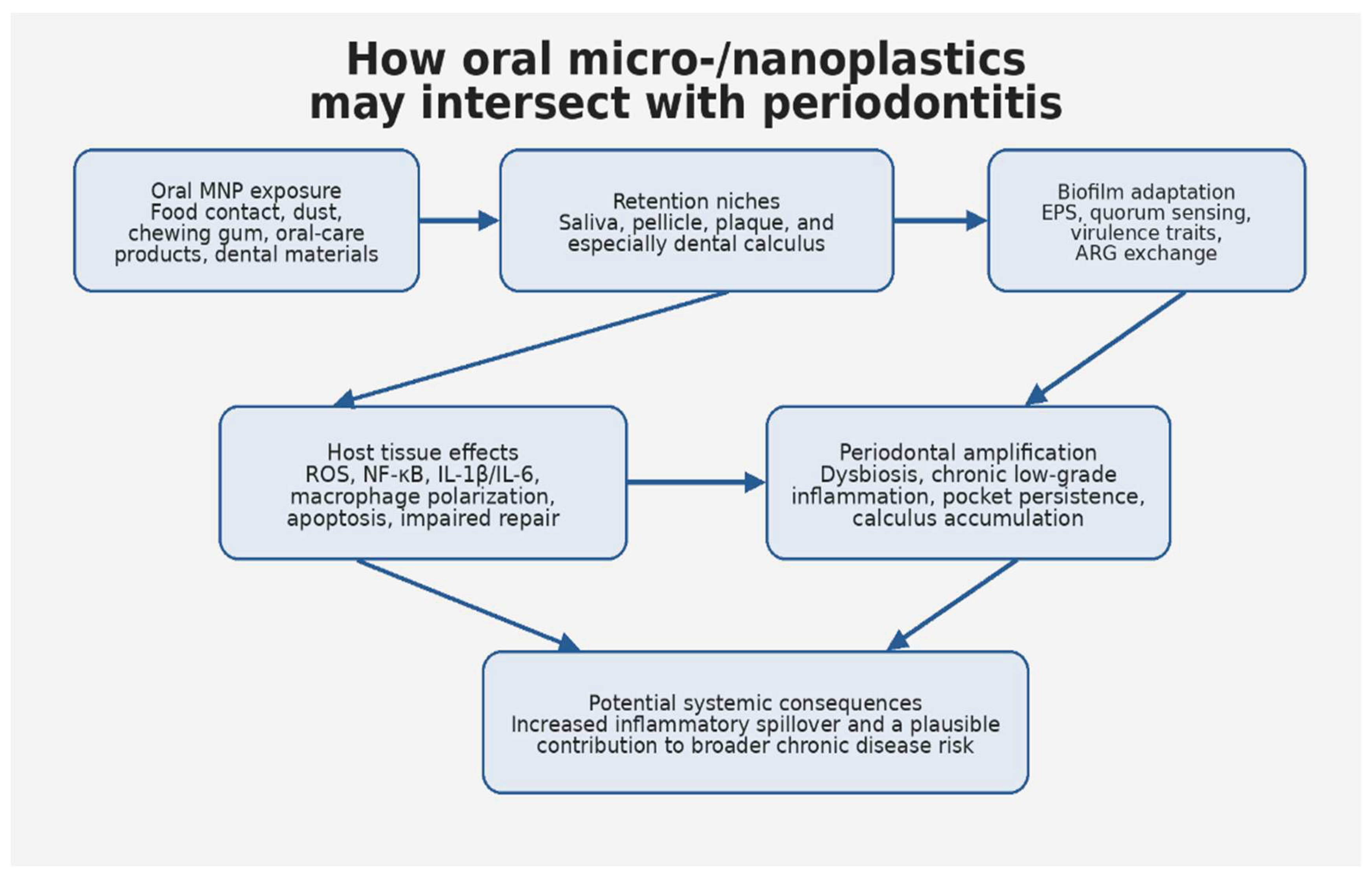

Table 1.
Evidence appraisal for the proposed connection between periodontal micro-/nanoplastics.
| Claim | Current evidence base | Strength of support | Interpretation |
|---|---|---|---|
| Human oral retention of MNPs occurs | Direct human evidence | Moderate-to-high | Microplastics detected in human dental calculus; strongest direct oral retention evidence (Wu et al., 2025). |
| MNPs can activate periodontal cell inflammatory pathways | Direct in vitro periodontal-cell evidence | Moderate | Polyethylene reduced gingival fibroblast viability, impaired migration, and activated NF-κB/IL-1β/IL-6 signaling (Wu et al., 2025). |
| The oral cavity is a relevant exposure and generation site | Direct oral exposure and dental material evidence | Moderate | Chewing gum, oral-care products, orthodontic materials, and dental polymers can release particles or polymer by-products (Pant et al., 2025; Saha et al., 2025; Warunek et al., 2026). |
| Plastic-associated biofilms can become more pathogenic or resilient | Strong non-oral experimental evidence; oral extrapolation | Moderate for general plastisphere biology; low-to-moderate for oral-specific translation | Biofilm promotion, EPS increase, quorum sensing activation, ARG transfer, and pathogen persistence reported in environmental systems (Huang et al., 2024; Zhou et al., 2024; Wang et al., 2026; Zhang et al., 2026). |
| Oral microbes degrade dental polymers, and polymer by-products can reshape biofilms | Direct oral microbiology and dental material evidence | High for methacrylate dental polymers | Cariogenic bacteria and E. faecalis degrade resins; BisGMA degradation products alter S. mutans virulence-related gene expression (Bourbia et al., 2013; Marashdeh et al., 2018; Singh et al., 2009). |
| Environmental MNP exposure causes human periodontitis | No direct longitudinal clinical proof | Insufficient | Currently unproven; supported mainly by mechanistic plausibility and limited direct oral evidence (Francis & Reddy, 2025). |
Table 2.
Mechanistic convergence between micro-/nanoplastic biology and periodontal pathobiology.
| Pathway | MNP-associated evidence | Periodontal relevance | Implication |
|---|---|---|---|
| Oxidative stress and NF-κB activation | Inflammatory signaling and redox imbalance after MNP exposure in oral and non-oral systems | Central to periodontal tissue destruction and host dysregulation | Shared pathway likely to intensify chronic inflammatory signaling |
| Inflammasome activity and IL-1β/IL-6 release | Gingival fibroblast and human cell studies show cytokine upregulation; calculus itself activates NLRP3 | IL-1β and IL-6 are core mediators of periodontitis and oral-systemic inflammation | Particle exposure may amplify an already activated periodontal cytokine network |
| Impaired migration, apoptosis, and wound repair | Polyethylene reduced fibroblast viability and migration; barrier injury was reported in gut models | Delayed epithelial/connective tissue repair supports lesion chronicity | MNPs may hinder resolution after periodontal injury or therapy |
| Macrophage and T-cell polarization | Orthodontic particles altered macrophage homeostasis; non-oral models show immune imbalance | Periodontitis is shaped by maladaptive innate and adaptive immunity | Combined exposure may favor persistent proinflammatory cell states |
| Biofilm EPS production, quorum sensing, and ARG transfer | Plastic particles enhance EPS, virulence traits, and horizontal gene transfer in environmental biofilms | Oral biofilms depend on matrix architecture, signaling, and coaggregation | Potential oral plastisphere mechanism requiring direct subgingival testing |
| Barrier dysfunction and translocation potential | Systemic tissue studies support internal exposure and barrier injury | Periodontal tissues already form an inflamed, permeable interface | Could increase the dissemination of inflammatory mediators, microbes, or particles |
Table 3.
Priority research agenda for environmental oral microbiology.
| Research question | Recommended design | Key measurements | Why it matters |
|---|---|---|---|
| How common are MNPs in periodontal compartments? | Cross-sectional, contamination-controlled clinical sampling | Saliva, supra-/subgingival plaque, GCF, calculus, tissue; polymer fingerprinting; dental-material inventory | Establishes prevalence and source attribution by periodontal status |
| Where are particles located within oral biofilms? | Spatial imaging and correlative spectroscopy | Raman/FTIR/Py-GC-MS plus microscopy; matrix localization; particle size and charge | Determines whether particles are embedded in pathogenic biofilm microdomains |
| Do MNPs worsen dysbiosis or host injury? | Multi-species oral biofilm and host co-culture models | EPS, quorum sensing, virulence genes, invasion, cytokines, osteoimmune readouts | Tests causality in orally relevant systems rather than environmental surrogates |
| Are external and dentistry-derived plastics biologically distinct? | Comparative polymer-source studies | Environmental weathered particles versus orthodontic, restorative, and oral-care derived particles | Separates environmental exposure from treatment-related polymer burdens |
| Does oral plastic burden predict periodontal progression? | Prospective longitudinal cohorts | Periodontal parameters, plastic burden, inflammatory biomarkers, restorations, diet, smoking, therapy history | Moves the field from plausibility to temporality and risk estimation |
| Can intervention reduce plastic-associated inflammatory burden? | Clinical or translational intervention studies | Debridement, source reduction, lower-shedding materials, post-treatment polymer measurements | Provides immediate preventive and materials-science relevance |
Disclaimer/Publisher’s Note: The statements, opinions and data contained in all publications are solely those of the individual author(s) and contributor(s) and not of MDPI and/or the editor(s). MDPI and/or the editor(s) disclaim responsibility for any injury to people or property resulting from any ideas, methods, instructions or products referred to in the content. |
© 2026 by the authors. Licensee MDPI, Basel, Switzerland. This article is an open access article distributed under the terms and conditions of the Creative Commons Attribution (CC BY) license (http://creativecommons.org/licenses/by/4.0/).
Copyright: This open access article is published under a Creative Commons CC BY 4.0 license, which permit the free download, distribution, and reuse, provided that the author and preprint are cited in any reuse.


