
Submitted:
01 April 2026
Posted:
02 April 2026
You are already at the latest version
Abstract
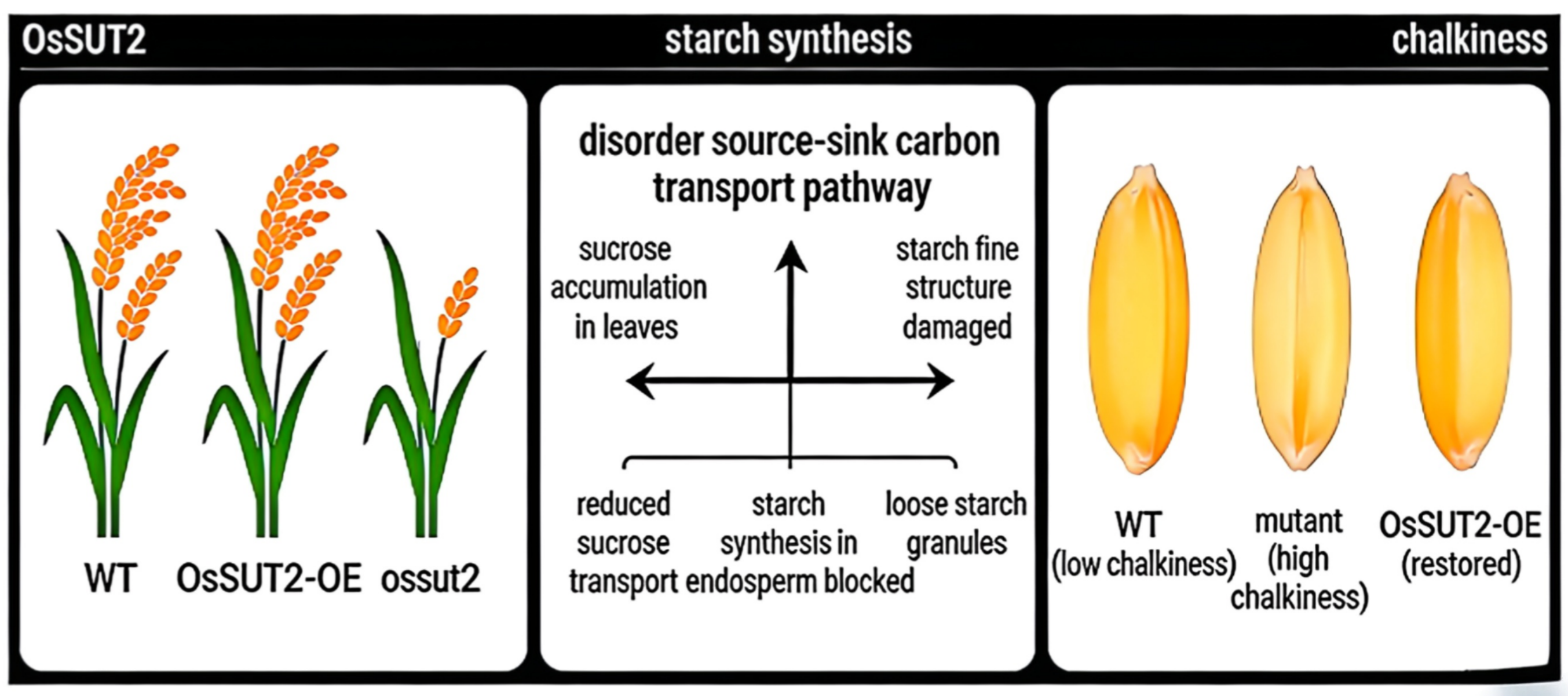
Rice chalkiness is a key constraint on high-quality rice breeding, and unbalanced sucrose transport and starch metabolism are its primary causes. To clarify the molecular mechanism by which OsSUT2 regulates rice grain chalkiness formation, the rice cultivar TP309 was used as material, and ossut2 homozygous mutants were generated via CRISPR/Cas9. Systematic studies were performed using gene overexpression complementation, phenotypic identification, cytological observation, transcriptome sequencing and haplotype analysis. Results showed that loss of OsSUT2 function significantly increased grain chalkiness, deteriorated agronomic traits, induced carbon assimilate accumulation in leaves, blocked sugar transport and starch synthesis in grains, and destroyed starch fine structure; normal phenotype was fully restored by OsSUT2 overexpression. OsSUT2 was expressed in both source and sink organs, with the most obvious inhibition detected in panicles. Mutation of OsSUT2 disordered sucrose and starch metabolic pathways. Three main haplotypes of OsSUT2 were identified in natural populations, with significant indica–japonica differentiation. OsSUT2 is confirmed as a key regulator of rice chalkiness, providing gene resources and theoretical support for rice quality improvement.
Keywords:
rice
; OsSUT2 gene
; chalkiness formation
; sucrose transport
; starch synthesis
Copyright: This open access article is published under a Creative Commons CC BY 4.0 license, which permit the free download, distribution, and reuse, provided that the author and preprint are cited in any reuse.


