

Submitted:
02 April 2026
Posted:
02 April 2026
You are already at the latest version
Abstract
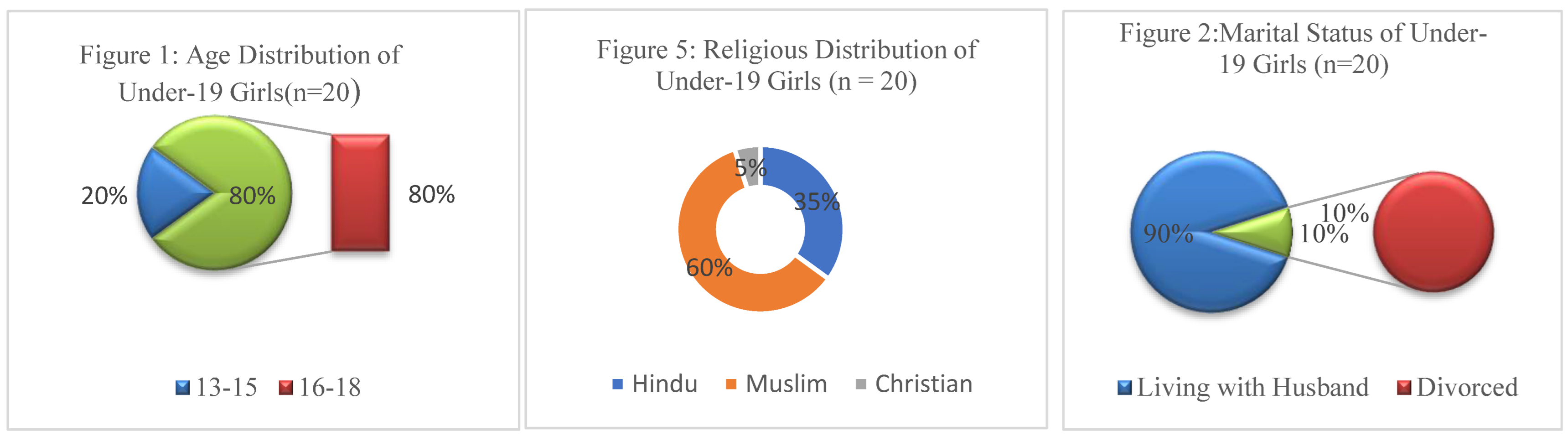
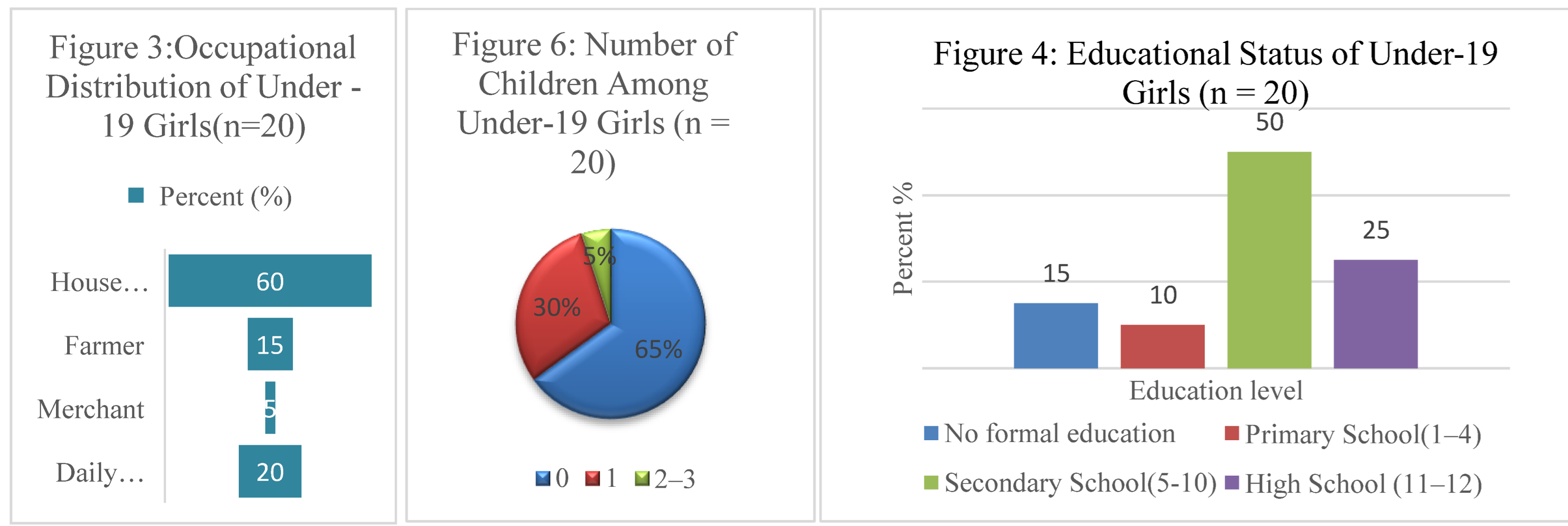
Background: Early marriage among girls under 19 years remains a significant public health and social concern in the Sundarbans of West Bengal, India. Despite legal restrictions, the practice continues due to socio-cultural norms, economic constraints, and gender inequality. Objectives: To assess the sociodemographic characteristics of girls married before the age of 19 years and to explore their opinions regarding early marriage. Methods: A mixed-methods study employing a convergent parallel design was conducted among 20 girls married before the age of 19 years. Quantitative sociodemographic data were analyzed descriptively, while qualitative insights were generated through two Focus Group Discussions (FGDs) and analyzed using thematic analysis. The findings were integrated using a joint analysis approach to examine convergence, divergence, and complementarity across data strands. Results: Quantitative findings: Most participants were aged 16–18 years (80%), with 90% living with their husbands. A majority were housewives (60%), while others were engaged in daily work or farming. Half had secondary education (50%), while 15% had no formal education. Most participants had no children (65%). Qualitative findings: Early marriage was socially accepted and influenced by family pressure and limited autonomy. Although participants preferred marriage after valued education, early marriage often resulted in school discontinuation. Girls reported a lack of readiness for marital responsibilities and economic dependency. However, many expressed a desire to delay marriage and continue education. Conclusion: Early marriage persists due to entrenched socio-cultural and economic factors despite awareness of its adverse effects. Strengthening education, empowerment, and community awareness is essential to delay the age of marriage.
Keywords:
INTRODUCTION:
MATERIALS AND METHODS :

| Theme | Participant Quotes | Interpretation |
|---|---|---|
| 1: Social norms and cultural acceptance | “Early marriage is common in our village.” “Everyone follows this practice.” “People will talk if a girl is not married early.” | Early marriage is culturally accepted and normalized within the community. |
| 2: Family pressure and lack of autonomy | “It is not good but we have to follow family decisions.” “My parents decided everything.” “I had no choice.” “Girls cannot go against their family.” | Girls have limited decision-making power and are expected to comply with family decisions. |
| 3:Preferred age and education linkage | “Girls should marry after 18.” “Better after completing studies.” “First education, then marriage.” “If we study more, we can marry later.” | Participants prefer marriage after the legal age and associate it with completion of education. |
| 4:Educational disruption | “After marriage, I had to stop school.” “It is difficult to study after marriage.” “My studies ended after marriage.” “I wanted to continue school but couldn’t.” | Early marriage interrupts education and limits future opportunities. |
| 5:Marital unpreparedness | “Too many responsibilities at a young age.” “We are not mentally ready.” “Marriage brings pressure.” “I feel stressed handling household work.” | Early marriage leads to psychological stress and lack of readiness for marital roles. |
| 6:Economic dependency | “After marriage, I became a housewife.” “I could not work outside.” “I depend on my husband for everything.” “I wanted to earn but I had no opportunity.” | Early marriage restricts employment opportunities, leading to financial dependence. |
| 7:Love marriage and elopement | “Some girls run away to marry their partner.” “Parents don’t agree, so they elope.” “They fear forced marriage at home.” “Love marriage is not accepted in families.” | Some early marriages occur due to romantic relationships and lack of parental acceptance. |
| 8:Early motherhood challenges | “Having a child early is very difficult.” “It is hard to take care of a baby at this age.” “We are not ready to become mothers.” | Early pregnancy is perceived as physically and emotionally burdensome. |
| 9:Aspiration for delayed marriage | “Girls should study first.” “Marriage should be delayed.” “We want to become something before marriage.” “Early marriage should be stopped.” | There is strong support among girls for delaying marriage and prioritizing education. |
| Theme | Participant Quotes | Interpretation |
|---|---|---|
| 1: Social norms and cultural acceptance | “It is a tradition in our community.” “Everyone follows this custom.” “People expect girls to marry early.” | Early marriage is culturally accepted and sustained by community expectations. |
| 2: Family pressure and lack of autonomy | “Sometimes it is forced.” “Parents and relatives decide.” “Girls are not asked about their choice.” | Girls have limited autonomy, with family and relatives playing a dominant role in decision-making. |
| 3:Preferred age and education linkage | “After 20 is better.” “First education, then marriage.” “Girls should complete studies before marriage.” | Participants prefer delayed marriage and emphasize education as a priority. |
| 4:Educational disruption | “Girls cannot continue studies after marriage.” “Education stops once a girl is married.” “Many girls drop out after marriage.” | Early marriage interrupts education and limits future opportunities. |
| 5:Marital unpreparedness | “Life becomes difficult after marriage.” “There is a lot of responsibility.” “Girls are not ready for such roles.” | Early marriage leads to increased responsibilities and lack of mental preparedness. |
| 6:Economic dependency | “We stay at home and do household work.” “Girls cannot work after marriage.” “They depend on family income.” | Early marriage restricts employment opportunities and leads to financial dependence. |
| 7:Love marriage and elopement | “Some girls marry by their own choice.” “They leave home if parents do not agree.” “Love marriage is not accepted easily.” | Some early marriages occur due to romantic relationships and lack of parental acceptance. |
| 8:Early motherhood challenges | “Early childbearing is risky.” “Young girls face health problems.” “It is difficult to manage a child at this age.” | Early pregnancy is associated with health risks and physical burden. |
| 9:Aspiration for delayed marriage | “Awareness should be increased.” “Girls should be empowered.” “Marriage should happen later.” | Participants support delaying marriage and promoting education and empowerment. |
| Quantitative Results (QUAN): Figures |
 |
| Qualitative Findings (QUAL): Themes |
| Theme 1:Social norms and cultural acceptance. Theme 2:Family pressure and lack of autonomy. Theme 3:Preferred age and education linkage. Theme 5:Marital unpreparedness. Theme 7:Love marriage and elopement. Theme 8: Early motherhood challenges. |
| Integrated Interpretation :(QUAN+QUAL) |
| The quantitative findings on age, religion, and marital status show that early marriage among under-19 girls is a common and socially accepted practice in the community. This reflects Theme 1 and Theme 2, where marriage decisions are mainly influenced by social norms and family pressure rather than the girl’s own choice. The age pattern also connects with Theme 3, showing that marriage often happens at a stage when education is affected or stopped. Even though this practice is common, qualitative findings highlight Theme 5 and Theme 8, indicating that many girls are not fully ready for married life and face difficulties related to early motherhood. Theme 7 shows that in some cases, girls choose love marriage or elopement, but this is limited compared to family-driven decisions. |
| Quantitative Results (QUAN): |
|---|
 |
| Qualitative Findings (QUAL): Themes |
| Theme 2:Family pressure and lack of autonomy. Theme 3:Preferred age and education linkage. Theme 4:Educational disruption. Theme 6:Economic dependency. Theme 8: Early motherhood challenges. Theme 9:Aspiration for delayed marriage |
| Integrated Interpretation :(QUAN+QUAL) |
| The quantitative findings on occupation, education, and number of children show that most under-19 girls are engaged as housewives, have limited educational attainment, and many have already entered motherhood. This reflects Theme 2, in which family influence shapes life choices, and Themes 3 and 4, which indicate that marriage often leads to the interruption or discontinuation of education. The dominance of housewifery and low participation in income-generating activities align with Theme 6, highlighting economic dependency. The presence of children among these girls further supports Theme 8, showing early entry into motherhood with associated challenges. At the same time, Theme 9 suggests that despite these conditions, some girls express a desire to delay marriage, indicating awareness and emerging aspirations beyond existing social constraints. |
DISCUSSION:
LIMITATION :
CONCLUSION :
References
- World Health Organization (WHO). Policy and education: ways to end child marriage and prevent adolescent pregnancy: progress and insights from Colombia . Geneva: WHO; 2025. Available at: https://www.who.int/news-room/feature-stories/detail/policy-and-education--ways-to-end-child-marriage-and-prevent-adolescent-pregnancy(Accessed 25 January 2026).
- United Nations Population Fund (UNFPA)-United Nations Children’s Fund (UNICEF). Leaving no one behind: Technical note of the global programme to end child marriage. New York: UNFPA and UNICEF; 2020. Available at: https://www.unicef.org/media/85301/file/Child-marriage-leaving-no-one-behind-2020.pdf(Accessed 30 January 2026).
- United Nations Population Fund (UNFPA)-United Nations Children’s Fund (UNICEF). Child marriage country profile: India. New York: UNFPA and UNICEF; 2021. Available at: https://www.unicef.org/media/111381/file/Child-marriage-country-profile-India-2021.pdf(Accessed 15 February 2026).
- International Institute for Population Sciences (IIPS), ICF. National Family Health Survey (NFHS-5), India, 2019–21. Mumbai: IIPS; 2021. Available at: https://dhsprogram.com/pubs/pdf/FR375/FR375.pdf.(Accessed 23 February 2026).
- ActionAid Association. Troubles in the Sundarbans: a study of social and ecological issues in Hingalganj Block, North 24 Parganas, West Bengal. New Delhi: A A A; 2022. Available at: https://www.actionaidindia.org/wp-content/uploads/2022/04/Troubles-in-the-Sundarbans-I-E-book.pdf(Accessed 25 February 2026).
- Bandopadhyay K. Climate change pushing up child labour, trafficking, early marriage in Sundarbans. The Times of India;2025. Available at: https://timesofindia.indiatimes.com/city/kolkata/climate-change-pushing-up-child-labour-trafficking-early-marriage-in-sundarbans/articleshow/118396564.cms(Accessed 11 March 2026).
- Binu VS, Sridhar V, Subba SH, Prathyusha PV, Sabu KM. Direct and indirect factors associated with child marriage: evidence from India using NFHS-4 data. Child Abuse Negl. 2022; 131:105785. [CrossRef]
- United Nations Children’s Fund (UNICEF).Evidence review: Child marriage interventions and research from 2020 to 2022. New York: UNICEF; 2023.Available at: https://www.unicef.org/media/136646/file/CRANK-Evidence-Review-Child-Marriage-2023.pdf.(Accessed 17 March 2026).
- Gelchu S, Wirtu D and Dheresa M. Determinants of child marriage among rural women in the West Guji Zone, Southern Ethiopia, 2024: a community-based cross-sectional study [version 1; peer review: 1 approved with reservations]. F1000Research 2024, 13:1322. [CrossRef]
- Gelchu Adola S and Wirtu D.Effects of early marriage among women married before reaching 18 years old (qualitative study approach). Front. Sociol.2024; 9:1412133. [CrossRef]
- Wahyuningsih S, Widati S, Puspitasari N, Salim LA, Azkiya MW. Exploring adolescent girls' involvement in decision-making processes regarding child marriage: A systematic review. Narra J. 2025 ;5(1):e1656. [CrossRef]
- Nurhaeni A, Marisa DE, Oktiany T, Rahayu R, Wahyuni L. Impact and causes of early marriage in adolescents: systematic review. Malahayati Nursing Journal. 2025;7(6):2551–2562. [CrossRef]
| Characteristics | Frequency (n) | Percent (%) |
| Age | ||
| 13-15 | 4 | 20 |
| 16-18 | 16 | 80 |
| Marital status | ||
| Living with Husband | 18 | 90 |
| Divorced | 2 | 10 |
| Occupation | ||
| Housewife | 12 | 60 |
| Farmer | 3 | 15 |
| Merchant | 1 | 5 |
| Daily worker | 4 | 20 |
| Education level | ||
| No formal education | 3 | 15 |
| Primary School(1–4) | 2 | 10 |
| Secondary School(5-10) | 10 | 50 |
| High School (11–12) | 5 | 25 |
| Religion | ||
| Hindu | 7 | 35 |
| Muslim | 12 | 60 |
| Christian | 1 | 5 |
| Number of children | ||
| 0 | 13 | 65 |
| 1 | 6 | 30 |
| 2–3 | 1 | 5 |
Disclaimer/Publisher’s Note: The statements, opinions and data contained in all publications are solely those of the individual author(s) and contributor(s) and not of MDPI and/or the editor(s). MDPI and/or the editor(s) disclaim responsibility for any injury to people or property resulting from any ideas, methods, instructions or products referred to in the content. |
© 2026 by the authors. Licensee MDPI, Basel, Switzerland. This article is an open access article distributed under the terms and conditions of the Creative Commons Attribution (CC BY) license (http://creativecommons.org/licenses/by/4.0/).


