

Submitted:
01 April 2026
Posted:
02 April 2026
You are already at the latest version
Abstract
Natural noises, especially the sounds of birds, have been found to be beneficial in lowering tension, anxiety, and agitation as well as promoting emotional healing. Recent laboratory research has mainly examined how public responses to birdsongs differ from those to other biological, artificial, or mechanical sounds, finding that birdsong promotes more effective physiological and psychological recovery. Our study continued this experiment with a questionnaire survey (N=202) in a non-lab on site outdoor setting in a larger Viennese recreational area, accompanied by soundscape analysis. Main findings show an overall effect on perceived mental health, with strongest effects in the field of emotional restoration (reduction of worries) than to cognitive clarity (clarification of thoughts). More in-depth analysis confirms low relevance of demographic variables age and gender but outlines the interesting relevance of the belief in the presence of animals in the recreational area. random forests, GAMMs, mediation, conditional inference trees, Bayesian models — suggest that it is not the acoustic composition per se that drives restoration, but rather how visitors perceive and interpret the soundscape. Interventions should therefore not focus solely on improving NDSI values but also on facilitating visitors’ awareness of the natural sounds already present.
Keywords:
soundscape
; biodiversity
; mental health
; recreation
; urban green areas
; bird diversity
; perceived restorative soundscape scale
1. Introduction
From a planning perspective it is highly relevant, how urban planning directly affects urban green areas and indirectly shapes sensory experience influencing overall well-being. Due to the limited availability of green spaces in urban areas, it is crucial to optimize the design and utilization of existing green spaces. Research supports planners to identify the types and features of green spaces that offer the greatest mental health benefits to urban residents while maximizing other benefits such as for biodiversity and recreation at the same time (Beute et al., 2023). According to Stangierska-Mazurkiewicz et al. (2025), the latest research from various countries reveals that, to improve citizens’ mental health through urban planning strategies, the relationship between perceived stress (PS) levels and satisfaction with green space attributes (SGSA) requires further investigation due to inconsistent findings to date.
Next to visual perception, the acoustic experience influences our mental health in UGS. One of the primary components of restorative landscape design is soundscape, which also has significant recreational value (Aletta et al., 2018). Urban soundscapes have a considerable impact on the health and well-being of city inhabitants as indicated by the research. These soundscapes include biophony (sounds of biological origin, such as birdsong), anthropophony (sounds generated by humans, such as traffic or speech), and geophony (natural non-biological sounds, such as wind or rain) (Bian et al., 2023). Passive acoustic monitoring has increased abilities in soundscape ecology research (Hou et al., 2022).
The constitution of soundscapes within urban green areas is highly intriguing since these spaces are essential for providing people with intimate access to nature and its restorative qualities. It has been shown that natural noises, such as birdsong and water sounds, have more calming effects than human-made noise (Suko et al., 2019). However, the interference of natural sounds with those produced by humans can negatively impact the quality of a green area soundscape. Various non-natural noises have the potential to diminish the green area’s restorative effect by degrading the perceived soundscape quality. Shaping soundscapes, e.g., by elevating the presence of natural soundscapes in urban green spaces due to natural elements fostering bird- or insect-biodiversity can be highly significant for ameliorated recreational experiences and wellbeing (Benocci et al., 2020).
Birdsong is the most common natural sound in urban green areas and has both physiological and psychological restorative effects (Yi et al., 2024, Suko et al., 2019). Studies have hypothesized that greater bird diversity in urban environments leads to direct mental health benefits through birdsong, which has been found to reduce stress and irritation. Consequently, soundscapes with more birdsongs are associated with stronger mental health including effects on concentration, reduction of stress-related behavior and facilitation of mental restoration (Buxton et al., 2023). The majority of bird sounds and songs fall between 2 and 6 kHz. The acoustic frequency of a bird’s song is influenced by both its body size and the characteristics of its habitat, with larger species typically producing lower-frequency sounds around 1 kHz (Pijanowski et al., 2011). Furthermore, birds may modify their vocal frequency and pressure for communication, warning, territory calls, and mating cries, demonstrating their high bioacoustics adaptation in urban environments (Yi et al., 2024). Despite a variety of initial research, the exact mechanisms through which birds contribute to human well-being and offer certain health benefits are not yet fully understood. Moreover, most studies derive from a lab setting. Effects measured on-site directly remain scarce.
This research targets to considerably improve comprehension of urban soundscapes based on an Austrian case study on-site in a recreational area in the capital city Vienna. It aims to investigate the structure of both biodiversity-embracing and restorative urban environments by researching how both anthropogenic and nature-derived sounds impact people’s well-being and their perception of the environment. Previous studies in Vienna particularly highlighted the relevance of large green areas increased for recreational purposes but also in public perception as a source of health and wellbeing (Taczanowska et al., 2024).
The core objectives of this study were: 1) to examine the soundscape of a larger urban green space with its heterogeneous territory in an on-site survey, 2) to investigate how both anthropogenic and natural sounds — and their interference — impact four dimensions of well-being (attention restoration, mental clarity, relaxation, and serenity), with a focus on birdsong and the subjective perception of the acoustic environment, 3) to compare the explanatory power of objective acoustic indices (the Normalized Difference Soundscape Index, NDSI) versus subjective sound perception using complementary analytical approaches, including random forests, generalized additive models, mediation analysis, and Bayesian estimation, and 4) to examine the role of demographic variables (age, gender, childhood environment) in moderating restoration outcomes.
The paper is structured as follows: Section two introduces the theoretical framework, including key definitions, concepts, and a review of existing literature on the mechanisms through which urban green spaces and birdsong/bird calls influence human well-being. Section three provides a detailed overview of the methodology applied to address the research objectives. Section four presents the descriptive evaluation and findings of the empirical survey as well as an in-depth analysis of the data collected. Thereafter, section five discusses the results in the context of research questions and existing literature and concludes with recommendations for future research. Finally, section six concludes with an outlook on further research.
2. Methodological Approach
2.1. Quantitative Questionnaire Survey
The quantitative questionnaire survey employed in this study was adapted from Uebel et al. (2021) who investigated the perceived restorativeness and other health benefits from eight urban park soundscapes which differed in the presence and intensity of bird sounds and traffic noise. The study by Uebel et al. (2021) employed a repeated measures within-subjects design in a controlled laboratory setting, along with moderating variables, such as noise sensitivity, environmental knowledge and the amount of time lived in the city. Sound recordings were captured at sample sites along a gradient of low to high bird species richness and varying degrees of traffic noise. In total, 162 participants listened to all eight 70-second sound recordings from different urban parks in Brisbane, Australia, in randomized order and completed a block of questions related to the soundscape and its perceived restorativeness. Perceived restorativeness was measured using a 5-item short-form of the Perceived Restorative Soundscape Scale (PRSS-SF) based on Attention Restoration Theory’s four qualities: fascination, being-away, compatibility, and extent. Perceived restorative outcomes were assessed using the 6-item Restorative Outcomes Scale (ROS) evaluating attention restoration, clearing thoughts, and relaxation/calmness (Uebel et al., 2021).
The questionnaire for the purpose of this study (see Appendix A) was adapted for the purposes of this research. In contrast to the controlled laboratory setting employed by Uebel et al. (2021), the research conducted for this study was carried out in four different outdoor locations under natural field conditions, which represents the methodological difference between the two study designs. Another methodological difference is that, in the present study, the questionnaire was handed out to participants directly in the research area, whereas in the study by Uebel et al. (2021), the survey was administered in a lab experiment in a quiet, partitioned room, with no more than four participants per session. The five primary dimensions of evaluation that questionnaire focused on in the present study are: the presence of nature sounds & birdsongs/bird calls, the perception of green and blue infrastructure, the experience of fascination and restoration of attention, the clarification of thoughts and relaxation and serenity. Each of these dimensions consists of multiple items, comprising mostly quantitative but also some qualitative questions, in order to gain a comprehensive understanding of respondents’ experiences.
2.1.1. Data Collection Procedure and Content of the Questionnaire
The data collection procedure started in the second half of September 2024 and was conducted on the following dates: 21st, 22nd, 26th, 28th and 29th as well as October 1st, 8th and 19th. On each of these days, the questionnaire (see Appendix A) was distributed randomly to individuals passing through the designated research area at the time of data collection. All participants took part in the survey on a voluntary basis. Prior to participation, they received a brief explanation outlining the purpose and scope of the research. The survey was conducted anonymously. On average, the respondents required approximately six minutes to complete the questionnaire. The questionnaire used in the present study was structured into several sections aimed at assessing both environmental perceptions and participants’ psychological well-being in situ. Firstly, the perceived presence of nature sounds and birdsongs/birdcalls were examined. Sound categories included biological sounds (animal sounds, for example birdsong), anthropogenic sounds (e.g., human speech, traffic noise), and other natural sounds (e.g., wind, rustling of leaves). For each sound category, participants rated the audibility and perceptual dominance on a Likert scale ranging, from 1 (“not perceptible”) to 4 (“strongly perceptible”). Secondly, participants were asked about their perception of green and blue infrastructure, specifically by identifying the most prominent natural (green) and water-related (blue) structures visible to them at the specific location, together with rating the perceived green space as a habitat for animal species (“no animal species”, “few animal species”, “many animal species”). To assess the emotional and psychological state, a set of statements was presented regarding the current mood and psychological condition. Participants indicated their level of agreement on a Likert scale (e.g., from “does not apply at all” to “applies strongly”). The items covered perceived fascination and attention restoration (“The occurring birdcalls/birdsong here fascinate me”, “My concentration increases significantly after listening to birdsong in the prevailing soundscape in this area” and “Listening to the sounds that prevail here gives me energy for my daily routines”), clarification of thoughts (“What I hear here makes me forget the worries of everyday life” and “Listening to birdsong in this place is a way to clear my thoughts”), and relaxation & serenity (“The prevailing background sounds here give me a good break from my everyday routine”, “I feel calmer after listening to the prevailing sounds here” and “After listening to the prevailing sounds here, I feel refreshed and relaxed”). In order to simplify interpretation of the results in chapters 4 and 5, the following descriptive terms were used for the questions related to relaxation and serenity:
- The statement “The prevailing background sounds here give me a good break from my everyday routine” was defined as auditory escape.
- The statement “I feel calmer after listening to the prevailing sounds here” was defined as calming effect.
- The statement “After listening to the prevailing sounds here, I feel refreshed and relaxed” was defined as emotional rejuvenation.
As a specific indicator of perceived biodiversity, participants were asked to estimate how many different bird species they believed they could hear at the moment (“none”, “1-3”, “4-6” and “7-10”).
Basic demographic information was collected, such as their age group and gender. Additionally, participants indicated their place of upbringing (rural, urban or suburban), length of stay and the reasons for visiting the research area, in order to provide contextual information for the analysis.
2.1.2. Sample Characteristics
A total of 202 valid questionnaires were received and evaluated during the survey. The participants were randomly selected in each of the four survey sites. The number of female and male respondents were 112 and 88, respectively, accounting for 55.4% and 43.6% of the total sample, whereas respondents that declared themselves as diverse (n=2) account for 1.0%.
As it is shown in the Table 1 on age and gender distribution, respondents aged between 26-35 years encompass the majority with 33.2%, while the participants older than 55 years represent the smallest sample with 12.4%. Interestingly, people aged between 12-25 and 46-55 years have the exact same survey participation rate, namely 15.3%. Middle-aged respondents (36-45 years old) account for 23.8% of the total sample. The majority of respondents (43.5%) were raised in rural environment, as illustrated by the descriptive statistics provided in Table 1.
Sample sizes across the four locations ranged from n = 40 (Location 4) to n = 57 (Location 1). Gender distribution varied notably: Location 1 showed a roughly even split (30 m / 27 f), while Locations 2 and 3 had a female majority (34 f / 19 m and 29 f / 23 m, respectively). At Location 4, 22 participants were female, 16 male, and 2 identified as diverse. All five age groups were represented at each location, with the 26–35 age group consistently the largest. Detailed cross-tabulations of location × demographics are given in Table 2.
2.1.3. Data Analysis
Data preparation was performed using Microsoft Excel. Descriptive and non-parametric analyses were conducted in SPSS 25, while all multivariate modelling (random forests, GAMMs, mediation, Bayesian estimation, latent profile analysis) was carried out in R 4.4.x (R Core Team, 2024).
The following analysis was done to explore whether respondents of different age were exposed to different level of anthropogenic and biological sounds. Respondents were compared looking at the number of anthropogenic/biological sounds they were exposed to 30 minutes, 20 minutes, 10 minutes before the survey completion and at the moment of survey completion. The results are presented in Table 3. The results clearly show that respondents of different age groups have been exposed to the same anthropogenic and biological sounds before and during the survey completion.
The following analysis was done to explore whether respondents of different age groups were exposed to different sounds according to the NDSI. To ascertain the impact of age, an analysis of variance (ANOVA) test was employed, given that more than two age groups were considered and the variables of interest were scale. In total, five age groups have been considered. The null hypothesis of the test states that there is no statistically significant difference between the groups (population means are the same), while the alternative hypothesis states that there are statistically significant differences between the groups (population means differ).
The results are given in Table 4. These findings suggest that respondents of all ages have been exposed to the same sounds. Consequently, the sample shows no disparities in this regard.
2.2. Analysis of GBI in Case Study Areas and Description of Research Locations
The soundscape recordings and participant survey were conducted in the Laaerwald recreational area, located in the 10th district of Vienna. Laaerwald (48°9’45”N, 16°23’46”E) encompasses an area of approximately 39.6 hectares, of which around 3 hectares consist of water bodies (Erholungsgebiet Laaer Wald - Lage und Angebote, 2017). The top of the Laaer Berg was originally covered in mixed downy oak forests, which were increasingly cleared in the late 17th and 18th centuries to make way for brickworks. Between 1956 and 1970, over 270,000 trees and shrubs were reforested here, hiking trails were laid out and a bird sanctuary was created around the two former brick ponds, Butterteich and Blauer Teich, which is now home to over 50 bird species. The Laaer Wald has been open to the public as a recreational area since 1982. Children’s playgrounds and places to sit and rest as well as a viewing platform at the Butterteich are available to visitors (Nikles, n.d.).
To satisfy the accuracy of the research, four respective locations were selected for the analysis of soundscape recordings and participants’ survey answers and observations (Figure 1). The four locations were selected to provide diversity of soundscape samples that range from high traffic and human noise and supposedly low bird activity to low traffic and human noise and supposedly high bird activity and richness. Location 1 is situated near the open water body known as Butterteich, which is located within a forested area. The site also includes a designated bird protection zone, which highlights the area’s ecological significance. A small recreational area surrounded by a diverse range of tree species is located directly above the Butterteich. This contributes to the site’s ecological heterogeneity and offers visitors a calm natural setting. The level of anthropogenic use in this location can be classified as moderate, with human presence not dominating the acoustic environment. Location 2 is located deeper in the forest, at the intersection of the forest paths and represents the transition from forest to agricultural landscape. This area experiences a lower intensity level of human activity compared to the Location 1. Furthermore, Location 3 is characterized by the presence of a children’s playground and its proximity to infrastructure, suggesting that this site experiences the highest level of human use and activity. Lastly, Location 4 offers a spacious city view and is the most used one for walking dogs and engaging in social activities. Although traffic noise is present due to the proximity of the infrastructure, it is not prevailing.
2.3. Acoustic Environment Assessment
2.3.1. Soundscape Recordings
In addition to the quantitative questionnaire survey, the soundscapes were recorded at each location within the research area. Despite its complexity, the acoustic environment in natural areas can be described effectively using different acoustic indices that have been developed in soundscape ecology (Benocci et al., 2020). In a few recent studies such as Hou et al. (2022) measuring outdoor soundscapes and the degree of anthropogenic disturbance has been facilitated through passive acoustic sensor-based soundscape analysis. This approach requires an understanding of the composition of the soundscape and the relationships between acoustic indices and species richness of birds, the most significant sound source in the ecosystem (Hou et al., 2022).
Due to the vocal nature of many bird species, passive acoustic monitoring (PAM) has become a widely used method for bird monitoring. Birds are frequent vocalizers, and their songs form a key part of most natural soundscapes, making them easy to detect with passive acoustic sensors. This approach involves the use of autonomous recording units (ARUs), which are programmed to capture sound during designated time periods (Manzano-Rubio et al., 2022). The soundscape monitoring in this study was carried out using AudioMoth, a passive acoustic recording device designed for long-term environmental sound monitoring. AudioMoth are low-cost, highly adaptable devices that may be set up to record at different sampling rates, which enables them to collect sounds from a variety of sources. Soundscapes are typically divided into biophony, anthropophony, and geophony, with anthropogenic sounds - such as human speech and car horns - most often occurring in the 1-2 kHz range. For the detection of anthropogenic noises like gunshots, chainsaws, or engine sounds, lower sample rates (e.g., 8 kHz) are appropriate. Birds, insects, and frogs are among audible animals that can be recorded at standard rates of about 48 kHz. Higher sample rates (up to 384 kHz) are employed to monitor ultrasonic signals, such as those made by bats or amphibians (Hill et al., 2019). The device was activated during the distribution of the quantitative questionnaire survey at all four locations within the research area, with the objective of recording a broad spectrum of acoustic components (soundscapes), including biophony (biological sounds, such as birdsong), anthropophony (human-generated sounds), and geophony (non-biological natural sounds, such as rain and wind). However, the primary focus of this study is on biological and anthropogenic sounds, specifically in relation to their effects on human well-being within the urban green space. At all four locations, the AudioMoth device was on for a total of 13 hours and recorded 821 data files during the recording times. The sounds recorded followed a scheduled pattern, consisting of one minute of recording followed by a ten-second pause. The acoustic recordings were stored on a microSD card, subsequently extracted, and processed using specialized software named BirdNET-Analyzer (v. 2.1), BirdNET model V2.4.
Automated bird species identification was performed using BirdNET-Analyzer v2.1 with BirdNET model V2.4 (Kahl et al., 2021), a deep learning-based system for automated avian species recognition from audio recordings. The model was applied to all 821 one-minute recordings across the four study locations. BirdNET assigns a confidence score (0–1) to each detection; only detections exceeding a confidence threshold of 0.7 were retained for analysis. The resulting species list was cross-checked against known avifauna records for the Vienna region to exclude implausible detections.
2.3.2. Soundscape Analysis
Normalised Difference Soundscape Index (NDSI)
Analysing biophonic and anthropogenic components of the urban soundscape has been recognized as an effective method for monitoring bird biodiversity and assessing the effects of noise pollution in urban park environments (Latifi et al., 2023). Furthermore, monitoring biodiversity is of high significance in determining global changes caused by anthropogenic activity and climate change (Atemasov & Atemasova, 2023). In light of this, multiple indices have lately been developed with the aim of evaluating factors such as heterogeneity, richness, relative abundance, intensity and human impact on the acoustic environment (Hou et al., 2022). These include the Acoustic Complexity Index (ACI), Acoustic Diversity Index (ADI), Acoustic Evenness Index (AEI), Bioacoustic Index (BI), and Normalized Difference Soundscape Index (NDSI). All of these indices have proven useful in several instances, both individually and in combination, as indicators of anthropogenic disturbance and biodiversity levels. Nevertheless, according to the latest research, the relationship between biodiversity and soundscape indices remains primarily unknown and understudied due of the complexity of urban soundscapes (Arzberger et al., 2025). Alcocer et al. (2022) reported that Acoustic Entropy (H), NDSI, and ACI were stronger indicators of biodiversity than the other commonly used indices analysed in their meta-analysis - namely, ADI, AEI, Acoustic Richness (AR), and BI.
This study employed the Normalized Difference Soundscape Index (NDSI) to describe and evaluate the recorded soundscapes. According to the research, the NDSI identifies sound category by frequency range and has been widely applied in similar contexts to assess soundscape composition and evaluate the balance between biological and human-made sounds. Alongside the Acoustic Entropy Index (H) and the Acoustic Diversity Index (ADI), the NDSI has been identified as one of the most effective indicators for linking soundscape patterns with landscape features, ecological conditions, and bird species richness (Hou et al., 2022).
The Normalized Difference Soundscape Index (NDSI) is an acoustic indicator that shows the level of anthropogenic disturbance and noise pollution on the natural soundscape, and it is calculated as the ratio between anthropogenic (1–2 kHz) and biological (2–11 kHz) sounds. The index ranges from -1 to 1, where values closer to 1 indicate a greater dominance of biophony over human-generated sounds (Bian et al., 2023). More precisely, certain spectral regions within an audio signal’s normalized power spectral density (PSD) are used to generate the NDSI. The first spectral band, ranging from 1000 to 2000 Hz, is typically associated with anthropogenic (human-generated) sounds. The sum of the total power within this band over the course of the recording is referred to as the alpha (α) value. The biophonic activity is better represented by the second spectral range, which spans from 2000 to 11000 Hz. This range is divided into 1 kHz bands, and the power within each band is summed across the entire recording period. The highest of these summed values is defined as the beta (β) value. The NDSI is then calculated using the formula NDSI = (β − α) / (β + α), producing a value between −1 and +1 (Devos, 2016).
The data analysis was conducted using two software programmes: Excel, for the purpose of data preparation, SPSS 25 for the initial descriptive and non-parametric analyses, and R 4.4.x (R Core Team, 2024) for advanced statistical modelling. The data preparation stage involved data coding and cleansing. The two data sets contained in the study were merged; the first set related to survey results, while the second set related to the recorded environmental sounds using AudioMoth. The time of survey completion was recorded in order to enable the merging of the two data sets. To gain a thorough understanding of the acoustic characteristics of the urban soundscape, we analyzed the average Normalised Difference Soundscape Index (NDSI).
Following the recording of the exact time and location at which each survey was completed, these data were matched with the corresponding NDSI (Normalized Difference Soundscape Index) values for the same time and place. The objective was to examine whether the soundscape conditions prevailing prior to the survey completion at the four locations had an influence on the participants’ responses.
Relationships between variables were tested using parametric (t-test, ANOVA with Levene’s test for homogeneity of variances) and non-parametric methods (Mann-Whitney U, Kruskal-Wallis with pairwise Mann-Whitney post-hoc tests, Spearman’s rank correlation), selected based on the measurement level and distributional properties of the data. Age group effects were tested using Kruskal-Wallis tests across five age categories with Mann-Whitney post-hoc comparisons.
To move beyond the descriptive and bivariate analyses, we conducted a series of complementary multivariate analyses in R. First, we constructed composite scores by averaging the Likert-scaled restoration items into three subscales — Attention (fascination, concentration, energy; Cronbach’s α = 0.75), Clarity (worry reduction, thought clarification; α = 0.56), and Relaxation (auditory escape, calming, rejuvenation; α = 0.85) — as well as an overall Restoration score (all 8 items; α = 0.86). We then applied random forests (ranger package; Breiman, 2001) with permutation and conditional importance (Strobl et al., 2008) to identify the most influential predictors of each restoration outcome. To model nonlinear relationships while accounting for repeated survey dates, we fitted generalized additive mixed models (GAMMs; mgcv package; Wood, 2017) with NDSI and perceived animal sounds as smooth terms and survey date as a random effect. Mediation analysis (lavaan package; Rosseel, 2012) with bootstrap confidence intervals (N = 1,000) tested whether NDSI effects were mediated by subjective perception. Bayesian multilevel models (brms package; Bürkner, 2017) provided posterior distributions and ROPE analyses for the NDSI effect. Additionally, NDSI temporal variability was examined by extracting distributional features (SD, minimum, range) from the minute-level NDSI time series. Age group differences were tested with Bonferroni-corrected post-hoc comparisons. Complete-case analyses were conducted throughout; sample sizes vary slightly across models (N = 192–200) due to missing NDSI values or incomplete questionnaire responses.
3. Results
3.1. Description of the On-Site Survey of GBI
Given the limitation of an article length we refer to the vegetation analysis only briefly. The four research locations within the Laaerwald recreational area varied in vegetation structure and degree of anthropogenic disturbance (see Figure 1). Location 1 featured a heterogeneous vegetation structure with moderate anthropogenic disturbance and approximately 50% canopy cover, including a small pond (“Butterteich”). Location 2, situated at a forest path intersection, had the highest canopy cover (~65%) and lowest disturbance levels. Location 3 combined natural vegetation with nearby infrastructure and a children’s playground, characterized by a dominant herbaceous layer (~70%). Location 4 (Löwygrube Park) was an extensively maintained urban park with a city view and clearly audible traffic noise, representing the most urbanized location.
3.2. Survey Results
3.2.1. Personal Recognition of Natural Structures and Bird Species
Out of all respondents (n=202), only 19.8% (n=40) were able to recognize one or more bird species across the entire research area. The figure illustrates the total sample evaluation of the number of bird species heard at all four research locations in relation to the place of upbringing. Data from three respondents were excluded due to invalid responses. The majority of respondents identified corvids — predominantly hooded crows (Corvus cornix; 32.4%) — followed by additional corvid species (12.7%, likely referring to hooded crows or rooks, Corvus frugilegus; the common German term “Raben” is colloquially used for various corvid species) (Table 5). Only a small number of respondents recognized other bird species, such as blue tits, owls, great tits, and others. Woodpeckers and pigeons were equally recognized by 8.5% of the participants.
In terms of overall loudness and sound frequency, birds like crows also produce loud and frequent calls that are easily heard, which aligns with the recognition rate of 32.4% for these birds.
In contrast to the limited species recognition by survey participants, automated species identification using BirdNET 2.4 (Kahl et al., 2021) applied to the AudioMoth recordings revealed a considerably larger species assemblage at the research locations. The following species were detected: grey heron (Ardea cinerea), Eurasian coot (Fulica atra) (both associated with the pond at Location 1), hooded crow (Corvus cornix), long-tailed tit (Aegithalos caudatus), common chiffchaff (Phylloscopus collybita), hawfinch (Coccothraustes coccothraustes), great spotted woodpecker (Dendrocopos major), mallard (Anas platyrhynchos), and redwing (Turdus iliacus; detected in late October recordings only). This discrepancy between perceived and recorded species richness underscores the limited conscious awareness of biodiversity even in acoustically diverse environments.
When asked about the estimated number of different bird species observable at the four locations, approximately 63% of these respondents indicated they could hear 1 to 3 different bird species. The recognition of 4 to 6 different bird species also shows a similar percentage, around 22%. In addition, we analyzed whether the origin of people influences their knowledge of bird species. The responses were quite similar though for those who were raised in urban and rural environments (see Figure 2). Only people from sub-urban areas showed more knowledge of bird species judging from their answers.
At location 4, the highest percentage of respondents (25.6%) reported not recognizing any bird songs, followed by location 3 with 15.4%. Across all locations, the majority of respondents identified 1 to 3 different bird species. Location 2 had the highest percentage of respondents (90.5%) recognizing a variety of bird species (1 to 3 and 4 to 6), followed by location 1 with 86% and location 3 with 84.7%. Location 4 had the lowest proportion of respondents who were able to identify different bird species.
As demonstrated in the following Table 6, trees were evaluated as a dominant green structure at all research locations, with locations 1, 3 and 4 being particularly notable, accounting for 35.8%, 36.2% and 38.2% of the responses, respectively. Additionally, respondents highlighted the prevalent presence of meadows at locations 3 and 4, accounting for 35.2% and 34.8% of the responses.
Across all four locations, the majority of respondents perceived the green space as a habitat for many animal species, ranging from 41% at Location 4 (most urbanized) to 65% at Location 1. This perception of habitat quality (habitat_perc) emerged as one of the strongest predictors of restoration outcomes in the multivariate analyses (see Section 3.2.2). Overall, the results suggest variations in the perceived biodiversity of green spaces across locations, with location 1 (with a pond) and location 2 (at the crossing of paths) being perceived as supporting a higher diversity of species compared to location 3 (near the playground) and, particularly, location 4 (near the street).
In addition, we looked at the different reasons for visiting the research area. The responses have been grouped into several categories. As shown in Table 7, the most common reason for visiting is relaxation or recreation, accounting for 22.1% of the respondents, followed by walking, which was mentioned by 19.5%. Additionally, 12.1% of respondents indicated that walking dogs and escaping from daily routine were their main reasons for visiting Laaerwald. A smaller proportion of participants reported visiting the area for the view, low noise, and overall sense of well-being.
3.2.2. Effects on Mental Health
Overall Effects on Diverse Dimensions of Mental Health
Across all four locations, the prevailing soundscape was perceived positively for all restoration dimensions. For relaxation and serenity, 90.1% of respondents reported that the soundscape offered relief from daily routines (auditory escape: 54.0% “applies”, 36.1% “applies strongly”), 85.1% acknowledged a calming effect, and 83.6% reported emotional rejuvenation.
Locations 2 and 3 (forest interior) showed the highest relaxation ratings (94% auditory escape), while Locations 1 and 4 (more urbanized) showed slightly lower but still predominantly positive responses (83–88%).
For attention restoration, 62.4% of respondents agreed that they were fascinated by the birdsong, 60.4% reported increased concentration, and 79.6% reported increased energy levels for daily routines. The impact of birdsong on reducing worries (77.7%) was generally greater than its effect on thought clarification (72.6%), indicating stronger effects on emotional restoration than on cognitive clarity.
The Role of Age in the Perception of Soundscapes
Kruskal-Wallis tests at the individual item level identified four items with statistically significant age-group differences (p < 0.05): habitat perception (H = 10.4, p = 0.034), worry reduction (H = 9.5, p = 0.049), auditory escape (H = 15.0, p = 0.005), and emotional rejuvenation (H = 11.9, p = 0.018). However, after Bonferroni correction for multiple comparisons (9 items tested), only two items retained significance in pairwise post-hoc tests:
- Auditory escape (≤25 vs. >55 years): p = 0.004
- Emotional rejuvenation (≤25 vs. >55 years): p = 0.008
At the composite score level, only Relaxation showed a significant age effect (Kruskal-Wallis H = 14.1, p = 0.007; survives Bonferroni correction, p_adj = 0.028). Restoration approached significance (H = 9.3, p = 0.053), while Attention (H = 5.8, p = 0.219) and Clarity (H = 5.1, p = 0.274) were non-significant. The pattern indicates a consistent downward trend with age for the Relaxation composite.
When perception variables (perc_animal, perc_human, biodiv_perceived) were added as covariates, age coefficients were substantially attenuated, suggesting that age differences in restoration are partially mediated by perceptual sensitivity. Specifically, the path from age to perceived animal sounds (cf. mediation model in Figure 7) showed a marginal effect (β = −0.076, p = 0.07), indicating that younger participants may attend more to natural sounds.
The Role of Gender in the Perception of Soundscapes
Mann-Whitney U tests revealed no significant gender differences for any of the four composite restoration outcomes. Effect sizes were uniformly small (r = 0.04–0.09). In the random forest models, gender ranked consistently among the least important predictors — last or second-to-last across all four outcomes. Similarly, childhood environment (urban vs. rural upbringing) showed no significant association with any restoration outcome (Kruskal-Wallis tests, all p > 0.39).
3.1. The Impact of the NDSI on Wellbeing Effects of Soundscapes
To assess restoration outcomes, we used the composite subscales described in the Methods section (Attention, Clarity, Relaxation) as well as an overall Restoration score.
Figure 3 provides a descriptive overview of these composite scores and mean NDSI values across the four study locations.
Random forest models (N = 500 trees, permutation and conditional importance) consistently identified perceived biodiversity (biodiv_perceived) and perceived animal sounds (perc_animal) as the two most important predictors of all four outcomes (see Figure 4). NDSI ranked between 5th and 7th; its conditional permutation importance was approximately zero, indicating that the NDSI contribution is fully redundant with subjective perception variables (see Supplementary Table S1 for full importance rankings).
Generalized additive mixed models (GAMMs) with survey date as random effect confirmed this pattern: perceived animal sounds showed a significant positive smooth effect on all four outcomes (p < 0.05), whereas the NDSI smooth term was consistently non-significant (all p > 0.19). The best-fitting model (M6) included both perception and acoustic variables, with adjusted R² values ranging from 0.07 (Clarity) to 0.17 (Attention) (see Figure 5 and Supplementary Table S2).

A conditional inference tree corroborated these findings: only perceptual variables (biodiv_perceived, habitat_perc) were selected as split criteria; NDSI was never chosen by the recursive partitioning algorithm (Figure 6)
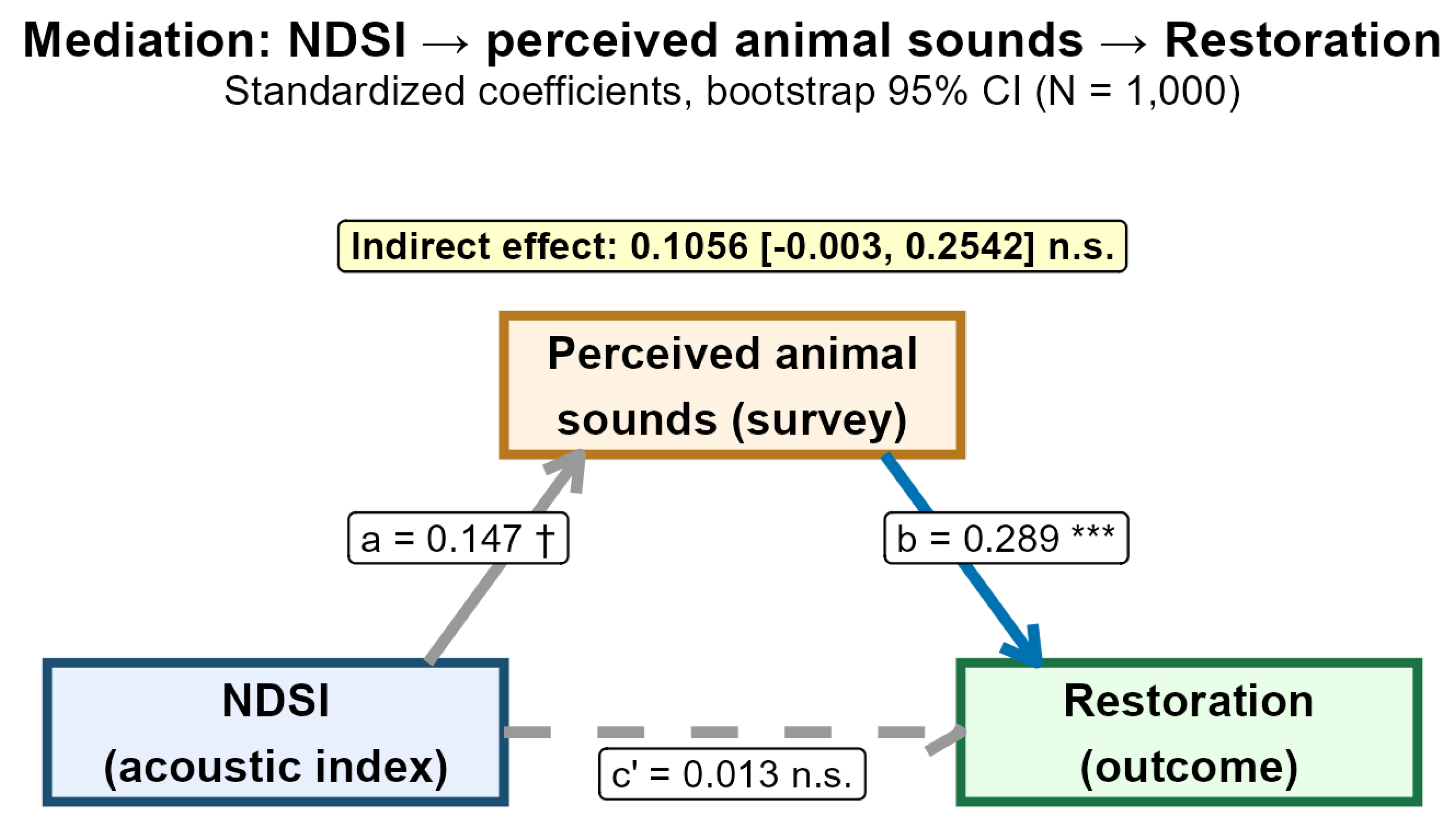
Mediation analysis (lavaan, bootstrap N = 1,000) revealed that 89% of the total NDSI effect on restoration operates indirectly through perceived animal sounds. The a-path (NDSI → perceived animal sounds) was significant (β = 0.147, p = 0.02), and the b-path (perceived animal sounds → restoration) was strongly significant (β = 0.278, p < 0.001). After controlling for perception, the direct NDSI effect was reduced to near zero and non-significant.
Suppression effects were observed for Clarity and Relaxation, where the indirect effect exceeded the total effect. Among the four outcomes, Attention showed the only individually significant indirect path (p = 0.035)(Figure 7).
Figure 7.
Mediation path diagram. Structural equation model with bootstrap mediation (1,000 replications, N = 195). Standardized coefficients shown. The indirect effect (a × b = 0.106) accounts for 89% of the total NDSI effect on Restoration. The direct effect c′ is negligible (0.013, n.s.). Arrow colors indicate significance: blue = p < 0.05, grey = n.s. Dagger (†) indicates p < 0.10.
Figure 7.
Mediation path diagram. Structural equation model with bootstrap mediation (1,000 replications, N = 195). Standardized coefficients shown. The indirect effect (a × b = 0.106) accounts for 89% of the total NDSI effect on Restoration. The direct effect c′ is negligible (0.013, n.s.). Arrow colors indicate significance: blue = p < 0.05, grey = n.s. Dagger (†) indicates p < 0.10.
Extending the analysis to NDSI temporal variability (standard deviation, minimum, range extracted from minute-level time series), we found that variability features ranked in the top 5 of random forest importance and that the mean × SD interaction improved GAMM fit for Attention (ΔAIC = −4.6) and Restoration (ΔAIC = −3.0). Critically, the mediation of NDSI variability (SD) through perceived animal sounds produced the first statistically significant indirect effect (β = 0.060, p = 0.016), suggesting that acoustic variability carries additional information beyond the mean (Figure 8).
Latent profile analysis identified two distinct visitor types: a ‘nature-sensitive’ group (n = 113, higher perceived biodiversity and animal sounds) and an ‘urban-oriented’ group (n = 83). Despite clear profile differences in perceptual variables, the NDSI–restoration slope was flat and non-significant in both groups, ruling out hidden subgroup effects (Figure 9).
Bayesian multilevel models with weakly informative priors placed 42–57% of the posterior distribution for the NDSI effect within the region of practical equivalence (ROPE ± 0.1 SD), indicating that the direct NDSI effect is most likely negligible (Figure 10). The effect was most likely positive for Attention (51% of the posterior above zero) and weakest for Clarity (42%).
In summary, five independent analytical approaches — random forests, GAMMs, mediation analysis, conditional inference trees, Bayesian estimation — converge on the same conclusion: the NDSI does not directly predict restoration outcomes. Instead, its effect operates indirectly through the subjective perception of natural sounds, with perceived animal sounds emerging as the central mediating variable. This pattern was robust across frequentist and Bayesian frameworks, and across both mean NDSI and its temporal variability. The only exception was the NDSI standard deviation, which produced a significant indirect mediation effect (p = 0.018), suggesting that acoustic variability may carry restorative information that visitors translate into perceived biodiversity.
4. Discussion
Our findings suggest that birdsong contributes – in the subjective perception – more reliably to emotional restoration (reduction of worries) than to cognitive clarity (clarification of thoughts). Across the full sample, over 60% agreed that they felt fascinated or more focused when hearing birdsong, and nearly 80% reported increased energy levels, indicating a strong overall restorative effect. These results align with the findings of Buxton et al. (2024), who showed that exposure to local green spaces reduces mental fatigue and enhances attentional capacity among urban residents.
These self-reported patterns are supported by multivariate modelling. In random forest analyses, perceived biodiversity and perceived animal sounds consistently emerged as the two most influential predictors (the variable importance analysis) of all four restoration composites, while the objective acoustic index (NDSI) contributed negligibly once perception variables were included (conditional permutation importance ≈ 0). Generalized additive mixed models confirmed significant positive effects of perceived animal sounds on all four outcomes (all p < 0.05), whereas the NDSI effect was non-significant throughout (all p > 0.19).
In this context it was interesting how participants perceived their environment, which observations of birds they make to contrast it with the fascination levels of birdsong as well as impacts on subjective mental health. In terms of bird species recognition, most respondents were only able to identify a few bird species, or none at all. Our findings suggest that although restorative benefits of the soundscape were clearly reported, recognition of biological sounds remained limited. This disconnect could be a consequence of anthropogenic noise. Although natural sounds contribute to perceived well-being, they may be masked by urban noise, meaning people may not consciously identify them, which is again consistent with findings of Uebel et al. (2021).
Findings by Buxton et al. (2023) suggest that increased species diversity may benefit mental health directly by providing a more peaceful environment that supports mental restoration, and indirectly by promoting physical exercise, which can have a profound effect on mental health.
Our study revealed differences in the perceived habitat quality for wild species of the locations. Locations 1 and 2 were perceived as both greener and richer in animal species, whereas location 4, despite a visually green landscape, was perceived as a habitat for fewer animal species, possibly due to its proximity to infrastructure and the prevalence of anthropogenic noise. The multivariate analyses suggest that location-specific differences in restoration are not directly attributable to the objective acoustic environment (NDSI). Rather, locations where participants perceived greater biodiversity and more animal sounds showed higher restoration scores, regardless of the measured NDSI value. This implies that the restorative quality of a soundscape is primarily determined by visitors’ subjective perception, not by the physical sound composition alone.
The research results showed that both men and women as well as all five age groups of respondents have been exposed to the same anthropogenic and biological sounds, as indicated by the number of perceived sounds and NDSI at each location. Therefore, the sample had no inequalities in this sense. Gender differences in the first descriptive analysis revealed a more positive tendency for women in the perception of bird song. The descriptive results indicated that women were slightly more likely to experience fascination and attention restoration, while men reported slightly higher increase in energy, a more in-depth analysis does not support this tendency as significant. These descriptive gender tendencies, did not reach statistical significance when examined at the composite level (Mann–Whitney, all p > 0.20, r = 0.04–0.09). In the random forest analyses, gender consistently ranked lowest in variable importance. This result is consistent with the findings of Hammoud et al. (2022), who reported no demographic moderation of birdsong benefits. Interestingly, partly confirm findings of Chen and von Haaren (2025), who reported that females tend to be more sensitive to unpleasant sounds but also demonstrate a more positive perception of green spaces and natural sounds compared to males overall. However, these perceptions varied depending on the dominant species of bird.
Age differences revealed that fascination with birdsong is strongest in the youngest group (17–25 years), whereas concentration benefits were reported most strongly in the 46–55 age group. Interestingly, older adults (>55) rarely reported negative effects and tended to experience at least moderate positive responses. Consistent with the findings related to fascination levels, younger individuals tended to report stronger positive effects from birdsong overall in this category as well. The 26–35 age group was particularly polarized, with both the highest percentage reporting no effect and the highest reporting a very strong effect, indicating individual variability in how birdsong is perceived. Younger individuals perceived stronger restorative influences of the soundscape across all categories compared to older participants, suggesting a decrease in sensitivity to environmental sounds with age.
However, when applying Bonferroni correction for multiple pairwise comparisons, only the contrasts between the youngest (≤25) and oldest (>55) age groups for auditory escape (p = 0.004) and emotional rejuvenation (p = 0.008) remained significant — both within the Relaxation subscale. At the composite level, only Relaxation showed a significant age effect (H = 14.1, p = 0.007), suggesting that the apparent age sensitivity is concentrated in one specific restorative dimension. Moreover, mediation analysis indicates that these age differences are partially explained by younger participants’ greater attentiveness to natural sounds: when perception variables were included as covariates, independent age effects disappeared entirely, consistent with the central role of subjective perception.
Perhaps the most consequential finding for urban soundscape design concerns the role of the NDSI as an objective acoustic indicator, which continues research, such as Lawrence et al. (2023), which examined associations between acoustic metrics and standardized soundscape perception measures. Mediation analysis revealed that 89% of the total NDSI effect on overall restoration operates indirectly through perceived animal sounds (see mediation analysis); the direct NDSI effect was reduced to near zero after controlling for subjective perception. Bayesian estimation placed 42–57% of the posterior NDSI effect within the region of practical equivalence, confirming a most likely negligible direct contribution. When extending the analysis to NDSI temporal variability, the standard deviation produced the first statistically significant indirect effect through perceived animal sounds (p = 0.016). Although a full spectral decomposition of the NDSI into its biophonic and anthropophonics frequency components was beyond the scope of this study, the variability analysis indicates that temporal dynamics of the acoustic environment carry restorative information beyond average values. Future research could explore whether specific frequency bands or identified sound source types (e.g., using automated classifiers such as BirdNET or Perch) differentially contribute to this variability signal. These converging results from five independent analytical approaches — random forests, GAMMs, mediation, conditional inference trees, Bayesian models — consistently indicate that subjective perception of the soundscape, rather than its objective acoustic composition, is the primary driver of restoration outcomes (the Bayesian posterior estimation). Interventions should therefore not focus solely on improving NDSI values but also on facilitating visitors’ awareness of the natural sounds already present. In this context, the connectedness to nature (Mayer & Frantz, 2004) could be a highly relevant influence factor to explore more in-depth.
In addition, the differential impact of specific anthropogenic sound types (e.g., airplane noise) on mental restoration warrants further investigation. While our study treated perceived human sounds as a single category — which showed a consistent negative tendency across outcomes (GAMM: p = 0.041 for Clarity; Bayesian posterior consistently negative) — Chen and von Haaren’s (2025) laboratory findings suggest that heterogeneous urban sounds (e.g., traffic, construction, social noise) may have distinct effects on restoration that merit field-based examination.
5. Conclusion and Outlook
It has been demonstrated that natural noises, particularly avian sounds, have the capacity to reduce psychological distress, such as tension, anxiety, and agitation, while concomitantly facilitating emotional restoration. Our study built on laboratory research, which has primarily examined how public responses to birdsongs differ from those to other biological, artificial, or mechanical sounds. The present study built upon this experiment by conducting a questionnaire survey in a non-laboratory outdoor setting within a larger Viennese recreational area, accompanied by soundscape analysis. The findings our research demonstrate that birdsong promotes more effectively emotional restoration than cognitive clarity.
A more thorough investigation has confirmed the negligible impact of demographic variables, such as age and gender, on the study’s outcomes. However, the investigation did reveal the intriguing significance of individuals’ beliefs regarding the presence of animals in the designated recreational area. The utilisation of advanced statistical methods, including random forests, generalised additive models (GAMs), mediation, conditional inference trees, Bayesian models, has demonstrated that restoration outcomes are primarily shaped not by the objective acoustic environment, but by how visitors perceive it. The pivotal factor is the way visitors perceive and interpret the auditory environment. It is therefore recommended that interventions not be exclusively oriented towards the enhancement of NDSI values; rather, there should be an emphasis on the promotion of visitors’ cognisance of the prevailing natural sounds as well as their sound experiences made before the visit.
Supplementary Materials
The following supporting information can be downloaded at the website of this paper posted on Preprints.org.
References
- Alcocer, I.; Lima, H.; Sugai, L. S. M.; Llusia, D. Acoustic indices as proxies for biodiversity: a meta-analysis. Biological Reviews/Biological Reviews of the Cambridge Philosophical Society 2022, 97(6), 2209–2236. [Google Scholar] [CrossRef]
- Aletta, F.; Oberman, T.; Kang, J. Associations between Positive Health-Related Effects and Soundscapes Perceptual Constructs: A Systematic Review. International Journal of Environmental Research and Public Health 2018, 15(11), 2392. [Google Scholar] [CrossRef] [PubMed]
- Atemasov, A.; Atemasova, T. A soundscape assessment of the oak forests in the national Park “Homilshanski Lisy” (Northeastern Ukraine). Ochrana PríRody Slovenska/EkolóGia 2023, 42(1), 55–63. [Google Scholar] [CrossRef]
- Arzberger, S.; Fairbairn, A.; Hemauer, M.; Mühlbauer, M.; Weissmann, J.; Egerer, M. The potential of soundscapes as an ecosystem monitoring tool for urban biodiversity. Journal of Urban Ecology 2025, 11(1). [Google Scholar] [CrossRef]
- Baron, R. M.; Kenny, D. A. The moderator-mediator variable distinction in social psychological research: Conceptual, strategic, and statistical considerations. Journal of Personality and Social Psychology 1986, 51(6), 1173–1182. [Google Scholar] [CrossRef]
- Benocci, R.; Brambilla, G.; Bisceglie, A.; Zambon, G. Sound ecology indicators applied to urban parks: A preliminary study. Asia-Pacific Journal of Science and Technology 2020, 25(4), Article APST-25-04-10. Available online: https://www.tci-thaijo.org/index.php/APST/article/view/241936.
- Beute, F.; Marselle, M. R.; Olszewska-Guizzo, A.; Andreucci, M. B.; Lammel, A.; Davies, Z. G.; Glanville, J.; Keune, H.; O’Brien, L.; Remmen, R.; Russo, A.; De Vries, S. How do different types and characteristics of green space impact mental health? A scoping review. People and Nature 2023, 5(6), 1839–1876. [Google Scholar] [CrossRef]
- Bi, Y.; Wang, Y.; Yang, D.; Mao, J.; Wei, Q. Urban green spaces and resident health: an empirical analysis from data across 30 provinces in China. Frontiers in Public Health 2024, 12. [Google Scholar] [CrossRef]
- Bian, Q.; Zhang, C.; Wang, C.; Yin, L.; Han, W.; Zhang, S. Evaluation of soundscape perception in urban forests using acoustic indices: a case study in Beijing. Forests 2023, 14(7), 1435. [Google Scholar] [CrossRef]
- Breiman, L. Random Forests. Machine Learning 2001, 45(1), 5–32. [Google Scholar] [CrossRef]
- Bürkner, P.-C. brms: An R Package for Bayesian Multilevel Models Using Stan. Journal of Statistical Software 2017, 80(1), 1–28. [Google Scholar] [CrossRef]
- Buxton, R. T.; Pearson, A. L.; Lin, H.; Sanciangco, J. C.; Bennett, J. R. Exploring the relationship between bird diversity and anxiety and mood disorder hospitalisation rates. Geo Geography and Environment 2023, 10(2). [Google Scholar] [CrossRef]
- Buxton, R. T.; Hudgins, E. J.; Lavigne, E.; Villeneuve, P. J.; Prince, S. A.; Pearson, A. L.; Halsall, T.; Robichaud, C.; Bennett, J. R. Mental health is positively associated with biodiversity in Canadian cities. Communications Earth & Environment 2024, 5(1), 310. [Google Scholar] [CrossRef] [PubMed]
- Chen, Z.; Von Haaren, C. Urban dwellers’ perceptions of soundscapes and landscapes: Impacts of birdsongs and noises, and moderation by demographic characteristics. Urban Forestry & Urban Greening 2025, 128838. [Google Scholar] [CrossRef]
- D’Alessandro, D.; Buffoli, M.; Capasso, L.; Fara, G. M.; Rebecchi, A.; Capolongo, S. Green areas and public health: improving wellbeing and physical activity in the urban context. Epidemiol Prev 2015, 39((4) Suppl 1, 8–13. Available online: https://pubmed.ncbi.nlm.nih.gov/26499409.
- Devos, P. Soundecology indicators applied to urban soundscapes; Proceedings of the 45th International Congress and Exposition on Noise Control Engineering, 2016; pp. 177–184. Available online: https://biblio.ugent.be/publication/8157555/file/8157562.pdf.
- Erholungsgebiet Laaer Wald - Lage und Angebote. 1 February 2017. Available online: https://www.wien.gv.at/umwelt/wald/erholung/laaerwald.html.
- Hammoud, R.; Tognin, S.; Burgess, L.; Bergou, N.; Smythe, M.; Gibbons, J.; Davidson, N.; Afifi, A.; Bakolis, I.; Mechelli, A. Smartphone-based ecological momentary assessment reveals mental health benefits of birdlife. Scientific Reports 2022, 12(1). [Google Scholar] [CrossRef]
- Hill, A. P.; Prince, P.; Snaddon, J. L.; Doncaster, C. P.; Rogers, A. AudioMoth: A low-cost acoustic device for monitoring biodiversity and the environment. HardwareX 2019, 6, e00073. [Google Scholar] [CrossRef]
- Hou, Y.; Yu, X.; Yang, J.; Ouyang, X.; Fan, D. Acoustic Sensor-Based soundscape analysis and acoustic assessment of bird species richness in Shennongjia National Park, China. Sensors 2022, 22(11), 4117. [Google Scholar] [CrossRef]
- Kahl, S.; Wood, C. M.; Eibl, M.; Klinck, H. BirdNET: A deep learning solution for avian diversity monitoring. Ecological Informatics 2021, 61, 101236. [Google Scholar] [CrossRef]
- Latifi, M.; Fakheran, S.; Moshtaghie, M.; Ranaie, M.; Tussi, P. M. Soundscape analysis using eco-acoustic indices for the birds biodiversity assessment in urban parks (case study: Isfahan City, Iran). Environmental Monitoring and Assessment 2023, 195(6). [Google Scholar] [CrossRef]
- Lawrence, B. T.; Hornberg, J.; Schröer, K.; Djeudeu, D.; Haselhoff, T.; Ahmed, S.; Moebus, S.; Gruehn, D. Linking ecoacoustic indices to psychoacoustic perception of the urban acoustic environment. Ecological Indicators 2023, 155. [Google Scholar] [CrossRef]
- Ma, H.; Shu, S. An experimental study: The restorative effect of soundscape elements in a simulated Open-Plan office. Acta Acustica United With Acustica 2018b, 104(1), 106–115. [Google Scholar] [CrossRef]
- MacKinnon, D. P.; Krull, J. L.; Lockwood, C. M. Equivalence of the mediation, confounding and suppression effect. Prevention Science 2000, 1(4), 173–181. [Google Scholar] [CrossRef] [PubMed]
- Manzano-Rubio, R.; Bota, G.; Brotons, L.; Soto-Largo, E.; Pérez-Granados, C. Low-cost open-source recorders and ready-to-use machine learning approaches provide effective monitoring of threatened species. Ecological Informatics 2022, 72, 101910. [Google Scholar] [CrossRef]
- Mayer, F. S.; Frantz, C. M. P. The connectedness to nature scale: A measure of individuals’ feeling in community with nature. Journal of Environmental Psychology 2004, 24(4), 503–515. [Google Scholar] [CrossRef]
- Methorst, J. Positive relationship between bird diversity and human mental health: An analysis of repeated cross-sectional data. The Lancet Planetary Health 2024, 8, e285–e296. Available online: https://www.thelancet.com/planetary-health. [CrossRef]
- Nikles, G. Wien - Laaer Wald. n.d. Available online: https://www.austriasites.com/vienna/bezirk10_laaer_wald.htm.
- Pijanowski, B. C.; Villanueva-Rivera, L. J.; Dumyahn, S. L.; Farina, A.; Krause, B. L.; Napoletano, B. M.; Gage, S. H.; Pieretti, N. Soundscape Ecology: The science of sound in the landscape. BioScience 2011, 61(3), 203–216. [Google Scholar] [CrossRef]
- R Core Team. R: A Language and Environment for Statistical Computing. R Foundation for Statistical Computing, Vienna, Austria; 2024. Available online: https://www.R-project.org/.
- Ratcliffe, E. Sound and soundscape in restorative natural environments: A narrative literature review. Frontiers in Psychology 2021, 12, 570563. [Google Scholar] [CrossRef]
- Rosseel, Y. lavaan: An R Package for Structural Equation Modeling. Journal of Statistical Software 2012, 48(2), 1–36. [Google Scholar] [CrossRef]
- Stangierska-Mazurkiewicz, D.; Fornal-Pieniak, B.; Szumigała, P.; Widera, K.; Żarska, B.; Szumigała, K. Green space attributes and their impact on perceived stress in Poland. Scientific Reports 2025, 15(1). [Google Scholar] [CrossRef] [PubMed]
- Strobl, C.; Boulesteix, A.-L.; Kneib, T.; Augustin, T.; Zeileis, A. Conditional variable importance for random forests. BMC Bioinformatics 2008, 9, 307. [Google Scholar] [CrossRef]
- Suko, Y.; Saito, K.; Takayama, N.; Warisawa, S.; Sakuma, T. Effect of faint road traffic noise mixed in birdsong on the perceived restorativeness and listeners’ physiological response: an exploratory study. International Journal of Environmental Research and Public Health 2019, 16(24), 4985. [Google Scholar] [CrossRef]
- Taczanowska, K.; Tansil, D.; Wilfer, J.; Jiricka-Pürrer, A. The impact of age on people’s use and perception of urban green spaces and their effect on personal health and wellbeing during the COVID-19 pandemic—A case study of the metropolitan area of Vienna, Austria. Cities 2024, 104798. [Google Scholar] [CrossRef]
- Uebel, K.; Marselle, M.; Dean, A. J.; Rhodes, J. R.; Bonn, A. Urban green space soundscapes and their perceived restorativeness. People and Nature 2021, 3(3), 756–769. [Google Scholar] [CrossRef]
- Wood, S. N. Generalized Additive Models: An Introduction with R, 2nd ed.; Chapman and Hall/CRC, 2017. [Google Scholar] [CrossRef]
- Wu, C.; O’Keefe, J.; Ding, Y.; Sullivan, W. C. Biodiversity of urban green spaces and human health: a systematic review of recent research. Frontiers in Ecology and Evolution 2024, 12. [Google Scholar] [CrossRef]
- Yi, K.; Zhang, J.; Zhang, Z.; Shi, X.; Du, W.; Yang, L.; Wei, M. Differences in public perceptions of recovery in different urban forests based on Birdsong. Forests 2024, 15(12), 2217. [Google Scholar] [CrossRef]
Figure 1.
Map with the research locations within the study area. Basemap: © OpenStreetMap contributors (openstreetmap.org/copyright).
Figure 1.
Map with the research locations within the study area. Basemap: © OpenStreetMap contributors (openstreetmap.org/copyright).
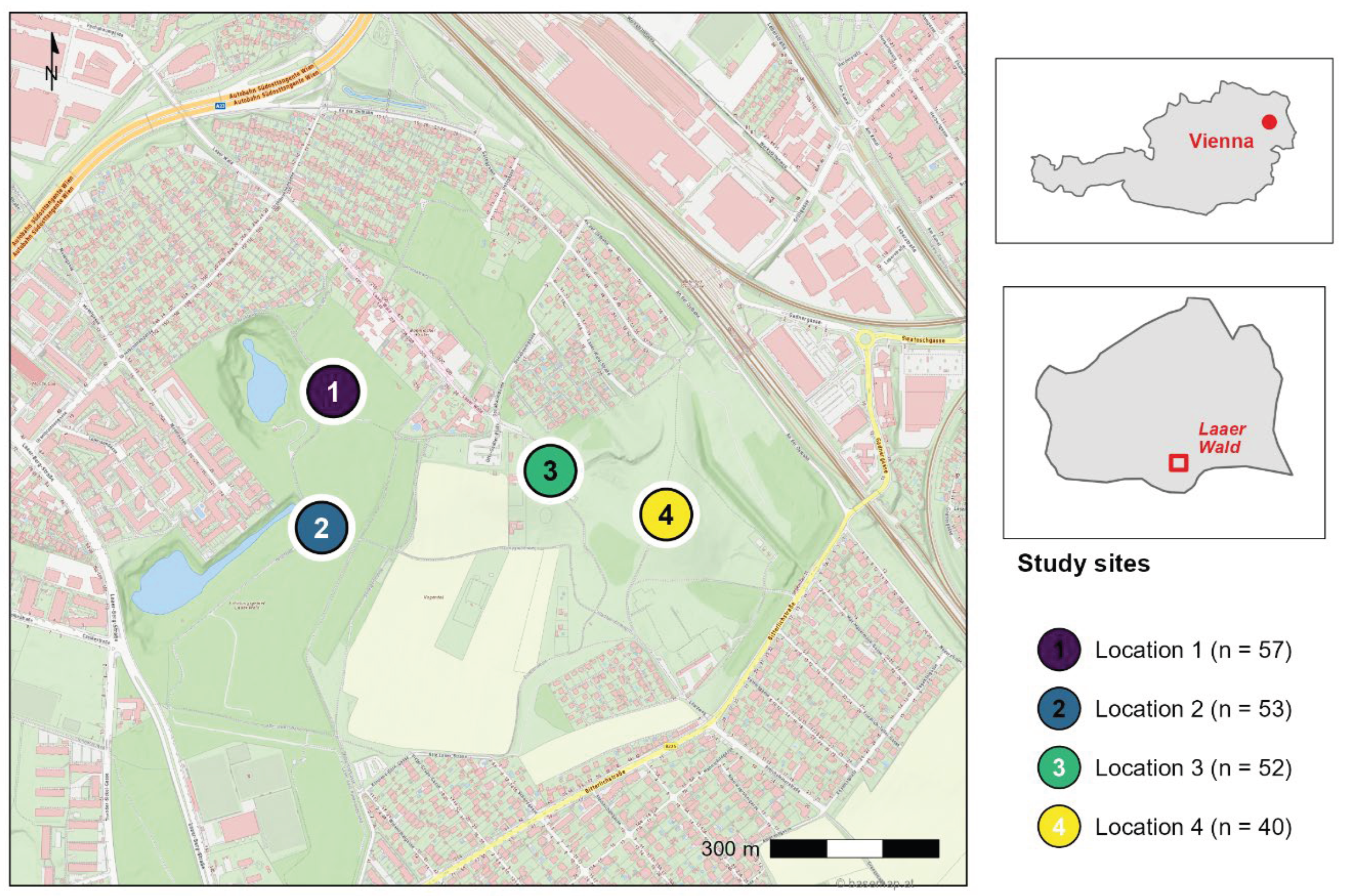
Figure 2.
Recognition of bird species in relation to the area of upbringing.
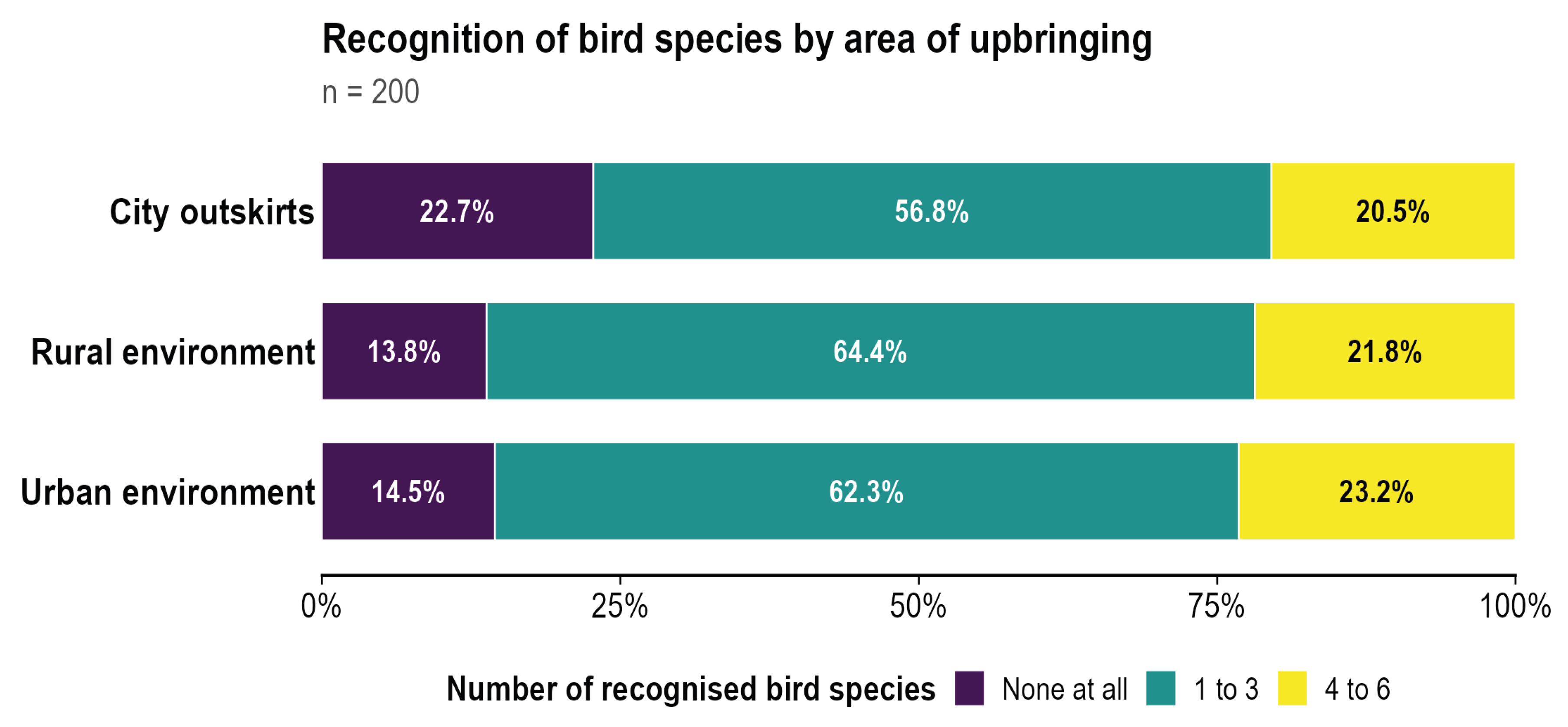
Figure 3.
Descriptive overview. Distribution of (A) the Restoration composite score (mean of 8 items, scale 1–4) and (B) the Normalized Difference Soundscape Index (NDSI, 10-min mean) across four study locations in the Laaerwald, Vienna (N = 195). Boxes show interquartile range with median; whiskers extend to 1.5× IQR; points show individual observations.
Figure 3.
Descriptive overview. Distribution of (A) the Restoration composite score (mean of 8 items, scale 1–4) and (B) the Normalized Difference Soundscape Index (NDSI, 10-min mean) across four study locations in the Laaerwald, Vienna (N = 195). Boxes show interquartile range with median; whiskers extend to 1.5× IQR; points show individual observations.
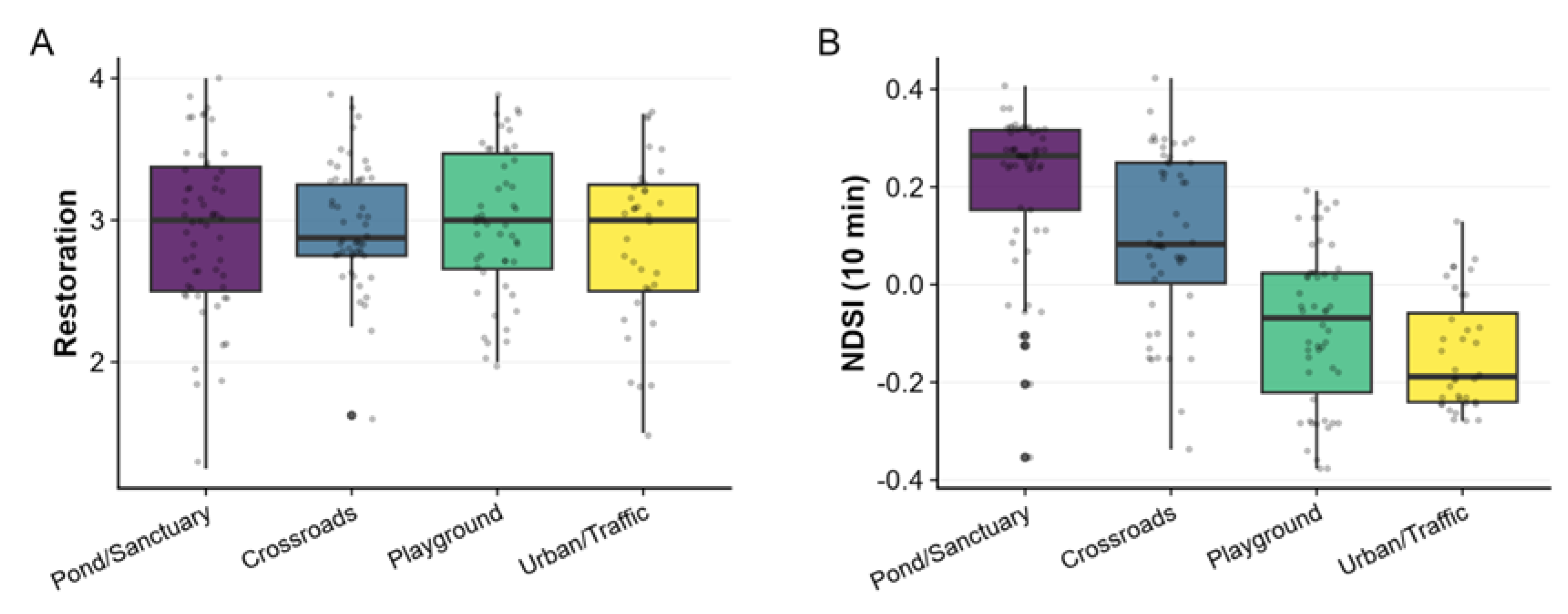
Figure 4.
Random Forest variable importance. Permutation importance from Random Forest models (ranger, 500 trees, 10-fold cross-validation × 5 repeats) for four restoration outcomes (N = 192). Perceived biodiversity consistently ranks highest. NDSI ranks 5th–7th with marginal importance. Red bars indicate negative importance (worse than random chance).
Figure 4.
Random Forest variable importance. Permutation importance from Random Forest models (ranger, 500 trees, 10-fold cross-validation × 5 repeats) for four restoration outcomes (N = 192). Perceived biodiversity consistently ranks highest. NDSI ranks 5th–7th with marginal importance. Red bars indicate negative importance (worse than random chance).
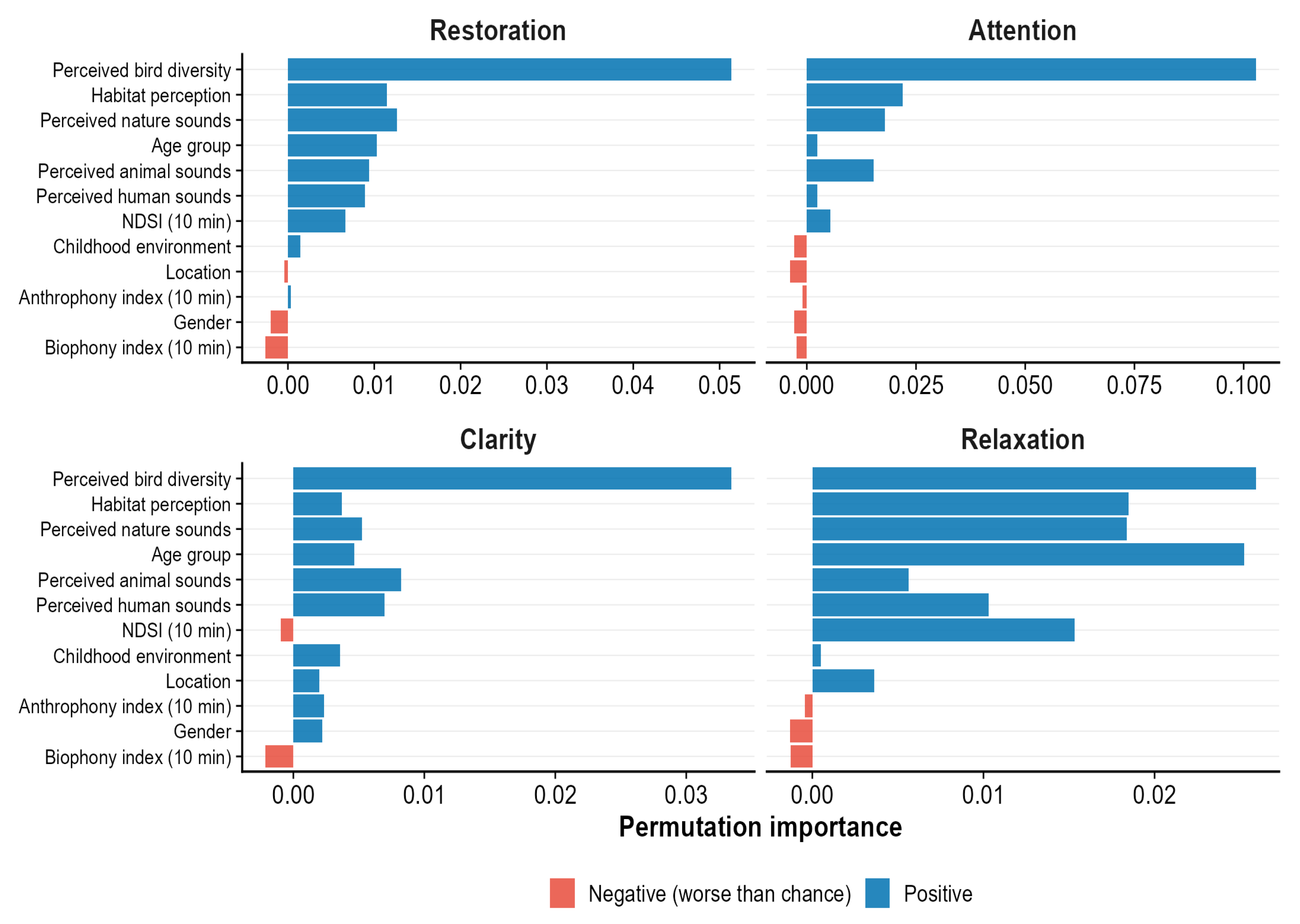
Figure 5.
GAMM smooth effects. Non-linear NDSI smooth effects s(NDSI_10) from generalized additive mixed model M6 on three restoration subscales (N = 195), adjusted for perceived animal sounds, perceived human sounds, and location (fixed effect) with date as random intercept. Grey bands show 95% confidence intervals. The NDSI effect is non-significant for all subscales (Attention: p = 0.115; Clarity: p = 0.549; Relaxation: p = 0.211).
Figure 5.
GAMM smooth effects. Non-linear NDSI smooth effects s(NDSI_10) from generalized additive mixed model M6 on three restoration subscales (N = 195), adjusted for perceived animal sounds, perceived human sounds, and location (fixed effect) with date as random intercept. Grey bands show 95% confidence intervals. The NDSI effect is non-significant for all subscales (Attention: p = 0.115; Clarity: p = 0.549; Relaxation: p = 0.211).
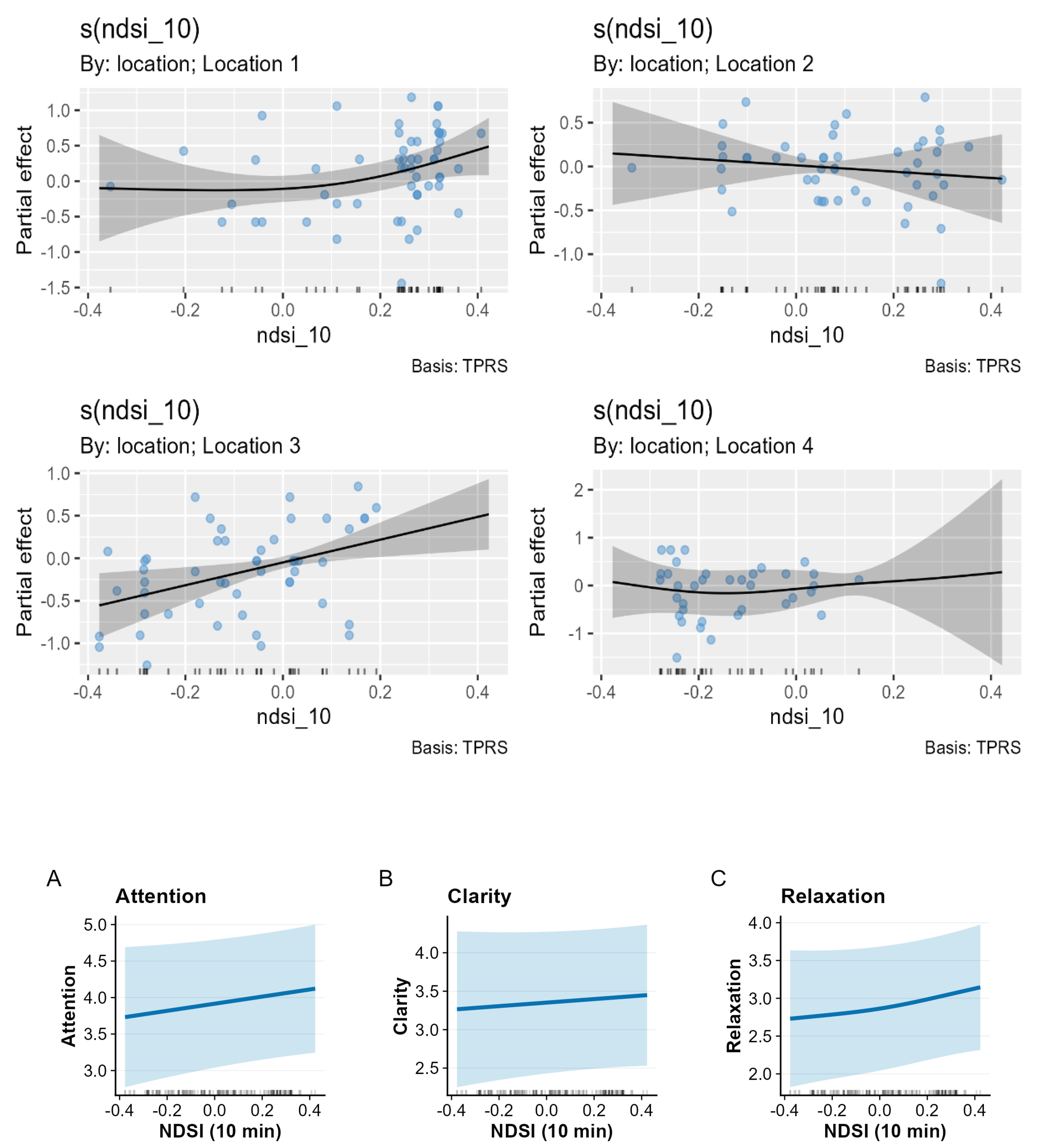
Figure 6.
Conditional inference tree. Conditional inference tree (ctree, α = 0.05, minimum bucket = 15) for Restoration using all 25 available predictors (N = 192). The algorithm exclusively selects perceptual variables as split criteria: perceived bird diversity (p < 0.001) and habitat perception (p = 0.002). NDSI was never selected. Terminal boxplots show Restoration distributions; diamonds indicate group means.
Figure 6.
Conditional inference tree. Conditional inference tree (ctree, α = 0.05, minimum bucket = 15) for Restoration using all 25 available predictors (N = 192). The algorithm exclusively selects perceptual variables as split criteria: perceived bird diversity (p < 0.001) and habitat perception (p = 0.002). NDSI was never selected. Terminal boxplots show Restoration distributions; diamonds indicate group means.
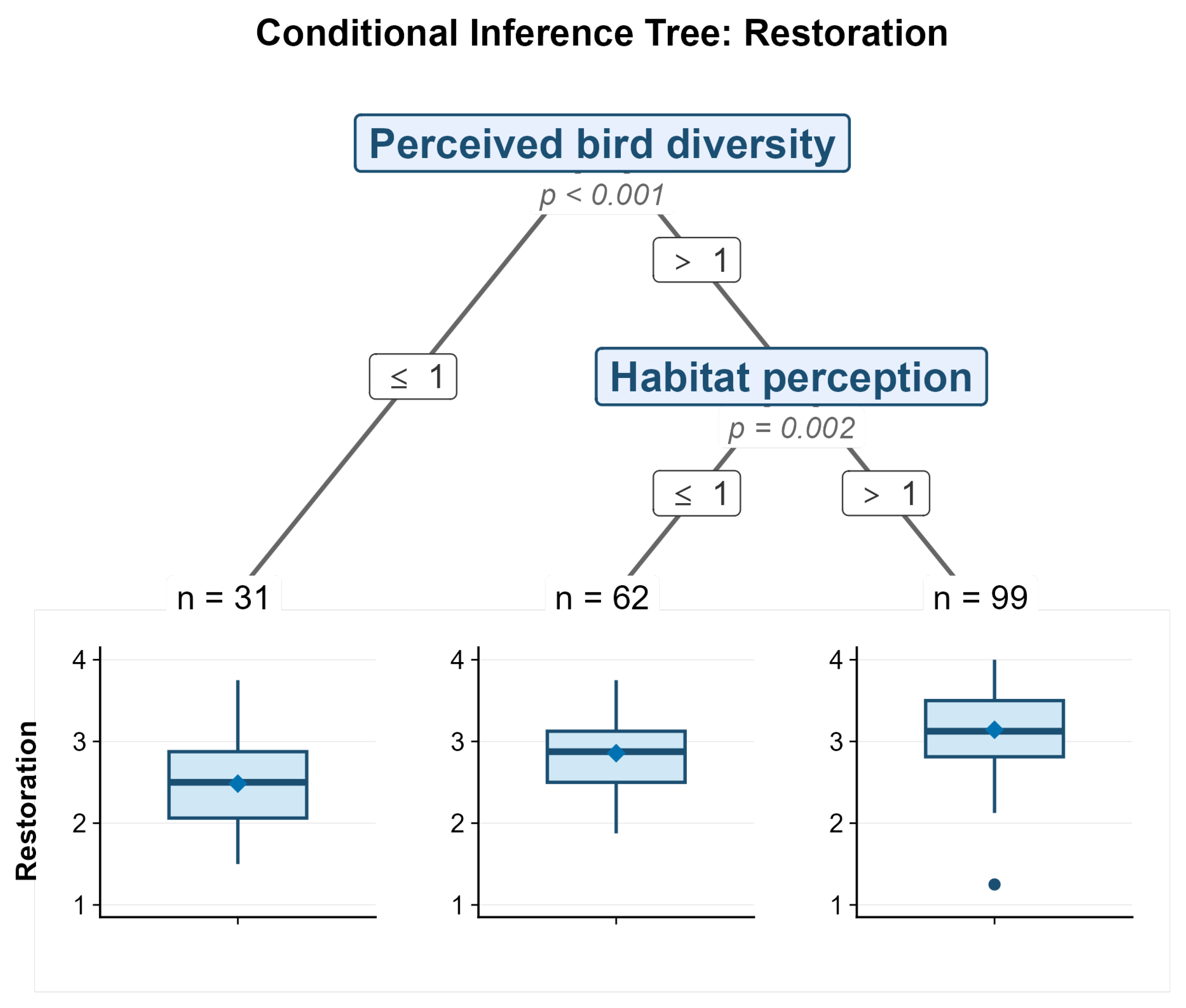
Figure 8.
NDSI temporal variability. Top: Distribution of NDSI variability features (SD, minimum, range, dip count, maximum drop) across study locations, derived from 30-min AudioMoth recordings at 1-min resolution (N = 197). Bottom: NDSI standard deviation vs. four restoration outcomes with LOESS smooths. The mediation NDSI-SD → perceived animal sounds → Restoration yields the first significant indirect effect (β = 0.26, p = 0.016, 95% CI [0.06, 0.45]).
Figure 8.
NDSI temporal variability. Top: Distribution of NDSI variability features (SD, minimum, range, dip count, maximum drop) across study locations, derived from 30-min AudioMoth recordings at 1-min resolution (N = 197). Bottom: NDSI standard deviation vs. four restoration outcomes with LOESS smooths. The mediation NDSI-SD → perceived animal sounds → Restoration yields the first significant indirect effect (β = 0.26, p = 0.016, 95% CI [0.06, 0.45]).
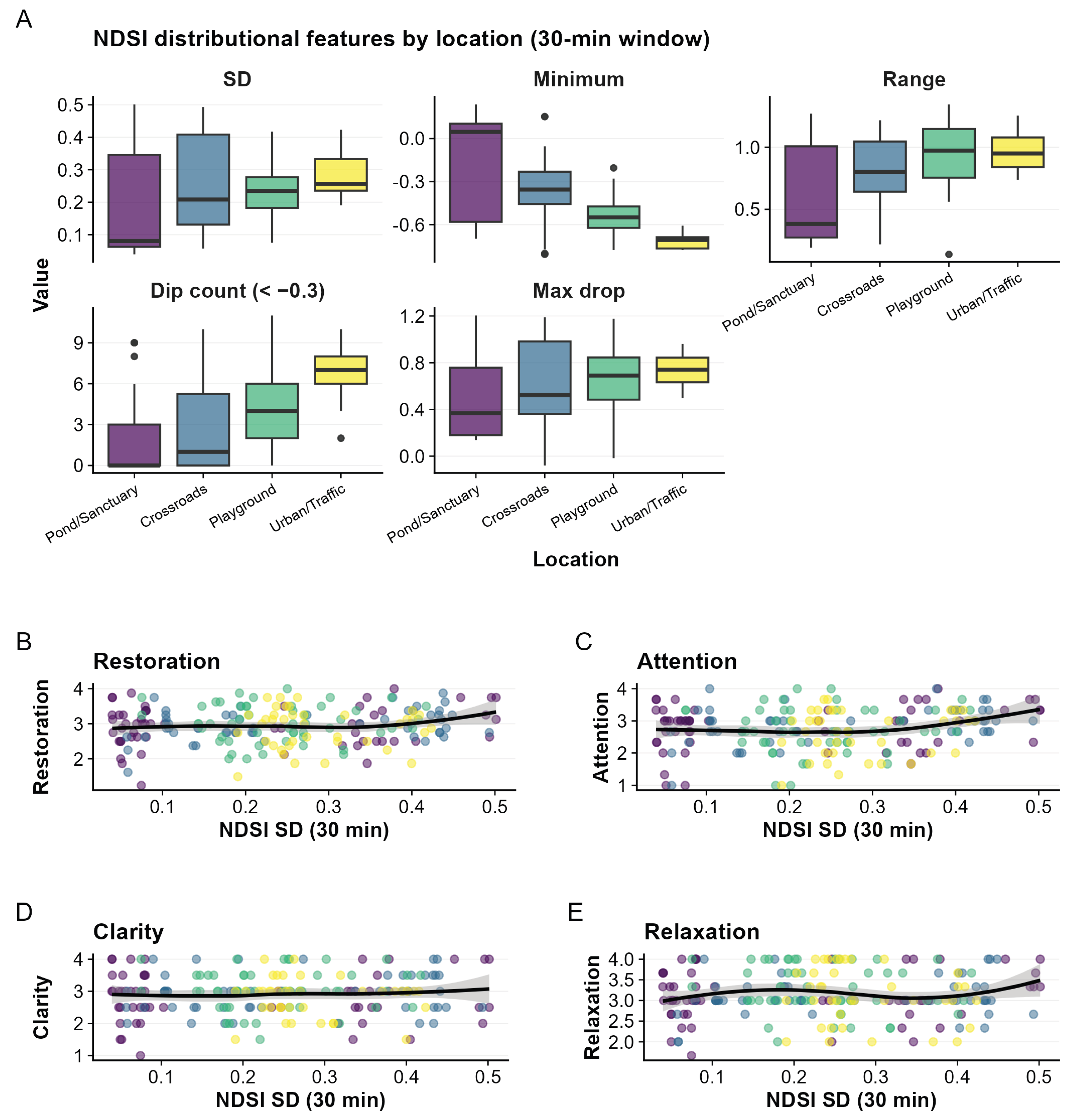
Figure 9.
Latent Profile Analysis. Two-profile solution from Gaussian mixture models (mclust, N = 196). (A) Profile characteristics across perceptual variables. (B) Restoration outcomes by profile (boxplots). (C) NDSI–Restoration relationship by profile, showing parallel slopes — no differential NDSI sensitivity. (D) BIC model comparison (k = 1–6); red diamond marks optimal k = 2.
Figure 9.
Latent Profile Analysis. Two-profile solution from Gaussian mixture models (mclust, N = 196). (A) Profile characteristics across perceptual variables. (B) Restoration outcomes by profile (boxplots). (C) NDSI–Restoration relationship by profile, showing parallel slopes — no differential NDSI sensitivity. (D) BIC model comparison (k = 1–6); red diamond marks optimal k = 2.
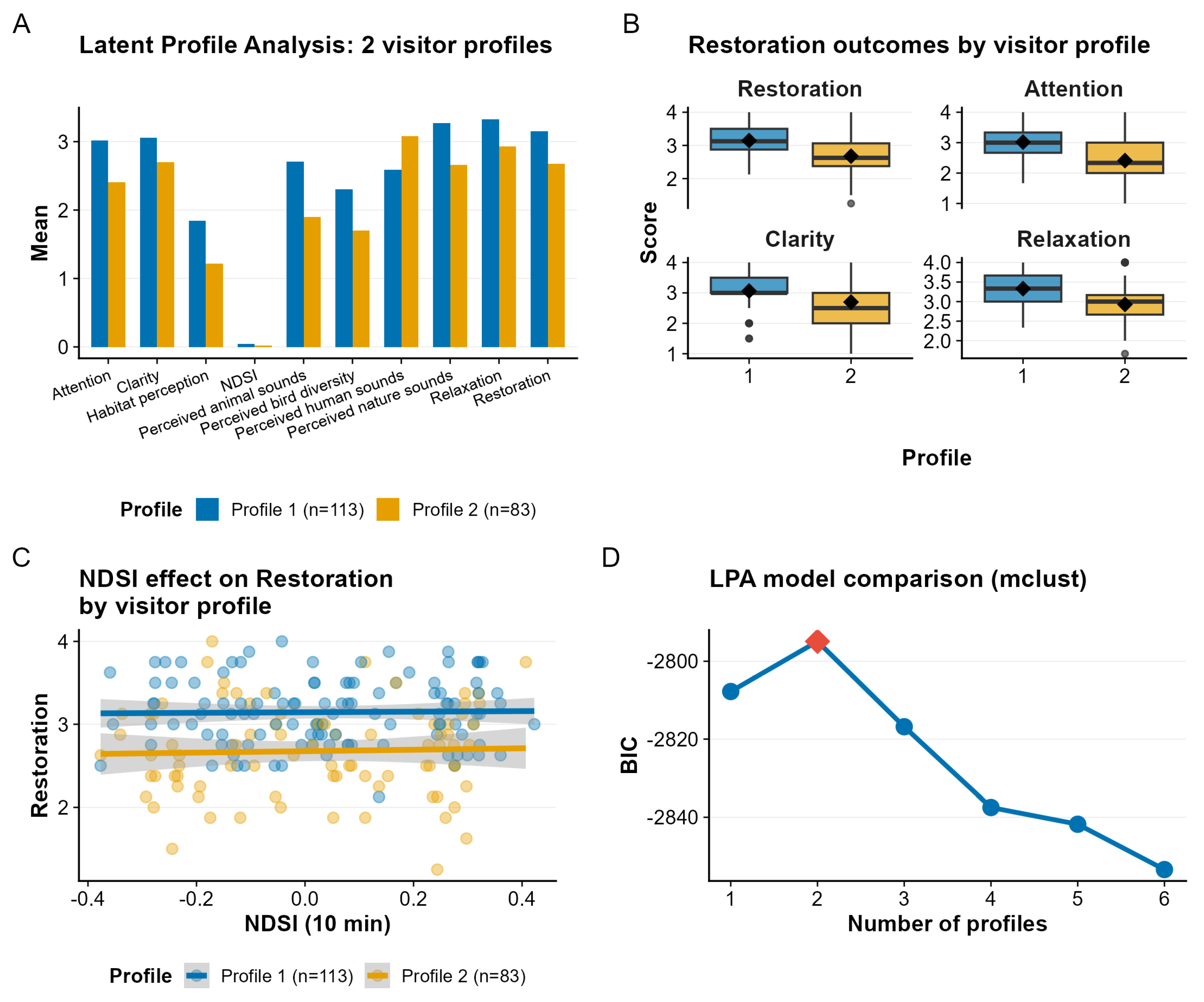
Figure 10.
Bayesian effect comparison. Posterior medians with 95% credible intervals from Bayesian multilevel models (brms, 4 chains × 4,000 iterations, weakly informative student-t prior) for three predictors across four outcomes. Perceived animal sounds: consistently positive, CrI excludes zero. Perceived human sounds: consistently negative. NDSI: small effects, CrI overlaps zero for all outcomes.
Figure 10.
Bayesian effect comparison. Posterior medians with 95% credible intervals from Bayesian multilevel models (brms, 4 chains × 4,000 iterations, weakly informative student-t prior) for three predictors across four outcomes. Perceived animal sounds: consistently positive, CrI excludes zero. Perceived human sounds: consistently negative. NDSI: small effects, CrI overlaps zero for all outcomes.
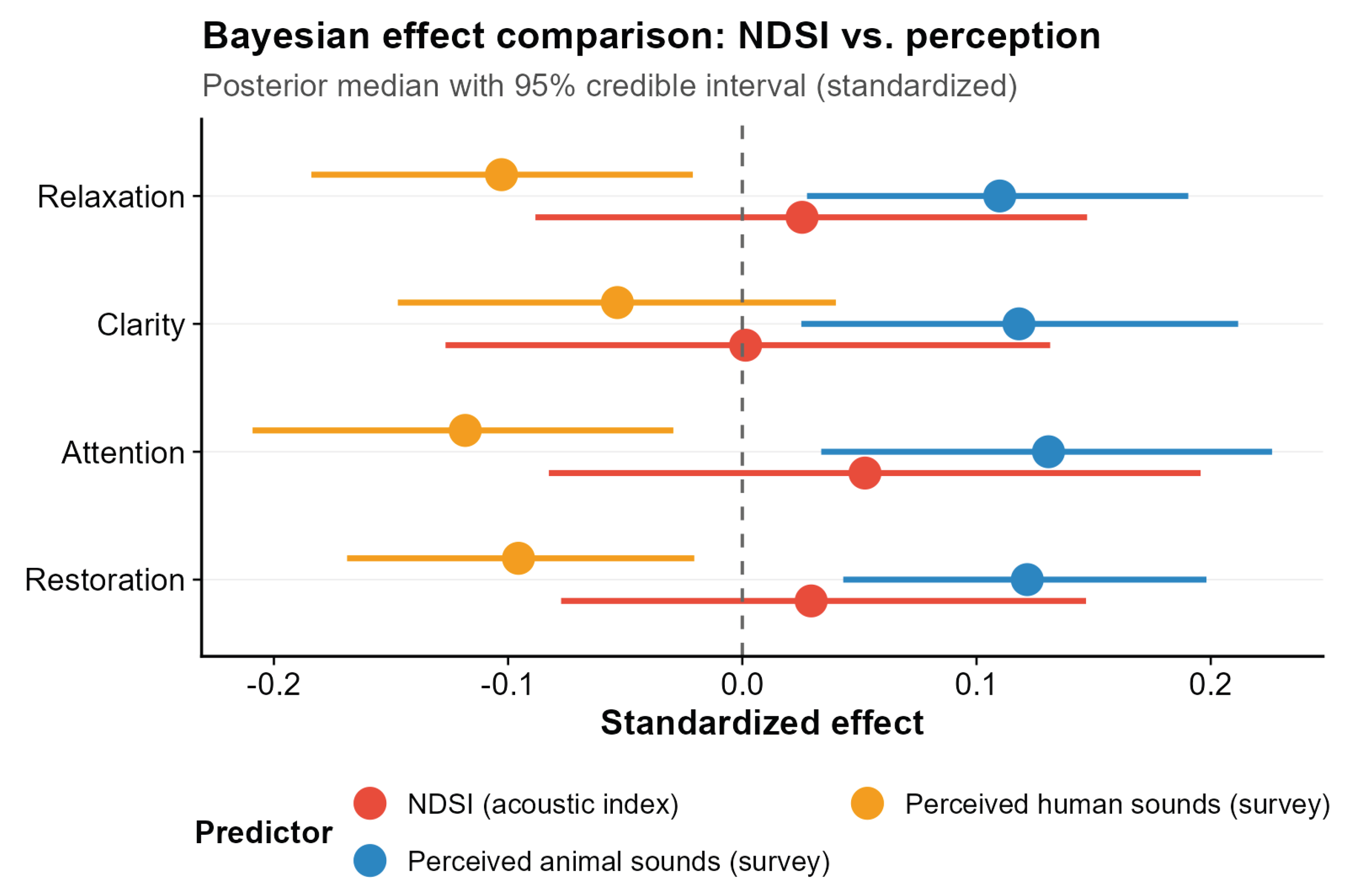

Table 1.
Total sample distribution of survey respondents by age group and gender.
| Age groups (years) | Frequency (n) | Percentage (%) |
|---|---|---|
|
17-25 26-35 36-45 46-55 >55 Total |
31 67 48 31 25 202 |
15.3 33.2 23.8 15.3 12.4 100 |
|
Gender Male Female Diverse |
88 112 2 |
43.6 55.4 0.10 |
|
Place of upbringing Rural environment |
87 |
43.5 |
|
Urban environment City outskirts |
69 44 |
34.2 22.0 |
Table 2.
Sample distribution by location, gender, and age group (N = 202).
| Location 1 | Location 2 | Location 3 | Location 4 | Total | |
|---|---|---|---|---|---|
| Gender | |||||
| Male | 30 | 19 | 23 | 16 | 88 |
| Female | 27 | 34 | 29 | 22 | 112 |
| Diverse | – | – | – | 2 | 2 |
| Age group | |||||
| 17–25 | 8 | 5 | 6 | 12 | 31 |
| 26–35 | 15 | 22 | 18 | 12 | 67 |
| 36–45 | 15 | 11 | 17 | 5 | 48 |
| 46–55 | 11 | 7 | 8 | 5 | 31 |
| >55 | 8 | 8 | 3 | 6 | 25 |
| Total | 57 | 53 | 52 | 40 | 202 |
Table 3.
Results of the Kruskal Wallis test exploring whether respondents of different age have been exposed to the same anthropogenic and biological sounds.
Table 3.
Results of the Kruskal Wallis test exploring whether respondents of different age have been exposed to the same anthropogenic and biological sounds.
| Type | Indicator | H | Asymp. Sig. (2-tailed) |
Conclusion |
|---|---|---|---|---|
| Anthropogenic | Number of anthropogenic sounds heard 30 min before | 3.321 | 0.506 | Accept null hypothesis |
| Number of anthropogenic sounds heard 20min before | 3.313 | 0.507 | ||
| Number of anthropogenic sounds heard 10min before | 3.176 | 0.529 | ||
| Number of anthropogenic sounds heard at the moment | 2.289 | 0.683 | ||
| Biological | Number of bio sounds heard 30 min before | 5.012 | 0.286 | |
| Number of bio heard 20min before | 1.796 | 0.773 | ||
| Number of bio heard 10min before | 3.444 | 0.487 | ||
| Number bio heard at the moment | 2.915 | 0.572 |
Table 4.
Results of the ANOVA test exploring whether respondents of different age have been exposed to the same sounds according to the NDSI.
Table 4.
Results of the ANOVA test exploring whether respondents of different age have been exposed to the same sounds according to the NDSI.
| Variable | Indicator | F | Asymp. Sig. (2-tailed) |
Conclusion |
|---|---|---|---|---|
| NDSI | NDSI heard 30 min before | 1.459 | 0.218 | Accept null hypothesis |
| NDSI heard 20min before | 1.364 | 0.249 | ||
| NDSI heard 10min before | 0.711 | 0.585 | ||
| NDSI heard at the moment | 0.475 | 0.754 |
Table 5.
Bird species recognition, n=40, N=71.
| Bird species: | Percentage: |
|---|---|
| woodpecker | 8.5% |
| blackbird | 11.3% |
| crow | 32.4% |
| raven | 12.7% |
| owl | 2.8% |
| great tit | 2.8% |
| sparrow | 8.5% |
| pigeon | 4.2% |
| blue tit | 2.8% |
| Eurasian nuthatch | 2.8% |
| tit | 4.2% |
| cuckoo/goldfinch/Eurasian jay/nightingale/blackcap | 7.0% |
Table 6.
Perception of green & blue infrastructure in relation to different locations in the research area.
Table 6.
Perception of green & blue infrastructure in relation to different locations in the research area.
| GRI | Location 1 | Location 2 | Location 3 | Location 4 |
|---|---|---|---|---|
| trees | 35,8% | 29,0% | 36,2% | 38,2% |
| meadow | 19,7% | 26,7% | 35,2% | 34,8% |
| bushes | 8,0% | 2,3% | 1,9% | 3,4% |
| fields | 0,0% | 11,5% | 4,8% | 1,1% |
| water fountain, river, wasser, lake | 0,7% | 0,8% | 1,9% | 2,2% |
| arable land | 0,0% | 6,9% | 1,9% | 0,0% |
| shrubs | 8,0% | 5,3% | 6,7% | 7,9% |
| heathland, flowers, gardens, farm, pasture, ditch | 0,0% | 2,3% | 1,9% | 2,2% |
| pond | 15,3% | 0,8% | 0,0% | 0,0% |
| leaves | 0,7% | 0,8% | 3,8% | 0,0% |
| grass | 2,2% | 0,8% | 0,0% | 1,1% |
| hedges | 8,0% | 7,6% | 4,8% | 5,6% |
| hill | 0,0% | 0,8% | 0,0% | 2,2% |
| woods | 1,5% | 4,6% | 1,0% | 1,1% |
Table 7.
Reasons for visiting Laaerwald n=182, N=272.
| Reasons for visiting Laaerwald | Percentage |
|---|---|
| Recreation/relaxation | 22.1% |
| Walk | 19.5% |
| Dog walks | 12.1% |
| Escape from routine/tranquility | 12.1% |
| Nature | 9.6% |
| Fresh air | 4.4% |
| Nearby residence/vacation | 4.4% |
| Meeting friends/spending time with family | 3.7% |
| Sports/exercise | 3.7% |
| Art/reading/learning | 2.9% |
| Other | 2.9% |
| View | 1.5% |
| Well-being | 0.7% |
| Low noise | 0.4% |
Disclaimer/Publisher’s Note: The statements, opinions and data contained in all publications are solely those of the individual author(s) and contributor(s) and not of MDPI and/or the editor(s). MDPI and/or the editor(s) disclaim responsibility for any injury to people or property resulting from any ideas, methods, instructions or products referred to in the content. |
© 2026 by the authors. Licensee MDPI, Basel, Switzerland. This article is an open access article distributed under the terms and conditions of the Creative Commons Attribution (CC BY) license (http://creativecommons.org/licenses/by/4.0/).
Copyright: This open access article is published under a Creative Commons CC BY 4.0 license, which permit the free download, distribution, and reuse, provided that the author and preprint are cited in any reuse.


