

Submitted:
01 April 2026
Posted:
02 April 2026
You are already at the latest version
Abstract
BL Lac objects are active galactic nuclei notable for beamed nonthermal radiation, which is generated in one of the relativistic jets forming a small angle to our line-of-sight. The broadband spectra of BL Lacs show a two-component spectral energy distribution (SED). High-energy-peaked BL Lacs (HBLs) exhibit their lower-energy (synchrotron) peaks at UV to X-ray frequencies. Consequently, these objects are generally bright in the 0.3-10 keV bands (compared to other blazar subclasses) and allow us to carry out intense timing and spectral studies on the wide range of timescales (from years down to a few minutes). Although x-ray emission of HBLs is widely accepted to have a synchrotron origin, many problems associated with the jet particle content, their acceleration up to ultrarelativistic energies, and unstable mechanisms responsible for the extreme flux and spectral variability still remain to be solved. This review highlights the basic timing and spectral results obtained in the framework of the numerous timing and spectral studies of HBLs in the 0.3-10 keV band which is covered by the X-ray instruments operating onboard the different space missions. Moreover, the plausible physical processes ot be responsible for the observed HBL features (relativistic shocks, magnetic reconnection, turbulence etc.) are also addressed.
Keywords:
galaxies
; BL Lacertae objects
1. Introduction
BL Lacertae objects (BL Lacs) form a sub-class of active galactic nuclei (AGNs) which are notable for a featureless optical spectrum, compact radio-structure with apparent superluminal motion of some components, high and variable polarization, a very broad continuum extending from the radio to the very high-energy -rays (E>100 GeV) frequencies, and strong flux variability in all spectral ranges (see, e.g., [1]). These features are commonly attributed to the relativistic jet forming a small angle with our line-of-sight (<10–15 deg) which, in turn, emerges from the vicinity of central supermassive black holes (SMBH; M∼–), and a relativistic plasma motion boosts the non-thermal jet emission into a observer-pointed cone [2]. In such a situation, a strongly beamed jet radiation should completely outshine other AGN components [3].
BL Lacs are widely believed to possess radiatively inefficient accretion disks (AD), leading to the absent emission lines in their spectra (see, e.g., [4]). The broadband SED of these objects exhibit two smooth, distinct components ("humps") in the – plane [1]): the first one covers the frequency range from the radio to X-rays (synchrotron emission from relativistic electrons and, possibly, positrons), and the higher-energy component peaking at the MeV–TeV energies. The origin of the latter is still disputable and three different types of emission models are proposed: leptonic, hadronic and hybrid lepto-hadronic models (based on the particle content responsible for the -ray emission; see [4,5,6] for the corresponding reviews). Depending on the position of the synchrotron SED peak , BL Lacs are divided into the low-energy-peaked (LBLs), intermediate-energy-peaked (IBLs) and high-energy-peaked (HBLs) objects [1,7]. In the case of the latter group, the peak of the lower-energy "hump" is situated at UV-to-hard X-ray wavelengths, and that of high-frequency component is generally found beyond ∼100 GeV. Alternatively, these sources can be associated with so-called X-ray selected BL Lacs (XBLs; see [8] for the definition and [9] for the catalogue of XBLs).
Since we can not directly resolve the multiwavelength (MWL) emission zone owing to extremely small angular sizes of the latter, intense flux variability studies provides us with an efficient tool for drawing conclusions about the structure of this zone. Especially informative is the X-ray variability study: the keV-band emission is produced by the highest energy electrons via the synchrotron mechanism, which lose the energy sufficient for producing X-ray photons very quickly and, consequently, the corresponding electron population should exist only in the vicinity of the particle acceleration sites. Namely, accreting SMBHs are believed to convert a part of their rotational energy into Poynting flux and power the collimated, observer-pointed jets (see [14] and references therein). However, the electrons/positrons, accelerated to ultra-relativistic energies, will lose their energy via the emission of X-ray photons (plus the inverse Compton scattering of low-energy photons to the gamma-ray energies) very quickly: the corresponding radiative lifetimes are of the order of one hour [15]. The flaring X-ray states, observed on daily-weekly timescales and extremely rapid 0.3–10 keV and TeV-band variability on timescales of a few hundred seconds to be at least an order of magnitude, than the light-crossing time of the central SMBH with a typical mass (e.g., reported in [16,17,18,19,20,21] for Mrk 421). Consequently, such a ultra-fast variability (along with the extreme TeV-band instances) should be associated to the small jet regions rather than the central region, and the corresponding electron population is in-situ accelerated by some powerful acceleration mechanisms to be continuously at work in jets [22]. In this regard, the most commonly-considered mechanisms are (i) first-order Fermi acceleration operating at the front of relativistic shocks propagating down the jet; (ii) stochastic (second-order Fermi) acceleration by the magnetic turbulence [24]; (iii) magnetic reconnection [159].
This review highlights the basic results obtained in the framework of the numerous timing and spectral studies of HBLs in the 0.3–10 keV band which is covered by the X-ray instruments operating onboard the different space missions, first of all, by the X-Ray Telescope (XRT; [27]) onboard the Neil Gehrels Swift Observatory; [26]). These instruments and the corresponding data reduction are briefly presented in Section 2. The basic achievements of the timing study is provided in Section 3 for the relatively well-studied HBLs (or showing very interesting properties, as revealed within this work; hereinafter, TW), whereas those from the 0.3–10 keV spectral study are reviewed Section 4. Based on these results, the corresponding physical implications are discussed in Section 5. Finally, Section 6 is devoted to the concluding remarks and future prospects of the study in the 0.3–10 keV band.
2. The Sample and Observations
The sample of HBLs is presented in Table 1, providing the redshift, information about the TeV-detection (58 HBLs to be TeV-detected and forming the largest extragalactic group of TeV-detected sources1), ranges and mean value of the unabsorbed 0.3–10 keV flux, fractional variability amplitude and the mean isotropic luminosity in this band. The latter quantity was calculated as =4 erg , with to be the luminosity distance determined by means of the online cosmology tool2 based on [28]. The fractional amplitude is given by , with , the sample variance; , the mean square error, and , the mean flux [29].
Swift-XRT is a sensitive, flexible, autonomous X-ray imager, equipped with with a CCD-22 detector and designed to measure fluxes, spectra, and lightcurves of X-ray sources over a range of more than 7 orders of magnitude in flux (down to 2×erg in seconds). The XRT is characterized by a sensitive in the 0.2–10 keV, effective area of 120 at 1.5 keV, field of view of 23.6×23.6 arcmin, and angular resolution of 18 arcsec [27]. However, the spectral "channels" below 0.3 keV are dominated by instrumental effects and generally not used in high-level analysis.
The XRT detector is using two readout modes when observing BL Lacs: (1) the Windowed Timing (WT) mode is obtained by compressing 10 rows into a single row, and then reading out only the central 200 columns of the CCD (covering the central 8 arcmin of the field of view with at least 10 ms time resolution and one dimensional imaging preserved); (2) photon counting (PC) mode retains full imaging and spectroscopic resolution but the time resolution is limited (full field of view is accumulated every 2.5 sec). In order to optimize the XRT performance during the flux variability, the onboard software automatically switches the detector from the PC into the WT mode when the count rate from the targets exceeds a threshold of 1 cts and vice versa [30]. Since the Swift observatory is in low Earth orbit and the XRT cannot be pointed closer than 30 degrees to the Earth’s limb, observations of any given target are broken into segments (“snapshots) of up to 2,000 sec duration, with other objects intervening [30].
The Level-1 unscreened XRT event files (in the FITS format, stored at the publicly available archive maintained by NASA’s Archive of Data on Energetic Phenomena, HEASARC3) are processed with the XRTDAS package developed at the ASI Science Data Center (ASDC) and distributed by means of the HEASOFT package4. These files are reduced, calibrated, and cleaned by means of the XRTPIPELINE on the basis of the standard filtering criteria (grade, region, time, energy, and phase ) and the calibration files from the Swift-XRT CALDB. A photon pileup in the PC and WT modes is corrected by following the recipes of [31] and [32], respectively. High-level light curves are constructed via XRONOS, whereas spectral analysis is performed by means of XSPEC (both to be the packages of HEASOFT) by the corrections related to the PSF (point spread function) losses, different extraction regions, CCD defects, and vignetting.
The space mission XMM-Newton [33] is operating since 1999 and characterized by a 48 hr period of orbit revolution (versus 96 min in the case of Swift). Among the different onboard instruments, the most notable is the EPIC-PN camera due to its greater collecting area (1500 ), higher sensitivity compared to EPIC-MOS, a large field of view of 30 arcmin diameter, excellent angular resolution and reduced susceptibility to pile-up effects [34]. Although it is sensitive in the 0.15–15 keV energy range, some studies of HBLs (see Section 3–4) with this instrument were restricted to the 0.3–10 keV energy range: data below 0.3 keV are considerably contaminated by noise events and data above 10 keV are usually dominated by background flares [35]. The XMM-Newton data are reduced, calibrated and cleaned by using the Science Analysis System (SAS), which also contains the tasks for extracting light curves and spectra, correcting for possible a pileup and other effects 5.
The 0.3–10 keV energy range is selected by some authors (see, e.g., [36]) also in the case of the X-ray data obtained with the detectors ACIS (Advanced CCD Imaging Spectrometer) and HRC (High Resolution Camera) onboard Chandra [37]. The steps of the data reduction, calibration, and screening, aw well as those related to extraction of high-level products (lightcurves, spectra) are implemented via the tools incorporated by the package Chandra Interactive Analysis of Observations6 (CIAO). However, there is no possibility of dealing with the possible pileup as perfectly as in the case of Swift and XMM-Newton (see, e.g., [38]).
3. Timing Results
3.0.1. Mrk 421
Mrk 421 is the closest and, on average, the brightest member of our sample, with the unabsorbed 0.3–10 KeV exceeding a level of erg during the strongest flares (see Table 1). Namely, the highest state was recorded during the unprecedented X-ray outburst during 2013 April 11–17, when the XRT-band brightness boosted by a factor of >20 [16]. A simultaneous TeV-band outburst was also observed, and the source showed a violent intra-day variability (IDV) with the duty cycle (i.e., the fraction of the total observation time during which the object displays a variability) of DC=83%, fractional variability amplitude up to 32% and flux doubling/halving timescales of 1.04–7.20 hours in the XRT-band [16]. For example, the brightness boosted by a factor of 2.8 in 6.3 hr before reaching the highest historical 0.3-10 keV count rate CR≈265 cts (corresponding to the unabsorbed flux of ∼6.7×erg – the highest value ever observed for extragalactic sources in this band) on April 13. Note the source was sometimes variable within the time intervals as short as 300 seconds [16].
Strong outbursts with the maximum peak 0.3–10 KeV fluxes of ∼(4.8–5.5)×erg were recorded in 2008 June, 2010 March and 2018 January [18,19,39], with IDVs frequently occurring on sub-hour timescales and characterized by DC>50%, up to 42% and the flux doubling/halving timescales of 1.4–18.9 hours. While there was only one XRT observation during the first outburst [18], the source was monitored densely in the 0.3–10 KeV band during the last two instances, demonstrating a long-term X-ray flaring activity by a factor of up to 20 (mostly well-correlated with the TeV-band variability) and strong flares of 2-4 week durations superimposed on elevated baseline flux level (to be variable on monthly timescales; [19,21,39,43,44,45]).
A similar situation was also in other those periods during 2005–2024, which were characterized by intense XRT observations of Mrk 421 (see [16,17,18,19,21,39,42,46,47]): strong flares on timescales from several days to several weeks by factors of 5–15, peak fluxes of (1.0–4.5)×erg and frequent IDV occurring sometimes on timescales of a few hundred seconds (with DC=43–51 per cent, up to 20% and shortest flux doubling/halving timescale of 1.2 hr); strong correlations between the soft (0.3–2 keV) and hard (2–10 keV) fluxes); mostly correlated XRT and TeV-band variability. However, some periods (e.g., during 2011–2012, 2021 January–June, 2022 May–June) were characterized by considerably weaker 0.3–10 KeV flaring activity around the mean level to be lower than 5×erg , and "quiescent" brightness levels were different from flare to flare [19,39,42,50,51]. Finally, the source showed a lognormal 0.3–10 KeV variability (i.e. a lognormal distribution of the unabsorbed flux values), as well as a strong correlation between the unabsorbed 0.3–2 keV and 2–10 keV fluxes7 in each of the aforementioned periods [39,42].
[54] analyzed XMM-Newton observations during from 2000 May–2017 May, taken with the EPIC-pn instrument, to probe into the 0.3–10.0 keV IDV, by selecting 25 observations with a minimum duration of 10 ks. The DC of the detected IDVs was 96%, with the minimum variability timescales of 1.03–10.59 ks, the quantity in the hard 2–10 keV band to be from ≈1 to 2.5 times higher than that in the hard/soft depending on the variability strength: hard lags occurred during less variable observations, while highly variable observations have shown large positive/soft lags (hard photons leading). [55] found a rapid variability on time-scales of 1 ks in 2019 June when the source was in the brightest state ever observed using XMM-Newton (2.8×erg ). Note that this timescale was found by [56] to be most frequent from all available observations of Mrk 421 carried out with this instrument.
The Chandra observations of Mrk 421, performed during 2000–2015, showed DC=84% for the 0.3–10.0 keV IDV , with up to 21.3% , variability timescales of 5.5–30.5 ks on seven occasions, positive correlations between the soft and hard X-ray fluxes with zero time lags [36].
3.0.2. 1ES 1959+650
This object is the second brightest HBL in the 0.3–10 KeV and TeV band according to the maximum and mean fluxes (see Table 1), mostly owing to the strongly enhanced flaring activity observed since 2015 August [57,58,59,60,61]. While the mean unabsorbed XRT-band flux was 2.5×erg and sometimes showed lower states without strong flaring activity over ∼1 month time intervals during the previous 10-yr period of the Swift observations [62,63], 1ES 1959+650 was the second brightest source in the X-ray sky to be mostly brighter than 5×erg during the ≈6 yr period. On some occasions, the object showed >erg (in 2016 June–July) and was the X-ray brightest extragalactic source during the corresponding short time intervals. A long-term high X-ray state was superimposed by shorter-term flares by a factor of 2–5 on timescales of ∼1–3 weeks, along with the frequent occurrence of 0.3–10 keV IDVs, which were sometimes observed within a few hundred seconds and characterized by =3–8 per cent, as well by a decline by a factor of 2.3 in 17.2 ks [57,58,59]. Similarly to the past years (e.g., the prominent "orphan" TeV flare in 2002 June; [64]), this period sometimes was characterized by a lack of correlated X-ray and TeV variability, indicating the MWL emission in to be generated in the emission region more complex than a single zone [57,58,59].
The source showed a lognormal 0.3–10 KeV variability from the XRT and XMM-Newton observations performed during 2018 June–2020 December, with the flux-doubling timescale of 15.3 ks and =2–3 per cent for the IDVs characterized by soft or hard lags on two occasions [65,66]. A lognormal variability was also evident during the XRT monitoring of the source during 2016–2017 [58,59,67]. The baseline 0.3–10 KeV brightness gradually decreased to a "quiescent" level from 2019 April to 2021 October (by showing a lognormal variability again and short-term flares of weekly timescales; IDVs on some occasions; [65,68]). Afterwards, the source underwent another long-term, multi-year cycle of the strongly enhanced XRT-band activity (frequently to be brighter than than 5×erg ) with a short-term variations similar to those observed during the previous years [68,69,70].
3.0.3. Mrk 501
The source showed extended X-ray outbursts during 2014 March–October and 2021 February–2022 December [60,73,75]: there was a long-term increase in the baseline 0.3–10 KeV flux level in each case, superimposed by shorter-term flares by a factor of 2–5 on timescales of a few weeks to about 2 months. Consequently, Mrk 501 was the brightest blazar in the X-ray sky during some short time intervals; frequently showed an IDV with =4%–18%, which was sometimes detected within the exposures lasting a few hundred seconds and were mostly observed during short-term X-ray flares. The X-ray flux was generally correlated with the TeV flux during the 2014 outburst, although some fast TeV flares were accompanied only by a minor 0.3–10 KeV brightening and this situation was a challenge for the one-zone SSC model. Short-term X-ray flares showed different profiles: nearly-symmetric, double-peaked, those with negative and positive asymmetries.
The source showed the 0.3–10 KeV IDVs during the two extended XMM-Newton observations performed in 2011 February with timescales of 3.3–3.6 kilo-seconds [66]. However, two other extended (35–40 ks) observations did not show any variability at the 99% confidence level.
The 0.3–10 KeV flux variability carried a lognormal character, including the periods of relatively lower activity during 2025–2024 [50,60,73,74,78]. A significant correlation between X-ray and VHE emissions was observed during 2017–2020 when the source showed a historically low XRT-band activity from mid-2017 to mid-2019. A similar situation was also in 2008 March–May, when Mrk 501 was showing a relatively low keV–TeV activity [78] and during the 2012 March–July period notable for a considerably stronger flaring behaviour [81]. However, a moderate 0.3–10 KeV activity was observed during the two fast strong TeV-band flares occurring in 2009 May[79,80]. During the entire XRT campaign since 2005 February, the source indicate a baseline 0.3–10 keV flux variability over timescales of several years, which reached highest levels during 2014 March–October and in 2021–2022 [73].
3.0.4. PKS 2155−304
During 2005–2012, the source was highly variable both on longer (weeks-to-months) and intra-day time-scales, up to a factor of 7 in flux, and =8–30 per cent, respectively, with no periodic variations [50,82]. The IDV were characterized by timescales of 9–40 kilo-seconds and the maximum soft lag of ≈7 ks in the epoch of a relatively lower brightness, while this quantity was less than 1 ks in higher states. The highest historical 0.3–10 KeV state of 3.3×erg coincided with the exceptional TeV-band outburst on 2006 July 28–29). PKS 2155−304 almost attained the aforementioned highest historical 0.3–10 KeV state in 2024 June [88]. Flaring X-ray states were also observed during 2021 August and 2023 June–August [89,90].
The source was found to show a lognormal X-ray variability during the XRT and XMM-Newton observations performed during 2005–2014 [83]. A similar results was obtained also for the earlier (2000-2004) observations of PKS 2155−304 with the same instrument by [87]. It showed the 0.3–10 KeV IDVs during the extended (26–76 kilo-seconds) 24 exposures XMM-Newton performed in 2000–2014, with timescales ranging from 16 ks to 41 ks, with a possible 6.4-hr periodicity on one occasion, fractional amplitudes of up to 20% (=47% for the entire data set) and the PSD (power spectral density) slopes showed 3.5≤≤1.7 [84,86,87].
3.1. 1ES 1218+304
1ES 1218+304 showed the 0.3–10 keV IDV during the 28-ks XMM-Newton observations on 2002 June 26, with nominal variability timescales of 3–10 kilo-seconds and PSD slope ∼2 [84]. A larger slope of 2.93 was derived from the 30-ks pointing with the same instrument on 2001 Jun 11, when the source was variable by =2%, minimum weighted timescale of 3.7 ks and showing a hard lag of 0.7 ks [66].
The source showed various strengths of X-ray flaring activity during 2005–2024 and 0.3–10 keV states differing by a factor up to 20 in brightness, exceeding a level of 3.3×erg and representing the third brightest blazar during the strongest flare observed in 2022 January [98]. Tens of the XRT-band instances were detected (with =4–32 per cent), the majority of which occurred on sub-hour time-scales down to that occurring within 450 seconds and during the strong short-term flares occurring in 2018–2023. One of these instances was recorded along with the TeV-band flare observed during 2018 December 31–2019 January 5 [99,100]. On the contrary, 1ES 1218+304 mostly exhibited the low/medium XRT-band states and low-amplitude flares the campaigns carried out during 2013–2017. The source showed 12 instances of flux doubling/halving with timescales ranging from 0.91 d to more than 10 d and constraining the upper limit to the variable emission zone as 2.0× cm–4.5× cm. The daily-binned 0.3–10 keV fluxes showed a lognormal distribution, while the latter was not the case for those fluxes extracted from the individual segments of those XRT observations showing an intraday variability.
3.1.1. 1ES 2344+514
[101] reported the source to be variable on longer (weeks-to-months) time-scales, with the 0.3–10 keV flux ranging by a factor of ∼13 during 2005–2015. The flux variability exhibited an erratic character, changing its amplitude and minimum flux level from flare to flare. The target was significantly passive on intra-day timescales compared to other HBLs (five instances with =18.0(7.5)–39.0(9.6) per cent. A strong flare by a factor of ∼7 and peak flux representing the highest historical XRT-band state of the source in 2007 December was correlated with the TeV-band counterpart [103]. A similar situation was during the preceding two lower-amplitude keV–TeV flares in 2007 October and November. 1ES 2344+514 was found in very low flux states in both X-rays and TeV bands during 2008 September–November, and no enhanced TeV-band activity was observed along with the X-ray flare occurring in October [104]. The source was found in a flaring X-ray-to-TeV state in 2016 August, with the XRT-band flux boosted by a factor of >3 [105].
The source was variable during the 29-ks XMM-Newton observation performed on 2020 Jul 22 by =3%, and timescale of 1.57 ks [66]. During December 2018 and January 2022 (the XRT and XMM-Newton observations), the source showed an overall variability by a factor of ∼4, down to intraday timescales in the soft 0.3–2 keV or hard 2–10 keV bands [102]. No significant VHE (MAGIC observations) versus X-ray correlation was found: the XRT-band flux stayed nearly-constant during the VHE flares (e.g., during 2019 August). Sometimes, even the fluxes from the soft and hard X-ray bands did not show a correlated variability (e.g., 2–10 keV flux remains at the quiescent state, while the source underwent a 0.3–2 keV flare by a factor of ∼2 in 2019 October). During the XRT 2019–2021 campaign, five fast flares by a factor of ∼2–3.5 were observed [102]. The source varied on day-to-date and, sometimes, on intraday timescales.
3.1.2. 1ES 0033+595
The source was characterised by very uneven and erratic 0.3–10 keV in diverse epochs during 2005–2022 [106]: the period of strong flares (2013–2016) was preceded by a moderate variability and followed by a gradual long-term decrease in X-ray flaring activity (to be a faint X-ray object in 2021–2022). The XRT-band flux was frequently higher than 3×erg in that period, and 1ES 0033+595 became one of the brightest blazars in the X-ray sky during those observations. A number of the IDVs with =6%–30% and DC=27% were detected, sometimes observed within a few hundred seconds and characterized by a flux doubling timescale of 12 ks in 2015 September. The X-ray flux showed a lognormal distribution. The soft 0.3–2 keV and hard 2–10 keV fluxes showed a strong cross-correlation.
Note that the tentative redshift z=0.467 (reported in [156]) yields extremely high X-ray luminosity of the source: for the mean 0.3–10 keV flux value of 2.02×erg (derived from all XRT observations of the source) corresponds to the luminosity of 1.66×erg . The latter is at least a factor of 3.6 higher compared to the luminosities of those source having the confirmed redshift (see Table 1).
3.2. H 1426+428
The source was found variable during the six (out of seven, lasting 28–60 ks) XMM-Newton observations in the period 2001–2005 [66]: the 0.3–10 keV flux showed =0.7–2.8 per cent, timescales of 2.4–4.2 ks and stronger variability above 2 keV (except for one occasion). These observations were characterized by the PSD slopes between =∼1–2 [84]. A slope of 2.06±0.06 was reported by [50] from the XRT observations performed during 2004–2012.
Our detailed study, based on more than 250 XRT observations during 2004–2025 showed a weaker 0.3-10 keV flux variability (characterized by =0.33 from the daily-binned flux values) compared to the bright nearby HBL sources. On the weakly timescales, the source showed X-ray flares by a factor of 1.5–2.5 (see, e.g., [136]), with the highest 0.3–10 keV state recorded in 2024 September. The baseline flux level showed an apparent variability on timescales of several years. The source was variable on intraday timescales 12 times (especially, during the extended XRT observations), including two flux doubling/halving instances within 2.5-3 hours. Moreover, the entire 0.3–10 keV dataset of the 1-d binned fluxes showed a lognormal variability, while the distribution of those extracted from separate spectra shows a significant deviation from this shape and this results is obviously related to the flux values from those XRT observations showing the 0.3–10 keV IDVs.
3.2.1. PG 1553+113
[94] reported a strong 0.3–10 keV variability by a factor of ∼10 from the XRT observations during 2005–2010 (stronger than that observed in the TeV, optical, and GeV bands). A strong flare by a factor of ∼13 during 2014 December–2015 January was detected with the same telescope, characterized by a rapid fall and was followed by a minor flare [92]. The source showed the 0.3–10 keV IDV during 16 out of the 19 XMM-Newton observations performed during 2010–2018 with DC=84%, =0.7–18.7 per cent; redshift-corrected flux doubling/halving of 1.8–23.2 kilo-seconds; no significant lags between the soft 0.3–2 keV and 2–10 keV variability, exhibiting a very strong cross-correlation; red-noise dominance in the PSDs with e a range of spectral slopes from −2.36 to −0.14 [96]. On long-term timescales, the source varied by a factor of 6.7. The XMM-Newton observation on 2013 July 24–25 (34.5 ks exposure) did not show a significant variability [96].
3.3. PKS 0548−322
The source has been observed with Swift-XRT mostly in the Safe Pointing (SP) mode. The latter is generally adopted when observing constraints (e.g., nearby optically bright stars), do not allow observations of automated or pre-planned targets the spacecraft points to predetermined locations on the sky that are observationally safe for the UVOT [26]). Those performed in the mutual regime were very mostly short (a few hundred seconds or shorter then 100 sec) and, consequently, the source has been poorly studied in the 0.3–10 keV range to date. Although five XRT observations of PKS 0548−322 from the period 2006 April–June were considered by [108], but no orbit-resolved analysis of these long (7–40 ks) observations were carried out and the source outer radius of 20 pixels adopted which is obviously very small in those cases corresponding to the elevated states of the source (the observation-averaged 0.3–10 keV rates of 2.02–2.42 cts out of the historical 0.91–3.12 cts ). Moreover, only the 0.3–1.5 keV and 1.5–10 kev count rates from the longest observation (on May 22) were used in this study and the 2–10 keV fluxes were extracted from these observations, and the obtained results do not show a significant flux variability (only by 20%). A similar situations was with (i) the XRT observation of PKS 0548−322 in 2006 November (4.3 ks, 5 Swift orbits): [109] adopted an 20-pixel source radius and a simple PL for the entire observation; (ii) 16 XRT observations during 2004 December and 2007 March; the source radius of 20 pixels, no orbit-resolver analysis and 2–10 keV fluxes. Before the start of the Swift operations, the source showed an 0.3–10 keV IDV during the prolonged (79.4 ks) XMM-Newton observation in 2002 October with the timescale of 4.75 ks [66].
Our detailed analysis of the aforementioned and later (till 2025 September) XRT observations (including an orbit-resolved study of those ObsIDs lasting 2–41 ks) showed a variability by a factor of 2–4 of the daily-binned 0.3–10 keV flux, exceeding the level of ∼erg in 2021 September. The comparable level was recorded on during ObsID 44002079 (2018 June 3-5; 36.5-ks exposure, distributed over the 26 Swift orbits and lasting about 1.6 days) when the source showed 11 IDVs occurring within the time intervals of 1.3 ks to 3 hr. The longest observation included in the study of [108] (ObsID 44002013) showed 6 IDVs with =8.9(2.1)–26.9(3.9) per cents. The source underwent IDVs during other 21 XRT pointings, characterized by =6.6(0.8)–39.4(4.2) per cents and accompanied by an extreme flux variability (see Section 4).
3.3.1. 1ES 0229+200
Two XRT observations performed on 2008 August 8–9 were analyzed by [110], not finding any flux variability. The 0.3–10 keV emission was not variable also during the two prolonged (24–28ks) XMM-Newton observations in 2009 August [66]. These pointings were included also in the study of [111] which detected X-ray emission up to ∼100 keV without any significant cut-off (by adding the simultaneous data obtained with different space instruments) and classified 1ES 0229+200 to be an EHBL source. The same study incorporated also XRT observations performed in the same period, although only the 2–10 keV fluxes were extracted showing a brightness doubling. [112] reported a variability by a factor of ≈1.8 of the 0.3–10 keV from the XRT data collected during 2009–2012. [113] extracted the 0.3–10 keV fluxes from the XRT observations during 2008–2024, reporting only a overall flux variability by a factor of ∼4 (since the study was focused on the NuSTAR pointings to the source in that period).
Our analysis of the entire XRT data set (along with the results of [113]) showed an overall variability of the 0.3–10 keV flux by a factor of ∼6 up to 5×erg . On average, the strongest activity was observed during 2012 October–2014 January and 2023 January–2024 March, contrary to the interim period and 2024 June–2025 October when the mean flux was almost by a factor of 2 lower. The source was variable on intraday timescales four times with =14.4(3.1)–40.6(7.4) per cent. The distribution of the daily-binned fluxes was rather closer to the lognormal shape than to the Gaussian one.
4. The 0.3–10 KeV Spectroscopy
When performing an analysis of the HBL 0.3–10 KeV spectra with XSPEC, the absorbing hydrogen column density is generally fixed to the Galactic value derived for the particular source in the framework of different studies (most frequently, from the Leiden/Argentine/Bonn (LAB) Survey of Galactic HI [114]). Since HBLs are notable for demonstrating a spectral curvature (see, e.g., [115]), a single power-law (PL) model (with , the photon index throughout the entire 0.3–10 keV energy range) does not represent a satisfactory description of the given spectrum (unacceptable values of the reduced Chi-squared and null hypothesis probability; prominent trends of the fit residuals with energy). Therefore, the 0.3–10 KeV spectra of HBLs are most commonly well-fit with the logparabolic (LGP) function ([15]; implemented via the XSPEC model LOGPAR):
with the reference energy , generally fixed fixed to 1 keV; a, the photon index at this energy; b, the curvature parameter; K, the normalization factor. Based on the derived values of the parameters a and b, the position of the synchrotron SED peak was calculated as keV [15]. Note that this quantity can be directly obtained by using the XSPEC model EPLOGPAR representing the spectrum as keV with =, the peak height [117]. Some authors also adopt a broken PL (BPL) when a simple PL is nor acceptable for the given spectrum (see,e.g, [146])
with , the break energy; and , power-law photon indices below and above the break energy, respectively. However, the LGP model generally yields better statistics in such a situation [115].
4.1. Mrk 421
The much higher average 0.3–10 KeV brightness of Mrk 421 compared to other HBLs allow us to extract spectra and derive the values of different spectral parameters with a good accuracy from the observation segments down to ∼100 seconds during the strongest flares (see [16,17,18,19,24,39,42]). The latter also reported a general dominance of the curved (LGP) spectra in all periods of the XRT observations and various brightness states (72–95 percent). A vast majority of these spectra exhibited low curvatures (b∼0.3 and lower), rarely exceeding the threshold b=0.40 and showing the distribution peaks at =0.19–0.29. The source showed the anti-correlations b– and b– with various strengths in different periods and frequently varied by =0.11–0.31 during the IDVs detected within the XRT exposures shorter than 1 ks, hinting at the extreme variability in the X-ray emission zone.
The parameter a showed the widest overall range of ∼1.5, with a number of the very and extremely hard spectra represented by a∼1.5–1.8 and distribution peaks at =1.87–2.47 in different epochs. Note that the spectral variability followed a harder-when-brighter (HWB) trend (demonstrated by anti-correlation photon index–flux or positive hardness ratio–flux correlation), although with various strengths in different periods and even excursions from the general trend during some time intervals (especially, around the peaks of some strongest 0.3–10 KeV flares) and, consequently, the hardest curved spectra and distribution peaks belong to the periods 2006 April–July and 2018 October–2019 June when the XRT-band flares of Mrk 421 were not the strongest. For example, the exceptionally strong outburst in 2013 April was characterized by =1.68±0.05 and =1.99±0.01; =1.63±0.06 and =1.89±0.01 during the second strongest outburst in 2018 January–February, while ∼1.5 and =1.87±0.01. Finally, the source showed a positive correlation in some time intervals (serving as an indication of the first-time Fermi acceleration; see Section 5).
The source also showed an extreme range (about 3.35 orders of frequency) of the position of the synchrotron SED peak ranging from the UV frequencies to about 30 keV (derived by [42] by joint fit of the XRT and BAT data corresponding to 2019 June 10; comparable value obtained in the same way by [24] from the 2006 15 July pointing). The latter is the second most extreme result after that shown by Mrk 501 when synchrotron SED peak was shifted beyond 100 keV in 1997 April [116]. The parameter showed a violent variability on different timescales, sometimes by several keV within 1-ks exposures and, generally, showed a positive correlation with the 0.3–10 KeV flux. Moreover, the correlation – correlation with the values of the -exponent close to 0.6 was observed in different periods [18,39,42], but significantly lower values were obtained in some epochs [17,19]. The case =1.0 was found for "quiescent" states by [24], versus =0.2 during flaring states in 2006 April–July [18]. The XMM-Newton observations during 2000–2005 showed =1.2 [117].
The period 2005 March–2008 June was characterized by the most frequent occurrence of the PL spectra (28%) represented by =1.68(0.03)–2.74(0.03) and =1.86. Comparable ranges were derived also in other periods, but with softer distributions (except for 2018 April–2023 December). These two periods were notable also for the frequent fast LGP-to-PL transition and/or conversely, explained by turbulence-driven relativistic magnetic reconnection (RMR; see [39,42] and Section 5). In the HR–flux (or photon index–flux) plane, the source exhibited a complex behaviour, and its spectral evolution followed the clockwise (CW) or counter-clockwise (CCW) hysteresis during the short-term X-ray flares, or showed changes between these types during a single flare or even within some extended XRT observations (see, e.g., [16,18,24].
4.2. 1ES 1959+650
Although the method based on [118] yields a value of absorbing neutral hydrogen (H I and ) column density of 1.63 for this HBL, the corresponding fit with 0.3–10 KeV spectra does not yield better statistics compared to the fit performed by fixing to =1.00 (from the LAB survey) which, in turn, is in close agreement with the value obtained when the absorption parameter is allowed to vary freely during the fit process. On the other hand, the difference between the values obtained in the framework of these two surveys is related to the detection of molecular hydrogen towards 1ES 1959+650 (as reported in [118]), but affected by a large systematic uncertainty.
The quantity fixed to the LAB value was successfully adopted by [57,58,59,65] for the 0.3–10 KeV spectra (from the both XRT and XMM-Newton observations), finding them mostly curved (84–99 per cents of all spectra in the different periods). The photon index showed a range wider than =1 with the hardest spectrum =1.34±0.09 and distribution peak =1.74 (in 2015 August–2016 January), showing a variability by up to =0.25 on sub-hour timescales. Overall, the spectral variability followed a HWB trend characterized by various strengths in different periods. The curvature parameter mostly showed large values (b>0.4, up to ∼1) and positive correlation a–b in some epochs, hinting at the lower importance of stochastic acceleration (see Section 5 for the corresponding discussion). On the contrary, some periods were characterized by a dominance of relatively small curvatures (b∼0.3 or lower) and by an anti-correlation b–. The position of the synchrotron SED peak showed an extreme variability on various timescales between energies less than 0.1 keV and more than 10 keV, with the vast majority of the values larger than 2 keV during 2016 January–August that is uncommon even among HBLs (see [58] and Table 2). This parameter frequently varied by more than 1 keV during the 0.3–10 KeV IDVs observed during the XRT exposures shorter than 1 ks. On average, these extreme changes were notable for the positive –flux correlation and – correlation with the values of the -exponent close to 0.6 in 207 May–November.
The period 2016 January–August was also notable for the most frequent occurrence of power-law spectra (about 16%), with a vast majority yielding <2 and also showing a HWB trend. Sometimes, the source showed a fast LGP-to-PL or converse transition. A vast dominance of the LGP spectra occurred also before 2016 August, although with relatively lesser extreme values of the and parameters, with the distribution peak values =2.02, =0.35 (only several spectra with b∼0.4–0.7) and never observed beyond 2 keV [57,62,107]. In the HR–flux plane, the source exhibited a complex behaviour, and its spectral evolution followed the CW or CCW loops during the short-term X-ray flares, or showed changes between these types within a single flare.
4.3. Mrk 501
The source also showed extreme spectral behaviour during the powerful and long-lasting X-ray flaring activity in 2014 March–October [72]: the majority (76%) of the 0.3–10 keV spectra well-fit with the LGP model, mostly characterized by low curvatures and a weak anti-correlation with the parameter . The latter was characterized by the extreme range between ∼0.8 keV to 20.96±2.81 keV and the distribution peak at 3.45 keV - only 5% of the curved spectra showed their synchrotron SED peaks below 2 keV; 21 spectra showed >10 keV to be rarely observed for our sample. The source demonstrated a positive – correlation: the SED peak shifted by 5.5–17.1 keV towards higher energies with an increasing flux during short-term 0.3–10 KeV flares. The correlation – with ∼0.6 was also observd. The photon index at 1 keV frequently showed very and extremely hard values down to a=1.39±0.07, distribution peak =1.7 with 18% of the spectra showing a<1.60 and only one instance of a>2. The source generally followed a HWB trend, showing a spectral variability on different timescales down to intraday ones. The same trend was shown by the PL spectra, showing =1.54±0.02, all instances to be hard (<2) and =1.77. On some occasion, there was a fast LGP-to-PL transition and/or conversely. Both CW and CCW hysteresis patterns were observed.
Practically the same spectral properties were shown by the source in 2011–2013, with ∼30 keV and –. A relatively moderate spectral behaviour was observed during the another prolonged X-ray flaring activity during 2021 February–2022 December, in 2005–2010 and especially in 2016–2020 when the source was showing the lowest XRT-band activity [73]: the majority of the spectra with <2 and never observed beyond 6 keV, dominance of the cases >2, 40–60 per cent of LGP spectra to be soft (a>2) without extremely hard (a<1.6) instances. The relation – showed the -exponent close to 0.6 only during 2021 February–2022 December, while =0.18–0.30 in other periods. The highest-curvature spectra with b∼0.5–0.8 were observed in these periods (although still dominated by low-curvature spectra and distribution peaks at =0.24–0.32). In each period, the source demonstrated a HWB trend (see also [49]) and presence of complex hysteresis patterns on some occasions. The period 2021 February–2022 December was also characterized by fast LGP-to-PL and/or converse transitions during some densely-sampled XRT observations; by the anti-correlations b– and b–. The parameters a and b showed a positive correlation in 2008–2010, while they were ant-correlated during 2016–2020 and 2021 February–2021 December. The most extreme spectral variabilities incorporated = 0.31(0.11), = 0.21(0.06), = 0.15(0.04) and = 2.25(0.55) keV, which occurred within the 1 ks interval and during the 0.3–10 keV IDVs.
4.4. 1ES 0033+595 and PKS 0548−322
The first source showed extreme spectral properties during the XRT observations performed in the period 2005–2022 [106]: the majority 0.3–10 keV spectra were curved with b∼0.5 and higher (b>1 on some occasions), exhibiting anti-correlations a–b, b– and b–. This parameter sometimes varied on intraday timescales, with the fastest instances =0.33(0.19) and =0.44(0.21) occurring within 3.7–4.4 ks during 0.3–10 keV IDVs. Note that 1ES 0033+595 showed the hardest X-ray spectra among HBLs: more than half of the curved spectra showed very and extremely hard values with a≲1.5, and even down to ∼1 for 13 spectra. The spectral variability mainly followed a HWB trend during the XRT-band flares, with the fastest instances characterized by =0.21(0.13)–0.41(0.18) during some IDVs and multi-segment observations. At least 64% of the curved spectra showed the position of the synchrotron SED peak in hard X-rays (including seven instances with 10 keV), which is also uncommon in HBLs. The source showed the relation ∝ with ≈1. More than 20% of the power-law spectra were very hard with ∼1.5–1.7, and he source showed fast LGP-to-PL and converse transitions several times.
Similarly, PKS 0548−322 showed extreme spectral characteristics during 2024–2025, as revealed by our detailed analysis of all XRT observations longer than 300 sec (including the spectra extracted from the separate orbits of extended pointings or even their segments in the case of the sufficient statistics; see Table 2 and Figure 1a). Namely, the source showed a slightly higher occurrence of LGP spectra (51.4% of all spectra), with the vast majority of the instances showing very and extremely hard photon indices at 1 keV, down to ∼1 in the case of 8 instances. Note that the mostly were derived from ObsID 44002079 which was also notable for the most violent flux variability on intraday timescales. The same observation also showed a LGP→PL→LGP transitions 6 times with =1.42(0.08)–1.59(0.05), as well as wide ranges of the curvature (b=0.35(0.15)–1.15(0.30)) and SED peak position (=1.80(0.29)–6.89(0.71) keV). The latter parameter showed an extreme range from 0.71±0.16 keV to beyond 17.3 keV and varied by more than 1 keV on sub-hour timescales may times. In the most extreme cases, the photon indices a and showed a variability by ∼0.2–0.3 on sub-hour timescales, whereas the higher-amplitude changes occurred on longer timescales and these variations basically followed a HWB trend. The transitions LP→PL→ were especially frequent during ObsIDs (440020)08,13,81,87. The source also showed an anti-correlations a–b (moderate), b– (weak) and positive – correlation with =0.54±0.08.
4.5. 1ES 0229+200
From the 23 XRT observations during 2008 August–2009 November, [111] reported only the annual mean -values. However, our detailed study (orbit-resolved on two occasions) revealed a LGP shape for 52% of these spectra (with b=0.36(0.20)–0.94(0.37), to be extremely hard: a=0.99(0.20)–1.64(0.09), =2.39(0.29)–8.25(0.89) keV. The PL spectra were also very and extremely hard, represented by =1.36(0.14)–1.65(0.13). These and later XRT observations of the period 2008–2024 were included in the study of [112,113], which adopted only a simple PL fit for all extracted spectra, yielding a range =1.25–2.25 and HWB trend.
The entire set of the spectra extracted from all XRT observations of he source (TW) showed one of the most extreme properties among HBLs (see Figure 1b and Table 2): the hardest LGP and PL spectra were represented by a=0.86±0.23 and =1.35±0.15. Correspondingly, the mean values of these indices were also the hardest among HBLs: 1.43±0.01 and =1.69±0.01. On average, the LGP and PL spectra followed a HWB trend: the extremely hard values generally correspond the periods of the long-term enhanced activity (2012 October–2014 January and 2023 January–2024 March; see Section 3.3.1), while the softest values (with =1.80±0.16 and =2.40±0.18) were obtained from those XRT observations which correspond to the faintest states of the source. On intraday timescales, only the parameter showed a variability with the most extreme change incorporating a softening by 0.53(0.22) in about 6 hr. Furthermore, the LGP-to-PL and converse transitions occurred may times on these timescales and the observed IDVs were generally associated with such transitions.
The mean value of the parameter was also one of the highest among HBLs, that was related to the peak position of the most curved spectra in hard X-rays (see the last panel of Figure 1b, which does not incorporate the values beyond 5 keV (similar that of the previous source) since they should be considered as lower limits to the intrinsic synchrotron peak position; see, e.g., [18]). This peak was observed beyond 10 keV at least two times (ObsID 80245006, 2013 October 10, corresponding to one of the highest 0.3–10 keV states of the source) and moved beyond 21.9 keV that is extreme even among the HBL sources. On intraday timescales, the SED position underwent a shift by >1 keV towards higher frequencies and vice versa several times on intraday timescales.
The source showed the positive correlations – and – with =0.45±0.10, as well as an anti-correlation b– which was one of the strongest among HBLs (r=0.64±0.07). The LGP spectra were characterized by dominance of large curvatures (sometimes higher than b=1; see Figure 1b, third panel). Finally, this parameter also showed a weak anti-correlation with the photon index at 1 keV.
4.6. 1ES 1218+304
In contrast to the X-ray bright HBLs, more than 51% of the 0.3–10 keV spectra from the period 2005–2024 did not show a curvature and were well-fit with the PL model, characterized by the range =1.09(0.09), =1.60±0.06 [98]. Frequently, these spectra were (very) hard, and the source showed very fast LP-to-PL EED transitions and/or conversely for the spectra extracted from the 330–700 second segments of a single XRT exposure or from those corresponding to the different segments of the multi-orbit Swift observations. Moreover, 1ES 1218+304 showed the spectra with relatively large curvature (b>0.4), very hard photon-index at 1 keV (a∼1.5–1.8) and an anti-correlation a–b in some epochs. Other spectra with the relatively large curvature were characterized by the positive a–b and negative b– correlations. The latter correlation was shown also by the another sample of curved spectra were characterized also by curvatures of b∼0.3 or lower. Sometimes, the source showed a fast transition from high to low curvature (or conversely). Both spectral indices varied on different timescales (down to the hardenings/softenings by 0.17(0.07)–0.40(0.09) within ∼1 ks time intervals) and mainly followed a HWB trend.
The synchrotron SED peak position also showed a wide range of values =0.21(0.13)–4.83(0.42) keV, varied on diverse time-scales and underwent an intraday variability five times (e.g, shifted by 1.21±0.29 keV towards lower energies within 2 hr). Predominantly, the source exhibited a shifting the synchrotron SED peak to higher energies with the increasing X-ray flux, yielding a positive – correlation. Moreover, the relation ∝ with the value of the exponent relatively close to =1.5 was also observed [98].
4.7. 1ES 1101−232
This southern TeV-detected HBL source was previously poorly studied in the 0.3–10 keV band: [107] extracted the spectra and 2–10 keV flux from three XRT observations performed during 2005 June–November but adopted the source outer radius of 20 pixels which is obviously small for those cases. Consequently, the derived the 2–10 keV flux values do not show a significant time variability. For exmple, we extracted 13 spectra (corresponding to separated Swift orbits from the first observation and found three subsequent transition from the PL (=1.86(0.05)–2.02(0.05)) in the LGP (a=1.81(0.07)–2.02(0.07), b=0.24(0.15)–0.40(0.17)) SED shapes (TW). Moreover, The study of [119] incorporated five XRT observations performed during 2024 November–December and adopted the hydrogen column density of 1.34× which is at least twice higher with those obtained within the different surveys. Consequently, all spectra were fitted with a simple PL yielding >2.15 (while four out of these observations were characterized by curved spectra; see below). [120,121,122,123] alerted a long-term X-ray flaring activity observed during 2023 November–2024 January 2025 May–June, characterized by flux variations on different time scales. The prolonged (18.5 ks) XMM-Newton observation in 2009 August revealed an 0.3–10 keV IDV with the timescale of ∼1 ks [66].
Our detailed analysis of all available 94 XRT observations revealed a relatively weak flux variability (=0.21 from the daily-binned fluxes): on weekly timescales, the flare amplitudes were generally low (not exceeding a factor of 2), and this was the case also during the highest states observed in 2023–2025. The source showed four 0.3–10 keV IDVs with the highest-amplitude variation incorporating a brightness drop by more than 40% between the two subsequent orbits of ObsID 35013089 (2025 July ). These instances were associated with the LGP-to-PL (or conversely) spectral transitions. Note that this source was also characterized by relatively high occurrence of the PL spectra (47% of all spectra extracted by us) characterized by a wide rage of the photon index =0.90±0.16 and the hardest spectrum with =1.44±0.15. The range of the photon index from the curved spectra was also wide (=0.68±0.11, =1.56±0.09), with a frequent occurrence of hard and very hard values. The relatively extended observations generally showed the LP-to-PL or converse transitions. Both parameters varied on different timescales, with the most extreme cases of hardenings/softenings by 0.11(0.07)–0.22(0.10) within 0.5–1.5 kilo-seconds, and this variability basically followed a weak but statistically significant HWB spectral evolution. The spectra parameter also showed a wide range of values with a dominance of broad synchrotron SEDs (b∼0.3 or lower; see Table 2), showing an anti-correlation with the 0.3–10 keV flux but was not correlated with the parameter . The latter also showed a wide range of the synchrotron SED peak position but never was detected at the energies beyond 5 keV, with the distribution peak at 1.6 keV. This parameter showed a variability on intraday timescales down to =-1.32(0.36) keV within 1.08 ks and a positive – correlation with =0.99±0.14.
4.8. RGB J0710+591
This is another TeV-detected HBL, to be poorly studied in the 0.3–10 keV band but having very interesting timing and spectral properties. Namely, [124] derived a time-averaged spectrum from seven XRT observations performed within the 2-week period in 2009 February–March and obtained =1.86(0.01). Our detailed analysis revealed the presence of the both PL (=1.63(0.04)–1.82(0.04)) and LP (a=1.55(0.06)–1.75(0.07), b=0.19(0.11)–0.50(0.19), =2.13(0.21)–13.34(1.46) keV) from these observations (TW). Nevertheless, the synchrotron SED peak showed a shift by ∼10 keV towards the lower frequencies between the first two XRT observations. Note that the presence of this peak beyond 10 keV was concluded by [124] from the broadband SED properties of the source. Based on the same feature, RGB J0710+591 was suggested to be an UHBL source by [166] and attributed to the jet hadronic content. [125] alerted a flaring state of the source, characterized by very hard spectrum with a=1.77±0.07 and =4.02±0.34 keV.
During the later XRT observations (throughout April 2024), the source showed a dominance harder spectra down to =1.48±0.09 and =1.49±0.05, while none of the spectra securely showed <2 (TW; see Figure 1c and Table 2). Note also that the majority of the spectra exhibited their peaks beyond 2 keV (see the last panel of Figure 1c where three instances with >8 keV are not included). Both kind of the spectra strongly followed a HWB trend, reflected also in a positive correlation –. Consequently, the highest observed 0.3–10 keV states (∼erg ) corresponded to the XRT observations with the hardest spectra (2009 February–March and 2012 November–December). The curved spectra were dominated by those having broad (b∼0.3 or lower) synchrotron SEDs (Figure 1c, 3rd panel), showing an anti-correlation with the 0.3–10 keV flux and SED peak position. Moreover, the source showed the correlation – with =0.54±0.11. The detected four IDVs of the 0.3–10 keV flux (including a flux halving on one occasion) were clearly related to the LGP-to-PL or/and converse transitions, changes in the spectral hardness and curvature. The entire XRT dataset demonstrates a lognormal variability of the source.
4.9. 1ES 1727+502
Despite the relatively numerous XRT observations (almost 200 during 2010–2025), this source was poorly studied in the past in the 0.3–10 keV band. Namely, [126] included the 2015–2021 observations in their MWL correlation study. However, only a simple PL fit was adopted for this purpose, while 64% of the spectra extracted by us from these observations show a significant curvature. Nevertheless, the source was relatively bright during these years: there was a strong long-term flare in 2015 March–2016 February and sometimes showed the XRT-band flux higher than erg (see [127,128,129,134] for the corresponding alerts), allowing to carry out a spectral analysis by using the spectra extracted from the segments down to 200 sec during the highest states (TW). Namely, the LGP spectra from this period were characterized by a majority of large curvatures with b∼0.4 and higher (up to 1.41±0.72; see Figure 1d) and sometimes varied significantly within a multi-segment observation (especially, during the elevated states). The corresponding photon indices also showed a very wide range with =1.40±0.09 and =0.91±0.13, dominated by hard and very hard spectra. The SED peak also showed very wide range of the position, but the majority does not belong to hard X-rays and never was observed beyond 10 keV (with the maximum value of 7.70±0.69 keV; see the last panel of Figure 1d). Note that the spectral values from other periods fall within these distributions, except for two softer spectra with =2.38±0.07 and the corresponding SED peak situated below 0.25 keV.
The PL spectra from all XRT observations also showed a very wide range =1.55(0.11)–2.54(0.12) and distribution peak at =1.95±0.01 (versus ∼1.8–2.8, provided in [126]). Both kind of the spectra varied on different timescales, mainly following a HWB trend. Many times, the spectral hardness varied on intraday timescales (sometimes by /=0.20–0.25 within 1-ks exposures, along with the LGP-to-PL or/and opposite transitions on the same timescales). Consequently, the source showed IDVs more than 40 times, with =6.7(2.2)–44.9(3.8) per cent and three flux halving instances. The entire set of the curved spectra showed a weak anti-correlation of the parameter b with the 0.3–10 keV flux and the position of the SED peak. The latter was also characterized by the correlation – with =0.78±0.12, as well as be a trend of shifting towards higher frequencies with increasing flux and vice versa, down to intraday timescales (generally, during the the 0.3–10 keV IDVs). Consequently, the most of the values >2 keV belong to the period of the strongest flaring activity in 2015–2016 and generally showed <1 keV during the "quiescent" states.
While the 1-d binned flux from the 2015–2016 flare was characterized by a lognormal variability, those from other period and from the orbit-resolved spectra corresponding to the 0.3–10 keV IDVs showed a clear deviation from this shape (TW).
4.10. 1ES 0647+250
This relatively bright HBL source of unknown redshift was also poorly studied perviously. Namely, [131] included 70 XRT observations carried out May 2010 and December 2020, although the X-ray fluxes were extracted in the separate 0.3–2 keV and 2–10 keV bands. The source was flaring in both bands in 2014 and 2020 versus a significantly lower activity (on average, by a factor of 2–3 fluxes) in 2010–2011. This study reported a mean PL index from different XRT observing seasons of the 2010–2020 period, as well as those corresponding to the minimum, mean and maximum states in those seasons the source was showing an X-ray flaring activity: =1.95(0.04)–2.50(0.04). A HWB behaviour in the X-ray spectra was observed during the low states in 2010–2011, as well as for the flare from 2019. An X-ray flaring behaviour of the source was alerted in [132,134,150], reporting the highest historical 0.3–10 keV state (corresponding to ∼2×erg ) and brightness variations by a factor of 1.5–3.3 on timescales of several days days to a few weeks.
Contrary to the results of [131], our detailed, orbit-resolved spectral analysis of all XRT observations (2010 May to 2024 December) revealed the presence of a curvature for a majority (78%) of the 0.3–10 keV spectra (TW). Both the LP and PL spectra showed a wide range of a hardness: the photon index ranges from very hard (=1.66±0.12 and =1.63±0.16) to very soft (=2.37±0.06 and =2.88±0.17) values, showing the distribution peaks in soft X-rays (=2.05 and =2.26). Both parameters showed fast and large variability on intraday timescales (e.g., subsequent softening and hardening by 0.22(0.10)–0.32(0.10) within 0.85 ks, or the opposite behaviour by 0.40(0.14)–0.58(0.13) in 5.3 hr). Moreover, the LGP-to-PL or converse transitions occurred many times (even two times within 1-ks expositions). Such instances were generally associated with 14 IDVs shown by the 0.3–10 keV flux, characterized by =8.4(2.6)–35.6(3.9) per cent and flux doubling on one occasion.
The entire data sets of the PL and LGP spectra do not show any significant spectral trend (uncommon for the HBL sources). No correlation was found also between the parameters a, b, and . The LGP spectra were characterized also by dominance of large curvatures, yielding the distribution peak at b=0.56. More than 11% of the spectra showed <0.5 keV when these values represent upper limits to the intrinsic SED peak position. Note that this peak never was detected securely in the hard X-ray range (see Table 2). The parameter varied on intraday timescales during the aforementioned extreme changes of the photon index.
4.11. H 1426+428
The XRT exposures in 2005-2007 showed the presence of the both LGP (b=0.31–0.49, a=1.75–1.89, =1.47–2.49 keV) and PL (=1.86–2.03) spectra [107]. Along with the earlier X-ray observations of the source by different instruments, the existence of the b– anti-correlation was detected by the same study. Our detailed (orbit-resolved) analysis of these and latter (2008–2025) XRT observations showed that the majority (56.7% out of the total 443; uncommon for HBLs) of all spectra are consistent with the PL, yielding =1.58(0.14)–2.09(0.06) and more 90% to be hard or very hard (TW). The source underwent a strong spectral variability (by dominance of a HWB trend) on diverse timescales, with the most extreme instance characterized by a hardening and softening by =-0.15(0.07) and =0.29(0.09), respectively, within 1.7 ks.
An extreme variability was shown by the LGB spectra, characterized by the spectral ranges b=0.15(0.09)–1.51(0.34), a=1.34(0.13)–2.22(0.06), =0.58(0.23)–12.59(1.13) keV. Despite of this very wide range, the majority of these spectra showed low curvatures, reflected in the peak and average values of 0.30 and 0.34, respectively. The majority of these spectra were also hard and very hard. The most extreme variability of these parameters were softenings/hardenings by =0.11(0.07)–0.21(0.11) within 1.5 ks and the position of the synchrotron SED peak shifter my more than 10 keV in 1.13 ks (ObsID 30375064; 2010 June 28). The source showed LGP-to-PL and/or converse transitions on intraday timescales many times, down to 1.5–2 ks on some occasions. Positive correlations – and – with =0.45±0.10, as well as anti-correlations b– and a–b were observed.
4.12. 1ES 2344+514
The majority of the XRT-band spectra from the period 2005–2015 showed a good fit with a simple PL, yielding =1.44(0.12)–2.21(0.10) with a HWB trend and more than 73% of the spectra to be harder than =2 [101,104,107]. The LGP spectra were characterized by high curvatures (b∼0.4–1.1) and were mostly very/extremely hard with a=1.36(0.08)–1.87(0.11), =1.35(0.36)–6.03(0.89) keV. In the HR–flux plane, the source followed the CW or CCW loops in different epochs. A similar situation was during the XRT campaigns performed during 2019–2021 [102]: the dominance of PL spectra, represented by =1.55(0.20)–2.18(0.13) and showing an anti-correlation –. In the case of the curved spectra, b=0.22(0.12)–0.82(0.34) and a=1.53(0.18)–2.08(0.06). Two XMM-Newton observations in the same period yielded also a curvature detection: b=0.26(0.02)–0.41(0.02), a=1.94(0.01)–2.07(0.01) and =0.82(0.03)–1.32(0.04) keV.
The spectra from 9 XRT observations during 2016 August–November were reported to be well-fit with a simple PL, represented by =1.93(0.06)–2.02(0.07) and not showing any clear trend in the HR–flux plane [105]. During the XRT 2019–2021 campaign, more than 60% of the spectra also showed a simple PL shape with =1.59(0.20)–2.18(0.13), while the ranges a=1.53(0.18)–2.08(0.06), b=0.22(0.12)–0.82(0.34) and =0.66(0.13)–2.53(0.26) keV were derived for the curved spectra ([102], TW). Note that the spectral evolution did not followed a HWB trend during some time intervals (e.g., during the flare recorded in 2019 October). Finally, the dataset with all LGP spectra is showing the relation ∝ with ∼1.
4.13. 1ES 1011+496
The spectra from three XRT observations in 2005 June–December were well-fit with with the LGP model, yielding a=2.13(0.03)–2.34(0.03), b=0.33(0.09)–0.50(0.09) and =0.46(0.08)–0.64(0.12) keV [107]. However, all spectra from nine XRT observations performed in 2008 April–May were fitted with a simple PL by [137], deriving =2.00(0.30)–2.47(0.06) with a HWB trend. Moreover, the outer radius of a source extraction region was 25 pixels that is obviously small for the most of these observations. Note that the majority of the spectra from these observations were found to be curved, characterized by a=2.07(0.05)–2.41(0.04), b=0.28(0.11)–0.56(0.18), =0.22(0.08)–0.78(0.15) keV and significantly wider range =2.06(0.17)–2.73(0.15) (TW).
Only a simple PL was adopted also by [138] fin the case of four XRT observations performed in 2012 March yielding =2.12(0.08)–2.50(0.26). However, these spectra and those from the periods 2012 December–2013 January and 2014 February–March was found to be curved by [139], although performed an analysis of time-averaged spectrum from each observing campaign. During the 2014 Campaign, the source attained to the highest historical X-ray state, corresponding to ≈1.5×erg ([140], TW). However, even higher 0.3–10 keV state was observed in 2015 March (≈1.5×erg ; [141], TW). Our detailed analysis of this data set yielded wide spectral ranges: a=1.59(0.07)–2.34(0.06), b=0.20(0.10)–1.06(0.20) and =0.47(0.15)–6.45(0.57) keV and =1.91(0.06)–2.51(0.06).
On the contrary, 1ES 1011+496 was found in the lowest X-ray state in 2023 March (as low as 4.6×erg ; [142]). Consequently, (i) the source showed one of the highest from the entire, 1-d binned XRT data set (see Table 1), exhibiting a lognormal X-ray variability (but showing some deviation from this shape for the fluxes from the observations showing a flux IDV); (ii) the spectra from the period 2015 December showed, on average, softer spectra compared to the aforementioned ranges (with =2.54±0.04 and =2.62±0.10, most spectra with <1 keV). Finally, the source varied on intraday timescales 6 times (with =6.3(1.8)–23.1(2.4)), related to the LGP-to-PL transitions and other spectral changes.
4.14. PKS 2155−304
During 2005–2012, The XRT-band spectra were mostly curved [82,107]: the parameter b showed a wide range (0.13–0.80) and was anti-correlated with the 0.3–10 keV flux. However, the correlations a–b, b– and – were not obtained. The two latter correlations were absent due to the fact that a majority spectra showed <0.5 and such values should be considered as upper limits to the intrinsic SED peak positions (see, e.g., [43]). The maximum value was 0.89 keV. Al spectra were soft (a=2.05(0.04)–2.75(0.07) and 2.4–2.7), following a HWB trend (excluding the flare in 2010 October) and showing the both CW and CCW loops in the HR–flux plane [82]. The a and b parameters showed the most extreme variability by = 0.20(0.05) and =0.34(0.11), respectively, during the 0.3–10 KeV IDVs. Similar ranges of each parameter were derived from the XMM-Newton observations in 2000–2006, although the curvature parameter mainly showed the values ∼0.3 or lower [107].
Note that [91] reported a negative (upward) curvature ranging from b=-0.07(0.01) and b=-0.31(0.02) for the spectra extracted from some segments of tree extended (28–71 ks) XMM-Newton pointings to the source in 2004 November–2006 November. A similar feature, hinting at the contribution of the IC emission to the energies below 10 keV, was also reported by [85,87] from some later observations performed with this instrument in the period 2009–2014, showing the presence of the both LGP (a=2.05–2.75, b=0.07–0.11, =1.34–6.26 keV) and PL spectra (∼2.6–2.9). The majority of the observations did not exhibit substantial spectral changes (in contrast to the flux variations). In the HR–flux plane, most observations do not follow a simple trend, including the both HWB and softer-when-brighter (SWB) cases.
The entire XMM-Newton dataset from the period 2000-2024 was fitted also with the BPL by [87], yielding =0.49–2.63 keV, =2.49–2.88 and =2.60–3.07 for the spectra showing a significant curvature and better statistics compared to simple PL fit.
4.15. PG 1553+113
Five XRT observations in 2005 April–October showed the presence of the both LGP (a=2.11–2.21, b=0.23–0.36, =0.51–0.57 keV) and PL (=2.21) 0.3–10 keV spectra [107]. About 72% of the XRT-band spectra from the period 2005 April–2015 April was found to be curved with b=0.17(0.06)–0.39(0.06) [145]. The extended XMM-Newton observations in 2015 July–August (each of 90–139 ks durations) showed a low spectral curvature with b=0.06(0.01)–0.15(0.01) and very soft photon index a=2.476(0.004)–2.501(0.004) [92]. However, some XRT observations preceding this campaign (2013 April–July), as well as those performed during 2009–2012, were characterized by larger curvatures (b=0.17–0.37) and harder spectra (a=1.88–2.42; [92]). Based on these results, [93] reported a HWB trend in the flares states versus the opposite tendency in the low states.
Although [95] reported a HWB trend with r=-0.55 for the entire XRT data set obtained during 2012, this study was based on the solely PL spectral fit (yielding =1.85–2.90). Nevertheless, the XRT observations from the period 2022 December–2023 March showed a dominance of curved spectra, characterized by b=0.10(0.05)–0.85(0.35) and a=1.90(0.15)–2.40(0.05) [97]. On the contrary, the majority of the spectra extracted from the XRT campaign during 2024 December–2025 July showed a PL shape with ∼2.1–2.7 (TW). The curved spectra were also soft (∼2.2–2.5; <0.7 keV), and the entire dataset does not show a clear spectral trend.
4.16. Mrk 180 and TXS 0210+515
The first source was studied very poorly in the 0.3–10 keV band during the past years: only two XRT observations (performed in 2006 April) were analyzed by [107], and the corresponding spectra were curved with a≈2.20, b=0.40(0.07)–0.58(0.12) and =0.57(0.11)–0.67(0.10) keV. Our detailed analysis of all 45 XRT observations (the period of 2005 April–2025 October) revealed a very interesting timing and spectral properties of the source: while representing a faint X-ray source with the XRT-band count rate of ∼0.1–0.4 cts (corresponding to the unabsorbed flux of (0.3–1.4)×erg ) during 2015–2025, two strong X-ray outbursts to the level of (1.3–1.5)×erg occurred in 2008 November and 2009 October. Moreover, two lower-amplitude flares were recorded in 2005 April and 2008 May. Correspondingly, the spectral variability was also large: about 58% of the 0.3–10 keV spectra were curved, showing a very wide range of the parameter b from 0.13±0.05 to b>1, changing from the high to low values within a single extended observation (e.g. b=0.31(0.11)–0.81(0.31) within ObsID 35015025, corresponding to the highest historical X-ray state). During these flares, the spectra were hard and very hard (a∼1.6–1.8 versus a∼2.4–3.0 in 2015–2025) and the synchrotron SED peak moved to 7.08±0.63 keV (versus <0.1 keV during the lowest states). The PL spectra also showed a very large change in the hardness (=0.81(0.24), =1.98(0.04)) and followed a HWB trend.
TXS 0210+515 is another nearby TeV-detected HBL with the redshift comparable to Mrk 180 (see Table 1) and poorly studied previously. Namely, [143] reported a high curvature (b=0.43–0.65) in two spectra extracted from the XRT observations performed in 2008 December 2009 September, deriving (a∼1.7 and =1.62(0.11)–2.58(0.45) keV. However, we obtained a better fit with the PL model for the spectrum extracted from the first orbit of IbsID 35006001, along with other 37 spectra from the XRT data collected subsequently (throughout July 2025). Note also that [144] extracted a single time-averaged spectrum from all XRT observations of TXS 0210+515 in the period 2015 December–2017 October and fitted with the LGP model, while 24 spectra from this campaign is well-fit with the PL (TW). The set of the PL spectra mostly showed very hard shapes with =1.57±0.07 and =1.84±0.01. The curved spectra mostly were very and extremely hard down to =1.25±0.14, with the mean mean value =1.84±0.02 and never showing a securely a>2 (TW). On contrast to the most HBL sources, the spectral variability followed a HWB trend very weakly. The curvature parameter was mainly characterized by large values (see Table 2), as well as anticorrelations with the 0.3–10 keV flux and SED peak position. The latter showed a very wide range from 0.94±0.25 keV to beyond 13.3 keV and positive correlations – and – with =0.74±0.15. The flux variability was not strong (=0.23) without any IDV and showed a lognormallity.
4.17. 1ES 0502+675, RX J1136.5+6737, H 2356-309 and MS 1235.4+6315
The first source was poorly studied perviously: [145] included the range of the curvature parameter (0.28–0.70) and [146] reported the presence of spectral curvature from the averaged spectrum from all XRT observations performed during 2009–2015. Our detailed study (TW) revealed an overall flux variability by a factor of ∼8 with the strongest flare and highest 0.3–10 keV state during 2014 December–2015 February (corresponding to ∼7.5×erg ). Comparable flares occurred also in 2009 January and November. only 12% of the spectra were well-fit with the PL model, yielding =1.58(0.20)–2.16(0.17). A vast majority of the LGP spectra were hard and very hard =1.46±0.10 and =1.75±0.3, =0.60(0.21)–11.89(1.30) keV. These strong spectral changes generally followed a HWB trend, but not on intraday timescales during the two extended XRT observations when the source showed an 0.3-10 keV IDV during ObsID 38378002 (2009 January 4; associated with the most extreme spectra change by =0.43(0.10), =0.42(0.23), =0.78(0.24) keV occurring between the two subsequent orbits separated by ≈1.6 hr). The parameter b mainly showed large values, as well as and weak anti-correlations with the flux and the parameter .
RX J1136.5+6737 is another poorly-studied source, showing very and extremely hard spectra. [143] reported a=1.47(0.07)–1.74(0.07), b=0.38(0.19)–0.96(0.23) and =1.60(0.14)–4.26(1.57) keV from five XRT observations performed during 2007 May–2008 January. However, some out of these fits did not show a good fit with the LGP model, and our orbit-resolved analysis showed also the presence of PL spectra with =1.53(0.06)–1.97(0.06), as well as more extreme values of some parameters beyond the reported ranges (a=1.33(0.14) and =6.56(0.61)–6.88(0.63) keV). The later 6 observations (throughout February 2023) were characterized by comparable spectral ranges and by the LGP-to-PL (and/or converse) transitions within a single ObsID. The parameter showed negative and positive correlations with spectral curvature and 0.3–10 keV flux, respectively. The latter underwent an overall variability by a factor of >4 and an IDV during the most extended observation (in 2007 May).
H 2356-309 was also included in the list of TeV-peaked candidate BL Lac objects [149]. [35] found the 0.3–10 keV IDVs in five out of the nine XMM-newton observations of H 2356-309 during 2005–2024 (with =1.7–2.2 per cent). Some spectra showed a LGP shape with a=1.99(0.01)–2.15(0.01) and b=0.04(0.01)–0.18(0.01), while the others were well-fit with the PL model yielding a=2.16(0.01)–2.28(0.01) and the spectral changes mainly followed a HWB trend. Our analysis of the XRT observations (performed during 2012–2020) found the source in significantly harder states =1.61(0.11), =1.72(0.09) and only a few spectra showed >2 (TW). The curvature parameter underwent large and, sometimes, fast charges. For example, the sequence b=0.51(0.18) →0.21(0.13)→0.40(0.17) was observed during the first, third and fourth orbits, while the second and fifth orbits showed PL spectra with =1.72(0.07)–1.76(0.05). The LGP-to-PL or converse transitions were observed several times even within 1-ks exposures. The SED peak position also varied on intraday timescales (especially, around the highest value of 3.73±0.31 keV). The parameter b was in anti-correlation with and , and the latter showed a positive cross-correlation.
Similar spectral features with wider ranges of each parameter was shown by MS 1235.4+6315, although its is significantly more distant (z=0.295 versus z=0.165 for H 2356-309). Although representing a faint source in the 0.3–10 keV band (the maximum flux of ∼7×erg ; sometimes very faint down to ∼6×erg ) and still not detected in VHE -rays. However, the source was in the XRT FOV during extended safe-mode observations several times, which allowed to detect the object’s flux and spectral variability on intraday timescales. For example, the 0.3–10 keV flux showed brightenings and subsequent declines by ∼30–70 per cent four times (with no clear spectral trend) during ObsID 42002064 (2018 September 8–9), totally lasting 105 ks (including the intervals between the subsequent Swift evolutions). Overall ranges of each spectral parameters were large (e.g., /∼1; see Table 2).
4.18. 1ES 2037+521, 1ES 1741+196, 1ES 0347−121, 1ES 0120+340, BZB J1137−1710 and 1H 1515+660
These sources are relatively faint and poorly studied in the 0.3–10 keV band (13–39 XRT observations to date), but showing very and extremely hard X-ray spectra (see Table 2). For example, the curved spectra of the nearby (z=0.053) TeV-detected object 1ES 2037+521 were characterized by a∼1.0–1.4 and synchrotron SED peaks situated in hard X-rays (TW). More than 40% of the PL spectra (showing a range =0.76±0.28) were characterized by ∼1.5–1.7 when the broadband SED fit generally showed the presence of the synchrotron SED peak position beyond 10 keV. Note also that this HBL was included in the list of the hard-TeV extreme blazars [144]. The spectral changes generally followed a HWB trend, but the 0.3–10 keV variability showed a deviation from lognormality. Note that this object is associated with the largest Galactic absorption in our sample (see Table 1), yielding a general faintness of the source with the maximum observed XRT-band count rate of ≈0.5 cts .
Although the XRT 2007–2013 observations of 1ES 1741+186 were included in the broadband study of [148], the PL model was adopted for all spectra yielding =1.31(0.34)–2.12(0.25), and the trend in the fit residual were frequently obtained. However, our detailed analysis revealed that more than a half of these observations showed curved spectra characterized by a=0.26(0.11)–1.08(0.29), a=1.40(0.19)–1.96(0.11) and =1.13(0.28)–6.60(0.62) keV (TW). The values from the later 4 observations (2020–2022) fall within these intervals. The entire set of the PL spectra do not securely show a soft photon index with dominance of ∼1.5–1.8).
A similar situation is in the case of another nearby (z=0.065), TeV-detected source PGC 2402248: all spectra from the XRT observations during 2009–2018 were fitted with the PL by [144], yielding =1.51(0.09)–2.07(0.21). In fact, a vast majority of these spectra are curved with b=0.28(0.18)–0.65(0.24), as well as very and extremely hard (a=1.39(0.12)–1.71(0.08), =2.03(0.26)–6.73(0.65) keV; TW). Only five spectra show a PL shape (including also the later observations with =1.72(0.06)–2.07(0.14). No clear spectral trend was shown (similar to the previous two objects).
Although 1ES 0120+340 was showing extreme spectral properties during the 17 XRT observations in 2005 June–2013 October (=1.50±0.10 and =1.67±0.02, =3.20±0.11 to be one of the highest mean value among HBLs; very broad curvature range from b∼0.2 to b∼0.9; =1.70(0.09)–1.86(0.09) (TW), the source has not been afterwards visited with Swift that mainly could be related to the non-detection in the TeV energy range. Note that the results from the 2005–2009 observations were presented by [143] but the extended pointing ObsID 37298002 did not show a good fit with the model, and this was achieved by us by extracting and analyzing the spectra from three different segments. Note that this object was included in the list of TeV-peaked candidate BL Lac objects by [149]. The same list included also 1ES 0347−121, to be as hard as a=1.31±0.24 and =1.64±0.10 but showing wider ranges of these parameters (=0.82±0.25 and =0.58±0.13), as well as stronger flux variability (=0.60 versus 0.25 for the previous source; TW).
BZB J1137−1710 is a distant HBL (z=0.600) showing very and extremely hard (a=1.39(0.11)–1.67(0.13), 1.48(0.15)–1.84(0.12) and highly curved (b=0.75(0.24)–1.09(0.39)) spectra, as well as the 0.3–10 keV flux to be variable by a factor of ∼4 with at least four X-ray flares during 2013–2015 [150]. Another distant object 1H 1515+660 (z=0.702) was also showing very and extremely hard fluxes during the XRT-band flares (down to a=1.27±0.10, 1.57(0.06)), but it was also very soft in the low X-ray states (=2.55±0.19, =2.53±0.18) and the synchrotron SED peak never observed beyond 4 keV ([150], TW). The curvature range was also large (=0.77±0.23). Consequently, this object showed a higher variability (e.g., a flare by a factor of ∼5 during 2014 September–December).
4.19. PKS 2005−489, 1ES 1215+303, 1ES 1118+424, TXS 0628-240 and RX J1230.2+2518
Although representing an HBL source during the most XRT observations, these objects showed upwardly-curved 0.3–10 keV spectra with b=-0.46(0.21) to b=-1.52(0.52) (similar to PKS 2155-304): three times for 1ES 1215+303 and only once for other four objects. This is a typical feature of the IBL sources8 (see, e.g., [151,152]. Note that these sources were also characterized, on average, by the softest spectra among the sources listed in Table 1: =2.28(0.03)–2.54(0.02), =2.26(0.02)–2.55(0.01).
The majority XRT-band spectra of PKS 2005−489 from the period 2005–2020 are well-fit with the PL model, yielding one of the most broad ranges of the 0.3–10 keV photon index among HBLs: =1.31(0.10) with the softest spectrum ever observed for our sample (=3.25±0.09). Several spectra showed a positive curvature (b=0.20–0.93) and the photon index at 1 keV a=1.92(0.04)–2.87(0.07). The source showed a wide range of the synchrotron peak position in the UV–to-soft X-ray range (with ∼1.5 keV). PKS 2005−489 did not show a clear HWB trend, possibly owing to very different physical conditions in the jet emission zone in diverse epochs. Moreover, this object was notable for the extreme flaring event was recorded in 2009 June when the 0.3–10 keV flux boosted by a factor of 37 compared to the previous observation with the same instrument [151], yielding one of the highest values among our sample for the entire 1-d binned dataset (see Table 1). However, strong flaring epochs were followed by much longer periods with significantly lower X-ray states and weak flaring activity, and the target was passive on intraday timescales: only one 0.3–10 keV IDV was shown during 60 XRT observations, incorporating very fast brightness increase by 70% within 160 seconds which was superimposed on the significantly slower variability over the 82-ks time interval [151]. The source was not variable also during the three XMM-Newton observations performed during 2004 October–2005 September (each of 13–28 ks duration; [66]).
1ES 1215+303 was also characterized by a large variability with =0.91±0.01, primarily due to the very strong flare in 2017 April with the peak flux to be by a factor of ∼10–14 higher compared to those in quiescent states. The flaring states were also characterized by four IDVs, corresponding to the brightness fluctuations ∼30–40 per cent. The source showed a HBW spectral trend, with ∼3.2–3.3 corresponding to the lowest X-ray states ([154], TW). The source also characterized by a very wide range of positive curvatures between b∼0.3 to b=1.17±0.30 ([155], TW).
4.20. RGB J1243+364 and PG 1246+586
RGB J1243+364 is the latest TeV-detected source to date (in November 2025) with unknown distance (z>0.48; [156]). Although showing a wide range of the spectral hardness during 35 XRT observations performed in 2009–2024, the source was generally soft (a=2.04(0.10)–2.69(0.12), <1 keV, ∼2.1–2.6; TW; see Table 2). The spectral and flux variability carried out the HWB and lognormal characters, respectively. Overall, the 0.3–10 flux varied by a factor of ∼10 and showed one IDV.
PG 1246+586 is also a HBL object of the unknown distance (z>0.14; [156]); targeted 28 times with XRT during 2008 May–2021 April, and no TeV-band detection has been reported to date. Our analysis of the available data (TW) shows a dominance of the PL spectra represented by a very wide range of the hardness between =1.76±0.26 to =2.65±0.18. The four LP spectra were very soft (up to a=2.66±0.12) and highly-curved (b=0.66(0.38)–2.14(0.84)). Both kind of the spectra show a dominance of the HWB trend.
Note that our analysis of all the Fermi-LAT data (collected since 2008 August), show the target’s detected above 100 GeV with a significance of ≈7, the number of the model-predicted photons ≈8 (TW), and this corresponds to the robust detection of the source with LAT (see, e.g., [18]).
5. Discussion and Physical Implications
HBL sources represent one of the most important AGN groups by providing excellent space laboratories to study extreme physical processes proposed to occur in the relativistic, magnetized outflows. Due to the presence of their synchrotron SED peak basically in X-rays, these objects are generally bright (depending on the distance), as well as showing the fastest and strongest flux/spectral variability in this energy range (along with those observed in the VHE range). These properties are especially apparent in the 0.3–10 keV band, primarily, owing to the unique characteristics and extremely fruitful functioning of Swift-XRT which allow us to study a flux and spectral variability of bright HBLs on different time-scales down to a few hundred seconds. In turn, these observational results allow us to test different relations obtained from the theoretical treatments and simulations for different physical mechanisms to be at work in relativistic jet plasma.
Our sample is spread over the distances from z=0.031 to z=0.702 in the case of the confirmed redshifts and, consequently, the observed fluxes cover up to four orders of the 0.3–10 keV fluxes from higher than erg during the strongest flares of Mrk 421 (to be the closest) target down to lower than erg during the lowest states of faint HBLs. However, such low fluxes was observed even in the case of one of the nearest HBL source Mrk 180, and this situation demonstrates that the difference in the observed fluxes is also very dependent on the importance and strength of the physical mechanisms to be responsible for the acceleration of electrons (and, possibly, positrons) to the energies required for production of X-ray photons (along with the jet orientation with respect to our line-of-sight, determining the Doppler boosting).
Moreover, the importance of these processes, as well as the physical conditions in the jet emission zone should be variable on different spatial and timescales: our targets frequently showed charges in their "status" - representing EHBL and even UHBL sources or, much rarely, becoming IBLs, and these changes were not simply related to the highest and lowest X-ray states, respectively. For example, 1ES 0033+595 was mostly an extreme EHBL source with at least 75% of the 0.3–10 keV spectra showing their synchrotron SED peak at the energies beyond 1 keV, including those well-fit with the PL model [106]. The peak positions of these spectra were estimated by fitting their synchrotron SEDs with the function [157]. For the softest PL spectrum, this function yielded ≈0.2 keV versus the most extreme case >23.2 keV (derived from a LGP spectrum within XSPEC). Consequently, the synchrotron peak position varied by more than two orders of frequency during the XRT monitoring of this object. Even wider range of the SED peak position was shown by Mrk 421 (>3.17 orders of frequency; [18,42]). Similar extreme shifts were shown by 1ES 0229+200, PKS 0548−322 and Mrk 501 (characterized by the most extreme SED peak position beyond 29.4 keV during the XRT monitoring and beyond 100 keV as observed with wider-range instrument BeppoSAX). Furthermore, by adding the Swift-BAT data, spectral modelling of [111] yielded that the X-ray emission of 1ES 0229+200 extended up to 100 keV in 2009, without any cut-off or spectral upturn.
Figure 2.
The 0.3–10 keV light curve of PKS 0548-322 from the XRT observation performed on 2005 May 23, constructed via 2-min time bins.
Figure 2.
The 0.3–10 keV light curve of PKS 0548-322 from the XRT observation performed on 2005 May 23, constructed via 2-min time bins.
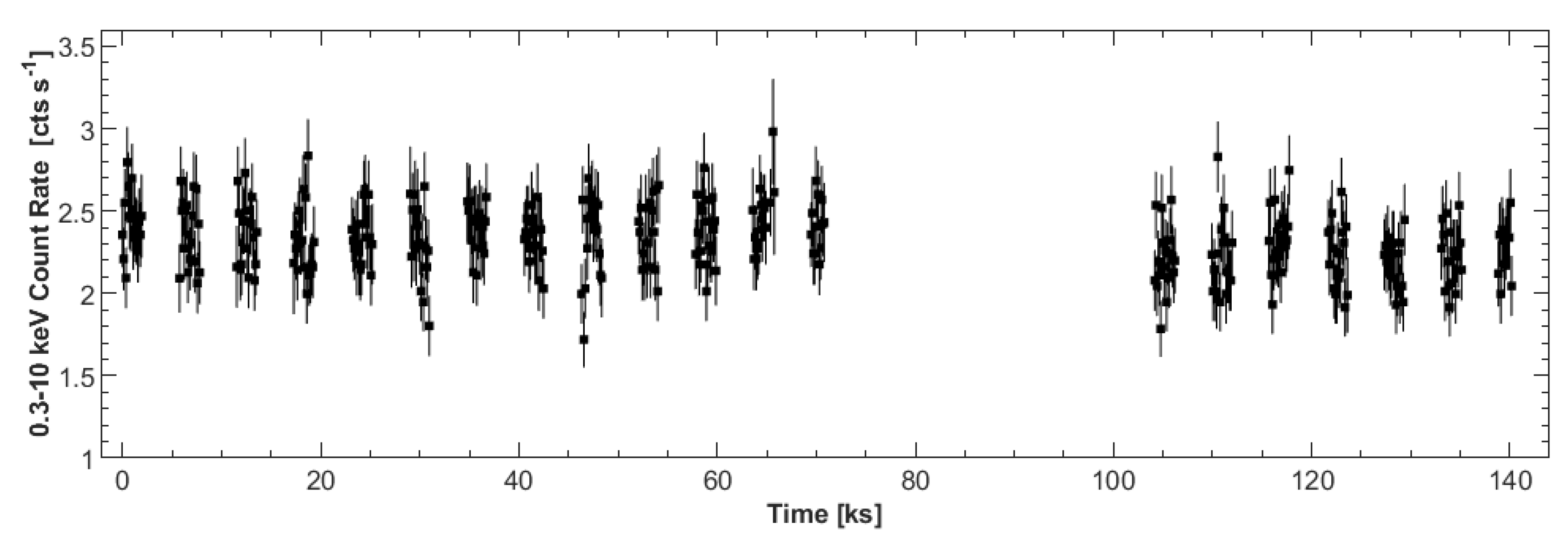
5.1. Origin of Power-Law Spectra
In the framework of the synchrotron emission scenario, a simple power-law spectrum of HBLs can be interpreted as synchrotron emission produced by a simple PL distribution of electron energy distribution (EED; see [15] and references therein). Namely, such a shape can by established by energyzation of charged leptons by some statistical mechanism, like a first-order Fermi acceleration (Fermi-I process) occurring at relativistic shock front moving down a jet. In such a situation, the number of particles having a Lorentz factor greater than is given by =, with s=-+1 to be the particle spectral index; p, the probability that an electron implements an acceleration step i characterized by the energy gain . In the case of the PL EED, this quantity in independent from the acceleration step: = and ==.
Hard or very hard EEDs )∝ can be established by relativistic magnetic reconnection (RMR) operating in the small-scale, magnetized jets areas [158,159]. According to different theoretical studies (see, e.g., [162]), magnetic field lines can reverse on small spatial scales in blazar jets, when the latter carries some current sheets from its base or during some nonlinear stages of the magneto-hydrodynamic (MHD) instabilities. Consequently, a magnetic reconnection can occur which is characterized by a significant transfer of jet magnetic energy into kinetic energy of jet plasma [159]. If the energy density of the reconnecting magnetic field is higher than that of the ambient plasma layer (including the rest-mass energy), reconnection could be implemented in the relativistic regime. Eventually, the liberated magnetic energy can heating plasma to relativistic temperatures and accelerate particles up to ultra-relativistic energies [160].
Downstream of the reconnection layer, the existing EED hardens with the upstream magnetization = with , the reconnecting magnetic field; h, the relativistic enthalpy density of the upstream plasma [161]. Typically, the EED spectral index p<4 is predicted in the case of the RMR, while p=4–11 can be obtained in non-relativistic cases (depending on the strength of the so-called guide field when the reconnecting current sheets are not perfectly anti-aligned with respect to magnetic fields; [162]). Specifically, the upstream magnetization =50 can yield p∼1.5–3.0 (depending on the guide-field strength; [161]). In turn, hard or very hard PL photon spectra with = (in the representation; [137]) can be established. The simulations of [158] showed that the EED with p≲2 can be obtained with the upstream magnetization ≳10 .
Moreover, different particle-in-cell (PIC) and MHD simulations [158,163] demonstrated that a non-linear kink instability can generate large-scale current sheets, which break up into small-scale turbulent areas. In the latter, a fast magnetic reconnection can be implemented [160]. As frequently mentioned in Section 4, different bright HBLs underwent fast LGP-to-PL EED transitions and conversely within the spectra extracted from short segments of a single XRT observation. For example, PKS 0548−322 exhibited such extreme transitions during the extended XRT visit with ObsID 44002013 (on 2005 May 23; "Or" stands for "Orbit", "S" – for "Segment"):
Or2 S1(710 s) LGP a=1.62(0.08), b=0.37(0.17) → S2 PL =1.85(0.06) → S3 LGP a=1.76(0.07), b=0.35(0.17) → Or3 S1(708 s) LGP a=1.85(0.08), b=0.32(0.17) → S2 PL =1.86(0.06) → S3 LGP a=1.65(0.08), b=0.45(0.16) → Or4 S1(700 s) PL =1.94(0.06) → S2 LGP a=1.74(0.07), b=0.28(0.16) → S3 LGP a=1.87(0.07), b=0.26(0.16) → Or5 S1(711 s) PL =1.85(0.06) → S2 LGP a=1.67(0.08), b=0.26(0.16) → S3 PL =1.86(0.06) → Or6 S1(710 s) LGP a=1.85(0.08), b=0.26(0.17) → S2 PL =1.85(0.06) → S3 PL =1.82(0.06) → Or7 S1(710 s) LGP a=1.55(0.08), b=0.38(0.18) → S2 PL =1.86(0.06) → S3 PL =1.85(0.06) → ...→ Or9 S3(710 s) LGP a=1.80(0.07), b=0.54(0.18) → Or10 S1(710 s) PL =1.81(0.06) → S2 PL =1.84(0.06) → S3 LGP a=1.79(0.07), b=0.37(0.16) → Or11 S1(710 s) PL =1.85(0.06) → ...→ Or14 S1(722 s) PL =1.85(0.06) → S2 LGP a=1.74(0.08), b=0.28(0.07) → S3 LGP a=1.66(0.08), b=0.28(0.18) → Or15 S1(726 s) PL =1.94(0.06) → S2 LGP a=1.70(0.08), b=0.50(0.18) → S3 PL =1.93(0.06) → Or16 S1(724 s) PL =2.00(0.06) → S2 LGP a=1.95(0.07), b=0.25(0.16) → S3 LGP a=1.80(0.07), b=0.29(0.17) → Or17 S1(724 s) PL =1.72(0.06) → S2 LGP a=1.92(0.07), b=0.39(0.20)
We see that the many LGP spectra during these LGP→PL→LGP transition were low (b∼0.3), and the origin of such curved EED is related to the efficient stochastic (second-order Fermi) acceleration of electrons in the highly turbulent jet medium (see below). The spectra from the intermediate segments show the PL shapes with hard or very hard photon indices. Note that similar cases for Mrk 421, Mrk 501 and 1ES 1218+304 were explained by [42,43,69] to be turbulence-driven, fast reconnection instances in the relativistically magnetized jet area with small spatial extents: by adopting a typical value of 10 for the bulk Lorentz-factor for the emission zone (see, e.g., [1]), a fast, turbulence-driven relativistic reconnection should occur on spacial scales of ∼– cm during ObsID 44002013 and in the cases provided in [42,69]. Even significantly harder (∼1.4–1.7) PL spectra were observed during other XRT observations of PKS 0548−322 and Mrk 501 characterized similar transitions, and since the aforementioned -values correspond to p∼1.8–2.4, the upstream magnetization for the reconnection layer should close to the value =10 or even higher in those cases.
Moreover, a fast magnetic reconnection can be implemented by a self-similar chain of plasmoids [164]: such chains accumulate particles from the adjacent current sheets and grow with time. Consequently, each plasmoid interiors compress and amplify their internal magnetic field. In turn, this process can energize charged particles via magnetic moment conservation,and the existing EED will extended to higher energies by a non-thermal tail followed by an exponential cutoff. The simulations showed that the cutoff energy can increase with time as , and by sufficient efficiency and duration of this process, the formation of self-similar plasmoid chain the EED’s highest-energy tail with ultra-relativitic electron population capable of (a) emitting in the BAT energy range and, in the most extreme cases; (b) cause a shift of the synchrotron SED peak to the energies beyond 10 keV. Such processes could occur in Mrk 421, Mrk 501 and 1ES 0033+595 (see [42,43,69]).
During some LGP-to-PL and converse transition within ObsID 44002013, some spectra showed higher curvatures with b∼0.4–0.5. In those cases, an alternative mechanism for producing such curvatures and intermediate PL spectra could be the Fermi-I process operating at the relativistic shock front, when the latter is subsequently passing the small scale jet areas characterized by different particle confinement efficiencies: (i) PL spectrum when this efficiency is not dependent on the particle’s energy; (2) curved spectrum otherwise (see the discussion below). Consequently, the magnetic field properties in the jet of PKS 0548−322 should be variable on spatial scales of ∼– cm on some occasions (as well as in other HBL showing similar transitions).
The origin of very hard PL spectra is also explained by means of the significant contribution of those photons to the hard X-ray energy range, which stem from the hadronic cascades (see, e.g., [149,165,166]). In the framework of modified synchrotron-proton blazar (SPB) models, photohadronic interaction produces either or mesons. Subsequently, the charged mesons decay as . These secondary electrons/positrons are expected to contribute to the lower-energy SED component of blazars via synchrotron radiation (along with the "primary" electron population), especially, at the hard X-ray frequencies [6,166]. Generally, hadronic and lepto-hadronic scenarios predict weaker and slower flux variability (see, e.g., [6,41]). In fact, some relatively bright and frequently observed HBLs with very and extremely hard PL spectra (1ES 0229+200, PKS 0548−322, RGB J0710+591, 1ES 1101−232, H 1426+428 and 1ES 2344+514) showed significantly weaker long-term variability (=0.22–0.47) and were passive on intraday timescales than other sources of our sample characterized by comparable mean 0.3–10 keV brightness and observational cadence. Such a behaviour could be caused by a significant contribution from those electrons which are produced within the aforementioned leptohadronic cascades. Although some other HBLs also were characterized by similar spectral and timing properties (1ES 0120+340, TXS 0210+515, PGC 2402248, 1ES 0747+746, RX J0812.0+0237, RBS 0723, RX J1136.5+6737, BZBJ1137−1710, 1ES 1255+244, 1ES 1332−295, 1ES 1332−295, 1ES 1440+122, 1RXS J150343.0−154107, 1ES 1533+535, 1ES 1741+186, H 2356-309), these objects are still sparcely observed or/and are faint in the XRT band (with low signal-to-noise ratios preventing to detect IDVs). Therefore, it’s not possible to draw any firm conclusion about the possible hadronic contribution to the X-ray spectra of these sources.
5.1.1. Logparabolic Spectra: Physical implications
A log-parabolic EED can be established by a Ferm-I acceleration at relativistic shock front in magnetized jet medium, where the confinement efficiency of relativistic electrons by a magnetic field decreases with increasing gyro-radius (i.e., with increasing electron’s energy; see [15] and references therein). In such a situation, the probability of further acceleration of the particle with the energy at the i-th step is represented as as , with g and q being constants. In the case , the probability becomes gradually lower with increasing energy (the so-called energy-dependent acceleration probability (EDAP) process). Consequently, a LGP distribution of electrons with energy will be established as , with the ptoton index and curvature parameter related to the s and r quantities as and , respectively.
According to Section 4, strong spectral variability of HBLs mostly followed a HBW trend, which is explained in the framework of the shock-in-jet model, incorporating particle escape processes and synchrotron losses ([167] and references therein). In this model, a flaring behaviour of blazars is explained by the shock propagating through plasma, the density of which is locally enhanced (accompanied by increase in the magnetic field strength) and the number of particles participating in the acceleration process is boosted, leading to higher acceleration rate and shift of the EED peak to higher values. Consequently, a slope in the photon index–flux plane is controlled by synchrotron cooling during the particle acceleration processes and a HBW trend implies a stronger and faster variability in the number of the electrons producing X-ray photons via the synchrotron mechanism. In turn, the quantity in the hard 2–10 keV band was significantly higher than its "counterpart" in the soft 0.3–2 keV band for the most HBLs (except for those objects which frequently showed very soft 0.3–10 keV spectra; see Section 4 and Table 2).
Generally, the EDAP scenario predicts a linear relationship between the s and r parameters as . In turn, the latter should yield a positive correlation. In fact, the latter was reported for Mrk 421 in different periods [15,17,18,19,39,42], but was absent during 2013 January–2014 June [16,17]. However, an anti-correlation between these parameters is expected when , i.e. there are electron populations with a very low initial energy in the emission zone, which was observed during some time intervals for Mrk 421, Mrk 501 and for 1ES 0033+595 during the entire 2005–2022 period [39,42,68,69]. This correlation also explains the occurrence of very and extremely hard values of the photon index at 1 keV: the Fermi-I acceleration shifts the electron population with very low initial energy predominantly to the energies capable of producing photons around 1 keV and relatively less frequently to the higher energies. This shift yields a spectral hardening at the reference energy and establishment of very and extremely hard a values along with large spectral curvatures [69]. Note that these opposite correlations were observed for the different subsets of XRT observations of 1ES 1218+304 [98]. In each case, the correlations were weak hinting at the presence also other particle acceleration mechanisms.
Moreover, the EDAP presence in HBL jets explains the observation of a CW-type spectral evolution in the photon index–flux plane ("spectral hysteresis"): the source follows such a "loop", if the spectral evolution is due to the flaring component starting in the hard X-ray band due to rapid injection of very energetic particles [24]. In turn, such a situation is compatible with the EDAP within the Bohm’s limit of particle diffusion, yielding an instantaneous acceleration of particles and their injection into the emission zone [169]. Note that the CW-type hysteresis patterns were observed many times for the aforementioned sources in the period characterized by EDAP-inherent correlations [17,18,19,24,39,42,68,69,98]. However, the Fermi-I acceleration cannot be instantaneous in the case of the significantly weaker (sub-Gauss) fields frequently obtained by one- or multi-zone SSC modellings of broadband HBL SEDs (see [69] for the corresponding review). Consequently, a gradual acceleration of electrons can occur by the EDAP. In such a situation, X-ray flares will propagate from low to high frequencies and a CCW-type spectral evolution of X-ray flares is expected [24]. Note that such a hysteresis pattern was also reported many times in the aforementioned studies.
One of the most commonly considered mechanisms is a stochastic (second-order Fermi) acceleration of electrons arising from magnetic turbulence close to a shock front see, e.g., [24]). The relativistic MHD simulations of [170] demonstrated that shock propagation through the jet medium can amplify the turbulent magnetic field, owing to the shock interaction with higher-density inhomogeneities existing in the pre-shock medium. Eventually, the amplification of the jet turbulence can make the Fermi-II mechanism more efficient when the curvatures with b∼0.3 are predicted (versus large curvatures to be established in the case the Fermi-II process is not efficient; see [143]). Namely, the Fokker-Plank equation yields a low EED curvature term r with higher values of the diffusion coefficient D as [24]. On the other hand, the parameter r is inverse to the number of acceleration steps as , with , the variance of the energy gain [15]. Since the low r-values also result in low curvature parameter b, the observation of anti-correlations –b and b– is explained in the framework of efficient stochastic acceleration during X-ray flares occurring in HBLs (see, e.g., [24,70]). Note that these correlations (along with the dominance of low-curvature spectra) were observed in Mrk 421 and Mrk 501 in different periods, as well as during the entire XRT observing campaigns of 1ES 1218+304 [17,18,19,24,39,42,68,69,98]. However, the stochastic acceleration was found to be less important for 1ES 1959+650 during some periods [57,58,59].
Note also that the anti-correlation –b can be observed also within the EDAP process, but the scatter plot should show a slope b∝ in that case [24] versus b∝) for the stochastic acceleration (with ; B, the magnetic field strength; , the Doppler factor of the emission zone; [172]). Consequently, this should yield a significant scatter of the data points and weakness of the anti-correlation (as discussed above). As demonstrated by simulations of [174], electrons can undergo a Fermi-I acceleration at the shock front and then continue gaining an additional energy by means of the stochastic mechanism in the shock downstream area. Eventually, the energyzed particles will succeed in re-entering the shock acceleration region and repeating the combined acceleration cycle. Consequently, the correlations and –b will be weak or even not observed at all.
In the case of 1ES 0033+595, 1ES 0229+200, PKS 0548−322, 1ES 0647+250, H 1426+428 and 1ES 2344+514, characterized by a significantly larger portion of the spectra with a large curvature or/and the presence of the comparable portion of power-law spectra, the Fermi-I mechanism (along with the RMR) should be of greater importance than the second-order one in the target source. Similar properties are shared by also some other HBLs listed in Table 2, but they still have been sparcely observed or/and are faint in the 0.3–10 keV energy range. Consequently, it’s not possible to draw firm conclusions about higher importance of the Fermi-I processes (both of the EDAP and energy-independent one) in these objects.
In the jet area with low magnetic field and high matter density, the Fermi-II process can yield a slow, gradual acceleration of electrons and CCW-type loops should be observed in the course of X-ray flares [175]. In fact, such a spectral evolution was also reported many times for bright HBLs in those time periods, which were characterized by aforementioned features of stochastic acceleration [17,18,19,24,39,42,68,69,98]. On the contrary, the stochastic acceleration timescale can be short and almost instantaneous in the emission zone mainly contains a lepton plasma of low density and high magnetic fields. Consequently, a CW-type spectral evolution can be observed [169]. The aforementioned spectral studies revealed also many occasions when two subsequent CCW loops or a CCW→CW transition (or conversely) were observed during a single 0.3–10 keV flare. Moreover, some X-ray flares or their particular parts did not show any clear hysteresis pattern, possibly due to co-existence of different acceleration mechanisms and complex physical conditions in the X-ray emission zone.
Detailed spectral studies of bright HBLs revealed another turbulence-related feature: Mrk 421 showed a correlation ∝, with the exponent ∼0.6 in 1996–1997 [107] and during some time intervals of the period 2008–2023 [18,39,42]. This relation is expected in the case of a transition from the Kraichnan-type spectrum of the turbulence (q=3/2) into the "hard-sphere" (q=2) spectrum [172]. Namely, the turbulence spectrum (i.e., energy distribution with the wave number) is represented by ; ,the wave number; , the turbulent component of the jet magnetic field [173]. However, other time intervals of the XRT monitoring of Mrk 421 showed the -values to be significantly lower than 0.6, hinting at strong "contamination" by other particle acceleration mechanisms which do not follow the ∝ relation, or transitions from the Kraichnan-to-"hard-sphere" turbulence were less frequent. A similar situation was observed for Mrk 501, showing ∼0.6 in 2011–2015 and 2021–2022 [73], as well as during the XRT monitoring of 1ES 1959+650 in 2017 May–November [59]. This relation was also observed from the entire XRT datasets of PKS 0548−322 and RGB J0710+591 (TW), while some other frequent XRT targets (1ES 0033+595, 1ES 0229+200, 1ES 1101−232, 1ES 1218+304, H 1426+428, 1ES 1727+502) showed <0.45 or >0.75. For example, the value =1 was reported for 1ES 0033+595 [106] which is expected when the spectral changes are dominated only by variations in the average electron energy, and the number of X-ray emitting particles N is constant [24], and the exponent was close to 1.5 when the spectral changes are dominated by variations in the average electron energy and the number of X-ray emitting particles N is also variable [24,98]. Moreover, no significant correlation ∝ has been detected for other sources (PG 1553+113, PKS 2155−304, 1ES 2344+514).
The simulations of [171] showed a low probability (∼12%) for the production of TeV photons in HBL sources when the X-ray spectral curvature is higher than the boundary value =0.55. On the contrary, the sources with broad synchrotron SEDs (b∼0.3 or lower, related to the efficient stochastic acceleration) are characterized by much higher probabilities to generated a TeV-band emission. In fact, this prediction is in agreement of frequent TeV-detection of Mrk 421 and Mrk 501, characterized by the lowest mean values of the curvature parameter among HBLs (=0.24), asides of being the closest objects from our sample. On the other hand, most of the TeV-undetected HBLs show >0.55 (see Table 2). However, 1ES 0120+340 seems to be a promising source in point of the TeV-detection, since more than a half of the curved spectra show b∼0.3, as well as hard and very hard PL spectra. Although 1H 1515+660 is characterized by a significant portion of the curved spectra showing b∼0.3 or lower, as well as ∼1.6–1.9 during the flaring 0.3–10 keV states, a TeV-detection of this HBL will be prevented by the large distance (z=0.702, to the the largest confirmed value for our sample).
The anti-correlation between the parameters b and is predicted in the framework of both EDAP and stochastic accelerations, although with different slopes of the scatter plot –b (see [39]). Consequently, there is a large scatter of the data points and weakness in the correlation. According to the Monte Carlo simulations of [174], electrons can be accelerated at the shock front by the EDAP and continue to gain energy via the stochastic mechanism in the downstream shock region. After some time, a particle will be able to re-enter the shock acceleration region and repeat the acceleration cycle. The co-existence of both mechanisms in the jet area with the electron population with very low initial energy can be explained by the weak –b anti-correlation, and the very hard values of the photon index at 1 keV and large spectral curvature.
Moreover, HBLs generally show a positive – correlation ([16,17,18,19,39,42,58,68,69,98],TW), i.e., a trend of shifting the synchrotron SED peak (along with the EED peak) towards higher energies with increasing X-ray flux. This causes a shortening of the mean cooling timescale of the X-ray-emitting electron population and a weakening of the –b anti-correlation is expected, since the cooling timescale is shorter than that of EDAP or stochastic acceleration [24]. In turn, a positive correlation between the parameter and 0.3–10 keV flux is expected within the shock-in-jet scenario by injection of high-energy particles in the shock acceleration process and by dominance of synchrotron cooling of the highest-energy electrons over the IC cooling [21].
5.1.2. Character of the Flux Variability
Detection of QPOs in different spectral ranges is very important since they could be caused by the physical factors as follows: (i) presence of the central binary SMBH where the system is composed by a primary SMBH (with the associated accretion disk and jet closely aligned with our line-of-sight), and a smaller-mass, secondary BH orbiting the primary object. In such a situation, a QPO can be related to the periodic change of the jet orientation with respect the observer due to the movement of the primary SMBH around the mass center or owing to the Lense-Thirring effect on the AD (see, e.g., [176]). Moreover, when a secondary BH moving on a highly eccentric orbit hits the primary’s AD twice per revolution, a strong shock wave may propagate through the observer-pointed jet and one should observe an outburst. In case of two impacts per each pericentre passage od the secondary object, double-peak maxima should appear in the observed light curve, and since the secondary BH hits the primary’s AD periodically, one expect quasi-periodical flares [177].
PG 1553+113 is the primary candidate among HBLs for hosting a binary SMBH system: by using various periodicity detection technique, different authors reported a 2.2-yr QPO with (4–5) significances from the regular Fermi-LAT campaign [177,179,180]. However, the XRT observations showed a 1.5-yr period with a local significance of 2 (see [180]). [181] reported a 1.7-yr QPO with a significance of 2.5–5 by different periodicity searching technique from the LAT observations of PKS 2155−304 performed during 2008–2020, and the same period with a local significance of 2.5 was obtained from the XRT observations by [180].
Based on the XRT data collected throughout February 2023, [182] reported a detection of a 208-d QPO with local >5 and global 3.7 confidences in 1ES 1959+650, which was superimposed on a slow, long-term trend as observed since 2015 August during the intense XRT monitoring (see Section 3.2). However, the count rates used for a QPO finding were retrieved from https://www.swift.psu.edu/monitoring/ where the analysis is performed using automated scripts. In such a situation, no pileup correction is made for the PC-mode observations, as well as the same source extraction radius is adopted for all WT-mode observations regardless the target’s brightness and exposure length. Nevertheless, no QPOs were detected by [183] from the LAT 2008–2021 campaign.
No highly-significant QPOs were detected from the LAT and other MWL (including those with XRT) observations of Mrk 421, Mrk 501, 1ES 1218+304 and 1ES 0033+595 performed in different periods [39,42,51,73,98,106,183].
As noted above, HBLs generally demonstrated a HBW spectral behaviour during the 0.3–10 keV flares, and such a spectral evolution indicates (i) stronger and faster variability in the number of those electrons producing X-ray photons by the synchrotron mechanism; (ii) dominance of synchrotron cooling of the highest energy electrons over the IC cooling. However, some sources (e.g., the softest objects in Table 2) did not follow this spectral trend, or showed the opposite (SWB) spectral trend during the highest states of 0.3–10 keV flares. As the SWB trend can be explained by the emergence of a soft X-ray component in the X-ray emission zone (yielding a brightness increase while softening the observed 0.3–10 keV spectrum; see, e.g., [39]), those highest states (and the entire flares) were due to the addition of a new, soft flaring component to the emission zone.
A lognormal flux variability, reported for different HBLs (see Section 3), is explained as an imprint of the instable processes occurring in the AD onto the observer-pointed jet ([184] and references therein). Namely, some independent density fluctuations on the local viscous timescale in the AD should be characterized by a negligible damping. Such events show a tendency of propagate towards the innermost disc area and couple there to produce a multiplicative behavior. The latter can transferred to the jet flow (e.g., via the abrupt jet collimation rate) and produce a propagating shock. Note that the long-term blazar flares are the most commonly explained within the shock-in-jet scenario ([185] and references therein) and, therefore, a lognormal variability may indicate an imprint of those AD instabilities on the jet, which trigger a shock propagation through the observer-pointed jet. However, Section 3 presents the situations with some HBLs when the sample of flux values from those XRT observations characterized by the 0.3–10 keV IDVs in the source did not show a lognormal distribution. This result could be related to higher fractions of 0.3–10 keV emission from those ultrarelativistic electron populations which were energized by the local, jet-inherent instabilities: (i) relativistic magnetic reconnection (the signatures of which were frequently observed in HBLs); (ii) interaction between the jet flow and standing shock [186] etc.
Synchrotron emission produced by electrons from the proton-induced hadronic cascades is also expected to show a lognormal variability in blazars [187]. Note that the lepto-hadronic processes are characterized by a lack of the correlation between the x-ray and VHE flux variabilities, which sometimes was the case bright HBLs (see Section 3 and [69] for the corresponding review). Moreover, a significant contribution from the photons of the lepto-hadronic origin to the 0.3–10 keV energy range could also yield very hard photon indices (see [188] and references therein), which have been reported for different HBLs (see Section 4). Finally, a lognormal flux distribution with the photon indices showing a Gaussian behaviour can be related to the fluctuations in the particle acceleration rate as reported for Mrk 421 in other spectral bands [189].
The detailed study of 0.3–10 keV IDVs in the nearby bright HBLs showed that a majority of these instances belong to the flaring states of the source [16,17,18,19,39,42,58,69,98]. Note that this result is consistent with the shock-in-jet scenario: these fast brightness variations can be related to the interactions between the moving shock front and stationary, small-scale jet inhomogeneities characterized by strong magnetic fields compared to the ambient medium. In turn, these inhomogeneities could be produced by jet turbulence, significantly amplified by the shock passage [170,186]: the most rapidly variable emission can be produced in the smallest-scale jet areas, which contain the strongest magnetic fields of turbulent origin. For example, the majority of the fastest IDVs (occurring within the time intervals shorter than 1 ks) in Mrk 421 during 2018–2023 belong to the elevated X-ray states and were characterized by low X-ray spectral curvatures, inherent to the efficient stochastic acceleration, which, in turn, is implemented by highly-developed jet turbulence capable for producing the jet inhomogeneities with strong magnetic fields on spatial scales ∼– cm. The aforementioned studies demonstrated that the 0.3–10 keV IDVs were frequently related to the changes in spectral curvature. The latter could be caused by the subsequent passage of shock front through the small-scale jet areas, which were characterized by stronger and weaker turbulence, respectively. Consequently, various levels of the HBL activity on intraday and, especially, on the sub-hour timescales could be associated with the variable turbulence strength in the jet of the particular source in different epochs. Moreover, the importance of the small-scale turbulence could different among the nearby X-ray bright HBLs. Consequently, the DC of 0.3–10 keV IDVs in Mrk 421 were higher (up to 83%) varied from epoch to epoch, and it was significantly higher during the strongest flares which were probably triggered by propagation of significantly stronger shocks generating a higher turbulence in the jet than in other epochs (see [16,17,18,19,39,42]). A similar situation was observed also in the case of Mrk 501 and 1ES 1959+650.
Frequently, the 0.3–10 keV IDVs were associated with spectral hardening or softening, i.e., changes in the EED slope which depends on the position of the EED peak (with a hardening by shifting the EED peak to higher energies and conversely). On the other hand, these shifts also change of the synchrotron peak position as ∼[172] that was also observed many times during these IDVs. Moreover, the EED shifts could cause a variability of the synchrotron SED peak height as ∝, also to be a frequent driver of the detected IDVs. Nevertheless, these changes sometimes were large, plausibly due the extreme variability of the physical conditions in the X-ray emission zone, over the small spatial and temporal scales. Furthermore, the RMR instances (to be driven by turbulence or other jet instabilities) could trigger IDVs via the LGP-to-LP or converse EED transitions (occurring as in the flaring epochs, as during the lower X-ray states of the bright HBLs; see Section 4).
The well-studied HBLs showed a doubling or halving of the 0.3–10 keV flux on different timescales calculated as . These quantities can be used to constrain the upper limit to the variable emission zone: , with and , the size and Lorentz-factor of the emission zone, respectively [190]. On intraday timescales, Mrk 421 underwent the most extreme doubling/halving with =1.0–1.5 hours during the 2013 April outburst, as well as in 2009 February–May, 2017 February and 2019 December. By adopting the most commonly-adopted value of the Lorentz factor =10, we obtain a range of upper limits of (1.04–1.56)× cm for the emission zone responsible for that extreme variability. In other periods, the source showed =4.8–21.8 hours on intraday timescales. 1ES 1959+650 showed flux halvings within 4.0–12.6 hours in 2015 November and 2017 June [58,63], whereas 1ES 0033+595 demonstrated 12 hr in 2015 September [106].
The densely-sampled 0.3–10 keV light curves showed a variety of flare profiles, which could be related to the specific cases of particle acceleration and cooling. Namely, (i) a symmetric shape (with nearly equal flux rising and declining phases; with a possible plateau) indicates that the flare was dominated by the time required for the radiation to cross the emission zone, while the particle acceleration and cooling timescales are of lower importance: these timescales are much shorter than the light-crossing timescale [192,193]. Alternatively, a symmetric flare shape indicates that the observed variability was driven by the crossing time-scale of the underlying disturbance, e.g., a shock front [191]. As discussed above, the EDAP-acceleration of X-ray emitting electrons and subsequent cooling could be very fast within the Bohm’s limit of particle’s diffusion. In fact, some out of 0.3–10 keV flares of bright HBLs with symmetric profiles were indeed observed in those epochs, when these sources were showing the different EDAP-related features (correlations and hysteresis patterns discussed above). However, detection of symmetric flares are limited, since a superposition of two or more symmetric instances, occurring in different emission regions situated at different azimuthal angles in the jet cross-section, may result in observation of single asymmetric flare [194]; (ii) gradual acceleration of x-ray emitting particles may produce a flare with a negative asymmetry (longer rising phase, followed by a fast decline; [191]). In such a situation, the cooling time-scale of these electrons can be shorter than the acceleration one. As note above, this acceleration type is inherent to the Fermi-II mechanism operating in the jet region with a low magnetic field and high matter density [175]. Such flares were also observed in the periods corresponding to the detection of the spectral features corresponding to the efficient stochastic acceleration in different bright HBLs. On the other hand, such a profile could simply be an artifact of superposition of two or more symmetric flares (not resolvable separately); (iii) positively-asymmetric flares can be explained by a fast injection and slower radiative cooling and/or escape of X-ray emitting electrons from the energy zation region and, therefore, representing a cooling-dominated variability [192]. However, the radiative lifetimes corresponding to the 0.3–10 keV energy range are generally very short, and the observed positively-asymmetric flare (also to be the case in HBLs many times), in fact, could be a superposition of shorter-term (or low-amplitude) instances not being individually resolvable. Furthermore, a non-uniformity of the Doppler factor across the jet (e.g., due to radial expansion of the relativistic flow) may yield a significant symmetry distortion of the observed light curves and produce a positively-asymmetric flare: the emission produced within those parts characterized by the largest inclinations arrive to the observer with a significant time delay compared to that from those parts located at smaller viewing angles, resulted in a substantially extended declining phase of the flare [195].
Finally, HBLs sometimes exhibited also a two-peak flare profile. Along with the superposition of two different instances, a two-peak profile is explained in the framework of detailed internal-shock model [196], namely, by the propagation of forward and reverse shocks. The latter can be triggered by colliding of two high-energy plasma "shells", injected into the jet base with different speeds: a forward shock moving into the slower shell and a reverse one propagating in the faster shell, with the peak heights depending on the speeds of these shocks.
5.2. Concluding Remarks and Future Prospects
In this paper, we have presented a review of the timing and spectral properties of the HBL sources, characterized by the confirmed distances z=0.031–0.702 and those possibly having even larger separations (e.g. beyond z=1.239). Moreover, no TeV-band detection has been reported for 15 sources of our sample (and 3 TeV-detected are not included in our sample due to availability of only 2-3 XRT observations, along with other >30 HBLs having the same situation and to be TeV-undetected). In addition to extremely large differences in the 0.3–10 keV brightness, the TeV-detection of HBLs occurred during more three decades from 1992 January (Mrk 421) to 2025 November (RGB J1243+364) that defined the frequency of observations with the XRT and other MWL instruments. Consequently, they have been studied on very different levels in the 0.3–10 keV band (including the original results presented in this paper), and the corresponding highlights are as follows:
- The brightest and best studied HBLs (Mrk 421, 1ES 1959+650 and Mrk 501): targeted 720–1675 times to date with XRT; show an extreme time 0.3–10 keV variability with the maximum-to-minimum flux ratios of 45–125 and =0.75–1.25 (from all available the daily-binned fluxes); exceptionally strong X-ray outburst in Mrk 421 in 2013 April, and very strong, long-term flaring activities demonstrated also in several periods during 2004–2025; very fast flux variation on timescales down to a few minuted in the course of strong flares lasting 2-4 weeks and flux doubling/halving timescales of a few hours in the most extreme cases; the dominance of the LGP spectra, showing the distributions of the spectral parameters and their cross-correlations anticipated in the case of the EDAP and stochastic accelerations (with variable efficiency in different periods); extremely hard spectra during some flares (with the presence of the synchrotron SED peak in hard X-rays and, sometimes, beyond 10 keV) along with fast LPG→PL→LPG transitions, plausibly to the RMR triggered by turbulence or other jet instable processes; possible contribution from the secondary electron populations produced by lepto-hadronic cascades in some epochs; large and fast spectral variability demonstrating extreme changes of jet physical conditions on spatial scales of ∼– cm. Note also that the baseline flux level seems to vary on timescales of several years (especially, in 1ES 1959+650 and Mrk 501; possibly due to enhanced jet collimation rate on timescales on such timescales). Consequently a future intense monitoring of these objects in the 0.3–10 keV energy range are crucial in order to confirm this phenomenon and derive the corresponding timescale for each object, as well as to check correlations between the variabilities of observed in different spectral ranges and discern the most plausible emission mechanisms.
- Some HBLs (Mrk 180, PKS 0301−243, 1ES 1011+496, PKS 1424+240, H 1722+119, PKS 2005−489) showed the values comparable or even higher that those of 1ES 1959+650 and Mrk 501. Although this result is basically due to the much smaller 0.3–10 keV data sets available for these sources (obtained mainly during the strong X-ray flares), these objects are anyway very important targets for the future intense campaigns with the space instruments covering the 0.3–10 keV band: Mrk 180 and PKS 2005−489 showed very strong outburst by a factor >30 compared to their quiescent states and very broad ranges of different spectral parameters (in turn, indicating extreme changes in physical properties of the jet emission zones); 1ES 1011+496 is showing very hard LGP and PL spectra during strong 0.3–10 keV flares and relatively high brightness provides us a very important space "laboratory" for investigating the properties of the "responsible" physical mechanisms (the Fermi-I and Fermi-II processes in the relativistic plasma having various physical properties; magnetic reconnection triggered by different jet instabilities; lepto-hadronic processes). PKS 1424+240 and H 1722+119 were also relatively bright sources with interesting timing/spectral properties, and the further more intense observations with XRT and other MWL instruments will be valuable for blazar physics.
- The TeV-detected, relatively bright and frequently observed sources 1ES 0229+200, PKS 0548−322, RGB J0710+591, 1ES 1101−232, H 1426+428 and 1ES 2344+514 show significantly weaker long-term variability, passivity on intraday timescales and represent the EHBL/UHBL sources during higher X-ray states with very and extremely hard spectra. Such a timing/spectral behaviour hint a the possible significant synchrotron emission from the electron populations generated within different lepto-hadronic cascades. Similar spectral properties are exhibited by another, relatively bright TeV-detected HBL of unknown redshift 1ES 0033+595, but this object shows a significantly higher value, and, consequently, very and extremely hard LGP and PL spectra should be rather related to the RMR and to specific cases of the Fermi-type processes.
- Very/extremely hard spectra and low values are shown also by other TeV-detected HBLs, characterized by relatively lower XRT-band brightness and, consequently, studied poorly to date (TXS 0210+515, 1ES 0347-121, 1ES 0502+675, PGC 2402248, RX J1136.5+6737, 1ES 1440+122, 1ES 1741+196, 1ES 2037+521). Therefore, significantly more intense observations of these objects with the XRT and other X-ray space missions are very important in order to make a further progress in understanding of lepto-hadronic and reconnection-related processes.
- TXS 0628-240, 1ES 1118+424, 1ES 1215+303, RX J1230.2+2518 PKS 2005−489 and PKS 2155-304 showed upwardly-curved 0.3–10 keV spectra in a few cases, in addition to the dominance of soft or very soft photon indices. Negative curvatures are found also from the NuSTAR observations of some out of these objects and indicate a significant portion of those X-ray photons which have an IC origin. The upwardly-curved spectra mostly were not observed in lowest XRT-band states and, consequently, the ranges of the 0.3–10 keV flux were large (e.g., PKS 2005−489 has shown the third largest values among HBLs) and the spectral evolution during the X-ray flares did not generally follow a HWB trend (in contrast to most HBLs). Sometimes, the strongest 0.3–10 keV flares showed the opposite SWB trend, presumably, emergence of a new, soft X-ray component in the X-ray emission zone. In turn, the EED peak of such component should correspond to significantly lower energies, than that in "typical" HBLs and EHBL/UHBL objects, probably, owing to some physical "agents" in their jets preventing the EED maximum at the energies required to produce hard X-ray photons: EDAP with very low initial energy distribution, lower large-scale magnetic fields etc. Consequently, these objects also represent important targets for the XRT and different MWL instruments in point of the jet physics and blazar phenomenon.
- Sources to be mostly soft or very soft (KUV 00311-1938, RGB J0136+391, RGB J0152+017, 1RXS J023832.6-311658, PKS 0301−243, 1ES 0414+009, PKS 0447-439, TXS 0628-240, RX J0648.7+1516, 1ES 0806+524, RX J1230.2+2518, RGB J1243+364, PG 1246+586, PKS 1424+240, PKS 1424+240, PG 1553+113, H 1722+119, 1ES 2322−409), characterized by =2.11–2.47 and =2.19–2.56; rarely or not showing a/<2. Similar to the previous sub-sample, their jets should be characterized by those physical conditions preventing the EED maximum at the energies required to produce hard X-ray photons. Consequently, these sources may also show a negative curvature in the 0.3–10 keV band and, more plausibly, at higher energies (especially, during low X-ray states). Therefore, further intense XRT and NuSTAR observations of these source will be useful to study the properties of the lowest-energy "tail" of IC-emission. Nevertheless, we report the detection of PG 1246+586 above 100 GeV for the first time from the Fermi-LAT observations with the significance of ≈7, and this source seems a promising target for the Cherenkov-type telescopes.
- Some sources show relatively narrow ranges of spectral indices (RBS 0723, 1ES 0927+500, RX J0812.0+0237, 1ES 1028+511, BZBJ1137−1710, 1RXS J121321.6-261802, 1ES 1255+244, 1ES 1312−423, 1ES 1332−295, RX J1417.9+2543, 1ES 1421+582, 1RXS J150343.0−154107, 1RXS J195815.6-301119, RGB J2042+244 (along with some of the aforementioned HBLs showing soft and very soft spectra), and this result should be rather related to poor observational sampling. Further more frequent observations may expand these ranges, as well as reveal very interesting spectral and timing properties.
- The importance of the particular acceleration and/or instable process should vary from source to source, as well as with time in the given object. However, their detection is also dependent also on the observational sampling. For example, no power-law spectra are revealed in the case of 1RXS J121321.6-261802. However, this HBL has been targeted few times with the XRT, and those observations were concentrated within a short time interval. Consequently, more regular and long-term and observations with this telescope and by those covering the 0.3–10 keV energy range will allow us to draw conclusion about the importance of the jet nonstationary process yielding a power-law EED (energy-independent first-order Fermi acceleration; magnetic reconnection in different regime).
- The tentative redshift 1ES 0033+595 seem to be exaggerated compared to the intrinsic one, owing to the exceedingly high isotropic 0.3–10 keV luminosity. Similarly, the lower limit to the redshift of TXS 0628-240 (z=1.239; [197]) makes this object to be the second highest-luminous HBL source (after 1ES 0033+595, with >4.1×erg ).
- We conclude a requirement of more densely-sampled 0.3–10 keV observations of poorly-studied HBLs exhibiting very and extremely hard spectra and/or large flux variability; possible IC contribution to this energy range. A subsequent intense monitoring of well-studied HBLs are also still important for solving different problems of the blazar physics (jet structure and particle content; geometric and physical properties of the X-ray emission zone; particle acceleration and MWL emission processes; origin of the flux and spectral variability etc.). The Swift Mission is planned to be functional during the next years (similar to XMM-Newton and Chandra), especially, after the planned orbit boost (scheduled in 2026 June). The planned X-ray Integral Field Unit at Athena is very important in recording high signal-to-noise 0.2–12 keV spectra within the short time intervals and study very fast spectral variability, which provides us with another powerful tool for the further progress in our understanding of the instable processes in the SMBH vicinity. improves on previous missions by factor of 20-100 for spectroscopy, 6-10 for imaging surveys, and 3-50 for timing measurements.
Acknowledgments
The author thanks Shota Rustaveli National Science Foundation and E. Kharadze National Astrophysical Observatory (Abastumani, Republic of Georgia) for the fundamental research grant FR-21–307.
Conflicts of Interest
The author declares no conflict of interest.
References
- Falomo, R.; Pian, E.; Treves, A. An optical view of BL Lacertae objects. Astron. Astrophys. Rev. 2014, 22, 89. [Google Scholar] [CrossRef]
- Padovani, P.; Alexander, D. M.; Assef, R. J.; De Marco, B.; Giommi, P.; Hickox, R. C.; Richards, G. T.; Smolčić, V.; Hatziminaoglou, E.; Mainieri, V.; Salvato, M. Active galactic nuclei: what’s in a name? Astron. Astrophys. Rev. 25, 89. [CrossRef]
- Bodo, G.; Tavecchio, F. Recollimation shocks and radiative losses in extragalactic relativistic jets. Astron. Astrophys. 1997, 609, 89. [Google Scholar] [CrossRef]
- Biteau, J.; Prandini, E.; Costamante, L.; Lemoine, M.; Padovani, P.; Pueschel, E.; Resconi, E.; Tavecchio, F.; Taylor, A.; Zech, A. Progress in unveiling extreme particle acceleration in persistent astrophysical jets. Nat. Astr. 2020, 4, 124–131. [Google Scholar] [CrossRef]
- Böttcher, M. Modeling the Emission Processes in Blazars. Astrophys. Space Sci. 2007, 309, 95–104. [Google Scholar] [CrossRef]
- Sol, H.; Zech, A. Blazars at Very High Energies: Emission Modelling. Galax. 2022, 10, 105. [Google Scholar] [CrossRef]
- Padovani, P.; Giommi, P. The Connection between X-Ray– and Radio-selected BL Lacertae Objects. Astrophys. J. 1995, 444, 567–581. [Google Scholar] [CrossRef]
- Nieppola, E.; Tornikoski, M.; Valtaoja, E. Spectral energy distributions of a large sample of BL Lacertae objects. Astron. Astrophys. 2006, 445, 441–450. [Google Scholar] [CrossRef]
- Kapanadze, B. Catalog and Statistical Study of X-Ray Selected BL Lacertae Objects. Astron. J. 2013, 145, 89. [Google Scholar] [CrossRef]
- Costamante, L.; Ghisellini, G.; Giommi, P.; Tagliaferri, G.; Celotti, A; Chiaberge, M.; Fossati, G.; Maraschi, L.; Tavecchio, F.; Treves, A.; Wolter, A. Extreme synchrotron BL Lac objects: stretching the blazar sequence. Astron. Astrophys. 2001, 371, 512–526. [Google Scholar] [CrossRef]
- Costamante, L.; Bonnoli, G.; Tavecchio, F.; Ghisellini, G.; Tagliaferri, G.; Khangulyan, D. The NuSTAR view on hard-TeV BL Lacs. Mon. Not. R. Astron. Soc. 2018, 477, 4257–4268. [Google Scholar] [CrossRef]
- Cerruti, M.; Zech, A.; Boisson, C.; Inoue, S. A hadronic origin for ultra-high-frequency-peaked BL Lac objects. Mon. Not. R. Astron. Soc. 2015, 448, 910–927. [Google Scholar] [CrossRef]
- Aharonian, F. A.; Akhperjanian, A. G.; Barrio, J. A.; Bernlöhr, K.; Bolz, O.; Börst, H.; Bojahr, H.; Contreras, J. L.; Cortina, J.; Denninghoff, S.; et al. Reanalysis of the high energy cutoff of the 1997 Mkn 501 TeV energy spectrum. Astron. Astrophys. 2001, 366, 62–66. [Google Scholar] [CrossRef]
- Blandford, R. D.; Znajek, R. L. Kerr black holes. Mon. Not. R. Astron. Soc. 1977, 179, 433–-456. [Google Scholar] [CrossRef]
- Massaro, E.; Perri, M.; Giommi, P.; Nesci, R. Log-parabolic spectra and particle acceleration in the BL Lac object Mkn 421: Spectral analysis of the complete BeppoSAX wide band X-ray data set. Astron. Astrophys. 2004, 413, 489–503. [Google Scholar] [CrossRef]
- Kapanadze, B.; Dorner, D.; Vercellone, S.; Romano, P.; Aller, H.; Aller, M.; Hughes, P.; Reynolds, M.; Kapanadze, S.; Tabagari, L. X-Ray Flaring Activity of MRK 421 in the First Half of 2013. Astrophys. J. 2016, 831, 89. [Google Scholar] [CrossRef]
- Kapanadze, B.; Dorner, D.; Romano, P.; Vercellone, S.; Kapanadze, S.; Tabagari, L. Mrk 421 after the Giant X-Ray Outburst in 2013. Astrophys. J. 2017, 848, 89. [Google Scholar] [CrossRef]
- Kapanadze, B.; Vercellone, S.; Romano, P.; Hughes, P.; Aller, M.; Aller, H.; Kharshiladze, O.; Kapanadze, S.; Tabagari, L. Swift Observations of Mrk 421 in Selected Epochs. I. The Spectral and Flux Variability in 2005–2008. Astrophys. J. 2018, 854, 89. [Google Scholar] [CrossRef]
- Kapanadze, B.; Dorner, D.; Romano, P.; Vercellone, S.; Kapanadze, S.; Tabagari, L. Swift Observations of Mrk 421 in Selected Epochs. II. An Extreme Spectral Flux Variability in 2009-2012. Astrophys. J. 2018, 858, 89. [Google Scholar] [CrossRef]
- Gaidos, J. A.; Akerlof, C. W.; Biller, S.; Boyle, P. J.; Breslin, A. C.; Buckley, J. H.; Carter-Lewis, D. A.; Catanese, M.; Cawley, M. F.; Fegan, D. J.; et al. Natur. 1996, 383, 319–320. [CrossRef]
- Acciari, V.A.; Ansoldi, S.; Antonelli, L. A.; Arbet Engels, A.; Artero, M.; Asano, K.; Babic, A.; Baquero, A.; Barres de Almeida, U.; Batkovic, I.; et al. Investigation of the correlation patterns and the Compton dominance variability of Mrk 421 in 2017. Astron. Astrophys. 2021, 655, 89. [Google Scholar] [CrossRef]
- Begelman, M. C.; Fabian, A. C.; Rees, M. J. Implications of very rapid TeV variability in blazars. Mon. Not. R. Astron. Soc. 2008, 384, L19–-L23. [Google Scholar] [CrossRef]
- Kirk, J.G.; Rieger, F.M.; Mastichiadis, A.A. Particle acceleration and synchrotron emission in blazar jets. Astron. Astrophys. 1998, 333, 452–458. [Google Scholar]
- Tramacere, A.; Giommi, P.; Perri, M.; Verrecchia, F.; Tosti, G. Swift observations of the very intense flaring activity of Mrk 421 during 2006. I. Phenomenological picture of electron acceleration and predictions for MeV/GeV emission. Astron. Astrophys. 2009, 501, 47–56. [Google Scholar] [CrossRef]
- Sironi, L.; Petropoulou, M.; Giannios, D. Relativistic jets shine through shocks or magnetic reconnection? Mon. Not. R. Astron. Soc. 2015, 450, 183–191. [Google Scholar] [CrossRef]
- Gehrels, N.; Chincarini, G.; Giommi, P.; Mason, K. O.; Nousek, J. A.; Wells, A. A.; White, N. E.; Barthelmy, S. D.; Burrows, D. N.; Cominsky, L. R.; et al. Astrophys. J. 2004, 611, 1005–1020. [CrossRef]
- Burrows, D.N.; Hill, J.E.; Nousek, J.A.; Kennea, J.A.; Wells, A.; Osborne, J.P.; Abbey, A.F.; Beardmore, A.; Mukerjee, K.; Short, A.D.T.; et al. The Swift X-ray Telescope. Space Sci. Rev. 2005, 120, 165–95. [Google Scholar] [CrossRef]
- Wright, E. L. A Cosmology Calculator for the World Wide Web. Publ. Astron. Soc. Pac. 2013, 850, 1711–1715. [Google Scholar] [CrossRef]
- Vaughan, S.; Edelson, R.; Warwick, R. S.; Uttley, P. On characterizing the variability properties of X-ray light curves from active galaxies. Mon. Not. R. Astron. Soc. 2003, 345, 1271–1284. [Google Scholar] [CrossRef]
- Burrows, D.N.; Kennea, J.A.; Abbey, A.F.; Beardmore, A.; Campana, S.; Capalbi, M.; Chincarini, G.; Cusumano, G.; Evans, P. A.; Hill, J.E.; et al. The Swift X-Ray Telescope: Status and Performance. Proc. SPIE 2007, 6686, 668607. [Google Scholar]
- Moretti, A.; Campana, S.; Mineo, T.; Romano, P.; Abbey, A. F.; Angelini, L.; Beardmore, A.; Burkert, W.; Burrows, D. N.; Capalbi, M.; et al. Proc. SPIE 2007, 5898, 360–368.
- Romano, P.; Campana, S.; Chincarini, G.; Cummings, J.; Cusumano, G.; Holland, S. T.; Mangano, V.; Mineo, T.; Page, K. L.; Pal’Shin, V.; et al. Astron. Astrophys. 2006, 456, 917–926. [CrossRef]
- Jansen, F. XMM-Newton observatory I. The spacecraft and operations. Astron. Astrophys. 2001, 365, L1–L6. [Google Scholar] [CrossRef]
- Briel, U. G. EPIC-pn camera onboard XMM-Newton: performance and scientific results. Proc. SPIE 2003, 4851, 181–195. [Google Scholar]
- Wani, K. A.; Gaur, H. X-ray Flux and Spectral Variability of Blazar H2356-309. Galax. 2020, 8, 89. [Google Scholar]
- Aggrawal, V.; Pandey, A.; Gupta, A. C.; Zhang, Z.; Wiita, P. J.; Yadav, K. K.; Tiwari, S. N. X-ray Intraday Variability of the TeV Blazar Mrk 421 with Chandra. Mon. Not. R. Astron. Soc. 2018, 480, 4873–4883. [Google Scholar] [CrossRef]
- Weisskopf, M. C.; Tananbaum, H. D.; Van Speybroeck, L. P.; O’Dell, S. L. Chandra X-ray Observatory (CXO): overview. Proc. SPIE 2000, 4012, 89. [Google Scholar]
- Chandra IPI Teams, The Chandra Proposers’ Observatory Guide. Chandra X-ray Center 2012, 107–108.
- Kapanadze, B.; Gurchumelia, A.; Dorner, D.; Vercellone, S.; Romano, P.; Hughes, P.; Aller, M.; Aller, H.; Kharshiladze, O. Swift observations of Mrk 421 in selected epochs. III. Extreme X-ray timing/spectral properties and multiwavelength lognormality during 2015 December-2018 April. Astrophys. J. Suppl. Ser. 2020, 247, 89. [Google Scholar] [CrossRef]
- Fossati, G.; Buckley, J. H.; Bond, I. H.; Bradbury, S. M.; Carter-Lewis, D. A.; Chow, Y. C. K.; Cui, W.; Falcone, A. D.; Finley, J. P.; Gaidos, J. A.; et al. Multiwavelength Observations of Markarian 421 in 2001 March: An Unprecedented View on the X-Ray/TeV Correlated Variability. Astrophys. J. 2008, 677, 906–925. [Google Scholar] [CrossRef]
- Böttcher, M.; Reimer, A.; Sweeney, K.; Prakash, A. Leptonic and Hadronic Modeling of Fermi-detected Blazars. Astrophys. J. 2013, 768, 89. [Google Scholar] [CrossRef]
- Kapanadze, B.; Gurchumelia, A.; Aller, M. Swift Observations of Mrk 421 in Selected Epochs. IV. Physical Implications of X-Ray Flaring Activity and Features of Relativistic Magnetic Reconnection in 2018 April–2023 December. Astrophys. J. Suppl. Ser. 2024, 275, 89. [Google Scholar] [CrossRef]
- Kapanadze, B.; Gurchumelia, A.; Aller, M. Long-term Fermi observations of Mrk 421: clues for different non-stationary processes. Astrophys. Space Sci. 2025, 370, 89. [Google Scholar] [CrossRef]
- Abe, S.; Abe, K.; Abhir, J.; Abhishek, A.; Acciari, V. A.; Aguasca-Cabot, A.; Agudo, I.; Aniello, T.; Ansoldi, S.; Antonelli, L. A.; et al. Characterization of Markarian 421 during its most violent year: Multiwavelength variability and correlations. Astron. Astrophys. 2025, 694, 89. [Google Scholar] [CrossRef]
- Aleksić, J.; Ansoldi, S.; Antonelli, L. A.; Antoranz, P.; Babic, A.; Bangale, P.; Barres de Almeida, U.; Barrio, J. A.; Becerra González, J.; Bednarek, W. Unprecedented study of the broadband emission of Mrk 421 during flaring activity in March 2010. Astron. Astrophys. 2015, 578, 89. [Google Scholar] [CrossRef]
- Balokovic, M.; Paneque, D.; Madejski, G.; Furniss, A.; Chiang, J.; Ajello, M.; Alexander, D. M.; Barret, D.; Blandford, R. D.; Boggs, S. E.; et al. MULTIWAVELENGTH STUDY OF QUIESCENT STATES OF Mrk 421 WITH UNPRECEDENTED HARD X-RAY COVERAGE PROVIDED BY NuSTAR IN 2013. Astrophys. J. 2016, 819, 89. [Google Scholar] [CrossRef]
- Bartoli, B.; Bernardini, P.; Bi, X. J.; Cao, Z.; Catalanotti, S.; Chen, S. Z.; Chen, T. L.; Cui, S. W.; Dai, B. Z.; D’Amone, A.; et al. 4.5 YEARS OF MULTI-WAVELENGTH OBSERVATIONS OF MRK 421 DURING THE ARGO-YBJ AND FERMI COMMON OPERATION TIME. Astrophys. J. Suppl. Ser. 2016, 222, 89. [Google Scholar] [CrossRef]
- Arbet-Engels, A.; Baack, D.; Balbo, M.; Biland, A.; Blank, M.; Bretz, T.; Bruegge, K.; Bulinski, M.; Buss, J.; Doerr, M.; et al. The relentless variability of Mrk 421 from the TeV to the radio. Astron. Astrophys. 2021, 647, 89. [Google Scholar] [CrossRef]
- Alfaro, R.; Alvarez, C.; Andrés, A.; Arteaga-Velázquez, J.C.; Avila Rojas, D.; Ayala Solares, H.A.; Babu, R.; Belmont-Moreno, E.; Bernal, A.; Caballero-Mora, K.S.; et al. Study of Long-term Spectral Evolution and X-Ray and γ-Ray Correlation of Blazars Seen by HAWC. Astrophys. J. 2025, 980, 89. [Google Scholar] [CrossRef]
- Stroh, M. C.; Falcone, A. D. Swift X-ray Telescope Monitoring of Fermi-LAT Gamma Ray Sources of Interest. Astrophys. J. Suppl. Ser. 2013, 207, 89. [Google Scholar] [CrossRef]
- Abe, S.; Abhir, J.; Acciari, V. A.; Agudo, I.; Aniello, T.; Ansoldi, S.; Antonelli, L. A.; Arbet Engels, A.; Arcaro, C.; Artero, M.; et al. First characterization of the emission behavior of Mrk 421 from radio to very high-energy gamma rays with simultaneous X-ray polarization measurements. Astron. Astrophys. 2024, 684, 89. [Google Scholar] [CrossRef]
- Li, H. Z.; Jiang, Y. G.; Guo, D. F.; Chen, X.; Yi, T. F. Multiband Variability Analysis of Mrk 421. Publ. Astron. Soc. Pac. 2016, 128, 074101. [Google Scholar] [CrossRef]
- O’Neil, S.; Kiehlman, S.; Readhead, A. C. S.; Aller, M. F.; Blandford, R. D.; Liodakis, I.; Lister, M. L.; Mróz, P.; O’Dea, C. P.; Pearson, T. J.; et al. Astrophys. J. Lett. 2022, 926, 89.
- Noel, A. P.; Gaur, H.; Gupta, A. C.; Wierzcholska, A.; Ostrowski, M; Dhiman, V.; Bhatta, G. X-Ray Intraday Variability of the TeV Blazar Markarian 421 with XMM-Newton. Astrophys. J. Suppl. Ser. 2022, 262, 89. [Google Scholar] [CrossRef]
- Gokus, A.; Wilms, J.; Kadler, M.; Dorner, D.; Nowak, M. A.; Kreikenbohm, A.; Leiter, K.; Bretz, T.; Schleicher, B.; Markowitz, A. G.; et al. Rapid variability of Markarian 421 during extreme flaring as seen through the eyes of XMM–Newton. Mon. Not. R. Astron. Soc. 2024, 529, 1450–1462. [Google Scholar] [CrossRef]
- Yan, D.; Yang, S.; Zhang, P.; Dai, B.; Wang, J.; Zhang, L. Statistical analysis on XMM-Newton X-ray flares of Mrk 421: distributions of peak flux and flaring time duration. Astrophys. J. 2018, 864, 89. [Google Scholar] [CrossRef]
- Kapanadze, B.; Dorner, D.; Vercellone, S.; Romano, P.; Kapanadze, S.; Mdzinarishvili, T. A recent strong X-ray flaring activity of 1ES 1959+650 with possibly less efficient stochastic acceleration. Mon. Not. R. Astron. Soc. 2016, 461, L26–L31. [Google Scholar] [CrossRef]
- Kapanadze, B.; Dorner, D.; Vercellone, S.; Romano, P.; Hughes, P.; Aller, M.; Aller, H.; Reynolds, M.; Kapanadze, S.; Tabagari, L. The second strong X-ray flare and multifrequency variability of 1ES 1959+650 in 2016 January-August. Mon. Not. R. Astron. Soc. 2018a, 473, 2542–2564. [Google Scholar] [CrossRef]
- Kapanadze, B.; Dorner, D.; Vercellone, S.; Romano, P.; Hughes, P.; Aller, M.; Aller, H.; Reynolds, M.; Tabagari, L. Strong X-Ray and Multiwavelength Flaring Activity for 1ES 1959+650, 2016 August-2017 November. Astrophys. J. Suppl. Ser. 2018, 238, 89. [Google Scholar] [CrossRef]
- Kapanadze, B. The Onset of Another Very Strong X-Ray Flare in the HBL Source 1ES 1959+650. Astron. Tel. 2017, 11059, 1. [Google Scholar]
- Kapanadze, B. A TeV-Detected Blazar 1ES 1959+650 in a Strong 0.3-10 keV Flaring State. Astron. Tel. 2018, 11538, 1. [Google Scholar]
- Tagliaferri, G.; Foschini, L.; Ghisellini, G.; Maraschi, L.; Tosti, G; Albert, J.; Aliu, E.; Anderhub, H.; Antoranz, P.; et al. Simultaneous Multiwavelength Observations of the Blazar 1ES 1959+650 at a Low TeV Flux. Astrophys. J. 2008, 679, 1029–1039. [Google Scholar] [CrossRef]
- Kapanadze, B.; Romano, P.; Vercellone, S.; Kapanadze, S.; Mdzinarishvili, T.; Kharshiladze, G. The long-term Swift observations of the high-energy peaked BL Lacertae source 1ES 1959+650. Mon. Not. R. Astron. Soc. 2016, 457, 704–722. [Google Scholar] [CrossRef]
- Krawczynski, H.; Hughes, S. B.; Horan, D.; Aharonian, F.; Aller, M. F.; Aller, H.; Boltwood, P.; Buckley, J.; Coppi, P.; Fossati, G.; et al. Multiwavelength Observations of Strong Flares From the TeV-Blazar 1ES 1959+650. Astrophys. J. 2004, 601, 151–164. [Google Scholar] [CrossRef]
- Wani, K. A.; Gaur, H.; Patil, M. K. X-Ray Studies of Blazar 1ES 1959+650 Using Swift and XMM-Newton Satellite. Astrophys. J. 2023, 951, 89. [Google Scholar] [CrossRef]
- Devanand, P. U.; Gupta, A. C.; Jithesh, V.; Wiita, P. J. X-ray Intraday Variability of HBL Blazars with XMM-Newton. Astrophys. J. 2022, 939, 89. [Google Scholar] [CrossRef]
- Patel, R.; Shukla, A.; Chitnis, V. R.; Dorner, D.; Mannheim, K.; Acharya, B. S.; Nagare, B. J. Broadband study of blazar 1ES 1959+650 during flaring state in 2016. Astron. Astrophys. 2018, 611, 89. [Google Scholar] [CrossRef]
- Kapanadze, B. Long-Term X-Ray Flare in the Blazar 1ES 1959+650. Astron. Tel. 2022, 15433, 1. [Google Scholar]
- Kapanadze, B. A Strong X-Ray Flare in the TeV-Detected Blazar 1ES 1959+650. Astron. Tel. 2023, 16087, 1. [Google Scholar]
- Kapanadze, B. Very Strong 0.3-10 keV flare in 1ES 1959+650. Astron. Tel. 2023, 16186, 1. [Google Scholar]
- Kapanadze, B. Strong X-Ray Flare in the TeV-Detected Blazar 1ES 1959+650. Astron. Tel. 2023, 16449, 1. [Google Scholar]
- Kapanadze, B.; Dorner, D.; Romano, P.; Vercellone, S.; Mannheim, K.; Lindfors, E.; Nilsson, K.; Reinthal, R.; Takalo, L.; et al. The prolonged X-ray flaring activity of Mrk 501 in 2014. Mon. Not. R. Astron. Soc. 2017, 469, 1655–1672. [Google Scholar] [CrossRef]
- Kapanadze, B.; Gurchumelia, A.; Aller, M. Long-term X-Ray Outburst in the TeV-detected Blazar Mrk 501 in 2021–2022: Further Clues for the Emission and Unstable Processes. Astrophys. J. Suppl. Ser. 2023, 268, 89. [Google Scholar] [CrossRef]
- Abe, H.; Abe, S.; Acciari, V. A.; Agudo, I.; Aniello, T.; Ansoldi, S.; Antonelli, L. A.; Arbet-Engels, A.; Arcaro, C.; Artero, M.; et al. Multi-messenger characterization of Mrk 501 during historically low X-ray and γ-ray activity. Astrophys. J. Suppl. Ser. 2023, 266, 89. [Google Scholar] [CrossRef]
- Acciari, V. A.; Ansoldi, S.; Antonelli, L. A.; Babić, A.; Banerjee, B.; Barres de Almeida, U.; Barrio, J. A.; Becerra González, J.; Bednarek, W.; Bernardini, E.; et al. Study of the variable broadband emission of Markarian 501 during the most extreme Swift X-ray activity. Astron. Astrophys. 2020, 637, 89. [Google Scholar] [CrossRef]
- Roedig, C.; Burkart, T.; Elbracht, O.; Spanier, F. Multiwavelength periodicity study of Markarian 501. Astron. Astrophys. 2009, 501, 925–932. [Google Scholar] [CrossRef]
- Arbet-Engels, A.; Baack, D.; Balbo, M.; Biland, A.; Bretz, T.; Buss, J.; Dorner, D.; Eisenberger, L.; Elsaesser, D.; Hildebrand, D.; et al. Long-term multi-band photometric monitoring of Mrk 501. Astron. Astrophys. 2021, 655, 89. [Google Scholar] [CrossRef]
- Aleksić, J.; Ansoldi, S.; Antonelli, L. A.; Antoranz, P.; Babic, A.; Bangale, P.; Barres de Almeida, U.; Barrio, J. A.; Becerra González, J.; Bednarek, W.; et al. Multiwavelength observations of Mrk 501 in 2008. Astron. Astrophys. 2015, 573, 89. [Google Scholar] [CrossRef]
- Aliu, E.; Archambault, S.; Archer, A.; Arlen, T.; Aune, T.; Barnacka, A.; Behera, B.; Beilicke, M.; Benbow, W.; Berger, K. Very High Energy outburst of Markarian 501 in May 2009. Astron. Astrophys. 2016, 594, 89. [Google Scholar] [CrossRef]
- Ahnen, M. L.; Ansoldi, S.; Antonelli, L. A.; Antoranz, P.; Babic, A.; Banerjee, B.; Bangale, P.; Barres de Almeida, U.; Barrio, J. A.; Becerra González, J.; et al. Multiband variability studies and novel broadband SED modeling of Mrk 501 in 2009. Astron. Astrophys. 2017, 607, 89. [Google Scholar] [CrossRef]
- Ahnen, M. L.; Ansoldi, S.; Antonelli, L. A.; Arcaro, C.; Babić, A.; Banerjee, B.; Bangale, P.; Barres de Almeida, U.; Barrio, J. A.; Becerra González, J.; et al. Extreme HBL behavior of Markarian 501 during 2012. Astron. Astrophys. 2018, 620, 89. [Google Scholar] [CrossRef]
- Kapanadze, B.; Romano, P.; Vercellone, S.; Kapanadze, S. The X-ray behaviour of the high-energy peaked BL Lacertae source PKS 2155-304 in the 0.3–10 KeV band. Mon. Not. R. Astron. Soc. 2014, 444, 1077–1094. [Google Scholar] [CrossRef]
- Chevalier, J.; Sanchez, D.A.; Serpico, P. D.; Lenain, J.-P.; Maurin, G. Variability studies and modelling of the blazar PKS 2155-304 in the light of a decade of multi-wavelength observations. Mon. Not. R. Astron. Soc. 2019, 484, 749–759. [Google Scholar] [CrossRef]
- Gaur, H.; Gupta, A. C.; Lachowicz, P.; Wiita, Paul J. Detection of Intra-day Variability Timescales of Four High-energy Peaked Blazars with XMM-Newton. Astrophys. J 2010, 718, 279–291. [Google Scholar] [CrossRef]
- Gaur, H.; Chen, L.; Misra, R.; Sahayanathan, S.; Gu, M. F.; Kushwaha, P.; Dewangan, G. C. The Hard X-Ray Emission of the Blazar PKS 2155–304. Astrophys. J 2017, 850(id. 209). [Google Scholar] [CrossRef]
- Lachowicz, P.; Gupta, A. C.; Gaur, H.; Wiita, P. J. A ∼4.6 h quasi-periodic oscillation in the BL Lacertae PKS 2155-304? Astron. Astrophys. 2009, 506, L17–L20. [Google Scholar] [CrossRef]
- Bhatta, G; Chaudhary, S. C.; Dhital, N.; Adhikari, T. P.; Mohorian, M.; Pánis, R.; Neupane, R.; Maharjan, Y. S. Probing X-ray Timing and Spectral Variability in the Blazar PKS 2155-304 Over a Decade of XMM-Newton Observations. Astrophys. J 2025, 981, id.118. [Google Scholar] [CrossRef]
- Kapanadze, B. Strong X-Ray Flaring Activity of PKS 2155-304. Astron. Tel. 2023, 16182, 1. [Google Scholar]
- Kapanadze, B. Enhanced X-Ray Activity of the southern TeV-Detected Blazar PKS 2155-304. Astron. Tel. 2021, 14865, 1. [Google Scholar]
- Kapanadze, B. X-Ray Flare and Extreme Intraday Flux Variability in the TeV-Detected Blazar PKS 2155-304. Astron. Tel. 2023, 16182, 1. [Google Scholar]
- Zhang, Y. H.; Treves, A.; Maraschi, L.; Bai, J. M.; Liu, F. K. XMM-Newton View of PKS 2155-304: Hardness Ratio and Cross-Correlation Analysis of EPIC pn Observations. Astrophys. J 2006, 637, 699–710. [Google Scholar] [CrossRef]
- Raiteri, C. M.; Nicastro, F.; Stamerra, A.; Villata, M.; Larionov, V. M.; Blinov, D.; Acosta-Pulido, J. A.; Arévalo, M. J.; Arkharov, A. A.; Bachev, R.; et al. Synchrotron emission from the blazar PG 1553+113. An analysis of its flux and polarization variability. Mon. Not. R. Astron. Soc. 2017, 466, 3762–3774. [Google Scholar] [CrossRef]
- Huang, S.; Yin, H.; Hu, S.; Chen, X.; Jiang, Y.; Alexeeva, S.; Wang, Y. The X-Ray Outburst of PG 1553+113: A Precession Effect of Two Jets in the Supermassive Black Hole Binary System. Astrophys. J 2021, 922, 89. [Google Scholar] [CrossRef]
- Aleksić, J.; Alvarez, E. A.; Antonelli, L. A.; Antoranz, P.; Asensio, M.; Backes, M.; Barrio, J. A.; Bastieri, D.; Becerra González, J.; Bednarek, W.; et al. PG 1553+113: Five Years of Observations with MAGIC. Astrophys. J 2012, 748, 89. [Google Scholar] [CrossRef]
- Aniello, T.; Antonelli, L. A.; Tombesi, F.; Lamastra, A.; Middei, R.; Perri, M.; Saturni, F. G.; Stamerra, A.; Verrecchia, F. Unveiling the periodic variability patterns of the X-ray emission from the blazar PG 1553+113. Astron. Astrophys. 2023, 686, 89. [Google Scholar] [CrossRef]
- Dhiman, V.; Gupta, A. C.; Gaur, H.; Wiita, P. J. Multi-band Variability of the TeV BlazarPG 1553+113 with XMM-Newton. Mon. Not. R. Astron. Soc. 2021, 506, 1198–1208. [Google Scholar] [CrossRef]
- Middei, R.; Perri, M.; Puccetti, S.; Liodakis, I.; Di Gesu, L.; Marscher, A. P.; Rodriguez Cavero, N.; Tavecchio, F.; Donnarumma, I.; Laurenti, M.; et al. IXPE and Multiwavelength Observations of Blazar PG 1553+113 Reveal an Orphan Optical Polarization Swing. Astrophys. J 2023, 953(id.L28). [Google Scholar] [CrossRef]
- Kapanadze, B.; Gurchumelia, A.; Aller, M. Long-term multiwavelength observations of 1ES 1218+304: physical implications of the flux and spectral variability. Mon. Not. R. Astron. Soc. 2025, 539, 2806–2828. [Google Scholar] [CrossRef]
- Mirzoyan, R. MAGIC Collaboration, MAGIC detects an unprecedented activity from the blazar 1ES 1218+304 at very high energy gamma rays. Astron. Tel. 2019, 12354, 1. [Google Scholar]
- Mukherjee, R. VERITAS Collaboration, VERITAS Detection of an Exceptional VHE Gamma-Ray Flare from the Blazar 1ES 1218+304. Astron. Tel. 2019, 12360, 1. [Google Scholar]
- Kapanadze, S.; Kapanadze, B.; Romano, P.; Vercellone, S.; Tabagari, L. The swift observations of BL Lacertae object 1ES 2344+514. Astrophys. Sp. Sci. 2017, 362, 89. [Google Scholar] [CrossRef]
- Abe, S.; Abe, S..; Acciari, V. A..; Agudo, I..; Aniello, T..; Ansoldi, S..; Antonelli, L. A..; Arbet Engels, A..; Arcaro, C..; Artero, M..; Asano, K.; et al. Multi-year characterisation of the broad-band emission from the intermittent extreme BL Lac 1ES 2344+514. Astron. Astrophys. 2024, 682, 89. [Google Scholar]
- Acciari, V. A.; Aliu, E.; Arlen, T.; Aune, T.; Beilicke, M.; Benbow, W.; Boltuch, D.; Bugaev, V.; Cannon, A.; Ciupik, L.; et al. MULTIWAVELENGTH OBSERVATIONS OF THE VERY HIGH ENERGY BLAZAR 1ES 2344+514. Mon. Not. R. Astron. Soc. 2011, 471, 2117–2123. [Google Scholar] [CrossRef]
- Aleksić, J.; Antonelli, L. A.; Antoranz, P.; Asensio, M.; Backes, M.; Barres de Almeida, U.; Barrio, J. A.; Bednarek, W.; Berger, K.; Bernardini, E.; et al. The simultaneous low state spectral energy distribution of 1ES 2344+514 from radio to very high energies. Astron. Astrophys. 2013, 556, 89. [Google Scholar] [CrossRef]
- Acciari, V. A.; Ansoldi, S.; Antonelli, L. A.; Arbet Engels, A.; Babić, A.; Banerjee, B.; Barres de Almeida, U.; Barrio, J. A.; Becerra González, J.; Bednarek, W.; et al. An intermittent extreme BL Lac: MWL study of 1ES 2344+514 in an enhanced state. Mon. Not. R. Astron. Soc. 2020, 496, 3912–3928. [Google Scholar] [CrossRef]
- Kapanadze, B.; Gurchumelia, A. Long-term multi-wavelength variability and extreme spectral properties of the TeV-detected blazar 1ES 0033+595. Astron. Astrophys. 2022, 668, 89. [Google Scholar] [CrossRef]
- Massaro, F.; Tramacere, A.; Cavaliere, A.; Perri, M.; Giommi, P. X-ray spectral evolution of TeV BL Lacertae objects: eleven years of observations with BeppoSAX, XMM-Newton and Swift satellites. Astron. Astrophys. 2008, 478, 395–401. [Google Scholar] [CrossRef]
- Perri, M.; Maselli, A.; Giommi, P.; Massaro, E.; Nesci, R.; Tramacere, A.; Capalbi, M.; Cusumano, G.; Chincarini, G.; Tagliaferri, G.; et al. Swift XRT and UVOT deep observations of the high-energy peaked BL Lacertae object PKS 0548-322 close to its brightest state. Astron. Astrophys. 2007, 462, 889–893. [Google Scholar] [CrossRef]
- Aharonian, F.; Akhperjanian, A. G.; Anton, G.; Barres de Almeida, U.; Bazer-Bachi, A. R.; Becherini, Y.; Behera, B.; Benbow, W.; Bernloehr, K.; Bochow, A.; et al. Discovery of VHE γ-rays from the BL Lacertae object PKS 0548-322. Astron. Astrophys. 2010, 521, 89. [Google Scholar] [CrossRef]
- Tavecchio, F.; Ghisellini, G.; Ghirlanda, G.; Costamante, L.; Franceschini, A. The hard TeV spectrum of 1ES 0229+200: new clues from Swift. Mon. Not. R. Astron. Soc. 2009, 399, L59–L63. [Google Scholar] [CrossRef]
- Kaufmann, S.; Wagner, S. J.; Tibolla, O.; Hauser, M. 1ES 0229+200: an extreme blazar with a very high minimum Lorentz factor. Astron. Astrophys. 2011, 534, 89. [Google Scholar] [CrossRef]
- Aliu, E.; Archambault, S.; Arlen, T.; Aune, T.; Behera, B.; Beilicke, M.; Benbow, W.; Berger, K.; Bird, R.; Bouvier, A.; et al. A Three-year Multi-wavelength Study of the Very-high-energy γ-Ray Blazar 1ES 0229+200. Astrophys. J 2014, 782, 89. [Google Scholar] [CrossRef]
- Wierzcholska, A.; Siejkowski, H. Disentangling two spectral components in the X-ray emission of the blazar 1ES0229+200. Astron. Astrophys. 2025, 703, 89. [Google Scholar] [CrossRef]
- Kalberla, P. M. W.; Burton, W. B.; Hartmann, D; Arnal, E. M.; Bajaja, E.; Morras, R.; Poeppel, W. G. L. The Leiden/Argentine/Bonn (LAB) Survey of Galactic HI. Final data release of the combined LDS and IAR surveys with improved stray-radiation corrections. Astron. Astrophys. 2005, 440, 775–782. [Google Scholar] [CrossRef]
- Perlman, E. S.; Madejski, G.; Georganopoulos, M.; Andersson, K.; Daugherty, T.; Krolik, J. H.; Rector, T.; Stocke, J. T.; Koratkar, A.; Wagner, S.; et al. Intrinsic Curvature in the X-Ray Spectra of BL Lacertae Objects. Astrophys. J 2005, 625, 727–740. [Google Scholar] [CrossRef]
- Tavecchio, F.; Maraschi, L.; Pian, E.; Chiappetti, L.; Palazzi, E.; Celotti, A.; Fossati, G.; Ghisellini, G.; Tagliaferri, G.; Treves, A. Spectral evolution of Mkn 501: three years of BeppoSAX observations. Mem. Soc. Astron. It. 2001, 72, 131–133. [Google Scholar]
- Tramacere, A.; Giommi, P.; Massaro, E.; Perri, M.; Nesci, R.; Colafrancesco, S.; Tagliaferri, G.; Chincarini, G.; Falcone, A.; Burrows, D. N.; et al. SWIFT observations of TeV BL Lacertae objects. Astron. Astrophys. 2007, 467, 501–508. [Google Scholar] [CrossRef]
- Willingale, R.; Starling, R. L. C.; Beardmore, A. P.; Tanvir, N. R.; O’Brien, P. T. Mon. Not. R. Astron. Soc. 2013, 431, 394–404. [CrossRef]
- Hu, X.-K.; Zhang, J.; Xie, F.; Wang, X.-G. X-Ray Polarization and Spectral Variations in an Extreme High-synchrotron-peaked Blazar 1ES 1101-232. Astrophys. J 2026, 997, 89. [Google Scholar] [CrossRef]
- Kapanadze, B. X-Ray Flare in the Southern TeV-Detected Blazar 1ES 1101-232. Astron. Tel. 2023, 16322, 1. [Google Scholar]
- Kapanadze, B. Long-Term X-Ray Flare in the Southern Blazar 1ES 1101-232. Astron. Tel. 2024, 16396, 1. [Google Scholar]
- Kapanadze, B. Long-Term X-Ray Flaring Activity in the TeV-Decected Blazar 1ES 1101-232. Astron. Tel. 2025, 17143, 1. [Google Scholar]
- Kapanadze, B. X-Ray Re-Flare in 1ES 1101-232. Astron. Tel. 2025, 17219, 1. [Google Scholar]
- Acciari, V. A.; Aliu, E.; Arlen, T.; Aune, T.; Bautista, M.; Beilicke, M.; Benbow, W.; Boettcher, M.; Boltuch, D.; Bradbury, S. M.; et al. The Discovery of Gamma-Ray Emission from the Blazar RGB J0710+591. Astrophys. J. 2010, 715, L49–L55. [Google Scholar] [CrossRef]
- Kapanadze, B. Enhanced X-Ray Activity in the TeV-detected Blazar RGB J0710+591. Astron. Tel. 2022, 15830, 1. [Google Scholar]
- Prince, R.; Khatoon, R.; Majumdar, P.; Czerny, B.; Gupta, N. Multiwavelength temporal and spectral study of TeV blazar 1ES 1727+502 during 2014–2021. Mon. Not. R. Astron. Soc. 2022, 515, 2633–2645. [Google Scholar] [CrossRef]
- Kapanadze, B. X-ray Flare in TeV-detected BL Lacertae Source 1ES 0727+502. Astron. Tel. 2015, 7342, 1. [Google Scholar]
- Kapanadze, B. The Highest Historical X-ray Brightness State in HBL Source 1ES 1727+502. Astron. Tel. 2015, 8224, 1. [Google Scholar]
- Kapanadze, B. X-Ray flare in the Nearby TeV-Detected Blazar 1ES 1727+502. Astron. Tel. 2017, 14276, 1. [Google Scholar]
- Kapanadze, B. Increasing X-Ray Brightness of HBL Source 1ES 1727+650. Astron. Tel. 2017, 10054, 1. [Google Scholar]
- Acciari, V. A.; Aniello, T.; Ansoldi, S.; Antonelli, L. A.; Arbet Engels, A.; Arcaro, C.; Artero, M; Asano, K.; Baack, D.; Babić, A.; et al. Long-term multi-wavelength study of 1ES0647+250. Astron. Astrophys. 2023, 670, 89. [Google Scholar]
- Kapanadze, B. Strong X-Ray Flare of TeV-Detected Blazar 1ES 0647+250. Astron. Tel. 2019, 13324, 1. [Google Scholar]
- Kapanadze, B. Strong X-Ray Flare of TeV-Detected Blazar 1ES 0647+250. Astron. Tel. 2020, 13520, 1. [Google Scholar]
- Kapanadze, B. Another Strong X-Ray Flare in 1ES 0647+250. Astron. Tel. 2020, 14264, 1. [Google Scholar]
- Kapanadze, B. Long-Term X-ray Flaring Activity of the TeV-Detected Blazar H1426+428. Astron. Tel. 2021, 14560, 1. [Google Scholar]
- Kapanadze, B. The highest historical X-ray flux in HBL source H 1426+428 through the 0.3-10 keV band. Astron. Tel. 2013, 4937, 1. [Google Scholar]
- Ahnen, M. L.; Ansoldi, S.; Antonelli, L.; Antoranz, P.; Babic, A.; Banerjee, B.; Bangale, P.; Barres de Almeida, U.; Barrio, J. A.; Becerra González, J.; et al. Multiwavelength observations of the blazar 1ES 1011+496 in Spring 2008. Mon. Not. R. Astron. Soc. 2016, 459, 2286–2298. [Google Scholar]
- Aleksić, J.; Arcaro, C.; Babic, A.; Bangale, P.; Barres de Almeida, U.; Barrio, J. A.; Becerra González, J.; et al. Insights into the emission of the blazar 1ES 1011+496 through unprecedented broadband observations during 2011 and 2012. Astron. Astrophys. 2016, 591, 89. [Google Scholar] [CrossRef]
- Sinha, A.; Sahayanathan, S.; Acharya, B. S.; Anupama, G. C.; Chitnis, V. R.; Singh, B. B. On the Spectral Curvature of VHE Blazar 1ES 1011+496: Effect of Spatial Particle Diffusion. Astrophys. J. 2016, 836, 89. [Google Scholar] [CrossRef]
- Kapanadze, B. The Highest Historical 0.3-10 keV Flux in TeV Blazar 1ES 1011+496. Astron. Tel. 2014, 5866, 1. [Google Scholar]
- Pacciani, L.; Stamerra, A. The TeV HBL blazar 1ES 1011+496 in Gamma-, X-, Optical flaring activity. Astron. Tel. 2015, 7267, 1. [Google Scholar]
- Kapanadze, B. The Lowest Historical 0.3-10 keV State of the TeV-Detected Blazar 1ES 1011+496. Astron. Tel. 2023, 15936, 1. [Google Scholar]
- Massaro, F.; Paggi, A.; Elvis, M.; Cavaliere, A. X-Ray and TeV Emissions from High-frequency-peaked BL Lac Objects. Astrophys. J. 2011, 739, 89. [Google Scholar] [CrossRef]
- Acciari, V. A.; Ansoldi, S.; Antonelli, L. A.; Arbet Engels, A.; Babić, A.; Banerjee, B.; Barres de Almeida, U.; Barrio, J. A.; Becerra González, J.; Bednarek, W.; et al. New Hard-TeV Extreme Blazars Detected with the MAGIC Telescopes. Astrophys. J. Suppl Ser. 2020, 24, 89. [Google Scholar] [CrossRef]
- Kapanadze, B.; Romano, P.; Vercellone, S.; Kapanadze, S.; Mdzinarishvili, T.; Kharshiladze, G. The Presence of X-ray Spectral Curvature in HBLs at Different Redshifts. Proc. of MULTIF15, Palermo, Italy, 25-30 May 2015; Available online: http://pos.sissa.it/cgi-bin/reader/conf.cgi?confid=246.
- Wierzcholska, A.; Wagner, S. J. X-ray spectral studies of TeV γ-ray emitting blazars. Mon. Not. R. Astron. Soc. 2016, 458, 56–83. [Google Scholar] [CrossRef]
- Acciari, V. A.; Ansoldi, S.; Antonelli, L. A.; Arbet Engels, A.; Baack, D.; Babić, A.; Banerjee, B.; Barres de Almeida, U.; Barrio, J. A.; Becerra González, J.; et al. Testing emission models on the extreme blazar 2WHSP J073326.7+515354 detected at very high energies with the MAGIC telescopes. Mon. Not. R. Astron. Soc. 2019, 490, 2284–2299. [Google Scholar]
- Abeysekara, A. U.; Archambault, S.; Archer, A.; Benbow, W.; Bird, R.; Biteau, J.; Buchovecky, M.; Buckley, J. H.; Bugaev, V.; Byrum, K.; et al. VERITAS and multiwavelength observations of the BL Lacertae object 1ES 1741+196. Mon. Not. R. Astron. Soc. 2016, 459, 2550–2557. [Google Scholar] [CrossRef]
- Costamante, L. TeV-peaked candidate BL Lac objects. Mon. Not. R. Astron. Soc. 2020, 491, 2771–2778. [Google Scholar] [CrossRef]
- Kapanadze, S.; Kapanadze, B.; Vercellone, S.; Romano, P.; Neparidze, L. The swift observations of distant high-energy peaked BL Lacertae objects. Astrophys. Sp. Sci. 2020, 365, 89. [Google Scholar] [CrossRef]
- Kapanadze, B. The long-term multiwavelength observations of the blazar PKS 2005-489. Astropart. Phys. 2021, 132, 102620. [Google Scholar] [CrossRef]
- Kapanadze, B.; Vercellone, S.; Romano, P.; Hughes, P.; Aller, M.; Aller, H.; Kapanadze, S.; Tabagari, L. Strong X-ray flaring activity of the BL Lacertae source OJ287 in 2016 October–2017 April. Mon. Not. R. Astron. Soc. 2018, 480, 407–430. [Google Scholar] [CrossRef]
- Abramowski, A.; Acero, F.; Aharonian, F.; Akhperjanian, A. G.; Anton, G.; Barnacka, A.; Barres de Almeida, U.; Bazer-Bachi, A. R.; Becherini, Y.; Becker, J.; et al. Simultaneous multi-wavelength campaign on PKS 2005-489 in a high state. Astron. Astrophys. 2011, 533, 89. [Google Scholar] [CrossRef]
- Valverde, J.; Horan, D.; Bernard, D.; Fegan, S.; Fermi-LAT Collaboration; Abeysekara, A. U.; Archer, A.; Benbow, W.; Bird, R.; Brill, A.; Brose, R.; et al. A Decade of Multiwavelength Observations of the TeV Blazar 1ES1215+303: Extreme Shift of the Synchrotron Peak Frequency and Long-term Optical–Gamma-Ray Flux Increase. Astrophys. J. 2020, 891, 89. [Google Scholar] [CrossRef]
- Aleksić, J; Alvarez, E. A.; Antonelli, L. A.; Antoranz, P.; Ansoldi, S.; Asensio, M.; Backes, M.; Barres de Almeida, U.; Barrio, J. A.; Bastieri, D.; et al. Discovery of VHE gamma-rays from the blazar 1ES 1215+303 with the MAGIC telescopes and simultaneous multi-wavelength observations. Astron. Astrophys. 2012, 544, 89. [Google Scholar] [CrossRef]
- Paiano, S.; Landoni, M.; Falomo, R.; Treves, A.; Scarpa, R.; Righi, C. On the Redshift of TeV BL Lac Objects. Astrophys. J. 2017, 837, 89. [Google Scholar] [CrossRef]
- Landau, R.; Golisch, B.; Jones, T. J.; Jones, T. W.; Pedelty, J.; Rudnick, L.; Sitko, M.l L.; Kenney, J.; Roellig, T.; Salonen, E. Active Extragalactic Sources: Nearly Simultaneous Observations from 20 Centimeters to 1400 Angstrom. Astrophys. J. 1986, 308, 78–88. [Google Scholar] [CrossRef]
- Sironi, L.; Spitkovsky, A. Relativistic Reconnection: An Efficient Source of Non-thermal Particles. Astrophys. J. 2014, 948(id.L21). [Google Scholar] [CrossRef]
- Sironi, L.; Petropoulou, M.; Giannios, D. Relativistic jets shine through shocks or magnetic reconnection? Mon. Not. R. Astron. Soc. 2015, 450, 183–191. [Google Scholar] [CrossRef]
- Bodo, G.; Tavecchio, F.; Sironi, L. Kink-driven magnetic reconnection in relativistic jets: consequences for X-ray polarimetry of BL Lacs. Mon. Not. R. Astron. Soc. 2021, 501, 2836–2847. [Google Scholar] [CrossRef]
- French, O.; Guo, F.; Zhang, Q.; Uzdensky, D. Particle Injection and Nonthermal Particle Acceleration in Relativistic Magnetic Reconnection. Astrophys. J. 2002, 948, 89. [Google Scholar] [CrossRef]
- Zech, A.; Lemoine, M. Electron-proton co-acceleration on relativistic shocks in extreme-TeV blazars. Astron. Astrophys. 2021, 654, 96–113. [Google Scholar] [CrossRef]
- Werner, G. R.; Uzdensky, D. A. Nonthermal Particle Acceleration in 3D Relativistic Magnetic Reconnection in Pair Plasma. Astrophys. J. 2017, 843(id.L27). [Google Scholar] [CrossRef]
- Hakobyan, H.; Petropoulou, M.; Spitkovsky, A.; Sironi, L. Secondary Energization in Compressing Plasmoids during Magnetic Reconnection. Astrophys. J. 2021, 912, 89. [Google Scholar] [CrossRef]
- Mücke, A.; Protheroe, R. J.; Engel, R.; Rachen, J. P.; Stanev, T. BL Lac objects in the synchrotron proton blazar model. Astropart. Phys. 2003, 18, 593–613. [Google Scholar] [CrossRef]
- Cerruti, M.; Zech, A.; Boisson, C.; Inoue, S. A hadronic origin for ultra-high-frequency-peaked BL Lac objects. Mon. Not. R. Astron. Soc. 2015, 448, 910–927. [Google Scholar] [CrossRef]
- Kirk, J.; Rieger, F. M.; Mastichiadis, A. Particle acceleration and synchrotron emission in blazar jets. Astron. Astrophys. 1998, 333, 452–456. [Google Scholar]
- Massaro, F.; Paggi, A.; Elvis, M.; Cavaliere, A. X-Ray Spectral Curvature of High-frequency-peaked BL Lac Objects: A Predictor for the TeV Flux. Astrophys. J. 2011, 739(id. 73). [Google Scholar]
- Tammi, J.; Duffy, P. Particle-acceleration time-scales in TeV blazar flares. Mon. Not. R. Astron. Soc. 2009, 393, 1063–1069. [Google Scholar] [CrossRef]
- Mizuno, Y.; Pohl, M.; Niemiec, J.; Zhang, B.; Nishikawa, K.-I.; Hardee, P. E. Magnetic field amplification and saturation in turbulence behind a relativistic shock. Mon. Not. R. Astron. Soc. 2014, 439, 3490–3503. [Google Scholar] [CrossRef]
- Massaro, F.; Paggi, A.; Elvis, M.; Cavaliere, A. X-Ray Spectral Curvature of High-frequency-peaked BL Lac Objects: A Predictor for the TeV Flux. Astrophys. J. 2011, 742(id.L32). [Google Scholar] [CrossRef]
- Tramacere, A.; Massaro, E.; Taylor, A. M. Stochastic Acceleration and the Evolution of Spectral Distributions in Synchro-Self-Compton Sources: A Self-consistent Modeling of Blazars’ Flares. Astrophys. J. 2011, 739, 89. [Google Scholar] [CrossRef]
- Becker, P. A.; Le, T.; Dermer, C. D. Time-dependent Stochastic Particle Acceleration in Astrophysical Plasmas: Exact Solutions Including Momentum-dependent Escape. Astrophys. J. 2006, 647, 539–551. [Google Scholar] [CrossRef]
- Katarzynski, K.; Ghisellini, G.; Mastichiadis, A.; Tavecchio, F.; Maraschi, L. Stochastic particle acceleration and synchrotron self-Compton radiation in TeV blazars. Astron. Astrophys. 2006, 453, 47–56. [Google Scholar] [CrossRef]
- Virtanen, J. J. P.; Vainio, R. Stochastic Acceleration in Relativistic Parallel Shocks. Astrophys. J. 2005, 621, 313–323. [Google Scholar] [CrossRef]
- Sobacchi, E.; Sormani, M. C.; Stamerra, A. NA model for periodic blazars. Mon. Not. R. Astron. Soc. 2017, 465, 161–172. [Google Scholar] [CrossRef]
- Valtonen, M. J.; Nilsson, K.; Sillanpää, A. Predicting the Next Outbursts of OJ 287 in 2006-2010. Astrophys. J. 2006, 646, 36–48. [Google Scholar] [CrossRef]
- Ackermann, M.; Ajello, M.; Albert, A.; Atwood, W. B.; Baldini, L.; Ballet, J.; Barbiellini, G.; Bastieri, D.; Becerra Gonzalez, J.; Bellazzini, R.; et al. Multiwavelength Evidence for Quasi-periodic Modulation in the Gamma-Ray Blazar PG 1553+113. Astrophys. J. 2007, 813(id.L41). [Google Scholar] [CrossRef]
- Peñil, P.; Domínguez, A.; Buson, S.; Ajello, M.; Otero-Santos, J.; Barrio, J. A.; Nemmen, R.; Cutini, S.; Rani, B.; Franckowiak, A.; et al. Systematic Search for γ-Ray Periodicity in Active Galactic Nuclei Detected by the Fermi Large Area Telescope. Astrophys. J. 2020, 896, 89. [Google Scholar] [CrossRef]
- Peñil, P.; Westernacher-Schneider, J. R.; Ajello, M.; Domínguez, A.; Buson, S.; Otero-Santos, J.; Marcotulli, L.; Torres-Albà, N.; Zrake, J. Multiwavelength analysis of Fermi-LAT blazars with high-significance periodicity: detection of a long-term rising emission in PG 1553+113. Mon. Not. R. Astron. Soc. 2024, 527, 10168–10184. [Google Scholar] [CrossRef]
- Peñil, P.; Ajello, M.; Buson, S.; Domínguez, A.; Westernacher-Schneider, J. R.; Zrake, J. Evidence of Periodic Variability in γ-ray Emitting Blazars with Fermi-LAT. Arxiv 2025, Mon. Not. R. Astron. Soc. 2025, 527, 2955–2977. [Google Scholar]
- Zhang, B.; Jin, M.; Zong, P. Discovery of a 208 day Quasiperiodic Oscillation in the X-Ray Emission of the TeV Blazar 1ES 1959+650. Astrophys. J. 2025, 995, id.192. [Google Scholar]
- Ren, H. X.; Cerruti, M.; Sahakyan, N. Quasi-periodic oscillations in the γ-ray light curves of bright active galactic nuclei. Astron. Astrophys. 2023, 672, 89. [Google Scholar] [CrossRef]
- Giebels, B.; Degrange, B. Lognormal variability in BL Lacertae. Astron. Astrophys. 2009, 503, 797–799. [Google Scholar] [CrossRef]
- Sokolov, A.; Marscher, A. P.; McHardy, I. M. Synchrotron Self-Compton Model for Rapid Nonthermal Flares in Blazars with Frequency-dependent Time Lags. Astrophys. J. 2004, 613, 725–746. [Google Scholar] [CrossRef]
- Marscher, A. P. Turbulent, Extreme Multi-zone Model for Simulating Flux and Polarization Variability in Blazars. Astrophys. J. 2014, 780, 89. [Google Scholar]
- Rieger, F.M. Gamma-Ray Astrophysics in the Time Domain. Galax. 2019, 7, 89. [Google Scholar] [CrossRef]
- Mannheim, K. The proton blazar. Astron. Astrophys. 1993, 269, 67–76. [Google Scholar]
- Sinha, A.; Khatoon, R.; Misra, R.; Sahayanathan, S.; Mandal, S.; Gogoi, R.; Bhatt, N. The flux distribution of individual blazars as a key to understand the dynamics of particle acceleration. Mon. Not. R. Astron. Soc. 2018, 480, L116–L120. [Google Scholar]
- Saito, S.; Stawarz, L.; Tanaka, Y. T.; Takahashi, T.; Madejski, G.; D’Ammando, F. Very Rapid High-amplitude Gamma-Ray Variability in Luminous Blazar PKS 1510-089 Studied with Fermi-LAT. Astrophys. J. 2013, 766(id.L11). [Google Scholar] [CrossRef]
- Roy, N.; Chatterjee, R.; Joshi, M.; Ghosh, A. Probing the jets of blazars using the temporal symmetry of their multiwavelength outbursts. Mon. Not. R. Astron. Soc. 2019, 482, 743–757. [Google Scholar] [CrossRef]
- Abdo, A. A.; Ackermann, M.; Ajello, M.; Antolini, E.; Baldini, L.; Ballet, J.; Barbiellini, G.; Bastieri, D.; Bechtol, K.; Bellazzini, R.; et al. Gamma-ray Light Curves and Variability of Bright Fermi-detected Blazars. Astrophys. J. 2010, 722, 520–542. [Google Scholar] [CrossRef]
- Finke, J. Light travel time effects in blazar flares. Front. Astron. Space Sci. 2024, 11, 1384234. [Google Scholar] [CrossRef]
- Nalewajko, K. The brightest gamma-ray flares of blazars. Mon. Not. R. Astron. Soc. 2013, 430, 1324–1333. [Google Scholar] [CrossRef]
- Saito, S.; Stawarz, Ł.; Tanaka, Y. K.; Takahashi, T.; Sikora, M.; Moderski, R. Time-dependent Modeling of Gamma-Ray Flares in Blazar PKS 1510-089. Astrophys. J. 2015, 809, 89. [Google Scholar] [CrossRef]
- Böttcher, M.; Dermer, C. Timing Signatures of the Internal-Shock Model for Blazars. Astrophys. J. 2010, 711, 445–460. [Google Scholar] [CrossRef]
- Shaw, M. S.; Romani, R. W.; Cotter, G.; Healey, S. E.; Michelson, Peter F.; Readhead, A. C. S.; Richards, J. L.; Max-Moerbeck, W.; King, O. G.; Potter, W. J. Spectroscopy of the Largest Ever γ-Ray-selected BL Lac Sample. Astrophys. J. 2013, 764, 89. [Google Scholar] [CrossRef]
| 1 | see TeVCAT; www.tevcat.org/
|
| 2 | |
| 3 | |
| 4 | |
| 5 | |
| 6 | |
| 7 | This correlation was also the case for all HBLs discussed below (unless otherwise stated). |
| 8 | Note that RX J1230.2+2518 (S3 1227+25) is classified as an IBL source on https://www.tevcat.org/. |
Figure 1.
Distribution of the values of the photon indices a and , curvature parameter and synchrotron SED peak position. In the latter case, the values below 0.5 keV and beyond 8 keV are not shown.
Figure 1.
Distribution of the values of the photon indices a and , curvature parameter and synchrotron SED peak position. In the latter case, the values below 0.5 keV and beyond 8 keV are not shown.
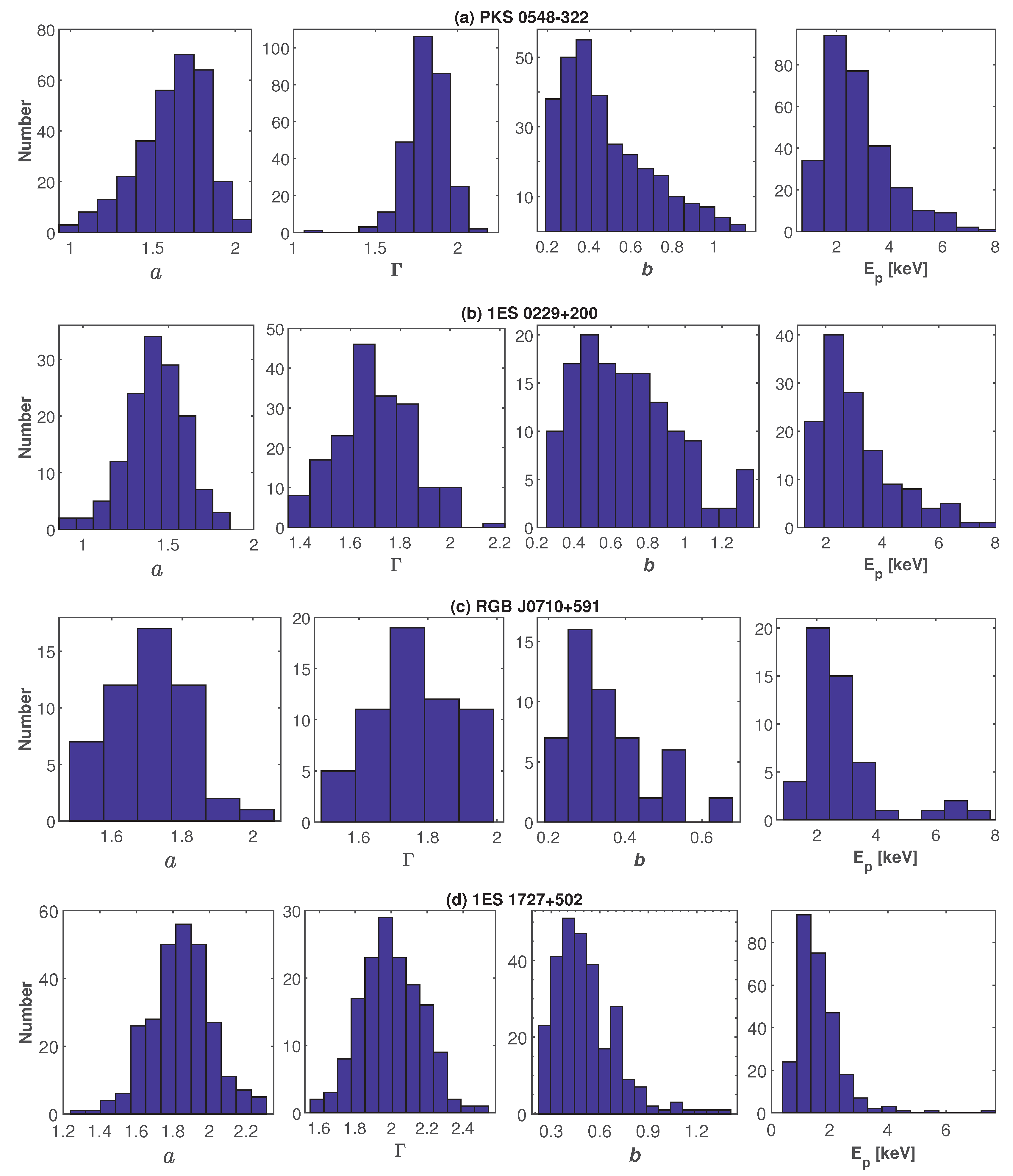

Table 1.
Summary of the sample. The redshifts brackets represent the unconfirmed values (Column 2). For each source, Column (3) provides information about the TeV-detection (with "N*" indicating that no TeV-detection is reported to date, although the Fermi-LAT data showing the detection with >5 significance above 100 GeV; TW); column (4): the value of the hydrogen column density from the LAB Survey (in ); Columns(5)–(7): the minimum, maximum and mean unabsorbed 0.3–10 keV fluxes (daily-binned values; in units of erg ); column (7)–(8): fractional variability amplitude and isotropic mean luminosity in this band, respectively.
Table 1.
Summary of the sample. The redshifts brackets represent the unconfirmed values (Column 2). For each source, Column (3) provides information about the TeV-detection (with "N*" indicating that no TeV-detection is reported to date, although the Fermi-LAT data showing the detection with >5 significance above 100 GeV; TW); column (4): the value of the hydrogen column density from the LAB Survey (in ); Columns(5)–(7): the minimum, maximum and mean unabsorbed 0.3–10 keV fluxes (daily-binned values; in units of erg ); column (7)–(8): fractional variability amplitude and isotropic mean luminosity in this band, respectively.
| Source | z | TeV-det. | ||||||
| (1) | (2) | (3) | (4) | (5) | (6) | (7) | (8) | (9) |
| SHBL J001355.9-1854 | 0.095 | Y | 0.020 | 0.76(0.10) | 1.67(0.10) | 1.16(0.02) | 0.25(0.02) | 44.43 |
| KUV 00311-1938 | 0.610 | Y | 0.017 | 0.64(0.05) | 1.31(0.05) | 0.89(0.02) | 0.27(0.03) | 46.15 |
| 1ES 0033+595 | [0.467] | Y | 0.413 | 2.89(0.37) | 60.53(2.27) | 20.18(0.07) | 0.62(0.01) | [47.22] |
| 1ES 0120+340 | 0.272 | N | 0.052 | 2.32(0.21) | 4.61(0.36) | 3.22(0.04) | 0.25(0.01) | 45.88 |
| RGB J0136+391 | >0.27 | Y | 0.062 | 3.01(0.13) | 4.91(0.17) | 3.73(0.05) | 0.17(0.01) | >45.93 |
| RGB J0152+017 | 0.080 | Y | 0.067 | 0.27(0.04) | 1.32(0.04) | 0.70(0.01) | 0.51(0.02) | 44.08 |
| TXS 0210+515 | 0.049 | Y | 0.144 | 0.90(0.09) | 2.48(0.12) | 1.52(0.01) | 0.23(0.01) | 43.91 |
| 1ES 0229+200 | 0.140 | Y | 0.079 | 0.85(0.09) | 4.99(0.36) | 2.23(0.01) | 0.36(0.01) | 45.07 |
| 1RXS J023832.6-311658 | 0.232 | Y | 0.028 | 0.74(0.08) | 2.96(0.16) | 1.63(0.04) | 0.41(0.02) | 45.42 |
| PKS 0301-243 | 0.266 | Y | 0.017 | 0.22(0.03) | 2.91(0.16) | 0.90(0.01) | 0.92(0.01) | 45.31 |
| 1ES 0347-121 | 0.189 | Y | 0.031 | 0.75(0.10) | 5.77(0.34) | 2.88(0.04) | 0.60(0.01) | 45.47 |
| 1ES 0414+009 | 0.287 | Y | 0.077 | 1.22(0.10) | 6.03(0.27) | 2.90(0.02) | 0.35(0.01) | 45.89 |
| PKS 0447-439 | 0.343 | Y | 0.012 | 1.11(0.06) | 7.13(0.37) | 3.65(0.02) | 0.49(0.01) | 46.17 |
| 1ES 0502+675 | 0.340 | Y | 0.091 | 0.99(0.13) | 7.66(0.29) | 3.29(0.03) | 0.72(0.01) | 46.11 |
| PKS 0548-322 | 0.069 | Y | 0.026 | 2.75(0.05) | 10.57(0.60) | 6.25(0.03) | 0.24(0.01) | 44.87 |
| TXS 0628-240 | >1.239 | N | 0.085 | 0.15(0.02) | 0.48(0.5) | 0.21(0.01) | 0.45(0.04) | >46.63 |
| RX J0648.7+1516 | 0.179 | Y | 0.163 | 1.42(0.09) | 3.18(0.14) | 2.36(0.05) | 0.31(0.02) | 45.33 |
| 1ES 0647+250 | >0.29 | Y | 0.116 | 1.07(0.08) | 21.80(0.37) | 7.63(0.02) | 0.62(0.01) | >46.32 |
| RGB J0710+591 | 0.125 | Y | 0.044 | 1.99(0.15) | 9.96(0.36) | 4.79(0.02) | 0.42(0.01) | 45.30 |
| PGC 2402248 | 0.065 | Y | 0.051 | 1.08(0.10) | 3.36(0.32) | 1.99(0.03) | 0.39(0.02) | 44.31 |
| 1ES 0747+746 | 0.309 | N | 0.032 | 0.48(0.10) | 1.03(0.08) | 0.75(0.03) | 0.25(0.04) | 45.37 |
| 1ES 0806+524 | 0.138 | Y | 0.042 | 1.10(0.07) | 4.41(0.54) | 2.06(0.02) | 0.40(0.01) | 45.03 |
| RX J0812.0+0237 | 0.172 | Y | 0.036 | 0.33(0.05) | 1.00(0.09) | 0.53(0.02) | 0.36(0.04) | 44.65 |
| RBS 0723 | 0.198 | Y | 0.027 | 1.00(0.09) | 2.62(0.11) | 1.92(0.04) | 0.26(0.03) | 45.34 |
| 1ES 0927+500 | 0.188 | N | 0.014 | 0.93(0.08) | 2.14(0.15) | 1.38(0.04) | 0.35(0.03) | 45.15 |
| 1ES 1011+496 | 0.212 | Y | 0.008 | 0.46(0.02) | 13.24(0.18) | 5.97(0.03) | 0.82(0.01) | 45.90 |
| 1ES 1028+511 | 0.361 | Y | 0.012 | 1.77(0.12) | 4.84(0.16) | 3.47(0.04) | 0.30(0.02) | 46.20 |
| 1ES 1101-232 | 0.186 | Y | 0.056 | 4.40(0.25) | 12.16(0.65) | 7.45(0.01) | 0.22(0.01) | 45.87 |
| Mrk 421 | 0.031 | Y | 0.019 | 5.31(0.15) | 470.55(2.25) | 138.27(0.01) | 1.25(0.01) | 45.49 |
| 1ES 1118+424 | 0.124 | N | 0.022 | 0.73(0.05) | 1.90(0.09) | 0.99(0.02) | 0.25(0.01) | 44.61 |
| RX J1136.5+6737 | 0.134 | Y | 0.011 | 1.36(0.12) | 5.39(0.11) | 2.81(0.03) | 0.40(0.01) | 45.13 |
| Mrk 180 | 0.045 | Y | 0.012 | 0.31(0.04) | 15.03(0.92) | 3.35(0.02) | 1.23(0.02) | 44.21 |
| BZBJ1137-1710 | 0.600 | N | 0.031 | 0.88(0.07) | 2.01(0.18) | 1.39(0.04) | 0.30(0.04) | 46.33 |
| 1RXS J121321.6-261802 | 0.278 | N | 0.050 | 1.14(0.07) | 1.81(0.12) | 1.57(0.06) | 0.18(0.04) | 45.59 |
| 1ES 1215+303 | 0.131 | Y | 0.018 | 0.27(0.04) | 3.83(0.21) | 1.39(0.02) | 0.91(0.01) | 44.80 |
| 1ES 1218+304 | 0.182 | Y | 0.019 | 1.14(0.10) | 27.69(1.05) | 8.46(0.02) | 0.54(0.01) | 45.90 |
| MS 1221.8+2452 | 0.218 | Y | 0.018 | 0.31(0.04) | 4.12(0.15) | 1.86(0.02) | 0.64(0.01) | 45.42 |
| RX J1230.2+2518 | [0.135] | Y | 0.014 | 0.46(0.03) | 2.45(0.13) | 1.31(0.02) | 0.43(0.01) | [44.81] |
| MS 1235.4+6315 | 0.295 | N | 0.010 | 0.06(0.01) | 0.70(0.06) | 0.31(0.01) | 0.53(0.01) | 44.91 |
| RGB J1243+364 | >0.483 | N | 0.015 | 0.34(0.04) | 3.67(0.17) | 1.19(0.01) | 0.63(0.01) | >46.03 |
| PG 1246+586 | >0.14 | N* | 0.010 | 0.17(0.01) | 0.64(0.05) | 0.41(0.01) | 0.30(0.02) | >44.34 |
| 1ES 1255+244 | 0.141 | N | 0.013 | 0.29(0.04) | 1.01(0.10) | 0.66(0.02) | 0.30(0.03) | 44.55 |
| 1ES 1312-423 | 0.103 | Y | 0.015 | 3.18(0.12) | 5.41(0.20) | 4.46(0.06) | 0.22(0.02) | 45.09 |
| 1ES 1332-295 | [0.513] | N | 0.041 | 0.45(0.05) | 1.15(0.15) | 0.82(0.03) | 0.32(0.03) | [45.93] |
| RX J1417.9+2543 | 0.236 | Y | 0.015 | 2.05(0.11) | 3.21(0.18) | 2.68(0.06) | 0.16(0.02) | 45.66 |
| 1ES 1421+582 | 0.638 | N | 0.012 | 0.86(0.05) | 2.22(0.15) | 1.51(0.03) | 0.23(0.02) | 46.43 |
| PKS 1424+240 | 0.605 | Y | 0.031 | 0.16(0.02) | 5.36(0.25) | 2.32(0.02) | 0.78(0.01) | 46.56 |
| H 1426+428 | 0.129 | Y | 0.011 | 1.14(0.06) | 13.93(1.23) | 5.93(0.01) | 0.32(0.01) | 45.42 |
| 1ES 1440+122 | 0.162 | Y | 0.015 | 1.34(0.06) | 3.37(0.27) | 2.17(0.05) | 0.39(0.03) | 45.20 |
| PKS 1440-389 | 0.139 | Y | 0.078 | 0.23(0.04) | 4.26(0.27) | 1.69(0.02) | 0.69(0.01) | 44.95 |
| 1RXS J150343.0-154107 | >0.497 | Y | 0.081 | 0.64(0.05) | 1.31(0.24) | 1.02(0.06) | 0.21(0.07) | >45.99 |
| 1H 1515+660 | 0.702 | N | 0.026 | 0.55(0.04) | 4.02(0.15) | 1.74(0.02) | 0.53(0.01) | 46.59 |
| 1ES 1533+535 | [0.875] | N | 0.014 | 0.70(0.04) | 1.81(0.23) | 1.07(0.02) | 0.31(0.03) | [46.62] |
| PG 1553+113 | [0.433] | Y | 0.037 | 0.56(0.05) | 18.75(0.25) | 5.05(0.01) | 0.65(0.01) | [46.55] |
| H 1722+119 | >0.4 | Y | 0.089 | 0.55(0.05) | 6.17(0.52) | 4.94(0.01) | 0.81(0.01) | >44.56 |
| 1ES 1727+502 | 0.055 | Y | 0.036 | 0.80(0.06) | 16.60(0.94) | 6.54(0.01) | 0.69(0.01) | 44.68 |
| 1ES 1741+196 | 0.084 | Y | 0.074 | 0.83(0.09) | 2.23(0.16) | 1.49(0.03) | 0.24(0.02) | 44.42 |
| Mrk 501 | 0.034 | Y | 0.016 | 2.47(0.08) | 82.41(1.51) | 24.61(0.01) | 0.75(0.01) | 44.82 |
| 1RXS J195815.6-301119 | 0.119 | Y | 0.079 | 1.40(0.08) | 3.56(0.19) | 2.00(0.05) | 0.42(0.02) | 44.87 |
| 1ES 1959+650 | 0.048 | Y | 0.100 | 6.11(0.27) | 145.47(2.14) | 38.75(0.01) | 0.81(0.01) | 45.33 |
| PKS 2005-489 | 0.071 | Y | 0.039 | 1.11(0.06) | 41.59(3.08) | 4.96(0.03) | 1.20(0.01) | 44.76 |
| 1ES 2037+521 | 0.053 | Y | 0.585 | 0.37(0.04) | 3.24(0.21) | 1.47(0.02) | 0.62(0.01) | 44.00 |
| RGB J2042+244 | 0.103 | Y | 0.101 | 0.51(0.06) | 2.19(0.18) | 1.22(0.03) | 0.35(0.02) | 44.52 |
| PKS 2155-304 | 0.116 | Y | 0.015 | 2.05(0.11) | 33.18(0.28) | 12.40(0.01) | 0.67(0.01) | 45.64 |
| RGB J2247+381 | 0.119 | Y | 0.104 | 0.42(0.04) | 3.00(0.15) | 1.65(0.02) | 0.46(0.02) | 44.79 |
| RX J2322.6+3436 | 0.098 | N | 0.060 | 0.12(0.02) | 0.46(0.04) | 0.24(0.01) | 0.47(0.05) | 43.77 |
| 1ES 2322-409 | 0.176 | Y | 0.016 | 0.65(0.03) | 1.55(0.07) | 1.03(0.01) | 0.37(0.02) | 44.76 |
| 1ES 2344+514 | 0.044 | Y | 0.100 | 0.73(0.09) | 10.57(0.43) | 2.38(0.01) | 0.47(0.01) | 44.04 |
| H 2356-309 | 0.165 | Y | 0.014 | 1.60(0.12) | 7.09(0.26) | 3.86(0.03) | 0.49(0.01) | 45.57 |
Table 2.
The ranges and mean values of different spectral parameters in HBLs. Columns (2)–(3): photon index 1 keV; (4)–(5): curvature parameter; (6)–(7): the position of the synchrotron SED peak; (8)–(9): the 0.3–10 keV photon index from power-law spectra.
Table 2.
The ranges and mean values of different spectral parameters in HBLs. Columns (2)–(3): photon index 1 keV; (4)–(5): curvature parameter; (6)–(7): the position of the synchrotron SED peak; (8)–(9): the 0.3–10 keV photon index from power-law spectra.
| Source | a | b | ||||||
| (1) | (2) | (3) | (4) | (5) | (6) | (7) | (8) | (9) |
| J001355.9-1854 | 1.49(0.14)–2.15(0.13) | 1.77(0.03) | 0.25(0.12)–0.93(0.43) | 0.52(0.07) | 0.83(0.37)–7.02(0.72) | 2.29(0.11) | 1.56(0.18)–1.99(0.09) | 1.78(0.08) |
| KUV 00311-1938 | 2.11(0.05)–2.30(0.09) | 2.20(0.05) | 0.49(0.31)–0.55(0.15) | 0.52(0.16) | 0.49(0.16)–0.79(0.13) | 0.64(0.10) | 2.13(0.13)–2.29(0.09) | 2.19(0.06) |
| 1ES 0033+595 | 0.92(0.25)–2.04(0.14) | 1.44(0.01) | 0.23(0.10)–1.50(0.35) | 0.55(0.02) | 0.89(0.21)–23.19(1.98) | 2.94(0.03) | 1.51(0.07)–2.34(0.08) | 1.94(0.01) |
| 1ES 0120+340 | 1.50(0.10)–1.83(0.05) | 1.67(0.02) | 0.20(0.13)–0.88(0.25) | 0.38(0.04) | 1.85(0.22)–8.76(0.90) | 3.20(0.11) | 1.70(0.09)–1.89(0.09) | 1.80(0.03) |
| RGB J0136+391 | 2.05(0.05)–2.32(0.08) | 2.18(0.02) | 0.22(0.10)–0.61(0.17) | 0.38(0.05) | 0.17(0.10)–0.88(0.15) | 0.51(0.06) | 2.19(0.0)–2.22(0.8) | 2.21(0.06) |
| RGB J0152+017 | 1.93(0.08)–2.820(0.06) | 2.32(0.04) | 0.42(0.26)–1.60(0.65) | 0.72(0.12) | 0.32(0.15)–1.19(0.22) | 0.65(0.12) | 2.16(0.05)–2.69(0.15) | 2.37(0.05) |
| TXS 0210+515 | 1.25(0.14)–2.02(0.12) | 1.62(0.02) | 0.20(0.12)–1.40(0.41) | 0.50(0.04) | 0.94(0.25)–13.34(1.44) | 2.97(0.07) | 1.57(0.07)–2.14(0.08) | 1.84(0.01) |
| 1ES 0229+200 | 0.86(0.23)–1.80(0.16) | 1.43(0.01) | 0.35(0.19)–1.34(0.59) | 0.69(0.03) | 1.31(0.63)–21.88(3.55) | 3.46(0.04) | 1.35(0.15)–2.4(0.18) | 1.69(0.01) |
| J023832.6-311658 | 2.08(0.06)–2.22(0.09) | 2.16(0.04) | 0.37(0.18)–0.94(0.31) | 0.55(0.12) | 0.56(0.23)–0.78(0.18) | 0.70(0.11) | 2.42(0.12)–2.77(0.23) | 2.56(0.08) |
| PKS 0301−243 | 2.22(0.07)–2.99(0.25) | 2.39(0.03) | 0.36(0.23)–1.80(0.85) | 0.64(0.10) | 0.33(0.18)–0.75(0.32) | 0.47(0.07) | 2.01(0.08)–2.84(0.22) | 2.49(0.03) |
| 1ES 0347-121 | 1.31(0.24)–2.13(0.08) | 1.75(0.05) | 0.27(0.16)–1.08(0.53) | 0.59(0.12) | 0.72(0.24)–4.64(0.49) | 2.20(0.15) | 1.64(0.10)–2.22(0.08) | 1.91(0.02) |
| 1ES 0414+009 | 1.90(0.06)–2.530(0.08) | 2.19(0.02) | 0.24(0.15)–0.77(0.39) | 0.49(0.04) | 0.35(0.10)–1.32(0.17) | 0.67(0.03) | 2.02(0.06)–2.55(0.12) | 2.28(0.02) |
| PKS 0447-439 | 1.95(0.06)–2.84(0.06) | 2.47(0.01) | 0.24(0.15)–0.88(0.21) | 0.50(0.03) | 0.13(0.08)–1.27(0.17) | 0.37(0.02) | 2.29(0.09)–2.78(0.07) | 2.50(0.02) |
| 1ES 0502+675 | 1.46(0.10)–2.21(0.08) | 1.79(0.01) | 0.20(0.13)–1.21(0.25) | 0.59(0.03) | 0.60(0.15)–11.89(1.30) | 1.88(0.04) | 1.58(0.20)– 2.16(0.17) | 193.(0.05) |
| PKS 0548−322 | 0.93(0.14)–2.10(0.08) | 1.62(0.01) | 0.20(0.12)–1.24(0.51) | 0.48(0.01) | 0.71(0.16)–17.34(2.54) | 3.03(0.03) | 1.42(0.08)–2.18(0.07) | 1.81(0.01) |
| TXS 0628-240 | 2.24(0.17)–2.77(0.21) | 2.40(0.07) | -1.04(0.51)–1.86(0.87) | - | 0.62(0.54)–0.86(0.77) | 0.75(0.23) | 2.01(0.22)–2.76(0.23) | 2.41(0.08) |
| RX J0648.7+1516 | 1.98(0.11)–2.550(0.08) | 2.27(0.08) | 0.55(0.21)–0.86(0.27) | 0.70(0.24) | 0.32(0.15)–1.03(0.29) | 0.67(0.15) | 1.94(0.07)–2.56(0.07) | 2.20(0.04) |
| 1ES 0647+250 | 1.66(0.12)–2.37(0.06) | 2.05(0.01) | 0.23(0.14)–1.12(0.25) | 0.54(0.01) | 0.22(0.10)–1.85(0.19) | 0.91(0.01) | 1.63(0.16)–2.88(0.17) | 2.26(0.01) |
| RGB J0710+591 | 1.48(0.09)–2.06(0.08) | 1.71(0.01) | 0.21(0.14)–6.73(0.64) | 0.35(0.02) | 0.88(0.21)–13.34(1.36) | 3.22(0.05) | 1.49(0.05)–1.99(0.06) | 1.76(0.01) |
| PGC 2402248 | 1.39(0.12)–1.71(0.08) | 1.59(0.03) | 0.28(0.18)–0.65(0.24) | 0.44(0.05) | 1.96(0.26)–0.96(0.38) | 3.44(0.16) | 1.72(0.06)–2.07(0.14) | 1.88(0.03) |
| 1ES 0747+746 | 2.05(0.10)–2.41(0.21) | 2.18(0.06) | 0.64(0.22)–1.31(0.64) | 0.95(0.17) | 0.71(0.17)–0.96(0.38) | 0.80(0.18) | 1.65(0.25)–2.36(0.13) | 2.01(0.09) |
| 1ES 0806+524 | 1.83(0.07)–2.650(0.13) | 2.33(0.02) | 0.23(0.15)–1.43(0.44) | 0.56(0.05) | 0.15(0.10)–1.50(0.20) | 0.50(0.05) | 1.83(0.18)–2.59(0.15) | 2.31(0.02) |
| RX J0812.0+0237 | 1.81(0.15)–2.01(0.15) | 1.91(0.11) | 0.52(0.33)–0.83(0.51) | 0.67(0.30) | 0.99(0.52)–1.52(0.35) | 1.26(0.31) | 1.55(0.20)–2.49(0.23) | 1.96(0.05) |
| RBS 0723 | 1.58(0.06)–1.820(0.06) | 1.67(0.03) | 0.32(0.12)–0.64(0.19) | 0.43(0.07) | 1.87(0.19)–4.53(0.41) | 2.78(0.13) | 1.74(0.15)–1.80(0.05) | 1.76(0.07) |
| 1ES 0927+500 | 1.82(0.12)–2.21(0.10) | 2.06(0.07) | 0.74(0.48)–1.10(0.58) | 0.86(0.27) | 0.73(0.34)–1.32(0.51) | 0.97(0.28) | 1.83(0.08)–2.15(0.10) | 2.03(0.06) |
| 1ES 1011+496 | 1.59(0.07)–2.54(0.04) | 2.12(0.01) | 0.19(0.09)–1.06(0.20) | 0.43(0.02) | 0.22(0.08)–5.18(0.48) | 1.01(0.02) | 1.70(0.05)–2.62(0.10) | 2.29(0.01) |
| 1ES 1028+511 | 1.79(0.07)–2.10(0.07) | 2.00(0.02) | 0.28(0.15)–0.64(0.26) | 0.39(0.05) | 0.69(0.16)–1.80(0.23) | 1.02(0.06) | 1.89(0.06)–2.2(0.08) | 2.6(0.01) |
| 1ES 1101−232 | 1.56(0.09)–2.24(0.06) | 1.89(0.01) | 0.14(0.08)–0.82(0.22) | 0.34(0.01) | 0.35(0.13)–3.98(0.34) | 1.56(0.02) | 1.44(0.15)–2.34(0.06) | 1.99(0.01) |
| Mrk 421 | 1.48(0.03)–3.02(0.03) | 2.08(0.01) | 0.07(0.04)–0.64(0.08) | 0.24(0.01) | 0.02(0.01)–29.29(4.17) | 2.25(0.01) | 1.62(0.02)–2.93(0.03) | 2.10(0.01) |
| 1ES 1118+424 | 2.10(0.09)–2.42(0.08) | 2.28(0.03) | -0.46(0.21)–1.16(0.37) | - | 0.46(0.13)–0.85(0.23) | 0.63(0.10) | 2.25(0.08)–2.52(0.07) | 2.39(0.03) |
| RX J1136.5+6737 | 1.33(0.14)–1.75(0.06) | .0(0.01) | 0.21(0.14)–0.65(0.23) | 0.38(0.05) | 1.70(0.25)–7.57(0.68) | 4.51(0.11) | 1.53(0.06)–1.97(0.06) | 1.76(0.02) |
| BZB J1137−1710 | 1.39(0.11)–1.65(0.12) | 1.59(0.06) | 0.75(0.24)–1.09(0.39) | 0.90(0.16) | 1.42(0.58)–2.55(0.67) | 1.79(0.29) | 1.48(0.15)–1.94(0.12) | 1.76(0.05) |
| Mrk 180 | 1.59(0.04)–2.98(0.16) | 2.18(0.06) | 0.13(0.05)–1.64(0.93) | 0.52(0.04) | 0.11(0.07)–7.08(0.63) | 3.10(0.01) | 1.98(0.04)–2.79(0.24) | 2.39(0.02) |
| J121321.6-261802 | 1.68(0.13)–1.85(0.10) | 1.78(0.05) | 0.47(0.22)–0.69(0.30) | 0.56(0.14) | 1.39(0.35)–1.71(0.32) | 1.54(0.15) | - | - |
| 1ES 1215+303 | 2.22(0.09)–2.93(0.14) | 2.54(0.02) | -1.52(0.52)–1.17(0.30) | - | 0.21(0.12)–0.81(0.28) | 0.42(0.05) | 2.23(0.11)–3.16(0.25) | 2.55(0.03) |
| 1ES 1218+304 | 1.53(0.08)–2.46(0.07) | 1.90(0.01) | 0.16(0.08)–1.06(0.37) | 0.34(0.01) | 0.21(0.13)–4.83(0.42) | 1.83(0.02) | 1.60(0.06)–2.69(0.07) | 1.98(0.01) |
| MS 1221.8+2452 | 1.79(0.07)–2.38(0.07) | 2.12(0.02) | 0.28(0.18)–0.75(0.47) | 0.45(0.05) | 0.30(0.15)–2.00(0.25) | 0.79.(0.05) | 2.05(0.18)–2.69(0.10) | 2.31(0.04) |
| RX J1230.2+2518 | 2.19(0.09)–2.37(0.13) | 2.28(0.03) | -0.53(0.32)–0.75(0.32) | - | 0.27(0.11)–0.67(0.22) | 0.53(0.06) | 2.05(0.06)–2.56(0.09) | 2.26(0.02) |
| MS 1235.4+6315 | 1.69(0.10)–2.68(0.25) | 1.97(0.02) | 0.35(0.23)–1.45(0.33) | 0.72(0.06) | 0.58(0.42)–2.09(0.22) | 1.09(0.06) | 1.62(0.24)–2.67(0.14) | 2.11(0.03) |
| RGB J1243+364 | 2.04(0.10)–2.69(0.12) | 2.19(0.03) | 0.19(0.12)–1.10(0.31) | 0.50(0.08) | 0.32(0.12)–0.96(0.30) | 0.64(0.08) | 2.06(0.10)–2.57(0.18) | 2.32(0.02) |
| PG 1246+586 | 2.48(0.10)–2.66(0.12) | 2.56(0.08) | 0.66(.38)–2.14(0.84) | 1.23(0.29) | 0.32(0.19)–0.73(0.45) | 0.55(0.15) | 1.76(0.26)–2.65(0.18) | 2.32(0.04) |
| 1ES 1255+244 | 1.73(0.10)–1.92(0.09) | 1.86(0.06) | 0.34(0.21)–0.59(0.34) | 0.44(0.15) | 1.19(0.35)–2.18(0.32) | 1.56(0.17) | 1.71(0.14)–2.21(0.19) | 1.96(0.05) |
| 1ES 1312−423 | 1.57(0.06)–2.03(0.05) | 1.87(0.03) | 0.28(0.11)–0.83(0.13) | 0.46(0.06) | 0.88(0.11)–1.82(0.16) | 1.29(0.07) | 1.96(0.05)–2.13(0.06) | 2.04(0.03) |
| 1ES 1332−295 | 1.71(0.14)–1.76(0.07) | 1.68(0.05) | 0.31(0.16)–0.64(0.24) | 0.42(0.12) | 1.95(0.26)–3.75(0.39) | 2.61(0.15) | 1.71(0.13)–2.36(0.22) | 1.99(0.07) |
| RX J1417.9+2543 | 1.73(0.06)–1.96(0.06) | 1.84(0.02) | 0.20(0.11)–0.44(0.21) | 0.28(0.06) | 1.20(0.16)–4.73(0.41) | 2.28(0.09) | 1.94(0.0)–2.01(0.11) | 1.94(0.03) |
| 1ES 1421+582 | 1.73(0.09)–2.00(0.02) | 1.90(0.04) | 0.31(0.20)–0.74(0.39) | 0.48(0.10) | 1.00(0.40)–2.37(0.31) | 1.47(0.12) | 1.79(0.09)–1.98(0.11) | 1.82(0.04) |
| PKS 1424+240 | 1.91(0.08)–2.69(0.09) | 2.34(0.02) | 0.23(0.15)–0.95(0.39) | 0.48(0.05) | 0.22(0.12)–1.15(0.24) | 0.44(0.03) | 2.16(0.07)–2.69(0.10) | 2.42(0.02) |
| H 1426+428 | 1.34(0.13)–2.22(0.06) | 1.80(0.01) | 0.15(0.09)–1.51(0.34) | 0.34(0.01) | 0.58(0.23)–12.59(1.13) | 2.26(0.02) | 1.58(0.14)–2.09(0.06) | 1.87(0.01) |
| 1ES 1440+122 | 1.79(0.07)–2.13(0.08) | 1.92(0.04) | 0.38(0.24)–0.57(0.26) | 0.46(0.12) | 0.67(0.26)–1.75(0.20) | 1.28(0.14) | 1.30(0.15)–2.02(0.06) | 1.74(0.04) |
| PKS 1440-389 | 1.74(0.10)–2.60(0.17) | 2.18(0.02) | 0.39(0.23)–1.13(0.35) | 0.64(0.05) | 0.35(0.15)–1.68(0.25) | 0.79(0.06) | 2.10(0.12)–2.80(0.19) | 2.44(0.04) |
| J150343.0−154107 | 1.47(0.12)–1.73(0.11) | 1.60(0.08) | 0.74(0.28)–1.19(0.27) | 0.97(0.19) | 1.52(0.36)–1.67(0.39) | 1.59(0.26) | 1.75(0.17)–2.19(0.16) | 2.01(0.05) |
| H 1515+660 | 1.27(0.10)–2.19(0.08) | 1.77(0.02) | 0.12(0.08)–0.89(0.22) | 0.45(0.04) | 0.40(0.13)–8.19(0.93) | 3.04(0.19) | 1.57(0.06)–2.53(0.18) | 2.04(0.03) |
| 1ES 1533+535 | 1.72(0.10)–2.19(0.11) | 1.96(0.03) | 0.38(0.25)–1.10(0.39) | 0.60(0.07) | 0.73(0.28)–1.88(0.29) | 1.15(0.08) | 1.70(0.20)–2.26(0.10) | 1.99(0.05) |
| PG 1553+113 | 1.96(0.10)–2.59(0.08) | 2.27(0.01) | 0.18(0.07)–0.88(0.48) | 0.36(0.01) | 0.22(0.11)–1.19(0.17) | 0.55(0.01) | 2.12(0.11)–2.68(0.13) | 2.35(0.01) |
| Mrk 501 | 1.39(0.06)–2.54(0.05) | 1.90(0.01) | 0.09(0.05)–0.79(0.26) | 0.24(0.01) | 0.08(0.04)–29.43(3.22) | 3.10(0.01) | 1.41(0.03)–2.60(0.06) | 1.99(0.01) |
| H 1722+119 | 2.05(0.05)–2.32(0.08) | 2.11(0.07) | 0.41(0.23)–1.20(0.47) | 0.71(0.18) | 0.48(0.23)–1.01(0.48) | 0.77(0.19) | 2.03(0.17)–2.64(0.12) | 2.41(0.04) |
| 1ES 1727+502 | 1.40(0.09)–2.38(0.07) | 1.84(0.01) | 0.22(0.14)–1.29(0.52) | 0.49(0.01) | 0.25(0.10)–7.70(0.69) | 1.63(0.01) | 1.55(0.11)–2.54(0.12) | 2.00(0.01) |
| 1ES 1741+196 | 1.40(0.19)–1.96(0.11) | 1.62(0.04) | 0.26(0.16)–1.08(0.29) | 0.61(0.09) | 1.13(0.28)–6.60(0.62) | 2.59(0.11) | 1.45(0.17)–2.05(0.06) | 1.80(0.03) |
| J195815.6-301119 | 1.65(0.08)–1.92(0.08) | 1.77(0.04) | 0.30(0.14)–0.64(0.20) | 0.49(0.06) | 01.60(0.20)–2.70(0.25) | 1.82(0.09) | 1.88(0.12)–1.94(0.07) | 1.91(0.05) |
| 1ES 1959+650 | 1.34(0.09)–2.41(0.02) | 1.90(0.01) | 0.10(0.05)–0.99(0.13) | 0.38(0.01) | 0.12(0.07)–12.80(0.81) | 1.72(0.01) | 1.71(0.03)–2.22(0.04) | 1.91(0.01) |
| PKS 2005−489 | 1.92(0.04)–2.87(0.07) | 2.37(0.02) | −1.15(0.28)–0.93(0.45) | - | 0.24(0.14)–1.58(0.18) | 0.68(0.05) | 1.95(0.04)–3.25(0.09) | 2.58(0.01) |
| 1ES 2037+521 | 0.91(0.32)–1.52(0.23) | 1.25(0.07) | 0.47(0.29)–1.50(0.46) | 0.88(0.10) | 2.00(0.55)–4.46(0.68) | 2.85(0.15) | 1.48(0.17)–2.24(0.26) | 1.85(0.03) |
| RGB J2042+244 | 1.80(0.10)–2.04(0.13) | 1.88(0.03) | 0.28(0.18)–1.37(0.38) | 0.59(0.08) | 0.91(0.27)–1.85(0.21) | 1.33(0.08) | 1.83(0.17)–2.33(0.11) | 2.10(0.03) |
| PKS 2155−304 | 2.05(0.03)–2.75(0.04) | 2.45(0.01) | -0.31(0.01)–0.80(0.13) | - | 0.02(0.001)–0.89(0.11) | - | 2.40(0.03)–2.75(0.04) | 2.52(0.02) |
| RGB J2247+381 | 1.57(0.19)–2.20(0.11) | 1.93(0.02) | 0.30(0.20)–1.70(0.55) | 0.68(0.05) | 0.65(0.26)–1.87(0.25) | 1.16(0.05) | 2.01(0.10)–2.48(0.08) | 2.22(0.04) |
| RX J2322.6+3436 | 1.60(0.22)–2.20(0.17) | 1.82(0.07) | 0.58(0.27)–2.80(1.37) | 1.15(0.21) | 0.81(0.56)–1.55(0.59) | 1.27(0.20) | 1.73(0.22)–2.20(0.15) | 1.95(0.10) |
| 1ES 2322−409 | 2.31(0.06)–2.36(0.07) | 2.33(0.05) | 0.39(0.19)–0.59(0.21) | 0.49(0.14) | 0.40(0.14)–0.50(0.16) | 0.45(0.11) | 2.28(0.08)–2.43(0.05) | 2.36(0.03) |
| 1ES 2344+514 | 1.36(0.08)–2(0.07) | 1.75(0.03) | 0.22(0.12)–1.06(0.24) | 0.46(0.04) | 1.42(0.36)–6.03(0.58) | 2.45(0.10) | 1.55(0.20)–2.36(0.19) | 1.95(0.01) |
| H 2356-309 | 1.61(0.11)–2.15(0.01) | 1.87(0.01) | 0.13(0.01)–0.73(0.27) | 0.34(0.043) | 0.30(0.13)–3.73(0.31) | 1.65(0.04) | 1.72(0.07)–2.28(0.01) | 1.93(0.01) |
Disclaimer/Publisher’s Note: The statements, opinions and data contained in all publications are solely those of the individual author(s) and contributor(s) and not of MDPI and/or the editor(s). MDPI and/or the editor(s) disclaim responsibility for any injury to people or property resulting from any ideas, methods, instructions or products referred to in the content. |
© 2026 by the authors. Licensee MDPI, Basel, Switzerland. This article is an open access article distributed under the terms and conditions of the Creative Commons Attribution (CC BY) license (http://creativecommons.org/licenses/by/4.0/).
Copyright: This open access article is published under a Creative Commons CC BY 4.0 license, which permit the free download, distribution, and reuse, provided that the author and preprint are cited in any reuse.


