
Submitted:
01 April 2026
Posted:
02 April 2026
You are already at the latest version
Abstract
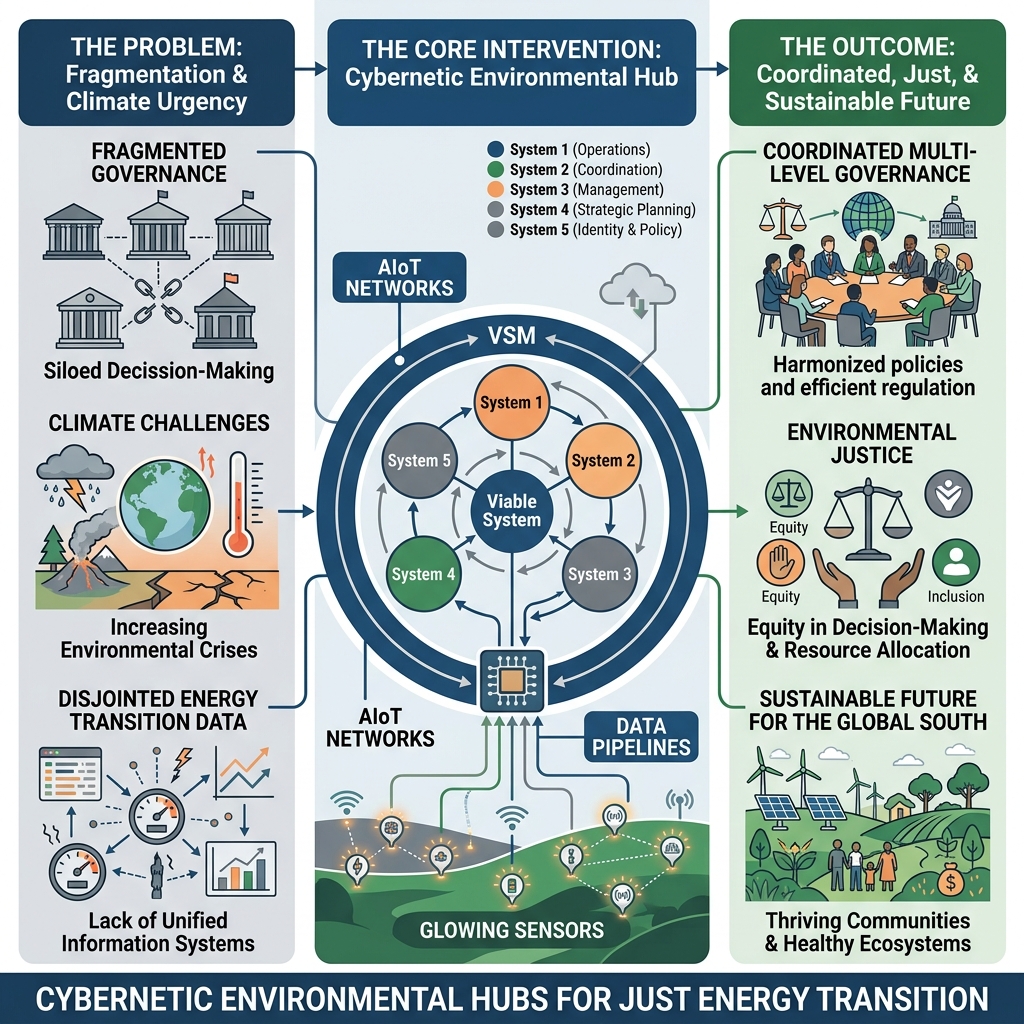
Just energy transitions in the Global South unfold under conditions of institutional fragmentation, fiscal constraints, and high socio-ecological turbulence, making governance capacity a critical bottleneck for effective decarbonization and climate justice. This study proposes the Cybernetic Environmental Hub (CEH) framework, which extends the Viable System Model (VSM) to sustainability governance by integrating AIoT-enabled environmental monitoring, Early Warning Systems, decentralized data governance, and justice-centered institutional design. Methodologically, the research adopts a hybrid conceptual–empirical approach combining theoretical development with participatory territorial diagnostics. Empirical validation is illustrated through a case study in the Caribbean Mining Corridor, where socio-ecological challenges were collected through participatory innovation workshops, thematically coded, and mapped onto the five VSM subsystems to identify systemic “variety gaps.” The analysis demonstrates that fragmented operational initiatives coexist with weak meta-systemic coordination, limiting adaptive capacity in energy transition processes. The CEH architecture addresses these deficiencies by embedding AIoT sensing, federated learning, blockchain-based coordination, and Early Warning Systems within recursive governance structures. Additionally, the study introduces a Territorial Governance Maturity Model (H1–H3) to diagnose systemic learning capacities and transition readiness across technological, institutional, data governance, and justice dimensions. The findings suggest that cybernetic environmental hubs can function as socio-technical infrastructures enabling coordinated, adaptive, and justice-centered energy transitions in the Global South.
Keywords:
cybernetic environmental hubs
; Viable System Model (VSM)
; just energy transition
; AIoT environmental monitoring
; early warning systems
; climate justice governance
; open environmental data governance
; Global South
Copyright: This open access article is published under a Creative Commons CC BY 4.0 license, which permit the free download, distribution, and reuse, provided that the author and preprint are cited in any reuse.


