

Submitted:
01 April 2026
Posted:
02 April 2026
You are already at the latest version
Abstract
This research aims to investigate the concept of Industrial Symbiosis as a change agent in the Circular Economy, with its consequent effects on the economy, the environment, and society in terms of sustainable development. This study employs qualitative research with quantitative support from a structured survey of 152 IS project experts, researchers, and practitioners, utilizing a questionnaire comprising Likert-type and multiple-choice questions. Data were aggregated into composite indicators and analyzed by using a log-log regression model. Empirical results reveal that economic benefits are the most significant positive drivers. The actors’ involvement also contributes positively, highlighting the importance of multi-stakeholder collaboration. Conversely, barriers have the strongest negative impact on perceived obstacles and reduce IS synergies on the largest scale. Broader economic and social conditions moderately enhance, while awareness and training show a weaker but positive effect. IS is both economically viable and environmentally necessary, but its expansion depends on reducing financial, regulatory, and infrastructural barriers. Certain economic policy-driven interventions, such as fiscal incentives, regulatory clarity, and investment, enable infrastructure to scale up the adoption of IS.
Keywords:
industrial symbiosis
; circular economy
; resource efficiency synergies
; sustainable industrial transformation
1. Introduction: Economic Perspectives on Industrial Symbiosis
Industrial Symbiosis (IS) refers to a collaborative approach in which two or more entities, either within the same industry or across different sectors, generate both environmental and economic value. In this system, businesses coordinate decision-making and share resources. The waste produced by one organization serves as a raw material for another. Resource sharing extends beyond waste materials to include energy, labor, logistics, and expertise, all of which are efficiently exchanged. The initial IS initiatives began in Denmark during the 1970s. Today, the concept is widely implemented in Europe and North America, as well as in countries such as South Korea, China, Mexico, Brazil, and Australia. IS constitutes a transformative strategy to sustainable industrial development. Traditionally, isolated industries now collectively exchange materials, energy, water, and by-products.
By converting waste streams into inputs for other processes, IS establishes resource-sharing networks that challenge the linear “take-make-dispose” pattern. IS reflects the principles of the Circular Economy (CE), where resources are kept in circulation for as long as possible to maximize value. This paper examines the economics of IS, specifically the value created, Key Performance Indicators (KPIs), and the micro- and macro-level benefits gained in the long term. These pillars, based on the CE, which focuses on the elimination of waste, the optimization of resource use, and the regeneration of the environment, ensure the sustainability and competitiveness of industrial processes. IS applies these principles through pragmatic and collaborative approaches, which reduce the need for raw materials, extend the useful life of products and resources, and minimize waste. There has been an increase in the amount of resources needed globally, while the amount extracted has tripled, which has led to a fourfold increase in GDP. In addition, the amount of resources used globally will nearly double by 2060, with an increase in greenhouse gas emissions [1].
Economic motivation is provided by IS through various dimensions, including but not limited to environmental sustainability. At a micro-economic level, IS offers cost savings as well as efficiency gains through reduced spending on raw materials and waste disposal. Shared infrastructures, including pipelines as well as waste treatment facilities, can also be streamlined. IS can also provide revenue generation through the conversion of by-products into sellable products, creating new revenue streams with reduced exposure to raw material price fluctuations [2]. Another important benefit of resource security is that local exchanges reduce reliance on unstable global markets, thereby insulating industries against geopolitical risks. IS can also provide risk management as well as regulatory compliance, enabling industries to avoid financial penalties as well as reap incentives, including tax credits, subsidies, and carbon trading opportunities [2,3]. IS can also provide industries with innovative as well as competitive advantages through new product development, logistics, and business models with Environmental, Social, and Governance criteria [4,5].
Besides its immediate economic and environmental benefits, the concept of industrial symbiosis (IS) must also be seen as a contributor to sustainability transitions. Sustainability transitions towards a low-carbon and resource-efficient economy call for systemic innovations that go beyond the firm-level concept of efficiency. IS delivers precisely this kind of systemic change because it impacts the regional and interregional patterns of production and consumption. Through its capacity for collective action, IS helps deliver the Sustainable Development Goals (SDGs), particularly those on responsible consumption and production (SDG12), climate change (SDG13), and industry, innovation, and infrastructure (SDG9). This systemic approach thus locates IS as a bridge between the micro-level actions of corporations and the macro-level ambitions of policies, thus further emphasizing its position as a key driver towards a sustainable and future circular economy.
At the macro level, the overall social benefits of IS include regional development through the establishment of industrial clusters, the creation of jobs in the recycling and green technology industries, and the long-run contribution to economic growth through the enhancement of industrial diversification [6]. In this respect, IS offers a powerful example of the mutually reinforcing nature of economic and environmental goals. However, the implementation of IS is faced with a number of challenges. These include the initial capital costs, the complexity of coordination in the various industries, and the potential instability of the flows in the system, which may impede the adoption of IS [7]. However, to address these barriers, financial instruments such as subsidies and/or favorable loans need to be put in place, but more importantly, institutional innovations need to be made in the governance structure in order to equitably share the costs and the benefits. IS is not only a technical and environmental concept but also an innovative economic concept, where waste is converted into a resource, creating cost savings, additional revenue, and innovation, and at the same time fulfilling environmental goals. In the face of climate change, resource depletion, and environmental regulations, industries worldwide need a solution to balance economic and environmental goals, and IS offers a solution to these problems. Therefore, the economic dimension is vital in guiding industries and communities towards a sustainable industrial future.
This research aims to identify the major impediments to, as well as the drivers of, IS adoption in Europe, providing practical solutions to enhance efficiencies. It employed a mixed-methods approach, a structured survey of experts such as researchers, practitioners, and evaluators on IS projects, using Likert scales to collect data on economic, organizational, technological, and institutional aspects, along with multiple-choice questions on best practices, stakeholders, and context. Log-linear regression was used to analyze the results. The results are useful to policymakers and public institutions in understanding the impediments to IS adoption, such as institutional, financial, and legal issues, to design better policies, incentives, and laws. To industries and businesses, IS can mean lower costs, improved competitiveness, and higher revenues. To collaborative groups and industrial networks, the results are relevant in understanding the importance of working with stakeholders to leverage resources. To academic and research institutions, this research contributes to the literature on the economic and organizational aspects of IS.
2. Literature Review
However, it is not possible to fully grasp the notion of Industrial Symbiosis (IS) in a vacuum, as it is embedded in a broader discussion of sustainability transitions and the Circular Economy. Over the past two decades, both theoretical and policy-focused literature has highlighted the need for a radical rethink of the way in which industrial systems are organized to reduce environmental pressures in a manner that sustains competitiveness. The traditional linear “take, make, dispose” model has become ever more unsustainable, creating issues of resource scarcity, waste, and climate change [8]. As a response, the Circular Economy has been posited as a fundamentally different way of thinking, embracing a restorative and regenerative approach to production and consumption [9].
Researchers argue that Industrial Symbiosis is one of the most operational and practice-oriented manifestations of the concept of the Circular Economy. While the Circular Economy is a broad framework of principles and objectives, Industrial Symbiosis is a specific expression of this concept, where material, energy, and by-product exchange represent a practical expression of circularity [10,11]. Such a perspective on the subject, which considers the concept of the Circular Economy as a paradigm and Industrial Symbiosis as a mechanism, is considered to frame most of the existing research. However, the existing literature on the subject is also seen to contain a mix of enthusiasm and gaps. On the one hand, several empirical studies have proven the benefits of Industrial Symbiosis, including cost savings, job creation, and innovation. On the other hand, a few gaps, including a lack of clarity of the regulatory framework, coordination, and infrastructures, which hinder the development of Industrial Symbiosis, have also been pointed out by researchers. Such gaps are overcome only by the most advanced economies, which have already established a circular economic model, but this is a problem for developing countries [12]. Such a perspective on Industrial Symbiosis has made it a rich subject of study. Further research on Industrial Symbiosis taxonomy, especially materials exchange, will help to bridge gaps in the existing literature and improve the Industrial Symbiosis framework, especially from the point of view of stakeholders [10].
Nevertheless, in recent years, there has been a continued focus on measurement and evaluation. This is because, in recent years, there has been a proliferation of information systems initiatives, and policymakers, industry stakeholders, and researchers need powerful tools to evaluate the impacts of these initiatives. To this end, there has been a renewed focus on the development of Key Performance Indicators (KPI) designed to measure the performance of information systems initiatives in a number of areas, including the legal and regulatory environment, the economic and organizational environment, the technical environment, the social and cultural environment, and the environmental environment [13,14]. With this background, the following section reviews the evolution of Circular Economy principles in the European context, highlights the diverse benefits associated with IS, and discusses the role of KPIs as essential tools for evaluating and fostering sustainable industrial practices.
2.1. Circular Economy and Its Evolution
IS refers to the connection between industrial facilities or companies. In this association, the waste or by-products of one become raw materials for another. IS can be described as a collaboration between several different entities. These are often geographically proximate, such as companies and factories closely co-located in clusters or industrial parks. They exchange resources (e.g., materials, energy, water, and by-products) that can serve as substitutes for products or raw materials. Otherwise, these resources would be imported from elsewhere or treated as waste [11]. IS is an integral part of the concept of the Circular Economy that has been prevalent in the last few decades and can enhance the circular economy and is becoming crucial, especially in specific industries. Firstly, we must understand the importance of the Circular Economy and then of IS (as a more advanced and specific step). A sustainable economy, with almost zero waste and pollution, is becoming increasingly crucial in our era, stated as one of the achievements of applying circular economic concepts [15]. Regarding the Circular Economy, products are created for disassembly and reuse, shifting from end-of-life to restoration. Four sources of value creation are highlighted: minimizing material usage, maximizing consecutive cycles and time in each cycle, diversifying reuse across the value chain, and maintaining uncontaminated material streams.
Compared to traditional linear economic models, these principles simulate increased productivity of resource use in the long term [16]. Ellen MacArthur Foundation [17] outlines three fundamental principles for a Circular Economy. First, design out waste and pollution, which reduces environmental impacts, saves on raw materials, and decreases waste. Second, use and reuse products and materials, which extends product lifecycles, cuts material costs, and supports resource efficiency. Third, regenerate natural systems, which restore ecosystems and enhance overall environmental quality [18]. Circularity is key for industries to achieve climate neutrality and competitiveness, as it delivers significant material savings across value chains, increases value creation, and generates new economic opportunities. Opportunities include promoting circular practices within industrial processes, fostering IS through reporting and certification, supporting the sustainable bio-based sector, using digital resource tracking, and encouraging adoption of green technologies [19]. The European Environment Agency [8] shows that over the past 50 years, unprecedented rises in global material demand have doubled goods production, tripled material extraction, and quadrupled economic growth (GDP). This growth has contributed to biodiversity loss, water stress, and climate change. Global material use is projected to almost double by 2060, leading to substantial increases in greenhouse gas emissions.
The Circular Economy aims to mitigate these trends by recycling materials, reusing products, and extending their lifespans, yielding both economic and environmental benefits. Achieving a Circular Economy requires systemic changes across the value chain, including product design, technology, business models, consumer behaviour, education, etc [20]. The EU launched its Circular Economy package in 2015 to address sustainability challenges and establish concrete measures spanning consumption, production, waste management, and secondary raw material markets [21]. The Circular Economy is integrated better with climate policies if countries can take some crucial steps, including coordinating between countries, using models to identify impactful actions, integrating Circular Economy policies into climate mitigation reporting, evaluating the need for additional legislative proposals, monitoring policy progress, and continuously refining and developing integration strategies [22].
2.2. IS Within the Circular Economy
Based on this overview of the Circular Economy in the EU, industries promise large development potential. There are different potential industries that could engage in IS, such as: agriculture and food processing; chemical and pharmaceutical; construction and demolition; energy production; metal manufacturing and recycling; paper and textile, etc. [8]. IS offers numerous benefits for businesses, enhancing their operational efficiency and sustainability [23]. The literature highlights a wide range of benefits associated with IS, which extend beyond simple resource sharing. One of the most frequently cited advantages is cost savings, achieved by reducing raw material expenses through the use of industrial by-products and by lowering waste disposal costs [24]. At the same time, IS can create revenue streams for industries through the sale of by-products or innovative products developed from waste materials [25,26]. The second important contribution is efficiency, as IS ensures the optimum utilization of resources, minimization of waste, and productivity, along with supply chain sustainability through local sourcing strategies [27].
Apart from economic benefits, IS is also important for industries in terms of minimizing their negative impacts on the environment. Carbon dioxide emissions have increased in recent years due to the rise of industrialization and urbanization globally. IS can help industries reduce their carbon footprints and ensure compliance with environmental regulations, making it an important aspect for corporate sustainability [28]. At the same time, IS can help industries innovate and increase their competitiveness through collaborative approaches, making them stronger in the global market through sustainability [29,30,31,32]. Other benefits include better risk management through diversified supply chains, minimizing dependence on a single source for raw materials, and making industries stronger in terms of sustainability [33]. The final important benefit is corporate image and branding, as industries can benefit from IS by showing their commitment to sustainability, as consumers are becoming increasingly environmentally conscious [23]. Moreover, the collaborative frameworks underlying information systems (IS) contribute even more to stimulating innovation and technological development [34,35], including joint research and the appearance of green technologies, which in turn consolidates sustainable business practices in the economy. At the same time, information systems play a critical role in protecting the environment by reducing its degradation and the economic costs of this degradation, as well as by complying with environmental legislation and reducing the risks of incurring penalties or reputational losses. This is complemented by significant savings in energy costs due to the increased efficiency of industrial processes, the use of renewable sources of energy, and savings in energy costs. In addition, information systems contribute to the development of regions by facilitating the formation of industrial clusters and enhancing economic resilience by means of a diversified industrial sector. Finally, the establishment of public-private partnerships plays a critical role in scaling information systems initiatives, as joint work by governmental actors and industries facilitates investments in infrastructure and economic development.
3. Data and Method
The purpose of this study is to identify the main obstacles and barriers for the implementation of IS, with special reference to Europe, but at the same time provide useful insights for increasing efficiency. The methodological approach is based on a combination of both quantitative and qualitative approaches, enabling a comprehensive evaluation of economic, organizational, technological, educational, institutional, and collaborative aspects affecting IS implementation. The survey is conducted among 152 participants, including scientific researchers, domain experts, and evaluators with special expertise in IS. The sample is selected according to their expertise and their involvement in IS projects or evaluations. The survey is composed of two types of questions: Likert scale questions measuring the intensity, relevance, or effectiveness of different influencing factors, with a scale from 1-strongly disagree to 5-strongly agree. The second type of question is multiple choice, aiming to collect information on common practices, main actors, and conditions regarding IS implementation. The survey is designed to collect both quantitative and qualitative information, enabling a holistic understanding of IS barriers and drivers in the national context:
- Economic and business drivers: The survey asks respondents to rate their expectations regarding the expected economic benefits of IS implementation, including waste reduction, cost savings, improved competitiveness, sustainability, and new business opportunities. These questions provide useful insights regarding IS as an economic driver.
- Actors and synergies: The methodological approach highlights the importance of main actors by evaluating their involvement levels among internal company actors, industry partners, and public institutions. Moreover, synergies between resources are assessed regarding material, energy, water, by-products, logistics, and knowledge flows, reflecting the multidimensional nature of IS.
- Technologies and tools: A special section is concerned with the implementation of process, digital, and ICT technologies, as well as innovations in quality regarding by-products. This provides information on the technological level of the industries and technology gaps.
- Barriers and challenges: The survey also covers structural challenges from a systematic point of view, including funding, regulations, awareness, and cooperation. The role of fiscal, regulatory, organizational, and geographic barriers is also assessed. This provides a multilayered view of systemic inefficiencies.
- Technological and socio-economic conditions: The technological barriers of high technology, low R&D infrastructure, and a lack of qualified personnel are analyzed, as well as socio-economic aspects including GDP growth, unemployment rates, educational levels, and cultural aspects regarding reuse and recycling. This provides a multilayered view of IS performance.
- Awareness and institutional support: The influence of awareness conditions such as governmental policies, funding schemes, educational initiatives, and community engagement. These indicators help assess the institutional ecosystem and its capacity to sustain IS initiatives.
Table 1 below provides a summary of the variables of the model under analysis and the description of each variable regarding the components it contains, based on the questionnaire questions and the possible response options chosen by the respondents.
The research develops a log-linear regression model to investigate the link between the dependent variable (resource synergies) and the set of independent indices. This method enables the estimation of elasticity coefficients and facilitates the analysis of proportional shifts in resource synergies in response to changes in the underlying determinants. By using indicator values, it is possible to reduce dimensionality and multicollinearity, and at the same time, a structured overview of grouped themes is obtained
The parameters βᵢ, are estimated based on the the Ordinary Least Squares (OLS) methodology, which minimizes the sum of squared errors [36]. For reliability, the following assumptions of the Gauss-Markov theorem are made [37]:
Assumption 1: Linearity of the model in parameters (not necessarily in variables).
Assumption 2: Random and population’s representative sample.
Assumption 3: No perfect multicollinearity i.e., no constant or exact linear relationships between independent variables.
Assumption 4: Zero conditional mean i.e., expected value of the error term equals zero, given independent variables.
Assumption 5 (Homoskedasticity): The variance of the error term should remain constant and should not correlate with the values of the explanatory variables.
Assumption 6 (Normality): The error term is characterized by a mean of zero and constant variance and has a normal distribution.
4. Results and Discussion
In the following section of this study, we will first provide a summarized presentation of the questionnaire results for the variables included in the evaluation model. This analysis, illustrated with histograms and descriptive statistics, is based on groups of factors converted into evaluation indicators, calculated as the average of the values obtained from the questionnaire (average scores ranging from 1 to 5 on a Likert scale).
There are several dimensions of IS implementation synergies based on practices applied in different countries. Figure 1 shows that material flows represent the most important synergy in IS implementation (indicator of the main resource synergies), followed by energy flows and waste reuse, while water flows and human/knowledge synergies are rated lowest.
IS fosters sustainability by creating synergies across material, energy, water, waste, logistical, and knowledge flows. Material exchanges reduce reliance on pure resources, while energy transfers, such as reusing excess heat, enhance efficiency and cut emissions. Also, water reuse conserves freshwater, though often rated lower in importance, and waste and by-product repurposing support closed-loop systems that minimize environmental impacts. In the low scale of synergies, shared logistics and infrastructure streamline operations and lower costs, and human and knowledge synergies enable collaboration, innovation, and continuous improvement. So, IS promotes economic efficiency, resource optimization, and environmental benefits, making it vital to advancing the Circular Economy.
Figure 2 shows histogram that businesses expect the greatest economic benefit from IS implementation (indicator of the main expected economic benefits for the businesses) through increased sustainability, waste/disposal cost reduction, and higher energy efficiency, while revenue generation and cost sharing are considered least significant.
IS provides multiple economic benefits at both micro and meso levels. Key advantages include significant reductions in waste and disposal costs, improved sustainability, enhanced energy efficiency, and shared cost savings, all rated highly by most studies. Moderate benefits include increased competitiveness, revenue generation from by-products, new business creation, and broader cooperation among firms. While direct financial gains are often secondary, IS strengthens resource efficiency, collaboration, and long-term ecological performance, positioning businesses more sustainably within evolving market environments.
Figure 3 shows histogram that regulatory issues, insufficient funding, and high investment costs are the most significant barriers to IS implementation (indicator of the main barriers), while geographical and skill-related gaps have comparatively lower impact.
The key barriers to IS implementation, with most respondents rating financial challenges as most critical such as: lack of fiscal incentives, insufficient funding, and high investment costs were highlighted as major obstacles that hinder adoption. Also, regulatory issues and weak integration of regional stakeholders were also widely viewed as very important barriers, creating uncertainty and limiting collaboration. The other important issues include outdated infrastructures, difficulties in cooperation, and a lack of information concerning IS. At the same time, geographical, skills, and sectoral differences were generally rated as moderately important, which implies that, though important, they are less pressing than financial and regulatory issues.
The technological aspect is an extremely important dimension of IS implementation, which, in its turn, represents one of the main obstacles to the creation of industrial parks with IS. Figure 4 presents detailed information concerning the main technological barriers to IS implementation (indicator of the main technological barriers); two main obstacles to IS implementation are identified: high technology costs and poor infrastructures.
High technology costs, insufficient innovation, and lack of infrastructure development were considered to have a high impact by most of the respondents, thus emphasizing the challenges that face industries, especially small and medium-sized enterprises. Lack of availability of advanced technologies for recycling and difficulties in integrating new technologies further limit the exchange of resources. Furthermore, a lack of human skills to manage and maintain technologies and a lack of access to R&D limit innovation. Moreover, the fact that existing technologies tend to become obsolete over a short period introduces instabilities, making it difficult for industries to maintain IS practices and meet the demands of evolving technology.
Evaluation of the impact of economic and social conditions on the efficiency of IS, which is the indicator of economic and social conditions, is of paramount importance in understanding the role of economic and social conditions on the performance of IS, as shown in Figure 5, which indicates the factors that enhance the efficiency of IS.
The assessment of the economic and social conditions is vital in understanding the impact on the efficiency of the information system (IS). For instance, GDP growth and industrial investment were identified as the primary enablers, which contributed to the advancement and development of technology, infrastructure, and the use of resources. In addition, the collaboration between the government and the private sector, as well as the community involvement, was rated as vital and indispensable, leading to the formulation and implementation of policies, the sharing of resources, and the creation of a sustainable culture. Educational level, community awareness of environmental issues, and community culture in relation to reusing and recycling also contribute to the overall success of the IS, as these conditions encourage community participation and innovation. Access to international markets, trade policies, and international collaboration in green technology were rated as positive, creating a platform for the exchange and sharing of ideas. However, conditions such as unemployment, age distribution, and urbanization were rated as neutral, while access to natural resources and infrastructure was rated as mixed but moderately positive.
In evaluating the impact of the awareness conditions on the implementation of the IS, it is vital to consider the conditions, such as community awareness of environmental issues, community involvement in IS initiatives, community culture in relation to reusing and recycling, and collaboration between the public and private sectors. These conditions have a significant impact on the overall success of the IS, and Figure 6 offers a detailed illustration of the impact of the awareness conditions on the implementation of the IS, where the indicator is the main awareness condition.
Awareness plays a crucial role in the formulation and implementation of IS. Government policies, regulations, and financial incentives create a conducive environment through cost savings and innovation. Universities and research centers contribute to IS through research, technology, and technology transfer. Educational institutions contribute through education and training. Awareness and community participation contribute to IS through increased awareness and community participation. Finally, the organizational culture is a factor in IS, where companies with a cooperative and sustainable culture have a higher chance of embracing IS. This combination gives a synergistic effect to IS, which in turn supports the Circular Economy.
Based on the correlation analysis in Table 2, the indicator of industrial symbiosis synergies (IIS), the industrial symbiosis (IS) synergy indicator, has a positive correlation with economic benefits, namely IEB, with a correlation coefficient of 0.51 and a probability level < 1% (IEB, r = 0.51, p < 1%). IIS is also positively correlated with actor involvement, namely IAI, with a correlation coefficient of 0.65 and a probability level < 1% (IAI, r = 0.65, p < 1%). This shows that the more the expected economic returns and the more the involvement of the actor, the more the IS synergy. This is in line with the economic and organizational drivers of IS, where economic incentives and actor involvement enhance IS synergies. IIS is negatively correlated with barriers, namely IB, with a correlation coefficient of -0.44 and a probability level < 1% (IB, r = –0.44, p < 1%).
This further reiterates the point that the presence of structural constraints, such as the lack of fiscal incentives, funding, regulation, and skills, is a critical factor in the deterrence of resource synergies. In socio-economic terms, the negative impact of these barriers underscores the vulnerability of the information systems in the environment, which is marked by the presence of weak institutional structures and a lack of infrastructural support. Other variables have shown a weaker and insignificant correlation. For instance, the economic and social conditions indicator (IESC) has shown a weak positive correlation with the information systems success indicator (IIS) but is not statistically significant at the 0.05 level, with a correlation coefficient of 0.28. This reiterates the point that macro-economic and social conditions, such as GDP growth, education, and cultural factors, while creating a conducive environment, do not constitute a critical factor in the success of IS. This is further reinforced by the negative correlation between the indicator of awareness and training (IAT) and the information systems success indicator, although not statistically significant, with a correlation coefficient of -0.11. Descriptive statistics have shown a stable level of variability in the indices, with the averages clustering around the middle point of the Likert scale. It is evident from the analysis above that economic incentives and stakeholder involvement constitute the most decisive factors, and institutional and financial barriers constitute the strongest constraints in the environment.
After processing the data, we realized the final output results of the model. Table xxx below which presents the final test results.
The overall regression model (Table 3) is strongly significant (F-statistic = 13.19, p < 0.000001), showing that the group of independent factors collectively accounts for a considerable share of the variation in the dependent variable. The R-squared value of 0.702 indicates that around 70.2% of the fluctuations in IS development are explained by the predictors, while the Adjusted R-squared of 0.6488 confirms robust explanatory power after adjusting for degrees of freedom. Since the model applies a log–log specification, the estimated coefficients can be interpreted as elasticities that is, the percentage change in the dependent variable correlated with a 1% change in an independent variable, assuming all others remain constant.
The indicator of the economic benefits (IEB) has the coefficient 0.7113 (p = 0.0003). The elasticity shows that a 1% increase in economic benefits is associated with a 0.71% increase in the indicator of the industrial symbiosis implementation. This indicates that perceived or realized economic advantages, such as cost reduction, competitiveness, and revenue generation, strongly drive industrial symbiosis practices. When businesses realized real financial gains from resource synergies, they are more likely to adopt and expand industrial symbiosis. Stronger economic incentives not only motivate businesses but also support job creation, innovation, and the development of green technologies. These benefits contribute to sustainable community development and environmental protection.
The indicator of the actors' involvement (IAI) has the coefficient 0.2746 (p = 0.0359). A 1% increase in actors’ involvement leads to a 0.28% increase in the indicator of the industrial symbiosis implementation. The coefficient is smaller than for economic benefits, but still significant. The involvement of internal, industrial, and public actors strengthens collaboration and facilitates resource exchange. It reduces transaction costs and helps overcome coordination problems. Broad involvement fosters trust and long-term relationships between businesses, governments, and communities. It enhances transparency, mutual support, and the pooling of knowledge. By engaging multiple actors, synergies in waste reuse, water recycling, and energy flows are more effectively realized, reducing environmental footprints.
The indicator of the barriers (IB) has the coefficient -0.9564 (p = 0.0007). Barriers have a negative and significant effect. A 1% increase in perceived barriers leads to nearly a 0.96% reduction in the indicator of the industrial symbiosis implementation. This strong negative elasticity underlines the critical role of institutional, financial, geographical, technological and informational obstacles in implementing industrial symbiosis. High costs of investment, lack of fiscal incentives, and outdated infrastructure discourage firms from participating. Also, limited public awareness, insufficient skills, and weak networks reduce collective willingness to engage in industrial symbiosis initiatives. Barriers prevent the achievement of potential environmental benefits from reduced waste, energy savings, and resource circularity. Addressing these challenges is crucial for scaling up IS.
The indicator of the economic and social conditions (IESC) has the coefficient 0.1355 (p = 0.0293). The positive coefficient suggests that favorable macroeconomic and social conditions lead to stronger industrial symbiosis. A 1% improvement in conditions corresponds to a 0.14% increase in the indicator of the industrial symbiosis implementation.
Higher GDP growth, increased investment in industries, and favorable trade policies all contribute to creating a conducive environment in which IS can thrive. At the same time, education, awareness, and community participation contribute to the cultural acceptance of the use and recycling of resources. Therefore, countries with higher environmental awareness and infrastructure would be more likely to implement IS practices, and these factors can be considered fundamental pillars.
The indicator of awareness and training (IAT) has a coefficient of 0.2205, which is significant at the 10% level with a 62.1% probability, indicating weak significance. This shows that a 1% increase in awareness and training would result in a 0.22% increase in the IS indicator. This is because training, regulations, and education lay the foundation for the long-term potential for the adoption and implementation of IS. Though not as immediate in impact as the direct financial effects, these factors lay the foundation for long-term sustainable growth. In addition, awareness and education would contribute to a more supportive society, which would encourage participation in the implementation of IS. This is because a more aware society is more likely to participate in practices that would contribute to the environment, and this would, in effect, contribute to the adoption and implementation of IS.
In conclusion, it is evident that IS is a vital component in the sustainable industrial development pathway, and it has economic, social, and environmental impacts. Economically, the adoption and implementation of IS would greatly depend on the profitability aspect, and therefore, favorable policies would have to be put in place to reduce costs, enhance competitiveness, and create new markets to enhance the potential for the synergies created by the use and recycling of resources. However, these would be greatly affected by regulatory, financial, and infrastructure barriers, which could greatly impede the adoption and implementation of IS. Socially, the long-term sustainability of IS would depend on the social aspect, and though the financial rewards would encourage participation in IS, the social aspect would ensure the long-term sustainability of IS, as it would encourage cooperation and the sharing of knowledge among the participants. Environmentally, IS is equally important, as it would encourage the reduction of waste, the saving of energy, and the use and recycling of resources.
Finally, regression analysis highlights that economic benefits are the strongest positive driver, while barriers act as the most significant constraint. Policies should prioritize barrier reduction, incentives, and collaborative networks. Aligning economic, social, and environmental objectives positions IS as a cornerstone of a sustainable industrial future.
This model successfully passed all the basic assumptions of the linear model (i.e., it is homoscedastic, has no multicollinearity, the residuals are normally distributed, etc.) as follow in Table 4. Based on the main assumptions of the Gauss-Markov theorem, the model tested above fulfills all these criteria. It is a statistically complete and statistically dedicated model in every respect for constructing robust parametric analyses.
5. Conclusions
Industrial Symbiosis (IS) emerges as a transformative model that unites economic growth with environmental and social sustainability. By turning waste into resources, IS reduces costs, generates new revenue streams, and strengthens supply chains, while advancing circular economy principles. Its collaborative network promotes innovations, resource security, and competitiveness at both industry and regional levels. Despite various challenges, policies, governance, and educational support can facilitate IS implementation. IS proves that collaborative industries can address ecological risks and generate economic value at the same time. This is a strategic approach for industries to prosper in a world with limited resources. IS promotes economic growth, employment, and regional development with support from PPPs and GTs.
This study aims to explore the determinants of IS implementation through a survey of experts, researchers, and practitioners. The research adopted a combination of both qualitative and quantitative approaches. The results were derived from a Likert scale survey, where the data were aggregated to create composite indices. The research applied a log-log regression model, where OLS estimation was used. The results were found to be valid since they satisfied the Gauss-Markov assumptions. The results showed a strong explanatory power with an R-squared of 0.702. The elasticity results provided critical information on the relative importance of each determinant. Economic benefits were found to be the most significant positive determinant. The elasticity results showed that a 1% increase in perceived economic benefits can increase IS synergies by 0.71%. Actor involvement is another positive determinant. The elasticity results showed a 0.28% increase in IS synergies. The results showed barriers as the most significant negative determinant. The elasticity results showed that a 1% increase in perceived barriers can decrease IS synergies by 0.96%. The results showed a significant negative relationship between IS synergies and perceived barriers. The results showed a moderate but significant elasticity of 0.14%. The results showed a positive but weakly significant determinant. Awareness and training were found to contribute positively to IS synergies with an elasticity of 0.22%.
As a matter of fact, the analysis has shown that industrial symbiosis is economically viable, socially desirable, and environmentally necessary, although its success depends on the ability of policymakers and industry actors to address barriers and align incentives.
The main policy recommendation that has come out of this body of work is the importance of policy-driven barrier reduction, including fiscal incentives, regulatory certainty, and infrastructure investment, as a means of reinforcing economic benefits and stakeholder cooperation in the uptake of industrial symbiosis solutions. As a matter of fact, therefore, industrial symbiosis should be viewed not only as a means of achieving environmental sustainability but also as a means of creating a new economic model for sustainable industrialization.
From a governance point of view, it has been suggested that platforms for exchange, innovation, and digitalization may help accelerate the matching of supply and demand in industrial symbiosis, which may help overcome one of the main barriers identified in the study.
It has also been suggested that the integration of industrial symbiosis into regional development strategies may help leverage positive spillover effects by connecting the competitiveness of industry with social well-being, and that by integrating industrial symbiosis into broader industrial policies, governments may be able to contribute to economic diversification and territorial cohesion.
As a means of taking the study forward, it has been suggested that the analysis should be extended longitudinally, including dynamic econometric modeling of the dynamics of industrial symbiosis, as well as cross-country comparisons, which may help reveal the importance of institutional, cultural, and regulatory factors in shaping the uptake of industrial symbiosis solutions, as well as a combination of elasticity analysis and case study work, which may help deepen the understanding of the way in which industrial symbiosis ecosystems work in practice.
Ultimately, this study underscores that IS is not only an environmentally sound practice but also a systemic economic model capable of transforming industries. By reducing barriers, reinforcing collaboration, and strategically aligning economic, social, and environmental drivers, IS offers a robust pathway for industries to thrive sustainably in the global value chains of the future.
Supplementary Materials
The following supporting information can be downloaded at the website of this paper posted on Preprints.org.
Author Contributions
Conceptualization, Ll. Ll. and A. M. P.; methodology, A. M. P., B. Sh. and M. K.; software, Ll. Ll. and B. Z.; validation, A. M. P., K. Sh. K and B. Sh.; formal analysis, Ll. Ll. and B. Z.; investigation, K. Sh. K.; resources, Ll. Ll..; data curation, Ll. Ll. and B. Z.; writing—original draft preparation, B. Sh., Ll. Ll. and M. K.; writing—review and editing, A. M. P.; visualization, Ll. Ll.; supervision, A. M. P. All authors have read and agreed to the published version of the manuscript.
Funding
The APC was funded by Cost Action: CA22110 - Cooperation, development and cross-border transfer of Industrial Symbiosis among industry and stakeholders (LIAISE).
Institutional Review Board Statement
Not applicable.
Informed Consent Statement
Not applicable.
Data Availability Statement
The data that support the findings of this study are available from the corresponding author upon reasonable request.
Conflicts of Interest
The authors declare no conflicts of interest.
References
- OECD. Global Material Resources Outlook to 2060: Economic Drivers and Environmental Consequences; OECD Publishing: Paris, France, 2019. [Google Scholar]
- Leiva, H.; Julian, I.; Ventura, L.; Wallin, E.; Vendt, M.; Fornell, R.; Gomez-Perez, M. Advancing sustainability through industrial symbiosis: A technoeconomic approach using material flow cost accounting and cost–benefit analysis. Sustainability 2025, 17, 62730. [Google Scholar] [CrossRef]
- Ji, Y.; Shao, Z.; Wang, R. Does industrial symbiosis improve carbon emission efficiency? Evidence from Chinese national demonstration eco-industrial parks. Sustainability 2024, 16, 828. [Google Scholar] [CrossRef]
- Taddeo, R.; Simboli, A.; Ioppolo, G.; Morgante, A. Industrial symbiosis, networking and innovation: The potential role of innovation poles. Sustainability 2017, 9, 169. [Google Scholar] [CrossRef]
- Laatsit, M.; Johansson, G. Fostering industrial symbiosis in process industries: An innovation policy perspective. Environ. Technol. Innov. 2025, 5 37, 104027. [Google Scholar] [CrossRef]
- Liu, J.; Qian, Y.; Song, S.-F.; Duan, R.-R. Industrial symbiotic agglomeration and green economic growth: A spatial difference-in-differences approach. J. Clean. Prod. 2022, 364, 132560. [Google Scholar] [CrossRef]
- Boom-Cárcamo, E.; Peñabaena-Niebles, R. Analysis of the development of industrial symbiosis in emerging and frontier market countries: Barriers and drivers. Sustainability 2022, 14, 4223. [Google Scholar] [CrossRef]
- European Environment Agency. Paving the way for a circular economy: Insights on status and potentials (EEA Report No. 11/2019). European Environment Agency, 2019. Available online: https://www.eea.europa.eu/publications/circular-economy-in-europe-insights.
- Sanz-Torró, V.; Calafat-Marzal, C.; Guaita-Martinez, J.M.; Vega, V. Assessment of European countries’ national circular economy policies. J. Environ. Manag. 2025, 373, 123835. [Google Scholar] [CrossRef]
- Chertow, M. Industrial symbiosis: Literature and taxonomy. Annu. Rev. Environ. Resour. 2000, 10 25, 313–337. [Google Scholar] [CrossRef]
- Clift, R.; Druckman, A. Taking stock of industrial ecology; Springer, 2015. [Google Scholar]
- Marciniuk-Kluska, A.; Kluska, M. An attempt to assess the implementation of the circular economy in the EU-27 as an important element of sustainable development. Sustainability 2025, 12 17, 4942. [Google Scholar] [CrossRef]
- Yilmaz, O.; Yontem, E.; Alkaya, E. Industrial symbiosis indicators (H2020-WASTE-2014-two-stage, Ref. Ares (2016) 5432278 - 19/09/2016); European Commission, 2016; Available online: https://ec.europa.eu/research/participants/documents/downloadPublic?documentIds=080166e5ace5dfaf&appId=PPGMS.
- Kantor, I.; Bütün, H.; Robineau, J.; Maqbool, S.; Zwaenepoel, B.; Norbert, R.; Arias, S.; Cervo, H.; Wolf, F.; Santecchia, A. Long- and short-lists of key performance indicators in industry and for industrial symbiosis. Authorea, 2019. [Google Scholar]
- Arruda, E.H.; Melatto, R.A.P.B.; Levy, W.; Conti, D.M. Circular economy: A brief literature review (2015–2020). Sustain. Oper. Comput. 2021, 2, 79–86. [Google Scholar] [CrossRef]
- Lamba, H.K.; Kumar, N.S.; Dhir, S. Circular economy and sustainable development: A review and research agenda. Int. J. Prod. Perform. Manag. 2024, 16 73, 497–522. [Google Scholar] [CrossRef]
- Foundation, Ellen MacArthur. Circular economy systems diagram. 2019. Available online: https://www.ellenmacarthurfoundation.org/topics/circular-economy-introduction/overview.
- Sihvonen, S.; Ritola, T. Conceptualizing ReX for aggregating end-of-life strategies in product development. Procedia CIRP 2015, 29, 639–644. [Google Scholar] [CrossRef]
- Streimikiene, D.; Mikalauskiene, A.; Burbaite, G. The role of sustainable finance in achieving sustainable development goals. Econ. Sociol. 2023, 19 16, 271–298. [Google Scholar] [CrossRef]
- Eisenreich, A.; Füller, J.; Stuchtey, M.; Gimenez-Jimenez, D. Toward a circular value chain: Impact of the circular economy on a company’s value chain processes. J. Clean. Prod. 2022, 378, 134375. [Google Scholar] [CrossRef]
- Nainggolan, D.; Pedersen, A.; Smed, S.; Zemo, K.H.; Hasler, B.; Termansen, M. Consumers in a circular economy: Economic analysis of household waste sorting behaviour. Ecol. Econ. 2019, 166, 106402. [Google Scholar] [CrossRef]
- European Environment Agency (EEA). Seasonal climate services for energy demand and renewable generation in Europe; European Environment Agency, 2024; Available online: https://www.eea.europa.eu/.
- Cardoni, E.; Kiseleva, P.; Taticchi, P. In search of sustainable value: A structured literature review. Sustainability 2020, 12, 615. [Google Scholar] [CrossRef]
- Ehrenfeld, J.; Gertler, N. Industrial ecology in practice: The evolution of interdependence at Kalundborg. J. Ind. Ecol. 2008, 24 1, 67–79. [Google Scholar] [CrossRef]
- Park, J.M.; Park, J.Y.; Park, H.-S. A review of the national eco-industrial park development program in Korea: Progress and achievements in the first phase (2005–2010). J. Clean. Prod. 2016, 114, 33–44. [Google Scholar] [CrossRef]
- Mirata, M.; Lindfors, A.; Kambanou, M.L. A business value framework for industrial symbiosis. J. Ind. Ecol. 2024, 26 28, 1541–1553. [Google Scholar] [CrossRef]
- Wadström, C.; Johansson, M.; Wallén, M. A framework for studying outcomes in industrial symbiosis. Renew. Sustain. Energy Rev. 2021, 27 151, 111526. [Google Scholar] [CrossRef]
- Wu, J.; Qi, H.; Wang, R. Insight into industrial symbiosis and carbon metabolism from the evolution of the iron and steel industrial network. J. Clean. Prod. 2016, 28, 135. [Google Scholar] [CrossRef]
- Qu, W.; Zhang, Y.; Kong, L. Promoting industrial symbiosis: Does the synergistic drive of innovation and domestic demand work? Evidence from listed enterprises in China. Sustainability 2025, 17, 165. [Google Scholar] [CrossRef]
- Giacometti, A.; Kāle, M.; Berlina, A. Industrial symbiosis—an end or a means? Nordregio-INTERREG: Vilnius, Lithuania, 2025; p. 30. [Google Scholar]
- Zhu, Y.; Dawande, M.; Gavirneni, N.; Jayaraman, V. Industrial symbiosis: Impact of competition on firms’ willingness to implement. IISE Trans. 2020, 53, 897–913. [Google Scholar] [CrossRef]
- Souza, F.F.; Ferreira, M.B.; Saraceni, A.V.; Betim, L.M.; Pereira, T.L.; Petter, R.R.; Piekarski, C.M. Temporal comparative analysis of industrial symbiosis in a business network: Opportunities of circular economy. Sustainability 2020, 12, 1832. [Google Scholar] [CrossRef]
- Oughton, C.; Kurup, B.; Anda, M.; Ho, G. Industrial symbiosis—recommendations on a business framework conducive for successful industrial symbiosis at the Kwinana industrial area. Renew. Energy Environ. Sustain. 2023, 8, 20. [Google Scholar] [CrossRef]
- Mironova, D.Y.; Pashkova, E.A.; Budrin, A.G.; Baranov, I.V.; Varadarajan, V.; Afrifa, S. Enhancing university innovation through industrial symbiosis. J. Compr. Bus. Adm. Res. 2025, 2, 2. [Google Scholar] [CrossRef]
- Zhang, Y.; Zheng, H.; Chen, B.; Su, M.; Liu, G.; 35. A review of industrial symbiosis research: Theory and methodology. Front. Earth Sci. 2015, 9, 91–104. [Google Scholar] [CrossRef]
- Verbeek, M. A guide to modern econometrics, 5th ed.; John Wiley & Sons, Ltd: New York, NY, USA, 2017. [Google Scholar]
- Wooldridge, J.M. Introductory Econometrics: A Modern Approach, 7th ed.; South-Western Cengage Learning, 2020. [Google Scholar]
Figure 1.
The main resource synergies involved in the IS implementation.
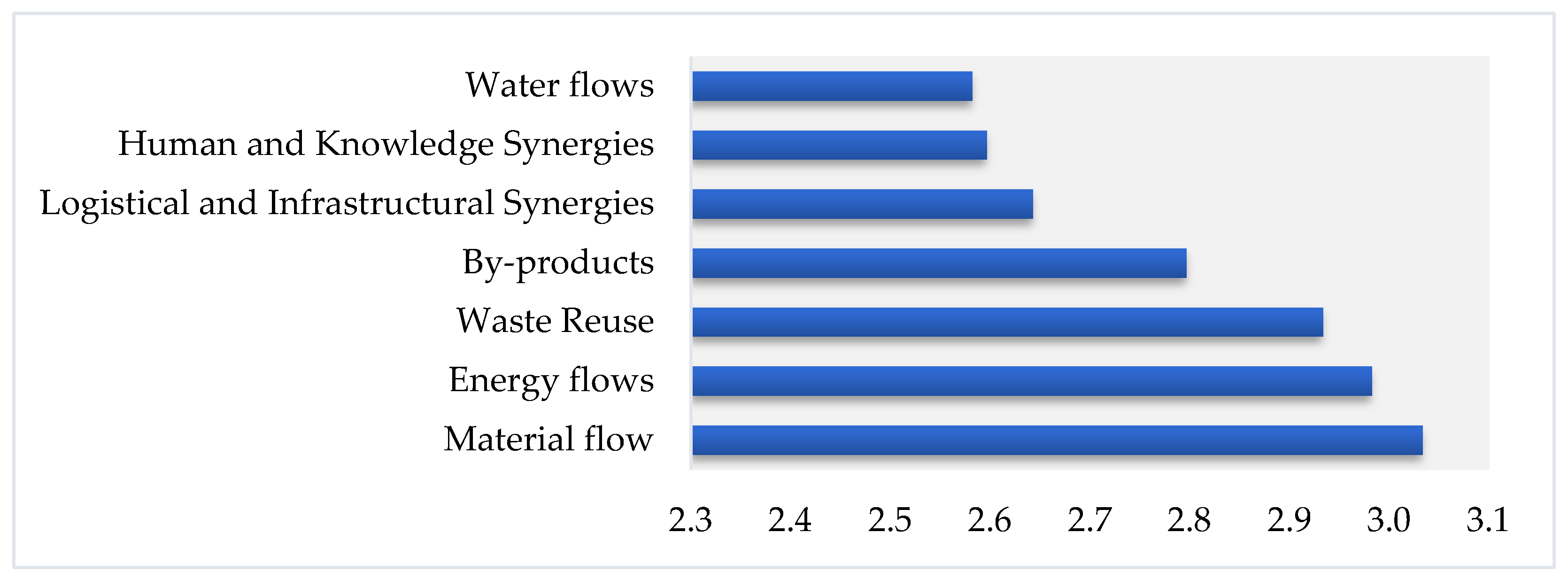
Figure 2.
The level of the expected economic benefits for the businesses from IS implementation.
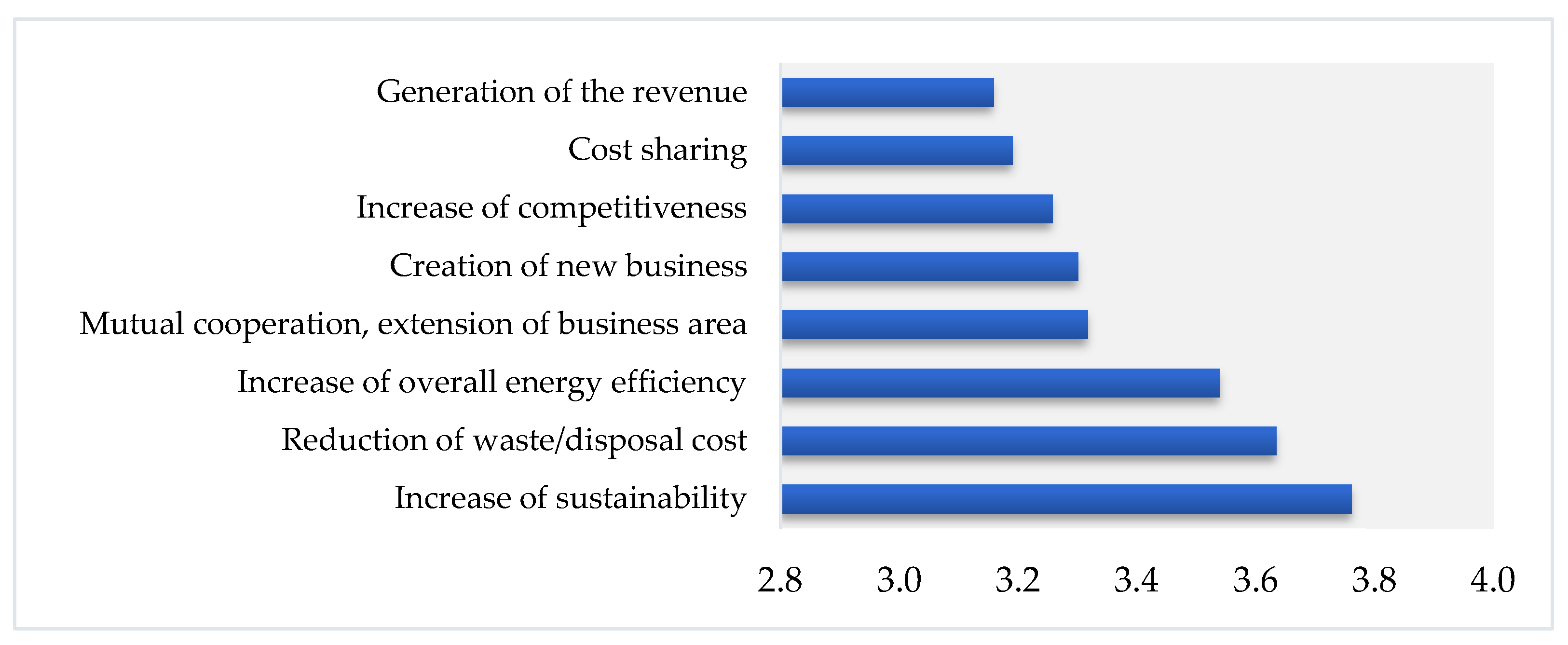
Figure 3.
The level of impact of barriers to IS implementation.
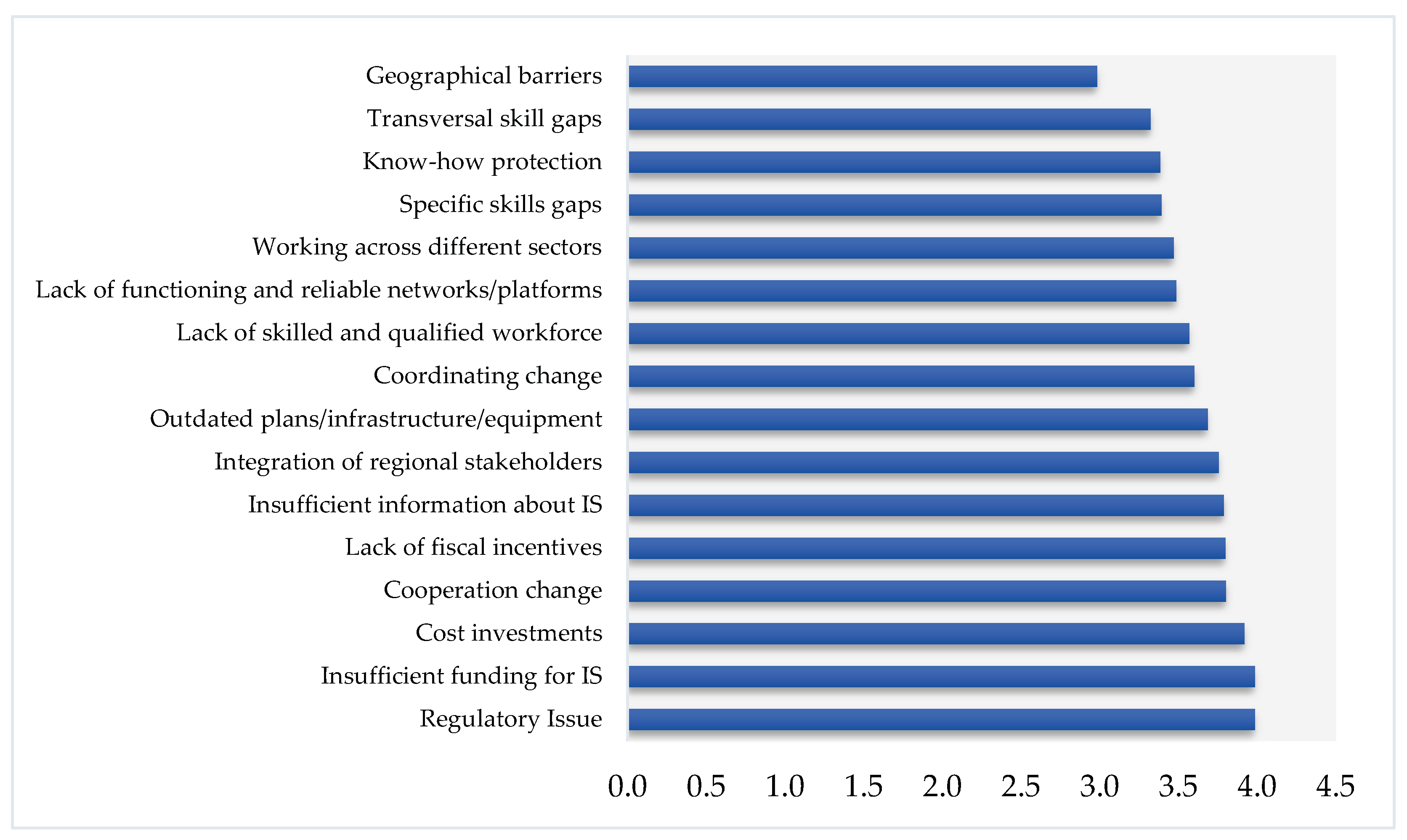
Figure 4.
The main technological barriers in the IS implementation.
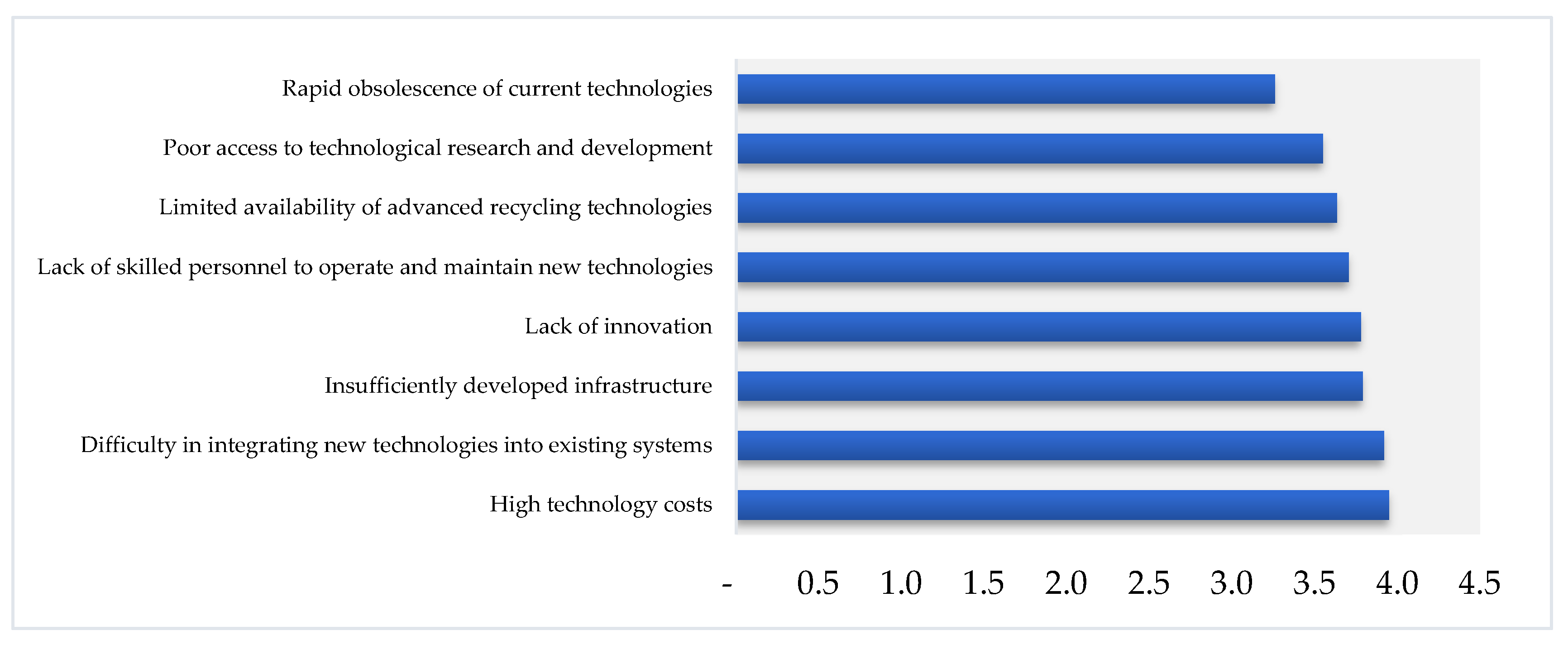
Figure 5.
The impact of the economic and social conditions on the efficiency of the IS implementation.
Figure 5.
The impact of the economic and social conditions on the efficiency of the IS implementation.
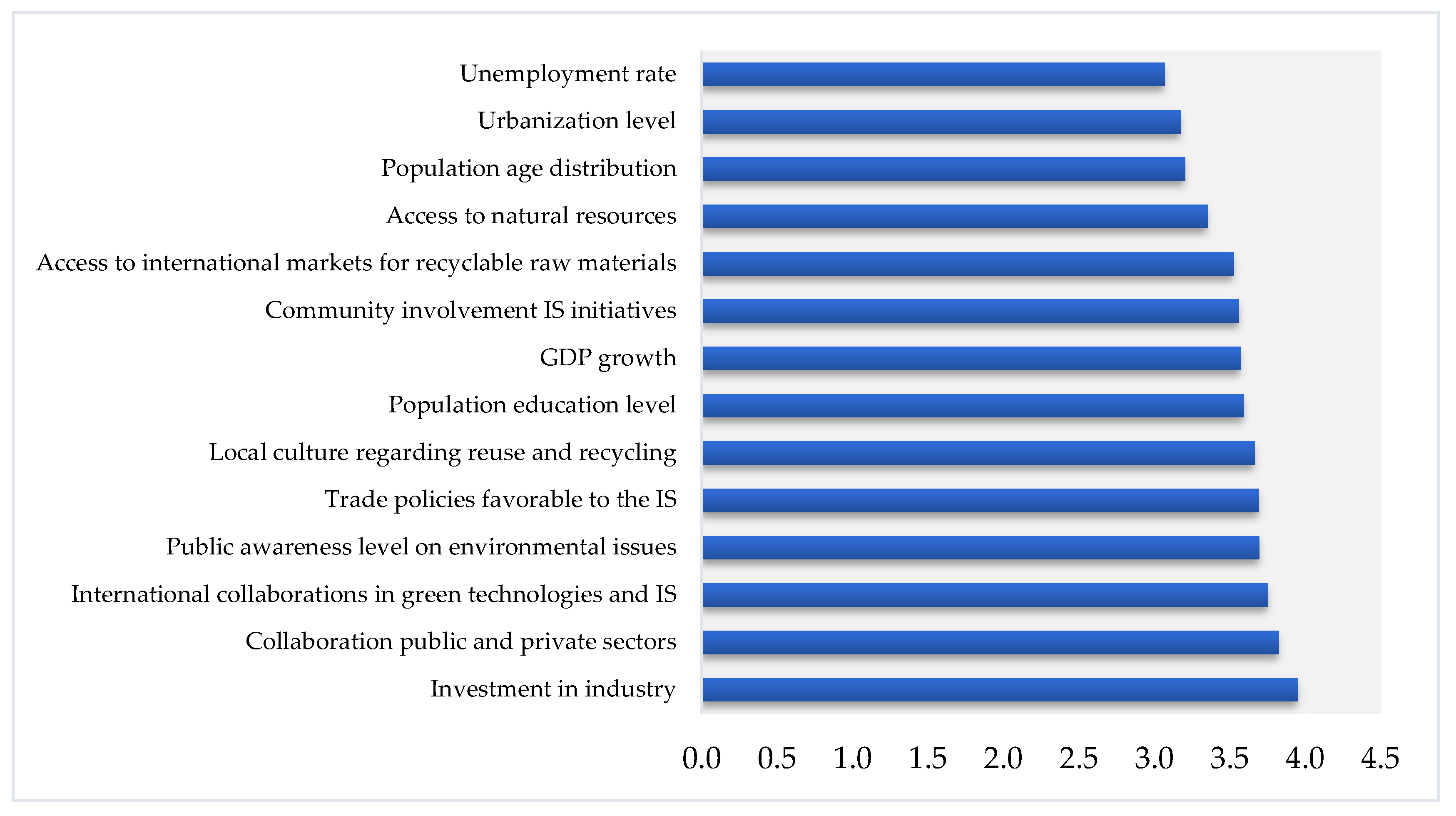
Figure 6.
The impact of the awareness conditions on the IS implementation.
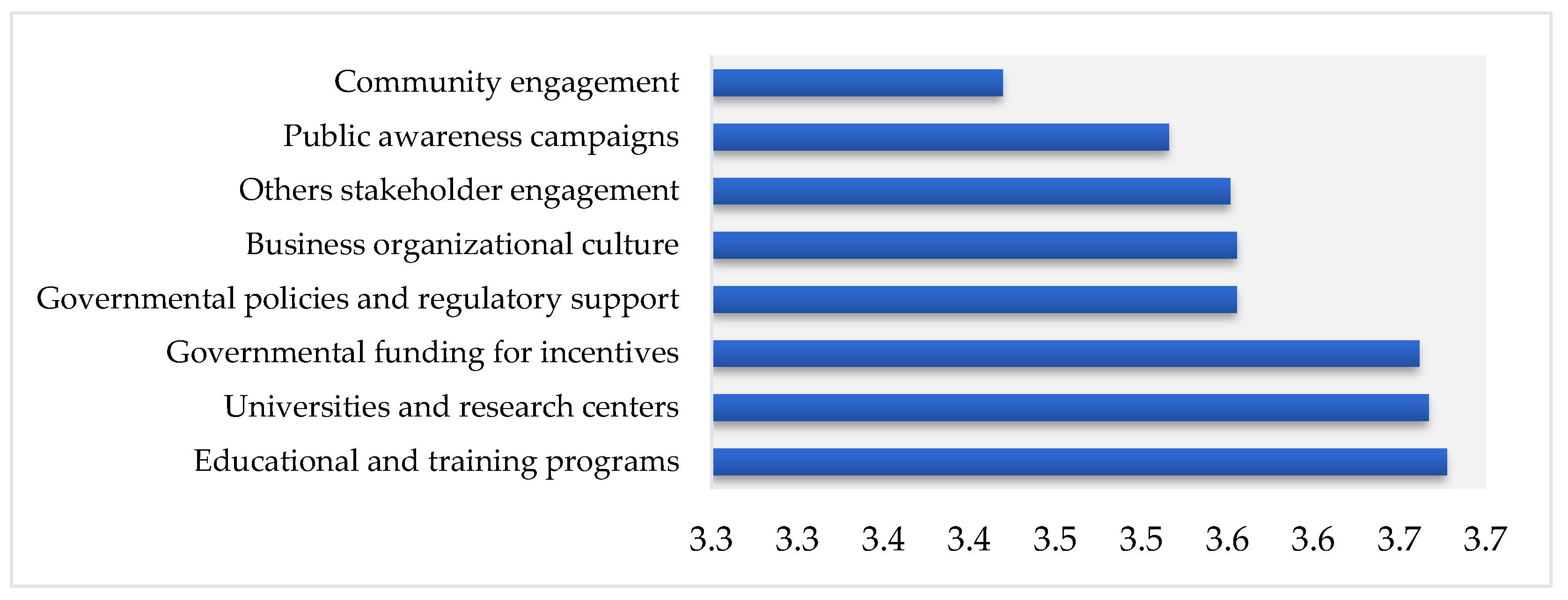

Table 1.
Description of the indicator-variables.
| Abbreviation | Type of Variable | Description of the variable |
|---|---|---|
| IIS | Dependent | Indicator of the main resource synergies (industrial symbiosis, shown in Figure 1) represented by the question: “What is the level of the main resource synergies involved in the application of practices of Industrial Symbiosis in your country? (1 = very low, 5 = very high)” {is an average indicator of the: material flow; energy flows; water flows; waste reuse; by-products; logistical and infrastructural synergies; and human and knowledge synergies}. |
| IEB | Independent | Indicator of the economic benefits, shown in Figure 2, represented by the question: “What is the level of the expected economic benefits for the businesses from the application of practices of IS in your country? (1 = very low, 5 = very high)” {is an average indicator of the: reduction of waste/disposal cost; increase of sustainability; increase of competitiveness; increase of overall energy efficiency; creation of new business; generation of the revenue; mutual cooperation, extension of business area; and cost sharing}. |
| IAI | Independent | Indicator of the actor’s involvement represented by the question: “What is the level of the main actors involved for the IS implementation in your country? (1 = very low, 5 = very high)” {is an average indicator of the: internal actors of the company (e.g. Operation Manager, Technical Manager, Quality Manager, etc.); industrial actors (e.g. financial partners, other industries in various sectors, etc.); and public actors (e.g. local agencies, public parties, etc.)}. |
| IB | Independent | Indicator of the barriers, shown in Figure 3, represented by the question: “Assess the degree of impact of barriers to IS implementation in your country (1 = not important, less important, 5 = very important)” {is an average indicator of the: insufficient funding for IS; lack of fiscal incentives; integration of regional stakeholders; cost investments; regulatory issue; outdated plans/infrastructure/equipment; cooperation change; insufficient information about industrial symbiosis; coordinating change; geographical barriers; transversal skill gaps; working across different sectors; lack of functioning and reliable networks/platforms; know-how protection; specific skills gaps; and lack of skilled and qualified workforce}. |
| IESC | Independent | Indicator of the economic and social conditions, shown in Figure 5, represented by the question: “How do you evaluate the impact of the following economic and social conditions on the efficiency of the IS in your country? (1 = very negatively, 5= very positively)” {is an average indicator of the: GDP growth; investment in industry; unemployment rate; collaboration public and private sectors; population education level; population age distribution; urbanization level; public awareness level on environmental issues; community involvement is initiatives; local culture regarding reuse and recycling; access to international markets for recyclable raw materials; trade policies favorable to the IS; international collaborations in green technologies and industrial symbiosis; access to natural resources; and transport and logistics infrastructure}. |
| IAT | Independent | Indicator of the awareness and training, shown in Figure 6, represented by the question: “How do you evaluate the impact of the following awareness conditions on the IS implementation in your country? (1 = very negatively, 5 = very positively)” {is an average indicator of the: governmental policies and regulatory support; governmental funding for incentives; universities and research centers; educational and training programs; public awareness campaigns; community engagement; business organizational culture; others stakeholder engagement}. |
Source: Authors’ summary.
Table 2.
Correlation matrix and descriptive statistics.
| Ln(IIS) | Ln(IEB) | Ln(IAI) | Ln(IB) | Ln(IESC) | Ln(IAT) | Mean |
Standard Deviation. |
|
|---|---|---|---|---|---|---|---|---|
| Ln(IIS) | 1.00 | 1.04 | 0.30 | |||||
| Ln(IEB) | 0.51* | 1.00 | 1.23 | 0.21 | ||||
| Ln(IAI) | 0.65* | 0.32 | 1.00 | 1.07 | 0.31 | |||
| Ln(IB) | -0.44* | -0.01 | -0.31 | 1.00 | 1.28 | 0.14 | ||
| Ln(IESC) | 0.28 | 0.01 | 0.33 | 0.25 | 1.00 | -0.29 | 0.62 | |
| Ln(IAT) | -0.11 | -0.42** | -0.17 | 0.22 | 0.09 | 1.00 | 0.18 | 0.31 |
Note: * is the significance p < 1% dhe ** is the significance p < 5%. Source: Authors’ calculation in EViews 12.
Table 3.
Regression model estimation.
| Dependent Variable: Ln(IIS) | Coefficient | t-Statistic | Prob. |
|---|---|---|---|
| Independent variables | |||
| Constant | 1.088342 | 2.702952 | 0.0115 |
| Ln(IEB) | 0.711286 | 4.157901 | 0.0003 |
| Ln(IAI) | 0.274585 | 2.204608 | 0.0359 |
| Ln(IB) | -0.956361 | -3.833733 | 0.0007 |
| Ln(IESC) | 0.135476 | 2.297321 | 0.0293 |
| Ln(IAT) | 0.220494 | 1.942919 | 0.0621 |
| R-squared | 0.702000 | ||
| Adjusted R-squared | 0.648786 | ||
| F-statistic | 13.19197 | 0.000001 |
Source: Authors’ calculation in EViews 12.
Table 4.
Analysis of the residual of the model.
| The test | Null hypothesis | Test result | Decision | |
|---|---|---|---|---|
| Statistics | Probability | |||
| Model function: Ramsey RESET-test |
H0: “the model function is appropriate (logarithm form) | F-statistic = 0.8245 | 0.2753 | H0 is not rejected |
| Multicollinearity: VIF-test (Variance Inflation Factors) |
H0: “model has not multicollinearity {Cov(ɛi; ɛj) = 0 and Cov(xi; xj) = 0 for each i ≠ j}” | Centered – VIF < 10 | --- | H0 is not rejected |
| Autocorrelation: LM-test (Breusch Godfrey) |
H0: “model has not autocorrelation {Cov(ɛi; ɛi=i-p) = 0 for p = 1, 2, 3, 4}” | Chi-squared = 0.2160 | 0.8976 | H0 is not rejected |
| Heteroskedasticity: Breusch-Pagan Godfrey | H0: “model has not heteroskedasticity {E(ɛi 2) = constant}” | F-statistic = 3.1391 | 0.6785 | H0 is not rejected |
| Normality of the residual distribution ɛi: Jarque-Bera-test |
H0: “the residual {ɛi} of the model has normality distribution” | Chi-squared = 2.4163 | 0.2987 | H0 is not rejected |
Source: Authors’ calculation in EViews 12.
Disclaimer/Publisher’s Note: The statements, opinions and data contained in all publications are solely those of the individual author(s) and contributor(s) and not of MDPI and/or the editor(s). MDPI and/or the editor(s) disclaim responsibility for any injury to people or property resulting from any ideas, methods, instructions or products referred to in the content. |
© 2026 by the authors. Licensee MDPI, Basel, Switzerland. This article is an open access article distributed under the terms and conditions of the Creative Commons Attribution (CC BY) license (http://creativecommons.org/licenses/by/4.0/).
Copyright: This open access article is published under a Creative Commons CC BY 4.0 license, which permit the free download, distribution, and reuse, provided that the author and preprint are cited in any reuse.


