
Submitted:
01 April 2026
Posted:
02 April 2026
You are already at the latest version
Abstract
Reliable assessment of small-strain soil stiffness is essential for geotechnical site characterization and for analysing the behaviour of embankments and other earth structures. Surface-wave methods provide an efficient non-destructive means of estimating shear-wave velocity profiles; however, their application is limited by the non-uniqueness of the inversion process. This paper presents a multimodal inversion procedure for Rayleigh-wave dispersion curves based on the particle swarm optimization algorithm. The procedure involves the calculation of theoretical dispersion curves for a horizontally layered medium and their matching with experimental data through a global search scheme. The proposed procedure was first verified using two synthetic soil profiles, and its robustness was further assessed by considering perturbations of the theoretical dispersion curve of up to 10%. Particular attention was given to the influence of higher modes on the inversion results. The results show that including higher modes leads to a more accurate and reliable determination of shear-wave velocity profiles than an inversion based solely on the fundamental mode. The procedure was subsequently validated on a transverse embankment profile using an experimental MASW dispersion curve and comparison with SCPT results. Good agreement was obtained, and the eight-layer model proved to be a good compromise between accuracy and model complexity. The proposed multimodal approach therefore represents a reliable tool for the geotechnical characterization of layered soil profiles.
Keywords:
surface waves
; MASW
; shear-wave velocity
; small-strain stiffness
; multimodal inversion
; particle swarm optimization
; SCPT
1. Introduction
Small-strain soil stiffness is one of the fundamental parameters in geotechnical engineering because it directly affects the reliability of numerical analyses, the assessment of deformations, and the interpretation of the behaviour of geotechnical structures within the working load range [1,2]. In the very small strain range, soil behaviour is commonly described by the initial shear modulus, G0, which is particularly important in soil–structure interaction analyses, dynamic response assessment, and the definition of representative soil deformation parameters [1,2,3]. Reliable determination of small-strain stiffness is therefore important not only for general geotechnical site characterization, but also for the analysis of the behaviour of embankments and other earth structures [2,3].
The initial shear modulus is directly related to the shear-wave velocity, VS, through the relationship G0 = ρVS² [1,2]. For this reason, the shear-wave velocity profile with depth is considered one of the most important indicators of stiffness variation within layered soil deposits [2,3,4]. In geotechnical practice, the determination of the Vs profile has become an important part of modern soil characterization, especially when it is necessary to investigate a larger volume of soil than can be covered solely by laboratory testing or by a limited number of point in situ tests [3,4].
Among the available approaches, methods based on the analysis of surface waves occupy a special place, as they enable efficient non-destructive testing and the assessment of changes in shear-wave velocity with depth [3,4,5]. Their main advantage lies in the dispersive behaviour of Rayleigh waves in a layered medium, where waves of different frequencies and wavelengths carry information from different depths within the investigated profile [4,5]. As a result, these methods are now widely accepted in geotechnical practice for the characterization of natural deposits, embankments, transport infrastructure, and other shallow to intermediate-depth soil profiles [3,4,5,6]. Within this group of methods, multichannel analysis of surface waves is of particular interest because, with appropriate processing, it also enables the identification of higher modes of the dispersion curve [4,5,6].
However, the transition from the measured dispersion curve to the shear-wave velocity profile is not unique. The non-uniqueness of the inversion process is one of the key challenges in the interpretation of surface-wave data, because different layering models may lead to very similar agreement between theoretical and experimental dispersion curves [5,6,7,8]. This problem is particularly pronounced under more complex layering conditions, such as velocity inversions, marked stiffness contrasts, or the presence of thin layers [6,7,8]. For this reason, the literature increasingly emphasizes the importance of robust global search procedures, as well as approaches that include higher modes of the dispersion curve in the inversion process [7,8,9,10]. The inclusion of higher modes can increase the sensitivity of the inversion procedure to individual model parameters, improve the resolution of the investigated profile, and contribute to a more stable determination of soil stiffness properties [8,9,10].
In this context, multimodal inversion and global optimization algorithms are of particular interest for geotechnical applications. Previous studies have shown that the inclusion of higher modes can improve the reliability of VS-profile estimation compared with approaches based solely on the fundamental mode [8,9]. At the same time, particle swarm optimization algorithms have proven to be suitable for nonlinear and multimodal dispersion-curve inversion problems, enabling efficient global exploration of the space of possible solutions [9,10]. This makes them suitable for the development of practical procedures for the geotechnical characterization of layered soil profiles.
Based on the above, the aim of this study is to develop a procedure for determining small-strain soil stiffness properties through the measurement and inversion of Rayleigh-wave dispersion curves in layered soil. The basic hypothesis is that the reliability of shear-wave velocity profile determination can be improved by incorporating higher modes into the inversion process. Accordingly, this paper presents a multimodal inversion procedure based on the particle swarm optimization algorithm, its verification on synthetic soil profiles, and its validation on an embankment field profile through comparison with seismic CPT results.
2. Methodology
2.1. Surface-Wave Method Framework
Methods based on the analysis of surface waves are among the most commonly applied non-destructive geophysical techniques for determining small-strain soil stiffness. Their application is based on the fact that, in the very small strain range, the initial shear modulus is directly related to shear-wave velocity. Therefore, determining the shear-wave velocity profile with depth enables the assessment of stiffness changes within layered soil deposits [4,5].
The basis of all these methods is the dispersive behaviour of Rayleigh waves in a vertically heterogeneous medium. Waves of different frequencies, or wavelengths, sample different depth zones, so the variation of phase velocity with frequency contains information on the distribution of stiffness with depth. In a horizontally layered medium, the propagation of surface waves is generally a multimodal phenomenon, meaning that, in addition to the fundamental mode, higher vibration modes may also exist. This is of particular importance for the interpretation of experimental dispersion curves and the subsequent inversion procedure [4,5,15].
In geotechnical practice, the most commonly used methods are continuous surface-wave analysis, or the continuous surface-wave system (CSW/CSWS), spectral analysis of surface waves (SASW), and multichannel analysis of surface waves (MASW). All of these methods are based on the generation and recording of Rayleigh waves at the ground surface, but they differ in terms of the source type, the number of receivers, and the signal-processing procedure [3,4,5,11,12,13,14,15].
CSW or CSWS uses a controlled sinusoidal source, most commonly a vibrator, to generate excitation over a prescribed frequency range. Such an approach enables good control of the frequency content of the excitation and allows the investigation to be targeted toward the depth range of interest. In addition, owing to the controlled excitation, the useful signal can be extracted more effectively under conditions of increased noise, which is one of the reasons why this method has found application in geotechnical investigations aimed at assessing soil stiffness [3,11].
SASW is an older and widely used active surface-wave method developed for determining shear-wave velocity profiles solely from the ground surface. In its classical configuration, it uses two receivers, and the analysis is based on the phase relationship between signals recorded at a known spacing between the receivers. The main advantage of the method is its simple and economical field implementation, whereas its sensitivity to the signal-to-noise ratio and to the quality of phase-difference estimation is one of the reasons why more robust multichannel approaches were later developed [12,15].
MASW is based on multichannel recording, most commonly with uniformly spaced receivers arranged in a linear geometry and an impulsive source. The main advantage of this method is that multichannel acquisition and wavefield transformation allow a clearer representation of dispersion trends, more effective separation of coherent noise, and easier identification of the fundamental and higher modes. For this reason, MASW enables not only the determination of one-dimensional shear-wave velocity profiles, but also the construction of two-dimensional representations of soil stiffness variation along the profile, with relatively efficient and economical field implementation [13,14,15].
For the purposes of this study, particular attention is focused on the MASW method. The reason is that, compared with CSWS and SASW, it is better suited for the identification of higher modes of the dispersion curve, which is of direct importance for the multimodal inversion procedure developed in this work. Accordingly, in the following sections, surface-wave methods are considered primarily as the experimental basis for determining Rayleigh-wave dispersion curves, while the emphasis of the subsequent analysis is placed on the theoretical calculation of dispersion curves and their multimodal inversion [5,13,14,15].
2.2. Calculation of Theoretical Dispersion Curves
For the theoretical calculation of dispersion curves, the soil is considered as a horizontally layered elastic medium consisting of a finite number of homogeneous, isotropic, and linearly elastic layers overlying an elastic half-space [16,17,18,19,20]. Each layer is described by its thickness , density , shear-wave velocity , and compression-wave velocity . An example of such a model, for the case of two layers overlying an elastic half-space, is shown in Figure 1.
The objective of the theoretical calculation is to determine, for a given soil profile, the relationship between frequency, or wavelength, and the phase velocity of Rayleigh waves. The resulting theoretical dispersion curve provides the basis for the subsequent inversion procedure. The phase velocity of a Rayleigh wave can be expressed as
where is the phase velocity of the Rayleigh wave, is the angular frequency, is the wavenumber, is the frequency, and is the wavelength. In a layered medium, the phase velocity is not constant, but depends on frequency or wavelength, which gives rise to the dispersion curve.
In this paper, the theoretical calculation is based on the formulation using the dynamic stiffness matrix of a horizontally layered medium [18,19]. Within this approach, the condition for free-wave propagation can be written as
where is the global dynamic stiffness matrix of the system and is the displacement vector. A non-trivial displacement solution exists only when the matrix is singular, that is, when the system satisfies the free-wave condition for the considered combination of frequency and phase velocity.
In the literature, two numerical approaches are most commonly considered for identifying the modes of the dispersion curve. The first is the DET method, in which the modes are identified by tracking the zeros of the determinant of the global stiffness matrix,
The second is the SAE method, in which matrix singularity is assessed through the smallest absolute eigenvalue of the global stiffness matrix. In this case, a mode is identified for the phase velocity value satisfying
where is an eigenvalue of the global dynamic stiffness matrix. Both approaches are based on the same physical condition, namely system singularity, and yield the same results, but they differ in terms of numerical implementation and numerical stability [18,19,21].
In this way, for each considered frequency or wavelength, the points of the fundamental and higher modes of the dispersion curve can be determined, i.e., multiple possible surface-wave velocities for the same wavelength. Figure 2 shows an example of a theoretical multimodal dispersion curve, including the fundamental mode and the first two higher modes of Rayleigh waves.
In this paper, the SAE approach is adopted because it provides smooth and numerically stable theoretical dispersion curves and is suitable for the determination of higher modes, which is particularly important for the multimodal inversion procedure. Therefore, in the remainder of the paper, the theoretical dispersion curves are calculated using the SAE method [19,21].
Since the aim of this paper is multimodal inversion, the theoretical calculations consider not only the fundamental mode, but also the higher modes of Rayleigh waves. This provides an appropriate theoretical basis for the subsequent inversion procedure, in which experimental and theoretical dispersion curves are compared across multiple modes in order to achieve a more reliable determination of shear-wave velocity profiles in layered soil.
2.3. PSO-Based Inversion Procedure
The inversion of dispersion curves is formulated as a global optimization problem in which the objective is to determine the set of soil model parameters that provides the best agreement between the theoretical and experimental dispersion curves. Since this is a nonlinear and multimodal problem, the inversion process is carried out using the particle swarm optimization (PSO) algorithm, which belongs to the class of population-based evolutionary algorithms [22,23]. In this approach, each particle represents one possible solution, i.e., one set of soil model parameters, and the optimization is performed through an iterative search of the solution space.
The vector of a single particle is defined by the soil model parameters to be determined through the inversion procedure. These parameters generally include the thicknesses of individual layers and the corresponding shear-wave velocities, while the theoretical dispersion curves for each trial model are calculated using the procedure described in the previous subsection. For each particle, a theoretical multimodal dispersion curve is obtained from the prescribed parameter vector, and its deviation from the experimental dispersion curve is then evaluated. The optimization process is directed toward minimizing this mismatch, i.e., the objective function.
The objective function may be written as the sum of normalized differences between the theoretical and experimental phase velocities for all included modes and all considered points of the dispersion curve:
where is the vector of unknown soil model parameters, is the number of considered modes, is the number of points on the dispersion curve for the -th mode, is the total number of considered points, and and are the theoretical and experimental phase velocities for the -th point and the -th mode, respectively. In this way, the optimization problem is reduced to finding the set of model parameters that minimizes the value of the function .
The basic principle of the particle swarm optimization algorithm is that each particle changes its velocity and position in the search space during the iterations, taking into account its own best solution found so far and the best solution found by the entire swarm. The basic principle of particle movement in the search space is illustrated in Figure 3.
The updating of the velocity and position of the -th particle at step can be written as [22,23]
where is the position of the particle, is its velocity, is the inertia factor, is the cognitive factor, is the social factor, and are random numbers in the interval from 0 to 1, is the best position found so far by the particle under consideration, and is the global best solution found by the entire swarm.
At the beginning of the optimization, the initial position and velocity of each particle are randomly assigned within the predefined lower and upper bounds of the parameters. The value of the objective function is then calculated for all particles, their best individual positions are determined, and the global best solution of the swarm is identified. The procedure requires the definition of lower and upper parameter bounds, the number of particles, the values of the cognitive and social factors, the maximum number of iterations, and the stopping criteria.
After each iteration, it is checked whether the new particle positions fall outside the prescribed search-space bounds. If this occurs, their values are corrected to remain within the allowable range. The objective function is then recalculated, the best individual positions are updated, and a new global best solution is determined. The procedure is repeated until the prescribed maximum number of iterations is reached or until the change in the best particle position, or the change in the optimal value of the objective function, becomes smaller than a predefined threshold.
In addition to the basic PSO approach, a modified variant with periodic resetting of a portion of the particles is also applied. Compared with the classical algorithm, this variant allows a certain fraction of particles at a given iteration step to re-enter the search process from a newly assigned random position. This increases the possibility of escaping local minima and improves the exploration of the solution space. As the optimization progresses, the number of particles whose initial positions are reset is gradually reduced, so that in the final stages of the iteration this number tends toward a single particle [24,25,26].
Since the objective is multimodal inversion, the objective function is not based solely on the fundamental mode, but also includes the higher modes of the dispersion curve. This increases the amount of information incorporated into the optimization process and reduces the possibility that different soil profiles may provide equally good agreement in only one mode. Such an approach is particularly important under more complex layering conditions, where the inclusion of higher modes may lead to a more reliable determination of the shear-wave velocity profile [9,10].
3. Synthetic Validation of the Inversion Procedure
The proposed inversion procedure was first tested on synthetic soil profiles, for which the model parameters and the corresponding theoretical dispersion curves were known in advance. Such an approach makes it possible to evaluate the accuracy of the procedure under controlled conditions, without the uncertainty inherent in field data. Accordingly, this section first presents the inversion results for two synthetic soil profiles, followed by an analysis of the influence of dispersion-curve perturbation on the stability and robustness of the obtained solutions.
3.1. Synthetic Profile A
Synthetic Profile A represents a case in which shear-wave velocity, and thus soil stiffness, increases with depth. The model consists of two layers overlying an elastic half-space, with m/s and a thickness of 20 m adopted for the first layer, m/s and a thickness of 20 m for the second layer, and m/s for the half-space. For all layers, Poisson’s ratio and unit weight kN/m3 were adopted. Its configuration is shown in Figure 4. Such a profile is suitable for the initial verification of the inversion procedure because it enables the assessment of accuracy on a relatively simple and clearly defined model.
Based on the synthetic model, a theoretical multimodal dispersion curve was determined, and the inversion process was then carried out using particle swarm optimization. A comparison between the dispersion curve obtained from the synthetic model and the dispersion curve obtained through the inversion process is shown in Figure 5. This comparison indicates very good agreement for all three considered Rayleigh-wave modes, with deviations of 0.00% for the fundamental, first higher, and second higher modes.
The obtained shear-wave velocities also show an almost complete agreement with the prescribed values of the synthetic model. A value of 300.015 m/s was obtained for the first layer, 499.989 m/s for the second layer, and 700.009 m/s for the half-space, while the corresponding prescribed values were 300, 500, and 700 m/s. This confirms that the proposed inversion procedure yields highly accurate results under controlled conditions for a profile in which soil stiffness increases monotonically with depth.
3.2. Synthetic Profile B
Synthetic Profile B represents a case in which a stiffer layer overlies a less stiff layer. As in Profile A, the model consists of two layers overlying an elastic half-space, with m/s and a thickness of 20 m adopted for the first layer, m/s and a thickness of 20 m for the second layer, and m/s for the half-space. For all layers, Poisson’s ratio and unit weight kN/m3 were adopted. A representation of Synthetic Profile B is shown in Figure 6.
Based on the synthetic dispersion curve, the inversion procedure was performed using particle swarm optimization. The same basic settings as for Profile A were applied, including 30 particles, a maximum of 100 iterations, and a resetting factor of 0.5. A comparison between the dispersion curve obtained from the synthetic model and the dispersion curve obtained through the inversion process is shown in Figure 7. This comparison indicates very good agreement, with deviations of 0.00% for the fundamental, first higher, and second higher modes.
The obtained shear-wave velocities also show an almost complete agreement with the prescribed values of the synthetic model. A value of 500.018 m/s was obtained for the first layer, 299.979 m/s for the second layer, and 700.089 m/s for the half-space, while the corresponding prescribed values were 500, 300, and 700 m/s. This confirms that the proposed inversion procedure yields highly accurate results also for a profile in which a stiffer layer overlies a less stiff layer.
3.3. Robustness of the Procedure to Measurement Perturbation
In order to assess the influence of possible measurement error on the inversion result, analyses were performed by introducing perturbations into the theoretical dispersion curve. For each point on the curve, an error of up to 10% was introduced, after which the inversion process was carried out using the perturbed data. Thirty analyses were performed for each of the two synthetic profiles, which allowed the stability and robustness of the obtained solutions to be evaluated.
The results show that the proposed procedure retains a high level of accuracy even when perturbations are introduced. For Profile A, the deviations of shear-wave velocity for the layers and the half-space range from 0.08% to 10.30%, with mean deviation values between 1.06% and 3.55%. For Profile B, the deviations range from 0.01% to 6.39%, while the mean values range from 1.42% to 2.48%. At the same time, the deviations of the dispersion curves for Profile A range from 4.66% to 6.75%, with mean values between 5.63% and 5.69%, whereas for Profile B they range from 4.55% to 6.82%, with mean values between 5.50% and 5.71%.
The obtained results indicate that the proposed inversion procedure remains robust even when the experimental data deviate from the idealized theoretical dispersion curve. Although the deviations increase, as expected, compared with the ideal case, the mean deviations of shear-wave velocity remain relatively small, and the deviations of the dispersion curves for both profiles remain within a narrow range. This confirms that the procedure can provide reliable results even under conditions in which the input data are affected by a level of uncertainty that may be expected in field measurements.
4. Influence of Higher Modes on Inversion Results
4.1. Comparison of Inversion Results for Different Numbers of Included Modes
One of the important objectives of the study was to examine the influence of including higher modes of the dispersion curve in the inversion process. For this purpose, an analysis was carried out on a synthetic soil profile adopted from the literature [27], consisting of five layers overlying a half-space, as shown in Figure 8. For this profile, three variants of the inversion procedure were considered: the case in which the fundamental mode and the first two higher modes were included, the case in which the fundamental mode and the first higher mode were included, and the case in which only the fundamental mode was included. Such an approach enables a direct comparison of the influence of the amount of information included in the inversion process on the obtained shear-wave velocity profile.
The result for the case in which the fundamental mode and the first two higher modes were included in the inversion process is shown in Figure 9. A comparison of the synthetic and inverted dispersion curves indicates very good agreement for all three modes. This case also produced the most accurate shear-wave velocity values for all layers. As shown in Table 1, the obtained values are 299.80 m/s, 350.52 m/s, 199.65 m/s, 350.16 m/s, and 801.24 m/s, with none of the deviations exceeding 0.2% relative to the prescribed synthetic soil model.
When only the fundamental and first higher modes are included in the inversion process, the deviations become noticeably larger. The resulting shear-wave velocities are 282.09 m/s, 366.29 m/s, 217.06 m/s, 326.30 m/s, and 820.84 m/s, with corresponding deviations ranging from 2.60% to 8.53%. In the case where only the fundamental mode is included, the deviations are also significant: the obtained velocities are 276.29 m/s, 370.56 m/s, 216.27 m/s, 325.19 m/s, and 840.72 m/s, with deviations ranging from 5.09% to 8.14%. The numerical comparison therefore clearly shows that reducing the number of included modes also reduces the accuracy of the obtained profile.
A similar trend can be observed when comparing the deviations of the dispersion curves. When all three considered modes are included, the deviations are 0.00%, 0.00%, and 0.00%. In the case where the fundamental and first higher modes are included, the deviations are 0.00%, 0.00%, and 11.50%, whereas in the case where only the fundamental mode is included, the deviations are 0.00%, 14.57%, and 16.84%. Although good agreement is retained in the latter two cases for the modes included in the objective function, excluding higher modes leads to a much poorer description of the remaining parts of the multimodal dispersion curve.
Based on the obtained results, it can be concluded that including higher modes in the inversion process significantly increases the accuracy of determining the shear-wave velocity profile. This is particularly important for more complex soil profiles, such as the one analysed here, because the additional information contained in the higher modes enables more reliable discrimination among possible solutions and reduces the non-uniqueness of the inversion process.
4.2. Discussion of the Influence of Higher Modes on Inversion Accuracy
The results presented in the previous subsection clearly show that the number of modes included in the inversion process has a direct influence on the accuracy of the obtained shear-wave velocity profile. The most accurate result was achieved when the fundamental mode and the first two higher modes were included in the objective function, with velocity deviations for all layers remaining below 0.2%. At the same time, complete agreement of the dispersion curves was achieved for all three considered modes. When the number of included modes is reduced, the deviations of the obtained velocities increase, and the quality of the description of the multimodal dispersion curve deteriorates noticeably.
It is particularly important that the difference among the analysed cases is reflected not only in the numerical deviations of the shear-wave velocities, but also in the ability of the model to describe modes that are not directly included in the optimization process. In the case where the fundamental and first higher modes are included, good agreement remains limited to those two modes, while the deviation for the second higher mode reaches 11.50%. When only the fundamental mode is included in the inversion process, the deviations for the first and second higher modes further increase to 14.57% and 16.84%, respectively. This shows that the model can reproduce only the part of the information that is included in the objective function, whereas excluding higher modes leads to the loss of an important part of the information on the actual soil layering.
The obtained results are consistent with the general findings in the literature that the inclusion of higher modes reduces the non-uniqueness of the inversion process and increases the reliability of the interpretation, especially in cases where the soil profile is not simply normally dispersive [9,10,26]. The analysed synthetic profile consists of multiple layers with alternating increases and decreases in shear-wave velocity with depth and can therefore be regarded as a sufficiently demanding test for assessing the actual informativeness of each mode. Precisely under such conditions, the additional information contained in the higher modes enables better discrimination among possible solutions and more accurate determination of individual layers.
Based on the performed analysis, it can be concluded that the inclusion of higher modes in the inversion process is not only beneficial, but also necessary when a high level of accuracy is required in determining shear-wave velocity profiles under more complex layering conditions. The multimodal approach therefore proves to be a justified choice for further application to field data, where the non-uniqueness of the solution is additionally pronounced due to measurement uncertainty and the natural heterogeneity of soil.
5. Field Validation on an Embankment Profile
5.1. Field Investigations and Reference Data
Field validation was carried out on a transverse embankment profile, for which a measuring profile 200 m in length was selected for the analysis. The geophones were spaced at 1 m intervals, which enabled the acquisition of an experimental MASW dispersion curve suitable for subsequent inversion analysis. A representation of the measuring profile with the location of the borehole and SCPT tests is shown in Figure 10, while the experimental dispersion curve obtained along the selected profile is shown in Figure 11. The dispersion curves obtained from geophysical testing along measuring profile SCPT_8 were used as input data for the inversion process.
In the middle of the measuring profile, borehole B8 was carried out to a depth of 10.0 m, providing the basic data on soil layering. At 15 locations along the measuring profile, shear-wave velocity measurements were performed using the seismic CPT test (SCPT – Seismic Cone Penetration Test). These results were used to validate the shear-wave velocity profiles obtained through inversion of the experimental MASW dispersion curve.
5.2. Inversion Results and Comparison with SCPT
Based on the experimental MASW dispersion curve, inversion was carried out for several soil layering models, while the original analyses considered models ranging from three to ten layers. It was observed that, with an increasing number of layers, the deviation of the calculated dispersion curve from the experimental one gradually decreases, while the agreement between the obtained shear-wave velocity profile and the SCPT results improves. This trend indicates that an overly coarse model cannot adequately describe the actual soil layering, especially in the upper part of the profile.
This can already be seen from a comparison of selected representative cases. For the four-layer model, the deviations of the calculated from the experimental dispersion curve are 2.53%, 1.14%, and 1.07% for the 0th, 1st, and 2nd modes, respectively, while the comparison with the SCPT results shows that the deviation at a depth of about 2 m is strongly increased. For the seven-layer model, these deviations are already significantly smaller, amounting to 0.19%, 0.14%, and 0.25%, and the results show good agreement except at a depth of about 4 m. For the eight-layer model, the deviations further decrease to 0.18%, 0.15%, and 0.18%, and the comparison with the SCPT results indicates good agreement. A further increase in the number of layers brings only a slight improvement: for nine and ten layers, the deviations are approximately 0.17%, 0.14%, and 0.16%, again with good agreement with the SCPT results.
Considering the presented results, the eight-layer model was selected as the representative model for comparison with the field data. This model yields very small deviations of the calculated from the experimental dispersion curve while at the same time remaining sufficiently simple for engineering interpretation. A comparison between the shear-wave velocity profile obtained by inversion and the SCPT results for this case is shown in Figure 12. It may be concluded that the eight-layer model represents a good compromise between accuracy and model complexity, whereas a further increase in the number of layers does not provide significant practical benefit.
5.3. Discussion of Field Validation
The results of the field validation show that the quality of the obtained shear-wave velocity profile strongly depends on the selected layering model. When too few layers are used, the model cannot adequately describe the variation of soil stiffness with depth, resulting in larger deviations of the calculated from the experimental dispersion curve and poorer agreement with the SCPT results. This is particularly evident in the upper part of the profile, where coarser models cannot sufficiently capture local variations in soil properties.
As the number of layers increases, the quality of the solution improves gradually. Already for the seven-layer model, the deviations of the dispersion curve become very small, and the agreement with the SCPT results is good, except for a local deviation at a depth of about 4 m. For the eight-layer model, good agreement with the SCPT data is achieved together with very small deviations of the dispersion curve, while a further increase in the number of layers to nine and ten results in only marginal improvement. In other words, beyond a certain level of detail, further refinement of the model no longer provides a significant practical benefit.
On this basis, it can be concluded that the eight-layer model represents a good compromise between accuracy and model complexity. On the one hand, such a model provides very good agreement with the experimental dispersion curve and the SCPT results, while on the other hand it remains sufficiently simple for engineering interpretation. The field validation thus confirms that the proposed procedure can reliably determine the shear-wave velocity profile from MASW data, provided that the soil layering is described with a sufficient level of detail.
6. Conclusions
This paper presents a procedure for determining the small-strain stiffness properties of soil through the measurement and inversion of Rayleigh-wave dispersion curves in horizontally layered soil. The theoretical calculation of dispersion curves is based on the dynamic stiffness matrix formulation, while the SAE approach was selected for further application because it provides smooth and numerically stable theoretical dispersion curves and is suitable for the identification of higher modes. The inversion procedure was formulated as a global optimization problem and solved using a modified PSO algorithm.
The verification of the procedure on synthetic soil profiles showed very high accuracy in determining the shear-wave velocity profile. For Profile A, almost complete agreement with the prescribed synthetic model was obtained, while very good accuracy was also confirmed for Profile B, in which a stiffer layer overlies a less stiff one. Analyses performed with perturbations of the theoretical dispersion curve of up to 10% showed that the procedure retains a high level of accuracy even under such conditions, with the mean deviations of shear-wave velocities remaining relatively small for both profiles.
It was further shown that the inclusion of higher modes of the dispersion curve significantly increases the accuracy and reliability of the inversion results. For the synthetic profile adopted from the literature, the most accurate result was obtained when the fundamental mode and the first two higher modes were included in the objective function, with none of the shear-wave velocity deviations exceeding 0.2%. When the number of included modes is reduced, the deviations of the obtained profile increase and the description of the multimodal dispersion curve deteriorates, confirming that higher modes contain important additional information on the actual soil layering.
Field validation on a transverse embankment profile confirmed the applicability of the proposed procedure under real conditions. By comparing the results of the inversion of the experimental MASW dispersion curve with the SCPT results, it was shown that increasing the number of layers improves the agreement between the obtained profile and the field measurements. The eight-layer model proved to be a good compromise between accuracy and model complexity, since it provides very small dispersion-curve deviations, lower than 0.2% for all three considered modes, together with good agreement with the SCPT results. Based on the presented findings, it may be concluded that the proposed multimodal approach represents a reliable tool for the geotechnical characterization of layered soil profiles.
Author Contributions
Conceptualization, M.S.K. and L.L.; methodology, M.S.K. and M.G.; validation, L.L. and D.J.K.; investigation, M.G and D.J.K..; writing—original draft preparation, M.S.K. and M.G.; writing—review and editing, M.S.K. and L.L. All authors have read and agreed to the published version of the manuscript.
Funding
This research received no external funding.
Data Availability Statement
The original contributions presented in this study are included in the article. Further inquiries can be directed to the corresponding author.
Acknowledgments
Not applicable.
Conflicts of Interest
The authors declare no conflicts of interest.
References
- Richart, F.E.; Hall, J.R.; Woods, R.D. Vibrations of Soils and Foundations; Prentice-Hall: Englewood Cliffs, NJ, USA, 1970. [Google Scholar]
- Cha, M.; Santamarina, J.C.; Kim, H.-S.; Cho, G.-C. Small-strain stiffness, shear-wave velocity, and soil compressibility. J. Geotech. Geoenviron. Eng. 2014, 140, 06014011. [Google Scholar] [CrossRef]
- Matthews, M.C.; Hope, V.S.; Clayton, C.R.I. The use of surface waves in the determination of ground stiffness profiles. Proc. Inst. Civ. Eng. Geotech. Eng. 1996, 119, 84–95. [Google Scholar] [CrossRef]
- Foti, S.; Lai, C.G.; Rix, G.J.; Strobbia, C. Surface Wave Methods for Near-Surface Site Characterization; CRC Press: Boca Raton, FL, USA, 2014. [Google Scholar] [CrossRef]
- Socco, L.V.; Foti, S.; Boiero, D. Surface-wave analysis for building near-surface velocity models: Established approaches and new perspectives. Geophysics 2010, 75, 75A83–75A102. [Google Scholar] [CrossRef]
- Cercato, M. Addressing non-uniqueness in linearized multichannel surface-wave inversion. Geophys. Prospect. 2009, 57, 27–47. [Google Scholar] [CrossRef]
- Xia, J.; Miller, R.D.; Park, C.B.; Tian, G. Inversion of high-frequency surface waves with fundamental and higher modes. J. Appl. Geophys. 2003, 52, 45–57. [Google Scholar] [CrossRef]
- Luo, Y.; Xia, J.; Liu, J.; Liu, Q.; Xu, Y. Joint inversion of high-frequency surface waves with fundamental and higher modes. J. Appl. Geophys. 2007, 62, 375–384. [Google Scholar] [CrossRef]
- Song, X.; Tang, L.; Lv, X.; Fang, H.; Gu, H. Application of particle swarm optimization to interpret Rayleigh wave dispersion curves. J. Appl. Geophys. 2012, 84, 1–13. [Google Scholar] [CrossRef]
- Wang, Y.; Song, X.; Zhang, X.; Yuan, S.; Zhang, K.; Wang, L.; Le, Z.; Cai, W. Multi-objective particle swarm optimization for multimode surface wave analysis. Comput. Geosci. 2023, 176, 105343. [Google Scholar] [CrossRef]
- Heymann, G. Ground stiffness measurement by the continuous surface wave test. J. S. Afr. Inst. Civ. Eng. 2007, 49, 25–31. [Google Scholar]
- Nazarian, S.; Stokoe, K.H., II. In situ shear wave velocities from spectral analysis of surface waves. In Proceedings of the 8th World Conference on Earthquake Engineering, San Francisco, CA, USA, 1984; Volume 3, pp. 31–38. [Google Scholar]
- Park, C.B.; Miller, R.D.; Xia, J. Multichannel analysis of surface waves. Geophysics 1999, 64, 800–808. [Google Scholar] [CrossRef]
- Park, C.B.; Miller, R.D.; Xia, J.; Ivanov, J. Multichannel analysis of surface waves (MASW): Active and passive methods. Lead. Edge 2007, 26, 60–64. [Google Scholar] [CrossRef]
- Foti, S.; Hollender, F.; Garofalo, F.; Albarello, D.; Asten, M.; Bard, P.-Y.; Comina, C.; Cornou, C.; Cox, B.; Di Giulio, G.; et al. Guidelines for the good practice of surface wave analysis: A product of the InterPACIFIC project. Bull. Earthq. Eng. 2018, 16, 2367–2420. [Google Scholar] [CrossRef]
- Thomson, W.T. Transmission of elastic waves through a stratified solid medium. J. Appl. Phys. 1950, 21, 89–93. [Google Scholar] [CrossRef]
- Haskell, N.A. The dispersion of surface waves on multilayered media. Bull. Seismol. Soc. Am. 1953, 43, 17–34. [Google Scholar] [CrossRef]
- Kausel, E.; Roësset, J.M. Stiffness matrices for layered soils. Bull. Seismol. Soc. Am. 1981, 71, 1743–1761. [Google Scholar] [CrossRef]
- Lai, C.G.; Rix, G.J. Simultaneous Inversion of Rayleigh Phase Velocity and Attenuation for Near-Surface Site Characterization. In School of Civil and Environmental Engineering; Georgia Institute of Technology: Atlanta, GA, USA, 1998. [Google Scholar]
- Wolf, J.P. Dynamic Soil-Structure Interaction; Prentice-Hall: Englewood Cliffs, NJ, USA, 1985. [Google Scholar]
- Kumar, J.; Tarun, N. A fast and accurate method to compute dispersion spectra for layered media using a modified Kausel–Roësset stiffness matrix approach. Soil Dyn. Earthq. Eng. 2017, 92, 176–182. [Google Scholar] [CrossRef]
- Kennedy, J.; Eberhart, R. Particle swarm optimization. In Proceedings of the IEEE International Conference on Neural Networks, Perth, Australia, 1995; pp. 1942–1948. [Google Scholar]
- Shi, Y.; Eberhart, R.C. A modified particle swarm optimizer. In Proceedings of the IEEE International Conference on Evolutionary Computation, Anchorage, AK, USA, 1998; pp. 69–73. [Google Scholar]
- García-Gonzalo, E.; Fernández-Martínez, J.L.; Fernández-Álvarez, J.P.; Kuzma, H.A.; Menéndez-Pérez, C.O. Particle swarm optimization algorithms for geophysical inversion: Practical hints. J. Artif. Evol. Appl. 2008, 2008, 861275. [Google Scholar]
- Fernández-Martínez, J.L.; García-Gonzalo, E.; Fernández-Álvarez, J.P.; Kuzma, H.A.; Menéndez-Pérez, C.O. PSO: A powerful algorithm to solve geophysical inverse problems: Application to a 1D-DC resistivity case. J. Appl. Geophys. 2010, 71, 13–25. [Google Scholar] [CrossRef]
- Kovačević, M.S.; Bačić, M.; Gavin, K.; Stipanović, I. Assessment of long-term deformation of a tunnel in soft rock by utilizing particle swarm optimized neural network. Tunnelling and underground space technology 2021, 110, 103838. [Google Scholar] [CrossRef]
- Dal Moro, G.; Pipan, M.; Gabrielli, P. Rayleigh wave dispersion curve inversion via genetic algorithms and margin misfit function. J. Appl. Geophys. 2007, 61, 39–55. [Google Scholar] [CrossRef]
Figure 1.
Schematic representation of a horizontally layered elastic medium with two layers overlying an elastic half-space for the calculation of theoretical Rayleigh-wave dispersion curves.
Figure 1.
Schematic representation of a horizontally layered elastic medium with two layers overlying an elastic half-space for the calculation of theoretical Rayleigh-wave dispersion curves.
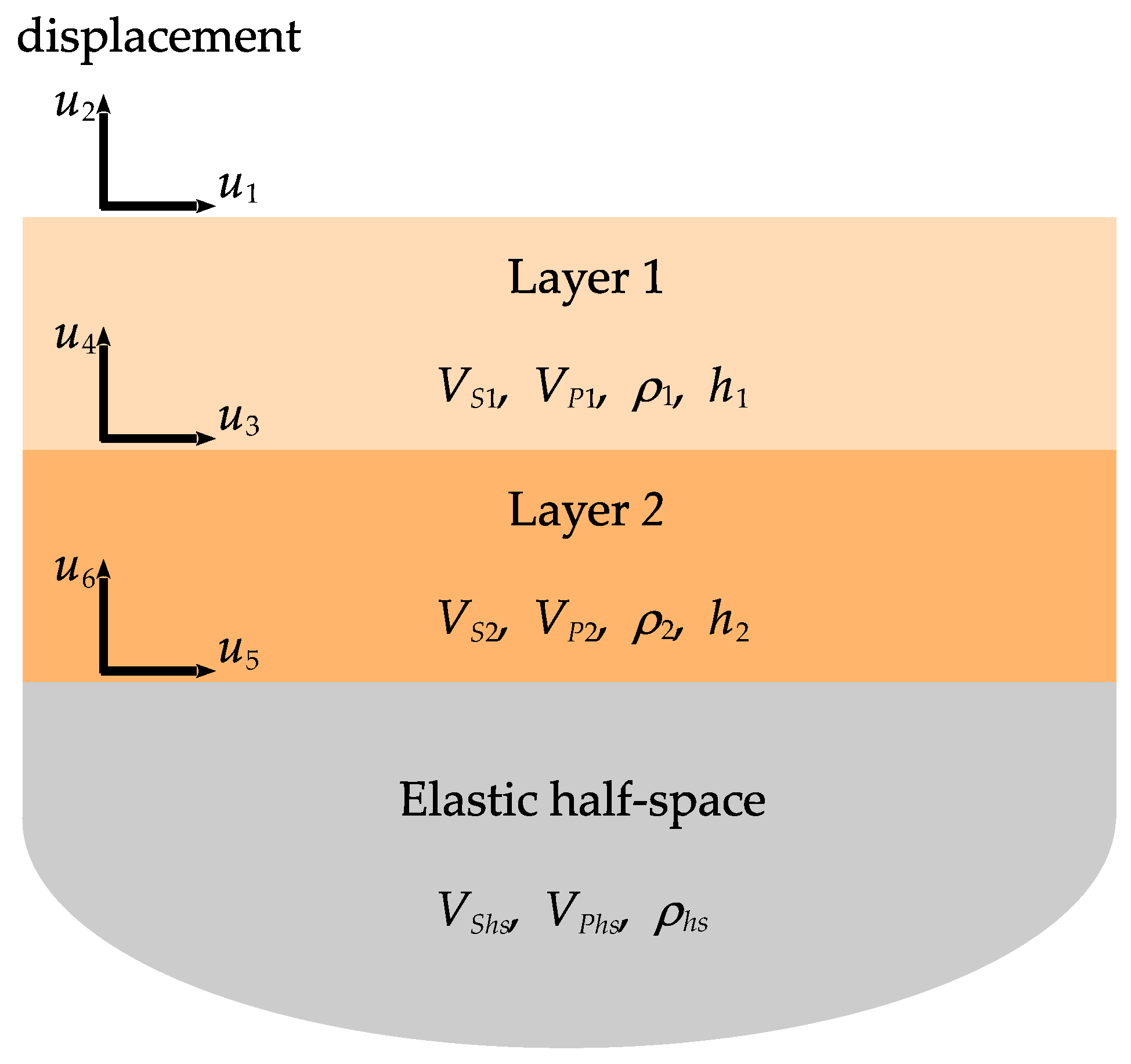
Figure 2.
Theoretical multimodal Rayleigh-wave dispersion curve showing the fundamental mode and the first two higher modes.
Figure 2.
Theoretical multimodal Rayleigh-wave dispersion curve showing the fundamental mode and the first two higher modes.
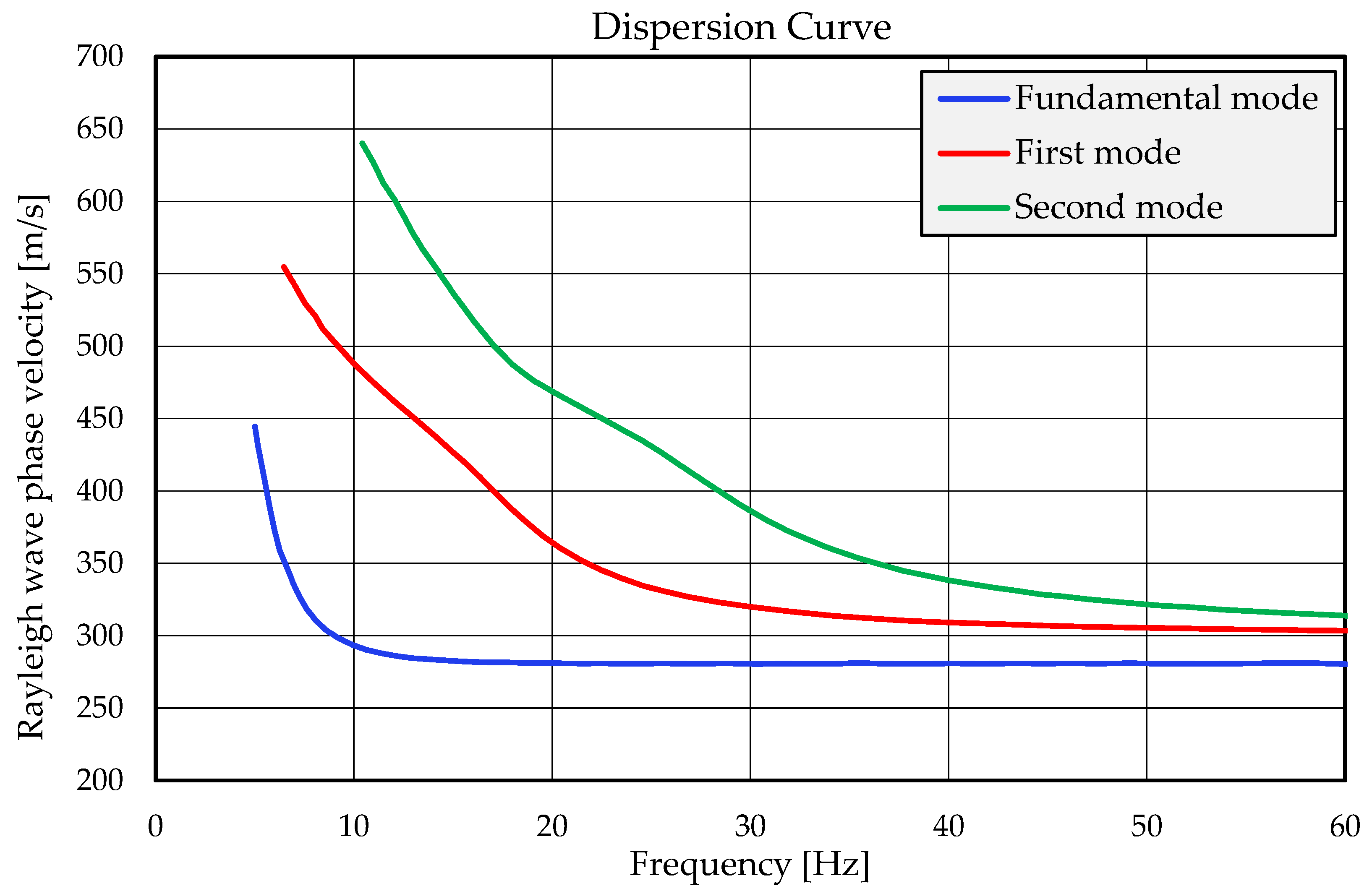
Figure 3.
Illustration of the basic particle movement principle in the search space within the particle swarm optimization algorithm.
Figure 3.
Illustration of the basic particle movement principle in the search space within the particle swarm optimization algorithm.
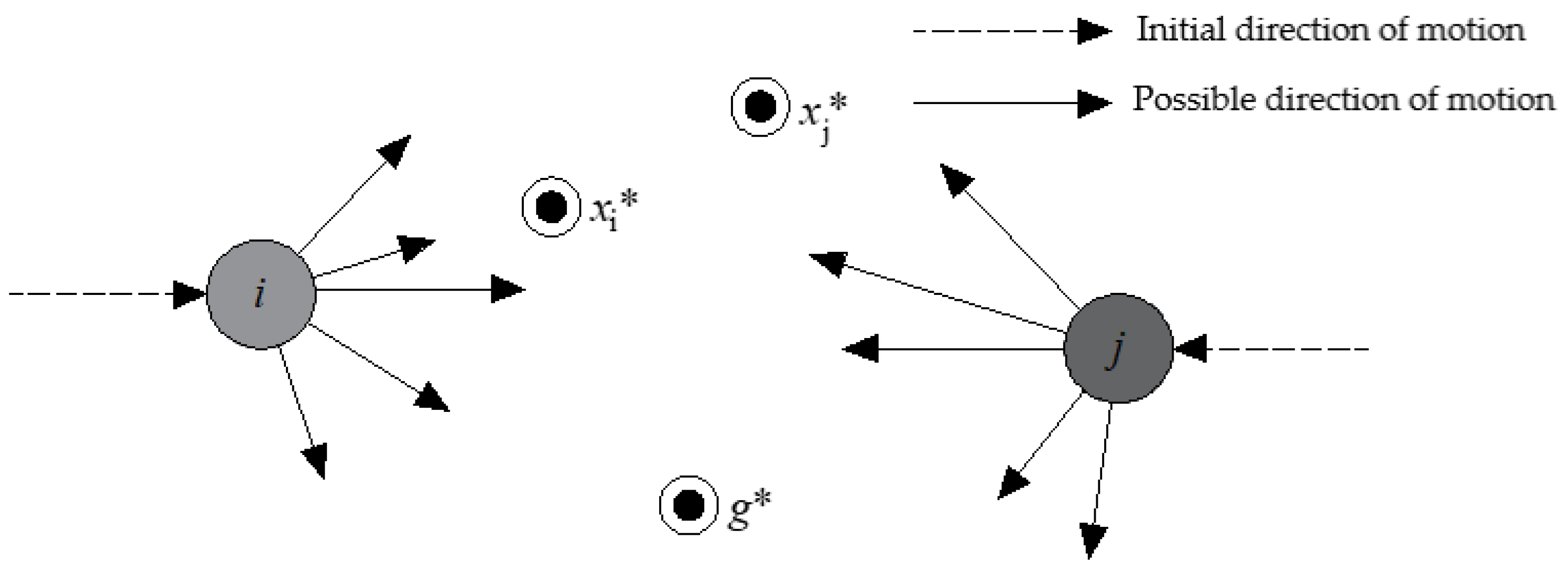
Figure 4.
Synthetic Profile A with two layers overlying an elastic half-space.
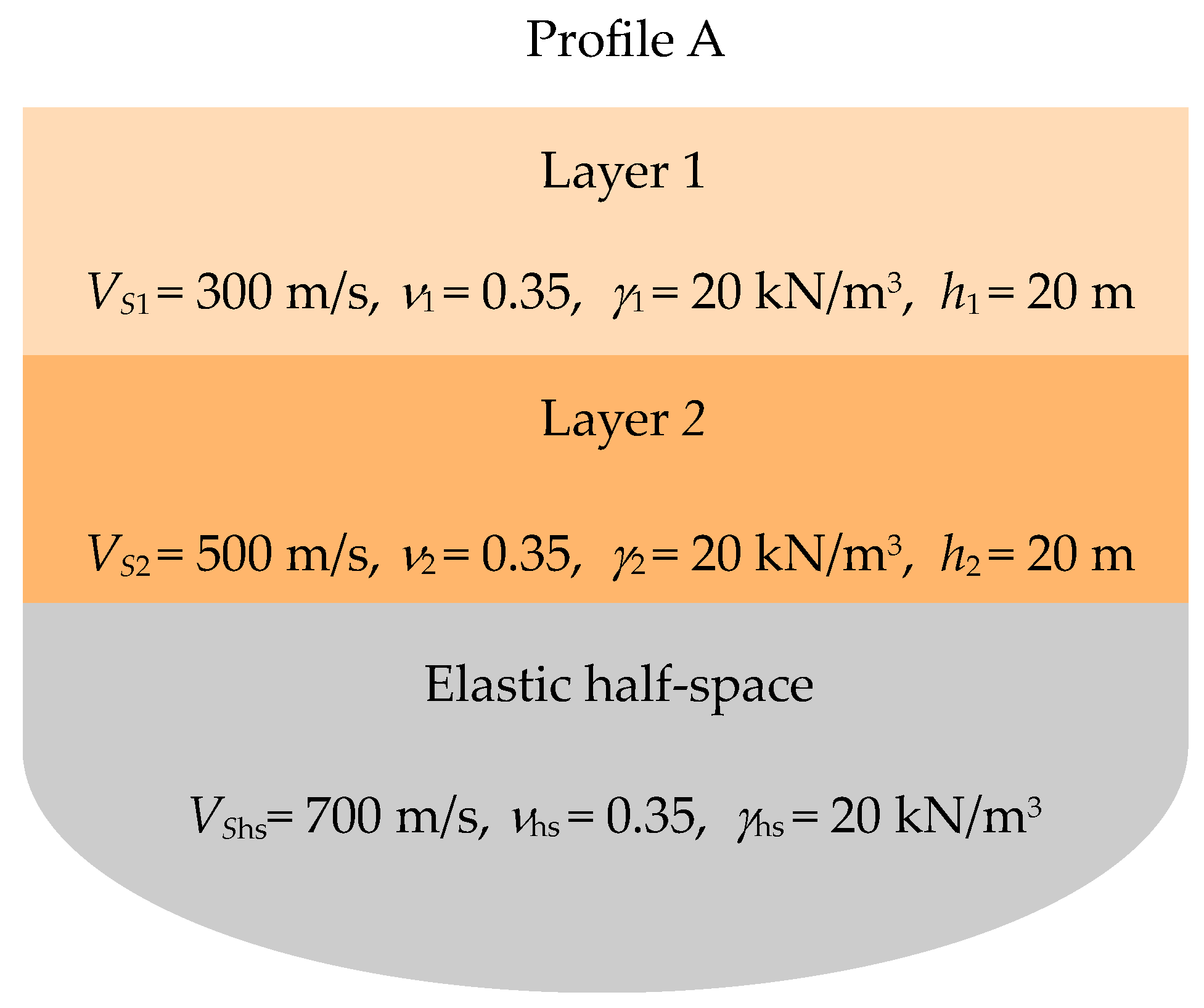
Figure 5.
Comparison between the dispersion curve obtained from Synthetic Profile A and the dispersion curve obtained through the inversion process.
Figure 5.
Comparison between the dispersion curve obtained from Synthetic Profile A and the dispersion curve obtained through the inversion process.
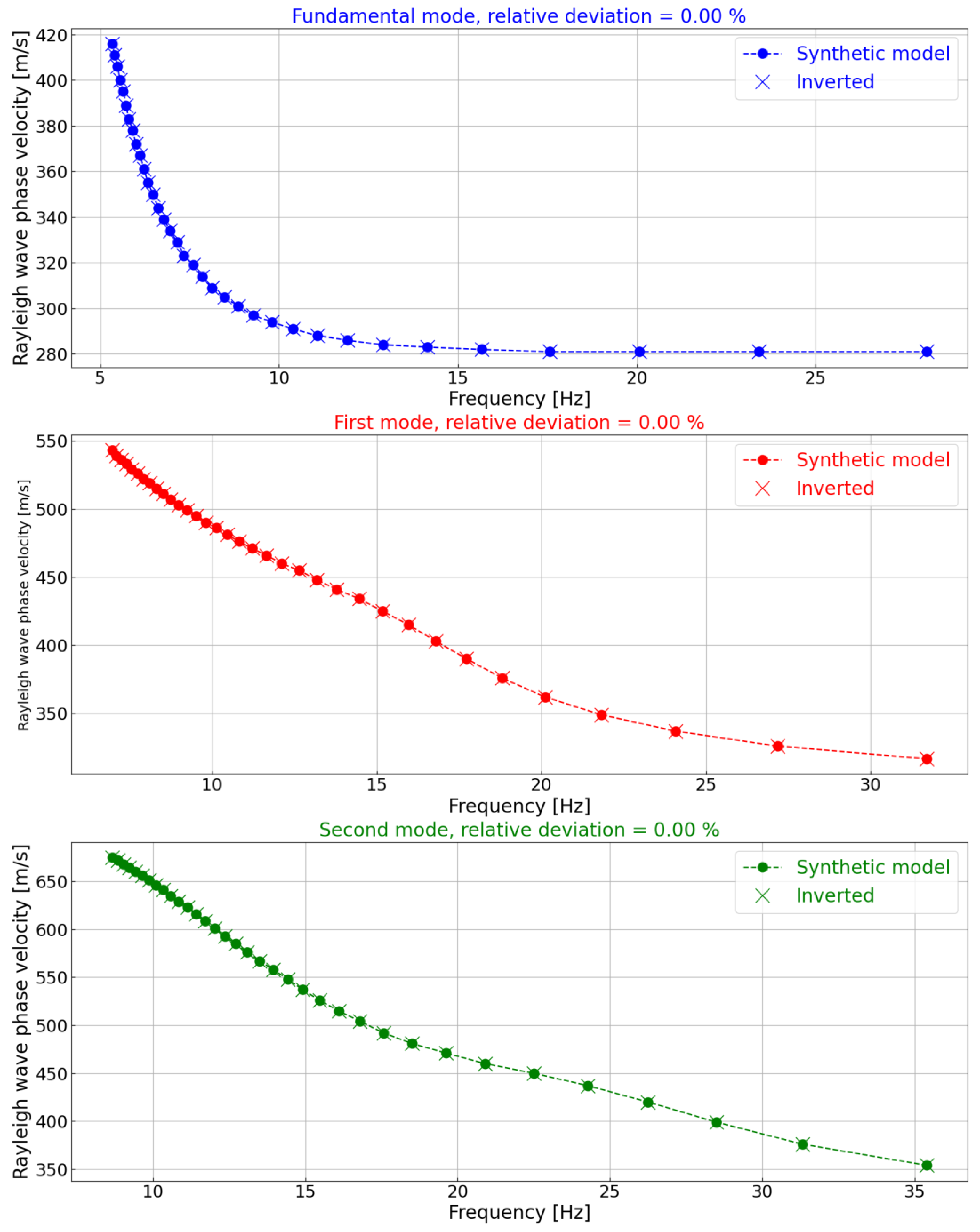
Figure 6.
Synthetic Profile B with two layers overlying an elastic half-space.
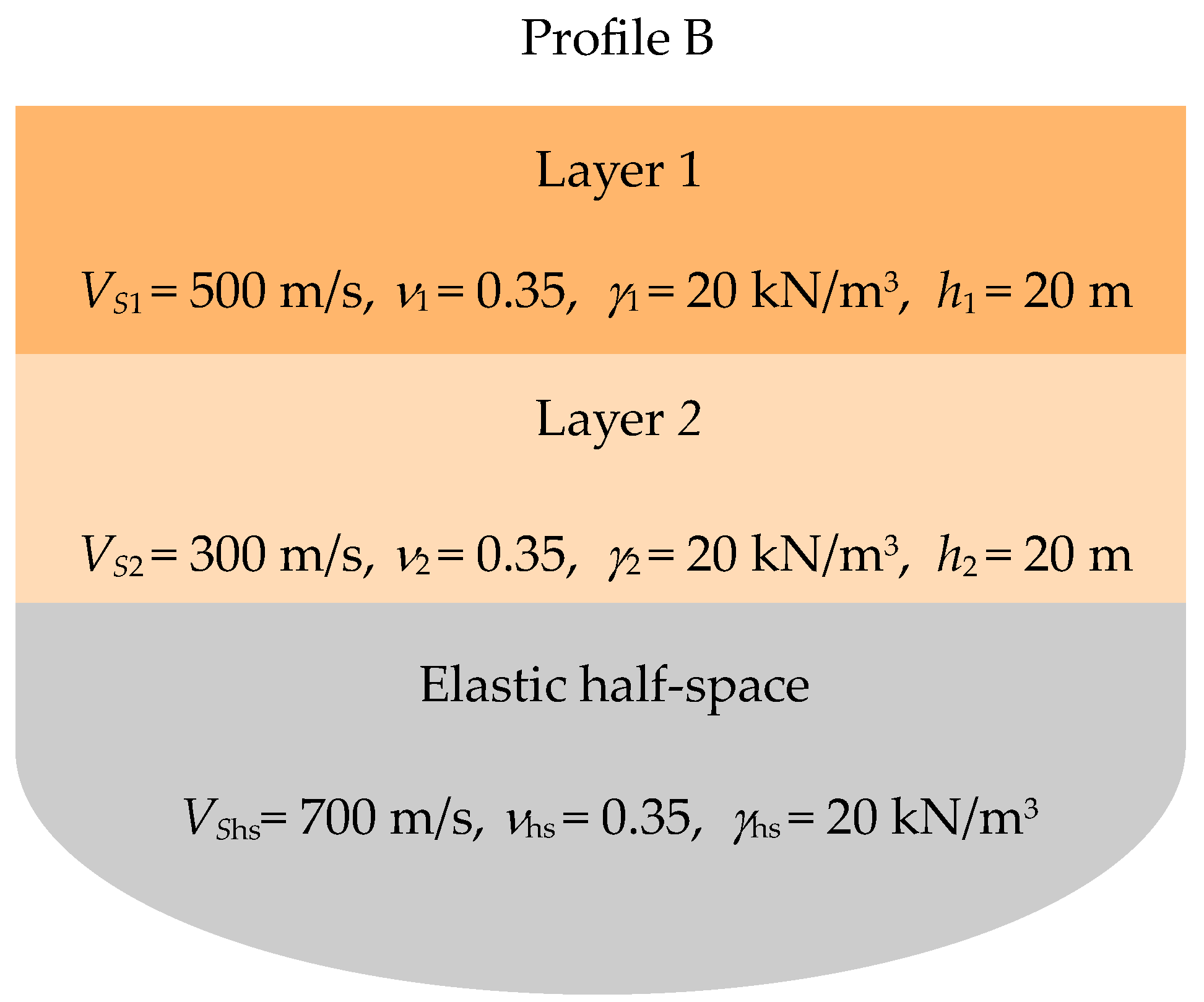
Figure 7.
Comparison between the dispersion curve obtained from Synthetic Profile B and the dispersion curve obtained through the inversion process.
Figure 7.
Comparison between the dispersion curve obtained from Synthetic Profile B and the dispersion curve obtained through the inversion process.
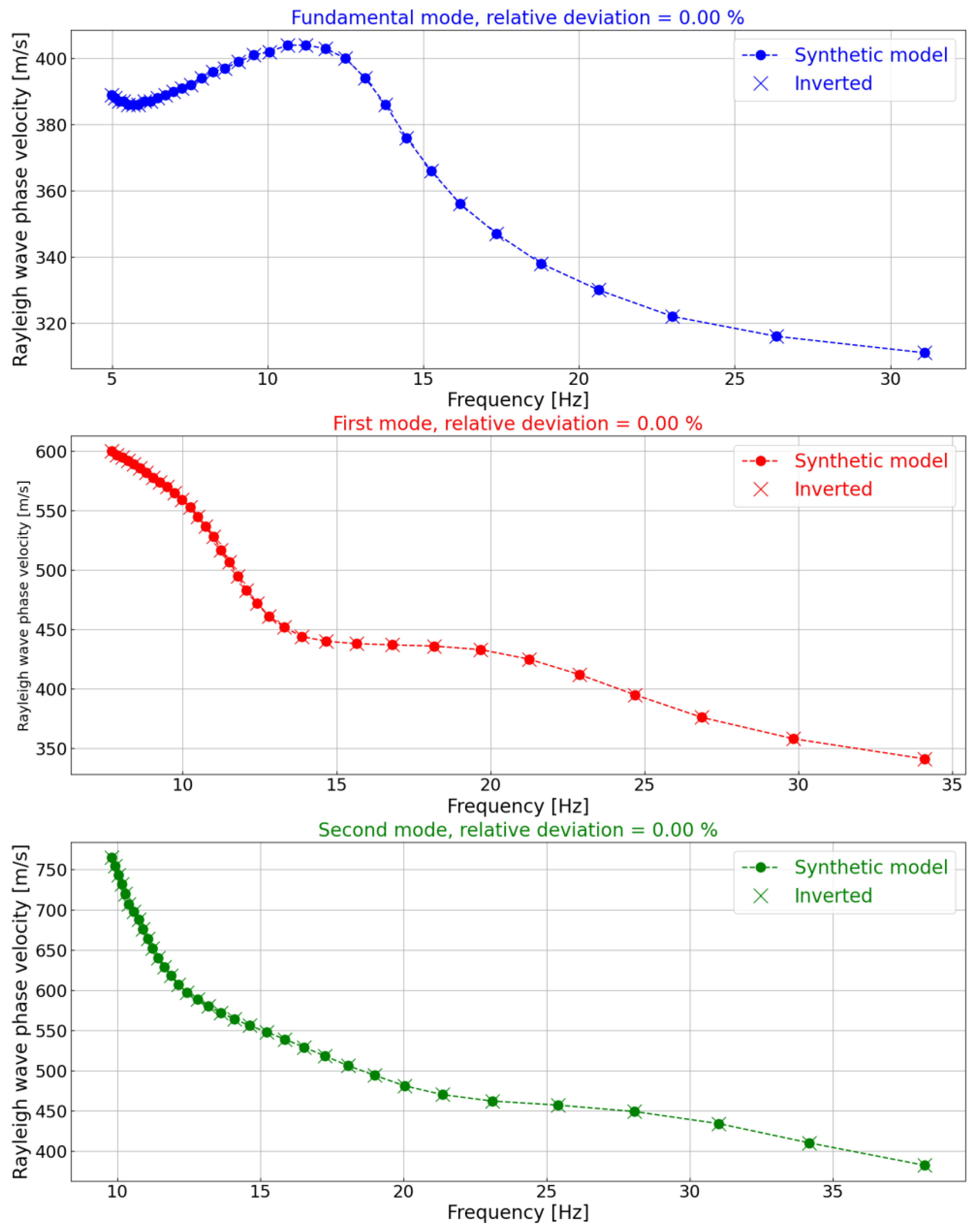
Figure 8.
Synthetic soil profile used for the analysis of the influence of higher modes on inversion results.
Figure 8.
Synthetic soil profile used for the analysis of the influence of higher modes on inversion results.
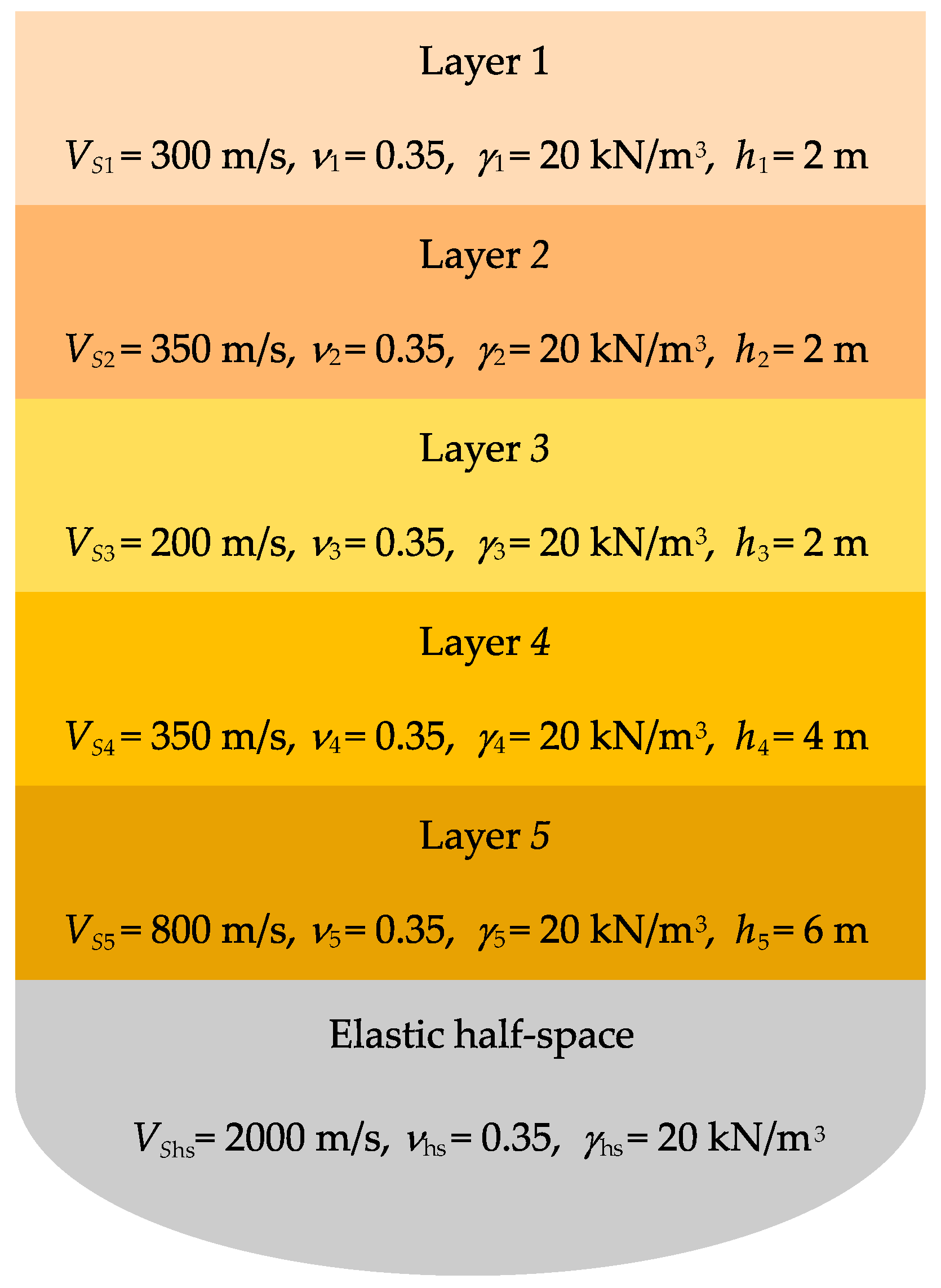
Figure 9.
Inversion result for the case in which the fundamental mode and the first two higher Rayleigh-wave modes are included in the optimization process.
Figure 9.
Inversion result for the case in which the fundamental mode and the first two higher Rayleigh-wave modes are included in the optimization process.
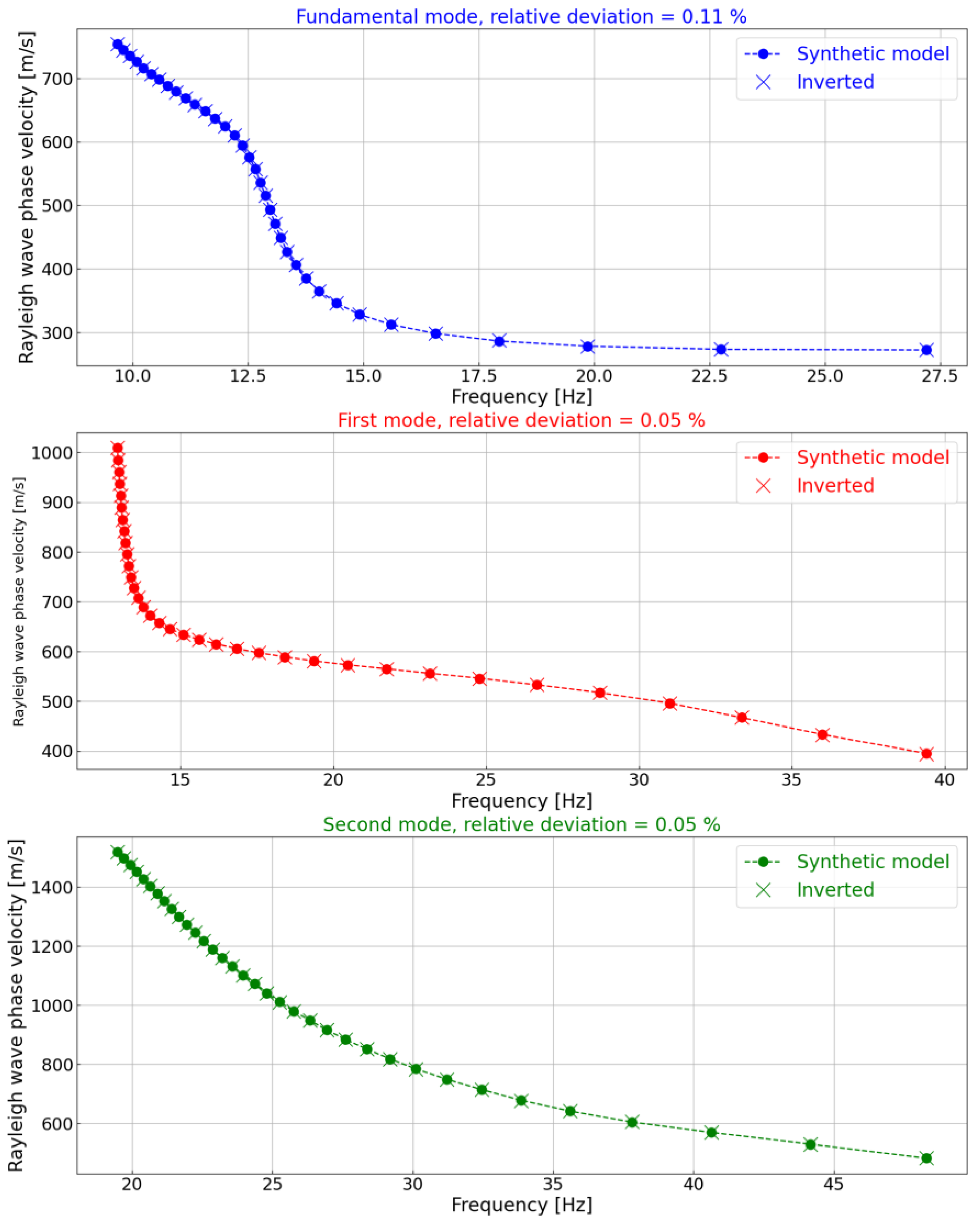
Figure 10.
Measuring profile on the transverse embankment with the location of borehole B8 and the SCPT tests.
Figure 10.
Measuring profile on the transverse embankment with the location of borehole B8 and the SCPT tests.
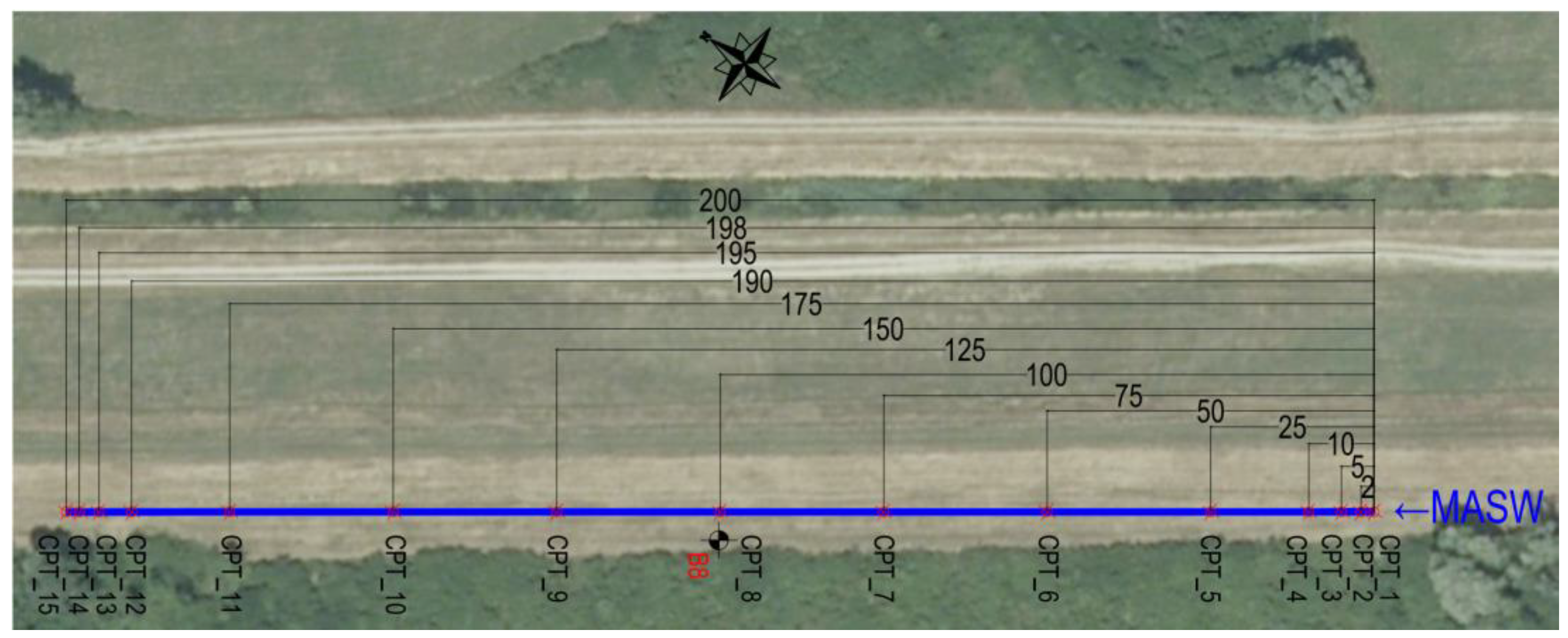
Figure 11.
Dispersion curves obtained from geophysical testing along measuring profile SCPT_8, used as input data for the inversion process.
Figure 11.
Dispersion curves obtained from geophysical testing along measuring profile SCPT_8, used as input data for the inversion process.
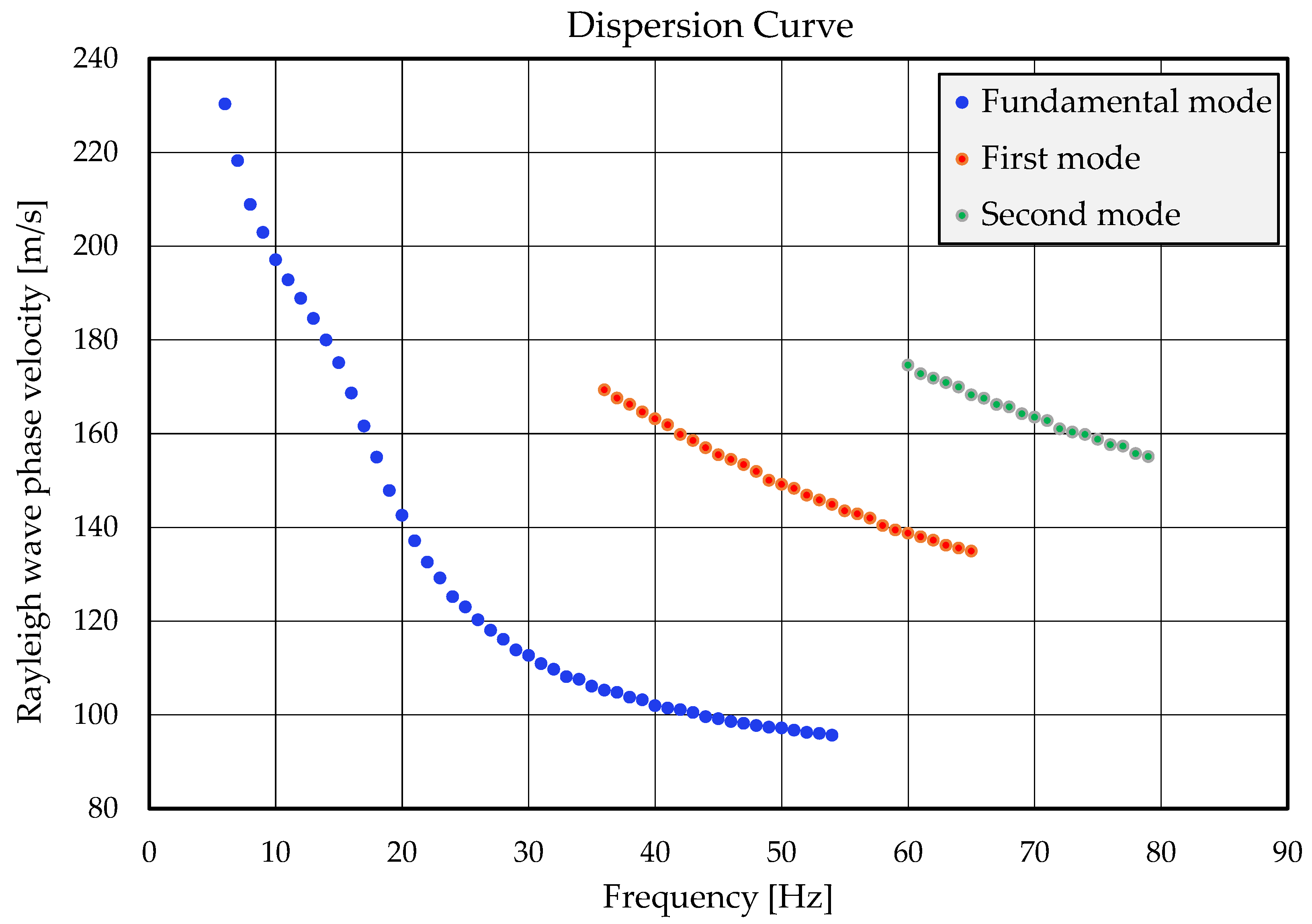
Figure 12.
Comparison between the shear-wave velocity profile obtained by inversion of the MASW dispersion curve and the SCPT results for the eight-layer model.
Figure 12.
Comparison between the shear-wave velocity profile obtained by inversion of the MASW dispersion curve and the SCPT results for the eight-layer model.
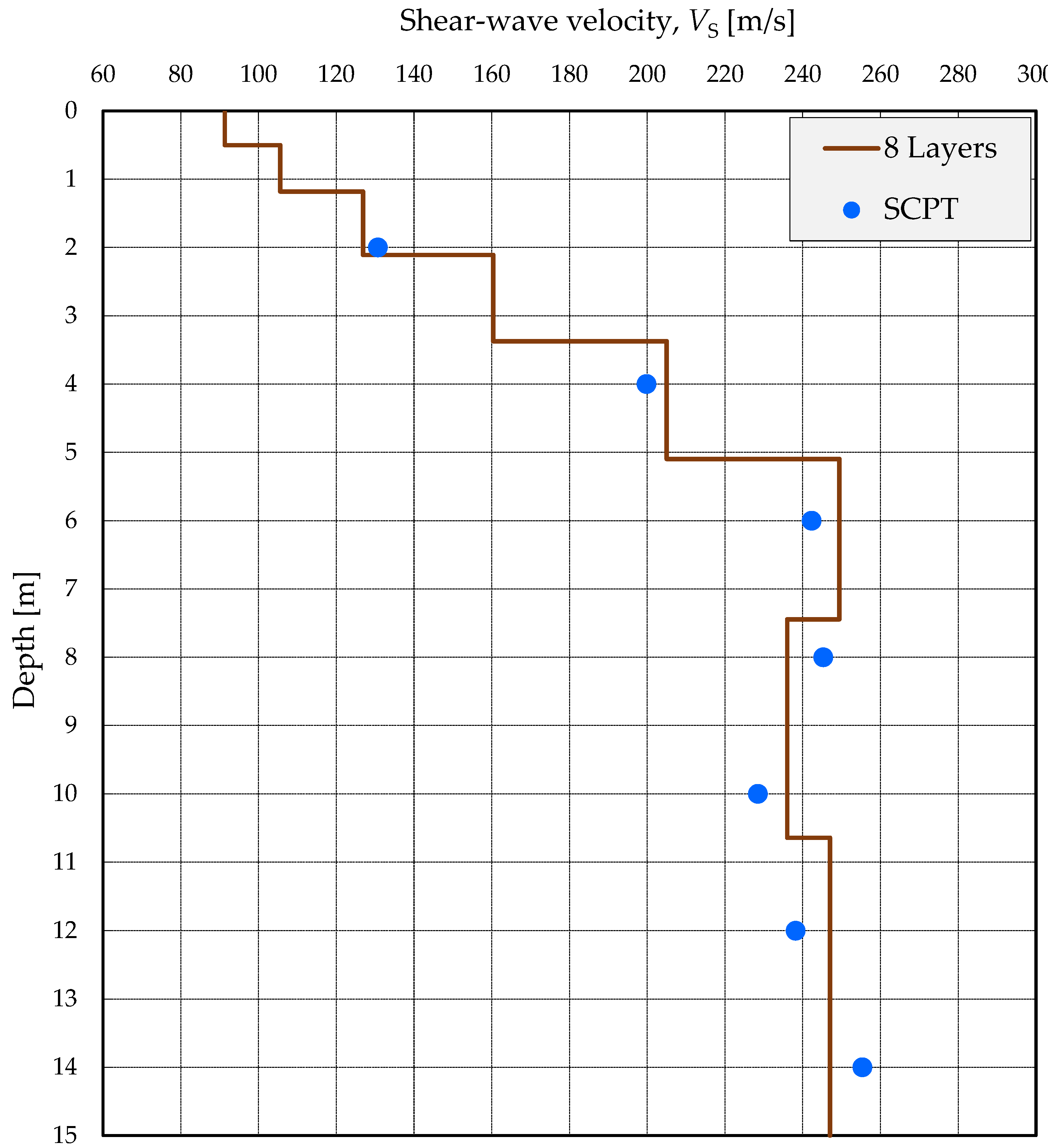

Table 1.
Shear-wave velocities obtained through the inversion process and their deviations for different numbers of included modes.
Table 1.
Shear-wave velocities obtained through the inversion process and their deviations for different numbers of included modes.
| Shear-wave velocities [m/s] | |||||
| Included modes case | Layer 1 | Layer 2 | Layer 3 | Layer 4 | Layer 5 |
| Fundamental + first and second higher modes | 299.80 | 350.52 | 199.65 | 350.16 | 801.24 |
| Fundamental + first higher mode | 282.09 | 366.29 | 217.06 | 326.30 | 820.84 |
| Fundamental mode only | 276.30 | 370.56 | 216.27 | 325.19 | 840.72 |
| Relative deviation of shear-wave velocities [%] | |||||
| Included modes case | Layer 1 | Layer 2 | Layer 3 | Layer 4 | Layer 5 |
| Fundamental + first and second higher modes | 0.07 | 0.15 | 0.18 | 0.05 | 0.16 |
| Fundamental + first higher mode | 5.97 | 4.65 | 8.53 | 6.77 | 2.60 |
| Fundamental mode only | 7.90 | 5.87 | 8.14 | 7.09 | 5.09 |
Disclaimer/Publisher’s Note: The statements, opinions and data contained in all publications are solely those of the individual author(s) and contributor(s) and not of MDPI and/or the editor(s). MDPI and/or the editor(s) disclaim responsibility for any injury to people or property resulting from any ideas, methods, instructions or products referred to in the content. |
© 2026 by the authors. Licensee MDPI, Basel, Switzerland. This article is an open access article distributed under the terms and conditions of the Creative Commons Attribution (CC BY) license (http://creativecommons.org/licenses/by/4.0/).
Copyright: This open access article is published under a Creative Commons CC BY 4.0 license, which permit the free download, distribution, and reuse, provided that the author and preprint are cited in any reuse.


