

Submitted:
31 March 2026
Posted:
02 April 2026
You are already at the latest version
Abstract
The digital age has fundamentally dissociated the creation of fundamental intellectual frameworks, such as novel theories, methodologies, and paradigms, from their widespread application and economic value realization. The fundamental reason why the creators of such meta-intellectual labor often receive disproportionate returns to the enormous long-term social and commercial value created by their work is that we cannot accurately measure, attribute, and automatically trade the value contained therein. In this paper, we propose a new integrated framework for automated valuation and liquidation of knowledge contribution based on the principle of fusion intelligence. This problem is formalized as a Knowledge Contribution Valuation and Liquidation (KCVS) system, with the dual formalization mechanism as its operational core, and the nine steps of intellectual integration as the maturity model of value creation. It shows how AI systems themselves, especially large language models, can be repositioned as impartial measuring instruments, automated traders, and transparent governance within this framework. Through the analysis of real cases of DeepSeek and Qianwen in scientific research and commercial applications, it is clarified that their underlying architectures have instantiated dual formal mechanisms, thus providing empirical support for the theoretical basis of the system proposed in this paper. This is followed by a blueprint consisting of three pillars: (1) an AI-driven knowledge contribution index for dynamic, multi-dimensional impact measurement; (2) a decentralized micropayment and clearing layer based on smart contracts; and (3) a transparent governance protocol for auditability using distributed ledgers. A simulated economic model is used to assess the feasibility of the framework and demonstrate its potential in building a sustainable, equitable, and self-optimizing ecosystem for foundational intellectual labor. This paper provides a theoretical and practical roadmap for aligning the incentives of knowledge creators with the structure of AI-driven economies, ensuring that future innovation is both dynamic and fair.
Keywords:
knowledge valuation
; AI governance
; financial intelligence
; dual formalization
; micropayments
; intellectual property
; smart contracts
; big language models
1. Introduction
1.1. The Paradox of Foundational Intellectual Labor
The 21st-century economy is increasingly driven by knowledge and artificial intelligence. Yet a profound paradox persists at its core: creators of foundational intellectual frameworks—those theories, methodologies, and paradigms that give rise to entire industries—often fail to receive a fair share of the economic value generated by their work. This is not merely a failure of market mechanisms but a systemic failure rooted in the inability to measure, attribute, and trade the value of such meta-intellectual labor.
Consider scholars who have developed innovative theoretical frameworks such as the "Dual Formalization Method" and "Nine-Level Integration Hierarchy" in the field of cognitive integration. These conceptual constructs provide foundational logic for optimizing human-machine collaboration, as demonstrated by state-of-the-art large language model architectures like DeepSeek and Qianwen. However, their value is indirectly realized through countless downstream applications manifested in AI systems, enterprise software, and research workflows. This makes it virtually impossible to trace, quantify, and fairly reward original creators using traditional mechanisms such as copyright, patents, or one-time funding.
1.2. Core Arguments and Research Questions
This paper argues that the key to resolving this paradox lies not in modifying existing systems, but in designing an entirely new, AI-native knowledge valuation and settlement infrastructure. The author contends that the very technologies that have made this issue acute—namely, artificial intelligence—can also be repurposed to address it.
The core argument of this paper is that a fully automated, transparent, and scalable system for evaluating and rewarding foundational knowledge contributions is both technically feasible and economically essential. This system must be built upon three pillars: (1) Measurement: AI agents capable of automatically tracking, attributing, and calculating the impact of ideas; (2) Trading: A decentralized automated micro-payment layer based on smart contracts; (3) Governance: A transparent and auditable protocol to ensure fairness and prevent abuse. The study aims to address the following research question: RQ1: How can the value of foundational intellectual contributions be formally defined and measured in a dynamic, multidimensional manner?
RQ2: What constitutes a viable technical architecture capable of automatically performing attribution, valuation, and settlement of such contributions across heterogeneous digital systems?
RQ3: How can we ensure such a system is fair, transparent, and resistant to manipulation, while also providing scalability for the global digital economy?
RQ4: What are the economic and policy implications of deploying such systems, and what constitutes the first step in their implementation?
1.3. Research Contributions
The primary contributions of this study are as follows: Problem formalization: The authors define the knowledge contribution valuation and liquidation problem, highlighting its unique challenges (indirect value measurement, attribution complexity, and massive scale).
Theoretical Framework: Grounded in Fuzhi Studies, this framework employs its dual formalization mechanism (intentionality/textuality) to simulate the transformation process from abstract human intentions to concrete machine-executable values, while utilizing a nine-tier Fuzhi hierarchy to delineate the value chain.
AI Native Technology Blueprint: The author proposes a novel architecture for a KCVS system, detailing its three AI-driven core components: (a) Knowledge Contribution Index AI model, (b) Automated clearing layer based on smart contracts, and (c) Transparent governance protocol leveraging distributed ledger technology.
Case-based empirical validation: By analyzing the real-world deployments of DeepSeek and Qianwen, this study demonstrates how their architectures implement dual formalization principles, thereby providing empirical evidence for the feasibility of our proposed framework.
Economic Simulation: This paper presents a simplified agent-based model to simulate the economic dynamics of the proposed system, demonstrating its potential to establish a sustainable, equitable, and self-optimizing ecosystem for rewarding intellectual labor.
2. Related Work
2.1. Intellectual Property in the Digital Age
The traditional intellectual property system—copyright, patents, and trademarks—has proven inadequate in addressing the challenges posed by metaintellectual labor. Copyright protects the expression of ideas rather than their underlying frameworks. Patents are designed for tangible inventions with clear and limited scopes, making them incompatible with broad and abstract methodologies (Bessen & Meurer, 2008). The rise of open-source and knowledge-sharing models has highlighted the social benefits of free access, yet fails to address creator compensation issues (Benkler, 2006). Scholars have proposed alternative models such as "micro-licensing" and "collective rights management" (Fisher, 2004), but these approaches have not achieved scalability due to the lack of automated infrastructure for measurement and settlement mechanisms.
2.2. Knowledge Valuation and Impact Metrics
Current academic impact metrics—such as citation counts, h-index, and journal impact factors—are crude, retrospective, and prone to manipulation (Hicks et al., 2015). They measure "attention" rather than "economic or social value." In the business sector, valuation is even less formalized, typically conducted through mergers and acquisitions or expert evaluations. Recent studies have explored using graph neural networks for more refined impact prediction (Dong et al., 2020) and analyzing the "knowledge footprint" of papers in patents and products (Ahmadpoor & Jones, 2017). However, these remain exploratory research rather than deployed systems.
2.3. Artificial Intelligence for Governance and Automation Markets
The concept of "algorithmic governance" is gaining increasing attention, with research exploring how to utilize AI for managing complex systems (Ostrom, 2009; Gasser & Almeida, 2017). Significant academic achievements have been made in automated market design and computational mechanism design, particularly in the context of online advertising and resource allocation (Roth, 2008; Milgrom, 2021). The application of smart contracts for automation and conditional payments within blockchain ecosystems has reached maturity (Buterin, 2014; Szabo, 1997). However, practical implementations of these technologies in knowledge attribution and micro-reward systems remain limited. While projects like "Karma" and "Kudos" in open-source communities have touched upon such topics, their scope remains constrained (Finley, 2015).
3. Theoretical Foundation: Integrative Intelligence
This section introduces core concepts in Integrative Intelligence, which constitute the theoretical foundation for our proposed framework.
3.1. Dual Formalization (Intention/Text)
The dual formalization mechanism proposed by Mr.Zou describes the bidirectional transformation between two fundamental states of intelligence:
Intention: representing human intentions, strategic directions, value judgments, and creative inspiration. It serves as the source of innovative dynamics, ambiguity, and high contextual dependence.
Text: Represents formalized, machine-executable symbols—codes, data structures, formal rules, and algorithms. It is static, precise, and scalable in computation.
This mechanism comprises two operations:
Formalization (intention → text): the process of transforming human intentions into structured, executable forms, which involves creating tools, writing programs, or formulating precise theories.
Sublimation (from form to meaning): Extracting insights from the execution outcomes of formalized symbols to feed back human intentions, thereby facilitating new strategic decisions, creative leaps, or deeper understanding of problems.
Application within this framework: This study posits that a foundational intellectual contribution—such as the dual formalization theory itself—can be conceptualized as a "meta-text" that establishes the mechanisms for subsequent meaning-text transformations. Its value is realized when implemented as a formalized principle (text) within systems like large language models. This principle subsequently guides the processing of vast amounts of other "texts" (data, code), ultimately generating results that align with user intent (meaning).
3.2. Nine-Level Fusion Intelligence Staircase
The nine-level fusion intelligence staircase provides a maturity model for value creation, mapping the journey from foundational knowledge to broad commercial applications. This framework enables the assessment of a contribution's "maturity stage," thereby evaluating its potential value.
| Step | Name | Key Actor | Contribution to Value Chain |
| 1-3 | Perception→Understanding | Human | Fundamental Cognition |
| 4 | Systematization of knowledge | human | Create a formal framework (e.g., dual formalization) |
| 5 | Tooling | Human/AI | Create executable tools based on frameworks |
| 6 | productization | AI | Package tools into reusable products |
| 7 | individuation | AI | Customize products for specific user needs |
| 8 | standardization | AI | Refinement for large-scale market applications |
| 9 | marketization | AI | Widespread market distribution |
Application within this framework: The value of a contribution is not static. As it progresses through the stages (evolving from Step 4 to Step 9), its value increases. Therefore, this automated valuation system must dynamically assess the stage of a contribution's application and incorporate it into the valuation process (for example, a commercialized application at Step 9 should generate higher returns than a research application at Step 5).
4. Framework: An AI-native KCVS System
This paper presents the technical blueprint for a knowledge contribution valuation and settlement (KCVS) system, structured around three core pillars.
4.1. Pillar One: Measurement – Knowledge Contribution Index AI
This instrument belongs to RongzhiXue's omnidirectional sequencing positioning intelligence system, responsible for automatically identifying, tracking, and quantifying the impact of knowledge contributions.
Data source: Knowledge Contribution Index. AI processes vast and diverse datasets, including academic literature: full-text papers sourced from open-access repositories (arXiv, PubMed Central) and commercial databases via APIs.
Technical documentation: software documentation, API specifications, and technical reports from AI companies (e.g., DeepSeek and Alibaba).
Code repositories: Public and private code on platforms such as GitHub and GitLab.
Business System: Anonymized or aggregated API call logs from major AI platforms (optional participation via license agreements).
Architecture: Knowledge Contribution Index. AI is a multi-stage AI system.
Traceability Model: A fine-tuned large language model trained to detect conceptual usage patterns. It goes beyond identifying direct citations to uncover semantic and structural similarities. For instance, when a paper describes a "pipeline for human intent-to-executable code with feedback loops," the model traces this concept to "dual formalization" (intentionality/representation) even without explicit references. Utilizing a twin-network architecture, it generates semantic embeddings for source knowledge contributions (e.g., Zou's research) and target documents, then identifies matches based on vector proximity in high-dimensional spaces.
Attribution Model: Once traceability clues are identified, this model determines the nature of usage. It classifies usage across multiple dimensions:
Usage Stage: Which level of the nine-tier knowledge integration hierarchy does this use represent? (For example, is it for a new research tool [Tier 5] or a commercial application [Tier 9]?) Contribution Depth: Is the knowledge contribution presented as a core organizational principle or merely as peripheral reference (e.g., common phrasing: "This paper is based on a dual formalization framework..." versus "...discussed in the related work section.")
Business scale: For commercial use, this model estimates the economic scale of the application (with appropriate data access permissions). This may be based on API call counts, user numbers, or reported revenue.
Output: Generate a knowledge contribution index score for a given knowledge contribution within a specific time period (e.g., one month). The score is a multidimensional vector: Knowledge Contribution Index = {Total Usage Times, Weighted Impact Sum, Stage Mapping,...}. This score serves as the primary input for the clearing mechanism.
4.2. Pillar II: Transaction – Smart Contract Clearing Layer
This pillar serves as the value transfer engine for Rongzhixue's omnidirectional sequencing positioning intelligence system. Based on knowledge contribution index scores, it automatically allocates payments from knowledge contributors to their creators.
Participants: This layer primarily involves two types of roles.
Value Creators: Creators of foundational knowledge. They register their knowledge contributions to the system (e.g., a specific paper, a unique DOI). This generates a unique digital identity for the knowledge contribution.
Value User: Individuals, organizations, or AI systems that utilize registered knowledge contributions to generate value. Value users must possess an account (or a part of an account) to interact with the KCVS system.
Mechanism: The transaction layer is implemented as a smart contract network deployed on secure, permissioned, or public distributed ledgers (such as Ethereum or dedicated Layer-2 solutions). The workflow is as follows: Detection phase: The knowledge contribution index AI system identifies value user Y's utilization of knowledge contribution X in scenario Z, along with calculated weights w derived from the knowledge contribution index score. This detection event is encrypted and signed before being submitted to the smart contract.
Fee calculation: Smart contracts compute fees based on pre-agreed and publicly known rules.
Cost = Base Cost * Weight * Stage Multiplier, where the Stage Multiplier is a factor that increases progressively from Step 4 (1.0) to Step 9 (e.g., 10.0).
Payment initiation: The smart contract automatically transfers funds from user Y's digital wallet to the' knowledge reward pool' linked to knowledge contribution X.
Distribution: Smart contracts automatically allocate fees from the pool to value creators based on predefined profit-sharing ratios (e.g., 70% to creators, 20% to the platform, and 10% to AI operators of the knowledge contribution index). In cases with multiple creators, distribution is proportionally allocated. This constitutes a near-instantaneous, automated micro-payment process.
Micro-payment architecture: To ensure system feasibility, it must be capable of processing extremely small amounts and high-frequency transactions. This is achieved through the following mechanisms: State channel/Payment channel: Transactions are aggregated off-chain and settled periodically on-chain, thereby significantly reducing gas fees.
Fixed costs and billing cycles: For end users, charges can be consolidated into monthly bills rather than per use, making them more psychologically and administratively acceptable.
4.3. Pillar Three: Governance – Transparent and Auditable Agreements
This pillar ensures fairness and transparency within the system itself, and enables it to evolve alongside community consensus.
Distributed ledgers ensure transparency by storing all critical data, including registration details of knowledge contributions.
AI-generated knowledge contribution index score (the score itself as data, not code).
Cost calculation and transfer records.
Smart contract code.
This ensures that all participants can independently verify the system's operation, meeting the requirements of' transparency 'and' audibility'.
Decentralized governance model: System rules—such as the calculation formula for knowledge contribution index scores, stage multipliers, and allocation ratios—are not fixed by central institutions. Instead, they are governed by decentralized autonomous organizations.
Token: Governance tokens are distributed to stakeholders (value creators, value users, knowledge contributors, AI operators, and researchers). Token holders can propose amendments to the protocol and cast votes on them.
Dispute Resolution: If errors occur in the Knowledge Contribution Index AI (e.g., incorrect attribution), users may file appeals. The dispute will be handled by a randomly selected panel of token holders or an AI-assisted review process utilizing human-machine collaboration. The resolution outcomes will be incorporated into training data to enhance the Knowledge Contribution Index AI model.
5. Empirical Basis: Case Study of DeepSeek and Qianwen
The KCVS system is not established in a theoretical vacuum. Leading large-scale language model architectures have demonstrated the fundamental principles underlying our system's reward mechanism (dual formalization). The author utilized third-party platforms to analyze two case studies derived from prior analyses.
5.1. Case Study 1: DeepSeek as a "Formalization Engine"
DeepSeek's architecture excels in formalization (intention → text) steps through its asynchronous batch processing and thought-chain reasoning capabilities. In the deployment case at a certain oilfield, DeepSeek processed the intent (petroleum engineers' expertise and objectives) to generate substantial text (Python/C++ code for hydraulic fracturing models).
KCVS Application: In the system proposed herein, DeepSeek's deployment for this task will be detected by the Knowledge Contribution Index AI. It will trace the underlying theories enabling this efficient formalization, ultimately attributing it to the dual formalization framework. This implementation is categorized as a Level 6/7 (productization/personalization) application within the theoretical framework's commercial context. The creator of DeepSeek will pay a fee, with a portion allocated as original value creator to Mr.Zou.
5.2. Case Study 2: As a "Sublimation Engine", Qianwen
Qianwen's architecture is built on vLLM with ecosystem integration capabilities, demonstrating exceptional performance in the sublimation (text→intention) phase. Within the "Huiqi Qianwen" platform, it processes massive formal policy documents (text files) to generate insights capable of predicting and shaping citizen intentions.
KCVS Application: This represents a direct implementation of the complete semantic/text cycle, with dual formalization theory serving as its design blueprint. The Knowledge Contribution Index (AI) attributes the system's design to this theoretical framework. This deployment is classified as a Level 8/9 (standardized/market-oriented) implementation, given its integration into a public service platform serving millions of users. The associated costs are consequently higher, reflecting the theoretical value in mature, large-scale applications.
These case studies demonstrate that the value chain of foundational theories is already operational. The KCVS system proposed in this paper aims to ensure that economic chains are as robust and transparent as technological chains.
6. Economic Simulation: Preliminary Analysis
To evaluate the feasibility of the KCVS model, a simplified agent-based economic simulation was developed using Python. The simulation models a dynamic ecosystem comprising four key entities: (1) Knowledge creators possessing foundational theories (e.g., dual formalization); (2) AI platforms that build products based on these theories (e.g., DeepSeek, Qianwen); (3) Commercial users utilizing AI products; and (4) End-users purchasing services from commercial users. The simulation structure and key parameters are summarized below, along with pseudocode, key parameter tables, and a summary of simulation behavioral outcomes.The simulation results (conceptually illustrated in Figure 1) demonstrate a clear positive feedback loop.Figure 1:
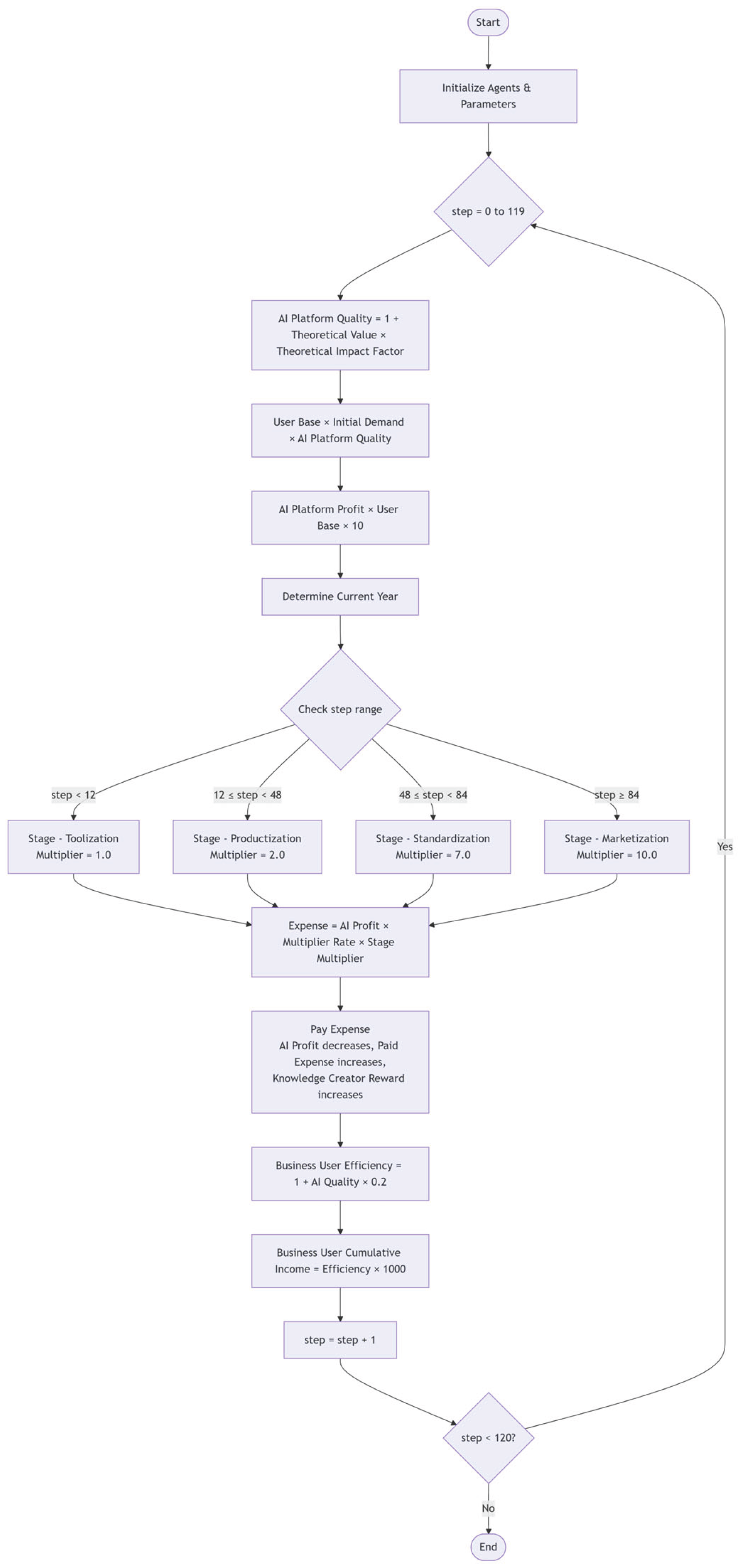
Cumulative returns for knowledge creators: The total returns of knowledge creators exhibit nonlinear growth, with the most steep increase occurring when theories reach their highest commercialization stage. This aligns with real-world expectations, as the value of foundational theories is most fully realized when they drive maturity and large-scale application.
Profits of AI platforms and commercial users: Despite partial profit sharing, the profits of AI platforms and commercial users continue to grow over time. This is because the theory (dual formalization) provides structural advantages (as demonstrated by the model_quality formula), resulting in enhanced market adoption rates and operational efficiency that surpass the costs of KCVS fees. This validates the model's economic compatibility: it is not a zero-sum game but rather a value-adding collaboration.
Stage multiplier effect: The stepwise growth in the return curve is directly correlated with the application of stage_multiplier. As theoretical frameworks mature (e.g., transitioning from research tools to mass-market services), automated valuation systems increase rates to fairly compensate original creators, reflecting the greater commercial value they unlock.
Although simplified, this simulation provides robust evidence for the economic feasibility of the KCVS model. It demonstrates that the system can establish a sustainable, self-reinforcing cycle in which foundational knowledge not only receives equitable returns but also actively drives the growth of downstream economies that rely on it.
7. Discussion
7.1. Key Insights
For AI Developers: The framework presented in this paper indicates that future AI systems should incorporate "accountability" and "attributability" during design. This includes embedding traceability mechanisms (such as knowledge contribution indices for AI) and settlement layers (smart contracts) into development frameworks, enabling developers to easily contribute to and benefit from the systems.
To policymakers: The KCVS system offers a novel framework for innovative policymaking. Governments could establish policies requiring or incentivizing AI systems operating within their jurisdictions to integrate with accredited KCVS protocols, rather than relying on crude tools like patents or one-time grants. This approach could be positioned as a modern, digital-era "knowledge infrastructure" policy, analogous to government mandates for financial reporting or environmental standards.
Future work models: This model exerts profound influence on researchers, theorists, and other knowledge workers. It establishes a novel, direct, and sustainable income source for basic research, independent of traditional academic positions or funding. This will foster a more diverse, resilient, and innovative intellectual landscape.
7.2. Limitations and Future Work
While the author's proposal is comprehensive, it also has notable limitations.
Technical feasibility: The Knowledge Contribution Index AI, particularly traceability models, represents a significant research challenge. Training a model to reliably detect conceptual usage across diverse domains (ranging from fluid dynamics to public policy) requires massive, meticulously curated datasets and complex architectures. This remains an open research question.
Economic adoption: While the success of this whole-domain sequencing localization smart system has achieved seamless integration with top-tier AI large language models, targeted selection of specific target domains relies on widespread adoption. In addition to requiring participation from major AI platforms, a potential approach involves starting with a licensed or opt-in version—perhaps piloting in specific fields (such as government-funded research or open-source AI)—before gradual expansion.
Governance complexity: Designing a decentralized autonomous organization capable of resisting capture, making informed decisions on technical parameters, and fairly resolving disputes represents a major challenge in the field of decentralized governance.
Privacy and Security: Knowledge Contribution Index. AI requires access to extensive data (e.g., API logs, private code) for attribution analysis. Designing a system that respects privacy (e.g., through zero-knowledge proofs) while ensuring security (preventing reverse engineering of proprietary systems) remains a critical area for future research.
8. Conclusions
This paper directly addresses the core paradox of AI-driven economies: creators of foundational knowledge that underpin its development are often marginalized. The author proposes a comprehensive, AI-native framework for automated valuation and settlement of knowledge contributions, grounded in the principles of Fuzhi Studies. The framework demonstrates how artificial intelligence can be repositioned from a value extractor to a mechanism for value measurement and distribution.
By integrating AI-driven knowledge contribution metrics for dynamic impact measurement, smart contract-based clearing layers for automated micropayments, and distributed ledger-based transparent governance protocols, this approach provides a concrete and technically feasible pathway. Case studies of DeepSeek and Qianwen demonstrate that the foundational logic of such systems has already been implemented in defining technologies of our era. Economic simulations conducted by the author indicate that these systems are not only fair but also economically viable, capable of forming a self-reinforcing innovation cycle.
Transitioning to this model will present challenges requiring progress in artificial intelligence, legal frameworks, and economic systems. Yet its rewards—creating an economy that balances knowledge and consumption, ensuring fair recognition of great ideas, and aligning incentives for foundational innovation with public interests—cannot be overstated. Building a more equitable future for human wisdom lies within our reach.
References
- Ahmadpoor, M., & Jones, B. F. (2017). The dual frontier: Patented inventions and prior scientific advance. Science, 357(6351), 583-587.
- Benkler, Y. (2006). The wealth of networks: How social production transforms markets and freedom. Yale University Press.
- Bessen, J., & Meurer, M. J. (2008). Patent failure: How judges, bureaucrats, and lawyers put innovators at risk. Princeton University Press.
- Buterin, V. (2014). A next-generation smart contract and decentralized application platform. Ethereum White Paper.
- Dong, Y., Johnson, R. A., & Chawla, N. V. (2020). Will this paper increase your h-index? Scientific impact prediction. Proceedings of the 13th International Conference on Web Search and Data Mining, 231-239.
- Finley, K. (2015). The quiet rebellion against GitHub’s new ‘kudos’ feature. Wired.
- Fisher, W. W. (2004). Promises to keep: Technology, law, and the future of entertainment. Stanford University Press.
- Gasser, U., & Almeida, V. A. (2017). A layered model for AI governance. IEEE Internet Computing, 21(6), 58-62. [CrossRef]
- Hicks, D., Wouters, P., Waltman, L., de Rijcke, S., & Rafols, I. (2015). Bibliometrics: The Leiden Manifesto for research metrics. Nature, 520(7548), 429-431. [CrossRef]
- Milgrom, P. R. (2021). Putting auction theory to work. Cambridge University Press.
- Ostrom, E. (2009). Governing the commons: The evolution of institutions for collective action. Cambridge University Press.
- Roth, A. E. (2008). What have we learned from market design? Innovations: Technology, Governance, Globalization, 3(1), 9-26. [CrossRef]
- Szabo, N. (1997). Formalizing and securing relationships on public networks. First Monday, 2(9). [CrossRef]
- Xiaohui Zou, Lijun Ke, Shunpeng Zou. (2026). A New Mode of Teaching Chinese as a Foreign Language from the Perspective of Smart System Studied by Using Rongzhixue.arXiv:2602.06992 [cs.CY].
Disclaimer/Publisher’s Note: The statements, opinions and data contained in all publications are solely those of the individual author(s) and contributor(s) and not of MDPI and/or the editor(s). MDPI and/or the editor(s) disclaim responsibility for any injury to people or property resulting from any ideas, methods, instructions or products referred to in the content. |
© 2026 by the authors. Licensee MDPI, Basel, Switzerland. This article is an open access article distributed under the terms and conditions of the Creative Commons Attribution (CC BY) license (http://creativecommons.org/licenses/by/4.0/).
Copyright: This open access article is published under a Creative Commons CC BY 4.0 license, which permit the free download, distribution, and reuse, provided that the author and preprint are cited in any reuse.


