

Submitted:
31 March 2026
Posted:
02 April 2026
You are already at the latest version
Abstract
Background/Objectives: Although pharmaceutical formulations on the market are more varied than in previous decades, developing tablets remains a continuing interest due to increased patient compliance. Simultaneously, the development of multifaceted excipients has remained a requirement of the pharmaceutical industry. This study aimed to develop a granular co-processed excipient for tablets and to evaluate it using the SeDeM expert system. Methods: Six granule formulations (obtained via wet layering granulation) were developed using different binder concentrations, fillers, and core types. The binders’ concentration (AquaPolish® STA) varied on three levels: 10%, 15%, and 20%. Three formulations used microcrystalline cellulose as the filler, while the remaining three replaced it with lactose (six formulations coded E1-E6). The granules obtained were evaluated using the SeDeM expert system for all 12 characteristic parameters, encompassing six incidence factors. The unloaded granules were compressed to yield uncoated tablets, which were verified for dimensional parameters, mechanical properties, and disintegration ability in accordance with the in-force European Pharmacopoeia requirements. Results: The binder concentration influenced particle size, with a 20% AquaPolish® STA concentration yielding large granules. It has been observed that the type of core used to prepare the granules played an important role in establishing mechanical strength; thus, the formulation in which Cellets® was used exhibited lower resistance than those in which sugar was used. During the SeDeM evaluation, it was observed that two formulations (E4 and E5) exhibited good results in terms of the parameter index (PI), parameter profile index (PPI), and Good Compressibility Index (GCI). The recorded disintegration times were less than 15 minutes for all the tablets obtained from the formulated granules. Conclusions: For granule development, binder concentration had the greatest influence on particle size, mechanical strength, and lubricity; also, the type of core used played an important role in tablet mechanical strength. With the help of the SeDeM expert system, the excipients most suitable for developing uncoated tab-lets were highlighted.
Keywords:
co‐processed excipient
; granules
; binder
; SeDeM expert system
; wet granulation
1. Introduction
It is well known that single-component excipients do not always provide the necessary performance in compressibility and tablettability to enable the formulation or manufacture of uncoated tablets [1]. Pharmaceutical excipients are pharmacologically inert substances, aside from the active drug product, that have been thoroughly evaluated for safety and are included in a drug delivery system to assist in the processing of the system during manufacturing, to protect, support, or enhance: stability, bioavailability, aid in product identification, or improve any other attribute of the overall safety and efficacy of the drug during storage or use of the pharmaceutical product [1,2,3,4].
As regulatory requirements for the purity, safety, and standardization of excipients have become stricter, a new international organization has emerged. In the case of the excipient, the entity responsible for the excipient quality is the International Pharmaceutical Excipients Council (IPEC) [5]. According to the IPEC, a co-processed excipient is considered a combination of two or more excipients intended to physically modify their properties in a way that cannot be achieved by simple physical mixing and without significant chemical modification [4].
Various combinations of excipients have been used to enhance tablet manufacturing, leading to improved time management in preparation and cost reductions. A suitable excipient selection is shown in Table 1.
Typically, functional excipients are available as powders or granules. The excipients mentioned earlier are powders that have been co-processed to create a new, versatile excipient that better meets industrial needs. In some cases, certain active ingredients require improved compressibility, and therefore, a powdered or granular functional excipient might be necessary.
To produce granules, two different methods are employed: dry granulation and wet granulation. A comparison between these methods is highlighted in Table 2.
Since the aim of this study was to develop a granular excipient with increased hardness, wet granulation was chosen to produce a multi-functional excipient. This method offers several advantages: absence of chemical changes, improved physico-mechanical properties (compared to the physical mixture with the same composition), enhanced flow properties, better compressibility, higher dilution capacity, and reduced sensitivity to lubricant.
In all cases, the resulting excipients are characterized in terms of quality. One of the tools that can be used in this case scenario to evaluate the granular excipients is the Sediment Delivery Model (SeDeM) expert system, a methodology applied in drug preformulation and formulation studies, especially in the case of solid dosage forms (uncoated tablets made through direct compression) [14,15]. Besides this particular use, this mathematical tool can be used to compare different excipients from the same category (different superdisintegrants, different functional excipients, different fillers) or with the same chemical formula (different types of lactose or microcrystalline cellulose) or to characterize the same excipient from different batches [16].
The main use of this expert system is to develop uncoated tablets by characterizing the active ingredients and the excipients. This system provides information on the physical profile of the active pharmaceutical ingredient (API) and excipients. Through the SeDeM expert system, the advantages and disadvantages of API and excipients are highlighted, indicating whether the direct compression method is appropriate. This system thus provides information that will ensure the robust design of the formulation in the final product [17,18,19].
Through the SeDeM system, 12 parameters are evaluated each of them included in five distinct incidence factors: dimension (Bulk density (Da) and tapped density (Dt), compressibility (porosity—Ie, Carr index—CI, Cohesion index—Icd), Flowability (Hausner ratio—HR, Angle of repose—α, Flowability—t”), Lubrication/stability (loss on drying—%HR, hygroscopicity—%H), and Dosage/lubrication (particles < 50 µm—%Pf, Homogeneity index—Iθ) [20,21].
This study aims to develop a new co-processed excipient by preparing granules via wet granulation and to compare formulations developed using the SeDeM expert system to determine which formulations are most suitable for creating uncoated tablets. Until now, few researchers have used this expert system to analyse granular formulations, modifying methods to meet formulation requirements in terms of dosage and lubrication (homogeneity index and particles < 160 μm) [21]. The objective of developing granules that meet flow properties, compressibility, particle size, and stability criteria is to subsequently use them to develop conventional release tablets that also meet parameters such as friability, mechanical strength, and disintegration. The development of granules with varying binder concentrations and two core types indicates that excipients influence the final product, potentially affecting both granule size and the properties analysed further.
2. Materials and Methods
To obtain granules via wet granulation, AquaPolish® STA (a binder composed of hydroxypropyl methyl cellulose, hydroxypropyl cellulose, and other cellulose ethers, supplied by Biogrund GmbH, Hünstetten, Germany) was used at concentrations of 10%, 15%, and 20%. Two types of cores were used: sugar (manufactured by AGRANA Beteiligungs-AG, Vienna, Austria) and Cellets® (microcrystalline cellulose pellets, produced by Pharmatrans SANAQ AG, Allschwil-Basel, Switzerland), resulting in six formulations (E1-E6) as detailed in Table 3.
The remaining excipients used are sorbitol (Merck KGaA, Hesse, Germany), sodium alginate (gifted by JRS Pharma GmbH & Co. KG, Rosenberg, Germany), sodium stearyl fumarate (Pruv® sodium stearyl fumarate—JRS Pharma GmbH & Co. KG, Rosenberg, Germany), microcrystalline cellulose (Alfa Aesar, Ward Hill, MA, USA), and lactose (DFE Pharma, Goch, Germany). The quantities and roles of the components are shown in Table 4.
As shown in Table 4, microcrystalline cellulose was used as a filler in two different core types to prepare formulations E1-E3. Formulation E1 employed a binder concentration of 10% with Cellets® as the core, whereas formulations E2 and E3 utilized binder dispersion concentrations of 15% and 20%, respectively, with sugar as the core.
In the following three formulations (E4-E6), microcrystalline cellulose was replaced with lactose as a filler, and sodium alginate was removed to observe its impact on disintegration time. Sugar was used as the core for all three formulations, with binder concentration at 10%, 15%, and 20%.
2.1. Granules Manufacturing Steps
The powders were gradually added to a mortar in increasing amounts and ground until a fine, uniform powder was achieved. The resulting powder was then divided into 10 equal portions.
After setting up the pan for the coating process (pan angle = 30°, pan rotation rate = 35 rpm), the cores were introduced and then sprayed with binder to humidify them. After one minute, a portion of the powder was added every two minutes, with binder spraying performed after each addition. Following the addition of the tenth portion of powder, the drying process was conducted at 40 °C for 24 hours in an oven.
A final step before evaluating the formed granules was sieving (mesh sizes of 2 mm and 800 µm), with granules retained on the 2 mm sieve eliminated, and those retained on the 800 µm sieve further evaluated.
2.2. Evaluation of the Granules Obtained by Means of the SeDeM Expert System.
The parameters outlined for the prepared granules define the SeDeM expert system. These twelve parameters are organised into five incidence factors and will be elaborated on in the following sections. The results are the average of three measurements for each formulation.
2.2.1. Particle Size
This incidence factor includes two parameters: Da and Dt.
Bulk density (Da) and Tapped density (Dt)
The European Pharmacopoeia 12th edition (Ph. Eur. 12) describes three methods for determining the bulk volume and bulk density [22]. For practical determinations, the first method was used with a 50 mL graduated cylinder, in which a pre-established mass of granules was taken that occupied 60-70% of the cylinder’s total volume. For each analyzed granule sample, the results obtained represent the average of three determinations [22].
The bulk density was calculated using the following formula:
Da =m/Va
where,
m—weighed mass (g);
Va—bulk volume (mL).
The tapped density is determined by repeatedly tapping the powder in a graduated cylinder. Following the initial measurement of the powder’s volume or mass, the graduated cylinder is subjected to mechanical tapping, with subsequent volume readings recorded after 10, 50, 500, or 1250 tappings [22].
The tapped density was calculated using the equation:
Dt=m/Vt
where,
m—weighed mass (g);
Vt—tapped volume (mL).
2.2.2. Compressibility
The three parameters considered to determine the compressibility parameter are: Porosity, Carr’s Index, and Cohesion Index.
Porosity (ξ)
Porosity is the first parameter included in the compressibility incidence factor, and it is calculated using the formula [23]:
ξ = (Dt -Da)/(Dt
*Da)*100
Carr’s Index (CI)
Carr’s index, also called the compressibility factor, quantifies the compaction ability [24]. It is calculated using the bulk density and the tapped density using the equation:
CI= (Dt -Da)/Dt
*100
Cohesion index (Icd)
The cohesion index is calculated by compressing the studied granules using an eccentric tablet press (Shanghai Tianfeng Pharmaceutical Machinery Co., Ltd., Shanghai, China) to produce 12-mm-diameter tablets. The crushing resistance (N) of the tablets formed during this compression process was measured using a mechanical strength testing device called Tablet Four-Usage Tester—TFUT3 (Biobase Biolin Co., Ltd., Shandong, China) [25].
2.2.3. Flow Property Assessment
Parameters included in the flow incidence factor include the Hausner ratio (HR), angle of repose (α), and flow factor (t”).
Hausner’s Ratio (HR)
The Hausner ratio is a measure of a powder’s ability to settle and assesses the importance of particle interactions [22]. It is calculated using the tapped density and the bulk density according to the equation below:
HR=Dt /Da
Angle of repose (α)
α is the angle of the cone formed when the granules are passed through a funnel with pre-established dimensions for the upper diameter of the opening, inner diameter at the bottom, and the narrow end of the funnel opening.
The funnel is positioned on a support 20 cm above the table surface, centred on a millimetre sheet. The closed end of the funnel is filled with the evaluated granules. The funnel is connected to a vibrator, which starts at t = 0. The experiment is considered complete when all the granules are on the millimetre sheet, and a heap or cone has formed. For the resulting cone, the height (h) is measured, while the radius of the base is evaluated (diameter/2 or d/2). The radius of the cone’s base, the height of the resulting cone, and the time taken for the powder to flow are measured [26].
This is calculated according to the formula:
tan α=h/r
h—cone height (mm);
r—cone radius (mm).
Flow factor (t”)
The flow factor is the time, measured in seconds and tenths of a second (t), required for a preestablished amount of sample (m) to flow from the funnel onto a flat surface [26]. The formula used is as follows:
t’’ = m/t (g/s)
2.2.4. Lubricity/Dosage Evaluation
To evaluate lubricating capacity and dosage, the following two factors are considered: the homogeneity index and the percentage of particles smaller than 160 µm.
Evaluation of the Homogeneity Index (Iθ)
This parameter is calculated in accordance with the provisions of Ph. Eur. 12 [22]. To determine particle size by the sieve test, the grain size of a 100 g sample is measured by vibrating a series of sieves for 10 minutes at a speed of 10. The sieve sizes used are 2500 µm, 800 µm, 315 µm, 200 µm, and 160 µm. The percentage of product retained on each sieve was calculated, and the amount passing through the sieve with the smallest aperture, 160 µm, was measured [22,25]. The equation used to calculate the homogeneity index is [25]:
Iθ=Fm/100+(dm-dm-1)Fm-1(dm+1-dm)Fm+1(dm-dm-2)Fm-2(dm+2-dm)Fm+2
where:
Iθ—Homogeneity index;
Fm+1—the percentage of particles that are found in the upper range of the majority range;
Fm—the percentage of particles found in the majority range;
Fm-1—the percentage of particles found in the lower range of the majority range;
dm+1—average particle diameter in the range immediately above the majority range;
dm—average particle diameter in the majority range;
dm-1—average particle diameter in the range immediately below the majority range.
% Particles < 160 µm
The determination of particles smaller than 160 µm is performed following the procedure described for establishing the homogeneity index. The quantity of granules passing through the 160 µm sieve is weighed [21].
2.2.5. Lubricity/Stability Assessment
Loss on drying and hygroscopicity are parameters used to evaluate the lubricity and stability of the studied powders.
Hygroscopicity (%H)
%H was determined by calculating the weight gain after 1 g of granules was kept in a desiccator at an ambient humidity of 75% ± 2% and a temperature of 22 °C ± 2 °C for 24 and 72 hours, respectively [20,24].
Loss on drying (%RH)
Loss on drying is determined according to the Ph. Eur. 12 by drying the sample in an oven at 105 °C ± 2 °C until a constant mass is obtained [22]. The temperature at which the experiments were conducted was selected based on the melting point. 1 g of each proposed formulation was added to Petri dishes and spread uniformly. After 30 minutes, the samples were removed from the oven and weighed. This process was carried out for each sample separately until a constant sample mass was reached [20].
2.2.6. Parameter Conversion into Radius Values
The conversion of the parameters included by the SeDeM expert system is underscored in Table 5. For all selected parameters, some factors are applied to obtain radius values in the range 0-10. For Icd, if the crushing resistance exceeds 200 N, a radius of 10 will be assigned.
2.2.7. Acquiring the SeDeM Diagram
After the radius values for all 12 parameters are obtained, the SeDeM diagram is plotted in Microsoft Excel as a radar chart, followed by a visual evaluation of the SeDeM diagram, which outlines the alterations that need to be made in the case of the active ingredient or the limitations of a certain excipient. This step is followed by the assessment of the Parameter Index (PI), the Parameter Profile Index (PPI), and the Good Compressibility Index (GCI), as will be detailed in the next subchapter.
2.2.8. Assessment of the Parameter Index (PI), Parameter Profile Index (PPI) and Good Compressibility Index (GCI)
Parameter Index (PI)
This index measures the ratio of parameters with values exceeding 5 to the total number of parameters assessed by this expert system (12). Experts on this mathematical tool suggest that this value should be greater than 0.5.
Parameter Profile Index (PPI)
This parameter is the average value of all twelve radius values obtained. For this index, a value greater than 5 is recommended to comply with the SeDeM expert system’s stipulations.
Good Compressibility Index (GCI)
This index is specific to SeDeM and is calculated as follows (Eq. 9):
GCI=
PPIxf,
where,
f—reliability factor and represents the surface occupied by the polygon inscribed in the circle, f =0.952. For this specific index, a value > 5 is recommended.
2.3. Uncoated Tablets Manufacturing Using the Granules Developed
Following characterisation of the granules using the SeDeM expert system, they shall be compacted to produce uncoated tablets by direct compression (13 mm punches). These tablets will subsequently be evaluated for their diameter and thickness, followed by assessment of their mechanical properties, including friability, crushing resistance, and disintegration.
2.4. Uncoated Tablet Quality Assessment
Quality is a fundamental requirement across all sectors and is also a primary objective within the pharmaceutical industry [27]. Given that uncoated tablets without active ingredients will be developed, certain traditional assessments specific to tablets will be considered [28].
2.4.1. Mechanical Property—Tablet Friability
To assess tablet friability, a TFUT3 apparatus (Biobase Biolin Co., Ltd., Shandong, China) is used, operated at 25 rpm for 4 minutes. For tablets with a unit weight of 650 mg or less, a sample comprising 20 entire tablets shall be utilised; for tablets weighing more than 650 mg, a sample of ten tablets shall be selected [22]. Before testing, the tablets should be carefully dusted. The 10 tablets are to be weighed accurately, with the initial mass (mi) recorded. The tablets are then rotated for 4 minutes at 25 ± 1 revolutions per minute, after which any dust is removed, and they are weighed again to determine the final mass (mf) [22].
The following formula was used to calculate friability:
F=(mi -mf)/mf*100
where
F—friability (%);
mi—initial mass of the tablets;
mf—final mass of the tablets after dedusting.
2.4.2. Mechanical Property—Resistance to Crushing
This test aims to determine, under defined conditions, the crushing strength of tablets, measured as the force required to break or fracture them.
To measure the mechanical strength, the tablet will be placed between two plates, and measurements will be taken on 10 tablets, ensuring all fragments are removed before each test. The average of the 10 measurements will be calculated and expressed in Newtons.
2.4.3. Tensile Strength
Another physical parameter that is evaluated in the case of tablets is the tensile strength, which can be obtained by applying the equation:
Ts = 2 x F/π x d x h
where,
Ts = tensile strength (MPa)
F = resistance to crushing (N)
d = tablets’ diameter (mm)
The results obtained are the average of six evaluations.
2.4.4. Crushing Strength—Friability Ratio
CSFR is a metric used to evaluate tablet quality by integrating two previously determined parameters: tablet crushing strength and friability. This measurement of physical strength is derived by dividing the crushing strength by the friability (refer to Equation (12)). The influence of various types and quantities of disintegrants on the mechanical robustness of the tablets can be assessed by examining the CSFR value [31,32].
CSFR = Resistance to crushing/friability
2.4.5. Tablet Disintegration
This test determines whether tablets disintegrate within the specified time when placed in a liquid medium. Disintegration does not mean the complete dissolution of the unit or its active ingredient. Complete disintegration is defined as the state where any residue of the unit is a soft mass and has no palpable firm core [32].
The apparatus includes a basket-rack assembly, a 1 L beaker, a thermostatic device to heat the disintegration media to 37 ± 2 °C, and a component that moves the basket into the immersion fluid at a steady frequency of 29 to 32 cycles per minute [22].
The procedure involves inserting one tablet into each of the six basket tubes. The specified medium (600 mL) was maintained at 37 ± 2 °C and used as the immersion fluid. Upon completion of the designated time, the basket was withdrawn from the liquid, and the tablets were analyzed: all dosage units had fully disintegrated. If one or two dosage units did not disintegrate, the test was repeated with an additional twelve dosage units. The test requirements are met if at least 16 of the 18 dosage units disintegrate within 15 minutes [22,32].
2.4.6. Determination of Tablet Diameter and Thickness
Dimensional parameters (thickness and diameter) will be determined on 10 tablets from each sample using a micrometer (Yuzuki, India ) [33].
2.5. Statistical Evaluation
A statistical analysis was performed using GraphPad Prism 11.0.0 (Dotmatics, Boston, MA, USA) with the ROUT test to remove one or more outliers at Q=1%, followed by a normality test (Shapiro-Wilk) to determine whether the data distribution was Gaussian or non-Gaussian. If the distribution was Gaussian, ANOVA-based tests were used, along with Tukey’s multiple comparisons test. If the residuals showed a non-Gaussian distribution, a non-parametric test was applied—Kruskal-Wallis and Dunn’s multiple comparisons test. Results are reported as mean ± SD. The significance level was set at 0.05 (p), with p values marked by asterisks in the results and discussion sections: ns (p > 0.05), ns—not significant; * (p<0.05); ** (p<0.01); *** (p<0.001); **** (p<0.0001).
3. Results and Discussions
The excipients, quantities, and concentrations used to prepare the granules were selected based on results from previous studies and our own tests to ensure compliance with the pharmacopoeial requirements in force. Six granule formulations were obtained, and their evaluation will be further underscored. Firstly, the granules were evaluated for quality using the SeDeM expert system, followed by the evaluation of the tablets obtained by compacting the unloaded granules. This section outlines how binder concentration and core type influence the SeDeM profile, a methodological approach not previously reported in the literature.
From the perspective of the core used, it was observed that it influenced the formation and appearance of the granules. Thus, in E1, where Cellets® cores were used, the resulting granules were smaller in size and a different colour from those of the other formulations. Another factor influencing granule development was binder concentration; higher concentrations led to larger granules.
3.1. Evaluation of the Granules by Means of the SeDeM Specific Incidence Factors
This subchapter presents the results for the parameters evaluated by the SeDeM expert system, grouped into five distinct incidence factors. To facilitate understanding, these results will be discussed in five subchapters, each examining all formulations.
3.1.1. Particle Size
The radius values for Da range from 5.2 (E3) to 7 (E4), while the Dt values range from 5.7 (E3) to 7.6 (E4). Following particle-size tests, the results for tapped and apparent density are presented in Table S1. As shown in Table S1, for all radii of Da and Dt, values higher than 5 were obtained, which is an advantage, since powders usually yield values lower than 5, especially for Da, as can be seen in the previously published studies [20,34].
Suñé-Negre et al. highlighted powder excipients with Da radii values lower than 5: Pearlitol 200 SD, Tri-cafos, Prosolv HD90, Isomalt 721, Pharmaburst C1, Erysta [35]. All the excipients mentioned are powdered materials or co-processed powder blends suitable for direct compression. Khan et al. showed similar results for the radii of Da and Dt of the developed granular excipients [21]. In conclusion, there are excipients on the pharmaceutical market that do not comply with the SeDeM expert system requirements regarding the particle size incidence factor. Still, they are certainly exhibiting other parameters that fall under the other four incidence factors. Developing granular excipients tends to improve the particle-size incidence factor, as outlined in this study and in the study conducted by Khan et al. [21].
3.1.2. Compressibility Incidence Factor
Of the three parameters assessed, porosity and Carr’s Index were calculated from previously obtained apparent and tapped density results using the formulas provided in the materials and methods chapter. At the same time, the cohesion index was determined experimentally with tablets produced by direct compression. The results for these three parameters across the six formulations are shown in Table S2, alongside the compressibility index. Although it was expected to achieve a compressibility incidence factor greater than 5, this was not observed due to low interparticle porosity and a low Carr Index.
The low Carr index and porosity values imply effective particle rearrangement and a densely packed powder bed. Yet the high cohesion index reveals a strong tendency of particles to form interparticle bonds during compression. This behaviour is related to the particles’ deformation mechanism, particularly plastic deformation, which enlarges contact surfaces and enhances bonding under compression. As a result, the granules exhibit good flowability and packing density, along with high cohesion during compression, indicating their excellent compressibility and suitability for direct compression tabletting.
Similar results for this incidence factor were also observed in the article published by Khan et al., where compressibility ranged from 1.41 to 5.28, indicating low porosity and the Carr Index, which led to these reduced values [21].
3.1.3. Flow Property Evaluation
As shown in Table S3, all the formulations exhibited high flowability incidence factor values, ranging from 8.25 (E3) to 9.54 (E6). For all three parameters used in calculating the flowability incidence factor, values >5 were recorded, resulting in a high average. Besides, all six formulations specified RH = 10, while the latter three exhibited an extremely good flow factor and, as a result, a radius of 10 was assigned. Even with very small values of α, the radius values for this parameter were not at their maximum; nonetheless, the results supported the imposed average value, which is limited to at least 5.
One of the properties that influences the direct compression process is the flow capacity of the powder blend or mixture, as poor properties can lead to issues during the scale-up process or even in the preformulation or formulation stage when the eccentric press might experience hopper bridging, funnel clogging, and irregular powder descent, which can interrupt manufacturing.f Other issues that might occur include inconsistent die filling (increased weight variation), capping, lamination, sticking, and picking [36].
3.1.4. Evaluation of Lubricity/Dosage
To calculate the homogeneity index, particle distributions for the 6 formulations were analysed. The results for the two parameters characterising lubricity/dosage are presented in Table S4. The highest values were achieved for the last three formulations for both the homogeneity index and Pf; as a result, the lubricity/dosage incidence factor received the highest score of 10. For the first three granular formulations, the Iθ values were 10, while the Pf ranged from 7.66 (E2) to 9.17 (E3).
Khan et al., outlined similar results in terms of lubricity/dosage evaluation with low values outlined for the active ingredient (<5), while for the granules loaded with ribavirin, the incidence factor showed the highest value comparable with the result obtained in this study (9.13—Trial 1) [21].
3.1.5. Lubricity/Stability Assessment
As demonstrated in Table S5, all granular excipients yielded values greater than 5 for radius, with ranges from 7.07 (E5) to 9.29 (E6). Conversely, two granular excipients did not exceed the proposed radius value of 5, with 0 for E1 and 4.62 for E2. The highest value for this parameter was observed in the E6 formulation at 9.72. In summary, E1 did not fall below the average threshold of 5, whereas the remaining five formulations had mean incidence values ranging from 6.48 (E2) to 9.51 (E6).
3.2. Mathematical Evaluation of the Proposed Granular Excipients
SeDeM diagrams were generated for the six granular excipients chosen for this study. Typically, a graphical evaluation can identify parameters that require adjustment, as well as those with radii close to 10. In practice, the greater the surface area encompassed by the combined radii of the 12 parameters obtained, the lower the likelihood of encountering problems during tablet development using the direct compression method (flowability, stability, compressibility, etc.). Out of the six granular functional excipients, E4 and E5 showed the lowest number of parameters that need improvement (two: porosity and Carr Index), while in the case of E1, the most parameters that need improvement were encountered (four: Cohesion Index, hygroscopicity, porosity, and Carr Index). These results are supported by the PI, PPI, and GCI indices, which will be discussed in the following subchapter.
Figure 1.
The SeDeM diagram for the developed granular excipients: E1 (a), E2 (b), E3 (c), E4 (d), E5 (e), E6 (f).
Figure 1.
The SeDeM diagram for the developed granular excipients: E1 (a), E2 (b), E3 (c), E4 (d), E5 (e), E6 (f).
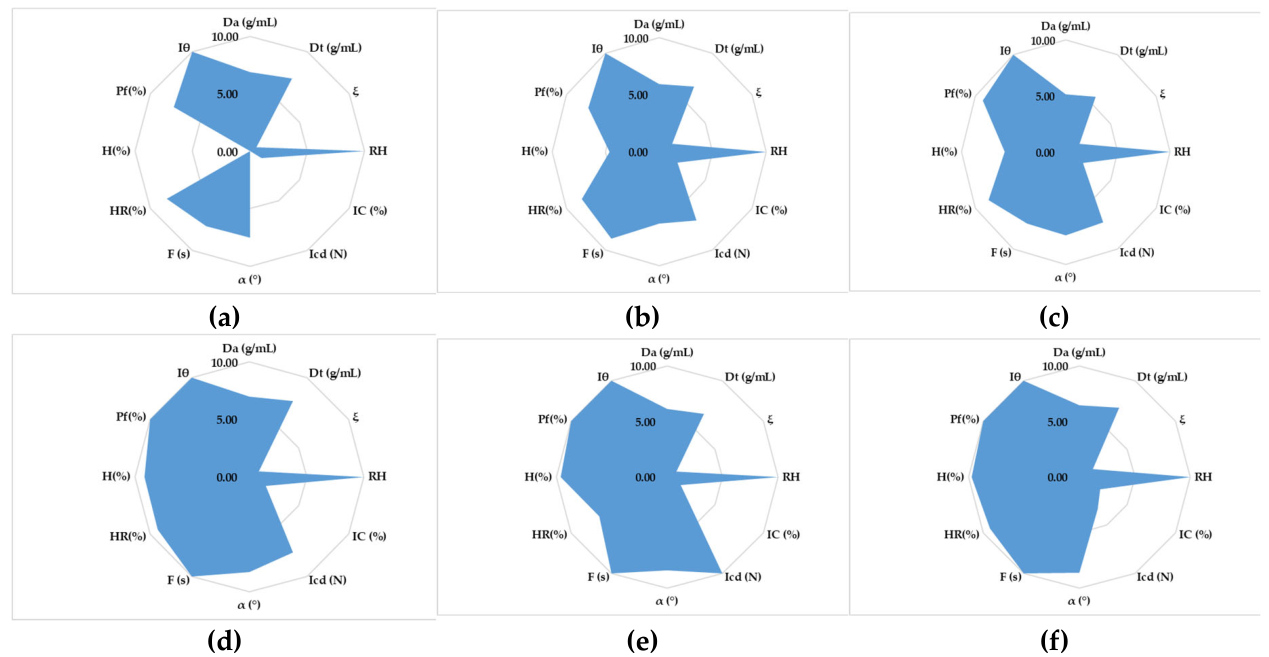
In the case of PI, the granular excipients coded E3-E5 exhibited the highest value of 0.83, while E1 outlined a lower value of 0.67; even so, all the excipients developed are in the range recommended by the SeDeM expert system, 0.5-1 [37]. In the study by Khan et al., PI values ranged from 0.4 to 0.67; in contrast, this research observed higher values for three formulations of granular excipients [21]. Sune Negre conducted research analysing several powders and functional excipients recommended for direct compression; as the results show, none of the excipients had PI values higher than 0.5 [34].
PPI—a parameter that is calculated in the case of all SeDeM/SeDeM-derived expert systems, showed values that exceeded the limit value imposed by this mathematical tool (5) in the case of all six granular excipients proposed (Figure 2 (a)). Since this parameter is used to calculate the GCI, which is the product of the PPI and a subunitary value, the higher the PPI, the lower the risk that the GCI will yield values that do not meet the SeDeM requirements. The PPI ranged between 5.60 (E1) and 7.69 (E4). Khan et al. indicated lower values of this parameter (4.02—active ingredient—ribavirin) and 5.8 for loaded functional granules [21].
In the case of GCI, lower values were obtained than in the case of PPI, but even after comparing the results, it was observed that for all granular excipients (E1-E6), values higher than 5 were recorded (Figure 2(b)). Although a value higher than 5 was registered for the E1 excipient, its compressibility issues mean this granular excipient cannot be used further to develop tablets by direct compression. The value of GCI for E1 was obtained because this excipient exhibited extremely good values for the other parameters, except for compressibility. Also, when the compressibility incidence factor is compared with the GCI, the latter tends to be higher. Since the cohesion index (Icd) underlined good values for the E2-E6 granular excipients, it can be concluded that for these excipients, the high GCI can be correlated with the compressibility incidence factor. Higher GCI-values than those for powder excipients were obtained in this research [35,37,38].
3.3. Tablets’ Quality Assessment
As mentioned in the materials and methods section, this subchapter will be divided into several chapters to outline the results better. Firstly, the dimensional parameters (diameter and thickness) will be included, followed by the mechanical properties proposed in this study (friability, resistance to crushing, tensile strength, crushing strength/friability ratio), and, finally, the disintegration ability will be discussed.
3.3.1. Dimensional Parameters (Thickness and Diameter)
The results for the thickness and diameter are shown in Figure 3(a) and 3(b), respectively. Regarding thickness, most comparisons between means are statistically significant, except for E5-E6, where p>0.05 (Figure 3(a)). The variation in thickness can be attributed to differences in interparticle porosity among the granules and the excipients used; for example, in E2 and E3, increasing the binder concentration increased thickness. Comparing the first group, which used microcrystalline cellulose (a plastic deforming filler), with the second group (E4-E6), which used lactose (brittle fracture filler), it is evident that the latter generally exhibits higher thickness values (> 4 µm) [39].
Regarding diameter, although several statistical differences were observed, most results are very close to the proposed value of 12 mm (12.026 mm (E6) and 12.075 mm (E2) (Figure 3(b)). Several statistically significant differences were detected between: E2-E4; E2-E6; E3-E4; E3-E6; E4-E5; E5-E6 at different levels of significance (Figure 3(b)). The measured tablet thickness exceeded the punch penetration depth slightly, attributable to the elastic recovery of the compact following decompression and die ejection—an occurrence frequently observed in pharmaceutical compaction procedures [39].
3.3.2. Mechanical Parameters
Since mechanical strength is a key requirement for tablet development, several parameters in this category were assessed: friability, resistance to crushing, tensile strength, and the crushing strength/friability ratio.
Friability
The initial mass of 10 tablets and their final mass after processing were measured, and their friability was calculated. For the tablets developed from E1, which used Cellets® as the core, friability was not evaluated because they lacked sufficient mechanical strength.
Of the six formulations developed, the following correspond to the requirements of Ph. Eur. 12 (E2, E4 and E5), these presenting values lower than 1%, two formulations (E3 and E6) stand out by exceeding values ( >1% ), while for the first formulation, the test was not performed due to unfavorable mechanical properties [22]. While performing the Tukey’s multiple comparisons test, no significant statistical differences were noticed between the tablets for which the friability respected the Ph. Eur. 12 stipulations, while some differences were noticed between the formulations with a friability lower than 1% and the ones that exceeded this limit value (E3, E6) (Figure 4(a).
The higher performance observed in formulations with lower or intermediate binder levels is due to an ideal balance between particle cohesion and granule porosity. Too much binder can create overly dense and rigid granules, limiting their capacity to break apart and develop new bonds during compression [40,41]. Consequently, formulations with moderate binder amounts typically yield tablets with greater mechanical strength and improved disintegration properties.
Resistance to crushing
In the case of resistance to crushing, the results increased in the following order: E6<E2<E3<E4<E5, while E1 exhibited very low mechanical properties; as a result, this formulation was not evaluated further for the other properties proposed in this article. Better results were obtained with lactose as a filler than with microcrystalline cellulose. Increasing the binder content of the formulation with microcrystalline cellulose and sodium alginate yields a small, statistically insignificant increase in this parameter (Figure 4(b)). For E4-E6 granules, the tablets obtained from E5 granules exhibited the best resistance to crushing, with values exceeding 200 N. Even so, if the binder concentration was 20%, the results for this mechanical parameter decreased dramatically, with the lowest value across all formulations recorded at 66.03 N (excluding E1).
By comparing the results with those in the literature, focusing on directly compressible tablets, the crushing strengths recorded for E4 and E5 fall within the range typically associated with good mechanical properties, while the tablets made with the granules coded E3 and E6 align more closely with intermediate-strength tablets.
Tensile strength
For tensile strength, tablets from granules coded E2-E4 showed results close to 2 MPa/mm2, whereas for E6, the value was below 1 MPa/mm2. The highest value for this parameter was observed for E5, which correlates with its resistance to crushing, as the same formulation also exhibited the highest values. From a statistical point of view, only one statistically significant difference was observed between the E5-E6 tablets, while among the other tablets obtained from the granules, no statistical differences were observed (p>0.05) (Figure 4(c)). In a previous study in which orodispersible tablets containing drotaverine hydrochloride were developed, and the concentration and disintegrant type were varied, the highest value recorded for this parameter was 1.94 MPa/mm2 [32]. Brniak et al. compared two formulations used to develop orodispersible tablets by varying the compression force, and observed values close to 2 MPa at the intermediate compression level in both cases. In the case of the formulation where Avicel PH 101 was used at the highest level of compression, the highest value of tensile strength was noticed (>8 MPa) [42].
CSFR
The results for this last mechanical parameter are very interesting, since statistically significant differences were observed in all cases when comparing the results (Figure 4(d). Again, the highest value was observed for the tablets obtained from the granules coded E5, which can be explained by their higher resistance to crushing and lower friability. In practice, the tablets exhibited friability <1% in all cases and achieved higher CSFR values. The values can be grouped into three categories: <100 MPa/% for tablets obtained from granules E3 and E6; 200-300 MPa/% for tablets obtained from granules E2 and E4; and 300-400 MPa/% for tablets obtained from granules E5.
Considering the results obtained during the mechanical properties evaluation, it can be stated that the granules coded E2, E4, and E5 can be easily used to obtain tablets with different quantities of drug loads, while the other two formulations need some adjustments in order to comply with the Ph. Eur. 12 requirements regarding friability, and automatically CSFR [22].
The high crushing strength observed in tablets made by compressing the E5-granules also correlates with their high tensile strength and CSFR value, emphasising that the 15% binder level creates an optimal balance between granule cohesiveness and the ability to form strong interparticle bonds during tabletting.
3.4. Tablet Disintegration
After the tablets were manufactured, the final test for quality evaluation was disintegration testing, with results reported in seconds. For tablets obtained by compressing the granules, a disintegration time of less than 11 minutes (660 s) was observed (Figure 5); as a result, the excipients can be readily used to develop uncoated tablets with varying drug loads. The disintegration time increased in the following order: E1<E4<E6<E5<E3<E2, ranging between 65 (E1)-650 s (E2). The results obtained are in accordance with the Ph. Eur. 12. stipulations considering uncoated tablets [22]. The disintegration ability was also evaluated for the first formulation, and a very fast disintegration time was observed, which could be useful in the future for developing other types of tablets with a fast-release profile (orodispersible tablets). For the tablets obtained by direct compression with the E1 granules, several modifications (different formulation) are needed because their mechanical properties are unacceptable.
5. Conclusions
This study provides comparative information on binder concentration and core substrate in the SeDeM diagrams of granular excipients obtained via wet granulation. The SeDeM expert system is a method for granule characterisation that addresses flow, compressibility, particle size, and lubricity. These characteristics provide the best way to optimise the excipients used to develop an optimal co-processed excipient for further use in the development of conventionally released tablets. Based on the results obtained using SeDeM diagrams, several granular excipients were characterised for use in producing conventionally released tablets. One of the critical factors considered was the binder excipient AquaPolish®, which influences granule size; a high concentration leads to higher-dimensioned granules. Another critical factor was the type of core used; thus, the E1-coded formulation based on Cellets® exhibited insufficient mechanical strength due to poor compressibility.
The compressibility index was high for the E5 formulation, whereas the E1 formulation showed the lowest value. The results obtained for the E4 and E6 formulations are not negligible, and in these cases, relatively high GCI values are highlighted.
Regarding flow properties, the E1-E3 formulas, which use microcrystalline cellulose as a filler, demonstrate better performance than the E4-E6 formulas, which use lactose. From a lubrication and stability perspective, all six formulations meet the proposed requirements. The granules coded E2, E4, and E5 can be utilised to formulate conventional-release tablets since they respect the dimensional, mechanical and disintegration requirements imposed by the in-force pharmacopoeias.
The ability to determine the most suitable binder concentrations and core materials fosters more systematic excipient design and may help manufacturers shorten development time when aiming for direct-compression functional excipients.
Future research should link SeDeM predictions to tablets loaded with the API, compare the new excipients with existing co-processed systems on the market, and investigate the scalability of the granulation process.
Overall, the study shows that SeDeM profiling is an effective method for guiding the development of strong granular co-processed excipients, with E2, E4, and E5 identified as the most promising options for direct compression.
Supplementary Materials
The following supporting information can be downloaded at the website of this paper posted on Preprints.org, Table S1. The results of the Da and Dt for all six granular excipients proposed and their calculated radius value (r), Table S2. The results of the porosity, Carr Index, and Cohesion index and their calculated radius value, Table S3. Hausner ratio, angle of repose, flow ability, Table S4. The lubricity/dosage evaluation for the six granular excipients proposed in this study Table S5. Results of the six formulations for loss on drying and hygroscopicity.
Author Contributions
For research articles with several authors, a short paragraph specifying their individual contributions must be provided. The following statements should be used “Conceptualization, A.C. and R.-A.V.; methodology, R.-A.V., A.C.; software, P.A., E.-M.R., A.P.,C.P., A.-A.C. M.-F.M and R.-A.V.; validation, R.-A.V., A.C.; formal analysis, R.-A.V., M.-F.M., and A.C.; investigation, M.-F.M. R.-A.V.; resources, A.C.; P.A., E.-M.R., A.P., C.P., A.-A.C. M.-F.M., M.B., and R.-A.V.; data curation, R.-A.V., M.-F.M., and A.C.; writing—original draft preparation, R.-A.V., A.C.; C.P.; writing—review and editing, P.A., E.-M.R., A.P., C.P., A.-A.C. M.-F.M., M.B.; visualization, R.-A.V.; supervision, A.C. and R.-A.V.; project administration, A.C. and R.-A.V.; funding acquisition, A.C. and R.-A.V.; All authors have read and agreed to the published version of the manuscript.
Funding
This research received no external funding.
Institutional Review Board Statement
Not applicable.
Informed Consent Statement
Not applicable.
Data Availability Statement
Data is available within the article and the supplementary material.
Conflicts of Interest
The authors declare no conflicts of interest.
Abbreviations
The following abbreviations are used in this manuscript:
| IPEC | International Pharmaceutical Excipients Council |
| SeDeM | Sediment Delivery Model |
| API | Active pharmaceutical ingredient |
| Da | Bulk density (g/mL) |
| Dt | Tapped density (g/mL) |
| Ie | Porosity |
| CI | Carr Index |
| Icd | Cohesion Index |
| HR | Hausner ratio |
| α | Angle of repose |
| t’’ | Flowability (parameter) |
| %HR | Loss on drying (%) |
| %H | Hygroscopicity |
| %Pf | Particles < 50 µm |
| Iθ | Homogeneity index |
| Ph. Eur. 12 | European Pharmacopeia 12th Edition |
| v | value range |
| r | Radius value |
| PI | Parameter Index |
| PPI | Parameter Profile Index |
| GCI | Good Compressibility Index |
| f | reliability factor |
| CSFR | Crushing strength/friability ratio |
References
- Qelliny, M. R.; Mustafa, W. W.; Fatease, A. A.; Alamri, A. H.; Alany, R.; Abdelkader, H. Biofunctional Excipients: Their Emerging Role in Overcoming the Inherent Poor Biopharmaceutical Characteristics of Drugs. Pharmaceutics 2025, 17 (5), 598. [CrossRef]
- Pockle, R. D.; Masareddy, R. S.; Patil, A. S.; Patil, P. D. A Comprehensive Review on Pharmaceutical Excipients. Ther. Deliv. 2023, 14 (7), 443–458. [CrossRef]
- Goel, R.; Bhardwaj, S.; Bana, S. Pharmaceutical Excipients. In Dosage Forms, Formulation Developments and Regulations; Elsevier, 2024; pp 311–348. [CrossRef]
- Available online: https://ipec-federation.org/ (accessed 2026-03-04).
- Ludipress®. Available online: https://www.pharmaexcipients.com/product/ludipress/ (accessed 2026-03-04).
- Cellactose® 80. Available online: https://www.meggle-excipients.com/products/cellactose-80 (accessed 2026-03-04).
- PROSOLV® RX. Available online: https://www.jrspharma.com/pharma_en/products/excipients/prosolv-rx.php (accessed 2026-03-04).
- Avicel® CE-15. Available online: https://www.bsce.co.il/product-page/avicel-ce-15 (accessed 2026-03-04).
- Grathwohl, T. Contribution of Particle Design Research to the Development of Patient-Centric Dosage Forms. Pharma Excipients. Available online: https://www.pharmaexcipients.com/news/particle-design-patient-centric/ (accessed 2026-03-04).
- Bano, G.; Dhenge, R. M.; Diab, S.; Goodwin, D. J.; Gorringe, L.; Ahmed, M.; Elkes, R.; Zomer, S. Streamlining the Development of an Industrial Dry Granulation Process for an Immediate Release Tablet with Systems Modelling. Chem. Eng. Res. Des. 2022, 178, 421–437. [CrossRef]
- Ranjan, O. P.; Kumbhar, A. P. Dry and Wet Granulation. In Polymers for Oral Drug Delivery Technologies; Elsevier, 2025; pp 463–494. [CrossRef]
- Monaco, D.; Omar, C.; Reynolds, G. K.; Tajarobi, P.; Litster, J. D.; Salman, A. D. Drying in a Continuous Wet Granulation Line: Investigation of Different End of Drying Control Methods. Powder Technol. 2021, 392, 157–166. [CrossRef]
- Vadaga, A. K.; Gudla, S. S.; Nareboina, G. S. K.; Gubbala, H.; Golla, B. Comprehensive Review on Modern Techniques of Granulation in Pharmaceutical Solid Dosage Forms. Intell. Pharm. 2024, 2 (5), 609–629. [CrossRef]
- Salim, I.; Olowosulu, A. K.; Abdulsamad, A.; Gwarzo, M. S.; Khalid, G. M.; Ahmad, N. T.; Eichie, F. E.; Kurfi, F. S. Application of SeDeM Expert System in the Development of Novel Directly Compressible Co-Processed Excipients via Co-Processing. Future J. Pharm. Sci. 2021, 7 (1), 135. [CrossRef]
- Singh, I.; Thakur, A. K.; Bala, R.; Madan, R. SeDeM Expert System, an Innovative Tool for Developing Directly Compressible Tablets: A Review. Curr. Drug Res. Rev. 2021, 13 (1), 16–24. [CrossRef]
- Castañeda Hernández, O.; Domínguez-Robles, J.; Caraballo, I.; Bernad, M. J.; Melgoza Contreras, L. M. Comparison between Polymeric Excipients Using SeDeM Expert System in Combination with Mathematical Modeling and Quality Control Tools. J. Drug Deliv. Sci. Technol. 2023, 86, 104750. [CrossRef]
- Kotsur, Yu. M.; Flisjuk, E. V. Application of the SeDeM Method for Optimization of Tablet Formulations (A Review). Pharm. Chem. J. 2021, 55 (3), 290–294. [CrossRef]
- Shukla, A. K.; Yadav, V. K.; Verma, M.; Kanaujia, K. A.; Jaiswal, A.; Gupta, V. Expert Systems in Preformulation and Formulation Development with Special Reference to SeDeM System: An Innovative, Problem Solving, Intelligent and Optimization Algorithm Tool. Curr. Indian Sci. 2024, 02, e2210299X338978. [CrossRef]
- Figuera-Figuera, A.; Suñé-Pou, M.; Pérez-Lozano, P.; García-Montoya, E.; Amela-Navarro, J.; Suñé-Negre, J. M. SeDeM as a Tool to Validate Drug Substance Manufacturing Processes and Assess Scalability and Suitability for Direct Compression: Supplier Screening. Pharmaceutics 2023, 15 (8), 2034. [CrossRef]
- Vlad, R.-A.; Antonoaea, P.; Todoran, N.; Muntean, D.-L.; Rédai, E. M.; Silași, O. A.; Tătaru, A.; Bîrsan, M.; Imre, S.; Ciurba, A. Pharmacotechnical and Analytical Preformulation Studies for Cannabidiol Orodispersible Tablets. Saudi Pharm. J. 2021, 29 (9), 1029–1042. [CrossRef]
- Khan, A. Optimization of the Process Variables of Roller Compaction, on the Basis of Granules Characteristics (Flow, Mechanical Strength, and Disintegration Behavior): An Application of SeDeM-ODT Expert System. Drug Dev. Ind. Pharm. 2019, 45 (9), 1537–1546. [CrossRef]
- European Pharmacopoeia—New online-only 12th Edition—European Directorate for the Quality of Medicines & HealthCare—EDQM. European Directorate for the Quality of Medicines & HealthCare. https://www.edqm.eu/en/european-pharmacopoeia-new-online-only-12th-edition (accessed 2026-03-05).
- Gülbağ, S.; Yılmaz Usta, D.; Gültekin, H. E.; Oktay, A. N.; Demirtaş, Ö.; Karaküçük, A.; Çelebi, N. New Perspective to Develop Memantine Orally Disintegrating Tablet Formulations: SeDeM Expert System. Pharm. Dev. Technol. 2018, 23 (5), 512–519. [CrossRef]
- Wan, S.; Yang, R.; Zhang, H.; Li, X.; Gu, M.; Guan, T.; Ren, J.; Sun, H.; Dai, C. Application of the SeDeM Expert System in Studies for Direct Compression Suitability on Mixture of Rhodiola Extract and an Excipient. AAPS PharmSciTech 2019, 20 (3), 105. [CrossRef]
- Hamman, H.; Hamman, J.; Wessels, A.; Scholtz, J.; Steenekamp, J. H. Development of Multiple-Unit Pellet System Tablets by Employing the SeDeM Expert Diagram System I: Pellets with Different Sizes. Pharm. Dev. Technol. 2018, 23 (7), 706–714. [CrossRef]
- Aguilar-Díaz, J. E.; García-Montoya, E.; Pérez-Lozano, P.; Suñé-Negre, J. M.; Miñarro, M.; Ticó, J. R. SeDeM Expert System a New Innovator Tool to Develop Pharmaceutical Forms. Drug Dev. Ind. Pharm. 2014, 40 (2), 222–236. [CrossRef]
- Haleem, R. M.; Salem, M. Y.; Fatahallah, F. A.; Abdelfattah, L. E. Quality in the Pharmaceutical Industry—A Literature Review. Saudi Pharm. J. 2015, 23 (5), 463–469. [CrossRef]
- AlSwayeh, R.; Alvi, S. N.; Hammami, M. M. Quality Assessment of Nine Paracetamol 500 Mg Tablet Brands Marketed in Saudi Arabia. BMC Res. Notes 2021, 14 (1), 254. [CrossRef]
- Newton, J. M. The Calculation of the Tensile Strength of Tablets. J. Pharm. Pharmacol. 1974, 26 (3), 215–216. [CrossRef]
- Halenius, A.; Lakio, S.; Antikainen, O.; Hatara, J.; Yliruusi, J. Fast Tablet Tensile Strength Prediction Based on Non-Invasive Analytics. AAPS PharmSciTech 2014, 15 (3), 781–791. [CrossRef]
- Adedokun, M. O.; Ayorinde, J. O.; Odeniyi, M. A. Compressional, Mechanical and Release Properties of a Novel Gum in Paracetamol Tablet Formulations. Curr. Issues Pharm. Med. Sci. 2014, 27 (3), 187–194. [CrossRef]
- Vlad, R.-A.; Pintea, C.; Chirteș, D.-A.; Antonoaea, P.; Rédai, E. M.; Todoran, N.; Bîrsan, M.; Ciurba, A. The Influence of the Intergranular Superdisintegrant Performance on New Drotaverine Orodispersible Tablet Formulations. Pharmaceutics 2023, 15 (8), 2147. [CrossRef]
- Vlad, R.-A.; Antonoaea, P.; Todoran, N.; Rédai, E.-M.; Bîrsan, M.; Muntean, D.-L.; Imre, S.; Hancu, G.; Farczádi, L.; Ciurba, A. Development and Evaluation of Cannabidiol Orodispersible Tablets Using a 23-Factorial Design. Pharmaceutics 2022, 14 (7), 1467. [CrossRef]
- Suñé-Negre, J. M.; Roig, M.; Fuster, R.; Hernández, C.; Ruhí, R.; García-Montoya, E.; Pérez-Lozano, P.; Miñarro, M.; Ticó, J. R. New Classification of Directly Compressible (DC) Excipients in Function of the SeDeM Diagarm Expert System. Int. J. Pharm. 2014, 470 (1–2), 15–27. [CrossRef]
- Suñé-Negre, J. M.; Roig, M.; Fuster, R.; Hernández, C.; Ruhí, R.; García-Montoya, E.; Pérez-Lozano, P.; Miñarro, M.; Ticó, J. R. New Classification of Directly Compressible (DC) Excipients in Function of the SeDeM Diagarm Expert System. Int. J. Pharm. 2014, 470 (1–2), 15–27. [CrossRef]
- Salish, K.; Maurer, R.; Mao, C. Risks of Powder Flow Obstruction in Hopper and Bin Discharge in Solid Dosage Form Manufacture Should Be Predicted Under The Active Stress State. J. Pharm. Sci. 2024, 113 (3), 688–698. [CrossRef]
- Suñé-Negre, J.; Pérez-Lozano, P.; Miñarro, M.; Roig, M.; Fuster, R.; Hernández, C.; Ruhí, R.; García-Montoya, E.; Ticó, J. Application of the SeDeM Diagram and a New Mathematical Equation in the Design of Direct Compression Tablet Formulation. Eur. J. Pharm. Biopharm. 2008, 69 (3), 1029–1039. [CrossRef]
- Saurí, J.; Millán, D.; Suñé-Negre, J. M.; Pérez-Lozano, P.; Sarrate, R.; Fàbregas, A.; Carrillo, C.; Miñarro, M.; Ticó, J. R.; García-Montoya, E. The Use of the SeDeM Diagram Expert System for the Formulation of Captopril SR Matrix Tablets by Direct Compression. Int. J. Pharm. 2014, 461 (1–2), 38–45. [CrossRef]
- Sun, C. C. Mechanism of Moisture Induced Variations in True Density and Compaction Properties of Microcrystalline Cellulose. Int. J. Pharm. 2008, 346 (1–2), 93–101. [CrossRef]
- Mahours, G. M.; Shaaban, D. E. Z.; Shazly, G. A.; Auda, S. H. The Effect of Binder Concentration and Dry Mixing Time on Granules, Tablet Characteristics and Content Uniformity of Low Dose Drug in High Shear Wet Granulation. J. Drug Deliv. Sci. Technol. 2017, 39, 192–199. [CrossRef]
- Köster, C.; Kleinebudde, P. Evaluation of Binders in Twin-Screw Wet Granulation—Optimization of Tabletability. Int. J. Pharm. 2024, 659, 124290. [CrossRef]
- (Brniak, W.; Jachowicz, R.; Pelka, P. The Practical Approach to the Evaluation of Methods Used to Determine the Disintegration Time of Orally Disintegrating Tablets (ODTs). Saudi Pharm. J. 2015, 23 (4), 437–443. [CrossRef]
Figure 2.
The PI (a)/PPI/GCI (b) index obtained in the case of the granular excipients developed.
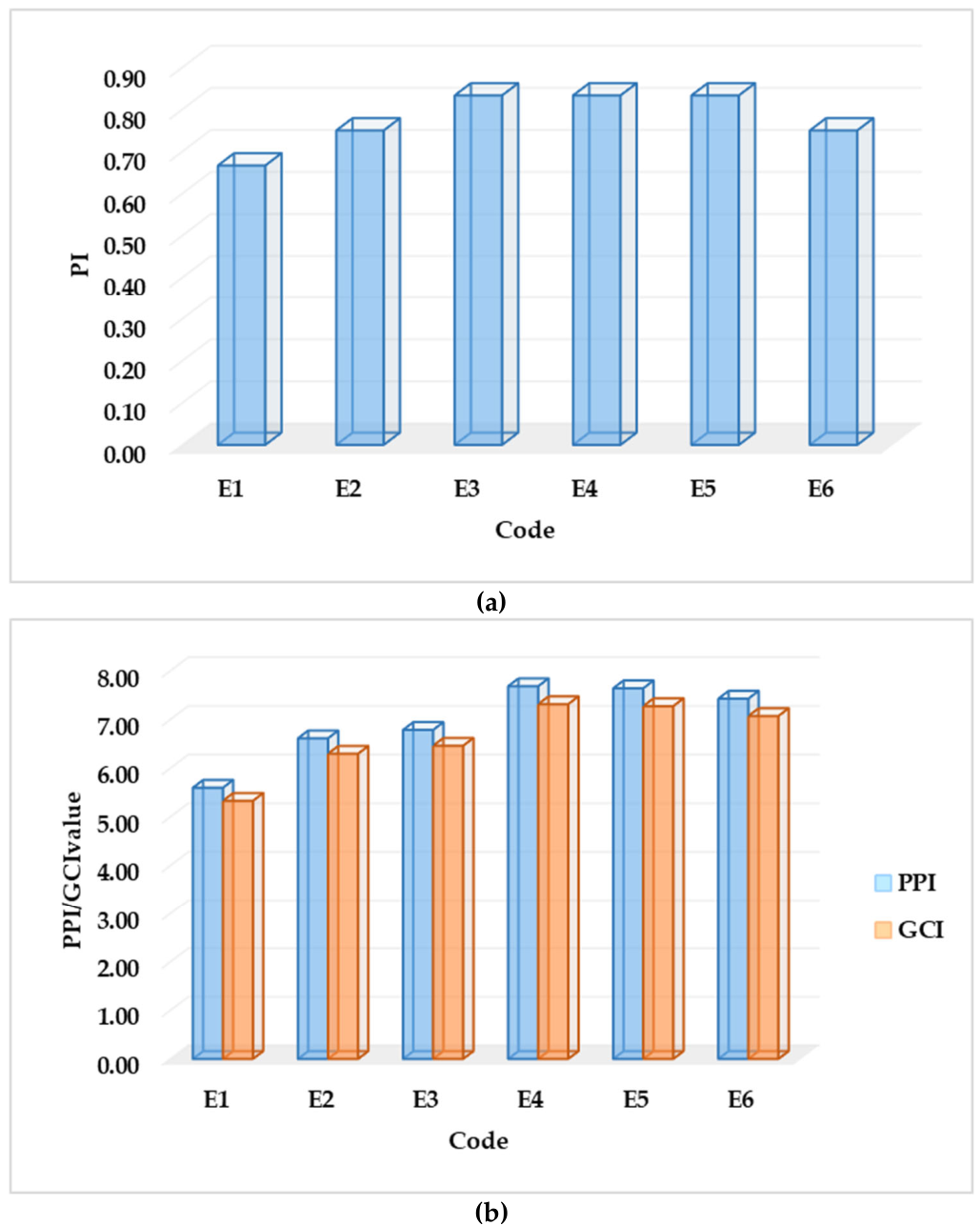
Figure 3.
The dimensional parameters for the developed tablets and their statistical evaluation using Tukey’s multiple comparisons test: ns (p > 0.05), ns—not significant; * (p<0.05); ** (p<0.01); *** (p<0.001); **** (p<0.0001).
Figure 3.
The dimensional parameters for the developed tablets and their statistical evaluation using Tukey’s multiple comparisons test: ns (p > 0.05), ns—not significant; * (p<0.05); ** (p<0.01); *** (p<0.001); **** (p<0.0001).
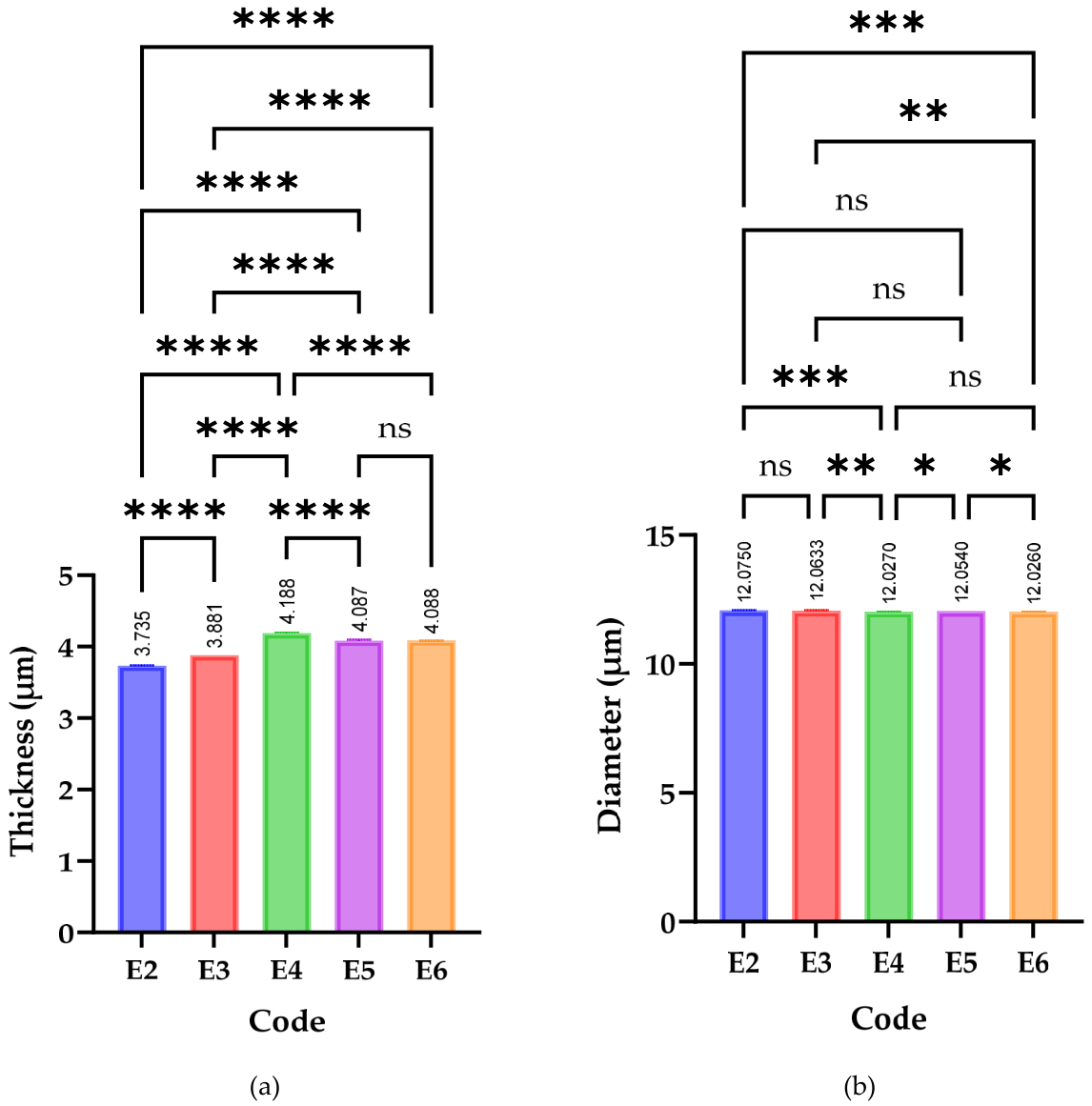
Figure 4.
The Tukey’s multiple comparisons test (a, c, d), Dunn’s multiple comparison test (b), conducted for the mechanical properties: friability (a), resistance to crushing (b), tensile strength (c), CSFR (d); ns (p > 0.05), ns—not significant; * (p<0.05); ** (p<0.01); *** (p<0.001); **** (p<0.0001.
Figure 4.
The Tukey’s multiple comparisons test (a, c, d), Dunn’s multiple comparison test (b), conducted for the mechanical properties: friability (a), resistance to crushing (b), tensile strength (c), CSFR (d); ns (p > 0.05), ns—not significant; * (p<0.05); ** (p<0.01); *** (p<0.001); **** (p<0.0001.
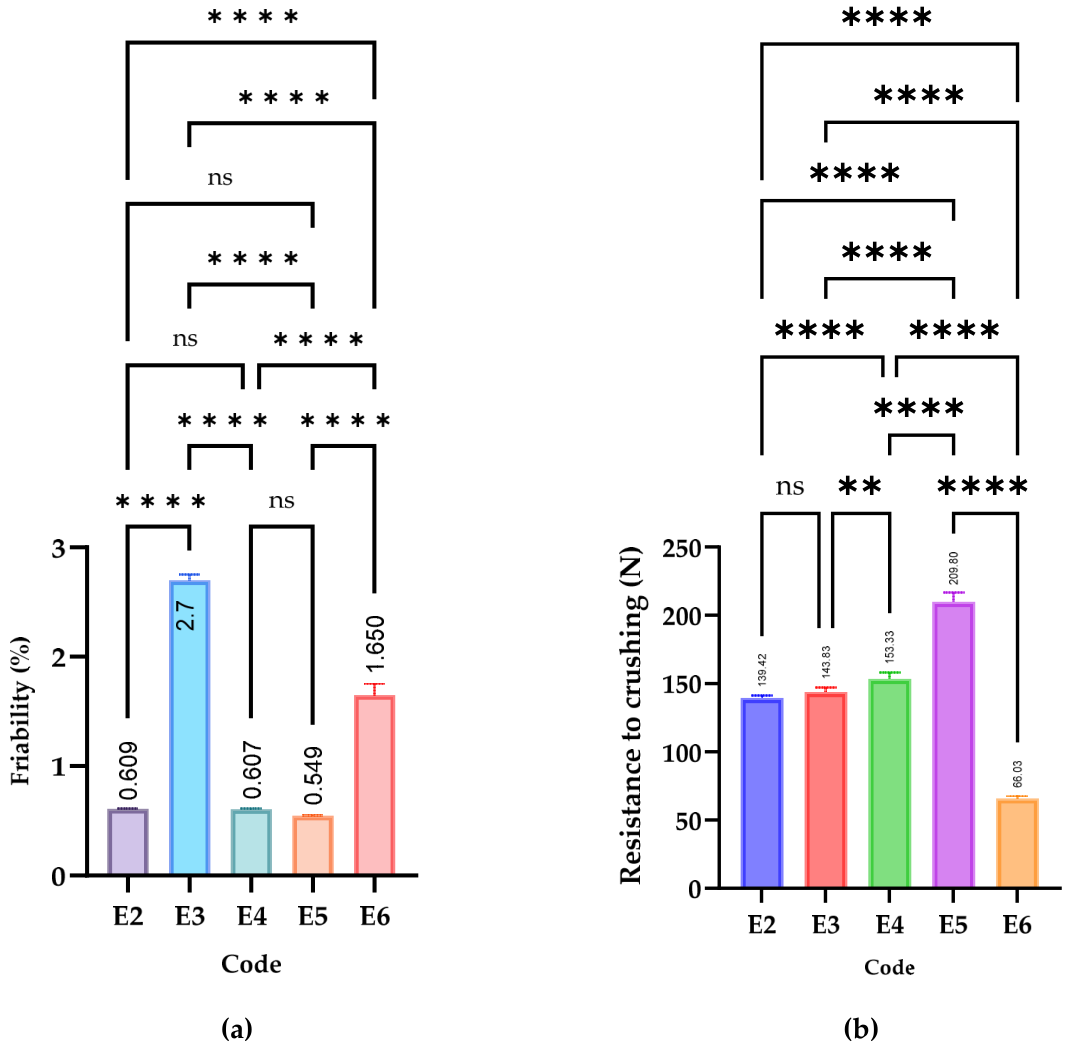
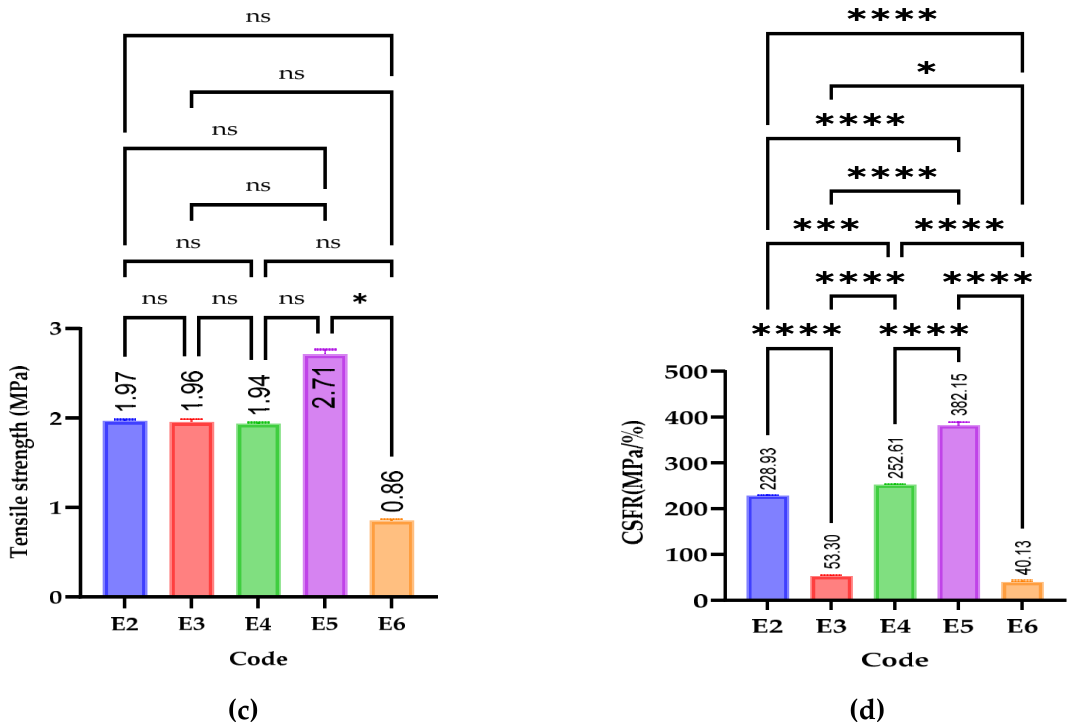
Figure 5.
The Tukey’s multiple comparisons test for the disintegration ability; ns (p > 0.05), ns—not significant; * (p<0.05); ** (p<0.01); *** (p<0.001); **** (p<0.0001.
Figure 5.
The Tukey’s multiple comparisons test for the disintegration ability; ns (p > 0.05), ns—not significant; * (p<0.05); ** (p<0.01); *** (p<0.001); **** (p<0.0001.
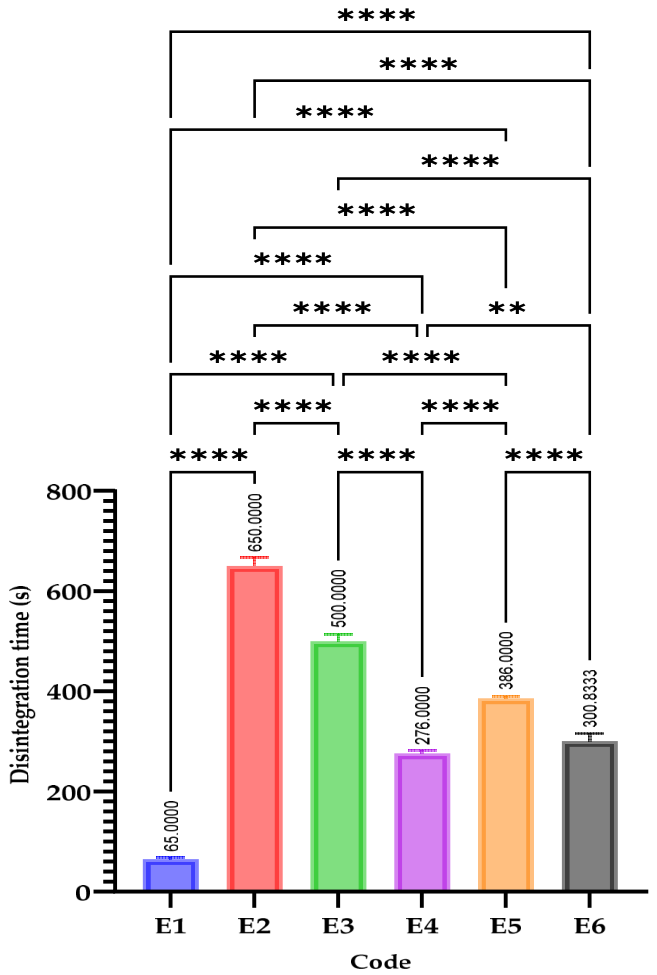

Table 1.
Functional excipients used in the tablet manufacturing process.
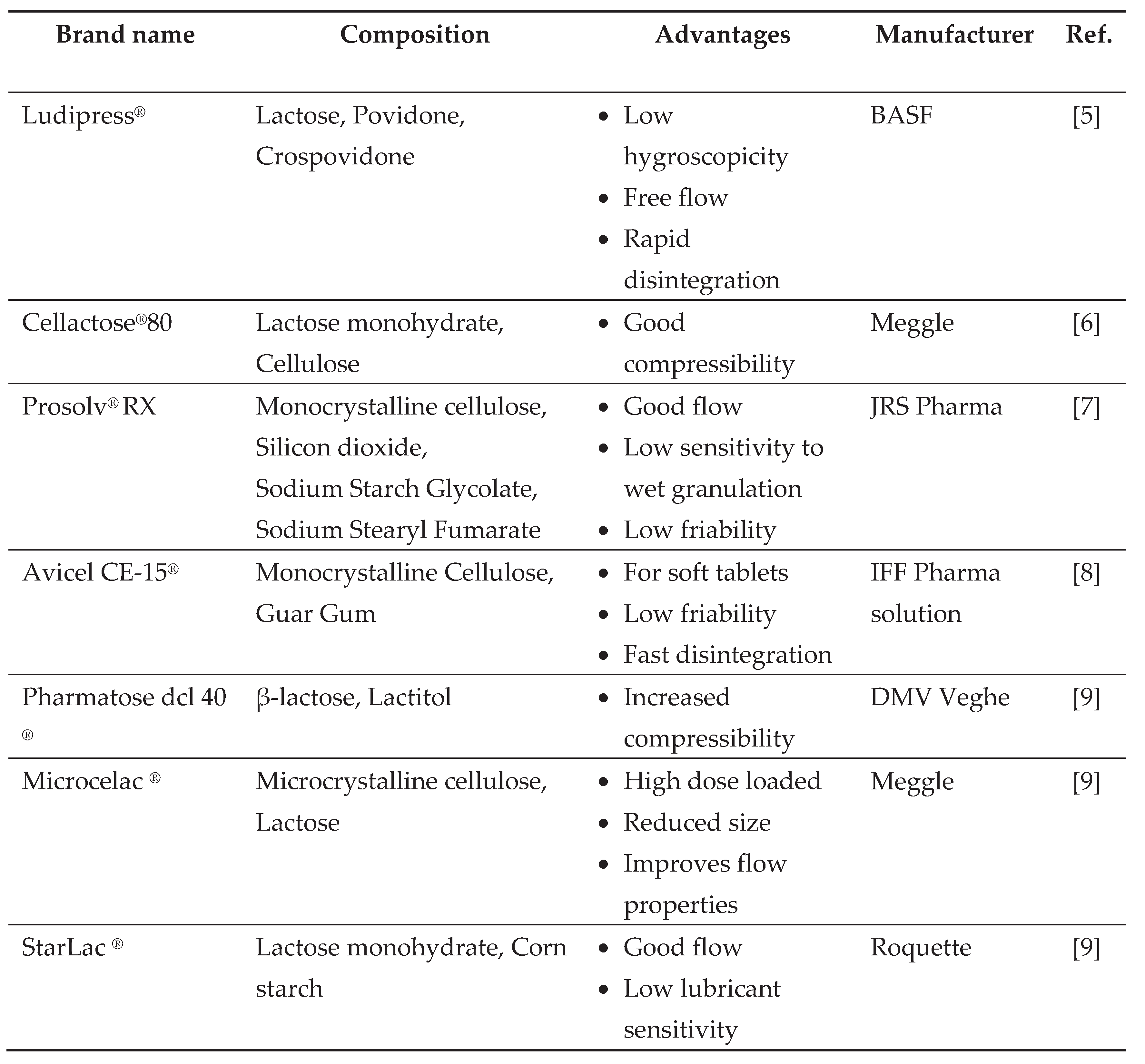 |
Table 2.
Comparison between the wet and dry granulation.
| Parameter | Wet Granulation | Dry Granulation | Ref. |
| Basic principle | Uses a binder to agglomerate powder particles | Uses compaction | [10,11,12,13] |
| Binder requirement | Requires liquid binder solution | No liquid binder (may use dry binder) | |
| Moisture involvement | Yes | No | |
| Heat exposure | Requires drying | No drying step required | |
| Suitable for heat-sensitive drugs | Limited suitability | Highly suitable | |
| Suitable for moisture-sensitive drugs | Not suitable | Suitable | |
| Equipment | High-shear granulator, fluid bed granulator, dryer | Roller compactor or slugging press | |
| Process steps | Mixing → Wet massing → Granulation → Drying → Milling | Mixing → Compaction (slugging/roller) → Milling | |
| Cost | Higher (more steps, energy for drying) | Lower (fewer steps) | |
| Time consumption | Longer | Shorter | |
| Granule properties | Generally, more uniform and stronger | Less dense, may show more fines | |
| Flow properties | Usually improved significantly | Improved, but sometimes less than wet | |
| Tablet hardness | Typically higher | May be lower depending on compaction | |
| Scale-up complexity | More complex | Relatively simpler | |
| Industrial preference | Widely used for difficult formulations | Preferred for moisture/heat-sensitive APIs |
Table 3.
Binder concentration and core type related to the developed formulations.
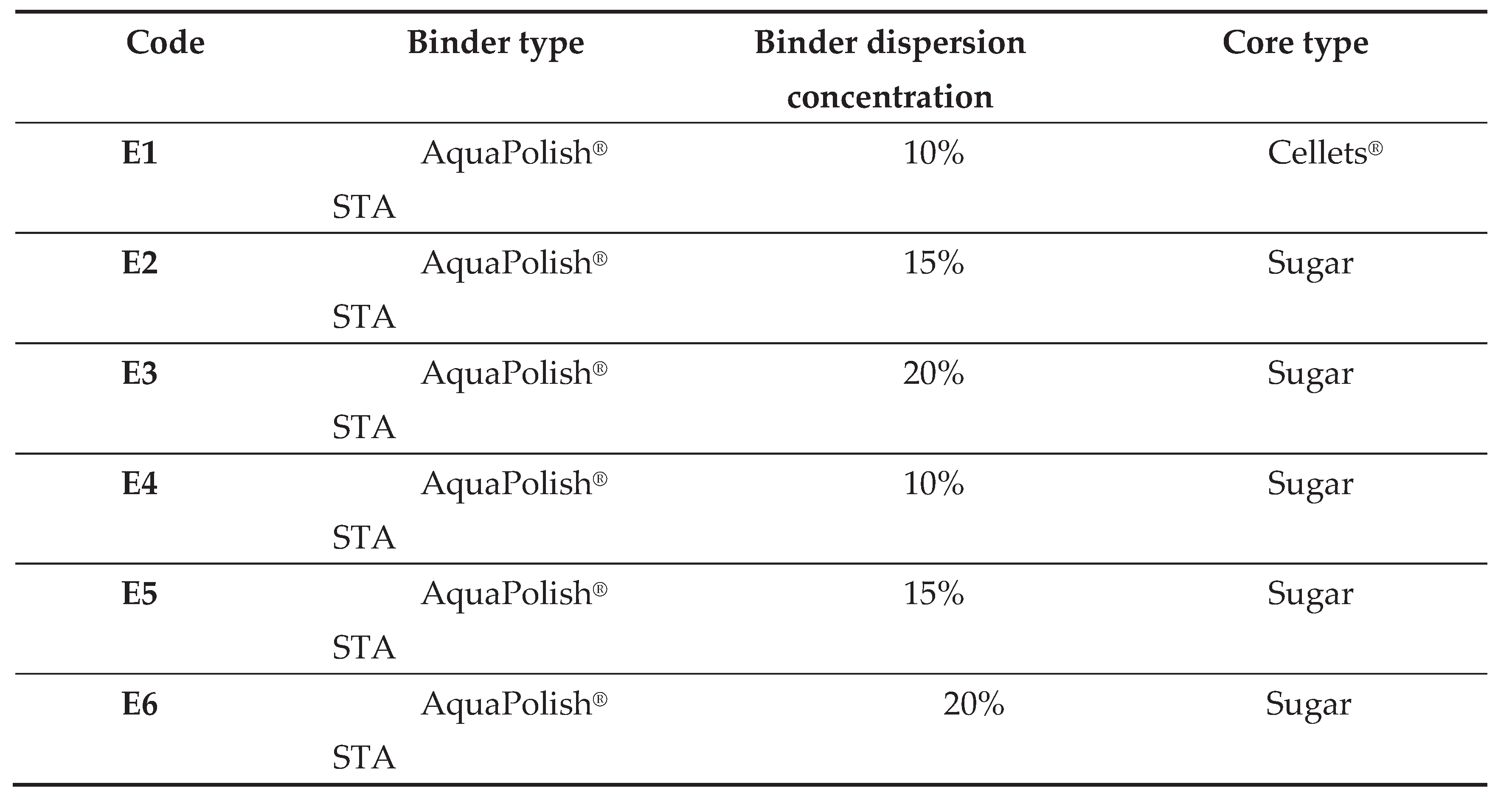 |
Table 4.
Constituents of the six formulations.
| Excipient | Role | Amount (g) (w/w%) | ||||||
| E1 | E2 | E3 | E4 | E5 | E6 | |||
| Microcrystalline cellulose | Filler | 93 | 93 | 93 | - | - | - | |
| Lactose | Filler | - | - | - | 94 | 94 | 94 | |
| Pruv® | Lubricant | 1 | 1 | 1 | 1 | 1 | 1 | |
| Sodium alginate | Disintegrant | 1 | 1 | 1 | - | - | - | |
| Sorbitol | Sweetener | 5 | 5 | 5 | 5 | 5 | 5 | |
| Dispersion of AquaPolish®STA | Binder | quantity sufficient (q.s.) | q.s. | q.s. | q.s. | q.s. | q.s. | |
| Final mixture mass (g) | 100 | 100 | 100 | 100 | 100 | 100 | ||
Table 5.
Factors applied to the parameters to obtain the radius value.
| Parameters | Value Range (v) | Radius range (r) | Factors Applied to Limit Value |
| Da | 0–1 g/mL | 0–10 | 10 × v |
| Dt | 0–1 g/mL | 0–10 | 10 × v |
| ξ | 0–1.2 | 0–10 | (10 × v) / 1.2 |
| CI | 0–50% | 0–10 | v / 5 |
| Icd | 0–200 N | 0–10 | v / 20 |
| HR | 3–1 | 0–10 | (30—10 × v) / 2 |
| α | 50–0° | 0–10 | 10—(v / 5) |
| t” | 20–0 | 0–10 | 10—(v / 2) |
| %RH | 0–10% | 0–10 | 10—v |
| %H | 20–0% | 0–10 | 10—(v / 2) |
| Pf | 50–0% | 0–10 | 10—(v / 5) |
| Iθ | 0–0.02 | 0–10 | 500 × v |
Disclaimer/Publisher’s Note: The statements, opinions and data contained in all publications are solely those of the individual author(s) and contributor(s) and not of MDPI and/or the editor(s). MDPI and/or the editor(s) disclaim responsibility for any injury to people or property resulting from any ideas, methods, instructions or products referred to in the content. |
© 2026 by the authors. Licensee MDPI, Basel, Switzerland. This article is an open access article distributed under the terms and conditions of the Creative Commons Attribution (CC BY) license (http://creativecommons.org/licenses/by/4.0/).
Copyright: This open access article is published under a Creative Commons CC BY 4.0 license, which permit the free download, distribution, and reuse, provided that the author and preprint are cited in any reuse.


