

Submitted:
15 May 2026
Posted:
18 May 2026
You are already at the latest version
Abstract
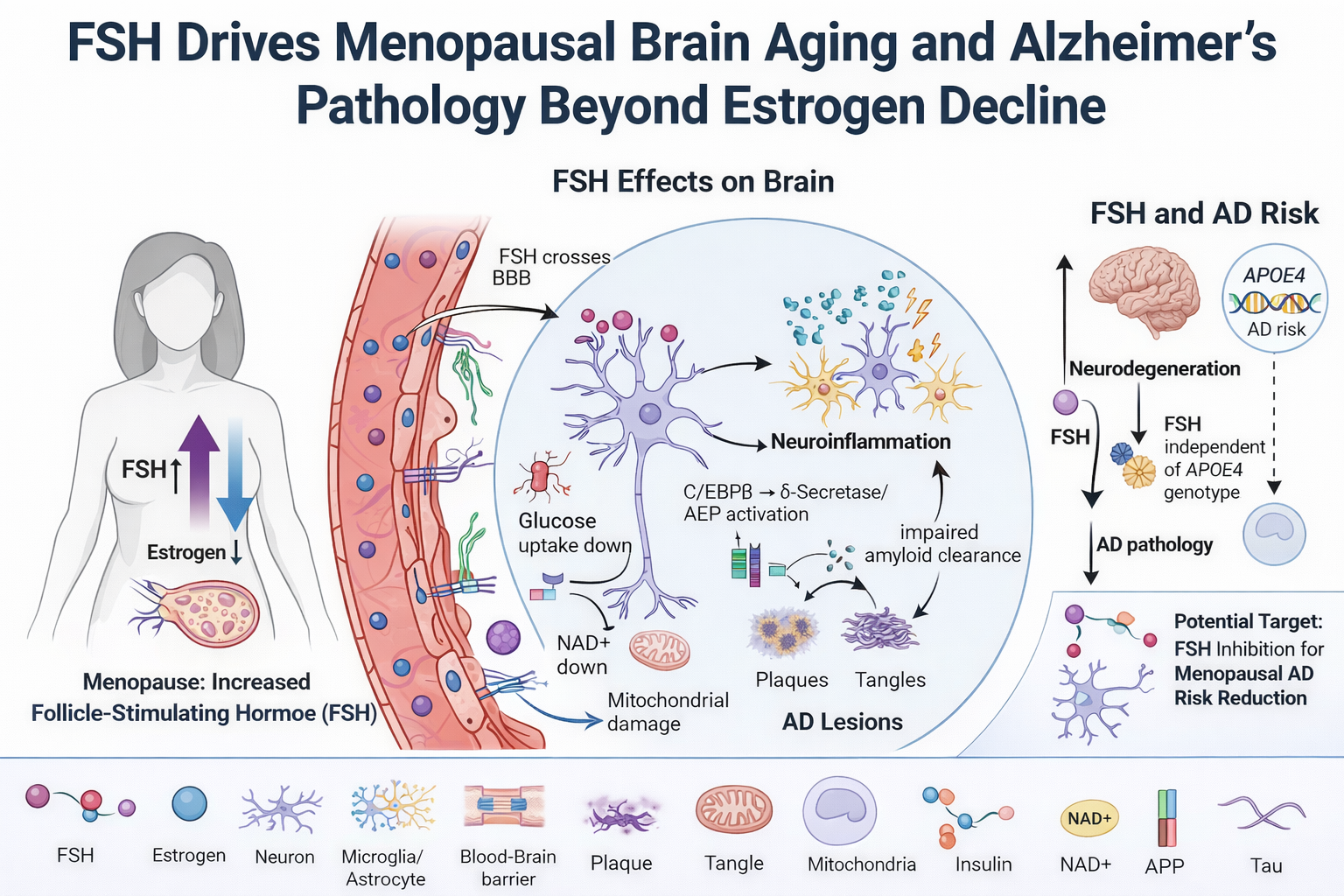
Alzheimer’s disease (AD) is more common in women than men and the risk of AD increases markedly during and after the menopausal transition. Although a role for estrogen deficiency is well studied, recent reports have revealed the pivotal but under-recognized contribution of follicle-stimulating hormone (FSH) in mediating neurodegenerative risk. In this review, we integrate current understanding of reproductive aging, AD pathobiology, and sex differences with a specific emphasis on endocrine, metabolic and inflammatory processes. FSH increases during reproductive aging and has mechanistic connections to several canonical molecular pathways that are altered in AD. This includes signaling through C/EBPβ-δ-secretase, mitochondria, glucose metabolism, and the autophagic/lysosomal clearance pathway. The convergence of these processes appears to underlie aspects of amyloid-β (Aβ) accumulation, tau pathology, and chronic neuroinflammation. FSH also modulates apolipoprotein biology (e.g., ApoE) by impacting lipid metabolism, protein lipidation, and clearance, which in turn affects Aβ kinetics and neuroinflammation in an ApoE isoform-specific manner. In addition, reproductive aging is associated with changes in vascular health and permeability, blood-brain barrier function, and immunometabolic processes that may drive neurodegenerative risk. Critically, these early upstream events drive disease risk before the onset of the more classical pathological features, which may shift our current perception of Aβ and tau as causes of AD to instead be consequences of upstream failure. Overall, this review provides mechanistic insight into the role of FSH and its downstream signaling pathways in neurodegeneration. As such, modulating FSH signaling and downstream pathways is a promising and mechanistically supported therapeutic strategy for reducing AD risk in women.
Keywords:
FSH
; Alzheimer’s disease
Copyright: This open access article is published under a Creative Commons CC BY 4.0 license, which permit the free download, distribution, and reuse, provided that the author and preprint are cited in any reuse.


