

Submitted:
31 March 2026
Posted:
02 April 2026
You are already at the latest version
Abstract
Alzheimer’s disease (AD) disproportionately affects women, with risk increasing sharply during and after the menopausal transition. While declines in estrogen have traditionally been emphasized, emerging evidence suggests that elevations in follicle-stimulating hormone (FSH) may represent a critical and underappreciated driver of neurodegenerative vulnerability. This review synthesizes current evidence linking reproductive aging to AD pathobiology, with a focus on endocrine, metabolic, and inflammatory mechanisms. We examine how sustained FSH elevation interacts with key molecular pathways implicated in AD, including C/EBPβ–δ-secretase signaling, mitochondrial dysfunction, impaired glucose metabolism, and disruptions in autophagic and lysosomal clearance. These processes converge to promote amyloid-β accumulation, tau pathology, and chronic neuroinflammation. In parallel, FSH influences apolipoprotein biology - particularly ApoE - through effects on lipid metabolism, protein lipidation, and clearance dynamics, thereby modulating both amyloid kinetics and inflammatory responses in an isoform-dependent manner. Reproductive aging is further characterized by systemic shifts in vascular integrity, blood–brain barrier function, and immunometabolic regulation, all of which may amplify susceptibility to neurodegenerative processes. Importantly, these upstream disturbances precede classical pathological hallmarks, reframing amyloid and tau accumulation as downstream manifestations of broader regulatory failure. Collectively, this work positions FSH not merely as a biomarker of ovarian decline, but as an active endocrine mediator of neurodegeneration. Targeting FSH signaling and its downstream pathways may therefore represent a promising and mechanistically grounded approach for mitigating AD risk, particularly in women.
Keywords:
FSH
; Alzheimer’s disease
Introduction
Alzheimer’s disease (AD) is a progressive neurodegenerative disorder and the leading cause of dementia worldwide, representing a growing public health challenge. In the United States, approximately one in nine individuals aged 65 years and older (10.8%) are affected, with an annual incidence of 1,275 new cases per 100,000 persons (Zhang et al., 2024). Clinically, AD is characterized primarily by amnestic cognitive impairment. Early manifestations may include depression, anxiety, social withdrawal, and sleep disturbances, which progressively evolve into severe memory loss, neuropsychiatric symptoms (e.g., hallucinations and delusions), and behavioral dysregulation. In some cases, non-amnestic presentations occur, involving impairments in visuospatial processing, language, executive function, or motor coordination.
AD is broadly categorized into familial and sporadic forms. Familial AD (FAD), accounting for approximately 1-5% of cases, is typically driven by autosomal dominant mutations in amyloid precursor protein (APP), presenilin 1 (PS1), and presenilin 2 (PS2), with onset often occurring between 30 and 65 years of age and characterized by rapid progression (Liu et al., 2019). In contrast, sporadic or late-onset AD (SAD), which comprises over 95% of cases, generally manifests after age 65 and arises from a complex interplay of genetic susceptibility, environmental exposures, and comorbid conditions (Fedele, 2023; Suresh et al., 2023).
The primary risk factors for late-onset AD include advanced age, female sex, and apolipoprotein E (APOE) genotype (Riedel et al., 2016). Women account for nearly two-thirds of individuals living with AD in the United States, with most cases emerging after age 65 (Alzheimer’s Disease and Dementia, 2024). Reproductive aging appears to contribute significantly to this increased vulnerability, reflecting coordinated changes in endocrine and neurobiological systems. Declines in circulating estrogen and progesterone, alongside alterations in gonadotropins and hypothalamic signaling peptides (e.g., FSH, LH, GnRH), are associated with measurable changes in brain structure and function. Lower bioavailable estrogen levels have been linked to increased risk of global cognitive decline and impaired verbal memory (Laughlin et al., 2010; Zsido et al., 2019). Peri- and postmenopausal women also exhibit accelerated rates of cognitive decline compared to men, as well as greater reductions in hippocampal volume (Mosconi et al., 2018). Additionally, vasomotor symptoms such as nocturnal hot flashes have been associated with impaired memory performance and elevated biomarkers of amyloid pathology (Maki et al., 2008; Thurston et al., 2024).
Importantly, reproductive aging is accompanied by a broader spectrum of hormonal perturbations beyond estrogen decline. Among these, progressive elevation of follicle-stimulating hormone (FSH) has emerged as a potentially significant contributor to age-related pathology. Elevated FSH levels have been associated with a range of chronic conditions, including AD, osteoporosis, cardiovascular dysfunction, and metabolic disturbances (Lizneva et al., 2019). These observations suggest that FSH may function not only as a compensatory marker of ovarian insufficiency, but also as an active endocrine driver of systemic aging processes. Accordingly, this review examines the mechanistic pathways through which sustained elevations in FSH may contribute to downstream pathological changes relevant to AD.
Overview of Canonical Cellular Alterations Underlying Neurodegeneration in Alzheimer’s Disease
Cholinergic Hypothesis
The cholinergic hypothesis represents one of the earliest frameworks proposed to explain AD pathogenesis. It posits that selective degeneration of cholinergic neurons in the nucleus basalis of Meynert (NBM) leads to reduced choline acetyltransferase (ChAT) activity, impairing acetylcholine synthesis and disrupting cortical cholinergic transmission (Berry & Harrison, 2023). This loss of cholinergic integrity is accompanied by increased deposition of senile plaques in affected cortical regions (Rodríguez et al., 2010; Serrano-Pozo et al., 2011). Collectively, this model highlights a strong association between basal forebrain cholinergic dysfunction and the cognitive deficits characteristic of AD (Hampel et al., 2019). Cholinergic neurons within the NBM, as well as those in the medial septum and diagonal band of Broca (MS/DBB), are particularly vulnerable to degeneration in this context (Schmitz et al., 2018).
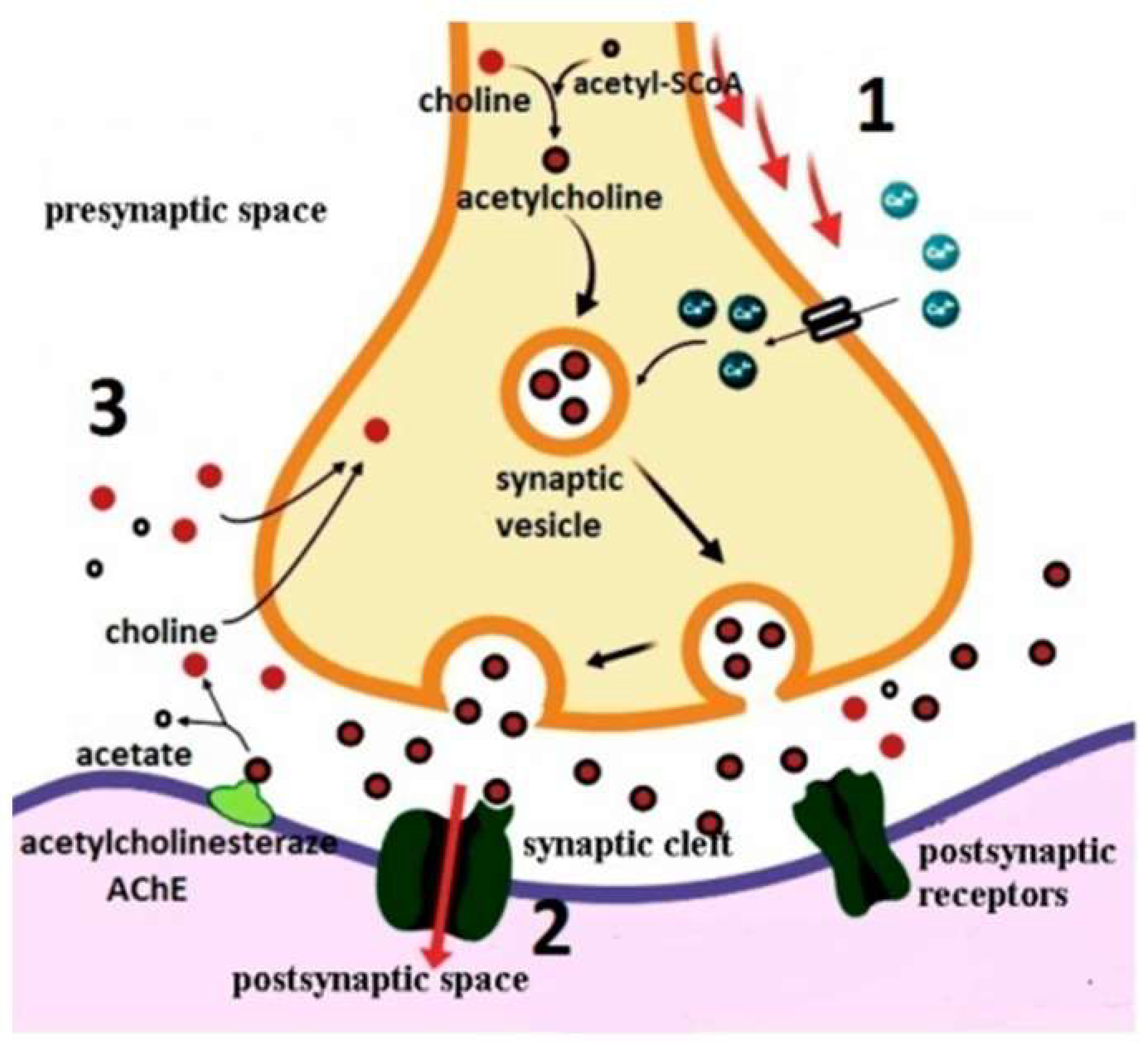
Acetylcholine (ACh) is produced in cholinergic neurons through the enzymatic conversion of choline and acetyl-coenzyme A by choline acetyltransferase (ChAT). Once synthesized, ACh is transported into synaptic vesicles by the vesicular acetylcholine transporter (VAChT) and released into the synaptic cleft in response to presynaptic depolarization. In the synaptic space, ACh interacts with both muscarinic and nicotinic receptors (mAChRs and nAChRs) on postsynaptic cells to facilitate signal transmission (Paul et al., 2022). Termination of signaling is achieved through rapid enzymatic breakdown by acetylcholinesterase (AChE), generating choline, which is subsequently reclaimed by the presynaptic neuron for reuse (Berry & Harrison, 2023; Stanciu et al., 2019). Disruptions in ChAT expression or function reduce ACh availability, weakening cholinergic signaling. Such impairments affect multiple physiological processes governed by this system, including cognitive function, attentional regulation, motor control, and sleep–wake dynamics (Walczak-Nowicka & Herbet, 2021).
Figure 1.
Cholinergic projections arise from basal forebrain nuclei - including the medial septum (MS), vertical limb of the diagonal band of Broca (vDB), nucleus basalis of Meynert (NBM), and substantia innominata (SI) - which send widespread projections to the hippocampus, thalamus, olfactory bulb, and cortical regions. In parallel, cholinergic neurons of the pontomesencephalon - specifically the laterodorsal tegmental nucleus (LDT) and pedunculopontine tegmental nucleus (PPT) - project to the hindbrain, thalamus, hypothalamus, and basal forebrain, contributing to the regulation of arousal and behavioral state. Adapted from Paul et al. (2015).
Figure 1.
Cholinergic projections arise from basal forebrain nuclei - including the medial septum (MS), vertical limb of the diagonal band of Broca (vDB), nucleus basalis of Meynert (NBM), and substantia innominata (SI) - which send widespread projections to the hippocampus, thalamus, olfactory bulb, and cortical regions. In parallel, cholinergic neurons of the pontomesencephalon - specifically the laterodorsal tegmental nucleus (LDT) and pedunculopontine tegmental nucleus (PPT) - project to the hindbrain, thalamus, hypothalamus, and basal forebrain, contributing to the regulation of arousal and behavioral state. Adapted from Paul et al. (2015).
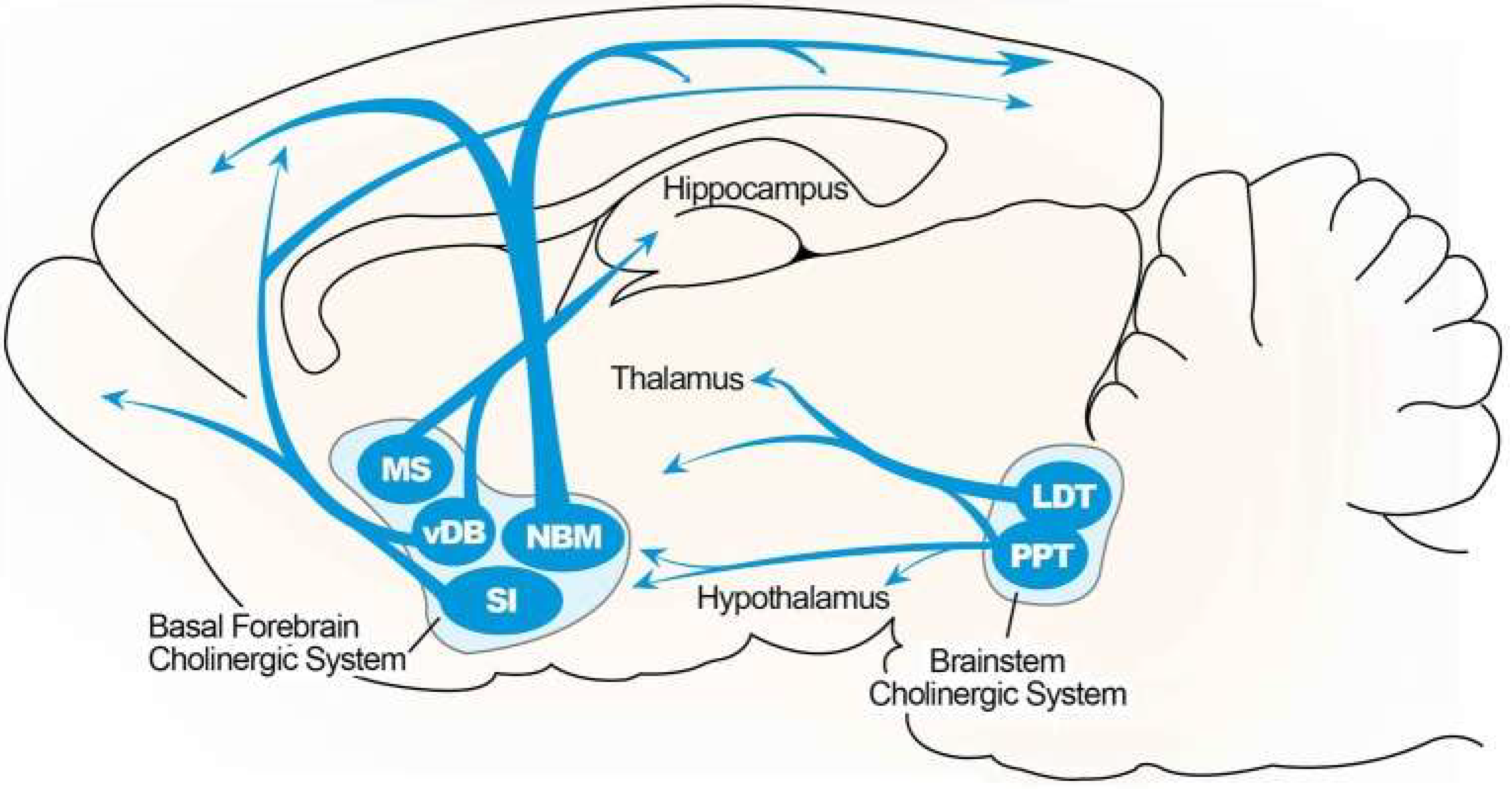
Figure 2.
Acetylcholine release and synaptic signaling. Schematic of cholinergic neurotransmission showing (1) Ca²⁺-dependent release of acetylcholine (ACh) from presynaptic vesicles, (2) binding of ACh to postsynaptic receptors to induce depolarization, and (3) enzymatic breakdown of ACh by acetylcholinesterase (AChE) with subsequent reuptake of choline into the presynaptic neuron. Adapted from Stanciu et al., (2019).
Figure 2.
Acetylcholine release and synaptic signaling. Schematic of cholinergic neurotransmission showing (1) Ca²⁺-dependent release of acetylcholine (ACh) from presynaptic vesicles, (2) binding of ACh to postsynaptic receptors to induce depolarization, and (3) enzymatic breakdown of ACh by acetylcholinesterase (AChE) with subsequent reuptake of choline into the presynaptic neuron. Adapted from Stanciu et al., (2019).
Aβ
C/EBPβ acts as an upstream transcriptional regulator of δ-secretase, also known as asparagine endopeptidase (AEP; LGMN), linking inflammatory signaling to proteolytic pathways implicated in AD (Luo et al., 2025). Increased C/EBPβ activity elevates AEP expression, facilitating cleavage of APP at N585 and tau at N368, thereby generating fragments with increased aggregation potential (Wu et al., 2020). APP, a type I transmembrane glycoprotein, undergoes sequential processing in the amyloidogenic pathway via β-secretase followed by γ-secretase, a multiprotein complex in which PS1 or PS2 functions as the catalytic core. This cleavage produces Aβ) peptides of varying lengths, most notably Aβ40 and Aβ42. The latter, due to its more hydrophobic C-terminal region, exhibits a greater tendency to adopt β-sheet conformations and self-assemble into fibrillar aggregates that form the structural basis of senile plaques (Lin et al., 2019).
Aβ has remained a central feature of AD models, supported in part by genetic evidence from familial disease. Mutations in APP on chromosome 21 are associated with autosomal dominant AD, and individuals with Down syndrome - who possess an additional copy of APP - consistently develop early-onset pathology (Wiseman et al., 2015). Similarly, APP duplications increase disease risk, whereas variants associated with reduced Aβ production have been linked to preserved cognitive aging (Castellani et al., 2025). Rare cases of Down syndrome lacking APP triplication do not exhibit early pathological changes, reinforcing the importance of APP gene dosage. However, extrapolation of these findings to sporadic AD remains complicated by the broader genetic alterations present in trisomy 21 (Castellani et al., 2025).
Mutations in PS1 and PS2 further support a role for amyloidogenic processing in familial disease, although PS1-associated cases often display distinct pathological features, raising questions regarding their direct relevance to sporadic AD (Heilig et al., 2010). Across both familial and sporadic forms, insoluble Aβ species are consistently elevated relative to cognitively normal individuals (van Helmond et al., 2010; Wang et al., 1999). Nevertheless, whether Aβ accumulation alone is sufficient to account for the full clinical and pathological spectrum of AD remains an area of ongoing debate (Castellani et al., 2025).
Despite these uncertainties, Aβ deposition remains a consistent feature of disease, and plaque formation - along with broader alterations in Aβ metabolism - remains closely associated with disease progression. As emphasized throughout this review, however, Aβ accumulation occurs within a broader network of upstream regulatory disturbances. Accordingly, while Aβ remains central to the disease landscape, its precise position within the temporal and mechanistic hierarchy of AD is considered in greater detail elsewhere (Castellani et al., 2025; Riku et al., 2025).
Tau
Tau is a microtubule-associated protein predominantly localized to neuronal axons, with lower expression in dendrites, the soma, and glial cells (Sinsky et al., 2021; Wei et al., 2022). Its structure includes multiple phosphorylation sites distributed across the N-terminal region, C-terminal domain, and microtubule-binding repeats. Under physiological conditions, tau phosphorylation is tightly controlled through coordinated kinase and phosphatase activity, a balance required for maintaining microtubule stability and normal neuronal function (Noble et al., 2013).
Disruption of this regulatory equilibrium results in excessive phosphorylation, reducing tau’s affinity for microtubules and promoting its detachment (Bjørklund et al., 2019; Almansoub et al., 2019). Detached tau undergoes conformational changes and redistributes from axons to the somatodendritic compartment, where it forms soluble oligomeric species. These intermediates can further assemble into paired helical filaments (PHFs) and eventually neurofibrillary tangles (NFTs), which accumulate within neuronal cell bodies and dendrites as defining pathological features of tauopathies (Lo et al., 2020; Robbins et al., 2021).
Tau pathology spreads along synaptically connected networks, impairing synaptic transmission and axonal transport prior to overt tangle formation. This progressive dissemination, characterized by Braak staging (Therriault et al., 2022), reflects a network-based propagation that precedes synaptic loss, axonal degeneration, and neuronal death, ultimately driving cognitive decline (Lo et al., 2020; Wu et al., 2017; Yin et al., 2021). Notably, the extent of tau pathology shows a stronger association with memory impairment and neurodegeneration than amyloid burden (Doering et al., 2024; Iaccarino et al., 2017; Lamontagne-Kam et al., 2023).
In addition to phosphorylation, tau undergoes diverse post-translational modifications - including truncation, glycosylation, glycation, acetylation, methylation, and sumoylation - that modulate its structural properties, aggregation behavior, and intracellular trafficking (Alquézar et al., 2021). Many of these modifications occur on lysine residues and influence protein turnover. Ubiquitination of lysine residues typically targets tau for proteasomal degradation; however, competing modifications such as acetylation or methylation can inhibit ubiquitin attachment, thereby impairing clearance and promoting accumulation (Luo et al., 2014; Kontaxi et al., 2017). Consistent with this, lysine 254 (K254) is preferentially methylated in fibrillar tau, suggesting that site-specific methylation may hinder degradation and contribute to the persistence of pathogenic species (Thomas et al., 2012).
As discussed in subsequent sections, accumulation of tau and Aβ, along with disruptions in neurotransmission, arise as downstream consequences of upstream perturbations that are further amplified by age-related and reproductive aging–associated changes.
Endocrine Drivers of Female-Related Alzheimer’s Disease Vulnerability
Follicle-Stimulating Hormone and Its Role in Alzheimer’s Disease Pathogenesis
The menopausal transition is marked by a decline in circulating estradiol (E2) alongside a sustained rise in FSH (Muhammad, 2025). This endocrine shift has traditionally been linked to the increased prevalence of AD in women; however, emerging evidence suggests that elevated FSH may play a more direct role in shaping neurodegenerative risk than estrogen loss alone (Scheyer et al., 2018; Nerattini et al., 2023; Wood Alexander et al., 2025).
Elevated FSH has been shown to engage inflammatory, lipid, and neuronal signaling pathways that favor amyloid accumulation and downstream neurodegenerative processes (Wang et al., 2026). In clinical cohorts of older women, circulating FSH levels stratify with disease severity, with the highest concentrations observed in individuals with AD, intermediate levels in those with mild cognitive impairment, and the lowest levels in cognitively normal individuals (Wang et al., 2026; Short et al., 2001). Higher FSH levels are associated with increased cerebral Aβ burden and poorer cognitive performance, whereas circulating estradiol does not demonstrate comparable associations across disease stages (Wang et al., 2026).
Notably, the relationship between FSH and amyloid burden persists within diagnostic groups, indicating that FSH tracks pathological progression independently of clinical classification. Consistent with this, individuals with higher amyloid deposition exhibit correspondingly elevated circulating FSH levels. Together, these findings position FSH as both a potential biomarker and an active endocrine contributor to disease progression, with effects that appear to extend beyond those attributable to estrogen decline alone.
Convergent Pathways of Ovarian and Neurobiological Aging
Aging of the ovary and the brain has traditionally been viewed as parallel but independent processes; however, increasing evidence suggests that these trajectories are mechanistically linked and converge on shared systems-level dysfunction. Reproductive aging is now understood not as an isolated ovarian event, but as a broader neuroendocrine and immunometabolic transition involving coordinated changes across endocrine, immune, metabolic, and mitochondrial networks (Muhammad, 2025). Within this framework, ovarian decline and neurobiological aging reflect interconnected manifestations of systemic dysregulation rather than discrete processes.
Both ovarian and neural tissues undergo a shift toward chronic, low-grade inflammation with age. In the ovary, inflammatory signaling contributes to follicular depletion, impaired steroidogenesis, and reduced oocyte quality. In the brain, similar inflammatory pressures manifest as microglial priming and astrocytic reactivity, often emerging well before overt neurodegeneration. These changes are not restricted to higher-order cognitive regions, but also involve neuroendocrine centers such as the hypothalamus. Age-related hypothalamic inflammation is characterized by progressive microglial activation and neuronal dysfunction (Tang & Cai, 2013; Kermath et al., 2013; Muhammad, 2025; Zhang et al., 2013), with consequences that extend beyond reproductive regulation. Indeed, hypothalamic deterioration has been linked to impairments in both cognition and physical function (Zhang et al., 2013). Mechanistically, reductions in GnRH signaling - partly driven by IKKβ/NF-κB-mediated pathways - have been associated with neuronal loss in both the hypothalamus and hippocampus, a key site of vulnerability in AD (Zhang et al., 2013). Together, these findings support inflammaging as a shared upstream process linking reproductive decline with increased susceptibility to neurodegeneration.
In parallel, aging is accompanied by a gradual decline in cellular maintenance systems critical to both ovarian and neural function. Mitochondrial dysfunction, oxidative stress, and impaired autophagic clearance are consistently observed across both tissues, alongside increases in pro-inflammatory extracellular vesicle populations. These disruptions are particularly consequential in metabolically active cells, where sustained energy demands require efficient turnover of damaged proteins and organelles. Over time, failure of these systems leads to the accumulation of dysfunctional mitochondria, lipid peroxidation products, and misfolded proteins - features common to both ovarian aging and neurodegenerative pathology.
Hormonal changes intersect with these processes in a context-dependent manner. While acute gonadotropin signaling supports adaptive responses in reproductive tissues, chronic elevations - particularly of FSH - may exert maladaptive effects in non-gonadal systems. These include modulation of inflammatory pathways, vascular function, and cellular metabolism, all of which contribute to neurobiological aging. In this context, menopause is increasingly viewed not simply as an endocrine endpoint, but as a neuroimmune transition shaped by the integration of hormonal, metabolic, and inflammatory signals that collectively influence systemic aging trajectories.
The Role of APOE Variants in AD Pathobiology
Genetic variation in APOE is one of the strongest modifiers of AD risk. Carriage of a single ε4 allele increases risk approximately two- to three-fold, while homozygosity is associated with an estimated ten- to twelve-fold increase (Ayton & Bush, 2021). ApoE protein is consistently localized within neuritic plaques, and ε4 carriers exhibit greater cerebral Aβ accumulation relative to non-carriers (Baek et al., 2020). Experimental evidence supports multiple mechanisms through which APOE4 exacerbates amyloid pathology, including altered APP processing that may increase Aβ production, facilitation of Aβ aggregation through interactions with soluble and fibrillar species, and impaired clearance via disrupted glial uptake, enzymatic degradation, and reduced vascular efflux (Koutsodendris et al., 2022; Serrano-Pozo et al., 2021; Troutwine et al., 2022).
Within the CNS, ApoE functions as the primary lipid transport protein, mediating cholesterol redistribution among astrocytes, microglia, and neurons (Belaidi et al., 2025). Through its role in maintaining membrane composition, supporting lipid-dependent signaling, and facilitating clearance of neurotoxic substrates - including Aβ - ApoE is central to neuronal integrity and brain homeostasis (Islam et al., 2025; Ioannou et al., 2019). Humans express two alleles drawn from three major isoforms - ε2, ε3, and ε4 - which differentially influence disease susceptibility. Epidemiological data indicate that risk is lowest in ε2 carriers, approximately neutral in ε3 carriers, and markedly elevated in individuals carrying one or more ε4 alleles, with particularly pronounced effects observed in women (Stuchell-Brereton et al., 2023; Sun et al., 2023).
ApoE contributes to Aβ clearance through both vascular and cellular pathways. At the blood–brain barrier, ApoE binds Aβ to form complexes that interact with lipoprotein receptors on the abluminal surface, including LDL receptor-related protein 1 (LRP1), the low-density lipoprotein receptor (LDLR), and very-low-density lipoprotein receptor (VLDLR) (Kanekiyo et al., 2013; Ruiz et al., 2005). ApoE2 and ApoE3 preferentially facilitate Aβ transport through LRP1-dependent pathways, which are characterized by rapid internalization and efficient transcytosis into the circulation. In contrast, ApoE4 biases Aβ trafficking toward VLDLR-mediated routes with slower clearance kinetics, resulting in prolonged retention within the brain and increased propensity for plaque formation (Deane et al., 2008).
In addition to vascular clearance, Aβ is removed through cellular uptake by glial populations, where it is frequently internalized in complexes with ApoE and trafficked to lysosomes for degradation (Liu et al., 2025). Within these compartments, proteases such as neprilysin and insulin-degrading enzyme (IDE) facilitate peptide breakdown. The efficiency of this pathway is strongly influenced by the lipidation state of ApoE (Chen et al., 2025). Lipid-rich ApoE - regulated in part by ATP-binding cassette transporter A1 (ABCA1) - more effectively supports Aβ uptake and degradation, whereas poorly lipidated ApoE exhibits reduced clearance capacity (Jiang et al., 2008).
The three major ApoE isoforms differ at amino acid positions 112 and 158, where cysteine-to-arginine substitutions distinguish their biochemical properties. ApoE2 contains cysteine at both positions, ApoE3 contains cysteine at position 112 and arginine at 158, and ApoE4 contains arginine at both sites (Stuchell-Brereton et al., 2023). Structurally, ApoE comprises an N-terminal region (residues 1-167) organized into a conserved four-helix bundle, a flexible hinge region (residues 168-205), and a C-terminal domain (residues 206-299). While the helical bundle is well characterized and structurally consistent across studies (Frieden & Garai, 2013; Wilson et al., 1991; Grimaldi et al., 2024), the conformation and positioning of the hinge and C-terminal domains remain less clearly defined.
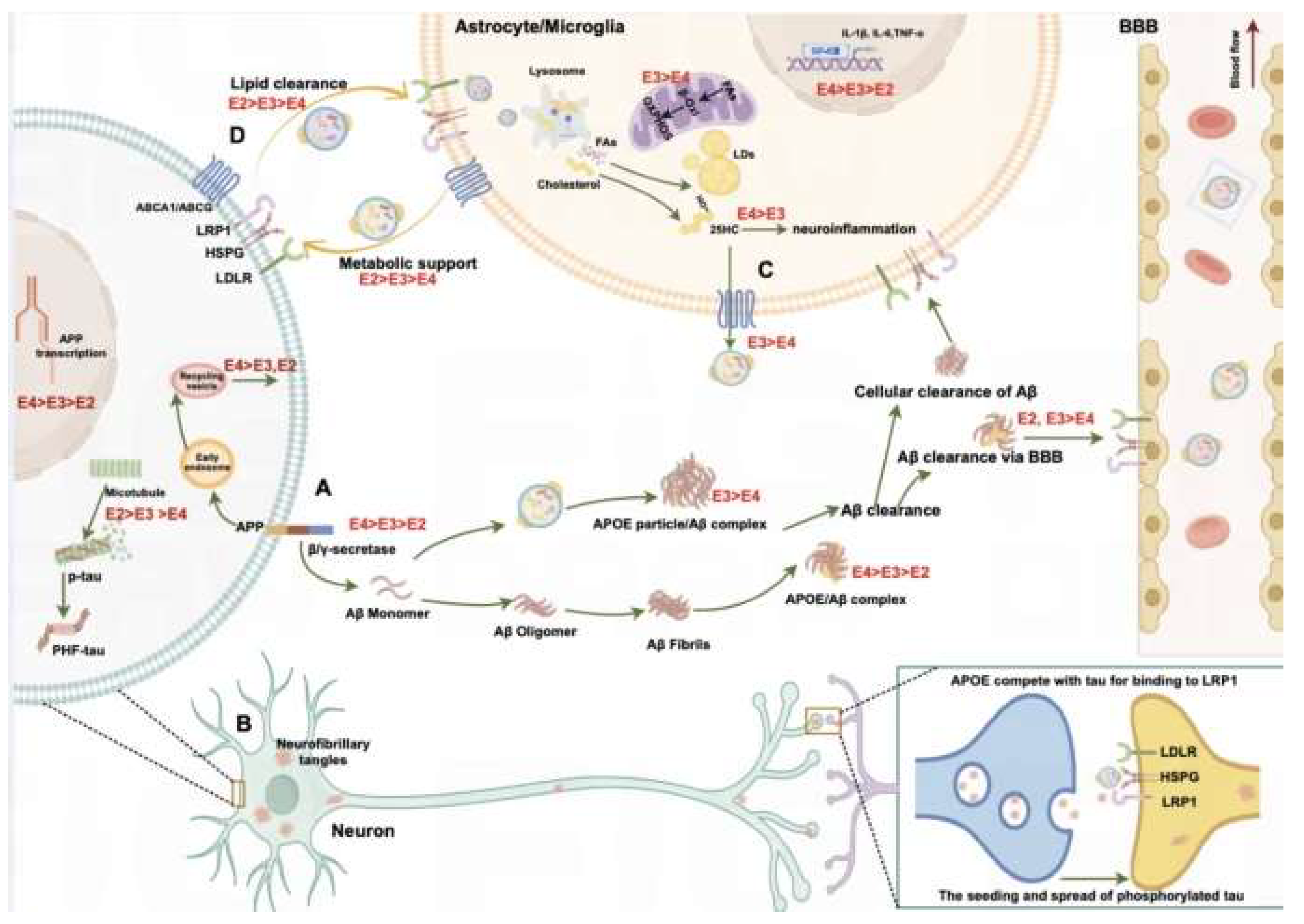
Figure 3.
Isoform-dependent ApoE regulation of Aβ clearance kinetics and context-specific tau pathology. Collectively, ApoE4 disrupts multi-compartment Aβ clearance kinetics, leading to impaired Aβ turnover, prolonged brain retention, and enhanced neuroinflammatory signaling. However, the relationship between ApoE isoforms and tau pathology is more context-dependent and does not strictly follow the canonical AD risk hierarchy. In primary tauopathy models (e.g., TauP301L and PSP), ApoE2 promotes greater tau aggregation and hyperphosphorylation than ApoE3 and ApoE4 (ApoE2 > ApoE3 > ApoE4). In contrast, in the presence of amyloid-β - as in Alzheimer’s disease - ApoE4 appears to exacerbate tau-mediated neurodegeneration, likely through indirect mechanisms linked to impaired Aβ clearance and heightened inflammatory signaling. Adapted from Liu et al., 2025.
Figure 3.
Isoform-dependent ApoE regulation of Aβ clearance kinetics and context-specific tau pathology. Collectively, ApoE4 disrupts multi-compartment Aβ clearance kinetics, leading to impaired Aβ turnover, prolonged brain retention, and enhanced neuroinflammatory signaling. However, the relationship between ApoE isoforms and tau pathology is more context-dependent and does not strictly follow the canonical AD risk hierarchy. In primary tauopathy models (e.g., TauP301L and PSP), ApoE2 promotes greater tau aggregation and hyperphosphorylation than ApoE3 and ApoE4 (ApoE2 > ApoE3 > ApoE4). In contrast, in the presence of amyloid-β - as in Alzheimer’s disease - ApoE4 appears to exacerbate tau-mediated neurodegeneration, likely through indirect mechanisms linked to impaired Aβ clearance and heightened inflammatory signaling. Adapted from Liu et al., 2025.
A widely cited explanation for the functional divergence of ApoE isoforms is the “domain interaction” model (Mahley et al., 2009). In ApoE4, substitution of cysteine with arginine at position 112 alters intramolecular electrostatic interactions within the helical bundle, promoting a distinct folding conformation. The presence of positively charged arginine residues modifies local charge distributions and interactions with neighboring residues, reshaping the protein’s tertiary structure. These conformational changes influence key functional properties, including lipid-binding capacity, receptor engagement, susceptibility to proteolysis, and intracellular trafficking. Importantly, such structural differences are also thought to impact autophagic processing and the handling of Aβ and other protein substrates, thereby linking ApoE isoform-specific properties to downstream cellular dysfunction.
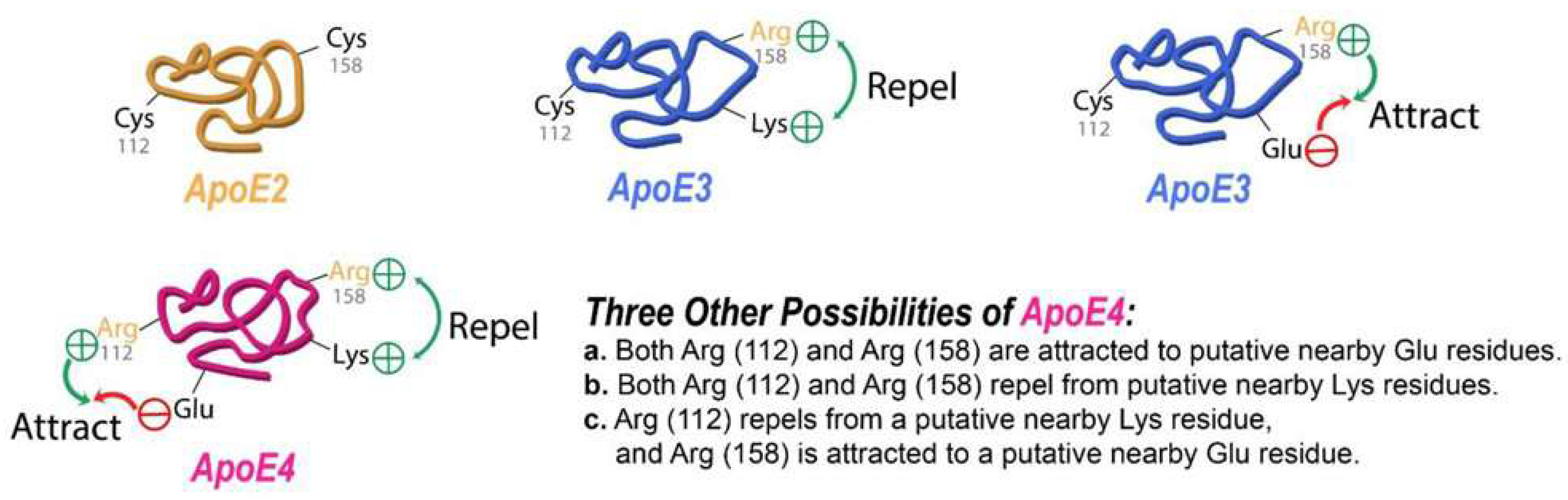
Figure 4.
Structural conformations of apolipoprotein E (apoE) isoforms. Schematic representation of the distinct conformational differences among apoE2, apoE3, and apoE4, illustrating how amino acid substitutions at key positions alter intramolecular interactions. Replacement of cysteine residues with positively charged arginine residues - particularly in apoE4 - modifies electrostatic interactions within the protein, promoting domain–domain interactions between the N-terminal and C-terminal regions. In contrast, apoE2 and apoE3, which retain cysteine at these positions, exhibit reduced intramolecular interaction and adopt more flexible conformations. These structural differences influence lipid binding, receptor interactions, and isoform-specific functional properties relevant to disease risk. Adapted from Butterfield and Mattson (2020).
Figure 4.
Structural conformations of apolipoprotein E (apoE) isoforms. Schematic representation of the distinct conformational differences among apoE2, apoE3, and apoE4, illustrating how amino acid substitutions at key positions alter intramolecular interactions. Replacement of cysteine residues with positively charged arginine residues - particularly in apoE4 - modifies electrostatic interactions within the protein, promoting domain–domain interactions between the N-terminal and C-terminal regions. In contrast, apoE2 and apoE3, which retain cysteine at these positions, exhibit reduced intramolecular interaction and adopt more flexible conformations. These structural differences influence lipid binding, receptor interactions, and isoform-specific functional properties relevant to disease risk. Adapted from Butterfield and Mattson (2020).
In addition to alterations within the four-helix bundle, structural and sequence differences in other regions of APOE further shape its functional behavior. Variations outside the core bundle - particularly within the hinge and C-terminal domains - can modulate lipid binding, receptor interactions, oligomerization, and intracellular trafficking. These non-four-helix contributions to ApoE function and dysfunction have been considered elsewhere (Stuchell-Brereton et al., 2023). Historically, APOE4 has been described as adopting a characteristic “closed” conformation, in which the N-terminal domain (NTD) and C-terminal domain (CTD) are in close physical proximity. Early biochemical and structural studies proposed that this intramolecular domain interaction shields residues within the NTD that are critical for binding to the low-density lipoprotein receptor (LDLR), thereby impairing receptor-mediated lipid transport and clearance (Stuchell-Brereton et al., 2023). This domain interaction model became a dominant framework for explaining ApoE4-associated functional deficits.
However, APOE exhibits substantial conformational plasticity, owing to intrinsically disordered and flexible segments distributed throughout the protein (Frieden et al., 2017). More recent biophysical studies suggest that the “closed” conformation attributed to ApoE4 may arise preferentially under conditions that promote protein oligomerization, including certain experimental contexts and pathological states (Stuchell-Brereton et al., 2023). As such, NTD-CTD proximity may not represent a stable or obligatory feature of monomeric ApoE4, but rather an emergent property of higher-order assemblies that becomes relevant after oligomer formation . Nonetheless, the hinge region plays a central regulatory role by competing with the CTD for interactions with the four-helix bundle. Specific contacts involving the N-terminal tail and the four-helix bundle can bias interaction preferences toward either the hinge or the CTD, dynamically shaping ApoE conformational states.
In addition to effects on protein conformation, ApoE isoform differences also shape vulnerability to oxidative chemical modification. The brain is particularly susceptible to oxidative stress due to its high polyunsaturated fatty acid content, elevated oxygen consumption, and the presence of redox-active transition metals such as Fe²⁺ and Cu⁺, which catalyze reactive oxygen species formation (Cobley et al., 2018). Under these conditions, lipid peroxidation generates reactive aldehydes such as 4-hydroxynonenal (HNE), which covalently modify proteins through Michael addition reactions with nucleophilic residues, particularly cysteine, histidine, and lysine (Milkovic et al., 2023). These adducts introduce carbonyl functional groups (aldehydes or ketones) onto proteins, forming so-called protein carbonyls-stable oxidative modifications widely used as biomarkers of oxidative reactions and molecular aging (Gonos et al., 2018; Milkovic et al., 2023; Weber et al., 2015).
ApoE2 and ApoE3 contain cysteine residues that provide thiol nucleophiles capable of sequestering electrophilic lipid peroxidation products, thereby limiting their diffusion and secondary damage to proteins and membranes (Abeer et al., 2023). In contrast, ApoE4 lacks these cysteine residues at key positions, reducing its capacity to neutralize reactive aldehydes and increasing susceptibility to oxidative protein modification (Abeer et al., 2023; Butterfield & Mattson, 2020). This deficit is further compounded by impaired glutathione-dependent redox buffering, as cysteine availability is rate-limiting for glutathione synthesis (Hara et al., 2017). Consistent with this, individuals with mild cognitive impairment and Alzheimer’s disease exhibit reduced glutathione levels and lower GSH/GSSG ratios, reflecting compromised antioxidant defenses (Bermejo et al., 2008).
Understandably, a substantial body of work demonstrates that ApoE isoforms differentially modulate Aβ pathology. Carriers of the ε4 allele exhibit increased cerebral Aβ deposition, earlier amyloid positivity, and a more rapid accumulation of Aβ burden over time (Liu et al., 2017). Historically, efforts to explain APOE-dependent Alzheimer’s disease risk focused primarily on differences in plaque load, however; this framework proved insufficient, as plaque burden correlates poorly with synaptic dysfunction and cognitive decline (Xia et al., 2024). Instead, converging evidence indicates that soluble, early-stage Aβ assemblies - rather than mature plaques - are the species most closely linked to neuronal toxicity and cognitive impairment (Xia et al., 2024).
Accordingly, the role of fibrillization warrants careful interpretation. Although fibril formation ultimately contributes to plaque deposition, it can also mitigate acute neurotoxicity by sequestering highly diffusible, synaptotoxic oligomeric species into relatively inert fibrillar assemblies (Verma et al., 2015). Thus, the pathological relevance of fibril growth kinetics does not depend simply on whether elongation is accelerated or delayed, but on how aggregation dynamics govern the abundance, persistence, and clearance of intermediate Aβ species. These intermediates - rather than mature fibrils - are now widely recognized as the principal drivers of synaptic dysfunction, neuroinflammation, and disease progression (Liu et al., 2025). Importantly, although APOE2 and APOE3 inhibit fibril elongation more strongly than ApoE4, this does not result in greater neurotoxicity. Instead, these isoforms tend to promote more ordered aggregation pathways and facilitate more efficient clearance of early Aβ assemblies (Dasadhikari et al., 2025). In contrast, APOE4 preferentially stabilizes disordered, poorly cleared Aβ intermediates, extending their lifetime and amplifying their synaptotoxic and pro-inflammatory effects (Xia et al. 2024).
Using single-molecule imaging and ex vivo brain-derived aggregates, Xia et al. (2024) demonstrated that ApoE does not simply modulate plaque deposition or the structure of mature fibrils. Instead, ApoE transiently associates with Aβ during the earliest stages of aggregation, forming highly populated yet short-lived APOE-Aβ co-aggregates that critically shape aggregation pathways, toxicity, and clearance behavior (Verghese et al., 2013; Xia et al., 2024). Although only 1-5% of Aβ particles are physically associated with APOE, these co-aggregates account for approximately 20-50% of the total Aβ mass, indicating that they represent disproportionately large and biologically consequential intermediates rather than rare byproducts.

Table 1.
Structural and functional hierarchy of amyloid-β aggregation states and their relevance to Alzheimer’s disease. This table summarizes the progressive aggregation states of amyloid-β (Aβ), spanning from soluble monomeric peptides to insoluble extracellular plaques, and highlights their distinct structural, biochemical, and pathological characteristics. Early-stage species, particularly soluble oligomers, are highly dynamic and exhibit the greatest neurotoxicity, with strong associations to synaptic dysfunction and cognitive decline. Intermediate assemblies such as protofibrils represent transitional forms with significant pathogenic potential. In contrast, mature fibrils and plaques are structurally stable end-products of aggregation that, while defining histopathological features of Alzheimer’s disease, show weaker correlations with clinical symptoms. Collectively, the table emphasizes that Aβ toxicity is not solely dependent on aggregate presence, but is critically influenced by aggregation state, solubility, and molecular dynamics.
Table 1.
Structural and functional hierarchy of amyloid-β aggregation states and their relevance to Alzheimer’s disease. This table summarizes the progressive aggregation states of amyloid-β (Aβ), spanning from soluble monomeric peptides to insoluble extracellular plaques, and highlights their distinct structural, biochemical, and pathological characteristics. Early-stage species, particularly soluble oligomers, are highly dynamic and exhibit the greatest neurotoxicity, with strong associations to synaptic dysfunction and cognitive decline. Intermediate assemblies such as protofibrils represent transitional forms with significant pathogenic potential. In contrast, mature fibrils and plaques are structurally stable end-products of aggregation that, while defining histopathological features of Alzheimer’s disease, show weaker correlations with clinical symptoms. Collectively, the table emphasizes that Aβ toxicity is not solely dependent on aggregate presence, but is critically influenced by aggregation state, solubility, and molecular dynamics.
| Term | Scale | Structure | Solubility | Stability | Primary Biological Relevance | Toxicity | Relationship to AD |
| Monomers | Molecular | Single Aβ peptides | Soluble | Unstable | Baseline physiological state | Low | Not directly pathogenic |
| Early-stage aggregates (oligomers) | Molecular-nanoscale | Small, flexible clusters (dimers, trimers, etc.) | Soluble | Transient | Synaptic signaling disruption, membrane interaction | Highest | Best correlate with cognitive decline |
| Protofibrils | Nanoscale | Elongated, partially ordered assemblies | Semi-soluble | Intermediate | Transitional species between oligomers and fibrils | High | Contribute to early pathology |
| Mature fibrils | Nanoscale–microscale | Highly ordered β-sheet polymers | Insoluble | Stable | Structural end-products of aggregation | Moderate–low | Build plaques but are not main toxic species |
| Plaques | Tissue-level | Macroscopic extracellular deposits of fibrils + cellular debris | Insoluble | Very stable | Histopathological hallmark | Variable | Poor correlation with symptoms |
Importantly, the formation and behavior of these co-aggregates are strongly dependent on ApoE isoform and lipidation state. In ApoE4 homozygotes, a substantially greater fraction of Aβ exists in co-aggregated form compared with ApoE3 carriers, with approximately 80% of these assemblies containing non-lipidated ApoE. Rather than influencing the final fibrillar end state, APOE acts upstream by stabilizing or destabilizing early, toxic Aβ intermediates that drive synaptic dysfunction, membrane disruption, and neuroinflammatory responses. Consistent with this model, mature Aβ fibrils do not retain ApoE and are functionally indistinguishable regardless of which APOE isoform was present during aggregation. This indicates that ApoE does not exert its pathogenic effects by shaping plaque structure itself. Instead, ApoE modifies Alzheimer’s disease risk by regulating the structure, persistence, Further evidence of this can be gleaned from the work of Xia et al (2024), who demonstrated that lipidated ApoE-Aβ co-aggregates are cleared more efficiently by glial cells and elicit a comparatively attenuated inflammatory response. In contrast, non-lipidated ApoE4-Aβ co-aggregates are cleared less effectively and induce a strongly pro-inflammatory glial phenotype. This sustained inflammatory environment further compromises the clearance of additional Aβ species, establishing a self-reinforcing cycle that promotes progressive Aβ accumulation over time.
These findings provide a mechanistic explanation for the heightened Alzheimer’s disease risk conferred by ApoE4, which is less efficiently lipidated in vivo than ApoE2 or ApoE3. Reduced lipidation increases the likelihood that ApoE4 participates in the formation of toxic, poorly cleared co-aggregates rather than in protective, clearance-facilitating assemblies. Consistent with this, genetic deletion of ABCA1-a key regulator of ApoE lipidation-exacerbates amyloid plaque deposition, whereas ABCA1 overexpression enhances ApoE lipidation, reduces cerebral Aβ burden, and improves cognitive outcomes in transgenic Alzheimer’s disease models (Wahrle et al., 2008; Tate et al., 2024).
Differential Hormonal Regulation of Apolipoprotein E
The functional units of the ovaries are the follicles, each consisting of an oocyte surrounded by specialized somatic cells, including granulosa and theca cells. These structures serve both endocrine and gametogenic roles, supporting steroid hormone and peptide synthesis as well as oocyte survival, growth, maturation, and eventual release for fertilization. Ovarian follicles are broadly classified into preantral and antral stages. Preantral follicles include primordial, intermediate, primary, and secondary follicles and collectively represent approximately 90-95% of the total follicular population in mammals (Smitz & Cortvrindt, 2002; van den Hurk & Zhao, 2005). As folliculogenesis progresses, follicles transition into the antral stage, where they can be further categorized based on size and developmental status into tertiary and preovulatory follicles. Being an abundantly expressed lipoprotein, not only is in the central nervous system, or by the liver, but also in mammalian ovarian tissue (Corraliza-Gomez et al., 2019; Oriá et al., 2020). Although ApoE is best known for its role in mediating cholesterol transport from peripheral tissues to the liver for metabolism, it also plays a critical role in reproductive physiology.
ApoE contributes to cholesterol trafficking within ovarian follicles, where it supports steroidogenesis by facilitating cholesterol availability to steroidogenic cells (Oriá et al., 2020). Cholesterol uptake by ovarian thecal and granulosa cells depends in part on ApoE, either through participation in lipoprotein-receptor complexes or via lipid endocytosis pathways (Getz et al., 2009). Structurally, ApoE is a key component of several lipoprotein particles, including VLDL remnants, a subclass of high-density lipoproteins (HDL) involved in reverse cholesterol transport, and chylomicrons that carry dietary lipids absorbed from the intestine (Kockx et al., 2018). Through these roles, ApoE serves as a molecular link between lipid metabolism, ovarian steroid hormone production, and systemic metabolic regulation.
ApoE production in ovarian cells is under direct hormonal control and shows a strong dependence on FSH signaling. Early in vitro studies demonstrated that exposure of rat granulosa cells to FSH (50 ng/mL) resulted in an approximately two-fold increase in ApoE secretion compared with cells maintained under FSH-free conditions (Driscoll et al., 1985). Mechanistically, this effect was mediated through activation of intracellular cyclic AMP (cAMP) signaling, as treatment with exogenous cAMP similarly enhanced ApoE release. These findings indicate that ApoE expression in granulosa cells is responsive to cAMP-dependent endocrine pathways downstream of FSH receptor activation. Consistent with these experimental observations, age-associated increases in circulating apolipoprotein E levels have also been reported in vivo in women, supporting a link between reproductive aging, increased gonadotropin signaling, and ApoE regulation (Von Wald et al., 2010).
Metabolic and Lipid Regulation of Apolipoprotein E
It is well established that both AD and reproductive aging are associated with extensive alterations in cellular metabolism and mitochondrial function (Muhammad, 2025; Spina et al., 2025; Wang et al., 2025; Xu et al., 2025). One of the most prominent consequences of impaired mitochondrial activity - particularly reduced oxidative phosphorylation (OXPHOS) - is the disruption of key components required for mitochondrial homeostasis, including proteins within the electron transport chain such as complex I. Beyond energetic deficits, emerging evidence suggests that mitochondrial dysfunction exerts broader regulatory effects on cellular signaling pathways, including those governing lipid metabolism and apolipoprotein expression. Notably, ApoE appears to be particularly sensitive to shifts in mitochondrial and metabolic state.
ApoE expression is highly responsive to cellular metabolic stress. Work by Wynne et al. (2023) demonstrates that disruption of mitochondrial electron transport - whether through genetic manipulation of mitochondrial solute carriers (e.g., SLC25A family members such as SLC25A1) or through pharmacologic and genetic inhibition of electron transport chain complexes I, III, or the copper-dependent complex IV - elicits robust upregulation of ApoEacross multiple cell types (Wynne et al. 2023) . This response is especially pronounced in human glial cells, which represent the primary source of ApoE within the central nervous system (Wynne et al., 2023; Wang et al., 2026).
Importantly, ApoE induction is not restricted to conditions of overt mitochondrial respiratory failure. Mutagenesis of the mitochondrial carnitine transporter SLC25A20 increases ApoE expression despite preserved oxidative phosphorylation and intact respiratory chain subunit abundance. Similarly, disruption of ATP citrate lyase (ACLY) - a cytosolic enzyme critical for acetyl-CoA production - also elevates ApoE levels (Wynne et al. 2023). Therefore, ApoE upregulation likely reflects an adaptive program linked to mitochondrial dysfunction, altered lipid and acetyl-CoA metabolism, and potentially mitochondria-initiated inflammatory signaling. While such responses may initially support membrane repair and metabolic homeostasis, they may become maladaptive in the aging brain, particularly in carriers of the ApoE4 isoform.
Under more canonical physiological conditions, ApoE expression is also regulated through sterol-sensitive transcriptional pathways. Reductions in neuronal cholesterol availability promote the formation of oxysterols, which activate the astrocyte-enriched liver X receptor (LXR) pathway (Wang et al., 2021). LXR functions as a ligand-activated nuclear receptor that induces the expression of genes central to cholesterol homeostasis, including ABCA1 and ApoE (Staurenghi et al., 2021). Together, these proteins facilitate the formation of HDL-like particles and mediate cholesterol transport within the brain (Lindner & Gavin, 2024). In parallel, peroxisome proliferator-activated receptor gamma (PPARγ) contributes to ApoE upregulation in astrocytes, linking APOE expression to broader metabolic programs involving glucose metabolism and insulin sensitivity (Tyagi et al., 2011; Qi et al., 2021).
Beyond sterol signaling, lipid availability itself further modulates ApoEexpression and processing. Oleic acid, a monounsaturated fatty acid that is esterified into triacylglycerols (TAGs) and stored in lipid droplets under conditions of excess, has been shown to alter APOE dynamics. Specifically, oleic acid exposure reduces intracellular levels of heavily glycosylated ApoEE while promoting its secretion (Huang et al., 2004). Chronic exposure enhances ApoE release from astrocytes, with a disproportionately greater increase observed for the ApoE4 isoform (Lindner et al., 2022). This hypersecretion is likely driven by impaired degradation of ApoE4 and increased interactions between ApoE4 and TAG-rich lipid droplets.
A Note on Other Apolipoprotein Variants
Hormonal perturbations associated with aging - particularly those influencing apoE dynamics - occur alongside broader age-related declines in multiple apolipoprotein species. Using data-independent acquisition (DIA) proteomics, McCoy et al. (2025) demonstrated that circulating apolipoproteins, including ApoA-I, ApoA-IV, ApoB-100, ApoC-I, ApoC-IV, ApoD, ApoE, and ApoM, decline significantly with age in postreproductive female mice.
Several of these apolipoproteins have established relevance to neurodegenerative processes. For example, ApoA-I can bind Aβ and has been implicated in modulating its aggregation and clearance; accordingly, circulating ApoA-I levels are significantly reduced in individuals with Alzheimer’s disease compared to healthy controls (Tong et al., 2022). Restoration of ApoA-I levels following ovarian tissue transplantation was associated with improved cognitive performance, reduced inflammatory signaling, and decreased gliosis in aged mice (McCoy et al., 2025).
Additional apolipoproteins exhibit similar patterns. ApoC-IV and ApoD both decline with age and are restored following transplantation of young ovarian tissue (McCoy et al., 2025). Notably, loss of ApoD function increases susceptibility to oxidative stress, elevates brain lipid peroxidation, and impairs locomotor and learning capacity, whereas ApoD overexpression confers protective effects, enhancing survival and limiting oxidative damage (Ganfornina et al., 2008).
Importantly, these restorative effects appear largely independent of follicular content. Both follicle-containing and follicle-depleted ovarian tissue transplants returned circulating apolipoprotein levels in aged mice to profiles resembling those of young animals, while also improving cognitive outcomes and attenuating gliosis (McCoy et al., 2025). In parallel, these interventions suppressed circulating FSH levels to those observed in young, reproductively active mice (McCoy et al., 2025; Uilenbroek et al., 1978). These effects occur alongside reductions in circulating FSH, supporting a model in which endocrine aging contributes to both altered lipid transport biology and neurodegenerative vulnerability. However, whether FSH directly regulates the synthesis of apolipoproteins beyond ApoE remains to be determined.
Stepwise Neurobiological Dysregulation Driven by Elevated FSH in Alzheimer’s Disease
Elevated FSH Disrupts Oxidative Phosphorylation (OXPHOS) in Aging Neurons, Shifting Cellular Energetics Toward Dysfunction
Impairments in glucose metabolism and oxidative phosphorylation are well-established features of AD, consistently documented across both experimental and clinical settings. These deficits are routinely observed using fluorodeoxyglucose positron emission tomography (FDG-PET), which reveals characteristic patterns of cerebral hypometabolism in affected individuals (Christodoulou et al., 2026). Among the pathways implicated in this dysfunction, the C/EBPβ-δ-secretase signaling axis has emerged as a key contributor, with FSH acting as a positive regulator of this pathway (Xiong et al., 2023). C/EBPβ, a stress-responsive transcription factor upregulated with aging and in AD, disrupts neuronal glucose utilization by interfering with insulin signaling (Tsukada et al., 2011). Specifically, C/EBPβ suppresses FOXO1 activity and inhibits Akt (protein kinase B), a central mediator of insulin-dependent glucose uptake. Because Akt signaling is required for efficient glucose transport and downstream metabolism, its inhibition induces a functional insulin-resistant state within neurons (Gabbouj et al., 2019). As a result, brain cells are unable to effectively utilize glucose despite adequate substrate availability, directly contributing to the hypometabolic profile observed on FDG-PET imaging in AD. Notably, the metabolic effects of FSH extend beyond the central nervous system, influencing processes such as adipogenesis and cardiovascular function in both men and women, suggesting broader systemic consequences of dysregulated FSH signaling (Kim et al., 2026).
Beyond its effects on glucose utilization, the C/EBPβ-δ-secretase pathway further compromises cellular energetics by targeting key regulators of mitochondrial function. Activation of this axis promotes degradation of nicotinamide phosphoribosyltransferase (NAMPT), leading to depletion of nicotinamide adenine dinucleotide (NAD⁺) (Li et al., 2025), an essential cofactor for mitochondrial respiration and energy production. Upstream regulation of C/EBPβ provides an additional layer of relevance in aging. C/EBPβ is physiologically induced by gonadotropins, including follicle-stimulating hormone FSH and LH, where it regulates genes involved in steroidogenesis and inflammatory signaling, such as steroidogenic acute regulatory protein (StAR) and prostaglandin-endoperoxide synthase 2 (PTGS2/COX-2) (Sirois & Richards, 1993; Duffy et al., 2019). Under normal conditions, LH surges produce transient increases in C/EBPβ that support tightly regulated periovulatory transcriptional programs. However, in the context of aging, sustained elevations in gonadotropins-particularly chronic exposure to FSH can drive persistent activation of C/EBPβ (Zaidi et al., 2024). Such prolonged induction may shift signaling away from adaptive, temporally restricted responses toward sustained inflammatory and proteolytic activity. Correspondingly, both ApoE4 and FSH have been shown to additively activate the C/EBPβ-δ-secretase pathway, promoting proteolytic processing of amyloid precursor protein (APP) and tau, and thereby enhancing amyloid-β accumulation and neurofibrillary tangle formation (Xiong et al., 2022; Xiong et al., 2023; Zaidi et al., 2024).
Importantly, the hypometabolic state observed in AD is not necessarily a primary event, but may instead be preceded by a phase of heightened mitochondrial activity and neural hyperexcitability (Christodoulou et al., 2026; Naia et al., 2023) . During these early stages, C/EBPβ-dependent signaling can transiently enhance mitochondrial output - partly through increased transcriptional activity at the TFAM promoter - thereby supporting mitochondrial biogenesis and oxidative capacity in response to elevated cellular demand (Sierra-Magro et al., 2023). Concurrently, C/EBPβ-mediated suppression of FOXO1 and REST disrupts inhibitory neuronal programs, particularly within GABAergic circuits, leading to reduced inhibitory tone and aberrant network excitation (Mattson M. P. 2020; Xia et al., 2022) . This state of hyperexcitability is consistent with early hypermetabolic signals detected in preclinical and prodromal stages of AD (Christodoulou et al., 2026; Naia et al., 2023)
Figure 5.
Convergent drivers and consequences of mitochondrial perturbation in Alzheimer’s disease. Amyloid-β deposition, tau pathology, oxidative stress, and electron transport chain (ETC) impairment. These stressors disrupt mitochondrial quality control by promoting excessive fission (e.g., DRP1, FIS1, MFF upregulation) while suppressing fusion (OPA1, MFN1/2), mitophagy (PINK1, Parkin, LC3), and mitochondrial-derived vesicle (MDV) formation. The resulting imbalance favors mitochondrial fragmentation, reduced turnover of damaged organelles, and accumulation of dysfunctional mitochondria. Adapted from Li et al., (2022).
Figure 5.
Convergent drivers and consequences of mitochondrial perturbation in Alzheimer’s disease. Amyloid-β deposition, tau pathology, oxidative stress, and electron transport chain (ETC) impairment. These stressors disrupt mitochondrial quality control by promoting excessive fission (e.g., DRP1, FIS1, MFF upregulation) while suppressing fusion (OPA1, MFN1/2), mitophagy (PINK1, Parkin, LC3), and mitochondrial-derived vesicle (MDV) formation. The resulting imbalance favors mitochondrial fragmentation, reduced turnover of damaged organelles, and accumulation of dysfunctional mitochondria. Adapted from Li et al., (2022).
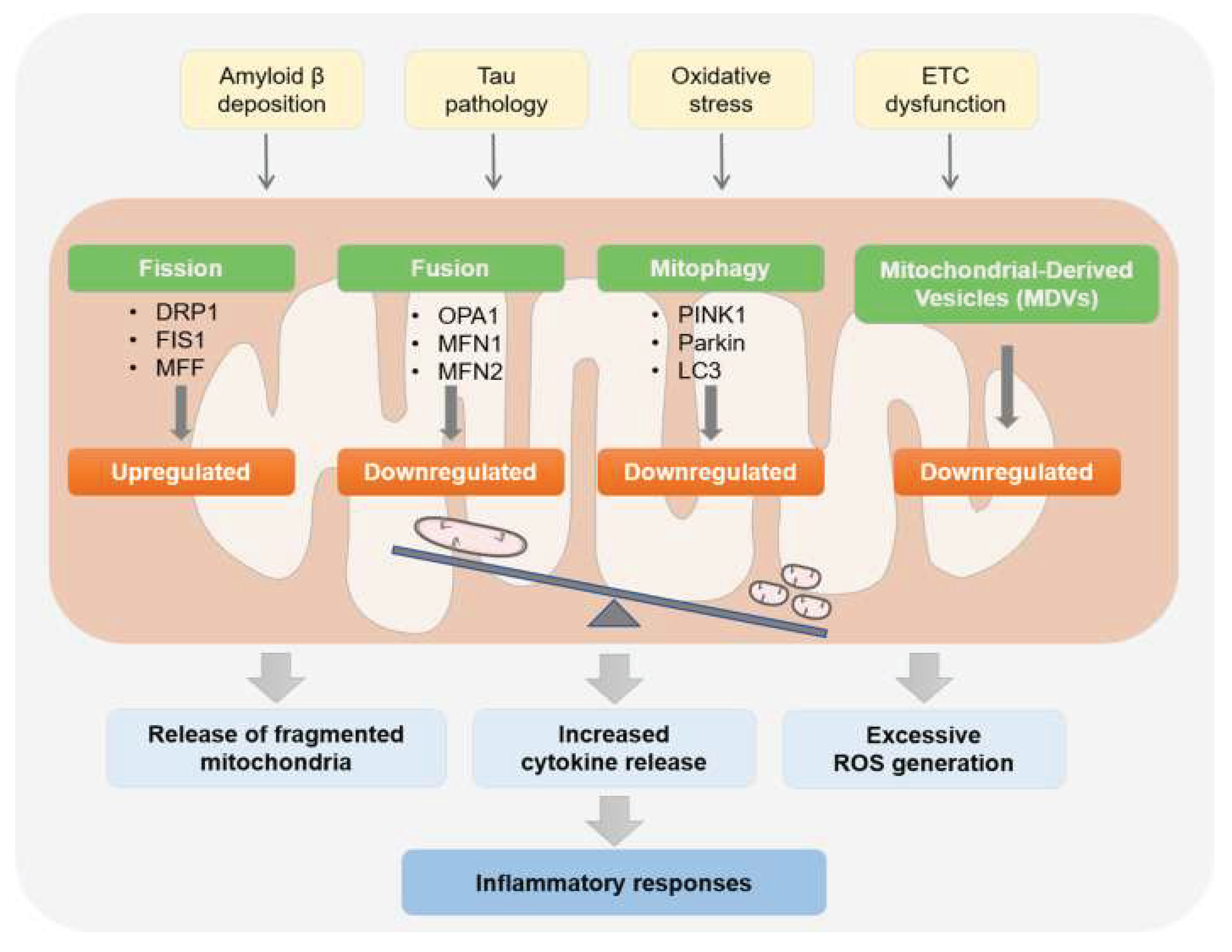
However, sustained activation of this pathway appears to shift the system toward metabolic failure. Chronic C/EBPβ activity - together with persistent Akt inhibition and progressive mitochondrial damage - promotes the accumulation of dysfunctional mitochondria and reduces overall metabolic efficiency (Shaerzadeh et al., 2014; Yu et al., 2014; Wang et al., 2025). As mitochondrial quality control mechanisms become compromised, this initially compensatory hypermetabolic state transitions into overt hypometabolism (Naia et al., 2023; Christodoulou et al., 2026). The downstream consequences of this metabolic shift are both multifaceted and self-reinforcing. Impaired oxidative metabolism promotes cytosolic acidification and lactate accumulation, which in turn disrupt lysosomal acidification and autophagic flux (Chen et al., 2022; Hagihara & Miyakawa, 2024; Wang X et al., 2025). These alterations contribute to lysosomal swelling, autophagosome accumulation, and impaired clearance of cellular debris (Quick et al., 2023). In parallel, these metabolic disturbances sustain microglial activation and inflammatory signaling, further amplifying neurodegenerative processes (Jung et al., 2025; Wu et al., 2025). The mechanisms by which metabolic perturbations bias microglial cells toward pro-inflammatory phenotypes are beyond the scope of this review; however, readers are referred to prior work for a more detailed treatment of this topic (Ball et al., 2025; Shaikh & Nicholson, 2009).
FSH-Mediated Enhancement of ApoE4 as a Barrier to Autophagy: Implications for Proteinopathy
During folliculogenesis, FSH is generally regarded as a regulator of autophagy, acting in a context-dependent manner through the PI3K-AKT-mTOR signaling axis. Under basal conditions, FSH activation of AKT-mTOR promotes cell growth and suppresses autophagy (Liu et al., 2023). However, as follicles progress to the antral and pre-ovulatory stages, rapid cellular proliferation and metabolic demand create localized hypoxic microenvironments. Under these conditions, FSH signaling intersects with hypoxia-inducible pathways, leading to dynamic modulation of mTOR activity. Specifically, transient activation of mTOR is followed by a relative decline in its activity as hypoxia stabilizes HIF-1α, shifting the balance toward autophagy induction via an FSHR-mTOR-HIF-1α–dependent mechanism (Zhou et al., 2017). This transition allows follicular cells to maintain metabolic homeostasis despite increased energetic and oxidative stress. Functionally, autophagy plays a critical protective role in follicular survival. Impairment of autophagic pathways leads to intracellular waste accumulation, compromised cellular integrity, and depletion of the primordial follicle pool (Gawriluk et al., 2011; Wu et al., 2015; Song et al., 2015; Zhou et al., 2017). Accordingly, stress-induced upregulation of autophagy during later stages of folliculogenesis likely represents an adaptive mechanism that preserves follicular viability under conditions of heightened metabolic demand.
The downstream consequences of enhanced FSH signaling appear to be highly context-dependent and may diverge significantly in the central nervous system. These differences are largely determined by tissue-specific coupling of FSHRs to distinct intracellular signaling pathways. In classical endocrine tissues such as the ovary, FSHR predominantly couples to Gαs proteins, leading to increased cAMP production and activation of protein kinase A (PKA). This signaling cascade integrates with Akt-mTOR pathways to promote cell survival and growth (Casarini & Crépieux., 2019). In contrast, neuronal FSHR signaling may preferentially engage alternative G-protein pathways, including Gαi-mediated signaling. Rather than promoting a cAMP-driven anabolic program, this coupling activates downstream kinases such as Akt, ERK1/2, and SRPK2, resulting in upregulation of the transcription factor C/EBPβ. Following phosphorylation, SRPK2 translocates to the nucleus, where it contributes to activation of δ-secretase (also known as AEP). This protease cleaves APP and tau into aggregation-prone fragments, thereby promoting amyloid-β accumulation and tau pathology (Li et al., 2024). Thus, a consequence. FSH up-regulation is the production of protein metabolites that the cells are unable to clear, including Aβ, tau, and ApoE (especially APOE4).
Consequently, the accumulation of autophagic vesicles within dystrophic neurites is a well-established feature of Alzheimer’s disease, reflecting impaired autophagosome-lysosome fusion and defective degradation of autophagic cargo (Nixon et al., 2005; Nixon & Yang, 2011; Zhang et al., 2022). Consistent with this, experimental models show elevated levels of LC3-II, indicative of stalled or incomplete autophagosome turnover (Yang et al., 2011; Zhang et al., 2022). Notably, ApoE4 carriers exhibit a pronounced accumulation of autophagic vesicles, suggesting that this isoform further exacerbates impairments in autophagic flux (Sohn et al., 2021). One proposed mechanism involves FSH-mediated induction of ApoEE nuclear localization, where it interferes with transcriptional regulation of autophagy by binding to coordinated lysosomal expression and regulation (CLEAR) motifs. In vitro studies indicate that ApoE4 competes with transcription factor EB (TFEB) for occupancy at these elements - including SQSTM1, MAP1LC3B, and LAMP2 - thereby suppressing TFEB-driven expression of lysosomal and autophagy-related genes (Parcon et al., 2018).
Additionally, aberrant autophagosome accumulation has been shown to precede amyloid plaque formation, indicating that autophagic dysfunction represents an early pathogenic event rather than a secondary consequence of amyloid deposition (Yu et al., 2005). Experimental induction or inhibition of macroautophagy in neuronal cells produces parallel changes in autophagic vesicle abundance and amyloid-β production (Yu et al., 2005). Impaired PS1 function promotes mTORC1 activation, which suppresses TFEB-mediated autophagy and lysosomal biogenesis in brain cells (Reddy et al., 2016), while PS2 mutations further inhibit autophagosome - lysosome fusion (Fedeli et al., 2019). Importantly, the efficiency of autophagic and lysosomal pathways declines with advancing age even in individuals without presenilin mutations or complete loss of function, further increasing vulnerability to disrupted protein homeostasis later in life (Beckman et al., 2020; Lim et al., 2024; Shen et al., 2007; Thakur & Ghosh, 2007).
FSH-Mediated Augmentation of Glial Activation in Alzheimer’s Disease
C/EBPβ serves as a central regulator of inflammatory signaling. Numerous pro-inflammatory genes contain consensus C/EBPβ binding sites, and both macrophages and glial cells exhibit marked upregulation of C/EBPβ in response to inflammatory stimuli (Wang et al., 2025). Consistent with this role, C/EBPβ-deficient brains display reduced expression of pro-inflammatory genes and attenuated neurotoxic effects of activated microglia (Straccia et al., 2011; (Yao et al., 2024). ). Moreover, loss of C/EBPβ activity confers neuroprotection in experimental models of ischemic and excitotoxic injury, underscoring its contribution to neuroinflammatory damage (Wu et al., 2023).
C/EBPβ plays a central role in regulating genes involved in inflammasome activation (Wang, J. et al., 2025). Inflammasomes - particularly the NLRP3 complex - are activated by a range of cellular stressors, including misfolded protein aggregates, oxidative stress, and mitochondrial dysfunction (Wu, D. et al., 2022; Baragetti et al., 2020; Hamilton & Anand, 2019; Halliday & Mallucci, 2015; Jones et al., 2021). Within this context, C/EBPβ directly regulates the transcription of key inflammasome components by binding to their promoter regions. Notably, C/EBPβ has been shown to upregulate expression of NLRP3, a core structural component of the inflammasome complex (Ma et al., 2018; Chen, J. et al., 2021). It similarly enhances expression of AIM2, a cytosolic DNA sensor that forms a caspase-1–activating inflammasome (Hornung et al., 2009; Zou et al., 2023). Through these actions, C/EBPβ contributes to the priming phase of inflammasome activation, increasing cellular sensitivity to downstream activating signals. In addition to its direct transcriptional effects, C/EBPβ functions synergistically with other inflammatory transcription factors, most notably NF-κB, to amplify cytokine production (McClure et al., 2016). NF-κB is a well-established regulator of inflammatory gene expression, and its cooperation with C/EBPβ enhances transcriptional output at shared target loci. For example, both factors bind to adjacent promoter regions of IL-1β and IL-18, driving coordinated upregulation of these cytokines (Ma et al., 2018).
Figure 6.
C/EBPβ-dependent transcriptional regulation of inflammasome activation and pro-inflammatory signaling. This figure illustrates the role of C/EBPβ as a central transcriptional regulator linking upstream inflammatory cues to inflammasome activation. In panel A, C/EBPβ cooperates with NF-κB to induce expression of key inflammasome components, including NLRP3 and AIM2, promoting assembly of ASC-containing complexes, activation of caspase-1, and subsequent maturation of IL-1β and IL-18. In panel B, distinct C/EBPβ isoforms differentially regulate inflammasome gene expression, thereby modulating downstream inflammatory responses through calcium-dependent signaling and cytokine production. Collectively, the figure highlights C/EBPβ as a key integrator of transcriptional control and innate immune activation, coordinating inflammasome pathways implicated in neuroinflammation and neurodegenerative disease. Adapted from Wang, J., et al. (2025).
Figure 6.
C/EBPβ-dependent transcriptional regulation of inflammasome activation and pro-inflammatory signaling. This figure illustrates the role of C/EBPβ as a central transcriptional regulator linking upstream inflammatory cues to inflammasome activation. In panel A, C/EBPβ cooperates with NF-κB to induce expression of key inflammasome components, including NLRP3 and AIM2, promoting assembly of ASC-containing complexes, activation of caspase-1, and subsequent maturation of IL-1β and IL-18. In panel B, distinct C/EBPβ isoforms differentially regulate inflammasome gene expression, thereby modulating downstream inflammatory responses through calcium-dependent signaling and cytokine production. Collectively, the figure highlights C/EBPβ as a key integrator of transcriptional control and innate immune activation, coordinating inflammasome pathways implicated in neuroinflammation and neurodegenerative disease. Adapted from Wang, J., et al. (2025).
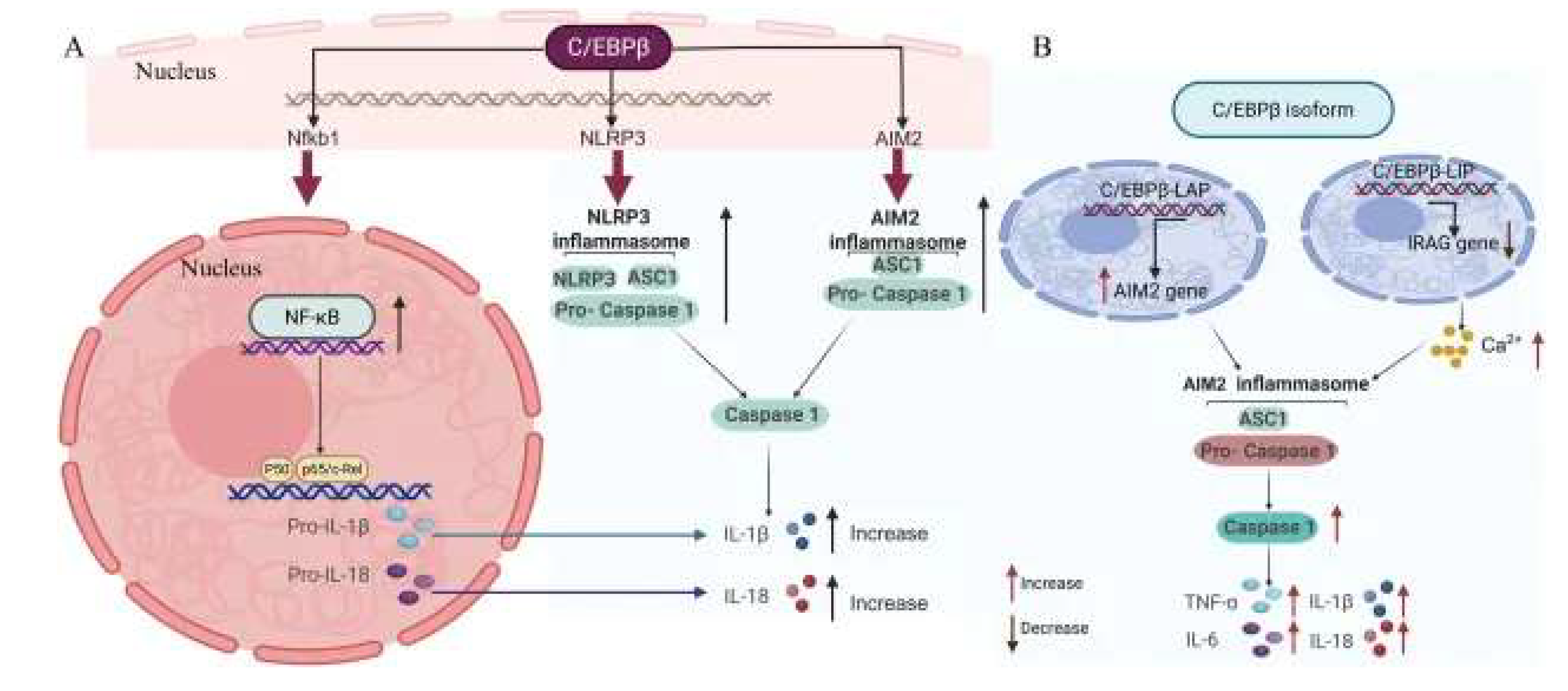
Figure 7.
FSH-FSHR signaling as a driver of amyloidogenic, tau-directed, and inflammatory pathology in Alzheimer’s disease. FSH binding to FSHR in cortical and hippocampal neurons activates Gαi-dependent ERK1/2 and AKT signaling, leading to phosphorylation of C/EBPβ and SRPK2. These pathways upregulate asparagine endopeptidase (AEP), promoting cleavage of APP and tau into aggregation-prone species (Aβ, Tau368). These products further activate microglial and inflammasome signaling, amplifying cytokine production and sustaining neuroinflammation. Collectively, this axis links elevated FSH to proteolysis, inflammation, and accumulation of neurotoxic substrates in AD. Adapted from Li et al., (2024).
Figure 7.
FSH-FSHR signaling as a driver of amyloidogenic, tau-directed, and inflammatory pathology in Alzheimer’s disease. FSH binding to FSHR in cortical and hippocampal neurons activates Gαi-dependent ERK1/2 and AKT signaling, leading to phosphorylation of C/EBPβ and SRPK2. These pathways upregulate asparagine endopeptidase (AEP), promoting cleavage of APP and tau into aggregation-prone species (Aβ, Tau368). These products further activate microglial and inflammasome signaling, amplifying cytokine production and sustaining neuroinflammation. Collectively, this axis links elevated FSH to proteolysis, inflammation, and accumulation of neurotoxic substrates in AD. Adapted from Li et al., (2024).
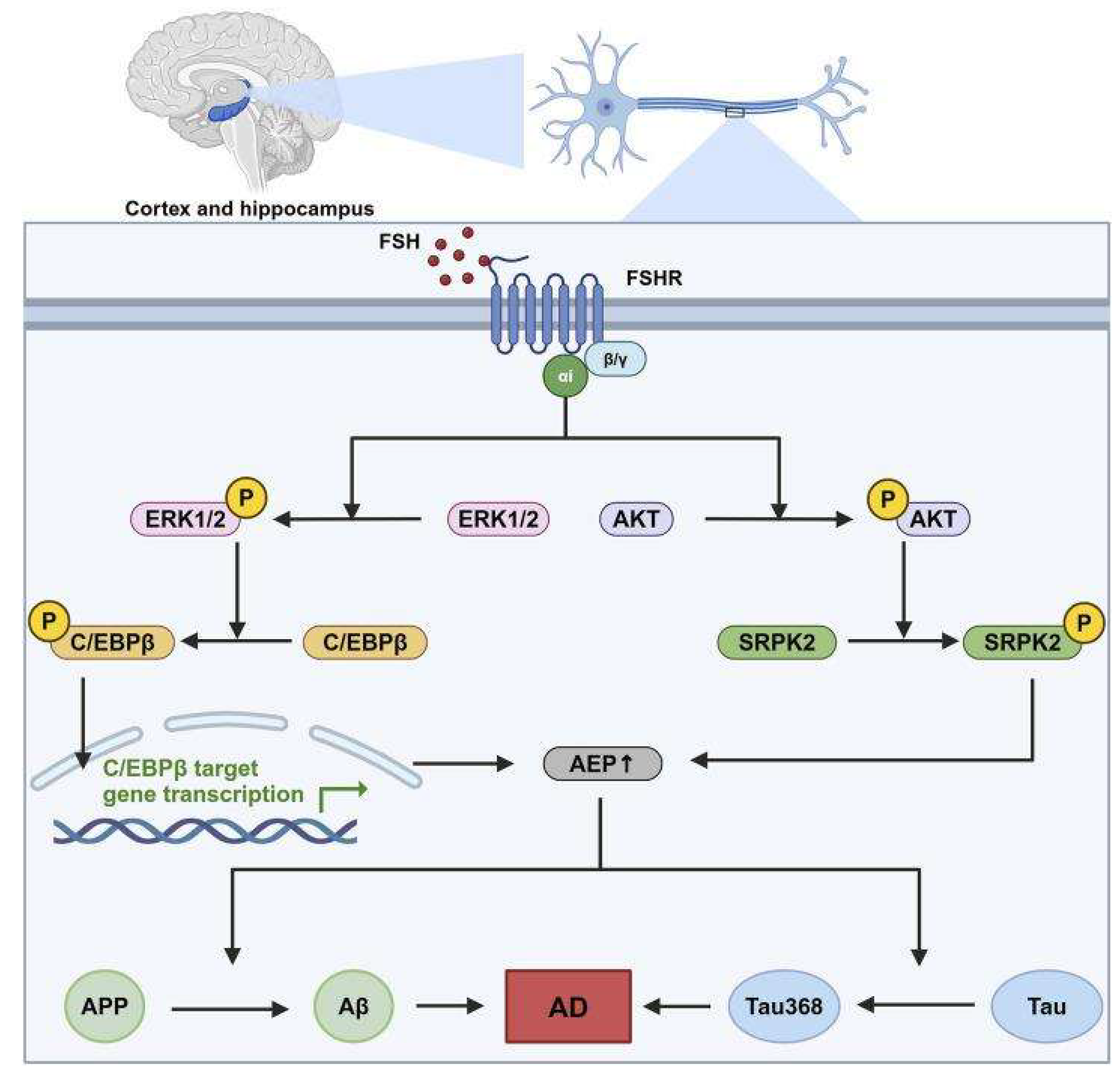
Despite the lack of evidence concerning microglial expression of FSH-receptors, considering the regulatory influence of FSH on C/EBPβ, it follows that elevated FSH signaling may directly promote microglial activation through C/EBPβ-dependent and related inflammatory pathways. Consistent with this, accumulating evidence indicates that FSH acts as a positive modulator of neuroinflammatory processes and glial activation. To directly assess these effects, Xiong et al. (2023) developed an Alzheimer’s disease mouse model using ovariectomy to disrupt endogenous sex hormone balance, while maintaining physiological estrogen levels through replacement. Under these conditions, FSH elevation was associated with increased accumulation of Alzheimer’s disease-related markers in the brain, including Aβ and hyperphosphorylated tau (Tau368), indicating that FSH may promote disease pathology independently of estrogen.
Importantly, Aβ and hyperphosphorylated tau act as reciprocal amplifiers of neuroinflammation. Aβ facilitates microglial recruitment and clustering within plaque-dense regions (Gao et al., 2023) and induces activation of the NLRP3 inflammasome, leading to the release of apoptosis-associated speck-like protein containing a CARD (ASC) aggregates. These ASC specks can bind Aβ, further promoting its aggregation and propagation (Venegas et al., 2017). In parallel, chronic activation of microglia and astrocytes enhances amyloidogenic APP processing and upregulates tau-directed kinases, including glycogen synthase kinase-3β (GSK-3β), thereby accelerating tau hyperphosphorylation, synaptic dysfunction, and neurodegenerative spread (Chen & Yu, 2023; Zhang et al., 2021). Further supporting a causal role, treatment with FSH-neutralizing antibodies has been shown to reduce Aβ accumulation and tau pathology in experimental models, reinforcing the contribution of FSH signaling to Alzheimer’s disease progression (Xiong et al., 2022).
FSH-Mediated Disruption of the Blood-Brain Barrier
The blood-brain barrier (BBB) is formed by specialized brain endothelial cells connected by tight junctions and supported by perivascular cell populations, including pericytes, astrocytes, microglia, and oligodendrocytes. Together, these components tightly regulate molecular exchange between the circulation and the central nervous system, restrict the entry of neurotoxic substances, and maintain neural homeostasis (Kim et al., 2025).
Circulating FSH levels are inversely associated with vascular compliance, such that higher FSH concentrations correlate with increased arterial stiffness and endothelial dysfunction (Ferretti et al., 2018; Laakkonen et al., 2021; Wang et al., 2026; Xue et al., 2025). Experimental and clinical studies further indicate that elevated FSH promotes vascular calcification and progressive loss of arterial elasticity, contributing to age-related vascular remodeling (Li et al., 2024; Roelofs et al., 2022). In parallel, FSH has been shown to disrupt endothelial junctional integrity by altering the expression of adherens junction proteins, including E-cadherin and V-cadherin, thereby increasing vascular permeability (Kolnes et al., 2020; Rocca et al., 2024).
Beyond its effects on peripheral vasculature and neural cells (Xue et al., 2025), emerging evidence suggests that FSH can also influence cerebrovascular function (Alkhalifa et al., 2023; Wilson et al., 2008). Because BBB integrity depends on adherens and tight junction mechanisms shared across vascular beds, FSH-mediated disruption of endothelial junctional signaling observed in peripheral tissues may extend to the BBB. Such destabilization would be expected to increase permeability, facilitating the entry of inflammatory mediators, lipids, and circulating factors into the brain parenchyma.
In addition to adherens junction disruption, BBB impairment may also arise through FSH-associated alterations in gap junction signaling. In a mouse model, ovariectomy followed by treatment with a gonadotropin agonist (leuprolide acetate) resulted in increased expression of connexin-43 and enhanced Evans blue dye extravasation into the brain, indicating elevated BBB permeability (Wilson et al., 2008). Notably, BBB dysfunction is now recognized as an early feature of Alzheimer’s disease, emerging prior to overt neurodegeneration and clinical symptoms (Alkhalifa et al., 2023).
Figure 8.
FSH-mediated contributions to blood–brain barrier dysfunction and cerebrovascular pathology. Elevated FSH promotes blood-brain barrier (BBB) disruption, vascular stiffness, and reduced cerebral blood flow (CBF) through inflammatory signaling, lipid dysregulation, and structural vascular changes. These alterations facilitate the entry of peripheral risk factors into the brain, amplifying neuroinflammation, cerebral lipid accumulation, cerebral amyloid angiopathy (CAA), and intracranial atherosclerosis. Collectively, these processes contribute to the development of Alzheimer’s disease-like pathology. Adapted from Xue, Y., et al. (2025).
Figure 8.
FSH-mediated contributions to blood–brain barrier dysfunction and cerebrovascular pathology. Elevated FSH promotes blood-brain barrier (BBB) disruption, vascular stiffness, and reduced cerebral blood flow (CBF) through inflammatory signaling, lipid dysregulation, and structural vascular changes. These alterations facilitate the entry of peripheral risk factors into the brain, amplifying neuroinflammation, cerebral lipid accumulation, cerebral amyloid angiopathy (CAA), and intracranial atherosclerosis. Collectively, these processes contribute to the development of Alzheimer’s disease-like pathology. Adapted from Xue, Y., et al. (2025).
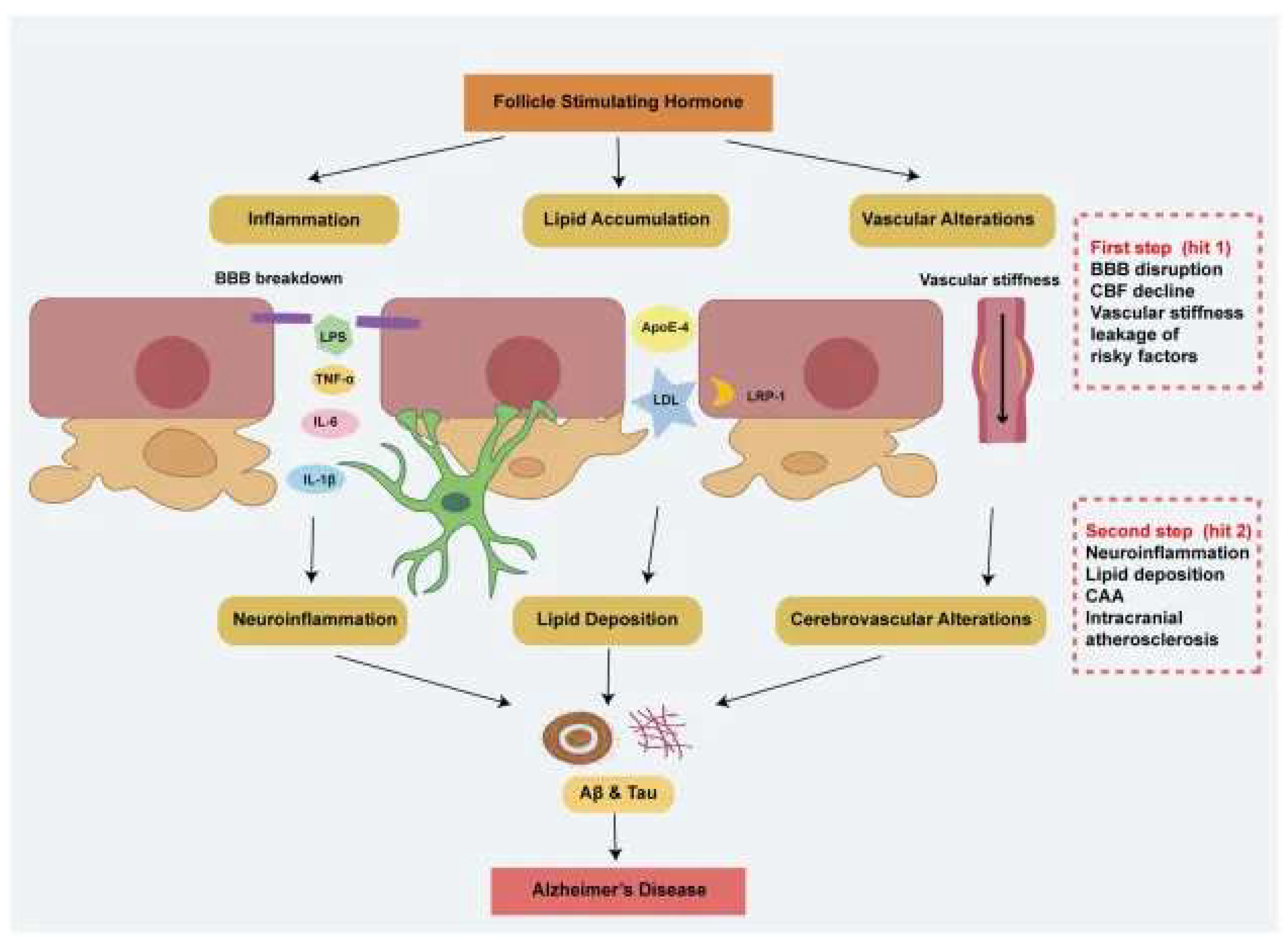
Astrocyte aging represents an additional layer of vulnerability. Aged astrocytes exhibit reduced capacity to support neuronal function and maintain homeostasis, and have been identified as a strong cellular predictor of Alzheimer’s disease risk (Bronzuoli et al., 2019; Cohen & Torres, 2019; Monterey et al., 2021). Given that astrocytic endfeet provide near-complete coverage of the cerebral vasculature (Mathiisen et al., 2010), age-related astrocytic dysfunction is likely to further compromise BBB stability. Consistent with this, aging itself is associated with progressive increases in BBB permeability, with older women demonstrating greater BBB vulnerability than younger individuals (Goodall et al., 2018; Knox et al., 2022).
Integrative Mechanistic Framework: How Reproductive Aging in Biological Females Reconfigures Alzheimer’s Disease Risk
The biological features commonly associated with AD, as with many age-related disorders, are not unique to individuals who meet diagnostic criteria for the condition. Although amyloid-β accumulation, tau pathology, and α-synuclein aggregation are central to the pathobiology of neurodegenerative diseases such as Alzheimer’s disease, Parkinson’s disease, and dementia with Lewy bodies, these same molecular alterations are also observed during normative aging (Sengupta & Kayed 2022). Indeed, postmortem studies have repeatedly identified amyloid plaques and tauopathy, of varying degrees, in cognitively normal for older adults and even middle aged carriers (Krishnadas et al., 2022; Morris et al., 2010 ;Pletnikova et al., 2008; Sengupta & Kayed 2022). Moreover, the proteins involved in these processes are produced constitutively throughout life, yet the majority of individuals never develop clinical neurodegenerative disease (Pearson et al., (1999). Thus, pathology does not arise simply from protein presence, but from failures in the regulatory systems that govern protein folding, trafficking, clearance, and cellular context, which are commonly aberrant among various neurodegenerative conditions outside of the one subject to this review (Jamerlan, A., & Hulme, J. (2026).
The earliest indicators of impending neurodegeneration - often preceding measurable cognitive impairment - include impaired proteostatic and autophagic clearance, altered cellular metabolic activity (Gazestani et al., 2023), chronic microglial activation (Li et al., 2018), increased blood-brain barrier permeability, and astrocytic dysfunction. Collectively, these upstream disturbances compromise cellular homeostasis, inflammatory regulation, and metabolic support well before overt neuronal loss becomes evident (Li et al., 2018). In this context, classical pathological hallmarks such as amyloid-β and tau accumulation, autophagosome buildup, and progressive neuronal degeneration are more accurately understood as downstream consequences of sustained regulatory failure rather than primary initiating events. With these points in mind, it is prudent to consider factors that pre-emptively perturb these aspects of the condition at an early stage so that the risk of disease progression may be mollifie
In the United States, the majority of AD cases occur in women, suggesting that female-specific biological factors contribute meaningfully to disease risk, progression, and severity. Consistent with this, women - particularly those carrying the ApoE4 allele - tend to exhibit earlier onset and more severe clinical manifestations of AD. Notably, approximately 40-60% of AD cases involve at least one ApoE4 allele, underscoring its substantial contribution to the overall disease burden (Pires & Rego, 2023). Beyond its role in AD, ApoE4 may also influence responses to other conditions associated with reproductive aging. For example, female APOE4 carriers appear to be at increased risk for treatment resistance in the context of menopausal symptoms, including vasomotor instability and sleep disturbances (Muhammad, 2025). These observations suggest that ApoE4 may interact with endocrine aging processes in ways that extend beyond classical neurodegenerative pathways.
Although this review focuses on mechanisms underlying increased AD risk in women, it is important to note that age-related increases in FSH are also observed in men, albeit to a lesser extent (Kim et al., 2024). This raises the possibility that FSH-related mechanisms may contribute to neurodegenerative processes across sexes, and warrants further investigation into the role of FSH in AD pathophysiology in male populations.
Endocrine and Metabolic Targets: Translational Opportunities in Alzheimer’s Disease
Although a wide range of pharmacologic agents are currently used in the clinical management of AD - including cholinesterase inhibitors, NMDA receptor antagonists, and more recently developed anti-amyloid therapies (Zhang et al., 2024) - a comprehensive evaluation of these treatments is beyond the scope of this review. Instead, the present work focuses specifically on mechanisms linking reproductive aging to AD pathophysiology, with particular emphasis on endocrine transitions, gonadotropin signaling, and their downstream effects on inflammation, metabolism, and cellular homeostasis. Within this framework, emerging therapeutic strategies targeting these upstream, system-level processes - such as modulation of FSH signaling - are discussed as potential avenues for intervention. This approach is intended to complement, rather than replace, existing treatment paradigms by highlighting underexplored biological drivers that may contribute to disease susceptibility and progression in women.
Therapeutic Targeting of FSH in Alzheimer’s Disease
Given the emerging role of FSH in modulating AD risk and pathology, therapeutic targeting of FSH signaling represents a promising avenue for intervention. Preclinical studies demonstrate that ovariectomy induces AD-like pathology and cognitive deficits in female ApoE4 knock-in mice, effects that are significantly attenuated by treatment with FSH-neutralizing antibodies. These interventions reduce amyloid burden, mitigate hippocampal and cortical neurodegeneration, and improve cognitive performance (Xiong et al., 2022; Xiong et al., 2023). Subsequent work has reinforced these findings, showing that disruption of FSH signaling - either through FSHR knockout or antibody-mediated blockade - improves spatial learning and recognition memory in experimental models (Korkmaz et al., 2025; Pallapat et al., 2025). Despite these encouraging results, FSH-targeted therapies remain in the preclinical stage, although efforts toward translation into human trials are currently underway (Pallapat et al., 2025).
Hormone Therapy and Estrogen Receptor Modulation
The use of menopause hormone therapy (MHT) for the treatment of menopausal symptoms and its effects on cognition and dementia risk remains an area of ongoing clinical and public debate, largely due to conflicting evidence and concerns regarding potential adverse outcomes (Rocca et al., 2024). While experimental and laboratory studies often suggest neuroprotective or cognitive benefits of hormone therapy, these findings have not been consistently replicated in human populations (Ali et al., 2023; Andy et al., 2024).
Some clinical and epidemiological studies report that MHT may increase the risk of dementia and cognitive decline (Craig et al., 2005; Yuk et al., 2023), and it has been associated with increased Alzheimer’s-related tau pathology (Coughlan et al., 2023). However, the overall certainty of this evidence remains limited, as many systematic reviews fail to meet rigorous standards (e.g., GRADE) due to bias, heterogeneity, and inconsistency across studies (Hilton Boon et al., 2021). Early observational studies suggested that MHT might reduce dementia risk, particularly when initiated during midlife and used over extended durations (Henderson et al., 1994; Henderson et al., 2005; Kim et al., 2021; Whitmer et al., 2011; Zandi et al., 2002). However, these findings are highly susceptible to confounding - especially healthy user bias - and have not been consistently reproduced in randomized controlled trials (Rahman et al., 2019).
The Women’s Health Initiative Memory Study (WHIMS) reported that combined MHT (conjugated equine estrogens plus medroxyprogesterone acetate) approximately doubled dementia risk, while estrogen-only therapy increased the risk of mild cognitive impairment in women aged 65 years or older (Shumaker et al., 2003; Shumaker et al., 2004). Although these findings are often cited, the late age of therapy initiation limits their generalizability to typical clinical use, where treatment is often initiated earlier in the menopausal transition.
Subsequent observational studies and meta-analyses have yielded inconsistent results. Some large observational cohorts suggest that combined MHT may increase dementia risk, particularly with prolonged use (Pourhadi et al., 2023; Vinogradova et al., 2021), whereas others report a potential reduction in risk - especially with estrogen-only therapy initiated during midlife (Nerattini et al., 2023; Mosconi et al., 2025). However, more stringent umbrella reviews applying risk-of-bias assessments and GRADE criteria have found no reliable evidence supporting a protective “therapeutic window” for MHT and emphasize substantial uncertainty in the literature (Melville et al., 2025). Across randomized and observational evidence, findings remain heterogeneous and frequently limited by methodological constraints, including imprecision, study design variability, and cohort overlap. As such, current evidence does not support the use of MHT solely for dementia prevention, nor does it definitively establish a causal relationship between MHT and increased dementia risk (Livingston et al., 2024).
Notably, the analysis by Melville et al. (2025) did not account for potential modifying effects of genetic factors such as ApoE4 status, which may partially explain heterogeneity across studies. Evidence suggests that responses to estrogen-based therapies are genotype- and age-dependent. In younger postmenopausal women (mean age <65 years), estrogen treatment has been associated with beneficial effects on brain structure and amyloid dynamics, including reduced amyloid deposition and preservation of hippocampal and entorhinal cortex volumes - effects that appear most pronounced in ApoE3/4 carriers (Kantarci et al., 2016). However, outcomes in ε4 homozygotes remain uncertain (Saleh et al., 2023; Depypere et al., 2023), and these benefits are not consistently observed in women over the age of 65 (Yaffe et al., 2000; Burkhardt et al., 2004; Kang et al., 2004; Kang & Grodstein, 2012).
Experimental data further support genotype-specific differences in estrogen responsiveness. In female mouse models, acute estradiol administration into the dorsal hippocampus enhanced object recognition and spatial memory consolidation, along with increased dendritic spine density in the CA1 region, in animals carrying ApoE3 or a single ApoE4 allele (E3FAD and E3/4FAD), but not in ApoE4 homozygous mice (E4FAD) (Taxier et al., 2022a; Taxier et al., 2022b). Although the mechanisms underlying this reduced responsiveness remain unclear, ApoE4 homozygous females exhibit elevated ERα expression without corresponding changes in ERβ levels, suggesting a shift in receptor balance that may influence estrogen signaling outcomes (Taxier et al., 2022a,b).
Importantly, clinical practices such as sequential hormone replacement therapy - where estrogen is administered continuously with intermittent progestin in cycling women - may introduce additional risks. Chronic estrogen exposure in this context has been associated with adverse effects including hyperprolactinemia, hypertension, and metabolic disturbances ( Kalenga et al., 2022; MohanKumar et al., 2018), warranting careful consideration when evaluating endocrine interventions.
A limitation of estrogen-based therapies in postmenopausal individuals with AD is their association with increased risk of hormone-sensitive cancers, including breast and endometrial cancer, largely mediated through the proliferative effects of estrogen receptor alpha (ERα) signaling (Shete et al., 2023). In contrast, activation of ERβ does not promote cancer cell proliferation (Jia et al., 2015) and has been associated with beneficial effects on cognition (Fleischer et al., 2021). Experimental studies demonstrate that ERβ activation enhances memory formation in rodent models (Schwabe et al., 2024), and this receptor is highly expressed in brain regions critical for cognition and neuroendocrine regulation, including the hippocampus, medial prefrontal cortex, and hypothalamus (Almey et al., 2014; Shughrue et al., 1998; Milner et al., 2005).
Importantly, ERβ signaling has been linked to reductions in amyloid-β levels and tau phosphorylation within the hippocampus (Tian et al., 2013; Xiong et al., 2015). Consistent with a protective role, constitutive knockout of ERβ in mice results in increased Aβ42 deposition and ApoE accumulation in the hippocampus and cortex (Zhang et al., 2004). However, evidence from preclinical models indicates that ERβ-mediated benefits may be genotype-dependent, with cognitive and neuropathological improvements observed primarily in E3FAD and E3/4FAD mice, but not in ApoE4 homozygous models. Interestingly, a similar pattern of differential responsiveness has been reported in clinical contexts, where ERβ-targeted approaches appear to confer more consistent benefits in subsets of women experiencing menopausal symptoms (Muhammad, 2025). Together, these findings suggest that while ERβ signaling may offer a more favorable therapeutic profile than non-selective estrogen approaches, its efficacy is likely influenced by underlying genetic and physiological context. Further studies need to be conducted with human subjects to confirm or deny its clinical utility.
Targeting Metabolic Perturbations in Alzheimer’s Disease
Metabolic perturbations in brain cells represent some of the earliest detectable changes preceding the AD phenotype (Naia et al., 2023). These disturbances are further amplified by FSH-associated signaling dynamics, establishing a metabolic environment that predisposes to downstream dysfunction, including impaired autophagy, microglial activation, disrupted glucose utilization, and the accumulation of pathogenic protein species. In this context, metabolic dysfunction is not merely a consequence of disease progression but a key upstream driver of neurodegenerative vulnerability.
Importantly, metabolic alterations within the hypothalamus may also contribute to dysregulation of FSH signaling itself (Zhang et al., 2013). The menopausal transition is characterized by transient elevations in gonadotropin-releasing hormone GnRH, followed by subsequent declines in postmenopausal stages (Hall et al., 2000). Reduced GnRH signaling has been linked to activation of NF-κB/IKK-β-mediated inflammatory pathways (Zhang et al., 2013), suggesting that hypothalamic metabolic reprogramming may precede and facilitate inflammatory signaling cascades that further disrupt neuroendocrine regulation. These interactions point to a bidirectional relationship in which metabolic dysfunction and endocrine dysregulation reinforce one another across aging.
Among therapeutic strategies targeting metabolic dysfunction in AD, ketogenic diets (KD) have emerged as one of the most promising non-pharmacological approaches. Ketogenic interventions have a well-established role in neurological conditions such as epilepsy and are increasingly being explored as adjunctive therapies in disorders including bipolar disorder, glioblastoma, and neurodegenerative diseases. In AD, a randomized trial demonstrated that a 12-week KD intervention improved quality of life and daily functional performance, although interpretation is limited by small sample size and short duration (Phillips et al., 2021). Additional studies report improvements in cognitive function alongside favorable changes in metabolic and biomarker profiles (Neth et al., 2020), including increased cerebral ketone uptake, enhanced brain perfusion, and improved peripheral lipid and glucose metabolism.
A broader range of trials using varied ketogenic formulations has consistently demonstrated beneficial effects in individuals with mild cognitive impairment (MCI) and AD, with evidence suggesting that efficacy may be greatest during early to moderate stages of disease progression (Oliveira et al., 2023). Although the literature remains heterogeneous with respect to study design, intervention protocols, and outcome measures, the collective evidence supports the therapeutic potential of ketogenic strategies in AD (Grammatikopoulou et al., 2020).
Additional pharmacologic and non-pharmacologic approaches targeting metabolic dysfunction in AD have also been explored, and readers are referred to Stefaniak et al. (2022) and Wang et al. (2023) for further discussion.
Conclusions
Alzheimer’s disease emerges not solely from the accumulation of pathogenic proteins, but from progressive failures in the systems that regulate metabolism, proteostasis, inflammation, and vascular integrity. Reproductive aging represents a critical inflection point in female neurobiology, characterized by coordinated endocrine, immunological, and metabolic shifts that reshape vulnerability to neurodegeneration.
Among these changes, sustained elevations in FSH appear to exert broad and multifaceted effects that extend well beyond reproductive physiology. Evidence synthesized in this review suggests that FSH contributes to AD pathogenesis through convergent mechanisms involving dysregulated glucose metabolism, mitochondrial dysfunction, impaired autophagic clearance, altered apolipoprotein dynamics, and amplification of neuroinflammatory signaling. These effects are further compounded by interactions with genetic risk factors such as ApoE4, as well as age-associated declines in vascular and blood–brain barrier integrity. Importantly, many of the molecular alterations traditionally regarded as defining features of AD - such as amyloid-β accumulation and tau pathology - are more accurately understood as downstream consequences of earlier systemic dysregulation. This perspective shifts emphasis toward upstream drivers of disease susceptibility, particularly those emerging during the menopausal transition.
Although therapeutic strategies targeting FSH signaling remain in early stages of development, preclinical evidence suggests that modulation of this axis may attenuate multiple facets of AD pathology. Notably, such modulation need not rely solely on direct FSH blockade; selective targeting of estrogen receptor pathways, particularly ERβ, may offer an alternative means of mitigating FSH-associated effects while preserving beneficial estrogenic signaling. Future work should aim to clarify the extent to which FSH influences neurodegenerative outcomes in both men and women, as well as how progressive hypothalamic–pituitary alterations in neuroendocrine, metabolic, and immune regulation shape FSH dynamics across aging. Advancing this understanding may enable the development of more precise, biology-informed interventions that address upstream drivers of neurodegeneration rather than its late-stage manifestations.
Author Contributions
Manuscript drafting and revision, as well as figure development and acquisition, were all conducted by Yasin Ali Muhammad.
Funding
This research received no external funding.
Institutional Review Board Statement
Not applicable.
Informed Consent Statement
Not applicable.
Data Availability Statement
No new data were created or analyzed in this study.
Conflicts of Interest
The authors declare no conflict of interest.
References
- Abeer, M. I.; Abdulhasan, A.; Haguar, Z.; Narayanaswami, V. Isoform-specific modification of apolipoprotein E by 4-hydroxynonenal: protective role of apolipoprotein E3 against oxidative species. The FEBS journal 2023, 290(11), 3006–3025. [Google Scholar] [CrossRef]
- Ali, N.; Sohail, R.; Jaffer, S. R.; Siddique, S.; Kaya, B.; Atowoju, I.; Imran, A.; Wright, W.; Pamulapati, S.; Choudhry, F.; Akbar, A.; Khawaja, U. A. The Role of Estrogen Therapy as a Protective Factor for Alzheimer's Disease and Dementia in Postmenopausal Women: A Comprehensive Review of the Literature. Cureus 2023, 15(8), e43053. [Google Scholar] [CrossRef]
- Alkhalifa, A. E.; Al-Ghraiybah, N. F.; Odum, J.; Shunnarah, J. G.; Austin, N.; Kaddoumi, A. Blood-Brain Barrier Breakdown in Alzheimer's Disease: Mechanisms and Targeted Strategies. International journal of molecular sciences 2023, 24(22), 16288. [Google Scholar] [CrossRef]
- Almansoub, H. A. M. M.; Tang, H.; Wu, Y.; Wang, D. Q.; Mahaman, Y. A. R.; Wei, N.; Almansob, Y. A. M.; He, W.; Liu, D. Tau Abnormalities and the Potential Therapy in Alzheimer's Disease. Journal of Alzheimer's disease: JAD 2019, 67(1), 13–33. [Google Scholar] [CrossRef]
- Almey, A.; Cannell, E.; Bertram, K.; Filardo, E.; Milner, T. A.; Brake, W. G. Medial prefrontal cortical estradiol rapidly alters memory system bias in female rats: ultrastructural analysis reveals membrane-associated estrogen receptors as potential mediators. Endocrinology 2014, 155(11), 4422–4432. [Google Scholar] [CrossRef] [PubMed]
- Alquezar, C.; Arya, S.; Kao, A. W. Tau Post-translational Modifications: Dynamic Transformers of Tau Function, Degradation, and Aggregation. Frontiers in neurology 2021, 11, 595532. [Google Scholar] [CrossRef] [PubMed]
- Alzheimer's disease facts and figures. Alzheimer's & dementia: the journal of the Alzheimer's Association 2024, 20(5), 3708–3821. [CrossRef]
- Andy, C.; Nerattini, M.; Jett, S.; Carlton, C.; Zarate, C.; Boneu, C.; Fauci, F.; Ajila, T.; Battista, M.; Pahlajani, S.; Christos, P.; Fink, M. E.; Williams, S.; Brinton, R. D.; Mosconi, L. Systematic review and meta-analysis of the effects of menopause hormone therapy on cognition. Frontiers in endocrinology 2024, 15, 1350318. [Google Scholar] [CrossRef]
- Apátiga-Pérez, R.; Soto-Rojas, L. O.; Campa-Córdoba, B. B.; Luna-Viramontes, N. I.; Cuevas, E.; Villanueva-Fierro, I.; Ontiveros-Torres, M. A.; Bravo-Muñoz, M.; Flores-Rodríguez, P.; Garcés-Ramirez, L.; de la Cruz, F.; Montiel-Sosa, J. F.; Pacheco-Herrero, M.; Luna-Muñoz, J. Neurovascular dysfunction and vascular amyloid accumulation as early events in Alzheimer's disease. Metabolic brain disease 2022, 37(1), 39–50. [Google Scholar] [CrossRef] [PubMed]
- Ayton, S.; Bush, A. I. β-amyloid: The known unknowns. Ageing research reviews 2021, 65, 101212. [Google Scholar] [CrossRef]
- Baek, M. S.; Cho, H.; Lee, H. S.; Lee, J. H.; Ryu, Y. H.; Lyoo, C. H. Effect of APOE ε4 genotype on amyloid-β and tau accumulation in Alzheimer’s disease. Alzheimer’s Research & Therapy 2020, 12, 140. [Google Scholar] [CrossRef]
- Ball, A. B.; Jones, A. E.; Nguyễn, K. B.; Rios, A.; Marx, N.; Hsieh, W. Y.; Yang, K.; Desousa, B. R.; Kim, K. K. O.; Veliova, M.; Del Mundo, Z. M.; Shirihai, O. S.; Benincá, C.; Stiles, L.; Bensinger, S. J.; Divakaruni, A. S. Pro-inflammatory macrophage activation does not require inhibition of oxidative phosphorylation. EMBO reports 2025, 26(4), 982–1002. [Google Scholar] [CrossRef] [PubMed]
- Baragetti, A.; Catapano, A. L.; Magni, P. Multifactorial Activation of NLRP3 Inflammasome: Relevance for a Precision Approach to Atherosclerotic Cardiovascular Risk and Disease. International journal of molecular sciences 2020, 21(12), 4459. [Google Scholar] [CrossRef] [PubMed]
- Bermejo, P.; Martín-Aragón, S.; Benedí, J.; Susín, C.; Felici, E.; Gil, P.; Villar, Á. M. Peripheral levels of glutathione and protein oxidation as markers in the development of Alzheimer’s disease from Mild Cognitive Impairment. Free Radical Research 2008, 42(2), 162–170. [Google Scholar] [CrossRef] [PubMed]
- Berry, A. S.; Harrison, T. M. New perspectives on the basal forebrain cholinergic system in Alzheimer's disease. Neuroscience and biobehavioral reviews 2023, 150, 105192. [Google Scholar] [CrossRef] [PubMed]
- Beckman, M.; Knox, K.; Koneval, Z.; Smith, C.; Jayadev, S.; Barker-Haliski, M. Loss of presenilin 2 age-dependently alters susceptibility to acute seizures and kindling acquisition. Neurobiology of disease 2020, 136, 104719. [Google Scholar] [CrossRef] [PubMed]
- Bethlehem, R. A. I.; Seidlitz, J.; White, S. R.; Vogel, J. W.; Anderson, K. M.; Adamson, C.; Adler, S.; Alexopoulos, G. S.; Anagnostou, E.; Areces-Gonzalez, A.; Astle, D. E.; Auyeung, B.; Ayub, M.; Bae, J.; Ball, G.; Baron-Cohen, S.; Beare, R.; Bedford, S. A.; Benegal, V.; Beyer, F.; Alexander-Bloch, A. F. Brain charts for the human lifespan. Nature 2022, 604(7906), 525–533. [Google Scholar] [CrossRef]
- Bjørklund, G.; Aaseth, J.; Dadar, M.; Chirumbolo, S. Molecular Targets in Alzheimer's Disease. Molecular neurobiology 2019, 56(10), 7032–7044. [Google Scholar] [CrossRef]
- Brosseron, F.; Krauthausen, M.; Kummer, M.; Heneka, M. T. Body fluid cytokine levels in mild cognitive impairment and Alzheimer's disease: a comparative overview. Molecular neurobiology 2014, 50(2), 534–544. [Google Scholar] [CrossRef]
- Bronzuoli, M. R.; Facchinetti, R.; Valenza, M.; Cassano, T.; Steardo, L.; Scuderi, C. Astrocyte Function Is Affected by Aging and Not Alzheimer's Disease: A Preliminary Investigation in Hippocampi of 3xTg-AD Mice. Frontiers in pharmacology 2019, 10, 644. [Google Scholar] [CrossRef]
- Burkhardt, M. S.; Foster, J. K.; Laws, S. M.; Baker, L. D.; Craft, S.; Gandy, S. E.; Stuckey, B. G.; Clarnette, R.; Nolan, D.; Hewson-Bower, B.; Martins, R. N. Oestrogen replacement therapy may improve memory functioning in the absence of APOE epsilon4. Journal of Alzheimer's disease: JAD 2004, 6(3), 221–228. [Google Scholar] [CrossRef]
- Butterfield, D. A.; Mattson, M. P. Apolipoprotein E and oxidative stress in brain with relevance to Alzheimer's disease. Neurobiology of disease 2020, 138, 104795. [Google Scholar] [CrossRef]
- Casarini, L.; Crépieux, P. Molecular Mechanisms of Action of FSH. Frontiers in endocrinology 2019, 10, 305. [Google Scholar] [CrossRef]
- Castellani, R. J.; Jamshidi, P.; Plascencia-Villa, G.; Perry, G. The Amyloid Cascade Hypothesis: A Conclusion in Search of Support. The American journal of pathology 2025, 195(11), 1988–1997. [Google Scholar] [CrossRef] [PubMed]
- Chen, H.; Fang, H. Q.; Liu, J. T.; Chang, S. Y.; Cheng, L. B.; Sun, M. X.; Feng, J. R.; Liu, Z. M.; Zhang, Y. H.; Rosen, C. J.; Liu, P. Atlas of Fshr expression from novel reporter mice. eLife 2025, 13, RP93413. [Google Scholar] [CrossRef]
- Chen, J.; Li, Q.; Wang, J. Topology of human apolipoprotein E3 uniquely regulates its diverse biological functions. Proceedings of the National Academy of Sciences of the United States of America 2011, 108(36), 14813–14818. [Google Scholar] [CrossRef]
- Chen, J.; Sun, J.; Hu, Y.; Wan, X.; Wang, Y.; Gao, M.; Liang, J.; Liu, T.; Sun, X. MicroRNA-191-5p ameliorates amyloid-β1-40 -mediated retinal pigment epithelium cell injury by suppressing the NLRP3 inflammasome pathway. FASEB journal: official publication of the Federation of American Societies for Experimental Biology 2021, 35(4), e21184. [Google Scholar] [CrossRef]
- Chen, T. H.; Koh, K. Y.; Lin, K. M.; Chou, C. K. Mitochondrial Dysfunction as an Underlying Cause of Skeletal Muscle Disorders. International journal of molecular sciences 2022, 23(21), 12926. [Google Scholar] [CrossRef] [PubMed]
- Chen, Y.; Jin, H.; Chen, J.; Li, J.; Găman, M. A.; Zou, Z. The multifaceted roles of apolipoprotein E4 in Alzheimer's disease pathology and potential therapeutic strategies. Cell death discovery 2025, 11(1), 312. [Google Scholar] [CrossRef] [PubMed]
- Cheng, Y. J.; Lin, C. H.; Lane, H. Y. From Menopause to Neurodegeneration-Molecular Basis and Potential Therapy. International journal of molecular sciences 2021, 22(16), 8654. [Google Scholar] [CrossRef]
- Chong, C. M.; Ke, M.; Tan, Y.; Huang, Z.; Zhang, K.; Ai, N.; Ge, W.; Qin, D.; Lu, J. H.; Su, H. Presenilin 1 deficiency suppresses autophagy in human neural stem cells through reducing γ-secretase-independent ERK/CREB signaling. Cell death & disease 2018, 9(9), 879. [Google Scholar] [CrossRef]
- Christodoulou, R. C.; Eller, D.; Papageorgiou, P. S.; Angelopoulou, E.; Vassiliou, E.; Papageorgiou, S. G. Metabolic Dysfunction in Alzheimer's Disease: Brain Glucose Hypometabolism as an Early Precursor to Amyloid and Tau Pathology. Journal of clinical medicine 2026, 15(5), 1884. [Google Scholar] [CrossRef]
- Cobley, J. N.; Fiorello, M. L.; Bailey, D. M. 13 reasons why the brain is susceptible to oxidative stress. Redox biology 2018, 15, 490–503. [Google Scholar] [CrossRef]
- Cohen, J.; Torres, C. Astrocyte senescence: Evidence and significance. Aging cell 2019, 18(3), e12937. [Google Scholar] [CrossRef]
- Combs, B.; Mueller, R. L.; Morfini, G.; Brady, S. T.; Kanaan, N. M. Tau and Axonal Transport Misregulation in Tauopathies. Advances in experimental medicine and biology 2019, 1184, 81–95. [Google Scholar] [CrossRef]
- Corraliza-Gomez, M.; Sanchez, D.; Ganfornina, M. D. Lipid-Binding Proteins in Brain Health and Disease. Frontiers in neurology 2019, 10, 1152. [Google Scholar] [CrossRef]
- Cortes-Canteli, M.; Iadecola, C. Alzheimer's Disease and Vascular Aging: JACC Focus Seminar. Journal of the American College of Cardiology 2020, 75(8), 942–951. [Google Scholar] [CrossRef] [PubMed]
- Coughlan, G. T.; Betthauser, T. J.; Boyle, R.; Koscik, R. L.; Klinger, H. M.; Chibnik, L. B.; Jonaitis, E. M.; Yau, W. W.; Wenzel, A.; Christian, B. T.; Gleason, C. E.; Saelzler, U. G.; Properzi, M. J.; Schultz, A. P.; Hanseeuw, B. J.; Manson, J. E.; Rentz, D. M.; Johnson, K. A.; Sperling, R.; Johnson, S. C.; Buckley, R. F. Association of Age at Menopause and Hormone Therapy Use With Tau and β-Amyloid Positron Emission Tomography. JAMA neurology 2023, 80(5), 462–473. [Google Scholar] [CrossRef] [PubMed]
- Craig, M. C.; Maki, P. M.; Murphy, D. G. The Women's Health Initiative Memory Study: findings and implications for treatment. The Lancet. Neurology 2005, 4(3), 190–194. [Google Scholar] [CrossRef] [PubMed]
- Dani, M.; Wood, M.; Mizoguchi, R.; Fan, Z.; Walker, Z.; Morgan, R.; Hinz, R.; Biju, M.; Kuruvilla, T.; Brooks, D. J.; Edison, P. Microglial activation correlates in vivo with both tau and amyloid in Alzheimer's disease. Brain: a journal of neurology 2018, 141(9), 2740–2754. [Google Scholar] [CrossRef] [PubMed]
- Dasadhikari, S.; Ghosh, S.; Pal, S.; Knowles, T. P. J.; Garai, K. A single fibril study reveals that ApoE inhibits the elongation of Aβ42 fibrils in an isoform-dependent manner. Communications chemistry 2025, 8(1), 133. [Google Scholar] [CrossRef] [PubMed]
- Deane, R.; Sagare, A.; Hamm, K.; Parisi, M.; Lane, S.; Finn, M. B.; Holtzman, D. M.; Zlokovic, B. V. apoE isoform-specific disruption of amyloid beta peptide clearance from mouse brain. The Journal of clinical investigation 2008, 118(12), 4002–4013. [Google Scholar] [CrossRef] [PubMed]
- Deming, Y.; Filipello, F.; Cignarella, F.; Cantoni, C.; Hsu, S.; Mikesell, R.; Li, Z.; Del-Aguila, J. L.; Dube, U.; Farias, F. G.; Bradley, J.; Budde, J.; Ibanez, L.; Fernandez, M. V.; Blennow, K.; Zetterberg, H.; Heslegrave, A.; Johansson, P. M.; Svensson, J.; Nellgård, B.; Cruchaga, C. The MS4A gene cluster is a key modulator of soluble TREM2 and Alzheimer's disease risk. Science translational medicine 2019, 11(505), eaau2291. [Google Scholar] [CrossRef]
- Depypere, H.; Vergallo, A.; Lemercier, P.; Lista, S.; Benedet, A.; Ashton, N.; Cavedo, E.; Zetterberg, H.; Blennow, K.; Vanmechelen, E.; Hampel, H.; Neurodegeneration Precision Medicine Initiative (NPMI). Menopause hormone therapy significantly alters pathophysiological biomarkers of Alzheimer's disease. Alzheimer's & dementia: the journal of the Alzheimer's Association 2023, 19(4), 1320–1330. [Google Scholar] [CrossRef]
- Descalzi, G; Gao, V; Steinman, MQ; Suzuki, A; Alberini, CM. Lactate from astrocytes fuels learning-induced mRNA translation in excitatory and inhibitory neurons. Commun Biol. 2019, 2, 247. [Google Scholar] [CrossRef] [PubMed] [PubMed Central]
- Doering, S.; McKay, N. S.; Jana, N.; Dombrowski, K.; McCullough, A.; Millar, P. R.; Hobbs, D. A.; Agrawal, R.; Flores, S.; Llibre-Guerra, J. J.; Huey, E. D.; Ances, B. M.; Xiong, C.; Aschenbrenner, A. J.; Hassenstab, J.; Morris, J. C.; Gordon, B. A.; Benzinger, T. L. S. Domain-specific cognitive impairment is differentially affected by Alzheimer disease tau pathologic burden and spread. Imaging neuroscience (Cambridge, Mass.) 2024, 2, imag-2-00405. [Google Scholar] [CrossRef]
- Driscoll, D. M.; Schreiber, J. R.; Schmit, V. M.; Getz, G. S. Regulation of apolipoprotein E synthesis in rat ovarian granulosa cells. The Journal of biological chemistry 1985, 260(15), 9031–9038. [Google Scholar] [CrossRef]
- Duffy, D. M.; Ko, C.; Jo, M.; Brannstrom, M.; Curry, T. E. Ovulation: Parallels With Inflammatory Processes. Endocrine reviews 2019, 40(2), 369–416. [Google Scholar] [CrossRef]
- Erten-Lyons, D.; Dodge, H. H.; Woltjer, R.; Silbert, L. C.; Howieson, D. B.; Kramer, P.; Kaye, J. A. Neuropathologic basis of age-associated brain atrophy. JAMA neurology 2013, 70(5), 616–622. [Google Scholar] [CrossRef]
- Eskandari-Sedighi, G.; Crichton, M.; Zia, S.; Gomez-Cardona, E.; Cortez, L. M.; Patel, Z. H.; Takahashi-Yamashiro, K.; St Laurent, C. D.; Sidhu, G.; Sarkar, S.; Aghanya, V.; Sim, V. L.; Tan, Q.; Julien, O.; Plemel, J. R.; Macauley, M. S. Alzheimer's disease associated isoforms of human CD33 distinctively modulate microglial cell responses in 5XFAD mice. Molecular neurodegeneration 2024, 19(1), 42. [Google Scholar] [CrossRef]
- Fedeli, C.; Filadi, R.; Rossi, A.; Mammucari, C.; Pizzo, P. PSEN2 (presenilin 2) mutants linked to familial Alzheimer disease impair autophagy by altering Ca2+ homeostasis. Autophagy 2019, 15(12), 2044–2062. [Google Scholar] [CrossRef]
- Fedele, E. Anti-Amyloid Therapies for Alzheimer's Disease and the Amyloid Cascade Hypothesis. International journal of molecular sciences 2023, 24(19), 14499. [Google Scholar] [CrossRef]
- Feng, Y.; He, D.; Yao, Z.; Klionsky, D. J. The machinery of macroautophagy. Cell research 2014, 24(1), 24–41. [Google Scholar] [CrossRef] [PubMed]
- Ferretti, M. T.; Iulita, M. F.; Cavedo, E.; Chiesa, P. A.; Schumacher Dimech, A.; Santuccione Chadha, A.; Baracchi, F.; Girouard, H.; Misoch, S.; Giacobini, E.; Depypere, H.; Hampel, H. & Women’s Brain Project and the Alzheimer Precision Medicine Initiative (2018). Sex differences in Alzheimer disease - the gateway to precision medicine. Nature reviews. Neurology 14(8), 457–469. [CrossRef]
- Fleischer, A. W.; Schalk, J. C.; Wetzel, E. A.; Hanson, A. M.; Sem, D. S.; Donaldson, W. A.; Frick, K. M. Long-term oral administration of a novel estrogen receptor beta agonist enhances memory and alleviates drug-induced vasodilation in young ovariectomized mice. Hormones and behavior 2021, 130, 104948. [Google Scholar] [CrossRef] [PubMed]
- Frieden, C.; Garai, K. Concerning the structure of apoE. Protein science: a publication of the Protein Society 2013, 22(12), 1820–1825. [Google Scholar] [CrossRef] [PubMed]
- Frieden, C.; Wang, H.; Ho, C. M. W. A mechanism for lipid binding to apoE and the role of intrinsically disordered regions coupled to domain-domain interactions. Proceedings of the National Academy of Sciences of the United States of America 2017, 114(24), 6292–6297. [Google Scholar] [CrossRef]
- Fruhwürth, S.; Zetterberg, H.; Paludan, S. R. Microglia and amyloid plaque formation in Alzheimer's disease - Evidence, possible mechanisms, and future challenges. Journal of neuroimmunology 2024, 390, 578342. [Google Scholar] [CrossRef]
- Fung, Y. L.; Ng, K. E. T.; Vogrin, S. J.; Meade, C.; Ngo, M.; Collins, S. J.; Bowden, S. C. Comparative Utility of Manual versus Automated Segmentation of Hippocampus and Entorhinal Cortex Volumes in a Memory Clinic Sample. Journal of Alzheimer's disease: JAD 2019, 68(1), 159–171. [Google Scholar] [CrossRef] [PubMed]
- Gabbouj, S.; Ryhänen, S.; Marttinen, M.; Wittrahm, R.; Takalo, M.; Kemppainen, S.; Martiskainen, H.; Tanila, H.; Haapasalo, A.; Hiltunen, M.; Natunen, T. Altered Insulin Signaling in Alzheimer's Disease Brain - Special Emphasis on PI3K-Akt Pathway. Frontiers in neuroscience 2019, 13, 629. [Google Scholar] [CrossRef] [PubMed]
- Ganfornina, M. D.; Do Carmo, S.; Lora, J. M.; Torres-Schumann, S.; Vogel, M.; Allhorn, M.; González, C.; Bastiani, M. J.; Rassart, E.; Sanchez, D. Apolipoprotein D is involved in the mechanisms regulating protection from oxidative stress. Aging cell 2008, 7(4), 506–515. [Google Scholar] [CrossRef]
- Gao, C.; Jiang, J.; Tan, Y.; Chen, S. Microglia in neurodegenerative diseases: mechanism and potential therapeutic targets. Signal transduction and targeted therapy 2023, 8(1), 359. [Google Scholar] [CrossRef]
- Gawriluk, T. R.; Hale, A. N.; Flaws, J. A.; Dillon, C. P.; Green, D. R.; Rucker, E. B., 3rd. Autophagy is a cell survival program for female germ cells in the murine ovary. Reproduction (Cambridge, England) 2011, 141(6), 759–765. [Google Scholar] [CrossRef] [PubMed]
- Gazestani, V.; Kamath, T.; Nadaf, N. M.; Dougalis, A.; Burris, S. J.; Rooney, B.; Junkkari, A.; Vanderburg, C.; Pelkonen, A.; Gomez-Budia, M.; Välimäki, N. N.; Rauramaa, T.; Therrien, M.; Koivisto, A. M.; Tegtmeyer, M.; Herukka, S. K.; Abdulraouf, A.; Marsh, S. E.; Hiltunen, M.; Nehme, R.; Macosko, E. Z. Early Alzheimer's disease pathology in human cortex involves transient cell states. Cell 2023, 186(20), 4438–4453.e23. [Google Scholar] [CrossRef]
- Getz, G. S.; Reardon, C. A. Apoprotein E as a lipid transport and signaling protein in the blood, liver, and artery wall. Journal of lipid research 2009, 50 Suppl(Suppl), S156–S161. [Google Scholar] [CrossRef] [PubMed]
- Gonos, E. S.; Kapetanou, M.; Sereikaite, J.; Bartosz, G.; Naparło, K.; Grzesik, M.; Sadowska-Bartosz, I. Origin and pathophysiology of protein carbonylation, nitration and chlorination in age-related brain diseases and aging. Aging 2018, 10(5), 868–901. [Google Scholar] [CrossRef] [PubMed]
- Goodall, E. F.; Wang, C.; Simpson, J. E.; Baker, D. J.; Drew, D. R.; Heath, P. R.; Saffrey, M. J.; Romero, I. A.; Wharton, S. B. Age-associated changes in the blood-brain barrier: comparative studies in human and mouse. Neuropathology and applied neurobiology 2018, 44(3), 328–340. [Google Scholar] [CrossRef]
- Grammatikopoulou, M. G.; Goulis, D. G.; Gkiouras, K.; Theodoridis, X.; Gkouskou, K. K.; Evangeliou, A.; Dardiotis, E.; Bogdanos, D. P. To Keto or Not to Keto? A Systematic Review of Randomized Controlled Trials Assessing the Effects of Ketogenic Therapy on Alzheimer Disease. Advances in nutrition (Bethesda, Md.) 2020, 11(6), 1583–1602. [Google Scholar] [CrossRef] [PubMed]
- Gyparaki, M. T.; Arab, A.; Sorokina, E. M.; Santiago-Ruiz, A. N.; Bohrer, C. H.; Xiao, J.; Lakadamyali, M. Tau forms oligomeric complexes on microtubules that are distinct from tau aggregates. Proceedings of the National Academy of Sciences of the United States of America 2021, 118(19), e2021461118. [Google Scholar] [CrossRef]
- Hagihara, H.; Miyakawa, T. Decreased Brain pH Correlated With Progression of Alzheimer Disease Neuropathology: A Systematic Review and Meta-Analyses of Postmortem Studies. The international journal of neuropsychopharmacology 2024, 27(10), pyae047. [Google Scholar] [CrossRef]
- Hall, J. E.; Lavoie, H. B.; Marsh, E. E.; Martin, K. A. Decrease in gonadotropin-releasing hormone (GnRH) pulse frequency with aging in postmenopausal women. The Journal of clinical endocrinology and metabolism 2000, 85(5), 1794–1800. [Google Scholar] [CrossRef]
- Halliday, M.; Mallucci, G. R. Review: Modulating the unfolded protein response to prevent neurodegeneration and enhance memory. Neuropathology and applied neurobiology 2015, 41(4), 414–427. [Google Scholar] [CrossRef]
- Hamilton, C.; Anand, P. K. Right place, right time: localisation and assembly of the NLRP3 inflammasome. F1000Research 2019, 8, F1000 Faculty Rev–676. [Google Scholar] [CrossRef]
- Hampel, H.; Mesulam, M. M.; Cuello, A. C.; Khachaturian, A. S.; Vergallo, A.; Farlow, M. R.; Snyder, P. J.; Giacobini, E.; Khachaturian, Z. S. Revisiting the Cholinergic Hypothesis in Alzheimer's Disease: Emerging Evidence from Translational and Clinical Research. The journal of prevention of Alzheimer's disease 2019, 6(1), 2–15. [Google Scholar] [CrossRef] [PubMed]
- Hammond, T. R.; Marsh, S. E.; Stevens, B. Immune Signaling in Neurodegeneration. Immunity 2019, 50(4), 955–974. [Google Scholar] [CrossRef] [PubMed]
- Hara, Y.; McKeehan, N.; Dacks, P. A.; Fillit, H. M. Evaluation of the Neuroprotective Potential of N-Acetylcysteine for Prevention and Treatment of Cognitive Aging and Dementia. The journal of prevention of Alzheimer's disease 2017, 4(3), 201–206. [Google Scholar] [CrossRef] [PubMed]
- Harrison, T. M.; La Joie, R.; Maass, A.; Baker, S. L.; Swinnerton, K.; Fenton, L.; Mellinger, T. J.; Edwards, L.; Pham, J.; Miller, B. L.; Rabinovici, G. D.; Jagust, W. J. Longitudinal tau accumulation and atrophy in aging and alzheimer disease. Annals of neurology 2019, 85(2), 229–240. [Google Scholar] [CrossRef] [PubMed]
- Hatters, D. M.; Budamagunta, M. S.; Voss, J. C.; Weisgraber, K. H. Modulation of apolipoprotein E structure by domain interaction: differences in lipid-bound and lipid-free forms. The Journal of biological chemistry 2005, 280(40), 34288–34295. [Google Scholar] [CrossRef]
- Heilig, E. A.; Xia, W.; Shen, J.; Kelleher, R. J., 3rd. A presenilin-1 mutation identified in familial Alzheimer disease with cotton wool plaques causes a nearly complete loss of gamma-secretase activity. The Journal of biological chemistry 2010, 285(29), 22350–22359. [Google Scholar] [CrossRef]
- Henderson, V. W.; Benke, K. S.; Green, R. C.; Cupples, L. A.; Farrer, L. A.; MIRAGE Study Group. Postmenopausal hormone therapy and Alzheimer's disease risk: interaction with age. Journal of neurology, neurosurgery, and psychiatry 2005, 76(1), 103–105. [Google Scholar] [CrossRef]
- Henderson, V. W.; Paganini-Hill, A.; Emanuel, C. K.; Dunn, M. E.; Buckwalter, J. G. Estrogen replacement therapy in older women. Comparisons between Alzheimer's disease cases and nondemented control subjects. Archives of neurology 1994, 51(9), 896–900. [Google Scholar] [CrossRef] [PubMed]
- Heneka, M. T.; Kummer, M. P.; Stutz, A.; Delekate, A.; Schwartz, S.; Vieira-Saecker, A.; Griep, A.; Axt, D.; Remus, A.; Tzeng, T. C.; Gelpi, E.; Halle, A.; Korte, M.; Latz, E.; Golenbock, D. T. NLRP3 is activated in Alzheimer's disease and contributes to pathology in APP/PS1 mice. Nature 2013, 493(7434), 674–678. [Google Scholar] [CrossRef]
- Hickman, S. E.; Kingery, N. D.; Ohsumi, T. K.; Borowsky, M. L.; Wang, L. C.; Means, T. K.; El Khoury, J. The microglial sensome revealed by direct RNA sequencing. Nature neuroscience 2013, 16(12), 1896–1905. [Google Scholar] [CrossRef]
- Hilton Boon, M.; Thomson, H.; Shaw, B.; Akl, E. A.; Lhachimi, S. K.; López-Alcalde, J.; Klugar, M.; Choi, L.; Saz-Parkinson, Z.; Mustafa, R. A.; Langendam, M. W.; Crane, O.; Morgan, R. L.; Rehfuess, E.; Johnston, B. C.; Chong, L. Y.; Guyatt, G. H.; Schünemann, H. J.; Katikireddi, S. V.; GRADE Working Group. Challenges in applying the GRADE approach in public health guidelines and systematic reviews: a concept article from the GRADE Public Health Group. Journal of clinical epidemiology 2021, 135, 42–53. [Google Scholar] [CrossRef]
- Hornung, V.; Ablasser, A.; Charrel-Dennis, M.; Bauernfeind, F.; Horvath, G.; Caffrey, D. R.; Latz, E.; Fitzgerald, K. A. AIM2 recognizes cytosolic dsDNA and forms a caspase-1-activating inflammasome with ASC. Nature 2009, 458(7237), 514–518. [Google Scholar] [CrossRef] [PubMed]
- Huang, Z. H.; Gu, D.; Mazzone, T. Oleic acid modulates the post-translational glycosylation of macrophage ApoE to increase its secretion. The Journal of biological chemistry 2004, 279(28), 29195–29201. [Google Scholar] [CrossRef]
- Iaccarino, L.; Tammewar, G.; Ayakta, N.; Baker, S. L.; Bejanin, A.; Boxer, A. L.; Gorno-Tempini, M. L.; Janabi, M.; Kramer, J. H.; Lazaris, A.; Lockhart, S. N.; Miller, B. L.; Miller, Z. A.; O'Neil, J. P.; Ossenkoppele, R.; Rosen, H. J.; Schonhaut, D. R.; Jagust, W. J.; Rabinovici, G. D. Local and distant relationships between amyloid, tau and neurodegeneration in Alzheimer's Disease. NeuroImage. Clinical 2017, 17, 452–464. [Google Scholar] [CrossRef]
- Ioannou, K.; Bucci, M.; Tzortzakakis, A.; Savitcheva, I.; Nordberg, A.; Chiotis, K. & Alzheimer’s Disease Neuroimaging Initiative Tau PET positivity predicts clinically relevant cognitive decline driven by Alzheimer's disease compared to comorbid cases; proof of concept in the ADNI study. Molecular psychiatry 2025, 30(2), 587–599. [Google Scholar] [CrossRef] [PubMed]
- Islam, S.; Noorani, A.; Sun, Y.; Michikawa, M.; Zou, K. Multi-functional role of apolipoprotein E in neurodegenerative diseases. Frontiers in aging neuroscience 2025, 17, 1535280. [Google Scholar] [CrossRef] [PubMed]
- Ismail, R.; Parbo, P.; Madsen, L. S.; Hansen, A. K.; Hansen, K. V.; Schaldemose, J. L.; Kjeldsen, P. L.; Stokholm, M. G.; Gottrup, H.; Eskildsen, S. F.; Brooks, D. J. The relationships between neuroinflammation, beta-amyloid and tau deposition in Alzheimer's disease: a longitudinal PET study. Journal of neuroinflammation 2020, 17(1), 151. [Google Scholar] [CrossRef]
- Jamerlan, A.; Hulme, J. From Evasion to Collapse: The Kinetic Cascade of TDP-43 and the Failure of Proteostasis. International Journal of Molecular Sciences 2026, 27(3), 1136. [Google Scholar] [CrossRef]
- Jia, M.; Dahlman-Wright, K.; Gustafsson, J. Å. Estrogen receptor alpha and beta in health and disease. Best practice & research. Clinical endocrinology & metabolism 2015, 29(4), 557–568. [Google Scholar] [CrossRef]
- Jiang, Q.; Lee, C. Y.; Mandrekar, S.; Wilkinson, B.; Cramer, P.; Zelcer, N.; Mann, K.; Lamb, B.; Willson, T. M.; Collins, J. L.; Richardson, J. C.; Smith, J. D.; Comery, T. A.; Riddell, D.; Holtzman, D. M.; Tontonoz, P.; Landreth, G. E. ApoE promotes the proteolytic degradation of Abeta. Neuron 2008, 58(5), 681–693. [Google Scholar] [CrossRef]
- Jones, G. H.; Vecera, C. M.; Pinjari, O. F.; Machado-Vieira, R. Inflammatory signaling mechanisms in bipolar disorder. Journal of biomedical science 2021, 28(1), 45. [Google Scholar] [CrossRef] [PubMed]
- Jung, E. S.; Choi, H.; Mook-Jung, I. Decoding microglial immunometabolism: a new frontier in Alzheimer's disease research. Molecular neurodegeneration 2025, 20(1), 37. [Google Scholar] [CrossRef] [PubMed]
- Kalenga, C. Z.; Hay, J. L.; Boreskie, K. F.; Duhamel, T. A.; MacRae, J. M.; Metcalfe, A.; Nerenberg, K. A.; Robert, M.; Ahmed, S. B. The Association Between Route of Post-menopausal Estrogen Administration and Blood Pressure and Arterial Stiffness in Community-Dwelling Women. Frontiers in cardiovascular medicine 2022, 9, 913609. [Google Scholar] [CrossRef]
- Kanekiyo, T.; Cirrito, J. R.; Liu, C. C.; Shinohara, M.; Li, J.; Schuler, D. R.; Shinohara, M.; Holtzman, D. M.; Bu, G. Neuronal clearance of amyloid-β by endocytic receptor LRP1. The Journal of neuroscience: the official journal of the Society for Neuroscience 2013, 33(49), 19276–19283. [Google Scholar] [CrossRef]
- Kang, J. H.; Grodstein, F. Postmenopausal hormone therapy, timing of initiation, APOE and cognitive decline. Neurobiology of aging 2012, 33(7), 1129–1137. [Google Scholar] [CrossRef]
- Kang, J. H.; Weuve, J.; Grodstein, F. Postmenopausal hormone therapy and risk of cognitive decline in community-dwelling aging women. Neurology 2004, 63(1), 101–107. [Google Scholar] [CrossRef] [PubMed]
- Kantarci, K.; Lowe, V. J.; Lesnick, T. G.; Tosakulwong, N.; Bailey, K. R.; Fields, J. A.; Shuster, L. T.; Zuk, S. M.; Senjem, M. L.; Mielke, M. M.; Gleason, C.; Jack, C. R.; Rocca, W. A.; Miller, V. M. Early Postmenopausal Transdermal 17β-Estradiol Therapy and Amyloid-β Deposition. Journal of Alzheimer's disease: JAD 2016, 53(2), 547–556. [Google Scholar] [CrossRef]
- Kaushik, S.; Cuervo, A. M. The coming of age of chaperone-mediated autophagy. Nature reviews. Molecular cell biology 2018, 19(6), 365–381. [Google Scholar] [CrossRef] [PubMed]
- Kermath, B. A.; Riha, P. D.; Woller, M. J.; Wolfe, A.; Gore, A. C. Hypothalamic molecular changes underlying natural reproductive senescence in the female rat. Endocrinology 2014, 155(9), 3597–3609. [Google Scholar] [CrossRef]
- Kerr, J. S.; Adriaanse, B. A.; Greig, N. H.; Mattson, M. P.; Cader, M. Z.; Bohr, V. A.; Fang, E. F. Mitophagy and Alzheimer's Disease: Cellular and Molecular Mechanisms. Trends in neurosciences 2017, 40(3), 151–166. [Google Scholar] [CrossRef] [PubMed]
- Kim, S.; Jung, U. J.; Kim, S. R. The Crucial Role of the Blood-Brain Barrier in Neurodegenerative Diseases: Mechanisms of Disruption and Therapeutic Implications. Journal of clinical medicine 2025, 14(2), 386. [Google Scholar] [CrossRef]
- Kim, S. M.; Sultana, F.; Sims, S.; Gimenez-Roig, J.; Laurencin, V.; Pallapati, A.; Rojekar, S.; Frolinger, T.; Zhou, W.; Gumerova, A.; Macdonald, A.; Ryu, V.; Lizneva, D.; Korkmaz, F.; Yuen, T.; Zaidi, M. FSH, bone, belly and brain. The Journal of endocrinology 2024, 262(1), e230377. [Google Scholar] [CrossRef]
- Kim, Y. J.; Soto, M.; Branigan, G. L.; Rodgers, K.; Brinton, R. D. Association between menopausal hormone therapy and risk of neurodegenerative diseases: Implications for precision hormone therapy. Alzheimer's & dementia (New York, N. Y.) 2021, 7(1), e12174. [Google Scholar] [CrossRef]
- Knox, E. G.; Aburto, M. R.; Clarke, G.; Cryan, J. F.; O'Driscoll, C. M. The blood-brain barrier in aging and neurodegeneration. Molecular psychiatry 2022, 27(6), 2659–2673. [Google Scholar] [CrossRef]
- Kreisl, W. C.; Lyoo, C. H.; McGwier, M.; Snow, J.; Jenko, K. J.; Kimura, N.; Corona, W.; Morse, C. L.; Zoghbi, S. S.; Pike, V. W.; McMahon, F. J.; Turner, R. S.; Innis, R. B.; Biomarkers Consortium PET Radioligand Project Team. In vivo radioligand binding to translocator protein correlates with severity of Alzheimer's disease. Brain: a journal of neurology 2013, 136 Pt 7, 2228–2238. [Google Scholar] [CrossRef]
- Kim, S. M.; Sultana, F.; Sims, S.; Gimenez-Roig, J.; Laurencin, V.; Pallapati, A.; Rojekar, S.; Frolinger, T.; Zhou, W.; Gumerova, A.; Macdonald, A.; Ryu, V.; Lizneva, D.; Korkmaz, F.; Yuen, T.; Zaidi, M. FSH, bone, belly and brain. The Journal of endocrinology 2024, 262(1), e230377. [Google Scholar] [CrossRef]
- Krishnadas, N.; Doré, V.; Groot, C.; Lamb, F.; Bourgeat, P.; Burnham, S. C.; Huang, K.; Goh, A. M. Y.; Masters, C. L.; Villemagne, V. L.; Rowe, C. C.; AIBL research group. Mesial temporal tau in amyloid-β-negative cognitively normal older persons. Alzheimer's research & therapy 2022, 14(1), 51. [Google Scholar] [CrossRef]
- Kockx, M.; Traini, M.; Kritharides, L. Cell-specific production, secretion, and function of apolipoprotein E. Journal of molecular medicine (Berlin, Germany) 2018, 96(5), 361–371. [Google Scholar] [CrossRef] [PubMed]
- Kolnes, A. J.; Øystese, K. A. B.; Olarescu, N. C.; Ringstad, G.; Berg-Johnsen, J.; Casar-Borota, O.; Bollerslev, J.; Jørgensen, A. P. FSH Levels Are Related to E-cadherin Expression and Subcellular Location in Nonfunctioning Pituitary Tumors. The Journal of clinical endocrinology and metabolism 2020, 105(8), 2587–2594. [Google Scholar] [CrossRef] [PubMed]
- Kontaxi, C.; Piccardo, P.; Gill, A. C. Lysine-Directed Post-translational Modifications of Tau Protein in Alzheimer's Disease and Related Tauopathies. Frontiers in molecular biosciences 2017, 4, 56. [Google Scholar] [CrossRef] [PubMed]
- Koutsodendris, N.; Nelson, M. R.; Rao, A.; Huang, Y. Apolipoprotein E and Alzheimer’s disease: Findings, hypotheses, and potential mechanisms. Annual Review of Pathology: Mechanisms of Disease 17 2022, 73–99. [Google Scholar] [CrossRef]
- Korkmaz, F.; Sims, S.; Sen, F.; Sultana, F.; Laurencin, V.; Cullen, L.; Pallapati, A.; Liu, A.; Chen, R.; Rojekar, S.; Pevnev, G.; Cheliadinova, U.; Vasilyeva, D.; Burganova, G.; Macdonald, A.; Saxena, M.; Goosens, K.; Rosen, C. J.; Barak, O.; Lizneva, D.; Zaidi, M. Gene-dose-dependent reduction of Fshr expression improves spatial memory deficits in Alzheimer's mice. Molecular psychiatry 2025, 30(5), 2119–2126. [Google Scholar] [CrossRef] [PubMed]
- Laakkonen, E. K.; Karppinen, J. E.; Lehti, S.; Lee, E.; Pesonen, E.; Juppi, H. K.; Kujala, U. M.; Haapala, E. A.; Aukee, P.; Laukkanen, J. A.; Ihalainen, J. K. Associations of Sex Hormones and Hormonal Status With Arterial Stiffness in a Female Sample From Reproductive Years to Menopause. Frontiers in endocrinology 2021, 12, 765916. [Google Scholar] [CrossRef]
- La Joie, R.; Visani, A. V.; Lesman-Segev, O. H.; Baker, S. L.; Edwards, L.; Iaccarino, L.; Soleimani-Meigooni, D. N.; Mellinger, T.; Janabi, M.; Miller, Z. A.; Perry, D. C.; Pham, J.; Strom, A.; Gorno-Tempini, M. L.; Rosen, H. J.; Miller, B. L.; Jagust, W. J.; Rabinovici, G. D. Association of APOE4 and Clinical Variability in Alzheimer Disease With the Pattern of Tau- and Amyloid-PET. Neurology 2021, 96(5), e650–e661. [Google Scholar] [CrossRef]
- Lamontagne-Kam, D.; Ulfat, A. K.; Hervé, V.; Vu, T. M.; Brouillette, J. Implication of tau propagation on neurodegeneration in Alzheimer's disease. Frontiers in neuroscience 2023, 17, 1219299. [Google Scholar] [CrossRef]
- Laughlin, G. A.; Kritz-Silverstein, D.; Barrett-Connor, E. Endogenous oestrogens predict 4-year decline in verbal fluency in postmenopausal women: the Rancho Bernardo Study. Clinical endocrinology 2010, 72(1), 99–106. [Google Scholar] [CrossRef]
- Lee, J. H.; Yang, D. S.; Goulbourne, C. N.; Im, E.; Stavrides, P.; Pensalfini, A.; Chan, H.; Bouchet-Marquis, C.; Bleiwas, C.; Berg, M. J.; Huo, C.; Peddy, J.; Pawlik, M.; Levy, E.; Rao, M.; Staufenbiel, M.; Nixon, R. A. Faulty autolysosome acidification in Alzheimer's disease mouse models induces autophagic build-up of Aβ in neurons, yielding senile plaques. Nature neuroscience 2022, 25(6), 688–701. [Google Scholar] [CrossRef]
- Li, B.; Xie, Z.; Wang, M.; Nie, S.; Qian, Z.; Meng, X.; Liu, X.; Kang, S. S.; Ye, K. Neuronal C/EBPβ Shortens the Lifespan via Inactivating NAMPT. Advanced science (Weinheim, Baden-Wurttemberg, Germany) 2025, 12(21), e2414871. [Google Scholar] [CrossRef] [PubMed]
- Li, C.; Ling, Y.; Kuang, H.; 122. Research progress on FSH-FSHR signaling in the pathogenesis of non-reproductive diseases. Frontiers in cell and developmental biology 2024, 12, 1506450. [Google Scholar] [CrossRef]
- Li, R.; Wang, X.; He, P. The most prevalent rare coding variants of TREM2 conferring risk of Alzheimer's disease: A systematic review and meta-analysis. Experimental and therapeutic medicine 2021, 21(4), 347. [Google Scholar] [CrossRef] [PubMed]
- Li, J. W.; Zong, Y.; Cao, X. P.; Tan, L.; Tan, L. Microglial priming in Alzheimer's disease. Annals of translational medicine 2018, 6(10), 176. [Google Scholar] [CrossRef] [PubMed]
- Li, X; Fang, C; Li, Y; Xiong, X; Xu, X; Gu, L. Glycolytic reprogramming during microglial polarization in neurological diseases. Front Immunol 2025, 16, 1648887. [Google Scholar] [CrossRef] [PubMed] [PubMed Central]
- Lin, Y.; Im, H.; Diem, L. T.; Ham, S. Characterizing the structural and thermodynamic properties of Aβ42 and Aβ40. Biochemical and biophysical research communications 2019, 510(3), 442–448. [Google Scholar] [CrossRef] [PubMed]
- Li, Y.; Xia, X.; Wang, Y.; Zheng, J. C. Mitochondrial dysfunction in microglia: a novel perspective for pathogenesis of Alzheimer's disease. Journal of neuroinflammation 2022, 19(1), 248. [Google Scholar] [CrossRef]
- Lizneva, D.; Rahimova, A.; Kim, S. M.; Atabiekov, I.; Javaid, S.; Alamoush, B.; Taneja, C.; Khan, A.; Sun, L.; Azziz, R.; Yuen, T.; Zaidi, M. FSH Beyond Fertility. Frontiers in endocrinology 2019, 10, 136. [Google Scholar] [CrossRef] [PubMed]
- Lindner, K.; Gavin, A. C. Isoform- and cell-state-specific APOE homeostasis and function. Neural regeneration research 2024, 19(11), 2456–2466. [Google Scholar] [CrossRef]
- Lim, S. H. Y.; Hansen, M.; Kumsta, C. Molecular Mechanisms of Autophagy Decline during Aging. Cells 2024, 13(16), 1364. [Google Scholar] [CrossRef]
- Lish, A. M.; Grogan, E. F. L.; Benoit, C. R.; Pearse, R. V., 2nd; Heuer, S. E.; Luquez, T.; Orme, G. A.; Galle, P. C.; Milinkeviciute, G.; Green, K. N.; Alexander, K. D.; Fancher, S. B.; Stern, A. M.; Fujita, M.; Bennett, D. A.; Seyfried, N. T.; De Jager, P. L.; Menon, V.; Young-Pearse, T. L. CLU alleviates Alzheimer's disease-relevant processes by modulating astrocyte reactivity and microglia-dependent synaptic density. Neuron 2025, 113(12), 1925–1946.e11. [Google Scholar] [CrossRef] [PubMed]
- Liu, C. C.; Zhao, N.; Fu, Y.; Wang, N.; Linares, C.; Tsai, C. W.; Bu, G. ApoE4 Accelerates Early Seeding of Amyloid Pathology. Neuron 2017, 96(5), 1024–1032.e3. [Google Scholar] [CrossRef]
- Liu, C.; Liu, J.; Wang, Y. Y.; Xu, S. F.; Yu, L. M. APOE Lipoprotein Particles: Pathophysiology, Therapy, and the Crosstalk in Alzheimer's Disease and Cardiovascular Disease. Molecular neurobiology 2025, 63(1), 325. [Google Scholar] [CrossRef]
- Liu, H.; Zhao, X.; Chen, J.; Win, Y. Y.; Cai, J. Unnatural foldamers as inhibitors of Aβ aggregation via stabilizing the Aβ helix. Chemical communications (Cambridge, England) 2025, 61(24), 4586–4594. [Google Scholar] [CrossRef] [PubMed]
- Liu, L.; Hao, M.; Zhang, J.; Chen, Z.; Zhou, J.; Wang, C.; Zhang, H.; Wang, J. FSHR-mTOR-HIF1 signaling alleviates mouse follicles from AMPK-induced atresia. Cell reports 2023, 42(10), 113158. [Google Scholar] [CrossRef]
- Liu, P. P.; Xie, Y.; Meng, X. Y.; Kang, J. S. History and progress of hypotheses and clinical trials for Alzheimer's disease. Signal transduction and targeted therapy 2019, 4, 29. [Google Scholar] [CrossRef]
- Lo, C. H.; Sachs, J. N. The role of wild-type tau in Alzheimer's disease and related tauopathies. Journal of life sciences (Westlake Village, Calif.) 2020, 2(4), 1–17. [Google Scholar] [CrossRef]
- Luo, H. B.; Xia, Y. Y.; Shu, X. J.; Liu, Z. C.; Feng, Y.; Liu, X. H.; Yu, G.; Yin, G.; Xiong, Y. S.; Zeng, K.; Jiang, J.; Ye, K.; Wang, X. C.; Wang, J. Z. SUMOylation at K340 inhibits tau degradation through deregulating its phosphorylation and ubiquitination. Proceedings of the National Academy of Sciences of the United States of America 2014, 111(46), 16586–16591. [Google Scholar] [CrossRef]
- Luo, X.; Liang, J.; Lei, X.; Sun, F.; Gong, M.; Liu, B.; Zhou, Z. C/EBPβ in Alzheimer's disease: An integrative regulator of pathological mechanisms. Brain research bulletin 2025, 221, 111198. [Google Scholar] [CrossRef]
- Lutsenko, S.; Roy, S.; Tsvetkov, P. Mammalian copper homeostasis: physiological roles and molecular mechanisms. Physiological reviews 2025, 105(1), 441–491. [Google Scholar] [CrossRef] [PubMed]
- Mahley, R. W.; Weisgraber, K. H.; Huang, Y. Apolipoprotein E: structure determines function, from atherosclerosis to Alzheimer's disease to AIDS. Journal of lipid research 2009, 50 Suppl(Suppl), S183–S188. [Google Scholar] [CrossRef]
- Ma, J.; Liu, C.; Yang, Y.; Yu, J.; Yang, J.; Yu, S.; Zhang, J.; Huang, L. C/EBPβ Acts Upstream of NF-κB P65 Subunit in Ox-LDL-Induced IL-1β Production by Macrophages. Cellular physiology and biochemistry: international journal of experimental cellular physiology, biochemistry, and pharmacology 2018, 48(4), 1605–1615. [Google Scholar] [CrossRef]
- Mak, E.; Bethlehem, R. A. I.; Romero-Garcia, R.; Cervenka, S.; Rittman, T.; Gabel, S.; Surendranathan, A.; Bevan-Jones, R. W.; Passamonti, L.; Vázquez Rodríguez, P.; Su, L.; Arnold, R.; Williams, G. B.; Hong, Y. T.; Fryer, T. D.; Aigbirhio, F. I.; Rowe, J. B.; O'Brien, J. T. In vivo coupling of tau pathology and cortical thinning in Alzheimer's disease. Alzheimer's & dementia (Amsterdam, Netherlands) 2018, 10, 678–687. [Google Scholar] [CrossRef]
- Maki, P. M.; Drogos, L. L.; Rubin, L. H.; Banuvar, S.; Shulman, L. P.; Geller, S. E. Objective hot flashes are negatively related to verbal memory performance in midlife women. Menopause (New York, N.Y.) 2008, 15(5), 848–856. [Google Scholar] [CrossRef] [PubMed]
- Malpetti, M.; Joie, R.; Rabinovici, G. D. Tau Beats Amyloid in Predicting Brain Atrophy in Alzheimer Disease: Implications for Prognosis and Clinical Trials. Journal of nuclear medicine: official publication, Society of Nuclear Medicine 2022, 63(6), 830–832. [Google Scholar] [CrossRef] [PubMed]
- Mathiisen, T. M.; Lehre, K. P.; Danbolt, N. C.; Ottersen, O. P. The perivascular astroglial sheath provides a complete covering of the brain microvessels: an electron microscopic 3D reconstruction. Glia 2010, 58(9), 1094–1103. [Google Scholar] [CrossRef] [PubMed]
- Mattson, M. P. Involvement of GABAergic interneuron dysfunction and neuronal network hyperexcitability in Alzheimer's disease: Amelioration by metabolic switching. International review of neurobiology 2020, 154, 191–205. [Google Scholar] [CrossRef]
- Melville, M.; He, L.; Desai, R.; Nyamayaro, P.; Fox, C.; Kothari, K. U.; Condron, P.; Miao, M.; Hickey, M.; Spector, A. Menopause hormone therapy and risk of mild cognitive impairment or dementia: a systematic review and meta-analysis. The lancet. Healthy longevity 2025, 6(12), 100803. [Google Scholar] [CrossRef]
- McClure, C.; McPeak, M. B.; Youssef, D.; Yao, Z. Q.; McCall, C. E.; El Gazzar, M. Stat3 and C/EBPβ synergize to induce miR-21 and miR-181b expression during sepsis. Immunology and cell biology 2017, 95(1), 42–55. [Google Scholar] [CrossRef] [PubMed]
- McCoy, N. D.; Gawrys, S. P.; Mackintosh, S. G.; et al. Ovarian somatic tissue rejuvenates circulating apolipoproteins and promotes cognitive health in postreproductive female mice. In GeroScience; 2025. [Google Scholar] [CrossRef]
- Milkovic, L.; Zarkovic, N.; Marusic, Z.; Zarkovic, K.; Jaganjac, M. The 4-Hydroxynonenal-Protein Adducts and Their Biological Relevance: Are Some Proteins Preferred Targets? Antioxidants (Basel, Switzerland) 2023, 12(4), 856. [Google Scholar] [CrossRef]
- Milner, T. A.; Ayoola, K.; Drake, C. T.; Herrick, S. P.; Tabori, N. E.; McEwen, B. S.; Warrier, S.; Alves, S. E. Ultrastructural localization of estrogen receptor beta immunoreactivity in the rat hippocampal formation. The Journal of comparative neurology 2005, 491(2), 81–95. [Google Scholar] [CrossRef] [PubMed]
- MohanKumar, S. M. J.; Balasubramanian, P.; Subramanian, M.; MohanKumar, P. S. Chronic estradiol exposure - harmful effects on behavior, cardiovascular and reproductive functions. Reproduction (Cambridge, England) 2018, 156(5), R169–R186. [Google Scholar] [CrossRef] [PubMed]
- Monterey, M. D.; Wei, H.; Wu, X.; Wu, J. Q. The Many Faces of Astrocytes in Alzheimer's Disease. Frontiers in neurology 2021, 12, 619626. [Google Scholar] [CrossRef]
- Monsorno, K.; Ginggen, K.; Ivanov, A.; Buckinx, A.; Lalive, A. L.; Tchenio, A.; Benson, S.; Vendrell, M.; D'Alessandro, A.; Beule, D.; Pellerin, L.; Mameli, M.; Paolicelli, R. C. Loss of microglial MCT4 leads to defective synaptic pruning and anxiety-like behavior in mice. Nature communications 2023, 14(1), 5749. [Google Scholar] [CrossRef] [PubMed]
- Morris, J. C.; Roe, C. M.; Xiong, C.; Fagan, A. M.; Goate, A. M.; Holtzman, D. M.; Mintun, M. A. APOE predicts amyloid-beta but not tau Alzheimer pathology in cognitively normal aging. Annals of neurology 2010, 67(1), 122–131. [Google Scholar] [CrossRef] [PubMed]
- Mosconi, L.; Andy, C.; Nerattini, M.; et al. Systematic Review and Meta-analysis of Menopause Hormone Therapy (MHT) and the Risk of Alzheimer’s Disease and All-cause Dementia: Effects of MHT Characteristics, Location, and APOE-4 Status. Curr Obstet Gynecol Rep 2025, 14, 6. [Google Scholar] [CrossRef]
- Mosconi, L.; Rahman, A.; Diaz, I.; Wu, X.; Scheyer, O.; Hristov, H. W.; Vallabhajosula, S.; Isaacson, R. S.; de Leon, M. J.; Brinton, R. D. Increased Alzheimer's risk during the menopause transition: A 3-year longitudinal brain imaging study. PloS one 2018, 13(12), e0207885. [Google Scholar] [CrossRef] [PubMed]
- Muhammad, Y. A. Reproductive aging in biological females: mechanisms and immediate consequences. Frontiers in endocrinology 2025, 16, 1658592. [Google Scholar] [CrossRef]
- Nerattini, M.; Jett, S.; Andy, C.; Carlton, C.; Zarate, C.; Boneu, C.; Battista, M.; Pahlajani, S.; Loeb-Zeitlin, S.; Havryulik, Y.; Williams, S.; Christos, P.; Fink, M.; Brinton, R. D.; Mosconi, L. Systematic review and meta-analysis of the effects of menopause hormone therapy on risk of Alzheimer's disease and dementia. Frontiers in aging neuroscience 2023, 15, 1260427. [Google Scholar] [CrossRef] [PubMed]
- Neth, B. J.; Mintz, A.; Whitlow, C.; Jung, Y.; Solingapuram Sai, K.; Register, T. C.; Kellar, D.; Lockhart, S. N.; Hoscheidt, S.; Maldjian, J.; Heslegrave, A. J.; Blennow, K.; Cunnane, S. C.; Castellano, C. A.; Zetterberg, H.; Craft, S. Modified ketogenic diet is associated with improved cerebrospinal fluid biomarker profile, cerebral perfusion, and cerebral ketone body uptake in older adults at risk for Alzheimer's disease: a pilot study. Neurobiology of aging 2020, 86, 54–63. [Google Scholar] [CrossRef] [PubMed]
- Nixon, R. A.; Wegiel, J.; Kumar, A.; Yu, W. H.; Peterhoff, C.; Cataldo, A.; Cuervo, A. M. Extensive involvement of autophagy in Alzheimer disease: an immuno-electron microscopy study. Journal of neuropathology and experimental neurology 2005, 64(2), 113–122. [Google Scholar] [CrossRef] [PubMed]
- Nixon, R. A.; Yang, D. S. Autophagy failure in Alzheimer's disease--locating the primary defect. Neurobiology of disease 2011, 43(1), 38–45. [Google Scholar] [CrossRef] [PubMed]
- Noble, W.; Hanger, D. P.; Miller, C. C.; Lovestone, S. The importance of tau phosphorylation for neurodegenerative diseases. Frontiers in neurology 2013, 4, 83. [Google Scholar] [CrossRef] [PubMed]
- Nordengen, K.; Kirsebom, B. E.; Henjum, K.; Selnes, P.; Gísladóttir, B.; Wettergreen, M.; Torsetnes, S. B.; Grøntvedt, G. R.; Waterloo, K. K.; Aarsland, D.; Nilsson, L. N. G.; Fladby, T. Glial activation and inflammation along the Alzheimer's disease continuum. Journal of neuroinflammation 2019, 16(1), 46. [Google Scholar] [CrossRef]
- Oliveira, T. P. D.; Morais, A. L. B.; Dos Reis, P. L. B.; Palotás, A.; Vieira, L. B. A Potential Role for the Ketogenic Diet in Alzheimer's Disease Treatment: Exploring Pre-Clinical and Clinical Evidence. Metabolites 2023, 14(1), 25. [Google Scholar] [CrossRef]
- Okello, A.; Edison, P.; Archer, H. A.; Turkheimer, F. E.; Kennedy, J.; Bullock, R.; Walker, Z.; Kennedy, A.; Fox, N.; Rossor, M.; Brooks, D. J. Microglial activation and amyloid deposition in mild cognitive impairment: a PET study. Neurology 2009, 72(1), 56–62. [Google Scholar] [CrossRef]
- Oku, M.; Sakai, Y. Three Distinct Types of Microautophagy Based on Membrane Dynamics and Molecular Machineries. BioEssays: news and reviews in molecular, cellular and developmental biology 2018, 40(6), e1800008. [Google Scholar] [CrossRef]
- Oriá, R. B.; de Almeida, J. Z.; Moreira, C. N.; Guerrant, R. L.; Figueiredo, J. R. Apolipoprotein E Effects on Mammalian Ovarian Steroidogenesis and Human Fertility. Trends in endocrinology and metabolism: TEM 2020, 31(11), 872–883. [Google Scholar] [CrossRef]
- Ossenkoppele, R.; Lyoo, C. H.; Sudre, C. H.; van Westen, D.; Cho, H.; Ryu, Y. H.; Choi, J. Y.; Smith, R.; Strandberg, O.; Palmqvist, S.; Westman, E.; Tsai, R.; Kramer, J.; Boxer, A. L.; Gorno-Tempini, M. L.; La Joie, R.; Miller, B. L.; Rabinovici, G. D.; Hansson, O. Distinct tau PET patterns in atrophy-defined subtypes of Alzheimer's disease. Alzheimer's & dementia: the journal of the Alzheimer's Association 2020, 16(2), 335–344. [Google Scholar] [CrossRef]
- Ossenkoppele, R.; Smith, R.; Mattsson-Carlgren, N.; Groot, C.; Leuzy, A.; Strandberg, O.; Palmqvist, S.; Olsson, T.; Jögi, J.; Stormrud, E.; Cho, H.; Ryu, Y. H.; Choi, J. Y.; Boxer, A. L.; Gorno-Tempini, M. L.; Miller, B. L.; Soleimani-Meigooni, D.; Iaccarino, L.; La Joie, R.; Baker, S.; Hansson, O. Accuracy of Tau Positron Emission Tomography as a Prognostic Marker in Preclinical and Prodromal Alzheimer Disease: A Head-to-Head Comparison Against Amyloid Positron Emission Tomography and Magnetic Resonance Imaging. JAMA neurology 2021, 78(8), 961–971. [Google Scholar] [CrossRef] [PubMed]
- Parbo, P.; Ismail, R.; Hansen, K. V.; Amidi, A.; Mårup, F. H.; Gottrup, H.; Brændgaard, H.; Eriksson, B. O.; Eskildsen, S. F.; Lund, T. E.; Tietze, A.; Edison, P.; Pavese, N.; Stokholm, M. G.; Borghammer, P.; Hinz, R.; Aanerud, J.; Brooks, D. J. Brain inflammation accompanies amyloid in the majority of mild cognitive impairment cases due to Alzheimer's disease. Brain: a journal of neurology 2017, 140(7), 2002–2011. [Google Scholar] [CrossRef] [PubMed]
- Parcon, P. A.; Balasubramaniam, M.; Ayyadevara, S.; Jones, R. A.; Liu, L.; Shmookler Reis, R. J.; Barger, S. W.; Mrak, R. E.; Griffin, W. S. T. Apolipoprotein E4 inhibits autophagy gene products through direct, specific binding to CLEAR motifs. Alzheimer's & dementia: the journal of the Alzheimer's Association 2018, 14(2), 230–242. [Google Scholar] [CrossRef]
- Pallapati, A. R.; Korkmaz, F.; Rojekar, S.; Sims, S.; Misra, A.; Gimenez-Roig, J.; Gangadhar, A.; Laurencin, V.; Gumerova, A.; Cheliadinova, U.; Sultana, F.; Vasilyeva, D.; Cullen, L.; Schuermann, J.; Munitz, J.; Kannangara, H.; Parte, S.; Pevnev, G.; Burganova, G.; Tumoglu, Z.; Zaidi, M. Efficacy and safety of a therapeutic humanized FSH-blocking antibody in obesity and Alzheimer's disease models. The Journal of clinical investigation 2025, 135(17), e182702. [Google Scholar] [CrossRef]
- Palmer, J. E.; Wilson, N.; Son, S. M.; Obrocki, P.; Wrobel, L.; Rob, M.; Takla, M.; Korolchuk, V. I.; Rubinsztein, D. C. Autophagy, aging, and age-related neurodegeneration. Neuron 2025, 113(1), 29–48. [Google Scholar] [CrossRef] [PubMed]
- Paul, S.; Jeon, W. K.; Bizon, J. L.; Han, J. S. Interaction of basal forebrain cholinergic neurons with the glucocorticoid system in stress regulation and cognitive impairment. Frontiers in aging neuroscience 2015, 7, 43. [Google Scholar] [CrossRef] [PubMed]
- Paul, S. M.; Yohn, S. E.; Popiolek, M.; Miller, A. C.; Felder, C. C. Muscarinic Acetylcholine Receptor Agonists as Novel Treatments for Schizophrenia. The American journal of psychiatry 2022, 179(9), 611–627. [Google Scholar] [CrossRef]
- Pearson, H. A.; Peers, C. Physiological roles for amyloid beta peptides. The Journal of physiology 2006, 575 Pt 1, 5–10. [Google Scholar] [CrossRef] [PubMed]
- Phillips, M. C. L.; Deprez, L. M.; Mortimer, G. M. N.; Murtagh, D. K. J.; McCoy, S.; Mylchreest, R.; Gilbertson, L. J.; Clark, K. M.; Simpson, P. V.; McManus, E. J.; Oh, J. E.; Yadavaraj, S.; King, V. M.; Pillai, A.; Romero-Ferrando, B.; Brinkhuis, M.; Copeland, B. M.; Samad, S.; Liao, S.; Schepel, J. A. C. Randomized crossover trial of a modified ketogenic diet in Alzheimer's disease. Alzheimer's research & therapy 2021, 13(1), 51. [Google Scholar] [CrossRef]
- Piccarducci, R.; Giacomelli, C.; Bertilacchi, M. S.; Benito-Martinez, A.; Di Giorgi, N.; Daniele, S.; Signore, G.; Rocchiccioli, S.; Vilar, M.; Marchetti, L.; Martini, C. Apolipoprotein E ε4 triggers neurotoxicity via cholesterol accumulation, acetylcholine dyshomeostasis, and PKCε mislocalization in cholinergic neuronal cells. Biochimica et biophysica acta. Molecular basis of disease 2023, 1869(7), 166793. [Google Scholar] [CrossRef] [PubMed]
- Pires, M.; Rego, A. C. Apoe4 and Alzheimer's Disease Pathogenesis-Mitochondrial Deregulation and Targeted Therapeutic Strategies. International journal of molecular sciences 2023, 24(1), 778. [Google Scholar] [CrossRef] [PubMed]
- Planche, V.; Manjon, J. V.; Mansencal, B.; Lanuza, E.; Tourdias, T.; Catheline, G.; Coupé, P. Structural progression of Alzheimer's disease over decades: the MRI staging scheme. Brain communications 2022, 4(3), fcac109. [Google Scholar] [CrossRef] [PubMed]
- Pourhadi, N.; Mørch, L. S.; Holm, E. A.; Torp-Pedersen, C.; Meaidi, A. Menopausal hormone therapy and dementia: nationwide, nested case-control study. BMJ (Clinical research ed.) 2023, 381, e072770. [Google Scholar] [CrossRef]
- Price, M. S.; Rastegari, E.; Gupta, R.; Vo, K.; Moore, T. I.; Venkatachalam, K. Intracellular lactate dynamics in Drosophila neurons. iScience 2025, 28(10), 113462. [Google Scholar] [CrossRef] [PubMed]
- Qi, G.; Mi, Y.; Shi, X.; Gu, H.; Brinton, R. D.; Yin, F. ApoE4 Impairs Neuron-Astrocyte Coupling of Fatty Acid Metabolism. Cell reports 2021, 34(1), 108572. [Google Scholar] [CrossRef]
- Quick, J. D.; Silva, C.; Wong, J. H.; Lim, K. L.; Reynolds, R.; Barron, A. M.; Zeng, J.; Lo, C. H. Lysosomal acidification dysfunction in microglia: an emerging pathogenic mechanism of neuroinflammation and neurodegeneration. Journal of neuroinflammation 2023, 20(1), 185. [Google Scholar] [CrossRef]
- Rahman, A.; Jackson, H.; Hristov, H.; Isaacson, R. S.; Saif, N.; Shetty, T.; Etingin, O.; Henchcliffe, C.; Brinton, R. D.; Mosconi, L. Sex and Gender Driven Modifiers of Alzheimer's: The Role for Estrogenic Control Across Age, Race, Medical, and Lifestyle Risks. Frontiers in aging neuroscience 2019, 11, 315. [Google Scholar] [CrossRef]
- Rauchmann, B. S.; Brendel, M.; Franzmeier, N.; Trappmann, L.; Zaganjori, M.; Ersoezlue, E.; Morenas-Rodriguez, E.; Guersel, S.; Burow, L.; Kurz, C.; Haeckert, J.; Tatò, M.; Utecht, J.; Papazov, B.; Pogarell, O.; Janowitz, D.; Buerger, K.; Ewers, M.; Palleis, C.; Weidinger, E.; Perneczky, R. Microglial Activation and Connectivity in Alzheimer Disease and Aging. Annals of neurology 2022, 92(5), 768–781. [Google Scholar] [CrossRef]
- Reddy, K.; Cusack, C. L.; Nnah, I. C.; Khayati, K.; Saqcena, C.; Huynh, T. B.; Noggle, S. A.; Ballabio, A.; Dobrowolski, R. Dysregulation of Nutrient Sensing and CLEARance in Presenilin Deficiency. Cell reports 2016, 14(9), 2166–2179. [Google Scholar] [CrossRef]
- Riedel, B. C.; Thompson, P. M.; Brinton, R. D. Age, APOE and sex: Triad of risk of Alzheimer's disease. The Journal of steroid biochemistry and molecular biology 2016, 160, 134–147. [Google Scholar] [CrossRef] [PubMed]
- Riku, Y.; Brion, J. P.; Ando, K.; Uchihara, T.; Iwasaki, Y. The Determinant of Tau Spreading in Alzheimer's Disease: Dependent on Senile Plaque, Neural Circuits, or Spatial Proximity? International journal of molecular sciences 2025, 26(24), 12088. [Google Scholar] [CrossRef]
- Robbins, M.; Clayton, E.; Kaminski Schierle, G. S. Synaptic tau: A pathological or physiological phenomenon? Acta neuropathologica communications 2021, 9(1), 149. [Google Scholar] [CrossRef]
- Rocca, M. S.; Pannella, M.; Bayraktar, E.; Marino, S.; Bortolozzi, M.; Di Nisio, A.; Foresta, C.; Ferlin, A. Extragonadal function of follicle-stimulating hormone: Evidence for a role in endothelial physiology and dysfunction. Molecular and cellular endocrinology 2024, 594, 112378. [Google Scholar] [CrossRef] [PubMed]
- Rocca, W. A.; Kantarci, K.; Faubion, S. S. Risks and benefits of hormone therapy after menopause for cognitive decline and dementia: A conceptual review. Maturitas 2024, 184, 108003. [Google Scholar] [CrossRef] [PubMed]
- Roda, A. R.; Serra-Mir, G.; Montoliu-Gaya, L.; Tiessler, L.; Villegas, S. Amyloid-beta peptide and tau protein crosstalk in Alzheimer's disease. Neural regeneration research 2022, 17(8), 1666–1674. [Google Scholar] [CrossRef] [PubMed]
- Roe, J. M.; Vidal-Piñeiro, D.; Sørensen, Ø.; Grydeland, H.; Leonardsen, E. H.; Iakunchykova, O.; Pan, M.; Mowinckel, A.; Strømstad, M.; Nawijn, L.; Milaneschi, Y.; Andersson, M.; Pudas, S.; Bråthen, A. C. S.; Kransberg, J.; Falch, E. S.; Øverbye, K.; Kievit, R. A.; Ebmeier, K. P.; Lindenberger, U.; Wang, Y. Brain change trajectories in healthy adults correlate with Alzheimer's related genetic variation and memory decline across life. Nature communications 2024, 15(1), 10651. [Google Scholar] [CrossRef]
- Roelofs, E. J.; Dengel, D. R.; Wang, Q.; Hodges, J. S.; Steinberger, J.; Baker, K. S. The Role of Follicle-stimulating Hormone in Vascular Dysfunction Observed in Hematopoietic Cell Transplant Recipients. Journal of pediatric hematology/oncology 2022, 44(3), e695–e700. [Google Scholar] [CrossRef]
- Rosu, G. C.; Catalin, B.; Balseanu, T. A.; Laurentiu, M.; Claudiu, M.; Kumar-Singh, S.; Daniel, P. Inhibition of Aquaporin 4 Decreases Amyloid Aβ40 Drainage Around Cerebral Vessels. Molecular neurobiology 2020, 57(11), 4720–4734. [Google Scholar] [CrossRef]
- Ruiz, J.; Kouiavskaia, D.; Migliorini, M.; Robinson, S.; Saenko, E. L.; Gorlatova, N.; Li, D.; Lawrence, D.; Hyman, B. T.; Weisgraber, K. H.; Strickland, D. K. The apoE isoform binding properties of the VLDL receptor reveal marked differences from LRP and the LDL receptor. Journal of lipid research 2005, 46(8), 1721–1731. [Google Scholar] [CrossRef]
- Rutherford, S.; Fraza, C.; Dinga, R.; Kia, S. M.; Wolfers, T.; Zabihi, M.; Berthet, P.; Worker, A.; Verdi, S.; Andrews, D.; Han, L. K.; Bayer, J. M.; Dazzan, P.; McGuire, P.; Mocking, R. T.; Schene, A.; Sripada, C.; Tso, I. F.; Duval, E. R.; Chang, S. E.; Marquand, A. F. Charting brain growth and aging at high spatial precision. eLife 2022, 11, e72904. [Google Scholar] [CrossRef] [PubMed]
- Saleh, R. N. M.; Hornberger, M.; Ritchie, C. W.; Minihane, A. M. Hormone replacement therapy is associated with improved cognition and larger brain volumes in at-risk APOE4 women: results from the European Prevention of Alzheimer's Disease (EPAD) cohort. Alzheimer's research & therapy 2023, 15(1), 10. [Google Scholar] [CrossRef]
- Schmitz, T. W.; Mur, M.; Aghourian, M.; Bedard, M. A.; Spreng, R. N.; Alzheimer’s Disease Neuroimaging Initiative. Longitudinal Alzheimer's Degeneration Reflects the Spatial Topography of Cholinergic Basal Forebrain Projections. Cell reports 2018, 24(1), 38–46. [Google Scholar] [CrossRef]
- Schwabe, M. R.; Fleischer, A. W.; Kuehn, R. K.; Chaudhury, S.; York, J. M.; Sem, D. S.; Donaldson, W. A.; LaDu, M. J.; Frick, K. M. The novel estrogen receptor beta agonist EGX358 and APOE genotype influence memory, vasomotor, and anxiety outcomes in an Alzheimer's mouse model. Frontiers in aging neuroscience 2024, 16, 1477045. [Google Scholar] [CrossRef]
- Sengupta, U.; Kayed, R. Amyloid β, Tau, and α-Synuclein aggregates in the pathogenesis, prognosis, and therapeutics for neurodegenerative diseases. Progress in neurobiology 2022, 214, 102270. [Google Scholar] [CrossRef] [PubMed]
- Serrano-Pozo, A.; Frosch, M. P.; Masliah, E.; Hyman, B. T. Neuropathological alterations in Alzheimer disease. Cold Spring Harbor perspectives in medicine 2011, 1(1), a006189. [Google Scholar] [CrossRef] [PubMed]
- Serrano-Pozo, A.; Das, S.; Hyman, B. T. APOE and Alzheimer's disease: advances in genetics, pathophysiology, and therapeutic approaches. The Lancet. Neurology 2021, 20(1), 68–80. [Google Scholar] [CrossRef] [PubMed]
- Sierra-Magro, A.; Bartolome, F.; Lozano-Muñoz, D.; Alarcón-Gil, J.; Gine, E.; Sanz-SanCristobal, M.; Alonso-Gil, S.; Cortes-Canteli, M.; Carro, E.; Pérez-Castillo, A.; Morales-García, J. A. C/EBPβ Regulates TFAM Expression, Mitochondrial Function and Autophagy in Cellular Models of Parkinson's Disease. International journal of molecular sciences 2023, 24(2), 1459. [Google Scholar] [CrossRef]
- Shaerzadeh, F.; Motamedi, F.; Khodagholi, F. Inhibition of akt phosphorylation diminishes mitochondrial biogenesis regulators, tricarboxylic acid cycle activity and exacerbates recognition memory deficit in rat model of Alzheimer's disease. Cellular and molecular neurobiology 2014, 34(8), 1223–1233. [Google Scholar] [CrossRef]
- Shaikh, S. B.; Nicholson, L. F. Effects of chronic low dose rotenone treatment on human microglial cells. Molecular neurodegeneration 2009, 4, 55. [Google Scholar] [CrossRef]
- Shen, J.; Kelleher, R. J., 3rd. The presenilin hypothesis of Alzheimer's disease: evidence for a loss-of-function pathogenic mechanism. Proceedings of the National Academy of Sciences of the United States of America 2007, 104(2), 403–409. [Google Scholar] [CrossRef]
- Shete, N.; Calabrese, J.; Tonetti, D. A. Revisiting Estrogen for the Treatment of Endocrine-Resistant Breast Cancer: Novel Therapeutic Approaches. Cancers 2023, 15(14), 3647. [Google Scholar] [CrossRef]
- Short, R. A.; Bowen, R. L.; O'Brien, P. C.; Graff-Radford, N. R. Elevated gonadotropin levels in patients with Alzheimer disease. Mayo Clinic proceedings 2001, 76(9), 906–909. [Google Scholar] [CrossRef]
- Shughrue, P. J.; Lane, M. V.; Scrimo, P. J.; Merchenthaler, I. Comparative distribution of estrogen receptor-alpha (ER-alpha) and beta (ER-beta) mRNA in the rat pituitary, gonad, and reproductive tract. Steroids 1998, 63(10), 498–504. [Google Scholar] [CrossRef] [PubMed]
- Shumaker, S. A.; Legault, C.; Rapp, S. R.; Thal, L.; Wallace, R. B.; Ockene, J. K.; Hendrix, S. L.; Jones, B. N., 3rd; Assaf, A. R.; Jackson, R. D.; Kotchen, J. M.; Wassertheil-Smoller, S.; Wactawski-Wende, J.; WHIMS Investigators. Estrogen plus progestin and the incidence of dementia and mild cognitive impairment in postmenopausal women: the Women's Health Initiative Memory Study: a randomized controlled trial. JAMA 2003, 289(20), 2651–2662. [Google Scholar] [CrossRef] [PubMed]
- Shumaker, S. A.; Legault, C.; Kuller, L.; Rapp, S. R.; Thal, L.; Lane, D. S.; Fillit, H.; Stefanick, M. L.; Hendrix, S. L.; Lewis, C. E.; Masaki, K.; Coker, L. H.; Women's Health Initiative Memory Study. Conjugated equine estrogens and incidence of probable dementia and mild cognitive impairment in postmenopausal women: Women's Health Initiative Memory Study. JAMA 2004, 291(24), 2947–2958. [Google Scholar] [CrossRef]
- Silva, I.; Silva, J.; Ferreira, R.; Trigo, D. Glymphatic system, AQP4, and their implications in Alzheimer's disease. Neurological research and practice 2021, 3(1), 5. [Google Scholar] [CrossRef]
- Sinha, S.; Lieberburg, I. Cellular mechanisms of beta-amyloid production and secretion. Proceedings of the National Academy of Sciences of the United States of America 1999, 96(20), 11049–11053. [Google Scholar] [CrossRef] [PubMed]
- Sirois, J.; Richards, J. S. Transcriptional regulation of the rat prostaglandin endoperoxide synthase 2 gene in granulosa cells. Evidence for the role of a cis-acting C/EBP beta promoter element. The Journal of biological chemistry 1993, 268(29), 21931–21938. [Google Scholar] [CrossRef] [PubMed]
- Singleton, E.; Hansson, O.; Pijnenburg, Y. A. L.; La Joie, R.; Mantyh, W. G.; Tideman, P.; Stomrud, E.; Leuzy, A.; Johansson, M.; Strandberg, O.; Smith, R.; Berendrecht, E.; Miller, B. L.; Iaccarino, L.; Edwards, L.; Strom, A.; Wolters, E. E.; Coomans, E.; Visser, D.; Golla, S. S. V.; Ossenkoppele, R. Heterogeneous distribution of tau pathology in the behavioural variant of Alzheimer's disease. In Journal of neurology, neurosurgery, and psychiatry; Advance online publication, 2021; Volume 92, 8, pp. 872–880. [Google Scholar] [CrossRef]
- Sinsky, J.; Pichlerova, K.; Hanes, J. Tau Protein Interaction Partners and Their Roles in Alzheimer's Disease and Other Tauopathies. International journal of molecular sciences 2021, 22(17), 9207. [Google Scholar] [CrossRef] [PubMed]
- Sochocka, M.; Diniz, B. S.; Leszek, J. Inflammatory Response in the CNS: Friend or Foe? Molecular neurobiology 2017, 54(10), 8071–8089. [Google Scholar] [CrossRef] [PubMed]
- Smitz, J. E.; Cortvrindt, R. G. The earliest stages of folliculogenesis in vitro. Reproduction (Cambridge, England) 2002, 123(2), 185–202. [Google Scholar] [CrossRef]
- Spina, E.; Ferrari, R. R.; Pellegrini, E.; Colombo, M.; Poloni, T. E.; Guaita, A.; Davin, A. Mitochondrial Alterations, Oxidative Stress, and Therapeutic Implications in Alzheimer's Disease: A Narrative Review. Cells 2025, 14(3), 229. [Google Scholar] [CrossRef]
- Stanciu, G. D.; Luca, A.; Rusu, R. N.; Bild, V.; Beschea Chiriac, S. I.; Solcan, C.; Bild, W.; Ababei, D. C. Alzheimer's Disease Pharmacotherapy in Relation to Cholinergic System Involvement. Biomolecules 2019, 10(1), 40. [Google Scholar] [CrossRef] [PubMed]
- Stanciu, G. D.; Luca, A.; Rusu, R. N.; Bild, V.; Beschea Chiriac, S. I.; Solcan, C.; Bild, W.; Ababei, D. C. Alzheimer's Disease Pharmacotherapy in Relation to Cholinergic System Involvement. Biomolecules 2019, 10(1), 40. [Google Scholar] [CrossRef] [PubMed]
- Staurenghi, E.; Giannelli, S.; Testa, G.; Sottero, B.; Leonarduzzi, G.; Gamba, P. Cholesterol Dysmetabolism in Alzheimer's Disease: A Starring Role for Astrocytes? Antioxidants (Basel, Switzerland) 2021, 10(12), 1890. [Google Scholar] [CrossRef]
- Stefaniak, O.; Dobrzyńska, M.; Drzymała-Czyż, S.; Przysławski, J. Diet in the Prevention of Alzheimer's Disease: Current Knowledge and Future Research Requirements. Nutrients 2022, 14(21), 4564. [Google Scholar] [CrossRef]
- Stuchell-Brereton, M. D.; Zimmerman, M. I.; Miller, J. J.; Mallimadugula, U. L.; Incicco, J. J.; Roy, D.; Smith, L. G.; Cubuk, J.; Baban, B.; DeKoster, G. T.; Frieden, C.; Bowman, G. R.; Soranno, A. Apolipoprotein E4 has extensive conformational heterogeneity in lipid-free and lipid-bound forms. Proceedings of the National Academy of Sciences of the United States of America 2023, 120(7), e2215371120. [Google Scholar] [CrossRef] [PubMed]
- St-Onge, F.; Chapleau, M.; Breitner, J. C.; Villeneuve, S.; Binette, A. P. Tau accumulation and its spatial progression across the Alzheimer's disease spectrum. medRxiv: the preprint server for health sciences 2023, 23290880. [Google Scholar] [CrossRef] [PubMed]
- Stouffer, K. M.; Chen, C.; Kulason, S.; Xu, E.; Witter, M. P.; Ceritoglu, C.; Albert, M. S.; Mori, S.; Troncoso, J.; Tward, D. J.; Miller, M. I.; Alzheimer’s Disease Neuroimaging Initiative. Early amygdala and ERC atrophy linked to 3D reconstruction of rostral neurofibrillary tau tangle pathology in Alzheimer's disease. NeuroImage. Clinical 2023, 38, 103374. [Google Scholar] [CrossRef]
- Straccia, M.; Gresa-Arribas, N.; Dentesano, G.; Ejarque-Ortiz, A.; Tusell, J. M.; Serratosa, J.; Solà, C.; Saura, J. Pro-inflammatory gene expression and neurotoxic effects of activated microglia are attenuated by absence of CCAAT/enhancer binding protein β. Journal of neuroinflammation 2011, 8, 156. [Google Scholar] [CrossRef]
- Suresh, S.; Singh S, A.; Rushendran, R.; Vellapandian, C.; Prajapati, B. Alzheimer's disease: the role of extrinsic factors in its development, an investigation of the environmental enigma. Frontiers in neurology 2023, 14, 1303111. [Google Scholar] [CrossRef]
- Song, Y. J.; Li, S. R.; Li, X. W.; Chen, X.; Wei, Z. X.; Liu, Q. S.; Cheng, Y. The Effect of Estrogen Replacement Therapy on Alzheimer's Disease and Parkinson's Disease in Postmenopausal Women: A Meta-Analysis. Frontiers in neuroscience 2020, 14, 157. [Google Scholar] [CrossRef]
- Sung, Y. F.; Tsai, C. T.; Kuo, C. Y.; Lee, J. T.; Chou, C. H.; Chen, Y. C.; Chou, Y. C.; Sun, C. A. Use of Hormone Replacement Therapy and Risk of Dementia: A Nationwide Cohort Study. Neurology 2022, 99(17), e1835–e1842. [Google Scholar] [CrossRef]
- Sun, Y. Y.; Wang, Z.; Huang, H. C. Roles of ApoE4 on the Pathogenesis in Alzheimer's Disease and the Potential Therapeutic Approaches. Cellular and molecular neurobiology 2023, 43(7), 3115–3136. [Google Scholar] [CrossRef]
- Song, Z. H.; Yu, H. Y.; Wang, P.; Mao, G. K.; Liu, W. X.; Li, M. N.; Wang, H. N.; Shang, Y. L.; Liu, C.; Xu, Z. L.; Sun, Q. Y.; Li, W. Germ cell-specific Atg7 knockout results in primary ovarian insufficiency in female mice. Cell death & disease 2015, 6(1), e1589. [Google Scholar] [CrossRef]
- Sweeney, M. D.; Montagne, A.; Sagare, A. P.; Nation, D. A.; Schneider, L. S.; Chui, H. C.; Harrington, M. G.; Pa, J.; Law, M.; Wang, D. J. J.; Jacobs, R. E.; Doubal, F. N.; Ramirez, J.; Black, S. E.; Nedergaard, M.; Benveniste, H.; Dichgans, M.; Iadecola, C.; Love, S.; Bath, P. M.; Zlokovic, B. V. Vascular dysfunction-The disregarded partner of Alzheimer's disease. Alzheimer's & dementia: the journal of the Alzheimer's Association 2019, 15(1), 158–167. [Google Scholar] [CrossRef]
- Tate, M.; Wijeratne, H. R. S.; Kim, B.; Philtjens, S.; You, Y.; Lee, D. H.; Gutierrez, D. A.; Sharify, D.; Wells, M.; Perez-Cardelo, M.; Doud, E. H.; Fernandez-Hernando, C.; Lasagna-Reeves, C.; Mosley, A. L.; Kim, J. Deletion of miR-33, a regulator of the ABCA1-APOE pathway, ameliorates neuropathological phenotypes in APP/PS1 mice. Alzheimer's & dementia: the journal of the Alzheimer's Association 2024, 20(11), 7805–7818. [Google Scholar] [CrossRef]
- Taxier, L. R.; Philippi, S. M.; Fleischer, A. W.; York, J. M.; LaDu, M. J.; Frick, K. M. APOE4 homozygote females are resistant to the beneficial effects of 17β-estradiol on memory and CA1 dendritic spine density in the EFAD mouse model of Alzheimer's disease. Neurobiology of aging 2022a, 118, 13–24. [Google Scholar] [CrossRef]
- Taxier, L. R.; Philippi, S. M.; York, J. M.; LaDu, M. J.; Frick, K. M. The detrimental effects of APOE4 on risk for Alzheimer's disease may result from altered dendritic spine density, synaptic proteins, and estrogen receptor alpha. Neurobiology of aging 2022b, 112, 74–86. [Google Scholar] [CrossRef] [PubMed]
- Takata, F.; Nakagawa, S.; Matsumoto, J.; Dohgu, S. Blood-Brain Barrier Dysfunction Amplifies the Development of Neuroinflammation: Understanding of Cellular Events in Brain Microvascular Endothelial Cells for Prevention and Treatment of BBB Dysfunction. Frontiers in cellular neuroscience 2021, 15, 661838. [Google Scholar] [CrossRef]
- Tang, Y.; Cai, D. Hypothalamic inflammation and GnRH in aging development. Cell cycle (Georgetown, Tex.) 2013, 12(17), 2711–2712. [Google Scholar] [CrossRef]
- Thakur, M. K.; Ghosh, S. Age and sex dependent alteration in presenilin expression in mouse cerebral cortex. Cellular and molecular neurobiology 2007, 27(8), 1059–1067. [Google Scholar] [CrossRef]
- Therriault, J.; Pascoal, T. A.; Lussier, F. Z.; Tissot, C.; Chamoun, M.; Bezgin, G.; Servaes, S.; Benedet, A. L.; Ashton, N. J.; Karikari, T. K.; Lantero-Rodriguez, J.; Kunach, P.; Wang, Y. T.; Fernandez-Arias, J.; Massarweh, G.; Vitali, P.; Soucy, J. P.; Saha-Chaudhuri, P.; Blennow, K.; Zetterberg, H.; Rosa-Neto, P. Biomarker modeling of Alzheimer's disease using PET-based Braak staging. Nature aging 2022, 2(6), 526–535. [Google Scholar] [CrossRef]
- Thomas, S. N.; Funk, K. E.; Wan, Y.; Liao, Z.; Davies, P.; Kuret, J.; Yang, A. J. Dual modification of Alzheimer's disease PHF-tau protein by lysine methylation and ubiquitylation: a mass spectrometry approach. Acta neuropathologica 2012, 123(1), 105–117. [Google Scholar] [CrossRef] [PubMed]
- Thurston, R. C.; Maki, P.; Chang, Y.; Wu, M.; Aizenstein, H. J.; Derby, C. A.; Karikari, T. K. Menopausal vasomotor symptoms and plasma Alzheimer disease biomarkers. American journal of obstetrics and gynecology 2024, 230(3), 342.e1–342.e8. [Google Scholar] [CrossRef]
- Tian, Z.; Fan, J.; Zhao, Y.; Bi, S.; Si, L.; Liu, Q. Estrogen receptor beta treats Alzheimer's disease. Neural regeneration research 2013, 8(5), 420–426. [Google Scholar] [CrossRef] [PubMed]
- Troutwine, B. R.; Hamid, L.; Lysaker, C. R.; Strope, T. A.; Wilkins, H. M. Apolipoprotein E and Alzheimer's disease. Acta pharmaceutica Sinica. B 2022, 12(2), 496–510. [Google Scholar] [CrossRef]
- Tong, J. H.; Gong, S. Q.; Zhang, Y. S.; Dong, J. R.; Zhong, X.; Wei, M. J.; Liu, M. Y. Association of Circulating Apolipoprotein AI Levels in Patients With Alzheimer's Disease: A Systematic Review and Meta-Analysis. Frontiers in aging neuroscience 2022, 14, 899175. [Google Scholar] [CrossRef]
- Tsukada, J.; Yoshida, Y.; Kominato, Y.; Auron, P. E. The CCAAT/enhancer (C/EBP) family of basic-leucine zipper (bZIP) transcription factors is a multifaceted highly-regulated system for gene regulation. Cytokine 2011, 54(1), 6–19. [Google Scholar] [CrossRef]
- Twarowski, B.; Herbet, M. Inflammatory Processes in Alzheimer's Disease-Pathomechanism, Diagnosis and Treatment: A Review. International journal of molecular sciences 2023, 24(7), 6518. [Google Scholar] [CrossRef] [PubMed]
- Tyagi, S.; Gupta, P.; Saini, A. S.; Kaushal, C.; Sharma, S. The peroxisome proliferator-activated receptor: A family of nuclear receptors role in various diseases. Journal of advanced pharmaceutical technology & research 2011, 2(4), 236–240. [Google Scholar] [CrossRef]
- Uilenbroek, J. T.; Tiller, R.; de Jong, F. H.; Vels, F. Specific suppression of follicle-stimulating hormone secretion in gonadectomized male and female rats with intrasplenic ovarian transplants. The Journal of endocrinology 1978, 78(3), 399–406. [Google Scholar] [CrossRef]
- van Helmond, Z.; Miners, J. S.; Kehoe, P. G.; Love, S. Higher soluble amyloid beta concentration in frontal cortex of young adults than in normal elderly or Alzheimer's disease. Brain pathology (Zurich, Switzerland) 2010, 20(4), 787–793. [Google Scholar] [CrossRef]
- van den Hurk, R.; Zhao, J. Formation of mammalian oocytes and their growth, differentiation and maturation within ovarian follicles. Theriogenology 2005, 63(6), 1717–1751. [Google Scholar] [CrossRef]
- Venegas, C.; Kumar, S.; Franklin, B. S.; Dierkes, T.; Brinkschulte, R.; Tejera, D.; Vieira-Saecker, A.; Schwartz, S.; Santarelli, F.; Kummer, M. P.; Griep, A.; Gelpi, E.; Beilharz, M.; Riedel, D.; Golenbock, D. T.; Geyer, M.; Walter, J.; Latz, E.; Heneka, M. T. Microglia-derived ASC specks cross-seed amyloid-β in Alzheimer's disease. Nature 2017, 552(7685), 355–361. [Google Scholar] [CrossRef]
- Verghese, P. B.; Castellano, J. M.; Garai, K.; Wang, Y.; Jiang, H.; Shah, A.; Bu, G.; Frieden, C.; Holtzman, D. M. ApoE influences amyloid-β (Aβ) clearance despite minimal apoE/Aβ association in physiological conditions. Proceedings of the National Academy of Sciences of the United States of America 2013, 110(19), E1807–E1816. [Google Scholar] [CrossRef] [PubMed]
- Verma, M.; Vats, A.; Taneja, V. Toxic species in amyloid disorders: Oligomers or mature fibrils. Annals of Indian Academy of Neurology 2015, 18(2), 138–145. [Google Scholar] [CrossRef]
- Vogel, J. W.; Young, A. L.; Oxtoby, N. P.; Smith, R.; Ossenkoppele, R.; Strandberg, O. T.; La Joie, R.; Aksman, L. M.; Grothe, M. J.; Iturria-Medina, Y.; Alzheimer’s Disease Neuroimaging Initiative; Pontecorvo, M. J.; Devous, M. D.; Rabinovici, G. D.; Alexander, D. C.; Lyoo, C. H.; Evans, A. C.; Hansson, O. Four distinct trajectories of tau deposition identified in Alzheimer's disease. Nature medicine 2021, 27(5), 871–881. [Google Scholar] [CrossRef] [PubMed]
- Voloboueva, LA; Emery, JF; Sun, X; Giffard, RG. Inflammatory response of microglial BV-2 cells includes a glycolytic shift and is modulated by mitochondrial glucose-regulated protein 75/mortalin. FEBS Lett. 2013, 587(6), 756–62. [Google Scholar] [CrossRef] [PubMed] [PubMed Central]
- Vinogradova, Y; Dening, T; Hippisley-Cox, J; Taylor, L; Moore, M; Coupland, C; et al. Use of menopausal hormone therapy and risk of dementia: nested case-control studies using QResearch and CPRD databases. BMJ 2021, 374, n2182. [Google Scholar] [CrossRef]
- Wahrle, S. E.; Jiang, H.; Parsadanian, M.; Kim, J.; Li, A.; Knoten, A.; Jain, S.; Hirsch-Reinshagen, V.; Wellington, C. L.; Bales, K. R.; Paul, S. M.; Holtzman, D. M. Overexpression of ABCA1 reduces amyloid deposition in the PDAPP mouse model of Alzheimer disease. The Journal of clinical investigation 2008, 118(2), 671–682. [Google Scholar] [CrossRef]
- Walczak-Nowicka, Ł. J.; Herbet, M. Acetylcholinesterase Inhibitors in the Treatment of Neurodegenerative Diseases and the Role of Acetylcholinesterase in their Pathogenesis. International journal of molecular sciences 2021, 22(17), 9290. [Google Scholar] [CrossRef]
- Wang, J.; Li, Y.; Xia, Y. C/EBPβ as a master regulator of inflammasome signaling in neurodegenerative diseases: mechanisms and therapeutic implications. Frontiers in immunology 2025, 16, 1656165. [Google Scholar] [CrossRef]
- Wang, S-M; Jeong, C; Um, YH; Kang, DW; Kim, S; Lee, S; Lee, CU; Aizenstein, HJ; Baek, K-H; Lim, HK. Follicle-stimulating hormone linked to cognitive decline and amyloid burden in postmenopausal women. Front. Aging Neurosci. 2026, 17, 1697255. [Google Scholar] [CrossRef] [PubMed]
- Wang, Q.; Chen, G.; Schindler, S. E.; Christensen, J.; McKay, N. S.; Liu, J.; Wang, S.; Sun, Z.; Hassenstab, J.; Su, Y.; Flores, S.; Hornbeck, R.; Cash, L.; Cruchaga, C.; Fagan, A. M.; Tu, Z.; Morris, J. C.; Mintun, M. A.; Wang, Y.; Benzinger, T. L. S. Baseline Microglial Activation Correlates With Brain Amyloidosis and Longitudinal Cognitive Decline in Alzheimer Disease. Neurology(R) neuroimmunology & neuroinflammation 2022, 9(3), e1152. [Google Scholar] [CrossRef]
- Wang, S.; Liao, Z.; Zhang, Q.; Han, X.; Liu, C.; Wang, J. Mitochondrial dysfunction in Alzheimer's disease: a key frontier for future targeted therapies. Frontiers in immunology 2025, 15, 1484373. [Google Scholar] [CrossRef] [PubMed]
- Wang, X.; Shao, X.; Yu, L.; Sun, J.; Yin, X. S.; Chen, Z.; Xu, Y.; Wang, N.; Zhang, D.; Qiu, W.; Liu, F.; Ma, C. Changes in the pH value of the human brain in Alzheimer's disease pathology correlated with CD68-positive microglia: a community-based autopsy study in Beijing, China. Molecular brain 2025, 18(1), 10. [Google Scholar] [CrossRef]
- Wang, W.; Huang, J.; Qian, S.; Zheng, Y.; Yu, X.; Jiang, T.; Ai, R.; Hou, J.; Ma, E.; Cai, J.; He, H.; Wang, X.; Xie, C. Amyloid-β but not tau accumulation is strongly associated with longitudinal cognitive decline. CNS neuroscience & therapeutics 2024, 30(7), e14860. [Google Scholar] [CrossRef]
- Wang, Y.; Hu, H.; Liu, X.; Guo, X. Hypoglycemic medicines in the treatment of Alzheimer's disease: Pathophysiological links between AD and glucose metabolism. Frontiers in pharmacology 2023, 14, 1138499. [Google Scholar] [CrossRef]
- Wang, J.; Dickson, D. W.; Trojanowski, J. Q.; Lee, V. M. The levels of soluble versus insoluble brain Abeta distinguish Alzheimer's disease from normal and pathologic aging. Experimental neurology 1999, 158(2), 328–337. [Google Scholar] [CrossRef]
- Wang, Y.; Yutuc, E.; Griffiths, W. J. Neuro-oxysterols and neuro-sterols as ligands to nuclear receptors, GPCRs, ligand-gated ion channels and other protein receptors. British journal of pharmacology 2021, 178(16), 3176–3193. [Google Scholar] [CrossRef] [PubMed]
- Watanabe, H.; Iqbal, M.; Zheng, J.; Wines-Samuelson, M.; Shen, J. Partial loss of presenilin impairs age-dependent neuronal survival in the cerebral cortex. The Journal of neuroscience: the official journal of the Society for Neuroscience 2014, 34(48), 15912–15922. [Google Scholar] [CrossRef]
- Whitmer, R. A.; Quesenberry, C. P.; Zhou, J.; Yaffe, K. Timing of hormone therapy and dementia: the critical window theory revisited. Annals of neurology 2011, 69(1), 163–169. [Google Scholar] [CrossRef]
- Weber, D.; Davies, M. J.; Grune, T. Determination of protein carbonyls in plasma, cell extracts, tissue homogenates, isolated proteins: Focus on sample preparation and derivatization conditions. Redox biology 2015, 5, 367–380. [Google Scholar] [CrossRef]
- Wei, L; Yang, X; Wang, J; Wang, Z; Wang, Q; Ding, Y; Yu, A. H3K18 lactylation of senescent microglia potentiates brain aging and Alzheimer's disease through the NFκB signaling pathway. J Neuroinflammation 2023, 20(1), 208. [Google Scholar] [CrossRef] [PubMed] [PubMed Central]
- Wei, Y.; Liu, M.; Wang, D. The propagation mechanisms of extracellular tau in Alzheimer's disease. Journal of neurology 2022, 269(3), 1164–1181. [Google Scholar] [CrossRef]
- Wilson, A. C.; Clemente, L.; Liu, T.; Bowen, R. L.; Meethal, S. V.; Atwood, C. S. Reproductive hormones regulate the selective permeability of the blood-brain barrier. Biochimica et biophysica acta 2008, 1782(6), 401–407. [Google Scholar] [CrossRef]
- Wirth, M.; Oh, H.; Mormino, E. C.; Markley, C.; Landau, S. M.; Jagust, W. J. The effect of amyloid β on cognitive decline is modulated by neural integrity in cognitively normal elderly. Alzheimer's & dementia: the journal of the Alzheimer's Association 2013, 9(6), 687–698.e1. [Google Scholar] [CrossRef]
- Wiseman, F. K.; Al-Janabi, T.; Hardy, J.; Karmiloff-Smith, A.; Nizetic, D.; Tybulewicz, V. L.; Fisher, E. M.; Strydom, A. A genetic cause of Alzheimer disease: mechanistic insights from Down syndrome. Nature reviews. Neuroscience 2015, 16(9), 564–574. [Google Scholar] [CrossRef]
- Wood Alexander, M.; Honer, W. G.; Saloner, R.; Galea, L. A. M.; Bennett, D. A.; Rabin, J. S.; Casaletto, K. B. The interplay between age at menopause and synaptic integrity on Alzheimer's disease risk in women. Science advances 2025, 11(10), eadt0757. [Google Scholar] [CrossRef] [PubMed]
- Wu, D. M.; Liu, J. P.; Liu, J.; Ge, W. H.; Wu, S. Z.; Zeng, C. J.; Liang, J.; Liu, K.; Lin, Q.; Hong, X. W.; Sun, Y. E.; Lu, J. Immune pathway activation in neurons triggers neural damage after stroke. Cell reports 2023, 42(11), 113368. [Google Scholar] [CrossRef] [PubMed]
- Wu, D.; Zhang, Y.; Zhao, C.; Li, Q.; Zhang, J.; Han, J.; Xu, Z.; Li, J.; Ma, Y.; Wang, P.; Xu, H. Disruption of C/EBPβ-Clec7a axis exacerbates neuroinflammatory injury via NLRP3 inflammasome-mediated pyroptosis in experimental neuropathic pain. Journal of translational medicine 2022, 20(1), 583. [Google Scholar] [CrossRef]
- Wu, J.; Carlock, C.; Zhou, C.; Nakae, S.; Hicks, J.; Adams, H. P.; Lou, Y. IL-33 is required for disposal of unnecessary cells during ovarian atresia through regulation of autophagy and macrophage migration. Journal of immunology (Baltimore, Md.: 1950) 2015, 194(5), 2140–2147. [Google Scholar] [CrossRef] [PubMed]
- Wu, Q. L.; Yang, X.; Luo, J. X.; Liu, L.; Zhou, Y.; Lu, M. H. Microglia energy metabolism: A new perspective on Alzheimer's disease treatment. Journal of the neurological sciences 2025, 475, 123585. [Google Scholar] [CrossRef]
- Wu, X. L.; Piña-Crespo, J.; Zhang, Y. W.; Chen, X. C.; Xu, H. X. Tau-mediated Neurodegeneration and Potential Implications in Diagnosis and Treatment of Alzheimer's Disease. Chinese medical journal 2017, 130(24), 2978–2990. [Google Scholar] [CrossRef]
- Wu, Z.; Wang, Z. H.; Liu, X.; Zhang, Z.; Gu, X.; Yu, S. P.; Keene, C. D.; Cheng, L.; Ye, K. Traumatic brain injury triggers APP and Tau cleavage by delta-secretase, mediating Alzheimer's disease pathology. Progress in neurobiology 2020, 185, 101730. [Google Scholar] [CrossRef] [PubMed]
- Wynne, M. E.; Ogunbona, O.; Lane, A. R.; Gokhale, A.; Zlatic, S. A.; Xu, C.; Wen, Z.; Duong, D. M.; Rayaprolu, S.; Ivanova, A.; Ortlund, E. A.; Dammer, E. B.; Seyfried, N. T.; Roberts, B. R.; Crocker, A.; Shanbhag, V.; Petris, M.; Senoo, N.; Kandasamy, S.; Claypool, S. M.; Faundez, V. APOE expression and secretion are modulated by mitochondrial dysfunction. eLife 2023, 12, e85779. [Google Scholar] [CrossRef]
- Xia, Y.; Qadota, H.; Wang, Z. H.; Liu, P.; Liu, X.; Ye, K. X.; Matheny, C. J.; Berglund, K.; Yu, S. P.; Drake, D.; Bennett, D. A.; Wang, X. C.; Yankner, B. A.; Benian, G. M.; Ye, K. Neuronal C/EBPβ/AEP pathway shortens life span via selective GABAnergic neuronal degeneration by FOXO repression. Science advances 2022, 8(13), eabj8658. [Google Scholar] [CrossRef]
- Xia, Z.; Prescott, E. E.; Urbanek, A.; Wareing, H. E.; King, M. C.; Olerinyova, A.; Dakin, H.; Leah, T.; Barnes, K. A.; Matuszyk, M. M.; Dimou, E.; Hidari, E.; Zhang, Y. P.; Lam, J. Y. L.; Danial, J. S. H.; Strickland, M. R.; Jiang, H.; Thornton, P.; Crowther, D. C.; Ohtonen, S.; De, S. Co-aggregation with Apolipoprotein E modulates the function of Amyloid-β in Alzheimer's disease. Nature communications 2024, 15(1), 4695. [Google Scholar] [CrossRef] [PubMed]
- Xiong, J.; Kang, S. S.; Wang, Z.; Liu, X.; Kuo, T. C.; Korkmaz, F.; Padilla, A.; Miyashita, S.; Chan, P.; Zhang, Z.; Katsel, P.; Burgess, J.; Gumerova, A.; Ievleva, K.; Sant, D.; Yu, S. P.; Muradova, V.; Frolinger, T.; Lizneva, D.; Iqbal, J.; Ye, K. FSH blockade improves cognition in mice with Alzheimer's disease. Nature 2022, 603(7901), 470–476. [Google Scholar] [CrossRef] [PubMed]
- Xiong, J.; Kang, S. S.; Wang, M.; Wang, Z.; Xia, Y.; Liao, J.; Liu, X.; Yu, S. P.; Zhang, Z.; Ryu, V.; Yuen, T.; Zaidi, M.; Ye, K. FSH and ApoE4 contribute to Alzheimer's disease-like pathogenesis via C/EBPβ/δ-secretase in female mice. Nature communications 2023, 14(1), 6577. [Google Scholar] [CrossRef]
- Xiong, Y. S.; Liu, F. F.; Liu, D.; Huang, H. Z.; Wei, N.; Tan, L.; Chen, J. G.; Man, H. Y.; Gong, C. X.; Lu, Y.; Wang, J. Z.; Zhu, L. Q. Opposite effects of two estrogen receptors on tau phosphorylation through disparate effects on the miR-218/PTPA pathway. Aging cell 2015, 14(5), 867–877. [Google Scholar] [CrossRef] [PubMed]
- Xu, X.; Pang, Y.; Fan, X. Mitochondria in oxidative stress, inflammation and aging: from mechanisms to therapeutic advances. Signal transduction and targeted therapy 2025, 10(1), 190. [Google Scholar] [CrossRef]
- Xue, Y.; Zuo, S.; Wang, F.; Qi, X. From hormones to neurodegeneration: how FSH drives Alzheimer's disease. Frontiers in aging neuroscience 2025, 17, 1578439. [Google Scholar] [CrossRef]
- Yaffe, K.; Haan, M.; Byers, A.; Tangen, C.; Kuller, L. Estrogen use, APOE, and cognitive decline: evidence of gene-environment interaction. Neurology 2000, 54(10), 1949–1954. [Google Scholar] [CrossRef]
- Yang, D. S.; Stavrides, P.; Mohan, P. S.; Kaushik, S.; Kumar, A.; Ohno, M.; Schmidt, S. D.; Wesson, D. W.; Bandyopadhyay, U.; Jiang, Y.; Pawlik, M.; Peterhoff, C. M.; Yang, A. J.; Wilson, D. A.; St George-Hyslop, P.; Westaway, D.; Mathews, P. M.; Levy, E.; Cuervo, A. M.; Nixon, R. A. Therapeutic effects of remediating autophagy failure in a mouse model of Alzheimer disease by enhancing lysosomal proteolysis. Autophagy 2011, 7(7), 788–789. [Google Scholar] [CrossRef] [PubMed]
- Yao, Q.; Long, C.; Yi, P.; Zhang, G.; Wan, W.; Rao, X.; Ying, J.; Liang, W.; Hua, F. C/EBPβ: A transcription factor associated with the irreversible progression of Alzheimer's disease. CNS neuroscience & therapeutics 2024, 30(4), e14721. [Google Scholar] [CrossRef]
- Yang, H; Mo, N; Tong, L; Dong, J; Fan, Z; Jia, M; Yue, J; Wang, Y. Microglia lactylation in relation to central nervous system diseases. Neural Regen Res 2025, 20(1), 29–40. [Google Scholar] [CrossRef] [PubMed] [PubMed Central]
- Yang, Z.; Klionsky, D. J. Eaten alive: a history of macroautophagy. Nature cell biology 2010, 12(9), 814–822. [Google Scholar] [CrossRef] [PubMed]
- Yin, X.; Zhao, C.; Qiu, Y.; Zhou, Z.; Bao, J.; Qian, W. Dendritic/Post-synaptic Tau and Early Pathology of Alzheimer's Disease. Frontiers in molecular neuroscience 2021, 14, 671779. [Google Scholar] [CrossRef]
- Yoshiyama, Y.; Higuchi, M.; Zhang, B.; Huang, S. M.; Iwata, N.; Saido, T. C.; Maeda, J.; Suhara, T.; Trojanowski, J. Q.; Lee, V. M. Synapse loss and microglial activation precede tangles in a P301S tauopathy mouse model. Neuron 2007, 53(3), 337–351. [Google Scholar] [CrossRef] [PubMed]
- Yu, J.; Nagasu, H.; Murakami, T.; Hoang, H.; Broderick, L.; Hoffman, H. M.; Horng, T. Inflammasome activation leads to Caspase-1-dependent mitochondrial damage and block of mitophagy. Proceedings of the National Academy of Sciences of the United States of America 2014, 111(43), 15514–15519. [Google Scholar] [CrossRef]
- Yuk, J. S.; Lee, J. S.; Park, J. H. Menopausal hormone therapy and risk of dementia: health insurance database in South Korea-based retrospective cohort study. Frontiers in aging neuroscience 2023, 15, 1213481. [Google Scholar] [CrossRef]
- Zaidi, M.; Ye, K. A pituitary hormone has a key role in Alzheimer's disease. In Nature; Advance online publication, 2022. [Google Scholar] [CrossRef]
- Zeng, Q.; Li, K.; Luo, X.; Wang, S.; Xu, X.; Jiaerken, Y.; Liu, X.; Hong, L.; Hong, H.; Li, Z.; Fu, Y.; Zhang, T.; Chen, Y.; Liu, Z.; Huang, P.; Zhang, M.; for behalf of Alzheimer's Disease Neuroimaging Initiative (ADNI). The association of enlarged perivascular space with microglia-related inflammation and Alzheimer's pathology in cognitively normal elderly. Neurobiology of disease 2022, 170, 105755. [Google Scholar] [CrossRef]
- Zhang, G.; Li, J.; Purkayastha, S.; Tang, Y.; Zhang, H.; Yin, Y.; Li, B.; Liu, G.; Cai, D. Hypothalamic programming of systemic aging involving IKK-β, NF-κB and GnRH. Nature 2013, 497(7448), 211–216. [Google Scholar] [CrossRef] [PubMed]
- Zhang, H.; Wei, W.; Zhao, M.; Ma, L.; Jiang, X.; Pei, H.; Cao, Y.; Li, H. Interaction between Aβ and Tau in the Pathogenesis of Alzheimer's Disease. International journal of biological sciences 2021, 17(9), 2181–2192. [Google Scholar] [CrossRef]
- Zhang, J.; Zhang, Y.; Wang, J.; Xia, Y.; Zhang, J.; Chen, L. Recent advances in Alzheimer's disease: Mechanisms, clinical trials and new drug development strategies. Signal transduction and targeted therapy 2024, 9(1), 211. [Google Scholar] [CrossRef] [PubMed]
- Zhang, X. W.; Zhu, X. X.; Tang, D. S.; Lu, J. H. Targeting autophagy in Alzheimer's disease: Animal models and mechanisms. Zoological research 2023, 44(6), 1132–1145. [Google Scholar] [CrossRef] [PubMed]
- Zhang, W.; Xu, C.; Sun, J.; Shen, H. M.; Wang, J.; Yang, C. Impairment of the autophagy-lysosomal pathway in Alzheimer's diseases: Pathogenic mechanisms and therapeutic potential. Acta pharmaceutica Sinica. B 2022, 12(3), 1019–1040. [Google Scholar] [CrossRef] [PubMed]
- Zhou, J.; Yao, W.; Li, C.; Wu, W.; Li, Q.; Liu, H. Administration of follicle-stimulating hormone induces autophagy via upregulation of HIF-1α in mouse granulosa cells. Cell death & disease 2017, 8(8), e3001. [Google Scholar] [CrossRef]
- Zou, H.; Chen, M.; Wang, X.; Yu, J.; Li, X.; Xie, Y.; Liu, J.; Liu, M.; Xu, L.; Zhang, Q.; Tian, X.; Zhang, F.; Guo, B. C/EBPβ isoform-specific regulation of podocyte pyroptosis in lupus nephritis-induced renal injury. The Journal of pathology 2023, 261(3), 269–285. [Google Scholar] [CrossRef]
- Zsido, R. G.; Heinrich, M.; Slavich, G. M.; Beyer, F.; Kharabian Masouleh, S.; Kratzsch, J.; Raschpichler, M.; Mueller, K.; Scharrer, U.; Löffler, M.; Schroeter, M. L.; Stumvoll, M.; Villringer, A.; Witte, A. V.; Sacher, J. Association of Estradiol and Visceral Fat With Structural Brain Networks and Memory Performance in Adults. JAMA network open 2019, 2(6), e196126. [Google Scholar] [CrossRef] [PubMed]
Disclaimer/Publisher’s Note: The statements, opinions and data contained in all publications are solely those of the individual author(s) and contributor(s) and not of MDPI and/or the editor(s). MDPI and/or the editor(s) disclaim responsibility for any injury to people or property resulting from any ideas, methods, instructions or products referred to in the content. |
© 2026 by the authors. Licensee MDPI, Basel, Switzerland. This article is an open access article distributed under the terms and conditions of the Creative Commons Attribution (CC BY) license (http://creativecommons.org/licenses/by/4.0/).
Copyright: This open access article is published under a Creative Commons CC BY 4.0 license, which permit the free download, distribution, and reuse, provided that the author and preprint are cited in any reuse.


