
Submitted:
31 March 2026
Posted:
02 April 2026
You are already at the latest version
Abstract
We present a self-contained gauge-sector account of the octonionic programme, starting from the underlying trace-dynamics Lagrangian and ending with closed-form expressions for the strong and electromagnetic couplings, together with a brief review of the weak mixing angle. The derivation has three steps. First, inside the visible bosonic sector we derive the broken-phase relation αsαem=16, from a single visible Yang--Mills coupling before symmetry breaking. The mechanism combines the standard visible charge-trace factor \( 8/3 \) with a six-direction support factor \( 6 \) on the real octonionic ladder space \( H_6 \). Second, we recall the 2022 Eur. Phys. J. Plus. paper [1], where the minimal visible charge quantum \( q_0=1/3 \) fixes the exponential seed A:=exp[q0(q0−38)]=exp[13(13−38)]. Combining this seed with the charged-sector datum \( 3/8 \) gives αs\thv(MZ)=964exp[23(13−38)]=0.11675418, while the broken-phase factor \( 16 \) then yields αem\thv(0)=91024exp[23(13−38)]=0.00729713629. Third, we briefly review the earlier spinorial derivation of the weak mixing angle~\cite{RajSinghBosonic}, which leads to 1=cos(θW/2)2+sin(θW/2),sin2θW\thv=0.24969776. A key conceptual point is that the seed is attached to the \emph{minimal visible charge quantum} \( q_0=1/3 \), not to a specific particle species. The electron, whose charge is \( 1=3q_0 \), is not omitted: its contribution enters explicitly through the electromagnetic charge trace \( k_{\mathrm{em}}=8/3 \). In this form the derivation of $\alpha_{\mathrm{em}}$ is conceptually sharper than in the earlier Eur. Phys. J. Plus. presentation [1], because the factor\( 1/16 \) is no longer hidden in a length-identification step but is derived directly from the visible broken-phase gauge structure.
Keywords:
standard model
; Gauge couplings
; octonionic unification
; QCD gauge coupling
; fine structure constant
; weak mixing angle
1. Introduction
The octonionic programme aims at a pre-quantum, pre-spacetime description of elementary physics in which quantum field theory and classical spacetime both emerge from an underlying matrix-valued dynamics. In this approach, the fundamental variables are matrices living on an octonionic or split-bioctonionic spinor space and evolving in Connes time. The corresponding framework is a version of trace dynamics: one writes a trace Lagrangian for matrix degrees of freedom and does not impose canonical commutators at the outset. Instead, ordinary quantum theory is expected to emerge in an appropriate thermodynamic limit.
This framework has led to a sequence of concrete phenomenological claims. The 2022 Eur. Phys. J. Plus paper [1] proposed a derivation of the low-energy fine-structure constant together with fermion mass ratios from Jordan eigenvalues and the octonionic state structure. The 2022 bosonic-Lagrangian paper [2] derived the weak mixing angle from a spinorial rotation between the and sectors. More recently, the visible gauge-sector relation has emerged as the missing piece that connects the earlier Eur. Phys. J. Plus fine-structure seed to the strong coupling.
The purpose of the present paper is to make that gauge-sector chain readable in one place. The emphasis is not on presenting new ultraviolet dynamics, but on giving a clear and pedagogical account of how the various ingredients fit together. In particular, we want to answer three questions.
- 1.
- Where does the factor 16 come from inside the visible bosonic sector?
- 2.
- How does one go from the earlier Eur. Phys. J. Plus seed [1] to separate formulas for and ?
- 3.
- Why is it legitimate to anchor the seed on the charge quantum even though the electron carries charge ?
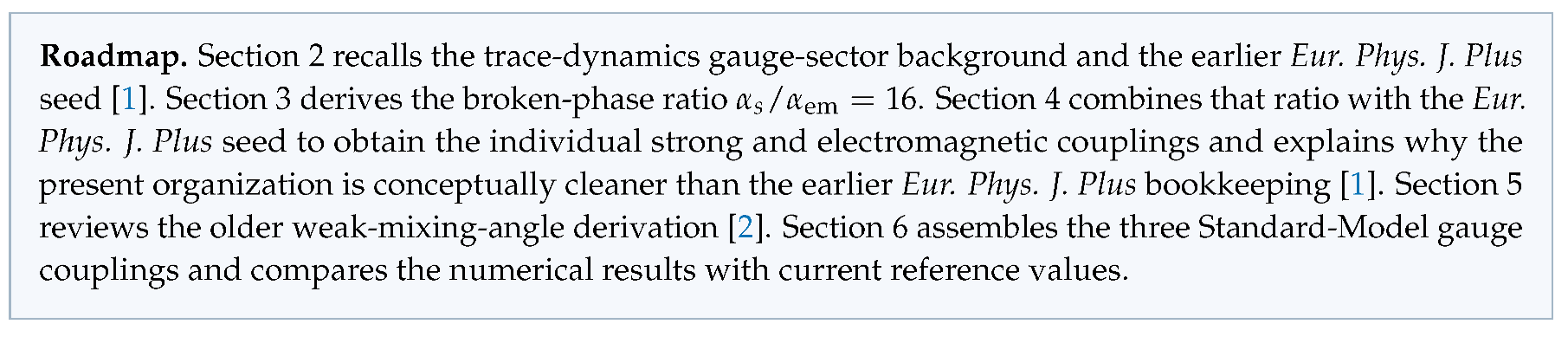
2. Trace-Dynamics Background and the Earlier Eur. Phys. J. Plus Seed
The gauge-sector story begins with the bosonic part of the trace-dynamics Lagrangian. In the notation of Ref. [2], one introduces bosonic and fermionic matrix variables and , and then writes the bosonic velocity in the form
Here L is a characteristic length scale and is a dimensionless parameter generated when scale invariance is broken. At the schematic level, the visible bosonic block takes the form
When this is expanded, one finds three qualitatively different structures:
- 1.
- a pure visible block , from which the photon and the gluons are identified;
- 2.
- a mixed block , from which the weak bosons are identified;
- 3.
- fermionic terms and mixed boson-fermion terms, not needed for the present note.
This split is important. In the present gauge-sector package, color and electromagnetism are read from the same visible block, whereas the weak bosons are associated with the mixed sector.
The earlier Eur. Phys. J. Plus paper [1] then identifies the dimensionless coefficient of the charged visible terms as
To avoid confusion with the gauge couplings and , we denote the earlier exponential seed by A rather than by . In the Eur. Phys. J. Plus paper [1], the anti-down sector is used to define
so that
Numerically, this works remarkably well. Conceptually, however, the origin of the extra factor inside is not as transparent as it could be, because in the original Eur. Phys. J. Plus presentation [1] it is tied to a length-identification step. The aim of the present paper is to separate that bookkeeping into two cleaner pieces:
We will interpret as the primary charged-sector datum and as the visible broken-phase gauge normalization.
3. Broken-Phase Derivation of
3.1. The Standard Visible Charge-Trace Factor
Before introducing any octonionic support hypothesis, one first recalls a standard one-generation normalization. For visible matter with quark charges and and charged-lepton charge , the electromagnetic charge trace is
The factor 3 counts color, and the final is precisely the charged-lepton contribution. If the visible bosonic sector carries a single Yang–Mills coupling g before symmetry breaking, then the canonically normalized abelian coupling at equal support is
so that
This factor is conventional. The new step is the broken-phase support factor.
3.2. The Six Real Ladder Directions and the Support Factor 6
They single out the real six-dimensional space
In the visible bosonic block, the gluon representatives are built from antisymmetric bilinears involving exactly these six directions. This suggests treating as the relevant broken-phase support space for the visible gauge sector.
We now make the effective broken-phase hypothesis used throughout this paper.

Choose an orthonormal support basis for . The normalized abelian trace mode is then
whereas a minimal localized color mode and the relevant matter zero mode may be taken as
Modeling the effective couplings by support overlaps gives
This is the origin of the support factor 6.
3.3. The Ratio 16
Equivalently,
The factor is the standard visible charge-trace normalization, and the factor is the broken-phase support dilution of the democratic electromagnetic mode.
It is important to be honest about the status of this result. The derivation of Equation (19) is conditional: the support factor 6 is not yet derived from a microscopic localization operator. What has been achieved is a precise and geometrically motivated broken-phase mechanism under which the factor 16 follows.
3.3.0.1. Comparison with experiment.
The first comparison is the conservative same-scale benchmark; the second is the mixed-scale comparison that turns out to be especially relevant in the present framework.
4. From the Earlier Eur. Phys. J. Plus Seed to and
4.1. The Charged-Sector Datum
The present reorganization keeps the exponential seed A of the earlier Eur. Phys. J. Plus paper [1], but it interprets the geometric number more directly. In the charged Furey-type first-generation states, two orthogonal components of magnitude give a norm per charged slot. Summing the three charged generation slots gives
This is the number that now enters the color-sector seed.
4.2. The Strong Coupling
Using the earlier Eur. Phys. J. Plus seed A from Equation (5) together with the charged-sector datum (23), we define
Hence
The corresponding QCD gauge coupling is
4.3. The Electromagnetic Coupling
Once Equation (19) is available, the electromagnetic coupling follows immediately:
Substituting Equation (25) gives
Equivalently,
Thus the earlier Eur. Phys. J. Plus formula (6) is recovered exactly, but now as the end of a more structured chain:
4.4. Why the Present Electromagnetic Derivation is Conceptually Sharper
This reorganization makes the electromagnetic derivation more credible than in the earlier Eur. Phys. J. Plus presentation [1] in a specific and limited sense. In the Eur. Phys. J. Plus paper [1], the numerical factor is packaged inside the step , so that the fine-structure constant is obtained directly as . The numerical result is excellent, but the gauge-sector origin of the extra factor is not manifest.
In the present paper the bookkeeping is separated into two distinct ingredients:
This is conceptually cleaner for three reasons.
- The primary charged-sector datum remains , with no hidden extra factor.
- The factor is derived from the visible broken-phase gauge structure, namely the combination .
- The charged-lepton contribution is explicit, because the in is precisely the electron/charged-lepton term.
So “more credible” does not mean that all microscopic questions are solved. The support factor 6 is still a hypothesis. What it means is that the earlier numerical success of the Eur. Phys. J. Plus formula [1] is now attached to a cleaner and more transparent gauge-sector interpretation.
5. Why the Seed Uses Although the Electron Has Charge 1
A natural concern is the following. If the electric charge of the electron is three times that of the down quark, why should the seed be tied to rather than to 1?
The answer is that the seed is not attached to a particular particle species. It is attached to the minimal visible charge quantum. In the octonionic/Furey construction, the charge operator is normalized as [3]
so the visible charge lattice is
The electron therefore does not carry a different primitive charge; it carries three quanta of the same basic unit .
Just as importantly, the electron is not left out of the derivation. Its contribution enters explicitly in the electromagnetic trace factor
where the final is the charged-lepton contribution. The logic is therefore split between two levels:
- the primitive algebraic seed is fixed by the minimal nonzero charge quantum ;
- the fact that the electron has charge enters later through the electromagnetic normalization already used in deriving the factor 16.
This is why using is not in conflict with the existence of the unit-charged electron.

6. Review of the Weak Mixing Angle Derivation
The derivation of the weak mixing angle belongs to the 2022 bosonic-Lagrangian paper [2], not to the present gauge-ratio mechanism. Since the present paper aims to be self-contained, it is useful to summarize that argument briefly.
The starting point is the claim that the transformation from to is a rotation on the spinorial octonionic gauge space. Because this is a spinorial space, the physical gauge-space angle is twice the octonionic one. Thus one writes [2]
In the asymptotic flat limit , the antisymmetric contribution is taken to vanish, and one obtains
where is the fine-structure coupling in that limit.
The next step is to use the standard electroweak relation
together with the additional identifications
These imply
The nontrivial solution is
This derivation is elegant, but it is not on exactly the same footing as the strong and electromagnetic chain. Beyond the half-angle identification, it uses the asymptotic flat limit, drops the antisymmetric term, and assumes the quadratic identifications in Equation (37). In addition, the weak mixing angle is quoted experimentally in several different schemes, so any numerical comparison is inherently more delicate. For that reason the weak-angle part of the present paper should be read as a brief review of Ref. [2], not as the most rigid part of the gauge-sector package.
7. The Three Standard-Model Gauge Couplings and comparison with Experiment
The first two numbers, and e, are tied directly to the closed-form formulas above. The latter two inherit the more tentative status of the weak-angle derivation and should therefore be interpreted with the same caution.
Strong and Electromagnetic Sectors
Weak-Angle Benchmarks
Because the weak mixing angle is scheme dependent, we compare Equation (40) with a small set of standard reference values rather than with a single unique experimental number. The current PDG electroweak review quotes [5]
As a low- benchmark we also quote the SLAC E158 determination [7],
The comparison is summarized in Table 2.
The pattern is clear. The strong and electromagnetic sectors are numerically successful at the percent level or better, while the weak-angle result is substantially more tentative. It lies well above the standard on-shell and collider-effective values, though it comes somewhat closer to the low- benchmark.
8. Summary
The present note reorganizes the gauge sector of the octonionic framework into a single self-contained chain.
- 1.
- Starting from a common visible Yang–Mills coupling in the trace-dynamics Lagrangian, the standard visible normalization combines with a six-direction support factor to give the broken-phase relation
- 2.
- 3.
- The present organization is conceptually sharper than the earlier Eur. Phys. J. Plus bookkeeping [1], because the factor is no longer hidden in a length-identification step but is derived directly from the visible broken-phase gauge structure.
- 4.
- The use of the primitive charge quantum is consistent because it fixes the algebraic seed, whereas the charged-lepton contribution enters explicitly through the electromagnetic charge trace .
- 5.
- The older weak-angle derivation [2] can be summarized compactly, but it remains the least settled part of the package, both conceptually and phenomenologically.
What remains open is the microscopic origin of the support factor 6, i.e. the dynamical reason why the broken visible electromagnetic mode should be democratic on while the color mode remains localized. Until that step is derived, the result should be read as a concrete broken-phase mechanism together with its phenomenological continuation.
References
- Singh, T. P. Quantum gravity effects in the infrared: a theoretical derivation of the low-energy fine structure constant and mass ratios of elementary particles. Eur. Phys. J. Plus 2022, 137, 664. [Google Scholar] [CrossRef]
- Raj, S.; Singh, T. P. A Lagrangian with E8 × E8 symmetry for the standard model and pre-gravitation I: The bosonic Lagrangian, and a theoretical derivation of the weak mixing angle. arXiv 2022, arXiv:2208.09811. [Google Scholar]
- Furey, C. SU(3)C×SU(2)L×U(1)Y(×U(1)X) as a symmetry of division algebraic ladder operators. Eur. Phys. J. C 2018, 78, 375. [Google Scholar] [CrossRef] [PubMed]
- S. Navas et al. (Particle Data Group) Quantum chromodynamics, Review of Particle Physics 2025 update. Available online: https://pdg.lbl.gov/2025/reviews/rpp2025-rev-qcd.pdf.
- et al.; S. Navas et al. (Particle Data Group) Electroweak model and constraints on new physics, Review of Particle Physics 2025 update. Available online: https://pdg.lbl.gov/2025/reviews/rpp2025-rev-standard-model.pdf.
- NIST, CODATA value: inverse fine-structure constant, 2022 CODATA recommended values. Available online: https://physics.nist.gov/cgi-bin/cuu/Value?alphinv=.
- Anthony, P. L.; et al. (SLAC E158 Collaboration), Precision measurement of the weak mixing angle in Møller scattering. Phys. Rev. Lett. 2005, 95, 081601. [Google Scholar] [CrossRef] [PubMed]

Table 1.
Strong and electromagnetic sectors versus experiment.
| Quantity | Theory | Experiment | Deviation |
|---|---|---|---|
Table 2.
Weak-mixing-angle benchmarks versus the octonionic value .
| Benchmark | Experiment | Deviation |
|---|---|---|
| On-shell | ||
| quantity | ||
| Effective leptonic angle | ||
| SLAC E158 low- effective angle |
Disclaimer/Publisher’s Note: The statements, opinions and data contained in all publications are solely those of the individual author(s) and contributor(s) and not of MDPI and/or the editor(s). MDPI and/or the editor(s) disclaim responsibility for any injury to people or property resulting from any ideas, methods, instructions or products referred to in the content. |
© 2026 by the authors. Licensee MDPI, Basel, Switzerland. This article is an open access article distributed under the terms and conditions of the Creative Commons Attribution (CC BY) license (http://creativecommons.org/licenses/by/4.0/).
Copyright: This open access article is published under a Creative Commons CC BY 4.0 license, which permit the free download, distribution, and reuse, provided that the author and preprint are cited in any reuse.


