
Submitted:
31 March 2026
Posted:
01 April 2026
You are already at the latest version
Abstract
Using a parameter that characterizes the damping capacity of the bar material, a mathematical model was developed to control the transverse vibration motion of a slender bar under boundary conditions defined by various support configurations. The model was validated for composite bars reinforced with natural fabrics made of flax, cotton, silk, or hemp fibers, and a hybrid resin matrix containing a 60% volumetric fraction of natural Dammar resin.
Keywords:
composite bar
; transvers vibrations
; mathematical model
1. Introduction
The literature indicates that PFCs (plant fiber composites) exhibit loss factor values ranging from 0.7% to 14%, whereas SFCs (synthetic fiber composites) show values between 0.24% and 2.5% [1]. Therefore, the damping capacity of PFCs is generally significantly higher than that of SFCs. The damping range is also broader. This behavior is related to the wide variety of fibers and their complex structure.
The literature reports differing viewpoints and sometimes contradictory results [2]. This is attributed to the large diversity of bio composites studied, involving various types of plant fibers arranged in different reinforcement architectures and embedded in a wide range of polymer matrices. Therefore, although the damping behavior of PFCs has been documented [3,4], it is not yet fully understood.
Numerous studies have highlighted the potential of flax fibers in terms of specific mechanical properties, low density, and especially their damping characteristics [5,6,7,8,9]. For example, [10] and [11] showed that the damping properties of flax-reinforced composites are significantly higher than those of glass- or carbon-fiber-reinforced composites.
The feasibility of hybrid configurations combining natural fibers and carbon fibers to enhance the damping properties of carbon composites was investigated in [12,13]. In this context, [14] examined the effect of layer stacking sequence on the damping behavior of flax–carbon hybrid composites. A significant increase in damping performance was observed when flax layers were placed on the outer surface of the carbon laminate.
Study [6] reported that the damping of flax-fiber-reinforced composites was 51% higher than that of glass-fiber-reinforced composites. Another study [15] investigated the damping behavior of flax-fiber-reinforced polypropylene (PP) composites using vibration measurements. The composites were manufactured by vacuum bag molding with different fiber volume fractions (31%, 40%, and 50%) and orientations (45°, 60°, and 90°). The results showed that fiber orientation has a greater influence on vibration damping than fiber content.
Vibration studies on hemp fiber-polypropylene composites were conducted in [16] for fiber loadings ranging from 0 to 60%, in 10% increments. The effect of a coupling agent on vibration behavior was also examined. The highest damping ratio was obtained at a hemp content of 30%. The influence of hemp content on the dynamic behavior of glass- and hemp-fiber-reinforced composites was analyzed in [17]. An increase in hemp fiber content led to an increase in the loss factor.
In [18], the dynamic structural and mechanical properties of natural fiber-reinforced polymer composites were investigated both experimentally and numerically. Three types of laminated composites-jute-epoxy and hemp-epoxy-with one, three, and five layers were analyzed.
Among natural fibers, silk is one of the most durable and exhibits excellent mechanical properties, such as stiffness, strength, and ductility [19]. Topics such as the diversity of spider silk, its composition and architecture, the differences between silkworm and spider silk, and the biosynthesis of natural silk were addressed in [20].
Another study [21] investigated the development of biocompatible composites using basalt fibers and ductile silk fibers, together with a polylactic acid (PLA) matrix. Five distinct stacking sequences with alternating layers were fabricated and enhanced by the addition of graphene nano platelets (GNP) at 3, 6, and 9% relative to the PLA matrix. The results showed that the incorporation of 6% GNP improved damping by a factor of 1.54.
2. Materials and Methods
2.1. Theoretical Considerations
Beams represent structural elements frequently encountered in engineering applications, typically analyzed via the Euler-Bernoulli model. This framework relies on the kinematic hypothesis that a plane section, initially normal to the centroidal axis, remains plane and perpendicular to said axis throughout the deformation. The model is further governed by the following assumptions:
- the displacement field is analogous to that of simple bending;
- the transverse deflection is considered a function of the longitudinal coordinate alone;
- the material behavior is defined by a one-dimensional constitutive relation;
- the beams are subjected exclusively to transverse external loading;
- the boundary conditions remain constant, with no auxiliary supports emerging during deformation.
The Euler-Bernoulli theory hypotheses are valid exclusively for beams where the cross-sectional dimensions are small relative to the total length.
Due to internal friction and aerodynamic interaction, the transverse vibrations of the beams are damped. The inclusion of energy dissipation mechanisms is now a standard requirement in all models used for the simulation of mechanical vibrations in structural systems. Numerous studies have investigated various aspects and mechanisms of this phenomenon, as well as its influence on the vibratory behavior of different composite materials [22,23,24,25,26,27,28].
In the presence of damping, the governing equation of motion is expressed as follows [29]:
where
● is the displacement of the elastic centre of the bar section;
and
with
● is the mass per unit length of the bar;
● is the stiffness of the bar;
● is the density of the material of the bar;
● is the Young’s modulus of the material of the bar.
The term introduces external or viscous damping. Under this model, the amplitudes of all vibration modes (modal amplitudes) are attenuated at a uniform rate, which contradicts experimental observations. A natural interpretation of term is that the damping force is proportional to the bending velocity of the beam. The presence of term implies that the damping rates of the natural modes of vibration are proportional to the square of the frequency, characterizing the Kelvin-Voigt model of internal damping.
Experimental data indicate that, for damped vibrations, the predominant mechanism involves a damping force proportional to the bending velocity. Under these conditions, the equation of motion for the transverse vibrations of a slender beam can be expressed as:
where represents a parameter characterizing the damping capacity of the beam material.
The solution to Equation (3) is expressed as:
where and .
Leads to:
The determination of the constants and is performed based on the boundary conditions defined by the specific support configuration of the beam.
Case 1. Simply supported beam (Supported-supported beam).
The boundary conditions for this case are given by
To obtain non-trivial solutions, it is required that
Case 2. Cantilever beam (Clamped-free beam).
The boundary conditions for this case are given by
For non-zero solutions to exist, we must have
Case 3. Fully clamped beam (Clamped-clamped).
The boundary conditions for this case are given
To obtain non-trivial solutions, it is required that
Case 4. Propped cantilever beam (Clamped-supported beam).
The boundary conditions for this case are given
For non-zero solutions to exist, we must have
Equations (8), (13), (16) and (19) each admit a solution for every vibration mode. If, and represent the real and imaginary parts of the function , respectively, then the damping factor, the natural frequency and the damping ratio for the vibration mode are given by:
Table 1 presents the values for components and , as well as the damping ratio , of the first vibration mode, for each of the four types of boundary conditions across various values of parameter .
2.2. Specimen Preparation
Composite beams were fabricated using a Dammar-based hybrid resin, reinforced with fabrics made of flax, cotton, silk, or hemp fibers.
The mechanical properties of the utilized fibers are presented in Table 2.
The hybrid resin was synthesized by combining natural Dammar resin with a synthetic counterpart. The volumetric fraction of Dammar was 60%, with the remainder being Resoltech 1050 epoxy resin, utilized in conjunction with its corresponding Resoltech 1055 hardener. Specimens were fabricated with a width of 20 mm and a length of 240 mm. The casting process was conducted at a controlled temperature of 21–23°C. The principal properties of the investigated composite materials are summarized in Table 3.
The four specimens used for the vibration analysis are shown in Figure 1.
2.3. Testing Equipment
Vibration analysis was executed using SPIDER 8 acquisition system coupled with NEXUS 2692-A-0I4 signal conditioner and a 0.04 pC/ms-2 sensitivity accelerometer. Measurement protocols utilized a frequency bandwidth of 0 to 2.400 Hz. Potential experimental artifacts were eliminated by implementing a Butterworth “High-Pass” filter at 3 Hz.
3. Results
The beams were clamped at one end, with the cantilever lengths set to 120 mm, 140 mm, 160 mm, 180 mm, and 200 mm, respectively. For each specimen, the free vibrations-induced by an initial deformation resulting from a point load applied at the free end-were recorded. Two measurements were performed for each specific length. Figure 2 illustrates an experimental recording for the hemp-reinforced specimen with an effective free length of 200 mm.
For each recording, the frequency, damping factor, damping ratio and loss factor were determined using the following relations (see [28]):
● frequency ;
● damping factor ;
● damping ratio ;
● loss factor ;
where
● and represent the time instances at which two local maxima of the experimentally recorded signal are obtained;
● represents the peak value at time and represents the peak value at time ;
● denotes the number of oscillations occurring during the interval .
Table 4 presents the mean values obtained from the two measurements for each experimental test.
Figure 3 illustrates the variation of the vibration frequency as a function of the beam length for the four composite specimens.
Figure 4 illustrates the variation of the vibration damping factor as a function of the beam length for the four composite specimens.
4. Discussion
The calculated average damping ratio and loss factor for the four composite materials are as follows:
● flax fabric reinforced composite: , ;
● cotton fabric reinforced composite: , ;
● silk fabric reinforced composite: , ;
● hemp fabric reinforced composite: , .
The corresponding values of parameter , to be utilized in the transverse vibration equation, are as follows:
● flax fabric reinforced composite: ;
● cotton fabric reinforced composite: ;
● silk fabric reinforced composite: ;
● hemp fabric reinforced composite: .
5. Conclusions
Vibration damping depends on the inertial and elastic properties of the materials, the beam dimensions, and the boundary conditions. Consequently, for a simply supported beam, the parameter used in the equation of motion coincides with the damping ratio. Conversely, for the other support configurations, the damping ratio increases with the parameter , although the relationship is no longer strictly linear.
Since the dimensions and constituent proportions of the investigated specimens are similar, the discrepancies observed in the experimental results are attributed to the variations in the mechanical properties of the reinforcement fabrics. It is observed that the beams reinforced with cotton or silk fabrics exhibit damping properties superior to those reinforced with flax or hemp fabrics.
The most significant vibration damping properties were observed in the silk-reinforced beam, which exhibits the lowest elastic modulus and the highest elongation at break. Conversely, the hemp-reinforced beam-characterized by the highest elastic modulus and the lowest elongation at break-yielded the lowest damping performance.
It can be concluded that reinforcement materials with higher deformability are preferable for developing composite materials with enhanced vibratory performance.
Author Contributions
Conceptualization, B.D. and S.M.M.; methodology, B.D. and S.M.M.; validation, B.D., S.M.M. and B.A.; formal analysis, B.D. and S.M.M.; investigation, B.D., S.M.M. and B.A.; resources, B.D., S.M.M. and B.A.; data curation, B.D. and S.M.M.; writing—original draft preparation, B.D. and S.M.M.; writing—review and editing, B.D., S.M.M. and B.A.; visualization, B.A.; supervision, B.D. and S.M.M.; project administration, B.D. and S.M.M.; funding acquisition, B.A. All authors have read and agreed to the published version of the manuscript.
Funding
This research received no external funding.
Data Availability Statement
The original contributions presented in the study are included in the article, further inquiries can be directed to the corresponding author.
Conflicts of Interest
The authors declare no conflicts of interest.
References
- Kalusuraman, G.; Kumaran, S.T.; et al. Vibration studies on fiber reinforced composites – a review. J. Nat. Fibers 2022, 20. [Google Scholar] [CrossRef]
- Saba, N.; Jawaid, M.; O.Y., A.; Paridah, M.T. A review on dynamic mechanical properties of natural fibre reinforced polymer composites. Constr. Build. Mater. 2016, 106, 149–159. [Google Scholar] [CrossRef]
- Duc, F.; Bourban, P.E.; Plummer, C.J.G.G.; Manson, J.A.E.E. Damping of thermoset and thermoplastic flax fibre composites. Compos. –A: Appl. Sci. Manuf. 2014, 64, 115–123. [Google Scholar] [CrossRef]
- Duc, F.; Bourban, P.E.; Manson, J.A.E. The role of twist and crimp on the vibration behaviour of flax fibre composites. Compos. Sci. Technol. 2014, 102. [Google Scholar] [CrossRef]
- Yan, L.; Chouw, N.; Jayaraman, K. Flax fibre and its composites - a review. Compos. B Eng. 2014, 56, 296–317. [Google Scholar] [CrossRef]
- Prabhakaran, S.; Krishnaraj, V.; Senthil Kumar, M.; Zitoune, R. Sound and vibration damping properties of flax fiber reinforced composites. Procedia Eng. 2014, 97, 573–581. [Google Scholar] [CrossRef]
- Monti, A.; El Mahi, A.; Jendli, Z.; Guillamat, L. Experimental and finite elements analysis of the vibration behaviour of a bio-based composite sandwich beam. Compos. B Eng. 2017, 110, 466–475. [Google Scholar] [CrossRef]
- Cheour, K.; Assarar, M.; Scida, D.; Ayad, R.; Gong, X.L. Effect of water ageing on mechanical and damping properties flax-fibre reinforced composite materials. Compos. Struct. 2016, 152, 259–266. [Google Scholar] [CrossRef]
- Le Guen, M.J.; Newmana, R.H.; Fernyhough, A.; Staiger, M.P. Tailoring the vibration damping behaviour of flax fibre-reinforced epoxy composite laminates via polyol additions. Compos.–A: Appl. Sci. Manuf. 2014, 67, 37–43. [Google Scholar] [CrossRef]
- Wielage, B.; Lampke, T.; Utschick, H.; Soergel, F. Processing of natural-fibre reinforced polymers and the resulting dynamic-mechanical properties. J. Mater. Process Technol. 2003, 139, 140–146. [Google Scholar] [CrossRef]
- Duc, F.; Bourban, P.E.; Manson, J.A.E. Dynamic mechanical properties of epoxy/flax fibre composites. J. Reinf. Plast. Compos. 2014, 33, 1625–1633. [Google Scholar] [CrossRef]
- Ashorth, S.; Rongong, J.; Wilson, P.; Meredith, J. Mechanical and damping properties of resin transfer moulded jute-carbon hybrid composites. Compos. B Eng. 2016, 105, 60–66. [Google Scholar] [CrossRef]
- Li, Y.; Cai, S.; Huang, X. Multi-scaled enhancement of damping property for carbon fiber reinforced composites. Compos. Sci. Technol. 2017, 143, 89–97. [Google Scholar] [CrossRef]
- Assarar, M.; Zouari, W.; Sabhi, H.; Ayad, R.; Berthelot, J.M. Evaluation of the damping of hybrid carbon-flax reinforced composites. Compos. Struct. 2015, 132, 148–154. [Google Scholar] [CrossRef]
- Rahman, M.Z.; Jayaraman, K.; Mace, B.R. Influence of damping on the bending and twisting modes of flax fibre-reinforced polypropylene composite. Fibers Polym. 2018, 192, 375–382. [Google Scholar] [CrossRef]
- Etaati, A.; Mehdizadeh, S.A.; Wang, H.; Pather, S. Vibration damping characteristics of short hemp fibre thermoplastic composites. J. Reinf. Plast. Compos. 2013, 33, 330–341. [Google Scholar] [CrossRef]
- Indra Reddy, M.; Srinivasa Reddy, V. Dynamic mechanical analysis of hemp fiber reinforced polymer matrix composites. IJERT 2014, 3, 410–415. [Google Scholar] [CrossRef]
- Singh, S.P.; Dutt, A.; Hirwani, C.K. Mechanical, modal and harmonic behavior analysis of jute and hemp fiber reinforced polymer composite. J. Nat. Fibers 2022, 20, 2140328. [Google Scholar] [CrossRef]
- Ranakoti, L.; Gupta, M.K.; P.K., R. Silk and silk-based composites: opportunities and challenges Volume Chapter: 7; Springer Nature Singapore Pte Ltd., 2019. [Google Scholar]
- Kiseleva, A.P.; Krivoshapkin, P.V.; Krivoshapkina, E.F. Recent advances in development of functional spider silk-based hybrid materials. Front. Chem. 2020, 8, 554. [Google Scholar] [CrossRef]
- Hamim, R.; Hasan, T.; Shahriar, F.; Chowdhury, S.R.; Rahman, A.; Nasim, M.; Habib, M.A. Basalt-silk fiber reinforced PLA composites: Effect of graphene fillers and stacking sequence. Compos. Part C-Open 2025, 16, 100564. [Google Scholar] [CrossRef]
- Kumar, N.; Singh, S.P. Vibration and damping characteristics of plat-bands with active constrained layer treatments under parametric variations. Materials & Design 2009, 30, 4162–4174. [Google Scholar] [CrossRef]
- Stănescu, M.M.; Bolcu, D.; Pastramă, S.D.; Ciucă, I.; Manea, I.; Baciu, F. Determination of damping factor at the vibrations of composite bars reinforced with carbon and kevlar texture. Mater. Plast. 2010, 47, 492–496. [Google Scholar]
- Sarlin, E.; Liu, Y.; Vippola, M.; Zogg, M.; Ermanni, P.; Vuornien, J.; Lepisto, T. Vibration damping properties of steel/rubber/composite hybrid structures. Compos. Struct. 2012, 94, 3327–3335. [Google Scholar] [CrossRef]
- Bowyer, E.P.; Krylov, V.V. Experimental investigation of damping flexural vibrations in glass fibre composite plates containing one- and two-dimensional acoustic black holes. Compos. Struct. 2014, 107, 406–415. [Google Scholar] [CrossRef]
- Yang, J.; Xiong, J.; Ma, L.; Zhang, G.; Wang, X.; Wu, L. Study on vibration damping of composite sandwich cylindrical shell with pyramidal truss-like cores. Compos. Struct. 2014, 117, 362–372. [Google Scholar] [CrossRef]
- Vanwalleghem, J.; De Baere, I.; Loccufier, M.; Van Paepegem, W. External damping losses in measuring the vibration damping properties in lightly damped specimens using transient time-domain methods. J. Sound Vib. 2014, 333, 1596–1611. [Google Scholar] [CrossRef]
- Burada, C.O.; Miritoiu, C.M.; Stanescu, M.M.; Bolcu, D. The vibration behaviour of composite sandwich bars reinforced with glass fiber. Rev. Rom. Mater. 2015, 45, 244–254. [Google Scholar]
- Hermann, L. Vibration of the Euler-Bernoulli beam with allowance for dampings. In Proceedings of the World Congress on Engineering 2008 (WCE 2008), London, UK, 2–4 July 2008, 2008. [Google Scholar]
- Ciuca, I.; Bolcu, A.; M.M., S. A study on some mechanical properties of bio-composite materials with a Dammar-based matrix. EEMJ 2017, 16, 2851–2856. [Google Scholar]
Figure 1.
Specimens utilized for vibration analysis.
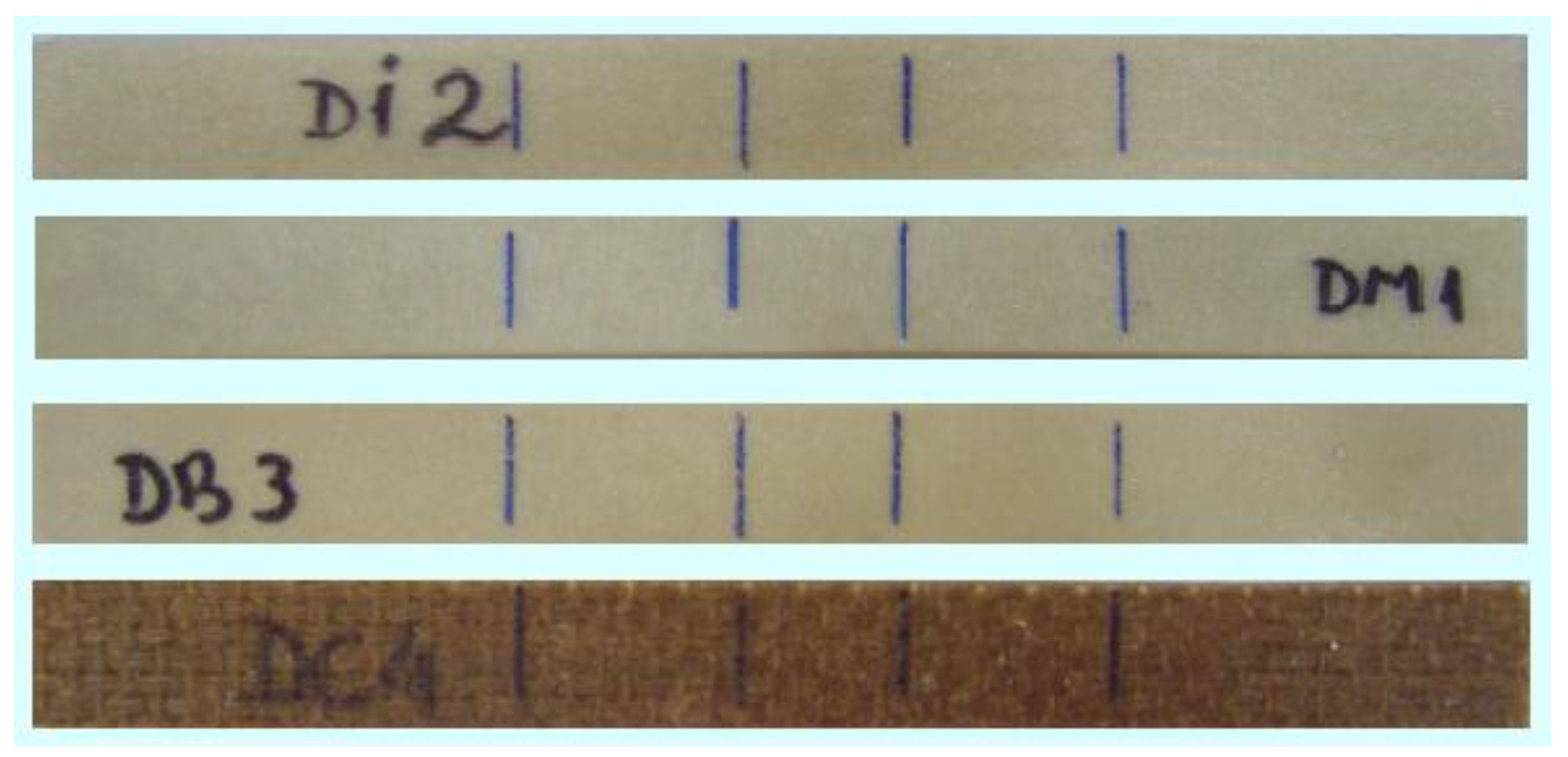
Figure 2.
Experimental recording for the hemp-reinforced specimen with a free length of 200 mm.
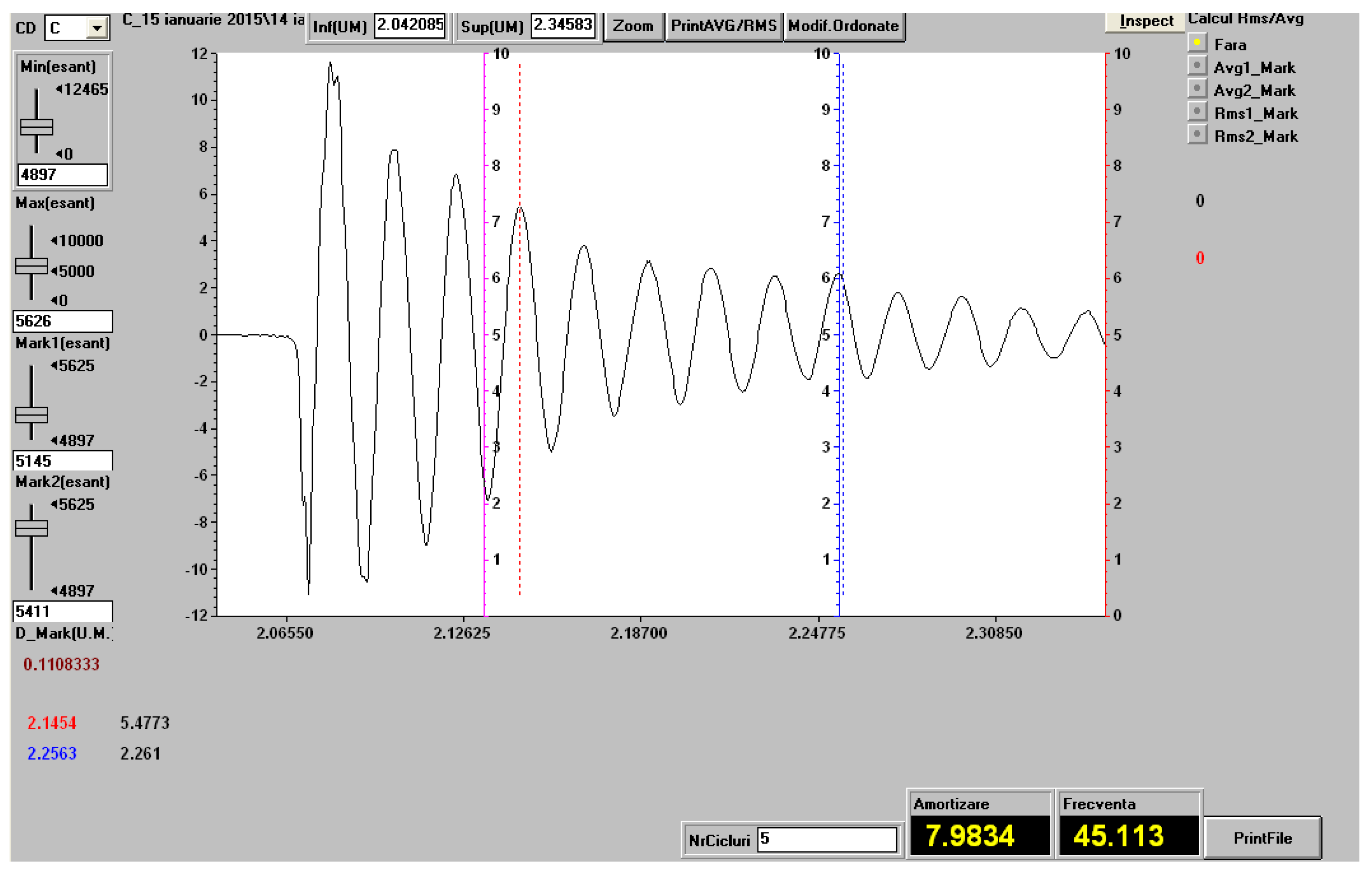
Figure 3.
Vibration frequency versus beam length.
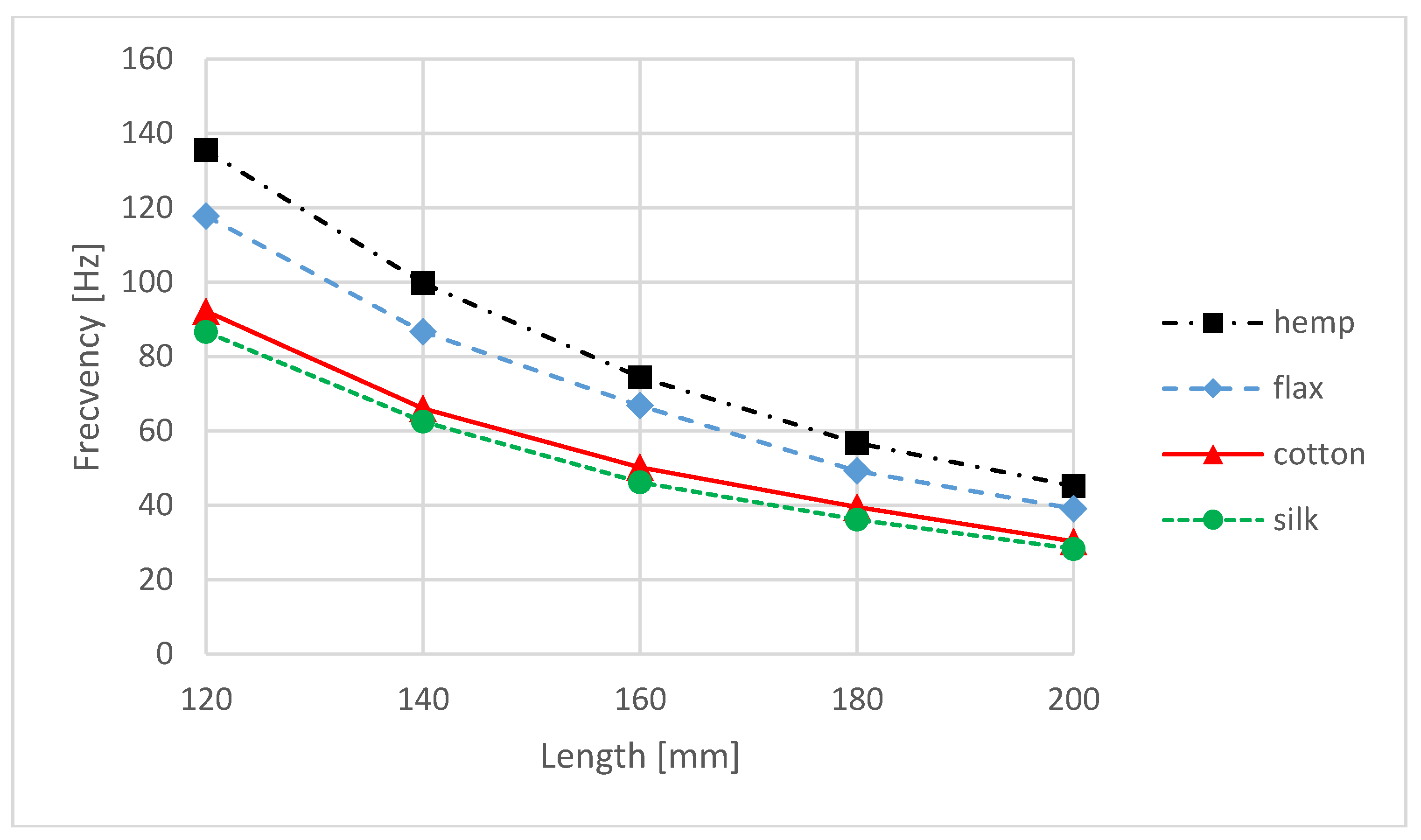
Figure 4.
Damping factor versus beam length.
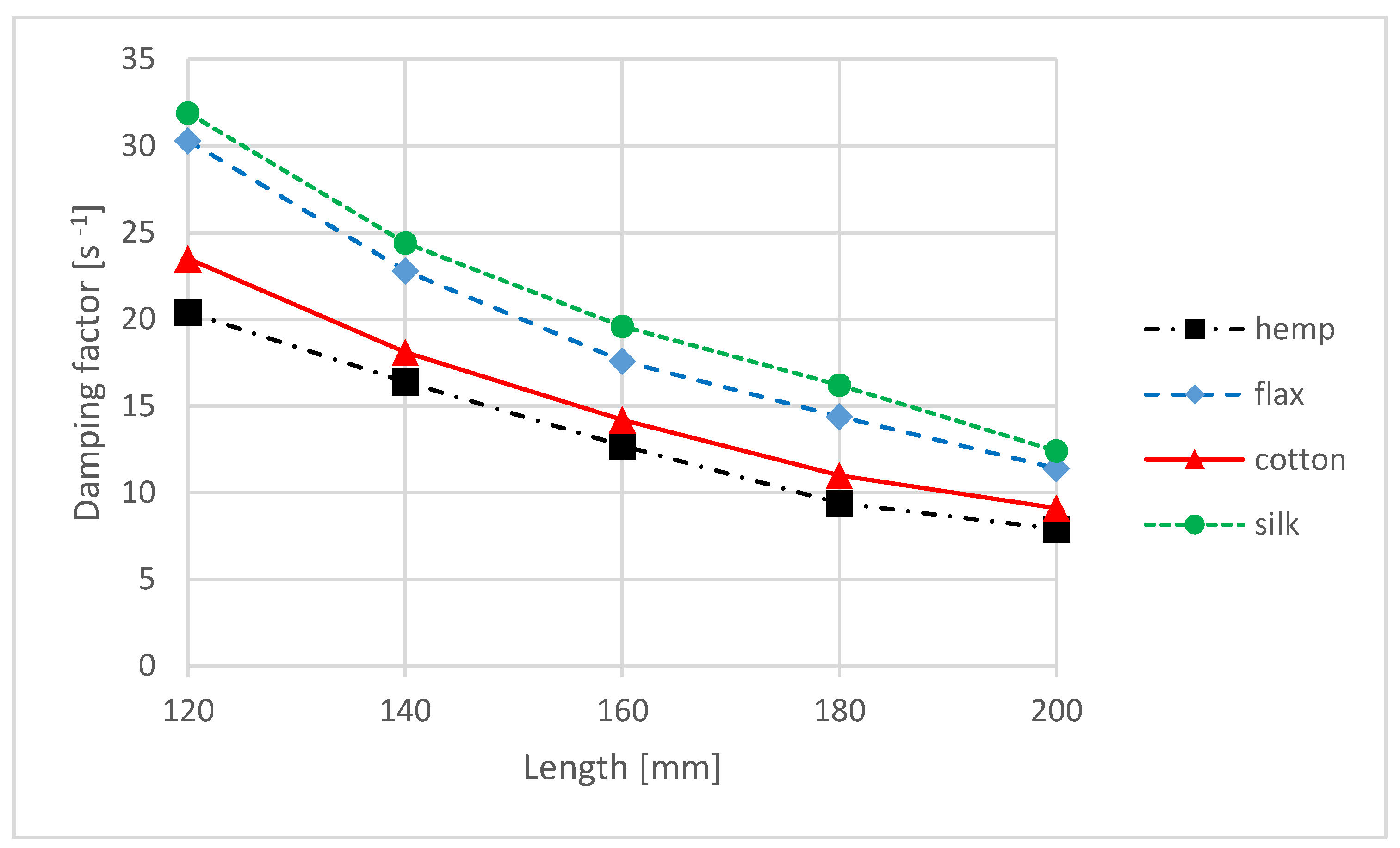

Table 1.
Values of , , for the first vibration mode, across various values of parameter .
| Beam configuration | ) | |||
|---|---|---|---|---|
| Supported-supported | 0 | 0 | ||
| 0.05 | 0.05 | |||
| 0.1 | 0.1 | |||
| 0.15 | 0.15 | |||
| 0.2 | 0.2 | |||
| Clamped-free | 0 | 1.875104069 | 1.875104069 | 0 |
| 0.05 | 1.851412407 | 1.901766366 | 0.02682787047 | |
| 0.1 | 1.831148407 | 1.930841007 | 0.05296274351 | |
| 0.15 | 1.814653599 | 1.961688103 | 0.07775352462 | |
| 0.2 | 1.802146038 | 1.993609875 | 0.1006270828 | |
| Clamped-lamped | 0 | 4.730040745 | 4.730040745 | 0 |
| 0.05 | 4.627364110 | 4.851229318 | 0.04720962142 | |
| 0.1 | 4.550523752 | 4.974774434 | 0.08890235886 | |
| 0.15 | 4.495661633 | 5.084847965 | 0.1225334384 | |
| 0.2 | 4.452873085 | 5.171729010 | 0.1485501468 | |
| Clamped-supported | 0 | 3.926602312 | 3.926602312 | 0 |
| 0.05 | 3.852701250 | 3.999331134 | 0.03733524309 | |
| 0.1 | 3.777524677 | 4.070984831 | 0.07467671467 | |
| 0.15 | 3.700961529 | 4.141655833 | 0.1120307523 | |
| 0.2 | 3.622891116 | 4.211433285 | 0.1494039085 |
Table 2.
Principal mechanical properties of the reinforcement fibers (see [30]).
Table 2.
Principal mechanical properties of the reinforcement fibers (see [30]).
| Fiber |
Density (g/cm3) |
Elongation (%) |
Tensile strength (MPa) |
Elastic Modulus (MPa) |
| Cotton | 1.5-1.6 | 7.0-8.0 | 287-800 | 5.5-12.6 |
| Flax | 1.5 | 2.7-3.2 | 345-1100 | 27-39 |
| Hemp | 1.4-1.5 | 2-4 | 310-750 | 30-60 |
| Silk | 1.3-1.4 | 18-33 | 160-260 | 4-6 |
Table 3.
Mechanical properties of the investigated composite materials.
| Reinforcement type | Flax | Cotton | Silk | Hemp |
| Areal density | ||||
| Number of layers | 16 | 26 | 30 | 8 |
| Resin mass ratio | 0.52 | 0.52 | 0.51 | 0.54 |
| Composite density | ||||
| Specimen thickness | 7.9 | 8.0 | 7.8 | 8.1 |
Table 4.
Mean values of frequency, damping factor, damping ratio, and loss factor.
| Reinforcement type | Free length (mm) | Frequency (Hz) | Damping factor() | Damping ratio | Loss factor |
|
Flax |
120 | 117.8 | 30.3 | 0.0409 | 0.0818 |
| 140 | 86.6 | 22.8 | 0.0419 | 0.0838 | |
| 160 | 66.8 | 17.6 | 0.0419 | 0.0838 | |
| 180 | 49.2 | 14.4 | 0.0465 | 0.0930 | |
| 200 | 39.1 | 11.4 | 0.0464 | 0.0928 | |
|
Cotton |
120 | 90.2 | 23.5 | 0.0415 | 0.0830 |
| 140 | 64.1 | 18.1 | 0.0449 | 0.0898 | |
| 160 | 50.2 | 14.2 | 0.0450 | 0.0900 | |
| 180 | 39.6 | 11.0 | 0.0442 | 0.0884 | |
| 200 | 30.3 | 9.1 | 0.0478 | 0.0956 | |
|
Silk |
120 | 86.6 | 31.9 | 0.0586 | 0.1172 |
| 140 | 62.5 | 24.4 | 0.0621 | 0.1242 | |
| 160 | 46.2 | 19.6 | 0.0675 | 0.1350 | |
| 180 | 36.1 | 16.2 | 0.0714 | 0.1428 | |
| 200 | 28.3 | 12.4 | 0.0697 | 0.1394 | |
|
Hemp |
120 | 135.4 | 20.4 | 0.0239 | 0.0478 |
| 140 | 99.8 | 16.4 | 0.0261 | 0.0522 | |
| 160 | 74.5 | 12.7 | 0.0271 | 0.0542 | |
| 180 | 56.7 | 9.4 | 0.0264 | 0.0528 | |
| 200 | 45.2 | 7.9 | 0.0278 | 0.0556 |
Disclaimer/Publisher’s Note: The statements, opinions and data contained in all publications are solely those of the individual author(s) and contributor(s) and not of MDPI and/or the editor(s). MDPI and/or the editor(s) disclaim responsibility for any injury to people or property resulting from any ideas, methods, instructions or products referred to in the content. |
© 2026 by the authors. Licensee MDPI, Basel, Switzerland. This article is an open access article distributed under the terms and conditions of the Creative Commons Attribution (CC BY) license.
Copyright: This open access article is published under a Creative Commons CC BY 4.0 license, which permit the free download, distribution, and reuse, provided that the author and preprint are cited in any reuse.


