

Submitted:
31 March 2026
Posted:
03 April 2026
You are already at the latest version
Abstract
Alcohol use disorder (AUD) is a major contributor to global disease burden and a leading cause of preventable death, yet available treatments remain modestly effective. Although rodent models are widely used to study alcohol-related behaviors and guide pharmacotherapy development, many treatments with strong preclinical efficacy fail clinically. Here, we propose a reward-component framework that separates ethanol intake into four components: pre-oral, oral, post-oral peripheral, and post-oral central drug rewards. Synthesizing behavioral, pharmacological, and neurobiological evidence, we find that the component primarily sustaining high ethanol intake in rodents remains unclear, with intake reflecting mixed oral and post-oral rewards. In contrast, human AUD is predominantly sustained by post-oral central drug reward, creating a translational misalignment in pharmacotherapy testing. Pharmacotherapies act across multiple components, and translational failure may arise from misalignment between the components sustaining drinking in rodent models and human AUD. This framework provides a basis for developing more predictive preclinical models and more effective pharmacological interventions.
Keywords:
alcohol use disorder
; ethanol reward
; harmacotherapy
; translational research
1. Introduction: A Multi-Reward Component Framework for Ethanol Intake
Alcohol use disorder (AUD) remains a leading cause of preventable morbidity and mortality worldwide, yet pharmacological progress has been limited and approved pharmacotherapies produce modest and heterogeneous effects [1,2,3]. Despite the central role of rodent models in linking molecular and circuit mechanisms to alcohol-related behaviors and guiding pharmacotherapy development, several treatments with robust preclinical efficacy—including CRF1 receptor antagonists and, more recently, histamine H3 receptor inverse agonists—have failed in clinical trials [4,5,6,7,8]. Translational failures are sometimes attributed to inadequate face validity of rodent models; however, widely used paradigms reproduce key outward features of AUD, including high intake, escalation, relapse-like rebounds, tolerance, and withdrawal [9,10,11]. The selectively bred alcohol-preferring (P) rat illustrates this clearly, reliably achieving high voluntary intake (~5–8 g/kg/day) and pharmacologically relevant blood ethanol concentrations (BEC), alongside high motivation for ethanol, escalation, and dependence-relevant phenotypes [12,13,14,15].
A more fundamental issue may instead be a misalignment between the reward and motivational components of drinking in humans with AUD and those engaged in rodent models. In clinical AUD, drinking is predominantly and increasingly controlled by alcohol’s post-oral central drug effects, defined as the rewarding effects of ethanol and its metabolites resulting from their direct pharmacological actions within brain reward circuitry. Accordingly, high intake or BEC in rodents are insufficient for pharmacotherapy discovery unless drinking is meaningfully controlled by this component, rather than by other non-drug reward components. This issue is particularly critical for ethanol because, unlike most drugs of abuse—which are typically administered via routes such as injection, inhalation, or insufflation and act through direct pharmacological effects in the brain—ethanol is consumed orally. As a result, ethanol engages multiple reward components beyond its central drug effects, including oral reward (e.g., taste and trigeminal signals) and post-oral peripheral reward (e.g., caloric, metabolic, and gut-derived interoceptive signals conveyed via peripheral–central pathways). Therefore, ethanol engages the brain reward circuitry both directly, via its pharmacological effects, and indirectly, via sensory and peripheral physiological signals. Consequently, high intake in rodents can be sustained by different reward components that may not align with those controlling drinking in clinical AUD. Which reward components predominantly control ethanol drinking across commonly used rodent models, however, remains unclear. This uncertainty has direct translational consequences: a pharmacotherapy may appear effective in rodents by modifying the components controlling intake in a given model or procedure, yet fail clinically if it does not meaningfully engage the post-oral central drug reward component that predominates in patients.
To address this gap, we ask a central question: do standard strains and selectively bred high-drinking lines drink mainly to obtain ethanol’s central drug effects, or is drinking dominated by other reward components such as oral and peripheral signals (e.g., palatability, caloric value, and gut-derived peripheral signals)? Guided by a recent framework distinguishing post-oral signals, oral cues, and learned predictors of intake [16], and because ethanol is both a psychoactive drug and an energy substrate [17], we parse ethanol reward into four reward components (Figure 1): pre-oral reward, oral reward, post-oral peripheral reward, and post-oral central drug reward. The pre-oral reward component reflects anticipatory processes controlled by learned predictors of ethanol (e.g., contexts and discrete cues) that acquire value through association with other components. The oral reward component include signals arising within the oral cavity, including taste, trigeminal, and retronasal inputs. The post-oral peripheral reward component encompasses signals generated after ingestion, including the detection of ethanol oxidation and delayed physiological feedback. These signals may arise from peripheral detection of nutrient and energy availability (e.g., glucose oxidation, intestinal lipid and glucose sensing) or improvements in physiological state (e.g., rehydration), and are conveyed to the brain via peripheral–central pathways such as vagal and brainstem circuits [18,19]. The post-oral central drug reward component reflects the rewarding effects of ethanol and its metabolites arising from their direct pharmacological actions within brain reward circuitry. These components are further shaped by modulatory factors such as tolerance, aversive learning, stress responsivity, and gut–autonomic signaling. This framework clarifies which reward components are engaged by a given model and provides a basis for aligning models, reward components, and pharmacotherapies.
In this Review, we synthesize behavioral, pharmacological, metabolic, and circuit-level evidence across standard strains and selectively bred high-drinking lines to estimate the contribution of each reward component and to determine when high intake primarily reflects a post-oral central drug reward component or alternative oral, peripheral, and pre-oral components. We then examine pharmacotherapy outcomes through this reward-component framework by (i) asking whether misalignment between the component(s) modified by a pharmacotherapy, the component(s) controlling intake in the preclinical model, and the component(s) sustaining drinking in clinical AUD can account for translational failures, and (ii) identifying which reward components are modified by clinically used and emerging pharmacotherapies. Finally, we outline experimental strategies that orthogonally manipulate oral reward, post-oral peripheral reward, and post-oral central drug reward to quantify component contributions, strengthen construct validity, and improve translation for AUD pharmacotherapy development.
2. Evidence for Distinct Reward Components Across Rodent Models
2.1. Evidence for Post-Oral Reward Components
This section evaluates two post-oral reward components: post-oral central drug reward and post-oral peripheral reward. We first review paradigms that minimize oral reward while leaving both post-oral components intact, and then discuss approaches that more selectively isolate each component.
2.1.1. The Post-Oral Peripheral Reward and Central Drug Reward Components Together
Here we discuss paradigms that minimize or remove the oral component yet leave both post-oral reward components available. Intragastric delivery removes the oral reward component of ethanol but retains gastric and post-absorptive components, whereas intravenous delivery removes both oral and peripheral gastric reward components while retaining systemic post-absorptive exposure. Intragastric delivery removes the oral component while preserving post-oral components, including central drug reward as well as both gut-derived and post-absorptive peripheral reward. In contrast, intravenous delivery removes oral and gut-derived peripheral rewards while preserving systemic post-oral components. We evaluate whether intake persists under these conditions, the doses that sustain behavior, and how route-specific results constrain inference about post-oral control.
2.1.1.1. The Post-Oral Components Without the Oral Component: Intragastric Self-Infusion
To bypass the oral component, a transesophageal catheterization procedure delivered ethanol directly into the stomach [20,21]. Rats licked a neutral flavored solution (e.g., almond or banana) in the home cage with food available ad libitum, with each lick triggering an intragastric infusion of ethanol (10–40%) or water. After brief water-restricted training, P rats self-infused up to 9.4 g/kg/day, reaching BEC (92–415 mg/dL) well within the intoxicating range, despite never tasting or smelling ethanol. In contrast, non-preferring (NP) rats did not self-infuse. Importantly, consumption scaled with concentration (10–40%), suggesting that higher doses were more reinforcing, and intake dropped when ethanol was replaced with water and recovered when reinstated. This contrasts with carbohydrate-conditioned flavor preferences that typically endure for weeks without further nutrient, implying a stronger, longer-lasting post-oral nutritive component [22,23]. In Wistar and Sprague–Dawley rats, higher preference for ethanol-paired flavors after intragastric conditioning emerged only with sucrose fading, induced dependence, or food deprivation [24,25,26]. Only one study showed that in ad libitum–fed Sprague–Dawley rats, pairing a flavor with intragastric 5% ethanol produced a flavor preference when later tested without ethanol [26]. However, persistence was assessed only over two days, leaving durability uncertain as in P rats, ethanol seeking in intragastric self-infusion procedures extinguished within three days when ethanol was replaced with water. In High- and Low-Alcohol Preferring mice (HAP2, LAP2), the pronounced oral intake difference was markedly reduced under intragastric delivery, implicating pre- and intraoral cues as well as gut signaling as important contributors to the phenotype [11,27]. These findings indicate that post-oral components can sustain ethanol intake in P rats when the oral component is absent. At the same time, inference is constrained by small samples (n = 4–6), lack of replication, and the observation that oral intake exceeded intragastric intake by ~50% at 10% ethanol—consistent with a substantial role of oral components. Intermediate oral versus intragastric comparisons at higher concentrations (20–40%) were not reported. Finally, intragastric delivery cannot dissociate post-oral peripheral reward from central drug reward.
2.1.1.2. The Post-Oral Components Without the Oral Component and Peripheral Gastric Post-Oral Reward: Intravenous Self-Infusion
To remove both oral component and post-oral peripheral gut reward, studies have delivered ethanol intravenously via jugular catheters. In one study, P rats pressed a lever for 1% sucrose either alone or paired with intravenous ethanol infusions (20%, 25 mg/kg/infusion) [28]. Responding declined when ethanol was paired with sucrose compared to sucrose alone, and error responses increased during ethanol-paired sessions, suggesting that ethanol’s post-oral reward effects were not strongly rewarding and could even be mildly aversive. Some exploratory responding occurred when ethanol-paired cues appeared early in the session, but overall intake remained low. Comparable results were obtained in alcohol-preferring AA and alcohol-avoiding ANA rats: while both readily acquired intravenous heroin self-administration, only AA rats maintained limited intravenous ethanol intake (1–4 mg/kg/infusion), with total consumption rarely exceeding 10 mg/kg per session [29]. Given redistribution and metabolism, such levels are unlikely to produce intoxicating BEC. Responding did not scale robustly with dose, consistent with contributions from conditioned cues or pharmacokinetics rather than drug reward per se [30]. More broadly, intravenous ethanol is a weak reinforcer in rats, with reliable self-administration requiring sucrose fading, prior dependence, or even co-administration with other drugs [30]. In mice, strain differences observed with oral intake (e.g., C57BL/6J vs DBA/2J) largely disappeared under intravenous delivery, again implicating pre-oral and oral factors in ethanol preference [31,32,33]. Across rat and mouse lines, intravenous ethanol supports at best low, inconsistent responding and rarely produces intoxicating exposure, indicating that post-oral central drug reward without oral components and post-oral peripheral gastric reward is typically insufficient to sustain robust intake.
2.1.2. The Post-Oral Central Drug Reward Component
This subsection evaluates whether post-oral central drug reward can meaningfully contribute to ethanol drinking in the absence of other reward components. We review evidence that links behavior to internal pharmacological state (titration and drug discrimination), distinguishes pharmacological consequences from pharmacological control (dependence/withdrawal), and tests causal roles for ethanol-derived metabolites within mesolimbic circuits.
2.1.2.1. Pharmacological Regulation by Internal Cues: Titration and Drug Discrimination
A central prediction of post-oral central drug reward control is that animals adjust intake according to internal pharmacological state (e.g., BEC). With continuous access to 10% ethanol and water, P rats reduced oral intake when systemic levels were elevated by intravenous ethanol (175% baseline intake) or by 4-methylpyrazole (alcohol dehydrogenase inhibitor), which slows metabolism and prolongs high BEC [34]. Intake suppression was closely correlated with BEC (~50–100 mg%). Intake never dropped to zero, indicating that pharmacological feedback constrains but does not abolish drinking and may reflect negative feedback, satiety, or metabolic aversion rather than purely titration to an intoxication set point. In Long–Evans rats trained under intermittent access (20% ethanol), lever pressing followed an inverted-U across concentrations (2.5–60%), while total intake and BECs stabilized at ~60 mg%, suggesting regulation to a preferred pharmacological exposure rather than taste avoidance [35]. However, the BEC maintained were moderate compared to those often reached by P rats in free-choice paradigm, and intermittent-access training may have been critical in shifting motivation toward pharmacological regulation.
Drug discrimination studies add further support for a role of a post-oral central drug reward component. In Long–Evans rats trained to discriminate intraperitoneal ethanol injections (1 g/kg) from saline on a two-lever sucrose-reinforced task, subsequent oral ethanol intake of ~0.7–1.2 g/kg (ethanol added to the sucrose reinforcer) reliably shifted responding from the saline lever to the ethanol-appropriate lever [36]. Similarly, Shelton and Macenski (1998) reported that orally self-administered 10% ethanol produced discriminative stimulus effects indistinguishable from IP-administered ethanol once sufficient amounts were consumed [37]. Their results showed a clear dose–response: low intakes (0.1–0.3 g/kg) did not substitute, moderate doses (~0.6 g/kg) produced partial substitution (~33% ethanol-appropriate responding), and higher intakes (~1.1 g/kg) produced near-complete substitution (~83%). Although these were not performed in P rats, they demonstrate that rats can use internal pharmacological state to guide behavior.
Together, titration and discrimination studies support a role for post-oral pharmacological feedback in regulating ethanol intake. However, they do not by themselves demonstrate that ethanol drinking is predominantly controlled by the post-oral central drug reward component across models, nor do they exclude substantial contributions from other components during acquisition and maintenance.
2.1.2.2. Pharmacological Consequences of Sustained Intake: Physical Dependence
An important question is whether voluntary drinking achieves exposure sufficient to produce physical dependence. With long-term free-choice access to 10% ethanol, male P rats consumed 5.6–7.2 g/kg/day and, after ~20 weeks, 85–95% exhibited robust withdrawal signs upon ethanol removal (e.g., tremor, hyperreactivity, wet-dog shakes, teeth chattering) lasting up to 72 h [38]. These signs symptoms absent in water controls and in NP rats, indicating that P rats can reliably reach pharmacologically significant exposure sufficient for physiological dependence. Warsaw high preferring rats show similar dependence-relevant outcomes [39]. Critically, dependence reflects a consequence of sustained high intake rather than direct evidence of the component controlling intake. High drinking could arise from reduced aversion or elevated sensory valuation, with dependence emerging downstream. Withdrawal therefore demonstrates pharmacological impact of intake but does not establish that the post-oral central drug component is the primary determinant of drinking.
2.1.2.3. The Role of Ethanol and Its Metabolites
Ethanol metabolism generates bioactive intermediates that can act within reward circuitry, raising the possibility that metabolites contribute to the post-oral central drug reward beyond ethanol itself [17,40]. Ethanol is oxidized in the liver and brain primarily by alcohol dehydrogenase (ADH), catalase, and CYP2E1 to acetaldehyde, which can condense with dopamine to form salsolinol. Acetaldehyde is then oxidized by aldehyde dehydrogenase (ALDH) to acetate and ultimately acetyl-CoA.
Multiple lines of evidence support metabolite involvement. Intracranial self-administration studies show that P and Wistar rats self-infuse ethanol (25–300 mg% ≈ 17–66 mM), acetaldehyde (6–90 µM; ~1000-fold lower than ethanol), or salsolinol (at ~1–2× lower concentrations than acetaldehyde) into the posterior VTA or nucleus accumbens shell; responding extinguishes with vehicle and reinstates with drug [41,42,43,44,45,46,47,48,49,50]. Repeated VTA microinjections of acetaldehyde or salsolinol produce conditioned place preference, elevate accumbens dopamine, and increase VTA firing in UChB, P, HAD, and Wistar rats; effects blocked by μ-opioid antagonists (e.g., naltrexone) and by GABA_A blockade (gabazine), consistent with μ-opioid–dependent disinhibition [44,45,46,47,48,49,50,51,52,53,54,55]. Salsolinol given intracerebroventricularly, intra-pVTA, or systemically escalates voluntary ethanol intake by ~200–250% in Sprague–Dawley, Long–Evans, and UChB rats, with effects persisting for weeks and prevented by opioid antagonists [51,56,57,58,59]. Notably, ethanol’s pVTA reinforcement depends on D2/3 and 5-HT3 receptors, whereas acetaldehyde’s depends on D2/3 but not 5-HT3, indicating partially dissociable mechanisms [44]. Whether oral drinking generates comparable brain levels of acetaldehyde/salsolinol, as well as how much they explain ongoing intake relative to ethanol itself, and how their contribution changes with experience, remain unresolved, although chronic ethanol was shown to elevate salsolinol in mesolimbic regions of P rats [60].
Causal manipulations of acetaldehyde formation and clearance further implicate metabolite-dependent central drug reward. Enhancing brain ALDH2 activity (Alda-1; ALDH2 overexpression), reducing central production (catalase knockdown; catalase/CYP2E1 inhibition), or sequestering acetaldehyde systemically (D-penicillamine) reduces voluntary ethanol intake by ~60–90% and abolishes ethanol-evoked accumbens dopamine across naïve and ethanol-experienced UChB, Wistar, Long–Evans, and Swiss Webster animals, without altering saccharin intake, total fluid consumption, or systemic ethanol elimination [44,52,61,62,63,64,65,66,67,68,69,70,71,72,73,74]. In UChB rats with a chronic history (~45–80 days), viral catalase knockdown or ALDH2 overexpression initially fail to reduce intake but then progressively suppress it after several weeks, indicating that acetaldehyde signaling regain control over maintenance [66,68]. Critically, inhibiting brain ALDH2 renders otherwise non-aversive acetaldehyde doses (25 mg/kg) aversive in UChB rats, showing that central acetaldehyde clearance governs whether early ethanol pharmacology is experienced as reinforcing or dysphoric [75]. When the effect of acetaldehyde is weakened (e.g., catalase knockdown), quinine adulteration more readily suppresses ethanol intake, implying that taste aversion can dominate once mesolimbic acetaldehyde reward is reduced [68]. Finally, genetic and enzymatic differences across lines (e.g., ALDH2, ADH isoforms) track aversive sensitivity and drinking propensity: UChB rats show elevated ALDH2 activity consistent with enhanced acetaldehyde clearance, whereas msP rats show differences in ADH isoforms/activity consistent with altered acetaldehyde generation (details in 2.4.).
In sum, convergent intracranial, pharmacological, and genetic evidence indicates that ethanol-derived metabolites—especially acetaldehyde and salsolinol—can contribute to ethanol reward by acting within mesolimbic circuits, and that variation in central metabolism may shape line differences in heavy drinking. However, these findings do not establish that the post-oral central drug component is the main component controlling ethanol intake during voluntary drinking.
2.1.3. The Post-Oral Peripheral Component
Here, we evaluate the extent to which ethanol’s post-oral peripheral reward contributes to drinking behavior. We synthesize evidence from flavor–nutrient conditioning, caloric compensation, and comparisons with isocaloric sugars and fats to assess the strength and persistence of this component independently of other reward components.
In ad libitum–fed Sprague–Dawley rats, pairing a novel flavor with intragastric 5% ethanol (~0.5 g/kg) produces a subsequent flavor preference when ethanol is absent [26]. This effect is potentiated by food, but not water, restriction and disappears or reverses at higher doses as ~1.0 g/kg (~10%) yields no preference and ~2 g/kg (~20%) conditions aversion [76,77]. Interpretation is complicated by greater intake of the sucrose vehicle on ethanol-paired days and by the general amplification of drug reward under caloric deficit [26,78]. Increasing intragastric ethanol also proportionally reduces chow intake in ad libitum rats, consistent with partial caloric substitution and a satiety-like effect; in contrast, concentrated carbohydrate or fat infusions typically increase total energy intake because chow is not fully down-regulated [79,80,81]. Similar reduction in chow intake was observed in P rats when given ad-libitum ethanol access in their homecage [82].
Direct comparisons indicate that intragastric ethanol is a relatively weak nutritive reinforcer. When pitted against isocaloric solutions, rats prefer flavors paired with 7% sucrose, fructose, or corn oil over those paired with 5% ethanol; ethanol is chosen only over hypocaloric 1% sucrose, and responding to 3% sucrose approximates that to 10% ethanol [24,77,79,83,84,85]. These rank orders align with nutrient-specific post-absorptive values: glucose > fructose, maltodextrin > corn oil, and glucose evoking larger striatal dopamine responses than isocaloric amino acids [86,87,88].
Overall, available data suggest that ethanol can generate post-oral peripheral reward under specific conditions, but that this effect is dose-limited, potentiated by food restriction, and weaker and less persistent than that produced by sugars or fats. Critically, most available studies were conducted in standard rat strains and do not cleanly separate the post-oral peripheral and central drug reward components.
2.1.4. Conclusion on Post-Oral Reward Components
Post-oral reward components contribute to ethanol intake, but their relative contribution remains incompletely resolved across models. Several findings indicate that post-oral central drug reward constrains drinking, but they do not yet show it is the dominant controller across models. Rats regulate ethanol intake with rising BEC, discriminate ethanol’s interoceptive state after oral self-administration, and high-drinking lines readily reach physical dependence, indicating that pharmacology constrains and shapes behavior, without proving it is the dominant component. Manipulations of acetaldehyde/salsolinol formation and clearance and mesolimbic self-administration in P, UchB, Sprague-Dawley and Long-Evans rats support a metabolite-related post-oral involvement, but whether oral drinking produces comparable metabolite brain exposure and how this interacts with tolerance and aversion feedback remains unresolved. Component-bypass tests provide stronger, yet uneven, support: P rats (but not Sprague–Dawley or several high-drinking mouse lines) sustain intragastric self-infusion at meaningful BECs and scale intake with concentration, but limited replication and incomplete oral– intragastric matching prevent clean partitioning of oral vs post-oral control; notably, oral 10% exceeds intragastric 10% by ~50%, implying a sizeable oral contribution even in P rats. IV self-administration is generally weak in rodents and yields low BECs, suggesting that the post-oral reward components are often insufficient under typical IV procedures (though procedural constraints may contribute). Evidence that ethanol intake is sustained by the peripheral reward component is modest and context-dependent. Intragastric ethanol can condition flavor preference under low-dose/food-restricted conditions and can substitute partially for chow calories in P and Sprague–Dawley rats but Sprague-Dawley rats show preference for isocaloric carbohydrate or fat over 5% ethanol, and comparable tests in high-drinking lines are scarce. Taken together, post-oral reward components seem relevant in ethanol drinking in some rodent models, but their exact contribution remains unclear.
2.2. Evidence for Oral Reward Component
This section evaluates ethanol’s oral reward component—taste, oral somatosensation (including trigeminal “burn”), and retronasal olfaction— and asks whether it can initiate, shape, or sustain intake. We leverage converging paradigms that selectively remove post-oral components (sham drinking), test substitutability (alternative reinforcers), probe aversion resistance (quinine adulteration), index hedonic valuation (taste reactivity/brief-access licking), and disrupt taste transduction to constrain the contribution of the oral components.
2.2.1. The Oral Reward Compotnent Without Post-Oral Components: Sham Drinking with Gastric Fistula
To determine whether ethanol intake can be sustained by the oral component alone, researchers used “sham drinking” preparations in which ingested fluid drains through a gastric fistula before reaching the stomach, thereby eliminating the post-oral components while preserving the oral component. Rowland and Morian (1994) reported that ethanol-experienced male P rats consumed similar amounts of 10% ethanol during 1-h sessions under sham (open fistula) and normal (closed fistula) conditions [89]. Sham intake was higher at night (12.9 vs. 6.4 ml) and after water deprivation, but remained consistently lower than sham water intake and typically ceased within 15–30 minutes—unlike water, which was consumed steadily across the session. The lack of robust sham ethanol drinking closely paralleled earlier findings in water-deprived Sprague–Dawley rats [90]. Together, these findings indicate that the post-oral components are not required for initiation of ethanol drinking in experienced P rats, and that the oral component can support brief bouts of intake under sham conditions. However, equivalent sham and closed-fistula intake in ethanol-experienced P rats does not establish oral reward as the primary controlling component, because prior ethanol history can recruit learned cue control and habit-like responding, and pre-oral/oral components can become learned predictors of post-oral central drug reward effects, sustaining intake even when post-oral delivery is prevented. Overall ethanol intake in this study (~4 g/kg/24 h) was lower than the levels usually observed in P rats (6–8 g/kg/24 h), perhaps reflecting surgical effects. More decisive tests will require sham-versus-closed comparisons in ethanol-naïve animals, and concurrent BEC measures to clarify whether post-absorptive consequences add rewarding value beyond taste alone.
2.2.2. Ethanol Preference over Palatable Alternatives
To constrain ethanol’s oral component, studies have offered ethanol alongside non-alcoholic palatable alternatives. After three weeks of home-cage ethanol training, P (but not NP) rats preferred ethanol over both water and alternative palatable solutions (a non-caloric sweetener or a chocolate-flavored drink) in a three-bottle choice paradigm. Although ethanol intake fell modestly with alternatives (from ~10.9 to ~7–8 g/kg/day at 25% ethanol), it remained high and far above NP rats intake, likely inducing pharmacologically meaningful BEC [82]. Similarly, under operant access to 10% ethanol versus 0.0125% saccharin, P and HAD rats preferentially consumed ethanol (~2.2–3.0 g/kg per 4-h daily session) [91]. With increasing response requirements, P rats worked harder for 15% ethanol, showed stronger reinstatement after extinction than for 0.0125% saccharin, and displayed a robust alcohol-deprivation effect [92]. Notably, brief home-cage access to ethanol or saccharin during deprivation blunted the alcohol-deprivation effect, suggesting a role of schedule/novelty and reward history. In contrast, several other high-drinking lines (HAD, sP, UChB) reduce ethanol preference and intake when palatable alternatives (e.g., chocolate, saccharin) are available [93,94,95,96]. In UChB rats, this reduction disappeared after ~3 months of ethanol exposure, indicating experience-dependent sensitization. Taken together, in several high-drinking lines, ethanol displacement by palatable alternatives is consistent with a strong contribution of oral hedonic and/or peripheral components to intake control, with chronic ethanol exposure reducing displacement suggesting progressive engagement of additional components. In contrast, in P rats, ethanol intake remains high despite alternative options, together with higher effort, stronger reinstatement, and alcohol-deprivation effect. However, these findings should be interpreted with caution, as rats had prior ethanol exposure and the saccharin concentration was relatively low, and such paradigms alone do not allow a clear dissociation between oral and post-oral components.
2.2.3. Ethanol Drinking Persistence Despite Quinine-Adulteration
To constrain the contribution of ethanol’s oral reward component, studies have tested whether animals maintain ethanol intake when palatability is reduced by adulteration. In the 2-Choice Auditory Pavlovian (2CAP) task, where auditory cues signaled access to 20% ethanol, P rats continued to consume quinine-adulterated ethanol (0.1 g/kg) and reached intoxicating BECs (>60 mg/dL), whereas Wistar rats largely avoided it [97]. When given a direct home-cage choice, however, both strains preferred non-adulterated ethanol, confirming that quinine was aversive at the dose used. Other studies report little difference between P and Wistar rats in quinine-only intake, and aversion resistance across strains—including Sardinian P rats and Wistars—appears dependent on ethanol dose, prior exposure history, and quinine pre-exposure [96,98,99]. Notably, in Timme’s study both strains had undergone eight weeks of intermittent ethanol exposure before testing, a history likely to alter sensitivity to adulteration and influenced aversion resistance differently in P rats compared to Wistars. High drinking mice (cHAP) also show innate and experience-enhanced aversion resistant quinine-ethanol drinking but reduce drinking when foot shock punishment was performed, suggesting that adulteration- and punishment-based tests can diverge in what they capture [100,101]. Overall, these findings indicate that P rats, and under some conditions other strains, can maintain ethanol intake despite aversive adulteration. However, quinine-based paradigms do not allow a clear dissociation between oral and post-oral components, as aversion resistance may be influenced by multiple reward components and not specifically reflect post-oral drug components.
2.2.4. Oral Reward Through Enhanced Palatability: Taste Reactivity and Brief Access Licking
To test whether high-drinking lines are predisposed to value ethanol more positively at the oral level, studies have used taste-reactivity (orofacial “liking/disliking”) and brief-access licking (rapid sampling with minimal post-oral feedback).
Ethanol-naïve P and NP rats show comparable orofacial responses to oral ethanol (5–40%), sucrose, and quinine, indicating no innate ethanol preference [102]. After three weeks of two-bottle choice with 10% ethanol, P rats display more positive reactions (e.g., tongue protrusions) and fewer aversive responses (gapes, chin rubs), particularly at higher ethanol concentrations; NP rats show no change. At the neural level, ethanol-evoked activity in taste-responsive neurons of the nucleus of the solitary tract in ethanol-naïve P rats resembles sucrose-like coding, whereas Wistar responses resemble bitter–acid representations [103]. Consistent with enhanced chemosensory attraction, ethanol-naïve P rats show greater brief-access licking for ethanol (3–40%) and sucrose (0.01–1 M), but not for quinine (0.01–3 mM) or capsaicin (0.003–1 mM), relative to NP and Wistar rats [98].
Across lines, palatability contributions are strain-dependent. AA, UChB, and Warsaw rats often show higher saccharin/sucrose preference than their controls, while sP rats do not [94,95,104,105,106]. AA rats also consume more bitter, salty, and sour solutions controls and display greater orofacial reactions to ethanol, sucrose, and quinine both than ANA and Wistar before and after ethanol access, whereas P rats show little or no difference from controls on non-ethanol tastants, and high-drinking Warsaw rats ingest more citric acid (0.5–2 g/L) than their low-preferring counterparts [106,107,108,109]. In mice, C57BL/6ByJ exceed 129/J in preference for ethanol, sucrose, and citric acid, and show lower or similar preference for NaCl, quinine and capsaicin [110]. HAP lines consume more saccharin and are more impulsive for saccharin reinforcers than LAP, with saccharin intake correlating with ethanol intake, but show no differences for salt or quinine solutions [11,111]. By contrast, HDID mice do not differ from controls in sucrose, saccharin, or quinine intake [112,113]. Notably, a 4-week bitter diet (quinine) in C57BL/6 increases ethanol preference and reduces sweet-taste cells, suggesting taste-coding plasticity can shift ethanol choice [114].
Overall, some lines exhibit a more accepting taste phenotype for ethanol, sometimes being either sweet or bitter biased, supporting a hedonic contribution to high intake [115,116,117]. In P rats, the oral component likely amplify ethanol intake after experience, but taste-reactivity and brief-access assays capture short-horizon preference and do not establish that palatability alone sustains the high, pharmacologically meaningful intake typical of this line.
2.2.5. Ethanol Intake Despite the Absence of Specific Taste Receptors
To test the role of the oral component in ethanol intake, several studies disrupted sweet transduction. Although ethanol lacks a dedicated receptor, it engages multiple peripheral sensors: at low concentrations it can activate sweet receptors (T1R2/T1R3), whereas higher concentrations recruit bitter T2Rs and trigeminal nociceptive channels (e.g., TRPV1), producing burning and warming sensations [103,118,119,120,121]. In C57BL/6J mice lacking key components of sweet-taste signaling (Tas1r3, Trpm5, or Gnat3), two-bottle choice tests show significantly reduced intake of ethanol and saccharin but not NaCl intake, relative to wild-type controls [122]. Crucially, these knockouts show intact pharmacological responses to ethanol (conditioned place preference, conditioned taste aversion, withdrawal severity, and motor impairment) indicating that reduced drinking reflects blunted oral sweet-like orosensory processing rather than diminished sensitivity to ethanol’s central drug reward effects. Consistent with this, T1R3-null C57BL/6J mice do not show preference to ethanol in taste-reactivity and licking microstructure assays; ethanol-evoked activity in nucleus of the solitary tract neurons is reduced, and behavioral/neural responses to sweet stimuli are suppressed while responses to salt, acid, and bitter are spared [123]. At higher ethanol concentrations (e.g., ~15%), the preference gap between knockouts and wild types narrows, suggesting that other sensory and/or postingestive effects compete with sweet input at elevated concentrations. Despite reduced preference, T1R3 knockouts still consume appreciable ethanol (~100 ml/kg/day vs ~150 ml/kg/day in wild types), consistent with additional non-taste components. A caveat is that most tests use ethanol-naïve animals under two-bottle choice; evaluating experienced mice and effortful procedures (e.g., operant self-administration) would provide additional insights into the contribution of the post-oral central drug reward component.
By contrast, sucrose provides clear evidence that the post-oral peripheral metabolic reward, rather than oral reward, serves as primary components. Sweet-taste–blind mice (e.g., Tas1r3, Trpm5−/−) still acquire strong preferences and striatal dopamine responses for nutritive sucrose but not for non-nutritive sweeteners like sucralose [123,124,125,126]. Furthermore, flavor–nutrient conditioning depends on the post-oral energy/nutritive component, and dopamine release is not sustained by palatable but non-caloric sweeteners [124,127,128,129]. For ethanol, available knockout evidence in standard mouse strains points to a large role of oral (sweet-like) component in sustaining intake, because disrupting sweet transduction reduces ethanol drinking without altering post-oral central drug reward sensitivity. Whether the same holds in selectively bred high-drinking rodents is uncertain.
2.2.6. Conclusion on the Oral Reward Component
The oral component clearly contributes to ethanol intake, with marked strain and history dependence. In ethanol-experienced P rats, sham drinking with a gastric fistula suggests that the oral component can sustain short bouts when the post-oral reward components are minimized, though replication in ethanol-naïve animals is needed to reduce ethanol-history–dependent confounds. Palatable alternatives (sweetened solutions, saccharin, chocolate drinks) reduce ethanol intake in several high-drinking lines (HAD, sP, UChB) and typically less so in P rats, consistent with substantial oral reward and/or peripheral reward components without a search to reach pharmacologically meaningful levels. Both substitution by alternatives and sensitivity to quinine adulteration diminish after extended ethanol history, consistent with experience-dependent adaptations in oral and post-oral reward components. Neurobehavioral readouts echo this as P rats show “sweet-like” NTS coding of ethanol (vs bitter–acid coding in Wistars), higher brief-access licking for ethanol and sucrose, and more appetitive/positive orofacial reactions after ethanol experience. Across lines, chemosensory phenotypes differ widely, with some lines showing greater acceptance of sweet, bitter, or acid solutions (AA, UchB, Warsaw, HAP, cHAP, but not HDID), stronger ethanol-evoked orofacial responses (Warsaw) than their low-preferring counterparts. Furthermore HAP2 mice show a markedly reduce intragastric vs oral ethanol intake supporting an oral hedonic bias in high intake. In mice, disrupting sweet transduction (Tas1r3, Trpm5, Gnat3 knockouts) reduces ethanol intake, and ethanol-evoked activity in taste pathways without altering classic drug reward, underscoring a role for oral sweetness reward in ethanol drinking. Yet knockouts still consume appreciable ethanol levels, indicating additional non-sweet and non-taste components that remain to be determined. This contrasts with sucrose, where the post-oral peripheral metabolic component sustains preference even in sweet-blind mice. For ethanol, standard mouse strains appear to show a greater relative contribution of the oral component in controlling drinking. Taken together, the oral component is important in ethanol drinking in rodents, but its exact contribution remains unclear.
2.3. Evidence for the Pre-Oral Reward Component
Because this review is focused on what sustains ethanol intake, we prioritize the oral and post-oral components and treat the pre-oral component more briefly. Pre-oral cues—contexts, orthonasal odors, discrete visual/auditory cues, time-of-day signals, and other environmental stimuli—can promote approach, seeking, and relapse-like behavior after repeated association with ethanol. In P rats, ethanol-associated cues elicit anticipatory autonomic (heart-rate increases) and locomotor activation accompanied by enhanced accumbens dopamine responses [12,130,131,132], and ethanol odor can also trigger anticipatory locomotor activation [133], indicating that the pre-oral component can induce ethanol-directed behavior. However, cue-driven drinking depends on the broader reward components engaged by ethanol, and pre-oral reward alone is unlikely to sustain persistent intake in the absence of oral and/or post-oral components.
2.4. Additional Modulatory Factors Shaping Ethanol Intake
Beyond the pre-oral, oral, and post-oral reward components, additional factors modulate the expression of ethanol intake (details in supplementary text). Baseline behavioral traits (risk taking, exploration, anxiety-like behavior) vary widely across high-drinking lines. Anxiolysis drinking appears prominent in sP/msP rats but not in P rats, Warsaw high-drinking rats, or HDID mice, and cHAP mice can even show increased anxiety after prolonged drinking; thus, baseline anxiety and ethanol’s anxiolytic effects are not line-general drivers of high intake. Several lines instead show broader reward sensitivity—for example, P, sP, AA and UChB rats and HAP/HDID mice show heightened mesolimbic responsivity and/or elevated self-administration across other drugs—consistent with a generalized reward bias rather than a selective engagement of ethanol-related post-oral central drug reward component. Pharmacokinetic adaptations, functional tolerance, and attenuated aversive feedback can lower the subjective and physiological cost of heavy drinking and facilitate escalation without implying stronger intoxication seeking. For example, P rats show faster elimination and can reach lower BECs than Wistar or Long–Evans rats at comparable intake, AA rats show faster clearance and reduced impairment, HAP/cHAP mice develop experience-dependent increases in elimination, and multiple high-drinking lines exhibit weakened conditioned taste aversion (e.g., P, sP, Warsaw High-drinking, and UChB rats, and HAP and HDID mouse lines). Line-specific differences in ethanol-metabolizing enzymes such as UChB rats showing higher ALDH2 activity (enhanced acetaldehyde clearance) and msP rats differing in ADH isoforms, can shift acetaldehyde production/clearance and thereby modulate aversive feedback, offering an additional metabolic route by which high intake can be facilitated or constrained. Finally, gut–autonomic pathways can modulate intake by altering interoceptive state. In UChB rats and in high-drinking mouse models (e.g., HDID, C57BL/6J) probiotics/non-absorbable antibiotics and short-chain fatty acids (notably butyrate) reduce drinking; fecal microbiota transfer can shift ethanol preference (including NP to P transfers and donor-to-recipient effects across species); microbiota-derived extracellular vesicles can increase intake via vagus-dependent routes; and vagal interventions alter consumption in a strain- and procedure-dependent manner. Taken together, these modulatory factors amplify or constrain ethanol intake, but do not constitute the primary reward component of sustained drinking.
2.5. Heterogeneity of Reward Components Across Models and Implications for Translation
High ethanol intake in rodents is often treated as a unitary phenotype, yet the evidence reviewed above suggests that in many high-drinking lines, intake is not clearly dominated by the post-oral central drug component but instead likely reflects contributions from multiple reward components including pre-oral, oral, and peripheral components, together with modulatory factors such as tolerance, aversive constraints, stress responsivity, and gut–autonomic state regulation. The P rat shows evidence for both post-oral central drug reward (e.g., sustained intragastric self-infusion, scaling with ethanol concentration) and oral reward (e.g., higher oral than intragastric intake, persistence under sham-drinking, enhanced licking and taste reactivity and “sweet-like” coding), preventing clear dissociation between components. Additionally, many other lines (e.g., HAD, sP, UChB, and multiple mouse models) appear strongly influenced by the oral and/or peripheral reward components, as indicated by displacement with palatable alternatives, and associations with sweet preference. This oral component may be particularly pronounced in mice, where ethanol intake tracks sweet preference, is reduced under intragastric conditions, and is sensitive to disruption of sweet taste signaling despite intact post-oral central drug reward. Modulatory factors including negative-affect relief (e.g., msP/sP rats), generalized reward sensitivity (e.g., P, HAD, sP, AA, UChB, HAP, HDID), tolerance-related processes (e.g., P, sP, UChB), and gut–autonomic signaling (e.g., UChB, sP, P rats) may further shape intake across models. A key caveat is that many conclusions derive from comparisons with low-preferring lines, which may exaggerate differences relative to standard outbred strains.
The relative contribution of each reward component and in particular the importance of the post-oral central drug component relevant for human AUD remains unclear across models. This uncertainty has important translational implications, as it limits our ability to identify which rodent lines best align with the components sustaining drinking in humans. Models in which ethanol intake is predominantly determined by the pre-oral, oral, or peripheral components may have limited predictive validity, whereas models in which the post-oral central drug component play a predominant role are more likely to be relevant to clinical AUD. Translational progress will therefore depend on identifying rodent models that capture the post-oral central drug component, rather than models defined solely by high ethanol intake. Until such alignment is established, pharmacotherapy effects observed in models characterized by different component profiles may fail to generalize to clinical AUD.
3. A Reward-Component Framework for AUD Pharmacotherapy: Alignment and Multi-Component Action
The reward-component framework parses ethanol intake into four components—pre-oral reward, oral reward, post-oral peripheral reward, and post-oral central drug reward—whose relative contributions are shaped by modulatory factors (e.g., tolerance, aversive learning, stress responsivity, and gut–autonomic signaling). Within this framework, successful pharmacotherapy translation requires alignment across three elements: (i) the reward component controlling drinking in the rodent model, (ii) the component sustaining drinking in individuals with AUD, and (iii) the component(s) modified by the pharmacological intervention. We believe that when these elements align, pharmacotherapies are more likely to produce consistent effects across preclinical models and clinical populations. In contrast, misalignment at any level may lead to strong preclinical efficacy that fails to translate to clinical AUD. For example, a treatment may show robust effects in rodents when it modifies the component dominating intake in the model, yet fail clinically if that component is not central—or differs in importance—across individuals with AUD.
Here, we first apply our reward-component framework to translational failures, asking whether misalignment between the reward component controlling drinking in the model, the component(s) modified by the pharmacological intervention, and the component(s) sustaining drinking in humans can explain why pharmacotherapies showing robust preclinical efficacy fail to translate to clinical AUD (Figure 2). We then examine pharmacotherapies used clinically, as well as emerging ones, to identify which reward components they modify and whether their effects reflect action on single or multiple components.
3.1. Translational Failures as Cases of Component Misalignment
Translational failures provide a critical test of the reward-component framework, as they may arise when pharmacotherapies target components that dominate intake in preclinical models but are not central to drinking in patients. In this section, we examine such cases, focusing on CRF1 receptor antagonists and H3 inverse agonists, which show robust effects in rodent paradigms yet fail clinically. These examples allow us to assess whether misalignment between the components engaged in preclinical models and those sustaining drinking in patients can explain failures of translation.
3.1.1. CRF1 Receptor Antagonists
CRF1 receptor antagonists are a canonical translational failure in AUD pharmacotherapy. In humans, brain-penetrant CRF1 antagonists (e.g., pexacerfont, verucerfont) did not reduce stress- or cue-induced craving and did not meaningfully improve drinking outcomes despite evidence of central target engagement and, in some studies, attenuation of HPA-axis responses [5,6,7,134]. In contrast, preclinical efficacy is most consistently observed in dependence models—particularly chronic intermittent ethanol vapor exposure with testing during acute withdrawal—where CRF1 antagonists reduce vapor-associated elevations in operant ethanol self-administration in outbred strains (e.g., Wistar) and in selected high-drinking or stress-biased lines (e.g., sP, P), and in msP, a strain with upregulated CRF signaling) [135,136,137,138,139,140,141]. Effects on baseline drinking in nondependent controls are small or absent, including in lines with already high baseline intake. A key interpretational constraint is that vapor exposure is a prolonged whole-body manipulation that likely redistributes multiple reward components of ethanol drinking. Beyond recruiting stress and withdrawal circuitry, repeated high-level vapor ethanol exposure (~2–4 weeks; ~14 h/day) can alter pharmacokinetics and tolerance, shift interoceptive state processing, affect chemosensory/trigeminal function, modify aversive learning, and reshape conditioned responding to ethanol (including reports that adolescent vapor exposure attenuates ethanol-induced conditioned taste aversion) [142]. Consistent with a state-dependent mechanism, CRF1 antagonists reduce stress-induced drinking (e.g., yohimbine), but does not reduce drinking when behavior is driven by alcohol-associated cues alone [143,144,145,146]. This suggests that CRF1 antagonists’ main impact is on stress-related internal state rather than on cue-driven motivation per se, partly explaining its limited impact on craving in humans. Viewed through the reward-component framework, CRF1 antagonists appear to suppress escalation selectively in vapor-exposed animals, while showing limited efficacy on baseline drinking in outbred or genetically high-drinking lines, suggesting that their apparent preclinical “success” depends on a specific state induced by the vapor procedure. An important next step is therefore not simply to label vapor-induced intake as “negative reinforcement,” but to quantify which reward component(s) vapor exposure amplifies or suppresses. Explicitly mapping this component redistribution would clarify what CRF1 blockade is normalizing in the model and could guide dependence paradigms toward better translational alignment.
3.1.2. Histamine H3 Receptor Inverse Agonists
Histamine H3 receptor inverse agonists provide a second instructive translational dissociation. Preclinically, BP1.3656B reduced operant ethanol self-administration, motivation, and relapse-like responding after extinction in both nondependent and vapor-exposed rats, with more modest reductions in binge-like drinking in mice [8]. Yet clinically, BP1.3656B failed to reduce heavy drinking days and did not decrease intravenous alcohol self-administration despite high central receptor occupancy confirmed by PET imaging [8]. As with CRF1 antagonists, inference is constrained by uncertainty about which reward components dominated the rodent procedures used—including dependence paradigms where vapor and non-vapor groups show relatively similar mean ethanol intake—making it difficult to identify what the pharmacotherapy was functionally “treating.”
Within the reward-component framework, H3 signaling is positioned to influence multiple components. High H3 expression in striatal circuitry supports a potential capacity to influence mesolimbic dopaminergic tone and reward-cue salience [147]. Histaminergic systems play broad roles in feeding, arousal, and energy homeostasis, and H3 inverse agonism can produce anorexigenic and weight-related effects by increasing histaminergic tone [148,149,150,151,152]. Consistent with a broader ingestive role, H3R knockout mice show reductions in ethanol drinking alongside reductions in sucrose intake and food consumption, without parallel changes in quinine or saccharin intake [151,153,154,155], suggesting that ethanol reductions may arise partly through altered peripheral (e.g., ingestive-state changes) reward component rather than selective suppression of ethanol’s post-oral central drug reward. H3 modulation may also indirectly alter the pre-oral and oral components as taste stimulation can increase histamine release in brain regions involved in ingestive control [151,156], and H3 antagonists attenuate cue-induced reinstatement of alcohol seeking [157]. Given this multi-component reach, the translational failure is compatible with a reward component-misalignment account: rodent procedures may have expressed a configuration of determinants (interoceptive state, cue control, or general ingestive drive) that was modifiable by H3 inverse agonism, whereas the dominant reward components of heavy drinking in the clinical populations tested were not sufficiently engaged. A priority for future work is to isolate which reward component is causally responsible for reduced drinking in the used preclinical models.
3.2. The Reward Components Modified by Clinically Used Pharmacotherapies for AUD
Clinically used pharmacotherapies for AUD, despite their modest effects on alcohol drinking, provide an opportunity to examine which reward components are modified by pharmacotherapies and whether multiple components contribute to their therapeutic effects. This section focuses on naltrexone, disulfiram, and acamprosate, as well as emerging and repurposed approaches such as GLP-1 receptor agonists, to identify the reward components they appear to modify and which may be most relevant for therapeutic effects.
3.2.1. Naltrexone
Naltrexone, a µ-opioid receptor antagonist, produces modest but reproducible reductions in heavy drinking and relapse risk in AUD and is often interpreted as attenuating opioid-facilitated mesolimbic dopamine signaling, thereby weakening post-oral central drug reward [158,159]. However, converging evidence indicates that opioid antagonism also reduces the oral reward component. In rodents, naltrexone (and naloxone) suppresses intake of highly palatable solutions such as sucrose and maltodextrin during sham feeding—where postingestive consequences are largely minimized by a gastric fistula—supporting a direct reduction in oral hedonic valuation [160,161,162]. Naltrexone also increases aversive taste reactivity to ethanol in Long–Evans rats, suggesting reduced ethanol palatability [163], and intracerebroventricular administration reduces intake of saccharin (non-caloric), sucrose, and maltodextrin, reinforcing an oral contribution that does not require caloric/nutritive feedback [164]. In humans, naltrexone decreases ratings of taste pleasantness (including reduced sucrose liking) without reliably shifting detection thresholds for basic taste qualities [165,166], again pointing to modulation of hedonic evaluation rather than taste detection. Within the reward component framework, these data suggest that naltrexone’s drinking reduction may reflect a mixture of oral and post-oral components, with their respective importance remaining unclear.
3.2.2. Disulfiram
Disulfiram is classically thought to reduce alcohol consumption by inhibiting aldehyde dehydrogenase (ALDH), thereby producing acetaldehyde accumulation after drinking and a robust aversive reaction that increases the post-oral cost of consumption rather than directly weakening ethanol’s rewarding post-oral central drug component [167]. Clinically disulfiram rarely produces sustained abstinence or long-term reductions in drinking in unsupervised settings, is often recommended as an adjunct to other treatments, and its efficacy is strongly dependent on supervision/adherence—compatible with a role for a pre-oral reward via anticipation and avoidance [159,168,169,170,171]. Disulfiram is also not purely peripheral as it inhibits brain dopamine β-hydroxylase, reducing norepinephrine synthesis and altering catecholaminergic tone in circuits relevant to stress and reward, effects implicated in its actions in improving cocaine use disorder, and it may increase brain acetaldehyde which has rewarding properties [172,173,174]. Direct evidence for effects on the oral reward component is limited, and additional systemic effects (e.g., reported microbiota changes) may contribute but remain difficult to link mechanistically to drinking outcomes [175]. Preclinically, disulfiram’s impact is history-dependent: in high-drinking UChB rats it suppresses intake in ethanol-naïve animals but becomes ineffective after chronic exposure [176], implying that, with drinking history, other reward components become more important that the initial acetaldehyde-based aversion constraint. This aligns well with its limited efficacy in individuals with long established AUD; however which components become dominant remains unresolved. Within the reward-component framework, disulfiram is best characterized as increasing post-oral aversive constraint and recruiting the pre-oral component, with additional central catecholaminergic effects, which predicts efficacy when that constraint remains behaviorally salient and adherence is high.
3.2.3. Acamprosate
Acamprosate shows moderate clinical efficacy for increasing abstinence and reducing relapse risk, particularly in detoxified individuals, consistent with its known action on withdrawal-related hyperexcitability [159,169,177,178]. Its mechanism remains unresolved: although often linked to restoring glutamatergic/GABAergic balance, converging evidence suggests that key effects may be calcium-dependent rather than reflecting a selective glutamate-receptor mechanism [178,179]. In rodents, acamprosate reduces behavioral signs of withdrawal (e.g., hyperactivity, anxiety-like responses), supporting an action on post-oral central components engaged during dependence and early abstinence [180,181]. Effects on drinking itself are history- and regimen-dependent: acute acamprosate administration can reduce homecage and operant ethanol self-administration across several lines (e.g., Wistar, Fawn-Hooded, iP, AA), whereas chronic administration often yields weaker or absent effects on baseline intake [182,183]. Notably, multiple studies indicate effects on reducing the pre-oral component: acamprosate delays initiation of ethanol-reinforced responding, reduces cue-triggered responding and cue-induced reinstatement, and suppresses conditioned behavioral responses to ethanol-associated contexts including CPP under dependence-relevant conditions [181,182,184,185,186]. Weaker effects in alcohol-naïve rats aligns with limited established conditioned reward in those animals [183,187,188]. Direct evidence for modulation of the oral component is limited, and acamprosate has been reported not to induce taste aversion [189]. Within the reward-component framework, acamprosate appears to reduce post-oral peripheral reward associated with dependence and negative affect, as well as dampen pre-oral reward processes that promote relapse, rather than directly affecting oral reward or post-oral central drug reward.
3.3. Emerging and Repurposed Pharmacotherapies
Although we focus on approved treatments, the broader point generalizes to other pharmacotherapies.
GLP-1 receptor agonists (GLP-1RAs) mimic a gut–brain peptide that enhances insulin secretion, suppresses glucagon, slows gastric emptying, and reduces appetite, and have recently emerged as candidates for AUD treatment [190]. Clinically, a randomized trial reported that low-dose weekly semaglutide reduced craving and some drinking outcomes, while exenatide showed mixed effects on consumption but altered neural responses to alcohol cues in striatal reward circuitry [191,192,193]. Preclinically, GLP-1RAs (e.g., exendin-4, liraglutide, semaglutide) reduce alcohol intake, operant responding, CPP, and alcohol-evoked mesolimbic dopamine signaling in rodents, and GLP-1 receptors are expressed throughout addiction-relevant circuitry, consistent with modulation of the post-oral reward components [194,195,196,197,198,199,200,201]. GLP-1RAs may also act on the post-oral peripheral component through GLP-1–dependent satiety and gut–brain signaling (e.g., delayed gastric emptying and visceral state signaling), and ethanol reductions often parallel decreases in food intake (e.g., in sP and outbred rats), raising the possibility that altered interoceptive state contributes substantially to reduced drinking in some contexts [195]. Emerging human and mechanistic evidence also implicates the oral component: GLP-1RA treatment has been associated with altered objective taste function, and reduced preference for sweet and hyperpalatable foods [202,203,204,205], and GLP-1 signaling is present in lingual taste buds and brainstem gustatory nuclei [206,207,208], with experimental work indicating modulation of sweet/bitter sensitivity, altered dopaminergic responses to sweet stimuli, and reduced sweetener and sucrose preference in GLP-1 receptor knockout mice [202,203,207,209,210]. Finally, GLP-1RAs can reduce relapse-like behaviors in rodents (cue-induced reinstatement, alcohol deprivation effect), consistent with effects on the pre-oral component [194,195,211,212,213]. Viewed through the reward-component framework, GLP-1RAs plausibly impact multiple components (pre-oral, oral, post-oral peripheral satiety signals, and post-oral central drug rewards), and a key translational priority is determining which component is causally primary under specific model configurations and clinical endpoints.
Beyond GLP-1RAs, a broad range of pharmacotherapies and repurposed candidates—including GABAergic and glutamatergic modulators and agents targeting stress, arousal, or craving (e.g., gabapentin, baclofen, topiramate, ondansetron)—are subject to similar multi-component effects and alignment constraint. Notably, recent work indicates that pharmacotherapies can reduce alcohol intake without directly engaging the post-oral central drug reward component: the novel compound Nezavist, which does not cross the blood–brain barrier, reduces alcohol seeking and relapse in both alcohol-dependent (vapor-exposed) and non-dependent rats, likely via post-oral peripheral pathways involving gut–brain signaling and vagal afferents [214]. However, Nezavist has not yet been evaluated in humans, and it remains unclear whether targeting post-oral peripheral reward—without engaging post-oral central drug reward—can produce clinically meaningful reductions in alcohol use.
3.4. Conclusion: Toward Component-Aligned Pharmacotherapy
Within the reward-component framework (Table 1), the translational failures of CRF1 antagonists and H3 inverse agonists illustrate that strong preclinical efficacy can arise when a treatment targets a reward component configuration disproportionately engaged by a specific paradigm (e.g., vapor-associated escalation), yet fail to generalize to other procedures, models, or clinical AUD in which different components primarily control ethanol intake. Furthermore, the causally primary component(s) underlying reduced ethanol intake remains unclear for many pharmacotherapies. Naltrexone, beyond its presumed central drug reward effects, shows a prominent oral contribution. Disulfiram primarily strengthens post-oral aversive constraints and recruits conditioned avoidance, consistent with its supervision dependence, with additional catecholaminergic effects. Acamprosate appears to act on post-oral reward associated with withdrawal-related states and on the pre-oral reward processes involved in relapse-like behavior. GLP-1 receptor agonists likely act across multiple components, including post-oral central drug reward, post-oral peripheral reward, oral reward, and pre-oral reward. Consequently, pharmacotherapy effects in rodents and humans may arise because the treatment targets different primary components across species. Importantly, given that pharmacotherapies target different reward components and show differential efficacy across patient subgroups [2], this suggests that, while post-oral central drug reward is the predominant component of drinking in humans, the relative contribution of pre-oral, oral, and post-oral peripheral reward components may vary across individuals. Pharmacotherapies acting on these secondary components may therefore be more effective in individuals in whom these components are more strongly expressed.
Together, these observations indicate that pharmacotherapies should not be evaluated solely by their ability to reduce intake, but by how they reduce intake. Interpreting pharmacotherapy effects therefore requires identifying both the components modified by a treatment and those controlling ethanol drinking under the conditions tested, as well as determining whether these correspond to the components sustaining drinking in humans with AUD. Without this resolution, reductions in ethanol intake in rodents may reflect modification of model-specific components that are not central to the targeted clinical outcome or patient subgroup, thereby limiting translation to clinical AUD. To address this, establishing component-specific pharmacotherapy “fingerprints,” and testing pharmacotherapies in models where ethanol intake is clearly controlled by post-oral central drug components, would shift preclinical screening from one-size-fits-all intake reduction toward component-aligned, hypothesis-driven testing. This would support model selection and go/no-go decisions, and help prioritize therapeutic targets aligned with the reward components sustaining heavy drinking in clinical AUD, thereby likely to improve preclinical translation to clinical AUD.
4. Future Directions: Experimental Strategies to Dissociate the Reward Components Controlling Ethanol Intake
To improve preclinical translation in AUD, it is essential to align the reward components controlling ethanol intake in rodent models with those sustaining drinking in humans, as well as with the components modified by pharmacotherapies. Achieving this requires experimental designs that dissociate the different reward components contributing to ethanol intake and quantify their relative importance under defined conditions. We therefore propose component-sensitive experimental designs that orthogonally dissociate pre-oral/oral from post-oral components and quantify how much each contributes to ethanol intake across standard strains and high-drinking lines (Figure 3). Existing studies have sampled parts of this problem space, but small samples, incomplete controls, and procedures that entangle oral cues, gut feedback, and pharmacological exposure have limited causal inference.
A practical starting point is to focus on oral, intragastric, and sham-drinking preparations. Oral access engages both oral and post-oral reward components; intragastric delivery bypasses the oral component while preserving the post-oral components; and sham drinking with a gastric fistula preserves the oral component while minimizing the post-oral components. Where necessary, temporary pyloric occlusion during testing can further reduce intestinal ethanol passage [215,216]. This design enables testing under conditions where animals are never exposed to either oral or post-oral components, allowing determination of whether ethanol intake persists in their absence and thus estimation of their respective contributions. Contrasts between oral and intragastric conditions estimate the contribution of the oral component, whereas contrasts between oral and sham conditions test the necessity of the post-oral post-absorptive components for sustaining intake. Ethanol concentration should be varied systematically (e.g., 5–40%) and paired with BEC measurements to link behavior to achieved pharmacology.
These same paradigms can also be used to define component-specific fingerprints for pharmacotherapies. If a treatment reduces intake under intragastric access, this supports an action on the post-oral components; if its effect is restricted to oral intake and persists under sham conditions, this is more consistent with a primary oral component. Applying this logic would allow pharmacotherapies to be mapped onto the components they most strongly affect and would support more principled, component-aligned model selection.
Several complementary strategies could complement this framework. As a non-surgical alternative to gastric fistula preparations, intestinal ethanol absorption could be reduced pharmacologically using enteral adsorbents that sequester ethanol in the lumen (e.g., activated charcoal, Alcosorb, synthetic resins) [217] or gastric-emptying modulators (α-MGBL, costunolide) [218] which were shown to substantially reduced gut ethanol uptake (≈70–80%), although existing studies remain limited. Salvia miltiorrhiza and Panax ginseng have also been reported to reduce ethanol gut absorption, but require further testing with appropriate controls [219,220]. A second strategy is closed-loop pharmacokinetic matching. Animals first lever-press for oral ethanol while their individual blood-ethanol trajectories are recorded (rise, peak, decay). Delivery is then replaced with intragastric or intravenous infusions clamped to reproduce the same trajectory, with yoked-saline controls. If motivation, bout structure, and intoxication indices are preserved under pharmacokinetically matched intragastric or intravenous delivery, central drug reward is sufficient; if behavior collapses, oral or gut channels are necessary; partial preservation implies mixed control.
Once the relative importance of pre-oral/oral versus post-oral components has been established, the next step is to decompose the post-oral components. Comparisons between intravenous and intragastric self-administration can isolate the peripheral gut reward component, as intravenous delivery bypasses gastrointestinal sensing while preserving systemic pharmacological exposure. This also includes dissociating central drug reward from post-absorptive peripheral reward, quantifying the contribution of ethanol-derived metabolites (e.g., acetaldehyde, salsolinol, acetate), testing gut–vagus involvement, and distinguishing reduced aversive “brakes” from strengthened post-oral reward by adding calibrated costs (e.g., quinine adulteration, footshock) while clamping BEC [221]. In parallel, fiber photometry (dopamine/serotonin) or calcium imaging during oral versus intragastric versus sham drinking can provide convergent readouts of route-specific reward gain and brain activation patterns [222,223], while targeted taste perturbations (mask sweetness or bitterness) can validate which oral component is primary. A pragmatic starting point is to include behavioral intoxication indices (e.g., rotarod, locomotion, CatWalk) together with BEC to confirm that animals achieve pharmacologically meaningful exposure.
Together, these approaches would move the field beyond asking whether a line drinks heavily, or whether a pharmacotherapy reduces intake, toward identifying which reward component controls drinking and which component a treatment actually modifies. This shift is necessary to identify models that capture the central role of post-oral central drug in human AUD, thereby improving translational predictability.
5. Conclusion
This review proposes a reward-component framework for understanding ethanol drinking, distinguishing four separable components: pre-oral reward, oral reward, post-oral peripheral reward, and post-oral central drug reward, together with modulatory factors that shape ethanol drinking. Viewing ethanol intake through this lens highlights a key gap in the preclinical literature: for most rodent models, it remains unclear which reward components primarily sustains high ethanol consumption. In parallel, pharmacotherapies for AUD often influence multiple reward components beyond their canonical targets, yet the reward components causally modified by these treatments remain poorly defined. As a result, pharmacotherapies may reduce drinking in rodents by acting on the component controlling intake, yet fail clinically if they do not engage the components sustaining drinking in individuals with AUD.
Resolving these gaps would enable identification of which preclinical models and procedures best capture the reward components sustaining drinking in human AUD, notably the central post-oral drug component, while also clarifying which reward components are modified by different pharmacotherapies. This would substantially improve preclinical translation by enabling component-aligned model selection, such that pharmacotherapies are evaluated in models where the controlling reward components align with those relevant in humans. Achieving this requires experimental approaches explicitly designed to dissociate reward components (e.g., intragastric and sham-drinking preparations), allowing identification of both the components controlling intake in a given model and those modified by a pharmacotherapy.
Ultimately, focusing on why animals drink, rather than simply how much they drink, provides a reward-component framework for improving mechanistic interpretation of ethanol drinking, guiding model selection, and strengthening the translational validity of preclinical research on AUD pharmacotherapies.
6. Outstanding Questions for the Field
- Which reward component(s) primarily control high intake in each rodent line, and how do their relative contributions change with experience, dependence, and testing conditions?
- Can we identify preclinical models in which ethanol intake is primarily controlled by the post-oral central drug reward component, and do such models improve the prediction of pharmacotherapy outcomes from preclinical studies to clinical AUD?
- Can orthogonal experimental designs (e.g., oral vs intragastric vs sham drinking, or intravenous vs intragastric) reliably dissociate reward components and yield reproducible estimates of their relative contribution across laboratories?
- Which reward components are causally modified by clinically used, repurposed, and emerging pharmacotherapies, and to what extent do these component profiles differ between rodents and humans?
- How large, persistent and behaviorally meaningful is ethanol’s peripheral component in standard and high-drinking lines?
- Why is intravenous ethanol a weak reinforcer in rats, and what does this reveal about the relative importance of oral reward , post-oral peripheral reward, and post-oral central drug reward components?
- Are there sex differences in the relative contribution of reward components to ethanol drinking?
Author Contributions
C.G.J.G. and S.H.A. conceived the project. C.G.J.G researched data for the article and wrote the different drafts of the manuscript. Both authors contributed to discussion of the content, reviewed and/or edited the manuscript before submission.
Acknowledgments
This work was supported by the French Research Council (CNRS), the Université de Bordeaux, the French National Agency (ANR-19-CE37-0013 to S.H.A.) and IReSP/INCa (SPAV1-22-003 to S.H.A.). This publication is also part of the project “Unravelling Alcohol-Cocaine Polysubstance Use Patterns and Underlying Neurobiology Through a Novel Animal Model” with file number 019.242EN.004 of the research programme Rubicon, which is (partly) financed by the Dutch Research Council (NWO) under the grant https://doi.org/10.61686/MBOBC20231.
Competing interests
The authors declare no conflict of interest.
References
- MacKillop, J; Agabio, R; Feldstein Ewing, SW; Heilig, M; Kelly, JF; Leggio, L; et al. Hazardous drinking and alcohol use disorders. Nat Rev Dis Prim 2022, 8(1), 80. [Google Scholar] [CrossRef]
- Guerrin, CGJ; Tesselaar, DRM; Booij, J; Schellekens, AFA; Homberg, JR. Precision medicine in substance use disorders: Integrating behavioral, environmental, and biological insights. Neurosci Biobehav Rev [Internet] 2025, 176, 106311. Available online: https://www.sciencedirect.com/science/article/pii/S0149763425003124. [CrossRef]
- Witkiewitz, K; Litten, RZ; Leggio, L. Advances in the science and treatment of alcohol use disorder. Sci Adv 2019, 5(9), eaax4043. [Google Scholar] [CrossRef] [PubMed]
- Spanagel, R. Animal models of addiction. Dialogues Clin Neurosci 2017, 19(3), 247–58. [Google Scholar] [CrossRef] [PubMed]
- Kwako, LE; Spagnolo, PA; Schwandt, ML; Thorsell, A; George, DT; Momenan, R; et al. The corticotropin releasing hormone-1 (CRH1) receptor antagonist pexacerfont in alcohol dependence: a randomized controlled experimental medicine study. Neuropsychopharmacol Off Publ Am Coll Neuropsychopharmacol 2015, 40(5), 1053–63. [Google Scholar] [CrossRef]
- Schwandt, ML; Cortes, CR; Kwako, LE; George, DT; Momenan, R; Sinha, R; et al. The CRF1 Antagonist Verucerfont in Anxious Alcohol-Dependent Women: Translation of Neuroendocrine, But not of Anti-Craving Effects. Neuropsychopharmacology [Internet] 2016, 41(12), 2818–29. [Google Scholar] [CrossRef]
- Spierling, SR; Zorrilla, EP. Don’t stress about CRF: assessing the translational failures of CRF(1)antagonists. Psychopharmacology (Berl) 2017, 234(9–10), 1467–81. [Google Scholar] [CrossRef] [PubMed]
- Le Foll, B; Naassila, M; Jeanblanc, J; Hendershot, CS; Chavarria, J; Calmels, T; et al. Histamine H3 Receptor as a target for alcohol use disorder: challenging the predictability of animal models for clinical translation in drug development. Transl Psychiatry [Internet] 2026. [Google Scholar] [CrossRef]
- Samson, HH; Files, FJ; Denning, C; Marvin, S. Comparison of alcohol-preferring and nonpreferring selectively bred rat lines. I. Ethanol initiation and limited access operant self-administration. Alcohol Clin Exp Res 1998, 22(9), 2133–46. [Google Scholar]
- Tabakoff, B; Hoffman, PL. Animal models in alcohol research. Alcohol Res Heal J Natl Inst Alcohol Abus Alcohol. 2000, 24(2), 77–84. [Google Scholar]
- Oberlin, B; Best, C; Matson, L; Henderson, A; Grahame, N. Derivation and characterization of replicate high- and low-alcohol preferring lines of mice and a high-drinking crossed HAP line. Behav Genet. 2011, 41(2), 288–302. [Google Scholar] [CrossRef] [PubMed]
- Bell, RL; Rodd-Henricks, ZA; Webster, AA; Lumeng, L; Li, TK; McBride, WJ; et al. Heart rate and motor-activating effects of orally self-administered ethanol in alcohol-preferring (P) rats. Alcohol Clin Exp Res. 2002, 26(8), 1162–70. [Google Scholar] [CrossRef] [PubMed]
- Li, TK; Lumeng, L; Doolittle, DP. Selective breeding for alcohol preference and associated responses. Behav Genet. 1993, 23(2), 163–70. [Google Scholar] [CrossRef]
- McBride, WJ; Rodd, ZA; Bell, RL; Lumeng, L; Li, TK. The alcohol-preferring (P) and high-alcohol-drinking (HAD) rats – Animal models of alcoholism. Alcohol [Internet] 2014, 48(3), 209–15. Available online: https://www.sciencedirect.com/science/article/pii/S0741832913001778. [CrossRef]
- Bell, RL; Rodd, ZA; Lumeng, L; Murphy, JM; McBride, WJ. The alcohol-preferring P rat and animal models of excessive alcohol drinking. Addict Biol. 2006, 11(3–4), 270–88. [Google Scholar] [CrossRef]
- Weber, LA; Yee, DM; Small, DM; Petzschner, FH. The interoceptive origin of reinforcement learning. Trends Cogn Sci. 2025, 29(9), 840–54. [Google Scholar] [CrossRef] [PubMed]
- Wilson, DF; Matschinsky, FM. Ethanol metabolism: The good, the bad, and the ugly. Med Hypotheses [Internet] 2020, 140, 109638. Available online: https://www.sciencedirect.com/science/article/pii/S0306987720300797. [CrossRef]
- de Araujo, IE; Schatzker, M; Small, DM. Rethinking Food Reward. Annu Rev Psychol 2020, 71, 139–64. [Google Scholar] [CrossRef]
- Sclafani, A. From appetite setpoint to appetition: 50years of ingestive behavior research. Physiol Behav 2018, 192, 210–7. [Google Scholar] [CrossRef]
- Waller, MB; McBride, WJ; Gatto, GJ; Lumeng, L; Li, TK. Intragastric Self-Infusion of Ethanol by Ethanol-Preferring and -Nonpreferring Lines of Rats. Science (80- ) [Internet] 1984, 225(4657), 78–80. [Google Scholar] [CrossRef]
- Murphy, JM; Waller, MB; Gatto, GJ; McBride, WJ; Lumeng, L; Li, TK. Effects of fluoxetine on the intragastric self-administration of ethanol in the alcohol preferring P line of rats. Alcohol [Internet] 1988, 5(4), 283–6. Available online: https://www.sciencedirect.com/science/article/pii/0741832988900663. [CrossRef]
- Elizalde, G; Sclafani, A. Flavor preferences conditioned by intragastric polycose infusions: a detailed analysis using an electronic esophagus preparation. Physiol Behav 1990, 47(1), 63–77. [Google Scholar] [CrossRef]
- Drucker, DB; Ackroff, K; Sclafani, A. Flavor preference produced by intragastric polycose infusions in rats using a concurrent conditioning procedure. Physiol Behav [Internet] 1993, 54(2), 351–5. Available online: https://www.sciencedirect.com/science/article/pii/003193849390122V. [CrossRef] [PubMed]
- Ackroff, K; Sclafani, A. Flavor quality and ethanol concentration affect ethanol-conditioned flavor preferences. Pharmacol Biochem Behav [Internet] 2002, 74(1), 229–40. Available online: https://www.sciencedirect.com/science/article/pii/S0091305702009875. [CrossRef]
- Fidler, TL; Clews, TW; Cunningham, CL. Reestablishing an intragastric ethanol self-infusion model in rats. Alcohol Clin Exp Res. 2006, 30(3), 414–28. [Google Scholar] [CrossRef]
- Ackroff, K; Sclafani, A. Flavor preferences conditioned by intragastric infusion of ethanol in rats. Pharmacol Biochem Behav 2001, 68(2), 327–38. [Google Scholar] [CrossRef]
- Fidler, TL; Dion, AM; Powers, MS; Ramirez, JJ; Mulgrew, JA; Smitasin, PJ; et al. Intragastric self-infusion of ethanol in high- and low-drinking mouse genotypes after passive ethanol exposure. Genes Brain Behav 2011, 10(3), 264–75. [Google Scholar] [CrossRef] [PubMed]
- Windisch, KA; Kosobud, AEK; Czachowski, CL. Intravenous alcohol self-administration in the P rat. Alcohol [Internet] 2014, 48(5), 419–25. Available online: https://www.sciencedirect.com/science/article/pii/S0741832914000901. [CrossRef]
- Hyytiä, P; Schulteis, G; Koob, GF. Intravenous heroin and ethanol self-administration by alcohol-preferring AA and alcohol-avoiding ANA rats. Psychopharmacology (Berl) [Internet] 1996, 125(3), 248–54. [Google Scholar] [CrossRef]
- Lê, AD; Kalant, H. Intravenous self-administration of alcohol in rats-problems with translation to humans. Addict Biol. 2017, 22(6), 1665–81. [Google Scholar] [CrossRef]
- McClearn, GE; Rodgers, DA. Differences in Alcohol Preference among Inbred Strains of Mice. Q J Stud Alcohol [Internet] Available from. 1959, 20(4), 691–5. [Google Scholar] [CrossRef]
- Grahame, NJ; Cunningham, CL. Intravenous Ethanol Self-administration in C57BL/6J and DBA/2J Mice. Alcohol Clin Exp Res [Internet] Available from. 1997, 21(1), 56–62. [Google Scholar] [CrossRef]
- He, XX; Nebert, DW; Vasiliou, V; Zhu, H; Shertzer, HG. Genetic differences in alcohol drinking preference between inbred strains of mice. Pharmacogenetics 1997, 7(3), 223–33. [Google Scholar] [CrossRef]
- Waller, MB; McBride, WJ; Lumeng, L; Li, TK. Effects of intravenous ethanol and of 4-methylpyrazole on alcohol drinking in alcohol-preferring rats. Pharmacol Biochem Behav [Internet] 1982, 17(4), 763–8. Available online: https://www.sciencedirect.com/science/article/pii/0091305782903598. [CrossRef]
- Carnicella, S; Yowell, Q V; Ron, D. Regulation of Operant Oral Ethanol Self-Administration: A Dose–Response Curve Study in Rats. Alcohol Clin Exp Res [Internet] Available from. 2011, 35(1), 116–25. [Google Scholar] [CrossRef]
- Hodge, CW; Cox, AA; Bratt, AM; Camarini, R; Iller, K; Kelley, SP; et al. The discriminative stimulus properties of self-administered ethanol are mediated by GABA(A) and NMDA receptors in rats. Psychopharmacology (Berl) 2001, 154(1), 13–22. [Google Scholar] [CrossRef] [PubMed]
- Shelton, KL; Macenski, MJ. Discriminative stimulus effects of self-administered ethanol. Behav Pharmacol 1998, 9(4), 329–36. [Google Scholar] [CrossRef] [PubMed]
- Waller, MB; McBride, WJ; Lumeng, L; Li, TK. Induction of dependence on ethanol by free-choice drinking in alcohol-preferring rats. Pharmacol Biochem Behav [Internet] 1982, 16(3), 501–7. Available online: https://www.sciencedirect.com/science/article/pii/0091305782904592. [CrossRef]
- Dyr, W; Kostowski, W. Warsaw high-preferring (WHP) and Warsaw low-preferring (WLP) lines of rats selectively bred for high and low voluntary ethanol intake: preliminary phenotypic characterization. Alcohol 2008, 42(3), 161–70. [Google Scholar] [CrossRef]
- Israel, Y; Quintanilla, ME; Karahanian, E; Rivera-Meza, M; Herrera-Marschitz, M. The “first hit” toward alcohol reinforcement: role of ethanol metabolites. Alcohol Clin Exp Res. 2015, 39(5), 776–86. [Google Scholar] [CrossRef]
- Gatto, GJ; McBride, WJ; Murphy, JM; Lumeng, L; Li, TK. Ethanol self-infusion into the ventral tegmental area by alcohol-preferring rats. Alcohol [Internet] 1994, 11(6), 557–64. Available online: https://www.sciencedirect.com/science/article/pii/0741832994900833. [CrossRef]
- Rodd, ZA; Bell, RL; Melendez, RI; Kuc, KA; Lumeng, L; Li, TK; et al. Comparison of intracranial self-administration of ethanol within the posterior ventral tegmental area between alcohol-preferring and Wistar rats. Alcohol Clin Exp Res. 2004, 28(8), 1212–9. [Google Scholar] [CrossRef]
- Engleman, EA; Ding, ZM; Oster, SM; Toalston, JE; Bell, RL; Murphy, JM; et al. Ethanol is self-administered into the nucleus accumbens shell, but not the core: evidence of genetic sensitivity. Alcohol Clin Exp Res. 2009, 33(12), 2162–71. [Google Scholar] [CrossRef]
- Rodd, ZA; Bell, RL; Zhang, Y; Murphy, JM; Goldstein, A; Zaffaroni, A; et al. Regional Heterogeneity for the Intracranial Self-Administration of Ethanol and Acetaldehyde within the Ventral Tegmental Area of Alcohol-Preferring (P) Rats: Involvement of Dopamine and Serotonin. Neuropsychopharmacology [Internet] Available from. 2005, 30(2), 330–8. [Google Scholar] [CrossRef]
- Rodd-Henricks, ZA; Melendez, RI; Zaffaroni, A; Goldstein, A; McBride, WJ; Li, TK. The reinforcing effects of acetaldehyde in the posterior ventral tegmental area of alcohol-preferring rats. Pharmacol Biochem Behav 2002, 72(1–2), 55–64. [Google Scholar] [CrossRef]
- Rodd, ZA; Bell, RL; Kuc, KA; Murphy, JM; Lumeng, L; McBride, WJ. Effects of concurrent access to multiple ethanol concentrations and repeated deprivations on alcohol intake of high-alcohol-drinking (HAD) rats. Addict Biol. 2009, 14(2), 152–64. [Google Scholar] [CrossRef]
- Deehan, GA; Hauser, SR; Wilden, JA; Truitt, WA; Rodd, ZA. Elucidating the biological basis for the reinforcing actions of alcohol in the mesolimbic dopamine system: the role of active metabolites of alcohol. Front Behav Neurosci [Internet]. 2013, pp. 7–2013. Available online: https://www.frontiersin.org/journals/behavioral-neuroscience/articles/10.3389/fnbeh.2013.00104.
- Deehan, GAJ; Engleman, EA; Ding, ZM; McBride, WJ; Rodd, ZA. Microinjections of acetaldehyde or salsolinol into the posterior ventral tegmental area increase dopamine release in the nucleus accumbens shell. Alcohol Clin Exp Res. 2013, 37(5), 722–9. [Google Scholar] [CrossRef]
- Brown, ZW; Amit, Z; Rockman, GE. Intraventricular self-administration of acetaldehyde, but not ethanol, in naive laboratory rats. Psychopharmacology (Berl) 1979, 64(3), 271–6. [Google Scholar] [CrossRef]
- Smith, BR; Amit, Z; Splawinsky, J. Conditioned place preference induced by intraventricular infusions of acetaldehyde. Alcohol. 1984, 1(3), 193–5. [Google Scholar] [CrossRef] [PubMed]
- Quintanilla, ME; Rivera-Meza, M; Berrios-Cárcamo, PA; Bustamante, D; Buscaglia, M; Morales, P; et al. Salsolinol, free of isosalsolinol, exerts ethanol-like motivational/sensitization effects leading to increases in ethanol intake. Alcohol 2014, 48(6), 551–9. [Google Scholar] [CrossRef] [PubMed]
- Melis, M; Enrico, P; Peana, AT; Diana, M. Acetaldehyde mediates alcohol activation of the mesolimbic dopamine system. Eur J Neurosci 2007, 26(10), 2824–33. [Google Scholar] [CrossRef]
- Hipólito, L; Martí-Prats, L; Sánchez-Catalán, MJ; Polache, A; Granero, L. Induction of conditioned place preference and dopamine release by salsolinol in posterior VTA of rats: Involvement of μ-opioid receptors. Neurochem Int [Internet] 2011, 59(5), 559–62. Available online: https://www.sciencedirect.com/science/article/pii/S0197018611001720. [CrossRef]
- Xie, G; Hipólito, L; Zuo, W; Polache, A; Granero, L; Krnjevic, K; et al. Salsolinol stimulates dopamine neurons in slices of posterior ventral tegmental area indirectly by activating μ-opioid receptors. J Pharmacol Exp Ther. 2012, 341(1), 43–50. [Google Scholar] [CrossRef]
- Rodd, ZA; Bell, RL; Zhang, Y; Goldstein, A; Zaffaroni, A; McBride, WJ; et al. Salsolinol produces reinforcing effects in the nucleus accumbens shell of alcohol-preferring (P) rats. Alcohol Clin Exp Res. 2003, 27(3), 440–9. [Google Scholar] [CrossRef] [PubMed]
- Duncan, C; Deitrich, RA. A critical evaluation of tetrahydroisoquinoline induced ethanol preference in rats. Pharmacol Biochem Behav 1980, 13(2), 265–81. [Google Scholar] [CrossRef]
- Myers, RD; Melchior, CL. Differential actions on voluntary alcohol intake of tetrahydroisoquinolines or a β-carboline infused chronically in the ventricle of the rat. Pharmacol Biochem Behav [Internet] 1977, 7(4), 381–92. Available online: https://www.sciencedirect.com/science/article/pii/0091305777902350. [CrossRef] [PubMed]
- Matsuzawa, S; Suzuki, T; Misawa, M. Involvement of mu-opioid receptor in the salsolinol-associated place preference in rats exposed to conditioned fear stress. Alcohol Clin Exp Res. 2000, 24(3), 366–72. [Google Scholar]
- Hipólito, L; Sánchez-Catalán, MJ; Zornoza, T; Polache, A; Granero, L. Locomotor stimulant effects of acute and repeated intrategmental injections of salsolinol in rats: role of mu-opioid receptors. Psychopharmacology (Berl) 2010, 209(1), 1–11. [Google Scholar] [CrossRef] [PubMed]
- Starkey, JA; Mechref, Y; Muzikar, J; McBride, WJ; Novotny, M V. Determination of salsolinol and related catecholamines through on-line preconcentration and liquid chromatography/atmospheric pressure photoionization mass spectrometry. Anal Chem. 2006, 78(10), 3342–7. [Google Scholar] [CrossRef]
- Koechling, UM; Amit, Z. Effects of 3-amino-1,2,4-triazole on brain catalase in the mediation of ethanol consumption in mice. Alcohol [Internet] 1994, 11(3), 235–9. Available online: https://www.sciencedirect.com/science/article/pii/0741832994900361. [CrossRef]
- C.M.G. A, Z. A. The effect of 3-amino-1,2,4-triazole on voluntary ethanol consumption: Evidence for brain catalase involvement in the mechanism of action. Neuropharmacology [Internet] 1992, 31(7), 709–12. Available online: https://www.sciencedirect.com/science/article/pii/002839089290150N. [CrossRef]
- Tampier, L; Quintanilla, ME; Mardones, J. Effects of aminotriazole on ethanol, water, and food intake and on brain catalase in UChA and UChB rats. Alcohol [Internet] 1995, 12(4), 341–4. Available online: https://www.sciencedirect.com/science/article/pii/074183299500014I. [CrossRef]
- Rotzinger, S; Smith, BR; Amit, Z. Catalase inhibition attenuates the acquisition of ethanol and saccharin-quinine consumption in laboratory rats. Behav Pharmacol 1994, 5(2), 203–9. [Google Scholar] [CrossRef]
- Ledesma, JC; Baliño, P; Aragon, CMG. Reduction in central H2O2 levels prevents voluntary ethanol intake in mice: a role for the brain catalase-H2O2 system in alcohol binge drinking. Alcohol Clin Exp Res. 2014, 38(1), 60–7. [Google Scholar] [CrossRef]
- Karahanian, E; Rivera-Meza, M; Tampier, L; Quintanilla, ME; Herrera-Marschitz, M; Israel, Y. Long-term inhibition of ethanol intake by the administration of an aldehyde dehydrogenase-2 (ALDH2)-coding lentiviral vector into the ventral tegmental area of rats. Addict Biol. 2015, 20(2), 336–44. [Google Scholar] [CrossRef] [PubMed]
- Tampier, L; Quintanilla, ME; Karahanian, E; Rivera-Meza, M; Herrera-Marschitz, M; Israel, Y. The alcohol deprivation effect: marked inhibition by anticatalase gene administration into the ventral tegmental area in rats. Alcohol Clin Exp Res. 2013, 37(8), 1278–85. [Google Scholar] [CrossRef] [PubMed]
- Quintanilla, ME; Tampier, L; Karahanian, E; Rivera-Meza, M; Herrera-Marschitz, M; Israel, Y. Reward and relapse: complete gene-induced dissociation in an animal model of alcohol dependence. Alcohol Clin Exp Res. 2012, 36(3), 517–22. [Google Scholar] [CrossRef]
- Quintanilla, ME; Israel, Y; Sapag, A; Tampier, L. The UChA and UChB rat lines: metabolic and genetic differences influencing ethanol intake. Addict Biol. 2006, 11(3–4), 310–23. [Google Scholar] [CrossRef]
- Tampier, L; Quintanilla, ME. Involvement of brain ethanol metabolism on acute tolerance development and on ethanol consumption in alcohol-drinker (UChB) and non-drinker (UChA) rats. Addict Biol. 2003, 8(3), 279–86. [Google Scholar] [CrossRef]
- Karahanian, E; Quintanilla, ME; Tampier, L; Rivera-Meza, M; Bustamante, D; Gonzalez-Lira, V; et al. Ethanol as a Prodrug: Brain Metabolism of Ethanol Mediates its Reinforcing Effects. Alcohol Clin Exp Res [Internet] Available from. 2011, 35(4), 606–12. [Google Scholar] [CrossRef]
- Rivera-Meza, M; Vásquez, D; Quintanilla, ME; Lagos, D; Rojas, B; Herrera-Marschitz, M; et al. Activation of mitochondrial aldehyde dehydrogenase (ALDH2) by ALDA-1 reduces both the acquisition and maintenance of ethanol intake in rats: A dual mechanism? Neuropharmacology 2019, 146, 175–83. [Google Scholar] [CrossRef]
- Orrico, A; Hipólito, L; Sánchez-Catalán, MJ; Martí-Prats, L; Zornoza, T; Granero, L; et al. Efficacy of D-penicillamine, a sequestering acetaldehyde agent, in the prevention of alcohol relapse-like drinking in rats. Psychopharmacology (Berl) 2013, 228(4), 563–75. [Google Scholar] [CrossRef]
- Font, L; Aragon, CMG; Miquel, M. Voluntary ethanol consumption decreases after the inactivation of central acetaldehyde by d-penicillamine. Behav Brain Res. 2006, 171(1), 78–86. [Google Scholar] [CrossRef]
- Quintanilla, ME; Callejas, O; Tampier, L. Aversion to acetaldehyde: differences in low-alcohol-drinking (UChA) and high-alcohol-drinking (UChB) rats. Alcohol [Internet] 2002, 26(2), 69–74. Available online: https://www.sciencedirect.com/science/article/pii/S0741832901001975. [CrossRef] [PubMed]
- Deems, DA; Oetting, RL; Sherman, JE; Garcia, J. Hungry, but not thirsty, rats prefer flavors paired with ethanol. Physiol Behav [Internet] 1986, 36(1), 141–4. Available online: https://www.sciencedirect.com/science/article/pii/0031938486900879. [CrossRef]
- Sherman, JE; Hickis, CF; Rice, AG; Rusiniak, KW; Garcia, J. Preferences and aversions for stimuli paired with ethanol in hungry rats. Anim Learn Behav [Internet] Available from. 1983, 11(1), 101–6. [Google Scholar] [CrossRef]
- de Vaca, SC; Carr, KD. Food Restriction Enhances the Central Rewarding Effect of Abused Drugs. J Neurosci [Internet] 1998, 18, 7502–10. Available online: https://api.semanticscholar.org/CorpusID:15955552. [CrossRef]
- Ackroff, K; Rozental, D; Sclafani, A. Ethanol-conditioned flavor preferences compared with sugar- and fat-conditioned preferences in rats. Physiol Behav. 2004, 81(4), 699–713. [Google Scholar] [CrossRef] [PubMed]
- Lucas, F; Sclafani, A; Ackroff, K; Sclafani, A. Flavor preferences conditioned by intragastric fat infusions in rats. Pharmacol Biochem Behav 1989, 46(2), 327–38. [Google Scholar] [CrossRef]
- Pérez, C; Lucas, F; Sclafani, A. Increased flavor acceptance and preference conditioned by the postingestive actions of glucose. Physiol Behav. 1998, 64(4), 483–92. [Google Scholar] [CrossRef]
- Lankford, MF; Roscoe, AK; Pennington, SN; Myers, RD. Drinking of high concentrations of ethanol versus palatable fluids in alcohol-preferring (P) rats: valid animal model of alcoholism. Alcohol [Internet] 1991, 8(4), 293–9. Available online: https://www.sciencedirect.com/science/article/pii/074183299190417U. [CrossRef]
- Mehiel, R; Bolles, RC. Learned flavor preferences based on caloric outcome. Anim Learn Behav [Internet] Available from. 1984, 12(4), 421–7. [Google Scholar] [CrossRef]
- Samson, HH; Roehrs, TA; Tolliver, GA. Ethanol reinforced responding in the rat: A concurrent analysis using sucrose as the alternate choice. Pharmacol Biochem Behav [Internet] 1982, 17(2), 333–9. Available online: https://www.sciencedirect.com/science/article/pii/0091305782900880. [CrossRef]
- Files, FJ; Samson, HH; Brice, GT. Sucrose, ethanol, and sucrose/ethanol reinforced responding under variable-interval schedules of reinforcement. Alcohol Clin Exp Res. 1995, 19(5), 1271–8. [Google Scholar] [CrossRef] [PubMed]
- Ren, X; Ferreira, JG; Zhou, L; Shammah-Lagnado, SJ; Yeckel, CW; de Araujo, IE. Nutrient selection in the absence of taste receptor signaling. J Neurosci Off J Soc Neurosci. 2010, 30(23), 8012–23. [Google Scholar] [CrossRef]
- Lucas, F; Sclafani, A. Differential reinforcing and satiating effects of intragastric fat and carbohydrate infusions in rats. Physiol Behav 1999, 66(3), 381–8. [Google Scholar] [CrossRef]
- Sclafani, A; Cardieri, C; Tucker, K; Blusk, D; Ackroff, K. Intragastric glucose but not fructose conditions robust flavor preferences in rats. Am J Physiol. 1993, 265 2 Pt 2, R320–5. [Google Scholar] [CrossRef] [PubMed]
- Rowland, NE; Morian, KR. Sham intake of ethanol in “P” rats. Alcohol [Internet] 1994, 11(2), 163–5. Available online: https://www.sciencedirect.com/science/article/pii/0741832994900582. [CrossRef]
- Rowland, NE; Barnett, M. Sham ingestion of alcohol in rats. Alcohol. 1992, 9(1), 75–7. [Google Scholar] [CrossRef]
- Russell, RN; McBride, WJ; Lumeng, L; Li, TK; Murphy, JM. Apomorphine and 7-OH DPAT reduce ethanol intake of P and HAD rats. Alcohol [Internet] 1996, 13(5), 515–9. Available online: https://www.sciencedirect.com/science/article/pii/0741832995000623. [CrossRef]
- Toalston, JE; Oster, SM; Kuc, KA; Pommer, TJ; Murphy, JM; Lumeng, L; et al. Effects of alcohol and saccharin deprivations on concurrent ethanol and saccharin operant self-administration by alcohol-preferring (P) rats. Alcohol 2008, 42(4), 277–84. [Google Scholar] [CrossRef]
- Lankford, MF; Myers, RD. Genetics of alcoholism: Simultaneous presentation of a chocolate drink diminishes alcohol preference in high drinking HAD rats. Pharmacol Biochem Behav [Internet] 1994, 49(2), 417–25. Available online: https://www.sciencedirect.com/science/article/pii/009130579490443X. [CrossRef]
- Colombo, G; Agabio, R; Diaz, G; Fà, M; Lobina, C; Reali, R; et al. Sardinian alcohol-preferring rats prefer chocolate and sucrose over ethanol. Alcohol [Internet] 1997, 14(6), 611–5. Available online: https://www.sciencedirect.com/science/article/pii/S074183299700075X. [CrossRef]
- Tampier, L; Quintanilla, ME. Effect of concurrent saccharin intake on ethanol consumption by high-alcohol-drinking (UChB) rats. Addict Biol. 2009, 14(3), 276–82. [Google Scholar] [CrossRef] [PubMed]
- Loi, B; Lobina, C; Maccioni, P; Fantini, N; Carai, MAM; Gessa, GL; et al. Increase in Alcohol Intake, Reduced Flexibility of Alcohol Drinking, and Evidence of Signs of Alcohol Intoxication in Sardinian Alcohol-Preferring Rats Exposed to Intermittent Access to 20% Alcohol. Alcohol Clin Exp Res [Internet] Available from. 2010, 34(12), 2147–54. [Google Scholar] [CrossRef]
- Timme, NM; Linsenbardt, D; Timm, M; Galbari, T; Cornwell, E; Lapish, C. Alcohol-preferring P rats exhibit aversion-resistant drinking of alcohol adulterated with quinine. Alcohol [Internet] 2020, 83, 47–56. Available online: https://www.sciencedirect.com/science/article/pii/S0741832919301235. [CrossRef]
- Brasser, SM; Silbaugh, BC; Ketchum, MJ; Olney, JJ; Lemon, CH. Chemosensory responsiveness to ethanol and its individual sensory components in alcohol-preferring, alcohol-nonpreferring and genetically heterogeneous rats. Addict Biol [Internet] Available from. 2012, 17(2), 423–36. [Google Scholar] [CrossRef]
- Seif, T; Chang, SJ; Simms, JA; Gibb, SL; Dadgar, J; Chen, BT; et al. Cortical activation of accumbens hyperpolarization-active NMDARs mediates aversion-resistant alcohol intake. Nat Neurosci [Internet] Available from. 2013, 16(8), 1094–100. [Google Scholar] [CrossRef]
- Sneddon, EA; Schuh, KM; Fennell, KA; Grahame, NJ; Radke, AK. Crossed high alcohol preferring mice exhibit aversion-resistant responding for alcohol with quinine but not footshock punishment. Alcohol 2022, 105, 35–42. [Google Scholar] [CrossRef] [PubMed]
- Houck, CA; Carron, CR; Millie, LA; Grahame, NJ. Innate and Acquired Quinine-Resistant Alcohol, but not Saccharin, Drinking in Crossed High-Alcohol-Preferring Mice. Alcohol Clin Exp Res. 2019, 43(11), 2421–30. [Google Scholar] [CrossRef]
- Bice, PJ; Kiefer, SW. Taste Reactivity in Alcohol Preferring and Nonpreferring Rats. Alcohol Clin Exp Res [Internet] Available from. 1990, 14(5), 721–7. [Google Scholar] [CrossRef]
- Lemon, CH; Wilson, DM; Brasser, SM. Differential neural representation of oral ethanol by central taste-sensitive neurons in ethanol-preferring and genetically heterogeneous rats. J Neurophysiol [Internet] Available from. 2011, 106(6), 3145–56. [Google Scholar] [CrossRef] [PubMed]
- Tampier, L; Quintanilla, ME. Saccharin consumption and the effect of a long-term exposure to a sweetened alcoholic solution in high- (UChB) and low- (UChA) alcohol-drinking rats. Alcohol [Internet] 2005, 37(1), 47–52. Available online: https://www.sciencedirect.com/science/article/pii/S0741832905001667. [CrossRef] [PubMed]
- Agabio, R; Carai, MA; Lobina, C; Pani, M; Reali, R; Bourov, I; et al. Dissociation of ethanol and saccharin preference in sP and sNP rats. Alcohol Clin Exp Res. 2000, 24(1), 24–9. [Google Scholar] [CrossRef] [PubMed]
- Dyr, W; Wyszogrodzka, E; Mierzejewski, P; Bieńkowski, P. Drinking of flavored solutions by high preferring (WHP) and low preferring (WLP) alcohol-drinking rats. Pharmacol Reports [Internet] Available from. 2014, 66(1), 28–33. [Google Scholar] [CrossRef]
- Badia-Elder, NE; Kiefer, SW. Taste Reactivity in Alcohol-Preferring AA and Alcohol-Avoiding ANA Rats. Alcohol [Internet] 1999, 18(2), 159–63. Available online: https://www.sciencedirect.com/science/article/pii/S0741832998000792. [CrossRef]
- Sinclair, JD; Kampov-Polevoy, A; Stewart, R; Li, TK. Taste preferences in rat lines selected for low and high alcohol consumption. Alcohol [Internet] 1992, 9(2), 155–60. Available online: https://www.sciencedirect.com/science/article/pii/0741832992900278. [CrossRef]
- Kampov-Polevoy, AB; Garbutt, JC; Janowsky, DS. Association between preference for sweets and excessive alcohol intake: a review of animal and human studies. Alcohol Alcohol. 1999, 34(3), 386–95. [Google Scholar] [CrossRef]
- Bachmanov, AA; Tordoff, MG; Beauchamp, GK. Ethanol consumption and taste preferences in C57BL/6ByJ and 129/J mice. Alcohol Clin Exp Res 1996, 20(2), 201–6. [Google Scholar] [CrossRef]
- Oberlin, BG; Grahame, NJ. High-alcohol preferring mice are more impulsive than low-alcohol preferring mice as measured in the delay discounting task. Alcohol Clin Exp Res. 2009, 33(7), 1294–303. [Google Scholar] [CrossRef]
- Crabbe, JC; Spence, SE; Brown, LL; Metten, P. Alcohol preference drinking in a mouse line selectively bred for high drinking in the dark. Alcohol [Internet] 2011, 45(5), 427–40. Available online: https://www.sciencedirect.com/science/article/pii/S0741832910002193. [CrossRef]
- Barkley-Levenson, AM; Crabbe, JC. High drinking in the dark mice: a genetic model of drinking to intoxication. Alcohol 2014, 48(3), 217–23. [Google Scholar] [CrossRef]
- Koh, AP; Dando, R. Bitter and Sweet Diets Alter Taste Response and Alcohol Consumption Behavior in Mice. Nutrients 2025, 17. [Google Scholar] [CrossRef]
- Goodwin, FL; Amit, Z. Relative taste thresholds for ethanol, saccharin, and quinine solutions in three strains of rats nonselected for ethanol: a comparative study. Exp Clin Psychopharmacol 2000, 8(2), 216–24. [Google Scholar] [CrossRef]
- Goodwin, FL; Amit, Z. Do taste factors contribute to the mediation of ethanol intake? Ethanol and saccharin-quinine intake in three rat strains. Alcohol Clin Exp Res. 1998, 22(4), 837–44. [Google Scholar] [CrossRef]
- Loney, GC; Meyer, PJ. Brief Exposures to the Taste of Ethanol (EtOH) and Quinine Promote Subsequent Acceptance of EtOH in a Paradigm that Minimizes Postingestive Consequences. Alcohol Clin Exp Res. 2018, 42(3), 589–602. [Google Scholar] [CrossRef]
- Lemon, CH; Brasser, SM; Smith, D V. Alcohol activates a sucrose-responsive gustatory neural pathway. J Neurophysiol. 2004, 92(1), 536–44. [Google Scholar] [CrossRef] [PubMed]
- Vetter, I; Wyse, BD; Roberts-Thomson, SJ; Monteith, GR; Cabot, PJ. Mechanisms involved in potentiation of transient receptor potential vanilloid 1 responses by ethanol. Eur J Pain [Internet] Available from. 2008, 12(4), 441–54. [Google Scholar] [CrossRef] [PubMed]
- Simon, SA; de Araujo, IE. The salty and burning taste of capsaicin. J Gen Physiol. 2005, 125(6), 531–4. [Google Scholar] [CrossRef] [PubMed]
- Trevisani, M; Smart, D; Gunthorpe, MJ; Tognetto, M; Barbieri, M; Campi, B; et al. Ethanol elicits and potentiates nociceptor responses via the vanilloid receptor-1. Nat Neurosci 2002, 5(6), 546–51. [Google Scholar] [CrossRef]
- Blednov, YA; Walker, D; Martinez, M; Levine, M; Damak, S; Margolskee, RF. Perception of sweet taste is important for voluntary alcohol consumption in mice. Genes Brain Behav 2008, 7(1), 1–13. [Google Scholar] [CrossRef] [PubMed]
- Brasser, SM; Norman, MB; Lemon, CH. T1r3 taste receptor involvement in gustatory neural responses to ethanol and oral ethanol preference. Physiol Genomics 2010, 41(3), 232–43. [Google Scholar] [CrossRef] [PubMed]
- Beeler, JA; McCutcheon, JE; Cao, ZFH; Murakami, M; Alexander, E; Roitman, MF; et al. Taste uncoupled from nutrition fails to sustain the reinforcing properties of food. Eur J Neurosci 2012, 36(4), 2533–46. [Google Scholar] [CrossRef]
- Tellez, LA; Ren, X; Han, W; Medina, S; Ferreira, JG; Yeckel, CW; et al. Glucose utilization rates regulate intake levels of artificial sweeteners. J Physiol [Internet] Available from. 2013, 591(22), 5727–44. [Google Scholar] [CrossRef]
- de Araujo, IE; Oliveira-Maia, AJ; Sotnikova, TD; Gainetdinov, RR; Caron, MG; Nicolelis, MAL; et al. Food Reward in the Absence of Taste Receptor Signaling. Neuron [Internet] Available from. 2008, 57(6), 930–41. [Google Scholar] [CrossRef] [PubMed]
- Sclafani, A; Glendinning, JI. Flavor preferences conditioned in C57BL/6 mice by intragastric carbohydrate self-infusion. Physiol Behav. 2003, 79(4–5), 783–8. [Google Scholar] [CrossRef]
- Sclafani, A. Oral and postoral determinants of food reward. Physiol Behav [Internet] 2004, 81(5), 773–9. Available online: https://www.sciencedirect.com/science/article/pii/S0031938404001817. [CrossRef]
- Holman, GL. Intragastric reinforcement effect. J Comp Physiol Psychol. 1969, 69(3), 432–41. [Google Scholar] [CrossRef]
- Bell, RL; Stewart, RB; Woods, JE, 2nd; Lumeng, L; Li, TK; Murphy, JM; et al. Responsivity and development of tolerance to the motor impairing effects of moderate doses of ethanol in alcohol-preferrfile:///C:/Users/cypgue/Downloads/29240979.nbibing (P) and -nonpreferring (NP) rat lines. Alcohol Clin Exp Res 2001, 25(5), 644–50. [Google Scholar]
- Katner, SN; Kerr, TM; Weiss, F. Ethanol anticipation enhances dopamine efflux in the nucleus accumbens of alcohol-preferring (P) but not Wistar rats. Behav Pharmacol. 1996, 7(7), 669–74. [Google Scholar] [CrossRef]
- Melendez, RI; Rodd-Henricks, ZA; Engleman, EA; Li, TK; McBride, WJ; Murphy, JM. Microdialysis of dopamine in the nucleus accumbens of alcohol-preferring (P) rats during anticipation and operant self-administration of ethanol. Alcohol Clin Exp Res. 2002, 26(3), 318–25. [Google Scholar] [CrossRef] [PubMed]
- Myers, RD; Ice, JC; Piercy, KT. Odor of specific alcohol solutions selectively alters locomotor activity of alcohol-drinking P rats. Physiol Behav 1997, 61(1), 71–5. [Google Scholar] [CrossRef] [PubMed]
- Pomrenze, MB; Fetterly, TL; Winder, DG; Messing, RO. The Corticotropin Releasing Factor Receptor 1 in Alcohol Use Disorder: Still a Valid Drug Target? Alcohol Clin Exp Res 2017, 41(12), 1986–99. [Google Scholar] [CrossRef] [PubMed]
- Hansson, AC; Cippitelli, A; Sommer, WH; Fedeli, A; Björk, K; Soverchia, L; et al. Variation at the rat Crhr1 locus and sensitivity to relapse into alcohol seeking induced by environmental stress. Proc Natl Acad Sci U S A 2006, 103(41), 15236–41. [Google Scholar] [CrossRef]
- Chu, K; Koob, GF; Cole, M; Zorrilla, EP; Roberts, AJ. Dependence-induced increases in ethanol self-administration in mice are blocked by the CRF1 receptor antagonist antalarmin and by CRF1 receptor knockout. Pharmacol Biochem Behav 2007, 86(4), 813–21. [Google Scholar] [CrossRef]
- Gehlert, DR; Cippitelli, A; Thorsell, A; Lê, AD; Hipskind, PA; Hamdouchi, C; et al. 3-(4-Chloro-2-morpholin-4-yl-thiazol-5-yl)-8-(1-ethylpropyl)-2,6-dimethyl-imidazo [1,2-b]pyridazine: a novel brain-penetrant, orally available corticotropin-releasing factor receptor 1 antagonist with efficacy in animal models of alcoholism. J Neurosci Off J Soc Neurosci. 2007, 27(10), 2718–26. [Google Scholar] [CrossRef]
- Richardson, HN; Zhao, Y; Fekete, ÉM; Funk, CK; Wirsching, P; Janda, KD; et al. MPZP: A novel small molecule corticotropin-releasing factor type 1 receptor (CRF1) antagonist. Pharmacol Biochem Behav [Internet] 2008, 88(4), 497–510. Available online: https://www.sciencedirect.com/science/article/pii/S0091305707003218. [CrossRef]
- Funk, CK; Zorrilla, EP; Lee, MJ; Rice, KC; Koob, GF. Corticotropin-releasing factor 1 antagonists selectively reduce ethanol self-administration in ethanol-dependent rats. Biol Psychiatry 2007, 61(1), 78–86. [Google Scholar] [CrossRef]
- Sabino, V; Cottone, P; Koob, GF; Steardo, L; Lee, MJ; Rice, KC; et al. Dissociation between opioid and CRF1 antagonist sensitive drinking in Sardinian alcohol-preferring rats. Psychopharmacology (Berl) 2006, 189(2), 175–86. [Google Scholar] [CrossRef]
- Sommer, WH; Rimondini, R; Hansson, AC; Hipskind, PA; Gehlert, DR; Barr, CS; et al. Upregulation of voluntary alcohol intake, behavioral sensitivity to stress, and amygdala crhr1 expression following a history of dependence. Biol Psychiatry 2008, 63(2), 139–45. [Google Scholar] [CrossRef]
- Diaz-Granados, JL; Graham, DL. The effects of continuous and intermittent ethanol exposure in adolesence on the aversive properties of ethanol during adulthood. Alcohol Clin Exp Res. 2007, 31(12), 2020–7. [Google Scholar] [CrossRef] [PubMed]
- Flores-Ramirez, FJ; Matzeu, A; Sánchez-Marín, L; Martin-Fardon, R. Blockade of corticotropin-releasing factor-1 receptors in the infralimbic cortex prevents stress-induced reinstatement of alcohol seeking in male Wistar rats: Evidence of interaction between CRF(1) and orexin receptor signaling. Neuropharmacology 2022, 210, 109046. [Google Scholar] [CrossRef]
- Chen, YW; Fiscella, KA; Bacharach, SZ; Tanda, G; Shaham, Y; Calu, DJ. Effect of yohimbine on reinstatement of operant responding in rats is dependent on cue contingency but not food reward history. Addict Biol. 2015, 20(4), 690–700. [Google Scholar] [CrossRef]
- Marinelli, PW; Funk, D; Juzytsch, W; Harding, S; Rice, KC; Shaham, Y; et al. The CRF1 receptor antagonist antalarmin attenuates yohimbine-induced increases in operant alcohol self-administration and reinstatement of alcohol seeking in rats. Psychopharmacology (Berl) 2007, 195(3), 345–55. [Google Scholar] [CrossRef]
- Liu, X; Weiss, F. Additive effect of stress and drug cues on reinstatement of ethanol seeking: exacerbation by history of dependence and role of concurrent activation of corticotropin-releasing factor and opioid mechanisms. J Neurosci Off J Soc Neurosci. 2002, 22(18), 7856–61. [Google Scholar] [CrossRef]
- Panula, P. Histamine, histamine H(3) receptor, and alcohol use disorder. Br J Pharmacol 2020, 177(3), 634–41. [Google Scholar] [CrossRef]
- Brown, RE; Stevens, DR; Haas, HL. The physiology of brain histamine. Prog Neurobiol 2001, 63(6), 637–72. [Google Scholar] [CrossRef]
- Yoshimoto, R; Miyamoto, Y; Shimamura, K; Ishihara, A; Takahashi, K; Kotani, H; et al. Therapeutic potential of histamine H3 receptor agonist for the treatment of obesity and diabetes mellitus. Proc Natl Acad Sci U S A 2006, 103(37), 13866–71. [Google Scholar] [CrossRef]
- Costa, A; Micioni Di Bonaventura, E; Botticelli, L; Eramo, B; Gaetani, S; Passani, MB; et al. Brain histaminergic system: An emerging target for the treatment of feeding and eating-related disorders. Pharmacol Res. 2025, 221, 107949. [Google Scholar] [CrossRef]
- Ishizuka, T; Yamatodani, A. Integrative role of the histaminergic system in feeding and taste perception. Front Syst Neurosci. 2012, 6, 44. [Google Scholar] [CrossRef] [PubMed]
- Xu, L; Lin, W; Zheng, Y; Wang, Y; Chen, Z. The Diverse Network of Brain Histamine in Feeding: Dissect its Functions in a Circuit-Specific Way. Curr Neuropharmacol. 2024, 22(2), 241–59. [Google Scholar] [CrossRef]
- Nuutinen, S; Vanhanen, J; Mäki, T; Panula, P. Histamine h3 receptor: a novel therapeutic target in alcohol dependence? Front Syst Neurosci 2012, 6, 36. [Google Scholar] [CrossRef]
- Nuutinen, S; Vanhanen, J; Pigni, MC; Panula, P. Effects of histamine H3 receptor ligands on the rewarding, stimulant and motor-impairing effects of ethanol in DBA/2J mice. Neuropharmacology 2011, 60(7–8), 1193–9. [Google Scholar] [CrossRef]
- Nuutinen, S; Lintunen, M; Vanhanen, J; Ojala, T; Rozov, S; Panula, P. Evidence for the role of histamine H3 receptor in alcohol consumption and alcohol reward in mice. Neuropsychopharmacol Off Publ Am Coll Neuropsychopharmacol 2011, 36(10), 2030–40. [Google Scholar] [CrossRef]
- Treesukosol, Y; Ishizuka, T; Yamamoto, T; Yamatodani, A. The effect of taste stimuli on histamine release in the anterior hypothalamus of rats. Brain Res [Internet] 2003, 964(1), 51–5. Available online: https://www.sciencedirect.com/science/article/pii/S0006899302040611. [CrossRef] [PubMed]
- Nuutinen, S; Mäki, T; Rozov, S; Bäckström, P; Hyytiä, P; Piepponen, P; et al. Histamine H3 receptor antagonist decreases cue-induced alcohol reinstatement in mice. Neuropharmacology [Internet] 2016, 106, 156–63. Available online: https://www.sciencedirect.com/science/article/pii/S0028390815002646. [CrossRef] [PubMed]
- Hendershot, CS; Wardell, JD; Samokhvalov, A V; Rehm, J. Effects of naltrexone on alcohol self-administration and craving: meta-analysis of human laboratory studies. Addict Biol. 2017, 22(6), 1515–27. [Google Scholar] [CrossRef]
- McPheeters, M; O’Connor, EA; Riley, S; Kennedy, SM; Voisin, C; Kuznacic, K; et al. Pharmacotherapy for Alcohol Use Disorder: A Systematic Review and Meta-Analysis. JAMA 2023, 330(17), 1653–65. [Google Scholar] [CrossRef]
- Leventhal, L; Kirkham, TC; Cole, JL; Bodnar, RJ. Selective actions of central mu and kappa opioid antagonists upon sucrose intake in sham-fed rats. Brain Res. 1995, 685(1–2), 205–10. [Google Scholar] [CrossRef]
- Leventhal, L; Bodnar, RJ. Different central opioid receptor subtype antagonists modify maltose dextrin and deprivation-induced water intake in sham feeding and sham drinking rats. Brain Res. 1996, 741(1–2), 300–8. [Google Scholar] [CrossRef]
- Kirkham, TC; Cooper, SJ. Attenuation of sham feeding by naloxone is stereospecific: evidence for opioid mediation of orosensory reward. Physiol Behav. 1988, 43(6), 845–7. [Google Scholar] [CrossRef]
- Coonfield, DL; Hill, KG; Kaczmarek, HJ; Ferraro, FM, 3rd; Kiefer, SW. Low doses of naltrexone reduce palatability and consumption of ethanol in outbred rats. Alcohol 2002, 26(1), 43–7. [Google Scholar] [CrossRef]
- Beczkowska, IW; Koch, JE; Bostock, ME; Leibowitz, SF; Bodnar, RJ. Central opioid receptor subtype antagonists differentially reduce intake of saccharin and maltose dextrin solutions in rats. Brain Res. 1993, 618(2), 261–70. [Google Scholar] [CrossRef]
- Bertino, M; Beauchamp, GK; Engelman, K. Naltrexone, an opioid blocker, alters taste perception and nutrient intake in humans. Am J Physiol. 1991, 261 1 Pt 2, R59–63. [Google Scholar] [CrossRef]
- Arbisi, PA; Billington, CJ; Levine, AS. The Effect of Naltrexone on Taste Detection and Recognition Threshold. Appetite [Internet] 1999, 32(2), 241–9. Available online: https://www.sciencedirect.com/science/article/pii/S0195666398902173. [CrossRef]
- Lanz, J; Biniaz-Harris, N; Kuvaldina, M; Jain, S; Lewis, K; Fallon, BA. Disulfiram: Mechanisms, Applications, and Challenges. Antibiot (Basel, Switzerland) 2023, (3), 12. [Google Scholar] [CrossRef]
- Suh, JJ; Pettinati, HM; Kampman, KM; O’Brien, CP. The status of disulfiram: a half of a century later. J Clin Psychopharmacol. 2006, 26(3), 290–302. [Google Scholar] [CrossRef] [PubMed]
- Shen, WW. Anticraving therapy for alcohol use disorder: A clinical review. Neuropsychopharmacol reports 2018, 38(3), 105–16. [Google Scholar] [CrossRef]
- Skinner, MD; Lahmek, P; Pham, H; Aubin, HJ. Disulfiram efficacy in the treatment of alcohol dependence: a meta-analysis. PLoS One 2014, 9(2), e87366. [Google Scholar] [CrossRef] [PubMed]
- Jørgensen, CH; Pedersen, B; Tønnesen, H. The efficacy of disulfiram for the treatment of alcohol use disorder. Alcohol Clin Exp Res. 2011, 35(10), 1749–58. [Google Scholar] [CrossRef]
- Gaval-Cruz, M; Weinshenker, D. mechanisms of disulfiram-induced cocaine abstinence: antabuse and cocaine relapse. Mol Interv. 2009, 9(4), 175–87. [Google Scholar] [CrossRef]
- Schroeder, JP; Cooper, DA; Schank, JR; Lyle, MA; Gaval-Cruz, M; Ogbonmwan, YE; et al. Disulfiram attenuates drug-primed reinstatement of cocaine seeking via inhibition of dopamine β-hydroxylase. Neuropsychopharmacol Off Publ Am Coll Neuropsychopharmacol 2010, 35(12), 2440–9. [Google Scholar] [CrossRef]
- Cooper, DA; Kimmel, HL; Manvich, DF; Schmidt, KT; Weinshenker, D; Howell, LL. Effects of pharmacologic dopamine β-hydroxylase inhibition on cocaine-induced reinstatement and dopamine neurochemistry in squirrel monkeys. J Pharmacol Exp Ther. 2014, 350(1), 144–52. [Google Scholar] [CrossRef]
- Lei, Y; Tang, L; Chen, Q; Wu, L; He, W; Tu, D; et al. Disulfiram ameliorates nonalcoholic steatohepatitis by modulating the gut microbiota and bile acid metabolism. Nat Commun [Internet] Available from. 2022, 13(1), 6862. [Google Scholar] [CrossRef]
- Tampier, L; Quintanilla, ME; Israel, Y. Tolerance to disulfiram induced by chronic alcohol intake in the rat. Alcohol Clin Exp Res. 2008, 32(6), 937–41. [Google Scholar] [CrossRef]
- Maisel, NC; Blodgett, JC; Wilbourne, PL; Humphreys, K; Finney, JW. Meta-analysis of naltrexone and acamprosate for treating alcohol use disorders: when are these medications most helpful? Addiction 2013, 108(2), 275–93. [Google Scholar] [CrossRef] [PubMed]
- Kalk, NJ; Lingford-Hughes, AR. The clinical pharmacology of acamprosate. Br J Clin Pharmacol 2014, 77(2), 315–23. [Google Scholar] [CrossRef] [PubMed]
- Spanagel, R; Vengeliene, V; Jandeleit, B; Fischer, WN; Grindstaff, K; Zhang, X; et al. Acamprosate produces its anti-relapse effects via calcium. Neuropsychopharmacol Off Publ Am Coll Neuropsychopharmacol 2014, 39(4), 783–91. [Google Scholar] [CrossRef] [PubMed]
- Dahchour, A; De Witte, P. Acamprosate decreases the hypermotility during repeated ethanol withdrawal. Alcohol 1999, 18(1), 77–81. [Google Scholar] [CrossRef]
- Cole, JC; Littleton, JM; Little, HJ. Acamprosate, but not naltrexone, inhibits conditioned abstinence behaviour associated with repeated ethanol administration and exposure to a plus-maze. Psychopharmacology (Berl) 2000, 147(4), 403–11. [Google Scholar] [CrossRef]
- Cowen, MS; Adams, C; Kraehenbuehl, T; Vengeliene, V; Lawrence, AJ. The acute anti-craving effect of acamprosate in alcohol-preferring rats is associated with modulation of the mesolimbic dopamine system. Addict Biol. 2005, 10(3), 233–42. [Google Scholar] [CrossRef]
- Heyser, CJ; Schulteis, G; Durbin, P; Koob, GF. Chronic acamprosate eliminates the alcohol deprivation effect while having limited effects on baseline responding for ethanol in rats. Neuropsychopharmacol Off Publ Am Coll Neuropsychopharmacol 1998, 18(2), 125–33. [Google Scholar] [CrossRef] [PubMed]
- Kurokawa, K; Mizuno, K; Shibasaki, M; Higashioka, M; Oka, M; Hirouchi, M; et al. Acamprosate suppresses ethanol-induced place preference in mice with ethanol physical dependence. J Pharmacol Sci. 2013, 122(4), 289–98. [Google Scholar] [CrossRef]
- Quertemont, E; Brabant, C; De Witte, P. Acamprosate reduces context-dependent ethanol effects. Psychopharmacology (Berl) 2002, 164(1), 10–8. [Google Scholar] [CrossRef] [PubMed]
- Bachteler, D; Economidou, D; Danysz, W; Ciccocioppo, R; Spanagel, R. The effects of acamprosate and neramexane on cue-induced reinstatement of ethanol-seeking behavior in rat. Neuropsychopharmacol Off Publ Am Coll Neuropsychopharmacol 2005, 30(6), 1104–10. [Google Scholar] [CrossRef]
- Czachowski, CL; Delory, MJ. Acamprosate and naltrexone treatment effects on ethanol and sucrose seeking and intake in ethanol-dependent and nondependent rats. Psychopharmacology (Berl) 2009, 204(2), 335–48. [Google Scholar] [CrossRef] [PubMed]
- Le Magnen, J; Tran, G; Durlach, J; Martin, C. Dose-dependent suppression of the high alcohol intake of chronically intoxicated rats by Ca-acetyl homotaurinate. Alcohol. 1987, 4(2), 97–102. [Google Scholar] [CrossRef]
- Le Magnen, J; Tran, G; Durlach, J. Lack of effects of Ca-acetyl homotaurinate on chronic and acute toxicities of ethanol in rats. Alcohol. 1987, 4(2), 103–8. [Google Scholar] [CrossRef]
- Jerlhag, E. GLP-1 Receptor Agonists: Promising Therapeutic Targets for Alcohol Use Disorder. Endocrinology 2025, 166(4). [Google Scholar] [CrossRef]
- Klausen, MK; Jensen, ME; Møller, M; Le Dous, N; Jensen, AMØ; Zeeman, VA; et al. Exenatide once weekly for alcohol use disorder investigated in a randomized, placebo-controlled clinical trial. JCI insight 2022, 7(19). [Google Scholar] [CrossRef]
- Hendershot, CS; Bremmer, MP; Paladino, MB; Kostantinis, G; Gilmore, TA; Sullivan, NR; et al. Once-Weekly Semaglutide in Adults With Alcohol Use Disorder: A Randomized Clinical Trial. JAMA psychiatry 2025, 82(4), 395–405. [Google Scholar] [CrossRef] [PubMed]
- Eshraghi, R; Ghadimi, DJ; Montazerinamin, S; Bahrami, A; Kachela, Y; Rezasoltani, M; et al. Effects of glucagon-like peptide-1 receptor agonists on alcohol consumption: a systematic review and meta-analysis. EClinicalMedicine 2025, 90, 103645. [Google Scholar] [CrossRef] [PubMed]
- Díaz-Megido, C; Thomsen, M. Sex-dependent divergence in the effects of GLP-1 agonist exendin-4 on alcohol reinforcement and reinstatement in C57BL/6J mice. Psychopharmacology (Berl) 2023, 240(6), 1287–98. [Google Scholar] [CrossRef] [PubMed]
- Vallöf, D; Maccioni, P; Colombo, G; Mandrapa, M; Jörnulf, JW; Egecioglu, E; et al. The glucagon-like peptide 1 receptor agonist liraglutide attenuates the reinforcing properties of alcohol in rodents. Addict Biol. 2016, 21(2), 422–37. [Google Scholar] [CrossRef]
- Eren-Yazicioglu, CY; Yigit, A; Dogruoz, RE; Yapici-Eser, H. Can GLP-1 Be a Target for Reward System Related Disorders? A Qualitative Synthesis and Systematic Review Analysis of Studies on Palatable Food, Drugs of Abuse, and Alcohol. Front Behav Neurosci. 2020, 14, 614884. [Google Scholar] [CrossRef]
- Zheng, Z; Zong, Y; Ma, Y; Tian, Y; Pang, Y; Zhang, C; et al. Glucagon-like peptide-1 receptor: mechanisms and advances in therapy. Signal Transduct Target Ther 2024, 9(1), 234. [Google Scholar] [CrossRef]
- Jensen, ME; Galli, A; Thomsen, M; Jensen, KL; Thomsen, GK; Klausen, MK; et al. Glucagon-like peptide-1 receptor regulation of basal dopamine transporter activity is species-dependent. Neurochem Int. 2020, 138, 104772. [Google Scholar] [CrossRef]
- Vallöf, D; Kalafateli, AL; Jerlhag, E. Brain region specific glucagon-like peptide-1 receptors regulate alcohol-induced behaviors in rodents. Psychoneuroendocrinology 2019, 103, 284–95. [Google Scholar] [CrossRef]
- Allingbjerg, ML; Hansen, SN; Secher, A; Thomsen, M. Glucagon-like peptide-1 receptors in nucleus accumbens, ventral hippocampus, and lateral septum reduce alcohol reinforcement in mice. Exp Clin Psychopharmacol 2023, 31(3), 612–20. [Google Scholar] [CrossRef]
- Zheng, YJ; Soegiharto, C; Au, HCT; Valentino, K; Le, GH; Wong, S; et al. A systematic review on the role of glucagon-like peptide-1 receptor agonists on alcohol-related behaviors: potential therapeutic strategy for alcohol use disorder. Acta Neuropsychiatr 2025, 37, e51. [Google Scholar] [CrossRef]
- Jensterle, M; Rizzo, M; Janez, A. Glucagon-Like Peptide 1 and Taste Perception: From Molecular Mechanisms to Potential Clinical Implications. Int J Mol Sci 2021, 22(2). [Google Scholar] [CrossRef]
- Khan, R; Doty, RL. GLP-1 receptor agonists significantly impair taste function. Physiol Behav 2025, 291, 114793. [Google Scholar] [CrossRef]
- Trapp, S; Brierley, DI. Brain GLP-1 and the regulation of food intake: GLP-1 action in the brain and its implications for GLP-1 receptor agonists in obesity treatment. Br J Pharmacol. 2022, 179(4), 557–70. [Google Scholar] [CrossRef] [PubMed]
- Gibbons, C; Blundell, J; Tetens Hoff, S; Dahl, K; Bauer, R; Baekdal, T. Effects of oral semaglutide on energy intake, food preference, appetite, control of eating and body weight in subjects with type 2 diabetes. Diabetes Obes Metab 2021, 23(2), 581–8. [Google Scholar] [CrossRef]
- Holt, MK; Richards, JE; Cook, DR; Brierley, DI; Williams, DL; Reimann, F; et al. Preproglucagon Neurons in the Nucleus of the Solitary Tract Are the Main Source of Brain GLP-1, Mediate Stress-Induced Hypophagia, and Limit Unusually Large Intakes of Food. Diabetes 2019, 68(1), 21–33. [Google Scholar] [CrossRef]
- Shin, YK; Martin, B; Golden, E; Dotson, CD; Maudsley, S; Kim, W; et al. Modulation of taste sensitivity by GLP-1 signaling. J Neurochem. 2008, 106(1), 455–63. [Google Scholar] [CrossRef]
- Doval-Caballero, JLE; Ferreira-Hermosillo, A; Eugenio-Ponce, GD; García-Sáenz, MR; Ibarra-Salce, R; Tenorio-Rojo, AP; et al. Potential role of glucagon like peptide 1 in taste receptors. Front Endocrinol (Lausanne) 2025, 16, 1683419. [Google Scholar] [CrossRef]
- Bettadapura, S; Dowling, K; Jablon, K; Al-Humadi, AW; le Roux, CW. Changes in food preferences and ingestive behaviors after glucagon-like peptide-1 analog treatment: techniques and opportunities. Int J Obes (Lond) 2025, 49(3), 418–26. [Google Scholar] [CrossRef] [PubMed]
- Martin, B; Dotson, CD; Shin, YK; Ji, S; Drucker, DJ; Maudsley, S; et al. Modulation of taste sensitivity by GLP-1 signaling in taste buds. Ann N Y Acad Sci. 2009, 1170, 98–101. [Google Scholar] [CrossRef] [PubMed]
- Thomsen, M; Dencker, D; Wörtwein, G; Weikop, P; Egecioglu, E; Jerlhag, E; et al. The glucagon-like peptide 1 receptor agonist Exendin-4 decreases relapse-like drinking in socially housed mice. Pharmacol Biochem Behav 2017, 160, 14–20. [Google Scholar] [CrossRef] [PubMed]
- Suchankova, P; Yan, J; Schwandt, ML; Stangl, BL; Caparelli, EC; Momenan, R; et al. The glucagon-like peptide-1 receptor as a potential treatment target in alcohol use disorder: evidence from human genetic association studies and a mouse model of alcohol dependence. Transl Psychiatry 2015, 5(6), e583. [Google Scholar] [CrossRef]
- Aranäs, C; Edvardsson, CE; Shevchouk, OT; Zhang, Q; Witley, S; Blid Sköldheden, S; et al. Semaglutide reduces alcohol intake and relapse-like drinking in male and female rats. EBioMedicine 2023, 93, 104642. [Google Scholar] [CrossRef]
- Hoffman, PL; de Guglielmo, G; Vengeliene, V; Kunze, W; Lebonville, CL; Swinny, JD; et al. Engaging Gut-to-Brain Signalling to Treat Alcohol Use Disorder. Addict Biol. 2026, 31(3), e70144. [Google Scholar] [CrossRef]
- Young, WG; Deutsch, JA. The construction, surgical implantation, and use of gastric catheters and a pyloric cuff. J Neurosci Methods 1981, 3(4), 377–84. [Google Scholar] [CrossRef]
- Rauhofer, EA; Smith, GP; Gibbs, J. Acute blockade of gastric emptying and meal size in rats. Physiol Behav. 1993, 54(5), 881–4. [Google Scholar] [CrossRef]
- Erickson, CK. Lowering of blood ethanol by activated carbon products in rats and dogs. Alcohol [Internet] 1993, 10(2), 103–7. Available online: https://www.sciencedirect.com/science/article/pii/0741832993900886. [CrossRef] [PubMed]
- Matsuda, H; Shimoda, H; Ninomiya, K; Yoshikawa, M. INHIBITORY MECHANISM OF COSTUNOLIDE, A SESQUITERPENE LACTONE ISOLATED FROM LAURUS NOBILIS, ON BLOOD-ETHANOL ELEVATION IN RATS: INVOLVEMENT OF INHIBITION OF GASTRIC EMPTYING AND INCREASE IN GASTRIC JUICE SECRETION. Alcohol Alcohol [Internet] Available from. 2002, 37(2), 121–7. [Google Scholar] [CrossRef] [PubMed]
- Colombo, G; Agabio, R; Lobina, C; Reali, R; Morazzoni, P; Bombardelli, E; et al. Salvia miltiorrhiza Extract Inhibits Alcohol Absorption, Preference, and Discrimination in sP Rats. Alcohol [Internet] 1999, 18(1), 65–70. Available online: https://www.sciencedirect.com/science/article/pii/S074183299800069X. [CrossRef]
- Lee, YJ; Pantuck, CB; Pantuck, EJ. Effect of ginseng on plasma levels of ethanol in the rat. Planta Med. 1993, 59(1), 17–9. [Google Scholar] [CrossRef]
- Crabbe, JC; Metten, P; Savarese, AM; Ozburn, AR; Schlumbohm, JP; Spence, SE; et al. Ethanol Conditioned Taste Aversion in High Drinking in the Dark Mice. Brain Sci. 2019, 9(1). [Google Scholar] [CrossRef] [PubMed]
- Gimenez-Gomez, P; Le, T; Zinter, M; M’Angale, P; Duran-Laforet, V; Freels, TG; et al. Suppression of binge alcohol drinking by an inhibitory neuronal ensemble in the mouse medial orbitofrontal cortex. Nat Neurosci [Internet] Available from. 2025, 28(8), 1741–52. [Google Scholar] [CrossRef] [PubMed]
- McDougle, M; de Araujo, A; Singh, A; Yang, M; Braga, I; Paille, V; et al. Separate gut-brain circuits for fat and sugar reinforcement combine to promote overeating. Cell Metab [Internet] 2024, 36(2), 393–407.e7. Available online: https://www.sciencedirect.com/science/article/pii/S1550413123004667. [CrossRef] [PubMed]
Figure 1.
A multi-reward-component framework for ethanol intake. Ethanol consumption can arise from multiple reward components.
Figure 1.
A multi-reward-component framework for ethanol intake. Ethanol consumption can arise from multiple reward components.
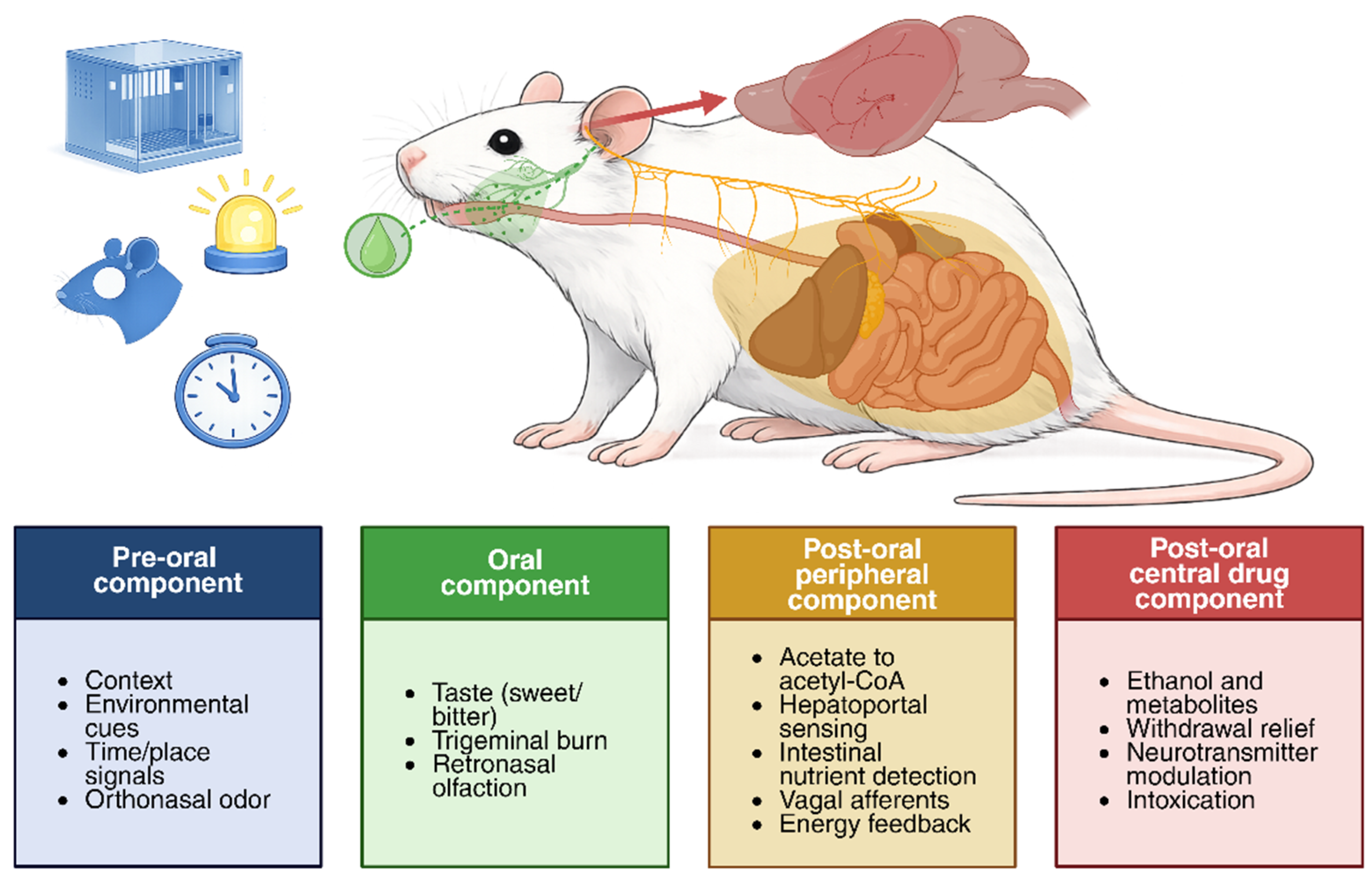
Figure 2.
Reward-component misalignment between rodent models and human AUD as a source of translational failure. Ethanol intake may be controlled by different reward components in rodents and humans. A pharmacotherapy that modifies the dominant component in a rodent model may reduce intake preclinically (left), yet fail clinically if that component is not central to human drinking (right), and vice versa. Differences in the relative contribution of reward components can therefore produce misleading pharmacotherapy outcomes resulting in translational failures.
Figure 2.
Reward-component misalignment between rodent models and human AUD as a source of translational failure. Ethanol intake may be controlled by different reward components in rodents and humans. A pharmacotherapy that modifies the dominant component in a rodent model may reduce intake preclinically (left), yet fail clinically if that component is not central to human drinking (right), and vice versa. Differences in the relative contribution of reward components can therefore produce misleading pharmacotherapy outcomes resulting in translational failures.
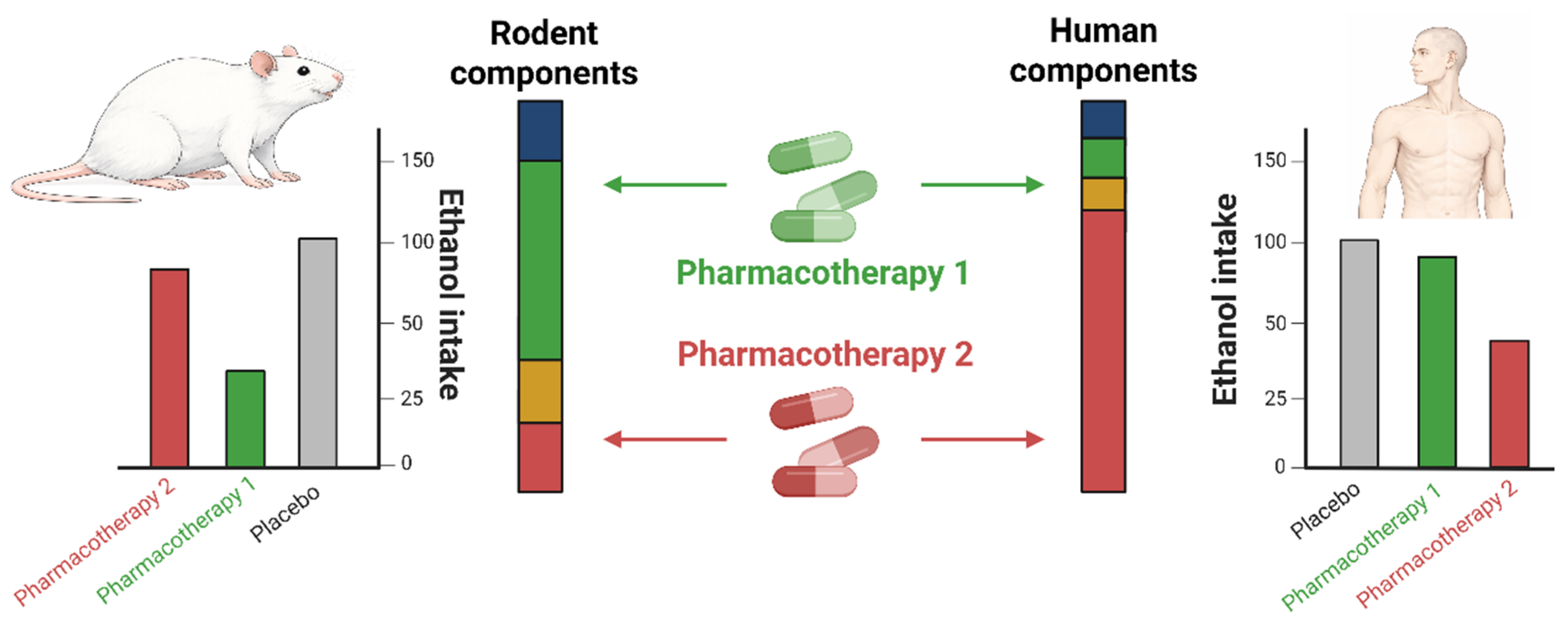
Figure 3.
Experimental strategies to orthogonally dissociate oral and post-oral reward components in ethanol intake. Sham drinking (gastric fistula) preserves the oral component while minimizing post-oral components. In contrast, intragastric delivery bypasses the oral component while preserving the post-oral components, including central drug and peripheral rewards. Together, these approaches allow testing conditions in which the oral or post-oral components are selectively absent, enabling estimation of their respective contributions to ethanol intake. Four groups per condition: oral-water/intragastric-water; oral-ethanol/intragastric-water; oral-water/intragastric-ethanol; oral-ethanol/intragastric-ethanol; and water-closed; water-sham; ethanol-closed; ethanol-sham.
Figure 3.
Experimental strategies to orthogonally dissociate oral and post-oral reward components in ethanol intake. Sham drinking (gastric fistula) preserves the oral component while minimizing post-oral components. In contrast, intragastric delivery bypasses the oral component while preserving the post-oral components, including central drug and peripheral rewards. Together, these approaches allow testing conditions in which the oral or post-oral components are selectively absent, enabling estimation of their respective contributions to ethanol intake. Four groups per condition: oral-water/intragastric-water; oral-ethanol/intragastric-water; oral-water/intragastric-ethanol; oral-ethanol/intragastric-ethanol; and water-closed; water-sham; ethanol-closed; ethanol-sham.
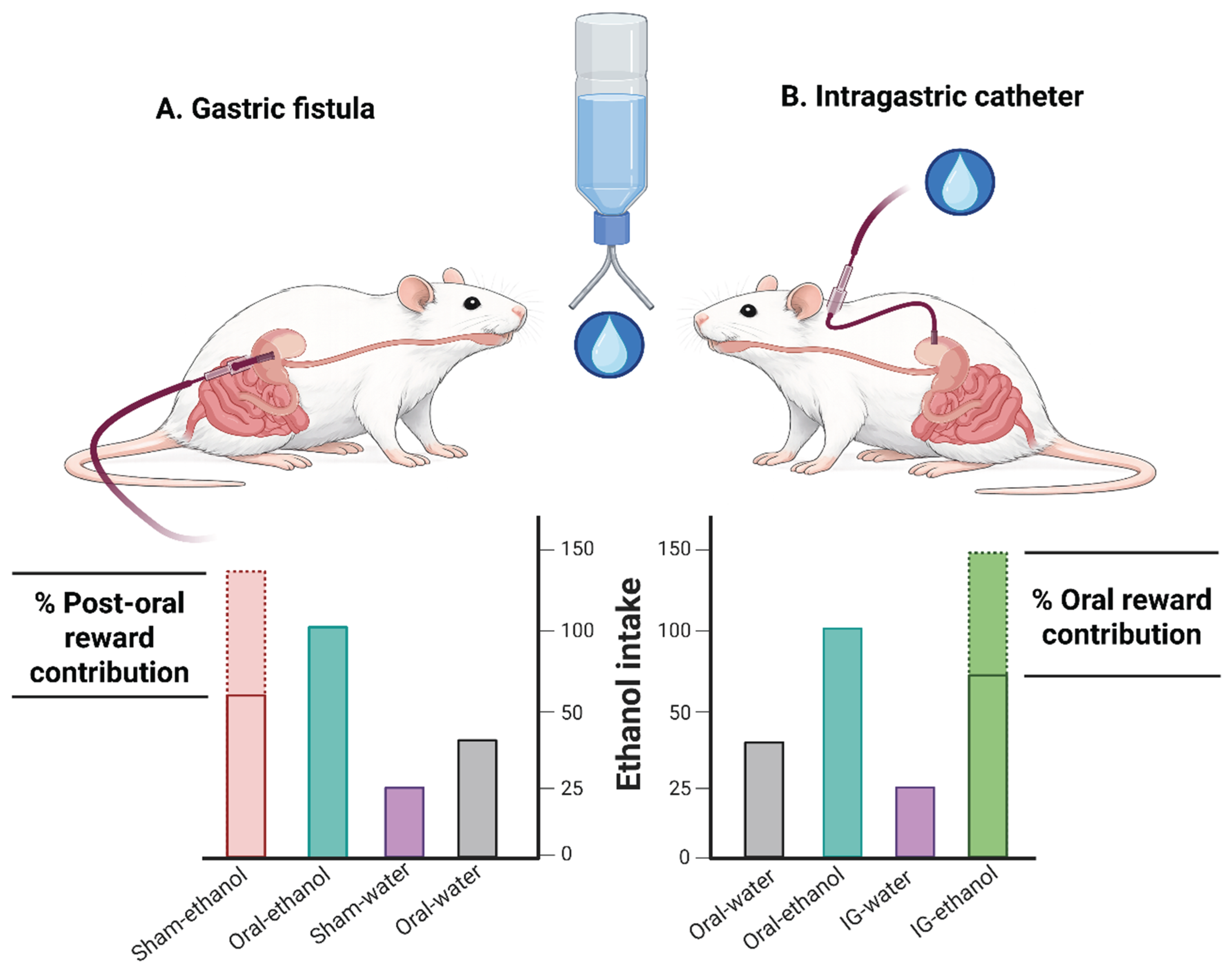

Table 1.
Pharmacotherapies mapped onto reward components.
| Pharmacotherapy | Primary target | Reward component(s) plausibly modified | Translational observation |
|---|---|---|---|
| CRF1 receptor antagonists | CRF1 blockade (stress circuitry). | Post-oral state (stress/withdrawal); pre-oral (stress-triggered seeking); modulatory stress responsivity (vapor-dependent configuration). | Clinical efficacy: no meaningful benefit on craving/drinking despite target engagement in trials. Preclinical efficacy: effective in vapor/withdrawal-dependent escalation; minimal effects on baseline drinking. |
| Histamine H3 inverse agonist | H3 receptor inverse agonism (increase histaminergic tone; arousal/feeding modulation). | Post-oral peripheral; post-oral central drug (neuromodulatory gain); oral; pre-oral conditioned. | Clinical efficacy: no reduction in heavy drinking days; Preclinical efficacy: reduced intake/seeking across operant/relapse-like procedures (incl. vapor paradigms). |
| Naltrexone | µ-opioid receptor antagonism. | Oral; post-oral central drug. | Clinical efficacy: modest, reproducible reductions in heavy drinking in subsets. Preclinical efficacy: reduces ethanol intake, but also intake of palatable non-alcohol rewards (incl. sham-feeding paradigms). |
| Disulfiram | ALDH inhibition (acetaldehyde accumulation; aversive state). | Post-oral aversive constraint; pre-oral (avoidance/adherence expectancy); Post-oral central drug (DBH inhibition); Stress/arousal modulation. | Clinical efficacy: efficacy strongly depends on supervision/adherence; limited unsupervised durability. Preclinical efficacy: history/procedure dependent; can lose efficacy after chronic exposure in some lines. |
| Acamprosate | Withdrawal-state stabilization (E/I modulation, calcium-dependent; mechanism unresolved). | Post-oral state (withdrawal/negative); pre-oral (reduced cue-driven relapse). | Clinical efficacy: moderate efficacy for abstinence/relapse prevention, especially detoxified individuals. Preclinical efficacy: more reliable in dependence/withdrawal-structured paradigms; variable effects on baseline intake. |
| GLP-1 receptor agonists | GLP-1 receptor activation (gut–brain satiety + reward-circuit modulation). | Post-oral peripheral (satiety/visceral state, gastric emptying); post-oral central drug (mesolimbic modulation); Oral (taste/food preference); pre-oral (cue responding). | Clinical efficacy: emerging signals (semaglutide: reduced craving/some drinking outcomes; exenatide mixed). Preclinical efficacy: reduces intake/operant responding and some relapse-like measures; often with parallel feeding effects depending on protocol. |
Disclaimer/Publisher’s Note: The statements, opinions and data contained in all publications are solely those of the individual author(s) and contributor(s) and not of MDPI and/or the editor(s). MDPI and/or the editor(s) disclaim responsibility for any injury to people or property resulting from any ideas, methods, instructions or products referred to in the content. |
© 2026 by the authors. Licensee MDPI, Basel, Switzerland. This article is an open access article distributed under the terms and conditions of the Creative Commons Attribution (CC BY) license.
Copyright: This open access article is published under a Creative Commons CC BY 4.0 license, which permit the free download, distribution, and reuse, provided that the author and preprint are cited in any reuse.


