

Submitted:
31 March 2026
Posted:
01 April 2026
You are already at the latest version
Abstract
Radiotherapy (RT) achieves excellent local control (LC) in early-stage glottic cancer (ESGC); however, treatment-related edema or necrosis may necessitate tracheostomy and adversely affect quality of life. We compared tracheostomy rates and oncologic outcomes between whole-larynx radiotherapy (WLRT) and vocal cord–only radiotherapy (VC-RT) in patients with ESGC.
We retrospectively analyzed 247 patients with Tis–T2 glottic cancer treated with definitive RT (2007–2023) at two Middle Eastern centers. Patients received WLRT (n = 166) or VC-RT (n = 81). The primary endpoint was a tracheostomy rate (TR) ≥6 months after RT for non-recurrent airway compromise. Secondary endpoints included 3-year local failure (LF) and overall survival (OS). TR and LF rates were analyzed using cumulative incidence with death as a competing risk, while OS was estimated using the Kaplan–Meier method.
The median age was 59 years; 97.6% of patients were male and 78.9% were smokers. The median follow-up was 45.3 months. VC-RT patients more frequently had cT2 disease (22.2% vs. 5.4%, p < 0.001) and received accelerated fractionation (19.8% vs. 7.2%, p = 0.0069). Overall, 20 of 247 patients (8%) required tracheostomy without recurrence. Edema-related tracheostomy occurred more frequently after WLRT (0% vs. 14.2% for VC-RT; p < 0.001). Tracheostomy was reversed in 8/20 patients (40%) after a median of 13.4 months.
The 3-year LF rates were 7.6% with VC-RT and 11.6% with WLRT (p = 0.18), and OS was 93.3% and 89.5% (p = 0.16), respectively.
VC-RT reduces the risk of tracheostomy without compromising oncologic outcomes.
Keywords:
laryngeal cancer
; vocal cord-only radiotherapy
; whole larynx radiotherapy
; tracheostomy rate
Introduction
Early-stage glottic cancer (ESGC; Tis–T2) is among the most curable head and neck cancers (1). Radiation therapy (RT) achieves excellent local control while preserving laryngeal function and voice quality (2). Definitive RT remains a standard treatment option alongside transoral laser microsurgery (3), with reported local control (LC) rates exceeding 85–90% for cT1 disease and 70–85% for cT2 disease (4,5,6).
Historically, RT for ESGC has targeted the entire larynx, a technique known as whole-larynx radiotherapy (WLRT) (6). This approach originated during the era of two- and three-dimensional conventional radiotherapy (2D/3DCRT) planning to account for uncertainties in tumor localization and motion (6). However, WLRT exposes uninvolved laryngeal structures including the supraglottic and subglottic regions, arytenoids, and surrounding soft tissues to substantial radiation doses (7). Consequently, patients may experience treatment-related toxicities such as laryngeal edema, fibrosis, cartilage necrosis, hypothyroidism, and airway compromise (8). Carotid artery irradiation has also been associated with increased cerebrovascular events (9,10).
Advances in imaging, immobilization, and intensity-modulated radiotherapy (IMRT) now enable more precise targeting of glottic tumors while sparing adjacent normal tissues (11). Reducing unnecessary radiation to uninvolved laryngeal structures may improve functional outcomes without compromising tumor control. Vocal cord–only radiotherapy (VC-RT) has therefore emerged as a strategy to reduce radiation exposure to uninvolved tissues while maintaining oncologic outcomes in selected cTis–T2 glottic cancers (12,13). However, concerns remain regarding the potential for geographic miss and the limited data comparing functional complications, particularly tracheostomy, between VC-RT (14) and conventional WLRT (11,15).
In this multi-institutional study, we compared tracheostomy rates and oncologic outcomes between WLRT and VC-RT in patients with ESGC treated at two centers in the Middle East.
Materials and Methods
Study Population
This retrospective study included patients with ESGC treated with curative-intent RT at two institutions: the Department of Radiation Oncology at King Hussein Cancer Center (KHCC), Amman, Jordan and the Department of Radiation Oncology, King Fahad Specialist Hospital, Dammam, Saudi Arabia, between January 2007 and October 2023. Institutional review board (IRB) approval was obtained on October 24, 2024 (IRB No 24 KHCC 221).
Eligible patients were ≥18 years old with cTis–T2 glottic cancer, treated with either WLRT or VC-RT, and staged according to the American Joint Committee on Cancer (AJCC), 8th edition criteria (16). Exclusion criteria included prior head and neck RT or treated with transoral laser microsurgery, total RT dose <50 Gy, Eastern Cooperative Oncology Group (ECOG) performance status (PS) >2, and the presence of metastatic disease or synchronous malignancies.
Diagnostic Evaluation
All patients underwent multidisciplinary evaluation, including a detailed medical history, comprehensive physical examination with fiberoptic nasopharyngolaryngoscopy, direct laryngoscopy with histologic confirmation of malignancy, and imaging with contrasted CT of the head and neck and chest. PET/CT was obtained when clinically indicated. Pretreatment assessments also included dental, nutritional, and speech pathology evaluations.
Treatment Approach
Patients received WLRT or VC-RT, delivered using either 2D/3DCRT or IMRT (17). Patients were immobilized in the supine using a thermoplastic head-and-neck mask and underwent CT-simulation with 3-5mm slices. After 2010, Daily Cone-beam CT (CBCT) with soft tissue matching was performed for the first 5 fractions, followed by weekly CBCT for IMRT set up verification.
For cTis–T1 tumors, commonly used RT regimens included 63 Gy in 28 fractions (5.6 weeks), 51 Gy in 20 fractions, or 66 Gy in 33 fractions (5.5–6.6 weeks), delivered at 5-6 fractions per week. For cT2 tumors, total doses ranged from 60 Gy in 25 fractions (5 weeks) to 65.25 Gy in 29 fractions (5.8 weeks) or 70 Gy in 35 fractions (6 weeks).
Target Volume Definition
For VC-RT, the gross tumor volume (GTV) was defined based on findings from fiberoptic laryngoscopy and available imaging. The high-risk clinical target volume (CTV-HR) was generated by an isotropic 5mm expansion of the GTV. The low-risk clinical target volume (CTV-LR) consisted of a 1cm isotropic expansion of the GTV, edited to respect anatomic boundaries and exclude soft tissues outside the thyroid cartilage, the contralateral vocal cord (if anterior commissure was uninvolved), the esophagus, and air cavities. The planning target volume (PTV) was generated by expanding the CTV by 5mm in all directions, with a 1cm margin in the superior–inferior axis to account for setup uncertainties and laryngeal motion.
For patients treated with conventional 2D-CRT for WLRT, treatment fields were defined using bony landmarks. The superior border was typically placed at the mid- hyoid bone, the inferior border at the caudal edge of first tracheal ring for cT1 and the second tracheal ring for cT2 disease, the anterior border extended to include the thyroid cartilage with a small skin margin, and the posterior border was positioned at the anterior aspect of the vertebral bodies to adequately cover the larynx while minimizing dose to the spinal cord.
For patients treated with 3DCRT/IMRT for WLRT, the GTV was defined based on fiberoptic laryngoscopy and available imaging. The CTV included the involved vocal cord(s) with a 5–10 mm margin to encompass potential microscopic disease, adjusted to respect anatomic boundaries. The CTV was expanded to include the entire thyroid cartilage while excluding the esophagus and air cavities. PTV was generated by a 5 mm isotropic expansion of the CTV in all directions to account for setup uncertainties and laryngeal motion.
Post-Treatment Evaluation and Follow-Up
Patients underwent fiberoptic nasopharyngolaryngoscopy every three months during the first two years, every four months in the third year, every six months during years four and five, and annually thereafter. Post-RT imaging was obtained as clinically indicated.
Statistical Methods
TR was defined as tracheostomy performed ≥6 months after radiotherapy for treatment-related airway compromise in the absence of recurrence. TR and Local failure (LF) were estimated using the cumulative incidence method, with death treated as a competing risk. OS was analyzed using the Kaplan–Meier method and compared using the log-rank test. Time-to-event outcomes were calculated from the date of diagnosis to the first event. All reported p-values were two-sided, with statistical significance defined as p < 0.05. Hazard ratios (HRs) with 95% confidence intervals (CIs) were reported when applicable. Analyses were conducted using SAS version 9.4 (SAS Institute Inc., Cary, NC), and figures were generated using GraphPad Prism 7.
Results
Patient, Tumor, and Treatment Characteristics
A total of 247 patients were included. The median age was 59 years (range, 30–92). Most patients were male (97.6%), and smokers (78.9%), while 4.5% reported alcohol consumption. T1a disease was present in 81.0% of patients. WLRT was delivered to 67.2% and VC-RT to 32.8%. Overall, 41.7% of patients received IMRT (Table 1).
Tracheostomy Rate
Overall, 36 of 247 patients (8%) required tracheostomy. Edema-related cases accounted for a 20 patients (12%) incidence in the WLRT group, compared with 0% in the VC-RT group (p < 0.001). Tracheostomy was later reversed in 8 patients (25%), with a median duration of 13.4 months. The 3-year TR for the entire cohort was 9.7% (95% CI, 5.28-%–13.75%) and was significantly lower with VC-RT than with WLRT (0% [95% CI, NA%–NA%] vs 14.22% [95% CI, 8.39-21,27%]; p < 0.0001) (Figure 1).
Local Failure
Local failure occurred in 24 patients (9.7%), with 20 patients (8.1%) underwent salvage laryngectomy. For the whole cohort, the 3-year cumulative incidence of LF was 10.1% (95% CI, 6.3–15.1%). The 3-year cumulative incindence of LF was 7.6% (95% CI, 2.7–15.8%) for VC-RT, and 11.6% (95% CI, 6.6–18.2%) for WLRT (p=0.183) (Figure 2).
Overall Survival
At a median follow-up of 38.2 months, 36 deaths (14.6%) occurred. The 3-year OS for the entire cohort was 90.8% (95% CI, 86.2%–94.6%). The 3-year OS was 93.3% (95% CI, 85.5%–98.2%) for VC-RT and 89.4% (95% CI, 83.3%–94.2%) for WLRT (p=0.16) (Figure 3).
Toxicity
Most acute skin toxicities were grade I–II. Aspiration pneumonia occurred in 5 patients (2.0%).
Discussion
RT remains a cornerstone in the management of ESGC (18). With modern RT techniques enabling improved target conformity and reduced toxicity (19). In this muliti-inistitutional study, VC-RT significantly reduces tracheostomy risk while maintaining excellent oncologic outcomes. The 3-year TR was markedly lower with VC-RT compared to WLRT, while LC and OS remained comparable despite a higher proportion of cT2 disease in the VC-RT cohort. These findings support the oncologic adequacy of VC-RT approach in appropriately selected patients (20).
Consistent with prior literature, both WLRT and VC-RT achieved high rates of LC and OS in ESGC (21,22). Historical WLRT series report 5-year LC rates of 85–95% for cT1 and 70–85% for cT2 disease, which formed the basis for WLRT in the treatment of ESGC (21). More recent studies using modern imaging and image-guided techniques demonstrate that VC-RT can achieve comparable oncologic outcomes in carefully selected patients, with reported 3- to 5-year LC rates of approximately 88–95% (22,23,24). In our cohort, 3-year LC was similar between VC-RT and WLRT (7.6% vs 11.6%, p=0.151), despite a higher proportion of cT2 disease in the VC-RT group, supporting the oncologic safety of focal approaches when delivered with modern radiotherapy techniques.
OS in ESGC is excellent, reflecting the curable nature of cTis–T2 disease, with published 3-year rates ranging from 85% to 95% (25,26,27). In our study, the 3-year OS was 93.3% (95% CI, 85.5%–98.2%) for VC-RT and 89.4% (95% CI, 83.3%–94.2%) for WLRT (p=0.16), with comparable outcomes despite more advanced disease in the VC-RT cohort. These findings further support the oncologic adequacy of a focal, organ-preserving approach in appropriately selected patients.
Tracheostomy following definitive RT for ESGC is uncommon but represents a clinically meaningful complication associated with laryngeal edema, fibrosis, or airway compromise (28). Historical WLRT series report tracheostomy rates ranging from 2% to 10%, while mor conformal approaches, such as VC-RT, are associated with lower rates due to reduced dose to uninvolved laryngeal structures (29). In our multi-institutional cohort, tracheostomy occurred in 20.5% of WLRT patients versus 0% with VC-RT (p<0.001), with edema-related events observed exclusively in the WLRT group. These findings are consistent with established dose–volume relationships, where higher mean laryngeal dose increases the risk of edema without improving LC. A recent meta-analysis of 7,033 patients reported a pooled dysfunctional larynx incidence of only 0.3% — the concentration of these events in our WLRT is consistent with known dose–volume relationships for laryngeal edema (20). Sanguineti et al. demonstrated that mean laryngeal dose is the strongest independent predictor of moderate-to-severe edema, with risk rising sharply above 44 Gy (30), and NTCP modeling confirmed a clear volume effect with a TD50 of approximately 47 Gy (31). Inoue et al. showed directly in a randomized comparison of field sizes in cT1 glottic cancer that larger fields produced five times more persistent edema (21% vs 4%, p<0.02) without any improvement in LC (32). While recurrence itself drives airway obstruction, the high prevalence of edema-related tracheostomy in our WLRT cohort implicates treatment-related toxicity from bilateral laryngeal exposure — including radiation-induced mucositis, fibrosis, and microvascular compromise rather than disease biology alone. Together, our results support treatment de-escalation with VC-RT as a strategy to reduce airway morbidity while maintaining excellent oncologic outcomes and toxicity (33).
Dosimetric studies show that VC-RT significantly reduces carotid dose compared with WLRT, without increasing contralateral vocal cord failure (34), that some radiation oncologists may have (35). This reduction in dose to uninvolved structures may decrease the risk of carotid stenosis and cerebrovascular events while maintaining adequate target coverage and LC (36,37). IMRT further reduces the mean carotid dose from 38 Gy with opposed lateral fields to as low as 4 Gy with VC-RT and decreases the carotid V50Gy from 77% to 0% (38). In our cohort, although VC-RT was associated with improved functional outcomes and lower TR, dosimetric data were not systematically collected, representing a limitation of this study. Adoption of VC-RT remains limited by the lack of consensus on target delineation, and further prospective studies are needed to define its vascular and functional benefits (39).
This study reflects real-world practice and highlights tracheostomy as a meaningful functional endpoint. Although limited by its retrospective design, treatment of heterogeneity, and lack of detailed dosimetric and voice outcome data, our findings support treatment of de-escalation with VC-RT and warrant prospective validation.
Conclusion
VC-RT significantly reduces TR without compromising LC or OS ESGC. These results support VC-RT as a safe, function-preserving radiotherapy strategy.
Author Contributions
Conceptualization: Issa Mohamad, Ali Hosni Statistical analysis: Ayat Taqash and Abdulla Alzibdeh Data collection: Mohamad Mukahad, Shatha Abu Taha, Mohamad Berawi, Lina Wahbeh, Mohamad Alsmairat, Randa AlHabib All authors reviewed and approved the final manuscript: Issa Mohamad, Ibrahim Alotain, Shatha Abu Taha, Mohamad Mukahal, Ayat Taqash, Mohamad Alsmairat; Abdulla Alzibdeh, Mohamad Berawi, Lina Wahbeh, Randa AlHabib, Akram Al-Ibraheem, Hikmat Abdel-Razeq, Fawzi Abuhijla, Ramiz Abuhijlih, Omar Al Saraireh, Ali Hosni.
Funding
This research received no external funding.
Institutional Review Board Statement
The study was approved by KHCC Institutional Review Board (IRB) (IRB No 24 KHCC 221).
Informed Consent Statement
Given the retrospective nature of the study and lack of identification of patients enrolled consent was waived.
Data Availability Statement
Data is available, upon reasonable request, from the corresponding author.
Conflicts of Interest
Related: None declared Unrelated: Ali Hosni, non-financial leadership (DSC) of liver TSG at ELEKTA MRL consortium.
Abbreviations
| ESGC: Early-stage glottic cancer |
| WLRT: Whole-larynx radiotherapy |
| VC-RT: Vocal cord–only radiotherapy |
| LC: Local control |
| OS : Overall survival |
References
- Peng PY, Lin CY, Liao CT, Wang HM, Huang SF, Tsai Y Te, et al. Outcome of T2 Glottic Cancer Treated with Radiotherapy Alone or Concurrent Chemo-Radiotherapy. Cancers (Basel) [Internet]. 2025 Feb 1 [cited 2026 Mar 16];17(4). Available from: https://pubmed.ncbi.nlm.nih.gov/40002305/. [CrossRef]
- Kinshuck AJ, Shenoy A, Jones TM. Voice outcomes for early laryngeal cancer. Curr Opin Otolaryngol Head Neck Surg [Internet]. 2017 Jun 1 [cited 2026 Mar 16];25(3):211–6. Available from: https://pubmed.ncbi.nlm.nih.gov/28277333/. [CrossRef]
- Fink DS, McWhorter AJ. Trans-oral laser microsurgery in the management of glottic cancer. Oper Tech Otolaryngol - Head Neck Surg [Internet]. 2024 Jun 1 [cited 2026 Mar 16];35(2):149–57. Available from: https://www.optecoto.com/action/showFullText?pii=S1043181024000307. [CrossRef]
- Cetinayak O, Dogan E, Kuru A, Akturk N, Aydin B, Umay C, et al. Outcome of Early-Stage Glottic Laryngeal Carcinoma Patients Treated with Radical Radiotherapy Using Different Techniques. J Oncol [Internet]. 2019 [cited 2026 Mar 16];2019. Available from: https://pubmed.ncbi.nlm.nih.gov/31781218/. [CrossRef]
- Adeel M, Faisal M, Rashid A, Rasheed S, Hussain R, Malik KI, et al. Outcomes of definitive radiotherapy for early laryngeal cancer in terms of survival and patterns of failure. J Laryngol Otol [Internet]. 2019 [cited 2026 Mar 16];133(12):1087–91. Available from: https://pubmed.ncbi.nlm.nih.gov/31791441/. [CrossRef]
- Yamazaki H, Nishiyama K, Tanaka E, Koizumi M, Chatani M. Radiotherapy for early glottic carcinoma (T1N0M0): Results of prospective randomized study of radiation fraction size and overall treatment time. Int J Radiat Oncol Biol Phys [Internet]. 2006 Jan 1 [cited 2025 Apr 28];64(1):77–82. Available from: https://pubmed.ncbi.nlm.nih.gov/16169681/. [CrossRef]
- Bahig H, Nguyen-Tan PF, Filion É, Roberge D, Thanomsack P, de Guise J, et al. Larynx motion considerations in partial larynx volumetric modulated arc therapy for early glottic cancer. J Med Imaging Radiat Oncol [Internet]. 2017 Oct 1 [cited 2026 Mar 16];61(5):666–73. [CrossRef]
- Mulholland GB, Zhang H, Nguyen NTA, Tkacyzk N, Seikaly H, O’Connell D, et al. Optimal detection of hypothyroidism in early stage laryngeal cancer treated with radiotherapy. J Otolaryngol Head Neck Surg [Internet]. 2015 [cited 2026 Mar 16];44(1). Available from: https://pubmed.ncbi.nlm.nih.gov/26362315/. [CrossRef]
- Tans L, Al-Mamgani A, Kwa SLS, Elbers JBW, Keskin-Cambay F, Sewnaik A, et al. Single vocal cord irradiation for early-stage glottic cancer: Excellent local control and favorable toxicity profile. Oral Oncol. 2022 Apr 1;127. [CrossRef]
- Ding C, Lee P, Jiang SB. SU-E-T-233: Cyberknife Versus Linac IMRT for Dose Comparision in Hypofractionated Hemi Larynx Irradiation of Early Stage True Vocal Cord Cancer: A Dosimetric Study. Med Phys. 2015 Jun;42(6Part15):3386–3386. [CrossRef]
- Bicakci BC, Mustafayev TZ, Cetinayak O, Igdem S, Birgi SD, Meydan D, et al. Outcomes of carotid sparing intensity-modulated radiotherapy for early stage glottic cancer in 201 patients: Multicenter study of Turkish Radiation Oncology Society/TROD-01-007. Head Neck. 2022 Aug 1;44(8):1825–32. [CrossRef]
- Brouwer CL, Steenbakkers RJHM, Bourhis J, Budach W, Grau C, Grégoire V, et al. CT-based delineation of organs at risk in the head and neck region: DAHANCA, EORTC, GORTEC, HKNPCSG, NCIC CTG, NCRI, NRG Oncology and TROG consensus guidelines. Radiother Oncol [Internet]. 2015 Oct 1 [cited 2026 Mar 16];117(1):83–90. Available from: https://pubmed.ncbi.nlm.nih.gov/26277855/. [CrossRef]
- Mucha-Małecka A, Chrostowska A, Urbanek K, Małecki K. Prognostic factors in patients with T1 glottic cancer treated with radiotherapy. Strahlenther Onkol [Internet]. 2019 Sep 1 [cited 2026 Mar 16];195(9):792–804. Available from: https://pubmed.ncbi.nlm.nih.gov/31214734/. [CrossRef]
- Rosenthal DI, Fuller CD, Barker JL, Mason B, Garcia JA, Lewin JS, et al. Simple Carotid-Sparing Intensity-Modulated Radiotherapy Technique and Preliminary Experience for T1-2 Glottic Cancer. Int J Radiat Oncol Biol Phys [Internet]. 2010 Jun 1 [cited 2026 Mar 16];77(2):455–61. Available from: https://pubmed.ncbi.nlm.nih.gov/19679406/. [CrossRef]
- Tali TA, Amin F, Dar JA, Sofi SR, Sofi MA, Khan NA, et al. Treatment Outcome of Early-stage Laryngeal Carcinoma Treated with Radical Radiotherapy Using Different Techniques: A Retrospective Study. Asian Pacific J Cancer Care. 2023;8(2):269–73. [CrossRef]
- Amin MB, Greene FL, Edge SB, Compton CC, Gershenwald JE, Brookland RK, et al. The Eighth Edition AJCC Cancer Staging Manual: Continuing to build a bridge from a population-based to a more “personalized” approach to cancer staging. CA Cancer J Clin [Internet]. 2017 Mar [cited 2026 Mar 16];67(2):93–9. Available from: https://pubmed.ncbi.nlm.nih.gov/28094848/. [CrossRef]
- Mohamad I, Salem A, Abu Hejleh T, Wadi-Ramahi S, Qandeel M, El Khatib S, et al. Peer-assisted Learning: Intensity-modulated Radiotherapy Transition in Developing Countries. Clin Oncol [Internet]. 2017 Oct 1 [cited 2026 Mar 17];29(10):689–95. Available from: https://pubmed.ncbi.nlm.nih.gov/28647432/. [CrossRef]
- Naunheim MR, Garneau J, Park C, Carroll L, Goldberg L, Woo P. Voice Outcomes After Radiation for Early-Stage Laryngeal Cancer. J Voice [Internet]. 2020 May 1 [cited 2026 Mar 17];34(3):460–4. Available from: https://pubmed.ncbi.nlm.nih.gov/30611594/. [CrossRef]
- Razavian NB, D’Agostino RB, Shenker RF, Hughes RT. Intensity-Modulated Radiation Therapy for Early-Stage Squamous Cell Carcinoma of the Glottic Larynx: A Systematic Review and Meta-Analysis. Int J Radiat Oncol Biol Phys [Internet]. 2023 Nov 1 [cited 2026 Mar 17];117(3):652–63. Available from: https://pubmed.ncbi.nlm.nih.gov/37150263/. [CrossRef]
- Linden SML, Philippens MEP, Sher DJ, Sanders ME, de Bree R, Rijken JA, et al. Risk of dysfunctional larynx after radiotherapy for early-stage glottic laryngeal cancer: A systematic review and meta-analysis. Radiother Oncol [Internet]. 2026 Jan 1 [cited 2026 Mar 17];214. Available from: https://researchinformation.umcutrecht.nl/en/publications/risk-of-dysfunctional-larynx-after-radiotherapy-for-early-stage-g/fingerprints/. [CrossRef]
- Yamazaki H, Suzuki G, Nakamura S, Yoshida K, Konishi K, Teshima T, et al. Radiotherapy for laryngeal cancer-technical aspects and alternate fractionation. J Radiat Res [Internet]. 2017 Jul 1 [cited 2026 Mar 17];58(4):495–508. Available from: https://pubmed.ncbi.nlm.nih.gov/28898958/. [CrossRef]
- Bahig H, Rosenthal DI, Nguyen-Tan FP, Fuller DC, Yuan Y, Hutcheson KA, et al. Vocal-cord Only vs. Complete Laryngeal radiation (VOCAL): a randomized multicentric Bayesian phase II trial. BMC Cancer [Internet]. 2021 Dec 1 [cited 2026 Mar 17];21(1). Available from: https://pubmed.ncbi.nlm.nih.gov/33888069/. [CrossRef]
- Gangsaas A, Astreinidou E, Quint S, Levendag PC, Heijmen B. Cone-beam computed tomography-guided positioning of laryngeal cancer patients with large interfraction time trends in setup and nonrigid anatomy variations. Int J Radiat Oncol Biol Phys [Internet]. 2013 Oct 1 [cited 2026 Mar 17];87(2):401–6. Available from: https://pubmed.ncbi.nlm.nih.gov/23958149/. [CrossRef]
- Al-Mamgani A, Kwa SLS, Tans L, Moring M, Fransen D, Mehilal R, et al. Single Vocal Cord Irradiation: Image Guided Intensity Modulated Hypofractionated Radiation Therapy for T1a Glottic Cancer: Early Clinical Results. Int J Radiat Oncol Biol Phys [Internet]. 2015 Oct 1 [cited 2026 Mar 17];93(2):337–43. Available from: https://pubmed.ncbi.nlm.nih.gov/26264629/. [CrossRef]
- Megwalu UC, Sikora AG. Survival outcomes in advanced laryngeal cancer. JAMA Otolaryngol Head Neck Surg [Internet]. 2014 Sep 1 [cited 2026 Mar 17];140(9):855–60. Available from: https://pubmed.ncbi.nlm.nih.gov/25144163/. [CrossRef]
- Pakkanen P, Irjala H, Ilmarinen T, Halme E, Lindholm P, Mäkitie A, et al. Survival and Larynx Preservation in Early Glottic Cancer: A Randomized Trial Comparing Laser Surgery and Radiation Therapy. Int J Radiat Oncol Biol Phys [Internet]. 2022 May 1 [cited 2026 Mar 17];113(1):96–100. Available from: https://pubmed.ncbi.nlm.nih.gov/35164976/. [CrossRef]
- Hut AR, Boia ER, Para D, Iovanescu G, Horhat D, Mikša L, et al. Laryngeal Cancer in the Modern Era: Evolving Trends in Diagnosis, Treatment, and Survival Outcomes. J Clin Med [Internet]. 2025 May 1 [cited 2026 Mar 17];14(10). Available from: https://pubmed.ncbi.nlm.nih.gov/40429363/. [CrossRef]
- MacKenzie R, Franssen E, Balogh J, Birt D, Gilbert R. The Prognostic Significance of Tracheostomy in Carcinoma of the Larynx Treated With Radiotherapy and Surgery for Salvage. Int J Radiat Oncol [Internet]. 1998 Apr 1 [cited 2026 Mar 17];41(1):43–51. Available from: https://www.sciencedirect.com/science/article/abs/pii/S0360301698000303. [CrossRef]
- Mendenhall WM, Strojan P, Lee AWM, Rinaldo A, Eisbruch A, Ng WT, et al. Radiotherapy in the management of glottic squamous cell carcinoma. Head Neck [Internet]. 2020 Dec 1 [cited 2026 Mar 17];42(12):3558–67. Available from: https://pubmed.ncbi.nlm.nih.gov/32896071/. [CrossRef]
- Sanguineti G, Adapala P, Endres EJ, Brack C, Fiorino C, Sormani MP, et al. Dosimetric Predictors of Laryngeal Edema. Int J Radiat Oncol Biol Phys [Internet]. 2007 Jul 1 [cited 2026 Mar 16];68(3):741–9. Available from: https://pubmed.ncbi.nlm.nih.gov/17398024/. [CrossRef]
- Rancati T, Fiorino C, Sanguineti G. NTCP modeling of subacute/late laryngeal edema scored by fiberoptic examination. Int J Radiat Oncol Biol Phys [Internet]. 2009 Nov 1 [cited 2026 Mar 28];75(3):915–23. Available from: https://pubmed.ncbi.nlm.nih.gov/19747783/. [CrossRef]
- Inoue T, Inoue T, Chatani M, Teshima T. Irradiated volume and arytenoid edema after radiotherapy for T1 glottic carcinoma. 1992 [cited 2026 Mar 28];168(1):23–6. Available from: https://inis.iaea.org/records/22xzc-9ew60.
- Elsharief MM, Hassouna AH, Shouman T, Mosallam A, El-Badrawy A, Shawky A, et al. Single vocal cord irradiation (SVCI) vs whole laryngeal radiotherapy in the treatment of T1aN0 glottic cancer A prospective randomized trial. Radiother Oncol [Internet]. 2026 Mar [cited 2026 Mar 28];216:111376. Available from: https://pubmed.ncbi.nlm.nih.gov/41520731/. [CrossRef]
- Zumsteg ZS, Riaz N, Jaffery S, Hu M, Gelblum D, Zhou Y, et al. Carotid sparing intensity-modulated radiation therapy achieves comparable locoregional control to conventional radiotherapy in T1-2N0 laryngeal carcinoma. Oral Oncol [Internet]. 2015 Jul 1 [cited 2026 Mar 17];51(7):716–23. Available from: https://pubmed.ncbi.nlm.nih.gov/25958831/. [CrossRef]
- Treechairusame T, Dee EC, Cao C, Wu Y, Yu Y, Gelblum D, et al. Partial vs Whole Laryngeal Radiotherapy for Clinical Stage T1-2N0M0/Tis Laryngeal Carcinoma. JAMA Otolaryngol Head Neck Surg [Internet]. 2025 Nov 13 [cited 2026 Mar 28];151(11):1071–9. Available from: https://pubmed.ncbi.nlm.nih.gov/41037280/. [CrossRef]
- Plummer C, Henderson RD, O’Sullivan JD, Read SJ. Ischemic stroke and transient ischemic attack after head and neck radiotherapy: A review. Stroke [Internet]. 2011 Sep [cited 2026 Mar 16];42(9):2410–8. [CrossRef]
- Swisher-Mcclure S, Mitra N, Lin A, Ahn P, Wan F, O’Malley B, et al. Risk of fatal cerebrovascular accidents after external beam radiation therapy for early-stage glottic laryngeal cancer. Head Neck [Internet]. 2014 May 1 [cited 2026 Mar 16];36(5):611–6. [CrossRef]
- Chera BS, Amdur RJ, Morris CG, Mendenhall WM. Carotid-sparing intensity-modulated radiotherapy for early-stage squamous cell carcinoma of the true vocal cord. Int J Radiat Oncol Biol Phys [Internet]. 2010 Aug 1 [cited 2026 Mar 17];77(5):1380–5. Available from: https://pubmed.ncbi.nlm.nih.gov/19942356/.
- Mohamad I, Abu Taha S, Bushehri A, Youssef B, Ozyar E, Alotain I, et al. Global Disparities and Trends in Radiotherapy for Early-Stage Glottic Cancer. 2026 Mar 9 [cited 2026 Mar 28]; Available from: https://www.preprints.org/manuscript/202603.0691/v1.
Figure 1.
Cumulative Incidence of Tracheostomy for the Entire Cohort and by Treatment Group (VC-RT vs WLRT). Observations: VC-RT: Vocal cord only radiotherapy; WLRT: Whole larynx radiotherapy.
Figure 1.
Cumulative Incidence of Tracheostomy for the Entire Cohort and by Treatment Group (VC-RT vs WLRT). Observations: VC-RT: Vocal cord only radiotherapy; WLRT: Whole larynx radiotherapy.
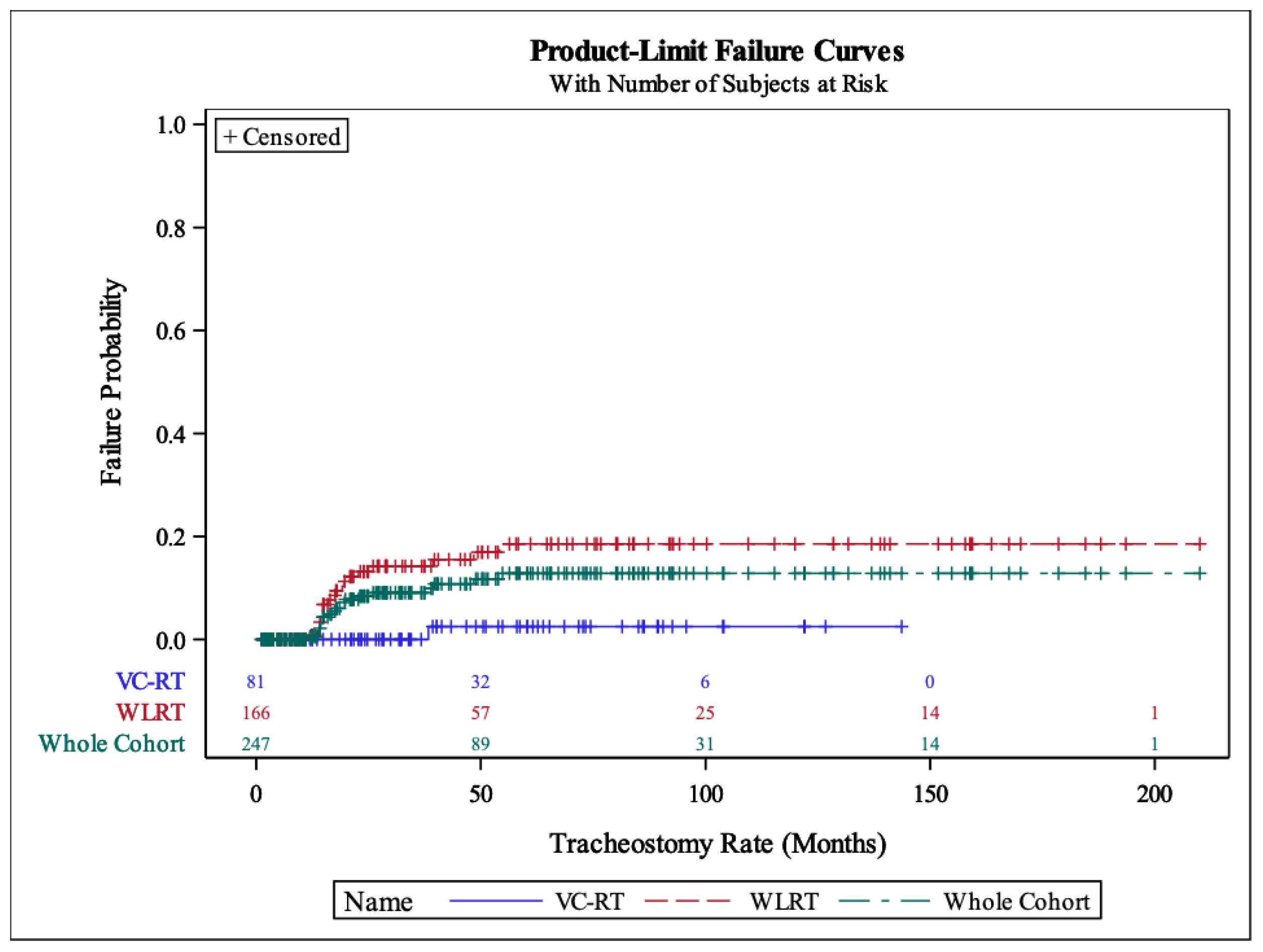
Figure 2.
Cumulative Incidence of local failure for the Entire Cohort and by Treatment Group (VC-RT vs WLRT). Observations: VC-RT: Vocal cord only radiotherapy; WLRT: Whole larynx radiotherapy.
Figure 2.
Cumulative Incidence of local failure for the Entire Cohort and by Treatment Group (VC-RT vs WLRT). Observations: VC-RT: Vocal cord only radiotherapy; WLRT: Whole larynx radiotherapy.
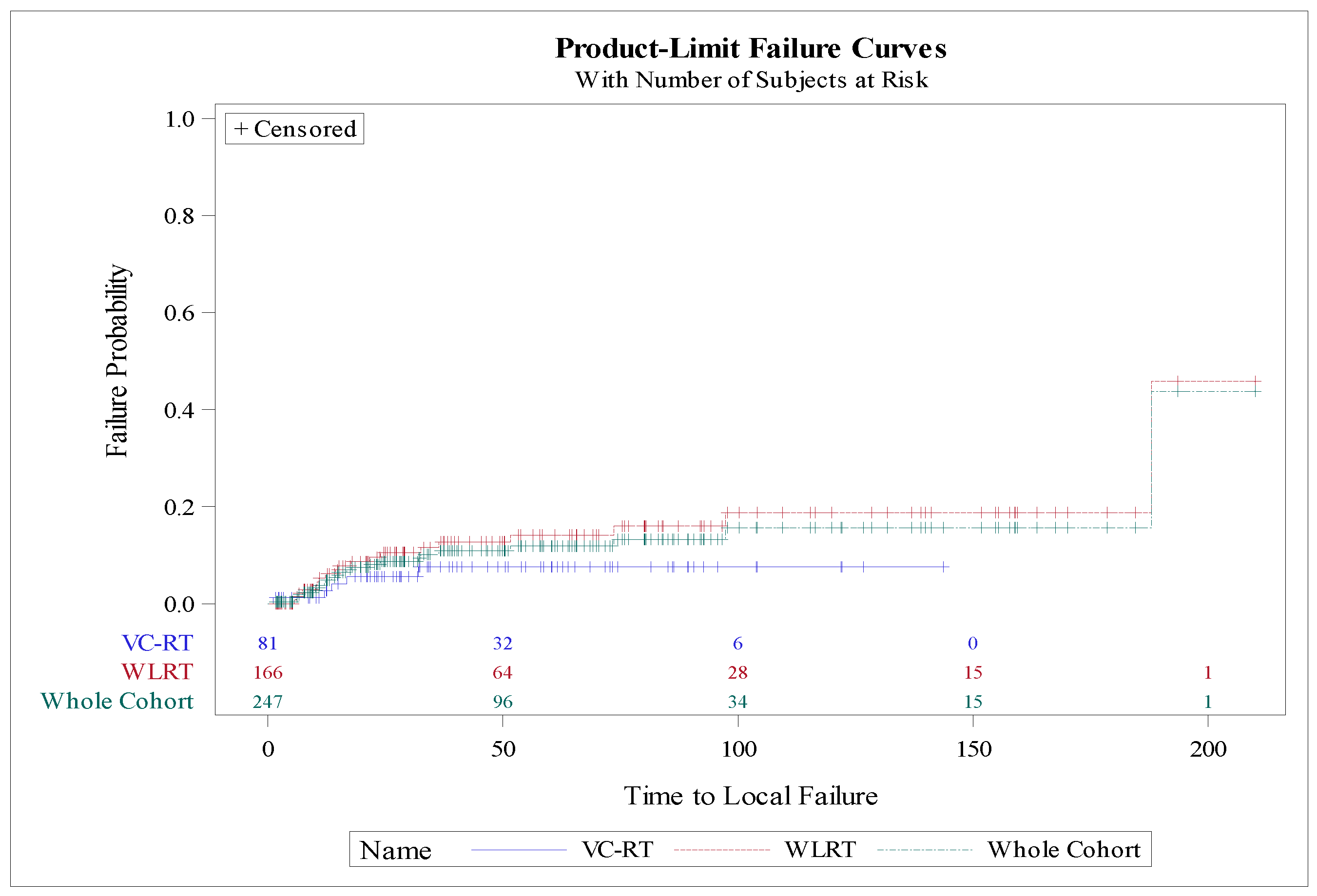
Figure 3.
Kaplan–Meier Curve for the Entire Cohort and by Treatment Group (VC-RT vs WLRT). Observations: VC-RT: Vocal cord only radiotherapy; WLRT: Whole larynx radiotherapy. Multivariate analysis revealed no independent predictors of TR, LF, or OS.
Figure 3.
Kaplan–Meier Curve for the Entire Cohort and by Treatment Group (VC-RT vs WLRT). Observations: VC-RT: Vocal cord only radiotherapy; WLRT: Whole larynx radiotherapy. Multivariate analysis revealed no independent predictors of TR, LF, or OS.
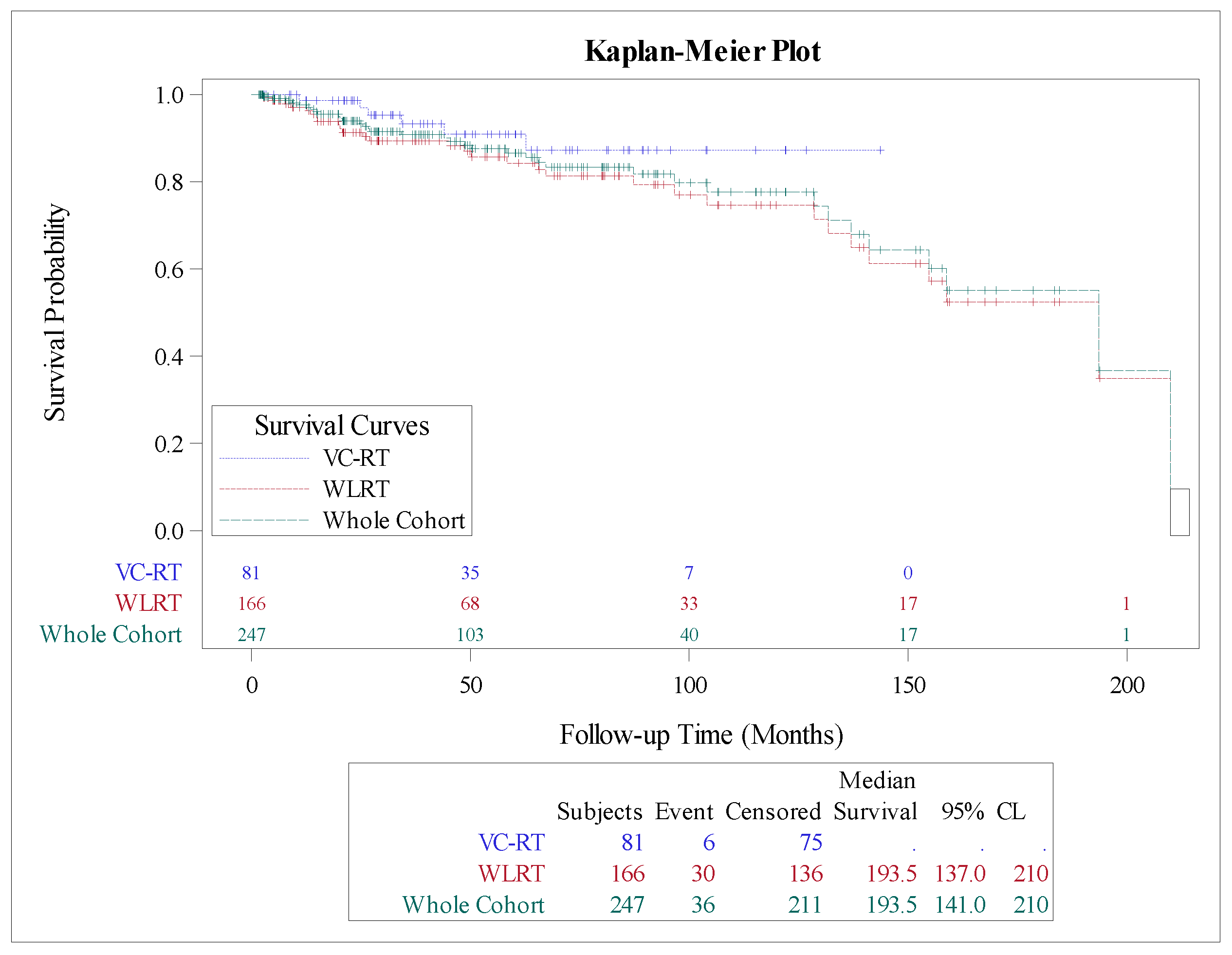

Table 1.
Patient, Tumor, and Treatment Characteristics.
| Characteristic | Total (n=247) | WLRT (n=166) | VC-RT (n=81) | P value |
|---|---|---|---|---|
| Follow-up, median (range), (months) | 38.2(1.61-192) | 42.1(1.6-194) | 43.4(1.6-144) | 0.21 |
| Age median (range), (years) | 59(30-92) | 50(30-92) | 57(32-90) | 0.19 |
| Gender | ||||
| Female | 6(2.4%) | 3(1.8%) | 3(3.7%) | 0.397 |
| Male | 241 (97.6%) | 163(98.2%) | 78(96.3%) | |
| Performance Status (ECOG) | ||||
| 0 | 210(85%) | 150(90.4%) | 60(74.1%) | 0.002 |
| 1 | 34(13.8%) | 15(9%) | 19(23.4%) | |
| 2 | 3(1.2%) | 1(0.06%) | 2(2.5%) | |
| Smoking History | ||||
| No | 52(21.1%) | 29(17.5%) | 23(28.4%) | 0.048 |
| Yes | 195(78.9%) | 137(82.5%) | 58(71.6%) | |
| Alcohol Use | ||||
| No | 236(95.5%) | 159(95.8%) | 77(95.1%) | 0.754 |
| Yes | 11(4.5%) | 7(4.2%) | 4(4.9%) | |
| cT- category | ||||
| Tis | 3 (1.2%) | 3 (1.8%) | 0 | <0.001 |
| T1a | 200 (81.0%) | 137 (82.5%) | 63 (77.8%) | |
| T1b | 17 (6.9%) | 17 (10.2%) | 0 | |
| T2 | 27 (10.9%) | 9 (5.4%) | 18 (22.2%) | |
| Overall Stage group | ||||
| Stage 0 | 3 (1.2%) | 3 (1.8%) | 0 | <0.001 |
| Stage I | 217 (87.9%) | 154 (92.8%) | 63 (77.8%) | |
| Stage II | 27 (10.9%) | 9 (5.4%) | 18 (22.2%) | |
| Radiotherapy Technique | ||||
| 2D RT | ||||
| 3DCRT | 144 (58.3%) | 119 (71.7%) | 25 (30.9%) | <0.001 |
| IMRT | 103 (41.7%) | 47 (28.3%) | 56 (69.1%) | |
| Fractionation | ||||
| Conventional | ||||
| 66Gy/33fraction/5 fractions/week | 29(80.6%) | 4(57.1%) | 25(86.2%) | 0.001 |
| 70Gy/35frcations/5 fractions/week | 7(19.4%) | 3(42.9%) | 4(13.8%) | |
| Accelerated Conventional | ||||
| 66Gy/33fraction/6 fractions/week | 26(89.7%) | 17(89.5%) | 9(90.0%) | |
| 70Gy/35frcations/6 fractions/week | 3(10.3%) | 2(10.5%) | 1(10.0%) | |
| Accelerated Hypofractionation | ||||
| 51Gy/20fractions/5fraction/week | 2(1.2%) | 2(5.0%) | 0 | |
| 60Gy/25fractions/5fractions/week | 8(4.9%) | 1(2.5%) | 7(5.7%) | |
| 63Gy/28fractions/5 fractions/week | 138(85.2%) | 26(65.0%) | 112(91.8%) | |
| 65.25Gy/29 fractions/5 fractions/week | 14(8.6%) | 11(27.5%) | 3(2.5%) | |
| Tracheostomy, irrespective of the underlying cause | ||||
| No | 211(85.4%) | 132(79.5%) | 79(97.5%) | 0.001 |
| Yes | 36(14.6%) | 34(20.5%) | 2(2.5%) | |
| Tracheostomy, based on the underlying cause | ||||
| Edema | 20(100%) | 20(100%) | 0 | 0.001 |
| Recurrence | 211(85.4%) | 132(79.5%) | 79(97.5%) | |
| Salvage laryngectomy | ||||
| No | 227(91.9%) | 150(90.4%) | 77(95.1%) | 0.23 |
| Yes | 20(8.1%) | 16(16.6%) | 4(4.9%) | |
Disclaimer/Publisher’s Note: The statements, opinions and data contained in all publications are solely those of the individual author(s) and contributor(s) and not of MDPI and/or the editor(s). MDPI and/or the editor(s) disclaim responsibility for any injury to people or property resulting from any ideas, methods, instructions or products referred to in the content. |
© 2026 by the authors. Licensee MDPI, Basel, Switzerland. This article is an open access article distributed under the terms and conditions of the Creative Commons Attribution (CC BY) license (http://creativecommons.org/licenses/by/4.0/).
Copyright: This open access article is published under a Creative Commons CC BY 4.0 license, which permit the free download, distribution, and reuse, provided that the author and preprint are cited in any reuse.


