

Submitted:
01 April 2026
Posted:
01 April 2026
You are already at the latest version
Abstract
Reaction time (RT) is widely used as a fundamental indicator of central nervous system processing speed. Numerous studies have shown that RT increases with age, generally in-terpreted as a decline in information processing efficiency. However, most previous studies have focused on absolute RT values, and it remains unclear whether aging also alters the relative relationships between responses under different task conditions.
The present study investigated whether aging affects the relative difference between inside and outside pedal reaction times in a Foot Psychomotor Vigilance Test (Foot PVT). A total of 44 participants were analyzed, including 20 younger adults (24 ± 3 years) and 24 older adults (73 ± 5 years). Participants responded to visual stimuli by pressing either the left or right pedal with the right foot. The difference between inside and outside RT (dRT) was calculated for each participant as an index of relative response structure. Group compari-sons and correlation analyses were conducted to examine associations with age, height, physical activity level (PAL), and sleep-related factors. As expected, RTs were consistently longer in older adults across conditions. In contrast, dRT did not differ significantly be-tween younger and older groups, with negligible effect sizes(|d|< 0.1). Furthermore, dRT showed no significant correlations with height, PAL, or sleep-related indices. These find-ings indicate that while aging affects the overall speed of motor responses, the relative temporal structure between response conditions is preserved. This dissociation between global slowing and stable response structure may represent a fundamental characteristic of neuromotor aging.
Keywords:
reaction time asymmetry
; lower limb reaction
; pedal response
; foot PVT
; aging
1. Introduction
Reaction time (RT) is widely used as a fundamental indicator of central nervous system processing speed [1,2]. RT reflects a sequence of processes from stimulus detection to response execution, including perceptual processing, decision-making, and motor output. Numerous studies have consistently demonstrated age-related prolongation of RT in both simple and choice reaction tasks [3,4], which is generally interpreted as a decline in processing speed. According to processing speed theory, many age-related changes in cognitive function can be explained by a generalized reduction in information processing efficiency [5,6].
Previous studies have primarily evaluated aging effects based on absolute RT values, focusing on whether older adults are slower than younger adults. However, such analyses do not clarify whether aging alters the relative relationships between responses under different task conditions. For example, differences in RT across directions or consistent patterns of faster or slower responses under specific conditions may reflect stable response patterns rather than merely global speed differences. Therefore, understanding age-related changes requires consideration not only of absolute RT but also of relative relationships across task conditions.
Age-related differences in RT may manifest in at least two ways. First, the overall temporal scale of the response system may be uniformly slowed, reflecting a global reduction in processing speed. Second, the relative differences in RT between task conditions may change. If aging primarily affects global processing speed, relative differences between conditions would remain stable. In contrast, if aging also influences condition-specific response characteristics, both the magnitude and direction of these differences may be altered.
The Psychomotor Vigilance Test (PVT) is a widely used RT task for assessing sustained attention and vigilance and is highly sensitive to sleep deprivation and fatigue [7,8,9,10,11]. In conventional PVT paradigms, participants respond to visual stimuli by pressing a button with a finger, and RT metrics such as mean values and distributional characteristics are used to evaluate attentional function and arousal state.
To extend this paradigm to lower-limb responses, a foot-response version of the PVT (Foot PVT) has been developed [12]. In the Foot PVT, participants respond by pressing left or right pedals from a central position, requiring direction-specific lower-limb movements. In a previous study using this system, clear age-related differences were observed in overall RT, along with differences in RT distribution characteristics [13]. However, these analyses focused primarily on absolute RT values and distributional properties and did not examine relative differences between stimulus conditions.
The difference between inside and outside responses in the Foot PVT may reflect not only processing speed but also directional characteristics of lower-limb motor control and response execution. Therefore, evaluating this inside–outside difference provides a means to examine whether age-related changes in RT arise from global slowing or also involve alterations in relative response relationships between conditions.
In this study, we focused on the difference between inside and outside RT (dRT) as an index of relative response structure. Specifically, we examined not only whether older adults exhibit slower responses, but also whether aging alters the relative differences between conditions.
In addition, RT performance may be influenced by factors other than age. RT is associated with cognitive factors such as attention and arousal [14,15], and physical characteristics and habitual physical activity level (PAL) may also affect neuromuscular function and motor performance [16]. However, few studies have examined whether these factors are related not to absolute RT but to relative differences between task conditions.
Therefore, the aims of this study were: (i) to determine whether the inside–outside RT difference differs between younger and older adults; and (ii) to examine whether these relative differences are associated with physical characteristics, PAL, and sleep-related factors.
2. Materials and Methods
2.1. Study Design and Participants
This study employed a cross-sectional observational design. The same cohort as in our previous study was used, and a total of 44 participants were included in the analysis, comprising 20 younger adults and 24 older adults.
The younger group had a mean age of 24 ± 3 years (range: 22–29), and the older group had a mean age of 73 ± 5 years (range: 66–84). The younger group consisted of 15 males and 5 females, while the older group included 12 males and 12 females.
Prior to the experiment, information on driving experience, visual function, height, and weekly PAL was collected. The calculation of PAL is described below. Driving experience was 3 ± 3 years (range: 0–9) in the younger group and 48 ± 9 years (range: 32–60) in the older group.
Inclusion criteria required participants to possess a valid driver’s license and to be actively driving in daily life. Individuals with neurological, musculoskeletal, or psychiatric disorders were excluded. All older participants were active drivers at the time of testing.
All participants were confirmed to correctly discriminate stimulus colors (red, yellow, and blue). Written informed consent was obtained from all participants, and the study was approved by the institutional ethics committee.
2.2. Foot PVT Procedure
RT was measured using a Foot PVT system developed by the authors. The system was implemented on a 15.6-inch laptop computer and interfaced with a USB three-pedal foot switch. The laptop computer was positioned approximately 1.5 m in front of the participant. All measurements were conducted with participants seated. Detailed system specifications, including hardware configuration, stimulus presentation, and RT recording procedures, have been described in previous studies [12,13]. The system has millisecond-level temporal resolution and is consistent with conventional PVT paradigms.
Three circles were presented at the center of the display, arranged from left to right as blue, yellow, and red. In each trial, one of the circles was randomly illuminated. Participants responded using the right foot: pressing the right pedal for blue stimuli (outside condition) and the left pedal for red and yellow stimuli (inside condition) (Figure 1).
After a correct response, the stimulus was extinguished, and participants were required to return their foot to the central pedal (home position). In the case of an incorrect response, the stimulus remained illuminated until the correct pedal was pressed. In the event of a false start, a message (“false start”) was displayed on the screen, and participants were required to return their foot to the home position.
RT was defined as the time interval between stimulus onset and pedal press. The inter-stimulus interval was randomly varied between 2 and 10 seconds. For each trial, stimulus color, response accuracy, inter-stimulus interval, RT, correction time, and elapsed time were automatically recorded. Detailed recording formats are described elsewhere [12,13]. In the present study, median RT values for each condition were used for analysis. Error rates and correction times were not analyzed in detail.
The Foot PVT was administered between 11:00 and 14:00. Participants first completed a 5 min practice session, followed by a 10 min main test. All pedal responses were performed barefoot using the right foot. Participants were instructed to respond as quickly and accurately as possible [13].
Participants responded to visual stimuli (blue, yellow, red) using a three-pedal device operated with the right foot. The central pedal served as the home position. Blue stimuli required pressing the right pedal (outside), whereas red and yellow stimuli required pressing the left pedal (inside).
2.3. Sleep Assessment
Sleep status on the night prior to the experiment was assessed using the OSA Sleep Inventory MA version [17], which has been used in previous studies [18].
On the morning of the experiment, participants completed a 16-item questionnaire using a four-point scale. Based on the responses, five factor scores were calculated: sleepiness on awakening (Factor 1), sleep initiation and maintenance (Factor 2), dreaming (Factor 3), recovery from fatigue (Factor 4), and sleep duration (Factor 5).
Each factor score was standardized (mean = 50), with higher scores indicating better sleep status.
2.4. Calculation of PAL
2.5. Statistical Analysis
For each participant, median RTs were calculated for inside stimuli (combined red and yellow; inside_RT), outside stimuli (blue; outside_RT), red-only stimuli (inside_RTr), and yellow-only stimuli (inside_RTy). RT was expressed in milliseconds (ms).
Differences relative to outside conditions were defined as follows:
dRT = inside_RT − outside_RT (ms)
dRTr = inside_RTr − outside_RT (ms)
dRTy = inside_RTy − outside_RT (ms)
Negative dRT values indicate faster responses to inside stimuli compared to outside stimuli, whereas positive values indicate slower responses. This metric represents directional asymmetry between inside and outside pedal movements rather than overall response speed.
2.5.1. Within-Group Analysis
Within each group, the null hypothesis that the median dRT equals zero was tested using the Wilcoxon signed-rank test (two-sided). Effect sizes were calculated as , where Z is the standardized test statistic and N is the total number of observations.
2.5.2. Between-Group Comparison
Between-group comparisons (younger vs. older) were conducted after assessing normality using the Shapiro–Wilk test and homogeneity of variance using Levene’s test. If assumptions were met, Student’s t-test was used; otherwise, the Mann–Whitney U test was applied. Effect sizes were calculated as Cohen’s d, defined as the difference between group means divided by the pooled standard deviation
, where , M1 and M2 are the group means, SD1 and SD2 are the standard deviations, and n1 and n2 are the sample sizes of the two groups.
2.5.3. Comparison of Participant Characteristics
Group differences in height and PAL were evaluated using the same procedure described above (Shapiro–Wilk test, Levene’s test, followed by Student’s t-test or Mann–Whitney U test as appropriate). Effect sizes were calculated as Cohen’s d using the same definition as above.
2.5.4. Correlation Analysis
Associations between dRT and height, PAL, and sleep-related indices were evaluated using Spearman’s rank correlation coefficient.
Statistical analyses were performed using Python 3.12.7 (SciPy, pandas). The significance level was set at p < 0.05 (two-sided).
2.5.5. Sample Size Sensitivity Analysis
A sensitivity analysis was conducted using G*Power 3.1 to evaluate the detectable effect size for between-group comparisons. Assuming a two-tailed test, α = 0.05, and the actual group sizes (20 younger, 24 older), the study had 80% power to detect an effect size of approximately Cohen’s d = 0.87.
Thus, the sample size was sufficient to detect relatively large group differences, but may have been underpowered to detect moderate effects.
3. Results
3.1. Descriptive Statistics of RT in Younger and Older Adults
Table 1 presents the descriptive statistics of RT for each stimulus color. The older group exhibited higher RT values than the younger group across all stimulus conditions.
In contrast, the relative pattern among blue (outside), red (inside), and yellow (inside) stimuli was similar between the two groups. Although an overall age-related slowing was observed, the general structure of responses appeared to be preserved.
3.2. Within-Group Analysis (Wilcoxon Signed-Rank Test)
Table 2 presents the results of the Wilcoxon signed-rank tests. In the younger group, the inside − outside RT differed significantly from zero (median: −20 ms, p = 0.005), with a moderate-to-large effect size (r = 0.61).
Similar significant differences were observed when red and yellow stimuli were analyzed separately (p = 0.007 and p = 0.012, respectively).
In contrast, in the older group, the inside − outside difference did not reach statistical significance (p = 0.053). However, a significant difference was observed for the yellow stimulus condition (p = 0.025), whereas no significant difference was found for the red stimulus condition (p = 0.317).
3.3. Between-Group Comparison of dRT
Table 3 presents the between-group comparisons of dRT in younger and older adults. No significant differences were observed between groups for dRT, dRTr, or dRTy (all p > 0.05). Effect sizes (Cohen’s d) were negligible in all cases (|d| < 0.1), indicating no meaningful age-related differences in the inside–outside RT difference.
For dRT (inside − outside), the median was −20 ms (IQR: 51 ms) in the younger group and −22 ms (IQR: 60 ms) in the older group, with no significant difference between groups (Student’s t-test, p = 0.998). The effect size was extremely small (Cohen’s d = −0.001), indicating no practical difference.
For the red stimulus condition (dRTr), the younger group showed a median of −14 ms (IQR: 33 ms), whereas the older group showed −7 ms (IQR: 51 ms), with no significant difference (Mann–Whitney U test, p = 0.396). The effect size was also small (Cohen’s d = −0.053).
Similarly, for the yellow stimulus condition (dRTy), the median was −27 ms (IQR: 74 ms) in the younger group and −31 ms (IQR: 100 ms) in the older group, with no significant difference (Student’s t-test, p = 0.911). The effect size was 0.034, indicating no clinically meaningful difference.
Overall, the inside–outside RT difference was comparable between younger and older adults regardless of stimulus color, suggesting no substantial age-related change in directional response asymmetry. The negligible effect sizes observed between groups strongly support the absence of a meaningful age-related difference in dRT.
3.4. Between-Group Comparison of Physical Characteristics
Table 4 presents the physical characteristics of the younger and older groups. Height was significantly greater in the younger group than in the older group (168 ± 9 cm vs 162 ± 9 cm, t = 2.132, p = 0.039, Cohen’s d = 0.645), with a moderate effect size.
PAL was significantly higher in the older group than in the younger group (19.62 ± 23.2 vs 4.90 ± 7.6 METs·h/week, U = 113, p = 0.002, Cohen’s d = −0.821), with a large effect size.
3.5. Associations Between dRT and Physical Characteristics and Sleep Measures
Table 5 presents the associations between dRT and physical characteristics and sleep measures. Spearman’s rank correlation analysis revealed no significant correlations between dRT, dRTr, or dRTy and height, PAL, or sleep-related factors (all p > 0.05).
In the overall analysis (n = 44), all correlation coefficients were weak (|ρ| < 0.20). Similar results were observed when analyses were conducted separately for the younger and older groups, with no significant associations identified.
4. Discussion
4.1. Main Findings
In our previous study using the same cohort, we demonstrated a clear age-related prolongation of overall RT, along with differences in distributional characteristics such as skewness and kurtosis [13]. Specifically, although the older group exhibited slower RTs than the younger group, the variability of responses was relatively smaller, indicating a more stable response pattern.
Building on these findings, the present study examined whether the difference between inside and outside responses (dRT) is similarly affected by aging. The results showed that although overall RT was prolonged in the older group (Table 1), no significant between-group differences were observed in dRT, with negligible effect sizes (Table 3). Furthermore, dRT was not associated with height, PAL, or sleep-related factors (Table 5).
Taken together, these findings suggest that while aging slows overall reaction speed, the relative temporal relationship between inside and outside pedal responses remains largely preserved.
Although within-group significance was weaker in older adults, the direction and magnitude of dRT were comparable between groups, and between-group differences were negligible. This pattern suggests that aging may increase variability in response asymmetry rather than fundamentally altering its structure.
4.2. Age-Related Slowing of RT
Age-related prolongation of both simple and choice RT has been widely reported [3,4]. According to processing speed theory, many age-related changes in cognitive function can be attributed to a generalized slowing of information processing [5,6]. In the motor domain, aging is also associated with delayed movement initiation, reduced nerve conduction velocity, and decreased neuromuscular efficiency.
4.3. Dissociation Between Speed and Response Structure
The absence of between-group differences in dRT suggests that age-related slowing of RT does not necessarily entail changes in the underlying pattern of motor responses. In other words, while aging appears to prolong the overall temporal scale of responses, the relative relationship between inside and outside responses remains largely unchanged [1,21,22,23,24].
Here, slowing of processing speed refers to a generalized delay in the sequence from stimulus perception to motor execution [1,2]. In contrast, the present study focuses on the temporal relationships between multiple response conditions. For example, the extent to which inside responses are faster than outside responses can be interpreted as a relative difference between conditions rather than an absolute measure of response speed.
In the present study, although absolute RT was prolonged in the older group, dRT remained comparable to that of the younger group. Because dRT represents the temporal difference between inside and outside lower-limb responses, it may reflect aspects of motor organization that are distinct from overall processing speed.
It should be noted that the absence of statistically significant differences does not imply complete equivalence between groups. However, the observed effect sizes were extremely small (|d| < 0.1), suggesting that any age-related differences, if present, are unlikely to be practically meaningful.
While most previous RT studies have focused on absolute response speed [1,2,3,4], the present findings indicate that age-related slowing does not necessarily alter the relative structure of responses across task conditions. This result is consistent with previous studies suggesting that certain aspects of motor coordination are preserved during healthy aging [22,25,26].
4.4. Stability of Inside–Outside Asymmetry
Another notable finding of this study is that dRT was not associated with height or PAL, despite clear between-group differences in these variables (Table 4). In particular, although the older group had significantly higher PAL than the younger group, no corresponding differences were observed in dRT (Table 5).
These results suggest that the temporal difference between inside and outside responses is not primarily determined by simple physical characteristics such as body size or habitual activity level. Rather, it may reflect intrinsic neuromotor properties underlying lower-limb coordination.
In motor control research, asymmetry in limb coordination has been attributed not only to biomechanical factors but also to neural control mechanisms [27,28,29]. Furthermore, several studies have suggested that fundamental aspects of motor control are preserved during aging [21]. The present findings are consistent with this view, indicating that dRT may capture stable characteristics of lower-limb motor coordination.
4.5. Implications for Driving and Pedal Control
Lower-limb RT plays a critical role in driving, particularly in pedal switching between the accelerator and brake. Previous studies have shown that age-related prolongation of braking RT is associated with an increased risk of traffic accidents [30,31,32].
However, most studies have focused on absolute delays in RT, with limited attention to the relative relationships between responses under different conditions. In the present study, although older adults exhibited overall slower responses, no substantial differences were observed in the relative relationship between inside and outside responses.
In our previous study, part of the prolongation of RT in older adults was interpreted as reflecting cautious strategies or behavioral compensation [13]. Consistent with this interpretation, the present findings show that although absolute RT was prolonged in the older group, dRT remained comparable to that of the younger group.
These results suggest that age-related slowing of RT does not necessarily indicate a breakdown of neuromotor coordination. Rather, alterations in neuromotor control may become apparent only when the underlying response structure, as captured by dRT, is disrupted.
4.6. Preservation of Relative Response Relationships
Taken together, the present findings indicate that aging does not necessarily affect absolute RT and relative response relationships in parallel. While aging influences the overall temporal scaling of responses, the relative timing between inside and outside responses appears to remain largely preserved.
4.7. Limitations
This study has several limitations. First, as a cross-sectional study, the observed differences between age groups may include cohort effects. Therefore, the findings should be interpreted as associations between age groups rather than direct evidence of causal effects of aging.
Second, although PAL differed significantly between groups, no association was observed between PAL and dRT. However, the possibility of residual confounding cannot be completely excluded.
Third, the sample size of this study was moderate, and validation in larger cohorts is warranted. The primary finding of this study was the absence of between-group differences in dRT, which requires careful consideration of statistical power. A sensitivity analysis using G*Power indicated that, given the current sample size (20 younger and 24 older participants), an effect size of approximately Cohen’s d ≈ 0.87 would be required to achieve 80% power.
Thus, while the present study was sufficiently powered to detect relatively large group differences, it may not have been adequately powered to detect moderate effects. However, the observed effect sizes for dRT were extremely small (|d| < 0.1), providing no support for the presence of substantial age-related differences.
Future studies should examine whether similar response structures are preserved in older populations and in clinical populations with motor impairments.
5. Conclusions
The present study demonstrated that although overall RT was prolonged in older adults, no significant changes were observed in the relative asymmetry between inside and outside pedal responses. In other words, aging increased the absolute temporal scale of responses, while the relative temporal relationship between conditions was preserved.
These findings suggest that motor aging primarily affects global temporal scaling of RT, whereas relative response relationships across conditions remain stable. The dissociation between slower response speed and preserved relative structure may represent a key characteristic of neuromotor aging.
Author Contributions
Conceptualization, Y.Y.; methodology, Y.Y.; software, Y.Y.; validation, Y.Y., K.Y.; formal analysis, Y.Y.; investigation, Y.Y.; resources, K.Y.; data curation, Y.Y.; writing—original draft preparation, Y.Y.; writing—review and editing, Y.Y.; visualization, Y.Y.; supervision, K.Y.; project administration, K.Y. All authors have read and agreed to the published version of the manuscript.
Funding
This research received no external funding.
Institutional Review Board Statement
The studies involving human subjects were reviewed and approved by School of Design & Architecture, Nagoya City University Institutional Review Board (No. 6 Geirin-No. 1, approved 23 April 2024). All participants provided written informed consent prior to participation, and the study was conducted in accordance with the Declaration of Helsinki.
Informed Consent Statement
Informed consent was obtained from all subjects involved in this study.
Data Availability Statement
The RT datasets analyzed in this study are not publicly available due to privacy considerations. However, the software used for RT measurement and analysis is publicly available and can be downloaded as described in Reference [12]. Additional information may be obtained from the corresponding author upon reasonable request.
Conflicts of Interest
The authors declare that they have no competing interests.
Abbreviations
The following abbreviations are used in this manuscript:
| RT | Reaction time |
| PVT | Psychomotor Vigilance Test |
| Foot PVT | Foot-response version of the PVT |
| dRT | difference between inside and outside RT |
References
- Hardwick, R.M.; Forrence, A.D.; Costello, M.G.; Zackowski, K.; Haith, A.M. Age-related increases in reaction time result from slower preparation, not delayed initiation. J. Neurophysiol. 2022, 128, 582–592. [Google Scholar] [CrossRef]
- Woods, D.L.; Wyma, J.M.; Yund, E.W.; Herron, T.J.; Reed, B. Factors influencing the latency of simple reaction time. Front. Hum. Neurosci. 2015, 9, 131. [Google Scholar] [CrossRef]
- Der, G.; Deary, I.J. Age and sex differences in reaction time in adulthood: Results from the United Kingdom Health and Lifestyle Survey. Psychol. Aging 2006, 21, 62–73. [Google Scholar] [CrossRef]
- Woods, D.L.; Wyma, J.M.; Yund, E.W.; Herron, T.J.; Reed, B. Age-related slowing of response selection and production in a visual choice reaction time task. Front. Hum. Neurosci. 2015, 9, 193. [Google Scholar]
- Salthouse, T.A. The processing-speed theory of adult age differences in cognition. Psychol. Rev. 1996, 103, 403–428. [Google Scholar] [CrossRef]
- Alves, I.I.P.S.; Bueno, G.A.S.; Elmescany, R.B.; Borges, L.A.; Pinto, D.K.; Martins, A.C.; Menezes, R.L. Motor reaction time, sarco penia and functional skills in elderly women: A cross-sectional study. J. Nutr. Health Aging 2023, 27, 878–884. [Google Scholar] [CrossRef] [PubMed]
- Yang, F.N.; Xu, S.; Chai, Y.; Basner, M.; Dinges, D.F.; Rao, H. Sleep deprivation enhances inter-stimulus interval effect on vigilant attention performance. Sleep 2018, 41, zsy189. [Google Scholar] [CrossRef] [PubMed]
- Basner, M.; Dinges, D.F. Maximizing sensitivity of the psychomotor vigilance test (PVT) to sleep loss. Sleep 2011, 34, 581–591. [Google Scholar] [CrossRef]
- Basner, M.; Moore, T.M.; Nasrini, J.; Gur, R.C.; Dinges, D.F. Response speed measurements on the psychomotor vigilance test: How precise is precise enough? Sleep 2021, 44, zsaa121. [Google Scholar] [CrossRef] [PubMed]
- Chaisilprungraung, T.; Stekl, E.K.; Thomas, C.L.; Blanchard, M.E.; Hughes, J.D.; Balkin, T.J.; Doty, T.J. Quantifying the effects of sleep loss: Relative effect sizes of the psychomotor vigilance test, multiple sleep latency test, and maintenance of wakefulness test. Sleep Adv. 2022, 3, zpac034. [Google Scholar] [CrossRef]
- Jones, M.J.; Dunican, I.C.; Murray, K.; Peeling, P.; Dawson, B.; Halson, S.; Miller, J.; Eastwood, P.R. The psychomotor vigilance test: A comparison of different test durations in elite athletes. J. Sports Sci. 2018, 36, 2033–2037. [Google Scholar] [CrossRef]
- Yoshida, Y.; Yuda, E.; Yokoyama, K. Design of the New Foot Psychomotor Vigilance Test (PVT) for Screening Driving Ability. Hardware 2025, 3, 3. [Google Scholar] [CrossRef]
- Yoshida, Y.; Yokoyama, K. Comparison of Foot-Response Reaction Time Between Younger and Older Adults Using the Foot Psychomotor Vigilance Test. J. Ageing Longev. 2026, 6, 17. [Google Scholar] [CrossRef]
- Vallesi, A.; Tronelli, V.; Lomi, F.; Pezzetta, R. Age differences in sustained attention tasks: A meta-analysis. Psychon. Bull. Rev. 2021, 28, 1755–1775. [Google Scholar] [CrossRef]
- Lim, J.; Dinges, D.F. Sleep deprivation and vigilant attention. Ann. N. Y. Acad. Sci. 2008, 1129, 305–322. [Google Scholar] [CrossRef]
- Blomstrand, P.; Tesan, D.; Nylander, E.M.; Ramstrand, N. Mind body exercise improves cognitive function more than aerobic- and resistance exercise in healthy adults aged 55 years and older—An umbrella review. Eur. Rev. Aging Phys. Act. 2023, 20, 15. [Google Scholar] [CrossRef] [PubMed]
- Japan Organization of Better Sleep (JOBS). OSA Sleep Inventory MA Version. Available online: https://www.jobs.gr.jp/osa_ma.html (accessed on 1 March 2026).
- Okamura, H.; Mihara, K.; Tsuda, A.; Morisaki, T.; Tanaka, Y.; Shoji, Y. Subjective Happiness Is Associated with Objectively Eval uated Sleep Efficiency and Heart Rate during Sleep: An Exploratory Study Using Non-Contact Sheet Sensors. Sustainability 2020, 12, 4630. [Google Scholar] [CrossRef]
- Ainsworth, B.E.; Haskell, W.L.; Herrmann, S.D.; Meckes, N.; Bassett, D.R., Jr.; Tudor-Locke, C.; Greer, J.L.; Vezina, J.; Whitt-Glover, M.C.; Leon, A.S. 2011 Compendium of Physical Activities: A second update of codes and MET values. Med. Sci. Sports Exerc. 2011, 43, 1575–1581. [Google Scholar] [CrossRef]
- National Institutes of Biomedical Innovation; Health and Nutrition. Revised “List of Physical Activity METs (METs Table)”. Available online: https://www.nibn.go.jp/eiken/programs/2011mets.pdf (accessed on 1 March 2026).
- Ketcham, C.; Stelmach, G. Age-related declines in motor control. In Handbook of the Psychology of Aging; Birren, J.E., Schaie, K.W., Eds.; Academic Press: San Diego, CA, USA, 2001; pp. 313–348. [Google Scholar]
- Hunter, S.K.; Pereira, H.M.; Keenan, K.G. The aging neuromuscular system and motor performance. J. Appl. Physiol. 2016, 121, 982–995. [Google Scholar] [CrossRef]
- Levin, O.; Fujiyama, H.; Boisgontier, M.P.; Swinnen, S.P.; Summers, J.J. Aging and motor inhibition: A converging perspective provided by brain stimulation and imaging approaches. Neurosci. Biobehav. Rev. 2014, 43, 100–117. [Google Scholar] [CrossRef] [PubMed]
- Heuninckx, S.; Wenderoth, N.; Swinnen, S.P. Systems neuroplasticity in the aging brain: Recruiting additional neural resources for successful motor performance in elderly persons. J. Neurosci. 2008, 28, 91–99. [Google Scholar] [CrossRef]
- Seidler, R.D.; Bernard, J.A.; Burutolu, T.B.; Fling, B.W.; Gordon, M.T.; Gwin, J.T.; Kwak, Y.; Lipps, D.B. Motor control and aging: Links to age-related brain structural, functional, and biochemical effects. Neurosci. Biobehav. Rev. 2010, 34, 721–733. [Google Scholar] [CrossRef]
- Sleimen-Malkoun, R.; Temprado, J.J.; Berton, E. Age-related changes of movement patterns in discrete Fitts' task. BMC Neurosci. 2013, 14, 145. [Google Scholar] [CrossRef] [PubMed]
- Swinnen, S.P.; Wenderoth, N. Two hands, one brain: Cognitive neuroscience of bimanual skill. Trends Cogn. Sci. 2004, 8, 18–25. [Google Scholar] [CrossRef] [PubMed]
- Carson, R.G. Neural pathways mediating bilateral interactions between the upper limbs. Brain Res. Brain Res. Rev. 2005, 49, 641–662. [Google Scholar] [CrossRef]
- van Opstal, A.J. Dynamic patterns: The self-organization of brain and behavior. J. Cogn. Neurosci. 1996, 8, 385–386. [Google Scholar] [CrossRef]
- Lee, H.C.; Cameron, D.; Lee, A.H. Assessing the driving performance of older adult drivers: On-road versus simulated driving. Accid. Anal. Prev. 2003, 35, 797–803. [Google Scholar] [CrossRef] [PubMed]
- Zhao, Y.; Mizuno, K.; Nitta, Y.; Kovaceva, J.; Thomson, R. Comparing the responses and visual behaviors of older and younger drivers in car-to-cyclist collisions using a driving simulator. J. Saf. Res. 2025, 94, 254–264. [Google Scholar] [CrossRef]
- De Biase, M.E.M.; Alonso, A.C.; da Silva, R.N.; Soares, S.M.; Canonica, A.C.; Belini, A.P.D.R.; Soares-Junior, J.M.; Baracat, E.C.; Busse, A.L.; Jacob-Filho, W.; Brech, G.C.; Greve, J.M.D. Multifactorial assessment of braking time predictors in a driving simulator among older adults according to gender. Clinics (Sao Paulo) 2024, 79, 100405. [Google Scholar] [CrossRef]
Figure 1.
Foot PVT task and pedal response mapping.
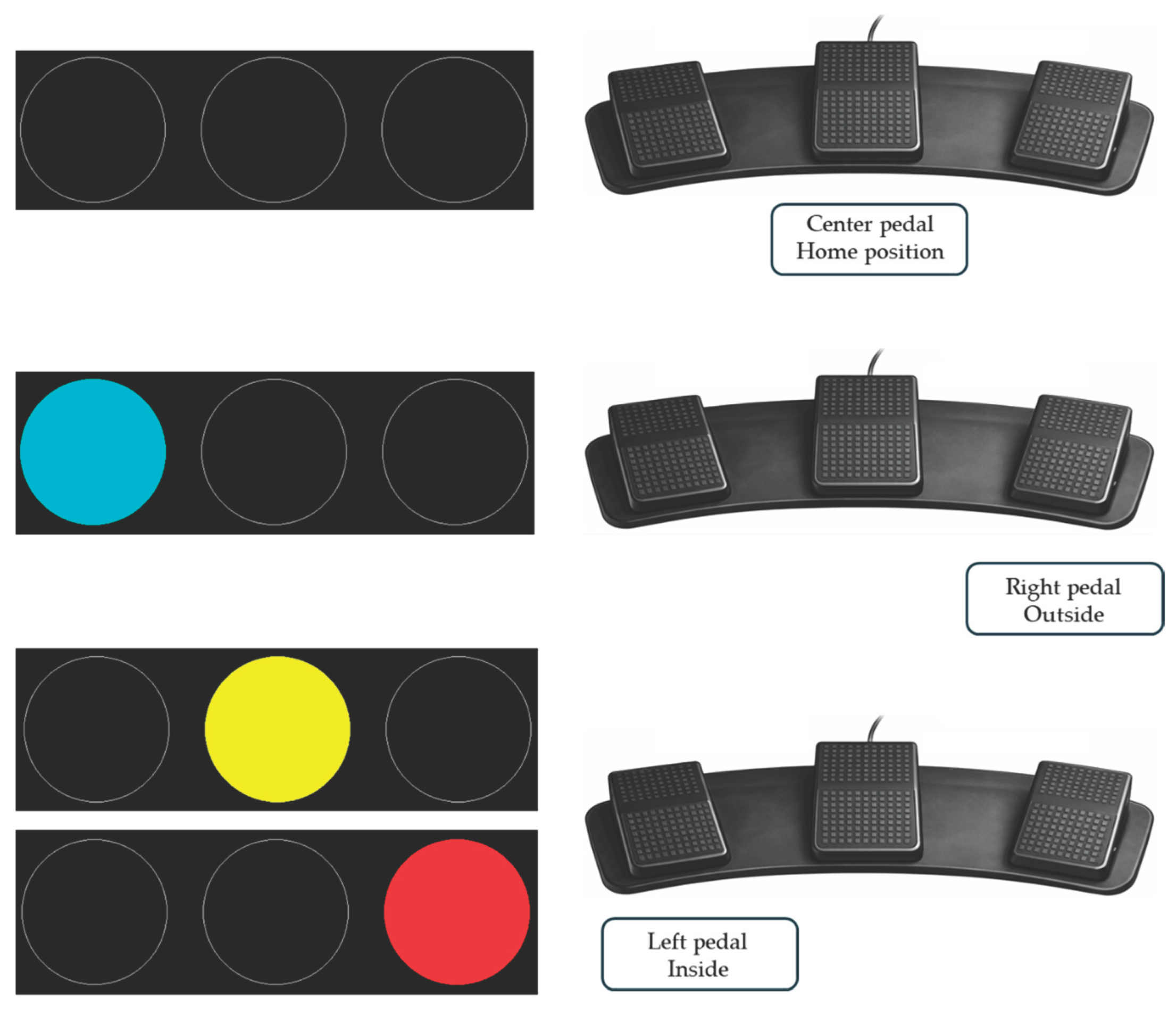

Table 1.
Descriptive statistics of RT (ms) by stimulus color and age group.
| Group | n | Response type | Color | Mean ± SD (ms) |
Median (IQR) (ms) |
Min–Max (ms) |
|---|---|---|---|---|---|---|
| Younger | 20 | Outside_RT | Blue | 697±74 | 693 (51) | 571–847 |
| Inside_RTr | Red | 673± 72 | 683 (33) | 558–784 | ||
| Inside_RTy | Yellow | 662±81 | 692 (74) | 544–802 | ||
| Older | 24 | Outside_RT | Blue | 818±113 | 786 (60) | 620–1035 |
| Inside_RTr | Red | 798±104 | 775 (51) | 635–1023 | ||
| Inside_RTy | Yellow | 781±106 | 770 (100) | 550–966 |
Table 2.
Wilcoxon signed-rank test for inside − outside RT differences (two-tailed).
| Group | Contrast | Median (IQR) (ms) |
W | p-value | Effect size (r) |
|---|---|---|---|---|---|
| Younger (n=20) |
dRT | ー20 (51) | 32 | 0.005 | 0.61 |
| dRTr | ー14 (33) | 35 | 0.007 | 0.58 | |
| dRTy | ー27 (74) | 39 | 0.012 | 0.55 | |
| Older (n=24) |
dRT | ー22 (56) | 82 | 0.053 | 0.40 |
| dRTr | ー7 (51) | 114 | 0.317 | 0.21 | |
| dRTy | ー31 (100) | 73 | 0.025 | 0.45 |
Table 3.
Between-group comparison of inside–outside RT differences (dRT) between younger and older adults.
Table 3.
Between-group comparison of inside–outside RT differences (dRT) between younger and older adults.
| Contrast | Group | n | Mean ± SD (ms) |
Median (ms) | Test | Statistic | p-value | Cohen’s d |
|---|---|---|---|---|---|---|---|---|
| dRT | Younger | 20 | −30±46 | −20 (51) | S | −0.002 | 0.998 | −0.001 |
| Older | 24 | −30±67 | −22 (60) | |||||
| dRTr | Younger | 20 | −23±38 | −14 (33) | M | 203.5 | 0.396 | −0.053 |
| Older | 24 | −20±66 | −7 (51) | |||||
| dRTy | Younger | 20 | −35±55 | −27 (74) | S | 0.113 | 0.911 | 0.034 |
| Older | 24 | −37±73 | −31 (100) |
S: Student t-test; M: Mann–Whitney U test. “Statistic” represents the t value for Student’s t-test and the U value for the Mann–Whitney U test.
Table 4.
Baseline anthropometric and physical activity characteristics of younger and older participants.
Table 4.
Baseline anthropometric and physical activity characteristics of younger and older participants.
| Variable | Group | n | Mean ± SD | Median (IQR) | Test | Statistic | p-value | Cohen's d |
|---|---|---|---|---|---|---|---|---|
| Height (cm) | Younger | 20 | 168± 9 | 171 (13) | S | 2.132 | 0.039 | 0.645 |
| Older | 24 | 162± 9 | 162 (13) | |||||
| PAL (METs·h/week) |
Younger | 20 | 4.90± 7.6 | 0.0 (6.0) | M | 113 | 0.002 | -0.821 |
| Older | 24 | 19.62± 23.2 | 15.0 (13.7) |
S: Student t-test; M: Mann–Whitney U test. “Statistic” represents the t-value for Student’s t-test and the U-value for the Mann–Whitney U test.
Table 5.
Spearman’s rank correlation coefficients between dRT measures and physical/sleep-related variables.
Table 5.
Spearman’s rank correlation coefficients between dRT measures and physical/sleep-related variables.
| Variable | Group | n | Height | PAL | Sleep1 | Sleep2 | Sleep3 | Sleep4 | Sleep5 |
|---|---|---|---|---|---|---|---|---|---|
| dRT | ALL | 44 | 0.029 | 0.149 | 0.048 | 0.052 | 0.083 | 0.009 | −0.177 |
| Younger | 20 | −0.109 | 0.100 | 0.063 | 0.172 | −0.262 | −0.325 | 0.030 | |
| Older | 24 | 0.183 | 0.196 | 0.070 | −0.014 | 0.387 | 0.251 | −0.293 | |
| dRTr | ALL | 44 | −0.082 | 0.196 | 0.087 | −0.003 | 0.059 | 0.065 | −0.185 |
| Younger | 20 | −0.136 | 0.118 | 0.154 | 0.066 | −0.203 | −0.327 | 0.038 | |
| Older | 24 | 0.019 | 0.120 | 0.027 | −0.011 | 0.266 | 0.252 | −0.321 | |
| dRTy | ALL | 44 | 0.119 | 0.069 | 0.010 | −0.005 | 0.098 | −0.029 | −0.207 |
| Younger | 20 | −0.093 | 0.042 | 0.077 | 0.199 | −0.379 | −0.318 | −0.015 | |
| Older | 24 | 0.322 | 0.146 | 0.002 | −0.100 | 0.416 | 0.192 | −0.313 |
All coefficients represent Spearman’s rank correlation (ρ). No correlations reached statistical significance (all p > 0.05).
Disclaimer/Publisher’s Note: The statements, opinions and data contained in all publications are solely those of the individual author(s) and contributor(s) and not of MDPI and/or the editor(s). MDPI and/or the editor(s) disclaim responsibility for any injury to people or property resulting from any ideas, methods, instructions or products referred to in the content. |
© 2026 by the authors. Licensee MDPI, Basel, Switzerland. This article is an open access article distributed under the terms and conditions of the Creative Commons Attribution (CC BY) license.
Copyright: This open access article is published under a Creative Commons CC BY 4.0 license, which permit the free download, distribution, and reuse, provided that the author and preprint are cited in any reuse.


