

Submitted:
31 March 2026
Posted:
01 April 2026
You are already at the latest version
Preprints on COVID-19 and SARS-CoV-2
Abstract
Rapid antigen tests targeting SARS-CoV-2 nucleocapsid protein were essential for decentralised testing during the COVID-19 pandemic. Independent performance evaluations are critical to guide regulatory approval and implementation, particularly in resource-limited settings. This study presents a retrospective analytical and operational evaluation of two instrument-based fluorescent immunoassays (FIA): the PCL COVID-19 Ag Rapid FIA (PCL Inc., South Korea) and LumiraDx SARS-CoV-2 Ag Test (LumiraDx Ltd., UK). Analytical sensitivity was determined using recombinant nucleocapsid protein and viral cultures. Clinical performance was assessed using residual clinical specimens (n=110) with RT-PCR as reference, stratified by cycle threshold (Ct). Operational characteristics were assessed using a structured Likert framework. Overall sensitivity was 63% (51-73) for PCL and 95% (88-99) for LumiraDx. For Ct≤25, sensitivity increased to 93% and 100%. Specificity was ≥97% for both. LumiraDx maintained sensitivity (83-94%) at Ct 25-30, whereas PCL detected no positives in this range. Limit of detection was 0.039 nM (PCL) and 0.6 pM (LumiraDx). Operational usability was high for both (90% PCL, 87% LumiraDx). LumiraDx showed higher analytical sensitivity across a broader viral load range, supporting primary diagnostic use, whereas PCL was limited to high viral loads. This provides a reproducible framework for rapid diagnostic assessment during emerging outbreaks.
Keywords:
SARS-CoV-2
; COVID-19
; rapid antigen test
; fluorescent immunoassay
; point-of-care testing
; diagnostic accuracy
; pandemic preparedness
1. Introduction
The emergence of severe acute respiratory syndrome coronavirus 2 (SARS-CoV-2) in 2019 placed unprecedented strain on global diagnostic systems, often exceeding the capacity of centralised molecular testing platforms. Although more than 779 million cases have been confirmed through laboratory testing worldwide [1], seroprevalence studies indicate that the true level of population exposure is much higher [2,3]. This discrepancy highlights limitations in testing accessibility and capacity, especially during the early phases of the pandemic. Low- and middle-income countries experienced significant challenges in scaling up reverse transcription polymerase chain reaction (RT-PCR) testing, including limited laboratory infrastructure, supply chain disruptions, and global shortages of critical [4,5]. These constraints emphasised the need for alternative diagnostic approaches that could be rapidly deployed outside of centralised laboratory settings.
Rapid antigen tests targeting the conserved nucleocapsid (N) protein emerged as a key solution for decentralised testing. These assays enabled rapid clinical decision-making, patient triage, and large-scale community screening [6,7]. The global diagnostics landscape expanded rapidly, with over 1,000 antigen-based assays developed across multiple platforms [8]. In response, regulatory bodies such as the U.S. Food and Drug Administration (FDA), the European Commission, and the World Health Organization (WHO) established emergency use pathways and performance guidelines [9,10,11] to facilitate rapid deployment [12]. Minimum performance criteria typically included ≥80% sensitivity and ≥97% specificity [13], alongside operational requirements such as ease of use, short turnaround time (≤30 minutes), and suitability for point-of-care implementation.
The South African Health Products Regulatory Authority (SAHPRA) received numerous SARS-CoV-2 antigen rapid test applications under emergency use conditions. Among these were assays based on fluorescent immunoassay (FIA) technology, which requires instrument-based result interpretation. While conventional lateral flow immunochromatographic assays offer advantages in cost and simplicity, they are limited by subjective visual interpretation and manual data capture, increasing the risk of user-dependent variability [14,15]. In contrast, instrument-based FIAs provide automated signal detection, standardised result interpretation, and integrated data management capabilities, supporting improved accuracy and digital health integration [16].
Despite manufacturer-reported performance data, independent evaluations remain essential to verify diagnostic accuracy under local conditions and to inform regulatory decision-making. Variability in assay performance across different settings, specimen types, and viral load distributions necessitate context-specific validation.
In this study, we present a retrospective performance evaluation of two instrument-based FIAs: the PCL COVID19 Ag Rapid FIA (PCL Inc., South Korea) and the LumiraDx SARS-CoV-2 Ag Test (LumiraDx Ltd., UK). We evaluated analytical sensitivity using recombinant protein and viral culture and evaluated clinical performance using residual patient specimens stratified by RT-PCR Ct values. In addition, operational characteristics were assessed using a structured framework to determine suitability for point-of-care deployment. Key characteristics of the evaluated assays are summarised in Table 1.
2. Materials and Methods
2.1. SARS-CoV-2 Purified Recombinant Protein Panel
Purified recombinant SARS-CoV-2 wild-type N protein (~60.68 kDa) was provided by Prof. Jonathan Blackburn (University of Cape Town, South Africa). The protein was expressed in a baculovirus expression system using KREX™ functional proteomics technology (Sengenics Co Pte Ltd., UK). To determine the limit of detection (LoD) for each assay, N protein concentrations ranging from 10nM to 2.4pM were prepared in manufacturer specific assay buffers. Each concentration was tested in duplicate according to the respective manufacturer’s instructions.
2.2. SARS-CoV-2 Viral Culture Panel
SARS-CoV-2 wild-type viral culture (2019-nCoV strain) was obtained through collaborators in South Africa (Prof. Wolfgang Preiser, Stellenbosch University; Prof. Bavesh Kana, University of the Witwatersrand). Viral stock was semi-quantified using reference RNA material (~log10 5 viral copies/µL). Two dilutions (1×10³ and 1×10⁴) were prepared, corresponding to approximately log 5.9 viral copies/mL and log10 4.7 viral copies/mL, respectively, following previously described methods [17]. Each dilution was mixed 1:1 with the respective assay buffer and tested according to manufacturer instructions. Parallel RT-PCR testing was performed using the TaqPath™ COVID-19 CE-IVD RT-PCR Kit on the QuantStudio platform (ThermoFisher Scientific, Waltham, MA, USA) to obtain corresponding Ct values.
2.3. Residual Clinical Specimen Evaluation Panels
Residual nasopharyngeal clinical specimens were obtained from routine SARS-CoV-2 RT-PCR testing at the HIV Molecular Laboratory of the National Health Laboratory Service, Charlotte Maxeke Johannesburg Academic Hospital, Johannesburg, South Africa. Ethics approval for use of residual specimens was granted by the University of the Witwatersrand Human Research Ethics Committee (approval #M1911201). Swabs were received at the testing laboratory and processed in phosphate-buffered saline (PBS), saline, viral transport medium (VTM), or universal transport medium (UTM), and tested using the cobas® SARS-CoV-2 platform (Roche Molecular, Pleasanton, CA, USA). Specimens were stratified based on Ct values into high viral load (HVL; Ct ≤25), medium viral load (MVL; Ct 25-30), low viral load (LVL; Ct 30-35), and SARS-CoV-2 negatives. A total of 110 specimens were evaluated per assay panel. Panel composition and specimen distribution are summarised in Table 2.
Due to the use of residual specimens, modifications to manufacturer protocols were required. Three specimen preparation methods were evaluated. Method A: Simulated swab protocol using a sterile swab (provided with test kits) were immersed in residual specimen for approximately 1 minute before processing according to manufacturer instructions. Method B: Direct 1:1 dilution of residual specimen in assay buffer prior to testing. Method C: Serial dilution of specimens (1:2-1:9) in assay buffer; for LumiraDx, a 1:7 dilution was selected based on manufacturer guidance and used for final analysis.
Although the assays were evaluated using different specimen panels, comparability was supported by standardisation of Ct distributions and validation against comparator assays. Discordant results were excluded following consensus review.
2.4. Precision Analysis
Intra-assay precision was assessed using quintuplicate testing of four residual clinical specimens (two SARS-CoV-2 positive with Ct <30 and two negative). Each specimen was tested five times within a single day (total n=20 per assay).
2.5. Statistical Analysis
Diagnostic performance, including sensitivity, specificity, positive predictive value (PPV), negative predictive value (NPV), and Cohen’s kappa coefficient (κ), were calculated using STATA version 14 (StataCorp, USA). Agreement was interpreted using the Landis and Koch scale: poor (<0.2), fair (0.2–0.4), moderate (0.4–0.6), good (0.6–0.8), and very good (0.8–1.0). Confidence intervals (95% CI) were calculated for all relevant estimates.
2.6. Operational Assessment
Operational characteristics were evaluated using a structured 5-point Likert scale (1=very poor/difficult; 5 = very good/easy), across the following domains (i) kit contents ready for implementation (including protective materials and consumables); (ii) biosafety requirements (safe use without specialised facilities); (iii) training complexity (standard procedure, no specialised skills); (iv) ease of use from specimen collection to result interpretation; (v) time to result (acceptable ≤40 min, optimal ≤20 min); and (vi) invalid/error rate (acceptable ≤5%). Scoring was performed by laboratory operators following completion of assay evaluations.
3. Results
3.1. Performance Using Reference Materials
The analytical performance of the PCL and LumiraDx SARS-CoV-2 antigen assays were first evaluated using viral culture and purified recombinant nucleocapsid protein. Both assays successfully detected SARS-CoV-2 viral culture at a dilution of 1×10³ (~log10 5.9 viral copies/mL), corresponding to RT-PCR Ct values ≤25. Neither assay detected the lower concentration dilution (1×10⁴; ~log10 4.8 viral copies/mL), which correspond to Ct values ranging from 25–28 (Table 3a).
Using purified recombinant N protein, the LoD differed substantially between assays. The PCL assay demonstrated a LoD of 0.039 nM (0.36 ng/µL), whereas the LumiraDx assay detected concentrations as low as 0.6 pM (0.006 ng/µL), indicating a higher analytical sensitivity (Table 3b).
3.2. Performance Using Residual Clinical Specimens
A total of 110 residual clinical specimens were evaluated for each assay. Compared to RT-PCR, the overall diagnostic sensitivity (95% CI) was 63% (51-73) for the PCL assay and 95% (88-99) for the LumiraDx assay (Table 4). Specificity was 100% (88-100) for PCL and 97% (83-100) for LumiraDx.
Stratification by viral load demonstrated a strong dependence of assay sensitivity on Ct values. For HVL specimens (Ct ≤25), sensitivity increased to 93% (82-98) for PCL (Method B) and reached 100% (92-100) for LumiraDx across both evaluated methods. In the MVL range (Ct 25-30), performance varied substantially between assays. LumiraDx maintained high sensitivity, achieving 83% using Method A and 94% using Method C. Whereas, PCL assay did not detect any positive specimens within this Ct range. For LVL specimens (Ct 30–35), LumiraDx retained moderate detection capability (65-85%, depending on method), whereas PCL performance remained limited. The distribution of antigen test results in relation to Ct values is presented in Figure 1.
3.3. Precision
Intra-assay precision was high for both assays. All positive and negative specimens (100%) were correctly classified across quintuplicate testing, demonstrating excellent repeatability. Additionally, LumiraDx quality controls and reference panel specimens (MRNDx) produced results consistent with manufacturer specifications.
3.4. Operational Performance
Operational performance, assessed using a structured Likert scale, yielded high overall scores for both assays: 90% (27/30) for PCL and 87% (26/30) for LumiraDx (Table 5). Both assays scored highly for ease of use, minimal training requirements, and rapid time to result. However, workflow limitations were noted. Instrument-based processing in single-read mode increased total turnaround time for both platforms. The LumiraDx system occasionally generated “insufficient sample volume” errors despite adequate sample application, contributing to a slightly lower score for invalid/error rate.
4. Discussion
This study presents a structured, independent evaluation of two instrument-based SARS-CoV-2 antigen tests conducted during a public health emergency. Using a standardised framework that includes analytical, clinical, and operational components, we demonstrate that while both assays meet minimum performance thresholds for HVL detection, their diagnostic utility differs substantially across the viral load ranges.
Both assays achieved high sensitivity in specimens with Ct ≤25, which corresponds to peak viral load and the period of high infectiousness. This finding aligns with established data reporting that antigen test sensitivity is highest during early infection when viral replication is at peak [18]. Reliable detection within this range supports the use of both assays for identifying individuals most likely to transmit infection [19,20], reinforcing their role in rapid clinical triage and outbreak response.
However, a key difference between the assays occurred at lower viral loads. The LumiraDx assay maintained high sensitivity (83-94%) in the MVL range (Ct 25-30), whereas the PCL assay failed to detect specimens within this category. This difference is clinically important, as individuals within this Ct range may still contribute to transmission, especially during the early or recovery phase [21,22]. The ability to detect these cases enhances the utility of antigen testing beyond detecting only highly infectious individuals.
The observed differences in clinical performance align with the analytical sensitivity results from this study. The approximately two-log difference in LoD between assays (0.6 pM for LumiraDx vs 0.039 nM for PCL) likely explains the improved performance of the LumiraDx platform at lower antigen concentrations. This increased sensitivity can be attributed to differences in assay design. The LumiraDx system employs a microfluidic platform with controlled sample processing and enhanced signal detection, whereas the PCL assay utilises a lateral flow format, which is more prone to matrix effects [23] and reduced sensitivity at low antigen levels.
These findings are consistent with previous studies evaluating SARS-CoV-2 antigen tests. Prior evaluations of lateral flow assays have reported sensitivities ranging from approximately 50-90%, with performance highly dependent on viral load, and the highest sensitivity observed at Ct ≤25 [24,25]. In contrast, instrument-based assays, including LumiraDx, have consistently demonstrated higher sensitivity and better correlation with viral culture positivity [26]. Meta-analyses have also identified LumiraDx as among the highest-performing antigen platforms [27], supporting the advantages of signal amplification and standardised detection.
The relationship between Ct value and antigen test positivity observed in this study further supports the use of Ct as a proxy for infectiousness [18]. The consistent detection of specimens with Ct ≤25 by both assays, along with the absence of detection at higher Ct values, reflects the biological relationship between viral load and antigen availability.
Beyond diagnostic accuracy, both assays demonstrated strong operational performance, confirming their suitability for decentralised testing. High scores for ease of use, minimal training needs, and quick turnaround times align with key criteria for point-of-care deployment. However, workflow limitations were noted. Both platforms operate in a single-read mode, which may limit throughput during high-demand periods. Additionally, the occurrence of “insufficient sample volume” errors with the LumiraDx system highlights the importance of operator training and system optimisation in real-world use.
An advantage of the LumiraDx platform is its ability to perform multiple tests, enabling the combination of infectious and non-communicable disease testing on a single device. This broadens its usefulness beyond just COVID-19 and encourages long-term integration into diagnostic networks, especially in resource-limited environments where platform flexibility is essential.
This study has several limitations. The lack of clinical metadata prevented analysis based on symptom duration or disease severity, which are known to impact viral dynamics and test performance. The use of multiple transport media may have influenced antigen stability and assay sensitivity. The assays were evaluated with different specimen panels, limiting direct comparison, though stratification by Ct values mitigated this constraint. Variant-specific performance was not systematically examined; however, using N protein targets decreases the chance of performance variation across variants. The use of residual clinical specimens required protocol adjustments, which might not fully reflect performance under manufacturer-recommended conditions. Lastly, limited sample sizes within stratified analyses could affect the precision of subgroup estimates.
Despite these limitations, this study offers a strong and reproducible framework for rapid diagnostic evaluation. The combined use of recombinant protein, viral culture, and clinical specimens allowed for a thorough assessment of both analytical and clinical performance. Stratification by Ct value provided clinically relevant insights into how the assay performs at different stages of infection, while a structured operational assessment highlighted practical considerations for implementation.
Importantly, these findings highlight the need for independent, context-specific evaluation within national regulatory processes. The variability in performance between assays with similar intended uses highlights the limitations of relying solely on manufacturer-reported data. The framework used in this study is scalable and adaptable, supporting quick assessment of diagnostic technologies during future infectious disease outbreaks.
5. Conclusions
Both evaluated SARS-CoV-2 antigen assays met the minimum performance criteria for detecting HVL infections, supporting their utility in identifying individuals at peak infectiousness. However, the LumiraDx assay showed higher sensitivity across a broader viral load range, including clinically relevant MVL specimens, supporting its use in near-patient diagnostic settings. Conversely, the PCL assay showed limited sensitivity beyond HVL specimens, indicating its suitability may be restricted to targeted screening strategies focused on highly infectious individuals. Instrument-based antigen assays offer important advantages over traditional lateral flow tests, including standardised result interpretation, reduced operator variability, and integration with digital health systems. Additionally, the multi-analyte capability of the LumiraDx platform enhances its long-term value by enabling broader diagnostic applications beyond COVID-19. The evaluation framework described in this study provides a practical and reproducible method for rapid diagnostic validation during public health emergencies. Incorporation of such standardised evaluation strategies into regulatory pathways will support the timely implementation of fit-for-purpose diagnostic technologies in resource-limited settings.
Author Contributions
Conceptualization, V.K. and L.S.; methodology, V.K.; software, V.K.; validation, V.K.; formal analysis, V.K.; investigation, L.S and W.S.; resources, L.H; data curation, V.K.; writing—original draft preparation, V.K.; writing—review and editing, L.S.; L.H; and W.S.; funding acquisition, W.S. All authors have read and agreed to the published version of the manuscript.
Funding
Financial support for this study was provided by the Gates Foundation through the Innovation in Laboratory Engineered Accelerated Diagnostics investment (grant number INV-006726) and Clinical Feasibility (grant number INV-051718).
Institutional Review Board Statement
Ethical approval was granted by the University of the Witwatersrand Human Research Ethics Committee (approval #M1911201).
Informed Consent Statement
Informed consent was not required as this study used residual de-identified specimens, and the use of these specimens for research was approved by the Institutional Review Board (approval #M1911201).
Data Availability Statement
All relevant data are presented within the manuscript. No publicly archived datasets were generated or analysed during this study.
Acknowledgments
We acknowledge Annie Chan for assistance with preparing the graph for this study.
Conflicts of Interest
The authors declare no conflicts of interest.
References
- World Health Organization. WHO Coronavirus (COVID-19) Dashboard 2023 [updated 28 June 2023. Available online: https://covid19.who.int/.
- Bergeri, I.; Whelan, M.G.; Ware, H.; Subissi, L.; Nardone, A.; Lewis, H.C.; Li, Z.; Ma, X.; Valenciano, M.; Cheng, B. Global SARS-CoV-2 seroprevalence from January 2020 to April 2022: A systematic review and meta-analysis of standardized population-based studies. PLoS medicine 2022, 19(11), e1004107. [Google Scholar] [CrossRef] [PubMed]
- Rostami, A.; Sepidarkish, M.; Leeflang, M.M.; Riahi, S.M.; Shiadeh, M.N.; Esfandyari, S.; Mokdad, A.H.; Hotez, P.J.; Gasser, R.B. SARS-CoV-2 seroprevalence worldwide: a systematic review and meta-analysis. Clinical Microbiology and Infection 2021, 27(3), 331–40. [Google Scholar] [CrossRef] [PubMed]
- Duroseau, B.; Kipshidze, N.; Limaye, R.J. The impact of delayed access to COVID-19 vaccines in low-and lower-middle-income countries. Frontiers in public health 2023, 10, 1087138. [Google Scholar] [CrossRef] [PubMed]
- Patwary, M.M.; Alam, M.A.; Bardhan, M.; Disha, A.S.; Haque, M.Z.; Billah, S.M.; Kabir, M.P.; Browning, M.H.; Rahman, M.M.; Parsa, A.D. COVID-19 vaccine acceptance among low-and lower-middle-income countries: a rapid systematic review and meta-analysis. Vaccines 2022, 10(3), 427. [Google Scholar] [CrossRef] [PubMed]
- Dutta, N.K.; Mazumdar, K.; Gordy, J.T. The nucleocapsid protein of SARS–CoV-2: a target for vaccine development. Journal of virology 2020, 94(13), e00647-20. [Google Scholar] [CrossRef] [PubMed]
- Zeng, W.; Liu, G.; Ma, H.; Zhao, D.; Yang, Y.; Liu, M.; Mohammed, A.; Zhao, C.; Yang, Y.; Xie, J. Biochemical characterization of SARS-CoV-2 nucleocapsid protein. Biochemical and biophysical research communications 2020, 527(3), 618–23. [Google Scholar] [CrossRef] [PubMed]
- FIND COVID-19 Test Directory [Internet]. 2022. Available online: https://www.finddx.org/tools-and-resources/dxconnect/test-directories/covid-19-test-directory/.
- Africa DoHRoS. Guide to Antigen Testing for SARS-CoV-2 in South Africa 2021.
- World Health Organization. SARS-CoV-2 antigen-detecting rapid diagnostic tests: an implementation guide; World Health Organization, 2021. [Google Scholar]
- Centers for Disease Control and Prevention. Guidance for Antigen Testing for SARS-CoV-2 for Healthcare Providers Testing Individuals in the Community [Internet]. 2022. Available online: https://www.cdc.gov/coronavirus/2019-ncov/lab/resources/antigen-tests-guidelines.html.
- In Vitro Diagnostics EUAs - Antigen Diagnostic Tests for SARS-CoV-2 [Internet]. 2023 [cited 12 January 2023]. Available online: https://www.fda.gov/medical-devices/coronavirus-disease-2019-covid-19-emergency-use-authorizations-medical-devices/in-vitro-diagnostics-euas-antigen-diagnostic-tests-sars-cov-2.
- Organization WH. Antigen-detection in the diagnosis of SARS-CoV-2 infection using rapid immunoassays. 2020. [Google Scholar]
- Kumar, V.; Ghosh, K.; Chandran, A.; Panwar, S.; Bhat, A.; Konaje, S.; Das, S.; Srikanta, S.; Jaganathan, L.; Prasad, S. Multicentric evaluation of a novel point of care electrochemical ELISA platform for SARS-CoV-2 specific IgG and IgM antibody assay. Journal of Virological Methods 2021, 298, 114275. [Google Scholar] [CrossRef] [PubMed]
- Wong, R.; Tse, H. Lateral flow immunoassay; Springer Science & Business Media, 2008. [Google Scholar]
- Kinnamon, D.S.; Heggestad, J.T.; Liu, J.; Chilkoti, A. Technologies for Frugal and Sensitive Point-of-Care Immunoassays. Annual Review of Analytical Chemistry 2022, 15, 123–149. [Google Scholar] [CrossRef] [PubMed]
- Keshav, V.; Scott, L.; David, A.; Noble, L.; Mayne, E.; Stevens, W. Antigen-based point of care testing (poct) for diagnosing sars-cov-2: assessing performance. In Sars-cov-2: Methods and Protocols; Springer, 2022; pp. 45–62. [Google Scholar]
- Puhach, O.; Meyer, B.; Eckerle, I. SARS-CoV-2 viral load and shedding kinetics. Nature Reviews Microbiology 2023, 21(3), 147–61. [Google Scholar] [CrossRef] [PubMed]
- Linares, M.; Pérez-Tanoira, R.; Carrero, A.; Romanyk, J.; Pérez-García, F.; Gómez-Herruz, P.; Arroyo, T.; Cuadros, J. Panbio antigen rapid test is reliable to diagnose SARS-CoV-2 infection in the first 7 days after the onset of symptoms. Journal of Clinical Virology 2020, 133, 104659. [Google Scholar] [CrossRef] [PubMed]
- Nordgren, J.; Sharma, S.; Olsson, H.; Jämtberg, M.; Falkeborn, T.; Svensson, L.; Hagbom, M. SARS-CoV-2 rapid antigen test: High sensitivity to detect infectious virus. Journal of clinical virology 2021, 140, 104846. [Google Scholar] [CrossRef] [PubMed]
- Rabaan, A.A.; Tirupathi, R.; Sule, A.A.; Aldali, J.; Mutair, A.A.; Alhumaid, S.; Muzaheed Gupta, N.; Koritala, T.; Adhikari, R. Viral dynamics and real-time RT-PCR Ct values correlation with disease severity in COVID-19. Diagnostics 2021, 11(6), 1091. [Google Scholar] [CrossRef] [PubMed]
- Calistri, P.; Danzetta, M.; Amato, L. Epidemiological significance of SARS-CoV-2 RNA dynamic in naso-pharyngeal swabs. Microorganisms 2021, 9(6), 1264. [Google Scholar] [CrossRef] [PubMed]
- Mayfield, J.; Hesse, P.; Ledden, D. The Impact of Universal Transport Media and Viral Transport Media Liquid Samples on a SARS-CoV-2 Rapid Antigen Test. medRxiv. 2021:2021.05. 12.21257107.
- Jääskeläinen, A.; Ahava, M.J.; Jokela, P.; Szirovicza, L.; Pohjala, S.; Vapalahti, O.; Lappalainen, M.; Hepojoki, J.; Kurkela, S. Evaluation of three rapid lateral flow antigen detection tests for the diagnosis of SARS-CoV-2 infection. Journal of Clinical Virology 2021, 137, 104785. [Google Scholar] [CrossRef] [PubMed]
- Diao, B.; Wen, K.; Zhang, J.; Chen, J.; Han, C.; Chen, Y.; Wang, S.; Deng, G.; Zhou, H.; Wu, Y. Accuracy of a nucleocapsid protein antigen rapid test in the diagnosis of SARS-CoV-2 infection. Clinical Microbiology and Infection 2021, 27(2), 289.e1–e4. [Google Scholar] [CrossRef] [PubMed]
- Kohmer, N.; Toptan, T.; Pallas, C.; Karaca, O.; Pfeiffer, A.; Westhaus, S.; Widera, M.; Berger, A.; Hoehl, S.; Kammel, M. The comparative clinical performance of four SARS-CoV-2 rapid antigen tests and their correlation to infectivity in vitro. Journal of clinical medicine 2021, 10(2), 328. [Google Scholar] [CrossRef] [PubMed]
- Brümmer, L.E.; Katzenschlager, S.; Gaeddert, M.; Erdmann, C.; Schmitz, S.; Bota, M.; Grilli, M.; Larmann, J.; Weigand, M.A.; Pollock, N.R. Accuracy of novel antigen rapid diagnostics for SARS-CoV-2: A living systematic review and meta-analysis. PLoS medicine 2021, 18(8), e1003735. [Google Scholar] [CrossRef] [PubMed]
Figure 1.
Distribution of positive and negative rapid antigen test results by RT-PCR Ct value (Violin plot with jittered data points showing the distribution of positive (red) and negative (green) rapid antigen test results for both assays in relation to corresponding RT-PCR Ct values (y-axis)).
Figure 1.
Distribution of positive and negative rapid antigen test results by RT-PCR Ct value (Violin plot with jittered data points showing the distribution of positive (red) and negative (green) rapid antigen test results for both assays in relation to corresponding RT-PCR Ct values (y-axis)).
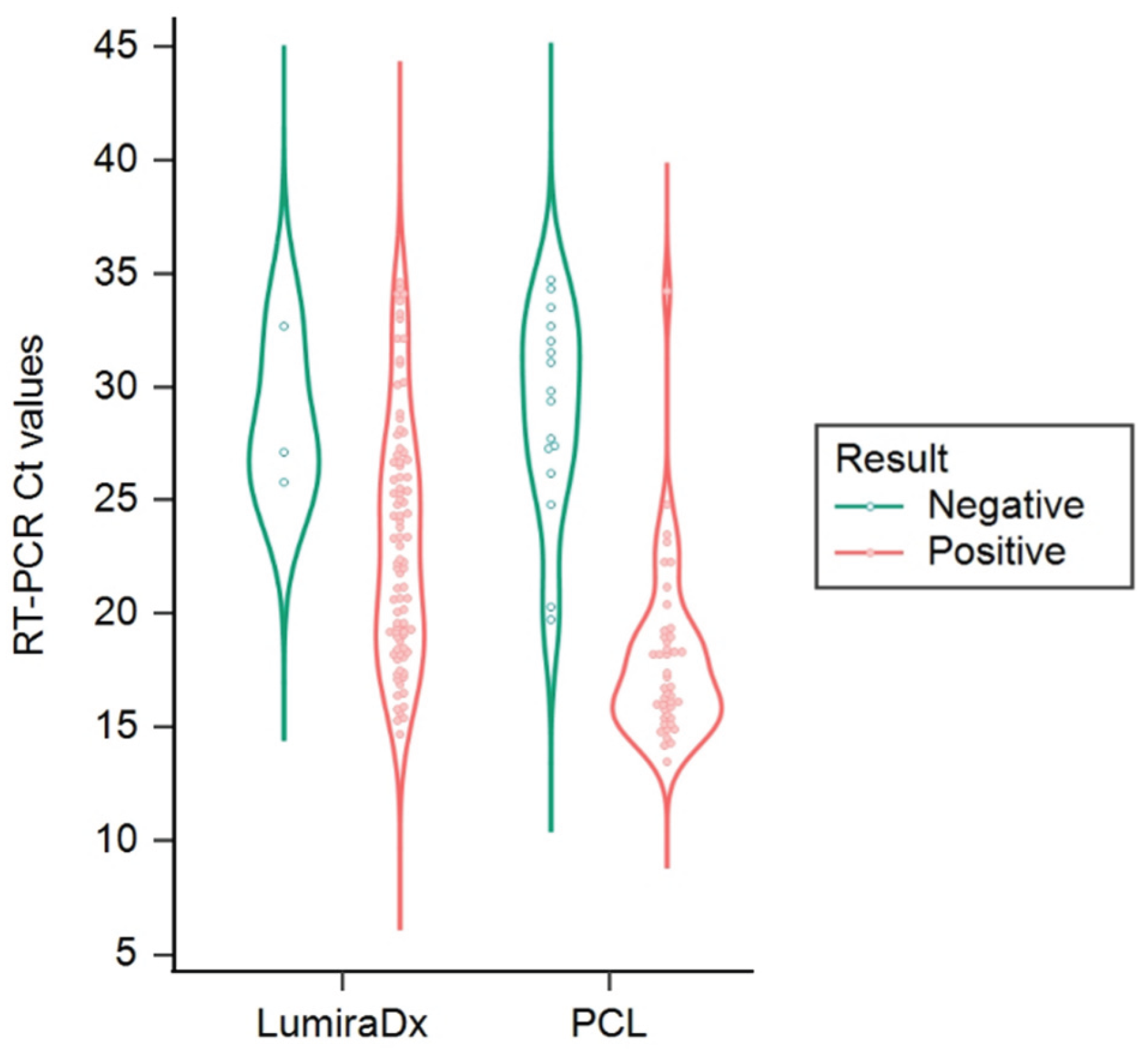

Table 1.
Key features of the SARS-CoV-2 antigen assays evaluated in this study.
| Characteristics | PCL COVID19 Ag Rapid FIA | LumiraDx SARS-CoV-2 Ag Test |
| Regulatory certification (at time of evaluation) | SAHPRA (08/01/2021), TGA (30/07/2021) | FDA EUA (18/12/2020) |
| Target population | Symptomatic individuals | Symptomatic and asymptomatic individuals |
| Specimen type(s) | Nasopharyngeal/Oropharyngeal | Nasal/Nasopharyngeal |
| Format/design | Immunosandwich lateral flow assay | Immunosandwich microfluidic assay |
| Target SARS-CoV-2 protein | Undisclosed | Nucleocapsid protein |
| Sample volume applied to test cassette | 4 drops | 1 drop (~20 µL) |
| Result interpretation | PCLOK EZ instrument | LumiraDx instrument |
| Time to result | Standard mode: 10 min on-board incubation; Quick mode: 10 min bench incubation + instrument read | 12 minutes after test strip insertion |
| Additional features | On-board printer; barcode scanning; USB data export | Automated quality checks; RFID calibration; cloud-based connectivity; LIS integration |
| Manufacturer performance data* | 89% sensitivity and 99% specificity | 98% sensitivity and 97% specificity |
*Obtained using fresh clinical specimens in accordance with the IFU. FIA – Fluorescent immunoassay, SAHPRA – South African Health Products Regulatory Authority, TGA – Therapeutic Goods Administration, EUA – Emergency Use Authorisation, FDA – U.S. Food and Drug Administration, WHO EUL – World Health Organisation Emergency Use Listing, RFID – Radio Frequency Identification, LIS – Laboratory Information System.
Table 2.
Description of the SARS-CoV-2 challenge panel materials.
| Material | Description | |
|---|---|---|
| SARS-CoV-2 purified recombinant N protein | 10 nM, 2.5 nM, 0.625 nM, 0.039 nM, 9.75 pM and 2.4 pM concentrations tested in duplicate | |
| SARS-CoV-2 viral cultures | 1x10³ and 1x10⁴ dilutions tested in triplicate and compared to RT-PCR | |
| SARS-CoV-2 residual clinical specimens | PCL COVID19 Ag Rapid FIA | LumiraDx SARS-CoV-2 Ag Test |
| Collected: Oct - Dec 2020 | Collected: April - June 2021 | |
| N=110 | N=110 | |
| n=54 HVL, n=10 MVL, n=17 LVL, n=30 Neg | n=42 HVL, n=18 MVL, n=20 LVL, n=30 neg | |
| Panel comprised of SA wave 1* specimens | Panel comprised of SA wave 1 and wave 2* specimens | |
| Methods applied | Simulated swab into kit buffer (A); 1:1 dilution of specimen with kit buffer (B) | Simulated swab into kit buffer (A); 1:7 dilution of specimen with kit buffer (C) |
*South African wave 1 was associated with a mix of SARS-CoV-2 lineages, whereas wave 2 comprised predominantly beta strains (B.1.351). .
Table 3.
Analytical performance of SARS-CoV-2 antigen assays using (a) viral cultures and (b) purified recombinant N protein.
Table 3.
Analytical performance of SARS-CoV-2 antigen assays using (a) viral cultures and (b) purified recombinant N protein.
| (a) SARS-CoV-2 viral cultures (SA wild-type) | ||||||||
| Assay | Dilution factor | FIA result | N | S | ORF1ab | |||
| PCL COVID19 Ag Rapid FlA | 1x10³ | Positive | 24,1 | 24,6 | 23,9 | |||
| 1x10⁴ | Negative | 27,2 | 27,9 | 27,1 | ||||
| LumiraDx SARS-CoV-2 Ag Test | 1x10³ | Positive | 24,59 | 24,09 | 23,90 | |||
| 1x10⁴ | Negative | 27,86 | 27,23 | 27,13 | ||||
| (b) SARS-CoV-2 purified recombinant nucleocapsid proteins (SA wild-type) | ||||||||
| Protein Concentration | 10 nM | 2.5 nM | 0.625 nM | 0.039 nM | 9.75 pM | 2.4 pM | 0.6 pM | 0.15 pM |
| PCL COVID19 Ag Rapid FlA | Positive | Positive | Positive | Positive | Negative | Negative | Negative | Negative |
| LumiraDx SARS-CoV-2 Ag Test | Positive | Positive | Positive | Positive | Positive | Positive | Positive | Negative |
Table 4.
Analytical performance of SARS-CoV-2 antigen assays on residual clinical specimens.
| Assay | Method | Ct range | n | Sensitivity (95% CI) | Specificity (95% CI) | PPV (95% CI) | NPV (95% CI) | Cohen Kappa (95% CI) | Agreement score |
| PCL COVID19 Ag Rapid FIA | A and B | Overall performance | 110 | 63% (51-73) | 100% (88-100) | 100% (93-100) | 50% (37-63) | 0.48 (0.34-0.61) | Moderate |
| A | Ct ≤ 25 | 53 pos, 30 neg | 91% (79-97) | 100% (88-100) | 100% (93-100) | 86% (70-95) | 0.87 (0.77-0.98) | Very Good | |
| B | Ct ≤ 25 | 53 pos, 30 neg | 93% (82-98) | 100% (88-100) | 100% (93-100) | 88% (73-97) | 0.89 (0.80-1.00) | Very Good | |
| A, B | Ct 25-30 | 7 pos, 30 neg | No positives detected (0%)/ All negatives correctly identified (100%) | ||||||
| A, B | Ct 30-35 | 20 pos, 30 neg | |||||||
| LumiraDx SARS-CoV-2 Ag Test | A and C | Overall performance | 110 | 95% (88-99) | 97% (83-100) | 99% (93-100) | 88% (72-97) | 0.89 (0.79-0.98) | Very Good |
| A | Ct ≤ 25 | 42 pos, 30 neg | 100% (92-100) | 97% (83-100) | 98% (88-100) | 100% (88-100) | 0.97 (0.92-1.02) | Very Good | |
| A | Ct 25-30 | 18 pos, 30 neg | 83% (59-96) | 97% (83-100) | 94% (70-100) | 91% (75-98) | 0.97 (0.92-1.03) | Very Good | |
| A | Ct 30-35 | 20 pos, 30 neg | 65% (41-85) | 97% (83-100) | 93% (66-100) | 81% (64-92) | 0.82 (0.65-0.99) | Very Good | |
| C | Ct ≤ 25 | 42 pos, 30 neg | 100% (92-100) | 97% (83-100) | 98% (88-100) | 100% (88-100) | 0.91 (0.80-1.03) | Very Good | |
| C | Ct 25-30 | 18 pos, 30 neg | 94% (73-100) | 97% (83-100) | 94% (73-100) | 97% (83-100) | 0.65 (0.43-0.87) | Good | |
| C | Ct 30-35 | 20 pos, 30 neg | 85% (62-97) | 97% (83-100) | 94% (73-100) | 91% (75-98) | 0.83 (0.67-0.99) | Very Good | |
Table 5.
Operational performance of SARS-CoV-2 Ag assays.
| Characteristic | PCL COVID19 Ag Rapid FlA | LumiraDx SARS-CoV-2 Ag Test |
| Kit contents ready for implementation | 4 | 4 |
| Need for biosafety | 4 | 4 |
| Training required | 5 | 5 |
| Ease of use from specimen collection to result interpretation | 4* | 4ǂ |
| Time to result | 5 | 5 |
| Invalid (error rate) | 5 | 4* |
| Comments | * Testing time increased with single-read mode | ǂTesting time increased with single-read cartridge *Analyser displayed “sample error - insufficient volume” despite adequate well coverage |
Disclaimer/Publisher’s Note: The statements, opinions and data contained in all publications are solely those of the individual author(s) and contributor(s) and not of MDPI and/or the editor(s). MDPI and/or the editor(s) disclaim responsibility for any injury to people or property resulting from any ideas, methods, instructions or products referred to in the content. |
© 2026 by the authors. Licensee MDPI, Basel, Switzerland. This article is an open access article distributed under the terms and conditions of the Creative Commons Attribution (CC BY) license (http://creativecommons.org/licenses/by/4.0/).
Copyright: This open access article is published under a Creative Commons CC BY 4.0 license, which permit the free download, distribution, and reuse, provided that the author and preprint are cited in any reuse.


