

Submitted:
31 March 2026
Posted:
01 April 2026
You are already at the latest version
Abstract
Ammonia volatilization after nitrogen fertilization represents a major pathway of reactive nitrogen loss in cropping systems, reducing nitrogen use efficiency and contributing to environmental impacts. This review analyses fertilizer-based strategies to mitigate these losses from a mechanistic perspective, focusing on the processes governing ammonia formation and emission under field conditions. Approaches such as urease inhibition, pH regulation, ammonium retention, and controlled-release formulations are examined in relation to their effects on hydrolysis, chemical equilibria, and mass transfer. Evidence from field studies and meta-analyses shows strong variability in mitigation performance across soils, climates, and management practices, indicating a high dependence on local conditions. The analysis also identifies trade-offs between nitrogen loss pathways, where reductions in ammonia emissions may influence nitrous oxide emissions or nitrate leaching. A process-based framework is proposed to guide the selection of mitigation strategies according to dominant loss mechanisms, supporting more efficient and con-text-specific nitrogen management in cropping systems.
Keywords:
agricultural soils
; controlled-release fertilizers
; emission dynamics
; fertilizer management
; nitrogen cycling
; nitrogen use efficiency
; reactive nitrogen
; soil processes
; urease inhibitors
1. Introduction
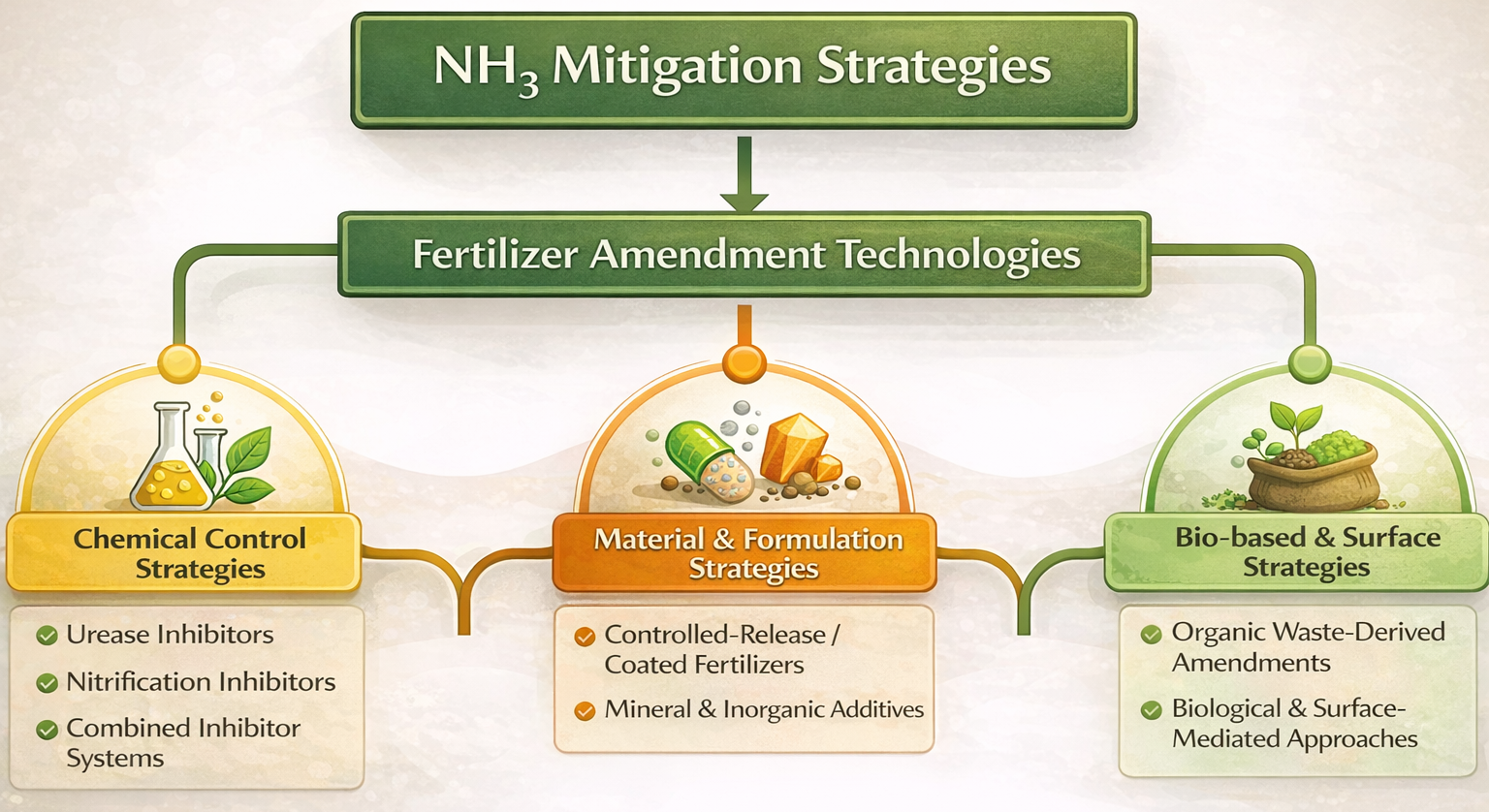
Ammonia volatilization is a major pathway of reactive nitrogen loss in agricultural systems, occurring shortly after fertilizer application and limiting the efficiency of nitrogen use in crops. Mineral nitrogen fertilizers sustain a substantial share of global food production, with estimates indicating that nearly half of crop output depends on synthetic nitrogen inputs [1], while future demand is expected to continue increasing [2]. Despite this importance, less than half of the applied nitrogen is typically recovered by crops, reflecting significant inefficiencies in current fertilization practices [3]. Nitrogen losses occur through several pathways, including volatilization, denitrification associated with nitrous oxide (N2O) emissions, and nitrate leaching, making their control essential for sustainable nutrient management [4]. Figure 1 illustrates these pathways within the agricultural nitrogen cycle, highlighting the main transformation processes and loss routes following fertilizer application.
Within this framework, ammonia emissions represent a particularly critical component due to their high variability and strong dependence on soil, climatic, and management conditions. Volatilization is especially relevant for urea-based fertilizers, where rapid hydrolysis can lead to substantial nitrogen losses at the soil surface. Reported emission rates vary widely across agroecosystems, highlighting the importance of understanding the underlying mechanisms that control ammonia formation and transfer rather than assuming uniform mitigation performance [5,6].
Beyond agronomic inefficiency, ammonia emissions have important environmental and societal implications. Once released, ammonia contributes to atmospheric processes that lead to soil acidification and eutrophication after deposition [7]. It is also a key precursor of secondary inorganic aerosols and fine particulate matter (PM2.5), which are associated with adverse human health effects, including respiratory and cardiovascular diseases [8,9,10]. Reducing ammonia emissions is therefore not only an agronomic priority but also a relevant strategy for improving air quality and mitigating broader environmental impacts [10].
From an agronomic perspective, ammonia losses directly reduce the nitrogen available for crop uptake, lowering nitrogen use efficiency and economic returns. Recent estimates suggest that a significant fraction of nitrogen applied as urea is lost through volatilization at global scale, representing substantial economic losses for farmers [6]. These combined environmental and economic drivers have stimulated the development of enhanced-efficiency fertilizers and related technologies aimed at reducing nitrogen losses while maintaining crop productivity [11].
Current mitigation approaches target key processes controlling ammonia emissions, including urea hydrolysis, pH-dependent chemical equilibria, ammonium retention, and nitrogen release dynamics. Urease inhibitors, nitrification inhibitors, and controlled-release fertilizers are among the most widely studied strategies, although their effectiveness varies depending on soil properties, weather conditions, and management practices [8,12,13,14]. In addition, increasing attention has been given to interactions between nitrogen loss pathways, as reducing ammonia emissions may influence N2O emissions or nitrate leaching, highlighting the need for integrated evaluation frameworks [8,15].
A major challenge in the field lies in the discrepancy between controlled experimental results and field-scale performance. While laboratory studies provide mechanistic insights, they often overestimate mitigation potential compared to field conditions, where variability in climate, soil properties, and management practices plays a dominant role [6]. This has led to a growing emphasis on field-based evidence and context-specific assessment of mitigation strategies.
In this context, this review aims to analyse ammonia volatilization from a process-based perspective, linking the main mechanisms governing nitrogen transformations with the performance of fertilizer-based mitigation strategies under real conditions. The work seeks to identify the key factors controlling variability in mitigation outcomes and to provide a structured framework to support the selection of appropriate strategies according to dominant loss processes. By integrating mechanistic understanding with practical considerations, this study contributes to improving nitrogen use efficiency and reducing environmental impacts in cropping systems.
2. Mechanisms Governing NH3 Volatilization in Agricultural Soils
Ammonia volatilization in fertilized soils results from the interaction between rapid biochemical transformations of nitrogen, physicochemical equilibria, and transport processes at the soil surface. In cropping systems, the highest risk is typically associated with urea and other readily hydrolysable fertilizers, as nitrogen is temporarily concentrated in localized reaction zones rather than evenly distributed. Conceptually, volatilization involves three sequential steps: formation of an ammoniacal nitrogen pool, partitioning between NH4+ and NH3, and transport of NH3 from the soil to the atmosphere. Urea hydrolysis has been identified as the critical initial step in this process, linking volatilization to subsequent nitrogen transformations such as nitrification and denitrification [16]. This mechanistic sequence explains why mitigation performance varies across soils, climates, and management conditions. Table 1 summarizes the main control points governing NH3 volatilization and their associated mitigation levers.
The first key driver is the enzymatic hydrolysis of urea by urease, which rapidly generates ammonium near fertilizer granules or bands. This process creates localized zones with high ammoniacal nitrogen concentrations and elevated pH, conditions that favor NH3 formation. Although microscale pH dynamics are rarely measured in field conditions, urea is widely considered a high-risk nitrogen source due to the short but intense emission window following application. Conditions that promote the conversion of ammonium to ammonia directly enhance emissions, showing that mitigation depends on controlling both the timing and location of nitrogen transformations [17].
A second controlling factor is the equilibrium between NH4+ and NH3, which is strongly influenced by pH and temperature. As pH and temperature increase, the proportion of nitrogen present as gaseous ammonia also rises. Ammonium may be retained through adsorption or microbial uptake, but when present in soil solution or surface water, it can readily convert to NH3 and be lost to the atmosphere [18]. This identifies two complementary mitigation targets: shifting the equilibrium toward NH4+ through pH control and increasing ammonium retention within the soil matrix.
The third driver is mass transfer, which determines whether NH3 formed at the microsite reaches the atmosphere. Emissions depend on diffusion through soil pores, transport across the boundary layer, and atmospheric turbulence. Environmental factors such as temperature, wind speed, and soil moisture influence these processes by modifying both reaction rates and transport resistance [19]. For example, wind reduces boundary-layer resistance and enhances emissions, while soil moisture can either promote hydrolysis or restrict gas diffusion depending on soil structure and timing. Temperature acts as a key accelerator of both biochemical and physicochemical processes, explaining the frequent association between warm conditions and high volatilization rates [20].
Soil properties strongly influence baseline susceptibility to volatilization. Soil pH and buffering capacity determine the NH4+/NH3 equilibrium and the extent of alkalinization following urea hydrolysis. Texture and cation exchange capacity (CEC) control the retention of ammonium through adsorption processes. Soils with high pH and low CEC tend to exhibit higher volatilization losses due to reduced capacity to retain NH4+ away from the soil–air interface [8]. These properties explain why mitigation performance is highly site-dependent and why uniform emission factors are often unreliable.
Management practices further modify volatilization dynamics by influencing the spatial distribution of nitrogen and its exposure to the atmosphere. Fertilizer placement is particularly important, as surface application creates direct pathways for NH3 loss, whereas incorporation increases diffusion distance and enhances ammonium retention. Field studies show that urease inhibitors are generally more effective under surface application conditions, where volatilization risk is highest [21]. Incorporation reduces emissions even without additives and may also limit the additional benefit of some mitigation technologies.
These interacting controls lead to the high variability observed in ammonia losses. Volatilization is governed by a nonlinear system in which small changes in pH, temperature, or placement can significantly alter emission outcomes. Global syntheses indicate that ammonia volatilization represents a substantial share of total nitrogen loss, with average losses from urea around 18%, but with reported values ranging from less than 1% to over 60% depending on conditions [5,22].
From a mitigation perspective, these mechanisms can be grouped into a limited number of intervention points. One approach is to slow urea hydrolysis, reducing the formation of ammonium and delaying the development of emission-prone conditions. Urease inhibitors operate through this mechanism, allowing urea to move into the soil before hydrolysis occurs and thereby reducing volatilization [6,23]. A second intervention targets pH at the fertilizer microsite, shifting the equilibrium toward NH4+ and lowering NH3 formation. Acidifying amendments, including sulfur-based materials, are particularly effective in alkaline soils [24].
A third strategy focuses on ammonium retention through adsorption and cation exchange. Materials such as zeolites and clays increase the residence time of NH4+ in the soil, reducing its availability for volatilization [25]. This mechanism is especially relevant in soils with low CEC or under surface application conditions [26]. A fourth intervention involves controlling nitrogen release dynamics. Controlled-release fertilizers reduce peak ammonium concentrations and distribute nitrogen availability over time, lowering volatilization potential and improving synchronization with crop uptake [27].
The effectiveness of these strategies depends on how well they align with local conditions. Variability in soil properties, weather, and management explains the wide range of reported mitigation outcomes and should be interpreted as a predictable response rather than inconsistency in the literature. This reinforces the need for site-specific approaches tailored to dominant loss drivers, such as high pH soils, warm and windy conditions, or surface fertilizer application in residue-covered systems [28].
Ammonia volatilization must also be considered within the broader nitrogen cycle. Emitted ammonia contributes to atmospheric reactions leading to particulate matter formation, linking fertilizer management to air quality impacts [29]. At the same time, retaining nitrogen in the soil may increase the substrate available for nitrification and denitrification, influencing nitrous oxide emissions. This creates potential trade-offs between nitrogen loss pathways, where reducing NH3 emissions may increase N2O emissions or vice versa [30,31]. As a result, mitigation strategies are increasingly evaluated in terms of their multi-pathway effects rather than single-emission reductions.
3. Fertilizer-Based Strategies for Reducing NH3 Emissions
Fertilizer amendment technologies designed to reduce ammonia volatilization operate by modifying, during the critical post-application period, one or more of the processes governing NH3 formation and transfer in soils. These include the rate of urea hydrolysis, the acid–base conditions within the fertilizer microsite, ammonium retention through adsorption or cation exchange, and the kinetics of nitrogen release and exposure at the soil surface. The effectiveness of each approach depends on its ability to sustain these modifications under field conditions, which is influenced by formulation properties, environmental conditions, and fertilizer placement.
Figure 2 provides a conceptual classification of fertilizer amendment strategies based on their dominant mechanisms of action. These range from chemical inhibition and controlled-release systems to mineral, organic, and biological approaches. The framework emphasizes that mitigation efficiency is determined not only by the strength of the mechanism but also by its persistence and alignment with the temporal window of maximum emission risk. Accordingly, the following sections discuss amendment technologies in relation to their dominant mechanisms, while maintaining conventional functional categories for comparison across agronomic contexts.
3.1. Urease Inhibitors
Urease inhibitors are the most extensively studied fertilizer amendment for reducing ammonia volatilization from urea-based fertilization. Their effectiveness is supported by a substantial body of field data, allowing robust quantification of mitigation performance across a wide range of soils, climates, and management conditions. A large-scale synthesis of field experiments across 14 countries, including 48 studies and 256 comparisons, reported average reductions in NH3 volatilization of 61% for N-(n-butyl) thiophosphoric triamide (NBPT) (95% CI: 57–64; n = 165), 70% for N-(2-nitrophenyl) phosphoric triamide (2-NPT) (95% CI: 63–76; n = 19), and 75% for combined NBPT + N-(n-propyl) thiophosphoric triamide (NPPT) formulations (95% CI: 58–82; n = 32), while methyl-phosphoric acid tri-isopropyl ester (MIP) showed no consistent mitigation effect at field scale (0.3%, 95% CI: −8 to 9; n = 40) [6].
The performance of urease inhibitors is governed primarily by their persistence during the period of highest volatilization risk. Rather than inhibition intensity alone, the duration of delayed hydrolysis determines cumulative NH3 reduction. Field evidence indicates that the effective half-life of NBPT varies widely depending on soil pH, texture, and moisture, leading to substantial variability in mitigation outcomes. When inhibitor persistence overlaps with the peak emission window, significant reductions are achieved; when degradation is rapid, mitigation benefits are limited.
NBPT remains the reference compound within this class and has been widely tested across cropping systems [31]. Field studies demonstrate strong interactions with soil properties. For example, reductions of 32.3% in sandy loam and 71.4% in silty clay soils have been reported under comparable nitrogen rates, reflecting the influence of texture and cation exchange capacity on ammonium retention [32,33]. Higher mitigation efficiencies have been observed when urease inhibitors are combined with other amendments. The joint application of NBPT and dicyandiamide has been reported to reduce ammonia volatilization by up to 90%, illustrating the potential of multi-mechanism approaches under high-risk conditions [34].
Alternative urease inhibitors show variable performance. Benzoylthiourea- and benzimidazole-based compounds have been associated with reductions of approximately 10% and 22%, respectively, while commercial formulations such as Limus® can achieve reductions of 55–60% under favorable conditions [35]. These differences reflect variations in formulation stability and soil interactions rather than differences in mode of action. Yield responses are generally modest but positive, typically in the range of 4–6%, consistent with improved nitrogen retention rather than direct stimulation of plant growth.
Urease inhibitors provide a practical and scalable option to reduce ammonia volatilization from urea-based fertilization, particularly under conditions of surface application, elevated temperatures, and limited incorporation. However, their performance in practice depends strongly on site-specific factors that control inhibitor persistence and the timing of emission processes.
3.2. Nitrification Inhibitors and Combined Strategies
Nitrification inhibitors represent a second major category of fertilizer amendments, although their direct impact on ammonia volatilization is generally limited and highly dependent on context. Global meta-analyses indicate that compounds such as dicyandiamide (DCD) and 3,4-dimethylpyrazole phosphate (DMPP) reduce nitrous oxide emissions by approximately 40–50%, but do not produce consistent reductions in NH3 volatilization under field conditions [36]. In some controlled studies, increased ammonium residence time has been associated with higher NH3 emissions; however, this effect is typically moderated in field environments by adsorption, plant uptake, and transport constraints.
A comprehensive synthesis of 366 observations from 149 studies confirmed that while DCD and DMPP significantly reduce N2O emissions (47% and 39%, respectively), their overall effect on NH3 volatilization is not statistically significant under field conditions [37]. Increases in NH3 emissions observed in laboratory or incubation studies are not consistently reproduced at field scale. Field experiments further highlight the importance of environmental context. Studies under varying soil textures and moisture regimes show that the impact of nitrification inhibitors on ammonia volatilization is strongly influenced by water availability and soil physical properties. Similarly, incubation experiments demonstrate that interactions between inhibitors, soil pH, and organic matter can lead to divergent outcomes, including cases where NH3 volatilization increases in acidic soils when inhibitor combinations are applied [38].
The primary role of nitrification inhibitors in ammonia management therefore lies in integrated strategies. When combined with urease inhibitors, they help prevent the redistribution of retained nitrogen into other loss pathways. Dual-inhibitor systems have been reported to reduce NH3 emissions by 45–55% and N2O emissions by 35–45% compared with untreated urea, providing more balanced control of reactive nitrogen losses [39]. These combinations may also reduce nitrate leaching and improve nitrogen uptake under favorable conditions.
The performance of nitrification inhibitors varies across soils and cropping systems. Evidence suggests that DMPP may be more effective than DCD in reducing nitrate leaching and N2O emissions in some environments, although both compounds can be associated with increased NH3 emissions under specific conditions, such as high soil moisture, elevated pH, or interactions with amendments like biochar [40]. These findings reinforce that nitrification inhibitors are not direct NH3 mitigation tools, but components of broader nitrogen management strategies that integrate multiple processes to reduce overall nitrogen losses.
3.3. Fertilizers Designed for Controlled Nitrogen Release
Controlled-release and coated fertilizers, typically classified as enhanced-efficiency fertilizers (EEF), reduce ammonia volatilization by limiting the intensity and duration of ammoniacal nitrogen exposure at the soil surface. Their primary mechanism is kinetic, as they decrease peak ammonium concentrations during the early post-application period and distribute nitrogen release over time [27]. Reported average reductions in NH3 volatilization reach 78.4% for sulfur-coated urea, 82.7% for thermoplastic resin-coated urea, and 69.4% for polyolefin-coated urea [13]. Field data compiled in the same analysis show reductions of 60.7–68.8% in maize systems and up to 77.7–83.1% in vegetable cropping systems, although values range widely depending on coating performance, soil moisture, and crop type.
Recent field studies confirm that mitigation is largely driven by suppression of the initial emission peak. In a two-year experiment, cumulative NH3 volatilization was reduced by 80.8% with controlled-release fertilizer and by 53.2% with sulfur-coated fertilizer relative to conventional urea, alongside a clear reduction in peak emissions [41]. These results illustrate that effective mitigation depends on maintaining controlled nitrogen release under field moisture conditions during the critical volatilization window.
Advances in coating materials are moving toward engineered systems that improve resistance to physical damage, regulate water diffusion, and maintain stable release under fluctuating wet–dry cycles. Silicone-modified polymer coatings, for example, have shown reductions in ammonia volatilization of approximately 76% relative to uncoated urea, demonstrating that optimized release control can approach the performance of highly effective urease inhibitors [42]. In addition, combining release control with complementary mechanisms has shown potential to reduce sensitivity to site conditions. For instance, polymer-coated and gypsum–sulfur-coated fertilizers have been reported to reduce NH3 volatilization, with improved performance when combined with urease inhibition functionality [43]. These findings indicate that coatings can act not only as physical barriers but also as platforms for integrating multiple mitigation functions.
Environmental considerations are increasingly relevant in the development of coated fertilizers. Studies have identified the generation of microplastics from polymer coatings as a potential concern, with evidence of biological effects in soil–plant systems [44]. Additional work has shown that such materials may adsorb heavy metals, with reported capacities of up to 54.64 mg g−1 for Cd(II) and 30.77 mg g−1 for Pb(II), suggesting possible secondary environmental interactions [45]. These concerns are driving the development of biodegradable coatings that maintain performance while reducing long-term persistence in soils.
3.4. Inorganic and Mineral Additives for Ammonia Mitigation
Mineral and inorganic amendments reduce ammonia volatilization primarily by enhancing ammonium retention and moderating the transient increase in pH that follows urea hydrolysis. Adsorptive materials increase the fraction of nitrogen held as exchangeable NH4+, while acidifying components shift the equilibrium away from gaseous NH3. In laboratory conditions simulating surface application, nano-clinoptilolite mixed with urea reduced cumulative NH3 losses by 8.57–37.13% [46]. Under field conditions, stronger effects are observed when retention is combined with pH control. For example, gypsum-based treatments reduced volatilization by 58% relative to urea, while sulfur-coated urea achieved reductions of 42–74% across seasons [47].
Field studies in alkaline calcareous soils provide further insight into the magnitude and agronomic implications of these effects. In an irrigated maize system (soil pH 8.23), gypsum application reduced NH3 losses by 58% at 150 kg N ha−1 and 42% at 200 kg N ha−1, while sulfur-coated urea achieved reductions of 74% and 65%, respectively [47]. These reductions were accompanied by increases in grain yield (4–17% for urea plus sulfur and 25–28% for sulfur-coated urea) and higher nitrogen uptake (7–13% and 26–31%, respectively), reflecting improved nitrogen retention. Nitrogen use efficiency also increased substantially, with reported improvements of up to 72% under sulfur-coated urea relative to conventional fertilization at higher nitrogen rates [48].
For mineral sorbents, field-scale evidence shows that increasing ammonium retention can progressively reduce volatilization losses. In a two-year paddy field study, replacing urea with nano-clinoptilolite-based fertilizer resulted in NH3 loss reductions of 8.6%, 20.6%, 30.3%, and 37.1% as substitution rates increased from 20% to 50% [47]. This was accompanied by reductions in nitrogen runoff (23.3–43.8%) and increases in crop yield (5.1–15.3%), indicating that retention mechanisms can contribute to broader nitrogen loss control. However, diminishing returns were observed at higher substitution levels, suggesting practical limits for this approach.
These results indicate that mineral amendments act through two main pathways: acidification of the fertilizer microsite, which reduces NH3 formation, and enhancement of ammonium retention, which limits its availability for volatilization. The strongest and most consistent mitigation is achieved when both mechanisms operate simultaneously within the same soil–fertilizer environment, particularly under conditions of surface application and high volatilization risk [48].
3.5. Waste-Derived Organic Amendments
Organic amendments derived from waste streams, particularly biochar and hydrochar, show a wide range of effects on ammonia volatilization because their properties vary significantly depending on feedstock and processing conditions. Materials grouped under the same category can differ in pH, ash content, and surface functionality, which determines whether they suppress or enhance the NH4+→NH3 shift during the post-application peak.
Field evidence illustrates this variability. In a two-year rice experiment, nitrogen-enriched biochar applied at 10–20 t·ha−1 and combined with 75% of the conventional urea rate reduced cumulative NH3 volatilization by 13.3–21.0% while maintaining yield stability [49]. However, the same study reported that conventional biochar may increase NH3 emissions in paddy systems, highlighting the importance of controlling alkalinity and nitrogen availability.
Long-term studies reinforce this dual behavior. A 12-year field experiment showed that repeated biochar applications can increase soil pH and, under certain conditions, enhance NH3 volatilization and reactive nitrogen losses, potentially reducing nitrogen availability and crop performance [50]. These findings indicate that the effect of biochar may evolve over time rather than remaining constant.
Recent work has focused on engineered or nutrient-modified carbon materials designed to avoid these limitations. Enriched rice husk biochar, for example, has been associated with reduced NH3 losses and improved nutrient uptake, with reported increases exceeding 80% for N, P, and K uptake in some treatments [51]. This suggests that controlling amendment composition can significantly influence performance.
Hydrochar, produced by hydrothermal carbonization, is increasingly treated as a distinct category due to its lower ash alkalinity and different functional groups. Comparative studies show that hydrochar and pyrochar can influence NH3 volatilization differently, particularly in flooded or saline systems where dissolved organic matter and pH dynamics are critical [52].
Interactions with other amendments can further modify outcomes. Experimental evidence indicates that combining biochar with nitrification inhibitors such as DMPP can increase NH3 volatilization under certain moisture conditions, due to enhanced ammonium accumulation near the soil surface [53]. This demonstrates that combining mitigation strategies does not necessarily produce additive benefits and may shift nitrogen losses toward volatilization if interactions are not carefully managed.
To contextualize these materials within their technological origin, Table 2 compiles representative conversion pathways for char production from secondary raw materials, including pyrolysis, torrefaction, and hydrothermal carbonization systems. The table highlights how feedstock type and processing conditions determine key properties such as ash content and surface chemistry, which ultimately control the behavior of these amendments in relation to NH3 volatilization.
3.6. Biological and Surface-Mediated Approaches
Biological amendments, including microbial inoculants and algae-based systems, can reduce ammonia volatilization by modifying nitrogen transformations or altering conditions at the soil or water interface. Reported average reductions of approximately 50% have been described for biofertilizers in compiled studies [13].
Microbial inoculants such as Bacillus amyloliquefaciens have shown measurable mitigation potential under alkaline conditions. Field studies report reductions in NH3 volatilization of up to 68%, together with increases in crop yield and nitrogen recovery of around 19% [54]. These effects are associated with reduced urease activity and enhanced ammonia oxidation, indicating a shift away from the volatilization-prone ammonium pool. Other studies report more moderate reductions of around 20%, accompanied by decreases in soil pH during the emission peak and changes in microbial activity consistent with faster NH4+ turnover [55].
In flooded systems, strategies that act directly on the water–air interface are particularly effective. Floating plant covers such as duckweed (Lemna minor) reduce NH3 volatilization by lowering floodwater pH, temperature, and total ammoniacal nitrogen concentration. Field experiments report reductions of 20.0–53.7% at moderate nitrogen rates and 19.0–33.2% at higher rates, together with yield increases of approximately 9–10% [56].
Azolla-based systems show similar effects when combined with optimized nitrogen management. Reductions in NH3 volatilization of 50.3–66.9% have been reported relative to full nitrogen application, along with improved nitrogen recovery efficiency [57]. These results indicate that biological surface strategies are most effective when they directly modify the key drivers of volatilization in flooded environments, particularly floodwater pH and ammoniacal nitrogen concentration.
A related group of approaches involves algae-based systems for nutrient recovery from wastewater, producing biomass that can be used as biofertilizer. These systems are currently more developed in terms of nutrient capture than standardized fertilizer production, and their contribution to NH3 mitigation depends on biomass characteristics and application conditions. As such, they are best interpreted as enabling platforms whose effectiveness is linked to downstream use and system integration. Table 3 summarizes representative algae-based systems, including feedstocks, cultivation modes, and product pathways, providing an overview of their current technological maturity and application scope.
4. Technology-based Control of the NH4+/NH3 Equilibrium
Ammonia volatilization following fertiliser or organic amendment application is governed by the NH4+/NH3 equilibrium, which is controlled by pH, buffering capacity and surface moisture conditions. While most mitigation strategies are applied at field level, upstream technologies can also influence volatilization by modifying the initial chemical form in which nitrogen is delivered to the soil.
This pre-conditioning occurs mainly through two pathways. The first involves converting NH3 into stable ammonium salts, typically ammonium sulphate or ammonium nitrate, thereby reducing immediate volatilization potential. The second consists of generating fertiliser streams with lower pH, in which total ammoniacal nitrogen remains predominantly in the NH4+ form, limiting the fraction available for volatilization after application.
These approaches do not replace field-based mitigation strategies but instead act by shifting the initial conditions of the system, reducing the likelihood that the NH4+/NH3 equilibrium favours gaseous losses during the critical post-application period.
4.1. Urease Inhibitor Technologies
Urease inhibitors are widely adopted and, in some regions, supported by regulatory frameworks. For example, Germany has required either incorporation of urea or the use of urease inhibitors since 2020 to reduce NH3 emissions [58]. Commercial formulations based on NBPT, NBPT+NPPT and 2-NPT are available for both granular urea and liquid fertilisers such as urea–ammonium nitrate (UAN), allowing straightforward integration into standard fertilisation practices.
Field studies confirm their effectiveness under practical conditions, with reductions consistent with those reported previously [6]. However, performance varies depending on soil and environmental conditions. For instance, NBPT has been shown to reduce cumulative NH3 emissions by around 77% in sandy soils and 50% in clay soils, illustrating the influence of soil physical properties on inhibitor performance [59].
From an economic perspective, protected urea is generally more expensive than conventional urea, but improved nitrogen use efficiency can offset this difference. It remains competitive with calcium ammonium nitrate (CAN) on a per-unit nitrogen basis [60]. Practical limitations include dependence on rainfall or irrigation for incorporation, potential degradation during storage, and compatibility issues with some fertiliser blends [61]. These technologies are particularly effective in surface-applied systems, while their added value may be reduced when fertiliser placement already limits volatilization.
4.2. Controlled-Release Fertilisers in Practice
Controlled-release urea (CRU) and coated fertilisers are widely used enhanced-efficiency fertilisers that regulate nitrogen availability over time. Their influence on NH4+ ⇄ NH3 equilibrium is indirect but significant. By preventing high local concentrations of ammoniacal nitrogen, they reduce the magnitude of the pH increase at the fertiliser microsite and limit the formation of NH3 at the soil surface.
Reported mitigation effects vary across studies. Reductions of around 54% in NH3 volatilization have been observed for CRU on average, with higher values (up to ~79%) reported for resin-coated fertilisers [62]. Other analyses indicate more moderate reductions (~30%), reflecting differences in climate, management and product characteristics [63].
In practice, CRU can achieve mitigation levels comparable to urease inhibitors under suitable conditions. However, higher costs and the need to match release kinetics to temperature and moisture conditions limit widespread adoption. Typical price increases of around USD 0.18–0.20 per pound of nitrogen position CRU as a higher-cost option, justified where reduced application frequency, improved efficiency or regulatory compliance are priorities [64].
Limitations include the risk of under-release under dry or cold conditions and potential mismatch with crop nitrogen demand. As a result, CRU is more commonly used in high-value systems such as horticulture, turf and perennial crops, while its use in extensive cropping systems remains more selective.
4.3. Nitrification Inhibitors and Formulation Effects
Nitrification inhibitors and ammonium stabilisers, including DMPP, DCD, nitrapyrin and 3,4-dimethylpyrazole succinic acid (DMPSA), are widely used to reduce nitrate leaching and N2O emissions by delaying the conversion of NH4+ to NO3−. Their effect on NH3 volatilization, however, is indirect and highly dependent on conditions.
By prolonging the presence of ammonium in the soil, these compounds can increase the pool of potentially volatilizable nitrogen, particularly under high pH and surface application conditions. Field evidence supports this potential rebound effect. For example, DMPP has been reported to increase cumulative NH3 volatilization by 15–39% under different irrigation regimes [65]. Similarly, in maize systems, dual inhibitors showed NH3 losses comparable to untreated urea, whereas urease inhibitors or coated fertilisers reduced emission peaks more effectively [66].
Despite this, nitrification inhibitors are well established in systems where nitrate leaching and N2O emissions are dominant concerns. Their role in NH3 mitigation is therefore primarily indirect and most effective when combined with urease inhibitors or placement strategies that reduce surface exposure of ammoniacal nitrogen.
Fertiliser formulation also plays an important role. Emission factors indicate that urea can result in NH3 losses of around 16% of applied nitrogen under neutral to slightly acidic conditions, compared to ~2% for ammonium nitrate or CAN [67]. Intermediate values are observed for ammonium sulphate and UAN. However, under alkaline conditions, these differences are reduced, and volatilization risk remains high regardless of fertiliser type.
Liquid fertilisers such as UAN are particularly sensitive to application method and soil conditions, requiring integration with placement or complementary mitigation strategies. Similarly, fertilisers with acidifying effects can reduce volatilization under favourable conditions, although their effectiveness declines in high-pH soils where the equilibrium is already shifted toward NH3.
4.4. Ammonia Recovery and Nitrogen Conditioning Technologies
Upstream nitrogen recovery and conditioning technologies provide an additional route to influence NH4+ ⇄ NH3 equilibrium before field application. These systems are primarily based on ammonia stripping and scrubbing processes that capture volatilised NH3 and convert it into stable ammonium salts, typically ammonium sulphate.
Table 4 summarises representative technologies operating at commercial scale. Most systems rely on stripping–scrubbing processes, where ammonia is volatilised from waste streams and captured using acidic solutions. A smaller number of technologies also involve pH conditioning or plasma-based nitrogen fixation, producing fertiliser streams with controlled acidity and reduced volatilization potential. These approaches generate fertilisers in forms that are less prone to immediate NH3 loss upon application, either by stabilising nitrogen chemically or by delivering it in a solution with lower pH. While they do not eliminate the need for field-level mitigation, they contribute to reducing volatilization risk by modifying the initial chemical conditions under which nitrogen is applied.
5. Variability and Nitrogen Trade-offs
5.1. Main Drivers of Variability
Ammonia volatilization is controlled by a combination of soil, climatic and management factors whose relative influence varies across agroecosystems. Among these, soil pH consistently appears as a dominant factor. In Mediterranean systems, pH has been identified as the most influential variable, with emissions increasing sharply above values around 8.2 [68]. However, its effect depends strongly on buffering capacity, which determines the extent of local alkalinisation following fertiliser application. Both modelling and experimental studies show that pH response is governed by initial soil conditions and buffering components linked to clay content, organic carbon and mineralogy [26,69].
Soil physical properties also influence volatilization through their effects on ammonium retention and chemical buffering. Although higher cation exchange capacity (CEC) and finer textures generally favour NH4+ retention, recent evidence indicates that these relationships are not strictly linear and depend on interactions with moisture and pH [26,68,69]. In particular, studies in acidic and neutral soils suggest that organic matter can dominate buffering behaviour in sandy systems, meaning that clay content alone is not a reliable predictor of volatilization risk [70].
Meteorological conditions act as short-term controls that determine whether volatilization peaks occur. Temperature and pH jointly define high-risk situations, while water inputs influence nitrogen redistribution within the soil profile. Studies in Mediterranean environments indicate that temperature and pH are more decisive than precipitation alone, with management practices often determining whether favourable meteorological conditions actually lead to emission events [71,72,73].
At a broader scale, geographic variability reflects not only climate but also cropping system characteristics. Volatilization patterns are largely shaped by fertilisation intensity, irrigation regime and application methods, rather than climate alone [74]. This supports the view that volatilization risk is best understood as a system-level outcome arising from the interaction between soil, weather and management.
5.2. Trade-offs between Nitrogen Loss Pathways
Ammonia mitigation cannot be evaluated in isolation, as nitrogen retained in the soil may be redistributed to other loss pathways, particularly nitrous oxide emissions and nitrate leaching. Meta-analyses consistently show contrasting effects across technologies: urease inhibitors are most effective for reducing NH3 losses, whereas nitrification inhibitors primarily reduce N2O emissions and nitrate leaching [8,14].
This differentiation implies that mitigation strategies should be selected according to the dominant loss pathway under specific conditions. Urease inhibitors are more suitable in systems with high volatilization risk, whereas nitrification inhibitors are more relevant where leaching or N2O emissions dominate. However, interactions between pathways are not always straightforward. Maintaining nitrogen in ammoniacal form can reduce nitrate formation but may also increase NH3 volatilization risk under certain conditions, especially when surface exposure and high pH coincide [65,75,76].
Enhanced-efficiency fertilizers illustrate these trade-offs clearly. At global scale, urease inhibitors maximise NH3 reduction, whereas nitrification inhibitors and combined formulations are more effective in controlling N2O emissions and nitrate leaching [77]. At the same time, technologies that regulate nitrogen release, such as coated fertilisers, can reduce peak losses across multiple pathways, although their effectiveness remains strongly dependent on local conditions [63].
These findings highlight that mitigation strategies do not eliminate nitrogen losses but redistribute them across pathways. As a result, evaluation should be based on overall nitrogen balance rather than single-emission indicators.
5.3. High- and Low-Risk Conditions
A useful way to interpret variability and trade-offs is to distinguish between high- and low-risk conditions for ammonia volatilization. High-risk situations are typically associated with surface application of urea or ammoniacal fertilisers under alkaline conditions, limited buffering capacity, high temperatures and lack of rainfall or incorporation. In contrast, low-risk conditions include rapid incorporation, lower soil pH and higher retention capacity.
However, low NH3 risk does not necessarily imply low environmental impact. Nitrogen retained in the soil may still be lost through nitrification, denitrification or leaching, depending on moisture and management conditions. This reflects a key principle in nitrogen management: reducing one loss pathway does not automatically reduce total nitrogen losses.
From an agronomic perspective, this variability also affects yield response. In systems where NH3 volatilization is a major loss pathway, mitigation strategies can significantly improve nitrogen use efficiency and crop productivity. In contrast, when volatilization is limited, controlling nitrate leaching or N2O emissions becomes more relevant. Accordingly, recent studies emphasise the importance of selecting mitigation strategies based on the dominant loss pathway, combining urease inhibition, incorporation or irrigation where NH3 dominates, and nitrification control or synchronisation strategies where nitrate and N2O losses are more important [8,13,77].
This “dominant risk” approach provides a practical framework for linking environmental performance with agronomic efficiency while accounting for the complexity of nitrogen dynamics in agricultural systems.
6. Future Research Directions for Sustainable Ammonia Management
Although nitrogen management technologies have advanced considerably, several limitations still constrain their consistent performance and wider adoption across different soils and climates. A key challenge is not the lack of solutions, but the difficulty of predicting how they behave under real field conditions, where multiple factors interact simultaneously [13,78].
One of the main priorities is improving the prediction of NH3 volatilization at field scale. While the underlying processes are well established, their expression depends strongly on local conditions, including soil structure, organic matter, microbial activity and water dynamics. Current models often struggle to capture this complexity and tend to perform inconsistently across regions and cropping systems [79]. Advancing towards more robust predictive tools will require integrating these interacting variables rather than treating them in isolation.
Another important area is the long-term evaluation of enhanced-efficiency fertilizers. Urease and nitrification inhibitors have shown clear mitigation potential, but their effectiveness varies depending on environmental conditions and may involve trade-offs with other nitrogen loss pathways. For this reason, future studies should move beyond evaluating single emissions and instead consider full nitrogen balances, including NH3, N2O, NO3− losses and crop uptake [6,8].
Biological approaches also represent a promising but still developing field. Biological nitrification inhibition, based on plant-mediated suppression of nitrifying microorganisms, has the potential to reduce nitrogen losses without relying on synthetic inputs. However, the mechanisms involved are not yet fully understood, particularly regarding compound release, persistence in soil and variability between species and environments [80]. Further research is needed before these approaches can be reliably implemented at scale.
At the same time, improving nitrogen management will depend on better integration of agronomic practices. Fertilizer performance is closely linked to how and when it is applied, as well as to soil and water management. Combining different strategies (such as optimized timing, incorporation, irrigation management or mixed fertilizer systems) has been shown to enhance nitrogen use efficiency and reduce losses more effectively than single measures applied in isolation [81].
A particularly relevant direction is the development of circular nutrient systems. Recovering nitrogen from waste streams such as digestate, manure or wastewater can reduce dependence on synthetic fertilizers while closing nutrient cycles. Technologies that capture ammonia and convert it into stable ammonium salts enable its reuse as fertilizer, linking waste treatment with agricultural production and contributing to both emission reduction and resource efficiency [82,83,84].
In parallel, digital technologies are opening new opportunities for more precise nitrogen management. Advances in sensors, remote sensing and data analysis allow better estimation of nitrogen dynamics and more accurate adjustment of fertilizer inputs to crop demand. These tools can help reduce over-application and improve efficiency, especially when combined with site-specific management strategies [85].
Overall, future progress will depend on adopting a more integrated perspective. Rather than focusing on individual mitigation measures, the objective should be to optimise the entire nitrogen cycle within the soil–plant–atmosphere system. This requires considering interactions between processes, trade-offs between loss pathways, and the balance between productivity and environmental performance.
7. Conclusions
Ammonia volatilization continues to represent a major limitation for efficient nitrogen use in agricultural systems. It arises from the interplay between rapid biochemical transformations, physicochemical equilibria, and environmental conditions at the soil surface. Both the magnitude of these losses and their variability are largely determined by site-specific factors such as soil pH and buffering capacity, weather conditions, and fertilization practices, which together regulate the formation and release of NH3.
Fertilizer-based mitigation strategies can significantly reduce these losses when they are properly matched to the underlying mechanisms. Urease inhibitors and controlled-release fertilizers have shown consistent effectiveness under suitable conditions, while mineral, organic, and biological amendments contribute through complementary processes such as pH adjustment, ammonium retention, or modification of surface conditions. However, their performance is highly dependent on context and may involve shifts in other nitrogen loss pathways, including N2O emissions and nitrate leaching. This confirms that there is no universally effective solution and that mitigation must be adapted to the specific conditions of each system.
In this context, the concept of a “dominant loss pathway” provides a useful basis for decision-making, allowing strategies to be selected according to the main nitrogen loss process while maintaining a balance between agronomic efficiency and environmental impact. Future progress in sustainable ammonia management will depend on improving the ability to predict volatilization under field conditions, integrating mitigation technologies within broader nitrogen management strategies, and strengthening the role of circular nutrient recovery systems. Adopting a systemic perspective (one that considers interactions across the soil–plant–atmosphere–water continuum) will be essential to enhance nitrogen use efficiency while reducing environmental losses.
Author Contributions
Conceptualization, D.H.; methodology, F.C and F.V.; validation, J.M. M.-M.; writing—original draft preparation, D.H.; writing—review and editing, F.C., F.V. and J.M. M.-M. All authors have read and agreed to the published version of the manuscript.
Funding
This work has been carried out within the framework of the FERTICOVERY project, funded by the European Union’s Horizon Europe research and innovation programme under grant agreement Nº 101181936.
Conflicts of Interest
The authors declare no conflicts of interest.
Abbreviations
The following abbreviations are used in this manuscript:
| 2-NPT | N-(2-nitrophenyl) phosphoric triamide |
| CAN | Calcium ammonium nitrate |
| CEC | Cation Exchange Capacity |
| CRU | Controlled-release urea |
| DCD | Dicyandiamide |
| DMPP | 3,4-dimethylpyrazole phosphate |
| DMPSA | 3,4-dimethylpyrazole succinic acid |
| EEF | Enhanced-efficiency fertilizers |
| MIP | Methyl-phosphoric acid tri-isopropyl ester |
| NBPT | N-(n-butyl) thiophosphoric triamide |
| NPPT | N-(n-propyl) thiophosphoric triamide |
| PM2.5 | Fine particulate matter (particles ≤2.5 µm) |
| UAN | Urea–ammonium nitrate |
References
- Oita, A.; Malik, A.; Kanemoto, K.; Geschke, A.; Nishijima, S.; Lenzen, M. Substantial nitrogen pollution embedded in international trade. Nat. Geosci. 2016, 9, 111–115. [Google Scholar] [CrossRef]
- Statista. World fertilizer demand medium term forecast 2027. Available online: https://www.statista.com/statistics/438964/medium-forecast-fertilizer-demandglobally-by-nutrient/ (accessed on 29 March 2026).
- Tilman, D.; Balzer, C.; Hill, J.; Befort, B.L. Global food demand and the sustainable intensification of agriculture. Proc. Natl. Acad. Sci. USA 2011, 108, 20260–20264. [Google Scholar] [CrossRef] [PubMed]
- Scheer, C.; Rowlings, D.W.; Antille, D.L.; De Antoni Migliorati, M.; Fuchs, K.; Grace, P.R. Improving nitrogen use efficiency in irrigated cotton production. Nutr. Cycl. Agroecosyst 2023, 125, 95–106. [Google Scholar] [CrossRef]
- Zhou, M.; Li, T.; Liu, P.; Zhang, S.; Liu, Y.; An, T.; Zhao, H. Real-time on-site monitoring of soil ammonia emissions using membrane permeation-based sensing probe. Environ. Pollut. 2021, 289, 117850. [Google Scholar] [CrossRef]
- Matse, D.T.; Krol, D.J.; Richards, K.G.; Danaher, M.; Cummins, E.; Wang, X.; Forrestal, P.J. Field efficacy of urease inhibitors for mitigation of ammonia emissions in agricultural field settings: A systematic review. Front. Environ. Sci. 2024, 12, 1462098. [Google Scholar]
- van Wijk, D.; Raben, C.R.; Erbrink, H.J.; Heederik, D.J.; Dohmen, W. Effects of different ammonia emission reduction strategies from livestock farming on ambient ammonia concentrations in nature areas: A series of scenario analyses. Atmos. Environ. X 2025, 28, 100370. [Google Scholar] [CrossRef]
- Fan, D.; He, W.; Smith, W.N.; Drury, C.F.; Jiang, R.; Grant, B.B.; Zou, G. Global evaluation of inhibitor impacts on ammonia and nitrous oxide emissions from agricultural soils: A meta-analysis. Glob. Change Biol. 2022, 28(17), 5121–5141. [Google Scholar] [CrossRef]
- Lelieveld, J.; Evans, J.S.; Fnais, M.; Giannadaki, D.; Pozzer, A. The contribution of outdoor air pollution sources to premature mortality on a global scale. Nature 2015, 525, 367–371. [Google Scholar] [CrossRef]
- Pozzer, A.; Tsimpidi, A.P.; Karydis, V.A.; de Meij, A.; Lelieveld, J. Impact of agricultural emission reductions on fine-particulate matter and public health. Atmos. Chem. Phys. 2017, 17, 12813–12826. [Google Scholar] [CrossRef]
- Melara, F.; da Silva, L.K.; Martins Sanderi, D.; Dal Castel Krein, D.; Strieder Machado, T.; Dettmer, A.; Steffanello Piccin, J. Enhanced efficiency fertilizer: A review on technologies, perspectives, and research strategies. Environ. Dev. Sustain. 2024, 1–27. [Google Scholar] [CrossRef]
- Liu, C.; Li, B.; Wu, Q.; Chen, D.; Zhou, W.; Ao, J. The effects and mechanism of urease inhibitor and its combination with nitrification inhibitor on nitrous oxide emission across four soil types. Front. Plant Sci. 2025, 16, 1663261. [Google Scholar] [CrossRef]
- Li, T.; Wang, Z.; Wang, C.; Huang, J.; Feng, Y.; Shen, W.; Zhou, M.; Yang, L. Ammonia volatilization mitigation in crop farming: A review of fertilizer amendment technologies and mechanisms. Chemosphere 2022, 303, 134944. [Google Scholar] [CrossRef] [PubMed]
- Guo, T.; Bai, S.H.; Omidvar, N.; Wang, Y.; Chen, F.; Zhang, M. Insight into the functional mechanisms of nitrogen-cycling inhibitors in decreasing yield-scaled ammonia volatilization and nitrous oxide emission: A global meta-analysis. Chemosphere 2023, 338, 139611. [Google Scholar] [CrossRef] [PubMed]
- Sokal, K.; Kachel, M. Impact of agriculture on greenhouse gas emissions—A review. Energies 2025, 18, 2272. [Google Scholar] [CrossRef]
- Liu, Z.; Zhu, P.; Han, W.; Su, W.; Ye, X.; Zhang, Y.; Jing, J. Unraveling the mechanism of straw-derived humic acid in mitigating urea nitrogen volatilization loss in four Chinese soils. Ind. Crops Prod. 2025, 223, 120188. [Google Scholar] [CrossRef]
- Yang, Y.; Liu, L.; Bai, Z.; Xu, W.; Zhang, F.; Zhang, X.; Xie, Y. Comprehensive quantification of global cropland ammonia emissions and potential abatement. Sci. Total Environ. 2022, 812, 151450. [Google Scholar] [CrossRef]
- Horváth, L.; Szabó, A.; Weidinger, T. Conception and parameterization of field-scale models for simulating ammonia loss from fertilized lands: A review. Model. Earth Syst. Environ. 2024, 10, 3079–3100. [Google Scholar] [CrossRef]
- Sommer, S.G.; Bittman, S.; Pacholski, A. Expert opinion: Improving process knowledge about ammonia emission from field applied liquid manure. Biosyst. Eng. 2025, 260, 104304. [Google Scholar] [CrossRef]
- Lee, Y.J.; Im, E.C.; Lee, J.I.; Lee, C.G.; Park, S.J. Comparison of ammonia volatilization and crop growth in upland fields fertilized with urea and latex-coated fertilizer. J. Soils Sediments 2025, 25, 2347–2359. [Google Scholar] [CrossRef]
- Woodley, A.L.; Drury, C.F.; Yang, X.M.; Phillips, L.A.; Reynolds, W.D.; Calder, W.; Oloya, T.O. Ammonia volatilization, N2O emissions and corn yields as influenced by nitrogen placement and enhanced efficiency fertilizers. Soil Sci. Soc. Am. J. 2020, 84, 1327–1341. [Google Scholar] [CrossRef]
- Pan, B.; Lam, S.K.; Mosier, A.; Luo, Y.; Chen, D. Ammonia volatilization from synthetic fertilizers and its mitigation strategies: A global synthesis. Agric. Ecosyst. Environ. 2016, 232, 283–289. [Google Scholar] [CrossRef]
- Sigurdarson, J.J.; Svane, S.; Karring, H. The molecular processes of urea hydrolysis in relation to ammonia emissions from agriculture. Rev. Environ. Sci. Biotechnol. 2018, 17, 241–258. [Google Scholar] [CrossRef]
- Vidal, A.; Nguyen, C.; Janot, N.; Eon, P.; Coriou, C.; Cornu, J.Y. Effect of sulfur fertilizers applied at agronomic rates on cadmium availability in agricultural soils: Insights from a batch experiment. Pedosphere 2024, 35, 995–1004. [Google Scholar] [CrossRef]
- Legese, W.; Taddesse, A.M.; Kibret, K.; Wogi, L. Effects of natural and modified zeolite based composite fertilizers on slow release and nutrient use efficiency. Heliyon 2024, 10, e25524. [Google Scholar] [CrossRef]
- Hearn, L.O.; Barton, L.; Schwenke, G.D.; Murphy, D.V. Ammonia volatilisation losses from urea applied to acidic cropping soils is regulated by pH buffering capacity. Soil Res. 2023, 61, 685–696. [Google Scholar] [CrossRef]
- Moradi, S.; Babapoor, A.; Ghanbarlou, S.; Kalashgarani, M.Y.; Salahshoori, I.; Seyfaee, A. Toward a new generation of fertilizers with the approach of controlled-release fertilizers: A review. J. Coat. Technol. Res. 2024, 21, 31–54. [Google Scholar] [CrossRef]
- Sahu, B.; Dash, B.; Pradhan, S.N.; Nalia, A.; Singh, P. Fertilizer management in dryland cultivation for stable crop yields. In Enhancing Resilience of Dryland Agriculture under Changing Climate: Interdisciplinary and Convergence Approaches; Springer Nature: Singapore, 2023; pp. 305–322. [Google Scholar]
- An, Z.; Huang, R.J.; Zhang, R.; Tie, X.; Li, G.; Cao, J.; Zhou, W.; Shi, Z.; Han, Y.; Gu, Z.; Ji, Y. Severe haze in northern China: A synergy of anthropogenic emissions and atmospheric processes. Proc. Natl. Acad. Sci. USA 2019, 116, 8657–8666. [Google Scholar] [CrossRef]
- Sabina, R.; Paul, J.; Sharma, S.; Hussain, N. Synthetic nitrogen fertilizer pollution: Global concerns and sustainable mitigating approaches. In Agricultural Nutrient Pollution and Climate Change: Challenges and Opportunities; Springer Nature Switzerland: Cham, Switzerland, 2025; pp. 57–101. [Google Scholar]
- Cantarella, H.; Otto, R.; Soares, J.R.; Silva, A.G.B. Agronomic efficiency of NBPT as a urease inhibitor: A review. J. Adv. Res. 2018, 13, 19–27. [Google Scholar] [CrossRef]
- Martins, M.R.; Sant’Anna, S.A.; Zaman, M.; Santos, R.C.; Monteiro, R.C.; Alves, B.J.; Jantalia, C.P.; Boddey, R.M.; Urquiaga, S. Strategies for the use of urease and nitrification inhibitors with urea: Impact on N2O and NH3 emissions, fertilizer-15N recovery and maize yield in a tropical soil. Agric. Ecosyst. Environ. 2017, 247, 54–62. [Google Scholar] [CrossRef]
- Awale, R.; Chatterjee, A. Enhanced efficiency nitrogen products influence ammonia volatilization and nitrous oxide emission from two contrasting soils. Agron. J. 2017, 109, 47–57. [Google Scholar] [CrossRef]
- Ahmed, M.Y.W.; Lei, M.; Raza, S.; Zhou, J. Mitigation of ammonia volatilization with application of urease and nitrification inhibitors from summer maize at the Loess Plateau. Plant Soil Environ. 2018, 64, 164–172. [Google Scholar] [CrossRef]
- Barberena, I.M. Use of urease inhibitors to reduce ammonia volatilization in Amazonian soils. Pesqui. Agropecu. Bras. 2019, 54, e00253. [Google Scholar] [CrossRef]
- Liang, Y.; Zhang, Y.; Liu, T.; Si, Z.; Gao, Y. Efficiency of 3,4-dimethylpyrazole phosphate in mitigating N2O emission varied with irrigation regime in drip-irrigated wheat field. Agronomy 2024, 14, 3052. [Google Scholar] [CrossRef]
- Tufail, M.A.; Naeem, A.; Arif, M.S.; Farooq, T.H.; Shahzad, S.M.; Dar, A.A.; Shakoor, A. Unraveling the efficacy of nitrification inhibitors (DCD and DMPP) in reducing nitrogen gases emissions across agroecosystems: A three-decade global data synthesis (1993–2021). Fuel 2022, 324, 124725. [Google Scholar] [CrossRef]
- Cui, L.; Li, D.; Wu, Z.; Xue, Y.; Xiao, F.; Zhang, L.; Cui, Y. Effects of nitrification inhibitors on soil nitrification and ammonia volatilization in three soils with different pH. Agronomy 2021, 11, 1674. [Google Scholar] [CrossRef]
- Cassim, B.M.A.R.; Lisboa, I.P.; Besen, M.R.; Otto, R.; Cantarella, H.; Inoue, T.T.; Batista, M.A. Nitrogen: From discovery, plant assimilation, sustainable usage to current enhanced efficiency fertilizers technologies—A review. Rev. Bras. Cienc. Solo 2024, 48, e0230037. [Google Scholar] [CrossRef]
- Tufail, M.A.; Irfan, M.; Umar, W.; Wakeel, A.; Schmitz, R.A. Mediation of gaseous emissions and improving plant productivity by DCD and DMPP nitrification inhibitors: Meta-analysis of last three decades. Environ. Sci. Pollut. Res. 2023, 30, 64719–64735. [Google Scholar] [CrossRef]
- Guo, X.; Ren, H.; Ren, B.; Zhang, J.; Liu, P.; Shah, S.; Zhao, B. Long-term application of controlled-release urea reduced ammonia volatilization, raising the risk of N2O emissions and improved summer maize yield. Field Crops Res. 2024, 306, 109227. [Google Scholar] [CrossRef]
- Tang, J.; Xu, J.; Fan, H.; Li, R.; Shi, M.; Liu, Y.; Liu, P. Preparation of hydroxy-terminated polydimethylsiloxane and nano-SiO2 hydrophobic polyurethane coated urea and investigation of controlled nitrogen release. Chem. Eng. Sci. 2025, 302, 120728. [Google Scholar] [CrossRef]
- Hassan, M.U.; Guoqin, H.; Arif, M.S.; Mubarik, M.S.; Tang, H.; Xu, H.; Shakoor, A. Can urea-coated fertilizers be an effective means of reducing greenhouse gas emissions and improving crop productivity? J. Environ. Manage. 2024, 367, 121927. [Google Scholar] [CrossRef]
- Li, J.; Wang, D.; Chen, T.; Zhou, W.; Zhan, X. Risks of microplastics from polyurethane and polyethylene-polycarbonate coated fertilizers to soil–crop system. J. Hazard. Mater. 2025, 140181. [Google Scholar] [CrossRef] [PubMed]
- Isakov, V.; Vlasova, E.; Forer, V.; Kenny, J.; Lyulin, S. Analysis of slow-released fertilisers as a source of microplastics. Land 2024, 14, 38. [Google Scholar] [CrossRef]
- Sun, Y.; Wu, Q.; Chen, H.; Jia, X.; Gong, F.; Liu, X.; Chi, D. N-loaded clinoptilolite under water-saving irrigation mitigates ammonia volatilization while increasing grain yield and water–nitrogen use efficiency. Field Crops Res. 2023, 300, 109000. [Google Scholar] [CrossRef]
- Sun, Y.; Zhou, H.; Sun, Y.; Wu, Q.; Chen, H.; Chi, D. The application of nano-clinoptilolite based nitrogen fertilizer mixed with urea promotes nitrogen balance and enhances economic and ecological benefits in paddy fields. J. Clean. Prod. 2024, 453, 142257. [Google Scholar] [CrossRef]
- Dawar, K.; Dawar, A.; Tariq, M.; Mian, I.A.; Muhammad, A.; Farid, L.; Tahzeeb-ul-Hassan, M. Enhancing nitrogen use efficiency and yield of maize through ammonia volatilization mitigation and nitrogen management approaches. BMC Plant Biol. 2024, 24, 74. [Google Scholar] [CrossRef]
- Chen, H.; Zhou, H.; Sun, Y.; Liu, X.; Wu, Q.; Chi, D. Nitrogen-loaded biochar for environmental management: Enhancing nitrogen utilization balance in farmland, mitigating ammonia volatilization, and improving fertilizer efficiency. Environ. Technol. Innov. 2025, 37, 104006. [Google Scholar] [CrossRef]
- Jin, P.; Chen, Z.; Wang, H.; Lv, R.; Hu, T.; Zhou, R.; Xie, Z. 12-year continuous biochar application: Mitigating reactive nitrogen loss in paddy fields but without rice yield enhancement. Agric. Ecosyst. Environ. 2024, 375, 109223. [Google Scholar] [CrossRef]
- Selvarajh, G.; Ch’ng, H.Y.; Zain, N.M.; Wei, L.S.; Liew, J.Y.; Azmin, S.N.H.M.; Damrongrak, I. Enriched rice husk biochar superior to commercial biochar in ameliorating ammonia loss from urea fertilizer and improving plant uptake. Heliyon 2024, 10, e32080. [Google Scholar] [CrossRef]
- Ma, Y.; Xie, W.; Yao, R.; Feng, Y.; Wang, X.; Xie, H.; Yang, J. Biochar and hydrochar application influence soil ammonia volatilization and the dissolved organic matter in salt-affected soils. Sci. Total Environ. 2024, 926, 171845. [Google Scholar] [CrossRef]
- He, Z.; Lue, H.; Wang, Y.; Yuan, H.; Liu, Y.; Li, N.; He, L. Effects of biochar combined with nitrification inhibitors on NH3 and N2O emission under different water conditions from vegetable soils. Front. Microbiol. 2025, 16, 1547979. [Google Scholar] [CrossRef]
- Xue, L.; Sun, B.; Yang, Y.; Jin, B.; Zhuang, G.; Bai, Z.; Zhuang, X. Efficiency and mechanism of reducing ammonia volatilization in alkaline farmland soil using Bacillus amyloliquefaciens biofertilizer. Environ. Res. 2021, 202, 111672. [Google Scholar] [CrossRef]
- Maihaiti, M.; Ma, S.; Wang, X.; Sun, X.; Xia, B.; Yang, H.; Zhuang, X. A study of controlling of soil ammonia volatilization by Bacillus amyloliquefaciens and its mechanism. Water Air Soil Pollut. 2023, 234, 3. [Google Scholar] [CrossRef]
- Li, H.; Liang, X.; Lian, Y.; Xu, L.; Chen, Y. Reduction of ammonia volatilization from urea by a floating duckweed in flooded rice fields. Soil Sci. Soc. Am. J. 2009, 73, 1890–1895. [Google Scholar] [CrossRef]
- Yang, G.; Ji, H.; Liu, H.; Feng, Y.; Zhang, Y.; Chen, L.; Guo, Z. Nitrogen fertilizer reduction in combination with Azolla cover for reducing ammonia volatilization and improving nitrogen use efficiency of rice. PeerJ 2021, 9, e11077. [Google Scholar] [CrossRef] [PubMed]
- Schoof, J.; Fuß, R.; Wulf, S.; Pacholski, A. Regionalized ammonia emission abatement by urease inhibitor treatment of urea for agro-environmental conditions of Western Central Europe. Geoderma 2025, 457, 117285. [Google Scholar] [CrossRef]
- Cancian, A.; Viero, F.; Fontoura, S.M.V.; Soares, J.R.; Bayer, C. Ammonia volatilization from NBPT-treated urea in no-till maize at different soil textures in South Brazil. Geoderma Reg. 2025, 40, e00946. [Google Scholar] [CrossRef]
- Teagasc. Protected Urea (NBPT). Available online: https://teagasc.ie/crops/soil--soil-fertility/protected-urea-nbpt/ (accessed on 20 March 2026).
- Da Fonseca, A.B.; Santos, C.; Nunes, A.P.P.; Oliveira, D.P.; De Melo, M.E.A.; Takayama, T.; Guelfi, D. Urease inhibitors technologies as strategy to mitigate agricultural ammonia emissions and enhance the use efficiency of urea-based fertilizers. Sci. Rep. 2023, 13, 22739. [Google Scholar] [CrossRef]
- Qiao, Y.; Yue, G.; Mo, X.; Zhang, L.; Sun, S. Controlled-release urea derived from various coating materials on the impacts of maize production: A meta-analysis. Ind. Crops Prod. 2025, 225, 120485. [Google Scholar] [CrossRef]
- Lü, H.D. Assessment of the crucial factors influencing the responses of ammonia and nitrous oxide emissions to controlled release nitrogen fertilizer: A meta-analysis. J. Integr. Agric. 2023, 22, 3549–3559. [Google Scholar] [CrossRef]
- Nitrogen, Smart. Recommended ESN blends produce maximum profits. Available online: https://smartnitrogen.com/facts-from-the-field/recommended-esn-blends-produce-maximum-profits/ (accessed on 20 March 2026).
- Wyngaard, N.; Crespo, C.; Iglesias, M.P.; Sainz Rozas, H.R.; Aparicio, V.; Toribio, M.; Reussi Calvo, N.I. Impact of a nitrification inhibitor on nitrogen losses in contrasting soils and water regimes. J. Soil Sci. Plant Nutr. 2026, 1–12. [Google Scholar] [CrossRef]
- Torralbo, F.; Boardman, D.; Houx, J.H., III; Fritschi, F.B. Distinct enhanced efficiency urea fertilizers differentially influence ammonia volatilization losses and maize yield. Plant Soil 2022, 475, 551–563. [Google Scholar] [CrossRef]
- European Environment Agency. EMEP/EEA Air Pollutant Emission Inventory Guidebook 2023. Part B: Sectoral Guidance Chapters. 3. Agriculture. 3.D Agricultural Soils 2023. Available online: https://www.eea.europa.eu/en/analysis/publications/emep-eea-guidebook-2023 (accessed on 20 March 2026).
- Hurtado, C.; Doltra, J.; Villar-Mir, J.M.; Cabrera, M.L.; Quemada, M. Ammonia emissions from fertilized Mediterranean soils: Drivers, variability and mitigation potential. Agric. Ecosyst. Environ. 2024, 356, 108630. [Google Scholar]
- Gurung, R.; Bhandari, H.; Brinton, S.; Mulla, D.J. Soil buffering capacity and ammonia volatilization: Interactions with soil properties and management. Soil Sci. Soc. Am. J. 2021, 85, 1502–1514. [Google Scholar]
- Sarfraz, U.; Qian, Y.; Yu, Q.; Cao, Y.; Jiang, X.; Mahreen, N.; Tao, R.; Ma, Q.; Zhu, M.; Ding, J.; Li, C.; Guo, W.; Zhu, X. Microplastic effects on soil nitrogen storage, nitrogen emissions, and ammonia volatilization in relation to soil health and crop productivity: Mechanisms and future considerations. Front. Plant Sci. 2025, 16, 1621542. [Google Scholar] [CrossRef] [PubMed]
- Wester-Larsen, L.; Elsgaard, L.; Søgaard, H.T.; Petersen, S.O. Soil buffering and ammonia volatilization in sandy soils: Role of organic matter and pH interactions. Biogeochemistry 2022, 160, 45–60. [Google Scholar]
- Abeed, A.A.; Abd El-Mageed, T.A.; Rady, M.M.; Semida, W.M. Climate and management interactions controlling ammonia volatilization in Mediterranean cropping systems. Agronomy 2023, 13, 1890. [Google Scholar]
- Das, S.; Saha, A.; Adhya, T.K. Temperature and moisture controls on ammonia volatilization from fertilized soils: Implications for management. J. Environ. Manage. 2024, 350, 119600. [Google Scholar]
- Jiménez-de-Santiago, D.; Guardia, G.; Sanz-Cobena, A.; Vallejo, A. Drivers of spatial variability in ammonia volatilization from fertilized soils across cropping systems. Agric. Ecosyst. Environ. 2024, 349, 108564. [Google Scholar]
- Wang, Y.; Guo, T.; Bai, S.H.; Chen, F.; Zhang, M. Interactions between nitrogen forms and ammonia volatilization under different soil conditions. Sci. Total Environ. 2025, 926, 172245. [Google Scholar]
- Wu, D.; Cardenas, L.M.; Calvet, S.; Brüggemann, N.; Loick, N.; Liu, S.; Bol, R. The effect of nitrification inhibitors on ammonia volatilization: A review. Agric. Ecosyst. Environ. 2021, 318, 107512. [Google Scholar]
- Wang, Z.; Li, T.; Shen, W.; Huang, J.; Feng, Y.; Yang, L. Global assessment of enhanced-efficiency fertilizers on nitrogen losses and crop productivity. Chemosphere 2025, 345, 140123. [Google Scholar]
- Kohira, M.; Saito, T.; Yamamoto, A.; Nakajima, Y. Challenges and future directions in nitrogen management for sustainable agriculture. Agric. Syst. 2024, 220, 103873. [Google Scholar]
- Sha, Z.; Li, X.; Wang, Y.; Chen, D.; Zhang, J. Improving prediction of ammonia volatilization from agricultural soils: Model limitations and future perspectives. Sci. Total Environ. 2023, 875, 162487. [Google Scholar]
- Wang, J.; Liu, X.; Zhang, Y.; Li, Q.; Chen, W. Biological nitrification inhibition in agroecosystems: Mechanisms and applications. Plant Soil 2021, 466, 1–18. [Google Scholar]
- Chen, H.; Zhang, S.; Liu, Y.; Wang, Q.; Zhao, L. Integrated nitrogen management strategies for improving nitrogen use efficiency and reducing emissions in cropping systems. Agric. Ecosyst. Environ. 2024, 352, 108612. [Google Scholar]
- FertiCovery Project. Nutrient recovery from secondary raw materials for sustainable fertilization. Horizon Europe Project 2025. Available online: https://ferticovery.eu (accessed on 30 March 2026).
- LIFE Ammonia Trapping Project. Recovery of ammonia emissions from waste streams using gas-permeable membranes. LIFE Programme 2020. Available online: https://lifeammoniatrapping.eu (accessed on 30 March 2026).
- LIFE Green Ammonia Project. Sustainable ammonia recovery and reuse technologies. LIFE Programme 2026. Available online: https://lifegreenammonia.eu (accessed on 30 March 2026).
- NitroScope Project. Digital tools for monitoring and optimizing nitrogen fertilization in agriculture. 2025. Available online: https://nitroscope.eu (accessed on 30 March 2026).
Figure 1.
Nitrogen cycle in agricultural systems.
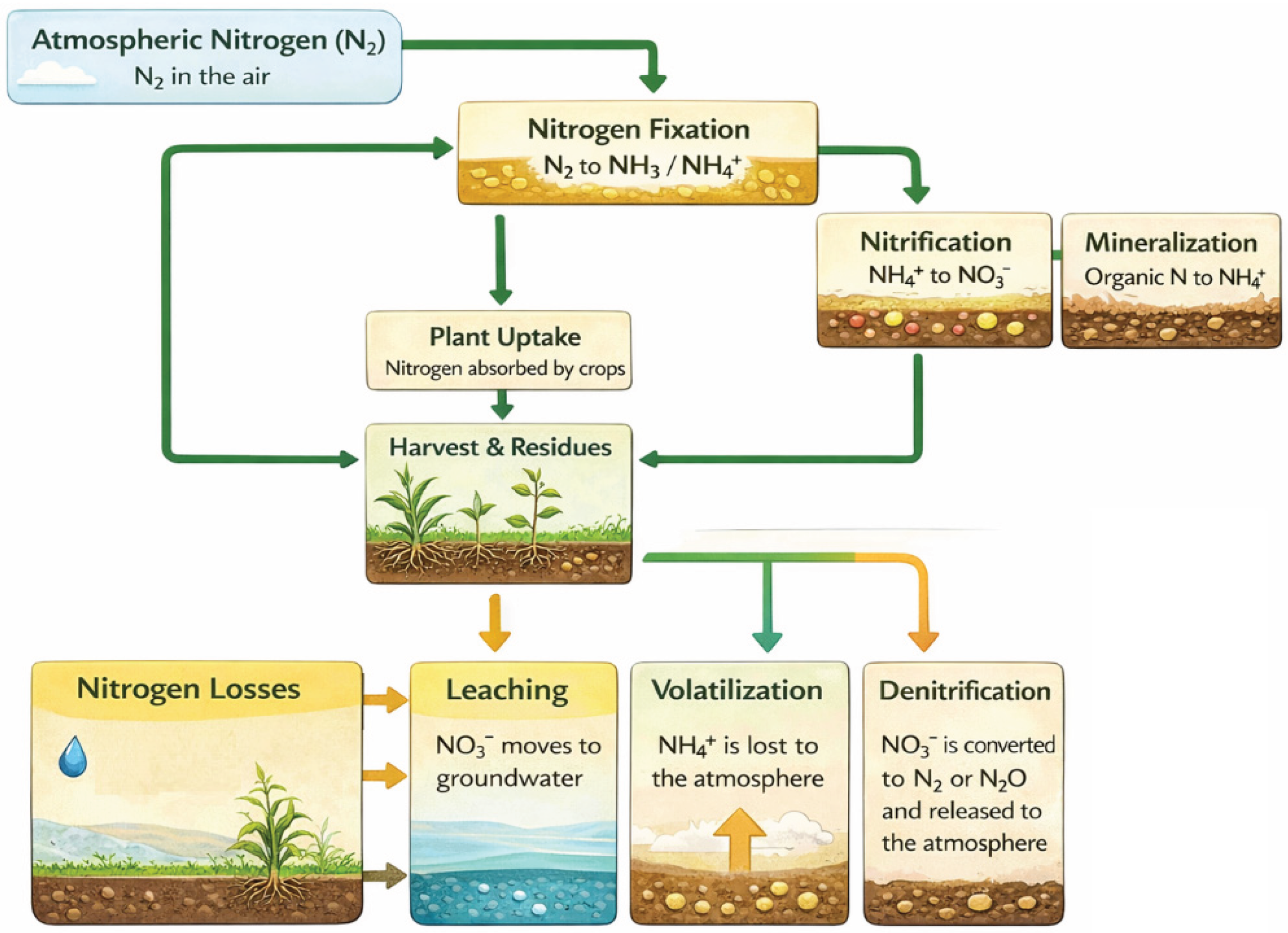
Figure 2.
Fertilizer amendment strategies for NH3 mitigation.
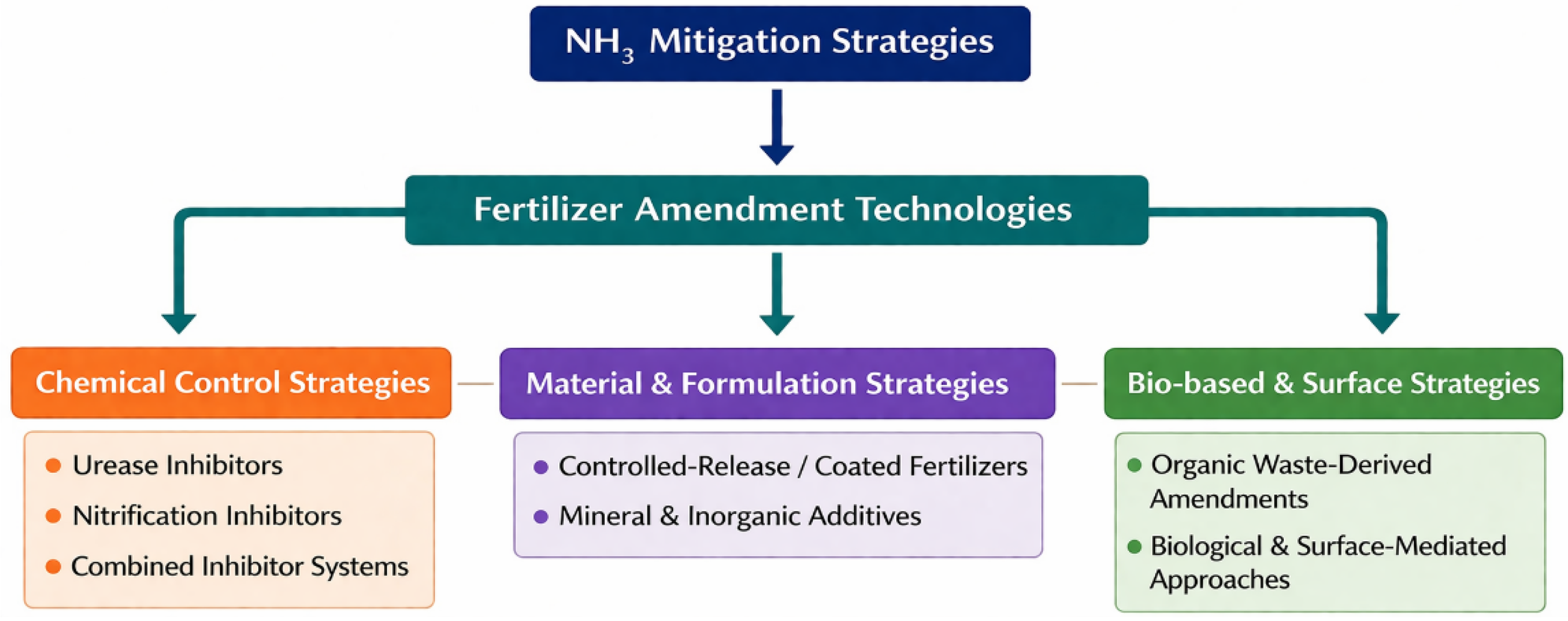

Table 1.
Key processes influencing NH3 volatilization and corresponding mitigation strategies.
| Process | Main field drivers | Conditions increasing NH3 emissions | Mitigation approaches |
| Urea hydrolysis and formation of NH4+ hotspots | Urease activity, soil moisture, fertilizer placement | Surface-applied urea, warm conditions, localized concentration | Urease inhibitors, soil incorporation, timely irrigation or rainfall |
| NH4+/NH3 equilibrium (speciation) | Soil pH, temperature, buffering capacity, surface water | High pH soils, elevated temperature, water accumulation | Local pH adjustment (acidifying amendments), avoid surface water accumulation |
| Ammonium retention (adsorption and CEC) | Soil texture, cation exchange capacity, organic matter | Low CEC soils, sandy textures, surface application | Use of adsorbents (e.g., zeolites, clays), improve soil–fertilizer contact |
| Transport of NH3 to the atmosphere | Wind speed, turbulence, soil moisture, boundary-layer resistance | Windy conditions, exposed soil surface, low resistance to diffusion | Soil incorporation, surface cover, application under low-wind conditions |
CEC: Cation Exchange Capacity.
Table 2.
Char production from secondary raw materials and resulting products.
| Technology | Feedstock | Process description | Output products | Development |
| Rustica biochar pilot | Lignocellulosic fractions from fruit and vegetable residues (stems, cores, peels) | Pyrolysis under oxygen-limited conditions (350–700 °C), followed by cooling, sieving and optional enrichment | Fine or granulated biochar for soil conditioning and microbial carriers | TRL 7 |
| Abfallwirtschaftsbetriebe Münster (AWM) | Green waste from garden and park maintenance | Small-scale pyrolysis under oxygen-free conditions at elevated temperature | Biochar for potential soil amendment use | TRL 7 |
| AgroAmerica | Pig manure and digestate from organic residues | Solid–liquid separation, drying, pyrolysis with heat recovery, ammonia recovery and potassium extraction | Biochar, ammonia solution, potassium concentrate, treated water | TRL 9 |
| CarbonFX (Airex Energy) | Forestry and agricultural biomass residues | Torrefaction in cyclonic reactor with pre-drying and densification steps | Biocoal, biochar, biocoke | TRL 9 |
| TerraNova Ultra | Dewatered sewage sludge (5–30% dry matter) | Hydrothermal carbonization (~200 °C, pressurised), heat recovery and dewatering | Hydrochar, Ca-based P products, ammonium sulphate | Not specified |
Table 3.
Algae-based nutrient recovery systems and products.
| Technology | Feedstock | Process description | Output products | Development |
| REALM | Greenhouse runoff and drainage water | Microalgae cultivation using nutrients (N, P) in water, supported by solar energy and CO2 capture; treated water reused | Algal biomass for biostimulants and aquaculture feed | TRL 7 |
| SABANA | Marine water enriched with nutrients from waste streams | Cultivation in thin-layer cascade and raceway pond systems | Biostimulants, biopesticides, feed additives and biofertilisers | TRL 8 |
| WALNUT pilot system | Industrial wastewater | Hybrid cultivation combining photoautotrophic and heterotrophic growth modes | Microalgal biomass for fertiliser, feed or bio-based applications | TRL 6 |
| LIFE ALGAECAN | Saline wastewater from food processing industries | Closed heterotrophic cultivation, biomass separation and drying, integrated with renewable energy | Treated water and microalgae powder | TRL 8 |
| EXTRAALGAE (NCBR) | Marine and cultivated algae species | Supercritical CO2 extraction followed by formulation into stable emulsions | Algae-based biostimulant formulations | TRL 7 |
Table 4.
Representative technologies for nitrogen recovery and conditioning.
| Technology | Feedstock | Process description | Output products | Development |
| 2 | Mixture of manure, organic wastes and/or energy crops | Chemical air scrubber used to capture ammonia from the solid fraction of digestate | Liquid ammonium sulphate (~8% N; ~25% SO4) | TRL 9 |
| BTS Biogas NITROStrip | Animal manure; agricultural residues and agro-industrial by-products | Ammonia stripping followed by acid scrubbing after heating and aeration of digestate | Ammonium sulphate solution | TRL 9 |
| H2-VOLAZ | Pig manure and digestate | Separation (NF/RO) combined with ammonia recovery via scrubbing | Ammonium sulphate; clean water; nutrient concentrates | TRL 9 |
| Detricon | Liquid fraction of manure, digestate or similar waste streams | Stripping and scrubbing system for nitrogen recovery from liquid waste streams | Liquid fertiliser based on ammonium salts | TRL 9 |
| N2Applied | Livestock slurry; liquid digestate fraction | Plasma-based nitrogen fixation converting slurry into enriched fertiliser | Liquid fertiliser based on ammonium nitrate | TRL 9 |
Disclaimer/Publisher’s Note: The statements, opinions and data contained in all publications are solely those of the individual author(s) and contributor(s) and not of MDPI and/or the editor(s). MDPI and/or the editor(s) disclaim responsibility for any injury to people or property resulting from any ideas, methods, instructions or products referred to in the content. |
© 2026 by the authors. Licensee MDPI, Basel, Switzerland. This article is an open access article distributed under the terms and conditions of the Creative Commons Attribution (CC BY) license (http://creativecommons.org/licenses/by/4.0/).
Copyright: This open access article is published under a Creative Commons CC BY 4.0 license, which permit the free download, distribution, and reuse, provided that the author and preprint are cited in any reuse.


