

Submitted:
31 March 2026
Posted:
01 April 2026
You are already at the latest version
Abstract
There has been an immense concern in the healthcare industry about the globally raising rate of cardiovascular disease (CVD). As per recent WHO reports, CVD is the leading cause of disability, hospitalization and premature death. Studies indicate oxidative stress negatively impacts heart and vascular system which could potentially lead to myocardial infarction, hypertension, cardiomyopathies, atherosclerosis and diabetic heart failure, highlights its significance as prognostic indicator in cardiovascular conditions Currently, Oxidative stress and its negative effect can be accessed by many multiple experimental tools in both, in-vitro and in-vivo settings. Nowadays, many common experimental assays are used for in-vitro and in-vivo evaluation of oxidative stress and its negative effects on the cardiovascular system. This review aims to serve as a comprehensive guide for researchers seeking to evaluate impact of oxidative stress on DNA damage in CVD utilizing standardized methods published by leading institutions. To achieve this, we analyzed 208 relevant articles from prominent databases such as Scopus, PubMed, ScienceDirect, etc. summarizing experimental validation of oxidative stress measurements from 1955 to the present.
Keywords:
cardiovascular
; oxidative stress
; in vitro
; in vivo
; assay
; ROS
1. Introduction
Medical experts around the world are increasingly concerned about the raising rate of cardiovascular disease (CVD). It’s the leading cause of early death, disability and put huge strain on healthcare systems and economies. In fact, CVD is considered the most expensive disease with an estimated indirect cost of $237 billion each year [1,2].
Research shows that many common risk factors like smoking, drinking alcohol, lack of physical activity, poor diet, hormonal changes due to stress, lack of proper sleep, obesity, and hypertension can lead to CVD [3], These factors are known to increase oxidative stress in body [4,5,6]. When body produces too many reactive oxygen species (ROS) and doesn’t have enough antioxidants to balance them out it leads to oxidative stress. This can damage important molecules like DNA, lipids, and proteins [7,8] which contributes to many diseases including cancers metabolic disorders and hormonal conditions leading to CVD [9,10]. Oxidative stress negatively impacts heart and blood vessels and can lead to conditions such as myocardial infarction, atherosclerosis, and diabetic heart failure [11,12]. The main sources of ROS in the heart include enzymes such as xanthine oxidoreductase, Monoamine oxidases (MAO), NADPH oxidases (NOXes), mitochondria, Cytochromes P450 (CYP) and nitric oxide (NO) synthases [7,9]. Tracking oxidative stress in blood, serum, plasma has helped researchers identify biomarkers that play key role in development of heart diseases. These markers play significant role in coronary artery disease (CAD) development and can also be used to predict disease progression of CVD [13]. For example, Serum lipid hydroperoxides (LOOHs) are primary products of fatty acid peroxidation, while Malondialdehyde (MDA) - a stable end product of lipid peroxidation (LP) result from an interaction between radical species and PUFAs [14]. Elevated levels of LOOH and MDA have been associated with cardiovascular risk factors like smoking and diabetes mellitus therefore, highlighting their utility to predict primary and secondary CVD [15,16]. Currently various in-vitro and in-vivo assays are employed to access oxidative stress and its detrimental impact on the CVD. These standard testing methods are instrumental not only in evaluating CVD risk but also screen for novel drugs with antioxidant activity. Over past decade, several studies focused on development and validation of such assays offering practical tools to study and access oxidative stress in CVD and to design novel antioxidant based therapeutic strategies. Our review provides comprehensive guidance for researchers by summarizing widely adopted and standardized assays used globally across academic, institutional, preclinical and clinical research settings.
2. Methods
To put together this review article, we explored wide range of publications, scientific protocols, and books available on major research databases Web of Science PubMed, Scopus, Google Scholar and, Science Direct. We focused on keywords such as oxidative stress assays and ROS in cardiovascular diseases, in-vitro and in-vivo studies, and methods to assess oxidative stress and DNA damage in CVD. We used two sets of criteria to select the source; first was the broad filter that included in-vitro and in-vivo methods for measuring oxidative stress. The second was more detailed focusing on studies specifically testing oxidative stress in CVD and heart failure. Our comprehensive search includes publication dating back to 1955 to ensure that we captured both foundational work and recent advancements (Figure 1).
3. Experimental In-Vitro Models
One of the key steps in pre-clinical research on CVD is evaluating the detrimental effects of oxidative stress on the heart and vascular system. Oxidative Stress can lead to various cellular abnormalities that ultimately contribute to cardiac dysfunction. To study these effects, it is important to select an appropriate in-vitro model that allows precise control over experimental conditions [17]. In-vitro models including primary or induced pluripotent single cardiac cell, 2D and 3D cultures, tissue culture, and microfluidic platforms are essential tools. They support researchers to explore the molecular mechanisms of ROS, along with its interaction with cells and gather valuable insights before moving on to in-vivo assay and de-risk major in-vivo studies by contributing to 3R (Table 1). A critical factors for obtaining reliable results is selecting the right cell lines [18]. The choice depends on several factors, including the available laboratory equipment, type of in-vitro models, functional characteristics of the cells, and the specific goals of the assay (17, 18). A variety of cell-lines are commonly used in CVD, including cell-lines like AT-1 [19], HL-1 [20], AC [21], and H9c2 [22], primary neonatal and adult cardiomyocytes [23,24] and stem or progenitor cells [25]. Among these the H9c2 cell-line has been most frequently used in CVD [22,26,27]. Derived from BD1X rat heart tissue, H9c2 cell line exhibits several properties of skeletal muscle and offers a versatile platform to investigate oxidative damage and its role in cardiac systems [28].
4. Direct Inducers of Oxidative Stress In-Vitro
4.1. Tert-Butyl Hydroperoxide (TBHP)
TBHP is one of the most commonly used compounds for investigating induction of oxidative stress in in-vitro models. It is well-known for its ability to trigger damage and apoptosis in cardiomyocyte [42,43]. The H9c2 myocardial cell line is widely considered an ideal model for studying oxidative stress and DNA damage in cardiovascular research. To perform this assay, H9c2 cells are cultured in Dulbecco’s modified Eagle medium (DMEM) supplemented with 10% fetal bovine serum (FBS), 100 μg/ml streptomycin, 100 U/ml penicillin, 1.5 g/L sodium bicarbonate and 4 mM L-glutamine. The cells are maintained in humidified incubator at 37◦C with 5% CO2 and 95% O2. After 2-3 passages of the stock cultures cells are seeded into 96-well plates at a density of 5.0×10³ cells per well. Once attached, cells are treated with 150-200 μM TBHP for 1 h, depending on read-out planned for the end point measurement. This provides a consistent and reliable setup for investigation of oxidative stress antioxidant strategies [44,45].
4.2. Isoproterenol (ISO)
ISO-induced myocardial ischemia is a classical model used to evaluate the cardio-protective effects of various pharmacological agents. ISO causes severe oxidative stress in the myocardium, leading to infarct-like necrosis of the myocardium.
To perform this assay, the H9c2 cells are cultured and divided into several groups: negative control, ISO-treated (50 μmol/L), positive control (0.1 mmol/L captopril), and treatment groups with different concentrations of test item with predicted antioxidant properties. All groups incubated for 24 h. Afterwards, all groups except the negative control group are treated with 50 μmol/L ISO, and incubated for 48 h. Depending on the endpoint, read-out is conducted and analyzed [46,47,48,49].
4.3. Hydrogen Peroxide (H2O2)
H2O2 is a commonly used ROS inducer for generating oxidative stress and cellular damage in various in vitro models [50]. Endogenous H2O2 in immune and vascular smooth muscle cells contributes to generation of oxidative stress which leads to endothelial dysfunction and development of various vascular diseases [51]. To perform this assay, seed H9c2 cells in 96-well plates at a density of 5 × 10³ cells per well, allowing them to reach logarithmic growth phase. Then, divide them in different groups and treat them with 200-400 μM of H2O2 for 24 h, upon treatment, cells can be used for subsequent experiments [52].
4.4. Potassium Bromate (KBrO3)
KBrO3 is a food additive that has been used commonly used in production of drinking water disinfected with ozone [53]. Due to its strong oxidizing properties, KBrO3 can act as an inducer of oxidative stress leading to lipid peroxidation and DNA damage [54]. The free radicals generated by KBrO3 are known cardiac toxins, and heart is very sensitive to its effect [55,56].
To perform this assay, seed the H9c2 cells in 96-well plates at a density of 5 × 10³ cells per well, and allow them to reach logarithmic growth phase. Then, divide them into the different groups and treat them with 250 μM KBrO3. Incubate the cells in humidified incubator at 37◦C with 5% CO2 and 95% O2 for 72 h [57].
4.5. Indirect Inducers of Oxidative Stress in In-Vitro
4.5.1. Tumor Necrosis Factor-Alpha (TNF-α)
TNF-α is a pro-inflammatory cytokine that promotes oxidative stress via activation of mitochondrial dysfunction and NADPH oxidase pathways. It plays a central role in enhancement of ROS induction in various cardiac and vascular models.To perform this assay, H9c2 cells are cultured and seeded into 96-well plates at a density of 5 × 10³ cells per well. Once attached, cells are treated with 10–50 ng/mL TNF-α for 24 h. The resultant oxidative stress can be measured through ROS-specific fluorescent probes and antioxidant enzyme activity assays [58].
4.5.2. Lipopolysaccharide (LPS)
LPS, a structural component of Gram-negative bacterial walls, is a widely used stimulator of inflammation-induced oxidative stress. Upon binding to TLR4, LPS activates transcription factors like NF-κB, which enhances intracellular ROS generation and impairs mitochondrial integrity.To model this in-vitro, H9c2 cells are treated with 1 μg/mL LPS for 24–48 h under standard conditions. The LPS model is particularly useful in evaluating antioxidant properties of natural and synthetic compounds [59].
4.5.3. High Glucose (HG)
Chronic exposure to high glucose mimics diabetic hyperglycemia and induces oxidative stress through enhanced mitochondrial ROS production and suppression of antioxidant pathways. This model is frequently used in diabetic cardiomyopathy research.To perform this assay, H9c2 cells are cultured in DMEM supplemented with 25- or 33-mM D-glucose for 48–72 h. The cells are then analyzed for markers of oxidative damage such as increased ROS, lipid peroxidation, and changes in GSH levels [60].
4.5.4. Hypoxia/Reoxygenation (H/R)
The hypoxia/reoxygenation model simulates ischemia-reperfusion injury in vitro, where the sudden influx of oxygen leads to a burst of ROS formation, especially from the mitochondria.For this assay, H9c2 cells are exposed to hypoxic conditions (1% O2) for 4–6 h using a hypoxia chamber or gas control incubator, followed by reoxygenation in normoxic conditions (21% O2) for 2–24 h. This model closely mimics clinical scenarios such as myocardial infarction or stroke [61].
4.5.5. Senescent Cell Co-Culture
Senescent cells are metabolically active and exhibit a senescence-associated secretory phenotype (SASP), which includes pro-oxidant cytokines and matrix-degrading enzymes. This microenvironment leads to increased oxidative burden in neighboring cells.To simulate this, H9c2 cells can either be co-cultured with senescent fibroblasts or treated with 0.2–0.5 μM doxorubicin for 24 h to induce senescence. After 48–72 h of exposure, oxidative stress parameters can be assessed [62].

Table 2.
Common induction of oxidative stress in cardiac cell culture (H9c2).
| Inducers | Experimental observation | Molecular Mechanisms | Inducer dose | EC50/appotosis |
|---|---|---|---|---|
| TBHP |
|
|
|
|
| ISO |
|
|
|
|
| H2O2 |
|
|
|
|
| KBrO3 |
|
|
|
|
5. In-Vitro Assays for Oxidative Stress and DNA Damage in Cardiovascular Diseases
Morphological Analysis
The H9c2 myocardial cell line is a well-established model for in-vitro evaluation of oxidative stress. To examine morphological changes, the cells should be fixed and stained following the YF®488 labeled Phalloidin staining protocol.
Briefly, fix the several cells on ice using 4% paraformaldehyde solution for 15 min. Then wash gently with PBS. Permeabilize using 0.5% Triton X-100 in PBS at room temperature for 10 min, followed by another PBS wash. Dilute 5 μL YF®488 labeled Phalloidin stock solution in 200 μL PBS and incubate cells with this mixture for 30 min at RT. After staining, wash off extra dye with PBS. Finally, observe the morphological changes using 400× inverted fluorescence microscope. For analysis, randomly select four to six views from each sample and measure the cell - surface with Oplenic software [49,69,70,71].
6. Cytotoxicity Assay
To assess cell viability, MTT assay is commonly used. Breifly, pre-incubate H9C2 suspensions cells in DMEM within 96-well plates at a concentration of 5×10⁴ cells/100 μl/well. Incubate overnight in humidified incubator at 37 °C with 5% CO2. Next day, replace the culture medium with fresh medium contains different groups-such as negative controls, positive control and treatment groups. Cells are treated with different concentrations of oxidative stress inducers and vehicle controls. Incubate the cells under same conditions for 6 h. Post treatment, add 10 μl of 10% MTT solution to each well and incubate for 4 h at 37 °C. Once incubation is complete, remove the supernatants and dissolve the formazan crystals in 100 μl of solubilization solution. Measure the absorbance by microplate reader at 630 nm [72]. To calculate percentage of viable cells, use the following equation:
6.1. Determination of Total Protein Content
To assess total protein content, along with SOD, GSH, and MDA levels use the appropriate commercial test kit. For this assay, centrifuge different treatment groups such as- negative control, positive control and treatment groups. Treat cells with different concentrations of oxidative stress inducers and vehicle controls. Post incubation, centrifuge at 137g, collect cell pellet. Add 0.3 mL of normal saline to each pellet for total protein, GSH, SOD assay. For MDA assay, add 0.5 mL TBA working solution and follow manufacturer’s instructions for accurate detection [73,74,75]
6.2. Determination of Cellular Apoptosis
To assess cellular apoptosis, begin by seeding cells at a concentration of 1×10⁶. Wash the cells with Phosphate-buffered saline (PBS) and centrifuge cells at 200g for 5 min. Resuspend the resulting pellet in 100μl of Annexin-V-FLUOS labeling solution and incubate the cells at 15-25 °C for 15 min. After incubation, use a fluorescence microscope to analyze apoptosis. Detection performed using Annexin-V-FLUOS staining kit [76].
In addition to staining, quantitative real-time PCR (qRT-PCR) can be used to evaluate apoptosis at the gene expression level. This involves measuring the mRNA expression of key apoptotic markers including Bcl-2, Bcl-2/Bax, Bax, Caspase-3, Caspase-8 and, Caspase-9. Studies have shown that oxidative stress inducers promote apoptosis in cells raising the expression of pro-apoptotic genes such as Bax, Caspase-3, Caspase-8 and, Caspase-9 while reducing expression of anti-apoptotic genes like Bcl-2 and reducing Bcl-2/Bax ratio [77,78,79,80]
6.3. Determination of Intracellular ROS
One of the key aspects of cellular behavior is its ability to respond to ROS within intracellular environment. The level of intracellular ROS can be measured by commercial ROS detection kits.
To perform this assay, harvest H9c2 cells and wash them thrice to remove traces of residual medium. Then add serum-free DMEM on cells. Stain them with 0.5 μL 100 mmol/L of 2′,7′–Dichlorofluorescin Diacetate (DCFDA), cell permeable fluorescent probe and place the cells in a dark for 30 min. The intracellular ROS level is then measured by flow cytometric evaluation of fluorescence intensity of DCFDA in cells [49,69,81].
7. Quantitative Real-Time PCR
To perform this assay, extract total RNA from H9c2 cells using RNA extraction kit. Then synthesize cDNA using cDNA synthesis kit. The mRNA expression levels of ANP, BNP, β-MHC, IL-6, TNF-α, Bax, Bcl-2, Caspase-3, Caspase-8 and Caspase-9 are then quantified using real time PCR [46].
8. Western Blot
For western blot assay, culture H9C2 cells (5×10⁶ cells) for 24 h, and prepare several treatment groups including positive and negative controls. After treatment, extract total protein and determine concentration using BCA protein assay kit. Separate proteins by sodium dodecyl sulphate polyacrylamide gel electrophoresis (SDS-PAGE) and transfer them to polyvinylidene fluoride (PVDF) membranes. Block the membranes with skim milk and incubate overnight with primary antibodies against p-JAK2, JAK2, p-STAT3, STAT3, TNF-α, Caspase-3, PI3K, Akt, mTOR, LC3-II, LC3-I, and GAPDH. Finally, analysis band intensities with digital tools to evaluate variation in protein levels [46,82].
9. Measurement of Cellular Inflammation
To assess inflammation, quantitative Real-Time PCR to measure cellular mRNA expression levels of IL-6 and TNF-α was widely reported. Several studies demonstrated that expression of both, IL-6 and TNF-α increases in cells under oxidative stress. In addition, protein expression of TNF-α also rises in ROS treated groups. Therefore, this assay set-up is used to evaluate impact of ROS on IL-6 and TNF-α expression to measure anti-inflammatory effects of tested compounds [82,83,84].
10. Evaluation of JAK2/STAT3 Signal Pathway
Several studies demonstrated that oxidative stress inducers can induce cardiomyocyte hypertrophy (CH). To perform this assay, evaluate the protein expression levels of JAK2, p-JAK2, STAT3, and p-STAT3 in the different treatment groups.
11. Evaluation of LC3 Conversion
LC3 (Microtubule-associated protein 1A/1B-light chain 3) protein plays a central role in autophagy, the process by which cells break down and recycle damaged components to maintain equilibrium. LC3 is a key autophagosome marker and plays an important role in final stages of autophagosome formation. LC3-I is an inactive form of protein, floating in the cytoplasm. LC3-I gets converted to LC3-II, which attaches to the membrane of the autophagosome. The LC3-II/LC3-I ratio is commonly used to measure autophagy levels. LC3-II to LC3-I conversion can be detected with western blot [88,89,90].
11.1. PI3K/Akt Signaling Pathway
PI3K/Akt/mTOR signaling pathway is key regulator for cell growth, survival, metabolism and autophagy, all of which are sensitive to increase in ROS levels. This pathway was very often reported in experimental models to investigate cellular response to oxidative stress. should be investigated. Western blot analysis to assess levels of PI3K, Akt, and mTOR in post treatment was performed. Reduction in levels of p-AKT and p-mTOR was indicative of oxidative stress in treated cells [91,92].
11.2. Comet Assay to Evaluate the Oxidative DNA Damage
Several methods exist to access oxidative DNA damage in mammalian cells under in-vitro conditions. Among them, the comet assay which is a simple and precise technique for quantifying DNA damage.
To perform this assay, seed the cells and mix them with 180μL of 0.5% low-melting agarose. Spread the mix onto fully frosted slides that have been already coated with a layer of 1% normal-melting agarose. Next, incubate slides in lysis solution composed of 0.1M EDTA, 10-g/L N-lauroylsarcosine sodium salt (pH 10), 2.5M NaCl, and 0.01M Tris, supplemented with 10% dimethyl sulfoxide (DMSO) and 1% Triton X-100 for 1 h at 4 ̊C. After lysis, wash the slides and place them in the electrophoresis solution for 20 min. Then perform electrophoresis at 25 V and 300 Ma for 20 min. In the next step, neutralize the slides using 0.4M Tris buffer and dehydrate them in the cold methanol at -20 ̊C for 10 min. After dehydration, place the slides in the incubator at 37 ̊C to dry, and then store them at RT. Finally, stain the DNA with Gel Red/ DABCO (diazabicyclo-octane) solution and analyze the images from each slide. The main evaluation parameter in this assay is the percentage of DNA tail, which reflects the extent of oxidative damage [93].
12. Seahorse Assay
The Seahorse XFp Analyzer is widely used and is one of the most powerful tools for analyzing and evaluating cellular respiration. This assay allows measurement of the oxygen consumption rate (OCR), and extracellular acidification rate (ECAR) which provides valuable information about metabolic dysfunction, mitochondrial function and oxidative stress in viable cells [94]. One of the key advantages of this assay compared to traditional oxygraph methods is its requirement for a low number of cells, which is particularly useful for metabolic analysis in diseases associated with mitochondrial dysfunction, hence it is one of the most commercially used techniques in metabolism research [95].
To perform this assay, the Seahorse XF24 Extracellular Flux analyzer and its dedicated software are used. First, seed 2×10⁴ H9c2 cells per well in XF24 cell culture plates. Incubate cells in XF assay medium, which is a modified DMEM medium, at 37 °C for 1 h. Next, cells are exposed to FCCP (a respiratory uncoupler) to measure maximal respiratory capacity of the cell, oligomycin, an ATP synthase inhibitor, to assess ATP-linked respiration, and rotenone plus antimycin A. Inhibitors of complex I and III to quantify non mitochondrial respiration. The results obtained after such analysis allow detailed profiling of mitochondrial function, which includes, basal respiration, ATP production, proton leak, maximal respiration, and spare respiratory capacity. These parameters are essential for evaluating the impact of oxidative stress and potential protective or therapeutic interventions on cellular metabolism. The main advantage of using Seahorse XFp Analyzer is the fact that it analyzes live cells, allowing compounds to be tested in a dose-dependent manner. This enables precise determination of their effects on cellular respiration and facilitates the calculation of lethal doses. [96,97].
13. Nanoparticles for Detection and Monitoring the Reactive Oxygen Species (ROS)
In recent years, growing number of research studies have focused on developing innovative tools for ROS detection, tracking and monitoring. To meet this need, various type of nanosensors and nanomaterials are designed to detect early signs of oxidative stress within biological systems [98] (Table 3). Numerous studies have shown that fluorescent nanomaterials, when combined with nanocarriers can significantly improve the optical performance of fluorescent probes and by minimizing photobleaching and enhancing signal stability [99,100,101]. The integration of nanomaterials in ROS detection offers several advantages including low toxicity, improved solubility, and precise customization of fluorescent imaging probes for specific biological environment [102]. Furthermore, the incorporation of nanomaterials into biosensors can enhance the physio-chemical properties of these analytical devices, improving their sensitivity, specificity and biocompatibility with in-vivo applications [103]. One of the emerging tools for evaluating ROS at tissue depth is photoacoustic (PA) imaging, a hybrid method that combines optical contrast with ultrasound resolution. PA imaging provides high spatial resolution and deep tissue penetration, making it a promising tool for ROS detection in live organisms [104,105]. Notably, photoacoustic sensors have been successfully used in cardiovascular research to monitor oxidative stress [106,107]. A Study by Jung et al. (2018) introduced thrombus-specific theranostic (T-FBM) nanoparticles which significantly enhance H2O2-triggered photoacoustic (PA) signals and also demonstrated antithrombotic effects of these molecules. [108]
14. Electrochemical Detection
Electrochemical methods have emerged as precise, sensitive and straight forward way to measure the ROS under both, in-vitro and in-vivo conditions. In these methods, the platinized nanoelectrode are commonly used as ROS detectors due to high sensitivity and rapid response time. Electrochemical techniques are especially valuable in biological assessments, where they are applied to evaluate drug-induced ROS production. These methods are not only easy to use but also offer detection sensitivity, short incubation time and ability to detect low levels of intracellular ROS with high spatial resolution [137]. Advancements in nanotechnology have further enhanced the capabilities of these tools. The development of these nanoelectrodes has enabled single-cell electrochemical monitoring and analysis, opening new possibilities for assessing oxidative stress at cellular and sub cellular levels [138,139,140,141,142]. These ultra-fine nanoelectrodes can penetrate the cell membrane and directly measuring ROS levels within cellular organelles such as nucleus and mitochondria [140,143]. A notable example of this application was reported by Actis and colleagues in 2014, where they used carbon fiber disk-shaped nanoelectrode to measure ROS levels in melanoma cells demonstrating the potential of this technique for real-time intracellular ROS detection and tracking [144]. Further research has lead to the development of quartz nanopipette-based nanoelectrode, which offer enhanced precision compared to first generation nanoelectrodes in intracellular ROS measurement. These electrodes provide unique advantages in single-cell analysis, enabling researchers to measure oxidative stress triggers at individual cell level and its subcellular compartments, which will contribute immensely to study cancer and disease models. [145,146].
15. Electron Paramagnetic (Spin) Resonance (EPR/ESR)
The development of sensitive, specific and precise assay for ROS detection is essential for advancing our understanding of oxidative stress and its trigger in disease pathology [147,148]. One of the most widely recognized and reliable techniques for detecting free radicals is Spin trapping [149,150]. It is well-established technique for detection of short-lived free radicals which otherwise are too reactive, unstable and transient to observe or measure directly. In this technique, these fleeting radicals react with Spin traps – special chemical moiety that form stable covalent bond with free radicals resulting in the production of persistent nitroxide molecules that can be detected and measured using electron paramagnetic resonance (EPR), also known as electron spin resonance (ESR) [151]. This method is based on the principle of microwave radiation absorption by unpaired electrons in a magnetic field. Key components of the EPR system includes a microwave generator, and a resonator cavity, which work together to detect the magnetic signals generated by spin-labelled radicals leading to detection of ROS [152]. Among the most effective probes used in this method are cyclic hydroxylamines which are highly reactive with ROS. These probes are converted into stable nitroxide radicals, making them ideal for quantitative EPR analysis. Several factors enhance the efficiency of hydroxylamine-based spin probes in ROS detection including their reactivity, accumulation rate, membrane permeability, organelle-targeting ability and chemical stability [153,154,155]. Due to enhanced specificity and ability to detect real-time radical formation, EPR remains one of the gold-standard techniques for studying oxidative stress in both in-vitro and in-vivo systems.
16. Extracellular H2O2 Detection by Amplex Red
The Amplex Red assay is a widely used and reliable tool for detection of extracellular H2O2 in biological samples [156]. This assay is based on the oxidation of Amplex Red reagent (10-acetyl-3,7-dihydroxyphenoxazine) in the presence of horseradish peroxidase (HRP) producing highly fluorescent and stable compound resorufin. To perform the assay, transfer three aortic segments (approximately 2mm in length) into 96-well plate. Add 10 μmol/L Amplex Red with 0.2 U/mL of HRP, then incubate the samples in dark place at 37 °C for 1h using Krebs Ringer’s phosphate glucose buffer (KRPG). After incubation, separate the buffer from the tissue, and measure fluorescence at 530 nm excitation (with an appropriate emission filter around 590 nm) [152,157]. This assay is highly sensitive, allowing for quantitative measurement of low concentrations of extracellular H2O2. However, it is important to protect the reaction from light and to optimize HRP concentration to avoid non-specific background signals.
17. Genetic Sensors for Mitochondrial ROS Measurement
Genetically encoded fluorescent biosensors have become precise and efficient tools to assess redox signaling and ROS dynamics within live cells. These protein-based sensors can be specifically targeted to cellular subcompartments, such as mitochondria, making them invaluable for studying localized ROS production, particularly mitochondrial H2O2 release [158,159]. Recent advances in biosensor technology have led to design of engineered probes that specifically and reliably detect H2O2. These probes offer key advantages such as high sensitivity, specificity reversibility and ability to enable real-time detection and visualization of redox flux under variety of physiological and pathological conditions. Two of the most widely used genetically encoded H2O2 sensors are roGFP2-Orp1 and HyPer [160,161,162]. roGFP2-Orp1is a redox-sensitive green fluorescent protein (roGFP) fused with the Orp1 peroxidase domain, enabling selective H2O2 detection through reversible oxidation. Whereas HyPer is a sensor derived from a permuted yellow fluorescent protein (cpYFP) fused to bacterial H2O2-sensing protein OxyR. It provides dynamic and ratiometric detection of intracellular H2O2 [163,164,165]. Both biosensors have been successfully studied in various cell types, including neurons, cardiomyocytes, and immune cells, allowing researchers to understand how ROS fluctuate in response to stimuli, drugs, or stress conditions. Their ability to monitor real-time oxidative events makes them a powerful complement to traditional chemical probes. [166,167,168].
18. In-Vivo Assays
18.1. Experimental In-Vivo Models
While in-silico and in-vitro models provide valuable insights into heart function in an isolated system outside the influence of physiological factors in a controlled experimental setting, it cannot replicate the complexity of a living organism. Therefore, in-vivo models remain essential for accurately studying the cardiovascular system and understanding key mechanisms of oxidative stress and DNA damage in a physiological context [169,170,171,172].
Effects of ROS induction in vivo can be directly modeled using a variety of chemical agents that either trigger free radicals’ generation or disrupt mitochondrial and antioxidant defense systems. These compounds can lead to oxidative stress in a specific organ or in many cases systemic effects are observed leading to an animal model which can be utilized to study a specific scientific question.
18.2. Direct Inducers of Oxidative Stress In-Vivo
Oxidative stress can be experimentally triggered in an animal using chemical agents such as isoproterenol (ISO), a synthetic β-adrenergic agonist that mimics the effects of excessive sympathetic stimulation. Numerous studies have shown that ISO administration increases heart weight-to-body weight ratio, elevates serum levels of cardiac injury markers such as Aspartate Aminotransferase (AST), Creatine Kinase-MB Isoenzyme (CK-MB), Lactate Dehydrogenase (LDH), Malondialdehyde (MDA), Cardiac Troponin I (cTnI) and Creatine Phosphokinase (CPK ) ,. It also leads to ST-segment elevation, reduced R-wave amplitude, QT interval prolongation and increased heart rate. In addition, it leads to structural damage like edema, and myocardial necrosis which can be observed via histology. This model is commonly used to study cardio-protective effects of antioxidant compounds ISO-induced myocardial infarction (MI) in both in-vitro and in-vivo settings [173,174]. To perform the study, the animals are divided into three major groups: a vehicle-control group, an ISO group receiving 85 mg/kg subcutaneously, and treatment groups receiving the test compound prior to ISO administration. The treatment group is used to evaluate the potential protective or therapeutic effects of the test compound against ISO-induced myocardial injury. ISO is typically administered for two consecutive days, and all animals are sacrificed or assessed 12 h after the final dose to analyze biochemical, histological, and functional parameters. One of the major drawbacks of such model is intense myocardial damage without involving vascular occlusion or chronic remodeling processes. Additionally, its outcomes can vary significantly with dose, strain, and systemic effects, limiting its translational relevance.
18.3. Doxorubicin (DOX)
Doxorubicin is an anthracycline chemotherapeutic agent known to induce dose-dependent cardiotoxicity. Its redox cycling within mitochondria results in the generation of superoxide and hydroxyl radicals, contributing to lipid peroxidation and mitochondrial damage. Repeated administration of DOX leads to progressive cardiac dysfunction, mimicking chronic heart failure.
In rodent models, DOX is administered intraperitoneally at cumulative doses of 10–20 mg/kg over 2–3 weeks. The protocol may involve a single high dose or multiple spaced doses to simulate chronic injury. Myocardium is particularly vulnerable to DOX as it targets mitochondrial function. Animals show reduced ejection fraction, increased oxidative markers, and fibrotic remodeling in cardiac tissue [175,176].
18.4. Carbon Tetrachloride (CCl4)
CCl4 is a potent hepatotoxin, but it also induces systemic oxidative stress, including in cardiac and renal tissues. It is metabolized by cytochrome P450 enzymes into trichloromethyl radicals that initiate lipid peroxidation.
In animal studies, CCl4 is typically diluted 1:1 in olive oil and administered at 1–2 mL/kg intraperitoneally. The oxidative burden can be assessed in liver, heart, and serum through MDA levels, antioxidant enzyme activity, and histology [177,178]. Inflammatory mediators such as TNF-α, IL-1β, NF-κB activation leads to spillover from CCl4 hepatotoxicity also damages myocardium in chronic condition.
18.5. Cisplatin
Cisplatin is a platinum-based chemotherapeutic agent widely used to induce nephrotoxicity in animal models. It impairs mitochondrial respiration, generates ROS, and depletes intracellular glutathione, particularly in renal tubular cells. It affects cardiac function but impacting cardio-renal cross-talk. Cisplatin is administered intraperitoneally at 5–10 mg/kg. Animals develop acute kidney injury, characterized by elevated serum creatinine, BUN, renal lipid peroxidation, and tubular necrosis [179,180].
18.6. Gentamicin
Gentamicin, an aminoglycoside antibiotic, causes oxidative damage primarily in the kidneys by accumulating in proximal tubules and generating mitochondrial superoxide.In rats, daily intraperitoneal administration of 80–120 mg/kg for 5–10 days induces nephrotoxicity, confirmed by raised creatinine, urea, and histological damage. Prolonged exposure to Gentamicin leads to oxidative stress in kidneys which increases lipid peroxidation and ROS. Histology of these animals would reveal cardiomyocyte vacuolization, edema and focal necrosis. Some reports demonstrated decreased heart rate and contractility. [181,182].
18.7. Bleomycin
Bleomycin is used to simulate oxidative lung injury and pulmonary fibrosis. Upon administration, it generates iron-catalyzed ROS that causes DNA strand breakage and release of inflammatory cytokine, which induces oxidative stress in cardiomyocytes indirectly.The model involves a single intratracheal or intraperitoneal dose of 2–3 mg/kg. Within 7–14 days, animals exhibit impaired lung function, increased collagen deposition, and histological features of fibrosis [183,184].
18.8. Rotenone
Rotenone is a mitochondrial complex I inhibitor that impairs oxidative phosphorylation and increases intracellular ROS, especially in dopaminergic neurons. It is frequently used to model Parkinson’s disease in vivo. Rotenone exposure upregulates oxidative-stress response genes in heart and elevates oxidative damage in heart mitochondria in rodent models, even when damage is subtle histologically. Animals receive chronic subcutaneous doses of 1–3 mg/kg for 4–6 weeks. Behavioral assessments reveal motor impairment, while brain tissue analysis confirms dopaminergic loss and oxidative damage [185,186].
18.9. Paraquat
Paraquat is a herbicide known for mitochondria-targeted redox cycler which interacts with complex I that generates ROS which leads to cute cardiac stress. Chronic exposure leads to metabolic programing and contractile defects in rodent models. Tempol pre-treatment partially reverses cardiac signatures making it a good mechanism to probe. In rodents, a single intraperitoneal dose of 10–20 mg/kg results in significant ROS generation, pulmonary edema, and myocardial necrosis upon long exposure [187,188].
18.10. Tert-Butyl Hydroperoxide (TBHP)
TBHP is a synthetic organic peroxide that undergoes heme-catalyzed decomposition leading to alkoxyl and peroxyl radical formation. These molecules directly cause lipid peroxidation and oxidative DNA damage. Cardiomyocytes are especially sensitive to TBHP due to high mitochondrial density and dependence on oxidative metabolism. TBHP is used to study acute oxidative stress, particularly in liver and kidney models. It is good model to study mechanistic redox studies but less translatable as compared to DOX or ISO models. A single intraperitoneal dose of 2–5 mmol/kg leads to measurable oxidative injury within a few hours, often evident as increased MDA levels, reduced GSH, and histological damage [189,190].
18.11. Potassium Bromate (KBrO3)
KBrO3 is a strong oxidizing agent that generates reactive oxygen species and causes oxidative DNA damage, particularly in renal tissue. The signs of oxidative stress can be observed histologically in heart even though kidney is the classical target organ. In experimental models, oral or intraperitoneal administration of 100–200 mg/kg induces glomerular injury, proteinuria, and elevated lipid peroxidation markers [191].
18.12. Indirect Inducers of Oxidative Stress In-Vivo
Oxidative stress can also develop indirectly in experimental animal models due to metabolic, inflammatory, psychological, or age-related imbalances that shift the redox system toward pro-oxidant dominance. These models do not rely on direct chemical pro-oxidants but instead trigger endogenous ROS production as a secondary effect of the biological process. They are increasingly used in translational research for diseases where oxidative stress is not the primary insult but a secondary consequence of systemic dysregulation [192].
18.13. High-Fat Diet (HFD)-Induced Metabolic Stress
Rodent model of high-fat diet (HFD) is commonly used to investigate oxidative stress resulting from metabolic syndrome. Chronic intake of saturated fats leads to insulin resistance, adipocyte hypertrophy, and mitochondrial dysfunction. This causes excessive ROS generation, mainly in liver, adipose tissue, and heart. Cardiac tissue due to high dependency on mitochondria is often impacted irreversibly. To generate the model, animals maintained on a 60% fat diet for 12–16 weeks exhibit increased levels of malondialdehyde (MDA), 4-hydroxynonenal (4-HNE), and reduced antioxidant enzyme activity in metabolic tissues. To evaluate therapeutic mechanisms, animals are split into two groups: a control group receiving normal chow and an HFD-fed group. Blood and tissues are collected at designated endpoints to assess oxidative damage and inflammation. Although the model recapitulates many features of human metabolic disease, inter-strain variability and the long duration required to establish significant pathology can be limitations [193,194].
18.14. Lipopolysaccharide (LPS)-Induced Systemic Inflammation
Lipopolysaccharide (LPS), a bacterial endotoxin, is widely used to initiate oxidative stress via systemic inflammation. LPS activates Toll-like receptor 4 (TLR4) on immune cells, leading to cytokine release, nitric oxide production, and ROS generation through NADPH oxidase. Elevated plasma levels of TNF-α, IL-6, nitric oxide, and protein carbonyls are commonly observed after LPS injection. To generate the model, animals are divided into a control group and an LPS group receiving a single intraperitoneal dose of 5 mg/kg. Tissues such as liver, lung, and brain are collected 6–24 hours post-administration for biochemical and histological evaluation. The LPS model is ideal for screening anti-inflammatory and antioxidant compounds under acute immune challenge. However, the short-lived nature of the response limits its relevance for chronic disease modeling [195].
18.15. D-Galactose-Induced Aging Model
D-galactose, when administered over extended periods, accelerates aging by promoting oxidative stress via the formation of advanced glycation end-products and mitochondrial dysfunction. Rats or mice receiving 100–150 mg/kg/day subcutaneously for 6–8 weeks show increased lipid peroxidation, protein oxidation, and decreased superoxide dismutase (SOD) activity in the brain, liver, and kidneys. The model is generated by assigning animals to control and D-galactose-treated groups. Behavioral assessments are often performed in parallel to examine cognitive effects, followed by tissue collection for oxidative biomarkers. This model is widely used in anti-aging and neurodegenerative studies. One drawback is that it mimics accelerated aging rather than natural senescence, which may not fully reflect chronic aging mechanisms
18.16. Hypoxia/Reoxygenation (H/R) Injury Model
Hypoxia followed by reoxygenation replicates ischemia-reperfusion injury, where a burst of ROS is generated upon oxygen restoration. This is primarily driven by mitochondrial electron transport chain instability, xanthine oxidase activation, and neutrophil infiltration. In myocardial or cerebral H/R models, oxidative stress is accompanied by elevated MDA, reduced GSH, and mitochondrial swelling. Cytokine response that follows the initial hypoxic insult often shapes the extent and prognosis of the injury [196]. To induce this model, rodents are subjected to controlled hypoxia (e.g., via coronary artery ligation or hypoxia chambers) for 30–60 minutes, followed by normoxic reoxygenation for 2–24 hours. Sham-operated animals serve as controls. This model effectively mirrors clinical scenarios such as myocardial infarction or stroke but requires surgical expertise and standardization [61,197].
18.17. Chronic Restraint Stress Model
Prolonged psychological stress is a recognized inducer of oxidative stress in the brain and cardiovascular system. It activates the hypothalamic–pituitary–adrenal axis, elevating glucocorticoid levels and altering redox signaling. Chronic restraint stress increases brain ROS levels, disrupts mitochondrial membrane potential, and decreases SOD and catalase activity in regions like the hippocampus. To induce the model, rodents are placed in plastic restrainers for 4–6 hours per day over 14–21 days. A control group is handled similarly without restraint. After the exposure period, behavioral assessments are followed by tissue analysis for oxidative markers. While highly relevant to stress-related disorders, variability in animal temperament and environmental sensitivity can affect reproducibility [198].
18.18. Sleep Deprivation Model
Sleep deprivation is associated with increased oxidative stress, especially in the central nervous system. Disrupted sleep leads to enhanced ROS production, impaired antioxidant defenses, and neuronal damage, particularly in memory-related regions like the hippocampus.
This model is implemented using gentle handling or rotating platform systems to prevent REM or total sleep for 24–72 hours. Following deprivation, animals show elevated brain MDA, decreased GSH, and impaired performance in behavioral tests. Control animals are housed under similar lighting and temperature conditions without intervention. Despite being non-invasive, the model demands continuous monitoring and often shows variability in stress levels induced by the setup itself [199].
18.19. Senescence-Accelerated Mouse Model (SAMP8)
The senescence-accelerated mouse prone 8 (SAMP8) strain is a spontaneous aging model that naturally exhibits increased oxidative stress, cognitive decline, and mitochondrial dysfunction at an early age. These mice show elevated brain MDA levels, increased protein oxidation, and reduced antioxidant enzyme expression by 5–6 months of age.Unlike other models, no intervention is needed. Age-matched SAMR1 mice are used as controls. Tissues from brain, heart, and skeletal muscle are typically collected for biochemical and histological analysis. SAMP8 is well-established in aging research and provides a stable platform for long-term studies. However, genetic drift and cost of colony maintenance can be limiting factors [200,201].
19. In-Vivo Assays for Oxidative Stress and DNA Damage in Cardiovascular Diseases
19.1. Electrocardiography (ECG)
To perform ECG recordings, SD rats are anesthetized, and positioned supine approximately for 30 minutes. Next, acupuncture needle electrodes are inserted subcutaneously based on lead II configuration i.e., right foreleg, left foreleg and left rear leg. ECG signal and heart rate are recorded at every 1 min interval every 5 min using a PowerLab system, and data are analyzed by LabChart 7 software [174], special attention should be given to changes in the ST-segment, which can indicate ischemia or myocardial injury.
19.2. Biochemical Estimations
After blood collection, centrifuge and separate the serum. Next, following biomarkers should be measured by using commercially available kit. These are routinely used in laboratory settings. Troponin I (cTnI), Aspartate aminotransferase (AST), Creatine phosphokinase (CPK), Creatine kinase-MB isoenzyme (CK-MB), Lactate dehydrogenase (LDH), Malondialdehyde (MDA) should be measures as they can be indicative of myocardial injury and oxidative damage [202,203,204,205].
19.3. Histopathological Examination
For histopathological assessment, after rats are sacrificed in accordance with ethical guidelines and their hearts are excised, immediately fix them in 10% buffered formalin. The ventricular mass is sectioned longitudinally from the apex to the base, followed by routine dehydration with graded alcohol and clearing with xylene before embedding in paraffin wax. Thin histological sections of approximately 5 µm are then prepared by slicing the paraffin block using microtome. These sections are then stained with hematoxylin and eosin (H &E) and examined under the light microscope to evaluate changes in tissue architecture. Key structural and pathological changes such as Edema, cellular infiltration, and myocardial necrosis should be evaluated to understand the extent of myocardial damage [206,207,208]. Special stains can be performed on the consecutive paraffin sections to characterize the cellular subtypes in case of massive infiltration and restructuring. This examination plays a crucial role in assessing oxidative stress-induced myocardial damage, as oxidative injury often manifests histologically through features such as interstitial edema, inflammatory cell infiltration, and myocardial fiber necrosis. These structural changes are consistent with the downstream effects of reactive oxygen species (ROS) on cardiac tissue integrity and are commonly observed in oxidative stress-related models of myocardial injury.
20. Conclusion and Future Perspective
Oxidative stress plays a central role in the development and progression of many diseases yet studying it in a lab setting is not straightforward. Over the years, health care professionals have developed a wide variety of in-vitro and in-vivo models to replicate oxidative conditions, each with its own strengths and weaknesses. Direct chemical inducers like TBHP, ISO, or H2O2 offer quick and controlled induction of oxidative stress but often lack the complexity seen in actual disease states which is influenced by multiple factors. On the other hand, indirect models—like high-fat diets, LPS exposure, or aging-based setups—better reflect physiological conditions but the results can often vary depending on the dosage, exposure and strain background. What’s often missing from the literature is a clear, side-by-side comparison of these models in one place. This review aims to fill that gap by compiling a detailed yet accessible overview of the most widely used oxidative stress models. It includes not only how these models are set up, but also what to expect in terms of biomarkers, tissue responses, and practical challenges. The addition of redox proteomics insights and models like the SAMP8 mouse helps connect molecular mechanisms to disease progression. By bringing together both direct and indirect inducers, this paper offers a practical toolkit for scientists designing studies in cardiovascular, metabolic, or neurodegenerative contexts. It encourages more thoughtful model selection based on research questions rather than convenience alone. In doing so, it bridges the gap between simplified systems and complex diseases. Ultimately, this review is meant to serve as a reference point—one that helps researchers navigate the crowded and sometimes confusing space of oxidative stress modeling.
Author Contributions Statement
S.G.: Conceptualization, writing of original draft preparation. P.P., H.Z.: Conceptualization, supervision, writing of original draft, reviewing & editing. E. M. O.: Supervision, writing, reviewing & editing.
Competing Interests
The authors declare that they have no known competing financial interests or personal relationships that could have appeared to influence the work reported in this paper.
References
- Flora, G.D.; Nayak, M.K. A Brief Review of Cardiovascular Diseases, Associated Risk Factors and Current Treatment Regimes. Current pharmaceutical design 2019, 25, 4063-4084. [CrossRef]
- Dunbar, S.B.; Khavjou, O.A.; Bakas, T.; Hunt, G.; Kirch, R.A.; Leib, A.R.; Morrison, R.S.; Poehler, D.C.; Roger, V.L.; Whitsel, L.P. Projected Costs of Informal Caregiving for Cardiovascular Disease: 2015 to 2035: A Policy Statement From the American Heart Association. Circulation 2018, 137, e558-e577. [CrossRef]
- Ruan, Y.; Guo, Y.; Zheng, Y.; Huang, Z.; Sun, S.; Kowal, P.; Shi, Y.; Wu, F. Cardiovascular disease (CVD) and associated risk factors among older adults in six low-and middle-income countries: results from SAGE Wave 1. BMC public health 2018, 18, 778. [CrossRef]
- Tsermpini, E.E.; Plemenitaš Ilješ, A.; Dolžan, V. Alcohol-Induced Oxidative Stress and the Role of Antioxidants in Alcohol Use Disorder: A Systematic Review. Antioxidants (Basel) 2022, 11. [CrossRef]
- Sambiagio, N.; Berthet, A.; Wild, P.; Sauvain, J.J.; Auer, R.; Schoeni, A.; Rodondi, N.; Feller, M.; Humair, J.P.; Berlin, I.; et al. Associations between urinary biomarkers of oxidative stress and biomarkers of tobacco smoke exposure in smokers. The Science of the total environment 2022, 852, 158361. [CrossRef]
- Pizzino, G.; Irrera, N.; Cucinotta, M.; Pallio, G.; Mannino, F.; Arcoraci, V.; Squadrito, F.; Altavilla, D.; Bitto, A. Oxidative Stress: Harms and Benefits for Human Health. Oxidative medicine and cellular longevity 2017, 2017, 8416763. [CrossRef]
- Dubois-Deruy, E.; Peugnet, V.; Turkieh, A.; Pinet, F. Oxidative Stress in Cardiovascular Diseases. Antioxidants (Basel) 2020, 9. [CrossRef]
- Othman, E.M.; Hintzsche, H.; Stopper, H. Signaling steps in the induction of genomic damage by insulin in colon and kidney cells. Free Radic Biol Med 2014, 68, 247-257. [CrossRef]
- Snezhkina, A.V.; Kudryavtseva, A.V.; Kardymon, O.L.; Savvateeva, M.V.; Melnikova, N.V.; Krasnov, G.S.; Dmitriev, A.A. ROS Generation and Antioxidant Defense Systems in Normal and Malignant Cells. Oxidative medicine and cellular longevity 2019, 2019, 6175804. [CrossRef]
- Othman, E.M.; Oli, R.G.; Arias-Loza, P.A.; Kreissl, M.C.; Stopper, H. Metformin Protects Kidney Cells From Insulin-Mediated Genotoxicity In Vitro and in Male Zucker Diabetic Fatty Rats. Endocrinology 2016, 157, 548-559. [CrossRef]
- D'Oria, R.; Schipani, R.; Leonardini, A.; Natalicchio, A.; Perrini, S.; Cignarelli, A.; Laviola, L.; Giorgino, F. The Role of Oxidative Stress in Cardiac Disease: From Physiological Response to Injury Factor. Oxidative medicine and cellular longevity 2020, 2020, 5732956. [CrossRef]
- Kurian, G.A.; Rajagopal, R.; Vedantham, S.; Rajesh, M. The Role of Oxidative Stress in Myocardial Ischemia and Reperfusion Injury and Remodeling: Revisited. Oxidative medicine and cellular longevity 2016, 2016, 1656450. [CrossRef]
- Antoniades, C.; Tousoulis, D.; Tentolouris, C.; Toutouzas, P.; Stefanadis, C. Oxidative stress, antioxidant vitamins, and atherosclerosis. From basic research to clinical practice. Herz 2003, 28, 628-638. [CrossRef]
- Jové, M.; Mota-Martorell, N.; Pradas, I.; Martín-Gari, M.; Ayala, V.; Pamplona, R. The Advanced Lipoxidation End-Product Malondialdehyde-Lysine in Aging and Longevity. Antioxidants (Basel) 2020, 9. [CrossRef]
- Sanderson, K.J.; van Rij, A.M.; Wade, C.R.; Sutherland, W.H. Lipid peroxidation of circulating low density lipoproteins with age, smoking and in peripheral vascular disease. Atherosclerosis 1995, 118, 45-51. [CrossRef]
- Nacítarhan, S.; Özben, T.; Tuncer, N.e. Serum and urine malondialdehyde levels in NIDDM patients with and without hyperlipidemia. Free Radical Biology and Medicine 1995, 19, 893-896. [CrossRef]
- Garbern, J.C.; Mummery, C.L.; Lee, R.T. Model systems for cardiovascular regenerative biology. Cold Spring Harbor perspectives in medicine 2013, 3, a014019. [CrossRef]
- Capes-Davis, A.; Bairoch, A.; Barrett, T.; Burnett, E.C.; Dirks, W.G.; Hall, E.M.; Healy, L.; Kniss, D.A.; Korch, C.; Liu, Y.; et al. Cell Lines as Biological Models: Practical Steps for More Reliable Research. Chemical research in toxicology 2019, 32, 1733-1736. [CrossRef]
- Field, L.J. Atrial natriuretic factor-SV40 T antigen transgenes produce tumors and cardiac arrhythmias in mice. Science (New York, N.Y.) 1988, 239, 1029-1033. [CrossRef]
- Claycomb, W.C.; Lanson, N.A., Jr.; Stallworth, B.S.; Egeland, D.B.; Delcarpio, J.B.; Bahinski, A.; Izzo, N.J., Jr. HL-1 cells: a cardiac muscle cell line that contracts and retains phenotypic characteristics of the adult cardiomyocyte. Proceedings of the National Academy of Sciences of the United States of America 1998, 95, 2979-2984. [CrossRef]
- Davidson, M.M.; Nesti, C.; Palenzuela, L.; Walker, W.F.; Hernandez, E.; Protas, L.; Hirano, M.; Isaac, N.D. Novel cell lines derived from adult human ventricular cardiomyocytes. Journal of molecular and cellular cardiology 2005, 39, 133-147. [CrossRef]
- Watkins, S.J.; Borthwick, G.M.; Arthur, H.M. The H9C2 cell line and primary neonatal cardiomyocyte cells show similar hypertrophic responses in vitro. In vitro cellular & developmental biology. Animal 2011, 47, 125-131. [CrossRef]
- Ellingsen, O.; Davidoff, A.J.; Prasad, S.K.; Berger, H.J.; Springhorn, J.P.; Marsh, J.D.; Kelly, R.A.; Smith, T.W. Adult rat ventricular myocytes cultured in defined medium: phenotype and electromechanical function. The American journal of physiology 1993, 265, H747-754. [CrossRef]
- Mitcheson, J.S.; Hancox, J.C.; Levi, A.J. Cultured adult cardiac myocytes: future applications, culture methods, morphological and electrophysiological properties. Cardiovascular research 1998, 39, 280-300. [CrossRef]
- Moretti, A.; Laugwitz, K.L.; Dorn, T.; Sinnecker, D.; Mummery, C. Pluripotent stem cell models of human heart disease. Cold Spring Harbor perspectives in medicine 2013, 3. [CrossRef]
- Witek, P.; Korga, A.; Burdan, F.; Ostrowska, M.; Nosowska, B.; Iwan, M.; Dudka, J. The effect of a number of H9C2 rat cardiomyocytes passage on repeatability of cytotoxicity study results. Cytotechnology 2016, 68, 2407-2415. [CrossRef]
- Zordoky, B.N.; El-Kadi, A.O. H9c2 cell line is a valuable in vitro model to study the drug metabolizing enzymes in the heart. Journal of pharmacological and toxicological methods 2007, 56, 317-322. [CrossRef]
- Kimes, B.W.; Brandt, B.L. Properties of a clonal muscle cell line from rat heart. Experimental cell research 1976, 98, 367-381. [CrossRef]
- Curtis, M.W.; Russell, B. Micromechanical regulation in cardiac myocytes and fibroblasts: implications for tissue remodeling. Pflugers Archiv : European journal of physiology 2011, 462, 105-117. [CrossRef]
- Cerbai, E.; Sartiani, L.; De Paoli, P.; Mugelli, A. Isolated cardiac cells for electropharmacological studies. Pharmacological research 2000, 42, 1-8. [CrossRef]
- Ribeiro, A.J.; Ang, Y.S.; Fu, J.D.; Rivas, R.N.; Mohamed, T.M.; Higgs, G.C.; Srivastava, D.; Pruitt, B.L. Contractility of single cardiomyocytes differentiated from pluripotent stem cells depends on physiological shape and substrate stiffness. Proceedings of the National Academy of Sciences of the United States of America 2015, 112, 12705-12710. [CrossRef]
- von Gise, A.; Lin, Z.; Schlegelmilch, K.; Honor, L.B.; Pan, G.M.; Buck, J.N.; Ma, Q.; Ishiwata, T.; Zhou, B.; Camargo, F.D.; et al. YAP1, the nuclear target of Hippo signaling, stimulates heart growth through cardiomyocyte proliferation but not hypertrophy. Proceedings of the National Academy of Sciences of the United States of America 2012, 109, 2394-2399. [CrossRef]
- Guo, L.; Abrams, R.M.; Babiarz, J.E.; Cohen, J.D.; Kameoka, S.; Sanders, M.J.; Chiao, E.; Kolaja, K.L. Estimating the risk of drug-induced proarrhythmia using human induced pluripotent stem cell-derived cardiomyocytes. Toxicological sciences : an official journal of the Society of Toxicology 2011, 123, 281-289. [CrossRef]
- Lu, J.; Wang, H.Z.; Jia, Z.; Zuckerman, J.; Lu, Z.; Guo, Y.; Boink, G.J.; Brink, P.R.; Robinson, R.B.; Entcheva, E.; et al. Improving cardiac conduction with a skeletal muscle sodium channel by gene and cell therapy. Journal of cardiovascular pharmacology 2012, 60, 88-99. [CrossRef]
- Chaicharoenaudomrung, N.; Kunhorm, P.; Noisa, P. Three-dimensional cell culture systems as an in vitro platform for cancer and stem cell modeling. World journal of stem cells 2019, 11, 1065-1083. [CrossRef]
- Pontes Soares, C.; Midlej, V.; de Oliveira, M.E.; Benchimol, M.; Costa, M.L.; Mermelstein, C. 2D and 3D-organized cardiac cells shows differences in cellular morphology, adhesion junctions, presence of myofibrils and protein expression. PLoS One 2012, 7, e38147. [CrossRef]
- Shimizu, T.; Yamato, M.; Isoi, Y.; Akutsu, T.; Setomaru, T.; Abe, K.; Kikuchi, A.; Umezu, M.; Okano, T. Fabrication of pulsatile cardiac tissue grafts using a novel 3-dimensional cell sheet manipulation technique and temperature-responsive cell culture surfaces. Circulation research 2002, 90, e40. [CrossRef]
- Kirkpatrick, C.J.; Fuchs, S.; Unger, R.E. Co-culture systems for vascularization--learning from nature. Advanced drug delivery reviews 2011, 63, 291-299. [CrossRef]
- Mehling, M.; Tay, S. Microfluidic cell culture. Current Opinion in Biotechnology 2014, 25, 95-102. [CrossRef]
- Duell, B.L.; Cripps, A.W.; Schembri, M.A.; Ulett, G.C. Epithelial cell coculture models for studying infectious diseases: benefits and limitations. Journal of biomedicine & biotechnology 2011, 2011, 852419. [CrossRef]
- Halldorsson, S.; Lucumi, E.; Gómez-Sjöberg, R.; Fleming, R.M.T. Advantages and challenges of microfluidic cell culture in polydimethylsiloxane devices. Biosensors and Bioelectronics 2015, 63, 218-231. [CrossRef]
- Bi, Y.M.; Wu, Y.T.; Chen, L.; Tan, Z.B.; Fan, H.J.; Xie, L.P.; Zhang, W.T.; Chen, H.M.; Li, J.; Liu, B.; et al. 3,5-Dicaffeoylquinic acid protects H9C2 cells against oxidative stress-induced apoptosis via activation of the PI3K/Akt signaling pathway. Food & nutrition research 2018, 62. [CrossRef]
- Fan, H.J.; Tan, Z.B.; Wu, Y.T.; Feng, X.R.; Bi, Y.M.; Xie, L.P.; Zhang, W.T.; Ming, Z.; Liu, B.; Zhou, Y.C. The role of ginsenoside Rb1, a potential natural glutathione reductase agonist, in preventing oxidative stress-induced apoptosis of H9C2 cells. Journal of ginseng research 2020, 44, 258-266. [CrossRef]
- Wu, Y.T.; Xie, L.P.; Hua, Y.; Xu, H.L.; Chen, G.H.; Han, X.; Tan, Z.B.; Fan, H.J.; Chen, H.M.; Li, J.; et al. Tanshinone I Inhibits Oxidative Stress-Induced Cardiomyocyte Injury by Modulating Nrf2 Signaling. Frontiers in pharmacology 2021, 12, 644116. [CrossRef]
- T, M.M.; Anand, T.; Khanum, F. Attenuation of cytotoxicity induced by tBHP in H9C2 cells by Bacopa monniera and Bacoside A. Pathophysiology : the official journal of the International Society for Pathophysiology 2018, 25, 143-149. [CrossRef]
- Han, S.; Chen, L.; Zhang, Y.; Xie, S.; Yang, J.; Su, S.; Yao, H.; Shi, P. Lotus Bee Pollen Extract Inhibits Isoproterenol-Induced Hypertrophy via JAK2/STAT3 Signaling Pathway in Rat H9c2 Cells. Antioxidants (Basel) 2022, 12. [CrossRef]
- Han, D.; Wan, C.; Liu, F.; Xu, X.; Jiang, L.; Xu, J. Jujuboside A Protects H9C2 Cells from Isoproterenol-Induced Injury via Activating PI3K/Akt/mTOR Signaling Pathway. Evidence-Based Complementary and Alternative Medicine 2016, 2016, 9593716. [CrossRef]
- Fan, C.; Tang, X.; Ye, M.; Zhu, G.; Dai, Y.; Yao, Z.; Yao, X. Qi-Li-Qiang-Xin Alleviates Isoproterenol-Induced Myocardial Injury by Inhibiting Excessive Autophagy via Activating AKT/mTOR Pathway. Frontiers in pharmacology 2019, 10, 1329. [CrossRef]
- Fan, C.L.; Yao, Z.H.; Ye, M.N.; Fu, L.L.; Zhu, G.N.; Dai, Y.; Yao, X.S. Fuziline alleviates isoproterenol-induced myocardial injury by inhibiting ROS-triggered endoplasmic reticulum stress via PERK/eIF2α/ATF4/Chop pathway. Journal of cellular and molecular medicine 2020, 24, 1332-1344. [CrossRef]
- Ransy, C.; Vaz, C.; Lombès, A.; Bouillaud, F. Use of H(2)O(2) to Cause Oxidative Stress, the Catalase Issue. Int J Mol Sci 2020, 21. [CrossRef]
- Coyle, C.H.; Kader, K.N. Mechanisms of H2O2-induced oxidative stress in endothelial cells exposed to physiologic shear stress. ASAIO journal (American Society for Artificial Internal Organs : 1992) 2007, 53, 17-22. [CrossRef]
- Anestopoulos, I.; Kavo, A.; Tentes, I.; Kortsaris, A.; Panayiotidis, M.; Lazou, A.; Pappa, A. Silibinin protects H9c2 cardiac cells from oxidative stress and inhibits phenylephrine-induced hypertrophy: potential mechanisms. The Journal of nutritional biochemistry 2013, 24, 586-594. [CrossRef]
- Parsons, J.L.; Chipman, J.K. The role of glutathione in DNA damage by potassium bromate in vitro. Mutagenesis 2000, 15, 311-316. [CrossRef]
- Watanabe, S.; Togashi, S.; Fukui, T. Contribution of nitric oxide to potassium bromate-induced elevation of methaemoglobin concentration in mouse blood. Biological & pharmaceutical bulletin 2002, 25, 1315-1319. [CrossRef]
- Priscilla, D.H.; Prince, P.S. Cardioprotective effect of gallic acid on cardiac troponin-T, cardiac marker enzymes, lipid peroxidation products and antioxidants in experimentally induced myocardial infarction in Wistar rats. Chemico-biological interactions 2009, 179, 118-124. [CrossRef]
- Oseni OA; Ogunmoyole T; Idowu KA. Lipid profile and cardio protective effects of aqueous extract of moringa oleifera (lam) leaf on bromate induced cardiotoxicity on Wistar albino rats. European Journal of Advanced Research in Biological and Life Sciences 2015, 3, 52 66.
- Kuo, S.C.; Li, Y.; Cheng, Y.Z.; Lee, W.J.; Cheng, J.T.; Cheng, K.C. Molecular mechanisms regarding potassium bromate-induced cardiac hypertrophy without apoptosis in H9c2 cells. Molecular medicine reports 2018, 18, 4700-4708. [CrossRef]
- Aggarwal, B.B. Signalling pathways of the TNF superfamily: a double-edged sword. Nature reviews. Immunology 2003, 3, 745-756. [CrossRef]
- Yang, Y.; Bazhin, A.V.; Werner, J.; Karakhanova, S. Reactive oxygen species in the immune system. International reviews of immunology 2013, 32, 249-270. [CrossRef]
- Nishikawa, T.; Edelstein, D.; Du, X.L.; Yamagishi, S.; Matsumura, T.; Kaneda, Y.; Yorek, M.A.; Beebe, D.; Oates, P.J.; Hammes, H.P.; et al. Normalizing mitochondrial superoxide production blocks three pathways of hyperglycaemic damage. Nature 2000, 404, 787-790. [CrossRef]
- Zorov, D.B.; Juhaszova, M.; Sollott, S.J. Mitochondrial ROS-induced ROS release: an update and review. Biochimica et biophysica acta 2006, 1757, 509-517. [CrossRef]
- Coppé, J.P.; Desprez, P.Y.; Krtolica, A.; Campisi, J. The senescence-associated secretory phenotype: the dark side of tumor suppression. Annual review of pathology 2010, 5, 99-118. [CrossRef]
- Davies, M.J. Detection of peroxyl and alkoxyl radicals produced by reaction of hydroperoxides with rat liver microsomal fractions. The Biochemical journal 1989, 257, 603-606. [CrossRef]
- Crane, D.; Häussinger, D.; Graf, P.; Sies, H. Decreased flux through pyruvate dehydrogenase by thiol oxidation during t-butyl hydroperoxide metabolism in perfused rat liver. Hoppe-Seyler's Zeitschrift fur physiologische Chemie 1983, 364, 977-987. [CrossRef]
- Park, J.; Park, E.; Ahn, B.H.; Kim, H.J.; Park, J.H.; Koo, S.Y.; Kwak, H.S.; Park, H.S.; Kim, D.W.; Song, M.; et al. NecroX-7 prevents oxidative stress-induced cardiomyopathy by inhibition of NADPH oxidase activity in rats. Toxicology and applied pharmacology 2012, 263, 1-6. [CrossRef]
- He, J.; Huang, L.; Sun, K.; Li, J.; Han, S.; Gao, X.; Wang, Q.-Q.; Yang, S.; Sun, W.; Gao, H. Oleuropein alleviates myocardial ischemia–reperfusion injury by suppressing oxidative stress and excessive autophagy via TLR4/MAPK signaling pathway.
- Song, L.; Srilakshmi, M.; Wu, Y.; Saleem, T.S.M. Sulforaphane Attenuates Isoproterenol-Induced Myocardial Injury in Mice. BioMed research international 2020, 2020, 3610285. [CrossRef]
- Zhang, H.; Chen, H.; Li, J.; Bian, Y.; Song, Y.; Li, Z.; He, F.; Liu, S.; Tsai, Y. Hirudin protects against isoproternol-induced myocardial infraction by alleviating oxidative via an Nrf2 dependent manner. International journal of biological macromolecules 2020, 162, 425-435. [CrossRef]
- Liu, F.; Su, H.; Liu, B.; Mei, Y.; Ke, Q.; Sun, X.; Tan, W. STVNa Attenuates Isoproterenol-Induced Cardiac Hypertrophy Response through the HDAC4 and Prdx2/ROS/Trx1 Pathways. Int J Mol Sci 2020, 21. [CrossRef]
- Sabeena Farvin, K.H.; Anandan, R.; Kumar, S.H.; Shiny, K.S.; Sankar, T.V.; Thankappan, T.K. Effect of squalene on tissue defense system in isoproterenol-induced myocardial infarction in rats. Pharmacological research 2004, 50, 231-236. [CrossRef]
- Shao, Y.; Redfors, B.; Scharin Täng, M.; Möllmann, H.; Troidl, C.; Szardien, S.; Hamm, C.; Nef, H.; Borén, J.; Omerovic, E. Novel rat model reveals important roles of β-adrenoreceptors in stress-induced cardiomyopathy. International journal of cardiology 2013, 168, 1943-1950. [CrossRef]
- Gavanji, S.; Bakhtari, A.; Famurewa, A.C.; Othman, E.M. Cytotoxic Activity of Herbal Medicines as Assessed in Vitro: A review. Chemistry & biodiversity 2023, 10.1002/cbdv.202201098. [CrossRef]
- Mu, R.; Ye, S.; Lin, R.; Li, Y.; Guo, X.; An, L. Effects of Peroxiredoxin 6 and Its Mutants on the Isoproterenol Induced Myocardial Injury in H9C2 Cells and Rats. Oxidative medicine and cellular longevity 2022, 2022, 2576310. [CrossRef]
- Cinar, I.; Yayla, M.; Tavaci, T.; Toktay, E.; Ugan, R.A.; Bayram, P.; Halici, H. In Vivo and In Vitro Cardioprotective Effect of Gossypin Against Isoproterenol-Induced Myocardial Infarction Injury. Cardiovascular toxicology 2022, 22, 52-62. [CrossRef]
- Tan, M.; Yin, Y.; Ma, X.; Zhang, J.; Pan, W.; Tan, M.; Zhao, Y.; Yang, T.; Jiang, T.; Li, H. Glutathione system enhancement for cardiac protection: pharmacological options against oxidative stress and ferroptosis. Cell death & disease 2023, 14, 131. [CrossRef]
- Piekarska, J.; Szczypka, M.; Obmińska-Mrukowicz, B.; Gorczykowski, M. Effect of phytohaemagglutinin-P on apoptosis and necrosis in Trichinella spiralis infected mice. Veterinary parasitology 2009, 159, 240-244. [CrossRef]
- Jun, H.O.; Kim, D.H.; Lee, S.W.; Lee, H.S.; Seo, J.H.; Kim, J.H.; Kim, J.H.; Yu, Y.S.; Min, B.H.; Kim, K.W. Clusterin protects H9c2 cardiomyocytes from oxidative stress-induced apoptosis via Akt/GSK-3β signaling pathway. Experimental & molecular medicine 2011, 43, 53-61. [CrossRef]
- Wan, C.R.; Han, D.D.; Xu, J.Q.; Yin, P.; Xu, X.L.; Mei, C.; Liu, F.H.; Xia, Z.F. Jujuboside A attenuates norepinephrine-induced apoptosis of H9c2 cardiomyocytes by modulating MAPK and AKT signaling pathways. Molecular medicine reports 2018, 17, 1132-1140. [CrossRef]
- Chang, H.; Li, C.; Huo, K.; Wang, Q.; Lu, L.; Zhang, Q.; Wang, Y.; Wang, W. Luteolin Prevents H2O2-Induced Apoptosis in H9C2 Cells through Modulating Akt-P53/Mdm2 Signaling Pathway. BioMed research international 2016, 2016, 5125836. [CrossRef]
- Li, H.; Niu, N.; Yang, J.; Dong, F.; Zhang, T.; Li, S.; Zhao, W. Nuclear respiratory factor 1 protects H9C2 cells against hypoxia-induced apoptosis via the death receptor pathway and mitochondrial pathway. Cell biology international 2021, 45, 1784-1796. [CrossRef]
- de Lima-Seolin, B.G.; Nemec-Bakk, A.; Forsyth, H.; Kirk, S.; da Rosa Araujo, A.S.; Schenkel, P.C.; Belló-Klein, A.; Khaper, N. Bucindolol Modulates Cardiac Remodeling by Attenuating Oxidative Stress in H9c2 Cardiac Cells Exposed to Norepinephrine. Oxidative medicine and cellular longevity 2019, 2019, 6325424. [CrossRef]
- Li, M.; Ye, J.; Zhao, G.; Hong, G.; Hu, X.; Cao, K.; Wu, Y.; Lu, Z. Gas6 attenuates lipopolysaccharide-induced TNF-α expression and apoptosis in H9C2 cells through NF-κB and MAPK inhibition via the Axl/PI3K/Akt pathway. International journal of molecular medicine 2019, 44, 982-994. [CrossRef]
- Li, F.; Liu, J.; Tang, S.; Yan, J.; Chen, H.; Li, D.; Yan, X. Quercetin regulates inflammation, oxidative stress, apoptosis, and mitochondrial structure and function in H9C2 cells by promoting PVT1 expression. Acta histochemica 2021, 123, 151819. [CrossRef]
- Luo, Q.; Yang, A.; Cao, Q.; Guan, H. 3,3'-Diindolylmethane protects cardiomyocytes from LPS-induced inflammatory response and apoptosis. BMC pharmacology & toxicology 2018, 19, 71. [CrossRef]
- Zhang, Y.; Zheng, L.M.; Wang, C.X.; Gu, J.M.; Xue, S. SENP3 protects H9C2 cells from apoptosis triggered by H/R via STAT3 pathway. European review for medical and pharmacological sciences 2018, 22, 2778-2786. [CrossRef]
- Huang, G.; Huang, X.; Liu, M.; Hua, Y.; Deng, B.; Jin, W.; Yan, W.; Tan, Z.; Wu, Y.; Liu, B.; et al. Secoisolariciresinol diglucoside prevents the oxidative stress-induced apoptosis of myocardial cells through activation of the JAK2/STAT3 signaling pathway. International journal of molecular medicine 2018, 41, 3570-3576. [CrossRef]
- Han, X.; Qi, J.; Yang, Y.; Zheng, B.; Liu, M.; Liu, Y.; Li, L.; Guan, S.; Jia, Q.; Chu, L. Protective mechanisms of 10-gingerol against myocardial ischemia may involve activation of JAK2/STAT3 pathway and regulation of Ca(2+) homeostasis. Biomedicine & pharmacotherapy = Biomedecine & pharmacotherapie 2022, 151, 113082. [CrossRef]
- Zhao, L.; Cheng, L.; Wu, Y. Ambra1 Alleviates Hypoxia/Reoxygenation Injury in H9C2 Cells by Regulating Autophagy and Reactive Oxygen Species. BioMed research international 2020, 2020, 3062689. [CrossRef]
- Zhang, Q.; Fu, H.; Gong, W.; Cao, F.; Wu, T.; Hu, F. Plumbagin protects H9c2 cardiomyocytes against TBHP-induced cytotoxicity by alleviating ROS-induced apoptosis and modulating autophagy. Experimental and therapeutic medicine 2022, 24, 501. [CrossRef]
- Ma, L.Q.; Yu, Y.; Chen, H.; Li, M.; Ihsan, A.; Tong, H.Y.; Huang, X.J.; Gao, Y. Sweroside Alleviated Aconitine-Induced Cardiac Toxicity in H9c2 Cardiomyoblast Cell Line. Frontiers in pharmacology 2018, 9, 1138. [CrossRef]
- Zheng, B.; Qi, J.; Yang, Y.; Li, L.; Liu, Y.; Han, X.; Qu, W.; Chu, L. Mechanisms of cinnamic aldehyde against myocardial ischemia/hypoxia injury in vivo and in vitro: Involvement of regulating PI3K/AKT signaling pathway. Biomedicine & pharmacotherapy = Biomedecine & pharmacotherapie 2022, 147, 112674. [CrossRef]
- Mao, S.; Luo, X.; Li, Y.; He, C.; Huang, F.; Su, C. Role of PI3K/AKT/mTOR Pathway Associated Oxidative Stress and Cardiac Dysfunction in Takotsubo Syndrome. Current neurovascular research 2020, 17, 35-43. [CrossRef]
- Othman, E.M.; Naseem, M.; Awad, E.; Dandekar, T.; Stopper, H. The Plant Hormone Cytokinin Confers Protection against Oxidative Stress in Mammalian Cells. PLoS One 2016, 11, e0168386. [CrossRef]
- Divakaruni, A.S.; Paradyse, A.; Ferrick, D.A.; Murphy, A.N.; Jastroch, M. Chapter Sixteen - Analysis and Interpretation of Microplate-Based Oxygen Consumption and pH Data. In Methods in enzymology, Murphy, A.N., Chan, D.C., Eds. Academic Press: 2014; Vol. 547, pp. 309-354.
- Muralimanoharan, S.; Maloyan, A.; Mele, J.; Guo, C.; Myatt, L.G.; Myatt, L. MIR-210 modulates mitochondrial respiration in placenta with preeclampsia. Placenta 2012, 33, 816-823. [CrossRef]
- Wang, M.; Wang, R.; Xie, X.; Sun, G.; Sun, X. Araloside C protects H9c2 cardiomyoblasts against oxidative stress via the modulation of mitochondrial function. Biomedicine & Pharmacotherapy 2019, 117, 109143. [CrossRef]
- Yu, J.; Li, Y.; Liu, X.; Ma, Z.; Michael, S.; Orgah, J.O.; Fan, G.; Zhu, Y. Mitochondrial dynamics modulation as a critical contribution for Shenmai injection in attenuating hypoxia/reoxygenation injury. Journal of Ethnopharmacology 2019, 237, 9-19. [CrossRef]
- Huynh, G.T.; Kesarwani, V.; Walker, J.A.; Frith, J.E.; Meagher, L.; Corrie, S.R. Review: Nanomaterials for Reactive Oxygen Species Detection and Monitoring in Biological Environments. Frontiers in Chemistry 2021, 9.
- Koren, K.; Borisov, S.M.; Klimant, I. Stable optical oxygen sensing materials based on click-coupling of fluorinated platinum(II) and palladium(II) porphyrins—A convenient way to eliminate dye migration and leaching. Sensors and Actuators B: Chemical 2012, 169, 173-181. [CrossRef]
- Lee, Y.E.; Smith, R.; Kopelman, R. Nanoparticle PEBBLE sensors in live cells and in vivo. Annual review of analytical chemistry (Palo Alto, Calif.) 2009, 2, 57-76. [CrossRef]
- Lee, Y.-E.K.; Kopelman, R. Optical nanoparticle sensors for quantitative intracellular imaging. WIREs Nanomedicine and Nanobiotechnology 2009, 1, 98-110. [CrossRef]
- Barone, P.W.; Parker, R.S.; Strano, M.S. In Vivo Fluorescence Detection of Glucose Using a Single-Walled Carbon Nanotube Optical Sensor: Design, Fluorophore Properties, Advantages, and Disadvantages. Analytical Chemistry 2005, 77, 7556-7562. [CrossRef]
- Wang, X.; Li, F.; Guo, Y. Recent Trends in Nanomaterial-Based Biosensors for Point-of-Care Testing. Frontiers in Chemistry 2020, 8.
- Lee, C.H.; Folz, J.; Tan, J.W.Y.; Jo, J.; Wang, X.; Kopelman, R. Chemical Imaging in Vivo: Photoacoustic-Based 4-Dimensional Chemical Analysis. Analytical Chemistry 2019, 91, 2561-2569. [CrossRef]
- Kim, C.; Erpelding, T.N.; Jankovic, L.; Pashley, M.D.; Wang, L.V. Deeply penetrating in vivo photoacoustic imaging using a clinical ultrasound array system. Biomedical optics express 2010, 1, 278-284. [CrossRef]
- Hariri, A.; Zhao, E.; Jeevarathinam, A.S.; Lemaster, J.; Zhang, J.; Jokerst, J.V. Molecular imaging of oxidative stress using an LED-based photoacoustic imaging system. Scientific reports 2019, 9, 11378. [CrossRef]
- Ahn, J.; Baik, J.W.; Kim, D.; Choi, K.; Lee, S.; Park, S.M.; Kim, J.Y.; Nam, S.H.; Kim, C. In vivo photoacoustic monitoring of vasoconstriction induced by acute hyperglycemia. Photoacoustics 2023, 30, 100485. [CrossRef]
- Jung, E.; Kang, C.; Lee, J.; Yoo, D.; Hwang, D.W.; Kim, D.; Park, S.-C.; Lim, S.K.; Song, C.; Lee, D. Molecularly Engineered Theranostic Nanoparticles for Thrombosed Vessels: H2O2-Activatable Contrast-Enhanced Photoacoustic Imaging and Antithrombotic Therapy. ACS Nano 2018, 12, 392-401. [CrossRef]
- Chen, R.; Zhang, L.; Gao, J.; Wu, W.; Hu, Y.; Jiang, X. Chemiluminescent nanomicelles for imaging hydrogen peroxide and self-therapy in photodynamic therapy. Journal of biomedicine & biotechnology 2011, 2011, 679492. [CrossRef]
- Lim, C.-K.; Lee, Y.-D.; Na, J.; Oh, J.M.; Her, S.; Kim, K.; Choi, K.; Kim, S.; Kwon, I.C. Chemiluminescence-Generating Nanoreactor Formulation for Near-Infrared Imaging of Hydrogen Peroxide and Glucose Level in vivo. Advanced Functional Materials 2010, 20, 2644-2648. [CrossRef]
- Dasari, M.; Lee, D.; Erigala, V.R.; Murthy, N. Chemiluminescent PEG-PCL micelles for imaging hydrogen peroxide. Journal of Biomedical Materials Research Part A 2009, 89A, 561-566. [CrossRef]
- Lee, D.; Erigala, V.R.; Dasari, M.; Yu, J.; Dickson, R.M.; Murthy, N. Detection of hydrogen peroxide with chemiluminescent micelles. International journal of nanomedicine 2008, 3, 471-476.
- Lee, D.; Khaja, S.; Velasquez-Castano, J.C.; Dasari, M.; Sun, C.; Petros, J.; Taylor, W.R.; Murthy, N. In vivo imaging of hydrogen peroxide with chemiluminescent nanoparticles. Nature Materials 2007, 6, 765-769. [CrossRef]
- Wen, F.; Dong, Y.; Feng, L.; Wang, S.; Zhang, S.; Zhang, X. Horseradish Peroxidase Functionalized Fluorescent Gold Nanoclusters for Hydrogen Peroxide Sensing. Analytical Chemistry 2011, 83, 1193-1196. [CrossRef]
- Shiang, Y.-C.; Huang, C.-C.; Chang, H.-T. Gold nanodot-based luminescent sensor for the detection of hydrogen peroxide and glucose. Chemical Communications 2009, 10.1039/B901916B, 3437-3439. [CrossRef]
- Li, D.-W.; Qin, L.-X.; Li, Y.; Nia, R.P.; Long, Y.-T.; Chen, H.-Y. CdSe/ZnS quantum dot–Cytochrome c bioconjugates for selective intracellular O2˙− sensing. Chemical Communications 2011, 47, 8539-8541. [CrossRef]
- Wang, S.; Han, M.-Y.; Huang, D. Nitric Oxide Switches on the Photoluminescence of Molecularly Engineered Quantum Dots. Journal of the American Chemical Society 2009, 131, 11692-11694. [CrossRef]
- Casanova, D.; Bouzigues, C.; Nguyên, T.-L.; Ramodiharilafy, R.O.; Bouzhir-Sima, L.; Gacoin, T.; Boilot, J.-P.; Tharaux, P.-L.; Alexandrou, A. Single europium-doped nanoparticles measure temporal pattern of reactive oxygen species production inside cells. Nature Nanotechnology 2009, 4, 581-585. [CrossRef]
- Auchinvole, C.A.R.; Richardson, P.; McGuinnes, C.; Mallikarjun, V.; Donaldson, K.; McNab, H.; Campbell, C.J. Monitoring Intracellular Redox Potential Changes Using SERS Nanosensors. ACS Nano 2012, 6, 888-896. [CrossRef]
- Chaichi, A.; Prasad, A.; Gartia, M.R. Raman Spectroscopy and Microscopy Applications in Cardiovascular Diseases: From Molecules to Organs. Biosensors 2018, 8. [CrossRef]
- Kim, J.-Y.; Choi, W.I.; Kim, Y.H.; Tae, G. Highly selective in-vivo imaging of tumor as an inflammation site by ROS detection using hydrocyanine-conjugated, functional nano-carriers. Journal of Controlled Release 2011, 156, 398-405. [CrossRef]
- Kim, G.; Lee, Y.-E.K.; Xu, H.; Philbert, M.A.; Kopelman, R. Nanoencapsulation Method for High Selectivity Sensing of Hydrogen Peroxide inside Live Cells. Analytical Chemistry 2010, 82, 2165-2169. [CrossRef]
- King, M.; Kopelman, R. Development of a hydroxyl radical ratiometric nanoprobe. Sensors and Actuators B: Chemical 2003, 90, 76-81. [CrossRef]
- Cao, Y.; Koo, Y.-E.L.; Koo, S.M.; Kopelman, R. Ratiometric Singlet Oxygen Nano-optodes and Their Use for Monitoring Photodynamic Therapy Nanoplatforms. Photochemistry and Photobiology 2005, 81, 1489-1498. [CrossRef]
- Hammond, V.J.; Aylott, J.W.; Greenway, G.M.; Watts, P.; Webster, A.; Wiles, C. An optical sensor for reactive oxygen species: encapsulation of functionalised silica nanoparticles into silicate nanoprobes to reduce fluorophore leaching. Analyst 2007, 133, 71-75. [CrossRef]
- Tian, J.; Chen, H.; Zhuo, L.; Xie, Y.; Li, N.; Tang, B. A Highly Selective, Cell-Permeable Fluorescent Nanoprobe for Ratiometric Detection and Imaging of Peroxynitrite in Living Cells. Chemistry – A European Journal 2011, 17, 6626-6634. [CrossRef]
- Kim, S.-H.; Kim, B.; Yadavalli, V.K.; Pishko, M.V. Encapsulation of Enzymes within Polymer Spheres To Create Optical Nanosensors for Oxidative Stress. Analytical Chemistry 2005, 77, 6828-6833. [CrossRef]
- Lee, H.; Lee, K.; Kim, I.-K.; Park, T.G. Fluorescent Gold Nanoprobe Sensitive to Intracellular Reactive Oxygen Species. Advanced Functional Materials 2009, 19, 1884-1890. [CrossRef]
- Guo, C.; Hu, F.; Li, C.M.; Shen, P.K. Direct electrochemistry of hemoglobin on carbonized titania nanotubes and its application in a sensitive reagentless hydrogen peroxide biosensor. Biosensors and Bioelectronics 2008, 24, 819-824. [CrossRef]
- Hrapovic, S.; Liu, Y.; Male, K.B.; Luong, J.H.T. Electrochemical Biosensing Platforms Using Platinum Nanoparticles and Carbon Nanotubes. Analytical Chemistry 2004, 76, 1083-1088. [CrossRef]
- Yu, X.; Chattopadhyay, D.; Galeska, I.; Papadimitrakopoulos, F.; Rusling, J.F. Peroxidase activity of enzymes bound to the ends of single-wall carbon nanotube forest electrodes. Electrochemistry Communications 2003, 5, 408-411. [CrossRef]
- Zeng, X.; Li, X.; Liu, X.; Liu, Y.; Luo, S.; Kong, B.; Yang, S.; Wei, W. A third-generation hydrogen peroxide biosensor based on horseradish peroxidase immobilized on DNA functionalized carbon nanotubes. Biosensors and Bioelectronics 2009, 25, 896-900. [CrossRef]
- Wang, J. Carbon-Nanotube Based Electrochemical Biosensors: A Review. Electroanalysis 2005, 17, 7-14. [CrossRef]
- Balasubramanian, K.; Burghard, M. Biosensors based on carbon nanotubes. Analytical and Bioanalytical Chemistry 2006, 385, 452-468. [CrossRef]
- Besteman, K.; Lee, J.-O.; Wiertz, F.G.M.; Heering, H.A.; Dekker, C. Enzyme-Coated Carbon Nanotubes as Single-Molecule Biosensors. Nano Letters 2003, 3, 727-730. [CrossRef]
- Xu, J.-Z.; Zhu, J.-J.; Wu, Q.; Hu, Z.; Chen, H.-Y. An Amperometric Biosensor Based on the Coimmobilization of Horseradish Peroxidase and Methylene Blue on a Carbon Nanotubes Modified Electrode. Electroanalysis 2003, 15, 219-224. [CrossRef]
- Vaneev, A.N.; Gorelkin, P.V.; Garanina, A.S.; Lopatukhina, H.V.; Vodopyanov, S.S.; Alova, A.V.; Ryabaya, O.O.; Akasov, R.A.; Zhang, Y.; Novak, P.; et al. In Vitro and In Vivo Electrochemical Measurement of Reactive Oxygen Species After Treatment with Anticancer Drugs. Analytical Chemistry 2020, 92, 8010-8014. [CrossRef]
- He, R.; Tang, H.; Jiang, D.; Chen, H.-y. Electrochemical Visualization of Intracellular Hydrogen Peroxide at Single Cells. Analytical Chemistry 2016, 88, 2006-2009. [CrossRef]
- Clausmeyer, J.; Schuhmann, W. Nanoelectrodes: Applications in electrocatalysis, single-cell analysis and high-resolution electrochemical imaging. TrAC Trends in Analytical Chemistry 2016, 79, 46-59. [CrossRef]
- Zhang, X.-W.; Oleinick, A.; Jiang, H.; Liao, Q.-L.; Qiu, Q.-F.; Svir, I.; Liu, Y.-L.; Amatore, C.; Huang, W.-H. Electrochemical Monitoring of ROS/RNS Homeostasis Within Individual Phagolysosomes Inside Single Macrophages. Angewandte Chemie International Edition 2019, 58, 7753-7756. [CrossRef]
- Li, Y.; Hu, K.; Yu, Y.; Rotenberg, S.A.; Amatore, C.; Mirkin, M.V. Direct Electrochemical Measurements of Reactive Oxygen and Nitrogen Species in Nontransformed and Metastatic Human Breast Cells. Journal of the American Chemical Society 2017, 139, 13055-13062. [CrossRef]
- Wang, Y.; Noël, J.-M.; Velmurugan, J.; Nogala, W.; Mirkin, M.V.; Lu, C.; Guille Collignon, M.; Lemaître, F.; Amatore, C. Nanoelectrodes for determination of reactive oxygen and nitrogen species inside murine macrophages. Proceedings of the National Academy of Sciences 2012, 109, 11534-11539. [CrossRef]
- Jiang, H.; Zhang, X.-W.; Liao, Q.-L.; Wu, W.-T.; Liu, Y.-L.; Huang, W.-H. Electrochemical Monitoring of Paclitaxel-Induced ROS Release from Mitochondria inside Single Cells. Small 2019, 15, 1901787. [CrossRef]
- Actis, P.; Tokar, S.; Clausmeyer, J.; Babakinejad, B.; Mikhaleva, S.; Cornut, R.; Takahashi, Y.; López Córdoba, A.; Novak, P.; Shevchuck, A.I.; et al. Electrochemical Nanoprobes for Single-Cell Analysis. ACS Nano 2014, 8, 875-884. [CrossRef]
- Erofeev, A.; Gorelkin, P.; Garanina, A.; Alova, A.; Efremova, M.; Vorobyeva, N.; Edwards, C.; Korchev, Y.; Majouga, A. Novel method for rapid toxicity screening of magnetic nanoparticles. Scientific reports 2018, 8, 7462. [CrossRef]
- Akasov, R.A.; Sholina, N.V.; Khochenkov, D.A.; Alova, A.V.; Gorelkin, P.V.; Erofeev, A.S.; Generalova, A.N.; Khaydukov, E.V. Photodynamic therapy of melanoma by blue-light photoactivation of flavin mononucleotide. Scientific reports 2019, 9, 9679. [CrossRef]
- Dikalov, S.I.; Dikalova, A.E.; Morozov, D.A.; Kirilyuk, I.A. Cellular accumulation and antioxidant activity of acetoxymethoxycarbonyl pyrrolidine nitroxides. Free radical research 2018, 52, 339-350. [CrossRef]
- Dikalov, S.I.; Harrison, D.G. Methods for detection of mitochondrial and cellular reactive oxygen species. Antioxidants & redox signaling 2014, 20, 372-382. [CrossRef]
- Hawkins, C.L.; Davies, M.J. Detection and characterisation of radicals in biological materials using EPR methodology. Biochimica et Biophysica Acta (BBA) - General Subjects 2014, 1840, 708-721. [CrossRef]
- Ouari, O.; Hardy, M.; Karoui, H.; Tordo, P. Recent developments and applications of the coupled EPR/Spin trapping technique (EPR/ST). In Electron Paramagnetic Resonance: Volume 22, The Royal Society of Chemistry: 2011; Vol. 22, pp. 1-40.
- Dikalov, S.I.; Polienko, Y.F.; Kirilyuk, I. Electron Paramagnetic Resonance Measurements of Reactive Oxygen Species by Cyclic Hydroxylamine Spin Probes. Antioxidants & redox signaling 2018, 28, 1433-1443. [CrossRef]
- Dikalov, S.; Griendling, K.K.; Harrison, D.G. Measurement of Reactive Oxygen Species in Cardiovascular Studies. Hypertension 2007, 49, 717-727. [CrossRef]
- Dikalov, S.I.; Kirilyuk, I.A.; Voinov, M.; Grigor'ev, I.A. EPR detection of cellular and mitochondrial superoxide using cyclic hydroxylamines. Free radical research 2011, 45, 417-430. [CrossRef]
- Kozuleva, M.; Klenina, I.; Mysin, I.; Kirilyuk, I.; Opanasenko, V.; Proskuryakov, I.; Ivanov, B. Quantification of superoxide radical production in thylakoid membrane using cyclic hydroxylamines. Free Radical Biology and Medicine 2015, 89, 1014-1023. [CrossRef]
- Israeli, A.; Patt, M.; Oron, M.; Samuni, A.; Kohen, R.; Goldstein, S. Kinetics and mechanism of the comproportionation reaction between oxoammonium cation and hydroxylamine derived from cyclic nitroxides. Free Radical Biology and Medicine 2005, 38, 317-324. [CrossRef]
- Zhou, M.; Diwu, Z.; Panchuk-Voloshina, N.; Haugland, R.P. A Stable Nonfluorescent Derivative of Resorufin for the Fluorometric Determination of Trace Hydrogen Peroxide: Applications in Detecting the Activity of Phagocyte NADPH Oxidase and Other Oxidases. Analytical Biochemistry 1997, 253, 162-168. [CrossRef]
- Weber, D.S.; Rocic, P.; Mellis, A.M.; Laude, K.; Lyle, A.N.; Harrison, D.G.; Griendling, K.K. Angiotensin II-induced hypertrophy is potentiated in mice overexpressing p22phox in vascular smooth muscle. American Journal of Physiology-Heart and Circulatory Physiology 2005, 288, H37-H42. [CrossRef]
- Belousov, V.V.; Fradkov, A.F.; Lukyanov, K.A.; Staroverov, D.B.; Shakhbazov, K.S.; Terskikh, A.V.; Lukyanov, S. Genetically encoded fluorescent indicator for intracellular hydrogen peroxide. Nature Methods 2006, 3, 281-286. [CrossRef]
- Gutscher, M.; Sobotta, M.C.; Wabnitz, G.H.; Ballikaya, S.; Meyer, A.J.; Samstag, Y.; Dick, T.P. Proximity-based Protein Thiol Oxidation by H2O2-scavenging Peroxidases*♦. Journal of Biological Chemistry 2009, 284, 31532-31540. [CrossRef]
- Ermakova, Y.G.; Bilan, D.S.; Matlashov, M.E.; Mishina, N.M.; Markvicheva, K.N.; Subach, O.M.; Subach, F.V.; Bogeski, I.; Hoth, M.; Enikolopov, G.; et al. Red fluorescent genetically encoded indicator for intracellular hydrogen peroxide. Nature Communications 2014, 5, 5222. [CrossRef]
- Gibhardt, C.S.; Zimmermann, K.M.; Zhang, X.; Belousov, V.V.; Bogeski, I. Imaging calcium and redox signals using genetically encoded fluorescent indicators. Cell Calcium 2016, 60, 55-64. [CrossRef]
- Hernández-Barrera, A.; Quinto, C.; Johnson, E.A.; Wu, H.-M.; Cheung, A.Y.; Cárdenas, L. Chapter Fifteen - Using Hyper as a Molecular Probe to Visualize Hydrogen Peroxide in Living Plant Cells: A Method with Virtually Unlimited Potential in Plant Biology. In Methods in enzymology, Cadenas, E., Packer, L., Eds. Academic Press: 2013; Vol. 527, pp. 275-290.
- Zhuravlev, A.; Ezeriņa, D.; Ivanova, J.; Guriev, N.; Pugovkina, N.; Shatrova, A.; Aksenov, N.; Messens, J.; Lyublinskaya, O. HyPer as a tool to determine the reductive activity in cellular compartments. Redox biology 2024, 70, 103058. [CrossRef]
- Hernández-Barrera, A.; Quinto, C.; Johnson, E.A.; Wu, H.M.; Cheung, A.Y.; Cárdenas, L. Using hyper as a molecular probe to visualize hydrogen peroxide in living plant cells: a method with virtually unlimited potential in plant biology. Methods in enzymology 2013, 527, 275-290. [CrossRef]
- Nietzel, T.; Elsässer, M.; Ruberti, C.; Steinbeck, J.; Ugalde, J.M.; Fuchs, P.; Wagner, S.; Ostermann, L.; Moseler, A.; Lemke, P.; et al. The fluorescent protein sensor roGFP2-Orp1 monitors in vivo H(2) O(2) and thiol redox integration and elucidates intracellular H(2) O(2) dynamics during elicitor-induced oxidative burst in Arabidopsis. The New phytologist 2019, 221, 1649-1664. [CrossRef]
- Arnaud, D.; Deeks, M.J.; Smirnoff, N. Organelle-targeted biosensors reveal distinct oxidative events during pattern-triggered immune responses. Plant physiology 2023, 191, 2551-2569. [CrossRef]
- Gutscher, M.; Sobotta, M.C.; Wabnitz, G.H.; Ballikaya, S.; Meyer, A.J.; Samstag, Y.; Dick, T.P. Proximity-based protein thiol oxidation by H2O2-scavenging peroxidases. The Journal of biological chemistry 2009, 284, 31532-31540. [CrossRef]
- Rampon, C.; Volovitch, M.; Joliot, A.; Vriz, S. Hydrogen Peroxide and Redox Regulation of Developments. Antioxidants (Basel) 2018, 7. [CrossRef]
- Neely, J.R.; Rovetto, M.J.; Whitmer, J.T.; Morgan, H.E. Effects of ischemia on function and metabolism of the isolated working rat heart. The American journal of physiology 1973, 225, 651-658. [CrossRef]
- Vidavalur, R.; Swarnakar, S.; Thirunavukkarasu, M.; Samuel, S.M.; Maulik, N. Ex vivo and in vivo approaches to study mechanisms of cardioprotection targeting ischemia/reperfusion (i/r) injury: useful techniques for cardiovascular drug discovery. Current drug discovery technologies 2008, 5, 269-278. [CrossRef]
- Halapas, A.; Papalois, A.; Stauropoulou, A.; Philippou, A.; Pissimissis, N.; Chatzigeorgiou, A.; Kamper, E.; Koutsilieris, M. In vivo models for heart failure research. In vivo (Athens, Greece) 2008, 22, 767-780.
- Liang, J.; Wu, M.; Chen, C.; Mai, M.; Huang, J.; Zhu, P. Roles of Reactive Oxygen Species in Cardiac Differentiation, Reprogramming, and Regenerative Therapies. Oxidative medicine and cellular longevity 2020, 2020, 2102841. [CrossRef]
- Sajid, A.; Ahmad, T.; Ikram, M.; Khan, T.; Shah, A.J.; Mahnashi, M.H.; Alhasaniah, A.H.; Al Awadh, A.A.; Almazni, I.A.; Alshahrani, M.M. Cardioprotective Potential of Aqueous Extract of Fumaria indica on Isoproterenol-Induced Myocardial Infarction in SD Rats. Oxidative medicine and cellular longevity 2022, 2022, 2112956. [CrossRef]
- Tiwari, R.; Mohan, M.; Kasture, S.; Maxia, A.; Ballero, M. Cardioprotective potential of myricetin in isoproterenol-induced myocardial infarction in Wistar rats. Phytotherapy research : PTR 2009, 23, 1361-1366. [CrossRef]
- Octavia, Y.; Tocchetti, C.G.; Gabrielson, K.L.; Janssens, S.; Crijns, H.J.; Moens, A.L. Doxorubicin-induced cardiomyopathy: from molecular mechanisms to therapeutic strategies. Journal of molecular and cellular cardiology 2012, 52, 1213-1225. [CrossRef]
- Vejpongsa, P.; Yeh, E.T. Prevention of anthracycline-induced cardiotoxicity: challenges and opportunities. Journal of the American College of Cardiology 2014, 64, 938-945. [CrossRef]
- Weber, L.W.; Boll, M.; Stampfl, A. Hepatotoxicity and mechanism of action of haloalkanes: carbon tetrachloride as a toxicological model. Critical reviews in toxicology 2003, 33, 105-136. [CrossRef]
- Rechnagel, R.O.; Glende, E.A., Jr. Carbon tetrachloride hepatotoxicity: an example of lethal cleavage. CRC critical reviews in toxicology 1973, 2, 263-297. [CrossRef]
- Chirino, Y.I.; Pedraza-Chaverri, J. Role of oxidative and nitrosative stress in cisplatin-induced nephrotoxicity. Experimental and toxicologic pathology : official journal of the Gesellschaft fur Toxikologische Pathologie 2009, 61, 223-242. [CrossRef]
- Yao, X.; Panichpisal, K.; Kurtzman, N.; Nugent, K. Cisplatin nephrotoxicity: a review. The American journal of the medical sciences 2007, 334, 115-124. [CrossRef]
- Rodríguez-Barbero, A.; Bosque, E.; Gonzalez-Buitrago, J.M.; Garcia-Bastos, J.L.; López-Novoa, J.M. Gentamicin nephrotoxicity in rats is not modified by verapamil. Archives internationales de physiologie, de biochimie et de biophysique 1993, 101, 395-397. [CrossRef]
- Balakumar, P.; Rohilla, A.; Thangathirupathi, A. Gentamicin-induced nephrotoxicity: Do we have a promising therapeutic approach to blunt it? Pharmacological research 2010, 62, 179-186. [CrossRef]
- Moeller, A.; Ask, K.; Warburton, D.; Gauldie, J.; Kolb, M. The bleomycin animal model: a useful tool to investigate treatment options for idiopathic pulmonary fibrosis? The international journal of biochemistry & cell biology 2008, 40, 362-382. [CrossRef]
- Chaudhary, N.I.; Schnapp, A.; Park, J.E. Pharmacologic differentiation of inflammation and fibrosis in the rat bleomycin model. American journal of respiratory and critical care medicine 2006, 173, 769-776. [CrossRef]
- Cannon, J.R.; Greenamyre, J.T. The role of environmental exposures in neurodegeneration and neurodegenerative diseases. Toxicological sciences : an official journal of the Society of Toxicology 2011, 124, 225-250. [CrossRef]
- Betarbet, R.; Sherer, T.B.; MacKenzie, G.; Garcia-Osuna, M.; Panov, A.V.; Greenamyre, J.T. Chronic systemic pesticide exposure reproduces features of Parkinson's disease. Nature neuroscience 2000, 3, 1301-1306. [CrossRef]
- Bus, J.S.; Gibson, J.E. Paraquat: model for oxidant-initiated toxicity. Environmental health perspectives 1984, 55, 37-46. [CrossRef]
- Dinis-Oliveira, R.J.; Remião, F.; Carmo, H.; Duarte, J.A.; Navarro, A.S.; Bastos, M.L.; Carvalho, F. Paraquat exposure as an etiological factor of Parkinson's disease. Neurotoxicology 2006, 27, 1110-1122. [CrossRef]
- Comporti, M. Lipid peroxidation and cellular damage in toxic liver injury. Laboratory investigation; a journal of technical methods and pathology 1985, 53, 599-623.
- Yagi, K. Lipid peroxides and human diseases. Chemistry and physics of lipids 1987, 45, 337-351. [CrossRef]
- Kurokawa, Y.; Maekawa, A.; Takahashi, M.; Hayashi, Y. Toxicity and carcinogenicity of potassium bromate--a new renal carcinogen. Environmental health perspectives 1990, 87, 309-335. [CrossRef]
- Doridot, L.; Jeljeli, M.; Chêne, C.; Batteux, F. Implication of oxidative stress in the pathogenesis of systemic sclerosis via inflammation, autoimmunity and fibrosis. Redox biology 2019, 25, 101122. [CrossRef]
- Furukawa, S.; Fujita, T.; Shimabukuro, M.; Iwaki, M.; Yamada, Y.; Nakajima, Y.; Nakayama, O.; Makishima, M.; Matsuda, M.; Shimomura, I. Increased oxidative stress in obesity and its impact on metabolic syndrome. The Journal of clinical investigation 2004, 114, 1752-1761. [CrossRef]
- McGregor, R.A.; Kwon, E.Y.; Shin, S.K.; Jung, U.J.; Kim, E.; Park, J.H.; Yu, R.; Yun, J.W.; Choi, M.S. Time-course microarrays reveal modulation of developmental, lipid metabolism and immune gene networks in intrascapular brown adipose tissue during the development of diet-induced obesity. International journal of obesity (2005) 2013, 37, 1524-1531. [CrossRef]
- Park, B.S.; Lee, J.O. Recognition of lipopolysaccharide pattern by TLR4 complexes. Experimental & molecular medicine 2013, 45, e66. [CrossRef]
- Heinen, A.; Nederlof, R.; Panjwani, P.; Spychala, A.; Tschaidse, T.; Reffelt, H.; Boy, J.; Raupach, A.; Gödecke, S.; Petzsch, P.; et al. IGF1 Treatment Improves Cardiac Remodeling after Infarction by Targeting Myeloid Cells. Molecular therapy : the journal of the American Society of Gene Therapy 2019, 27, 46-58. [CrossRef]
- Kalogeris, T.; Baines, C.P.; Krenz, M.; Korthuis, R.J. Cell biology of ischemia/reperfusion injury. International review of cell and molecular biology 2012, 298, 229-317. [CrossRef]
- Madrigal, J.L.; Olivenza, R.; Moro, M.A.; Lizasoain, I.; Lorenzo, P.; Rodrigo, J.; Leza, J.C. Glutathione depletion, lipid peroxidation and mitochondrial dysfunction are induced by chronic stress in rat brain. Neuropsychopharmacology : official publication of the American College of Neuropsychopharmacology 2001, 24, 420-429. [CrossRef]
- Everson, C.A.; Laatsch, C.D.; Hogg, N. Antioxidant defense responses to sleep loss and sleep recovery. American journal of physiology. Regulatory, integrative and comparative physiology 2005, 288, R374-383. [CrossRef]
- Butterfield, D.A.; Boyd-Kimball, D. Redox proteomics and amyloid β-peptide: insights into Alzheimer disease. J Neurochem 2019, 151, 459-487. [CrossRef]
- Takeda, T. Senescence-accelerated mouse (SAM): a biogerontological resource in aging research. Neurobiology of aging 1999, 20, 105-110. [CrossRef]
- Mihara, M.; Uchiyama, M. Determination of malonaldehyde precursor in tissues by thiobarbituric acid test. Anal Biochem 1978, 86, 271-278. [CrossRef]
- Karmen, A.; Wroblewski, F.; Ladue, J.S. Transaminase activity in human blood. The Journal of clinical investigation 1955, 34, 126-131. [CrossRef]
- Rajadurai, M.; Stanely Mainzen Prince, P. Preventive effect of naringin on cardiac markers, electrocardiographic patterns and lysosomal hydrolases in normal and isoproterenol-induced myocardial infarction in Wistar rats. Toxicology 2007, 230, 178-188. [CrossRef]
- Macdonald, R.P.; Simpson, J.R.; Nossal, E. Serum lactic dehydrogenase; a diagnostic aid in myocardial infarction. Journal of the American Medical Association 1957, 165, 35-40. [CrossRef]
- Molh, A.K.; Ting, L.C.; Khan, J.; Al-Jashamy, K.; Jaafar, H.; Islam, M.N. Histopathological studies of cardiac lesions after an acute high dose administration of methamphetamine. The Malaysian journal of medical sciences : MJMS 2008, 15, 23-30.
- Liao, W.; Rao, Z.; Wu, L.; Chen, Y.; Li, C. Cariporide Attenuates Doxorubicin-Induced Cardiotoxicity in Rats by Inhibiting Oxidative Stress, Inflammation and Apoptosis Partly Through Regulation of Akt/GSK-3β and Sirt1 Signaling Pathway. Frontiers in pharmacology 2022, 13, 850053. [CrossRef]
- Othmène, Y.B.; Hamdi, H.; Amara, I.; Abid-Essefi, S. Tebuconazole induced oxidative stress and histopathological alterations in adult rat heart. Pesticide biochemistry and physiology 2020, 170, 104671. [CrossRef]
Figure 1.
Methods for in-vitro and in-vivo oxidative stress induction and evaluation.
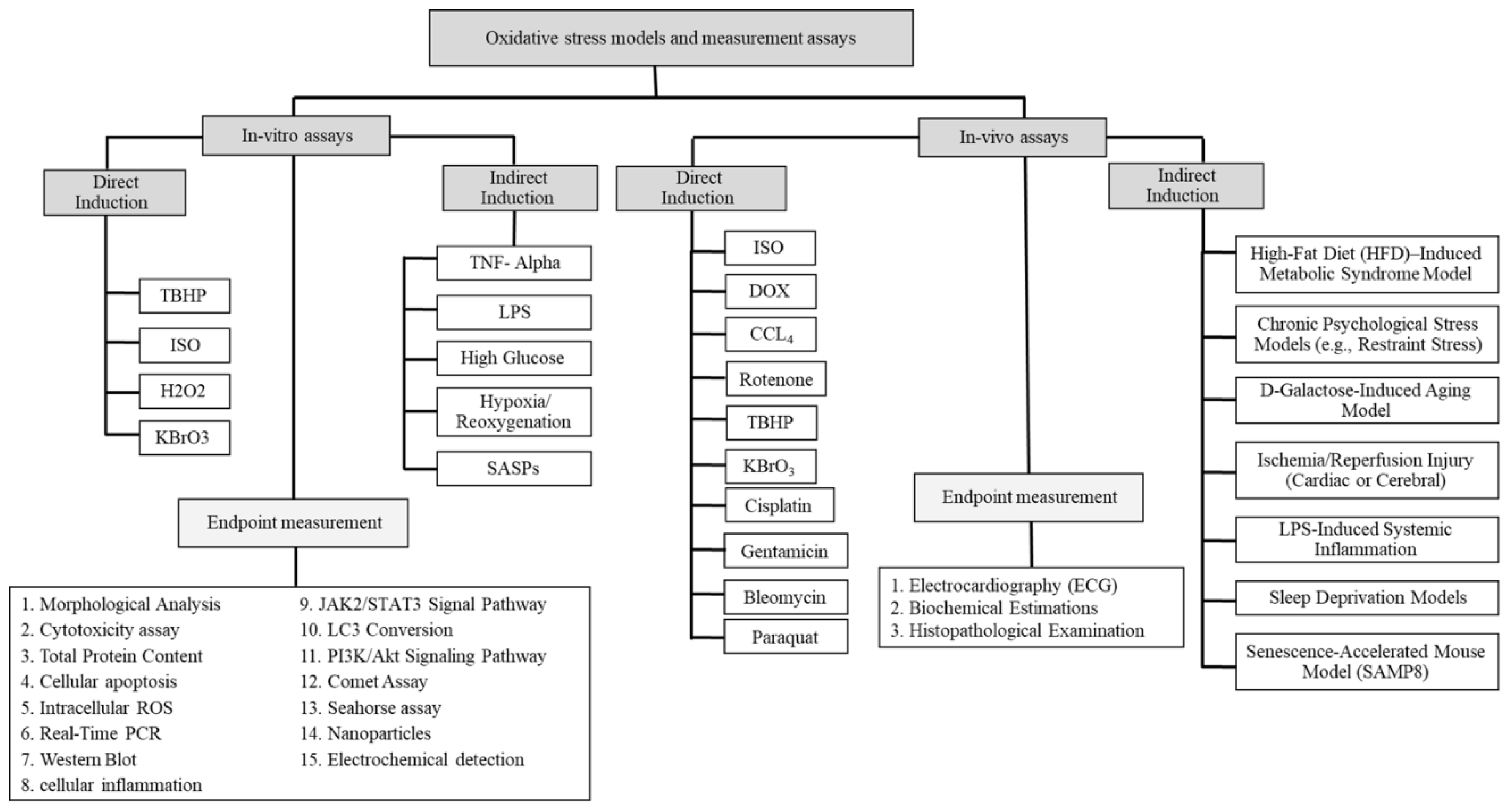
Table 1.
In-vitro models for assessment of oxidative stress in the cardiovascular system.
| In vitro models | Advantages | Disadvantages |
|---|---|---|
| Cardiac single cell |
|
|
| Two-dimensional (2D) cell cultures | ||
| Three- dimensional (3D) cell cultures |
|
|
| Coculture |
|
|
| Microfluidic cell culture |
|
Table 3.
Application of nanomaterials in ROS measurement.
| Nano Sensors Nanomicelles/Nanopolymer/Carbon Nanotubes/ Metallic |
Applications | Advantages | Disadvantages | References |
|---|---|---|---|---|
| Luminescence |
|
|
|
[109,110,111,112,113] |
| Fluorescent-quenching |
|
|
|
[114,115,116,117,118] |
| Surface-enhanced raman spectroscopy (SERS) |
|
|
|
[119,120] |
| ROS-dye encapsulation |
|
|
|
[121,122,123,124,125,126,127] |
| Nano surface energy transfer (NSET) |
|
|
|
[128] |
| Electrochemical |
|
|
|
[129,130,131,132,133,134,135,136] |
Disclaimer/Publisher’s Note: The statements, opinions and data contained in all publications are solely those of the individual author(s) and contributor(s) and not of MDPI and/or the editor(s). MDPI and/or the editor(s) disclaim responsibility for any injury to people or property resulting from any ideas, methods, instructions or products referred to in the content. |
© 2026 by the authors. Licensee MDPI, Basel, Switzerland. This article is an open access article distributed under the terms and conditions of the Creative Commons Attribution (CC BY) license (http://creativecommons.org/licenses/by/4.0/).
Copyright: This open access article is published under a Creative Commons CC BY 4.0 license, which permit the free download, distribution, and reuse, provided that the author and preprint are cited in any reuse.


