
Submitted:
31 March 2026
Posted:
01 April 2026
You are already at the latest version
Abstract
The 27 day and the 11 year solar cycles in extreme ultraviolet radiation (EUV) of the Sun are influencing the Earth’s middle atmosphere. For the first time, the solar cycle influences on geopotential height (or pressure) are analysed by using the Aura Microwave Limb Sounder (Aura/MLS) observations from 2004 to 2021. Composite analysis shows that the mesospheric 27 day variation of the global mean geopotential height is correlated with the 27 day variation of solar radio flux (F10.7cm index) which is a proxy of solar EUV. The maximum of the geopotential height has a phase lag of 4 days with respect to the maximum of EUV. The 11 year solar cycle has a sensitivity of 492m/100sfu in global mean geopotential height at about 94km height. Similarly, the solar cycle influences of the global means of middle atmospheric temperature, ozone, and water vapour are derived and discussed.
Keywords:
solar-terrestrial physics
; middle atmosphere
; 27 day solar cycle
; 11 year solar cycle
; Aura/MLS
; geopotential height
; temperature
; ozone
; water vapour
1. Introduction
The solar EUV flux varies with a period of about 27 days because active EUV emission regions rotate with the Sun which has a differential rotation period of about 27 days. The amplitude of the 27 day variation in EUV flux is up to 25% for the active Sun and about 2% for the quiet Sun [1]. In case of the 11 year solar cycle, the EUV irradiance can increase by about 100% from solar minimum to solar maximum [2]. These relatively large solar cycle variations of the EUV flux have an effect on the thermal state, dynamics and composition of the Earth’s middle atmosphere. The EUV flux is absorbed by atmospheric molecules such as oxygen, ozone and water vapour. Gan et al. [3] reported that the sensitivity of the 11 year solar cycle is about 2-4K/100sfu in the mesopause region (80-100km height) in simulations of the Canadian Middle Atmosphere Model while the satellite instrument TIMED/SABER showed a bit larger sensitivity values of 3-4.5K/100sfu. The unit of the solar radio flux F10.7cm which is a solar EUV proxy is 1 sfu and equal to 10−22Wm−2Hz−1 [4]. F10.7cm can increase by about 100 sfu from solar minimum to solar maximum.
The sensitivity of the mesospheric temperature to the 27 day solar cycle was investigated by [5] using Aura/MLS data. They found values between 1.8 and 2.7K/100 sfu in the equatorial mesopause region. In addition, they reported that the phase lag of the mesospheric temperature maximum can be up to 13 days. Rong et al. [5] did not discuss the reasons of the phase lag and its large variability. The phase lag of the thermospheric temperature to the 27 day variation in EUV was simulated and analysed by [6]. They used the National Center for Atmospheric Research Thermosphere Ionosphere Electrodynamic General Circulation Model to explore the physical mechanisms of the time delay of daytime thermospheric temperature response to the 27 day solar EUV flux variation. They found a delay of 0.5 to 0.8 days. This was the time until the total heating rate was balanced by the total cooling rate. While the time delays of the thermospheric and ionospheric responses are well studied, there are only a few studies about the time delays of the middle atmospheric responses to the 27 day solar EUV variation. The temperature sensitivity in the upper mesosphere at 85km height is about 3-6K/100 sfu as TIMED/SABER data and simulations of the Whole Atmosphere Community Climate Model (WACCM) showed over an 11 year solar cycle [7]. In the upper stratosphere and lower mesosphere, the temperature response to the 11 year solar cycle is about 1K/100 sfu, based on the analysis of HALOE and TIMED/SABER data by [8].
Fioletov [9] found a correlation between the 27 day solar cycle and upper stratospheric ozone in the tropics. The ozone data of SBUV (solar backscatter ultraviolet satellite) shows a response of about 2% to the 27 day variation of EUV. The phase lag changed with height from +3 days at 30km height to -3 days at 52km height. The observed ozone sensitivity at 2hPa was about 0.37% per 1% change in UV at 205nm. Amplitude and phase lag of the observed ozone response were in agreement with model estimates from [10]. Aikin and Smith [11] found a correlation between the 27 day variations of ozone and solar flux near 50km and between 65 and 70km height. Their calculations predicted a positive correlation over the entire mesosphere if there is no change in temperature accompanying the solar flux. They concluded that the lack of correlation is temperature induced. Recent model simulations showed a stratospheric ozone increase at 10hPa of about 0.11ppmv from solar minimum to solar maximum [12].
Brasseur [10] found in addition that the ozone response at 70 km height is anti-correlated to the 27 day variation of EUV. For the 11 year solar cycle, Fioletov [9] reported a 2% increase of tropical ozone at 40km height from solar minimum to solar maximum. At mid-latitudes, Moreira et al. [13] observed a 2% increase of upper stratospheric ozone (2hPa) and of mid-stratospheric ozone (10hPa) from solar minimum to solar maximum. Lee and Wu [14] analysed nighttime ozone variations in Aura/MLS data. In the upper mesosphere (0.001 hPa), they found an in-phase ozone variation within 3 ppmv (50%) versus the solar cycle. Fadnavis et al. [15] inferred from satellite data (HALOE, UARS) an annual-mean solar signal in ozone of the order of 5%/100 sfu in the upper mesosphere.
Upper mesospheric water vapour is photodissociated by the solar EUV radiation. Thus, a negative correlation can be expected between the 27 day variation in water vapour and the 27 day variation in EUV. Using Aura/MLS observations, Shapiro et al. [16] found that a water vapour minimum (above 78km height) occurred about 6-7 days after the maximum of the 27 day variation in EUV. This phase lag is possibly due to the relatively long lifetime of water vapour in the mesosphere. Similar results were obtained by [17] using the observations of mesospheric water vapour by a groundbased microwave radiometer at mid-latitudes (Switzerland). Nedoluha et al. [18] observed an anticorrelation between mesospheric water vapour and solar EUV during solar cycle 23 using a groundbased microwave radiometer at Hawaii and satellite data. The water vapour change at 80 km height is about % from solar minimum to solar maximum. Remsberg et al. [19] analysed data of the Halogen Occultation Experiment and derived a mesospheric water vapour change of about % at 80km height from solar minimum to solar maximum.
The introduction shows that the results of the 27 day and 11 year solar cycle signals on middle atmospheric parameters are spread over many studies over the past decades. The aim of the present study is to provide the solar cycle responses of geopotential height, temperature, ozone and water vapour within one paper. The benefit will be that connections between the parameters will be present. For example, geopotential height and temperature depend both on the solar short wave heating in a similar manner. It is for the first time that the solar cycle signals of the geopotential height are presented. Section 2 describes the Aura/MLS dataset and the data analysis. The results are presented in Section 3. The discussion is in Section 4, and conclusions are given in Section 5.
2. Aura Microwave Limb Sounder and Data Analysis
2.1. Aura/MLS
The present study is based on the profiles of geopotential height, temperature, ozone volume mixing ratio, and water vapour volume mixing ratio in the middle atmosphere which have been measured by the Microwave Limb Sounder (MLS) on the NASA satellite Aura. The Aura satellite was launched in 2004, and an overview about the technical details of the instrument MLS was given by [20]. Aura has a Sun-synchronous orbit in 705 km height with two equator overpasses at 01:45 local solar time (LST) and 13:45 LST. The orbit revolution time of Aura is about 99 min. Aura is in a near-polar orbit with an inclination of about 98. The atmospheric profiles are sampled below and along the orbit with a distance of 1.48° in latitude. The profiles are measured from 82S to 82N. In the present study, the profiles of a day are averaged with an area-preserving weighting by a factor where is the geographic latitude of the profile. These daily means of the Earth from 82S to 82N are called in the following global means.
Level 2 data of Aura/MLS of the retrieval version 5 are analysed in the present study. The data analysis applies the data screening and quality check according to [21]. The Aura/MLS retrieval yields atmospheric profiles on 42 pressure levels for the parameters temperature and geopotential height. These parameters are retrieved from the Aura/MLS measurements of the thermal microwave limb emissions of the O2 lines at 118GHz and 234GHz [22]. The ozone profiles are on 41 pressure levels from 215hPa (15km height) to 0.001hPa (90 km height). The ozone volume mixing ratio is derived from the 236GHz ozone line, and the precision is about 2%. The water vapour profiles are on 36 pressure levels from 82hPa (17km height) to 0.001hPa (90 km height). The water vapour volume mixing ratio is derived from the 183GHz water vapour line, and the precision is less than 1.5ppmv.
The present study only uses the data from 2004 to the end of 2021, since in 2022 the number of the pressure levels of the retrieved Aura/MLS profiles was reduced from 42 to 37 because of a technical degradation of the MLS instrument. It is better to restrict the data analysis to the high quality profiles before 2022 and to omit the Aura/MLS observations from 2022 to 2025 in the present study. In addition, middle atmospheric water vapour was strongly enhanced by the Hunga Tonga - Hunga Ha’apai volcano eruption in January 2022 [23], masking the solar cycle signal in the middle atmosphere after 2022.
The precision of the temperature profiles is about 1K in the stratosphere and about 3K in the mesosphere [22]. Precision of geopotential height is 35m from 316hPa to 100hPa, 44m at 1hPa, and 110m at 0.001hPa [22]. The temperature and geopotential height values beyond 90 km altitude are strongly influenced by the a priori of the retrieval, since the measurement uncertainty at upper altitudes is increased [21,22]. The a priori profile of upper mesospheric temperature and geopotential height originates from the COSPAR International Reference Atmosphere CIRA-86 [22].
2.2. Data Analysis
The solar radio flux at 10.7cm (F10.7) was used as a proxy of the solar EUV radiation [4]. Yearly averages of F10.7 are depicted in Figure 1 from 2005 to 2021. This 11 year solar cycle signal can be later compared to the solar cycle signals in the global means of the middle atmospheric parameters.
The 27 day variation of F10.7 and the middle atmospheric parameters were derived by means of a digital filter with a central period at 27.3 days and a bandpass from 24.8 to 30.3 days. The period 27.3 days was selected since it is the Carrington solar rotation period. Figure 2 shows the amplitude spectra of the oscillations in F10.7 (a) and the oscillations in geopotential height at about 94km height (b). Two of the three spectral peaks are close to the period 27.3 days and are within the selected bandpass. The GPH spectrum also has a spectral peak at half of a lunar month. This peak is induced by the lunar tide and the Sun-synchronous orbit of the Aura satellite. The semidiurnal lunar tide is sampled by Aura as a semimonthly lunar variation [24]. The amplitude spectra have been caclculated by digital filtering at the periods from 3 to 60 days. The digital filter is explained in the following paragraph.
The 27 day variations in F10.7 and the middle atmospheric parameters were extracted by means of a digital filter. The digital filter was run in forward and reverse direction in order to avoid a filter-induced phase delay. The selected digital filter is a non-recursive, finite impulse response bandpass filter with a Hamming window. The number of filter coefficients corresponds to a time window of three times the central period (27.3 days), so that the bandpass filter has a relative fast response time to temporal changes in the data series. The bandpass cut-off frequencies are at , where is the cut off frequency and is the central frequency (1/27.3days). Further details about the bandpass filtering are provided by [25]. The calculation of the amplitude envelope of the filtered series is described by equation 3 in [26].
Composite analysis or superposed epoch analysis was applied to the bandpass filtered time series where the local maxima of the 27.3 day bandpass-filtered F10.7 series F10.7 are taken as the epoch centers. Figure 3 shows the F10.7 series (blue) with the 134 local maxima (red dots) where the amplitude is greater than 3sfu. Composite analysis was also used by [5] and is a more objective method than cross-correlation. The main problem is that the phase difference between the 27 day variation of the middle atmospheric parameter and solar F10.7 can change in time. Composite analysis can better handle the variable phase differences and the variable occurrence of the local maxima in F10.7 than cross-correlation techniques. The mean response of the middle atmospheric parameter to solar EUV is computed as function of epoch time by using the local maxima of F10.7 as variable timing marks.
The composite of F10.7 for the mean of the 134 epochs is shown in Figure 4.
3. Results
Similar to the composite of F10.7 in Figure 4, the composite of the 27 day variation of the global means of geopotential height is calculated by using the 134 epoch centers of the F10.7 series (red dots in Figure 3). The result is shown in Figure 5. In the upper mesosphere and mesopause region, the GPH maximum has a phase delay of about 4 days with respect to the maximum in F10.7. The GPH variation is maximal at the mesopause and reaches down to the upper stratosphere.
The mean response of the global means of GPH to the 11 year solar cycle can be better recognized by taking the time series of yearly averages of the global means of GPH. Otherwise, the seasonal variation would mask a little the 11 year variation of the solar cycle signal. In addition, the mean profile of the global means of GPH from 2004 to 2021 is subtracted in Figure 6. The resulting GPH series correlates in the mesopause region with the 11 year solar cycle in F10.7 (Figure 1). Further, a negative linear trend is present which might be due to the expected cooling of the upper atmosphere because of increasing CO2 emissions of mankind. However, a negative trend is less obvious in the temperature series of Aura/MLS which will be shown below.
Figure 7 depicts the composite of the 27 day variation of global means of temperature. A 27 day solar cycle signal is present from the upper stratosphere to the mesopause region. The phase delay changes with height, and a phase reversal occurs at about 75km height. The phase delay is about 3 days in the mesopause region at 94km height. The maximum in temperature occurs about 3 days after the maximum in solar EUV. This is quite similar as the phase delay of GPH in Figure 5.
Figure 8 shows the global mean series T from 2005 to 2021. The temperature at the mesopause correlates well with the 11 year solar cycle signal in EUV or F10.7. Below 70km height, an 11 year solar cycle signal is not so obvious in temperature.
Figure 9 depicts the composite of the 27 day variation of global means of ozone. There is a clear anticorrelation between the 27 day variations in ozone at the mesopause and solar EUV. In the middle and upper stratosphere, ozone is roughly correlated with solar EUV.
Figure 10 shows the time series of global means of O3 from 2005 to 2021. A positive correlation occurs in the mesopause region between ozone and solar EUV. This behaviour of the 11 year solar cycle signal is opposite to the 27 day solar cycle signal where an anticorrelation occurred between ozone at the mesopause and solar EUV (Figure 9). The 11 year solar cycle signal in stratospheric ozone is not so obvious as in [13].
Finally, the middle atmospheric parameter H2O is presented. Figure 11 depicts the composite of the 27 day variation of global means of water vapour. About 5 days after the maximum of EUV, a minimum of water vapour follows in the mesopause region. There is a phase reversal at about 75km height. Below 60km, the signal in H2O is marginal. Figure 12 shows the time series of global means of H2O from 2005 to 2021. An anticorrelation occurs in the mesopause region between water vapour and solar EUV. The 11 year solar cycle signal in stratospheric water vapour is not so obvious and may be masked or superposed by other processes.
4. Discussion
The main results of Figure 5, Figure 6, Figure 7, Figure 8, Figure 9, Figure 10, Figure 11 and Figure 12 are quantified in Table 1. The sensitivity is the response of the middle atmospheric parameter divided by the F10.7 variation of the solar cycle signal. Further, the sensitivity is normalized with respect to 100sfu which is the typical difference between F10.7 at solar maximum and solar minimum. This normalization is often used in the literature, so that the sensitivity values of the present study can be compared to other studies.
As mentioned before, the response of the geopotential height to the solar cycle has not been addressed in the literature before. A variation of geopotential height at a fixed pressure level can be converted into a pressure variation at a fixed height. An increase of geopotential height means that the pressure increases. Table 1 shows that GPH at the mesopause (94km height) increases by about 154m/100sfu for the 27 day cycle and by 492m/100sfu for the 11 year cycle. Qualitatively, it is expected that GPH (or pressure) increases if there is more absorption of solar EUV at the mesopause. The observed time delay of 4 days for the GPH maximum after the F10.7 maximum of the 27 day variation is reasonable since a further accumulation of positive GPH deviation (or pressure) occurs after the maximum transit of F10.7. Further, a correlation coefficient of 0.76 is present for the 11 year solar cycle variations in GPH and F10.7. The response of GPH to the 27 day solar cycle signal is slowly decreasing on the way from the mesopause to the stratopause (Figure 5), indicating that solar EUV is stronger absorbed at higher altitudes.
At the mesopause, the response of the temperature to the F10.7 variations is a bit similar to the GPH response. The maximum in temperature (27 day variation) occurs about 3 days after the maximum in F10.7 (Table 1 and Figure 7). The sensitivity of the 11 year cycle is about 3 times stronger than for the 27 day cycle. This is quite similar as for the relation of the GPH sensitivities for the 11 year and 27 day solar cycle signals. In the mesopause region (94km), the sensitivity of the temperature response is 5.8K/100sfu for the 11 year solar cycle. This value agrees with [7] who found temperature sensitivities of 3-6K/100 sfu in the upper mesosphere in TIMED/SABER data and simulations of the Whole Atmosphere Community Climate Model (WACCM) for the 11 year solar cycle. A correlation coefficient of 0.93 is present for the 11 year solar cycle variations in temperature at the mesopause and F10.7 (Table 1 and Figure 8). Below 75km, the solar cycle signal in temperature is weak.
For the 27 day cycle, the temperature sensitivity is 1.9K/100sfu at the mesopause (Table 1). This value agrees with [5] who reported values between 1.7 and 2.8K/100sfu for the temperature sensitivity in the equatorial mesopause region. The time delay of the 27 day temperature maximum is strongly changing throughout the mesosphere (Figure 7). A phase reversal occurs at about 75km height. In the lower mesosphere, the time delay is again similar to those at the mesopause. This might be due to absorption of solar EUV by ozone.
In case of the ozone response, it is remarkable that ozone at the mesopause is anticorrelated to the 27day variation in F10.7. The time delay of the ozone minimum is zero days with respect to the maximum in F10.7. On the other hand, the 11 year solar cycle shows a positive correlation () between ozone and the solar cycle signal in F10.7 (Figure 10). Lee and Wong [14] emphasized that mesospheric ozone depends on the flux of atomic oxygen from the mesosphere. It is likely that this downwelling atomic oxygen flux is increased during solar maximum which would explain the ozone maximum at the mesopause at solar maximum. Such an enhanced downwelling causes adiabatic heating and would be consistent with the observed temperature increase during solar maximum, and the positive correlation of temperature and ozone in the mesopause region. Such a positive correlation of ozone and temperature was observed by [27] and would indicate a dynamical control of ozone at upper altitudes [14]. One may also argue that enhanced solar EUV would lead to more generation of odd oxygen by photodissociation of O2. On the other hand, the amount of upper mesospheric water vapour is smaller during solar maximum which would suggest a higher amount of odd hydrogen during solar maximum. This would result in more catalytic ozone depletion by odd hydrogen during solar maximum. However, the observations show that there must be other dynamical or photochemical processes which lead to the ozone maximum at 90km during solar maximum (Figure 10).
In case of the short-term 27 day variation in solar EUV, it can be argued that an increase of solar EUV leads to enhanced photodissociation of mesospheric ozone and enhanced catalytic ozone depletion processes by odd hydrogen. The zero phase lag indicates the short lifetime of ozone in the mesopause region. Such an anti-correlation of mesospheric ozone and solar EUV was also reported by [10]. In the upper stratosphere, there is a positive correlation between solar EUV and ozone which is in agreement with [9,10]. More solar EUV generates more atomic oxygen which then recombines with molecular oxygen to ozone. The slight variation of the phase lag of the ozone response in the upper stratosphere and lower mesosphere (Figure 9) agrees well with the simulations of Brasseur [10].
The relative ozone sensitivity is about 28%/100sfu at the mesopause (Table 1). This value is between the sensitivity values of Lee and Wu [14] (50% variation over solar cycle) and Fadnavis et al. [15] (5%/100sfu in upper mesosphere). Figure 10 shows that the ozone sensitivity strongly increases above the upper mesosphere, so that the low sensitivity value of Fadnavis et al. is not a contradiction.
Mesospheric water vapour is strongly depleted by solar EUV. Previous studies reported an anticorrelation between mesospheric water vapour and solar EUV. For the 27 day solar cycle, Shapiro et al. [16] reported that the minimum in mesospheric water vapour occurred 6-7 days after the maximum in solar EUV. They explained this behaviour by the relative long lifetime of mesospheric water vapour and the accumulation of water vapour dissociations. Shapiro et al. used a cross-correlation technique to compute the phase lag. The composite analysis of the present study yields a phase lag of about 5 days for the minimum in water vapour at the mesopause. Similarly, an anticorrelation is observed for mesospheric water vapour over the solar cycle (Figure 12). The correlation coefficient is .
If one compares the temperature response and the H2O response for the 27 day solar cycle in Figure 7 and Figure 11, a similar shape of the phase delay is obvious, with similar phase reversal at 75km height. Generally, there is an anticorrelation between the temperature response and the H2O response. This may be due to the importance of solar EUV absorption for the state of both parameters.
5. Conclusions
For the first time, the responses of geopotential height to the 27 day and 11 year solar cycle signals were investigated. Since geopotential height is closely related to pressure, these observational results are of interest for intercomparisons with model results. The pressure response to the solar cycle signals plays a role for satellites and rockets at upper altitudes. The combined discussion of the solar cycle responses in four middle atmospheric parameters is valuable and indicated some interesting results and many confirmations of expected results. Remarkable was the different behaviour of the mesospheric ozone response to the 27 day and 11 year variation of F10.7. It was also interesting that the mesospheric H2O and temperature response were clearly anticorrelated with a similar phase reversal at 75 km height. This may indicate the importance of H2O for the thermal state of the mesosphere.
Author Contributions
K.H. performed the data analysis and wrote the manuscript.
Funding
Open access funding was provided by the University of Bern.
Institutional Review Board Statement
Not applicable.
Informed Consent Statement
Not applicable.
Data Availability Statement
The Aura/MLS data are available at the Aura Validation Data Center (AVDC). https://avdc.gsfc.nasa.gov/ (accessed on 20 January 2026).
Acknowledgments
I thank the Aura/MLS team for the high quality data. The reviewers and the editor are thanked for their improvements and their work.
Conflicts of Interest
The author declares no conflicts of interest.
References
- Schanz, A.; Hocke, K.; Kämpfer, N. On forced and free atmospheric oscillations near the 27-day periodicity. Earth, Planets and Space 2016, 68, 97. [Google Scholar] [CrossRef]
- Lean, J.L.; Woods, T.N.; Eparvier, F.G.; Meier, R.R.; Strickland, D.J.; Correira, J.T.; Evans, J.S. Solar extreme ultraviolet irradiance: Present, past, and future. Journal of Geophysical Research: Space Physics 2011, 116. Available online: https://agupubs.onlinelibrary.wiley.com/doi/pdf/10.1029/2010JA015901. [CrossRef]
- Gan, Q.; Du, J.; Fomichev, V.I.; Ward, W.E.; Beagley, S.R.; Zhang, S.; Yue, J. Temperature responses to the 11?year solar cycle in the mesosphere from the 31?year (1979-2010) extended Canadian Middle Atmosphere Model simulations and a comparison with the 14?year (2002-2015) TIMED/SABER observations. Journal of Geophysical Research: Space Physics 2017, 122, 4801–4818. Available online: https://agupubs.onlinelibrary.wiley.com/doi/pdf/10.1002/2016JA023564. [CrossRef]
- Tapping, K.F. The 10.7 cm solar radio flux (F10.7). Space Weather 2013, 11, 394–406. Available online: https://agupubs.onlinelibrary.wiley.com/doi/pdf/10.1002/swe.20064. [CrossRef]
- Rong, P.; von Savigny, C.; Zhang, C.; Hoffmann, C.G.; Schwartz, M.J. Response of middle atmospheric temperature to the 27 d solar cycle: an analysis of 13 years of microwave limb sounder data. Atmospheric Chemistry and Physics 2020, 20, 1737–1755. [Google Scholar] [CrossRef]
- Ren, D.; Lei, J.; Wang, W.; Burns, A.; Luan, X.; Dou, X. A Simulation Study on the Time Delay of Daytime Thermospheric Temperature Response to the 27-Day Solar EUV Flux Variation. Journal of Geophysical Research: Space Physics 2019, 124, 9184–9193. Available online: https://agupubs.onlinelibrary.wiley.com/doi/pdf/10.1029/2019JA027000. [CrossRef]
- Forbes, J.M.; Zhang, X.; Marsh, D.R. Solar cycle dependence of middle atmosphere temperatures. Journal of Geophysical Research: Atmospheres 2014, 119, 9615–9625. Available online: http://arxiv.org/abs/https://agupubs.onlinelibrary.wiley.com/doi/pdf/10.1002/2014JD021484. [CrossRef]
- Li, T.; Yue, J.; Russell, J.M.; Zhang, X. Long-term trend and solar cycle in the middle atmosphere temperature revealed from merged HALOE and SABER datasets. Journal of Atmospheric and Solar-Terrestrial Physics 2021, 212, 105506. [Google Scholar] [CrossRef]
- Fioletov, V.E. Estimating the 27-day and 11-year solar cycle variations in tropical upper stratospheric ozone. Journal of Geophysical Research: Atmospheres 2009, 114. Available online: http://arxiv.org/abs/https://agupubs.onlinelibrary.wiley.com/doi/pdf/10.1029/2008JD010499. [CrossRef]
- Brasseur, G. The response of the middle atmosphere to long-term and short-term solar variability: A two-dimensional model. Journal of Geophysical Research: Atmospheres 1993, 98, 23079–23090. Available online: https://agupubs.onlinelibrary.wiley.com/doi/pdf/10.1029/93JD02406. [CrossRef]
- Aikin, A.C.; Smith, H.J.P. Mesospheric ozone changes associated with 27 day solar ultraviolet flux variations. Geophysical Research Letters 1986, 13, 427–430. Available online: http://arxiv.org/abs/https://agupubs.onlinelibrary.wiley.com/doi/pdf/10.1029/GL013i005p00427. [CrossRef]
- Huo, W.; Spiegl, T.; Wahl, S.; Matthes, K.; Langematz, U.; Pohlmann, H.; Kröger, J. Assessment of the 11-year solar cycle signals in the middle atmosphere during boreal winter with multiple-model ensemble simulations. Atmospheric Chemistry and Physics 2025, 25, 2589–2612. [Google Scholar] [CrossRef]
- Moreira, L.; Hocke, K.; Navas-Guzmán, F.; Eckert, E.; von Clarmann, T.; Kämpfer, N. The natural oscillations in stratospheric ozone observed by the GROMOS microwave radiometer at the NDACC station Bern. Atmospheric Chemistry and Physics 2016, 16, 10455–10467. [Google Scholar] [CrossRef]
- Lee, J.N.; Wu, D.L. Solar Cycle Modulation of Nighttime Ozone Near the Mesopause as Observed by MLS. Earth and Space Science 2020, 7, e2019EA001063. Available online: http://arxiv.org/abs/https://agupubs.onlinelibrary.wiley.com/doi/pdf/10.1029/2019EA001063. [CrossRef]
- Fadnavis, S.; Beig, G.; Chakraborti, T. Decadal solar signal in ozone and temperature through the mesosphere of Northern tropics. Journal of Atmospheric and Solar-Terrestrial Physics;Structure and Dynamics of Mesosphere and Lower Thermosphere 2012, 78-79, 2–7. [Google Scholar] [CrossRef]
- Shapiro, A.V.; Rozanov, E.; Shapiro, A.I.; Wang, S.; Egorova, T.; Schmutz, W.; Peter, T. Signature of the 27-day solar rotation cycle in mesospheric OH and H2O observed by the Aura Microwave Limb Sounder. Atmospheric Chemistry and Physics 2012, 12, 3181–3188. [Google Scholar] [CrossRef]
- Lainer, M.; Hocke, K.; Kämpfer, N. Variability of mesospheric water vapor above Bern in relation to the 27-day solar rotation cycle. Journal of Atmospheric and Solar-Terrestrial Physics 2016, 143-144, 71–87. [Google Scholar] [CrossRef]
- Nedoluha, G.E.; Gomez, R.M.; Hicks, B.C.; Wrotny, J.E.; Boone, C.; Lambert, A. Water vapor measurements in the mesosphere from Mauna Loa over solar cycle 23. Journal of Geophysical Research: Atmospheres 2009, 114. Available online: https://agupubs.onlinelibrary.wiley.com/doi/pdf/10.1029/2009JD012504. [CrossRef]
- Remsberg, E.; Damadeo, R.; Natarajan, M.; Bhatt, P. Observed Responses of Mesospheric Water Vapor to Solar Cycle and Dynamical Forcings. Journal of Geophysical Research: Atmospheres 2018, 123, 3830–3843. Available online: https://agupubs.onlinelibrary.wiley.com/doi/pdf/10.1002/2017JD028029. [CrossRef]
- Waters, J.W.; Froidevaux, L.; Harwood, R.S.; Jarnot, R.F.; Pickett, H.M.; Read, W.G.; Siegel, P.H.; Cofield, R.E.; Filipiak, M.J.; Flower, D.A.; et al. The Earth Observing System Microwave Limb Sounder (EOS MLS) on the Aura satellite. IEEE Transactions on Geoscience and Remote Sensing 2006, 44, 1075–1092. [Google Scholar] [CrossRef]
- Livesey, N.J.; Read, W.G.; Wagner, P.A.; Froidevaux, L.; Santee, M.L.; Schwartz, M.J.; Lambert, A.; Valle, L.F.M.; Pumphrey, H.C.; Manney, G.L.; et al. Earth Observing System (EOS) Aura Microwave Limb Sounder (MLS) Version 5.0x Level 2 and 3 data quality and description document. JPL D-105336 Rev. B, 2022. Available online: https://mls.jpl.nasa.gov/data/v5-0_data_quality_document.pdf.
- Schwartz, M.J.; Lambert, A.; Manney, G.L.; Read, W.G.; Livesey, N.J.; Froidevaux, L.; Ao, C.O.; Bernath, P.F.; Boone, C.D.; Cofield, R.E.; et al. Validation of the Aura Microwave Limb Sounder temperature and geopotential height measurements. Journal of Geophysical Research: Atmospheres 2008, 113. [Google Scholar] [CrossRef]
- Bell, A.; Sauvageat, E.; Stober, G.; Hocke, K.; Murk, A. Developments on a 22 GHz microwave radiometer and reprocessing of 13-year time series for water vapour studies. Atmospheric Measurement Techniques 2025, 18, 555–567. [Google Scholar] [CrossRef]
- Hocke, K. Observation of the Lunar Tide in the Middle Atmosphere by the Aura Microwave Limb Sounder. EGUsphere 2026, 2026, 1–16. [Google Scholar] [CrossRef]
- Studer, S.; Hocke, K.; Kämpfer, N. Intraseasonal oscillations of stratospheric ozone above Switzerland. Journal of Atmospheric and Solar-Terrestrial Physics 2012, 74, 189–198. [Google Scholar] [CrossRef]
- Hocke, K. Oscillations of global mean TEC. Journal of Geophysical Research: Space Physics 2008, 113. Available online: https://agupubs.onlinelibrary.wiley.com/doi/pdf/10.1029/2007JA012798. [CrossRef]
- Hocke, K.; Sauvageat, E. Frequency Dependence of the Correlation between Ozone and Temperature Oscillations in the Middle Atmosphere. Atmosphere 2023, 14. [Google Scholar] [CrossRef]
Figure 1.
Yearly averages of solar radio flux at 10.7 cm (F10.7) from 2005 to 2021.
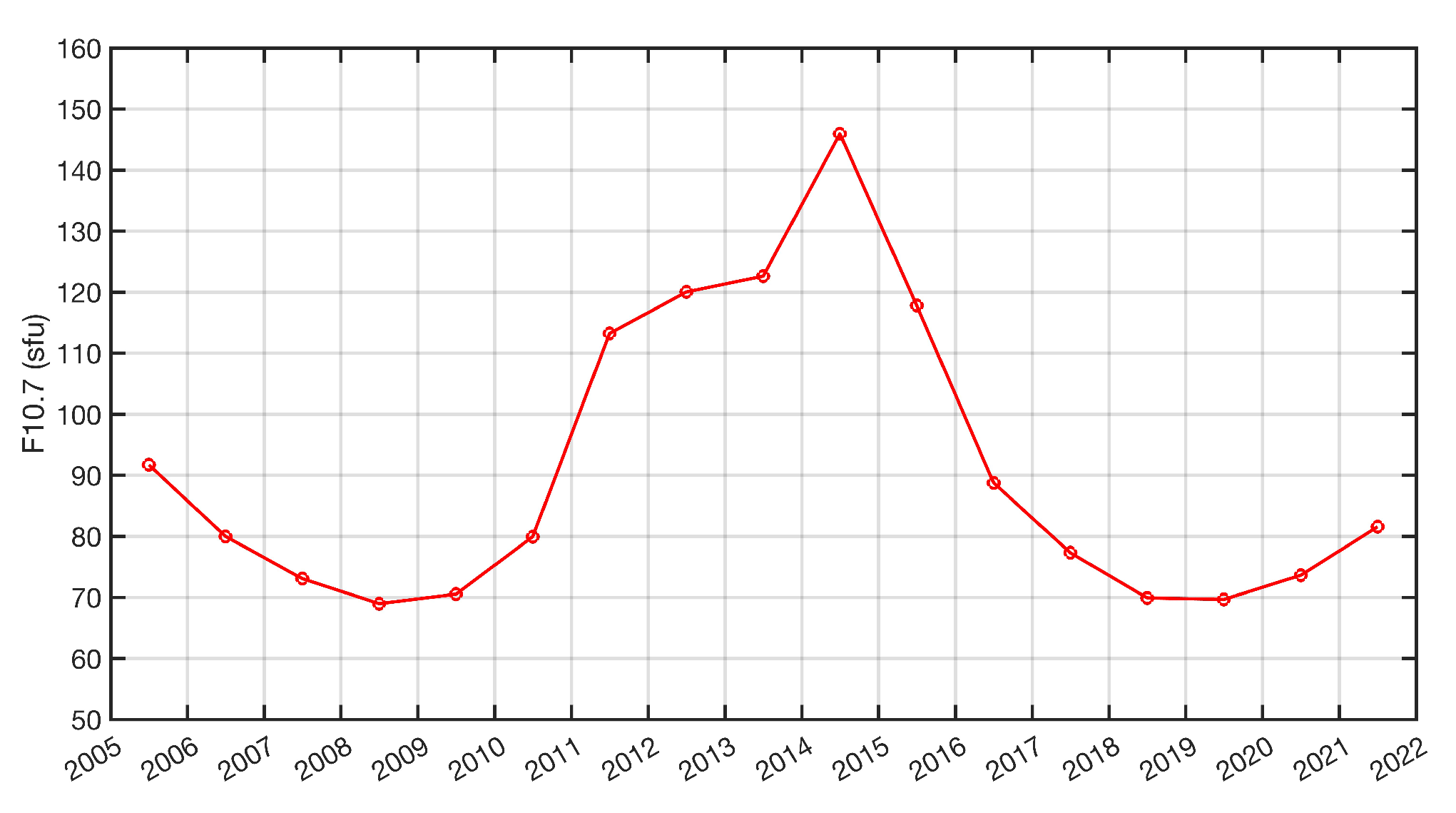
Figure 2.
Amplitude spectra of (a) solar radio flux F10.7 and (b) geopotential height (GPH) oscillations at about 94km and averaged over the time from 2004 to 2021. The vertical red line is at a period of 27.3 days indicating the 27 day solar cycle. The GPH spectrum at 94km height also has a spectral peak at the period of an half lunar month which is indicated by the vertical dashed black line in (b). This peak is due to the lunar tide and the Sun-synchronous orbit of the Aura satellite.
Figure 2.
Amplitude spectra of (a) solar radio flux F10.7 and (b) geopotential height (GPH) oscillations at about 94km and averaged over the time from 2004 to 2021. The vertical red line is at a period of 27.3 days indicating the 27 day solar cycle. The GPH spectrum at 94km height also has a spectral peak at the period of an half lunar month which is indicated by the vertical dashed black line in (b). This peak is due to the lunar tide and the Sun-synchronous orbit of the Aura satellite.
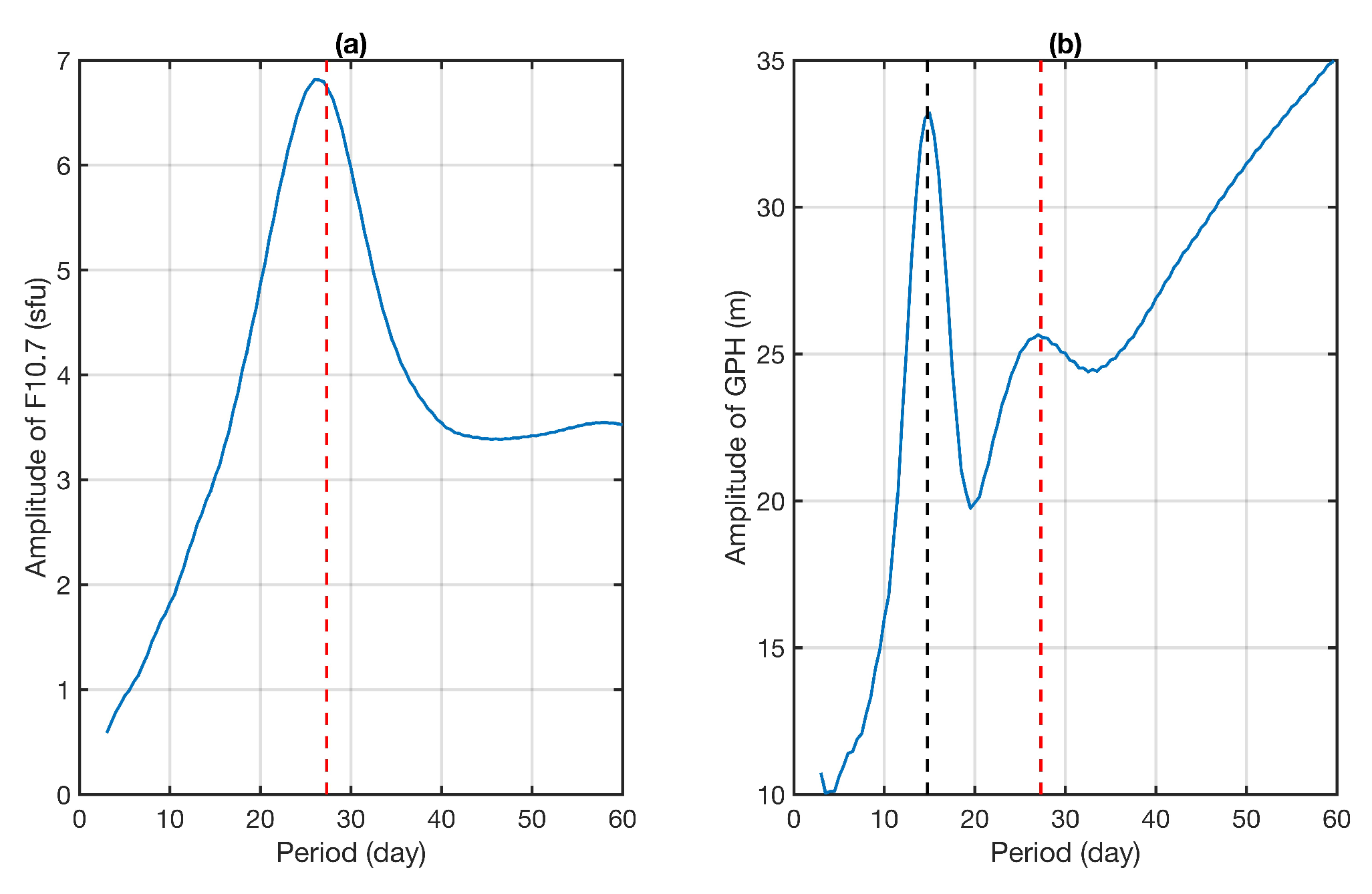
Figure 3.
27.3 day-bandpass filtered F10.7 series (blue) and local maxima (134 red dots) where the amplitude is greater than 3sfu. The times of the local maxima are taken as timing marks for the composite analysis.
Figure 3.
27.3 day-bandpass filtered F10.7 series (blue) and local maxima (134 red dots) where the amplitude is greater than 3sfu. The times of the local maxima are taken as timing marks for the composite analysis.
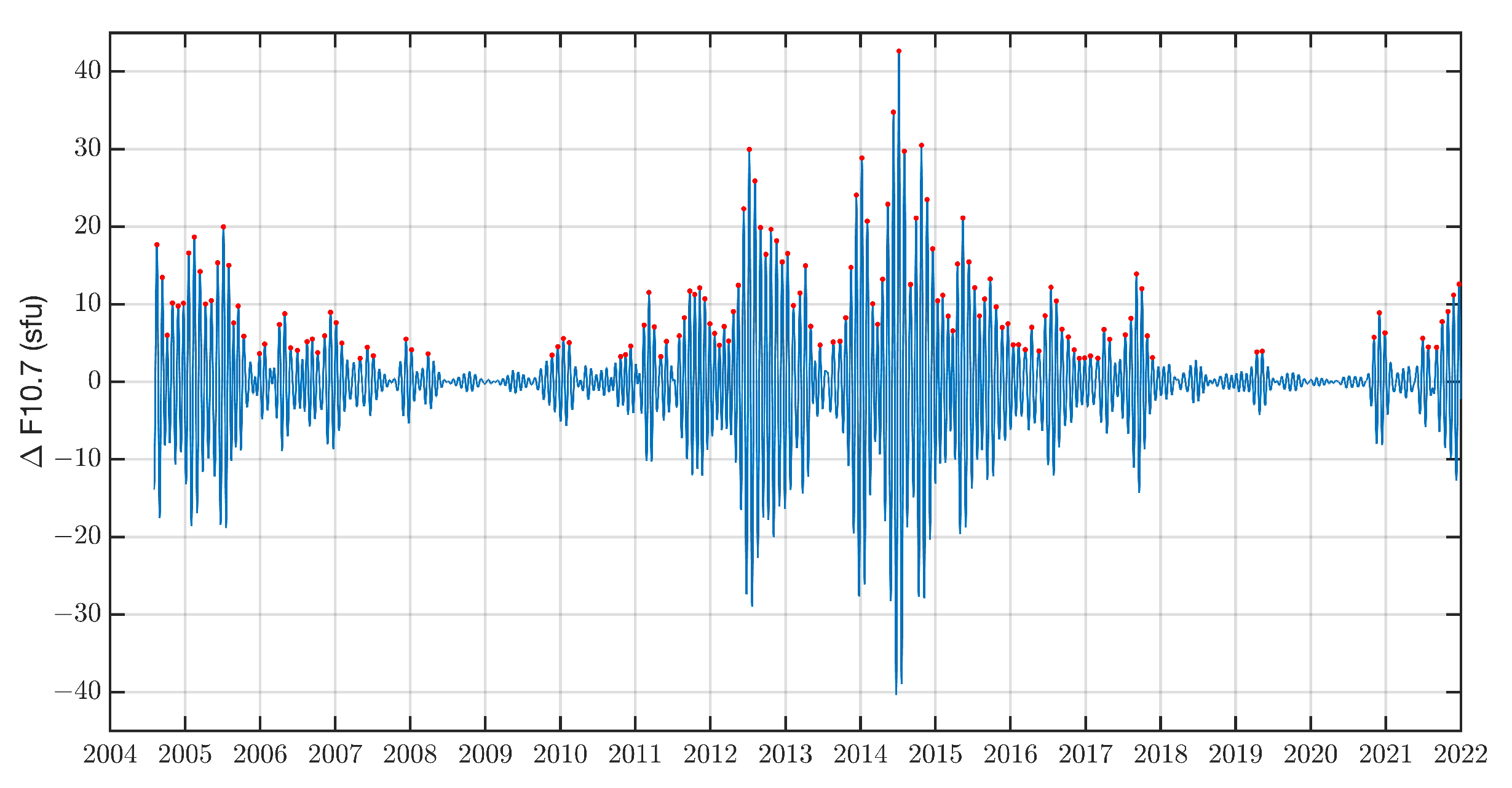
Figure 4.
Composite of the mean perturbation of the 27 day variation of F10.7 from 2004 to 2011. 134 events were averaged (red dots in Figure 3 are the epoch centers).
Figure 4.
Composite of the mean perturbation of the 27 day variation of F10.7 from 2004 to 2011. 134 events were averaged (red dots in Figure 3 are the epoch centers).
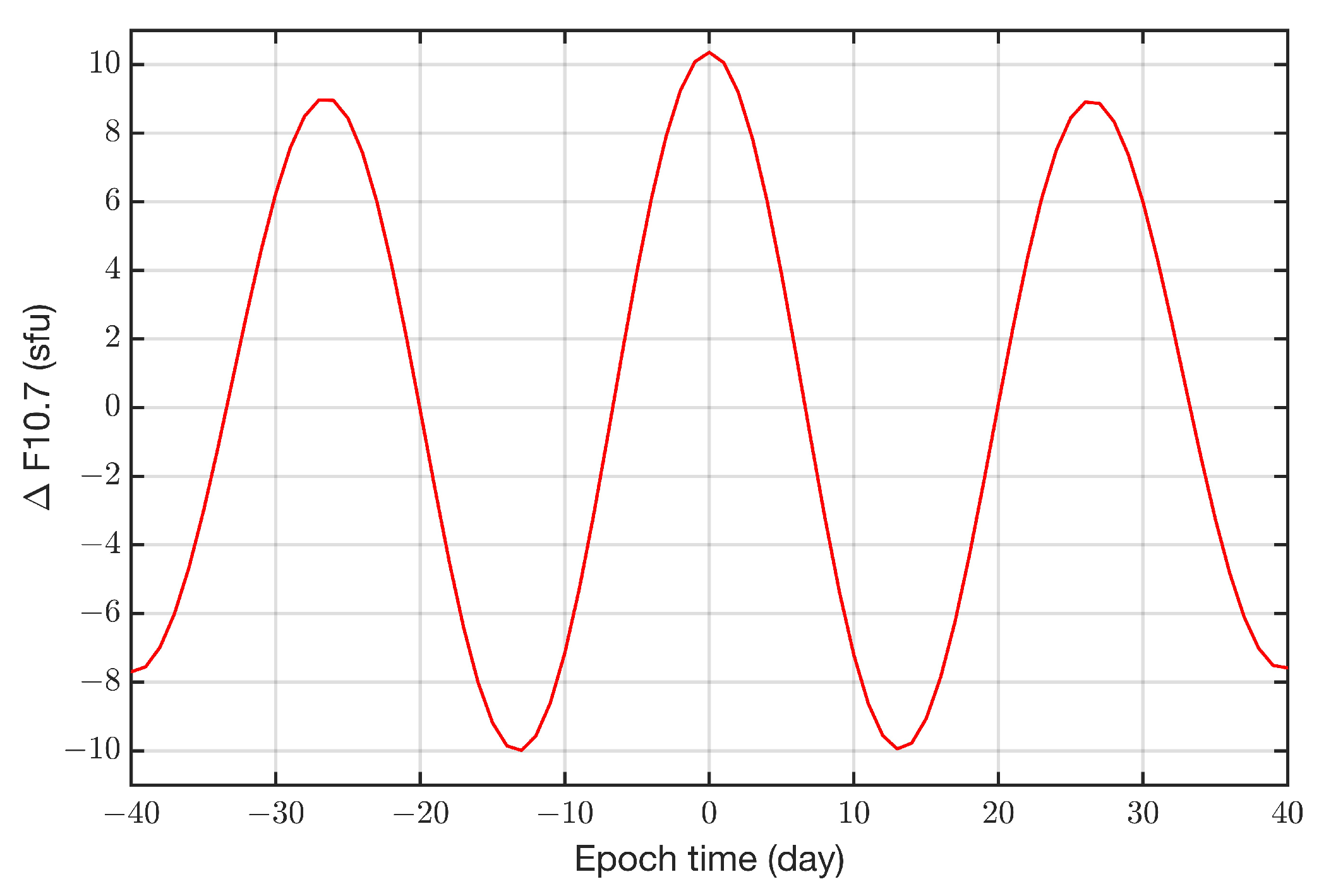
Figure 5.
Composite of the 27 day variation of global means of geopotential height GPH (134 events), Epoch time 0 corresponds to the local maximum of the 27 day variation in F10.7.
Figure 5.
Composite of the 27 day variation of global means of geopotential height GPH (134 events), Epoch time 0 corresponds to the local maximum of the 27 day variation in F10.7.
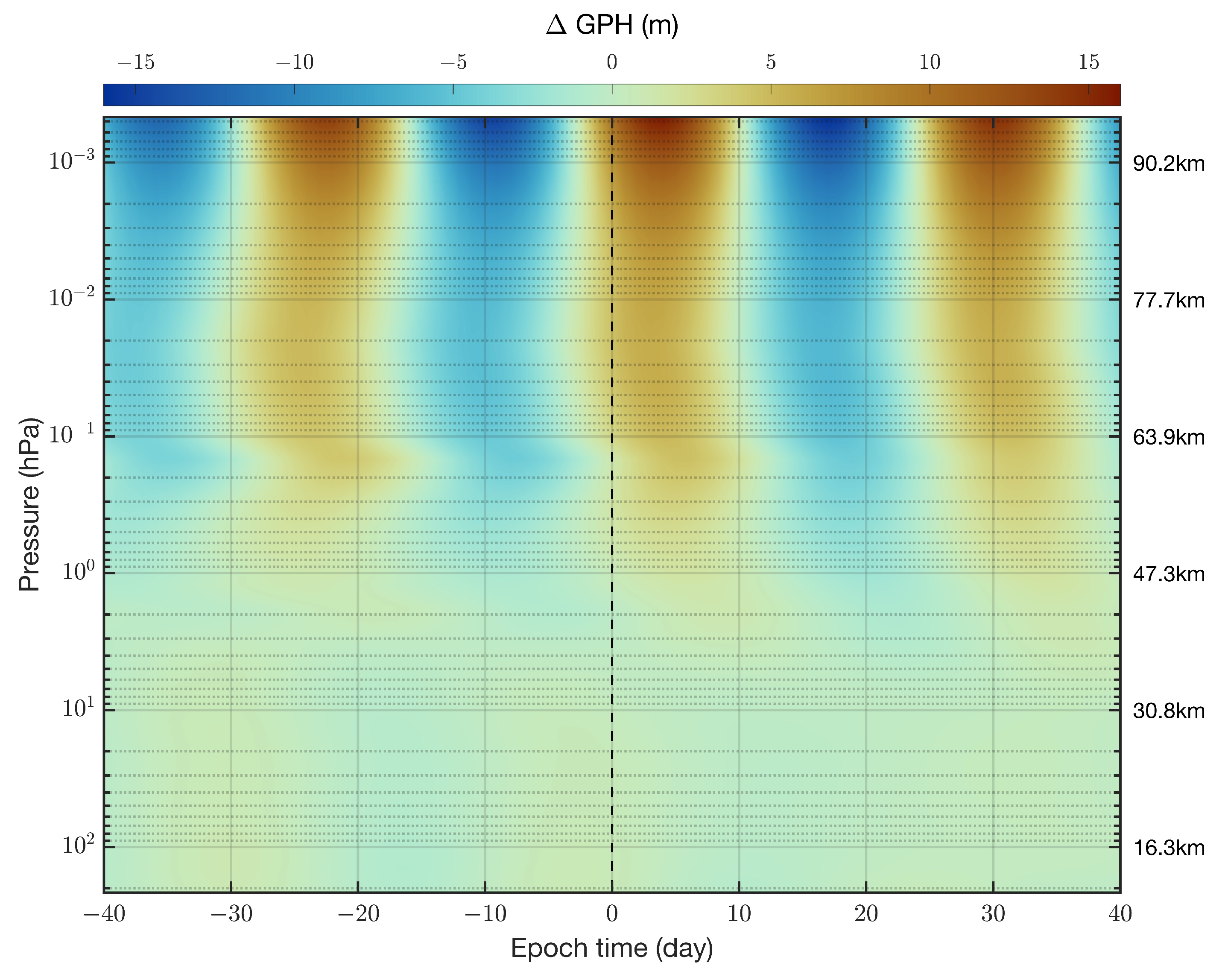
Figure 6.
Yearly averages of global means of GPH = GPH(p,t) − <GPH(p,t)>t where the mean is taken for the time 2004 to 2021. A correlation with the solar cycle in F10.7 (Figure 1) occurs in the mesopause region.
Figure 6.
Yearly averages of global means of GPH = GPH(p,t) − <GPH(p,t)>t where the mean is taken for the time 2004 to 2021. A correlation with the solar cycle in F10.7 (Figure 1) occurs in the mesopause region.
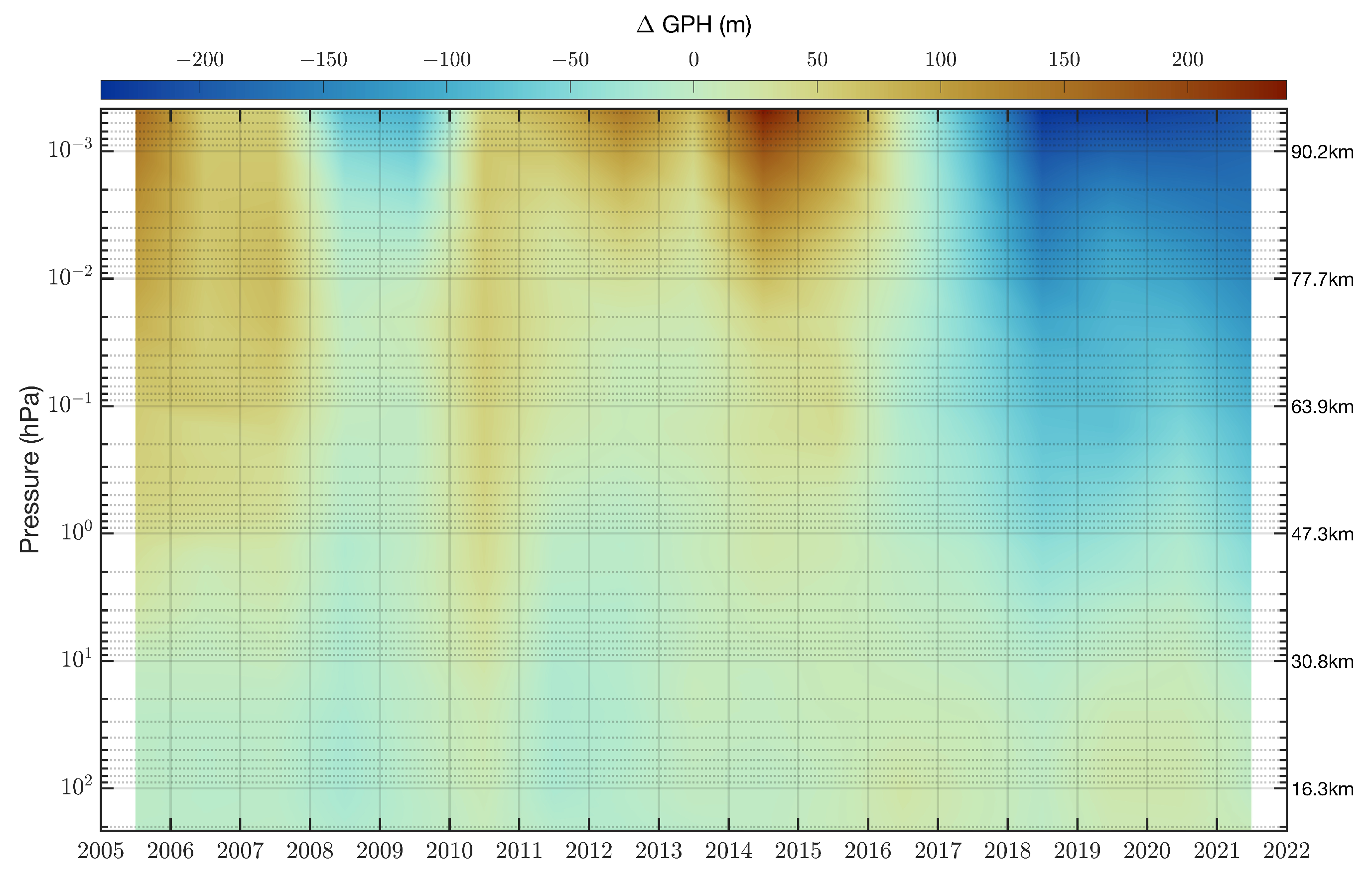
Figure 7.
Composite of the 27 day variation of global means of temperature (134 events), Epoch time 0 corresponds to the local maximum of the 27 day variation in F10.7.
Figure 7.
Composite of the 27 day variation of global means of temperature (134 events), Epoch time 0 corresponds to the local maximum of the 27 day variation in F10.7.
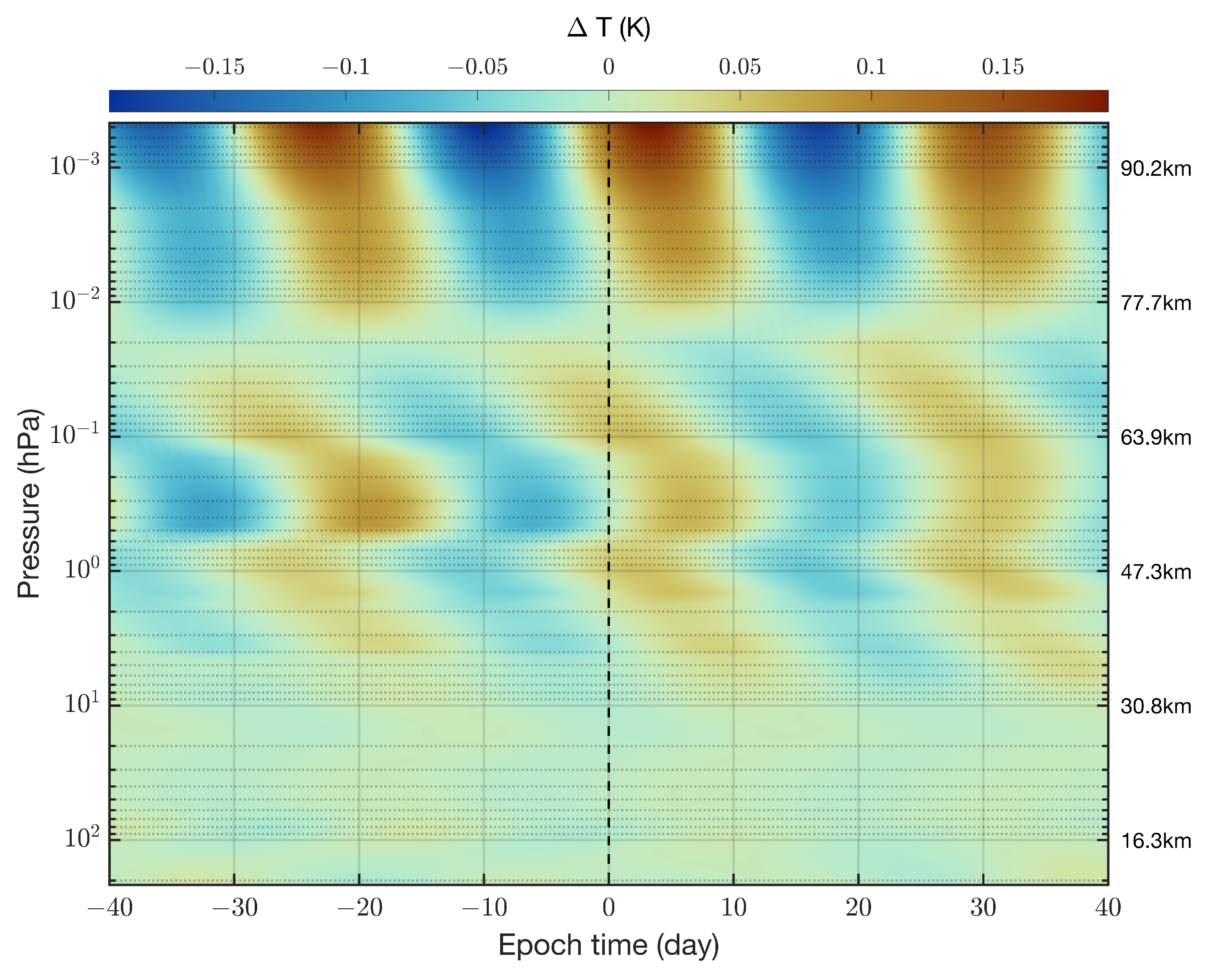
Figure 8.
Yearly averages of global means of T = T(p,t) − <T(p,t)>t where the mean is taken for the time 2004 to 2021. A correlation with the solar cycle in F10.7 (Figure 1) occurs in the mesopause region.
Figure 8.
Yearly averages of global means of T = T(p,t) − <T(p,t)>t where the mean is taken for the time 2004 to 2021. A correlation with the solar cycle in F10.7 (Figure 1) occurs in the mesopause region.
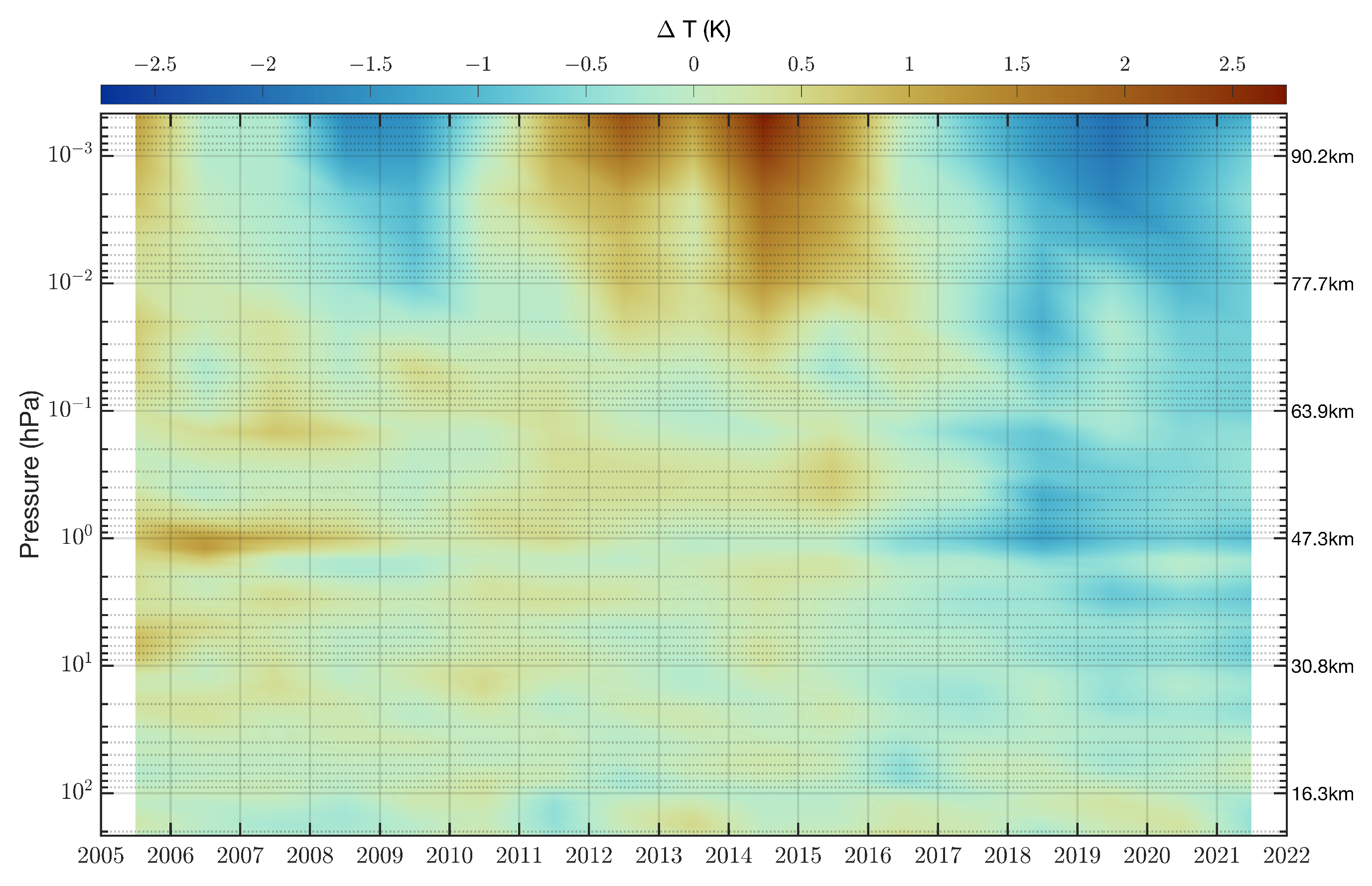
Figure 9.
Composite of the 27 day variation of global means of O3 (134 events), Epoch time 0 corresponds to the local maximum of the 27 day variation in F10.7.
Figure 9.
Composite of the 27 day variation of global means of O3 (134 events), Epoch time 0 corresponds to the local maximum of the 27 day variation in F10.7.
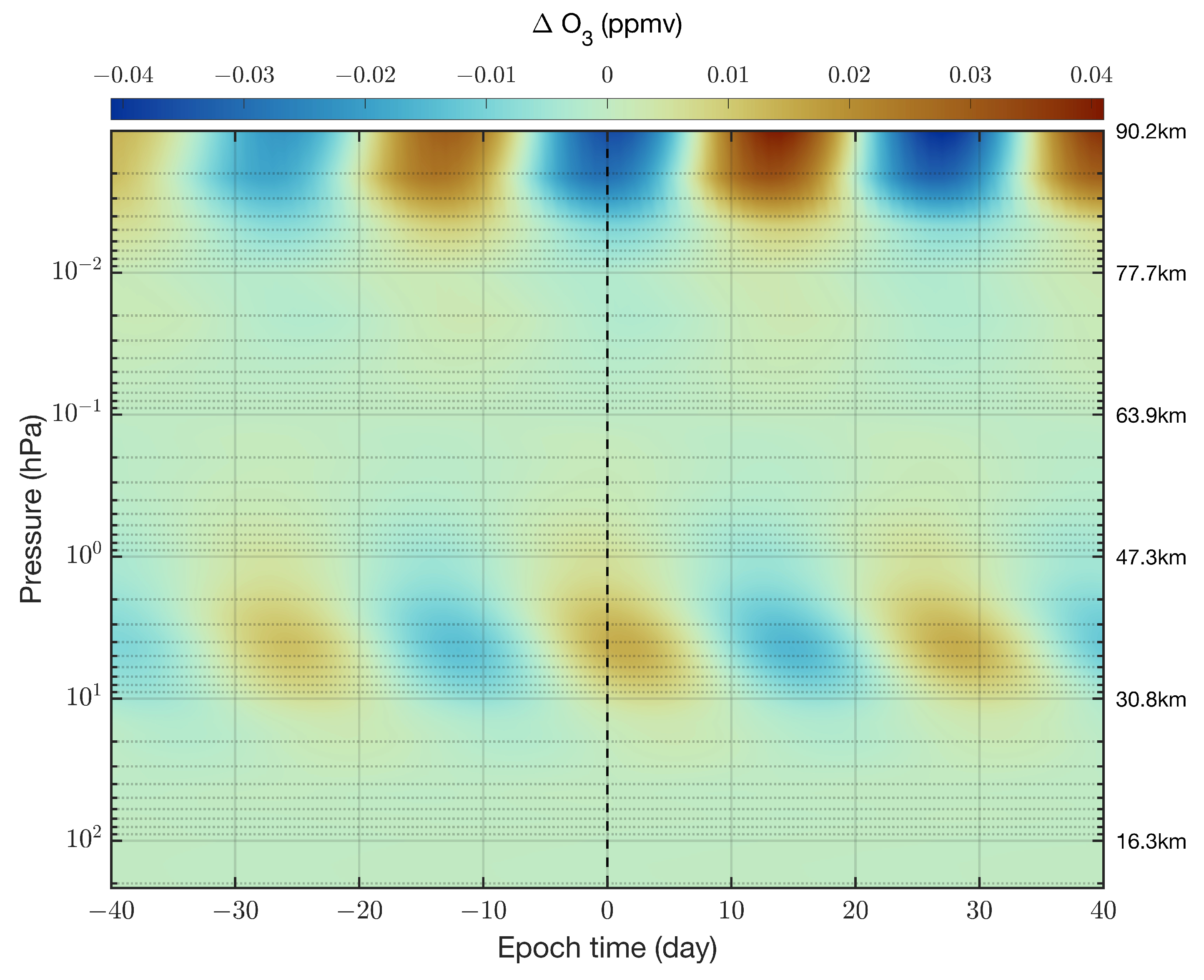
Figure 10.
Yearly averages of global means of O3 = O3(p,t) − <O3(p,t)>t where the mean is taken for the time 2004 to 2021. A correlation with the solar cycle in F10.7 (Figure 1) occurs in the mesopause region.
Figure 10.
Yearly averages of global means of O3 = O3(p,t) − <O3(p,t)>t where the mean is taken for the time 2004 to 2021. A correlation with the solar cycle in F10.7 (Figure 1) occurs in the mesopause region.
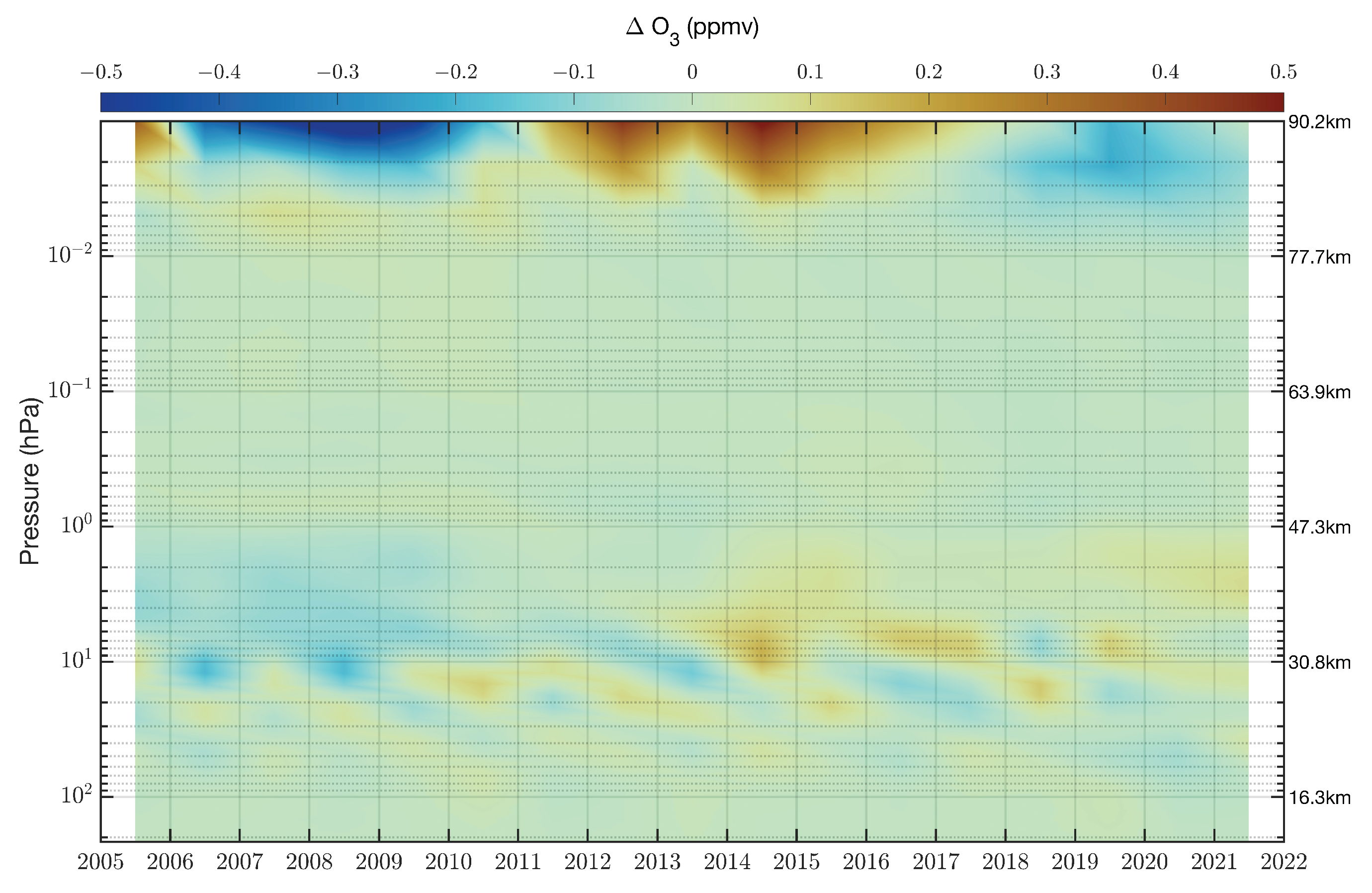
Figure 11.
Composite of the 27 day variation of global means of H2O (134 events), Epoch time 0 corresponds to the local maximum of the 27 day variation in F10.7.
Figure 11.
Composite of the 27 day variation of global means of H2O (134 events), Epoch time 0 corresponds to the local maximum of the 27 day variation in F10.7.
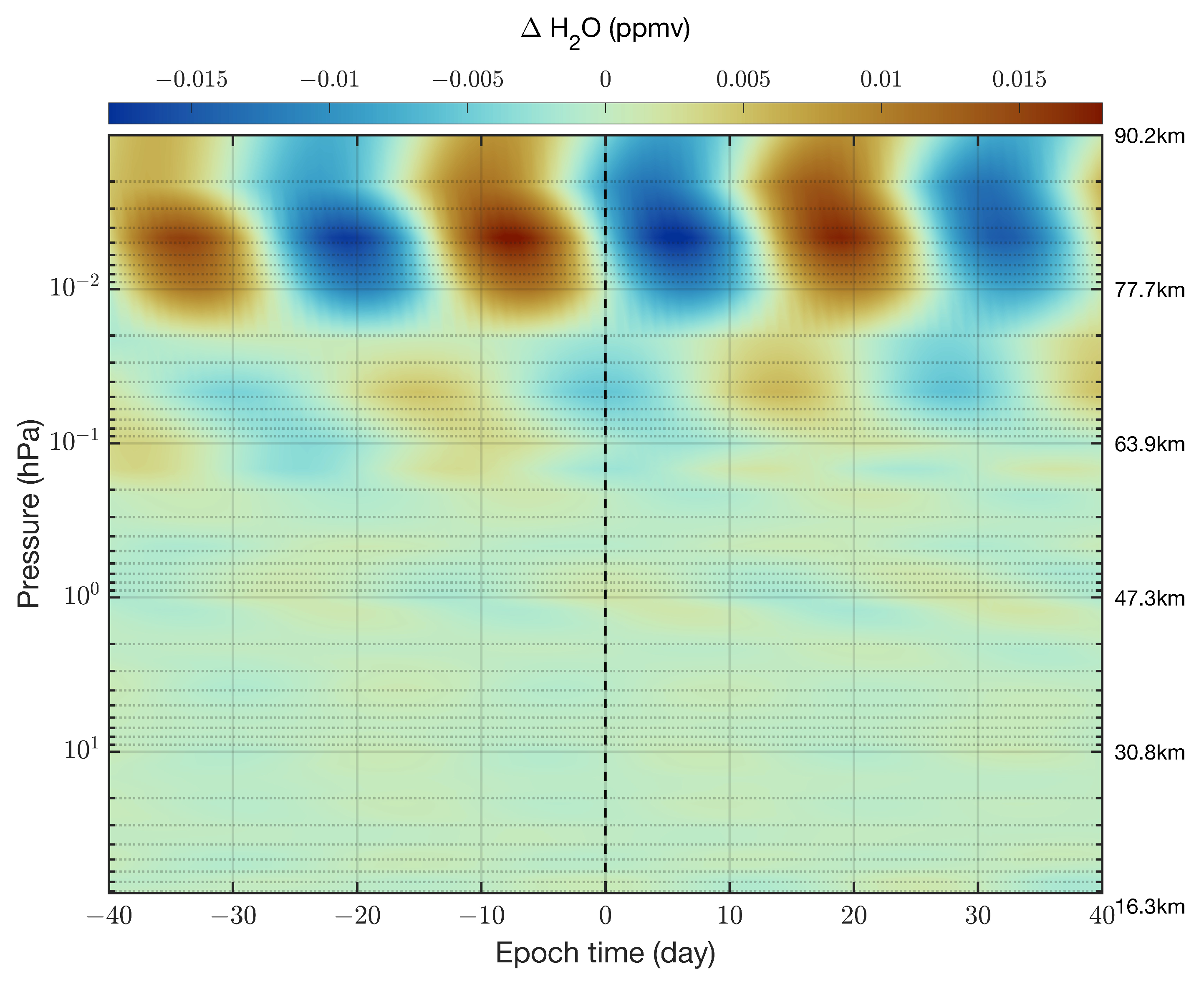
Figure 12.
Yearly averages of global means of H2O = H2O(p,t) − <H2O(p,t)>t where the mean is taken for the time 2004 to 2021. An anticorrelation with the solar cycle in F10.7 (Figure 1) occurs in the upper mesophere.
Figure 12.
Yearly averages of global means of H2O = H2O(p,t) − <H2O(p,t)>t where the mean is taken for the time 2004 to 2021. An anticorrelation with the solar cycle in F10.7 (Figure 1) occurs in the upper mesophere.
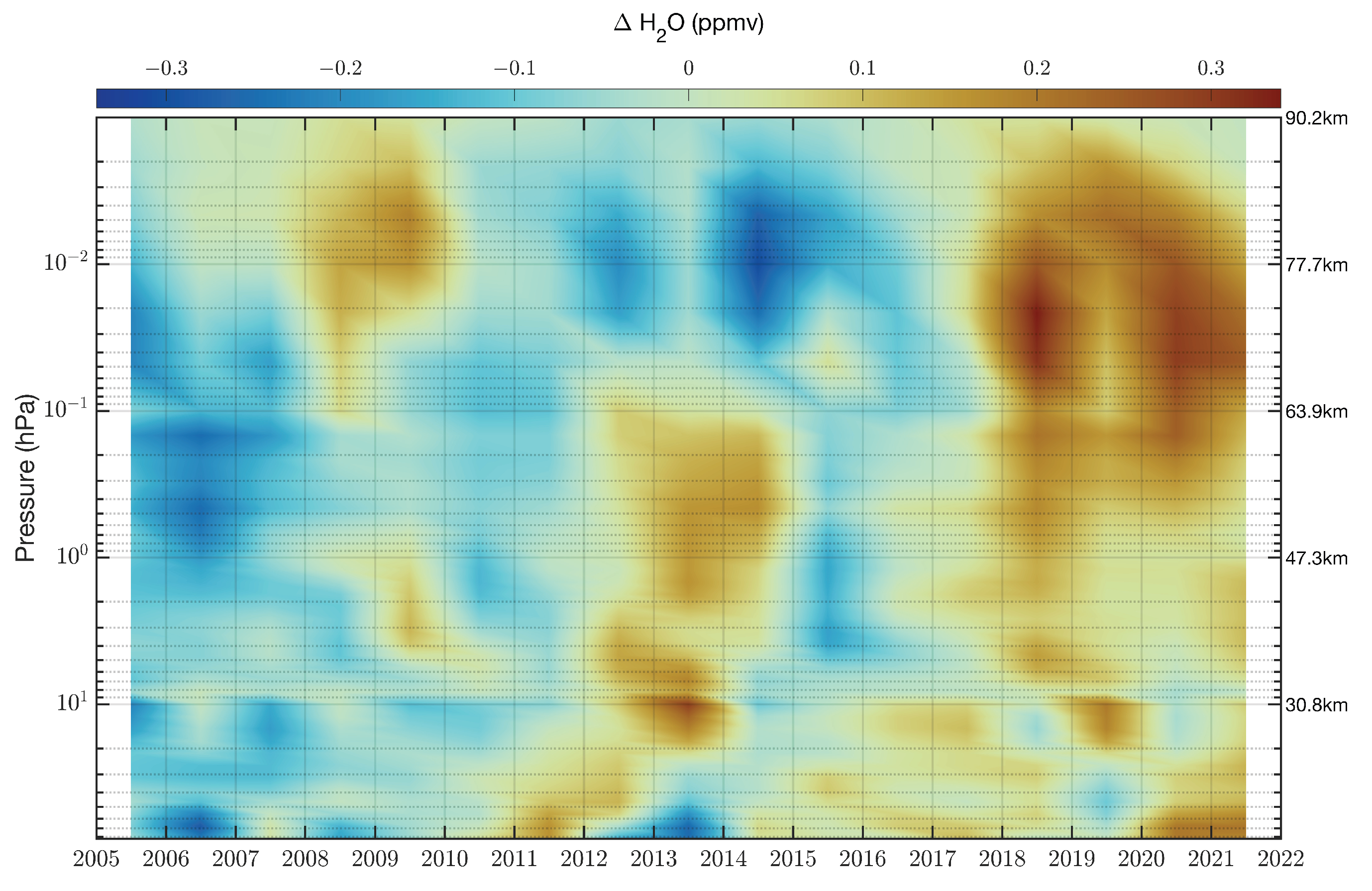

Table 1.
Response of the global means of the selected middle atmospheric parameters to the 27 day and 11 year solar EUV variations. The sensitivity of the relative O3 and H2O change to the solar signal is given in %/100sfu (with respect to the mean volume mixing ratio from 2004 to 2021).
Table 1.
Response of the global means of the selected middle atmospheric parameters to the 27 day and 11 year solar EUV variations. The sensitivity of the relative O3 and H2O change to the solar signal is given in %/100sfu (with respect to the mean volume mixing ratio from 2004 to 2021).
| Parameter | solar cycle | p,z | sensitivity | lag | correlation* |
|---|---|---|---|---|---|
| GPH | 27d | 4.6e-4hPa, 94km | 154m/100sfu | 4d | - |
| GPH | 11y | 4.6e-4hPa, 94km | 492m/100sfu | - | 0.76 |
| T | 27d | 4.6e-4hPa, 94km | 1.9K/100sfu | 3d | - |
| T | 11y | 4.6e-4hPa, 94km | 5.8K/100sfu | - | 0.93 |
| O3 | 27d | 5.6Pa, 39km | 0.13ppmv/100sfu 1.7%/100sfu | 2d | - |
| O3 | 27d | 0.001Pa, 90km | ppmv/100sfu %/100sfu | 0d | - |
| O3 | 11y | 0.001Pa, 90km | 1.2ppmv/100sfu 28%/100sfu | - | 0.80 |
| H2O | 27d | 0.001Pa, 90km | ppmv/100sfu %/100sfu | 5d | - |
| H2O | 11y | 0.001Pa, 90km | ppmv/100sfu %/100sfu | - |
* Correlation between yearly averages of parameter and F10.7cm.
Disclaimer/Publisher’s Note: The statements, opinions and data contained in all publications are solely those of the individual author(s) and contributor(s) and not of MDPI and/or the editor(s). MDPI and/or the editor(s) disclaim responsibility for any injury to people or property resulting from any ideas, methods, instructions or products referred to in the content. |
© 2026 by the author. Licensee MDPI, Basel, Switzerland. This article is an open access article distributed under the terms and conditions of the Creative Commons Attribution (CC BY) license (http://creativecommons.org/licenses/by/4.0/).
Copyright: This open access article is published under a Creative Commons CC BY 4.0 license, which permit the free download, distribution, and reuse, provided that the author and preprint are cited in any reuse.


