

Submitted:
31 March 2026
Posted:
01 April 2026
You are already at the latest version
Abstract
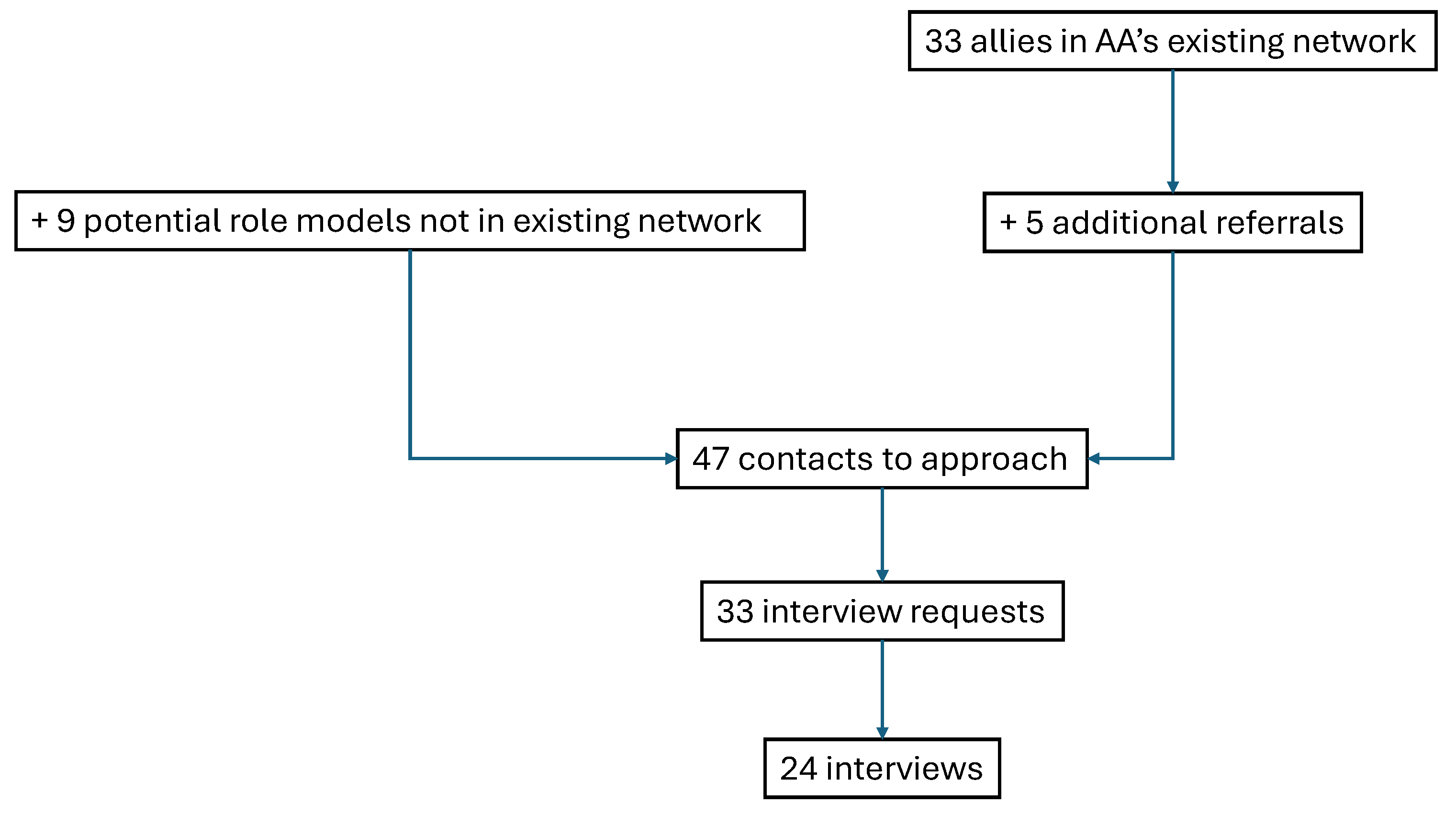
Many college graduates emerge from university wishing to pursue employment. Often, however, they lack a systematic approach for finding work. One published method calls for job-seekers to launch a relationship marketing campaign in advance of needing employment. This process, known by its acronym CARD, involves: identifying the job-seeker’s area of desired Contribution; enlisting the support of existing Allies or Advocates; identifying Role models to interview; and then Demonstrating value. A previous case report illustrated an undergraduate student’s use of CARD to find an internship opportunity while in college. The present case report contributes new knowledge to the literature in that it features the first account of a recent college graduate using CARD to seek full time employment. Also novel is the way this report includes the perspectives of the academic developer of CARD; the career counselor who guided the job-seeker; the job-seeker; and the eventual employer. We found that the career counselor was able to teach the CARD process to the job-seeker, who implemented it starting in January 2024. The process produced an offer of employment in June 2025. In the course of implementing the CARD process, the job seeker approached 33 potential role models already in her network, and nine potential role models identified through online searches. Five of these contacts provided a referral, resulting in a total of 47 people to approach. The job-seeker requested interviews with 33, and actually interviewed 24. We summarize the campaign, and describe the specific interviews and interactions with the role model who made an offer of employment first. This case report illustrates a systematic intervention, the CARD process, to implement relationship marketing when seeking full-time employment. CARD extends theory and evidence from the fields of relationship marketing and career counseling.
Keywords:
CARD process
; case report
; college graduate
; job-seeking
; life design career counseling
; relationship marketing
; self-marketing
; undergraduate
1. Introduction
College graduates are constantly emerging into an ever-changing job marketplace. Most lack any systematic method for finding a job. Career counseling centers at universities or in private practice can offer guidance. Career counselors help graduating students engage in introspection to identify career goals; direct them to the relevant job postings in a given industry; assist with refining resumes and cover letters; and help them prepare for interviews and negotiate offers (Chickering and Reisser, 1993; Hinkelman and Luzzo, 2007; Sampson Jr et al., 2014; Kronholz, 2015).
College graduates do face some barriers in implementing career counseling advice. The most significant is that a large number of jobs are never posted publicly: “At any given time, about 80% of all available jobs aren’t posted in the classifieds or on job boards, says BH Careers International, a New York career-management firm. And 60% of people surveyed by BH said they got their last job by networking.” (Bradford, 2005) Job-seekers also need systematic approaches for finding job opportunities that have never existed in the past (Afshar, 2025) and will never be shared publicly (Borchers and Ellis, 2024).
Some researchers have proposed additional approaches that address these barriers. McCorkle and colleagues were the first to propose that job-seekers could use marketing principles to guide their search. In this framing, job-seekers are the product or business seeking to find a fit in the market. The job-seeker is also the product manager or entrepreneur who assesses the market need; oversees the design and implementation of the product or business; and brings it to market with outbound marketing and sales strategies. McCorkle and colleagues reported in the literature on successful implementation of what they called a self-marketing course (McCorkle et al., 1992). Smith cited and extended the McCorkle experience with another course entitled Marketing You, with more evidence of success (Smith, 2004). Flostrand and colleagues cited and extended on Smith’s experience with a course entitled Marketing Me, which added simulation of networking events with alumni (Flostrand et al., 2016).
In this stream of research, self-marketing generally involves a positioning step in which students “identify the career skills sought by each target market,” followed by contact strategies inspired by the field of outbound sales. Self-marketing articles in the literature do not dwell on methodologies for positioning oneself in the market and then contacting people to find jobs. This gap led author JB, a university professor leading a service learning internship program, to articulate the CARD process for the positioning and contacting tasks. CARD is an acronym reflecting four steps: drafting and refining a statement of desired Contribution; enlisting Allies or Advocates; conducting Role model interviews; and Demonstrating value. See Figure 1.
In articulating CARD, JB also incorporated recent relationship marketing models that call for “flipping the funnel.” (Jaffe, 2010). The funnel terminology refers to the AIDA acronym frequently used in sales and marketing. The AIDA funnel involves raising Awareness with a large number of people (the top of the funnel) in hopes that you can attract Interest from many of them, cultivate Desire in some of them, and take Action with at least a few. Sales and marketing professionals represent AIDA as a funnel which narrows at each stage.
Relationship marketing flips the funnel so that you begin with the people in your network who are already taking action with you in some way. The CARD process applies relationship marketing to job seeking. Job seekers should enlist existing allies and advocates who desire to introduce them to role models; and demonstrate value to those role models during interactions surrounding a discovery interview.
One article in the literature described the CARD process in detail, in the context of an undergraduate using it to generate an internship opportunity (Belkora and Koehne, 2021). We now extend this contribution to the literature with a new case report of a recent college graduate using CARD to seek full-time employment under the guidance of a career counselor in a private practice setting. Also novel is the way this report includes the perspectives of the academic author of CARD; the career counselor; the job-seeker; and the eventual employer.
2. Setting for Case Report
2.1. Case Participants
Author JB is a faculty member at an academic medical center where he leads a service learning internship program, the Patient Support Corps (Belkora et al., 2021). JB develops educational materials to benefit the dozens of active interns (63 in 2026) and hundreds of program alumni (407 in 2026). These materials include training and other reference materials describing the CARD process.
A former student in JB’s service learning program, author ARA, obtained permission to access his materials, including CARD reference materials, for use in her private life coaching practice, which includes career counseling. ARA taught the CARD process to one of her clients, author AA, during AA’s last term at university, and counseled her throughout the ensuing CARD campaign. After AA interviewed author CS as part of a CARD campaign, author CS suggested writing up the campaign.
2.2. Ethics
This report analyzes and presents data from each author’s personal records, including notes, recordings, emails, and observations. Author JB ascertained with his university’s institutional review board that this case report did not require ethics review based on their rules governing educational and quality improvement activities and case reports.
3. Case Intervention and Results
We now review each step in author AA’s CARD campaign.

Table 1.
Timeline of case events.
| Time | CARD Event |
|---|---|
| January 2024 | C: Identifying target area of desired contribution |
| January 2024 to May 2024 | A: AA identifies 47 allies, advocates, and role models |
| June 2024 to March 2025 | R: AA conducts 24 role model interviews |
| October 2024 | R: First role model interview refers AA to a watering hole (estate planning lunch) where other role models and prospective employers may be present. AA attends and meets CS |
| November 2024 | R: AA conducts role model interview with CS |
| December 2024 | D: AA sends CS summary and transcript of role model interview |
| January 2025 | CS emails AA to request a follow-up discussion. AA replies. |
| May 2025 | CS emails AA about a potential role |
| June 2025 | AA interviews with CS colleagues. MyArtBroker offers position. |
3.1. Intervention Step 1: Identifying Your Target Area of Desired Contribution
3.1.1. Contribution - Description
As described previously (Belkora and Koehne, 2021), many young people who are emerging from formal education are understandably self-absorbed. Parents, educators, and college counselors often fan the flames of this self-absorption with advice to “follow your passion” or “find work that aligns with your passion.” Author JB receives many emails from students interested in joining his service learning program, the Patient Support Corps, that describe what the Patient Support Corps can do for them, rather than what they can contribute to the Patient Support Corps. A recent example: “I’d love to learn more about the structure of the internship and how to get involved so I can decide if this aligns with my goals.” The implicit message, while likely unintended, is that the program would be lucky to have the student who is deciding whether to grace the program with their presence. In practice, the Patient Support Corps receives over 10 applications for each open position. Employment recruiters have noted the same dynamic: “Job seekers spend way too much time thinking about themselves and what they have to offer, and precious little time thinking about the company and what it needs (Procopio, 2024).
Meanwhile, employers may find that employee passion is a two-edged sword when it comes to filling entry-level positions. Prospective employees who proclaim their passion may have grandiose views of what entry-level work in the trenches involves. Their commitment to a job may waver if it doesn’t feed their passion as they define it. They may be at higher risk for turnover when an entry-level job doesn’t meet their potentially unrealistic expectations. Conversely, prospective employees who focus more on what they can contribute may be more productive and persist in entry-level jobs because they derive satisfaction from being productive contributors to a bigger picture even in small ways. Indeed, researchers are actively investigating the productivity and well-being of individuals who focus on contributing as well as receiving. Focusing on contributions may increase both productivity and well-being (Grant and Dutton, 2012; Inagaki and Orehek, 2017).
Along these lines, Cal Newport has written about the importance of developing skills and using a contribution frame to break into the world of employment (Newport, 2012). Design thinkers suggest that job-seekers approach early jobs as a prototypes that require iteration and pivoting someone locks in to a career or path that is most productive and fulfilling (Burnett and Evans, 2016)
In light of these insights, a CARD campaign begins with identifying the job-seeker’s skills and strengths and looking for ways these can contribute to the agenda of possible employers in related areas. The product of this first step in the campaign is a draft statement of desired contribution.
3.1.2. Contribution - Results
AA had studied art history at university and felt the general domain of art was where her skills best positioned her to make a contribution. After reflecting on her experiences and exposure to the employment marketplace surrounding art, AA worked with ARA to develop a catchy statement of her areas of desired contribution that might be valued by employers in that arena:
“[Help collectors] Underpay for a Keith Haring. Overcharge for a Basquiat. Tidy up an art collection, upgrading a private collection from a jumble of assets to a museum-worthy show. Manage relationships with temperamental artists. The problems I aim to solve occur at the intersection of art and finance. I hope to help clients maximise the joy they derive from their collections; work on helping them manage, maintain, and reorganise their portfolio; and assess the risk and value of art acquisitions.”
Notice that this statement of desired contribution is focused on what AA might contribute to an art collector’s agenda. Also note that a job-seeker’s statement of desired contribution will need refining based on feedback as they pursue opportunities. The important thing is to develop a prototype statement of desired contribution and then refine it through iterations and as the job-seeker potentially pivots from one marketplace (e.g. art) to another (e.g. finance). Throughout the CARD campaign, the main objective is to “march in the direction of your goals” and then iterate based on feedback. This is a key principle of design thinking, which is at the foundation of the CARD process (Burnett and Evans, 2016).
3.2. Intervention Step 2: Enlisting Allies and Finding Role Models
3.2.1. Enlisting Allies - Description
One benefit of writing a statement of desired contribution is that it will help the job-seeker identify allies and role models. In this context, role models are people who have jobs that enact the desired contributions. AA, based on her draft statement, looked for candidate role models who are paid to advise art collectors about their portfolio of art, considering both aesthetic and financial aspects of the investments. Finding role models is important because they can provide maximally relevant information and advice for the job seeker about positioning oneself to make the desired contributions. Demonstrating value to role models will position the job seeker to access job opportunities when the role models recommend them for new openings or refer them to others who are looking for employees.
Job-seekers may not have ready access to role models. Network theory suggests, however, that there are only a few degrees of separation between any two individuals (Watts, 1999). In other words, job-seekers can often leverage their existing network for introductions that lead to the target role models.
Therefore, in step 2 of the CARD campaign, the job seeker enlists allies and advocates in the search for role models. Allies and advocates are individuals who will take the time to understand the job-seeker’s desired contribution and brainstorm how to advance the search for role models. Allies and advocates will make introductions that lead directly to role models, or indirectly snowball into successive introductions eventually leading to role models. Alternatively, allies and advocates may point the job seeker to “watering holes” where role models gather, either virtually or in person. The watering hole imagery invokes how photographers can capture photos of their target animals by staking out a stream, river, pond, or lake and waiting for the animals to drink from it in the evening. Likewise, job-seekers can find more allies or role models where they generally assemble.
In some cases, job seekers can identify role models without any intermediaries, such as through internet searches or reading published materials such as articles or books. In such cases the job seeker can work backwards to find allies or advocates who might be connected to the identified role model.
Overall, it’s important to emphasize to allies and role models that the primary intent is market research, not asking for a position at the outset. On the other hand, students transitioning out of school should also make it clear that they have recently graduated, or are approaching graduation and are seeking to understand the landscape with an eye to eventually finding a career path and employment.
3.2.2. Enlisting Allies - Results
In our case report, between January, 2024 and May, 2024, job-seeker AA communicated her statement of desired contribution to 33 people already in her network who appeared to fit her definition of a role model; and nine potential role models that AA identified online. Five of these 42 people provided a referral, resulting in a list of 47 people to contact. Among these, AA approached 33 to request interviews. Twenty-four of these 33 role models agreed to interviews. See Figure 2.
We will now describe in more detail AA’s interactions leading to her first employment offer. We focus on this interaction because it generated a case study of the entire lifecycle of the CARD campaign.
On October 9, 2024, one of AA’s prior interviewees suggested she attend an educational marketing event at a law firm, entitled “Art and Estate Planning Lunch.” Professional services firms often host free educational events like these to attract or retain clients interested in the topics. These events thus serve as watering holes that may attract role models relevant to a job-seeking campaign.
On October 16, 2024, AA attended the lunch event. There she introduced herself to several people from the art world, including author CS, the Managing Director of an online platform to buy and sell artwork. AA asked for a business card in order to retain the Managing Director’s contact information.
That evening, AA emailed the Managing Director:
It was wonderful to connect with you today at the [Redacted] Lunch. It is always wonderful to meet a fellow lover of prints & multiples. Looking forward to staying in touch.
The next day, AA read the following email response:
Great to meet you too, do keep in touch!
AA ascertained that this Managing Director met the criteria for a role model who had experience with advising art collectors on how to build their portfolio. Therefore AA planned to approach the Managing Director with a request for a role model interview.
3.2.3. Finding Role Models – Description
Having identified a role model, the CARD process next involves requesting and conducting a role model interview. Author JB designates this as a role model interview rather than informational interview because the term “role model” is more humanistic (or people-centered) and inherently more flattering than “informational interview.” Another dehumanizing phrase that job-seekers should avoid is asking a role model “Can I pick your brain?” Picking brains is something that scavengers such as vultures do to dead animals such as roadkill. Job-seekers should be cautious about inviting a role model to coffee or lunch, until they have demonstrated sufficient value to merit the extra time investment required (Butler, 2012). In addition, social situations are not conducive to discovery interviews, which are focused on gathering information to be analyzed later.
Instead, the role model interview, described elsewhere in more detail (Belkora and Koehne, 2021), requires job-seekers to request a 20 minute telephone interview. Twenty minutes is enough to elicit a surprisingly large amount of disclosure from the role model. The role model can choose to extend the interview if, as is often the case, they are finding it productive. The job-seeker must record the interview, transcribe it by hand (so that they absorb the contents in slow motion), and analyze the transcript for further opportunities to demonstrate value. The job-seeker can inform the role model that they will provide a summary of the interview that the role model can share with colleagues, friends or family or in a publication such as a blog or a podcast. This can demonstrate value to the role model in the form of a third party summary that is valuable to other audiences.
Author JB recommends that the invitation to a role model specifically indicate that the job seeker would like to hear the “story of how you came to be a role model for someone like me, who is interested in helping [summarize statement of desired contribution].” This wording is carefully designed to appeal to the universal human interest in story telling. If the statement of desired contribution is a match, the role model will resonate. In the case of AA, this formula resulted in “would you please tell me the story of how you came to be a role model for someone like me, who is interested in helping art collectors upgrade a private collection from a jumble of assets to a museum-worthy show.”
3.2.4. Finding Role Models - Results
On November 13, 2024, AA adapted the CARD guidance and sent the Managing Director the following email. Author JB recommends that all emails to role models begin with the words “thank you” or “congratulations” and refer to a recent positive occurrence. This launches the communication in a way that is focused on the role model rather than the job-seeker. The email should also propose specific dates and times so that if the role model is inclined to say yes, they can bypass unnecessary rounds of scheduling.
Subject: Role Model Interview Request
Dear Charlotte,
Congratulations on the launch of your new offices - this must be an extremely exciting time for you and your mission!
It was lovely to meet you at the [Redacted] Lunch in October, and was wondering if you would be up for speaking about your career with me?
I am currently doing a project in which I interview professional role models to learn more about their careers - as I embark upon my own.
After speaking with you about your career journey, you came to mind as one of these role models.
Would you be available for a 20-minute interview about your career?
Understandably, with the new offices launching, this must also be a busy season, however if you are up for speaking, please let me know if a 20-min time slot in the following dates work for you:
Friday, November 22nd, 11:00 - 15:00 GMT
Thursday, November 28th, 10:00 - 13:00 GMT
I can send a calendar invite with Zoom information once we find a time that works for you.
The Managing Director responded:
Hello [AA],
Sorry it’s taken so long to come back to you. Yes more than happy to help. I can do 11am on Friday for 30 mins if that still works?
And so they scheduled the interview for November 22, 2024.
3.3. Intervention Step 3: Interviewing Role Models – Description and Results
Here is a brief summary of how to prepare for a role model interview, with more details in our prior report (Belkora and Koehne, 2021). The job seeker wants to create conditions where they can elicit maximum disclosure from the role model, then reflect on how the job seeker can use this information to contribute value back to the role model in some way. This will help the job seeker grow in their capacity for contribution, and also demonstrate value to the role model who is pursuing a professional agenda that is most likely contribution-based as well. We now reprise some of the CARD process summarized in the prior article on this topic (Belkora and Koehne, 2021).
3.3.1. Before Interviewing a Role Model: Preparing the Interview Guide
The CARD process positions the role model interview as a discovery interview. Some hallmarks of a successful discovery interview are that the respondent speaks and the interviewer only prompts and listens; and that the interviewer captures a recording so they can revisit the interview to reflect critically on it.
CARD assumes the interviewer will use a specific discovery interview technique called the SLCT Process. SLCT is an acronym representing the steps in the interview process, namely Scribing, Laddering, Checking, and Triaging. Author JB developed the SLCT Process in the context of conducting discovery interviews in the domains of medicine (Belkora et al., 2013) and finance (Belkora, 2015b). JB has published details of the process in a book (Belkora, 2015a), and on the web (Belkora, 2014).
In summary, the Scribing step involves the interviewer asking a single question (in this case, “What’s the story behind how you came to be a role model for someone like me?”) and then making notes, without interrupting in any way whatsoever, while the respondent answers the question. Scribing continues with the simple prompt, “please continue” followed by silence; then repeating this prompt whenever the respondent falls silent again.
Most interviewers have trouble with these simple Scribing instructions. Too often they interrupt the respondent’s flow; and cannot remain silent after prompting the respondent. Yet these interviewer behaviors are critical to saturating the respondent, in other words getting the respondent to disclose everything that they can think of and want to disclose. The problem with interruptions or any of the interviewer’s utterances is that they risk that the respondent will switch attention to wondering what the interviewer is thinking, and perhaps feeling judged. These dynamics will inhibit respondent disclosure. Another frequent problem among inexperienced interviewers is double or triple barreling their prompts (Fowler, 1995). Nervous interviewers lack confidence in their prompts and feel the need to overexplain or provide several prompts in case the respondent does not understand. This is unnecessary. It’s vital to “single thread” all prompting so that the respondent has only one thing to think about at a time, and then remain silent so the respondent can hear themselves think.
Scribing continues until the respondent has saturated their responses. Saturation means that the respondent cannot think of anything else to say about the initial prompt, even after being encouraged several times (“please continue”). In that case, after a long silence, the interviewer continues with the second step in the SLCT process, Laddering.
Laddering involves identifying any points of vagueness in the interviewer’s notes, and circling back to ask a simple clarifying prompt: “You said X. Could you please elaborate on X.” This stimulates the respondent’s process of progressive disclosure. Respondents reveal more and more as they come to trust that the interviewer is paying attention, is interested, and won’t interrupt or judge them.
Once the interviewer has saturated the respondent on their initial topics and elaborations, the interviewer can introduce new topics that have not yet been discussed. The interviewer should do this using a checklist designed to pose questions the interviewer has formulated from prior research.
Therefore, prior to conducting a role model interview, the interviewer should create an interview guide based on the SLCT Process.
Here is a template for a SLCT Process interview guide:
-
Scribing. “Thanks for agreeing to be interviewed. With your permission, I am recording this interview and will provide you a copy of the recording and transcript. I have prepared an interview guide and will wrap up after 20 minutes as we agreed. My first question is: “What’s the story behind how you came to be a role model for someone like me?”
- Take notes in a numbered list of points. Do not interrupt
- When the respondent stops, say, “Please continue”
- When the respondent is saturated and says they can’t think of anything else, proceed to Laddering if time permits.
-
Laddering. I’d like to circle back over a few points you made. Please give me a moment to review my notes. [The respondent will frequently fill this silence and the interviewer will need to take more notes.]
- Identify any vague bullet points in the notes you’ve written down.
- The first/second/third etc point you made was about X topic. Could you please say more about that?
- Repeat until you have laddered all the vague topics
-
Checking. [Only if time permits]
- I have a few more questions I thought of in advance based on my prior research.
- [Read questions from a prepared list]
- [For example, “In X podcast interview recently, you said X. This made me think of question X”]
- Include questions about what are the problems or barriers the role model faces in advancing their agenda.
For role model interviews, the job-seeker should conclude the Checking section with a request for the role model’s physical address, where they can receive packages from express delivery services. Express delivery also demonstrates value as it signals the job-seekers willingness to invest in follow-up. As we will discuss in the section on demonstrating value, the job-seeker can send a number of physical items to the role model.
In our case report, job-seeker AA generally followed the template above, while preparing the additional questions for the Checking section, which included:
Many of the people I’ve spoken with have mentors. What has your experience been with receiving mentorship?
Do you have a direct-report relationship that has been fruitful to you, someone whose work product that you respect or admire?
These Checking questions are designed to generate insight into what this role model finds valuable, because in understanding their perception of value, the job seeker can then contribute to it. In addition, the mentors or direct reports who have contributed value to the role model could also be worth interviewing as role models themselves.
3.3.2. During the Role Model Interview: Administering the Interview Guide
During the interview, the interviewer should administer their interview guide. It is fine for the interviewer to tell the respondent that they will be reading from their interview guide. It shows preparation and seriousness of purpose. Airline pilots review written checklists with each other before every single takeoff and landing (Belkora, 2015a).
Ideally the interviewer will conduct the interview by telephone. If online, the interviewer should not display a photo or any video or screensharing. The point is to avoid distracting the respondent.
Be prepared to reschedule the interview, or for it to be cut off prematurely, or for it to start late. Plan to include buffer time in your schedule.
In our case report, AA adapted the SLCT Process and implemented her interview guide. In response to the scribing prompt, the respondent spoke for 10 minutes and two seconds without interruption, which reflects a successful administration of the Scribing step. Here are excerpts from the Scribing section of the interview:
Okay, yeah, I’ll give you a potted history. I didn’t do art history at university. I did it all the way to A-level, and then I actually wanted to go into directing. I went to Goldsmiths and I started doing a theatre degree there, but quickly found that it wasn’t literature-based enough. There was a great degree there that was called Image and Word, which allowed me to basically combine. So I did a postgrad in Art and Journalism in order to combine that Image and Word - that literature and image skillset more. I worked at Condé Nast as an editorial assistant,
My first full-time role was on the editorial team at Christie’s magazine. That was a top client magazine that looked at particular stories. So it was absolutely heaven for me because it was the stories of collectors. That’s been the root that my entire working life has been about, which is collector stories. Throughout everything I’ve done, the collector narrative is where I specialize in many ways, like why they collect, what they collect, how they collect.
Then there was 2008 Lehman Brothers crash and there was a round of redundancies. I went off to work back in the magazine world, I-D Magazine and Dazed & Confused magazine, so very much again in the journalistic area. Then went back to Christie’s as a marketing copywriter in 2010, and then moved all around marketing really into content creator roles. Then moved into business management, which was a really weird sideways move.
So again, I was really young to have that much responsibility and that was managing the entire specialist department and the profit and loss for the business. And I had a brilliant mentor there who taught me everything I know about business really. She’s a brilliant woman. Then moved back to King Street to be the Global Business Director for Decorative Arts. That was mainly New York and London, big private collector sales. So that would be one client coming in looking to sell an entire collection, whether it be art, decorative art collectibles, completely across all categories, which I loved because it allowed me to see everything.
So I worked at Christie’s for about 10 years in that capacity. Also, at the time I set up the Interiors Magazine because obviously I was a journalist by training. And then I had a baby in 2015 and went back into a Business Director role for another department. Then I had another baby. Was it actually a really good opportunity to do something a little bit more on my own? So I left Christie’s officially in 2017, and I created a consultancy where I worked with 25 different clients over the course from 2017 until 2021.
And then one of those clients was MyArtBroker, and I worked with them in a freelance capacity until I think early in 2018 the conversation started about me coming on board as the - first of all as the Marketing Director.
So the founders said, “would you come on as Managing Director?” So we started building it from there really. And yeah, it went from being in a garage in Marlow to being 30 of us internationally, and now we’re expanding. I mean, we’ve worked with the US a lot. They actually make up about 60% of our sales, but it’s just having senior people on the ground there that we now have as of the last few weeks. So yeah, I hope that wasn’t too waffled, but that’s the potted history.
AA then laddered the respondent on key points that were a bit vague to her:
AA: So thinking about your first being an editorial assistant at Condé Nast, so when you were doing the Image and Word course at Goldsmiths, was it then the writing that interested you at the time more than the art or the image? Is that why you went into magazines?
Respondent: Yeah, I just love stories. I’m a real stories person. And the thing is about literature or about art or about anything like that is you can’t appreciate - people talk about appreciating an artwork and people talk about - the good analogy I always give is people who buy prints and multiples, let’s say the person that buys - choose your weapon, a Banksy print. If they love that image, they could just go out and buy a poster of it if they just love that image. But the reason why people want to buy the original or the limited print or want to invest deeper in that is because of what it means, what it represents and what, and that’s the bit that I’ve always been obsessed with. And still, even with MyArtBroker, whilst I run all the nitty gritty day-to-day Managing Director stuff, the part that I play in the rest of the team is content and stories and generating engagement and entertainment, because that’s ultimately what the art business is, that when you boil it down it’s entertainment.
During the role model interview, AA asked several of her prepared Checking questions. Well-prepared Checking questions represent an opportunity to demonstrate value, as noted by the respondent in this exchange:
AA: And being the founder of this company, I’m assuming you have people who you have a direct report relationship to if there are 30 of you. I was just, if you can give me an example of a direct-report relationship that has been fruitful to you, someone whose work product that you respect or admire anything in that capacity in your career. Like the qualities that they had.
Respondent: Oh, I see, what a good question. So one of the founders, and I often refer to MVPs, the Most Valuable People in the company and who we want to offer share options to because with them, things work. What you want is people that want this dream as much as you want to build. And that’s quite hard to find unless you’re an owner or you’re a founder. This concept of founders and entrepreneurs thinking that their team should be as passionate about the project as them, that’s not going to happen. They don’t own the business. They didn’t birth the baby in the same way, but you don’t need to look for someone who would die for it like you would as a founder or an owner. But what you do need to look for is people that really get it. And I always subscribe to this concept of when I’m interviewing anybody or I’m considering recruiting someone, particularly a more senior level into a business, do they get it? Do they really get what the mission is? And they might need to learn a lot more before they get it, but do they have the capacity to get it? Are they the sort of person that I want to work with as well? There’s a huge cultural part at play when you’re hiring a team. So do they get it? Do they want it and can they do it? And there, there’s a handful of people in the team who I know, it’s not necessarily that I could leave tomorrow and everything would be fine and they wouldn’t make mistakes, but do I think that they’ve got the company’s back and really understand if they’ve been here for some time, really understand what the mission is? I think that’s the thing.
By the end of the interview, AA had demonstrated enough value that the role model was interested in working with her:
I hugely admire the way that you’re approaching it because I just don’t think that many people would approach it like that at age 22. So yeah, there’s always opportunities at MyArtBroker, so yeah, if you are interested in doing a little bit of work or exploring MyArtBroker, then I think, yeah, let me know
It is common for role models to send buying signals at the conclusion of a role model interview. Sometimes job-seekers are so absorbed in the mechanics of conducting the role model interview that they miss the buying signals. While role model interviews are not intended to immediately produce job offers, if they do, the job-seeker/interviewer should ladder them: “can you please say more about what you have in mind in terms of doing a little bit of work or exploring MyArtBroker?” AA did not immediately ladder. Having recorded the interview, though, this kind of buying signal will emerge on transcription and review if the interviewer misses it in real time.
3.3.3. After the Role Model Interview: Transcribing and Analyzing the Interview
Having concluded a role model interview, the job-seeker should transcribe it by hand. Many tools exist that will generate automatic transcripts. However, the benefit of typing a transcript while listening to the recording is that the information enters your brain through your hands (Longcamp et al., 2008), and, because we transcribe at about 1/6 the pace of actual interactions, in slow motion.
Thus the process of transcribing the interview also contributes to the process of extracting insights. The job-seeker should review the transcript looking for implicit suggestions about how they could contribute to the role model’s agenda. For example, the role model might refer to a problem they have encountered. The job-seeker could then conduct research on how to solve that problem, and convey the results of their research in a later communication.
After the interview, the job-seeker should create a brief, ideally one page, summary of the interview. The job-seeker then has options for sharing their work product with the role model, as we will discuss in the next section on demonstrating value.
From our case report, here is an excerpt of AA’s summary:
Charlotte Stewart’s words, “I just love stories; I’m a real stories person,” embody why the world of art journalism was her perfect entry into the arts. … She later began working for Christie’s Magazine, remarking that “it was absolute heaven for me because it was the stories of collectors – why they collect, what they collect, how they collect.” … During an unusual sideways move from marketing into the collector sales department, she was able to unlock her business management skills. “It was definitely a baptism by fire,” she says, a fine example of her keenness to learn and expand her expertise…Having children represented another paradigm shift, teaching Charlotte to think unconventionally. She wondered, “was this actually a really good opportunity to do something a little bit more on my own?” She decided it was and took the risk to launch her own consultancy. This drew her to companies whose passions she shares, including MyArtBroker, of which she is now co-owner and Marketing Director: “It was just the business that I believed in the most.” Charlotte reflects that, through her journey, she has come to understand the impact she can have: “I didn’t realise that I was literally a catalyst … you can become a catalyst of how things change.” Indeed, throughout her career, Charlotte’s wide and varied ventures and bold risk-taking clearly demonstrate the powerful catalyst she is.
3.4. Intervention Step 4: Demonstrating Value in Following up on the Role Model Interview
3.4.1. Demonstrating Value - Description
A well conducted role model interview demonstrates value all by itself. The interview respondent will take note of the level of preparation and professionalism, which will stand out, as it did in this case report. The job-seeker should continue to demonstrate value immediately after the role model interview, and then at regular intervals.
From the role model interview, the job-seeker has a treasure trove of work products and insights that can serve the role model’s agenda. The initial work products include a recording, a transcript, a summary, and perhaps some examples of problems or barriers the role model is encountering. The role model is probably a very busy person. They may field inquiries about their work, from colleagues, friends, and family members.
At a minimum, the work products from the interview can help the role model communicate about their work. The summary or transcript could appear in a blog post or newsletter hosted by the role model’s employer. The recording could serve as the basis for a podcast episode. The job-seeker could publish the interview on a website with a permanently accessible URL, or in a professional or industry newsletter or blog.
3.4.2. Demonstrating Value - Results
Indeed, toward the end of the interview in this case report, the respondent suggested the job seeker publish the findings from the interview:
CS: Are you going to turn it into a piece of content?
AA: Well, I’ve done quite a lot, so I probably should.
CS: That’s amazing. You know, if you want to get a job in this space and you say, “this is how I went about it. I spoke to this many people,” and you wouldn’t name anyone necessarily, … I think that would go a long way… We employ somebody called [Redacted] who interviews our audience and client base, and I love [Redacted’s] job. I would love to do that job. Obviously it’s back to stories and narratives.
Correspondingly, this case report follows CS’s suggestion to provide content for future job-seekers to review and adapt for their use.
In addition to contributing back content through appropriate channels, the job seeker should convey work products from the interview to the role model in physical (printed) as well as electronic form, along with handwritten thank you card.
From our case report, AA mailed via UK postal service the summary, transcript, and a thank you note to the role model Managing Director on November 25, 2024.
On December 16, AA followed up with an email:
Thank you again for an incredible interview last month. As a small thank-you gesture, I sent you a package with some follow-up from our interview - about 4 days after our call. I unfortunately have had some negative experience with the post lately, so wanted to know if there was anything that you had received? In the meantime I hope you have a wonderful festive season, and looking forward to staying in touch.
On January 8th, 2025, CS replied:
Sorry for such radio silence, I’ve just got back from leave, so catching up on loads and the end of the year was a bit of a bobsleigh into Christmas!! I haven’t received anything on my last day inhouse on the 18th, but back in on Tuesday so will check again, you’re so sweet to think of it, totally unnecessary. I hope you had a lovely Christmas and New Year!
Realizing the physical package had not been conveyed to the role model, on January 9, 2025, AA replied to the email with electronic versions of her work products
Subject: A token of my appreciation
Dear Charlotte,
That’s no worries - hoping that you had a restful leave and end of the year, and the catchup wasn’t too overwhelming!
Thank you so much again for our call. You taught me so much about the inspiring work that you do, and hopefully you found the conversation useful to reflect upon.
The parcel for you was the transcript of our call, alongside a summary that I wrote that you might enjoy reading, or sharing with your family and friends. In case it didn’t arrive or got lost, I have attached it in this email for you to read!
Looking forward to staying in touch in the new year, and hoping you have had a good 2025 so far!
On January 10, 2025, AA received the following response
Thanks [AA], that’s a really lovely gesture.
Having done your research - Do you know what you’re looking for in terms of a role? And when?
On January 13, 2025, the Managing Director emailed with the following:
Are you around for a chat about a project I have on going that you might find of interest?
On January 14, 2025, AA responded
Dear Charlotte,
Could we schedule a call for Thursday 16th any time after 10:00 GMT?
Hope to speak soon
[AA]
At this point, the Managing Director did not follow through with a call for several months. During that period, AA secured an unpaid internship and enrolled in two courses and stopped following up on her end.
Then on May 20, 2025, AA received the following email:
I hope this finds you well. Sorry, it’s been such a long time since we spoke.
I would love to chat about a potential role we have coming at MyArtBroker. Do let me know if you have time over the next few days to discuss.
All the best,
Charlotte
On May 22, 2025, AA spoke with the Managing Director, who indicated that one of the reasons she thought of AA was her consistent follow-up, because the job in question requires consistent follow-up.
On May 23, 2025, AA received an email from the Managing Director outlining the role and requesting she come into the office to be interviewed by the other team.
Here is the outline of the role in more detail below. The team would love to meet you. Would you be available to interview in our office on Thursday morning? Two of our senior specialists would be there to meet you. Let us know a time that would work, they can meet from 8.30 if easier for you to do ahead of work day.
The interview took place on May 29, 2025, followed by an interview with the co-founder on June 1, 2025. AA received a job offer on June 4, 2025, and negotiated a start date and holidays.
Please note that the demonstrating value phase of the CARD Campaign does not conclude with the job offer. As any job-seeker begins a job, naturally they will seek to contribute value to their employer. However, it’s important that the job-seeker continue to demonstrate value to all the role models interviewed. This network will become the source of future referrals and opportunities. The role model interviews represent a repository of content that can seed future communications.
Thus the job-seeker should regularly communicate with their burgeoning network of role models and continue to expand it. The key is to contribute value over time so as to enjoy better and better relationships with a broader and broader range of people.
3.5. Job-Seeker Reaction to the CARD Campaign
Author AA reflects: Halfway through the quest (which, at the time, I didn’t know was halfway), things started to come to a bit of a standstill, in terms of communicating with 30-40 or so people, with not much traction with follow ups or networking or linking to other contacts. This definitely scared me as it was when my faith started to waver- does this actually work? However, I was also taking long personal breaks along the way. Therefore, the long breaks reflected back to me with a bit of radio silence following some of those interviews. A lot of people along the way lifted my spirits – I went for drinks with my brothers and the second person I interviewed was there, saying to me that that interview he did with me was the most eye opening experience in reflecting on his career, and that the follow-up with the framed summary and transcript is still something he shows his friends and family. Some other outside opinions didn’t help. Some people disagreed with the method, saying it’s better to be upfront and ask for what you want directly.
3.6. Employer Reaction to CARD Campaign
Author CS reflects: The reality is that, over the course of a few months, I receive dozens of requests for conversations that are largely faceless and self-referential aiming to secure a role in the business without the candidate really understanding it. Many are framed around what the individual wants, a very loose understanding of the company’s mission from one article or LinkedIn post they’ve read, rather than what they have taken the time to understand.
There are, of course, moments when organisations are actively seeking specific skills at specific times, and in those instances candidates may succeed through timing or luck alone. However, that is not a reliable or particularly meaningful basis on which to assess long-term fit - and as Managing Director I aim to have a list of people I would ‘employ tomorrow’ if the value was ripe for it.
What distinguishes the CARD approach in AAs case is that it mirrors how trust is built in our professional environment more broadly. There are clear parallels with what might be described as “soft sales”: establishing credibility, demonstrating preparation, creating mutual value, and allowing trust to form before any form of direct ask. My job is one where 99% of the time I am creating the groundwork for future value. The skills to do that are not easily taught, nor are they quickly learned, but they are fundamental to working credibly in relationship-driven markets.
From that perspective, the CARD process does not feel artificial or transactional. It rewards authenticity, discipline, and genuine engagement. Most importantly to me - it encourages individuals to behave as professionals before they are formally employed or offered, which is precisely what many employers are seeking but probably rarely articulate.
Finally, the emphasis on narrative and shared understanding strongly resonates on a person level. While some organisations operate primarily on logic, systems, and operational efficiency, human decision-making remains deeply shaped by personal story. Shared narratives, about values (both financial and emotional), motivation, and purpose, create alignment more effectively than credentials alone. In that sense, CARD’s focus on story is not ornamental; it reflects a fundamental aspect of how people evaluate trust, capability, and cultural fit.
Taken together, the methodology offers a credible, ethical, and replicable alternative to traditional job-seeking models, one that aligns closely with how decisions are actually made in relationship-led industries.
In practice, the methodology also serves an equally important function for the candidate. It creates space for individuals to assess whether they genuinely want to work for a particular employer. How leaders articulate their story, advocate for their business, and describe the realities of working within it offers early and meaningful signals about culture, values, and leadership style. These signals help candidates understand not only whether they are capable of performing the role, but whether they would be supported, developed, and able to flourish within that environment.
I have seen many early career professionals commit to roles on the strength of brand or title alone, only to discover a misalignment that leaves them feeling devalued, underutilised, or ill suited to the organisation. The result is often a succession of short tenures that reflect poorly on both parties. Taking the time to engage with potential mentors and employers in this way allows candidates to test whether those relationships are genuinely developmental. Understanding whether mentors are, in fact, mentors is a critical part of building a sustainable career, and the CARD approach meaningfully enables that discernment from the get-go.
4. Discussion
4.1. Summary
This case report describes how a recent college graduate followed a systematic methodology, under the guidance of a counselor, to obtain a job offer through relationship marketing. This report extends an earlier report in which a student used the same methodology, known as CARD, to obtain an internship offer. These qualitative, exploratory reports suggest that the CARD process has certain features that may contribute to success.
First, the CARD process orients the job-seeker to explicitly focus on the needs of employers. Recent graduates may otherwise continue the self-centeredness that parents and teachers naturally encourage during earlier developmental stages. Job-seeking is a good time for young people to cultivate an orientation on how they can contribute value to others, if they have not already. (Kaufman, 2011). For example, in the present case report, the role model (author CS) describes the essence of the art broker business as follows: “the reason why people want to buy the Original or the Limited Print or want to invest deeper in that is because of what it means, what it represents,… the part that I play in the rest of the team is content and stories and generating engagement and entertainment, because that’s ultimately what the art business is, that when you boil it down it’s entertainment.” This signals to the job seeker that this role model will be vitally interested in any material that sheds light on how art brokers can present stories around art and generate engagement and entertainment. An audience-centered job-seeker would go research this topic and circle back with insights that would be guaranteed to contribute value to this role model.
Second, the methodology allows the job-seeker to demonstrate value during a prescribed set of interactions leading to role model interviews. In light of the ingrained nature of human habits, how we do anything is how we do everything. Allies, advocates, role models, and employers all appreciate a job-seeker who demonstrates desired qualities, such as reliability and follow-through, in every interaction. One of the most important features of a CARD campaign is “closing the loop” to inform contributors to the campaign that their efforts were productive. For example, in the present case report, the eventual job offer originated with one of AA’s allies referring her to a luncheon event. To demonstrate value longitudinally, AA must now report back to this ally with the full story of how this luncheon event led to an encounter that led to a role model interview that led to a job offer. This ally will appreciate AA’s follow through and be more likely to continue deepening the relationship with AA over time.
Third, the role model interviews build a foundation for exponential growth in a network. Job-seekers should ask role models for referrals to other role models, and then go interview those role models and seek additional referrals. Social scientists refer to this as the snowball effect, where the mass of role models accumulates as the interviews progress. For example, in the present case report, the featured role model referred to “MVPs” at the company, and the job-seeker could ask for introductions and interview some of them. The role model also refers to a specific colleague, “So we employ somebody called [Redacted] who interviews our audience and client base, and I love [Redacted]’s job. I would love to do that job. Obviously it’s back to stories and narratives.” This would be a natural person for the job-seeker to interview next.
Fourth, the role model interviews generate additional opportunities to demonstrate value in ongoing communications. The job-seeker can mine each role model interview for opportunities to follow up and contribute value to the original role model or, where permissible, other role models. Here the job-seeker must be wary of revealing trade secrets or competitive information that a role model may have inadvertently disclosed. For example, in the present case report, AA could pursue the role model’s insight into the importance of stories, and share with others in her network the role model’s practice of employing an interviewer who elicits stories from customers. AA should only do this with permission of the key parties involved. Likewise, the authors undertook this case report itself in consultation with the primary role model whose story we are telling.
4.2. Connections to the Literature
In the introduction, we related CARD to the academic literature on self-marketing. CARD also complements other approaches reported in the literature. One longstanding stream of research emanates from the JOBS intervention (Caplan et al., 1989) The JOBS intervention features a group curriculum and includes “using social networks to obtain job leads.” Akkermans and colleagues extended JOBS with a focus on the communicative competency of networking, “which refers to the awareness of the presence and professional value of one’s network, and the ability to expand this network for career-related purposes.” The CARD process provides a systematic method to implement “expanding a network.”
Another stream of research emerged from psychological theories about how individuals construct their careers as a form of self-expression (Savickas, 2005). Counselors began to implement career construction with clients as life design counseling (Savickas et al., 2009). We found case reports providing details of this kind of intervention with young adults in similar situations as ours, including with a sales job search (Glavin and Berger, 2012), a final year student (Di Fabio, 2016), and a recent alumna (Maree and Twigge, 2016). From these reports, we discerned several topics relevant to CARD. First, life design counseling includes structured interview guides or questionnaires such as the Career Construction Interview and Career Interest Profile. The career counselor administers these to help the job-seeker interpret their lives with a view to articulating a professional identity. However, we did not discern equally structured approaches to externally oriented communication, from the job-seeker to allies, role models, or prospective employers. Therefore, we propose the CARD process could add more structure to externally oriented communication in the life design process. We also found reports of group implementation of life design counseling (Barclay and Stoltz, 2016), leading us to ask if and how CARD could be implemented in a group setting.
4.3. Strengths and Limitations
The strengths of this report are that it details surrounding a specific campaign, and incorporates the viewpoints of the academic developer of the process, the job-seeker, the counselor, and the eventual employer. The limitations relate to the fact that the report describes unique conditions that may not be representative of the conditions faced by other job-seekers. Some of the unique conditions that may limit generalizability include: this job-seeker benefited from sufficient resources to hire a private practice counselor; had the initiative and courage to follow the CARD process; lived at home with parental support while looking for a job; interrupted her job search with travel to see friends; implemented the CARD process with a high degree of fidelity; yet also varied in unobserved ways from the counselor’s prescriptions. Another possible limitation on generalizability: the CARD process assumes that job-seekers have some allies and advocates (including teachers or professors) who can provide introductions to other allies and advocates and eventually to role models.
4.4. Implications for Future Research
This case report serves as exploratory research and can be used to generate testable hypotheses. For example, is there a predictable ratio of role model interviews to job offers? In this case, the job-seeker interviewed 24 role models before generating the first job offer. How might this ratio vary by industry or with the state of the economy? The job-seeker in this case contacted 47 people to identify 33 role models, of whom 24 agreed to be interviewed. Will these ratios recur in any particular pattern?
The job-seeker in our case found role models were generally willing to be interviewed. Author JB’s experience is that recent college graduates benefit from generosity in ways that job-changers may not to the same extent. Senior job-holders seem to feel some responsibility to be accessible to recent college graduates, perhaps out of a feeling of reciprocity towards the people who helped them early in their careers.
Another dynamic of interest to the present authors is that the CARD methodology as presently constituted requires the job-seeker to refrain from characterizing the role model interviews as being part of a specific effort to obtain a job offer from the role model. Instead, the job seeker positions the interview as an attempt to learn from the role model’s experience as they pursue a career path in the role model’s field. This is genuine – job offers emerge when a role model connects the job-seeker with an opportunity because the job-seeker has made a positive impression. Job offers do not arise because the job-seeker asks the role model if they have a position available. Observers have raised the question as to whether the CARD methodology would be more effective if the job-seeker combined the role model interview with a specific request for a position. Cialdini’s model of influence suggests that the job-seeker should contribute ample value to an individual before seeking reciprocal consideration. Nevertheless, this is an empirically testable proposition.
Related to the issue of whether to ask for jobs is the issue of if, when, and how to follow up on leads that do emerge organically from the role model interviews. One risk for job-seekers is that they become so absorbed in the intelligence-generating (i.e. marketing) purpose of the interviews that they lose sight of the fact that all this effort is ultimately in service of finding a position and building a career. For example, the role model in this case report concluded the interview with a very strong buying signal: “I hugely admire the way that you’re approaching it because I just don’t think that many people would approach it like that at 22. So yeah, there’s always opportunities at MyArtBroker, so yeah, if you are interested in doing a little bit of work or exploring MyArtBroker, then I think, yeah, let me know.” The job-seeker did not immediately ask for more details but deferred follow up questions to email. On the email channel, the communication seems to have lost urgency and played out over four months. The CARD methodology thus involves a balance of not asking for a job, but recognizing when one is on offer, and switching from market research to more singular pursuit of the opportunity at hand.
In order to expect success, our case report suggests that job-seekers must be willing to invest considerable amount of effort in a CARD campaign. How does this amount of effort compare to the effort that job-seekers otherwise might invest in scanning job boards, preparing resumes and cover letters, submitting applications, and conducting screening interviews? One advantage of the CARD campaign is that it generates insight for the job-seeker, as well as connections, compared to traditional job searches.
Our case report also played out over a duration of 17 months. During this time, the job-seeker was also enjoying a break after college, for example traveling to see friends and family. A key question about the CARD methodology is to what extent can the sizable effort be compressed into a shorter time frame? And can it be delivered in groups rather than individually, which might increase access while adding elements of peer support and friendly competition?
Another question for future examination relates to the scope of CARD. Is this methodology and approach particularly well suited to relationship-driven and trust-based industries? Is it as applicable in high-volume or purely transactional, operational markets?
As we pursue these and other questions, we have elevated the CARD methodology from a process with anecdotal evidence of success, to a process with replicable success in two detailed case reports. We invite readers to contact us with field reports as they implement and adapt this methodology.
Author Contributions
JB devised the method for generating employment opportunities and described it in this paper. ARA trained a client to use the method in a search for employment, and provided data and reflections on her experiences. AA conducted the search for employment and provided data and reflections on her experiences. CS suggested writing a manuscript and provided data and reflections on her experiences. JB drafted the manuscript. All authors contributed to revising the manuscript. All authors are accountable for the content of this work.
Funding
This project was undertaken outside of any funded projects.
Data Availability Statement
Records forming the basis for the case report may be requested in a limited and redacted form from the corresponding author.
Conflicts of Interest
This case report was otherwise conducted in the absence of any third-party commercial or financial relationships that could be construed as a potential conflict of interest.
References
- Afshar, M.F. Most Jobs for Gen Alpha Don’t Exist Yet—Here’s What They’ll Be. Newsweek [Online]. 2025. Available online: https://www.newsweek.com/experts-share-gen-alpha-future-jobs-2076358 (accessed on 5 July 2025).
- Barclay, S.R.; Stoltz, K.B. The Life Design Group: A Case Study Vignette in Group Career Construction Counseling. Journal of student affairs research and practice 2016, 53, 78–89. [Google Scholar] [CrossRef]
- Belkora, J. SLCT Process . Online. 2014. Available online: https://slctprocess.com (accessed on 5 July 2025).
- Belkora, J. DEAL! Discovery, Engagement, and Leverage for Professionals; Guidesmith: San Francisco, CA, 2015a. [Google Scholar]
- Belkora, J. Evaluating Client Discovery Interviews at a Financial Advisory Firm. The Journal of Wealth Management 2015b, 18, 9–23. [Google Scholar] [CrossRef]
- Belkora, J.; Miller, M.; Crawford, B.; Coyne, K.; Stauffer, M.; Buzaglo, J.; Blakeney, N.; Michaels, M.; Golant, M. Evaluation of question-listing at the Cancer Support Community. Transl Behav Med 2013, 3, 162–171. [Google Scholar] [CrossRef]
- Belkora, J.; Weinberg, T.; Murphy, J.; Karthikeyan, S.; Tran, H.; Toliver, T.; Lopez, F.; Tominaga, G.; Helle, M.; Intinarelli, G.; Adler, J. Extending the Population Health Workforce Through Service Learning Internships During COVID: A Community Case Study. Front Public Health 2021, 9, 697515. [Google Scholar] [CrossRef]
- Belkora, J.K.; Koehne, N. Helping Undergraduates Generate Internship Opportunities Through Relationship Marketing: A Case Report. In Frontiers in Education; 2021. [Google Scholar]
- Borchers, C.; Ellis, L. Landing a Job Is All About Who You Know (Again). Wall Street Journal. 2024. Available online: https://www.wsj.com/lifestyle/careers/networking-job-search-c6f06b0c (accessed on 5 July 2025).
- Bradford, S.L. Ten Job-Networking Tips. 2005. Available online: https://www.wsj.com/articles/SB110703479553740160 (accessed on 5 July 2025).
- Burnett, W.; Evans, D.J. Designing your life: how to build a well-lived, joyful life; Knopf, 2016. [Google Scholar]
- Butler, D.D. Take a professional to lunch: A process to establish a professional network. Marketing Education Review 2012, 22, 39–40. [Google Scholar] [CrossRef]
- Caplan, R.D.; Vinokur, A.D.; Price, R.H.; Van Ryn, M. Job seeking, reemployment, and mental health: A randomized field experiment in coping with job loss. Journal of Applied Psychology 1989, 74, 759–769. [Google Scholar] [CrossRef]
- Chickering, A.W.; Reisser, L. Education and identity; Jossey-Bass Publishers: San Francisco, 1993. [Google Scholar]
- Di Fabio, A. Life Design and Career Counseling Innovative Outcomes. The Career Development Quarterly 2016, 64, 35–48. [Google Scholar] [CrossRef]
- Flostrand, A.; Ho, J.Y.; Krider, R.E. Implementing “Marketing Me” A Simulation Enhanced Variant for a Student Self-Marketing Exercise. Journal of Marketing Education 2016, 38, 83–89. [Google Scholar] [CrossRef]
- Fowler, F.J. Improving survey questions: design and evaluation; Sage Publications: Thousand Oaks, 1995. [Google Scholar]
- Glavin, K.; Berger, C.A. Using career construction theory in employment counseling for sales and office and administrative support occupations. Journal of Employment Counseling 2012, 49, 185–191. [Google Scholar] [CrossRef]
- Grant, A.; Dutton, J. Beneficiary or Benefactor:Are People More Prosocial When They Reflect on Receiving or Giving? Psychological Science 2012, 23, 1033–1039. [Google Scholar] [CrossRef] [PubMed]
- Hinkelman, J.M.; Luzzo, D.A. Mental health and career development of college students. Journal of counseling & Development 2007, 85, 143–147. [Google Scholar]
- Inagaki, T.K.; Orehek, E. On the Benefits of Giving Social Support:When, Why, and How Support Providers Gain by Caring for Others. Current Directions in Psychological Science 2017, 26, 109–113. [Google Scholar] [CrossRef]
- Jaffe, J. Flip the funnel: how to use existing customers to gain new ones; Wiley: Hoboken, N.J., 2010. [Google Scholar]
- Kaufman, W. A Successful Job Search: It’s All About Networking. National Public Radio [Online]. 2011. Available online: https://www.npr.org/2011/02/08/133474431/a-successful-job-search-its-all-about-networking.
- Kronholz, J.F. Self-help career services: A case report. The career development quarterly 2015, 63, 282–288. [Google Scholar] [CrossRef]
- Longcamp, M.; Boucard, C.; Gilhodes, J.-C.; Anton, J.-L.; Roth, M.; Nazarian, B.; Velay, J.-L. Learning through hand-or typewriting influences visual recognition of new graphic shapes: Behavioral and functional imaging evidence. Journal of Cognitive Neuroscience 2008, 20, 802–815. [Google Scholar] [CrossRef] [PubMed]
- Maree, J.G.; Twigge, A. Career and Self-Construction of Emerging Adults: The Value of Life Designing. Frontiers in Psychology 2016, 6–2015. [Google Scholar] [CrossRef]
- Mccorkle, D.E.; Alexander, J.F.; Diriker, M.F. Developing self-marketing skills for student career success. Journal of Marketing Education 1992, 14, 57–67. [Google Scholar] [CrossRef]
- Newport, C. So good they can’t ignore you: why skills trump passion in the quest for work you love; Business Plus: New York, 2012. [Google Scholar]
- Procopio, J. An Honest Recruiter Told Me Why Most Job Seekers Don’t Get Hired. 2024. Available online: https://www.inc.com/joe-procopio/an-honest-recruiter-told-me-why-most-job-seekers-dont-get-hired.html (accessed on 5 July 2025).
- Sampson, J.P., Jr.; Hou, P.C.; Kronholz, J.F.; Dozier, V.C.; Mcclain, M.C.; Buzzetta, M.; Pawley, E.K.; Finklea, J.T.; Peterson, G.W.; Lenz, J.G. A content analysis of career development theory, research, and practice—2013. The career development quarterly 2014, 62, 290–326. [Google Scholar] [CrossRef]
- Savickas, M.L. The theory and practice of career construction. Career development and counseling: Putting theory and research to work 2005, 1, 42–70. [Google Scholar]
- Savickas, M.L.; Nota, L.; Rossier, J.; Dauwalder, J.-P.; Duarte, M.E.; Guichard, J.; Soresi, S.; Van Esbroeck, R.; Van Vianen, A.E.M. Life designing: A paradigm for career construction in the 21st century. Journal of Vocational Behavior 2009, 75, 239–250. [Google Scholar] [CrossRef]
- Smith, K.H. Implementing the “Marketing You” project in large sections of principles of marketing. Journal of Marketing Education 2004, 26, 123–136. [Google Scholar] [CrossRef]
- Watts, D.J. Networks, dynamics, and the small-world phenomenon. American Journal of sociology 1999, 105, 493–527. [Google Scholar] [CrossRef]
Figure 1.
Steps in the CARD process.
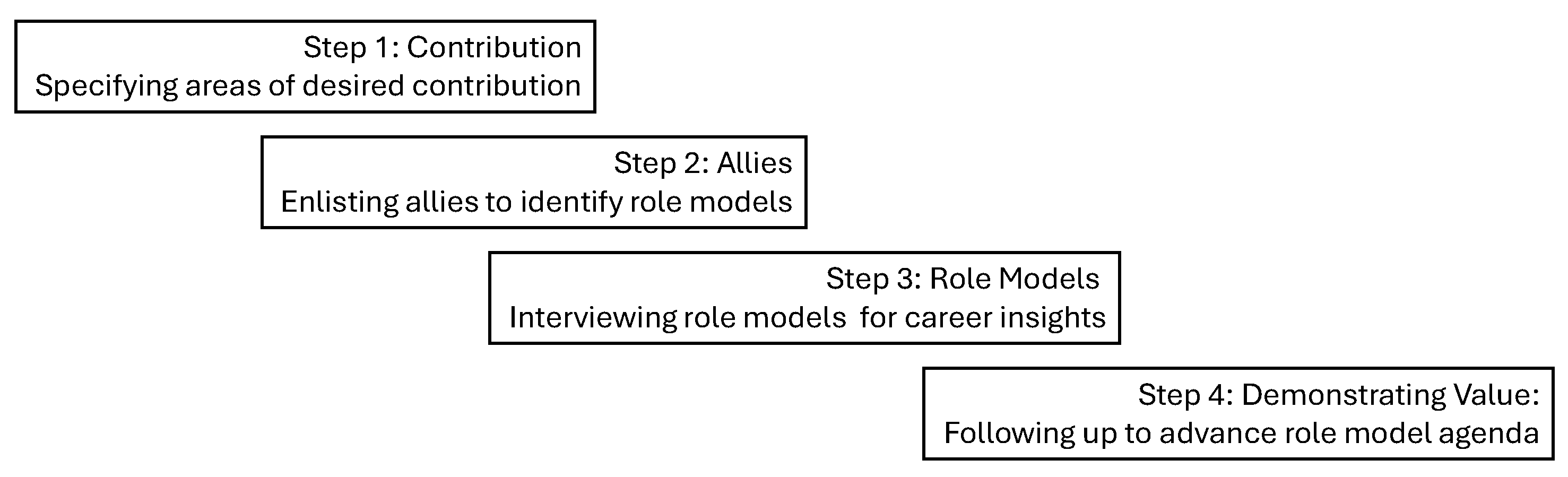
Figure 2.
Metrics from AA’s CARD Campaign.
Disclaimer/Publisher’s Note: The statements, opinions and data contained in all publications are solely those of the individual author(s) and contributor(s) and not of MDPI and/or the editor(s). MDPI and/or the editor(s) disclaim responsibility for any injury to people or property resulting from any ideas, methods, instructions or products referred to in the content. |
© 2026 by the authors. Licensee MDPI, Basel, Switzerland. This article is an open access article distributed under the terms and conditions of the Creative Commons Attribution (CC BY) license.
Copyright: This open access article is published under a Creative Commons CC BY 4.0 license, which permit the free download, distribution, and reuse, provided that the author and preprint are cited in any reuse.


