

Submitted:
31 March 2026
Posted:
01 April 2026
You are already at the latest version
Abstract
Climate warming is reshaping hydrothermal resource allocation worldwide, thereby altering the spatial suitability patterns of rice under different cropping systems. Using the maximum entropy model (MaxEnt), this study characterizes the climatic niche features of four typical rice cropping systems in China—single-season rice, double-season rice, rice–wheat rotation, and rice–maize rotation—based on occurrence points and climatic variables, and evaluates changes in their potential suitable areas during 2081–2100 under the SSP2-4.5 and SSP5-8.5 scenarios. The results show marked differences in the dominant factors controlling the four systems. Single-season rice and rice–maize rotation are mainly constrained by heat accumulation, whereas the suitability boundary of double-season rice is jointly limited by extreme temperature thresholds and precipitation conditions. Rice–wheat rotation is more sensitive to annual temperature range, reflecting its dependence on the seasonal rhythm of cold winters and hot summers. Under future climate scenarios, the potential suitable areas of all four systems generally shift northward and expand eastward, with stronger changes under SSP5-8.5. Suitability increases in parts of Northeast and North China, suggesting theoretical potential for the development of double-cropping systems in these regions, whereas some traditional double-season rice areas in South China may face declining suitability because of increasing high-temperature risk. These findings provide a reference for adjusting cropping systems and enhancing regional adaptation under climate change.
Keywords:
MaxEnt model
; rice cropping systems
; climate change
; suitability distribution
; SSP scenarios
1. Introduction
Climate change is reshaping the spatial pattern of grain production in China. The Sixth Assessment Report of the IPCC notes that global hydrothermal resources are being reorganized [1]. This trend creates opportunities for expanding rice production in some regions, while exposing some traditional production areas to yield-reduction risk. Ongoing warming and moistening trends are pushing the suitable zone for rice toward higher latitudes, but more frequent extreme heat events are undermining the production stability of traditional rice-growing areas in southern China [2,3,4,5,6]. Rice is the most important staple crop in China [7,8,9], and its cropping systems include single-season rice, double-season rice, rice–wheat rotation, and rice–maize rotation. This raises an important question: under future climate scenarios, how will different rice cropping systems—especially rotation systems that are more sensitive to hydrothermal allocation—respond differently?
Over the past two decades, species distribution models (SDMs) based on ecological niche theory have become an important tool for addressing such questions [10,11,12]. Among them, the maximum entropy model (MaxEnt) is widely used to predict potential species distributions because it requires only presence data and can effectively characterize relationships between species occurrence and environmental conditions [13,14,15]. In recent years, MaxEnt has increasingly been applied in agricultural research. Previous studies have shown that it performs well in large-scale crop suitability assessments: for example, the spatial crop distribution patterns predicted by the model are often broadly consistent with actual yield distributions [16,17], and the key environmental factors and thresholds identified by the model generally accord with crop physiological requirements [18,19].
In studies of rice suitability, MaxEnt applications have moved beyond broad climatic or non-climatic zonation toward more detailed comparisons among different maturity classes and cropping systems. Existing research indicates that the geographic distribution of rice is mainly influenced by climatic factors such as annual precipitation (P), moisture index (MI), the number of days with daily mean temperature stably above key thresholds (e.g., an), and accumulated temperature (AT0 [20]. However, different rice cultivation types do not require the same conditions. For single-season rice, accumulated temperatnd annual precipitation jointly shape its spatial pattern [21]. The mean temperature of the coldest month (Tc) is a key factor determining whether early rice can be safely sown [21], whereas the northern limit of late rice depends on whether low temperature occurs during heading and flowering [21]. In addition to accumulated temperature and precipitation, ratoon rice is also influenced by sunshine duration [22,23].
Although substantial progress has been made in rice suitability assessment [24,25], comprehensive comparative studies of complex rotation systems such as rice–wheat and rice–maize remain limited. Most existing work focuses on individual planting systems, such as single-season rice, double-season rice, or ratoon rice, whereas far less attention has been paid to rotation systems. As the two most important paddy–upland rotations in China, rice–wheat and rice–maize rotations differ from monocropped rice, winter wheat, or summer maize in their use of hydrothermal resources and their environmental adaptation. Conclusions drawn for single crops therefore cannot be directly transferred to these systems. If research remains confined to a single-crop perspective, it is difficult to explain the differing responses of China’s diverse rice production systems to climate change. Meanwhile, CMIP6 provides updated future climate scenario data (SSPs) [26,27], making it possible to reassess the future evolution of different rice cropping systems.
Addressing this gap would help optimize agricultural production layout at the national scale. This study selects four typical rice cropping systems—single-season rice, double-season rice, rice–wheat rotation, and rice–maize rotation—and combines high-quality occurrence points, climatic factors that may influence rice production under different systems, and the MaxEnt model to answer three questions: (1) Compared with traditional zoning methods based on empirical thresholds, how can data-driven MaxEnt provide a more objective assessment of suitability for complex rice cropping systems? (2) How do the dominant climatic factors and their suitable thresholds differ among systems? (3) How will the potential suitable areas of these four systems change under the current climate and under future SSP2-4.5 and SSP5-8.5 scenarios? By moving beyond single-crop zoning, the results provide a scientific basis for adjusting agricultural layouts under climate change in a way that better reflects the characteristics of cropping systems.
2. Materials and Methods
2.1. Data
2.1.1. Distribution Data for Rice Cropping Systems
The quality of occurrence records directly affects the predictive performance of the MaxEnt model. This study uses the China Crop Pattern map (ChinaCP) released by Qiu et al. (2022) [28] as the basic dataset. By combining MODIS EVI time-series features with a random forest algorithm, this dataset provides crop distribution information at 500 m resolution from 2015 to 2021, covering single-season rice, double-season rice, rice–wheat rotation, and rice–maize rotation, and thus serves as the base map for extracting training occurrence points.
To improve sample purity, we further introduced an existing 30 m resolution dataset of rice planting distribution in China as a spatial mask [29,30,31]. This dataset integrates Landsat and Sentinel imagery and identifies rice-growing areas using the TWDTW method, making it suitable for detecting mixed pixels in ChinaCP and screening more representative pure sample points.
2.1.2. Meteorological Forcing Data
Climatic conditions are the core factors determining the suitability of rice cropping systems. For the historical baseline period (1990–2020), we used the China Meteorological Forcing Dataset (CMFD v2.0) [32], which integrates remote sensing, reanalysis, and station observations. The dataset has a spatial resolution of 0.1° and a temporal resolution of 3 h, and it captures meteorological differences across China’s complex terrain well. Daily mean temperature and precipitation were extracted from this dataset for subsequent calculation of agroclimatic indicators.
Future climate data for 2081–2100 were taken from NASA’s NEX-GDDP-CMIP6 downscaled dataset [33]. This dataset applies bias correction and spatial downscaling to outputs from multiple GCMs using the BCSD method and is therefore well suited to regional-scale climate change analysis. We selected the SSP2-4.5 (sustainable development) and SSP5-8.5 (fossil-fuel-based development) scenarios from the MRI-ESM2-0 model [34]. To ensure spatial consistency between future and historical data, all future raster layers were resampled to 0.1° using bilinear interpolation.
2.2. Sample Point Selection
When sample points are extracted from remote sensing products, mixed pixels [35], interannual fluctuations, and spatial autocorrelation [36] may all interfere with the results. We therefore screened the original ChinaCP data step by step. First, using the 30 m rice planting distribution map of China as a base mask, we removed 500 m pixels in which the rice proportion was below 50% to reduce the effect of mixed pixels. Second, to reduce noise caused by interannual variation, we retained only areas that maintained the same cropping pattern for two consecutive years during 2015–2020. Finally, a spatial thinning method was applied to reduce spatial autocorrelation among sample points, with a minimum spacing of 20 km [37]. These procedures reduce spatial dependence among samples and alleviate sample redundancy in dominant patterns such as single-season rice, thereby producing a more balanced sample distribution for model training across the four cropping patterns (Figure A1). After screening, 1636 sample points for single-season rice, 358 for double-season rice, 288 for rice–wheat rotation, and 190 for rice–maize rotation were retained (Figure 1).
2.3. Preliminary Screening of Environmental Factors and Treatment of Multicollinearity
Rice is a typical crop that prefers warm and humid conditions, and its geographic distribution is mainly constrained by hydrothermal conditions [38]. Following commonly used indicators for heat availability, growing-season length, temperature background, and moisture conditions in studies of agroclimatic resources [38,39], and considering the basic temperature and moisture requirements of rice during its growth cycle, we selected nine climatic variables that may affect rice production. These variables were grouped into four categories:
(1) Heat accumulation. This category includes accumulated temperature and accumulated temperature ), which characterize heat supply over the entire crop growth period. The equation is:
ere is the daily mean temperature, is the threshold temperature 10), ad n is the number of consecutive days stably above the threshold.
(2) Growing-season length. This category includes the number of days with daily mean temperature stably () and the number of days with daily mean temperature stably ), calculated using a five-day moving average method:
where is the first day in spring when the five-day moving average temperontexc is the last day in autumn when the five-day moving average temperature remains ahe threshold.
(3) Extreme temperature conditions. This category includes the mean temperature of the coldest month (T usually January) and the mean temperature of the warmest month (T usually July). Their difference is defined as annual temperature range (:
(4) Moisture conditions. This category includes annual precipion () and moisture index (). recipitation is the sum of daily precipitation over the whole year, while the moisture index characterizes regional water surplus or deficit:
re PEl potential evapotranspiration.
To unify spatial resolution, all meteorological raster data were resampled to 0.1°. Considering the scale mismatch between the sample points (500 m) and the meteorological data (0.1°), we directly extracted the meteorological attributes of the grid cell containing each sample point to reduce computational errors introduced by additional interpolation. To address the common problem of high correlation among environmental variables [40], we used the SDMtune package to screen variables. An initial MaxEnt model was first constructed to obtain the permutation importance of each variable. Variable pairs with Spearman correlation coefficients greater than 0.8 were then identified, and the variable with lower permutation importance in each pair was removed [41]. The retained variable combinations are shown in Table 1.
The MaxEnt model is based on the principle of maximum entropy and can estimate potential species distributions under given sample constraints [42]. It captures nonlinear relationships between environmental variables and species distributions through linear, quadratic, and product features, while regularization is used to control model complexity; it therefore performs well even with small sample sizes [43]. In this study, MaxEnt 3.4.4 was used to construct potential suitability models for the four rice cropping systems, using the screened sample points together with their corresponding historical and future environmental variables.
To improve model generalization, two parameter settings were adopted. First, 10,000 background points were randomly generated across the study area to cover the environmental gradient from cold temperate to tropical regions as completely as possible. If background points were set only as a fixed multiple of the sample size, the background environment might not be adequately represented; previous studies suggest that 10,000 background points are sufficient to characterize environmental conditions at large spatial scales [44]. Meanwhile, automatic feature classes (Auto features: Linear, Quadratic, Product, Hinge) and the default regularization multiplier (Regularization Multiplier: 1) were retained to balance model fit and complexity. The model was run 10 times using the bootstrap method, and the mean prediction and standard deviation were reported. Preliminary experiments indicated that 10 replicates were sufficient to stabilize both the AUC and the spatial pattern of suitability (standard deviation < 0.01). Model performance was evaluated using the area under the receiver operating characteristic curve (AUC); the closer the AUC is to 1, the stronger the model’s ability to discriminate suitable areas from the background environment [45].
2.5. Analysis of Dominant Environmental Factors and Changes in Suitable Areas
To quantitatively identify the dominant environmental factors driving different rice cropping systems, we combined multiple indicators for integrated evaluation. First, percentage contribution (reflecting the frequency with which a variable is used during model construction) and permutation importance (reflecting the impact of a variable on final model accuracy) were used to screen potentially important variables for each system. Then, the jackknife method was applied to compare regularized training gain before and after excluding each variable, thereby assessing the independent explanatory power of each variable and ultimately identifying the dominant environmental controls for each system.
The output of the MaxEnt model is the habitat suitability index (HSI, a continuous value from 0 to 1). Higher HSI values indicate that regional environmental conditions are more suitable for crop growth [46]. To avoid simply dichotomizing continuous suitability information, this study follows the method of Venne & Currie (2021) and treats suitability as a continuous variable. We therefore analyze the historical suitability distribution of rice cropping systems directly on the basis of HSI values rather than dividing areas into suitable and unsuitable classes [46].
On this basis, we further calculated the difference in HSI between the future and historical periods (ΔHSI = HSI_future − HSI_historical) to examine the effects of future climate change on rice cropping systems. Positive values indicate increased suitability, whereas negative values indicate decreased suitability [47]. It should be noted that, following previous recommendations that threshold selection for presence-only models should be based on statistical criteria rather than arbitrary choices [48], HSI = 0.5 is used here only as a reference line for interpreting response curves and spatial maps, not as a strict ecological threshold or an actual planting boundary.
3. Results
3.1. Accuracy Assessment and Applicability of the MaxEnt Model
Based on the screened sample points and the de-correlated environmental variables, the MaxEnt model was run 10 times, and the mean AUC values for the four rice cropping systems are shown in Figure 2. The results indicate that all models achieved AUC values above 0.86, suggesting that MaxEnt can effectively capture the nonlinear relationships between climatic factors and cropping-system distribution. Model performance differed markedly among the cropping systems. The AUC values for rice–wheat rotation, rice–maize rotation, and double-season rice were 0.969, 0.963, and 0.959, respectively, all indicating high predictive accuracy, whereas the AUC for single-season rice was relatively lower at 0.868. This difference is related to variation in the breadth of the climatic niche among cropping systems. Multiple-cropping and rotation systems are often constrained by stricter hydrothermal thresholds or seasonal rhythms. For example, rice–wheat rotation depends on a transitional climate characterized by cold winters and hot summers, while double-season rice and rice–maize rotation are restricted by the thermal conditions of southern China. As a result, these systems have narrower distribution ranges and clearer boundaries, making them easier for the model to identify. In contrast, single-season rice spans regions from the cold temperate zone to the subtropics, with a broader suitable range and a more complex environmental background. This large-scale, cross-regional distribution means that the planting environment and background conditions of single-season rice are more complex than those of multiple-cropping and rotation systems, significantly increasing the difficulty of identifying its suitable areas. Overall, these results indicate that MaxEnt is applicable not only to individual crops, but also to identifying the potential suitable areas of complex cropping systems under strong climatic constraints.
3.2. Identification of Dominant Environmental Factors and Response Curve Analysis
3.2.1. Identification of Dominant Factors
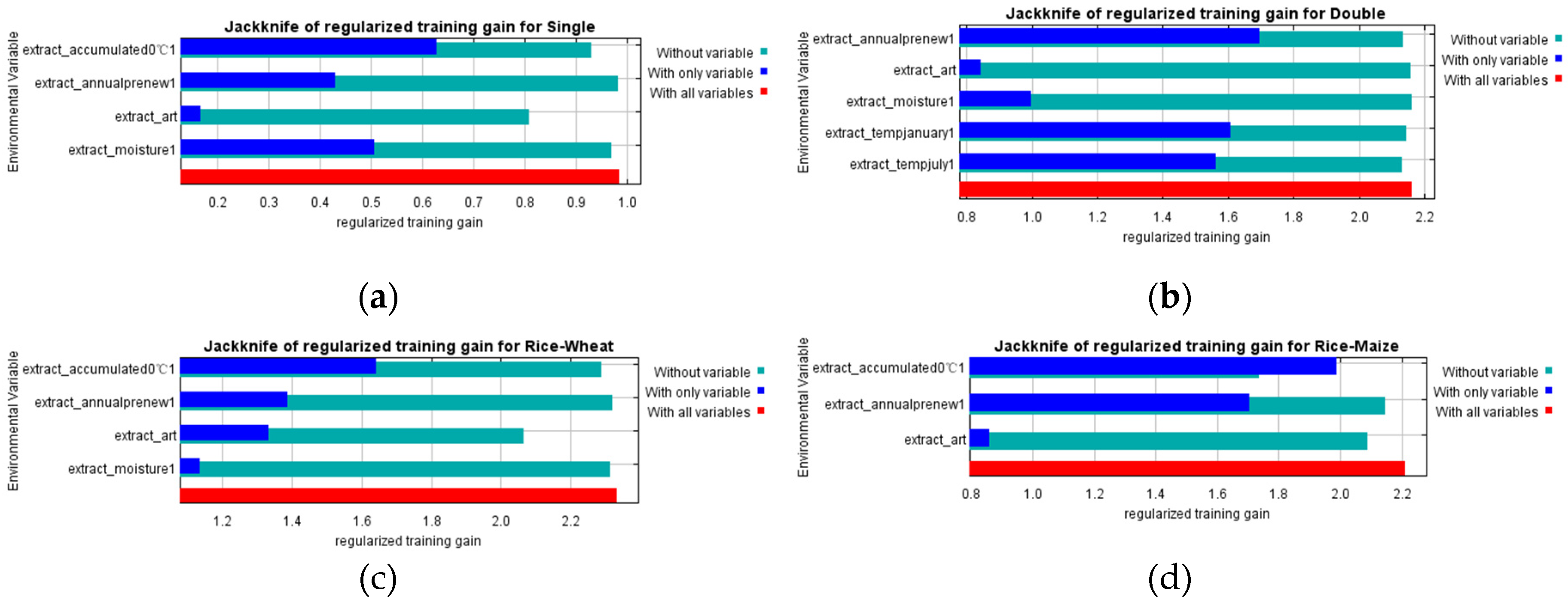
Integrating variable contribution, permutation importance (Table 2), and jackknife test results (Figure A2) shows that the dominant climatic factors differ among the four rice cropping systems. Broadly, they can be divided into two groups. Single-season rice, rice–wheat rotation, and rice–maize rotation are dominated by heat accumulation, with permutation importance values of 55.9%, 59.8%, and 77.0%, respectively, for accumulated temperature (AT10 for single-seasone; AT0 for the two rotation systems), making it the key factor shaping their distribution patterns. Double-season rice, by contrast, exhibits a different mechanism: its distribution is mainly constrained jointly by annual precipitation (P) and extreme monthly temperature variables, with the former contributing 69.8% and the latter (Tw and Tc combined) accounting for 58.4% of total permutation importance.
3.2.2. Analysis of response thresholds
The four rice cropping systems show clear differences in their responses to environmental variables (Figure 3). For a consistent interpretation of the response curves, HSI = 0.5 is used here as a reference line for relatively high suitability rather than as a strict threshold. Single-season rice has a broad range of adaptation to heat conditions: when accumulated erature (AT10) exceeds 5220, HSI rises markedly and remains high, and HSI also stays high when the moisture index (MI) exceeds 3.04. Its potential distribution therefore extends from the Northeast Plain to the southern hilly regions. Rice–wheat rotation is mainly influenced by accumulated temperature (AT0) and annual temperature range (ART), with relatively high HSI associated with 5334–9394 for the former and 23.8–52.8 for the latter. This indicates that the system requires both sufficient summer heat for rice growth and adequate winter cold to satisfy wheat vernalization and safe overwintering. Rice–maize rotation is jointly constrained by a thermal l limit and precipitation conditions. Although accumulated temperature (AT0) has the highest permutation importance (77.0%) and defines the thermal lower bound (7080), annual precipitation (P) contributes 51.8%, indicating that once thermal requirements are met, water availability remains a key factor affecting suitability. This system shows relatively high HSI when annual precipitation ranges from 1419 to 2242 mm, reflecting the strict hydrothermal requirements of rice and maize growing within the same seasonal window.
The response pattern of double-season rice differs markedly from those described above. Annual precipitation is the primary controlling factor, corresponding to relatively high HSI values over the range 1496–6377 mm, indicating a strong requirement for abundant rainfall. In addition, the mean temperature of the coldest month and that of the warmest month both impose clear constraints. The response curves show that the predicted HSI is relatively high when the mean temperature of the coldest month exceeds 5.6 and the mean temperature of the warmest month lies between 28.0 and 37.3. This is broadly consistent with the understanding that double-season rice production is constrained by both low-temperature injury risk and high-temperature stress. Accordingly, double-season rice is more suitable for warm and humid regions of southern China.
(AT0); (c) Moisture index (MI) for single-season rice and annual temperature range (ART) for rice–wheat rotation; (d) Mean temperature of the coldest month (Tc) and mean temperature of the warmest month (Tw) for double-season rice. The dashed line indicates the HIS = 0.5 reference line for relatively high climatic suitability.
3.3. Distribution of Suitable Areas for Rice Cropping Systems Under the Historical Climate
The habitat suitability index (HIS) produced by MaxEnt reflects both the probability of potential occurrence and the degree of environmental matching. In this study, HIS is analyzed as a continuous variable ranging from 0 to 1, and HIS > 0.5 is used only as a visual reference for relatively high values so as to preserve spatial gradients in suitability rather than impose a strict boundary between suitable and unsuitable areas. Figure 4 shows strong latitudinal zonality and dependence on climatic resources among the high-suitability areas of different cropping patterns. Single-season rice is widely distributed from Northeast China to the Yangtze River basin but shows a low-suitability belt over the North China Plain; double-season rice is strictly concentrated in southern China; rice–wheat rotation is mainly located in the Huai River–Yangtze River transition zone; and rice–maize rotation is most concentrated in southwestern China.
The high-HIS area for single-season rice exhibits two north–south cores, located in the Sanjiang–Songnen Plain in the north and the middle and lower reaches of the Yangtze Plain in the south. This broad distribution spanning from the cold temperate zone to the subtropics indicates a strong adaptability to heat conditions. Between these two high-value cores, however, the North China Plain forms a distinct low-HIS belt, which may be related to relatively low precipitation and limited natural moisture conditions in this region.
Unlike the broad north–south distribution of single-season rice, the high-HIS area of double-season rice is concentrated in South China and areas south of the middle and lower reaches of the Yangtze River. Suitability declines sharply northward beyond the northern bank of the Yangtze. This pattern is consistent with its temperature thresholds: double-season rice requires both a sufficiently high mean temperature in the coldest month to ensure safe growth of early rice and a suitable mean temperature in the warmest month to support the maturation of late rice. Only southern China can satisfy both conditions simultaneously, so the distribution of double-season rice is tightly confined to warm subtropical regions.
The high-HIS area of rice–wheat rotation closely matches China’s north–south climatic transition zone, forming an east–west belt across Jiangsu, Anhui, and Hubei. Its spatial pattern is strongly associated with a relatively large annual temperature range. South of this belt, winters are too warm to favor wheat vernalization, whereas north of it thermal conditions are insufficient to support double cropping of rice and maize, resulting in a narrow transitional zone suitable for this cropping pattern.
The high-HIS area of rice–maize rotation is mainly distributed in Yunnan, Guizhou, and parts of South China. Because both rice and maize require abundant heat and moisture, this pattern is better suited to areas where rainfall and heat are synchronized seasonally. Compared with double-season rice, rice–maize rotation shows relatively high suitability in the mountainous and plateau regions of southwest China, suggesting some adaptive potential under complex topography and vertical climatic gradients. Combined with existing practices of maize–rice composite cultivation in southern rice-growing areas, this pattern may serve as an alternative double-cropping option worthy of comparison in some mountainous areas of southwest China.
3.4. Spatiotemporal Evolution of Suitable Areas for Rice Cropping Systems Under Future Climate Scenarios
To evaluate the effects of future climate change on different rice cropping systems, we calculated the change in suitability (ΔHSI = HSI_future − HSI_historical) for 2081–2100 under two scenarios (SSP2-4.5 and SSP5-8.5) relative to the historical baseline period (1991–2020). All maps use a unified color scale of [[-1, 1] to facilitate comparison across patterns, where positive values (red) indicate increased suitability and negative values (blue) indicate decreased suitability. Overall, all four patterns show a tendency to shift northward and expand eastward in the future, but the direction and magnitude of change vary among patterns, and the changes are more pronounced under SSP5-8.5 (Figure 5).
For single-season rice, areas of increasing suitability are mainly located in the northern Northeast Plain, eastern Inner Mongolia, and along the Great Wall corridor. Under SSP5-8.5, the area of increase expands further and extends into the agro-pastoral ecotone of Inner Mongolia. These regions were previously constrained by low temperature; as accumulated temperature increases, thermal conditions gradually improve and the suitable zone expands northward. By contrast, some areas south of the middle and lower reaches of the Yangtze River show declining suitability, suggesting that future warming may increase the risk of local heat stress.
Changes in double-season rice are relatively moderate overall, but its suitability centroid tends to shift northward. Parts of the middle and lower Yangtze region, such as Hunan, Jiangxi, and southern Hubei, show positive ΔHSI values, indicating that warming may help extend the safe growing season for double-season rice to some extent. In contrast, large areas of Guangdong, Guangxi, and other coastal parts of South China exhibit negative values, especially under SSP5-8.5, suggesting that once warming exceeds the suitable range, heat stress may offset part of the benefit brought by increased thermal resources.
For rice–wheat rotation, the main change is a northward shift of suitable areas. Under SSP5-8.5, ΔHSI increases noticeably in southern parts of the North China Plain, as well as in Shandong and northern Henan, indicating that thermal conditions in these regions are gradually approaching the requirements of double cropping. By contrast, some traditionally suitable areas in the middle and lower Yangtze region show declines, possibly because winter warming weakens the vernalization conditions required by wheat.
Compared with the other multiple-cropping systems, rice–maize rotation shows relatively strong adaptability under future climate scenarios. Southwestern China, including Yunnan, Guizhou, and the Sichuan Basin, forms the main high-ΔHSI region, with suitability generally increasing. Compared with double-season rice, rice–maize rotation maintains positive changes in some warming regions, suggesting that it may be better able to utilize the increased hydrothermal resources expected in the future.
4. Discussion
4.1. The Advantages of the MaxEnt Model in the Evaluation of Complex Rice Planting Systems and Its Complement to Traditional Zoning
The research results show that the MaxEnt model is also suitable for multi-cropping and crop rotation systems. The AUC of each model exceeds 0.86, indicating that the model can better identify the nonlinear relationship between complex planting systems and climate factors [13]. Among them, the AUC of rice-wheat rotation, rice-maize rotation and double rice are all close to 0.96, showing high prediction accuracy. One possible reason is that these multiple cropping and rotation systems are subject to more stringent hydrothermal conditions and seasonal rhythms, and have relatively narrow climatic niches, so the boundaries of their suitable zones are easier to identify by the model. In contrast, single rice spans from cold temperate zones to subtropics, has a more complex environmental background, and is more susceptible to non-climatic factors such as soil and socioeconomic factors. Therefore, the AUC is relatively low (0.868). However, this result is still at a high level, indicating that MaxEnt still has good applicability under conditions of strong environmental heterogeneity. Different from existing studies that mostly focus on single rice or double rice, this paper incorporates rice-wheat rotation and rice-maize rotation into the same evaluation framework. The results show that, under the premise of reasonably screening variables and controlling sample quality, MaxEnt can be used not only for single-crop planting systems, but also for suitability identification of complex planting systems. This provides methodological support for the expansion of agricultural divisions from single crops to planting systems, and also provides a basis for subsequent comprehensive assessments incorporating soil and socioeconomic factors.
4.2. Differential Driving Mechanisms of Key Climatic Factors for Rice Cropping Systems
Different rice cropping systems use climatic resources in different ways, but overall they can be divided into two groups: heat-accumulation-dominated systems and temperature-threshold-limited systems. Single-season rice, rice–maize rotation, and rice–wheat rotation depend more strongly on heat accumulation, and accumulated temperature (AT10 for single-season rice and AT0 for the two rotasystems) has high importance in all three systems.
Despite this commonality, substantial differences remain among the patterns. In addition to accumulated temperature, rice–wheat rotation is also sensitive to annual temperature range. Its relatively high-HSI interval of 23.8–52.8 indicates that the system requires both high summer temperature for rice growth and low winter temperature for wheat vernalization, making it particularly sensitive to changes in seasonal rhythm. Double-season rice, by contrast, exhibits a more typical pattern of joint control by temperature thresholds and moisture conditions. Annual precipitation is its primary factor (69.8%), while the mean temperatures of the coldest and warmest months together define the key thermal boundaries. Higher temperatures in the coldest month help reduce cold damage risk for early rice, whereas excessively high temperatures during the growing season may increase heat stress risk for late rice. Double-season rice is therefore sensitive to both winter–spring thermal safety and summer–autumn heat risk.
Compared with the conclusions of Duan et al. [20] and Zhao et al. [21] regarding the importance of accumulated temperature and precipitation, this study further distinguishes the dominant factor combinations and threshold characteristics of four cropping systems within the same study area and modeling framework. In doing so, it extends discussion of crop distribution patterns to the level of cropping systems and provides a basis for understanding why different patterns respond differently to climate change.
4.3. Spatiotemporal Reorganization Under Climate Warming and Its Implications
The Sixth Assessment Report of the IPCC points out that global warming may drive agricultural climate zones northward [1]. Our results are consistent with this judgment and further show that different cropping systems do not respond to warming in the same way. Under both SSP2-4.5 and SSP5-8.5, the suitable areas of the four patterns generally shift northward and expand eastward, which agrees with the conclusion of Duan et al. [20] that warming relaxes thermal limitations in high-latitude regions. Among them, the expansion of multiple-cropping systems is more pronounced, especially under SSP5-8.5, where the suitable area for rice–wheat rotation extends northeastward, suggesting that some regions currently dominated by single cropping may in the future approach the thermal lower limit required for double cropping [49]. However, the effects of warming are not entirely positive. Double-season rice and rice–wheat rotation show declining suitability in parts of Southwest China, such as Yunnan and Guizhou, which may be related to frequent high-temperature events and changes in precipitation regimes. This indicates that climate warming may simultaneously open new cultivation frontiers and weaken some traditional core production areas.
From the perspective of regional adaptation, different regions should prioritize different responses. Northeast China should pay attention to the possibility of increasing the multiple-cropping index and the northward shift of cropping systems while guarding against cold damage risk. North China needs to consider both increased thermal resources and water constraints, with emphasis on improving hydrothermal matching. Southwest China, in turn, needs more heat-tolerant varieties and adjustments to sowing dates to cope with potential risks of heat and drought [17,50].
At a broader scale, agricultural zoning should incorporate climate change considerations and adjust production layouts according to future risks. Integrating climate risk identification with agricultural resource surveys, farmland construction, and the dissemination of adaptive technologies may better enhance the stability of food production systems [51].
4.4. Limitations of the Study
This study still has several limitations. First, regarding data and sample size, the original spatial resolution of the ChinaCP dataset is 500 m. After pure-pixel screening, temporal stability filtering, and spatial thinning, the numbers of sample points for double-season rice, rice–wheat rotation, and rice–maize rotation remain relatively limited, each at around 300 points, which may increase uncertainty in local response functions. However, previous studies indicate that MaxEnt remains reasonably stable under small-sample conditions [52], and together with the collinearity screening and parameter settings used here, the model results still retain reference value. If higher-resolution data and larger sample sizes become available, model robustness can be further improved. Second, this study focuses on climatic suitability and does not incorporate soil, topographic, or socioeconomic factors such as labor availability and local planting practices. The simulation results therefore reflect theoretical climatic feasibility rather than direct planting recommendations [53]. For example, some areas in Northeast China may in the future satisfy the thermal requirements for crop rotation, but actual adoption will still depend on factors such as cultivar maturity, labor costs, and institutional adjustment barriers. Likewise, some climatically suitable areas may remain unsuitable for large-scale cultivation because of fragmented terrain or limited soil conditions. Even so, analyses based solely on climatic variables are still helpful for identifying the broad direction of future changes in cropping patterns at large spatial scales [53]. Future studies could incorporate richer datasets and broader feature dimensions once more samples become available. Finally, future scenarios themselves remain uncertain. Although CMIP6 data were used here, different climate models still diverge in their projections of precipitation and extreme events [54], and future land-use change and socioeconomic pathways will also affect actual planting decisions. In addition, the model does not incorporate CO₂ fertilization, management improvements, cultivar renewal, or soil amelioration, and may therefore underestimate the actual adaptive capacity of future crops. Subsequent studies could couple process-based models such as DSSAT [55] with socioeconomic data to obtain assessments that more closely reflect real production conditions.
5. Conclusions
This study shows that the MaxEnt model can be used to assess the suitability of different rice cropping systems. The main conclusions are as follows. (1) All four cropping systems show good discriminability, with AUC values above 0.86, indicating that these systems are not merely simple combinations of single crops but possess relatively independent climatic suitability boundaries. (2) The dominant climatic factors differ markedly among systems. Single-season rice, rice–wheat rotation, and rice–maize rotation are mainly influenced by heat accumulation, whereas double-season rice is more sensitive to temperature thresholds and precipitation conditions. These differences indicate that the mechanisms by which different cropping systems respond to climate change are not uniform. (3) Future climate change is likely to reshape rice production systems: parts of Northeast and North China may gain greater multiple-cropping potential as thermal resources increase, whereas some traditional production areas in South China may face declining suitability because of high-temperature stress. Overall, future adjustments to agricultural layout need to consider both differences among cropping systems and their associated climatic constraints. Northern China should take advantage of expanding thermal windows to support the northward shift of rice-based cropping systems, whereas southern China needs to maintain the thermal safety limits of rice production. In this sense, rice production should adapt to the broader tendency toward northward shift and eastward expansion and turn the challenges of climate change into opportunities for agricultural development.
Author Contributions
Conceptualization, Y.C. and C.J.; methodology, Y.C. and T.Q.; software, Y.C. and C.H.; validation,Y.C., H.Z.; formal analysis, Y.C.; investigation, Y.C., T.Q., C.H., H.Z.; resources, Y.C., T.Q., C.H., H.Z.; data curation, Y.C.; writing—original draft preparation, Y.C.; writing—review and editing, Y.C., T.Q., C.H., H.Z, B.L, L.X, Y.Z, W.C, C.J; visualization, Y.C.; supervision, C.J.; project administration, C.J.; funding acquisition, C.J. All authors have read and agreed to the published version of the manuscript.
Funding
This research was funded by the National Key Research and Development Program of China (2023YFD2000103) and the Fundamental Research Funds for the Central Universities (QTPY2025010).
Data Availability Statement
The raw data supporting the conclusions of this article will be made
available by the authors on request.
Conflicts of Interest
The authors declare no conflicts of interest.
Appendix A
Figure A1.
Sample volume heatmaps under different combinations of mask ratio and frequency thresholds for four rice cropping systems. The x-axis represents the mask ratio threshold (0.1–1.0), and the y-axis represents the frequency threshold (years). The color gradient from yellow to blue indicates the number of retained sample points, with darker blue representing larger sample sizes. (a) Single-season rice; (b) Double-season rice; (c) Rice–wheat rotation; and (d) Rice–maize rotation.
Figure A1.
Sample volume heatmaps under different combinations of mask ratio and frequency thresholds for four rice cropping systems. The x-axis represents the mask ratio threshold (0.1–1.0), and the y-axis represents the frequency threshold (years). The color gradient from yellow to blue indicates the number of retained sample points, with darker blue representing larger sample sizes. (a) Single-season rice; (b) Double-season rice; (c) Rice–wheat rotation; and (d) Rice–maize rotation.
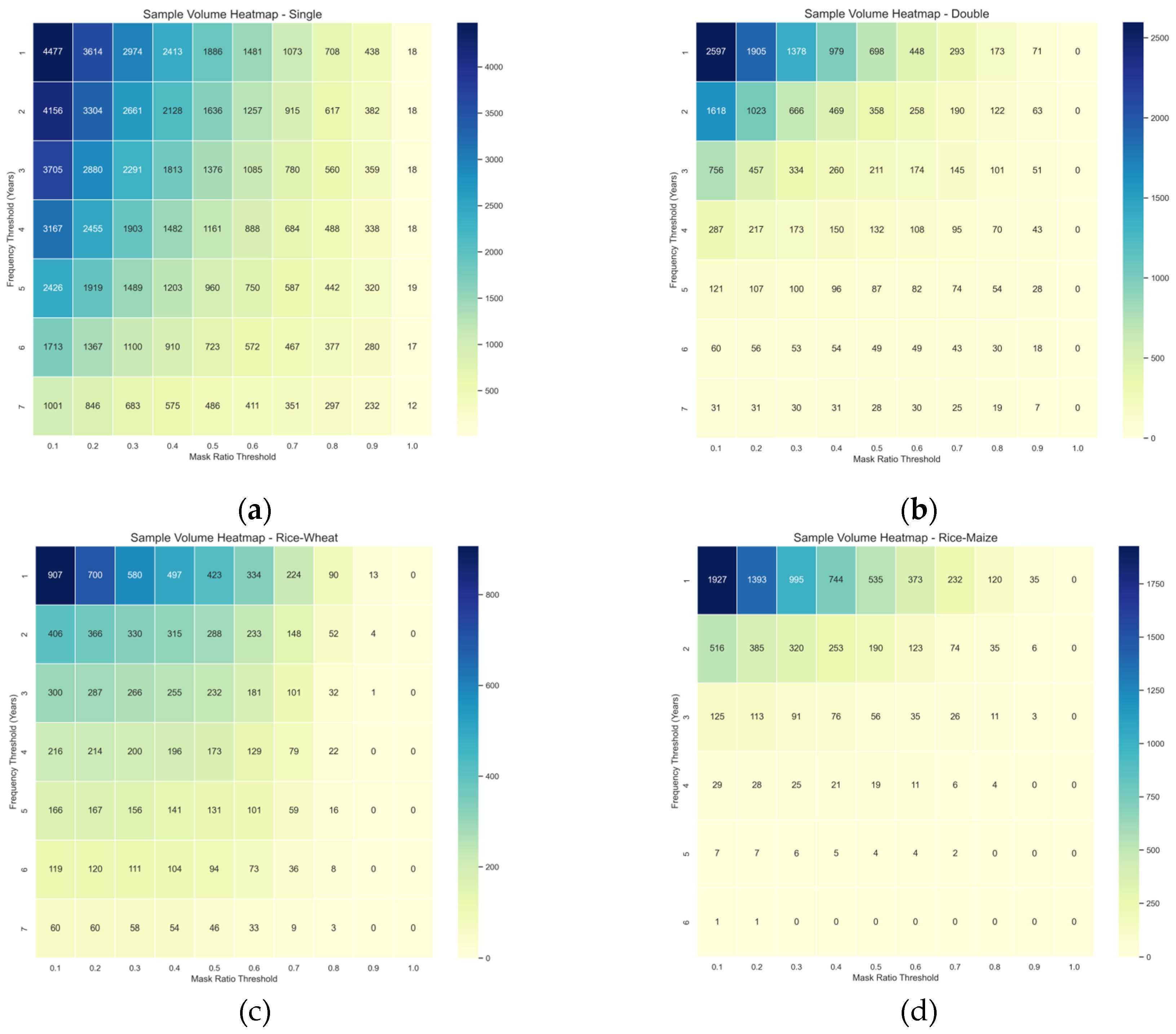
Figure A2.
Jackknife test of regularized training gain for evaluating variable importance in the MaxEnt models of four rice cropping systems. The dark blue bars ("With only variable") indicate the model gain when using only that specific environmental variable, the light blue bars ("Without variable") represent the gain when the variable is excluded from the full model, and the red bar ("With all variables") indicates the total gain using all environmental variables. (a) Single-season rice; (b) Double-season rice; (c) Rice–wheat rotation; and (d) Rice–maize rotation.
Figure A2.
Jackknife test of regularized training gain for evaluating variable importance in the MaxEnt models of four rice cropping systems. The dark blue bars ("With only variable") indicate the model gain when using only that specific environmental variable, the light blue bars ("Without variable") represent the gain when the variable is excluded from the full model, and the red bar ("With all variables") indicates the total gain using all environmental variables. (a) Single-season rice; (b) Double-season rice; (c) Rice–wheat rotation; and (d) Rice–maize rotation.
References
- Lee, H.; Calvin, K.; Dasgupta, D.; Krinner, G.; Mukherji, A.; Thorne, P.; Trisos, C.; Romero, J.; Aldunce, P.; Barrett, K.; et al. Climate Change 2023: Synthesis Report. Contribution of Working Groups I, II and III to the Sixth Assessment Report of the Intergovernmental Panel on Climate Change; 2023. [Google Scholar]
- Lobell, D.B.; Schlenker, W.; Costa-Roberts, J. Climate Trends and Global Crop Production since 1980. Science 2011, 333, 616–620. [Google Scholar] [CrossRef] [PubMed]
- Challinor, A.J.; Watson, J.; Lobell, D.B.; Howden, S.M.; Smith, D.; Chhetri, N. A Meta-Analysis of Crop Yield under Climate Change and Adaptation. Nature climate change 2014, 4, 287–291. [Google Scholar] [CrossRef]
- Zhao, C.; Liu, B.; Piao, S.; Wang, X.; Lobell, D.B.; Huang, Y.; Huang, M.; Yao, Y.; Bassu, S.; Ciais, P.; et al. Temperature Increase Reduces Global Yields of Major Crops in Four Independent Estimates. Proceedings of the National Academy of sciences 2017, 114, 9326–9331. [Google Scholar] [CrossRef] [PubMed]
- Porter, J.; Xie, L.; Challinor, A.J.; Howden, M.; Iqbal, M.M.; Lobell, D.B.; Travasso, M.I. others Food Security and Food Production Systems. 2014. [Google Scholar]
- Peng, S.; Huang, J.; Sheehy, J.E.; Laza, R.C.; Visperas, R.M.; Zhong, X.; Centeno, G.S.; Khush, G.S.; Cassman, K.G. Rice Yields Decline with Higher Night Temperature from Global Warming. Proceedings of the National Academy of Sciences 2004, 101, 9971–9975. [Google Scholar] [CrossRef]
- Saud, S.; Wang, D.; Fahad, S.; Alharby, H.F.; Bamagoos, A.A.; Mjrashi, A.; Alabdallah, N.M.; AlZahrani, S.S.; AbdElgawad, H.; Adnan, M.; et al. Comprehensive Impacts of Climate Change on Rice Production and Adaptive Strategies in China. Frontiers in Microbiology 2022, 13, 926059. [Google Scholar] [CrossRef]
- Wang, G.; Huang, S.; Zhang, Y.; Zhao, S.; Han, C. How Has Climate Change Driven the Evolution of Rice Distribution in China? International Journal of Environmental Research and Public Health 2022, 19, 16297. [Google Scholar] [CrossRef]
- Ye, L.; Xiong, W.; Li, Z.; Yang, P.; Wu, W.; Yang, G.; Fu, Y.; Zou, J.; Chen, Z.; Van Ranst, E.; et al. Climate Change Impact on China Food Security in 2050. Agronomy for Sustainable Development 2013, 33, 363–374. [Google Scholar] [CrossRef]
- Peterson, A.T. Predicting the Geography of Species’ Invasions via Ecological Niche Modeling. The quarterly review of biology 2003, 78, 419–433. [Google Scholar] [CrossRef]
- Elith*, J.; H. Graham*, C.; P. Anderson, R.; Dudík, M.; Ferrier, S.; Guisan, A.; J. Hijmans, R.; Huettmann, F.; R. Leathwick, J.; Lehmann, A.; et al. Novel Methods Improve Prediction of Species’ Distributions from Occurrence Data. Ecography 2006, 29, 129–151. [Google Scholar] [CrossRef]
- Guisan, A.; Thuiller, W. Predicting Species Distribution: Offering More than Simple Habitat Models. Ecology letters 2005, 8, 993–1009. [Google Scholar] [CrossRef]
- Elith, J.; Phillips, S.J.; Hastie, T.; Dudík, M.; Chee, Y.E.; Yates, C.J. A Statistical Explanation of MaxEnt for Ecologists. Diversity and distributions 2011, 17, 43–57. [Google Scholar] [CrossRef]
- Merow, C.; Smith, M.J.; Silander, J.A., Jr. A Practical Guide to MaxEnt for Modeling Species’ Distributions: What It Does, and Why Inputs and Settings Matter. Ecography 2013, 36, 1058–1069. [Google Scholar] [CrossRef]
- Warren, D.L.; Seifert, S.N. Ecological Niche Modeling in Maxent: The Importance of Model Complexity and the Performance of Model Selection Criteria. Ecological applications 2011, 21, 335–342. [Google Scholar] [CrossRef]
- Fitzgibbon, A.; Pisut, D.; Fleisher, D. Evaluation of Maximum Entropy (Maxent) Machine Learning Model to Assess Relationships between Climate and Corn Suitability. Land 2022, 11, 1382. [Google Scholar] [CrossRef]
- Yang, S.; Wang, H.; Tong, J.; Bai, Y.; Alatalo, J.M.; Liu, G.; Fang, Z.; Zhang, F. Impacts of Environment and Human Activity on Grid-Scale Land Cropping Suitability and Optimization of Planting Structure, Measured Based on the MaxEnt Model. Science of the total environment 2022, 836, 155356. [Google Scholar] [CrossRef]
- Ali, S.; Makanda, T.A.; Umair, M.; Ni, J. MaxEnt Model Strategies to Studying Current and Future Potential Land Suitability Dynamics of Wheat, Soybean and Rice Cultivation under Climatic Change Scenarios in East Asia. Plos one 2023, 18, e0296182. [Google Scholar] [CrossRef]
- Kogo, B.K.; Kumar, L.; Koech, R.; Kariyawasam, C.S. Modelling Climate Suitability for Rainfed Maize Cultivation in Kenya Using a Maximum Entropy (MaxENT) Approach. Agronomy 2019, 9, 727. [Google Scholar] [CrossRef]
- Ju-qi, D.; Guang-sheng, Z. Climatic Suitability of Single Cropping Rice Planting Region in China. Chinese Journal of Applied Ecology/Yingyong Shengtai Xuebao 2012, 23. [Google Scholar]
- Zhao, C.; Zhang, F.; Huang, J.; Zhang, Q.; Lu, Y.; Cao, W. Prediction of the Climatically Suitable Areas of Rice in China Based on Optimized maxEnt Model. International Journal of Plant Production 2024, 18, 549–561. [Google Scholar] [CrossRef]
- Yu, X.; Tao, X.; Liao, J.; Liu, S.; Xu, L.; Yuan, S.; Zhang, Z.; Wang, F.; Deng, N.; Huang, J.; et al. Predicting Potential Cultivation Region and Paddy Area for Ratoon Rice Production in China Using Maxent Model. Field Crops Research 2022, 275, 108372. [Google Scholar] [CrossRef]
- Yang, J.; Hu, Q.; You, L.; Cai, Z.; Chen, Y.; Wei, H.; Xu, Z.; He, Z.; Yin, G.; Xu, B. Mapping the Potential Northern Limits and Promotion Extent of Ratoon Rice in China. Applied Geography 2023, 150, 102822. [Google Scholar] [CrossRef]
- Heng, S.; Li, N.; Yang, Q.; Liang, J.; Liu, X.; Wang, Y. Effects of Environment and Human Activities on Rice Planting Suitability Based on MaxEnt Model. International Journal of Biometeorology 2024, 68, 2413–2429. [Google Scholar] [CrossRef]
- Li, X.; Wu, K.; Hao, S.; Yue, Z.; Ran, Z.; Ma, J. Mapping Cropland Suitability in China Using Optimized MaxEnt Model. Field crops research 2023, 302, 109064. [Google Scholar] [CrossRef]
- Eyring, V.; Bony, S.; Meehl, G.A.; Senior, C.A.; Stevens, B.; Stouffer, R.J.; Taylor, K.E. Overview of the Coupled Model Intercomparison Project Phase 6 (CMIP6) Experimental Design and Organization. Geoscientific Model Development 2016, 9, 1937–1958. [Google Scholar] [CrossRef]
- O’Neill, B.C.; Tebaldi, C.; Van Vuuren, D.P.; Eyring, V.; Friedlingstein, P.; Hurtt, G.; Knutti, R.; Kriegler, E.; Lamarque, J.-F.; Lowe, J.; et al. The Scenario Model Intercomparison Project (ScenarioMIP) for CMIP6. Geoscientific Model Development 2016, 9, 3461–3482. [Google Scholar] [CrossRef]
- Qiu, B.; Hu, X.; Chen, C.; Tang, Z.; Yang, P.; Zhu, X.; Yan, C.; Jian, Z. Maps of Cropping Patterns in China during 2015–2021. Scientific data 2022, 9, 479. [Google Scholar] [CrossRef]
- Shen, R.; Pan, B.; Peng, Q.; Dong, J.; Chen, X.; Zhang, X.; Ye, T.; Huang, J.; Yuan, W. High-Resolution Distribution Maps of Single-Season Rice in China from 2017 to 2022. Earth System Science Data Discussions 2023, 2023, 1–27. [Google Scholar] [CrossRef]
- Pan, B.; Zheng, Y.; Shen, R.; Ye, T.; Zhao, W.; Dong, J.; Ma, H.; Yuan, W. High Resolution Distribution Dataset of Double-Season Paddy Rice in China. Remote Sensing 2021, 13, 4609. [Google Scholar] [CrossRef]
- Shen, R.; Peng, Q.; Li, X.; Chen, X.; Yuan, W. CCD-Rice: A Long-Term Paddy Rice Distribution Dataset in China at 30 m Resolution. Earth System Science Data Discussions 2024, 2024, 1–33. [Google Scholar] [CrossRef]
- He, J.; Yang, K.; Tang, W.; Lu, H.; Qin, J.; Chen, Y.; Li, X. The First High-Resolution Meteorological Forcing Dataset for Land Process Studies over China. Scientific data 2020, 7, 25. [Google Scholar] [CrossRef] [PubMed]
- Thrasher, B.; Wang, W.; Michaelis, A.; Melton, F.; Lee, T.; Nemani, R. NASA Global Daily Downscaled Projections, CMIP6. Scientific data 2022, 9, 262. [Google Scholar] [CrossRef]
- O’Neill, B.C.; Tebaldi, C.; van Vuuren, D.P.; Eyring, V.; Friedlingstein, P.; Hurtt, G.; Knutti, R.; Kriegler, E.; Lamarque, J.-F.; Lowe, J.; et al. The Scenario Model Intercomparison Project (ScenarioMIP) for CMIP6. Geoscientific Model Development 2016, 9, 3461–3482. [Google Scholar] [CrossRef]
- Weiss, M.; Jacob, F.; Duveiller, G. Remote Sensing for Agricultural Applications: A Meta-Review. Remote sensing of environment 2020, 236, 111402. [Google Scholar] [CrossRef]
- Dormann, C.F.; McPherson, J.M.; Araújo, M.B.; Bivand, R.; Bolliger, J.; Carl, G.; Davies, R.G.; Hirzel, A.; Jetz, W.; Kissling, W.D.; et al. Methods to Account for Spatial Autocorrelation in the Analysis of Species Distributional Data: A Review. Ecography 2007, 609–628. [Google Scholar] [CrossRef]
- Kramer-Schadt, S.; Niedballa, J.; Pilgrim, J.D.; Schröder, B.; Lindenborn, J.; Reinfelder, V.; Stillfried, M.; Heckmann, I.; Scharf, A.K.; Augeri, D.M.; et al. The Importance of Correcting for Sampling Bias in MaxEnt Species Distribution Models. Diversity and distributions 2013, 19, 1366–1379. [Google Scholar] [CrossRef]
- Tang, X.; Yang, X.; Tian, Z.; Fischer, G.; Sun, L.; Pan, J. Impacts of Climate Change on Agro-Climatic Resources in China. Resources Science 2011, 33, 1962–1968. [Google Scholar]
- Zomer, R.J.; Xu, J.; Trabucco, A. Version 3 of the Global Aridity Index and Potential Evapotranspiration Database. Scientific Data 2022, 9, 409. [Google Scholar] [CrossRef]
- Dormann, C.F.; Elith, J.; Bacher, S.; Buchmann, C.; Carl, G.; Carré, G.; Marquéz, J.R.G.; Gruber, B.; Lafourcade, B.; Leitão, P.J.; et al. Collinearity: A Review of Methods to Deal with It and a Simulation Study Evaluating Their Performance. Ecography 2013, 36, 27–46. [Google Scholar] [CrossRef]
- Vignali, S.; Barras, A.G.; Arlettaz, R.; Braunisch, V. SDMtune: An R Package to Tune and Evaluate Species Distribution Models. Ecology and Evolution 2020, 10, 11488–11506. [Google Scholar] [CrossRef]
- Phillips, S.J.; Anderson, R.P.; Schapire, R.E. Maximum Entropy Modeling of Species Geographic Distributions. Ecological Modelling 2006, 190, 231–259. [Google Scholar] [CrossRef]
- Phillips, S.J.; Dudík, M. Modeling of Species Distributions with Maxent: New Extensions and a Comprehensive Evaluation. Ecography 2008, 31, 161–175. [Google Scholar] [CrossRef]
- Barbet-Massin, M.; Jiguet, F.; Albert, C.H.; Thuiller, W. Selecting Pseudo-Absences for Species Distribution Models: How, Where and How Many? Methods in ecology and evolution 2012, 3, 327–338. [Google Scholar] [CrossRef]
- Swets, J.A. Measuring the Accuracy of Diagnostic Systems. Science 1988, 240, 1285–1293. [Google Scholar] [CrossRef] [PubMed]
- Venne, S.; Currie, D.J. Can Habitat Suitability Estimated from MaxEnt Predict Colonizations and Extinctions? Diversity and Distributions 2021, 27, 873–886. [Google Scholar] [CrossRef]
- Zabel, F.; Putzenlechner, B.; Mauser, W. Global Agricultural Land Resources–a High Resolution Suitability Evaluation and Its Perspectives until 2100 under Climate Change Conditions. PloS one 2014, 9, e107522. [Google Scholar] [CrossRef]
- Liu, C.; White, M.; Newell, G. Selecting Thresholds for the Prediction of Species Occurrence with Presence-Only Data. Journal of biogeography 2013, 40, 778–789. [Google Scholar] [CrossRef]
- King, M.; Altdorff, D.; Li, P.; Galagedara, L.; Holden, J.; Unc, A. Northward Shift of the Agricultural Climate Zone under 21st-Century Global Climate Change. Scientific reports 2018, 8, 7904. [Google Scholar] [CrossRef]
- Tao, F.; Zhang, Z. Climate Change, High-Temperature Stress, Rice Productivity, and Water Use in Eastern China: A New Superensemble-Based Probabilistic Projection. Journal of Applied Meteorology and Climatology 2013, 52, 531–551. [Google Scholar] [CrossRef]
- Niu, Y.; Xie, G.; Xiao, Y.; Liu, J.; Zou, H.; Qin, K.; Wang, Y.; Huang, M. The Story of Grain Self-Sufficiency: China’s Food Security and Food for Thought. Food and Energy Security 2022, 11, e344. [Google Scholar] [CrossRef]
- Wisz, M.S.; Hijmans, R.J.; Li, J.; Peterson, A.T.; Graham, C.H.; Guisan, A.; Group, N.P.S.D.W. Effects of Sample Size on the Performance of Species Distribution Models. Diversity and distributions 2008, 14, 763–773. [Google Scholar] [CrossRef]
- Pearson, R.G.; Dawson, T.P. Predicting the Impacts of Climate Change on the Distribution of Species: Are Bioclimate Envelope Models Useful? Global ecology and biogeography 2003, 12, 361–371. [Google Scholar] [CrossRef]
- Tebaldi, C.; Debeire, K.; Eyring, V.; Fischer, E.; Fyfe, J.; Friedlingstein, P.; Knutti, R.; Lowe, J.; O’Neill, B.; Sanderson, B.; et al. Climate Model Projections from the Scenario Model Intercomparison Project (ScenarioMIP) of CMIP6. Earth System Dynamics 2021, 12, 253–293. [Google Scholar] [CrossRef]
- Jones, J.W.; Hoogenboom, G.; Porter, C.H.; Boote, K.J.; Batchelor, W.D.; Hunt, L.A.; Wilkens, P.W.; Singh, U.; Gijsman, A.J.; Ritchie, J.T. The DSSAT Cropping System Model. European journal of agronomy 2003, 18, 235–265. [Google Scholar] [CrossRef]
Figure 1.
Spatial distribution of high-quality sample points for four rice cropping systems. The colored points represent the screened sample locations used in this study, overlaid on the ChinaCP dataset (shaded areas) for comparison.
Figure 1.
Spatial distribution of high-quality sample points for four rice cropping systems. The colored points represent the screened sample locations used in this study, overlaid on the ChinaCP dataset (shaded areas) for comparison.
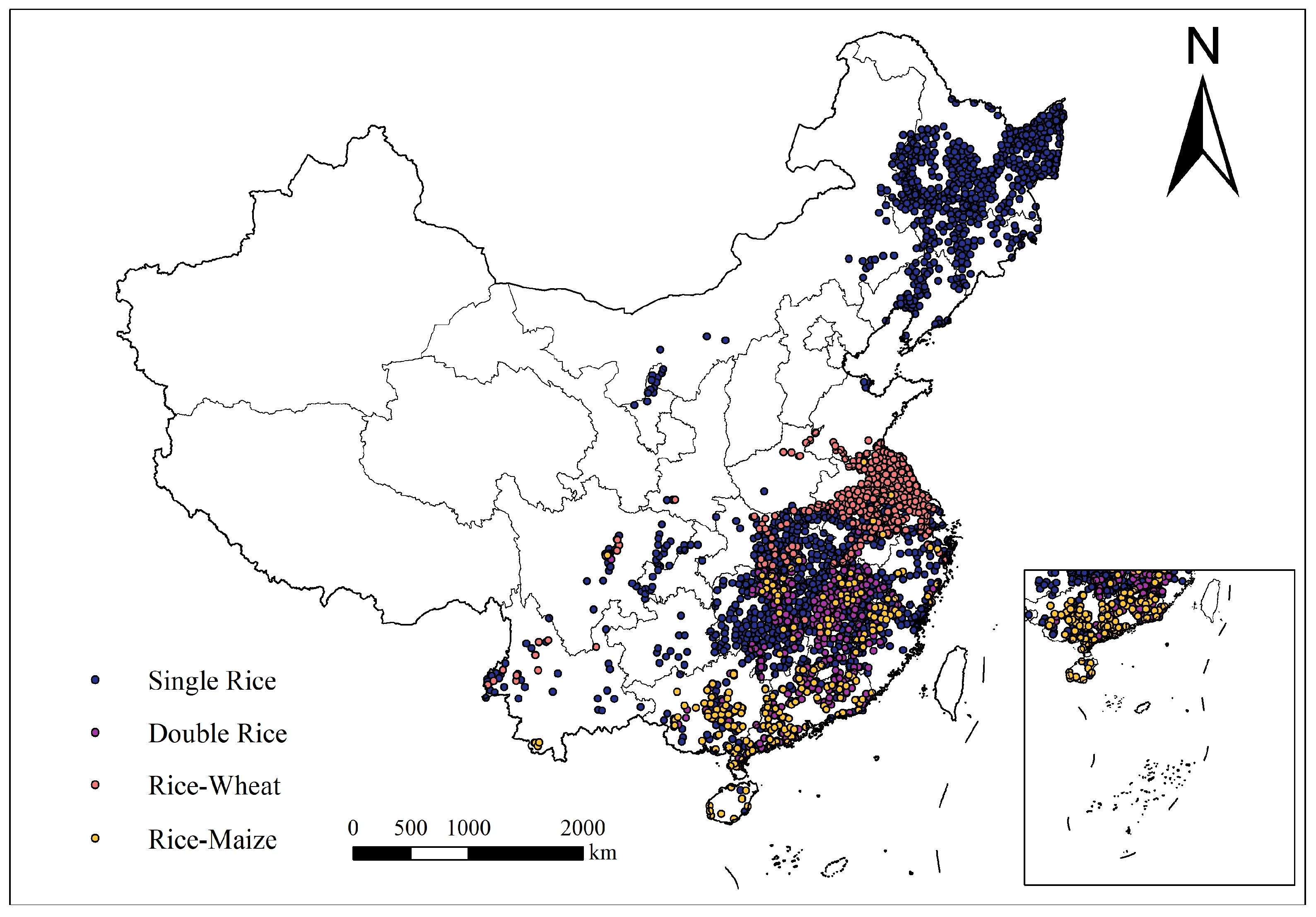
Figure 2.
ROC curves of the MaxEnt models for four rice cropping systems. Values in the legend indicate the mean AUC ± standard deviation from 10 replicate runs.
Figure 2.
ROC curves of the MaxEnt models for four rice cropping systems. Values in the legend indicate the mean AUC ± standard deviation from 10 replicate runs.
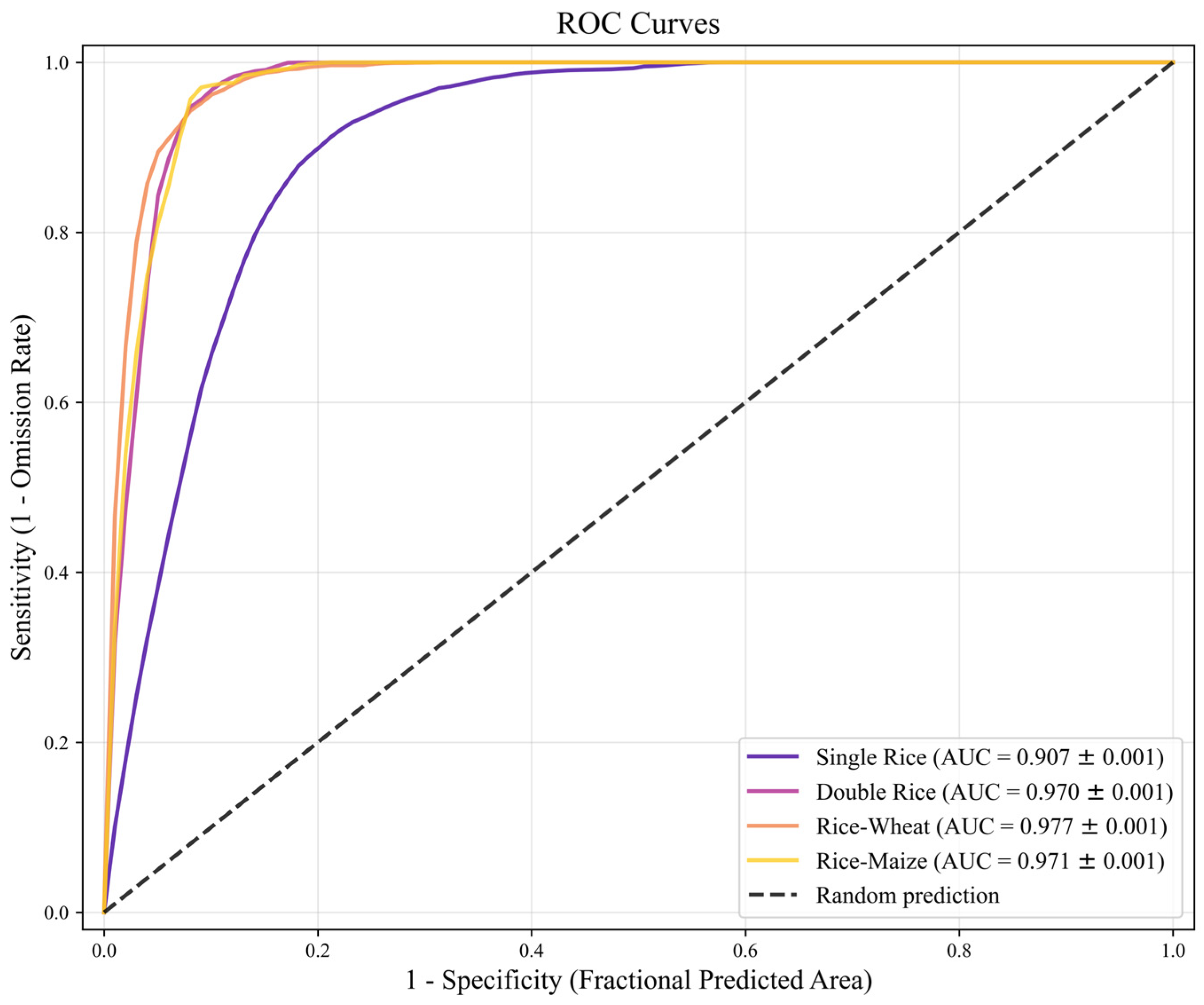
Figure 3.
Response curves of the four rice cropping systems to dominant environmental variables. (a) Annual precipitation (P); (b) Accumulated temperature ≥0
Figure 3.
Response curves of the four rice cropping systems to dominant environmental variables. (a) Annual precipitation (P); (b) Accumulated temperature ≥0
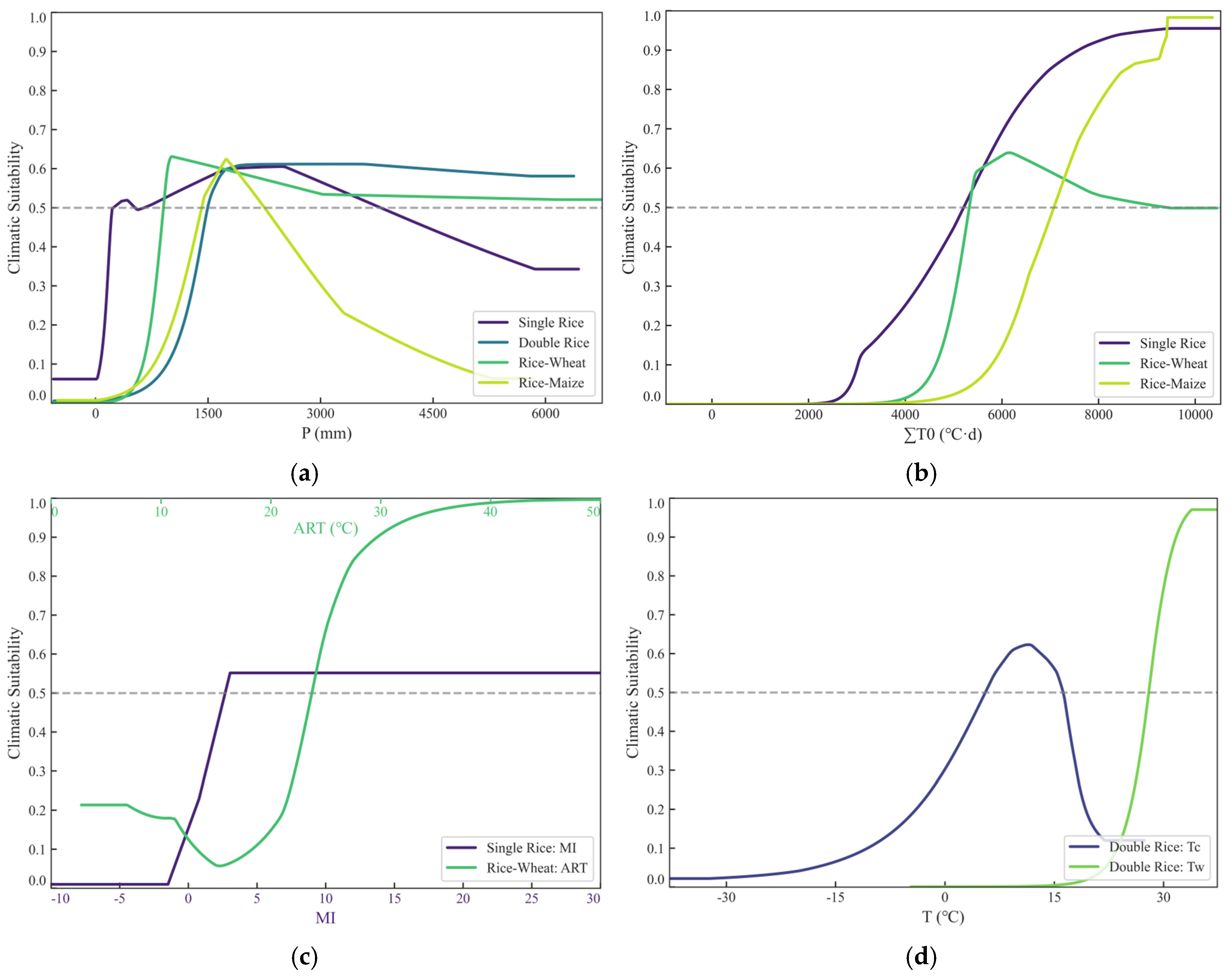
Figure 4.
Spatial distribution of habitat suitability index (HSI) for four rice cropping systems under historical climate conditions (1991–2020). Note: Values range from 0 to 1, displayed using a yellow-to-blue gradient. Red areas (High: 1) indicate high suitability, blue areas (Low: 0) indicate unsuitability, and yellow areas represent transitional zones. (a) Single-season rice; (b) Double-season rice; (c) Rice–wheat rotation; and (d) Rice–maize rotation.
Figure 4.
Spatial distribution of habitat suitability index (HSI) for four rice cropping systems under historical climate conditions (1991–2020). Note: Values range from 0 to 1, displayed using a yellow-to-blue gradient. Red areas (High: 1) indicate high suitability, blue areas (Low: 0) indicate unsuitability, and yellow areas represent transitional zones. (a) Single-season rice; (b) Double-season rice; (c) Rice–wheat rotation; and (d) Rice–maize rotation.
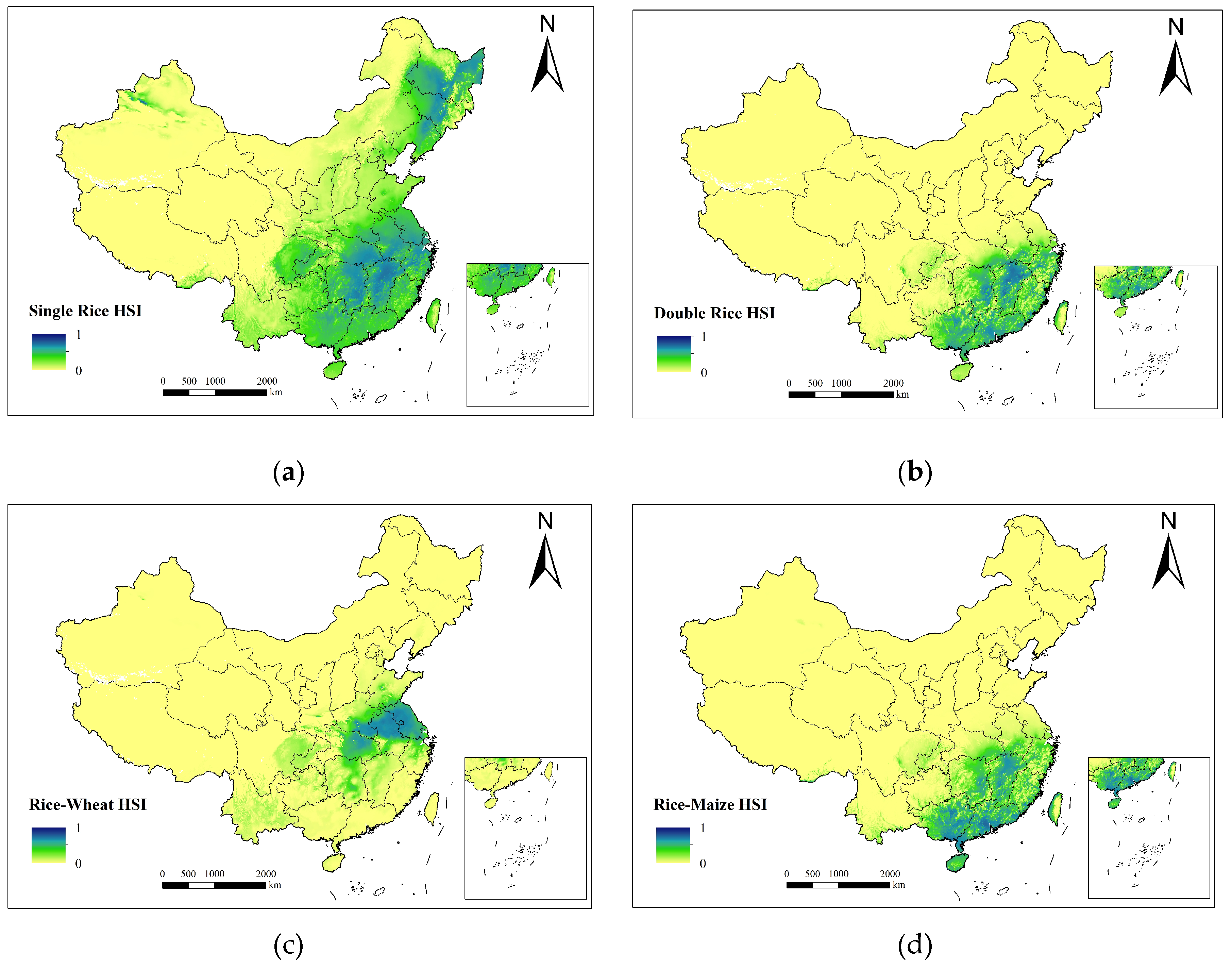
Figure 5.
Spatial distribution of changes in habitat suitability index (ΔHSI) for four rice cropping systems under future climate scenarios (2081–2100). Note: (a-b) Single-season rice; (c-d) Double-season rice; (e-f) Rice–wheat rotation; (g-h) Rice–maize rotation. The left column represents the SSP2-4.5 scenario, and the right column represents the SSP5-8.5 scenario. To ensure cross-system comparability, a unified color stretch range of [[-1, 1] is applied to all layers. Red colors (ΔHSI > 0) indicate increased suitability, while blue colors (ΔHSI < 0) indicate decreased suitability, with color saturation reflecting the magnitude of change.
Figure 5.
Spatial distribution of changes in habitat suitability index (ΔHSI) for four rice cropping systems under future climate scenarios (2081–2100). Note: (a-b) Single-season rice; (c-d) Double-season rice; (e-f) Rice–wheat rotation; (g-h) Rice–maize rotation. The left column represents the SSP2-4.5 scenario, and the right column represents the SSP5-8.5 scenario. To ensure cross-system comparability, a unified color stretch range of [[-1, 1] is applied to all layers. Red colors (ΔHSI > 0) indicate increased suitability, while blue colors (ΔHSI < 0) indicate decreased suitability, with color saturation reflecting the magnitude of change.
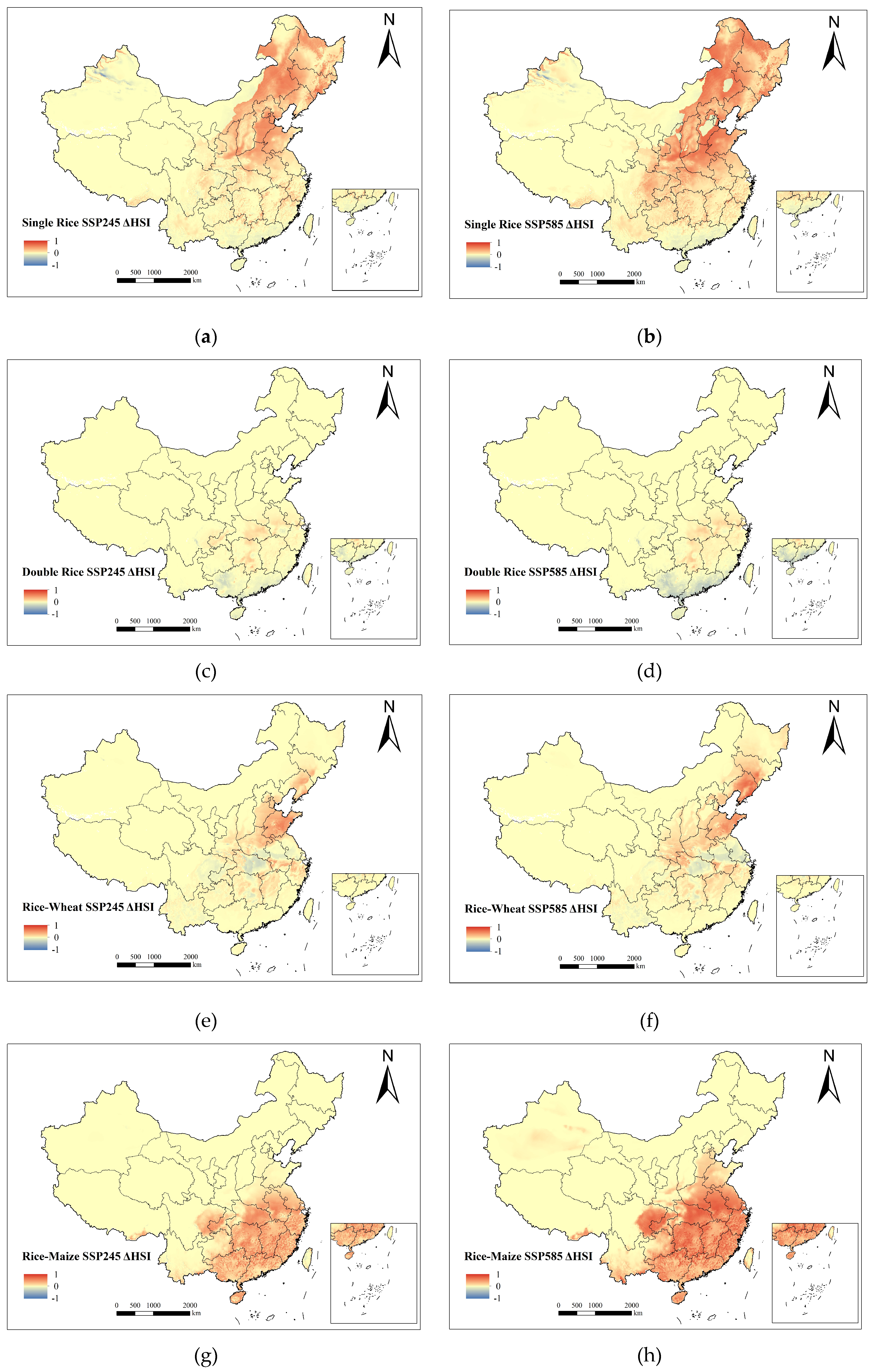

Table 1.
Permutation importance of environmental variables for four rice cropping systems.
| Variables | Single-season rice | Double-season rice | Rice–wheat rotation | Rice–maizerotation | |
| AT0 | 1.41 | 5.82 | 39.13 | ||
| AT10 | |||||
| Figure 3 | |||||
| N18 | |||||
| TC | 0.05 | ||||
| TW | 10.26 | ||||
| ART | 16.35 | 7.83 | 4.04 | 7.03 | |
| P | 5.79 | 47.62 | 11.88 | 24.93 | |
| MI | 24.42 | 0.01 | 14.17 | ||
Note: AT0: Accumulated temperature ≥0℃; AT10: Accumulated temperature ≥10℃; N10: Days with daily mean temperature stably ≥10℃; N18: Days with daily mean temperature stably ≥18℃; Tc: Mean temperature of the coldest month; Tw: Mean temperature of the warmest month; ART: Annual temperature range; P: Annual precipitation; MI: Moisture index. Values indicate the permutation importance (%) in the MaxEnt model.
Table 2.
Percent contribution and permutation importance of dominant environmental variables for four rice cropping systems.
Table 2.
Percent contribution and permutation importance of dominant environmental variables for four rice cropping systems.
| Rice cropping patterns | Environmental variables | Percent contribution (%) | Permutation importance (%) |
| Single-season rice | AT10 | 48.1 | 55.9 |
| P | 26.4 | 5.9 | |
| ART | 14.4 | 17.5 | |
| MI | 11.1 | 20.7 | |
| Double-season rice | P | 69.8 | 38.4 |
| TW | 27 | 42 | |
| TC | 1.9 | 16.4 | |
| ART | 1.2 | 0.6 | |
| MI | 0 | 2.6 | |
| Rice–wheat rotation | AT0 | 38.4 | 59.8 |
| P | 34 | 24.3 | |
| ART | 26 | 12.8 | |
| MI | 1.6 | 3 | |
| Rice–maize rotation | P | 51.8 | 17.6 |
| AT0 | 45.1 | 77 | |
| ART | 3.1 | 5.4 |
Disclaimer/Publisher’s Note: The statements, opinions and data contained in all publications are solely those of the individual author(s) and contributor(s) and not of MDPI and/or the editor(s). MDPI and/or the editor(s) disclaim responsibility for any injury to people or property resulting from any ideas, methods, instructions or products referred to in the content. |
© 2026 by the authors. Licensee MDPI, Basel, Switzerland. This article is an open access article distributed under the terms and conditions of the Creative Commons Attribution (CC BY) license (http://creativecommons.org/licenses/by/4.0/).
Copyright: This open access article is published under a Creative Commons CC BY 4.0 license, which permit the free download, distribution, and reuse, provided that the author and preprint are cited in any reuse.


