

Submitted:
30 March 2026
Posted:
01 April 2026
Read the latest preprint version here
Abstract
The old Le Sage’s hypothesis on the corpuscular origin of gravity is revisited. The discussion is developed along three lines: the "modern" wave approach, a "mass–flux" model of a relativistic fluid, and the traditional corpuscular model. The predictions obtained in all the three approaches are convergent with other current attempts. The main outcomes are the emergence of a maximal gravitational acceleration – compatible with the surface gravity of neutron stars – and the absence of gravitational field divergences for arbitrarily large or collapsed masses. The resulting theory differs from classical Newtonian gravity in its much clearer separation between the concepts of heavy mass and inert mass, a distinctive characteristic of the Le Sage-type (or “shadow gravity” or “Push–Gravity” (PG)) theories. The price to pay is the abandonment of the equivalence principle in its weak form, which might no longer be considered rigorously valid. We will only touch on the issue of experimental verification, which remains very difficult: the simple test we propose here is a rough estimate of gravity at the Earth’s equator and poles using PG theory, which indicates only qualitative agreement with experimental data. In this version, the section “XVII. NEWTONIAN VS RELATIVISTIC EFFECTS OF GRAVITY” has been added and small changes have been made here and there to the text and the bibliography. Finally, a cosmological speculation based on Le Sage’s idea is sketched, which is discussed at a preliminary and tentative level.
Keywords:
Le Sage’s theory of gravitation
; Push–Gravity
; cosmic background radiation
; gravitational absorption
; maximal acceleration
; “gravific machinery”
1. Introduction
Is gravity a push? The long-standing idea that gravity might be repulsive at a fundamental level occasionally resurfaces. The original, 18th century proposal is commonly credited to Le Sage (1748) [1], even though analogue suggestions by Fatio (1690) [2] and Lomonosov (c. 1747) [3] predate it. Generally met with skepticism, Le Sage’s theory, in various declinations, attracted sporadic interest until the late 19th century, when it enjoyed a revival as the development of the kinetic theory of gases made it less speculative and a possible candidate for the simplest explanation of the “true” origin of gravity, potentially overcoming the controversial question of Newtonian action at a distance. It was reappraised, among others, by great scientists like Kelvin (1872, 1873) [4,5], Lorentz (1900) [6], and J. J. Thomson (1904) [7], until persistent criticism, including objections from other greats like Laplace (1825) [8], Maxwell (1878) [9], and Poincaré (1908) [10,11,12], caused it to fall into disrepute. In the 20th century, with the general decline of mechanistic models and the advent of general relativity (GR), Le Sage’s theory lost almost all interest, with few exceptions. Among them, Feynman (1965) [13] re–examined the Lesagian mechanism as an example of a theory that reduces mathematical complication to a series of much simpler fundamental operations, but immediately discarded it for it predicts a drag on moving bodies, never observed. Conversely, in more recent years there was a resurgence of interest in Lesagian gravity. Among its major supporters, Arp (2002) [14] took it up again as a possible component of the solution of astrophysical and cosmological issues (anomalous redshifts). Other later developments of Le Sage-type (sometimes also called “shadow gravity” or “Push Gravity” (PG) lato sensu) models, occurring in various contexts ranging from unification of fundamental forces to low-energy quantum gravity, include contributions by Buonomano and Engel (1976) [15], Adămuti (1982) [16], Slabinski (2002) [17], Edwards (2014) [18], Fedosin (2015) [19], Wayne (2017) [20], Ivanov (2025) [21], and other authors.
Currently (2026), the most structured and comprehensive attempt to put PG in rigorous quantitative and testable form is the ongoing work by Danilatos [22], who is now striving to extend the momentum-transfer mechanism hypothesized for gravity to electromagnetic and nuclear interactions, indicating a way toward unification of the fundamental forces. Meanwhile, new suggestions for modernized versions of the old Lesagian paradigm resurface from time to time. For example, according to a recent (2023) proposal by Lahres [23], there are two possible sources of the repulsive effect of gravity:
- –
- the other masses of the universe;
- –
- a cosmic background gravitational radiation, which separated from other forms of energy in the early stages of the universe.
It is worth taking a closer look at these two possibilities. The first one, which encompasses Majorana’s theory of gravitational shielding [24], will not be discussed here except in passing, as the outcomes of Majorana’s and Le Sage’s theories are equivalent [25]. Therefore, each of the two theories can be translated into the other’s language. We will then focus on the second picture, more adherent to Lesagian original spirit. We will assume as in ref. [23] that some hypothetical form of background gravitational radiation, decoupled from other forms of energy in the early phases of the universe, exerts an isotropic repulsive effect on all parts of each test mass. A large mass close to one side of the test mass weakens the repulsive effect on that side. The outcome is a force that pushes the test mass toward the large mass. Not surprisingly, a linear approximation of the resulting law of force yields Newton’s law of gravitation and the standard gravitational field, while a more refined calculation predicts an exponential weakening of the force on the side of a very large mass, leading to a maximal gravitational acceleration of the test mass. This hypothetical PG scenario has potential cosmological implications [26,27] for big bang, the accelerated expansion of the universe, dark energy, and the physical mechanisms that might underlie repulsive gravity [23].
In our discussion we deliberately leave aside a detailed analysis of the drawbacks of PG models1as well as of the preliminary proposals of physical mechanisms that might possibly overcome notorious criticalities [28]. This is because we believe that the new efforts underway ([22,28]) to address the truly serious objection to PG – that of heating and/or mass accretion – are promising. Nor the subject of the experimental validation is addressed here except for a single test on Earth’s gravity that could possibly be added to the substantial number of tests suggested in ref. [22]. We believe that PG as a reassessment of standard Newtonian theory (NPG) has now reached a mature stage while a full push version of GR (PGR) is not yet in sight. However, a consistent theory of gravity must at the very least provide predictions compatible with the experimental constraints within which the outcomes of GR and Newtonian theory have been tested so far. So, in our opinion, a complete description of gravity in PG language is still lacking. Since shielding may be a property of gravitation (see e.g. ref. [29]) that remains outside the current understanding of GR, PG models, in so far as their distinctive features (gravitational shielding/absorption, maximal acceleration, …) are taken into account, could be viewed as test theories of GR itself and their respective predictions compared, tuning the model (or at worst ruling it out if untenable). However, in the lacking of a fully–equipped PGR, a test PG theory should at this stage be restricted to its Newtonian approximation. The following analysis brings to conclusions that match those reported in the relevant literature and especially in “Part One (1)” of ref. [22].
2. The Background Gravitational Radiation – Three Approaches to PG
In a universe permeated by background gravitational radiation of (as yet) unspecified origin, we consider three possible lines of attack to PG:
- 1.
- Radiation pressure (Wave theory). An all-pervasive radiant energy, which we assume to treat as electromagnetic radiation in a specific frequency range, propagates omnidirectionally as particles or waves, with no preferred direction. The radiant energy distribution is assumed homogeneous and isotropic in the spatial region of interest, that is, uniform at every point and in every direction. For now we are not concerned with the characteristics of this radiation (energy density, propagation speed, detailed emission mechanisms, interactions with matter, etc.) or its spectral composition. The radiation field is described by a classical theory similar to Maxwell’s electromagnetism. Radiation pressure exerts a mechanical action on ponderable matter. The radiation frequency is assumed extremely high (ultra-gamma) – or equivalently: only high-frequency radiation can be selectively absorbed/scattered by matter. The extremely high frequency requirement is necessary for the primary/secondary radiation to be extremely penetrating.2 Furthermore, the absorbed/scattered radiation frequency band must be large compared to the Doppler shift (due to the motion of the body relative to the background) for the braking effect due to gain/re-emission of energy (Poynting-Robertson drag or similar effect) to be small enough.
- 2.
- Simple (relativistic) fluid. The high frequency radiation is supposed to behave like a simple (relativistic) fluid: a continuous medium whose “particles” do not interact with each other in any way, capable of carrying mass and momentum (a “mass flux”) over distances (independent of the presence of ponderable matter). The material density of the medium (inertial mass per unit volume of space) is presumed homogeneous and constant everywhere in the given region. The term “relativistic” here refers only to the requirement that the mass density be defined in an appropriate reference frame as the energy density and the (linear) momentum density as the mass density.3 It has been observed that this assumption leads to inconsistencies in the case of the electromagnetic field [34]. We will leave this issue aside here.
- 3.
- Particulate gravitational field (Kinetic theory). The density of the fluid described above is so low that the radiation field can be considered completely localized into discrete units (gravitons4, gravions, radions, fations, lesagons or the alike)5 so far from each other that they almost never collide with each other (their mean free path is very large or virtually infinite). The fluid in such a condition has a presumed analogy with a rarefied gas of very high-frequency photons. We treat the problem by simply discretizing the continuous quantities in terms of number of (#) particles. The latter could be considered a special (or limiting) case of the above approaches.
In the following discussion, material bodies are considered (for now) stationary or in motion with negligible velocities with respect to the reference frame of the background radiation (Le Sage’s frame); rotations are not considered; material objects are assumed to have homogeneous density; coefficients and parameters characterizing the interaction of the radiation field with matter are assumed constant (and where applicable universal) unless otherwise stated.
3. Preliminary Definitions
The relevant radiometric quantities are the following (the suffix “e” indicates energetic quantities to distinguish them from photometric/photonic ones):
– Radiant energy: energy (in J) of the radiation field in the region of interest.
– Radiant energy density: radiant energy per unit volume (in J/m3)
– Radiant flux (or radiant power ): radiant energy emitted, reflected, transmitted, or received per unit time (in W)
– Irradiance (or flux density): radiant flux received by a surface per unit area (in W/m2)
– Radiance: radiant flux emitted, reflected, transmitted, or received by a surface per unit projected area per unit solid angle (in W)
(It is a directional quantity: is the angle between the normal to the surface and the axis of the solid angle).
– Radiant intensity: radiant flux emitted, reflected, transmitted, or received per unit solid angle (in W/sr)
The following actinometric quantities are defined in terms of the number of (#) particles counted:
– Energy of a radiant particle (“graviton”, “gravion”, …): in terms of the total number and the number density of particles in a given region we define the total energy and the energy density . Similarly we define the quantities , where the suffix “g” stands for “graviton/gravion/…”.
We also recall the following definitions:
– Solid angle: an elementary solid angle (in sr)
delimits a one-sheet cone (or semi–cone) in space; dA is the elementary surface area cut by the semi–cone on a sphere of radius r centered at the vertex of the semi–cone. The solid angle of the cone of revolution with plane angle at the vertex is
( for a hemisphere, for a sphere).
– Mass density: for point particles the mass density (in kg/m3) is defined as [35]
(and the corresponding integral for continuous media).
S – Poynting vector: power transported through the unit surface (in W/m2), defined as
where S, in analogy with the electromagnetic case, is the Poynting vector and the unit vector normal to the surface. S has the meaning of energy flux density. In the case of a linearly polarized plane wave , where is the wave unit vector.
g – Momentum density: the (linear) momentum density (in W) associated with the wave is defined as
– Mass density (relativistic fluid): the mass density associated to the energy density of the relativistic fluid is defined as
– Proper mass density: the proper mass density of the relativistic fluid is defined as
In case of departure from the simple plane-wave model, the previous relation is no longer strictly valid [36].
4. Radiation Pressure – Or Wave Theory
This is the “modern” approach to PG, even though it originally dates back to the mid-19thcentury [37].6 Within this line of thought fall, among others, the proposals by Lorentz (1900) [6], W. Thomson (1904) [7], Tommasina (1903, 1928) [30,31], Brush (1911, 1929) [32,33] and Klutz (1953) [38]. The present discussion follows in part the approaches in refs. [39] and [22].
The flux density received from a specific direction u within an elementary solid angle is
In the case of shielding material of small thickness dx interposed in the u–direction the flux will be attenuated by an amount proportional to the incident flux
and received downstream with density
In Equations (11) and (12) k (linear attenuation coefficient) is the ratio between the reduction in intensity of the radiant flux traversing the screen per unit length and the incoming flux (k is measured in m−1), x is the thickness and a build-up factor (BUF) introduced to account for secondary interactions within the screen. One can also use the mass attenuation coefficient of the Beer-Lambert law , related to the areal density (or mass thickness in kg/m2). From Equation (12) the net density received downstream in the u–direction is
Due to the presumed isotropy of the radiation incident at any point P in vacuum, the radiance is given by7
Recall that flux density is related to momentum density by [40]
and to the normal component of the momentum incident on the unit surface area per unit time by
Integrating over all possible directions within the solid angle defined by the shadow cone of the sphere (see Figure 1) and from Equation (16) we have:
(with the replacement , x dashed part of line u in Figure 1, and using Equation (40) below). is the radiation pressure on a surface element (assumed totally absorbing) normal to PO and containing P. The integration is over the projected surface area element normal to the u–direction; is the distance Ou and the rotation angle (not shown) about PO.
At low attenuation rates the following conditions apply:
Then the direct proportionality to the mass M (through the volume V and the density ) and the inverse proportionality to the squared distance is reproduced. We get in fact:
where we have introduced the mass attenuation coefficient . In extreme attenuation regime (saturation) the condition
holds. Then Equation (17) reduces to
representing the maximum possible radiation pressure that can be created, independent of the mass M and proportional to the cross-section .
5. Gravitational Field of a Point Mass
The following heuristic argument can be used to extend the validity of Equation (17) to the limiting case of the gravitational field of a point mass (and linear attenuation approximation). Let’s imagine to shrink the sphere in Figure 1 to a much smaller sphere with unchanged mass M. We have:
where the areal density
is measured in kg/m2. Furthermore, we assume to remain finite during the contraction. Then
which coincides with Equation (18). The flux density exiting a screen of thickness x is attenuated by a factor ; so, the downstream radiation pressure corresponds to a fraction of the incident flux. Suppose that a second small mass is placed at point P. Let dm be this mass, the thickness, and the attenuation coefficient. It experiences a force
where, by the previous definition (Equation (20)),
The accelerative field, in terms of force per unit mass, is therefore (in modulus)
which corresponds to the Newtonian field if we assume the mass attenuation coefficient in Equation (20) as a new universal constant of nature (or at least a constant in the region under study). Having dimensions of the inverse of an areal density, following ref. [22] we denote by the symbol (in (kg/m2)−1), i.e. we impose that in the given region. With this setting the Newton’s gravitational constant G becomes
We thus notice two significant departures from standard Newtonian theory:
- 1.
- G is no longer a fundamental quantity: it depends on the new natural constant and the energy density of the gravitational field (in the given region, e.g. the solar system, the galaxy, …);
- 2.
- and it may not even be a constant amount: it can diminish over time as the energy density of the gravitational field is reduced in the given region due to attenuation of gravity within ponderable matter. While a decrease in G over time and space remains a possibility, this seems at odds with recent findings by Danilatos (private communication, February 9, 2026). One might consider framing the constancy of G as an area for future reassessment.
On the other hand, the following standard Newtonian outcomes are preserved:
- –
- At low attenuation rates Newton’s gravitational law holds for a (homogeneous) spherical mass, with an external point mass as test body (homogeneous density of the central body is required for the constancy of 8 along any path within the body).
- –
- The field of the sphere at an external point is equivalent to that of the same mass shrunk to a smaller sphere.
6. The Relativistic Fluid – “Mass Flux”
Our study resumes at all attenuation rates in the scenario of a gravitational field endowed with material properties. Our discussion follows in part that in ref. [42]. The gravitational field is associated with a mass density assumed constant everywhere (or at least in the region of interest). In Figure 2 a “mass flux” (red arrows) flows perpendicularly through the spherical cap cut on a unit sphere (but any radius will do) by a semi-cone with the apex coinciding with the center of the sphere. From the isotropy hypothesis (Equation (14)) the radiant power in the spherical sector cut by the semi-cone is
or, in terms of the corresponding mass per unit time,
(the suffix “r” standing for “relativistic”). The associated linear momentum per unit time is
(From here on the discussion also follows in part ref. [39]) In Figure 3 a sphere is intersected by the small solid angle . Cutting the intersection with two parallel planes perpendicular to the chord AB a small frustum C of height and mass is identified. The mass flux absorbed per unit time and unit length within the frustum C will be proportional, through the linear attenuation coefficient k, to the mass flux injected at said intersection. The mass flux entering B and exiting A is attenuated within the frustum C by an amount
7. Mass Absorption by a Point Mass
Imagine a “point mass” as a spherical body small enough for the attenuation within it to be considered linear (according to Equation (27)). Let us divide its cross–section into a number of area elements and construct on each of them an elementary semi–cone circumscribing an elementary frustum of mass dm. If the spherical body is sufficiently small, all the elementary solid angles at the apexes of the semi–cones thus constructed are approximately equal to each other and to the solid angle of the semi–cone circumscribing the spherical body. Then in integrating Equation (27) we can extract the factor containing to get
For mass conservation the decrease in the field’s mass over time is counterbalanced by an increase in the rest mass of the small body by absorption of the corresponding mass flux. The increase, obtained by integrating over the entire space, is given by
where the momentum density of the gravitational field has been introduced. The rest mass of the small body then grows according to the exponential law
The problem of mass accretion will not be discussed here.
8. Progressive Attenuation of the “Mass Flux” Within a Massive Sphere
From Equation (27),
integrating on the chord BA (see Figure 3) we get
where is the field mass per unit time entering the elementary cone in B and the one exiting from A. In Figure 4 a test mass m has been introduced. From Equation (28) m absorbs a fraction
of the mass flux coming from the right in the direction AB, whereas from Equation (31) the absorbed fraction of the mass flux coming from the left in the direction BA is
To account for possible multiple scattering in the attenuating screen, a BUF can be introduced. It in general depends on many factors (energy of the incident particles, thickness of the shielding material, shape and size of the screen, etc.). Hence in general
By multiplying by c we can express the whole thing in terms of the linear momentum of the field absorbed per unit time by the mass m along AB, that is
so that, in the direction AB appears an attractive force on m:
If the attenuation within the sphere is low enough then , and the attractive force on m of an elementary frustum of height dx placed along the chord AB is given by
Since is the mass of the frustum and r its distance from m, we can reformulate the previous relation as
The attraction on m of a generic mass element C between A and B is evaluated by considering x variable and differentiating Equation (36) with respect to x, that is
where is the derivative of B with respect to . Notice that the attractive force does not depend on the position of C between A and B but only on the thickness x of the screen. Let () be the angle between the chord AB and the axis mO (see Figure 4) and the angle of rotation about mO; the element of solid angle about AB is
(or equivalently see ref. [39]).
9. Total Force on a Point Mass
The total force on m is evaluated by integrating Equation (36) with respect to . Noticing that by the chord theorem (Figure 4) CX:BX=XA:XD, viz
R being the radius of the sphere and the distance of AB from the center O of the sphere. Whence
r being the distance . Then, by multiplying Equation (36) by to get the force component along Om and integrating,
To evaluate the integral in Equation (41) we transform the integrand using Equation (40) as follows:
where
In general the BUF can be expanded in power series. For example, a proposed Taylor formula for gamma rays is (see ref. [43])
where are fitting parameters. As we expect low radiation absorption in ordinary situations then the conditions and hold and the integrand reduces to
Recalling that
it’s not hard to see that
Also recalling that we finally get
where
is the function introduced by Majorana [44]. The same result had been obtained in equivalent form by Radzievskii and Kagalnikova [42], and others, based on the Poincaré’s derivation in ref. [11]. The Majorana’s matches the q–factor defined in ref. [22]:
where is the absorptivity parameter
Introducing an “apparent mass” [44] and expanding up to the fourth order we get the two limiting cases:
- 1.
- (null attenuation)
- 2.
- (saturation)
For u small () but not negligible
Therefore the sought force is
and the accelerative field (in modulus)
10. Newtonian Limit and Maximum Acceleration
In general, with respect to standard Newton’s law, there would be an apparent decrease in the inertial mass (or “true mass” M [44]) with the progressive increase of the mass flux attenuation, according to a coefficient expressed by q. Also observe that from Equation (46), for test bodies of different composition, A and B, the so-called Eötvös parameter, that is
at ordinary attenuation rates, or
at saturation, signals a deviation from the equivalence principle in the weak form (WEP), which therefore we can no longer consider strictly valid in PG theories. In metric theories , in PG theories in general. Experimental restrictions on (e.g. using the Earth or the Sun as attractors) impose constraints on PG parameters that should be carefully assessed.
The corresponds to the null attenuation condition (or Newtonian approximation), which holds for (small linear attenuation coefficient - and/or small density - and/or small thickness). In this limit only a minute fraction of the incident mass flux is affected by secondary interactions, the BUF being essentially unity: ; hence the force is proportional to the inertial, “true” mass M, and indistinguishable from standard Newtonian gravitation:
The corresponds to the saturation condition, occurring for (high attenuation coefficient - and/or high density - and/or large dimensions of the absorbing layer) where the interactions, primary and/or secondary, involve the whole mass flux entering the body. In these conditions the BUF is practically irrelevant, since the total incident mass flux is absorbed; the intensity of the force on the unit mass is the maximum possible:
Notice that the maximal gravitational field is independent of M; for a not completely collapsed object (finite density) of arbitrarily large mass the gravitational field intensity does not grow beyond this limit. Since essentially in the Newtonian limit, the quantity
plays the role of the Newton’s gravitational constant G. The maximum possible acceleration on the surface of any star () is a new constant
independent of the size of the star. For stars of arbitrarily large mass and/or size, the gravitational acceleration at the surface cannot exceed that given by Equation (52). Notice that as the GR prediction is recovered. For non-vanishing , by introducing an “apparent Schwarzschild radius”
or
at the saturation condition (from Equation (45)), where Equation (46) has been used and where
(with R the radius of the celestial body), a collapsing object () does not incur the gravitational field’s divergence in for however small, as quadratically. Also notice that in PG the Schwarzschild radius at saturation does not depend on the mass of the star. The new natural constant has the same physical meaning as the Majorana’s attenuation factor h [45], whose current most stringent experimental upper limit is (see e.g. Eckhardt (1990), ref. [46]9)
to be compared with Majorana’s later experiments estimate [47]:
Taking for the from Equation (56), the lower limit for the mass density of the gravitational field is
and the lower limit for the maximum acceleration
which is of the same order of magnitude as the maximum acceleration due to gravity at the surface of a typical neutron star ( solar mass with a 10 km radius) [48]. However, the huge value of in Equation (57) leads to an untenable mass accretion rate according to Equation (30), which requires postulating the immediate re-emission (via a still unknown physical process) of the excess mass in the form of radiant energy. We are not discussing this issue for now.
11. Particulate Gravitational Field
This is the “old-fashioned” approach to PG, the so-called “gravific machinery” (see e.g. [49]). Besides Le Sage, in this vein, we recall the theories of Secchi (1864) [50], Leray (1869) [51], Kelvin (1872, 1873) [4,5], Schramm (1872) [52], Preston (1877, 1881, 1883) [53,54,55], Isenkrahe (1879) [56], Jarolimek (1883) [57], Vaschy (1886) [58], Ryšánek (1887) [59], Sulaiman (1934, 1935) [60,61], Shneiderov (1943) [62], and others; see also Peck’s review of the nineteenth-century corpuscular theory (1903) [63]. In the picture of a gravitational field thought of as radiant energy split into discrete and localized units, it is easy to translate the above quantities and formulas in particle language, i.e. in terms of the number of particles (gravitons, gravions, …) per unit volume. This task is not difficult. We could simply limit ourselves to giving the expressions for the radiation pressure and the accelerative field:
Expressing the energy density in terms of the particle density (number of gravitons, or gravions, etc. per unit volume) , viz , we immediately get
It is interesting to notice that G now depends on the number density of particles:
However, for completeness, it is worth to see how the particle (or corpuscular) approach allows us to get the above outcomes from first principles. A similar calculation (though approximate) to the one presented here was carried out by Annunziata in ref. [64]. Consider a small cylindrical test body B of cross–section dA, height dh and density (the cylinder is assumed sufficiently small for the thickness traversed by the particles to be approximately the same for all the directions of incidence of the particles). We also define:
– R – radius of a massive body (a “star”) of uniform density ;
– – an appropriate mass attenuation coefficient;
– – average number of (#) particles reaching the star’s surface unit area from the outside in one second;
– – (linear) momentum of the particle (in modulus);
– – velocity (and/or momentum) unit vector of the particle;
– – unit vector normal to the surface of the star (directed outwards).
Using the above definitions we can immediately evaluate:
– #particles arriving on the upper base of B in the time interval dt from all directions:
– #particles (out of the above total ) absorbed in the same time interval by B, giving up their momentum:
– #particles absorbed by the star before they reach the lower base of B in the time interval dt in the solid angle :
(this holds for linear attenuation; we will see later the generalization to the case of progressive attenuation; the motion of these particles inside the star before absorption occurs along a chord for a length x);
– #particles arriving on the lower base of B in the time interval dt in the solid angle :
– #particles (out of the above total) absorbed in the time interval dt by B, giving up their momentum:
12. Weak Gravitational Field Approximation - Newton’s Law
In this approximation we have:
– Momentum transferred to B in the time interval dt by particles coming from the outside of the shadow cone of the star in the solid angle :
– Momentum transferred to B in the time interval dt by particles coming from the interior of the shadow cone of the star in the solid angle :
– Total momentum transferred to B in the time interval dt in the solid angle :
where is the mass of B. Integrating,
For the integral between curly brackets we get
where and . Thus we easily get , and finally:
being the mass of the star. Knowing that and we get back to Equation (60).
13. Gravitational Field in the General Case
In the case of a strong gravitational field, the progressive absorption of particles can be treated by sectioning the chord length x into a large number n of small segments of length . Then the number of surviving (not absorbed) particles after the first segment is
after the second
and after the nth
In the limit , for the #particles reaching the lower base of B we get
and a fraction out of the above total of particles, corresponding to a momentum
are absorbed, by giving up their momentum. The same result can be obtained from a first–order linear differential equation for the #particles absorbed in the small segment dx,
with the initial condition . The solution takes the form
From the above initial condition , and therefore
On the lower surface of B will arrive
particles, and the argument continues as in the previous section. Finally, for the total momentum transferred to B in the time interval dt in the solid angle we find again:
In integral form:
From Section 9 the integral within curly brackets is equal to . With the correspondence all the previous results are exactly reproduced. Eq. 74 can be generalized, with appropriate integration limits, to any distribution of matter with variable for the component of g along :
In the perspective of the development of a future Quantum Push-Gravity (QPG), we could already imagine particles emerging from an appropriate quantum field and associate an oscillation frequency to the wavenumber k of each mode of a massless scalar field. The energy and momentum of massless particles are related as usual by ; the momentum of the particle associated with that particular mode will be and its energy . A quantum state of the field will be a superposition of the states for every single mode for all the infinitely many modes corresponding to all possible values of k. In the end, it should be possible to determine the energy density of a single mode of wavenumber k, , and the energy density of all modes, .
14. Gravitational “Attraction” Between Two Spheres
In early Lesagian models the particles of gross matter were modeled as rigid spheres. A detailed calculation of the attraction (and repulsion for the converse process) between two homogeneous spheres was first carried out by Darwin [65], confirming that Lesage’s theory could reproduce Newton’s law to a first approximation. He considered spheres of arbitrary size and distance apart as models of atoms and molecules of gross matter, treating separately the effects of the normal and transverse components of the momentum imparted by the impacting particles of cosmic matter, and neglecting secondary impacts with the two spheres. The outcome was that the force on a given sphere include a first-order term in (a being the radius of the affected sphere and R the distance between the spheres), and higher-order terms in various combinations of powers of the radii of the two spheres. These corrective terms cause the gravitational force on the larger sphere, due to the normal component of the bombardment, to be stronger than the gravitational force on the smaller. Conversely, the force due to the tangential component of the bombardment is stronger on the smaller one. The combined effect, including both the normal and tangential components, depends on the elasticity () and roughness () factors. For complete absorption () the force varies rigorously as the inverse square of the distance. In all other cases the result is approximate since the impacts of the comic particles reflected between the two spheres have been neglected in the calculations, but in general Newton’s third law is not strictly respected. For perfectly elastic collisions on smooth spheres, there cannot be force on either sphere. In the case of partial elasticity and roughness the forces between the spheres do not vary rigorously as the inverse square of the distance between their centers. If the spheres are of exactly the same size the third law is preserved, but this still leaves the law of inverse square imperfectly fulfilled. Only in the limiting case of perfect inelasticity and roughness (zero reflection) the inverse square law and the action and reaction principle become rigorous.
Poincaré [11] criticized Darwin in favor of a heuristic approach in the derivation of the exact Newton’s law in the limit of linear attenuation. Curiously, Poincaré is heavily indebted to Darwin and at a closer look his heuristic argument does not differ from the one in Darwin’s paper (which is actually attributed to Larmor [65]). Moreover, Poincaré’s assumption that a full sphere of gross matter can be replaced by one filled with spherules of infinitesimal size compared to their mutual distances is generally unrealistic.
Darwin’s and Poincaré’s derivations retain historical interest. Several other authors, and lately Danilatos [22], proposed formulas, involving appropriately defined apparent (heavy) masses of the two spheres, of the form
A law of the above form can be obtained from first principles involving the evaluation (possibly also numerical) of multiple integrals and a careful choice of the coordinate system (cf. [22]). The latter approach considers only the exchange of energy/momentum via absorption and re-emission (corresponding to Darwin’s scenario of perfect inelasticity and roughness). Although the computations need to be carried out in detail for the various proposed interaction mechanisms, the general form of the equation (76) can be assumed to be valid with reasonable certainty.
15. Gravitational Field at the Surface of a Homogeneous Ellipsoid
A computation that to our knowledge has never appeared in the PG literature is that of the gravitational field at the surface of an ellipsoid of revolution, which is approximately what our Earth is. It would be useful to evaluate the field at various points of the ellipsoidal surface for comparison with the corresponding Newtonian predictions and the instrumental measurements, and would represent a particularly simple, although potentially harmful, verification test as a complement of the terrestrial experiments discussed in ref. [22]. The surface of an ellipsoid of revolution, more specifically an oblate spheroid (Figure 5), centered at the origin, has equation
where and c are the equatorial and polar semi-axes respectively (with ). The ellipsoids in Newtonian theory are discussed for instance in ref. [66]. The parametric equations in spherical coordinates are the following:
with . In Figure 5 we have drawn a generic chord joining two points P0 and P0′ and a vector exiting the surface along the direction of the straight line joining the ends of the chord. For our purposes, however, it is sufficient to consider only chords lying on a meridian ellipse, since we will only evaluate lengths of chords with one end at a pole or at the equator, which represent reliable reference points in gravimetry. Since all chords with an endpoint at a pole lie on meridian ellipses, the field at a pole can be evaluated by integrating over all the chords of one ellipse and then with a second integration over the angle about the polar axis. However, for a point at the equator, there is only one meridian ellipse with chords converging at that point. Therefore, the same trick cannot be applied to calculate the field at a point on the equator. However, after integrating over the chords of the meridian ellipse converging at the equatorial point, one can underestimate the field at that point by integrating around the equatorial axis and overestimate it by taking the value predicted by the inverse square law. Considering the axial symmetry of the spheroid we can define a radius function
and work with the following parametrization:
In Figure 6 the coordinate system is fixed with the origin at the south pole, is the angle of the chord with the z-axis in the rz-plane. Due to the translation of the origin from the center of the ellipsoid to the south pole the parametrization changes as follows:
Then Equation (77) becomes
The chord length is
where
is the so-called “second eccentricity” (or “added eccentricity” [67]). From Equation (41), taking the z component of the force, we have
With the change of variable the integration limits between and change to (1,0) and we get
The integration is straightforward:
for small eccentricity. Then, from Equation (41) the force per unit mass at a pole is
For a homogeneous oblate spheroid
whence
coinciding with the value computed with the Newton’s formula.
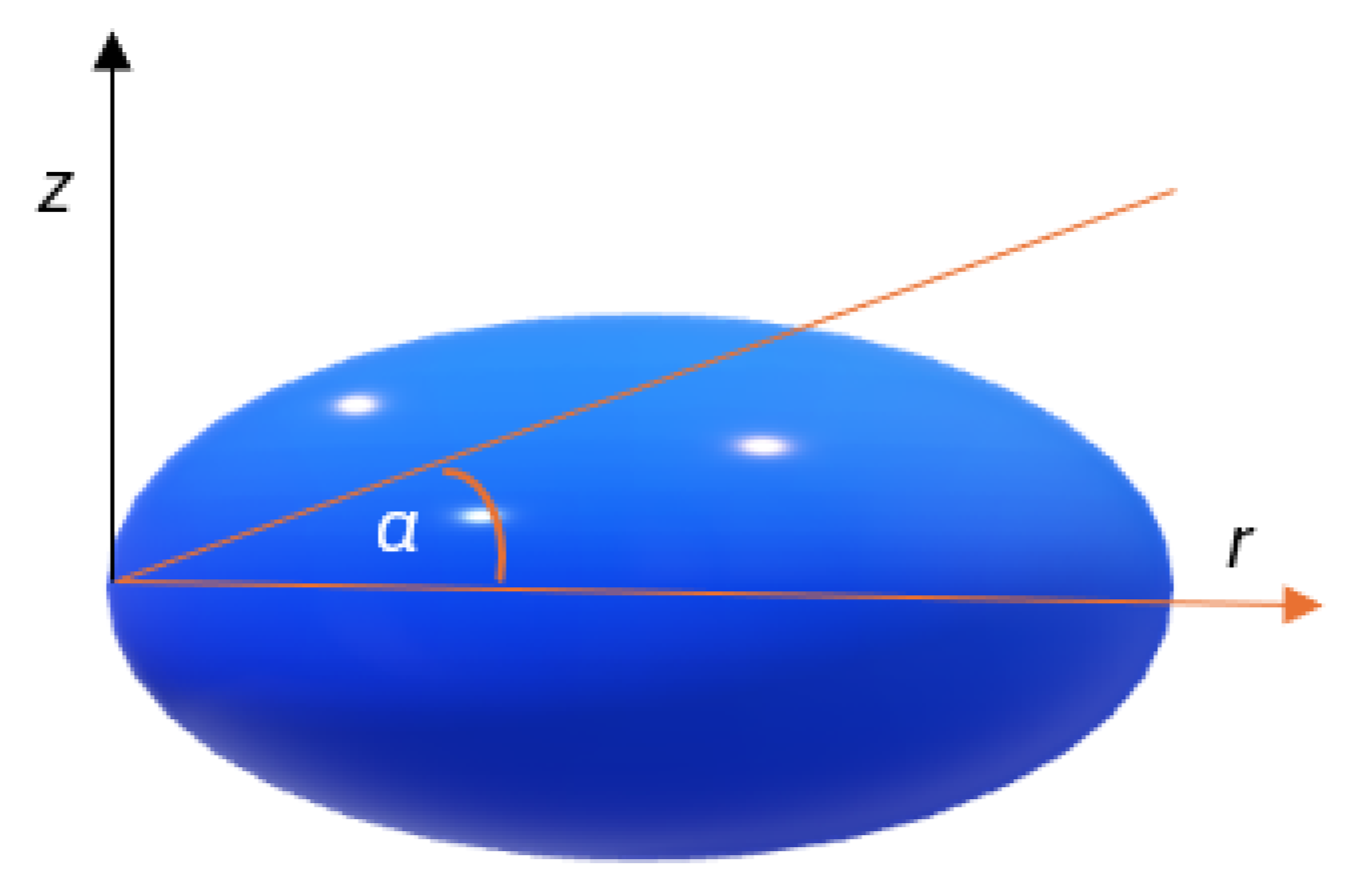
For a point at the equator (Figure 7) the parametrization changes as follows:
The chord length is
where
is the “eccentricity” (or “first eccentricity”). The relevant integral becomes
and for the force per unit mass at the equator we get the underestimate
that is times the Newtonian value, and the overestimate
which is less than the value at the pole as expected (not considering for now the centrifugal term).
16. Comparison with the Newtonian Ellipsoid and the Defined Gravity
The Newtonian formulas for the rotational ellipsoid are given in [67]. These formulas are for “normal” gravity, when the ellipsoid is an equipotential surface with the vector g normal to it. This condition occurs in the presence of rotation. For the non-rotating ellipsoid the surface is not equipotential and the terms containing the angular velocity must be eliminated from the equations. In this case, however, one can no longer speak of “normal” gravity and there is a component tangent to the meridian ellipse and tilted towards the Earth’s rotation axis. So, a body on the surface is not in equilibrium, except at the equator (unstable) and at the poles (stable). The modulus of the Newtonian gravitational field at the surface of the Earth’s ellipsoid is very well reproduced by the Somigliana formula
where is the latitude and where:
At this stage it is not actually necessary to use Somigliana’s formula as we only need to compare the PG–calculated values for equator and poles in the previous section with the measured values at the same points. However, it would be desirable if, at least in the linear attenuation regime of PG, a corresponding formula were to hold, that would allow a reliable comparison with Newtonian theory and experimental data. This hope incurs the difficulty that in PG the surface gravity does not behave in a Newtonian way. For the defined gravity at the equator (at sea level) and poles we have [68]:
We now introduce into our simple PG model the following parameters:
So we get:
In the lacking of a dynamic PG model for the Earth we consider spurious the estimate at the equator. The agreement is barely qualitative. The departures from the defined gravities at the equator and poles show that the homogeneous spheroid model of the Earth provides a very inaccurate estimate. We might consider using detailed density models of the Earth’s interior, such as PREM (Preliminary Reference Earth Model) [69]. Danilatos [22] has recently explored in this direction with a two-layer density model of planetary interiors, finding that, unlike the Newtonian model, surface gravity is influenced by the distribution of masses within the planet, with outcomes that can vary significantly with the density profile. This same fact was long ago highlighted by Russell [41]. In the PREM model the Earth’s density as a function of radius is represented by a piecewise quadratic function:10
Using eq. 82, the areal density (eq. 20), to be inserted into the Equation (41) in order to evaluate the value of the field, can be expressed by a piecewise integral:
where each step of the integration is on a segment of a generic chord that ends at the point where the field is evaluated and the sum is over the segments cut on the chord by the spherical layers it intercepts. All these sums over all the chords are then added together (via integration) to yield the field at the point under consideration. Unfortunately, just with only two layers the integration cannot be done analytically, and more detailed density models are likely to require significant or even demanding computational effort. We will avoid all that numerical work and limit ourselves to estimating the areal density along a diametral semi–chord, i.e. a Earth’s radius:
From the table of densities at different radii within the Earth [69] we get
contra
using the mean Earth’s density . The PREM-evaluated areal density is significantly higher than that estimated by the uniform density model, and both densities are overestimated, as we considered only diametral chords. Conversely, the “weighted” density , which is significantly different from the mean density, can be considered more representative of the overall internal distribution of Earth’s mass. To bring back to the behavior of Newtonian theory we could exploit the BUF (plugging it in Equation (75)) and require that
which would mean positing a non-local transfer of momentum, but this would be arbitrary at this stage.
17. Newtonian vs Relativistic Effects of Gravity
As we have seen, PG is a model capable of endowing gravity with basically all the properties described by Newton’s law of universal gravitation. More uncertain, in the current state of the theory, appears whether the PG concept has the potential to also justify the experimentally observed “relativistic” properties of gravity: the bending of the light path passing near a large mass, the gravitational redshift, the advance of Mercury’s perihelion, the slowing of radar signals through the Sun’s field, and some others. In the framework of a pure–PG (i.e. with a unique gravion medium) and an effective photon mass in a gravitational field, a recent preprint by Danilatos [70] addressed the problem of tracing, at least in part, the cosmological redshift back to a redshift of gravitational origin. A more conventional line of research explores an interpretation of GR which replaces curved space with flat–space pervaded by a medium capable of transmitting light waves (light–carrying medium - lcm). Einstein himself pioneered this idea (sometimes referred to as the “gradient–index” approach) suggesting that the path of light through a gravitational field is equivalent to its path through an optical medium with a varying refractive index [71]. But when trying to build a model of the bending of the light path by refraction in an optical medium, one immediately realizes that this medium cannot be the same one (Le Sage’s) responsible for the Newtonian effects of gravity. Indeed, due to the depletion of the Le Sage medium near large masses, light would bend toward the denser medium in the outer region, moving away from the mass, contrary to what is actually observed in gravitational deflection of light. Hence the need to introduce a separate lcm, like Tom Van Flandern’s elysium [72]. This second medium changes density/pressure depending on the gravitational potential , causing the wavefront to slow down as it passes through a region of refractive index [73]
(provided that ). de Felice [74] showed that light propagation in a curved spacetime can be modeled as light traveling through a refractive medium, establishing that the “equivalent medium” approach is a valid tool for interpreting GR, using optical analogies to describe gravitational phenomena. Solutions to real physics problems through optical equivalence have been worked out by Balazs [75], Skrotskii [76], and Winterberg [77].
A relativistic phenomenon that does not influence the propagation of light but the motion of material bodies, and whose explanation is still lacking in the framework of a single–medium PG, is the advancement of the perihelion (or of the periastron). Van Flandern proposed that the increasing density of the lcm toward the Sun causes a forward precession of Mercury’s elliptical orbit [72]. A detailed calculation worked out in [78] gave a transverse gravitational acceleration (in the direction opposite to the transverse velocity)
while the secular part of the perihelion motion due to the slight slowing caused by the effect of the lcm along the velocity component of the orbiting body is expressed by
(: longitude of perihelion, : orbital true anomaly, e: orbital eccentricity). In the case of Mercury , in agreement to within the errors of observation.
18. A “Gravific Machinery” Behind Dark Energy?
For purely exploratory purposes, we conclude with a very rudimentary exercise to test whether a Le Sage’s mechanism might underlie a sort of “pressure” causing the universe to expand at a changing rate as a manifestation of a dark energy (DE) which strength might be changing rather than be constant. It is a definitely crude exercise because we do not account for a detailed model of the expansion of a gas of Le Sage’s particles in an external void. The idea of a pressure gradient of a compressible fluid or a superfluid as the driver of the cosmic expansion is not new and we will not detail it here. Starting with a naive Newtonian model of expansion, we will try to see what might happen by introducing Le Sage particles (in the guise of DE particles) in a finite universe (a finite amount of matter and radiation) expanding in an (external, static) Euclidean space devoid of matter and radiation. Here we partly follow Annunziata’s discussion in ref. [64]. In Annunziata’s model DE is similar to a quintessence.
In Newtonian physics, the gravitational acceleration exerted by a homogeneous spherical distribution of matter, which we assume to be expanding, on a “particle” (a galaxy, cluster or super-cluster) placed on its surface, is given by
with the usual meaning of the symbols. We assume Equation (83) valid also in presence of DE particles, ignoring for now any matter at zero pressure (dust), radiation, or other stuff. To evaluate DE pressure (or Le Sage’s pressure), we presume the existence of a pressure gradient on a cosmological scale. Consider a volume slice traversed by a particle flow heading in the same direction as the cosmic expansion. Due to the DE pressure gradient, the pressure decreases in the direction from the inner to the outer face of the slice under consideration. The DE pressure gradient is and the magnitude of the force in the direction of expansion is
We are here presuming that the pressure p depends only on the scale factor R but does not explicitly depend on time. In other words, we are assuming the DE particle density stationary; so, the DE pressure gradient only depends on R. We are therefore considering negligible the decrease in pressure over time due to the absorption of gravific particles by gross matter (or assuming that DE particles form a specific sector not subject to depletion). This assumption may be quite reasonable as a first approximation. If we identify the DE particles with the gravific particles responsible for the Le Sage’s mechanism, to make their depletion negligible we posit an exorbitant, albeit finite, number of gravific particles circulating through the universe. We might define the space pervaded by these darting particles, which should have a mean free path of the order of the size of the observable universe, as a “gravific vacuum” (GV). The acceleration produced by the GV on a celestial object is then
As the gas model of our (massless) DE particles we assume an ultra–relativistic perfect gas and exploit the EOS
where u is the GV energy density. Thus
As the GV energy density u is presumed proportional to the particle number density n, then
whence
And finally
Notice that if we define , then
where represents an uniform relativistic acceleration. We can express the GV energy density u using the gravitational constant G:
with as an absorption coefficient of DE particles in matter. Inserting this last expression in Equation (84) and rearranging it a bit we get
and adding Equation (84) to Equation (83) in the simplistic assumption that there is only matter and GV energy in the universe:
One might conjecture that need not be strictly constant: it would be reasonable to expect that in the early stages of the universe the gravific/DE particles were more efficiently absorbed at high energies (or, correspondingly, low R), whilst a high density of both matter and vacuum favored a faster saturation of the absorption capabilities, viz, one might admit that . Thus Equation (86) becomes
where is some dimensionless constant. For comparison, for a generic component (matter, radiation, vacuum energy, …) holds the Friedmann equation
For vacuum energy , thus
Adding matter and vacuum contributions we have
So, with a dose of arbitrariness, we choose (). From Equation (87) at the instant when the Universe began to accelerate its expansion. In that instant
where is the redshift at which the expansion began to accelerate. Introducing the critical density and the density parameters we have that
At the current epoch and from the above . Interpreting the redshift in terms of recessional velocity, from the (relativistic) Doppler formula
we get , and from Hubble law, assuming from early–Universe measurements [79],
This way, the history of cosmic expansion would be governed by the parameter which rests on the changing of the attenuation factor . For the expansion of the universe would have begun to accelerate between six and seven billion years ago.
19. Concluding Remarks
The early 21st century witnessed a revival of a centuries–old idea: gravity is fundamentally repulsive, with a mechanism based on the exchange of momentum between a diffuse cosmic matter and the ordinary, ponderable matter. The main outcome of this idea is the concept of a heavy mass distinct from inert mass, a portion of which remains hidden from gravitational effects. This difference becomes appreciable when the attenuation of the flow of cosmic matter by inert matter is significant. This also results in a departure from the weak equivalence principle, which becomes more pronounced the larger the fraction of hidden mass is. The sacrifice of the equivalence principle in its weak form is compensated for by the emergence of a maximum acceleration at a gravitational saturation regime, which limits the magnitude of gravitational fields of any intensity, thus remaining finite even when the masses are collapsed. The estimated value of the maximum acceleration at the surface of a condensed star is of the same order of magnitude as the surface gravity of a neutron star. Since the cosmic matter has not been detected yet and remains hypothetical, one might wonder if its existence can be indirectly inferred through measurable effects. A very simple idea is to compare the gravitational forces measured at selected points on the Earth’s surface with the theoretical values deduced from the “push” hypothesis. A realistic calculation for the Earth is hampered by the need to consider a detailed density model of the Earth’s interior, such as PREM, which is very difficult to handle in PG theory. Coarse estimates of gravity at the equator and poles assuming a homogeneous Earth show a barely qualitative agreement, while a Newtonian estimate using the same homogeneous model yields very precise outcomes. However, ruling out “push” mechanisms in the generation of planetary gravity on this basis alone seems premature at this stage. “Push” mechanisms might also be hypothesized on a cosmological scale, although at present this possibility is highly speculative.
Funding
No Funding.
Acknowledgments
I thank Prof. Domenico Annunziata for introducing me through his work to Le Sage’s theory. I would also like to thank Dr. Gerry Danilatos for reading the preliminary manuscript and providing helpful comments.
Conflicts of Interest
No conflicts of interests
References
- G.–L. Le Sage (1818), Physique Mécanique des Georges-Louis Le Sage, in: Deux Traites de Physique Mécanique, P. Prévost (ed.), Geneva & Paris: J.J. Paschoud, 1818 (pp. 1–186).
- N. Fatio de Duillier (1743), De la Cause de la Pesanteur, in: De la Cause de la Pesanteur: Mémoire de Nicolas Fatio de Duillier, B. Gagnebin (ed.), Vol. 6, 1949 (pp. 125–160).
- M. V. Lomonosow (1758), On the Relation of the Amount of Material and Weight, in: Mikhail Vasil’evich Lomonosov on the Corpuscular Theory, H. M. Leicester (ed.), Cambridge: Harvard University Press, 1970 (pp. 224–233).
- W. Thomson (Lord Kelvin), On the ultramundane corpuscles of Le Sage, Edinb. Roy. Soc. Proc. 7 (1872): 577–589. [CrossRef]
- W. Thomson (Lord Kelvin), On the ultramundane corpuscles of Le Sage, Phil. Mag. 45 (1873): 321–332.
- H. A. Lorentz, Considerations on Gravitation, Proc. Acad. Amsterdam 2 (1900): 559–574.
- J. J. Thomson, Electricity and matter, Westminster: Archibald Constable & Co. Ltd., 1904.
- P.–S. Laplace (1825), Oeuvres completes de Laplace, Tome 5, Paris: Gauthier-Villars, 1882 (pp. 445–452).
- J. C. Maxwell, Atom, in: Encyclopædia Britannica, T. S. Baynes (ed.), vol. 3 (9th ed.), New York: Charles Scribner’s Sons, 1878 (pp. 38–47).
- H. Poincaré (1908), The foundations of science (Science and Method), New York: Science Press, 1913 (pp. 517–522).
- H. Poincaré (1906–7), Les Limites de la Loi De Newton, Bull. astron. XVII, n. 3 (1953): 181–265.
- H. Poincaré, La Dynamique de l’électron, Revue générale des sciences pures et appliquées 19, n. 9 (1908): 46–62.
- R. P. Feynman (1965), The Character of Physical Law, The 1964 Messenger Lectures, Cambridge, Mass.: Massachusetts Institute of Technology, 1967 (pp. 37–39).
- H. Arp, The observational impetus for Le Sage gravity, in: Pushing Gravity. New Perspectives on Le Sage’s Theory of Gravitation. M. R. Edwards (ed.), Montreal: Apeiron, 2002 (pp. 1–8).
- V. Buonomano and A. Engel, Some speculations on a causal unification of relativity, gravitation, and quantum mechanics, Int J Theor Phys 15, n. 3 (1976): 231–246.
- I. A. Adămuti, The screen effect of the earth in the TETG. Theory of a screening experiment of a sample body at the equator using the earth as a screen, Nuovo Cimento C 5, n. 2 (1982): 189–208. [CrossRef]
- V. J. Slabinski, Force, Heat and Drag in a Graviton Model, in: Pushing Gravity. New Perspectives on Le Sage’s Theory of Gravitation, M. R. Edwards (ed.), Montreal: Apeiron, 2002 (pp. 123–128).
- M. R. Edwards, Gravity from refraction of CMB photons using the optical–mechanical analogy in general relativity, Astrophysics and Space Science 351, n. 2 (2014): 401–406. [CrossRef]
- S. G. Fedosin, The Graviton Field as the Source of Mass and Gravitational Force in the Modernized Le Sage’s Model, Physical Science International Journal 8, n. 4 (2014): 1–18 (art. no. PSIJ.22197).
- R. Wayne, A Push to Understand Gravity: A Heuristic Model, The African Review of Physics 12, n. 2 (2017): 6–22.
- M. A. Ivanov, Gravity as a screening effect, Current Physics 2 (2025): 1–12 (art. no. e27723348373429). [CrossRef]
- G. Danilatos, Novel quantitative push gravity/field theory poised for verification (current Version v29), doi:10.5281/zenodo.18411867 (2026).
- S. Lahres: Was, wenn die Grundkraft “Gravitation” grundsätzlich abstoßend wirkt? (What if the basic force “gravity” is basically repulsive?). Proceedings of the German Physical Society SMuK 2023 20.-24. März 2023. Dresden: German Physical Society, 2023.
- Q. Majorana, XLVIII. On gravitation. Theoretical and experimental researches, The London, Edinburgh, and Dublin Philosophical Magazine and Journal of Science 39, n. 233 (1920): 488–504.
- R. de Andrade Martins, Gravitational absorption according to the hypotheses of Le Sage and Majorana, in: Pushing Gravity. New Perspectives on Le Sage’s Theory of Gravitation, M. R. Edwards (ed.), Montreal: Apeiron, 2002 (pp. 239–258).
- G. Danilatos, Is the big bang an artifact?, doi:10.5281/zenodo.11401298 (2024).
- G. Danilatos, The massive black hole bias: A potential origin for the cosmological redshift–distance relation without universal expansion, doi:10.5281/zenodo.17855884 (2025).
- S. Lahres, Effects of different interaction mechanisms between hypothetical gravions and matter on push gravity theories, doi:10.5281/zenodo.8176256 (2023).
- Q.–s. Wang et al., Precise measurement of gravity variations during a total solar eclipse, Phys. Rev. D 62 (2000): 041101(R) (3pp). [CrossRef]
- T. Tommasina, Sur la nature et la cause de la gravitation. Théorie électrique de la gravitation et des radiations, La Machine, nos 96–100, Genéve, 1903.
- T. Tommasina, La physique de la gravitation et la dynamique de l’univers : basées sur la découverte du mécanisme réel des radiations démontrant leur fonction gravitationnelle réciproque, Paris : Gauthier-Villars, 1928.
- C. F. Brush, A Kinetic Theory of Gravitation, Science 33, n. 845 (1911): 381–386.
- C. F. Brush, Gravitation, Proceedings of the American Philosophical Society 68, n. 1 (1929): 55–68.
- O. D. Johns, Is electromagnetic field momentum due to the flow of field energy?, Studies in History and Philosophy of Science 88 (2021): 358–366. [CrossRef]
- L. D. Landau and E. M. Lifshitz, The Classical Theory of Fields, 4th ed., Oxford: Butterworth-Heinenann, 1975.
- S. V. Vintskevich, V. G. Veselago and M. V. Fedorov, On a possible definition of the concept of ‘mass density’for a classical electromagnetic field in vacuum, Laser Phys. Lett. 12, n. 9 (2015): 096201 (3pp).
- F. A. E. Keller and É. Keller, Mémoire sur la cause de la pesanteur et des effets attribuès á l’attraction universelle, Comptes Rendus 56 (1863): 530–533.
- H. Klutz, The Lesagian theory of gravitation, Technical Engineering News 35, n. 1 (1953): 28–59.
- B. Mingst and P. Stowe, Deriving Newton’s Gravitational Law from a Le Sage Mechanism, in: Pushing Gravity. New Perspectives on Le Sage’s Theory of Gravitation. M. R. Edwards (ed.), Montreal: Apeiron, 2002 (pp. 183–194).
- C. Mencuccini and V. Silvestrini, Fisica, Vol. 2, Naples: Liguori, 1988 (p. 497).
- H. N. Russell, On Majorana’s Theory of Gravitation, Astrophysical Journal, Volume 54 (1921): 334–346.
- V. V. Radzievskii and I. I. Kagalnikova, The nature of gravitation, Vsesoyuz. Astronom.-Geodezich. Obsch. Byull. 26, n. 33 (1960): 3–14. English translation: U.S. government technical report: FTD TT64 323; TT 64 11801 (1964), Foreign Tech. Div., Air Force Systems Command, Wright-Patterson AFB, Ohio.
- Y. Zuo, J. Zhu and S. Niu, A comparative study of empirical formulas for gamma-ray dose build-up factor in iron and lead materials, IOP Conf. Series: Material Sciences and Engineering, 439 (2018): 022008.
- Q. Majorana, Sulla gravitazione. IV., Rend. R. Acad. Lincei XXVIII, n. 11 (1919): 416–4211.
- Q. Majorana, Sull’assorbimento della gravitazione. I., Rend. R. Acad. Lincei XXX, n. 10 (1921): 75–79.
- D. H. Eckhardt, Gravitational shielding, Phys. Rev. D 42, n. 6 (1990): 2144–2145.
- R. de Andrade Martins, Majorana’s Experiments on Gravitational Absorption, in: Pushing Gravity. New Perspectives on Le Sage’s Theory of Gravitation, M. R. Edwards (ed.), Montreal: Apeiron, 2002 (pp. 219–238).
- S. F. Green and M. H. Jones (Eds.), An Introduction to the Sun and Stars (illustrated ed.), Cambridge: Cambridge University Press, 2004, p. 322.
- E. Bellone, Classic and Non-intentional Consequences of some Newtonian Problems, Mem. S.A.It. 62, n. 3 (1991): 477–485.
- A. Secchi, L’unità delle forze fisiche, Roma: Tipografia Forense, 1864.
- A.–J. Leray, Theorie nouvelle de la gravitation, Comptes Rendus 69 (1869): 615–621.
- H. Schramm, Die allgemeine Bewegung der Materie als Grundursache aller Naturerscheinungen, Wien : Wilhelm Braumüller, k.k. Hof– und Universitäts–Buchhändler, 1872-1873.
- S. T. Preston, On some dynamical conditions applicable to LeSage’s theory of gravitation, Phil. Mag., 5th Series, 4 , n. 24 (1877): 206–213 (pt. 1) and 364–375 (pt. 2).
- S. T. Preston, LIII. On the importance of experiments in relation to the mechanical theory of gravitation , Philosophical Magazine Series 5, 11, n. 69 (1881): 391–393. [CrossRef]
- S. T. Preston, Eine dynamische Erklärung der Gravitation, Sitzungsber. Akad. Wiss. 87 (1883): 795–805.
- C. Isenkrahe, Das Räthsel von der Schwerkraft: Kritik der bisherigen Lösungen des Gravitationsproblems und Versuch einer neuen auf rein mechanischer Grundlage, Braunschweig: Friedrich Vieweg und Sohn, 1879.
- A. Jarolimek, Über die Gravitation, Sitzungsber. Akad. Wiss. 88 (1883): 897–911.
- M. Vaschy, Sur la nécessité de la loi d’attraction de la matière, J. Phys. Theor. Appl. 5, n. 1 (1866): 165–172.
- A. Ryšánek, Versuch einer dynamischen Erklärung der Gravitation, Repert. Exp. Phys. 24 (1887): 90–115.
- S. M. Sulaiman, The mathematical theory of a new relativity, Proc. Acad. Sci., U.P., India, 4 (1934/35), (1934): 1–36 (pt. 2) and (1935): 217–262 (pt. 3).
- S. M. Sulaiman, The mathematical theory of a new relativity, Proc. Acad. Sci., U.P., India, 5 (1935/36), (1935): 123–170 (pt. 2).
- A. J. Shneiderov, The exponential law of gravitation and its effects on seismological and tectonic phenomena: A preliminary exposition, Eos, Transactions American Geophysical Union 24, n. 1 (1943): 61–88.
- J. V. Peck, The Corpuscular Theories of Gravitation, Proceedings of the Royal Philosophical Society of Glasgow 34, (1903): 17–44.
- D. Annunziata, L’essenza della gravità. Nuove prospettive. Ediz. per la scuola, Lagonegro: Grafiche Zaccara, 2019. (in italian).
- G. H. Darwin, The Analogy between Lesage’s Theory of Gravitation and the Repulsion of Light, Proc. A 76, n. 511 (1905): 387–410.
- A. S. Ramsey, Newtonian Attraction, Cambridge: Cambridge University Press, 1981.
- C. Somigliana, Teoria generale del campo gravitazionale dell’ellissoide di rotazione, Mem.Soc.Astr.It., n. 4 (1929): 425–469.
- E. Groten, Fundamental Parameters and Current (2004) Best Estimates of the Parameters of Common Relevance to Astronomy, Geodesy, and Geodynamics, Journal of Geodesy 77 (2004): 724–797.
- A. M. Dziewonski and D. L. Anderson, Preliminary reference Earth model, Physics of the Earth and Planetary Interiors 25, n. 4 (1981): 297–356.
- G. Danilatos, The massive black hole bias: A potential origin for the cosmological redshift–distance relation, doi:10.5281/zenodo.19213024 (2026).
- A. Einstein, Uber den einflußder schwerkraft auf die ausbreitung des lichtes (On the Influence of Gravitation on the Propagation of Light), Annalen der Physik 340 (1911): 898–908.
- T. Van Frandern, Gravity, in: Pushing Gravity. New Perspectives on Le Sage’s Theory of Gravitation. M. R. Edwards (ed.), Montreal: Apeiron, 2002 (pp. 93–122).
- A. S. Eddington, Space, Time and Gravitation, 2th ed. (reprinted 1987), Cambridge: Cambridge University Press, 1920, p. 109.
- F. de Felice, On the gravitational field acting as an optical medium, Gen. Rel. Grav. 2, n. 4 (1971): 347–357.
- N. L. Balazs, Effect of a Gravitational Field, Due to a Rotating Body, on the Plane of Polarization of an Electromagnetic Wave, Phys. Rev. 110, n. 1 (1958): 236–239.
- G. V. Skrotskii, The influence of gravity on the propagation of light, Dokl. Akad. Nauk SSSR 114, n. 1 (1957): 73–76.
- F. Winterberg, Detection of gravitational waves by stellar scintillation in space, Nuovo Cimento B 53, n. 2 (1968): 264–279.
- T. Van Flandern, The Perihelion Advance Formula, Meta Research Bulletin 8 (1999): 10–15.
- N. Aghanim et al. (Planck Collaboration), Planck 2018 results, A&A 641, A1 (2020).
| 1 | See, for example, the popular Kevin S. Brown’s MathPages website for some further insight on this. |
| 2 | In the models of Tommasina [30,31] and Brush [32] very low frequency radiation was suggested. Brush later changed his mind and moved to extremely high frequency radiation [33]. Obviously, such an extremely high-frequency electromagnetic radiation would most likely have been discovered by now. It goes without saying that it must be an “exotic” type of radiation, unlike any known one. |
| 3 | Note on notations: “×” denotes the ordinary product (used wherever better clarity is needed), “·” the dot or scalar product, and “∧” the vector product. |
| 4 | Classical gravitons, not to be confused with spin–2 quantum particles. |
| 5 | More exactly, let us assume that the probability of finding more than one particle in a region of the size of a Compton length is negligible. |
| 6 | Other physical models are based on similar approaches, e. g. “mock gravity” (aka “radiation pressure instability”). |
| 7 |
. |
| 8 | This restriction can relax to a radially symmetric configuration (see e.g. ref. [41]). |
| 9 | Eckhardt’s is an indirect experimental measurement. |
| 10 | From ref. [69], this density function can be generated with constants indexed for each piece corresponding to a layer of the Earth’s interior. An Excel spreadsheet can be used to this purpose: an example can be found at the URL http://www.typnet.net/Essays/EarthGravGraphics/EarthGrav.pdf. |
Figure 1.
Sphere and external point P.
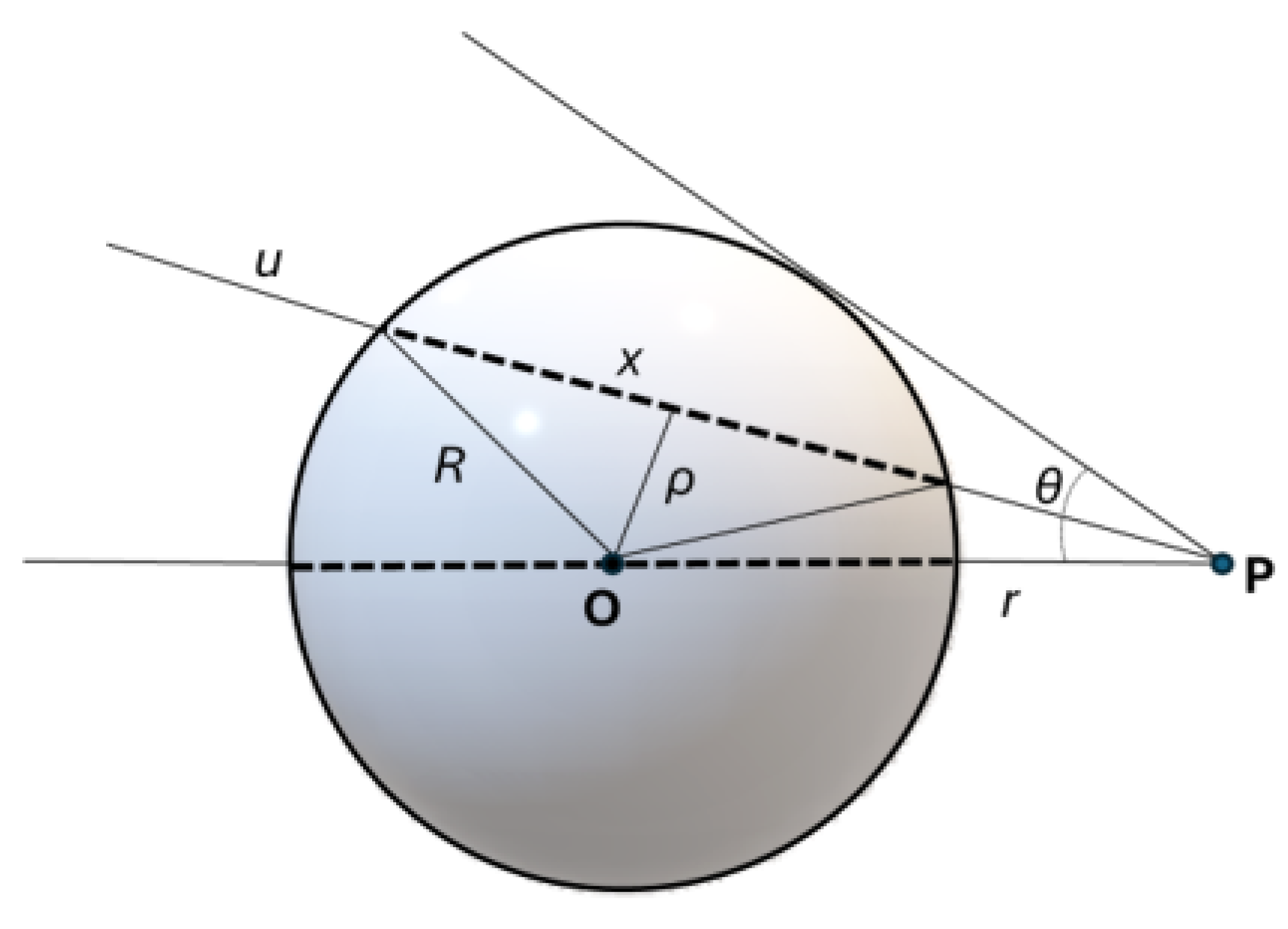
Figure 2.
“Mass flux” (red arrows) flowing perpendicularly through the spherical cap cut on a unit sphere by a semi-cone with the apex coinciding with the center of the sphere. The image is for illustrative purposes only (the magnitude of the solid angle has been exaggerated).
Figure 2.
“Mass flux” (red arrows) flowing perpendicularly through the spherical cap cut on a unit sphere by a semi-cone with the apex coinciding with the center of the sphere. The image is for illustrative purposes only (the magnitude of the solid angle has been exaggerated).
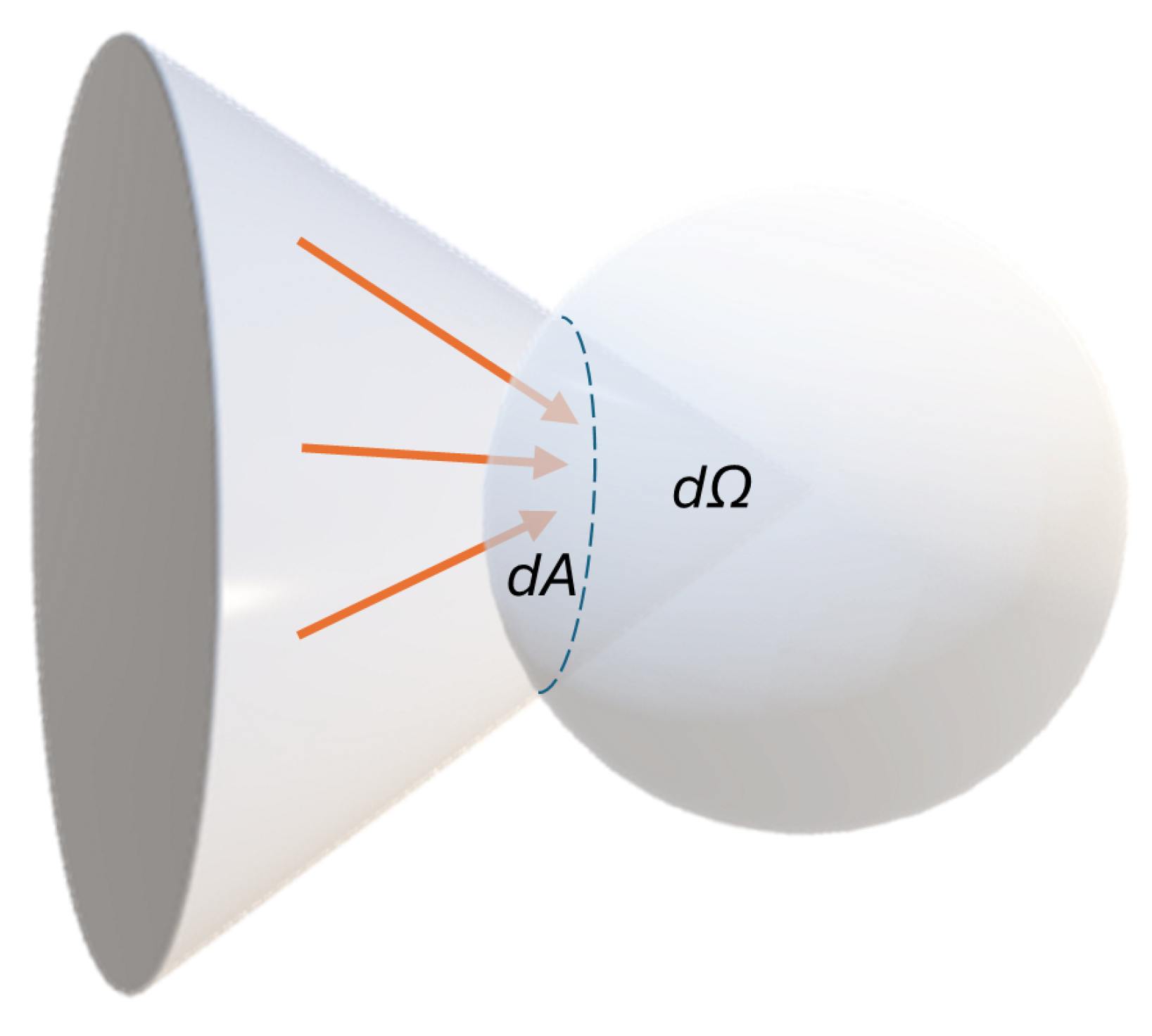
Figure 3.
Linear attenuation of mass flux injected into a sphere.
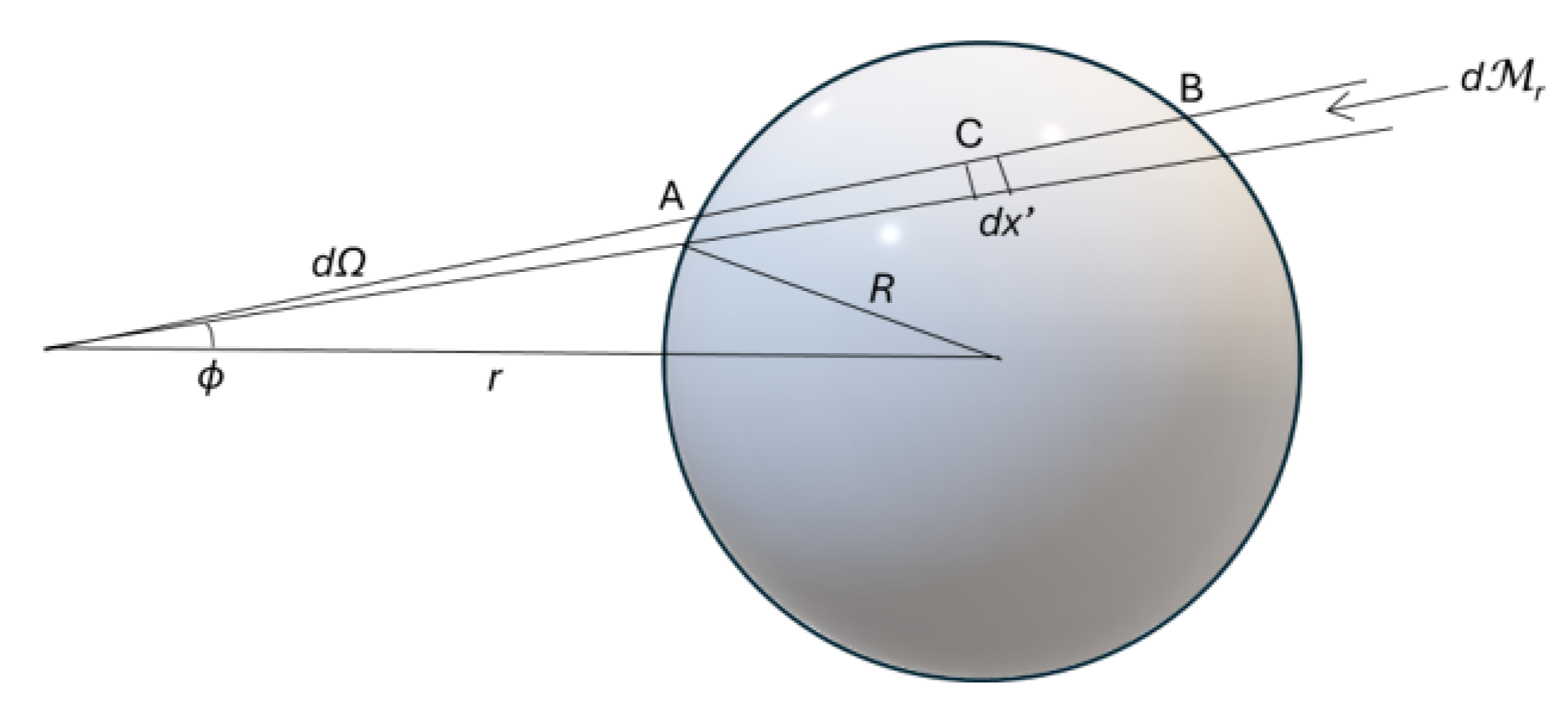
Figure 4.
Progressive attenuation of the mass flux within a massive sphere (blue).
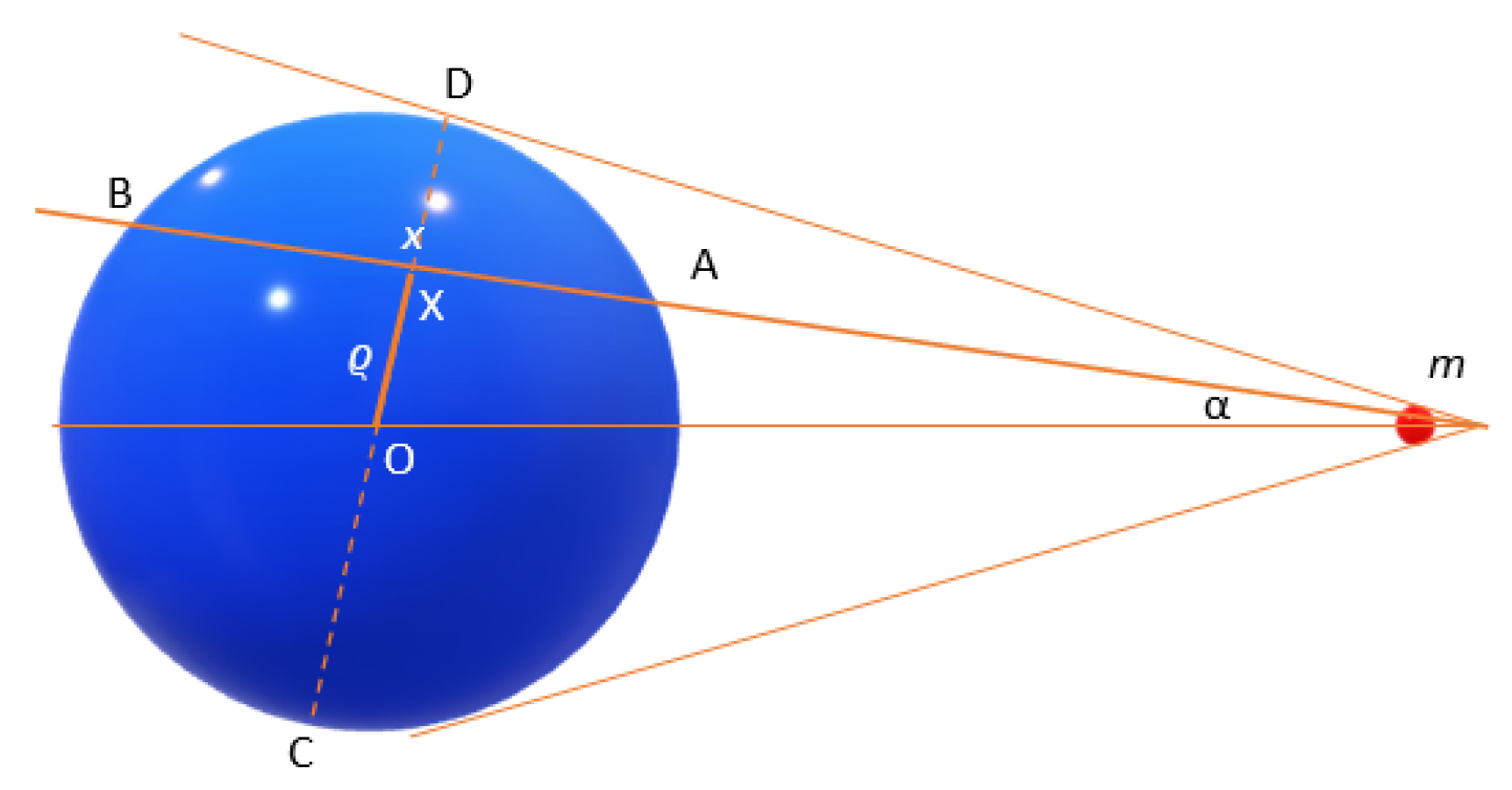
Figure 5.
Oblate spheroid and a generic chord. The oblateness has been exaggerated for illustrative purposes.
Figure 5.
Oblate spheroid and a generic chord. The oblateness has been exaggerated for illustrative purposes.
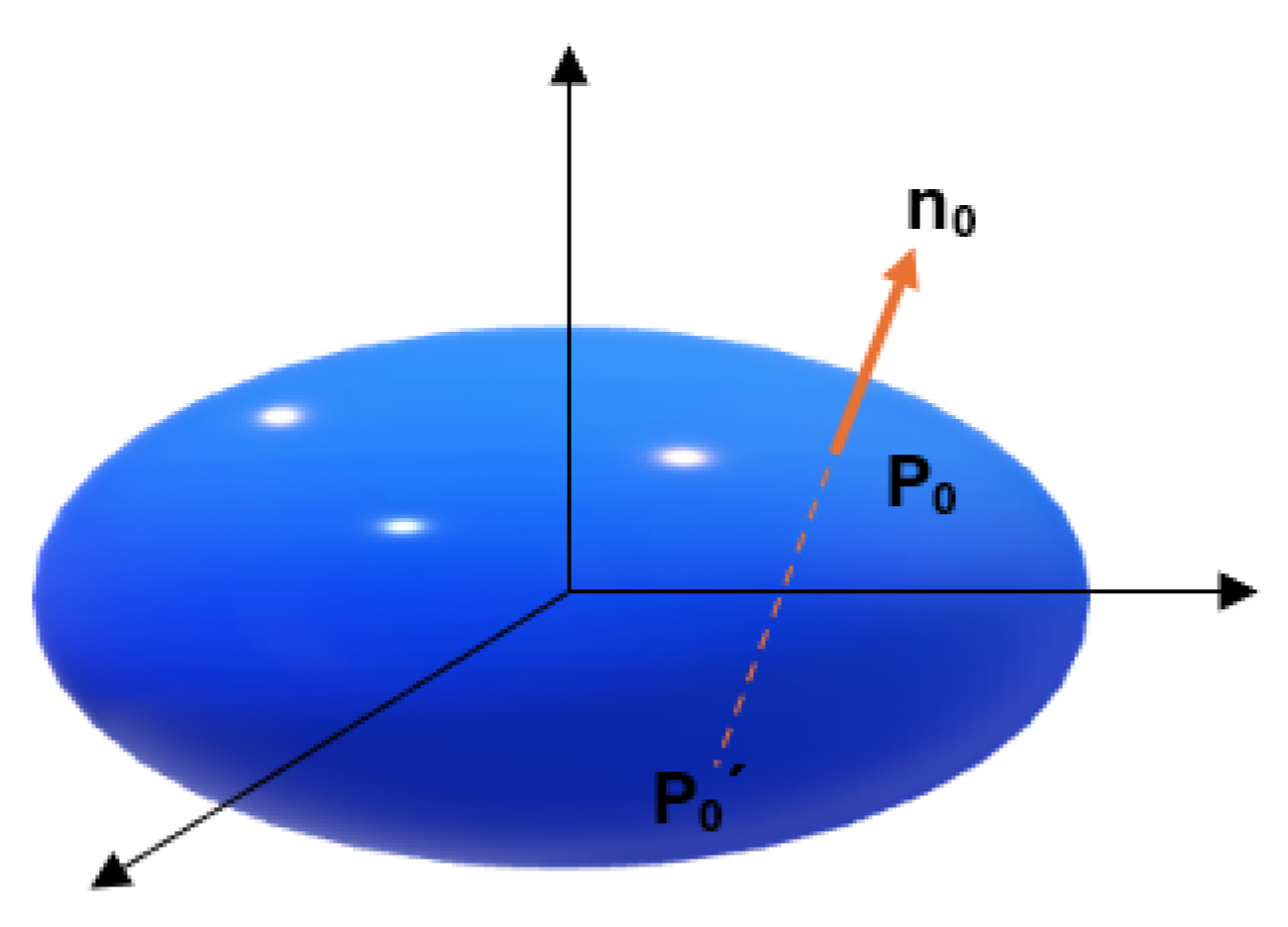
Figure 6.
Oblate spheroid and a chord ending at the south pole. Compared to Figure 5 the spheroid is shown rotated by a quarter of a turn for convenience.
Figure 6.
Oblate spheroid and a chord ending at the south pole. Compared to Figure 5 the spheroid is shown rotated by a quarter of a turn for convenience.
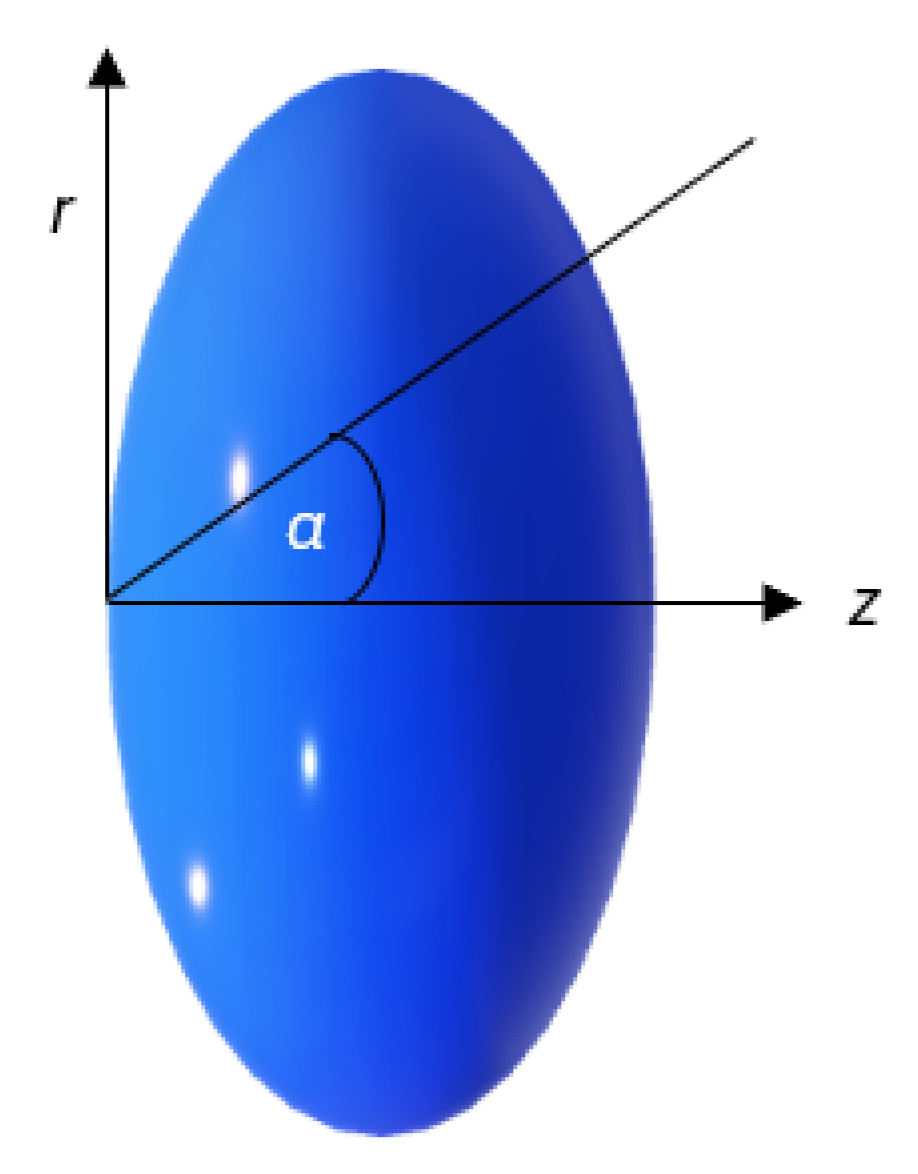
Figure 7.
Oblate spheroid and a chord ending at the equator. This is the Figure 5 with the origin translated to a point of the equator.
Figure 7.
Oblate spheroid and a chord ending at the equator. This is the Figure 5 with the origin translated to a point of the equator.
Disclaimer/Publisher’s Note: The statements, opinions and data contained in all publications are solely those of the individual author(s) and contributor(s) and not of MDPI and/or the editor(s). MDPI and/or the editor(s) disclaim responsibility for any injury to people or property resulting from any ideas, methods, instructions or products referred to in the content. |
© 2026 by the author. Licensee MDPI, Basel, Switzerland. This article is an open access article distributed under the terms and conditions of the Creative Commons Attribution (CC BY) license.
Copyright: This open access article is published under a Creative Commons CC BY 4.0 license, which permit the free download, distribution, and reuse, provided that the author and preprint are cited in any reuse.